Food container lids can quickly turn an organized kitchen cupboard into a cluttered space. Crochet food container lid sorting rack inspiration offers a softer, more attractive way to arrange everyday storage lids. This collection explores 19 different designs, including compact countertop racks, drawer dividers, cabinet-door organizers, rotating holders and wall-mounted storage. You’ll find ribbed crochet textures, gentle scalloped edges, colorful dividers and practical layouts for different lid shapes.
Some kitchens need a narrow organizer that fits inside a cupboard, while others benefit from a larger rack that keeps several lid sizes within easy reach. These ideas help you compare storage capacity, access, cleaning needs and the amount of space each design occupies. Most concepts combine decorative crochet with a separate rigid frame, making it easier to imagine a functional organizer rather than expecting soft yarn alone to support upright lids.
These are AI-generated crochet design visualizations for inspiration, not photographs of tested handmade pieces or step-by-step patterns.
Quick Design Selection Guide
- For limited counter space: Crochet Sage Countertop Rail Rack and Crochet Mustard Wrapped-Peg Rack provide compact layouts with straightforward access to upright lids.
- For small cupboards: Crochet Olive Corner Wedge Rack and Crochet Lilac Graduated Slot Tower use corner or vertical space differently.
- For hidden storage: Crochet Dusty-Blue Drawer Grid Rack and Crochet Blush Cabinet-Door Sling Rack keep lids arranged away from the countertop.
- For larger lid collections: Crochet Terracotta Two-Tier Cradle Rack and Crochet Color-Coded Family Rack separate multiple sizes and shapes.
- For adjustable storage: Crochet Mint Sliding-Track Rack and Crochet Berry Folding Accordion Rack offer different ways to change divider spacing or storage footprint.
- For easier textile removal: Crochet Mocha Removable-Sleeve Rack gives readers a design direction focused on detachable crochet covers.
1. Crochet Sage Countertop Rail Rack
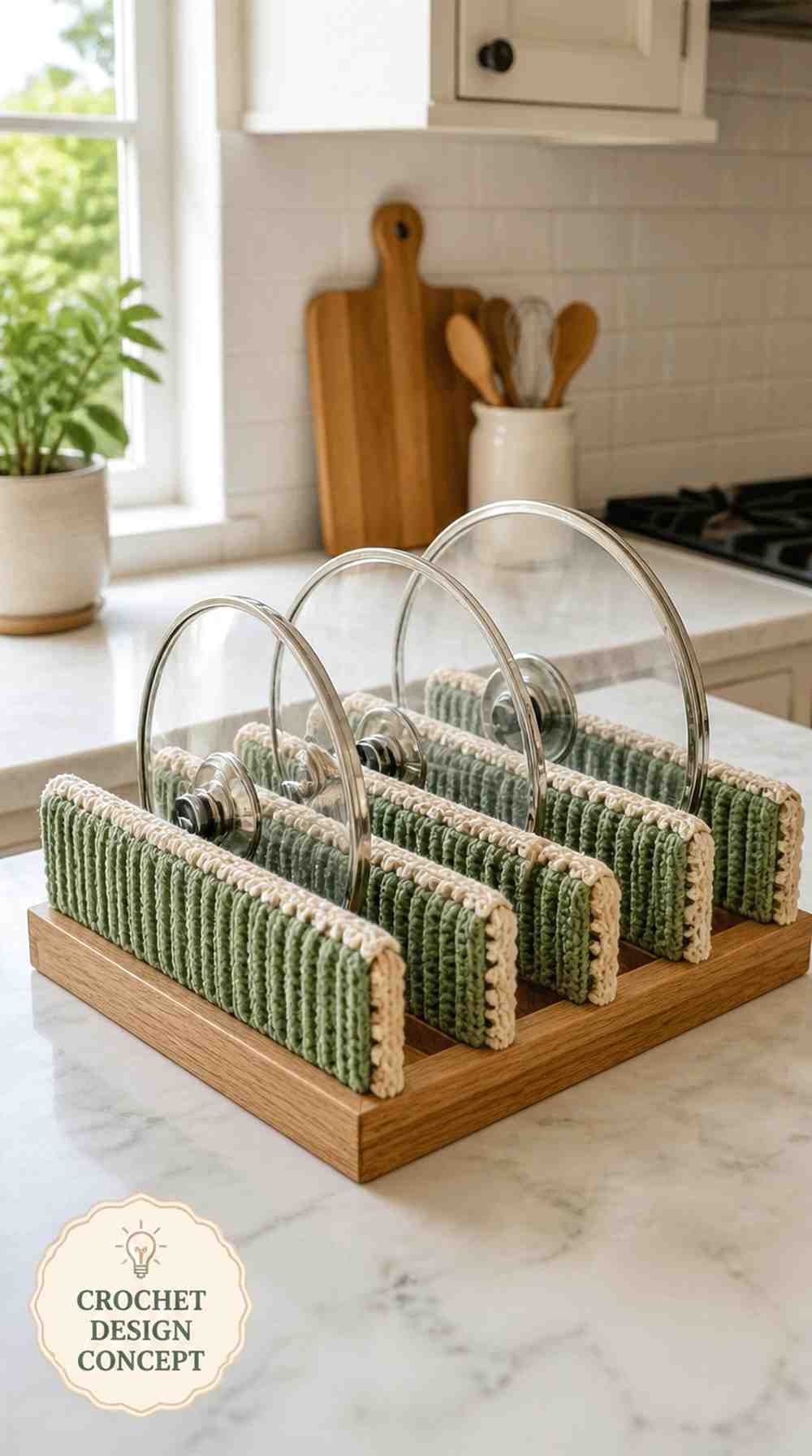
Sage-green crochet gives this rectangular oak rack a calm, welcoming finish. Five parallel divider rails wear snug ribbed crochet sleeves, while small ivory scallops soften their upper edges. Four round food container lids stand upright between the rails, creating clear spaces for everyday kitchen storage.
The wooden framework is an important part of the concept because the crochet serves as a decorative covering rather than the main support. The shallow rectangular layout could suit a countertop where a few frequently used lids need to remain visible.
- Divider spacing: Check the thickness of your actual lids before choosing gaps between rails. Shallow lids need different clearances from deep snap-on styles.
- Scalloped edging: The ivory scallops work best as small decorative details. Keep them away from the lid contact points if they catch during removal.
- Countertop footprint: Measure both the rack width and the space needed to lift lids comfortably without disturbing nearby kitchen items.
- Cotton selection: Consider a firm, washable cotton yarn for the sleeves, but check its care instructions and dry it thoroughly before returning it to the rack.
2. Crochet Oatmeal Wall-Mounted Slot Rack
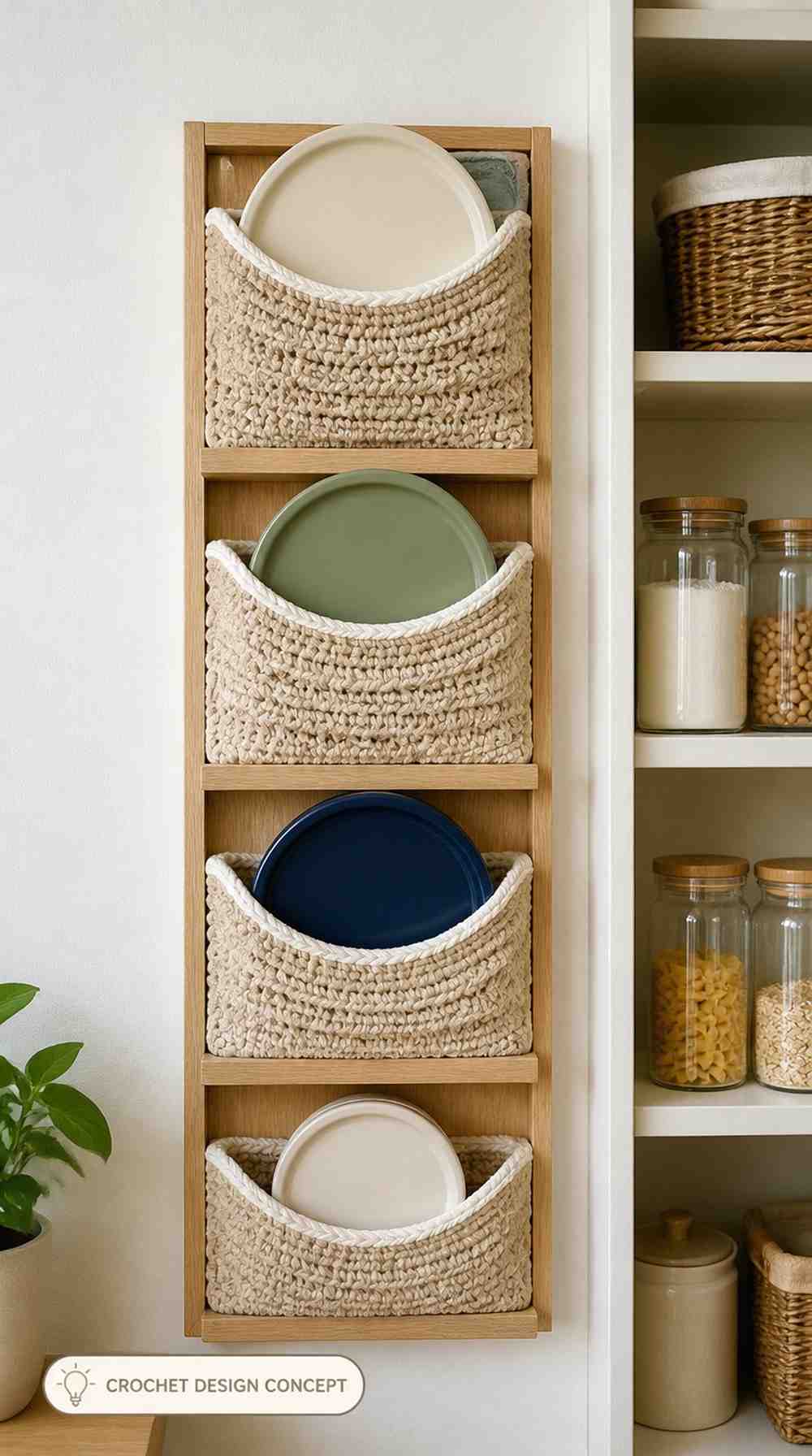
For kitchens with little spare counter space, this oatmeal crochet rack introduces a vertical storage arrangement. Four half-moon crochet slots sit inside a slim oak wall frame, with narrow wooden ledges supporting the individual lids. Raised stitching and cream piping outline each curved opening.
The four round lids remain partly visible, making their different sizes easier to recognize. Because the design relies on a mounted frame, the attachment method and wall location matter just as much as the decorative crochet.
- Mounting position: Place the rack where each lid can be lifted out without hitting the shelf above or another cupboard door.
- Curved slot depth: A shallow half-moon opening may suit a thin lid, while a deeper lid needs enough clearance around its edge.
- Wall protection: Check how the wooden framework contacts the wall, especially if lids are removed frequently and the rack could shift.
- Cleaning access: A removable crochet sleeve or slot covering would make maintenance easier than permanently attaching washable yarn to an unwashable wooden frame.
3. Crochet Terracotta Two-Tier Cradle Rack
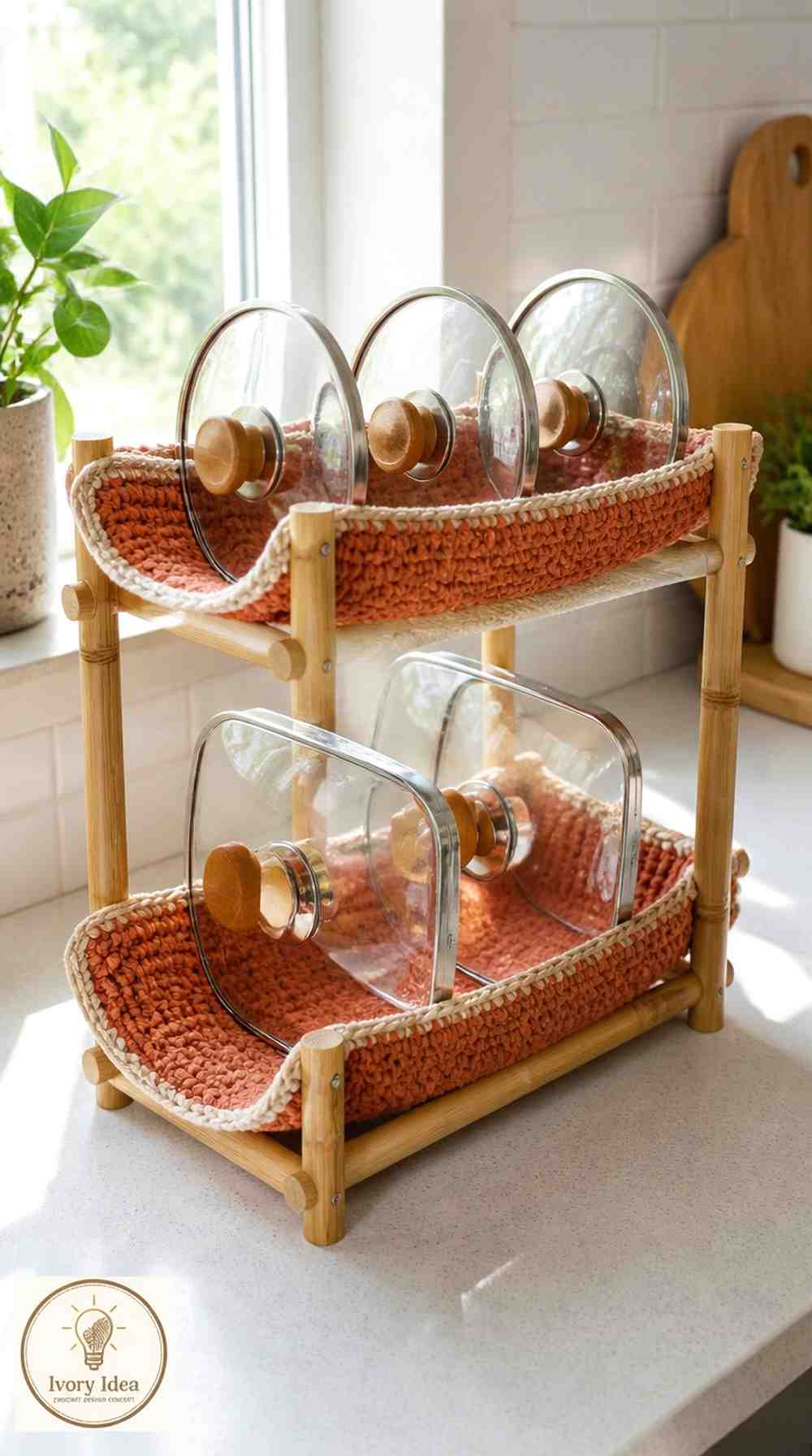
Warm terracotta crochet creates two distinct storage levels within this bamboo countertop rack. Three smaller round lids sit in the upper row, while two larger rectangular lids occupy the lower row. Closely crocheted cradle bands curve around slender bamboo bars, with narrow sand-colored edging defining their edges.
Its main advantage is the division between smaller and larger lids. Rather than mixing everything into one line, the tiered arrangement gives different sizes their own space. The supporting bamboo frame must carry the weight and maintain the shelf spacing.
- Upper-tier clearance: Leave enough vertical room to remove small lids without brushing against the supporting structure.
- Lower-tier capacity: Measure the tallest rectangular lid before selecting a lower compartment height; wide lids may also need more depth.
- Cradle tension: Crochet bands could sag if poorly supported, so a real version should use securely anchored bars and suitable structural reinforcement.
- Material combination: Bamboo and cotton create a warm appearance, but any finished rack needs cleaning methods appropriate to both materials.
4. Crochet Dusty-Blue Drawer Grid Rack
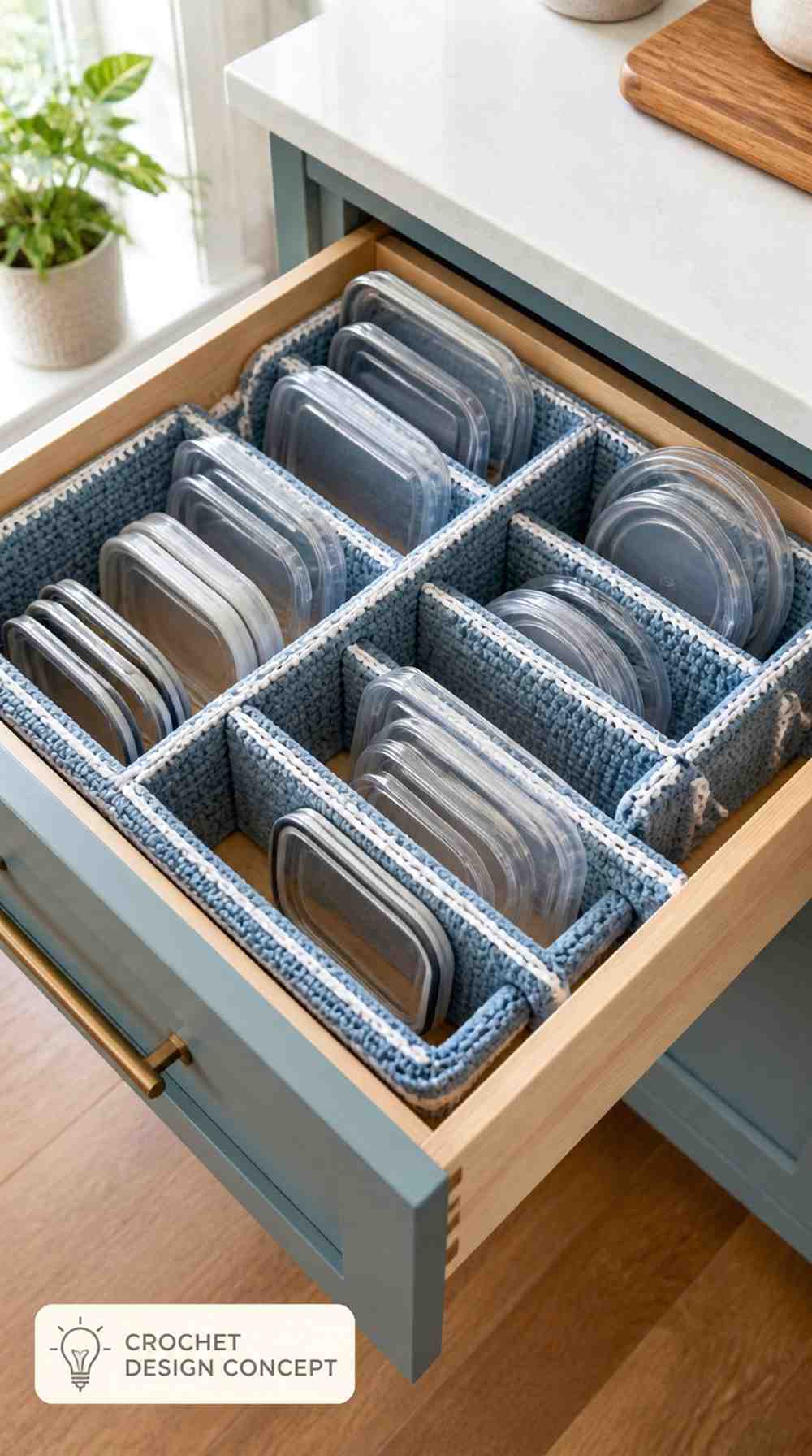
Dusty-blue crochet sleeves turn a practical drawer divider into a coordinated storage feature. Six straight partition rails create individual grid sections inside a wide kitchen drawer. White edging highlights the partitions, while square, round and rectangular lids stand upright in separate spaces.
The low profile keeps the organizer out of sight when the drawer closes. Unlike a countertop rack, however, the drawer grid needs careful planning around drawer height, lid dimensions and the space available for opening and closing.
- Drawer height: Measure the usable interior height with the tallest lid standing upright, including clearance below the drawer above.
- Grid arrangement: Arrange sections around the actual container lids you own instead of creating equally sized compartments that leave unused space.
- Rail thickness: Thick crochet sleeves reduce the available width between dividers, so include their bulk when planning the grid.
- Base stability: A snug-fitting rigid insert may reduce movement during drawer operation; the crochet sleeves alone are not intended to secure the framework.
5. Crochet Mustard Wrapped-Peg Rack
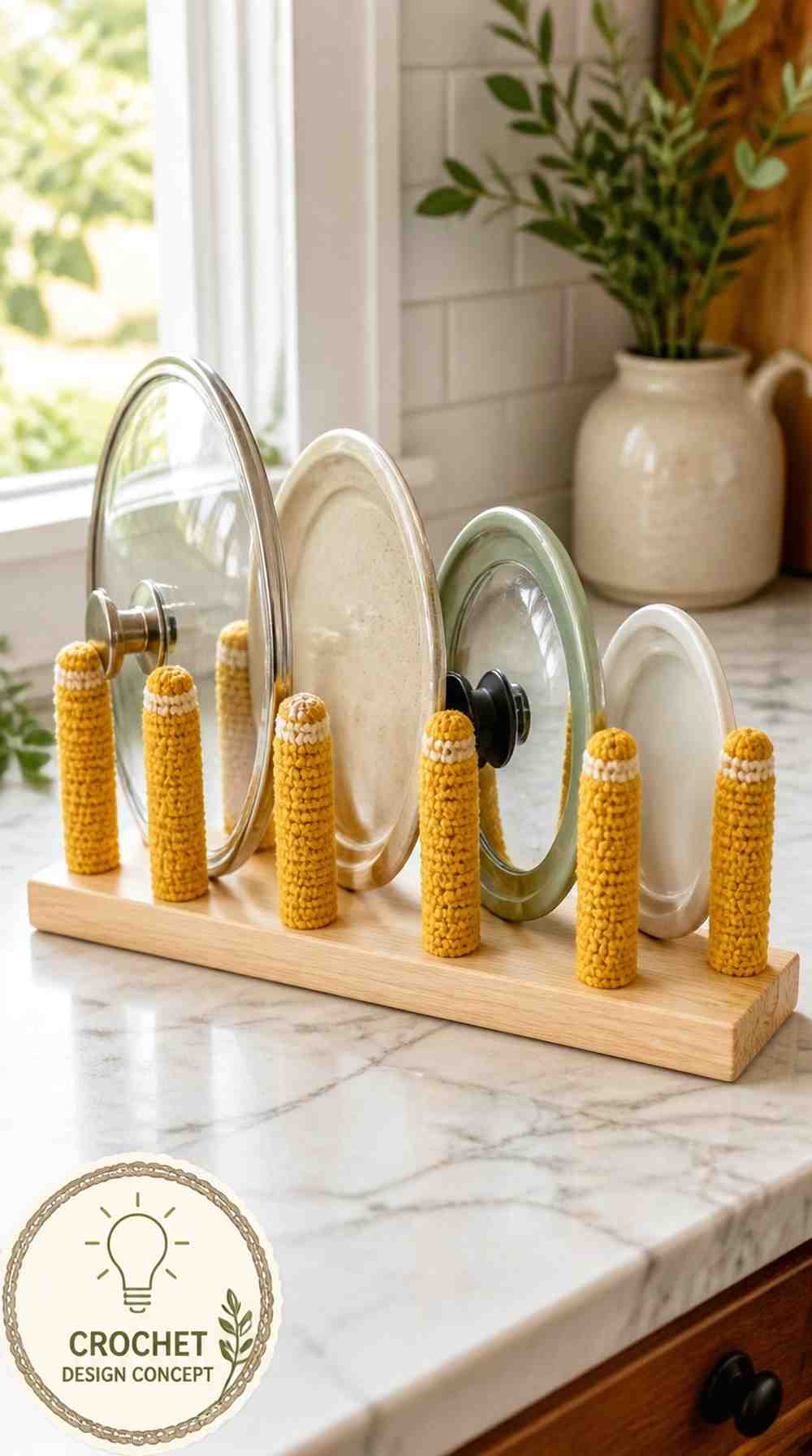
Mustard-yellow crochet brings cheerful color to a simple wooden peg organizer. Eight short upright dowels stand in pairs across the pale-wood base, each covered with a closely stitched sleeve and finished with a small cream ring near its top. Four container lids rest vertically between the paired pegs.
This open arrangement makes individual lids easy to see without requiring deep storage pockets. It works best as inspiration for a small collection where the gaps can be chosen according to the lid sizes.
- Peg placement: Set paired dowels far enough apart for the lid’s thickness but close enough to keep the lid from tipping sideways.
- Peg height: Short pegs may not support tall rectangular lids adequately; compare the exposed lid height with the chosen supports.
- Crochet fit: Snug sleeves reduce bulky folds around the posts and help preserve the available space between each pair.
- Base weight: A securely supported base is essential, particularly when several large lids lean toward the same side.
6. Crochet Blush Cabinet-Door Sling Rack
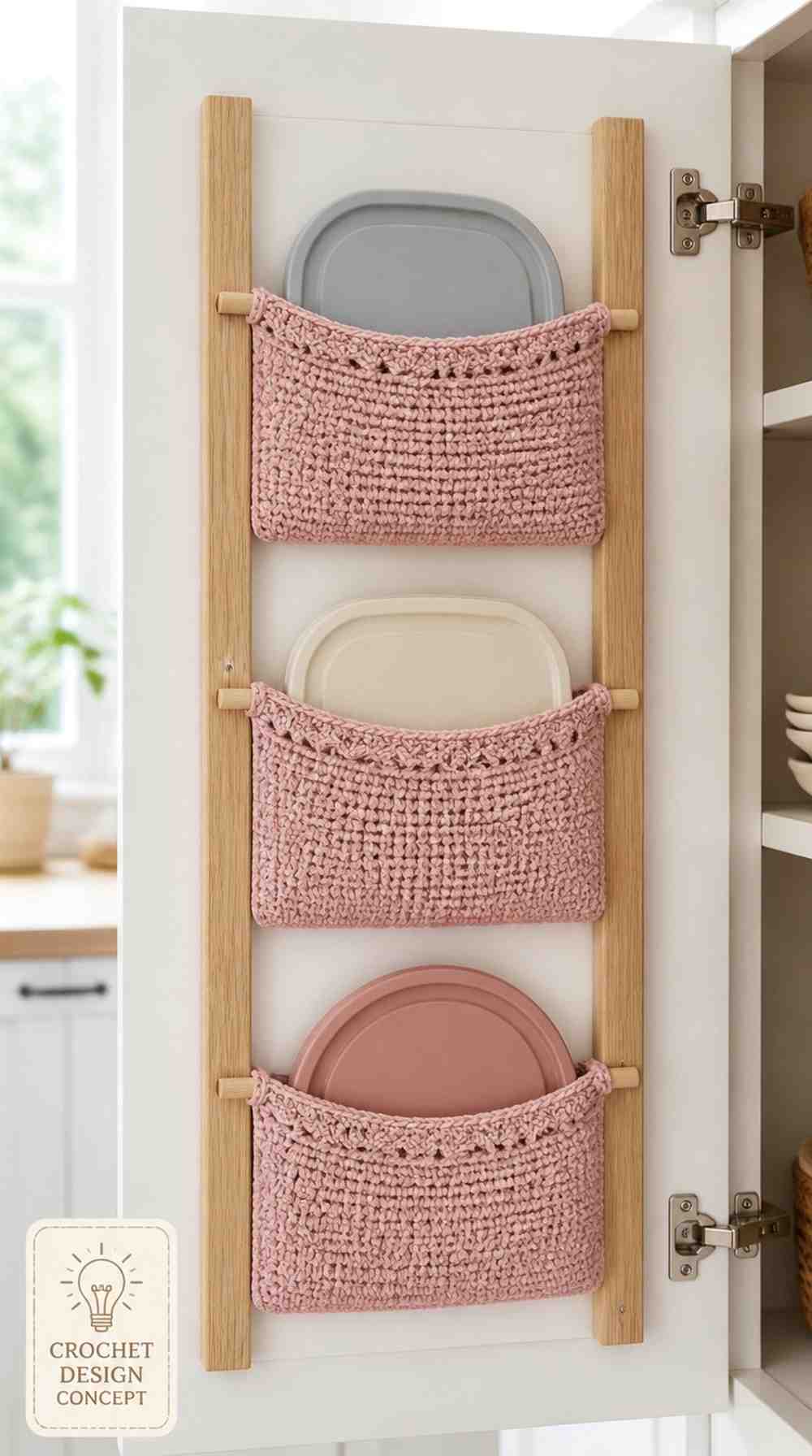
Soft blush-pink crochet makes this cabinet-door organizer feel gentle without losing its practical purpose. Three horizontal sling pockets run across a narrow oak support frame, each finished with a dense lower band and delicate shell-stitch trim. One food container lid sits partially exposed in each pocket.
The vertical layout keeps three lids separate and takes advantage of the inside surface of an open cabinet door. Because the design moves whenever the door opens, secure mounting and suitable lid retention deserve particular attention.
- Door clearance: Check that the organizer and stored lids do not collide with interior shelves when the cabinet closes.
- Sling depth: The lower crochet band should support enough of each lid to reduce the chance of it slipping during door movement.
- Shell trim: Keep decorative shell stitches along the visible opening rather than where they could interfere with removing lids.
- Attachment method: Use hardware appropriate to the cabinet-door material and avoid drilling where hinges, panels or fittings could be damaged.
7. Crochet Olive Corner Wedge Rack
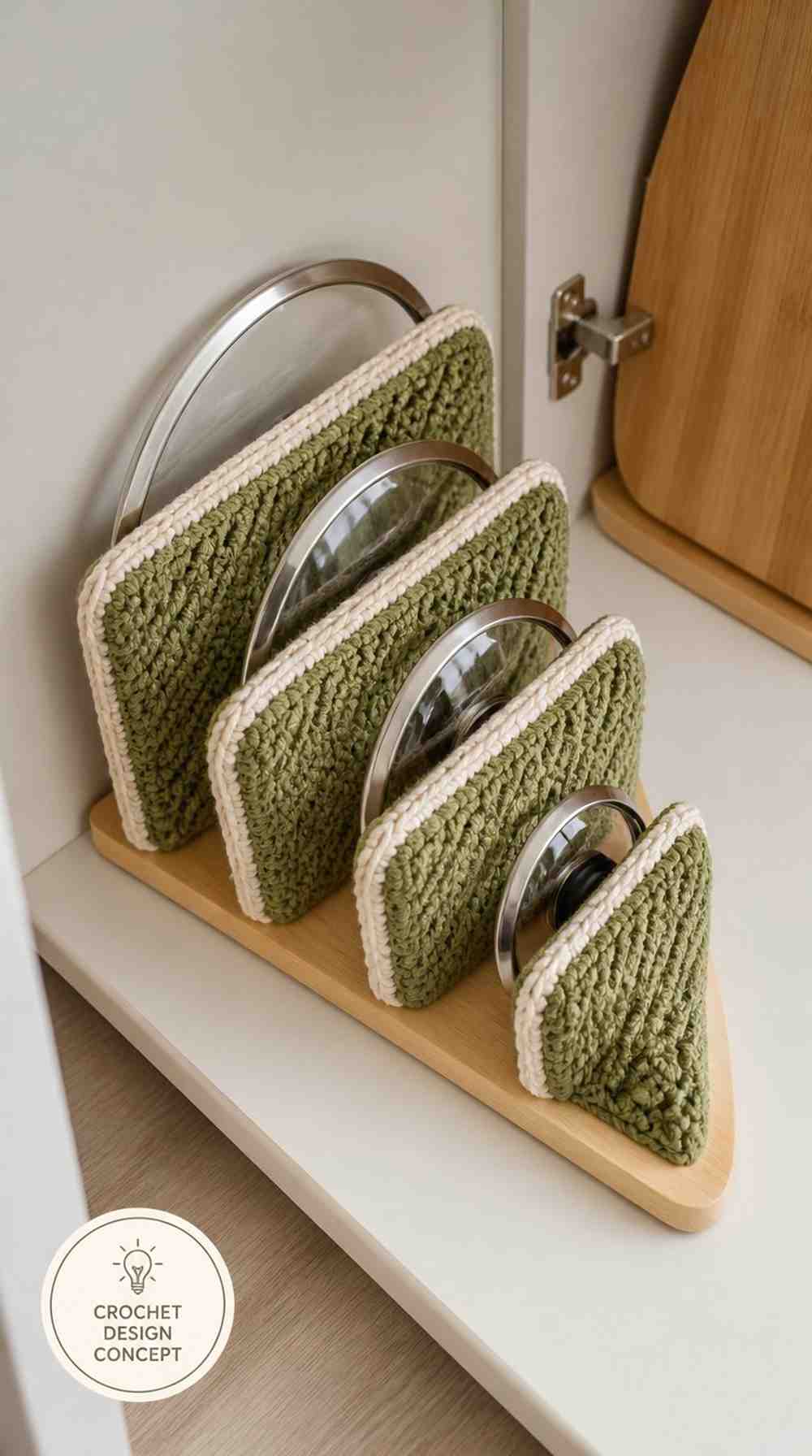
An olive-green crochet finish transforms a triangular wooden rack into a storage option for an awkward kitchen corner. Four angled wooden wedges have thick crochet padding, raised diagonal stitching and narrow ivory borders. Three graduated round lids stand between the padded dividers.
The triangular base is the defining feature. It makes the organizer visually suitable for corner placement, although the angle also limits the size and shape of lids it can hold. The rigid wedges provide the necessary structure beneath the crochet.
- Corner fit: Check the distance from both cabinet walls before planning a triangular base, leaving room for your hand to reach the back.
- Graduated spacing: Arrange smaller lids toward the narrower area and larger lids where the base provides sufficient room.
- Wedge padding: Thick crochet softens the appearance but occupies space. Avoid excessive bulk if the wedge gaps are already narrow.
- Access limitation: A corner rack may be harder to reach inside a deep cupboard, especially when stored behind other kitchen items.
8. Crochet Sky-Blue Rotating Carousel Rack
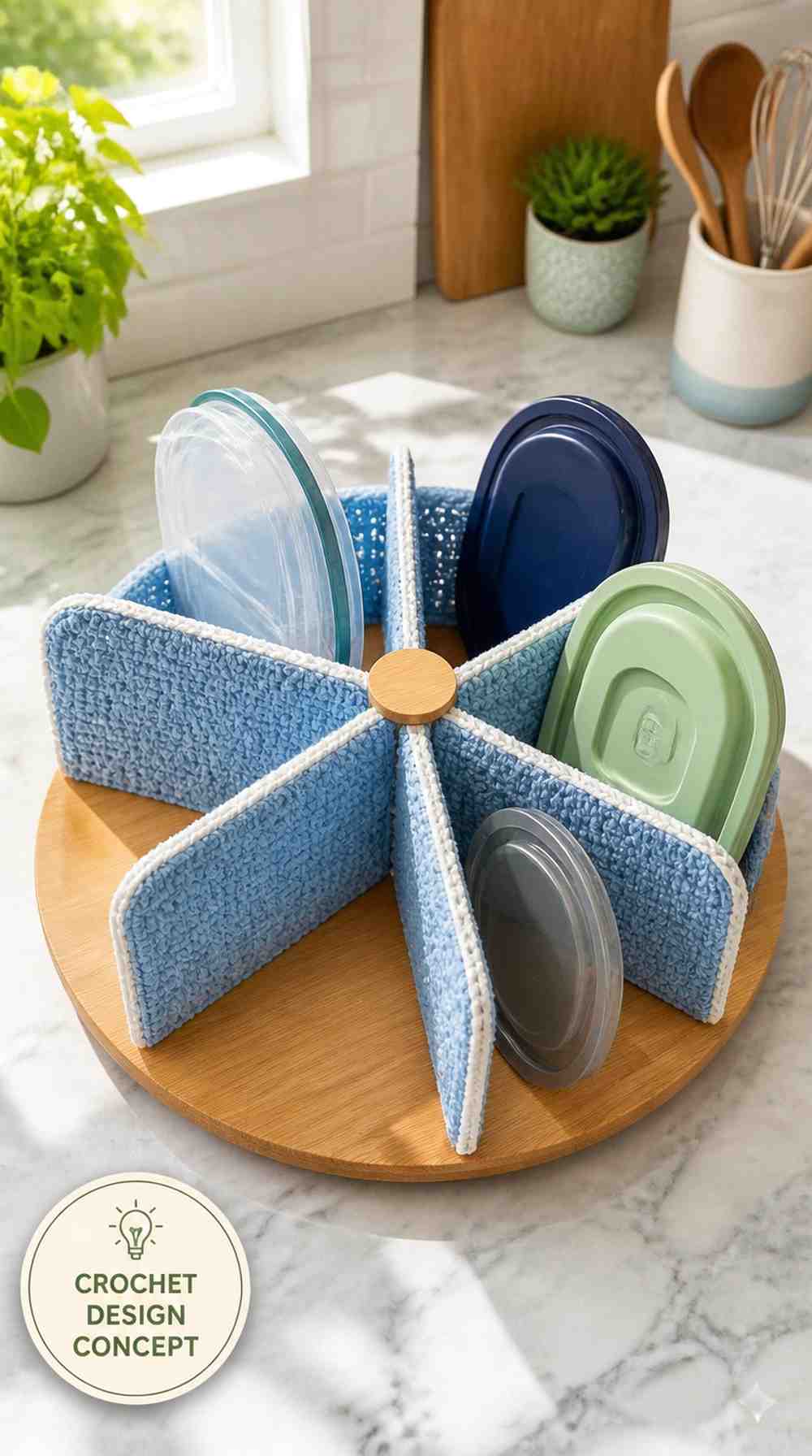
Sky-blue crochet covers six radial dividers rising from a circular bamboo platform. Fine white edging traces each partition, while a wooden central hub anchors the arrangement. Four container lids occupy individual wedge-shaped compartments, leaving two empty spaces visible.
The carousel layout gives this design a different character from straight rail organizers. A rotating platform could help bring lids around to the front, provided the rotating mechanism and dividers are stable and the lids remain safely positioned.
- Rotation clearance: Allow enough surrounding space for the largest stored lid to rotate without striking another object.
- Wedge shape: Narrow compartments near the central hub may not accommodate thick lid rims, even when the outer opening appears wide.
- Divider support: The rigid radial panels need firm attachment to the hub and base; crochet coverings should not act as the structural connection.
- Platform movement: Choose a reliable rotating mechanism and check that the organizer remains balanced as different compartments are filled.
9. Crochet Cream Double-Level Wire Rack
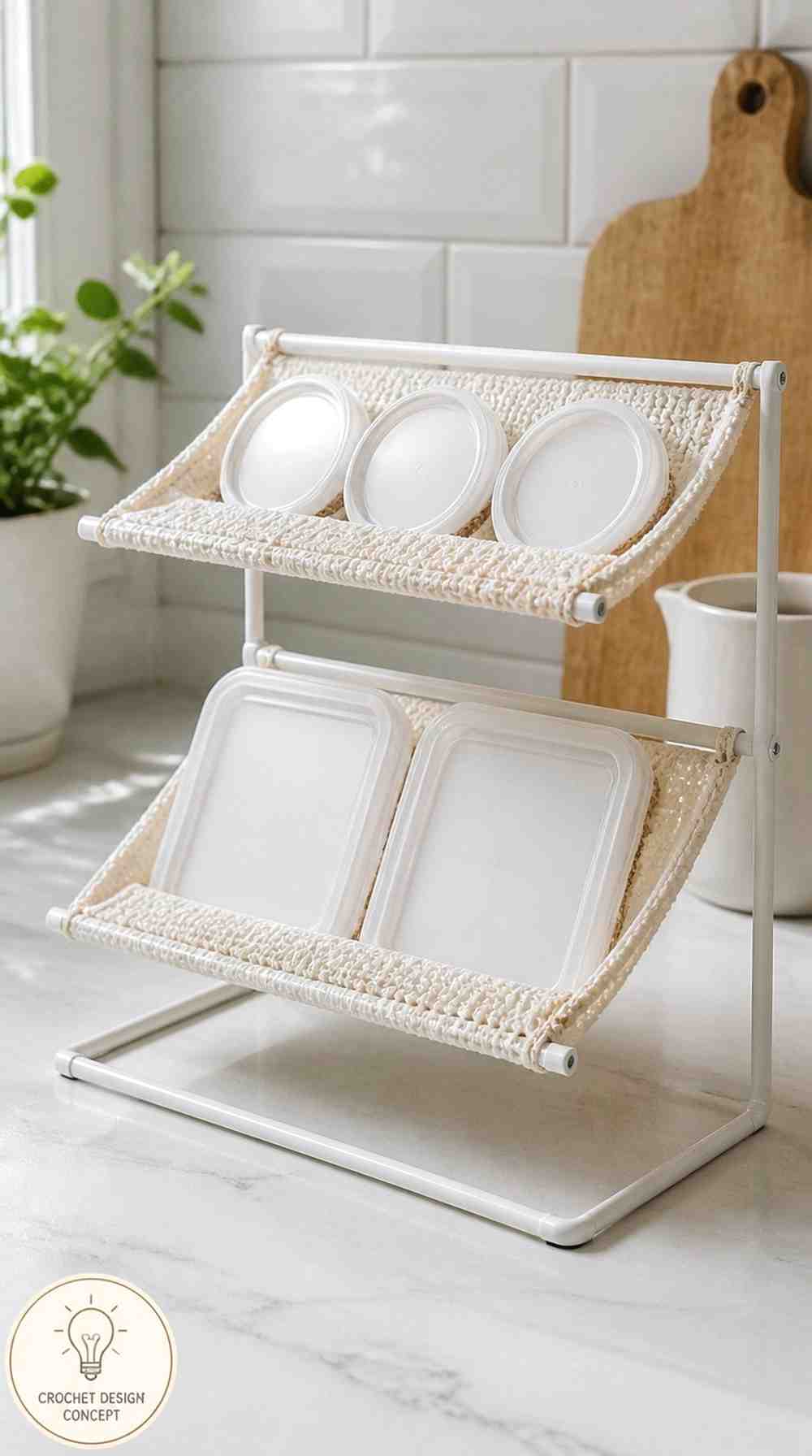
Warm-cream crochet cradle bands soften the appearance of this two-level white metal organizer. Three small round lids occupy the upper row, while two larger rectangular lids rest in the lower row. Raised crochet ridges and beige borders add definition without distracting from the simple shape.
The open wire structure separates the storage levels and supports the textile bands. It could appeal to readers who prefer a light-colored kitchen organizer that looks tidy without hiding the container lids.
- Tier accessibility: Check whether the lower lids can be removed without touching the upper cradle bands.
- Metal attachment: Crochet sections should be secured around smooth supporting bars, with no sharp ends that could wear through the yarn.
- Stitch density: A closely stitched cradle may support the lid’s edge more consistently than a widely spaced decorative mesh.
- Cleaning considerations: Removable bands are worth considering because crumbs and dust can collect where crochet wraps around metal rods.
10. Crochet Charcoal Mesh-Pocket Wall Rack
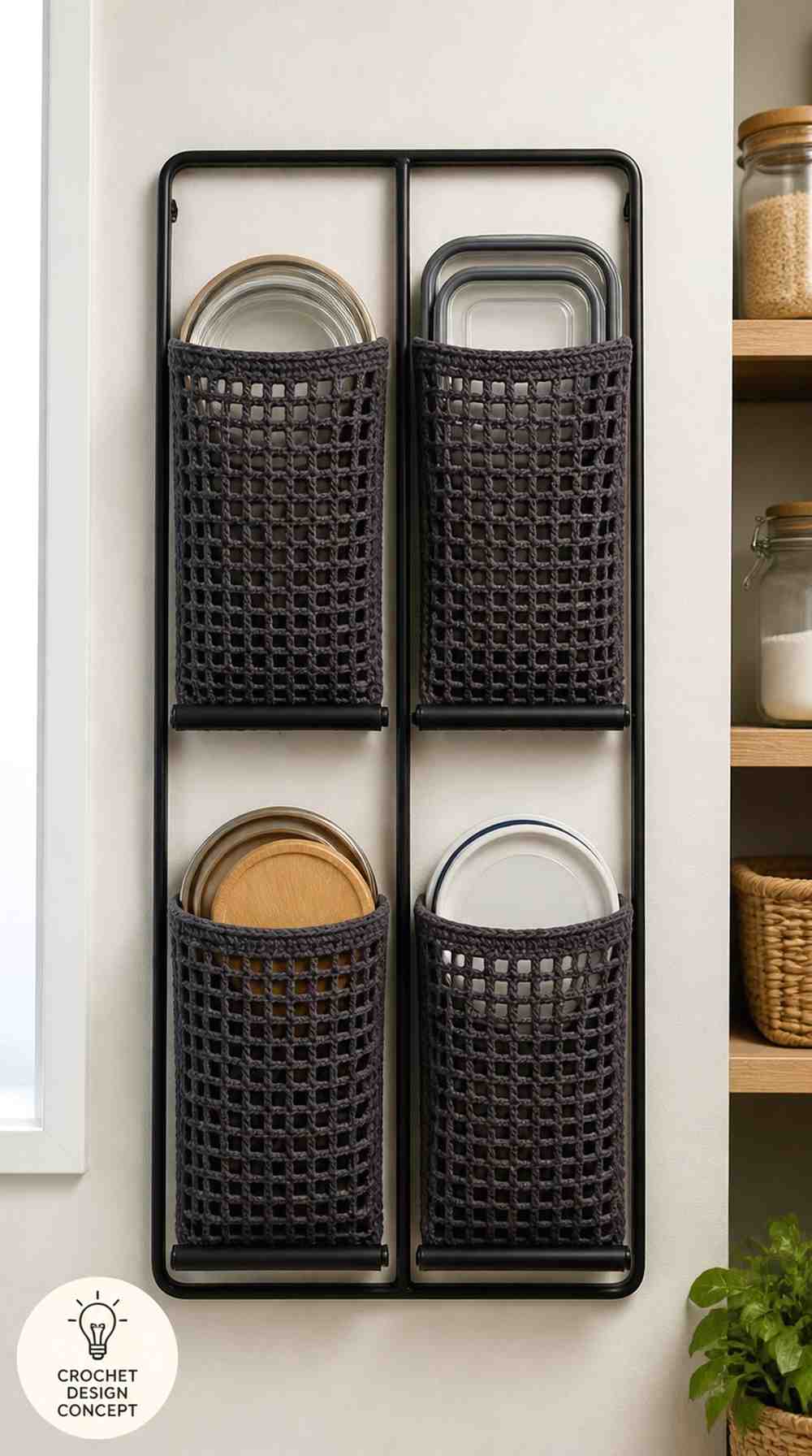
Charcoal crochet mesh creates four separate pockets inside a narrow black metal wall frame. Arranged in two vertical columns, the pockets have open square stitching, dense black borders and rigid metal support bars beneath them. Round and rectangular lids remain partially visible through the dark mesh.
The design is more flexible in appearance than a solid wooden rack. Its open crochet texture also makes it easier to see what is stored, although the pocket construction needs sufficient support to prevent lids from sagging or slipping.
- Mesh openings: Choose openings smaller than the lid areas they support, and check whether narrow corners could catch in the stitches.
- Pocket shape: A rigid bottom support helps maintain each compartment’s intended shape instead of relying on the mesh to hold everything.
- Dark yarn visibility: Light-colored lids contrast well with charcoal crochet, but darker lids may be harder to distinguish at a glance.
- Wall placement: Avoid frequently splashed kitchen areas and choose mounting hardware suited to the weight of the frame and contents.
11. Crochet Berry Folding Accordion Rack
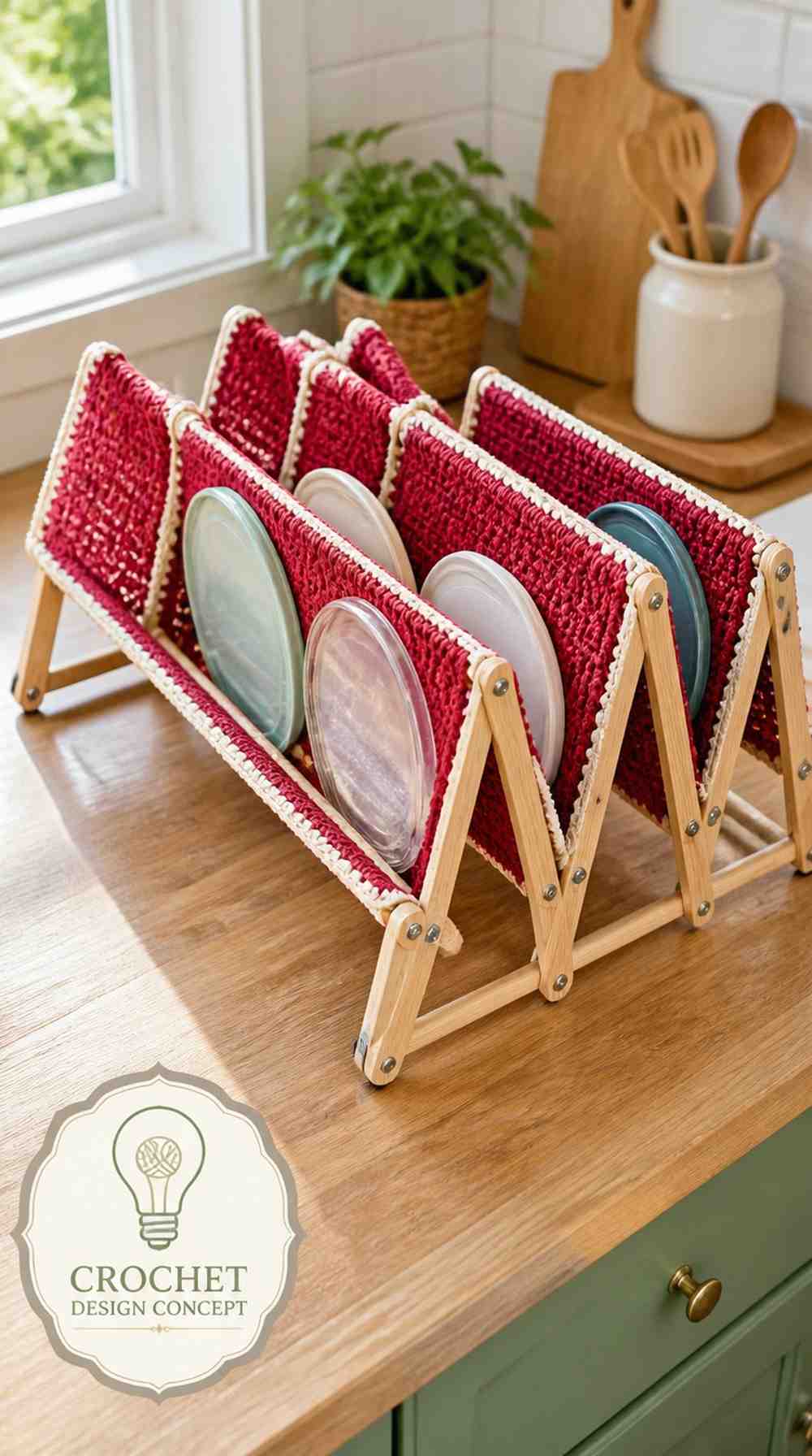
Berry-red crochet gives this wooden accordion rack a bold, cozy finish. Five folding zigzag divider rails wear snug textured covers with narrow cream edges. Four round container lids stand between the angled rails, while visible wooden hinges connect the folding sections.
The folding layout makes this concept particularly interesting for changing storage needs. Unlike a fixed rail rack, its overall footprint could potentially be adjusted when empty, but any real version must keep its hinges and dividers secure during use.
- Folding clearance: Keep crochet away from moving hinge gaps where yarn could become trapped, pinched or damaged.
- Open-position stability: A usable rack needs a reliable way to remain open while lids are inserted or removed.
- Divider angles: Check that the zigzag arrangement offers enough room for round lids without forcing them against neighboring sections.
- Storage flexibility: The folding feature is most useful when the rack can be emptied before collapsing, rather than folding around stored lids.
12. Crochet Mint Sliding-Track Rack
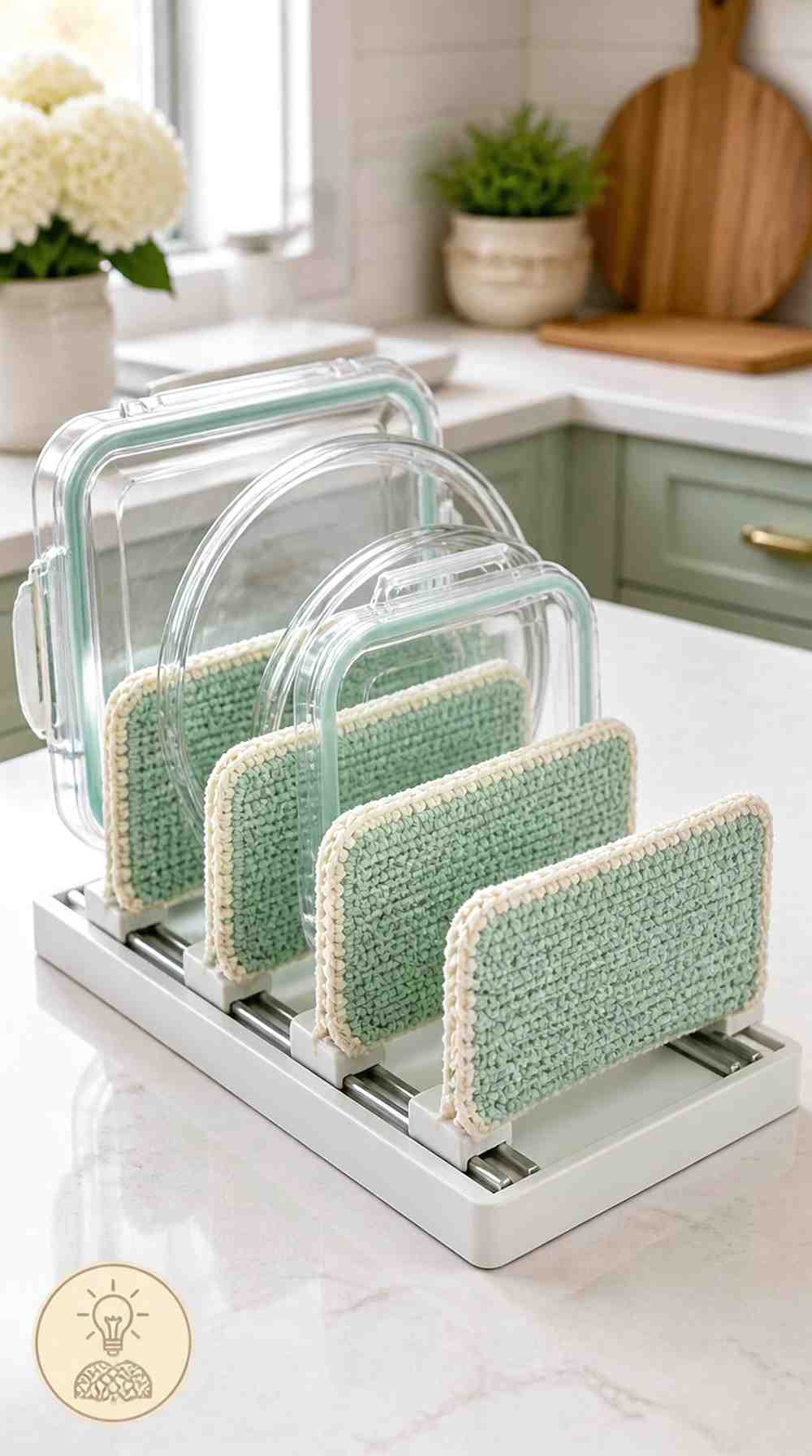
Fresh mint-green crochet covers four movable divider brackets on this white countertop organizer. Two visible sliding tracks run along its rectangular base, allowing the brackets to be positioned at different intervals. Ivory edging defines the softly ribbed crochet covers, while three round and rectangular lids stand in the adjustable spaces.
The movable partitions are the central idea here. Different lid collections need different amounts of room, and adjustable brackets could offer flexibility that fixed crochet-covered rails cannot.
- Track mechanism: Select a rigid system that holds each bracket in position rather than allowing it to slide whenever a lid is removed.
- Changing gaps: Adjust spacing for the widest part of the lid, including raised rims, clips and sealing edges.
- Crochet interference: Keep covers clear of sliding joints so the mint yarn does not catch or bunch along the tracks.
- Future flexibility: This arrangement may suit households whose food containers change over time, provided replacement lid sizes remain within the rack’s range.
13. Crochet Rust Arched Divider Rack
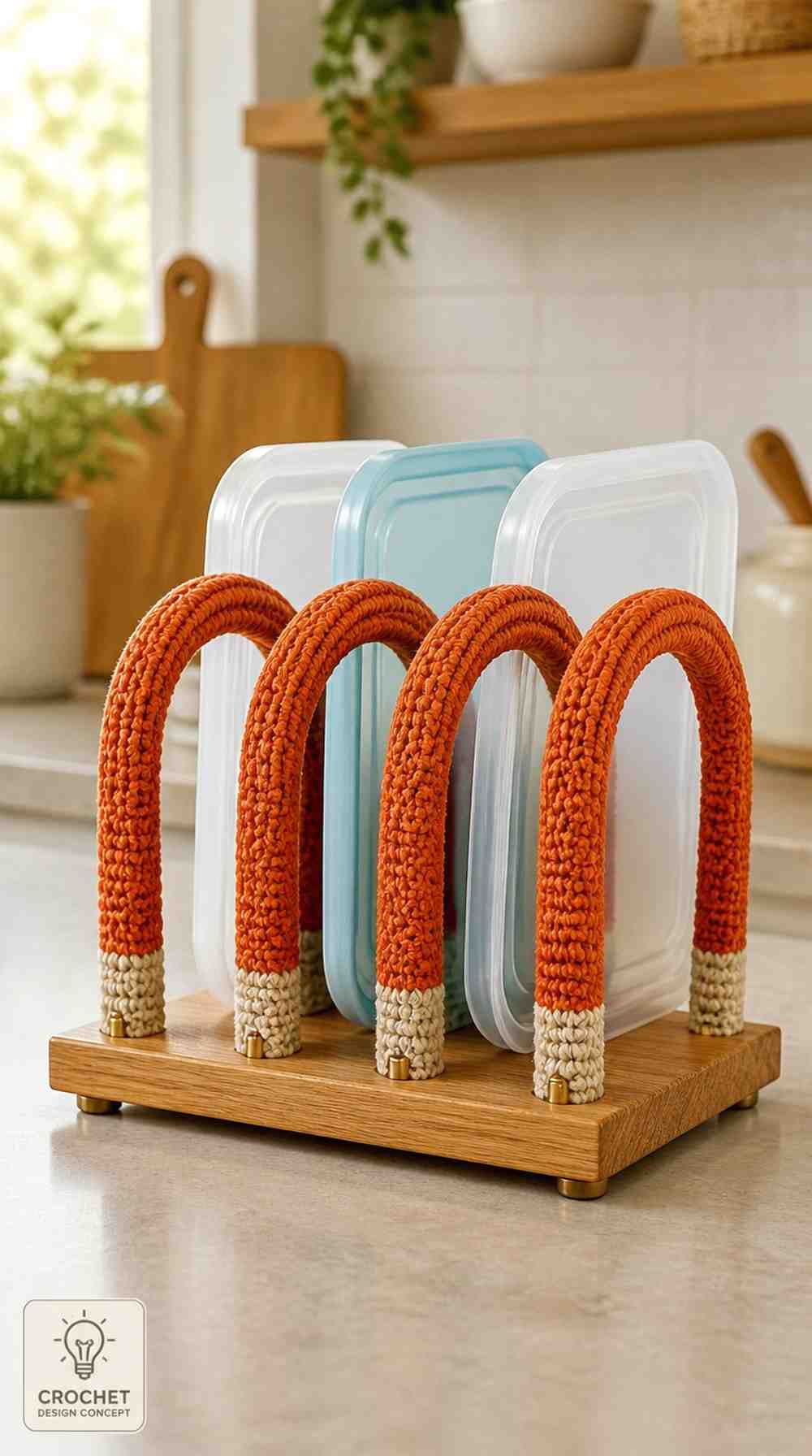
Rust-orange crochet follows the curves of four brass-colored metal arches mounted on a narrow oak base. Closely stitched vertical columns give the arched covers texture, while sand-colored finishing details appear near their lower ends. Three rectangular food container lids stand upright in the spaces between the arches.
The curved structure offers a more decorative interpretation of a traditional upright divider rack. Its visual strength comes from the contrast between rounded crochet-covered arches and the straight edges of the stored lids.
- Arch spacing: Measure thick rectangular lid rims before positioning the arches; a narrow curved opening may restrict removal.
- Metal smoothness: Check that the support frame has smooth surfaces and protected ends to prevent abrasion against the crochet sleeves.
- Yarn coverage: Tightly fitted crochet follows the arch shape better than loose fabric that might wrinkle along the inner curve.
- Decorative balance: The rust-and-sand palette works well with wood, but the arches must remain tall and rigid enough for the intended lids.
14. Crochet Coral Stackable Tray Rack
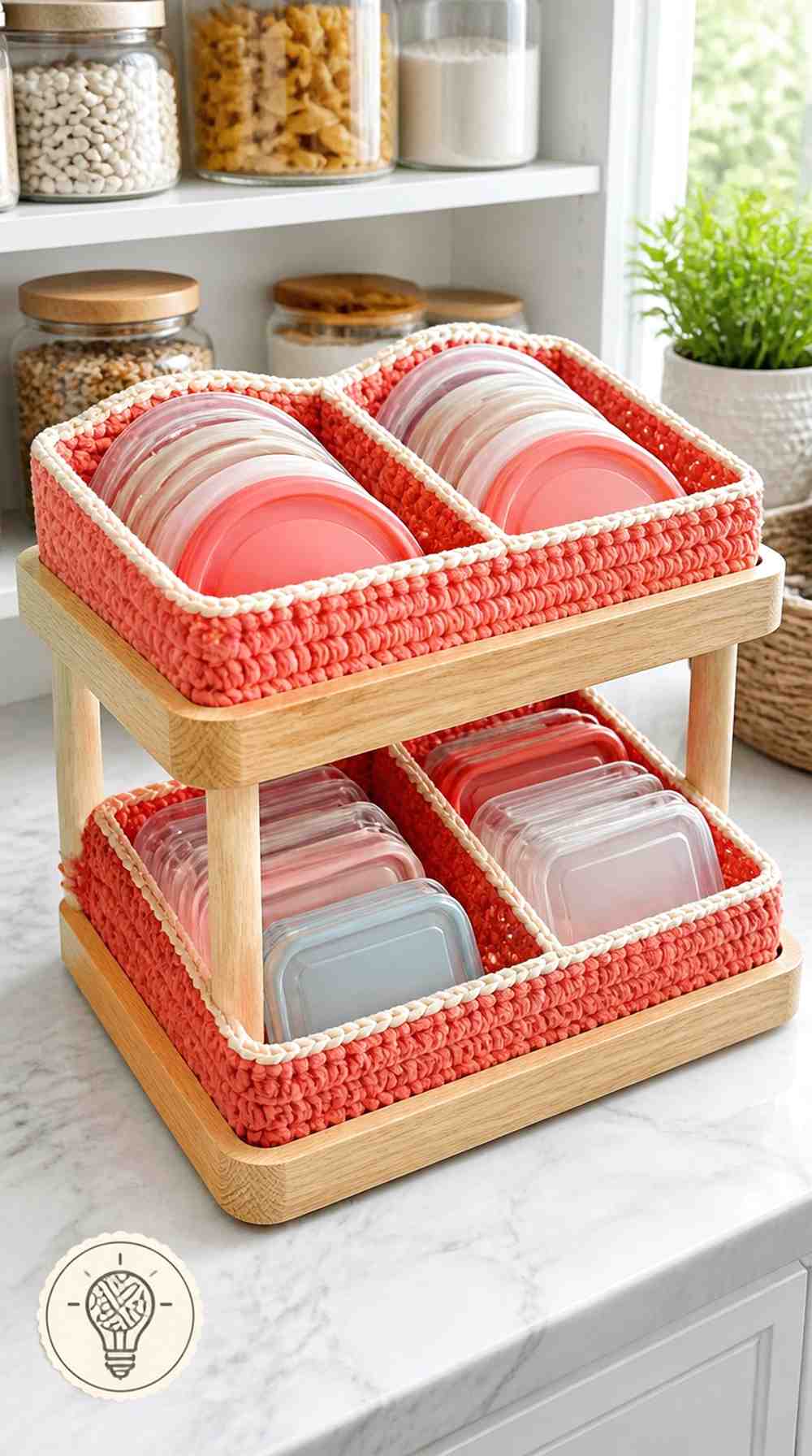
Coral crochet lines the sides and dividers of two shallow wooden trays held apart by short corner risers. The upper tray contains neatly stacked small round lids, while the lower tray holds rectangular lids lying flat. Cream piping highlights the crocheted compartment edges and gives both tiers a coordinated finish.
This design takes a different approach by sorting lids into flat stacks rather than standing each one upright. It may be more suitable for low-profile storage where the available shelf height matters more than individual vertical access.
- Tray height: Allow enough clearance to lift a lid from the lower tray without knocking against the upper wooden platform.
- Stack grouping: Keep lids of similar size and shape together so smaller pieces do not become hidden beneath much larger ones.
- Divider reinforcement: Use rigid compartment walls beneath the crochet rather than expecting fabric panels to hold separate stacks in position.
- Tray removal: Consider whether the two levels should separate for cleaning and easier access to the lower group.
15. Crochet Lilac Graduated Slot Tower
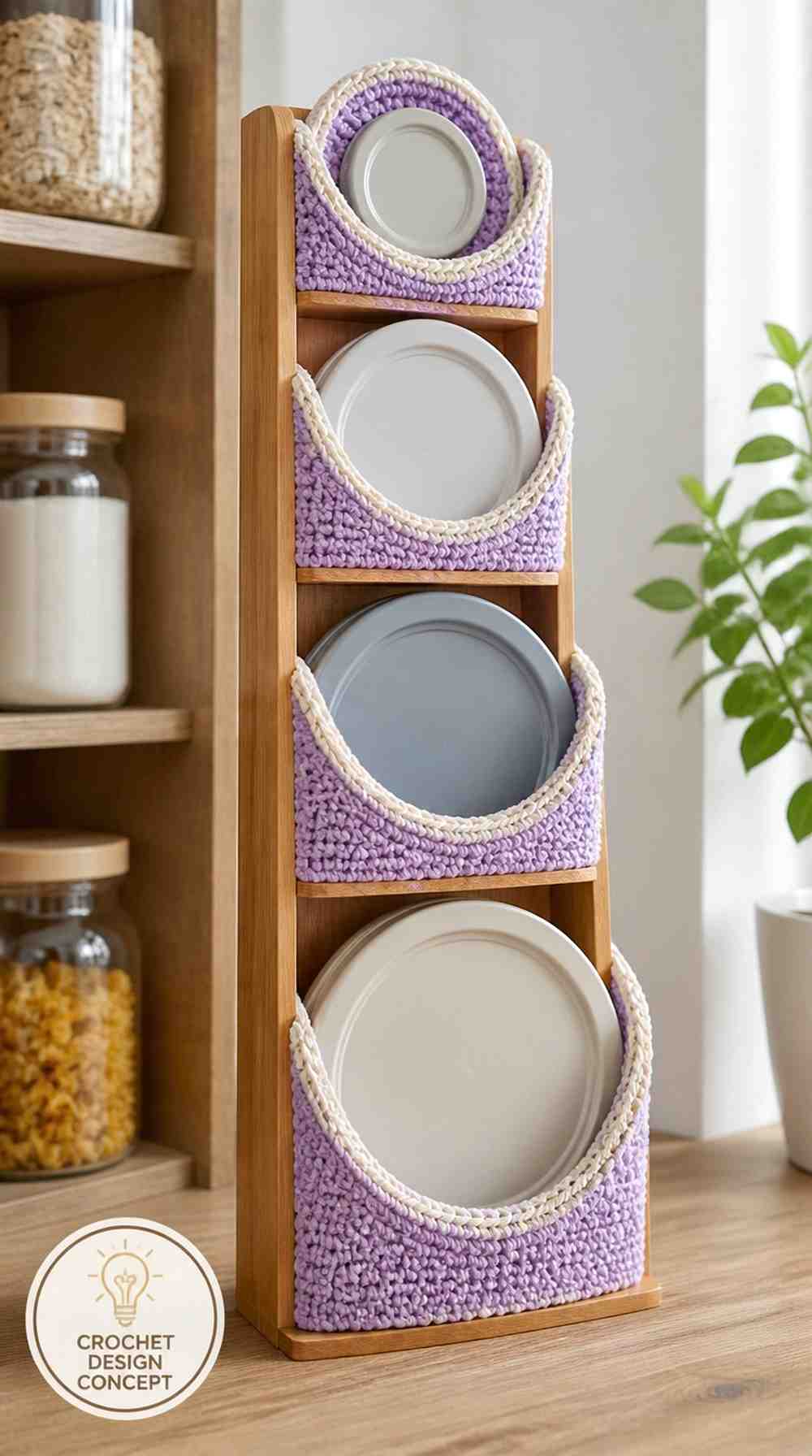
Lilac crochet outlines four half-round slots arranged along a narrow upright wooden tower. The smallest opening sits at the top, with progressively larger slots below. Each curved edge has close crochet stitching and fine ivory trim, while rigid wooden shelves support the four round lids.
The graduated shape makes different lid sizes visually easy to distinguish. Its tall, narrow footprint could also suit a small kitchen surface, although the tower needs careful balancing and enough space for the larger lower lids.
- Size progression: Arrange the slot openings around actual lid diameters rather than assuming every container collection follows the same size sequence.
- Tower stability: A narrow upright structure needs a suitable base or secure attachment to reduce tipping when lids are removed.
- Shelf depth: Each supporting wooden ledge must hold the lid edge adequately without making removal awkward.
- Crochet finishing: Keep ivory trim close to the curved openings so the decorative border does not reduce usable space unnecessarily.
16. Crochet Butter-Yellow Under-Shelf Rack
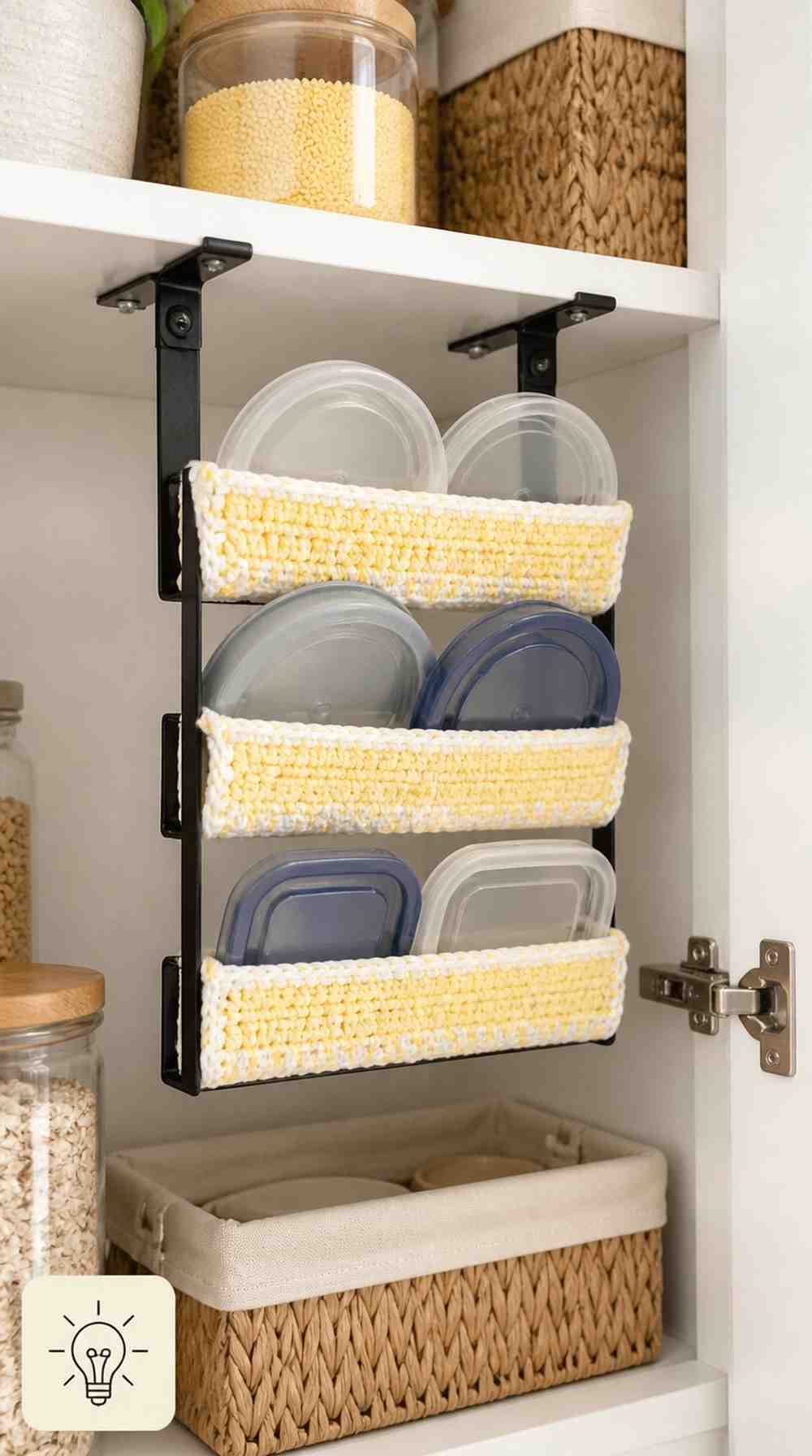
Butter-yellow crochet adds a warm detail beneath a white pantry shelf. Three shallow crochet sling bands sit inside a black metal organizer supported by two visible shelf brackets. Narrow white borders frame the textile channels, while three container lids rest tilted upright in separate spaces.
The under-shelf arrangement uses space that might otherwise remain empty. Its practicality depends on the strength of the attachment system, the shelf’s available clearance and whether the stored lids can be reached comfortably.
- Shelf compatibility: Confirm that the supporting shelf and mounting method are suitable for the organizer before considering this arrangement.
- Access height: Lids should remain reachable without awkward stretching or having to reach behind other stored items.
- Sling depth: Shallow bands need enough support beneath each lid to limit movement and prevent accidental slipping.
- Cleaning access: Consider removable crochet bands because dust can collect beneath shelves and around the metal support channels.
17. Crochet Navy Island-Side Rack
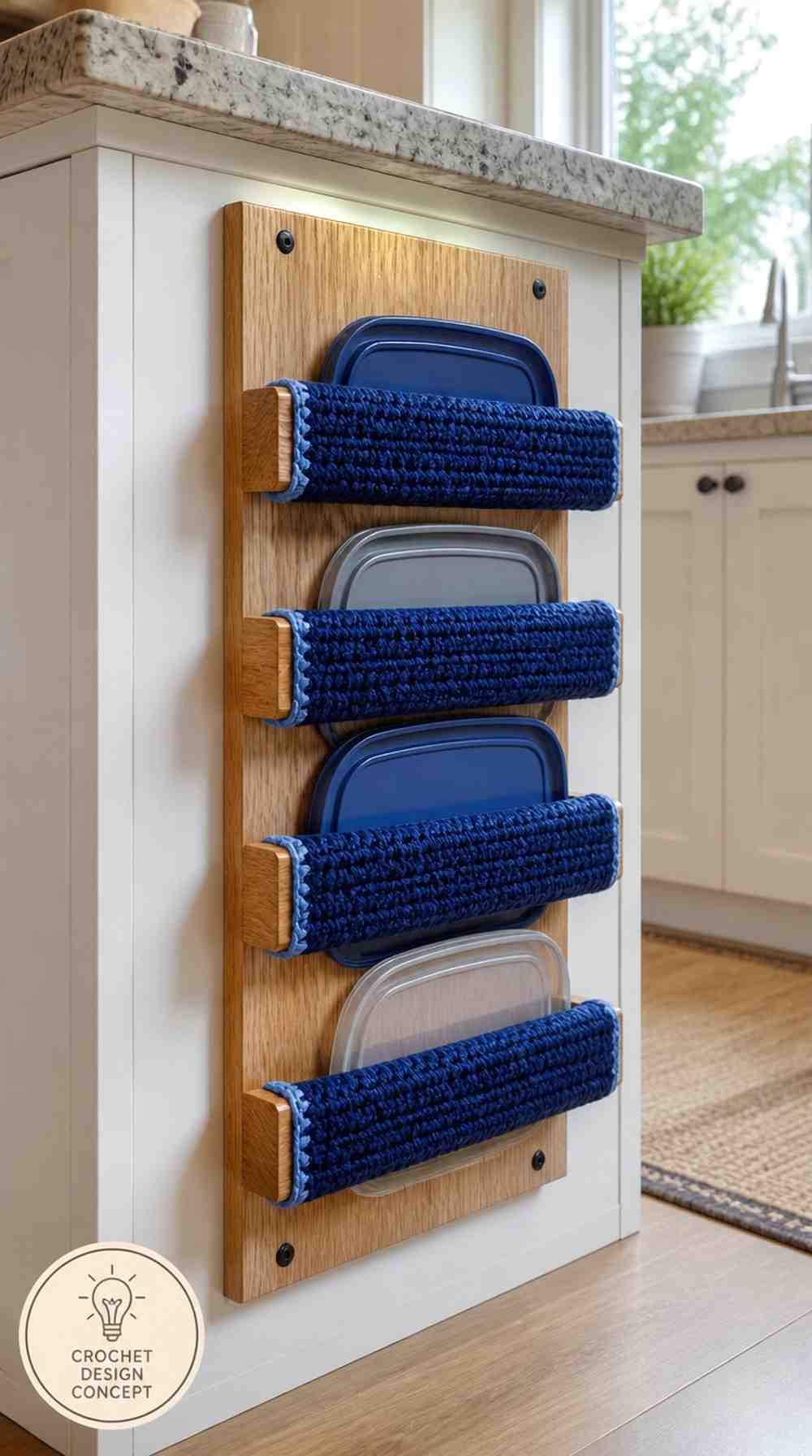
Deep navy crochet creates a neat finish across four horizontal wooden rails on this narrow oak organizer. Pale-blue edge stitching outlines the dense sleeves, while three rectangular food container lids stand edge-up in slim slots against the mounting panel.
The rack sits on the vertical side of a kitchen island, giving it a more integrated appearance than a loose countertop organizer. Its exposed location is useful for quick access but requires thoughtful positioning to avoid interference with movement around the kitchen.
- Island placement: Choose a side away from frequent foot traffic, seating knees and areas where stored lids could be knocked loose.
- Rail alignment: Keep the wooden rails level and evenly supported so the rectangular lids sit in predictable positions.
- Navy crochet detail: Pale-blue edging improves visual definition, particularly where dark sleeves overlap the shadows beneath the rails.
- Mounted access: Check whether the full lid can be lifted out comfortably without scraping the island surface or surrounding fittings.
18. Crochet Color-Coded Family Rack
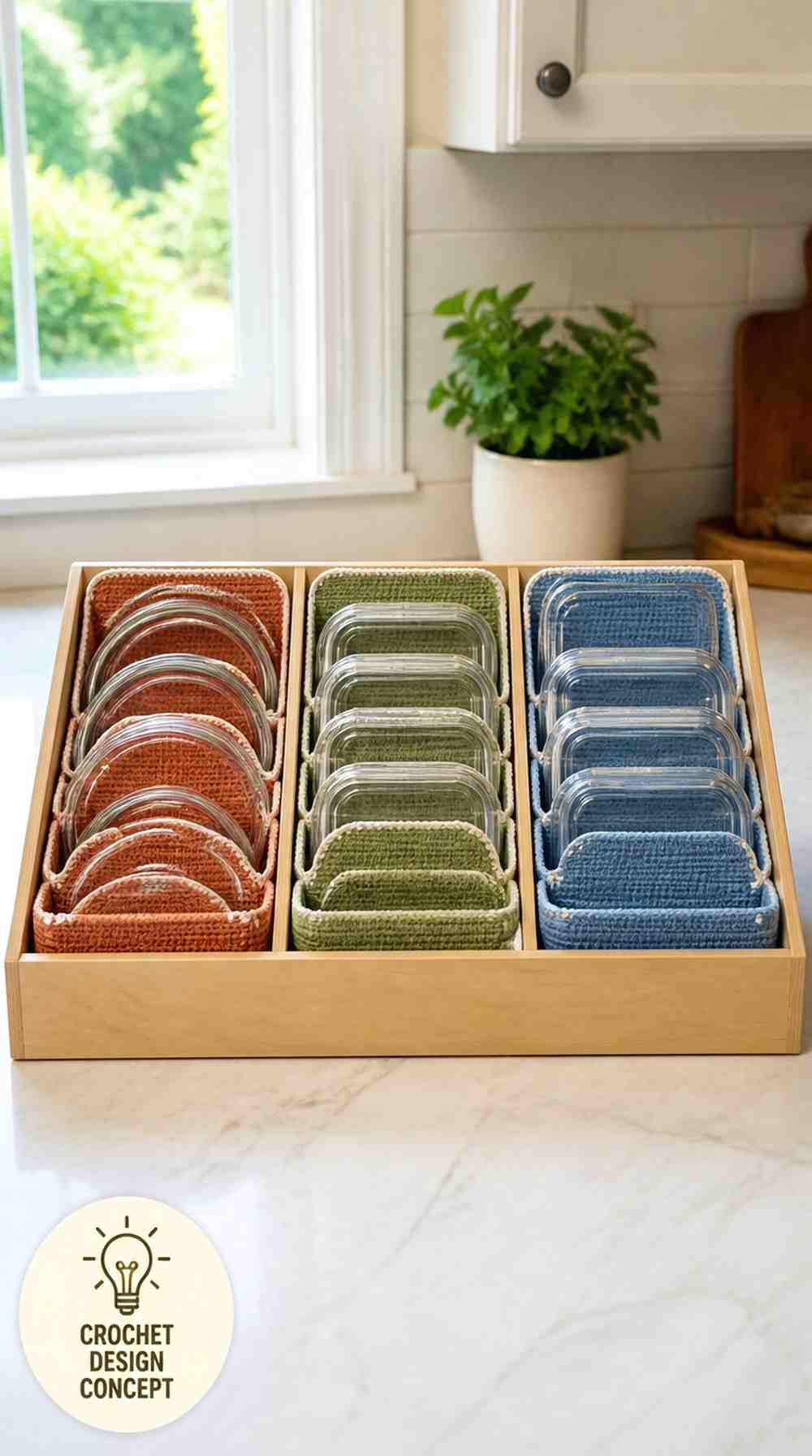
Three distinct crochet colors give this wide birchwood rack a clear storage system. Terracotta-covered rails hold round lids, sage-green dividers separate square lids, and cornflower-blue sections accommodate rectangular lids. All three bays share closely ribbed crochet textures and narrow ivory edging.
The main appeal is organization by shape rather than simply by size. The different colors make the sections visually distinct, while the rigid wooden base and partitions provide the structure required for upright storage.
- Shape categories: Divide the rack according to the lids your household actually uses; some collections may need more room for one shape than another.
- Bay proportions: Avoid making all three sections equal if rectangular lids occupy substantially more width than round ones.
- Color consistency: Using the same crochet texture and ivory edging across all bays keeps the multicolor arrangement coordinated.
- Family usability: A simple color grouping may make returning lids easier, provided users can still identify the correct compartments without relying on color alone.
19. Crochet Mocha Removable-Sleeve Rack
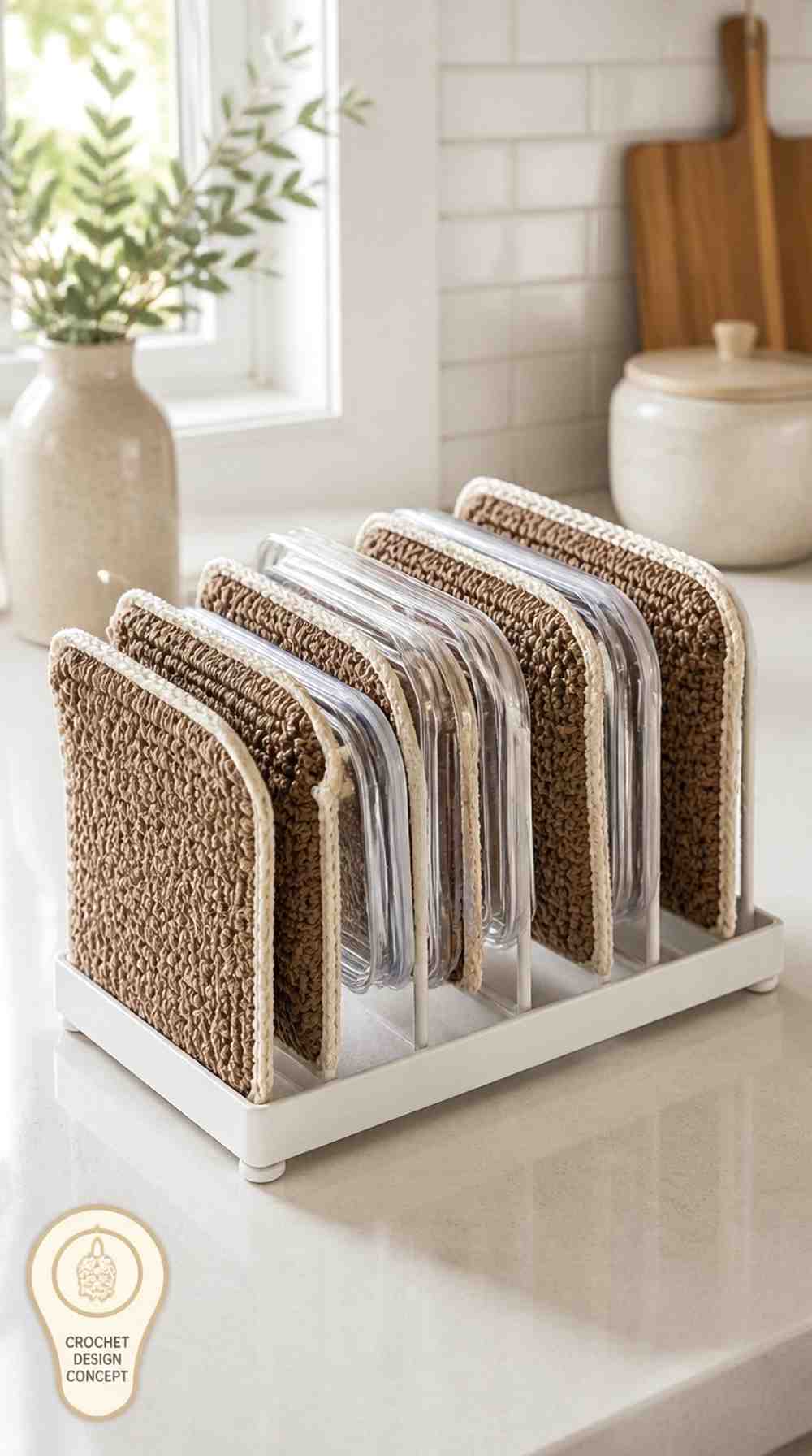
Mocha-brown crochet covers five upright translucent divider panels inside a narrow white metal base. Each sleeve has closely worked stitches, neat cream piping and a small folded pull tab at the upper corner. Four transparent food container lids stand separately between the panels.
The detachable-cover concept puts maintenance at the center of the design. Instead of treating the crochet as a permanent part of the rack, the removable sleeves could allow the rigid frame and textile surfaces to be cleaned separately.
- Sleeve removal: Design the pull tabs and openings so covers can be removed without dislodging or bending the rigid dividers.
- Panel thickness: Account for both the rigid divider and its crochet covering when calculating usable lid spacing.
- Wash preparation: Check the chosen yarn’s care instructions and allow cleaned sleeves to dry fully before refitting them.
- Minimalist appearance: Mocha and cream create a restrained finish that may appeal to readers who prefer practical storage without bright decorative details.
Practical Guide to Crochet Food Container Lid Sorting Racks
A crochet-covered lid rack needs more planning than a simple decorative basket. Food container lids have different shapes, thicknesses, clips and seals, and a flexible crochet fabric generally cannot hold them upright without another supporting material.
Start with your lids. Sort the lids you already own into groups of similar shape and size. Measure their widest points and thickest edges, then decide whether vertical slots, horizontal stacks or hanging compartments make the most sense.
Choose a suitable support system. Wood, smooth metal frames and appropriately reinforced rigid plastic components can provide structure beneath crochet coverings. Plastic canvas may help shape textile compartments, but it should not automatically be treated as a load-bearing frame. Check all attachment points and exposed edges.
Think about cleaning and moisture. Food storage lids should be clean and completely dry before being stored against yarn. Trapped moisture can create unpleasant conditions inside dense crochet. Removable cotton covers may be easier to maintain, provided their care instructions allow the intended washing method.
Plan for safe everyday access. Keep organizers away from flames, burners, heating elements and frequent splashes. Wall-mounted, cabinet-door and under-shelf designs require properly selected mounting hardware, secure supports and adequate clearance. If the rack wobbles, sags or allows lids to fall, reconsider its construction.
For more ideas about decorating and organizing kitchen storage, explore these crochet vintage kitchen wall-pocket designs and crochet storage basket ideas. Both cover related storage concepts, although they are not exact lid-rack patterns.
Want to Make Something Similar?
These resources explain related crochet organizer techniques rather than providing exact patterns for the 19 concepts above.
- Free Crochet Wall Organizer Pattern by Happy Heartsy explains pocket construction and using wooden dowels to support a hanging crochet organizer. Useful inspiration for the wall-mounted and cabinet-door concepts. Easy 3 Pocket Hanging Storage
- Mosaic Basket by Yarn + Chai discusses using plastic canvas to reinforce crocheted basket walls. It offers a useful starting point for understanding supported textile compartments. Yarn + Chai
A dedicated lid-sorting rack still needs its own measurements, structure and practical testing. These resources should not be treated as instructions that reproduce the pictured AI concepts.
Comparison: Which Crochet Lid Sorting Rack Should You Choose?
| Storage need | Design to consider | Important trade-off |
|---|---|---|
| Small countertop | Sage Countertop Rail Rack | Fixed spacing |
| Kitchen wall | Oatmeal Wall-Mounted Slot Rack | Requires secure mounting |
| Multiple lid sizes | Terracotta Two-Tier Cradle Rack | More vertical clearance |
| Drawer organization | Dusty-Blue Drawer Grid Rack | Must fit drawer height |
| Cabinet corner | Olive Corner Wedge Rack | Limited shape compatibility |
| Rotating access | Sky-Blue Rotating Carousel Rack | Wider turning space |
| Adjustable dividers | Mint Sliding-Track Rack | More moving parts |
| Flat lid stacking | Coral Stackable Tray Rack | Lower lids less accessible |
| Shape-based sorting | Color-Coded Family Rack | Requires more width |
| Removable textile covers | Mocha Removable-Sleeve Rack | Covers must fit securely |
If you regularly use only a few container sizes, a simple rail or peg rack may be enough. Larger collections benefit more from dedicated compartments, provided the organizer does not take up more space than the lids themselves.
Conclusion
Crochet food container lid sorting racks bring an interesting handmade element to everyday kitchen organization. From compact sage-green rail racks to colorful dividers and removable mocha crochet sleeves, these 19 concepts show how useful storage can also feel personal and attractive.
The best design will depend on your available space, the shape of your container lids and how often you need to reach them. A sturdy frame, easy cleaning and sensible spacing matter more than decoration alone. Choose a structure that suits your kitchen first, then use crochet texture and color to give it character.
Which design would you choose for your kitchen? Would the adjustable mint rack, the colorful family organizer or the compact sage rail rack be more useful for the lids you own? Share your favorite idea in the comments.
Frequently Asked Questions
Can a crochet lid sorting rack hold food container lids upright by itself?
Crochet fabric is naturally flexible, so it usually needs a separate supporting framework for upright lid storage. Firm stitches can help a cover retain its shape, but wooden dividers, smooth metal supports or another suitable rigid structure are more dependable for creating the actual slots. The finished organizer should be checked for stability before regular use.
What type of yarn is worth considering for a kitchen lid organizer?
Cotton yarn is a practical option to consider because many cotton varieties can be washed and have a relatively firm feel. However, actual care instructions vary by yarn. Choose a texture that does not shed excessively, check how it behaves after cleaning, and allow the crochet to dry completely before storing lids against it.
Is a crochet lid rack better inside a drawer or on a countertop?
That depends on the available space and how frequently you need the lids. Drawer racks can keep countertops clear, but their height must accommodate upright lids. Countertop racks provide more immediate visibility and access, although they occupy worktop space. Measure your largest lids and storage area before choosing.
How can I keep different-sized container lids organized?
Start by grouping lids according to shape and then size. Upright dividers are convenient when lids have similar thicknesses, while wider slots or shallow trays may suit unusually thick or large lids. Adjustable partitions can be helpful if your collection changes, provided the brackets lock securely into place.
Are these 19 crochet lid sorting racks available as exact crochet patterns?
No. The images and designs in this collection are AI-generated inspiration concepts, not tested patterns for completed products. Some visual details may need adjustment before they can be made safely and practically. The linked resources explain related crochet techniques, but they are not exact instructions for reproducing these racks.