A dish drying rack can hold much more than plates and cups when its side space is used thoughtfully. Crochet dish rack side organizer inspiration brings together 17 creative ways to arrange everyday washing-up accessories without spreading them across the countertop. From compact sponge pockets and colorful utensil caddies to dishcloth rails, brush holders and removable storage modules, these ideas combine attractive crochet textures with practical kitchen storage shapes.
The collection includes soft cottage-inspired colors, modern metal-and-crochet combinations, open mesh structures and space-saving hanging arrangements. Some concepts focus on keeping one frequently used tool accessible, while others separate several small accessories in a single side-mounted organizer. As you explore each design, compare the supporting frame, attachment method, airflow and cleaning needs. These details matter especially around a wet dish rack where yarn can remain damp.
These are AI-generated crochet design visualizations for inspiration, not photographs of tested handmade pieces or step-by-step patterns.
Quick Design Selection Guide
- For everyday sponge and brush storage: Crochet Sage Double-Pocket Dish Rack Organizer separates two common washing-up essentials.
- For hanging dishcloths: Crochet Ivory Side-Rail Dishcloth Holder and Crochet Teal Triple-Ring Side Organizer offer different hanging arrangements.
- For improving airflow around damp accessories: Crochet Dusty-Blue Mesh Sponge Cradle and Crochet Rust Perforated Scrubber Shelf keep much of the supporting structure open.
- For small utensils: Crochet Terracotta Utensil Side Organizer and Crochet Charcoal Divided Cutlery Caddy provide separate rigid compartments.
- For cleaning-tool storage: Crochet Olive Hanging Brush Dock, Crochet Seafoam Straw-Brush Loop Rail and Crochet Navy Mini Squeegee Side Dock offer specialized holders.
- For flexible storage: Crochet Coral Pivot-Out Side Tray and Crochet Mocha Modular Side-Pocket Rack introduce movable accessory compartments.
1. Crochet Sage Double-Pocket Dish Rack Organizer
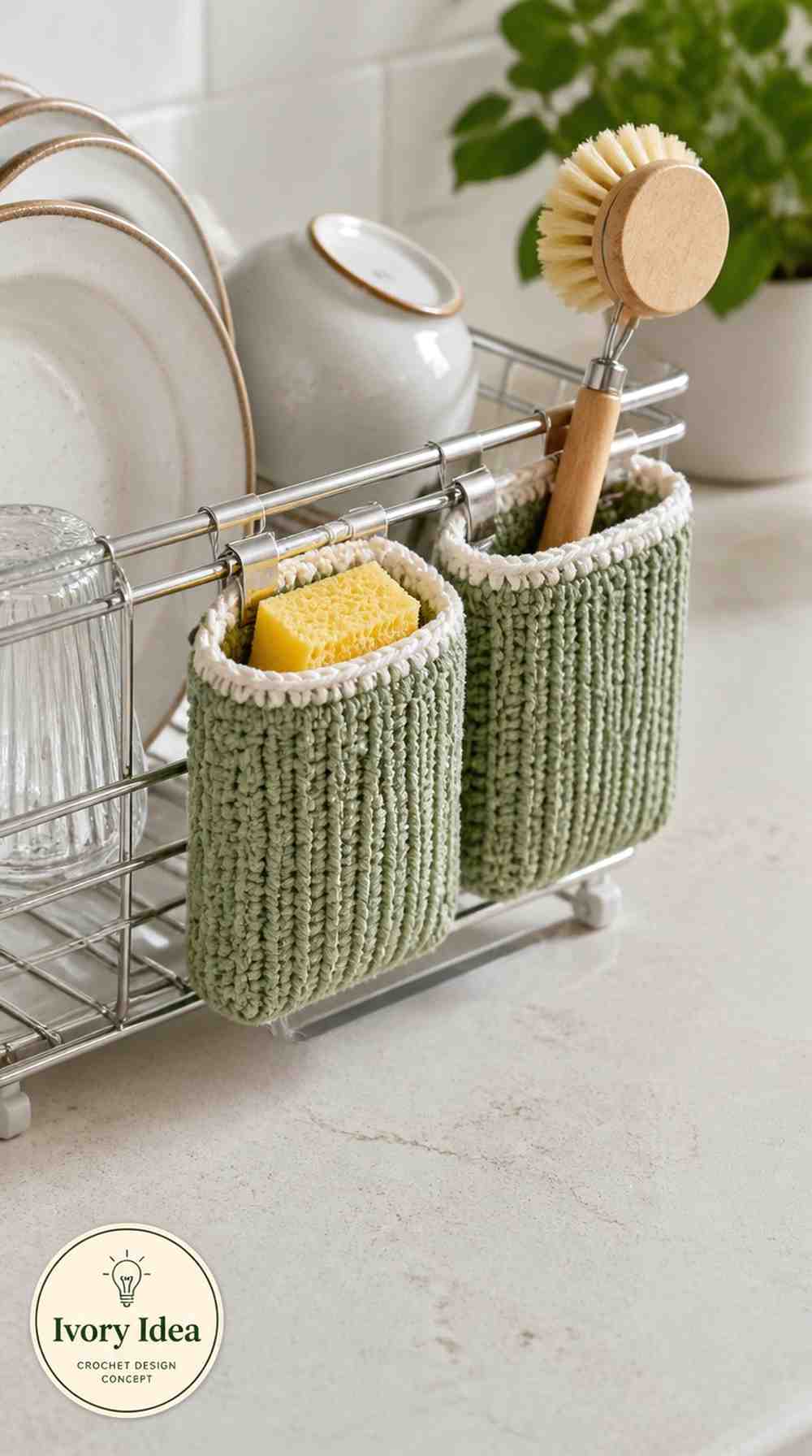
Soft sage-green crochet covers this compact side-mounted dish rack caddy, creating two separate storage pockets for a yellow kitchen sponge and a wooden-handled dish brush. The pockets have dense ribbed textures, cream piping around their openings and visible metal clips attaching the structure to the stainless-steel rack.
Keeping the sponge and brush in different compartments could make them easier to find during daily washing. The rigid underlying caddy is especially important because damp tools may add weight, and the crochet itself should not be relied upon for structural support.
- Separate compartments: The sponge pocket should fit without compressing the sponge tightly, while the taller brush compartment needs enough clearance for its handle.
- Mounting clips: Check the side-rail diameter and shape before choosing clips. A secure metal attachment matters more than decorative crocheted ties.
- Moisture management: The pockets should allow damp tools to drain and dry rather than holding moisture against the yarn for long periods.
- Color finishing: Cream piping defines both openings. For a real version, keep the trim compact so it does not catch on brush handles.
2. Crochet Ivory Side-Rail Dishcloth Holder
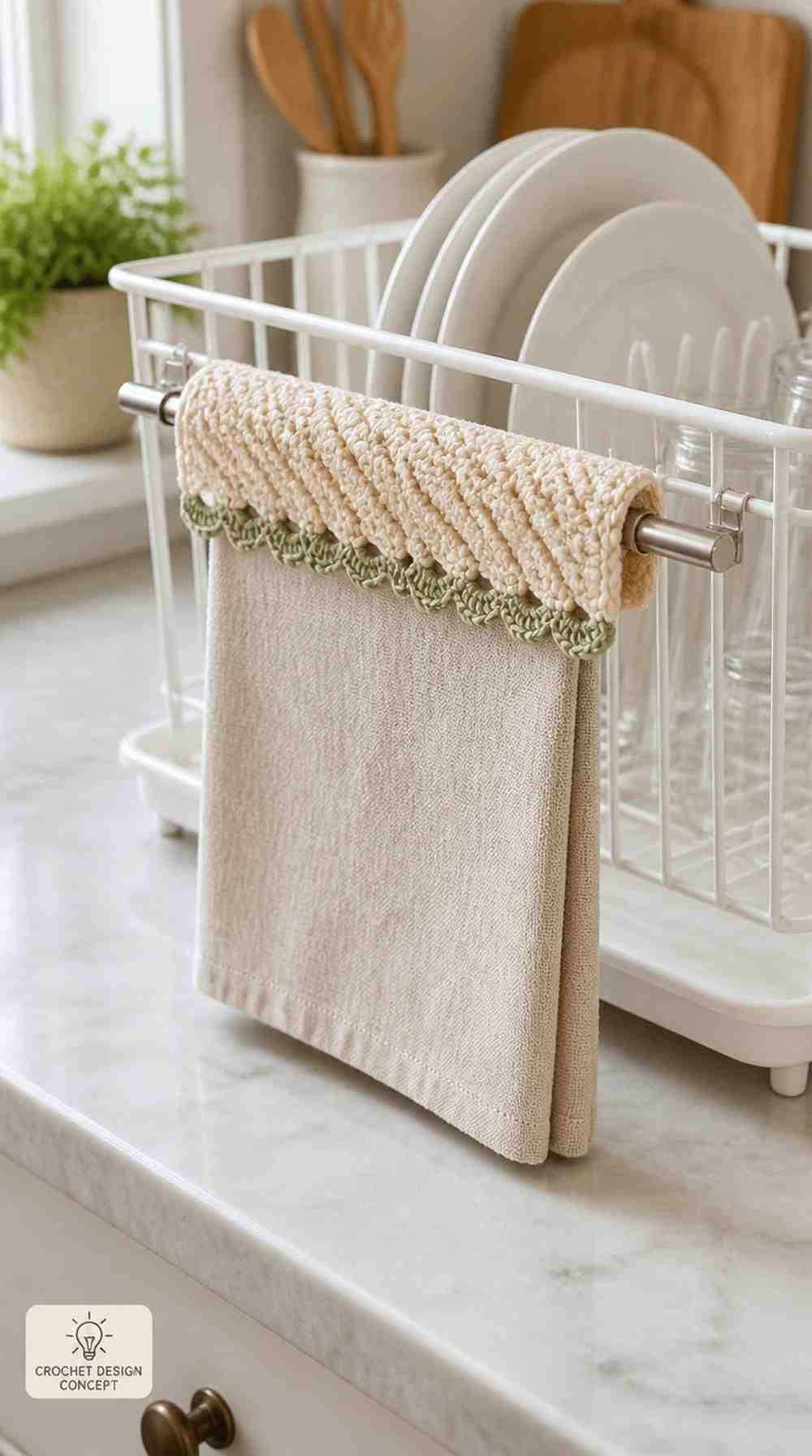
Warm ivory crochet wraps neatly around a narrow stainless-steel side rail, giving an ordinary dish rack an attractive hanging accessory. Raised diagonal stitches create subtle texture, while dusty-sage scalloped edging softens the lower edge. An oatmeal-colored cotton dishcloth hangs folded over the covered bar.
The open arrangement avoids the enclosed shape of a storage pocket. It gives the cloth space to hang, although airflow and drying time will still depend on the fabric, the amount of moisture and the surrounding kitchen conditions.
- Bar length: Choose a rail wide enough to support the dishcloth without bunching it into thick folds.
- Crochet covering: A snug sleeve should remain in place when the cloth is removed, without sliding across the support bar.
- Scalloped trim: Keep the sage edging small and away from the most frequently handled area to limit snagging.
- Drying position: Leave clearance below the cloth and avoid placing it where it will continually touch standing water.
3. Crochet Terracotta Utensil Side Organizer
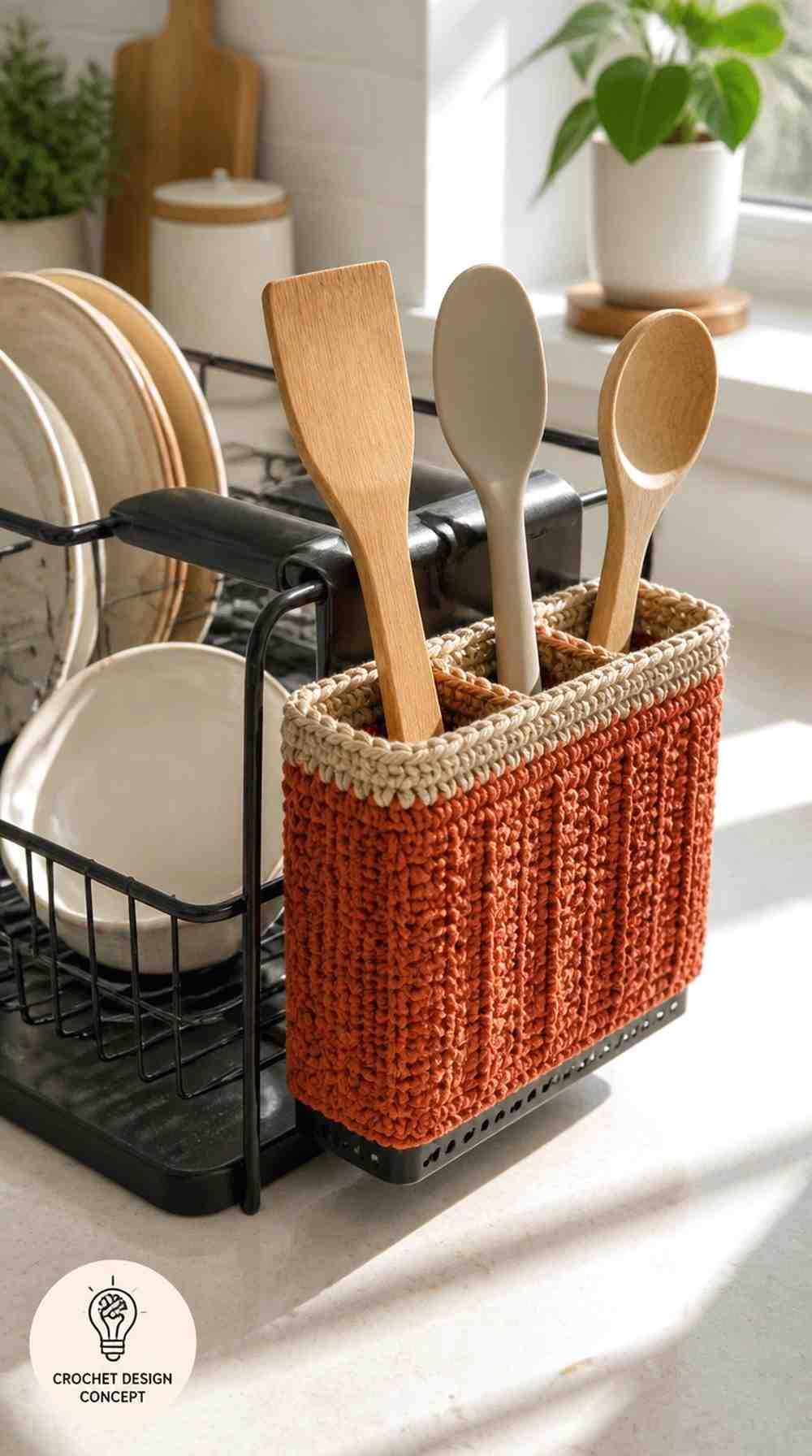
Warm terracotta crochet gives this rectangular utensil caddy a rich handmade finish. The exterior features vertical raised stitches, while a sandy-beige ribbed border outlines the top. Three narrow compartments keep a wooden spatula, silicone cooking spoon and wooden stirring spoon standing separately.
The crochet-covered holder hangs from the side of a black metal dish rack, with a perforated rigid cup underneath. Its upright arrangement makes long utensils visible without spreading them across the drying surface. A stable supporting frame is essential for preventing the filled holder from tilting.
- Utensil height: Tall spatulas and spoons can create leverage on a side-mounted caddy, so check the support bracket and the rack’s stability.
- Compartment width: Divide the space according to the utensils you own; broad silicone heads may need more room than narrow wooden handles.
- Perforated base: Any real holder should permit drainage and cleaning beneath the tools instead of trapping water inside the crochet covering.
- Raised crochet texture: Vertical ridges add interest without requiring decorative attachments that might snag utensil handles during removal.
4. Crochet Dusty-Blue Mesh Sponge Cradle
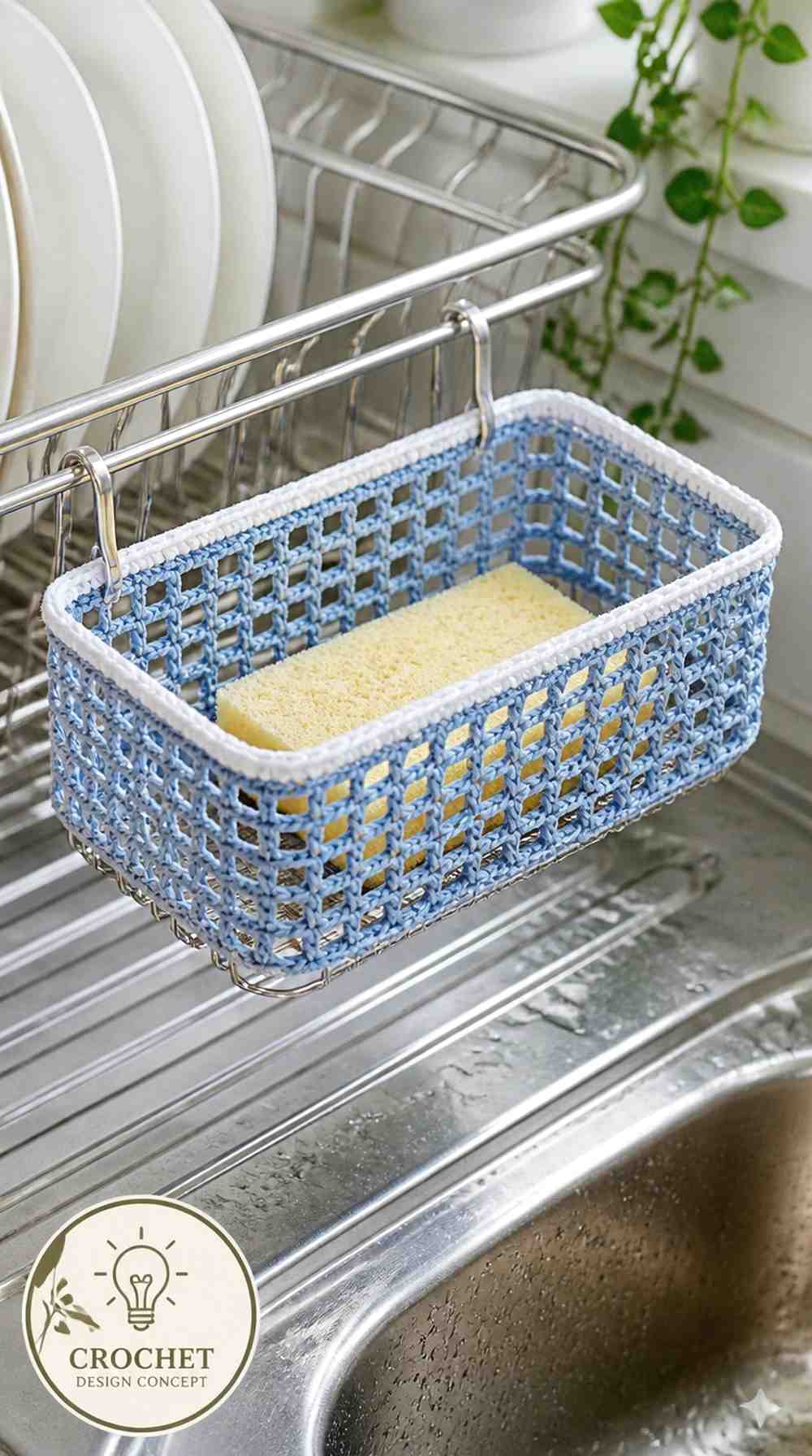
Dusty-blue crochet mesh lines a shallow wire cradle attached to the side of a silver dish drying rack. Open square stitches and neat white piping create a light, airy appearance. A pale-yellow sponge rests horizontally inside, with the metal base visible through the mesh.
The open crochet structure makes this concept different from a deep pouch. It leaves more of the sponge exposed, which may help reduce enclosed damp areas when the holder is properly positioned and regularly cleaned. The supporting wire frame maintains the rectangular shape.
- Mesh opening size: Keep the openings small enough that the sponge cannot fall through or become caught in the crochet.
- Drainage position: Mount the cradle above a suitable drainboard so dripping water does not collect beneath the organizer.
- Removable liner: A detachable crochet mesh section would make washing and drying easier than a permanently stitched covering.
- Support depth: Choose a shallow enough cradle for convenient access while still preventing the sponge from slipping over its edge.
5. Crochet Mustard Dish Soap Bottle Holder
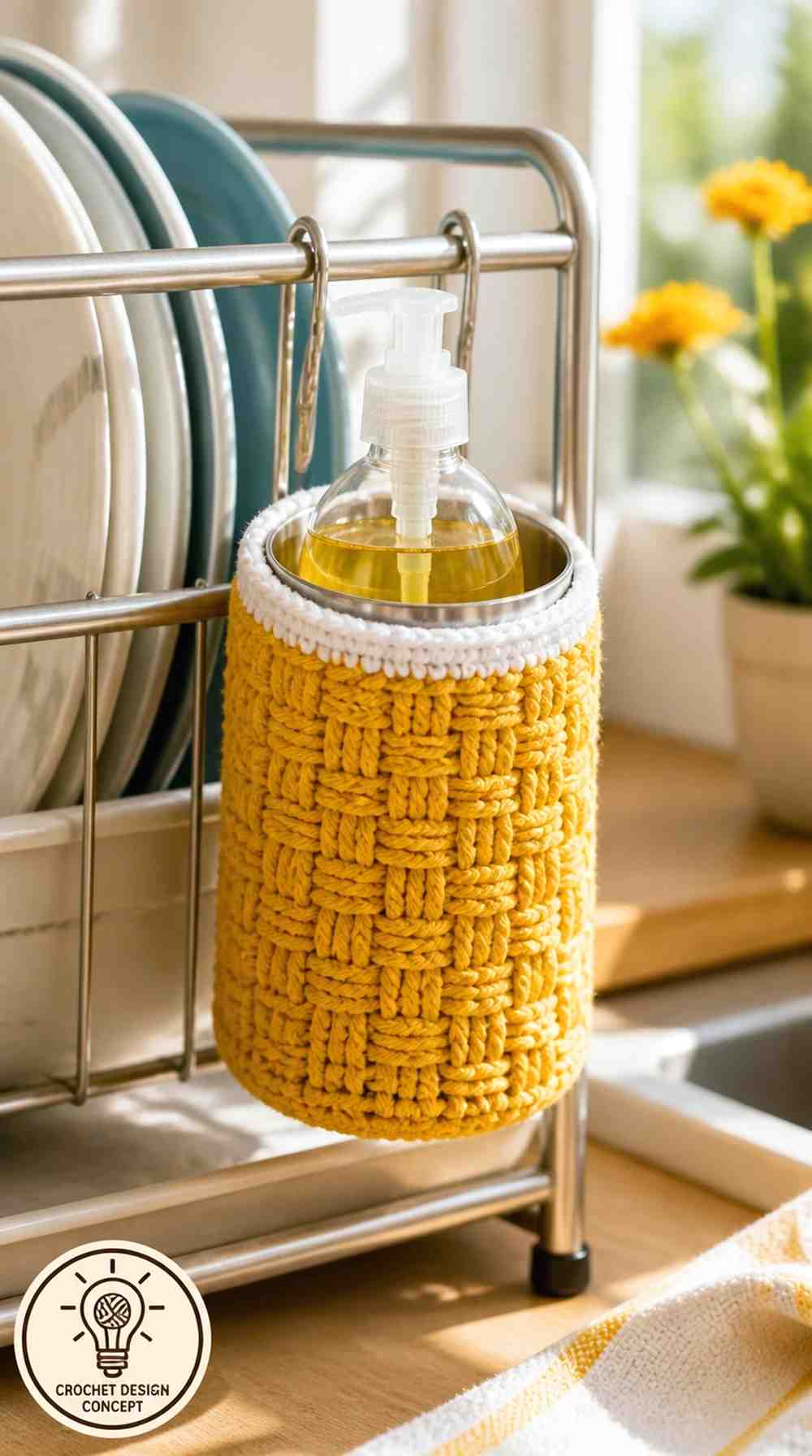
Mustard-yellow crochet adds cheerful color to a cylindrical metal cup attached to the dish rack’s side. Raised basketweave-style stitches form the sleeve, while a narrow white ribbed border finishes its upper edge. A small transparent pump bottle of golden dishwashing liquid stands upright inside the supported cup.
This concept keeps dish soap beside the washing area without placing the bottle directly on the countertop. Since a filled bottle can be surprisingly heavy, the rigid cup and its two metal mounting hooks are the most important functional parts.
- Bottle compatibility: Measure the bottle’s widest section, including its base, before choosing the cup diameter and depth.
- Attachment strength: Consider the weight of a full bottle and the force applied when using the pump; the dish rack must remain stable.
- Pump access: Position the holder so the bottle can be removed for use without pressing down on an unsupported rack attachment.
- Crochet sleeve fit: A closely fitted mustard cover can reduce sagging, but it must not interfere with drainage holes or cleaning access.
6. Crochet Olive Hanging Brush Dock
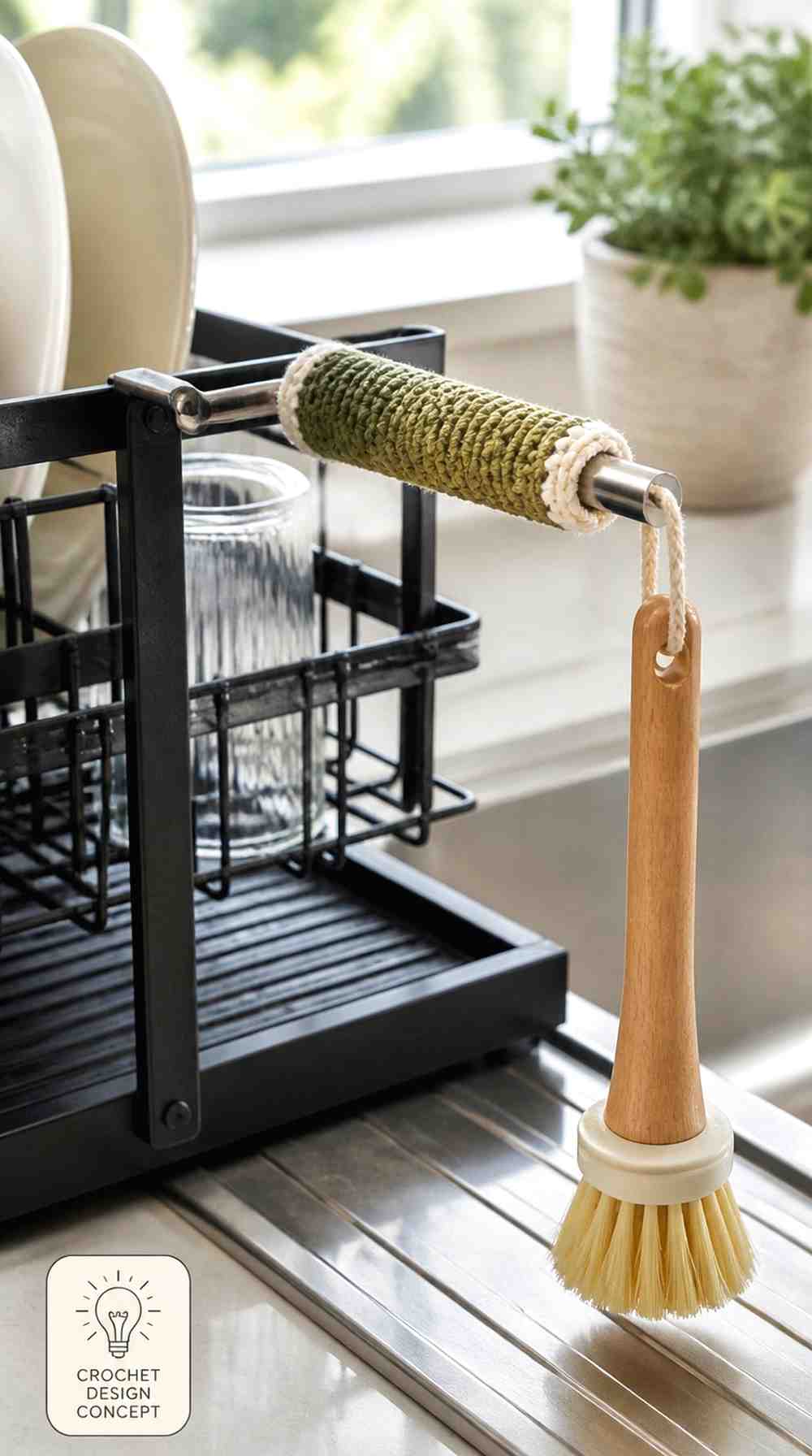
Olive-green crochet covers a short curved stainless-steel arm attached to a matte-black dish drying rack. Small cream rings finish both ends of the snug sleeve. A wooden-handled dish brush hangs from its own handle loop, with its bristles facing downward above the drainboard.
The single-purpose design keeps the brush separate from other tools. Unlike a deeper pocket, the rigid side arm supports the brush from above, leaving its head unobstructed. The arm must be firmly attached so removing the brush does not shift the rack.
- Brush handle loop: Check that the brush’s existing hanging loop fits the arm securely without being stretched or forced.
- Bristle clearance: Leave space beneath the hanging brush so its bristles do not touch pooled water or other kitchen items.
- Sleeve placement: Avoid covering the part of the arm where the hanging loop needs to move freely during removal.
- Support arm shape: A modest upward curve or other suitable stop may help prevent the brush loop from slipping off the end.
7. Crochet Blush Staggered Scrub-Pad Pockets
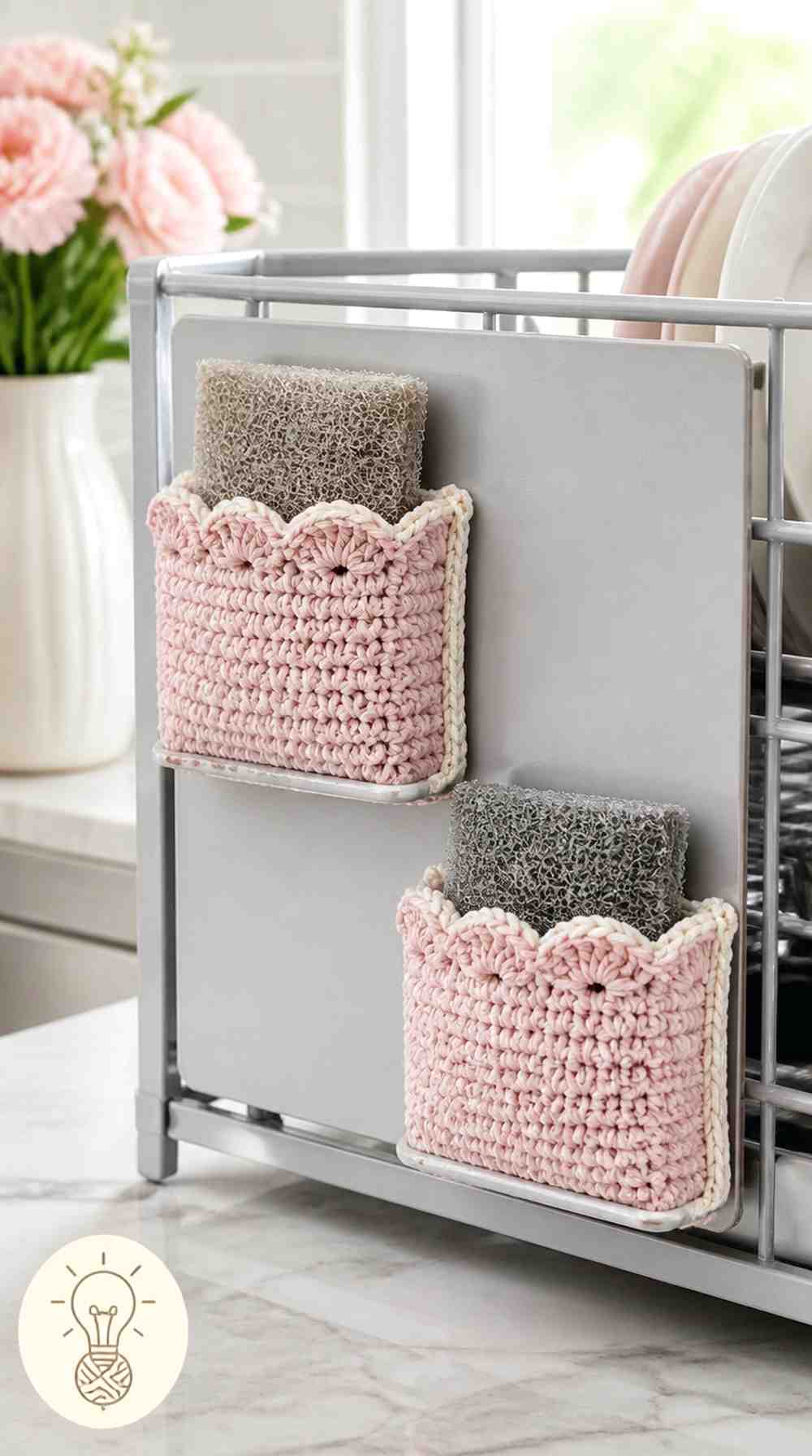
Two blush-pink crochet pockets sit at different heights on a slim gray dish rack side panel. Each shallow pocket features closely worked lower stitches, a curved shell-stitch top and cream piping. Two slim rectangular scouring pads remain partly visible above their individual openings.
The staggered layout makes each pad accessible without requiring a wide organizer. Small rigid ledges support the bottoms of the pockets, while the attached panel keeps the arrangement aligned. This could suit a kitchen where different scrub pads are used for separate cleaning tasks.
- Pocket positioning: Leave enough vertical separation to remove the lower pad without catching the upper pocket.
- Pad thickness: Shallow pockets work best when their opening width matches the actual scrub pad rather than squeezing it into a tight sleeve.
- Shell-stitch edges: Decorative shells should remain above the contact area so repeated removal does not pull or distort them.
- Cleaning routine: Avoid storing dirty, saturated pads in the crochet pockets for extended periods; wash and dry both the pads and holder as appropriate.
8. Crochet Charcoal Divided Cutlery Caddy
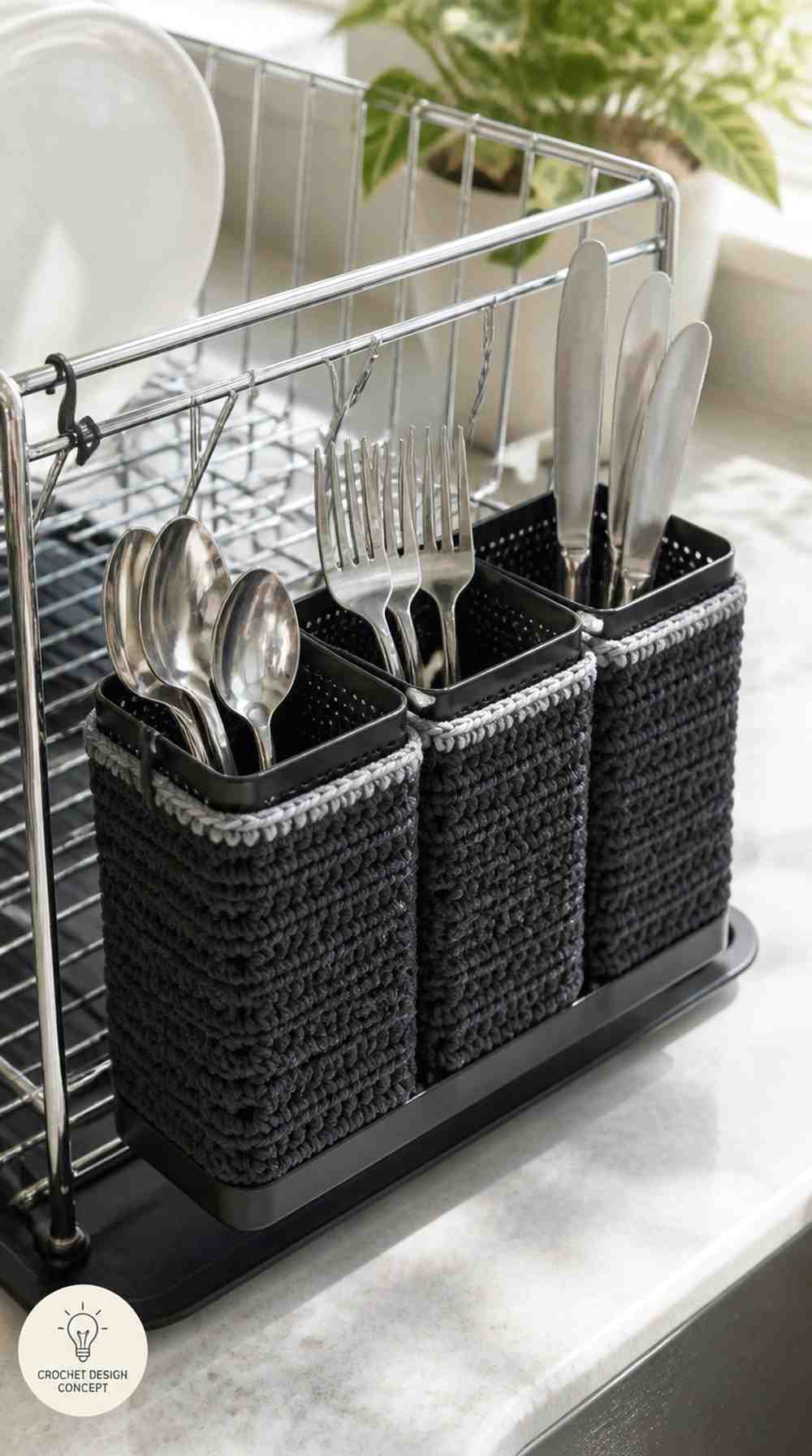
Charcoal-gray crochet brings a modern finish to this black metal cutlery caddy. Three upright compartments have individual removable crochet sleeves, each showing horizontal ridges and pale-gray top edging. Clean teaspoons, forks and blunt butter knives stand separately inside the perforated metal holder.
The dark crochet contrasts attractively with the stainless-steel dish rack while leaving the rigid structure visible. Divided storage helps keep different utensils organized, but the compartment bases and attachments must be strong enough to support the contents without relying on flexible crochet fabric.
- Cutlery separation: Use compartments wide enough for utensils to stand loosely rather than packing them tightly together, which can limit airflow.
- Removable covers: Individual crochet sleeves can be easier to wash than one permanently attached covering around the entire caddy.
- Perforated support: Keep the rigid metal drainage openings unobstructed so water can escape from the utensil compartments.
- Safe placement: Position the holder where utensils cannot fall or snag. Keep sharp knife blades out of this decorative side organizer.
9. Crochet Lilac Dishwashing Glove Drying Bars
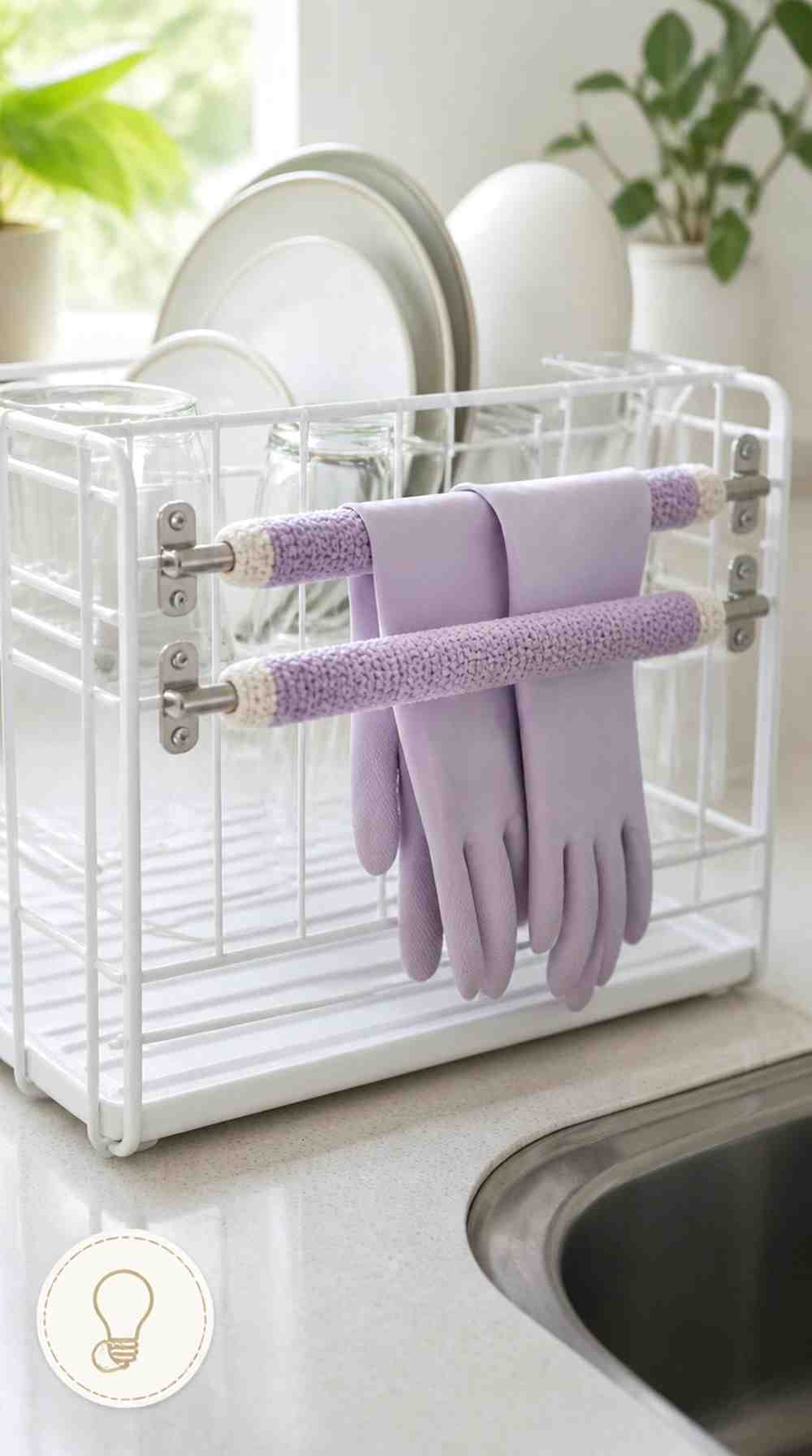
Pale lilac crochet softens two parallel stainless-steel drying bars attached to a white dish rack. Both bars have closely fitted ribbed sleeves and narrow ivory finishing bands. A pair of lavender dishwashing gloves hangs separately over the bars, with the fingers pointing downward.
The open bar arrangement provides a dedicated place for reusable gloves after washing up. Its simple structure avoids deep storage pockets, although gloves still need sufficient airflow to dry, including inside the fingers and cuffs.
- Separate drying bars: Giving each glove its own bar reduces crowding and makes the pair easier to remove individually.
- Glove positioning: Arrange the gloves so water can drain and air can circulate. Turn or reposition them if their interiors remain damp.
- Crochet sleeve thickness: Keep the lilac covers reasonably slim so gloves can hang without creating bulky folds around the supporting bars.
- Cleaning consideration: The crocheted bar sleeves may become damp during use, so removable covers could make regular washing and drying more convenient.
10. Crochet Oatmeal Rolled-Cloth Side Pocket
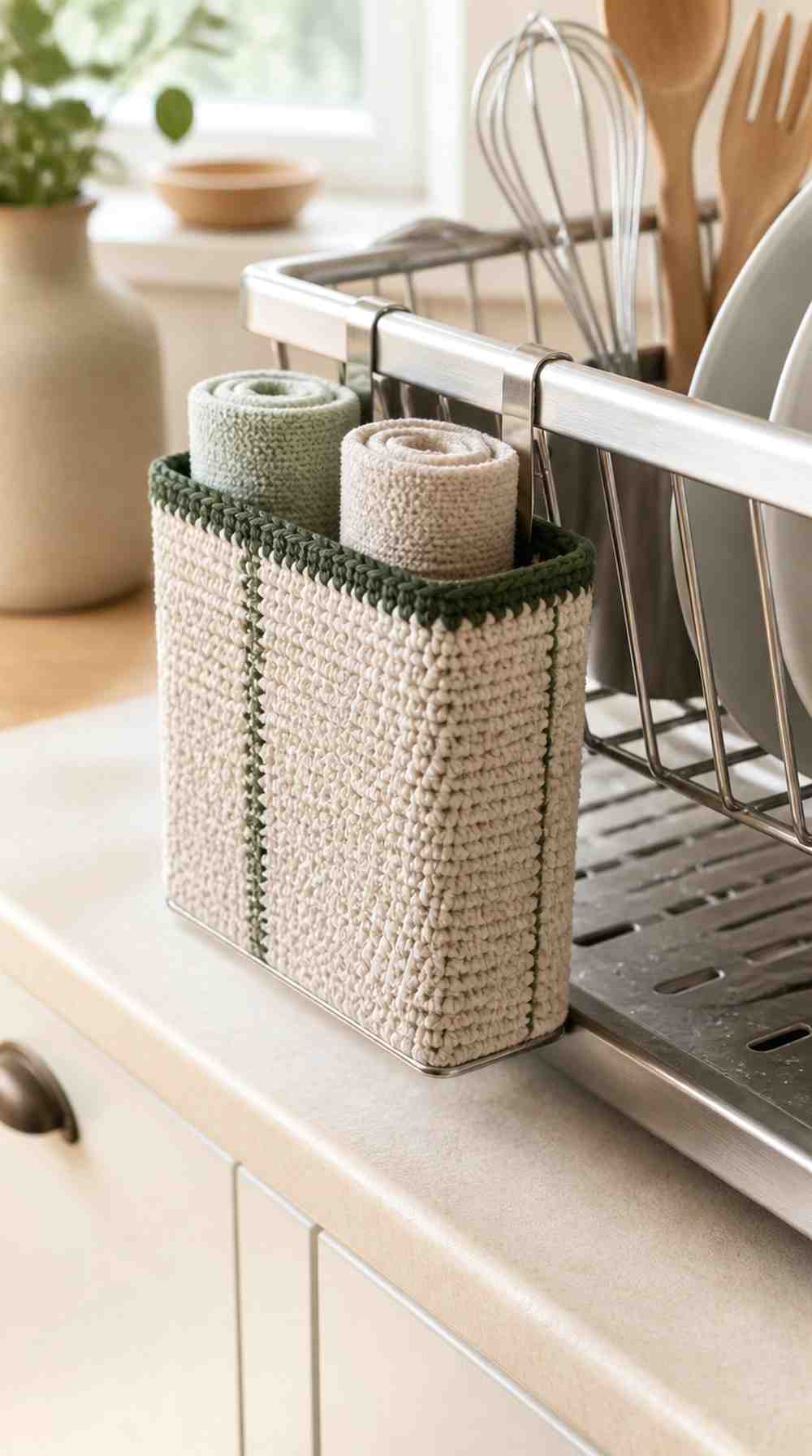
Oatmeal crochet creates a warm, understated covering for this narrow rectangular metal basket. Compact basket-textured stitches, a forest-green upper edge and two subtle vertical seams give the organizer a structured appearance. Two clean, dry microfiber cloths stand neatly rolled inside.
The basket attaches to the outer side of a brushed-steel dish rack, away from the wettest draining area. Its deeper shape is intended for storing spare cloths rather than holding items that have just been used for washing.
- Dry-cloth storage: Keep this compartment for completely dry replacement cloths; damp fabric should be hung separately where it can dry.
- Basket depth: The rolled cloths should remain partly exposed above the opening so they are easy to recognize and retrieve.
- Mounting location: Choose the drier outer side of the rack and avoid positions exposed to frequent splashes or overflowing drainage.
- Shape retention: The rigid metal basket supports the cloths, while the oatmeal crochet covering provides texture without needing to carry their weight.
11. Crochet Seafoam Straw-Brush Loop Rail
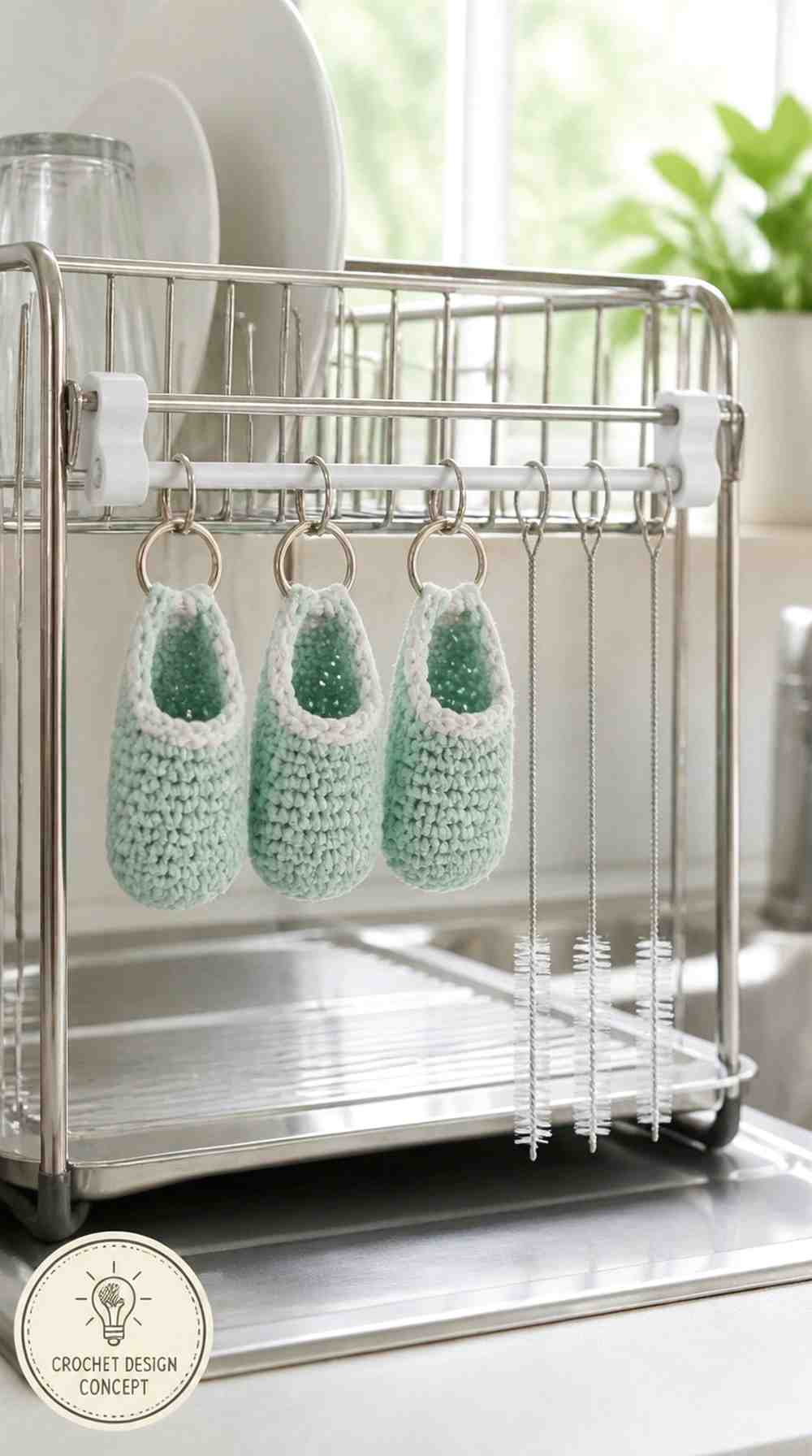
Three seafoam-green crochet loops hang from separate silver rings along a narrow white metal rail. Their closely worked stitches and white edging frame the small hanging points. Three reusable straw-cleaning brushes hang individually by their handle loops, with slender bristles pointing downward.
This organizer keeps narrow cleaning tools separate instead of letting them become tangled inside a utensil cup. The short accessory rail attaches to the dish rack’s outer frame, creating a compact hanging arrangement for tools that already have suitable loops.
- Loop compatibility: Check the size and shape of each brush handle loop before deciding how large the crocheted holders should be.
- Brush separation: Leave enough distance between the three rings so their bristle heads do not overlap or become tangled.
- Metal rail placement: Position the brushes above a suitable draining area, away from clean dishes that could be touched by dripping cleaning tools.
- Small-scale crochet: Firm, closely worked stitches suit these narrow loops better than bulky decorative textures that could obstruct the brush handles.
12. Crochet Coral Pivot-Out Side Tray
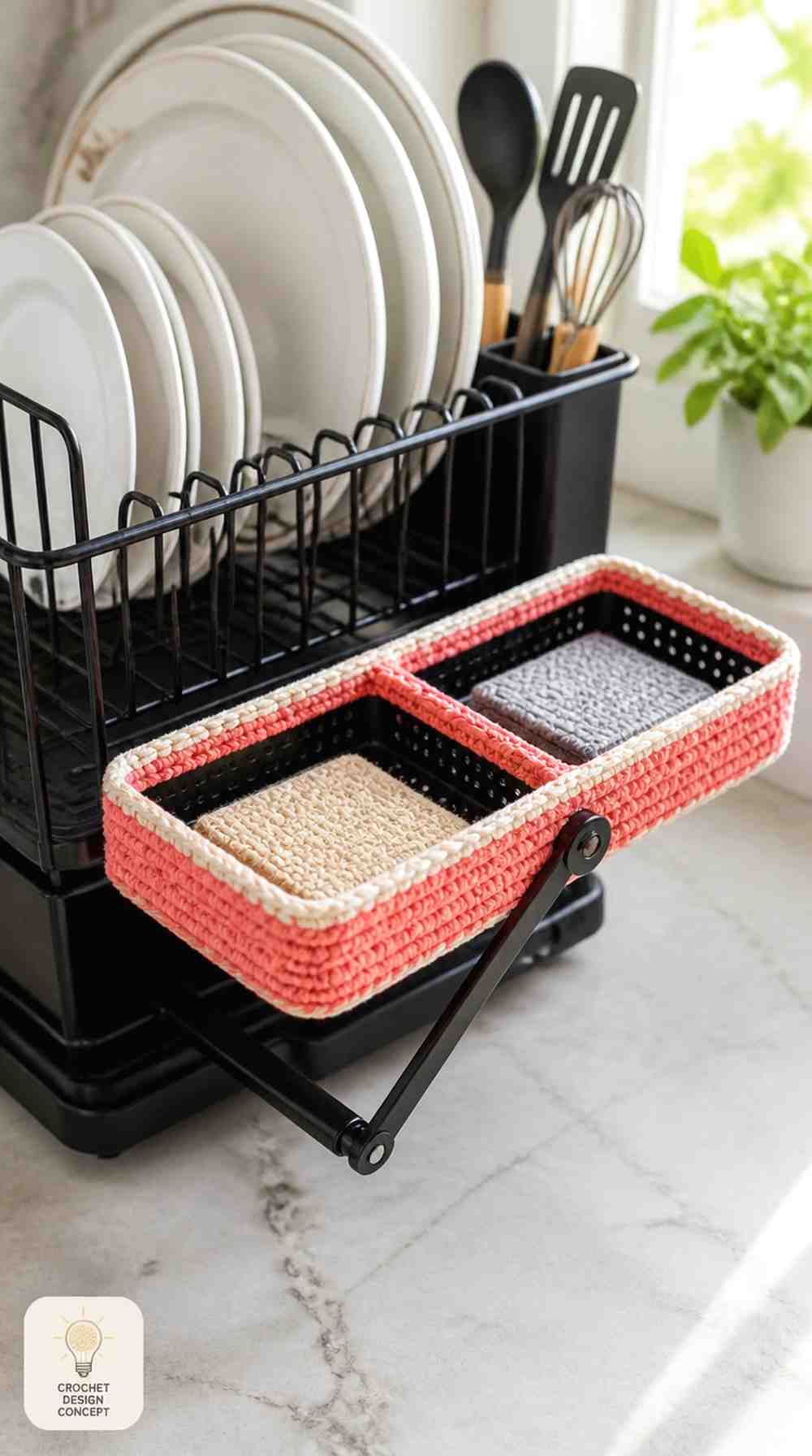
Coral-pink crochet wraps the upper edges of this shallow rectangular side tray, creating a colorful contrast against the black metal dish rack. Cream piping outlines the rim, while a matching crochet-covered central divider separates two small scrub pads. The perforated metal base remains exposed.
The tray extends outward on a visible pivoting support arm. This design could provide easier access to the cleaning pads without requiring a permanently projecting shelf. A practical version would need a secure hinge and a stable open position.
- Pivot mechanism: Choose a suitable rigid hinge with a reliable open position so the tray cannot swing unexpectedly during use.
- Tray clearance: Check that the extended shelf does not obstruct the sink, surrounding cabinets or normal movement around the worktop.
- Coral rim covering: Keep the crocheted wrap away from moving joints and drainage openings to prevent snagging and trapped moisture.
- Scrub-pad compartments: The central divider separates two pads, but both still need regular cleaning and enough open space to dry.
13. Crochet Navy Mini Squeegee Side Dock
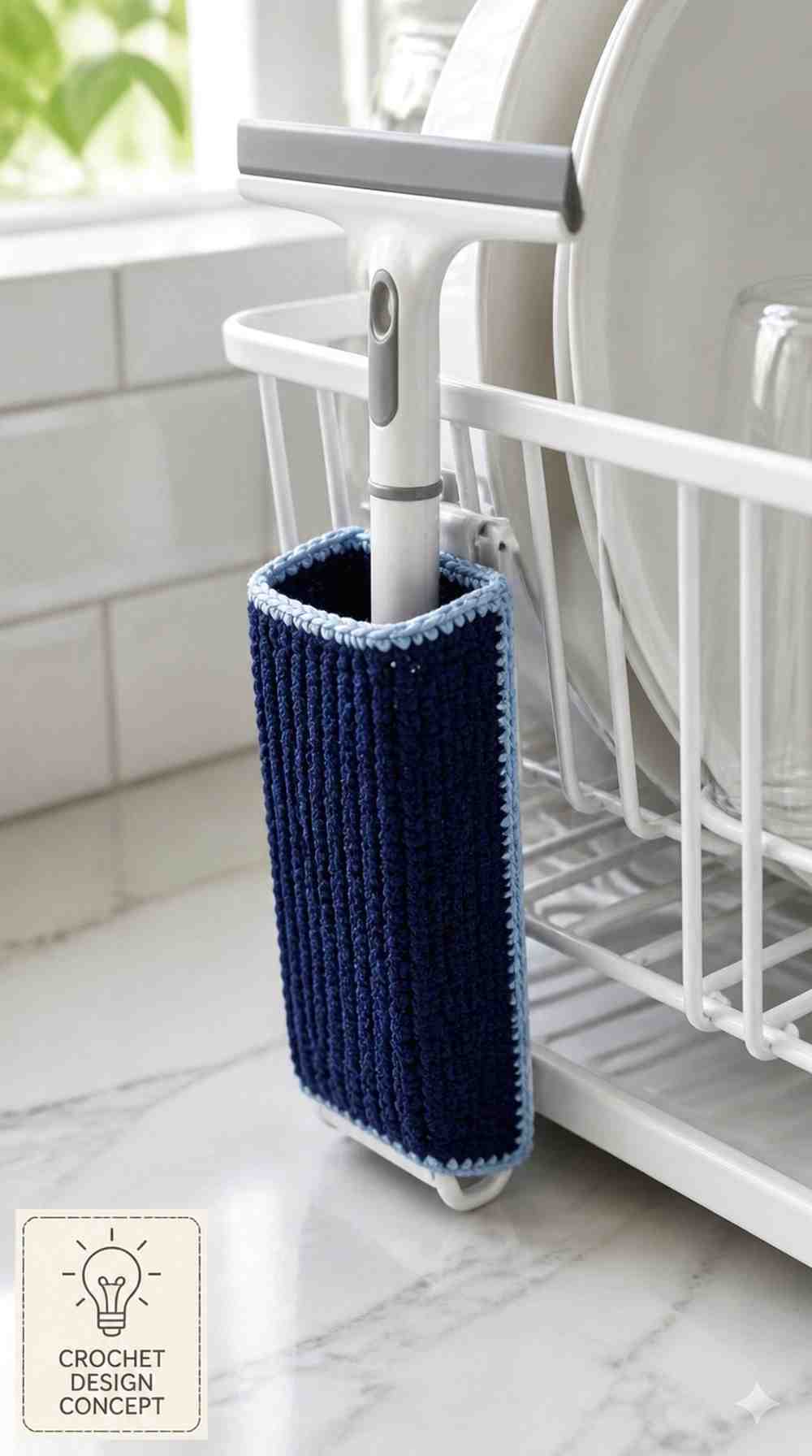
Deep navy crochet covers a narrow U-shaped accessory dock fixed to the side of a white metal dish rack. Dense vertical ribs provide texture, while powder-blue edging outlines the holder. A small white-and-gray silicone kitchen squeegee stands upright, with its handle inside the dock and wiping head visible above.
The holder is designed around one cleaning tool rather than several accessories. Its slim vertical shape limits the amount of side space required, provided the rigid dock securely supports the squeegee.
- Handle fit: Measure the squeegee handle before planning the opening, leaving enough clearance for easy removal without excessive movement.
- Rigid support: The U-shaped frame should carry the tool’s weight; crochet sleeves are not a substitute for a secure holder.
- Drying position: Avoid leaving the wiping head pressed against damp fabric or another surface where moisture can remain trapped.
- Crochet edge detail: Powder-blue edging highlights the dock’s opening while keeping the dark navy design visually simple.
14. Crochet Rust Perforated Scrubber Shelf
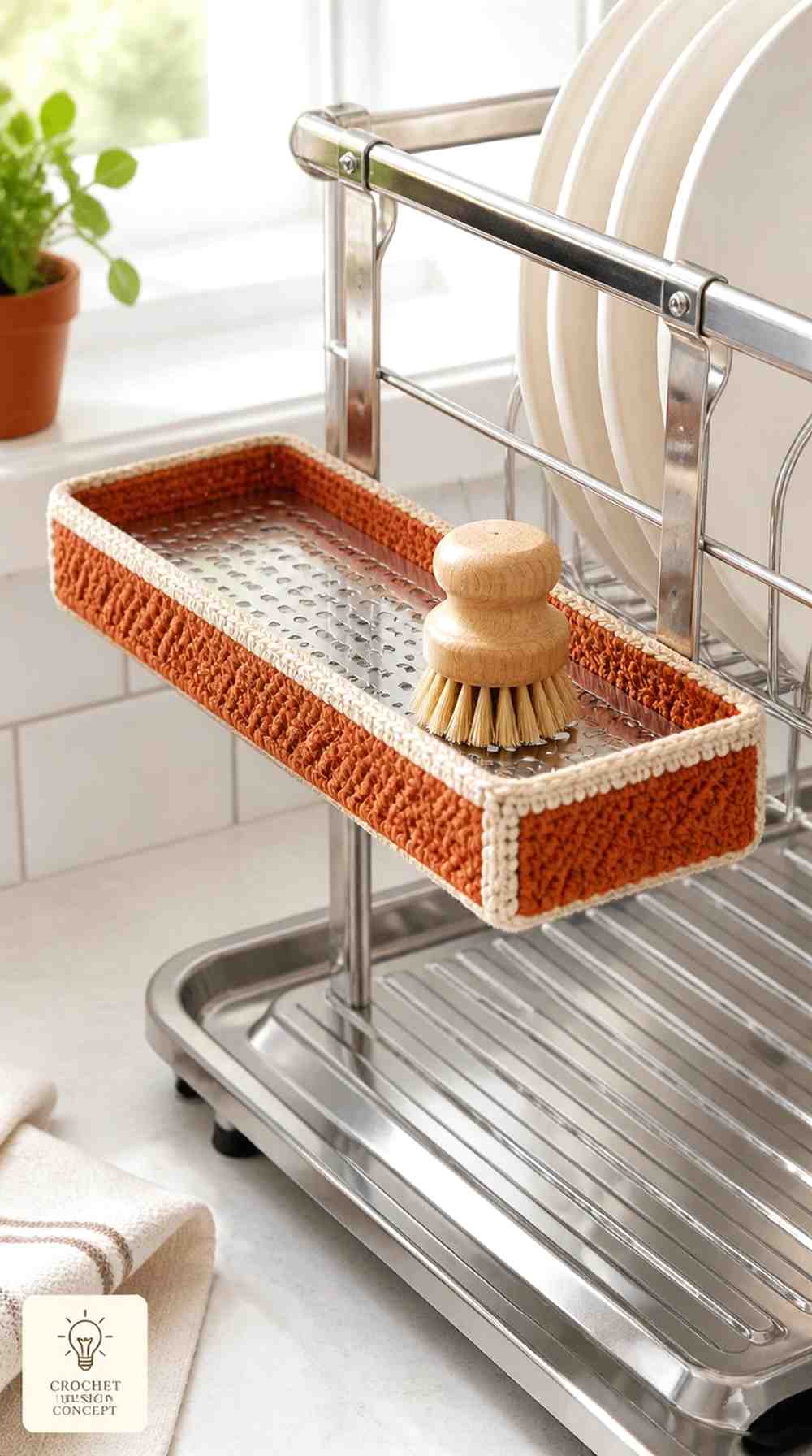
Rust-orange crochet adds warmth to a low perforated metal shelf attached to a stainless-steel dish rack. Raised diagonal stitches cover the front and side rails, while beige edging defines the borders. A compact wooden palm scrubber rests on the open shelf with its natural bristles visible.
The shallow arrangement gives the scrubber a dedicated spot without enclosing it inside a pocket. The perforated surface provides drainage openings, while the rigid supporting brackets carry the shelf and its contents.
- Shelf depth: Choose a platform large enough for the scrubber base without leaving the tool balanced on its edge.
- Perforated surface: Keep the drainage openings clear of crochet so water can escape rather than collect beneath the brush.
- Wooden scrubber care: Follow the brush manufacturer’s cleaning and drying guidance; prolonged dampness can affect natural wood and bristles.
- Crochet rail placement: Limit the rust-colored covering to the shelf edges where it can remain visible without sitting directly beneath the wet scrubber.
15. Crochet Teal Triple-Ring Side Organizer
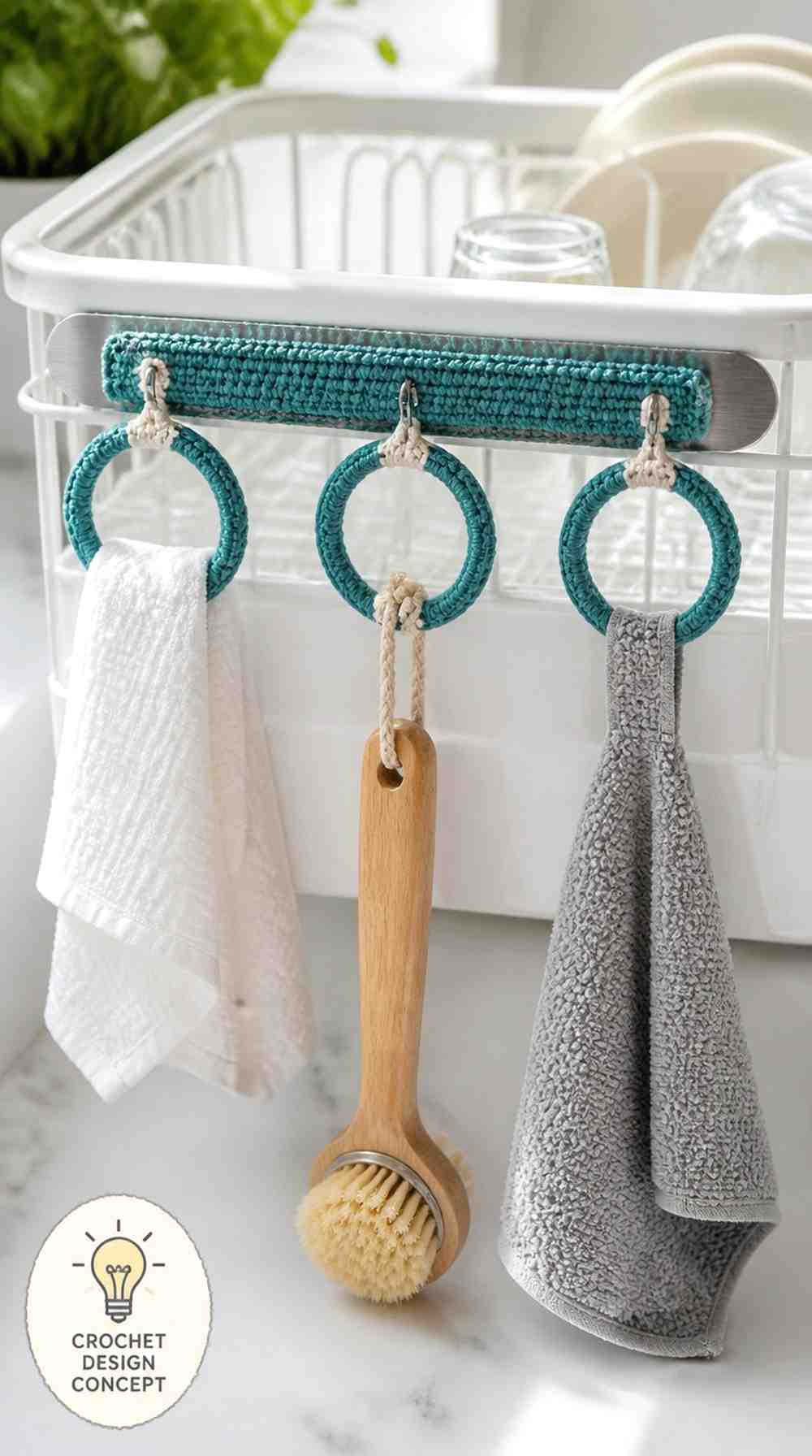
Teal crochet covers three small stainless-steel hanging rings mounted along a narrow brushed-metal strip. A matching ribbed crochet sleeve finishes the support strip, with cream joining stitches adding subtle contrast. The rings hold a white dishcloth, a wooden-handled brush and a gray cleaning cloth separately.
The open hanging layout gives several accessories their own positions without requiring individual baskets. Its usefulness depends on the loops and hanging points available on the tools, as well as sufficient clearance beneath the dish rack.
- Ring spacing: Keep the three rings far enough apart that the cloths do not bunch against the hanging dish brush.
- Tool compatibility: The brush requires a suitable handle loop, while the gray cloth hangs by its sewn loop rather than being forced through a tight opening.
- Mounting strip: A rigid strip helps distribute the accessories across the rack; the crocheted covering mainly contributes color and texture.
- Drying clearance: Leave the hanging cloths open to airflow and avoid contact with pooled water or items stored below them.
16. Crochet Butter-Yellow Twin-Cup Organizer
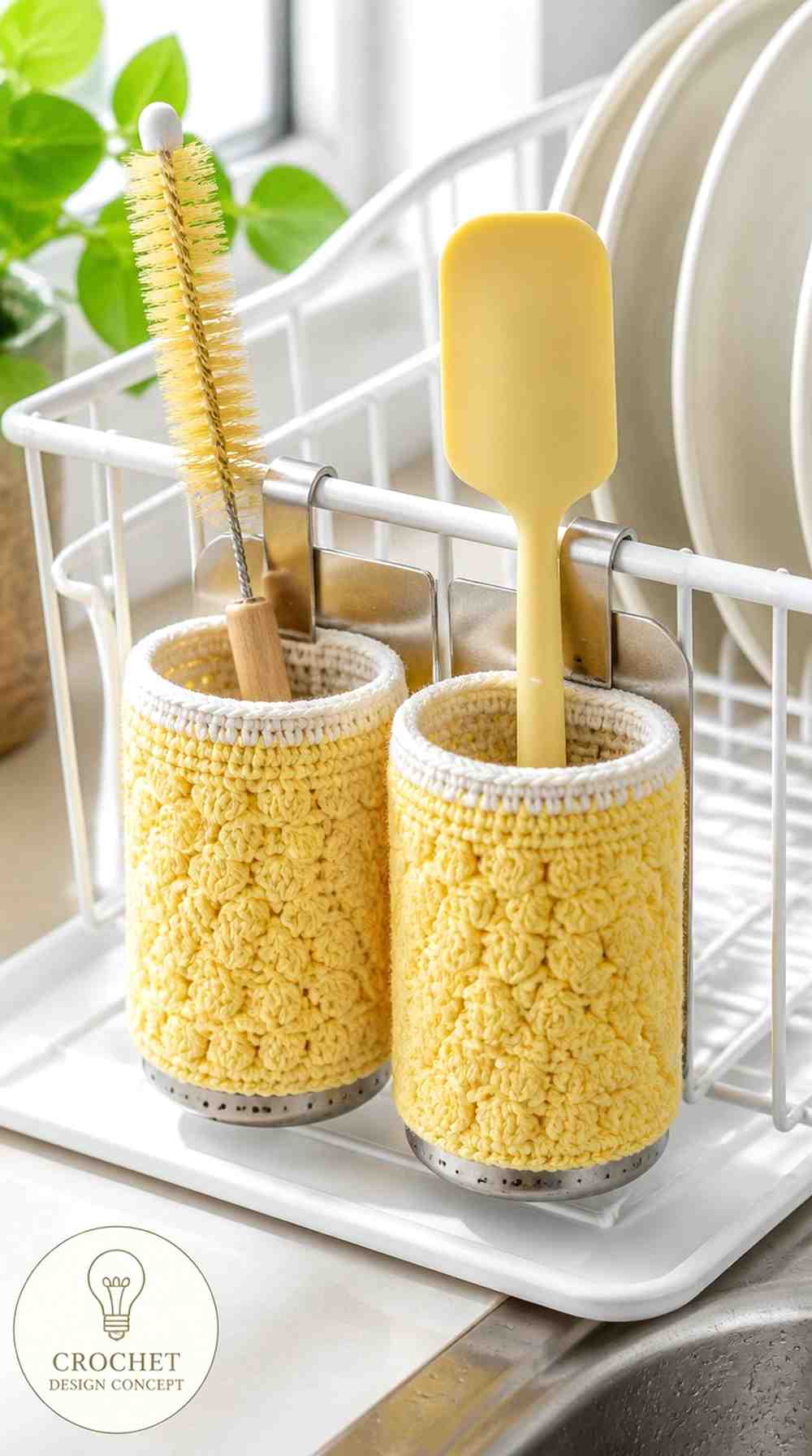
Butter-yellow crochet gives two small cylindrical metal cups a cheerful coordinated finish. Each exterior sleeve has delicate hexagon-like raised stitches and a narrow white ribbed upper border. One cup holds a slim bottle-cleaning brush, while the second contains a small silicone kitchen scraper.
Both cups hang from a shared stainless-steel bracket attached to the white dish rack. Their separate openings make it easier to sort different cleaning tools while keeping the overall organizer compact.
- Cup separation: Two individual holders prevent the bottle brush from becoming tangled with the silicone scraper.
- Perforated bottoms: Keep the metal drainage openings exposed and check that narrow cleaning tools cannot fall through them.
- Shared bracket: The mounting hardware must support both filled cups without twisting or pulling the dish rack out of balance.
- Yellow crochet sleeves: Firm, fitted crochet maintains the clean cylindrical appearance while allowing the metal cups to be removed for cleaning if the construction permits.
17. Crochet Mocha Modular Side-Pocket Rack
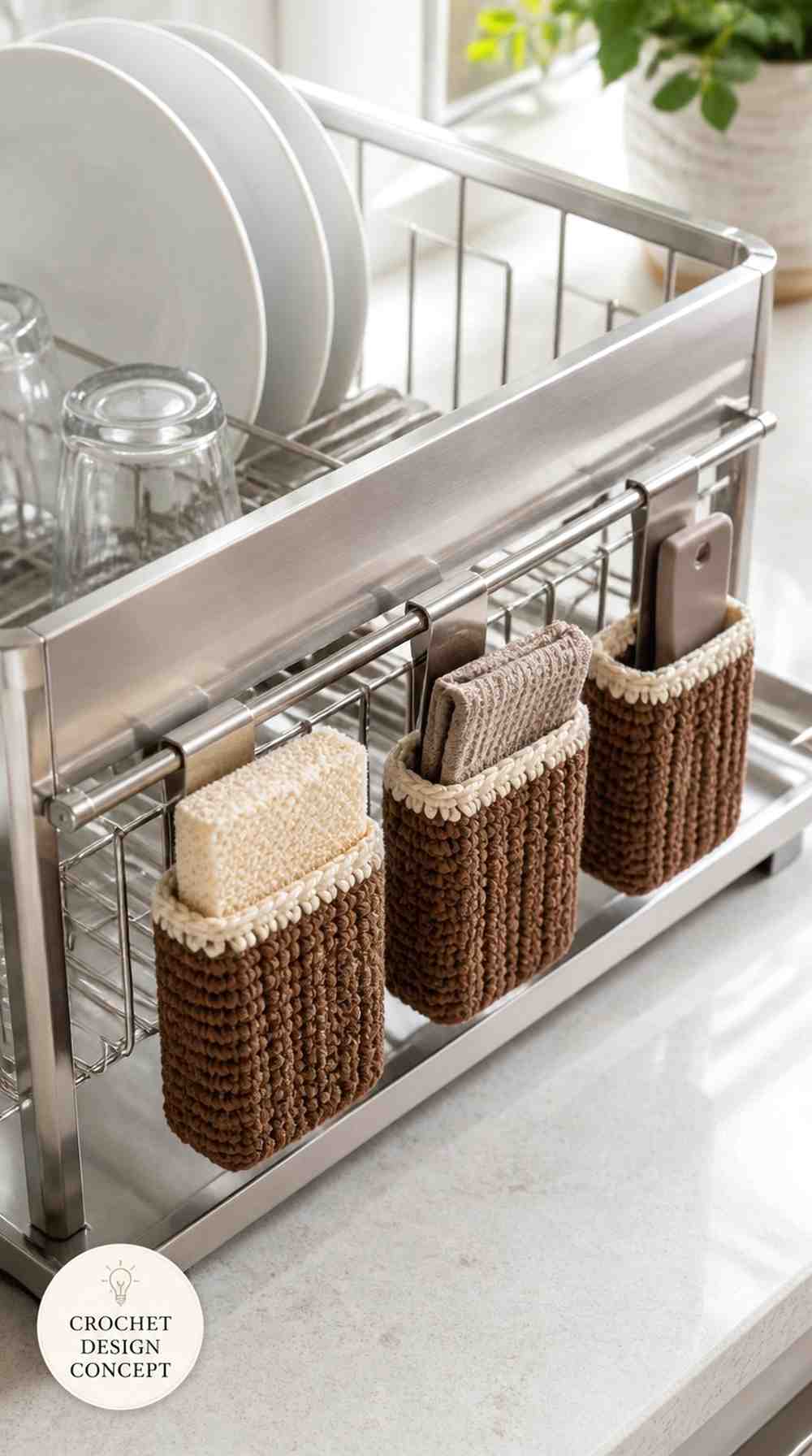
Mocha-brown crochet creates a coordinated finish across three individual pocket modules suspended from a stainless-steel sliding rail. Each pocket has raised vertical stitches and a warm-cream top border. A dry replacement sponge, folded microfiber cloth and slim silicone scraper occupy the three separate compartments.
The modular arrangement is the most flexible-looking concept in this collection. Instead of one fixed caddy, its individual pockets sit on separate sliding brackets. A usable version would need reliable stops or locks to prevent accidental movement along the rail.
- Modular placement: Arrange the three pockets according to the items you use most often, leaving enough space to remove each accessory.
- Sliding security: Brackets should remain fixed during normal use and should not slide off the end of the mounting rail.
- Dry-item storage: Keep the sponge and microfiber cloth dry while stored here; move damp items to an appropriate drying location.
- Removable crochet covers: Separate sleeves may simplify cleaning and allow worn or damaged textile covers to be replaced without discarding the rigid modules.
Practical Guide to Crochet Dish Rack Side Organizers
Dish rack side organizers work in a challenging kitchen location. They sit close to splashing water, drying dishes and frequently handled cleaning tools, so a successful design needs more than attractive stitching.
Check your dish rack first. Measure the available side space, rail thickness and distance to the countertop or drainboard. Some dish racks have round metal rails, while others use flat frames or molded plastic edges. A clip designed for one type may not fit another.
Let the rigid frame carry the weight. Metal cups, brackets, wire shelves and other suitably designed supports are better suited to carrying wet accessories than crochet fabric alone. The attachment should also avoid making the entire drying rack unstable.
Keep moisture under control. Cotton crochet can absorb water and may remain damp when wrapped around a wet accessory. Choose designs that expose the item to airflow, allow drainage and make the crocheted parts removable when possible. Wash the textiles according to the yarn care instructions and let them dry fully.
Make cleaning simple. Open mesh, removable sleeves and accessible supporting frames are worth considering. Avoid permanently enclosing dirty or damp surfaces behind thick crochet.
Match the holder to the accessory. Sponges, brushes, utensils, gloves and cleaning cloths need different storage shapes. One oversized pocket is not necessarily the best solution for everything.
For related kitchen organization inspiration, see these crochet vintage kitchen wall-pocket ideas and these crochet kitchen towel topper ideas on Yarn Nest Studio. Both explore hanging textile storage, although their construction and intended placement differ from dish rack side attachments.
Want to Make Something Similar?
The following verified resources cover related crochet techniques. They are not exact patterns for the 17 AI concepts shown here.
- Crochet Dish Brush Holder by CyCrochet — A free written pattern that uses a folded single-crochet panel, side seams and a hanging loop. It provides relevant construction guidance for a small brush pocket. CyCrochet
- Crochet Wall Hanging Organizer by Happy Heartsy — A free organizer pattern with pocket construction and a supporting hanging arrangement, useful for understanding attached crochet storage compartments. Free Pattern
- Free Crochet Towel Holder by Marching North — A photo-and-video tutorial for creating a hanging towel holder with a rigid ring, relevant to the ring and rail concepts in this collection. Marching North
These lessons can help with individual crochet techniques, but the dish rack-specific supports, drainage and attachments need separate planning and testing.
Comparison: Which Crochet Dish Rack Side Organizer Should You Choose?
| Your main need | Design to consider | Important consideration |
|---|---|---|
| Sponge and brush together | Sage Double-Pocket Organizer | Two compartments need cleaning |
| Hanging a dishcloth | Ivory Side-Rail Holder | Cloth needs room to dry |
| Upright kitchen utensils | Terracotta Utensil Organizer | Requires stable support |
| Open sponge storage | Dusty-Blue Mesh Cradle | Mesh must not obstruct drainage |
| Dish soap storage | Mustard Bottle Holder | Filled bottle adds weight |
| Hanging a single brush | Olive Brush Dock | Handle loop must fit |
| Separate scrub pads | Blush Staggered Pockets | Damp pads need regular cleaning |
| Organizing cutlery | Charcoal Divided Caddy | Keep drainage openings clear |
| Reusable glove storage | Lilac Glove Drying Bars | Glove interiors must dry |
| Dry replacement cloths | Oatmeal Rolled-Cloth Pocket | Keep away from splashes |
| Straw-cleaning brushes | Seafoam Loop Rail | Requires small hanging loops |
| Pivoting storage | Coral Pivot-Out Tray | Needs a secure hinge |
| Mini kitchen squeegee | Navy Squeegee Dock | Must fit the handle |
| Palm scrubber | Rust Perforated Shelf | Rigid drainage surface needed |
| Several hanging tools | Teal Triple-Ring Organizer | Allow spacing between accessories |
| Two different cleaning tools | Butter-Yellow Twin-Cup Organizer | Shared bracket must be secure |
| Changeable pocket positions | Mocha Modular Side-Pocket Rack | Sliding modules need stops |
For a small collection of washing-up essentials, a single-purpose holder may be easier to maintain than a larger organizer. If you regularly use several cleaning tools, separated compartments can make sense, but only if the dish rack has enough side space and a suitable rigid supporting frame.
Conclusion
Crochet dish rack side organizers show how small kitchen accessories can become part of a coordinated handmade space. From simple ivory dishcloth rails to colorful sponge cradles, utensil caddies and modular storage pockets, these 17 ideas offer different ways to use the sides of a dish drying rack.
The most useful design is the one that fits your existing rack and keeps cleaning tools accessible without making drying or maintenance harder. Let the supporting hardware handle the practical work, and use crochet for texture, color and removable decorative details wherever possible.
Which design would fit your kitchen best? Would you choose the sage double-pocket organizer, the dusty-blue mesh sponge cradle or the mocha modular pockets? Share which arrangement would make your washing-up area easier to use.
Frequently Asked Questions
Can I attach a crochet organizer directly to any dish drying rack?
Not necessarily. Dish racks vary in their rail spacing, frame materials and attachment points. Crochet straps or loops alone may not provide enough support for wet items. Check whether your rack can safely accommodate a rigid clip, bracket or supported holder without tipping, bending or damaging its frame.
Is cotton yarn suitable for crochet dish rack organizers?
Cotton can be a reasonable choice because many cotton yarns are washable and offer good stitch definition. However, cotton absorbs moisture, and a thick crocheted cover can remain damp. Use it thoughtfully around wet kitchen accessories, follow the yarn’s care instructions and allow it to dry completely between cleanings.
Which crochet organizer is better for a kitchen sponge?
An open mesh cradle or perforated supported shelf is worth considering because it leaves more of the sponge exposed than a deep, closed pocket. The sponge still needs proper cleaning and drying, and the holder should not trap water against the yarn or the dish rack.
How do I prevent a crochet side organizer from slipping?
Use mounting hardware suited to the dish rack’s actual frame shape and the organizer’s intended load. Clips, rigid brackets and properly secured rails may provide more reliable attachment than loose crochet ties. Check the assembled rack’s stability before storing wet accessories, and stop using an attachment that shifts or tips.
Are these crochet dish rack side organizer ideas complete patterns?
No. These 17 designs are AI-generated inspiration concepts, not tested crochet patterns or construction instructions. Their appearance can help you choose colors, shapes and storage layouts, but any real organizer needs appropriate dimensions, materials, supports and practical testing. The linked tutorials teach related skills rather than reproducing the exact pictured designs.