A collection of neckties can quickly become difficult to manage when different colors and patterns are piled together inside a dresser drawer. These 18 crochet necktie drawer organizer inspiration ideas explore attractive ways to keep ties separated, visible and easier to choose. From sage-green compartment trays and ivory long-lane organizers to terracotta circular dividers, blush fabric-lined boxes and mocha reversible panels, the designs bring handmade texture to practical bedroom storage.
Some ideas work best for a small selection of everyday ties, while others suit larger collections or drawers shared with bow ties. You’ll find different compartment shapes, sliding dividers, removable trays, dust covers and smooth fabric linings. As you explore each design, pay attention to drawer depth, the thickness of your loosely rolled ties and how the crochet surfaces interact with delicate neckwear. An organizer should keep ties neat without squeezing them into tight rolls or snagging their fabric.
These are AI-generated crochet design visualizations for inspiration, not photographs of tested handmade organizers or complete crochet patterns.
Quick Design Selection Guide
- For a larger tie collection: Crochet Sage Twelve-Compartment Necktie Drawer Tray offers twelve separate spaces for individual rolls.
- For gentler long-form storage: Crochet Ivory Long-Lane Necktie Drawer Insert uses broad compartments for ties arranged in loose curves.
- For individual circular spaces: Crochet Terracotta Round-Pod Necktie Organizer and Crochet Mint Six-Pod Necktie Drawer Insert use two different circular constructions.
- For adjustable widths: Crochet Dusty-Blue Adjustable Necktie Drawer Dividers provides sliding partitions.
- For delicate silk ties: Crochet Blush Silk-Friendly Necktie Compartment Box uses smooth removable fabric lining.
- For a deep drawer: Crochet Lilac Two-Tier Necktie Drawer Organizer introduces two storage levels.
- For neckties and bow ties together: Crochet Teal Mixed Necktie and Bow Tie Drawer Organizer uses compartments of different sizes.
- For a narrow drawer: Crochet Coral Slim-Drawer Necktie Roll Tray stores five rolls in one row.
- For covered storage: Crochet Oatmeal Covered Necktie Storage Tray includes a foldover dust cover.
- For reversible styling: Crochet Mocha Reversible Necktie Drawer Dividers offers contrasting crochet surfaces.
1. Crochet Sage Twelve-Compartment Necktie Drawer Tray
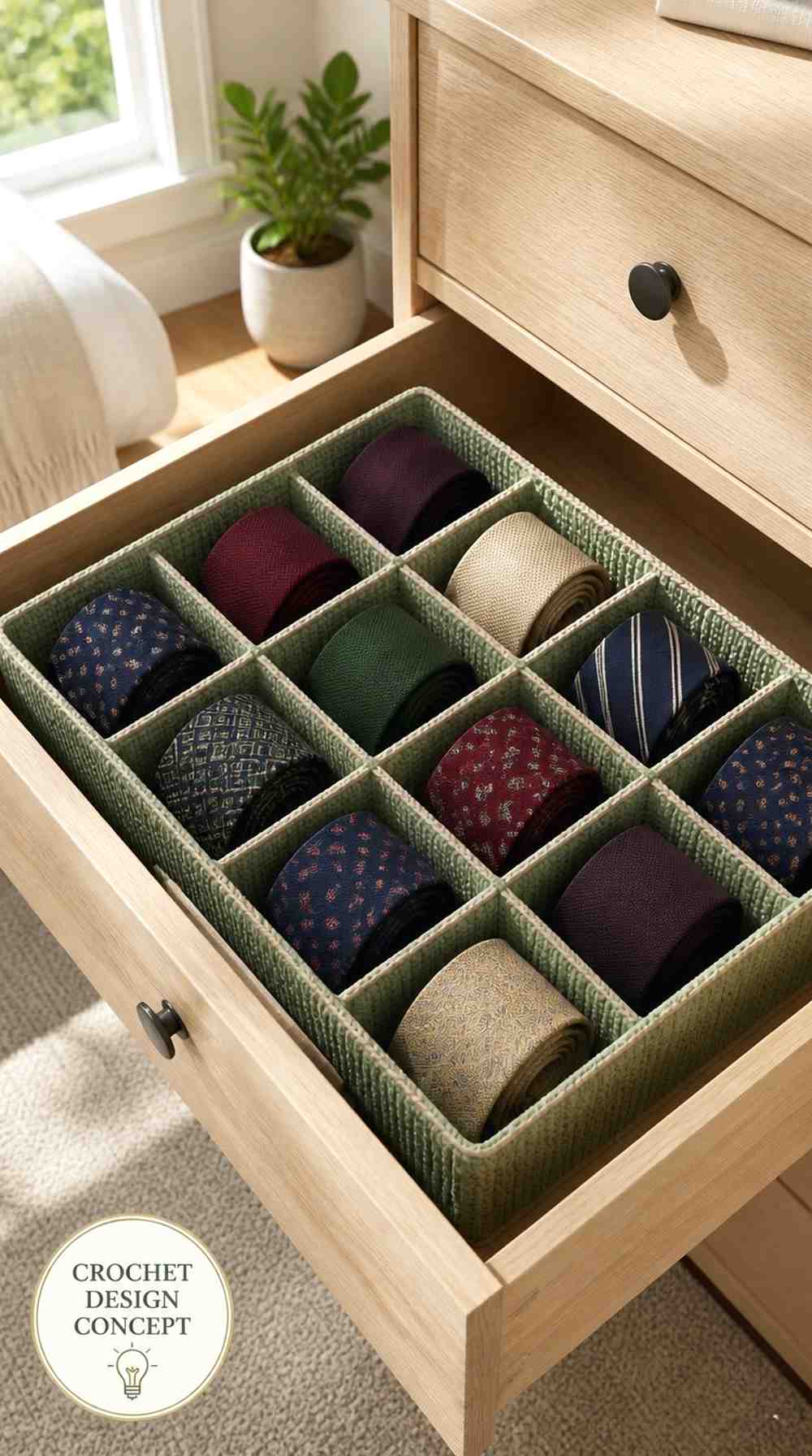
Sage-green crochet transforms this rectangular organizer into a tidy twelve-section storage grid. Fine vertical ribs cover the rigid dividers, while ivory piping finishes the edges. Each compartment contains one loosely rolled necktie, displaying navy, burgundy, champagne, olive and subtly patterned fabrics against a smooth base lining.
The three-by-four arrangement keeps every tie individually visible. It could be particularly useful for a frequently worn collection, provided the compartments have enough width for naturally relaxed rolls rather than forcing tightly wound spirals.
- Compartment sizing: Measure the diameter of a gently rolled tie before choosing the square dimensions, leaving room for easy removal.
- Single-roll layout: Giving each necktie its own compartment avoids stacking one delicate roll directly on another.
- Ivory-edged dividers: Keep the piping smooth and compact so it cannot catch on silk or textured tie fabrics.
- Drawer clearance: Confirm that the rolled ties and divider walls remain below the drawer’s upper opening when it closes.
2. Crochet Ivory Long-Lane Necktie Drawer Insert
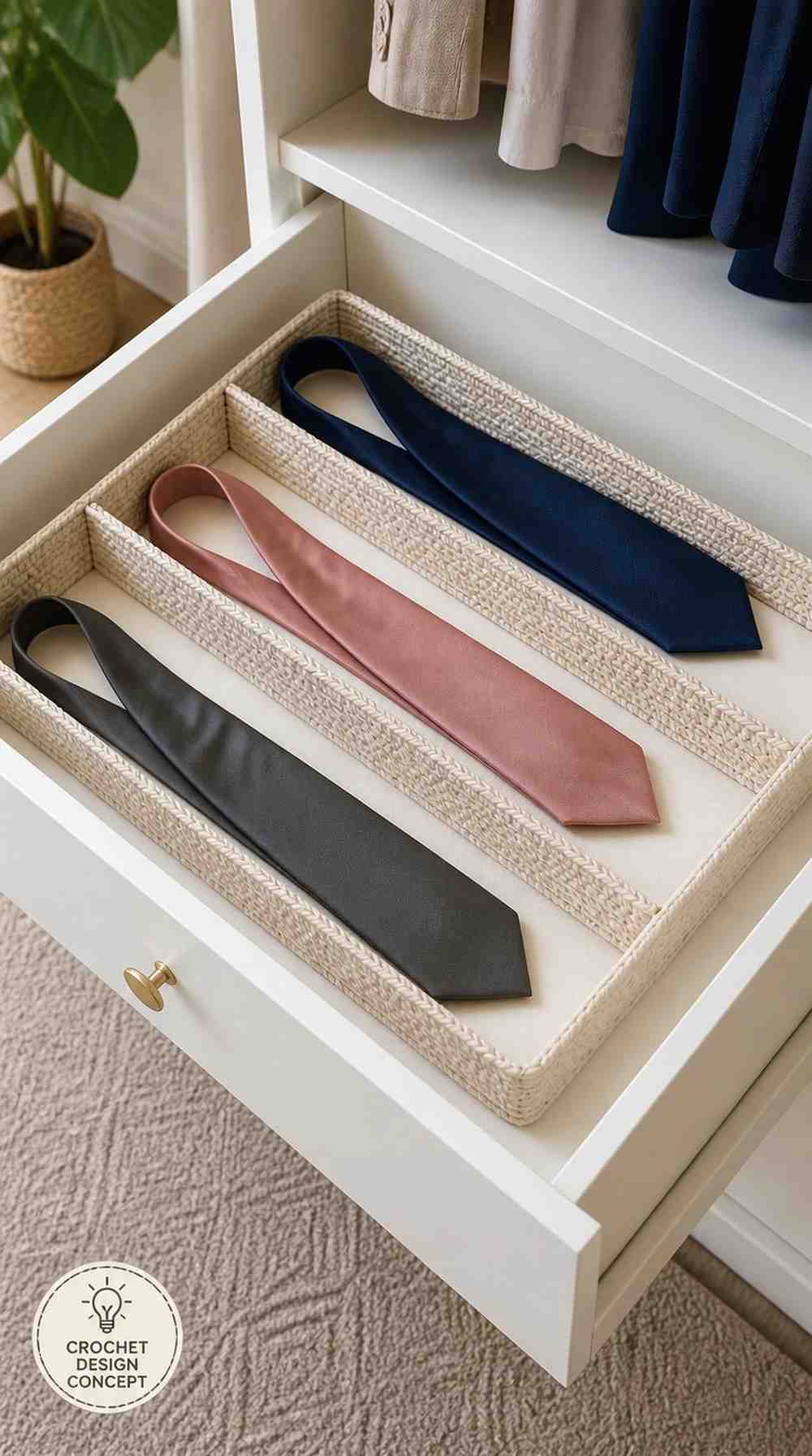
Warm ivory crochet covers two rigid partitions inside this long rectangular organizer. Raised diagonal stitches and delicate oatmeal edging give the dividers a soft finish. Three neckties in navy, dusty rose and charcoal rest separately in broad U-shaped loops on smooth cream fabric liners.
Unlike a grid intended for compact rolls, this organizer provides longer spaces for ties arranged with gentle curves. The design needs a relatively wide drawer, but it may appeal to someone who prefers less tightly gathered neckwear.
- Gentle curves: Arrange the neckties without sharp folds, pressing or excessive layering, particularly when the fabrics are delicate.
- Lane length: Measure the usable drawer width before planning the long compartments, allowing enough space for each tie’s natural shape.
- Smooth lining: A removable cotton liner can separate the tie fabric from raised crochet stitches and rigid divider edges.
- Practical limitation: Not every long tie can lie in a shallow drawer without some folding or curving, so the arrangement needs to suit the garment.
3. Crochet Terracotta Round-Pod Necktie Organizer
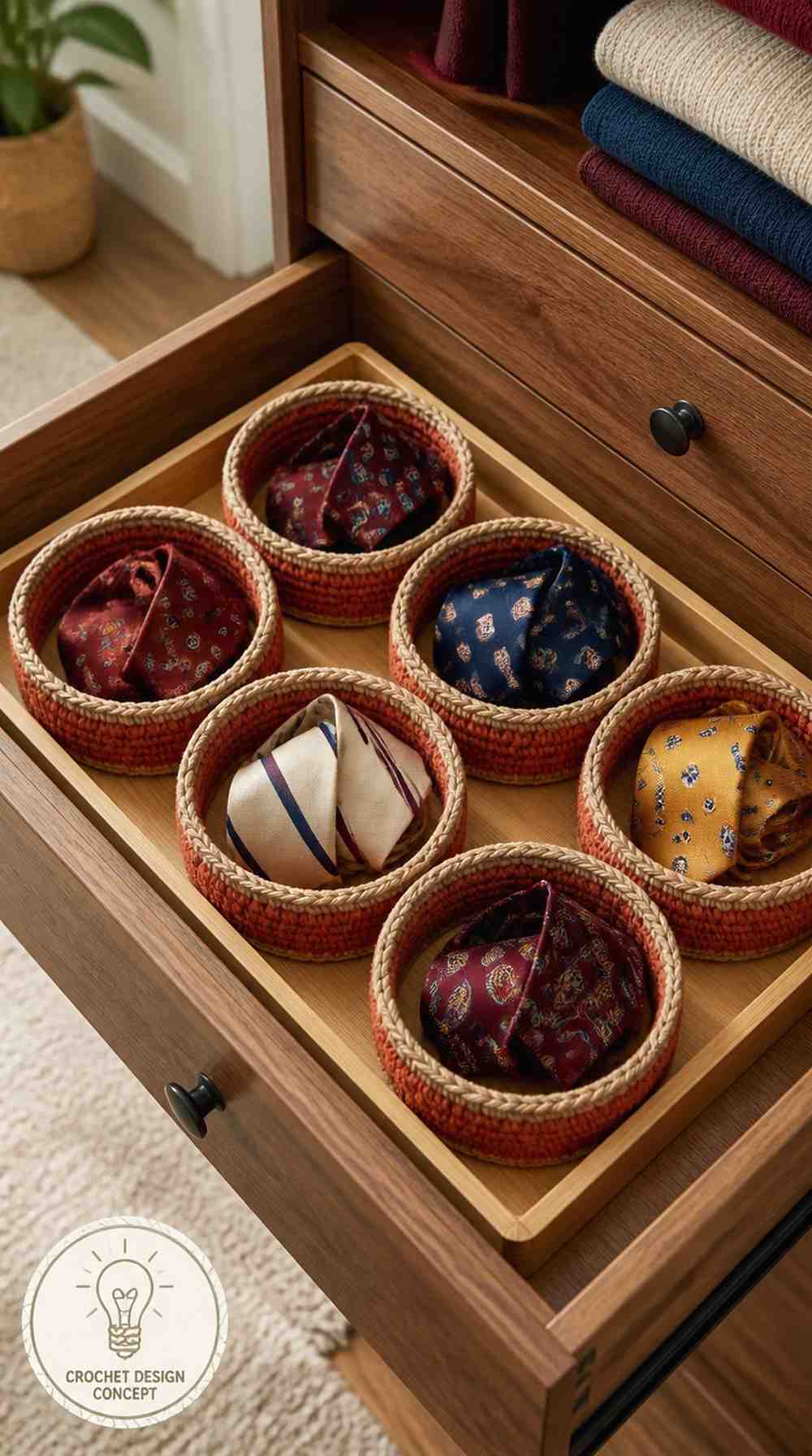
Terracotta crochet adds warm color to six circular compartments inside a shallow bamboo tray. The rigid rings have close horizontal stitches and sandy-beige edging, while the bamboo base remains visible beneath them. Each ring holds one relaxed necktie roll in a different muted color or pattern.
The separate circular compartments create a clean display that makes individual ties easy to recognize. The rigid tray supports the entire arrangement, while the crochet-covered rings act as attractive boundaries between the stored fabrics.
- Ring diameter: Allow the necktie roll to rest naturally inside the circle without being squeezed against the divider.
- Round supports: Use properly secured rigid rings so the shape does not collapse or distort when the organizer is partly empty.
- Spacing between pods: Leave enough room to lift a rolled tie without dragging it across neighboring crochet edges.
- Bamboo tray: Keep the base smooth and clean, preferably with an appropriate soft lining when storing delicate silk ties.
4. Crochet Dusty-Blue Adjustable Necktie Drawer Dividers
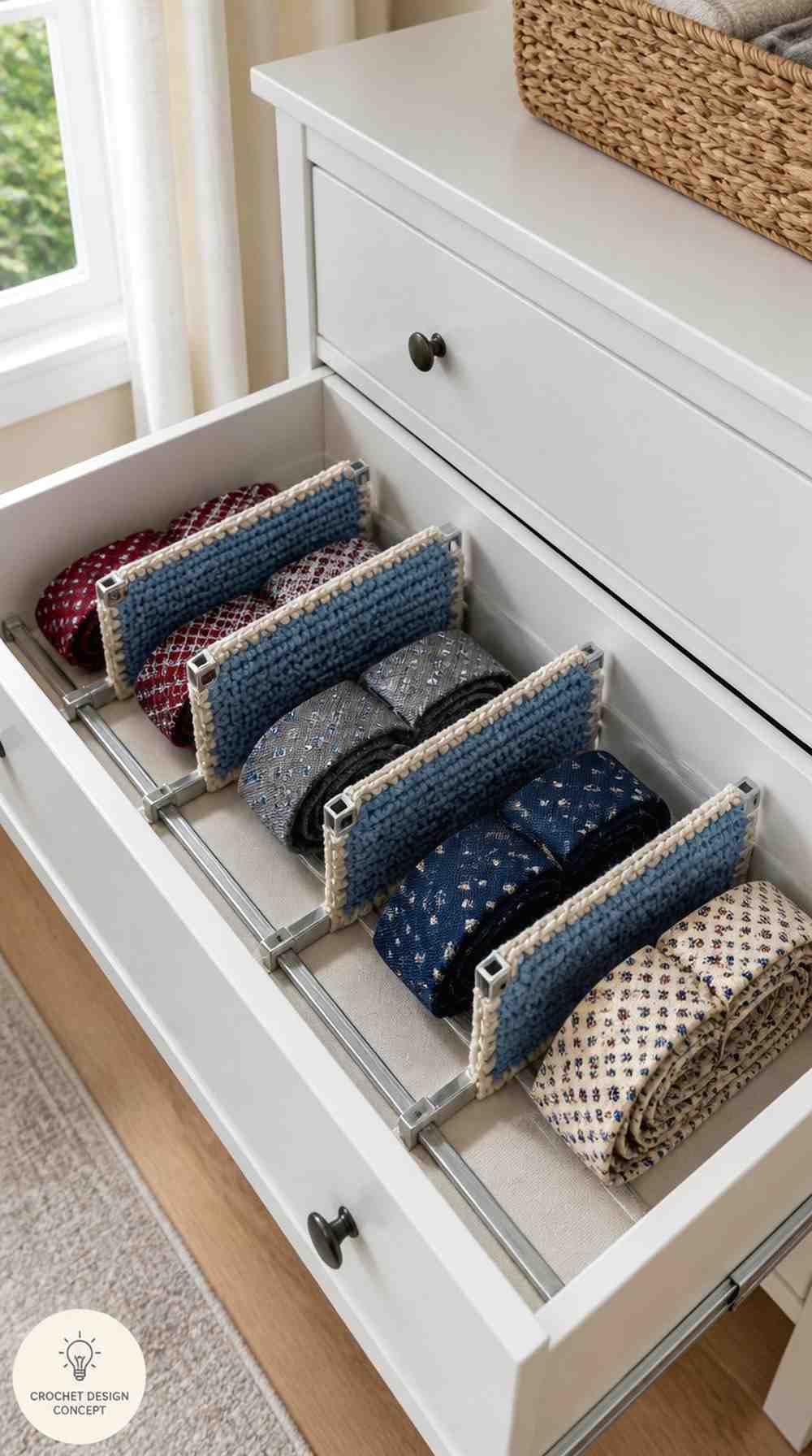
Dusty-blue crochet gives these sliding partitions a modern, coordinated look. Compact vertical ribs and fine ivory borders cover three rigid dividers, while recessed metal tracks allow the compartment widths to change. Four different-sized spaces hold small groups of loosely rolled neckties.
The adjustable layout makes this organizer more flexible than a fixed grid. It could be useful when tie widths, fabrics and collection sizes vary, although the panels must lock securely after the spaces are changed.
- Adjustable compartments: Set the partitions around the actual rolled tie sizes rather than fitting every roll into equal spaces.
- Locking hardware: Sliding dividers need secure stops so they do not shift when ties are removed.
- Track clearance: Keep crochet sleeves away from the moving rail sections to prevent fabric from becoming caught.
- Grouping method: Different compartments can separate everyday ties from special-occasion fabrics without requiring individual rigid boxes.
5. Crochet Mustard Diagonal Necktie Sorting Tray
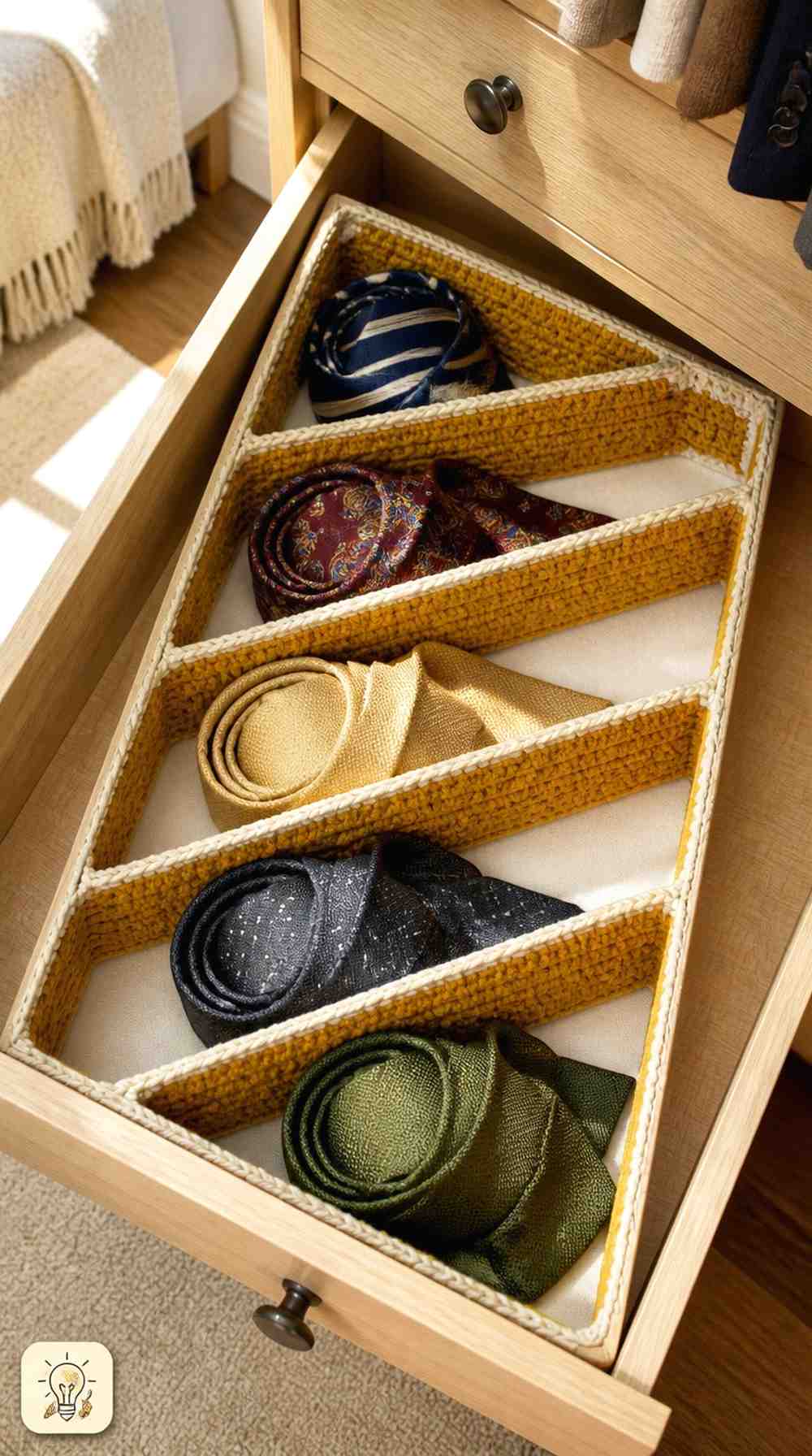
Mustard-yellow crochet covers four angled partitions inside a shallow oak drawer tray. Raised basketweave stitches and slim cream edges define five diagonal compartments, each containing one loosely rolled necktie. Navy stripes, burgundy paisley, pale gold and other muted patterns create a colorful arrangement.
The diagonal layout makes the organizer visually different from ordinary square compartments. However, angled walls can leave unusable space at the ends of a rectangular drawer, so the design is best considered when decorative presentation matters as much as capacity.
- Diagonal space: Check whether each angled compartment is wide enough for a relaxed tie roll, especially near the narrow ends.
- Divider stability: The rigid partitions need secure connections to the tray base rather than relying on the crocheted covering.
- Basketweave texture: Keep the raised mustard stitches outside the main contact area or use a smooth liner underneath the ties.
- Storage efficiency: Compare the number of ties held with a straight grid before choosing this decorative diagonal arrangement.
6. Crochet Blush Silk-Friendly Necktie Compartment Box
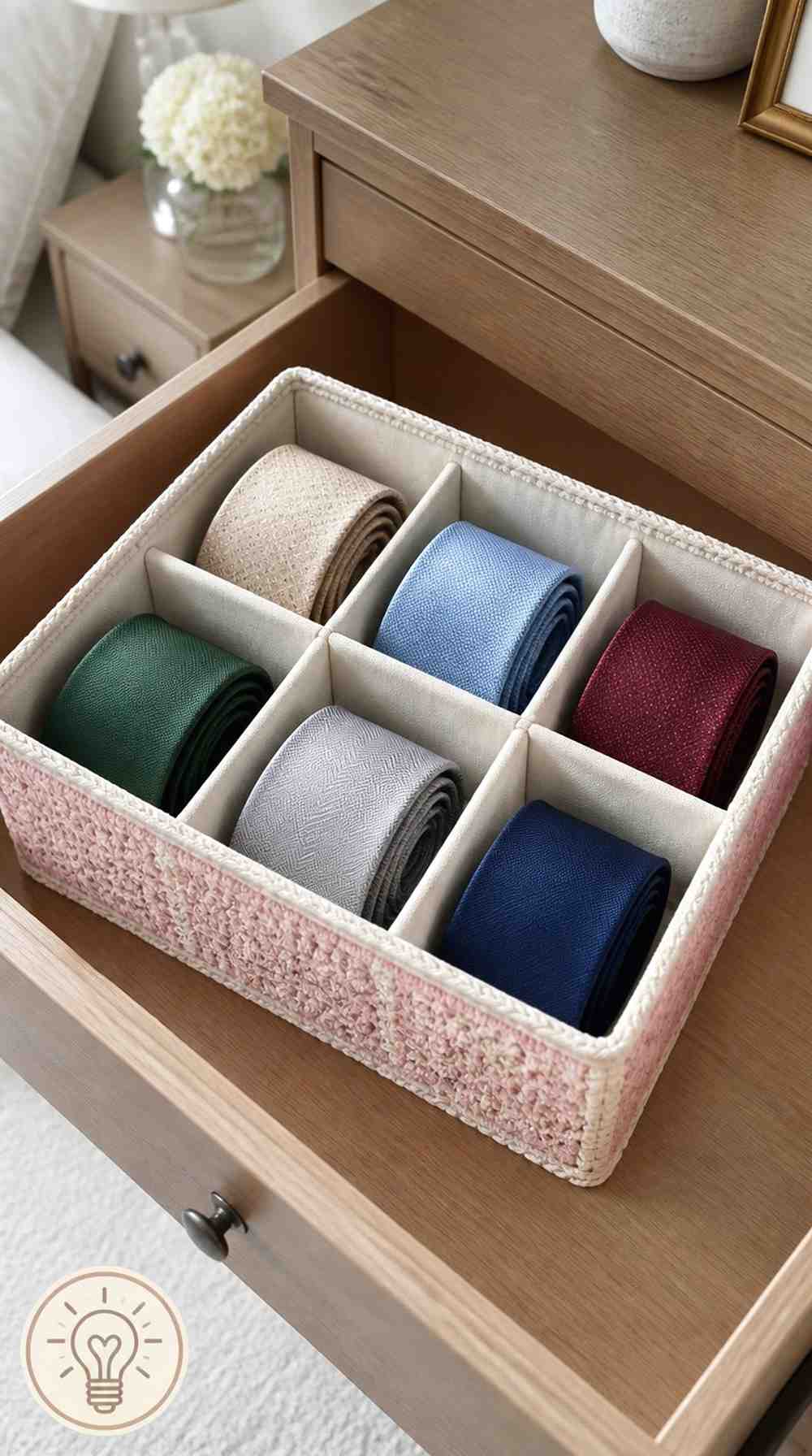
Blush-pink crochet softens this rectangular six-compartment drawer organizer. Shell-like stitches decorate the outer walls, while cream piping outlines its reinforced corners. Each square section has a smooth ivory fabric lining, with one loosely rolled silk necktie resting inside.
The separate lining is the most useful feature of this design. It keeps delicate silk away from raised yarn loops and rigid divider edges, while still allowing the crochet to provide the soft decorative finish around the compartments.
- Fabric contact: Choose smooth, clean lining material that will not catch against silk or loosely woven neckties.
- Liner removal: Individual removable liners may make cleaning easier without disturbing the entire rigid organizer.
- Shell-stitch exterior: Keep decorative stitches on the outer walls rather than placing raised shells directly beneath delicate fabrics.
- Compartment depth: Low walls should separate the six tie rolls while allowing enough space for fingers to lift each one.
7. Crochet Olive Front-to-Back Necktie Drawer Lanes
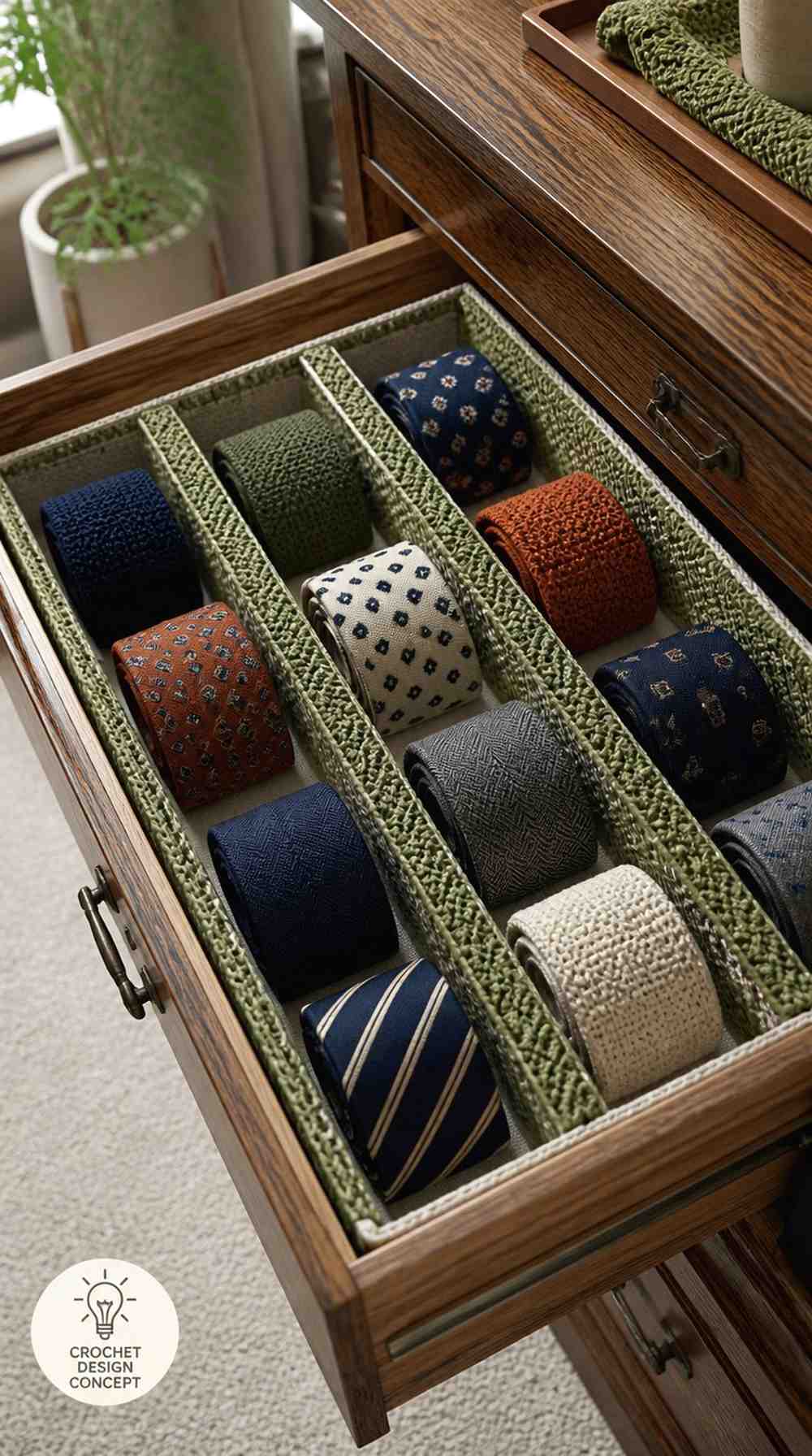
Olive-green crochet creates two long partitions inside a deep oak drawer tray. Raised diagonal ridges and ivory edging give the dividers a coordinated appearance. Three rows of loosely rolled neckties extend from the front toward the back, with three rolls in each lane.
This design makes use of drawer depth rather than dividing the entire space into small squares. Nine ties remain grouped in three long sections, although those stored at the back may be less convenient to reach.
- Lane width: Leave enough room around the rolled ties so they do not press against the olive crochet partitions.
- Front-to-back access: Store frequently worn ties toward the front and less-used pieces behind them.
- Base lining: A smooth light-beige liner can separate the ties from the rigid tray and make dust removal easier.
- Drawer depth: Check that the full organizer fits inside the drawer without restricting its movement or leaving the rear section inaccessible.
8. Crochet Lilac Two-Tier Necktie Drawer Organizer
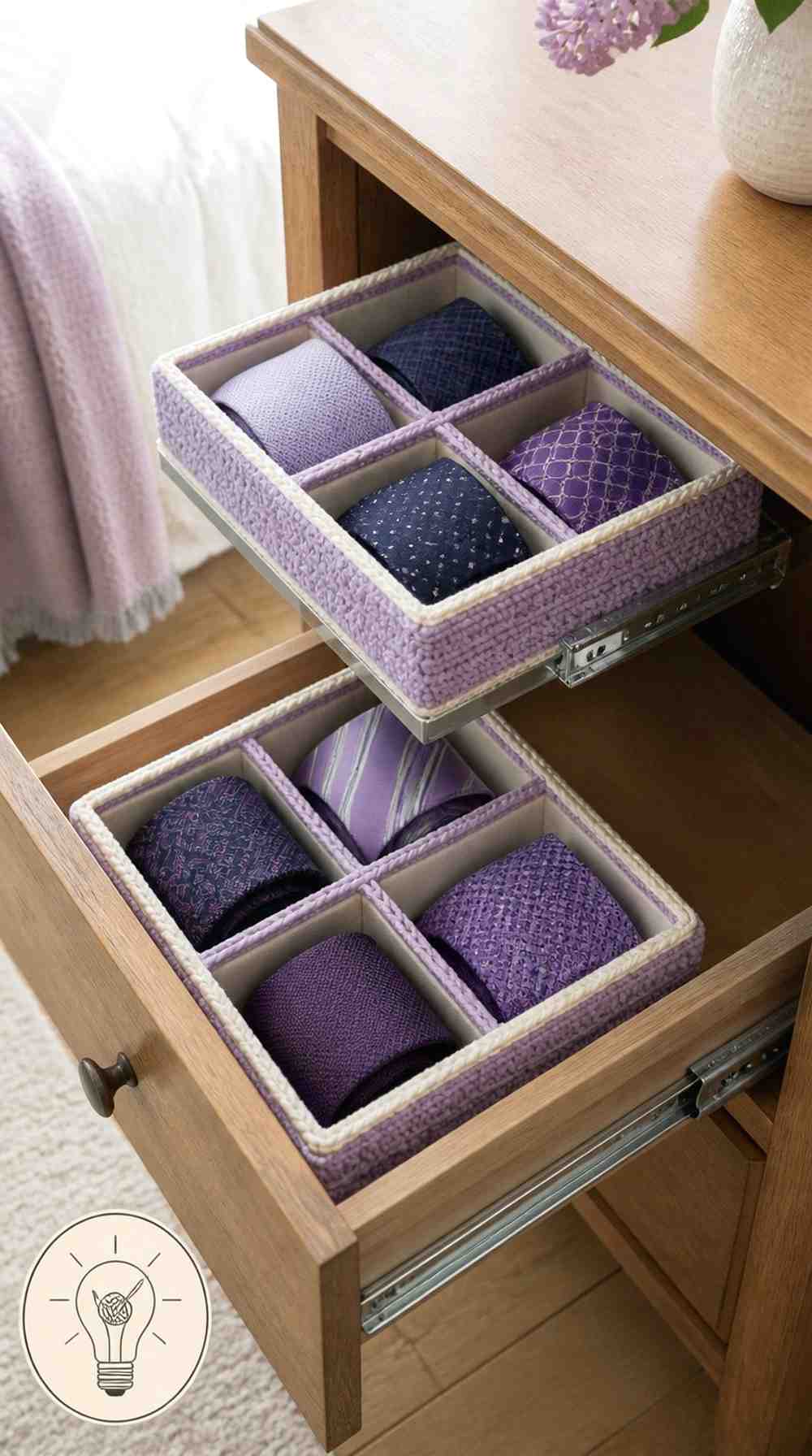
Lilac crochet brings a soft finish to two shallow wooden storage trays inside a deep dresser drawer. Each tray has low waffle-textured dividers, cream piping and smooth fabric lining. Four loosely rolled ties sit in the lower tray, with four more in the upper tray.
The upper tray slides partly to one side, revealing the lower storage level. This provides more organizing space within a single deep drawer, but the arrangement requires reliable runners and enough height to prevent the upper tray from pressing against the ties below.
- Drawer height: Measure the available vertical space before planning two storage levels, including clearance above the rolled ties.
- Sliding support: Use secure metal runners or another suitable mechanism that keeps the upper tray supported while it moves.
- Lower-tier access: The upper tray should move far enough aside that the lower ties can be removed without unnecessary rubbing.
- Layer separation: Each necktie remains inside its own compartment rather than being directly stacked under another tie.
9. Crochet Charcoal Perforated Necktie Divider Grid
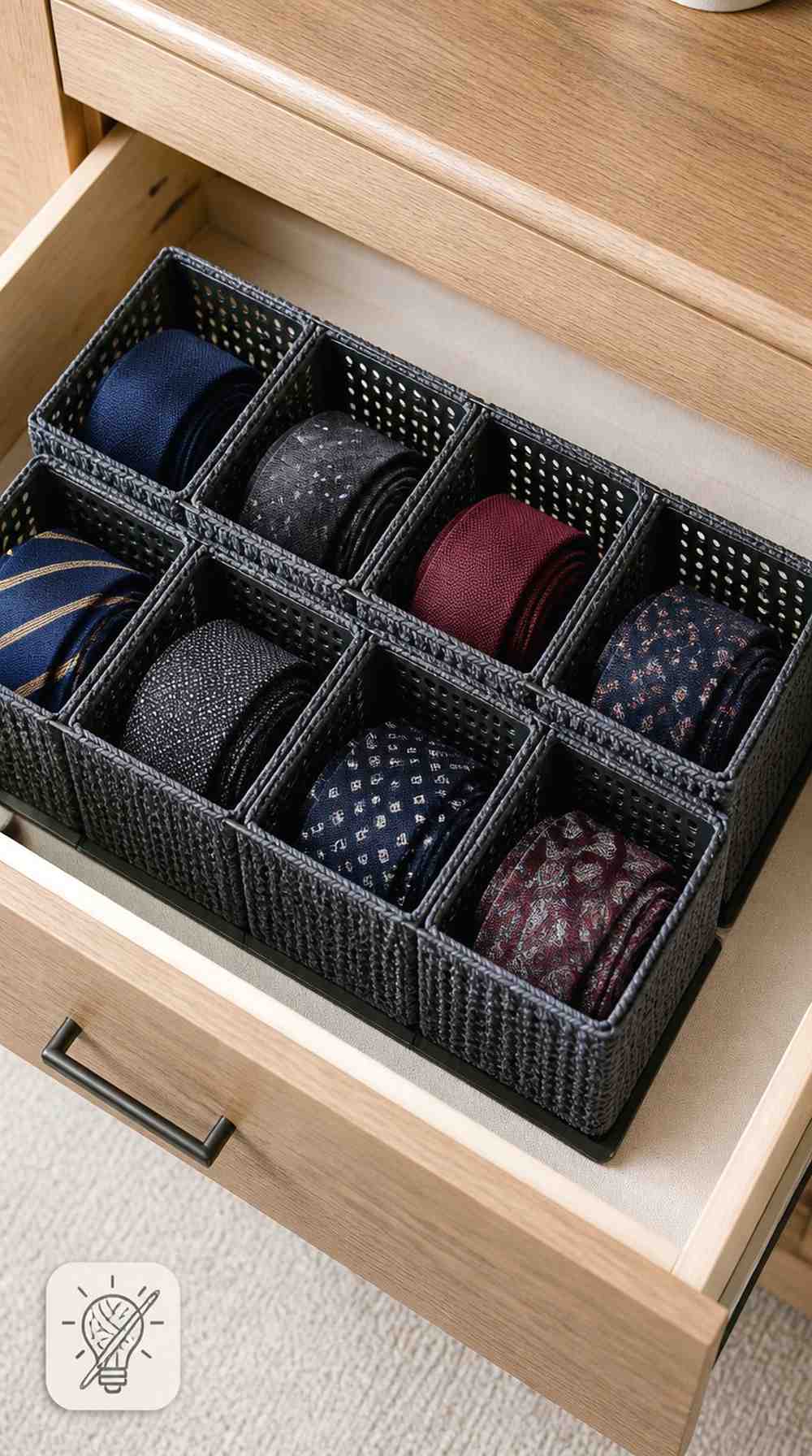
Charcoal-gray crochet gives this eight-section metal organizer a clean, modern appearance. Closely worked square mesh covers parts of the perforated divider panels, while silver-gray edging defines the compartment boundaries. Each section holds one loosely rolled tie on a smooth ivory lining.
The rigid black metal frame provides the actual structure beneath the decorative crochet. Its partially open panels create an airy appearance, although exposed metal edges and crochet loops must be carefully finished around delicate tie fabrics.
- Metal-edge protection: Smooth or cover any sharp edges before placing silk ties beside the dividers.
- Crochet mesh: Keep the square openings small and tightly secured so loose loops cannot catch on textured necktie fabrics.
- Individual compartments: One tie per section makes it easier to see the full collection without shifting neighboring rolls.
- Removable coverings: Separate mesh sleeves could simplify cleaning the metal frame and inspecting its joints.
10. Crochet Teal Mixed Necktie and Bow Tie Drawer Organizer
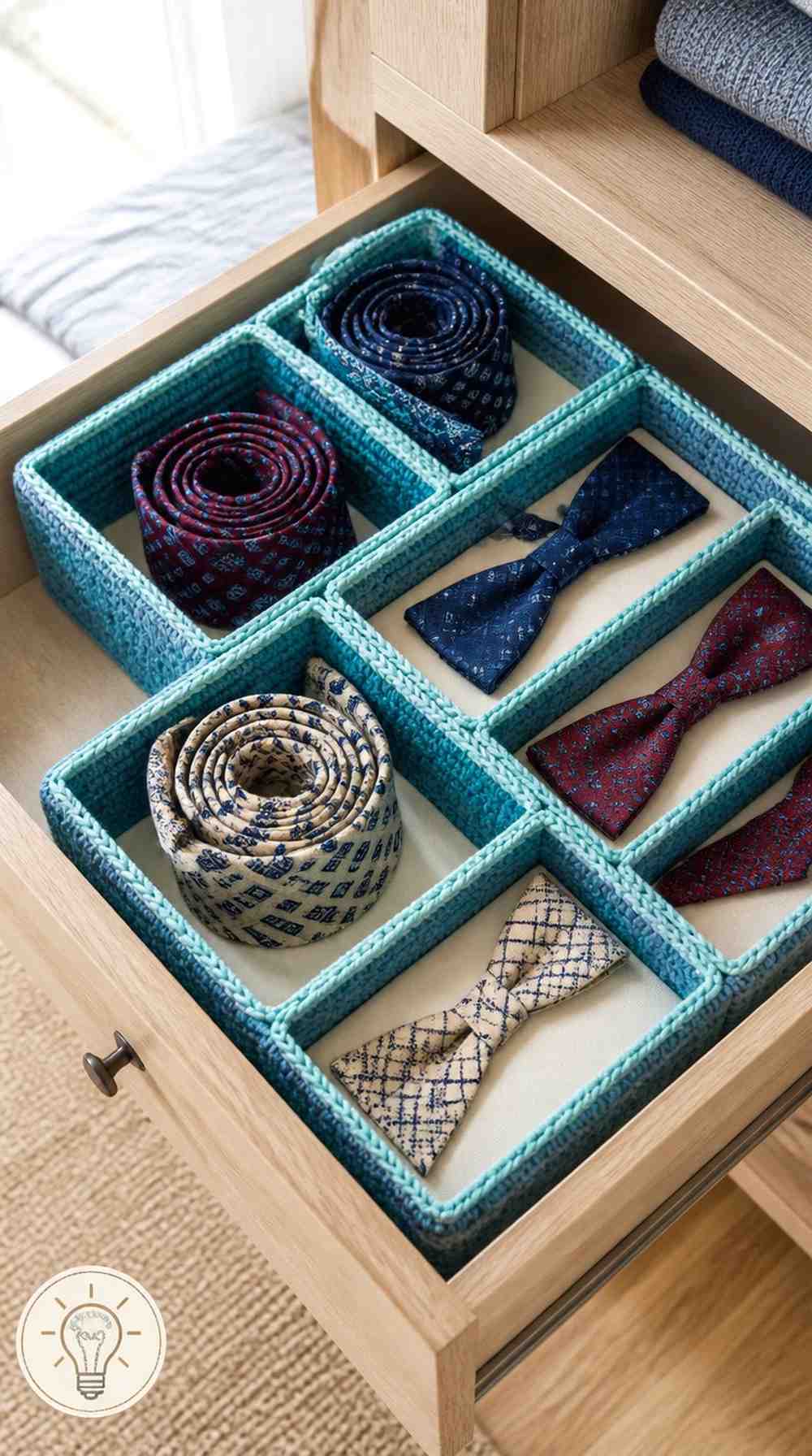
Teal crochet covers the partitions of this rectangular drawer tray, creating six compartments of different sizes. Three larger sections contain loosely rolled full-length neckties, while three smaller spaces hold neatly arranged untied self-tie bow ties. Pale-mint edging adds a gentle contrast to the close moss-stitch texture.
The mixed layout is useful for keeping different kinds of neckwear together without treating every accessory as the same size. The shallow compartments help display the fabrics, while a smooth ivory lining protects them from rough surfaces.
- Different dimensions: Full-length tie rolls usually need more space than compact bow ties, so the compartment sizes should reflect the collection.
- Bow tie storage: Untie self-tie bow ties before putting them away; avoid leaving sharp creases in delicate fabric.
- Fabric lining: Smooth removable liners can reduce contact with raised crochet and make the tray easier to clean.
- Separate categories: Three larger and three smaller compartments keep the two neckwear types visible without requiring another drawer.
11. Crochet Coral Slim-Drawer Necktie Roll Tray
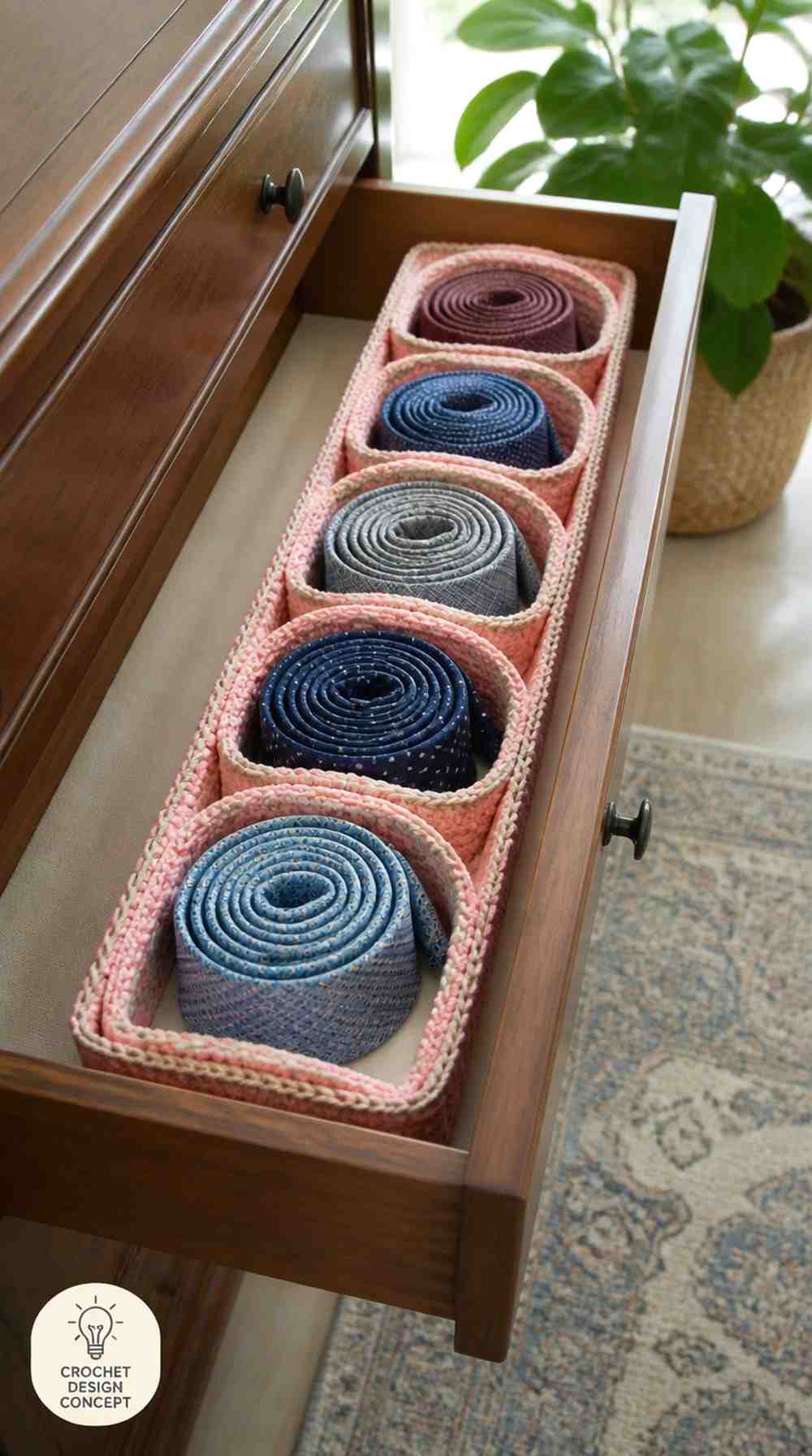
Coral-pink crochet creates a tidy single-row organizer inside a narrow walnut dresser drawer. Five low round-ended compartments run from front to back, each holding one loosely rolled necktie. Compact horizontal stitches and cream edging define the partitions, while an ivory lining softens the base.
The long, narrow arrangement makes this concept suitable for drawers that cannot accommodate a wide storage grid. Each tie has its own place, although the rear compartments will be easier to access when the drawer opens fully.
- Narrow drawer measurements: Check the usable interior width after accounting for drawer runners and any projecting fittings.
- Single-file layout: One tie per compartment prevents the rolls from being stacked on top of one another.
- Rear access: Confirm that the drawer opens far enough to reach the final compartments without pulling against the organizer.
- Rounded compartments: Smooth curves can suit circular tie rolls, provided the corners do not reduce their usable space too much.
12. Crochet Navy Lift-Out Necktie Organizer Tray
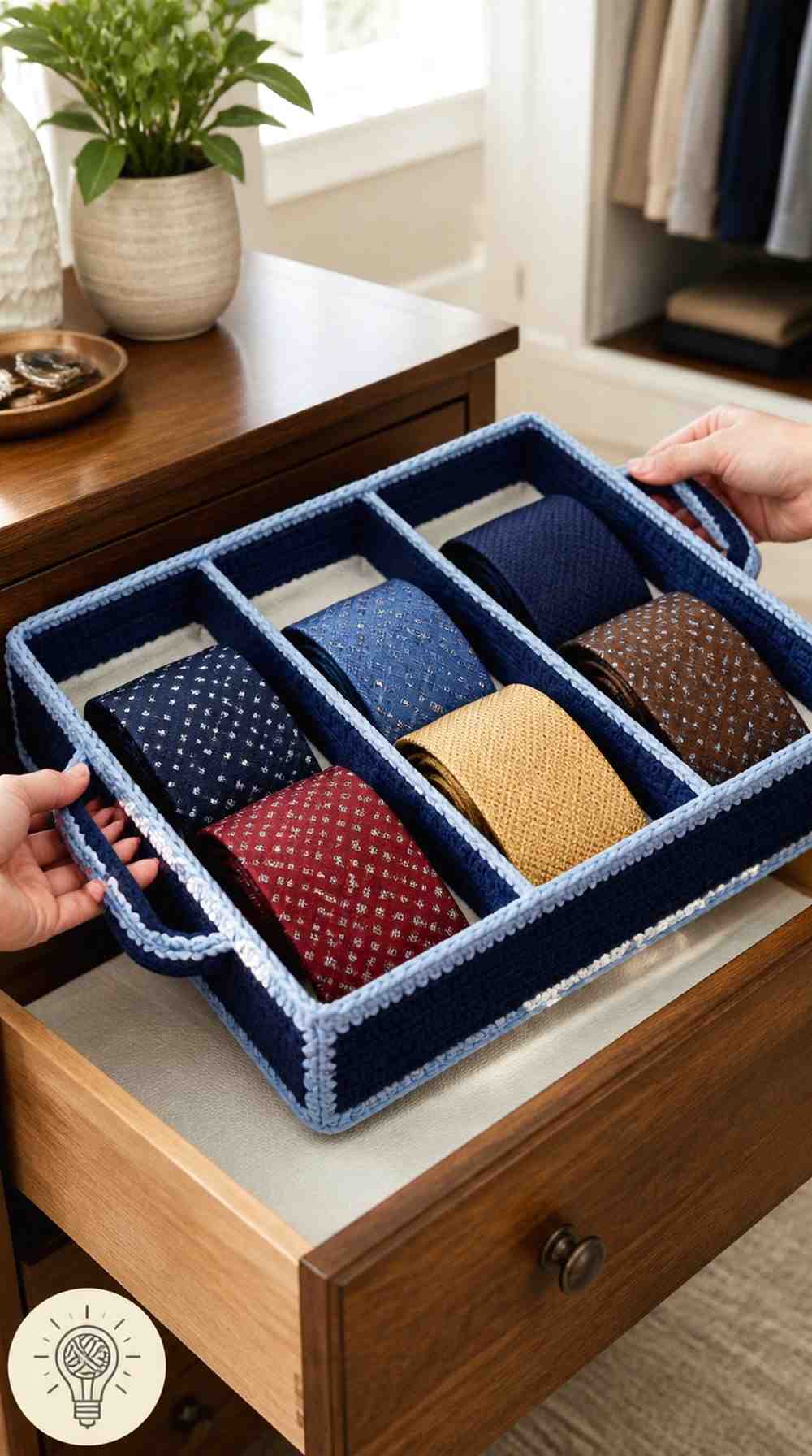
Deep navy crochet covers two low partitions inside a removable white storage tray. Powder-blue edging and horizontal ribs give the dividers a clean finish. Three elongated compartments hold six loosely rolled neckties, with two ties resting side by side in each section.
Short side handles allow the rigid tray to be lifted from the dresser drawer for rearranging or cleaning. The removable design makes it different from permanently installed dividers, although the handles and base need suitable strength for everyday use.
- Lift-out handles: Use securely attached rigid handles or properly reinforced grips rather than pulling the tray by its crochet-covered partitions.
- Two-roll compartments: Leave enough space around the paired ties that one can be removed without shifting or compressing the other.
- Tray fit: The outer dimensions should allow comfortable lifting without scraping the drawer’s side walls.
- Navy crochet care: Detachable divider covers may be easier to wash than an entire organizer with permanently attached fabric.
13. Crochet Peach Clear-Panel Necktie Drawer Dividers
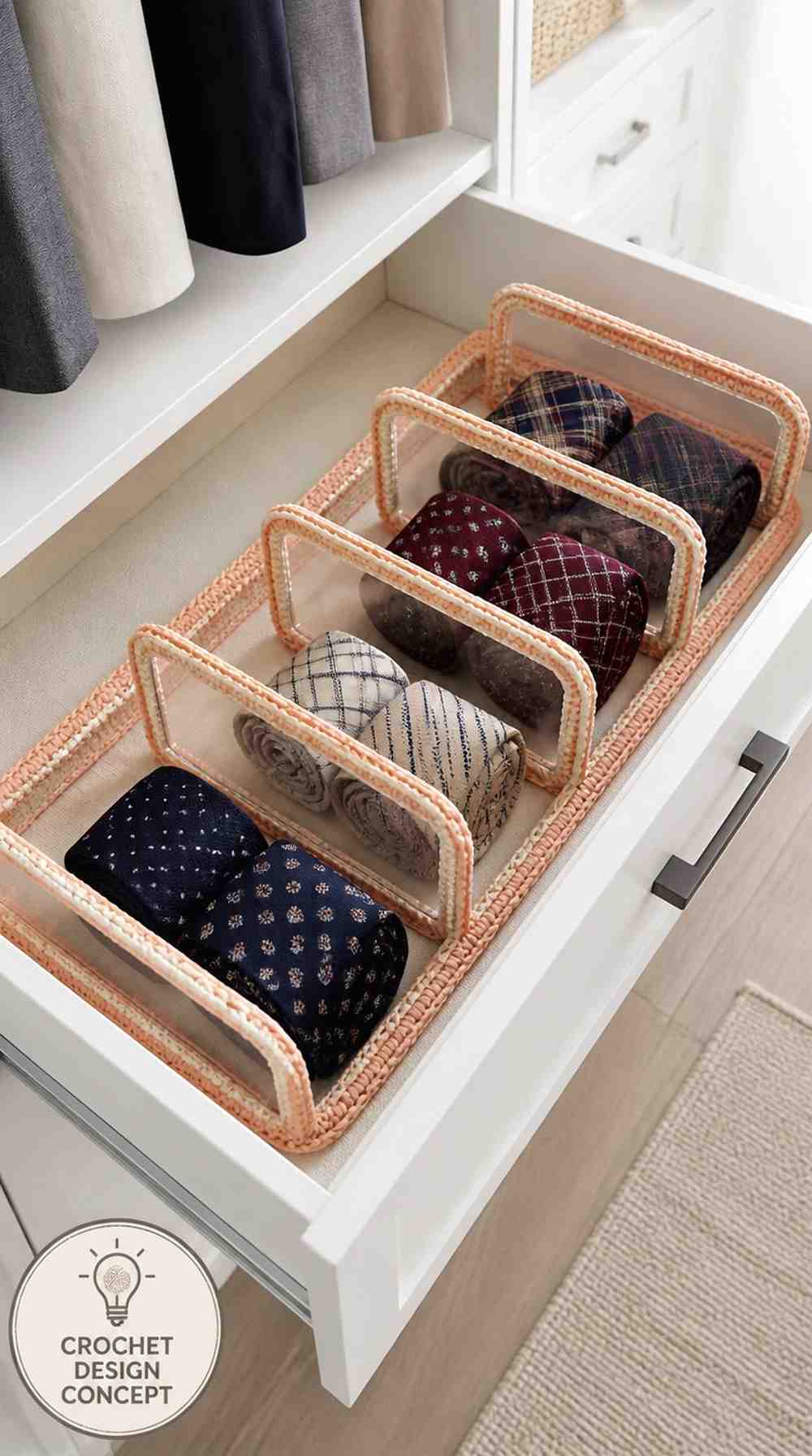
Peach crochet frames three transparent acrylic partitions inside a white drawer tray. Fine ivory piping outlines the raised stitch borders, while the clear centers reveal the neckties in neighboring compartments. Four sections contain two loosely rolled ties each, resting on a smooth beige fabric liner.
The transparent panels keep the collection visible across the organizer rather than concealing each section behind solid walls. This can make pattern selection easier, especially when the drawer contains several similar shades.
- Transparent visibility: Leave the center of each acrylic divider clear instead of covering it with a wide crochet panel.
- Smooth acrylic edges: Ensure all exposed edges are properly finished before the partitions come into contact with fabric.
- Base slots: Secure the three panels in rigid slots so they remain upright when a necktie is removed.
- Peach border thickness: Slim crochet trim keeps the transparent appearance while still adding handmade texture.
14. Crochet Rust Granny-Square Necktie Drawer Basket
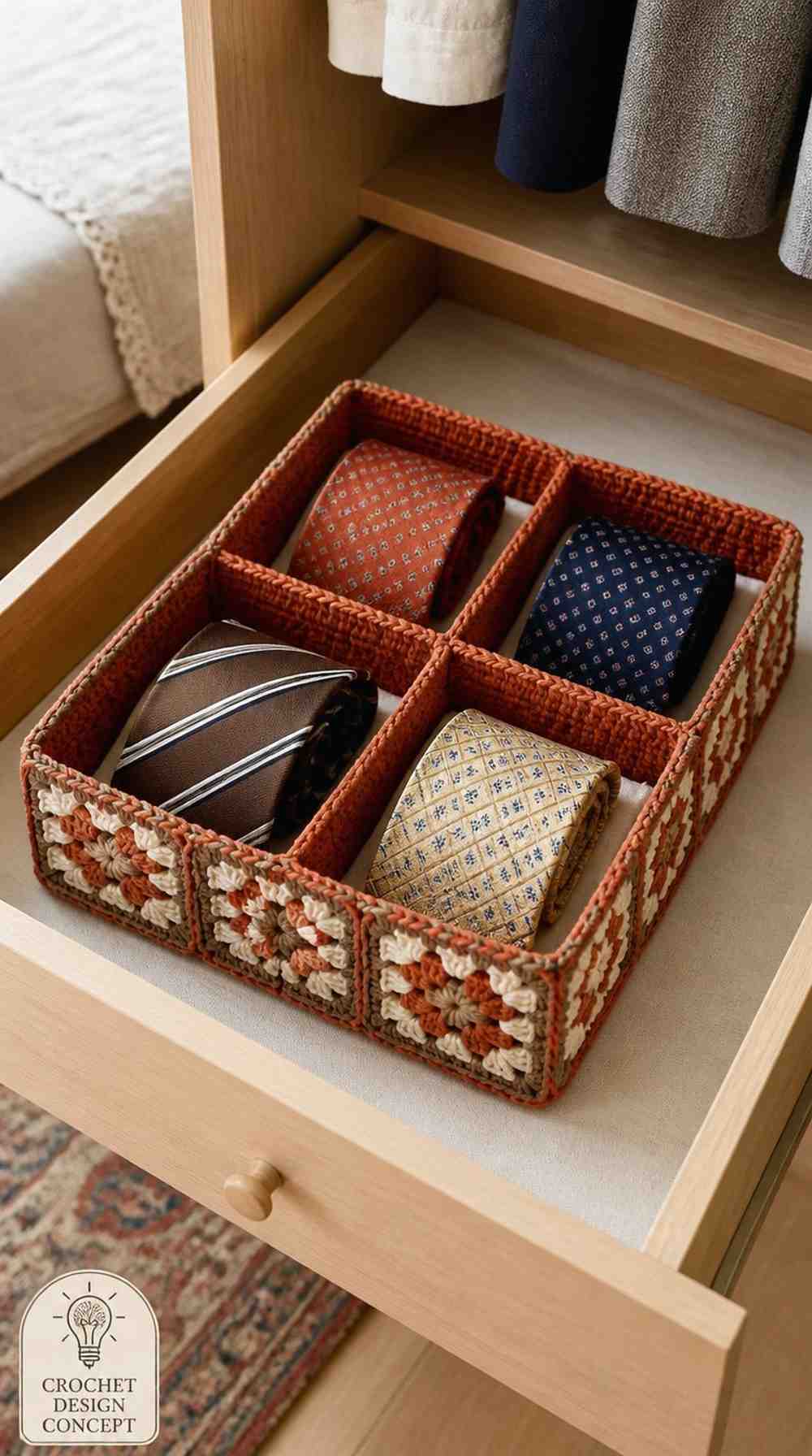
Rust-orange and cream granny squares create a vintage-inspired finish around this rectangular drawer basket. Thin mocha seams join the exterior motifs, while four low solid-rust crochet compartments hold individual loosely rolled silk ties. An ivory removable lining and firm rectangular base support the contents.
The granny-square details stay mostly on the outside of the organizer. This is an important design choice for delicate neckwear, because decorative open stitches can catch on textured silk or fine woven fabrics when used directly against the ties.
- Motif placement: Keep the openwork granny squares on the exterior and use smoother surfaces within the four storage spaces.
- Corner joining: Secure the mocha joins so the rectangular basket retains its intended shape without loose yarn ends.
- Rigid base: A removable supportive insert can help prevent the basket from bending when lifted from the drawer.
- Silk-friendly lining: Smooth ivory fabric provides a more suitable contact surface than the raised granny-square clusters.
15. Crochet Mint Six-Pod Necktie Drawer Insert
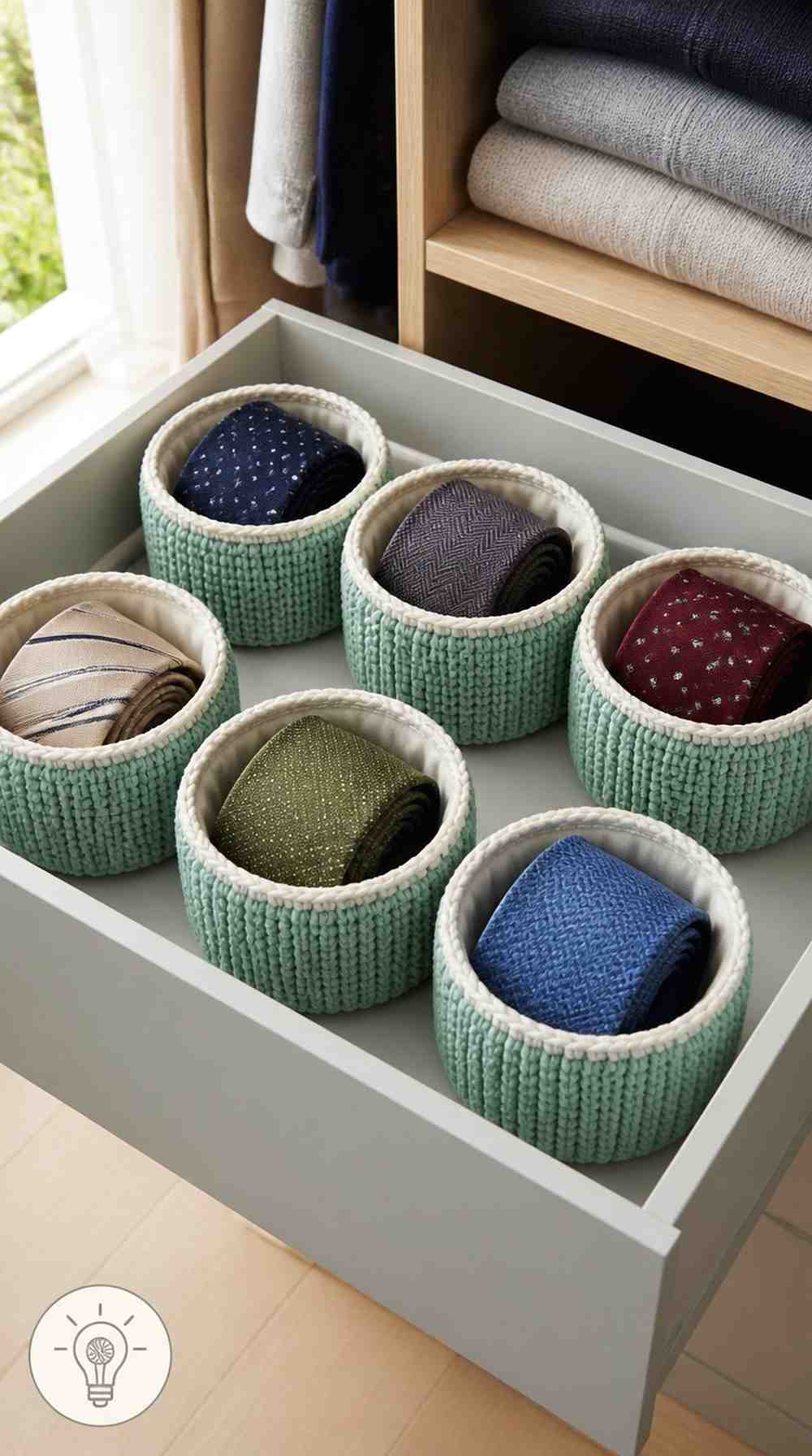
Mint-green crochet forms six small circular storage pods inside a pale-gray drawer insert. Close vertical ridges and ivory edging define the individual containers, while each pod has its own rigid round base and removable cream fabric lining. One loosely rolled necktie rests inside every compartment.
Unlike a large grid, the six pods are separate pieces that could be repositioned or removed individually. The circular arrangement suits a small collection, although it requires some spacing between containers so the ties remain easy to lift.
- Individual pod sizing: Make each circular compartment wide enough for a relaxed tie roll without squeezing the outer fabric.
- Separate removal: Leave small gaps between the pods so they can be lifted out without pulling against neighboring crochet.
- Firm circular bases: A suitable insert helps each pod hold its round shape even when empty.
- Arrangement flexibility: Separate pods can be rearranged inside a suitably sized drawer, but the overall layout should remain stable.
16. Crochet Butter-Yellow Accordion Necktie Dividers
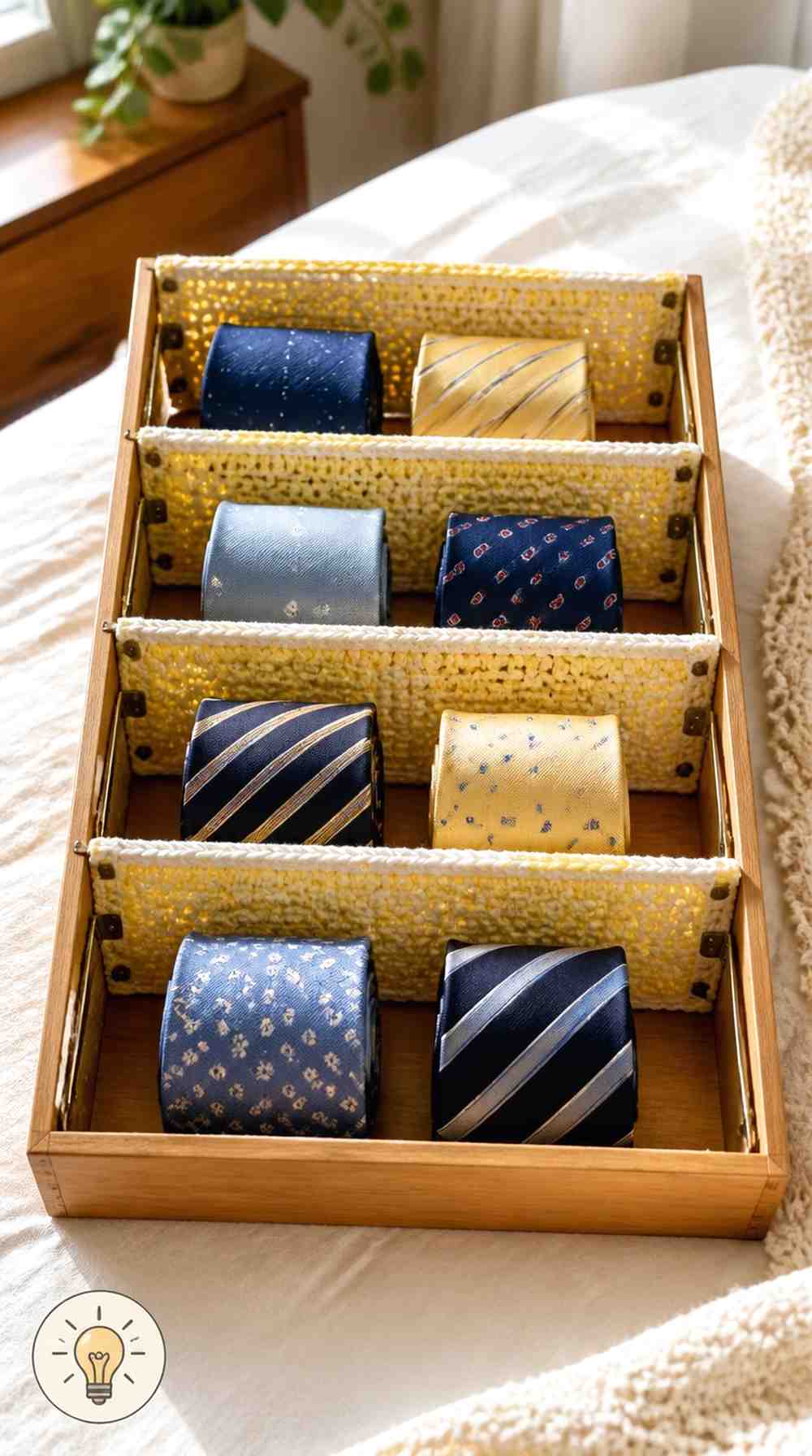
Butter-yellow crochet gives four hinged divider panels a cheerful textured finish. The panels stand partly extended inside a wooden tray, creating three roomy compartments with two loosely rolled ties in each. Fine cream edging follows the lemon-peel-style stitches, while small exposed hinges connect the supported panels.
The accordion construction offers an alternative to fixed compartments. Its folding action could make the empty organizer easier to adjust, but the panels must remain securely positioned while neckties are stored between them.
- Hinge clearance: Keep the yellow crochet away from moving joints to prevent yarn from becoming trapped or damaged.
- Open-position stops: Use suitable supports that hold the partitions in place instead of allowing them to fold against the ties.
- Compartment width: Each section should fit two gently rolled neckties without compression.
- Empty adjustment: Change the accordion position only after removing the stored ties, reducing the risk of snagging delicate fabrics.
17. Crochet Oatmeal Covered Necktie Storage Tray
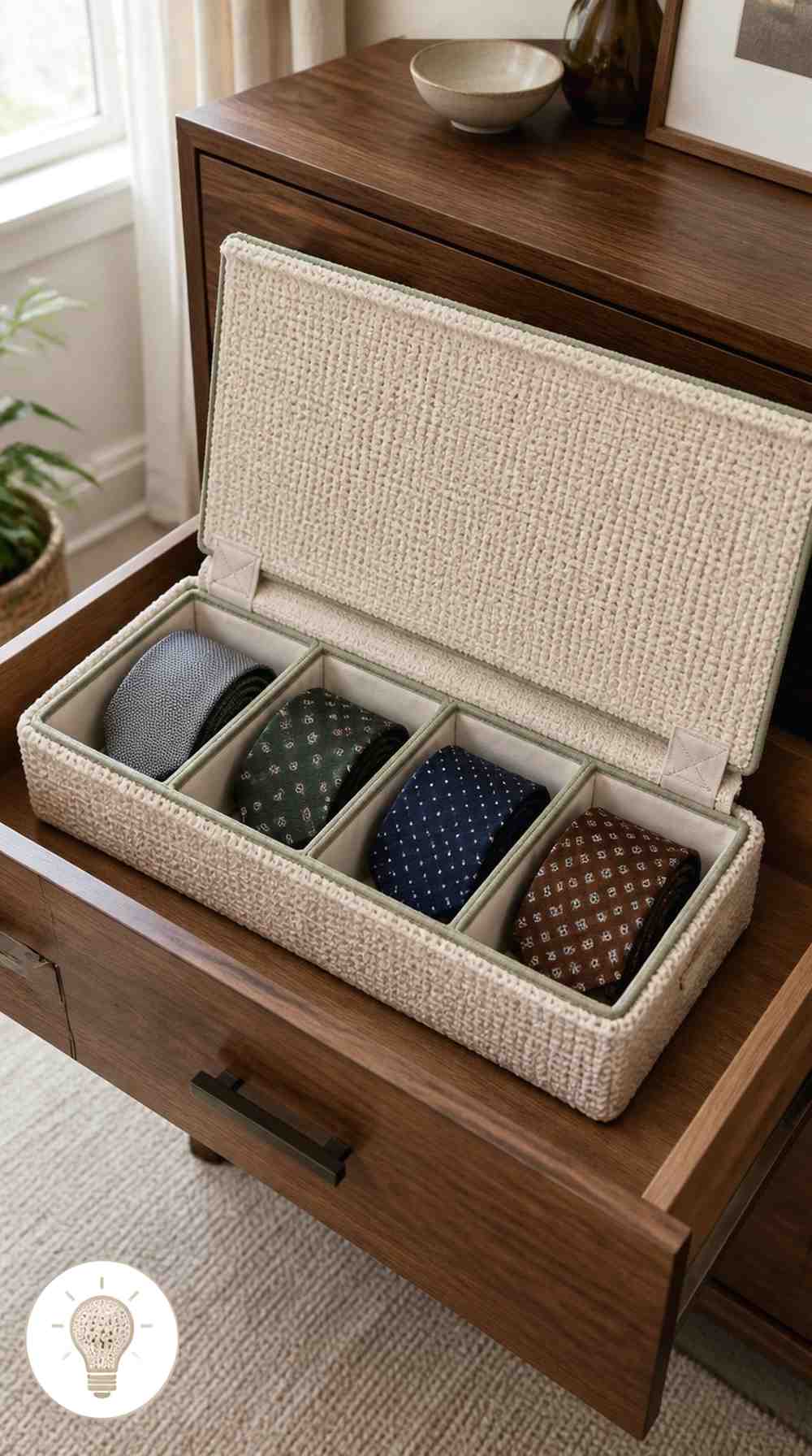
Oatmeal crochet covers a shallow rectangular drawer organizer with four generous storage compartments. Dense basketweave stitches decorate the outer walls, while sage piping finishes the low internal partitions. A matching foldover crochet lid is lifted backward, exposing four loosely rolled neckties on an ivory fabric lining.
The cover gives this concept a more enclosed appearance than an open organizer. It may help reduce ordinary dust exposure when the drawer is not used frequently, provided the lid rests above the contents without pressing against the rolls.
- Lid clearance: Leave enough height for the cover to close without flattening or compressing the neckties.
- Foldover hinges: Reinforce the two textile connections so repeated opening does not pull the rear organizer wall out of shape.
- Smooth interior: Keep the decorative basketweave texture on the exterior and provide soft contact surfaces beneath the ties.
- Dry storage: A crochet lid is not moistureproof, so the drawer and all stored neckwear should remain clean and completely dry.
18. Crochet Mocha Reversible Necktie Drawer Dividers
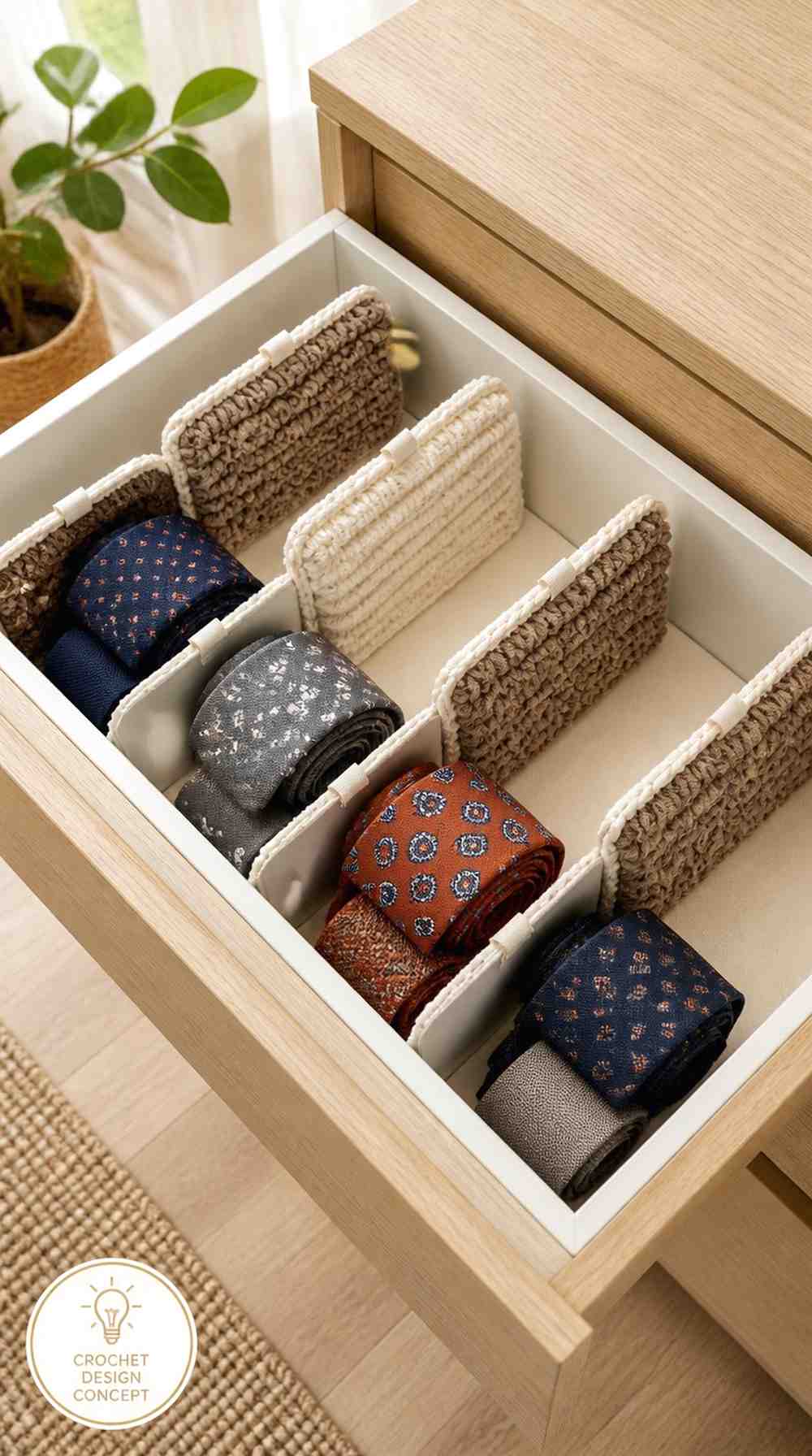
Mocha-brown and warm-ivory crochet give this rectangular drawer organizer two coordinated finishes. Three removable partitions form four compartments. The outer panels display raised mocha basketweave stitches, while the middle panel shows an ivory ribbed reverse surface. Cream piping and small removal tabs complete the covers.
Two loosely rolled neckties rest in each compartment on a smooth beige lining. The reversible sleeves offer a decorative change without replacing the rigid organizer, making this design attractive for someone who prefers neat neutral storage.
- Reversible surfaces: Both sides of each crochet sleeve should have tidy seams and similar thickness so the panels fit correctly in either orientation.
- Removal tabs: Keep the small tabs flat and accessible without leaving loose loops that could catch on necktie fabric.
- Divider slots: Rigid slots should hold the partitions upright when the sleeves are removed or reversed.
- Fabric protection: Smooth lining below the ties is more important than the reversible decorative surface, especially for delicate silk.
Practical Guide to Crochet Necktie Drawer Organizers
Neckties need more careful storage than many small wardrobe accessories. Silk, wool, cotton and polyester ties can behave differently when folded, rolled or pressed against textured surfaces. The right organizer should hold them gently rather than forcing them into uniform shapes.
Measure the drawer first. Record its usable width, depth and height. Include clearance for handles, drawer runners and the folded or rolled neckties. A shallow dresser drawer may suit a single layer of tie rolls, while deeper drawers offer more options.
Roll ties gently. Remove the knot after wearing a necktie and allow the fabric to recover before storing it. Roll loosely rather than winding the fabric tightly into a firm cylinder. Sharp folds and pressure from other garments can leave unwanted creases.
The Modest Man
Protect delicate fabrics. Smooth cotton liners, soft removable inserts and properly finished rigid partitions can reduce friction. Avoid leaving silk ties directly against rough crochet knots, exposed metal edges or decorative appliqués.
Use rigid divider supports. A crocheted wall can bend under pressure or lose its shape after washing. Suitable wooden, acrylic or metal panels may provide the structure, while crochet sleeves add the decorative finish.
Avoid overcrowding. Give each tie roll enough room to rest naturally. A compartment holding two loosely rolled ties may be more useful than one packed with several compressed spirals.
Keep the storage dry and clean. Never store damp ties, and follow each tie’s care label. Remove crochet covers when cleaning the organizer and allow them to dry completely before putting the neckwear back.
For related organization inspiration, explore 12 Crochet Storage Basket Ideas on Yarn Nest Studio. The collection covers useful crochet storage shapes and basket construction, although it is not a set of necktie-specific organizers.
Want to Make Something Similar?
These verified crochet resources demonstrate divided basket construction. They are not exact patterns for the 18 AI-generated necktie drawer organizers.
- Free Organizer Basket Crochet Pattern with Removable Dividers by Nicki’s Homemade Crafts — A free written pattern and video tutorial by Nicole Riley featuring a small crochet basket with removable dividers. It offers relevant ideas for compartment construction, but its original dimensions and materials are intended for the designer’s own basket. Nicki’s Homemade Crafts
- Rectangle Basket with Dividers by Rajeshwari Singh — A documented crochet pattern with a free version available through the designer’s website, as well as a paid Ravelry option. It explains another rectangular basket approach with internal dividers. ravelry.com
For actual necktie storage, adapt the compartment dimensions and add smooth lining where necessary. A general-purpose crochet basket pattern does not automatically provide the best shape or surface for delicate silk ties.
Comparison: Which Crochet Necktie Drawer Organizer Should You Choose?
| Storage need | Design to consider | Main trade-off |
|---|---|---|
| Twelve separate tie rolls | Sage Twelve-Compartment Tray | Fixed compartment sizes |
| Gently curved, less compact storage | Ivory Long-Lane Insert | Requires a wider drawer |
| Individual circular sections | Terracotta Round-Pod Organizer | Unused space between rings |
| Changing tie collection sizes | Dusty-Blue Adjustable Dividers | Tracks and locks require maintenance |
| Decorative angled compartments | Mustard Diagonal Sorting Tray | Less efficient use of rectangular space |
| Delicate silk ties | Blush Silk-Friendly Box | Requires separate lining |
| Deep drawer organization | Olive Front-to-Back Lanes | Rear ties harder to reach |
| Two storage levels | Lilac Two-Tier Organizer | Requires sufficient drawer height |
| Modern metal framework | Charcoal Perforated Grid | Metal edges need protection |
| Neckties and bow ties | Teal Mixed Organizer | Different-sized compartments |
| Narrow dresser drawer | Coral Slim-Drawer Tray | Limited capacity |
| Removable storage tray | Navy Lift-Out Organizer | Handles need reliable support |
| Transparent partitions | Peach Clear-Panel Dividers | Acrylic needs careful finishing |
| Granny-square decoration | Rust Granny-Square Basket | Raised motifs need smooth lining |
| Six independent tie holders | Mint Six-Pod Insert | More individual pieces |
| Folding compartments | Butter-Yellow Accordion Dividers | Hinges need secure stops |
| Covered tie storage | Oatmeal Covered Tray | Lid requires clearance |
| Reversible neutral colors | Mocha Reversible Dividers | Extra sleeve construction |
For a small collection, a simple divided tray with one tie per compartment is often a straightforward choice. A larger collection may benefit from a twelve-section grid or deeper drawer lanes. If your ties are particularly delicate, prioritize smooth lining and generous compartment dimensions over elaborate crochet texture.
Conclusion
Crochet necktie drawer organizers offer a way to bring handmade detail into an everyday wardrobe routine. From sage-green storage grids and terracotta circular compartments to blush-lined boxes, mint individual pods and mocha reversible panels, these 18 concepts show how different shapes and textures can help organize a necktie collection.
The best organizer is one that fits your drawer, keeps each tie easy to find and allows the fabric to rest without excessive pressure. Choose a suitable rigid base, smooth interior surfaces and enough room for gently rolled or curved ties. Crochet can then provide a beautiful decorative finish without compromising the practical purpose of the organizer.
Which design would work best in your wardrobe? Would you choose the sage twelve-compartment tray, the blush silk-friendly organizer or the mocha reversible dividers? Share your favorite and whether you prefer keeping neckties loosely rolled or arranged in longer compartments.
Frequently Asked Questions
Is it better to roll or fold neckties for drawer storage?
Loosely rolling a necktie is a common storage method, especially when using individual compartments. Avoid winding the tie tightly or making sharp folds that could leave creases. Some delicate fabrics may benefit from a broader, gently curved arrangement. Check the tie’s care guidance and choose a method that does not compress the fabric.
Can crochet dividers damage silk neckties?
Raised crochet stitches, loose yarn ends and rough seams may catch or rub against delicate silk, particularly when a tie is repeatedly removed from a compartment. A smooth removable fabric lining and properly finished edges can help reduce direct contact. Avoid placing silk directly against coarse yarn or openwork motifs.
What yarn is suitable for a crochet necktie drawer organizer?
Smooth cotton or cotton-blend yarn can be worth considering because many varieties provide clear stitch definition and are washable according to their care instructions. Choose a yarn that does not shed heavily or create rough raised surfaces. For dividers, use appropriate rigid support rather than expecting yarn alone to remain upright.
How many neckties should I store in one compartment?
That depends on the size of the compartment and the thickness of the ties. One loosely rolled tie per space makes selection easier and reduces pressure from neighboring items. Larger sections may accommodate two or more rolls when sufficient room remains between them. Avoid tightly packing the ties just to increase capacity.
Are these 18 crochet necktie drawer organizers available as exact patterns?
No. These are AI-generated design visualizations for inspiration, not tested finished products or complete crochet patterns. The linked tutorials cover related crochet basket and divider techniques, but they do not reproduce these specific necktie organizers. Each design would require appropriate measurements, structural materials, fabric linings and practical checks before becoming a usable drawer organizer.