A crochet ironing board cover securing strap may seem like a small household detail, but it offers plenty of room for creative design. These 15 inspiration ideas explore flat crocheted bands, buttoned adjustments, crossed straps, textured finishes and decorative sleeves. From sage-green ribbing and terracotta crochet to checkerboard patterns and soft mint colorblocking, each concept gives an everyday ironing accessory a different handmade appearance.
The collection focuses on strap arrangements positioned beneath an ironing board rather than on its hot working surface. You’ll find ideas with metal cover clips, adjustable fastenings, paired bands and decorative covers for existing straps. Because ironing involves heat, steam and moving equipment, the designs are best approached as visual inspiration, with safety, material compatibility and reliable cover tension taking priority over decoration.
These are AI-generated crochet design visualizations, not photographs of tested securing systems or step-by-step patterns. They are not certified heat-resistant or load-tested fastening solutions.
Quick Design Selection Guide
| Your main preference | Design to explore | Distinctive feature |
|---|---|---|
| Simple flat strap | Crochet Sage Ribbed Underboard Securing Strap | Broad ribbed band with two clips |
| Adjustable appearance | Crochet Oatmeal Three-Button Adjustment Strap | Three buttonhole positions |
| Crossed strap arrangement | Crochet Terracotta Crossed Cover Support Straps | Two diagonal bands forming an X |
| Metal adjustment hardware | Crochet Navy Sliding-Buckle Cover Band | Central sliding buckle |
| Decorative existing fastener | Crochet Plum Removable Fastener Sleeve | Crochet covers part of a separate commercial strap |
| Modern color styling | Crochet Mint Diagonal Colorblock Securing Strap | Three diagonal color sections |
For a working ironing board, manufacturer-approved straps or correctly fitted commercial cover fasteners are the safer starting point. Crochet decoration should never interfere with their clips, tensioning mechanism or the board’s folding parts.
1. Crochet Sage Ribbed Underboard Securing Strap
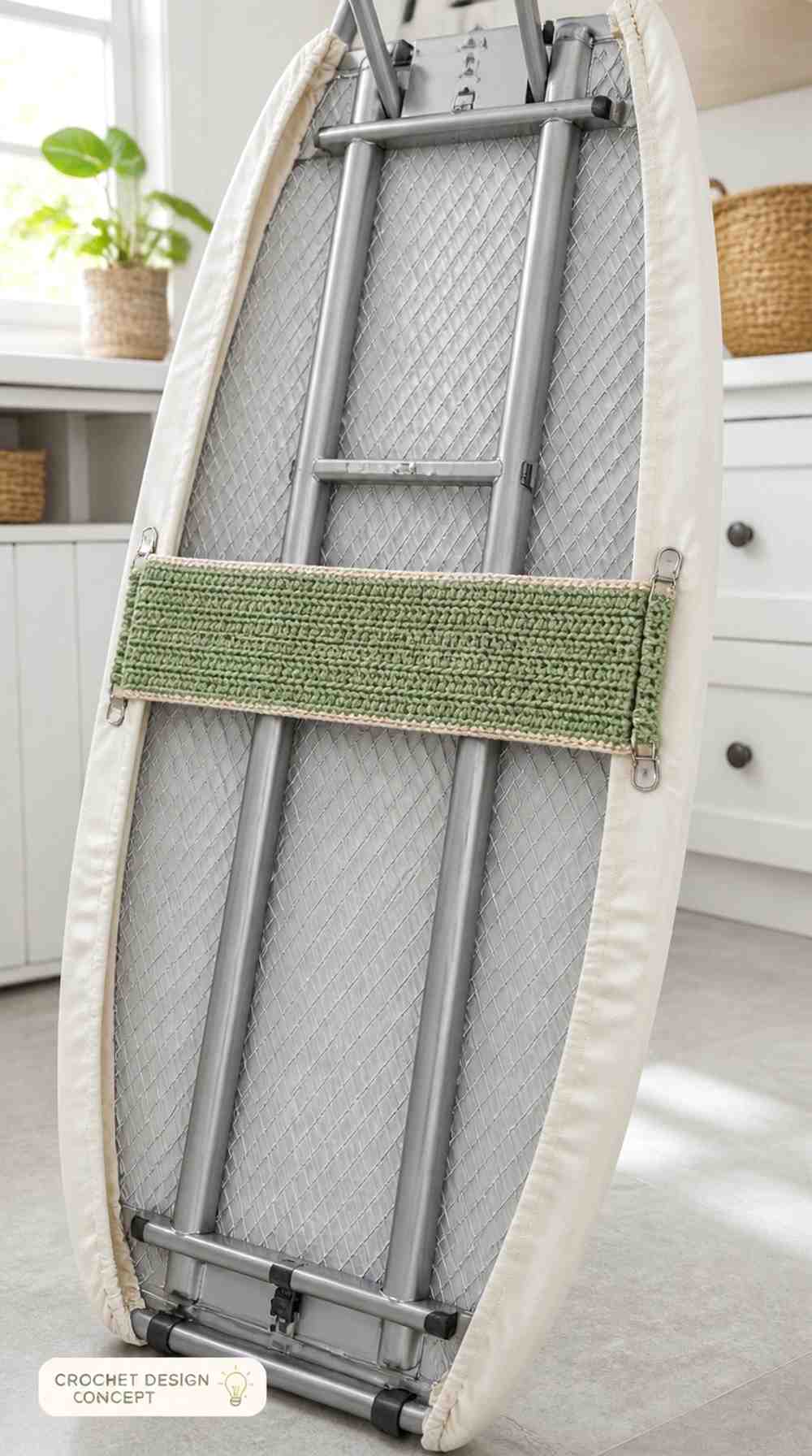
Sage-green crochet forms a broad, flat securing band with closely worked horizontal ribbing and narrow oatmeal edges. The strap stretches across the underside of a cream-covered ironing board, with small stainless-steel clips connecting both ends to the opposing cover hems. Its simple shape keeps the fastening arrangement visually uncluttered.
The soft green color adds a handmade detail beneath the board without affecting its upper appearance. Horizontal ribbing creates gentle texture, although a real crochet band may stretch under tension and should not be assumed suitable as a replacement for a tested cover fastener.
- Ribbed Band Structure: Horizontal back-loop ribs give the strap texture but may allow movement under tension. Compare the fabric’s stretch before considering a similar construction.
- Opposing Cover Clips: Both metal clips must be compatible with the cover hem and should grip securely without damaging the material.
- Underboard Clearance: Keep the band away from the board’s folding mechanism, moving supports, iron rest and other working components.
- Decorative Alternative: The sage ribbed design could inspire a removable cover for a separate manufacturer-approved strap, without making crochet responsible for holding the cover.
2. Crochet Oatmeal Three-Button Adjustment Strap
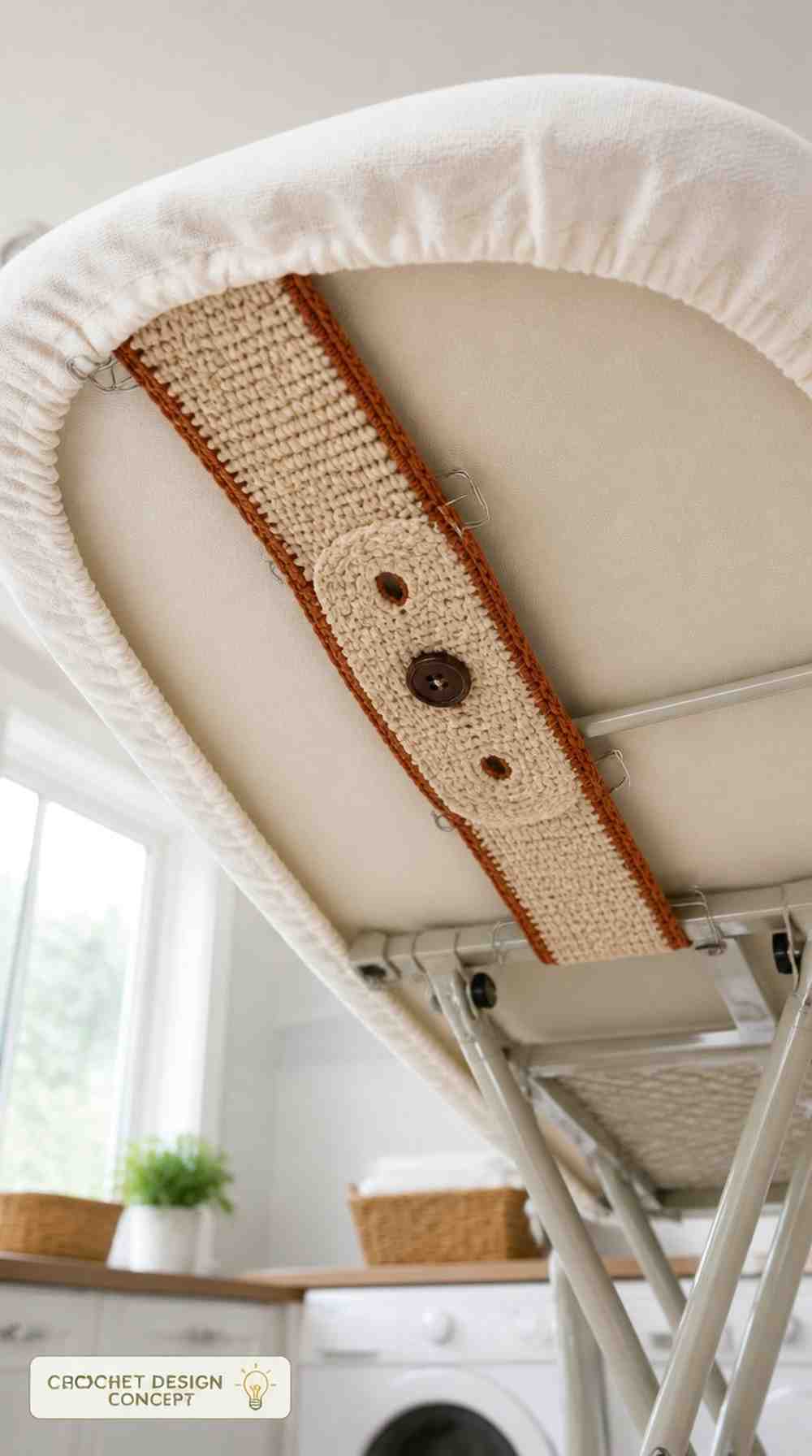
Oatmeal-colored crochet gives this securing band a simple linen-like appearance, finished with narrow terracotta edging. Three buttonholes sit along the central overlap, while one dark wooden button fastens through the middle opening. Metal clips at both ends connect the band to the folded ironing board cover.
The button arrangement suggests an adjustable length without relying on a traditional slider. It brings a vintage handmade look to an otherwise practical accessory. However, wooden buttons and crochet buttonholes are not automatically suitable for maintaining consistent cover tension during ironing.
- Three Buttonhole Positions: The different openings suggest size adjustment, but each fastening position would need testing for unwanted stretching or release.
- Wooden Button Closure: A small wooden button creates the visible focal point, although it may loosen or become damaged by repeated handling and heat exposure.
- Terracotta Edge: The contrasting border defines the band and its overlap without introducing bulky decorative elements.
- Practical Limitation: Buttoned crochet should not be relied upon as the sole securing method for a cover unless the entire fastening system has been appropriately evaluated.
3. Crochet Terracotta Crossed Cover Support Straps
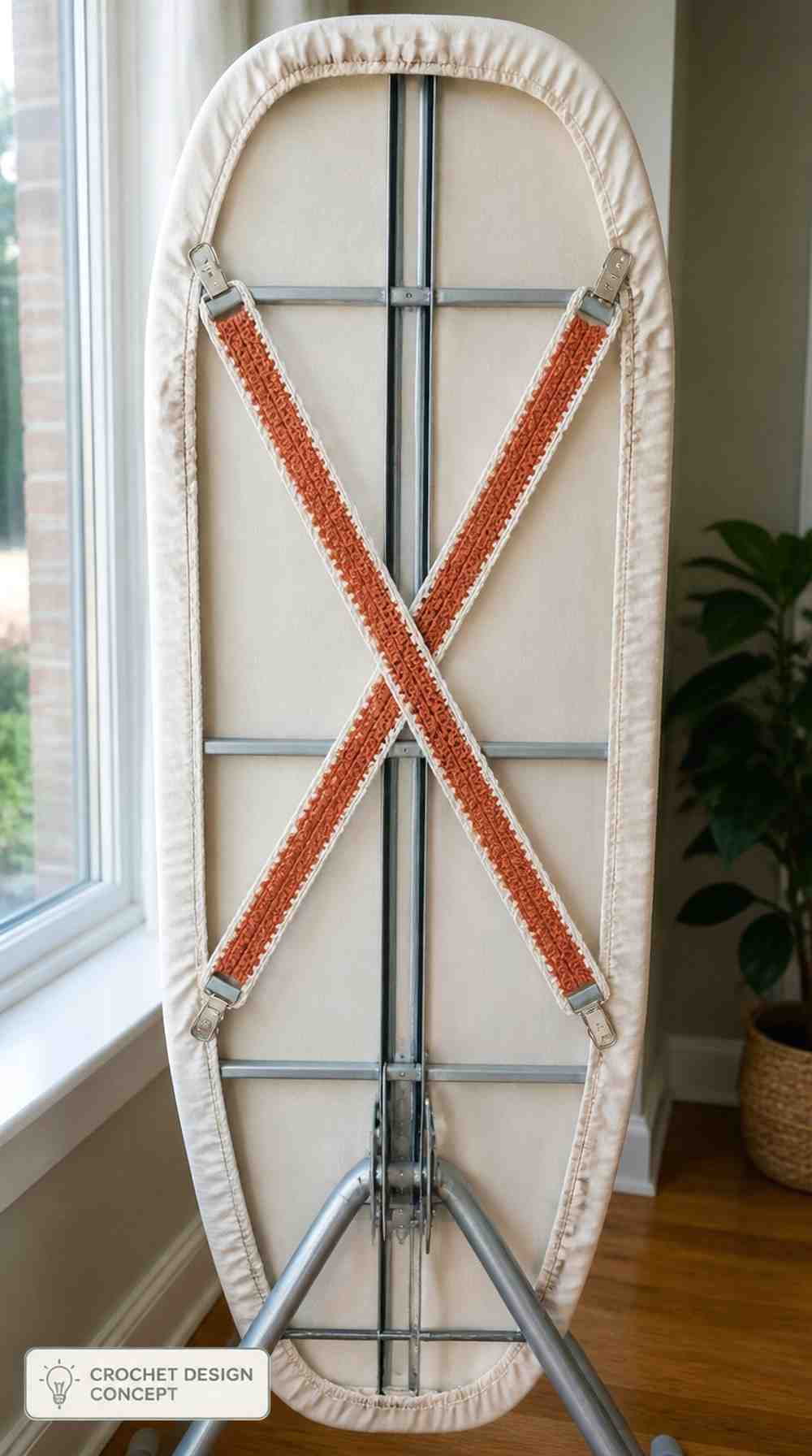
Two slender terracotta crochet bands form a clear X across the underside of this cream-covered ironing board. The closely worked strips have fine ivory edging, with four small silver cover clips connecting their ends to opposing fabric hems. The central crossing lies flat rather than forming a bulky knot.
The crossed arrangement creates a distinctive geometric appearance. Unlike a single straight band, it pulls visually from four attachment points. Its actual suitability depends on the board’s underside layout, because crossing straps could interfere with hinges, leg supports or cover-adjustment components.
- Four Clip Positions: Each attachment point needs sufficient clearance and compatible cover material; extra clips do not automatically mean greater security.
- Flat Central Crossing: Keep the two crochet bands thin where they overlap so they do not form a bulky raised knot.
- X-Shaped Placement: The diagonal paths should remain outside the movement range of the ironing board’s legs and central support mechanism.
- Safety Consideration: Check the complete underside before adapting this arrangement. Some board designs leave no suitable space for crossed straps.
4. Crochet Navy Sliding-Buckle Cover Band
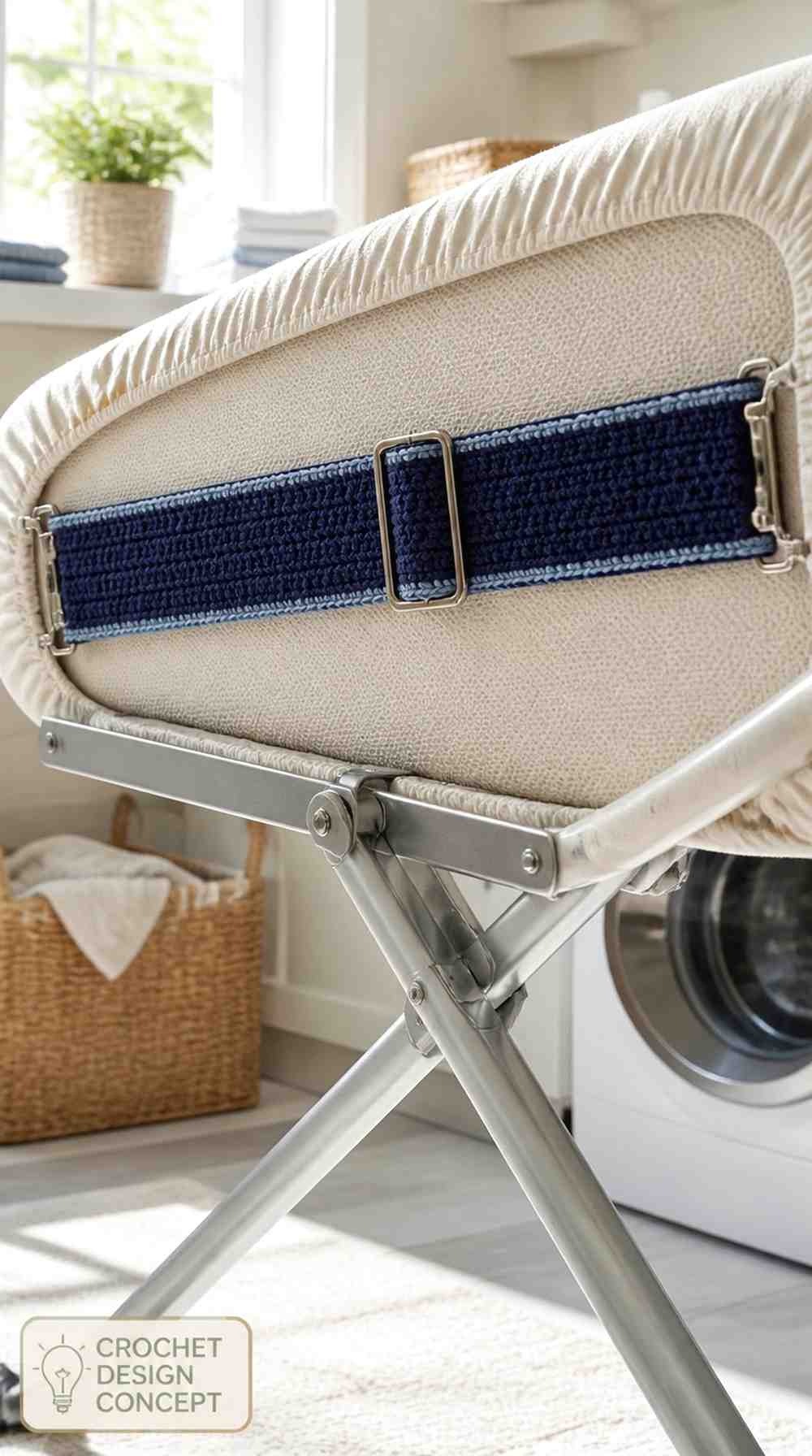
Deep navy crochet creates a flat underboard securing band with pale-blue finishing rows along both sides. A brushed-steel rectangular slider sits near the center, while the free end folds neatly through the adjustment hardware. Small metal clips connect the strap to the opposite cover hems.
This design combines a tailored crochet appearance with a more conventional-looking adjustment feature. The buckle gives the band a clean functional style, although its reliability depends on the actual hardware, the crochet fabric and their compatibility under tension.
- Metal Slider Fit: The slider must suit the strap’s width and thickness. An unsuitable buckle may slip or distort the crocheted fabric.
- Flat Navy Stitching: Closely worked rows create a smooth appearance, but the band may still lengthen during use.
- Folded Adjustment End: Keep the returned strap end neatly secured and away from moving parts rather than leaving excess fabric hanging beneath the board.
- Hardware Compatibility: A commercially tested cover fastener is preferable to combining unverified components for a working ironing board.
5. Crochet Ivory Scalloped Edge Cover Strap
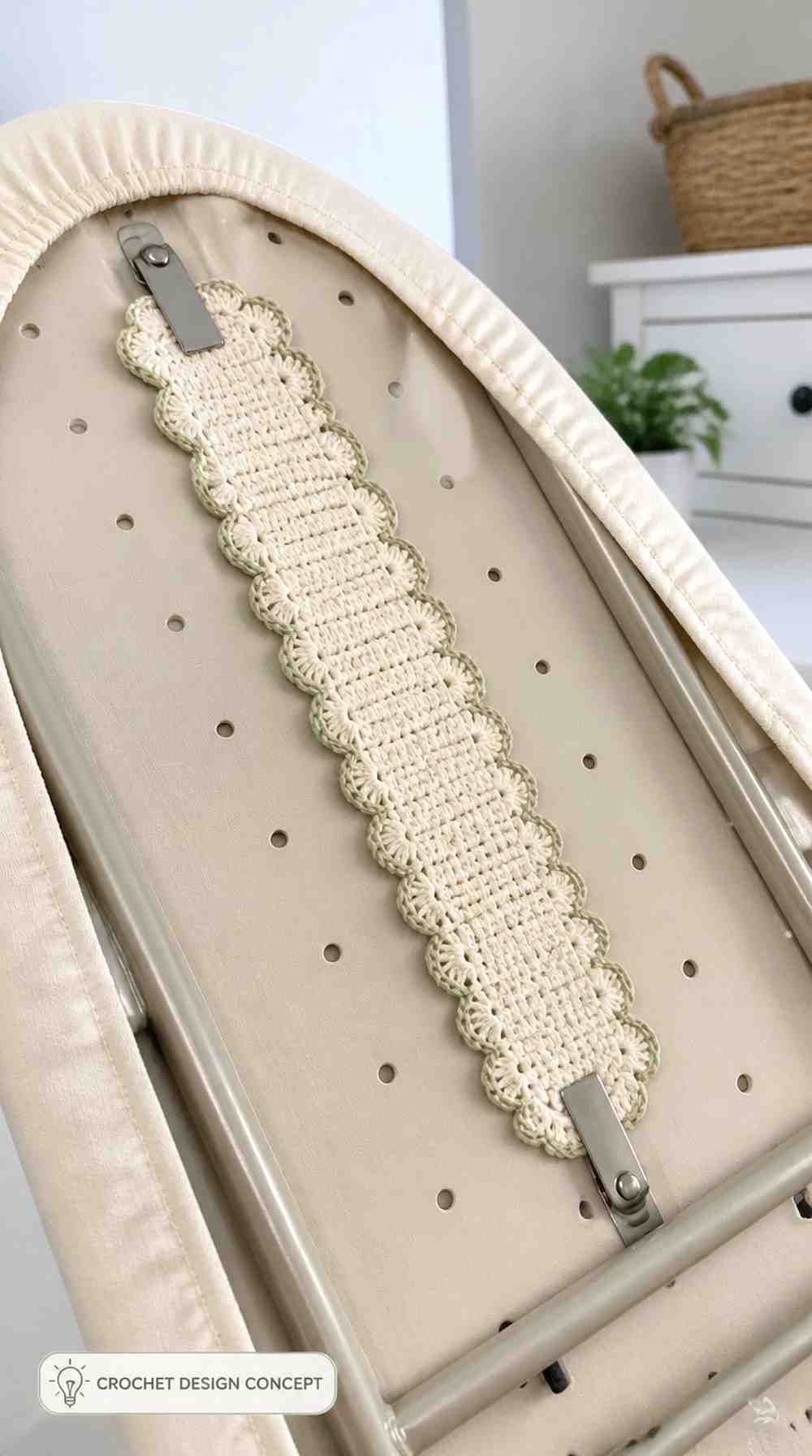
Ivory crochet forms a narrow, closely worked band with eight small scallops decorating each long side. Fine sage-green edging outlines the curves, while metal clips connect the strap to the cover hems beneath the ironing board. The entire scalloped section remains below the working surface.
This concept adds a cottage-inspired finish to a normally hidden household accessory. Its decorative edge is the main feature rather than an elaborate fastening system. The scallops should remain low-profile, since projecting crochet edges may catch against surrounding hardware or become difficult to keep clean.
- Sixteen Small Scallops: Eight curves along each side create the decorative outline. Keep them consistent and shallow rather than allowing them to project into nearby mechanisms.
- Sage Edge Definition: A fine green border helps distinguish the ivory scallops without requiring additional flowers, bows or hanging ornaments.
- Clip Clearance: The scalloped trim should stop before the metal clips so it cannot become trapped in their jaws.
- Practical Use: Treat the lace-like edging as decoration for an independently secure strap, not as evidence that the crochet itself can hold cover tension safely.
6. Crochet Charcoal Waffle Grip Securing Band
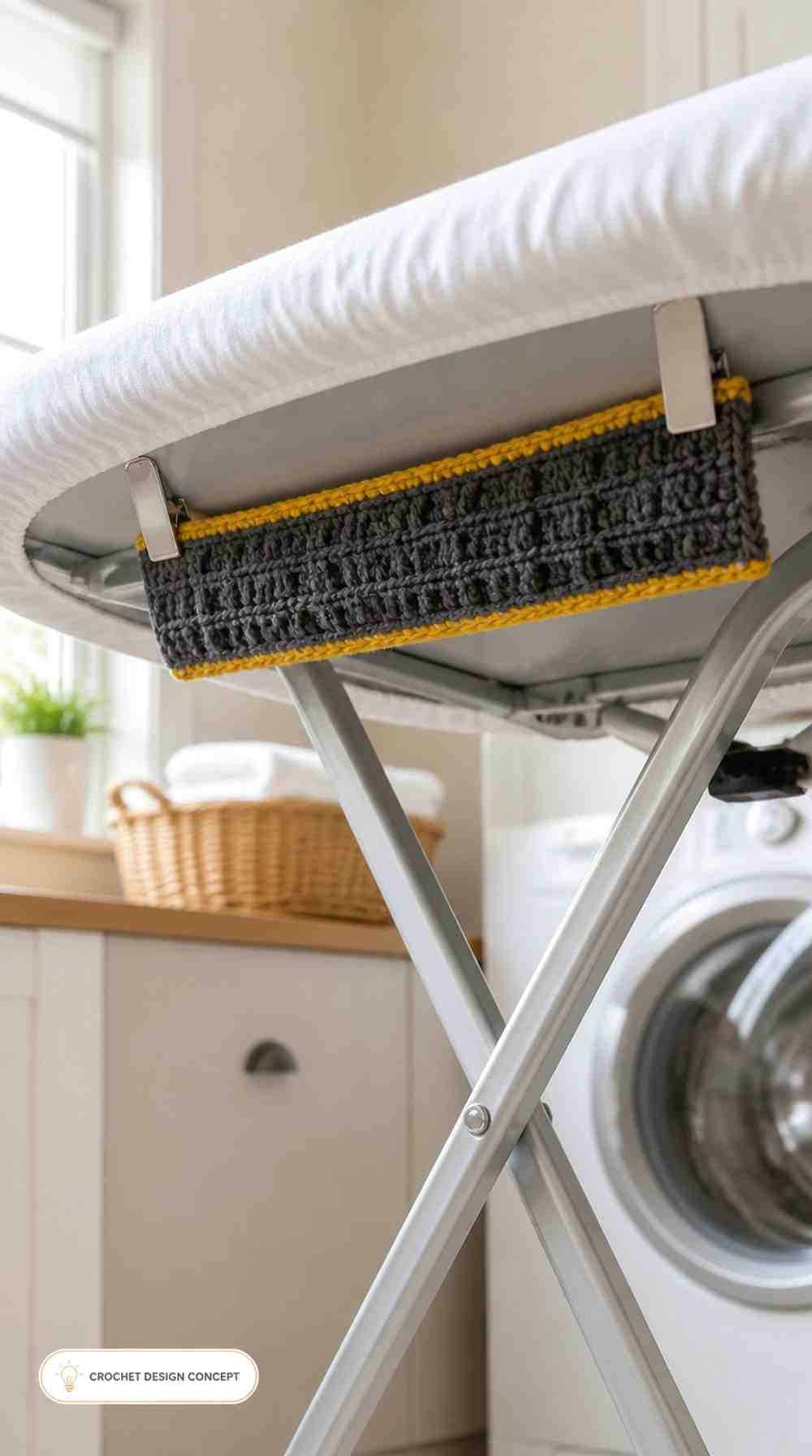
Charcoal-gray crochet creates a broad rectangular band with pronounced waffle-square texture across its surface. Straight mustard-yellow rows finish the long edges, while two steel clips attach the ends beneath a white ironing board cover. The dark textured fabric makes the small securing accessory visually distinctive.
The raised squares are the main attraction, bringing a stronger surface pattern than simple ribbing or linen-like stitches. However, waffle crochet can be comparatively thick, and extra bulk beneath an ironing board may create problems around restricted spaces or hardware.
- Raised Waffle Blocks: The textured squares create depth, but their thickness should be considered before placing the band against a board’s underside.
- Mustard Borders: Straight contrasting edges frame the charcoal pattern without adding raised decoration near the clips.
- Band Width: A broad strap needs enough uninterrupted underside space to lie flat and avoid the board’s supports.
- Texture Limitation: Raised stitches do not guarantee better grip or stability. A flatter manufacturer-approved fastening system may be more appropriate.
7. Crochet Mustard Twin Longitudinal Cover Straps
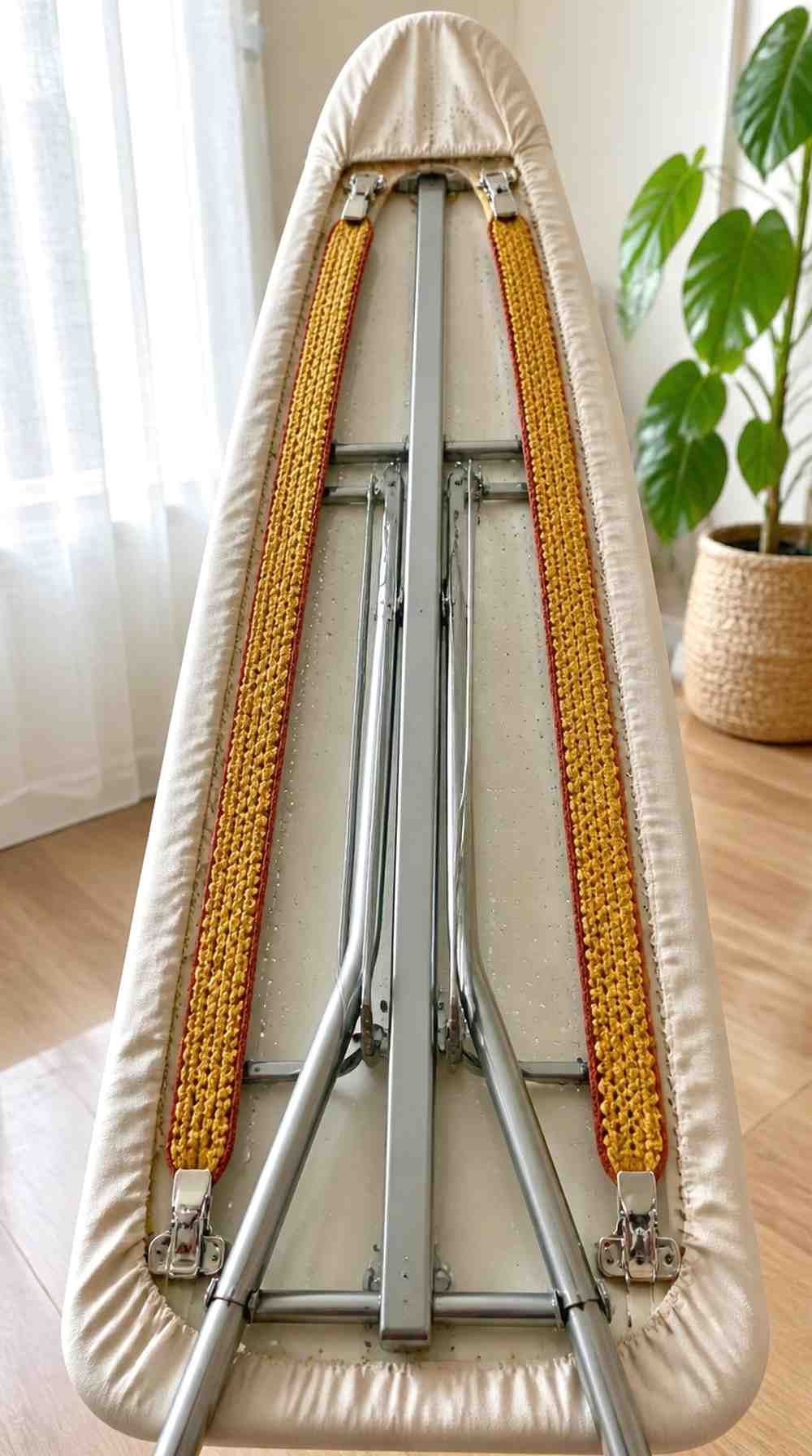
Two narrow mustard-gold crochet bands run lengthwise along the underside margins of this cream-covered ironing board. Each strip connects a front cover-hem clip to a rear cover-hem clip, creating two parallel lines with rust-orange edges. The central folding mechanism remains completely unobstructed.
This arrangement differs from the usual crosswise fastening strap. Instead of spanning the board’s width, it follows the longer side margins. Its suitability is highly dependent on the cover construction and the positions of any suitable attachment points.
- Longitudinal Arrangement: Lengthwise bands need suitable cover-hem attachment points at both ends; many ironing board covers may not support this configuration.
- Parallel Positioning: Keep the two strips evenly placed beneath the margins rather than allowing them to drift into the central mechanism.
- Compact Moss Stitch: The small stitches create an even-looking surface, but do not establish that the bands will resist stretching.
- Cover Compatibility: Use this layout only as inspiration unless the cover manufacturer specifically permits an appropriate lengthwise securing arrangement.
8. Crochet Dusty Blue Lattice Reinforced Strap
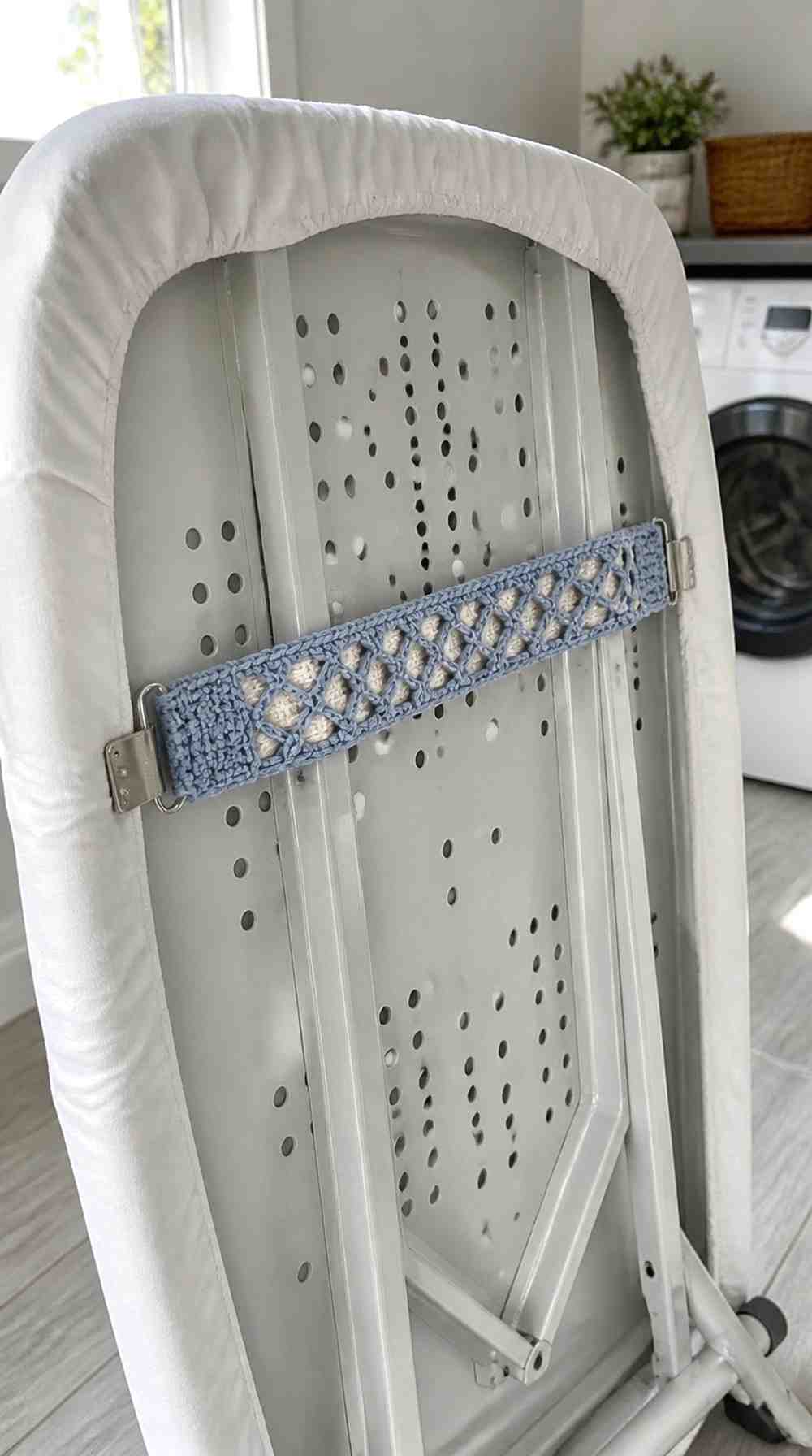
Dusty-blue crochet forms an open diamond-lattice layer over a continuous flat ivory fabric core. Small solid crochet finishing sections cover the clip junctions, and brushed-metal fasteners connect both ends to the opposite cover hems. The construction creates a contrast between decorative openwork and a smoother underlying strip.
This design is interesting because the lattice is not presented as the only material in the band. The ivory backing forms a separate continuous layer. Its actual performance, however, would depend on the core fabric, clip attachments and suitability of the complete system for use beneath an ironing board.
- Diamond-Lattice Surface: The open crochet pattern provides visual detail but should not be expected to withstand securing tension on its own.
- Continuous Ivory Backing: A separate flat core can carry a decorative layer, although its strength and heat suitability must be independently verified.
- Clip Junction Panels: Keep the solid crochet finishing sections away from moving clip jaws so the hardware remains accessible.
- Material Compatibility: Different fabrics can stretch, shrink or respond to heat differently, so the layered construction requires careful consideration.
9. Crochet Forest Braided Triple-Cord Underboard Strap
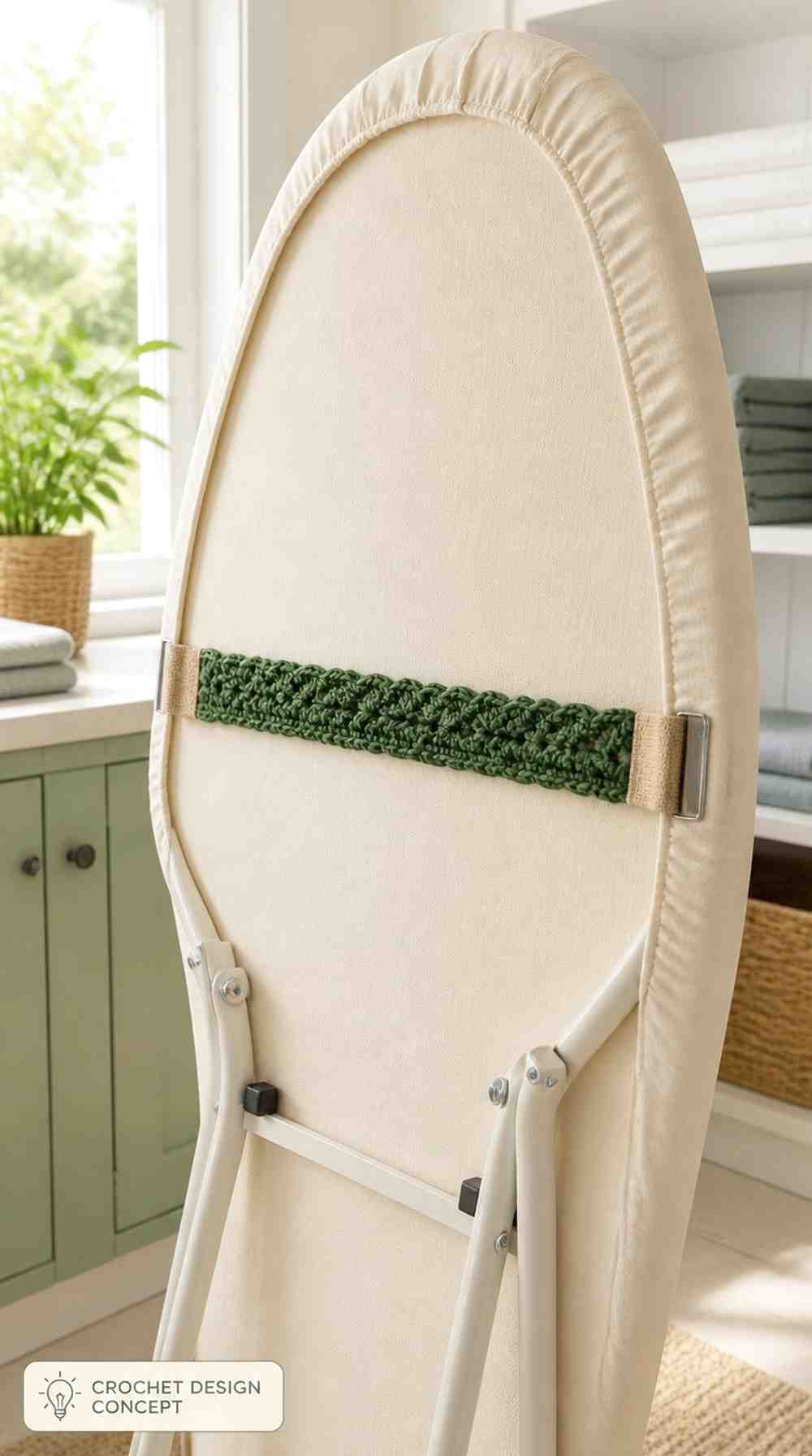
Three narrow forest-green crochet cords create a braided-looking flat band across the underside of a cream ironing board cover. Small oatmeal binding strips gather the cord ends into metal cover clips, leaving the center free of hanging strands. The closely arranged braids create a raised textured surface without additional embellishments.
This design has a more traditional handmade appearance than the flat ribbed bands. Its three-cord construction is visually appealing, although individual cords may stretch or shift under tension. The illustrated arrangement should be considered decorative unless the fastening system has been independently tested.
- Triple-Cord Layout: The three adjacent crochet cords need to remain joined and aligned rather than separating or twisting when the band is pulled.
- Oatmeal End Bindings: Flat joining strips help create a neat transition into the metal clips, but their appearance does not establish sufficient strength.
- Raised Braid Texture: The braided surface adds depth and may take up more space than a flat strap beneath the board.
- Fastening Limitation: A decorative cord arrangement should not replace a purpose-made securing strap that keeps the ironing board cover properly fitted.
10. Crochet Lilac Toggle-Loop Adjustment Strap
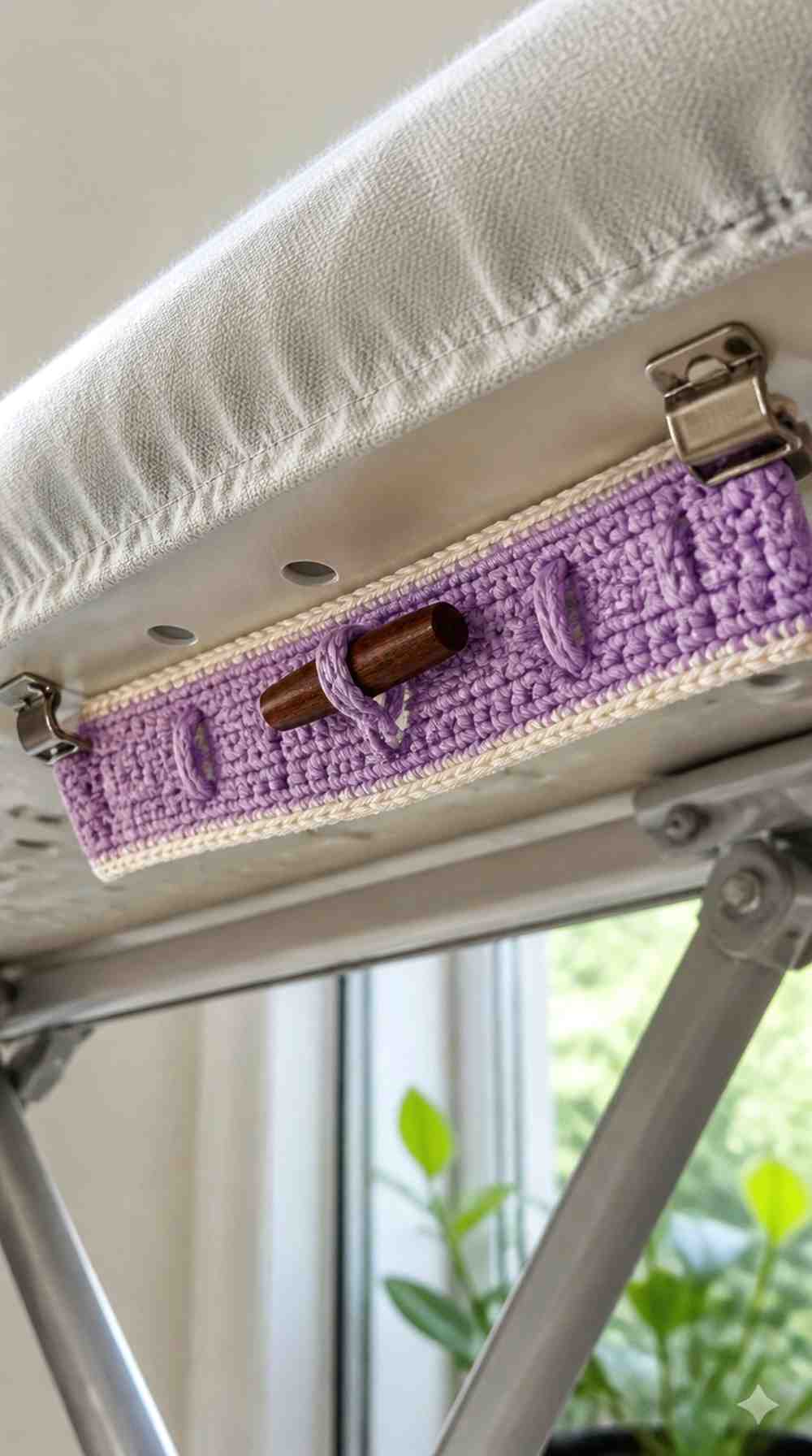
Soft lilac crochet forms a closely worked band with fine cream edging and a small dark wooden toggle at its center. Three lavender adjustment loops provide different fastening positions, while steel cover clips connect the strap to opposing cover hems beneath the board.
The toggle gives this concept a vintage-inspired appearance without requiring a large metal adjustment buckle. Its small scale works well with the narrow band. However, the combination of flexible crochet loops and a wooden toggle could loosen during handling, making the design more appropriate as fastening inspiration than a proven securing solution.
- Three Adjustment Loops: Multiple loops suggest different length settings, but their actual spacing and resistance to stretching would need to be checked.
- Wooden Toggle: The horizontal toggle should sit flat and avoid nearby mechanical parts. Wood and yarn must not contact hot surfaces.
- Cream Side Edging: The narrow border gives the lilac band a clean finish without introducing loose decorative yarn.
- Closure Reliability: A toggle that looks secure may still release under tension. Use tested hardware for the functional attachment.
11. Crochet Coral Daisy Center-Motif Cover Strap
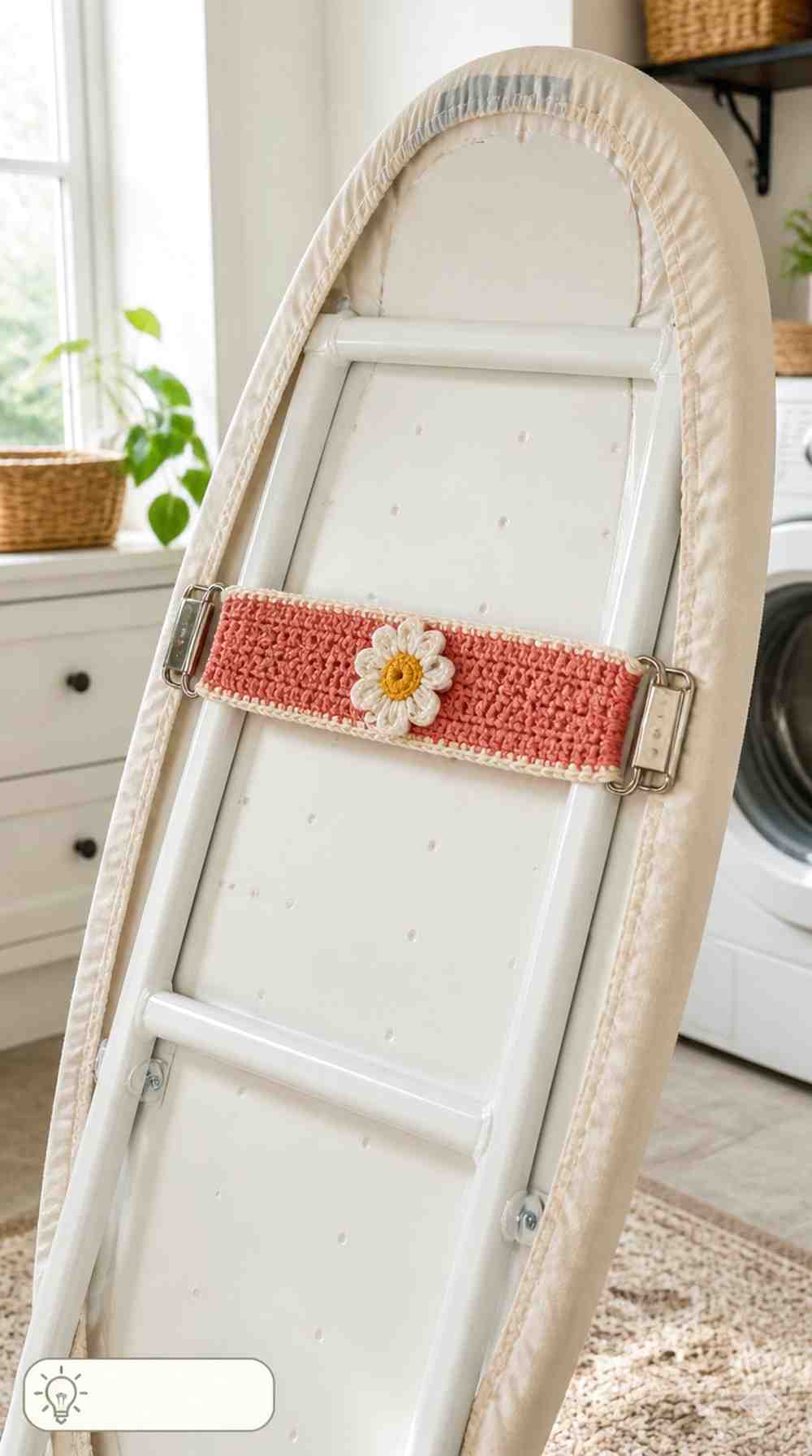
Coral-pink crochet creates a broad, flat securing band with cream finishing rows and one small ivory daisy at its center. The flower has five rounded petals and a mustard-yellow middle, positioned between two silver cover-grip clips. The entire arrangement remains beneath the ironing board.
The simple floral motif adds a cheerful detail to an otherwise practical-looking household accessory. Because the flower is flat and relatively small, it does not dominate the band. Even so, a raised appliqué can add bulk or catch on surrounding parts if the strap is placed incorrectly.
- Central Daisy Placement: Keep the five-petal flower clear of moving supports, adjusting levers and other underboard hardware.
- Low-Profile Appliqué: Flat petals are preferable to bulky three-dimensional decoration where the band needs to lie close to another surface.
- Coral Band Shape: A broad, even central panel gives the daisy space without extending decoration into the clip attachments.
- Decorative Purpose: The flower has no role in securing the cover. A separate approved fastener should handle the actual tension.
12. Crochet Denim Checkerboard Underboard Fastener
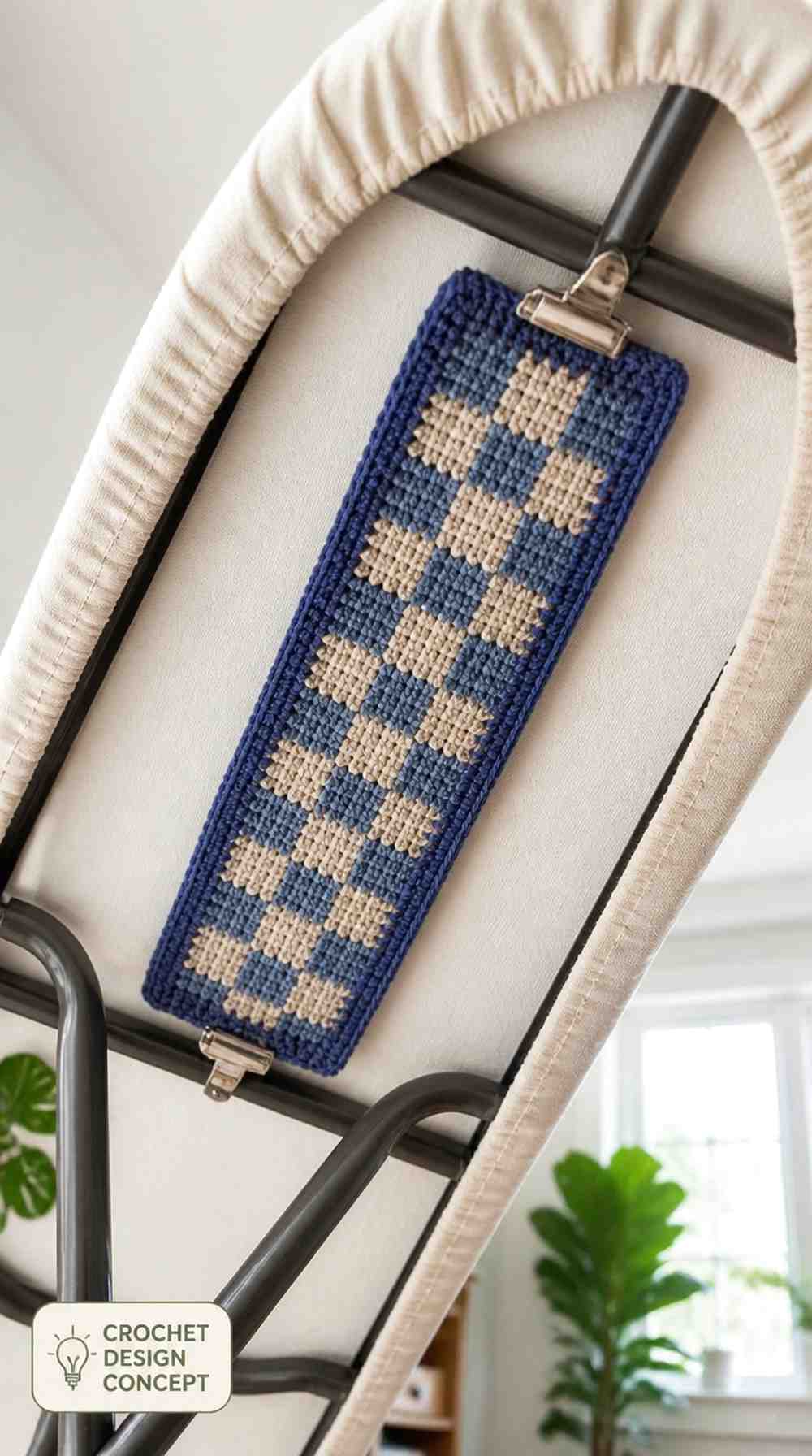
Denim-blue crochet forms a rectangular underboard strap decorated with small faded-blue and oatmeal checkerboard squares. Dark-denim borders frame the pattern, while one steel clip at each end connects the band to the opposite hems of a cream ironing board cover.
The checkerboard arrangement introduces colorwork without changing the strap’s basic flat silhouette. Its repeated squares create a clean graphic appearance, although the joined sections and color changes may behave differently from a single continuous crochet band. Keeping the strap flat is especially important.
- Checkerboard Alignment: Maintain even square proportions across the band so the pattern does not twist or produce irregular edges.
- Colorwork Joins: Multiple yarn changes can create additional ends or thicker sections that need secure finishing.
- Flat Outer Borders: The solid denim edges should remain straight and avoid bunching where they meet the cover clips.
- Stretch Consideration: Colorwork alone does not prevent a crocheted strap from lengthening. Proper cover tension requires a reliable fastening system.
13. Crochet Rust Parallel Double-Band Cover Fastener
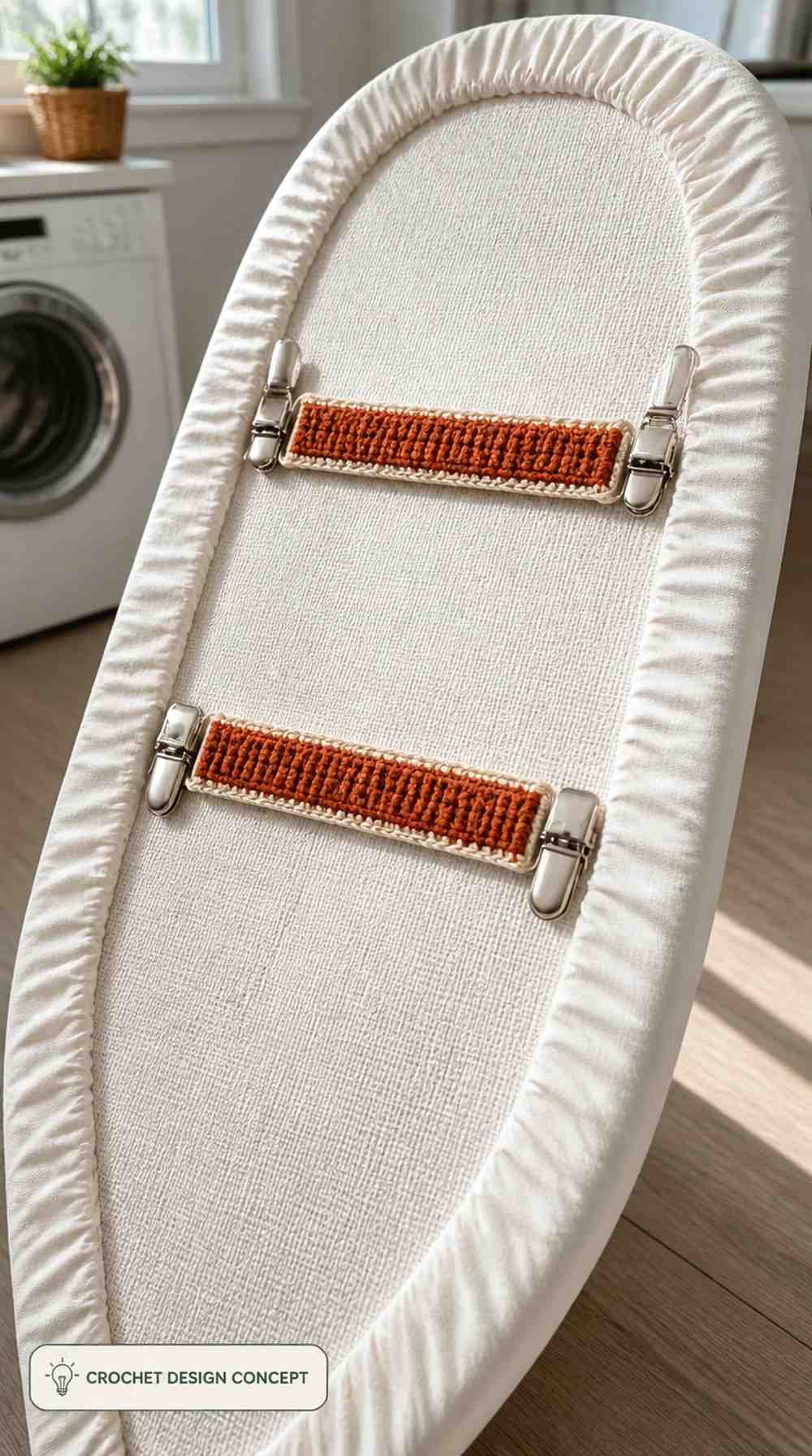
Two rust-orange crochet straps run parallel beneath the center of an ivory-covered ironing board. Each band has closely worked horizontal ribs, fine cream edges and its own pair of stainless cover clips. The two strips remain separate, creating four visible attachment points without crossing one another.
This arrangement offers a different approach from the single broad band. Two narrower strips could provide an interesting visual layout, but their position must suit the board’s underside. Four clips also introduce more places where the cover could be pulled unevenly.
- Parallel Band Spacing: Position the two straps so they remain clear of hinges, folding supports and adjustment hardware.
- Four Clip Attachments: Each clip must suit the cover hem and should not create wrinkles or uneven pulling around the board.
- Matching Ribbed Strips: Both rust bands need similar dimensions and tension to avoid one carrying more load than the other.
- Board Compatibility: Not every ironing board has enough uninterrupted underside space for two separate crosswise straps.
14. Crochet Plum Removable Fastener Sleeve
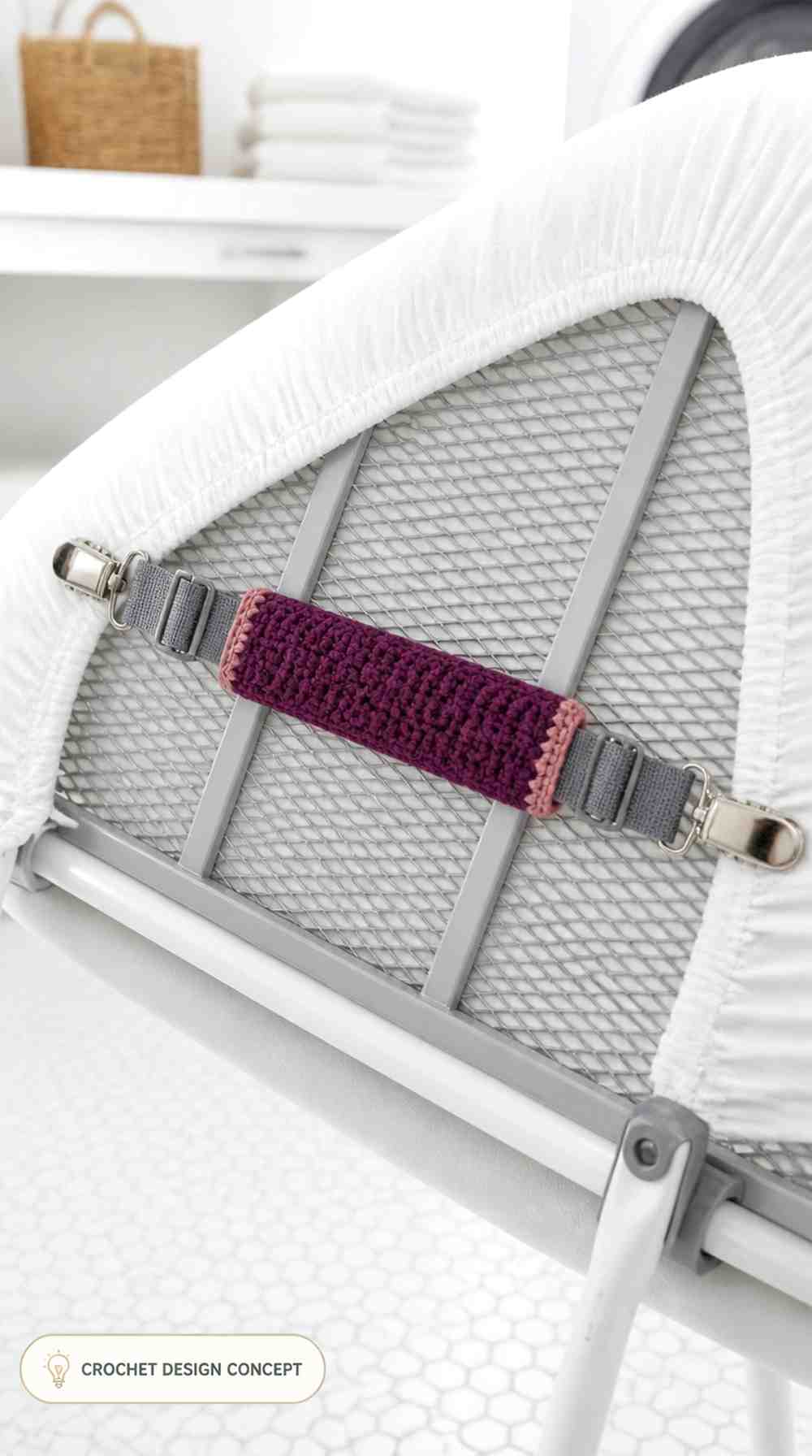
Plum-purple crochet forms a narrow removable sleeve around the central stationary section of an existing gray ironing board cover fastener. Fine horizontal linen-like stitches create a smooth surface, while dusty-rose edging finishes the sleeve. The original metal clips, adjustment buckle and elastic sections remain uncovered and accessible.
This concept is different because the crochet is primarily decorative rather than the main securing component. The underlying fastener retains its own adjustment system. It is one of the more realistic directions to explore, provided the sleeve does not affect the commercial strap’s operation or contact unsuitable heated areas.
- Existing Fastener Compatibility: The crochet sleeve should fit only a suitable stationary section without covering the adjustment buckle or clip mechanisms.
- Removable Decoration: A slip-on design may allow the crochet to be removed separately for cleaning and inspection.
- Dusty-Rose Edging: The narrow contrast trim gives the sleeve a finished appearance without extending over moving hardware.
- Safety Check: Even a decorative sleeve may interfere with the fastener or trap heat. Confirm compatibility with the manufacturer’s instructions before use.
15. Crochet Mint Diagonal Colorblock Securing Strap
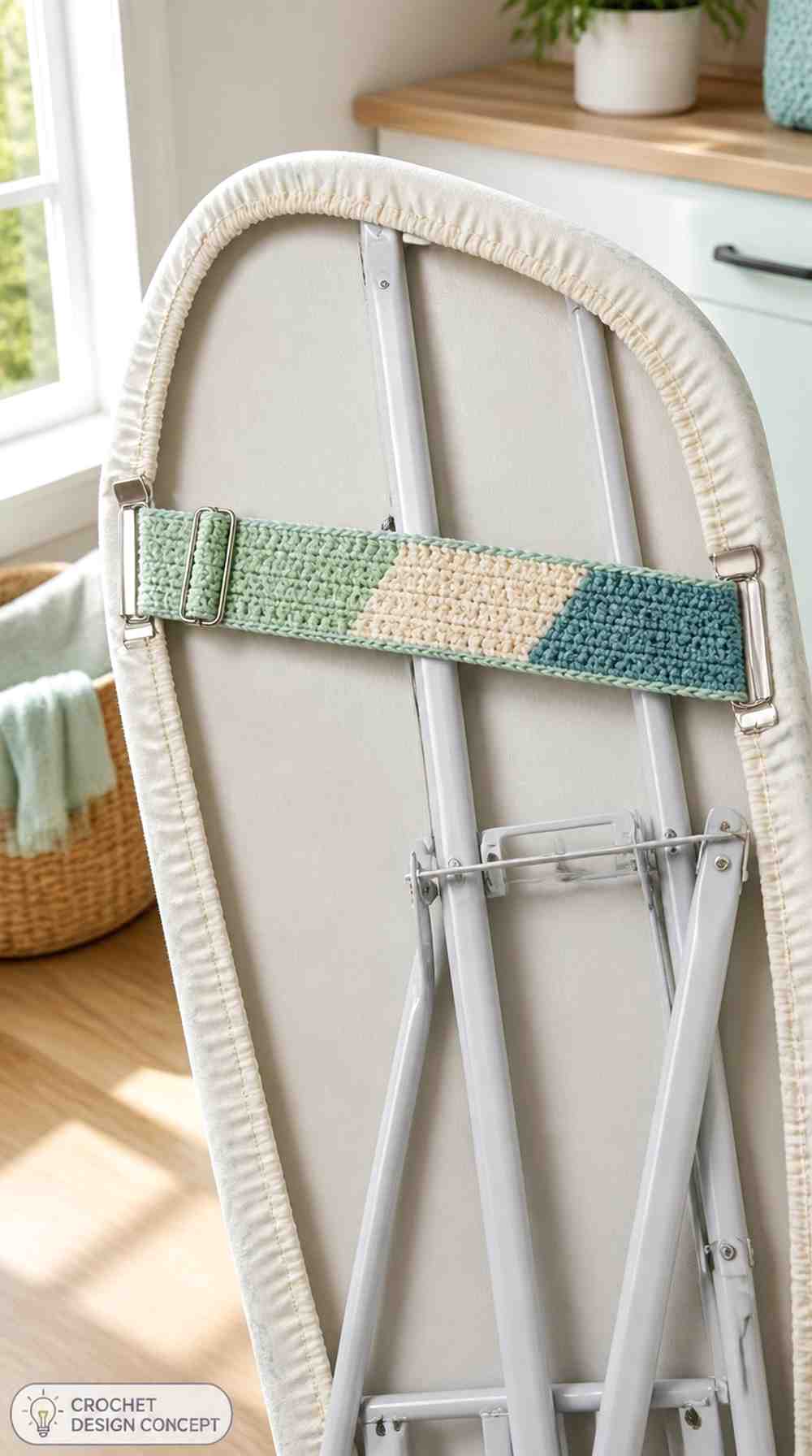
Mint-green, warm ivory and muted teal crochet form three diagonal color sections along a flat underboard strap. Thin mint finishing rows outline the edges, while a brushed-metal slider sits near one end. Two steel cover clips connect the band to opposite hems of the pale-cream ironing board cover.
The diagonal color transitions create a modern alternative to stripes and checkerboard squares. Because the design uses relatively flat stitches, its visual interest comes mainly from the color changes. The adjustment slider and joins would need careful checking in any real version.
- Diagonal Color Sections: Keep the three joins smooth and consistent so they do not create unnecessary ridges in the band.
- Metal Adjustment Slider: The hardware should suit the strap material and maintain its setting without slipping.
- Mint Finishing Rows: Narrow edging helps define the long strap without adding decorative pieces that could catch underneath the board.
- Practical Adaptation: The colorblock pattern could be used as decoration on a separate approved fastener rather than relying on the crochet itself.
Practical Guide to Crochet Ironing Board Cover Securing Straps
An ironing board cover needs to remain properly fitted while the board is used. A loose or shifting cover can affect ironing, and the equipment involves heat, steam and moving metal parts.
Check the existing cover first. Different ironing board covers use drawstrings, elastic edges, adjustable straps or clips. Follow the manufacturer’s fastening instructions before adding any extra accessory. Purpose-made cover clips and straps are designed to pull opposing cover edges together beneath the board.
Prym Americas+1
Measure the underside. Check the distance between the cover hems and identify where the board’s legs, hinges, height-adjustment lever and iron rest are located. Never route crochet across a moving component or attach it to the folding mechanism.
Understand yarn limitations. Cotton and other crochet fibers can stretch or change shape with use and washing. They are not automatically suitable for an ironing environment. Avoid placing crochet on the hot ironing surface or near the hot iron, steam outlets or heated metal parts.
Choose suitable hardware. Purpose-made commercial fasteners are preferable to improvised clips, wooden buttons or untested yarn loops. A decorative crochet sleeve may be worth considering only where the manufacturer permits it and the original fastener continues operating correctly.
Inspect before every use. The cover should lie smooth, remain properly secured and allow the board to open, close and adjust normally. Remove any decorative strap immediately if it slips, becomes damaged, restricts equipment movement or shows signs of heat exposure.
Want to Make Something Similar?
The following verified resources help explain related crochet strap construction and the way commercial ironing board fasteners work. They are not exact patterns or approved construction instructions for the illustrated securing straps.
- Non-Stretchy Crochet Strap Tutorial — The Loophole Fox explains techniques for reducing stretch in crochet straps. It is intended for craft projects, not for validating their use around heated ironing equipment. The Loophole Fox
- How to Crochet an I-Cord — Heart Hook Home teaches a compact crochet cord technique useful for exploring the Forest Braided Triple-Cord design. It does not establish suitability as an ironing board fastener. Heart Hook Home
- Ironing Board Cover Fasteners — Dritz shows a purpose-made commercial solution for securing an ironing board cover beneath the board. Prym Americas
These resources can help with related crafting and fastening ideas. They do not establish that any of the 15 crochet concepts are safe replacements for tested cover hardware.
Which Crochet Ironing Board Cover Securing Strap Should You Choose?
| Your design preference | Ideas worth comparing | Main consideration |
|---|---|---|
| Simple flat crochet appearance | Sage Ribbed, Navy Sliding-Buckle | Strap stretch and adjustment reliability |
| Traditional fastening details | Oatmeal Three-Button, Lilac Toggle-Loop | Closure security and material compatibility |
| Decorative textured surface | Charcoal Waffle, Forest Braided Triple-Cord | Extra thickness and uneven tension |
| Crossed or multiple bands | Terracotta Crossed, Rust Parallel Double-Band | Clearance around folding mechanisms |
| Color-focused styling | Denim Checkerboard, Mint Diagonal Colorblock | Flat joins and secure hardware |
| Cottage-inspired decoration | Ivory Scalloped Edge, Coral Daisy Center-Motif | Snagging and unnecessary bulk |
| Decorative commercial fastener | Plum Removable Fastener Sleeve | Must not interfere with approved hardware |
| Open-texture appearance | Dusty Blue Lattice Reinforced Strap | Backing material and structural compatibility |
If you simply want to explore decorative stitch textures, the Crochet Sage Ribbed Underboard Securing Strap and Crochet Mint Diagonal Colorblock Securing Strap provide clear visual starting points.
For a more practical direction, the Crochet Plum Removable Fastener Sleeve is worth examining because its concept separates decoration from the original securing system. However, even that arrangement should only be used if it is compatible with the fastener and ironing board.
A manufacturer-approved cover fastener remains the better option whenever securing performance matters.
Conclusion
These 15 crochet ironing board cover securing strap inspiration ideas explore how ribbing, buttoned details, geometric arrangements and colorful stitching can change the appearance of a small household accessory. Each concept offers a different decorative approach, from simple flat bands to crossed straps and removable sleeves.
Because ironing boards operate around heat and moving components, any functional modification needs more than visual appeal. Keep the original safety requirements in mind, use compatible fastening hardware and treat the crochet designs as inspiration rather than proven replacements.
Which design do you like most: the Sage Ribbed Strap, the Terracotta Crossed Straps or the Plum Removable Fastener Sleeve? Share whether your ironing board cover uses clips, elastic or a drawstring.
Frequently Asked Questions
1. Can a crochet strap securely hold an ironing board cover in place?
A crocheted strap may look suitable, but its actual holding strength depends on the yarn, stitches, attachments and amount of tension. Crochet can stretch and may loosen over time. Use a purpose-made securing system recommended for your cover rather than relying on an untested handmade strap to keep the surface properly fitted.
2. Is cotton yarn heat-resistant enough for ironing board accessories?
Cotton is often used in textiles, but that does not mean a cotton crochet strap is approved for contact with hot ironing equipment. Cotton can scorch or burn under sufficient heat, and other fibers may melt or deform. Keep all decorative crochet away from the iron, heated surfaces and steam exposure, and follow the manufacturer’s instructions.
3. Where should an ironing board cover securing strap be positioned?
Commercial cover fasteners commonly attach to opposing cover edges beneath the board. The correct position depends on the specific board and cover design. Keep attachments away from folding hinges, moving legs, adjustment levers and other mechanisms. Follow the fastener manufacturer’s instructions rather than assuming one placement works for every board.
4. Can I decorate an existing ironing board cover strap with crochet?
A removable decorative sleeve may be possible, but only if the original fastener’s operation is unaffected and its manufacturer permits the modification. Do not cover clips, adjustment buckles, elastic working sections or other moving parts. Remove any decoration that interferes with tension, traps heat or causes the strap to slip.
5. Are these 15 crochet ironing board cover securing strap ideas complete patterns?
No. These are original AI-generated crochet inspiration concepts showing possible strap shapes, colors, stitches and decorative arrangements. They do not contain tested stitch counts, exact dimensions, heat-resistance ratings, fastening strength results or verified installation instructions. The linked craft resources teach related techniques but do not reproduce or certify these specific designs.