A crochet makeup sponge drying stand can be an interesting addition to a handmade vanity collection, especially when the design uses open rings, raised supports and small sculptural shapes. These 16 inspiration ideas explore miniature crochet stands in sage, ivory, terracotta, navy and other soft colors, combining different crochet textures with simple tabletop arrangements.
The collection includes single-sponge stands, paired holders, flower-inspired supports and more unusual geometric designs. You’ll be able to compare how each stand supports a makeup sponge, how much surface remains exposed and what kind of structure it might need. Because damp makeup sponges require proper ventilation, these designs are best treated as creative concepts rather than proven drying tools, especially where absorbent yarn touches the sponge.
These are AI-generated crochet design visualizations, not photographs of tested handmade stands, verified drying equipment or step-by-step patterns.
Quick Design Selection Guide
| What you're looking for | Design to explore | Distinctive feature |
|---|---|---|
| Minimal single-sponge stand | Crochet Sage Three-Leg Ring Stand | Simple raised ring with three legs |
| Soft decorative styling | Crochet Ivory Scalloped Raised Halo Stand | Small scallops around an elevated ring |
| Two sponge positions | Crochet Navy Twin Ring Vanity Stand | Side-by-side rings on a common base |
| Different display heights | Crochet Forest Staggered Double Ring Rack | Low front ring and raised rear ring |
| A floral shape | Crochet Rose Three-Petal Wing Sponge Stand | Three curved supports around the sponge |
| A geometric vanity accent | Crochet Sand Hexagon Six-Spoke Sponge Stand | Six-sided base and open spoke arrangement |
These concepts vary in complexity. For a real drying setup, favor washable, nonabsorbent contact surfaces that expose the sponge to air, rather than assuming absorbent crochet fabric is suitable for holding a damp sponge.
1. Crochet Sage Three-Leg Ring Stand
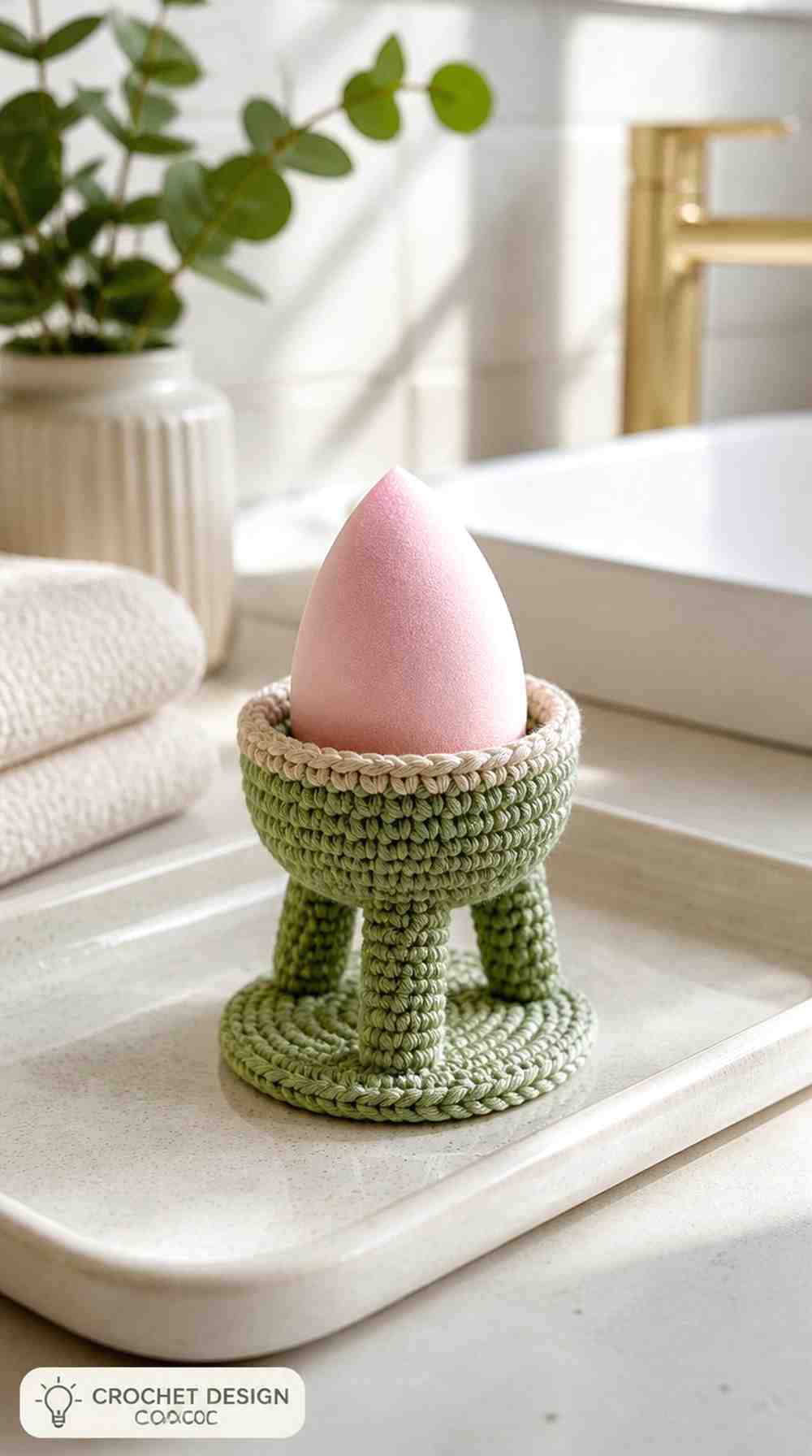
Soft sage-green crochet forms a small circular stand with three short legs and an open retaining ring above the base. A narrow oatmeal finishing row defines the upper edge. One blush-pink teardrop makeup sponge stands upright in the opening, leaving most of its rounded sides and pointed tip visible.
The compact tripod arrangement looks especially neat on a pale ceramic vanity tray. Its simple shape makes the raised ring the focus rather than decorative flourishes. A real version would need enough structural support to prevent the ring and three legs from bending under the sponge.
- Three-Leg Balance: The legs should meet the base evenly so the upper ring stays level rather than tipping toward one side.
- Open Ring Diameter: Match the opening to the sponge’s rounded lower portion without squeezing the foam or allowing it to fall through.
- Oatmeal Edge: A slim contrast border highlights the ring but should not create an oversized fabric contact area.
- Practical Limitation: Crochet can absorb moisture from a damp sponge. Consider this shape as decoration around a separate washable, nonporous support.
2. Crochet Ivory Scalloped Raised Halo Stand
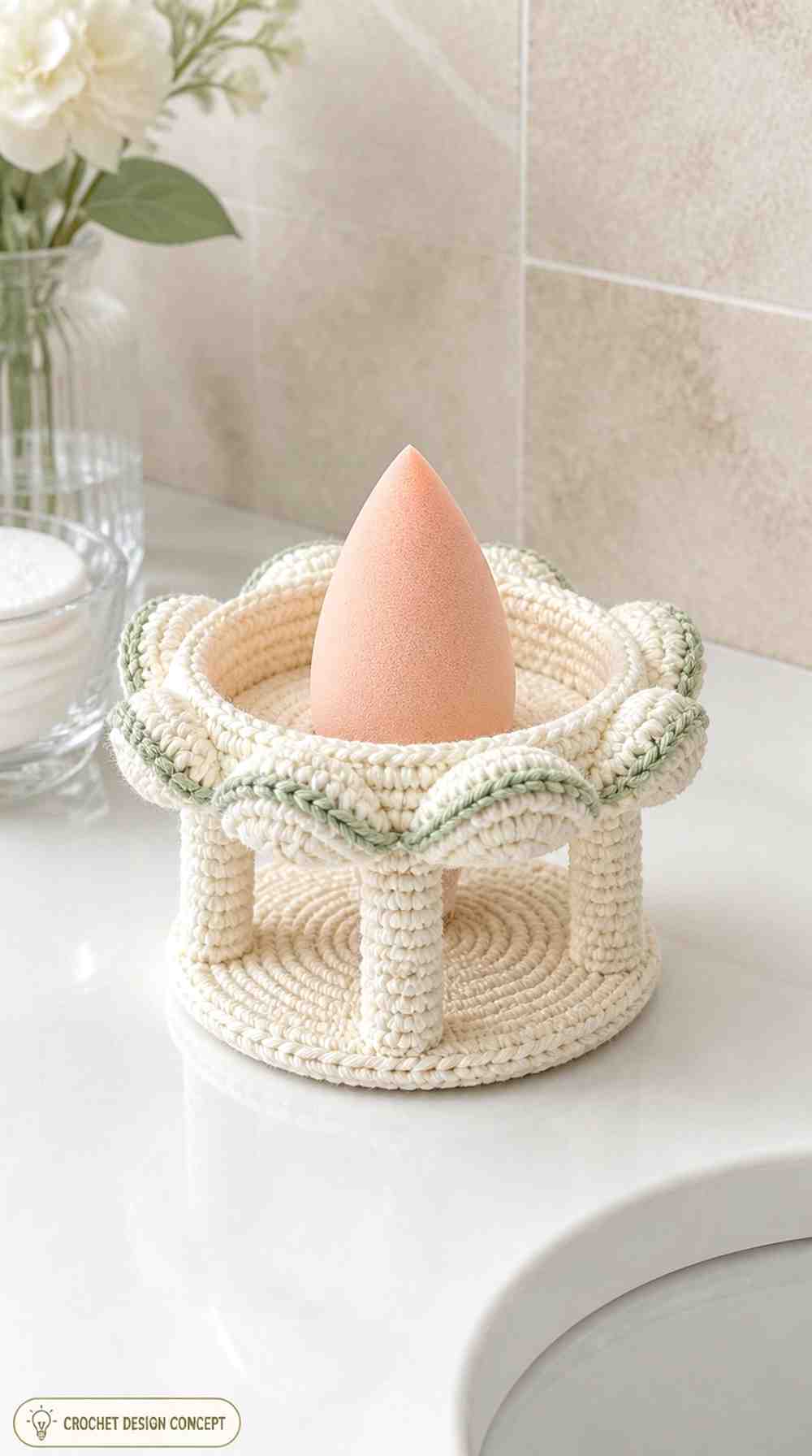
Six small ivory scallops surround the elevated circular ring of this delicate crochet stand. Four short posts lift the ring above a cream circular base, while dusty-sage edging traces the scalloped outline. A clean peach-colored makeup sponge sits upright in the central opening.
This design offers a cottage-inspired alternative to the plain sage tripod. The raised halo lets the sponge remain clearly visible rather than hiding it inside a cup. The decorative scallops are attractive but add edges that would need careful cleaning and shaping in a real piece.
- Scalloped Halo: Keep the six curved sections modest in size so they do not fold into the central ring or press against the sponge.
- Four Support Posts: Evenly spaced posts help create the elevated appearance, but they would need firm construction to maintain the circular shape.
- Central Opening: The ring should support the sponge near its wider lower section while leaving most of the foam exposed.
- Decorative Edges: Scallops create additional yarn surfaces that may collect residue, making them less suitable for direct contact with damp foam.
3. Crochet Terracotta Triangular Sponge Cradle
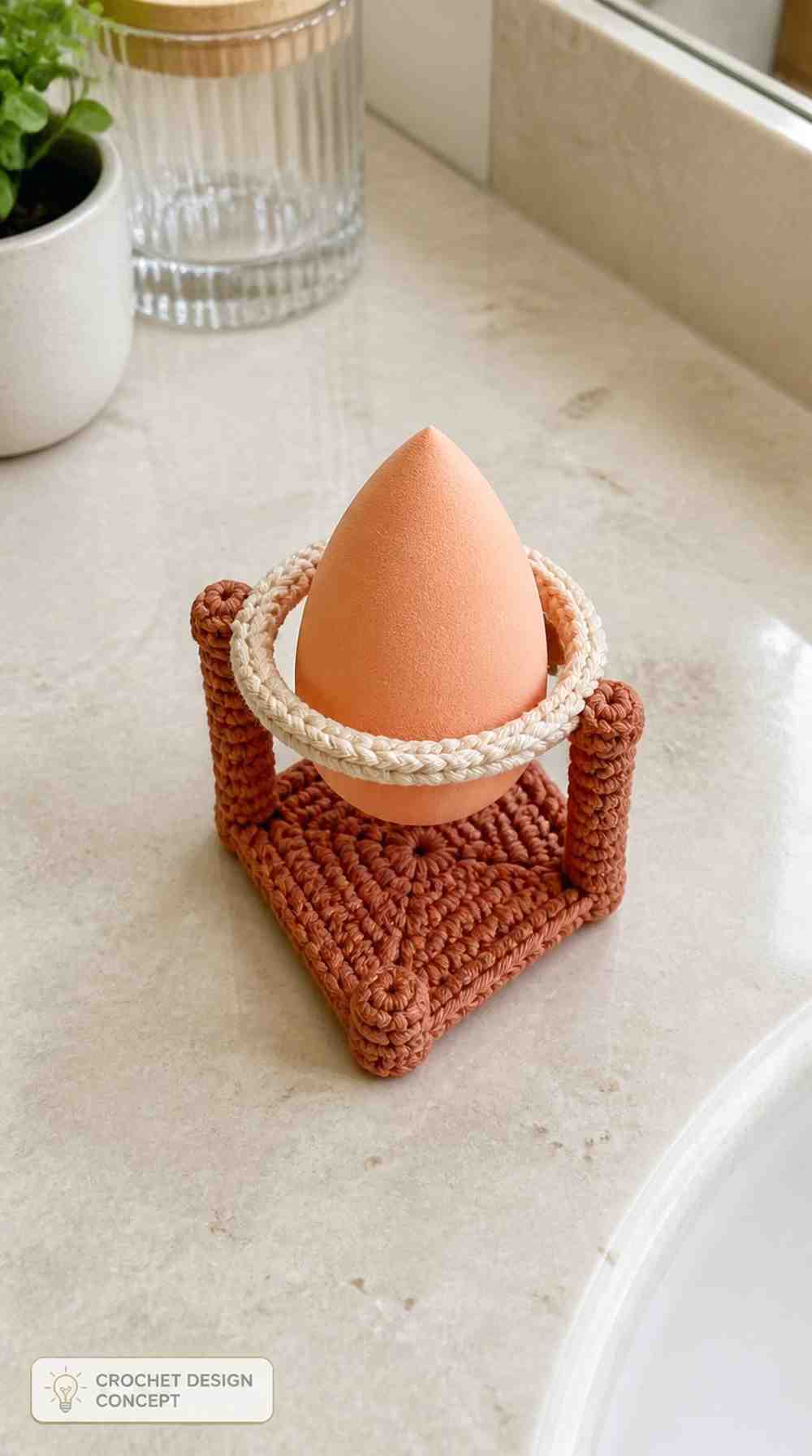
Warm terracotta crochet creates a miniature stand with a flat triangular base and three upright supports at the corners. A cream-edged circular ring connects the posts above the base, holding one apricot-colored teardrop sponge vertically. Small seed-like crochet stitches give the narrow supports a tidy textured appearance.
The triangular footprint provides a different geometry from ordinary round stands. Its three corner posts form a clear open structure beneath the sponge, although the connection between the ring and supports would need reinforcement to behave like a dependable tabletop holder.
- Triangular Footprint: Three rounded corners create distinct support points; check that the base is wide enough for the sponge’s size.
- Raised Circular Ring: The top ring needs to remain centered over the triangular base rather than drifting toward one corner.
- Cream Rim Detail: The narrow edging highlights the supporting ring without adding bulk to the terracotta structure.
- Construction Challenge: Flexible crochet posts may lean or collapse. Any reinforcing frame should be removable and suitable for cleaning.
4. Crochet Navy Twin Ring Vanity Stand
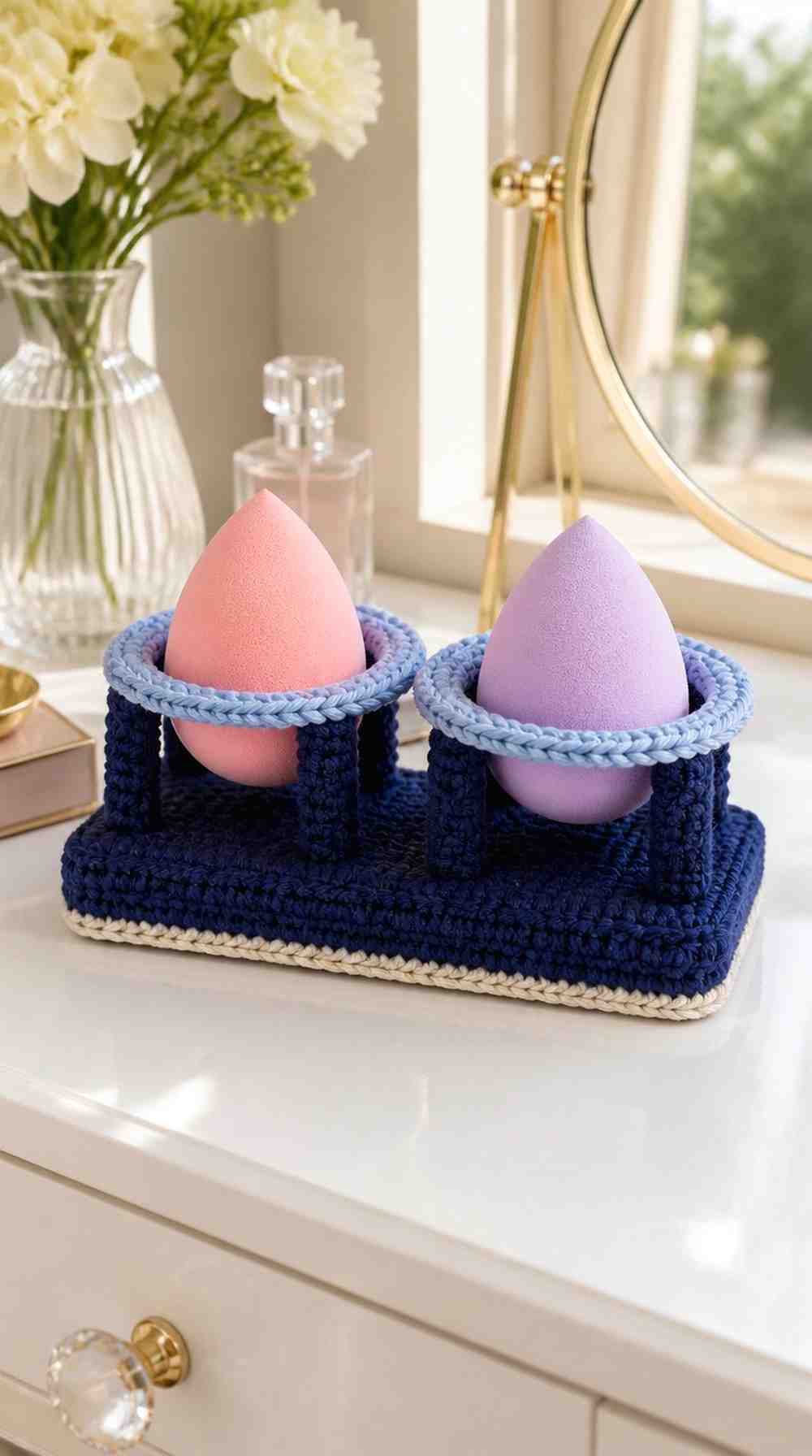
Deep navy crochet forms a compact rectangular base with two raised circular rings arranged side by side. Pale-blue edging surrounds each ring, while a straight cream row finishes the front of the stand. One blush-pink makeup sponge sits upright in the left opening, and a lavender sponge occupies the right.
The paired layout makes this design useful inspiration for a vanity with two different sponges. Its low, balanced silhouette keeps both sponges visible. The main challenge is allowing enough space between the rings so neither sponge touches the other.
- Two Separate Openings: Each ring should be sized for its sponge independently, especially if the two foam applicators differ in shape.
- Shared Rectangular Base: The base needs enough width to prevent one side from tipping when only one ring is occupied.
- Ring Separation: Leave a visible gap between both sponges so they are not pressed together during storage.
- Cleaning Access: The two raised supports create additional joints and openings; any actual version should be easy to take apart or clean thoroughly.
5. Crochet Dusty Blue Spiral Pedestal Stand
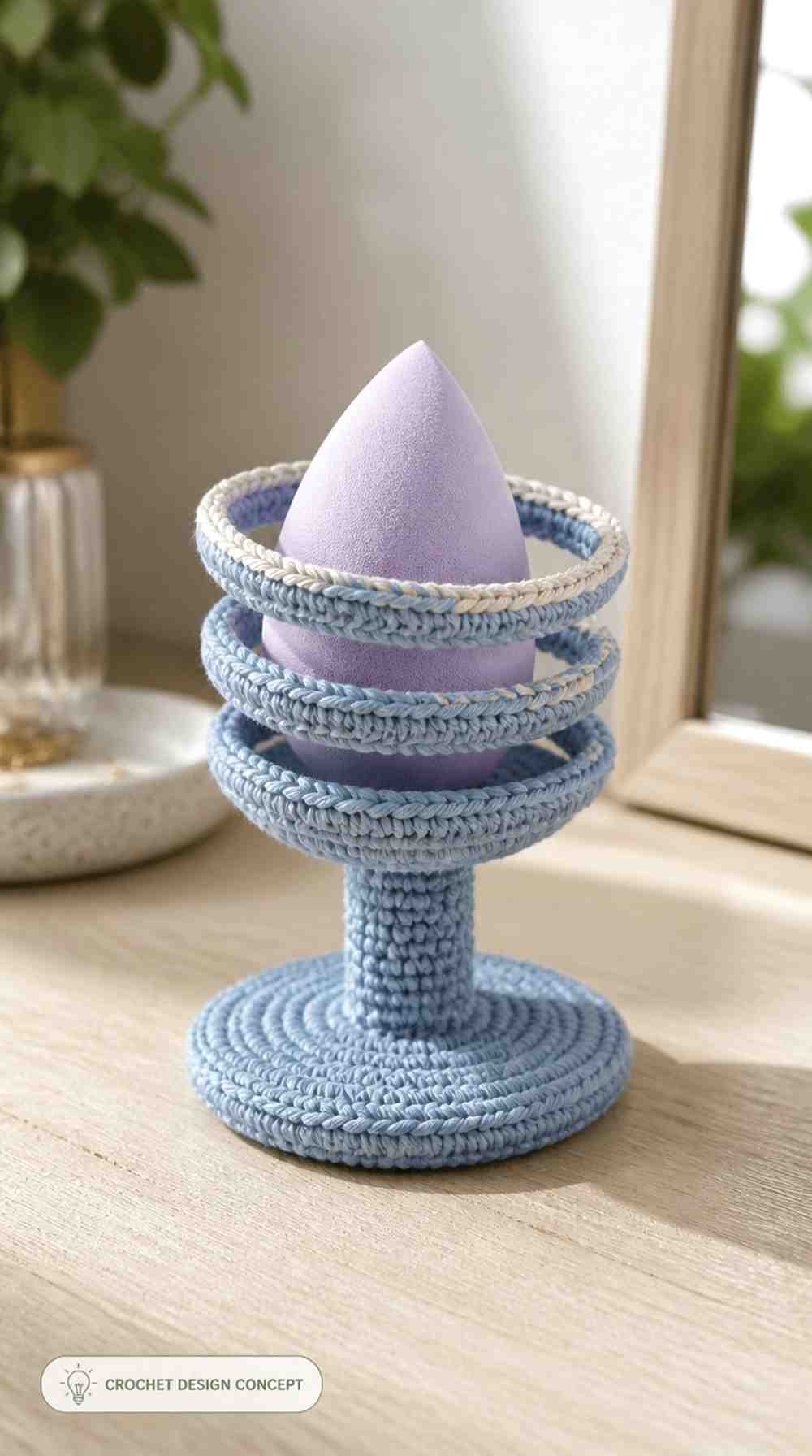
Dusty-blue crochet forms a small circular pedestal with a short upright column and a shallow spiral-shaped holding coil. Three open turns create the top support, while a fine cream line finishes the uppermost edge. A pale-lilac teardrop makeup sponge stands in the center, with its pointed end fully exposed.
The spiral gives this stand a sculptural appearance that feels more like a decorative vanity accessory than an ordinary storage cup. Its open coil would need a reliable internal structure, because closely wrapped crochet alone may not maintain the intended gaps and elevated shape.
- Three-Turn Coil: Keep the spiral openings distinct so the top does not become a deep fabric cup around the sponge.
- Pedestal Proportions: A broad lower base is important when a narrow central column supports the raised coil.
- Cream Upper Edge: The contrasting line emphasizes the top turn without changing the spiral’s overall shape.
- Moisture Concern: Multiple horizontal yarn turns could stay damp where they touch a wet sponge. A nonabsorbent drying insert is preferable for practical use.
6. Crochet Coral Daisy Petal Rim Stand
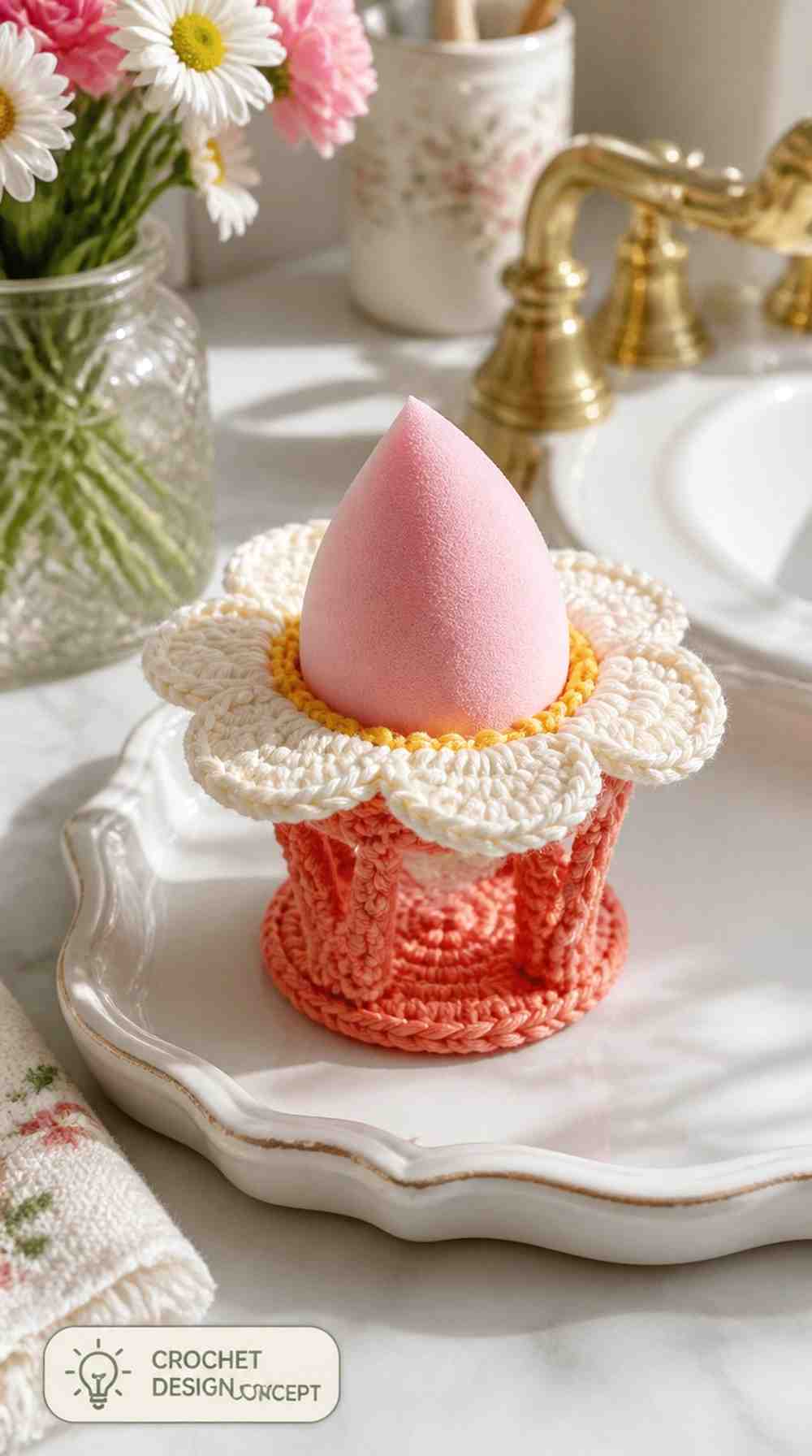
Coral-pink crochet forms a compact raised stand with a circular retaining ring decorated by five flat ivory petals. A fine mustard-yellow line follows the inner ring, and a short set of supports lifts the flower-shaped opening above the round base. One soft-pink teardrop sponge stands upright in the center.
The daisy-like design gives the stand a cheerful appearance without needing a separate hanging flower. Because the petals form part of the ring itself, their position matters. They should remain outside the holding opening rather than pressing inward against the foam.
- Five-Petal Outline: Evenly shaped ivory petals keep the flower recognizable without making the ring too wide for a small vanity.
- Inner Mustard Line: The contrasting yellow edge defines the opening, but should remain narrow and smooth.
- Petal Attachment: Each petal must connect securely to the coral ring so nothing loosens or curls into the sponge’s resting area.
- Decorative Use: The added petals increase fabric exposure and cleaning needs, making a washable separate holder sensible for damp sponges.
7. Crochet Forest Staggered Double Ring Rack
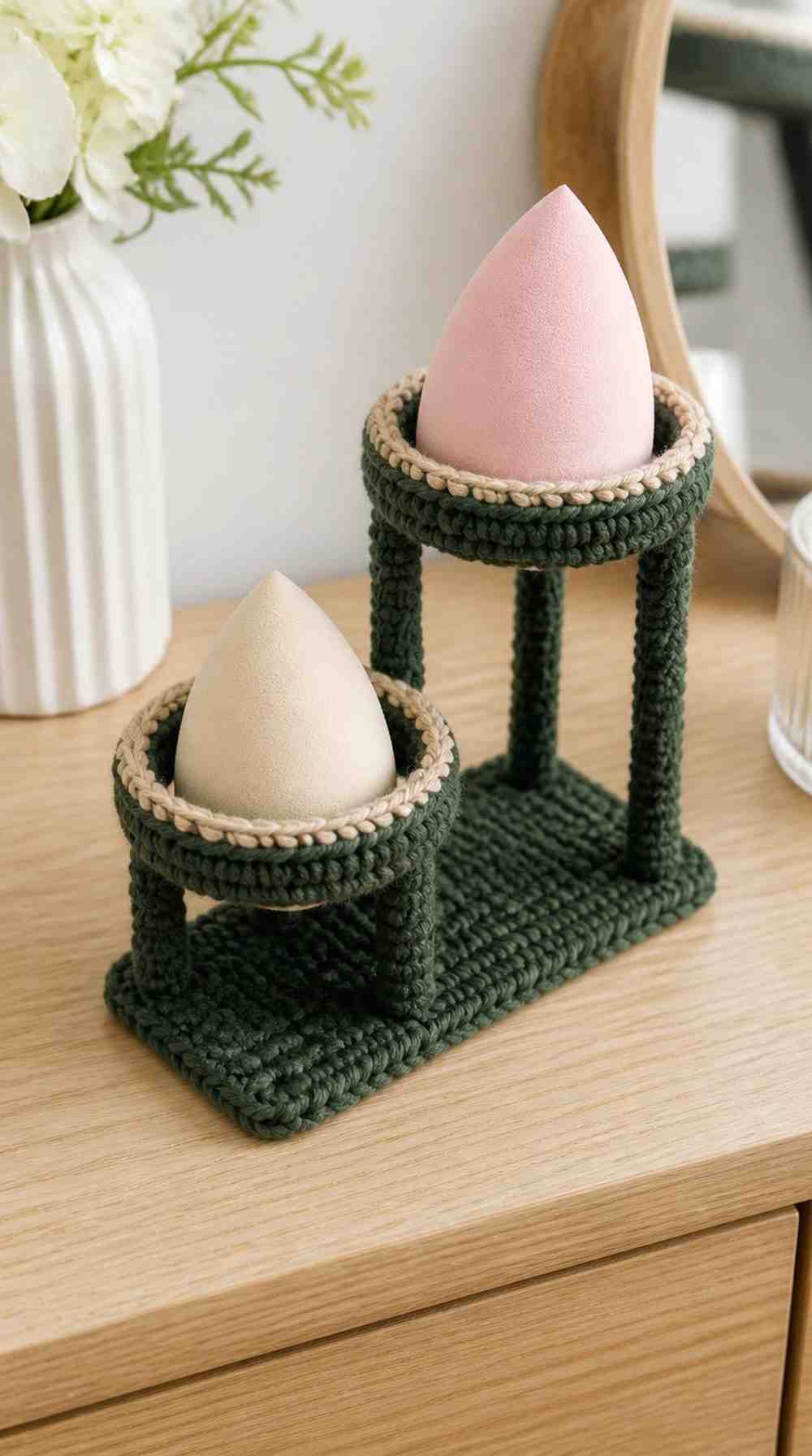
Forest-green crochet creates an elongated tabletop rack with two raised rings arranged at different heights. The lower ring sits toward the front left, while the taller ring stands toward the rear right. Fine oatmeal edging outlines both openings. A beige sponge occupies the lower position, and a pale-pink sponge stands upright behind it.
Unlike the navy twin stand, this design uses staggered height to distinguish its two holders. That can create an attractive vanity display, provided the rear support remains stable and does not cast the front ring into an awkward position.
- Different Ring Heights: The rear ring should sit high enough to distinguish the two levels without making the base unstable.
- Front-to-Back Spacing: Arrange the openings so the sponges remain separate and both can be removed comfortably.
- Tall Support Posts: The higher rear ring requires careful reinforcement because longer flexible crochet posts are more likely to bend.
- Vanity Placement: This layout needs more depth than a side-by-side rack, so measure the available counter space before adapting it.
8. Crochet Charcoal Checkerboard Open Cube Stand
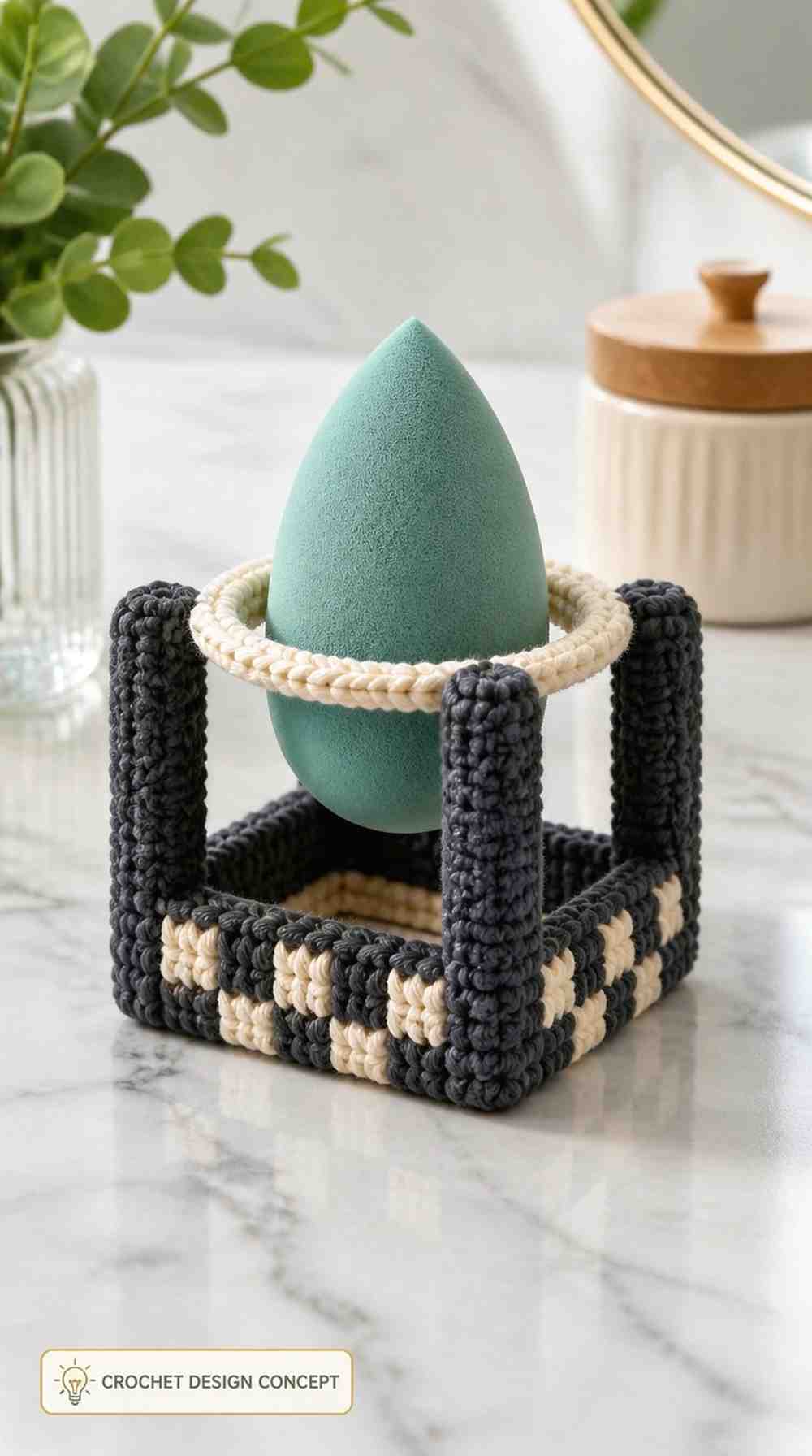
A square charcoal-and-cream crochet base forms the lower part of this open-cube sponge holder. Four short corner posts support a circular ivory ring across the top, while small checkerboard squares decorate the outer edges. One muted-teal makeup sponge stands upright in the ring, its rounded lower section held above the empty center.
The combination of square and circular geometry gives this design a modern look. It also creates an open area beneath the sponge rather than a solid fabric bowl. Keeping the checkerboard edges neat would help the stand retain its clean lines.
- Open Cube Structure: Four corner posts should remain vertical and evenly attached to the base so the upper ring does not tilt.
- Checkerboard Edging: Small charcoal and cream squares make the design distinctive without covering the open center.
- Suspended Sponge Position: The ring should hold the sponge above the base, preserving the intended gap beneath its rounded end.
- Support Material: An actual open frame may need a washable rigid insert; crochet yarn alone cannot be assumed to maintain a square structure.
9. Crochet Mustard Half-Moon Bridge Stand
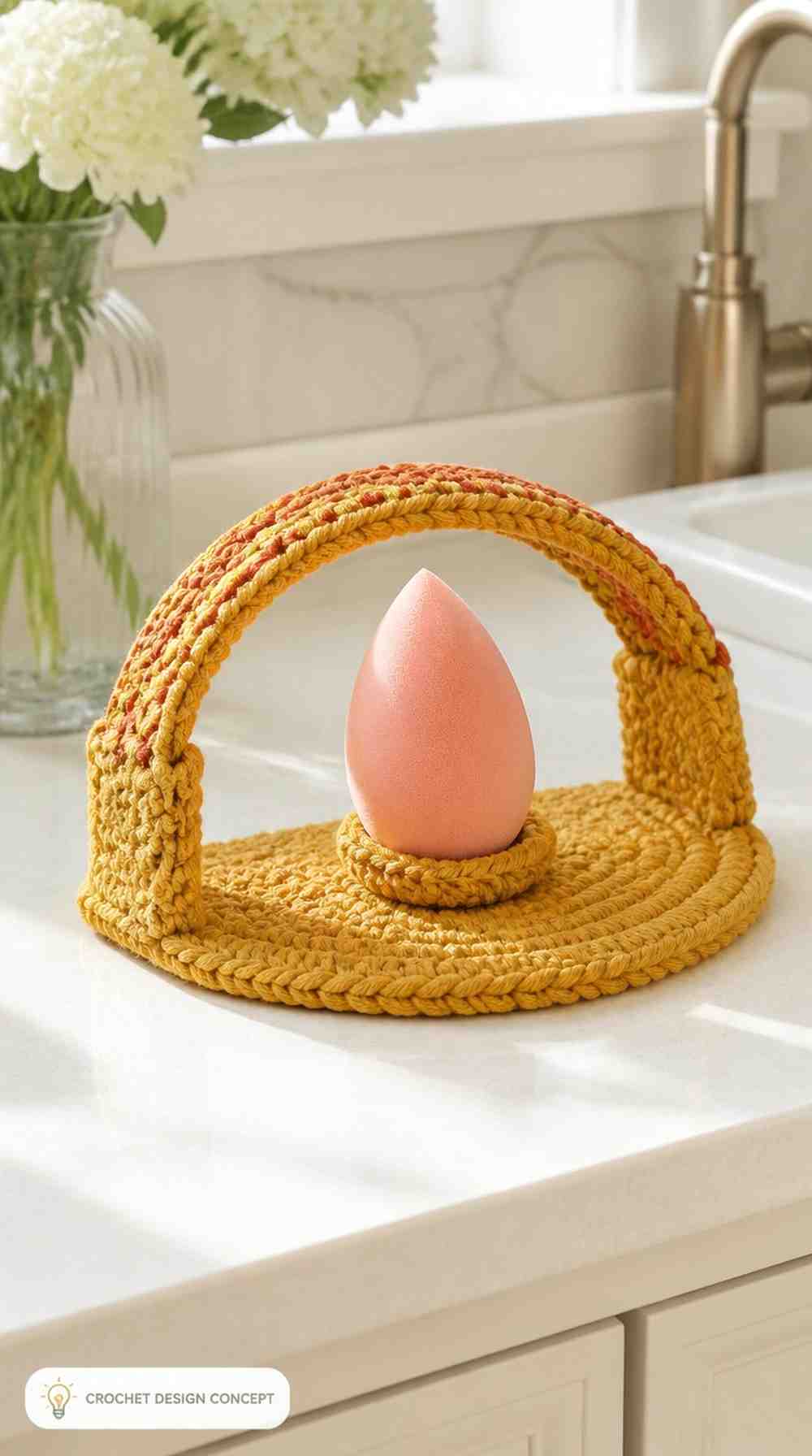
Mustard-gold crochet forms a small half-moon base with two short supports along the straight rear edge. A curved bridge rises between them, finished with a narrow rust-orange border. One central retaining loop extends forward from the bridge and holds a clean salmon-pink makeup sponge upright.
The semicircular shape gives this stand a different appearance from ordinary ring holders. Its front stays relatively open, while the taller rear bridge creates a noticeable outline. The center loop would need proper support to keep the sponge balanced.
- Half-Moon Base: The flat rear edge may sit neatly near a vanity wall, but the base must remain broad enough to resist forward tipping.
- Curved Rear Bridge: Keep the mustard arch centered over its two supporting posts so it does not lean to either side.
- Forward Holding Loop: The single loop should cradle the rounded lower sponge without pressing tightly against the foam.
- Optional Simplification: A shorter rear arch could reduce structural demands while preserving the half-moon shape and central opening.
10. Crochet Lilac Heart-Loop Sponge Stand
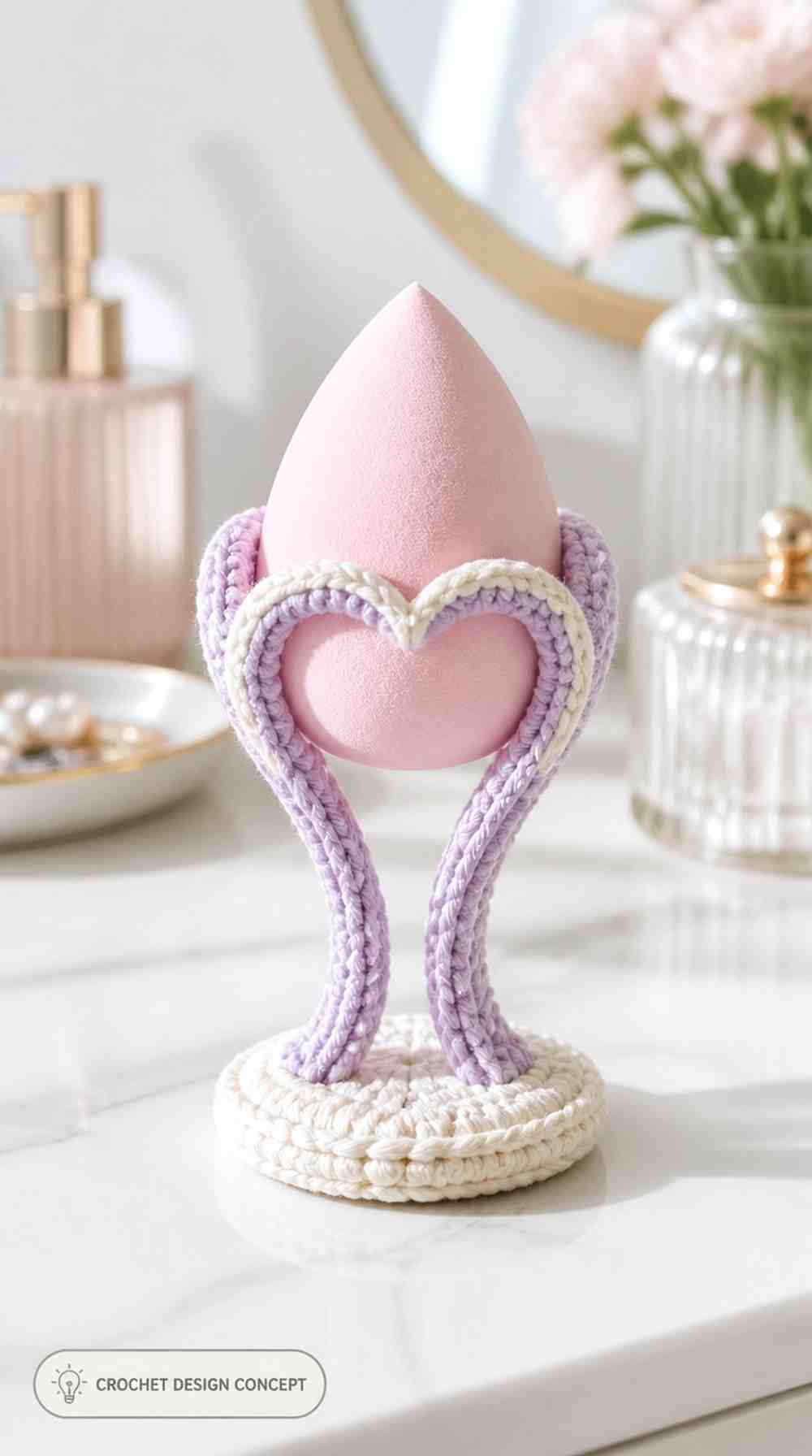
Soft lilac crochet forms two curved support arms that meet in an open heart-shaped loop above a narrow cream circular base. Fine back-loop ribbing follows the lilac curves, while ivory edging defines the heart outline. One blush-pink teardrop makeup sponge stands in the center, with its pointed upper end fully exposed.
This design introduces a romantic vanity accessory without adding separate flowers or bows. The heart-shaped support is its defining feature, although the curved fabric must remain properly shaped. A soft, unsupported crochet heart may collapse or squeeze the sponge.
- Heart-Shaped Opening: Keep both rounded sides symmetrical and provide enough room for the sponge without forcing it into the pointed lower section.
- Curved Support Arms: The two lilac arms should connect evenly to the cream base to avoid twisting the heart outline.
- Ribbed Surface: Fine ridges add definition to the curves, but should not create rough pressure points where the sponge touches the ring.
- Structural Limitation: A washable, nonabsorbent supporting frame would be worth exploring rather than relying on stiffened yarn around a damp sponge.
11. Crochet Oatmeal Granny-Square Raised Platform
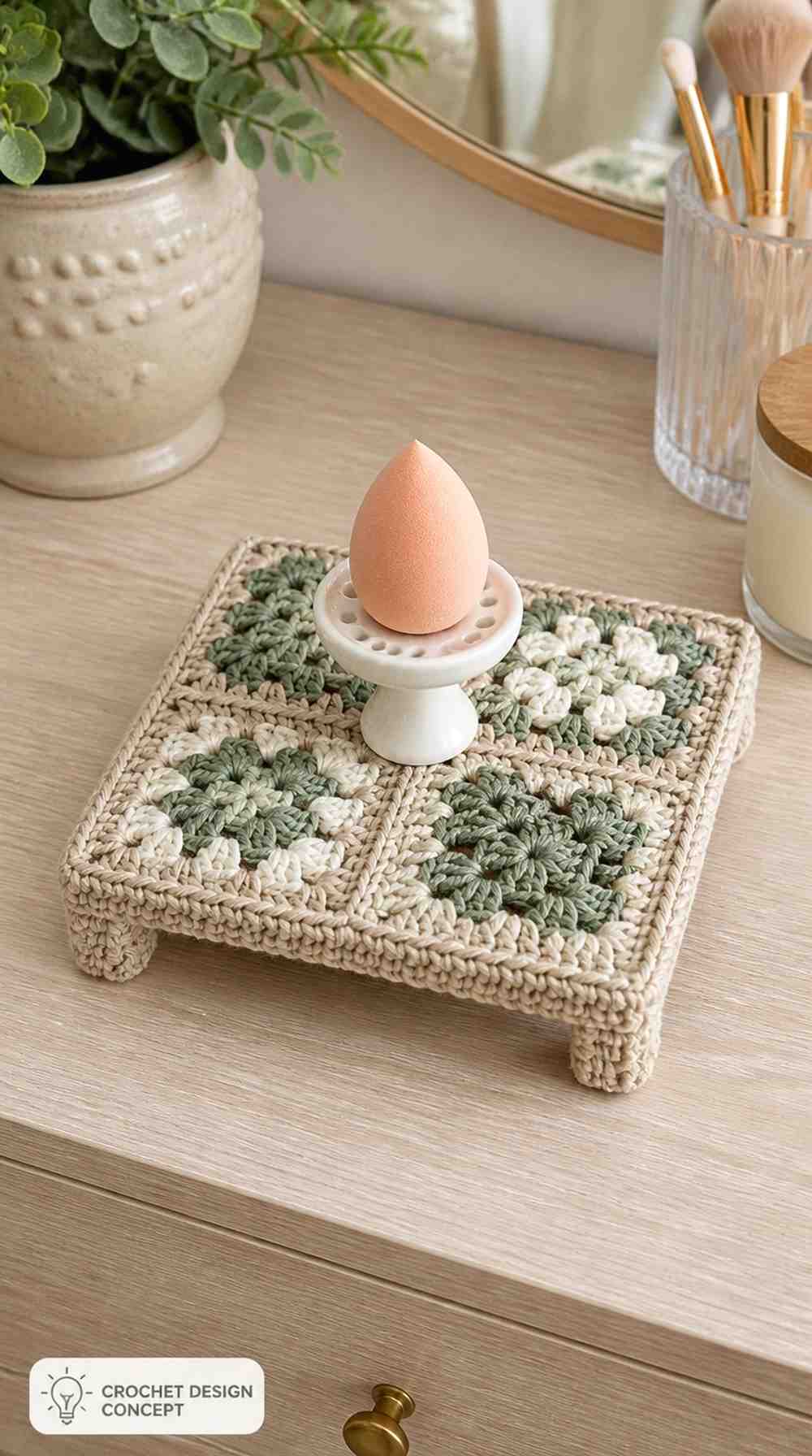
Four miniature crochet granny squares form a low oatmeal platform, arranged in a two-by-two grid with muted sage and cream centers. Narrow joining seams connect the squares, while four short corner feet lift the platform slightly above the vanity. A small removable white ceramic pedestal sits at the center, holding one peach-colored sponge.
This concept separates the decorative crochet surface from the sponge’s immediate resting point. The little ceramic insert makes the arrangement more practical to explore, provided it is suitable for cleaning and allows the sponge to remain exposed to air.
- Four-Square Joining: Keep the granny squares evenly sized so their joining seams form a level platform beneath the ceramic insert.
- Raised Corner Feet: All four feet should contact the vanity evenly rather than making the square base rock.
- Removable Ceramic Pedestal: A washable, nonporous insert can reduce direct contact between the damp sponge and the decorative crochet, though drying still needs checking.
- Granny-Square Openings: The decorative holes are part of the platform design; they do not establish that the entire stand will dry safely or quickly.
12. Crochet Plum Four-Post Floating Ring Stand
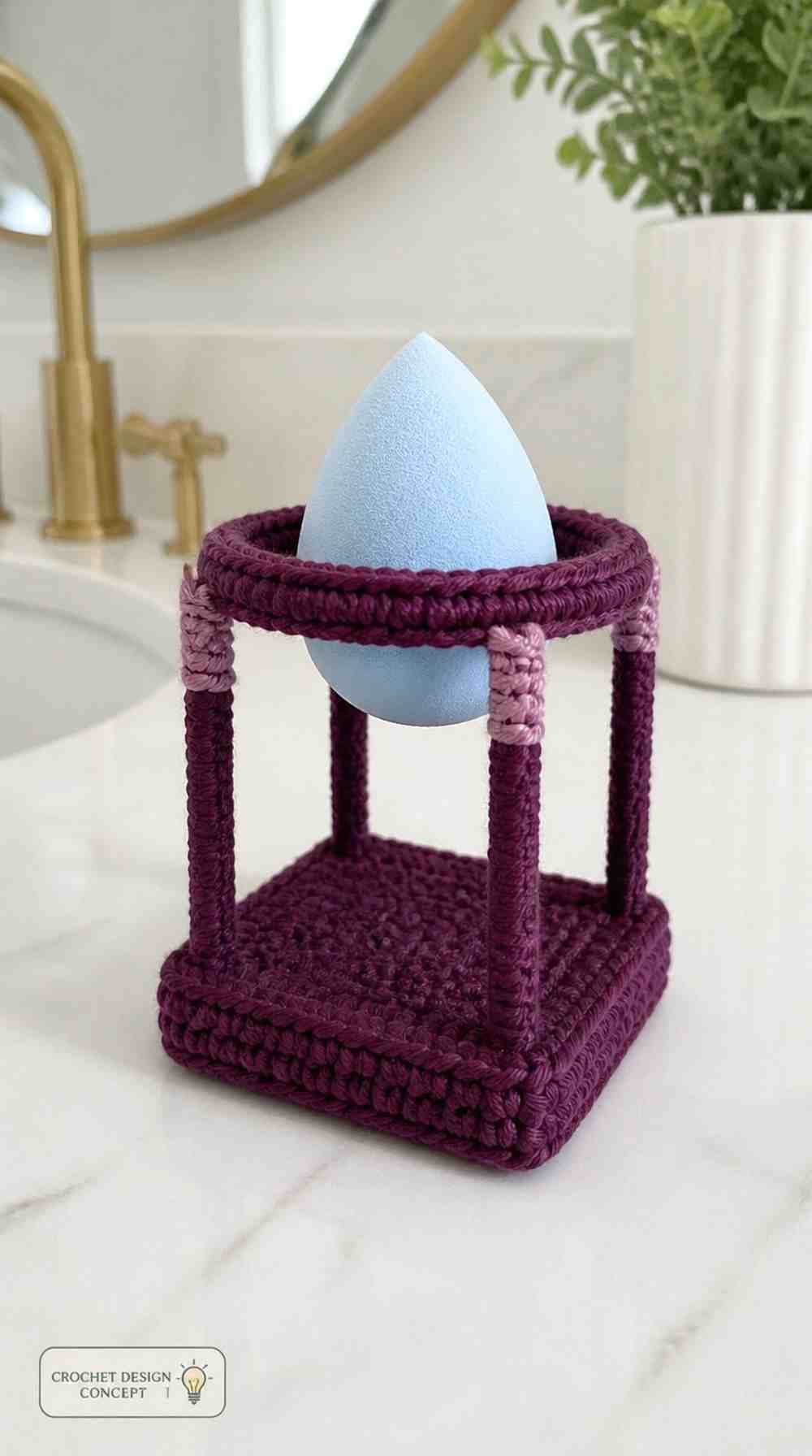
Plum-purple crochet forms a square base with four slim upright posts supporting an open oval ring. Small dusty-rose bands finish the upper ends of the posts, while the ring itself has closely worked plum stitches. A pale-blue makeup sponge rests upright in the elevated opening, leaving visible space beneath its rounded lower portion.
The open-frame arrangement gives this stand a clean architectural character. Unlike a short tripod, it relies on four comparatively tall supports. That makes alignment and internal stability particularly important if the concept is adapted into a real vanity accessory.
- Four-Post Alignment: Each post should remain upright and meet the oval ring evenly, keeping the sponge centered above the square base.
- Oval Ring Shape: An oval opening could suit a slightly flattened sponge, but its actual dimensions should be checked before planning the holder.
- Suspended Position: The gap beneath the sponge is an intentional visual feature and should not be blocked by additional solid crochet fabric.
- Hidden Reinforcement: Consider a removable washable frame that maintains the posts’ shape without leaving absorbent material permanently trapped around it.
13. Crochet Mint Diamond-Lattice Collar Stand
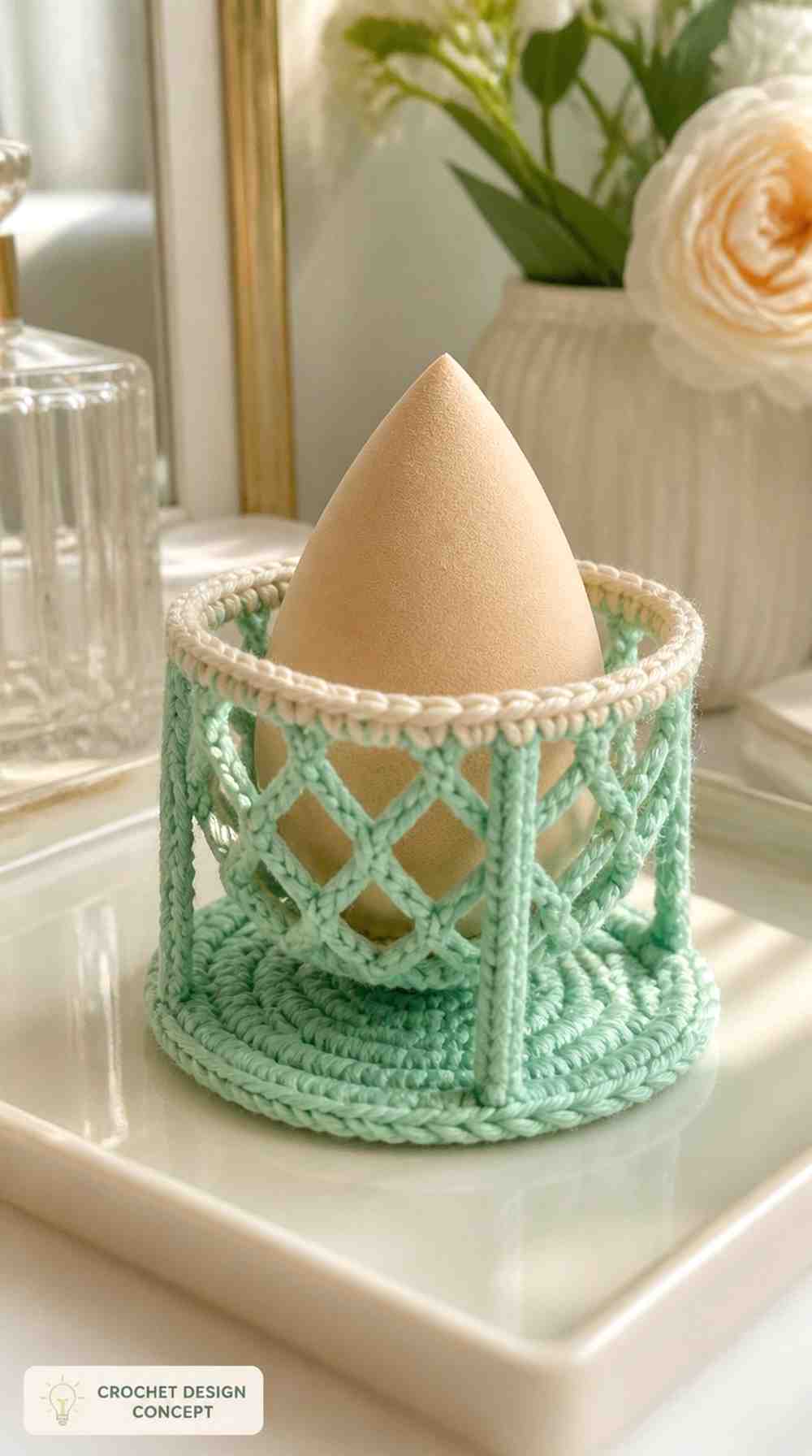
Mint-green crochet forms a short circular stand with an open diamond-lattice collar and four narrow vertical support strips. A tightly stitched base anchors the collar, while a fine ivory line follows its upper rim. One warm-beige teardrop makeup sponge stands inside, with its pointed upper half visible above the low openwork.
This design brings together two contrasting crochet textures: a dense base and airy lattice sides. The short collar differs from a deep cup because it exposes more of the sponge, although the fabric still touches its lower portion.
- Diamond-Lattice Openings: The mesh should remain evenly spaced without stretching into large gaps that allow the sponge to slide sideways.
- Four Vertical Strips: Solid mint supports divide the openwork and help define the collar, but need sufficient structural support to remain straight.
- Low Collar Height: Keeping the rim shallow leaves much of the sponge exposed rather than enclosing it in a fabric cup.
- Moisture Trade-Off: Open mesh does not make cotton yarn moisture-proof. Use a cleanable, nonabsorbent support for the actual drying contact area.
14. Crochet Rose Three-Petal Wing Sponge Stand
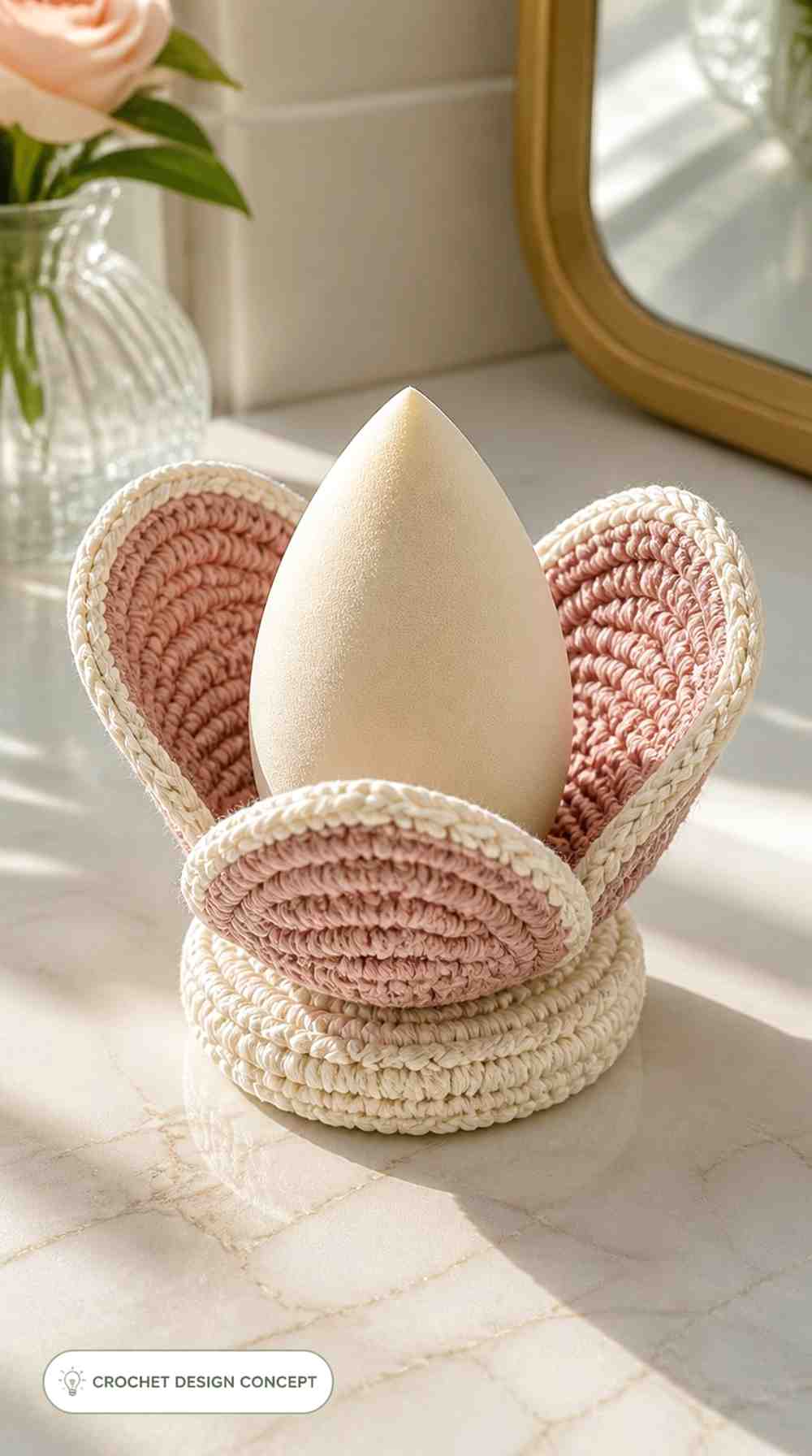
Rose-pink crochet creates three upward-curving petal-shaped supports arranged around an ivory circular base. Narrow cream edging outlines the three wings, leaving a wide open center where one ivory makeup sponge stands upright. The pointed sponge tip rises well above the petals, while its sides remain mostly visible.
The sculptural flower shape gives this concept a softer look than a conventional circular ring. Each curved petal forms part of the support rather than sitting on the surface as an appliqué. Their strength and placement would need careful planning in a functional version.
- Three-Petal Arrangement: Space the wings evenly around the center so the sponge does not lean against one large petal.
- Curved Support Shape: The rose petals should rise gently without folding inward and pressing against the foam.
- Cream Petal Edges: Thin contrast edging defines each curve while keeping the open central area visually uncluttered.
- Washable Framework: A removable internal support may be needed to preserve the wing shapes, especially after cleaning the crochet.
15. Crochet Burgundy Arch-Suspended Sponge Stand
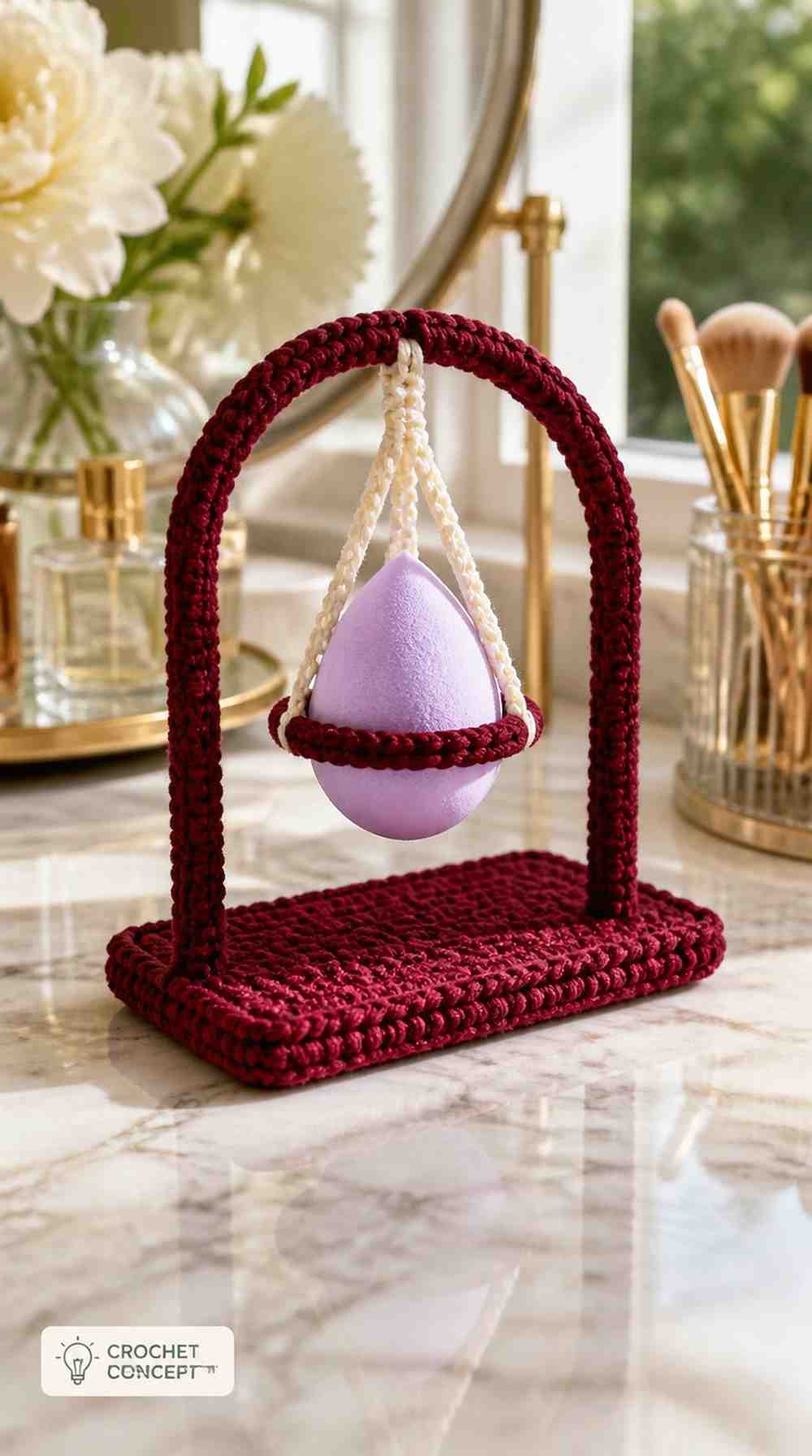
Deep burgundy crochet forms a rectangular base with one tall semicircular arch rising above the center. Three short cream crochet strands descend from the arch to a small open burgundy ring, which supports a clean light-lavender sponge. The sponge remains upright with no solid crochet fabric directly beneath its rounded bottom.
This design has a delicate suspended appearance that sets it apart from the other tabletop holders. The upper arch is the main structural challenge: it must remain upright while the lower ring stays level, and the support strands should not twist or pull the sponge sideways.
- Arch Support: A flexible crochet arch alone may bend. A suitably reinforced, cleanable frame would be needed to explore this silhouette realistically.
- Three Suspension Strands: Equal strand lengths help keep the small lower ring horizontal instead of hanging at an angle.
- Open Ring Placement: Leave enough space between the suspended ring and the base so the sponge is not pressed against the lower crochet.
- Movement Limitation: The suspended arrangement could swing when touched, making it less practical than a fixed ring for regular sponge handling.
16. Crochet Sand Hexagon Six-Spoke Sponge Stand
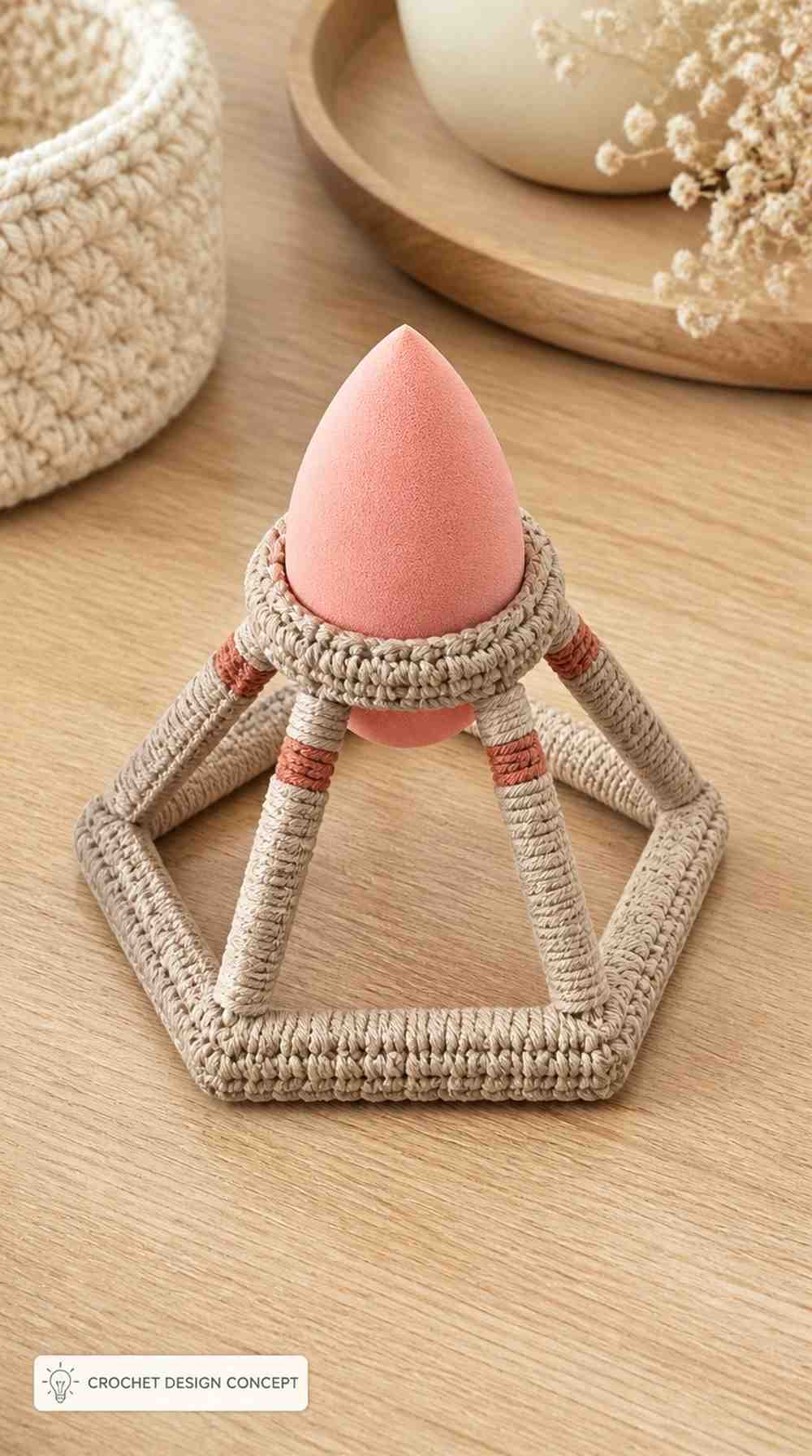
Sand-beige crochet forms a geometric six-sided base, with six short spokes rising toward a small circular holding ring. Narrow terracotta bands decorate the upper portions of the spokes, while large triangular gaps remain between them. One peach-pink teardrop sponge stands upright in the center, leaving its lower sides mostly visible.
The hexagonal layout gives the stand a more structured appearance than the flower-shaped designs. Its repeated spokes make an interesting visual pattern when viewed from above. The open construction also highlights how much structural support a real crochet version might require.
- Six-Sided Base: Keep the hexagonal edges even so the stand rests properly without rocking or twisting.
- Six Rising Spokes: Each spoke should meet the upper ring consistently, avoiding uneven pressure around the sponge.
- Terracotta Accent Bands: Short contrast details emphasize the spoke arrangement without closing the triangular gaps.
- Geometric Reinforcement: The elevated ring and multiple spokes need a carefully planned support structure; their illustrated firmness is not evidence of tested performance.
Practical Guide to Crochet Makeup Sponge Drying Stands
A makeup sponge drying stand needs more thought than an ordinary decorative crochet holder. Makeup sponges hold water after washing, and their drying environment matters.
Choose an open structure. Avoid deep closed pockets or tightly fitted crochet cups that surround most of the sponge. A raised ring or an open frame leaves more of the sponge exposed, but that alone does not guarantee proper drying.
Separate decorative crochet from wet contact points. Cotton and other absorbent yarns can retain moisture. For a functional setup, a removable, smooth, washable nonporous holder is generally more appropriate for supporting the damp sponge. Crochet can decorate its exterior or a separate base.
Measure your sponge. Teardrop, oval and smaller precision makeup sponges differ in shape. Check the sponge’s size when damp as well as dry, and avoid rings that squeeze or deform the foam.
Keep the vanity clean. Place the stand on a clean, dry surface away from splash zones. Any removable tray or insert must also be cleaned and dried.
Wash and dry the sponge properly. Follow its manufacturer’s instructions, remove cleanser residue and gently squeeze out excess water. Beautyblender’s makeup sponge cleaning guide recommends allowing sponges to air-dry in an open, well-ventilated space rather than trapping moisture in closed storage.
Beautyblender
A decorative crochet stand should never be treated as a proven hygienic drying solution just because it has an open shape.
Want to Make Something Similar?
These verified crochet lessons can help with the small circular shapes and ring construction used in several designs. They are related technique resources, not exact patterns for the illustrated makeup sponge stands.
- Round Crochet Soap Holder With Raised Lip by CyCrochet explains creating a flat crochet base and shaping a raised edge using back-loop stitches. It offers useful background for low circular structures. CyCrochet
- Simple Crochet Napkin Ring by CyCrochet demonstrates making a small ring from a crocheted rectangle and joining its ends. This is relevant to understanding the ring shapes, but it does not create a freestanding drying stand. CyCrochet
Neither tutorial establishes a safe drying method for makeup sponges. Any practical design should be checked independently for stability, cleaning and moisture retention.
Which Crochet Makeup Sponge Drying Stand Should You Choose?
| Your design preference | Ideas worth comparing | Important trade-off |
|---|---|---|
| Simple raised ring | Sage Three-Leg, Ivory Scalloped Halo | Ring support and sponge fit |
| Small decorative pedestal | Dusty Blue Spiral, Coral Daisy Petal | More decorative surfaces to clean |
| Two separate sponges | Navy Twin Ring, Forest Staggered Double Ring | More space and additional supports |
| Strong geometric structure | Terracotta Triangular, Sand Hexagon Six-Spoke | Greater structural complexity |
| Modern open-frame look | Charcoal Checkerboard Cube, Plum Four-Post | Requires stable upright posts |
| Romantic vanity styling | Lilac Heart-Loop, Rose Three-Petal Wing | Curved elements may need reinforcement |
| Separate sponge-contact insert | Oatmeal Granny-Square Platform | Additional removable component |
| Dramatic suspended design | Burgundy Arch-Suspended | Potential swinging and instability |
For a simple decorative concept, the Crochet Sage Three-Leg Ring Stand has one of the clearest shapes and the fewest design elements.
If you want to keep two sponges in separate positions, the Crochet Navy Twin Ring Vanity Stand is a straightforward option to explore.
For a more practical direction, the Crochet Oatmeal Granny-Square Raised Platform is particularly worth considering because the illustrated ceramic insert separates the sponge’s resting surface from most of the crochet decoration. Its actual drying performance would still need checking.
Conclusion
These 16 crochet makeup sponge drying stand inspiration ideas show how a small vanity accessory can be explored through different shapes and crochet techniques. Open rings, raised platforms, decorative petals, geometric supports and paired holders each offer a distinct visual approach.
The most important distinction is between a decorative concept and a genuinely suitable drying stand. Makeup sponges need proper cleaning and complete air-drying, so any real design should favor cleanable, nonabsorbent contact surfaces and adequate ventilation. Use the crochet elements to add handmade style without compromising those practical needs.
Which design would you prefer on your vanity: the Sage Three-Leg Ring Stand, the Ivory Scalloped Halo or the Oatmeal Granny-Square Platform? Share the style you like most and whether you usually use one makeup sponge or several.
Frequently Asked Questions
1. Is crochet suitable for drying a wet makeup sponge?
Crochet can be used as a decorative element, but absorbent yarn is not an ideal direct contact surface for a damp makeup sponge. It may retain moisture and require frequent cleaning. A washable, nonporous stand that allows air around the sponge is a better practical starting point. Any crochet decoration should be removable or kept away from the wet contact area.
2. What type of crochet design leaves the most sponge surface exposed?
Open rings, raised frames and small retaining supports generally expose more of the sponge than deep fabric cups. However, the opening must fit the actual sponge and the structure must remain stable. A more open appearance does not automatically mean the sponge will dry faster or more safely.
3. How should I clean my makeup sponge before placing it on a stand?
Follow the sponge manufacturer’s cleaning guidance. Generally, use a suitable cleanser, rinse thoroughly and gently squeeze out excess water without harsh twisting. Allow the sponge to dry completely in a clean, well-ventilated location. Clean the stand separately and avoid leaving either item damp in enclosed storage.
4. Can I make a crochet sponge stand firm without adding a frame?
Some tightly worked crochet shapes can hold a degree of structure, depending on the yarn, size and construction. However, narrow elevated rings, tall posts and curved arches may bend or collapse. Stiffening treatments are not automatically washable or suitable for contact with cosmetic tools. Consider a separate removable support if you want a freestanding design.
5. Are these 16 crochet makeup sponge drying stands complete patterns?
No. These are original AI-generated visual inspiration concepts rather than tested patterns or finished handmade products. They do not include verified stitch counts, exact dimensions, yarn quantities or proven drying methods. The linked tutorials explain related crochet techniques, but they do not reproduce these specific stands or establish their hygiene and stability.