A crochet dustpan hanging pocket can bring a handmade touch to an often-overlooked utility room or household cleaning corner. Rather than leaving a small hand dustpan loose on a shelf, these 14 inspiration ideas explore wall-mounted pockets, open mesh holders, hanging cradles and coordinated cleaning-tool organizers. Soft sage, warm terracotta, denim blue and deeper neutral colors give each concept a different character.
This collection focuses on compact handheld dustpans rather than large long-handled cleaning tools. You’ll find designs that hold the dustpan scoop, support its handle or provide separate spaces for a small cleaning brush. The ideas also highlight practical considerations such as hanging strength, dustpan dimensions, washing and protecting the crochet from dirt or moisture.
These are AI-generated crochet design visualizations for inspiration, not photographs of tested handmade holders or step-by-step patterns.
Quick Design Selection Guide
| Your storage goal | Design to explore | Why consider it |
|---|---|---|
| Simple wall storage | Crochet Sage Ribbed Dustpan Wall Pocket | Wide rectangular pocket with two hanging loops |
| A smaller triangular dustpan | Crochet Oatmeal V-Shaped Dustpan Pocket | Shaped front opening and lower pouch |
| Dustpan and brush together | Crochet Navy Dustpan and Brush Twin Pocket | Two separate compartments |
| Less coverage around the dustpan | Crochet Dusty Blue Handle-Loop Dustpan Harness | Supports the handle while leaving the scoop exposed |
| A decorative utility-room accent | Crochet Coral Daisy Dustpan Hanging Pocket | Simple pocket with one floral motif |
| Easier separation for cleaning | Crochet Plum Removable-Tray Dustpan Pocket | A removable liner between the dustpan and crochet |
For a dustpan that is used regularly, a washable hard-surface hook or rack is generally more practical than fabric storage. The crochet concepts work best as inspiration for storing a thoroughly cleaned, dry dustpan or decorating a separate washable storage system.
1. Crochet Sage Ribbed Dustpan Wall Pocket
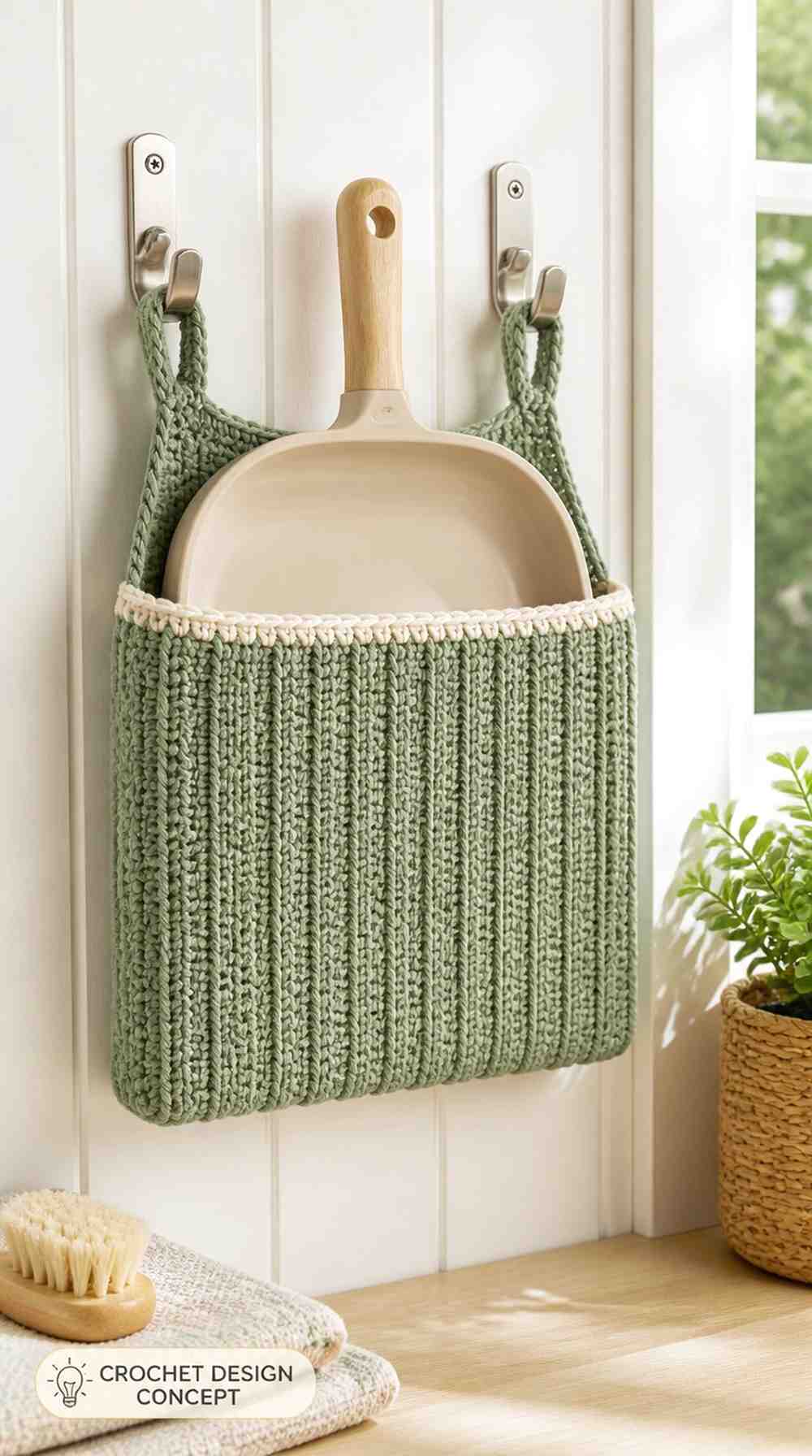
Sage-green crochet creates a wide rectangular wall pocket with vertical ribbing and a neat cream-edged upper opening. Two reinforced sage loops attach to separate stainless-steel wall hooks. A clean pale-beige handheld dustpan rests blade-down inside the holder, with its short wooden-look handle standing above the fabric.
The pocket’s straightforward shape makes it easy to picture in a sunny laundry room. Its main advantage is the broad front that accommodates a small dustpan scoop, although a real crochet version must account for the dustpan’s width and weight.
- Wide Scoop Fit: Measure the dustpan’s widest edge before planning the pocket. A narrow opening could bend the fabric or make removal awkward.
- Vertical Ribbing: The raised rows create a textured surface, but test how much the actual crochet stretches under the dustpan’s weight.
- Two-Point Hanging: Separate hooks may help distribute the load and keep the upper edge level if both attachment loops are appropriately reinforced.
- Cleaning Limitation: The closed pocket can collect dust or residue. Store only a cleaned, completely dry dustpan and remove the holder regularly for washing.
2. Crochet Oatmeal V-Shaped Dustpan Pocket
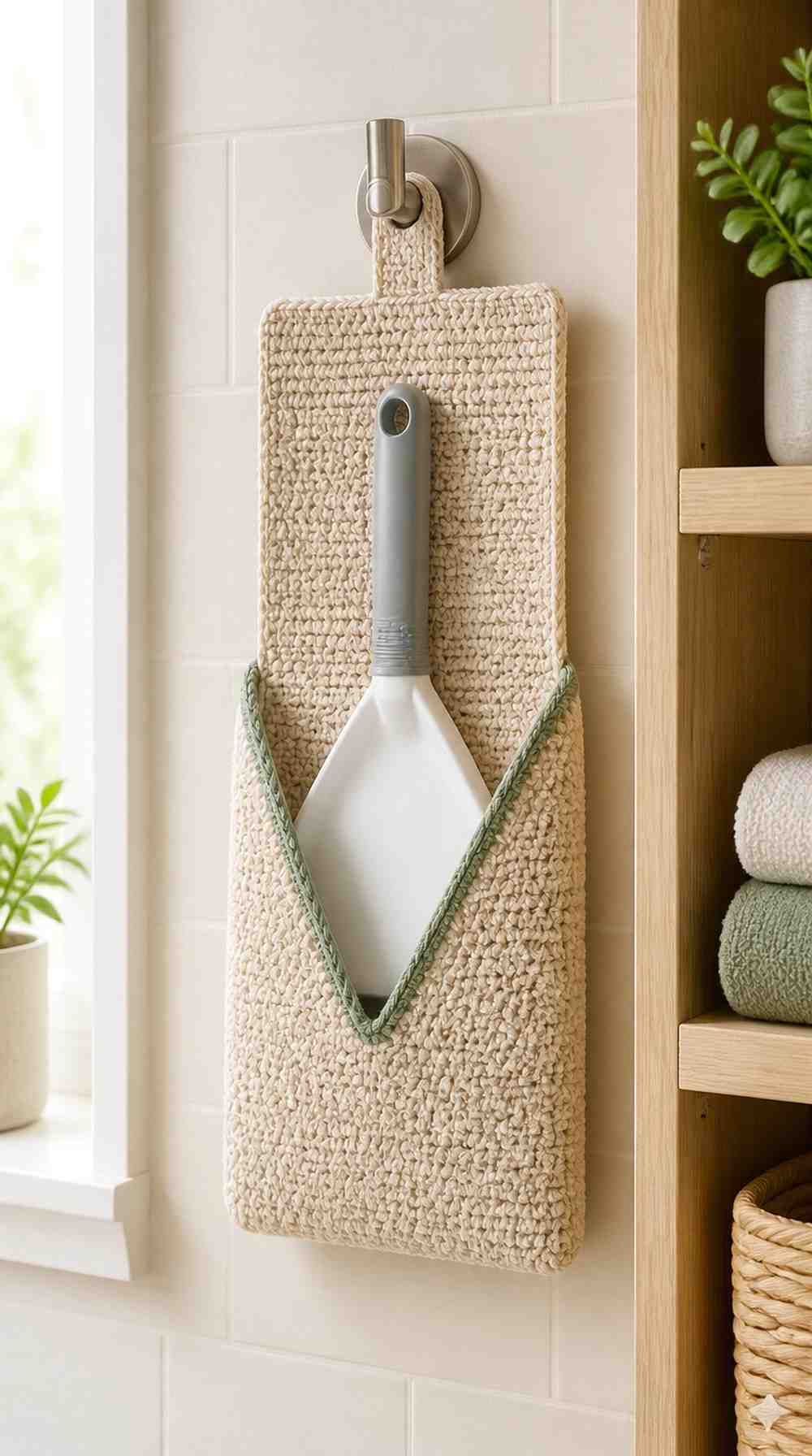
Warm oatmeal crochet forms a tall rectangular backing with a deep V-shaped front pocket. Sage-green edging follows the angled opening, while the lower section holds the clean triangular scoop of a small white dustpan. Its slim gray handle extends vertically above the fabric.
This design feels more tailored than a plain rectangular sleeve. The V-shaped opening reveals part of the dustpan scoop, making it easier to recognize and reach. Its suitability depends on how well the lower pouch supports the scoop without letting its corners slip outward.
- Triangular Scoop Shape: This opening is best explored for smaller dustpans with a tapered outline rather than unusually wide rectangular scoops.
- V-Shaped Access: The angled rim should expose enough of the dustpan for comfortable removal without leaving the lower blade unsupported.
- Single Hanging Tab: The upper attachment needs adequate reinforcement because the entire holder hangs from one central point.
- Backing Length: Keep the rectangular panel long enough to support the pocket but short enough to avoid unnecessary contact with nearby surfaces.
3. Crochet Terracotta Buttoned Dustpan Cradle
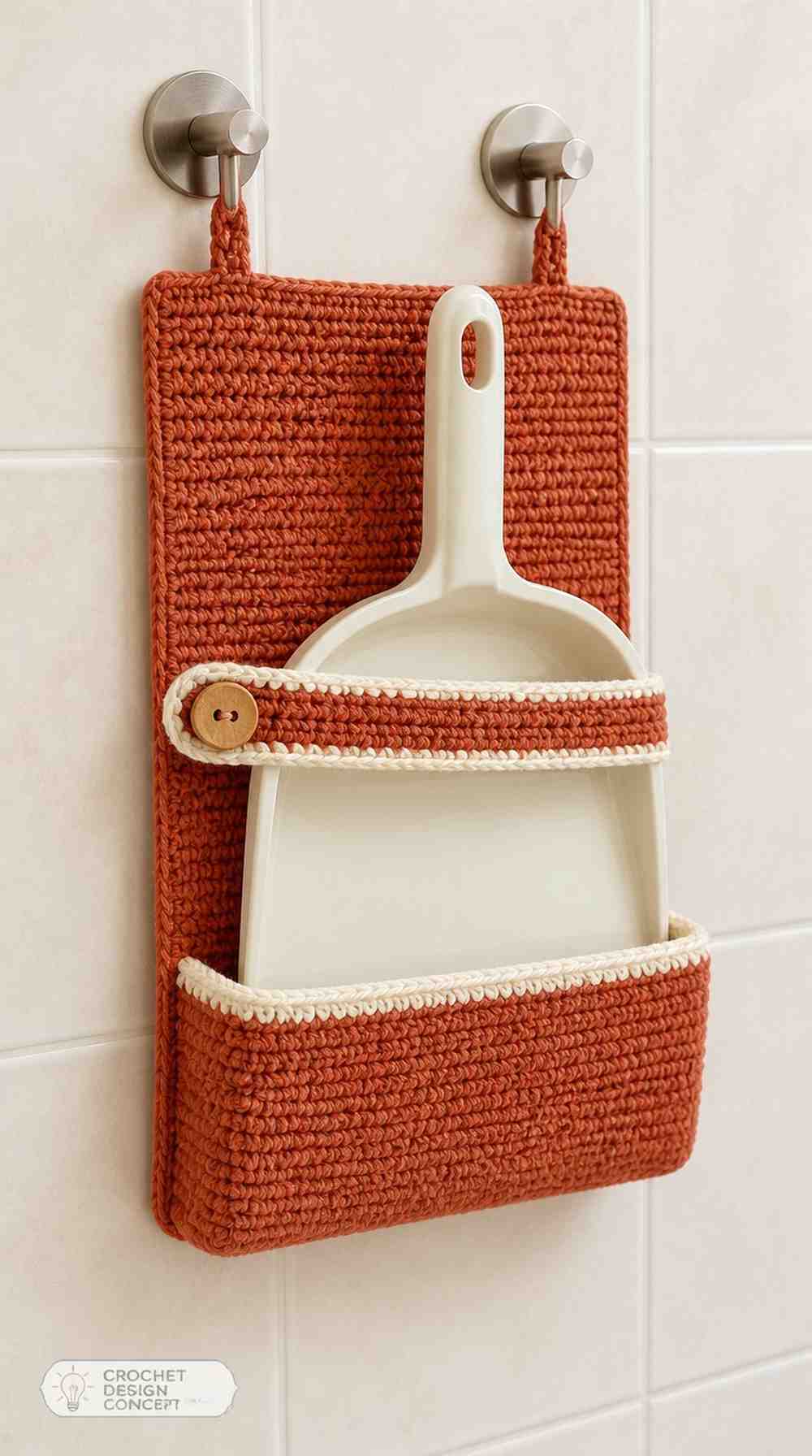
Terracotta crochet forms a wall-mounted cradle with a flat backing, a short lower pocket and one overlapping retaining strap. A small natural-wood button fastens the strap on the left side, while ivory edging defines the pocket and strap. The clean cream dustpan sits blade-down, its handle extending upward beyond the fabric.
The side fastening gives this concept a different structure from a fully enclosed pouch. It suggests a holder that could be opened for easier access, although both the button and lower support need to be checked before putting the arrangement into use.
- Lower Scoop Support: The short bottom pocket should carry the dustpan’s lower blade without placing unnecessary pressure on the retaining strap.
- Button Placement: Keep the wooden button clear of the dustpan handle and check that the fastening cannot open unexpectedly.
- Flat Backing: A broad rear panel may help maintain the shape, provided it hangs properly against the wall.
- Removable Arrangement: A buttoned cradle might simplify cleaning, but moisture and dirt can still collect around the overlapping crochet sections.
4. Crochet Navy Dustpan and Brush Twin Pocket
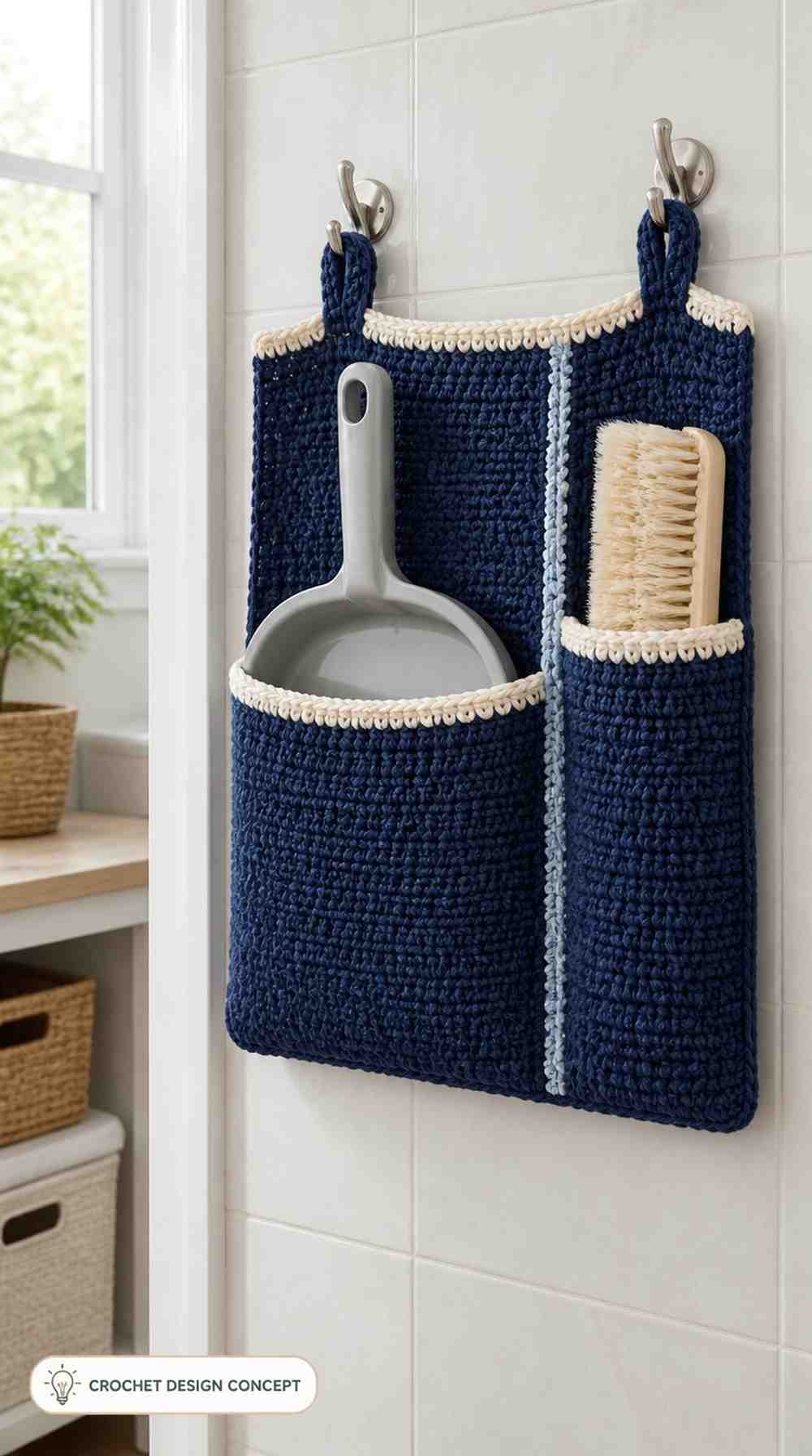
Deep navy crochet forms a rectangular wall organizer with two differently sized pockets. The wider left compartment supports a clean light-gray miniature dustpan, while the narrow right pocket holds a small hand brush with its pale bristles exposed. A fine pale-blue seam separates the tools, and cream edging finishes both openings.
This design provides a coordinated space for two household cleaning accessories. The different compartment widths make it more useful visually than a symmetrical double pocket, but the brush and dustpan should not be stored while dirty or wet.
- Different Pocket Widths: Plan the larger compartment around the dustpan scoop and the narrow section around the cleaning brush’s actual shape.
- Separate Tool Access: Both pockets should allow their contents to be removed independently without pulling the organizer away from the wall.
- Two Hanging Tabs: Position the hooks evenly so the organizer does not lean toward the heavier dustpan side.
- Brush Hygiene: Keep the bristles fully exposed and clean. For routine dirty tools, a washable hard-surface rack is preferable to crochet pockets.
5. Crochet Ivory Scalloped Half-Moon Dustpan Holder
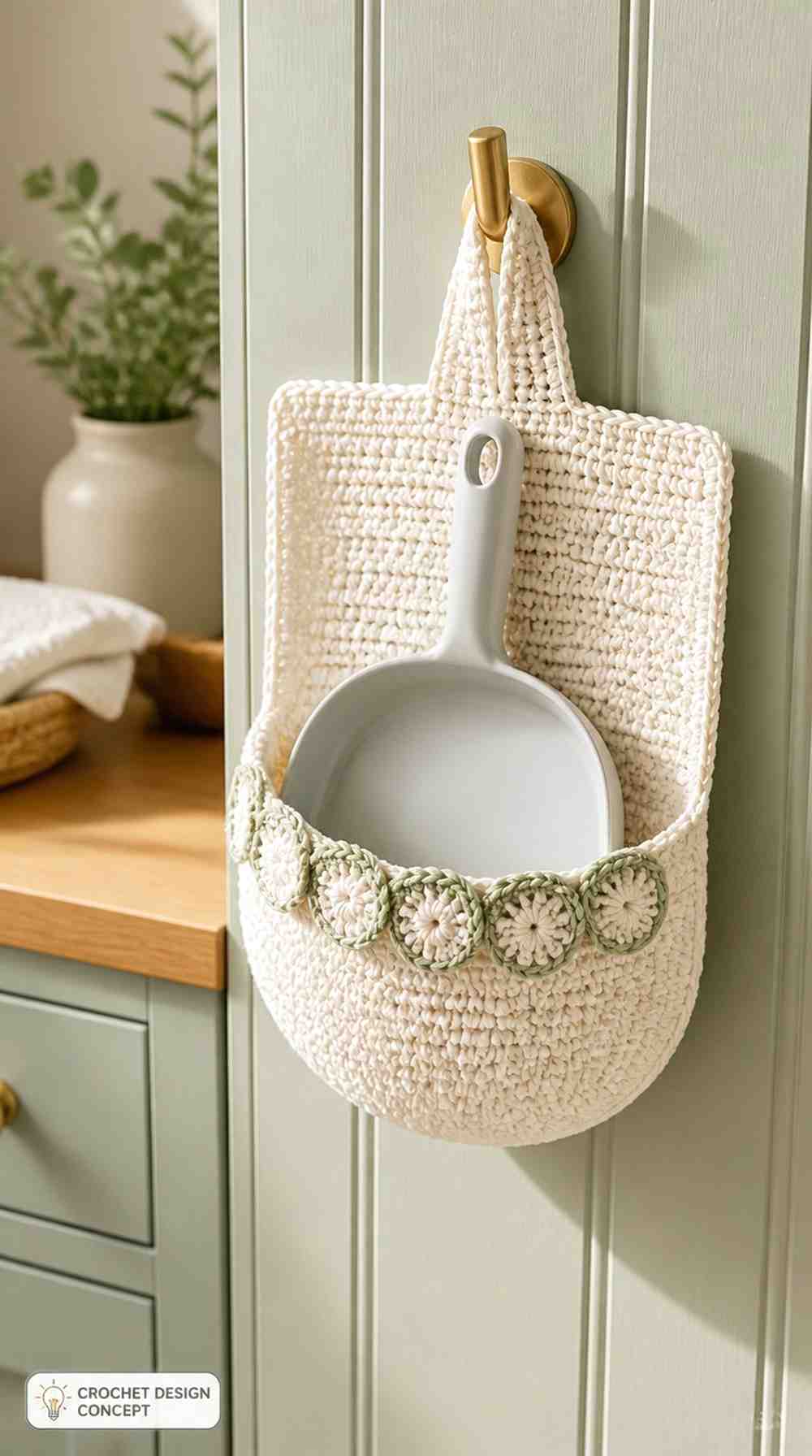
Ivory crochet forms a compact half-round wall pocket with a flat backing and a gently curved front. Seven small scallops decorate the upper edge, each outlined in muted sage. A clean pale-gray mini dustpan rests inside, with its rounded scoop supported by the shallow basket and its handle clearly exposed.
The curved pocket creates a softer, cottage-inspired appearance than a square utility holder. Against pale sage wall paneling, the ivory crochet becomes a decorative accent. However, the shallow front needs careful sizing to prevent the dustpan from tipping outward.
- Half-Moon Pocket Depth: Check that the rounded front reaches high enough to retain the dustpan without making the scoop difficult to lift out.
- Seven Scalloped Edges: Keep the decorative curves small so they do not fold inward or snag on the dustpan blade.
- Single Hanging Loop: The central ivory attachment must be strong enough to keep the basket upright without twisting.
- Light Yarn Maintenance: Ivory fabric may show transferred dust quickly, making this concept more suitable for a cleaned dustpan than a frequently soiled tool.
6. Crochet Charcoal Open-Mesh Dustpan Sleeve
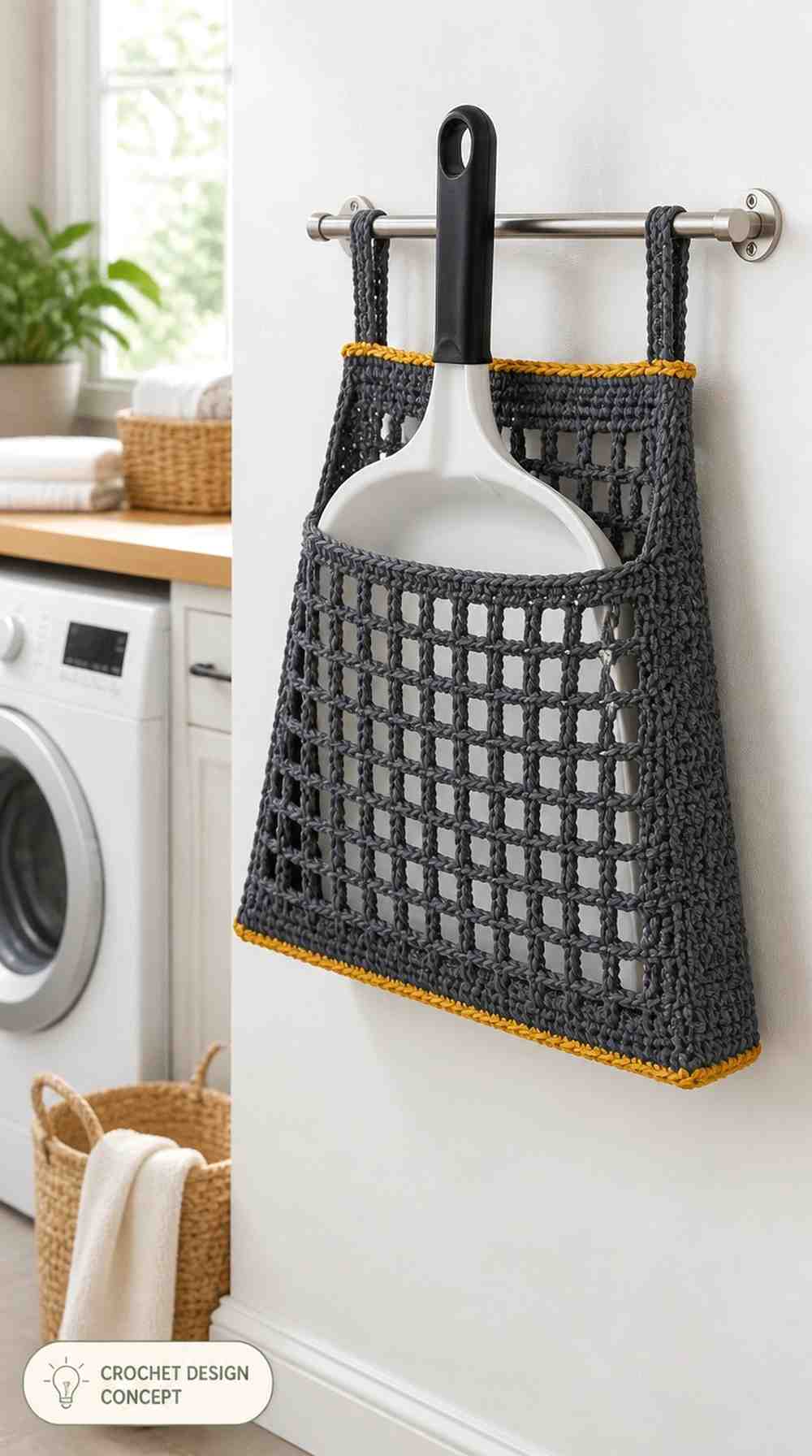
Charcoal-gray crochet forms a broad trapezoidal sleeve with square-mesh openings and closely stitched side seams. Mustard-yellow edging highlights the upper and lower bands. A clean white dustpan sits blade-down inside, with its black handle standing upright above the open rim.
The lattice-style surface gives this holder a less enclosed appearance than a solid crochet pocket. The dustpan remains visible through the mesh, while two charcoal loops connect the sleeve to a slim metal wall rail. The open construction needs enough support to prevent the broad scoop from distorting the fabric.
- Square-Mesh Openings: Choose an opening size that does not allow the edges of the dustpan scoop to push through the fabric.
- Trapezoidal Fit: A wider upper section can accommodate the dustpan’s broad blade while the narrower lower portion supports its shape.
- Metal Rail Mounting: Check that both hanging loops sit properly on the rail and cannot slide together under the dustpan’s weight.
- Openwork Limitation: Mesh exposes more of the tool but does not prevent dirt from collecting on the yarn or surrounding wall.
7. Crochet Dusty Blue Handle-Loop Dustpan Harness
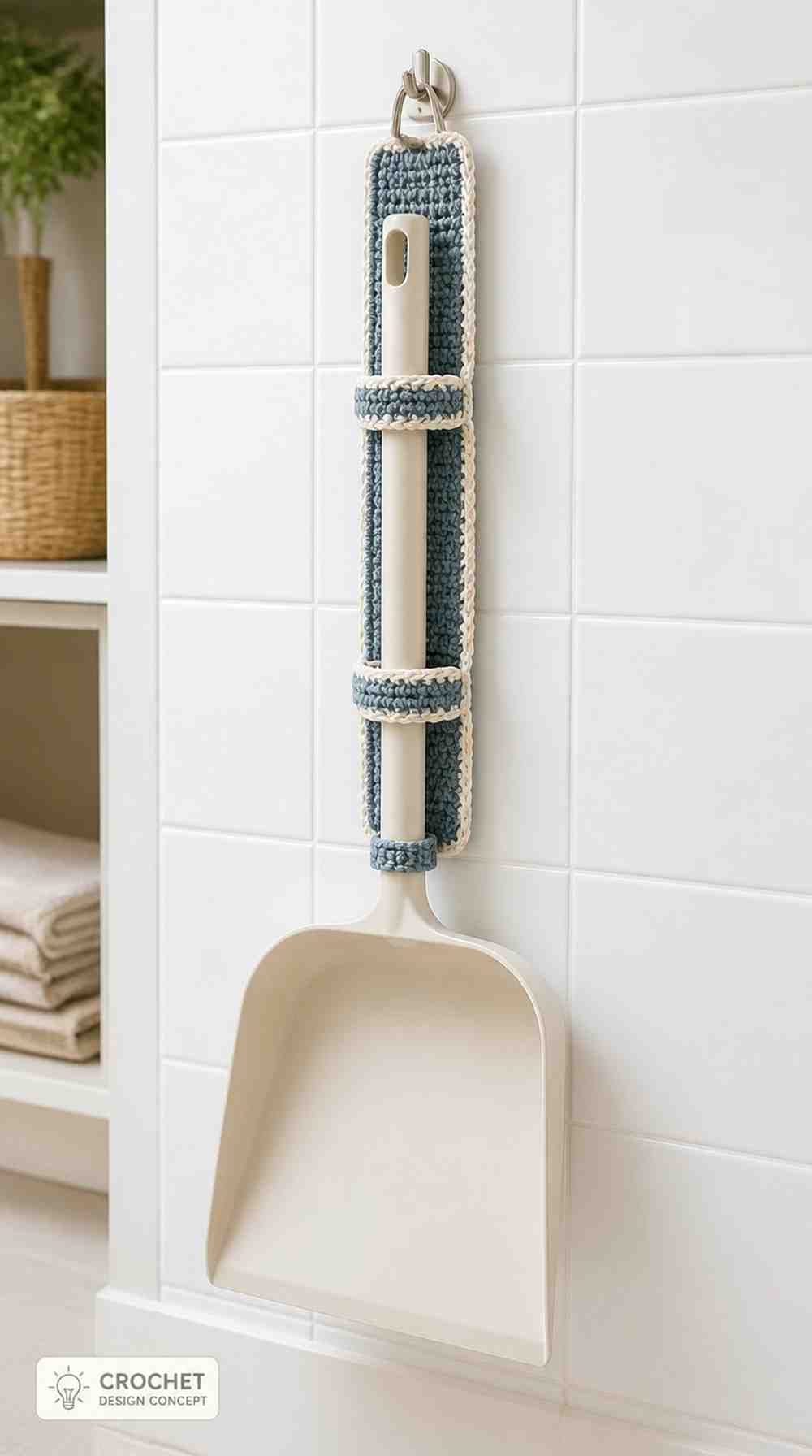
Dusty-blue crochet creates a slim wall-mounted harness with two horizontal retaining loops and a small lower support tab. Instead of enclosing the scoop, the loops hold the long cylindrical handle of a clean beige dustpan. Its broad plastic blade hangs completely exposed below the lower loop.
This is one of the most minimal concepts in the collection. It uses less crochet around the dustpan and leaves the entire scoop accessible for cleaning. The main challenge is ensuring that the handle cannot slide downward as the dustpan is removed or replaced.
- Handle Compatibility: The two loops need to suit the actual handle’s thickness and shape. A tapered or unusually short handle may not remain secure.
- Lower Retaining Tab: The small support is important because horizontal loops alone may let the dustpan slip through.
- Exposed Scoop: Keeping the scoop outside the crochet avoids enclosing the blade, although dirty surfaces should still remain away from the backing and wall.
- Vertical Clearance: Leave enough room beneath the holder so the hanging dustpan blade does not touch the floor or nearby stored items.
8. Crochet Mustard Stepped-Front Dustpan Pocket
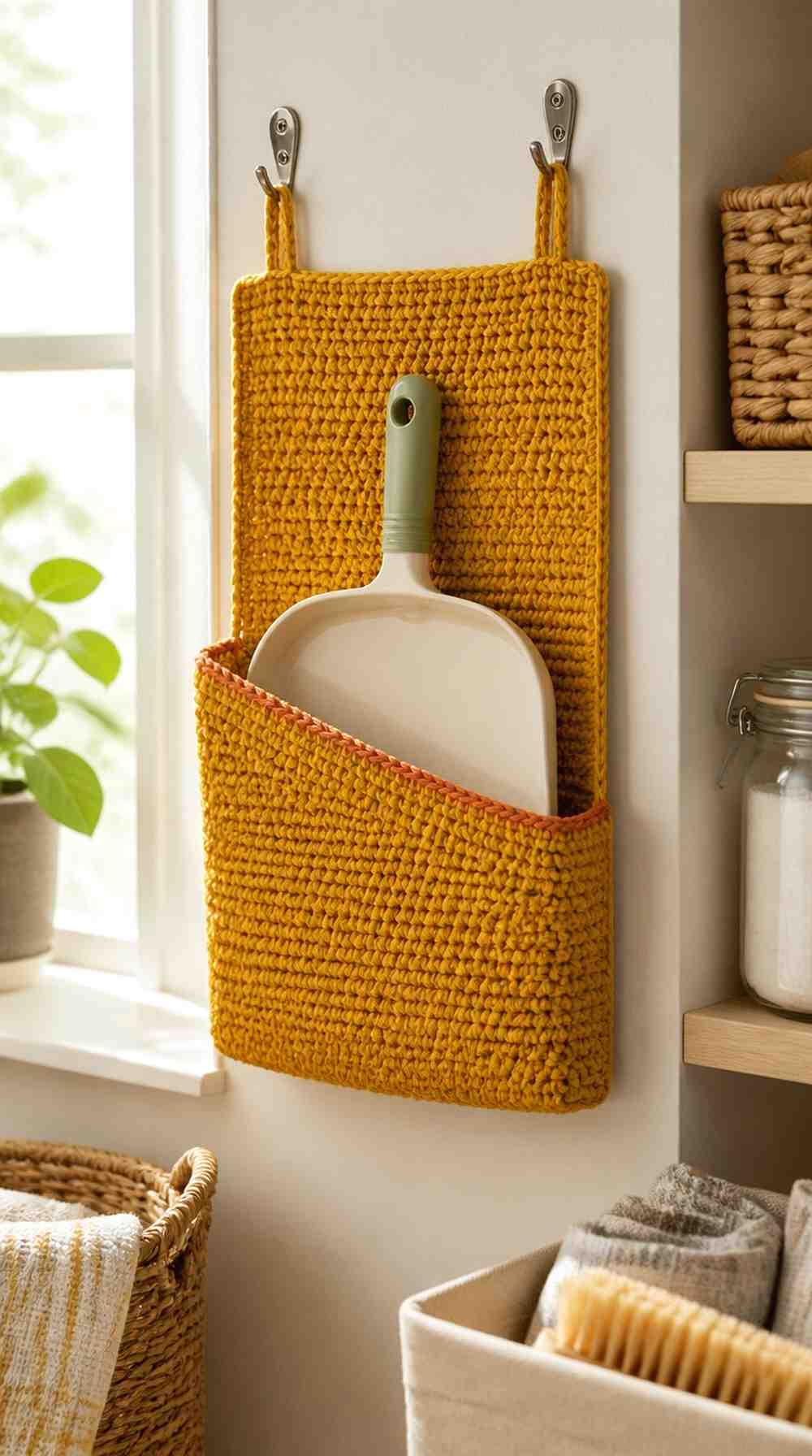
Mustard-gold crochet forms a wall pocket with a tall rectangular backing and an uneven front opening. The left side of the front rim sits slightly higher than the right, with rust-orange edging following the stepped shape. A clean pale-cream miniature dustpan rests inside, its olive handle extending above the front panel.
This design adds visual interest through the pocket’s shape rather than through flowers or buttons. The tall backing helps define the holder, while the lower side of the opening offers easier access. That asymmetry needs careful planning to keep the dustpan balanced.
- Stepped Upper Edge: The lower right section should make removal easier without leaving so much of the scoop exposed that it can tip forward.
- Tall Back Panel: The backing should remain straight against the wall rather than folding behind the pocket.
- Two-Strap Hanging: Separate upper straps can help maintain the uneven pocket shape if their lengths and attachment points are balanced.
- Rust Edging: The narrow contrasting border emphasizes the stepped front without adding bulky decorations that could catch on the dustpan.
9. Crochet Coral Daisy Dustpan Hanging Pocket
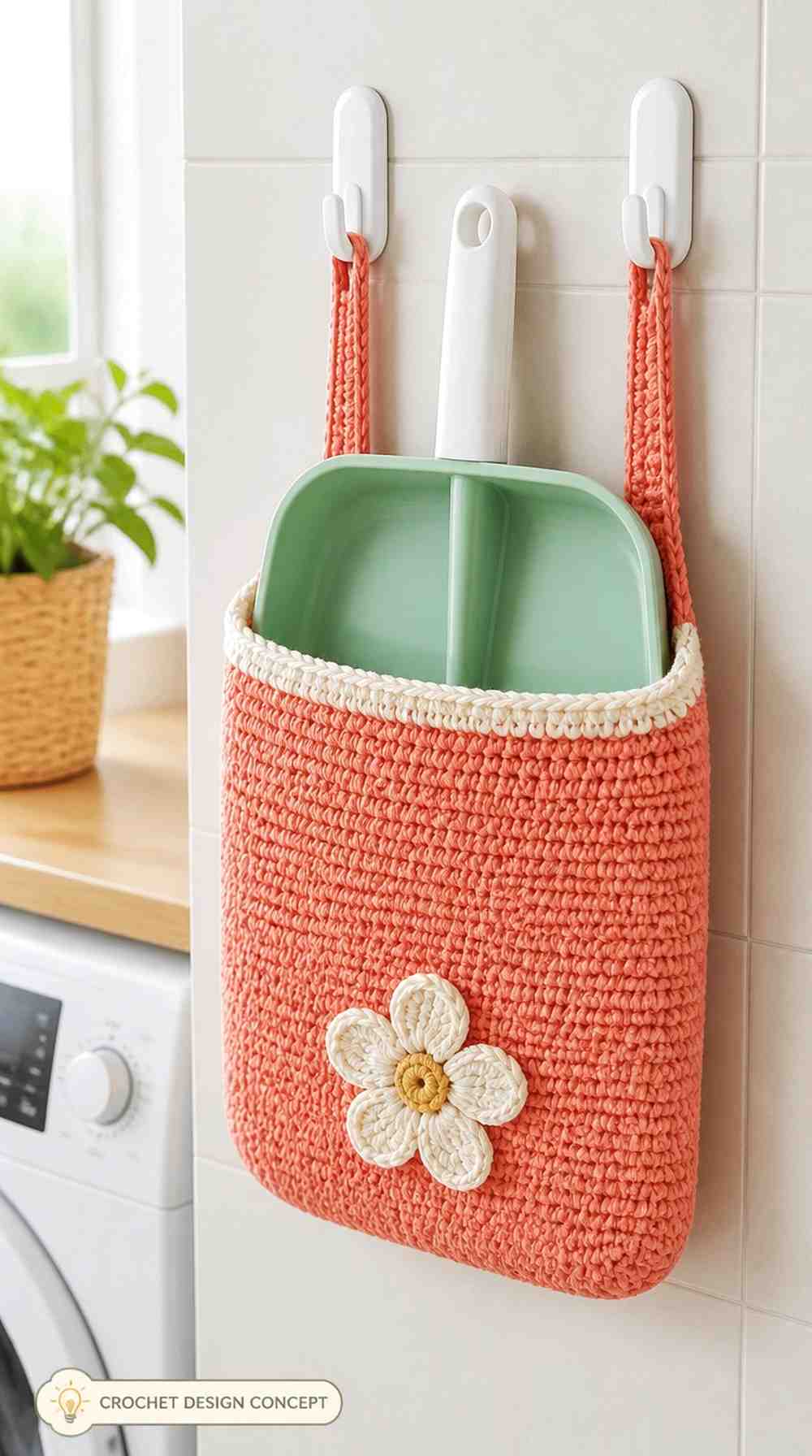
Coral-pink crochet forms a wide rectangular pocket with rounded lower corners and a straight cream-edged opening. A single flat ivory daisy with five petals and a golden-yellow center decorates the lower front. One clean mint-green hand dustpan rests inside, with its white handle visible above the rim.
The flower gives this otherwise simple holder a cheerful cottage-style appearance. Its placement below the opening allows the dustpan to remain easy to recognize. Because decorative appliqués add more stitch edges, this concept works better for a lightly used, thoroughly cleaned tool.
- Five-Petal Daisy: Keep the ivory flower securely attached and positioned away from the pocket opening so it does not interfere with removal.
- Rounded Lower Corners: The broad closed base should support the dustpan scoop without creating overly tight corners around its blade.
- Two Coral Hanging Loops: Separate wall hooks need to be placed at equal heights to keep the pocket level.
- Appliqué Cleaning: The flower’s small stitched details may trap dust, so a plain coral version would be an easier-care optional variation.
10. Crochet Forest Green Dowel-Hung Dustpan Station
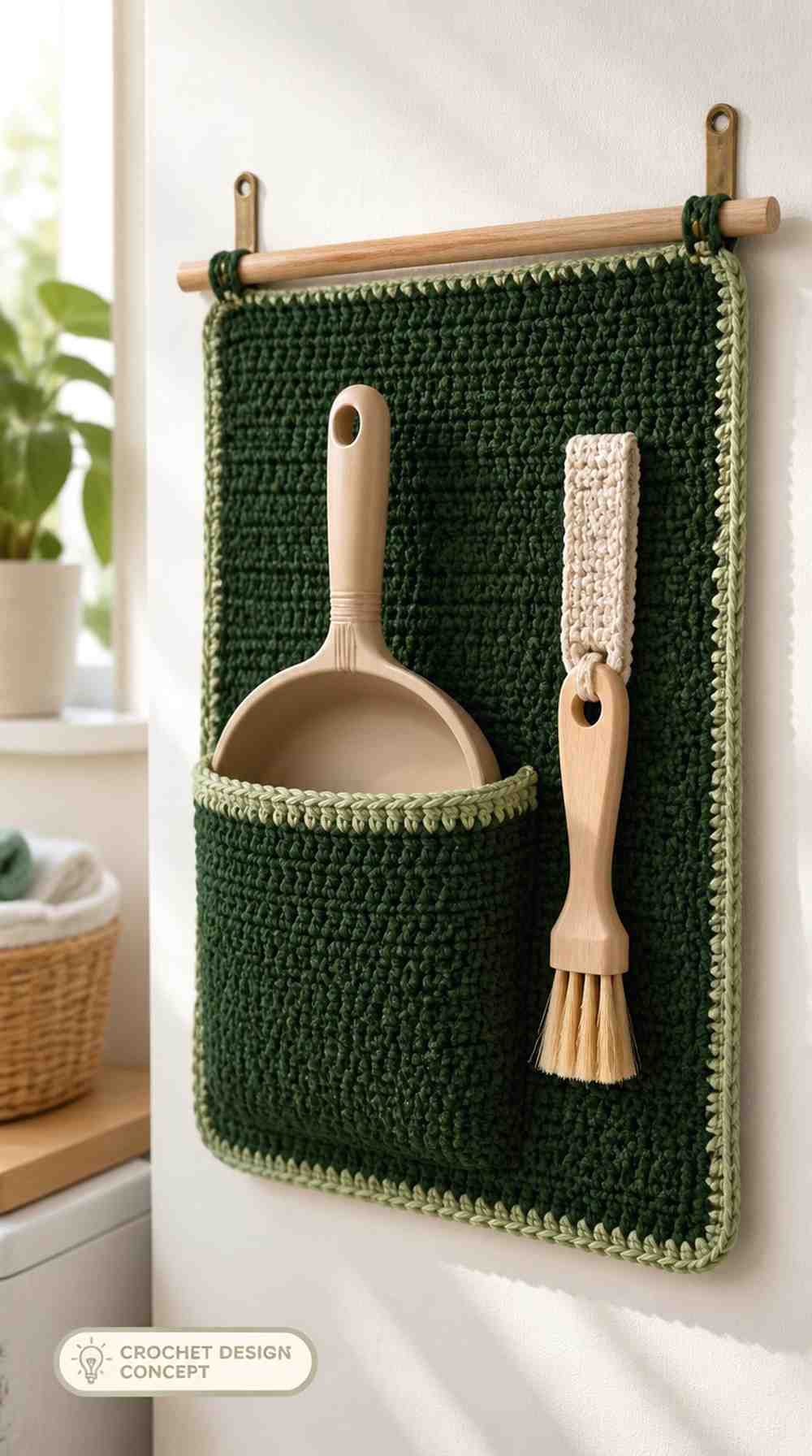
Forest-green crochet forms a broad backing panel suspended from a horizontal wooden dowel. A wide lower pocket holds the clean scoop of a beige mini dustpan, while a separate oatmeal crochet loop suspends a small wooden-handled cleaning brush by its handle hole. Sage edging follows the panel and pocket opening.
The design combines two related cleaning tools without forcing both into one compartment. Its dowel-mounted format gives the arrangement a more decorative wall-organizer appearance, although the brush suspension and wider pocket need their own secure attachment points.
- Wooden Dowel Support: Both brass wall hooks should hold the dowel securely and allow the organizer to be removed for cleaning.
- Separate Brush Loop: The oatmeal loop needs to fit the brush’s handle hole without letting the tool slip out unexpectedly.
- Wide Dustpan Pocket: Size the forest-green lower section around the scoop, leaving the dustpan handle clear above.
- Weight Distribution: Check the arrangement with both tools in place; the organizer should not twist toward the heavier side.
11. Crochet Lilac Corner-Wedge Dustpan Pocket
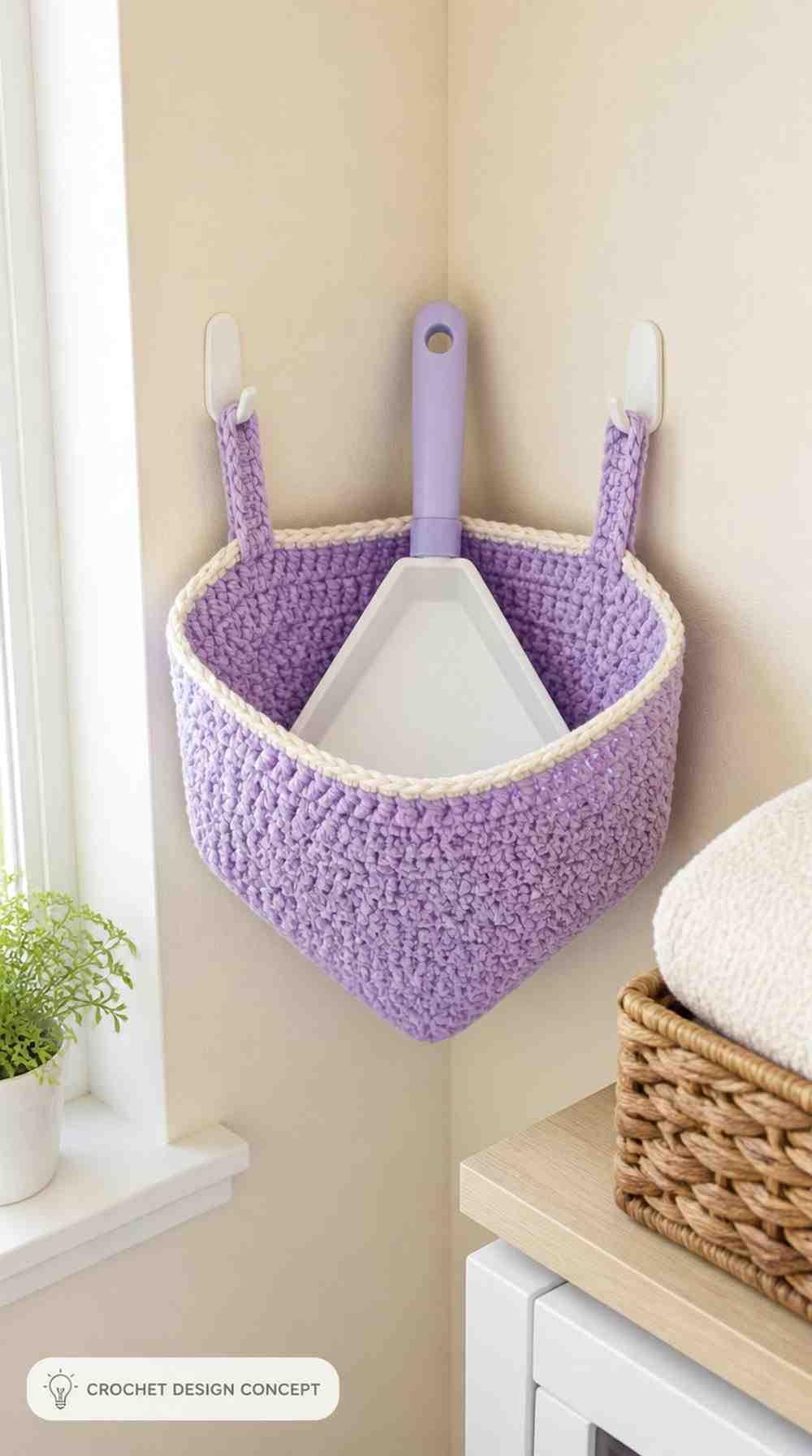
Lilac crochet forms a triangular wall pocket designed for the meeting point of two utility-room walls. Two straight back edges follow the corner, while a gently curved front rim has fine ivory edging. A small white triangular dustpan stands blade-down inside, with its lavender handle rising above the opening.
This design explores a wall corner that might otherwise remain unused. Two hanging tabs attach to separate hooks on the adjoining walls, giving the holder a distinctive two-sided arrangement. Its triangular shape is interesting, but the narrow rear section may restrict the size of the dustpan it can hold.
- Corner Geometry: Measure the available space along both walls before planning the base; the pocket needs to sit naturally within the corner.
- Curved Front Rim: The front should remain wide enough for the dustpan scoop to pass through without bending the fabric.
- Two-Wall Hanging: Both hooks require proper alignment and secure attachment so the triangular pocket does not sag toward one side.
- Tool Size Limitation: This compact arrangement is better suited to a small triangular dustpan than a large rectangular household scoop.
12. Crochet Denim Granny-Square Dustpan Wall Panel
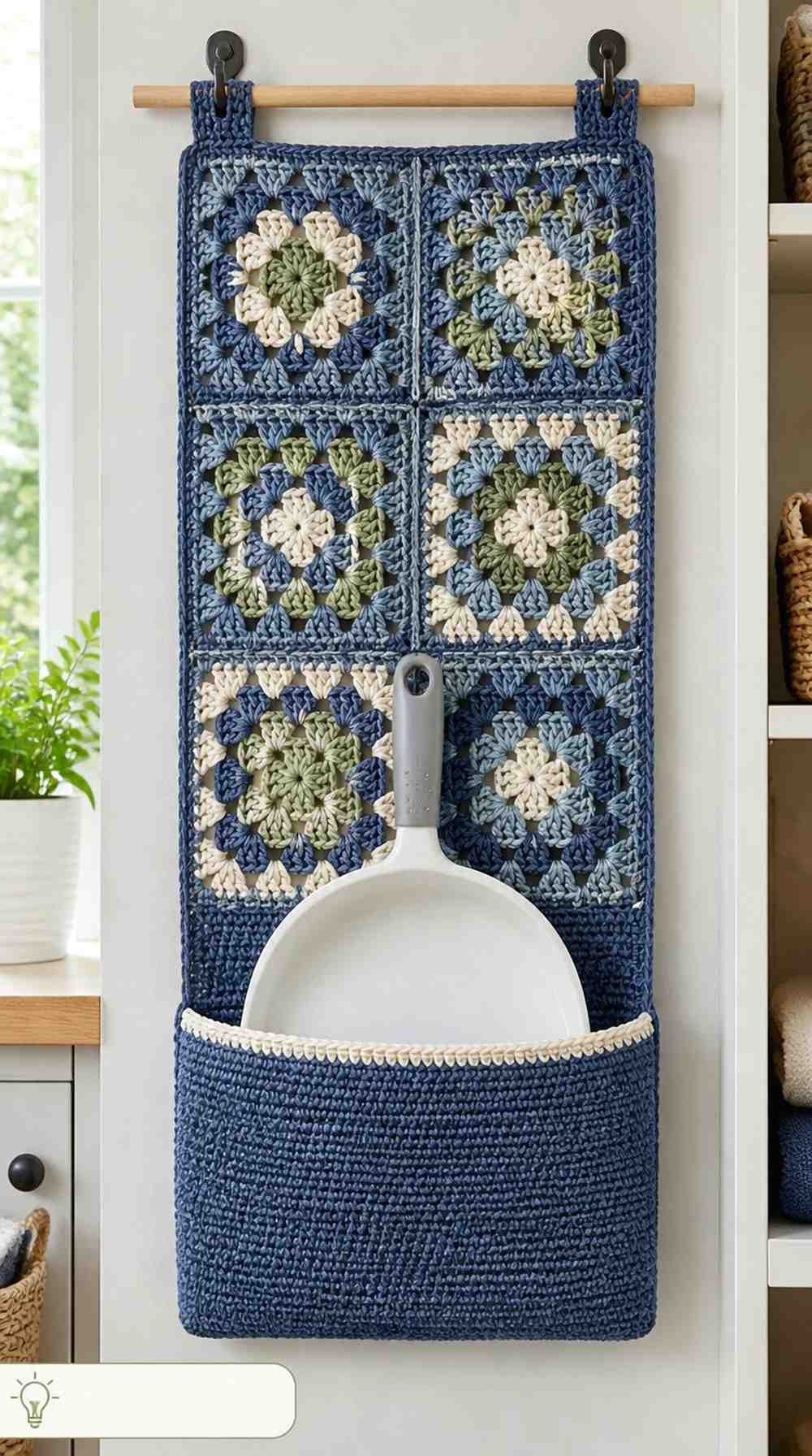
Six crochet granny squares form a wide vertical wall panel arranged in two columns and three rows. Denim blue, faded sky blue, oatmeal and sage appear across the joined motifs. A solid denim-blue trapezoidal pocket covers the lower section, supporting the clean scoop of a white dustpan while its gray handle remains exposed.
The combination of decorative granny squares and a practical-looking lower pocket gives the design a traditional handmade character. A narrow wooden dowel supports the panel through two denim hanging loops. The patterned backing is the main attraction, but it also introduces additional seams.
- Six-Square Arrangement: Keep the granny-square joins even so the panel hangs straight rather than twisting around its central seams.
- Trapezoidal Lower Pocket: The wider upper opening should accommodate the dustpan blade without making the lower pouch unnecessarily deep.
- Dowel Attachment: The two denim loops need proper support, particularly because the decorative backing extends above the storage pocket.
- Open Motif Care: Granny-square openings and joining seams can collect dust, so this arrangement needs more cleaning attention than a plain wall sleeve.
13. Crochet Rust Slatted Dustpan Wall Basket
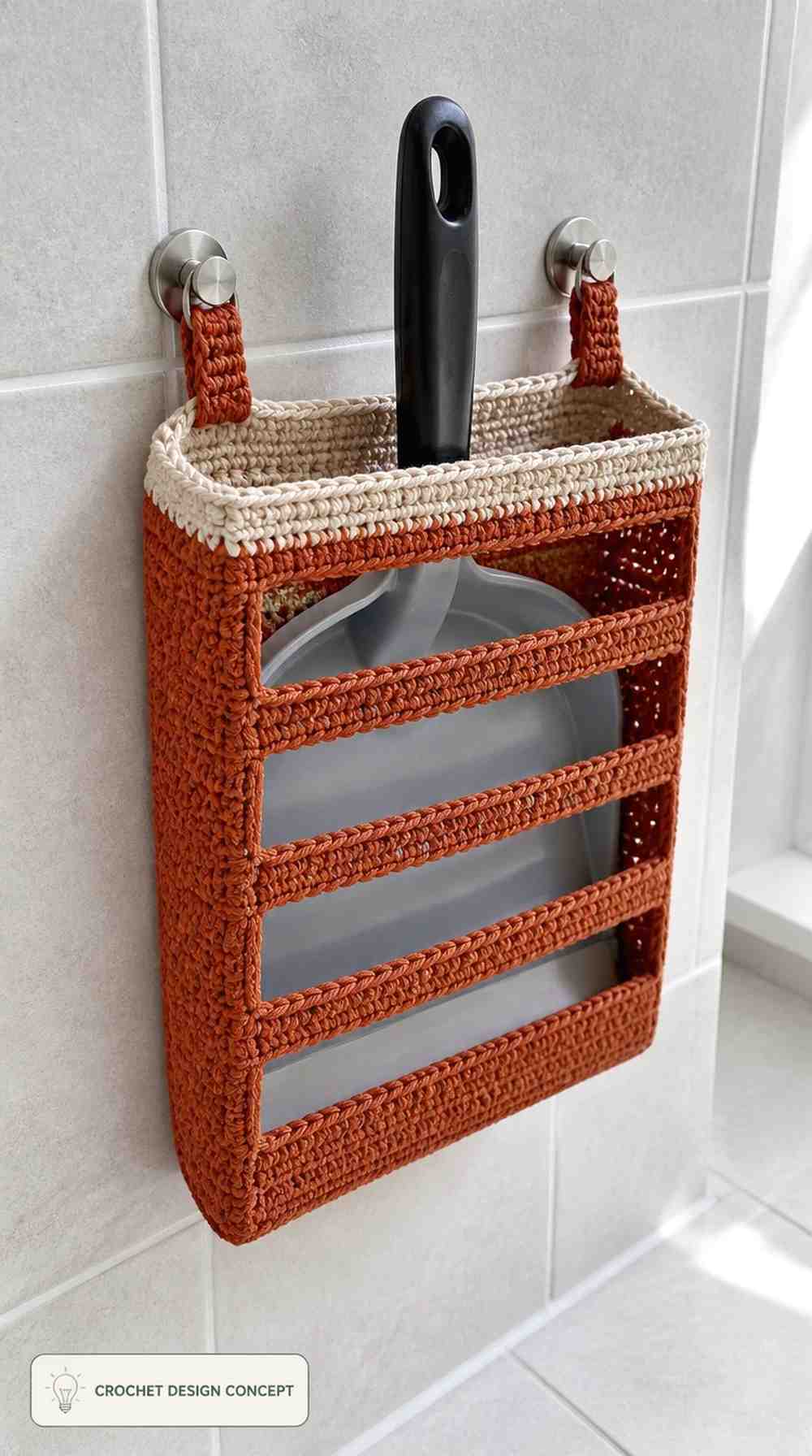
Rust-orange crochet forms a rectangular wall basket with four horizontal bands separated by open slots. Solid side supports and a closely worked base connect the bands, while an oatmeal rim finishes the upper edge. A clean pale-gray handheld dustpan rests behind the slatted front, its black handle clearly visible above.
The repeated horizontal bands give this design a tidy architectural appearance. Unlike a fully enclosed pocket, the open sections reveal parts of the dustpan scoop. The narrow spaces and lower support must work together so the tool cannot slip forward or become caught.
- Four Horizontal Bands: Keep the slats evenly spaced and sufficiently supported by the solid side strips to prevent excessive stretching.
- Open Front Slots: The gaps reveal the dustpan but should not allow the blade’s corners to project through and snag.
- Closely Worked Base: The lower section needs to support the scoop’s weight rather than leaving it suspended only by the front bands.
- Cleaning Access: Open slots may be easier to inspect visually, but every horizontal band still needs cleaning where dust might settle.
14. Crochet Plum Removable-Tray Dustpan Pocket
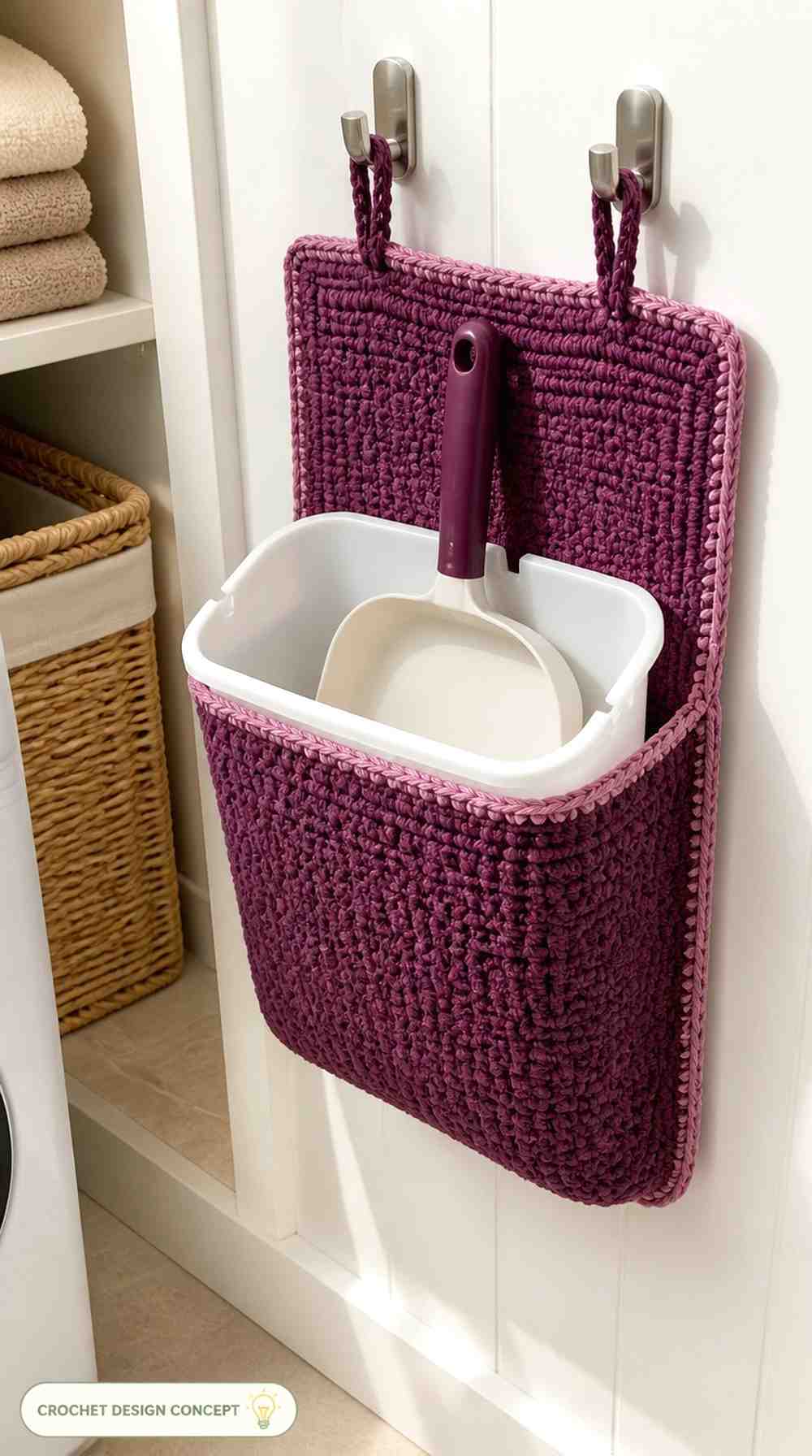
Plum-purple crochet creates a wide wall pocket with a closely worked front, straight upper opening and thin dusty-rose edging. A smooth white plastic liner tray sits inside the pouch, holding the clean scoop of a small ivory dustpan. The liner’s raised front lip remains visible just above the crochet rim, while the dark plum dustpan handle extends upward.
This design introduces a separate washable surface between the dustpan and the fabric. The removable liner makes it one of the more practical concepts to explore, although it must fit securely and be easy to remove without pulling the crochet out of shape.
- Removable Plastic Liner: The insert should be smooth, washable and shaped to fit the lower pocket without sharp edges pressing into the yarn.
- Visible Raised Lip: The white liner’s short front edge helps distinguish the removable insert from the plum crochet exterior.
- Two-Point Mounting: Separate stainless hooks should support the backing evenly, especially when the liner and dustpan are both in place.
- Cleaning Separation: Remove the dustpan and liner before washing the crochet. The insert may reduce direct fabric contact but does not prevent contamination.
Practical Guide to Crochet Dustpan Hanging Pockets
A crochet dustpan pocket is an unusual household storage idea, but cleaning tools present challenges that ordinary decorative wall pockets do not.
Start with the dustpan’s dimensions. Measure the scoop width, depth, blade thickness and handle length. Small handheld dustpans vary considerably. A holder that fits a narrow triangular scoop may not accommodate a wide rectangular one.
Choose the storage method. A full pocket surrounds the scoop, while a handle harness leaves the blade exposed. A wall-mounted hard-surface hook or rail is often the more hygienic option for a regularly used dustpan. Crochet can be added as decoration without enclosing dirty surfaces.
Avoid storing a dirty dustpan in yarn. Dustpans collect dust, hair, crumbs and other debris. Porous crochet fabric can trap these materials and may be difficult to clean thoroughly. Empty, wash if appropriate, and dry the dustpan according to its manufacturer’s instructions before storing it near fabric.
Consider washable materials. Firm, washable cotton or an appropriate easy-care blend may suit a decorative pocket, depending on the design. Check the yarn care label and avoid assuming that crochet is moisture-resistant or hygienic simply because the stitches are tightly worked.
Check wall support and access. Use mounting hardware appropriate for the wall and the tool’s weight. Leave enough clearance to lift the dustpan out, and ensure the hanging holder does not obstruct doors, shelves or cleaning equipment.
For related wall-storage inspiration, Yarn Nest Studio has a verified collection of 20 Crochet Hanging Wall Pocket Organizer Ideas that explores different hanging arrangements and pocket shapes.
Want to Make Something Similar?
The following verified resources explain related wall-pocket construction techniques. They are not exact patterns for the dustpan holders pictured in this article.
- Crochet Wall Pocket Organizer — CyCrochet — A free pattern demonstrating a flat backing, folded front pocket and hanging loop. It is designed for light, dry items, so it should not be treated as a tested dustpan holder. CyCrochet
- Free Crochet Wall Pocket Organizer — Fresh Knack — A wall-pocket pattern by Sierra that uses folded crochet panels, seaming and a wooden dowel. It provides useful background for the shaped and dowel-hung concepts. Fresh Knack
These tutorials teach general crochet construction. A real dustpan pocket still requires independent checks for fit, mounting strength, tool weight and cleaning.
Which Crochet Dustpan Hanging Pocket Should You Choose?
| What matters most | Suggested designs | Main trade-off |
|---|---|---|
| Simple wall storage | Sage Ribbed, Oatmeal V-Shaped | Closed fabric pockets collect debris |
| Smaller or angled dustpans | Lilac Corner-Wedge, Mustard Stepped-Front | More careful shaping and sizing |
| Minimal fabric around the scoop | Dusty Blue Handle-Loop Harness | Handle fit and lower support are critical |
| Dustpan and brush together | Navy Twin Pocket, Forest Dowel-Hung Station | Additional mounting and cleaning needs |
| Decorative cottage appearance | Ivory Scalloped Half-Moon, Coral Daisy | Extra details can trap dirt |
| Open-structure storage | Charcoal Open-Mesh, Rust Slatted Basket | Open stitches may stretch or snag |
| Patterned wall decoration | Denim Granny-Square Panel | More seams and surface area to maintain |
| Separate washable insert | Plum Removable-Tray Pocket | Added liner needs secure fit and cleaning |
For a simple decorative holder, the Crochet Sage Ribbed Dustpan Wall Pocket has a clear shape and straightforward visual arrangement.
If you prefer to leave most of the scoop exposed, the Crochet Dusty Blue Handle-Loop Dustpan Harness is worth considering, provided the handle can be held securely.
For a design that separates the tool from most of the crochet surface, the Crochet Plum Removable-Tray Dustpan Pocket offers an interesting approach with its washable liner. Even so, a plain washable wall hook remains the more practical choice for a dustpan that is regularly dirty.
Conclusion
These 14 crochet dustpan hanging pocket inspiration ideas show how small utility-room organizers can combine handmade texture with different storage arrangements. Rectangular sleeves, shaped cradles, open mesh holders and wall-mounted panels each offer a different approach to organizing a handheld dustpan.
The strongest concept is one that suits the tool’s actual shape, hangs securely and remains straightforward to clean. Because dustpans regularly contact dirt and debris, decorative crochet should never replace proper tool cleaning or create hard-to-clean storage surfaces.
Which design would you prefer in your cleaning corner: the Sage Ribbed Wall Pocket, the Dusty Blue Handle-Loop Harness or the Plum Removable-Tray Pocket? Share the style of dustpan you use and which storage arrangement seems most useful.
Frequently Asked Questions
1. What yarn is suitable for a crochet dustpan hanging pocket?
A firm, washable cotton yarn or a suitable easy-care blend may be worth considering for a decorative holder. However, yarn choice cannot make an absorbent crochet pocket as easy to sanitize as a smooth hard surface. Check the yarn’s cleaning instructions, and avoid storing a dirty or damp dustpan directly against the fabric.
2. Can a crochet wall pocket hold a full-size dustpan?
It depends on the dustpan’s size, weight and shape, as well as the holder’s construction and mounting hardware. Most concepts in this collection are intended for compact handheld dustpans. Larger or heavier tools are generally better stored on properly mounted hooks or racks designed for cleaning equipment.
3. How can I prevent a crochet dustpan pocket from sagging?
Closely worked stitches, secure wall attachments and a correctly sized pocket can help, but flexible crochet may still stretch. Some designs could benefit from a removable, washable internal support. Test the actual holder and its mounting hardware before relying on it to support a dustpan.
4. Is it hygienic to keep a dustpan inside a crochet pocket?
A crochet pocket is not ideal for a dustpan that is routinely put away dirty. Yarn can trap dust, hair, debris and moisture. For everyday cleaning tools, a washable hard-surface hook or rack is usually easier to maintain. If using a decorative crochet pocket, store only a thoroughly cleaned and dry dustpan, and wash the holder regularly.
5. Are these 14 crochet dustpan hanging pocket ideas complete patterns?
No. These are original AI-generated design concepts intended to inspire different pocket shapes, colors, stitches and hanging arrangements. They do not contain tested stitch counts, exact dimensions, verified load capacities or step-by-step construction instructions. The linked resources teach related crochet wall-organizer techniques rather than reproducing these particular designs.