A bath towel that keeps slipping off its hook can make an otherwise tidy bathroom feel messy. Crochet bath towel hook saver loops offer a decorative way to add or replace a hanging point on towels with missing, worn or inconveniently positioned loops. These 17 inspiration ideas explore double straps, reinforced corner patches, buttoned loops, tubular cords, floral accents and compact ring attachments in a variety of soft bathroom-friendly colors.
The right design depends on your towel’s thickness, the shape of your bathroom hook and how the crochet attachment will be secured to the towel fabric. Some concepts are permanently sewn to the hem, while others have buttons or snaps that open around a peg. This collection helps you compare attachment styles, yarn texture, reinforcement options and laundering considerations before choosing a design to develop.
These are AI-generated crochet design visualizations for inspiration, not photographs of tested handmade pieces or step-by-step patterns.
Quick Design Selection Guide
- For a simple replacement hanging loop: Consider the Crochet Oatmeal Double Strap Towel Loop or Crochet Cream Ladder Rib Towel Hanger.
- For reinforcing a weak towel corner: The Crochet Navy Saddle Patch Towel Hanger and Crochet Terracotta Corner Triangle Towel Loop spread the attachment across a wider section.
- For hooks or pegs that are awkward to reach: Explore the Crochet Sage Buttoned Replacement Towel Loop, Crochet Slate Snap Strap Towel Loop and Crochet Mint Foldover Buttonhole Towel Hanger.
- For decorative bathroom styling: Choose the Crochet Blush Scalloped Towel Hanging Loop, Crochet Mustard Sunflower Towel Hook Loop or Crochet Olive Leaf Backed Towel Loop.
- For different hanging hardware: The Crochet Teal Ring Assisted Towel Hanger adds a metal ring, while the Crochet Plum Adjustable Two Hole Towel Loop offers two fastening positions.
1. Crochet Oatmeal Double Strap Towel Loop
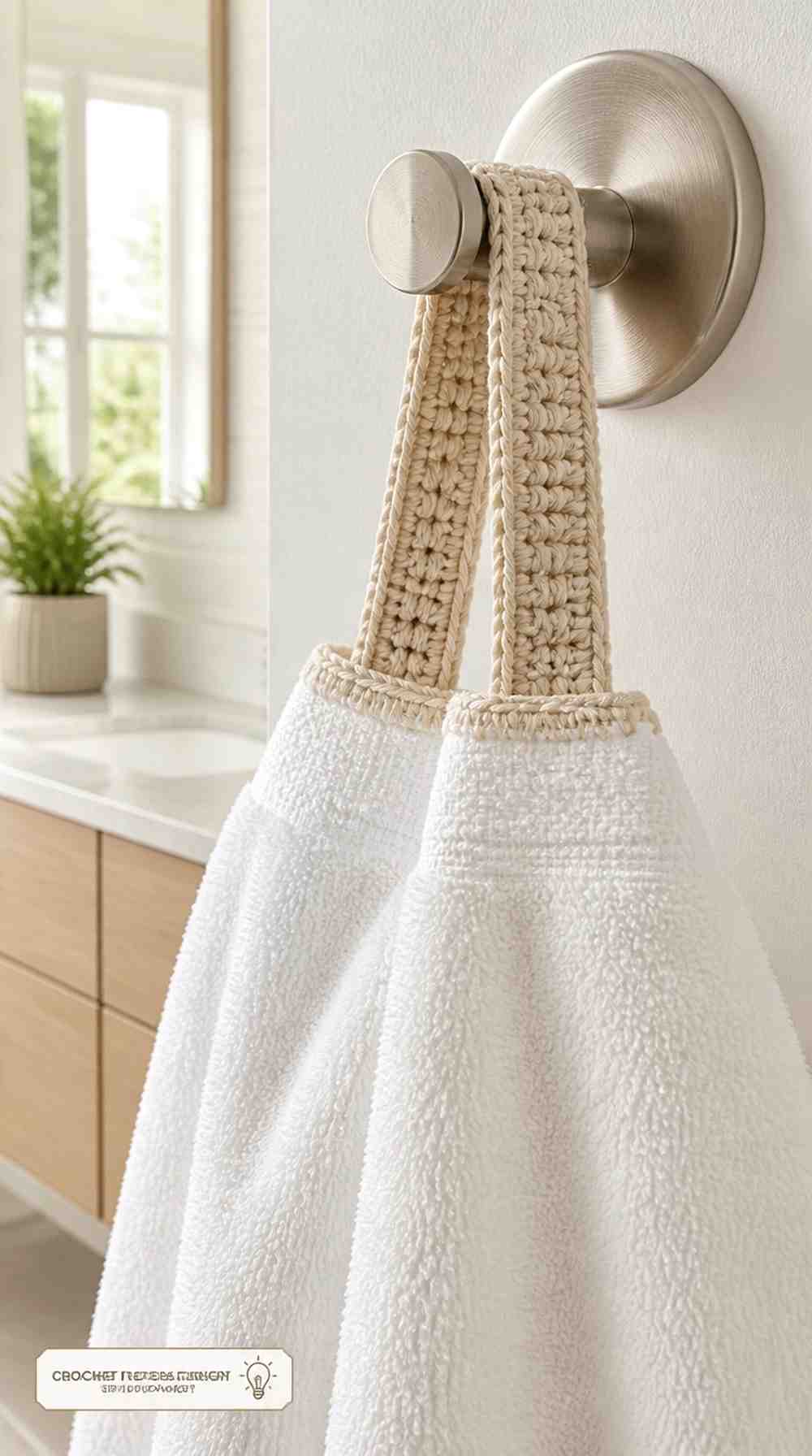
Two narrow oatmeal-beige crochet straps sit side by side, forming a compact hanging loop above the reinforced upper hem of a white cotton bath towel. The close ribbed texture and cream edging give the straps a neat finish, while separate stitched attachment points help define the loop’s shape.
This is one of the more understated designs in the collection. It keeps the crochet detail small and focuses attention on the hanging point rather than the towel itself. For a working version, both attachment points would need careful reinforcement.
- Two-point attachment: Sewing the parallel straps into separate reinforced areas may help distribute tension, but the towel fabric and stitching must support the load.
- Loop opening: Check that the combined loop fits over the intended hook without being stretched tightly or slipping off too easily.
- Edge tension: Keep the cream edging consistent with the oatmeal ribs so it does not pull either strap into a twisted shape.
2. Crochet Sage Buttoned Replacement Towel Loop
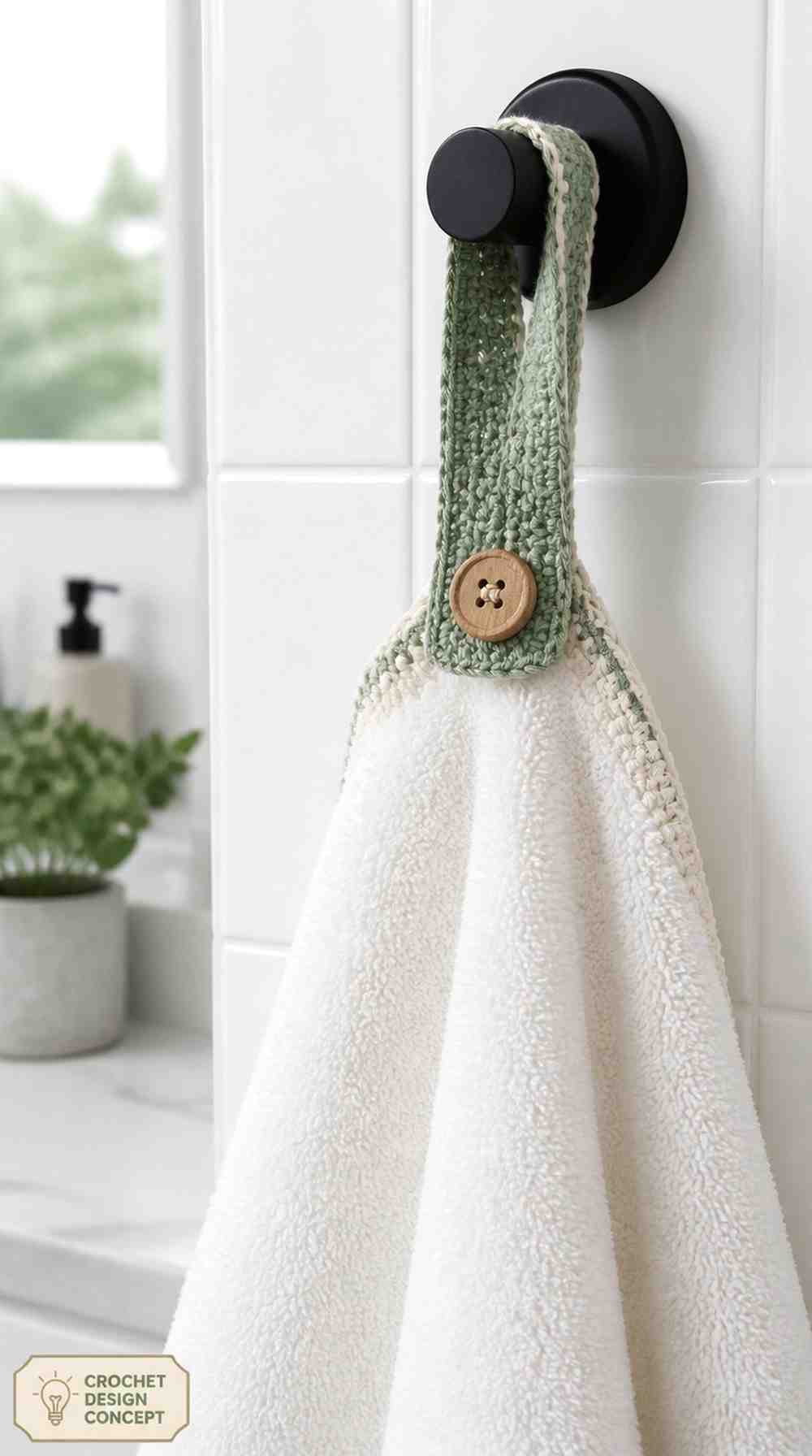
Sage-green crochet forms a narrow strap with close moss-stitch texture and a slim cream border. One end is permanently attached to the towel’s upper corner, while the free end folds around a matte-black peg and secures onto a small wooden button at the base.
The buttoned arrangement is particularly interesting for bathroom pegs that are easier to wrap than to thread a closed loop over. It also allows the crochet strap to open without removing the attachment from the towel.
- Button alignment: Fasten the sage strap around the actual peg before deciding where to position the button on its reinforced base.
- Opening strength: Reinforce the crochet buttonhole so repeated opening does not stretch it beyond the size needed for the wooden button.
- Wooden hardware: Check the button’s washing and moisture-care requirements, since bathroom towels often need frequent laundering.
3. Crochet Navy Saddle Patch Towel Hanger
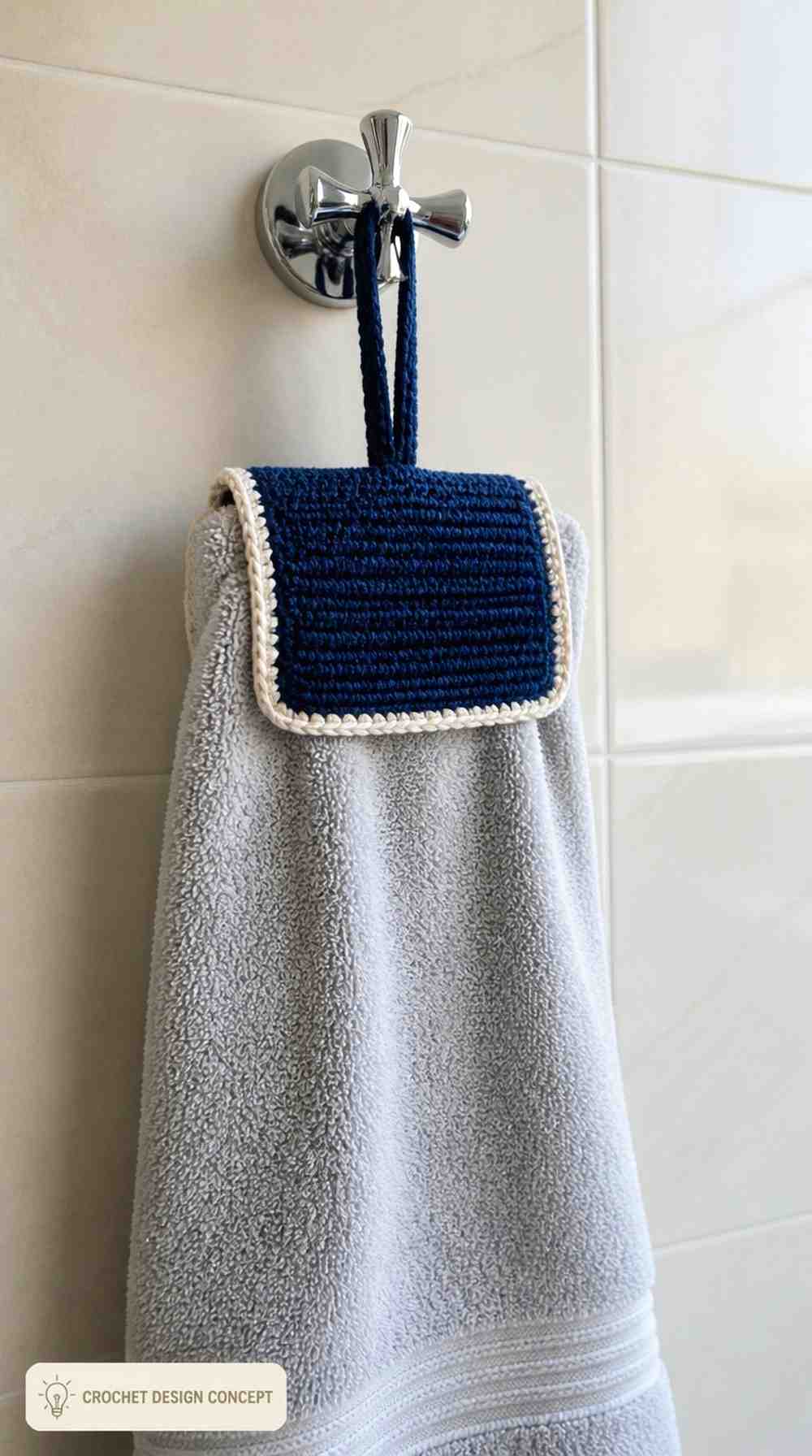
A broad navy-blue crochet patch folds over the upper hem of a pale-gray bath towel, covering a small area on both sides. Fine ivory edging outlines the rectangular saddle shape, while a doubled navy hanging loop rises from the center and rests on a chrome wall hook.
The two-sided patch is the main feature of this concept. Instead of attaching a narrow loop directly to one small section, the larger patch creates an area where the crochet and towel can be joined.
- Patch placement: Position the navy saddle across a sound section of the towel hem rather than over fabric that is already fraying or tearing.
- Sewing access: Secure both faces of the folded patch without leaving rough stitching or loose thread ends on the reverse side.
- Added thickness: A two-sided crochet patch can make the towel corner bulkier, so keep the joining area reasonably flat.
4. Crochet Terracotta Corner Triangle Towel Loop
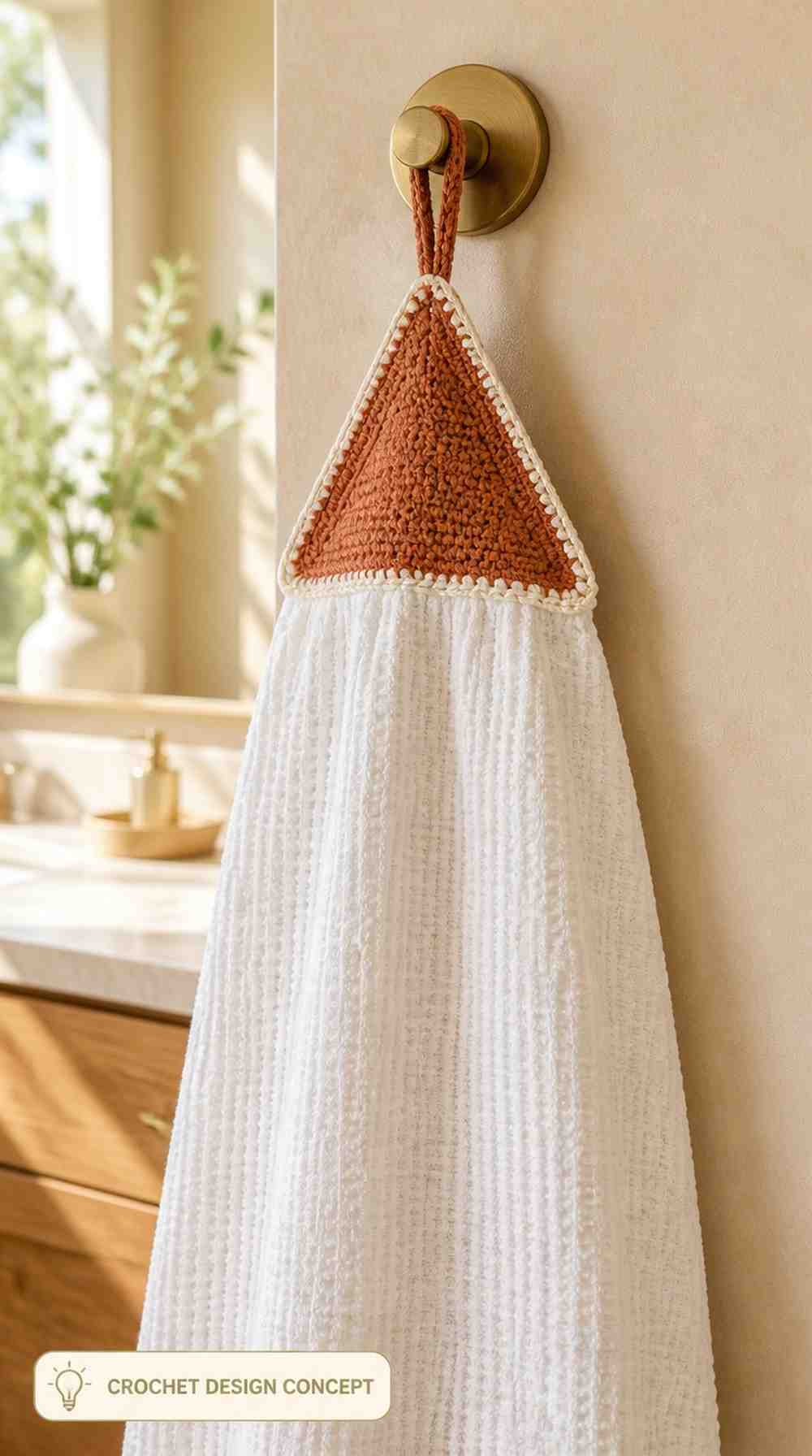
A terracotta-orange triangular crochet patch covers the upper corner of a white waffle-textured towel. Dense diagonal stitches give the triangle a structured appearance, while a narrow cream border follows its outer edges. A short terracotta hanging loop emerges from the top point.
The angled patch gives the design a different look from rectangular reinforcement tabs. Its corner placement also makes the loop visually distinct without covering much of the towel, provided the triangular piece is secured across suitable fabric.
- Corner reinforcement: Sew along the supported sides of the triangle instead of relying only on the pointed upper corner to carry the towel’s weight.
- Waffle fabric: Check the towel’s textured surface before attaching the patch, as uneven fabric may require careful positioning and sewing.
- Diagonal shaping: Keep the triangle balanced so its top loop hangs vertically rather than pulling the towel corner sideways.
5. Crochet Cream Ladder Rib Towel Hanger
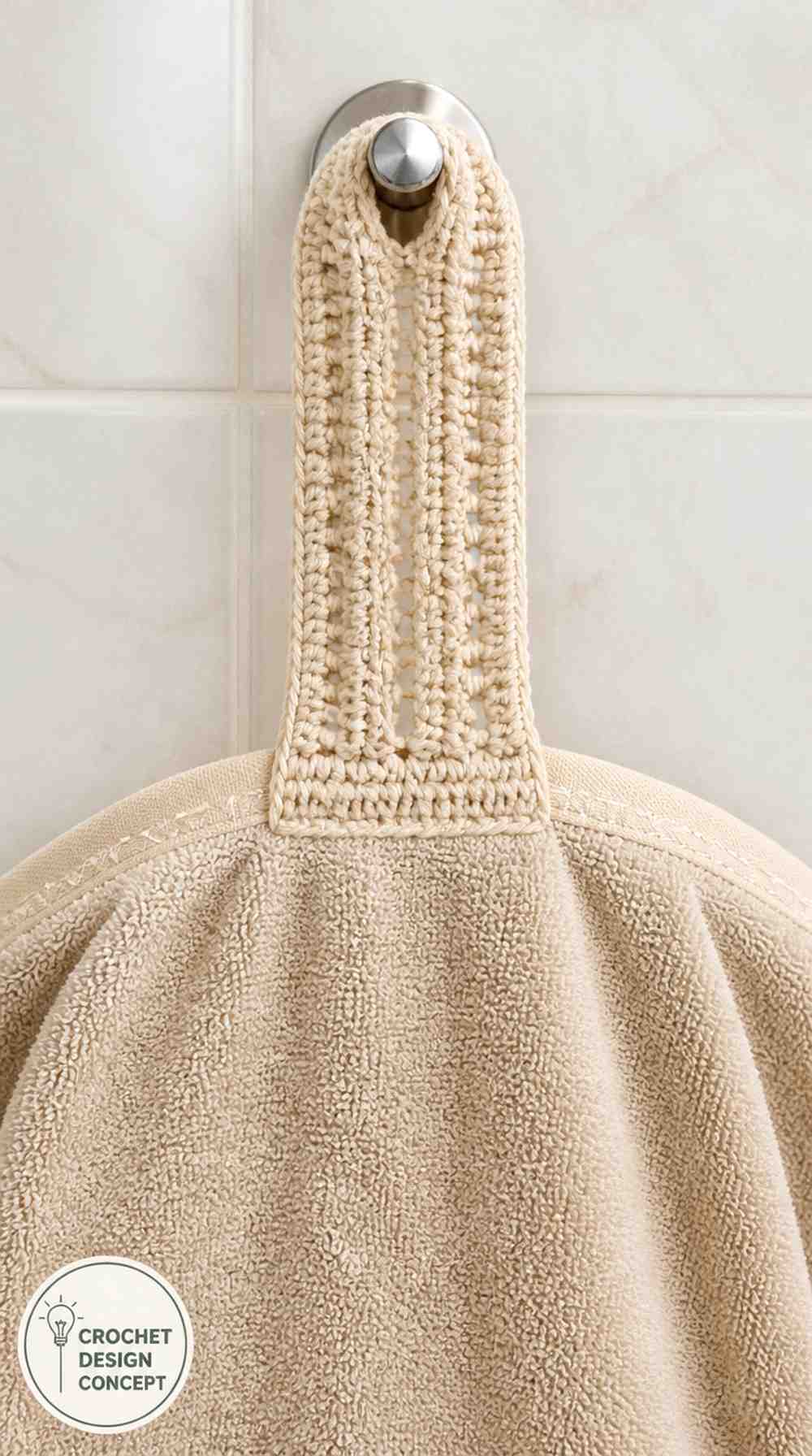
Cream crochet creates a broad rounded loop with three closely spaced vertical rib columns and shallow connecting stitches. A flat lower attachment tab joins the loop to the upper hem of a pale-sand bath towel, while a fine coordinating edge completes the design.
The wider strap offers a more substantial appearance than a narrow cord loop. Its ribbed construction could be useful inspiration for a flexible hanging band, but the stitch spacing and attachment still need to be checked against the towel’s weight.
- Rib spacing: Keep the three crochet columns close enough that the loop maintains its shape rather than spreading apart around the hook.
- Loop width: A broad band may suit rounded pegs, but check that it settles securely instead of folding awkwardly over a narrow hook.
- Lower tab: Reinforce the flat attachment area so the vertical ribs do not place all their tension on a small group of stitches.
6. Crochet Blush Scalloped Towel Hanging Loop
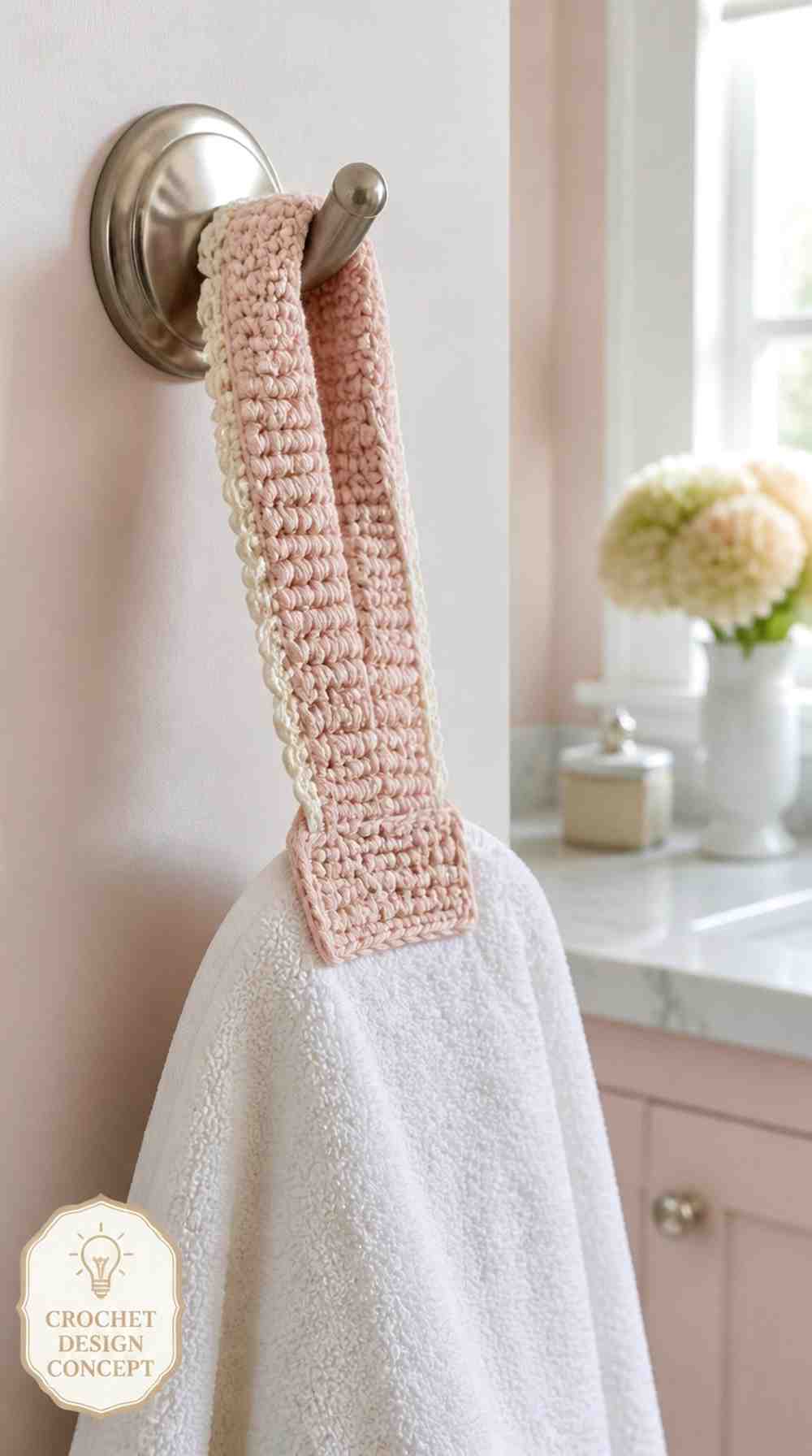
Pale-blush crochet forms a smooth central hanging strap with delicate cream scallops along both outer edges. The rounded upper loop sits on a satin-nickel hook, while its lower ends connect to a flat blush reinforcement patch sewn onto a white bath towel.
The scalloped trim brings a soft decorative touch to the practical hanging strap. Unlike loose lace or long fringe, the small scallops follow the loop’s outline, helping the design remain compact.
- Scallop size: Keep the cream edging shallow so it does not catch on the hook or become trapped when the towel is removed.
- Main strap: Use a dense central crochet band for the structural portion rather than depending on decorative scallops to support the towel.
- Patch positioning: Place the blush lower patch where its full width can be stitched onto sound towel fabric.
7. Crochet Charcoal Corded Reinforced Towel Loop
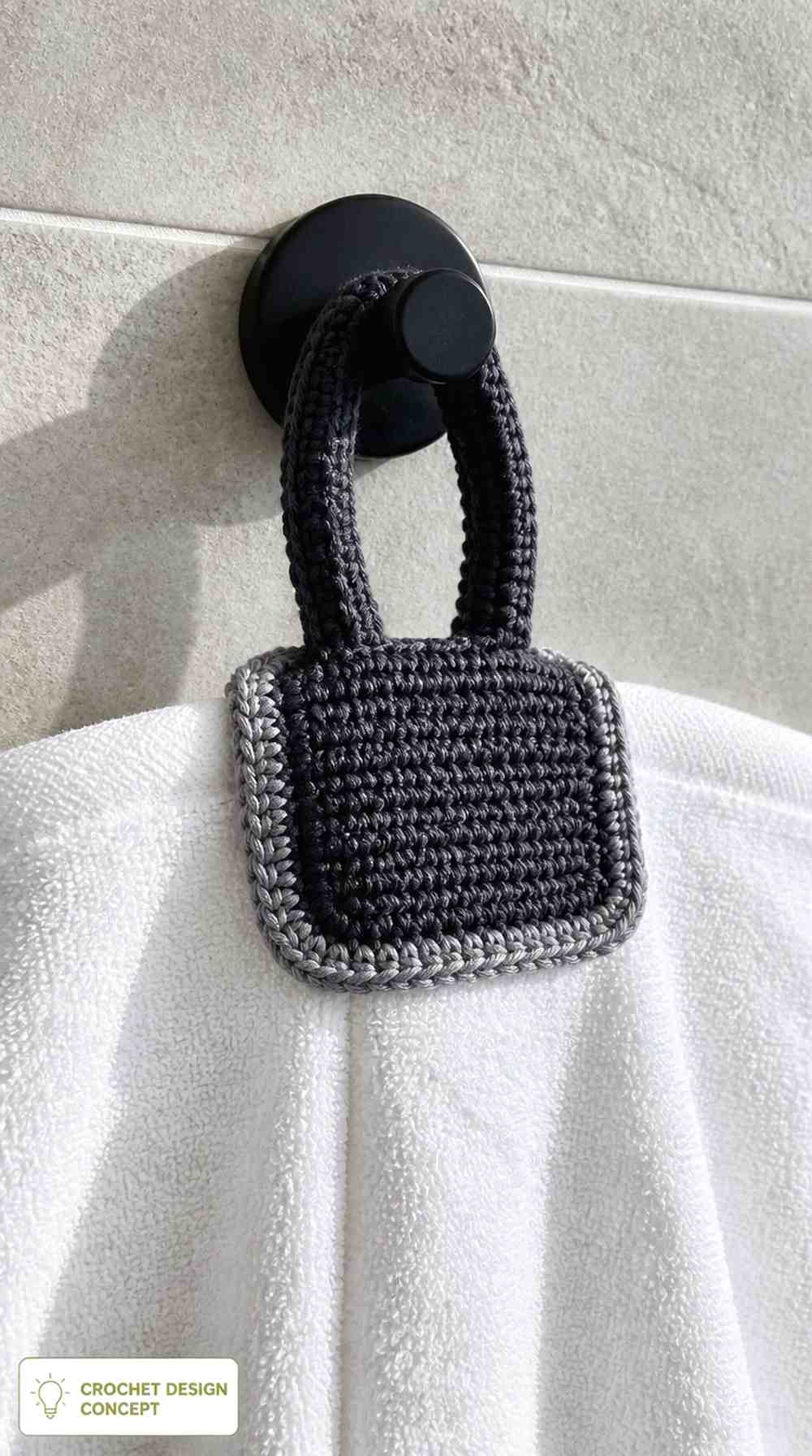
A short charcoal-gray tubular crochet cord curves around a matte-black bathroom hook. Both ends disappear beneath a broad charcoal reinforcement patch stitched onto the upper hem of a white terry bath towel. A narrow silver-gray edge gives the patch a subtle finish.
This design replaces a flat strap with a rounded crochet cord. Its compact shape looks understated against the fluffy towel, although the cord and its attachment points need to withstand repeated pulling and laundering.
- Tubular construction: Keep the cord evenly worked and flexible, without loose internal yarn or uneven thick sections that could distort its curve.
- Anchored ends: Secure both cord ends within the reinforced patch, allowing enough attachment length to resist pulling out.
- Hook contact: Examine the intended hook for sharp edges that could gradually wear against the narrow tubular crochet surface.
8. Crochet Mustard Sunflower Towel Hook Loop
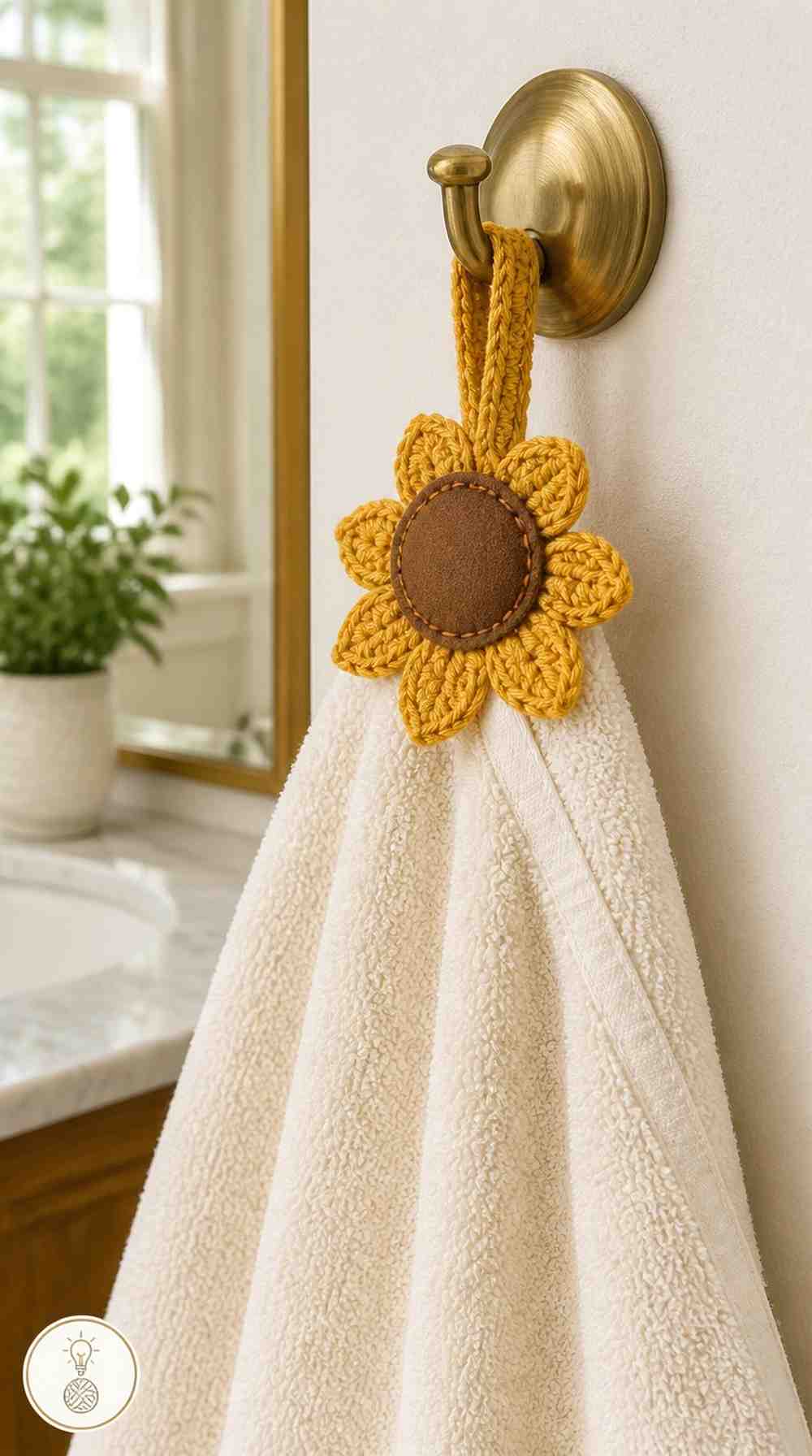
A small sunflower decoration sits below a mustard-yellow crochet hanging loop on a cream bath towel. Eight golden petals surround a flat cocoa-brown circular patch, which acts as the visible base of the attachment. The loop rests on a warm brass wall hook.
The sunflower adds a cheerful accent without requiring a large decorative towel topper. Its position below the hanging loop keeps the flower visible while the towel is in use, although the petals are decorative rather than structural.
- Flower foundation: Attach the cocoa circular patch securely to the towel before adding decorative details or relying on its upper loop.
- Petal security: Keep all eight mustard petals small and firmly worked so they do not snag during washing or when the towel is pulled down.
- Loop support: Reinforce the connection between the sunflower base and the upper strap instead of relying on decorative petal stitches.
9. Crochet Slate Snap Strap Towel Loop
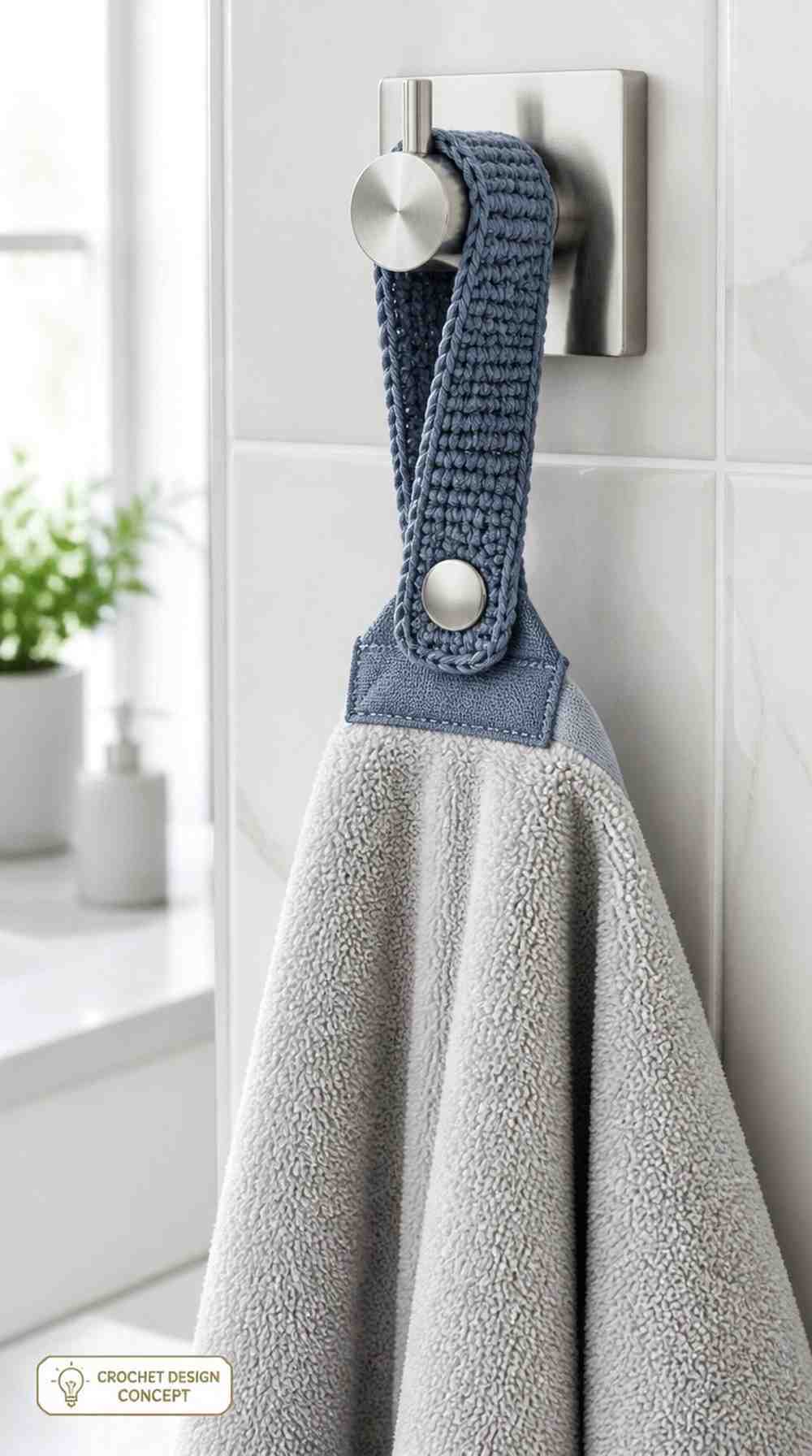
Slate-blue crochet forms a compact strap with close horizontal rows and a reinforced lower tab sewn to a light-gray bath towel. The strap passes over a wide brushed-steel hook and fastens back onto its base with a small silver snap.
The snap closure gives this concept a cleaner appearance than a large button. It also provides a way to open the loop around a bathroom hook, though the hardware and backing need to be suitable for repeated opening.
- Snap reinforcement: Support both halves of the fastening with appropriate backing so pulling the snap apart does not damage the crochet stitches.
- Hook clearance: Check that the slate strap wraps comfortably around the intended hook before the snap is closed.
- Laundering: Confirm the snap’s material and care requirements, including whether it may catch on the towel or other laundry items.
10. Crochet Lavender Twin Anchor Towel Loop
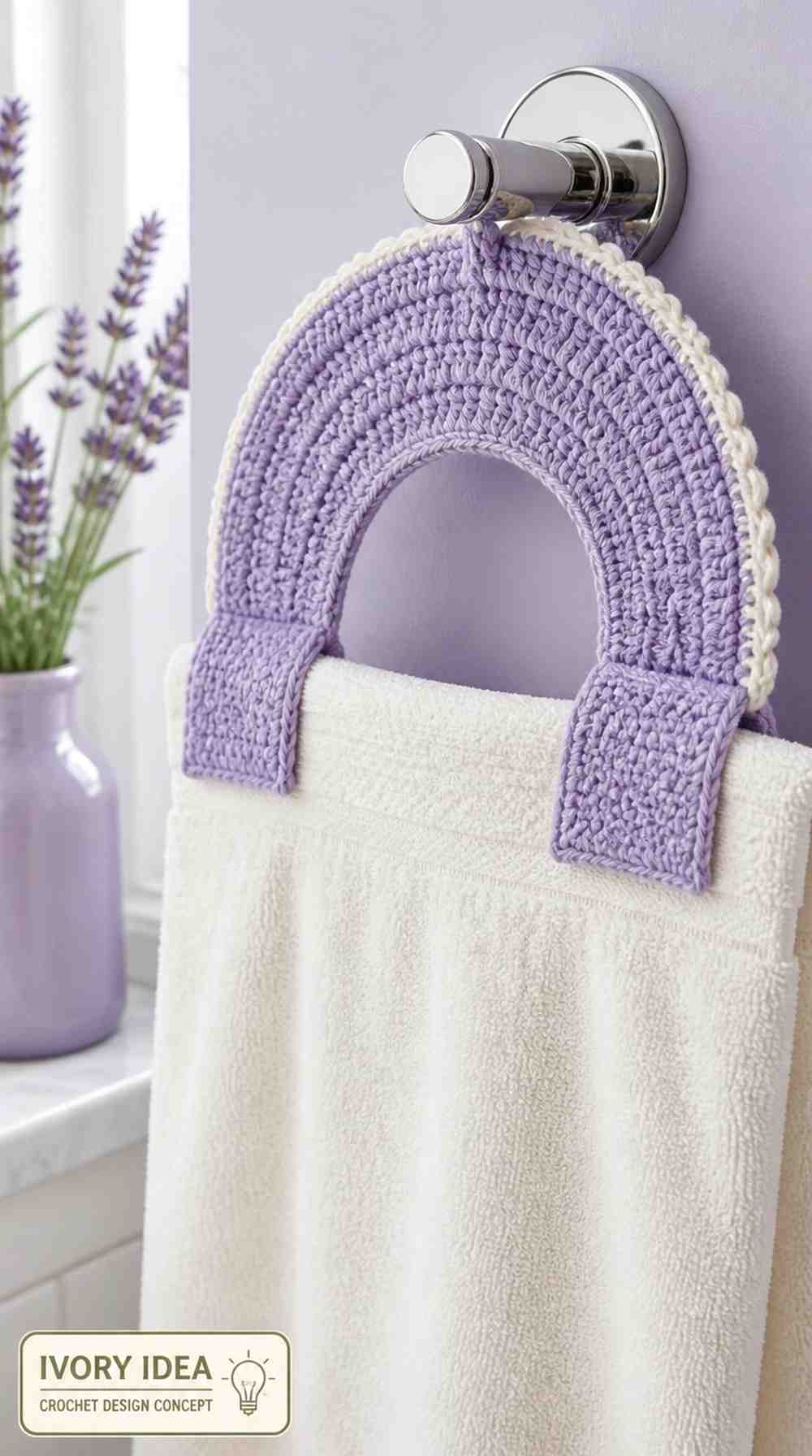
A wide lavender crochet loop rises in a rounded inverted-U shape above an ivory bath towel. Two separate flat attachment feet are stitched several centimeters apart along the upper hem. Cream edging follows the loop, while shallow curved stitch rows define its upper section.
The two spaced attachment points give this design a different silhouette from a narrow corner loop. It may help the towel hang more evenly when both lower feet remain properly secured and the hook is positioned above their midpoint.
- Anchor spacing: Check the distance between the lavender feet before sewing, so the towel hangs naturally instead of bunching between them.
- Upper curve: Keep the rounded crochet arch wide enough for the hook without allowing it to twist around the attachment points.
- Stitch distribution: Secure each lower foot across a suitable reinforced area rather than concentrating tension in one small stitch.
11. Crochet Mint Foldover Buttonhole Towel Hanger
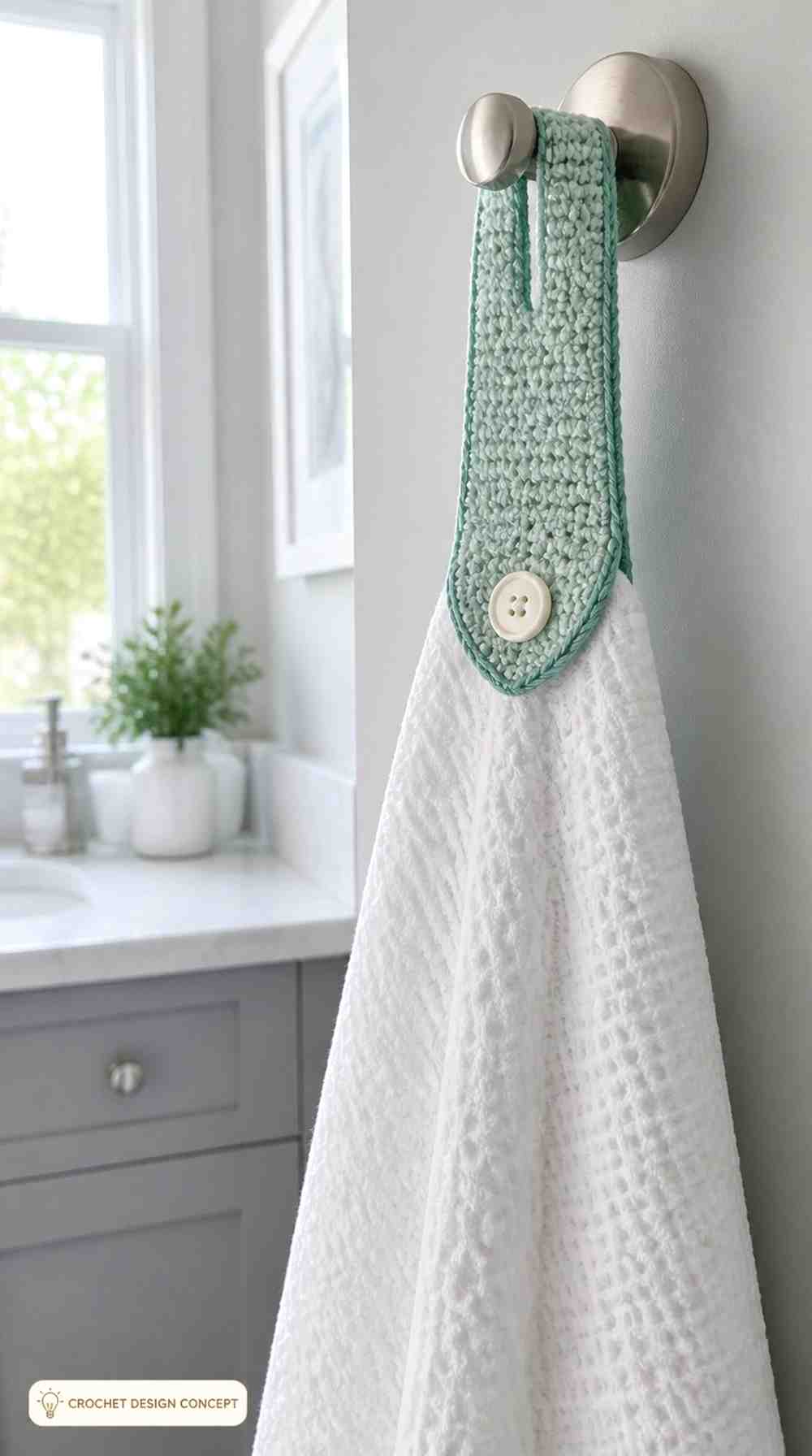
Mint-green crochet forms a long, flat hanging tab attached to the upper hem of a white waffle cotton towel. The strap folds over a rounded bathroom peg and closes on a small cream button near its base. A darker mint edge frames the strap, while an elongated buttonhole sits near the free end.
This concept uses a simpler rectangular strap shape than the decorative scalloped or leaf-backed loops. Its buttonhole can be positioned to suit a particular peg, but the finished strap should not hang unnecessarily low.
- Foldover length: Measure around the intended peg before selecting the strap length, allowing enough room for the button fastening without excessive slack.
- Buttonhole finish: Reinforce the elongated opening so the cream button does not gradually stretch or distort it.
- Waffle towel attachment: Use a sewing method suitable for the towel’s woven structure, avoiding torn fibers and uneven bunching near its top hem.
12. Crochet Olive Leaf Backed Towel Loop
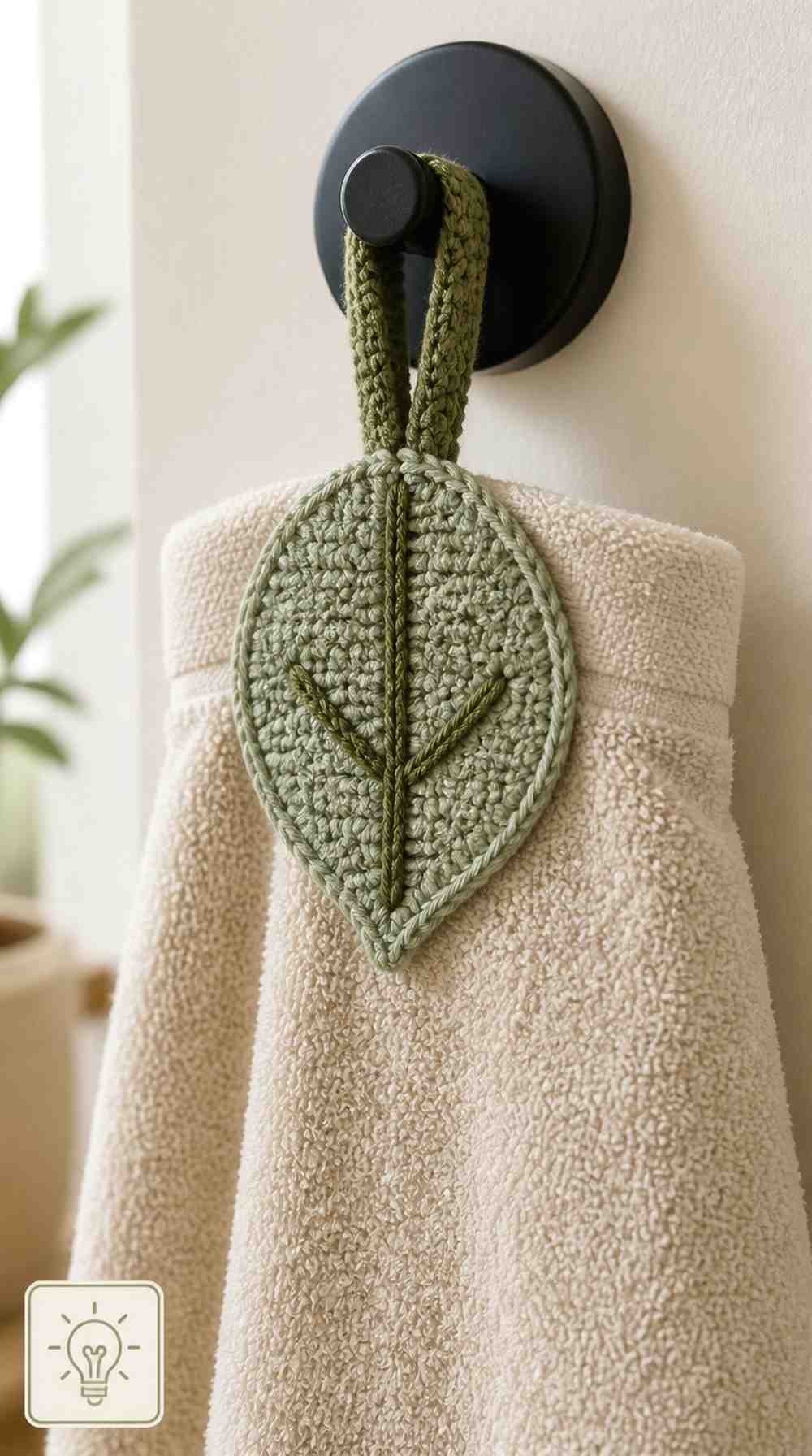
An olive-green hanging loop rises from a broad sage crochet leaf patch sewn onto a pale-beige bath towel. The leaf lies flat against the towel, with a darker olive central vein and two short stitched side veins. Its upper loop curves over a satin-black bathroom hook.
The large leaf shape creates a botanical detail while providing a broad area for joining the hanger to the towel. Its decorative surface is relatively flat, making it less bulky than a padded applique.
- Leaf foundation: Secure the sage patch across its supported edges, particularly where the olive hanging loop meets the upper center.
- Vein stitches: Keep the dark-green surface detailing short and firmly anchored so long threads do not snag during laundering.
- Patch shape: Check that the leaf lies smoothly against the towel without curling at its pointed ends.
13. Crochet Coral Braided Strap Towel Loop
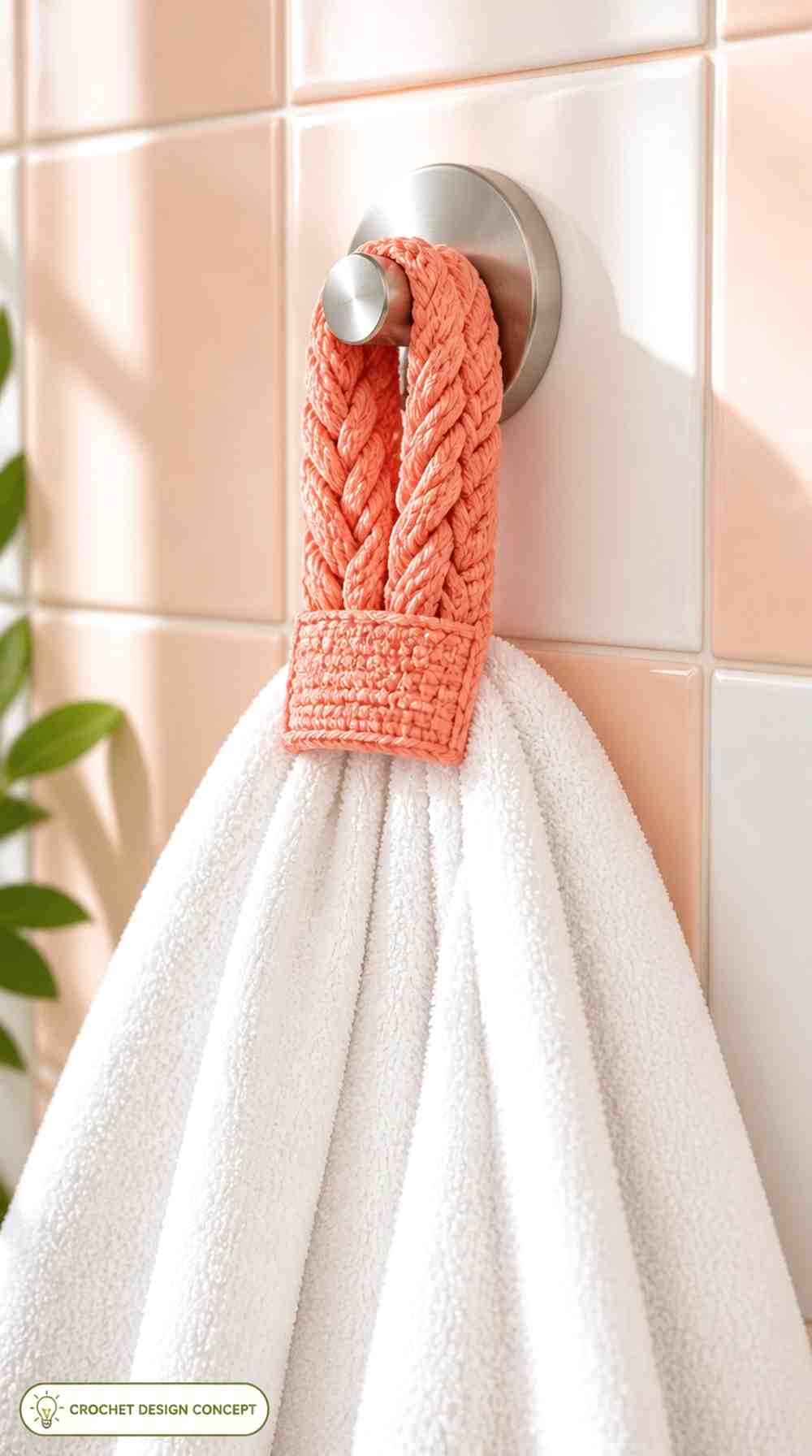
Three narrow coral-pink crochet strips are woven together into a flat, low-profile braid that forms a rounded hanging loop. Both braided ends are anchored beneath a broad coral crochet patch stitched onto the upper hem of a white bath towel.
The braid creates texture without using raised appliques or separate hardware. Compared with a single flat strap, however, its multiple strands introduce extra attachment points that need careful securing to prevent the braid from loosening.
- Even braiding: Maintain consistent tension across all three coral strips so the loop curves smoothly and does not twist.
- End reinforcement: Secure every strand beneath the rectangular patch instead of relying on only the outer strips to hold the attachment.
- Bulk control: Keep the braid relatively flat so it settles naturally over the hook and does not form a thick knot above the towel.
14. Crochet Cocoa Tubular Towel Hook Loop
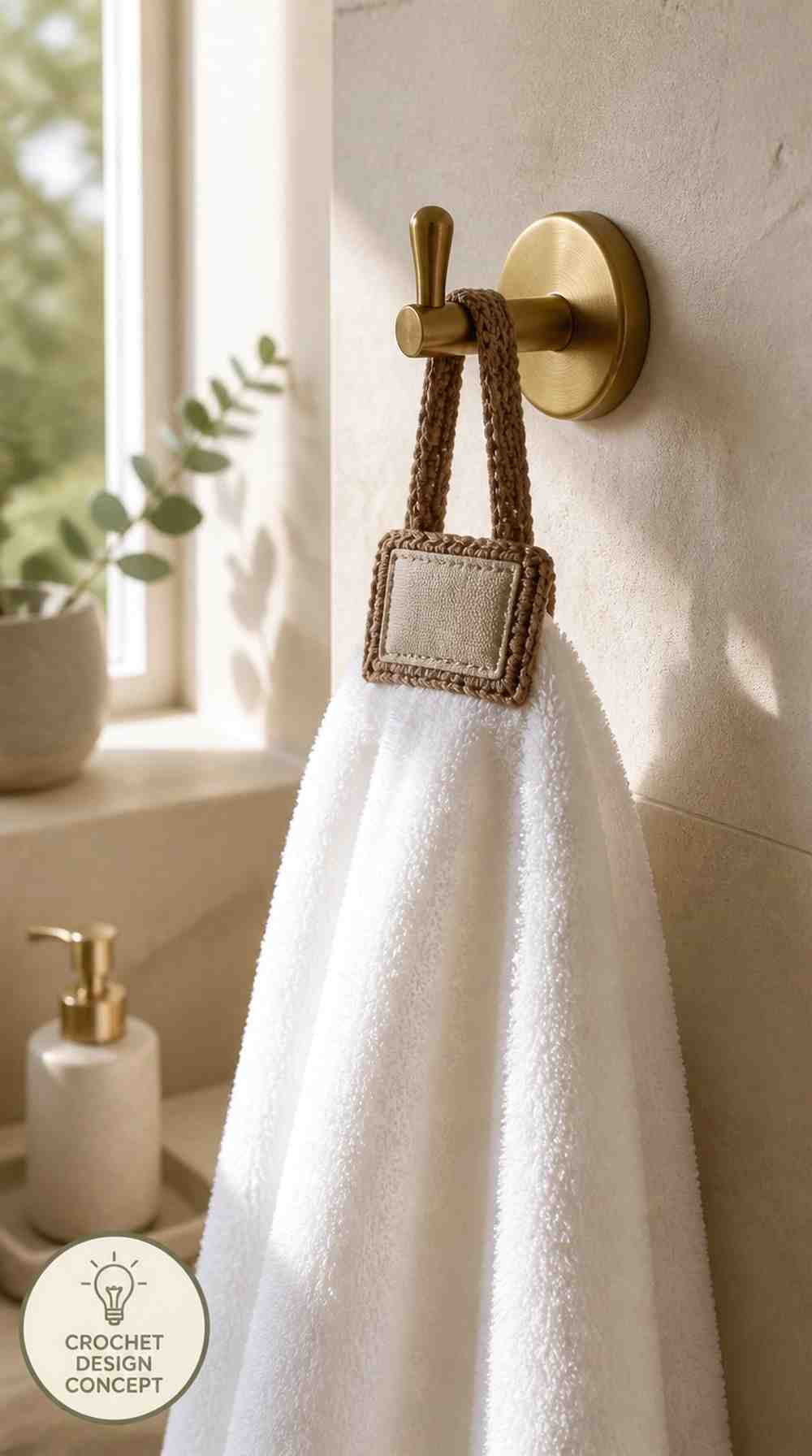
A cocoa-brown crochet tube creates a smooth rounded hanger above a thick white terry towel. The two ends are secured beneath a sand-beige cotton fabric patch, and a narrow cocoa crochet border outlines the patch. A brass bathroom hook supports the loop.
This design combines a crochet hanging cord with a separate woven-fabric reinforcement base. The contrasting materials give the attachment a neat appearance, but their different stretch and washing characteristics need to be considered.
- Fabric backing: Choose a sturdy, washable cotton patch that can be attached securely without damaging the terry towel’s underlying fabric.
- Tubular ends: Anchor both cocoa cord ends beneath the patch with suitable stitching rather than depending on the decorative crochet border.
- Material compatibility: Check that the fabric, crochet yarn and sewing thread tolerate similar laundering conditions and drying methods.
15. Crochet Sand Corner Wrap Toggle Loop
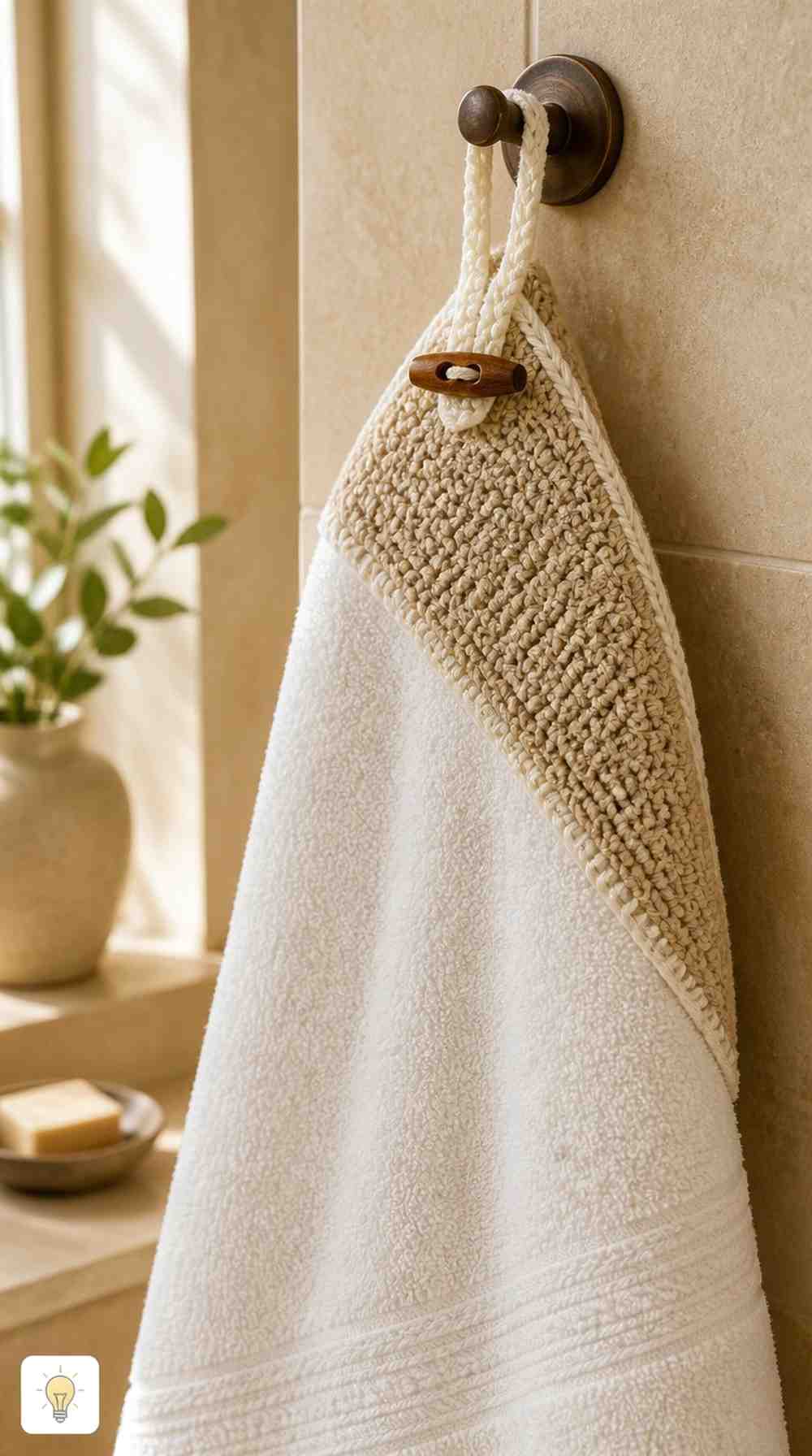
Sand-colored crochet wraps neatly around both sides of an ivory towel’s upper corner. A short cream hanging strap rises over a dark-bronze peg and closes onto the corner patch using a small cocoa-brown wooden toggle. Fine oatmeal edging outlines the reinforced corner.
The toggle fastening offers a different way to open and close a hanging loop. The corner wrap also spreads the attachment over a wider area, although a thick towel hem may require careful fitting.
- Corner wrap fit: Size the sand crochet patch around the actual towel corner so both faces lie flat without pulling against the existing hem.
- Toggle connection: Check that the wooden toggle remains secure within its small crochet fastening loop during normal towel handling.
- Laundry considerations: Confirm whether the toggle can remain attached during washing or whether an alternative washable fastening would be more practical.
16. Crochet Teal Ring Assisted Towel Hanger
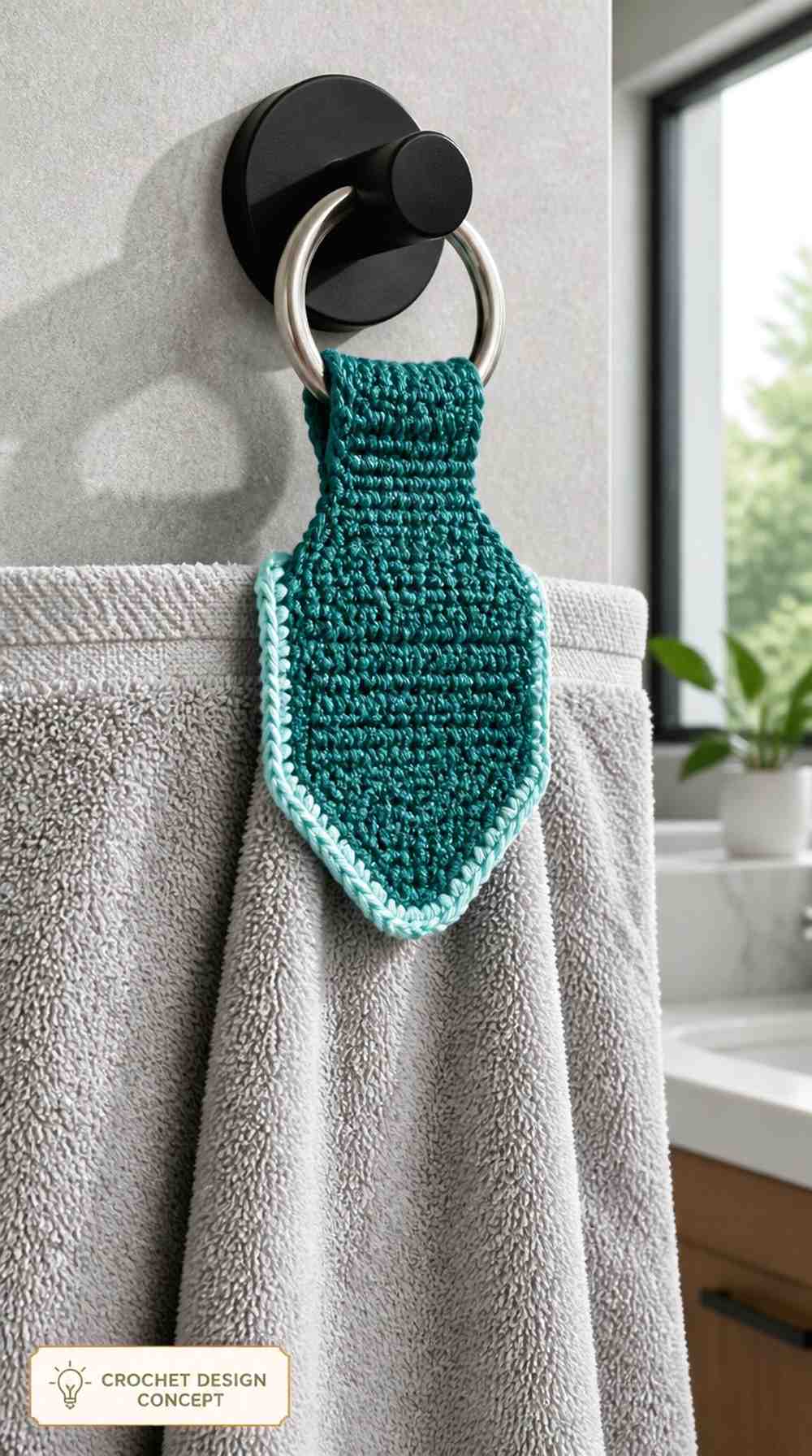
A broad teal-green crochet tab is sewn onto the upper hem of a pale-gray bath towel. At the top, a narrow teal crochet loop encloses a small stainless-steel ring, which hangs directly from a smooth black bathroom wall hook. Light-aqua edging finishes the lower tab.
Unlike the fully crocheted loops, this concept uses the metal ring as the contact point with the hook. The ring provides a defined opening, but it also adds hardware weight and an extra joining area.
- Ring selection: Choose a smooth, closed ring suitable for repeated damp exposure, without rough joins that could wear through the surrounding crochet.
- Ring enclosure: Reinforce the narrow teal loop holding the ring, checking that the yarn cannot slide apart or expose weak attachment stitches.
- Added hardware weight: Consider the weight of the ring alongside the wet towel, and make sure the wall hook and textile attachment are appropriately supported.
17. Crochet Plum Adjustable Two Hole Towel Loop
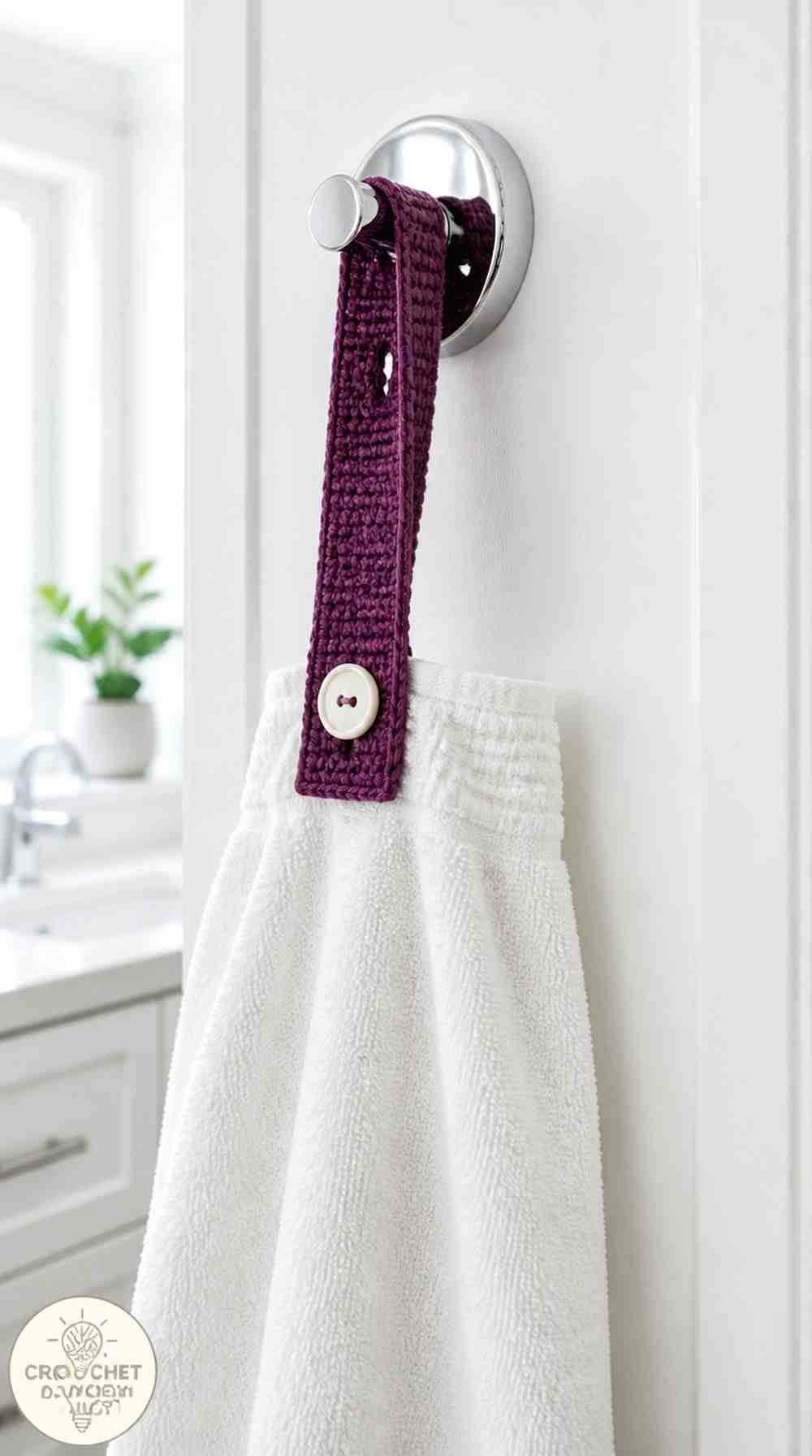
Plum-purple crochet creates a flat ribbed hanging strap with two reinforced buttonholes arranged near its free end. One buttonhole fastens onto a cream button attached to the broad plum reinforcement patch, leaving the second visible as an alternative fastening position.
This design provides two possible loop lengths rather than one permanently fixed opening. That flexibility could suit different bathroom pegs, provided both buttonholes are tested for a secure fit and the unused opening does not catch during handling.
- Two fastening positions: Test both buttonholes on the actual hook to confirm the shorter and longer loop arrangements remain stable.
- Button security: The cream button must be firmly attached to the reinforced base, particularly because either fastening position places tension on it.
- Unused opening: Keep the second buttonhole neatly finished so it does not stretch, catch or deform the strap while the other position is in use.
Practical Guide to Crochet Bath Towel Hook Saver Loops
A bath towel hook saver loop may look small, but it supports a much heavier item than a kitchen dishcloth. Its durability depends on the towel fabric, crochet yarn, attachment method and bathroom hook.
Check the towel first. Examine the upper hem or corner where you plan to attach the loop. Avoid sewing into fabric that is already worn, frayed or tearing. Repair or replace damaged fabric rather than covering a weak section with decoration.
Consider wet towel weight. Bath towels become noticeably heavier when wet, and pulling them off a hook can add extra strain. A decorative crochet loop should never be assumed strong enough based on its appearance. The attachment stitches and supporting towel fabric are just as important as the yarn.
Choose yarn with care. Smooth cotton or an appropriate washable cotton blend can be considered for hanging loops. Check the fiber label and test for stretch after washing. Very loose crochet, open lace and long narrow chains may not be suitable as the main structural hanger.
Match the hook shape. A narrow metal hook, rounded wall peg and thick decorative knob can require different loop openings. The towel should hang securely without the crochet being forced over sharp edges or overstretched around the support.
Attach the loop carefully. Use an appropriate sewing needle and strong, compatible thread. Reinforced hems, fabric backing patches and two-point attachment areas may be helpful depending on the towel construction. Do not force a large crochet hook through dense terry fabric, as this can damage the towel’s threads.
Keep the towel able to dry. The hanging loop should not bunch the towel into a tightly folded mass against the wall. Allow the towel to hang freely with enough airflow, and wash and dry the attached loop according to the materials used.
For more ideas about attaching crochet to towels, see 24 Crochet Kitchen Towel Topper Ideas for Cozy Cottage Kitchens on Yarn Nest Studio. That collection focuses on smaller kitchen towels and holders, so any method adapted to a heavier bath towel needs additional strength and fit checks.
Want to Make Something Similar?
These 17 designs are inspiration concepts, not tested patterns. The following real crochet resources explain related hanging-loop and towel-attachment techniques.
- The Romantic Towel Hanging Loop — Milla Billa: A free crochet guide for making a decorative hanging loop and sewing it onto a towel. The creator specifically recommends secure stitching because wet towels become heavy. Milla Billa
- Flower Crochet Towel Topper Pattern — You Should Craft: A free crochet pattern that includes a hanging loop, buttonhole and flower-shaped topper. It offers useful techniques for exploring the sunflower and buttoned concepts, although it is not an exact pattern for these bath towel designs. You Should Craft
These resources are useful starting points for crochet construction, but their examples and materials should not be assumed adequate for every bath towel. Check the actual towel weight and attachment before regular use.
Which Crochet Bath Towel Hook Saver Loop Should You Choose?
| Your priority | Design to consider | Main trade-off |
|---|---|---|
| Simple replacement loop | Oatmeal Double Strap | Requires secure two-point sewing |
| Openable fastening | Sage Buttoned Replacement | Button and buttonhole need care |
| Broad hem reinforcement | Navy Saddle Patch | Adds thickness to the towel edge |
| Small corner attachment | Terracotta Corner Triangle | Needs sound corner fabric |
| Wide crochet loop | Cream Ladder Rib | Rib tension must remain even |
| Decorative scalloped finish | Blush Scalloped Loop | Edging can catch if too loose |
| Rounded hanging cord | Charcoal Corded Loop | Narrow cord ends need reinforcement |
| Floral bathroom accent | Mustard Sunflower | Decorative petals require secure stitching |
| Snap closure | Slate Snap Strap | Hardware and backing add complexity |
| Two spaced attachment points | Lavender Twin Anchor | Requires careful alignment |
| Simple foldover button tab | Mint Foldover Buttonhole | Opening may stretch |
| Botanical reinforcement patch | Olive Leaf Backed Loop | Shaped edges need flat sewing |
| Braided crochet appearance | Coral Braided Strap | Multiple strand ends must be secured |
| Crochet with fabric backing | Cocoa Tubular Loop | Mixed materials need matching care |
| Toggle closure | Sand Corner Wrap | Wooden hardware may complicate washing |
| Metal ring support | Teal Ring Assisted | Additional hardware and joining area |
| Adjustable fastening length | Plum Two Hole Loop | Both openings need a secure fit |
For a simple replacement idea, the Crochet Oatmeal Double Strap Towel Loop offers a compact design without extra hardware. If a towel needs a broader attachment area, the Crochet Navy Saddle Patch Towel Hanger provides a different approach, although the condition of the towel fabric still matters.
The Crochet Sage Buttoned Replacement Towel Loop and Crochet Plum Adjustable Two Hole Towel Loop are worth considering for people who prefer openable loops. For decorative bathroom styling, the sunflower, scalloped and leaf-backed concepts bring more personality to the attachment.
Conclusion
These 17 crochet bath towel hook saver loop inspiration ideas show how a small hanging attachment can be adapted to different towel styles and bathroom hooks. Some use simple straps and reinforced patches, while others introduce braided cords, decorative flowers, adjustable buttonholes or metal rings.
The most important consideration is not how the loop looks but how securely it attaches to the towel and how well it supports the fabric during everyday use. Choose a design that fits the hook, works with the towel’s hem and can withstand the intended laundering routine.
Which crochet towel hanging loop would you choose for your bathroom? Do you prefer a simple reinforced strap, an adjustable buttoned loop or a decorative sunflower design? Share your favorite idea and the kind of towel hook you use at home.
Frequently Asked Questions
1. Can I add a crochet hanging loop to a bath towel that has no loop?
Yes, it is possible to add a separately made crochet hanging loop to a towel, provided the fabric is suitable for sewing and the attachment is properly reinforced. The towel’s weight, especially when wet, must be considered. A weak or damaged hem should be repaired or replaced rather than relied upon to support a new loop.
2. What yarn is suitable for crochet bath towel hanging loops?
A smooth, washable cotton yarn or appropriate cotton blend is worth considering because it can be worked into a dense, relatively firm strap. However, fiber content alone does not guarantee strength. Test the chosen crochet fabric for stretching after laundering, and avoid relying on loose decorative chains or fragile openwork as the main supporting structure.
3. Should I sew the crochet loop directly onto the towel or use a reinforcement patch?
Both methods are possible, depending on the towel and the loop design. A small loop may be attached to a sound, reinforced hem using suitable sewing methods. A broad patch can provide more area for stitching, but it does not repair damaged towel fabric automatically. The attachment must be checked under the actual towel load before use.
4. Can I wash a bath towel with a crochet hanging loop attached?
That depends on the yarn, thread, fastenings and towel-care instructions. A simple cotton crochet loop attached with compatible washable thread may be easier to maintain than a design containing a wooden toggle or delicate decorative petals. Check all material labels, use a suitable laundering method and inspect the attachment for loosening after washing.
5. Are these 17 crochet bath towel hook saver loops actual patterns?
No. These are visual inspiration ideas showing possible hanging-loop shapes, colors, reinforcement patches and fastenings. They are not tested patterns or guarantees of load-bearing performance. The linked tutorials demonstrate related techniques, but you should adapt any construction to your actual towel and hook, using suitable materials and secure sewing before regular use.