A crochet entryway shoe horn hanging sleeve gives an everyday shoe accessory a neat place beside the front door. Instead of leaving a shoehorn loose on a shelf or hidden in a drawer, these 16 inspiration ideas explore narrow hanging pockets, buttoned wraps, reinforced wall organizers, lined cases and compact travel holders. Soft oatmeal, sage, terracotta, navy, cream and teal bring different handmade looks to an entryway storage accessory.
Whether you use a short metal shoehorn or a longer wooden one, choosing a suitable crochet sleeve depends on the tool’s length, curved shape and weight. Some designs cover the lower working blade while leaving the handle accessible, and others combine a protective lining with hanging straps or wall-mounted pockets. This collection helps you compare storage arrangements, attachment methods, crochet textures and everyday convenience before planning a version for your home.
These are AI-generated crochet design visualizations for inspiration, not photographs of tested handmade pieces or step-by-step patterns.
Quick Design Selection Guide
- For simple everyday storage: Choose the Crochet Oatmeal Ribbed Shoehorn Pocket or Crochet Olive Leaf Shoehorn Hanging Sleeve.
- For adjustable access: Explore the Crochet Sage Buttoned Shoehorn Wrap and Crochet Mustard Lace Up Shoehorn Sleeve.
- For longer shoehorns: The Crochet Navy Long Shoehorn Hanging Sleeve and Crochet Teal Double Band Shoehorn Keeper offer extended vertical storage.
- For a shorter metal shoehorn: Consider the Crochet Terracotta Rounded Shoehorn Cup or Crochet Cocoa Felt Lined Shoehorn Pouch.
- For decorative entryway styling: The Crochet Blush Scalloped Shoehorn Pocket and Crochet Cream Granny Square Shoehorn Holder add distinctive details.
- For a shared shoe-care station: The Crochet Sand Shoehorn and Brush Twin Pocket offers separate compartments for two accessories.
1. Crochet Oatmeal Ribbed Shoehorn Pocket
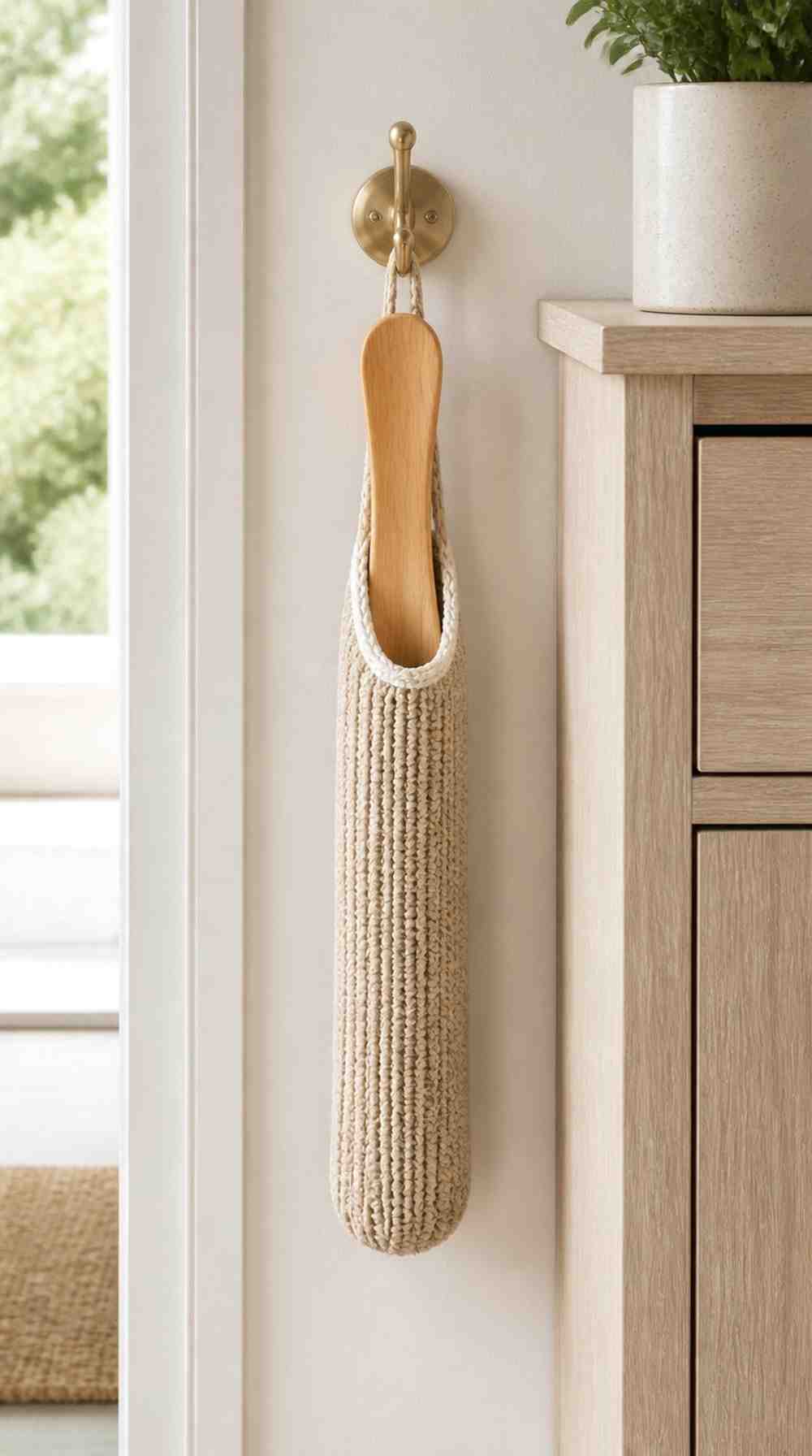
Warm oatmeal-beige crochet creates a slim vertical storage pocket with dense ribbed stitches, cream edging and a softly rounded lower end. A natural-wood shoehorn sits upright inside, with its smooth spoon-shaped blade covered and curved handle extending above the opening. A reinforced rear loop hangs from a brass wall hook.
The simple design suits an entryway where storage should remain neat without adding much decoration. Its narrow body makes the shoehorn easy to see and retrieve, although the opening needs to be sized for the tool’s widest section.
- Pocket depth: Allow the wooden blade to rest securely inside the closed lower section while keeping enough of the curved handle visible for comfortable removal.
- Ribbed structure: Close vertical stitches can create a tidy appearance, but excessive stretching may cause the pocket to sag over time.
- Hook support: Reinforce the oatmeal hanging loop and choose a securely mounted hook appropriate for the shoehorn and crochet holder’s combined weight.
2. Crochet Sage Buttoned Shoehorn Wrap
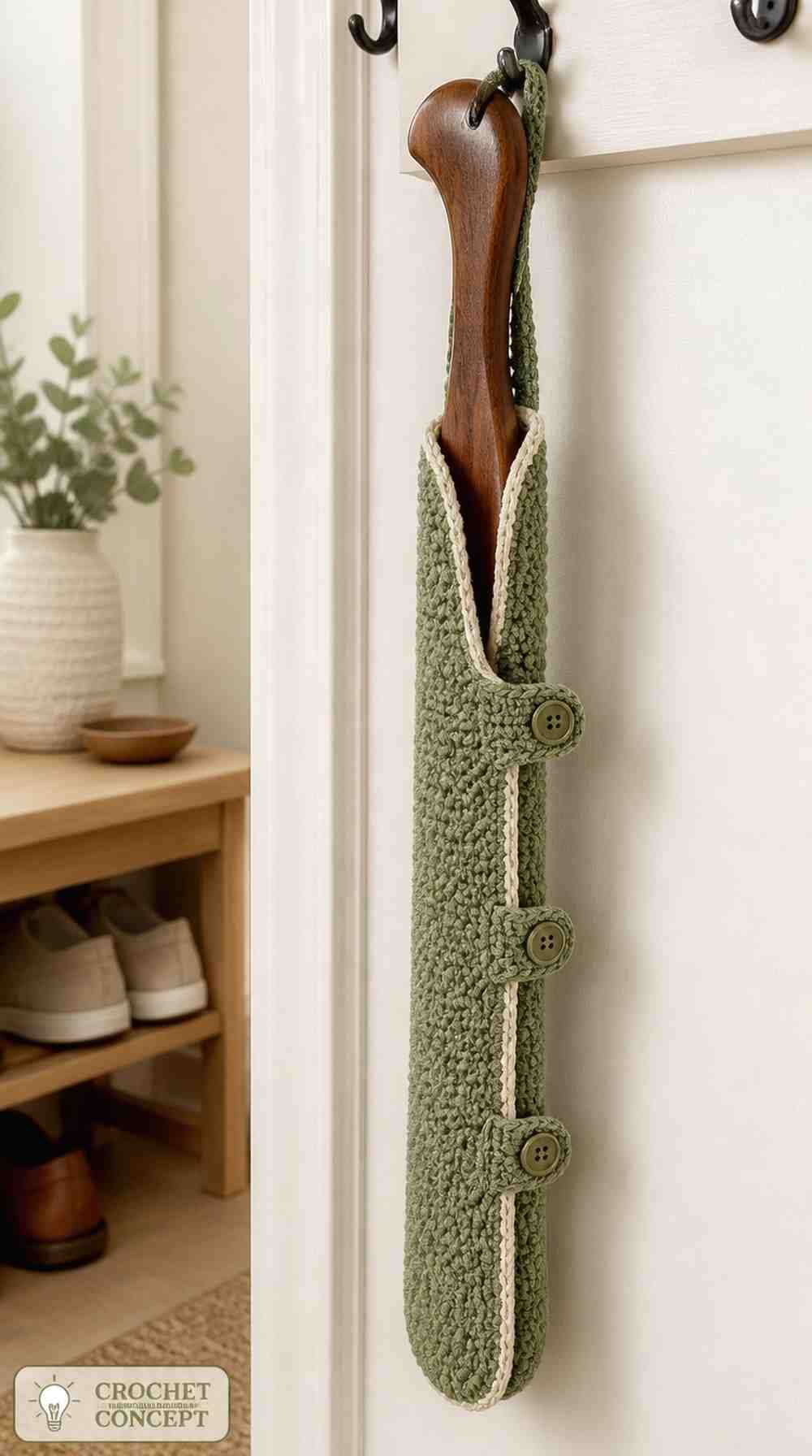
Muted sage-green crochet forms a long wrap with a soft moss-stitch texture and narrow cream edging. Three short sage straps fasten with small buttons along the front, holding the lower section of a walnut-brown wooden shoehorn. Its curved handle remains exposed above the wrap.
The buttoned arrangement makes this concept different from a permanently closed sleeve. It allows the crochet exterior to open for easier cleaning and fitting, although the extra fastenings introduce more details that need careful positioning.
- Button spacing: Position the three front tabs around the actual wooden shoehorn, ensuring the wrap closes without squeezing or bending the tool.
- Easy opening: Keep the small buttons accessible while the holder is hanging, especially if the shoehorn has a broad working blade.
- Moss-stitch fit: Use consistent stitch tension so the front panels meet neatly without creating large gaps or twisting around the wooden shaft.
3. Crochet Terracotta Rounded Shoehorn Cup
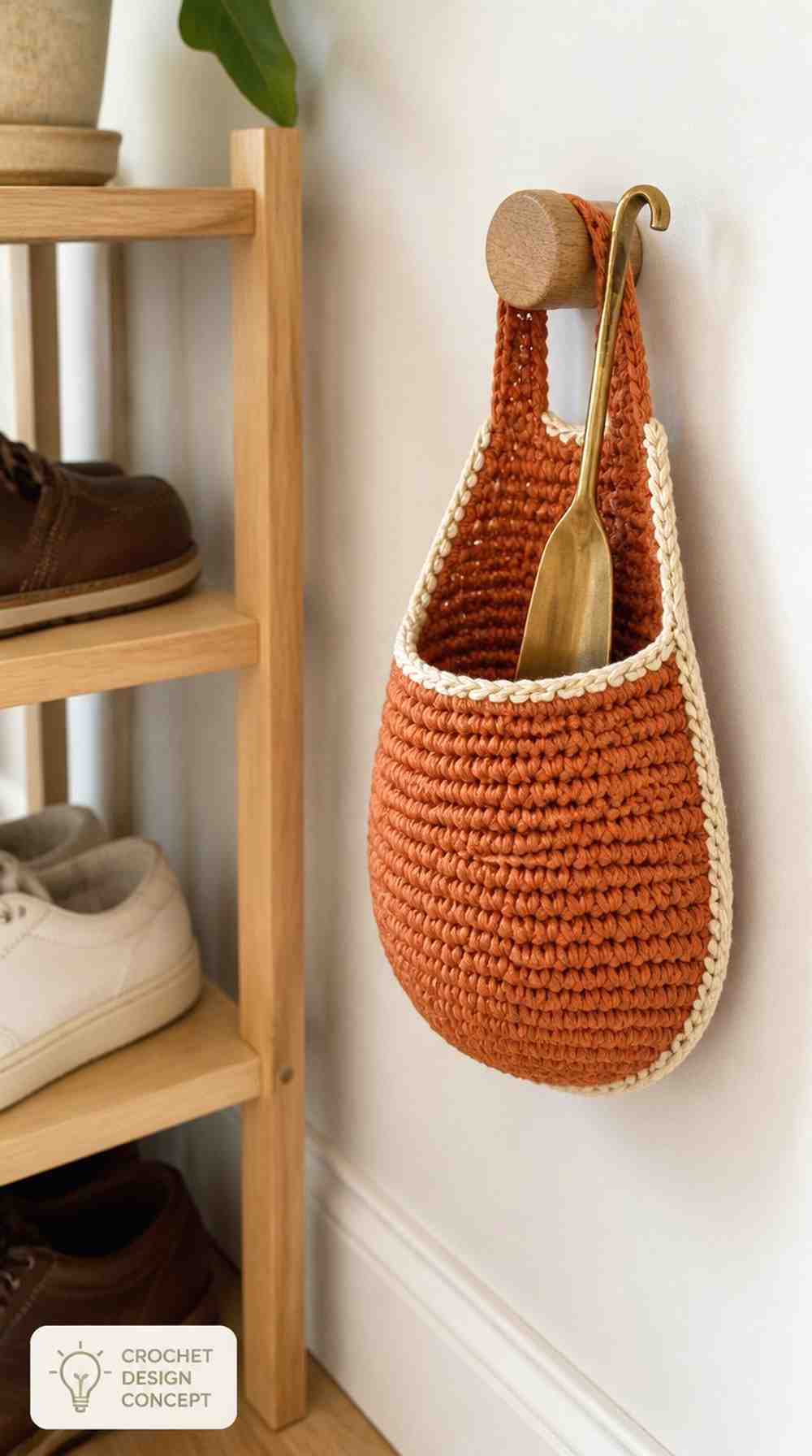
Terracotta-orange crochet forms a compact hanging pocket with a broad rounded bottom and gently tapered upper opening. Cream edging outlines the shape, while two short terracotta attachment tabs meet around an oak wall peg. A short brass-colored shoehorn sits inside with its handle visible above the rim.
The rounded cup-style pocket is particularly interesting for smaller shoehorns. Its wider lower body provides room for the curved metal blade, while the relatively compact length keeps the accessory close to the wall.
- Rounded base: Shape the lower pocket around the metal blade without leaving so much empty space that the shoehorn tips sideways.
- Two attachment tabs: Keep both terracotta straps evenly tensioned around the peg so the pocket hangs straight rather than rotating.
- Metal contact: Check that the crochet and seams do not contain rough decorative elements that could rub against polished metal finishes.
4. Crochet Navy Long Shoehorn Hanging Sleeve
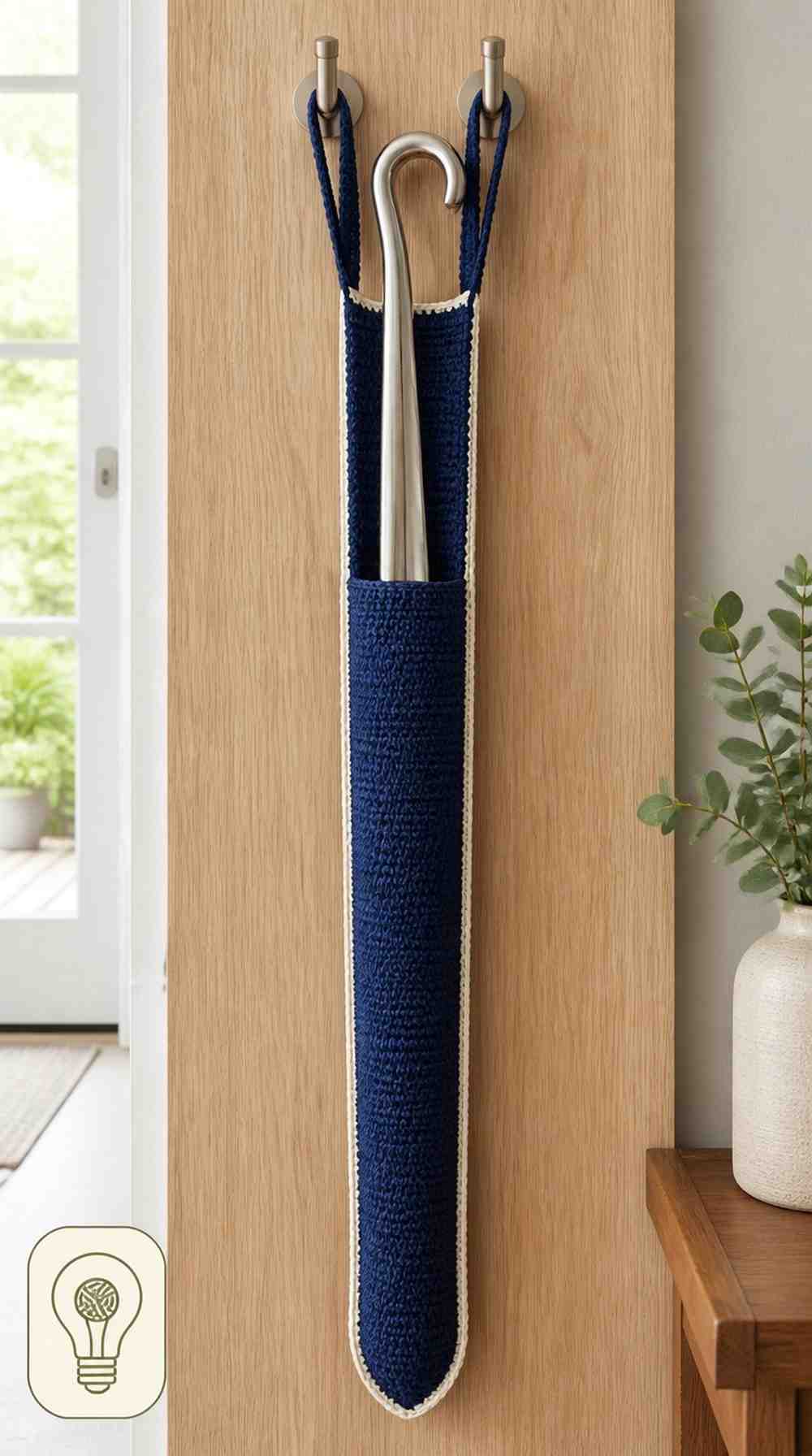
Deep navy-blue crochet creates a tall, narrow storage sleeve with horizontal rib rows and a cream border. Two reinforced upper loops hang from separate brushed-nickel hooks, while a long stainless-steel shoehorn rests vertically inside. Its curved handle remains clearly visible above the pocket.
This design focuses on storing a long shoehorn without leaning it against the wall or leaving it on the floor. The double-hook arrangement is distinctive because it spreads the upper attachment across two supported points.
- Full-length support: Measure the long metal shoehorn before planning the pocket, allowing the lower blade to settle inside without forcing the tip against the bottom seam.
- Two-hook alignment: Position the wall hooks at the same height so both navy suspension loops share the weight without pulling the sleeve sideways.
- Wall clearance: Keep the stored shoehorn away from door movement, electrical switches and places where someone may accidentally catch the exposed handle.
5. Crochet Blush Scalloped Shoehorn Pocket
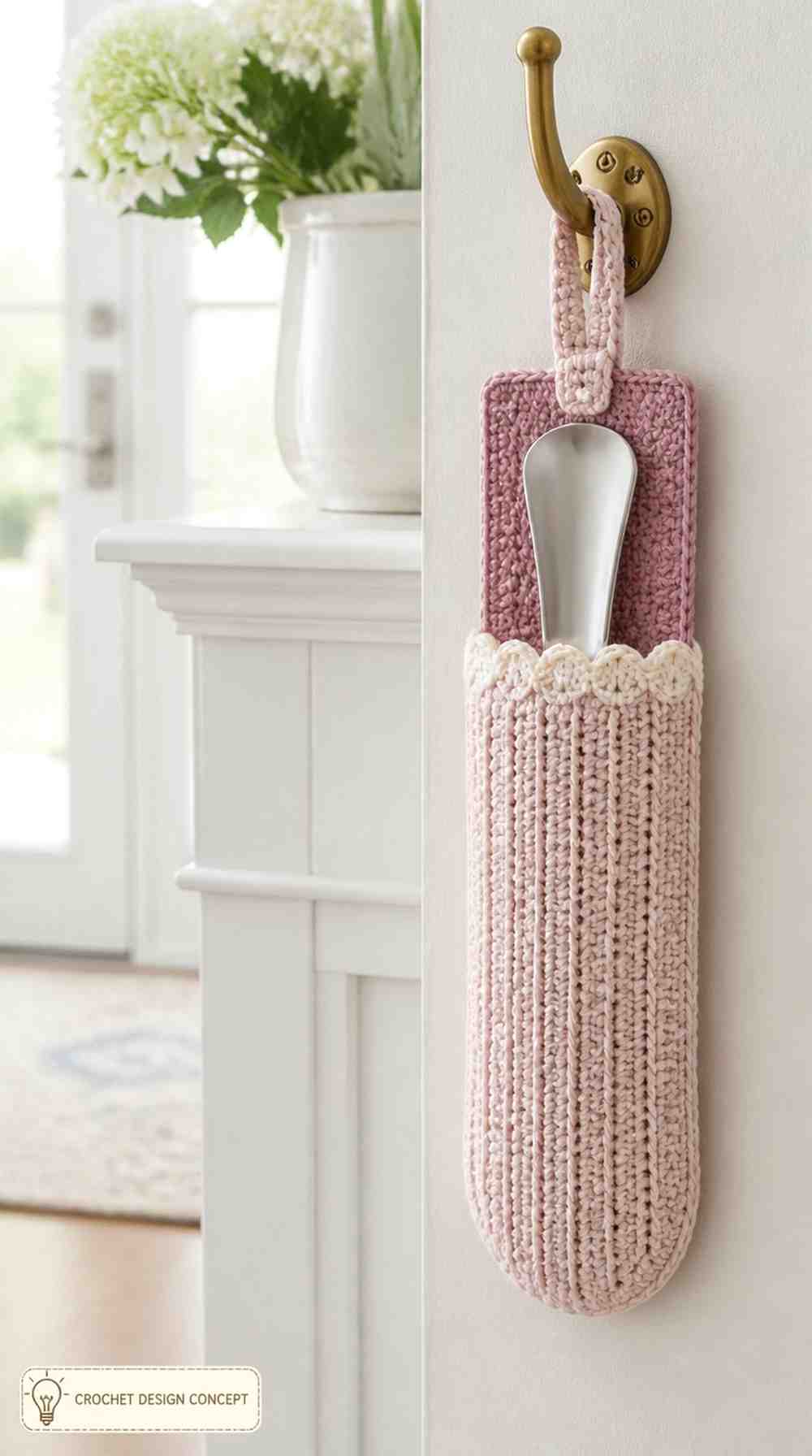
Pale-blush crochet forms a slim rounded pocket with close vertical stitches and delicate cream scallops along its upper opening. A dusty-rose backing tab supports the hanging loop, while a short satin-finished silver shoehorn rests inside with its narrow handle extending above the decorative rim.
The shallow scalloped edge gives this concept a softer look than a straight-sided utility sleeve. The decoration remains close to the opening, making the design relatively compact while still introducing a visible crochet detail.
- Scalloped opening: Keep the cream scallops small enough that the silver shoehorn can be removed without catching them along its handle or blade.
- Backing reinforcement: Secure the dusty-rose attachment tab across a suitable area of the pocket rather than depending on the decorative edging.
- Short-tool sizing: Avoid making the sleeve unnecessarily deep, as a short shoehorn could disappear below the opening and become awkward to retrieve.
6. Crochet Charcoal Ring Hanging Shoehorn Case
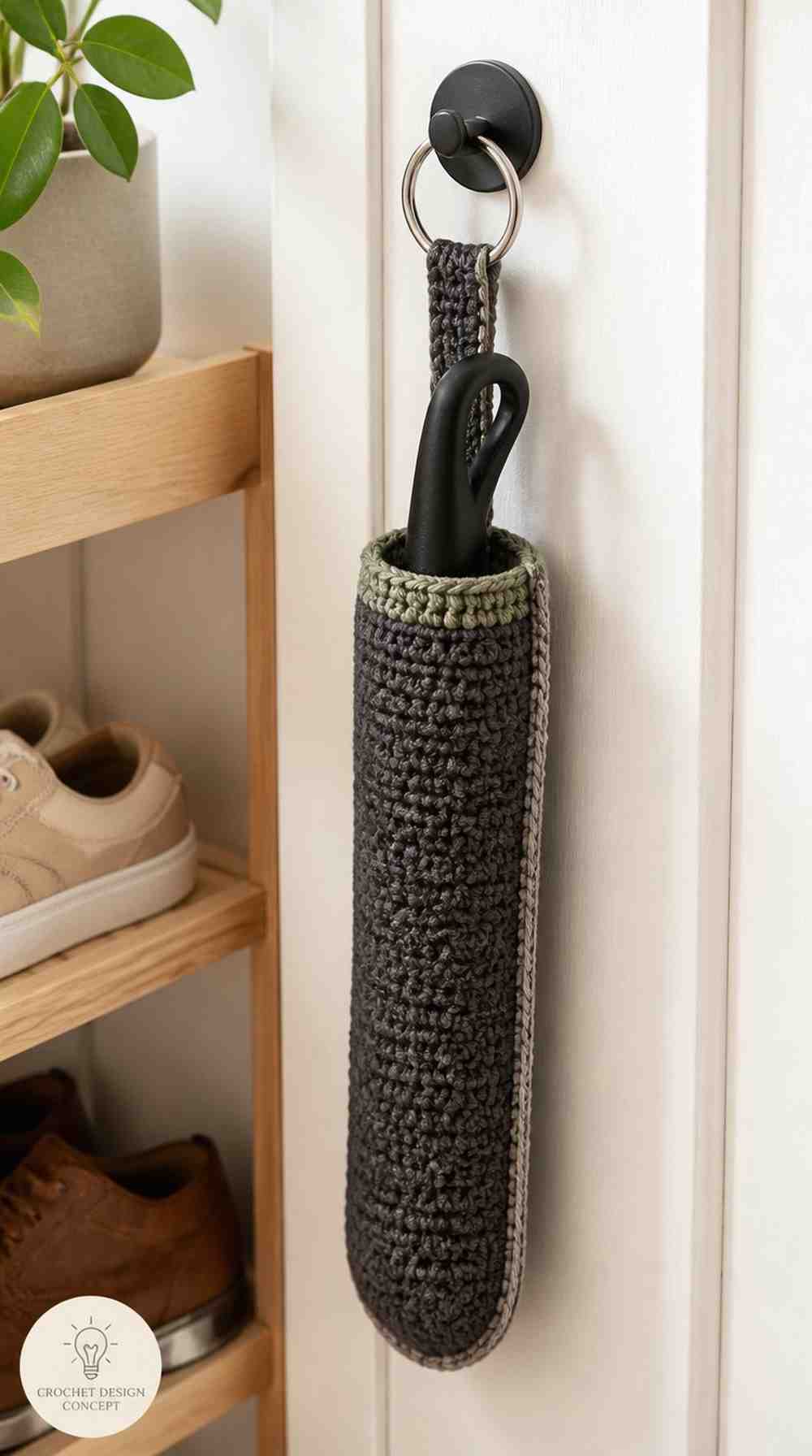
Charcoal-gray crochet gives this narrow case a basketweave-textured surface and gently tapered closed bottom. A muted-sage reinforced upper edge frames the opening, while a short doubled crochet tab holds a stainless-steel ring above the case. A smooth black shoehorn rests inside.
The metal ring creates a defined hanging point instead of relying only on a crochet loop. This may be useful for an entryway hook with a rounded shape, although the ring and its textile attachment require appropriate reinforcement.
- Ring attachment: Secure the charcoal tab firmly around a smooth closed ring, avoiding rough metal joins that could wear through the yarn.
- Basketweave thickness: Keep the textured crochet relatively flexible so it does not form bulky pressure points against the stored black shoehorn.
- Hanging balance: Position the ring above the pocket’s center so the case remains upright instead of leaning toward one side.
7. Crochet Mustard Lace Up Shoehorn Sleeve
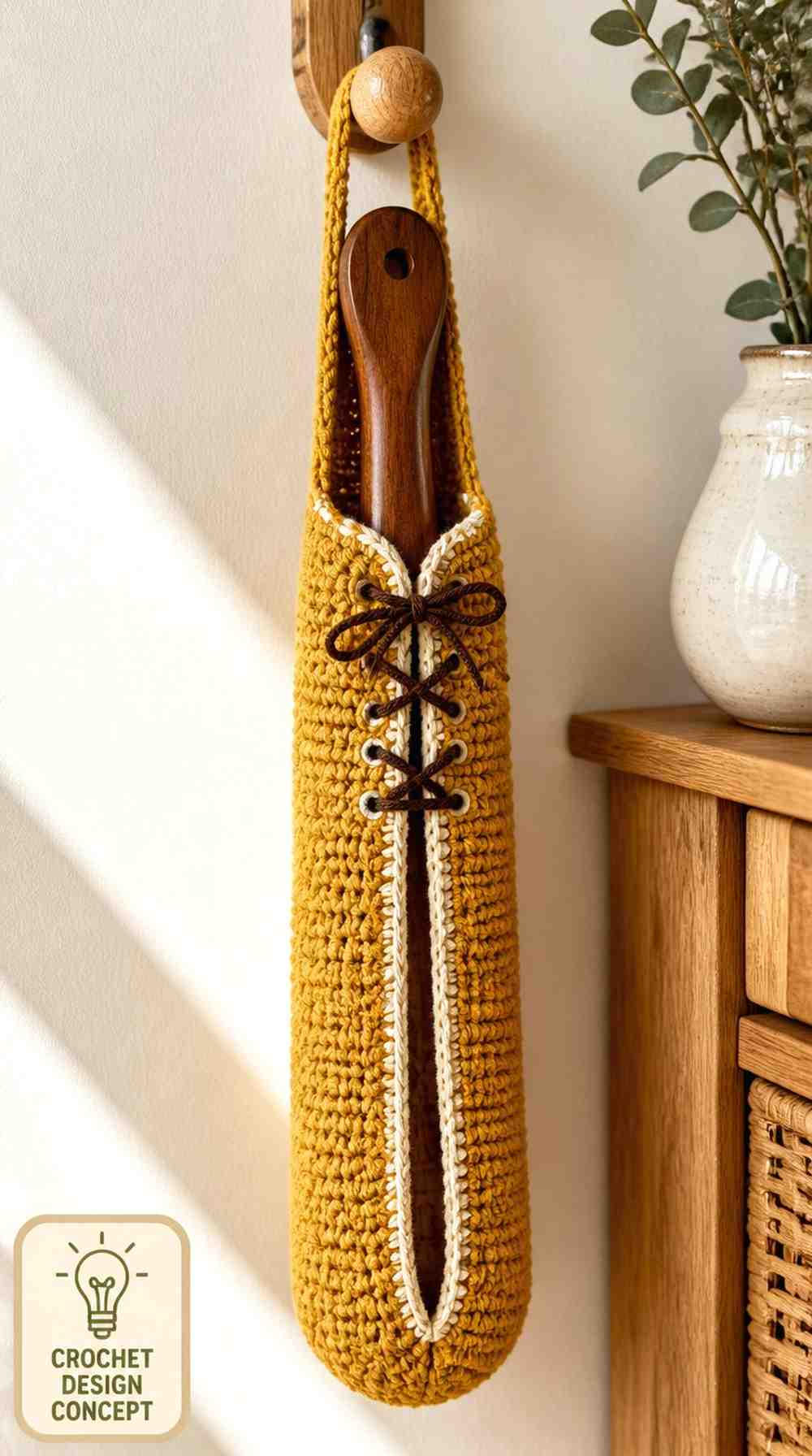
Mustard-yellow crochet forms a long storage sleeve with a solid back and two split front panels edged in cream. A short cocoa-brown cotton cord crosses through reinforced eyelets, creating an adjustable lace-up opening around a dark wooden shoehorn. A small bow sits near the upper front.
The lace-up feature gives the holder a different appearance from buttoned and slip-in pockets. It also introduces a way to adjust the fit, although the lacing should remain easy to loosen rather than being tied tightly around the tool.
- Lacing tension: Keep the cocoa cord snug enough to hold the front panels together without compressing the shoehorn or distorting the crochet backing.
- Eyelet reinforcement: Strengthen the small openings where the cord passes through, since repeated tightening can stretch individual stitches.
- Loose ends: Tie the upper bow neatly and keep its ends short enough that they do not drag against shoes or neighboring entryway items.
8. Crochet Lavender Side Zip Shoehorn Case
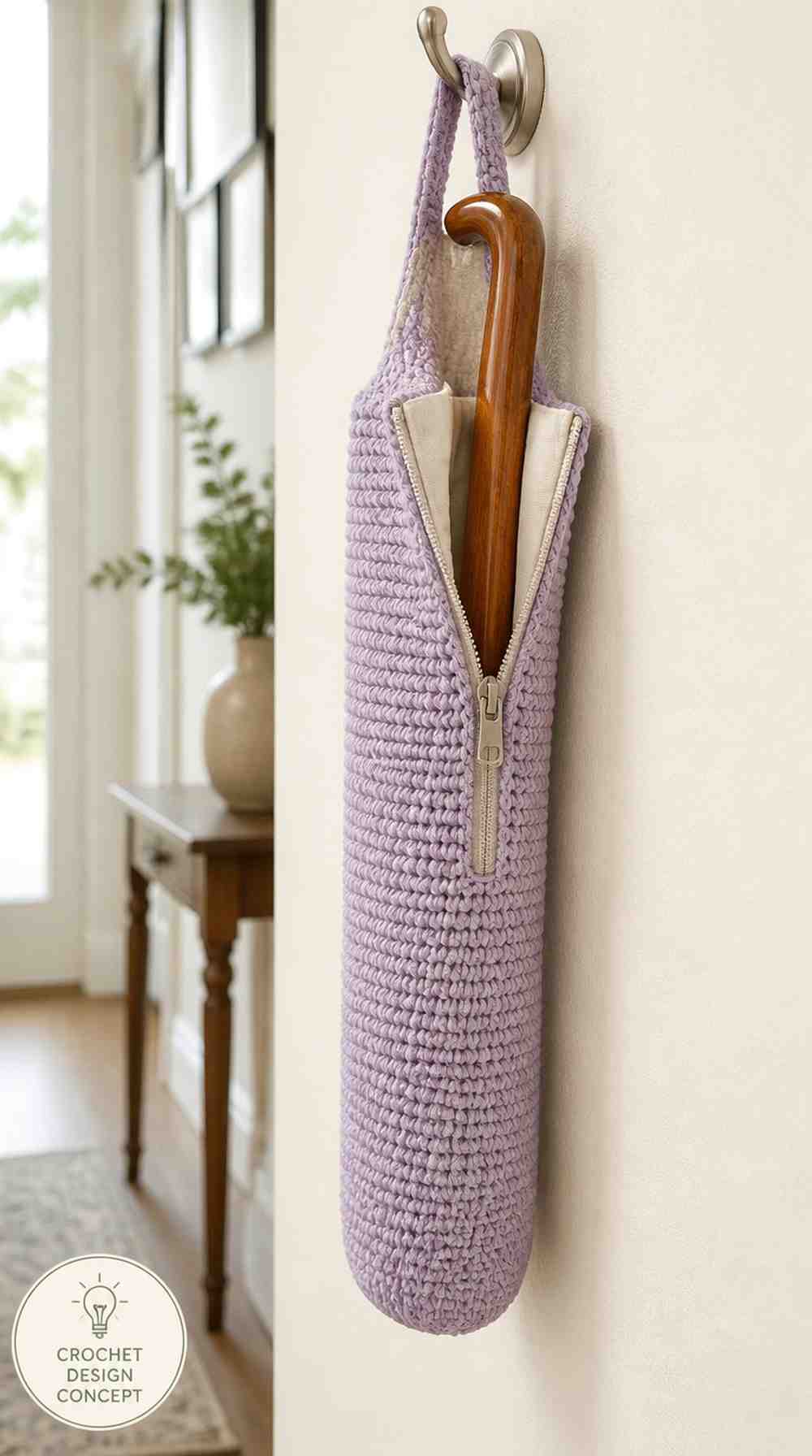
Dusty-lavender crochet forms a long narrow hanging case with dense horizontal rows and cream fabric lining. A short silver zipper runs down the upper side, allowing the case to open around a polished wooden shoehorn. Its curved handle extends beyond the reinforced top opening.
The side zipper offers a more enclosed storage style than an open slip pocket. Its lining also adds a separate surface between the shoehorn and the crochet, although the zipper needs enough clearance to avoid contacting the wooden finish.
- Zipper position: Keep the silver teeth and pull away from the polished shoehorn’s working surface, particularly near the curved blade.
- Lining fit: The ivory fabric should remain smooth inside the lavender case without folding into the side opening.
- Removal access: Test the zipper and top opening together so the shoehorn can be lifted without dragging against the fastening.
9. Crochet Cream Granny Square Shoehorn Holder
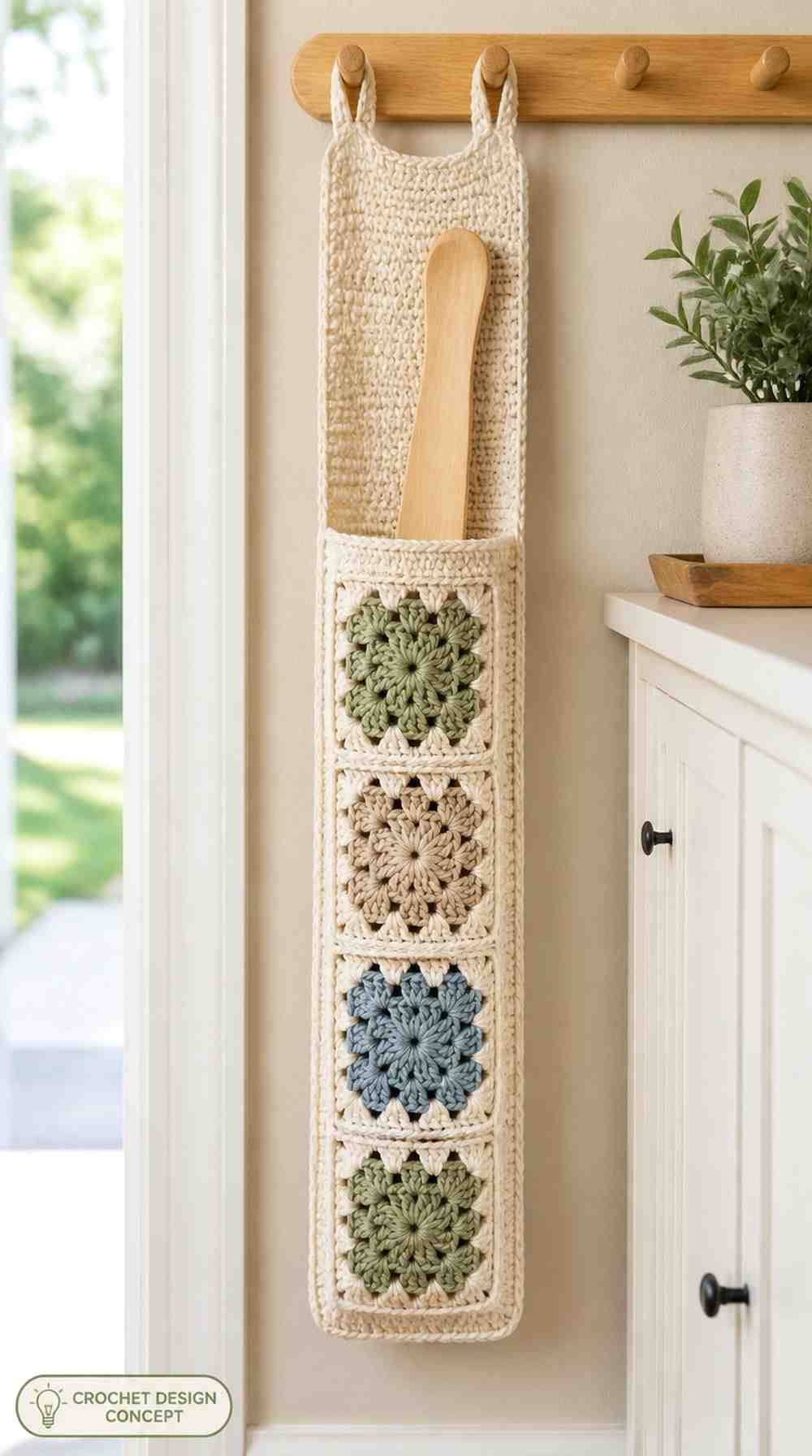
Cream crochet creates a tall wall organizer with a solid rectangular backing and a deep narrow pocket. Four small granny squares decorate the front in muted sage, oatmeal and dusty-blue tones. Two reinforced upper loops attach the organizer to an oak peg rail.
The stacked squares give this design a patchwork appearance without relying on large openings in the storage pocket. A pale wooden shoehorn sits vertically inside, leaving its handle exposed for easy removal.
- Granny-square seams: Join the four decorative squares closely so their edges remain flat and do not catch the shoehorn during insertion.
- Solid backing: Use a firm rear panel beneath the decorative pocket to help maintain the tall shape when the wooden shoehorn is stored.
- Peg spacing: Keep the two upper loops aligned with the available wall pegs so the organizer hangs evenly.
10. Crochet Olive Leaf Shoehorn Hanging Sleeve
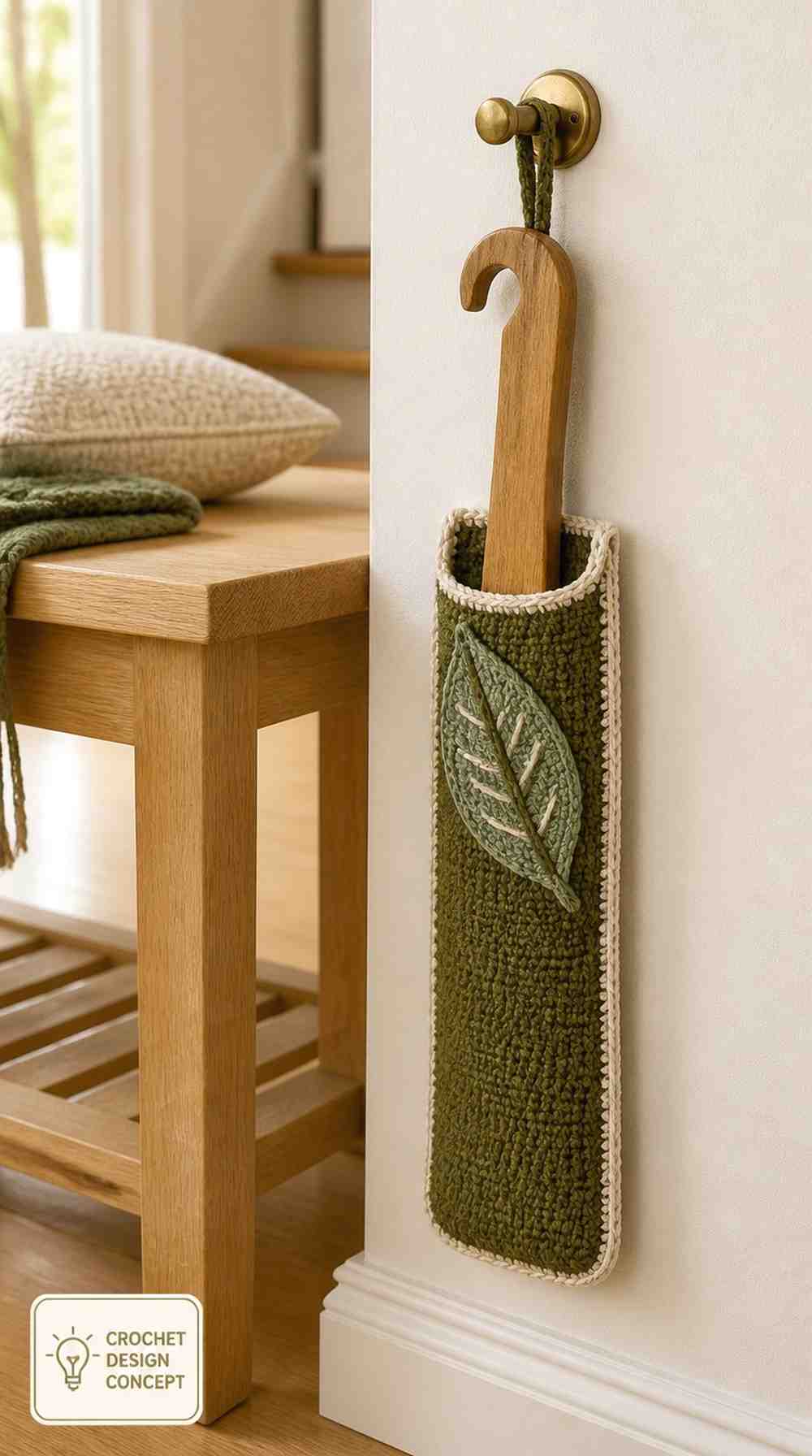
Olive-green crochet forms a slim vertical sleeve with close horizontal stitches, softly rounded lower corners and cream edging. A flat sage-green leaf applique decorates the upper front, with dark-olive and cream vein details. A natural-wood shoehorn sits inside, its curved handle rising above the opening.
The leaf motif gives the storage sleeve a botanical appearance without changing its basic function. Its decorative placement near the upper front makes it visible while the shoehorn is stored, provided the applique stays clear of the opening.
- Leaf placement: Keep the sage applique flat and away from the path of the shoehorn handle to reduce snagging.
- Rounded corners: Shape the lower pocket to support the wooden blade without leaving large gaps where the tool can shift.
- Decorative stitching: Secure the darker olive and cream veins carefully so loose yarn tails do not catch against the stored shoehorn.
11. Crochet Mint Lattice Lined Shoehorn Pocket
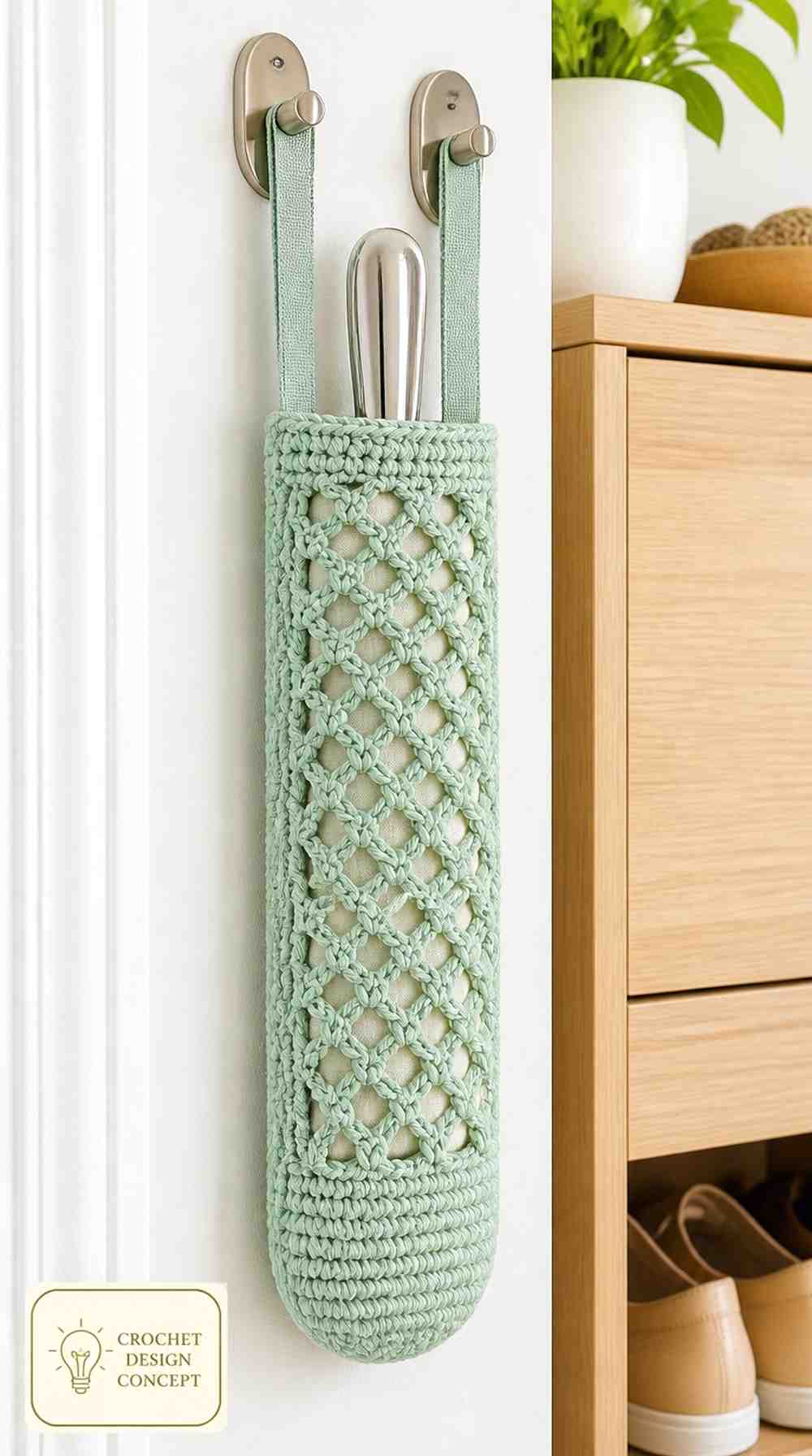
Sea-glass mint crochet creates a narrow hanging pocket with solid side seams, a rounded lower base and small diamond-lattice openings across the front. A cream cotton fabric lining sits behind the openwork, while two mint hanging tabs attach to separate silver wall hooks.
The lattice offers a lighter decorative appearance than a solid crochet sleeve. The cream lining is an important part of the visual concept because it separates the open stitches from the polished silver shoehorn stored inside.
- Lattice spacing: Keep the mint diamond openings evenly sized so the front panel remains stable instead of stretching around the metal tool.
- Fabric backing: Secure the cream lining smoothly behind the openwork, preventing the shoehorn blade from catching between crochet loops.
- Lining access: Consider a removable lining if the pocket needs regular cleaning, but ensure it cannot slide out when the shoehorn is lifted.
12. Crochet Cocoa Felt Lined Shoehorn Pouch
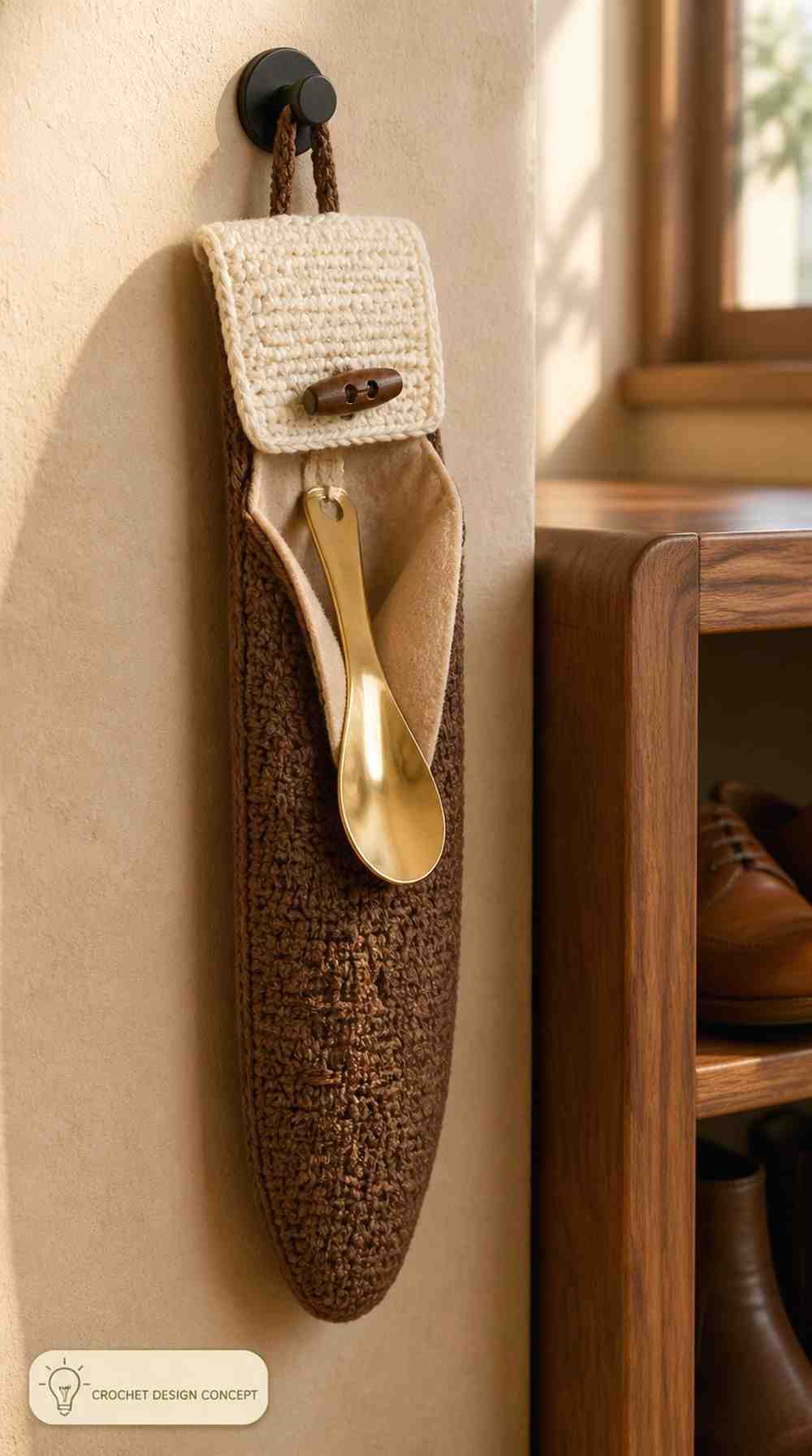
Cocoa-brown crochet creates a long storage pouch with shallow basketweave texture and a gently tapered lower end. A broad cream foldover flap closes with a wooden toggle, while beige felt lining surrounds the polished brass-colored shoehorn inside.
This design emphasizes a soft interior and a more enclosed shape. It could suit a short decorative shoehorn kept near a dressing bench, although the felt lining and wooden hardware introduce separate cleaning considerations.
- Felt lining: Choose a smooth, clean material that will not shed excessively or trap grit against the polished shoehorn.
- Toggle fastening: Position the wooden toggle on the outside, away from the metal blade and its working edge.
- Enclosed storage: Allow enough interior room for the curved blade without forcing it into the tapered lower end.
13. Crochet Teal Double Band Shoehorn Keeper
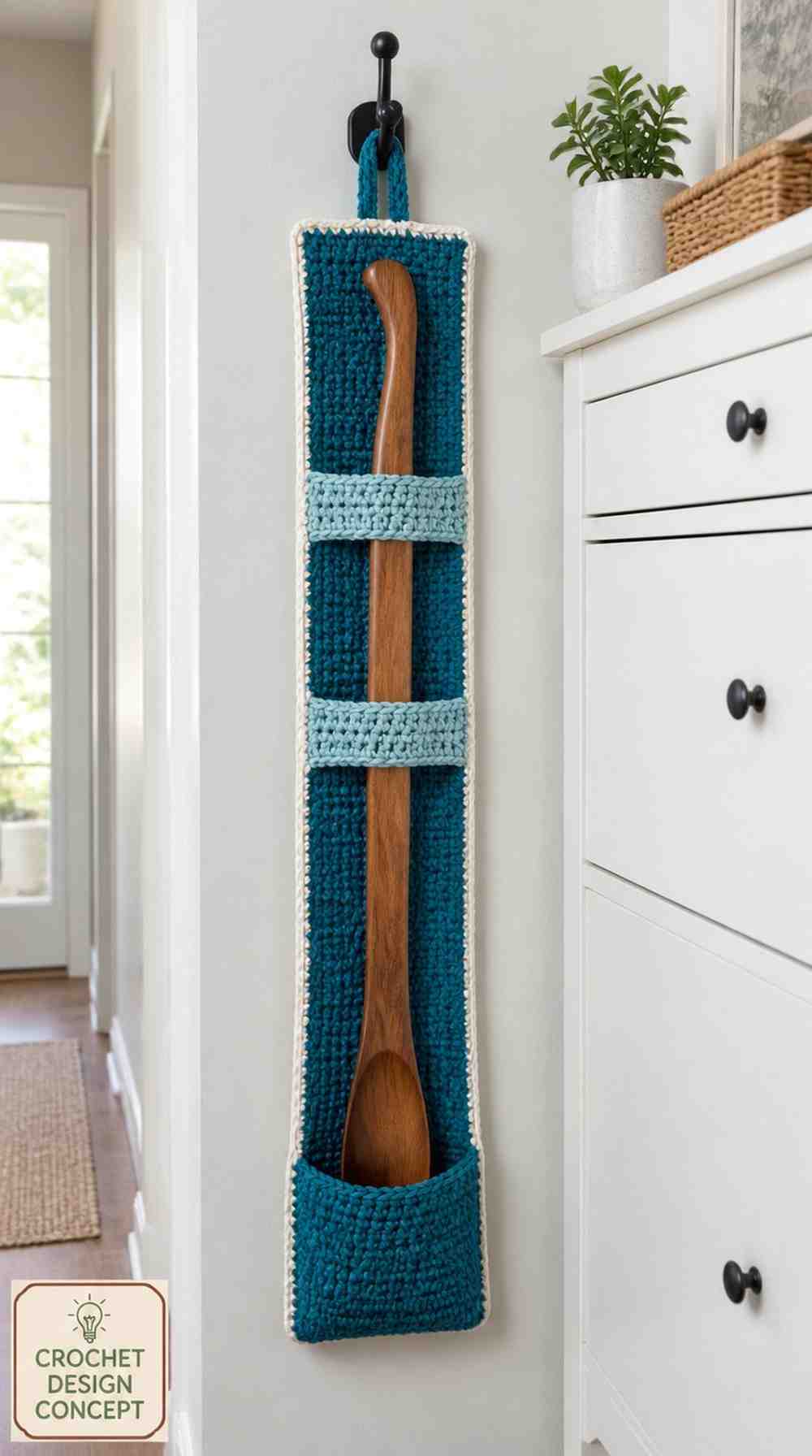
Teal-green crochet forms a long rectangular wall backing with a shallow closed pocket at its lower end. Two broad pale-aqua crochet bands sit farther up the panel, holding the shaft of a walnut-wood shoehorn upright while its spoon-shaped blade rests in the bottom pocket.
The open-band arrangement leaves much of the shoehorn visible. It offers a different style of storage from a full-length sleeve and may suit someone who wants to identify and remove the tool quickly.
- Band spacing: Place the two pale-aqua bands far enough apart to support the shaft without allowing it to tilt or twist.
- Lower pocket: The shallow teal cup should contain the shoehorn’s working end while leaving enough clearance for easy removal.
- Backing support: Reinforce the top hanging loop and check that the long panel does not stretch excessively under the stored tool.
14. Crochet Rust Roll Up Travel Shoehorn Wrap
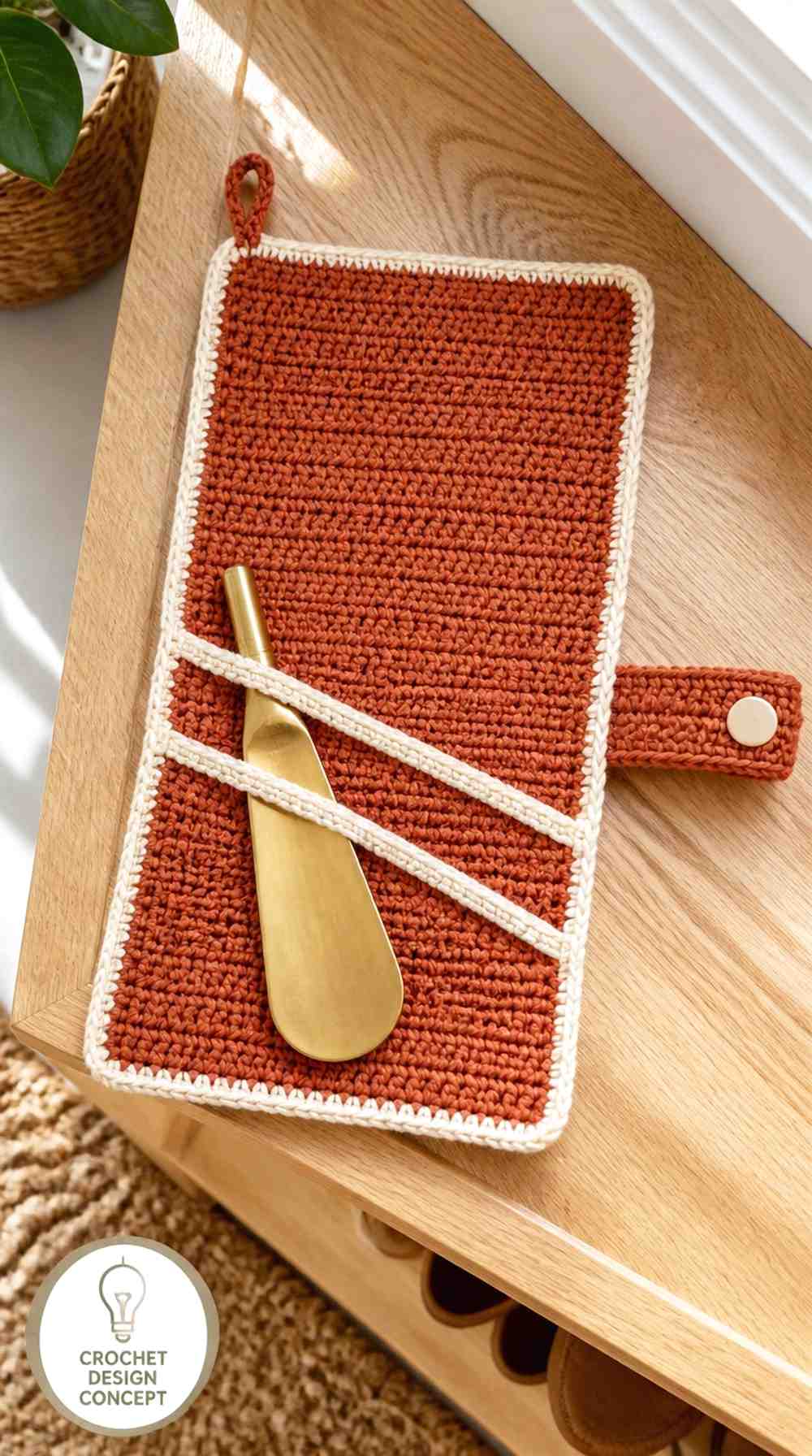
Rust-orange crochet forms a flat rectangular travel wrap with close horizontal rows and cream edging. Two diagonal cream retaining straps hold a short brass-colored shoehorn against the inner surface. A terracotta outer strap with a cream snap closes the wrap when folded.
Unlike the wall-mounted ideas, this concept is designed around compact storage. It could be explored for a small travel shoehorn kept inside a clean luggage compartment, although the metal edges should not be allowed to press against neighboring belongings.
- Travel fit: Measure the short shoehorn before planning the wrap so its curved working edge remains inside the closed crochet panel.
- Retaining straps: Position both cream bands to hold the tool securely without bending or scratching its polished surface.
- Snap clearance: Keep the cream snap outside the metal-contact area and test the folded thickness before packing.
15. Crochet Sand Shoehorn and Brush Twin Pocket
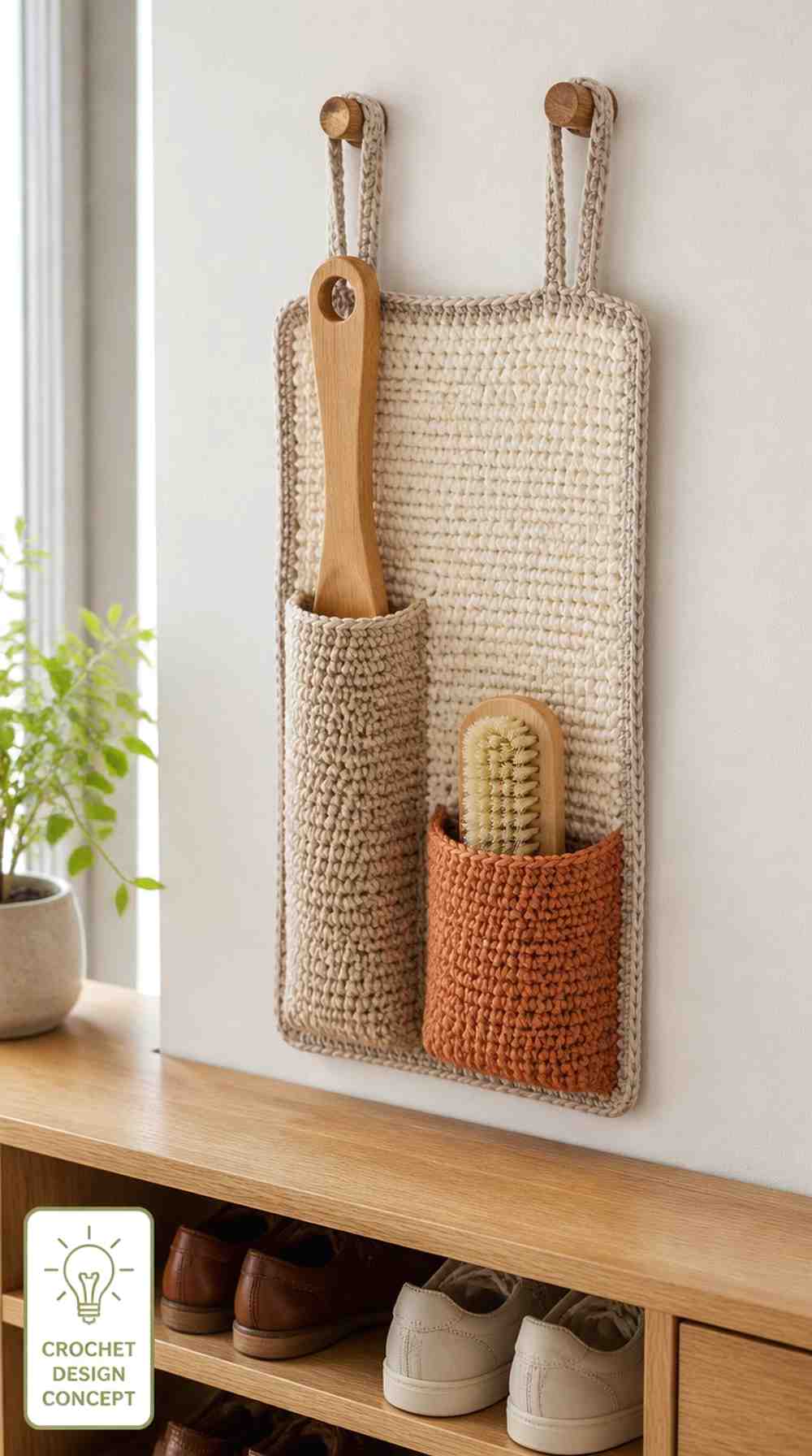
Sand-beige crochet forms a wall organizer with two separate compartments. The tall left pocket holds a natural-wood shoehorn with its handle exposed, while a shorter terracotta right pocket contains a small clean wooden shoe-polishing brush. A solid cream backing joins both storage areas.
This design creates a compact shoe-care station rather than a single-tool sleeve. The different pocket heights help accommodate the two accessories, but the brush and shoehorn need enough separation to avoid transferring dirt between them.
- Separate storage: Keep the tall shoehorn pocket and short brush compartment independently accessible rather than sharing one crowded opening.
- Brush cleanliness: Store the polishing brush only when clean and dry, and avoid allowing dirty bristles to rub against the crochet or shoehorn.
- Two-point hanging: Reinforce both upper loops so the organizer remains level even when one compartment is occupied and the other is empty.
16. Crochet Plum Detachable Entryway Shoehorn Sleeve
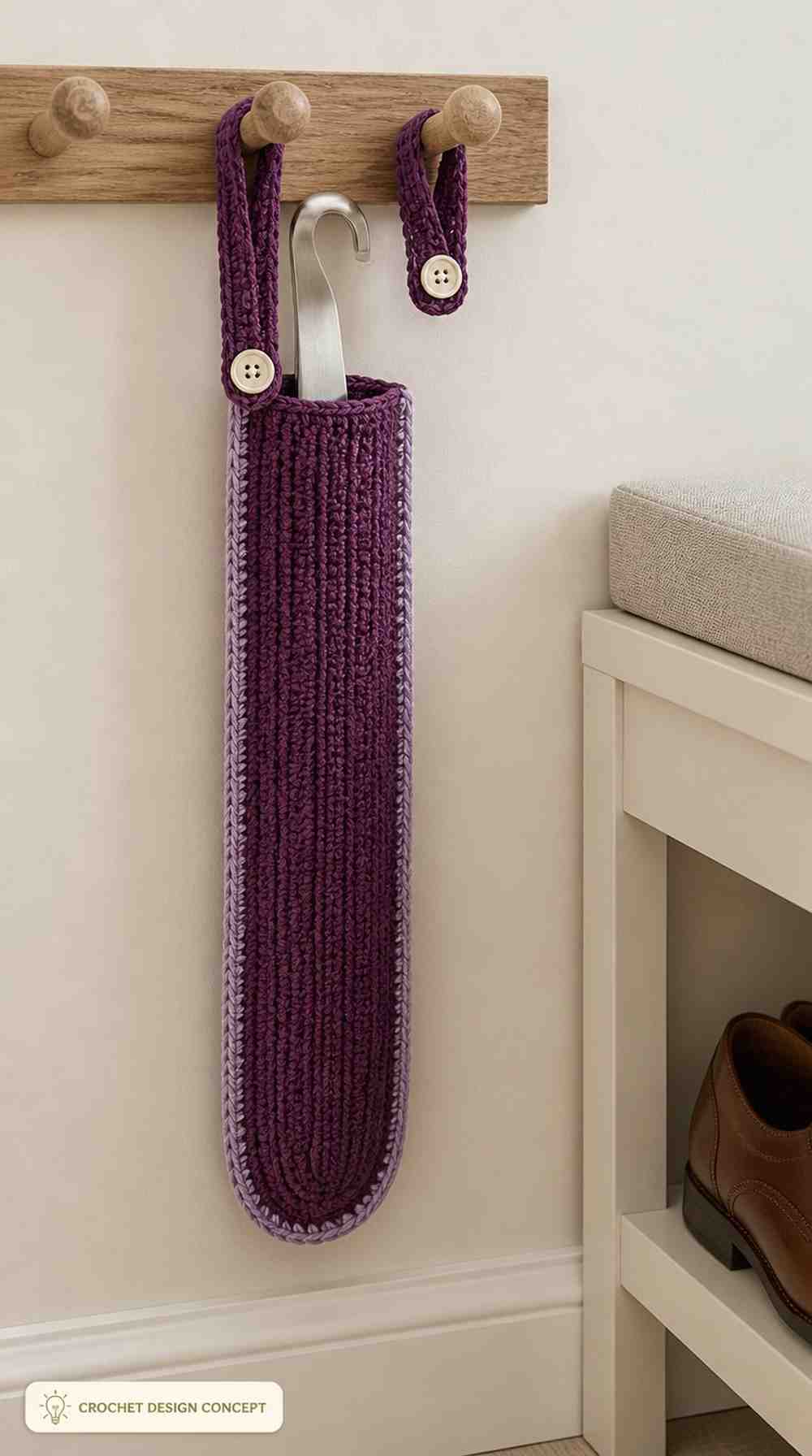
Plum-purple crochet forms a narrow vertical sleeve with dense ribbed rows, a rounded lower end and lilac edging. A brushed-steel shoehorn sits inside, leaving its curved handle visible. Two short fabric straps with cream buttons connect the sleeve to a wooden entryway peg rail.
The detachable attachment system distinguishes this design from permanent hanging loops. It allows the crochet holder to be separated from the wall rail for cleaning or repositioning, provided both straps close securely.
- Detachable straps: Check that both plum tabs can fasten around the chosen pegs without stretching the sleeve’s upper edge.
- Button reinforcement: Secure the cream buttons to supported fabric areas rather than relying on a small number of crochet stitches.
- Removal and care: Detach the empty sleeve before washing, and allow it to dry fully before reinstalling it on the entryway rail.
Practical Guide to Crochet Entryway Shoehorn Hanging Sleeves
A shoehorn storage sleeve should keep the tool easy to reach while protecting its working shape and avoiding unnecessary wear.
Measure the shoehorn first. Shoehorns vary considerably in length, blade width, handle shape and material. A short metal shoehorn may fit a compact pocket, while a long wooden or stainless-steel version needs a taller support arrangement. Measure the widest part of the blade, not only the narrow shaft.
Keep the working surface unobstructed. The smooth curved end of a shoehorn is intended to guide the heel into a shoe. Remove the crochet holder before using the tool. Decorative yarn, fastenings or hanging straps should never extend over the working blade during use.
Choose suitable yarn. Smooth cotton or an appropriate washable cotton blend may work well for a hanging pocket. Close stitching can help the sleeve maintain its shape, but yarn alone does not guarantee rigidity or strength. Consider a smooth fabric lining where the shoehorn has a delicate polished finish.
Support longer tools carefully. Tall sleeves and open-band organizers may stretch when a long shoehorn is inserted repeatedly. Use reinforced hanging loops, secure seams and appropriately mounted wall hooks. Test the holder with the actual tool before regular use.
Consider the entryway position. Install the sleeve where it can be reached comfortably without blocking a doorway or creating a tripping hazard. Keep the shoehorn above the floor and away from areas where wet footwear regularly splashes the wall.
Clean the accessory regularly. Shoe care tools can carry dust, grit or moisture from daily use. Wipe the shoehorn according to its material, let it dry, and clean the crochet sleeve when necessary. Avoid storing a wet or dirty tool inside a tightly enclosed textile pouch.
For another approach to organizing entrance essentials, see 18 Crochet Hanging Mail Sorting Organizer Inspiration Ideas on Yarn Nest Studio. It focuses on pocket layouts for entryway paperwork, while the shoehorn designs here use narrower compartments and tool-specific support.
Want to Make Something Similar?
These 16 designs are visual inspiration concepts, not tested shoehorn sleeve patterns. The following resources offer related crochet techniques for constructing hanging pockets and organizers.
- Free Crochet Hanging Storage Pouch Pattern — First The Coffee Crochet: This pattern teaches a textured hanging pouch using the lemon peel stitch. Its construction can help with basic pocket shaping and hanging-loop planning, although the original is a general-purpose storage pouch. First The Coffee Crochet
- Wall Pocket Organizer Free Crochet Pattern — Fresh Knack: Sierra’s pattern explains a hanging wall organizer with a shaped pocket and a wooden dowel support. It provides useful guidance for backing panels, seams and wall attachment methods. Fresh Knack
Neither tutorial is an exact pattern for the pictured shoehorn sleeves. A working design should be adapted to the actual shoehorn and checked for support, fit and easy removal.
Which Crochet Entryway Shoehorn Hanging Sleeve Should You Choose?
| Your priority | Design to consider | Main trade-off |
|---|---|---|
| Simple hanging storage | Oatmeal Ribbed Pocket | Needs accurate pocket width |
| Adjustable wrap | Sage Buttoned Wrap | Multiple button fastenings |
| Short metal shoehorn | Terracotta Rounded Cup | Compact, limited tool length |
| Long shoehorn storage | Navy Long Sleeve | Requires more wall height |
| Delicate decorative edge | Blush Scalloped Pocket | Scallops must not snag |
| Metal ring hanging | Charcoal Ring Case | Extra hardware and joining point |
| Adjustable lace-up fit | Mustard Lace Up Sleeve | Lacing takes more handling |
| Lined side-opening case | Lavender Side Zip | Zipper must clear the tool |
| Patchwork appearance | Cream Granny Square Holder | Additional square joining |
| Botanical decoration | Olive Leaf Sleeve | Applique needs secure stitching |
| Openwork with lining | Mint Lattice Pocket | Lining adds construction |
| Soft enclosed storage | Cocoa Felt Lined Pouch | Felt and toggle need care |
| Open-access long holder | Teal Double Band Keeper | Exposes more of the tool |
| Short travel shoehorn | Rust Roll Up Wrap | Limited to compact shapes |
| Two-tool shoe-care station | Sand Twin Pocket | Wider wall space needed |
| Removable wall attachment | Plum Detachable Sleeve | Buttons and tabs need checking |
For a simple everyday storage concept, the Crochet Oatmeal Ribbed Shoehorn Pocket offers a compact shape without complicated closures. It may be a suitable starting point for a short or medium-length shoehorn if the pocket is measured correctly.
For longer tools, the Crochet Navy Long Shoehorn Hanging Sleeve and Crochet Teal Double Band Shoehorn Keeper provide two different approaches. One uses an enclosed pocket, while the other leaves more of the shoehorn visible for quick access.
The Crochet Sand Shoehorn and Brush Twin Pocket is worth considering for a small entryway shoe-care area. If portability matters, the Crochet Rust Roll Up Travel Shoehorn Wrap offers a different storage concept for a compact travel shoehorn.
Conclusion
These 16 crochet entryway shoe horn hanging sleeve inspiration ideas show how a simple shoe-care accessory can be stored through different pocket shapes, straps, decorative panels and wall attachments. From oatmeal ribbed sleeves to colorful granny-square organizers and lined shoehorn cases, each concept brings a distinct look to everyday entryway storage.
The most useful choice will depend on the length of your shoehorn, the available hanging space and how easily you want to remove the tool. Start with a secure, correctly sized holder, then add crochet colors and details that complement your entryway.
Which shoehorn hanging sleeve would you choose for your home? Would you prefer a simple oatmeal pocket, a sage buttoned wrap or a teal double-band organizer? Share your favorite design and whether you use a short or long shoehorn.
Frequently Asked Questions
1. What yarn is suitable for a crochet shoehorn hanging sleeve?
Smooth cotton yarn or a washable cotton blend is worth considering for a compact hanging sleeve. Closely worked stitches may help maintain the pocket’s shape, although the actual structure depends on yarn thickness, stitch tension and construction. A longer or heavier shoehorn may require reinforced seams, secure attachment points or an appropriate fabric backing.
2. Can a crochet sleeve hold a long metal shoehorn?
A properly sized and reinforced hanging sleeve may be able to store a long metal shoehorn, but its strength should not be assumed from its appearance. Long tools can place additional tension on the upper hanging loops and pocket seams. Measure the tool, use suitable wall hardware and test the completed holder with the actual shoehorn before regular use.
3. Should I add a lining inside a crochet shoehorn pocket?
A lining is optional and depends on the shoehorn material. A smooth fabric lining may be worth considering for polished wooden or metal tools because it separates the working surface from prominent crochet seams. Keep the lining clean and securely attached, and avoid trapped grit that could scratch the shoehorn. A lining does not replace proper tool cleaning.
4. Is it better to hang a shoehorn by its handle or store it inside a crochet sleeve?
That depends on the tool and available space. Some shoehorns already have a hanging hole or curved handle designed for storage on a hook, making a separate sleeve unnecessary. A crochet pocket may help organize a tool without an appropriate built-in hanging point or create a matching entryway storage arrangement. In either case, the shoehorn should remain easy to remove and should not be used while covered.
5. Are these 16 crochet shoehorn hanging sleeves actual patterns?
No. These 16 designs are visual inspiration concepts showing possible storage shapes, colors, fastenings and hanging methods. They have not been physically tested, and their images do not confirm exact stitch counts, dimensions or carrying strength. The linked crochet tutorials teach related pocket-making techniques, but a working shoehorn holder should be measured, constructed and tested for the specific tool.