Learning flashcards are useful for reviewing vocabulary, formulas, definitions and other small pieces of information, but loose cards can quickly become scattered inside a backpack or travel bag. A crochet learning flashcard travel wallet offers a handmade way to keep a small study deck together. These 17 inspiration ideas explore foldover card holders, accordion compartments, zippered cases, granny-square wallets, color-coded sections and compact designs in a mix of warm, bright and neutral colors.
The right wallet depends on your flashcard dimensions, how many cards you carry and whether you prefer reviewing them one at a time or sorting them into groups. Some designs focus on a single secure pocket, while others include separate compartments for cards you have not studied, cards you are reviewing and cards you know well. This collection compares their shapes, closures, card accessibility and travel limitations so you can choose a style suited to your learning routine.
These are AI-generated crochet design visualizations for inspiration, not photographs of tested handmade wallets or step-by-step patterns.
Quick Design Selection Guide
- For a compact everyday wallet: Crochet Terracotta Button-Flap Flashcard Wallet and Crochet Rust Envelope-Flap Flashcard Case offer simple covered card storage.
- For sorting study progress: Crochet Navy Three-Section Flashcard Wallet, Crochet Cocoa Color-Tab Sorting Wallet and Crochet Sky-Blue Removable-Divider Study Wallet provide separate card groups.
- For cards traveling inside backpacks: Crochet Butter Yellow Zip-Top Flashcard Case and Crochet Charcoal Pencil-Slot Flashcard Wallet use zippered compartments.
- For decorative handmade texture: Crochet Raspberry Granny-Square Flashcard Wallet and Crochet Blush Daisy-inspired alternatives such as the Crochet Plum Scalloped Tri-Fold Card Wallet offer distinctive crochet finishes.
- For reviewing individual cards: Crochet Peach Corner-Retaining Flashcard Folio and Crochet Sage Flip-Tab Review Wallet keep selected cards visible.
- For different study-deck sizes: Crochet Coral Double-Deck Flashcard Pouch, Crochet Lavender Clear-Window Flashcard Wallet and Crochet Olive Wrap-Tie Flashcard Wallet offer alternative storage arrangements.
1. Crochet Terracotta Button-Flap Flashcard Wallet
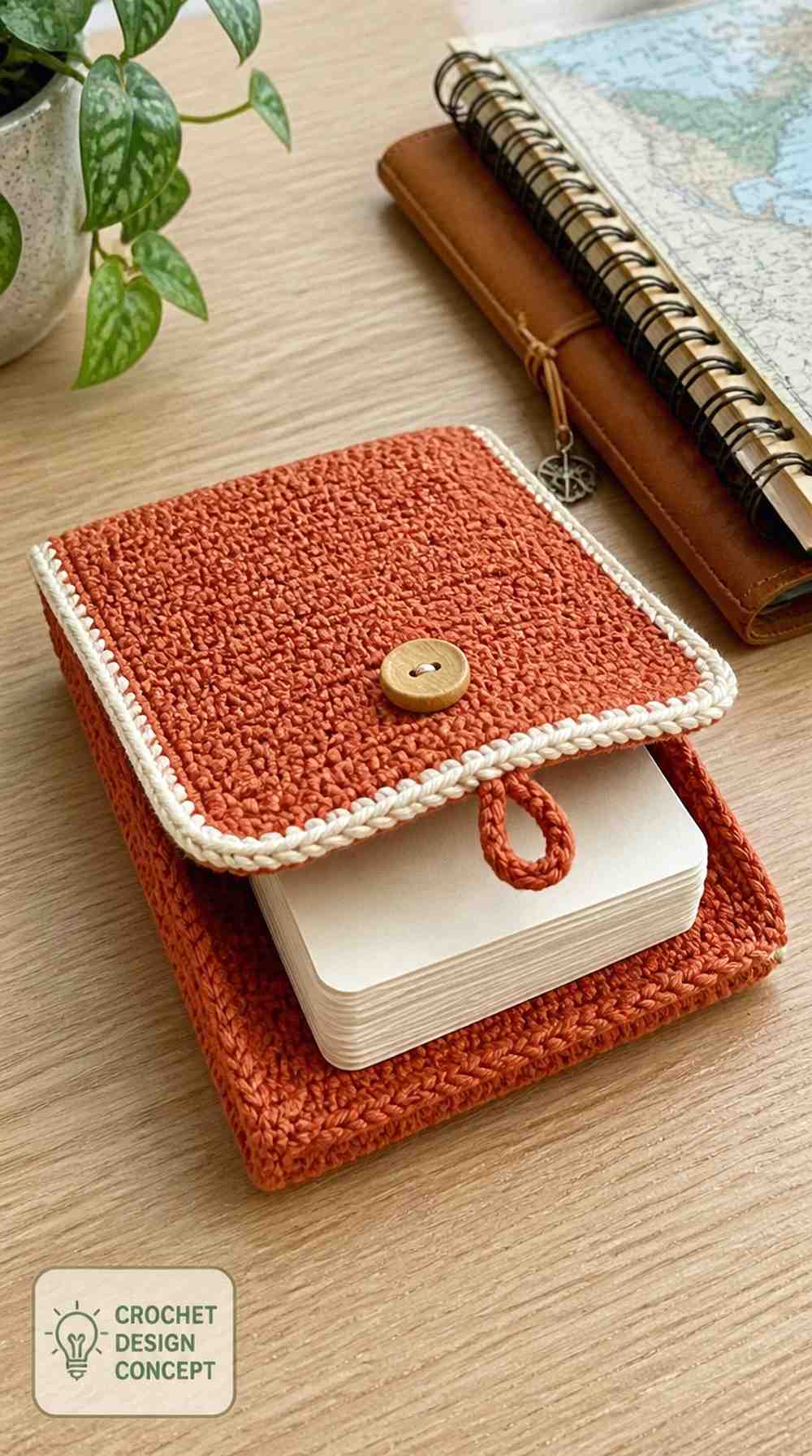
Burnt-terracotta crochet gives this compact travel wallet a warm, simple appearance. Its rectangular body uses closely worked horizontal rows, while a rounded flap has narrow ivory edging and a small tan wooden button. A matching crochet loop completes the fastening, with a stack of cream flashcards tucked inside the main pocket.
The slim shape makes this an appealing concept for carrying one small deck. Its foldover closure helps cover the opening, although the actual fit would need checking with the complete card stack before sewing on the button.
- Flap overlap: Allow enough fabric for the rounded flap to close over the filled wallet without pushing tightly against the upper card edges.
- Button positioning: Attach the wooden button securely and keep it flat enough to avoid creating unnecessary bulk in a backpack pocket.
- Single-deck capacity: Plan the main compartment around the actual card stack, including its thickness, rather than copying the proportions of a payment-card wallet.
2. Crochet Navy Three-Section Flashcard Wallet
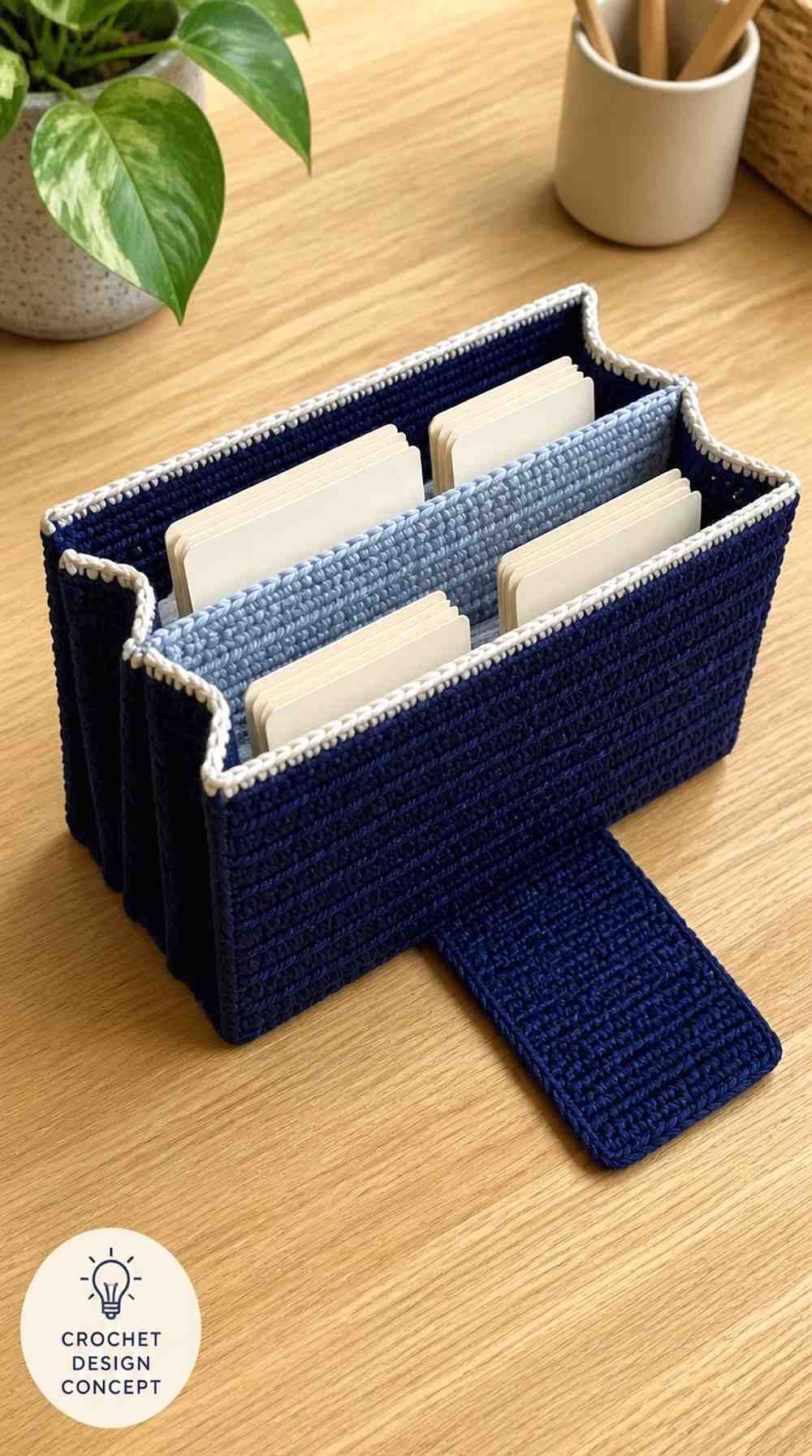
Midnight-navy crochet creates an accordion-style wallet with three compact internal compartments. Two pale-blue divider panels separate the sections, while ivory trim outlines their upper edges. A short navy wrap tab lies open at the front, revealing the stepped card stacks inside.
The three-part arrangement is useful for students who like keeping different kinds of flashcards apart. The accordion sides provide some flexibility, but the joins and gussets need careful planning so the wallet closes naturally without squeezing its contents.
- Three study groups: The compartments could optionally represent new, practicing and mastered cards, allowing a simple progress-sorting routine without printed labels.
- Accordion expansion: Allow the gusseted sides to fold smoothly while leaving enough space for the thickest group of flashcards.
- Divider height: Keep the pale-blue partition edges high enough to separate cards but low enough that the top card in each section remains accessible.
3. Crochet Butter Yellow Zip-Top Flashcard Case
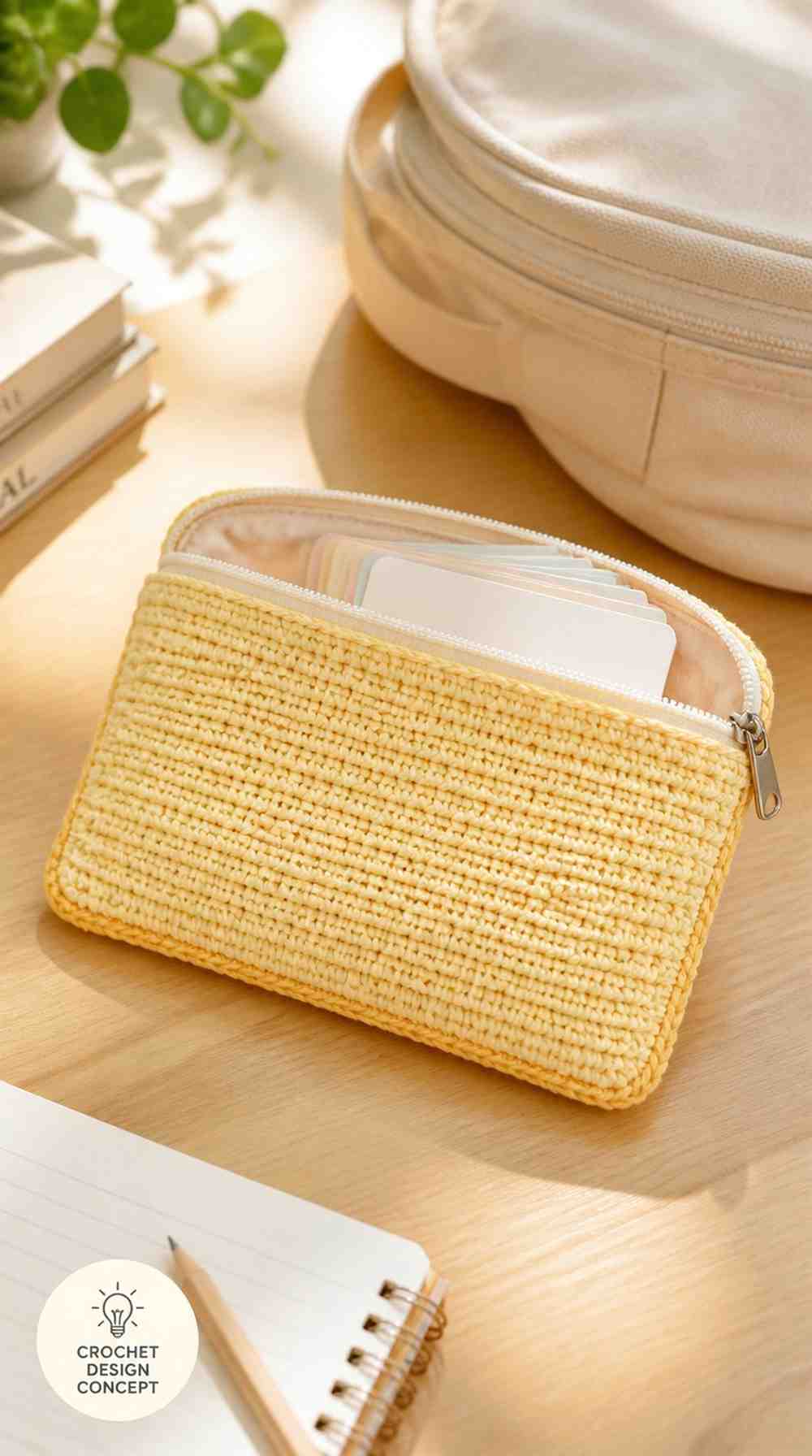
Pale butter-yellow crochet forms a neat rectangular zippered wallet with a thin golden border. A cream fabric lining sits inside the case, and the partly open ivory zipper reveals a compact stack of pastel-colored learning cards.
This design favors enclosed storage over quick access to several separate groups. The zipper and lining make it worth considering for everyday travel, although neither automatically makes the wallet waterproof, crushproof or suitable for carrying valuable documents.
- Zipper opening: Measure the flashcards’ full width so the top opening allows them to slide in without bending their corners.
- Fabric lining: A smooth lining can help paper slide past the crochet stitches and reduce the chance of card corners catching in openings.
- Zipper attachment: Sew the zipper evenly along the reinforced top edge, keeping metal teeth and the pull away from the cards’ exposed surfaces.
4. Crochet Indigo Book-Style Flashcard Folio
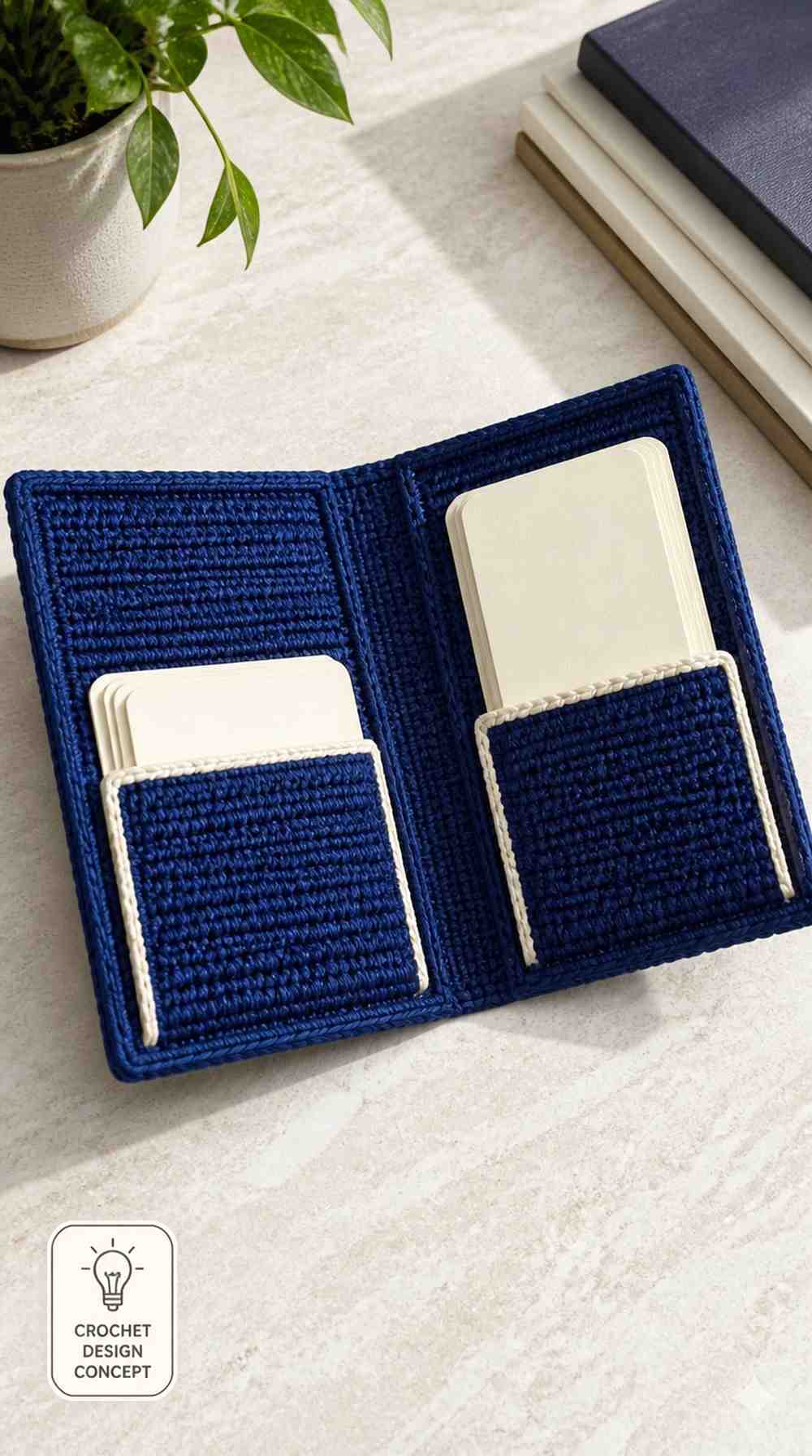
Deep-indigo crochet creates a small book-style folio with two interior card pockets. The left side holds cards horizontally, while the right pocket holds a separate vertical group. Ivory edging outlines both openings, and a plain flexible spine connects the panels.
The two orientations make this concept especially interesting for students who carry cards in more than one format. It would require careful sizing, since taller cards on one side may affect how smoothly the folio folds shut.
- Mixed orientation: Measure both card groups separately to ensure the left horizontal pocket and right vertical pocket suit their intended contents.
- Flexible spine: Leave enough movement around the central fold so filled pockets do not pull tightly against each other.
- Pocket edging: Keep the ivory borders smooth and firm enough to define the openings without curling over the visible card edges.
5. Crochet Raspberry Granny-Square Flashcard Wallet
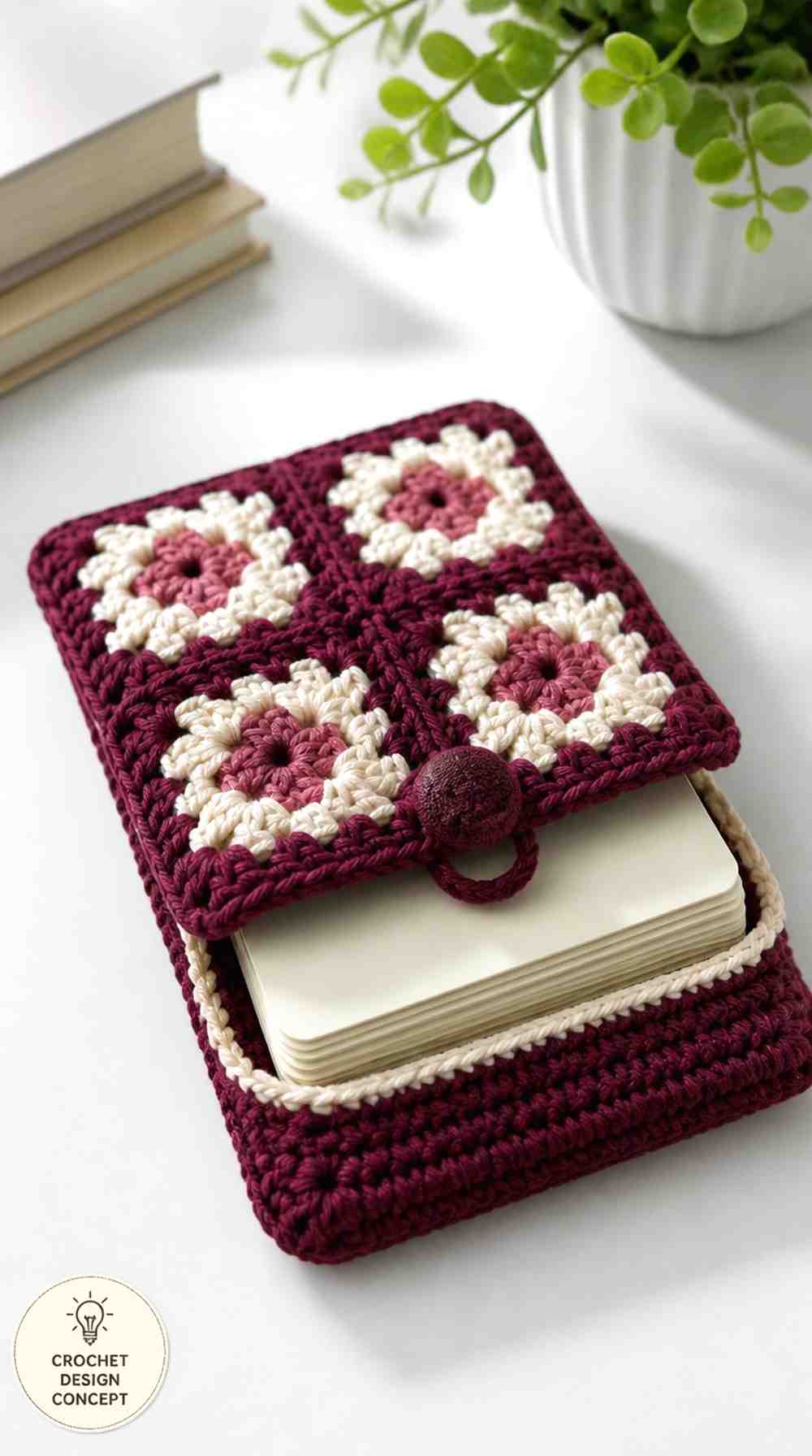
Four miniature granny squares decorate the flap of this raspberry-and-burgundy crochet wallet. Each square combines a raspberry center, ivory second round and deep-burgundy edging. A solid burgundy card pocket sits beneath the patterned flap, with an ivory-trimmed opening and a small covered-button fastening.
The granny-square arrangement gives the wallet a traditional handmade look without needing large floral appliqués. The solid backing beneath the motifs matters because the open spaces in granny squares should not serve as the main storage surface for loose paper cards.
- Four-square flap: Join the motifs flat over their continuous backing so the flap remains flexible and the corners do not bunch.
- Solid card pocket: Use closely worked crochet beneath the decorated flap to help keep card edges from slipping through open granny-square corners.
- Covered-button fastening: Check that the loop reaches comfortably around the filled wallet rather than stretching tightly across the cards.
6. Crochet Sea-Glass Drawstring Flashcard Pouch
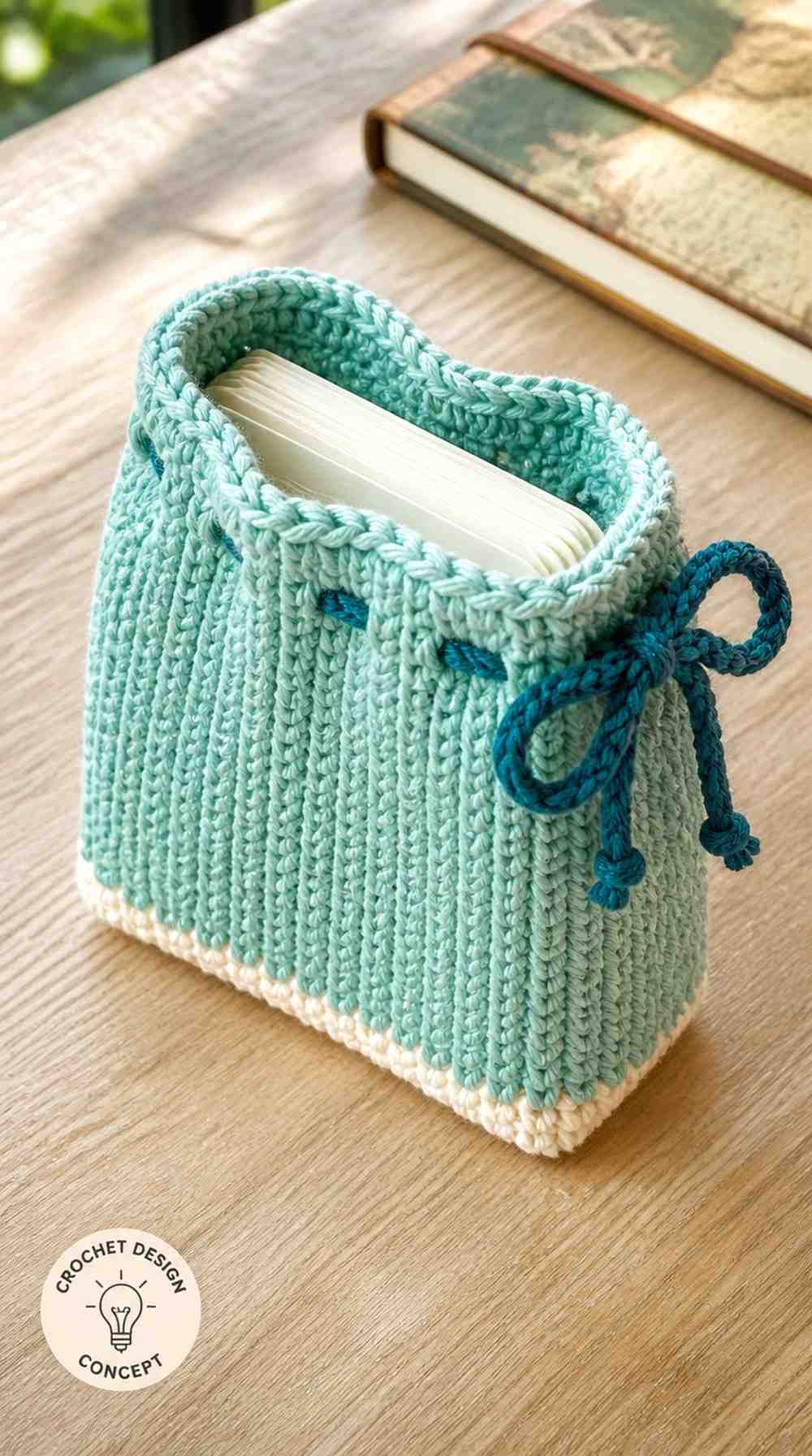
Sea-glass-turquoise crochet gives this small pouch a fresh appearance, with a flat rectangular base and narrow gusseted sides. Two deep-teal drawstrings pass through the reinforced upper channel and tie in a compact side bow. A thin ivory bottom border completes the simple design.
The gathered opening allows the pouch to hold a small card stack without relying on a button or zipper. However, a drawstring is not a completely sealed closure, so the finished design should be checked for gaps large enough for individual cards to escape.
- Drawstring channel: Reinforce the upper edge to reduce wear from repeatedly pulling the cords open and closed.
- Rectangular base: A flat bottom may help the card stack sit more neatly than a narrow rounded pouch with excessive fabric at its corners.
- Closure limitation: Drawstrings can loosen during travel; the wallet should be placed inside a suitable bag compartment rather than relied upon as a sealed case.
7. Crochet Lavender Clear-Window Flashcard Wallet
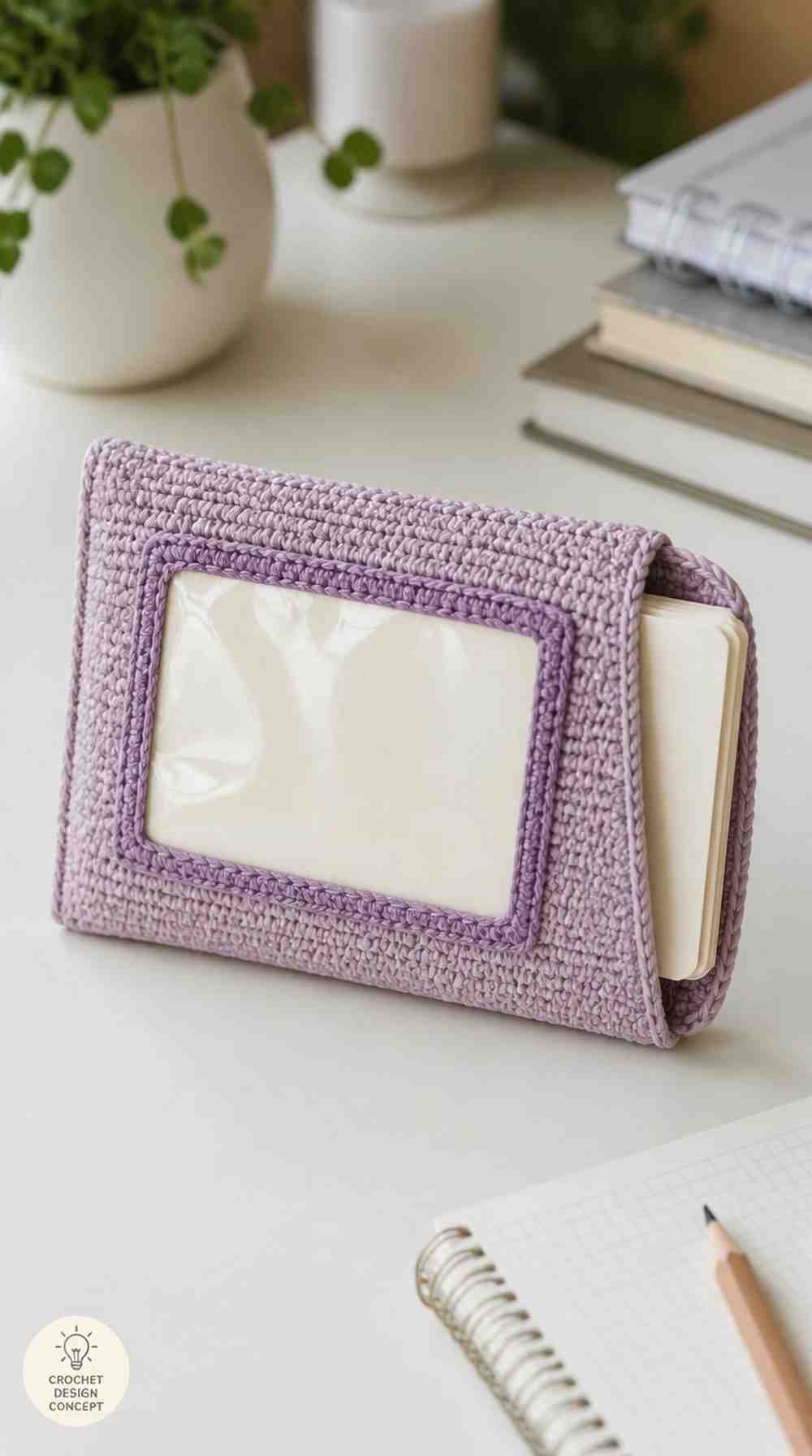
Dusty-lavender crochet forms a slim rectangular wallet with one transparent window across the front. A blank cream learning card sits behind the clear panel, while a separate side-opening pocket holds additional cards. Darker-lavender edging outlines the window and surrounding seams.
The visible front card could provide a convenient place for a study topic or reminder, while the main deck remains inside. The clear window introduces a different material, so its attachment and cleaning requirements need attention.
- Visible display card: A removable front card can identify the current study topic without permanently stitching words into the crochet.
- Transparent window: Attach the flexible sheet securely around its edges, avoiding hard corners or seams that could catch paper.
- Side-opening storage: Check that the card pocket opens far enough for the entire deck to be removed without pulling against the clear front panel.
8. Crochet Cocoa Color-Tab Sorting Wallet
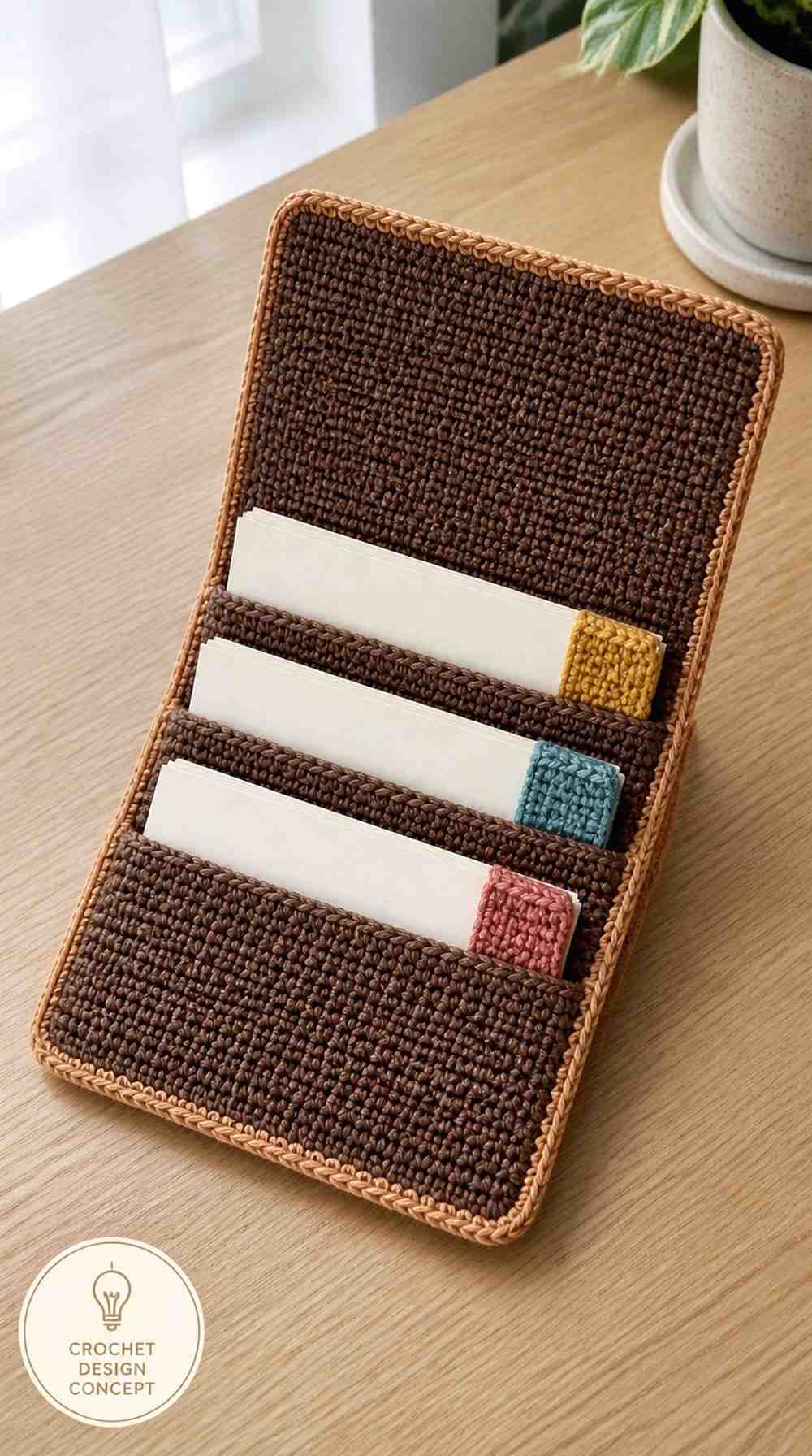
Cocoa-brown crochet gives this open wallet a warm, understated base. Three overlapping card pockets form a stepped arrangement, each with a small colored tab: mustard yellow at the back, muted teal in the middle and dusty rose at the front. Caramel edging finishes the outer cover.
The tabs make the sections easy to distinguish without adding written labels. This design suits a simple sorting system, especially when one group of cards needs more frequent attention than the others. The pocket depths should vary enough to expose all three colored markers.
- Color-coded sections: Assign a consistent meaning to the mustard, teal and rose tabs so you can identify the correct deck without checking every pocket.
- Overlapping pockets: Keep enough card height visible above each opening to allow quick removal without disturbing neighboring cards.
- Tab attachment: Secure each flat crochet marker to its own pocket edge so repeated handling does not stretch the pocket seam.
9. Crochet Peach Corner-Retaining Flashcard Folio
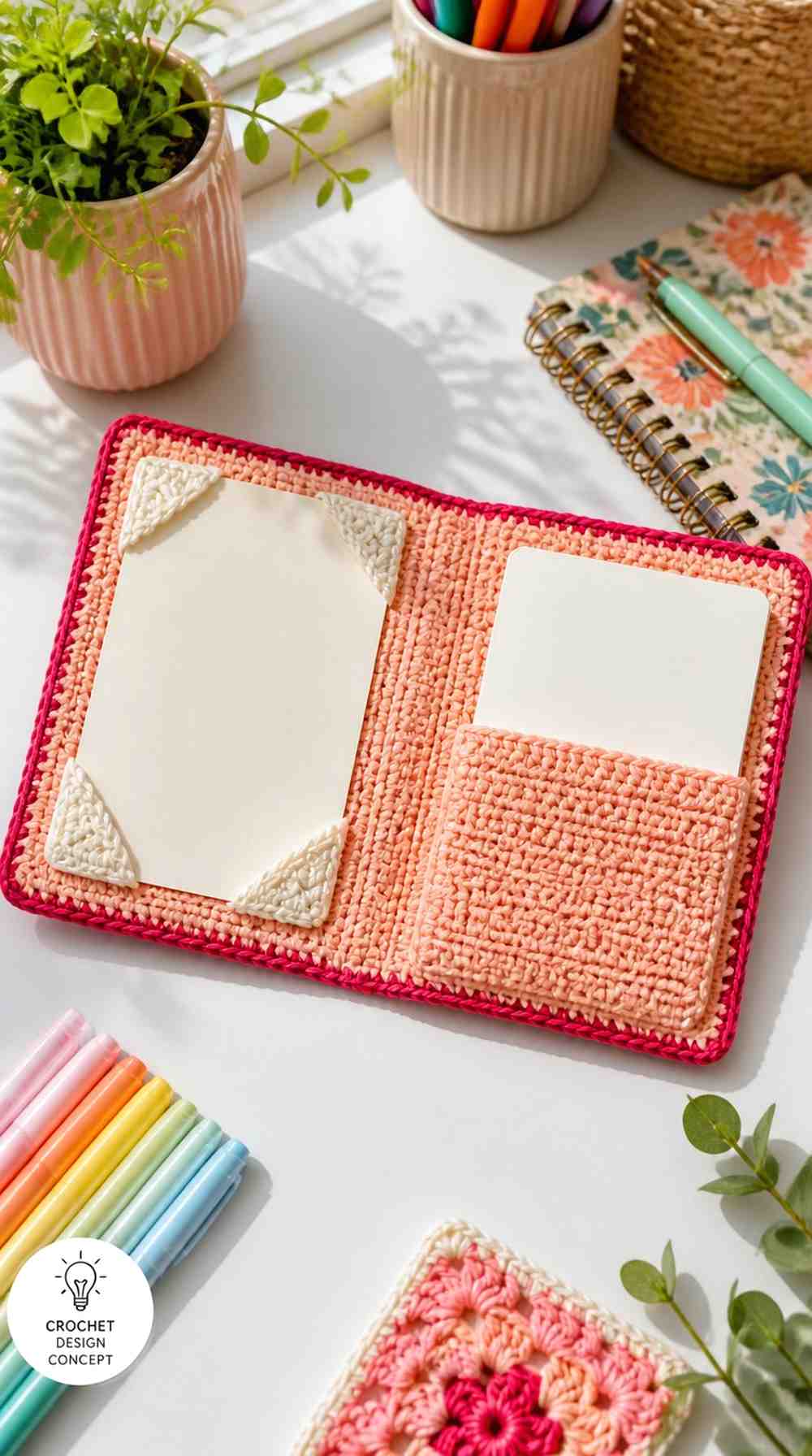
Soft-peach crochet creates an open book-style folio with two different interior sections. Four small ivory triangular corner tabs hold one blank revision card on the left panel, while a shallow peach pocket on the right stores the remaining deck. Raspberry edging frames the overall shape.
The corner-retaining arrangement leaves most of the displayed card uncovered, making it useful for viewing one selected flashcard. Unlike a fully enclosed wallet, the display side is intended for easy access rather than protection during rough handling.
- Four-corner retention: Position the small ivory tabs so they overlap card corners without covering important writing or illustrations.
- Displayed-card fit: Measure the card before placing the retaining tabs; an oversized card may bend when pushed beneath four fixed corners.
- Travel closure: The folio needs a secure outer arrangement if used inside a crowded bag, since the illustrated open panels do not include a clasp.
10. Crochet Olive Wrap-Tie Flashcard Wallet
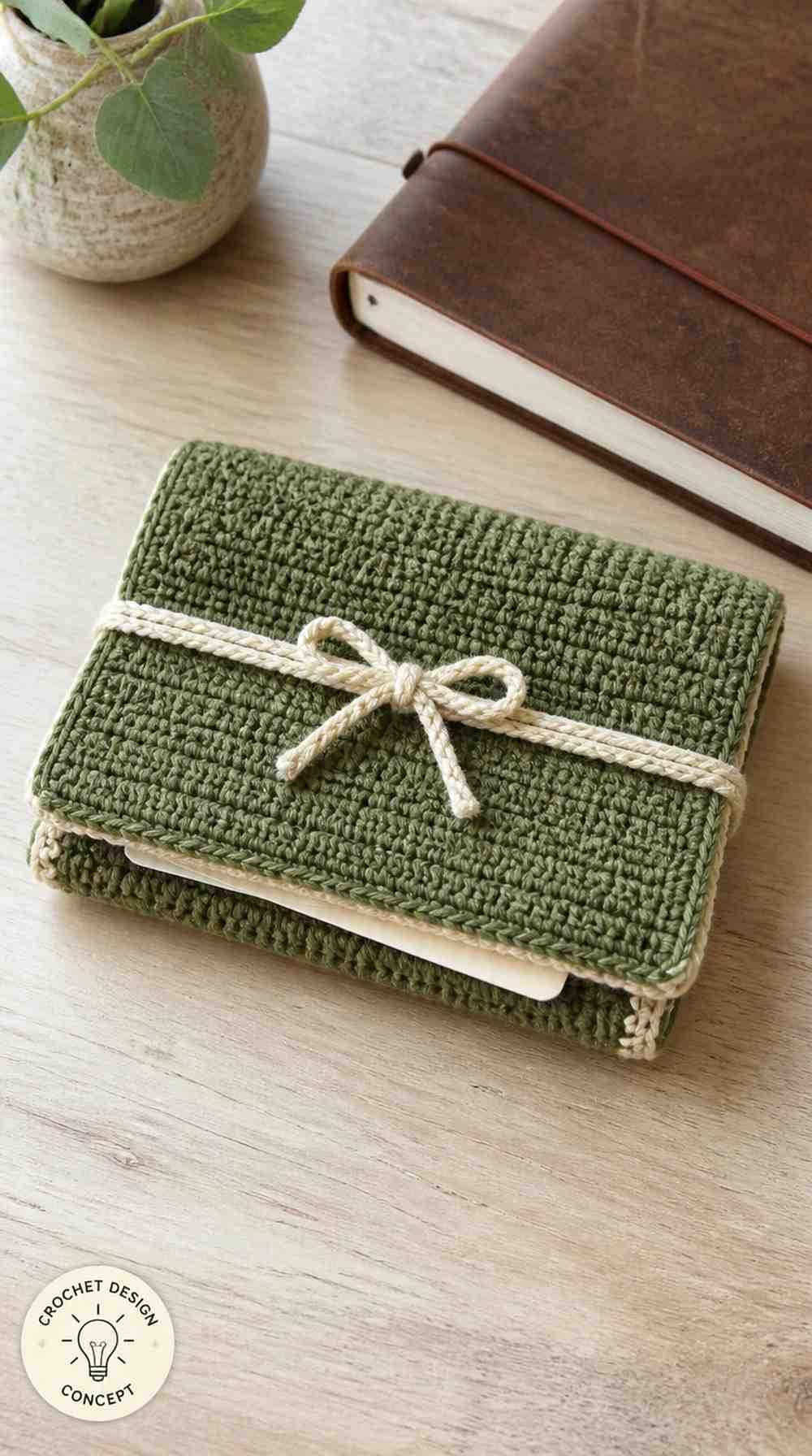
Muted-olive crochet creates a compact folded wallet secured with a narrow warm-ivory tie. The tie wraps around the middle and forms a small flat bow at the front. Dense moss-olive rows and cream edging keep the body visually simple.
The wrap-tie design has a flexible, stationery-inspired appearance. It can accommodate some variation in stack thickness, although the tie must remain long enough to secure the folded body without pressing too tightly against the paper cards inside.
- Wrap length: Size the ivory tie around the filled wallet, leaving enough room for a small flat bow without long loose ends.
- Folded card stack: Check the combined paper thickness so the main fold does not distort or push the cards toward the opening.
- Travel limitation: A tied closure may loosen when repeatedly handled; use the wallet inside a separate secure travel compartment.
11. Crochet Coral Double-Deck Flashcard Pouch
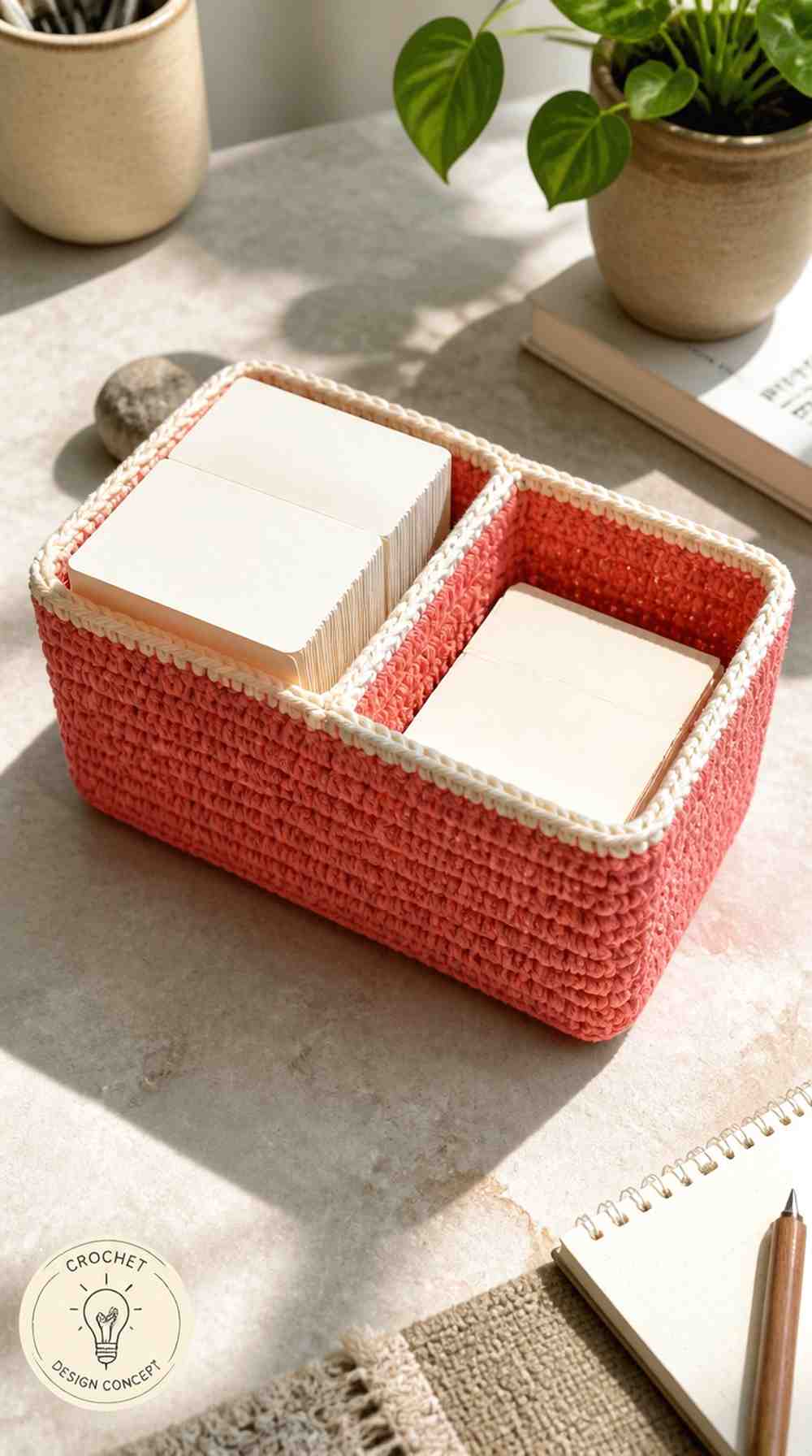
Coral-pink crochet forms a two-compartment pouch with a flat rectangular base. The side-by-side card chambers are separated by a warm-cream vertical seam, and ivory edging frames both openings. One side holds a taller stack of blank cards while the other contains a shorter group.
The paired compartments make this concept useful for keeping two different study decks available. Because both sections have open tops, it is more suited to controlled access than loose storage inside a moving backpack without additional containment.
- Two independent decks: The separated chambers could hold two subjects or a current deck and a shorter review set.
- Central support seam: Reinforce the cream divider where it meets the base so unequal card stacks do not pull the pouch out of shape.
- Open-top limitation: Consider adding a suitable optional closure for actual travel, since the pictured design leaves both card stacks exposed.
12. Crochet Charcoal Pencil-Slot Flashcard Wallet
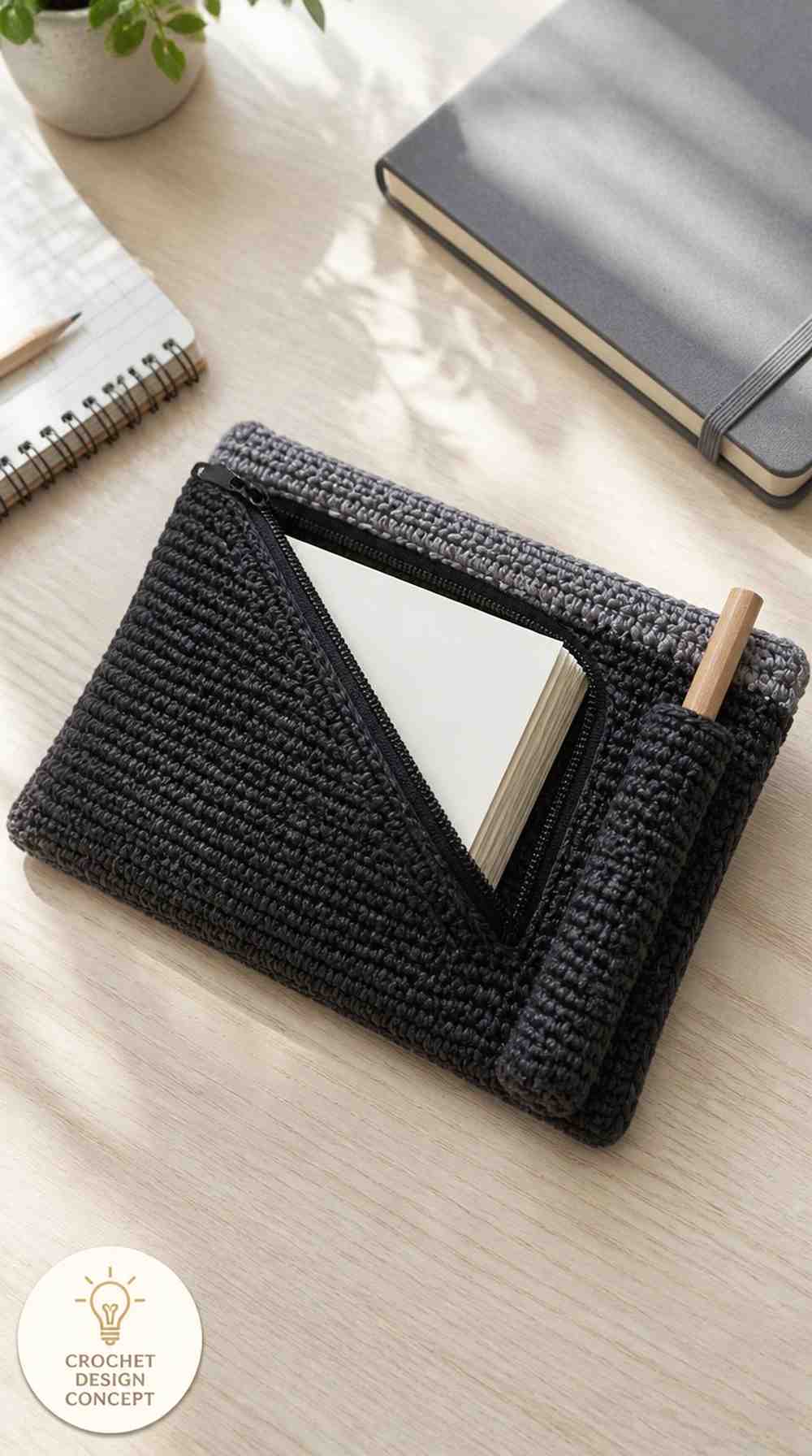
Charcoal-gray crochet gives this slim wallet a clean, practical appearance. A broad zippered compartment holds a stack of blank flashcards, while a narrow vertical sleeve along the right side contains one short wooden pencil. Pale-gray edging keeps the overall shape understated.
The pencil sleeve is the main difference from an ordinary card pouch. It gives a learner a place to keep a writing tool with the cards, although the exposed pencil should remain firmly held and its pointed end kept inside the sleeve.
- Pencil sleeve fit: Match the narrow compartment to the actual pencil diameter, avoiding a loose opening that allows it to fall out.
- Protected pencil point: Keep the tip inside the crochet sleeve so it does not snag fabric or damage nearby items.
- Main zipper access: Leave enough room to remove the flashcards without the exterior pencil sleeve pulling against the card compartment.
13. Crochet Sage Flip-Tab Review Wallet
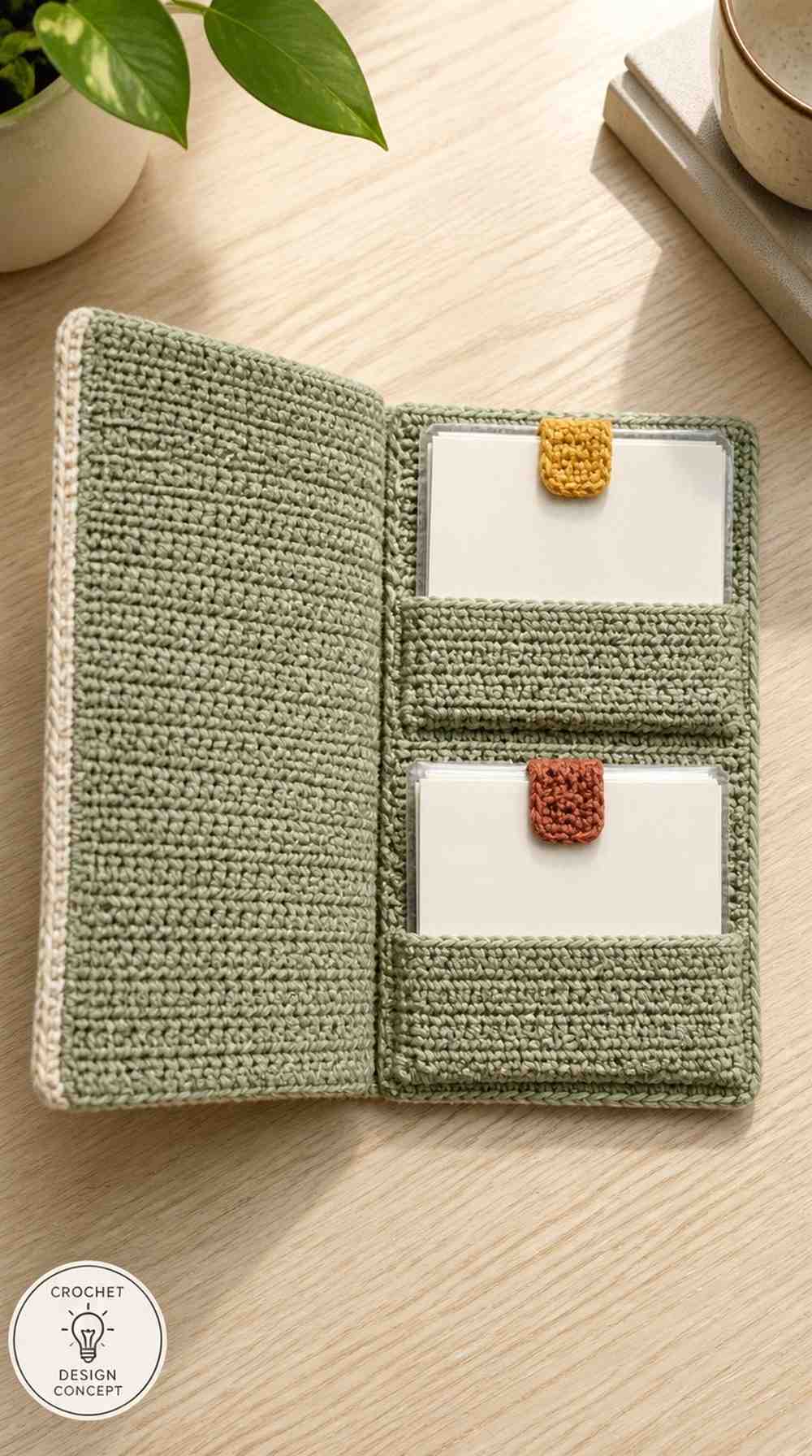
Muted-sage crochet forms a small folding wallet with two shallow interior card sleeves. The upper group has a mustard pull tab, while the lower group has a terracotta marker. Narrow ivory edging defines the pockets, and the opposite cover remains plain sage.
The two visible colored tabs suggest a simple way to divide cards by review priority. This design is more focused than a three-section organizer, making it interesting for a learner who prefers carrying only the cards needed for one short study session.
- Two review groups: The mustard and terracotta tabs could distinguish cards awaiting practice from those due for another check.
- Pull-tab size: Keep the small markers flat and easy to grasp without allowing them to bend or tear the paper sleeves.
- Fold clearance: Make sure the card stacks remain below the fold line so the cover closes without crushing their upper edges.
14. Crochet Rust Envelope-Flap Flashcard Case
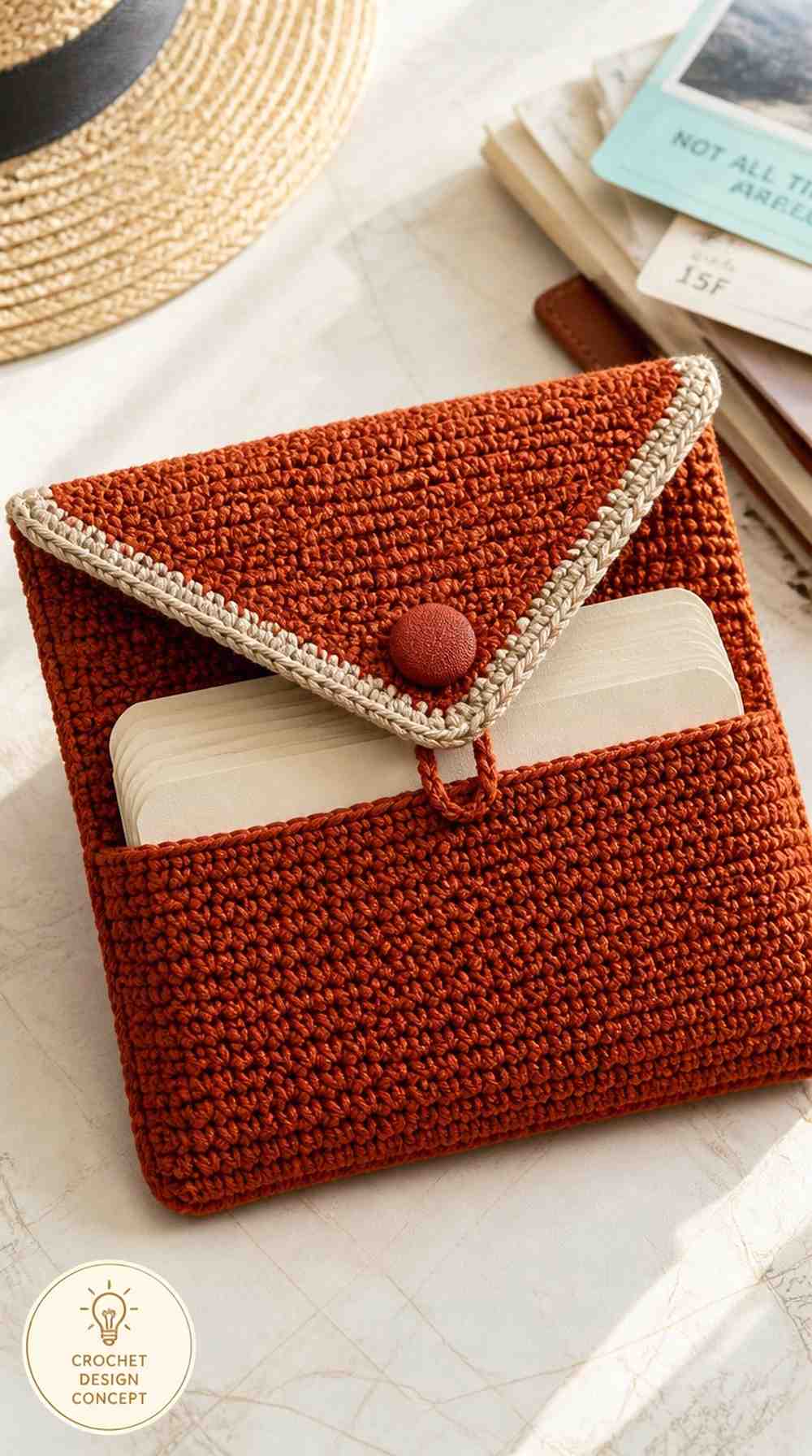
Warm-rust crochet creates a compact rectangular wallet with a sharply pointed triangular flap. Oatmeal-colored edging follows the envelope shape, while a small terracotta-covered button and matching loop secure the front. A deep inner pocket holds a single stack of blank ivory learning cards.
The familiar envelope silhouette makes this design attractive for a small travel deck. Its pointed flap gives the wallet a clear direction for opening and closing, although careful sizing is needed to keep the tip from curling when the compartment is full.
- Triangular flap overlap: The pointed section needs enough length to reach the button without pulling the wallet body into a tight curve.
- Deep card pocket: Keep most of the flashcard stack below the opening so individual sheets cannot easily slide out when the flap is closed.
- Button tension: Reinforce the loop attachment and test the fastening with the intended number of cards rather than with the empty case.
15. Crochet Ivory Checkerboard Travel Card Wallet
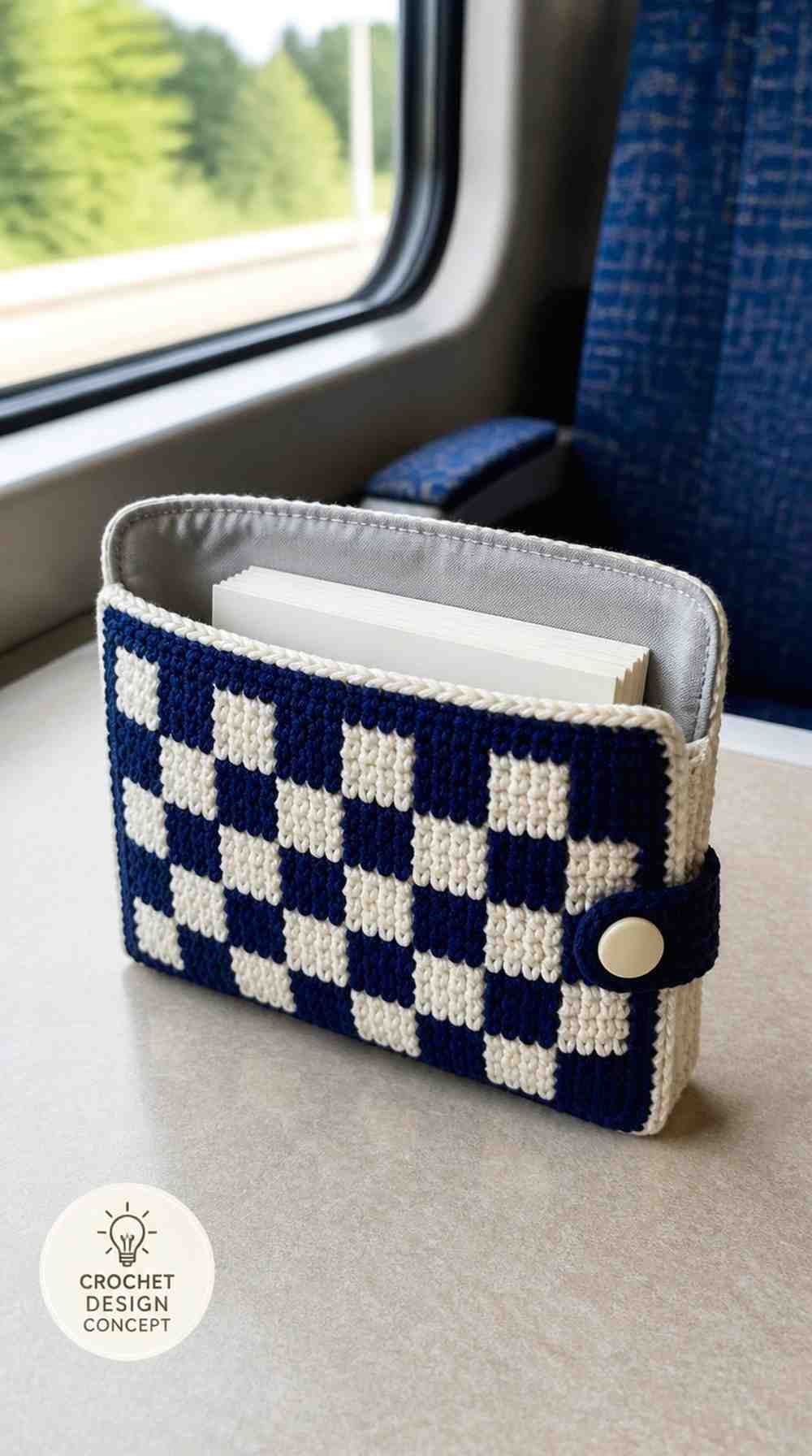
Warm-ivory and deep-navy crochet squares form a small checkerboard across this slim travel wallet. A plain navy border frames the patterned front, while a removable light-gray lining sits inside. The upper opening reveals a stack of learning cards, and one small buttoned navy side tab provides closure.
The colorwork gives this design a bold graphic appearance without adding raised motifs. Its flexible lining offers another material choice to consider, particularly when carrying cards with corners that might otherwise catch in textured crochet.
- Checkerboard alignment: Keep the navy and ivory color blocks consistent so the front remains square rather than leaning toward one side.
- Removable lining: A smooth, appropriately sized inner layer may reduce paper snagging, but the final closure still needs a separate fit check.
- Side-tab placement: Position the buttoned tab so it closes over the card opening without pushing against the edges of the inner stack.
16. Crochet Plum Scalloped Tri-Fold Card Wallet
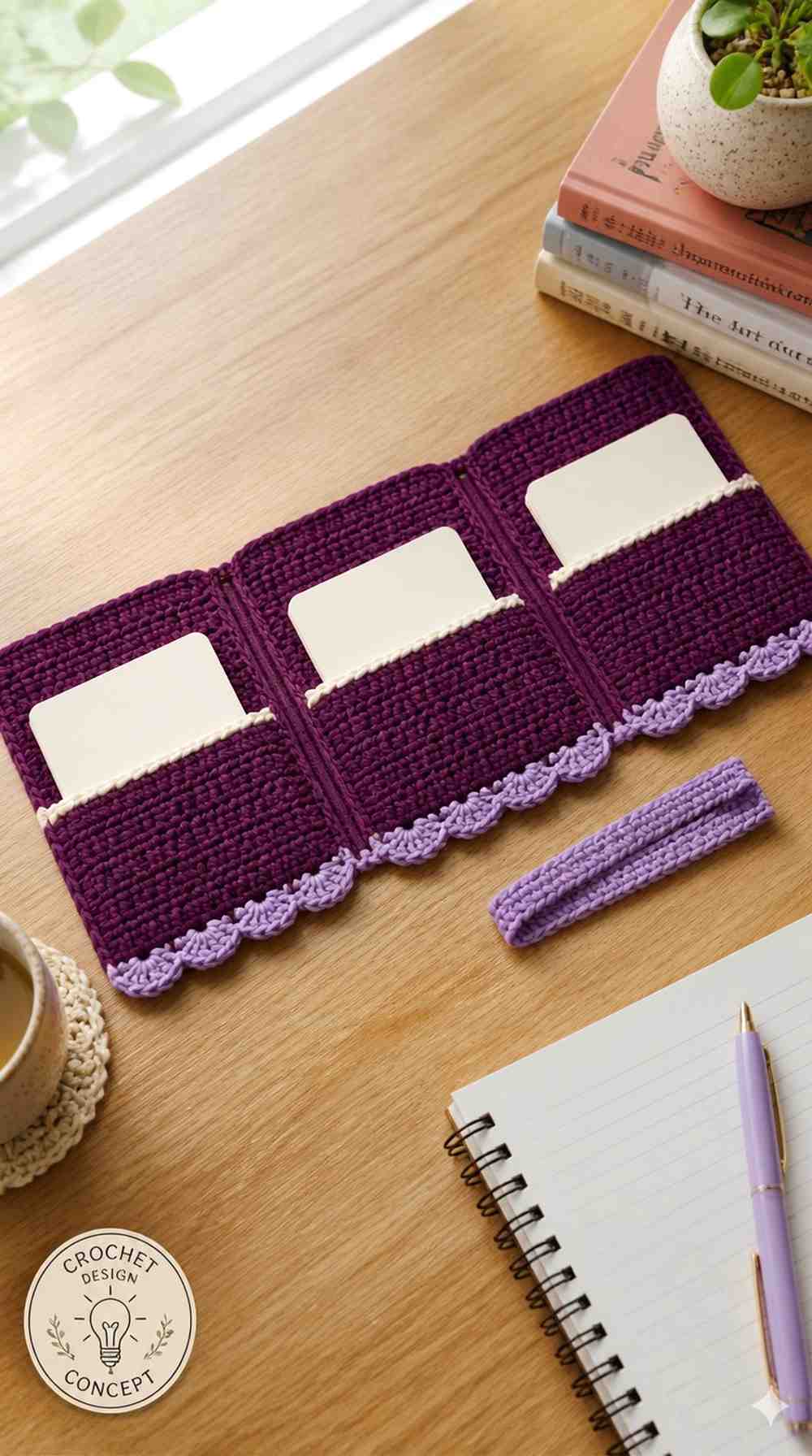
Deep-plum crochet forms three connected rectangular panels that open into a small tri-fold organizer. Each panel has a shallow ivory-edged card pocket, while delicate lavender scallops decorate the lower outer border. A separate narrow lavender band can wrap around the folded wallet for storage.
The three-pocket arrangement offers an organized way to carry several small groups of learning cards. Compared with a single pouch, the tri-fold body requires more careful planning around the folds so the card stacks do not overlap awkwardly when closed.
- Three-panel folding: Leave sufficient space at both fold lines for the filled pockets to close without bunching the crochet.
- Scalloped lower edge: Keep the lavender shells small and flat so they do not become caught between panels.
- Wrap-band security: Test the separate lavender band around the fully folded wallet, since a loose band could slide off during travel.
17. Crochet Sky-Blue Removable-Divider Study Wallet
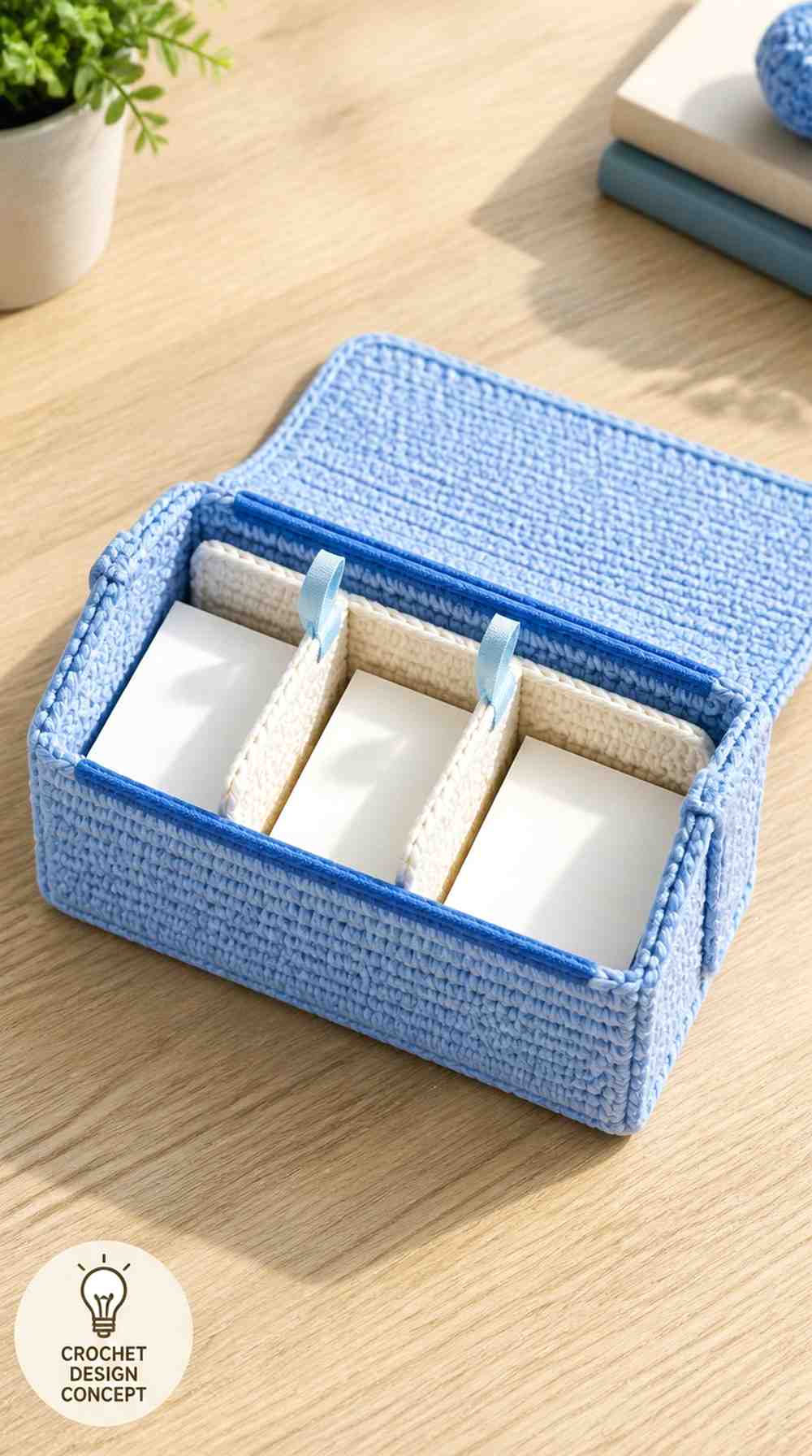
Sky-blue crochet creates a compact card wallet with one main compartment divided into three sections. Two removable ivory crochet panels stand between the flashcard groups, each with a short sky-blue finger-pull tab. A simple foldover flap lies open behind the organizer.
The removable dividers make this concept more adaptable than permanently stitched compartments. Their position could be changed when one card group becomes larger, although the finished inserts need enough structure to stand reasonably straight without becoming bulky.
- Removable partition fit: Keep each ivory divider narrow enough to slide into the main compartment without bending the flashcards on either side.
- Finger-pull tabs: Short reinforced tabs help identify and remove the panels without pulling on delicate divider edges.
- Changing deck sizes: Three flexible sections may suit uneven study groups, but soft crochet dividers cannot guarantee the cards will stay separated during rough travel.
Practical Guide to Crochet Learning Flashcard Travel Wallets
Measure the actual flashcards first. Learning cards are not all the same size. Some are small vocabulary cards, while others are larger index cards with handwritten notes. Measure the card width, height and complete stack thickness before choosing a wallet design. Leave enough ease to remove cards without bending their corners.
Think about how you study. A single-pocket wallet may work for one small subject deck. Two compartments can separate cards that need reviewing from cards already practiced. Three or more sections may help with a more detailed review system, but additional pockets also increase the wallet’s thickness.
Choose firm, smooth crochet fabric. Closely worked cotton crochet is one option for making compact card holders. A firm stitch texture may help the wallet retain its shape, while a smooth lining can reduce paper snagging. However, crochet fabric is flexible, and it should not be assumed to protect cards against bending or crushing.
Check closures with the wallet filled. Buttons, zippers, ties and drawstrings behave differently once a full card stack is inserted. Test the chosen fastening with the intended contents before finishing the design. A covered opening can help with organization, but it does not automatically make a wallet waterproof or prevent every card from escaping.
Keep paper away from moisture. Yarn can absorb moisture, and paper can bend, wrinkle or become damaged when wet. Carry the wallet inside a dry, suitable backpack compartment. For important or irreplaceable study notes, consider keeping digital copies or a separate protected backup.
Avoid unnecessary bulk. Large appliqués, heavy buttons, thick seams and multiple crochet layers can make a small travel wallet harder to carry. Decorative details are best kept flat and away from card openings.
Make cards easy to identify. Simple color tabs, removable paper dividers and differently colored pockets can help organize study groups without permanently attaching labels to the crochet. Keep any personal or sensitive information out of promotional photographs.
Follow material care instructions. Wash the crochet cover only when its yarn, lining and closures permit it. Remove paper cards and detachable components first, and allow everything to dry completely before reuse.
Want to Make Something Similar?
These verified tutorials explain related crochet wallet and card-pocket techniques. They are not exact patterns for the 17 learning flashcard travel wallet concepts above.
- Fold-Over Travel Wallet by CyCrochet — A free written crochet pattern with diagrams showing a textured wallet, two internal dividers and a button-loop closure. Useful for understanding folding, dividing and fastening a compact card holder.
- Crochet Card Case by Pink Bows & Twinkle Toes — A free small card-case pattern with two internal pockets, a button closure and scalloped details. Its original size is intended for standard cards, so learning flashcards may need different measurements.
- Card Holder Wallet Tutorial by HELLOhappy — A free written and video learning resource covering pocket folding, edging and wallet assembly. Useful for understanding how small crochet card pockets can be joined neatly.
For more travel-oriented crochet inspiration, see 15 Crochet Vintage Floral Passport Sleeve Inspiration Ideas on Yarn Nest Studio. Those sleeves are designed around travel booklets rather than flashcard decks, but their flap and pocket arrangements offer relevant ideas.
If you prefer a pouch intended for a thicker stack of cards, 23 Crochet Tarot Card Pouch Ideas explores a different category of crochet card storage. Tarot deck dimensions and use differ from learning flashcards, so the sizing would need to be adapted.
Which Crochet Learning Flashcard Wallet Should You Choose?
| Your main requirement | Designs to consider | Important trade-off |
|---|---|---|
| Small everyday study deck | Terracotta Button-Flap, Rust Envelope-Flap | One main compartment |
| Three separate card groups | Navy Three-Section, Sky-Blue Removable-Divider | More dividers add bulk |
| Zippered travel storage | Butter Yellow Zip-Top, Charcoal Pencil-Slot | Zippers need careful installation |
| Mixed card orientation | Indigo Book-Style Folio | Requires more precise measurements |
| Decorative granny-square finish | Raspberry Granny-Square | Additional motif joins |
| Soft pouch storage | Sea-Glass Drawstring | Less secure than a well-fitted zippered opening |
| Visible topic card | Lavender Clear-Window | Window and lining need extra care |
| Color-coded learning | Cocoa Color-Tab, Sage Flip-Tab | Requires a consistent sorting system |
| Display one card at a time | Peach Corner-Retaining Folio | Display section offers limited protection |
| Flexible tie closure | Olive Wrap-Tie, Plum Scalloped Tri-Fold | Ties or bands may loosen |
| Two subject decks | Coral Double-Deck | Open compartments need extra travel containment |
| Patterned compact wallet | Ivory Checkerboard | Color changes and lining add work |
For a short daily study session, the Terracotta Button-Flap or Rust Envelope-Flap design offers a straightforward way to carry one compact flashcard deck.
For more structured revision, the Navy Three-Section, Cocoa Color-Tab and Sky-Blue Removable-Divider concepts provide different ways to separate groups. The best option depends on whether you want fixed compartments or a layout that can change.
If you plan to carry the wallet inside a backpack, the Butter Yellow Zip-Top or Charcoal Pencil-Slot design may be worth exploring for its covered opening, while remembering that crochet does not provide the protection of a rigid case.
Conclusion
Crochet learning flashcard travel wallets bring a little handmade character to a practical study accessory. From simple terracotta buttoned pockets and navy accordion sections to granny-square flaps, clear windows, color-coded tabs and removable dividers, these 17 concepts offer different ways to keep small learning cards together. The most useful wallet is one that fits your actual flashcards, makes them easy to retrieve and closes comfortably when filled. With thoughtful sizing and suitable construction, a crochet wallet can become a personal companion for studying at home, during breaks or while traveling.
Which design would suit your study routine? Would you choose the three-section navy wallet, a simple zippered case, a granny-square flap or the sky-blue wallet with removable dividers? Share your favorite and whether you use flashcards for vocabulary, school subjects, professional study or another kind of learning.
Frequently Asked Questions
1. Can crochet be used to make a travel wallet for learning flashcards?
Yes, crochet can form the outer body, pockets and closures of a small flashcard holder. However, the final result depends on card dimensions, yarn thickness, stitch density and construction. Crochet is flexible and should not be expected to provide the same crush protection as a rigid case. The illustrated concepts are inspiration rather than tested finished products.
2. What yarn is suitable for a crochet flashcard wallet?
Smooth cotton yarn is one option because it can produce clearly defined stitches and a relatively firm fabric when worked closely. A lightweight yarn may help keep a travel wallet less bulky, but the actual feel depends on gauge and construction. Choose a washable material where practical, and consider a smooth lining if paper corners tend to catch on crochet stitches.
3. How many flashcards can a crochet travel wallet hold?
There is no universal capacity. It depends on the cards’ height, width, thickness, the number of pockets and how much the crochet stretches. Measure your complete card stack before planning a wallet. A small single-pocket design may suit a short review deck, while a gusseted or accordion wallet may provide more room for separated groups.
4. Is a zipper better than a button or drawstring for a flashcard wallet?
Each closure has advantages and limitations. A zipper provides a more enclosed opening when correctly installed, while a buttoned flap can be simple and compact. Drawstrings are flexible but may loosen, and wrap ties need careful fastening. None of these options makes the crochet wallet waterproof or completely protective against bending and loss.
5. Are these 17 crochet learning flashcard travel wallets available as patterns?
No. These are original crochet design visualizations intended to explore different pocket layouts, closures, card-sorting features, colors and decorative finishes. They are not tested finished products or complete patterns. The linked tutorials teach related card-wallet techniques, but they do not reproduce the pictured concepts exactly. A real project would need to be measured and adapted for the intended flashcards.