A home café feels more inviting when the smallest accessories have a little personality. These crochet stirring spoon rest inspiration ideas explore everything from simple caramel ovals and modern navy channels to cheerful citrus slices, delicate daisies and coffee-bean shapes. Each design brings a different combination of color, crochet texture, shape and countertop styling to a coffee-making space without needing a large decorative display.
Some of these concepts suit a compact espresso station, while others offer room for two small stirring spoons or provide a decorative crochet finish around a ceramic spoon rest. As you browse the collection, think about your counter space, the spoons you use, how easily the piece could be cleaned and whether the crochet would be exposed to heat or wet coffee. The ideas are especially suited to displaying clean, cool spoons and creating a coordinated coffee corner.
These are AI-generated crochet design visualizations for inspiration, not photographs of tested handmade pieces or step-by-step patterns.
Quick Design Selection Guide
- For a small everyday coffee station: Crochet Caramel Oval Spoon Rest and Crochet Poppy Hanging Spoon Rest have slim shapes that need relatively little counter space.
- For playful café decoration: Crochet Tangerine Citrus Spoon Rest and Crochet Cream Daisy Spoon Rest give a coffee corner recognizable fruit and floral shapes.
- For two teaspoons: Crochet Lavender Double Spoon Rest and Crochet Lilac Figure Eight Spoon Rest offer two different ways to separate stirring spoons.
- For a modern coffee bar: Crochet Navy Channel Spoon Rest and Crochet Charcoal Chevron Spoon Rest use clean lines and restrained colors.
- For easier handling of wet spoons: Crochet Pistachio Ceramic Spoon Rest leaves the washable ceramic center exposed, keeping the spoon away from the crochet.
- For a vintage-style display: Crochet Lemon Lace Spoon Rest and Crochet Burgundy Fan Spoon Rest bring decorative borders and more traditional shapes.
1. Crochet Caramel Oval Spoon Rest
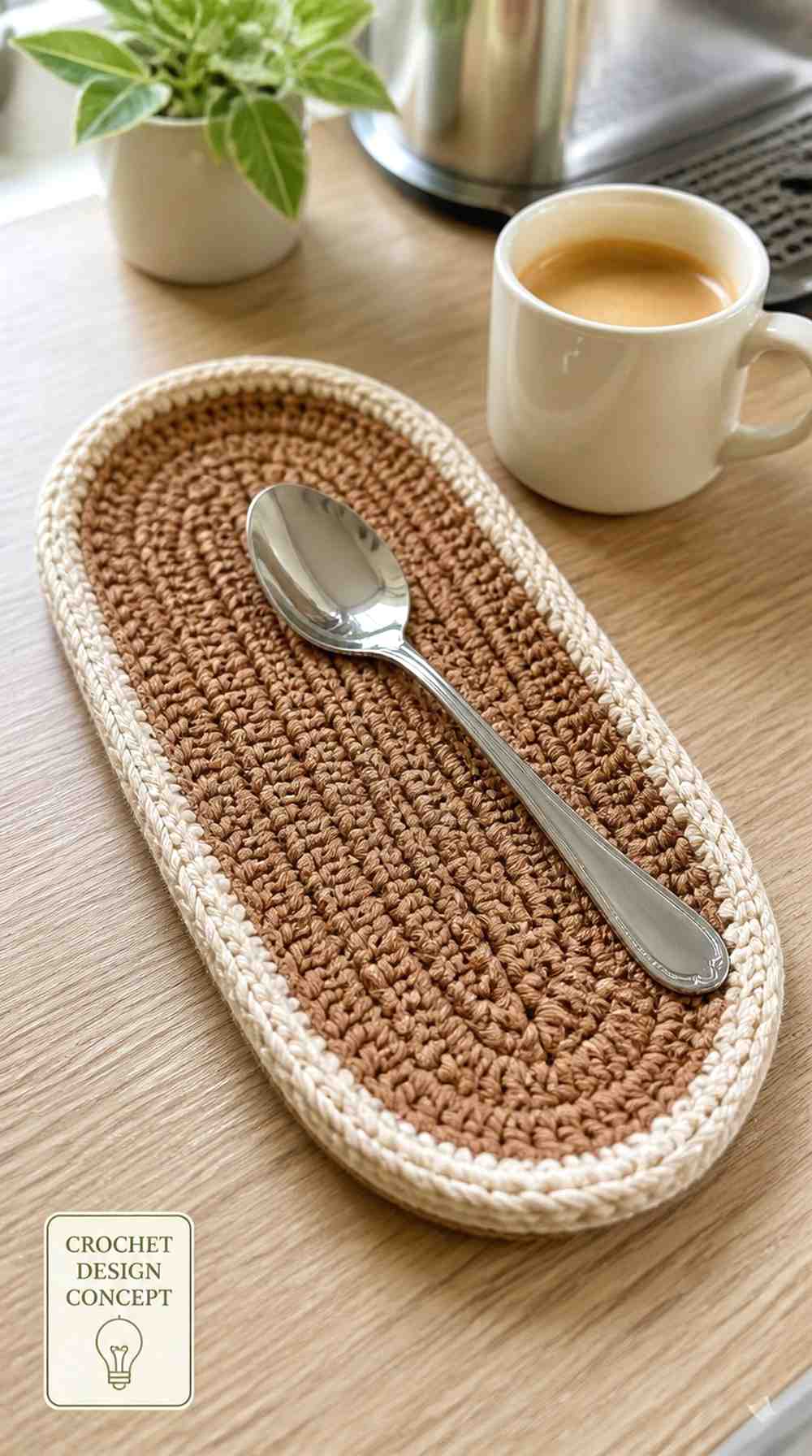
Warm caramel crochet gives this elongated oval spoon rest a soft, coffee-inspired look. Three subtle lengthwise ridges run through the center, while a raised ivory border follows the rounded outer edge. The design feels especially at home beside cream espresso cups and light wooden countertops.
Its simple outline makes the spoon easy to position without needing a complicated decorative arrangement. The rim provides visual definition, but its height and firmness would need checking in an actual crocheted version, particularly if the piece is used frequently.
- Raised Edge Design: Keep the ivory rim low and evenly worked so a small teaspoon can lie naturally across the center without rocking.
- Center Texture: The lengthwise ridges create a gentle structured appearance, although a real sample should be checked for stability beneath the spoon.
- Countertop Fit: The long oval is suited to a narrow space beside an espresso machine, provided the textile stays clear of hot surfaces.
- Yarn Choice: Smooth cotton is worth considering for a real version because it shows stitch definition and can be easier to care for when its label permits.
2. Crochet Tangerine Citrus Spoon Rest
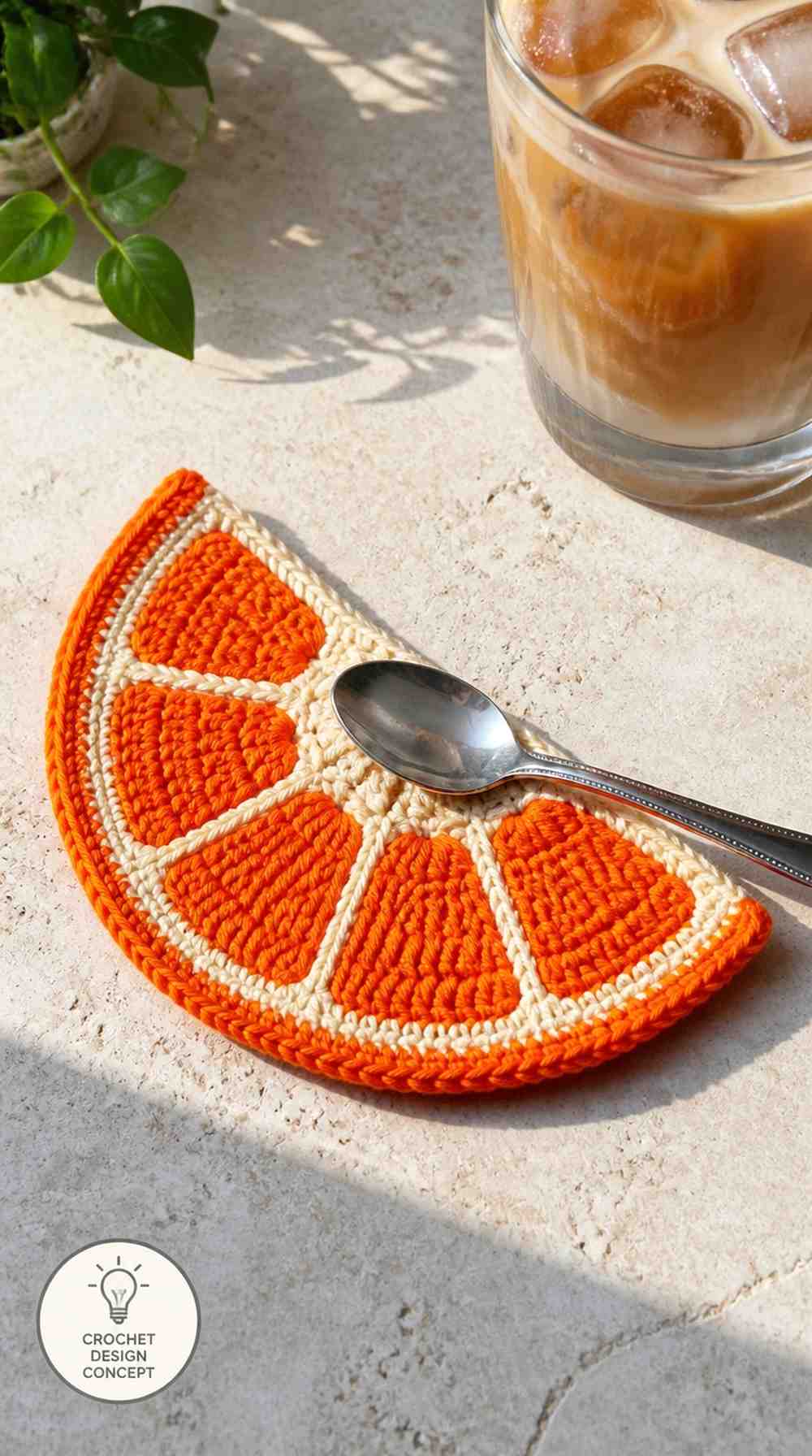
Bright tangerine crochet turns a small spoon rest into a playful citrus accent. Six orange wedge sections are separated by narrow ivory lines, creating the familiar appearance of a freshly sliced orange. A rounded peel-colored border completes the half-circle shape without making the design overly complicated.
The flat central surface gives the spoon a clear resting area, while the curved outline adds personality to a simple countertop. This style could look particularly cheerful beside iced coffee, cold brew glasses or a light-colored summer café setup.
- Segment Construction: Work the wedge sections with consistent spacing if recreating the look, keeping the dividing lines neatly connected rather than loosely attached.
- Flatness: A citrus shape needs careful control of increases so the semicircular fabric lies flat without rippling or curling.
- Color Contrast: Ivory dividing lines help the tangerine segments remain recognizable; a very similar cream-and-orange palette would make the shape less distinct.
- Everyday Limitation: Textured color joins may catch small stains, making a removable and easily cleaned version preferable to a permanently attached countertop accent.
3. Crochet Cream Daisy Spoon Rest
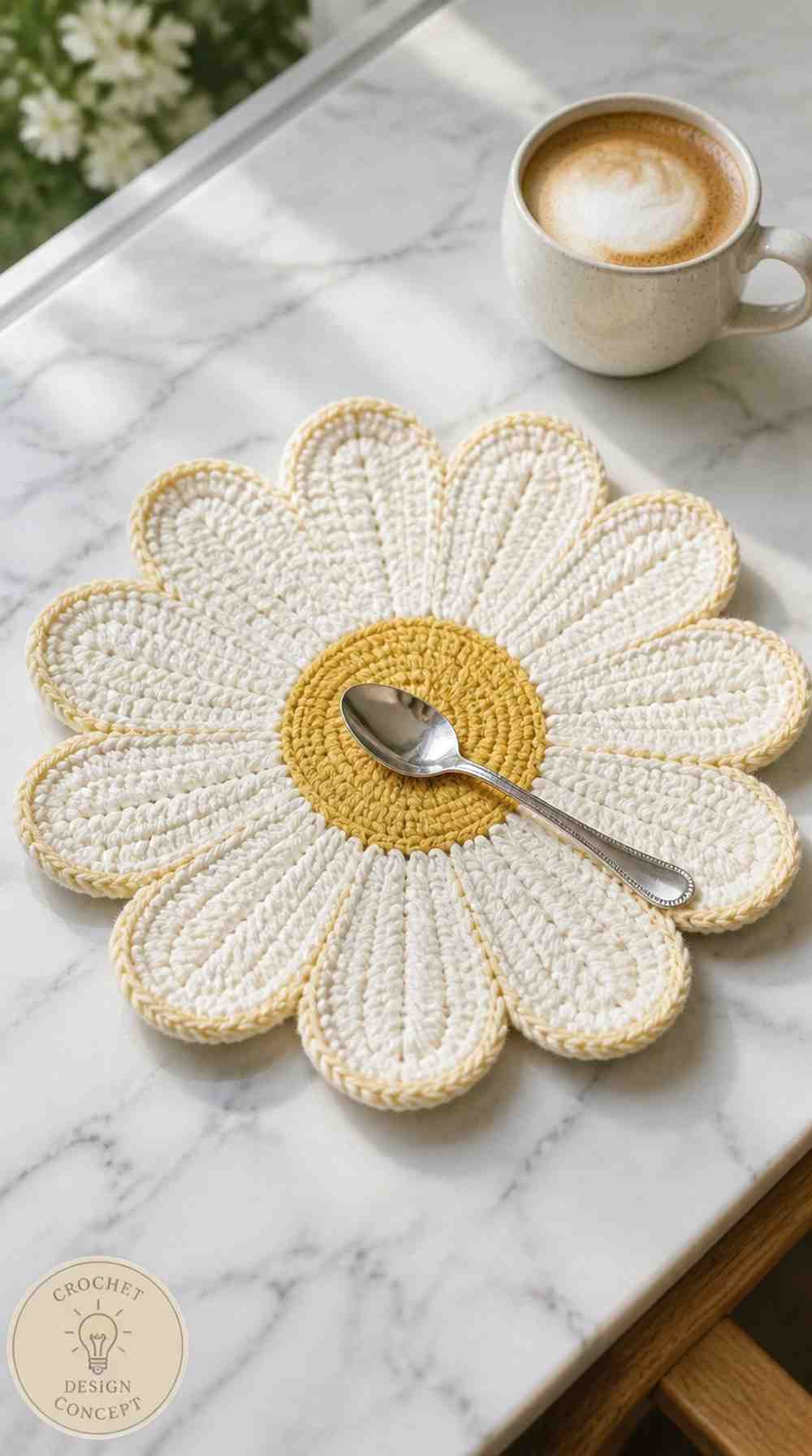
A large crochet daisy creates a gentle floral resting place for a small coffee spoon. Its butter-yellow center is surrounded by twelve ivory petals, each outlined with a subtle honey-colored edge. The finished concept has a flat central circle and a broad flower silhouette.
The yellow center is the useful resting zone, while the petals provide the decorative effect. This distinction matters because a spoon needs a reasonably level area beneath it. The design works best as a cheerful accent rather than something expected to catch heavy spills.
- Petal Arrangement: Twelve distinct petals give the flower its full outline; each should be joined firmly to the center in a handmade interpretation.
- Central Resting Area: Keep the yellow circle relatively dense and flat so the teaspoon can sit without being lifted unevenly by raised stitches.
- Space Planning: The petals extend beyond the functional center, so allow more countertop room than a plain circular spoon mat would require.
- Cleaning Detail: Ivory petals may show coffee marks quickly; choose a yarn with suitable washing instructions and allow the item to dry thoroughly.
4. Crochet Navy Channel Spoon Rest
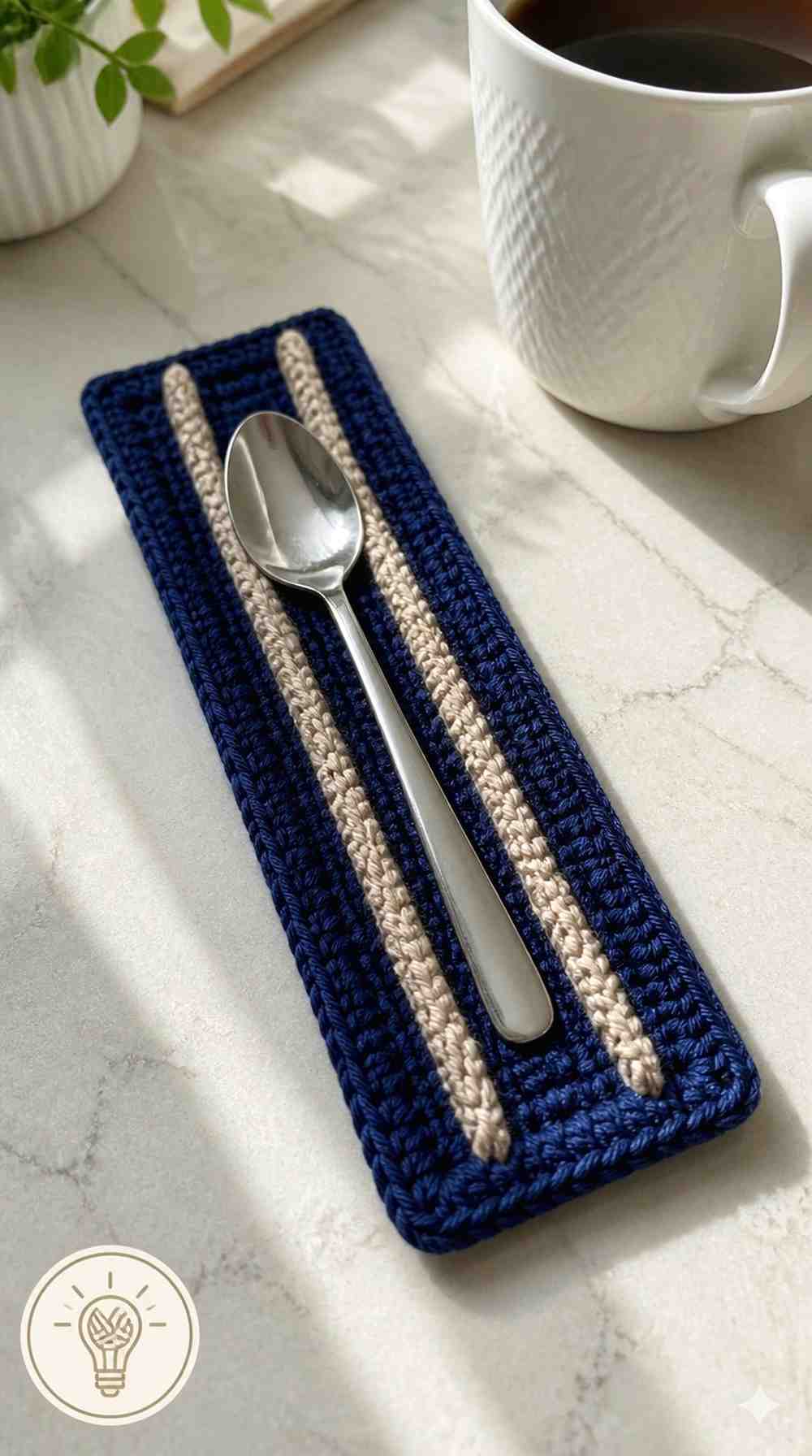
Deep navy crochet brings a tailored, modern finish to this narrow rectangular spoon rest. Two parallel sand-colored rails run along its length, forming a shallow central channel. The straight sides and neatly squared corners make the design look organized beside a simple white espresso cup.
The channel provides a clear visual position for one teaspoon, with the handle and bowl arranged lengthwise. A handmade version would need low, consistent rail height so the spoon remains comfortable to pick up without catching on the raised edges.
- Rail Spacing: Compare the distance between the two sand-colored rails with the width of your usual stirring spoon before planning the shape.
- Stitch Direction: Straight, closely worked rows can help create the clean rectangular appearance, but the finished fabric still needs checking for curling.
- Countertop Styling: The navy-and-sand palette pairs well with white cups, pale stone surfaces and other understated coffee accessories.
- Practical Limitation: Raised crochet rails are decorative guides, not a secure holder; they should not be relied on to stop a spoon sliding during movement.
5. Crochet Blush Crescent Spoon Rest
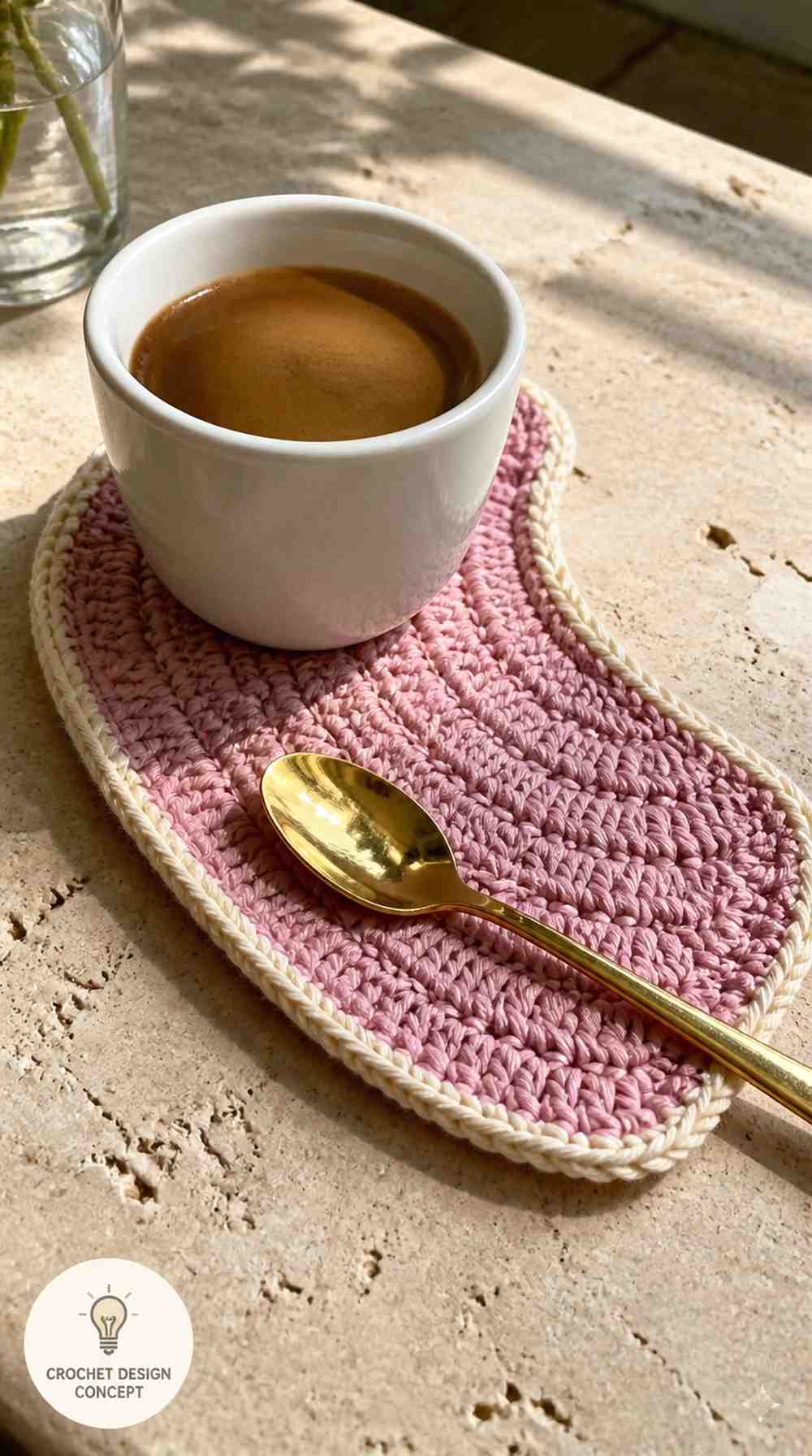
Soft blush-pink crochet gives this crescent-shaped spoon rest a graceful look around the base of a white coffee cup. A narrow cream edging defines the outer curve, while the broad crescent wing provides a resting place for a small gold-toned teaspoon.
Unlike a conventional oval, the inward curve makes the design feel connected to the nearby cup. It could suit a pretty afternoon coffee tray, although the spoon needs to stay entirely on the flat outer section rather than balancing across the curved opening.
- Cup Clearance: Leave enough space around the inner crescent so the cup does not press against or distort the crochet edging.
- Curved Shaping: Evenly controlled increases and decreases would help preserve the intended crescent outline without bunching the fabric.
- Spoon Position: The broader outer wing is the practical resting area; the narrow tips are decorative and should not carry the spoon’s weight.
- Color Styling: Blush and cream create a soft café look, while optional dusty-rose edging could provide stronger contrast against pale countertops.
6. Crochet Cocoa Checker Spoon Rest
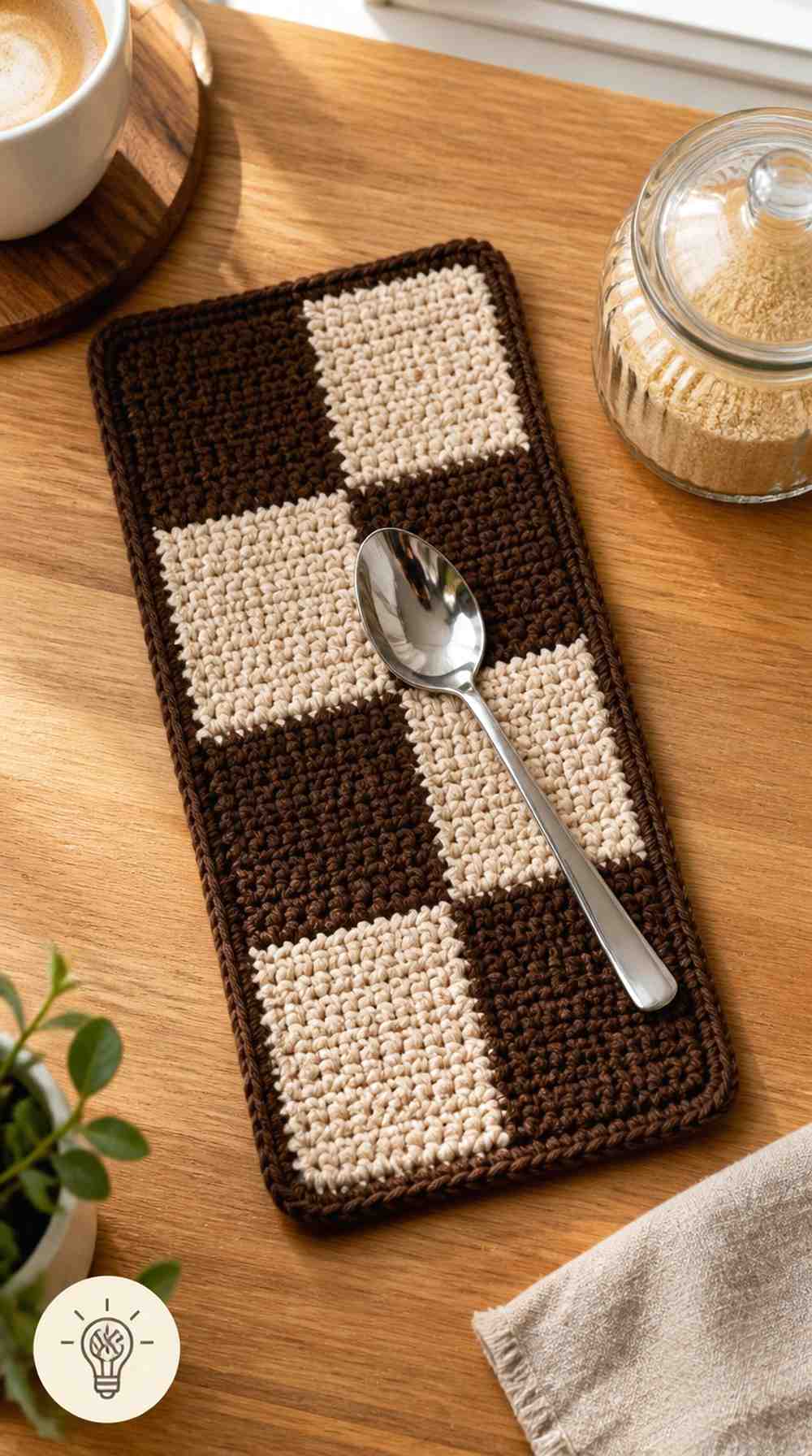
Alternating cocoa-brown and oatmeal squares give this rectangular crochet spoon rest the character of a tiny café checkerboard. Eight solid-textured blocks form a neat two-by-four arrangement, finished with a narrow chocolate-colored border.
The joined squares bring more detail than a plain fabric rectangle without changing the familiar resting shape. A silver teaspoon sits diagonally across the surface, allowing the different blocks to remain visible. This could work especially well with neutral mugs and wooden coffee accessories.
- Square Joining: Keep the eight squares close together with tidy seams so the surface does not develop large ridges beneath the spoon.
- Color Layout: The alternating pattern depends on consistent placement; checking the two-by-four arrangement before joining helps preserve the intended checkerboard.
- Surface Texture: Solid crochet blocks are more appropriate here than very open granny squares because they create a more continuous resting area.
- Personal Variation: Cream-and-terracotta or espresso-and-beige squares could offer a different café palette while retaining the same small checkerboard arrangement.
7. Crochet Lavender Double Spoon Rest
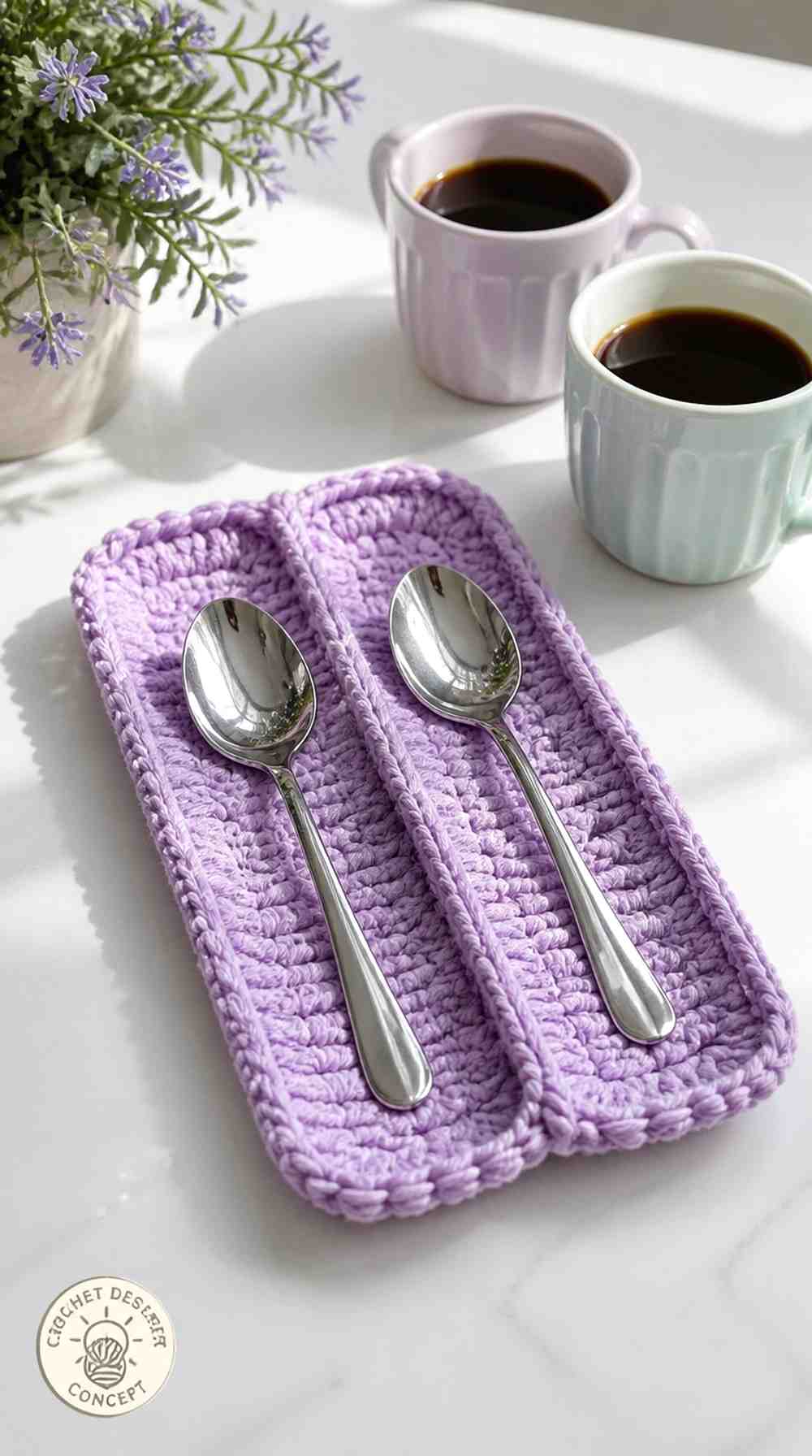
Two shallow resting channels make this lavender crochet spoon rest different from the single-spoon designs. A raised central rib separates the spaces, while a delicate lilac-textured edge softens the rectangular outline. Two silver teaspoons sit side by side against the lavender fabric.
This concept suits a small shared coffee station where two clean stirring spoons are often kept ready. The central divider creates visual order, although it would need enough firmness to retain its shape without making the fabric bulky.
- Two-Spoon Layout: Plan each channel around the actual spoon width rather than simply doubling the size of a narrow single-spoon mat.
- Center Divider: Keep the raised lavender rib attached along its full length so it does not lift or twist when the textile is handled.
- Edge Placement: The lilac outer texture adds decoration, but it should remain outside the two main resting channels.
- Cleaning Convenience: A wider piece may collect more dust and splashes, so consider how it will be removed, washed and dried between uses.
8. Crochet Apricot Granny Spoon Rest
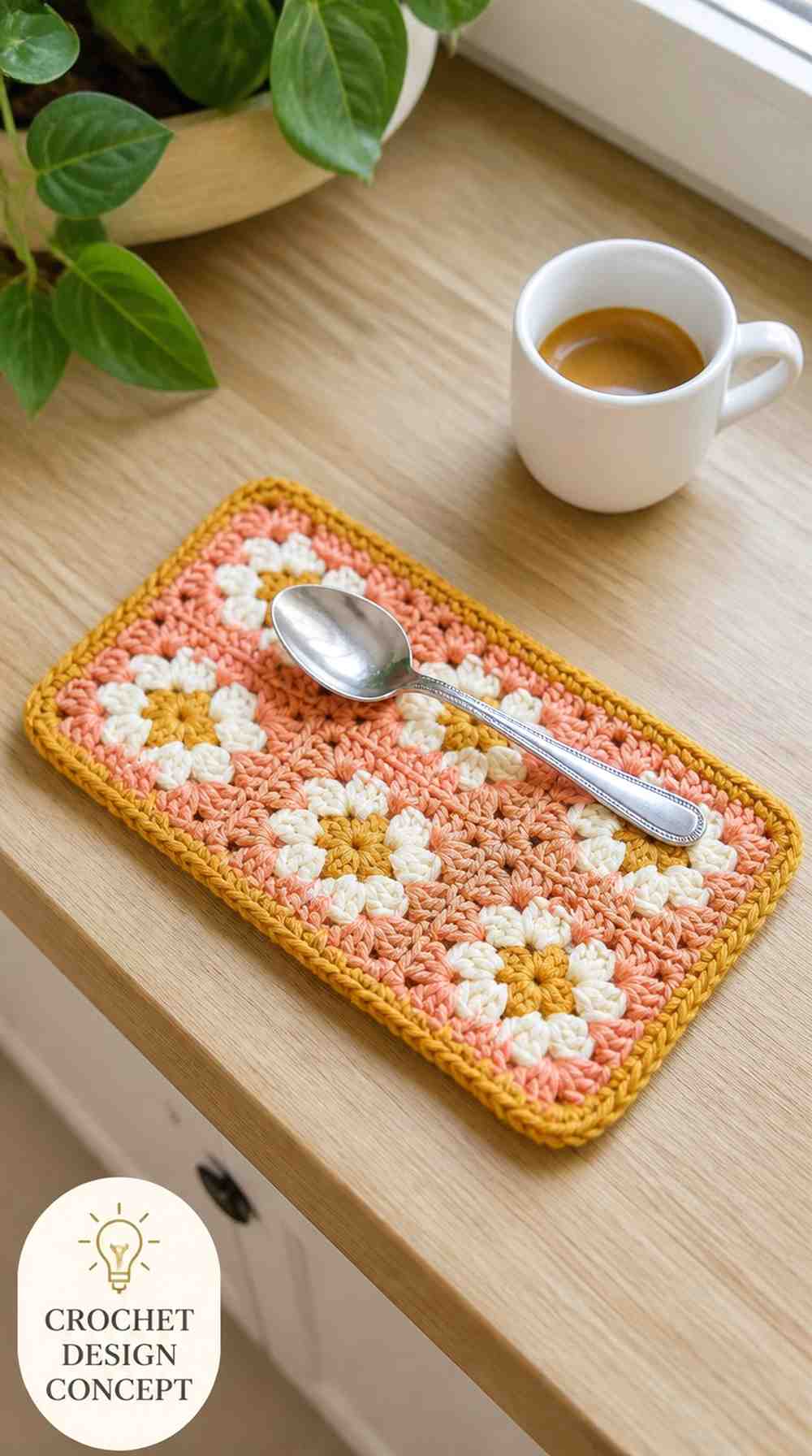
Four miniature granny-style motifs bring a traditional crochet detail to this apricot spoon rest. The motifs alternate apricot and cream tones, forming a short rectangular strip above a closely stitched apricot backing. A golden-ochre border completes the warm café palette.
The solid backing is important to the concept because open granny motifs alone would leave spaces beneath the spoon. Here, the decorative squares provide texture while the continuous lower layer offers a more practical resting surface for a cool teaspoon.
- Motif Connection: Join the four granny-style sections evenly so their corners align and the rectangular outline remains straight.
- Solid Backing: The apricot backing helps reduce the open gaps found in traditional granny designs, though a real sample must still be checked for firmness.
- Fabric Thickness: Two crochet layers may produce a thicker mat, so avoid making the decorative motifs excessively raised.
- Border Choice: The golden-ochre edging unifies the four blocks; a contrasting darker border could be an optional variation for a stronger vintage look.
9. Crochet Olive Leaf Spoon Rest
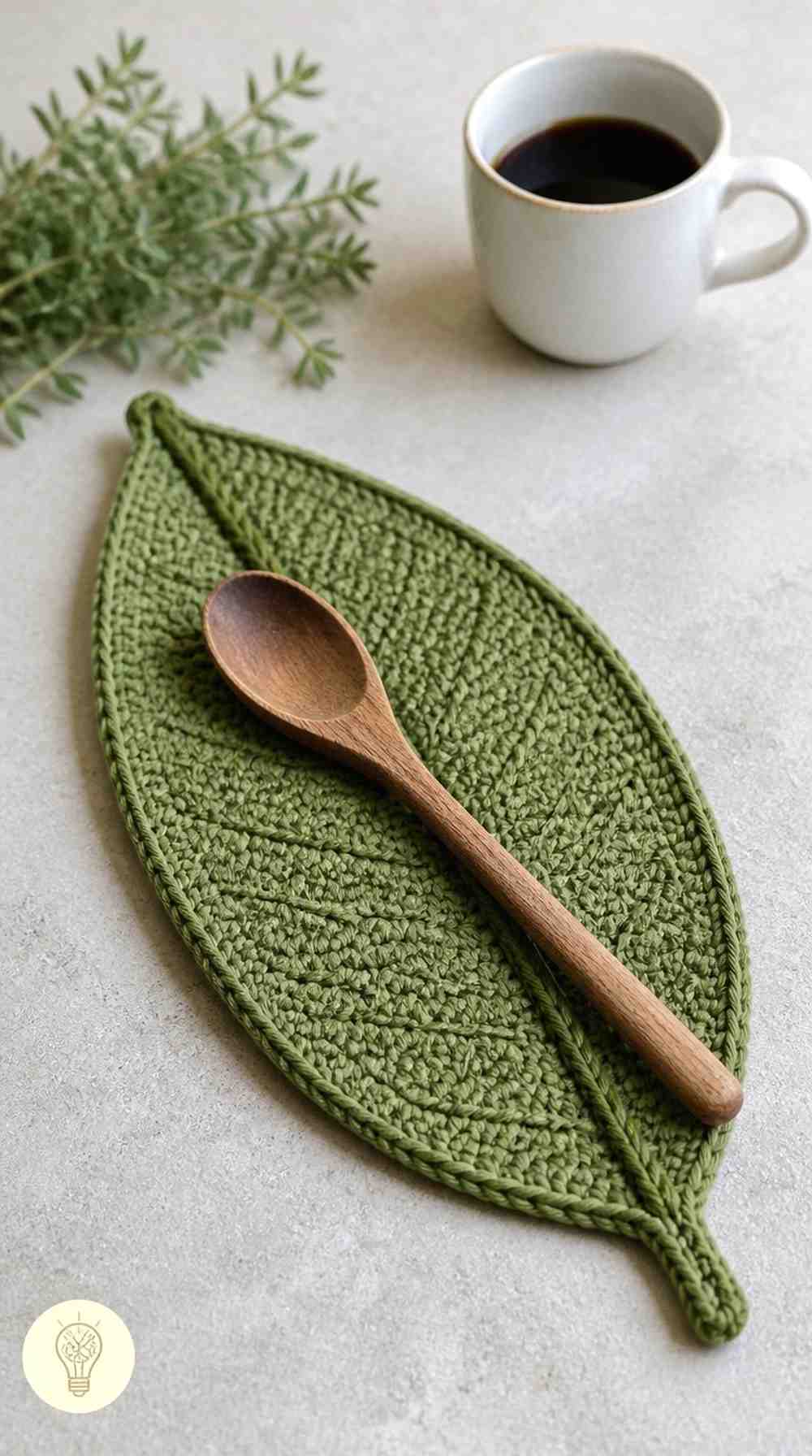
An elongated olive leaf becomes the outline of this botanical crochet spoon rest. Fine diagonal stitch lines suggest leaf veins, while a darker central ridge runs along the soft green surface. The pointed ends and smooth outer border give it a natural, understated appearance.
A wooden stirring spoon follows the broad middle of the leaf, making the shape especially clear. This design could suit a coffee corner with wooden accessories and greenery, provided the narrow pointed sections remain decorative rather than supporting the utensil.
- Leaf Proportions: Keep the widest area near the center so a small stirring spoon has more stable support than the pointed ends can provide.
- Vein Texture: Raised crochet lines should be subtle enough to suggest a leaf without creating pronounced bumps under the utensil.
- Natural Styling: The olive palette works with wooden stirrers, cream ceramics and light stone counters without requiring additional floral decoration.
- Shape Retention: A long pointed textile may curl after washing; reshape it carefully while drying according to the chosen yarn’s care instructions.
10. Crochet Poppy Hanging Spoon Rest
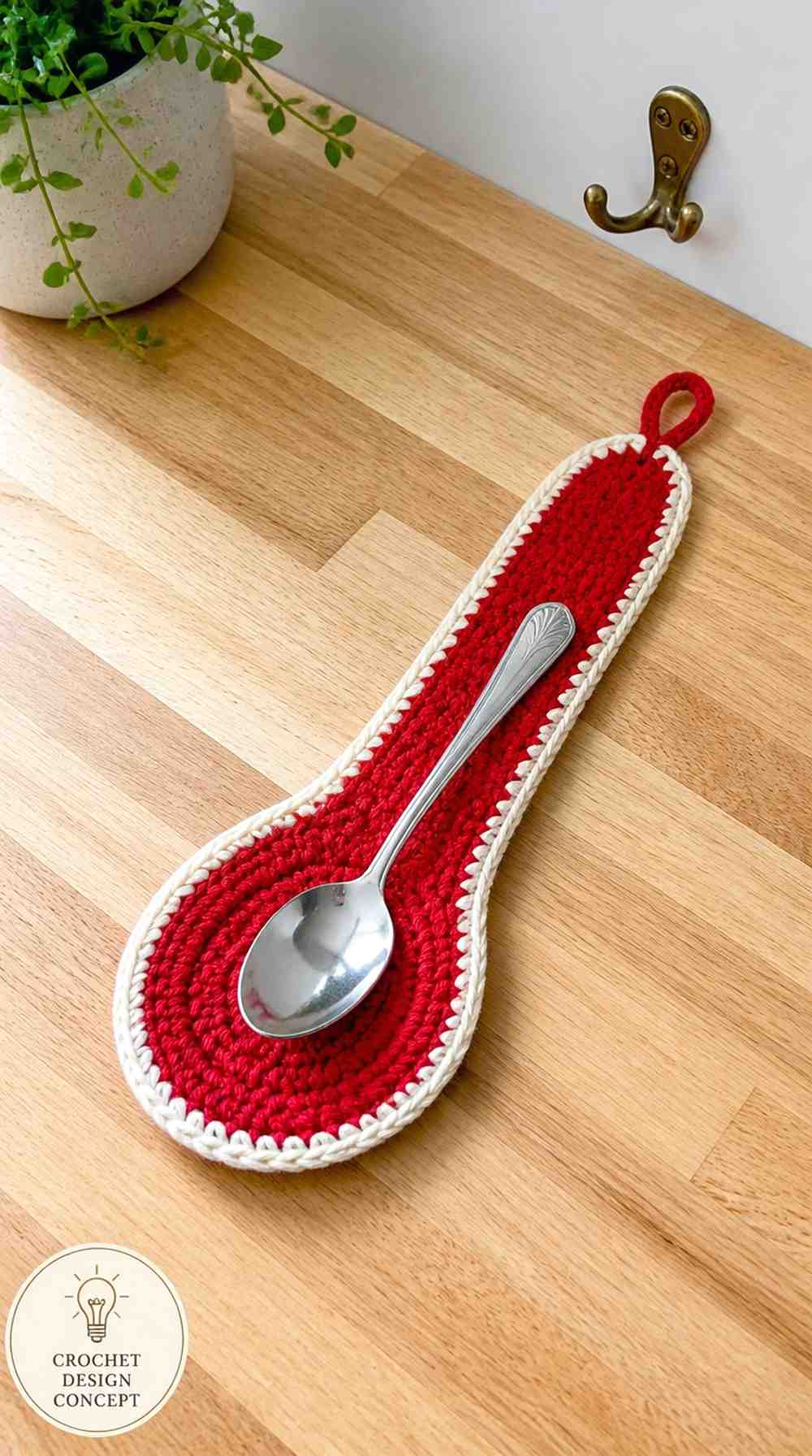
Bright poppy-red crochet gives this narrow spoon rest an energetic look against a pale wooden counter. Its broad rounded end supports the spoon bowl, while the slim extension follows the handle. A neat ivory border outlines the entire piece, and a small red loop finishes the far end.
The integrated loop adds a useful storage idea: the rest could hang from a nearby hook after washing and drying. Its position should remain away from steam, hot equipment and places where wet fabric cannot dry properly.
- Hanging Loop: Work the red loop securely into the narrow end, and check that it supports the fabric’s own weight without stretching excessively.
- Broad Spoon Area: The rounded lower section should be wide enough for the spoon bowl, while the tapered extension keeps the shape compact.
- Storage Position: A dry wall hook away from the coffee machine’s hot surfaces is more appropriate than hanging the crochet beside a steam wand.
- Color Care: Strong red yarn may bleed during early washes, so test colorfastness before placing it against pale fabrics or porous surfaces.
11. Crochet Mocha Coffee Bean Spoon Rest
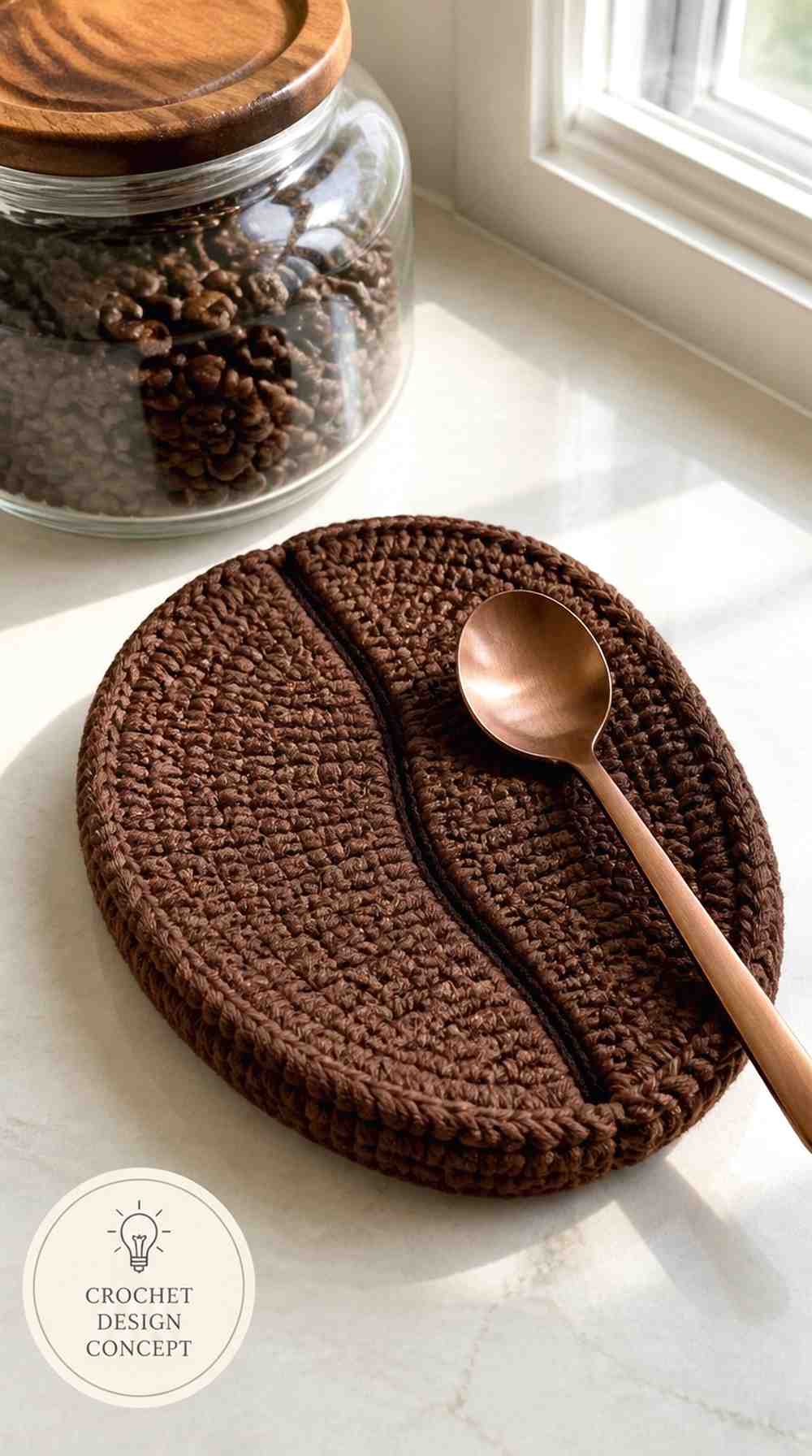
Coffee-inspired styling takes a literal turn with this mocha-brown crochet spoon rest shaped like an elongated coffee bean. A darker curved center seam divides its two rounded sections, giving the design a recognizable outline without relying on extra decorations.
The broad sides provide a resting place for a small copper-toned stirring spoon. Its rich brown coloring works naturally beside jars of coffee beans, cream countertops and simple espresso accessories. The center seam should remain low enough not to interfere with the spoon.
- Bean Silhouette: The rounded ends and curved center line are the main identifying details; overly sharp corners would weaken the coffee-bean appearance.
- Raised Center Seam: Keep the dark espresso-colored seam shallow so it adds definition without lifting the utensil away from the resting surface.
- Yarn Definition: Smooth, tightly worked crochet can make the bean shape easier to recognize than loose or heavily textured stitches.
- Countertop Contrast: Mocha crochet is clearer against cream or pale stone; it may visually disappear against a very dark wooden coffee station.
12. Crochet Blue Ripple Spoon Rest
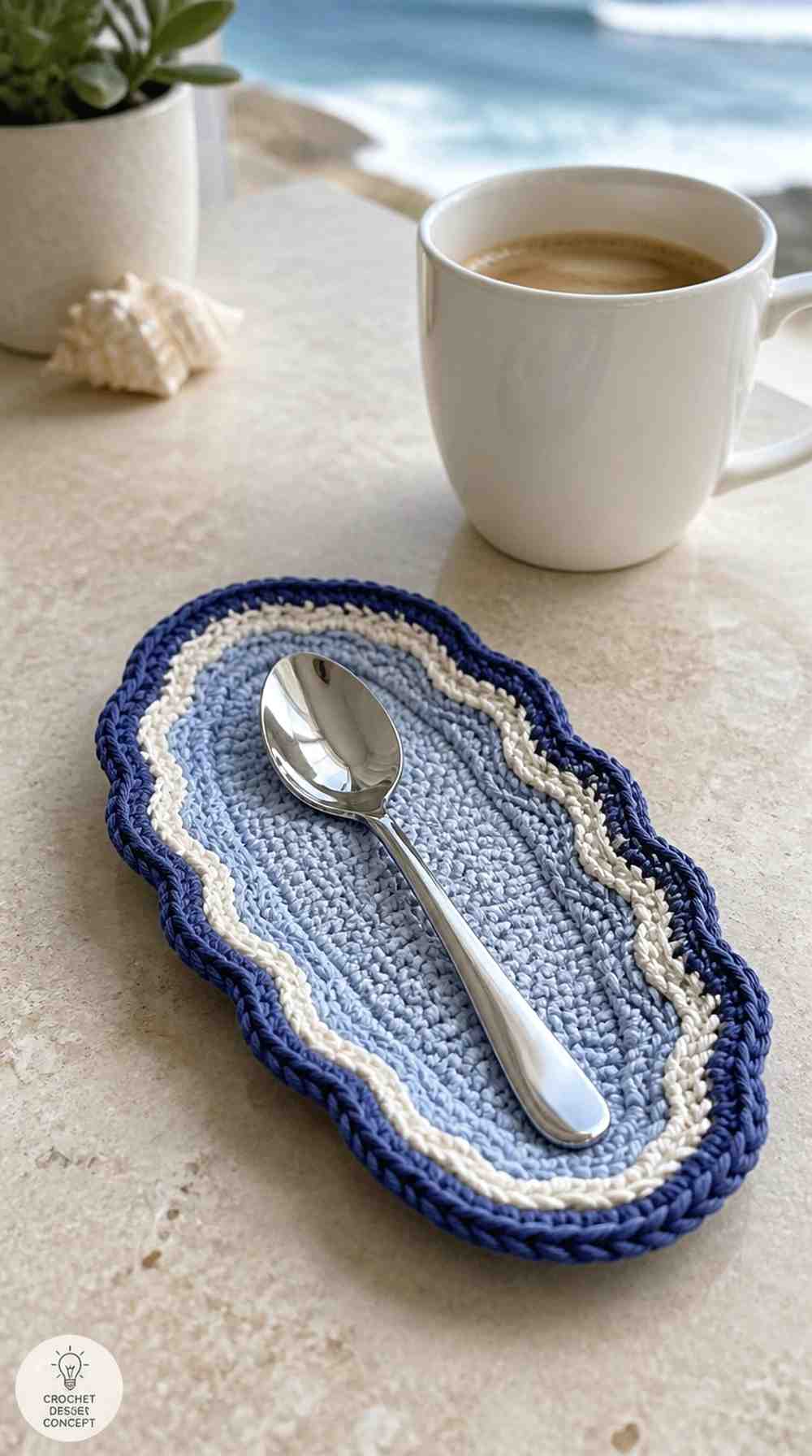
Soft blue crochet bands give this elongated oval spoon rest the appearance of gentle ripples. The closely worked sky-blue center is surrounded by powder-blue, ivory and deep ocean-blue rows, finishing in a softly undulating edge.
The color progression adds movement without introducing separate decorative pieces. A small silver teaspoon rests along the flat center, leaving the surrounding blue bands visible. This design could be a lovely match for a coastal-style breakfast corner or a café station with white ceramic accessories.
- Ripple Edging: Keep the waves concentrated around the perimeter so the central resting section remains relatively flat and easy to use.
- Color Transitions: Gradual changes from pale blue to deeper ocean tones make the ripples more noticeable without requiring raised embellishments.
- Oval Shaping: Check the increases around both rounded ends to avoid excessive waviness that could distort the intended elongated silhouette.
- Cleaning Consideration: Pale blue and ivory yarn can show coffee staining; a removable piece that can be washed according to its fiber label is preferable.
13. Crochet Rose Spoon Bowl Rest
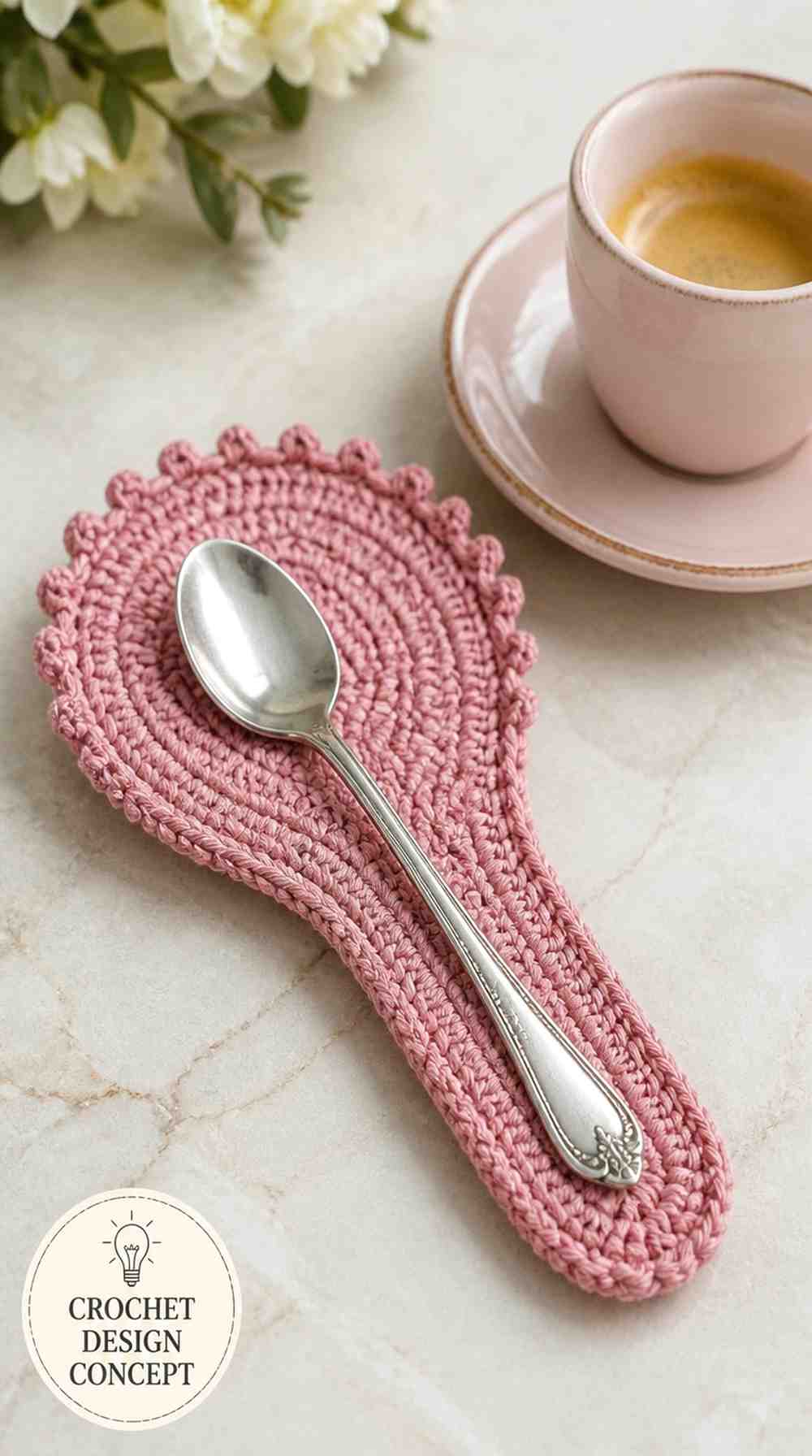
Dusty-rose crochet creates a delicate spoon rest with two clearly defined sections. One end forms a broad circular landing pad, edged with tiny matching bobbles, while a long tapered extension supports the handle of a small silver teaspoon.
The arrangement gives this concept a more purposeful shape than an ordinary crochet coaster. Its circular section is the visual focal point, but the bobbles stay around the outside so the center remains relatively smooth. The design suits a soft pink or cream home café setting.
- Spoon Bowl Position: The circular section should be planned around the actual spoon bowl, allowing the utensil to sit comfortably inside the bobbled border.
- Bobble Placement: Keep the small raised details around the outside rather than beneath the spoon, where they could create an unstable resting surface.
- Handle Extension: A narrow crochet strip can support the handle visually, but it should be wide enough to remain flat during everyday handling.
- Delicate Finishing: Matching rose-colored bobbles offer subtle texture; larger decorative knots could make the piece harder to clean and reshape.
14. Crochet Charcoal Chevron Spoon Rest
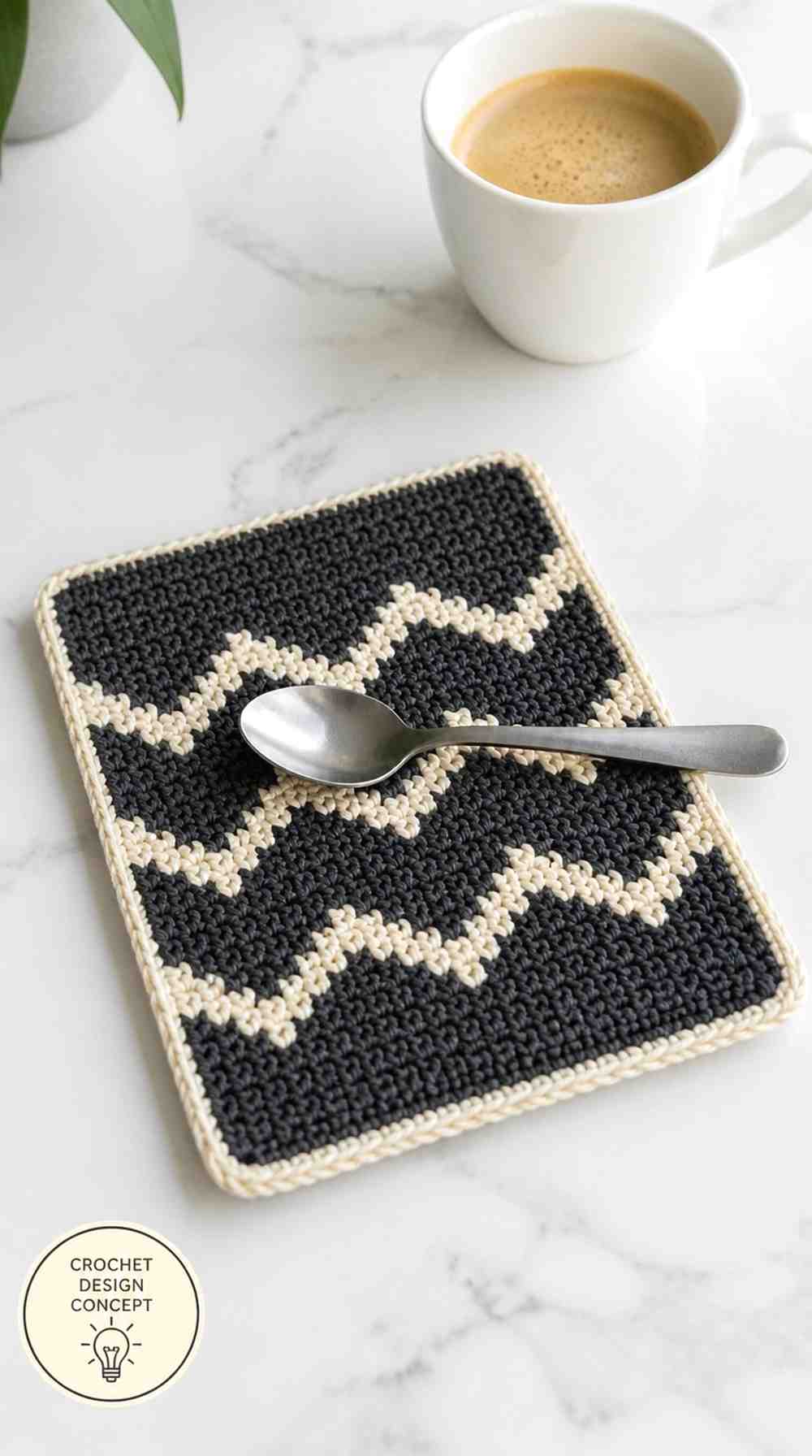
A charcoal-grey crochet base gives this rectangular spoon rest a modern café appearance. Three thin ivory chevrons run across its surface, while a clean cream border defines the straight edges. The pattern is geometric, restrained and easy to coordinate with white cups.
Unlike the floral and fruit-shaped designs, this concept relies on neatly worked color changes rather than unusual shaping. A brushed-steel teaspoon sits across the flat center, creating a simple arrangement suited to minimalist kitchens and contemporary coffee bars.
- Chevron Alignment: Plan the three ivory zigzags with even spacing so they read as a coordinated pattern rather than unrelated decorative stitches.
- Flat Colorwork: Working the chevrons into the crochet fabric can keep the surface smoother than adding thick decorative cords afterward.
- Edge Finish: A slim cream border gives the charcoal rectangle a defined outline without making it visually heavy.
- Countertop Matching: The dark textile looks especially clear against pale quartz or wood; a black countertop may need a lighter color variation.
15. Crochet Lemon Lace Spoon Rest
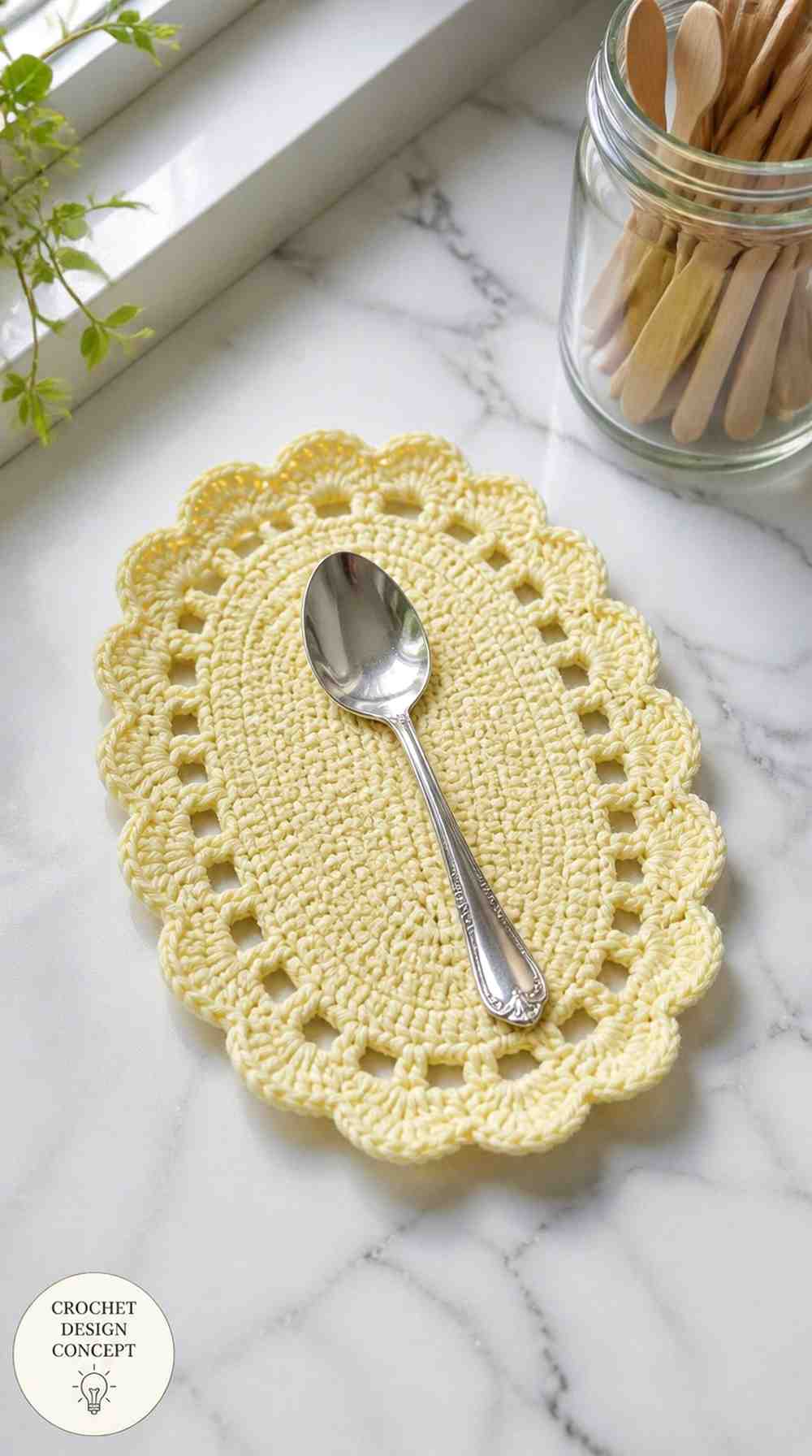
Pale butter-yellow crochet brings a light vintage character to this oval stirring spoon rest. Its solid center is surrounded by an orderly ring of small eyelet openings, followed by a soft lemon-colored scalloped border.
The lace detail remains around the outside rather than beneath the spoon, which helps keep the main resting area visually practical. This concept would look attractive beside clear jars, white cups and other delicate café accessories. It is especially appealing for someone who enjoys traditional crochet edging without wanting a fully open lace piece.
- Solid Central Panel: Keep enough closely worked crochet in the middle for the spoon to rest on, rather than depending on the decorative eyelet sections.
- Eyelet Consistency: Evenly spaced openings give the lace border its orderly appearance; irregular gaps may make the edge look unfinished.
- Scallop Width: A restrained border is more suitable for a small coffee station than oversized scallops that extend into nearby cup space.
- Fabric Care: Open decorative edges can snag during handling, so a real version should be washed gently when the yarn’s care instructions require it.
16. Crochet Pistachio Ceramic Spoon Rest
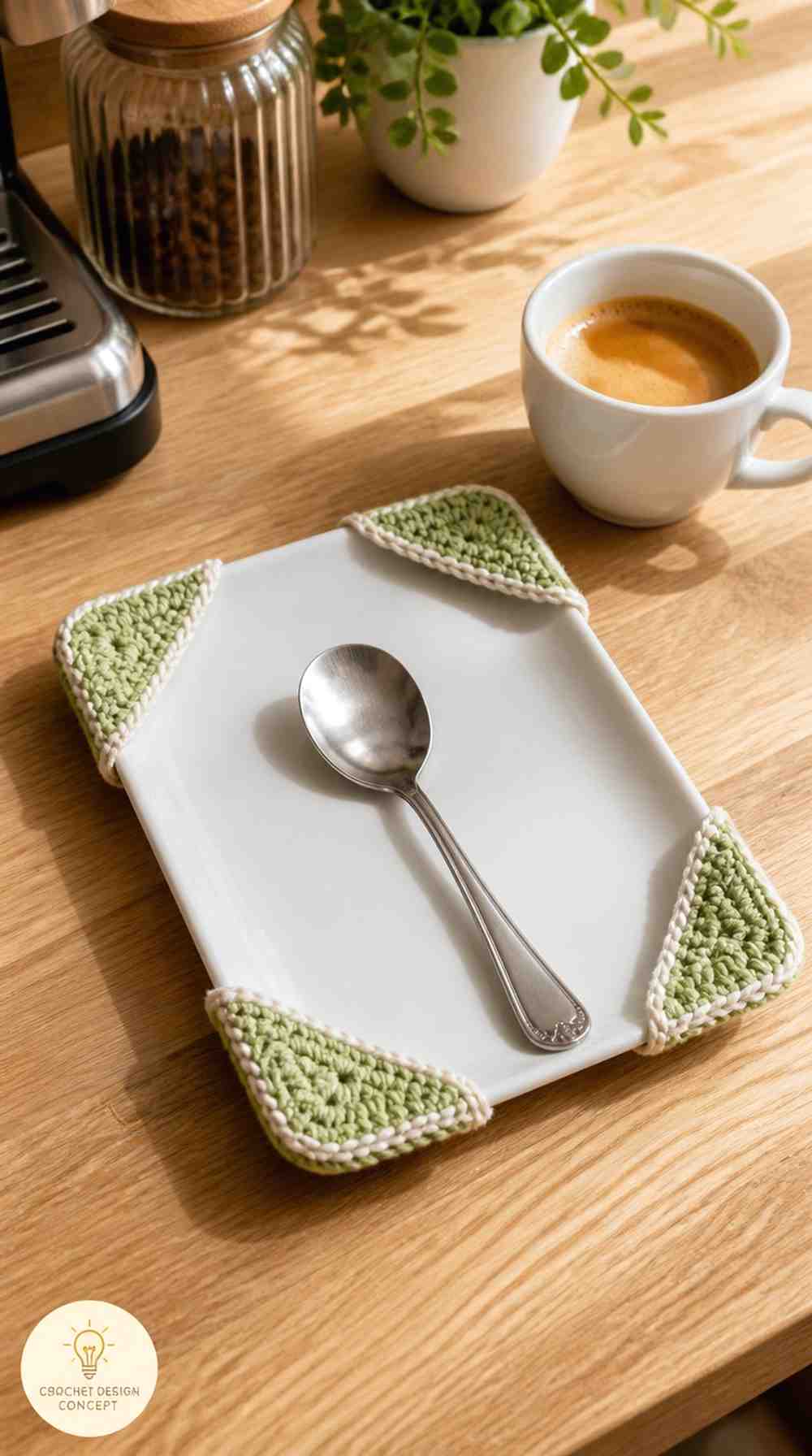
Pistachio-green crochet adds a handmade finish to this small white ceramic spoon rest without covering its useful central surface. Four carefully fitted crochet corner sleeves frame the rectangular dish, each finished with a narrow cream edge.
The silver teaspoon rests directly on the exposed ceramic center. This arrangement separates the decorative crochet from the area that may receive coffee drops, making it an interesting alternative to an entirely textile spoon rest. The removable nature and exact fit of the corner sleeves would need planning before making a real version.
- Exposed Ceramic Center: The spoon should contact the ceramic plate rather than the yarn, particularly when handling a damp or recently used utensil.
- Corner Fit: Each pistachio crochet sleeve needs to suit the dish’s actual corner shape without slipping over the central resting area.
- Cleaning Access: A removable crochet arrangement would make it easier to wash the ceramic separately and dry any textile parts completely.
- Material Separation: The ceramic must be suitable for the intended utensil temperature; the crochet corner accents should remain away from hot contact points.
17. Crochet Teal Spoon Bowl Pocket Rest
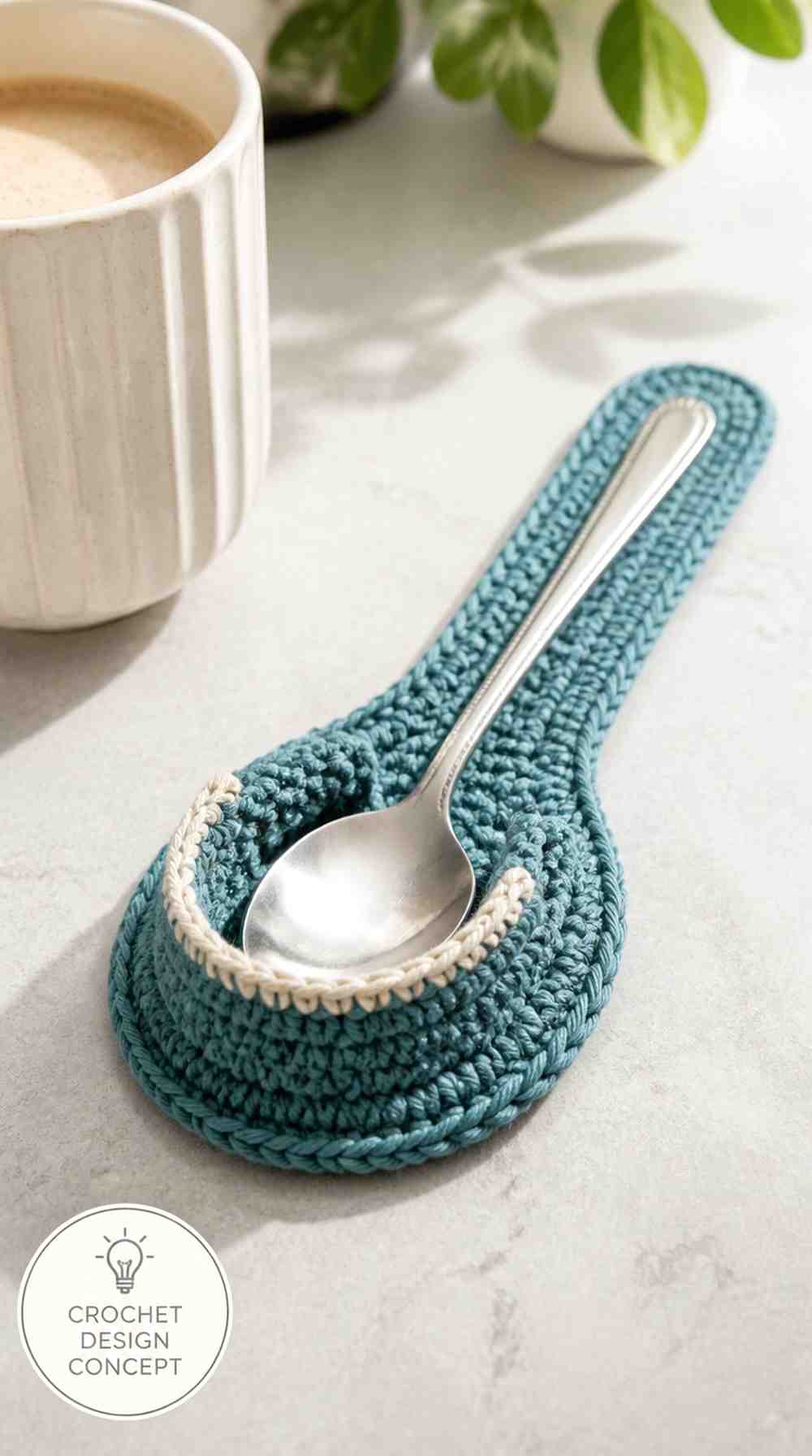
Dusty-teal crochet gives this elongated spoon rest a softly structured shape. Its rounded end features a shallow semicircular pocket with a cream-edged rim, while a narrow flat extension continues beneath the teaspoon handle.
The little raised section makes the spoon bowl appear nestled into the crochet rather than simply laid on top. This adds an unusual visual feature to a home café display. Because it is a textile pocket, however, a real version should be reserved for clean, cooled utensils rather than spoons carrying hot liquid.
- Pocket Depth: Keep the semicircular pocket shallow enough that the spoon bowl can be lifted easily without pulling or catching the crochet edge.
- Rim Stability: The cream border should follow the rounded pocket evenly; a loose rim may collapse over the resting space.
- Handle Alignment: Position the long teal extension in line with the center of the pocket so the utensil can rest in a natural direction.
- Moisture Limitation: The pocket shape may retain droplets and dry slowly, making a dry display use more suitable than frequent contact with wet spoons.
18. Crochet Burgundy Fan Spoon Rest
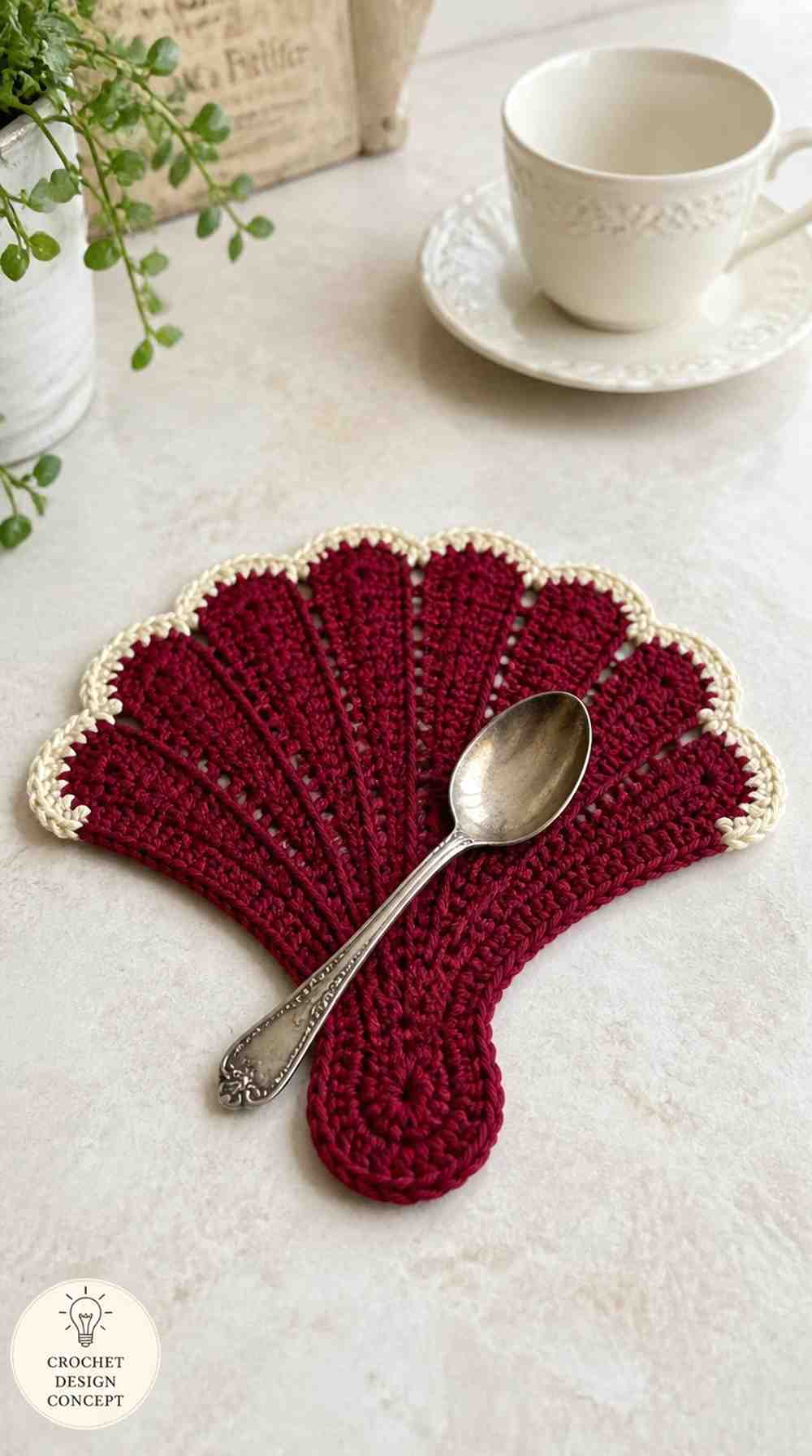
Rich burgundy crochet creates an elegant fan-shaped spoon rest with seven radiating stitch sections. The fabric spreads from a narrow rounded base into a broad curved edge, finished with small ivory scallops.
The design has a vintage café mood without needing extra beads, ribbons or attached flowers. A small antique-silver teaspoon lies across the broad central section, allowing the fan’s stitch direction to remain visible. Its wider upper edge gives it a more decorative silhouette than the simple oval and rectangular options.
- Radiating Sections: Keep the seven fan segments evenly spaced so the fabric expands smoothly rather than forming sharp ridges or puckered sections.
- Scalloped Arc: Ivory scallops should follow the outer curve without becoming so large that they interfere with the spoon’s resting position.
- Useful Landing Area: The broader middle of the fan is the appropriate support zone; its narrow base is primarily part of the decorative silhouette.
- Vintage Styling: Burgundy and ivory suit cream ceramics and traditional wooden trays, while an optional muted-plum version could create a softer appearance.
19. Crochet Lilac Figure Eight Spoon Rest
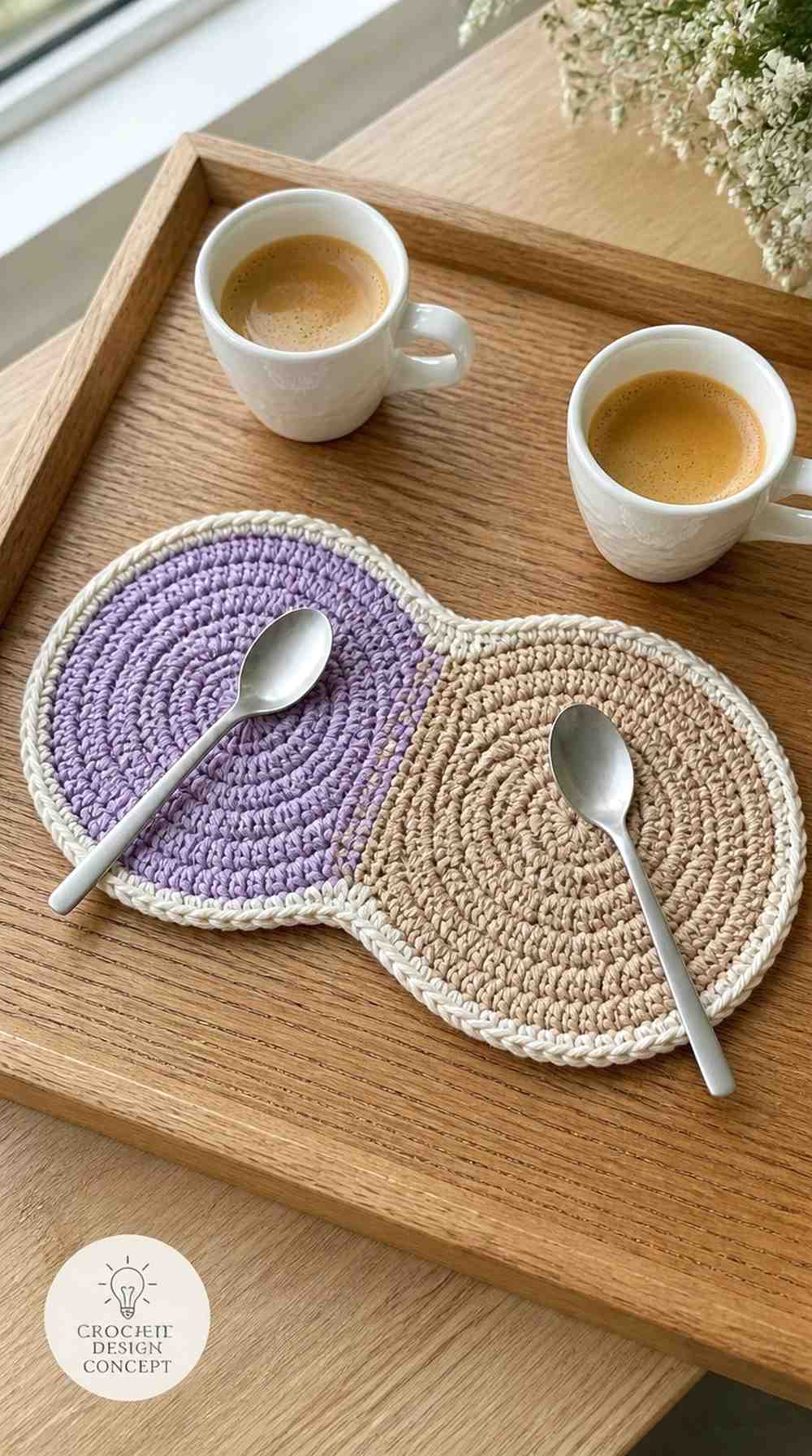
Two overlapping crochet circles create the unusual figure-eight outline of this final spoon rest. One circle is dusty lilac and the other warm sand beige, with a narrow ivory border linking the two into a continuous decorative shape.
Each circular section supports a separate small silver stirring spoon, giving the design a clear purpose for a shared coffee tray. Compared with the lavender double-channel version, the separated round areas create a softer and more casual arrangement. Its overall footprint matters when placing it beside two espresso cups.
- Joined Circular Centers: The two crochet rounds should connect neatly at the middle so the figure-eight shape remains flat rather than folding at the join.
- Individual Spoon Zones: Each circle needs enough usable surface for its own teaspoon, especially if the spoons have wider bowls.
- Two-Color Balance: Lilac and sand provide contrast without competing; an ivory outer edge helps connect both circles visually.
- Tray Placement: Check the combined width against a real coffee tray before making the piece, since two round sections may occupy more space than expected.
Practical Guide to Crochet Home Café Stirring Spoon Rests
A crochet spoon rest can make a coffee station feel more personal, but there are a few important details to consider before creating or using one.
Choose the right materials. Smooth cotton yarn is a sensible material to consider for small decorative kitchen textiles because it can provide clear stitches and may be washable. Always check the actual yarn label. Cotton is not automatically heatproof, and synthetic fibers can behave differently around heat.
Keep hot utensils away from crochet. A freshly heated spoon, steam wand, hot coffee drips or contact with a burner can damage textile fibers or create a burn risk. Use heat-suitable ceramic, metal or silicone for hot utensils. These crocheted concepts are best treated as accents for cool, clean spoons, with the ceramic-center design offering an alternative for separating the spoon from the yarn.
Measure the actual spoon. Check both the spoon bowl and handle before choosing a narrow channel, round landing pad or tapered shape. A resting surface that looks balanced in a design image may not suit your own utensils.
Plan for moisture and cleaning. Coffee, milk and water can stain yarn or leave it damp. Wash textile pieces according to their fiber-care instructions and dry them fully before returning them to the coffee station. For related kitchen crochet styling, the coaster and mug-cozy ideas in this crochet project collection offer another way to compare flat surfaces and fitted accessories.
Think about placement. Put decorative crochet accessories on a stable, dry surface away from hot machine parts, electrical controls and open flames. Designs with raised borders or narrow extensions should be checked for curling, shifting and uneven support.
Want to Make Something Similar?
These 19 designs are original visual concepts, not exact tested patterns. If you want to explore a real crochet project with a related shape or texture, these resources provide useful starting points:
- Craft Yarn Council — Learn Single Crochet explains the basic stitch that can be useful for closely worked rectangular and oval fabrics. Welcome to the Craft Yarn Council
- CAAB Crochet — How to Wash Cotton Yarn Projects discusses cleaning cotton crochet items, particularly those used around the kitchen. CAAB Crochet
A maker would still need to develop or choose a suitable pattern, check the finished size and evaluate whether the real piece is appropriate for its intended use.
Which Crochet Spoon Rest Design Should You Choose?
The best choice depends on whether you prefer decoration, compact storage, two-spoon organization or easy cleaning.
| Your main priority | Design worth considering | Main trade-off |
|---|---|---|
| Simple everyday display | Caramel Oval | Raised rim needs checking |
| Playful café styling | Tangerine Citrus | Curved shape uses more width |
| Floral decoration | Cream Daisy | Petals extend beyond resting area |
| Modern compact shape | Navy Channel | Rails must stay low and even |
| Vintage crochet detail | Lemon Lace | Open edging needs careful handling |
| Two clean teaspoons | Lavender Double | Wider fabric to clean |
| Traditional crochet motifs | Apricot Granny | Layered fabric can become bulky |
| Hanging after use | Poppy Hanging | Loop needs secure construction |
| Easier spoon-surface cleaning | Pistachio Ceramic | Crochet corner fit must be checked |
| Distinctive cup-side arrangement | Blush Crescent | Asymmetric resting area |
| Decorative two-spoon tray | Lilac Figure Eight | Needs room for both circles |
For a small coffee station, I would begin by comparing the Caramel Oval, Navy Channel and Poppy Hanging designs. Their narrow shapes make them easier to plan around limited counter space.
For a decorative café tray, the Cream Daisy, Tangerine Citrus and Burgundy Fan offer more distinctive silhouettes. Where actual wet spoon use matters, a suitable ceramic spoon rest is the more practical starting point, with the Pistachio Ceramic concept showing how crochet can remain part of the decoration.
Conclusion
Small crochet accessories can bring character to a home café without changing the entire kitchen. These 19 stirring spoon rest concepts show how much variety can come from the shape, color and texture of a simple item, whether you prefer a coffee-bean silhouette, a floral accent or a modern geometric design.
Choose a concept that suits your available space and daily coffee routine, while keeping the practical limits of crochet fabric in mind. For a real project, careful sizing, sensible material selection and safe utensil placement matter just as much as the finished appearance.
Which crochet spoon rest would you choose for your own coffee corner? Would you prefer the Caramel Oval, Cream Daisy, Pistachio Ceramic or one of the more unusual shapes? Share your favorite design in the comments.
Frequently Asked Questions
1. Can a crochet spoon rest be used for everyday coffee stirring spoons?
A crochet spoon rest may work as a decorative surface for clean, cool and dry stirring spoons, provided the finished piece is stable and appropriately made. It should not be assumed safe for freshly heated utensils, hot coffee drips or direct contact with cooking equipment. For wet or hot spoons, a suitable ceramic or silicone spoon rest is generally a more practical choice.
2. Which yarn is worth considering for a crochet spoon rest?
Smooth cotton yarn is worth considering for small decorative kitchen textiles because it can create defined stitches and may be easy to wash. However, care and suitability depend on the particular yarn and construction. Cotton can still stain, scorch or retain moisture. Avoid assuming any crochet yarn is heat-resistant simply because it is sold for kitchen projects.
3. How do I stop a crochet spoon rest from curling at the edges?
Curling can result from stitch tension, shaping, the way increases are distributed or changes after washing. A real sample can help show whether the selected crochet structure lies flat. Adjusting the construction or reshaping after washing may help, but the appropriate approach depends on the yarn and pattern. Raised decorative borders should not be used to hide a severely uneven base.
4. Are decorative crochet spoon rests easy to clean?
Cleaning depends on the fiber, stitch density and attached details. A simple cotton rectangle may be easier to maintain than a multi-layered granny design or a piece with raised bobbles. Always follow the yarn’s care instructions, wash when soiled and dry the entire piece completely. Textile accessories that regularly collect milk or coffee residue may need more maintenance than a washable ceramic dish.
5. Are these 19 crochet stirring spoon rest ideas available as patterns?
No. These are visual inspiration concepts rather than tested crochet patterns. Their proportions, stitch arrangements and decorative details are intended to help readers explore possible designs. Anyone wishing to make a similar item should use an appropriate existing pattern or develop and test their own construction, especially where fit, stability, cleaning and contact with hot utensils are concerned.