A well-organized coffee bar feels easier to use when little essentials have their own place. Crochet sugar sachet dispensers offer a creative way to keep individually wrapped sugar packets within reach while adding handmade texture to the counter. These 15 inspiration ideas explore compact baskets, divided organizers, hanging pockets, upright sleeves, and decorative holders in everything from warm terracotta and oatmeal to cornflower blue, lavender, and midnight navy.
Some designs suit a small coffee corner, while others work better on a wide countertop, open shelf, or dedicated beverage station. You will find options for separating sugar varieties, displaying packets for guests, and keeping a few everyday sachets close to the coffee machine. The main things to compare are access, available space, stability, cleaning, and how well the crochet structure would support real packets.
These are AI-generated crochet design visualizations for inspiration, not photographs of tested handmade pieces or step-by-step patterns.
Quick Design Selection Guide
| Your coffee bar needs | Design worth exploring |
|---|---|
| Fast access on a small counter | Crochet Terracotta Scoop-Front Sachet Caddy |
| Separate spaces for different sweeteners | Crochet Cornflower Three-Lane Sachet Sorter |
| A decorative bowl for guests | Crochet Butter Yellow Scalloped Sachet Bowl |
| Storage that frees up the countertop | Crochet Cocoa Double-Pocket Dowel Organizer |
| A narrow space beside the coffee machine | Crochet Sage Narrow Notch-Front Tower |
| A playful café-inspired accent | Crochet Espresso Mug-Shaped Sachet Holder |
1. Crochet Terracotta Scoop-Front Sachet Caddy
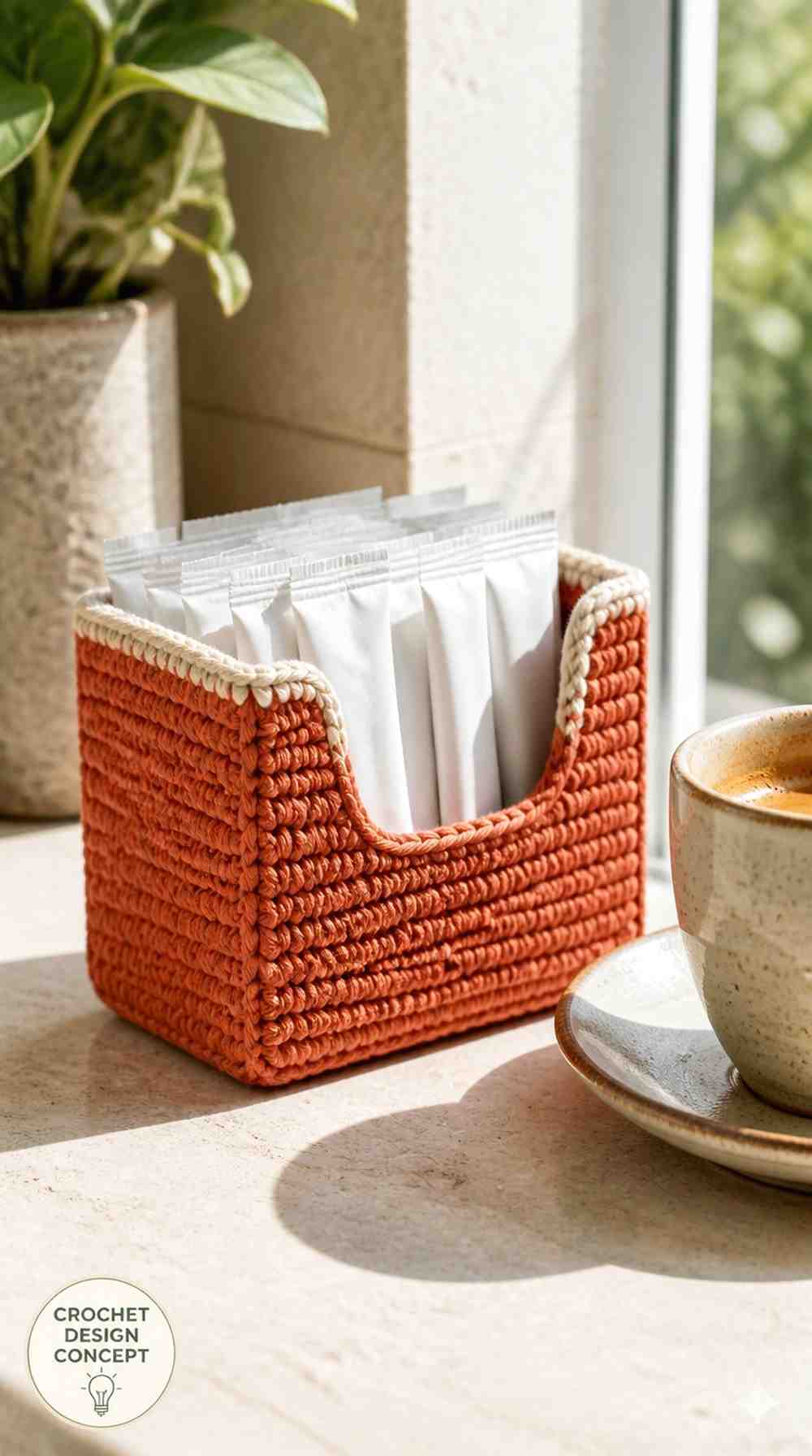
Warm terracotta crochet gives this compact dispenser a welcoming, earthy appearance. Its rectangular base, closely worked walls, and oatmeal-colored upper border create a neat countertop shape. The lowered curved front opening makes the upright sugar sachets visible without requiring a deep reach into the container.
The scoop-front silhouette is particularly interesting for a small coffee station where packets are selected frequently. Keeping the opening lower than the side walls could make individual sachets easier to grasp, although the finished crochet structure would need sufficient support to maintain its shape.
- Front-access opening: Keep the curved front low enough to expose the packet tops but high enough to stop the remaining sachets from spilling forward.
- Firm wall construction: Dense cotton crochet may help maintain the rectangular outline. Check how much the sides bend when the dispenser is filled.
- Countertop footprint: Measure the space beside your cups or coffee machine before choosing the base width, especially in a narrow preparation area.
- Color pairing: Terracotta and oatmeal complement pale stone, natural timber, and warm neutral kitchen finishes without needing additional decorative details.
2. Crochet Cornflower Three-Lane Sachet Sorter
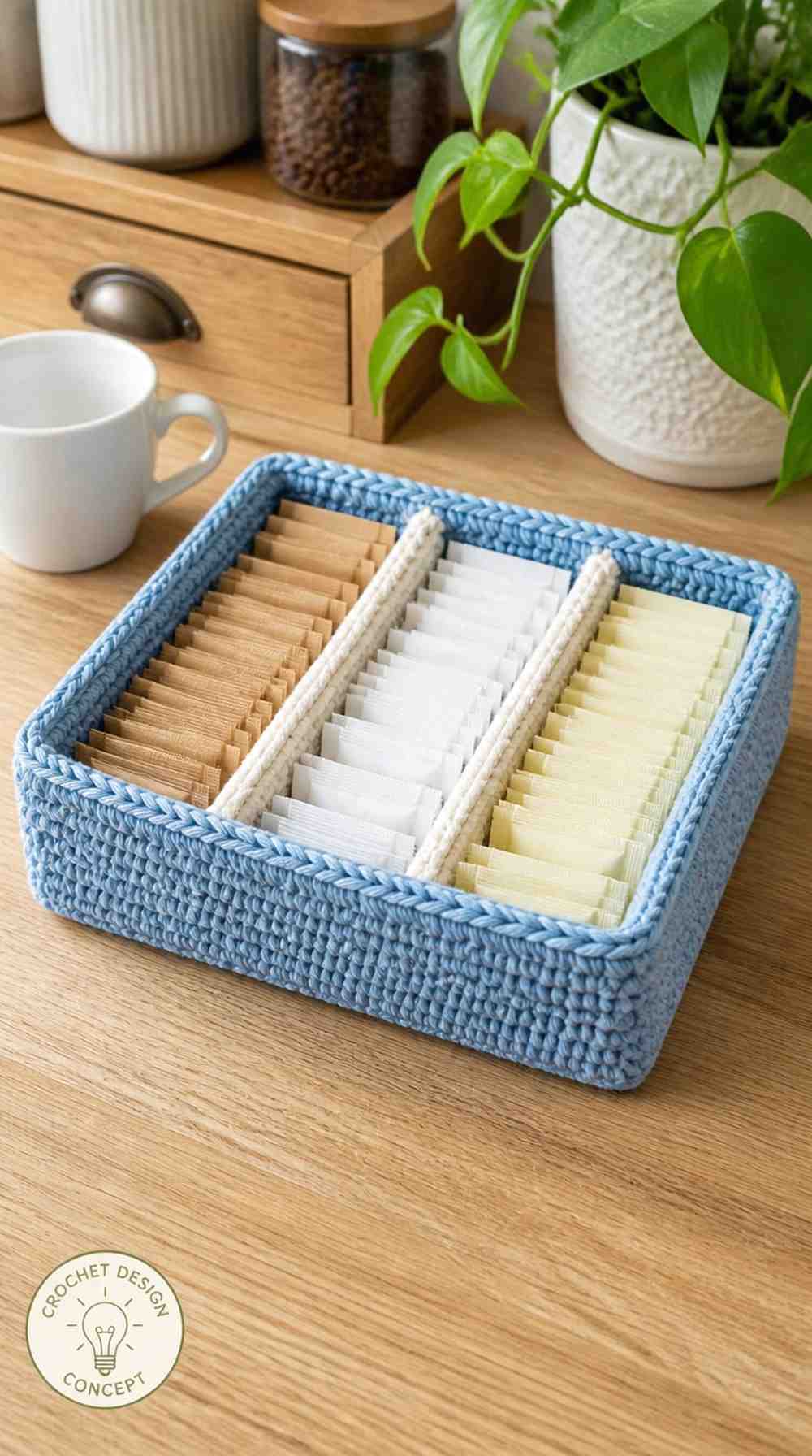
Cornflower-blue crochet gives this dispenser a clean, cheerful finish. Three long rectangular compartments sit side by side, separated by neatly joined ivory partitions. Each lane holds a small upright row of sugar sachets, while the slightly raised blue border frames the complete organizer.
The divided structure is its most useful feature. Instead of mixing every packet together, a coffee bar could reserve different sections for white sugar, brown sugar, and alternative sweeteners. The actual compartment width should be based on the packets used rather than appearance alone.
- Packet separation: Three lanes can help distinguish different sweetener varieties, provided each compartment has enough width for packets to move freely.
- Divider stability: The ivory crochet partitions need secure joins and sufficient firmness to avoid folding sideways when one compartment becomes empty.
- Easy replenishment: Leave enough room above the packets to add a fresh stack without squeezing or permanently bending the paper wrappers.
- Best surface: Its long, low shape is more suitable for an open counter or wide shelf than a particularly narrow corner.
3. Crochet Butter Yellow Scalloped Sachet Bowl
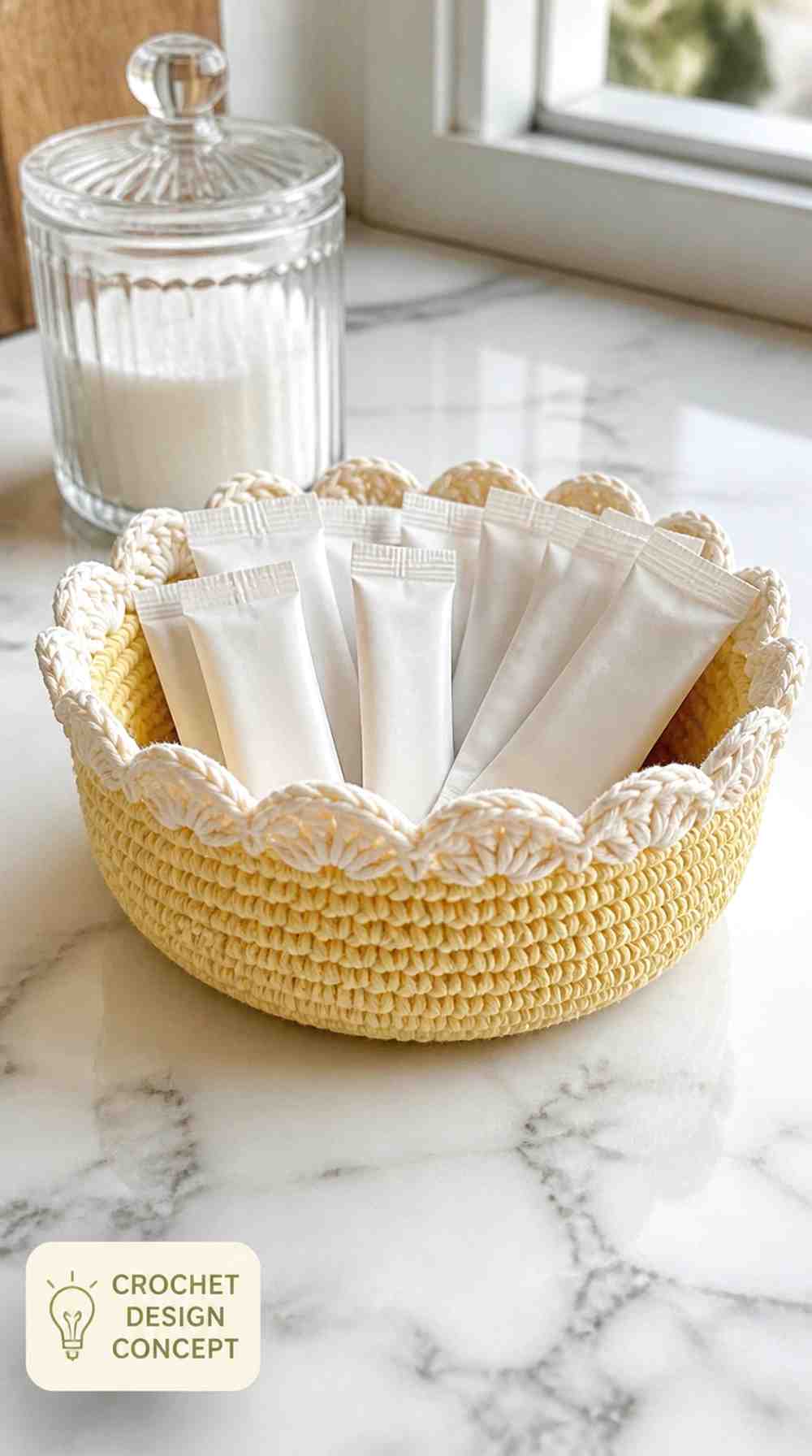
A shallow circular bowl worked in butter-yellow crochet brings a softer look to the coffee bar. Closely connected concentric stitches form the round base, while a delicate cream scalloped edge creates a decorative finish. The sugar sachets sit in a loose fan, making their individual tops visible.
Unlike a tall dispenser, this crochet bowl puts its contents on display. The low sides are useful when guests need to see what is available, although packets may become untidy if too many are placed inside. The scalloped border works best when it remains visible.
- Open presentation: A shallow bowl makes it easier to browse a few sugar options without moving a tall stack of packets.
- Scalloped rim: The cream edging is primarily decorative. Keep the actual supporting wall beneath it firm enough to retain the circular shape.
- Packet arrangement: A loose fan works better visually with a modest number of sachets; an overfilled bowl may conceal the crochet details.
- Cleaning consideration: Light-colored edging may show coffee stains, so select a yarn whose care instructions suit the intended location.
4. Crochet Cocoa Double-Pocket Dowel Organizer
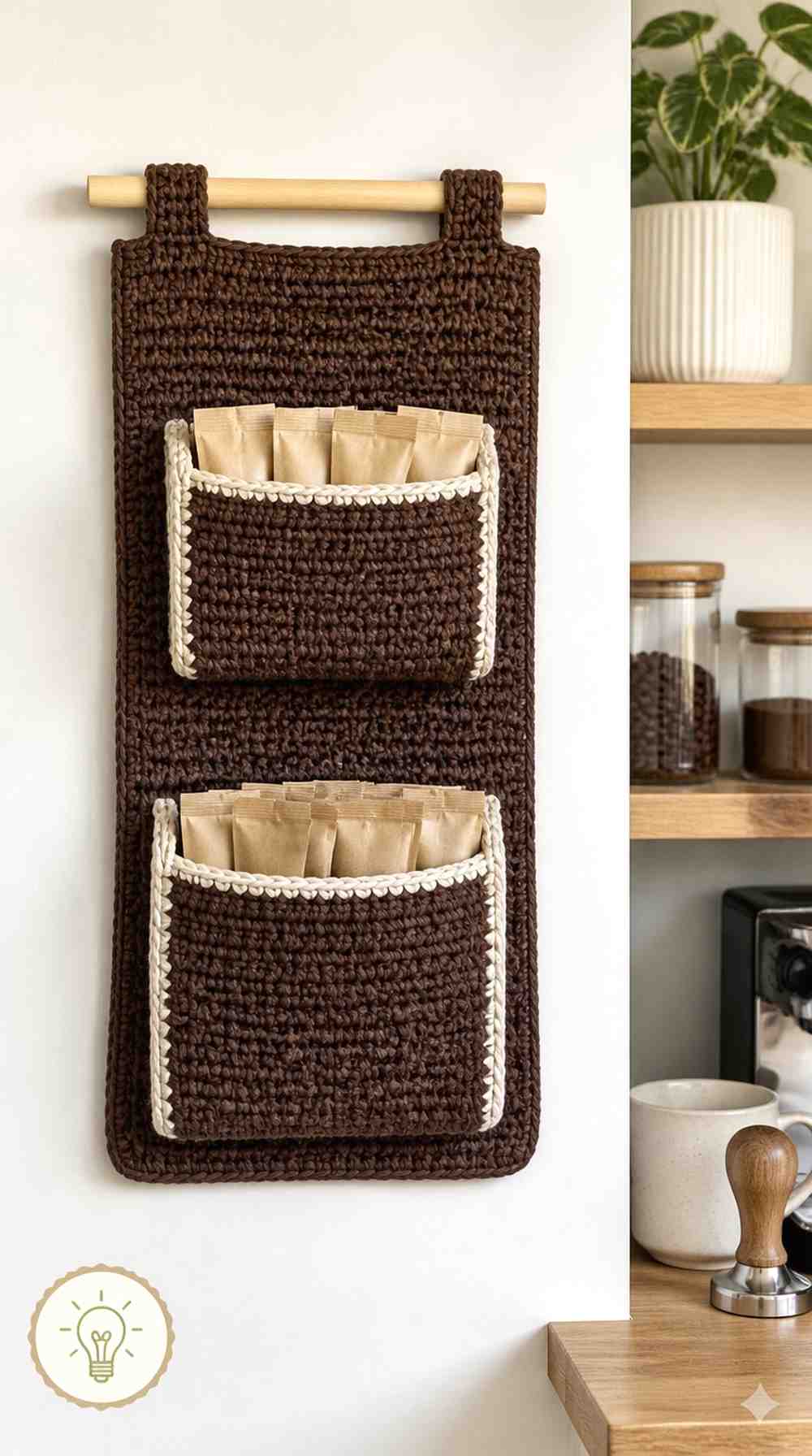
Deep cocoa-brown crochet forms the rectangular backing panel of this wall-hanging sugar sachet organizer. A slim wooden dowel supports the panel through two crocheted loops. Two cream-edged pockets are positioned vertically, with the lower compartment slightly wider than the upper one.
This design moves packet storage away from the main working surface. It could suit a home coffee corner where mugs and preparation equipment already occupy most of the countertop. Both pockets should remain easy to reach without placing the hanging organizer near steam, splashes, or heat.
- Dowel support: Choose a suitable mounting arrangement and check whether the crochet loops stretch or pull unevenly under a light load.
- Two storage levels: The narrower upper pocket could hold a small secondary sweetener selection, leaving the wider lower pocket for frequently used packets.
- Pocket visibility: Keep the cream-trimmed openings sufficiently open to show packet tops without letting the contents lean too far forward.
- Wall placement: Position the organizer away from hot appliances, sink splashes, and cabinet doors that might strike the hanging panel.
For additional kitchen-wall storage inspiration, explore these crochet vintage kitchen wall pocket ideas.
5. Crochet Dusty Rose Upright Sachet Sleeve
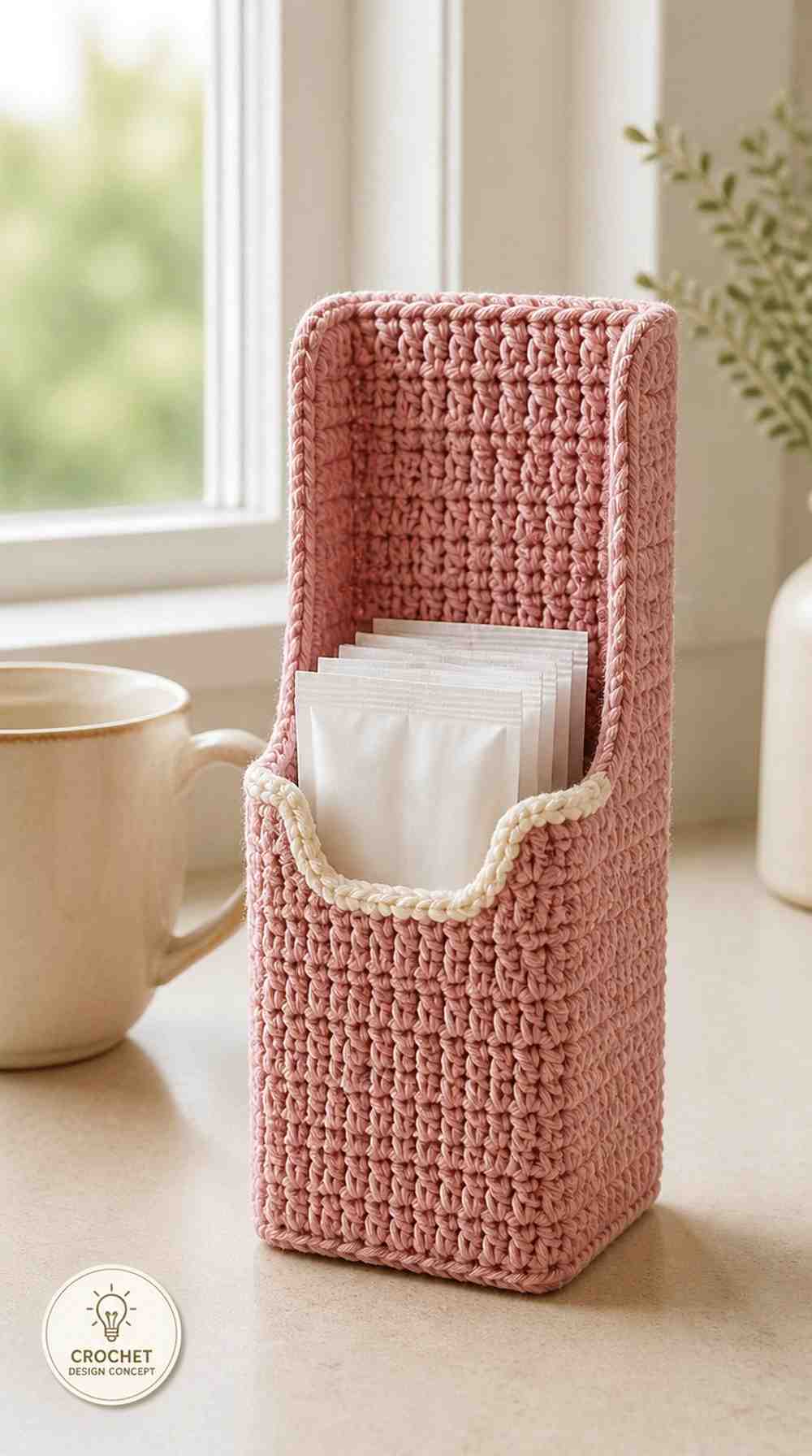
Dusty-rose crochet wraps around a narrow rectangular supporting container in this upright dispenser concept. The tall back and side panels create a slim vertical silhouette, while a shorter curved front lip finished in ivory crochet exposes the upper portions of the sugar sachets.
The removable inner container is an important part of the design. It gives the crochet sleeve a defined shape without requiring the yarn to provide all the structural support. The compact footprint could suit a coffee corner where counter depth is limited.
- Insert fitting: Measure the supporting container before planning the sleeve, allowing for the actual yarn thickness and crochet stretch.
- Front lip: The shorter opening should expose enough of each packet to grasp it without making the remaining stack unstable.
- Removable construction: A sleeve that can be taken off its insert would make it easier to inspect, clean, and dry the two components separately.
- Space planning: The upright silhouette saves horizontal counter space, but it still needs enough clearance above for comfortable access.
6. Crochet Teal Triangular Corner Caddy
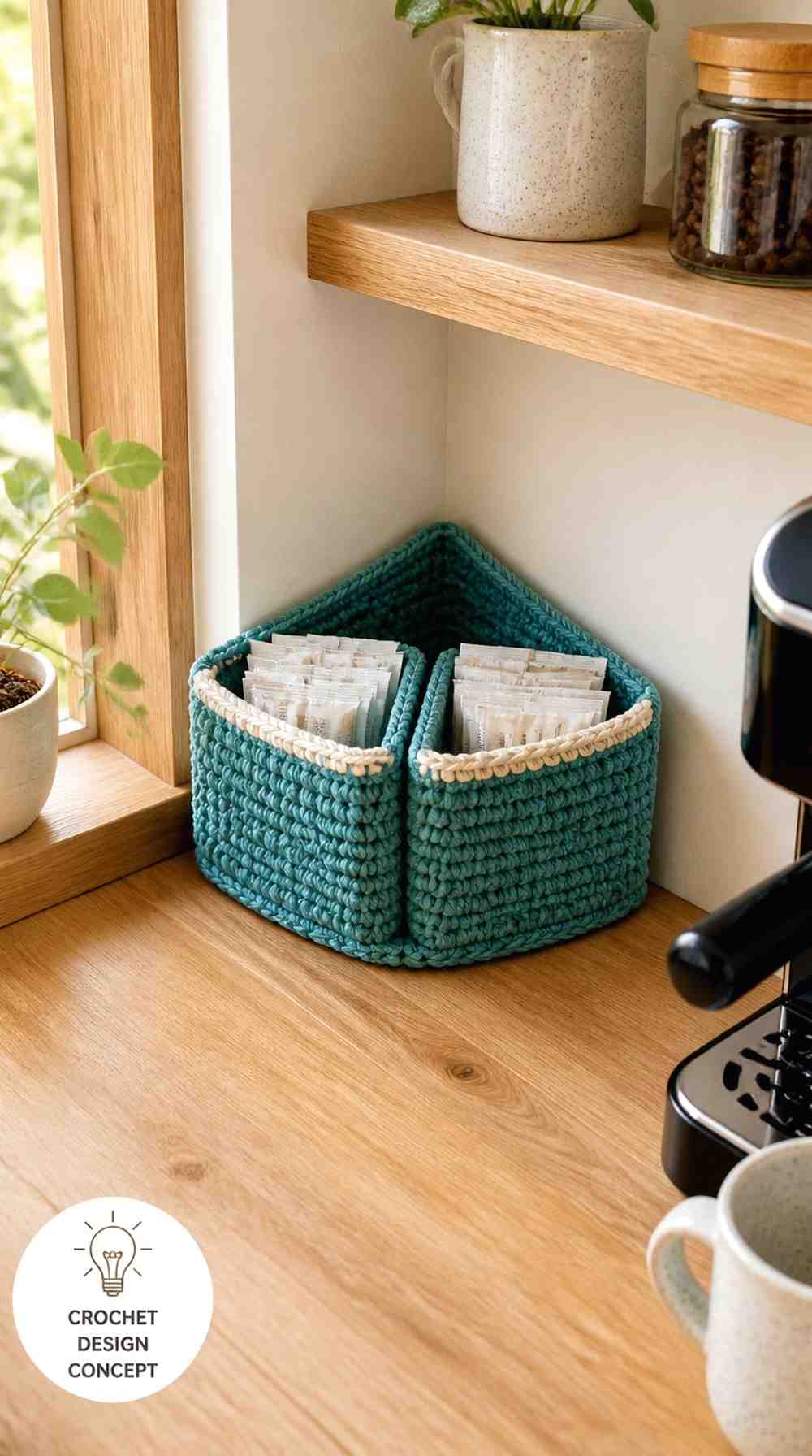
A triangular teal crochet base gives this organizer a different shape from an ordinary rectangular storage basket. Its pointed rear corner fits toward the back of a coffee station, while two cream-edged front compartments face the person preparing drinks.
The distinctive footprint is intended for corners that might otherwise remain unused. Separating the storage into two smaller sections also makes the concept useful for keeping regular sugar and an alternative sweetener apart. The corner shape needs careful planning so neither compartment becomes too narrow.
- Corner fit: Compare the triangular base with the actual counter corner, accounting for nearby cables, appliance feet, and the available reach.
- Two front compartments: The central divider should leave enough room for the intended sachets without forcing them into tight triangular spaces.
- Base support: A stable, flat foundation matters because a triangular organizer with an uneven base may rock when packets are removed.
- Practical access: Keep the broad front edge unobstructed rather than pushing the entire dispenser deep beneath an overhanging shelf.
7. Crochet Oatmeal Twin Oval Sachet Baskets
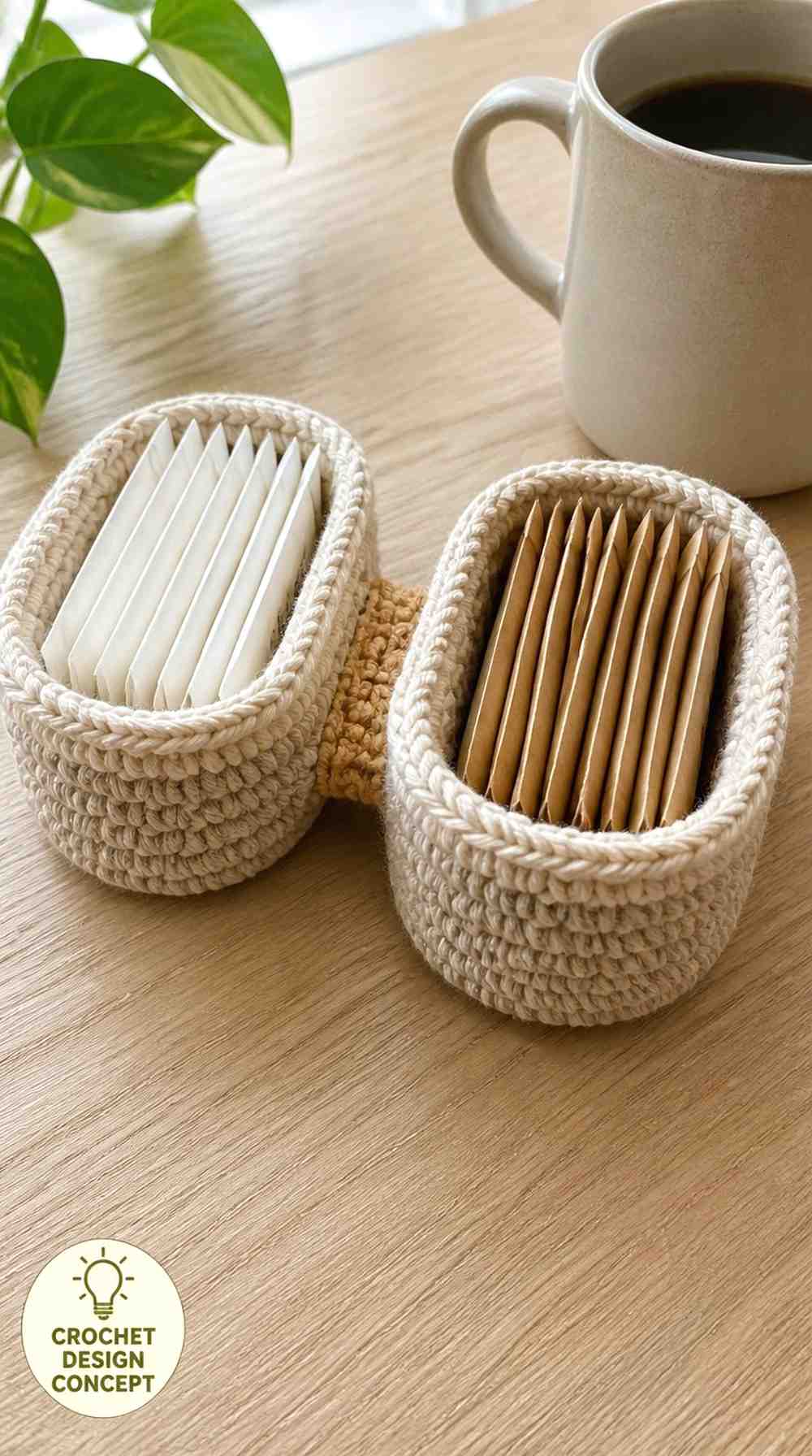
Two small oatmeal-colored crochet baskets sit beside each other, connected by a short wheat-colored crocheted bridge. Each compartment has a rounded oval base, gently tapered sides, and a narrow cream rim. Together, they create a low, balanced countertop arrangement.
This design keeps two packet groups separate without adding tall dividers. It can also work visually in a calm, neutral coffee corner where stronger colors would compete with the surrounding decor. The connecting bridge should keep both baskets aligned without making the arrangement awkward to lift.
- Oval compartments: Check the internal width against the sachet shape; overly narrow oval ends may reduce the amount of usable storage.
- Connecting bridge: A tightly joined central bridge could keep the pair together, but it should not be treated as a carrying handle without testing.
- Two packet choices: Use one basket for everyday sugar and the other for a second variety, avoiding unnecessary sorting within each compartment.
- Neutral appearance: The oatmeal, wheat, and cream combination works naturally with timber counters and other understated coffee accessories.
8. Crochet Lavender Two-Tier Sachet Display
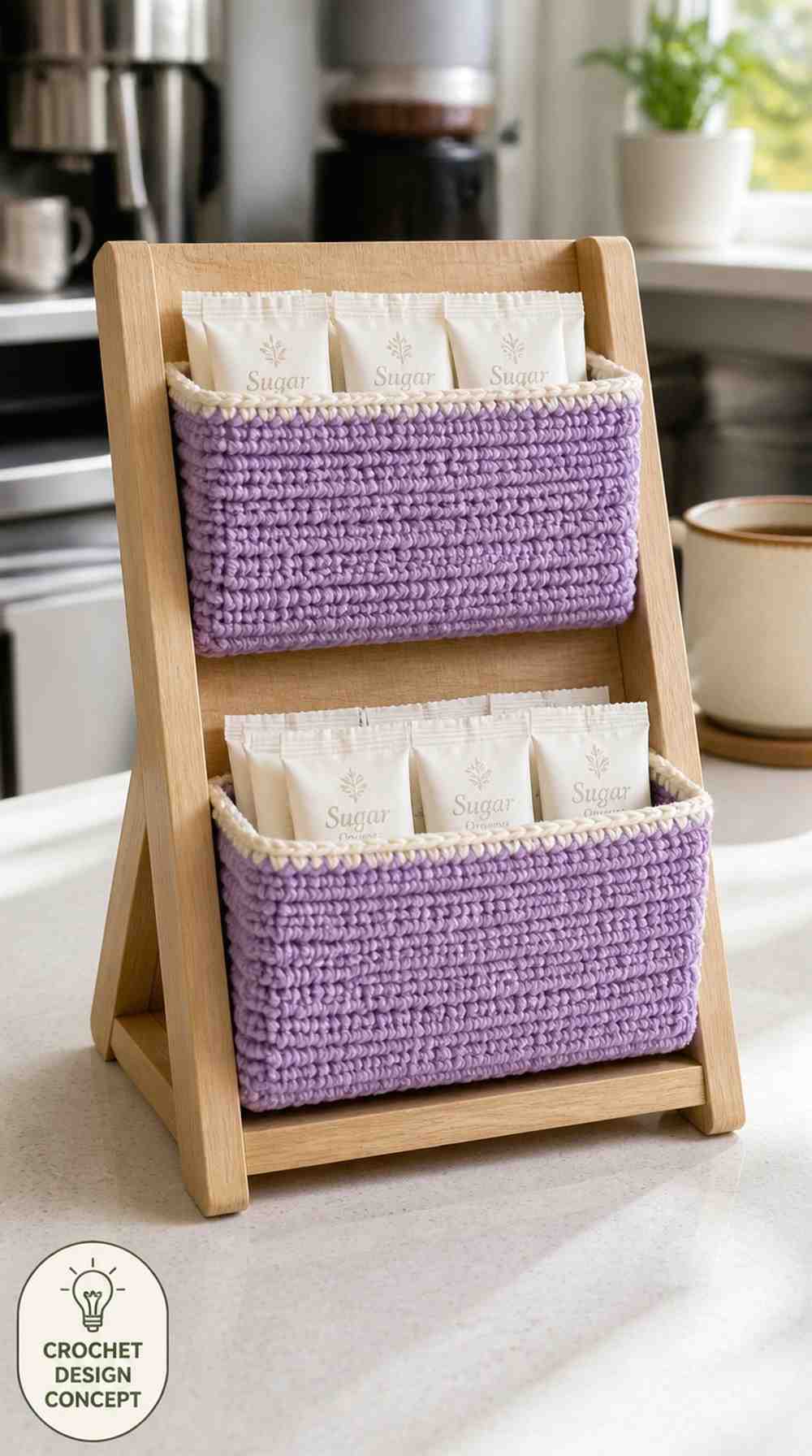
Soft lavender crochet pockets sit on a small angled wooden display frame, creating a two-level sachet organizer. The narrower upper pocket and wider lower pocket have neatly finished cream openings, structured rectangular shapes, and closely worked horizontal stitch rows.
The freestanding frame distinguishes this concept from a wall-hanging pocket. It brings the sachets into a more visible presentation while keeping the supporting structure separate from the crochet fabric. The angle of the stand matters because packets must remain accessible without tipping the unit forward.
- Tier clearance: Leave enough vertical space between the two pockets for fingers to reach the upper packets without disturbing the lower row.
- Wooden support: The stand should have an appropriately stable base and securely supported pockets before being used as a practical dispenser.
- Pocket depth: Shallower pockets can expose packet tops, while excessive depth may make the sachets difficult to remove.
- Display location: This freestanding concept needs more depth than a flat wall organizer, making an open shelf or spacious counter more suitable.
9. Crochet Espresso Mug-Shaped Sachet Holder
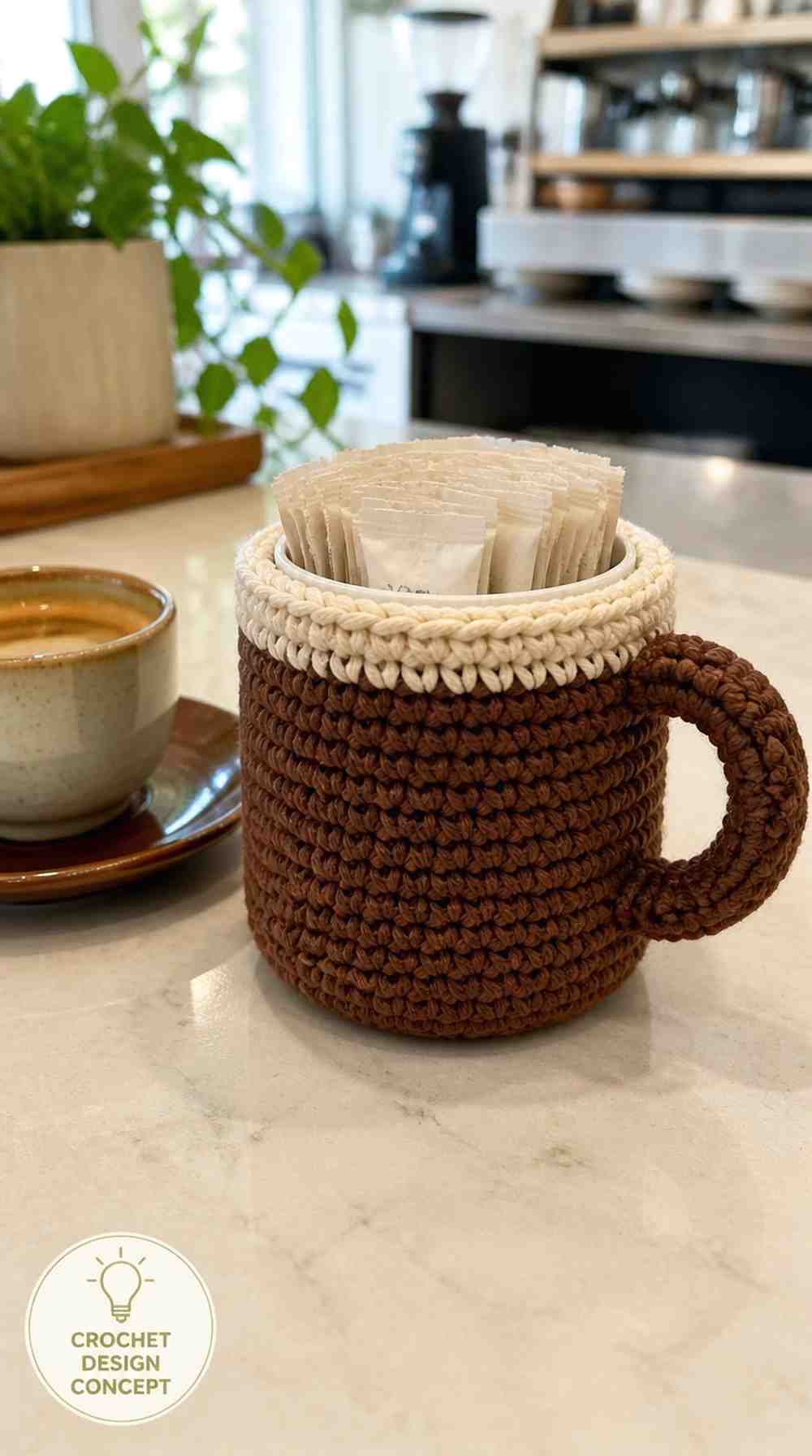
Espresso-brown crochet gives this sugar sachet holder the appearance of a small café mug. Its cylindrical body features a cream upper rim and a curved crocheted handle attached to one side. A discreet inner cup-shaped support provides a place for the sealed sugar packets.
The mug silhouette adds a playful connection to the coffee-bar theme without using a real drinking vessel as decoration. It is intended for dry packet storage only. The handle is a visual feature, and its strength would need to be checked before anyone used it to lift the filled container.
- Dry-storage purpose: This is a sachet holder, not a drinkable crochet mug. Keep the yarn away from hot liquids and direct food contact.
- Handle attachment: Both ends of the curved handle need credible joins, especially if someone might naturally try to pick the dispenser up by it.
- Cylindrical support: A suitable removable insert can help retain the rounded body shape and keep packets from spreading the sides.
- Packet visibility: Arrange the sachets so they extend above the cream rim while leaving the decorative crochet mug outline recognizable.
10. Crochet Midnight Blue Honeycomb Sachet Trio
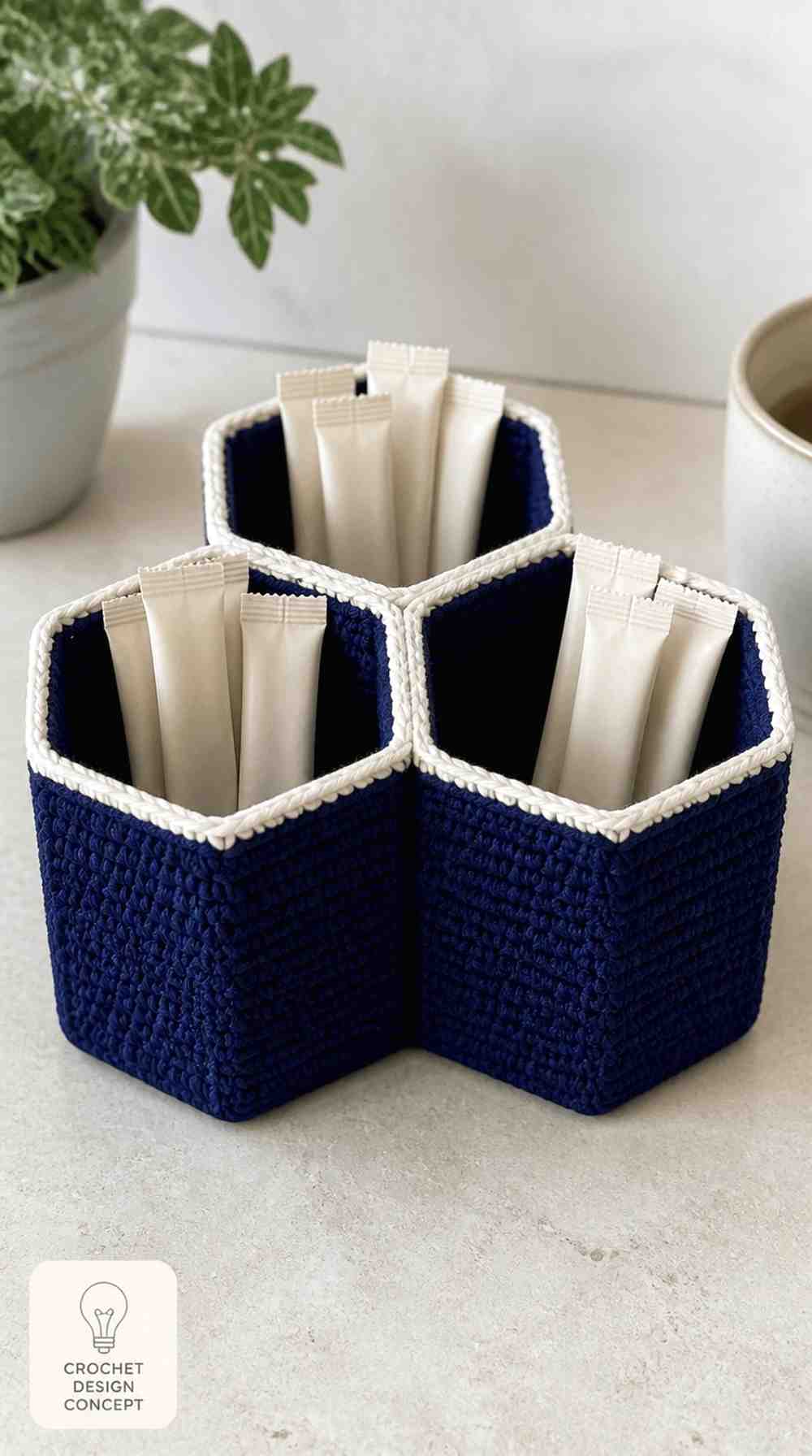
Three joined hexagonal compartments form this midnight-blue crochet organizer. Each cell has six defined sides, a flat bottom, and dense crochet walls. Narrow ivory joining borders create a clear honeycomb arrangement, with upright sugar sachets displayed inside the individual openings.
The geometric layout offers three separate storage areas in a compact cluster. It is particularly appealing for a coffee bar with multiple sweetener choices, although the pointed corners of each hexagon may provide less usable space than a rectangular container of similar outside dimensions.
- Hexagonal space: Check the widest part of the actual sachets against the internal cell opening rather than relying on the outer hexagon width.
- Joined edges: The shared sides need secure crochet connections to keep the three cells aligned when their contents are unevenly distributed.
- Shape retention: Fitted inserts may help maintain the six-sided geometry, especially when lightweight sachets provide little internal support.
- Three-way sorting: The individual cells could separate sugar types without needing additional labels, provided their contents remain easy to distinguish.
11. Crochet Sage Narrow Notch-Front Tower
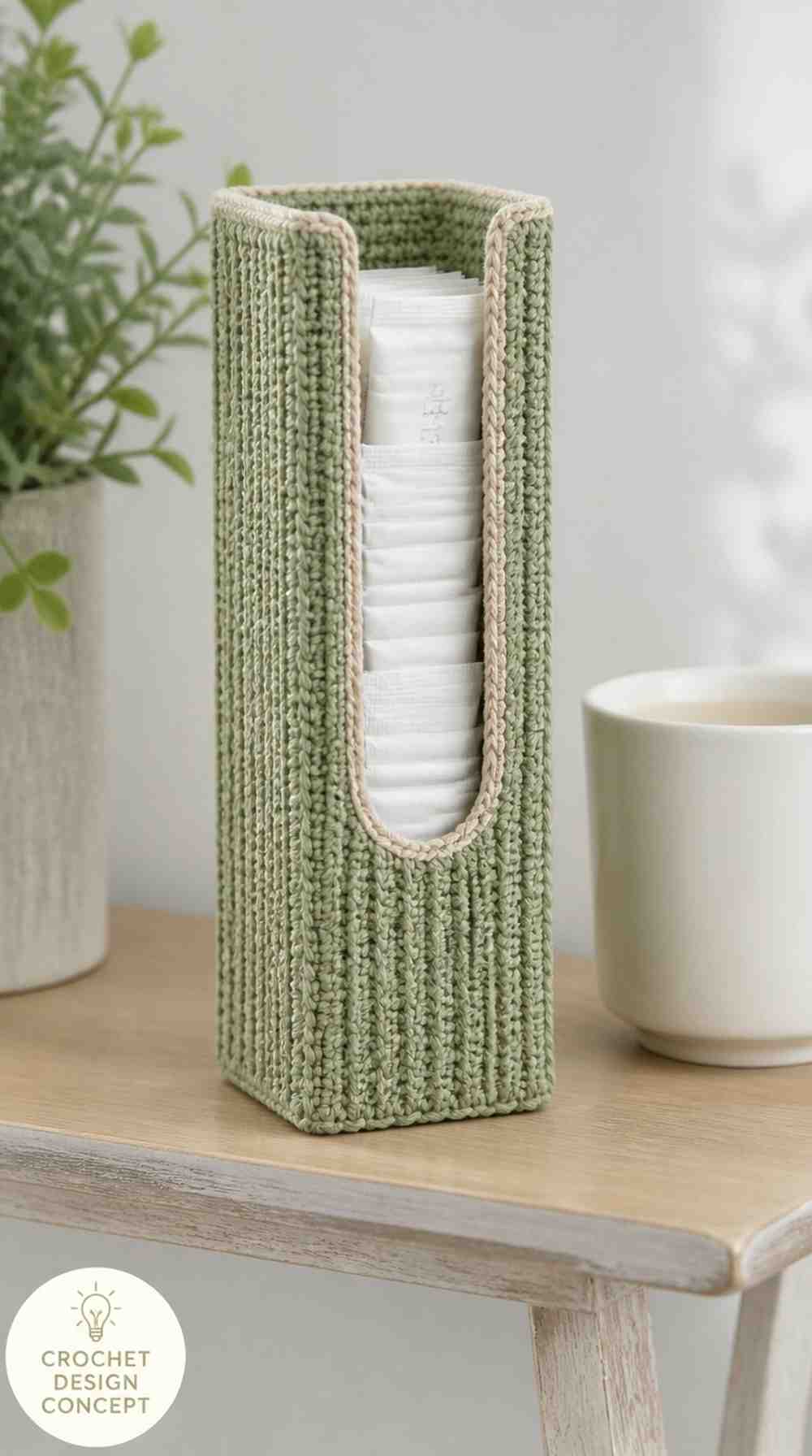
A tall sage-green crochet sleeve surrounds a slim rectangular support in this compact sugar sachet dispenser. Its vertical textured ridges create a subtle surface pattern, while a deep rounded notch at the front exposes the single-file stack of packets. An oatmeal-colored border neatly outlines the opening.
The tall, narrow shape helps organize sachets where horizontal space is limited. Its main trade-off is capacity: a single column will usually hold fewer packets than a wide basket. The notch should be planned around the actual packet height and how the stack behaves during use.
- Single-column storage: Keep the internal width close enough to guide the packet stack without making individual sachets difficult to remove.
- Notched opening: The rounded front cutout needs a stable finished edge so repeated handling does not stretch the crochet unnecessarily.
- Vertical ridges: Raised stitch texture adds interest without requiring decorative attachments that could catch on packet corners.
- Tall dispenser stability: A narrow upright unit may tip if its base is too light, so assess the insert and footprint together.
12. Crochet Cream Plum Radial Sachet Caddy
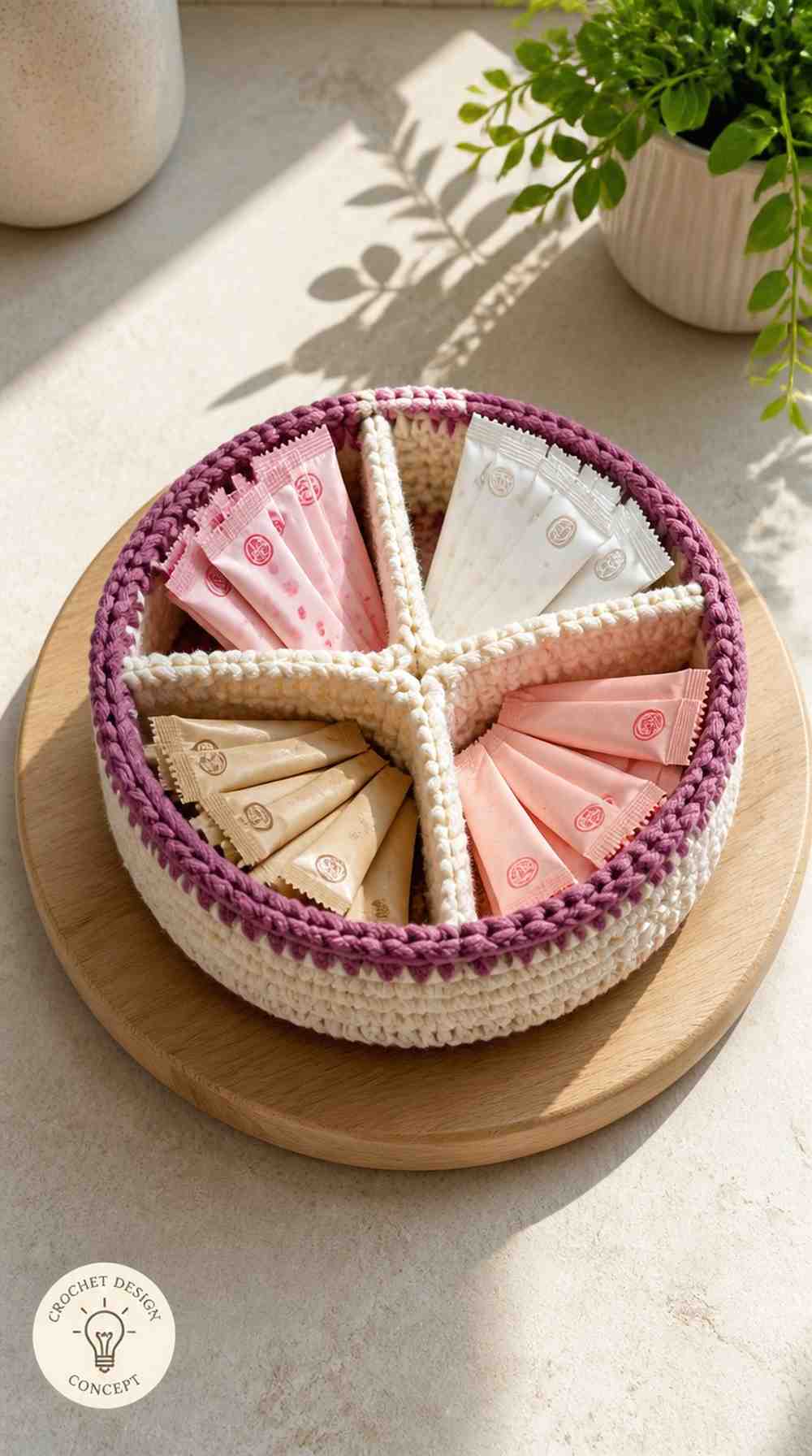
Four shallow wedge-shaped compartments radiate from the center of this cream crochet organizer. Short crochet dividers separate the sections, while a plum-colored outer rim defines the circular shape. The entire crochet tray rests on a small wooden turntable.
The radial arrangement offers an alternative way to present several sugar varieties. Instead of reaching across a wide rectangular tray, a user could turn the separate wooden base to bring another section forward. Whether that works smoothly depends on the turntable’s stability and the finished organizer’s fit.
- Radial dividers: Each wedge needs enough usable width for the sugar sachets, especially toward the narrow center where the partitions meet.
- Turntable compatibility: Keep the crochet tray appropriately centered on the wooden support and check that it does not shift during rotation.
- Shallow compartment walls: Low dividers preserve the open circular appearance but may allow packets to lean across neighboring sections.
- Plum border: The darker rim defines the tray without covering the cream crochet interior or hiding the individual packet groups.
13. Crochet Sand Rail-Hung Sachet Pouch
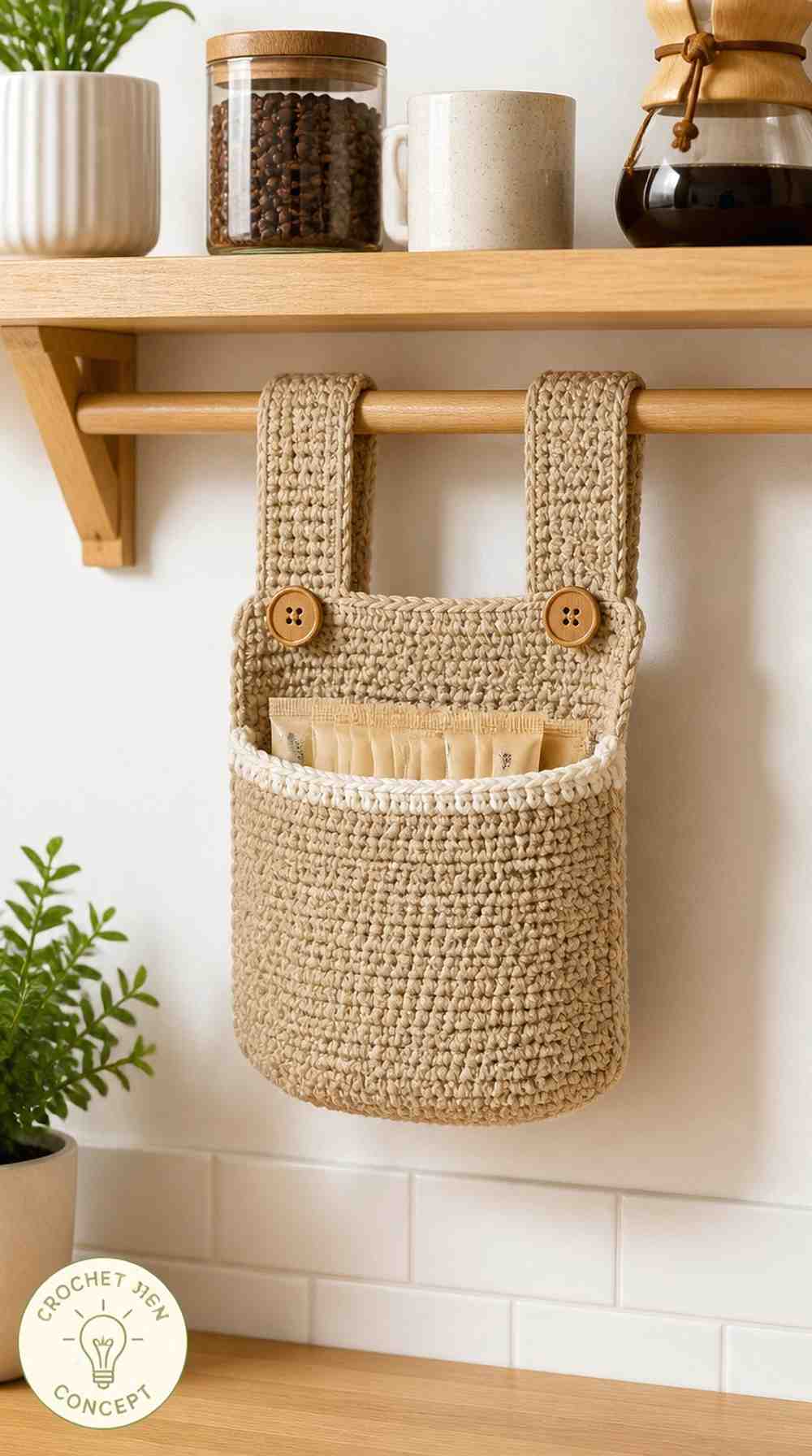
Sand-beige crochet forms a slim hanging pouch with a flat back, gently rounded bottom, and short cream-trimmed front wall. Two wide foldover crochet tabs wrap around a wooden rail and fasten with small wooden buttons, leaving the row of sugar sachets accessible from above.
This design could make use of a suitable rail beneath an open coffee-bar shelf. Unlike a permanently attached wall organizer, the buttoned tabs suggest a removable arrangement. However, the rail, closures, and crochet fabric would all need to support the contents safely.
- Buttoned tabs: Choose buttons and securely finished openings that suit the rail’s thickness and resist slipping when packets are removed.
- Hanging height: The pouch should sit at a comfortable reach without dangling into the workspace used for preparing drinks.
- Rounded bottom: The curved base gives the pouch a softer appearance, but it may allow sachets to settle unevenly.
- Rail suitability: Use a properly secured rail away from steam and heat rather than attaching the textile to an appliance or hot pipe.
14. Crochet Tangerine Daisy-Front Pull Basket
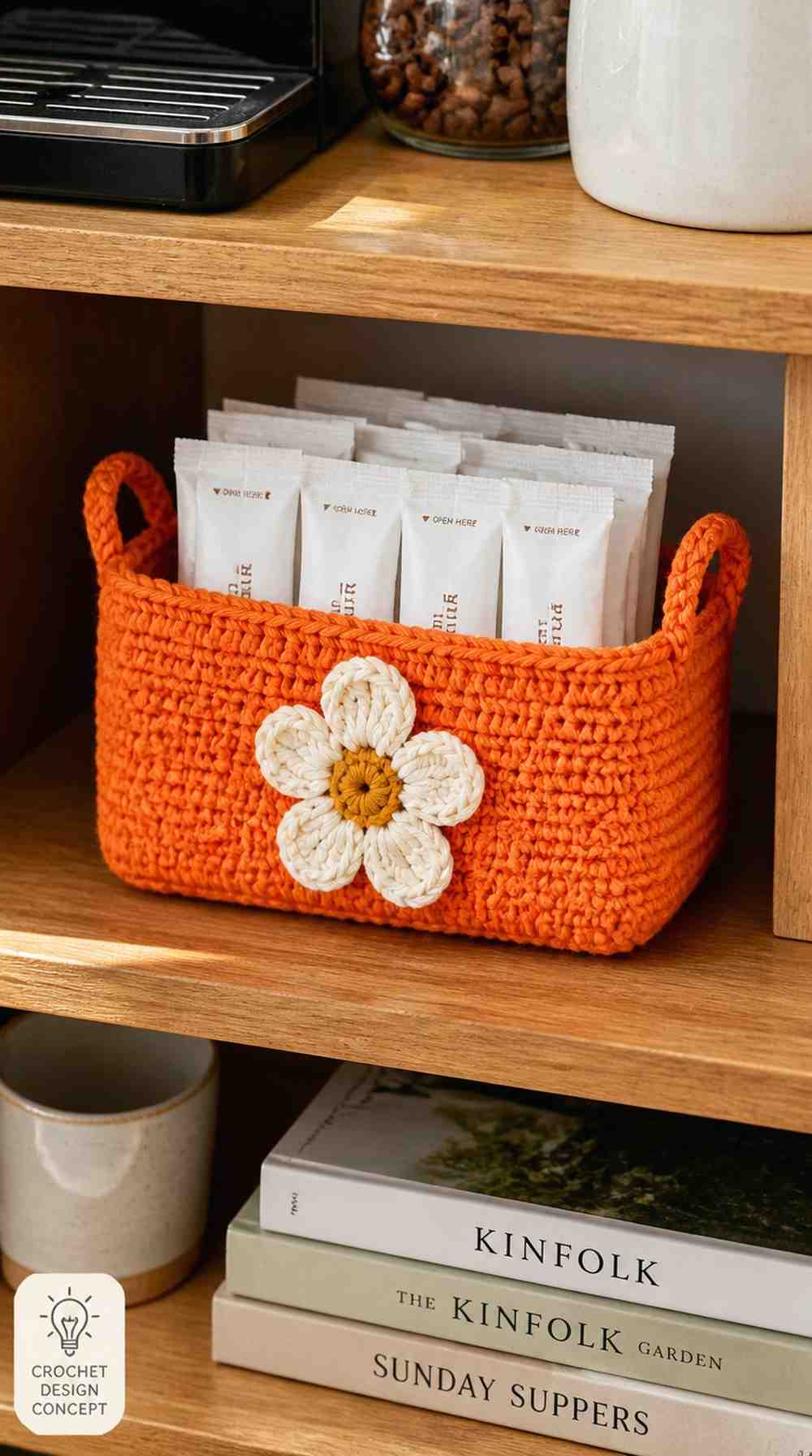
Bright tangerine crochet gives this small rectangular sachet basket a cheerful café-inspired look. A cream crochet daisy with a mustard-yellow center decorates the front wall, while two small side lifting loops complete the design. The basket contains a neat upright row of sealed sugar sachets.
Its low shape is intended for an accessible open shelf. The flower adds a decorative touch without changing the basket’s basic storage function. The side loops offer a possible way to move the container, provided their attachment and the basket’s filled weight have been checked.
- Open-shelf access: Position the basket near the front of a shelf so packets can be selected without repeatedly pulling the entire container forward.
- Daisy attachment: Keep the crocheted petals firmly secured and away from the opening where they might snag packet corners during regular use.
- Side lifting loops: Both loops need reinforced connections if they are intended for handling; otherwise, lift the supported basket from underneath.
- Color balance: Tangerine, cream, and mustard create a lively accent that works best when nearby coffee accessories are relatively simple.
15. Crochet Charcoal Window-Lattice Sachet Sleeve
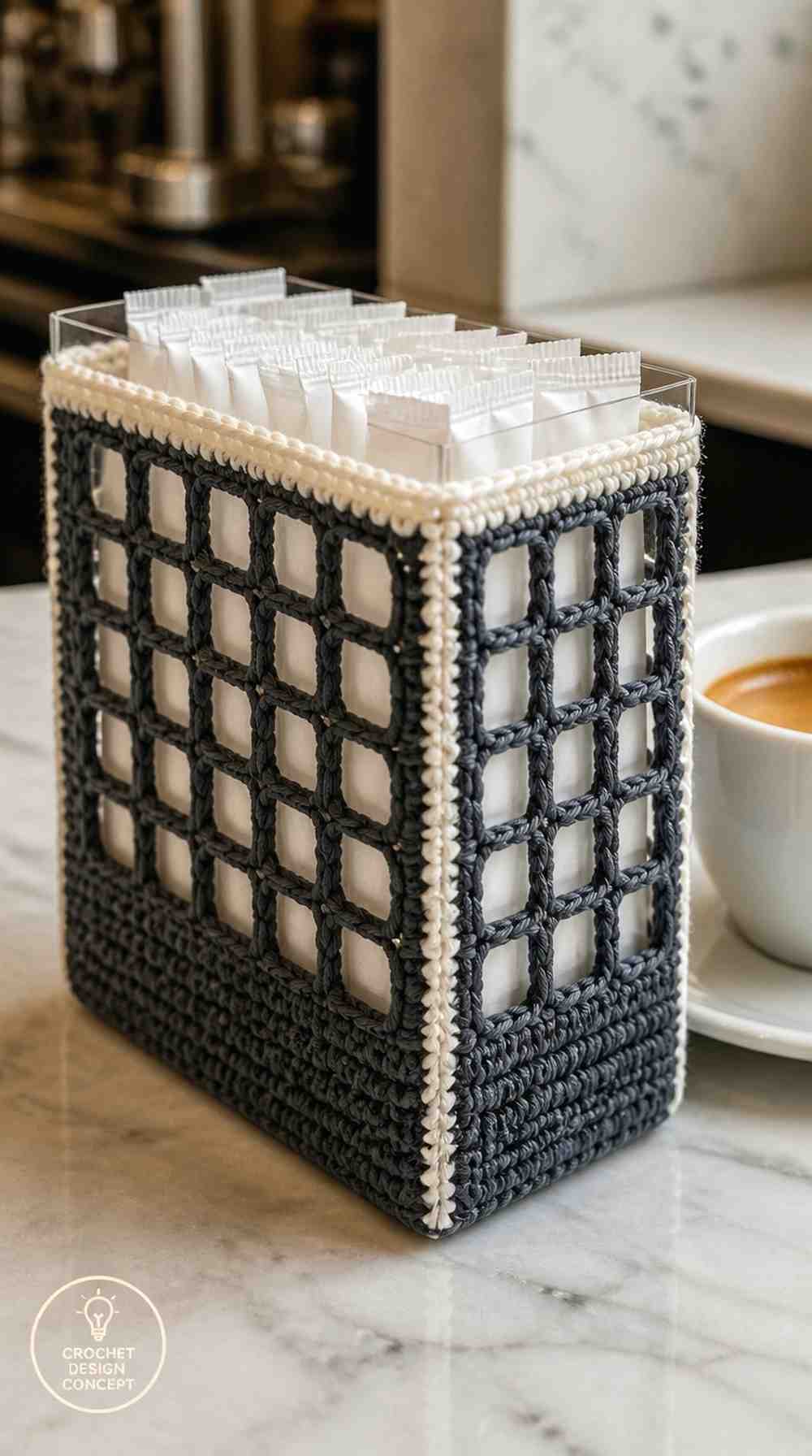
Charcoal-grey crochet surrounds a transparent rectangular inner container in this modern coffee-bar dispenser. Open square lattice stitches form the front and side panels, while a denser base and ivory corner seams give the sleeve a defined outline. The sealed sugar sachets remain visible through the clear insert.
The combination of open crochet and a solid inner container makes this concept visually lighter than a fully covered basket. It also separates the decorative lattice from the actual packet-holding surface. The inner insert is essential to the intended design, particularly where the open squares would otherwise allow sachets to slip through.
- Transparent insert: Select an appropriately sized removable container so the sachets remain supported behind the open crochet lattice.
- Square mesh consistency: Keep the openwork evenly spaced and properly joined; irregular tension may distort the rectangular window appearance.
- Ivory corner seams: The contrasting joins highlight the dispenser’s outline and should be planned to sit neatly against the clear inner container.
- Cleaning access: A removable insert allows the clear surface and outer crochet sleeve to be inspected and cleaned according to their separate material requirements.
Practical Guide to Crochet Coffee Bar Sugar Sachet Dispensers
Before choosing a crochet dispenser design, think about the packets, the available counter space, and the kind of coffee station you actually use.
Measure the sugar sachets first. Individually wrapped sugar portions come in different shapes, including narrow sticks and wider rectangular packets. Check their height, width, and thickness before choosing a container. Leave enough room to grasp a packet without pulling several others out together.
Match the crochet structure to the design. Close, firm stitching is worth considering for baskets, upright walls, and compartment dividers. Open lattice can provide a lighter decorative finish, but it needs an appropriate insert if small packets might fall through.
Choose the right support. Taller dispensers, unusual hexagonal shapes, and multi-tier arrangements may benefit from a separate rigid support. Any real holder should be assessed for stability when empty, partly filled, and fully stocked.
Keep the coffee bar dry. Crochet yarn can absorb spills, and paper sugar sachets should be protected from moisture. Place dispensers away from steam outlets, heating surfaces, open flames, and areas where coffee is regularly splashed.
Plan for cleaning and refilling. Removable sleeves or separate liners can simplify care. Always follow the yarn and insert manufacturers’ cleaning guidance, and let all parts dry properly before returning paper sachets to storage.
For a wider look at different crochet storage arrangements, the crochet hanging wall pocket organizer collection includes ideas for hanging pockets, structured storage, and compact wall displays.
Want to Make Something Similar?
If you want to turn one of these inspiration concepts into a real crochet project, a small basket is a practical starting point.
B.Hooked’s simple crochet basket tutorial using cotton yarn by Brittany provides a free basket pattern and explains a closely worked basket structure. Its construction can help readers understand the general idea behind the terracotta caddy, butter-yellow bowl, or other small countertop containers.
B.Hooked
The tutorial is not an exact pattern for the 15 pictured dispensers. Any changes to openings, dividers, hanging attachments, or inserts would need separate planning and physical testing.
Which Crochet Sugar Sachet Dispenser Should You Choose?
Choosing the right design is mostly about how you use the coffee bar.
For a busy everyday coffee station, the Crochet Terracotta Scoop-Front Sachet Caddy gives a straightforward access concept with a relatively uncomplicated shape. The Crochet Sage Narrow Notch-Front Tower may be more suitable when only a small amount of counter space is available.
If several people use different sweeteners, the Crochet Cornflower Three-Lane Sachet Sorter offers more separation, while the Crochet Midnight Blue Honeycomb Sachet Trio makes the storage arrangement more decorative.
For a coffee station that is already crowded, the Crochet Cocoa Double-Pocket Dowel Organizer or Crochet Sand Rail-Hung Sachet Pouch could be worth considering, assuming there is a suitable mounting point.
If presentation matters most, the Crochet Espresso Mug-Shaped Sachet Holder, Crochet Butter Yellow Scalloped Sachet Bowl, and Crochet Tangerine Daisy-Front Pull Basket each bring a different character to the countertop.
There is no single design that suits every coffee corner. The best concept is one that leaves the sachets easy to reach, keeps the preparation surface clear, and can be maintained without difficulty.
Conclusion
A crochet coffee bar sugar sachet dispenser can be more than a simple container for paper sugar packets. The right design can help organize different sweeteners, make better use of a small space, or add a handmade decorative touch to an everyday coffee station.
From compact scoop-front baskets and narrow upright sleeves to hanging organizers and playful mug-shaped holders, these 15 concepts show how much variety is possible within one useful idea. Choose the shape that suits your space first, then consider the colors, stitch details, and finishing touches.
Which would you choose for your coffee bar: the terracotta scoop-front caddy, the three-lane cornflower sorter, or the little espresso mug holder? Share your favorite design and how you currently organize your sugar sachets.
Frequently Asked Questions
1. What type of yarn is suitable for a crochet sugar sachet dispenser?
Cotton yarn or a suitable cotton blend may be useful for a dispenser that needs defined edges and closely worked walls. The right choice depends on the design, stitch density, and whether a supporting insert is used. Check the yarn’s care instructions and test the finished structure before everyday use.
2. Can a crochet dispenser hold different types of sugar sachets?
Yes, a suitably designed organizer can hold several varieties of individually sealed sugar packets. Divided concepts, such as the three-lane sorter and honeycomb trio, make it easier to separate different options. Measure the actual packaging first, since sugar sticks and wider sachets do not necessarily fit the same compartments.
3. How can I stop a crochet sugar sachet holder from losing its shape?
A closely worked base, firm side stitches, suitable yarn, and carefully finished joins may improve shape retention. Some designs will need an appropriately fitted removable insert, particularly tall holders or open lattice sleeves. Check the dispenser with different quantities of sachets rather than assuming the empty shape will stay unchanged.
4. Can I place a crochet sachet dispenser beside a coffee machine?
It depends on the coffee machine and the amount of heat, steam, and splashing around it. Keep yarn and paper packets clear of hot surfaces, steam vents, and water outlets. A nearby dry counter or shelf is generally a more sensible location than directly against the appliance.
5. Are these 15 crochet sugar sachet dispensers real patterns?
No. These are original crochet design visualizations intended to inspire different storage shapes, colors, and finishes. They are not tested physical samples or ready-to-follow patterns. Anyone making a similar dispenser should use reliable crochet guidance, adapt the shape to their own packets and space, and check stability and practicality before regular use.