A shoe rack can look much more inviting when its shelves have a thoughtful finishing touch. Crochet shoe rack shelf liners offer a creative way to add handmade texture and color to an everyday storage space. These 14 inspiration ideas explore closely stitched rectangular mats, fitted corner designs, open-mesh runners, buttoned shelf attachments, and decorative scalloped panels in terracotta, cornflower blue, oatmeal, lavender, and other beautiful shades.
Some designs suit solid wooden shelves, while others explore ways to use crochet over properly supported slatted or wire racks. You will also find separate shoe-placement pads, reversible mats, and liners that fold neatly over the front shelf edge. As you compare the ideas, consider the type of shoes you store, shelf measurements, cleaning needs, airflow, and how easily each crochet liner could be removed.
These are AI-generated crochet design visualizations for inspiration, not photographs of tested handmade shelf liners or step-by-step patterns.
Quick Design Selection Guide
| Your shoe-storage need | Design to explore |
|---|---|
| Simple coverage on a wooden shelf | Crochet Terracotta Ribbed Shoe Shelf Liner |
| A liner that fastens to the shelf | Crochet Cornflower Button-Tab Shoe Rack Liner |
| A light, open-mesh appearance | Crochet Wheat Open-Mesh Shoe Shelf Runner |
| Separate spaces for two shoes | Crochet Mustard Twin Shoe Placement Mats |
| A liner fitted around rear support posts | Crochet Teal Notched-Corner Shoe Shelf Mat |
| A decorative front shelf finish | Crochet Oatmeal Front-Lip Shoe Shelf Mat |
1. Crochet Terracotta Ribbed Shoe Shelf Liner
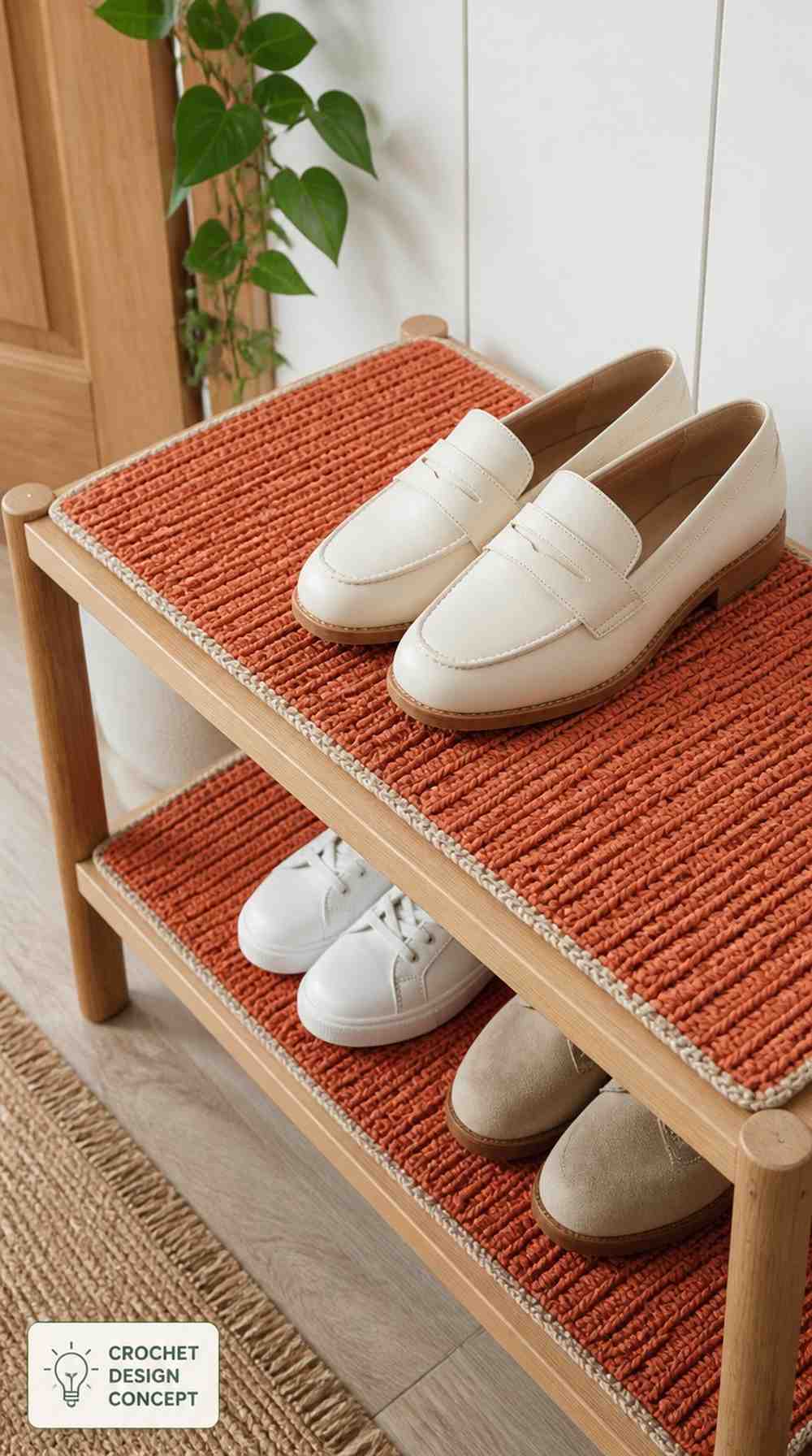
Warm terracotta crochet gives this rectangular shoe-rack liner a simple, welcoming appearance. Closely worked horizontal ribs create a clearly defined surface, while a slim oatmeal border finishes all four edges. The liner lies flat across a wooden shelf, with cream loafers resting on its center.
Its straightforward shape makes it one of the easiest concepts to adapt to a solid shelf. The raised ribbing provides texture without relying on loose decorative loops that might catch on shoe soles. A real version should remain flat beneath the shoes rather than bunching when footwear is removed.
- Ribbed surface: Keep the crochet relief low and even so smooth leather soles can rest on the liner without catching on unusually raised stitches.
- Rectangular coverage: Measure the shelf’s usable width and depth, leaving appropriate clearance around the edges for easy removal.
- Oatmeal edging: The narrow border helps define the terracotta rectangle without adding excessive thickness around the corners.
- Best footwear: This concept suits clean, dry everyday shoes better than wet, muddy footwear that could leave moisture or grit trapped in the yarn.
2. Crochet Cornflower Button-Tab Shoe Rack Liner
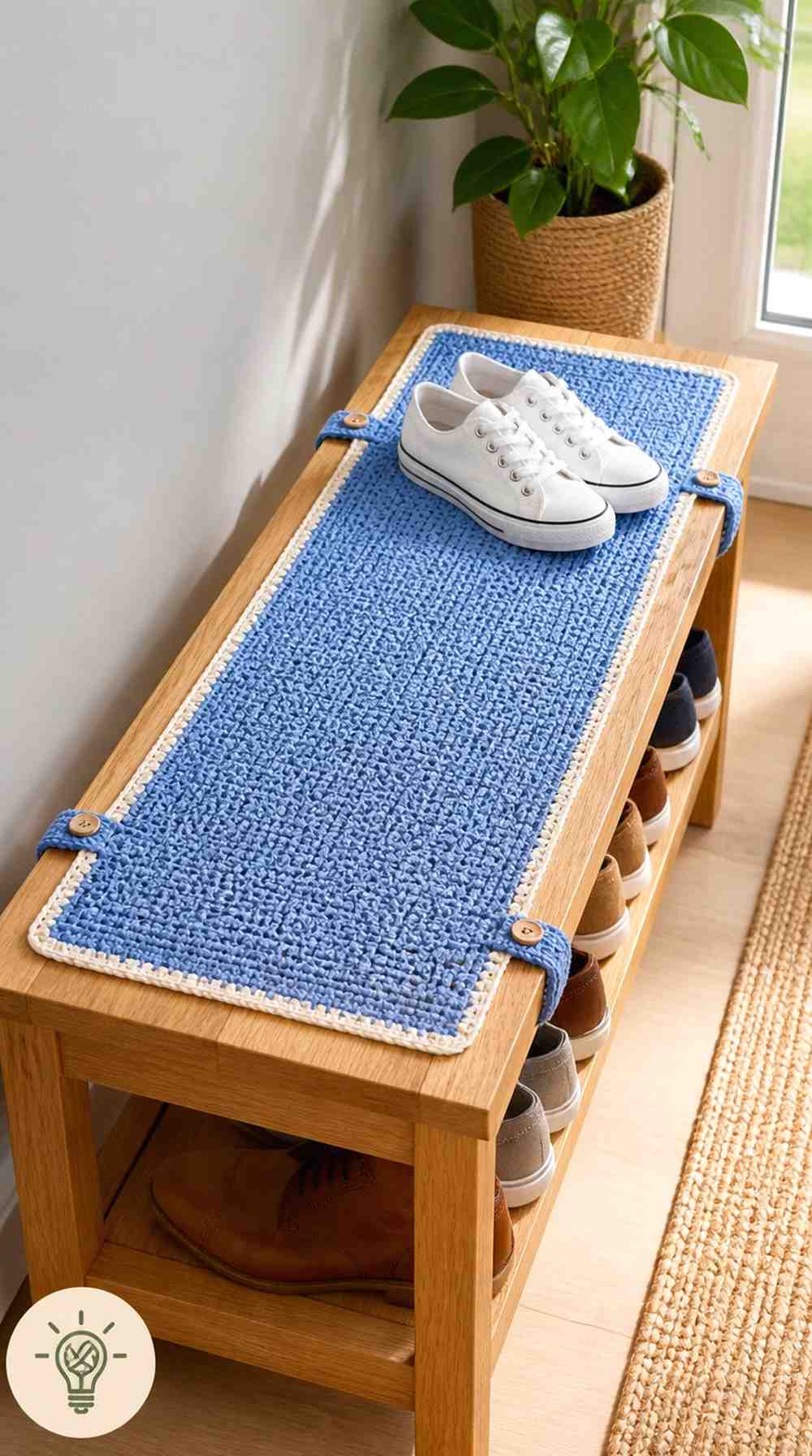
Cornflower-blue crochet creates a fresh finish across this pale-oak shoe shelf. A narrow ivory border outlines the rectangular mat, while four short blue tabs fold around the front and rear shelf edges. Small wooden buttons secure the tabs beneath the board, keeping the liner positioned over the shelf.
The attachment arrangement is the most interesting part of this design. Unlike a loose mat, the crochet fabric has defined fastening points that may help reduce movement. However, the tabs need to fit the actual shelf thickness without placing unnecessary pressure on the wooden surface.
- Four attachment points: Position the front and rear tabs where they can wrap around the shelf without interfering with its supports or neighboring panels.
- Button clearance: Leave enough space beneath the board for the wooden fastenings to sit comfortably without being pressed against another shelf.
- Removable fitting: A buttoned arrangement could make washing easier, provided the tabs can be opened without pulling on the main crochet panel.
- Shelf compatibility: This design requires accessible board edges and may not suit shelves with thick built-in frames or concealed undersides.
3. Crochet Wheat Open-Mesh Shoe Shelf Runner
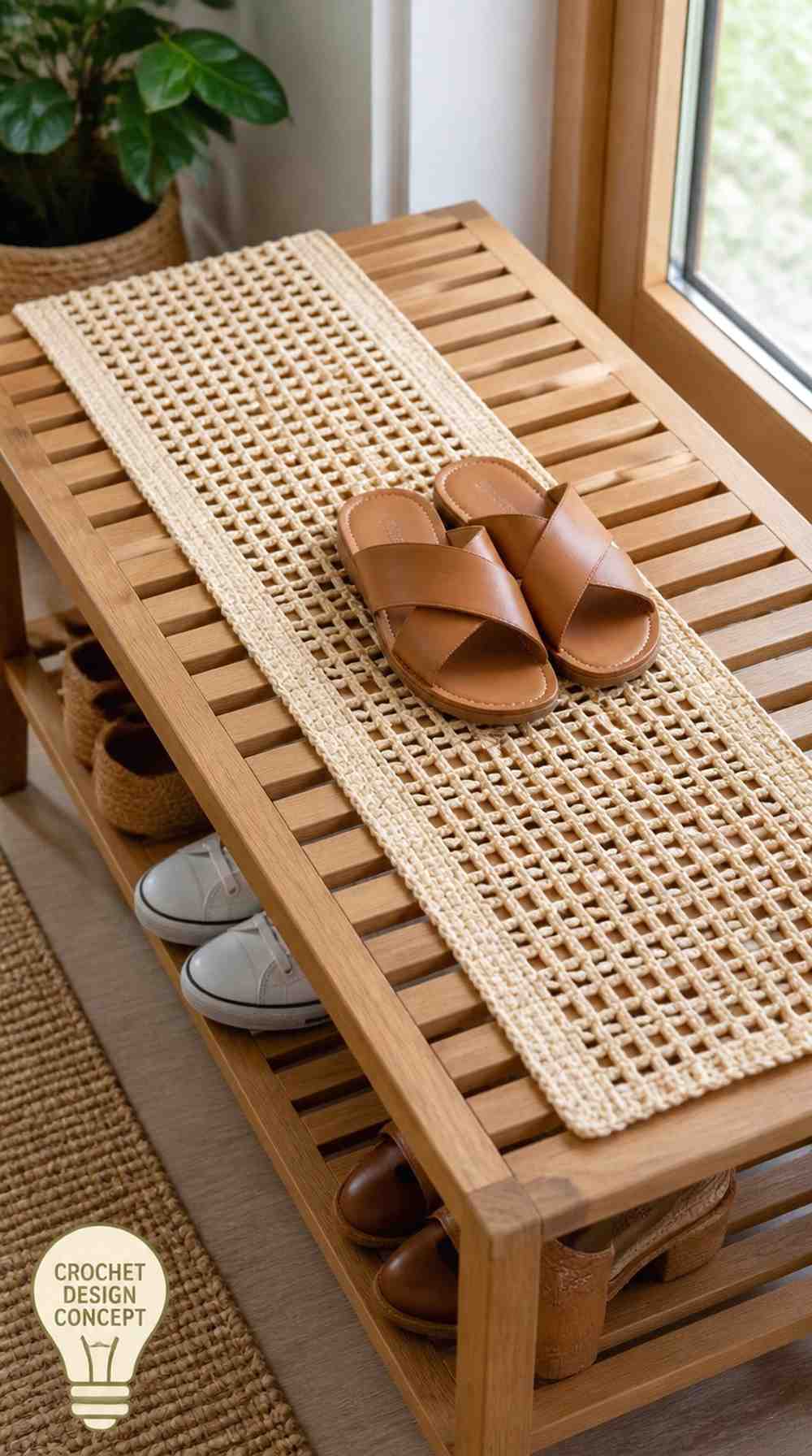
Soft wheat-colored crochet creates a narrow runner with orderly square-mesh openings and firm cream borders. The fabric lies across the center of a slatted wooden shoe shelf, leaving uncovered wood visible along both sides. A pair of tan leather sandals rests on the open crochet surface.
The mesh gives the liner a lighter appearance than a solid rectangular mat. Its openwork also allows the supporting wooden slats to remain visible. The important distinction is that the underlying shelf, not the crochet mesh, supports the footwear.
- Openwork placement: Keep the square crochet openings evenly joined and positioned over a stable supporting shelf rather than allowing them to span wide unsupported gaps.
- Runner width: A narrow central panel leaves the outer wooden edges visible, making the design less visually heavy than full-width coverage.
- Reinforced borders: Dense cream side edges can help define the mesh panel and reduce distortion along its exposed sides.
- Sandal compatibility: Check whether buckles, heel edges, or textured soles could snag the open crochet chains during everyday use.
4. Crochet Mustard Twin Shoe Placement Mats
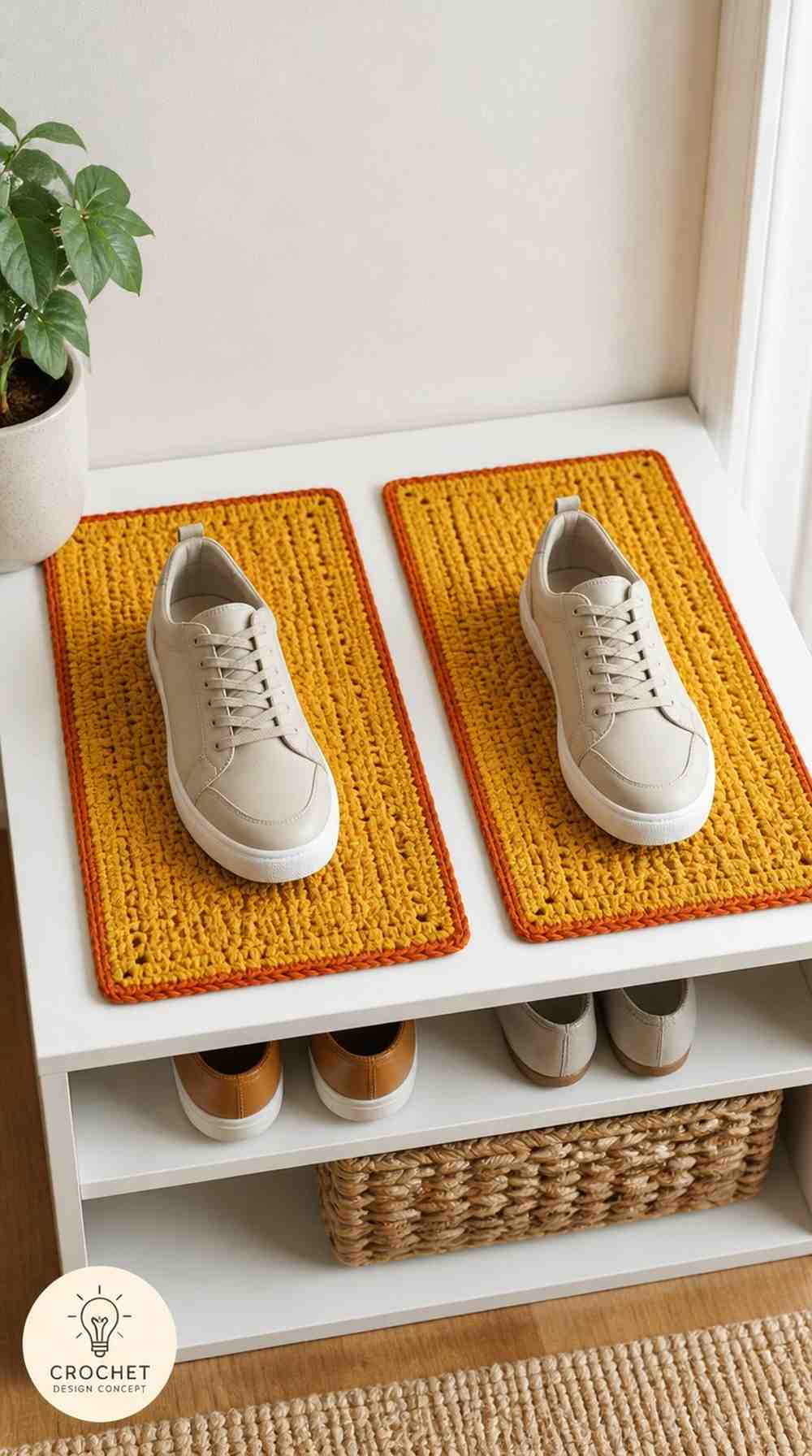
Two separate mustard-yellow crochet pads sit side by side on a white shoe-rack shelf. Each rectangular mat features dense moss-stitch texture, gently rounded corners, and a narrow rust-orange border. The small visible gap between them makes the arrangement feel orderly without covering the entire shelf.
This concept divides the surface into two individual shoe positions rather than using one continuous liner. It could be useful for keeping lightweight everyday shoes arranged neatly. Because the mats are separate, each piece can also be removed independently for cleaning or repositioning.
- Individual placement: Size each pad around the actual shoe footprint, allowing enough room for the sole without creating unnecessary fabric around it.
- Center gap: Keep the separation wide enough to show two distinct pads without wasting much of the shelf’s usable space.
- Rounded corners: Softly curved ends may be less likely to catch when sliding the mats off a shelf for cleaning.
- Independent care: Separate pieces can be washed or replaced individually if one becomes dirtier than the other.
5. Crochet Plum Hexagon-Panel Shoe Shelf Liner
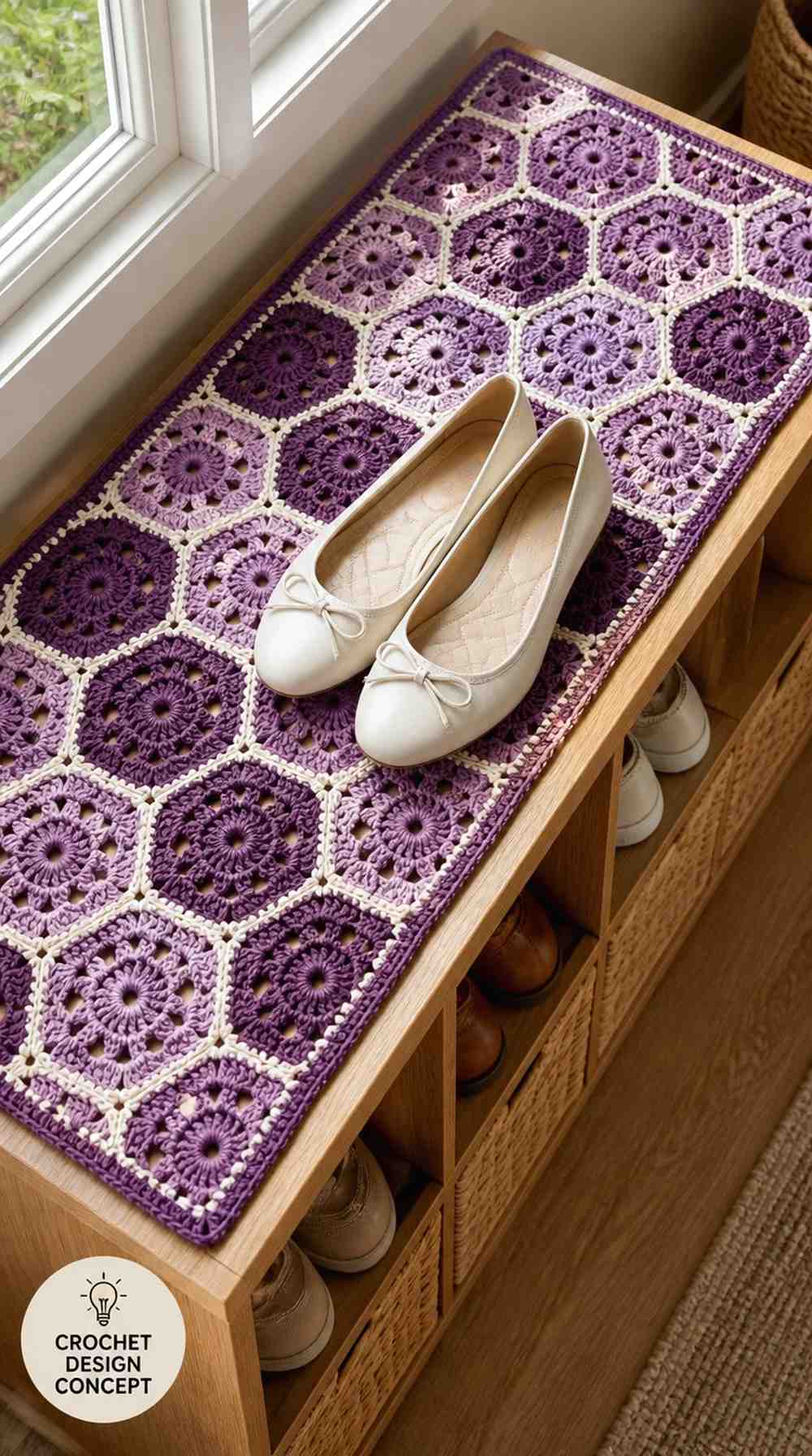
Plum-purple and dusty-lilac hexagonal motifs create a decorative rectangular liner for a wooden shoe rack. The individual crochet shapes have visible concentric rounds, cream joining stitches, and a dense backing beneath the small openings. Fitted edge motifs form straight sides, finished with a narrow plum border.
The hexagon construction offers a different look from ordinary row-by-row crochet. Its connected motifs create a textured surface that can become a decorative feature in an otherwise simple closet. The joined areas should remain smooth enough that ballet flats do not catch on raised seams.
- Hexagon alignment: Arrange the motifs to produce a flat rectangle, using properly shaped edge sections instead of leaving irregular protruding corners.
- Motif joins: Keep cream connecting stitches tidy and reasonably flat so they do not create uncomfortable ridges beneath shoe soles.
- Backing support: The dense underlying panel helps close the gaps between decorative motifs and separates the openings from the wooden shelf.
- Cleaning effort: Multiple joined motifs may require more careful inspection around seams, where fine dust and debris can collect.
6. Crochet Sage Reversible Shoe Rack Shelf Mat
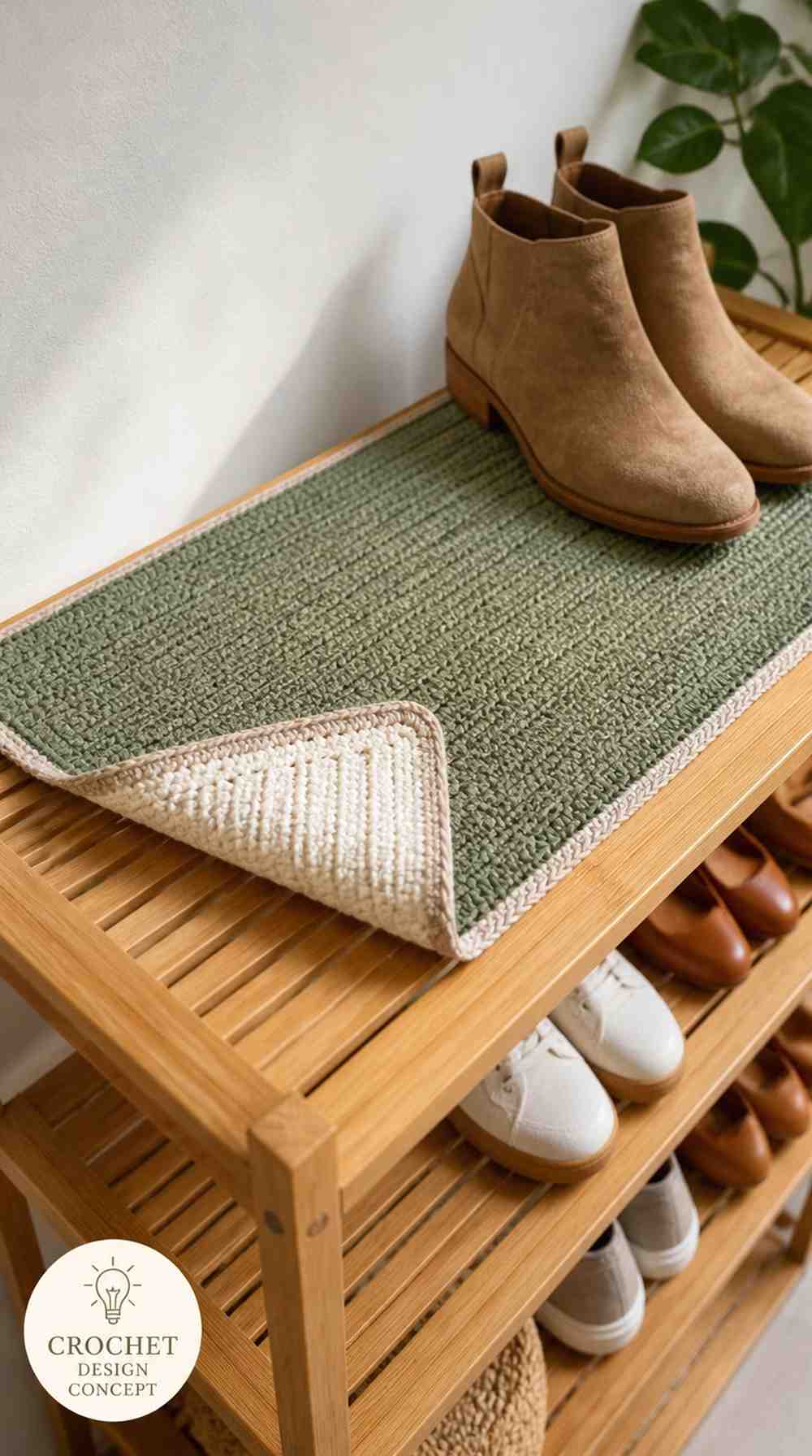
Sage-green crochet gives this bamboo shoe shelf a calm, natural appearance. The rectangular mat has a dense sage upper surface and a contrasting warm-cream reverse face. One corner folds back to reveal the second layer, while an oatmeal border joins the edges into a tidy finish.
The reversible construction makes this design more versatile than a single-color mat. Either side could provide a different look against the same bamboo shelf, assuming both surfaces are finished appropriately. The double-layer fabric would also be thicker and potentially slower to dry than a simple one-layer liner.
- Two-sided finish: Keep the sage and cream layers evenly joined so neither face curls or shifts independently.
- Folded-edge thickness: Consider the additional bulk created by two crochet layers, especially where the oatmeal border joins them.
- Reversible appearance: The cream reverse provides an optional lighter color treatment without requiring a completely separate shelf liner.
- Drying requirement: Both layers need to dry completely after cleaning before the mat is returned to a wooden or bamboo surface.
7. Crochet Peach Zigzag-Edge Shoe Shelf Runner
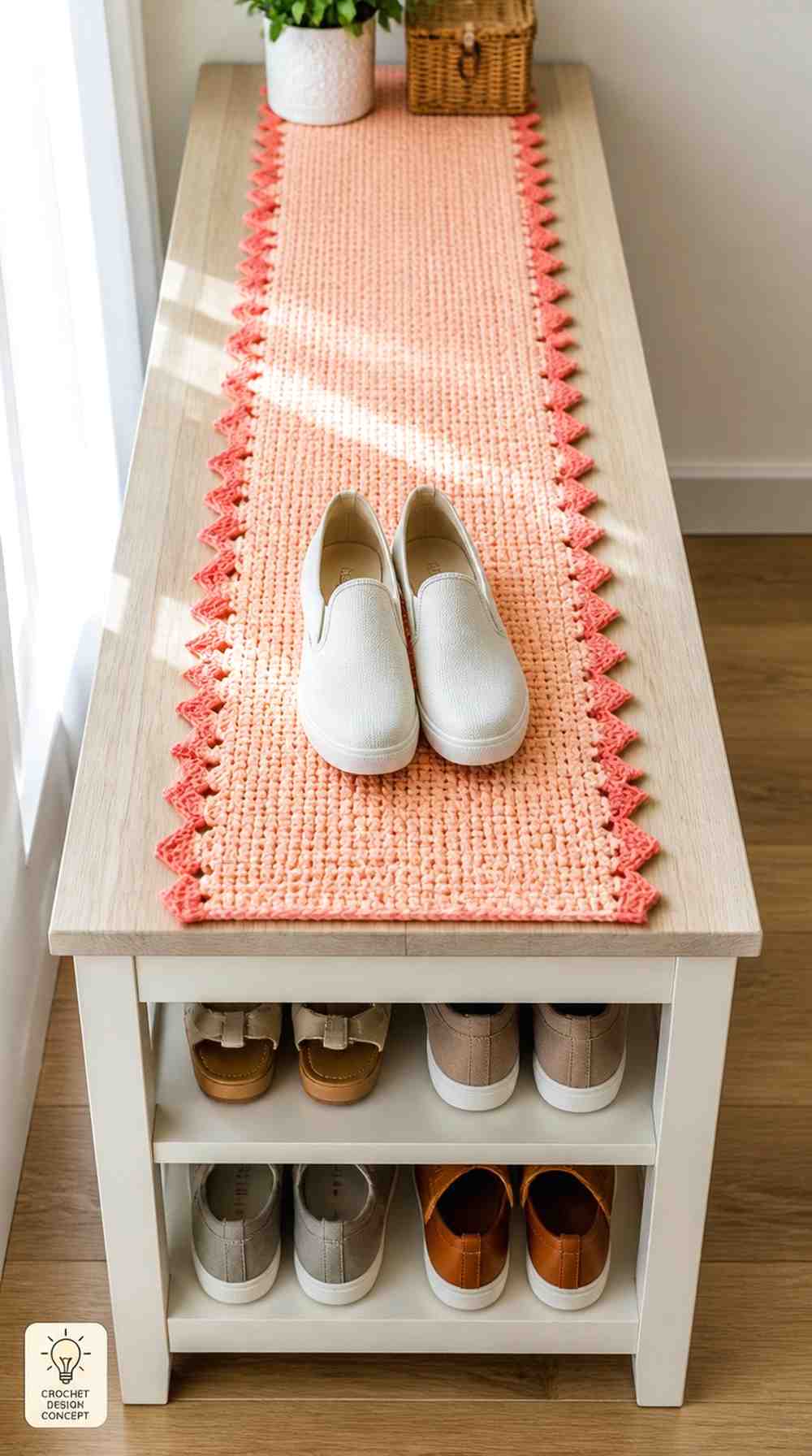
Peach-colored crochet creates a long, narrow runner across the front half of a cream-painted shoe shelf. The central surface has compact stitch rows, while coral-pink triangular points form a repeating zigzag border along both long sides. The ends remain straight and simple.
The sawtooth edging gives the runner a playful look without requiring large motifs. Since the strip covers only part of the shelf, more of the painted wood remains visible. Its narrow placement works as a decorative surface accent rather than full shelf coverage.
- Zigzag placement: Keep the triangular crochet points small enough that they do not curl upward or catch against the soles of slip-on shoes.
- Partial coverage: The liner intentionally leaves part of the shelf uncovered, so it is not suitable when complete surface coverage is the main goal.
- Runner alignment: Center the strip along the chosen shelf area and check that it stays straight when shoes are moved.
- Color contrast: Peach and coral provide a gentle accent against cream-painted furniture without creating a busy all-over pattern.
8. Crochet Charcoal Wire-Rack Overlay Liner
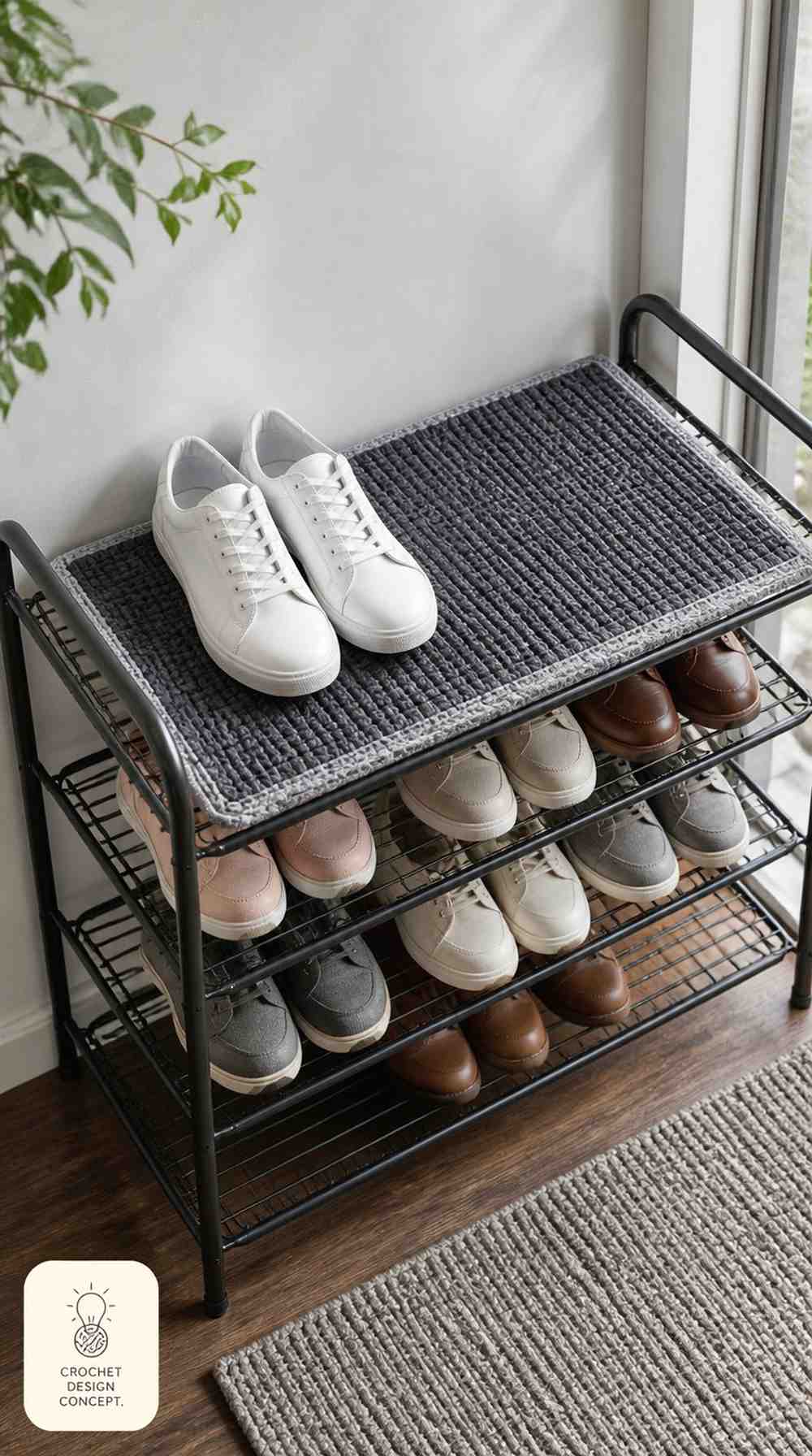
Charcoal-grey crochet creates a flat rectangular overlay for a metal shoe rack. Dense square stitches form the main surface, while a light-grey border finishes the edges. Beneath the crochet sits a separate rigid ventilated insert, supported by the rack’s existing metal bars.
The supporting insert is the important feature of this design. Wire racks often have openings between their bars, and crochet fabric alone should not be relied upon to bridge large gaps or support footwear. The liner provides a decorative top layer rather than replacing the shelf’s structural support.
- Underlying support: Use a properly sized rigid insert supported by the rack itself; a flexible crochet rectangle should not become the load-bearing shelf.
- Ventilation: Keep any insert openings functional and avoid creating a setup that traps dampness around footwear or metal bars.
- Border clearance: The light-grey crochet edging should sit within the supported area rather than hanging into gaps where it might snag.
- Rack compatibility: Check bar spacing, shelf slope, and actual insert stability before considering this arrangement for a real rack.
9. Crochet Teal Notched-Corner Shoe Shelf Mat
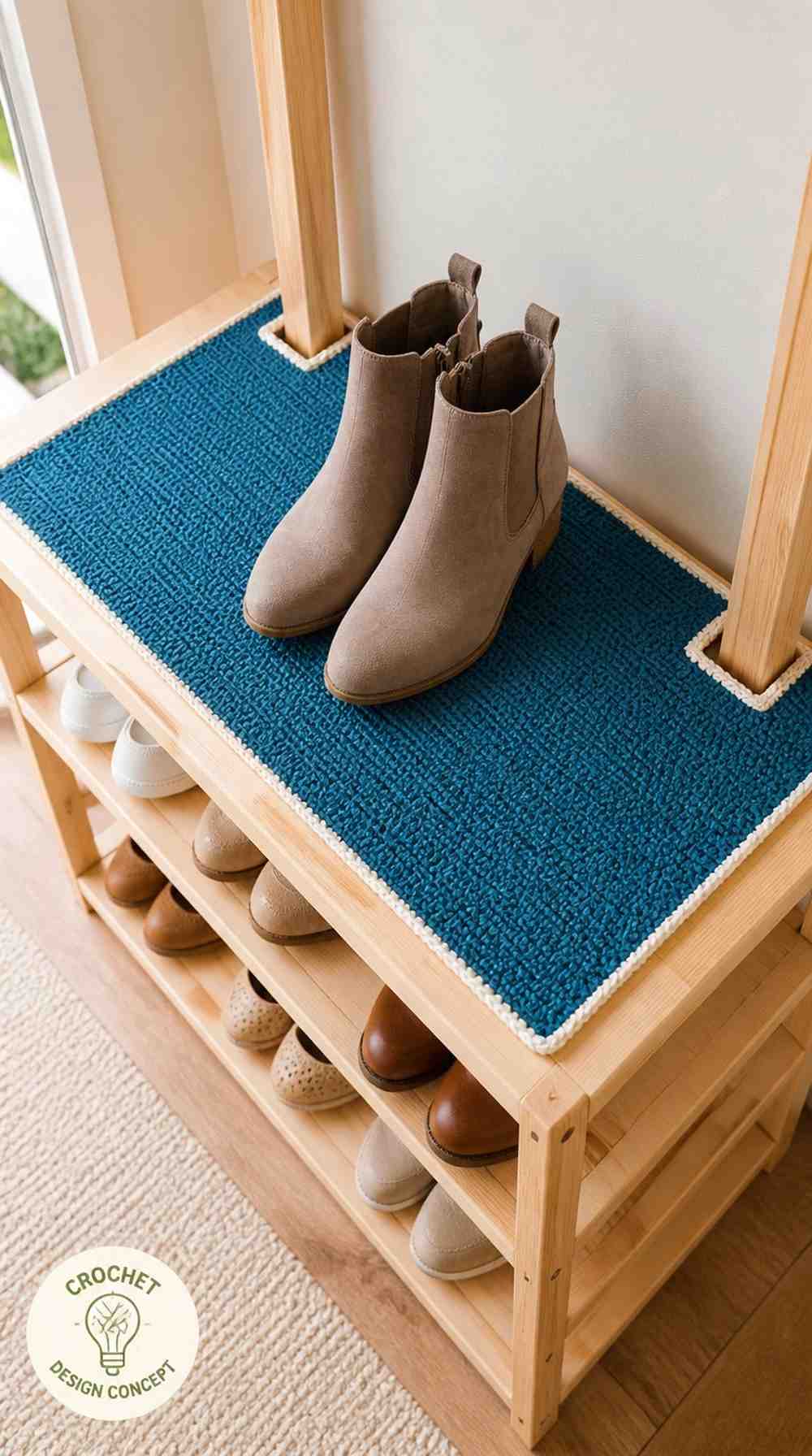
Teal-blue crochet creates a fitted rectangular liner with two square cutouts at the rear corners. These notches allow the mat to sit around the upright wooden support posts of a shoe rack. A thin cream border follows the complete shape, including the recessed corners.
The fitted construction distinguishes this concept from simple rectangular shelf mats. Instead of folding around the rack supports, the crochet follows the shelf’s actual outline. This may create a cleaner appearance, but the corner positions need careful measurement because even small fitting differences could cause the panel to bunch.
- Rear post measurements: Check the width and depth of both upright supports before planning the square cutouts.
- Notch edging: Reinforce the inner corners with neat crochet joins so the cutout edges do not stretch or distort during removal.
- Overall fit: Leave enough clearance around the wooden posts to lift the mat out without pulling against the rack.
- Boot placement: Keep the notched rear corners visible and unobstructed so taller shoes do not force the fitted crochet out of position.
10. Crochet Coral Corner-Button Shelf Liner
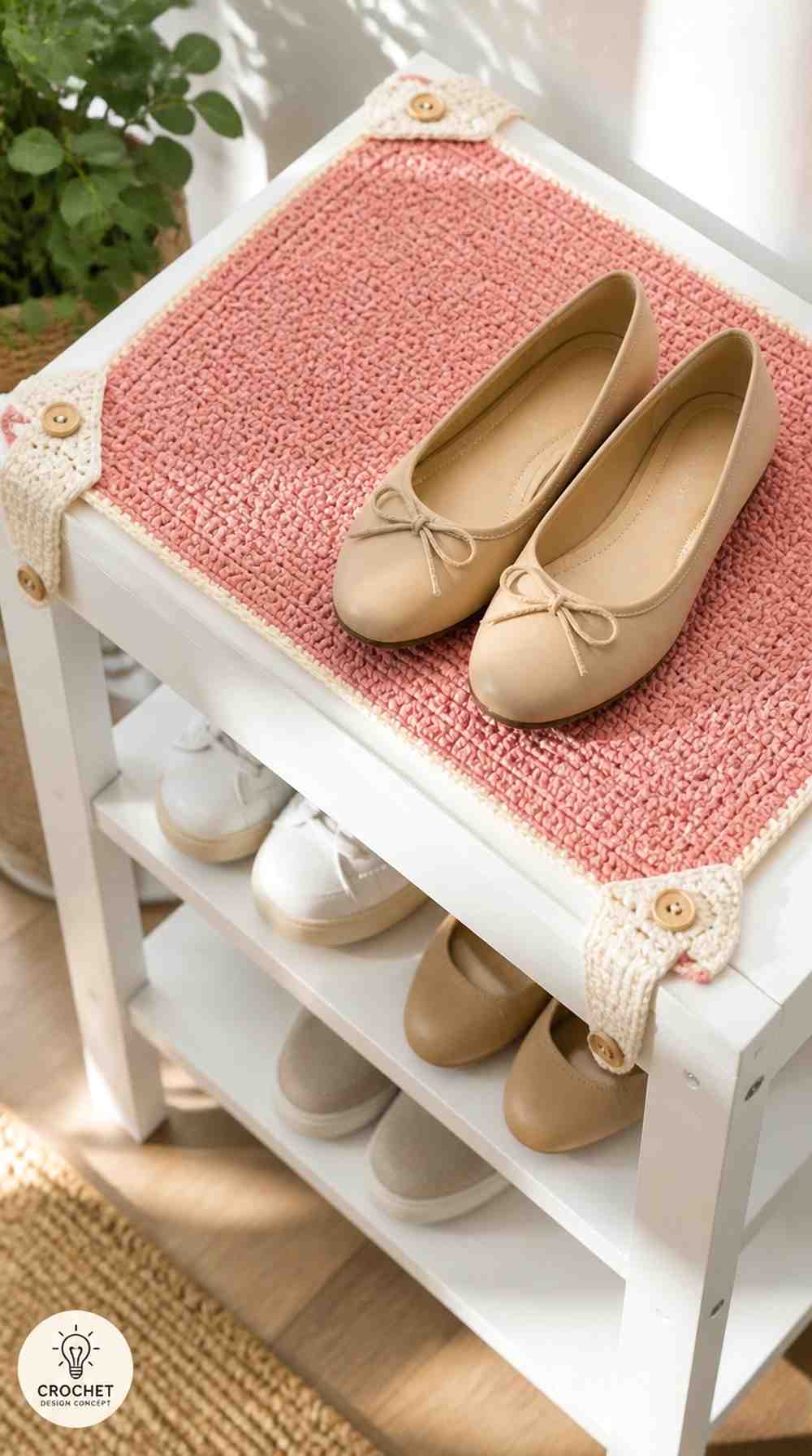
Coral-pink crochet forms a flat rectangular shelf liner with four small cream fastening tabs at its corners. Natural wooden buttons connect the tabs to short textile loops beneath the white wooden shelf. Ivory edging gives the main panel a neatly finished outline.
The corner-fastening arrangement differs from a complete wraparound band because only the four corners are secured. That could make the liner easier to remove while leaving most of its edges free. Each attachment point should sit comfortably without pulling the crochet diagonally out of shape.
- Corner positioning: Keep the four tabs equally spaced and aligned so one corner does not carry more tension than the others.
- Button access: The fastenings need enough room beneath the board to open without reaching into awkward shelf supports.
- Flat panel shape: Check that the main liner lies smoothly after fastening; overly tight corner tabs may create diagonal wrinkles.
- Existing shelf surface: Use the concept only where the attachment method is appropriate for the furniture and does not require damaging the shelf.
11. Crochet Oatmeal Front-Lip Shoe Shelf Mat
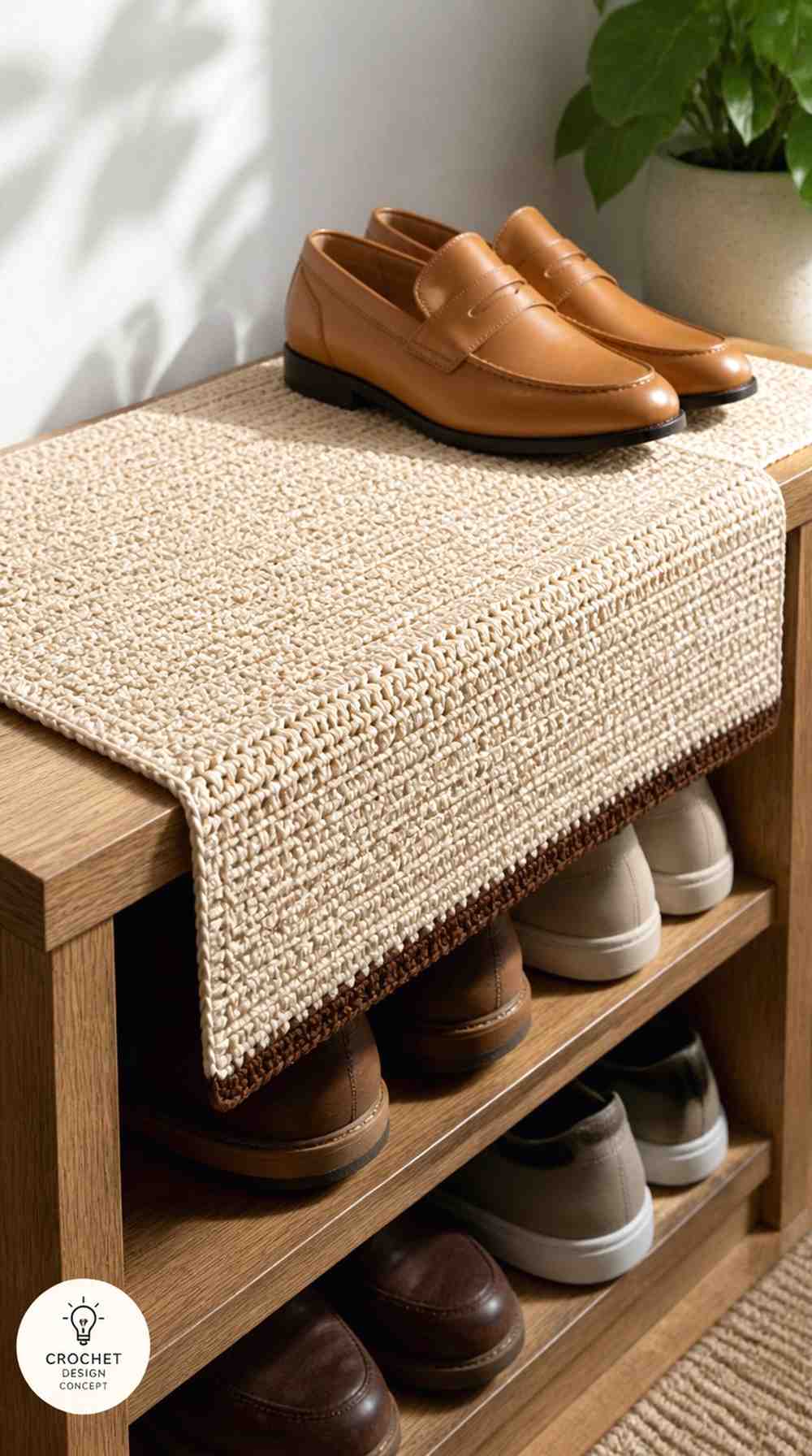
Warm oatmeal crochet covers the upper surface of an oak shoe shelf before folding over the front edge into a short hanging lip. Closely worked horizontal stitches keep the top relatively flat, while a narrow cocoa-brown border finishes the visible lower edge.
The folded front section creates a more decorative appearance than an ordinary shelf liner. It could visually soften a thick wooden shelf and bring the crochet texture into view even when shoes cover most of the top surface. The front lip should remain short enough not to interfere with lower storage levels.
- Front-edge allowance: Measure the shelf depth and the amount of fabric intended to hang over the edge before planning the complete rectangle.
- Lower clearance: Keep the short hanging section above the shoes or objects stored on the level beneath.
- Fold behavior: The transition over the wooden front edge should lie smoothly without creating a thick ridge beneath the shoes.
- Cocoa border: A narrow contrasting finish makes the hanging lip visible without adding heavy fringe that could collect dust.
12. Crochet Lavender Scalloped Two-Piece Shelf Liner
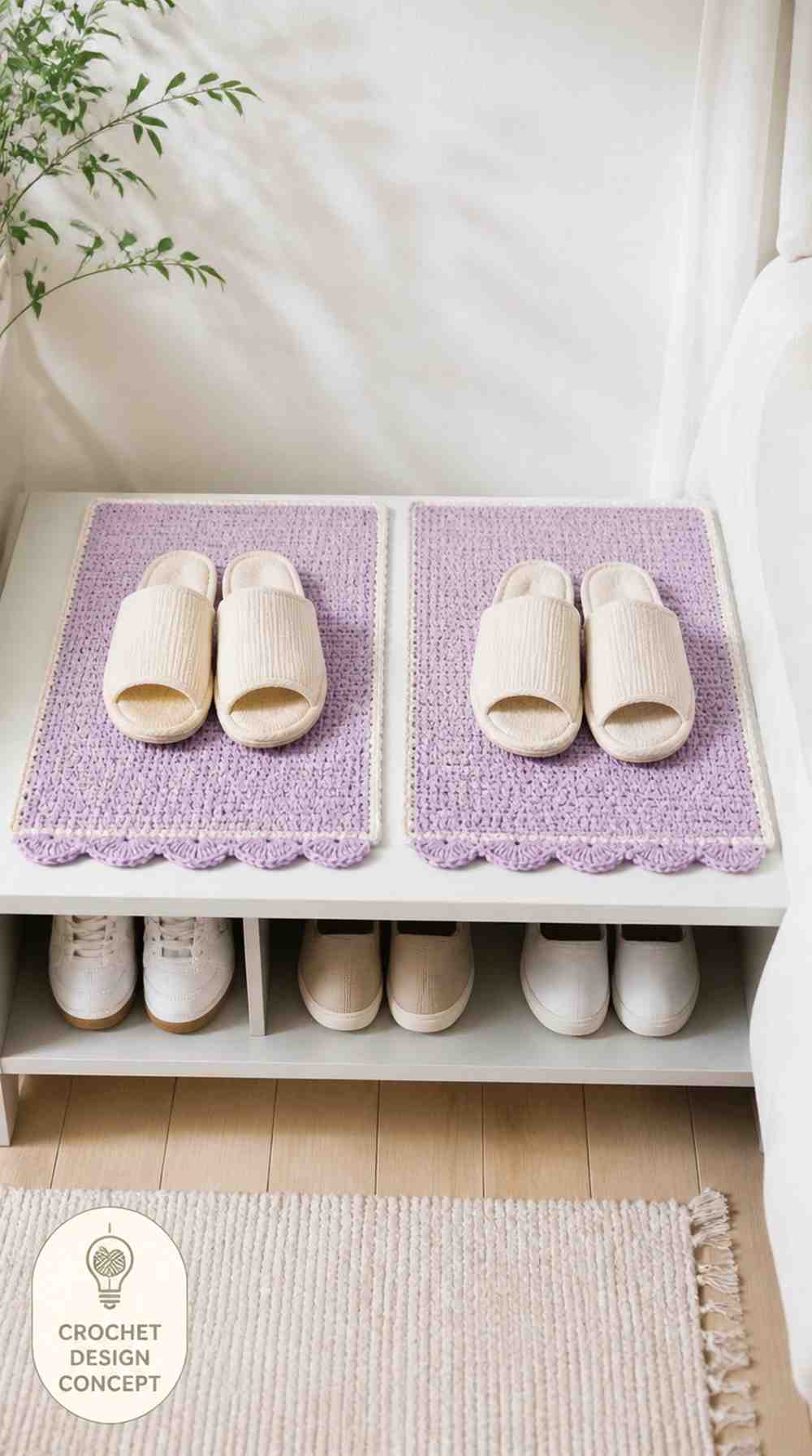
Two matching lavender crochet panels sit side by side on a wide white shoe shelf. Each rectangle has close stitch rows, a thin cream border, and small lavender scallops along its front edge. Pale-beige house slippers rest on the separate mats, with a narrow gap between them.
The paired construction provides two defined storage areas while maintaining a coordinated appearance. Its scalloped front edges make the design more decorative than plain placement pads. The small scallops should remain flat enough not to catch when slippers are removed from the shelf.
- Matched panel sizes: Keep both rectangles consistent in width, length, and edging so the paired arrangement looks intentional.
- Front-only scallops: Restrict the decorative border to the exposed front edges, leaving the sides simpler for close placement.
- Center separation: The narrow gap allows each mat to be removed independently without disturbing the other.
- Slipper storage: This concept is better suited to clean, dry indoor footwear than shoes that regularly carry moisture or outdoor dirt.
13. Crochet Rust Checkerboard Shoe Shelf Mat
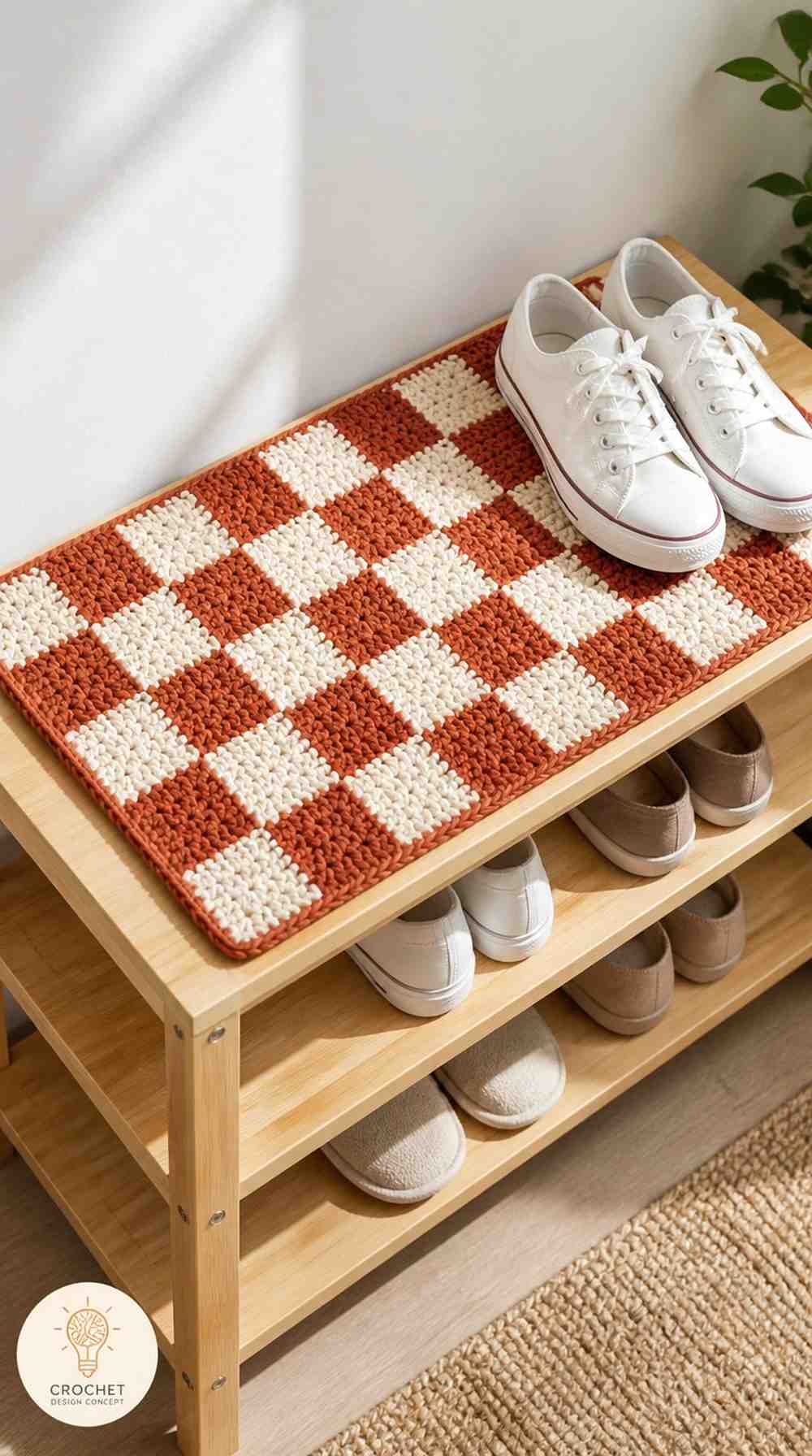
Rust-orange and ivory crochet squares form a neatly joined checkerboard liner across a light-birch shoe shelf. The individual motifs have straight edges and visible connecting seams, while a narrow rust border finishes the complete rectangular shape. White canvas sneakers rest on one side, leaving the checker pattern visible.
The repeated square arrangement creates visual interest through color and construction rather than raised embellishments. Each motif needs consistent sizing so the finished rectangle remains even. Noticeably raised seams or mismatched squares could make the surface less practical under footwear.
- Checker alignment: Keep the rust and ivory squares similar in finished dimensions so their edges meet without creating ripples.
- Seam thickness: Choose joins that remain relatively flat against the shelf, especially where several square corners meet.
- Color placement: Alternating rust and ivory produces strong contrast, but light-colored squares may show dust more readily.
- Rectangular proportion: Plan the number and arrangement of squares around the actual shelf shape rather than assuming a standard mat size.
14. Crochet Forest Green Banded Mesh Shelf Liner
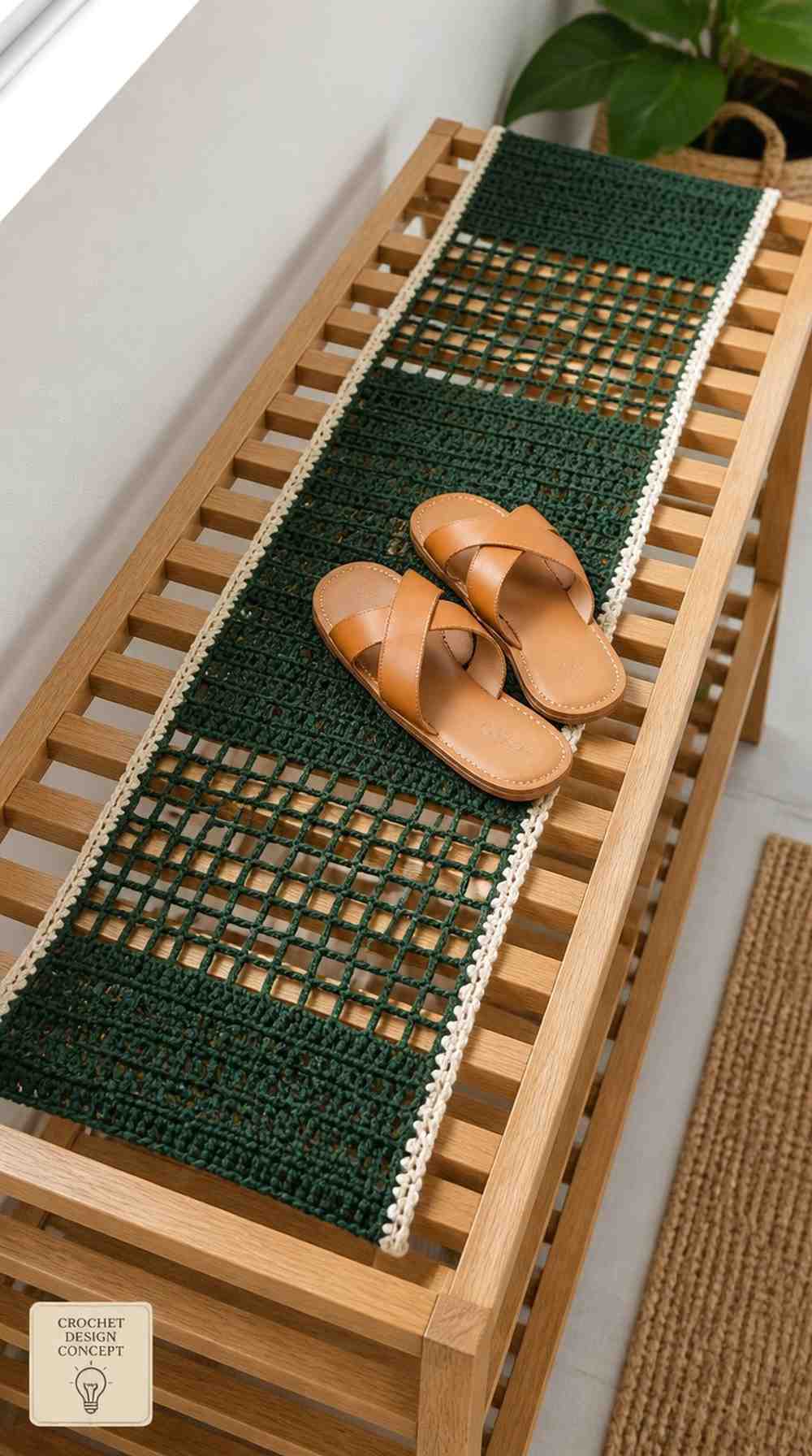
Forest-green crochet forms a long rectangular liner with three dense horizontal bands connected by open square-mesh sections. Cream edging runs along both long sides, and the short ends remain neatly finished. The liner rests on a slatted oak shelf, with tan sandals placed over its dense central band.
This design combines solid crochet with more open sections, creating a lighter appearance than a fully dense mat. The underlying wooden slats provide the actual footwear support. The open sections need secure joins so the mesh does not stretch unevenly during repeated use.
- Dense central band: Position footwear over a suitable supported section, rather than depending on the open crochet mesh to bridge gaps.
- Mesh consistency: Keep the square openings orderly with connected loops that maintain their shape when the liner is handled.
- Cream side borders: Continuous edging helps define the long strip and separates the green crochet from the visible wooden slats.
- Airflow consideration: Open crochet does not make a wet shoe safe to store; shoes should be dried separately before being placed on textile liners.
Practical Guide to Crochet Shoe Rack Shelf Liners
Before choosing a crochet shelf liner, look at the actual rack, the types of shoes you keep on it, and how often the shelves need cleaning.
Measure the usable shelf surface. Record the width and depth of each shelf, not just the outside measurements of the entire rack. Include any rear support posts, raised front lips, rounded corners, or attachment points.
Match the liner to the shelf structure. Solid wooden or bamboo shelves provide continuous support beneath crochet fabric. Wire and slatted shelves need more careful consideration. A decorative crochet liner cannot replace a rigid shelf or carry loads across unsupported gaps.
Choose a suitable crochet texture. Dense, relatively flat stitches may be more practical beneath everyday shoes than large raised motifs or delicate lace. Smooth cotton yarn or a suitable blend can be considered, but the finished fabric should be checked for stretching and movement.
Keep footwear dry. Do not place wet or muddy shoes directly on a crochet liner. Yarn can hold moisture and dirt against wooden surfaces, while poor ventilation can contribute to unpleasant storage conditions. Let footwear dry and clean away grit before returning it to the shelf.
Check slipping and stability. Crochet does not automatically provide a non-slip surface. If a liner shifts under footwear, reconsider the fitting or use a compatible, manufacturer-approved non-slip solution that will not damage the shelf.
Plan for easy removal. Shelf liners should be taken off regularly for cleaning and inspection. Follow the yarn manufacturer’s washing instructions and allow the crochet and shelf to dry completely before reassembly.
Want to Make Something Similar?
A flat rectangular crochet mat is a useful starting point when exploring these shelf-liner ideas.
Rhelena at CrochetNCrafts shares a Crochet Rectangle Placemat with an adjustable rectangular construction and a simple edging. Its general approach may help readers understand how to plan a flat crochet panel for a shelf.
Rachel Choi’s Basic Rectangle Placemat Pattern at Crochet Spot is another beginner-friendly resource for making a rectangular crocheted surface and adjusting its size.
These are general crochet mat patterns, not exact instructions for the 14 shoe-rack liners pictured here. Any shelf-specific changes, including buttoned attachments, corner notches, mesh panels, or front folds, require separate planning and practical checks.
Comparison: Which Crochet Shoe Rack Shelf Liner Should You Choose?
The right design depends on whether you prefer complete coverage, removable sections, a decorative shelf edge, or a more fitted finish.
| Design | Main advantage | Practical trade-off |
|---|---|---|
| Crochet Terracotta Ribbed Shoe Shelf Liner | Simple full rectangular coverage | Needs a flat supporting shelf |
| Crochet Cornflower Button-Tab Shoe Rack Liner | Removable buttoned attachments | Requires accessible shelf edges |
| Crochet Wheat Open-Mesh Shoe Shelf Runner | Light decorative appearance | Openwork may snag on shoes |
| Crochet Mustard Twin Shoe Placement Mats | Two independent pads | Does not cover the entire shelf |
| Crochet Plum Hexagon-Panel Shoe Shelf Liner | Decorative joined motifs | More seams and cleaning attention |
| Crochet Sage Reversible Shoe Rack Shelf Mat | Two color options | Thicker fabric and longer drying |
| Crochet Charcoal Wire-Rack Overlay Liner | Concept for a wire rack | Needs separate rigid support |
| Crochet Teal Notched-Corner Shoe Shelf Mat | Fits around rear support posts | Requires careful measurements |
| Crochet Oatmeal Front-Lip Shoe Shelf Mat | Decorative front edge | Needs clearance beneath the shelf |
For a straightforward wooden shoe rack, the Crochet Terracotta Ribbed Shoe Shelf Liner is a simple starting point. The Crochet Sage Reversible Shoe Rack Shelf Mat offers a similar broad shape with two different color surfaces.
If you prefer not to cover an entire shelf, the Crochet Mustard Twin Shoe Placement Mats or Crochet Lavender Scalloped Two-Piece Shelf Liner could be better inspiration. Their separate panels also allow individual removal.
The Crochet Teal Notched-Corner Shoe Shelf Mat is worth considering when upright rack supports make ordinary rectangles difficult to fit. For a decorative exposed edge, the Crochet Oatmeal Front-Lip Shoe Shelf Mat creates a different look.
On wire racks, the Crochet Charcoal Wire-Rack Overlay Liner requires particular care because the fabric must remain properly supported. A purpose-made rigid shelf insert may be more practical than an unsupported crochet mat.
Conclusion
Crochet shoe rack shelf liners offer an appealing way to bring handmade texture into everyday footwear storage. A simple rectangular mat can add warmth to a wooden shelf, while removable button tabs, decorative motifs, fitted notches, and two-piece arrangements provide different ways to personalize the space.
These 14 concepts show that a liner does not need to be complicated to look thoughtful. The best choice is one that fits the shelf, remains flat, can be removed for cleaning, and suits the shoes normally stored there. Start with the rack’s actual measurements and choose the crochet details that make sense for your home.
Which design would you choose for your shoe rack: the terracotta ribbed mat, the plum hexagon liner, or the oatmeal front-lip design? Share your favorite and whether your rack has wooden, bamboo, metal, or slatted shelves.
Frequently Asked Questions
1. Can I use crochet liners on any type of shoe rack?
Not every rack is equally suitable. Solid wooden, bamboo, or other continuously supported shelves may accommodate a flat removable liner more easily. Wire and slatted racks require particular attention to gaps and support. Crochet fabric should not be treated as a replacement for a structural shelf or rigid insert.
2. What yarn is suitable for crochet shoe rack shelf liners?
Smooth cotton yarn or a suitable cotton blend may be worth considering because it can produce defined stitches and relatively flat fabric. However, the right material depends on the shelf, footwear, washing requirements, and amount of wear. Check the yarn’s care instructions and test the finished mat for movement and stretching.
3. Will a crochet shoe shelf liner prevent shoes from slipping?
Not necessarily. Crochet texture does not guarantee reliable grip, and some yarns may slide on smooth painted or polished shelves. The finished liner should be checked under normal use. If it moves, consider a suitable non-slip solution approved for the particular shelf material rather than assuming thicker crochet will solve the problem.
4. Can I put wet shoes on a crochet shelf liner?
It is better to let wet footwear dry separately before placing it on a textile liner. Crochet yarn can absorb and retain moisture, potentially leaving the shelf damp underneath. Mud and grit can also become trapped in the stitches. Clean and dry both the shoes and the shelf before replacing the liner.
5. Are these 14 crochet shoe rack shelf liner ideas actual patterns?
No. These are original crochet design visualizations intended to inspire colors, textures, shapes, and shelf-fitting arrangements. They are not tested physical products or ready-to-follow patterns. Anyone making a similar liner should measure the rack, choose appropriate materials, and check the finished piece for stability, cleaning, and practical suitability.