A crochet bathroom scale storage sleeve can add a handmade touch to an often-overlooked bathroom accessory. These 17 inspiration ideas explore flat slipcases, buttoned pouches, folded wraps, decorative dust covers, lined storage cases, and removable closures. From warm terracotta and natural oatmeal to navy blue, dusty rose, charcoal, and forest green, the collection brings together different crochet textures and practical storage styles.
Whether your bathroom scale is kept on a cabinet shelf, inside a drawer, or in a dry storage cupboard, the right sleeve depends on its exact shape and the manufacturer’s storage instructions. Some concepts offer simple openings for quick access, while others add fabric linings, pockets, or decorative edging. Compare their thickness, fit, removal methods, and cleaning needs before choosing a design.
These are AI-generated crochet design visualizations for inspiration, not photographs of tested handmade products or step-by-step patterns. These covers are for storage only and must be completely removed before weighing.
Quick Design Selection Guide
- For simple slide-in storage: The Crochet Terracotta Side-Opening Scale Sleeve and Crochet Oatmeal Open-End Scale Slipcase offer straightforward rectangular designs.
- For a closure: Compare the Crochet Navy Button-Flap Scale Case, Crochet Charcoal Zippered Scale Sleeve, and Crochet Apricot Envelope-Flap Scale Case.
- For a decorative dust cover: The Crochet Butter Yellow Scalloped Dust Sleeve uses a removable draped design rather than a closed pouch.
- For fabric-lined interiors: The Crochet Ivory Corner-Cushion Scale Sleeve and Crochet Cocoa Pull-Tab Scale Slipcase include soft lining details.
- For extra organization: The Crochet Teal Dual-Pocket Scale Case holds a separate dry cleaning cloth, while the Crochet Forest Green Label-Pocket Scale Sleeve has a small removable label card.
1. Crochet Terracotta Side-Opening Scale Sleeve
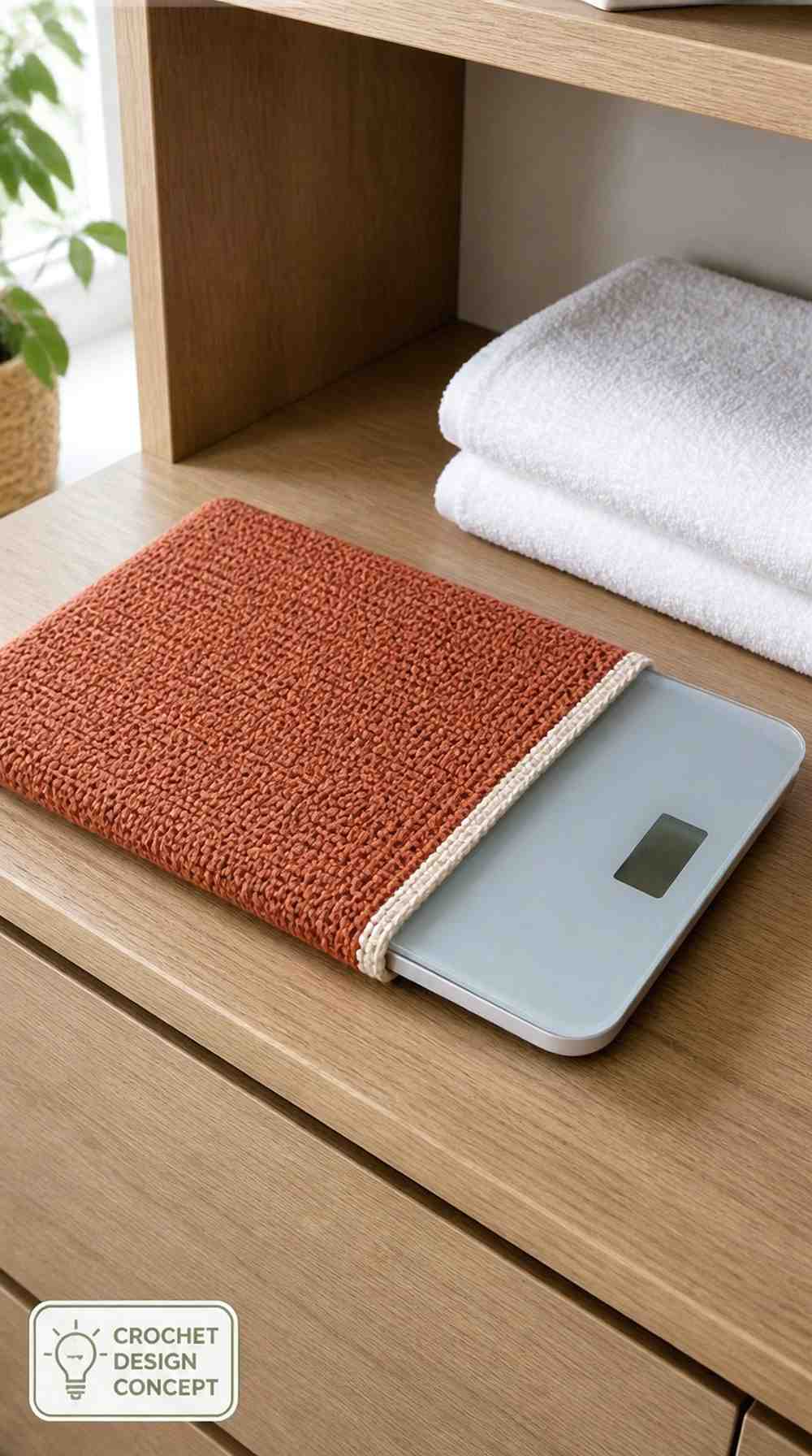
Warm terracotta cotton crochet creates a slim rectangular storage sleeve with a cream-edged opening along its right short side. The tightly connected horizontal rows give the case a tidy surface, while a pale-grey glass bathroom scale sits partly inside. Its simple shape keeps attention on the crochet fabric rather than decorative attachments.
This design suits a dry cabinet shelf where the scale can remain flat. The open side makes insertion straightforward, although the finished sleeve needs enough room for the scale’s actual thickness and corners.
- Side Opening: Keep the cream-edged entrance wide enough for the scale to slide in without scraping its glass surface or catching the corners.
- Flat Storage: The entire covered scale should rest on a stable shelf rather than hang from the crochet or stand unsupported on its edge.
- Stitch Density: Closely worked rows may reduce large gaps, but they do not guarantee dust protection or prevent damage from impacts.
2. Crochet Navy Button-Flap Scale Case
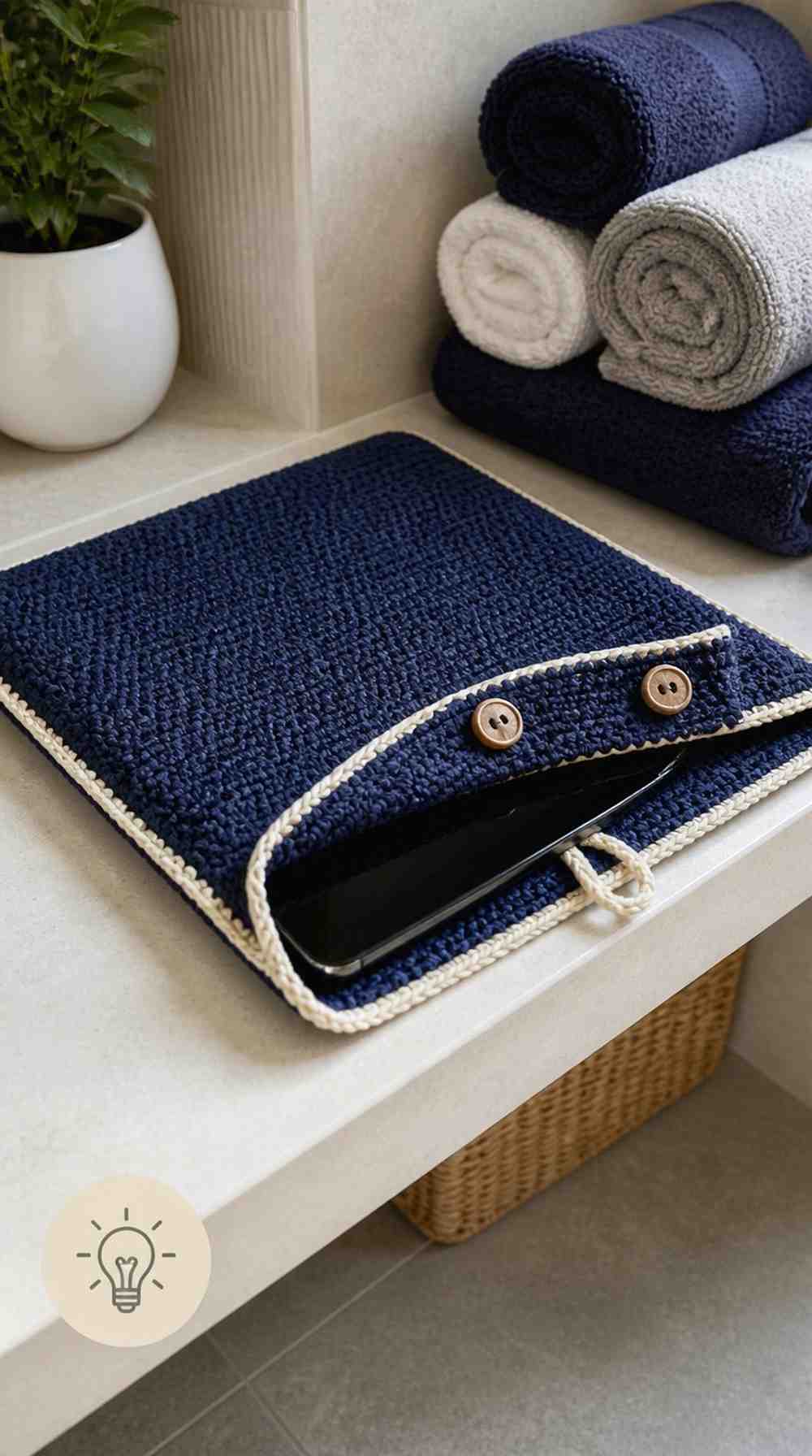
Deep navy crochet gives this rectangular case a clean, tailored appearance. A broad front flap folds over the opening, while two small wooden buttons and matching loops provide the closure. Narrow ivory borders brighten the edges, and part of the black-glass digital scale is visible beneath the opened flap.
The buttoned arrangement offers a more enclosed storage option than a plain slipcase. Its main practical consideration is closure placement, since hard buttons should not press directly against the scale’s glass platform or display.
- Button Clearance: Position the two wooden buttons where they cannot create pressure points against the stored scale or its sensitive surfaces.
- Flap Length: Allow enough overlap to close the case comfortably without pulling the crochet fabric tightly across the scale’s corners.
- Easy Access: Check that both button loops can be opened while the case lies flat, without needing to lift or twist the scale.
3. Crochet Oatmeal Open-End Scale Slipcase
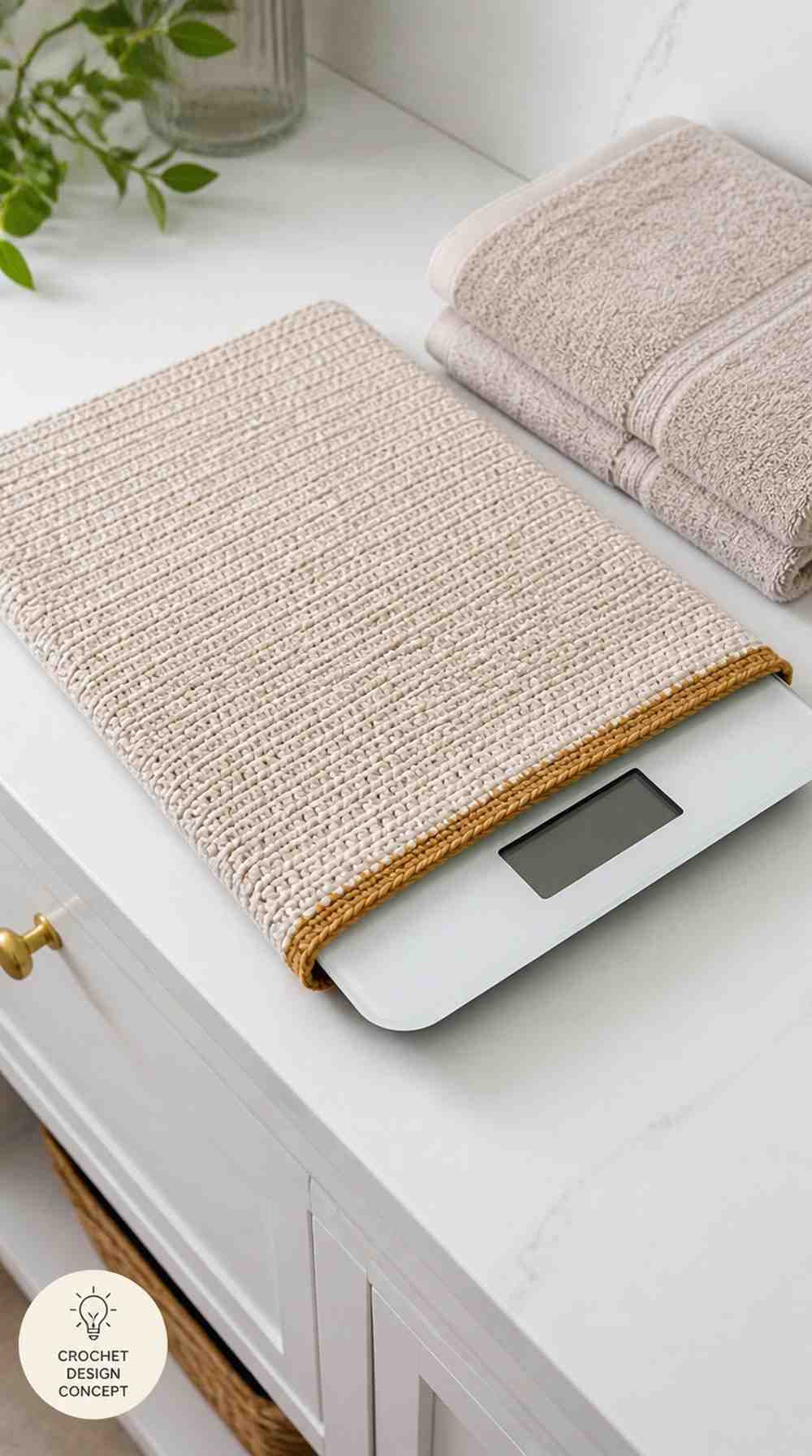
Natural oatmeal cotton forms a flat tubular crochet slipcase with two joined long sides and a caramel-edged opening. The closely worked rows create a soft, understated texture, while a white-glass bathroom scale is partially inserted through one short end.
The neutral palette works well with light bathroom cabinetry and folded towels. This is one of the simpler construction concepts, but the actual opening must account for the scale’s thickness, rounded corners, and any raised features along its edge.
- Tubular Shape: Measure the scale’s full width and thickness before planning the tube, because a flat measurement alone may produce an opening that’s too narrow.
- Caramel Edge: Keep the finishing border smooth so it does not form a thick ridge that catches the glass during insertion.
- Removal Space: Leave enough free shelf space beside the open end to slide the scale out without bumping adjacent bathroom items.
4. Crochet Dusty Rose Drawstring Scale Pouch
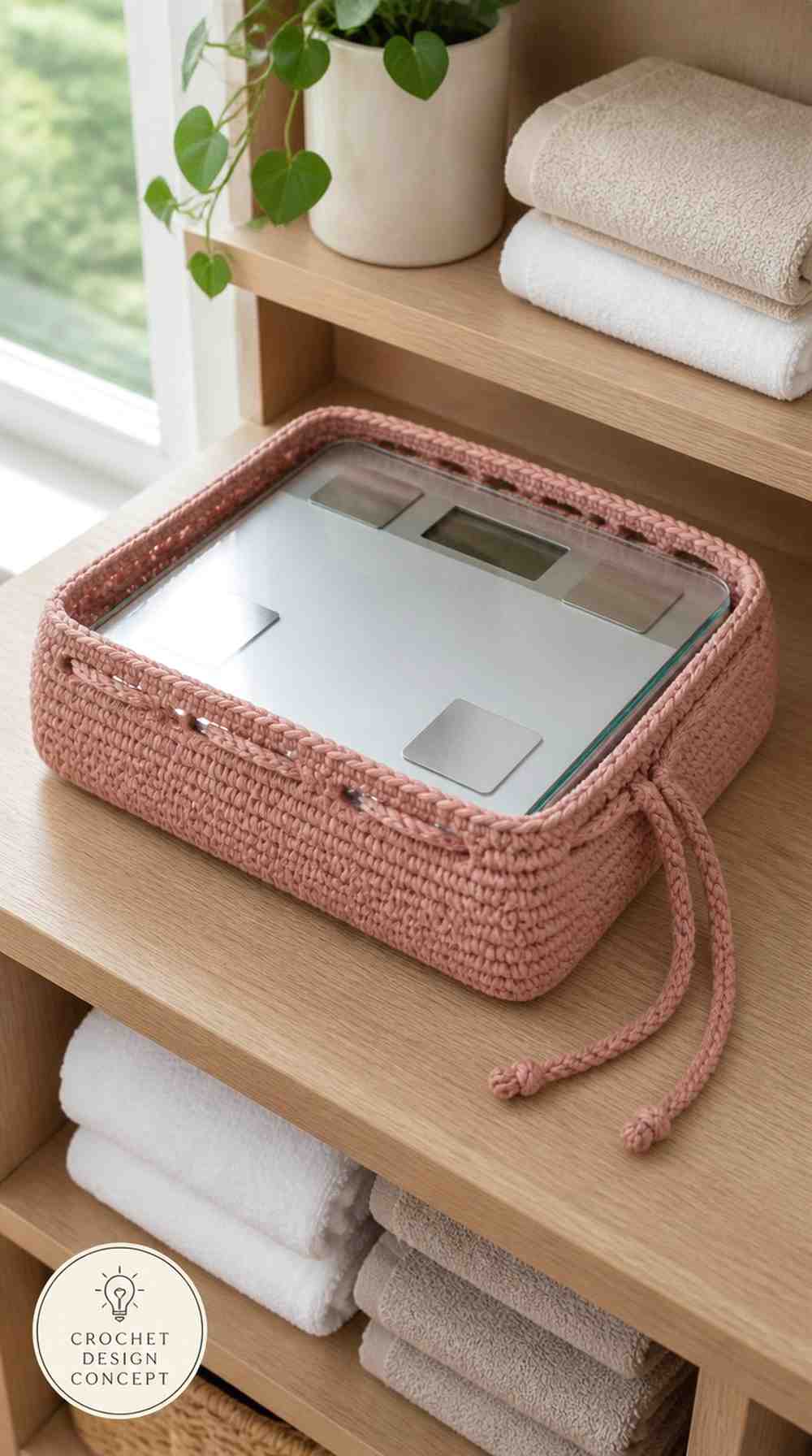
Dusty-rose crochet forms a wide, shallow rectangular pouch with a broad upper opening and a matching drawstring passing through evenly spaced eyelets. The soft cotton sides surround a silver-glass bathroom scale, which remains partially visible while the pouch lies open.
The drawstring provides a different closure idea from buttons or zippers. Rather than pulling the fabric tightly against the scale, the design allows the opening to gather loosely. This matters because excessive pressure around glass corners or a raised display should be avoided.
- Loose Drawstring Closure: Keep the gathered opening gentle and avoid cinching the cord tightly against the scale’s edges.
- Corner Shaping: Form the shallow rectangular base with enough room for all four corners to rest without stretching the pouch diagonally.
- Cord Ends: Keep the two matching drawstring ends short and tidy so they do not snag on nearby cabinet hardware.
5. Crochet Olive Cross-Tie Scale Wrap
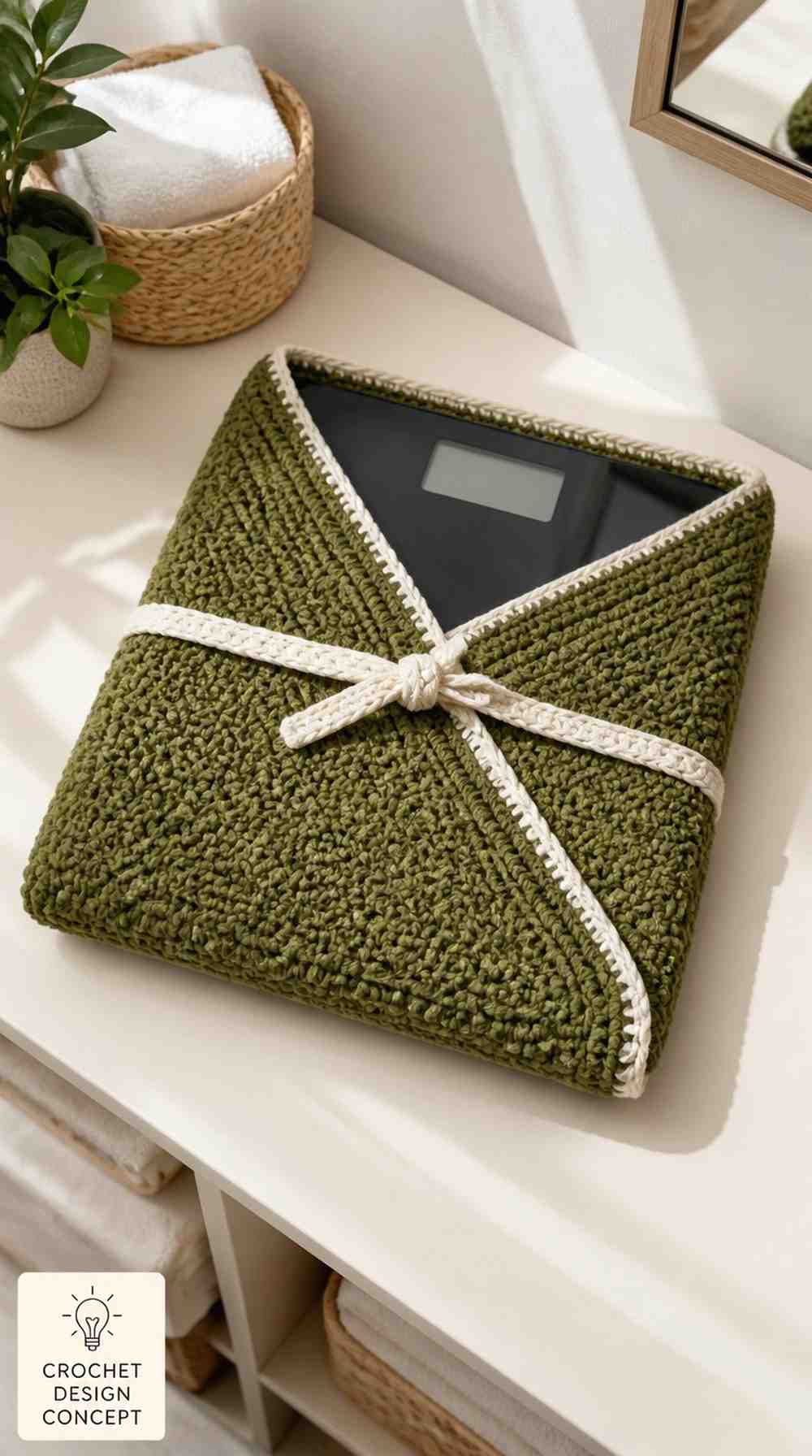
Muted olive-green crochet creates a broad rectangular wrap folded around a black-glass bathroom scale. Two cream crochet ties cross diagonally over the top in a shallow X-shape, while a narrow cream border defines the panel’s outer edges.
The design is more like a folded fabric wrap than a conventional pouch. Its adjustable ties offer flexibility for different scale thicknesses, but they should remain loose enough to avoid pressing against the glass surface.
- Crossed Tie Placement: Keep the cream ties positioned away from vulnerable buttons and displays, with no hard fasteners pressing onto the platform.
- Panel Coverage: Plan enough crochet fabric to fold around the scale without excessive overlap or bulky corners.
- Storage Position: Keep the wrapped scale lying flat, with the ties serving only to retain the fabric rather than suspend or carry the device.
6. Crochet Mustard Diagonal-Pocket Scale Sleeve
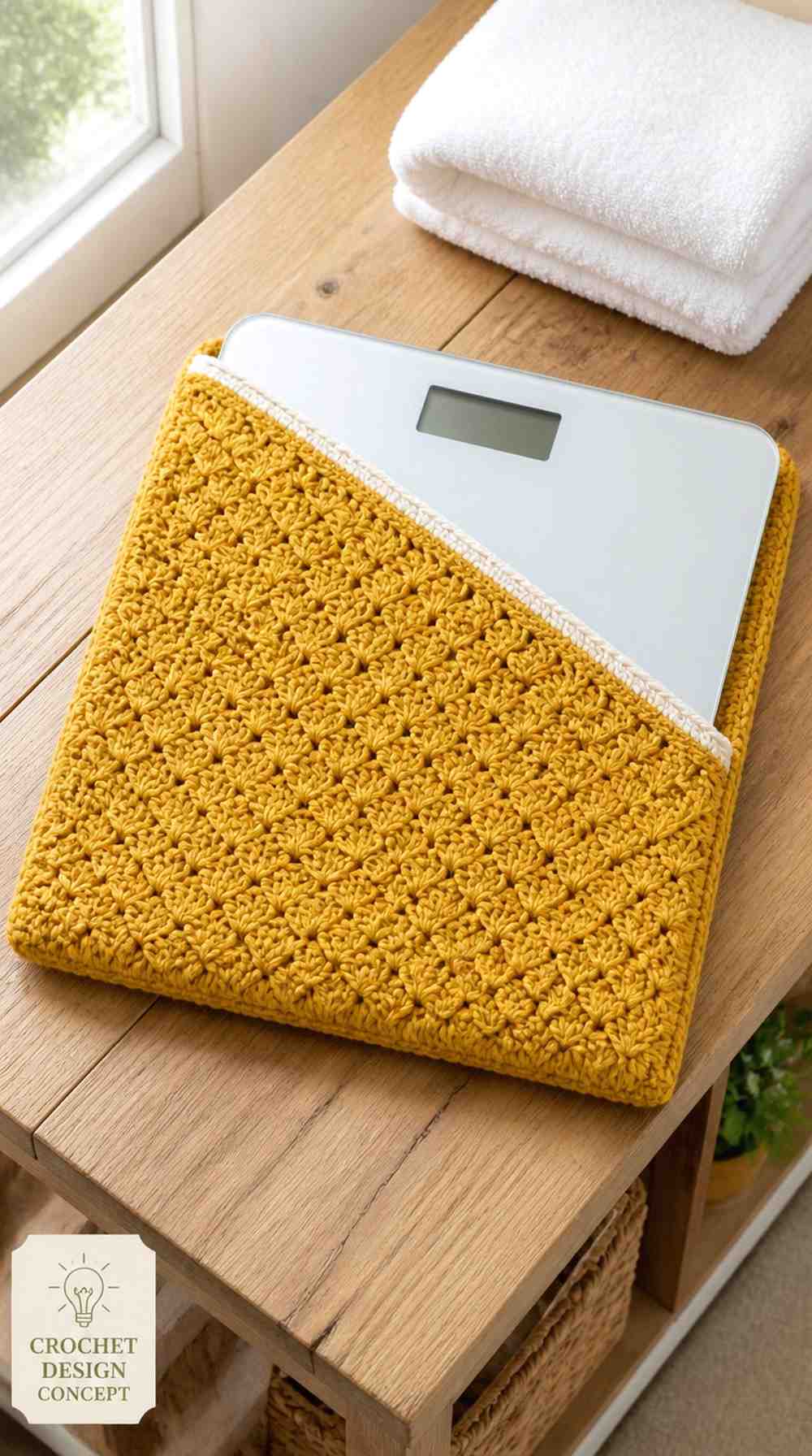
Warm mustard crochet gives this sleeve a striking diagonal front opening. A full rectangular back panel supports a broad sloping pocket, finished with a narrow cream border. The exposed corner of the white-glass bathroom scale makes the diagonal design easy to understand.
Unlike a full front panel, this arrangement leaves part of the stored scale visible. That visual openness may be appealing, but it also means the case offers less dust coverage than a more completely enclosed sleeve.
- Diagonal Edge: Keep the cream-bordered opening smooth and sufficiently wide so the scale can enter without scraping against a narrow crochet corner.
- Pocket Depth: The sloping front should retain a reasonable portion of the stored scale without forcing the glass against raised joins.
- Partial Coverage: Treat the diagonal pocket as a storage organizer, not a complete dust barrier or protective case.
7. Crochet Charcoal Zippered Scale Sleeve
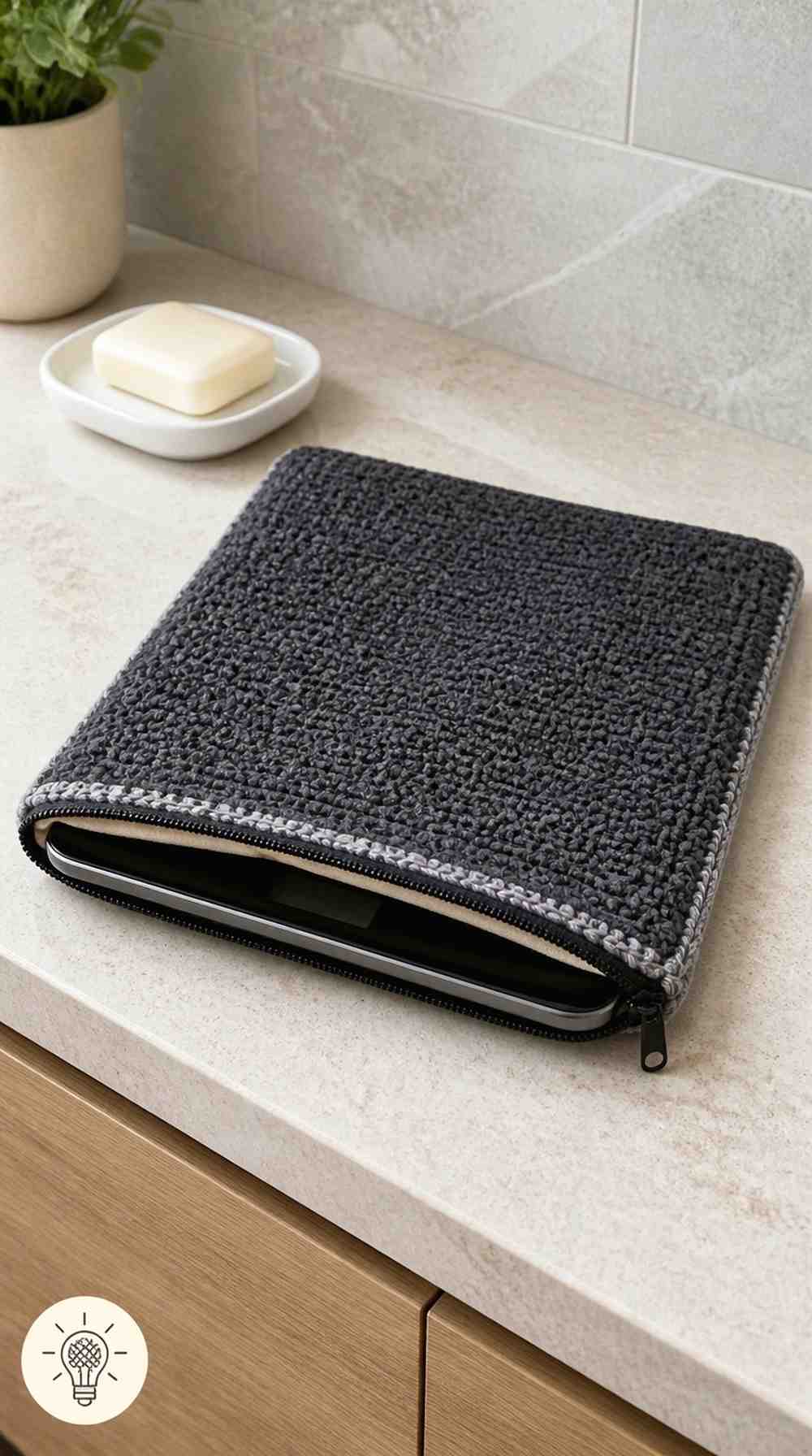
Charcoal-grey crochet forms a flat rectangular case with a black zipper running along one short edge. A narrow silver-grey border finishes the exterior, while soft cream fabric lining is visible near the opening. The partly opened zipper reveals a black-glass bathroom scale inside.
The zippered construction provides a more enclosed appearance than open-ended storage. However, its metal or plastic zipper components need careful positioning so they do not rub against the glass or catch the scale’s corners during removal.
- Zipper Clearance: Allow enough opening length for the scale to pass without forcing its corners against the zipper teeth or pull.
- Fabric Lining: A smooth lining may reduce direct contact with rough crochet joins, but it should not be assumed to provide impact protection.
- Opening Orientation: Arrange the case so the zipper remains accessible while the stored scale is supported on a stable, flat surface.
8. Crochet Butter Yellow Scalloped Dust Sleeve
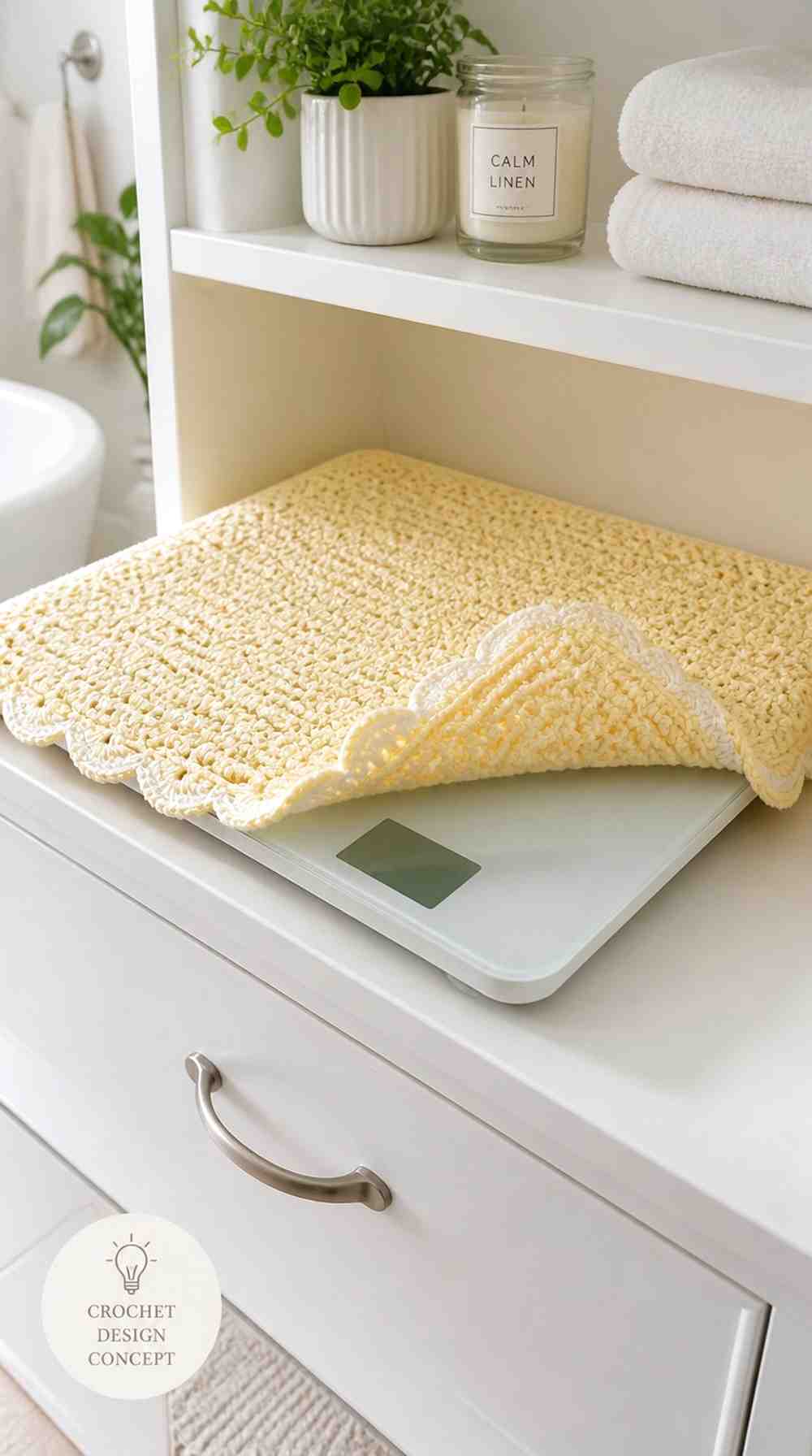
Butter-yellow crochet drapes over a white-glass bathroom scale, with small scallops running around the lower edge. A narrow ivory border separates the closely worked main fabric from the decorative finishing stitches. One lifted corner reveals the clean scale beneath.
This concept is a lightweight dust-cover style rather than a fully enclosed storage case. Its open underside makes removal simple, but the crochet should never remain on the scale when it is being used for weighing.
- Scalloped Hem: Keep the small yellow scallops evenly spaced and short enough to avoid catching against cabinet edges.
- Simple Removal: The draped cover should lift away completely without snagging on the scale’s corners or display area.
- Dust Limitation: Crochet fabric can collect lint and contains stitch openings, so it should not be considered a sealed dust barrier.
9. Crochet Denim Granny-Square Scale Case
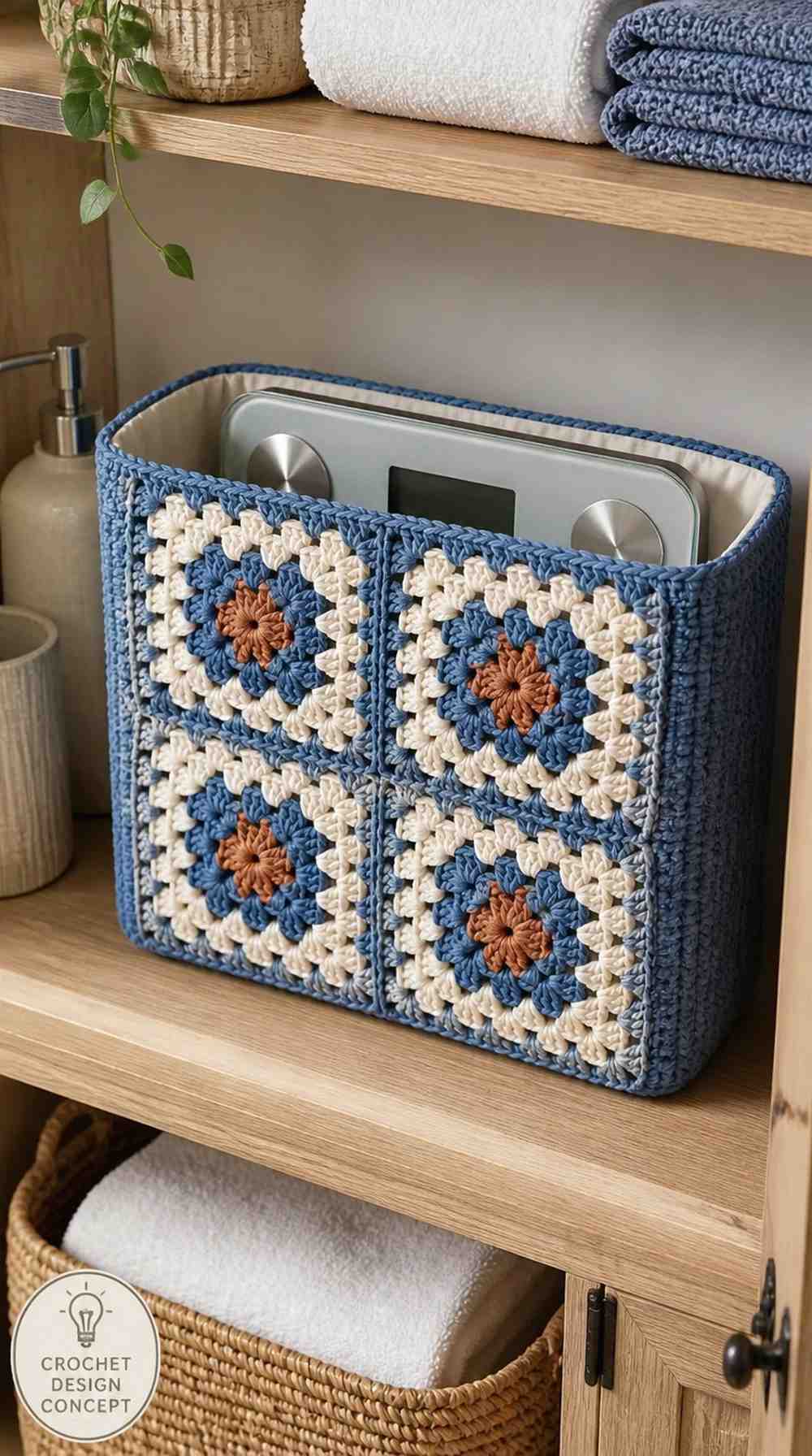
Four crochet granny squares create a decorative front panel in dusty denim blue, cream, and muted copper. Solid denim-blue side sections and a plain cream lining give the case a more complete rectangular shape. A small corner of the silver-glass scale remains visible through the upper opening.
The granny-square arrangement adds stronger handmade character than the simpler slipcases. Its individual motifs and joins are important visual features, although raised seams and open stitches could complicate the fit around a delicate glass device.
- Motif Alignment: Keep the four squares consistent in size so the joined front panel remains rectangular rather than twisting or narrowing at the center.
- Smooth Interior: The cream lining should cover any noticeably raised interior joins, while remaining soft and free from rough attachments.
- Openwork Limits: Traditional granny-square gaps allow dust to pass through, so the decorative front should not be relied on for complete coverage.
10. Crochet Ivory Corner-Cushion Scale Sleeve
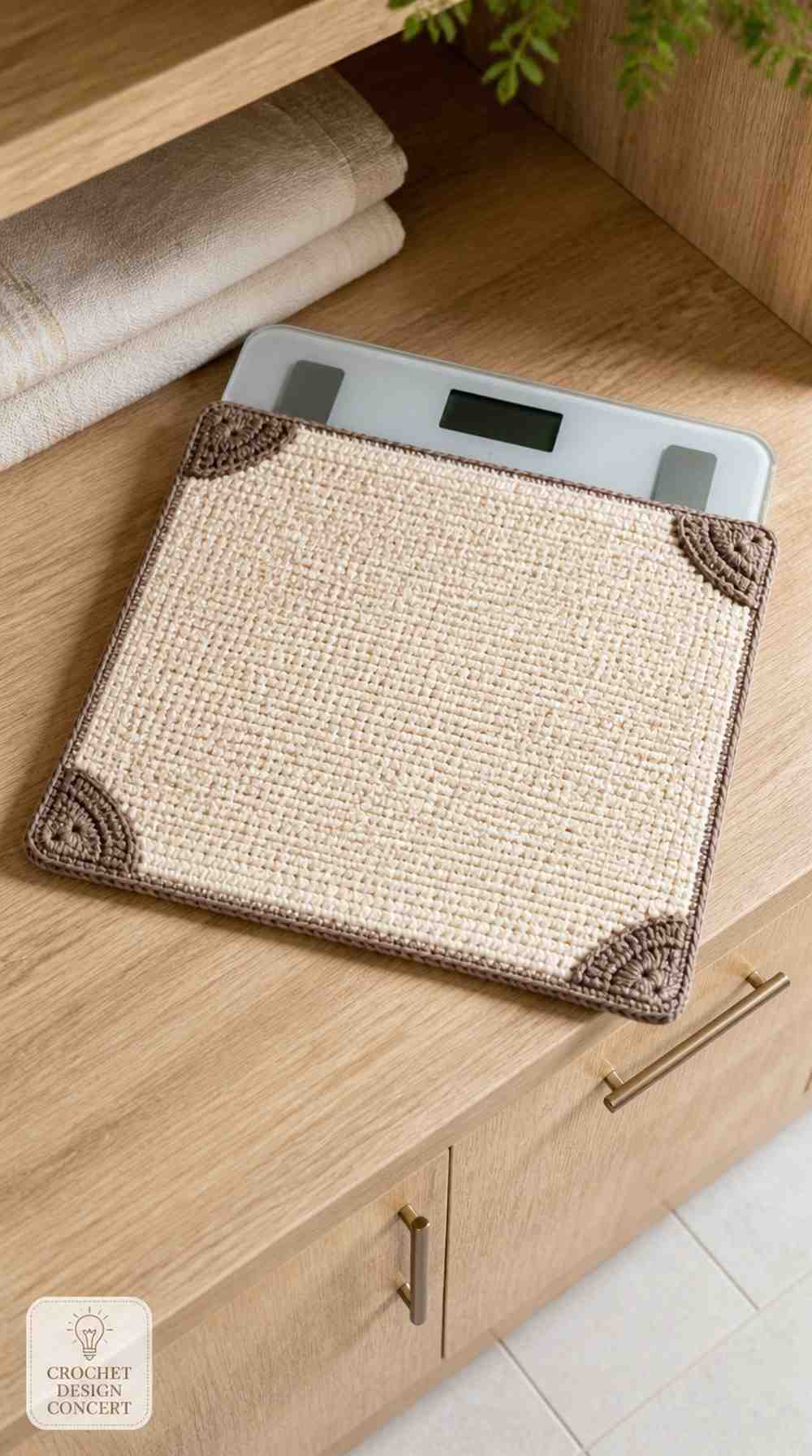
Warm-ivory crochet creates a flat sleeve with a narrow mocha border and four small matching corner reinforcements. A thin cream fabric lining sits between the crochet and the pale-grey glass scale, while the upper opening leaves part of the device visible.
The contrasting corners make this design look more structured without changing its basic rectangular shape. They can provide useful visual reinforcement, but their appearance should not be confused with tested cushioning or protection against accidental drops.
- Corner Placement: Keep the mocha reinforcing sections on the exterior and avoid thick joins that press inward against the scale’s glass corners.
- Lining Fit: Choose a smooth inner fabric that lies flat rather than bunching beneath the stored device.
- Protection Limitation: Decorative crochet corner reinforcements do not establish shock resistance, so handle the scale as carefully as you would without the sleeve.
11. Crochet Teal Dual-Pocket Scale Case
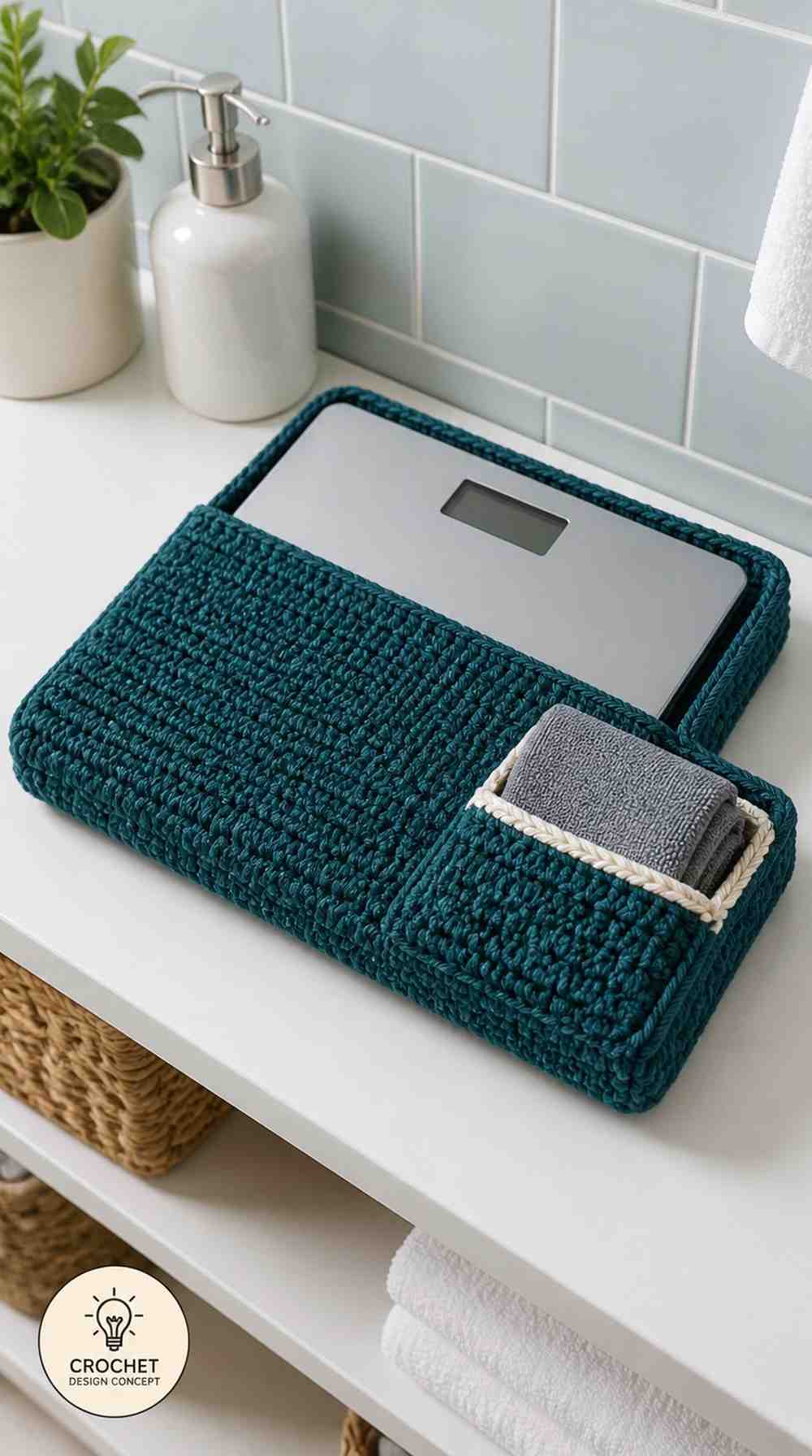
Deep-teal crochet forms a rectangular storage case with two distinct compartments. The larger sleeve holds a silver bathroom scale, while a narrow external side pocket contains a neatly folded grey microfiber cleaning cloth. An ivory edge outlines the smaller pocket.
This concept adds organization without storing loose tools directly against the scale. The separate cloth compartment could help keep cleaning supplies together, provided the cloth is fully dry before being placed into the crochet pocket.
- Separate Compartments: Keep the microfiber pocket external so its contents do not rub against the scale’s glass surface inside the main sleeve.
- Cloth Condition: Store only a clean, completely dry cloth; moisture retained in a pocket is undesirable around electronic equipment.
- Pocket Bulk: Keep the smaller pocket slim so the case continues to lie flat on its intended storage shelf.
12. Crochet Apricot Envelope-Flap Scale Case
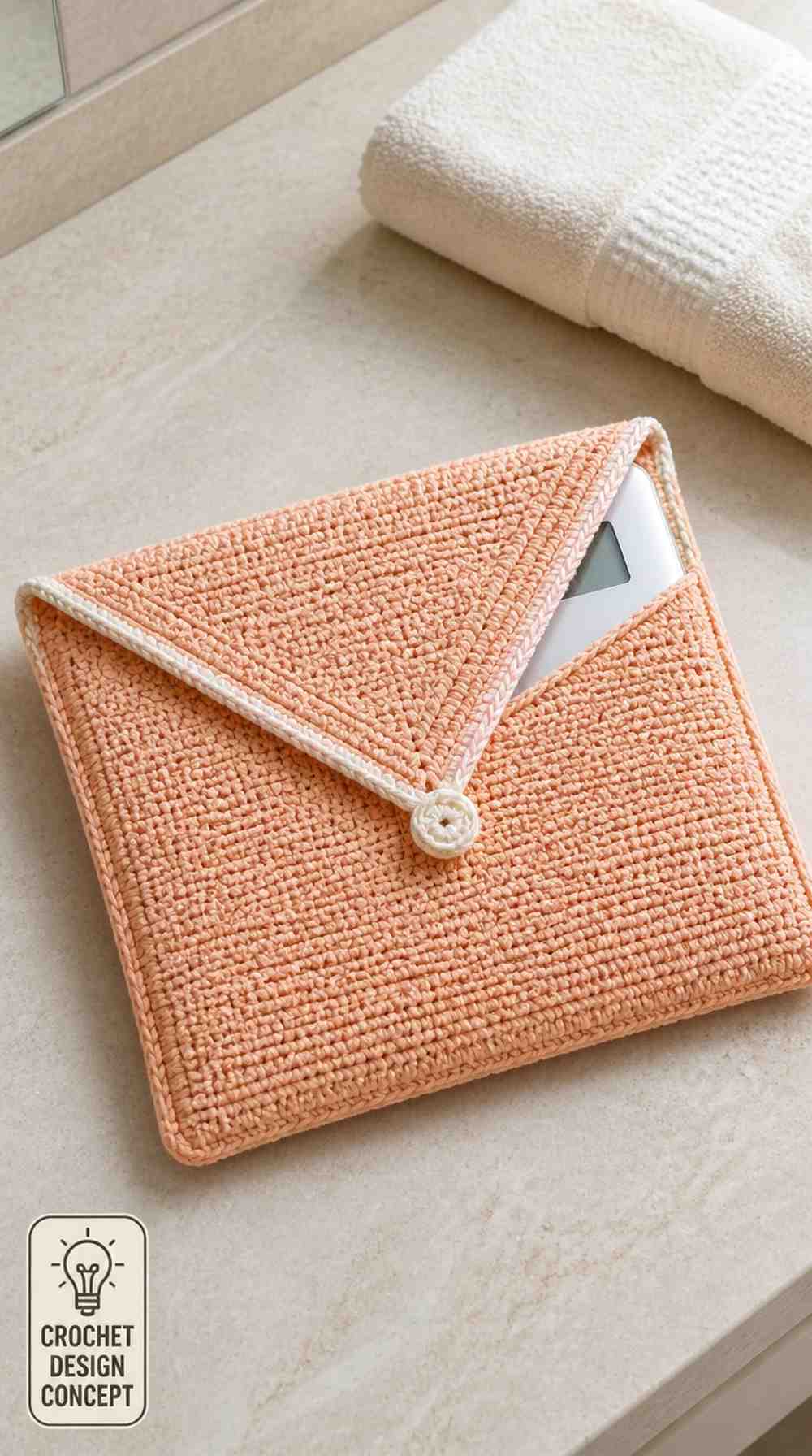
Soft apricot cotton crochet forms a rectangular storage envelope with a wide triangular front flap. Ivory edging follows the pointed outline, while a small cream crochet button secures the center. The partially opened flap reveals a white-glass bathroom scale inside.
The envelope shape offers a softer, more decorative alternative to a straight rectangular closure. Its triangular flap must be planned carefully so the center button fastens without pulling the crochet too tightly across the scale.
- Triangular Shaping: Keep both sloping edges balanced so the pointed flap reaches the center without twisting or leaving one corner uncovered.
- Button Location: Position the small crochet button where it closes the fabric without pressing directly against the device’s display.
- Flat Storage: Lay the filled envelope horizontally on a dry shelf rather than relying on the closure to hold the scale upright.
13. Crochet Burgundy Side-Snap Scale Wrap
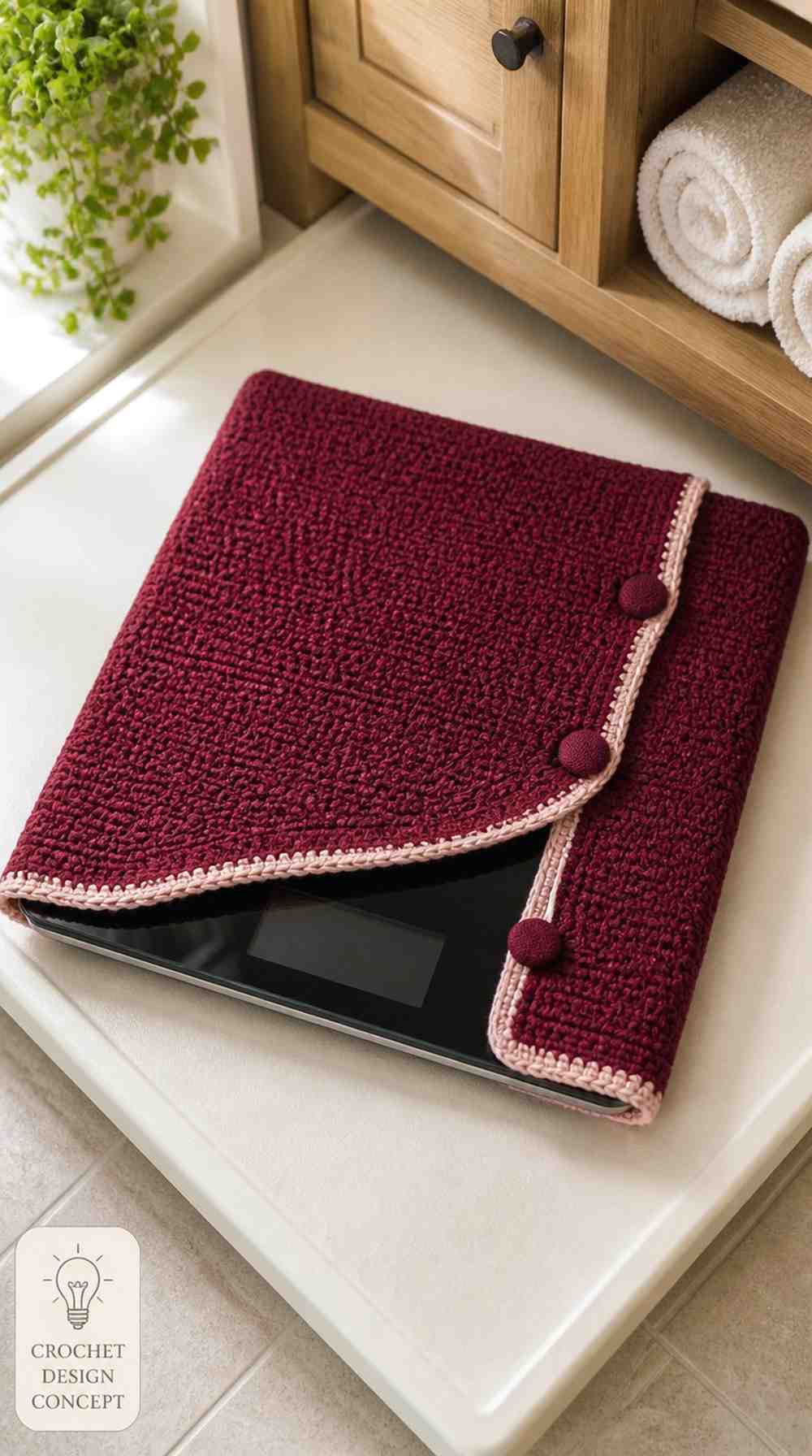
Rich burgundy crochet folds around a black-glass bathroom scale, with three small dark fabric-covered snaps securing overlapping sections along the right side. A thin blush-pink border follows the rectangular wrap, giving the dark yarn a gentle contrast.
The side-fastened arrangement provides a tidy alternative to ties and front buttons. The snaps are a useful removable-closure concept, but they need careful placement because pressing fasteners shut against the scale could put unwanted force on the glass.
- Snap Position: Keep the three snaps along the outer side overlap, not directly above the fragile glass platform or electronic display.
- Safe Fastening: Close the snaps while the wrap is supported and positioned so fastening pressure is not transferred to the scale.
- Wrap Thickness: Avoid excessive folded crochet at the corners, which could prevent the case from resting evenly on a shelf.
14. Crochet Seafoam Mesh-Back Scale Pouch
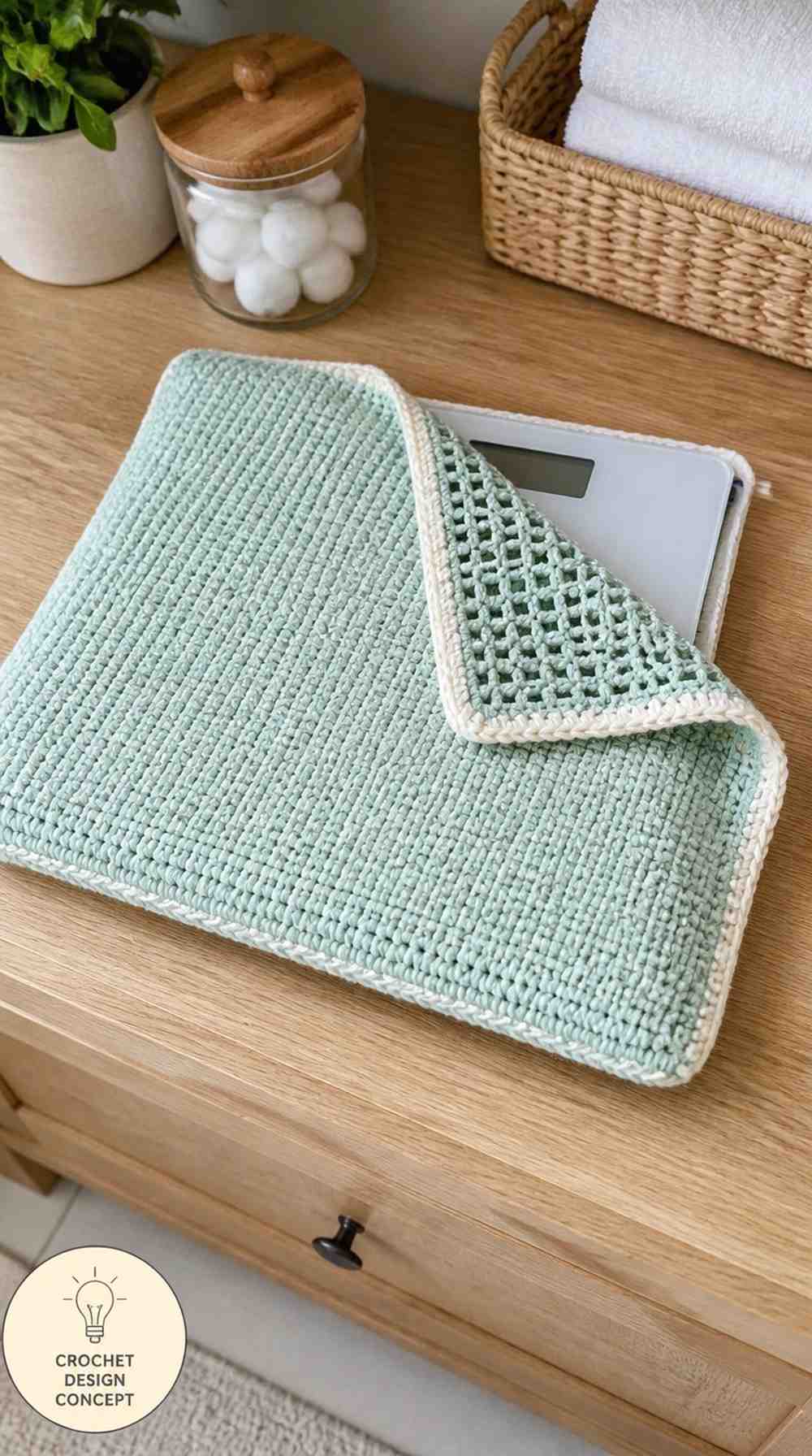
Pale-seafoam crochet creates a storage pouch with a solid front panel and an open-mesh back. A narrow cream border joins the two surfaces, while the broad upper opening reveals part of a white-glass bathroom scale resting horizontally inside.
The contrast between dense and airy crochet gives this design an interesting appearance. Although the mesh allows more air movement than a closely stitched panel, it does not make the pouch waterproof, prevent condensation, or replace the need for dry storage.
- Mesh Connections: Keep the open back panel’s loops and joining points regular so the fabric does not distort around the scale’s corners.
- Solid Front: The denser front panel provides a cleaner decorative surface, while the mesh back remains visibly different in texture.
- Moisture Awareness: Store the scale only when it and the pouch are dry; open mesh does not make a damp bathroom suitable for electronic storage.
15. Crochet Cocoa Pull-Tab Scale Slipcase
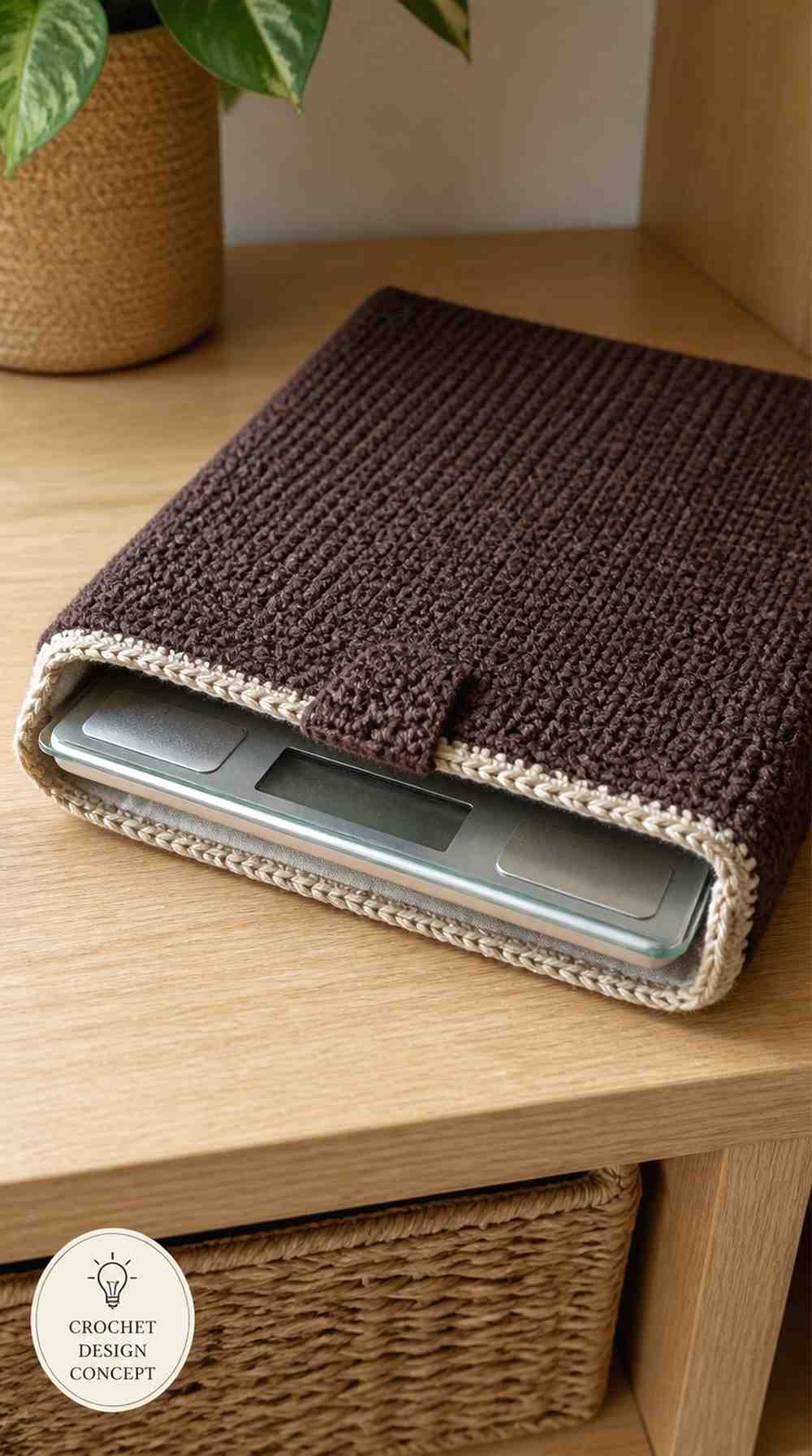
Deep cocoa-brown crochet forms a closely stitched slipcase with oatmeal edging around its open short end. A beige fabric lining is visible inside, while a small folded crochet pull tab sits beside the opening. The silver-glass bathroom scale rests partly within the sleeve.
The exterior tab makes the empty fabric case easier to grip and reposition. It is not intended as a carrying handle for the scale, which should remain fully supported whenever the device is being moved or stored.
- Pull-Tab Use: Reserve the small folded tab for handling the empty sleeve rather than lifting the scale’s weight by a single crochet attachment.
- Open-End Fit: Leave enough room around the scale’s short edge so it can slide through without pulling against the cocoa crochet.
- Lining Attachment: Secure the beige fabric lining neatly so it does not bunch at the entrance during insertion.
16. Crochet Plum Striped Wraparound Scale Sleeve
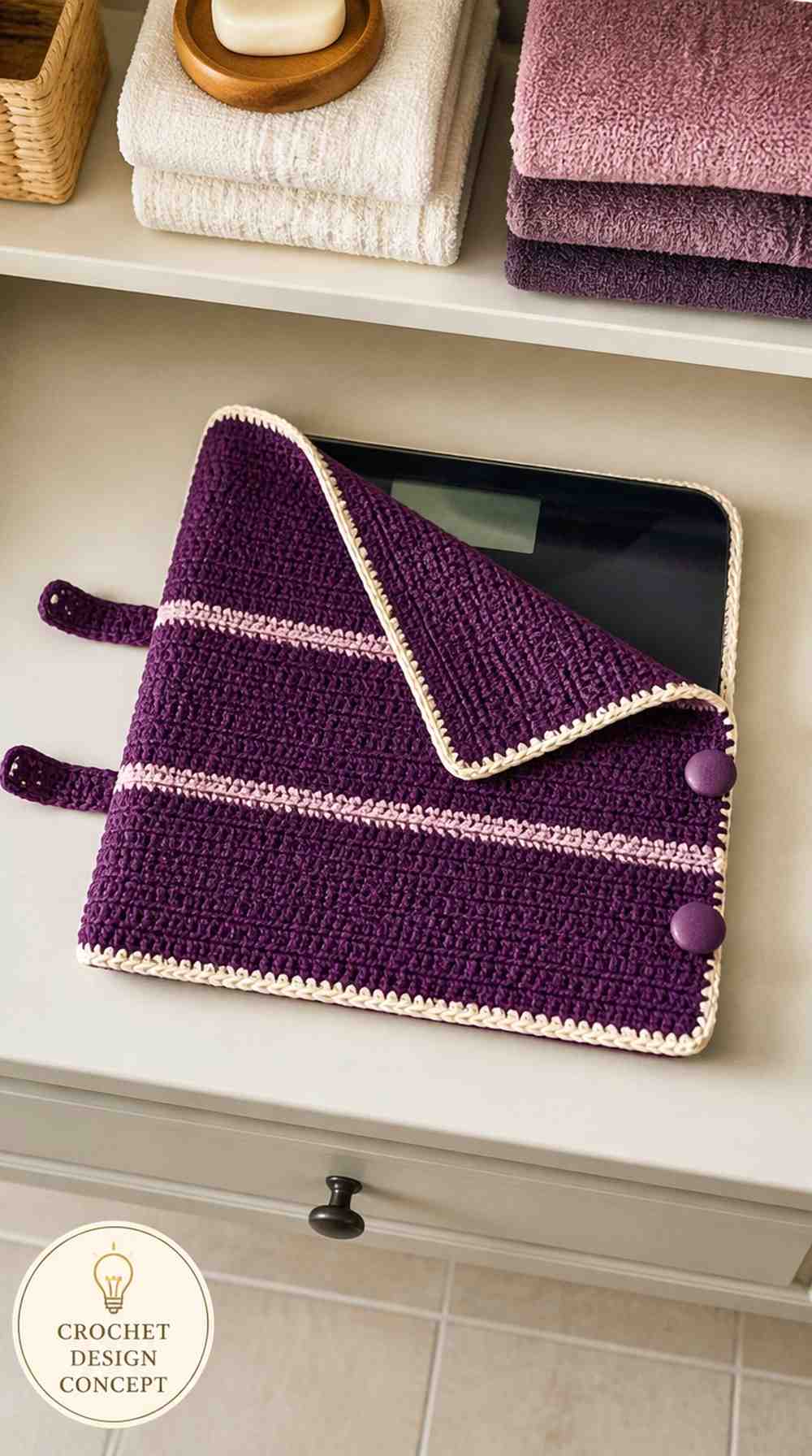
Deep plum crochet creates a broad wrap with two dusty-rose horizontal stripes and a narrow cream border. Two short matching straps extend from one side and fasten with small fabric buttons on the opposite edge. A folded-back corner reveals the black-glass digital scale inside.
The striped design gives this case a more graphic appearance than a plain solid-color wrap. Its two adjustable closure straps could suit a custom-fitted sleeve, although the button positions should be planned around the scale’s actual dimensions.
- Stripe Alignment: Keep both dusty-rose stripes straight across the wrap so they remain visually aligned when the crochet panel is folded.
- Two-Strap Closure: Space the straps evenly to hold the fabric in place without requiring tight tension across the scale’s surface.
- Button Clearance: Check where the fabric buttons sit when the wrap is closed, keeping them away from the device’s vulnerable features.
17. Crochet Forest Green Label-Pocket Scale Sleeve
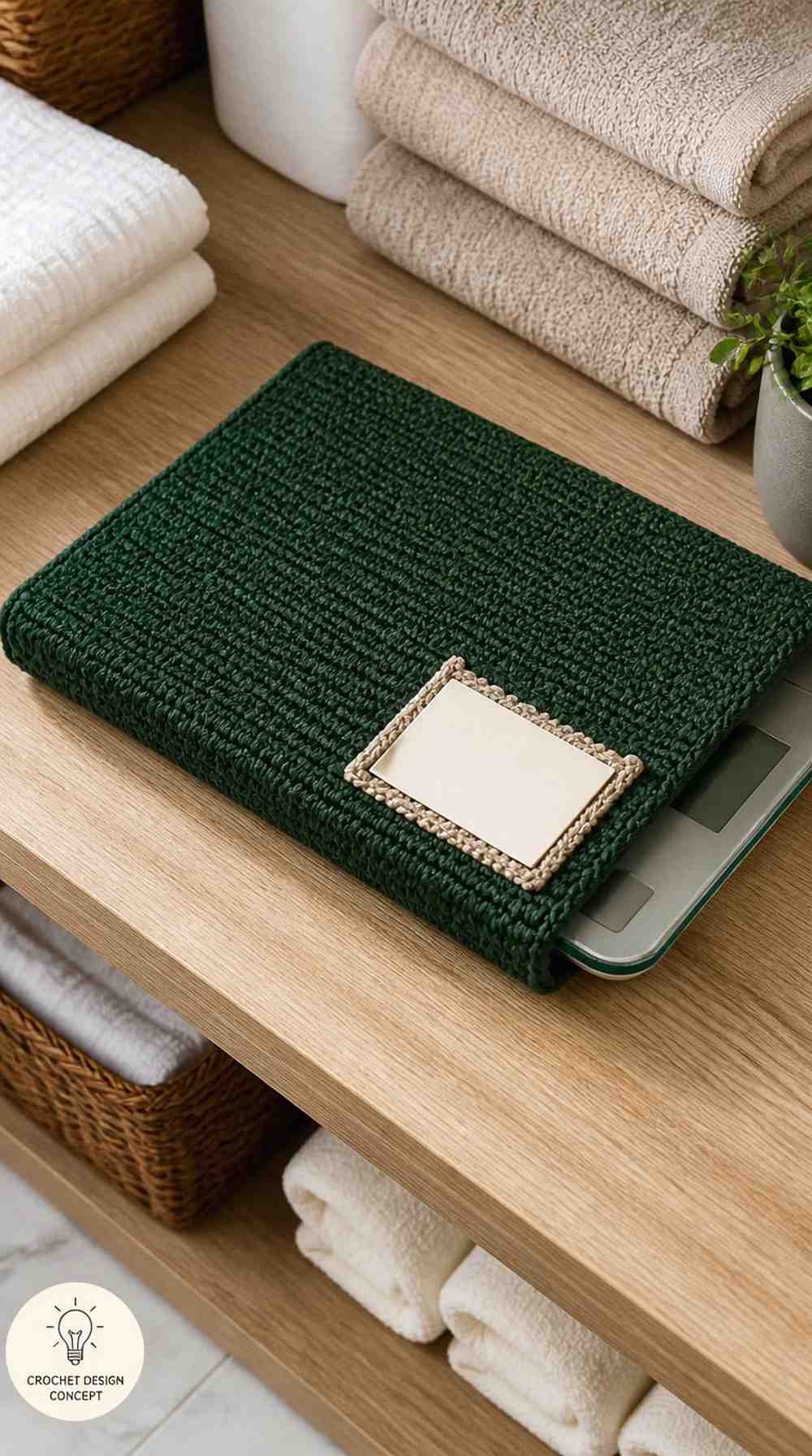
Deep forest-green crochet forms a rectangular storage sleeve with a short-side insertion opening and a small oatmeal-bordered card pocket near the lower front corner. A removable blank ivory card sits inside the pocket, while part of the silver-glass scale remains visible at the opening.
The card holder adds a simple organizational feature without changing the sleeve’s primary storage shape. It could be useful when several similar cases are kept in one cupboard, allowing a model name or other identifying information to be written on the removable card.
- Label Position: Keep the small oatmeal-framed pocket near the lower front corner where it can be read without covering the scale’s insertion opening.
- Card Replacement: Make the ivory card easy to remove if its written information changes or the paper becomes worn.
- Flat Profile: Keep the label pocket and outer joins relatively slim so the filled sleeve can rest evenly on a dry shelf.
Practical Guide to Crochet Bathroom Scale Storage Sleeves
Follow your scale’s manual first
Bathroom scales are precision measuring devices, and manufacturers give different storage instructions. Some specifically advise keeping the scale flat, away from moisture, and free from objects placed on its platform. Tefal’s guidance, for example, recommends flat storage and removing batteries before a long period without use.
| OBH Nordica
A crochet sleeve should never override the instructions for your particular model.
Measure the entire scale
Check its length, width, thickness, rounded corners, and any raised features. Measure the scale itself rather than using a generic bathroom-scale size.
For a slipcase, allow enough room for the scale to enter without forcing the glass against the crocheted seams. For a flap or wrap, check the finished closure position while the device remains flat.
Choose appropriate materials
Smooth cotton or a suitable cotton blend may offer neat stitch definition and relatively low bulk. A separate soft fabric lining can also be considered where appropriate.
However, neither crochet nor an ordinary fabric lining provides guaranteed drop protection. Avoid rough fasteners, hard decorations, loose threads, and bulky seams against the glass.
Keep the sleeve away from moisture
Do not insert a wet scale into crochet. Fabric can retain moisture, and an electronic device should be stored according to its manufacturer’s cleaning and storage instructions.
Keep the sleeve away from showers, wet bathroom floors, and places where condensation regularly accumulates. A dry cabinet shelf is generally more suitable than an exposed damp corner.
Remove the entire sleeve before weighing
Never stand on a bathroom scale while it is inside or covered by crochet. The fabric can interfere with the feet, sensors, and level contact with the floor. Tefal advises using bathroom scales on a hard, flat surface rather than a soft rug or carpet.
| OBH Nordica
For other removable textile covers, see Yarn Nest Studio’s Crochet Retro Record Player Dust Cover Inspiration Ideas. That collection explores different decorative cover shapes for electronics, with separate equipment-specific safety considerations.
Want to Make Something Similar?
These 17 designs are original crochet inspiration concepts, not tested bathroom-scale sleeve patterns. The following resources teach related pouch construction and sizing techniques.
- How to Crochet a Case for Any Device explains measuring a flat, rigid object and planning a rectangular sleeve from the actual dimensions. The guide is useful for thinking about custom fitting, not proof that a crochet case protects electronic equipment. Crochet Explained
- Linen Stitch Crochet Envelope Pouch Pattern by Joanna’s Crochet demonstrates a flat rectangular panel, folded construction, and a button-loop closure. Its pouch is much smaller than a bathroom scale, but the envelope-style construction is relevant. Joanna’s Crochet
Neither resource provides an exact pattern for these bathroom-scale concepts. A practical version requires its own measurements, stitch choices, closures, and careful checking against the scale’s manual.
Which Crochet Bathroom Scale Storage Sleeve Should You Choose?
| Your priority | Designs to consider | Main trade-off |
|---|---|---|
| Simple slip-in storage | Terracotta Side-Opening, Oatmeal Open-End | No secure closed flap |
| Buttoned closure | Navy Button-Flap, Apricot Envelope-Flap | Buttons need careful positioning |
| Adjustable fabric wrapping | Olive Cross-Tie, Plum Striped Wraparound | Ties and straps add handling steps |
| More enclosed case | Charcoal Zippered | Zipper placement requires care |
| Decorative dust covering | Butter Yellow Scalloped | Does not enclose the entire scale |
| Handmade motif styling | Denim Granny-Square | Openwork and joins add bulk |
| Smooth fabric interior | Ivory Corner-Cushion, Cocoa Pull-Tab | Lining needs neat attachment |
| Separate cleaning-cloth pocket | Teal Dual-Pocket | Extra pocket increases thickness |
| Open crochet texture | Seafoam Mesh-Back | Less dust coverage |
| Small identifying card | Forest Green Label-Pocket | Paper label needs replacing when worn |
| Removable side fastening | Burgundy Side-Snap | Snaps need gentle operation |
| Diagonal front detail | Mustard Diagonal-Pocket | Leaves part of the scale exposed |
| Drawstring opening | Dusty Rose Drawstring | Loose closure provides limited restraint |
For straightforward storage, the Crochet Terracotta Side-Opening Scale Sleeve and Crochet Oatmeal Open-End Scale Slipcase are sensible visual starting points because they use uncomplicated shapes.
If a more finished appearance matters, the Crochet Navy Button-Flap Scale Case or Crochet Apricot Envelope-Flap Scale Case adds a closure without needing elaborate decorative motifs.
Conclusion
Crochet bathroom scale storage sleeves can make a simple bathroom accessory look more organized while offering many different design directions. A terracotta slipcase keeps things minimal, a navy buttoned case introduces a tailored finish, and a butter-yellow scalloped cover brings a softer decorative touch.
The most useful choice will fit the scale without pressure, remain easy to remove, and suit a clean, dry storage space. Treat these designs as removable storage accessories rather than protective equipment, and always follow the scale manufacturer’s instructions.
Which design would you choose for your bathroom: the terracotta side-opening sleeve, the navy button-flap case, or the forest-green label-pocket version? Share your favorite color and storage style in the comments.
Frequently Asked Questions
1. Can I weigh myself while my bathroom scale is inside a crochet sleeve?
No. Remove the crochet sleeve completely before using the scale. Soft fabric can interfere with the weighing feet, sensors, and contact with a hard, level surface. It could also create a slipping risk. Follow your scale’s manual for proper placement and use.
| OBH Nordica
2. What yarn should I consider for a crochet bathroom scale storage sleeve?
Smooth cotton or a suitable cotton blend may be worth considering because it can create clearly defined stitches and a relatively tidy fabric. The best choice depends on the scale’s size, the desired thickness, and how the sleeve will be cleaned. Avoid assuming that ordinary crochet provides impact, moisture, or scratch protection.
3. Should I store a bathroom scale vertically in a crochet pouch?
Only if the scale’s manufacturer specifically permits that position. Some bathroom-scale manuals recommend horizontal storage and warn that upright storage can affect measurements or place stress on the device. A crochet pouch does not change those requirements. The pictured concepts use flat shelf storage for this reason.
| OBH Nordica
4. How can I keep a crochet scale sleeve clean and dry?
Remove the scale before cleaning the sleeve. Follow the yarn’s washing instructions, then allow the crochet and any lining to dry completely. Do not place a damp sleeve around an electronic scale. Keep the scale itself clean using the manufacturer’s recommended method, and avoid immersing it in water.
5. Are these 17 crochet bathroom scale storage sleeves available as exact patterns?
No. These are AI-generated inspiration concepts rather than tested patterns or finished handmade covers. The linked tutorials teach related rectangular sleeve and pouch techniques, but they do not reproduce the pictured designs. A real sleeve would need custom sizing, suitable material choices, careful closure placement, and checks against the specific scale’s storage instructions.