A crochet bridal hair vine can be almost invisible and delicate or become one of the strongest handmade details in a wedding hairstyle. The difference comes from more than flower choice. Vine width, motif scale, leaf density, stiffness, attachment points, and where the piece sits in the hairstyle can all change the finished effect.
These 19 ideas cover flexible flower vines, leafy chains, airy filler sprays, statement blooms, lace tie-backs, and crown-inspired constructions. One featured tutorial demonstrates an actual crochet flower hair vine, while several others teach headbands, garlands, crowns, or individual flowers that can serve as construction references for an adapted bridal piece. That distinction matters: use each creator’s original tutorial for the demonstrated project, then plan any bridal-vine adaptation around your own hairstyle, materials, and attachment method.
Quick List
- Crochet Alternating Flower Bridal Hair Vine
- Crochet Leaf-Only Trailing Bridal Vine
- Crochet Mini Flower Crown Bridal Vine
- Crochet Petite Blossom Halo Vine
- Crochet Vintage Floral Lace Tie-Back Vine
- Crochet Pointed-End Lacy Flower Hair Vine
- Crochet Baby’s Breath Bridal Hair Vine
- Crochet Forget-Me-Not Bridal Hair Vine
- Crochet Cherry Blossom Bridal Hair Vine
- Crochet Lavender Sprig Bridal Hair Vine
- Crochet Calla Lily Accent Hair Vine
- Crochet Orchid Side-Swept Bridal Vine
- Crochet Jasmine Star-Flower Hair Vine
- Crochet Poppy Statement Bridal Vine
- Crochet Camellia Cluster Hair Vine
- Crochet Daisy Spray Bridal Hair Vine
- Crochet Mini Rose Bridal Hair Vine
- Crochet Leafy Branch Bridal Hair Vine
- Crochet Lily and Leaf Bridal Hair Vine
Plan the Hair Vine Around the Hairstyle
A vine intended for a low bun needs different placement from one designed to follow a long braid. Before permanently joining motifs, decide where the decoration should begin and end and which parts of the hairstyle will actually support it.
For a loose updo, several separate anchor points can help the vine follow the curve of the hair instead of pulling from one end. A braid can accommodate a longer, narrower arrangement, while a half-up style often looks more balanced with a horizontal or gently curved section across the back.
Do a hairstyle trial with the unfinished vine temporarily positioned first. Check the front, back, and side views. A design that looks perfectly balanced when laid flat may appear heavier on one side once it follows the contour of the head.
Yarn, Structure, and Flower Scale Change the Result
Fine crochet thread or lightweight yarn can create smaller-looking petals and less visual bulk, while thicker yarn naturally makes the stitches and floral shapes more prominent. Do not assume a flower tutorial will produce bridal-scale motifs with every yarn and hook combination.
Structure matters too. A soft crocheted chain creates a flexible vine, while flower designs built around floral wire or stems may hold more deliberate curves. If you adapt a wired floral tutorial, make sure no cut wire ends or hard components can contact the scalp.
Before making an entire collection of motifs, crochet one sample flower or leaf and place it beside the planned hairstyle. That simple scale check can prevent a delicate inspiration image from becoming a much heavier accessory than intended.
Arrange Everything Before Final Assembly
Treat the vine like a small floral composition rather than attaching motifs as soon as they are finished. Lay the base along a curved line similar to its eventual position and experiment with flower spacing, leaf direction, and empty space.
Larger blooms usually need fewer neighboring motifs to remain visually distinct. Tiny flowers such as baby’s breath or forget-me-nots can tolerate greater repetition without turning the accessory into one solid mass. Leaves can also provide transition points between larger flowers.
Pay special attention to the ends. A hair vine often looks more natural when it narrows toward one or both ends rather than stopping abruptly with a large flower. Before fastening anything permanently, confirm where hairpins, combs, loops, ties, or another attachment method will need access.
1. Crochet Alternating Flower Bridal Hair Vine
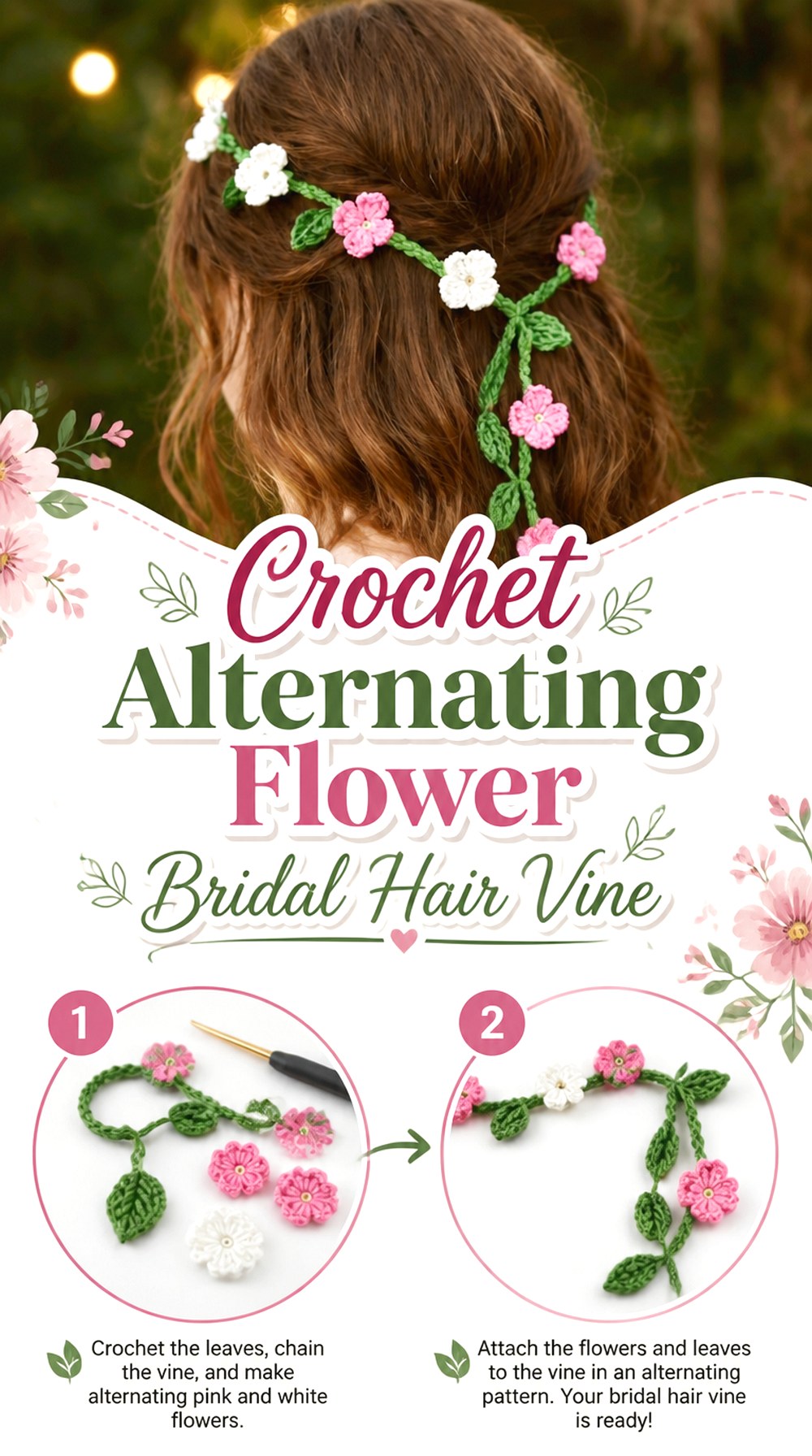
This is the closest direct match to the article topic. The tutorial from Knitting by Wajida shows a finished crochet hair vine with alternating flowers arranged along a crocheted green vine and describes it specifically as suitable for bridal hairstyles. That gives you a useful reference for understanding how a narrow crocheted stem can carry repeated blossoms without becoming a full headband.
For a wedding version, the strongest design decision is how much contrast you want between the vine and flowers. Ivory-on-green reads as botanical, while keeping both leaves and connecting sections closer to the flower color can make the entire accessory look quieter against the hair.
Alternating Blooms Create an Even Rhythm
Regular alternation makes the vine feel orderly, which can work particularly well when it follows a smooth braid or the edge of a structured bun. Before committing to equal spacing, compare that effect with a slightly more organic arrangement. Bridal florals often benefit from small variations in spacing because the accessory will be viewed along a curved hairstyle rather than as a straight line.
Keep the Connecting Vine Flexible
The narrow base is what allows this concept to behave like a vine rather than a rigid crown. Test the finished section by gently curving it around the approximate shape of the hairstyle. If closely packed flowers prevent it from bending comfortably, reducing floral density near stronger curves may give the piece more freedom to follow the hair.
Original Tutorial and Creator Credit
Creator: Knitting by Wajida
2. Crochet Leaf Only Trailing Bridal Vine
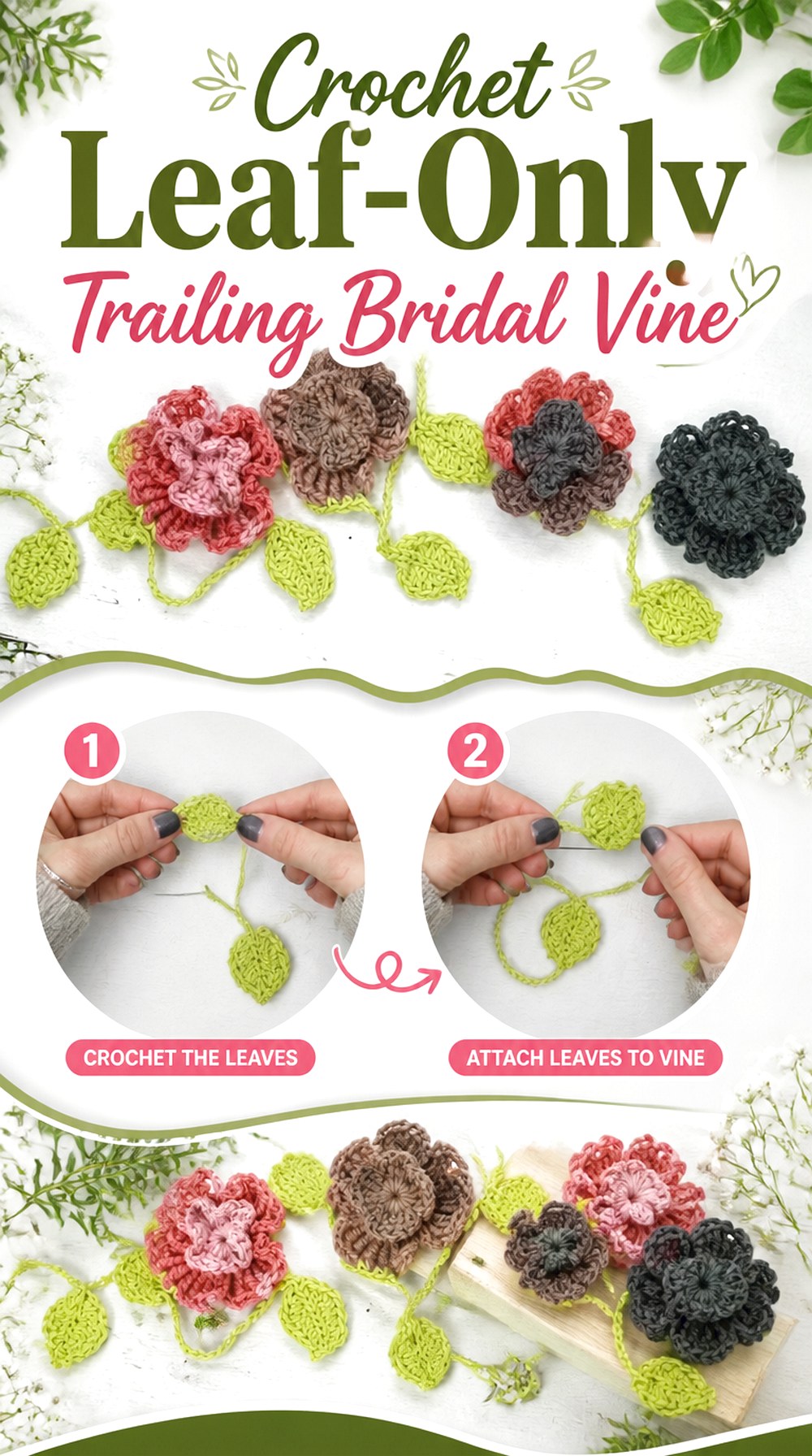
A foliage-only bridal vine is a useful alternative when the dress, earrings, veil, or bouquet already carries strong floral detail. Hooked by Robin’s tutorial demonstrates a continuous crochet leaf garland in which the chain and leaves are created as one connected piece. Although it is presented as a decorative garland rather than a hair accessory, the long flexible construction is especially relevant to vine planning.
For bridal styling, consider using the idea as a narrow botanical accent along a braid, around part of a bun, or beneath a veil. The absence of flowers shifts attention toward leaf shape, negative space, and the way the vine curves.
A Continuous Construction Reduces Bulky Joins
A leaf sequence made along the connecting chain avoids the visual interruption created by attaching many separate motifs later. That can be valuable when the vine will be visible against dark or sleek hair. If you adapt the concept, compare a continuous leaf section with separately attached leaves before choosing; the latter gives more control over leaf direction.
Leaf Direction Matters Along a Braid
When foliage follows a diagonal or vertical hairstyle, every leaf pointing the same way can look unusually regimented. Lay the vine against the braid before finishing and check whether alternating or gradually changing directions makes the line feel more natural. This is a styling decision rather than a change to the creator’s tutorial.
Original Tutorial and Creator Credit
Creator: Hooked by Robin
3. Crochet Mini Flower Crown Bridal Vine
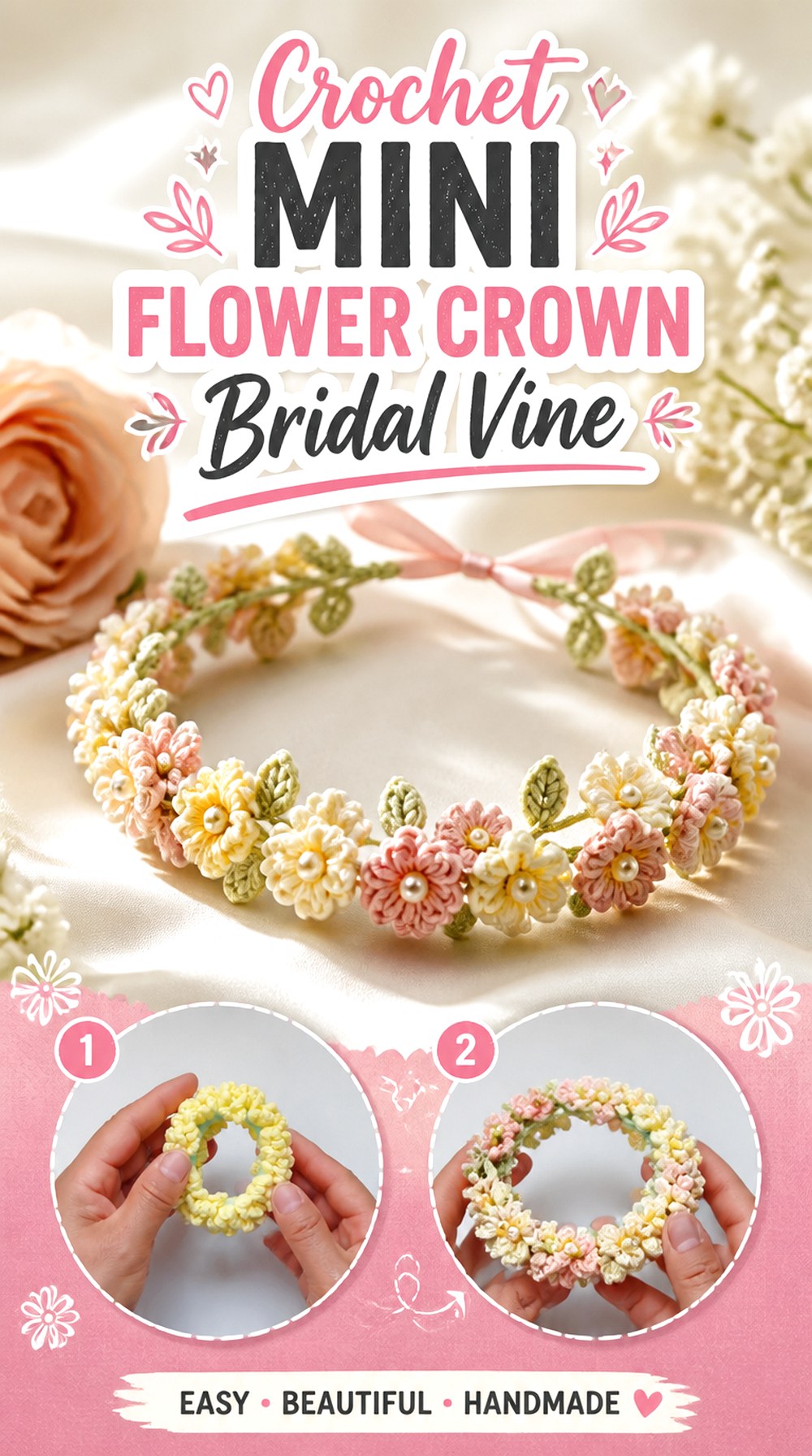
A flower-crown construction gives more coverage than a narrow trailing vine and suits hairstyles where the crochet should frame a larger portion of the head. Yarnissonline’s tutorial shows a finished crochet flower crown headband with repeated floral decoration. It is a headband tutorial, so treat it as a reference for flower distribution and circular placement rather than as an exact bridal-vine pattern.
For a softer bridal interpretation, you could concentrate flowers over one section instead of maintaining the same density around the entire head. That creates a crown-to-vine transition and leaves more room for a veil, comb, or statement earrings.
Decide Between Full-Halo and Partial Coverage
A complete floral halo becomes a defining part of the hairstyle. A partial version is quieter and can sit behind the ears or across the back of the head. During a hair trial, look at how much crochet is visible from the front. More coverage is not automatically more effective if it competes with other accessories.
Repeated Flowers Need Consistent Scale
When a design relies on many small motifs, variation in finished size becomes obvious. Make and finish a few sample flowers before producing the full set. If their dimensions differ noticeably after relaxing or blocking, correct that before assembly so the crown does not develop unexpected thick and thin sections.
Original Tutorial and Creator Credit
Creator: Yarnissonline
4. Crochet Petite Blossom Halo Vine
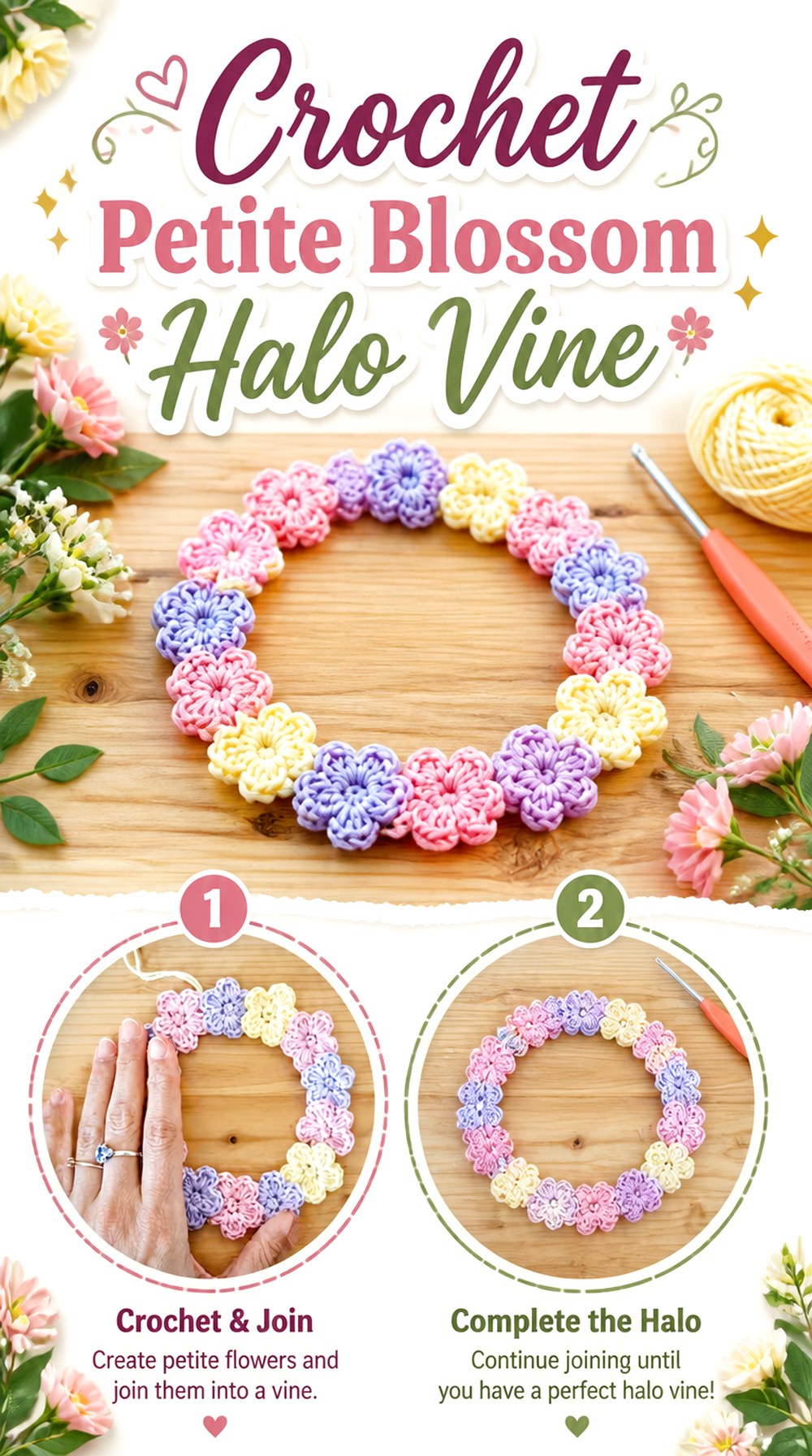
This interpretation uses numerous understated blossoms rather than a few large focal flowers. Hibouchoucaillou demonstrates small crochet flowers assembled into a decorative flower wreath. The project is not specifically a bridal hair vine, but its repetition and assembly concept provide a useful reference for creating a lightweight-looking ring or partial halo of miniature blossoms.
A bridal adaptation can be especially effective when the flowers are spaced far enough apart for the connecting base to remain visible. The result has more of a meadow-flower character than the formal symmetry of a dense crown.
Small Motifs Leave Room for Negative Space
A vine does not need to be completely covered. Allowing tiny sections of the base to remain visible can make the composition look more delicate and can also help individual blossoms register in photographs. Arrange the flowers loosely first and compare the effect before deciding how dense the final assembly should be.
Keep the Halo from Competing With the Veil
If a veil will sit over or beneath the accessory, test both pieces together. A continuous ring of flowers can occupy the same visual area as a veil comb. A partial halo or an intentionally open section around the intended comb position may give the hairstylist more flexibility.
Original Tutorial and Creator Credit
Creator: hibouchoucaillou
5. Crochet Vintage Floral Lace Tie Back Vine
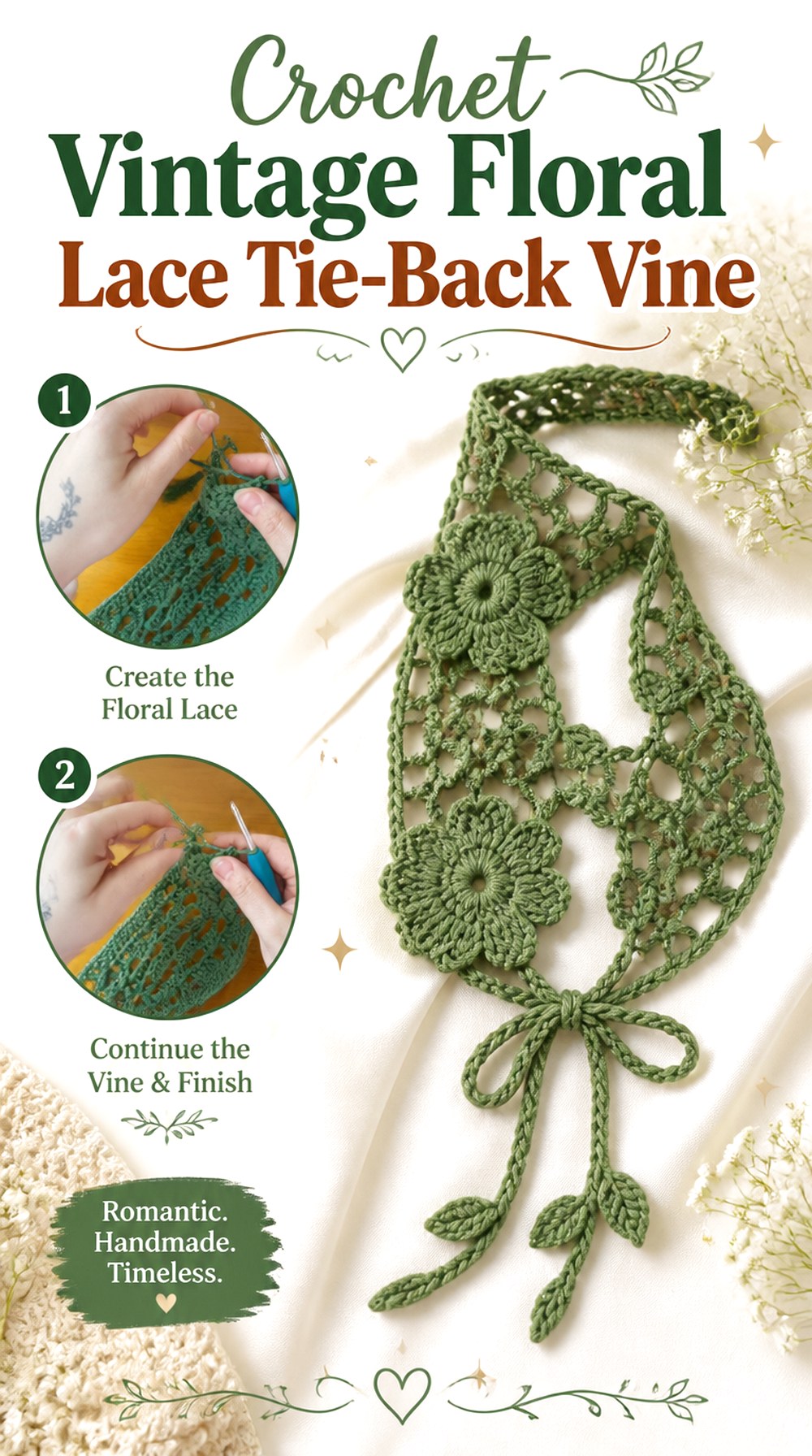
Not every bridal vine needs three-dimensional flowers. Triple Capricorn’s flower headband uses a floral lace effect within a wider crocheted band and finishes with ties. That makes it a strong reference for brides who prefer vintage lace, filet-style floral imagery, or a flatter accessory that will not project far from the hairstyle.
Instead of converting individual flowers into a vine, this concept lets the crochet fabric itself create the floral decoration. It can work particularly well across the back of loose waves or around a low hairstyle where a tied finish can be hidden under the hair.
Flat Lace Behaves Differently From Flower Sprays
A lace strip distributes its weight across a wider area and does not have individual wired stems to position. The trade-off is reduced three-dimensional movement. Decide whether you want the accessory to read as floral lace from a distance or as distinct flowers and leaves when photographed close up.
Check the Tie Placement Before Finishing
Ties are convenient only if they can be concealed or intentionally incorporated into the hairstyle. Have the hair roughly styled before deciding where the decorative lace should end. If the ties meet in an exposed area, they may become more noticeable than expected.
Openwork Needs Clean Tension
Floral lace depends on visible spaces as much as solid stitches. Uneven tension can distort the motif more noticeably than it would in a dense flower. Work a sample section and see how the fabric behaves when gently curved around the head rather than judging it only on a flat surface.
Original Tutorial and Creator Credit
Creator: Triple Capricorn
6. Crochet Pointed End Lacy Flower Hair Vine
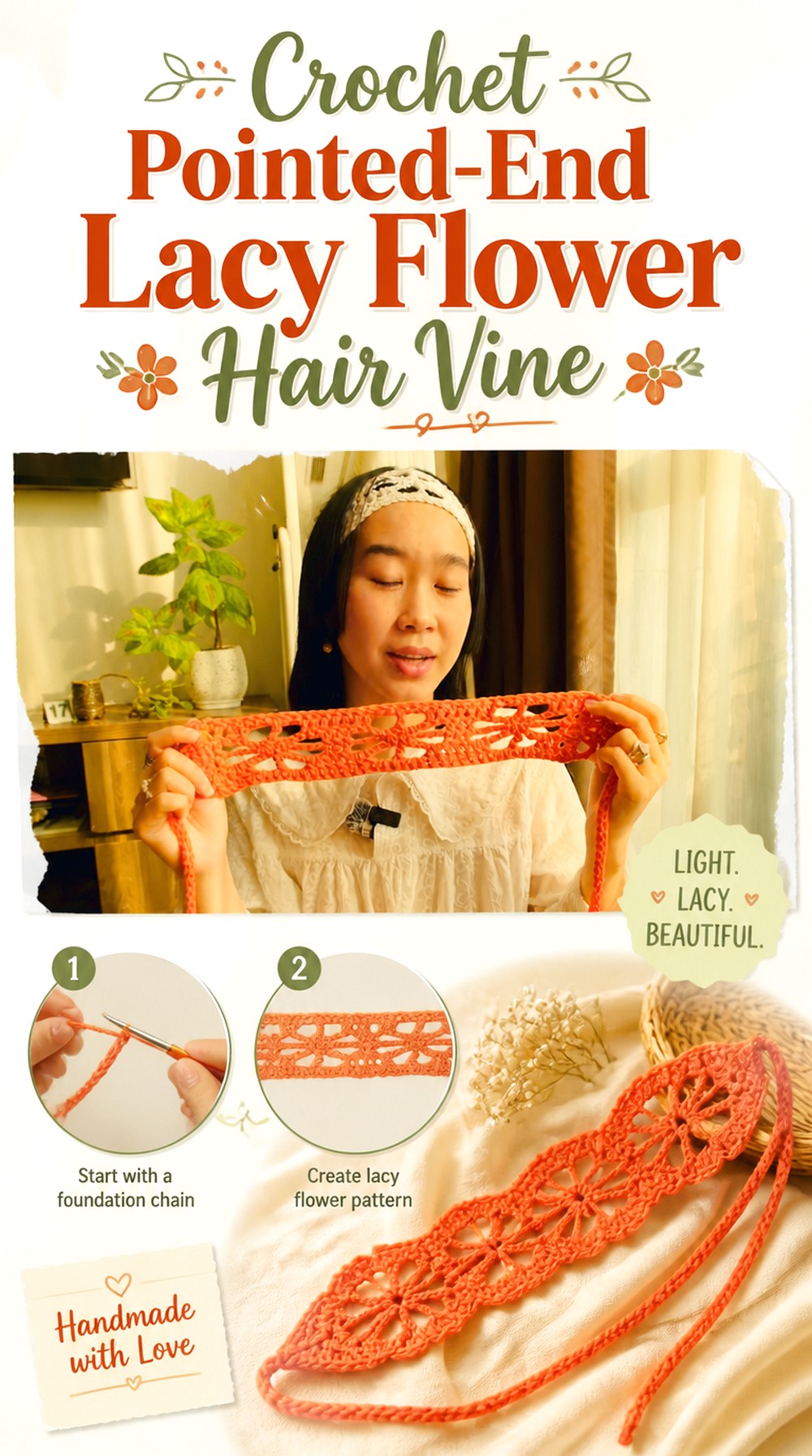
Day la hanh’s floral lace headband offers another flat-crochet direction, but its pointed ends and tied structure give it a different finished silhouette from a rectangular lace band. The source demonstrates a complete wearable headband rather than a bridal vine, so the useful lesson here is how a lace body can taper toward fastening points.
That taper can translate well to a bridal accessory because many traditional hair vines naturally narrow as they approach the temples or the ends of a braid. A slimmed-down interpretation could preserve the flowing line without requiring three-dimensional floral components.
Tapered Ends Make the Transition Softer
A sudden shift from a wide decorative section to a thin tie can look abrupt. Pointed or tapered ends create a more gradual change, especially when the accessory is visible from the side. Place the widest part over the area you want to emphasize and let the narrower ends disappear into the hairstyle.
Let the Hairstyle Determine the Width
A lace band that looks delicate on loose hair can appear much wider beside a compact bun. Test the crocheted width against the actual hairstyle before completing a long piece. If the accessory dominates the back view, a narrower floral section may better preserve the vine-like effect.
Original Tutorial and Creator Credit
Creator: day la hanh
7. Crochet Baby’s Breath Bridal Hair Vine
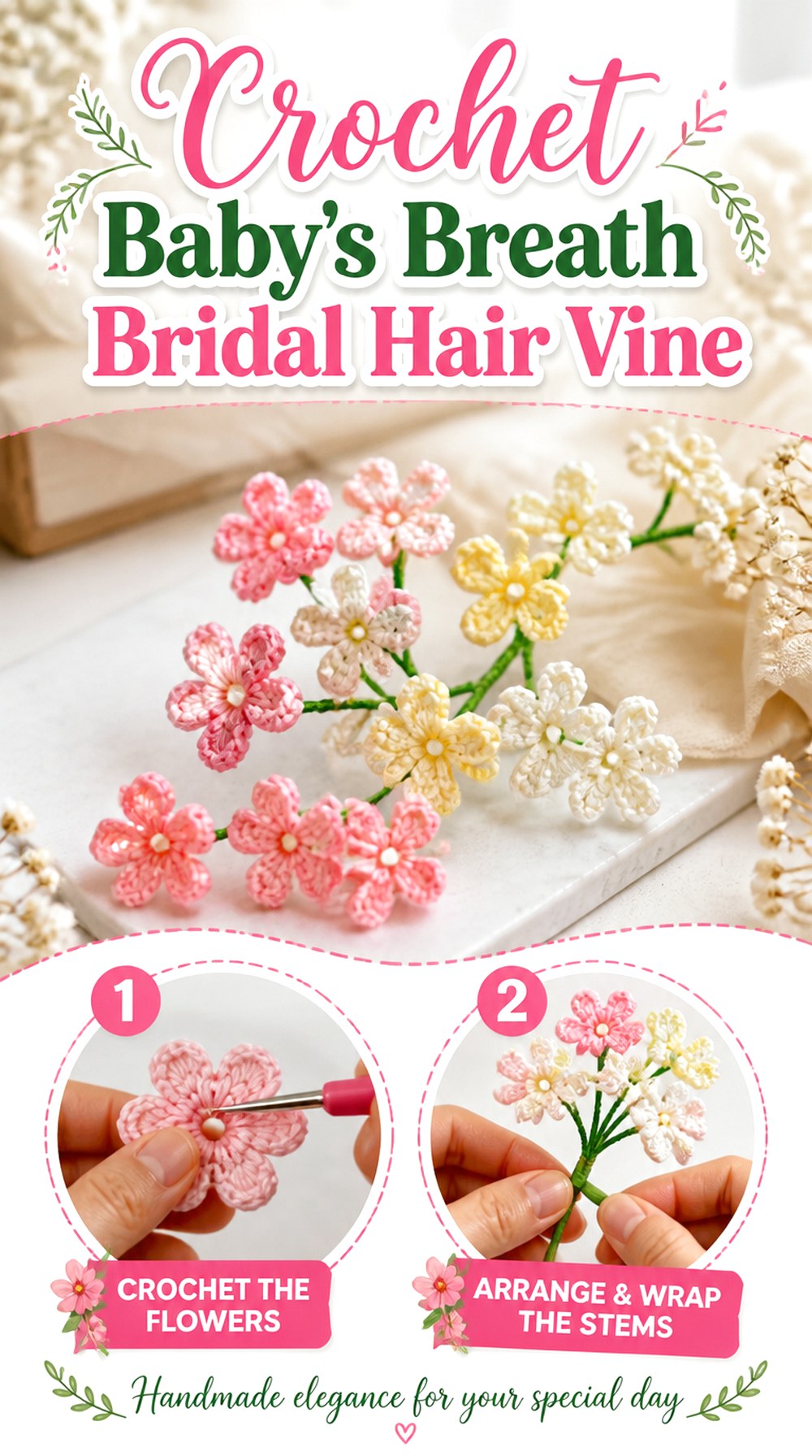
Baby’s breath is a natural concept for an airy crochet vine because the visual interest comes from many small blossoms rather than heavy focal flowers. Gonkui Crochet’s tutorial demonstrates the flower portion of a crochet baby’s-breath project, with a separate assembly continuation referenced by the creator.
For a bridal vine, the most effective interpretation is usually to preserve open space between flower clusters instead of packing every section tightly. This gives the finished piece a fine, scattered appearance that can weave through braids or sit around the edge of an updo without becoming a solid band.
Tiny Flowers Need a Deliberate Base
Small blossoms can visually disappear if the supporting vine is too thick. Before making many flowers, place one finished motif against the yarn, cord, or other base you plan to use. The support should hold the composition without visually overpowering the flowers.
Scatter Clusters Instead of Building a Solid Strip
Baby’s-breath styling is most recognizable when flower groups are separated by visible stems or space. Create a mock arrangement before attachment and compare small clusters with perfectly even spacing. The clustered version can produce a more botanical look while still keeping the piece balanced.
Original Tutorial and Creator Credit
Creator: Gonkui Crochet
8. Crochet Forget Me Not Bridal Hair Vine
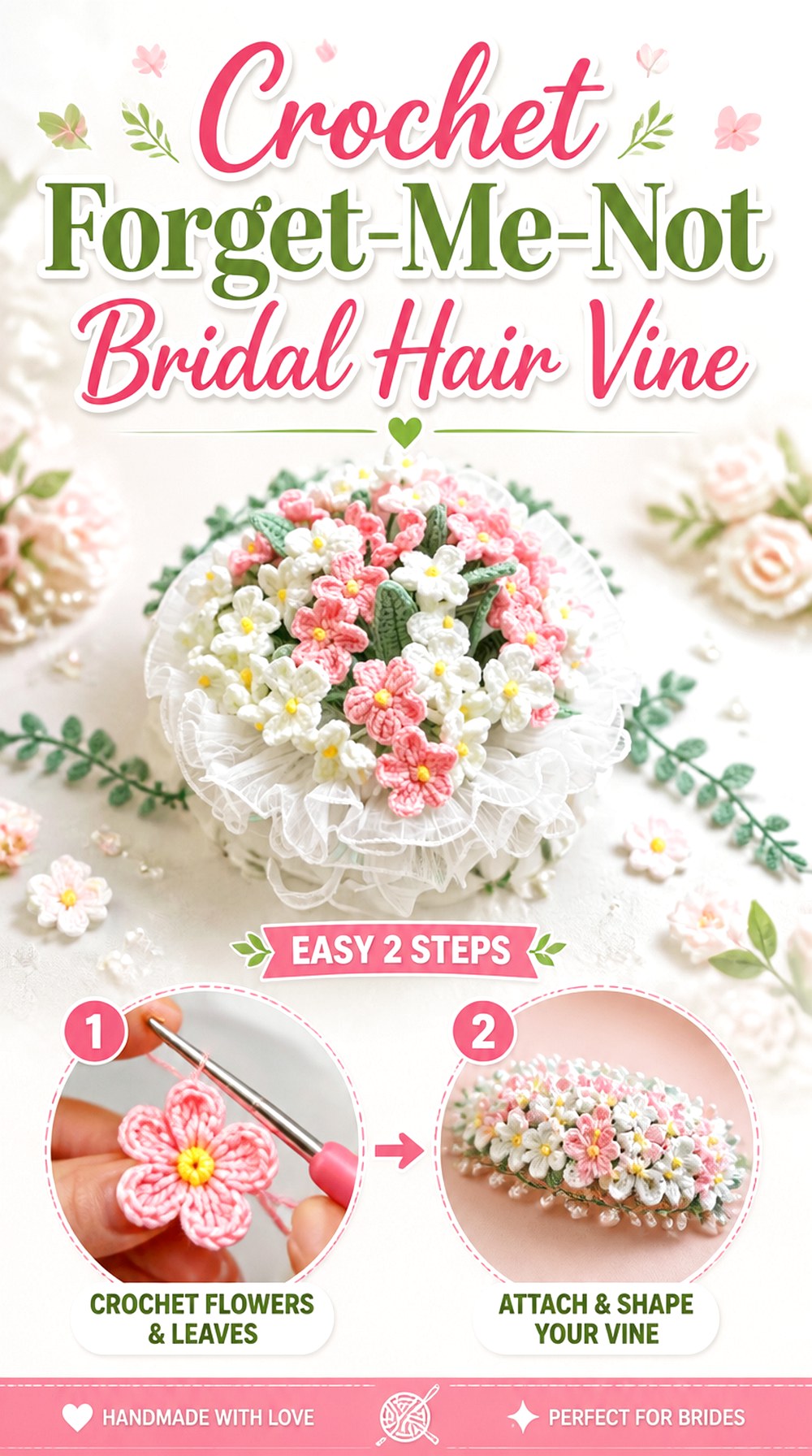
Forget-me-nots provide more visible petal shape than baby’s breath while still remaining suitable for a small-scale floral arrangement. Tammy crochet & art’s tutorial covers crochet forget-me-not flowers and leaves assembled for a bridal flower bouquet. That wedding-oriented floral source makes it particularly useful for imagining the same motifs in a smaller hair arrangement.
A hair vine can use the flowers as repeated points of color or keep them in a restrained bridal palette. The strongest distinction from a baby’s-breath vine is that each flower has enough visual identity to become part of the composition rather than simply filling space.
Mix Flower and Leaf Sizes Carefully
The tutorial includes flower and leaf components, giving you options for building more botanical variation. For a hair accessory, compare the leaves with the flower size before making many of them. Too many larger leaves can quickly change a small-flower vine into a foliage-heavy piece.
Use the Flowers as Small Focal Points
Instead of spacing every blossom identically, try arranging two or three small floral groups with quieter connecting sections. This can make the vine easier to place around a bun because the visually important clusters can be positioned where they will actually be seen.
Original Tutorial and Creator Credit
Creator: Tammy crochet & art
9. Crochet Cherry Blossom Bridal Hair Vine
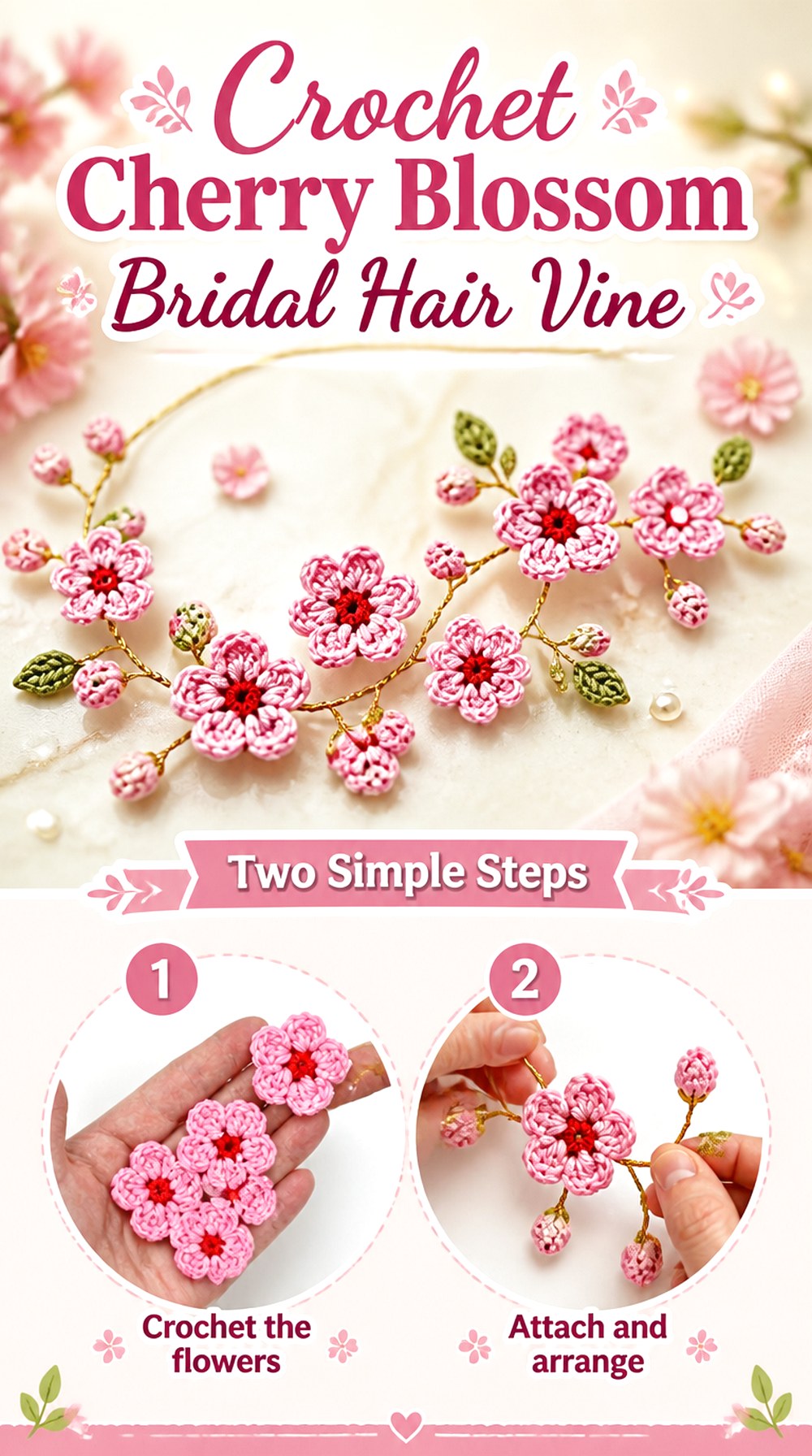
Cherry blossoms can give a bridal vine a lighter, flatter flower profile than roses or camellias. Knot Bad’s tutorial demonstrates individual crochet cherry blossoms designed as embellishments for other projects. The source uses a heavier yarn than you might choose for a delicate bridal piece, so treat the flower construction as inspiration and check your own finished scale before committing to a full vine.
A particularly effective layout is a branching composition where blossoms are concentrated near one side of an updo and become progressively more sparse toward the opposite end.
Scale the Blossom Before Repeating It
A flower that works as a scarf embellishment may look oversized beside a hairpin or narrow braid. Crochet one sample in the material you actually plan to use and photograph it against the hairstyle. That reference is more reliable than judging the flower in your palm.
Asymmetry Suits the Branching Look
Cherry blossom imagery often reads well when the arrangement feels like part of a branch rather than an evenly spaced chain. Place a denser group toward one end and use individual blossoms to extend the line. The gradual reduction in density also makes the end of the vine easier to conceal.
Original Tutorial and Creator Credit
Creator: Knot Bad
10. Crochet Lavender Sprig Bridal Hair Vine
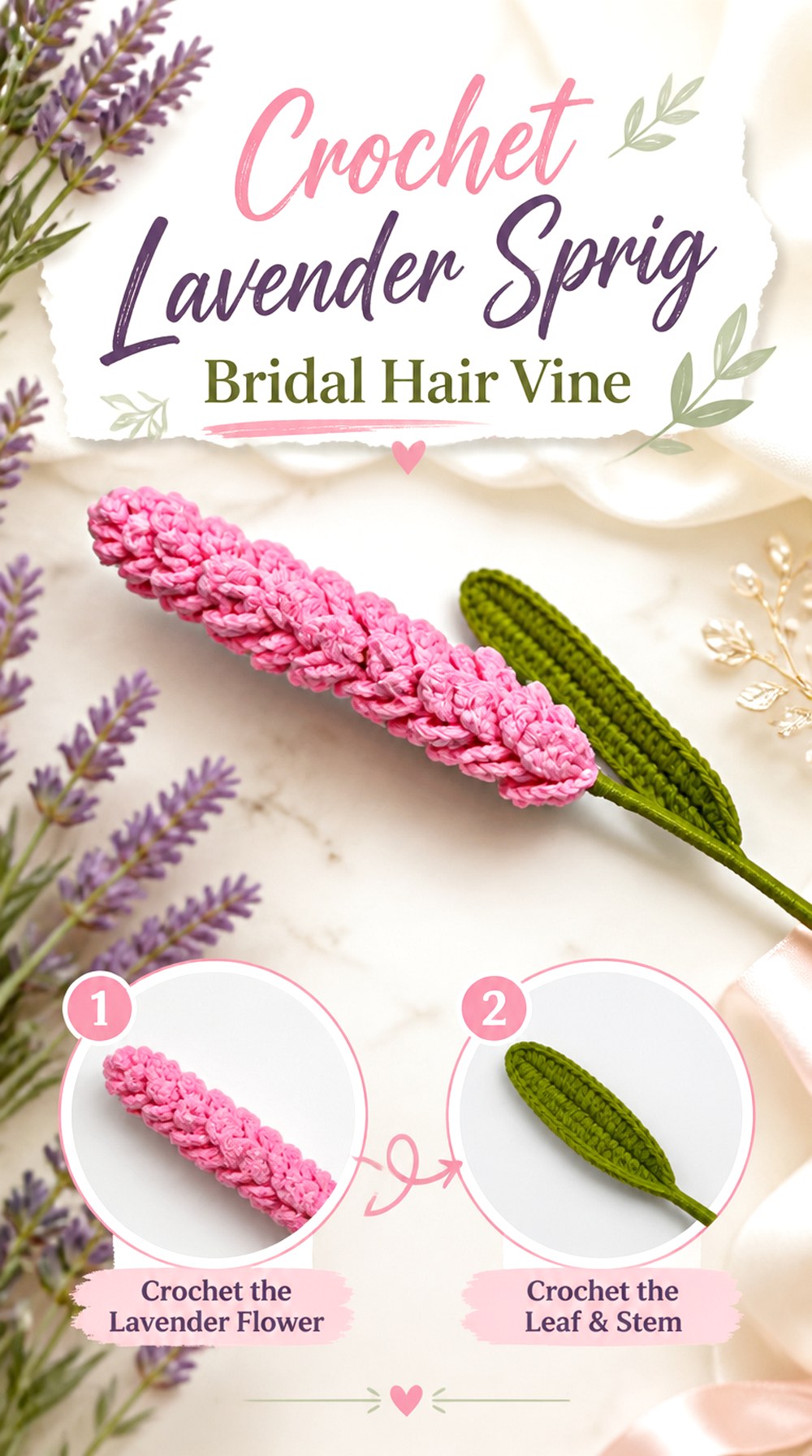
Lavender creates a completely different line from round flowers. KAQNIN KASIKAY demonstrates a crochet lavender flower with leaves and assembly, describing the finished motif as suitable for bouquets, wreaths, headpieces, and other decorations. That makes the source especially relevant for a bridal vine built from narrow upright or diagonal sprigs.
Rather than arranging the lavender end-to-end, position the sprigs so their tips radiate away from the central base. This works particularly well around a low bun, where the flowers can create a soft botanical edge without forming one uninterrupted floral strip.
Long Motifs Change the Vine’s Direction
A lavender sprig has a clear top and bottom. That means orientation becomes more important than with a round daisy or rose. Arrange every sprig before attachment and check the side view; several pieces leaning in competing directions can make the finished accessory feel visually tangled.
Use Lavender as an Accent, Not Automatic Filler
Because the flower has height, even a few stems can occupy considerable visual space. Start with fewer motifs than you think you need and add only after viewing the arrangement on the hairstyle. This preserves the open structure that makes a bridal vine look light.
Original Tutorial and Creator Credit
Creator: KAQNIN KASIKAY
11. Crochet Calla Lily Accent Hair Vine
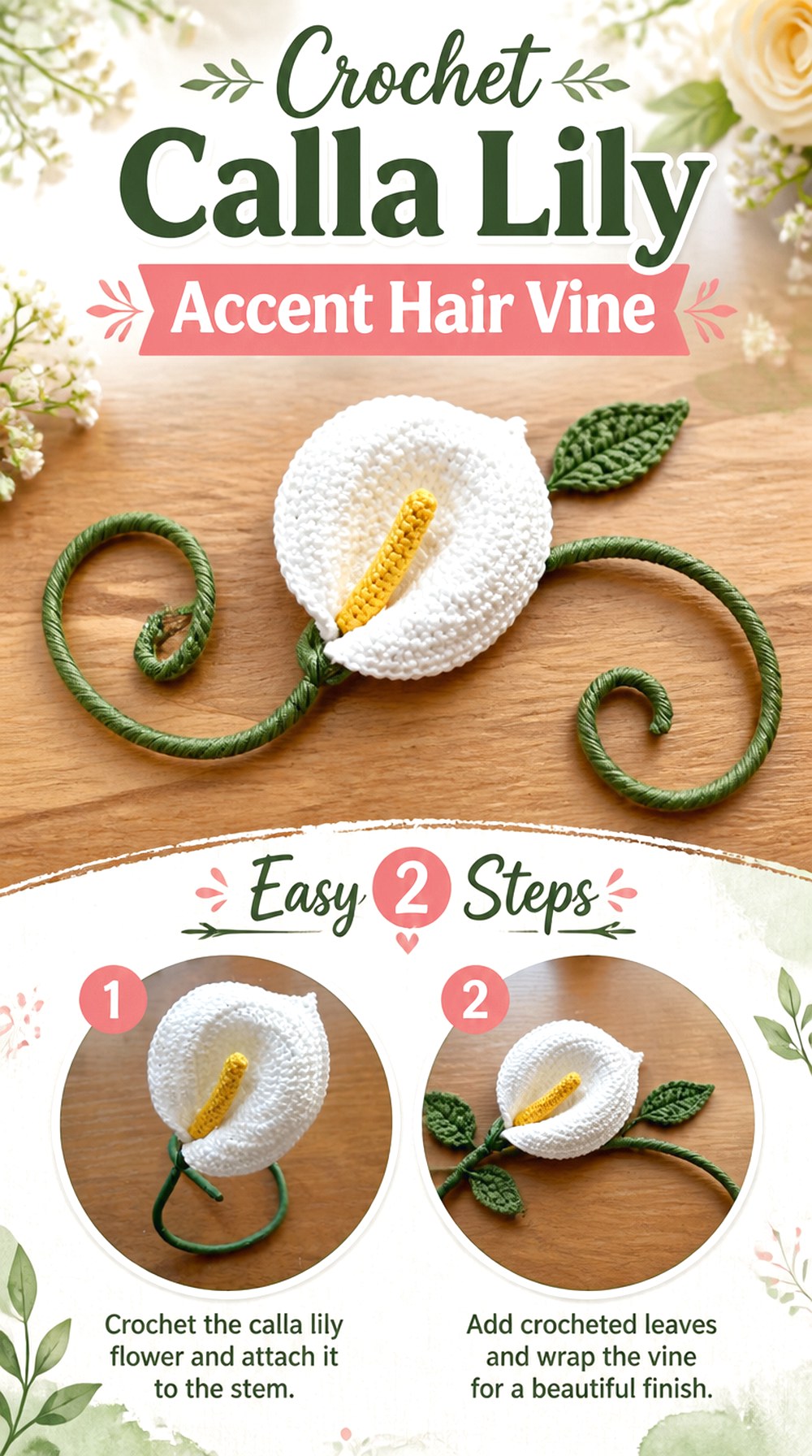
A calla lily is large enough to function as a focal motif rather than a repeated filler flower. World Of Amigurumi’s tutorial demonstrates a three-dimensional crochet calla lily with a contrasting center. For a bridal hair vine, this is better treated as a statement component than as something repeated continuously along the full length.
Consider using one primary lily near the bun or side of the head, then allowing narrow leaves or smaller flowers to extend away from it. This produces a comb-to-vine silhouette rather than a uniform garland.
One Large Flower Can Set the Whole Scale
Make the focal lily before designing the rest of the vine. Its finished dimensions determine how much supporting foliage you will need and whether the accessory still feels balanced against the hairstyle. Building the base first can leave you trying to force an oversized flower into a space that is too small.
Keep the Heavy Point Near Good Support
A dimensional flower generally creates more bulk than tiny flat blossoms. Position the focal point near a section of hair that can accept secure pins or another support method instead of leaving it at the unsupported end of a flexible vine.
Original Tutorial and Creator Credit
Creator: World Of Amigurumi
12. Crochet Orchid Side Swept Bridal Vine
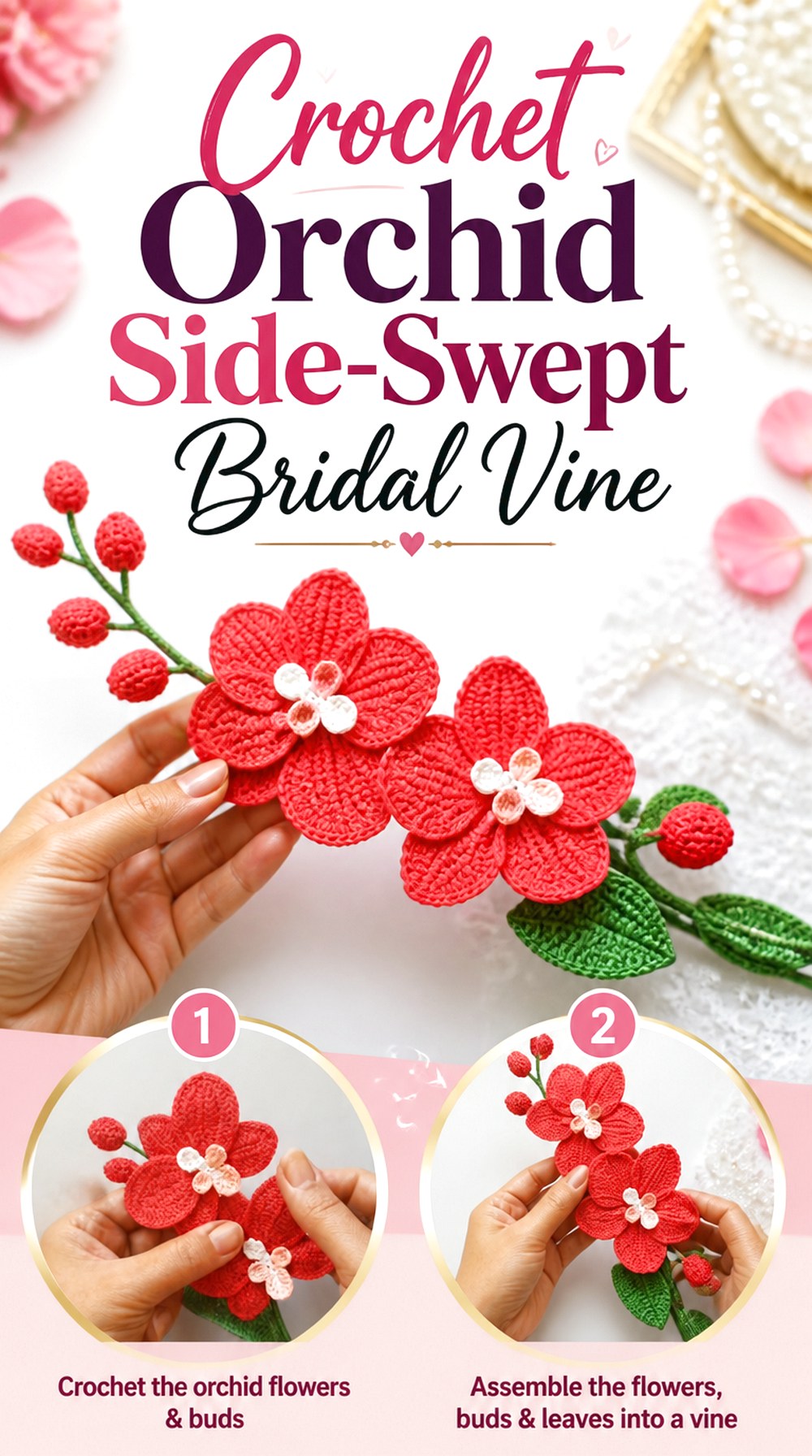
Orchids immediately create a more sculptural accessory because their petals have a distinctive layered shape. Golgoonak crochet’s tutorial demonstrates a crochet orchid that the creator specifically lists among possible hair-accessory uses, along with bouquets and decoration.
For a bridal vine, let the orchid be the feature. A side-swept arrangement with one or a few flowers near an updo can transition into a much narrower leafy or budded section. This keeps the distinctive petals readable rather than burying them inside a dense mixture of equally large flowers.
Give the Orchid Visual Breathing Room
Complex petals need empty space around them to remain recognizable. Lay the complete flowers beside the planned leaves and buds before joining anything. If the supporting elements cover the outer petal edges, reduce their number or move them farther along the vine.
Check Projection From the Side
Three-dimensional flowers can look balanced from the back but project farther than expected when viewed in profile. During the hairstyle trial, photograph the orchid from the side as well as straight on. Adjust its angle before final assembly so it follows the head rather than appearing to point outward.
Original Tutorial and Creator Credit
Creator: golgoonak crochet
13. Crochet Jasmine Star Flower Hair Vine
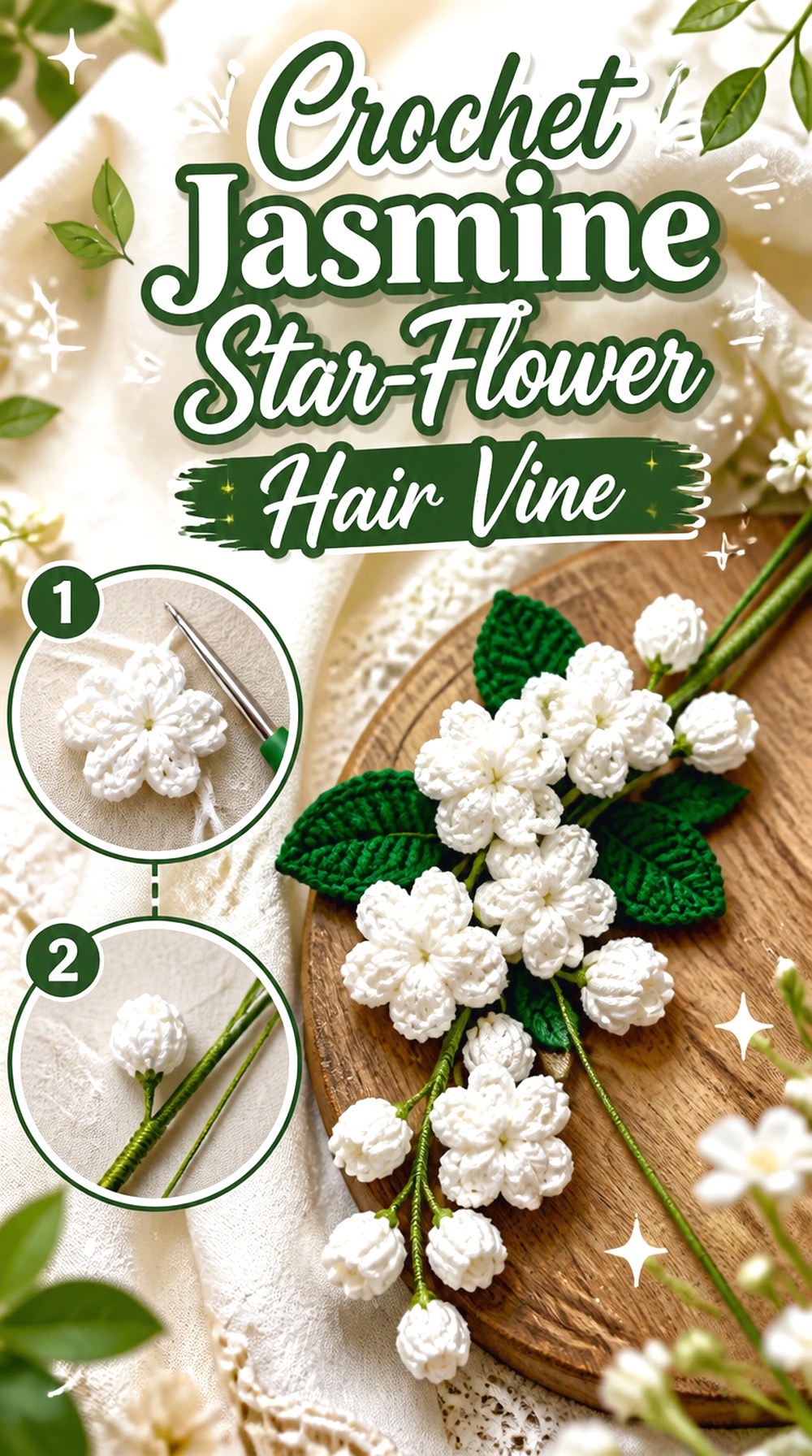
Jasmine gives you a small, crisp flower that can be repeated without creating the visual weight of roses or layered camellias. Natagor Finlayson’s tutorial demonstrates a white crochet jasmine flower with green elements, making it a useful component reference for an understated floral vine.
A bridal interpretation can keep the flowers entirely white or ivory and use the connecting structure, rather than contrasting foliage, to define the line. Because jasmine motifs are individually recognizable but relatively restrained, they suit a vine that is meant to complement detailed lace rather than compete with it.
Repetition Works Best With Controlled Spacing
Several similar flowers create rhythm quickly. Test three spacing options—close, medium, and noticeably open—against the hairstyle before assembling the full vine. The open version often allows more hair to show through, while the dense version reads more like a continuous floral band.
A Simple Palette Highlights Stitch Shape
When flowers and base stay within a narrow tonal range, the petal silhouette and crochet texture become more important. Finish yarn ends carefully and check each flower’s shape before attachment because small inconsistencies are easier to notice without strong color contrast to distract from them.
Original Tutorial and Creator Credit
Creator: Natagor Finlayson
14. Crochet Poppy Statement Bridal Vine
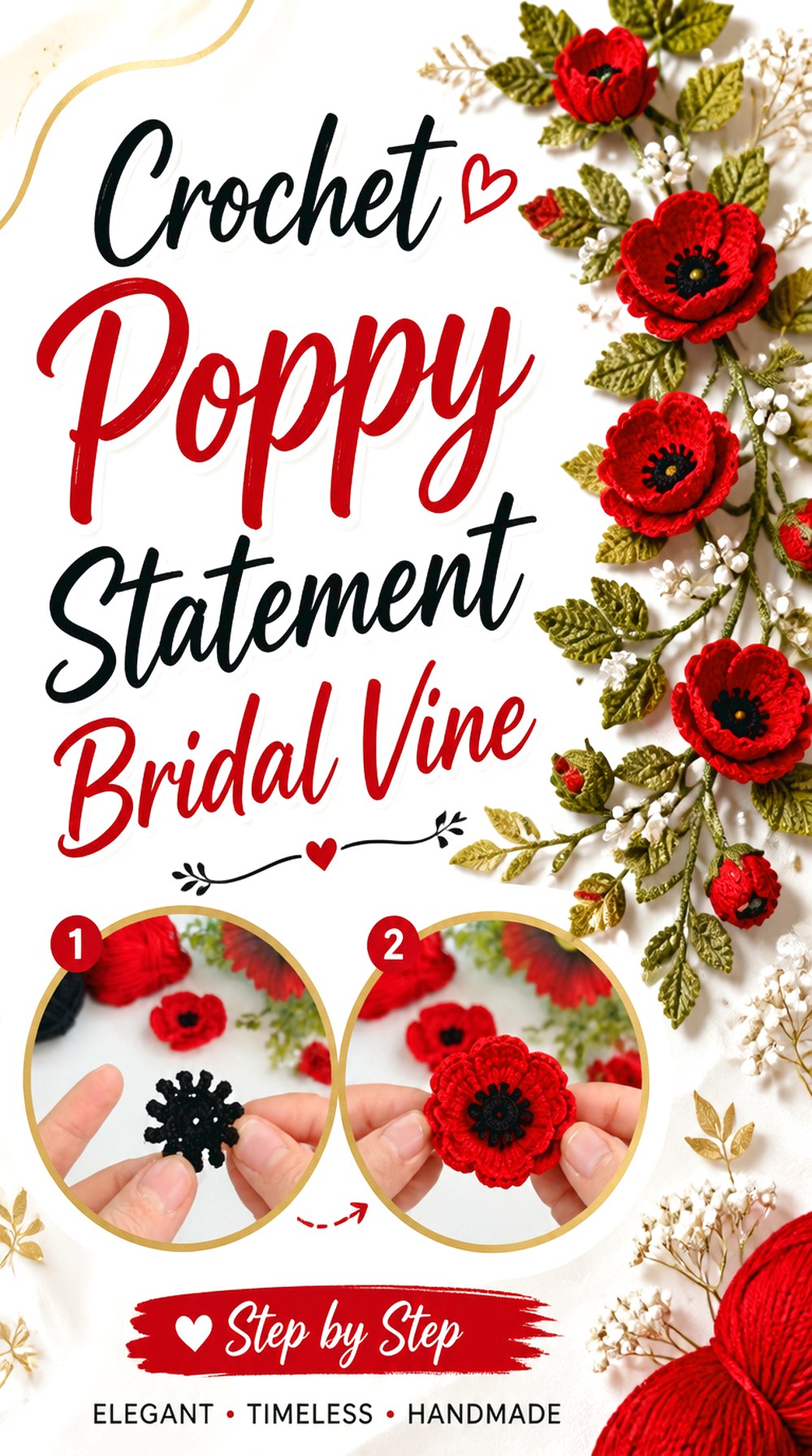
A poppy-inspired vine is for a bride who wants visible petal movement rather than a barely-there floral accent. Crochet My Hobby’s tutorial demonstrates a finished crochet poppy bouquet, providing a reference for the flower form rather than a dedicated hair accessory.
Instead of repeating large poppies across the entire head, place one or two focal blooms at the strongest point of the hairstyle and transition into narrower leaves or a plain vine. In white, cream, blush, or another wedding palette, the recognizable poppy silhouette can remain without requiring traditional red.
Limit the Number of Focal Flowers
Large petals compete when placed too closely. Start by positioning one flower, then add a second only if the hairstyle has enough visual space. A stronger asymmetrical composition may use one dominant bloom with smaller components rather than several equally sized poppies.
Watch for Petals Folding Into the Hair
Soft dimensional petals can disappear when pressed against curls or a textured bun. During the trial, check whether the outer edges remain visible. Changing the angle or moving the flower slightly away from a dense section of hair can preserve the silhouette without adding more motifs.
Original Tutorial and Creator Credit
Creator: Crochet My Hobby
15. Crochet Camellia Cluster Hair Vine
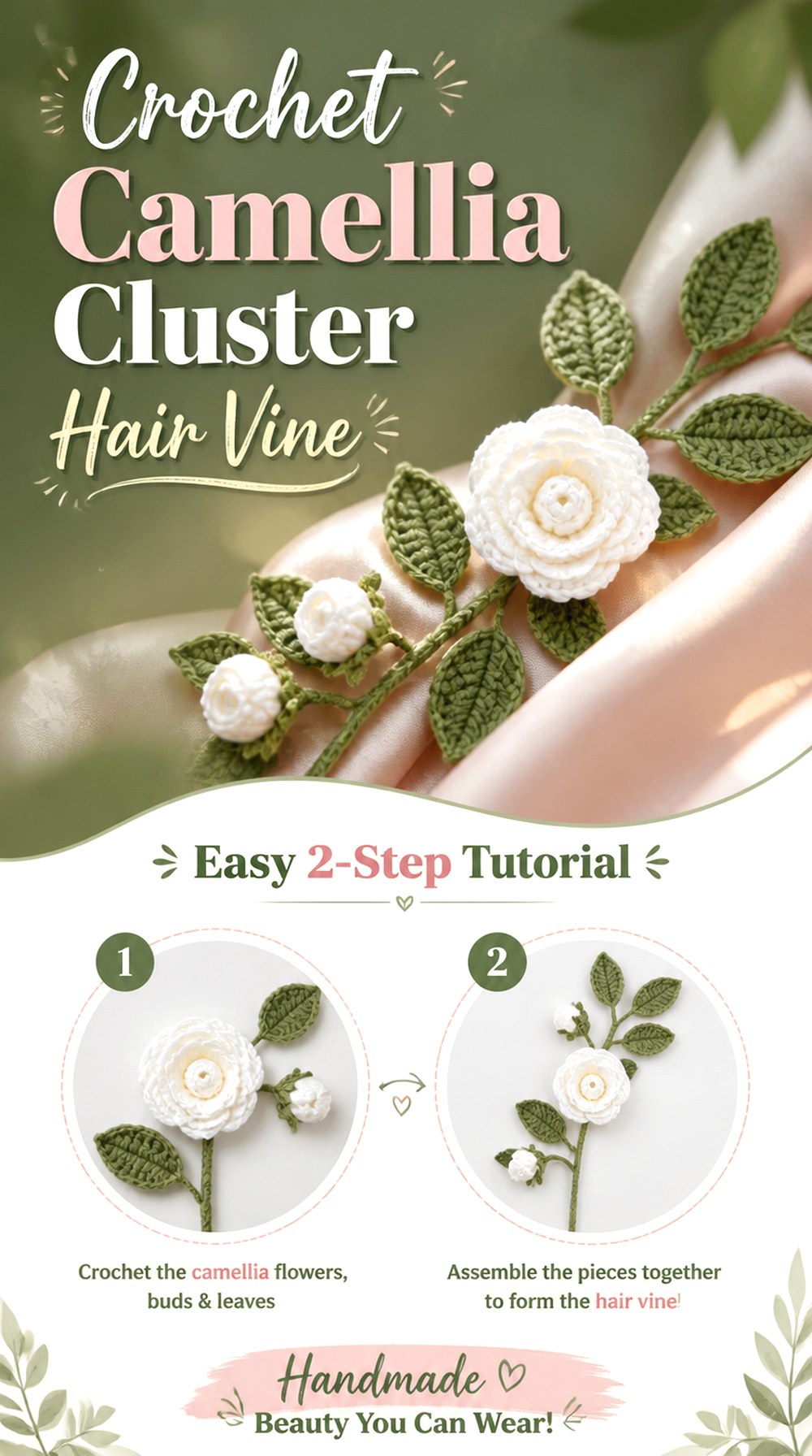
Camellias create a fuller, layered flower and therefore suit clustered bridal designs better than extremely long repeated vines. Crochet Everyday’s tutorial demonstrates a crochet camellia and explicitly suggests hair clips among its possible accessory uses.
For a bridal vine, cluster several blooms near one side of a low bun or twist and extend the arrangement with smaller leaves toward the back. The idea sits between a floral comb and a classic vine: most of the visual weight remains concentrated in one area, while the narrow extension keeps the piece connected to the hairstyle.
Layered Petals Need Separation
A camellia’s depth is part of its appeal, so avoid burying one bloom behind another. Arrange finished flowers at slightly different angles and check whether each center and outer edge can still be seen. If not, reduce the cluster or introduce foliage between the blooms.
Build the Cluster Before Extending the Vine
Treat the main floral group as one composition first. Once it looks balanced against the hairstyle, decide which direction the smaller vine section should travel. This prevents you from designing a long base and later discovering that the camellia cluster needs to sit somewhere else.
Original Tutorial and Creator Credit
Creator: Crochet Everyday
16. Crochet Daisy Spray Bridal Hair Vine
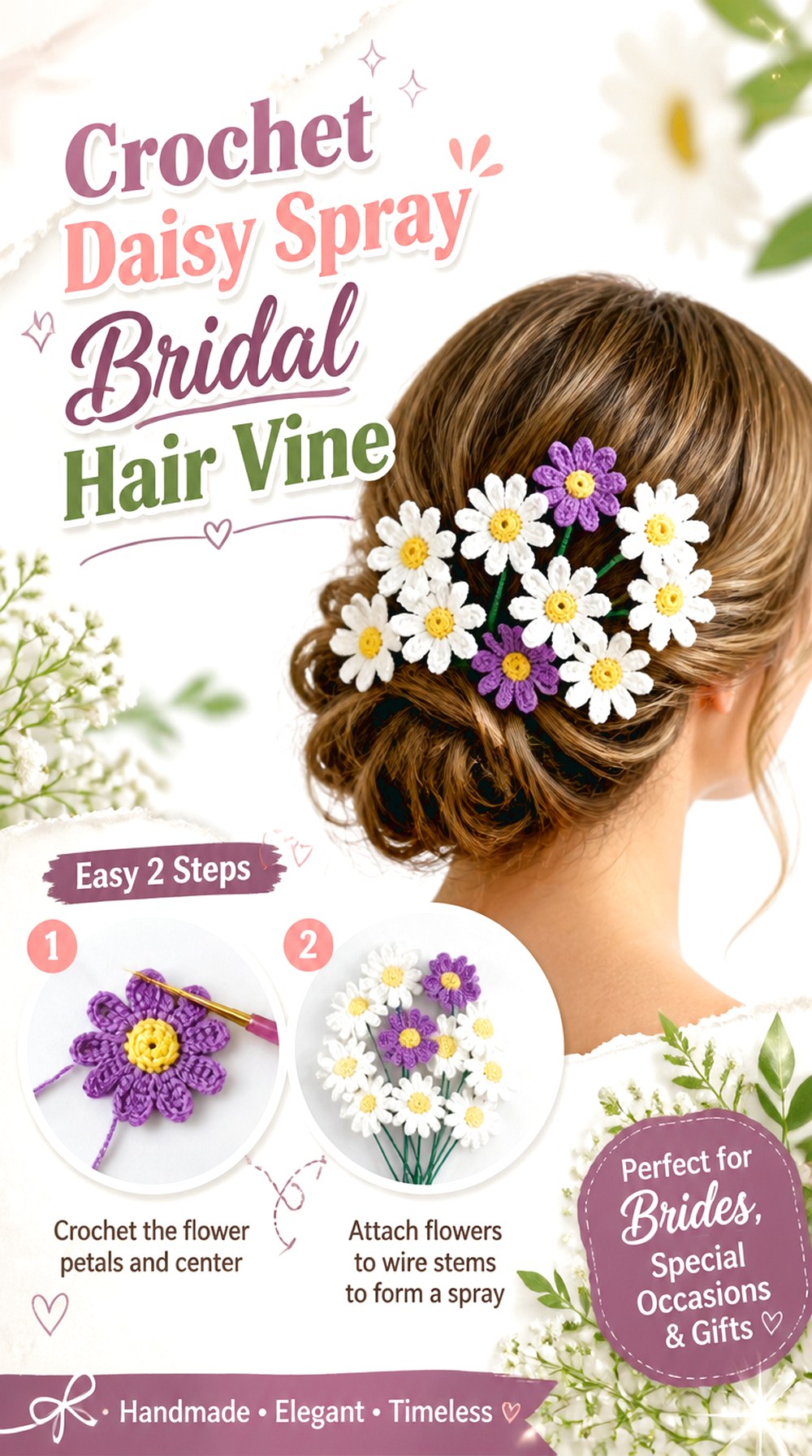
Daisies give the accessory a clearer, more graphic flower shape than baby’s breath while staying visually lighter than roses. Lingzhi Handmade demonstrates a crochet daisy bouquet with flower assembly and stem construction, so the tutorial works as a component reference rather than an exact hair-vine source.
For a wedding accessory, small daisy sprays can be placed intermittently along a flexible base or grouped near the center of a half-up hairstyle. Using fewer flowers with more empty space produces a refined vine; repeating them densely creates a more obvious flower-crown effect.
Decide How Visible the Flower Centers Should Be
Daisies naturally introduce contrast through their centers. Compare a stronger center color with a subtler tonal option before making the entire set. A lower-contrast palette usually integrates more quietly with formal bridal styling, while defined centers make each individual flower easier to read.
Keep the Flower Faces Visible
Flat-faced flowers can turn sideways when attached to a curved base. Before securing them, temporarily place the vine in the hairstyle and rotate each daisy so the face remains visible from the main viewing angles. This small adjustment can make a bigger difference than adding extra flowers.
Original Tutorial and Creator Credit
Creator: Lingzhi Handmade
17. Crochet Mini Rose Bridal Hair Vine
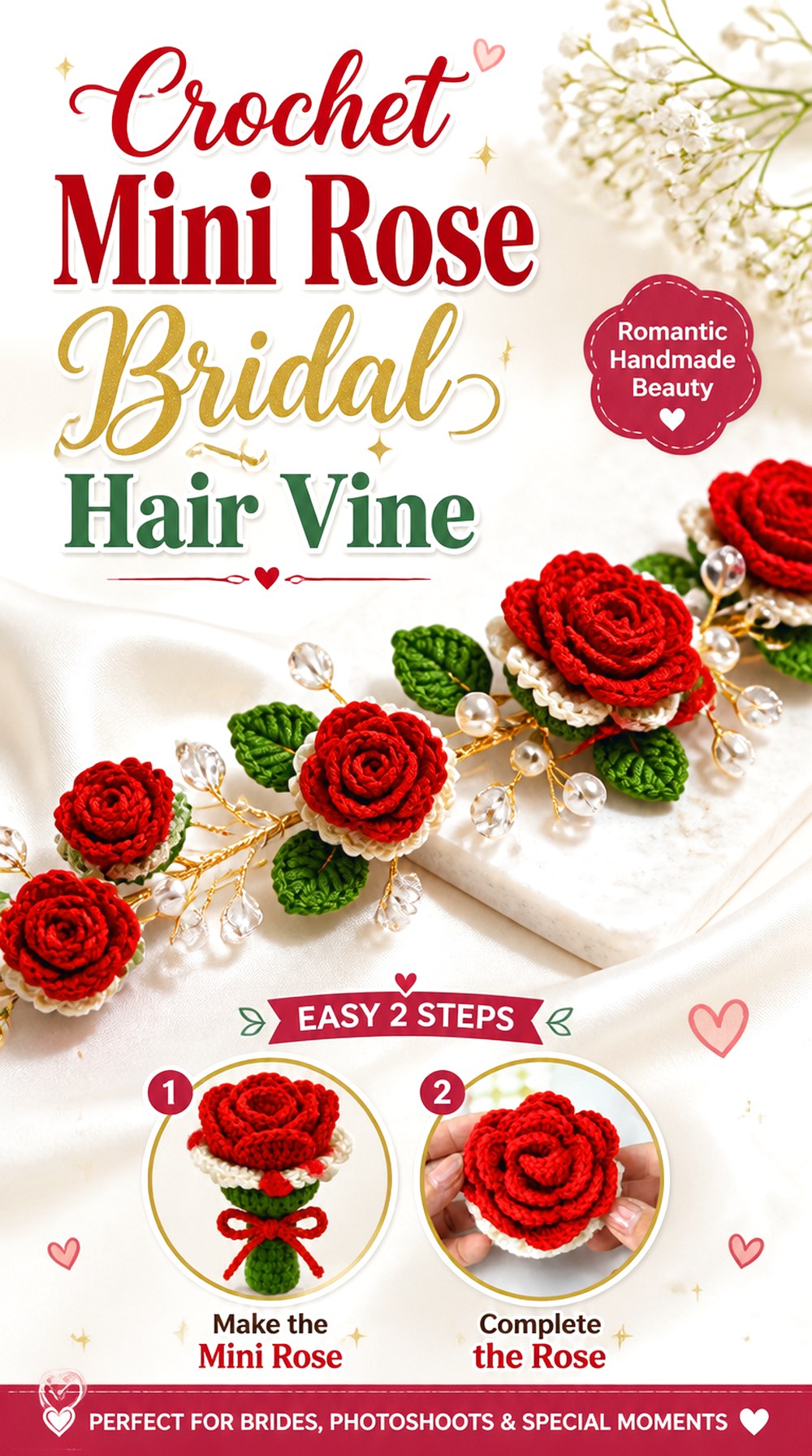
Mini roses offer the romantic look of a layered rose without requiring every flower to become a large focal point. Ngochan Crochet’s tutorial demonstrates a compact layered rose and notes that the flower can be used as a hair accessory as well as within a bouquet.
For a bridal vine, use the roses selectively. A few closely spaced near the center can create a focal cluster, while leaves, buds, or an undecorated connecting section allow the vine to taper toward its ends. That arrangement avoids turning a narrow hairpiece into a thick row of identical rosettes.
Rolled Flowers Add Depth Quickly
A layered rose creates more thickness than a flat five-petal flower. Check the back of one completed rose against your intended base before making multiples. If the attachment area is bulky, fewer flowers placed strategically may give a cleaner finish than a dense continuous row.
Vary Density Rather Than Flower Size
You do not need several different rose patterns to create movement. Keeping the roses consistent while changing the distance between them can make the composition fuller near the center and lighter near the ends without introducing incompatible motif shapes.
Original Tutorial and Creator Credit
Creator: Ngochan Crochet
18. Crochet Leafy Branch Bridal Hair Vine
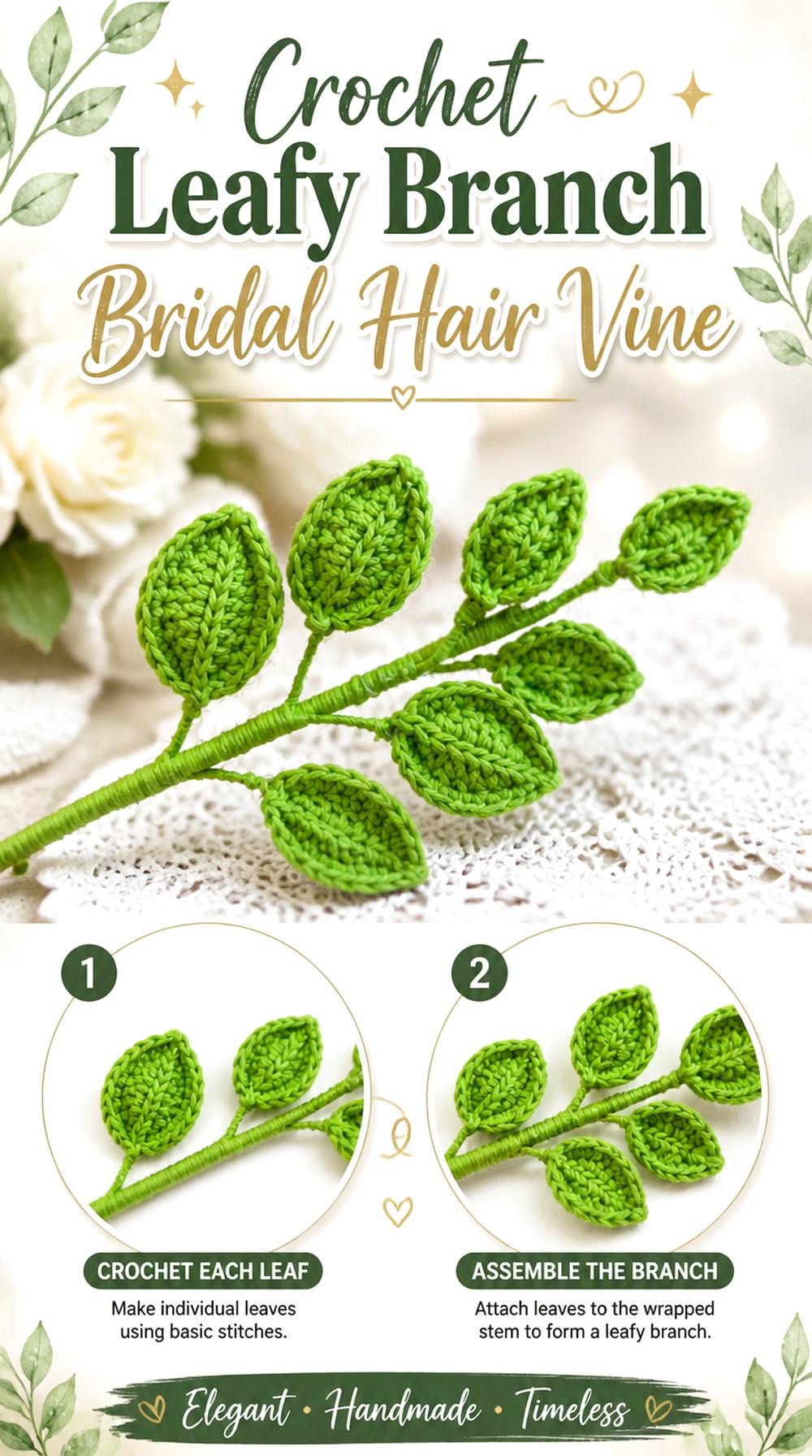
Shelen Crochet demonstrates a branch built from several leaf sizes and shows the final branch assembly. Although designed for bouquets and decorative arrangements, this construction is useful for a bridal vine where the foliage itself should create the shape rather than merely fill spaces between flowers.
A branch-inspired piece can curve around the side of a bun, travel diagonally across a French twist, or serve as a foliage base for a few separate bridal flowers. The variation in leaf scale helps the branch narrow naturally rather than ending with identical leaves.
Graduated Leaves Help the Vine Taper
Changing leaf scale can create a convincing transition from a fuller central section to a narrow tip. Before assembly, arrange the leaves from largest to smallest and compare a strict gradient with a more irregular pattern. The latter often avoids an overly manufactured appearance.
Check Every Structural Component for Hair Contact
A decorative branch may use internal support that was not designed to sit directly against the scalp. If you adapt a wired structure into a hairpiece, inspect and cover any rigid ends and confirm that the finished back remains smooth where it will meet the hair.
Original Tutorial and Creator Credit
Creator: Shelen Crochet
19. Crochet Lily and Leaf Bridal Hair Vine
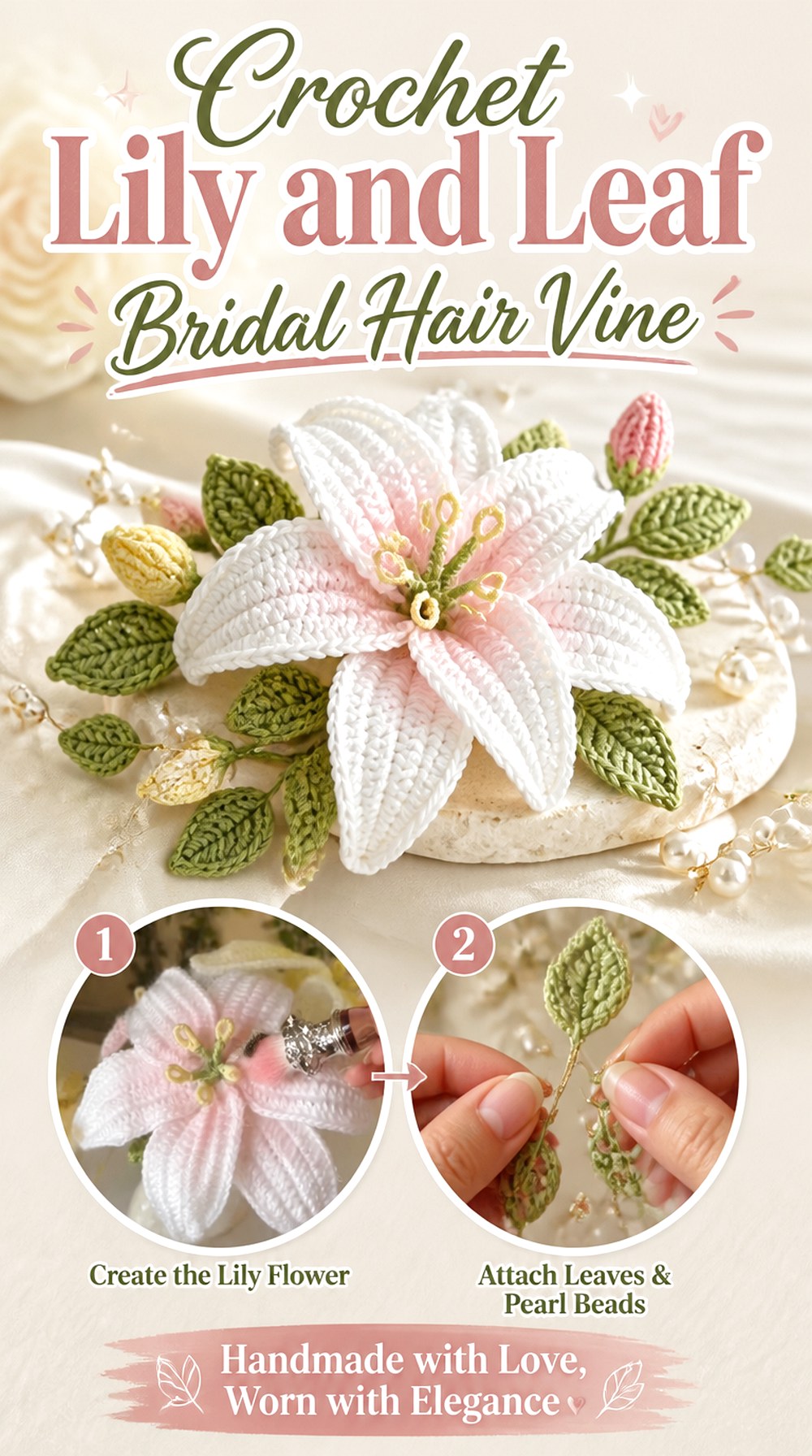
Mahum’s tutorial is particularly adaptable because it demonstrates crochet lilies in two sizes with leaves and explicitly includes both bouquet and flower-hair-clip uses. That gives you a practical reference for combining a recognizable flower with a smaller-scale option before deciding how prominent the lily should be in a bridal vine.
One strong arrangement is a small lily cluster near the side of an updo with leaves continuing into a thinner line. Another is to place the smaller flowers intermittently along a braid while keeping the larger lily as the visual anchor.
Two Flower Scales Create a Natural Hierarchy
Using both a focal and smaller version of the same flower can make the vine feel coordinated without looking repetitive. Start with the largest lily, then position the smaller blooms where the composition needs transition rather than simply alternating sizes along the entire base.
Keep the Large Lily Away From Delicate Ends
A narrow vine end should visually taper and remain easy to anchor. Keep the largest flower closer to the main hairstyle structure and allow leaves or smaller lilies to travel outward. This reduces both visual and physical heaviness at the tip.
Test Leaves Behind the Petals
Leaves can frame a lily beautifully, but too much overlap can hide the petal outline. Arrange them behind the completed flower and view it from the angle the accessory will actually be photographed. Move or remove leaves until the lily remains clearly recognizable.
Original Tutorial and Creator Credit
Creator: mahum 🎀
Which Crochet Bridal Hair Vine Style Should You Choose?
If you want the closest thing to a traditional flexible hair vine, start with the Alternating Flower Vine, Leaf-Only Vine, Baby’s Breath Vine, or Forget-Me-Not Vine. They can create a long line without requiring one very large focal element.
For a flatter accessory, the Vintage Floral Lace Tie-Back and Pointed-End Lacy Flower Vine avoid the projection of three-dimensional blossoms. They may be easier to combine with loose hair when you do not want individual flowers catching between curls.
The Calla Lily, Orchid, Poppy, Camellia, and Lily and Leaf versions are stronger statement choices. They make more sense when the main flowers are concentrated near a bun, twist, or other well-supported section.
For a botanical or garden-inspired look, consider the Leafy Branch, Lavender, Cherry Blossom, Jasmine, or Daisy designs. The main choice is whether you want foliage, elongated sprigs, or clearly recognizable individual flowers to dominate.
Conclusion
The most successful crochet bridal hair vine is not necessarily the one with the most flowers. Start with the hairstyle and decide whether you need a narrow trailing line, a partial halo, a flat lace tie-back, or a statement cluster. Baby’s breath, jasmine, and forget-me-nots suit lighter repetition, while orchids, calla lilies, poppies, camellias, and larger lilies benefit from more breathing room.
Make one sample motif before committing to the full accessory, arrange all components before permanent assembly, and test the vine during a hair trial so its scale and attachment points work with the finished style. For exact flower construction, materials, and techniques demonstrated by each designer, follow the original tutorials credited above.
Frequently Asked Questions
Can I turn any crochet flower tutorial into a bridal hair vine?
Not automatically. First check the finished flower’s scale, thickness, back surface, and how easily it can attach to a flexible base. A flower designed for a bouquet may contain structural elements that are unnecessary or uncomfortable in hair. Make one sample and hold it against the planned hairstyle before deciding whether the motif works as-is or whether you should choose a smaller, flatter alternative.
Should a crochet bridal hair vine use wire?
It depends on the effect you want. A purely crocheted chain or cord can create a soft, flexible vine, while a supported structure can hold deliberate curves and branching shapes. If you use any wire or rigid floral component, make sure the finished accessory has no exposed or sharp ends and that the side touching the hair and scalp is smooth.
How do I stop a crochet hair vine from looking too bulky?
Begin with motif scale rather than trying to solve bulk after assembly. Fine materials, smaller flowers, more empty space, and fewer overlapping leaves can all reduce visual density. Larger flowers can still work, but use them as focal points rather than repeating them continuously. Photograph a short mock-up against the hairstyle before making the remaining components.
Should I make the hair vine before choosing my wedding hairstyle?
It is better to plan them together. A vine for a long braid may need a narrow vertical arrangement, while a low bun can support a shorter curved cluster. A half-up hairstyle may show more of a horizontal design across the back. Even if you crochet the flowers early, delay final assembly until you know approximately where the accessory will sit.
How can I combine a crochet hair vine with a veil?
Decide which accessory needs the strongest anchor point first. During a hairstyle trial, position the veil comb and temporary vine together and make sure neither blocks the other’s attachment area. A vine can sit above, below, beside, or partly around a veil, but the right arrangement depends on the hairstyle and the size of both pieces. Avoid finalizing the vine without testing both together.
What crochet flowers work best for a very delicate bridal vine?
Look first at small, relatively flat or narrow motifs rather than a specific flower name. Baby’s breath, forget-me-nots, jasmine, small daisies, cherry blossoms, and tiny roses can all support a lighter visual effect when their scale is appropriate. Large layered flowers can still appear delicate when used sparingly, but repeating them closely usually creates a more substantial floral headpiece.