Keeping track of dinner plans, grocery notes and favorite meal ideas is easier when everything has a familiar place. A crochet meal planner pocket on a kitchen cupboard door offers a small, decorative space for storing recipe cards, weekly menus and shopping reminders. These 16 crochet cupboard door meal planner pocket inspiration ideas explore simple card holders, tiered organizers, granny-square details, pencil sleeves, detachable pockets and seven-day planning arrangements in a range of kitchen-friendly colors.
The inside of a cupboard door can be useful for keeping planning notes close to everyday kitchen supplies without taking up counter space. However, every door has different hinges, shelf clearances and mounting options, so a decorative crochet organizer needs to be sized carefully. This collection helps you compare pocket depth, card accessibility, hanging methods and storage layouts before choosing a design that suits your kitchen.
These are AI-generated crochet design visualizations for inspiration, not photographs of tested handmade pieces or complete step-by-step patterns.
Quick Design Selection Guide
- For simple meal cards: Crochet Oatmeal Single Wide Menu-Card Pocket and Crochet Terracotta Scalloped Card Holder provide one main storage compartment.
- For separating meal plans and shopping lists: Crochet Navy Dual-Column Planner Pockets and Crochet Butter Yellow Twin-Depth Holder offer two different compartment layouts.
- For a weekly planning routine: Crochet Sage Three-Tier Meal Card Organizer and Crochet Turquoise Seven-Day Card Slots make individual notes easier to separate.
- For cottage-kitchen styling: Crochet Blush Granny-Square Front Pocket, Crochet Peach Button-Flap Menu Pocket and Crochet Rust Lattice-Overlay Planner Pocket add handmade decorative details.
- For compact cupboard doors: Crochet Charcoal Slim Door Planner Pocket and Crochet Indigo Diagonal-Opening Planner Pocket keep the main storage area narrow or easy to access.
- For flexible organization: Crochet Moss Modular Detachable Pocket Set, Crochet Mustard Pencil-Side Meal Planner Pocket and Crochet Denim Over-Door Strap Pocket offer different storage or hanging arrangements.
1. Crochet Oatmeal Single Wide Menu-Card Pocket
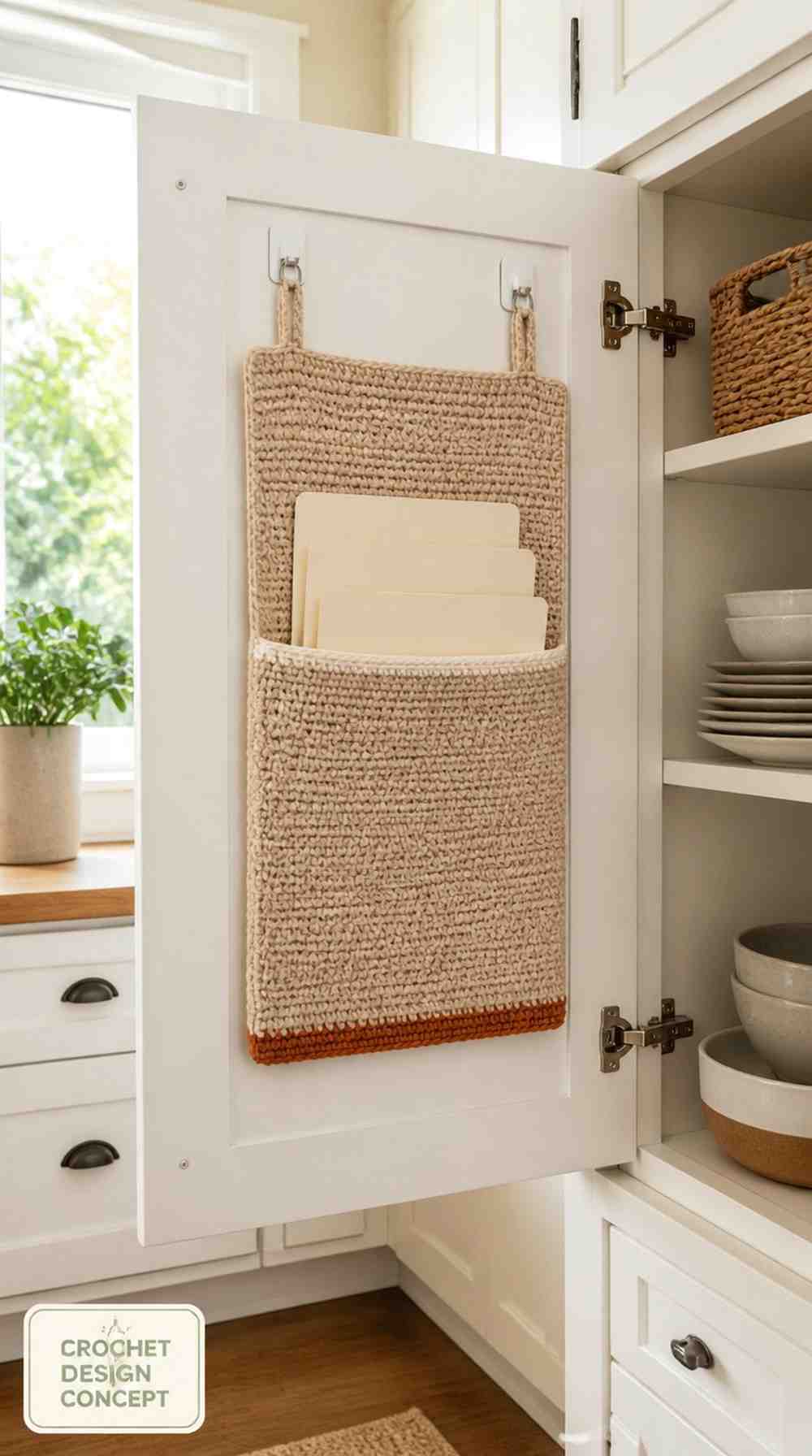
Warm oatmeal crochet gives this meal planner pocket a clean, natural appearance. Its rectangular backing and broad front compartment are finished with an ivory-trimmed opening and a narrow terracotta lower border. Three blank cream planning cards sit together inside the pocket, with their upper edges staggered for easy access.
This is a straightforward option for keeping a few meal ideas in one place. The broad opening makes inserting cards simple, although the pocket should stay shallow enough that paper does not disappear below the edge.
- Card capacity: Plan the pocket around the largest recipe or menu card you regularly use, leaving enough of each card exposed for easy retrieval.
- Straight upper edge: A firm, closely crocheted ivory border can help the pocket maintain a tidy opening when cards are removed repeatedly.
- Door placement: Leave sufficient space above the organizer for its hanging loops and below it so the cupboard still opens freely.
2. Crochet Navy Dual-Column Planner Pockets
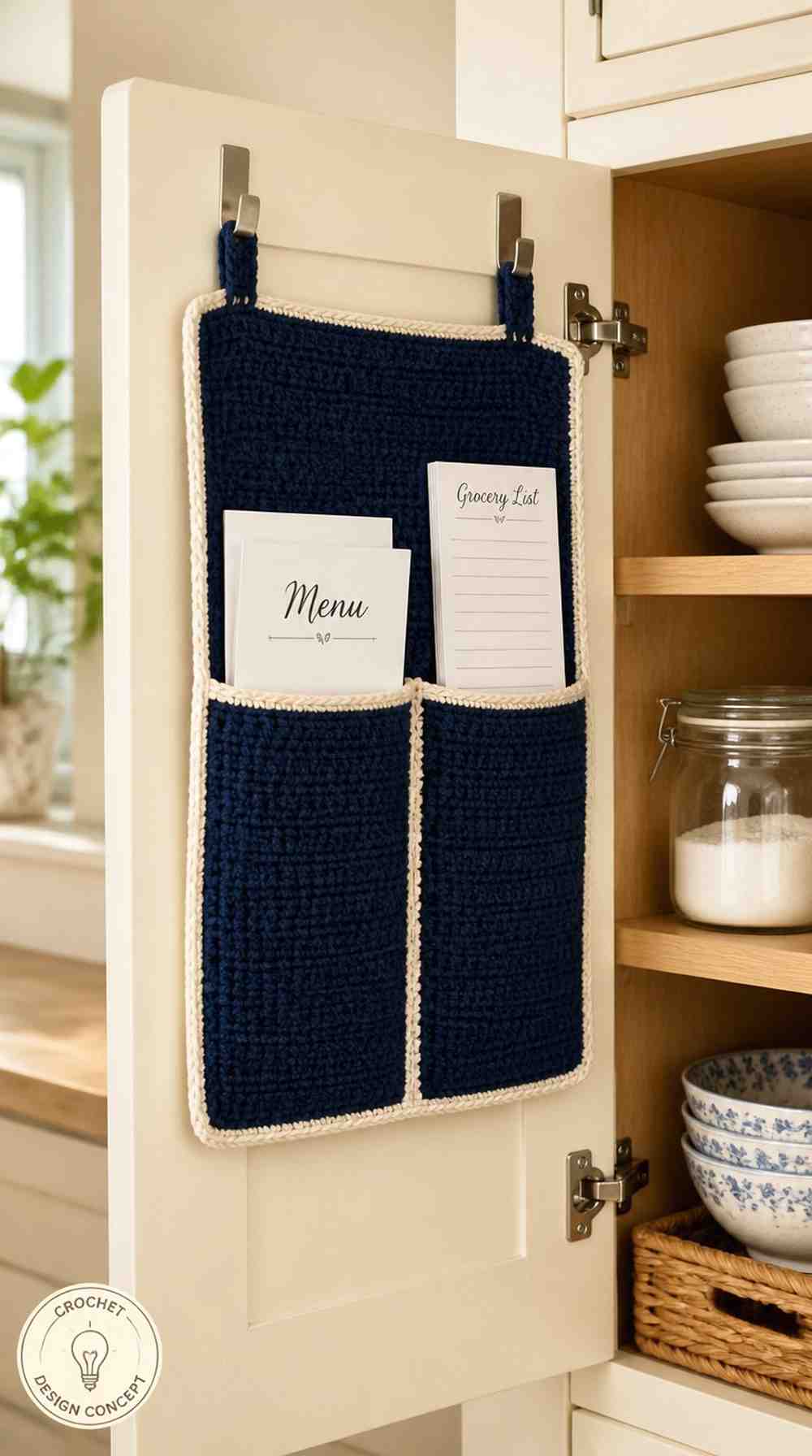
Deep-navy crochet creates a practical two-column organizer with a clear ivory seam between its compartments. One pocket holds blank meal-planning cards, while the other contains a narrow grocery-list notepad. Matching ivory edging gives both openings a consistent finish.
Separating the two paper types can help prevent shopping reminders from becoming mixed with planned meals. The side-by-side layout also makes good use of a wider cupboard door, although the central dividing seam needs to remain flat to avoid reducing usable pocket space.
- Different pocket contents: Give the meal-card side enough width for larger cards while keeping the grocery-list section narrow enough to support a small notepad.
- Central divider: Reinforce the vertical crochet seam so the two compartments retain separate openings instead of stretching into one large pocket.
- Daily access: Hang the organizer where both columns remain visible and reachable without opening the cupboard unusually wide.
3. Crochet Terracotta Scalloped Card Holder
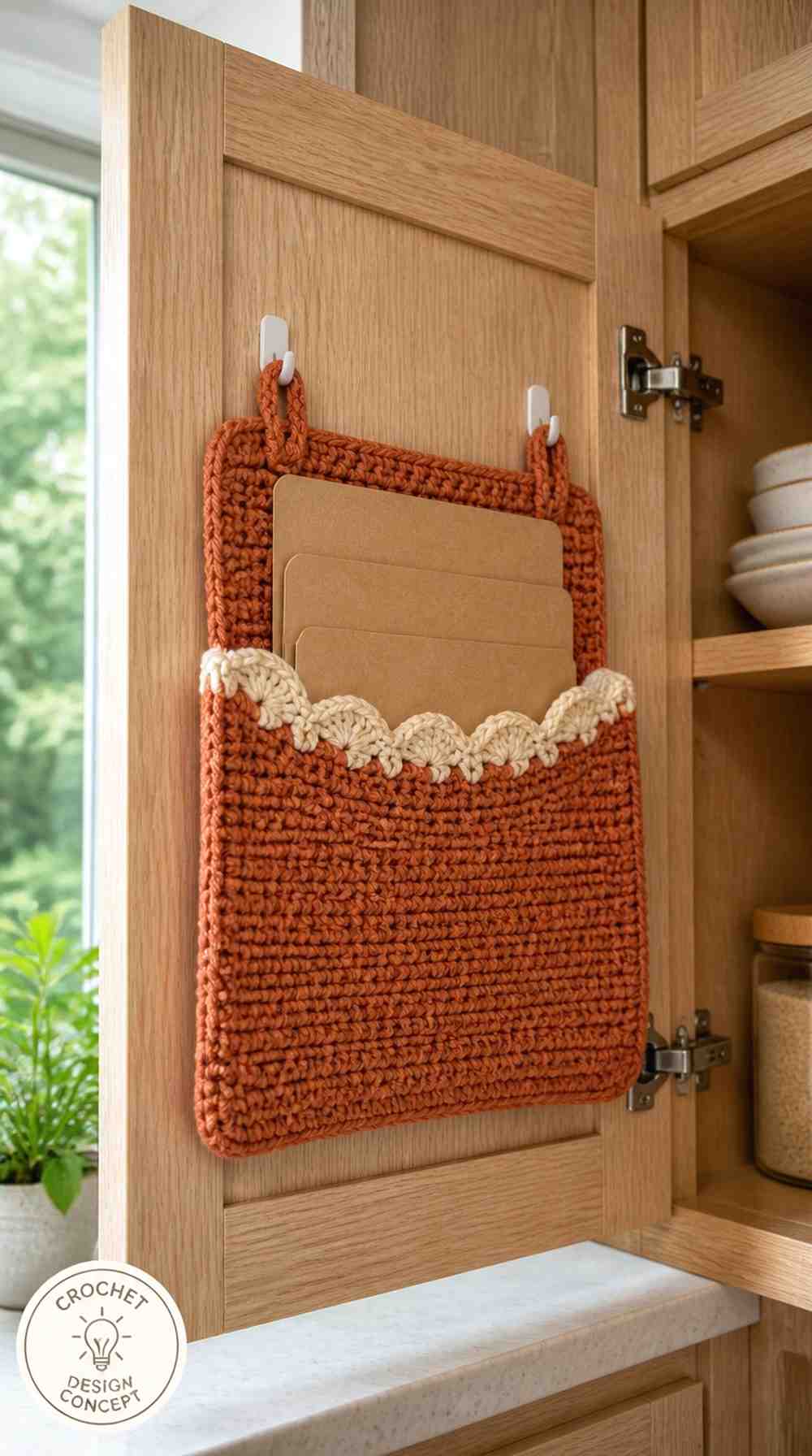
Burnt-terracotta crochet forms a broad, shallow card pocket with a delicate ivory shell-stitch opening. The back panel uses closely worked rows, while the lower edge remains straight and simple. Three kraft-colored cards rise above the scallops, giving the holder a warm, farmhouse-inspired appearance.
The decorative shell edging is the main feature of this design. It adds character without taking up much space, but the scallops should remain small enough that they do not catch against paper corners whenever a card is removed.
- Scallop proportions: Small, evenly spaced shells create a decorative border without making the card opening difficult to use.
- Paper protection: Keep the internal pocket smooth so the textured crochet edging does not bend delicate recipe cards during insertion.
- Optional color variation: A cream base with rust-colored shells could provide a lighter cottage look while retaining the same pocket shape.
For other decorative kitchen storage concepts, explore 16 Crochet Vintage Kitchen Wall Pocket Ideas for Cozy Cottage Homes, which includes hanging panels and textured pocket designs.
4. Crochet Mustard Pencil-Side Meal Planner Pocket
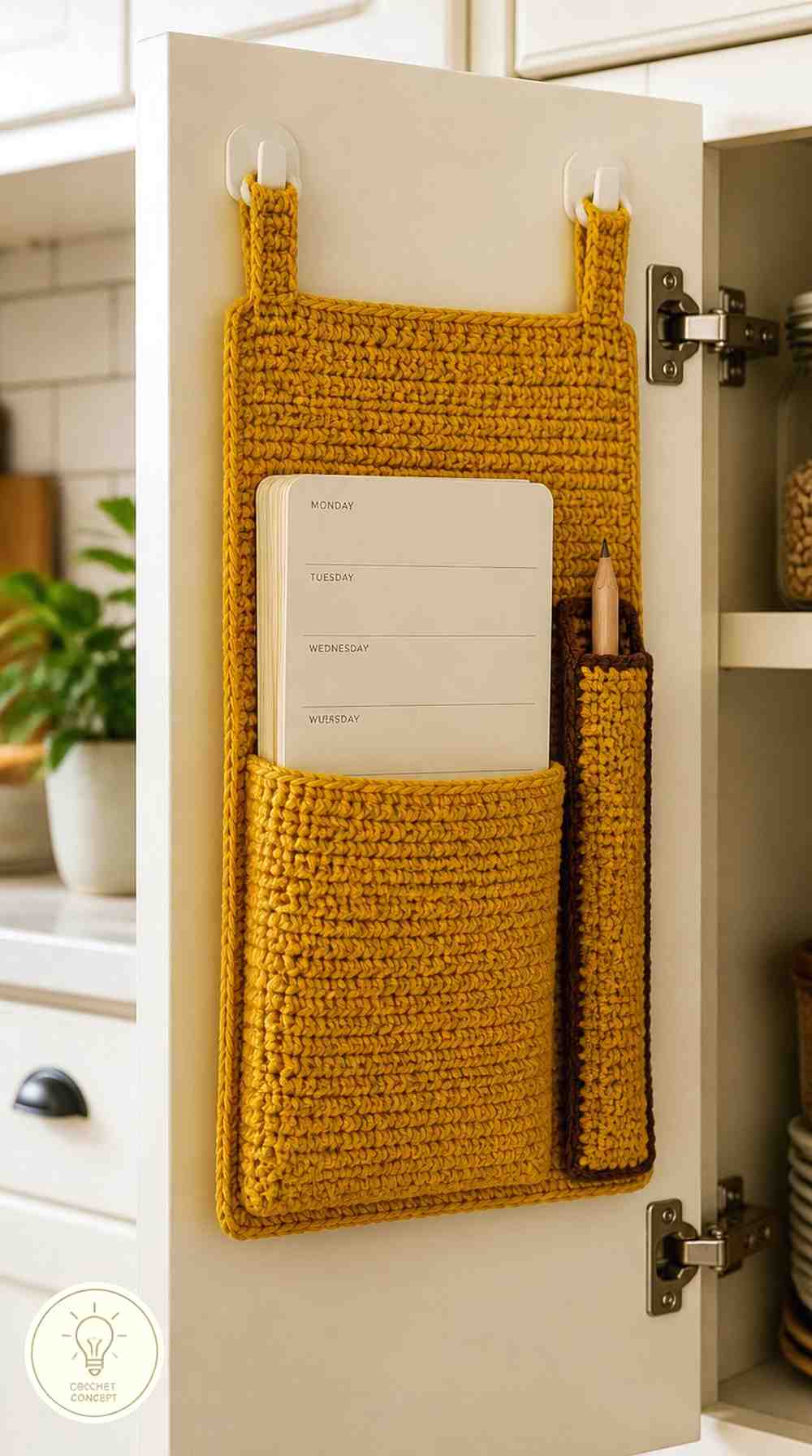
Golden-mustard crochet gives this organizer a cheerful appearance, while a separate narrow sleeve keeps a small wooden pencil beside the main menu-card compartment. The broad pocket holds several cream planning cards, and a deep-brown border makes the pencil holder easy to distinguish.
This design brings writing and storage together in one compact arrangement. Keeping the pencil attached to the organizer means there is a convenient place for it after updating the menu, although the narrow sleeve must be fitted to the actual pencil.
- Pencil sleeve fit: A short, closely stitched sleeve should support the pencil without squeezing it tightly enough to stretch the pocket out of shape.
- Point protection: Keep the pencil tip inside the sleeve so it does not scratch the cupboard door or catch on surrounding items.
- Compartment balance: The pencil holder should remain narrow enough that the meal-card section still accommodates the intended paper width.
5. Crochet Sage Three-Tier Meal Card Organizer
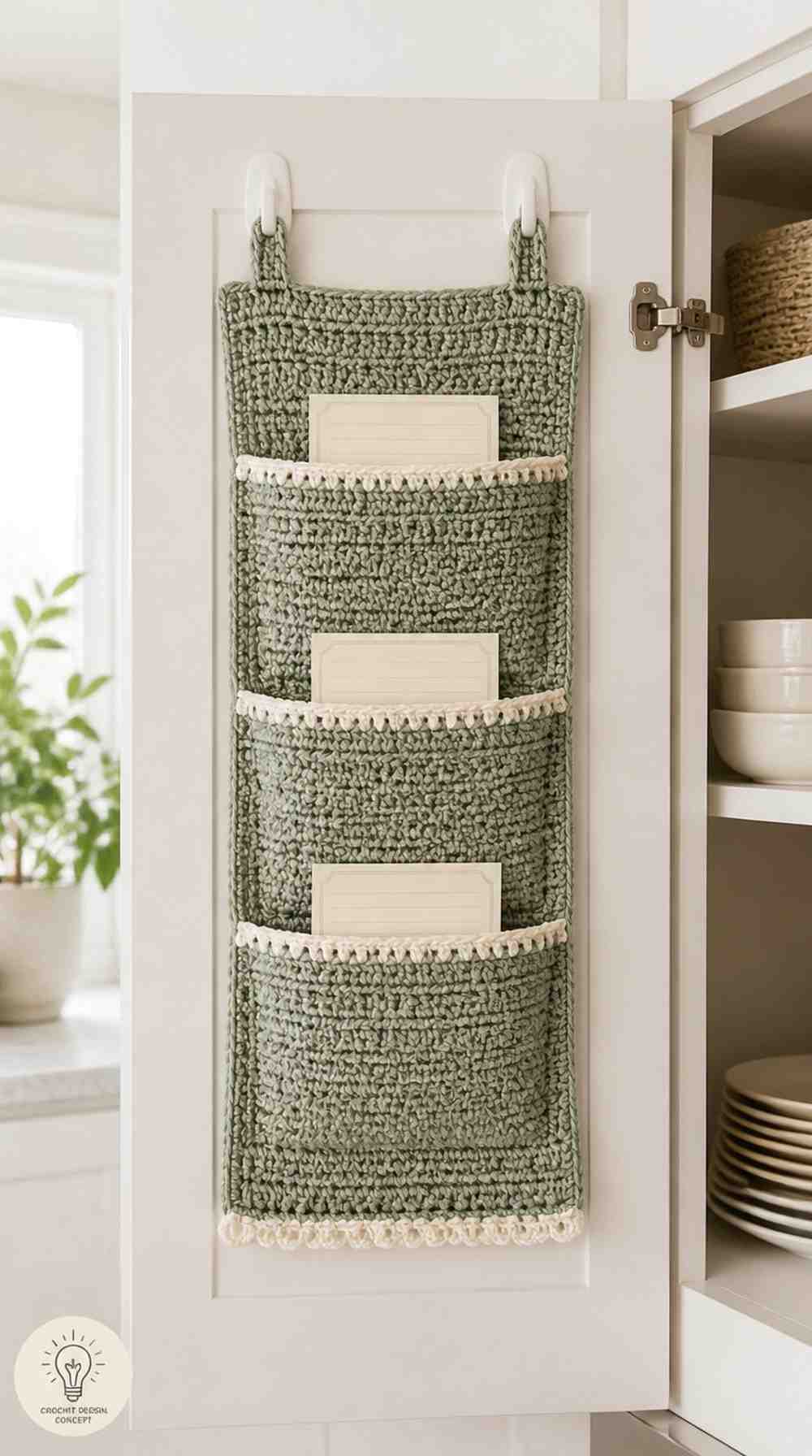
Muted-sage crochet creates three overlapping horizontal storage tiers on one rectangular backing. Each tier has a warm-ivory upper border, with a single blank menu card rising from its opening. The pockets become slightly deeper toward the bottom, giving the design a balanced, layered appearance.
The tiered arrangement makes it possible to keep different kinds of planning notes separated without using several organizers. Its main limitation is depth: if the upper pockets overlap too closely, removing one card may disturb the contents below.
- Tier spacing: Leave enough visible space between the pocket openings so fingers can reach each card independently.
- Pocket depth: Keep the upper tiers relatively shallow and reserve greater depth for the bottom pocket if larger cards need more support.
- Planning routine: Different tiers could hold current meals, future meal ideas and grocery reminders without adding visible labels to the crochet itself.
6. Crochet Blush Granny-Square Front Pocket
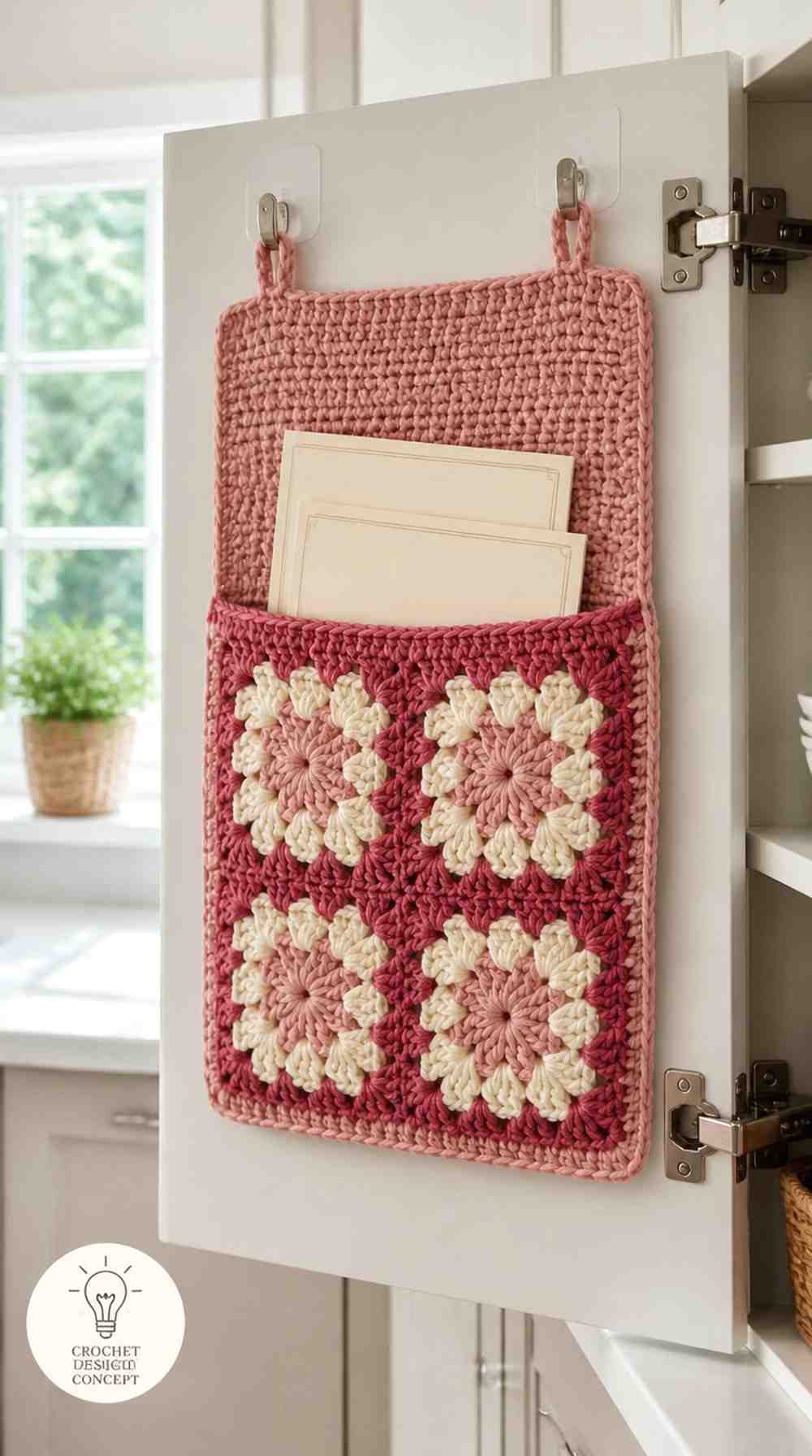
Dusty-blush crochet forms the backing of this decorative meal planner pocket, while four miniature granny squares cover the front compartment. Each square has a blush center, ivory middle round and raspberry edging. The squares are joined over a solid blush lining, giving the pocket a textured appearance without leaving open holes behind the cards.
This design combines traditional granny-square crochet with a practical storage shape. The solid lining matters because small paper corners could otherwise slip through the open spaces of decorative crochet motifs.
- Solid backing: A continuous crochet lining beneath the granny squares keeps the pocket more suitable for holding loose cards than open motifs alone.
- Flat motif joins: Joining the four squares neatly can reduce bulky ridges that might make the front pocket twist or hang unevenly.
- Color coordination: The raspberry borders can be matched with other small kitchen accents without changing the pocket’s basic rectangular construction.
7. Crochet Teal Dowel-Hung Meal Planner Pocket
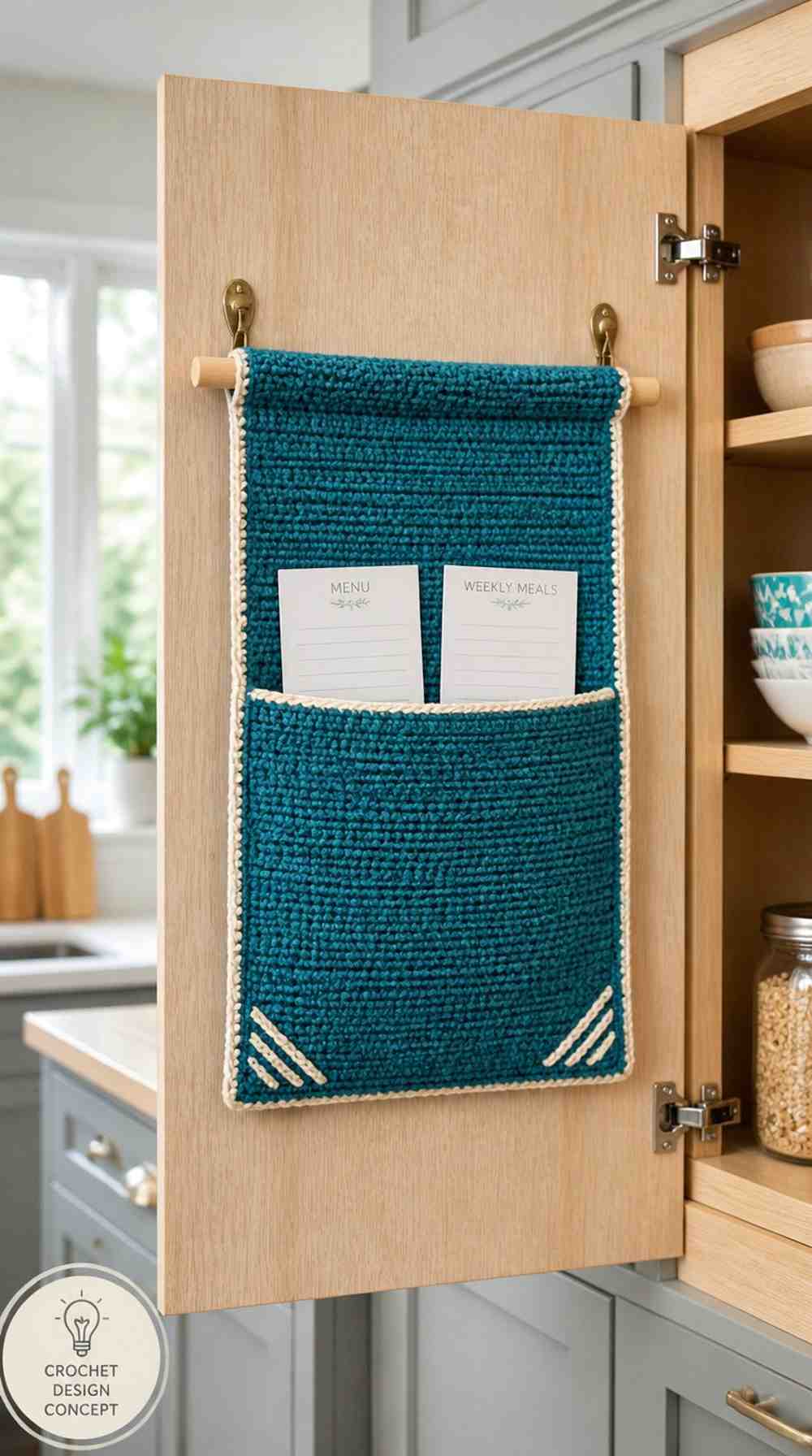
Deep-teal crochet gives this organizer a strong, simple appearance. A natural-wood dowel runs through the reinforced upper channel, while a broad front pocket holds two blank menu cards. Narrow cream edging defines the pocket opening, with small matching accents at the lower corners.
The dowel is the main structural feature. Rather than relying on two separate crochet loops to carry the fabric, it spreads the hanging support across the top panel. However, the supporting hooks must be compatible with the cupboard and the intended lightweight load.
- Dowel support: A suitable small dowel may help distribute the fabric’s weight along its upper edge and reduce sagging between the mounting points.
- Hook position: Place the supports far enough apart to hold the dowel level, without interfering with hinges or interior shelves.
- Removal for cleaning: Choose a dowel arrangement that allows the crochet panel to be taken down without forcing or damaging the mounting hardware.
8. Crochet Charcoal Slim Door Planner Pocket
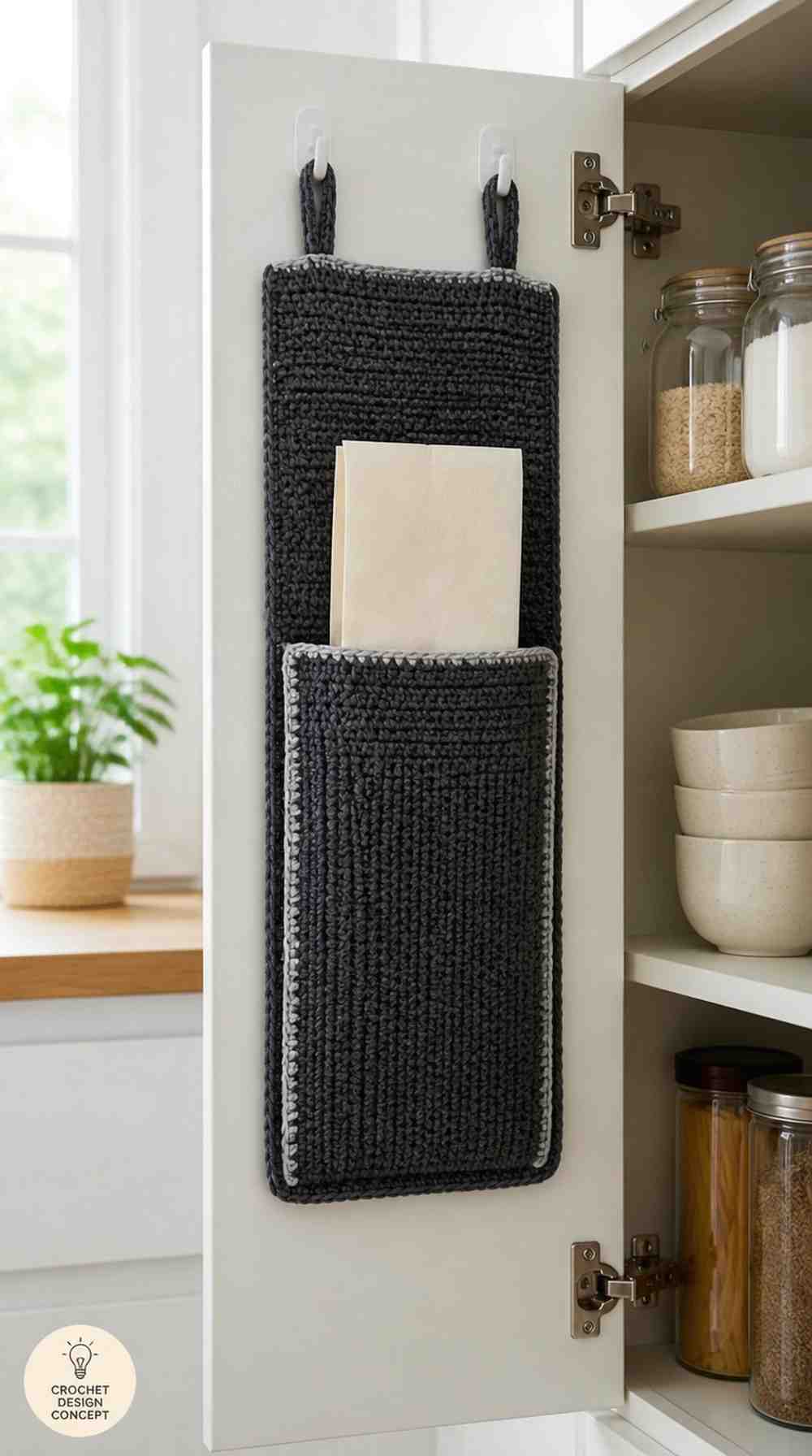
Charcoal-gray crochet creates a narrow, vertically shaped pocket designed for a slim kitchen cupboard door. Pale-gray edging frames the tall front compartment, while a folded blank shopping-list sheet remains visible above the opening. The dense stitch texture keeps the organizer simple and understated.
This idea is useful when there is not enough room for a broad weekly planner panel. A narrow holder can still provide a familiar place for grocery reminders, although larger recipe cards may need to be folded or stored elsewhere.
- Narrow-door fitting: Measure the clear space between the cupboard’s hinges, raised trim and door edges before deciding the organizer’s width.
- Paper size: Use shopping-list sheets that fit naturally inside the compartment rather than forcing oversized paper into a tight pocket.
- Hanging height: Position the holder where the list can be reached without placing the organizer against nearby shelves or stored containers.
9. Crochet Peach Button-Flap Menu Pocket
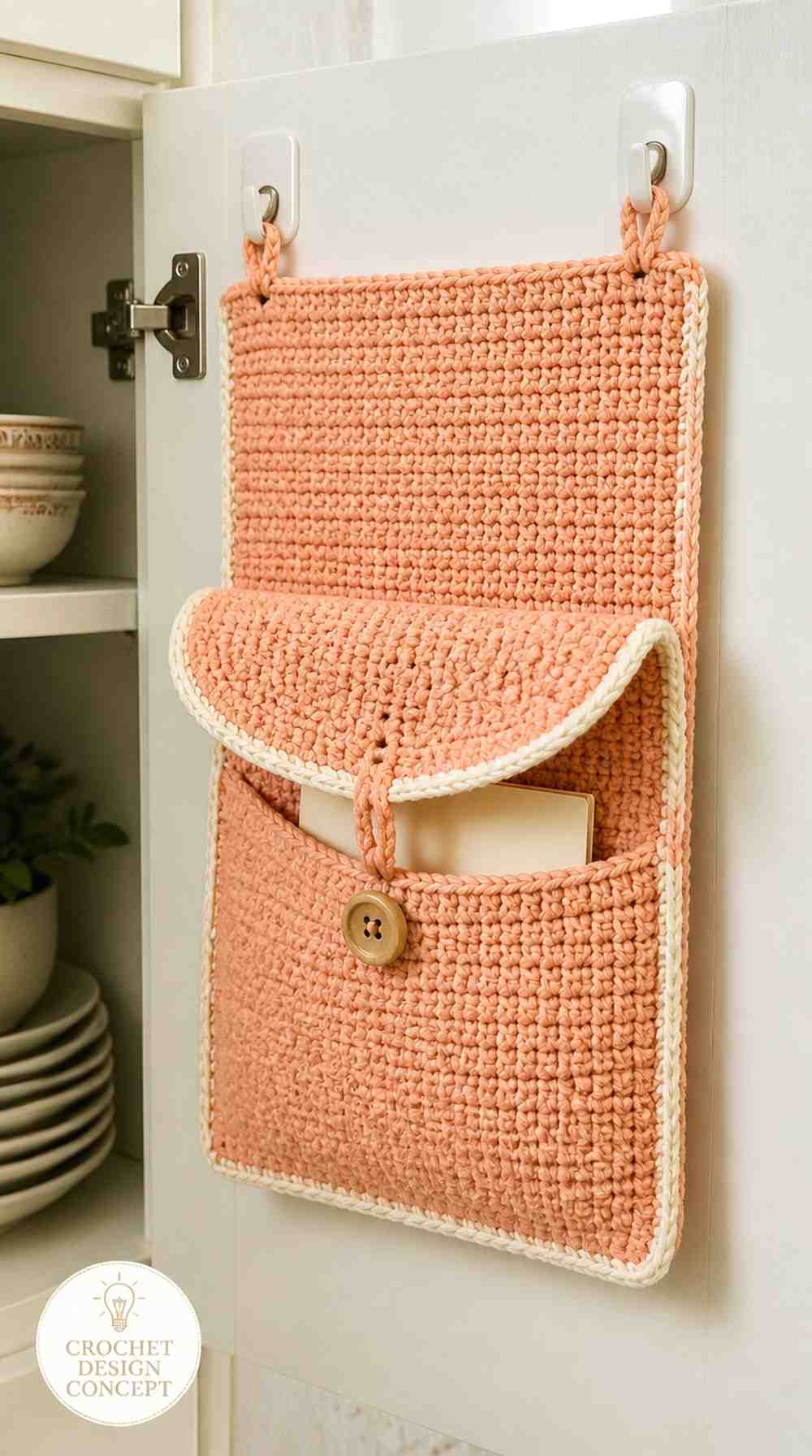
Soft-peach crochet gives this meal planner holder a gentle, tidy appearance. A rounded foldover flap covers the lower pocket, with an ivory crochet border outlining its shape. One small tan wooden button secures the flap through a matching peach loop, while a cream menu card rests inside.
The covered opening offers a different experience from the open-top pocket designs. It can conceal cards neatly when the planner is not being used, though the button introduces an extra step whenever someone wants to check or change the contents.
- Flap overlap: Keep the rounded flap long enough to cover the pocket opening without making it difficult to lift.
- Button placement: Sew the wooden button securely and position it away from areas where it might rub against the cupboard frame.
- Card access: Leave enough room beneath the flap so a menu card can be removed without pulling on the crochet button loop.
10. Crochet Indigo Diagonal-Opening Planner Pocket
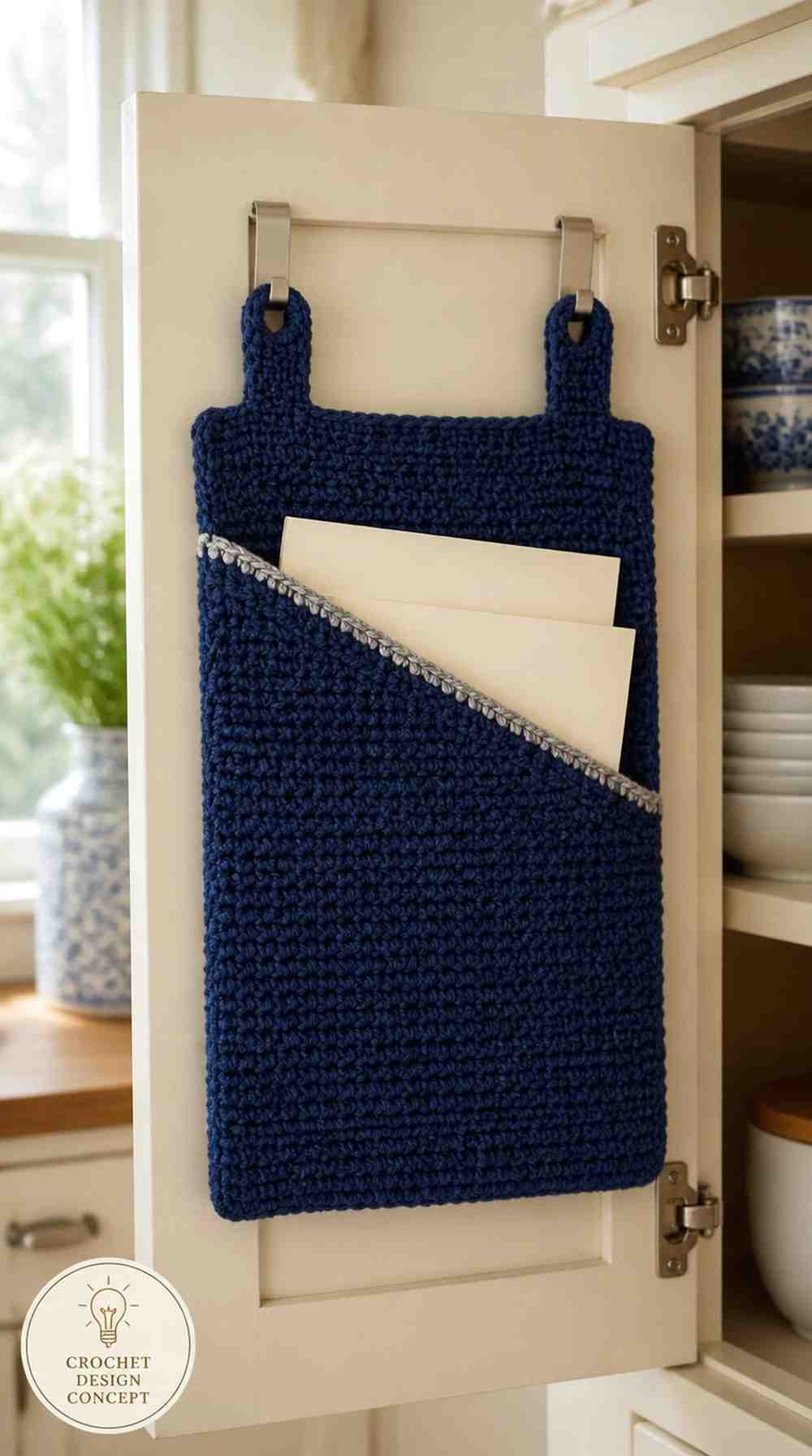
Deep-indigo crochet creates a simple rectangular organizer with one unusual feature: the pocket opening slopes diagonally from higher on the left to lower on the right. Thin silver-gray crochet edging follows the slanted upper line, while two cream recipe cards sit inside the compartment.
The diagonal opening makes the design visually distinctive and may help make the card corners easier to reach from one side. However, the lower end of the opening provides less coverage, so the pocket should be deep enough to keep its contents from sliding outward.
- Diagonal slope: A moderate angle can improve access without leaving most of a recipe card exposed.
- Side coverage: Keep the lower opening side sufficiently high and securely joined so the cards remain supported when the cupboard door moves.
- Card orientation: Arrange the paper with its upper corners above the slanted edge, making each card easier to grasp without pulling the whole pocket forward.
11. Crochet Butter Yellow Twin-Depth Holder
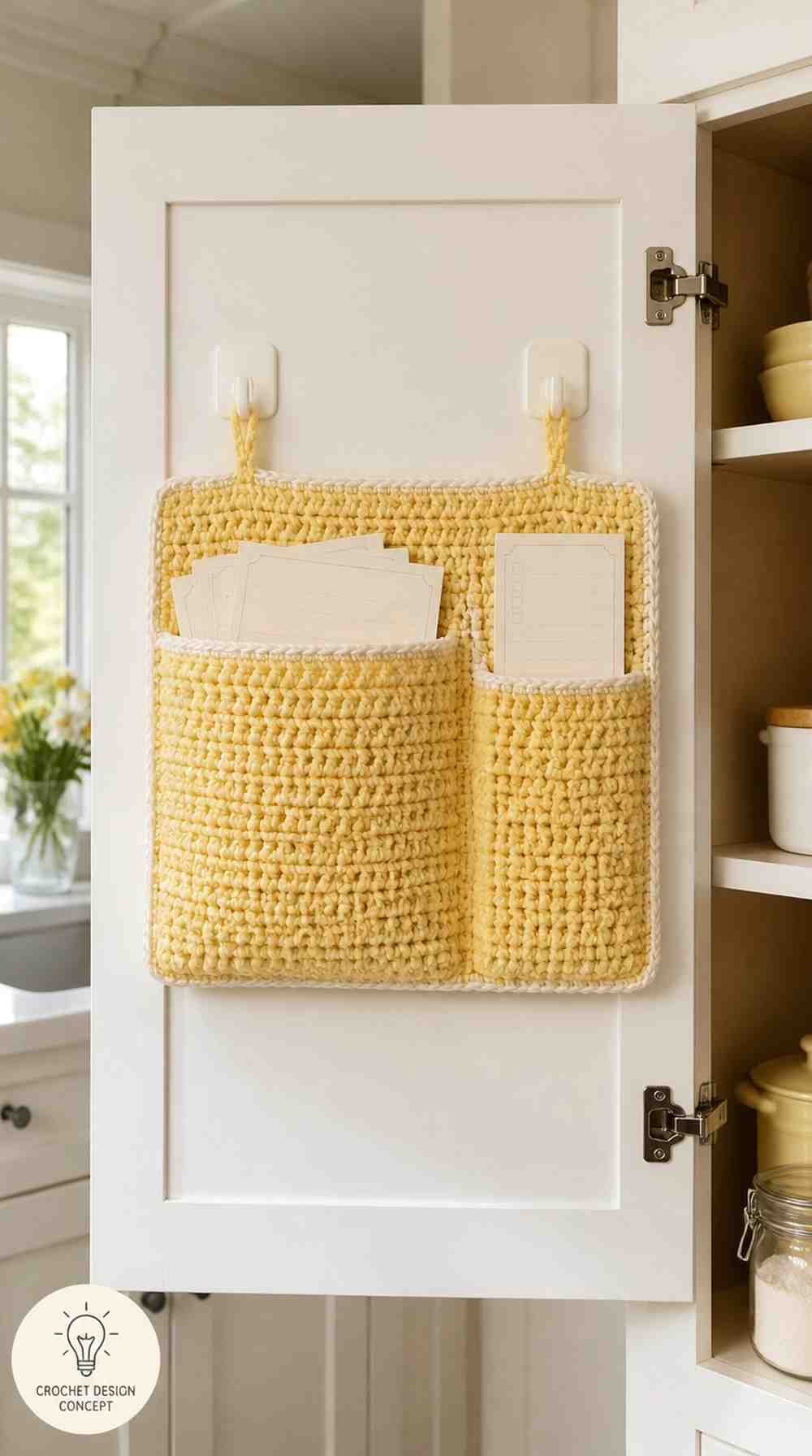
Soft butter-yellow crochet creates two unequal storage compartments on one rectangular hanging panel. The left pocket is deeper and wider, holding several cream recipe cards, while the right is shallow and narrow for smaller grocery reminder slips. Warm-ivory edging frames both openings.
This design separates cards by size rather than giving both compartments equal proportions. It could work well for someone who saves meal ideas on larger cards but writes grocery reminders on smaller pieces of paper.
- Unequal storage sizes: Measure the larger recipe cards first, then use the remaining width for the smaller note compartment.
- Shallow pocket purpose: A shorter pocket keeps small reminder slips visible instead of allowing them to disappear inside a deep pouch.
- Central seam: Reinforce the shared joining line so the filled larger pocket does not pull the narrower one out of shape.
12. Crochet Burgundy Three-Meal Tab Pockets
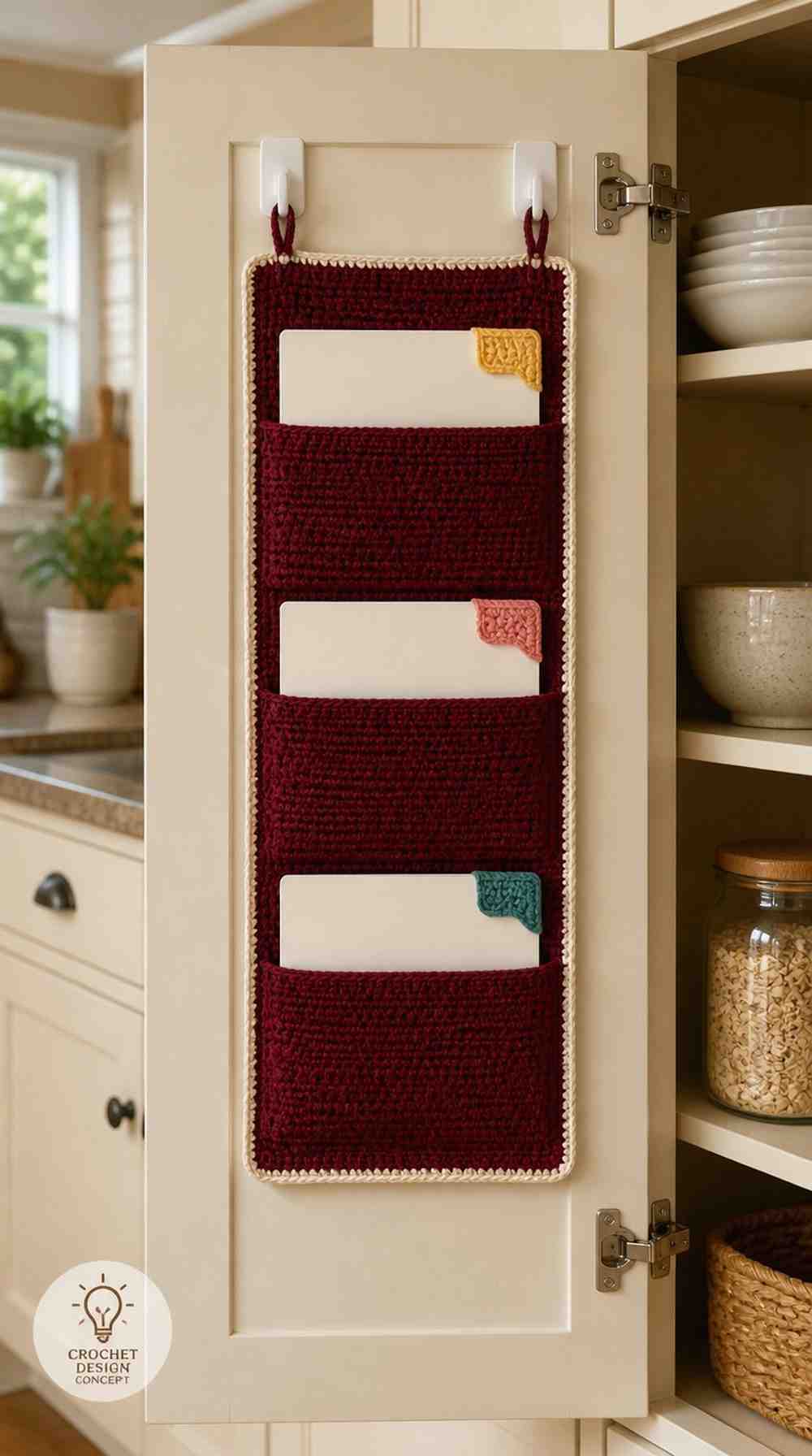
Burgundy crochet forms three equal horizontal pockets arranged vertically on one hanging panel. Each pocket holds a blank ivory meal-planning card, with a small colored crochet tab attached to its upper-right corner. The tabs appear in butter-yellow, dusty-rose and muted-teal, creating three clearly different markers.
The color-coded tabs make this design especially useful for separating three categories of meal ideas. They can represent breakfast, lunch and dinner without requiring permanent lettering on the crochet organizer.
- Colored tabs: Assign a consistent purpose to each tab color so the cards remain easy to identify even when the organizer is viewed quickly.
- Card exposure: Leave the colored tabs visible above the pockets, but keep most of each card supported within the crochet fabric.
- Tier alignment: Position all three openings evenly so the organizer remains balanced when cards are inserted and removed.
13. Crochet Moss Modular Detachable Pocket Set
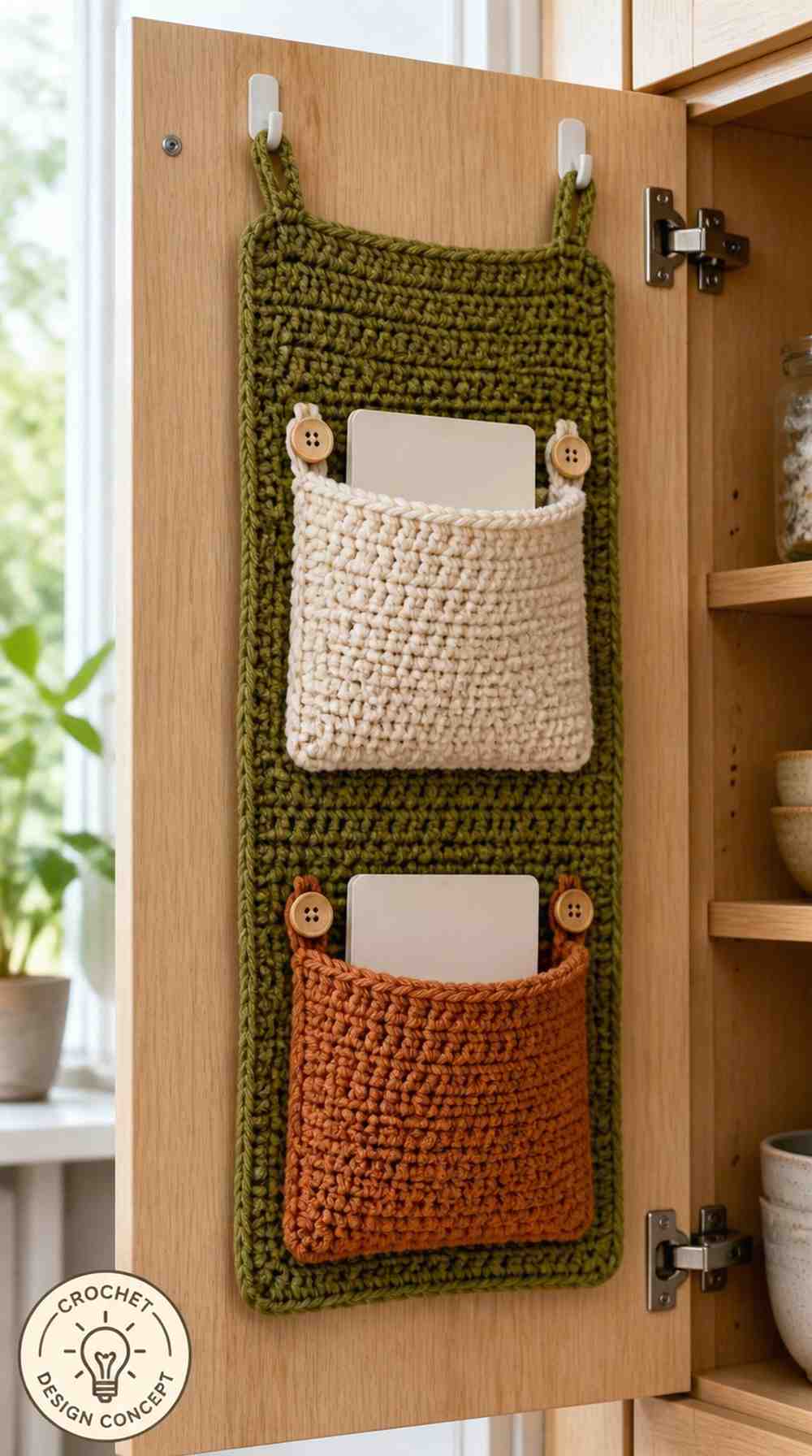
Moss-green crochet forms the backing of this modular kitchen organizer. Two smaller pockets attach vertically to the panel, with a warm-ivory upper pocket and a muted-terracotta lower pocket. Each compartment uses small crochet button tabs and flat wooden buttons to connect to the backing.
The detachable arrangement provides more flexibility than permanently joined pockets. One compartment could be removed or changed without replacing the whole backing, although the attachment points need to remain secure during normal cupboard-door movement.
- Removable components: Separate pockets allow different card groups to be rearranged, provided each section fits the backing’s button positions.
- Button-tab strength: Reinforce the tabs and button attachments so repeated opening and removal do not stretch the crochet loops.
- Lightweight use: Reserve the detachable pockets for paper cards and similarly light items instead of heavy kitchen tools or containers.
14. Crochet Rust Lattice-Overlay Planner Pocket
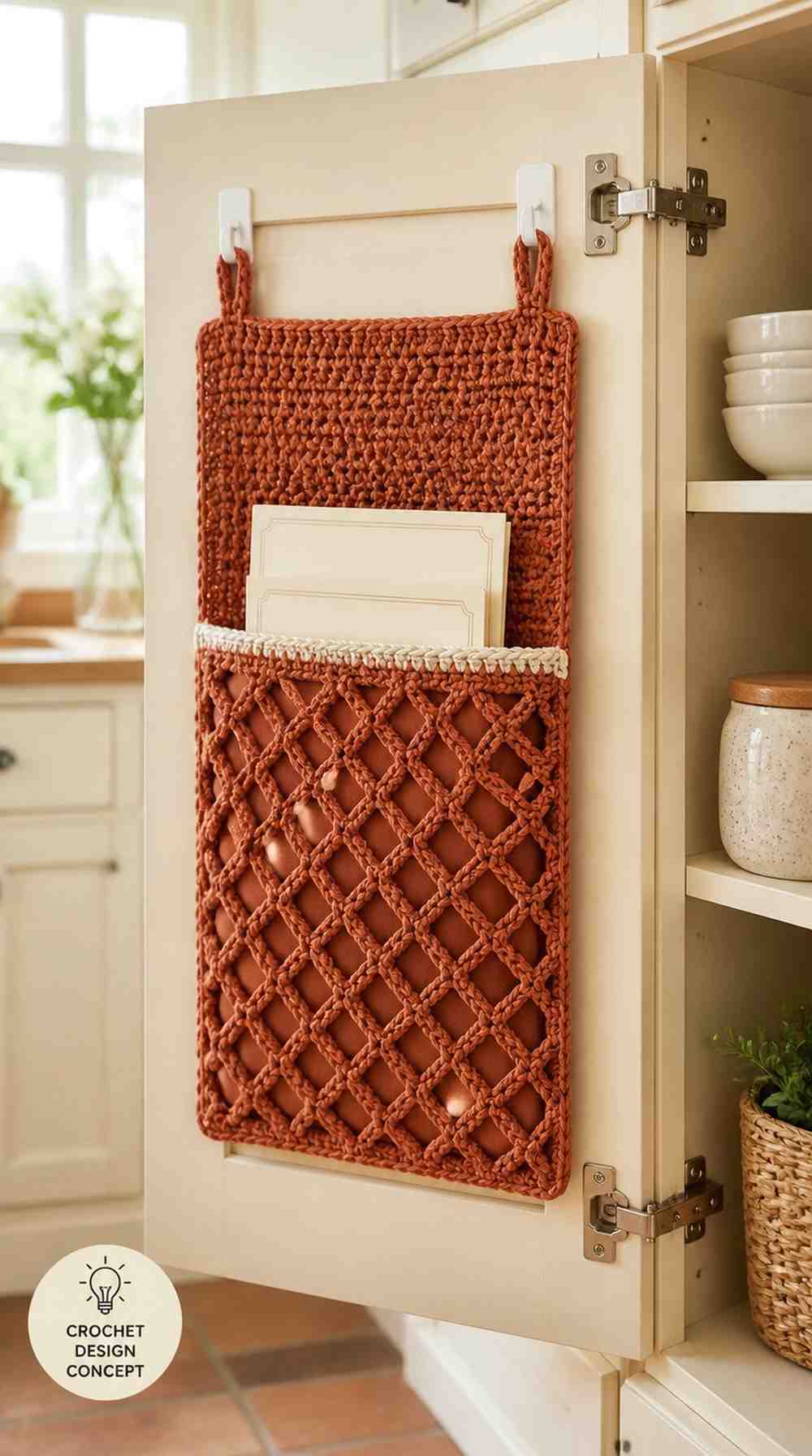
Warm-rust crochet gives this hanging meal planner a textured front surface. A diamond-shaped lattice layer sits over the solid lower pocket lining, with an oatmeal crochet border along the upper opening. Two ivory recipe cards peek out of the compartment.
The lattice makes the pocket look open and decorative, but the continuous inner lining keeps paper from slipping through the diamond spaces. This is a useful combination for someone who likes openwork crochet yet wants a more practical card holder.
- Lattice construction: Keep the diamond chains evenly connected so the decorative front does not sag into irregular loops.
- Solid inner pocket: A closely worked lining provides a continuous surface behind the cards, unlike an entirely open crochet mesh.
- Pocket thickness: Two layers of crochet can add bulk, so use a modest yarn weight if the cupboard has limited clearance behind the door.
15. Crochet Denim Over-Door Strap Pocket
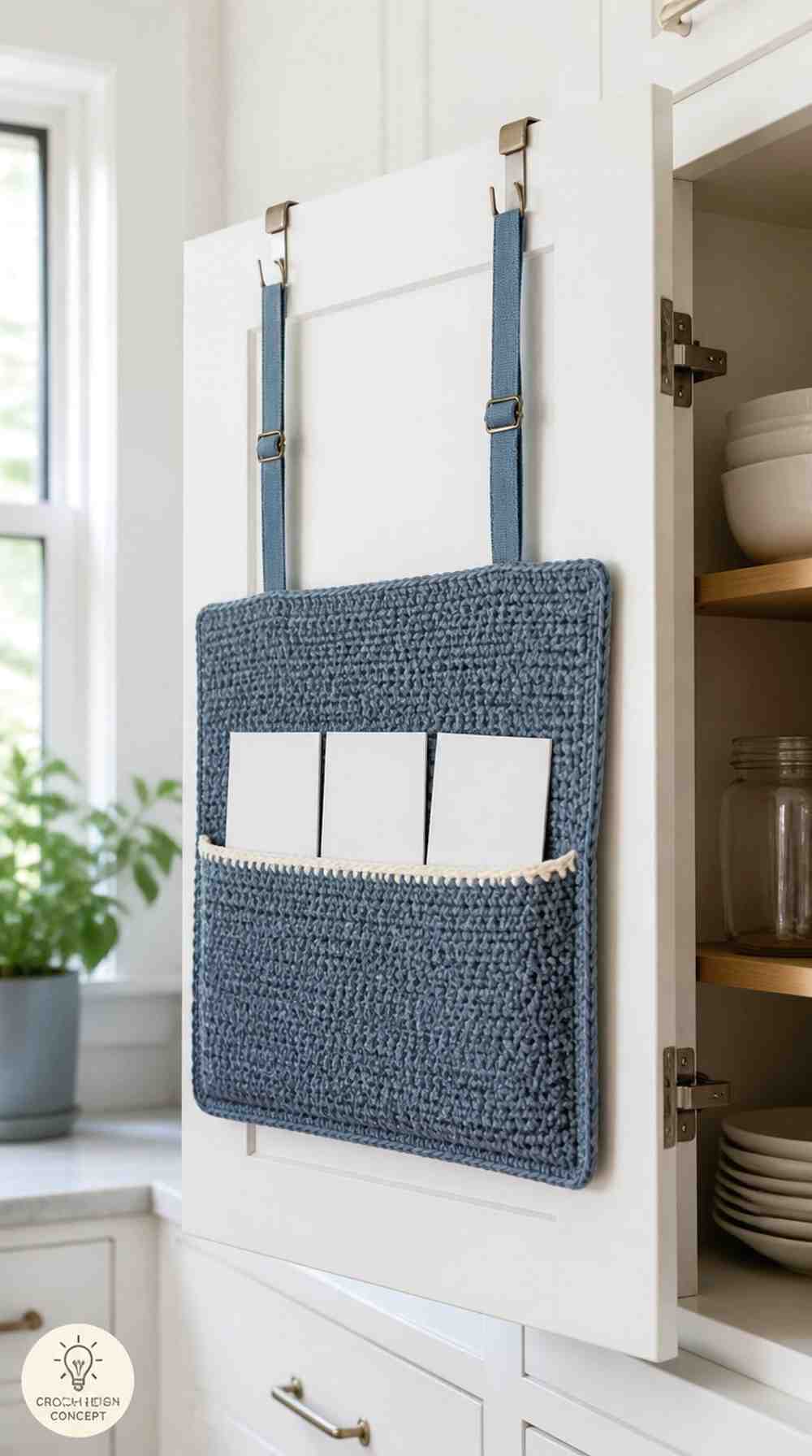
Dusty-denim-blue crochet forms a simple rectangular pocket with a cream-trimmed upper opening. Two fabric straps extend from its top and connect to slim padded hooks resting over the cupboard door’s upper edge. Three blank planning cards sit inside the shallow compartment.
This design explores hanging without attaching hooks directly to the door face. However, over-door hardware is not suitable for every cupboard. The door thickness, top clearance and surrounding frame must be checked carefully before using this kind of arrangement.
- Over-door hook clearance: Confirm the hooks fit the actual cupboard door and allow it to close normally without force, scraping or pressure against the frame.
- Strap positioning: Keep both straps evenly spaced so the crochet backing hangs straight rather than shifting to one side.
- Finish protection: Use compatible padded hardware and inspect for rubbing or marks; a removable hook does not automatically mean damage-free installation.
16. Crochet Turquoise Seven-Day Card Slots
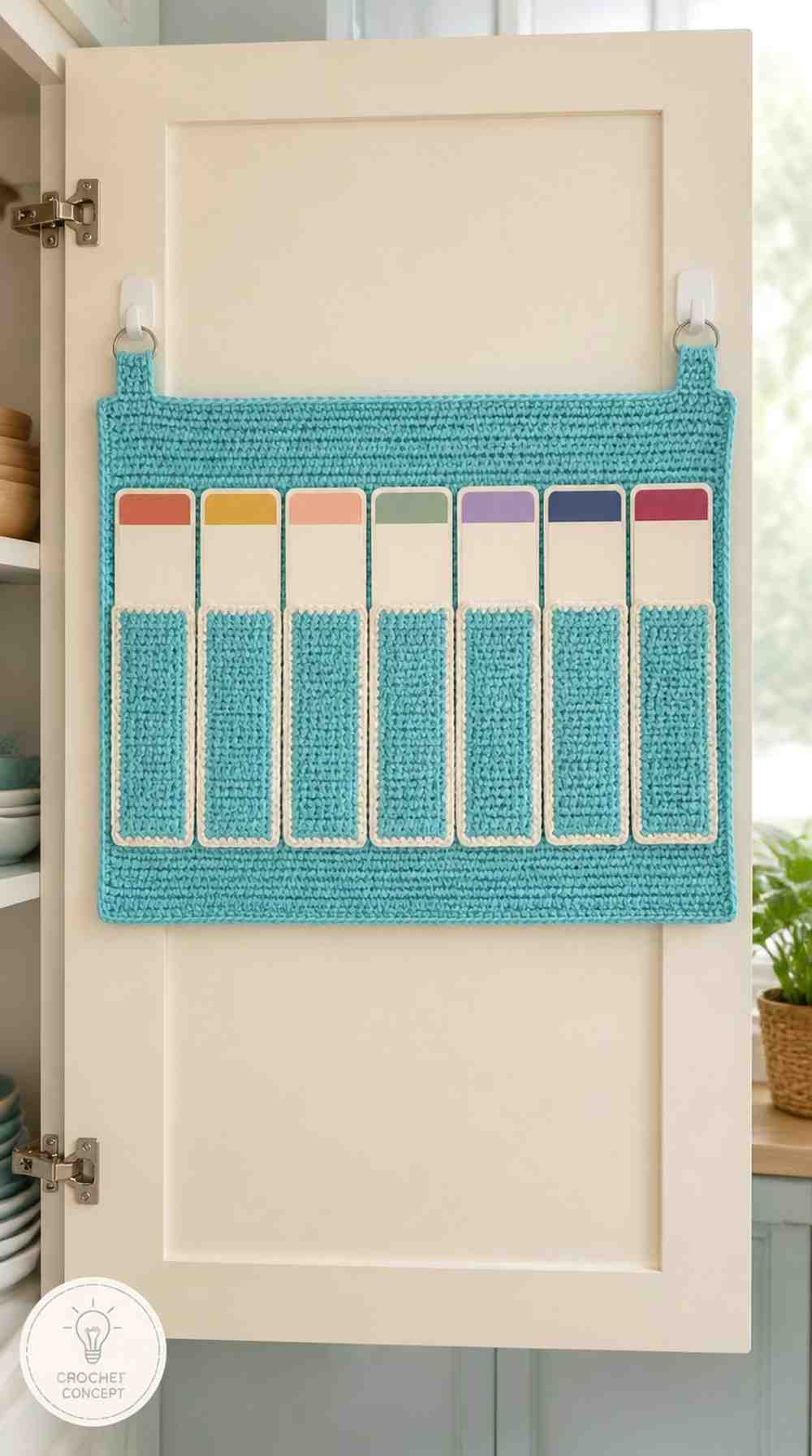
Aqua-turquoise crochet creates a wide rectangular organizer with seven narrow vertical card sleeves arranged side by side. Each sleeve has ivory edging and holds a slim blank card. Seven different colored crochet tabs rise above the openings, giving the collection a clear weekly-planning appearance.
The seven-slot arrangement is the most specialized meal planner in this collection. It gives each day its own small space, but the layout needs a sufficiently wide cupboard door and narrow cards that remain easy to remove.
- Seven-slot spacing: Divide the available panel width carefully, leaving room for the seven pocket seams as well as the cards themselves.
- Daily card tabs: Different colors can identify the days through a personal system, but consistency matters more than a particular color sequence.
- Cupboard width: Check that all seven compartments fit on the door without extending into the hinges, raised trim or closure area.
Practical Guide to Crochet Cupboard Door Meal Planner Pockets
Measure the door and its clearances. Before planning a hanging crochet organizer, measure the usable flat area of the cupboard door. Check the hinges, shelves, handles and surrounding frame. An organizer that looks flat when empty can project farther once cards or a notepad are added. Open and close the door slowly to ensure nothing catches.
Choose an appropriate mounting method. Removable adhesive hooks, suitable over-door hooks or existing approved supports may work in different kitchens. Follow the specific hardware manufacturer’s surface, weight and removal instructions. Do not assume adhesive mounting is suitable for every paint, varnish or laminated door, and never force the door closed against hooks.
Keep the crochet pockets shallow. Meal cards, grocery slips and thin notepads are relatively light. Wide, deep pockets may stretch unnecessarily when filled, while shallow openings keep paper more visible. Closely worked crochet and reinforced upper borders may help maintain the shape, but actual stability depends on the yarn and construction.
Consider paper size and moisture. Measure the cards or planner sheets you intend to store. Keep the organizer away from sink splashes, steam, greasy cooking areas and damp cupboard interiors. Paper can absorb moisture, and yarn should be cleaned according to its care instructions.
Make it easy to remove. A hanging organizer should come down without damaging the door or mounting hardware. Removable construction is useful for washing the crochet, reorganizing cards or accessing the full cupboard interior.
Avoid heavy contents. These concepts are designed for lightweight paper organization, not jars, utensils, cleaning bottles or heavy cookbooks. Excessive weight can stretch the crochet and place unnecessary stress on the cupboard door or its fittings.
Want to Make Something Similar?
These tutorials explain related crochet pocket-making techniques. They are not exact patterns for the 16 cupboard-door meal planner concepts illustrated here.
- Free Wall Pocket Organizer Crochet Pattern — Fresh Knack — A free pattern explaining how a rectangular crochet panel, folded sections and a wooden dowel can become a hanging pocket organizer. Useful for studying the broad-pocket and dowel-supported concepts.
- Crochet Wall Pocket Organizer — CyCrochet — A free written pattern with diagrams showing a flat back panel, a folded front pocket and a hanging loop. Especially relevant to the simple single-pocket designs.
For a broader range of hanging storage shapes, see 20 Crochet Hanging Wall Pocket Organizer Ideas on Yarn Nest Studio. Those ideas are for general wall storage rather than specifically for meal planning, but they offer useful inspiration for pocket layouts and decorative finishes.
Which Crochet Meal Planner Pocket Should You Choose?
| Main priority | Designs to consider | Important trade-off |
|---|---|---|
| Simple everyday card storage | Oatmeal Single Wide, Terracotta Scalloped | One compartment does not separate different note types |
| Separate menu and grocery notes | Navy Dual-Column, Butter Yellow Twin-Depth | Requires more width and additional seams |
| Weekly planning | Sage Three-Tier, Turquoise Seven-Day | More compartments need careful sizing |
| Decorative cottage style | Blush Granny-Square, Rust Lattice-Overlay | Extra layers and joins may add bulk |
| Pencil storage | Mustard Pencil-Side | Pencil sleeve needs secure fitting |
| Narrow cupboard doors | Charcoal Slim, Indigo Diagonal-Opening | Smaller usable card capacity |
| Covered cards | Peach Button-Flap | Button closure adds an extra step |
| Modular storage | Moss Detachable Pocket Set | Requires secure removable fasteners |
| Dowel support | Teal Dowel-Hung | Needs compatible mounting points |
| Over-door hanging | Denim Over-Door Strap | Door clearance and finish must be checked |
| Separate meal categories | Burgundy Three-Meal Tab | Requires a consistent card-labeling system |
If you want one place to store a few recipe or meal cards, the Oatmeal Single Wide and Terracotta Scalloped designs are straightforward choices.
For a more organized weekly system, the Sage Three-Tier or Turquoise Seven-Day arrangement provides distinct storage spaces. The Turquoise version is more specific to daily planning, while the Sage organizer leaves more flexibility for different card groupings.
For small cupboards, a narrow organizer such as the Charcoal Slim design may be more practical than trying to fit several large compartments onto a limited door surface.
Conclusion
Crochet cupboard door meal planner pockets offer a creative way to organize recipe cards, shopping reminders and everyday meal ideas without taking up valuable countertop space. From simple oatmeal pockets and scalloped terracotta edges to buttoned flaps, granny-square details and seven-day card slots, these 16 concepts explore a wide variety of useful shapes. The best design is one that fits your cupboard door, holds the paper you actually use and stays easy to remove for cleaning. A carefully placed organizer can make your weekly planning routine feel a little more manageable.
Which design would you choose for your kitchen? Would you prefer one large pocket for all your meal cards, separate grocery-list storage, three color-coded meal sections or a seven-day planner? Share your favorite idea and how you currently keep track of meals and shopping notes.
Frequently Asked Questions
1. Can I hang a crochet meal planner pocket inside a kitchen cupboard door?
Yes, a lightweight crochet organizer may be suitable if the cupboard has enough room and the mounting method is compatible with the door. Measure the clear area, check the hinges and shelves, and make sure the cupboard opens and closes normally. Avoid mounting anything that damages the door or creates new resistance.
2. What yarn is best for crochet meal planner pockets?
Smooth cotton yarn is one option because it can show stitches clearly and create a flexible but relatively neat pocket surface. The exact choice depends on the required structure, care instructions and the size of the organizer. A closely crocheted fabric may hold paper more neatly than large openwork, but it can still stretch.
3. How do I keep a crochet meal planner pocket from sagging?
Start with a suitable yarn, consistent stitch tension and a properly reinforced upper border. For wider organizers, a dowel or an appropriately designed support panel may help distribute the weight. Avoid overfilling the pockets, especially with heavy notepads or bulky stationery. The finished structure should be tested before regular use.
4. Will removable hooks damage my cupboard door?
Some removable hooks are designed for particular finished surfaces, but no mounting method should be assumed completely damage-free. The result depends on the adhesive or hook type, the door material, surface preparation, load and removal method. Follow the hardware manufacturer’s instructions and avoid any hook that interferes with the cupboard closing.
5. Are these 16 crochet cupboard door meal planner pockets available as patterns?
No. These are original crochet design visualizations intended to inspire different pocket arrangements, colors, trims and hanging methods. They are not tested handmade items or complete crochet patterns. The linked tutorials explain related hanging-pocket construction techniques, but they do not reproduce the illustrated meal planner concepts exactly.