A crochet playing card discard pocket can give used cards a dedicated place during family game night. When several people share a table, the draw pile and discarded cards can easily become mixed together, especially during games with frequent turns. These 18 crochet inspiration ideas explore shallow tabletop trays, hanging card pockets, divided organizers, fold-flat holders and decorative containers that make it easier to keep card piles separate.
Some designs are intended for a single discard pile, while others offer two compartments for games that require different stacks. You’ll find simple low-profile holders, colorful granny-square trays, compact pockets for smaller tables and removable options that can be put away between game nights. The most useful choice depends on the card size, your game’s rules, the number of players and how often the discarded pile needs to be picked up or reshuffled.
These are AI-generated crochet design visualizations for inspiration, not photographs of tested handmade pieces or step-by-step patterns.
Quick Design Selection Guide
- For simple family card games: Crochet Terracotta Low-Lip Playing Card Discard Tray and Crochet Dusty Rose Petal-Rim Discard Bowl offer open tabletop storage.
- For keeping draw and discard piles separate: Crochet Indigo Split Draw-and-Discard Organizer and Crochet Pearl Gray Two-Level Card Sorting Dock provide distinct sections.
- For smaller gaming tables: Crochet Pine Checkerboard Card-Box Sidecar Pocket and Crochet Mustard Table-Edge Strap-On Card Pocket explore attached storage.
- For decorative game-night accessories: Crochet Plum Granny-Square Playing Card Discard Tray, Crochet Cherry Gingham Foldover Discard Envelope and Crochet Coral Fan-Rim Card Discard Basket bring colorful crochet details.
- For easy storage between games: Crochet Oatmeal Snap-Corner Fold-Flat Discard Tray and Crochet Lavender Reversible Card-Pile Tray offer flexible designs.
- For collecting cards upright: Crochet Espresso Ribbed Upright Discard Bin, Crochet Slate Angled Easel Discard Pocket and Crochet Cornflower Lift-Tab Discard Sleeve use different card-access arrangements.
1. Crochet Terracotta Low-Lip Playing Card Discard Tray
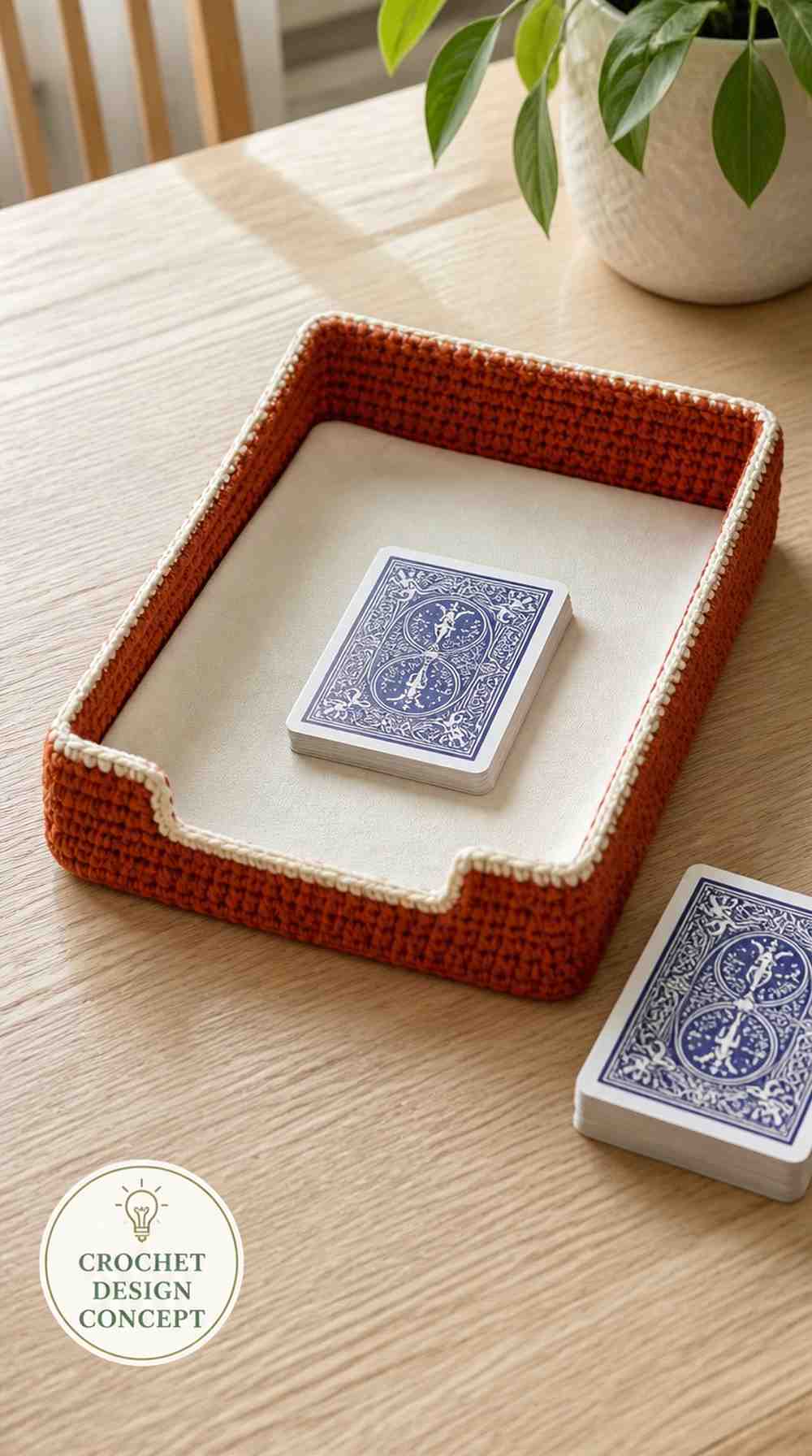
Burnt-terracotta crochet gives this shallow rectangular discard tray a warm, simple appearance. Closely worked horizontal stitches create its raised sides, while cream edging follows the rim. A gently curved low front edge and smooth ivory lining make the open center easy to reach.
The tray holds a small face-down pile of playing cards on a family game table. Its low profile provides a straightforward way to identify the discard area without introducing tall walls or additional compartments.
- Low Front Opening: The curved front edge allows players to lift the discarded stack without reaching over a tall crochet wall.
- Flat Interior: A smooth lining helps keep card corners away from textured stitches, especially when the pile is gathered for reshuffling.
- Table Placement: Position the tray away from the draw deck and within comfortable reach of every player.
2. Crochet Indigo Split Draw-and-Discard Organizer
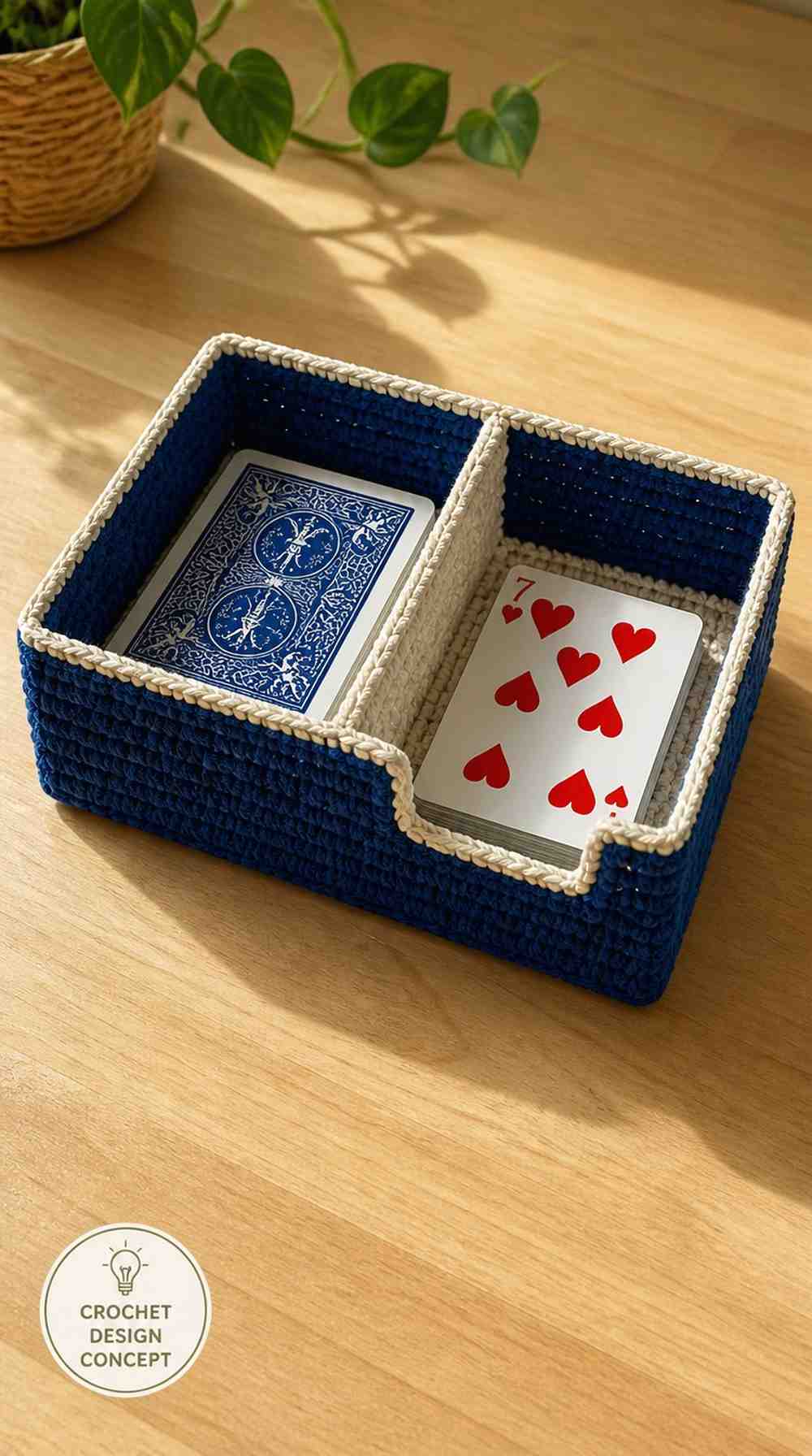
Deep-indigo crochet creates a rectangular tabletop organizer with two separate compartments. A cream center divider distinguishes the shallow left tray from the right section, which has a wider front opening. Oatmeal-colored edging and smooth cream lining finish the closely worked crochet body.
The illustrated arrangement keeps a face-down draw pile on one side and a face-up discard pile on the other. This design is particularly useful inspiration for games where both stacks must remain on the table throughout play.
- Center Divider: Keep the dividing wall firm and clearly visible so players do not accidentally place a card in the wrong section.
- Different Openings: The wider discard-side cutout makes collecting used cards easier, while the draw side retains a more contained stack.
- Game Rules: Some games use the discard pile differently. Check whether the two-pile arrangement suits the particular game before choosing this design.
3. Crochet Butter Yellow Scalloped Corner Card Scoop
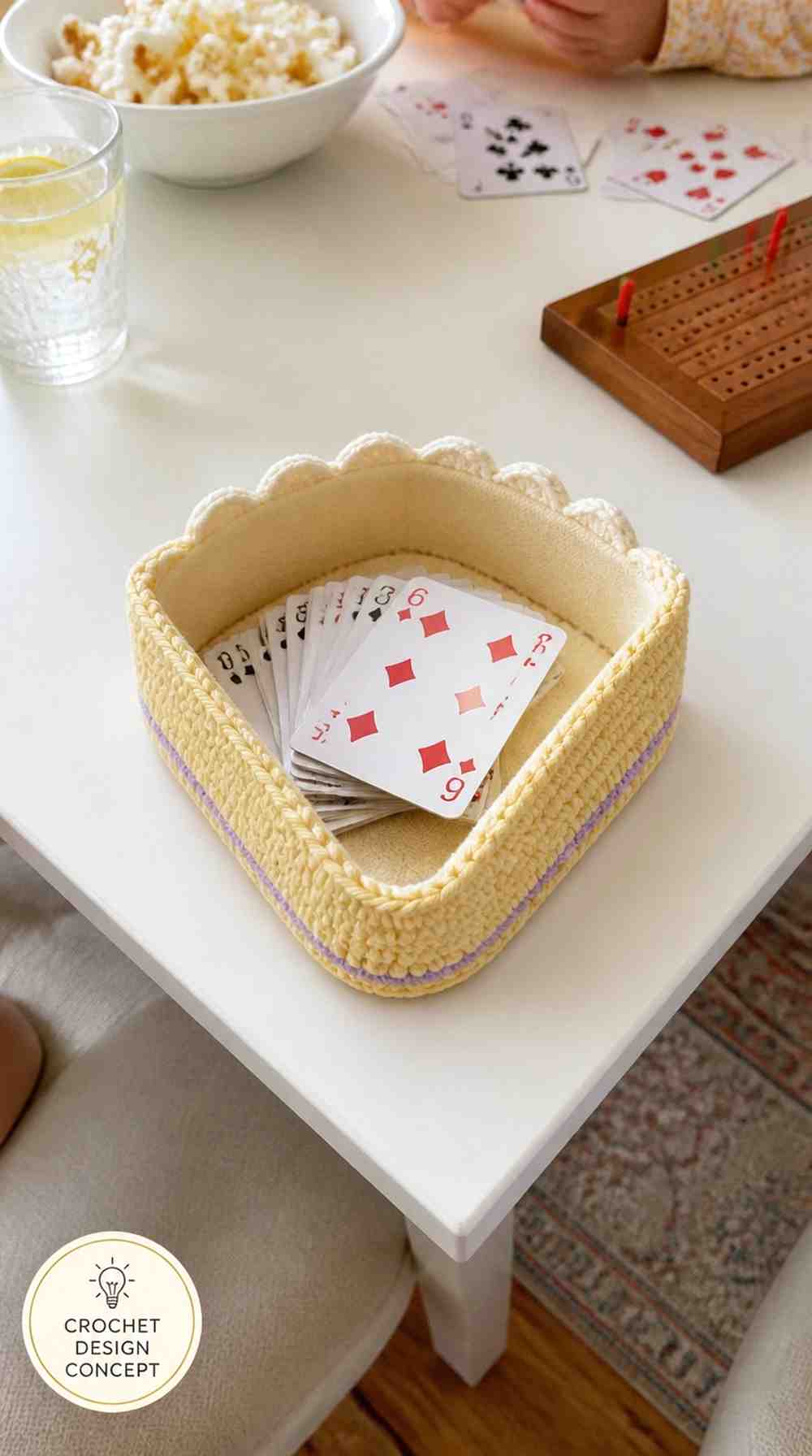
Butter-yellow crochet gives this compact discard scoop a cheerful appearance. Its triangular footprint has two raised back edges and a low rounded front point. Cream scallops decorate the outer upper rim, while a fine lilac stripe follows the lower border.
The cream-lined interior holds a neat face-up stack of playing cards. Its unusual corner shape could appeal to families who prefer to place the discard pile near an unused corner of the gaming table instead of in the middle.
- Corner Position: Check that the triangular tray sits securely on the table and does not extend beyond an edge.
- Scallop Placement: Keep the cream decorative loops on the outside so card corners do not catch when players remove the pile.
- Accessible Opening: The lowered front point makes the card stack easier to reach, although the opening must be wide enough for the actual deck.
4. Crochet Pine Checkerboard Card-Box Sidecar Pocket
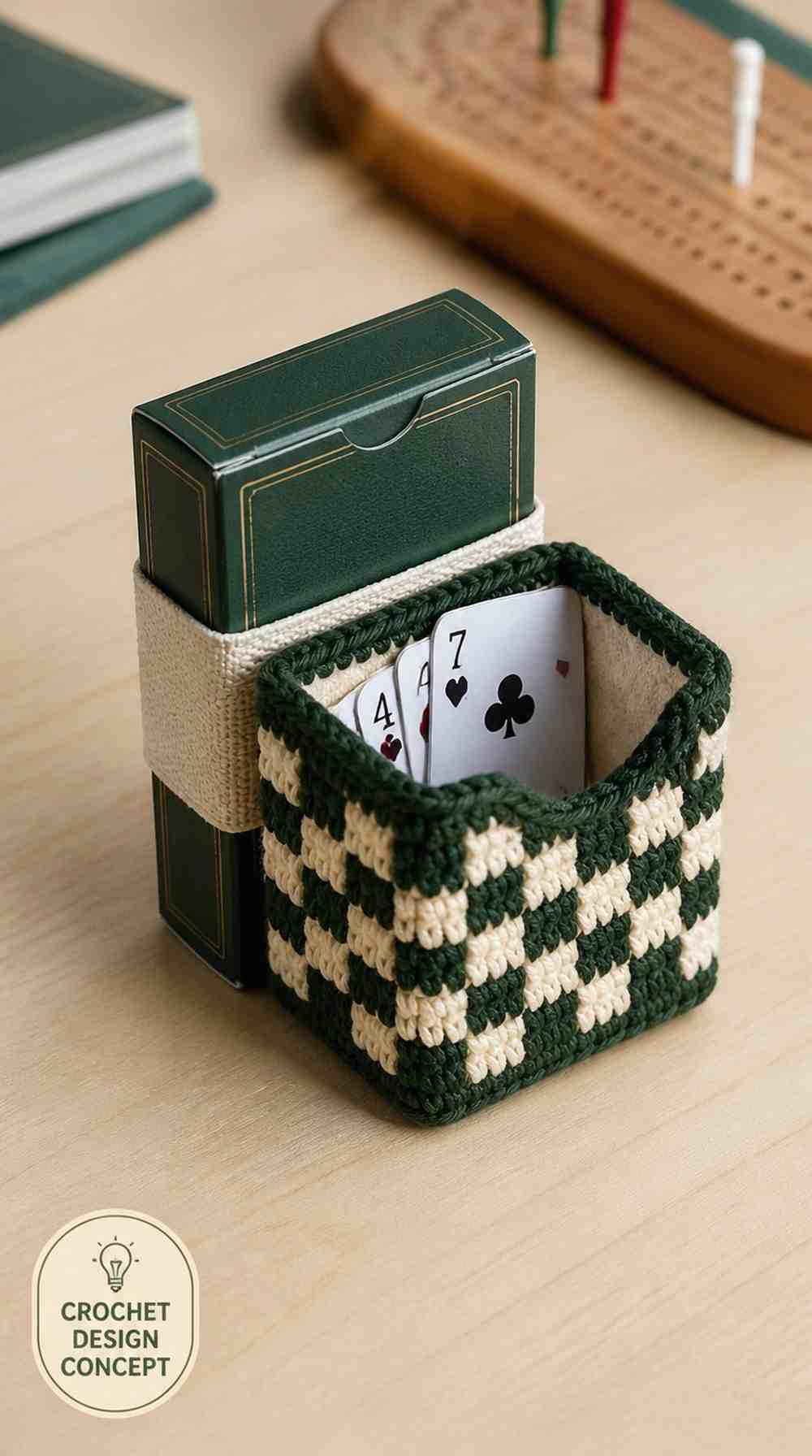
Pine-green and warm-cream checkerboard crochet creates a small rectangular sidecar pocket attached beside a rigid playing-card storage box. A broad fabric-backed band holds the pocket against the box, while the solid green rim and cream lining give the open compartment a neat finish.
A few discarded cards rest upright inside the pocket. The attached arrangement is the defining feature, allowing a compact discard area to sit beside the card box instead of using a separate large tray.
- Box Stability: The original card box must remain stable when the side pocket is filled. A light or empty box may tip under uneven weight.
- Removable Band: The cream-backed band should fit without crushing the box or preventing access to its closure.
- Pocket Depth: Keep the front sufficiently low for card removal while allowing enough side support to prevent the stack from falling outward.
5. Crochet Dusty Rose Petal-Rim Discard Bowl
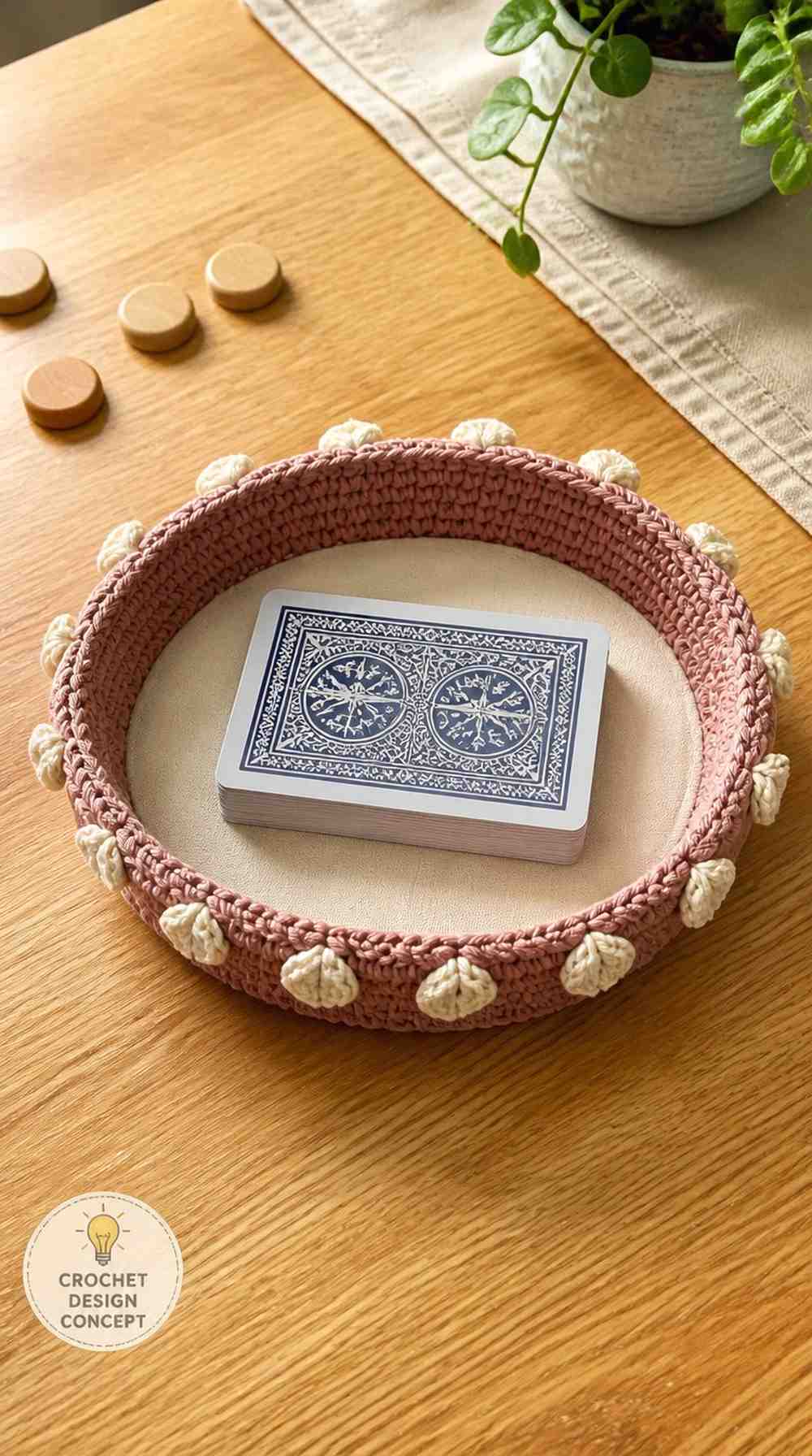
Dusty-rose crochet creates a shallow oval card bowl with gently sloping sides. Smooth cream lining covers the broad flat base, while small cream petal-shaped crochet details decorate the outside of the upper rim.
The open oval center holds a face-up pile of playing cards. Its softer shape offers a decorative alternative to a rectangular discard tray, particularly for a bright family game corner where the holder will remain visible between rounds.
- Oval Base: Allow enough flat interior space for the entire card stack. An overly curved base could bend card edges.
- Petal Decoration: Attach the cream petals securely outside the opening, where they are less likely to catch against cards.
- Stack Retrieval: The shallow rim should leave enough finger access to lift the whole discard pile when the game requires it.
6. Crochet Espresso Ribbed Upright Discard Bin
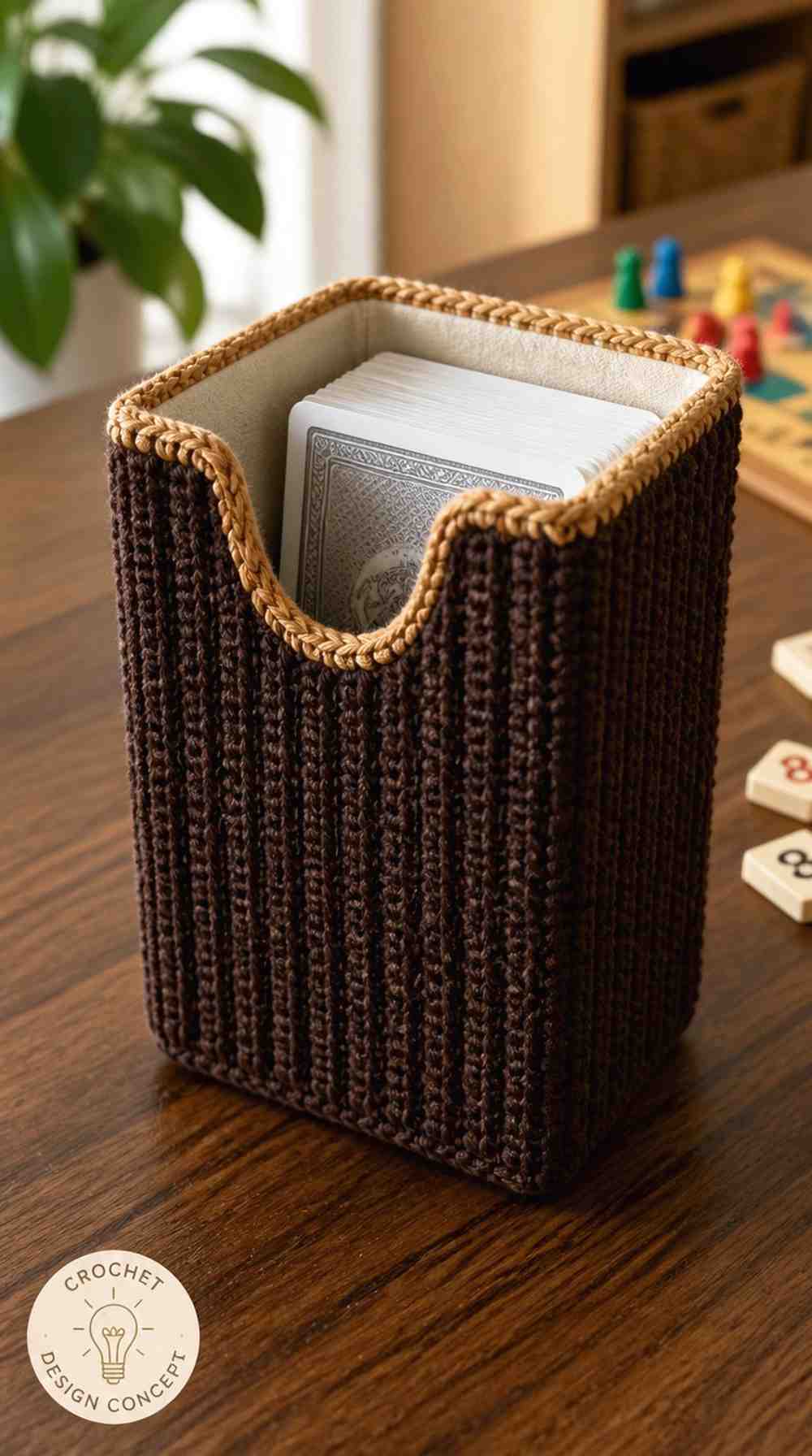
Espresso-brown crochet gives this compact upright bin a structured appearance. Closely spaced vertical ribs cover its tall rectangular sides, while a caramel upper rim provides contrast. A semicircular front thumb cutout reveals the card edges inside.
The bin holds a small stack of playing cards upright rather than flat. Its removable internal support gives the concept a more defined shape, making it worth considering for games where players want discarded cards contained in a narrow tabletop space.
- Thumb Cutout: The front notch should be wide enough to grip the cards without forcing them against the rim.
- Upright Support: A suitable removable inner support may be needed to keep the crochet sides straight without pressing against the cards.
- Card Access: Tall walls may make individual discards slower to place, so test the opening with the actual deck.
7. Crochet Sea Glass Linen-Backed Mesh Card Pocket
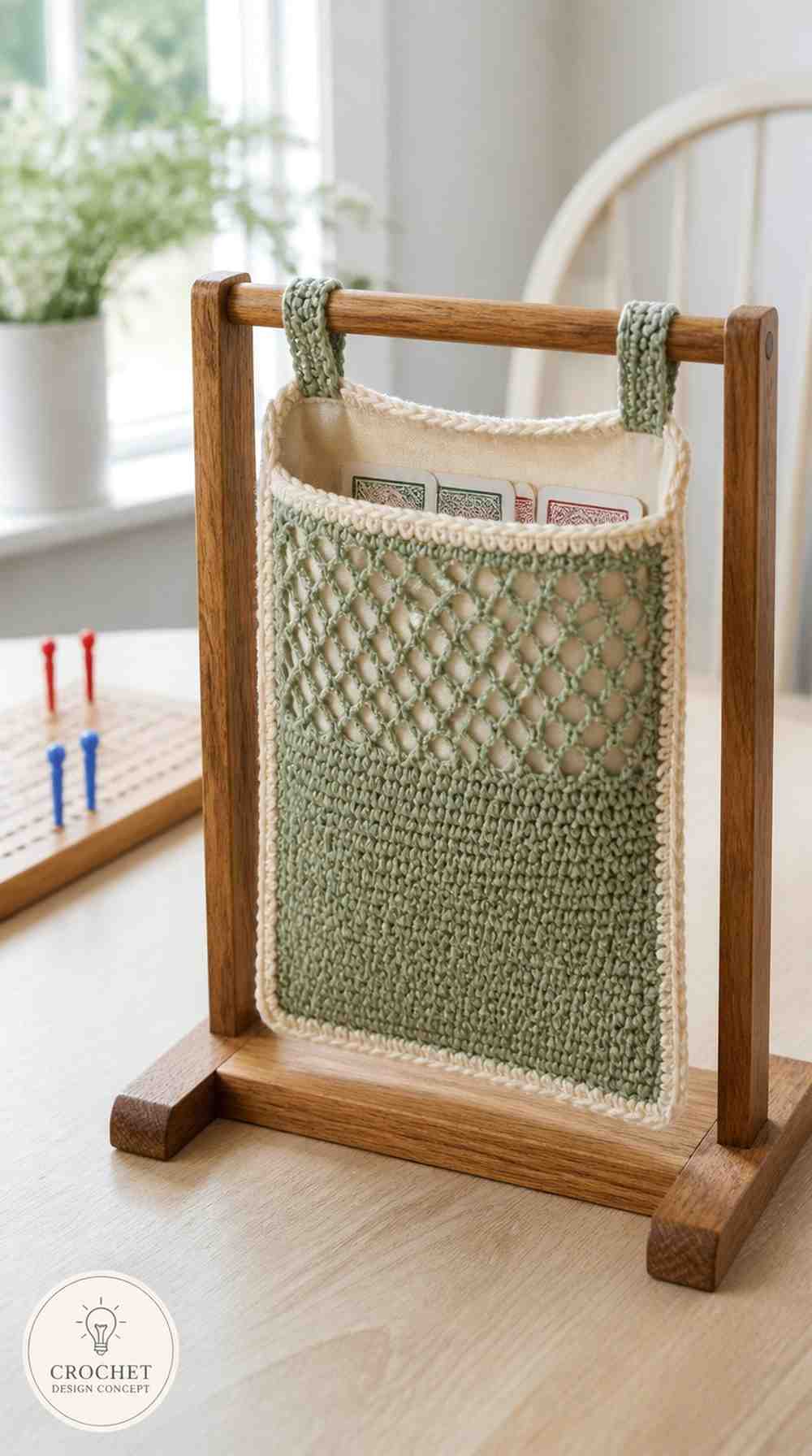
Pale sea-glass-green crochet creates a hanging discard pocket with a solid lower section and orderly diamond-mesh sides. Narrow cream borders define its rectangular shape, while continuous ivory linen backing sits beneath the open crochet stitches.
Two reinforced loops suspend the pocket from a small wooden tabletop organizer stand. Used playing cards rest upright inside, providing a visible discard location that occupies less of the table’s main playing surface.
- Lined Mesh: The fabric backing separates card corners from the diamond openings, reducing the chance of paper catching in loose crochet loops.
- Stand Stability: The wooden tabletop stand needs a suitable base so placing or removing cards does not tip the organizer.
- Hanging Height: Position the pocket low enough for children and adults to reach comfortably without pulling the entire stand.
8. Crochet Cherry Gingham Foldover Discard Envelope
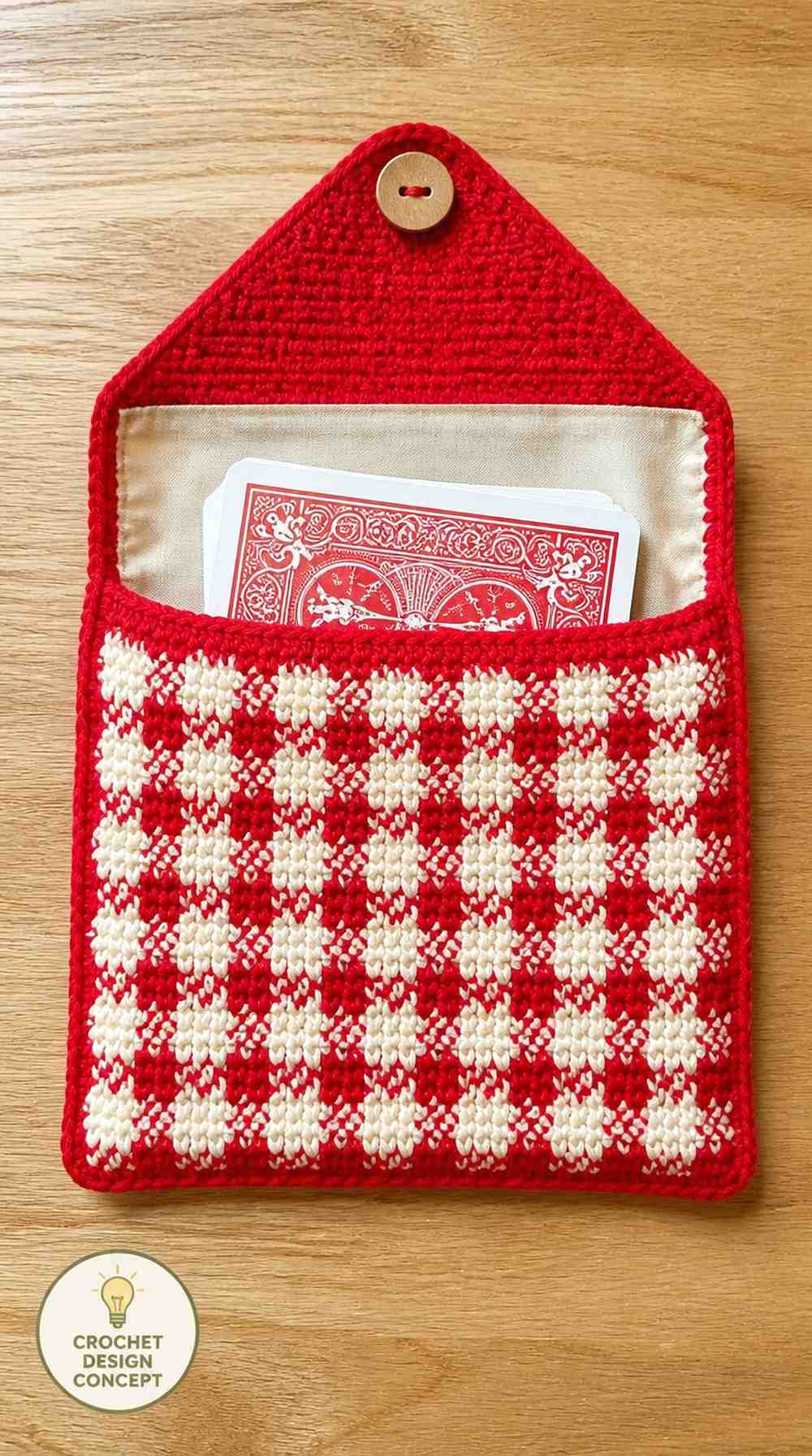
Cherry-red and cream gingham crochet gives this rectangular discard envelope a bright, playful appearance. Small checked stitches cover the body, with a solid red border and triangular flap. A natural wooden button provides the closure, while smooth cream fabric lines the card compartment.
The envelope lies open during play, holding a face-up discard stack with the flap folded back. After the cards are removed or the round finishes, the empty envelope can be closed for tidy storage.
- Open Flap Position: Keep the triangular flap fully out of the way during play so players can place cards inside without obstruction.
- Button Closure: The wooden button is useful for closing the empty pouch, but it should not press against stored cards.
- Card Capacity: Leave enough room for the expected discard stack without bending the corners against the envelope’s seams.
9. Crochet Plum Granny-Square Playing Card Discard Tray
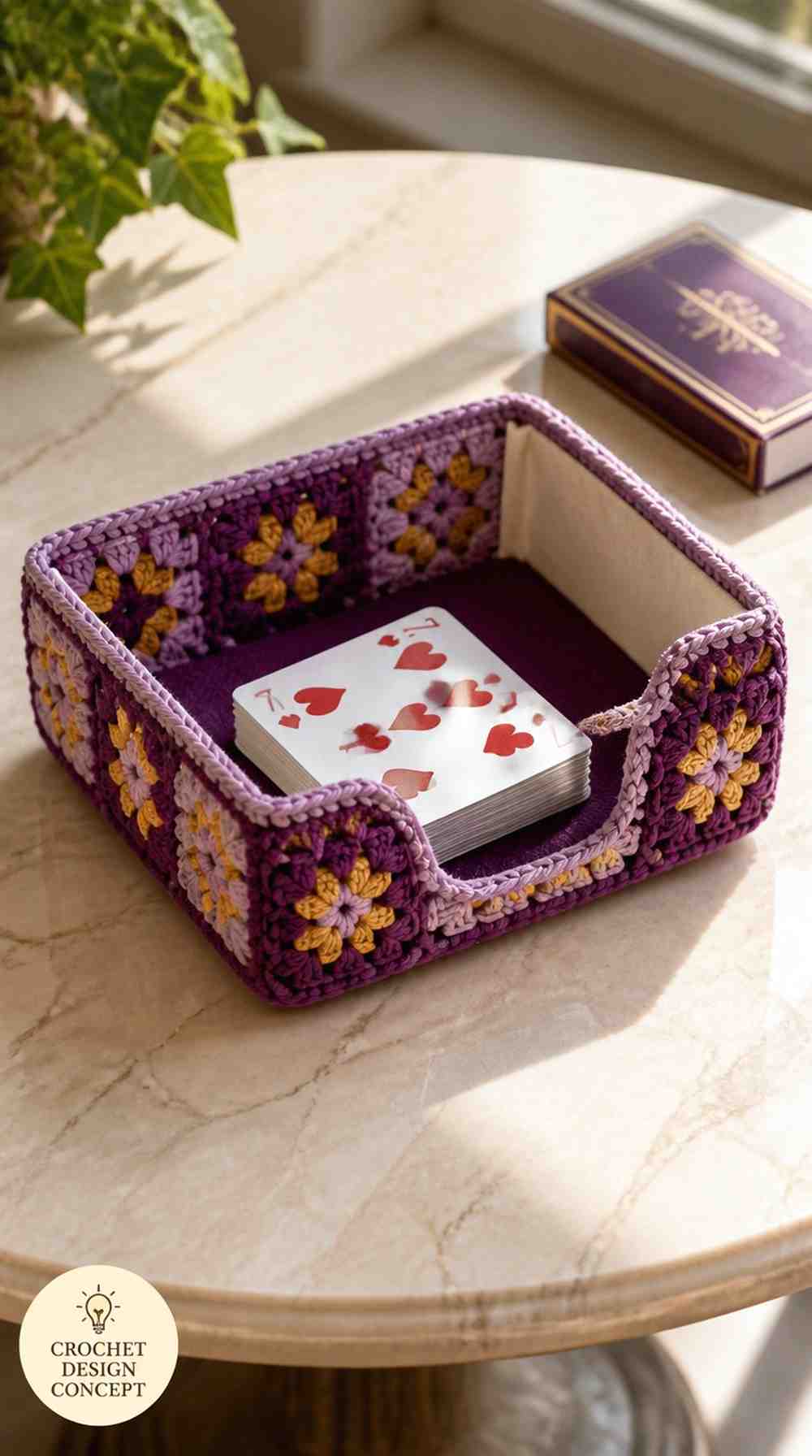
Plum, lavender and muted-ochre granny squares create a colorful rectangular discard tray. Four joined motifs form the raised sidewalls, while a solid plum base and smooth cream lining support the cards. A narrow lavender border finishes the top.
The front wall is slightly lower than the other sides, providing easier access to the face-up discard pile. Traditional granny-square clusters give the tray a distinctive handmade appearance without placing open crochet stitches directly beneath the cards.
- Motif Connections: Keep the granny-square seams secure and sufficiently flat so the tray walls remain aligned.
- Lined Interior: The smooth lining prevents card corners from entering the open spaces between clusters.
- Lower Front Wall: The reduced front height makes stack removal easier, but the tray should still hold cards securely during normal play.
10. Crochet Oatmeal Snap-Corner Fold-Flat Discard Tray
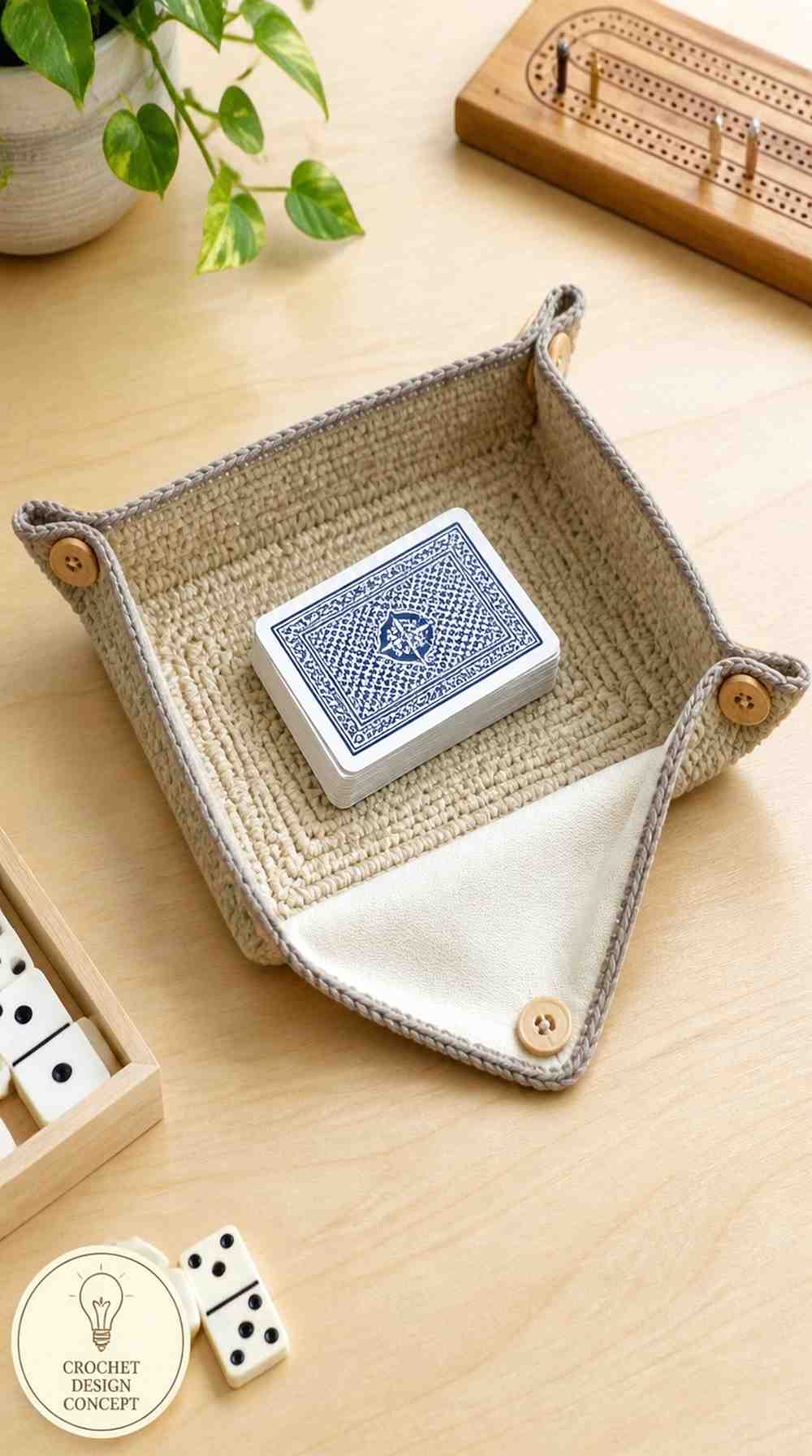
Oatmeal crochet creates a flexible tabletop tray with fine seed-like stitches and stone-gray edging. Four small corner tabs fasten with natural wooden buttons, raising the sides from an otherwise flat fabric panel. Cream cotton backing gives the interior a smooth finish.
The tray holds a small stack of playing cards while assembled. One corner is shown partly opened to demonstrate how the empty holder can unfold for storage, making this a convenient-looking idea for families who put away their game supplies after every session.
- Corner Fasteners: Secure the buttons and loops carefully so the walls do not unexpectedly collapse during play.
- Fold-Flat Storage: Remove all playing cards before opening the corners and flattening the crochet panel.
- Base Shape: Check that all four folded corners create an even rectangular area large enough to support the entire card stack.
11. Crochet Copper Dual-Pile Discard Pocket
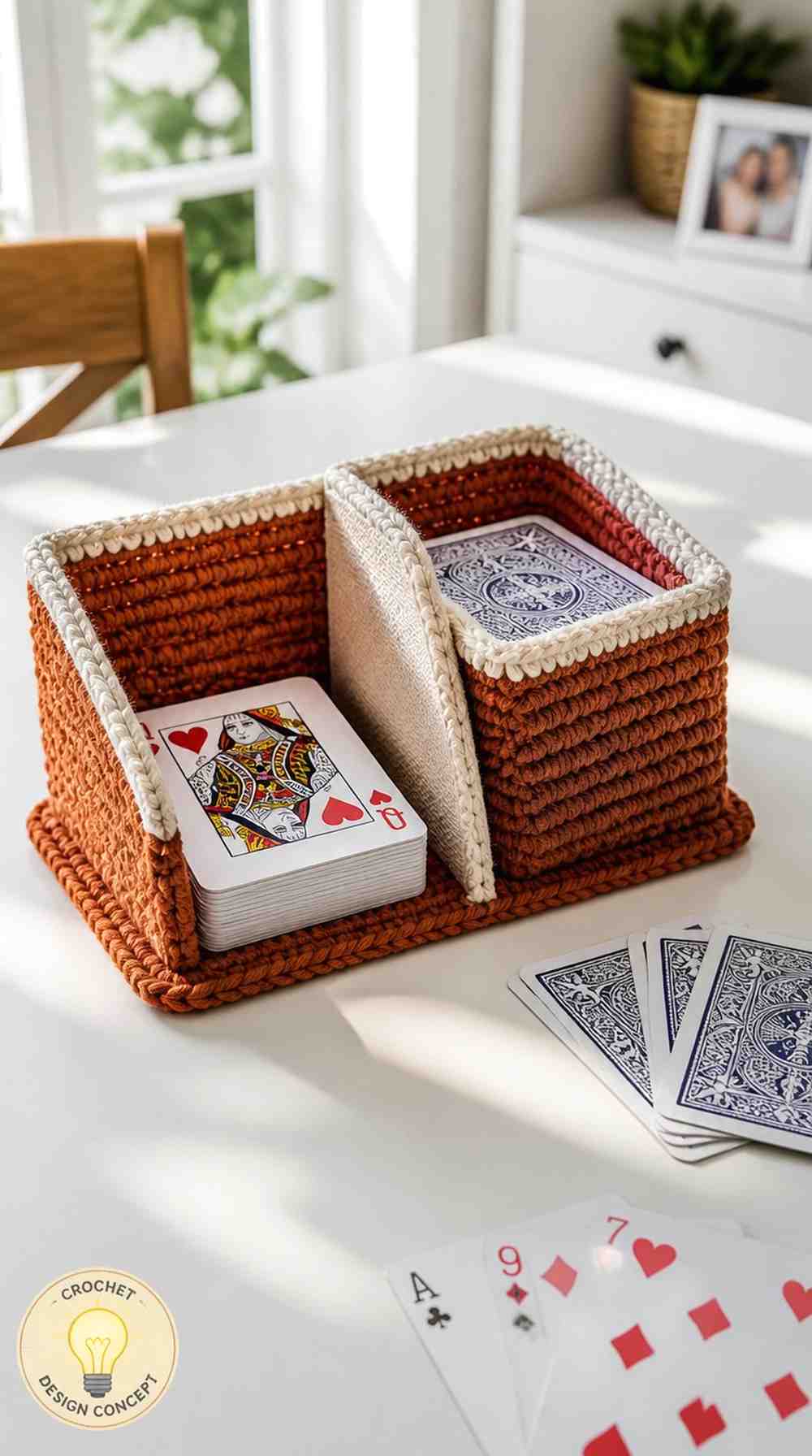
Copper-rust crochet creates a two-compartment card holder with diagonal stitch ridges and cream upper borders. A sturdy fabric-backed divider separates the shallow left pocket from the slightly deeper right compartment. Both sections have flat rectangular bases.
The illustrated holder contains a face-up discard pile on one side and a separate face-down stack on the other. This gives the design a more specialized purpose for games that require two designated piles or an additional temporary card area.
- Pile Separation: The central divider should clearly distinguish the two sections so players can follow the game’s intended card arrangement.
- Different Depths: The shallow and deeper pockets suit different access needs, but both must allow the cards to be removed without bending.
- Rule Compatibility: Not every card game uses two discard piles. Choose this design only when separate compartments have a clear purpose.
12. Crochet Slate Angled Easel Discard Pocket
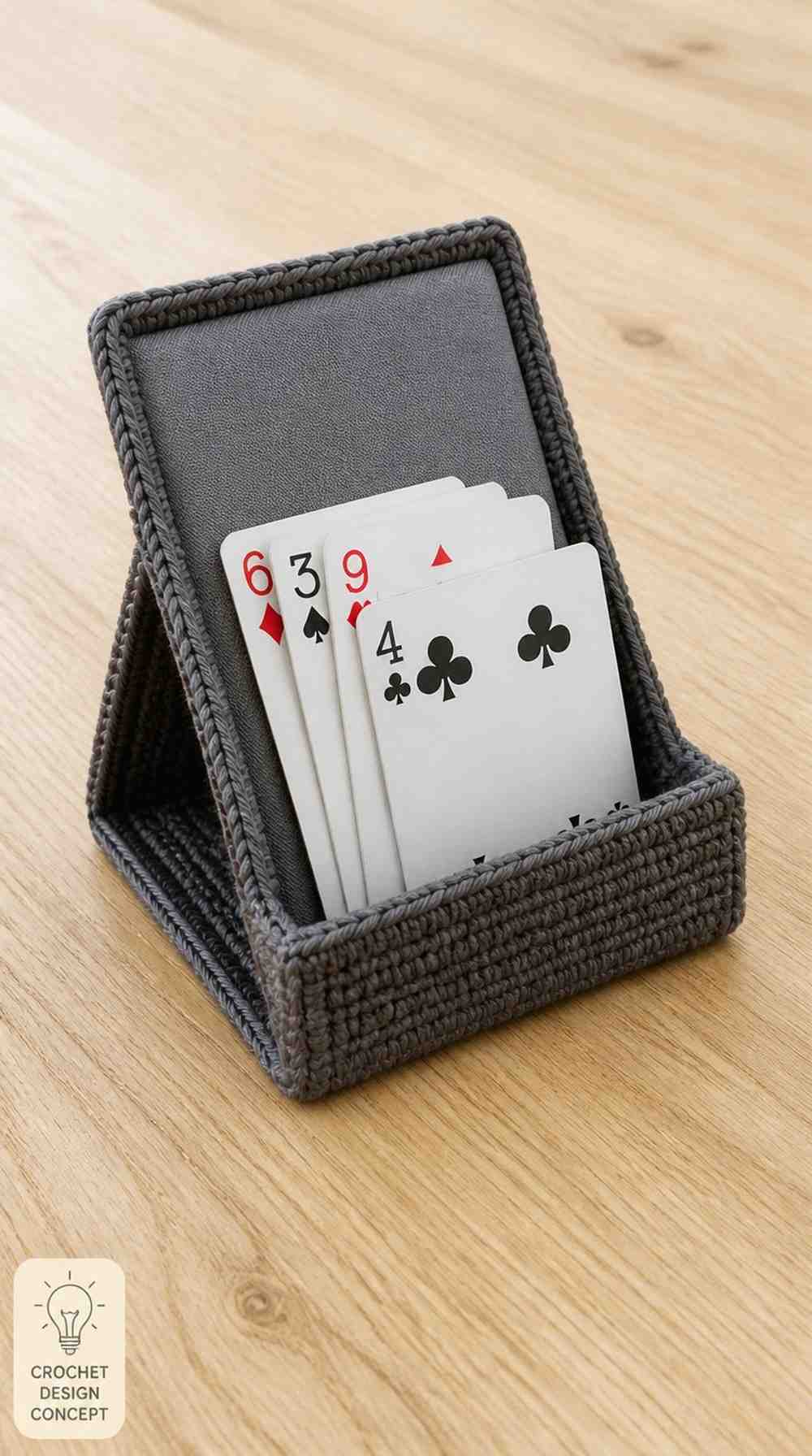
Slate-gray crochet forms a compact upright discard pocket with a sloped back panel and low front lip. Closely worked stitches cover the structure, while stone-gray edging and smooth fabric lining define the opening. A removable support behind the back panel helps maintain the inclined shape.
A small group of discarded cards leans naturally against the sloping interior. Compared with a deep vertical bin, this angled arrangement offers a more open front and makes the card stack easier to see from across the table.
- Backrest Angle: The panel should support the cards without allowing them to slide forward or bend sharply.
- Front Lip: Keep the low lip high enough to retain the bottom card edges while leaving room for easy removal.
- Support Insert: Any rigid insert should have smooth, enclosed edges and remain removable when the crochet needs cleaning.
13. Crochet Cornflower Lift-Tab Discard Sleeve
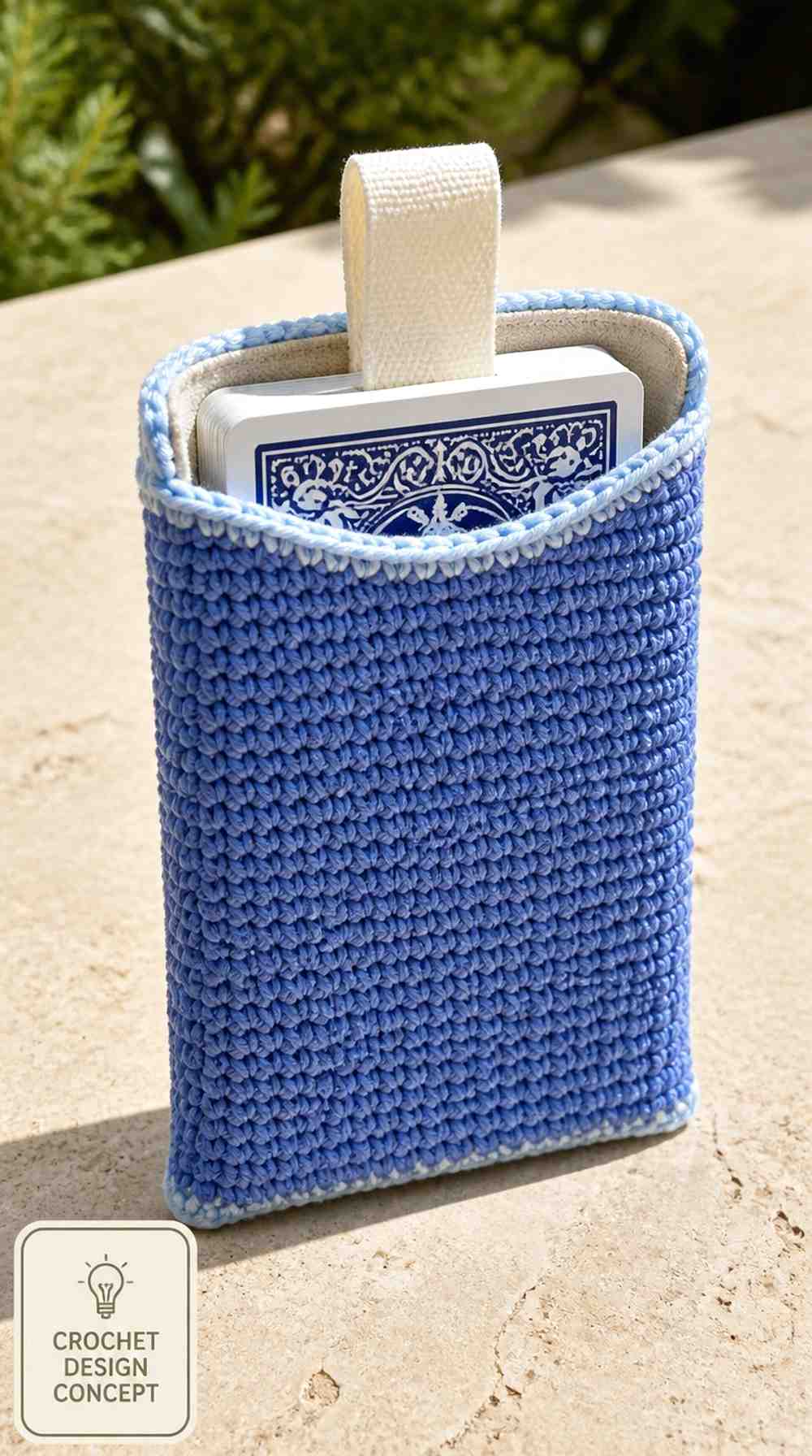
Cornflower-blue crochet creates a narrow rectangular card sleeve with smooth horizontal stitches and pale-blue edging. Cream cotton lining covers the interior, while a broad fabric ribbon runs beneath the upright card stack, leaving a pull tab visible above the opening.
The lifting ribbon is the main practical feature. It is intended to help raise the collected discard pile when a round ends, rather than requiring players to reach deeply into a narrow sleeve.
- Lift Ribbon: The fabric ribbon should run smoothly beneath the stack without folding card corners or pulling against the crochet seams.
- Sleeve Width: Leave enough space around the cards for easy insertion, but not so much that the upright pile collapses sideways.
- Stack Removal: Lift the cards gently and keep the sleeve stable; the ribbon is an access aid, not a carrying strap.
14. Crochet Mustard Table-Edge Strap-On Card Pocket
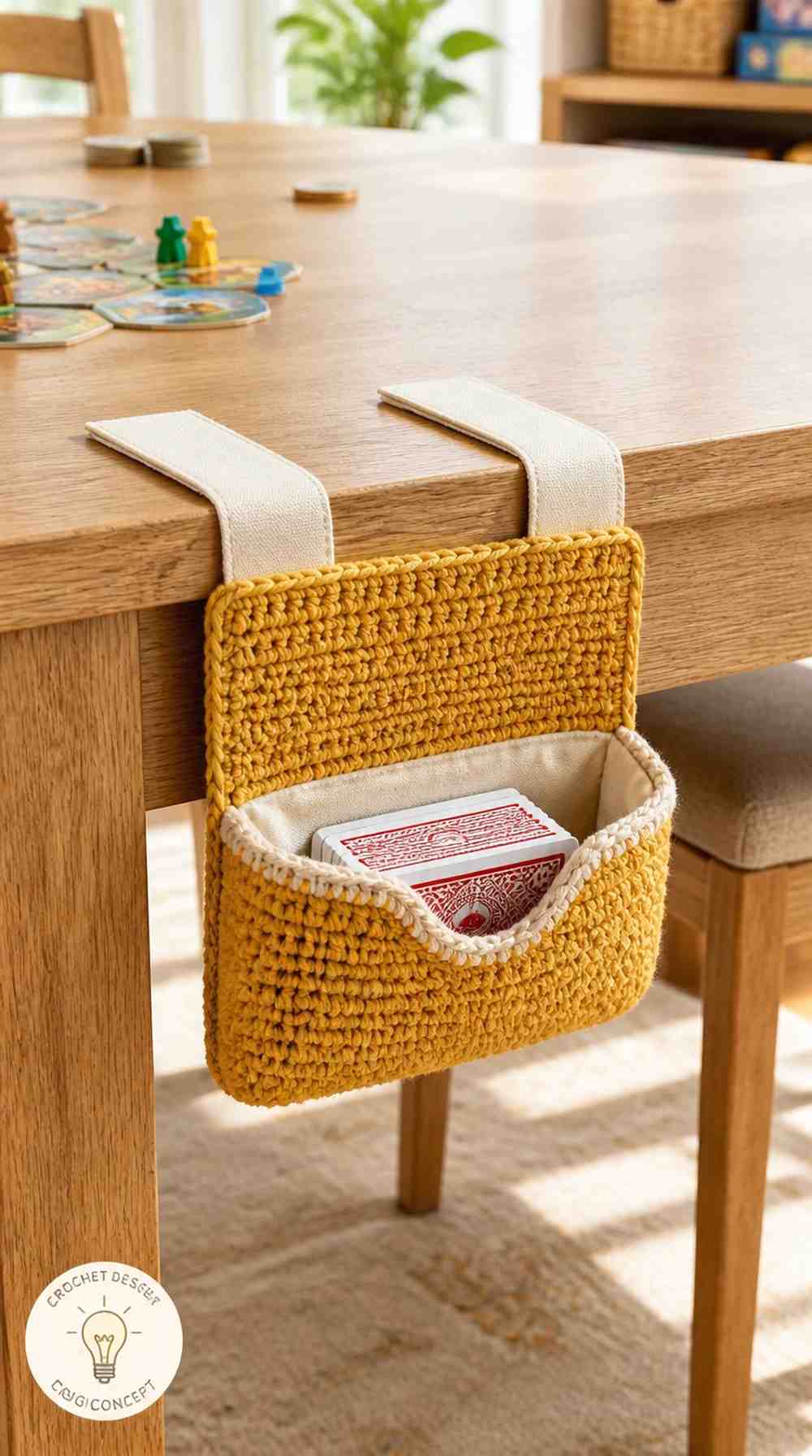
Golden-mustard crochet forms a shallow rectangular discard pocket with a low U-shaped front notch and cream lining. Two broad fabric-backed straps extend over the edge of a sturdy game table, fastening beneath it through concealed fabric closures.
The pocket hangs just below the tabletop, keeping discarded cards close to the players without occupying the central playing surface. Its unusual attachment makes it worth considering for tables where cards, score sheets and other game pieces compete for space.
- Table Compatibility: Check the tabletop thickness, edge shape and underside clearance before considering this attachment.
- Secure Fastening: Both straps must hold the pocket in position without damaging the tabletop or slipping when cards are added.
- Player Clearance: Position the hanging compartment away from knees, chairs and routes where someone might accidentally knock against it.
15. Crochet Teal Clear-Window Discard Pocket
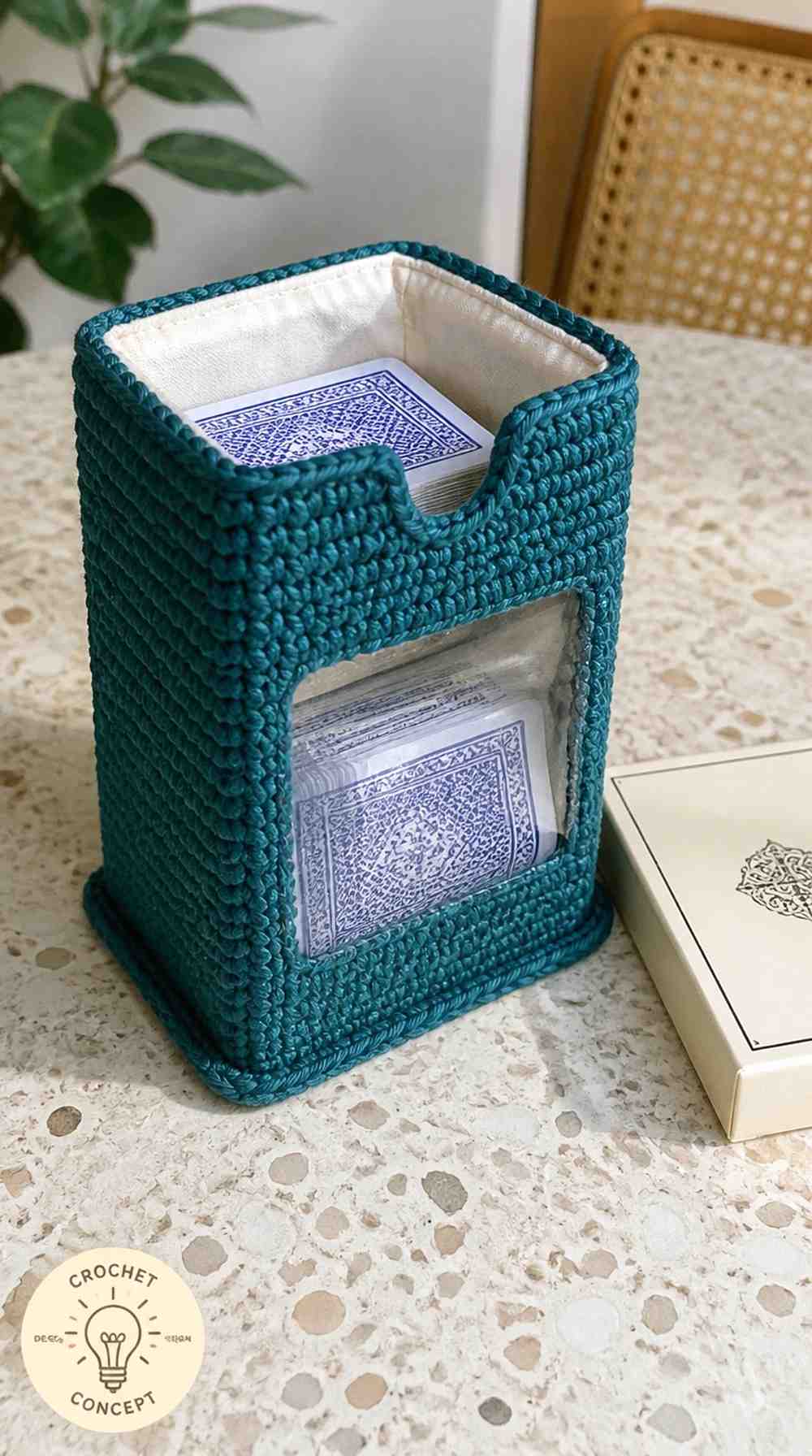
Deep-teal crochet creates an upright rectangular card pocket with dense stitched sides and a flat reinforced base. A transparent flexible window is sewn into its front panel, with a low oval thumb cutout above it. Smooth cream lining covers the interior.
The clear window reveals the face-down playing cards stored inside. This gives the pocket a different appearance from opaque bins and allows players to see whether the discard compartment contains cards without reaching inside.
- Window Material: Choose a smooth, flexible transparent material that does not have sharp edges or become excessively stiff.
- Card Visibility: The window may show how full the pocket is, but it should not expose hidden card information when a game’s rules require secrecy.
- Thumb Opening: The top cutout should allow easy stack removal without forcing cards against the window seam.
16. Crochet Pearl Gray Two-Level Card Sorting Dock
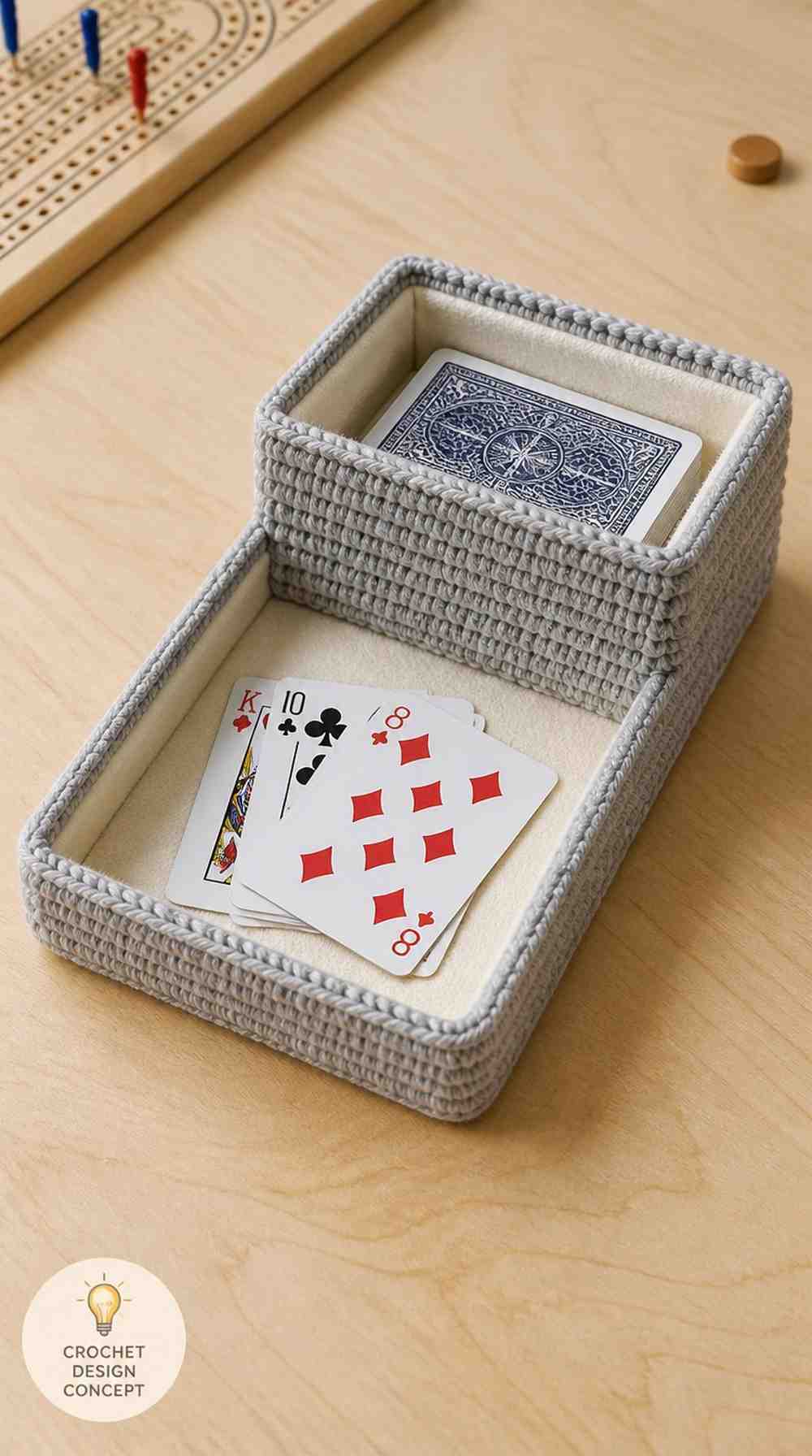
Pearl-gray crochet creates a compact tabletop organizer with a shallow front tray and a separate raised rear pocket. Stone-gray edging outlines both levels, while cream fabric lining provides smooth card-contact surfaces.
The lower section holds a face-up discard pile, while the raised rear pocket contains a separate face-down stack. The stepped arrangement keeps two groups visible and distinct while using less side-to-side space than a broad twin-compartment tray.
- Raised Section: A suitable support beneath the rear pocket may be needed to keep the upper stack level and prevent the structure from collapsing.
- Front Access: The shallow lower tray should remain accessible even when the rear compartment is filled.
- Game Organization: Assign each level a clear role before play, especially if one stack must remain hidden or cannot be reused immediately.
17. Crochet Lavender Reversible Card-Pile Tray
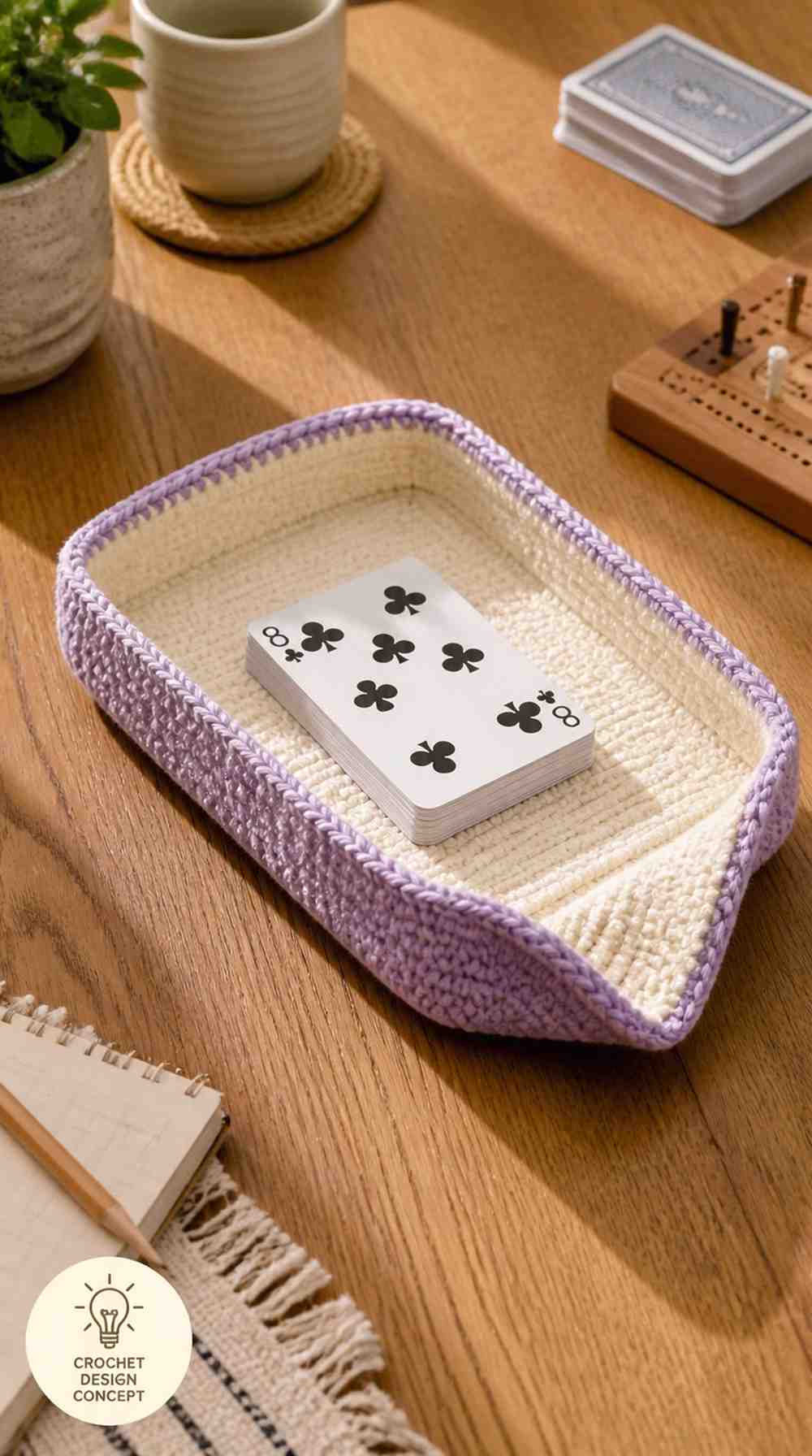
Muted-lavender crochet forms a shallow rectangular discard tray with smooth horizontal stitches and a narrow matching border. Its cream inner surface creates a contrasting base, while a gently turned-back corner reveals how the two fabric layers meet.
The tray holds a neat face-up pile of playing cards. Its reversible construction offers a simpler decorative variation, allowing the cream or lavender surface to become the more visible side if the finished design is properly structured for both arrangements.
- Two-Sided Finish: Both fabric surfaces should be neatly joined and suitable for contact with card edges if the tray is intended to reverse.
- Soft Sidewalls: Flexible crochet walls may need additional structure to retain a consistent rectangular shape.
- Color Choice: The lavender and cream surfaces offer different visual contrasts, which may help distinguish the discard tray from the surrounding table.
18. Crochet Coral Fan-Rim Card Discard Basket
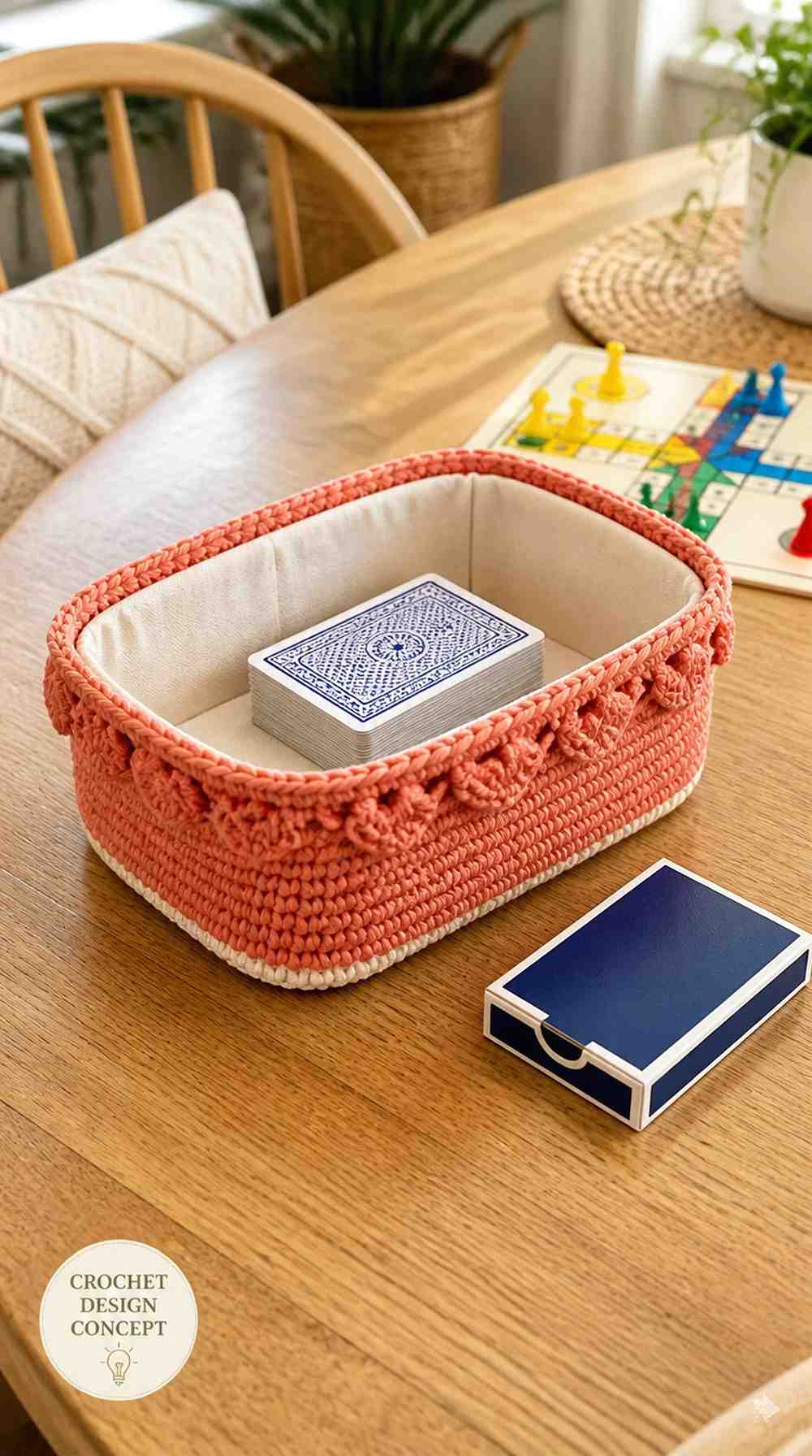
Warm-coral crochet creates a shallow rounded-rectangle discard basket with dense horizontal rows and a cream-lined interior. A narrow cream border finishes the lower edge, while small connected coral fan stitches decorate the outside of the upper rim.
The open basket holds a face-up pile of playing cards with enough room for easy removal. Its softly rounded corners and decorative fan edging make it an attractive centerpiece for a family card table without requiring several compartments.
- Fan-Stitch Position: Keep the decorative fans outside the card opening so their loops do not catch paper corners.
- Basket Depth: A shallow shape is usually easier to access during fast turns than a deep basket with high walls.
- Rounded Corners: The softly curved body should still provide a sufficiently flat base to prevent the card pile from bending.
Practical Guide to Crochet Playing Card Discard Pockets
Measure the actual cards
Playing cards come in different sizes. Before planning a holder, measure the deck you intend to use, including the width, height and thickness of a typical discard stack.
A pocket designed around one standard deck may not suit oversized family-game cards, heavily sleeved cards or unusually thick decks.
Decide how cards will enter the holder
A shallow tray lets players drop cards onto a flat surface. An upright pocket requires cards to be placed more deliberately, while an angled holder may make the stack easier to see.
Choose a design that matches the pace of the game. During fast turns, a low opening may be easier than a flap, zipper or narrow slot.
Keep the draw and discard piles distinct
Use separate compartments when the game requires separate piles. For some games, discarded cards are face-up; for others, card visibility or retrieval rules are different.
Follow the actual game’s instructions rather than assuming one discard arrangement is suitable for every deck.
Use smooth card-contact surfaces
Closely worked crochet may give a holder a tidy shape, but textured stitches can catch card corners. A smooth fabric lining may help keep paper cards away from raised seams or openwork.
Check the corners, base and pocket openings for loose yarn ends, hard fasteners or rough support materials.
Consider shape and stability
Crochet is flexible, so freestanding bins and shallow trays may need suitable support. The holder should remain stable when cards are added or removed.
For hanging or table-edge pockets, inspect the attachment points and make sure the holder cannot be easily knocked loose.
Keep the holder clean and dry
Avoid placing playing cards on damp crochet or near drinks and food spills. Choose yarn and lining materials according to their actual care instructions.
Keep small buttons, detachable supports and other loose components away from young children who may put them in their mouths.
For another way to organize family activities, explore 15 Crochet Jigsaw Puzzle Piece Sorting Mat Inspiration Ideas, which compares divided crochet work surfaces for sorting game-related pieces.
Want to Make Something Similar?
These 18 designs are original visual concepts rather than exact crochet patterns. The following resources offer useful techniques for working with cards and constructing small storage pockets:
- Crochet Playing Card Pouch — Sweet Bee Crochet — Rebecca’s free pattern teaches a pouch sized for a standard deck of playing cards, including the body and closure. It is useful for understanding deck-sized crochet storage, although it is not an open discard tray.
- Free Playing Card Holder Crochet Pattern — Heart Hook Home — Ashlea’s pattern is designed to help players hold cards in their hands. Its pocket construction provides useful related technique ideas, but the finished project is not a discard-pile organizer.
- Keep It Handy Organizer — Snappy Tots — Heidi’s free hanging-pocket pattern explains layered pocket construction and joining, which may help with developing a hanging discard-card holder.
Use each creator’s original instructions for their own design. Adapting these techniques into a discard pocket requires separate measurements, suitable lining and a sensible tabletop or hanging arrangement.
Which Crochet Family Playing Card Discard Pocket Should You Choose?
| Your priority | Design to consider | Main consideration |
|---|---|---|
| Simple tabletop discard pile | Terracotta Low-Lip Tray | Keep front access clear |
| Draw and discard piles together | Indigo Split Organizer | Center divider must stay firm |
| Compact corner placement | Butter Yellow Corner Scoop | Triangular base needs stability |
| Attached card-box storage | Pine Checkerboard Sidecar | Card box must remain upright |
| Decorative shallow holder | Dusty Rose Petal-Rim Bowl | Oval base must remain flat |
| Upright card collection | Espresso Ribbed Bin | Tall sides may slow access |
| Hanging tabletop organizer | Sea Glass Mesh Pocket | Stand must be stable |
| Foldover card storage | Cherry Gingham Envelope | Keep flap open during play |
| Traditional crochet motifs | Plum Granny-Square Tray | Motif joins need support |
| Easy packing after games | Oatmeal Snap-Corner Tray | Empty before folding flat |
| Two separate card piles | Copper Dual-Pile Pocket | Depends on game rules |
| Angled upright access | Slate Easel Pocket | Requires suitable back support |
| Easy removal of a card stack | Cornflower Lift-Tab Sleeve | Ribbon must lift evenly |
| Small tabletop footprint | Mustard Table-Edge Pocket | Needs compatible table edge |
| Visible contents | Teal Clear-Window Pocket | Check card-visibility rules |
| Front and raised rear sections | Pearl Gray Two-Level Dock | Rear support and balance |
| Two decorative surface options | Lavender Reversible Tray | Both sides need finishing |
| Soft rounded basket | Coral Fan-Rim Basket | Keep decoration outside opening |
For a straightforward family card game, the Terracotta Low-Lip Tray, Dusty Rose Petal-Rim Bowl or Coral Fan-Rim Basket may be practical starting points. Their open shapes keep the discard area easy to reach.
If your game uses separate draw and discard piles, the Indigo Split Organizer or Pearl Gray Two-Level Dock offers a more defined arrangement. Use the compartments according to the particular game’s rules.
For families who frequently travel with card games, the Oatmeal Snap-Corner Fold-Flat Tray and Cherry Gingham Envelope explore storage-friendly construction. Remove the cards before folding or closing any holder that was not specifically designed to transport a full deck.
Conclusion
A crochet family playing card discard pocket can bring a little order and handmade character to game night. These 18 inspiration ideas show how the same basic purpose can take many forms, from simple shallow trays and upright sleeves to divided organizers, hanging pockets and colorful granny-square baskets.
The best design is one that fits the actual cards, makes discarding easy and keeps the different piles organized according to the game. A smooth interior, accessible opening and stable construction matter more than decoration alone.
Which design would you choose for family game night? Would you prefer the simple Terracotta Low-Lip Tray, the practical Indigo Split Organizer or the colorful Plum Granny-Square Tray? Share your favorite in the comments.
Frequently Asked Questions
1. What is a crochet playing card discard pocket?
A crochet playing card discard pocket is a small handmade-style holder intended for cards that have already been played or discarded. Depending on the design, it may be a shallow tabletop tray, upright sleeve, hanging pocket or divided organizer. Its layout should follow the rules of the card game.
2. Can a crochet discard pocket hold a full deck of cards?
It may be possible if the pocket is sized and supported appropriately, but capacity depends on the actual deck, whether cards have protective sleeves, and the holder’s construction. Measure the complete stack rather than relying only on the height and width of one card.
3. What yarn works well for a playing card discard holder?
Smooth cotton or suitable cotton-blend yarn may be useful for a closely stitched card holder. However, the best material depends on the desired firmness, lining, support and care requirements. Avoid assuming that flexible crochet alone will hold a tall upright shape without additional structure.
4. Can I use one holder for both draw and discard piles?
Yes, provided it has clearly separated compartments and the arrangement suits the game. For example, a divided organizer may keep the draw deck on one side and discarded cards on the other. Some games have different rules for visibility and reuse, so follow the game’s instructions.
5. Are these 18 crochet family playing card discard pockets available as patterns?
No. These are original inspiration concepts, not tested crochet patterns or step-by-step instructions. They illustrate possible shapes, colors, compartments and storage arrangements. To create something similar, start with a suitable crochet pouch or basket technique, measure the deck and adapt the structure carefully.