A hooded scarf has a lovely way of bringing a winter outfit together. Pull the hood up, settle the scarf around your neck, and a plain coat suddenly has a softer frame. But the prettiest option in a photograph is not always the one you will enjoy wearing most. Long pocket ends, a fitted hood, and a closed neck loop each behave differently once you start moving.
These 19 crochet hooded scarf ideas focus on those differences. Some have flowing tails, some put texture first, and others offer a button fastening, pockets, modular motifs, or a removable hood. Closed-loop alternatives are included for readers who prefer neck coverage without loose scarf ends. The aim is not to collect nineteen versions of the same shape, but to show nineteen genuinely different ways a hood and scarf can work together.
Quick List
- Tapered Crochet Hooded Scarf
- Quick and Simple Crochet Hooded Scarf
- Buttoned Crochet Wanderer’s Hooded Scarf
- Crochet Scarf With a Detachable Hood
- Wheat Stitch Crochet Hooded Scarf
- Rounded Crochet Hooded Scarf With Pockets
- Cable Crochet Hooded Scarf With Contrast Pockets
- Extended Half Double Crochet Pocket Scoodie
- Trailhead Crochet Hooded Infinity Scarf
- Textured Crochet Scoodie in Three Sizes
- Two-Rectangle Crochet Hooded Scarf
- Two-Colour Crochet Hooded Scarf With a Separate Hood
- Large-Square Crochet Hooded Scarf
- Joined Granny Square Crochet Hooded Scarf
- Crochet Granny Square Hooded Scarf With Joining Options
- Crochet Hooded Scarf With a Crab Stitch Border
- Sophie-Style Crochet Hooded Scarf
- Crochet Hooded Infinity Scarf With a Textured Brim
- Crochet Turtleneck Hooded Scarf
At-a-Glance Hooded Scarf Finder
| # | Idea | Construction focus | Best reason to choose it | Main thing to check |
|---|---|---|---|---|
| 1 | Tapered hooded scarf | Shaped tapered scarf with fitted hood | Less bulk at the scarf ends | Hood depth once the tails hang |
| 2 | Quick and simple hooded scarf | Straightforward scarf-and-hood build | A simple, approachable silhouette | Finished neck ease and drape |
| 3 | Buttoned Wanderer’s scarf | Asymmetrical wrap with fastening | More control over how the scarf sits | Button position over outerwear |
| 4 | Detachable-hood scarf | Scarf and removable hood | One accessory can work with different coats | Comfort and balance at the attachment |
| 5 | Wheat Stitch hooded scarf | Textured top-down construction | Strong stitch definition | Gauge in the actual texture pattern |
| 6 | Rounded hooded pocket scarf | Rounded hood, long scarf and pockets | Hand-warming pocket ends | Pocket height while the hood is worn |
| 7 | Cable hooded scarf | Cables, pockets and optional fringe | Decorative texture | Fabric flexibility around the neck |
| 8 | Extended-HDC pocket scoodie | Extended half double crochet with shaped hood | Lighter-looking pocket scarf structure | Hood decrease section before seaming |
| 9 | Trailhead hooded infinity scarf | Double-wrapped infinity scarf plus hood | No loose scarf tails | Loop size over the head and coat |
| 10 | Three-size textured scoodie | Sized hood, scarf and pockets | More size choice | Match measurements, not only size labels |
| 11 | Two-rectangle hooded scarf | Separate hood and scarf rectangles | Easy-to-understand assembly | Centre placement before joining |
| 12 | Two-colour separate-hood scarf | Separate scarf and shaped hood | Easy to inspect pieces before assembly | Hood proportions before attaching |
| 13 | Large-square hooded scarf | Large and small granny squares | Strong motif-led look | Large-square dimensions first |
| 14 | Joined granny-square hooded scarf | Repeated squares assembled into a hood | Modular construction | Consistent square size and join tension |
| 15 | Granny-square scarf with joining options | Motifs with alternate joins | More finishing choice | Test joins before full assembly |
| 16 | Crab-stitch border hooded scarf | Mixed stitch fabrics with defined face edge | Strong finished hood opening | Border tension around the face |
| 17 | Sophie-style hooded scarf | Soft scarf silhouette with added hood | A lighter, fashion-led shape | Follow one creator’s sizing throughout |
| 18 | Hooded infinity scarf with brim | Closed loop with textured face brim | Secure neck coverage | Pull-on opening and brim tension |
| 19 | Turtleneck hooded scarf | Separate hood and close neck section | Compact coverage under a coat | Head opening and throat comfort |
Use this table as a first filter rather than a substitute for the tutorials. If pockets, a closed neck, a removable hood, or modular granny squares are non-negotiable for you, choose that construction family first. Then compare yarn, fit, and finishing details inside the individual sections below.
Choose the Scarf Shape Before Choosing the Colour
Start with the way you want the scarf to sit. Straight tails can hang down the front of a coat or cross over the chest. Tapered ends reduce the amount of fabric at the tips, which is useful if you prefer a smaller tie or a less bulky finish. Pocket ends work best when they reach your hands comfortably; wrapping those same ends around your neck changes where the pockets sit.
A buttoned scarf offers another approach. It can hold a chosen arrangement without depending entirely on a knot. An infinity scarf or turtleneck version keeps the neck section connected, although you lose some of the freedom to loosen or rearrange separate tails.
Then consider your coat. A high collar already occupies space behind the neck, so an oversized hood may feel crowded there when lowered. A collarless jacket gives a fuller scarf more room. If possible, try the unfinished accessory over the coat you expect to wear with it before making the final joins.
Check Hood Depth, Drape, and the Face Edge Together
Hood height and hood depth are different measurements. Height affects room over the crown; depth affects how far the fabric reaches from the back of your head toward your face. Adding rows without checking which direction they change can make a hood larger in the wrong place.
The scarf also affects the fit. A hood can feel comfortable while its tails are supported, then pull differently when those tails hang freely. Try it with the scarf arranged as you intend to wear it. Turn your head, lower your chin, and check whether the face edge stays clear of your eyes without pulling across your throat.
For yarn, test softness against the neck rather than only against your hand. Make a swatch in the actual stitch pattern and follow the yarn’s care instructions before measuring it again. Notice whether it grows, stiffens, or loses its shape. Smooth yarn makes shaping and stitch placement easier to inspect; a fuzzy yarn may soften the appearance but hide those details.
1. Tapered Crochet Hooded Scarf

VivCrochets’ tapered design combines narrowing scarf ends with a curved hood. The creator’s sample uses a wine-coloured worsted yarn, giving the shape a rich, understated look. This is an appealing starting point if you want a hooded scarf that feels like an everyday accessory rather than a large shoulder wrap.
Best for: smaller scarf ends with a fitted everyday silhouette Construction focus: tapered scarf shaping with a curved hood Main fit check: check hood depth after the scarf’s full weight hangs
Choose This for Smaller Scarf Ends
The taper changes how much fabric gathers at the tips. It is worth considering if a wide rectangular scarf feels cumbersome when tied or tucked into a coat. The hood still needs its own fit check; narrow ends do not automatically make the entire accessory close-fitting.
Try the tails crossed loosely before deciding whether to tie them. A comfortable arrangement should leave the hood resting naturally instead of drawing the face opening downward.
Keep Track of the Shaping Edge
The creator’s instructions distinguish the tapered edge from the straight edge. Marking that distinction helps prevent accidental shaping on the wrong side. When comparing the two scarf sections, check their shape as well as their length before continuing into the hood.
Let the Outline Stand Out
For styling, wine or burgundy would pair well with a charcoal coat, while oatmeal would give a darker jacket a softer frame. These are colour suggestions, not additional versions supplied by the tutorial.
Creator Credit: VivCrochets
2. Quick and Simple Crochet Hooded Scarf

JMCrochet’s quick hooded-scarf tutorial uses worsted-weight acrylic yarn with a 6 mm hook and keeps the overall idea uncomplicated. The creator describes the project as a cozy hooded cowl, making it a useful contrast to long pocket scarves and heavily shaped designs. Choose this direction when you want the hood-and-neck combination to feel simple rather than highly decorative.
Best for: a clean, uncomplicated hooded-scarf shape Construction focus: straightforward neck coverage with a hood Main fit check: enough ease to sit comfortably around the neck without making the hood pull backward
Start With the Wearing Shape, Not the Yarn Colour
Before choosing a palette, decide how close you want the neck section to sit. A compact hooded scarf can feel warm and tidy, but too little ease may make it uncomfortable over a sweater or zipped jacket. Try the developing piece with the type of layer you normally wear in winter.
Check Drape With the Actual Yarn and Hook
The creator uses worsted acrylic and a 6 mm hook, but yarns with the same label can still behave differently. Make a small sample and fold it as it would sit at the neck. You are looking for enough flexibility to follow the shoulders and jaw without collapsing completely or becoming stiff.
Keep the Finish Simple
This idea works well when the silhouette is the feature. A heather grey, soft cocoa, muted blue, or warm cream can make the accessory easy to wear with several coats. If you add extra trim, make sure it does not tighten the face opening or add unnecessary weight at the front.
Creator Credit: JMCrochet
3. Buttoned Crochet Wanderer’s Hooded Scarf

Winding Road Crochet’s Wanderer’s Hooded Scarf uses an asymmetrical scarf section and a button fastening. The creator shows ways to wear it long, wrapped, or arranged like an infinity scarf. Its appeal is the ability to secure the fabric in more than one position.
Best for: people who like to secure a wrapped scarf in place Construction focus: asymmetrical scarf with a button fastening Main fit check: test every button position over your usual outerwear
A Fastening Changes How You Wear the Scarf
This is a useful option if you like wrapped scarves but keep readjusting loose ends. The button gives the arrangement an anchor. Check the different wearing positions with your usual outerwear rather than choosing a fit while wearing only a thin top.
Check the Button Against the Finished Fabric
A decorative button should pass through its intended opening without stretching it excessively, then stay in place during ordinary movement. Heavy hardware can pull on soft crochet. Follow the creator’s fastening instructions and check the attachment after the first few wears.
Make the Asymmetry Deliberate
Allow the longer section to sit where it feels comfortable rather than forcing both sides to look identical. An olive, charcoal, or deep brown version would suit a simple outdoor jacket and let the wrap arrangement provide the interest.
Creator Credit: Winding Road Crochet
4. Crochet Scarf With a Detachable Hood

Bag-O-Day Crochet’s detachable-hood design is worth considering if you sometimes want only a scarf. Unlike a permanently connected scoodie, it lets the hood become an optional part of the accessory. That is a meaningful difference for a wardrobe that includes both hooded and hoodless coats.
Best for: switching between hooded and hoodless coats Construction focus: separate scarf with a detachable hood Main fit check: check the attachment while worn, not only laid flat
Choose It for Different Coats
A hooded coat may not need another hood underneath it. Removing the crochet hood can reduce the pile of fabric at the back of the neck while preserving the scarf. With a simpler jacket, the combined version gives you a different look.
Pay Attention to the Connection
Follow the original video for the attachment method. Check that the joining area lies comfortably against the neck and that the hood sits evenly once connected. Do this before deciding the scarf is finished; a good-looking flat connection can feel different when worn.
Choose Colours That Work Separately
A matching hood and scarf will look cohesive, but the scarf should also be a colour you enjoy on its own. A medium grey, cocoa, or muted blue would be easy to repeat across several winter outfits without needing additional decoration.
Creator Credit: Bag-O-Day Crochet
5. Wheat Stitch Crochet Hooded Scarf
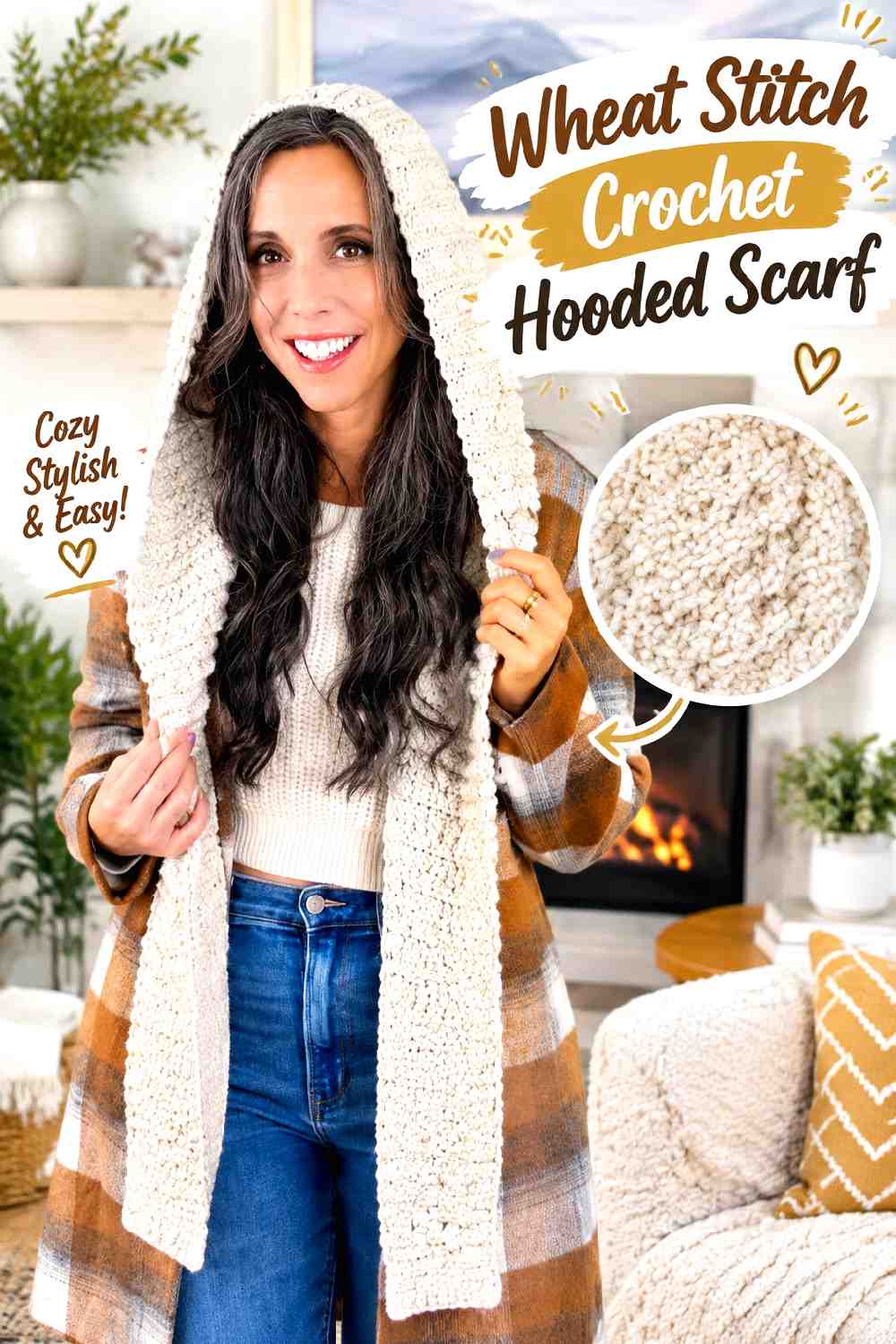
Briana K Designs’ Wheat Stitch hooded scarf puts the stitch texture at the centre of the design. The accompanying project page describes a seamless, top-down construction with tapered scarf panels and DK-weight yarn. It offers a different visual effect from open granny clusters or plain rows.
Best for: visible stitch texture and a more refined surface Construction focus: seamless top-down textured construction Main fit check: swatch in Wheat Stitch rather than a plain substitute
Give the Texture Room to Show
A solid or gently varied yarn allows the stitch pattern to remain readable. Strong, rapid colour changes could compete with the surface detail. Cream over a grey coat would make a particularly clear pairing if you want the crochet work to stand out.
Practise the Repeat Before Shaping
Make the gauge swatch in the actual pattern repeat. This gives you a place to become comfortable with stitch placement before managing the hood shape and scarf sections. A plain-stitch swatch will not tell you how this textured fabric behaves.
Follow the Full Project Instructions
The creator provides a project video and an accompanying written pattern on the Briana K Designs website. Use those together for construction details rather than attempting to reproduce the texture from photographs. The written instructions may have access requirements, and a printable PDF is offered separately.
Creator Credit: Briana K
6. Rounded Crochet Hooded Scarf With Pockets

Naztazia’s hooded pocket scarf combines a rounded hood with half double crochet and super bulky yarn. The hood is made first, with the scarf joined as the work progresses. This is a substantial option for someone who likes clear stitches and a simple surface rather than decorative motifs.
Best for: long scarf ends with practical hand pockets Construction focus: rounded hood joined into a super-bulky scarf Main fit check: place pockets according to the wearer’s arm reach
Position the Pockets for the Wearer
Check where your hands naturally rest while wearing the hood. Pocket height depends on the scarf length, the wearer’s proportions, and how much of the scarf is wrapped around the neck. A pocket that looks well placed on a hanger may be awkward to reach.
Consider the Weight of the Whole Accessory
Super bulky yarn produces noticeable fabric quickly, but a hood, two long tails, and pockets create more material than a small cowl. Support the unfinished scarf during a fit check, then let it hang to see how its weight affects the hood.
Keep the Pockets Light
These pockets are better treated as places to rest your hands than as substitutes for a handbag. Heavy contents can stretch the ends and make the accessory hang unevenly. A single neutral shade would keep attention on the rounded hood and practical shape.
Creator Credit: naztazia
7. Cable Crochet Hooded Scarf With Contrast Pockets

Let’s All Crochet combines a cable-stitch repeat, a hood, pockets, and fringe in one scoodie. The video separates the hood, border, fringe, and pocket stages with timestamps. This gives readers who enjoy textured crochet a more decorative option than a plain pocket scarf.
Best for: a decorative scoodie with cables and finishing detail Construction focus: cable texture with pockets, border and fringe Main fit check: make sure raised stitches still bend comfortably at the neck
Let the Cable Be the Main Feature
Smooth yarn helps the raised stitches remain visible. Before adding a strongly contrasting pocket colour, lay the colours together and decide which element should draw the eye first. Too many competing details can make the cable harder to appreciate.
Compare the Fabric Before Adding Length
Raised stitch patterns can feel different from flat crochet even in the same yarn. Bend the swatch around your neck and check the back as well as the front. The side against your skin matters just as much as the decorative surface.
Decide Whether Fringe Suits Your Routine
Fringe adds movement at the ends, but it also introduces more loose strands to keep tidy. Think about coat zips and bag straps before choosing the final finish. A short, restrained fringe can give the design a different feel from a long, dramatic one.
Creator Credit: Let’s All Crochet
8. Extended Half Double Crochet Pocket Scoodie

TCDDIY’s pocket scoodie uses extended half double crochet, with separate video chapters for scarf length, hood height, hood decreases, seaming, and pockets. The demonstrated project uses category-four yarn. It is a useful comparison with the super bulky Naztazia version if you prefer a different fabric scale.
Best for: a pocket scoodie with a different stitch scale Construction focus: extended half double crochet with hood decreases and pockets Main fit check: inspect the decrease shaping before closing the hood
Watch the Extended Stitch Carefully
Extended half double crochet is not interchangeable with ordinary half double crochet. Follow the creator’s stitch demonstration and check the resulting row height. Substituting the shorter stitch without adjusting the instructions could change the proportions.
Evaluate the Hood Before Closing It
The tutorial includes a specific decrease stage before the hood seam. Inspect that shaping while it is still easy to see. A small error repeated through the hood can affect the way the top sits even if the scarf section looks straight.
Finish the Pocket Openings Evenly
Compare both pocket folds and seams before securing every end. Matching their placement matters more than matching a particular colour. If you choose a flecked yarn, keep the finishing simple so the fabric has a calm, consistent appearance.
Creator Credit: TCDDIY
9. Trailhead Crochet Hooded Infinity Scarf

Kay Krochets’ Trailhead Hooded Scarf combines a double-wrapped infinity scarf with an attached hood. The creator’s published tutorial uses bulky-weight yarn and a repetitive beginner-stitch fabric, creating a different wearing experience from long open scarf tails. It is a useful option if you like the layered look of a wrapped scarf but do not want two ends hanging down the front.
Best for: secure wrapped neck coverage without loose tails Construction focus: infinity loop with an attached hood Main fit check: the loop must pass comfortably over the head and still wrap without pulling the hood
Test the Loop Before Final Finishing
Closed-loop scarves have one measurement that long scarves do not: the opening has to work both for dressing and for wearing. Check that it passes over the head without strain, then arrange the second wrap and raise the hood. If the loop becomes tight only after wrapping, the issue is the total circumference rather than the hood itself.
Let Bulky Yarn Stay Flexible
Bulky yarn can make a warm accessory quickly, but a doubled neck loop already creates layers. Avoid assuming that thicker automatically means better. A swatch should bend easily enough to sit around the neck twice without feeling like a rigid collar.
Use the Closed Shape to Simplify Styling
Because the scarf ends are connected, the accessory already has a strong, finished outline. A forest green, charcoal, deep rust, or natural oatmeal version can work as the main soft layer over a plain coat. The lack of loose ends also makes this style worth considering if bag straps tend to catch or rearrange long scarves.
Creator Credit: Kay Krochets
10. Textured Crochet Scoodie in Three Sizes

Sara Sach of Posh Pooch Designs provides this pocket scoodie in small, medium, and large sizes. The fabric combines single and double crochet, and the updated sample uses a self-striping yarn. Its video instruction is divided into a hood lesson and a scarf-and-pockets lesson.
Best for: making the same basic idea for different wearers Construction focus: textured hood plus scarf and pockets in three sizes Main fit check: compare actual measurements and gauge before choosing a size
Start With the Intended Size
Several size options are useful when making for different wearers, but the size name alone is not a fit guarantee. Compare the creator’s measurements with the intended wearer and check your gauge. Avoid choosing a larger hook simply to move from one size to another.
Let Self-Striping Yarn Change Naturally
Long colour runs may appear differently in the hood and the wider scarf rows. That is part of the effect. If precise matching is important to you, plan the colour placement before starting rather than trying to force symmetry at the final pocket stage.
Keep Both Lessons Together
The hood video is only the first part of the project. Use the second lesson for the scarf and pocket construction so the final accessory follows the intended proportions.
Creator Credit: Sara Sach / Posh Pooch Designs — Part 1: Hood · Part 2: Scarf and Pockets
11. Two-Rectangle Crochet Hooded Scarf

Crochetnotes builds this hooded scarf from a wider hood rectangle and a narrower scarf rectangle, both in half double crochet. The published sample uses pink and dark grey stripes, and the parts are connected with slip-stitch joins. This construction makes the separate shapes easy to understand before assembly.
Best for: a clear construction that is easy to visualize before assembly Construction focus: one hood rectangle plus one scarf rectangle Main fit check: centre and pin the hood before making the permanent join
Keep the Pieces Rectangular
Mark the first and last stitch if the turning edges are difficult to follow. Unplanned increases or missed edge stitches can turn a rectangle into a tapered panel, which becomes noticeable when you fold and join it.
Preview the Join Before Working It
Use removable markers to position the hood on the scarf. Check the centre and compare the two tails before joining. A balanced layout is easier to establish while the pieces can still be moved independently.
Choose a Comfortable Seam
A slip-stitch join can become firm if worked tightly. Check that it does not draw the adjoining edges together or create an uncomfortable ridge. For a softer-looking colour variation, dusty rose and charcoal would preserve the two-colour idea without requiring a change to the construction.
Creator Credit: Crochetnotes
12. Two-Colour Crochet Hooded Scarf With a Separate Hood

Anna Greene’s tutorial works through the scarf and hood before attaching them. The materials list uses worsted-weight yarn in two colours, and the hood is explained in several row groups. Choose this project if you prefer to examine a shaped hood separately before connecting it to the scarf.
Best for: makers who prefer to shape and inspect the hood separately Construction focus: two-colour scarf and separate hood joined later Main fit check: confirm hood depth and width before attachment
Use the Construction Order to Your Advantage
Working separate components gives you a chance to compare their proportions before joining. Lay the hood beside the scarf, then try the hood in position. Do not assume that a familiar scarf length guarantees enough room around the head.
Follow the Hood’s Row Groups
The video’s separate hood chapters are useful stopping points. Keep a written note of where you pause so you can return to the correct stage. Repeating the wrong section can affect the shape rather than merely adding length.
Plan the Palette Before the First Piece
If the scarf and hood use the colours differently, make a small sample of both arrangements. A pairing such as deep blue and cream can look quite different depending on which shade sits beside the face. Treat that placement as part of the design decision.
Creator Credit: Anna Greene
13. Large-Square Crochet Hooded Scarf

Crochet Musings combines two large granny squares with smaller squares to form a hooded scarf. That change in motif scale makes it a useful alternative to a piece built entirely from similarly sized blocks. The creator’s project listing links directly to the video and identifies medium-weight yarn for the sample.
Best for: a bold granny-square look with varied motif scale Construction focus: two large squares plus smaller scarf motifs Main fit check: get the large hood squares right before repeating smaller motifs
Check the Large Squares First
The large motifs determine much of the hood’s shape. Check their dimensions and how they fold before making every smaller square. Altering only the scarf motifs will not correct a hood that is too shallow or too deep.
Coordinate the Edges as Well as the Centres
Two motifs can use different centre colours and still look connected if their outer rounds share a shade. Cream edging with muted blue or rose centres would be one possible palette. Keep yarn thickness and care requirements compatible across the colours.
Be Realistic About Open Stitchwork
Traditional granny clusters leave visible spaces. Enjoy that airy, handmade appearance, but do not assume it will block wind like a tightly worked fabric. This is a useful choice for decorative layering when the motif design matters as much as coverage.
Creator Credit: Crochet Musings
14. Joined Granny Square Crochet Hooded Scarf

Käthe’s tutorial makes the hooded scarf entirely from granny squares and includes dedicated sections for hood sizing, square construction, joining, and finishing. It is an appealing option if you enjoy building a wearable from manageable pieces rather than working one long panel.
Best for: modular crochet made from repeated squares Construction focus: granny squares joined into scarf and hood sections Main fit check: keep motif size and joining tension consistent
Settle the Motif Size Before Repeating It
Finish a sample square and compare it with the creator’s hood-sizing guidance. A small difference repeated across several motifs can change the overall fit. It is easier to adjust one square than to discover that a finished collection will not assemble as intended.
Lay Out the Whole Arrangement
Place the squares in their final order before joining. This helps you see whether a bright centre lands beside the face or whether two similar blocks sit together unintentionally. Photograph the layout so you have a reference if the pieces are moved.
Keep the Joins Consistent
Use the same tension and orientation across the assembly. A tight join can make neighbouring squares cup or fold. A restrained palette, such as cream and navy, would let the repeated geometry remain the main feature.
Creator Credit: Käthe
15. Crochet Granny Square Hooded Scarf With Joining Options

Fiorafana’s tutorial covers both a granny-square scarf and a hooded version, with two colour-change options and two ways to join the motifs. Its particular value is the opportunity to compare finishing approaches within the same project family.
Best for: comparing different motif-finishing methods Construction focus: granny-square hooded layout with alternate joining options Main fit check: test joins on spare squares before committing
Compare a Join on Spare Squares
Before assembling the accessory, try each method on a small pair of practice motifs. Look at the front and back, then fold the join as it will sit around the head. Choose the finish you like wearing as well as looking at.
Follow the Hooded Arrangement
The scarf-only and hooded versions use different quantities and arrangements of squares. Keep the hooded layout in view while planning the project. A straight run of motifs is not enough information to work out the hood assembly by itself.
Check the Teaching Format Early
Preview the instructions and available captions before buying yarn, particularly if you rely on spoken guidance. The video description separates the hood assembly into several stages, which can help you locate the section you need without restarting the entire lesson.
Creator Credit: fiorafana
16. Crochet Hooded Scarf With a Crab Stitch Border

Patricia Fentie’s hooded-scarf lesson demonstrates adding a hood to a crocheted scarf and finishing the face opening with crab stitch. Her example combines a straight granny-stitch scarf with a different stitch pattern for the hood. This is a useful approach when you want to understand how two crochet fabrics can work together.
Best for: a defined face opening and adaptable scarf-to-hood method Construction focus: straight scarf fabric combined with a different hood fabric Main fit check: match joined edge dimensions and avoid a tight crab-stitch border
Match Width Before Joining Different Fabrics
Different stitch patterns can produce different dimensions in the same yarn. Compare the actual edges rather than relying on an equal stitch count. Temporarily mark the joining points so one fabric is not stretched unevenly to fit the other.
Use the Border to Define the Face Opening
Crab stitch gives the edge a distinct finish. Work a short practice section first and check that it sits comfortably. An overly tight border can draw the hood opening inward, while an overly loose one may flare away from the face.
Treat This as an Adaptable Method
The creator’s page includes separate supporting videos for the scarf and hood stitch patterns. Use those when reproducing the demonstrated combination. If you bring your own scarf design, you will need to evaluate the join and fit rather than assume the original proportions transfer unchanged.
Creator Credit: Patricia Fentie
17. Sophie-Style Crochet Hooded Scarf

Francesca Uncinettando Crochet&Love presents a crochet interpretation of a Sophie-style scarf with an added hood. The description identifies half double crochet and chain stitches and places the project at advanced-beginner to intermediate level. It is another option for readers drawn to a softer scarf-and-hood silhouette.
Best for: a softer, tapered fashion silhouette Construction focus: Sophie-inspired scarf shaping with an added hood Main fit check: stay with one creator’s sizing instead of mixing pattern counts
Follow the Crochet Instructions for This Version
The shared style name does not make different designers’ patterns interchangeable. Use this creator’s construction and sizing guidance throughout. Borrowing a stitch count from another Sophie-inspired project could change the width, the hood, or the connection between them.
Check Colour Changes Around the Face
If you choose a yarn with changing colours, look at how the shades fall across the hood as well as along the scarf. A long colour transition may create a very different effect on a short hood section than on a long tail.
Choose the Video for Your Learning Style
Preview the language and caption options before starting. Familiar stitches can still require careful attention when they become a shaped wearable. Keep the scarf stage and hood stage distinct in your notes so the construction remains easy to follow.
Creator Credit: Francesca Uncinettando Crochet&Love
18. Crochet Hooded Infinity Scarf With a Textured Brim

Wilmade’s Hooded Alpa Scarf joins an infinity scarf to a hood and finishes the face opening with a textured brim. It uses half double crochet, including loop-placement variations. This is a closed-loop alternative for someone who likes the look of a wrapped scarf without separate dangling ends.
Best for: closed-loop coverage with a clearly finished face edge Construction focus: infinity scarf joined to a hood with textured brim Main fit check: test the pull-on opening before closing the loop permanently
Try the Loop Before Closing It Permanently
The neck section needs enough room for the intended wearing arrangement. Check it over your head and with the hood raised before final finishing. A loop that fits comfortably at the neck may still be awkward to pull on if made too small.
Notice the Brim’s Separate Role
The brim frames the face and gives the front edge a more deliberate finish. Keep its tension consistent with the rest of the hood. A stiff front edge paired with very soft fabric can sit differently from the creator’s sample.
Choose This When Loose Ends Annoy You
The connected neck section is the main reason to pick this over a long-tail scoodie. The trade-off is less freedom to spread the scarf across the chest or reposition each end. A quiet neutral would highlight the ridged texture without requiring extra trim.
Creator Credit: Wilmade
19. Crochet Turtleneck Hooded Scarf

Lana Loca’s design combines a hood with a turtleneck-style scarf section. The two parts are crocheted separately and then connected. It sits closer to the hooded-cowl end of the category, making it a useful final comparison with the long scarves, pocket styles, and larger wraps above.
Best for: compact neck coverage with no scarf tails Construction focus: separate hood and turtleneck-style neck section Main fit check: check head opening, stretch recovery and throat comfort
Choose It for Continuous Neck Coverage
A turtleneck shape removes the need to arrange scarf tails. That may appeal if you prefer a compact accessory under a coat. It also means you cannot loosen the front simply by untying a knot, so comfort around the throat needs careful attention.
Test the Opening Before Joining
Make sure the neck section can pass comfortably over the head. Check both stretch and recovery instead of judging only its flat width. Then test how the hood and neck piece sit together before committing to the final connection.
Avoid Crowding a High Coat Collar
Try this design with the outerwear you intend to use. A tall neck section and a high zipped collar may occupy the same space. If you prefer something you can open at the front, the buttoned Wanderer’s scarf is a more suitable direction to investigate.
Creator Credit: Lana Loca – moderne Handarbeiten
How These 19 Crochet Hooded Scarf Ideas Compare
The biggest difference is not decoration; it is how the accessory behaves once it is on your body. Start by choosing between open tails, pocket ends, a fastened wrap, a removable hood, or a closed neck loop. That one decision narrows the list faster than choosing a stitch pattern first.
For a smaller, shaped scarf finish, start with the tapered VivCrochets design. For a simple hood-and-neck silhouette, compare JMCrochet’s compact version. The first emphasizes tapered shaping, while the second keeps the wearing shape more straightforward.
For adjustable ways of wearing one piece, the buttoned Wanderer’s scarf is particularly useful to investigate. If you want to use the scarf without its hood, the detachable Bag-O-Day design addresses that need more directly. If you dislike loose ends altogether, Kay Krochets’ Trailhead design moves in the opposite direction with a double-wrapped infinity loop.
For visible texture, compare Wheat Stitch with the cable scoodie. For pockets, compare the rounded super bulky version, the extended half double crochet design, and the three-size Posh Pooch scoodie. Check where the pockets fall before choosing between them.
For modular construction, explore the three granny-square approaches. Crochet Musings changes the square sizes, Käthe concentrates on a joined-square build, and fiorafana offers finishing choices. The two-rectangle design is another clear way to understand the parts without using motifs.
For fewer loose ends while wearing, the hooded infinity scarf and turtleneck option are the closest matches. Their connected neck sections are useful, but they do not provide the same open-front flexibility as separate scarf tails.
Why the Creator Mix Matters
A roundup becomes less useful when several entries come from the same channel and repeat the same design language. This list deliberately uses one project per creator. That gives you more variation in construction methods, teaching styles, yarn choices, finishing approaches, and fit decisions, while still keeping every idea tightly connected to the hooded-scarf theme.
The creator links are there so you can move from inspiration to the original instruction source. If a project requires exact stitch counts, gauge, sizing, or assembly, follow that creator’s current tutorial or written pattern rather than treating this roundup as a substitute pattern.
Conclusion
The most useful hooded scarf is the one whose shape suits the way you dress. Choose a taper if you prefer smaller ends, a button if you want to secure a wrap, pockets if you enjoy resting your hands in them, or a closed neck section if dangling tails get in your way.
Once you have chosen a shape, let the crochet detail guide the yarn. Clear texture benefits from a yarn that shows the stitches, while granny squares give you room to plan colour through individual motifs. Try the hood with the scarf’s weight hanging naturally, and check the result over your usual coat.
Use the credited creator’s instructions for the actual making. A comfortable face opening, a balanced join, and a scarf arrangement you enjoy wearing will do more for the finished piece than adding another decorative feature simply because there is room for it.
Frequently Asked Questions
What is the difference between a hooded scarf, a scoodie, and a hooded cowl?
A scoodie is a common name for a scarf and hood combined. Many hooded scarves have two open tails, while a hooded cowl has a connected neck section. Names vary between creators, so look at the finished shape rather than relying on the title alone. The infinity and turtleneck designs here are closed-loop alternatives.
Which hooded scarf should I consider if I am new to shaping?
The two-rectangle design offers a clear way to see the hood and scarf as separate components. A granny-square version may also suit you if you already make consistent squares. Familiar stitches do not eliminate fitting and joining, so preview the whole construction before deciding a project matches your experience.
Why does my hood pull backwards when I wrap the scarf?
The scarf may be pulling on the hood connection, or the hood may need a different depth for your head and hairstyle. Try the hood with the scarf unwrapped, then add the wrap gradually. If the fit changes only after wrapping, examine the scarf tension and position before assuming the crown needs more rows.
Can I replace worsted yarn with bulky yarn?
Not without checking the instructions and your gauge. Thicker yarn can change the hood dimensions, the weight of the tails, and the amount of fabric around the neck. Choose a pattern designed for the weight you want when possible. A larger finished piece is not necessarily a better-fitting one.
Are granny-square hooded scarves warm enough for winter?
They can provide a useful layer, but open spaces allow more airflow than a closely worked fabric. Warmth depends on the yarn, stitch density, fit, weather, and what you wear underneath. Choose the motif versions for their appearance and layering potential without assuming they replace wind-resistant outerwear.
Can I add pockets to a hooded scarf that does not include them?
Possibly, but that becomes an adaptation. Folding the ends into pockets reduces the available scarf length, and adding separate pockets increases weight. Decide where your hands need to reach while wearing the hood. If pockets are essential, starting with one of the pocket designs is more straightforward.
How should I wash and store a crochet hooded scarf?
Follow the care instructions for every yarn used, including contrast colours and trims. Support the full piece when wet so the hood and long tails are not hanging under their own weight. Reshape as the yarn instructions allow, dry completely, and store folded if hanging causes the accessory to stretch.