A crochet house key color coding tag is a small accessory that can make a bunch of similar-looking keys easier to sort. Instead of trying several silver keys to find the one you need, you can give each key a recognizable color, stripe pattern, shape, or little crochet symbol. These 14 inspiration ideas include fitted key-head covers, compact keyring tags, flower charms, geometric markers and replaceable label pockets.
The most practical key identification system is one you can recognize quickly without exposing private information about your home. Some designs sit over the broad metal head of a key, while others hang separately from the keyring. This collection helps you compare visibility, compactness, attachment methods, yarn wear and the difference between identifying individual keys and marking an entire keyring. Every design keeps the working metal blade unobstructed.
These are AI-generated crochet design visualizations for inspiration, not photographs of tested handmade key accessories or step-by-step patterns.
Quick Design Selection Guide
- For a simple individual key marker: Crochet Sage Single Stripe Key Cap and Crochet Navy Twin Stripe Key Sleeve use fitted head coverings.
- For recognizable shapes: Crochet Terracotta Daisy Key Marker, Crochet Lavender Heart Key Head Cover and Crochet Olive Leaf House Key Charm use different motifs.
- For textured identification: Crochet Mustard Three Bobble Key Tag and Crochet Dusty Blue Three Bar Key Marker use raised stitch patterns.
- For modern color contrast: Crochet Charcoal Checkerboard Key Tab and Crochet Burgundy Diamond Key Wrap provide geometric designs.
- For changing a marker: Crochet Teal Changeable Tile Key Tag uses a detachable center square.
- For a colorful keyring: Crochet Coral Half Moon Key Marker and Crochet Ivory Rainbow Keyring Marker make the accessory easy to spot.
- For a discreet written code: Crochet Plum Clear Label Key Tag includes a small replaceable card window.
Keep the color-coding system consistent, and remember that a keyring charm identifies the ring it is attached to, not necessarily each individual key on that ring.
1. Crochet Sage Single Stripe Key Cap
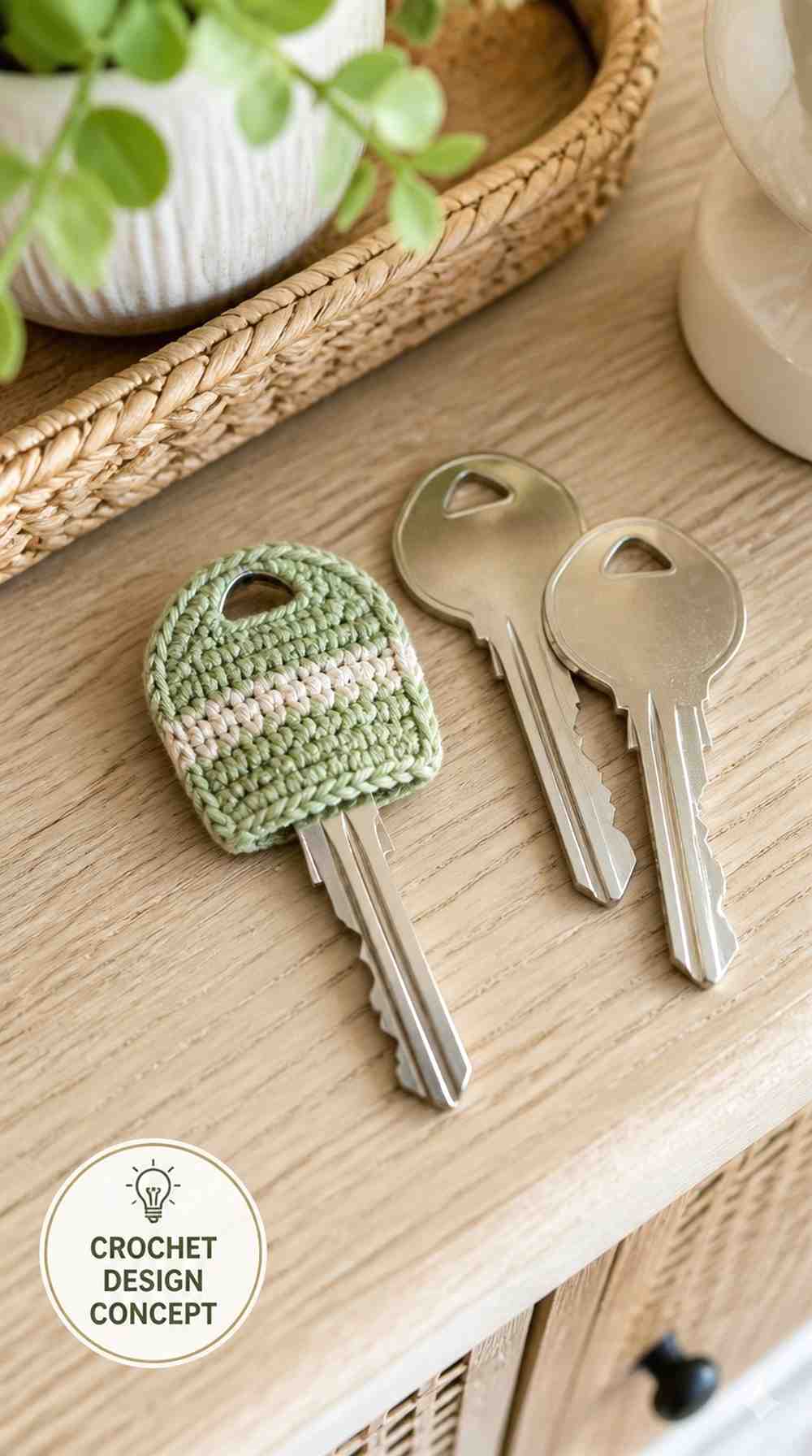
Soft sage-green crochet gives this key-head cover a simple, natural appearance. Its closely worked moss stitches wrap around the rounded metal head, while one cream stripe makes the key easy to distinguish. The metal blade and original keyring hole remain exposed.
This concept works well when you want to identify a single key without adding a separate dangling charm. The finished cap would need a snug fit so it does not slip off, while still leaving the key easy to insert, turn and remove from its lock.
- Key-Head Fit: Measure the actual metal head, including its thickness and keyring opening, rather than assuming all house keys have the same shape.
- Single-Stripe Code: Assign the sage-and-cream combination to one key consistently so the marker remains useful when several keys look alike.
- Lock Clearance: Keep all crochet away from the blade, shoulder and other areas that must enter or sit against the lock.
2. Crochet Navy Twin Stripe Key Sleeve
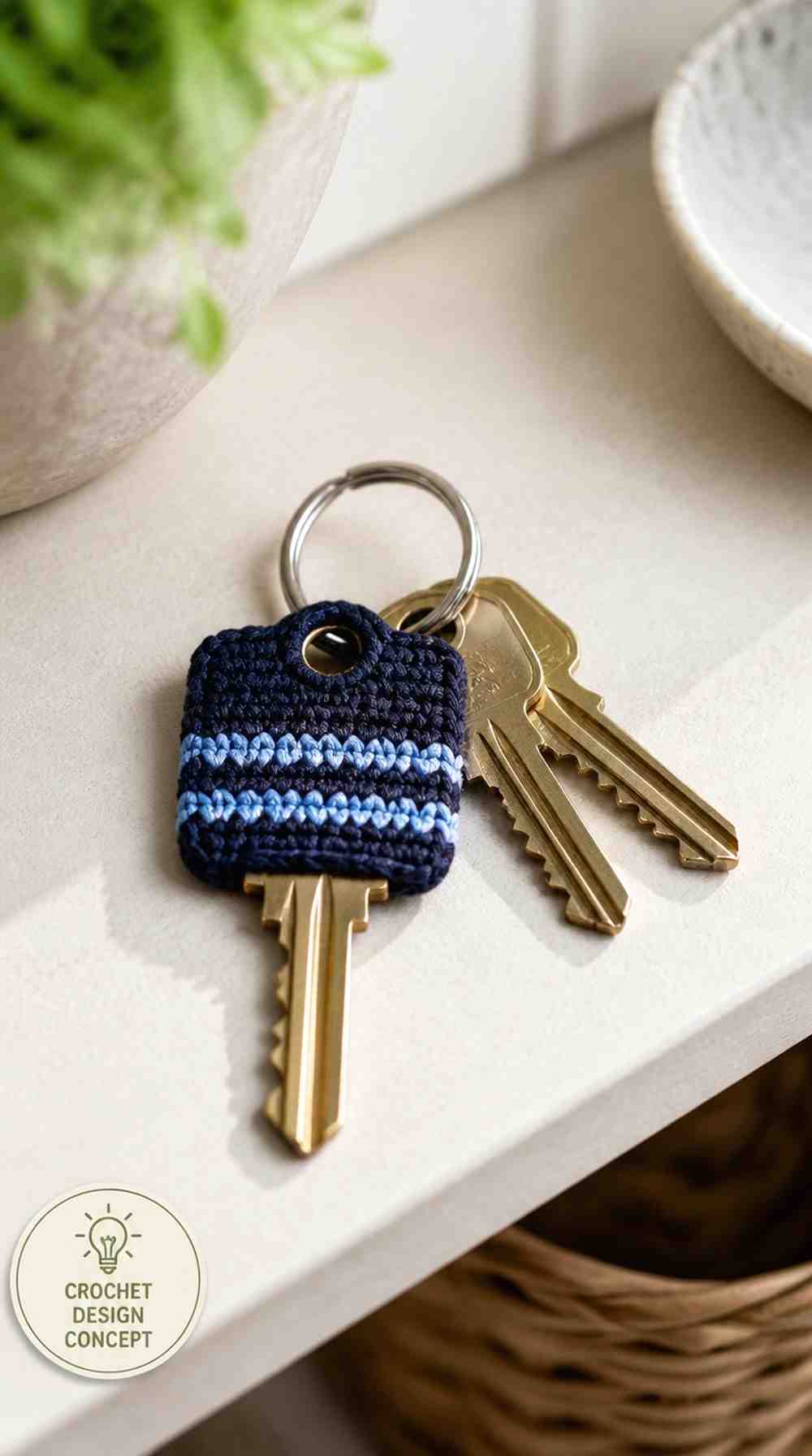
Deep navy crochet gives this miniature sleeve a tidy, understated finish. Two sky-blue stripes run across its closely stitched body, and a reinforced opening leaves the original keyring hole accessible. The brass-colored metal key head is covered, but its entire blade stays free.
The two-stripe arrangement provides a clear alternative to the sage single-stripe cap. A household could use stripe counts alongside colors to identify different keys, especially when several family members share the same key collection.
- Double-Stripe Identity: Two pale-blue lines create a distinctive marker that can be recognized without written information.
- Head Coverage: Fit the sleeve securely around the broad key head without stretching the yarn into the ring hole or down the metal shaft.
- Navy Visibility: Dark yarn works well with light stripes, although the marker should be checked under typical hallway or porch lighting.
3. Crochet Terracotta Daisy Key Marker
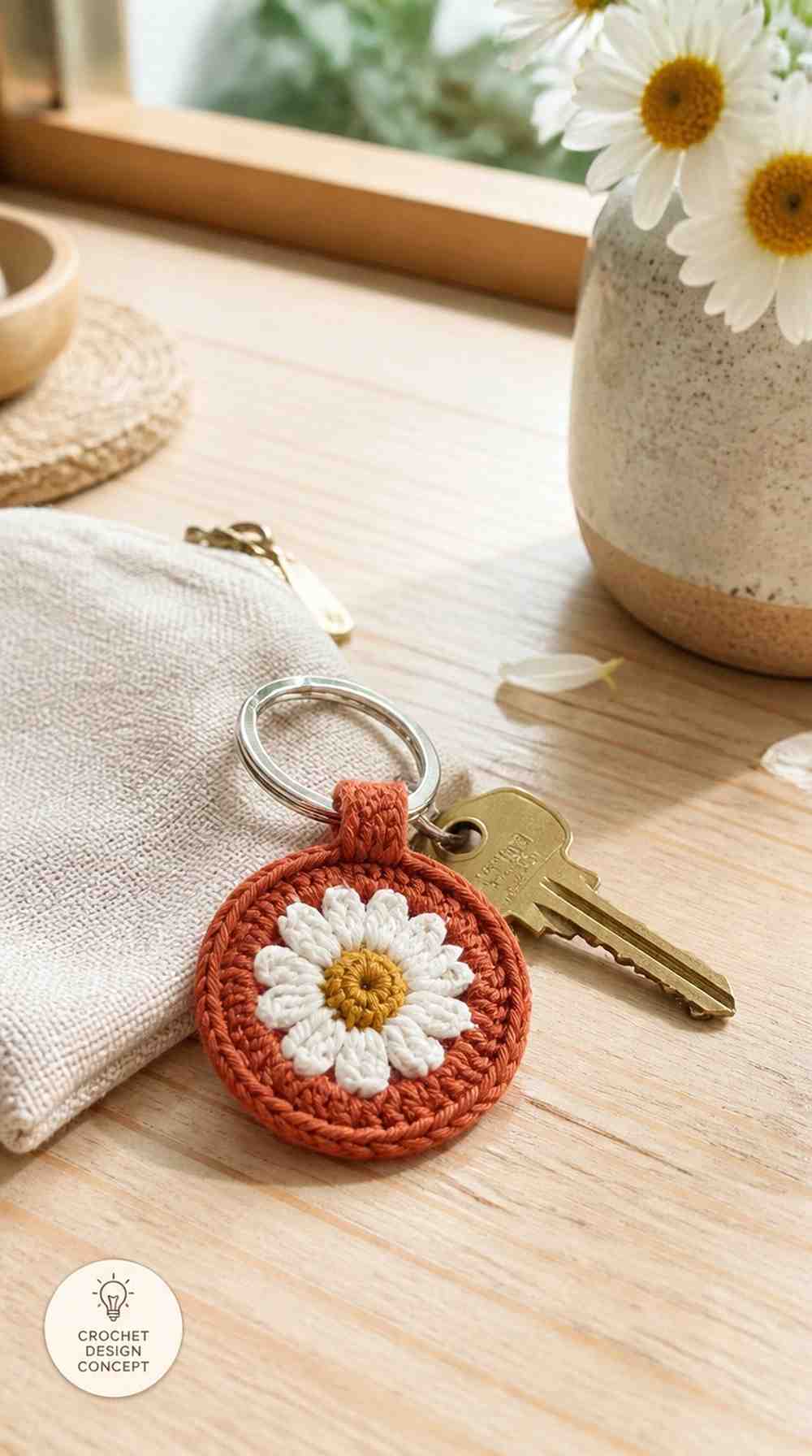
A small ivory crochet daisy brings a cheerful touch to this terracotta keychain marker. The flat circular tag has a mustard-yellow flower center, narrow rust edging and a reinforced loop connecting it to a silver split ring. The brass house key hangs separately and remains completely uncovered.
This design identifies the keyring through a recognizable flower rather than covering the key itself. It could be a good option when the key head is too narrow or unusually shaped for a fitted crochet cap.
- Flower Identification: Use the daisy as a consistent symbol for a specific keyring or key collection, rather than relying on color alone.
- Flat Petals: Secure the small flower closely to the circular tag so the petals do not lift or snag in pockets.
- Ring Attachment: Check the reinforced crochet loop for wear, especially when keys are repeatedly pulled from a handbag or pocket.
For more small handmade keychain designs, explore Yarn Nest Studio’s 10 Best Keychain Crochet Ideas collection, which covers decorative keyring accessories beyond identification tags.
4. Crochet Lavender Heart Key Head Cover
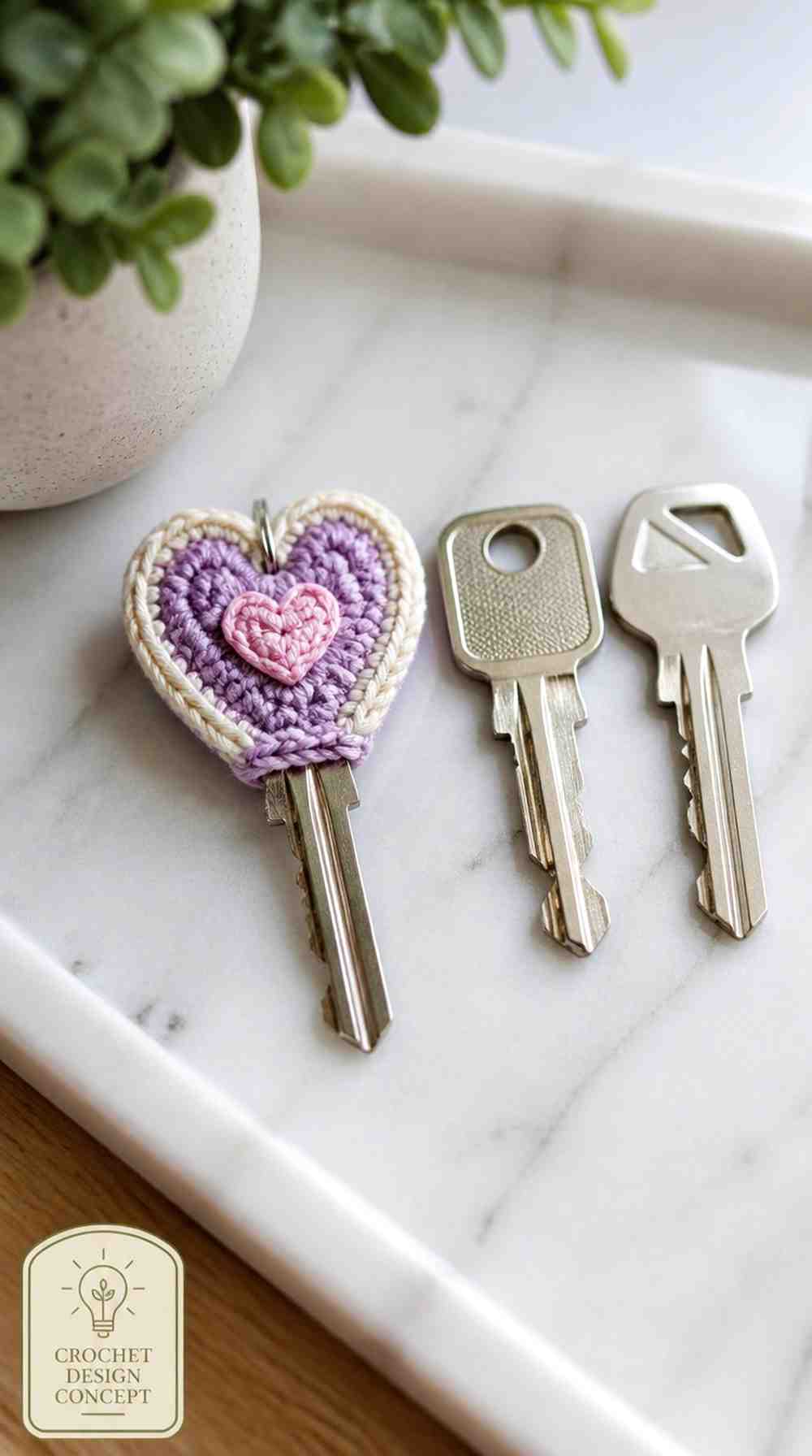
Lavender crochet creates a gentle heart-shaped cover around the broad head of a silver house key. Ivory edging follows the rounded lobes, while a smaller dusty-pink heart sits flat at the center. The keyring hole remains open between the upper curves.
The heart provides a recognizable shape without adding a long dangling accessory. Because the cover follows an unusual silhouette, careful fitting matters. It should not pull across the metal keyring opening or interfere with the key’s normal movement.
- Heart Silhouette: Keep the two rounded lobes compact enough to remain recognizable without making the key head unnecessarily bulky.
- Flat Pink Motif: Stitch the smaller heart securely to the lavender surface so it does not catch against clothing or pocket linings.
- Working Clearance: Check the finished cover with the actual lock, confirming that the key can turn freely without crochet touching the lock face.
5. Crochet Mustard Three Bobble Key Tag
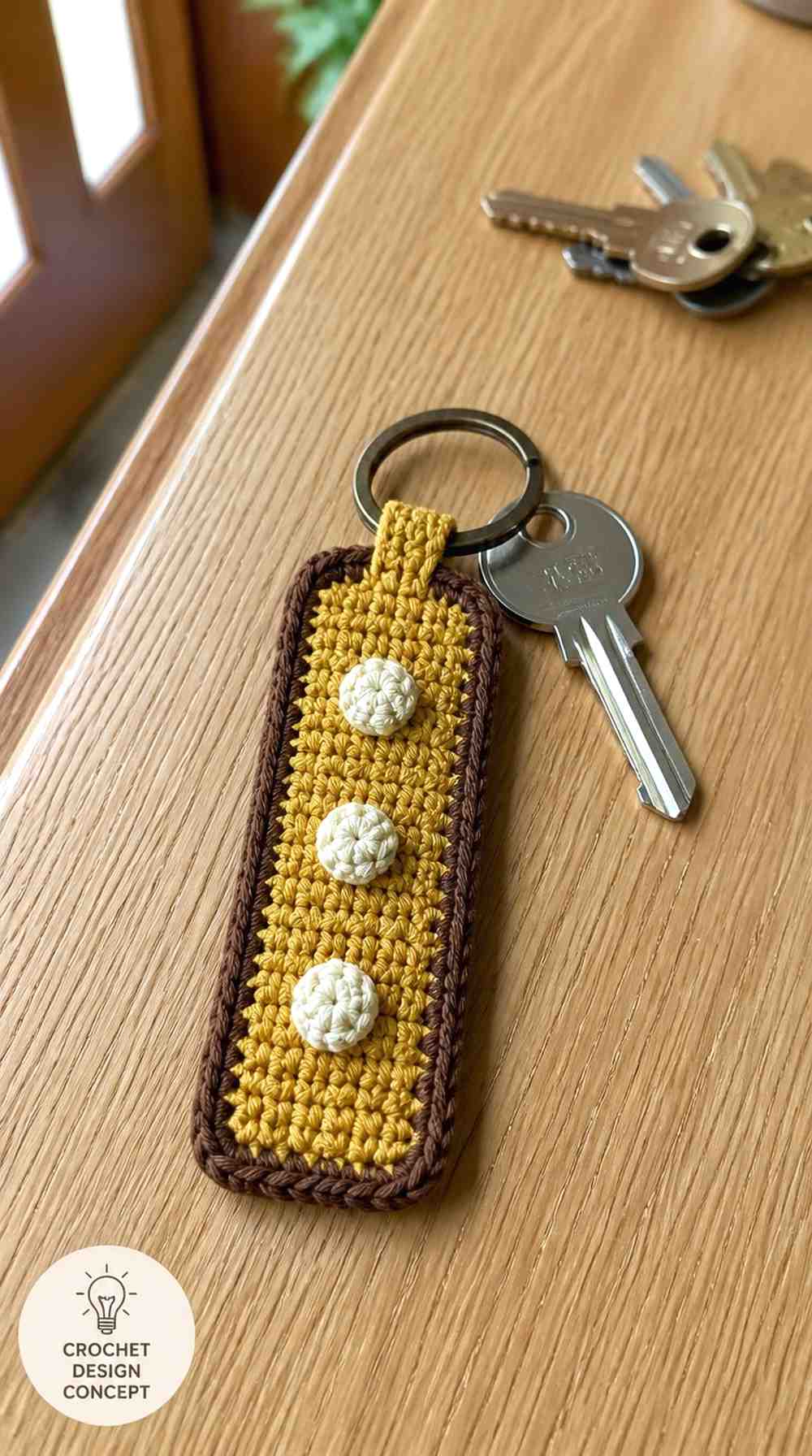
Golden mustard crochet gives this narrow identification tag a warm, easy-to-spot appearance. Three raised cream bobbles form a vertical row across its moss-stitch body, while chocolate-brown edging defines the rectangular shape. A bronze key ring holds the tag beside one exposed silver house key.
The raised bobbles make this concept different from purely color-based markers. They provide a touchable pattern that may help distinguish the tag by feel, although the small crochet bumps should not be treated as a guaranteed accessibility feature.
- Three-Bobble Pattern: Keep the bumps evenly spaced so the arrangement remains recognizable against the surrounding flat crochet.
- Texture Durability: Raised stitches may rub against keys and pocket fabric, so check them periodically for snagging or loosening.
- Compact Length: A short tag is easier to keep beside a key than a long decorative charm that can tangle with other belongings.
6. Crochet Charcoal Checkerboard Key Tab
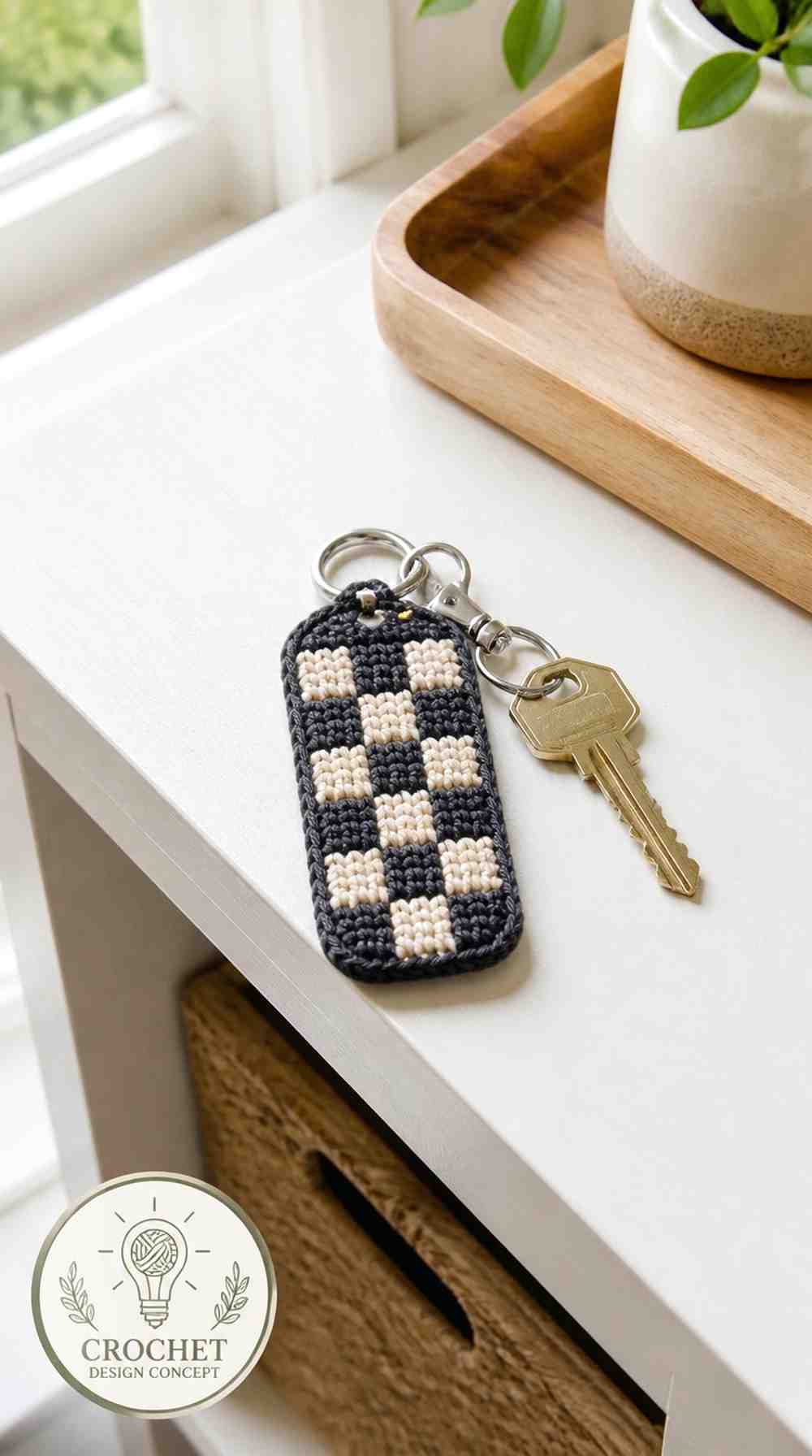
Alternating charcoal and warm-cream crochet blocks create a bold checkerboard front on this compact keyring tab. Its solid charcoal reverse and black edging keep the rectangular shape clean, while a silver swivel clasp connects it to a metal keyring.
The checkerboard pattern works as the main identifying feature. Unlike a fitted key cap, this design can be attached without needing to match the metal head precisely. However, a charm shared by several keys identifies the whole ring rather than showing which individual key opens a particular lock.
- Checkerboard Visibility: Small contrasting blocks create a clear pattern without requiring letters, numbers or additional embellishments.
- Flat Joining: Keep the miniature crochet squares securely connected so the tab remains relatively thin and pocket-friendly.
- Swivel Clasp: Choose appropriately sized hardware and check that the clasp closes reliably during everyday handling.
7. Crochet Dusty Blue Three Bar Key Marker
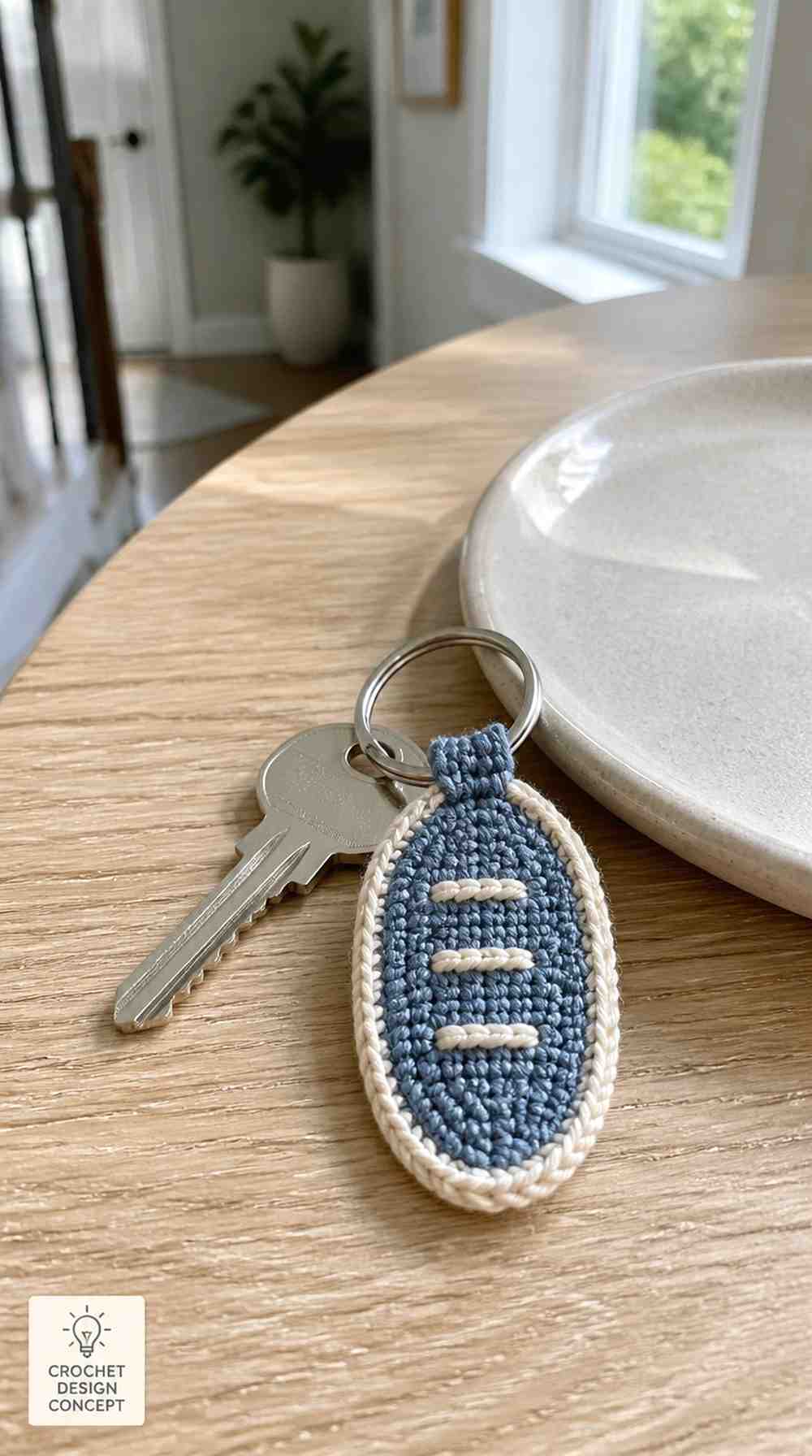
Dusty-blue crochet forms a slim oval identification tag with three raised ivory bars across its center. A narrow cream border follows the rounded outline, and a reinforced upper loop attaches the marker to a silver split ring holding an uncovered house key.
This concept explores a simple symbol code instead of a written label. For example, a household could use different bar counts to distinguish keys. The code must remain consistent, since three raised bars have no universal meaning.
- Three-Bar Code: Assign the pattern to a specific key or keyring and avoid reusing the same marker for a different purpose without updating the system.
- Raised Stitch Detail: The cream bars should remain prominent enough to see while staying securely attached to the blue background.
- Oval Shape: A narrow rounded tag fits naturally alongside keys without requiring sharp corners or dangling decorative elements.
8. Crochet Olive Leaf House Key Charm
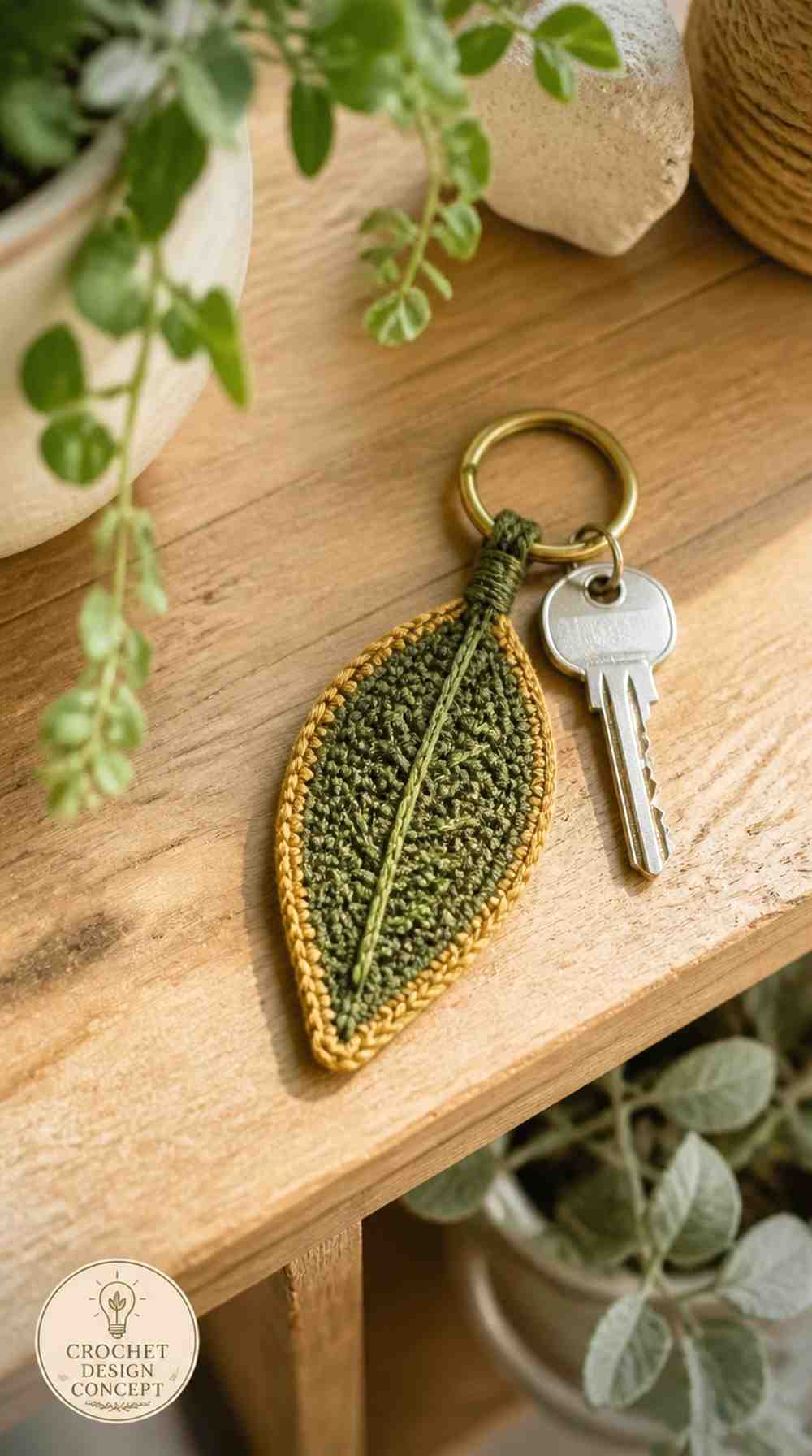
Olive-green crochet gives this small leaf-shaped tag a botanical appearance. Darker sage vein lines spread from its center, while a golden-ochre border defines the pointed edge. A short reinforced stem-loop connects the leaf to a brass keyring holding one silver house key.
The leaf creates a distinctive shape that can be recognized independently of its color. It may appeal to someone who prefers natural-looking accessories rather than brightly striped key covers. The pointed tip and raised veins should remain neat and compact.
- Leaf Identification: The botanical silhouette can represent one designated keyring without requiring a name or address label.
- Vein Placement: Keep the raised lines subtle and securely worked into the leaf so they do not catch on other keys.
- Stem-Loop Support: Reinforce the small hanging connection, since repeated key movement can pull against a narrow crochet stem.
9. Crochet Teal Changeable Tile Key Tag
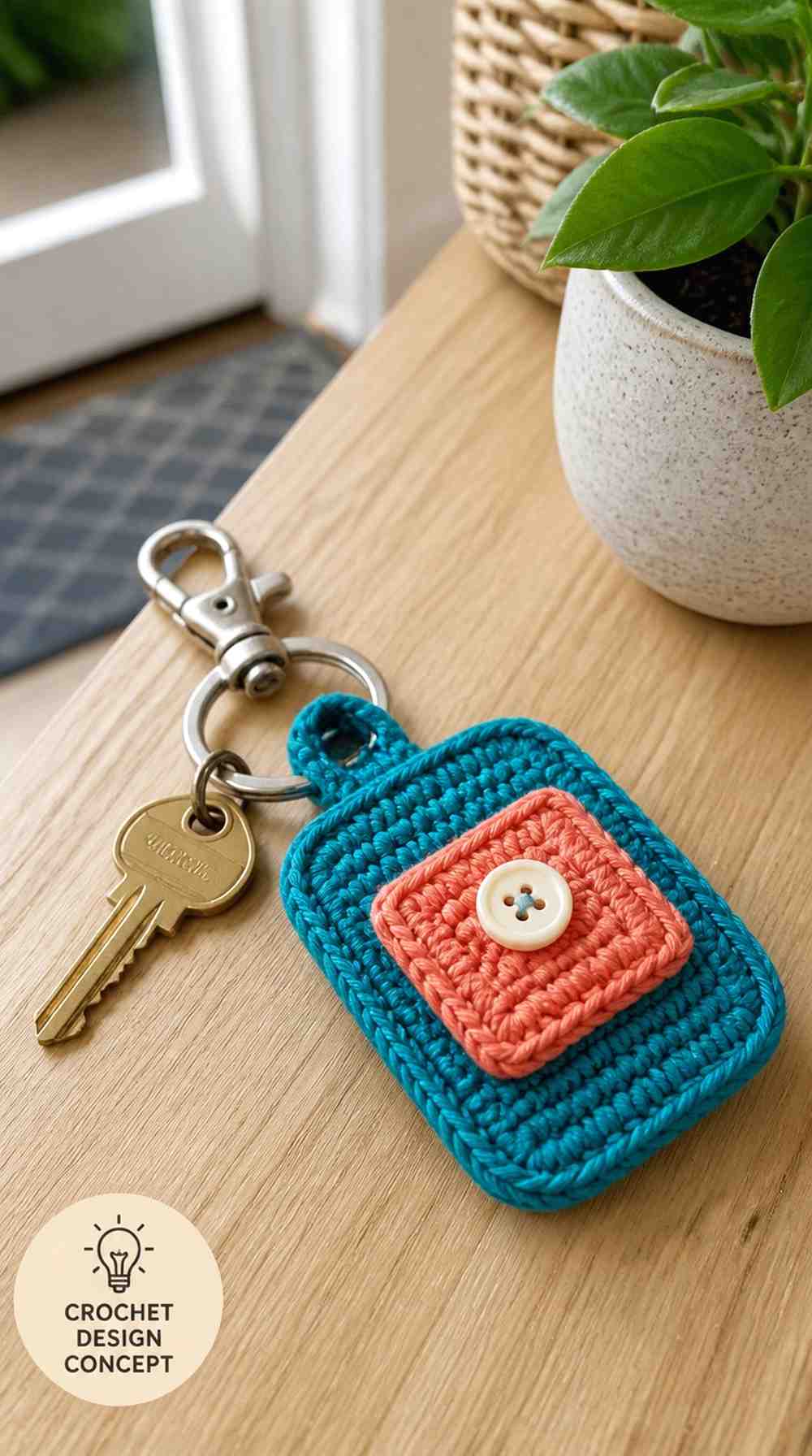
Bright teal crochet gives this identification tag a fresh, modern appearance. A small coral square sits at its center, outlined in ivory and fastened with a tiny cream button. The main rounded rectangular body connects to a silver swivel clasp through a reinforced crochet loop.
The removable square makes this design different from permanent color markers. In principle, the center tile could be replaced when the household changes its organization system. The extra button and detachable piece introduce small-part concerns, however.
- Changeable Color Tile: A replacement square can update the color code without remaking the main teal body.
- Small-Part Caution: Detachable buttons and tiles can present choking hazards, so this construction should be kept away from young children.
- Independent Attachment: The keyring clasp and decorative tile button perform separate functions and each needs secure fastening.
10. Crochet Blush Bow Key Cap
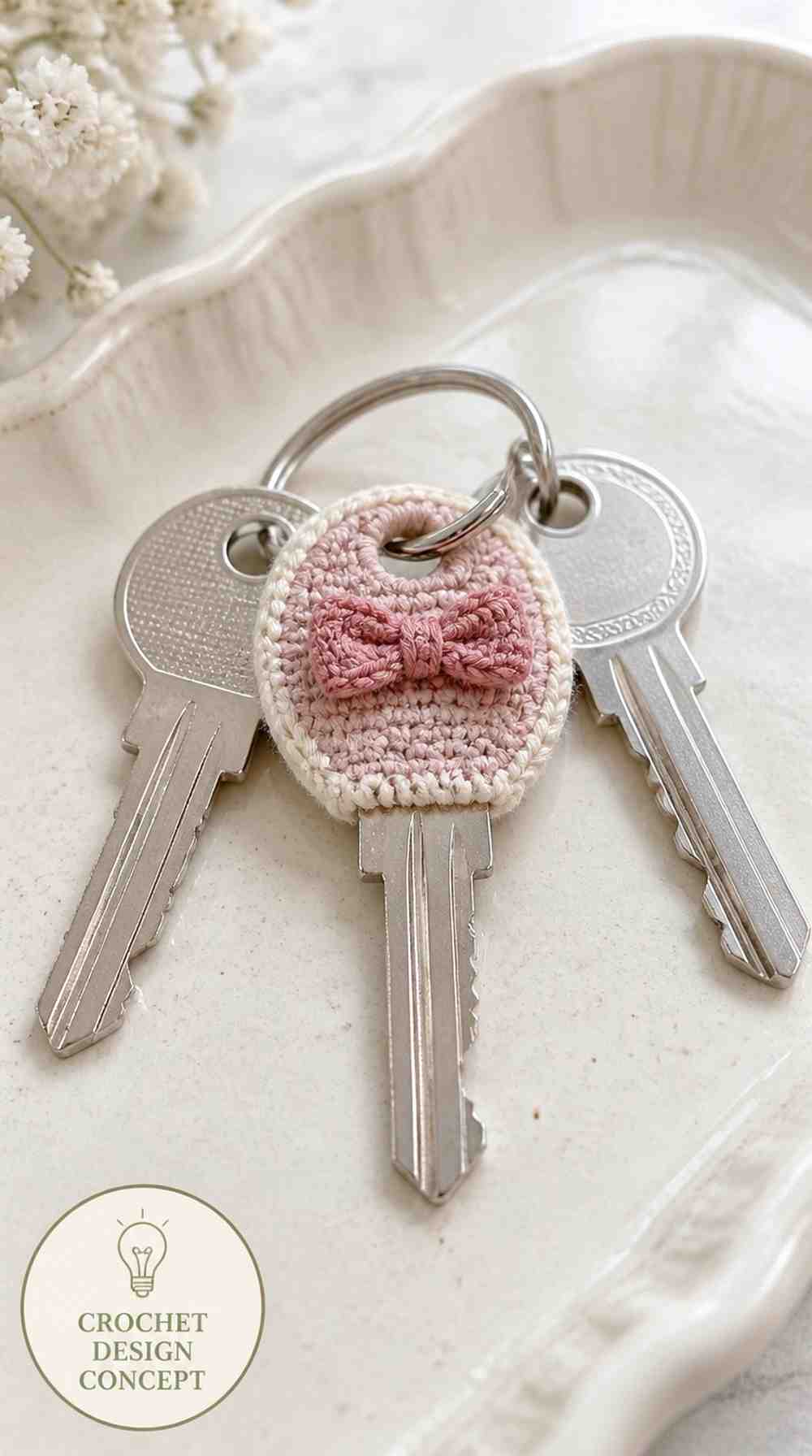
Soft blush crochet turns a plain key head into a delicate little accessory. Cream edging frames the close-worked cap, while one tiny dusty-rose bow sits flat across its upper front. The metal blade remains uncovered, and the reinforced keyring hole is still accessible.
The bow gives the key a recognizable decorative feature without requiring a dangling charm. Because small bows can catch on fabric, the loops should remain flat and securely stitched. This cap is best explored for a key with enough head space to accommodate the motif.
- Flat Bow Shape: Keep both bow loops attached closely to the cap rather than allowing loose decorative ends.
- Head Size: Check the actual key-head width before planning the bow placement or outer edging.
- Soft Color Contrast: Blush, cream and dusty rose create a coordinated marker, although a pale cap may show dirt more readily than a dark one.
11. Crochet Burgundy Diamond Key Wrap
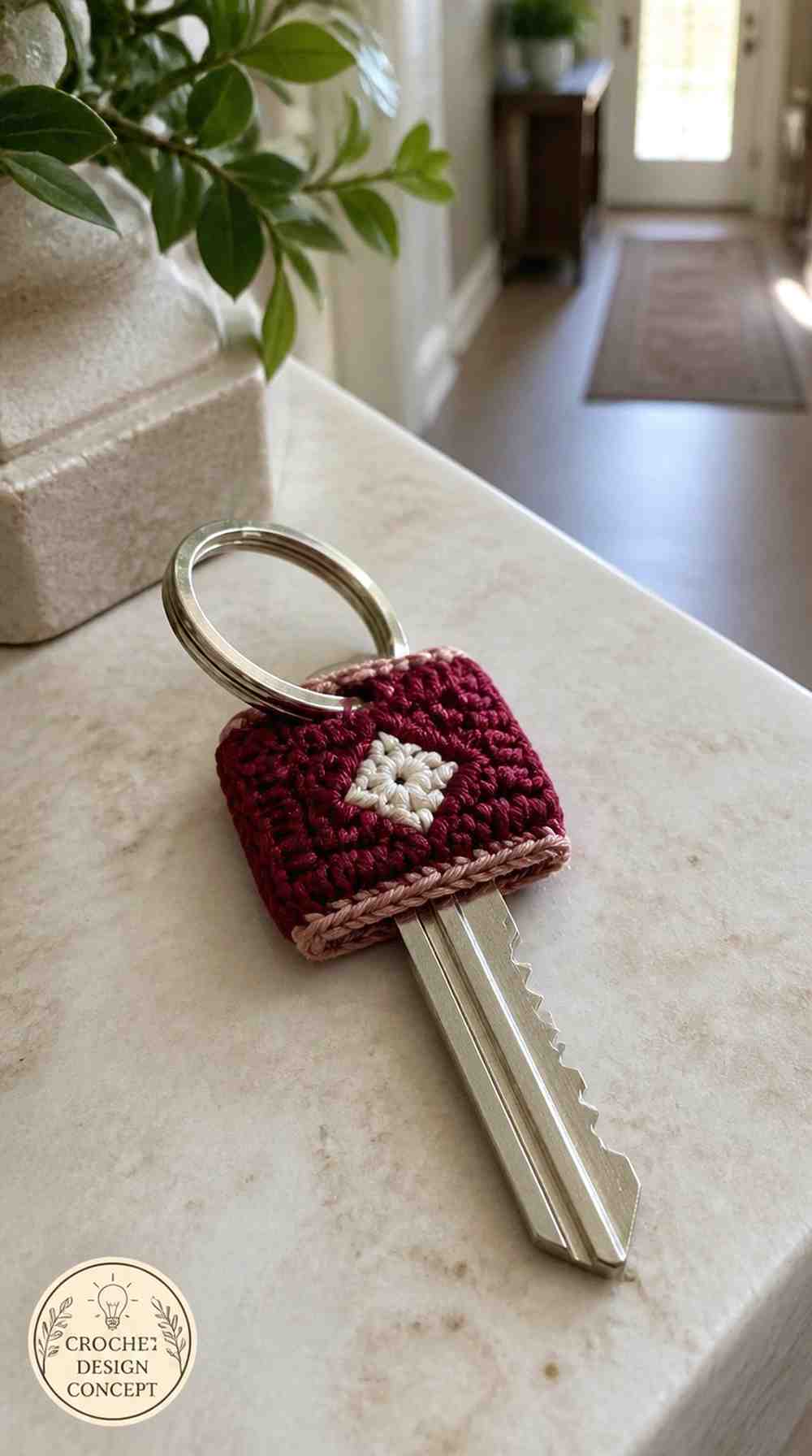
Rich burgundy crochet creates a narrow identification wrap around the broad head of a silver key. Horizontal ribs provide texture, dusty-rose edging outlines the band, and a small flat ivory diamond marks its front. A discreet rear snap closes the wrap.
The geometric motif is the main identifying feature. Unlike a permanently joined sleeve, the snap-fastened design explores a removable arrangement. Any real version would need careful placement so the hardware does not touch the lock, block the keyring hole or make the key uncomfortable to hold.
- Diamond Symbol: The ivory motif offers clear contrast against burgundy and can identify one key without using written information.
- Rear Snap: A miniature snap must close securely and remain clear of the key’s working surfaces.
- Removable Fit: Check that the wrap cannot slide down the metal shaft during insertion, turning or removal.
12. Crochet Coral Half Moon Key Marker
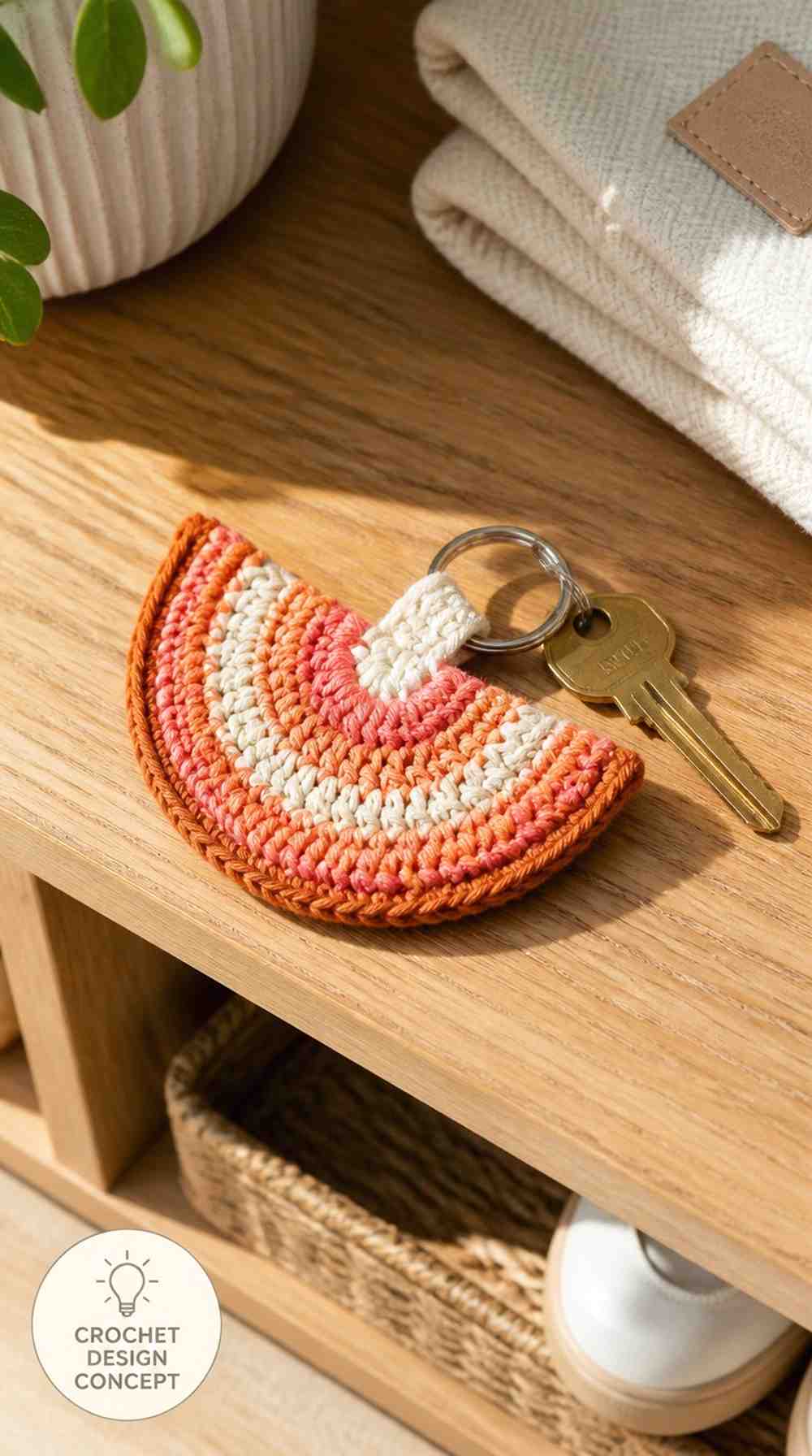
Coral, apricot and cream crochet rows form a cheerful half-moon identification charm. Its curved terracotta border defines the semicircular shape, while a short cream hanging loop connects the marker to a silver ring holding an ordinary brass key.
The concentric colors make the marker noticeable without requiring additional flowers, buttons or beads. Because the tag hangs beside the key instead of covering it, there is no need to adapt the crochet to the key head’s exact outline.
- Half-Moon Shape: The curved edge gives the tag a distinctive silhouette, while the straight upper section provides a clear place for the hanging loop.
- Concentric Stripes: Keep the coral, apricot and cream rows in a consistent order if making matching or replacement markers.
- Lightweight Construction: Avoid unnecessary stuffing or oversized dimensions that would make the charm awkward on a daily keyring.
13. Crochet Ivory Rainbow Keyring Marker
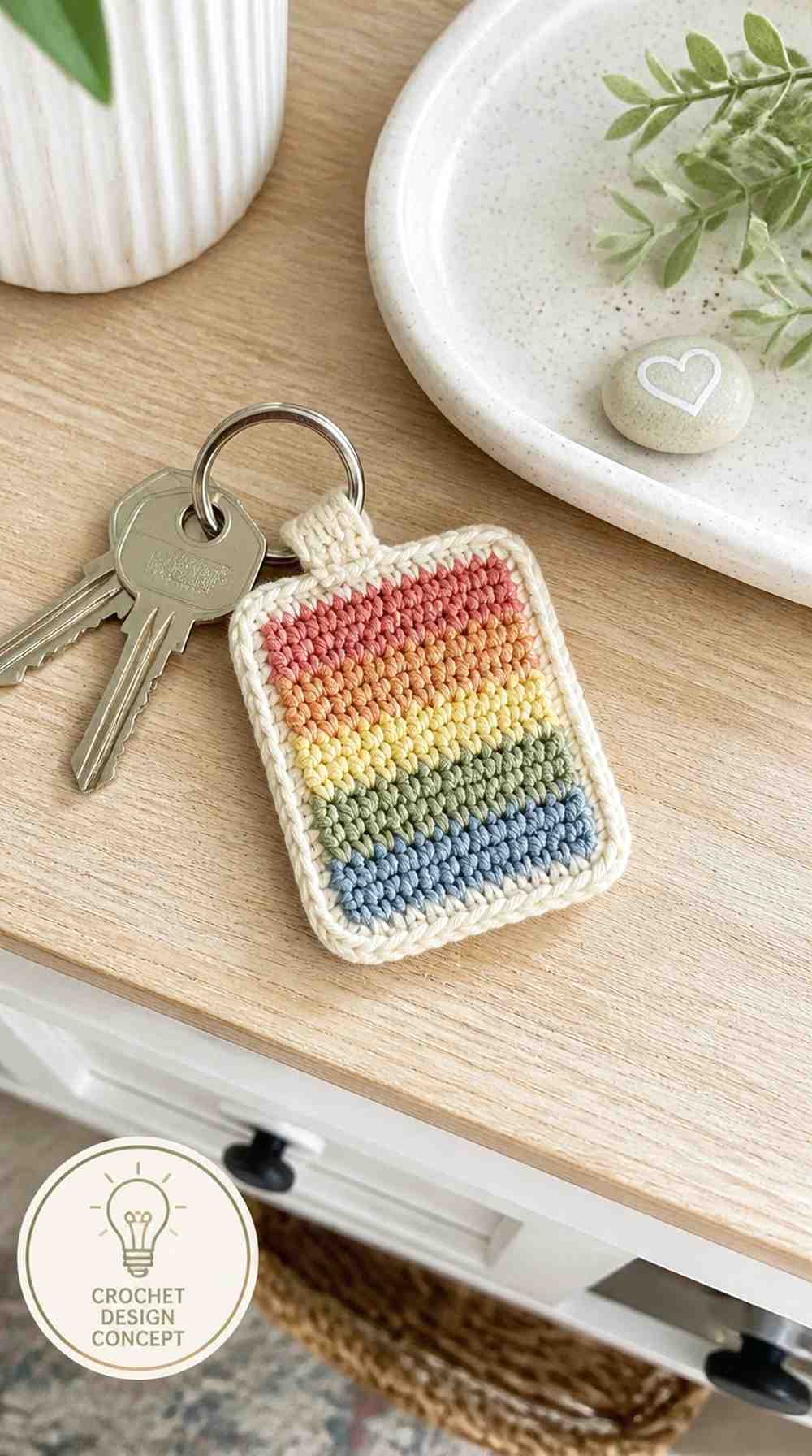
Five muted crochet stripes bring color to this small ivory keyring tag. Coral, apricot, butter yellow, sage and dusty blue run across its compact rectangular body, framed by cream edging and rounded corners. A reinforced short tab connects the marker to a split ring holding two plain metal keys.
This concept identifies an entire key collection rather than one individual key. It may be useful for distinguishing a household keyring from another set of keys, provided the rainbow code remains consistent and does not duplicate other markers.
- Five-Stripe Identity: The full color sequence creates a recognizable marker that differs from simple single-stripe designs.
- Whole-Ring Coding: Use the rainbow tag for the designated key collection, not as a substitute for individual key identification within that ring.
- Keyring Weight: Keep the crochet tag small and light so it does not add unnecessary bulk alongside multiple metal keys.
14. Crochet Plum Clear Label Key Tag
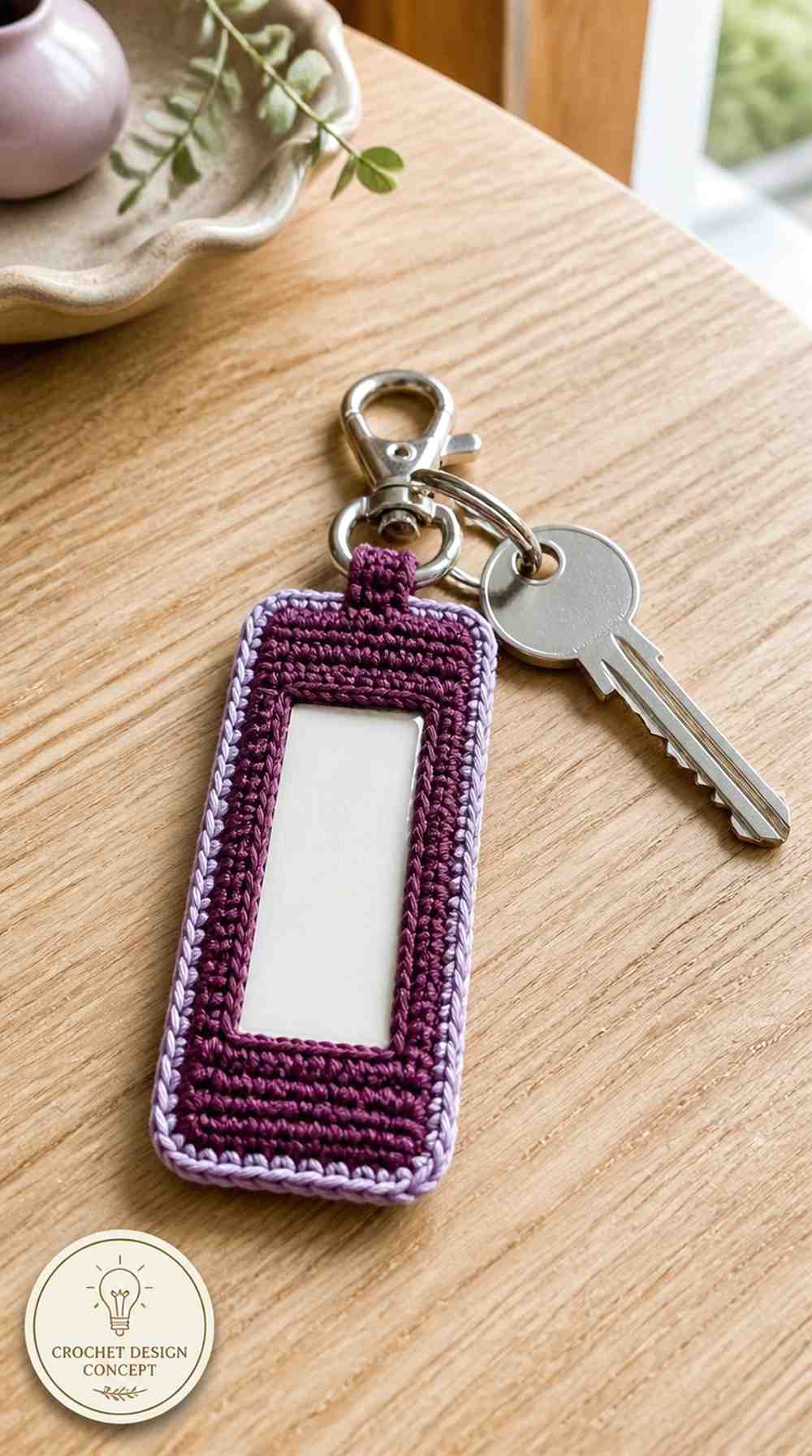
Deep plum crochet creates a slim rectangular identification tag with lilac edging and a small transparent front window. A blank ivory paper insert sits inside the window, while a reinforced upper loop connects the tag to a silver swivel clasp and one exposed house key.
The clear window makes this concept especially adaptable because its insert can be changed without replacing the crochet. For security, the label should use a private code or general color reference rather than revealing an exact address or identifying which property the key opens.
- Replaceable Label: Leave enough access to change the paper insert without damaging the transparent window or crochet frame.
- Privacy-Conscious Coding: Avoid street addresses, apartment numbers or other details that could identify the property associated with a lost key.
- Window Protection: Secure the clear material properly and keep paper inserts away from water, since ordinary crochet and paper are not waterproof.
Practical Guide to Crochet House Key Color Coding Tags
A useful key identification system should make everyday keys easier to recognize without making them harder to use or compromising home security.
Decide what each color represents. You might assign sage to one key, navy to another and terracotta to a third. If several keys are kept on one ring, separate key-head covers may identify them more clearly than one decorative charm attached to the ring.
Combine color with shape or texture. A flower, heart, leaf, stripe count or raised bobble pattern can help distinguish similar colors. This is also useful when identifying keys in poor lighting or when several people use the same key collection.
Check the working key area. A fitted crochet cap should cover only the suitable head section. Never cover the blade, cuts, grooves or any surface required to operate the lock. Test the finished cover carefully and remove it if it interferes with insertion, turning or removal.
Choose compact, close-textured crochet. Smooth cotton or a suitable cotton-blend yarn may be worth exploring. Use closely worked stitches and firmly secured ends, since loose loops can catch on keyring hardware or pocket fabric.
Secure the attachment. Metal split rings, jump rings and swivel clasps should be appropriately sized. Inspect crochet tabs and loops for stretching, fraying or loose stitches. Small charms are not suitable as handles for pulling a stuck key.
Keep home information private. Avoid printing your home address, apartment number, alarm code or other sensitive details on a tag. Use a color or private symbol system instead. If keys are lost, an identifying marker should not make it easier to determine where they belong.
Keep replacements consistent. If a tag becomes worn, replace it with the same color and symbol whenever possible. A simple household reference stored securely at home can help everyone remember the system.
Want to Make Something Similar?
These verified resources offer helpful techniques for small key markers, crochet covers and keyring straps. They are related lessons, not exact patterns for the 14 designs above.
- Free Crochet Key Marker by Rachel Choi at Crochet Spot — a particularly relevant tutorial for making a small cover that fits over the head of a house key while leaving the working blade exposed. Crochet Patterns, Tutorials and News
- Crochet Keychain — Step-by-Step by Yarn Nest Studio — covers constructing a small circular crochet accessory, attaching a reinforced tab and adding keyring hardware. Yarn Nest Studio
- Crochet Lanyard Keychain Pattern by Blue Star Crochet — includes written instructions and a video for creating an adjustable-length crochet strap with a clasp. Blue Star Crochet
For more small shape-based markers, see 15 Crochet Little Letter & Number Tags Ideas. Those decorative tags may offer further inspiration, although specific addresses or sensitive identification details should never be displayed on house keys.
Which Crochet House Key Color Coding Tag Should You Choose?
| Your main priority | Design to consider | Main consideration |
|---|---|---|
| Minimal fitted key marker | Sage Single Stripe | Must fit the key head |
| Two-stripe identification | Navy Twin Stripe | Requires enough head width |
| Recognizable flower symbol | Terracotta Daisy | Adds a separate charm |
| Heart-shaped key cover | Lavender Heart | Needs careful keyring clearance |
| Tactile raised marker | Mustard Three Bobble | Bobbles may snag |
| Modern high-contrast pattern | Charcoal Checkerboard | Separate keyring attachment |
| Simple three-bar code | Dusty Blue Three Bar | Code must remain consistent |
| Botanical key charm | Olive Leaf | Pointed edge needs secure finishing |
| Replaceable color marker | Teal Changeable Tile | Detachable small components |
| Soft decorative key cap | Blush Bow | Bow must remain flat |
| Geometric head wrap | Burgundy Diamond | Snap must not affect key operation |
| Colorful hanging charm | Coral Half Moon | Adds some keyring length |
| Identifying an entire keyring | Ivory Rainbow | Does not identify individual keys |
| Changeable private written code | Plum Clear Label | Paper insert requires care |
For identifying individual house keys, Crochet Sage Single Stripe Key Cap and Crochet Navy Twin Stripe Key Sleeve are useful concepts because they place the marker directly on the key head.
For an unusual key shape that cannot accommodate a fitted cover, the terracotta daisy, olive leaf or charcoal checkerboard tags may be easier to adapt. If a household needs a changeable identification system, the plum clear-label tag offers a place for a private code.
Conclusion
A crochet house key color coding tag can turn a small everyday accessory into a useful household organization tool. These 14 inspiration ideas show how different yarn colors, stripes, geometric shapes, floral motifs and raised textures can help distinguish keys that otherwise look almost identical.
The best design should be recognizable, compact and securely attached. More importantly, it should never interfere with the working part of a key or display sensitive details about your home. Choose a consistent system, keep the crochet well maintained and make everyday key identification simpler.
Which of these 14 crochet key identification designs would you use at home? Would you prefer colored covers fitted directly onto individual keys, small flower or leaf charms, or a removable label tag? Share the style that would make your keys easier to recognize.
Frequently Asked Questions
Can I crochet a color-coded cover for an ordinary house key?
Yes, a small crochet cover can be made for the broad head of some house keys. The fit depends on the head’s shape, thickness and keyring opening. The blade and other working parts must remain uncovered, and the finished cover should be tested to ensure it does not interfere with operating the lock.
Is it better to use a key-head cover or a separate crochet keyring tag?
A fitted key-head cover is more suitable when you need to distinguish individual keys on the same ring. A separate crochet charm generally identifies the ring or collection it is attached to. If your keys have unusual head shapes, a hanging tag may be easier to adapt.
How many colors should I use to identify my house keys?
Use as many clearly distinguishable colors as your household needs, but keep the system simple. For several similar keys, combining colors with stripes or symbols may help avoid confusion. For example, sage with one stripe and navy with two stripes are easier to distinguish than two nearly identical shades.
What yarn is suitable for crochet house key identification tags?
Smooth, closely worked cotton or cotton-blend yarn may be a useful choice for small key accessories. Check the yarn’s tendency to stretch, pill or fray, especially around metal attachments. The finished tag should be compact, and loose ends should be securely woven into the crochet.
Are these crochet house key color coding designs available as patterns?
These 14 designs are original visual inspiration concepts rather than tested crochet patterns. They illustrate possible colors, shapes, textures and keyring attachments. The linked tutorials provide real techniques for creating related accessories, but any fitted key cover requires its own measurements and checks to confirm that the key continues to operate safely.