A crochet kitchen faucet drip catcher mat is a small accent that can make the area around your sink look more thoughtful and inviting. From simple horseshoe shapes and thick waffle textures to scalloped crescents, leaf-inspired designs, and colorful granny-square arrangements, there are plenty of ways to give this everyday kitchen space a handmade touch. These 15 ideas explore different shapes, stitch textures, colors, and decorative details.
Some kitchens have wide countertop space behind the faucet, while others have barely enough room for a narrow strip of fabric. This collection helps you compare compact mats, larger decorative pieces, split designs, and textured surfaces that might suit your sink layout. You’ll also find practical advice about choosing suitable yarn, checking faucet clearance, removing damp mats, and understanding the limitations of crochet in a frequently wet area.
These are AI-generated crochet design visualizations for inspiration, not photographs of tested handmade pieces or step-by-step patterns.
Quick Design Selection Guide
- For a simple everyday look: Crochet Oatmeal Horseshoe Drip Mat has a neat shape and compact textured surface.
- For a narrow sink deck: Crochet Midnight Slim Backsplash Mat offers a long, shallow layout with minimal front-to-back coverage.
- For detailed stitch texture: Compare Crochet Sage Waffle Faucet Mat and Crochet Sandstone Basketweave Faucet Mat.
- For a softer decorative touch: Crochet Ivory Scalloped Crescent Mat and Crochet Blush Tulip Leaf Mat have more expressive silhouettes.
- For colorful kitchen styling: Crochet Rust Granny Mosaic Mat and Crochet Sunset Half-Round Stripe Mat bring several colors into a small space.
- For easy access around the faucet: Crochet Lavender Twin Faucet Pads leave the central faucet fitting uncovered.
Before choosing, measure the available space and consider whether a removable fabric mat will be practical in a spot that receives frequent splashes.
1. Crochet Oatmeal Horseshoe Drip Mat
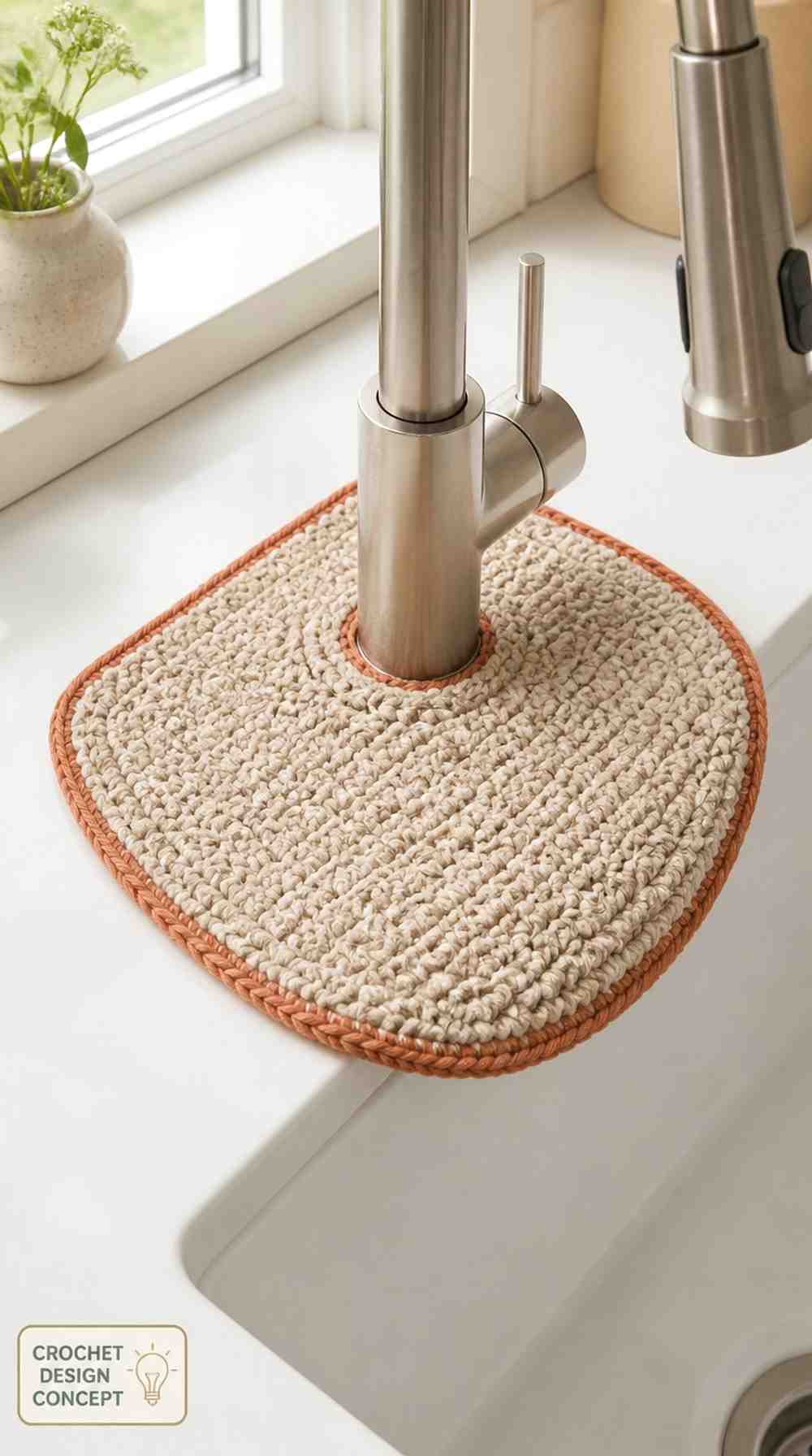
Warm oatmeal crochet gives this horseshoe-shaped mat a simple, natural look around the kitchen faucet. Its closely worked moss-stitch surface creates a subtle texture, while the thin terracotta edging brings a little warmth to the neutral yarn. The rounded front and open rear notch make the overall shape feel tidy without much decoration.
This concept suits a kitchen where you want a small fabric accent rather than a large countertop covering. The important detail is the open area around the faucet, which should allow the mat to lift away easily for cleaning and drying.
- Horseshoe Fit: Check the diameter of the faucet base and the available counter space before planning the notch. Avoid squeezing crochet tightly against the fitting.
- Moss-Stitch Texture: Closely spaced stitches offer a relatively even surface. Test the fabric flat before deciding whether that texture is suitable for your sink deck.
- Terracotta Border: The narrow contrasting edge defines the outline without adding bulky decoration. It could also coordinate with warm wood or clay-colored kitchen accents.
- Daily Removal: The simple open-backed shape may be easier to lift away than a fully enclosed ring when the counter needs wiping.
2. Crochet Sage Waffle Faucet Mat
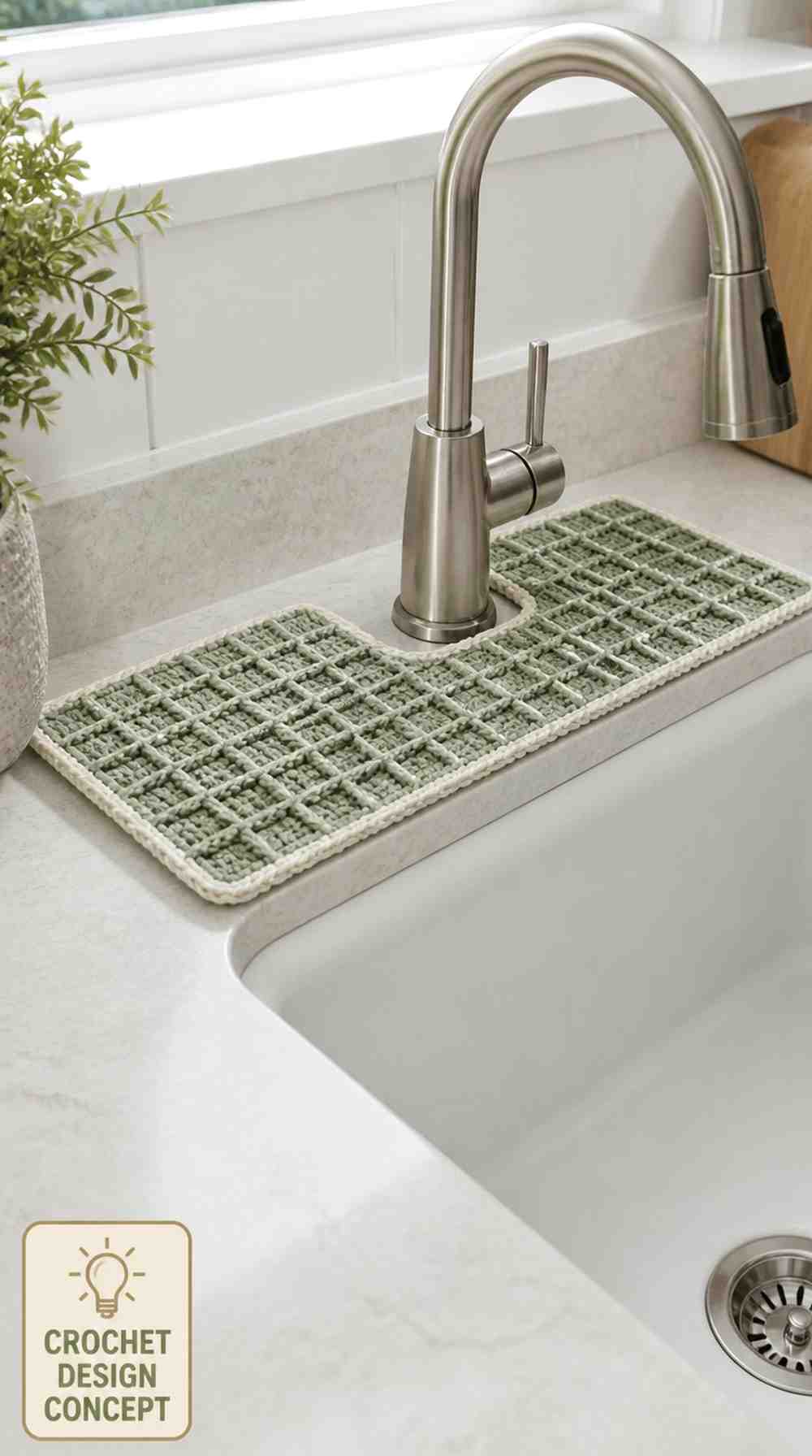
Raised waffle-stitch squares give this sage-green crochet mat a noticeably textured surface. Its broad rectangular body, centered U-shaped opening, and slim cream edging create an orderly design that works visually beside pale stone and brushed metal. The repeated square texture makes the crochet the main decorative feature.
For an actual kitchen, the raised sections deserve some thought. They create more surface detail than a flat stitch and may take additional attention when rinsing, washing, and drying. This is better treated as a removable decorative mat than a permanently damp fixture.
- Raised Texture: Waffle stitches form recessed spaces between raised sections. Consider how easily food particles, soap residue, and moisture could collect in those areas.
- Counter Width: The rectangular design needs enough room on either side of the faucet to sit flat without curling near the sink rim.
- Cream Edging: A smooth border creates a clean visual finish, but an actual sample should be checked for curling or pulling at the corners.
- Drying Needs: Thicker textured crochet may dry less quickly than a thinner fabric. Remove the mat and allow both sides to dry fully.
3. Crochet Dusty Blue Overlap Wrap
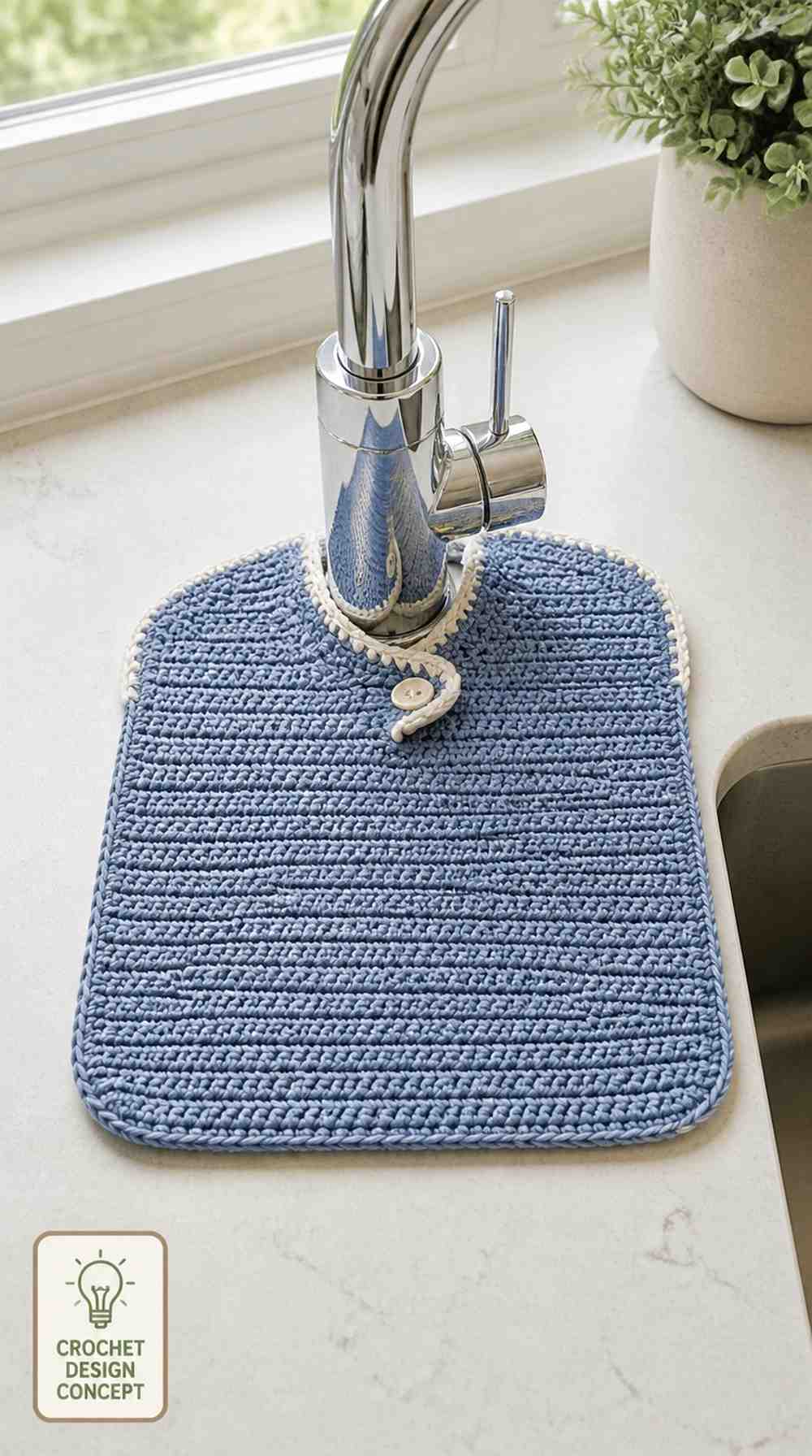
Dusty-blue yarn brings a soft, understated finish to this rounded rectangular crochet mat. Its most distinctive feature is the pair of narrow rear tabs that overlap behind the kitchen faucet. Fine ivory edging outlines the tabs, and a small cream button provides a visible fastening detail.
Unlike a simple U-shaped mat, this design explores a wrap-style arrangement that could suit a faucet with enough clear space behind its base. The button placement and tab length would need careful planning, especially if the faucet sits very close to a backsplash.
- Rear Tab Clearance: Check whether there is enough room behind the faucet to reach the button without disturbing the fitting or interfering with its movement.
- Button Placement: The small rear fastening should remain accessible. A real version would need a secure attachment and regular inspection.
- Flat Front Panel: The broad front section offers a continuous textured area, while the overlapping tabs keep the visual detail behind the faucet.
- Cleaning Access: A removable fastening could help with cleaning, although its practical convenience depends on the actual hardware and sink layout.
4. Crochet Ivory Scalloped Crescent Mat
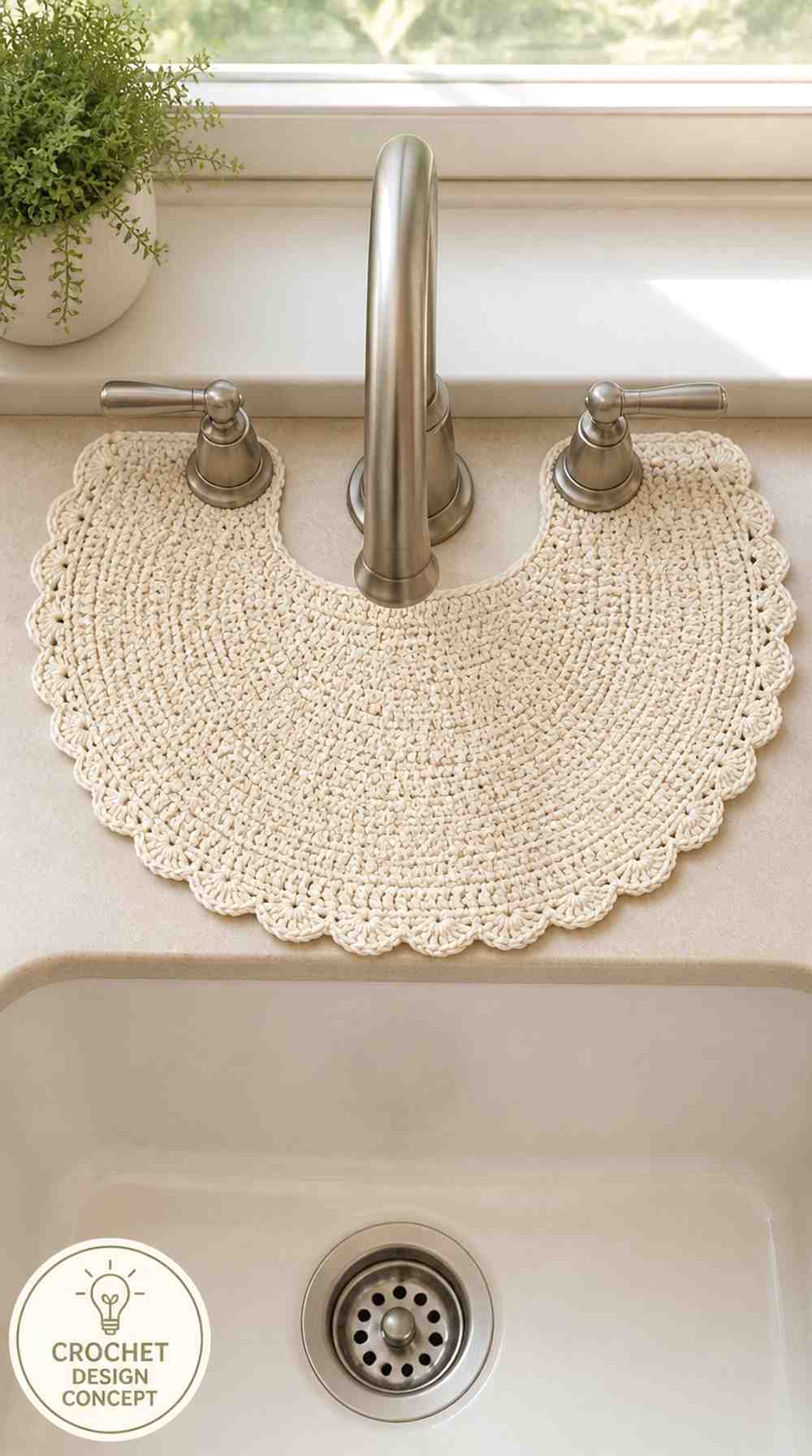
A curved ivory crochet mat can give an ordinary sink deck a softer, more traditional appearance. Here, the dense center follows a broad crescent shape, while small rounded scallops decorate the outer front edge. The warm-ivory color keeps the texture visible without introducing several contrasting shades.
The crescent silhouette is especially appealing when the faucet is centered on an open stretch of countertop. Still, its decorative edge should not hang into the basin, where repeated splashing could leave the yarn wet for long periods.
- Scalloped Edge: Small, evenly spaced scallops are preferable to deep dangling loops near a sink, where loose edges could catch or become damp.
- Curved Placement: Check both the inner opening and the front arc. A mat that looks balanced in a photograph may not fit every sink.
- Ivory Yarn: Light fabric makes residue and discoloration easier to notice, so this design may need more frequent cleaning than darker alternatives.
- Decorative Priority: The curved shape provides visual interest, but it does not create a waterproof seal or guarantee that splashes stay off the counter.
5. Crochet Charcoal Checkerboard Faucet Mat
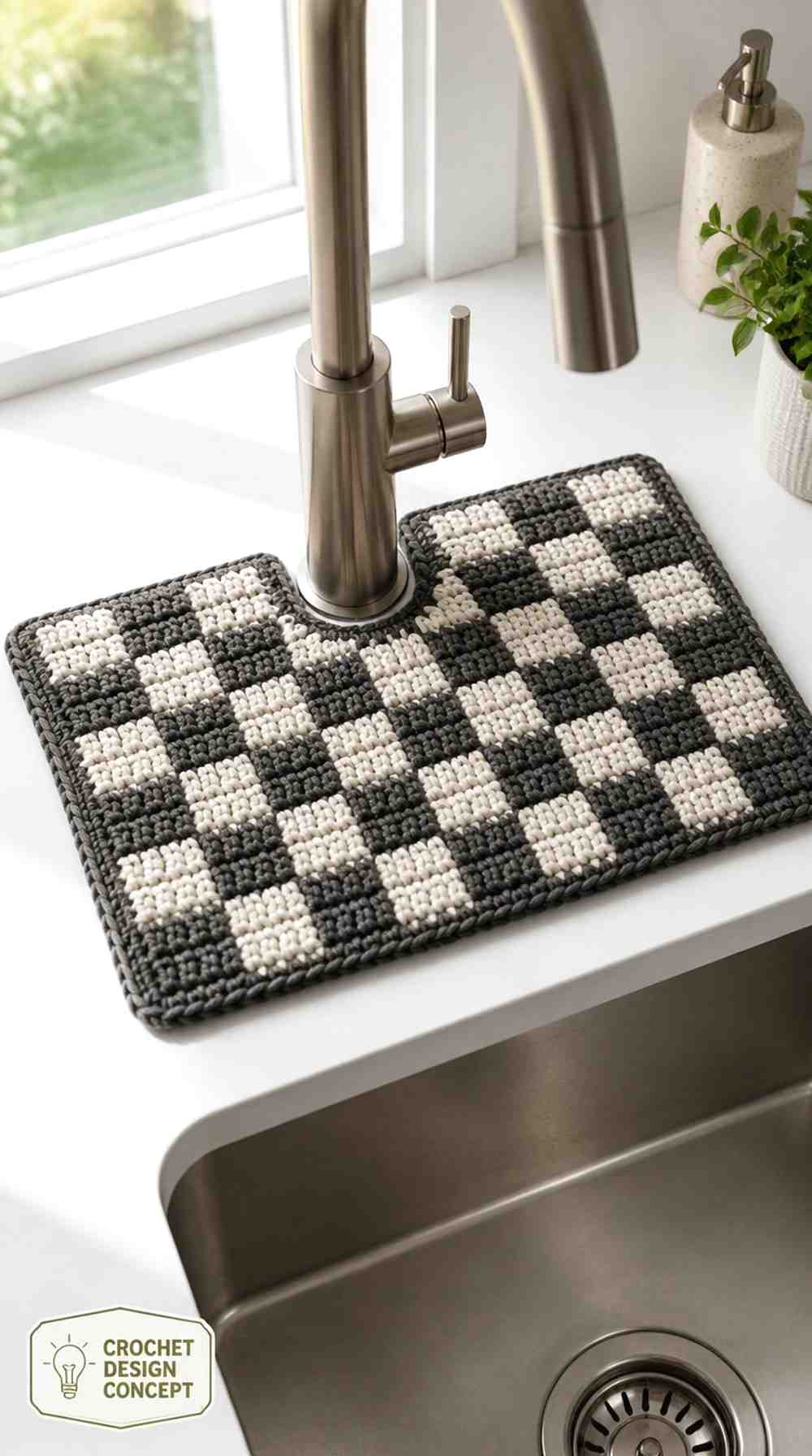
A charcoal-and-cream checkerboard brings a neat graphic finish to this rectangular crochet faucet mat. Small solid blocks alternate across the surface, creating a clear pattern with flat joining seams and a continuous charcoal border. The rear U-shaped cutout keeps the design focused on the faucet area.
This concept is a good example of how crochet can feel modern rather than rustic. The square arrangement needs accurate shaping around the opening, however, and a real version should avoid bulky seams underneath the mat that could prevent it from lying level.
- Checkerboard Alignment: Plan the square layout around the rear cutout so that the final design keeps its balanced alternating pattern.
- Flat Joining: Low-profile joins would be worth exploring because raised seams could create uneven contact with the countertop.
- Dark-Light Contrast: Charcoal hides some visible discoloration better than cream, but both shades still require appropriate cleaning.
- Shape Planning: A rectangular checkerboard is easier to visualize than an irregular design, though the faucet notch introduces additional shaping considerations.
6. Crochet Seafoam Shell Fan Mat
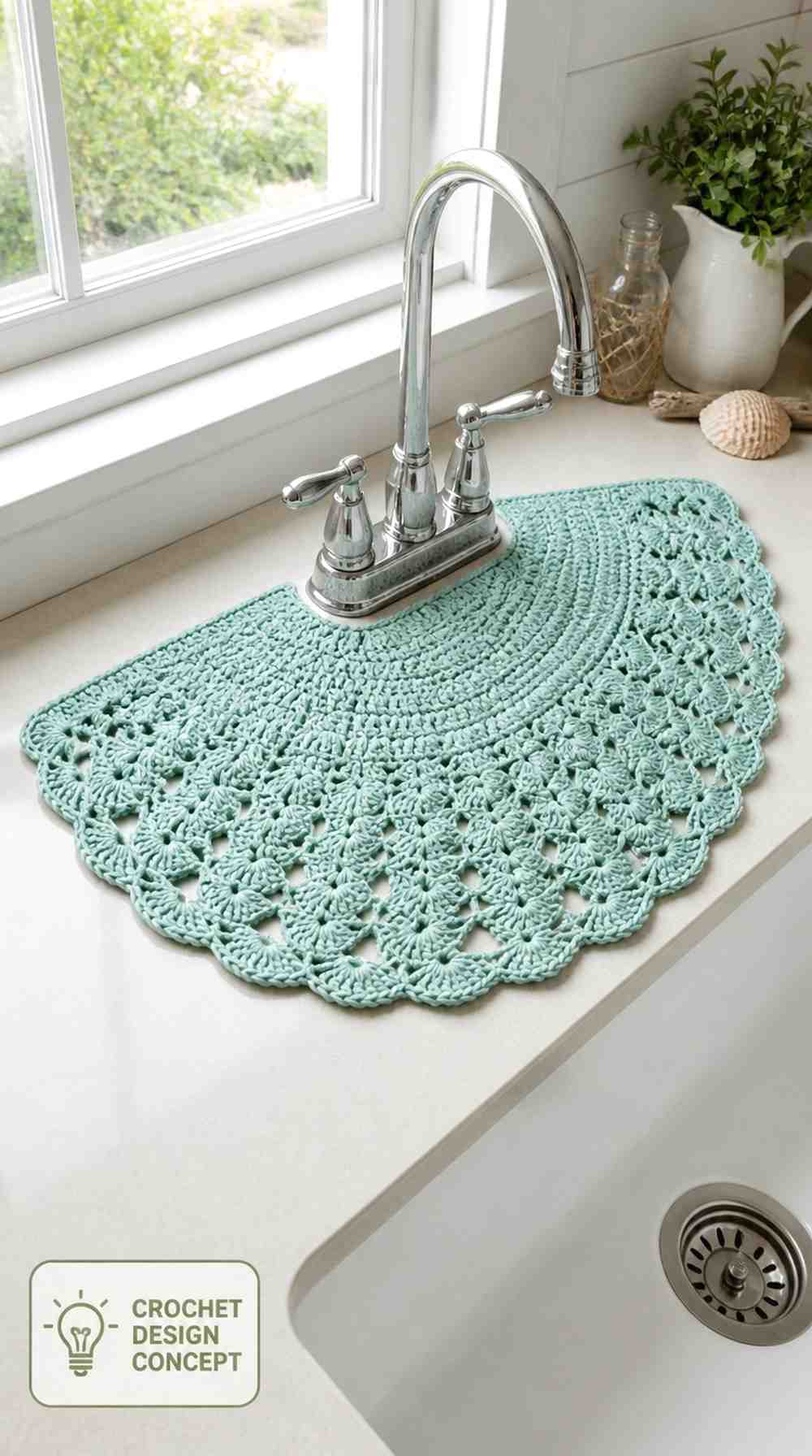
Seafoam-green crochet shell stitches spread outward from the faucet in this delicate fan-shaped design. The rounded front follows the repeated shell pattern, producing small scallops and decorative spaces between the raised stitch clusters. A more closely worked inner section gives the shape a defined center.
The airy shell texture makes this an attractive decorative option for a coastal-inspired kitchen. Its open areas, however, mean that splashed water can reach the countertop through the fabric. It is best considered a visual accent rather than a dependable moisture barrier.
- Shell Openings: Decorative gaps expose the surface underneath. Do not rely on this design to catch or hold every splash.
- Fan Proportion: The curved front needs enough counter depth to remain clear of the sink basin and other nearby fittings.
- Stitch Definition: Choose yarn and stitch spacing that keep the individual shell shapes recognizable without producing overly loose fabric.
- Cleaning Consideration: Open decorative stitches can trap small debris between loops, making gentle cleaning and thorough drying important.
7. Crochet Blush Tulip Leaf Mat
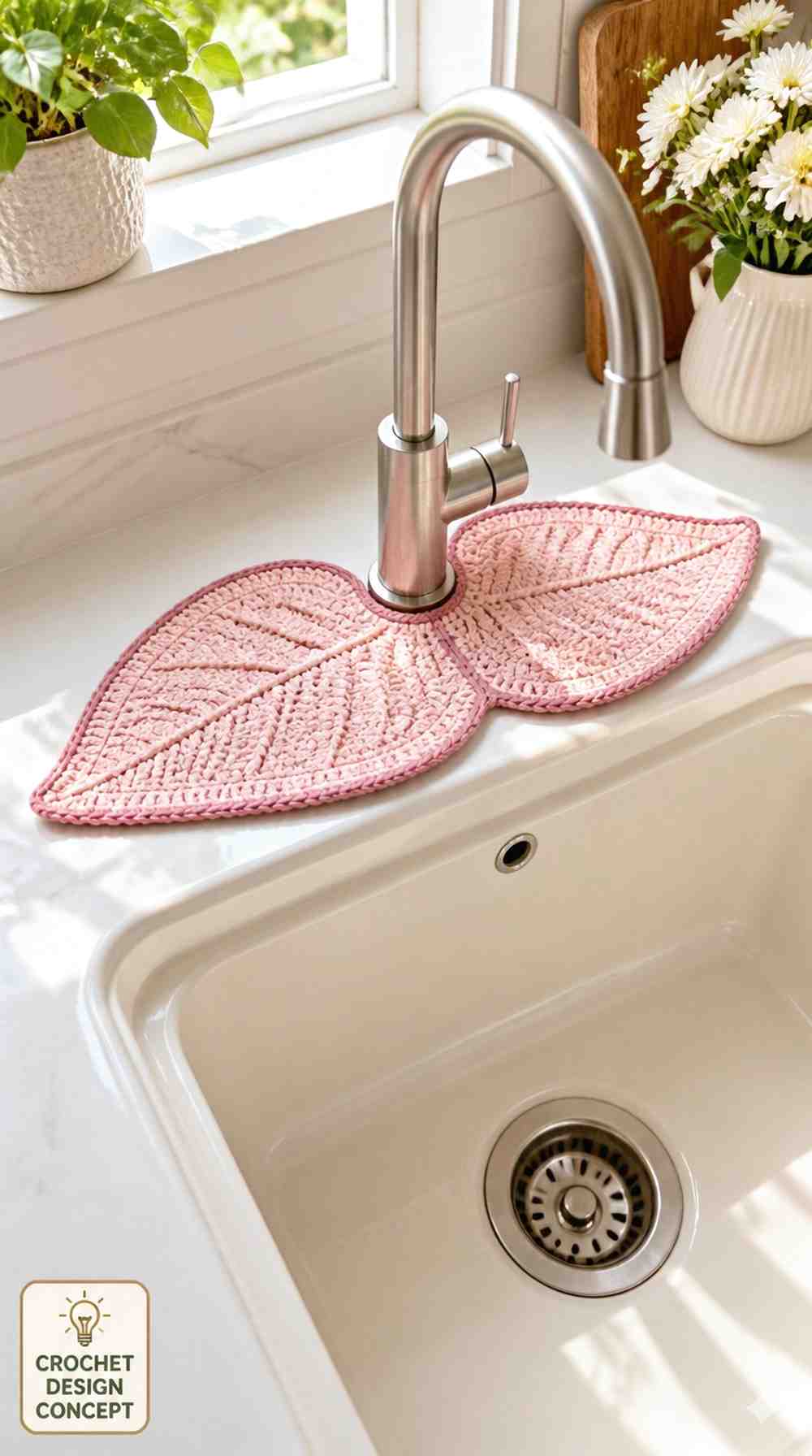
Two broad tulip-inspired leaf shapes give this blush-pink crochet mat its distinctive silhouette. Subtle raised vein lines run through each leaf, and a dusty-rose border highlights the pointed ends. The leaves meet in a flattened front section, while a small notch leaves room around the faucet base.
Rather than relying on added flowers or dangling embellishments, the design uses the shape of the crochet itself as decoration. That keeps the surface visually interesting without making it overly elaborate. The pointed ends should still stay well away from the wet sink opening.
- Leaf Wings: The two outward-pointing sections require enough side clearance to lie flat without folding against the backsplash or sink hardware.
- Raised Veins: Subtle crochet relief adds dimension, but excessively thick decorative lines could make the fabric sit unevenly.
- Pink Color Pairing: Blush and dusty rose can soften a cream or white kitchen while remaining subtle enough for everyday styling.
- Outer Points: Shape the tips carefully in a real sample to reduce curling, snagging, and unwanted contact with the basin.
8. Crochet Honey Ribbed Oval Mat
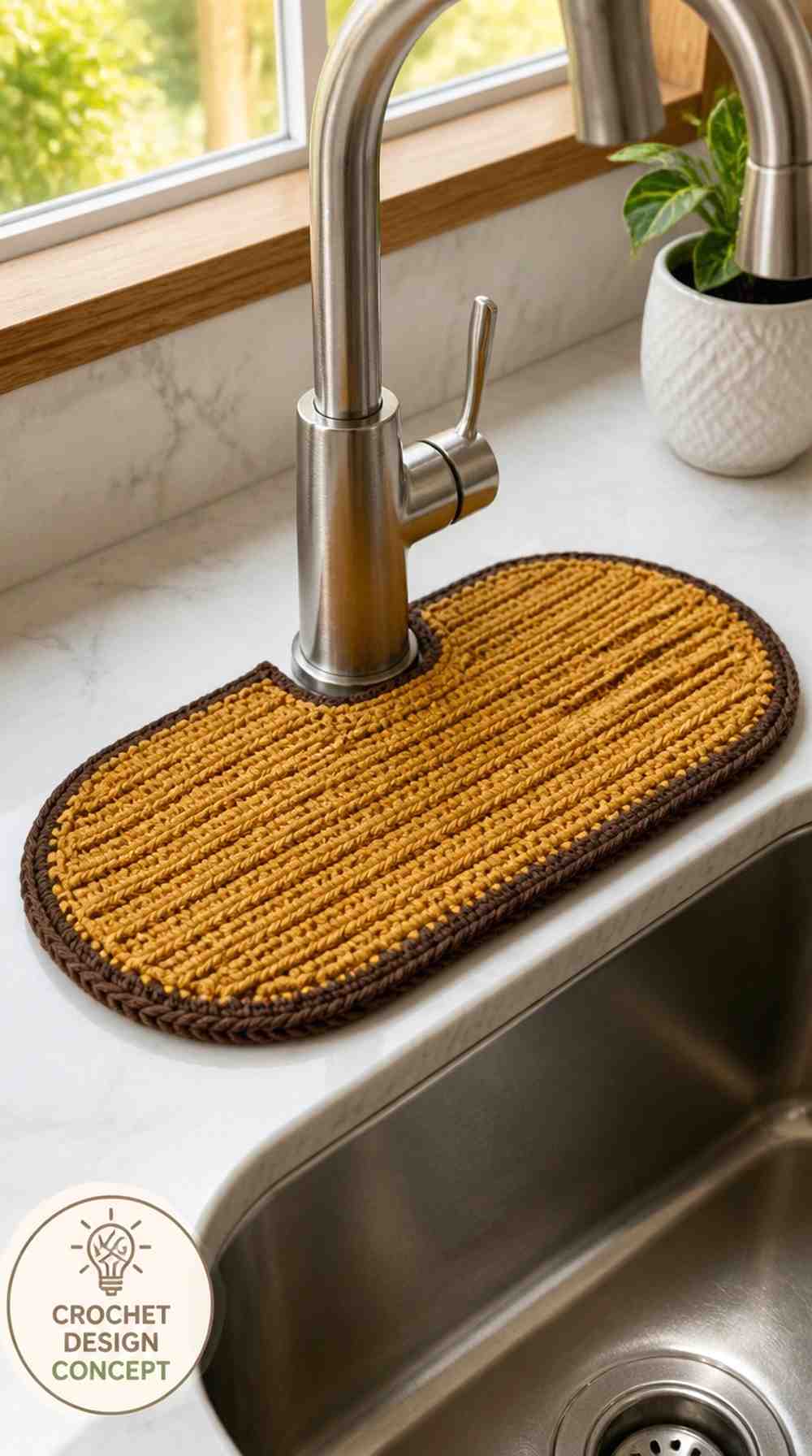
Honey-mustard yarn gives this long oval crochet mat a warm, sunny appearance. Horizontal raised ribs run across the surface, while a chocolate-brown border defines the curved outline. A low edging ridge adds another detail along the front perimeter without turning the flexible crochet into a rigid tray.
The shallow oval silhouette is a pleasing alternative to a rectangular faucet mat, particularly on a wider sink deck. Its raised border should be viewed as decorative texture rather than a water-retaining wall, since crochet yarn and stitches are not waterproof.
- Oval Fit: Measure the available width on both sides of the faucet. The rounded ends need space to lie smoothly against the counter.
- Horizontal Ribs: Raised rows make the fabric more dimensional. Avoid assuming they will direct water in a particular direction without testing.
- Low Front Ridge: Keep any edging modest so it does not extend into the sink or become an awkward raised obstruction.
- Mustard Palette: The warm golden shade pairs naturally with cream cabinets, timber details, and darker metal accents.
9. Crochet Blue Chevron Wave Mat
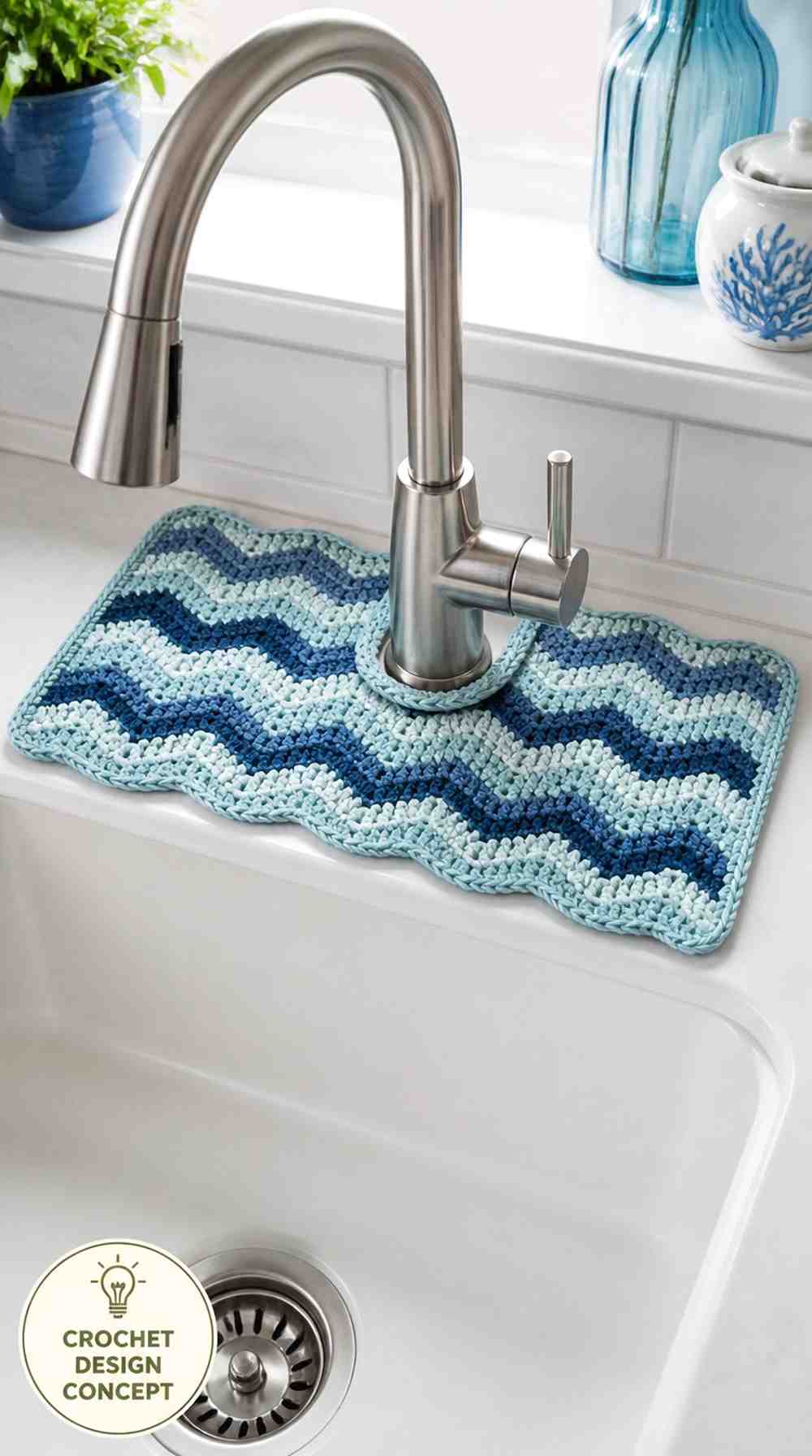
Alternating rows of aqua, dusty blue, and deeper ocean blue bring a gentle coastal feel to this crochet faucet mat. The chevron stitches create repeated peaks and valleys, while the front edge follows a soft wave. A fine aqua border ties the colors together without hiding the directional stitch pattern.
This design offers more movement than a plain striped mat. The main challenge is keeping the wavy front tidy and sufficiently shallow. A dramatic zigzag edge may look attractive in a design picture but become inconvenient when positioned near a busy kitchen sink.
- Chevron Shape: Keep the peaks and valleys proportional so the mat maintains a recognizable rectangular footprint around the faucet.
- Wavy Front: Check the distance between the lowest wave points and the basin edge before making a similar piece.
- Color Transitions: Clear changes between the three blue shades help the chevron pattern stand out without additional decorative attachments.
- Stretch Control: The shaped rows and border should be tested together to see whether the fabric remains level after washing and drying.
10. Crochet Midnight Slim Backsplash Mat
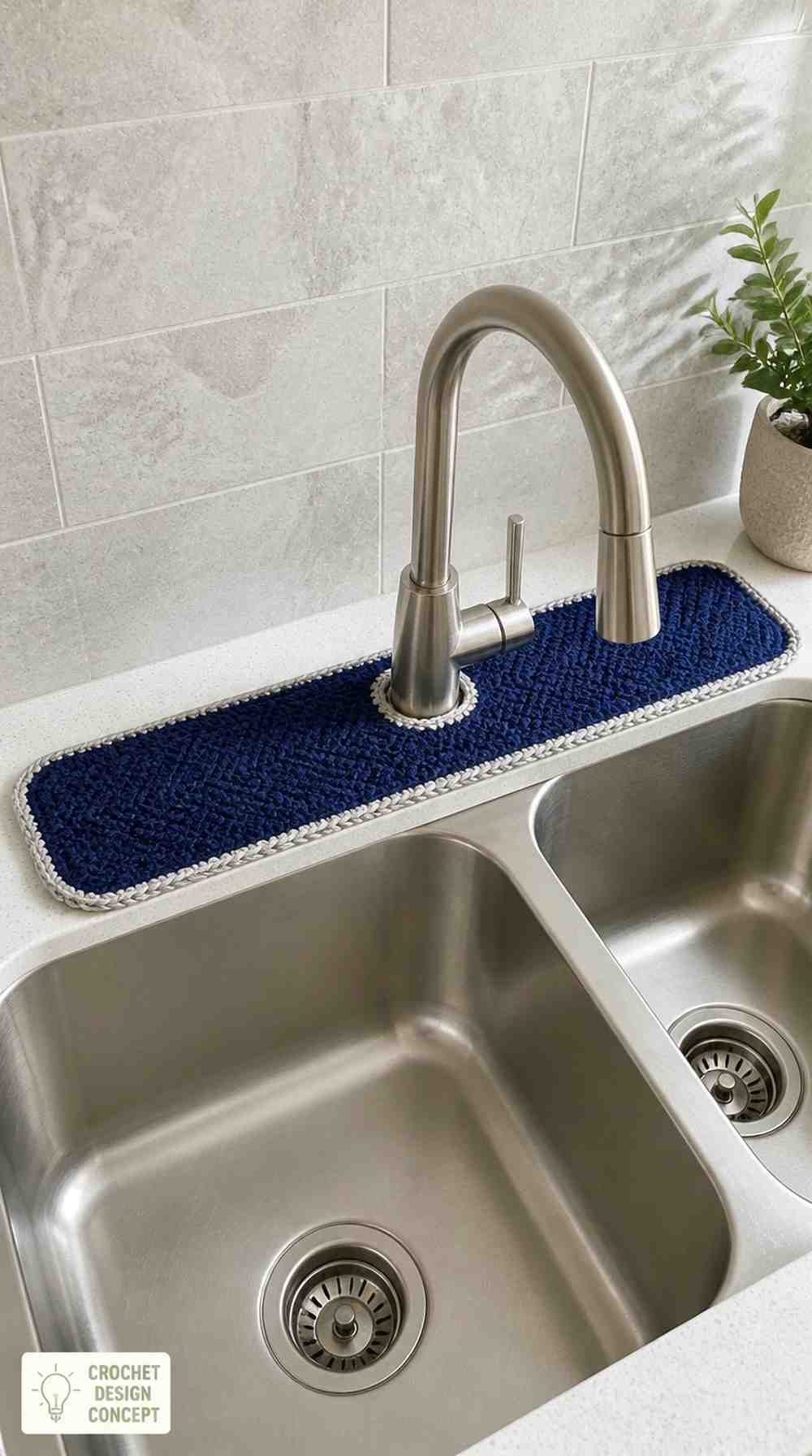
Deep midnight-navy crochet creates a striking contrast against pale stone in this slim backsplash-style mat. Instead of extending far toward the sink, the elongated piece stretches horizontally to either side of the faucet. Diagonal herringbone-like ridges and a silver-grey border provide detail within its narrow shape.
This is worth considering when there is more space beside the faucet than in front of it. Because the mat is long and shallow, it may need less countertop depth than the broad fan or crescent designs, but its length must still fit between nearby fixtures.
- Narrow Depth: Measure the space between the faucet, backsplash, and sink edge. This design depends on a shallow footprint that does not bunch up.
- Horizontal Coverage: The extended sides add visual continuity across a wider sink deck, though they do not necessarily cover the most frequently splashed areas.
- Herringbone Texture: Diagonal raised stitches provide interest in a single dark color without requiring multiple yarn changes.
- Grey Border: The muted outline makes the long shape easier to distinguish on pale countertops while keeping the appearance understated.
For another small sink-area storage idea, explore the Crochet Hanging Sink Sponge Caddy Inspiration Ideas collection, which focuses on organizing sponges rather than covering the faucet deck.
11. Crochet Rust Granny Mosaic Mat
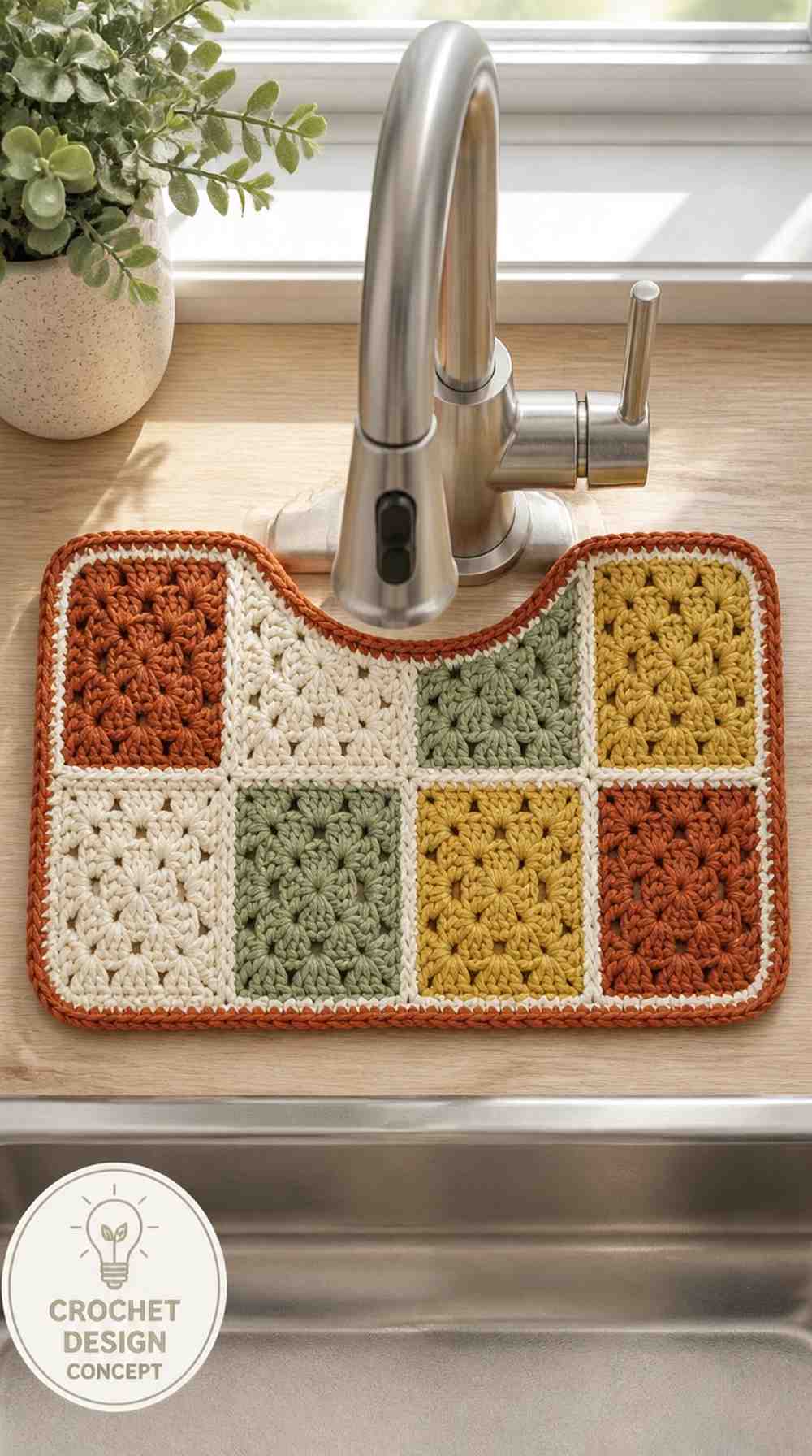
Eight small solid granny squares turn this faucet mat into a colorful little patchwork piece. Rust, ivory, mustard, and sage appear in alternating blocks, with flat cream joins connecting the squares into a shallow U-shaped arrangement. A narrow rust border brings the separate colors together.
This concept has a distinctly handmade, cottage-kitchen character. The modular construction could allow interesting color arrangements, although the edges and joining seams must be considered carefully. For practical use, tightly worked squares are more suitable to explore than highly open granny motifs in a frequently splashed location.
- Eight-Square Layout: Plan the placement of the individual motifs before joining them so the rear opening remains clear and the front edge stays balanced.
- Join Thickness: Flat joining techniques are worth considering, since bulky seams can create uneven areas against the counter.
- Solid Motifs: Tighter granny-square variations reduce large decorative gaps, but even dense crochet will not make a waterproof surface.
- Color Arrangement: The four-color palette is flexible; keeping the rust outer border consistent helps the patchwork look deliberate.
12. Crochet Olive Ginkgo Leaf Mat
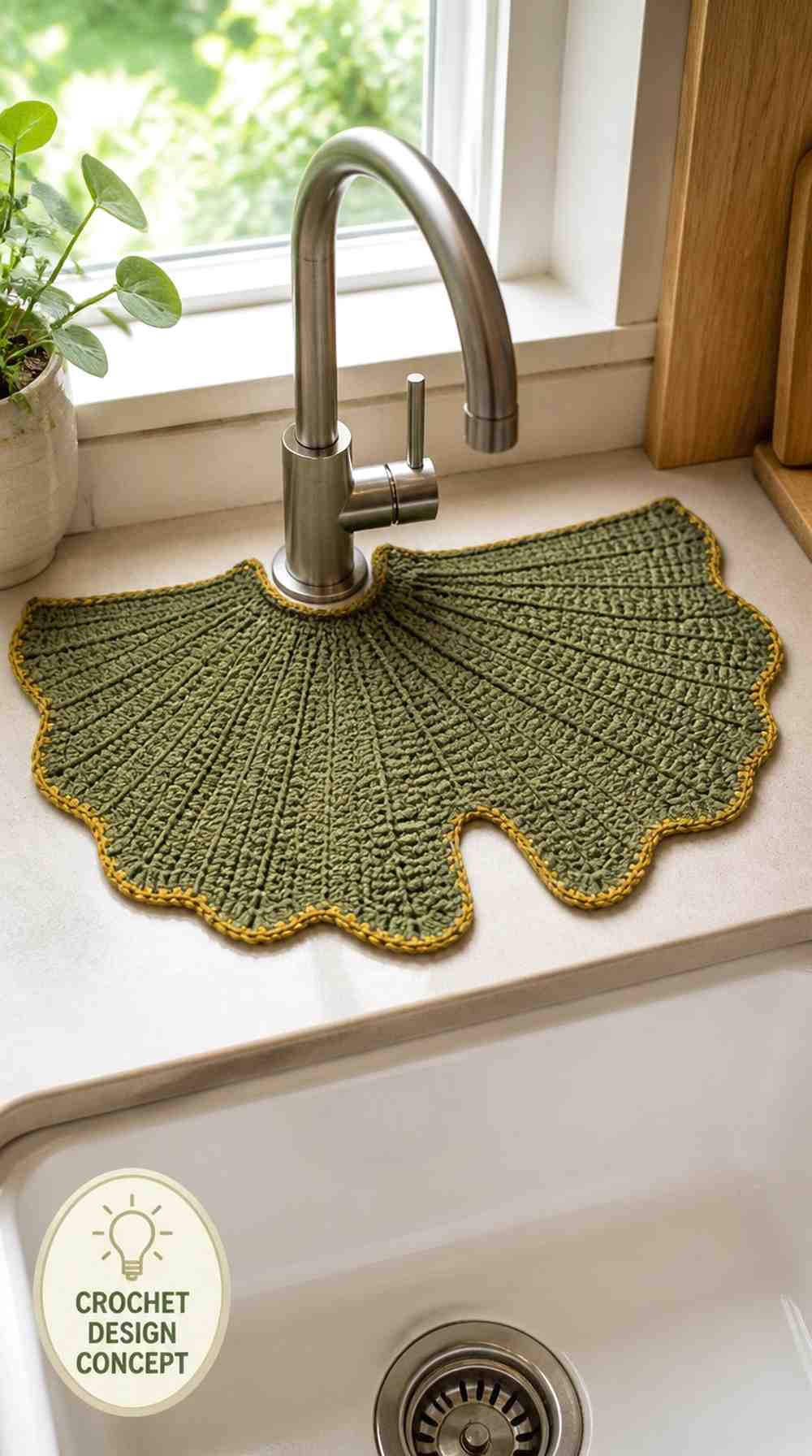
An olive-green ginkgo-leaf shape brings a natural botanical touch to this crochet kitchen mat. Raised vein lines spread outward from the notch near the faucet, forming a broad fan with softly lobed edges. Fine golden-ochre trim follows the leaf outline and makes the curved sections more noticeable.
The wide leaf silhouette gives this design a stronger decorative identity than a simple rectangle. It may suit a kitchen with natural wood and muted earthy colors, provided there is enough room for the lobes to lie flat without touching standing water or interfering with the sink.
- Leaf Proportions: Compare the full fan width with the available countertop space, not just the opening around the faucet.
- Vein Placement: The raised lines should follow the leaf shape naturally and remain modest enough to avoid excessive bulk.
- Lobed Border: A closely worked outer edge may help define the individual lobes, but the finished fabric still needs checking for curling.
- Botanical Styling: Olive and ochre complement natural wood and cream surfaces without requiring separate leaves or floral decorations.
13. Crochet Lavender Twin Faucet Pads
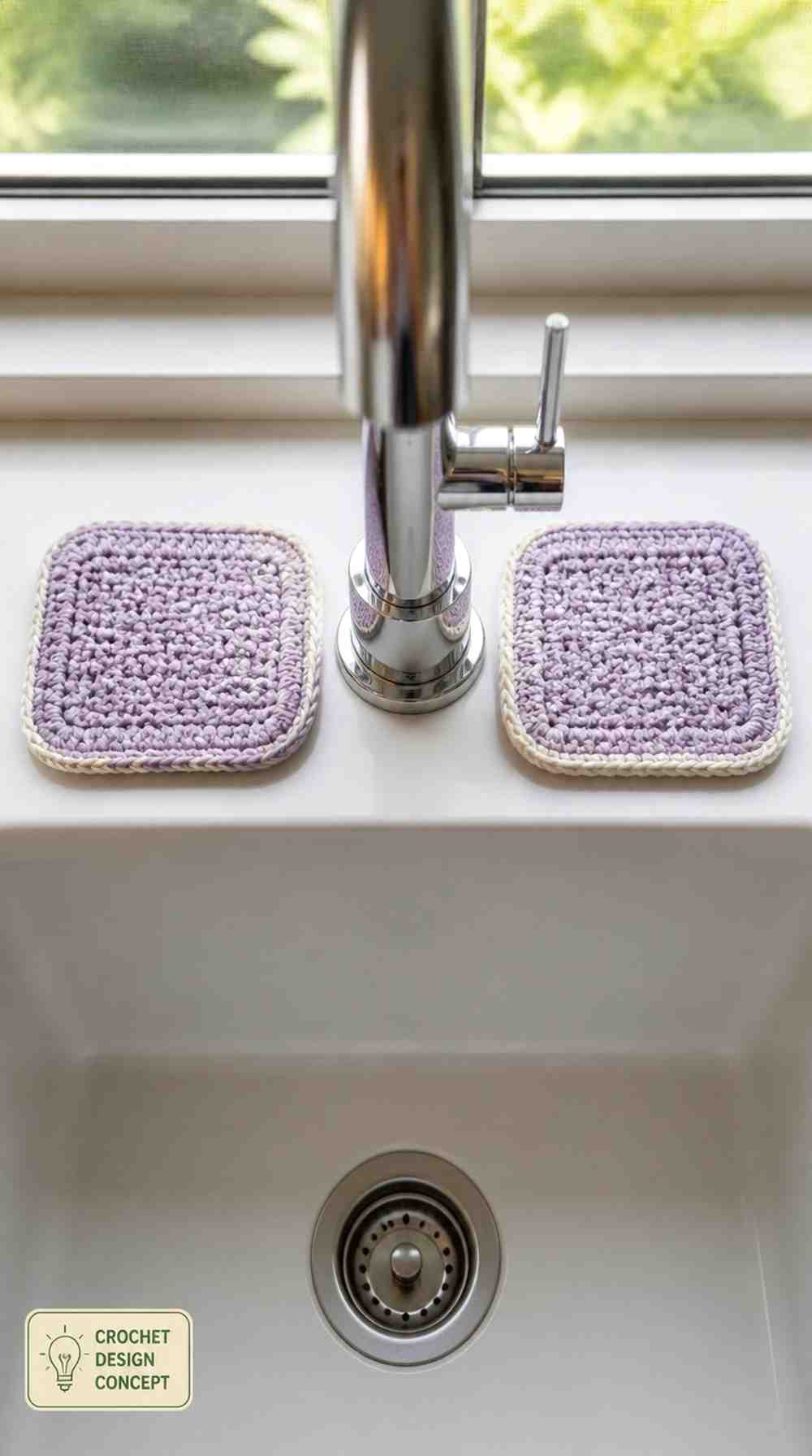
Instead of one large mat surrounding the faucet, this design uses two separate lavender crochet pads positioned on either side. Their narrow rounded-rectangle shapes, cream edging, and softly curved inner ends create a balanced pair, leaving the faucet base completely exposed.
The split arrangement could appeal to someone who prefers small removable pieces rather than a fitted cutout. Each pad can be handled separately, but the design also leaves the central area uncovered. Its usefulness depends on where splashes actually land around a particular faucet.
- Modular Placement: The two pads can be positioned independently, making the concept more adaptable to narrow spaces on either side of the fitting.
- Exposed Center: This layout does not cover the faucet base, so it cannot protect the central deck area from drips or splashes.
- Matching Edges: Keeping the cream borders and curved inner ends consistent helps the pair look coordinated instead of accidental.
- Individual Cleaning: Separate pieces could be convenient to remove, but both still need cleaning and complete drying after moisture exposure.
14. Crochet Sandstone Basketweave Faucet Mat
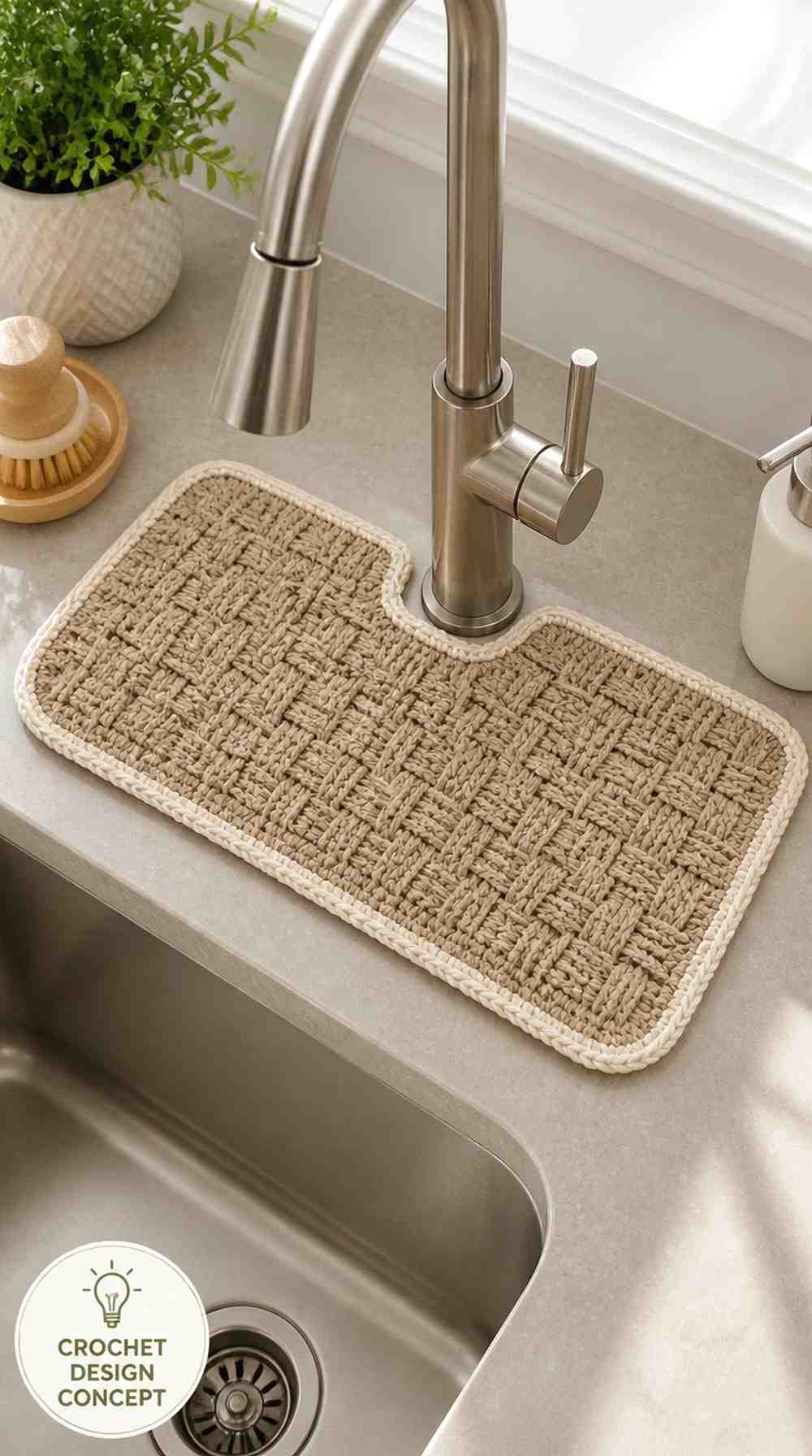
Sandstone-beige crochet gives this broad rectangular mat an understated look, while alternating raised basketweave-style blocks bring depth to its surface. The centered rear U-shaped cutout fits visually around the faucet, and a smooth ivory border frames the entire piece.
The textured center is the main reason to choose this style. Its structured blocks make a fairly simple color palette more interesting, although a thicker, raised surface may not be the easiest option for a damp kitchen area. A real sample should be checked for flatness, drying time, and compatibility with the counter surface.
- Basketweave Texture: Alternating raised stitch sections create a woven appearance using crochet. The resulting thickness will depend on yarn, hook size, and stitch tension.
- Large Center Surface: This broader design needs more front-to-back space than the slim backsplash mat and may be unsuitable for a very narrow deck.
- Ivory Frame: A narrow, smooth border keeps attention on the textured blocks while defining the rectangular outline.
- Practical Limitation: Textured fabric can retain moisture between raised sections. Avoid leaving it permanently wet against a countertop or faucet fitting.
15. Crochet Sunset Half-Round Stripe Mat
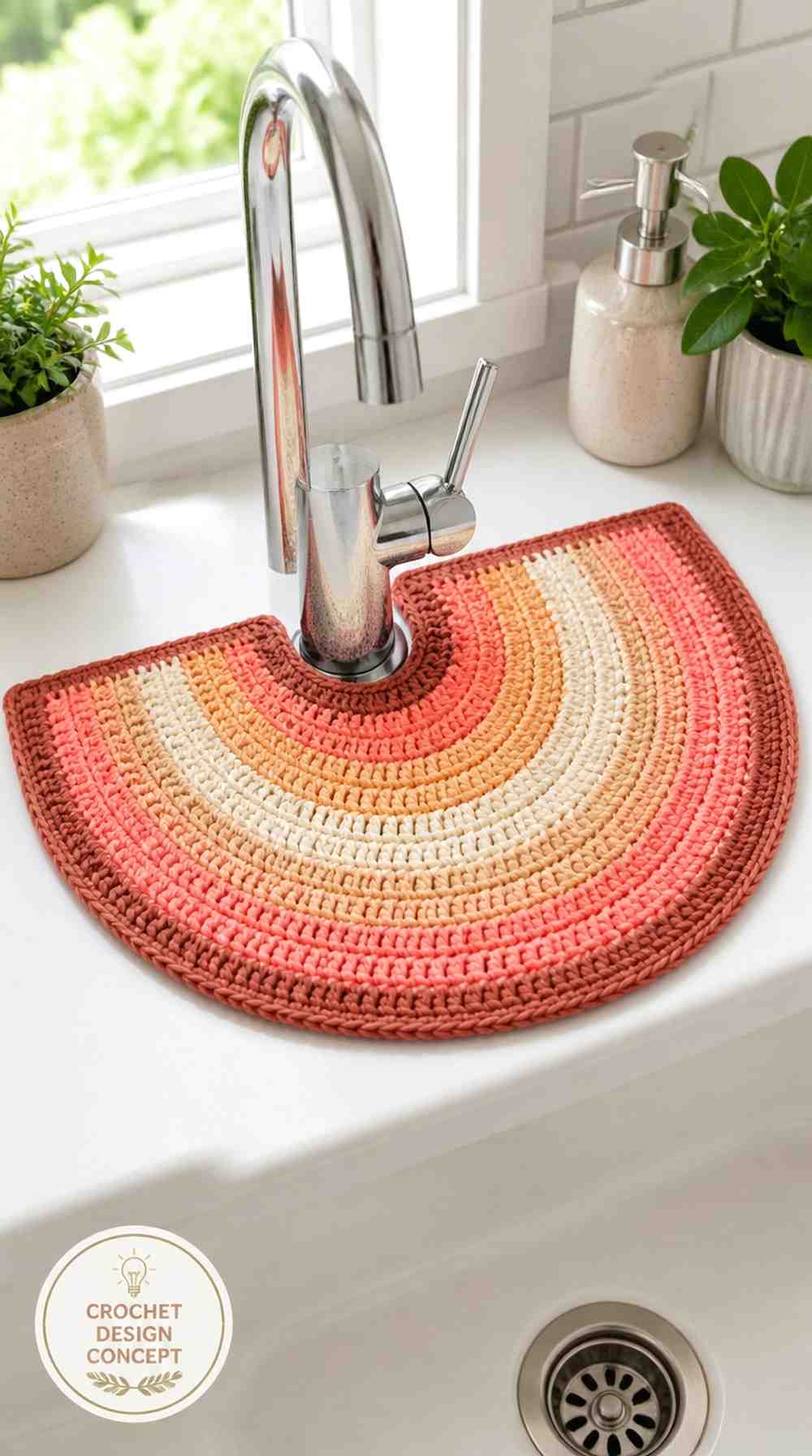
Curved bands of coral, apricot, cream, and terracotta give this half-round crochet mat a cheerful sunset-inspired look. The rows follow the rounded front edge, with a centered rear notch leaving space for the faucet base. A smooth terracotta border completes the silhouette.
The concentric stripes make this design appealing without requiring appliqués, buttons, or complicated surface decoration. Its wider curved front needs careful positioning, especially near a sink with little countertop depth. Choose it for the color arrangement and smooth rounded shape rather than for any assumed ability to contain water.
- Concentric Rows: Each stripe follows the half-round outline, so the color bands should remain even and balanced around the rear notch.
- Front Clearance: Check that the rounded front stays on the countertop and does not extend into the sink basin.
- Color Balance: Repeating terracotta at the outer edge helps tie together the coral, cream, and apricot bands.
- Smooth Finish: The absence of raised appliqués makes the surface visually simpler, though its suitability still depends on actual yarn and construction.
Practical Guide to Crochet Kitchen Faucet Drip Catcher Mats
A crochet faucet mat may look useful beside a kitchen sink, but it is important to understand what the fabric can and cannot do.
Start with the faucet and countertop shape. Measure the clear area behind and beside the faucet, the distance to the sink rim, and any handles or controls. Leave room for normal faucet movement and cleaning. Avoid covering removable hardware, mounting seams, or places that need regular inspection.
Choose materials with damp conditions in mind. Washable cotton yarn is worth exploring for small kitchen textile projects, but cotton absorbs water and can remain damp. Even closely worked crochet is not waterproof. If the sink area stays wet for long periods, a purpose-made washable sink splash guard may be more practical.
Check the underside. Moisture trapped beneath fabric can leave a countertop or faucet deck damp. Lift the mat regularly, wipe the surface, and dry both the mat and counter completely. Do not leave a wet crochet mat in place overnight or for extended periods.
Make removal easy. Horseshoe openings, split arrangements, and simple shapes can be easier to handle than complicated attachments. Choose a design that can be lifted away without moving or loosening any faucet hardware.
Keep expectations realistic. These crochet concepts are decorative ideas for occasional small splashes, not leak repairs, waterproof barriers, or substitutes for proper cleaning. If water is leaking from the faucet base, repair the underlying problem rather than covering it with yarn.
Want to Make Something Similar?
There is no verified exact pattern for the pictured concepts, but these resources offer relevant crochet skills you can adapt:
- B.Hooked Crochet’s woven-stitch cotton dishcloth lesson explains a textured cotton kitchen cloth that may help with planning a small washable mat. B.Hooked
- B.Hooked Crochet’s waffle-stitch tutorial offers stitch guidance relevant to the sage waffle-inspired design. B.Hooked
- B.Hooked Crochet’s granny-square joining guide covers several joining approaches useful when exploring the rust mosaic idea. B.Hooked
These are technique resources, not exact instructions for reproducing the visualized mats. Any adapted design would still need fitting, cleaning, and moisture-suitability checks.
Which Crochet Faucet Mat Design Should You Choose?
The right choice depends mostly on your available countertop space, the kind of crochet texture you prefer, and how easily you can remove the mat.
| Your priority | Design to consider | Main trade-off |
|---|---|---|
| Simple neutral look | Oatmeal Horseshoe | Limited decorative detail |
| Strong raised texture | Sage Waffle | More drying and cleaning attention |
| Removable rear fastening | Dusty Blue Overlap | Requires accessible space behind faucet |
| Traditional decorative edge | Ivory Scalloped Crescent | Needs enough room for curved front |
| Modern graphic style | Charcoal Checkerboard | Joined sections require careful shaping |
| Delicate coastal appearance | Seafoam Shell Fan | Decorative openings expose the counter |
| Botanical silhouette | Olive Ginkgo Leaf | Broad lobes need extra width |
| Narrow rear sink deck | Midnight Slim Backsplash | Limited front coverage |
| Multiple handmade motifs | Rust Granny Mosaic | More seams and joins |
| Small separate pieces | Lavender Twin Pads | Faucet center remains uncovered |
| Warm, colorful accent | Sunset Half-Round Stripe | Wide rounded front needs clearance |
For a starting point, the Crochet Oatmeal Horseshoe Drip Mat is the simplest visual choice. If you prefer a detailed stitch texture, compare the sage waffle and sandstone basketweave concepts. When space is limited, the midnight slim design or lavender twin pads may be easier to adapt.
Whatever you choose, a crochet mat should remain removable, washable, and able to dry fully between uses.
Conclusion
A kitchen faucet is a small area, but it offers plenty of room for creative crochet inspiration. These 15 ideas show how different shapes, stitches, borders, and color combinations can change the look of a simple sink deck. The horseshoe, waffle, scalloped, mosaic, leaf, and modular designs all have their own visual character.
For real everyday use, though, the ability to remove and dry a mat matters more than an elaborate shape. Choose a concept that suits your sink layout and remember that decorative crochet is not a waterproof drip-control product.
Which design would you choose for your kitchen sink? Do you prefer the simple oatmeal horseshoe, the textured sage waffle, or the colorful granny mosaic? Share your favorite and what kind of faucet you have.
Frequently Asked Questions
Can a crochet faucet drip catcher mat actually absorb water?
Crochet made with absorbent yarn, such as cotton, can take up some moisture, but the amount depends on the actual materials, thickness, and construction. It is not a waterproof barrier, and moisture can pass through to the countertop. Remove and dry the mat rather than allowing it to stay wet around the faucet.
What yarn is best for a crochet kitchen faucet mat?
Washable cotton yarn is one possible choice because it is commonly used for kitchen textiles. Look for suitable care instructions and avoid yarns that shed heavily or cannot tolerate frequent laundering. Even cotton needs regular cleaning and complete drying; no yarn choice makes an ordinary crochet mat waterproof.
How should I fit a crochet mat around the faucet?
Measure the base, available space on the counter, and the position of handles or moving parts. A rear notch, open horseshoe, or two separate pads can provide different placement options. Avoid tight wrapping, blocked controls, and any arrangement that hides an active leak or traps water beneath the fitting.
Can I leave a crochet faucet mat on the countertop all the time?
It is better not to leave one in place continuously if the sink area is frequently wet. Lift it after splashes, wipe the countertop, and allow the fabric to dry fully. Persistent dampness can encourage unpleasant odors, staining, and microbial growth. A mat is only suitable where it can be kept reasonably clean and dry.
Are these 15 crochet faucet mats available as patterns?
These are original visual design concepts rather than published, tested crochet patterns. The images illustrate possible shapes, textures, and styling choices. You can use the ideas as inspiration and learn related stitches through the linked resources, but making a functional version requires your own sizing, construction planning, and practical testing.