A tartan bow can give a Christmas tree the softness of crochet without losing the tailored look associated with plaid ribbon. Red, forest green, cream, black, navy, and gold-inspired combinations can feel traditional, while muted neutrals or burgundy-based palettes create a quieter version of the same idea.
Not every tutorial below is originally designed as a tartan tree topper. Some teach Christmas bows, ribbon-style bows, appliqués, coquette bows, or decorative bow constructions that can be adapted into a topper. That difference matters because enlarging a tiny accessory bow, adding plaid colorwork, or introducing long tails can change weight, stiffness, and balance.
For a convincing tartan effect, concentrate on the relationship between horizontal and vertical color lines rather than simply alternating random Christmas colors. For a convincing tree topper, concentrate just as much on structure: the loops should remain visible, the center should not collapse, and the attachment should hold the bow in the intended position without damaging the tree.
Quick List
- Crochet Classic Tartan Christmas Bow Tree Topper
- Crochet Long-Tail Tartan Bow Tree Topper
- Crochet Wide-Ribbon Tartan Bow Tree Topper
- Crochet Three-Piece Tartan Bow Tree Topper
- Crochet Minimal Plaid Bow Tree Topper
- Crochet Layered Coquette Tartan Bow Tree Topper
- Crochet Puffy Tartan Bow Tree Topper
- Crochet Double-Texture Tartan Bow Tree Topper
- Crochet Rounded Tartan Bow Tree Topper
- Crochet Flat Tartan Bow Tree Topper
- Crochet Compact Plaid Ribbon Tree Topper
- Crochet Pinched-Center Tartan Bow Tree Topper
- Crochet Fan-Shaped Tartan Bow Tree Topper
- Crochet Soft Ribbon Tartan Bow Tree Topper
- Crochet Magic-Ring Tartan Bow Tree Topper
- Crochet Decorative Plaid Bow Tree Topper
- Crochet Structured Tartan Bow Tree Topper With Tails
Build the Tartan Around the Bow Construction
Traditional woven tartan gets its character from intersecting bands. Crochet fabric behaves differently, so a successful tartan-inspired bow does not have to reproduce woven cloth literally.
For flat rectangular bow pieces, planned color changes can establish the broad horizontal bands while surface crochet, embroidery, or another compatible finishing treatment can suggest narrower crossing lines. For rounded or fan-shaped bows, a simplified plaid effect may work better because perfectly straight vertical bands can become distorted as the fabric curves.
Whatever method you choose, make a test section first. Check whether the darker lines remain visible against the main colors and whether additional surface work makes the bow noticeably stiffer or heavier.
Tree-Topper Scale Needs More Structure Than a Hair Bow
Many bow tutorials begin as accessories, gift decorations, or small ornaments. Simply using thicker yarn does not guarantee that the same shape will become a successful tree topper.
A topper needs enough visual width to stand out at the crown without becoming so heavy that the top branch bends. Loop depth matters too. Very soft loops can disappear when viewed from across the room, while overly rigid loops may look bulky and become difficult to store.
Before completing the final center wrap, hold the unfinished bow near the intended tree and assess its proportions. A full-height tree may need a stronger silhouette than a tabletop tree, but there is no universal topper measurement.
Plan the Attachment Before the Final Finishing
A tree topper is viewed upright, not flat on a table. That means the attachment point can change the appearance of the entire bow.
A tie-on method can allow adjustment around a central branch. A separate backing loop can keep the decorative center cleaner. A removable support may be useful if the crochet itself is very soft. Whatever method you choose, check that it supports the bow from the center instead of pulling one loop noticeably higher than the other.
Keep yarn, tails, and attachment pieces clear of light bulbs, electrical connections, and damaged wiring, and follow the instructions supplied with your tree lights. Do not assume that a particular yarn is heat-resistant simply because it is commonly used for holiday decor.
1. Crochet Classic Tartan Christmas Bow Tree Topper
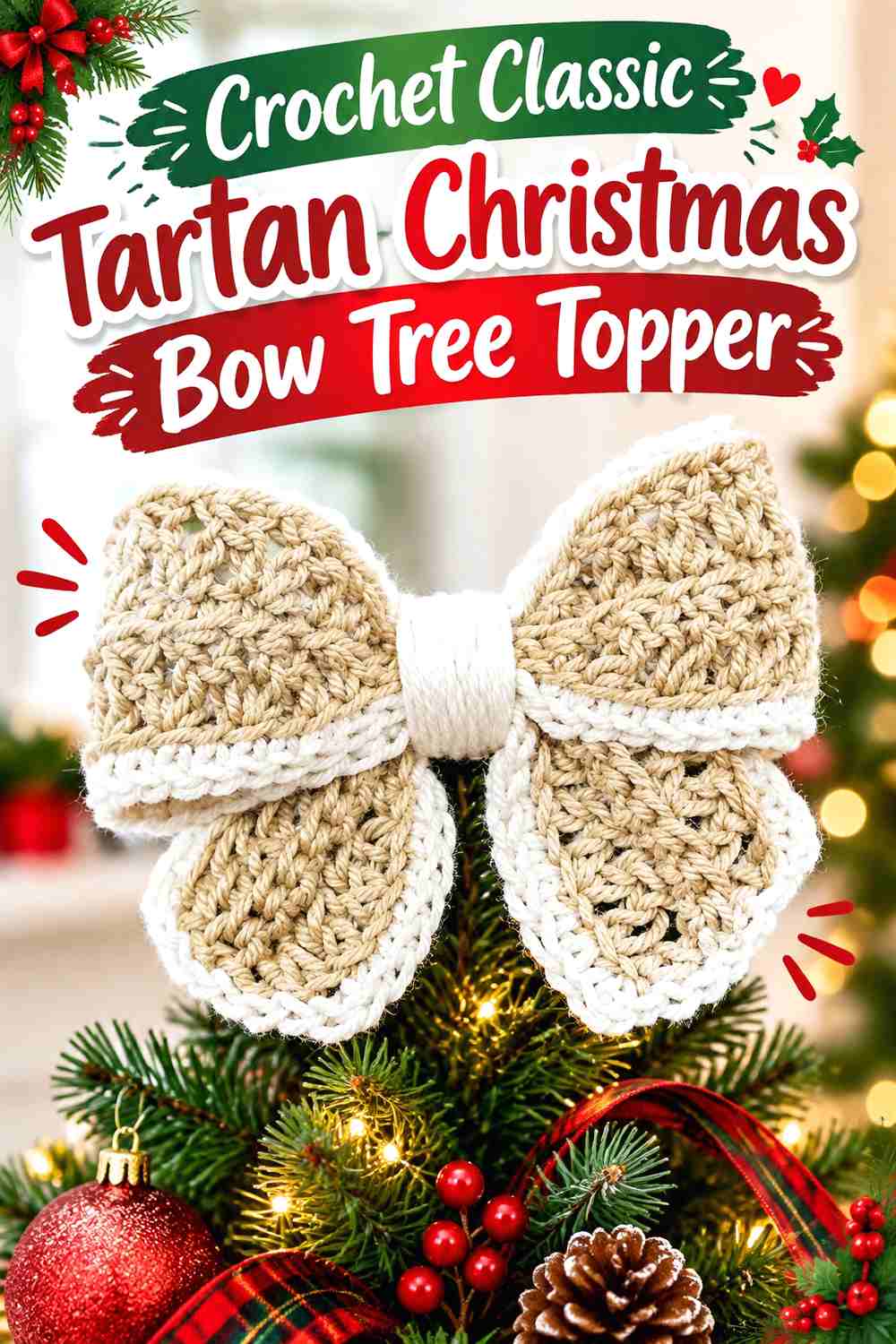
Francesca Uncinettando Crochet&Love’s source is already conceived as a Christmas bow that can be used on a tree, making it one of the most direct construction references in this collection. The finished form is light and clearly bow-shaped rather than heavily sculptural, which makes it a sensible starting point for tartan adaptation.
A classic red-and-green tartan treatment would fit this silhouette naturally, but a cream, burgundy, and forest palette could give the same construction a softer heritage look.
Keep the Plaid Clear Across the Two Loops
The loop area is the first part viewers will notice. If your tartan repeat is too large for the available fabric, one side may show a completely different section of the pattern from the other.
Test the color repeat against the planned bow width before completing both sides. Symmetry does not require every stripe to match perfectly, but the two loops should look intentionally related.
Let the Center Break the Pattern
Trying to continue every tartan line through the cinched middle can make the center visually congested. A solid center wrap in one of the dominant tartan colors can give the eye a resting point and make the plaid loops easier to read.
Check the Bow Upright Before Choosing an Attachment
A bow that looks balanced flat can sag once it is vertical. Hold it in its intended tree-topper position before deciding where a support or tie should sit.
Creator Credit: Francesca Uncinettando Crochet&Love
2. Crochet Long-Tail Tartan Bow Tree Topper
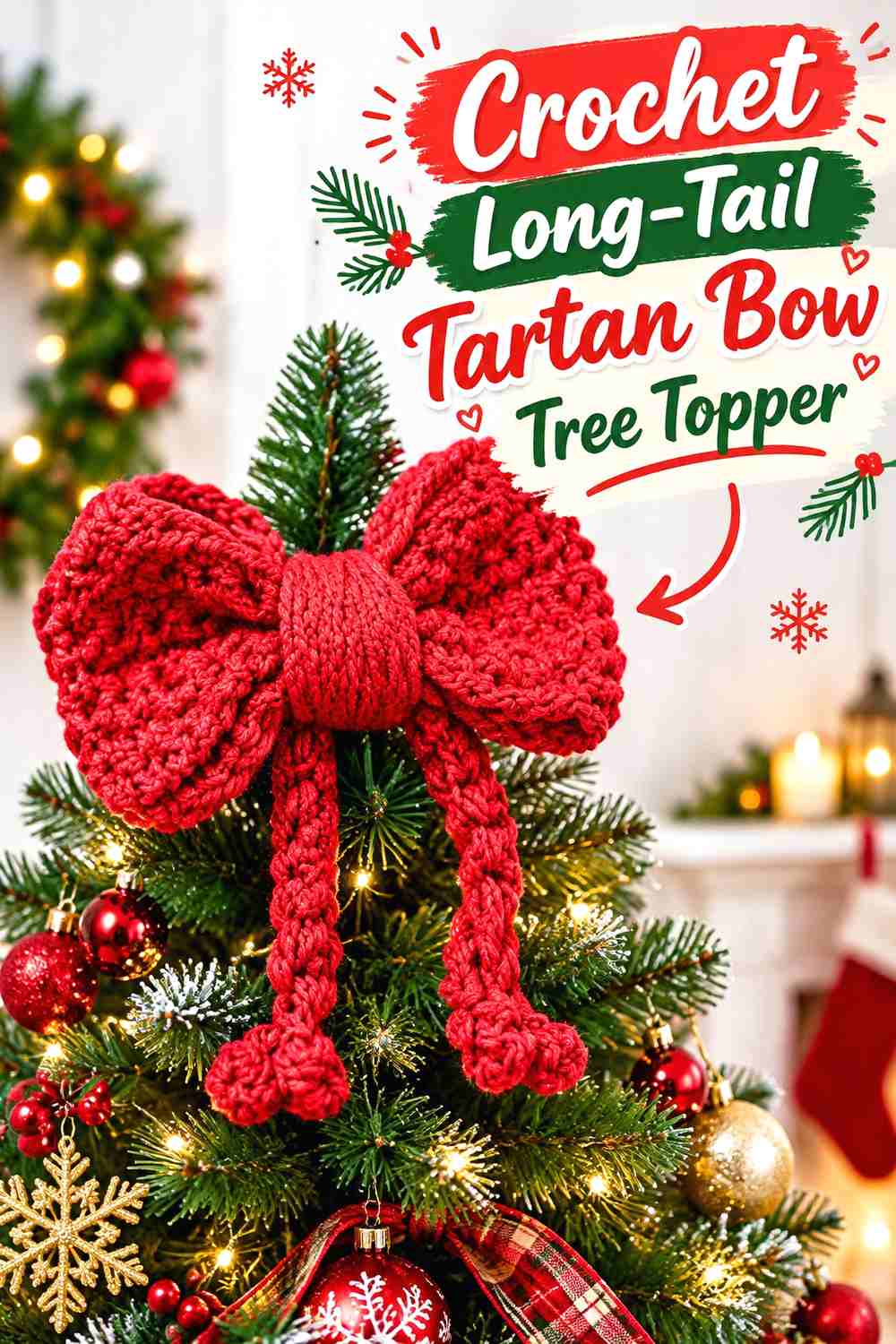
Bella Coco’s Christmas bow tutorial includes a bow construction plus hanging decorative elements, providing a strong reference for a topper where the vertical lines below the loops matter almost as much as the bow itself.
Long tails can help a topper visually connect with garland or ribbon running farther down the tree, but they also add weight and need enough contrast to remain visible against dense branches.
Use the Tails to Extend the Tartan
The loops do not have to carry the complete plaid design. Repeating one or two key stripes down the tails can create continuity while keeping the bow center simpler.
If the tails twist naturally, remember that both sides may become visible. Inspect the reverse before deciding how elaborate the surface treatment should be.
Tail Length Changes the Topper’s Proportion
Longer tails create a more dramatic vertical silhouette, while shorter tails keep attention concentrated at the crown. Compare the unfinished tail length against the actual tree rather than deciding from a close-up work surface.
Watch the Weight Below the Center
Heavy tails can pull a soft bow downward. If the decorative sections become denser through colorwork or added surface lines, reassess the center and attachment before final assembly.
Creator Credit: Bella Coco
3. Crochet Wide-Ribbon Tartan Bow Tree Topper
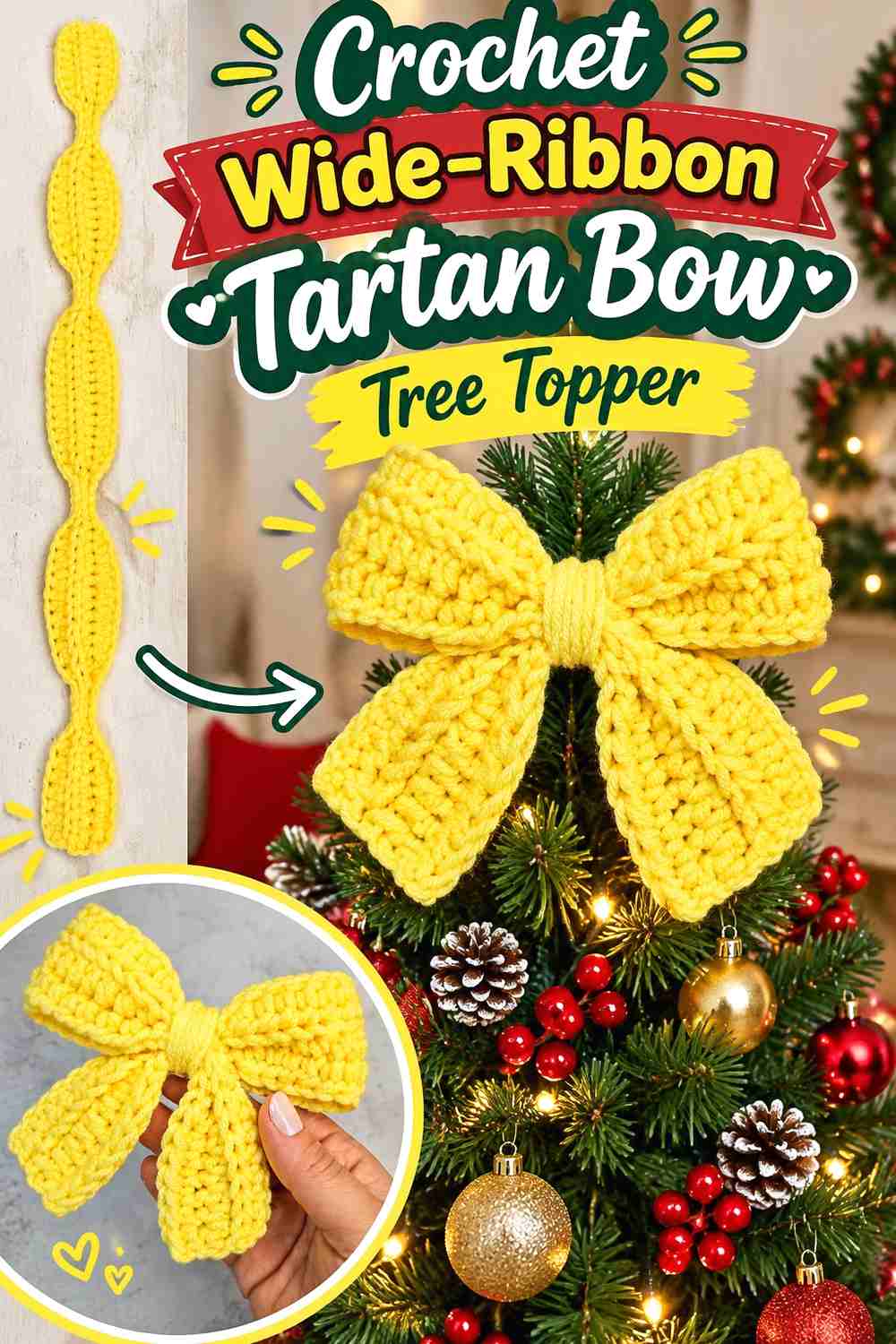
Brunaticality demonstrates a ribbon-style crochet bow built from defined bow components. The clean, broad surfaces make this construction particularly useful when your main goal is to showcase tartan rather than complicated stitch texture.
A wide ribbon effect gives larger checks and crossing stripes more room to remain recognizable, especially on a medium or larger Christmas tree.
Broad Panels Give Tartan More Breathing Room
Very narrow crochet strips can reduce plaid to a few disconnected color changes. A broader bow surface gives you space to establish a dominant background, wider bands, and narrower accents.
Keep the scale of the tartan proportional to the bow. A repeat designed for a blanket may be visually oversized once folded into loops.
Shape the Loops After Adding Surface Lines
Surface embellishment can alter how a crochet panel bends. If you add vertical plaid lines after making the base fabric, form the bow again before permanently securing the center.
You may find that a previously soft loop has become firmer or that one side bends more readily than the other.
Creator Credit: Brunaticality
4. Crochet Three-Piece Tartan Bow Tree Topper
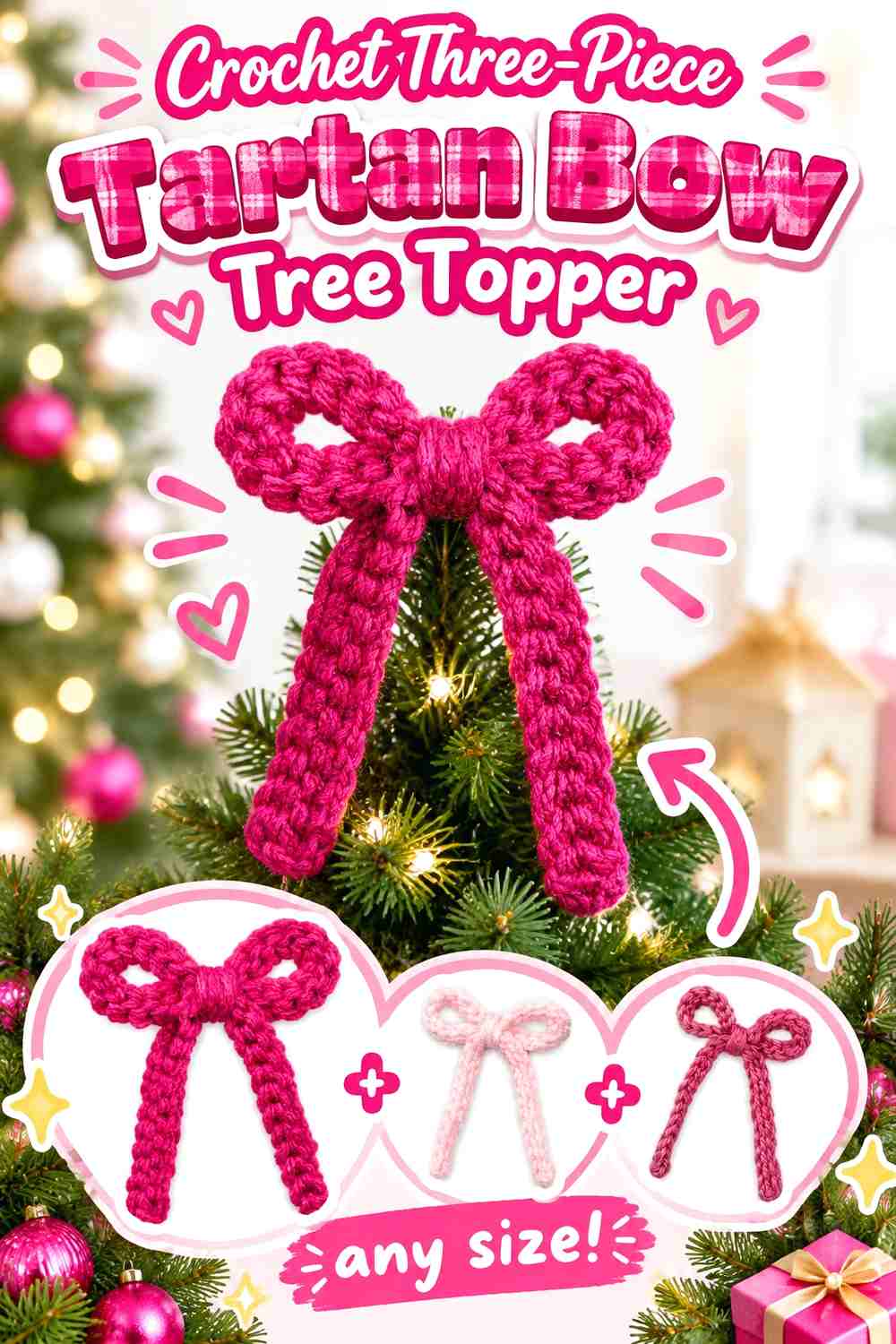
ElyseCrochets uses separate components for the bow body and center treatment, creating a tidy ribbon-style form whose parts can be planned independently.
That separation is useful for tartan because the main loops can carry the plaid while the central band remains solid, striped, or deliberately contrasting.
Give Each Piece a Clear Visual Job
Rather than forcing the same color sequence onto every component, decide which piece will carry the complex pattern. A tartan main body paired with a quiet center usually reads more clearly than three competing plaid sections.
The approach also makes it easier to introduce a dark center band that visually anchors lighter Christmas colors.
Match the Center Width to the Finished Thickness
Adding strands, embroidered lines, or surface crochet can make a tartan panel thicker than the tutorial’s original fabric. Check the center wrap against the completed bow body rather than assuming it will fit exactly as before.
Creator Credit: ElyseCrochets 💌
5. Crochet Minimal Plaid Bow Tree Topper
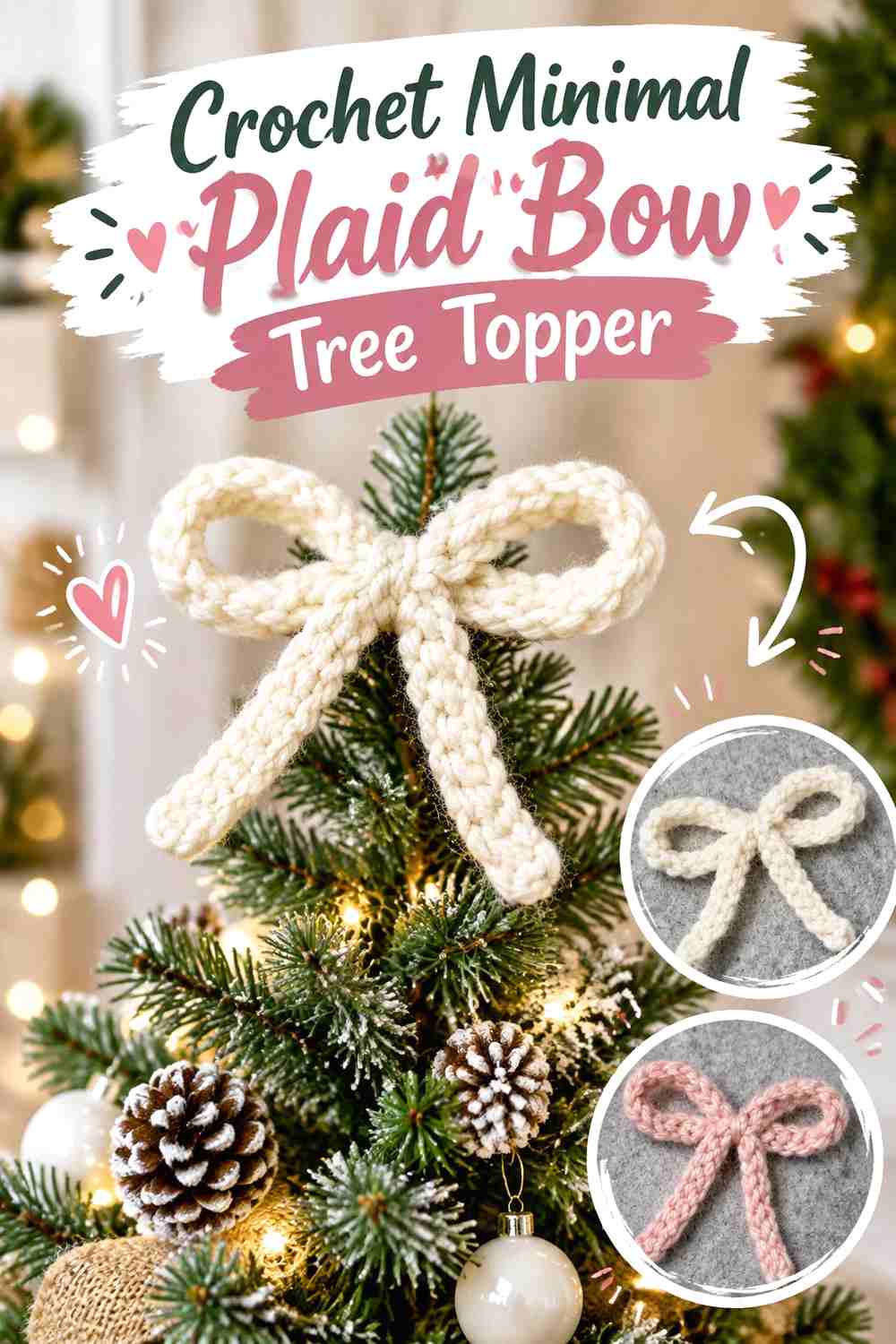
VivCrochets teaches a very compact bow construction intended for a small accessory. For a tree-topper article, its value is as a simple structural concept that can be tested at a larger scale rather than as an already full-size topper.
This route suits a restrained tree where the topper should echo smaller bows elsewhere in the decorating scheme instead of becoming an oversized focal point.
Enlarge by Testing, Not Guessing
Changing yarn or proportions can affect more than overall size. A larger fabric strip may droop differently, and the center may need a different balance.
Make one enlarged test bow and evaluate it upright before committing to a more elaborate tartan surface.
A Minimal Bow Can Use a Bolder Plaid
Because the construction itself is visually simple, the color pattern can do more work. A high-contrast tartan with dark crossing lines can add detail without needing beads, bells, or extra motifs.
Consider This Shape for a Smaller Tree
A restrained bow may suit a tabletop, bedroom, or narrow-profile Christmas tree particularly well. Judge the scale against the real tree rather than assuming every topper has to be oversized.
Creator Credit: VivCrochets
6. Crochet Layered Coquette Tartan Bow Tree Topper
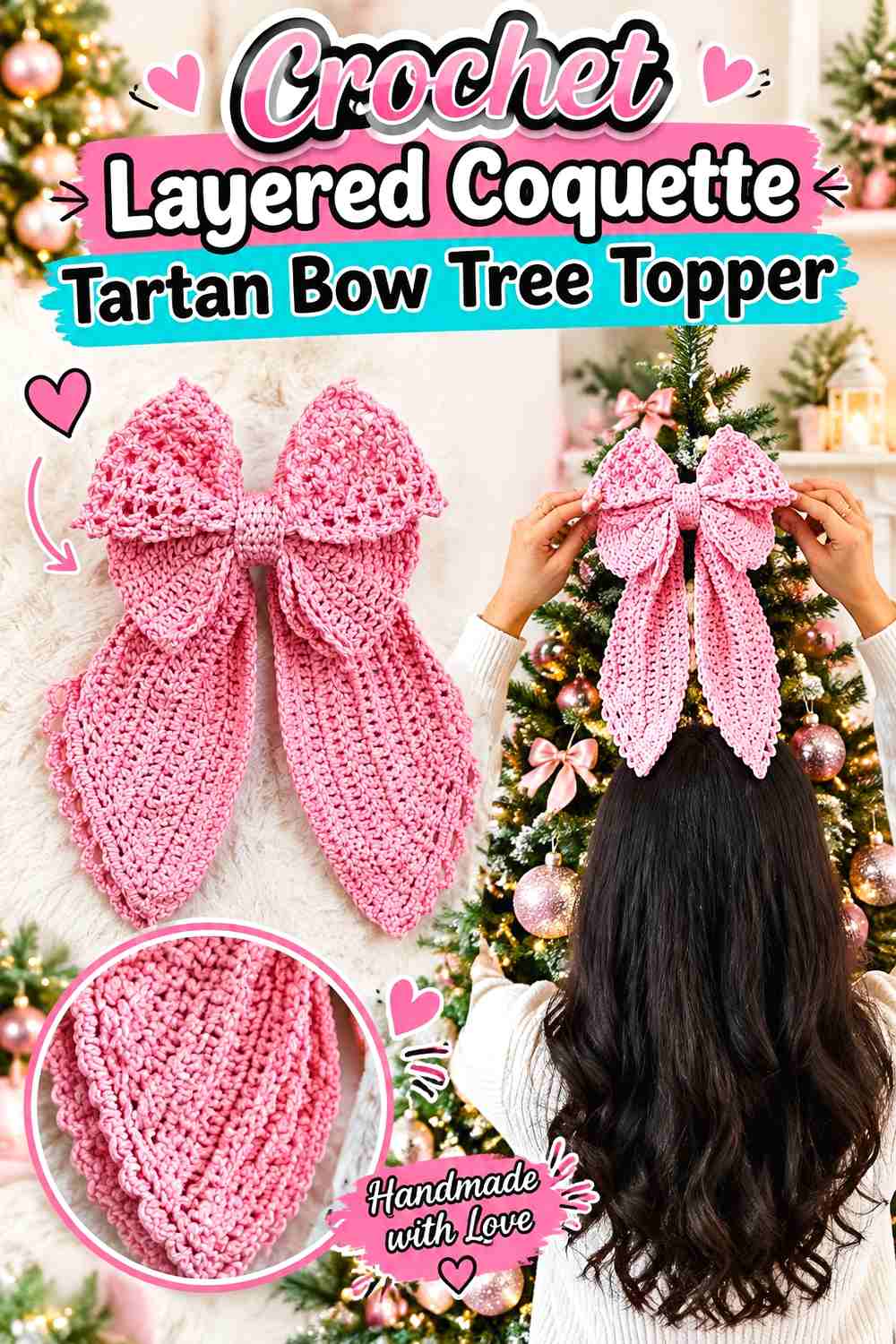
Gense’s bow is assembled from multiple individual pieces, giving the finished design a fuller, layered character than a single pinched rectangle.
That construction can produce an elegant topper when you want a tartan theme with more depth and movement rather than a flat country-style bow.
Keep the Layers From Hiding the Plaid
Overlapping pieces can obscure parts of a complicated tartan pattern. Concentrate the clearest plaid areas on sections that remain visible after assembly.
A solid or lightly striped back layer can also make the patterned front sections stand out more distinctly.
Layering Adds Visual Depth and Physical Weight
Multiple pieces create richer shadows, but every layer contributes to the load at the top of the tree. Test the assembled bow before adding further embellishment or a heavy center ornament.
Angle the Lower Pieces Before Final Securing
Small changes in tail angle can make a layered bow look either balanced or crowded. View it from the distance at which the Christmas tree will normally be seen before fixing every component permanently.
Creator Credit: Gense
7. Crochet Puffy Tartan Bow Tree Topper
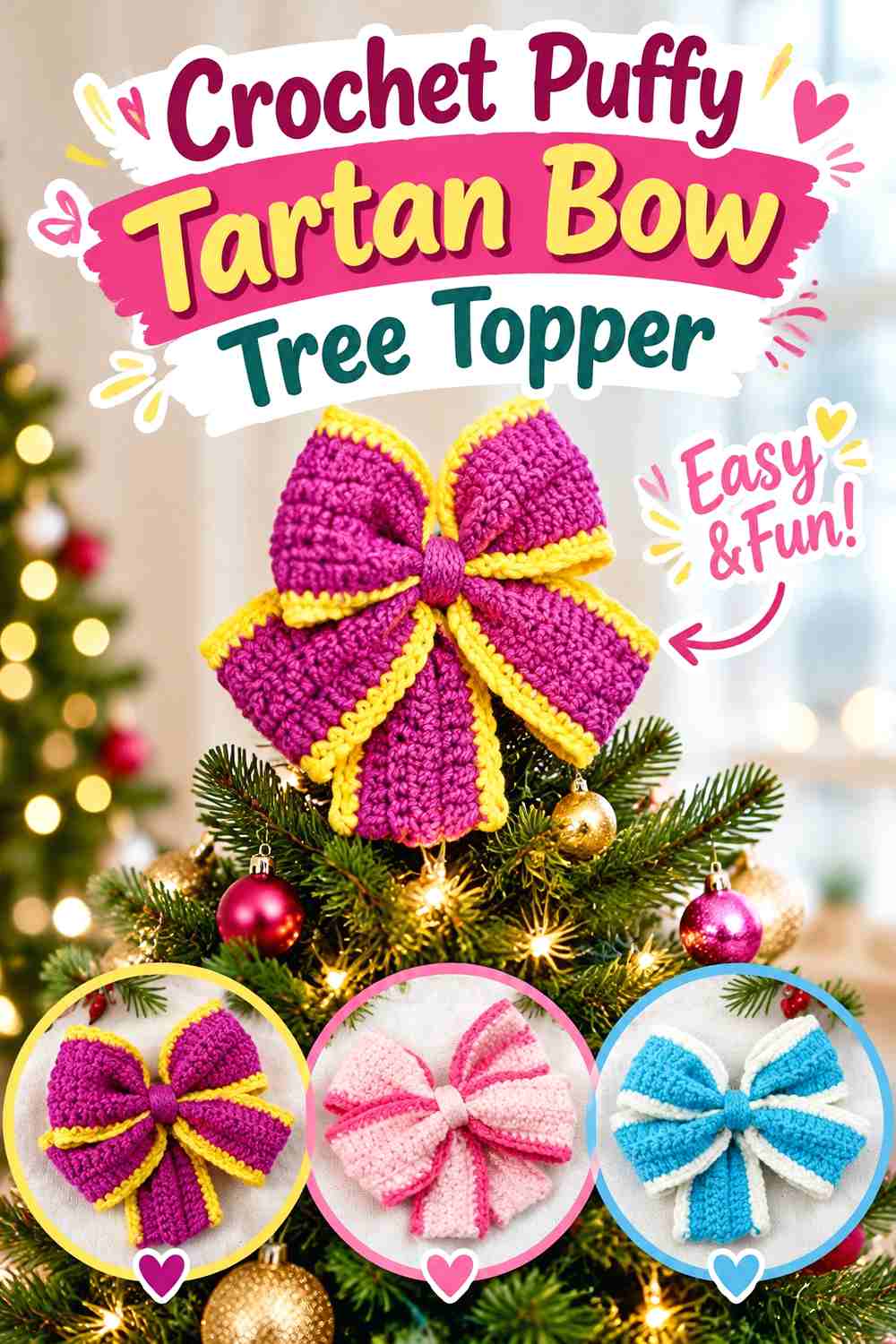
Creative Asra’s coquette-style bow provides a softer, fuller alternative to flat ribbon constructions. The rounded loops give a topper more volume, which can work well when it needs to stand out against dense artificial branches.
For tartan adaptation, simplify the plaid enough that the pattern remains visible when the loops curve away from the viewer.
Curved Loops Distort Straight Plaid Lines
A stripe that looks perfectly straight on an unfinished piece can arc once the bow is shaped. That is not necessarily a flaw; it is simply part of translating a woven visual idea into a three-dimensional crochet form.
Use the strongest contrast for the lines you most want to remain visible.
Puffy Shapes Need a Defined Center
Soft loops benefit from a visually firm middle. A solid dark center band can make the bow look more tailored and keep the tartan from becoming one continuous mass of color.
Creator Credit: Creative Asra
8. Crochet Double-Texture Tartan Bow Tree Topper
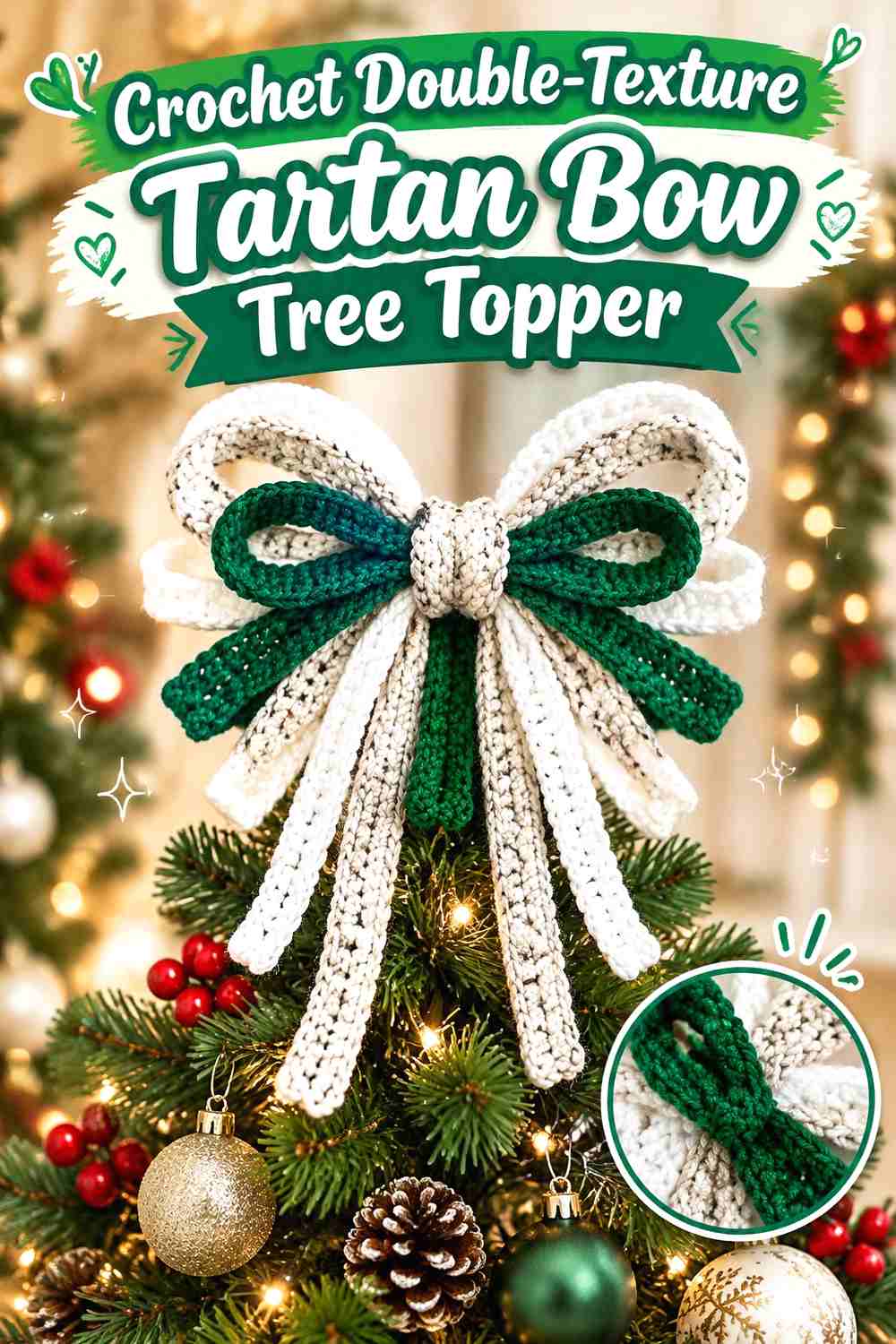
Make It With Megan demonstrates bow variations with different basic fabric treatments before showing how the pieces can become a garland. That variation makes the tutorial useful for comparing how texture changes the character of a bow.
For a tree topper, the same construction concept can be adapted into one larger focal bow while using texture to distinguish the dominant tartan bands.
Texture Can Replace One Layer of Color
A tartan-inspired design does not need every line to come from a new shade. A raised or visibly different fabric section can create separation between bands without introducing another competing color.
This can be especially effective in a neutral tartan made from cream, tan, brown, and one dark accent.
Choose the Fabric That Holds the Loop Better
If you are comparing two stitch textures, make a small sample of each and bend them into the approximate loop shape. The prettiest flat fabric may not be the one that holds the cleanest topper silhouette.
Repeat the Topper Texture Elsewhere Sparingly
Because the source also demonstrates smaller bows used decoratively, you could visually connect the crown with a few matching bow ornaments elsewhere on the tree without making every decoration identical.
Creator Credit: Make It With Megan
9. Crochet Rounded Tartan Bow Tree Topper
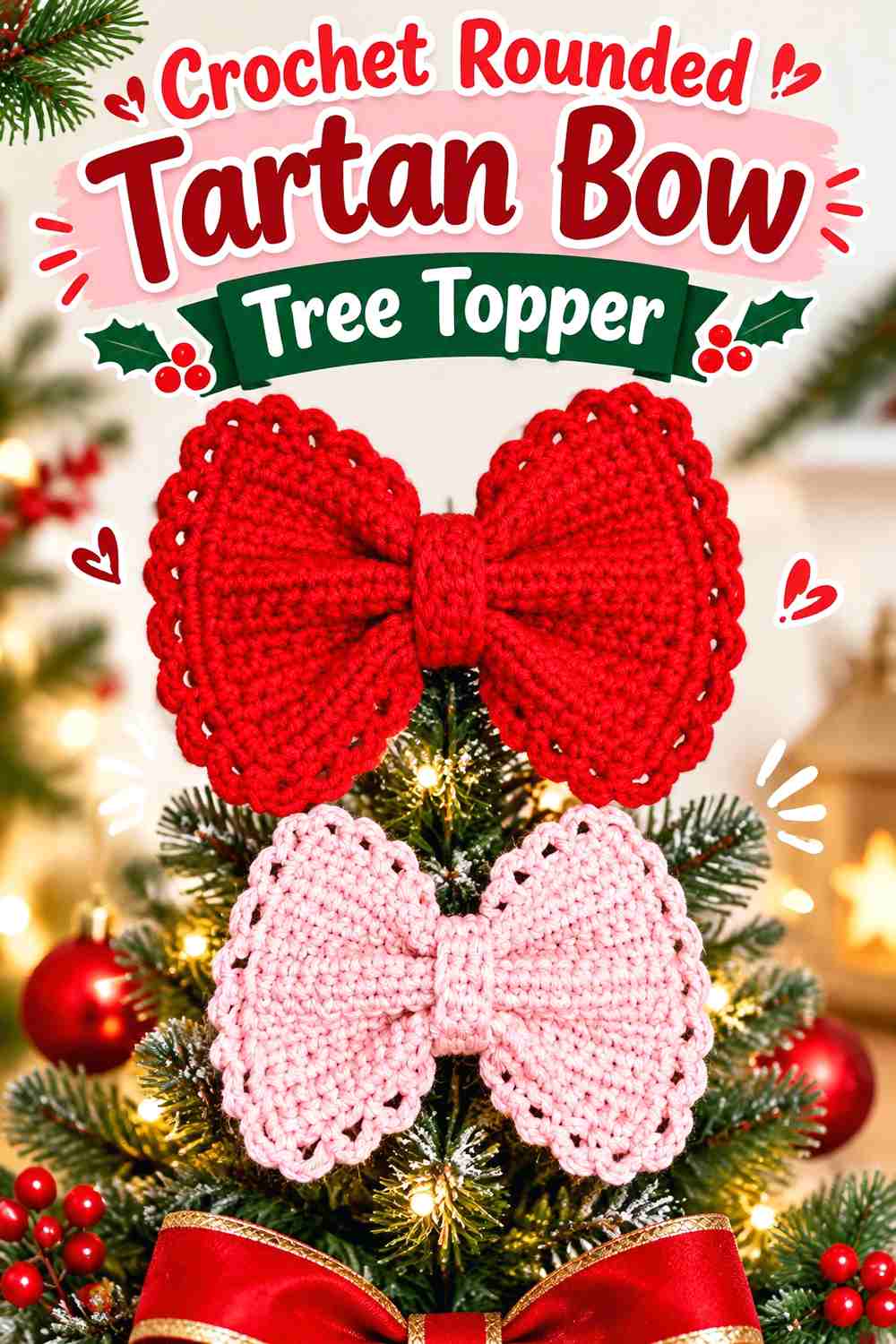
Fatinha Artesã’s bow has a compact, rounded silhouette that offers a less ribbon-like interpretation than the long rectangular bows in this collection.
The curved wings can be useful when you want the topper to feel soft and handmade rather than closely imitate wired fabric ribbon.
Use a Simplified Tartan on Rounded Wings
Several narrow vertical and horizontal lines can become visually cluttered on a curved shape. A reduced tartan—with one dominant color, one broad contrasting band, and one narrow accent—can retain the plaid idea more clearly.
Compare Both Wings Before Closing the Center
Rounded bows show asymmetry easily. Arrange the two sides at their final volume and view them straight on before securing the middle.
If one wing contains darker tartan bands than the other, equal physical size becomes even more important because the darker side may already appear visually heavier.
Creator Credit: Fatinha Artesã
10. Crochet Flat Tartan Bow Tree Topper
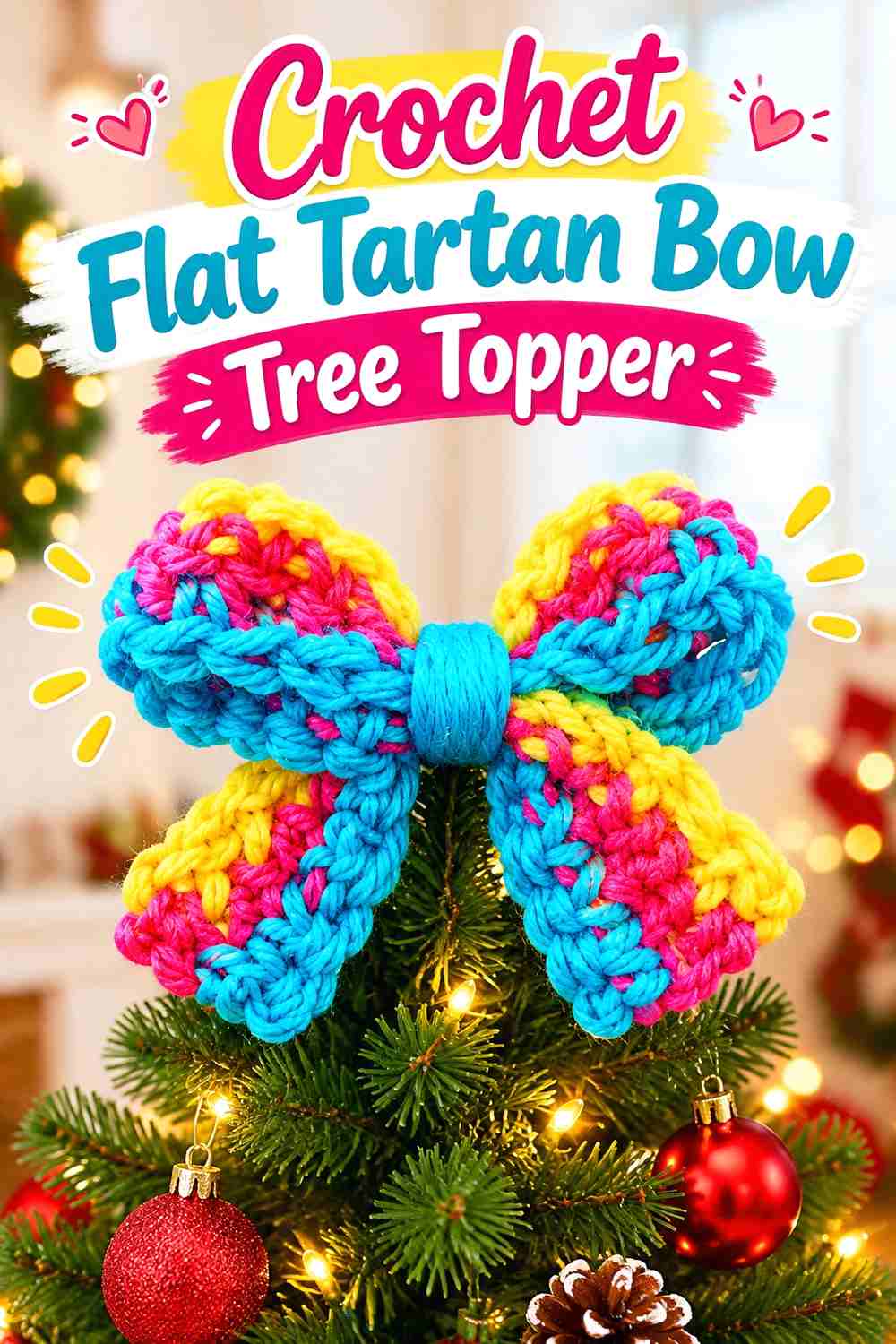
Hectanooga1’s source is an appliqué-style bow rather than a purpose-built tree topper, so this idea is most useful when you want a flatter topper or a decorative bow mounted against a separate support. Ravelry identifies the project as a crochet bow appliqué and links directly to the creator’s video demonstration.
A flat format can work particularly well on trees positioned close to a wall, where a deep three-dimensional topper is not always necessary.
Flat Bows Make Surface Plaid Easier to Control
Because the fabric does not curve as dramatically, horizontal and vertical lines have a better chance of remaining visually straight. This makes the construction suitable for a more graphic tartan treatment.
A Backing Can Change the Topper’s Role
An appliqué by itself may not stand upright at the crown. If you adapt it as a topper, think of the crochet bow as the decorative front and plan a separate removable mounting solution rather than expecting the fabric alone to provide all the structure.
Creator Credit: Hectanooga1
11. Crochet Compact Plaid Ribbon Tree Topper
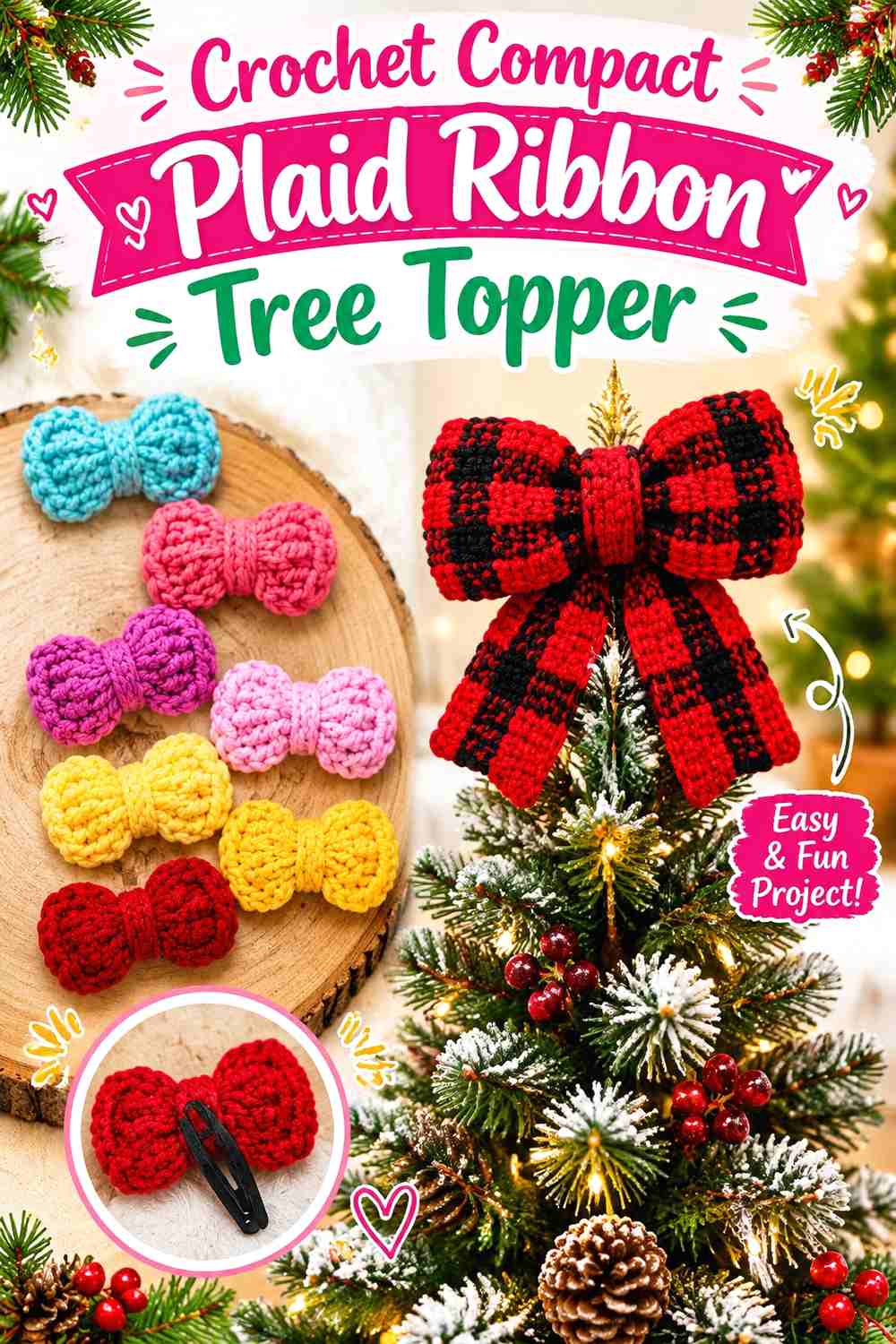
Crochet Chronicles demonstrates a compact bow intended for decorative and accessory uses. The source is useful here as another small-scale construction that can be enlarged cautiously or used almost unchanged on a miniature Christmas tree.
Instead of creating long tails, this style can keep the topper concentrated close to the tree’s crown.
A Short Silhouette Keeps the Top Branch Visible
Not every bow needs cascading ends. A compact topper lets the upper branches remain part of the composition, which can suit Scandinavian, cottage, or more restrained Christmas decorating.
Put the Tartan Contrast in the Loops
With little space below the center, the loop fabric has to carry the theme. Choose crossing colors that are sufficiently different in value to remain visible from several feet away.
If your plaid only becomes apparent at close range, simplify it before making the final topper.
Creator Credit: Crochet Chronicles
12. Crochet Pinched-Center Tartan Bow Tree Topper
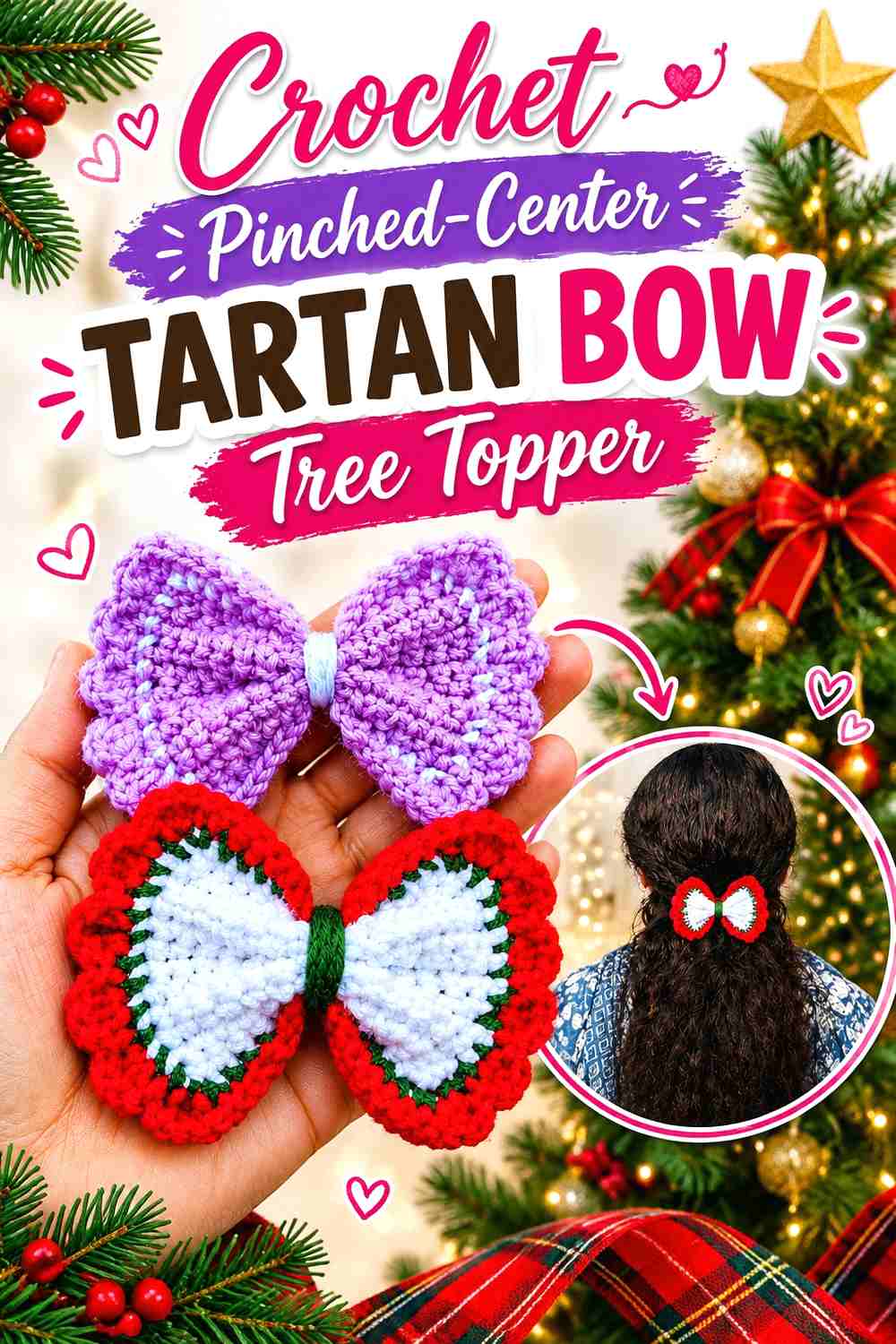
Pakhi Kar’s bow tutorial focuses on forming a clearly pinched center and a compact accessory shape. Although the original use is a hair accessory rather than tree decor, the well-defined middle offers a useful structural idea for a topper adaptation.
A strongly pinched center can make a tartan bow look closer to tied fabric ribbon because the loops flare outward from a narrow waist.
Keep the Center Narrow Enough to Define the Wings
If a topper is enlarged, the temptation is to enlarge every part equally. A center that becomes too broad can turn the shape into a rectangle with only slight indentation.
Evaluate the center in proportion to the loops rather than copying the same scaling ratio automatically.
Position the Darkest Plaid Lines Away From the Pinch
Several dark stripes converging at the middle can visually swallow the center. Adjust the tartan placement so at least some lighter fabric reaches the cinched area.
Creator Credit: Pakhi Kar
13. Crochet Fan-Shaped Tartan Bow Tree Topper
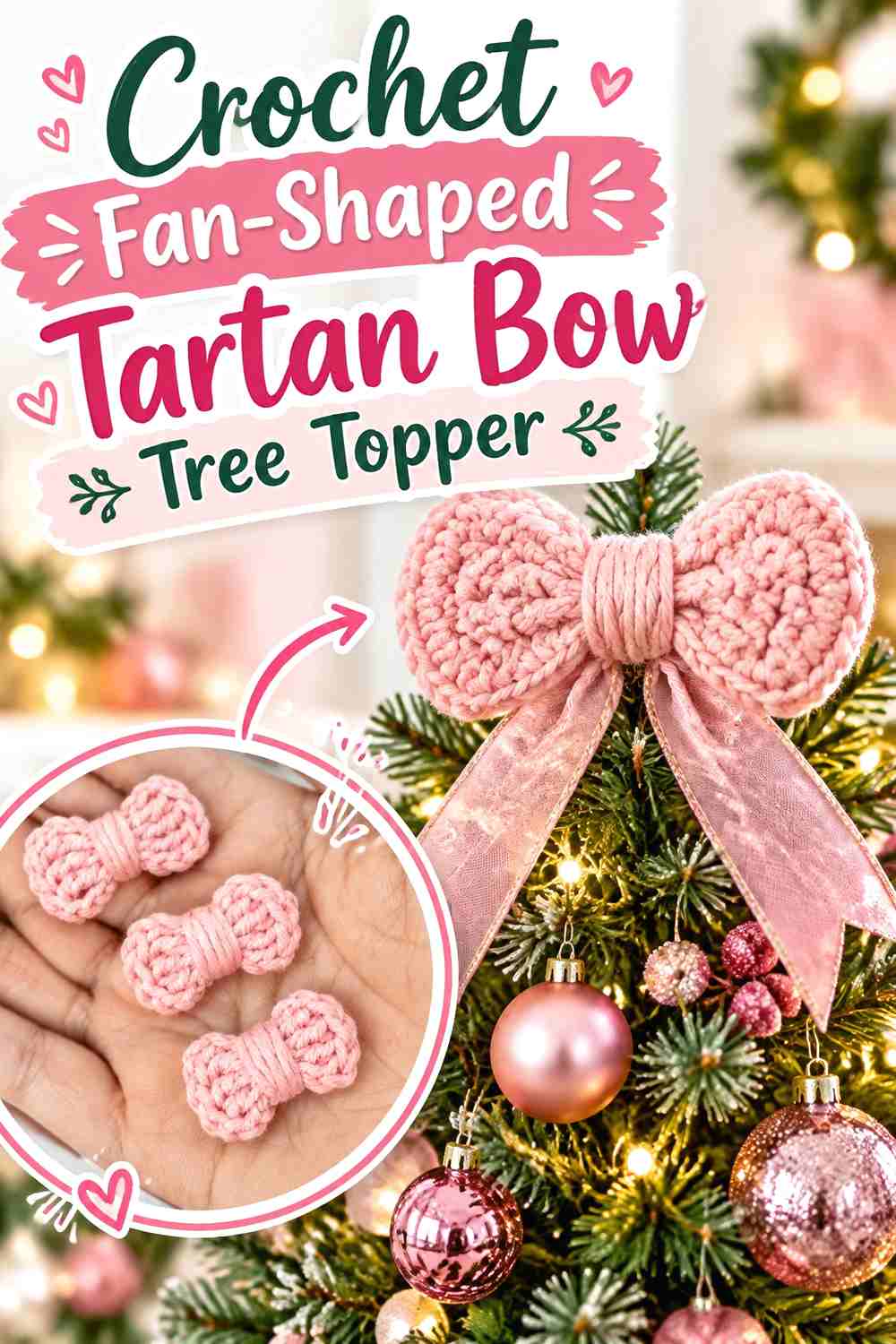
Neuzy Santana demonstrates an appliqué bow whose wings have a fan-like character rather than looking like two long folded ribbon loops. That makes this project visually different from the rectangular constructions above.
For tartan adaptation, treat each fan as a small graphic field instead of trying to force an uninterrupted woven repeat across the entire bow.
Radiating Stitches Change the Direction of the Plaid
Traditional plaid is rectilinear, but a fan-shaped crochet wing naturally sends stitch lines outward. You can either embrace that contrast or keep the tartan very simple so the two systems do not compete.
A broad central color band with one narrow crossing accent can be enough.
Flat Fan Wings Can Suit a Front-Facing Tree
This form is particularly useful if the tree is mainly viewed from one room-facing side. If the tree stands in the center of a room, inspect the back and side profiles before settling on a flat adaptation.
Creator Credit: Neuzy Santana
14. Crochet Soft Ribbon Tartan Bow Tree Topper
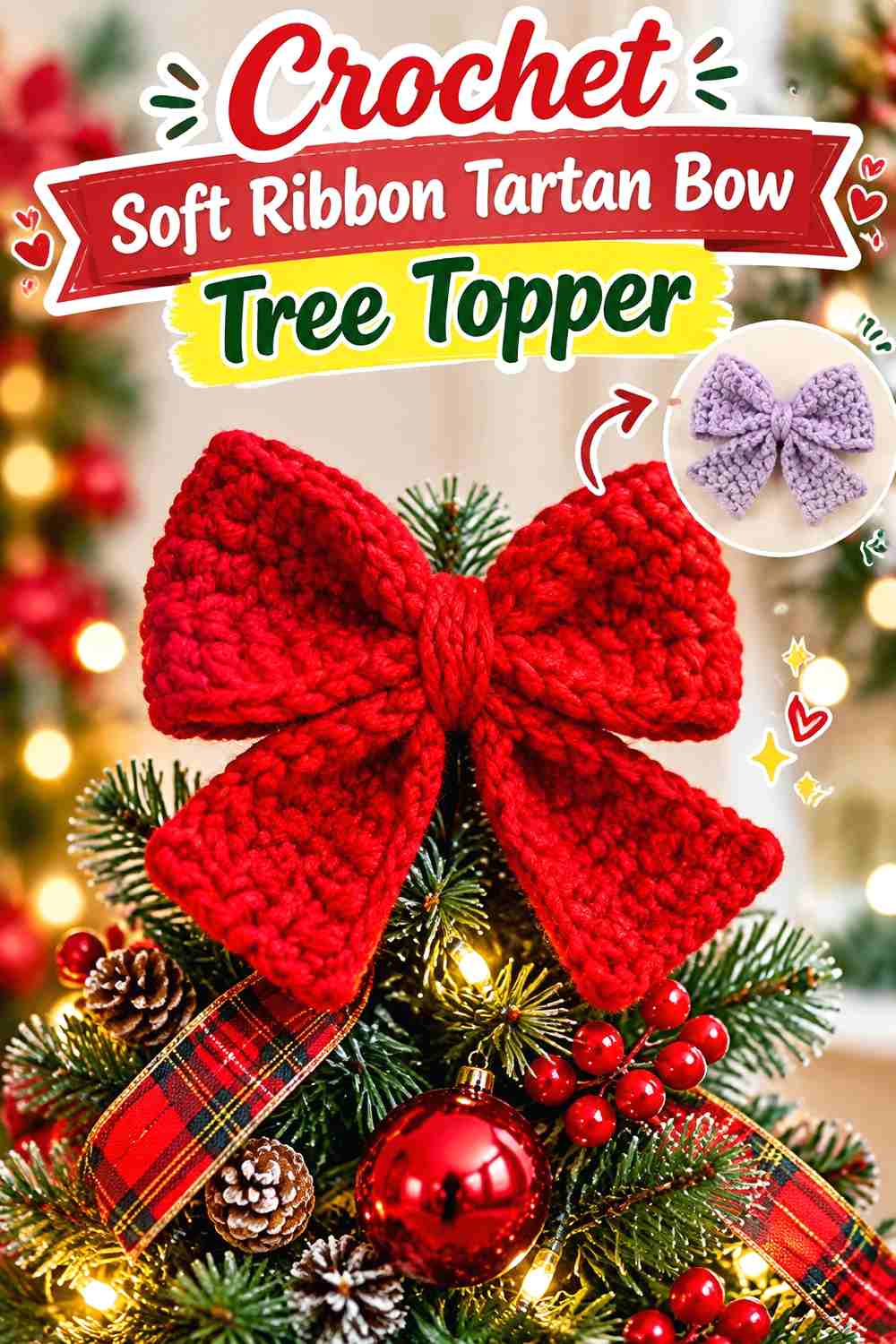
Shunu YT’s tutorial demonstrates another ribbon-style bow with an accessible, soft appearance. The straightforward silhouette gives you freedom to focus on the tartan palette and the relationship between loop size and tail placement.
This version suits a tree where you want the topper to look more like tied yarn ribbon than a sculptural crochet ornament.
Softer Fabric Needs More Careful Display Shaping
A flexible bow can flatten against the tree if it is pulled too tightly at the attachment point. Support it at the center and allow the loops to keep some depth.
If your tartan treatment adds surface strands, reassess the drape after those lines are complete.
Keep the Palette Controlled
Soft bows can already have plenty of visual movement. Three or four coordinated shades are often easier to read than a large number of narrow color bands competing across small loops.
Creator Credit: Shunu YT
15. Crochet Magic-Ring Tartan Bow Tree Topper
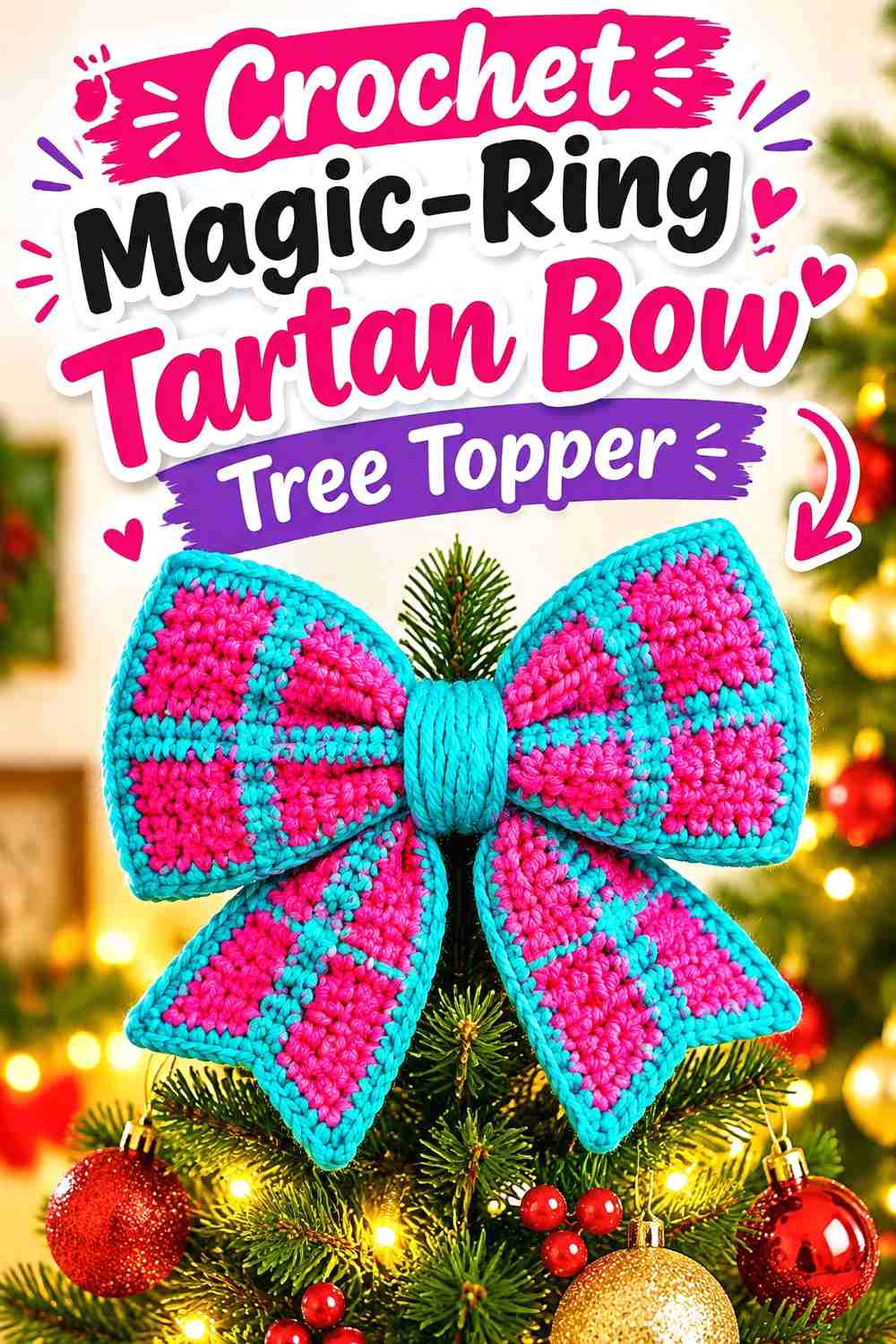
Crochet Jewel’s bow is built around a central ring with tall stitches forming the two wings, giving it a fundamentally different construction from folded rectangular bows. The source describes the two sides as fan-like sections that are pulled together at the middle.
Because the shape radiates from the center, this is better suited to a simplified tartan-inspired color arrangement than a literal grid.
Use Color Blocks Instead of Forcing a Square Grid
Radial stitches make straight vertical tartan lines difficult to preserve. Consider alternating larger sections of traditional tartan colors and using the center wrap as the strongest contrasting line.
That keeps the Scottish-inspired palette without fighting the geometry of the bow.
This Construction Makes the Center Structurally Important
Because the wings originate around the middle, any topper attachment should avoid distorting that central area. Add mounting support behind it rather than pulling directly on one side.
Check Whether Enlarging Changes the Fan Shape
A small bow and a large tree topper do not always behave identically. If you scale this concept up, make a trial version before adding complex colorwork and verify that the wings still hold a pleasing outline.
Creator Credit: Crochet Jewel
16. Crochet Decorative Plaid Bow Tree Topper
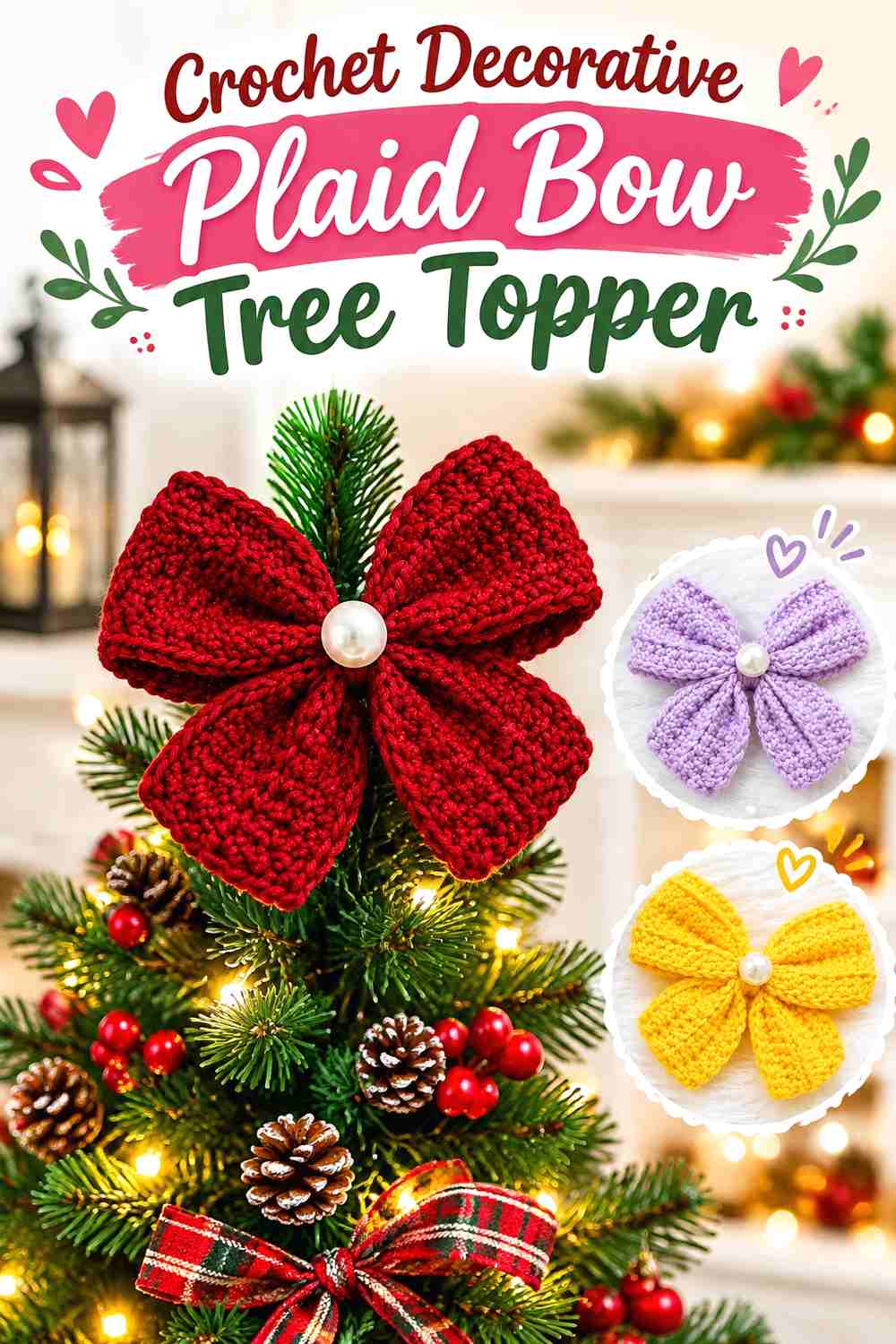
Crochet with Nimmi demonstrates a decorative crochet bow with a more accessory-focused finish. Its clean central shaping makes it useful as a starting form for a topper where you want clearly defined loops but minimal extra components.
For a Christmas version, a tartan body paired with a solid center can move the same basic shape from hair accessory territory toward seasonal decor.
Increase Visual Scale Before Adding More Pieces
If the bow looks too small for your tree, first reconsider overall loop scale rather than attaching extra tassels, flowers, or ornaments. A strong single silhouette usually reads more clearly at the crown.
Use Finishing to Hide Color-Change Clutter
Plaid adaptations can generate more yarn ends than a solid bow. Keep those ends on the least visible face and check that they do not add a lump directly beneath the center wrap.
Creator Credit: Crochet with Nimmi
17. Crochet Structured Tartan Bow Tree Topper With Tails
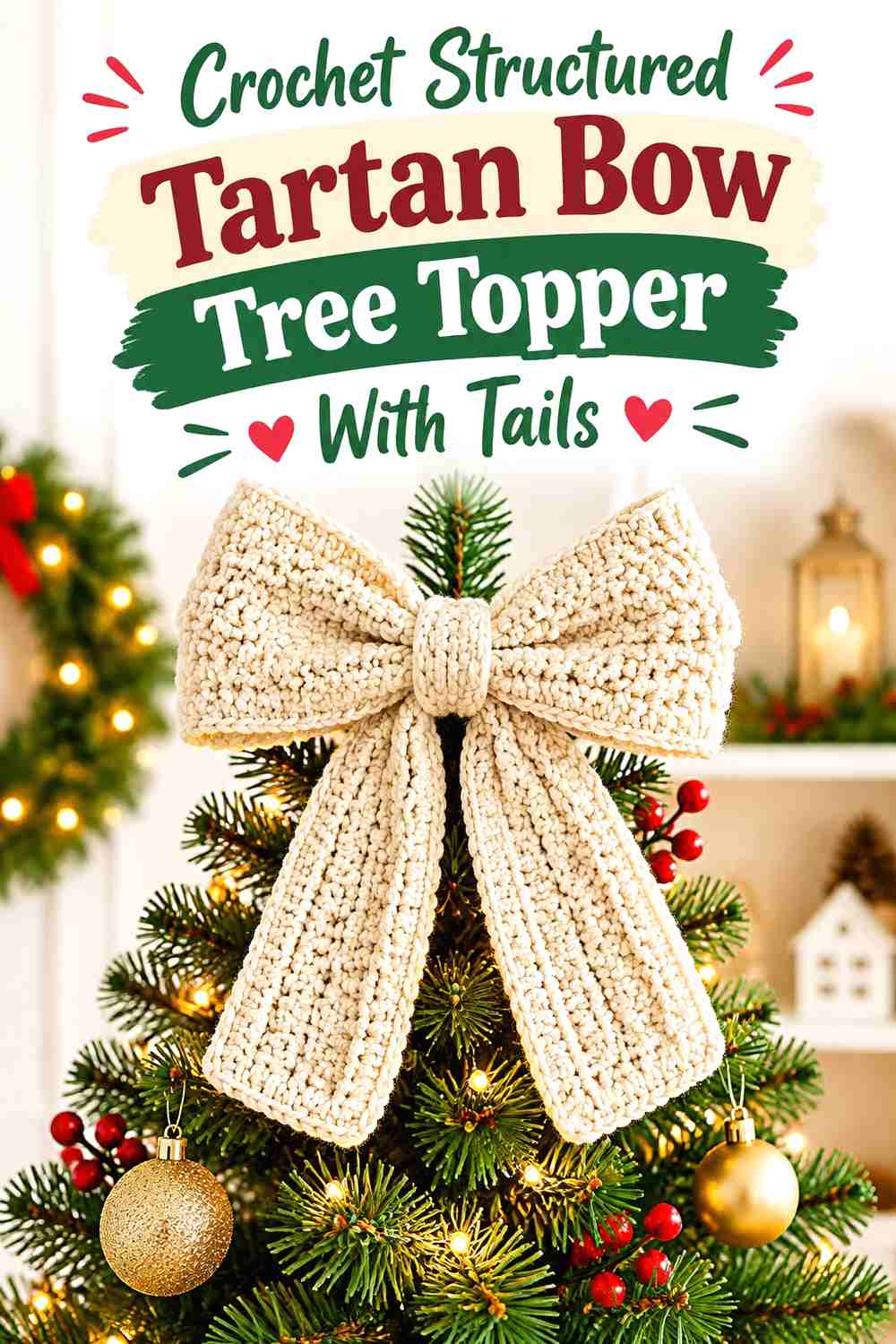
The Pink Craft Box demonstrates a bow assembled from separate main, tail, and center sections, giving this final idea one of the clearest multi-part structures in the collection. The source specifically includes substantial hanging tails rather than treating them as a minor finishing detail.
That separation makes it particularly useful for a traditional tartan topper: plaid loops can sit above coordinating tails, while a solid center keeps the whole composition organized.
Plan the Loops and Tails as One Tartan Layout
If both sections use plaid, decide whether their stripe positions should match or intentionally alternate. Random placement can make the tails feel as though they belong to a different bow.
You can also simplify the lower pieces by repeating only the major tartan bands from the loops.
Separate Pieces Give More Control Over Drape
The tail section can be allowed to hang softly even if the upper loops need additional support. That difference can produce a convincing ribbon effect without requiring the whole topper to behave the same way.
Finish the Attachment Before Perfecting Tail Angles
Mount the main bow at the intended height first. Once it is supported, arrange the tails around the upper branches and decide how much separation looks balanced.
Trying to establish their final position while the topper is still lying flat can give a misleading result.
Creator Credit: The Pink Craft Box
Comparing the 17 Crochet Tartan Bow Tree Topper Styles
| If you want… | Styles to compare | Main issue to check |
|---|---|---|
| A clearly Christmas-focused bow | Classic Christmas Bow, Bella Coco Long-Tail Bow | Tree attachment and proportion |
| Lots of room for visible tartan | Wide-Ribbon Bow, Three-Piece Bow | Plaid scale |
| A fuller romantic topper | Layered Coquette Bow, Puffy Bow | Added weight |
| A compact topper | Minimal Bow, Compact Plaid Ribbon Bow | Visibility from across the room |
| A flatter crown decoration | Flat Appliqué Bow, Fan-Shaped Bow | Mounting support |
| Long cascading tails | Long-Tail Bow, Structured Bow With Tails | Weight below the center |
| A construction unlike folded ribbon | Magic-Ring Bow | Pattern distortion on radial stitches |
| Strong texture | Double-Texture Bow | Whether texture competes with plaid |
| A soft handmade look | Rounded Bow, Soft Ribbon Bow | Loop shape retention |
For the most traditional tartan appearance, start with one of the broad, flatter ribbon constructions because straight color bands have more space to remain recognizable. For a softer handmade interpretation, the rounded, coquette, or fan-shaped options can carry the tartan palette without trying to imitate woven ribbon exactly.
Conclusion
A crochet tartan bow tree topper can range from a crisp plaid ribbon shape to a soft coquette bow with only a hint of traditional tartan color. The right option depends less on the exact red-and-green palette and more on how the bow behaves at the top of the tree.
Choose the wide-ribbon or three-piece ideas when you want the plaid to be the star. Choose a long-tail construction when you want the topper to connect visually with garland farther down the tree. A flat appliqué or compact bow can work better on a smaller or wall-facing tree, while layered and puffy bows create a fuller crown.
Whatever construction you adapt, test the finished piece upright before completing every detail. Follow the credited creator for the original bow construction, then adjust color placement, scale, backing, and attachment only after confirming that the topper remains balanced.
Frequently Asked Questions
Is tartan crochet the same as simply alternating red and green yarn?
No. A tartan-inspired effect depends on intersecting or layered bands rather than ordinary stripes alone. You can create the impression through planned color changes combined with compatible surface lines or other finishing techniques. The exact method should suit the bow construction.
Which bow construction shows a crochet tartan pattern most clearly?
Broad, relatively flat ribbon sections usually provide the clearest canvas because horizontal and vertical bands have more uninterrupted space. Rounded and fan-shaped bows can still use tartan colors, but a simplified interpretation may read better than a detailed grid.
Can I enlarge a small crochet hair bow into a tree topper?
You can use a small bow as a construction reference, but scaling is not always proportional. Thicker yarn or larger dimensions can change stiffness, loop depth, center bulk, and overall weight. Make a test version and hold it on the intended tree before investing time in detailed tartan work.
How do I keep a crochet tree-topper bow from drooping?
Start by assessing the fabric density, loop size, center construction, and attachment point. Sometimes a firmer yarn or more compact fabric helps; in other cases, a removable backing or internal support may be more appropriate. Avoid assuming that adding more crochet layers will solve the problem, because extra layers also add weight.
Should the tartan pattern continue through the center of the bow?
It does not have to. A solid center band can make a busy tartan easier to read and can disguise the visual disruption caused by cinching or folding. Using one of the darkest colors from the plaid often gives the bow a clear focal center without adding another unrelated shade.
How can I make long crochet bow tails look balanced on a Christmas tree?
Mount the bow first, then judge the tails in their hanging position. Compare their visual weight, spacing, and relationship to nearby branches rather than relying only on equal measured length. If the tails contain tartan, repeat enough of the upper bow’s colors to make them look connected.
Can I place a crochet bow close to Christmas tree lights?
Keep crochet decorations clear of bulbs, electrical connections, damaged wiring, and other heat or electrical hazards. Follow the tree-light manufacturer’s placement instructions rather than assuming a particular yarn or handmade topper is safe near every lighting system.