Wall hooks are some of the most useful little fixtures around a home, holding everything from hats and scarves to bags, towels and everyday accessories. A crochet wall hook soft grip sleeve offers a creative way to add color and handmade texture to an existing hook. From sage-green ribs and oatmeal buttoned wraps to granny-square accents, lined eyelets and reversible collars, these 16 inspiration ideas explore different ways to decorate the visible gripping areas of wall hooks without replacing the original hardware.
Not every wall hook has the same shape. Some have long curved metal arms, while others use wooden pegs, double prongs or flat rectangular stems. A fitted crochet sleeve needs to suit those differences, leaving mounting screws, retaining tips and essential hook surfaces accessible. This collection compares removable fastenings, compact stitch textures and decorative details while explaining the practical limits of a soft fabric covering.
These are AI-generated crochet design visualizations for inspiration, not photographs of tested handmade products or step-by-step patterns. A crochet sleeve is decorative and is not a load-bearing hook, certified protective padding or a guarantee against slipping.
Quick Design Selection Guide
- For a classic single wall hook: Crochet Sage Ribbed Single Hook Grip Sleeve and Crochet Oatmeal Buttoned Coat Hook Neck Wrap offer straightforward removable coverings.
- For wooden wall pegs: Crochet Dusty Blue Hook Loop Wall Peg Sleeve and Crochet Olive Adjustable Wooden Peg Grip Wrap explore different fitting arrangements.
- For matching entryway hooks: Crochet Terracotta Matching Twin Hook Collars creates a coordinated pair.
- For decorative crochet: Crochet Cream Granny Square Hook Neck Wrap, Crochet Blush Daisy Wall Hook Collar and Crochet Navy Chevron Wall Hook Collar bring additional detail.
- For modern metal fixtures: Crochet Charcoal Snap Tab Utility Hook Sleeve and Crochet Teal Envelope Overlap Rail Hook Wrap feature low-profile fastenings.
- For double-prong hooks: Crochet Mustard Honeycomb Double Hook Stem Sleeve decorates the shared central stem.
- For unusual shapes: Crochet Rust Split Panel Flat Hook Grip and Crochet Plum Reversible Wall Knob Neck Sleeve explore narrower fitting areas.
- For a dressing area: Crochet Lavender Lined Eyelet Hook Sleeve and Crochet Butter Yellow Scalloped Towel Hook Collar add softer colors and borders.
1. Crochet Sage Ribbed Single Hook Grip Sleeve
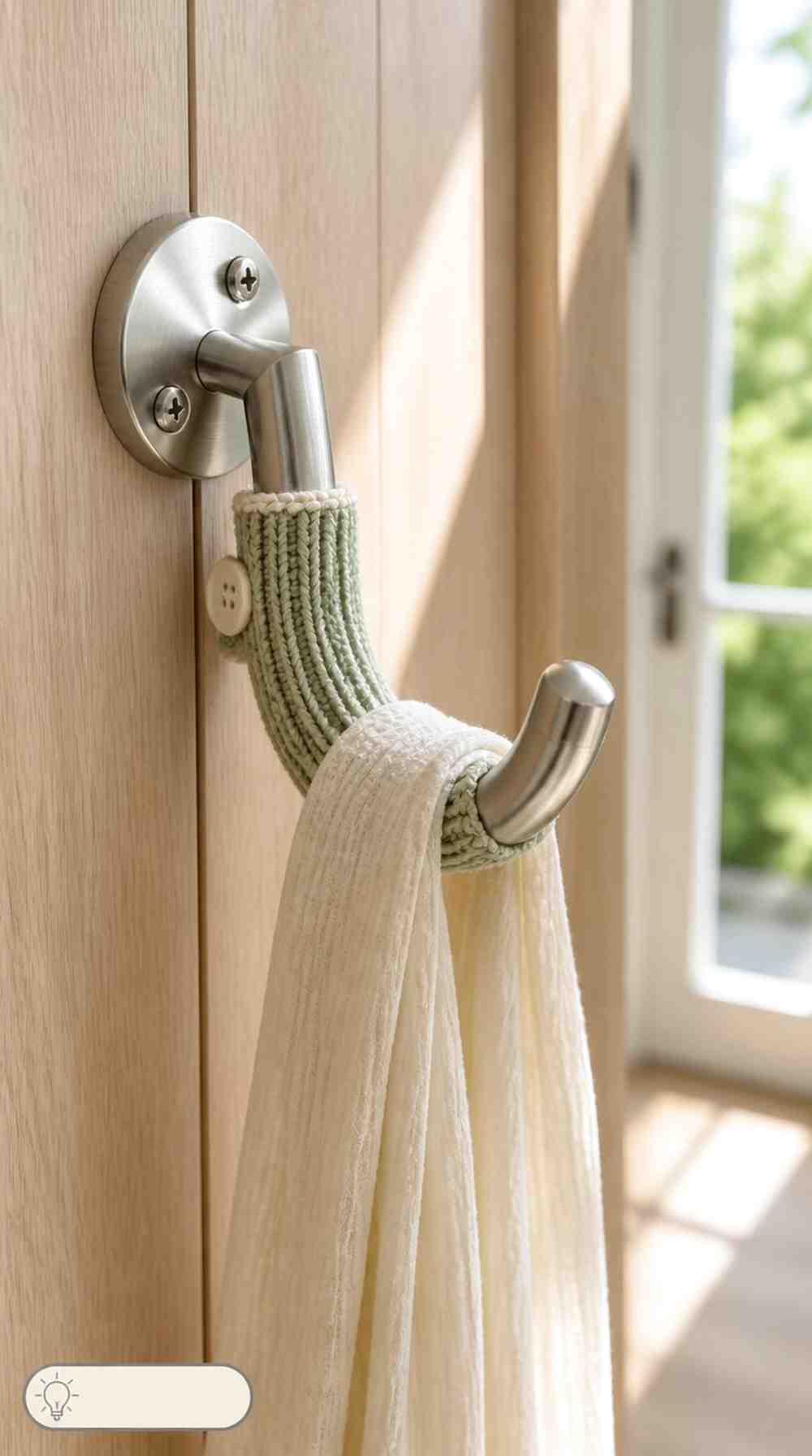
Muted sage-green cotton gives this brushed-nickel wall hook a calm, understated appearance. Raised vertical crochet ribs cover the middle section of its J-shaped arm, finished with narrow ivory edging. Two small cream button tabs close behind the hook, while an ivory scarf loop rests on the existing metal support.
The sleeve provides a soft textile surface at part of the gripping area without covering the wall mounting or upturned retaining tip. Its compact shape makes it a useful starting concept for a simple curved hook.
- Curved fit: Shape the ribbed panel around the actual metal curve instead of assuming a straight rectangle will stay evenly positioned.
- Button clearance: Place both cream buttons behind the hook, where they cannot rub against the scarf loop or interfere with the retaining tip.
- Slip checking: Test the fitted sleeve with the intended lightweight accessory, since crochet may change the friction and thickness of the original hook.
- Exposed hardware: Keep the wall plate and screws accessible so the original fixture can be inspected or tightened when required.
2. Crochet Oatmeal Buttoned Coat Hook Neck Wrap
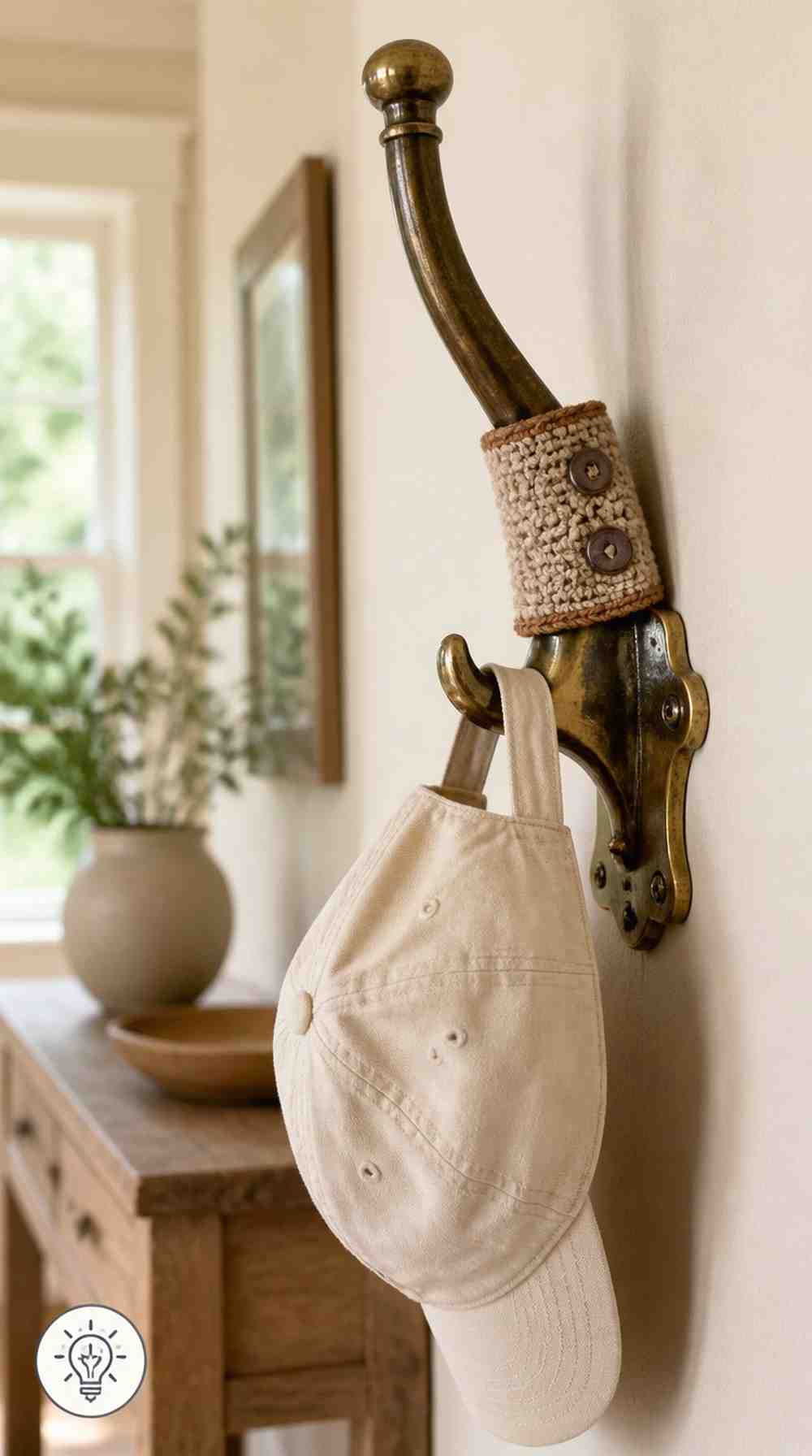
Warm oatmeal cotton gives this antique-brass coat hook a natural, classic look. Closely worked moss-style stitches form a small rectangular wrap around the straight neck, with cinnamon edging and two walnut-colored buttons fastening at the rear. A lightweight cream canvas hat hangs from the exposed brass tip.
This design concentrates its decorative fabric behind the actual carrying curve. It is an appealing option for an entryway where the warmth of brass and neutral crochet can complement wooden furniture and pale walls.
- Neck measurement: Check the straight section before the hook curves upward; the wrap should not bunch against the branching arm.
- Wooden buttons: Keep the buttons away from the visible gripping area and reinforce their attachment to the oatmeal crochet.
- Hat clearance: Make sure the original brass tip still projects sufficiently to retain the lightweight hat loop after the wrap is fitted.
3. Crochet Dusty Blue Hook Loop Wall Peg Sleeve
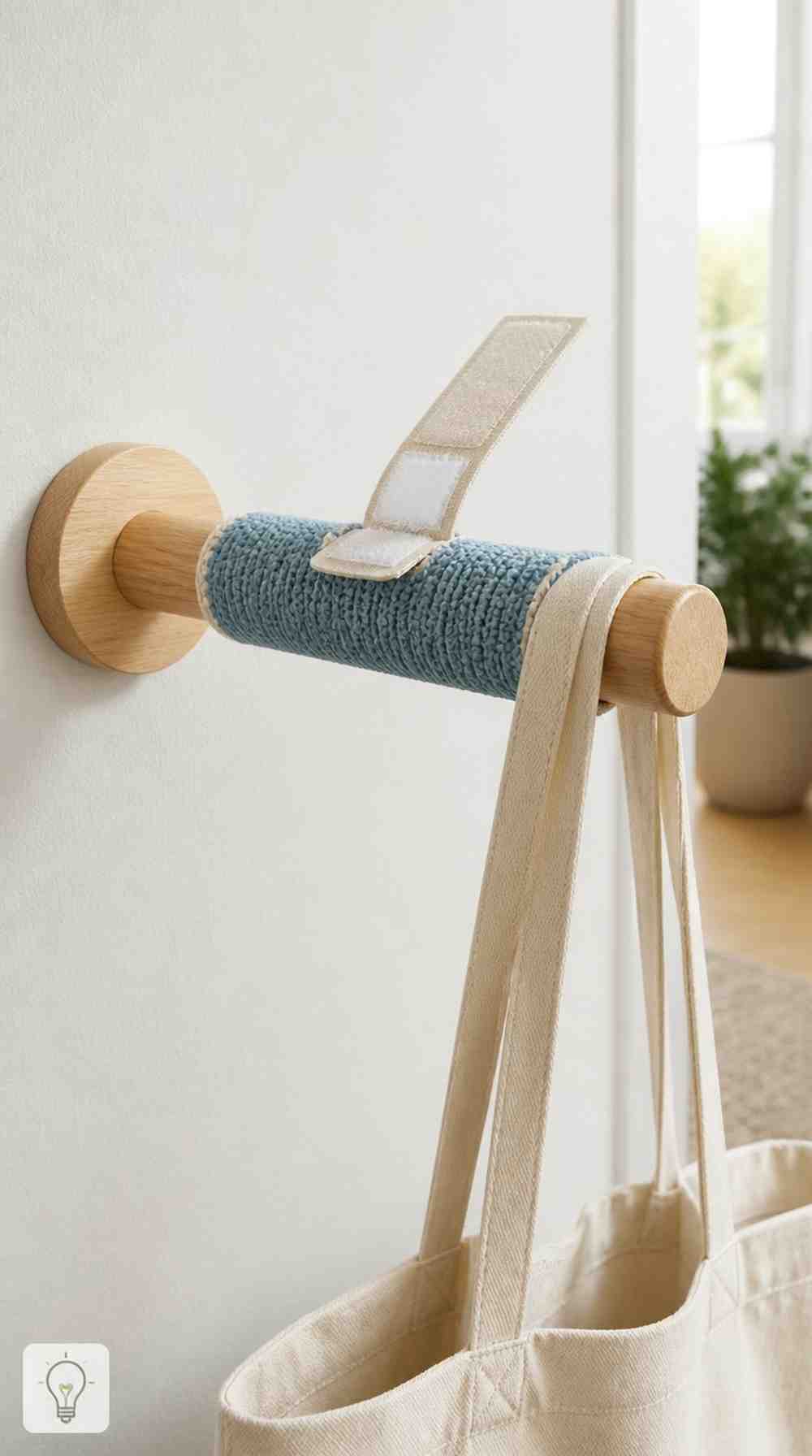
Dusty-blue cotton creates a neat cover for the central shaft of a pale-oak wall peg. Fine horizontal crochet stitches provide a smooth surface, while cream edging frames the panel. Two beige fabric tabs close underneath with concealed hook-and-loop fasteners, one partly opened to show the removable construction.
The large wooden retaining knob remains uncovered, allowing a lightweight canvas tote loop to rest on the peg. Compared with a closed crochet tube, this adjustable wrap can be removed without taking the wall-mounted peg apart.
- Peg shape: Measure both the straight shaft and the clearance behind the front knob before planning the crochet panel.
- Fastener position: Keep the hook-and-loop strips underneath, where they cannot catch the tote handle.
- Wood finish: Check the fabric tabs and seams for rough edges that could rub against the wooden surface.
- Use limitation: The original peg and its wall fixing must support the tote; the crochet sleeve must not be treated as an extra hanging attachment.
4. Crochet Terracotta Matching Twin Hook Collars
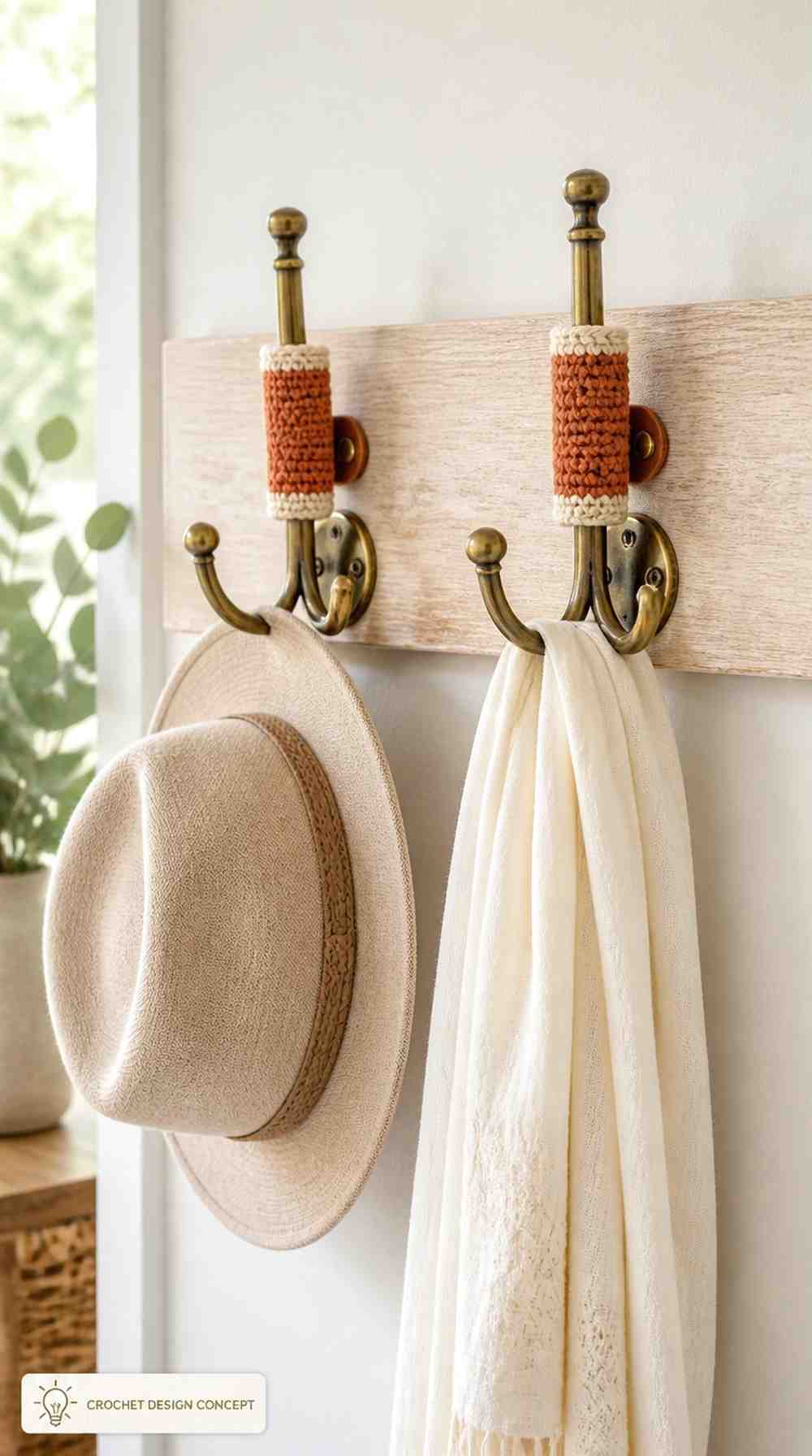
Two antique-brass hooks gain a coordinated handmade finish with matching terracotta crochet collars. Each short sleeve features dense horizontal stitches, a narrow cream border and a rust-colored snap tab hidden behind the straight stem. Both curved brass arms and retaining tips remain exposed.
The paired arrangement gives an entryway rail a consistent appearance without covering the whole set of hooks. A beige hat hangs from one hook and an ivory scarf from the other, showing how the same collar design can complement different lightweight accessories.
- Matching dimensions: Make both collars consistent in width and stitch orientation, adjusting only if the actual hooks differ.
- Snap tabs: Keep the rear snaps flat so the collars cannot turn around the stems during ordinary handling.
- Shared rail: Leave the wooden rail and all brass mounting screws exposed for access and inspection.
5. Crochet Cream Granny Square Hook Neck Wrap
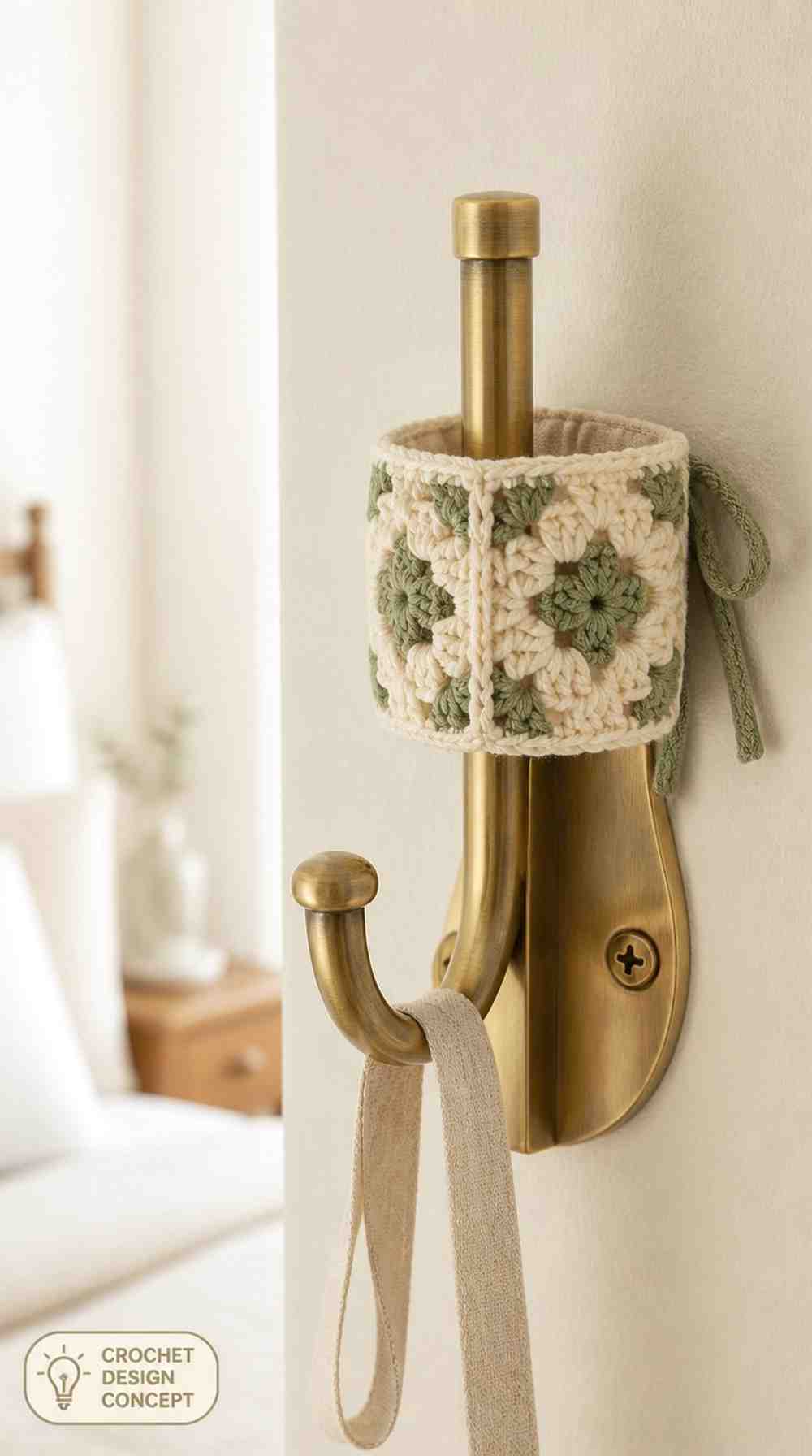
Two tiny cream granny squares give this brass hook a charming handmade detail. Sage-green centers and olive corner stitches add a gentle botanical palette, while a beige cotton backing supports the connected motifs. Short sage ties secure the narrow wrap behind the hook’s central neck.
The small granny-square arrangement makes a decorative statement without covering the metal retaining tip or curved supporting arm. Its limited size is important, as ordinary granny squares can become bulky when wrapped around a narrow fixture.
- Motif sizing: Keep both squares small enough to fit side by side without extending onto the wall plate or curved hook tip.
- Joining seams: Work the cream joins neatly so thick corners do not project against hanging fabric.
- Backing fabric: The beige lining helps prevent loose granny-square openings from catching a lightweight ribbon loop.
- Short ties: Secure the sage ties behind the neck with no long dangling strands.
6. Crochet Charcoal Snap Tab Utility Hook Sleeve
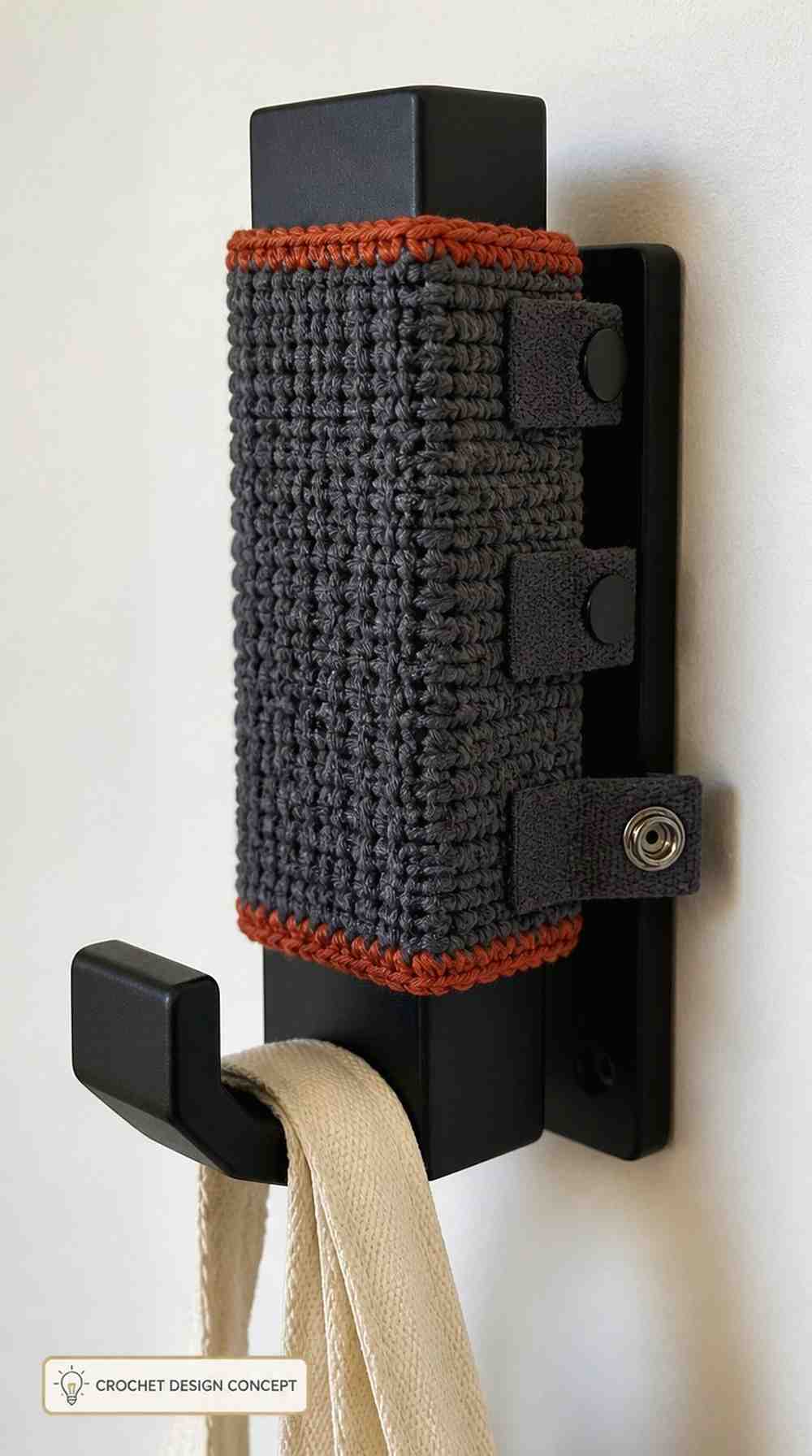
Charcoal-grey crochet gives this matte-black rectangular utility hook a clean modern appearance. Dense basketweave-style stitches cover its broad straight stem, with rust-orange edging and three charcoal snap tabs along the rear. One partly opened tab reveals the fastening arrangement.
The rectangular shape makes this design noticeably different from sleeves intended for rounded pegs. Its firm-looking edges follow the angular metal hardware, while the original retaining lip and mounting plate remain available for their normal functions.
- Flat-stem fitting: Measure the width and thickness of the rectangular metal section rather than using a circumference intended for a round hook.
- Three-snap alignment: Position the tabs evenly so the crochet does not twist around the stem.
- Texture height: Keep the basketweave ridges modest to avoid unnecessary bulk beneath a hanging canvas strap.
- Weight limitation: Follow the original hook’s load rating and installation instructions; decorative crochet cannot increase its strength.
7. Crochet Blush Daisy Wall Hook Collar
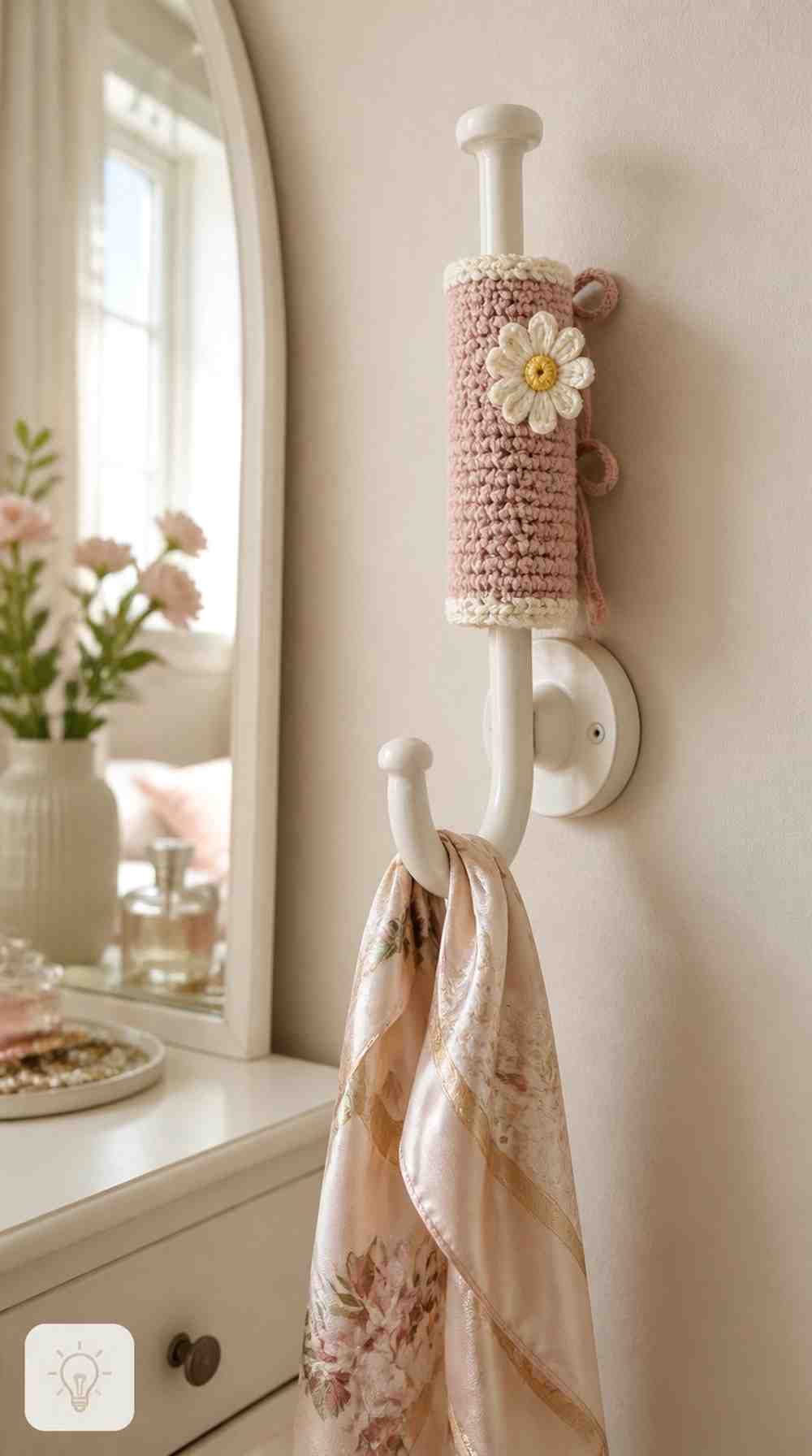
Blush-pink cotton gives this cream-painted J-shaped hook a soft decorative finish. Close moss-style crochet stitches form the collar, while ivory edging and a small cream-and-yellow daisy add detail. Two dusty-rose ties hold the sleeve behind the upper stem.
The flower sits above the actual hanging curve, leaving a lightweight satin hair scarf supported by the exposed metal hook. Its small, flat placement makes the design more practical than attaching a large flower across the gripping surface.
- Flower location: Position the daisy away from the hook’s carrying bend so the scarf does not constantly rub against its petals.
- Secure appliqué: Stitch the flower firmly, avoiding loose centers, beads or hanging decorative parts.
- Painted finish: Check that the rear ties and crochet seams do not abrade the cream-painted metal.
- Small accessories: Keep the fixture and its decorations out of young children’s reach where detachable parts could present a hazard.
8. Crochet Mustard Honeycomb Double Hook Stem Sleeve
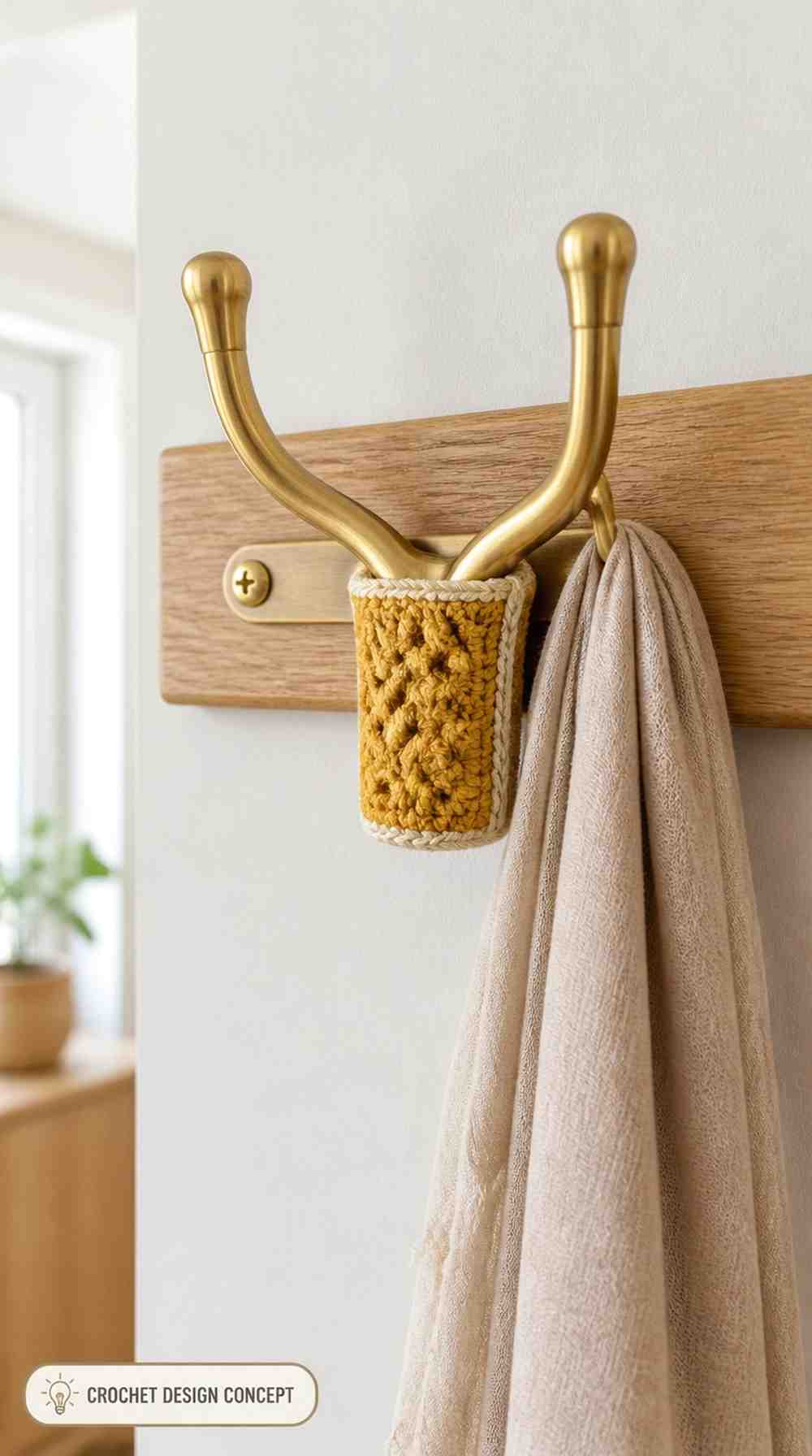
Mustard-yellow cotton adds a warm accent to this satin-brass double-prong wall hook. A small wrap covers the shared central stem, using shallow honeycomb-style crochet on the front and smoother side sections. Ivory edging and concealed hook-and-loop tabs finish the sleeve.
Because both brass prongs remain uncovered, the crochet acts as a central decoration rather than a replacement hanging surface. A lightweight beige scarf rests on one original prong, clearly distinguishing the hook’s working arms from its decorated stem.
- Shared-stem coverage: Keep the wrap below the two branching arms so neither prong loses useful hanging space.
- Honeycomb texture: Use shallow raised stitches that do not make the central section unnecessarily bulky.
- Rear closure: Position the hook-and-loop tabs where they cannot catch the scarf or interfere with the wooden mounting rail.
- Double-hook loading: The presence of two prongs does not establish any particular safe weight; follow the manufacturer’s rating for the fixture.
9. Crochet Teal Envelope Overlap Rail Hook Wrap
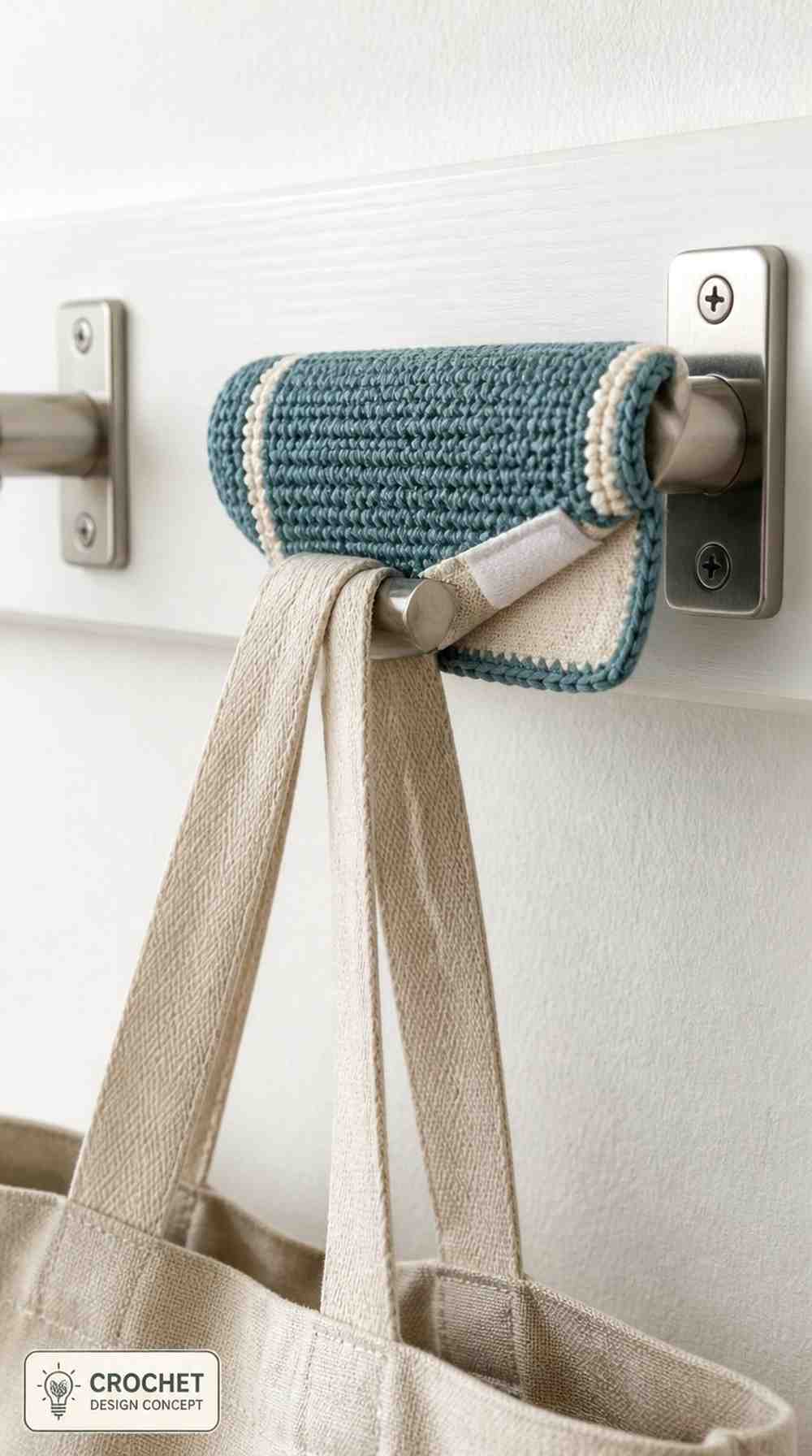
Dusty-teal crochet gives this brushed-steel hook a smooth, modern finish. Closely worked rows form the rectangular body, with narrow ivory stripes at both ends and a cream woven backing. Beneath the metal stem, overlapping fabric edges close through a concealed hook-and-loop strip.
The envelope-style construction creates a relatively uninterrupted outer surface. Its slightly lifted corner reveals how the sleeve can be removed without disturbing the wall-mounted coat rail.
- Overlap depth: Allow enough contact between the underside edges for a secure closure without forcing the crochet tightly around the stem.
- Fabric backing: Attach the cream lining evenly to prevent bunching beneath the teal panel.
- Hook clearance: Keep the retaining tip, carrying curve and rail screws uncovered.
- Bag handling: Check whether a lightweight linen bag loop catches on the overlapping seam when it is lifted from the hook.
10. Crochet Lavender Lined Eyelet Hook Sleeve
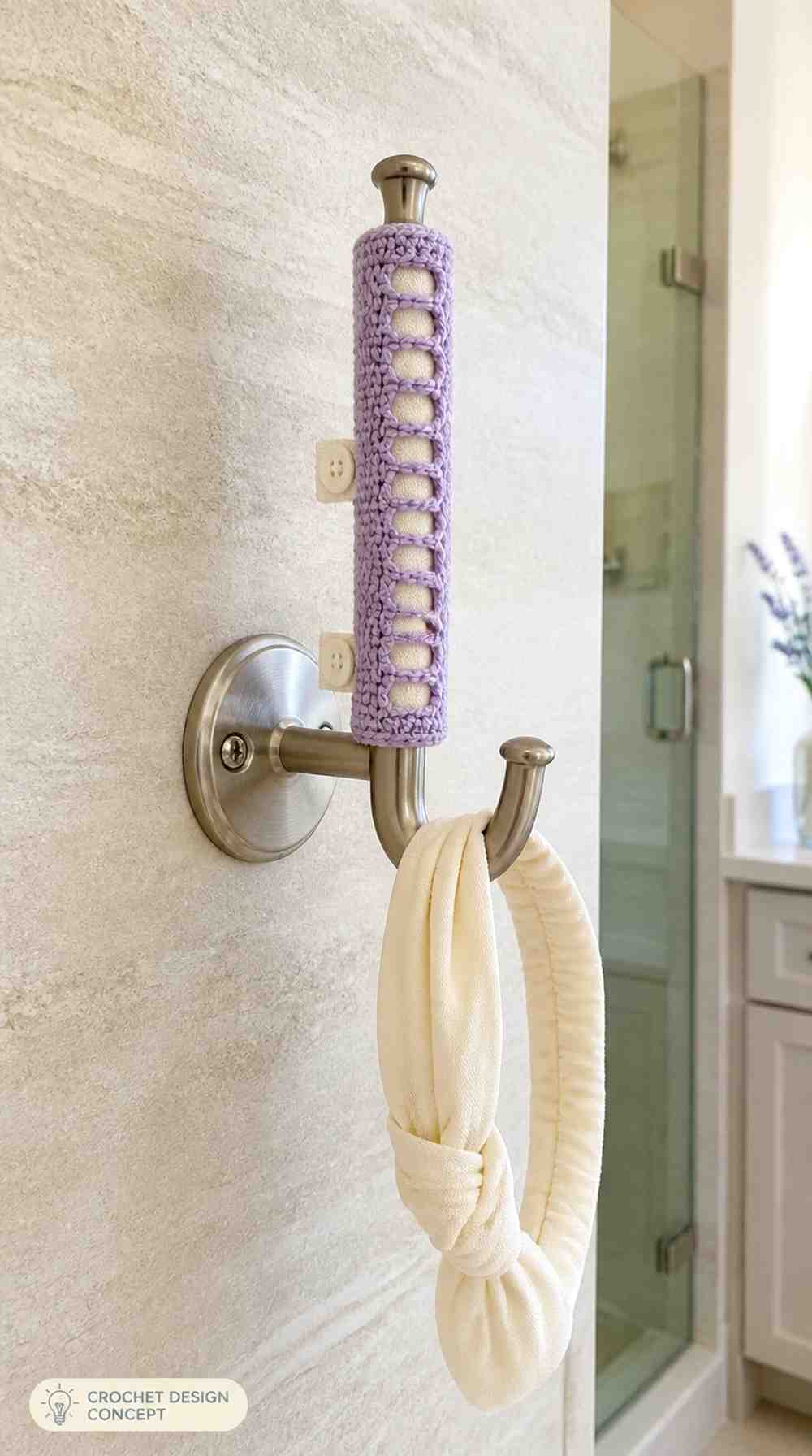
Pale-lavender crochet gives this satin-nickel hook a delicate appearance. Small evenly spaced eyelets run along the front of the narrow sleeve, backed with smooth cream woven cotton. Solid lavender borders and two cream button tabs hold the fabric around the straight stem.
The lining allows the eyelet texture to remain decorative without exposing every opening directly to the metal beneath. The design suits a dry dressing area where a lightweight fabric headband can hang from the original uncovered tip.
- Eyelet consistency: Keep the openings small and evenly connected so the crochet does not distort when wrapped around the hook.
- Lining coverage: Extend the cream fabric behind the decorative eyelets without covering the metal retaining tip.
- Button placement: Position both buttons on the rear where they remain easy to access for removal.
- Moisture exposure: Avoid prolonged wet conditions, since the cotton lining and crochet may retain moisture around the metal fixture.
11. Crochet Olive Adjustable Wooden Peg Grip Wrap
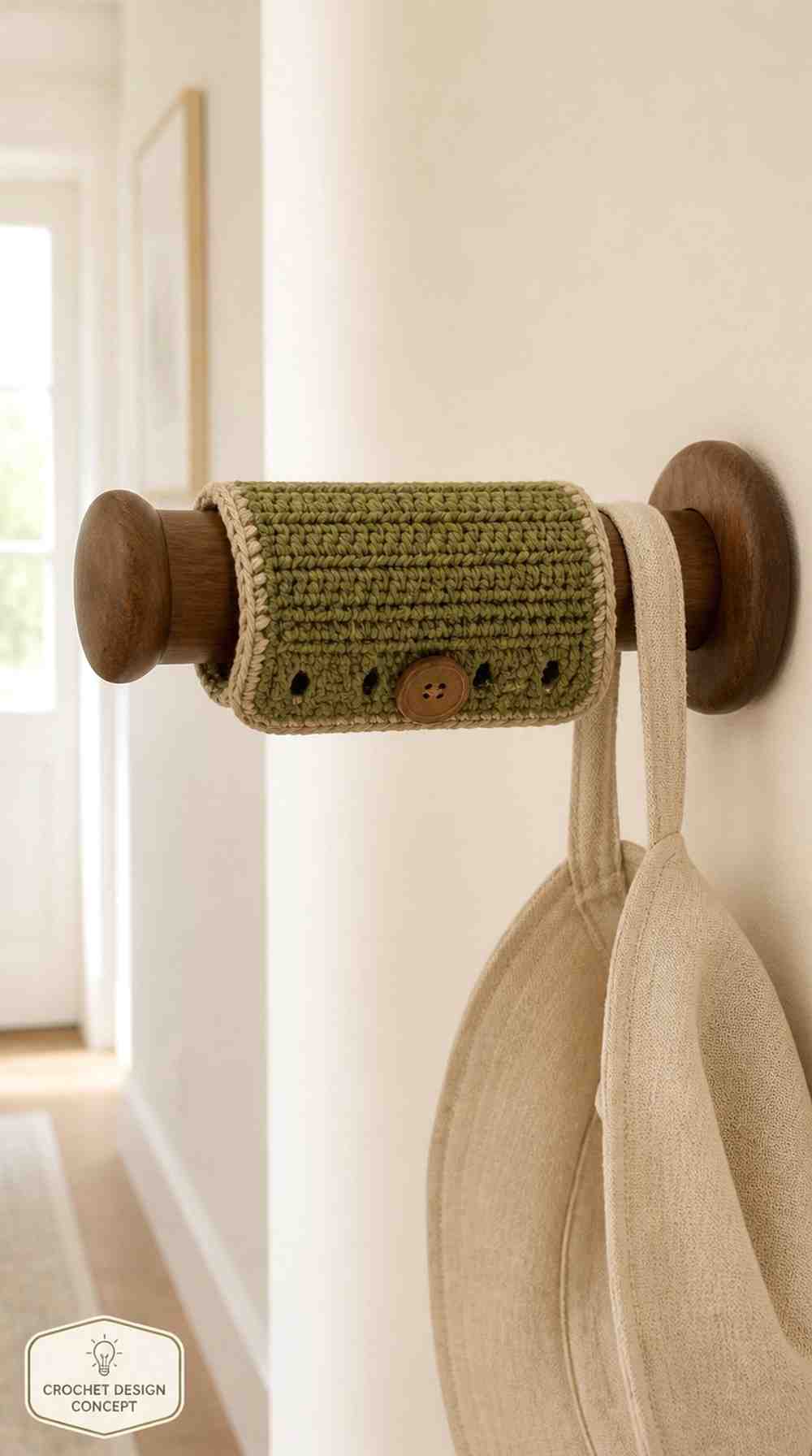
Olive-green cotton gives this dark-walnut peg a simple, natural finish. Alternating flat and shallow ribbed crochet rows create the small wrap, edged with beige yarn. One brown button closes through the middle of three available buttonholes beneath the peg.
The adjustable closure is the main feature. It allows the same rectangular panel to accommodate modest differences in peg thickness, although the width and length still need to suit the actual wooden fitting.
- Buttonhole spacing: Make the three openings meaningfully different so each provides a useful adjustment.
- Peg geometry: Measure the straight middle section separately from the wider front retaining knob.
- Button contact: Keep the wooden button beneath the shaft rather than against the surface used to support a hat loop.
- Stretch over time: Recheck the fit after repeated use, as crochet fabric may relax or shift.
12. Crochet Rust Split Panel Flat Hook Grip
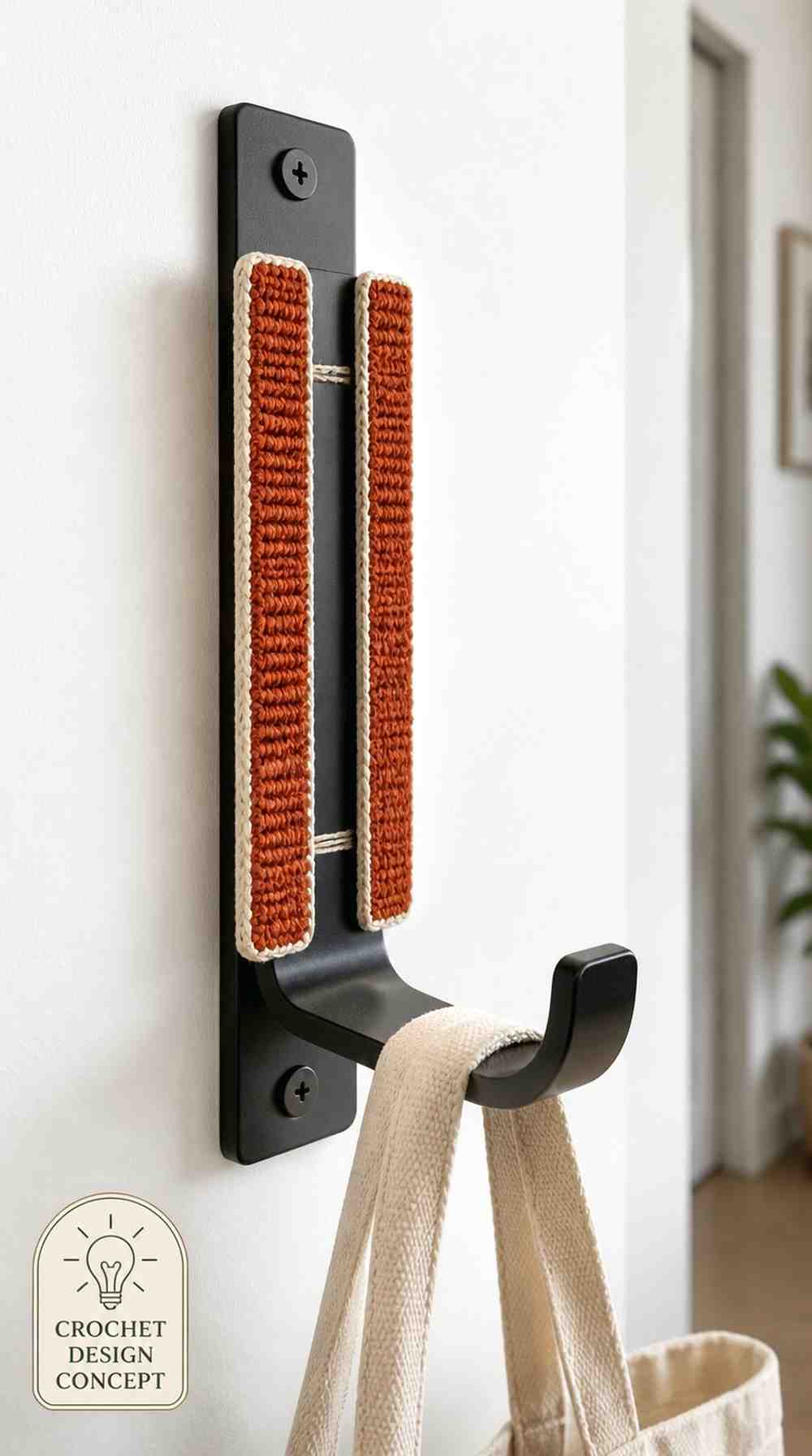
Rust-orange crochet creates an unusual two-sided decoration on this broad matte-black wall hook. Two narrow ribbed panels sit along the left and right faces of its rectangular stem, linked by slim cream-stitched bridges behind the metal. The central front strip remains uncovered.
The split-panel arrangement creates a lighter visual effect than completely wrapping the hook. It also shows more of the original black metal, making it attractive for modern hallways where a small accent is preferable to full coverage.
- Panel symmetry: Keep the two rust-colored sections equal in size so the decoration sits evenly on both sides of the stem.
- Rear bridges: Reinforce the cream connecting stitches so neither panel can swing loose during use.
- Exposed center: Preserve the intended central metal gap without allowing the side panels to overlap it.
- Snag inspection: Check that the small bridge joins do not catch on a cloth tote handle or other hanging accessory.
13. Crochet Navy Chevron Wall Hook Collar
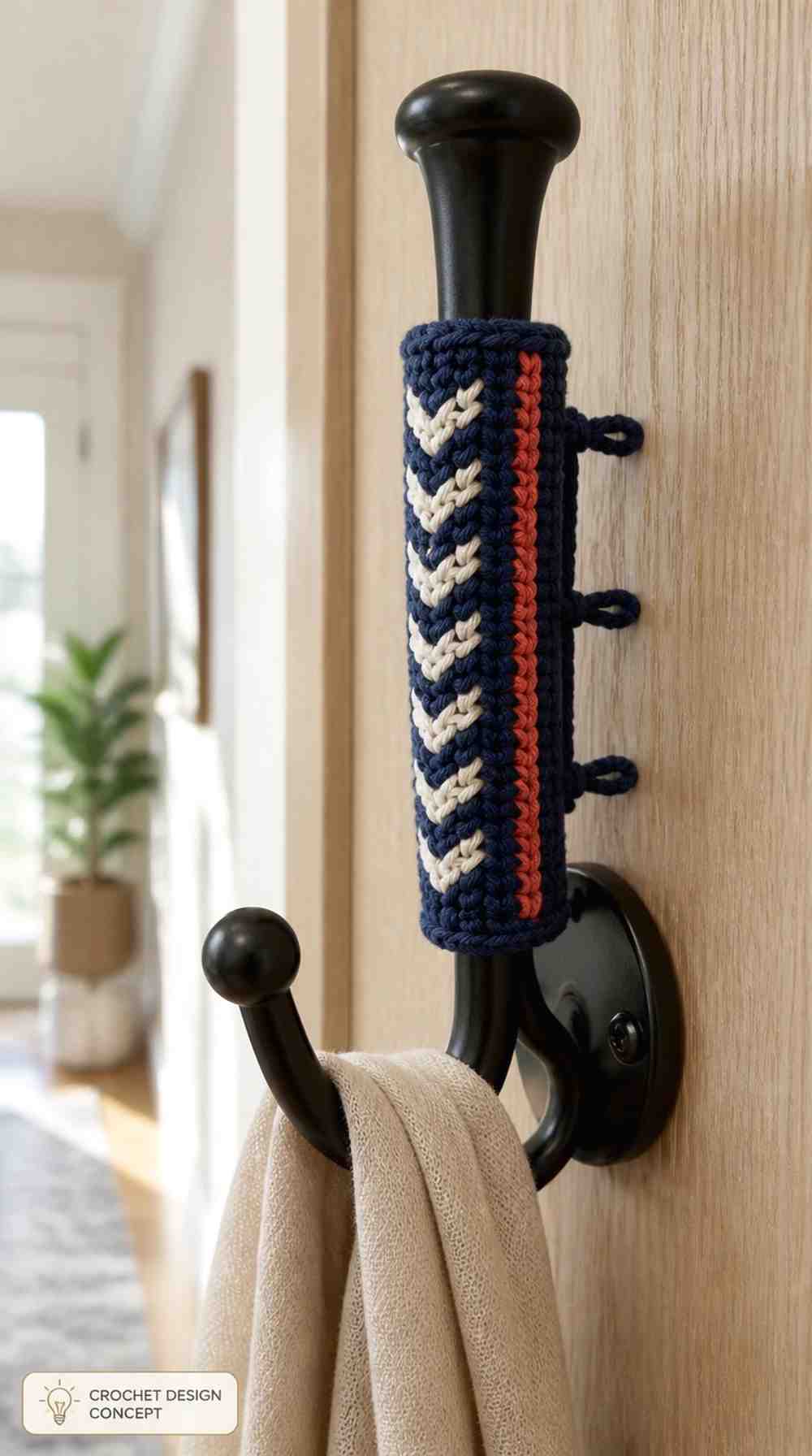
Navy-blue cotton adds a bold, tailored finish to this satin-black wall hook. Small cream chevrons repeat along the central sleeve, with a slim coral accent stripe near one outer edge. Short navy ties fasten behind the stem, and solid edging keeps the rectangular panel neatly shaped.
The colorwork makes this concept distinctive without requiring raised appliqués. A lightweight beige scarf hangs from the original metal curve, keeping the patterned crochet separate from the hook’s uncovered retaining tip.
- Chevron alignment: Keep the cream zigzag pattern straight across the visible front when the panel is wrapped.
- Yarn finishing: Secure color-change ends so they cannot work loose near the scarf or rear ties.
- Coral stripe: Position the accent close to the panel’s edge rather than through the middle of the chevron repeat.
- Tie security: Keep the navy cords short and fastened behind the metal stem.
14. Crochet Plum Reversible Wall Knob Neck Sleeve
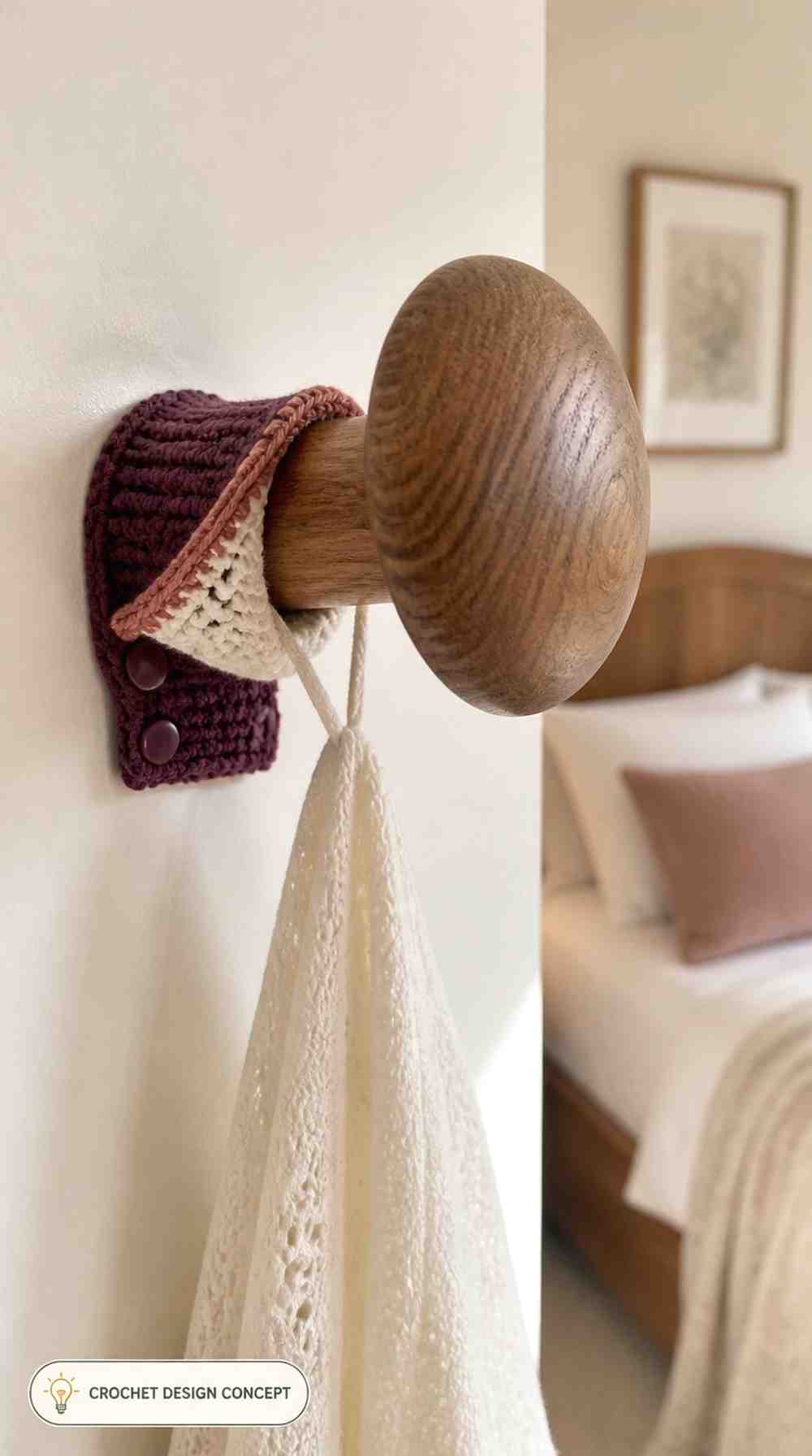
Deep-plum crochet creates an elegant little collar around the narrow neck of a walnut mushroom-shaped wall peg. Fine raised ribs appear on the outer face, while a folded corner reveals smooth ivory crochet on the reverse. Dusty-rose edging joins the two layers, with small plum snap tabs securing the collar underneath.
The broad wooden retaining head stays fully exposed. This is important for a peg-style hook because its enlarged front is what helps retain a hanging fabric loop.
- Neck-only fit: Measure the narrow section behind the wooden head; do not cover the broad front stop.
- Reversible construction: Join the plum and ivory crochet layers evenly so the collar does not twist around the peg.
- Snap positions: Keep both fasteners underneath the neck, where they cannot interfere with the hanging loop.
- Fabric thickness: Two crochet layers add bulk, so check the available space between the knob head and the wall.
15. Crochet Butter Yellow Scalloped Towel Hook Collar
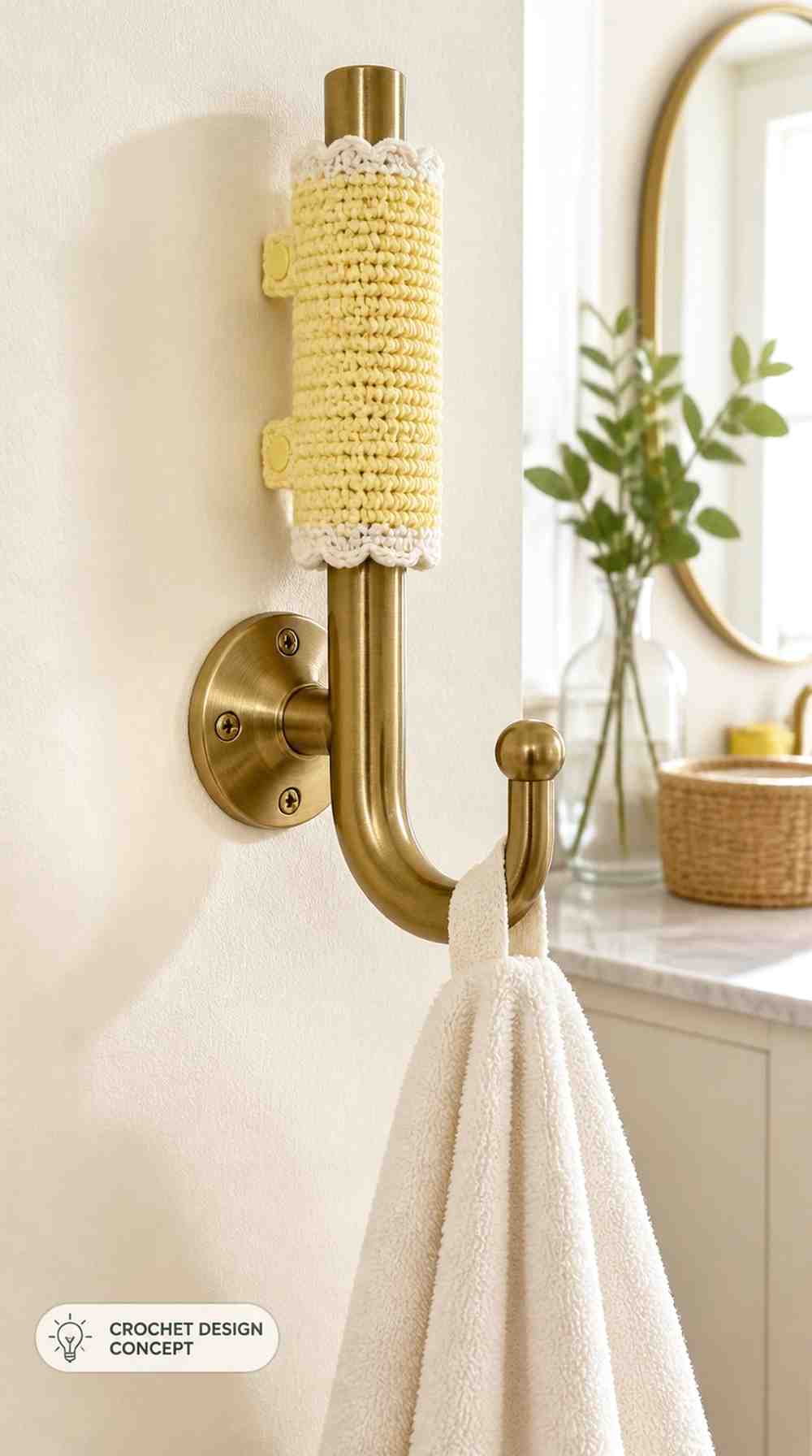
Butter-yellow cotton gives this satin-brass J-shaped hook a cheerful, delicate appearance. Flat crochet stitches form the compact sleeve, with tiny cream scallops at its short ends. Two yellow snap tabs fasten behind the straight upper stem, while the lower hook curve and retaining tip remain uncovered.
The design is shown in a bright, dry dressing area with a clean hand towel hanging from its sewn loop. The towel rests on the original brass tip rather than on the decorative crochet collar.
- Scalloped ends: Keep the cream scallops small and flat so they do not catch on the towel loop.
- Towel placement: Leave the original metal hanging curve and upturned tip available for the towel.
- Snap fastening: Position the ivory snaps behind the stem, clear of the towel’s normal contact area.
- Dry-area use: Avoid fitting a moisture-retaining crochet collar where it will be repeatedly soaked by wet towels or splashes.
16. Crochet Burgundy Zipper Back Hook Sleeve
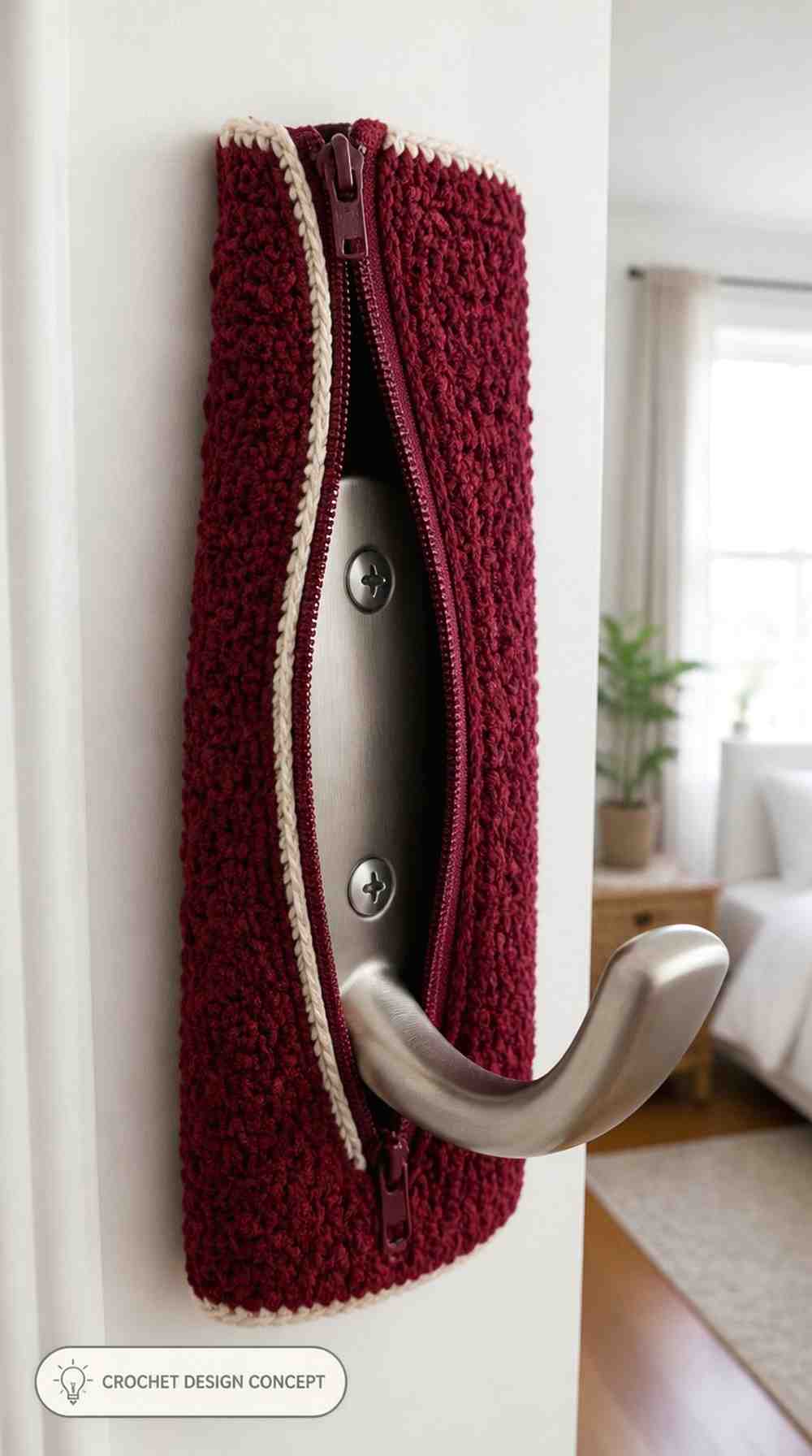
Rich burgundy cotton gives this substantial steel wall hook a more structured appearance. Raised waffle-style crochet squares cover the straight stem, framed by ivory edging. A short burgundy zipper runs along the rear seam, partly opened to reveal the removable jacket construction.
Unlike a buttoned or tied cover, the zipper creates a continuous opening along the back. The original metal hook curve, tip and fixing plate remain exposed, while the decorative sleeve can be removed without taking the hook off the wall.
- Rear zipper: Keep the zipper entirely behind the straight stem, away from the curve that supports hanging objects.
- Waffle texture: Work the raised squares firmly enough to maintain their shape without creating excessive bulk.
- Zipper clearance: Check that the pull tab does not scrape the wall or become trapped beneath the hook.
- Hardware access: The removable design should leave mounting screws reachable for normal inspection and maintenance.
Practical Guide to Crochet Wall Hook Soft Grip Sleeves
A crochet wall hook sleeve should be fitted around the actual hook rather than planned from appearance alone. The shape, surface and mounting arrangement determine whether a small textile covering is sensible.
Identify the hook’s working parts. Locate the mounting plate, screws, carrying curve, front retaining tip and any moving hardware. Keep essential parts exposed and avoid covering the attachment that supports the hook against the wall.
Measure the fitting area. Round metal hooks, flat rectangular stems and wooden pegs all need different crochet shapes. Check the available straight length, circumference or width, and clearance between the fitting and the wall. A removable panel is often easier to adapt than a closed tube on permanently mounted hardware.
Choose relatively firm crochet. Smooth cotton and close stitches are reasonable materials to consider. Thick padding or loose, slippery yarn may change how securely an item rests on the hook. A sleeve can provide a softer textile contact surface, but it is not proven to prevent fabric damage or slipping.
Keep the original load rating. Never use crochet ties, buttons or loops as extra load-bearing hooks. The wall anchor, mounting surface and metal or wooden fixture determine the safe hanging capacity. Stop using the sleeve if it slips, rotates, loosens or obstructs the hook.
Check cleaning and moisture. Remove the sleeve for washing when possible, and dry both the crochet and the hook completely. Avoid damp coverings on metal fixtures, particularly where moisture could remain trapped against the finish.
Think about children and pets. Loose ties, detachable buttons and small decorations can create hazards. Do not place fragile crochet accessories where they can be chewed, pulled or detached easily.
For another way to combine handmade crochet with household hardware, explore 15 Crochet Door Handle Wall Protector Inspiration Ideas. That collection explores wall protection rather than hook sleeves, but offers related ideas for decorative fabric and removable household accessories.
Want to Make Something Similar?
These 16 designs are original crochet inspiration concepts, not exact tested patterns. The following published resources teach related techniques that could help with small wraps, fitted covers and decorative motifs.
- Crochet Luggage Handle Wrap — CyCrochet: A free written pattern showing how to make a rectangular crochet cover with a buttonhole. Useful for studying the removable fastening approach in the Sage and Olive designs, although a wall hook needs different dimensions and safety checks.
- Crocheted Door Knob Covers — Coastal Crochet by Eleonora Tully: A free tutorial for fitted crochet covers around small furniture knobs, relevant to thinking about rounded hardware and the Plum Reversible Wall Knob Neck Sleeve.
- Solid Granny Square Tutorial — Sarah Maker by Sarah Stearns: A step-by-step photo tutorial for crocheting solid granny squares, useful for understanding the small motifs featured in the Cream Granny Square Hook Neck Wrap.
These resources explain related techniques, not exact patterns for the pictured wall-hook covers. A finished cover should be adapted to the actual hardware without interfering with the hook’s normal function.
Which Crochet Wall Hook Soft Grip Sleeve Should You Choose?
Start by identifying the type of wall hook already installed. Then compare the amount of crochet coverage, fastening method and whether the sleeve will touch the item being hung.
| Your hook or preference | Designs to compare | Main consideration |
|---|---|---|
| Single curved metal hook | Sage Ribbed, Oatmeal Buttoned | Grip-area wrap versus straight-neck collar |
| Horizontal wooden peg | Dusty Blue Hook Loop, Olive Adjustable | Hook-and-loop tabs versus buttonhole positions |
| Matching hook set | Terracotta Twin Collars | Two consistent removable covers |
| Decorative motifs | Cream Granny Square, Blush Daisy | Joined motifs versus a small flat flower |
| Modern rectangular hook | Charcoal Snap Tab, Rust Split Panel | Full stem covering versus exposed central metal |
| Double-prong hook | Mustard Honeycomb | Only the shared stem is covered |
| Wall-mounted coat rail hook | Teal Envelope Overlap | Concealed underside fastening |
| Lined openwork | Lavender Lined Eyelet | Eyelet crochet over woven cotton backing |
| Graphic colorwork | Navy Chevron | Repeating cream chevrons and coral accent |
| Rounded wall knob | Plum Reversible Neck | Broad retaining head stays exposed |
| Dry dressing-area towel hook | Butter Yellow Scalloped | Decorative ends and moisture control |
| Removable zipper closure | Burgundy Zipper Back | Rear zipper kept clear of carrying curve |
For a straightforward metal wall hook, the Crochet Sage Ribbed Single Hook Grip Sleeve is a simple starting concept because its decorative covering occupies a relatively small section.
For wooden pegs, the Crochet Olive Adjustable Wooden Peg Grip Wrap may offer more flexibility in circumference, while the Crochet Dusty Blue Hook Loop Wall Peg Sleeve provides a different removable fastening method.
If appearance matters most, the Cream Granny Square and Blush Daisy concepts create distinctive decorative accents. However, a simpler sleeve may be more suitable for hooks used frequently throughout the day.
Conclusion
A crochet wall hook soft grip sleeve can bring handmade texture to a small, everyday household fixture. From sage ribs and oatmeal buttons to colorful granny squares, honeycomb stitches and reversible plum crochet, these 16 ideas show several ways to add personality to metal and wooden wall hooks.
The best design is one that fits securely, remains easy to remove and does not interfere with the existing hook’s mounting, retaining tip or ability to hold an item safely. Decorative fabric can change the feel and appearance of a hook, but it should never be relied on to strengthen the fixture or guarantee protection for hanging belongings.
Which crochet wall hook sleeve would you choose? Would you prefer the Sage Ribbed Sleeve, the Terracotta Twin Collars or the decorative Cream Granny Square Wrap? Share your favorite and whether your home uses metal hooks, wooden pegs or double-prong wall fixtures.
Frequently Asked Questions
1. Can crochet be used to cover an existing wall hook?
A removable crochet sleeve can be designed for selected portions of some wall hooks, provided it does not obstruct the mounting, carrying surface or retaining tip. The suitability depends on the actual fixture. Check the fit carefully and remove the sleeve if it causes the hanging item to slip or interferes with normal use.
2. Does a crochet soft grip sleeve protect clothes and bags from damage?
A crochet sleeve adds a textile surface that may feel softer than bare metal or wood, but it does not guarantee protection against snagging, stretching, abrasion or slipping. Loose crochet loops can themselves catch on delicate fabrics. Use smooth, close stitches and test the arrangement carefully with lightweight items.
3. What yarn is suitable for a crochet wall hook sleeve?
Smooth cotton is worth considering because it can produce compact stitches and may be washable according to its care instructions. The ideal yarn weight depends on the size and shape of the hook. Avoid bulky fabric, loose decorative strands and slippery stitches that could reduce the usable retaining area.
4. Can a crochet sleeve increase how much weight a wall hook holds?
No. The safe load depends on the original hook, fasteners, wall anchors and mounting surface. A crochet sleeve does not increase that capacity, and its buttons, ties or snaps should never be used to support additional loads. Follow the hook manufacturer’s instructions and check the mounting regularly.
5. Are these 16 crochet wall hook soft grip sleeve ideas exact patterns?
No. These are AI-generated crochet design concepts created for inspiration, not photographs of physically tested sleeves or complete patterns. The linked resources demonstrate related crochet wrapping, fitted-cover and granny-square techniques. Any real sleeve needs its own measurements and should be checked for secure fit and unchanged hook function.