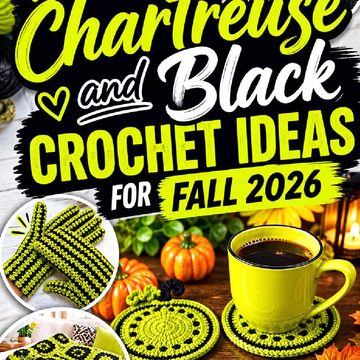
Mustard yellow has enough depth to carry an autumn crochet project without needing a large number of extra colors. The key to giving it a more polished, considered finish is deciding what mustard should do: cover the main surface, define selected motifs, appear only at borders, or connect darker fall shades.
The 26 ideas below pair mustard yellow with espresso, cream, charcoal, olive, rust, burgundy, navy, teal, and other grounded shades. Each palette is an editorial color adaptation, so the credited tutorial supports the crochet project or construction concept rather than necessarily showing the exact suggested colors.
Quick List
- Mustard Yellow Cream And Chocolate Crochet Granny Vest
- Mustard Yellow And Charcoal Crochet Oversized Vest
- Mustard Yellow Oatmeal And Walnut Crochet Ribbed Vest
- Mustard Yellow Black And Ecru Crochet Checkered Vest
- Mustard Yellow Camel And Cream Crochet Mock Neck Vest
- Mustard Yellow Olive And Tobacco Brown Crochet Hooded Vest
- Mustard Yellow Rust And Oatmeal Crochet Long Vest
- Mustard Yellow Burgundy And Dusty Rose Crochet Flower Vest
- Mustard Yellow Deep Brown And Stone Crochet Cable Vest
- Mustard Yellow Navy And Cream Crochet Ribbed Beanie
- Mustard Yellow Forest Green And Camel Crochet Beret
- Mustard Yellow Ivory And Taupe Crochet Headband
- Mustard Yellow Deep Teal And Tan Crochet Bucket Hat
- Mustard Yellow Chocolate And Caramel Crochet Crossbody Bag
- Mustard Yellow Black And Warm Beige Crochet Tote
- Mustard Yellow Terracotta And Cream Crochet Basket
- Mustard Yellow Plum And Oatmeal Crochet Mug Cozy
- Mustard Yellow Olive Cream And Rust Crochet Granny Blanket
- Mustard Yellow Aubergine And Beige Crochet Triangle Scarf
- Mustard Yellow Camel And Ivory Crochet Fringe Scarf
- Mustard Yellow Chocolate And Brick Crochet Chunky Scarf
- Mustard Yellow Charcoal And Stone Crochet Tunisian Scarf
- Mustard Yellow Rust And Deep Teal Crochet Filet Scarf
- Mustard Yellow Wine And Camel Crochet Poncho
- Mustard Yellow Deep Teal And Cream Crochet Fingerless Gloves
How to Make Mustard Yellow Crochet Look More Polished
Mustard yellow becomes easier to control when it has a clear role. On a cardigan or blanket, it can cover the largest area while a darker shade defines borders and seams. On a bag or hat, mustard can work equally well as a smaller panel or motif color if a deeper neutral provides the visual foundation.
Avoid giving every strong shade equal attention unless a deliberately graphic result is the goal. A mustard, rust, olive, and brown combination can become visually crowded when all four occupy similar areas. Let one shade lead, give one or two colors supporting roles, and reserve the darkest or strongest contrast for details that benefit from definition.
Use Contrast to Keep Mustard Yellow Crochet Texture Visible
Mustard yellow can sit surprisingly close in value to camel, tan, muted olive, or medium brown even though the hues are different. That matters on cables, bobbles, granny-square centers, ribbing, and other crochet details where shadows need enough separation to remain visible.
Before committing to a large colorwork project, place the yarns together and view them from farther away. A grayscale photo can also reveal whether two apparently different colors merge into the same light-dark range. When small details disappear, use the lighter or darker shade around those details instead of changing the whole palette.
Repeat Mustard Yellow Deliberately Around Crochet Edges and Details
A polished multicolor project usually looks more connected when accent shades return somewhere else. If mustard yellow appears only once on a bag strap, one isolated granny square, or a single cardigan cuff, it may look accidental.
Repeating mustard at both cuffs, around several motif centers, at a border, or in small sections across a scarf creates visual continuity. Repetition does not need to be symmetrical, but the viewer should be able to see that the color placement was planned.
1. Mustard Yellow Cream And Chocolate Crochet Granny Vest
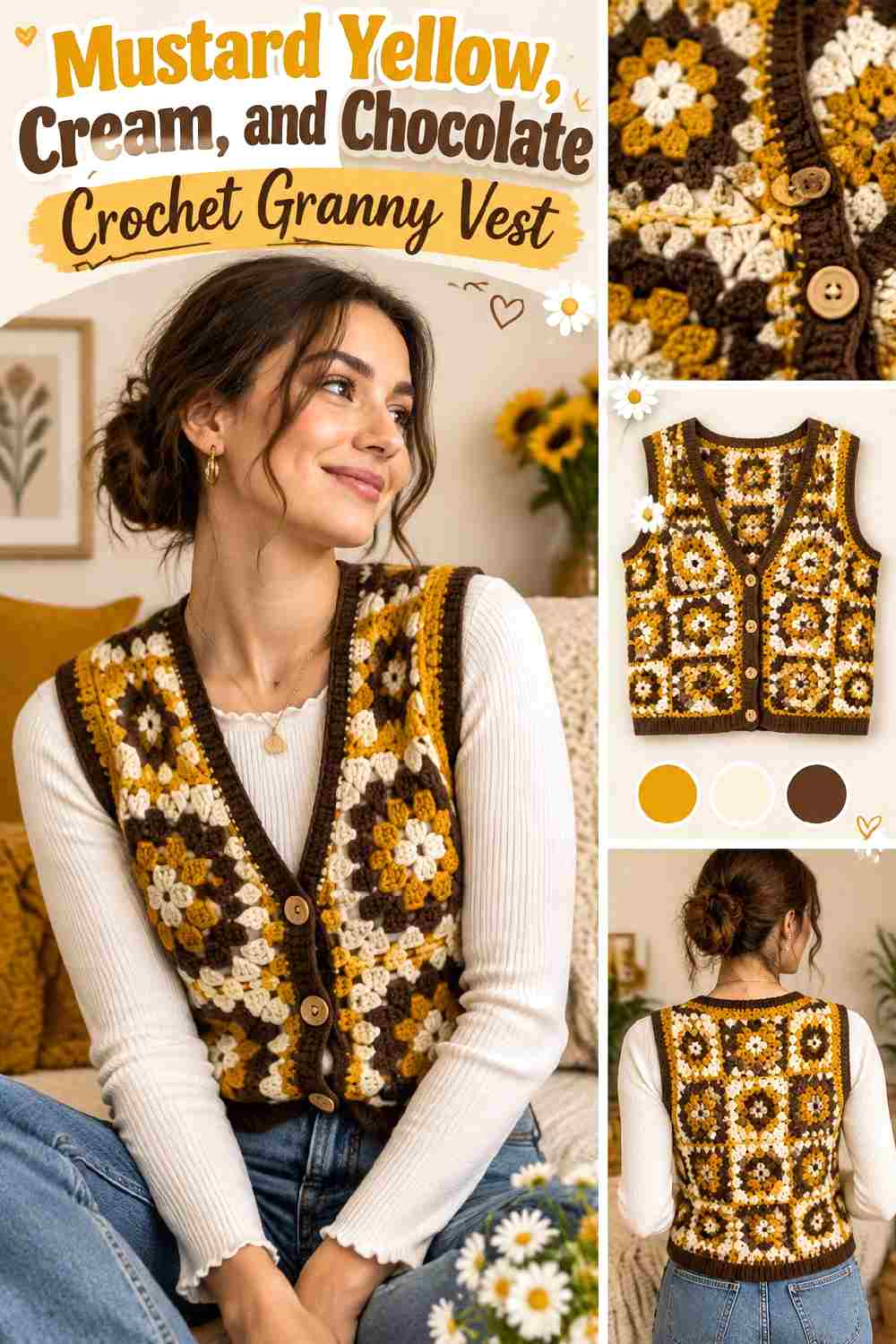
Granny-square construction gives mustard yellow several possible roles. Use it repeatedly in motif centers or outer rounds, let cream create breathing room, and reserve chocolate brown for joins or selected borders. The resulting vest can feel richly autumnal without every square becoming a separate color experiment. The supporting tutorial demonstrates a granny-square vest construction.
Repeat Mustard Yellow Across the Crochet Granny Squares
Mustard yellow should appear often enough that the squares read as one vest rather than unrelated motifs. Repeating mustard in the same approximate position is the most controlled approach, while alternating its position creates a looser patchwork effect.
Lay the squares out before joining. If mustard clusters heavily on one side of the vest, redistribute a few motifs before assembly.
Let Cream Separate Mustard Yellow From Chocolate Brown
Chocolate provides excellent definition but can visually overpower a small mustard motif when the colors touch over many rounds. A cream section between them softens that transition and keeps individual motif layers easier to distinguish.
Cream also works well around the neckline or armholes when you want those edges to feel lighter than a chocolate-brown join.
Creator Credit: HayHay Crochet
2. Mustard Yellow And Charcoal Crochet Oversized Vest
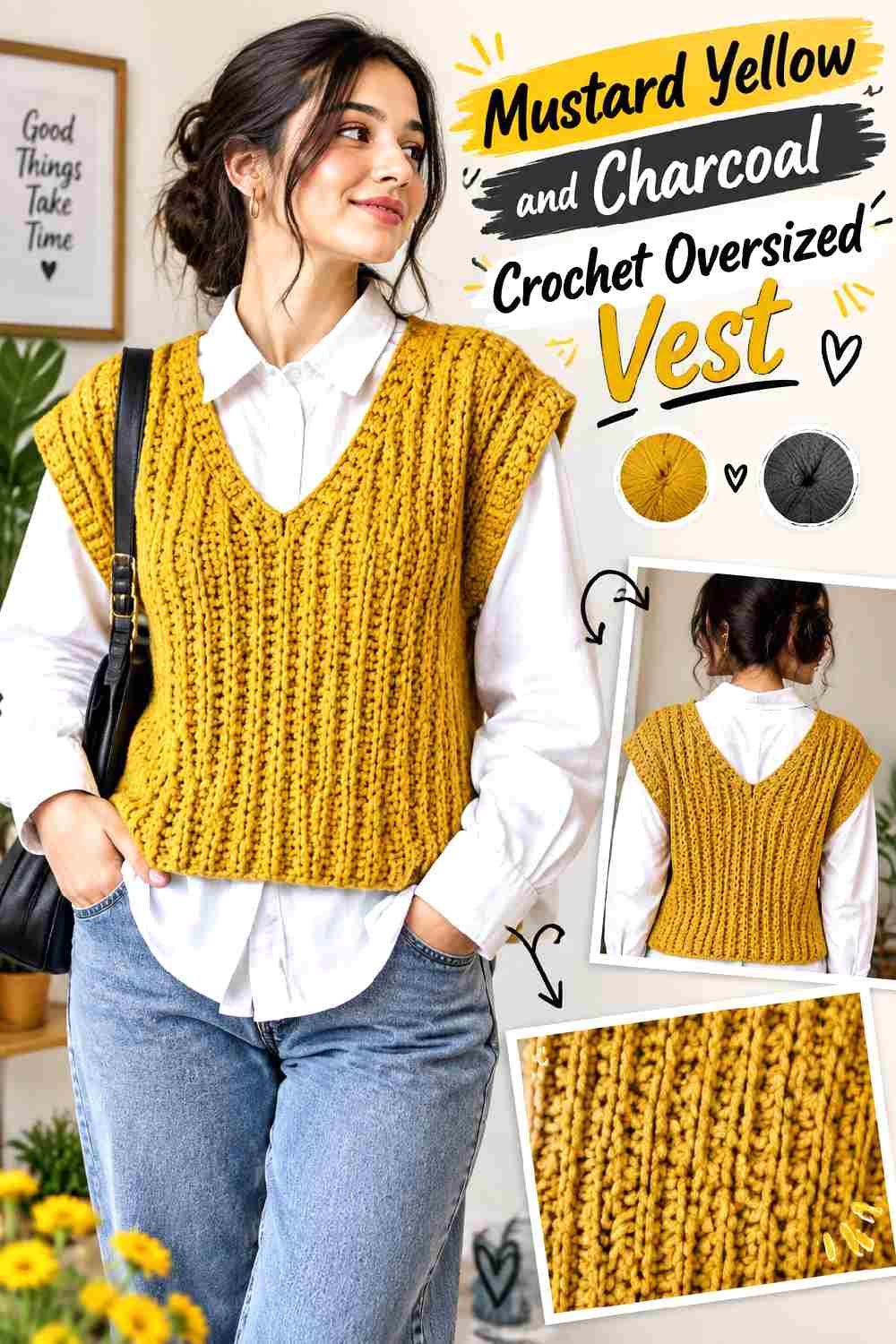
An oversized vest gives mustard yellow a large visual field, so charcoal is useful for controlling the perimeter. Rather than splitting the garment evenly into yellow and gray, keep the body predominantly mustard and use charcoal around ribbing, neck shaping, or selected lower sections. The tutorial source supports a relaxed V-neck vest construction.
Keep Mustard Yellow Broad Across the Crochet Vest Body
Large mustard panels reinforce the roomy silhouette instead of interrupting it with frequent stripes. The uninterrupted color also makes the V-neck outline easier to read.
If you want additional charcoal, increase it at the hem or neckline rather than scattering isolated patches throughout the body.
Charcoal Gives Mustard Yellow a Cleaner Crochet Neckline
The neckline is one of the strongest visual lines on a sweater vest. Charcoal ribbing can create a crisp frame against mustard while remaining softer than solid black.
Repeat a small amount of charcoal at the armholes or hem so the neckline does not become the only dark feature.
Creator Credit: Alona crochets
3. Mustard Yellow Oatmeal And Walnut Crochet Ribbed Vest
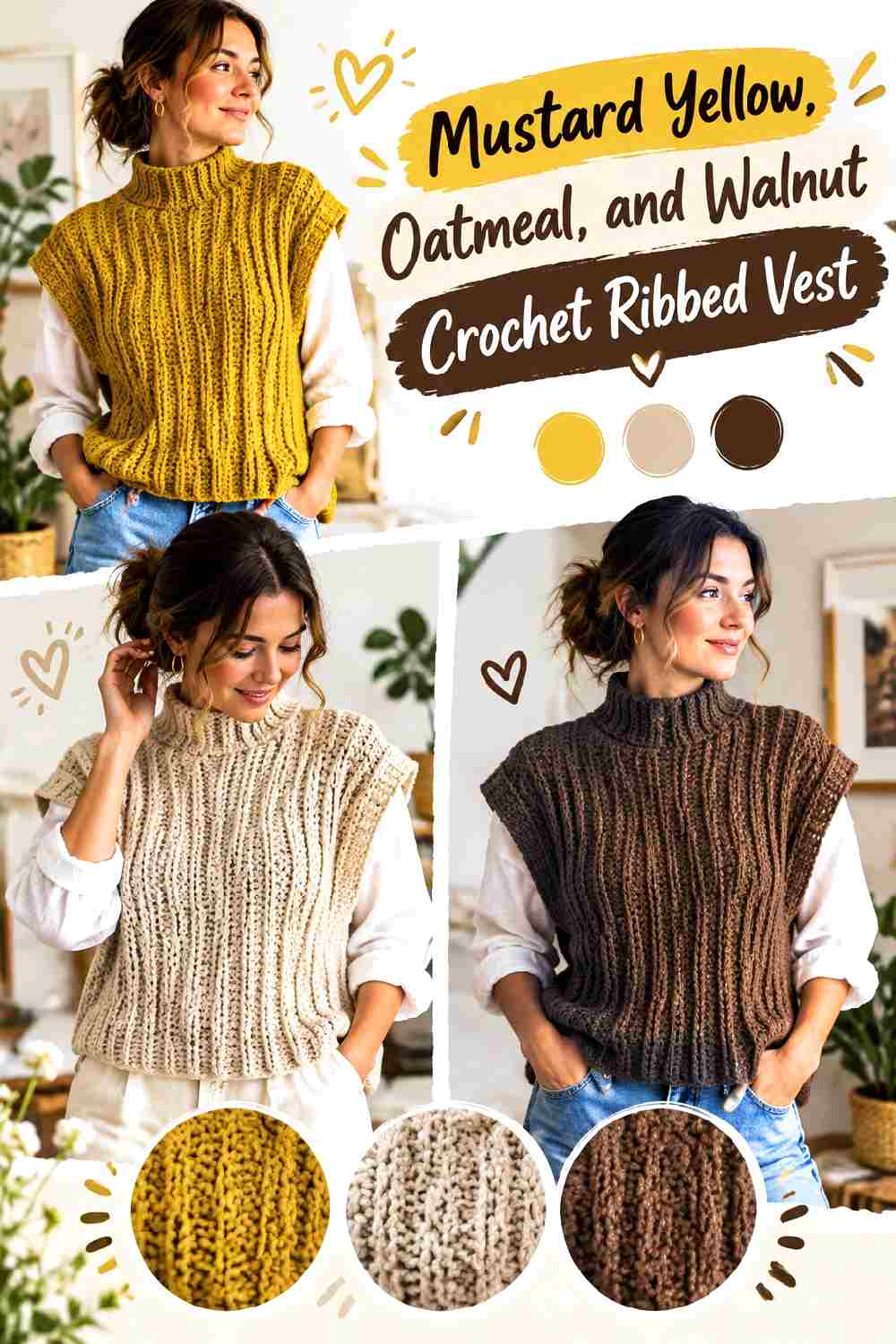
This softer palette reduces the dramatic light-dark contrast of charcoal or black. Mustard yellow remains the main color, oatmeal lightens the ribbed edges, and walnut supplies enough depth to define one secondary feature without dominating the vest. The source tutorial supports a clean sweater-vest construction where finishing around the openings is visually important.
Pair Mustard Yellow With Oatmeal at Crochet Ribbing
Oatmeal creates a gentler division than bright white. Around a mustard neckline or armhole, it can lighten the edge without producing a stark outline.
That makes it useful when you want the vest to coordinate with cream, camel, denim, or brown layers rather than reading as strongly graphic colorwork.
Add Walnut Sparingly Around Mustard Yellow Crochet Details
Walnut works better here as a small grounding color than as an equal third block. Consider a lower border, narrow stripe, or repeated detail instead of dividing the entire vest into three equal areas.
Keeping walnut limited allows the mustard-and-oatmeal relationship to remain visually dominant.
Creator Credit: passtschon
4. Mustard Yellow Black And Ecru Crochet Checkered Vest
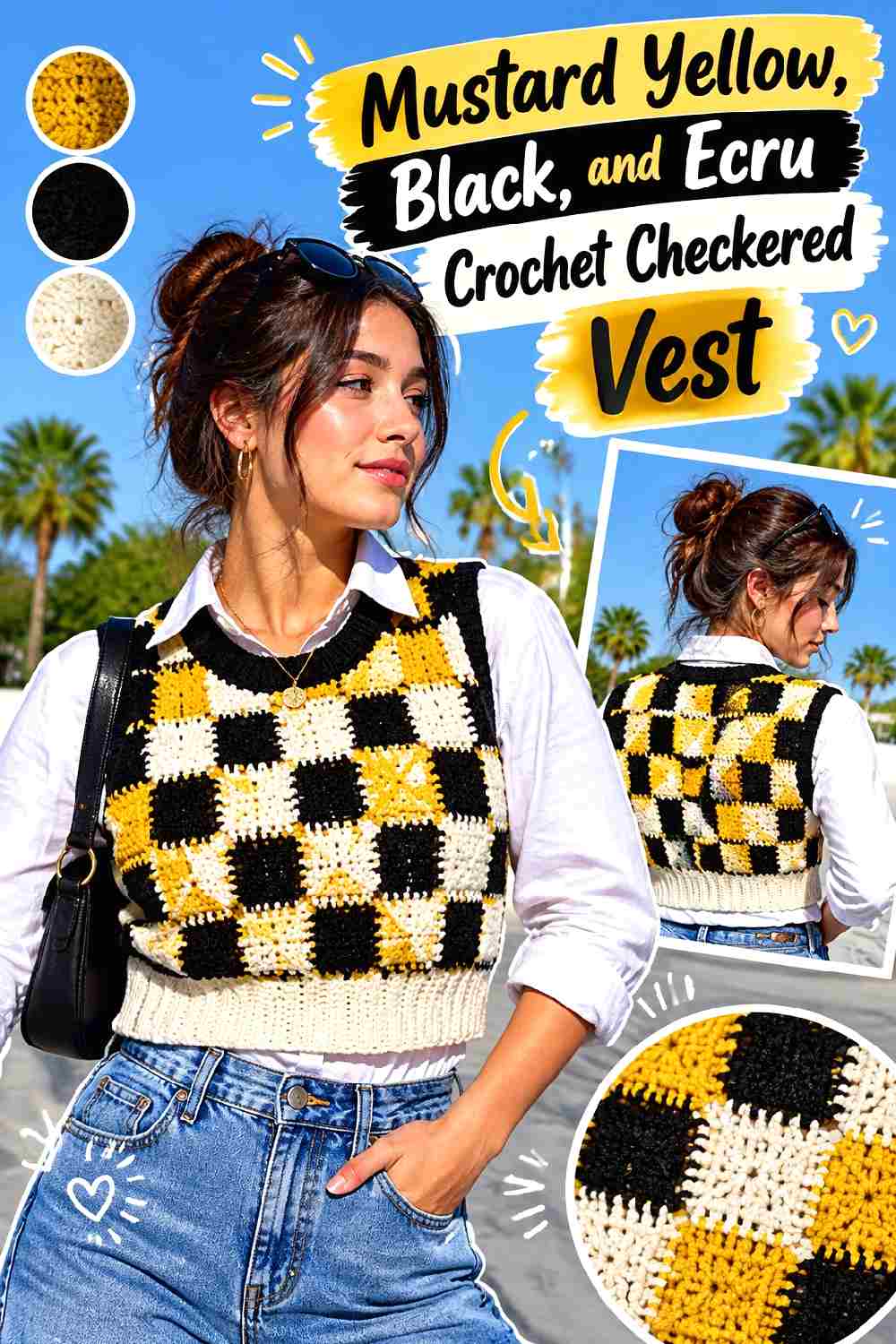
Checkerboard crochet naturally looks graphic, so mustard yellow needs a disciplined partner. Black provides maximum definition between checks, while ecru can interrupt the pattern in smaller areas when pure yellow-and-black feels too severe. The supporting source demonstrates a cropped checkered vest.
Keep Mustard Yellow and Black Crochet Checks Easy to Read
Check the two colors from a distance before committing. Mustard and black usually create clear value separation, which is useful because checkerboard designs depend on square boundaries remaining obvious.
Avoid adding several similar medium-value browns inside the checks; they can weaken the clean geometry that makes this vest distinctive.
Use Ecru to Soften Mustard Yellow Crochet Edges
Ecru is most useful around ribbing or as an occasional light check rather than as another equally dominant color. It gives the eye a break from strong yellow-black contrast.
Repeating ecru at more than one garment edge will make the lighter shade look deliberate rather than like a last-minute addition.
Creator Credit: it’s erin b.
5. Mustard Yellow Camel And Cream Crochet Mock Neck Vest
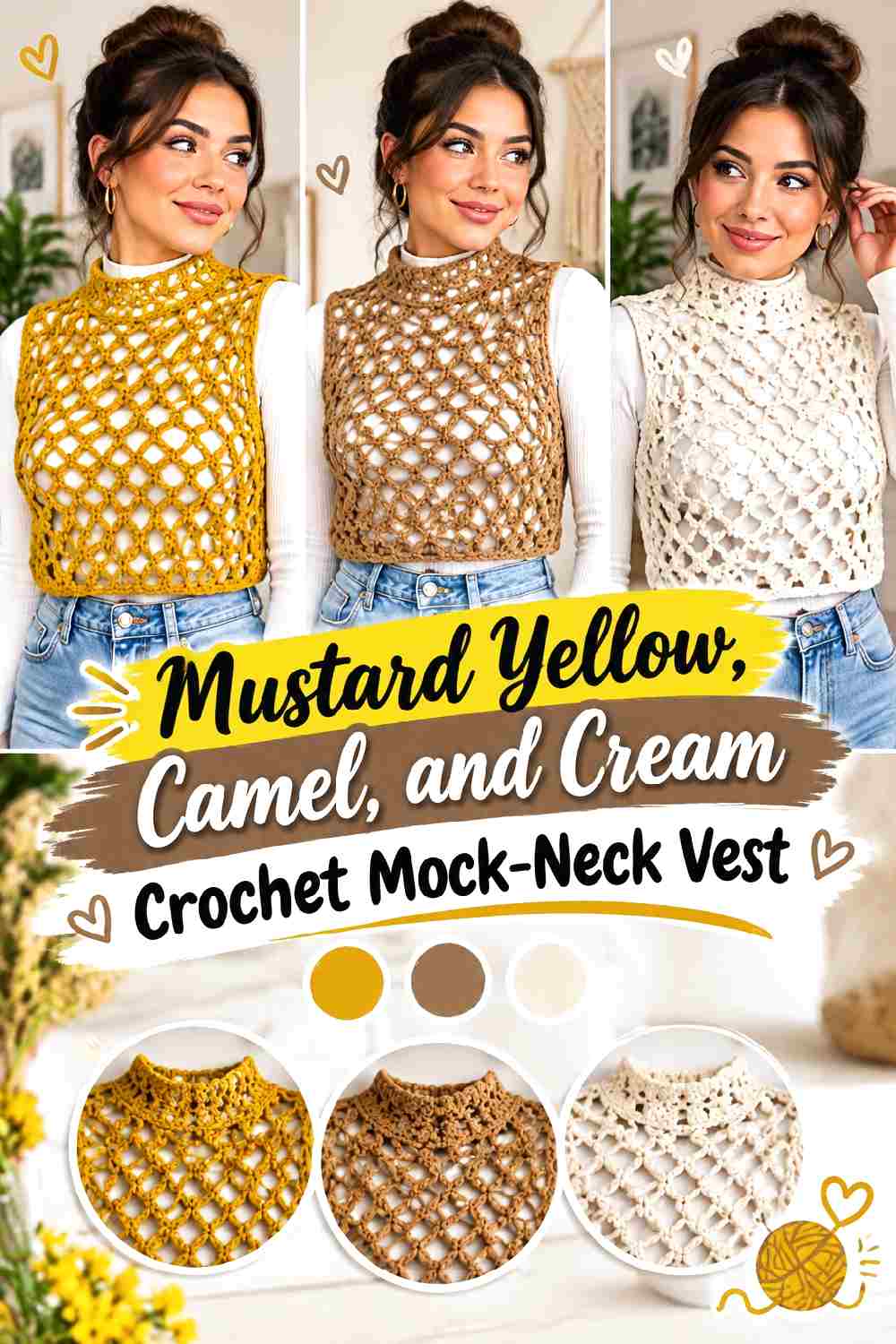
A mock neck already creates a strong focal point near the face, so this palette keeps contrast restrained. Mustard yellow can cover the main vest, camel can deepen the lower body or trim, and cream can lighten selected ribbed areas. The supporting tutorial source demonstrates a cropped high-neck vest construction.
Keep Mustard Yellow Strongest Across the Crochet Mock Neck
Using mustard at the neckline visually connects the collar with the rest of the vest instead of turning it into a separate contrast feature. That produces a more continuous silhouette.
If you prefer a cream collar, repeat cream somewhere lower on the garment so the pale neckline feels connected to the whole piece.
Camel Gives Mustard Yellow Crochet a Tonal Fall Transition
Camel and mustard are relatively close in warmth, creating a blended fall palette rather than a sharp split. Because their values can also be close, use camel in broad areas where subtle separation is acceptable.
For small ribbed details that need stronger definition, cream will usually provide clearer visibility.
Creator Credit: mae
6. Mustard Yellow Olive And Tobacco Brown Crochet Hooded Vest
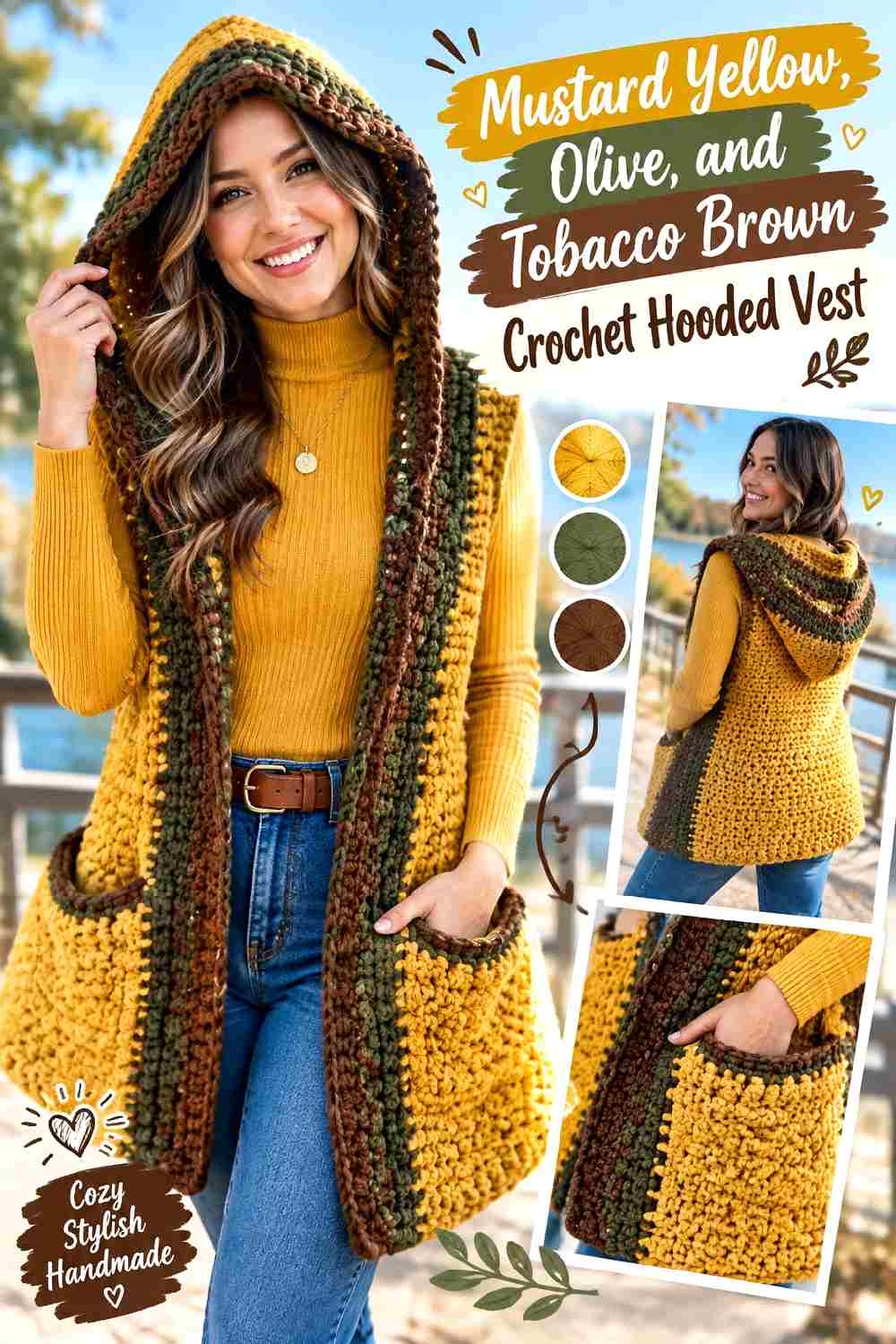
This is one of the earthiest palettes in the collection. Mustard can lead across the body, muted olive can distinguish the hood or pocket area, and tobacco brown can frame button bands or edges. The source tutorial supports a hooded, buttoned vest with pockets, giving all three colors practical places to appear.
Use Mustard Yellow Across the Crochet Vest Before Adding Olive
A hood, pockets, buttons, and contrasting colors already give this type of vest several focal points. Keeping the main fabric mustard prevents those features from competing with an overly complicated color arrangement.
Olive can then identify one substantial feature, such as the hood or pocket sections.
Tobacco Brown Can Outline Mustard Yellow Crochet Closures
Brown along a front opening gives the garment a defined vertical line and can connect visually with buttons or deeper fall layers without pretending to match them exactly.
Repeat the brown at one additional edge—such as the hem or hood trim—to keep the front band from looking isolated.
Creator Credit: KnitcroAddict
7. Mustard Yellow Rust And Oatmeal Crochet Long Vest
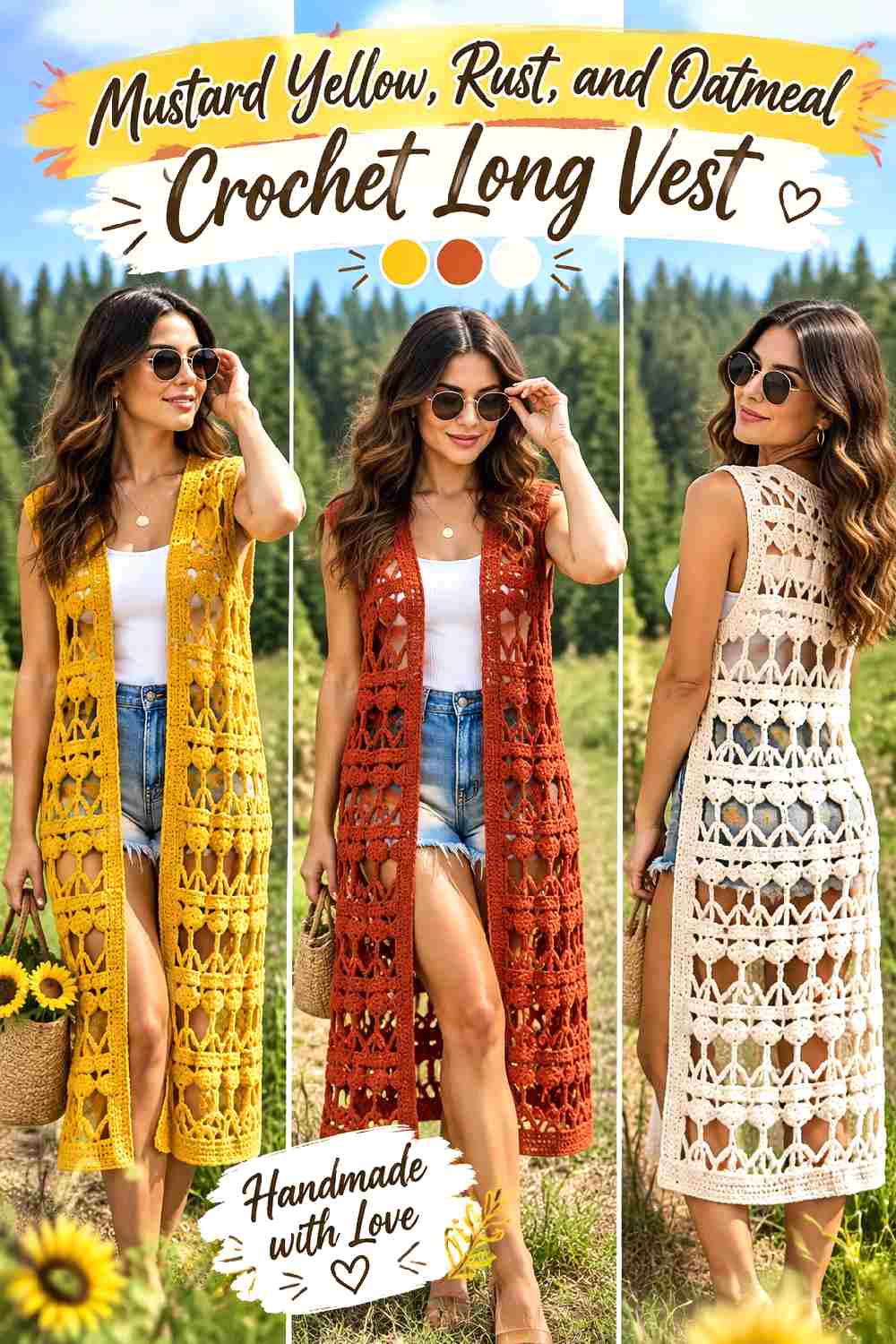
A long open vest gives color more vertical space than a cropped sweater vest. Mustard yellow can run through most of that length, while rust appears in controlled bands and oatmeal lightens the outer edge. The supporting source demonstrates a longer boho-style layering vest.
Let Mustard Yellow Create the Long Crochet Vest Line
Frequent high-contrast stripes can visually break a long garment into short sections. Keeping mustard continuous through large portions preserves the length that makes this vest distinctive.
Rust can be introduced in wider, less frequent bands when you want the autumn palette to remain visible without overwhelming the silhouette.
Oatmeal Can Lighten a Mustard Yellow Crochet Front Edge
An oatmeal front border creates a soft vertical frame and stops mustard and rust from filling every visible surface.
Because long open vests reveal the layer underneath, compare the oatmeal border with the shirts or dresses you expect to wear under it. A softer neutral usually integrates more easily than a stark white.
Creator Credit: The Craft Nut
8. Mustard Yellow Burgundy And Dusty Rose Crochet Flower Vest
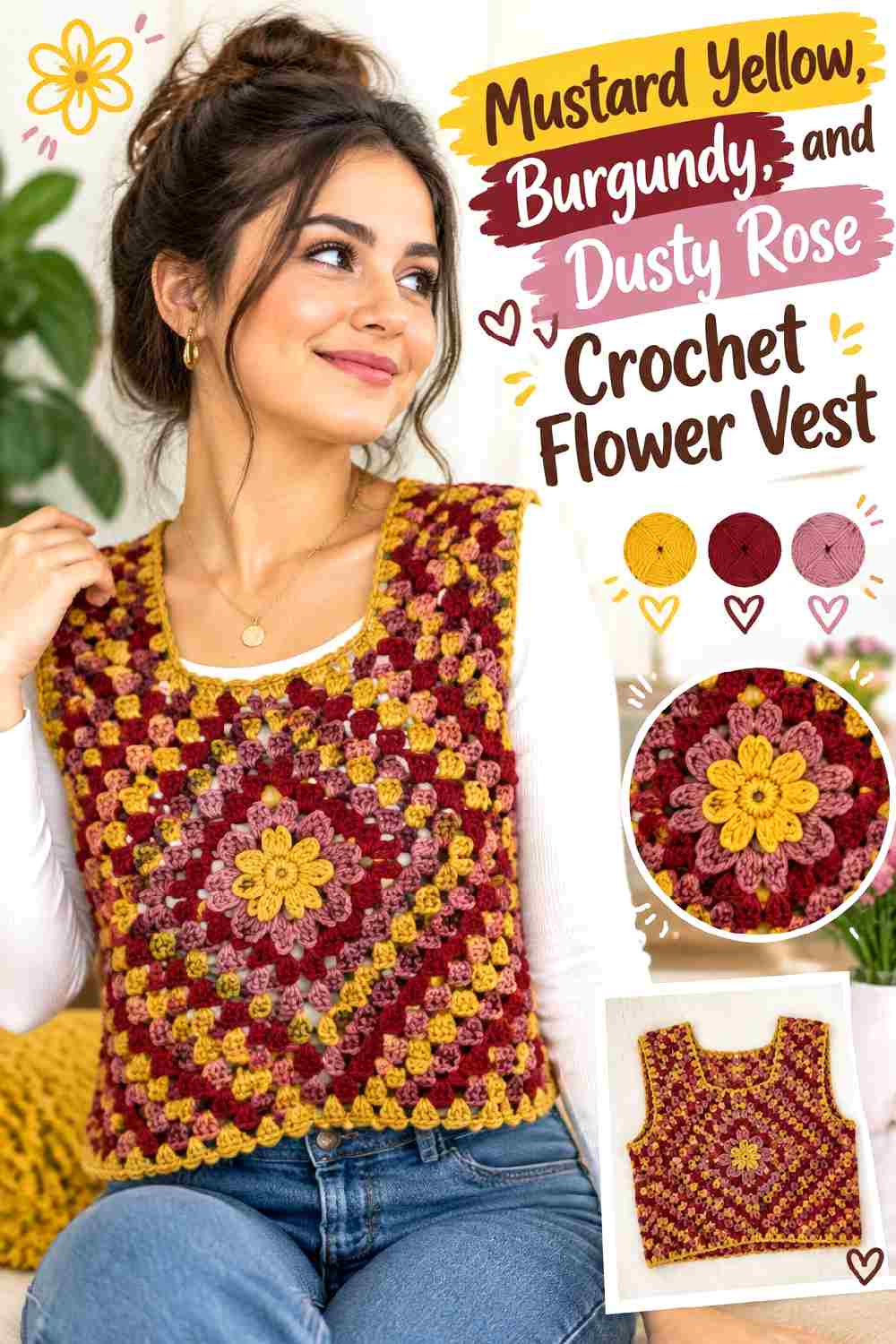
Flower motifs allow mustard yellow to function as a repeated center rather than the largest surface. Burgundy can anchor petals or surrounding fabric, while dusty rose creates a softer transition between the two stronger colors. The tutorial source supports a flower-detail vest concept.
Repeat Mustard Yellow in the Crochet Flower Centers
Using mustard consistently in flower centers is an efficient way to make separate motifs feel related. It also concentrates the brightest warm shade into small, repeated focal points.
If some flowers reverse the arrangement, distribute those exceptions evenly rather than clustering every alternate motif in one section.
Burgundy Gives Mustard Yellow Crochet Flowers More Definition
Burgundy creates a deep frame around mustard and can make flower shapes easier to distinguish against a quieter garment background.
Dusty rose is useful between the two when you want less abrupt contrast. Keep it noticeably lighter than burgundy so the flower does not collapse into one mid-dark area.
Creator Credit: Crochet with Karu
9. Mustard Yellow Deep Brown And Stone Crochet Cable Vest
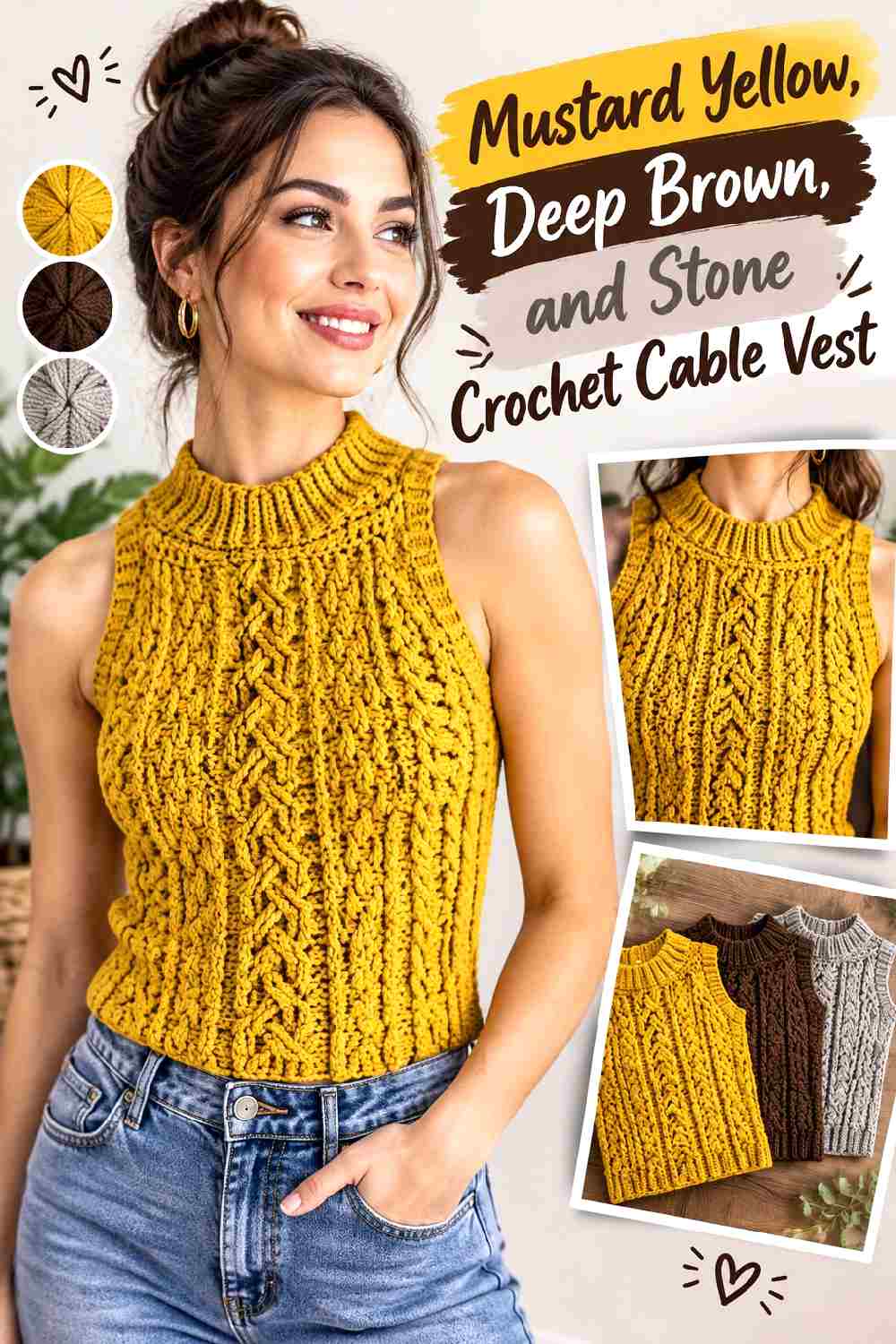
Raised crochet cables create their own shadows, so excessive color changes can distract from the texture. A mostly mustard yellow cable surface lets those relief patterns remain continuous, while deep brown defines edges and stone provides a restrained lighter accent. The source supports a cable-stitch vest construction.
Keep Mustard Yellow Continuous Across Crochet Cables
Do not change colors in the middle of the most detailed cable area unless color blocking is specifically the goal. Continuous mustard makes the raised structure easier to follow from top to bottom.
If the chosen mustard yarn has a very busy or heavily variegated appearance, compare a small sample first; strong variation may compete with cable shadows.
Deep Brown Frames Mustard Yellow Crochet Without Hiding Texture
Place the deepest brown around simpler areas such as ribbing, collars, or side edges rather than over the cable itself.
Stone can be used for a smaller third detail when the dark edge feels too heavy. Its lighter value gives mustard another type of contrast without introducing another saturated fall hue.
Creator Credit: TCDDIY
10. Mustard Yellow Navy And Cream Crochet Ribbed Beanie
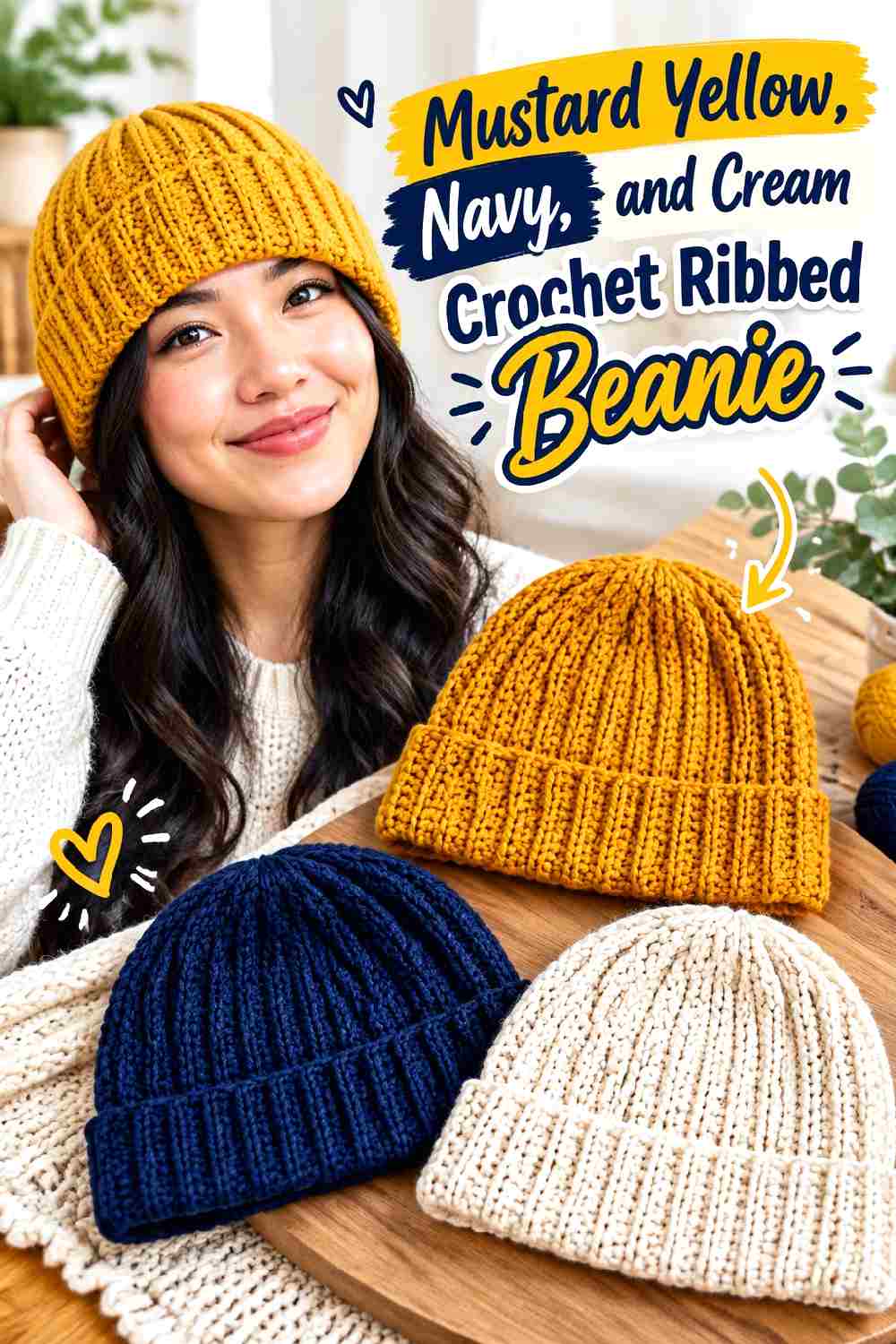
A mustard yellow beanie can look more considered when its ribbed surface is kept simple and color changes are concentrated at the cuff or crown. Navy supplies a deep cool counterpoint, while cream keeps the palette from becoming too dark. The supporting tutorial demonstrates a knit-look ribbed crochet beanie.
Let Mustard Yellow Show the Crochet Beanie Ribbing
Covering most of the hat in mustard gives repeated rib lines enough uninterrupted space to remain visible.
If you stripe every few rows, the eye may read the color bands before the rib texture. Reserve navy for the cuff or a controlled section when texture is the priority.
Navy Gives Mustard Yellow Crochet Beanies a Darker Anchor
Navy creates strong value contrast without repeating the brown-heavy combinations used elsewhere in this list. A navy cuff also gives the lower edge a defined visual base.
Add cream only in a small amount—such as a narrow transition—if the mustard-to-navy jump feels stronger than you want.
Creator Credit: VivCrochets
11. Mustard Yellow Forest Green And Camel Crochet Beret
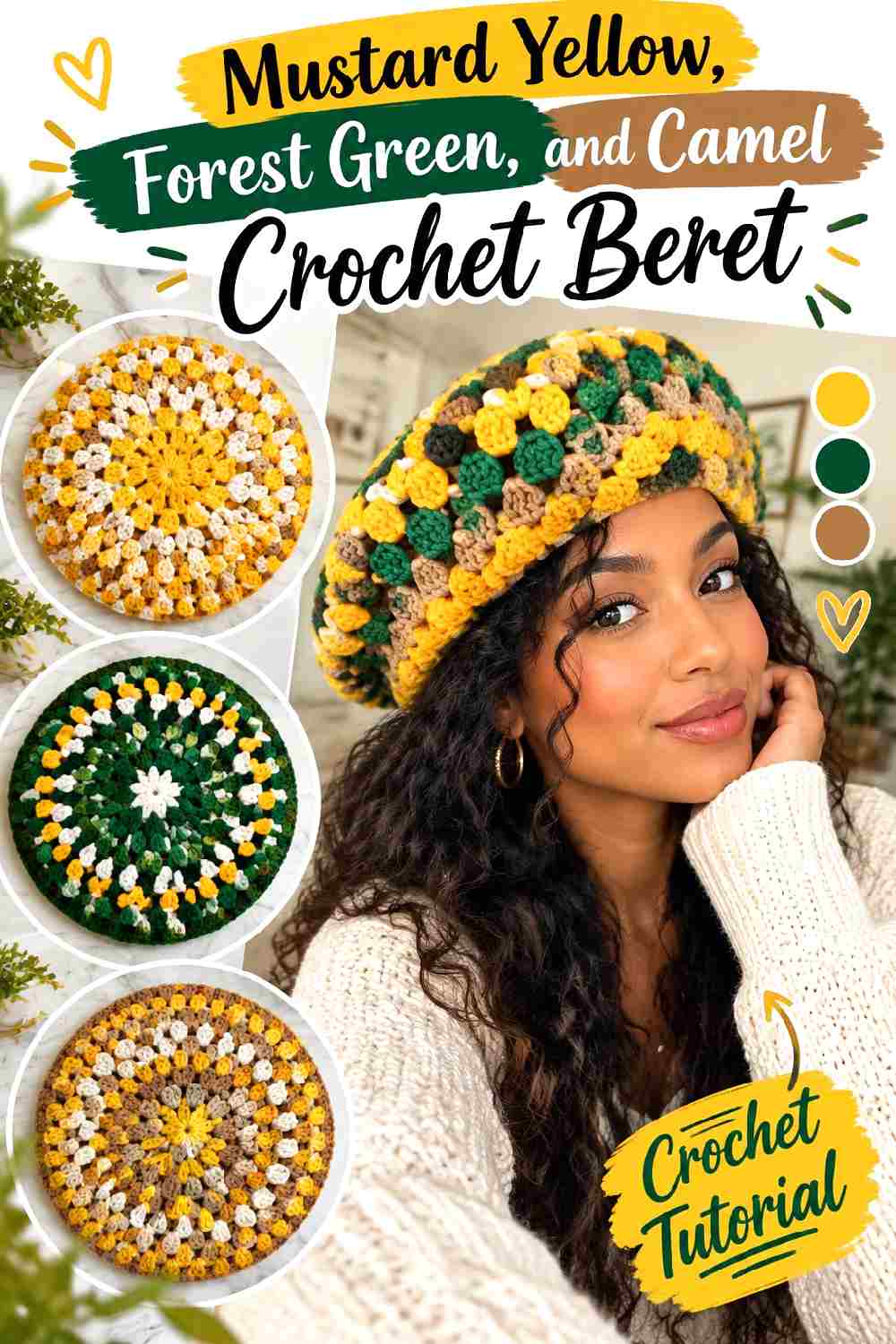
A beret concentrates color in a compact, highly visible shape. Mustard yellow can cover the crown while forest green defines a band or selected sections, and camel can act as the quieter connecting neutral. The supporting source is an autumn-focused crochet beret tutorial.
Keep Mustard Yellow Broad Across the Crochet Beret Crown
A broad mustard crown gives the hat a clear identity from above and from the side. Use forest green nearer the edge when you want contrast without fragmenting the circular shape.
This placement also keeps the strongest dark color away from the center where it could visually reduce the mustard area.
Camel Softens Mustard Yellow and Forest Green Crochet Contrast
Camel is useful as a narrow separator when mustard and forest green feel too abrupt together.
Because camel can sit close to mustard in value, it works better as a transition than as a small detailed motif that needs to remain sharply visible.
Creator Credit: The Black Goddess
12. Mustard Yellow Ivory And Taupe Crochet Headband
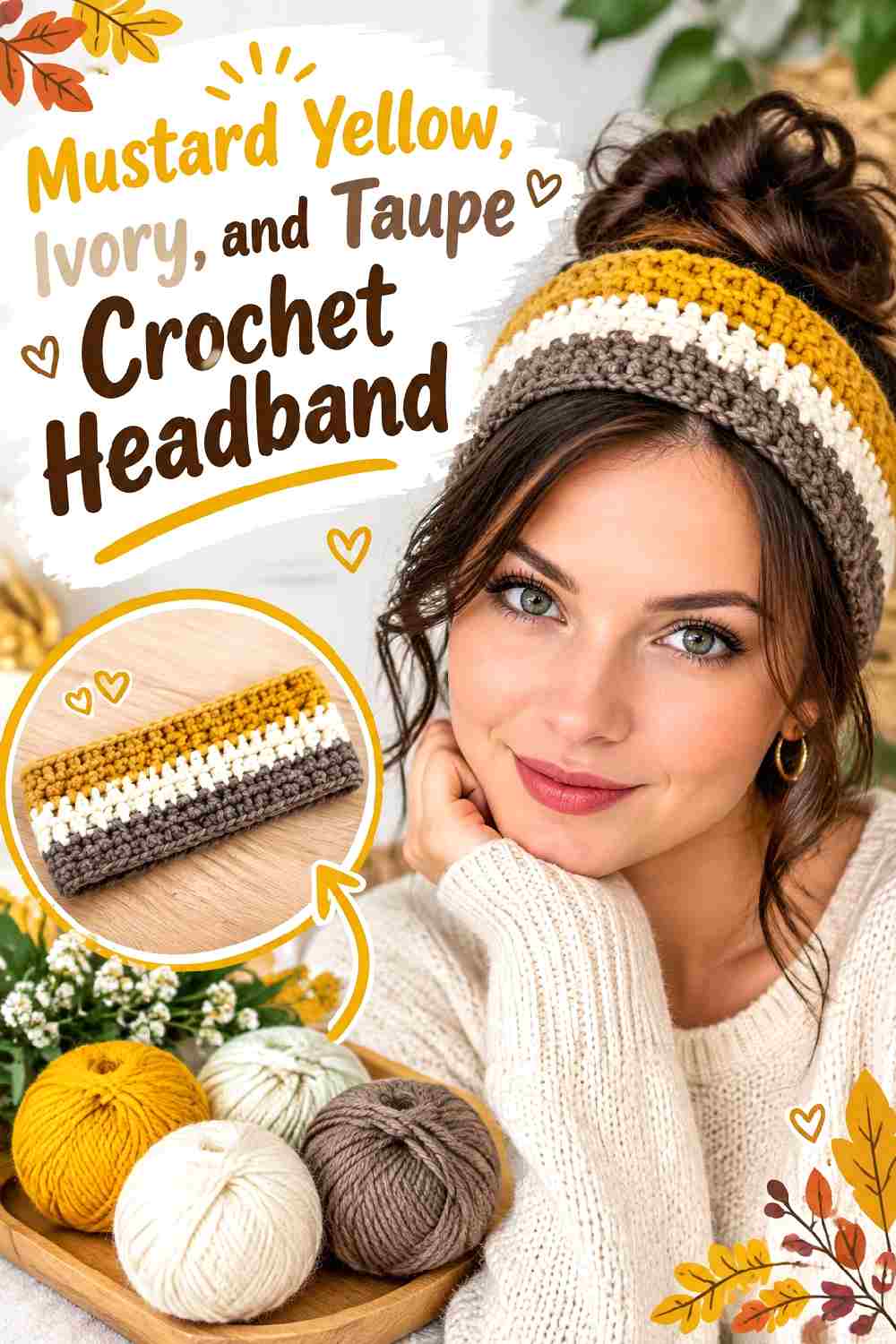
A crochet headband has limited surface area, so three colors should be handled carefully. Keep mustard yellow dominant, use ivory to reveal twists or raised texture, and let taupe appear only where a deeper neutral is needed. The source tutorial demonstrates an autumn crochet headband construction.
Mustard Yellow Should Lead the Crochet Headband Surface
A small accessory can look fragmented when several colors receive equal-width sections. A mostly mustard headband gives the shape a cleaner visual line.
Ivory can highlight a twist, center section, or slim edging without changing the overall identity.
Taupe Can Ground Mustard Yellow Crochet Without Harsh Contrast
Taupe creates less visual separation than black or navy, which suits an accessory where the texture should remain more important than the color break.
Place it near an edge or closure area rather than in a tiny central detail where the softer contrast may disappear.
Creator Credit: Chapter and Chains Co
13. Mustard Yellow Deep Teal And Tan Crochet Bucket Hat
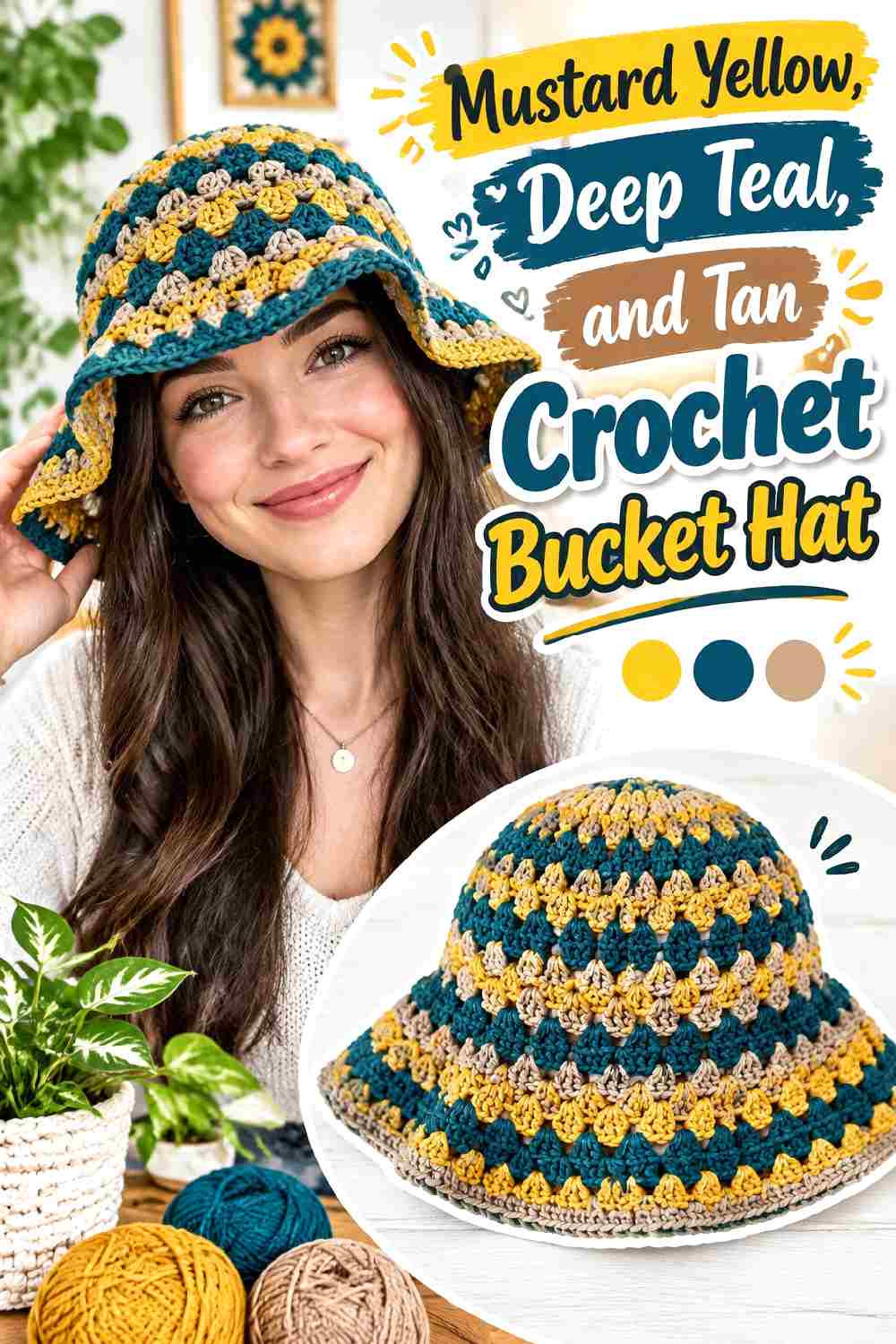
Deep teal gives mustard yellow one of the strongest warm-cool contrasts in the collection. A bucket hat has three obvious visual zones—crown, sides, and brim—so those sections can carry color without random striping. The supporting tutorial demonstrates a complete crochet bucket-hat construction.
Keep Mustard Yellow on the Crochet Bucket Hat Crown or Sides
Choose one substantial area for mustard instead of scattering narrow yellow stripes across the whole hat. The larger block makes the warm color feel intentional.
Deep teal can cover another structural section, such as the brim, creating contrast that follows the construction rather than fighting it.
Tan Can Connect Mustard Yellow and Deep Teal Crochet Sections
A small tan transition softens the meeting point between the warm mustard and cool teal.
Do not give tan the same amount of space as the other two colors unless a three-block hat is specifically desired. Its strongest role here is support.
Creator Credit: PassioKnit Kelsie
14. Mustard Yellow Chocolate And Caramel Crochet Crossbody Bag
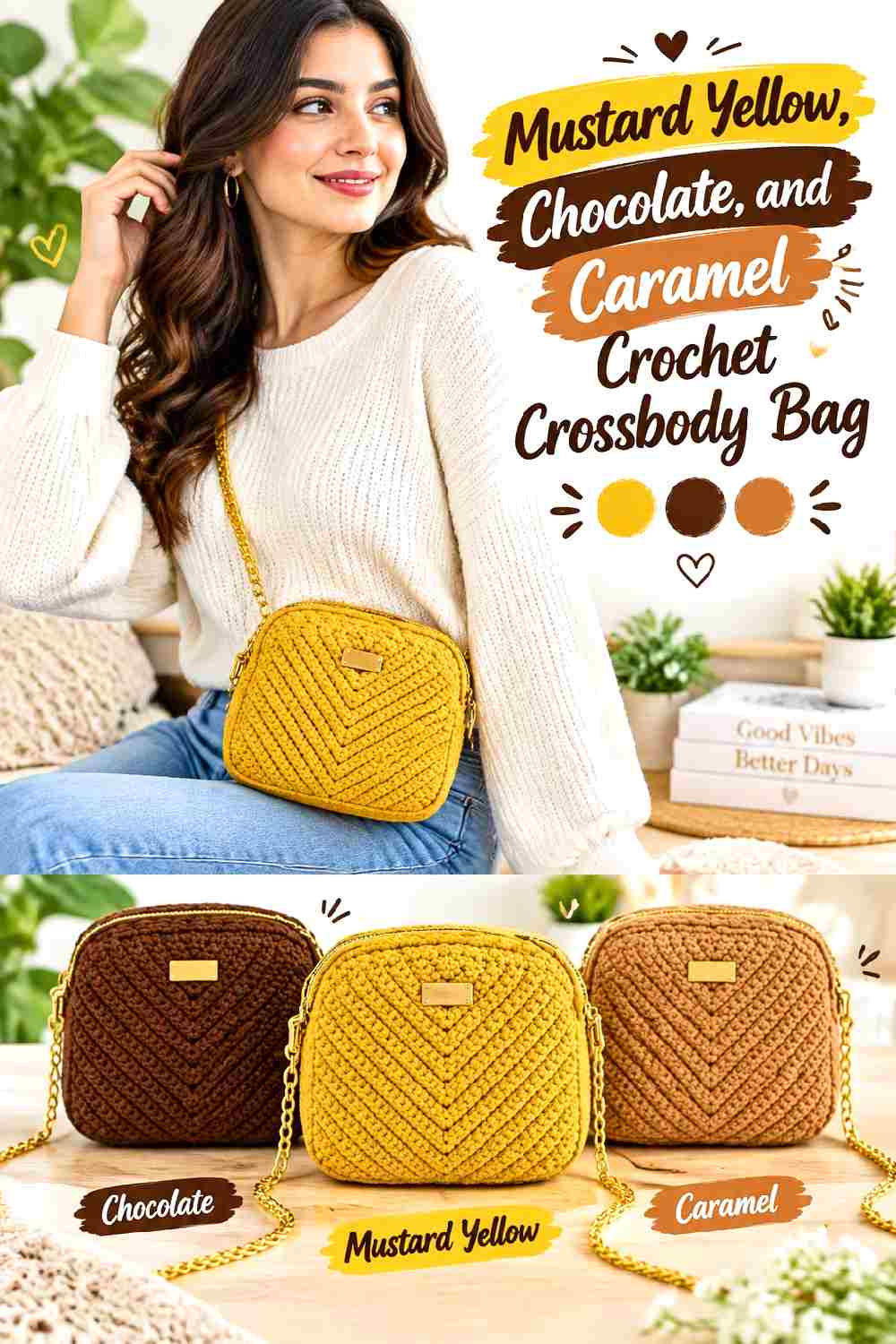
A structured crossbody bag benefits from darker color placement around areas that receive strong visual emphasis, such as the base, opening, or strap. Mustard yellow can lead across the bag body, chocolate can provide definition, and caramel can soften the transition. The source tutorial demonstrates a compact crossbody-bag construction.
Use Mustard Yellow Across the Main Crochet Bag Body
Keeping the largest panel mustard makes the bag recognizable from a distance and avoids overcomplicating a small accessory.
Chocolate is especially effective at the base or opening because those areas naturally form boundaries around the main panel.
Repeat Mustard Yellow on the Crochet Crossbody Strap
If the strap is entirely chocolate while the body is entirely mustard, the two components may feel visually disconnected.
Repeat mustard in a stripe, edge, or small strap section, or bring chocolate into the bag body. Either approach creates a clearer relationship between the functional parts.
Creator Credit: Amena Crochet Bags
15. Mustard Yellow Black And Warm Beige Crochet Tote
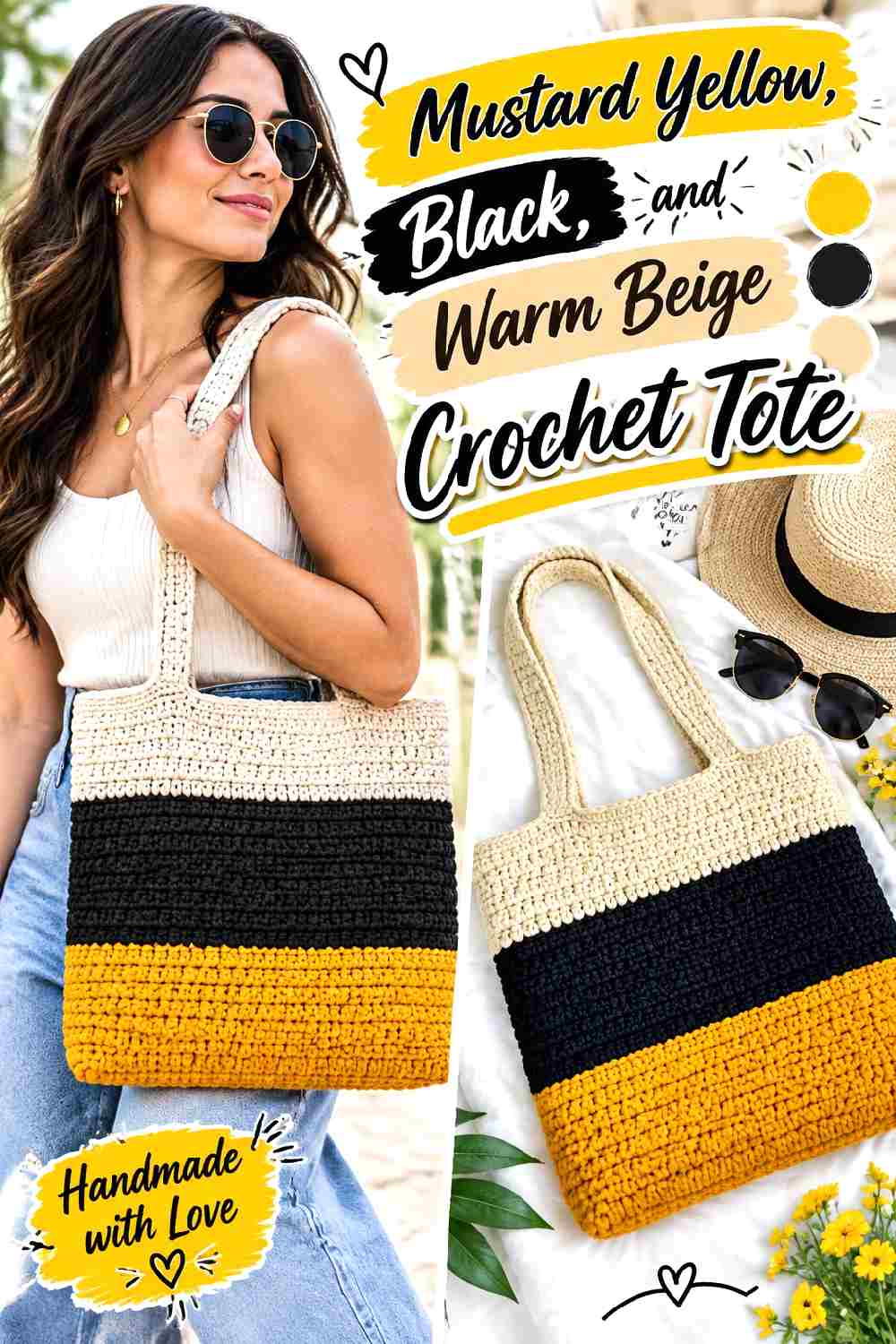
A tote offers more flat surface than a small purse, making strong color blocks easier to use. Mustard yellow can dominate the front and back, black can define the base or handles, and warm beige can provide lighter interruption when the contrast feels too severe. The supporting tutorial demonstrates a basic crochet tote construction.
Keep Mustard Yellow Away From Too Many Competing Crochet Blocks
Large tote panels already provide plenty of room for mustard to make an impact. Avoid subdividing every section simply because additional colors are available.
A broad mustard body with controlled black handles or a dark base generally looks more intentional than many narrow, unrelated bands.
Warm Beige Can Break Up Mustard Yellow and Black Crochet
Use warm beige when the transition from mustard to black looks harsher than desired. A beige border or narrow central band gives the palette a lighter middle value.
Repeat that beige on both sides of the tote or at another visible edge so it feels integrated.
Creator Credit: Hopeful Turns
16. Mustard Yellow Terracotta And Cream Crochet Basket
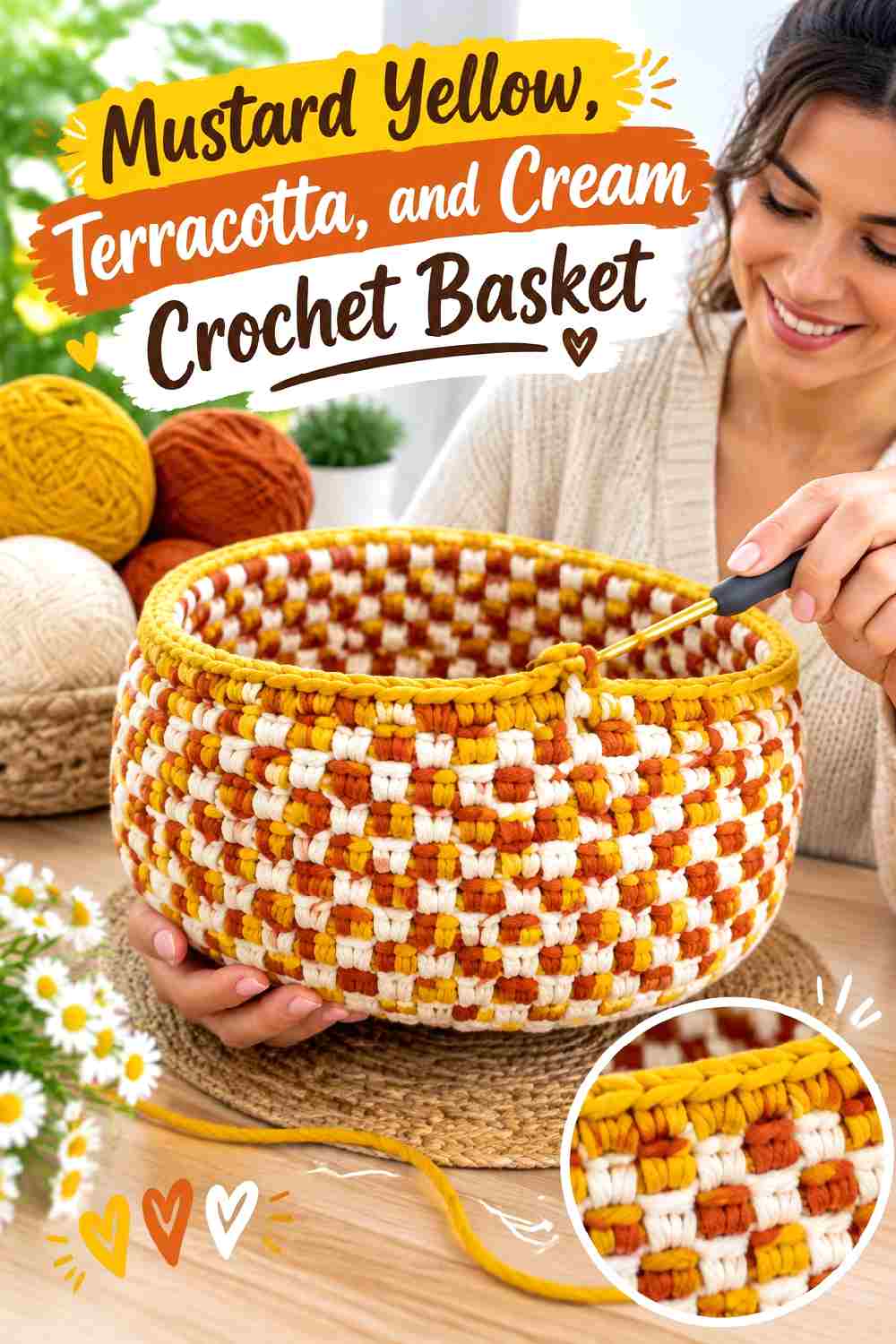
A crochet basket is one place where color placement can reinforce the shape. Mustard yellow can cover the body, terracotta can define the lower portion, and cream can finish the rim. This creates a clear bottom-to-top progression rather than random horizontal striping. The supporting tutorial shows a decorative crochet basket concept.
Keep Mustard Yellow Across the Crochet Basket Body
Mustard makes the basket easy to recognize as part of a fall décor palette while still leaving room for a darker, earthier base.
Because basket texture is often visible at close range, uninterrupted mustard also helps the stitch surface remain readable.
Cream Gives Mustard Yellow Crochet Baskets a Lighter Rim
A cream top edge creates a clean separation between the basket wall and whatever is stored inside.
Terracotta belongs lower in the design where its visual weight can ground the basket. Putting all three shades in narrow alternating stripes would weaken that top-to-bottom hierarchy.
Creator Credit: Knitting Home
17. Mustard Yellow Plum And Oatmeal Crochet Mug Cozy
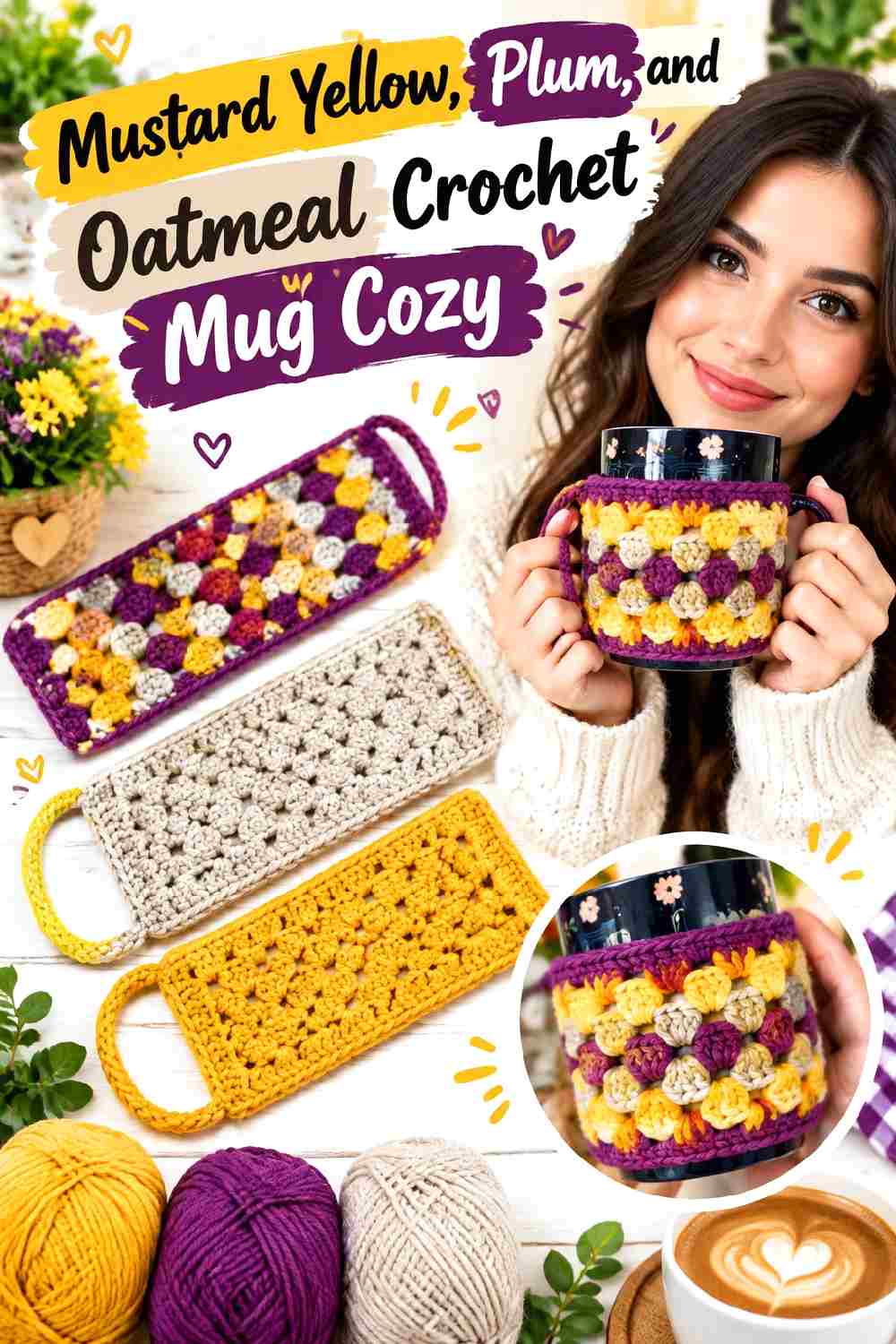
A mug cozy is small enough that contrast needs to be efficient. Mustard yellow should take most of the surface, plum can provide one dark focal detail, and oatmeal can prevent that focal point from feeling too heavy. The supporting tutorial demonstrates a granny-square-inspired mug cozy.
Keep Mustard Yellow Clear Around Crochet Mug-Cozy Motifs
If the design includes a square or repeated motif, use mustard consistently enough that the pattern remains easy to read at small scale.
Plum works well as a center or edge because its deeper value will remain visible against mustard.
Oatmeal Softens Plum Against Mustard Yellow Crochet
A thin oatmeal area between mustard and plum gives the small project three distinct value levels instead of two strong blocks fighting for attention.
Avoid adding another accent color. On a compact cozy, four or five strong shades can crowd the available surface quickly.
Creator Credit: Katia Creates
18. Mustard Yellow Olive Cream And Rust Crochet Granny Blanket
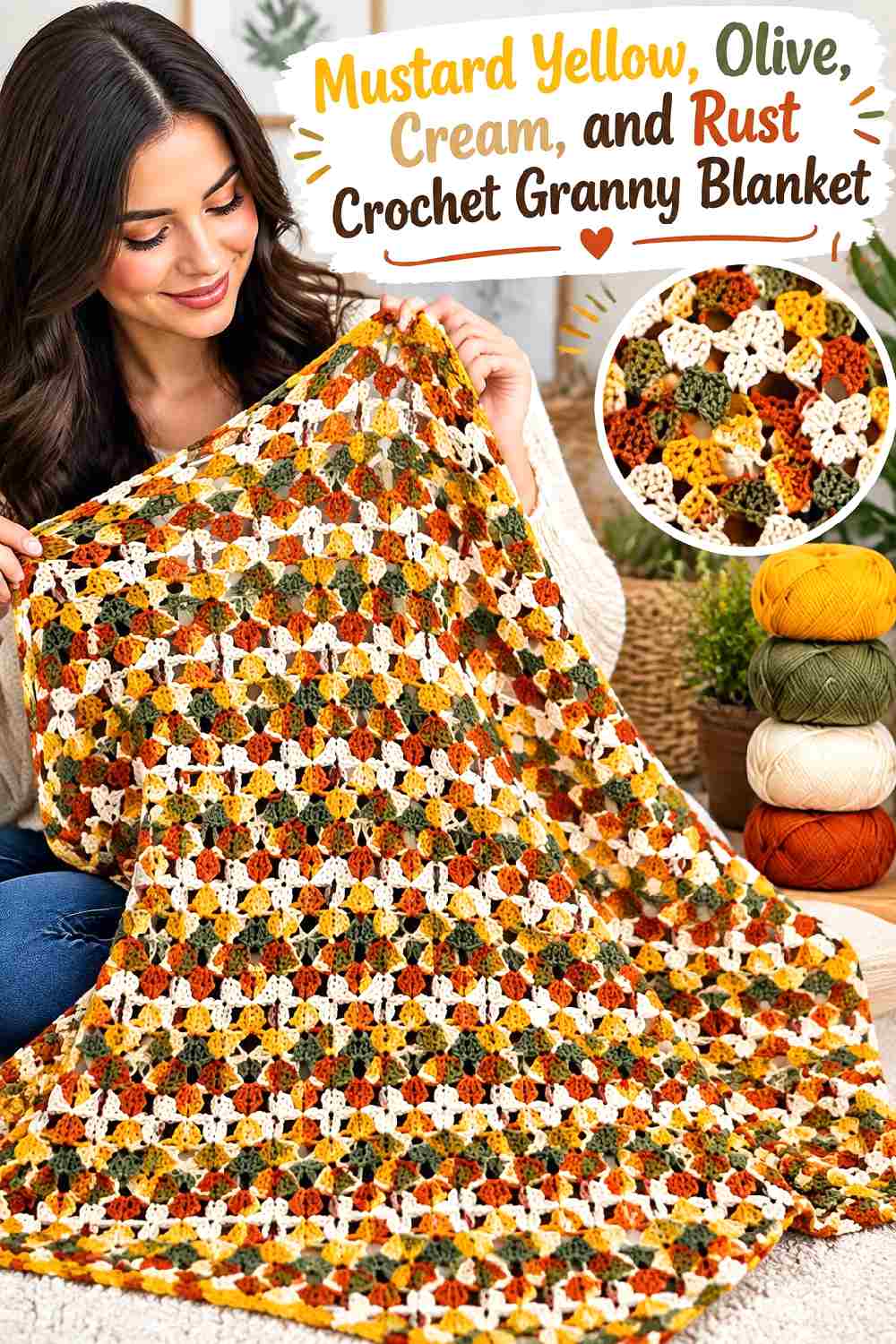
A granny-square blanket can carry more colors than a small accessory, but repetition still matters. Mustard yellow can become the recurring connector, cream can separate darker colors, olive can ground the palette, and rust can appear as a controlled warm accent. The supporting tutorial demonstrates granny-square blanket construction, joining, and edging.
Repeat Mustard Yellow Through the Crochet Blanket Layout
Choose a predictable role for mustard—such as repeated centers, outer rounds, or regularly spaced squares. That consistency is what turns many motifs into one palette.
Random mustard placement can work, but lay the complete arrangement out first to ensure large yellow clusters do not form unintentionally.
Cream Keeps Mustard Yellow, Olive, and Rust Crochet Motifs Separate
Olive, rust, and mustard can all sit in a medium-value range. Cream provides a lighter break that protects motif boundaries.
Use it especially around smaller details where the three earthy hues begin to merge when viewed from across the room.
Creator Credit: Knitting Love 💗
19. Mustard Yellow Aubergine And Beige Crochet Triangle Scarf
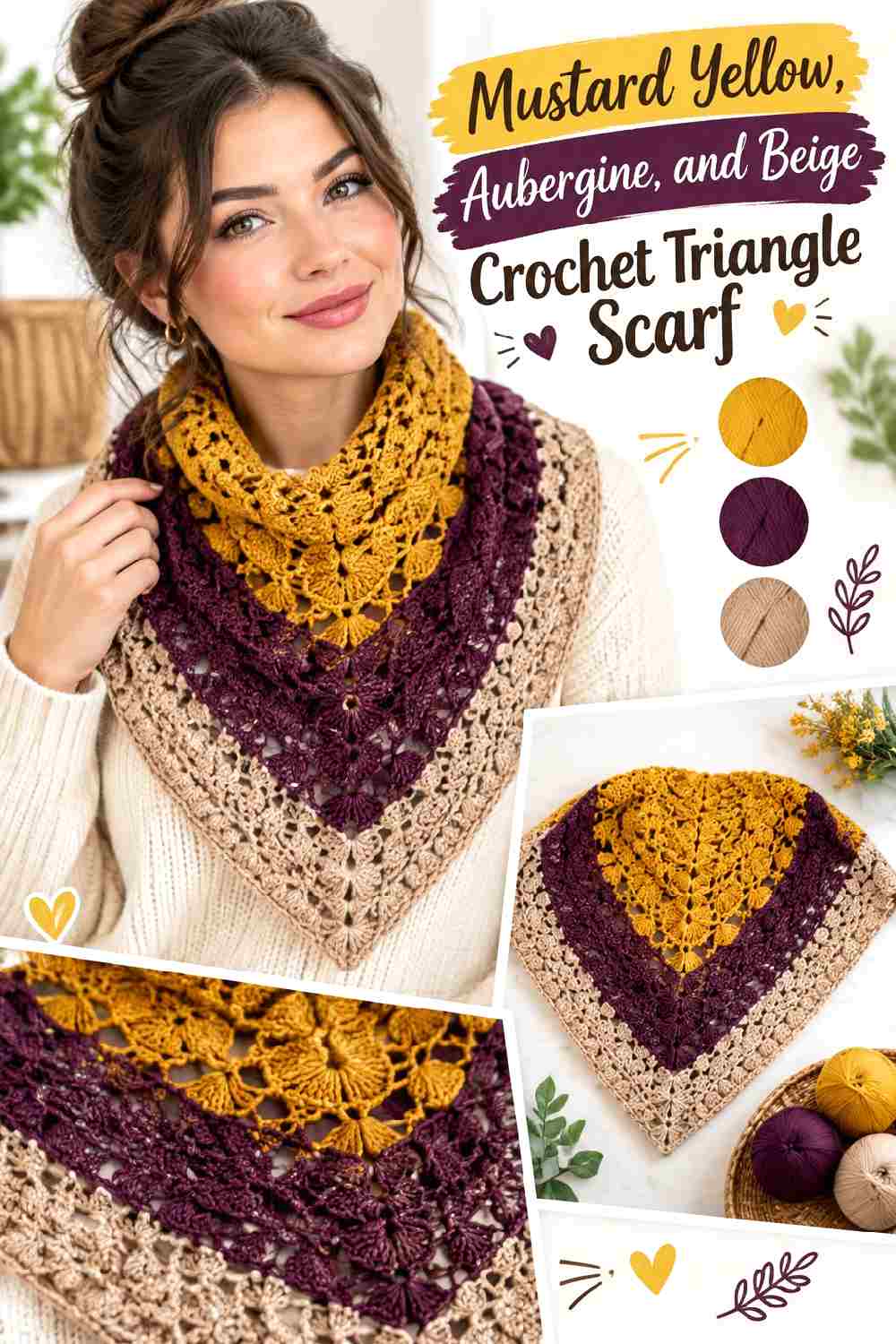
A triangle scarf naturally brings color toward a central point, making it useful for controlled color progression. Mustard yellow can occupy the broad upper section, aubergine can deepen the lower point, and beige can separate the two. The supporting tutorial demonstrates a crochet triangle scarf with visible open texture.
Keep Mustard Yellow Broad Across the Crochet Scarf Shoulders
Placing mustard near the wider edge gives it the most visual area and keeps the scarf recognizably yellow even when it is folded or wrapped.
Aubergine can become progressively more visible toward the point for a darker finish without covering the entire accessory.
Beige Protects Mustard Yellow Crochet Lace From Heavy Contrast
If the scarf contains openwork, a beige section can make the transition into dark aubergine feel less abrupt.
The lighter neutral also helps individual open spaces remain visible where two medium-dark colors might otherwise make the lace structure look denser.
Creator Credit: Crochet Knitting Sort
20. Mustard Yellow Camel And Ivory Crochet Fringe Scarf
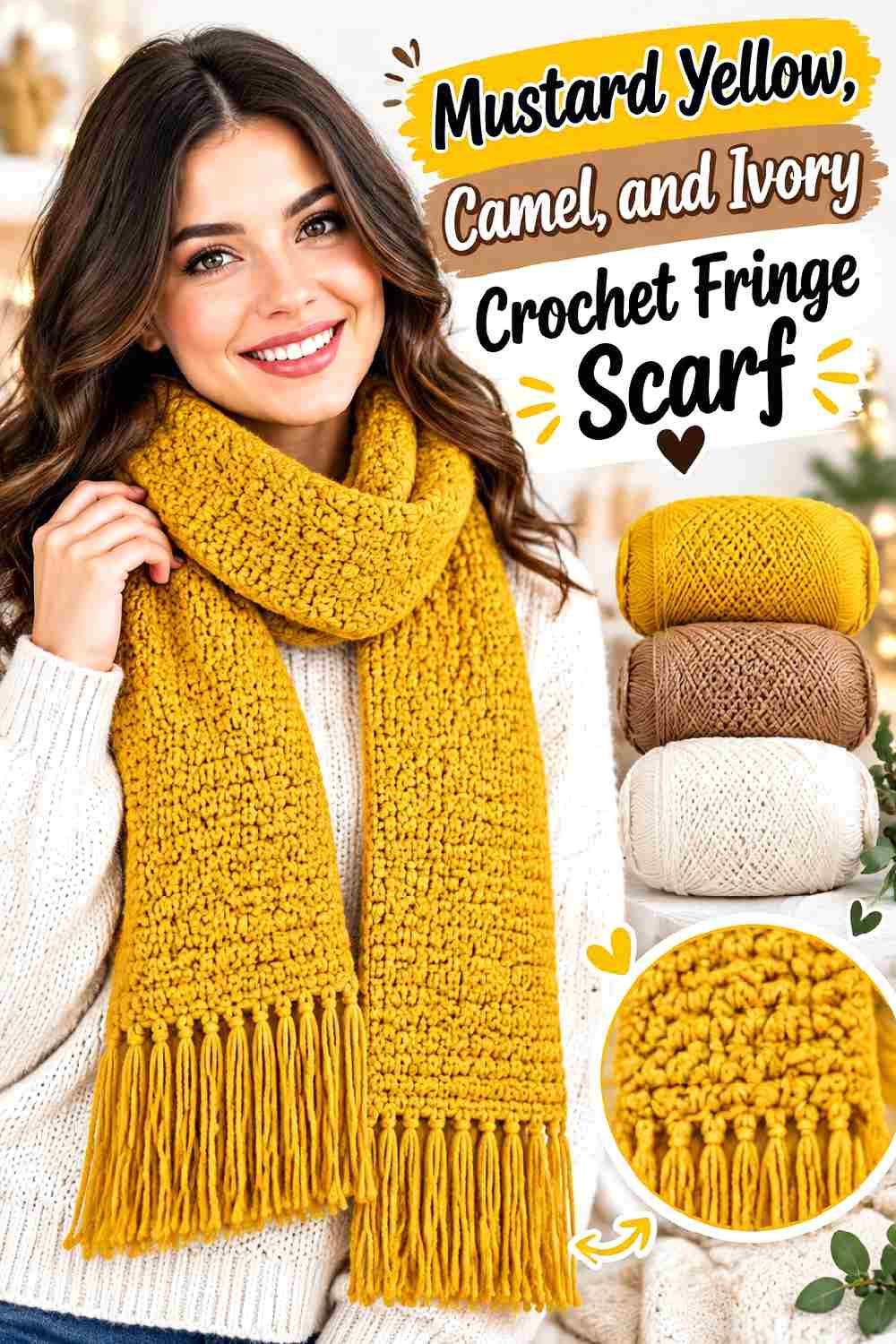
This palette relies on subtle value changes rather than drama. Mustard yellow should remain the main scarf color, camel can deepen selected rows or the border, and ivory can appear in fringe or a small contrasting band. The tutorial source supports a moss-stitch scarf with a fringed finish.
Let Mustard Yellow Carry the Crochet Scarf Texture
Moss-style texture is small and regular, so broad mustard sections help that rhythm remain visible.
Frequent camel-and-ivory striping would put more emphasis on color sequence than on the compact stitch texture. Use the secondary colors at wider intervals instead.
Ivory Fringe Can Lighten a Mustard Yellow Crochet Scarf
Ivory fringe creates a lighter finish without requiring pale stripes through the main scarf body.
For stronger continuity, mix a little mustard into the fringe or repeat ivory once elsewhere near the ends.
Creator Credit: Crafty Turtle Crochet and Knitting Machines
21. Mustard Yellow Chocolate And Brick Crochet Chunky Scarf
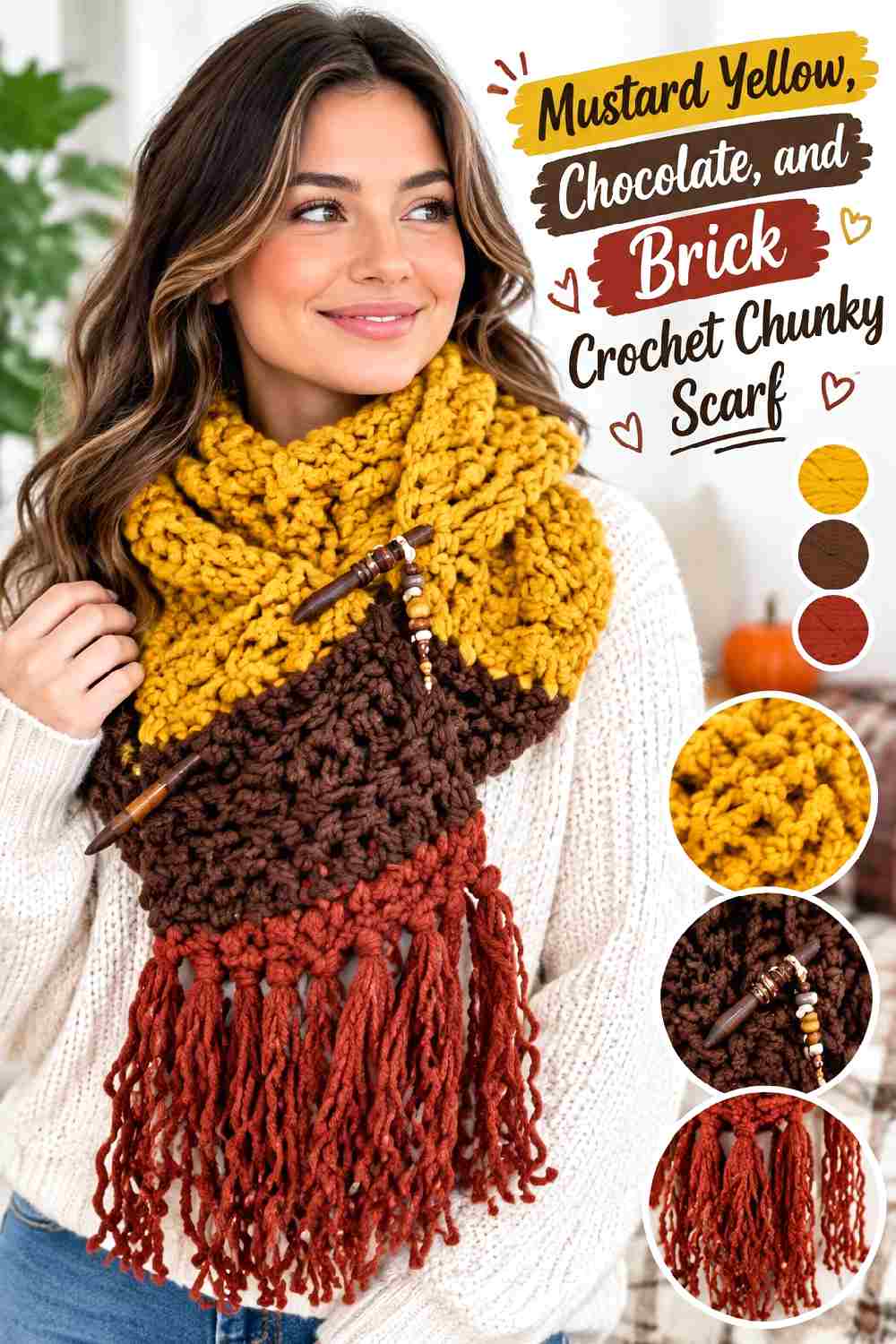
Chunky crochet gives every color more visual weight, so a three-color palette needs restraint. Mustard yellow can cover most of the scarf, chocolate can appear at the ends, and brick can form one controlled transition or accent band. The supporting tutorial source demonstrates a chunky fringed scarf.
Keep Mustard Yellow Dominant in Chunky Crochet
Thicker stitches already make a strong statement. Allowing mustard, brick, and chocolate to alternate constantly may make the scarf look heavier and busier than expected.
Use longer mustard sections and fewer secondary bands to preserve a calmer visual rhythm.
Chocolate Fringe Can Ground Mustard Yellow Crochet
Dark brown fringe creates a substantial ending beneath a mustard scarf body. Because chunky yarn produces volume quickly, test a few fringe bundles before filling the entire edge.
If the dark fringe looks too dense, mix in mustard or brick rather than simply adding fewer but oversized brown groups.
Creator Credit: Hectanooga1
22. Mustard Yellow Charcoal And Stone Crochet Tunisian Scarf
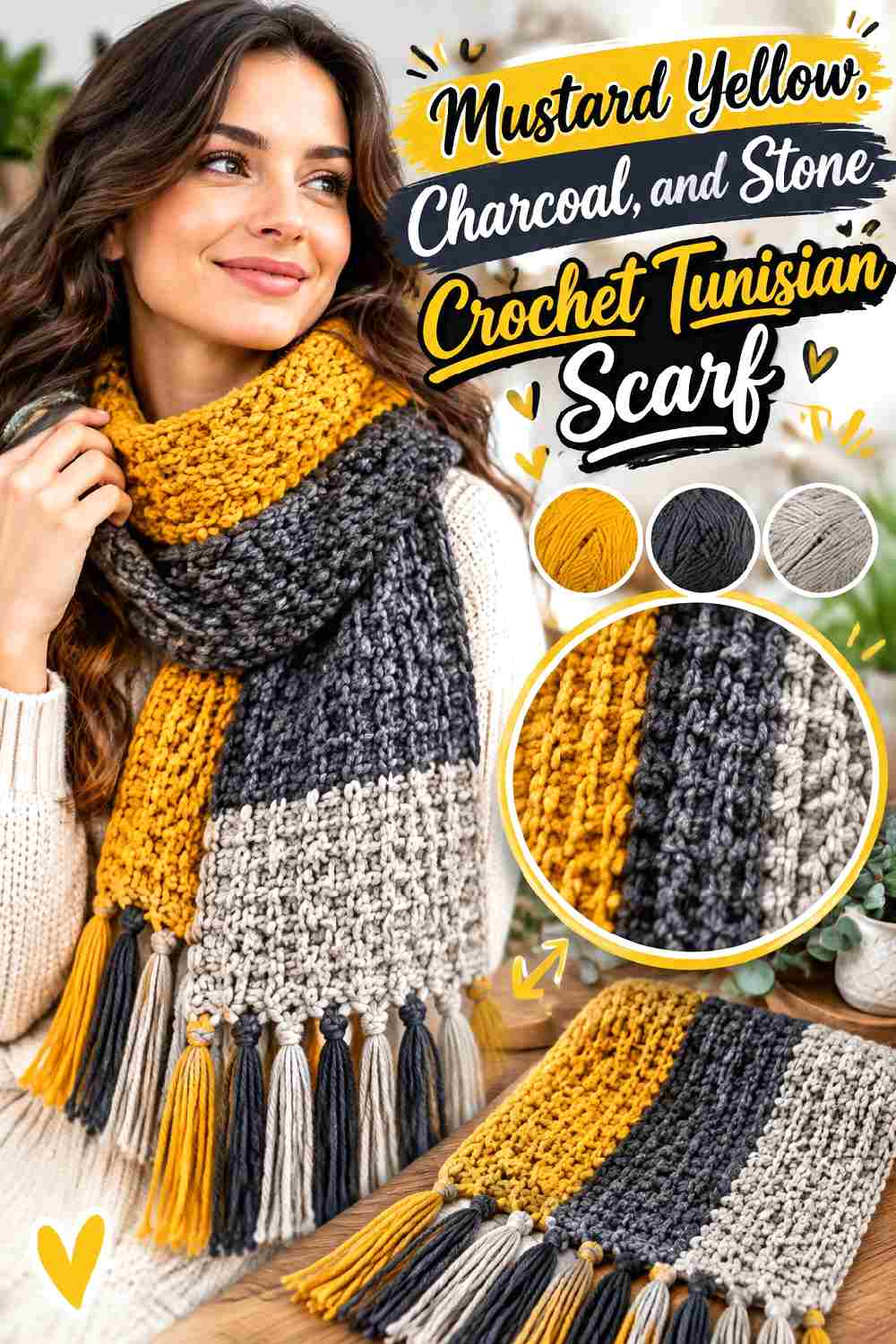
Tunisian crochet can produce a structured-looking fabric where color placement reads clearly. Mustard yellow can cover the main field, charcoal can organize the ends or border, and stone can create a softer transition. The supporting source demonstrates a Tunisian scarf with decorative fringe treatment. Crochet Wink
Mustard Yellow Should Remain Visible Across the Tunisian Crochet Surface
A large mustard field gives the Tunisian texture room to read without interruption. This is particularly helpful when the fabric itself is the feature.
Charcoal can be held back for end sections or fringe, where its darker value creates definition without cutting through the main surface.
Stone Can Separate Mustard Yellow and Charcoal Crochet Sections
Stone gray acts as an intermediate value, reducing the suddenness of a yellow-to-dark-gray transition.
It is especially useful if the fringe also contains charcoal: a stone band before the fringe can visually connect the lighter body with the darker finish.
Creator Credit: I Heart Yarn
23. Mustard Yellow Rust And Deep Teal Crochet Filet Scarf
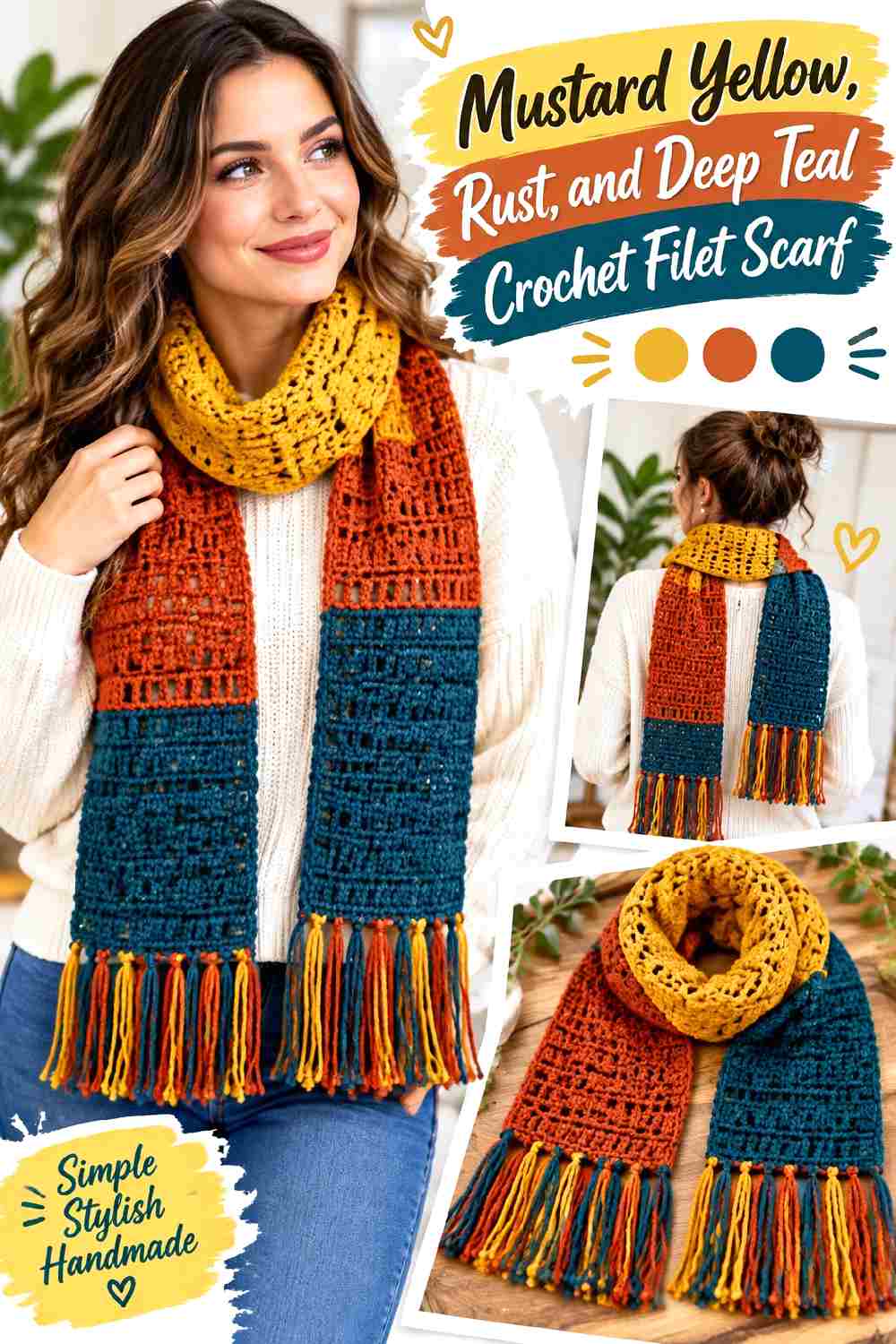
This combination has more color tension than the neutral-heavy palettes. Mustard yellow and rust keep the scarf warm, while deep teal introduces a cool counterpoint. Open filet-style fabric prevents the saturated shades from becoming one solid heavy block. The tutorial source supports a color-block filet scarf with fringe.
Give Mustard Yellow the Largest Crochet Color Block
When all three shades are strong, equal sections can make them compete. A larger mustard block establishes a hierarchy immediately.
Rust can follow as the related warm support color, while teal works best as the smaller contrasting area or finishing accent.
Deep Teal Needs Space From Mustard Yellow Crochet Details
If teal and mustard are placed around very small openwork details, the sharp hue difference may overpower the filet pattern.
Use larger blocks or separate them with rust so the eye can register both the color relationship and the open crochet structure.
Creator Credit: Sara Sach Crochet Designs
24. Mustard Yellow Wine And Camel Crochet Poncho
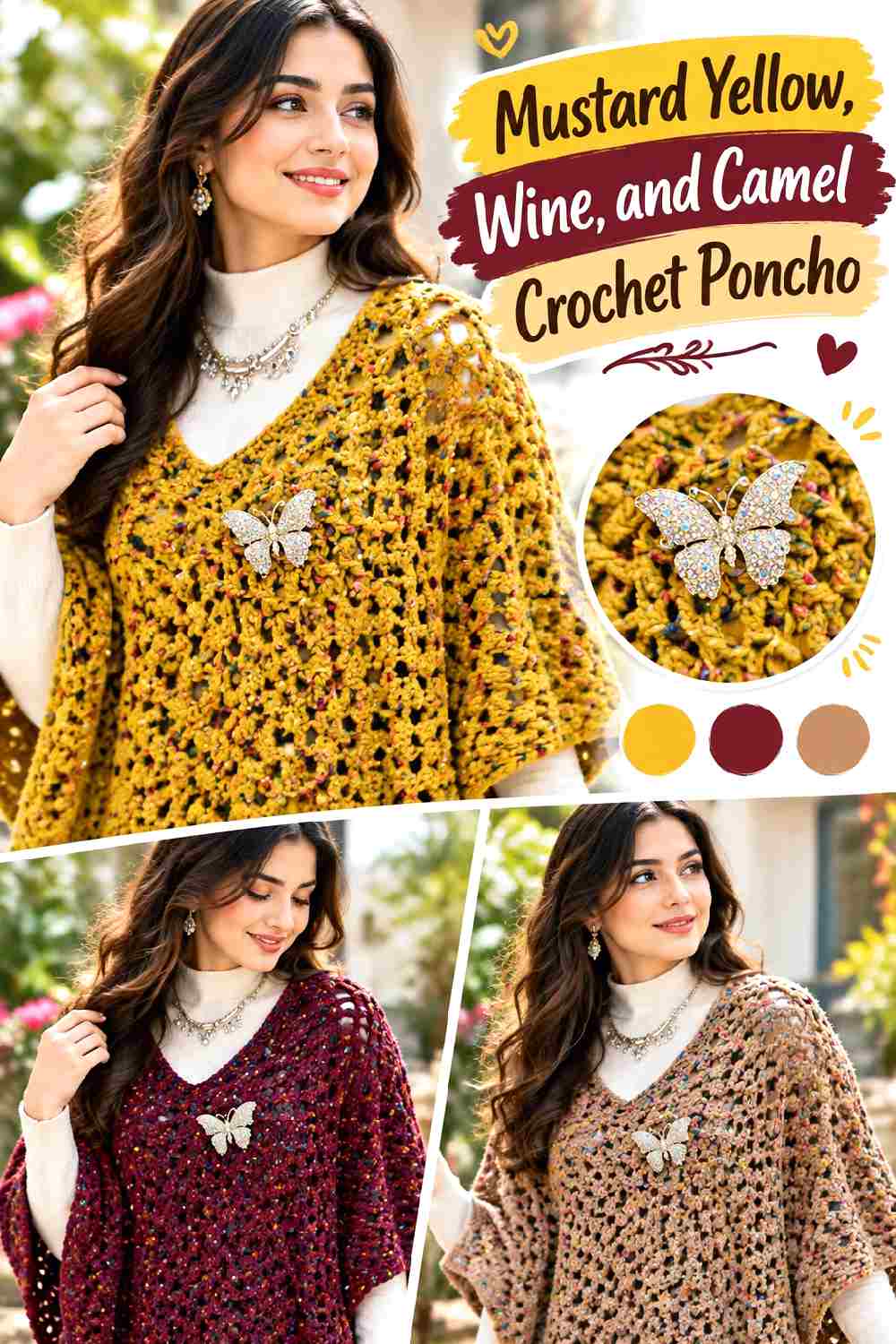
A poncho presents one of the largest wearable surfaces in this collection, so mustard yellow can dominate without feeling like a small accent. Wine gives the palette depth, while camel creates a softer bridge between the two. The supporting tutorial demonstrates a two-point crochet poncho construction.
Keep Mustard Yellow Continuous Through the Crochet Poncho Center
The central body should remain visually connected from neckline toward the lower points. Too many narrow contrasting stripes can make the broad shape feel segmented.
Use mustard for the continuous field and introduce wine farther toward the lower edge when you want the garment to become visually heavier near the bottom.
Camel Can Transition From Mustard Yellow to Wine Crochet
Camel shares warmth with mustard but is quieter, making it a useful intermediate shade before deep wine.
That three-step progression works especially well around broad poncho bands, where there is enough space for each color to remain identifiable.
Creator Credit: Bag-O-Day Crochet
25. Mustard Yellow Deep Teal And Cream Crochet Fingerless Gloves
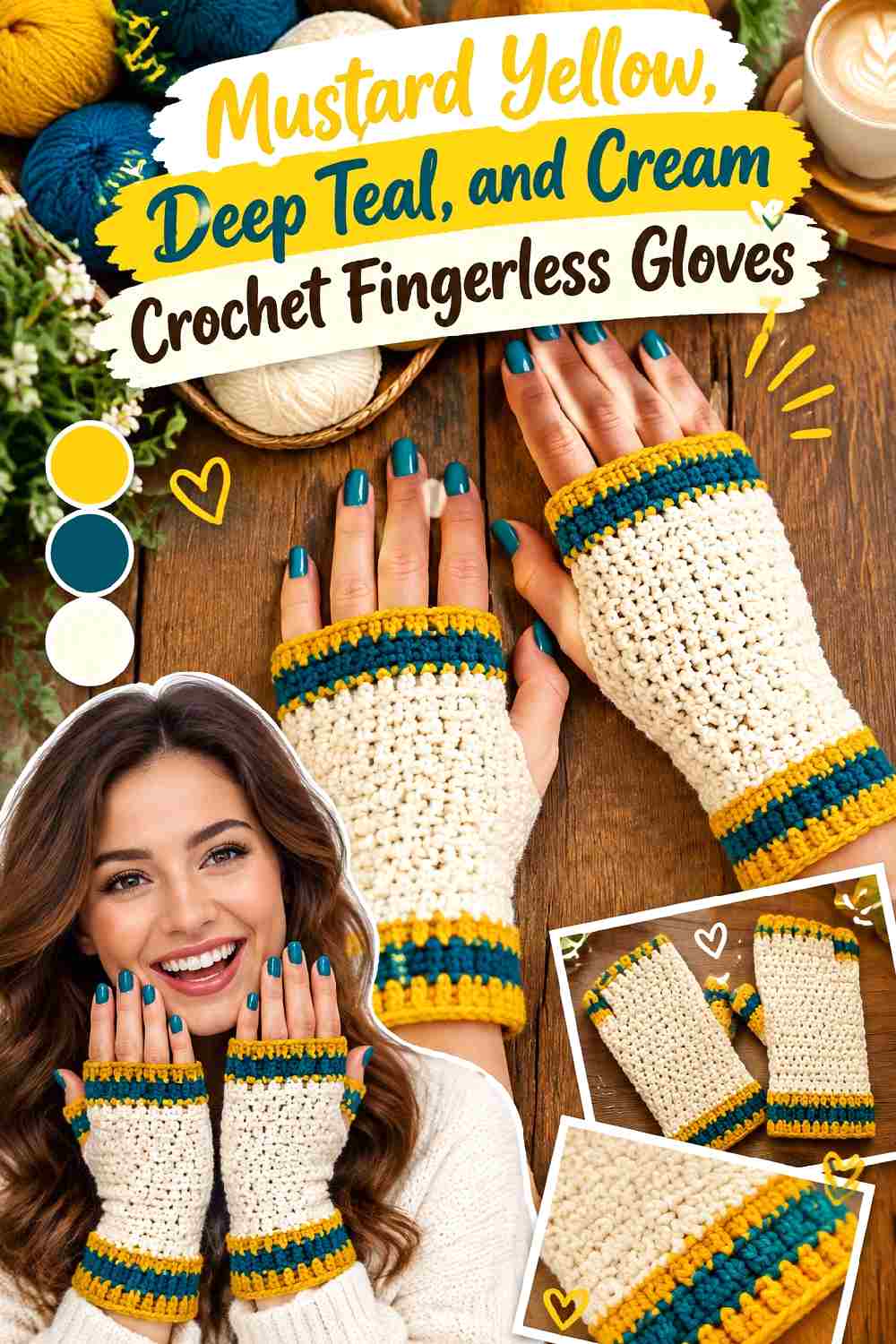
Fingerless gloves offer little room for complicated color arrangements, so the strongest version of this palette keeps mustard yellow dominant. Deep teal can define the cuff or thumb area, while cream can provide one lighter repeated detail. The supporting tutorial demonstrates a crochet fingerless-glove construction.
Keep Mustard Yellow Consistent Across Both Crochet Gloves
Color distribution should be compared as a pair, not one glove at a time. If mustard occupies the main hand section on one glove, keep that visual balance on the second.
Small differences in handmade pieces are natural, but noticeably different color proportions can make the pair look mismatched before stitch differences are even noticed.
Deep Teal Can Define Mustard Yellow Crochet Cuffs
The cuff is a logical place for the darkest contrast because it creates a clear starting edge without breaking up the hand area.
Repeat a small amount of teal elsewhere only when the design has a natural place for it. Cream can provide the lighter accent if additional separation is needed.
Creator Credit: naztazia
Which Mustard Yellow Crochet Palette Should You Choose?
For a quieter, refined fall palette, start with mustard and oatmeal, mustard and camel, or mustard with cream and chocolate. These combinations keep contrast controlled and work particularly well when crochet texture—not colorwork—is supposed to carry the design.
For stronger definition, mustard with charcoal, black, navy, or deep brown creates clearer edges around ribbing, motifs, bag bases, borders, and cuffs. Mustard with forest green, olive, rust, burgundy, wine, aubergine, or teal moves the project in a richer seasonal direction while still leaving room for neutrals to control the overall balance.
Whatever project you choose, decide where mustard belongs before starting the color changes. A clear dominant color, repeated accents, and enough light-dark contrast around important crochet details will usually do more for a polished finish than adding another shade.
Frequently Asked Questions
What colors make mustard yellow crochet look more polished?
Deep brown, charcoal, navy, black, olive, cream, camel, oatmeal, wine, and deep teal can all work, but the color hierarchy matters more than simply choosing sophisticated-sounding shades. Let mustard lead or give it one clearly defined accent role rather than using several strong colors in equal amounts.
Does cream work better than white with mustard yellow crochet?
Cream creates a softer transition, while a clearer white usually produces stronger light-dark contrast. For earthy fall palettes containing brown, olive, rust, or camel, cream can maintain the muted direction. If small motifs need greater separation, a lighter neutral may be more effective.
How can I tell whether mustard yellow has enough contrast with another yarn?
Put the yarns next to each other and look at them from a distance. You can also take a grayscale photo. If the shades become almost indistinguishable in grayscale, they have similar light-dark values even if their hues look different.
Should mustard yellow be the dominant color in every crochet project?
No. It can work as a repeated motif center, trim, cuff, fringe detail, bag panel, border, or stripe. The important point is to give it an intentional role. A small amount of mustard repeated consistently can look more controlled than making it dominate a project that already has strong texture or colorwork.
How do I stop a mustard yellow fall crochet palette from looking too busy?
Reduce the number of colors receiving equal visual space. Choose one dominant shade, one supporting color, and use additional shades more selectively. On granny squares or striped projects, repeating the same colors in predictable positions also helps connect the design.
What if I cannot find the exact mustard yellow shade?
Preserve the role rather than chasing an exact color name. Choose another muted golden yellow with a similar degree of darkness and warmth, then recheck it against the supporting colors. What matters is maintaining the intended contrast and dominant-supporting relationship.
Does crochet texture change how mustard yellow looks?
Texture changes how much light and shadow appears across the surface, which can alter the way a color reads visually. Cables, bobbles, ribbing, and raised stitches create more shadow than flat fabric, while lace and openwork allow the background behind the crochet to become part of the appearance. Test a small section when color visibility is especially important.