A porch goose gives Halloween crochet a surprisingly useful design challenge. The statue has a long neck, compact head, rounded body, and no human-style shoulders, so a costume that looks good on a person cannot simply be reduced by a fixed percentage. Hats, collars, capes, wraps, and skirt-style pieces all behave differently once they are adapted to that shape.
These 18 crochet Halloween porch goose outfit ideas cover much more than changing yarn colors. You will find a dedicated porch-goose costume, plus witch, pumpkin, ghost, spiderweb, bat, skull, cat, monster, clown, and wizard-inspired directions. Some supporting tutorials were originally designed for people or pets, so use them for their construction concept and visual details rather than copying their stated sizing. The comparisons below help you decide what to measure, what to simplify, and which costume shape makes sense for your display.
Quick List
- Crochet Halloween Skirt-and-Collar Porch Goose Outfit
- Crochet Crooked Witch Hat Porch Goose Outfit
- Crochet Pumpkin-Topper Porch Goose Outfit
- Crochet Spiderweb Cape Porch Goose Outfit
- Crochet Bat-Wing Backpiece Porch Goose Outfit
- Crochet Devil-Horn Headband Porch Goose Outfit
- Crochet Green Monster Hat Porch Goose Outfit
- Crochet Ghost Face Hat Porch Goose Outfit
- Crochet Skull Bandana Porch Goose Outfit
- Crochet Narrow Skull Scarf Porch Goose Outfit
- Crochet Clown Ruffle Collar Porch Goose Outfit
- Crochet Pumpkin Beret Porch Goose Outfit
- Crochet Sack-Monster Hood Porch Goose Outfit
- Crochet Black Cat Ear Headband Porch Goose Outfit
- Crochet Wizard Hood Porch Goose Outfit
- Crochet Halloween Bow Accent Porch Goose Outfit
- Crochet Bat Cape Porch Goose Outfit
- Crochet Pumpkin Cowl Porch Goose Outfit
Measure the Goose Instead of Shrinking Human Sizing
Most Halloween crochet wearables are designed around a human or pet head, neck, or shoulders. A decorative goose statue needs a different fit strategy. Before adapting a tutorial, measure the area the finished piece will actually touch: around the neck, over the crown, around the widest body section, or from the neck down the back.
Treat those measurements as checkpoints rather than trying to convert a human pattern by percentage. A hat may need less depth but a different opening shape; a cape may need a smaller neck opening without becoming proportionally shorter.
Check the fit before adding decorative pieces. The goose’s eyes and bill should remain visible, a collar should not ride upward, and a cape should hang without twisting around the neck.
Choose Structure According to Where the Goose Is Displayed
For an outdoor or semi-outdoor porch display, structure matters as much as color. A very soft fabric can make a pointed witch hat collapse, while an extremely stiff fabric may refuse to settle around the curved body. Smooth yarn also tends to show spiderwebs, skulls, stripes, and face details more clearly than heavily fuzzy yarn.
Think about weather exposure separately from crochet construction. A fiber that performs well in a wearable is not automatically suitable for prolonged rain, dampness, direct sun, or dirt. Check the yarn manufacturer’s care information and consider bringing removable outfits indoors during bad weather.
For elaborate costumes, detachable hats, collars, bows, and capes are practical because they can be stored flat or separately instead of remaining on the statue all season.
Plan Closures Before Adding Halloween Details
Porch goose clothing needs to stay positioned on a smooth, rigid form. Decide how the main piece will go on and come off before spending time on decorative motifs.
A neck tie can work for a bandana or cape, while a separate band may make more sense for ears or horns. Skirt-style pieces need an opening or enough stretch to pass over the relevant part of the statue. Avoid assuming that a human neckline will automatically settle correctly around the goose’s long neck.
For an exposed porch, also check loose ends, dangling ties, large wings, and other pieces that could catch wind. Decorative attachment methods should hold the costume in position without permanently altering or scratching the statue.
1. Crochet Halloween Skirt and Collar Porch Goose Outfit
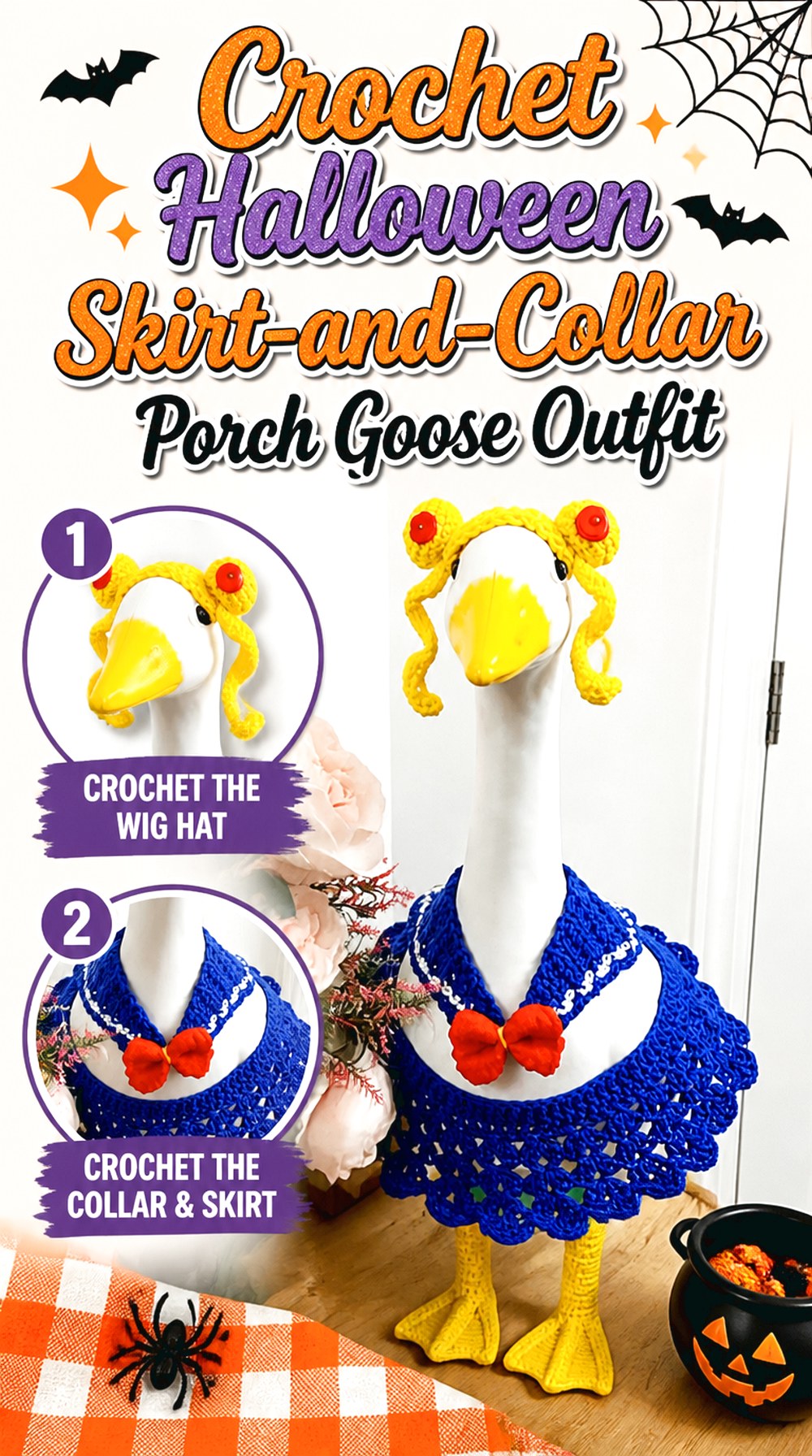
This is the most direct starting point in the collection because the supporting tutorial is actually made for a decorative porch goose. The finished Halloween costume combines several elements—including a skirt, collar, bow, and decorative hair treatment—rather than depending on one oversized accessory. That layered approach creates a complete character while still allowing individual pieces to be removed or changed.
Choose this direction if you want the goose itself to look fully costumed rather than simply wearing a seasonal hat. It is also a useful reference for seeing how crochet clothing can sit around the unusual proportions of a porch goose.
The Skirt Gives You a Built-In Fit Check
A skirt-style component immediately shows whether the outfit is sitting at the correct point on the body. If it slides downward, bunches unevenly, or rotates around the statue, extra decoration will not solve the underlying fit problem. Check that the upper edge stays where you want it before adding bows or other visual accents.
This also makes the skirt a useful foundation for future costumes because its general placement can inform other waist or body pieces.
Keep the Neck Detail Clear of the Bill
The tutorial’s collar concept creates visual interest high on the costume, but a porch goose has limited space between its body and bill. When adapting any collar, check the front and side views before making it fuller.
A collar that looks appropriately dramatic from the front can still push upward or visually crowd the face. Leave enough open space that the long neck remains recognizable; that contrast is part of what makes a dressed porch goose charming.
Original Tutorial and Creator Credit
Creator: My Yarn Loft by Tansy
2. Crochet Crooked Witch Hat Porch Goose Outfit
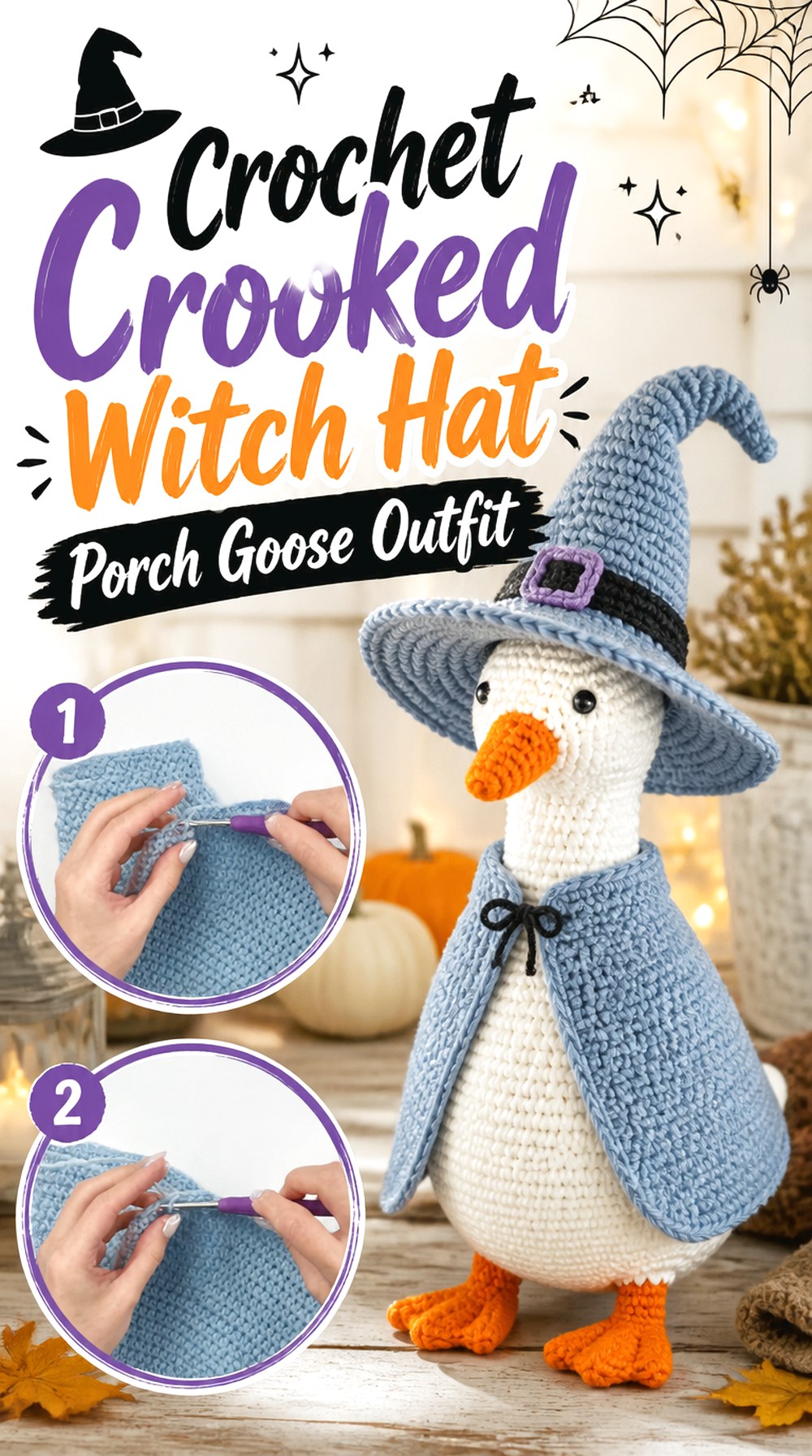
A pointed witch hat gives a porch goose an unmistakable Halloween identity without requiring a full body costume. The supporting tutorial teaches a traditional crochet witch or wizard hat with a defined point and brim. For a goose adaptation, those proportions matter more than the human finished size: the goal is to preserve the recognizable pointed silhouette while rebuilding the opening for your statue.
This option works particularly well if you already have a neutral cape, skirt, or black neckpiece that can be reused. Purple, black, charcoal, or unexpected autumn shades can change the mood without changing the essential witch-hat shape.
A Narrower Brim Suits a Small Statue Better
A full-size costume hat can carry a wide brim because a person’s shoulders visually balance it. A goose statue has a much narrower head and neck, so an overly large brim may hide the eyes or overwhelm the figure.
When planning the adaptation, compare brim width with the head rather than copying the source proportions automatically. You still want enough flare for the piece to read as a witch hat from across the porch.
Make the Hat Removable for Storage
Tall pointed pieces are usually the first part of a costume to become awkward in a storage bin. Keeping the hat separate from the body outfit lets you protect its point instead of crushing it beneath heavier pieces.
A removable design also makes the base costume more versatile. The same skirt or cape can support a pumpkin, cat, ghost, or monster headpiece later in the season without rebuilding the entire outfit.
Original Tutorial and Creator Credit
Creator: ElyseCrochets 💌
3. Crochet Pumpkin Topper Porch Goose Outfit
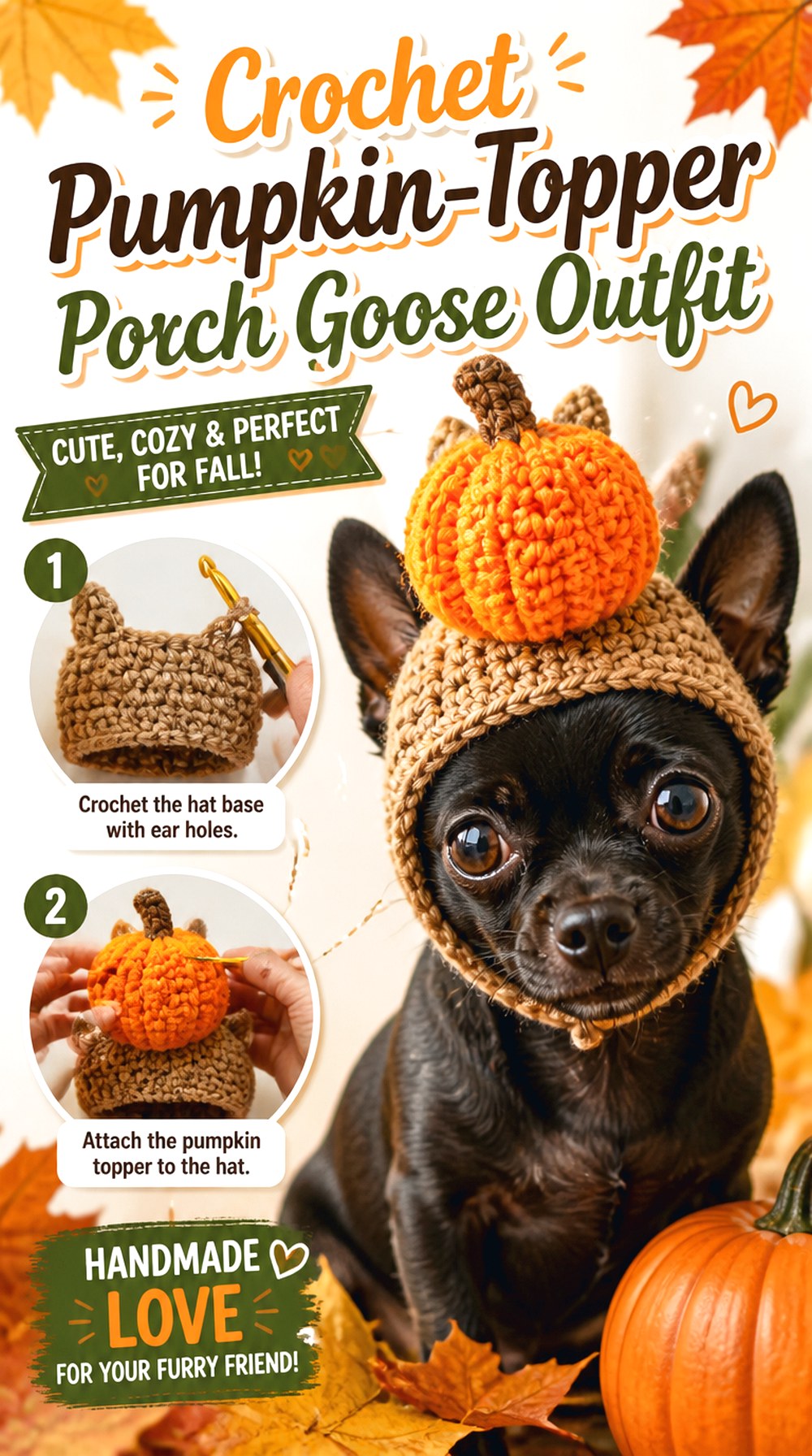
A pumpkin costume can stay relatively compact by concentrating the theme on the head instead of covering the whole goose in orange. TwinStarHooks’ source is a Halloween pumpkin hat intended for dogs and cats, making its accessory scale concept closer to a porch-goose adaptation than a full adult hat.
Rather than treating the pet dimensions as interchangeable with your statue, use the video to study how the pumpkin sits on a smaller headpiece and how the top decoration establishes the theme. Pair it with a plain green, brown, cream, or orange body accessory if you want a fuller harvest look.
Pet-Hat Logic Is Closer to Goose Scale
A small pet accessory already solves some problems that human hats do not: a compact opening, a relatively small crown, and a strong decorative focal point. That makes it a useful visual reference.
The remaining challenge is anatomy. A goose head is still shaped differently from a cat or dog head. Measure the statue at the exact resting point of the hat and treat the tutorial’s sizing as source-specific rather than universal.
Keep the Pumpkin Topper From Tilting Forward
Top decorations move the visual center of gravity upward. Even though a statue does not need wearable comfort, an off-center topper can make the whole costume look crooked from the sidewalk.
Before permanently attaching a stem or pumpkin detail, place the unfinished hat on the goose and view it from the front and both sides. A slightly smaller topper may look more intentional than a large one that dominates the narrow head.
Original Tutorial and Creator Credit
Creator: TwinStarHooks 💫
4. Crochet Spiderweb Cape Porch Goose Outfit
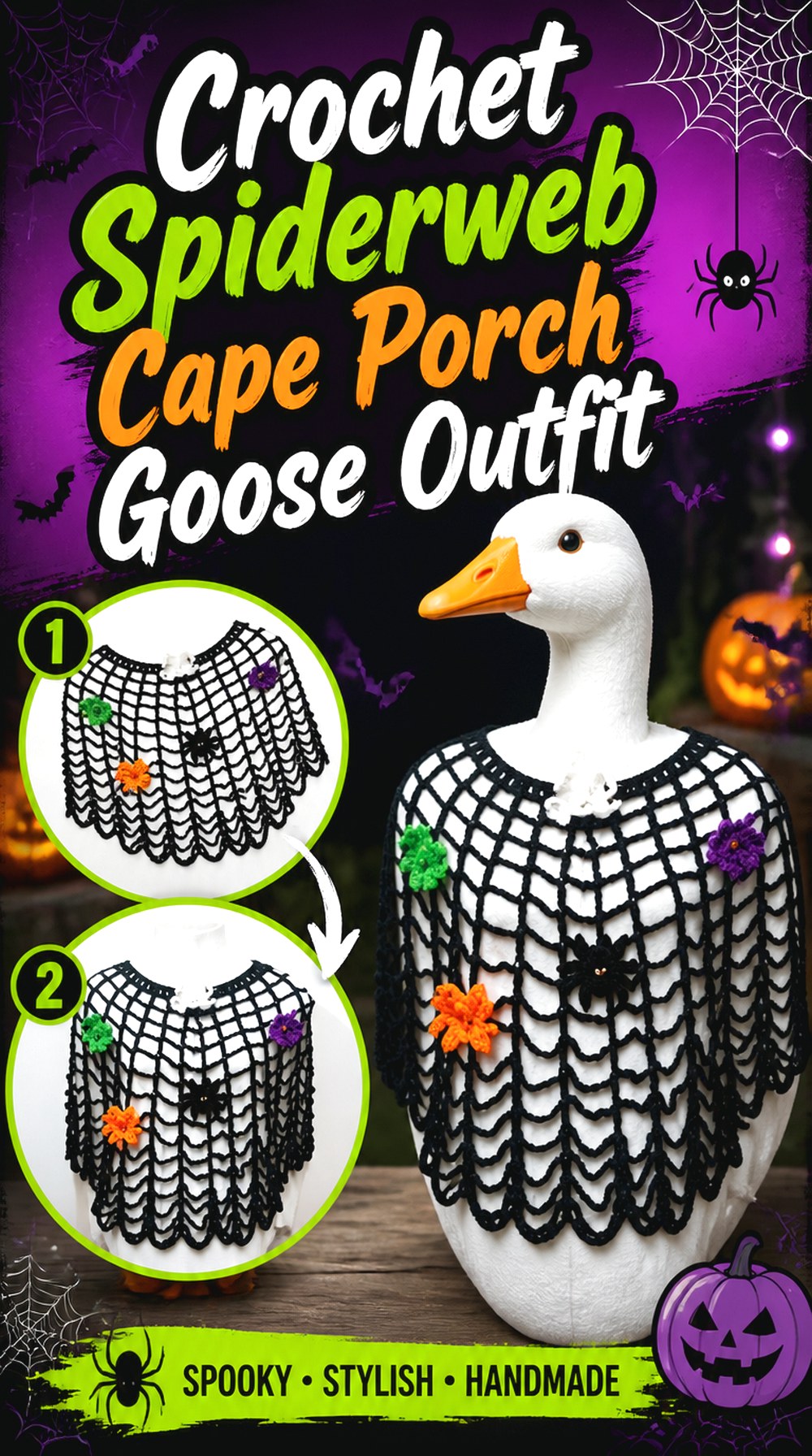
A spiderweb cape shifts the visual interest away from the head and lets the goose’s long neck remain completely visible. CrochetItForward’s source teaches a spiderweb cape or poncho, giving you a useful reference for the open radial structure that makes this costume recognizable.
For a porch goose, the idea works best as a scaled neck cape rather than a literal miniature human poncho. Keep enough spread across the back for the web pattern to be visible, but avoid so much length that the fabric gathers on the porch surface. A contrasting statue color can make the openwork especially noticeable.
Open Lace Needs a Stable Neck Anchor
A spiderweb design gains much of its character from open spaces, but that also means the fabric may have less weight holding it in position. If the neckline shifts around the statue, the web can look lopsided even when the crochet itself is correct.
Fit the neck area first. Once that point remains centered, let the wider section spread naturally across the shoulders and back instead of trying to force every point flat.
Let the Web Shape Stay Visible
Adding spiders, bows, tassels, edging, and other Halloween details at the same time can hide the geometry that makes a web interesting. View the cape from normal porch distance before adding extras.
If the radial lines are already clear, a restrained finishing treatment may produce a stronger display. If they disappear visually, stronger yarn contrast or a slightly broader cape can be more effective than piling on more embellishments.
Original Tutorial and Creator Credit
Creator: CrochetItForward
5. Crochet Bat Wing Backpiece Porch Goose Outfit
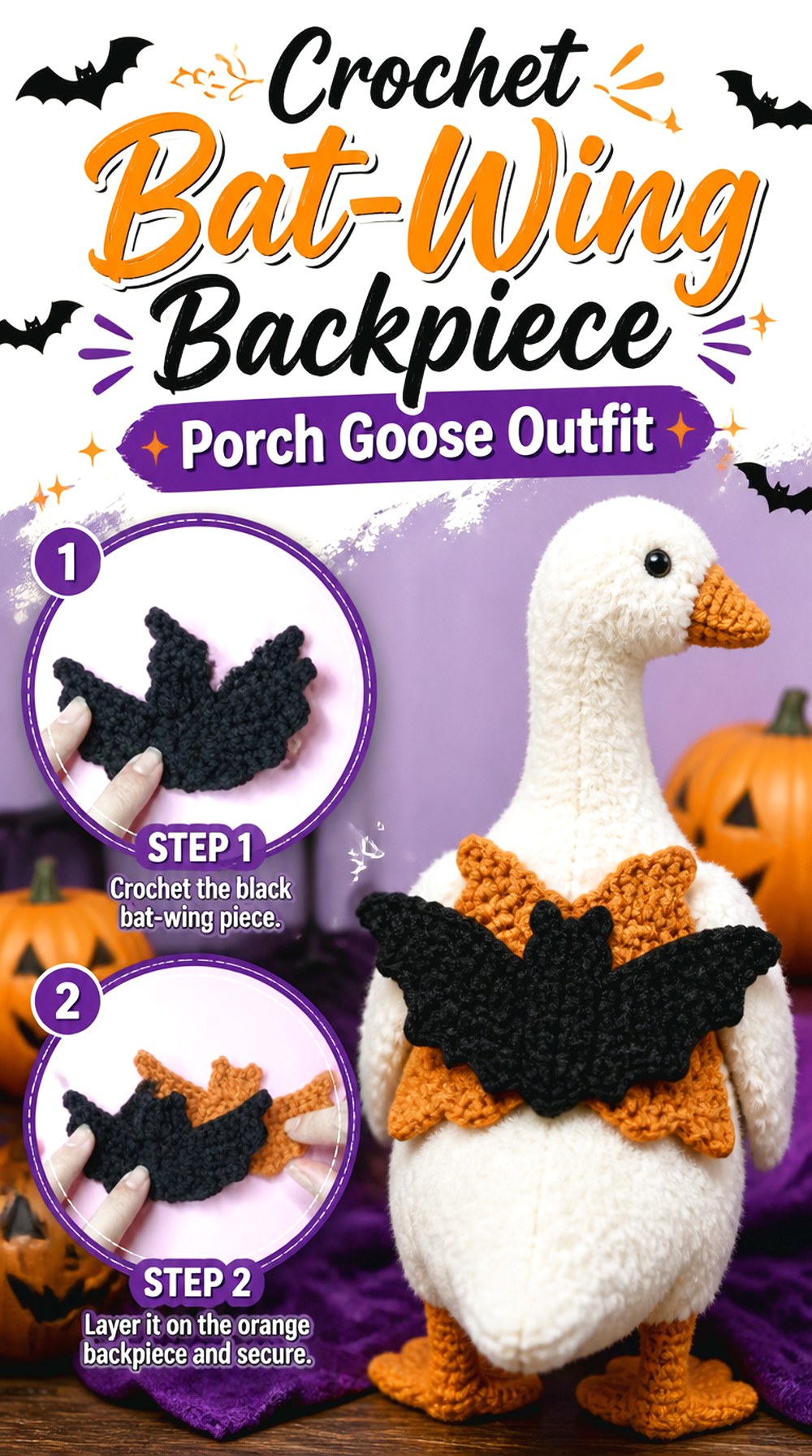
Bat wings create a dramatic silhouette without covering the goose’s face or neck. The Crochet Jewel tutorial focuses specifically on crocheted bat wings, which makes it a useful source for the shape of individual wing components even though the article adaptation uses them differently.
For a porch goose, consider the wings as a decorative backpiece attached to a small fitted band, cape base, or other removable support. That gives you greater control than trying to make the wings themselves wrap around the statue. Black is the obvious choice, but deep purple or charcoal can preserve the bat shape while separating it from other dark porch decorations.
Flat Wings Work Better Than Bulky Stuffed Pieces
A porch display benefits when the wing outline remains readable from several feet away. Thick or heavily dimensional wings may turn into dark lumps from the front, especially beside a narrow goose body.
A flatter wing profile can keep the pointed lower edges visible. Before attachment, temporarily position both wings and check that they mirror one another rather than pointing at noticeably different angles.
Check the Back View From the Sidewalk
Most people instinctively judge a costume from the front, but bat wings are primarily a side-and-back feature. Put the goose in its intended display location before deciding the final wing angle.
If both wings disappear behind the body from the main viewing direction, spread them slightly. If they dominate the statue, bring them inward. This simple visual test is more useful than relying on human costume proportions.
Original Tutorial and Creator Credit
Creator: Crochet Jewel
6. Crochet Devil Horn Headband Porch Goose Outfit
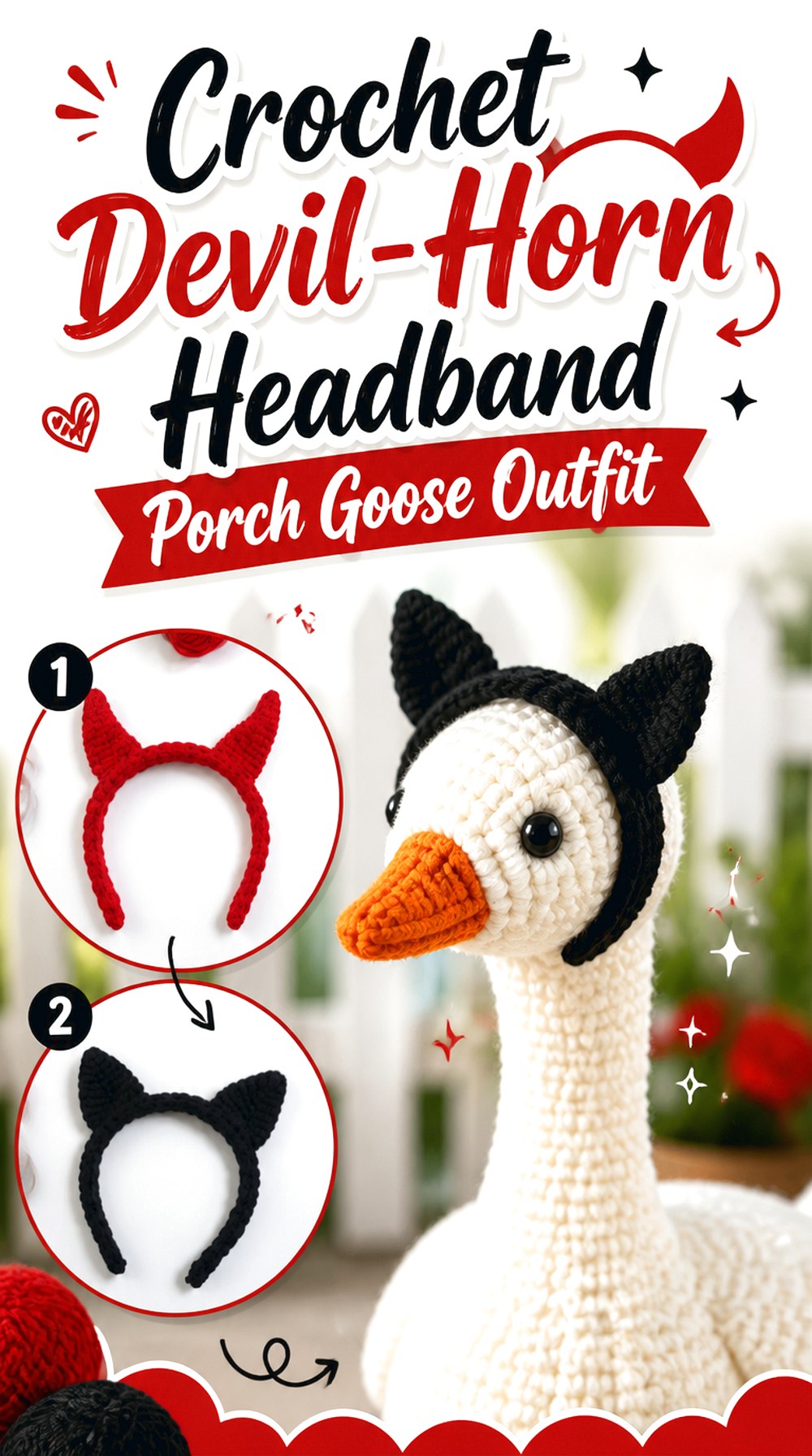
A horned headband is one of the smallest projects here, yet it can change the character of the goose immediately. Play Hooky with Me demonstrates crochet devil horns and black cat ears on headband-style accessories, giving this idea a clear Halloween foundation.
For the porch-goose version, the headband concept is more important than copying the human fit. A narrow removable band can carry the horns while leaving the neck and body available for a separate cape or skirt. This is a good direction when storage space is limited or when you want several interchangeable Halloween identities for the same basic goose outfit.
Headband Pressure Matters on a Hard Statue
A decorative statue does not compress like a human head, so an opening that is merely tight will not become more comfortable or flexible with wear. Too no waulu circular construction may build unwanted tension or slide toward the neck.
Fit the band directly to the surface where it will rest. It should stay positioned without needing force that could distort the crochet or scrape a painted finish.
Use Horn Size to Set the Mood
Small horns give the goose a mischievous look, while tall horns create a much stronger costume silhouette. Neither is automatically better.
Before fixing the horns to the band, pin or loosely position them and compare their height with the bill and neck. Keeping them proportional lets the face remain visible and prevents the accessory from becoming the only feature you notice.
Original Tutorial and Creator Credit
Creator: Play Hooky with Me
7. Crochet Green Monster Hat Porch Goose Outfit
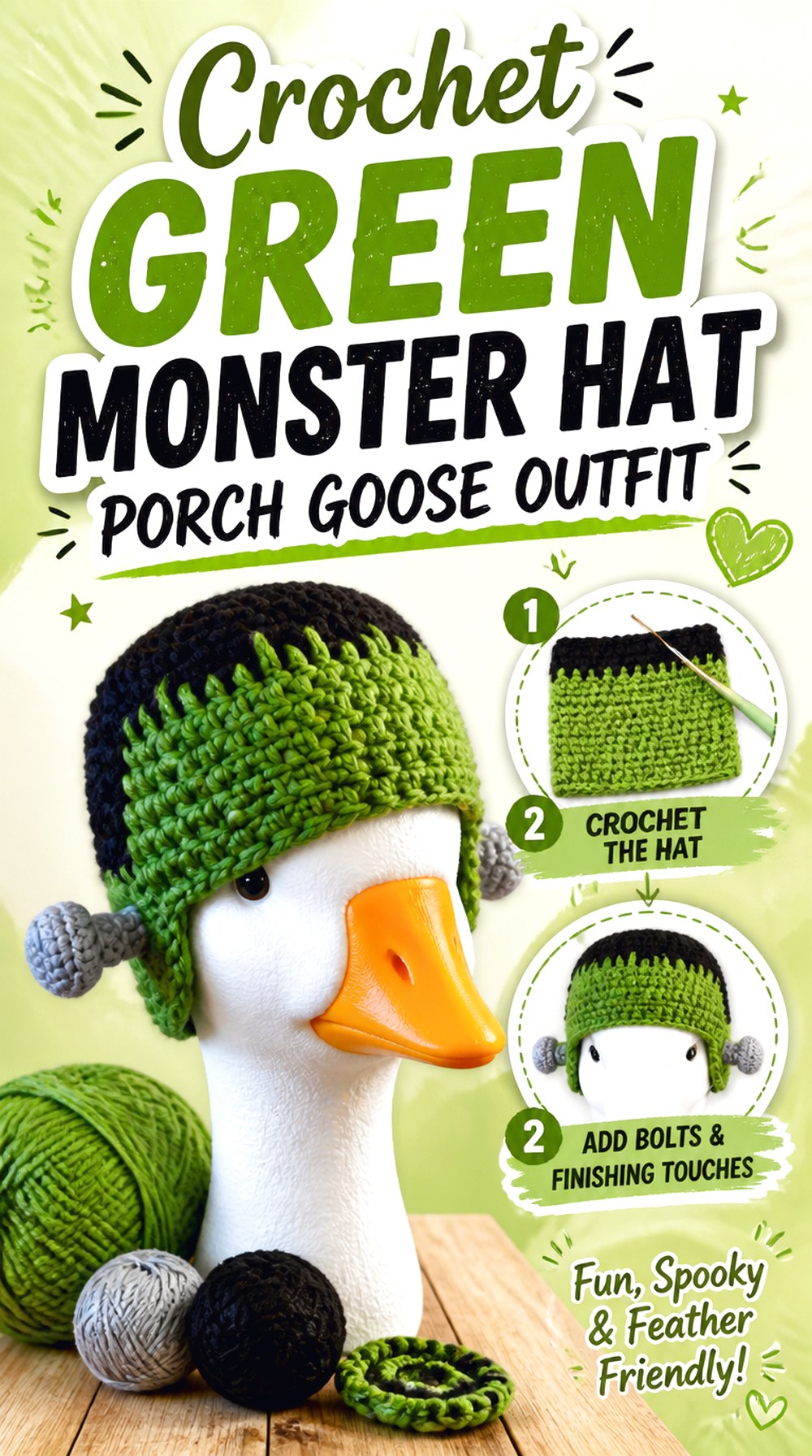
A green monster hat gives you a character costume without requiring an elaborate body garment. HappyBerry Crochet’s Frankenstein-themed hat tutorial provides the visual language: green coloring, strong facial details, and a recognizable monster-hat silhouette.
For a porch goose, simplify the idea around what can actually be seen on the narrow head. A face detail that works across a child’s hat may need to be reduced or repositioned substantially. Pairing the headpiece with a dark neutral neck wrap can create enough contrast to complete the monster theme without covering the goose in additional motifs.
Face Placement Carries the Monster Look
Once a character hat is reduced, there is less space between the eyes, hairline, edge, and other features. Trying to preserve every source detail can make the miniature version crowded.
Decide which two or three visual cues communicate “green monster” most clearly on your statue. Lay those elements on the unfinished hat before sewing them down so you can correct spacing while changes are still simple.
Avoid Covering the Goose’s Eyes or Bill
Character faces become confusing when a second set of eyes or features sits directly over the statue’s own face. Raising the hat slightly can preserve the goose’s expression while keeping the monster treatment readable.
Check from the front rather than only from above. Porch displays are normally viewed at a lower angle, so details that look separated on a worktable can overlap once the goose is standing.
Original Tutorial and Creator Credit
Creator: HappyBerry Crochet
8. Crochet Ghost Face Hat Porch Goose Outfit
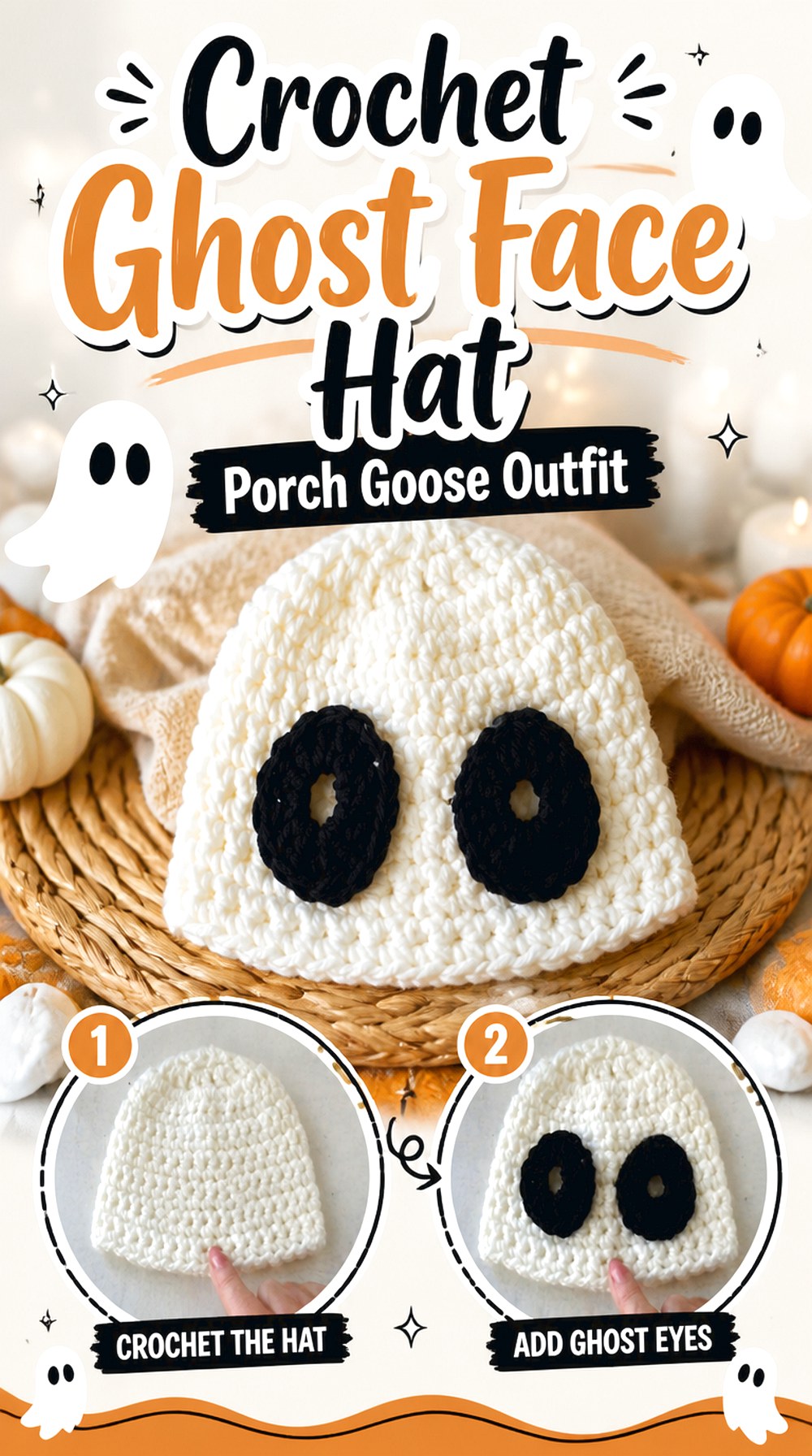
Ghost details often depend on relatively small dark shapes against a pale background. If those features become too thin, they may disappear when the goose is viewed from the walkway or street.
Before attaching the face permanently, place the hat on the statue and step away. Increase or simplify the contrast if necessary. Strong, uncomplicated shapes usually read better on a small decorative costume than several tiny embroidered details.
Choose Between a Hat and a Hooded Look
A short ghost hat keeps the neck exposed; extending the concept downward creates more of a hooded apparition. Those two silhouettes feel quite different.
Use a hat when you want to preserve the classic porch-goose shape or combine it with another body piece. Choose more neck coverage only when the ghost theme is meant to dominate the whole costume, and keep the lower edge away from the bill.
Original Tutorial and Creator Credit
Creator: Hectanooga1
9. Crochet Skull Bandana Porch Goose Outfit
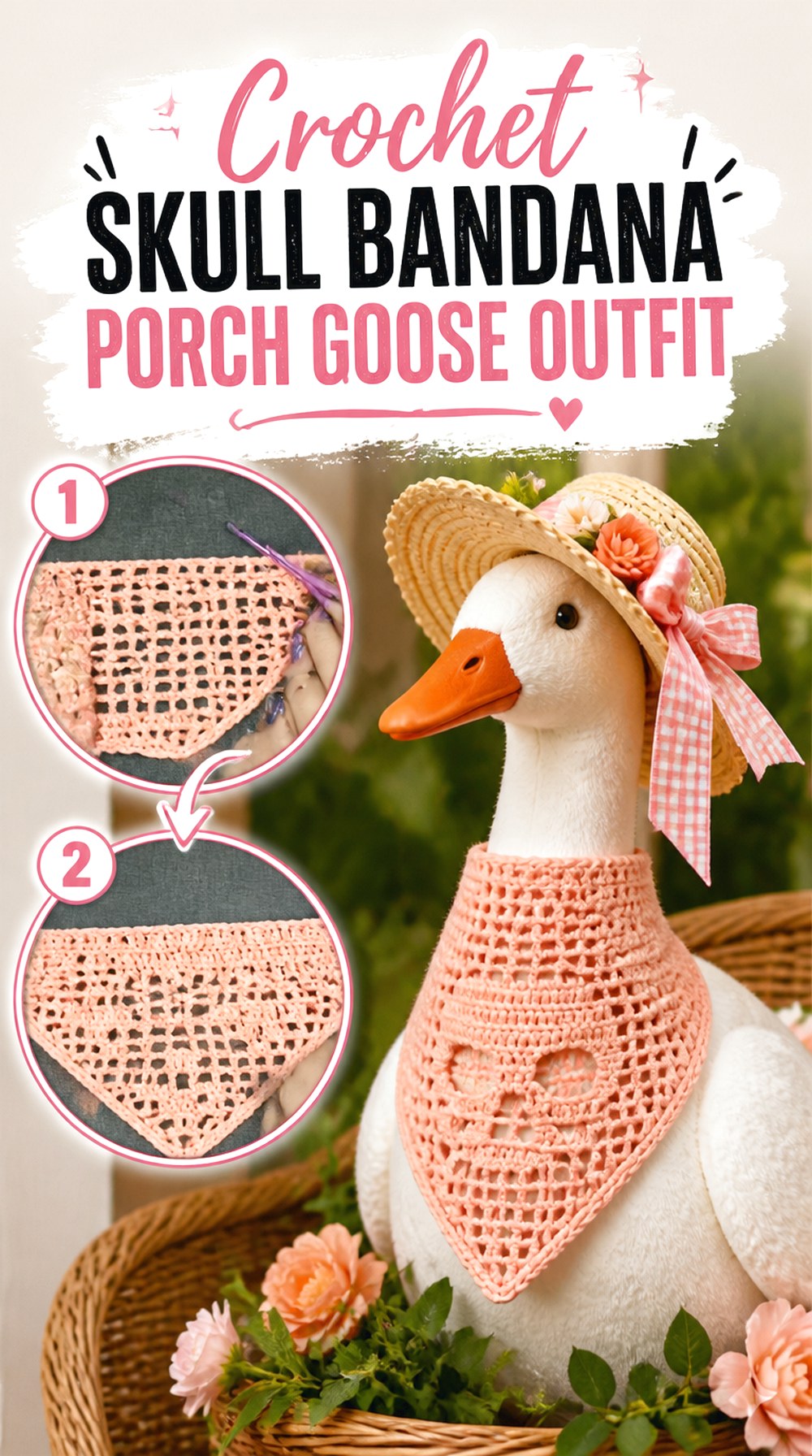
A triangular skull bandana changes the goose without adding height to the display, making it a useful option for covered shelves, lower porch tables, or storage boxes where tall hats are inconvenient. The tutorial from TEJIENDO CON PILY A LA VANGUARDIA centers on a crocheted skull Halloween bandana.
For the goose adaptation, think of it as a small triangular neckerchief rather than a human head covering. The point can fall down the chest or toward the back depending on where you want the skull to appear. A single strong motif can be more effective than reducing an entire repeat until it becomes difficult to recognize.
A Triangular Bandana Solves Neck Fit Simply
Compared with a closed cowl, a bandana can be easier to fit around an unusual neck because the ends provide adjustment. That is useful when the goose widens quickly below the head.
Keep the tied or fastened area neat enough that it does not become the main feature. The triangular section should still hang freely instead of being pulled so tightly that its point bunches upward.
Scale the Skull Motif Before Committing
Skull motifs rely on openings and proportions that can lose definition when altered aggressively. Instead of assuming the motif can be reduced to any size, compare its finished source shape with the usable space on your goose.
If one complete motif is already close to the required width, build the accessory around it. That will usually preserve the visual idea better than compressing several skulls onto a tiny bandana.
Original Tutorial and Creator Credit
Creator: TEJIENDO CON PILY A LA VANGUARDIA
10. Crochet Narrow Skull Scarf Porch Goose Outfit
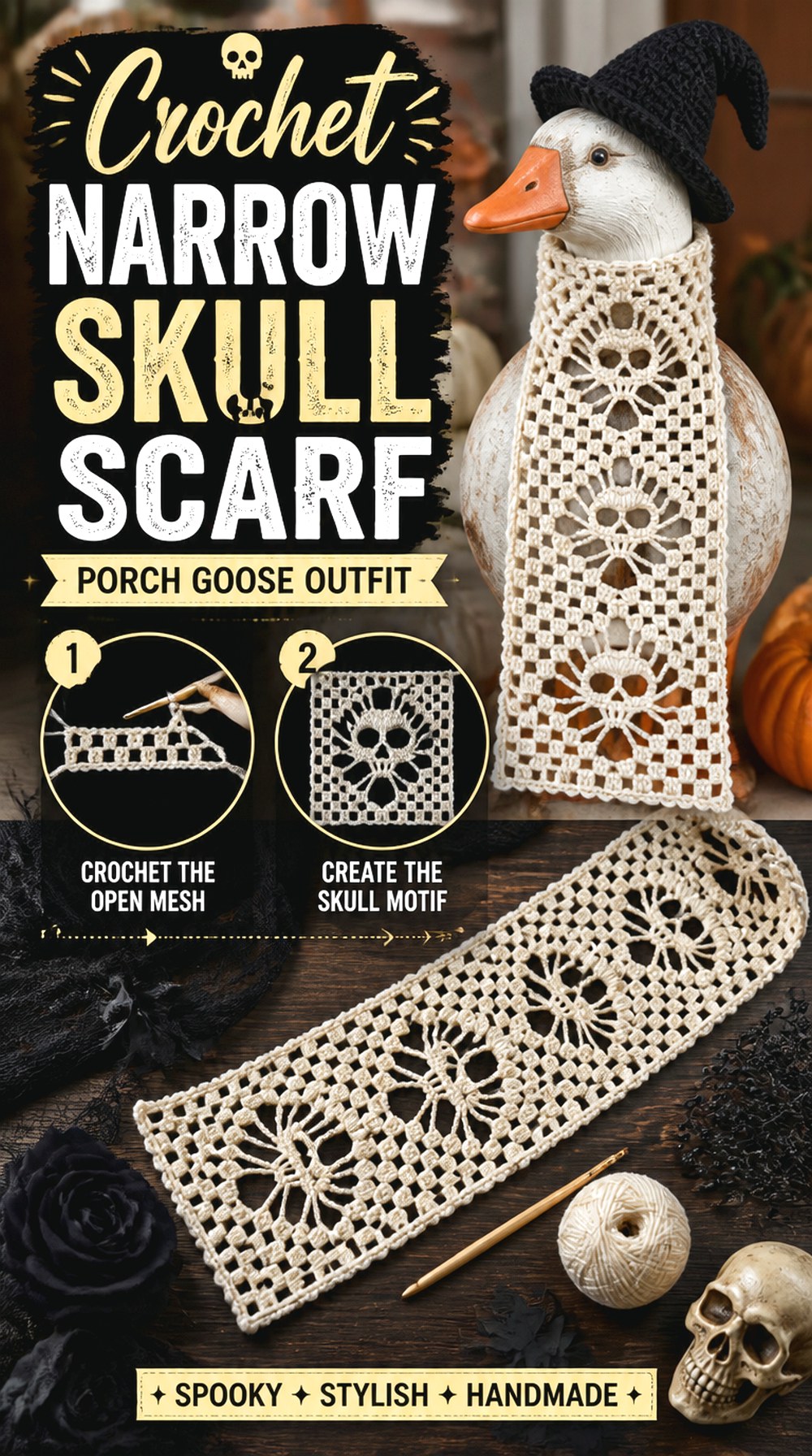
A narrow skull scarf creates a longer vertical accent than the bandana idea above. Fiber Spider’s tutorial demonstrates a scarf built around repeating skull motifs, giving you a strong reference for how the skulls read when arranged along a narrow strip.
For a porch goose, you do not need to reproduce human scarf length. The adaptation works better as a short decorative drape that frames the chest or falls down the back. This project suits a gothic display where black, gray, bone, or burgundy details need to connect the goose visually with nearby skeletons, lanterns, or dark foliage.
A Long Scarf Can Become a Wind Problem
Human scarves gain drama from length, but a porch-goose version can quickly become inconvenient if both ends hang near the ground. Long tails may twist around the statue or catch wind.
Decide where you want the lowest point to end while the goose is standing in its actual display position. A shorter scarf can still show the skull theme clearly while creating a tidier, easier-to-store costume.
Let One Skull Motif Do the Work
Repeating a detailed motif is not always necessary on a small statue. One clearly visible skull near the chest may communicate the theme better than several smaller motifs scattered around the neck.
Use the available display area to decide how many repeats make visual sense. This also avoids turning the adaptation into an attempt to reconstruct the entire source scarf at miniature scale.
Original Tutorial and Creator Credit
Creator: Fiber Spider
11. Crochet Clown Ruffle Collar Porch Goose Outfit
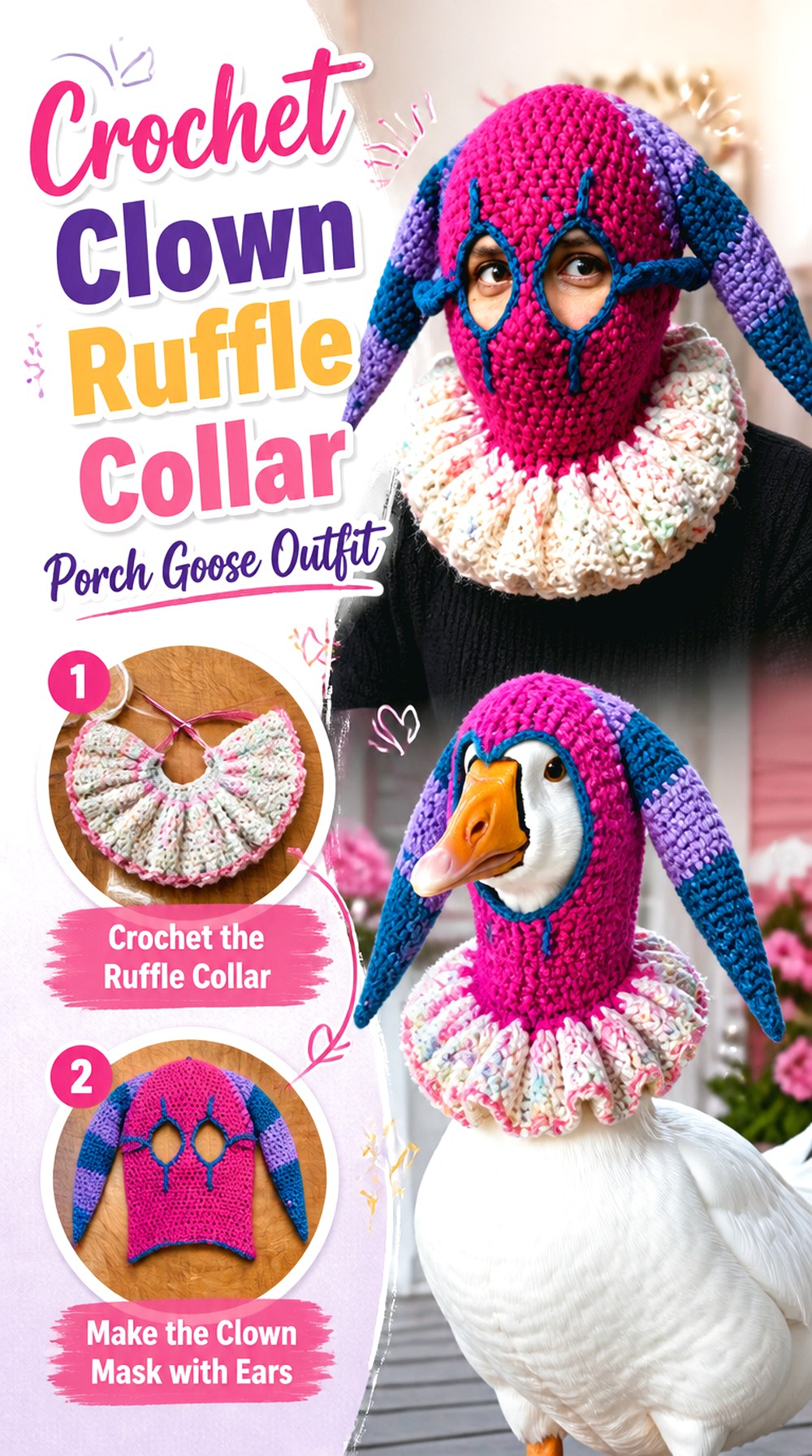
A large ruffled collar can turn the goose into a vintage clown, circus character, or slightly eerie Halloween figure without needing any hat at all. INGRATO’s tutorial demonstrates a full crochet clown ruffle collar, so the key adaptation is deciding how much of that volume the goose can carry.
This design works especially well when you want the long neck to remain part of the costume. Stripes, alternating dark and pale sections, or a restrained two-color palette can shift the result from playful to spooky. A simple body covering beneath the collar is enough; the ruffle should remain the main visual statement.
Ruffle Volume Changes the Whole Silhouette
A dense ruffle projects outward, which can make a narrow statue appear much wider around the neck. That can be effective, but too often a ruckling effect can obscure the goose’s natural shape.
Build enough fullness to create a deliberate collar, then evaluate it on the statue before adding more. The side profile is particularly important because a collar may look balanced from the front while projecting excessively at the back.
Keep the Collar From Swallowing the Head
The transition from neck to head is much smaller on a goose than on a person. If the ruffle climbs too postative, the head may seem to disappear into the collar.
Leave visible neck above the ruffle and check that the bill can visually clear the front edge. That little gap helps the costume read as “goose wearing a clown collar” instead of an indistinct bundle of crochet.
Original Tutorial and Creator Credit
Creator: INGRATO
12. Crochet Pumpkin Beret Porch Goose Outfit
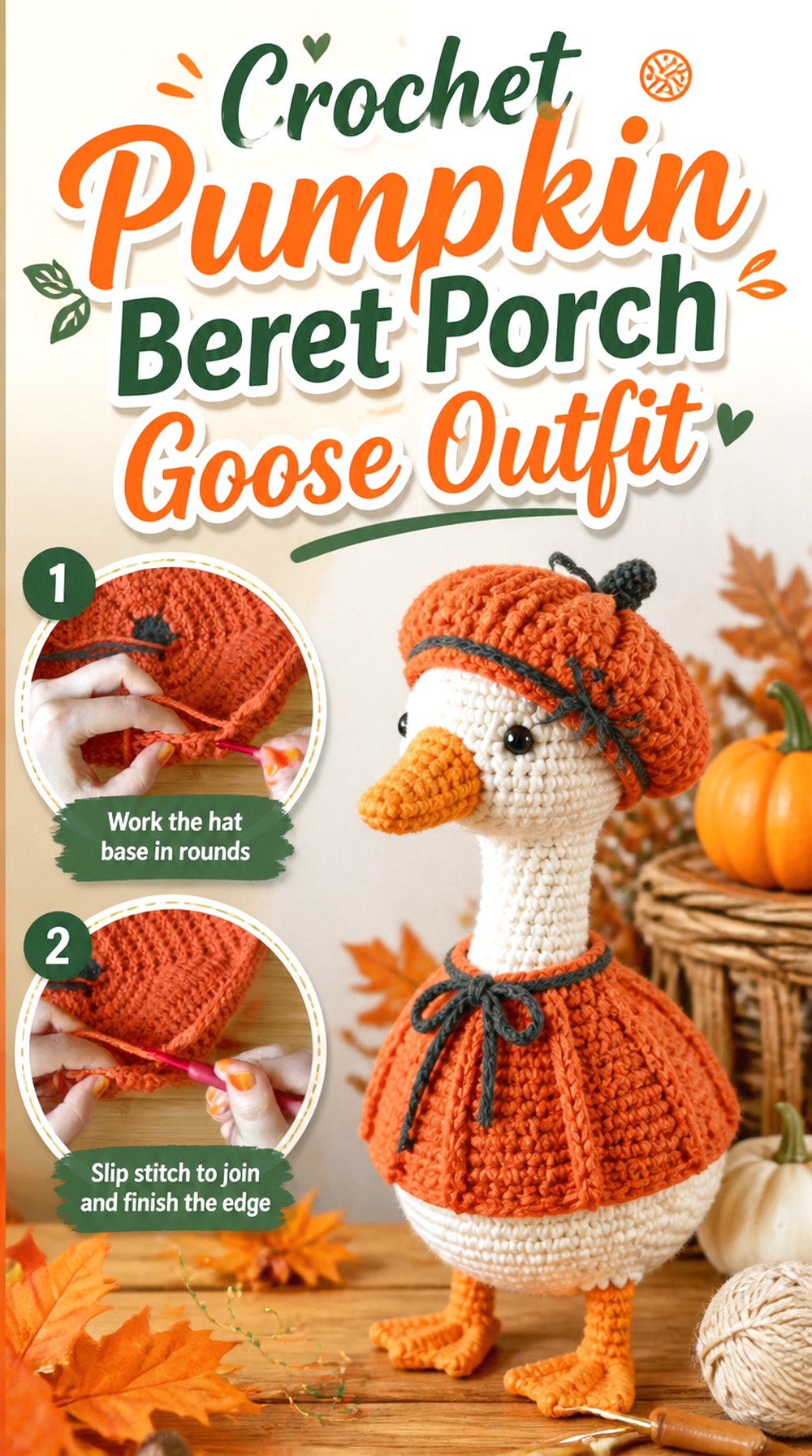
A pumpkin beret gives you a softer, rounder silhouette than the taller pumpkin topper earlier in the list. Jess And Her Crafts’ tutorial is specifically for a pumpkin beret, so the source is useful for studying how fullness, segmentation, and the top detail combine to create a recognizable squash shape.
On a porch goose, the rounded crown can become an intentionally oversized cap while the opening is adapted to the statue. Choose this idea when you want something more playful than a plain pumpkin hat but less elaborate than a full pumpkin body costume. Cream or muted rust can also make the concept feel more harvest-oriented.
Beret Fullness Creates the Pumpkin Shape
The pumpkin effect depends partly on the crown extending beyond the opening. If the scaled version fits the goose like a close beanie, much of that recognizable rounded profile disappears.
When adapting the idea, distinguish between the circumference that must fit the statue and the wider area that forms the pumpkin body. Checking both separately is more useful than shrinking every measurement at the same rate.
A Small Stem Keeps the Top Balanced
The broad beret already creates visual volume, so the stem does not need to be large to communicate “pumpkin.” An oversized stem can make the headpiece feel tall and unstable.
Position the topper after the rounded portion is finished and sitting correctly. This allows you to judge the actual scale on the goose instead of choosing the stem size while the hat is still flat on your work surface.
Original Tutorial and Creator Credit
Creator: Jess And Her Crafts
13. Crochet Sack Monster Hood Porch Goose Outfit
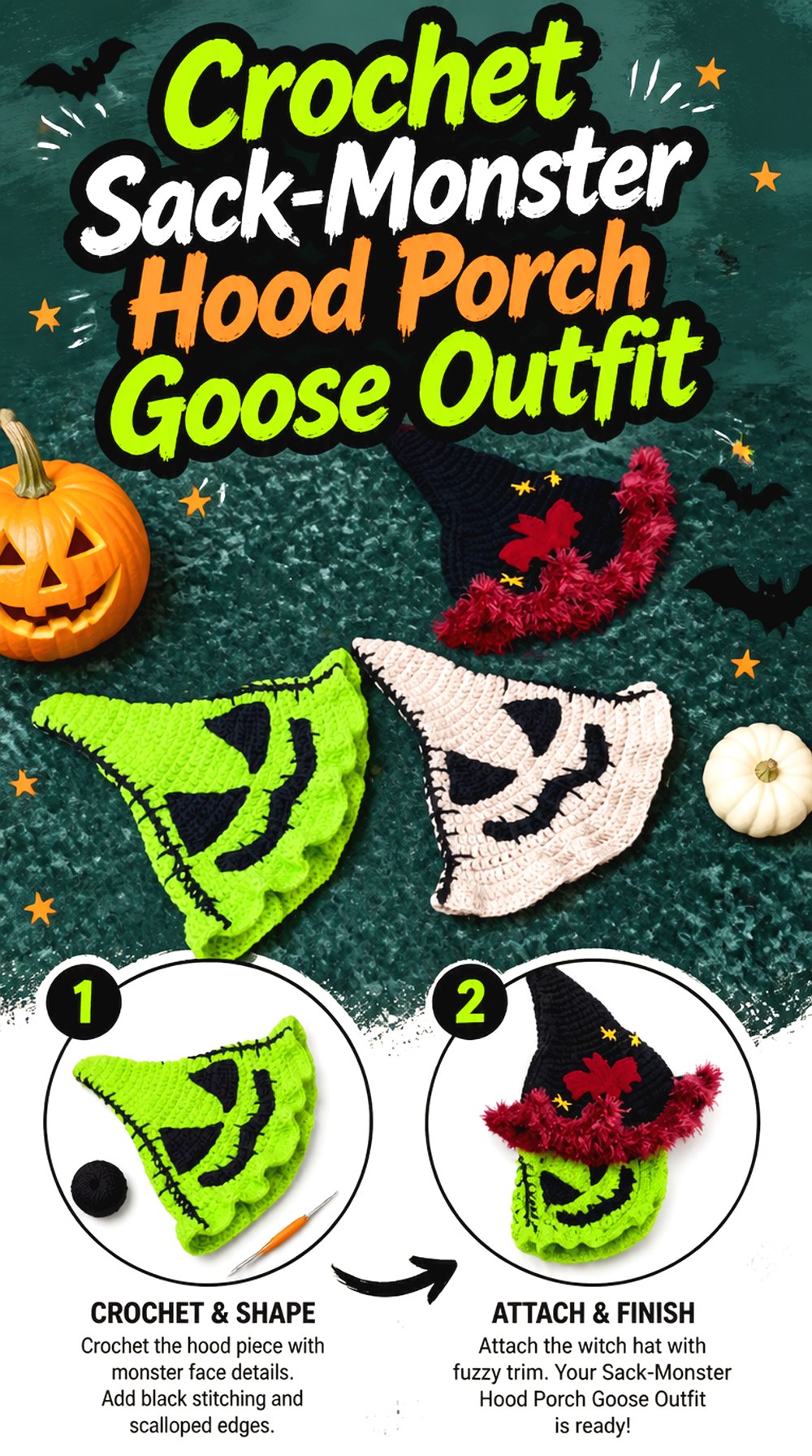
This costume direction uses the lumpy, stitched sack-monster look associated with Stitchinwithliz’s Oogie Boogie-inspired Halloween hat while turning the idea into an original porch-goose hood concept. The source demonstrates a character hat with surface details that create the personality rather than relying only on color.
For the goose version, concentrate on a loose hood-like crown with a few clearly placed face or seam accents. The statue’s long bill will already change the expression, so you do not need to reproduce the source character exactly. A muted green, khaki, or aged neutral palette can emphasize the stitched-monster feeling.
Surface Details Need to Read at Porch Distance
Fine embroidered marks may look interesting in your hands but disappear once the statue is several feet away. Prioritize a few larger seams or face shapes instead of many tiny accents.
Test the unfinished hood in its display location. If the character disappears at normal viewing distance, strengthen the contrast before adding more complexity. This keeps the design decorative without forcing you to duplicate the source hat’s specific detailing.
Use the Hood Shape, Not Human Sizing
A human hat needs depth for the crown and forehead; a goose head is much smaller and extends into a bill. Transferring the tutorial’s dimensions would therefore produce the wrong relationship even if the stitch tension were identical.
Study the overall silhouette and decorative placement, then develop the opening around your statue’s measurements. The source is a design reference, not a porch-goose size chart.
Original Tutorial and Creator Credit
Creator: Stitchinwithliz
14. Crochet Black Cat Ear Headband Porch Goose Outfit
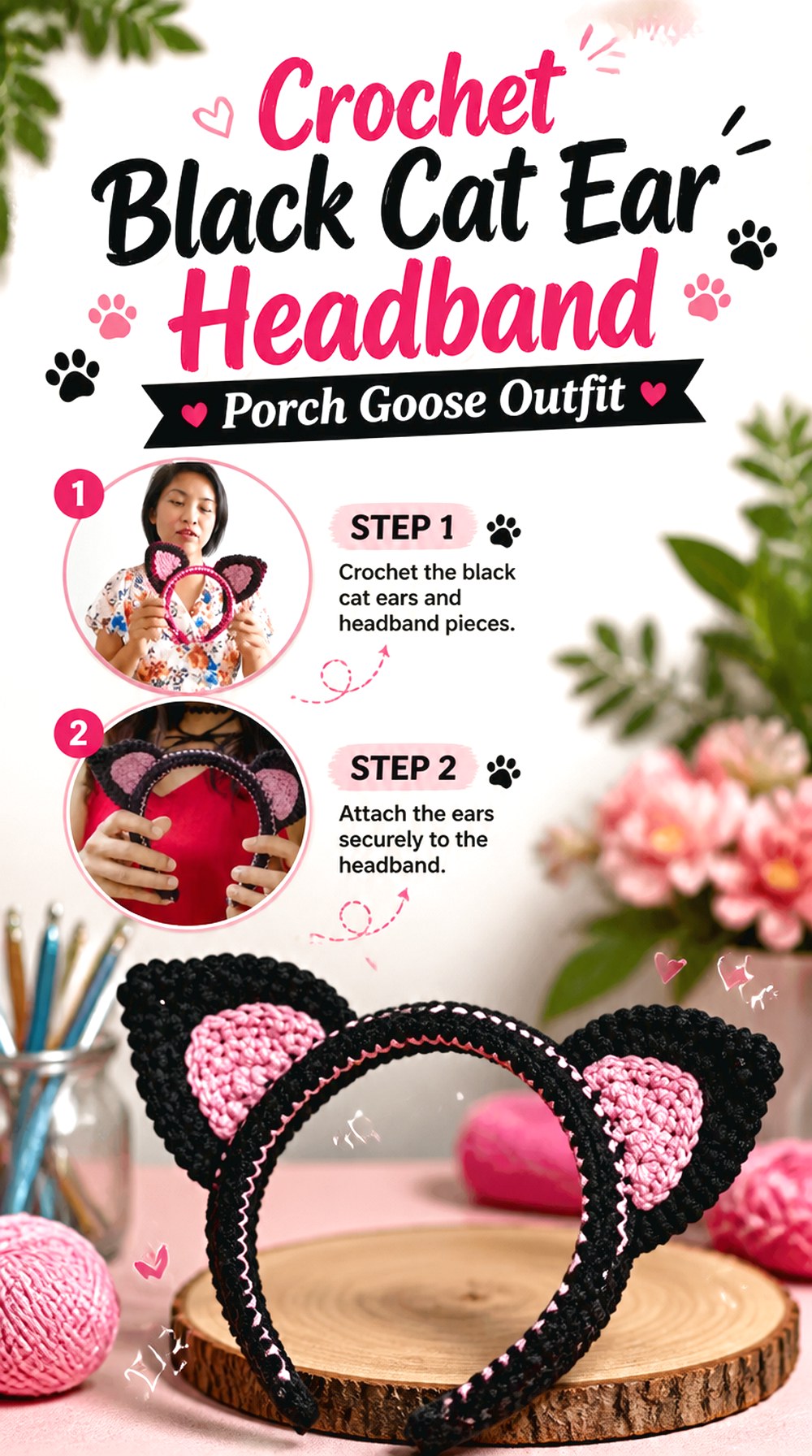
Black cat ears create a Halloween costume with almost no body coverage, which is useful if you like the original white goose to remain visible. Jennyandteddy crochet.’s tutorial teaches a crocheted cat-ear headband and shows the ears as separate shapes mounted onto a band.
That construction concept transfers neatly to a decorative goose because the band can be redesigned independently from the ears. Add a black bow, small neck collar, or tail-inspired back detail if you want to develop the costume further. Keeping the ears upright and symmetrical matters more than trying to reproduce a human headband’s original dimensions.
Ear Spacing Should Follow the Goose Head
Human cat-ear headbands often spread the ears across a much wider crown. On a narrow goose head, repeating that relationship can make the ears look as though they are falling off the sides.
Place the band on the statue first and mark the visually balanced ear positions. Then attach the ears. This simple sequence keeps the accessory centered and makes the cat silhouette read cleanly from the front.
A Detachable Band Makes Theme Swaps Easier
Because the ears are concentrated on one small accessory, you can change the goose from cat to devil, witch, or pumpkin without removing a full body garment.
That modular approach is particularly useful if you like rotating costumes during October. Keep the base neckpiece or skirt neutral, then let interchangeable headbands carry the theme. It also simplifies storage because the ears can lie flat separately from larger costumes.
Original Tutorial and Creator Credit
Creator: Jennyandteddy crochet.
15. Crochet Wizard Hood Porch Goose Outfit
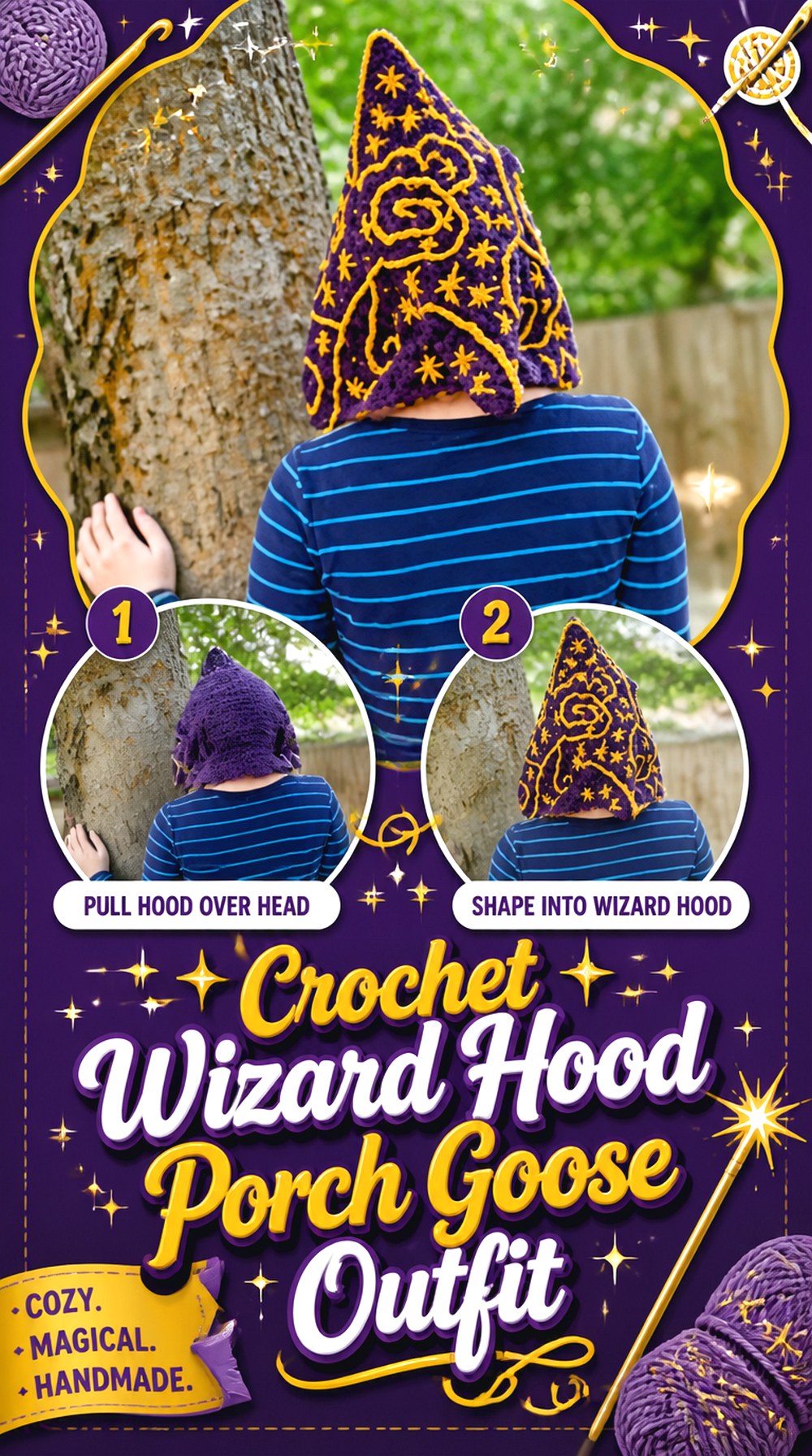
A wizard hood offers a very different profile from the wide-brimmed witch hat. KristalCrochet’s tutorial centers on a pointed hood with contrasting details, making it useful for a goose costume that covers part of the neck as well the head.
The long neck gives this idea extra potential because the hood can visually flow downward instead of sitting as an isolated cap. Dark blue, charcoal, purple, or black can create a night-sky effect, while stitched stars or simple contrasting marks can provide decoration without adding loose dimensional pieces. Keep the point proportional so the goose does not become top-heavy visually.
A Pointed Hood Needs Controlled Drape
Unlike a stiff witch hat, a hood can fold naturally. Too much contact with the lower neck ratherde will make the point disappear into excess fabric, though, as may a twist at the opening.
Fit the lower section first and let the point fall from a stable base. Check both sides to make sure it bends intentionally rather than because the hood is pulling unevenly around the statue.
Embroidery Can Replace Loose Add-Ons
Stars, moons, stitches, or other flat yarn details can create a strong wizard theme without dangling charms or bulky appliqués. That is useful on an outdoor decorative piece where protruding components can snag during handling.
Choose only enough surface decoration to remain visible. The pointed hood already carries much of the costume identity, so leaving some plain fabric can make the silhouette stronger rather than unfinished.
Original Tutorial and Creator Credit
Creator: KristalCrochet
16. Crochet Halloween Bow Accent Porch Goose Outfit
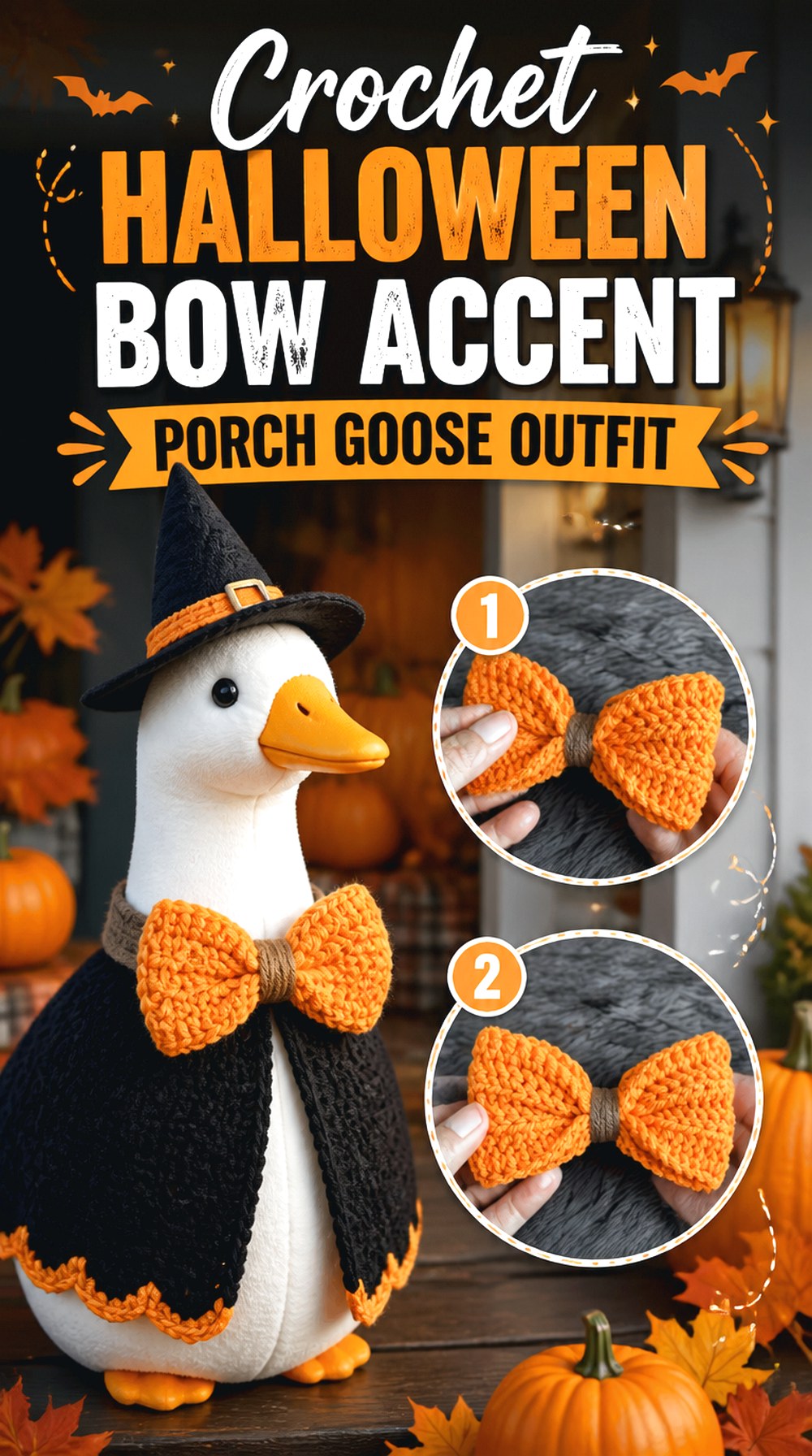
Not every porch goose costume needs a complicated hat or cape. Vicky Handmade’s Halloween bow tutorial provides a small-scale accessory that can become the finishing element on a simple black, orange, purple, or striped goose outfit.
A bow can sit at the neck, at the front of a skirt, on a hat band, or on a separate headband. Because the tutorial’s original bows are hair-tie accessories, use the source for the crochet bow concept rather than copying the elastic attachment. This option is particularly useful when you already have a basic goose garment and want to convert it into a Halloween-specific outfit.
Small Bows Work Best as Secondary Details
A miniature bow usually works better as punctuation than as the entire costume. Place it where it reinforces a larger shape—for example, at the center of a collar or beside a witch-hat band.
Before making several, test one finished bow on the goose. If it already reads clearly at porch distance, repeating the same detail around the outfit may create unnecessary visual clutter.
Choose One Attachment Point and Repeat It
If you plan to make interchangeable bows, use the same attachment location on the base costume. That lets you rotate spider, pumpkin, ghost, candy-corn, or simple striped colorways without redesigning the garment.
A consistent attachment point also makes storage easier because the decorative bows can be removed before washing or packing. Avoid permanently attaching every seasonal accent if you want the underlying goose clothing to serve multiple holidays.
Original Tutorial and Creator Credit
Creator: Vicky Handmade
17. Crochet Bat Cape Porch Goose Outfit
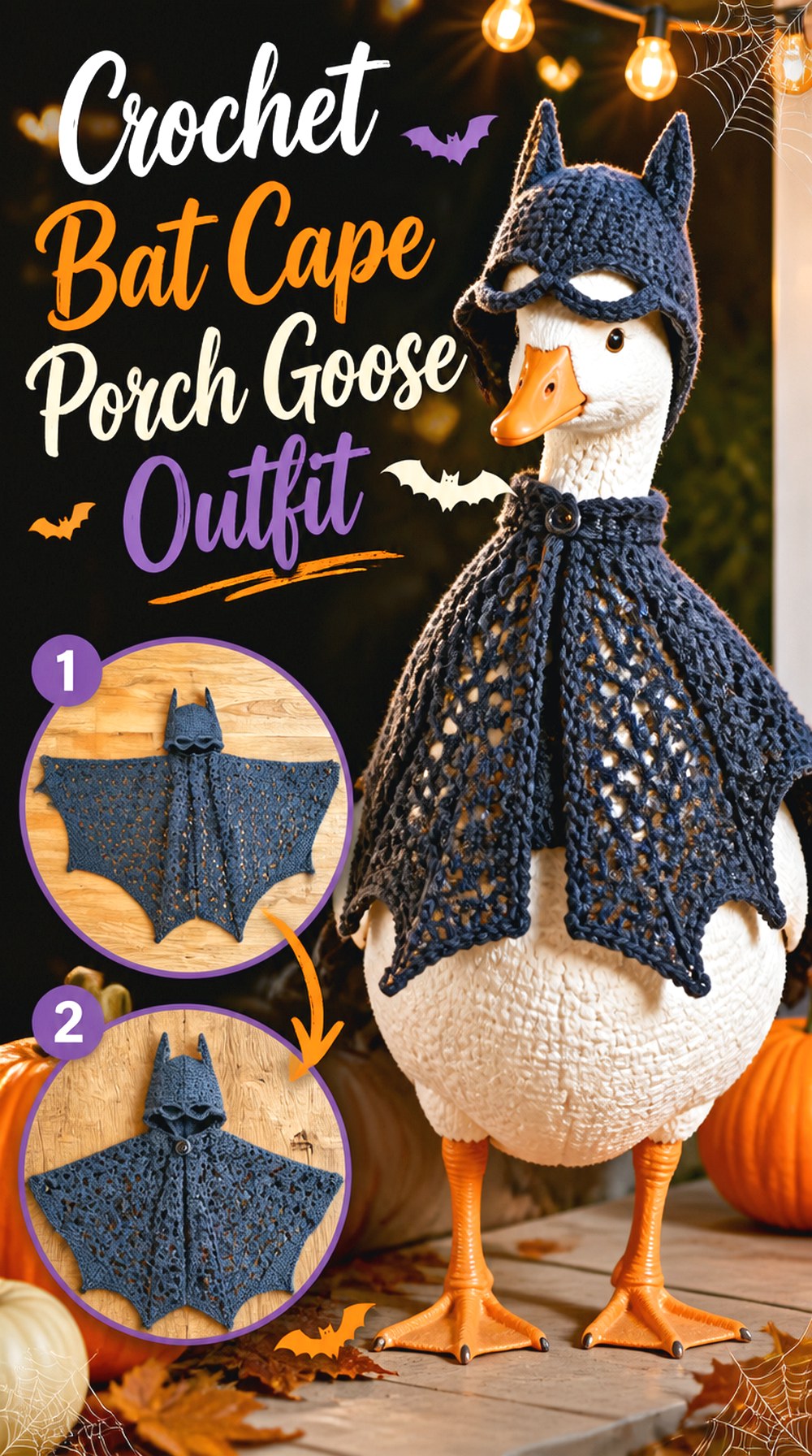
The bat cape creates one of the broadest silhouettes in this roundup. Crochet Me That (Formally Creeksendinc) provides a guided tutorial for a toddler-size crochet bat cape, offering a useful visual reference for how scalloped or wing-like edges can turn a cape into a costume.
For a porch goose, the project should be treated as a scaled neck cape, not a miniature toddler garment. Preserve the bat-wing outline while rebuilding the neckline around the statue. This costume works especially well when the goose is viewed from an angle because the cape can spread over the back without hiding the head.
A Cape Gives More Halloween Impact Than a Hat
If your porch goose sits among pumpkins or taller decorations, a small hat may visually disappear. A bat cape adds width and creates a larger dark shape around the white statue.
That makes it a strong option for displays viewed from a driveway or sidewalk. Keep the center front relatively simple so the cape does not compete with the bill and neck for attention.
Keep the Wing Edge Above the Ground
A human cape can extend far down the body, but a goose statue sits much closer to the ground. Over-scaling the length can cause the lower wing points to drag, fold under the base, or collect debris.
Measure downward from the intended neckline while the goose is standing. Set a maximum finished length before adapting the wing shape so the lowest points remain clear of the porch surface.
Original Tutorial and Creator Credit
Creator: Crochet Me That (Formally Creeksendinc)
18. Crochet Pumpkin Cowl Porch Goose Outfit
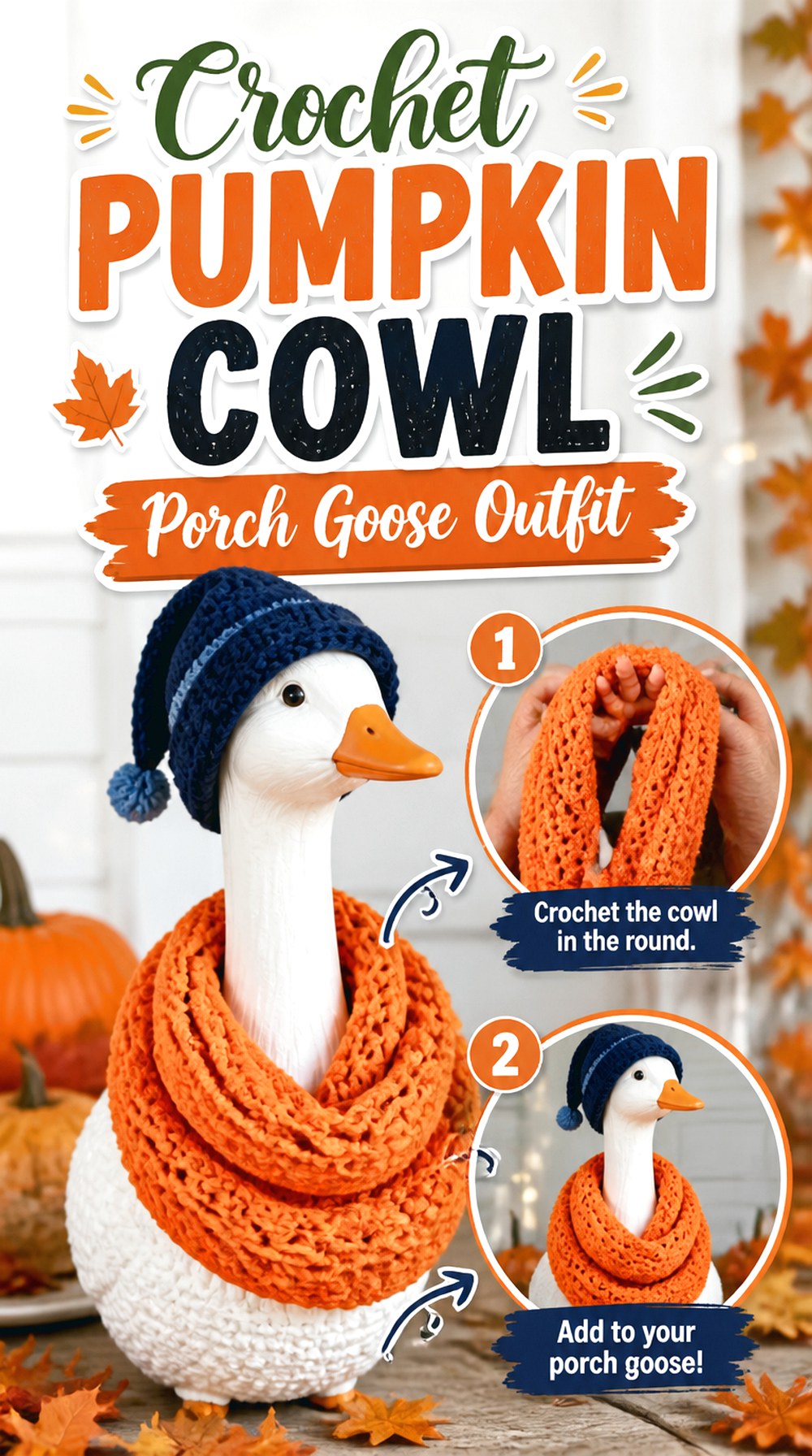
A pumpkin-colored cowl is the quietest costume in the collection and a useful alternative when you do not want anything sitting on the goose’s head. Fiber Flux’s Pumpkin Fluff Crochet Cowl is a fall accessory with a soft, strongly textured appearance. The human-scale source should be treated as inspiration for the neckpiece format and texture rather than as direct porch-goose sizing.
On a goose, a shorter cowl can create a thick seasonal collar around the lower neck. Add a removable leaf or small stem-inspired accent if you want a clearer pumpkin reference, or leave the texture alone for a costume that can remain on display beyond Halloween.
A Cowl Is Useful When You Want No Headpiece
Some porch-goose statues have narrow or unusually shaped crowns that make hats difficult to stabilize. A neck cowl bypasses that issue entirely.
It also keeps the face unobstructed, which can be useful on a goose with painted eyes or other features you do not want to hide. Check that the cowl settles at the lower neck instead of gradually climbing toward the bill.
Texture Matters More Than Pumpkin Orange
Orange alone can read as generic fall decor. Raised or fluffy texture gives the cowl more visual presence and helps distinguish it from a plain neck warmer.
If you substitute yarn, consider how clearly that texture appears rather than choosing solely by color. A cream, rust, moss, or muted gold version can still fit a harvest costume if the fabric has enough dimension to stand out on the statue.
Original Tutorial and Creator Credit
Creator: Fiber Flux
How the 18 Crochet Porch Goose Outfits Compare
| Outfit Direction | Main Visual Area | Planning Priority | Good Choice When You Want |
|---|---|---|---|
| Skirt and collar | Full body | Waist and neck fit | A complete goose-specific costume |
| Witch hat | Head | Brim clearance | Classic Halloween imagery |
| Pumpkin topper | Head | Stable crown fit | A compact harvest costume |
| Spiderweb cape | Back and shoulders | Centered neckline | Openwork and dramatic texture |
| Bat-wing backpiece | Back | Wing angle | A strong side silhouette |
| Devil horns | Head | Band fit | A tiny interchangeable costume |
| Green monster hat | Head | Face placement | Character-style detail |
| Ghost hat | Head | Contrast | A light-colored spooky look |
| Skull bandana | Neck/chest | Motif scale | A compact gothic accessory |
| Skull scarf | Neck/body | Finished length | A longer vertical accent |
| Clown collar | Neck | Ruffle volume | A theatrical silhouette |
| Pumpkin beret | Head | Crown fullness | A rounded novelty shape |
| Sack-monster hood | Head/neck | Surface detail | A stitched creature look |
| Cat ears | Head | Ear spacing | Minimal body coverage |
| Wizard hood | Head/neck | Drape | A pointed fantasy silhouette |
| Halloween bow | Accent area | Placement | A reusable base outfit |
| Bat cape | Back/body | Ground clearance | Maximum cape impact |
| Pumpkin cowl | Neck | Texture | A costume with no headpiece |
Conclusion
The most useful way to choose among these crochet Halloween porch goose outfit ideas is by silhouette rather than theme alone. Choose the skirt-and-collar costume when you want a complete dressed goose, a witch or pumpkin hat for a head-focused display, or the spiderweb and bat capes when you need a larger shape that reads from farther away. Skull accessories and the clown collar emphasize the neck, while cat ears, horns, bows, and the pumpkin cowl are easier to combine with reusable base pieces.
Whichever direction you choose, measure your actual statue instead of transferring human or pet sizing. Use the original tutorials for their exact construction details and adapt only where the goose’s proportions require it.
Frequently Asked Questions
Can I use a human crochet hat tutorial directly for a porch goose?
Use it as a construction and shape reference, but do not assume the original sizing will transfer. Human hats are designed around a much wider, rounder head. Measure the part of your goose where the hat will actually rest, then evaluate crown depth, opening shape, and brim clearance separately. Preserving the visual silhouette is usually more important than shrinking every original dimension by the same percentage.
What should I measure before making a crochet porch goose costume?
Measure only the areas relevant to the chosen costume. A hat needs the resting circumference and available head depth; a collar or cowl needs the neck area where it will sit; a skirt needs the body section supporting its upper edge; and a cape needs both a neckline measurement and a suitable finished length. Write the measurements down and check the unfinished piece on the statue before adding decorative details.
Which Halloween goose outfit is easiest to adapt when I do not know the statue’s exact brand?
Adjustable accessories are generally more forgiving than closely fitted garments. A tied bandana, small cape, detachable bow, or adjustable headband gives you more room to fit the actual statue than a deeply shaped hat. That does not guarantee a universal fit, however. Decorative porch geese vary, so even an adjustable project should be checked against the specific goose before final finishing.
What yarn works well for a porch goose Halloween outfit?
Choose according to the effect and display conditions rather than assuming one fiber is universally best. Smooth yarn can help skulls, stripes, spiderwebs, and facial details read clearly, while firmer fabric can support hats and structured shapes. Softer fabric is useful for draped capes and cowls. If the goose will be outdoors, also check the yarn manufacturer’s care guidance and avoid assuming crochet fabric is weatherproof.
How can I stop a crochet cape or scarf from twisting around a porch goose?
Start by checking the anchor point rather than immediately adding more ties. A neckline that is too heavy or a scarf with uneven hanging weight can rotate even when it feels tight. Position the accessory on the standing statue and look for balance from both sides. Shortening an excessively long tail, reducing a heavy embellishment, or changing where the piece fastens may work better than tightening it further.
Should I leave a crochet porch goose outfit outside in rain?
Do not assume a costume is suitable for prolonged rain simply because the yarn itself can be washed. Moisture can affect the fabric, embellishments, stuffing, closures, and the statue beneath it differently. Check the care guidance for every material you use. Removable costume pieces make it much easier to bring the crochet indoors during wet or severe weather and return it to the display afterward.