Indoor plants look lovely on windowsills, shelves and side tables, but their pots can leave scratches, damp rings or messy marks on furniture. These 13 crochet indoor plant pot drainage mat inspiration ideas explore decorative mats that sit beneath proper plant saucers, adding a handmade finish while helping separate hard ceramic surfaces from the furniture below. From sage moss stitches and terracotta ribs to checkerboard squares, delicate scallops and leaf-shaped borders, each concept offers a different way to style small houseplants.
The designs include round mats for individual pots, wider pieces for grouped plants, compact windowsill layouts, and coordinated sets for open shelving. They also explore border shape, stitch density, size and ease of cleaning. One important distinction runs through the collection: crochet is not waterproof and cannot replace a plant drainage saucer. The pictured mats are decorative underlays beneath separate water-catching trays, rather than fabric intended to collect runoff directly.
These are AI-generated crochet design visualizations for inspiration, not photographs of tested handmade pieces or step-by-step patterns.
Quick Design Selection Guide
- For a small everyday planter: Crochet Sage Moss-Stitch Round Saucer Mat offers a simple circular shape with a smooth cream border.
- For a textured pottery display: Crochet Terracotta Ribbed-Ring Plant Saucer Mat creates a raised decorative ring outside the saucer.
- For two plants together: Crochet Oatmeal Oval Twin-Saucer Plant Mat and Crochet Rust Chevron Windowsill Plant Mat accommodate two separate saucers.
- For delicate decorative edges: Crochet Ivory Scalloped Ceramic Saucer Mat and Crochet Teal Airy-Mesh Border Saucer Mat add more openwork beyond a solid center.
- For geometric color: Crochet Lavender Granny-Corner Plant Pot Mat and Crochet Cobalt Checkerboard Square Saucer Mat offer square silhouettes.
- For an adaptable shelf collection: Crochet Mint Modular Trio Saucer Mat Set gives each small planter its own matching mat.
1. Crochet Sage Moss-Stitch Round Saucer Mat
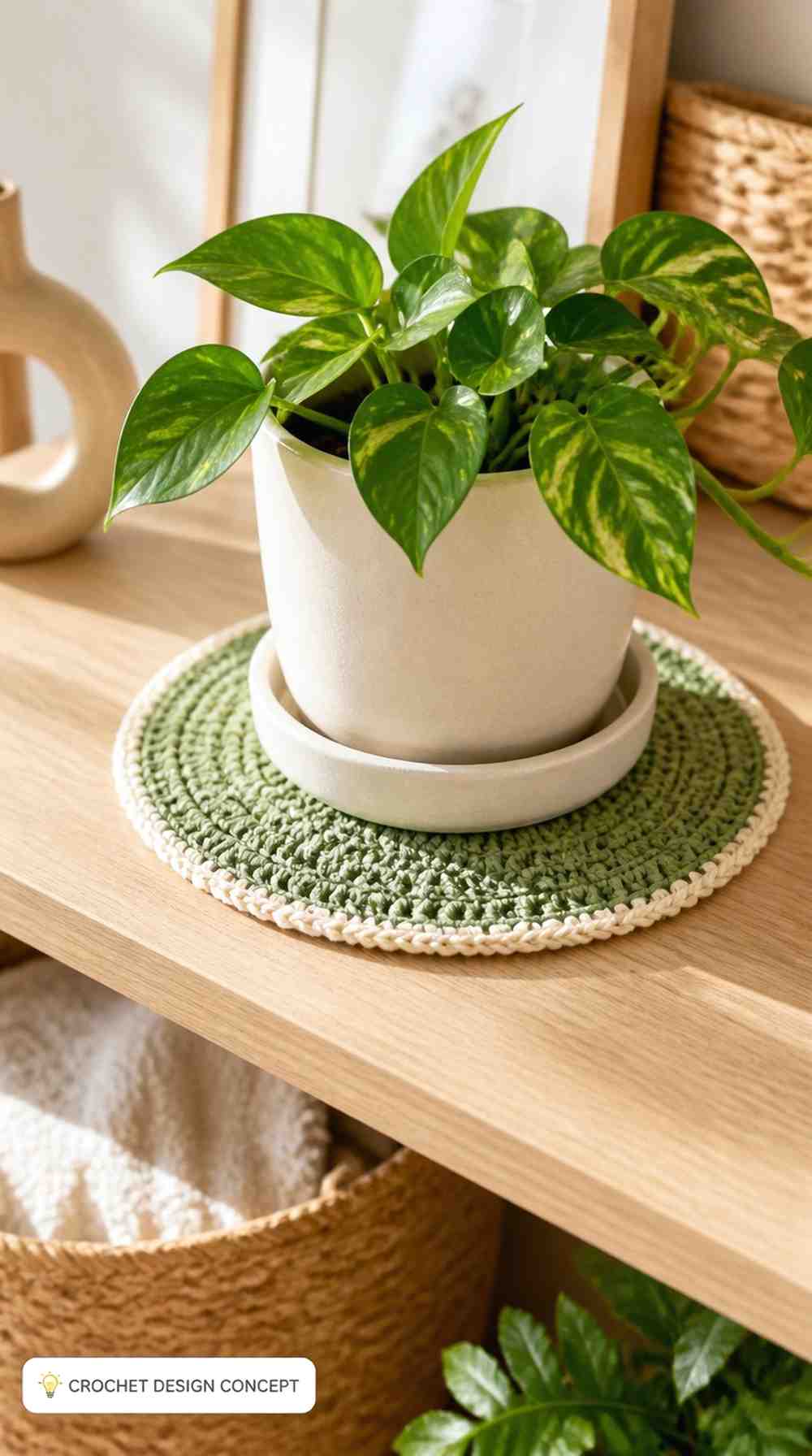
Soft sage-green moss stitches form a compact circular crochet mat with a smooth cream border. A shallow ivory drainage saucer rests in the center, holding a matching ceramic pot with a healthy green pothos. A narrow ring of crochet remains visible around the pottery.
The simple round shape makes this a useful starting point for decorating one small plant on an indoor shelf. Its close stitching creates an even-looking surface, although the separate ceramic saucer—not the crochet—must catch any water draining from the pot.
- Saucer sizing: Measure the outside base of the drainage saucer, then allow a modest exposed crochet border around it.
- Flat stitching: Keep the moss-stitch center even so the saucer stays level rather than rocking on raised crochet sections.
- Cleaning access: Lift off the saucer before cleaning the mat, and check underneath for hidden moisture after watering.
2. Crochet Terracotta Ribbed-Ring Plant Saucer Mat
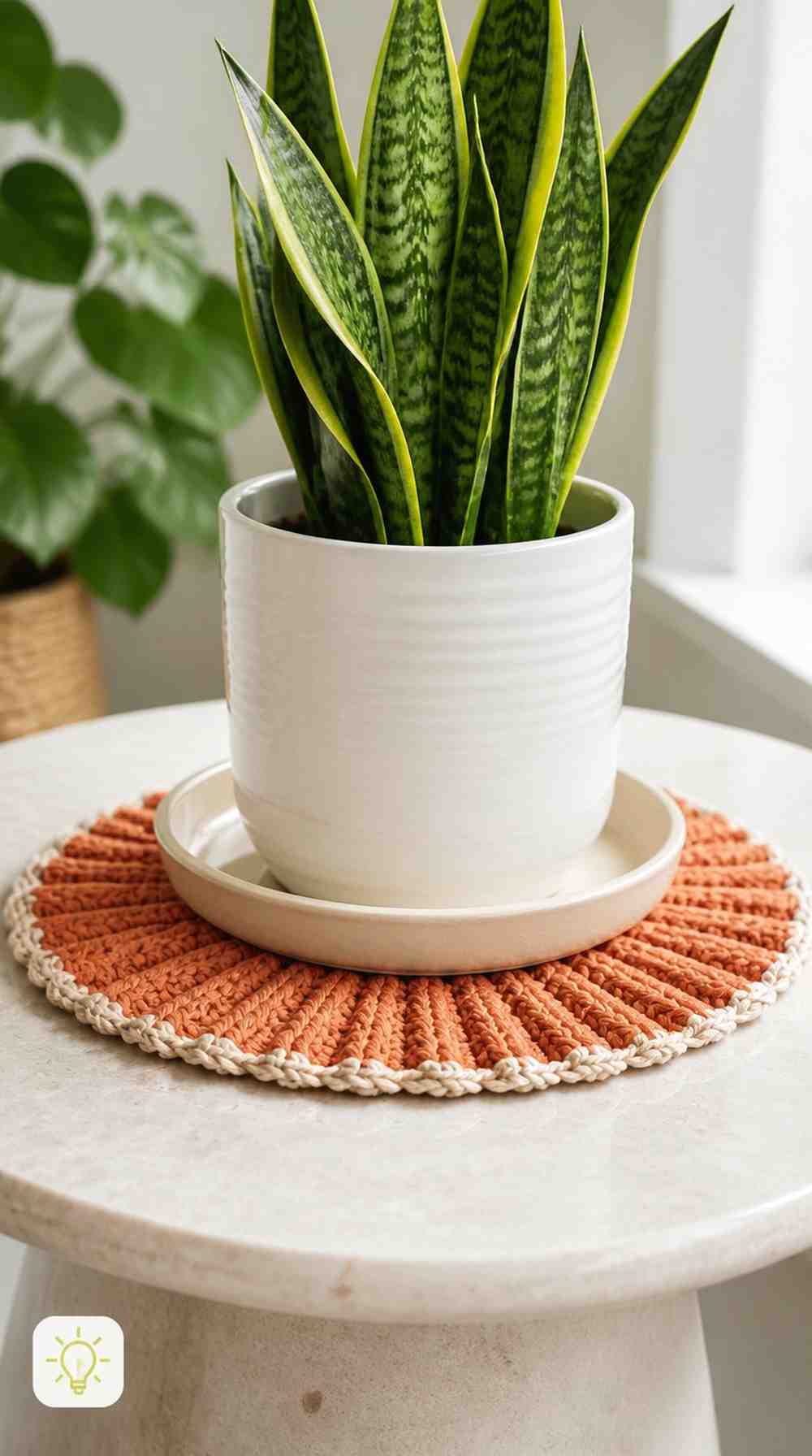
Terracotta-orange crochet creates a round mat with a closely worked flat center and low radial ribs circling the outer edge. Oatmeal yarn finishes the perimeter, while a glazed cream saucer holds a small white pot containing an upright snake plant.
The ribbed outer ring gives this design a more structured appearance than a plain coaster. Its practical detail is the separation between the flat supporting area and the raised decoration. Keeping the ribs outside the saucer’s footprint helps the pottery sit more evenly.
- Rib placement: Position raised crochet stitches beyond the saucer edge so they do not tilt the pot or reduce its stability.
- Decorative ring: Treat the outer ribbing as an accent, not a water barrier; it cannot safely contain drainage runoff.
- Pot weight: Check that the mat lies flat beneath the actual filled saucer and does not bunch around its base.
3. Crochet Oatmeal Oval Twin-Saucer Plant Mat
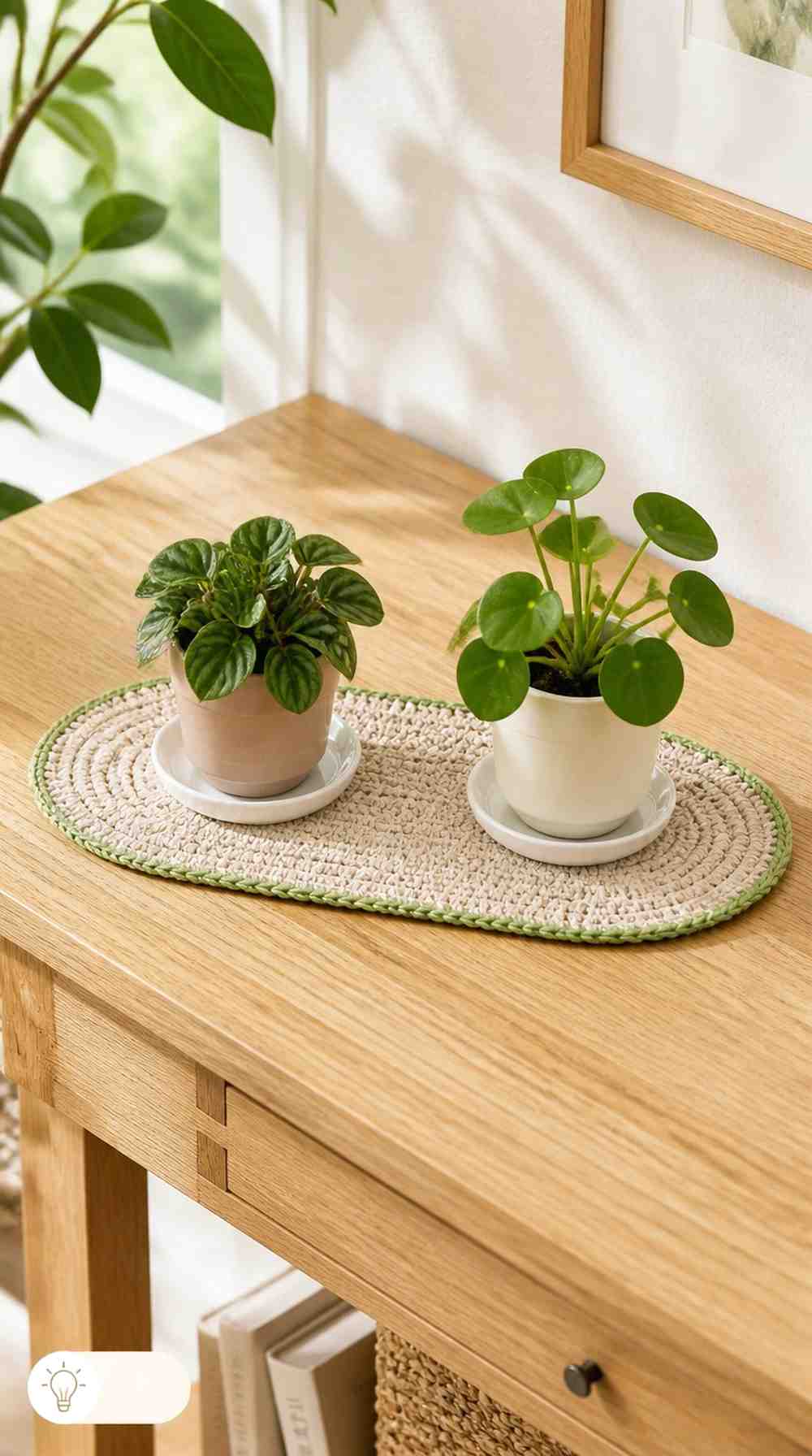
Warm oatmeal crochet forms a long oval mat with smooth half-double-crochet rows and a muted-sage outer border. Two small white ceramic saucers sit separately on the surface, one beneath a pale-clay peperomia pot and the other beneath an ivory pilea planter.
The oval layout makes this concept useful for creating a coordinated pair of plants on a console or deep shelf. Rather than balancing both pots in one large tray, each planter keeps its own saucer. The shared crochet mat simply provides a visual base beneath both.
- Two-saucer spacing: Leave enough room between the ceramic saucers for easy lifting, watering and checking for collected water.
- Oval proportions: Size the mat to the full arrangement rather than stretching a small round mat into a long shape.
- Surface protection: Both saucers must remain watertight; an exposed section of crochet between them will not contain spilled water.
4. Crochet Ivory Scalloped Ceramic Saucer Mat
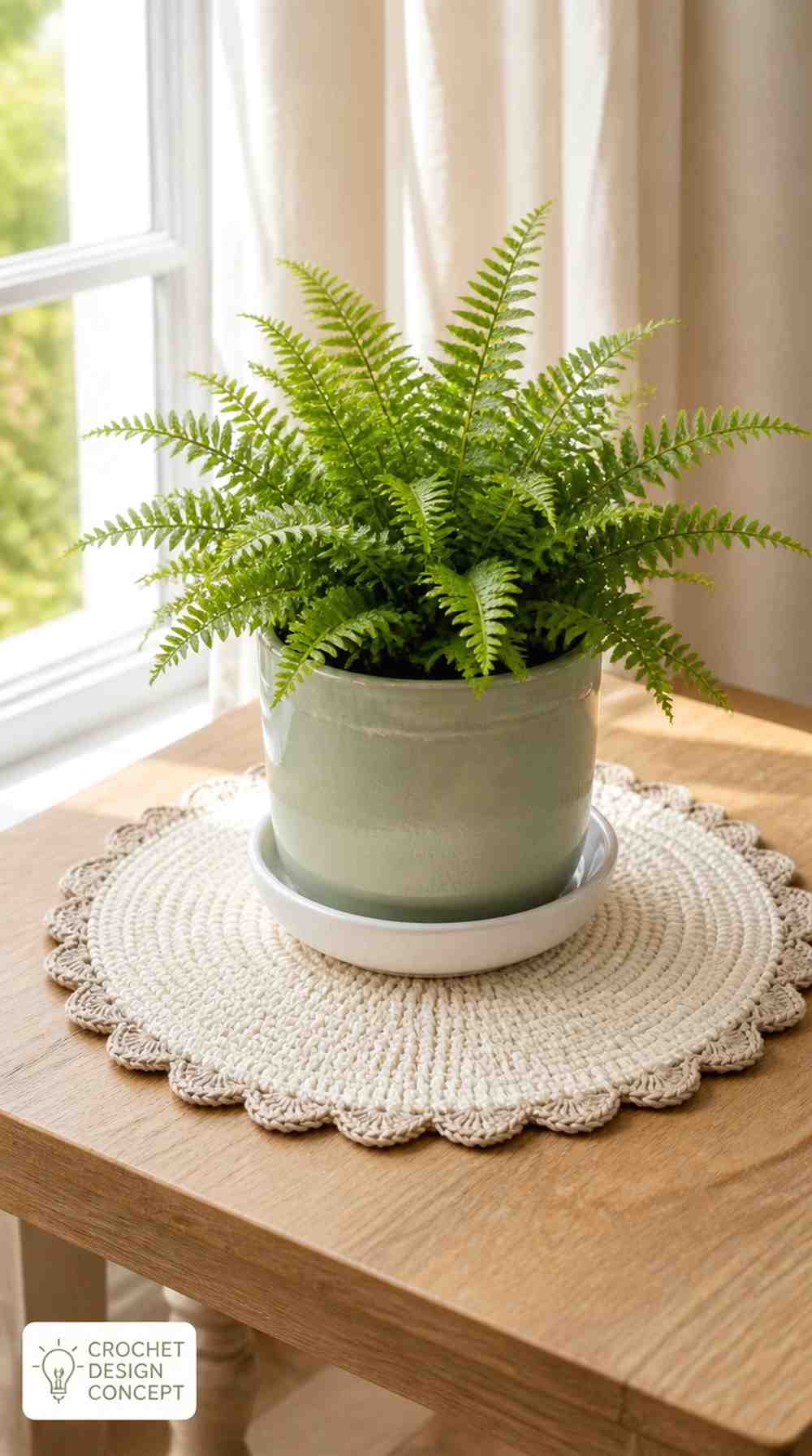
Ivory crochet forms a delicate circular mat with close concentric stitch rounds and small oatmeal scallops around the outside. A pale-sage ceramic fern pot sits in its own shallow white drainage saucer, leaving the scalloped border visible against the wooden table.
The scallops give this mat a softer cottage-style finish without changing the simple round center. It works best visually when the decorative edging extends beyond the saucer. If the scallops are too large, however, they may curl or catch during handling.
- Scallop clearance: Leave the outer edging fully exposed beyond the saucer rather than letting the ceramic press on uneven decorative stitches.
- Leafy plants: Allow enough table space around the mat so fern leaves do not brush against wet surfaces or get trapped during watering.
- Shape retention: Block or flatten the finished crochet appropriately for its yarn before placing a stable saucer on top.
5. Crochet Lavender Granny-Corner Plant Pot Mat
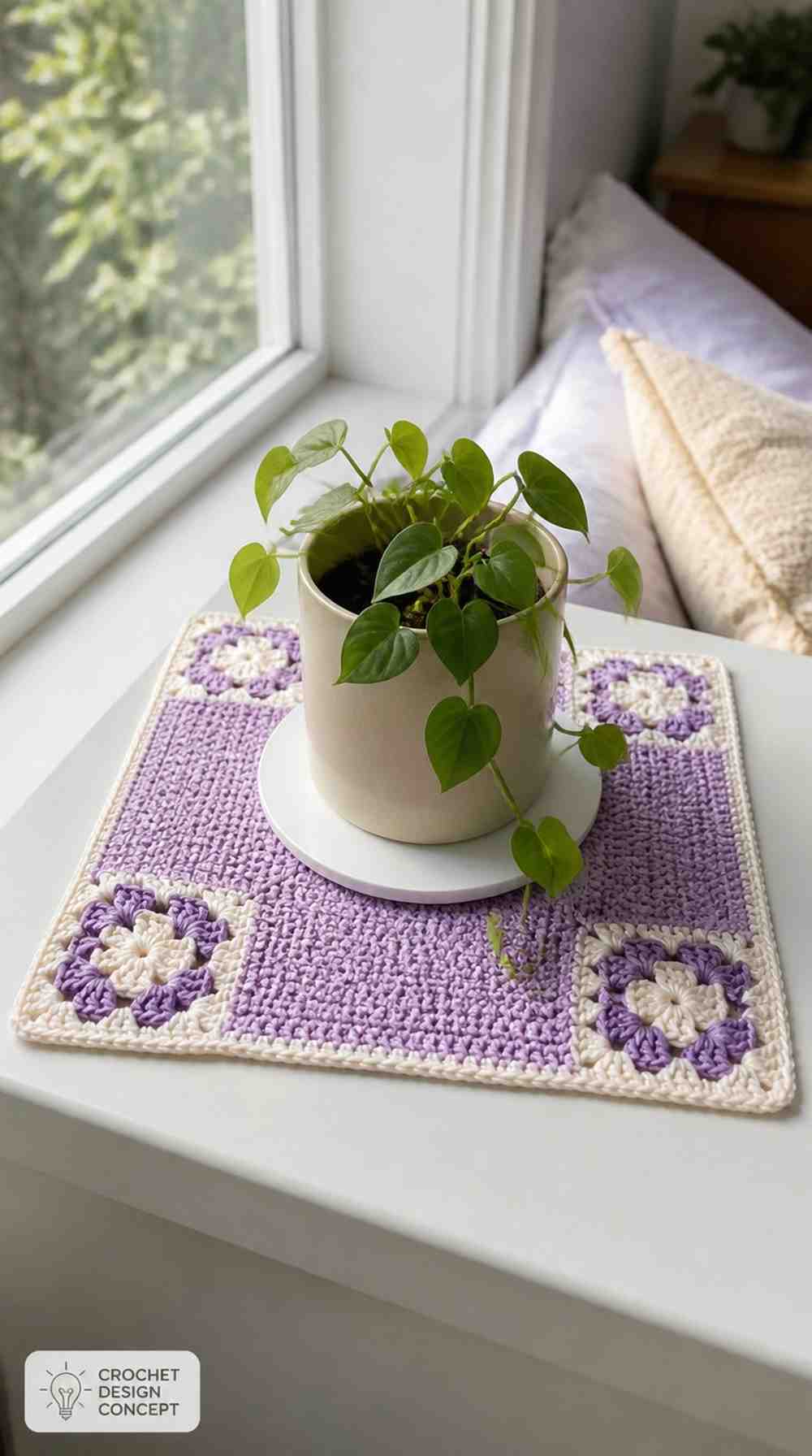
Lavender crochet gives this square mat a patchwork appearance, with four small granny-square motifs at the outer corners and a dense pale-lavender central panel. A round white drainage saucer supports a cream pot with a trailing heartleaf philodendron.
The solid center is what distinguishes this design from a large traditional granny square. It creates a flatter resting area for the saucer, while the open crochet clusters remain visible as decorative corners. The seams and contrasting cream joins add a little texture without covering the entire base.
- Center support: Keep the working area beneath the saucer closely stitched and flat rather than relying on open granny-square holes.
- Joining seams: Check that the cream seams do not create thick ridges where the saucer contacts the mat.
- Trailing leaves: Leave enough free space around the planter so long stems are not pinched when lifting the saucer.
6. Crochet Cobalt Checkerboard Square Saucer Mat
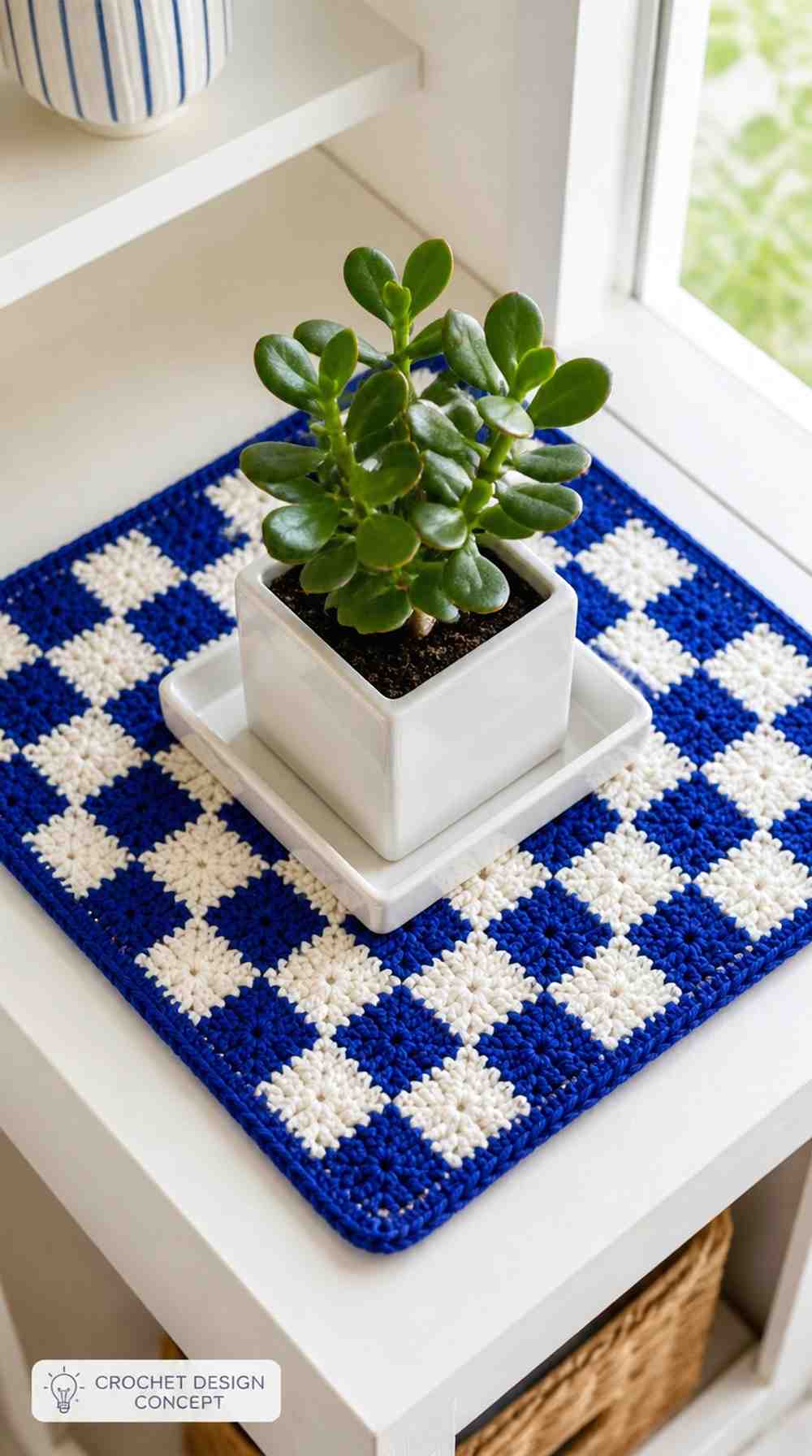
Bold cobalt-blue and warm-white crochet squares create a compact checkerboard mat with a solid cobalt border. A shallow square white ceramic drainage tray sits at the center, holding a matching planter with a small jade plant. The checkerboard remains visible as an even frame.
This design pairs square pottery with geometric crochet, making it a good option for a modern plant shelf. Its colorwork is the main decorative feature. A flat stitch arrangement matters more than raised embellishments because the square ceramic tray needs a level base.
- Square tray fit: Measure the drainage tray across its straight outer edges, allowing space for a consistent checkerboard border.
- Colorwork flatness: Keep yarn changes and loose ends secured so the mat does not develop bumps beneath the tray.
- White-yarn care: Check the cream yarn for staining and follow its care instructions if potting soil or dust reaches the exposed border.
7. Crochet Butter Yellow Daisy-Edge Plant Mat
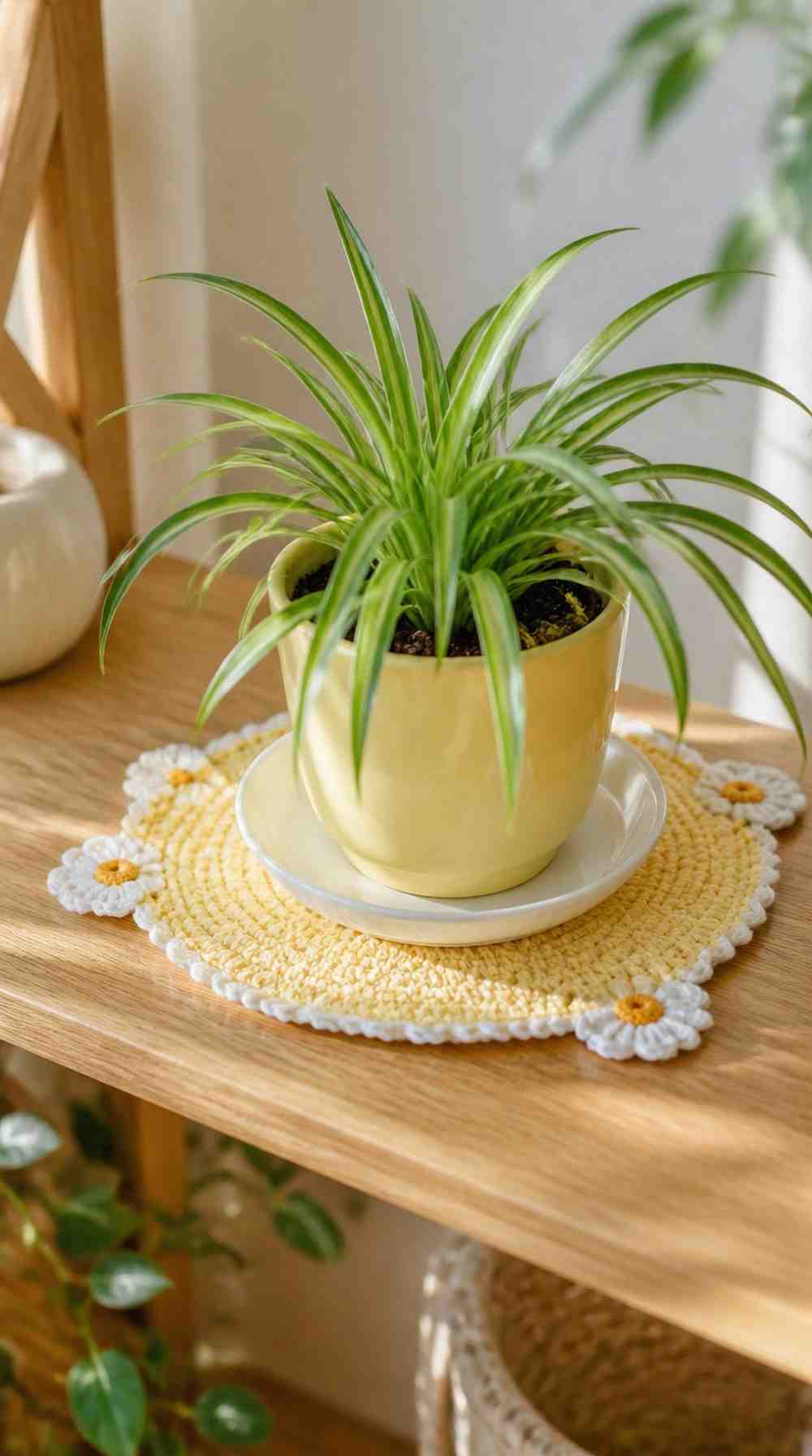
Butter-yellow crochet forms a cheerful round mat with a dense spiral center, an ivory border and four small flat daisies positioned along its outer edge. A separate white drainage saucer holds a pale-yellow pot with a compact spider plant.
The flower decorations give this piece a playful appearance without adding a raised surface beneath the pottery. Keeping the daisies outside the saucer means the plant can remain centered on the flat yellow mat. It is a useful direction for a small, colorful windowside display.
- Flat floral motifs: Keep all four daisies securely attached and outside the saucer’s footprint to avoid creating an uneven resting surface.
- Color harmony: Butter yellow and ivory suit light shelves, while the small mustard centers echo warmer pottery tones.
- Plant movement: Lift the saucer and pot together when necessary; avoid dragging the ceramic base across the flower edging.
8. Crochet Charcoal Hexagon Waffle Pot Mat
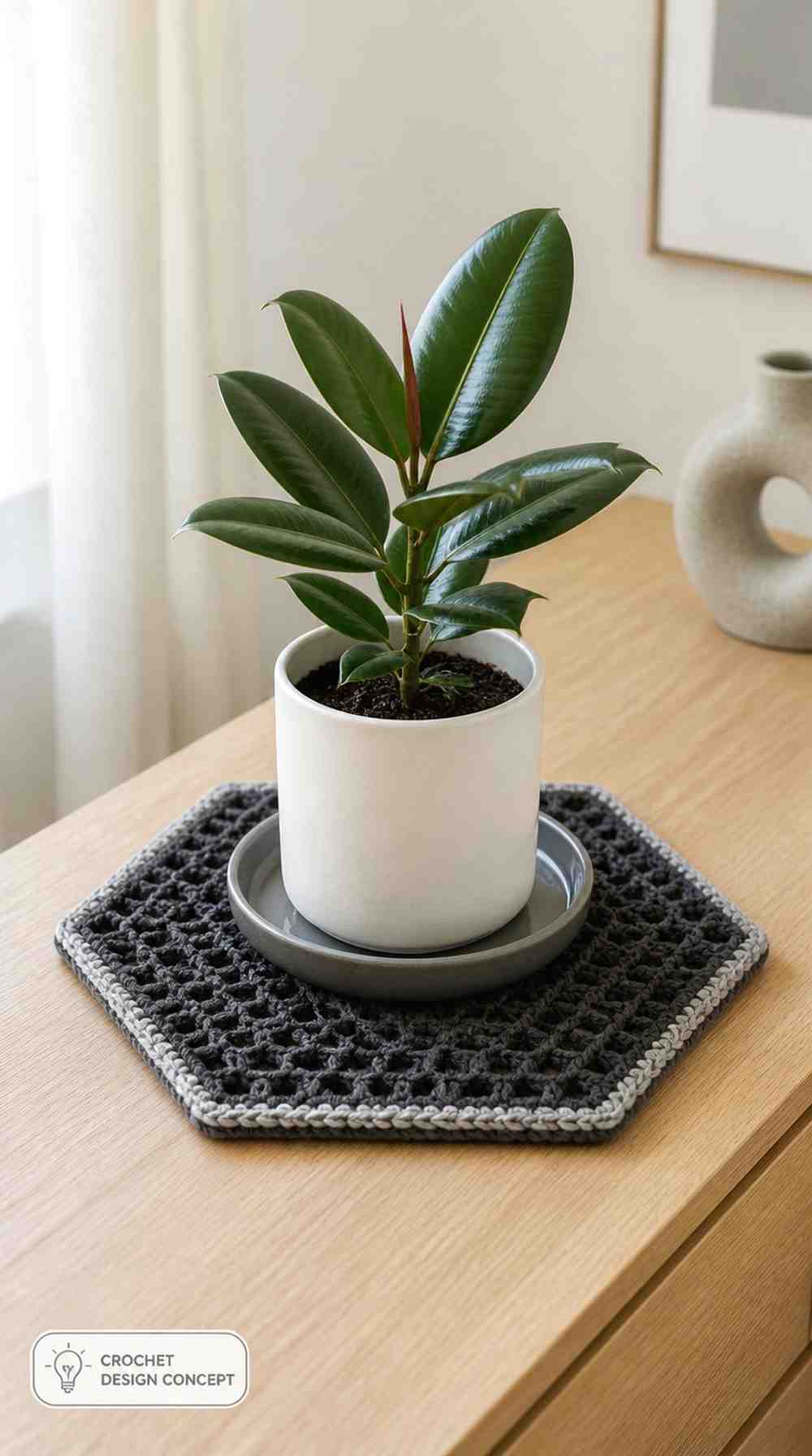
Charcoal-gray crochet forms a six-sided mat with shallow waffle texture and a narrow muted-silver border. A small round gray drainage saucer sits over its central area, supporting a matte-white planter with a compact rubber plant.
The contrast between a hexagonal mat and round saucer gives this design a more architectural look. The six corners stay visible around the pot, while the low textured center provides visual depth. Actual stitch thickness would need checking before assuming that a waffle surface can support a heavy ceramic planter evenly.
- Six-sided symmetry: Keep the hexagon sides and corners balanced so the mat does not appear distorted beneath a circular saucer.
- Raised texture: Use low-profile waffle stitches in the supporting area and test whether the filled saucer stays level.
- Dark-yarn care: Charcoal yarn may hide dust at first glance, so remove the pot periodically and inspect the full mat.
9. Crochet Teal Airy-Mesh Border Saucer Mat
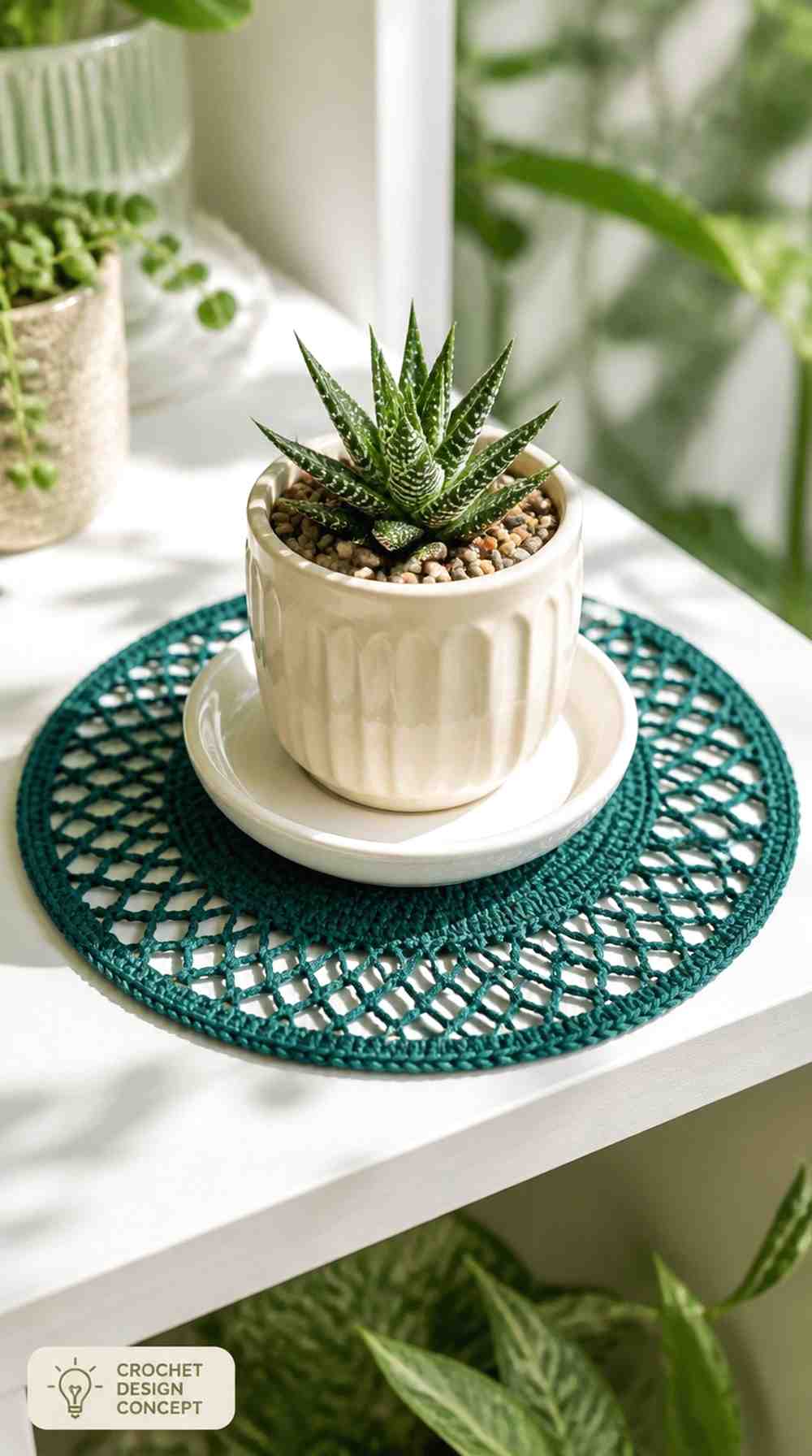
Teal crochet creates a compact round mat with a firm solid center surrounded by a ring of diamond-shaped open mesh. A narrow solid teal edge finishes the outside. A miniature haworthia in a cream pot rests in a white ceramic saucer placed entirely over the dense center.
The open mesh gives the mat a lighter appearance than a fully solid design. Its structure also makes an important distinction: the airy border is decorative, while the center provides the contact surface beneath the saucer. Neither section is intended to collect or drain plant water.
- Central diameter: Make the dense circle large enough for the entire base of the ceramic saucer, not just the planter itself.
- Mesh placement: Keep the diamond openings outside the area carrying the saucer so the tray does not rest on uneven crochet gaps.
- Dry display: If the mesh edge becomes wet during watering, remove the mat and dry it fully before replacing it.
10. Crochet Rust Chevron Windowsill Plant Mat
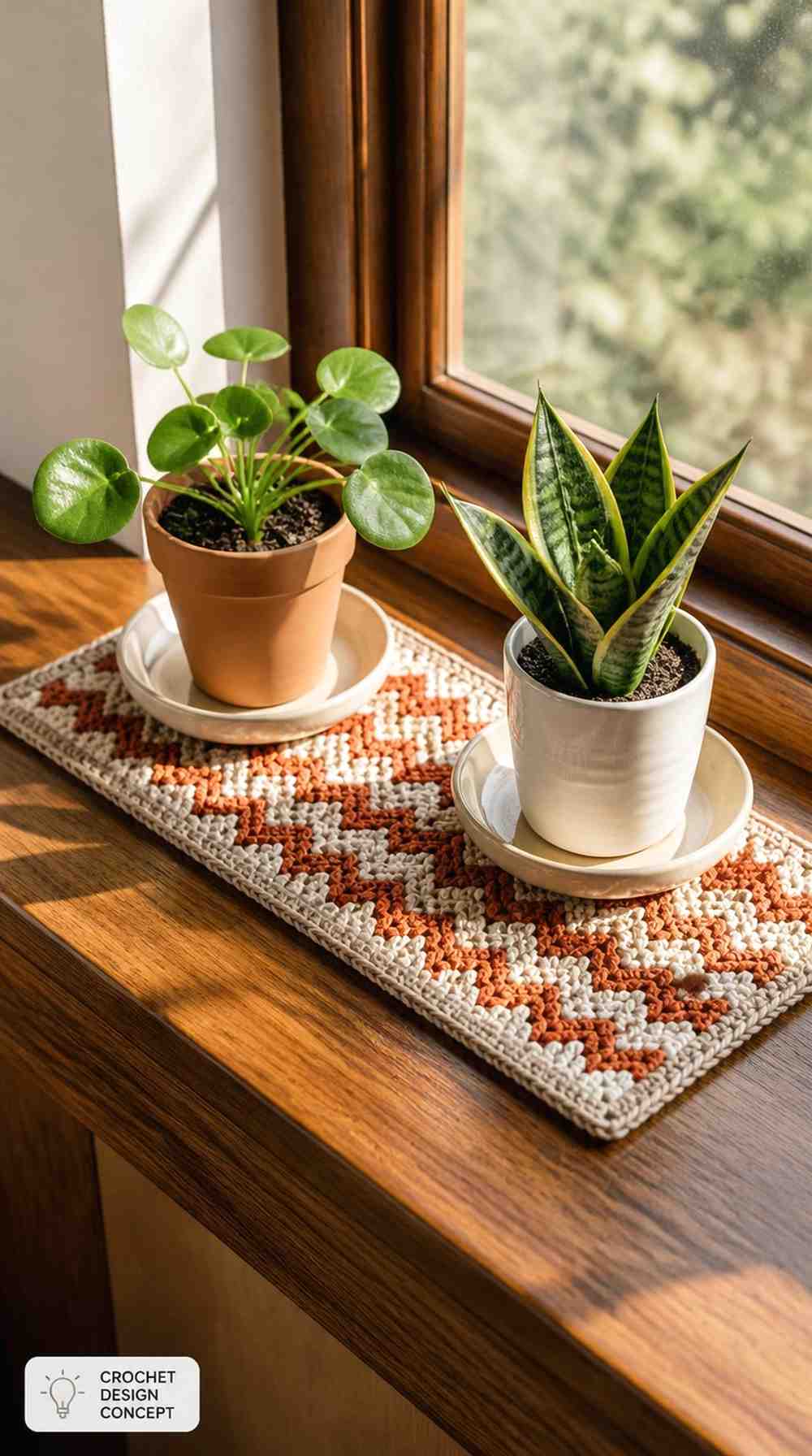
Rust-orange and cream chevrons create a narrow rectangular crochet mat with tidy oatmeal edging. Two small drainage saucers sit apart on its surface, holding a compact pilea in a terracotta pot and a miniature snake plant in a white pot.
The narrow shape suits a deep windowsill where two small plants are arranged side by side. Chevron rows provide enough visual detail without relying on raised flowers or separate motifs. The main practical concern is leaving adequate room for both saucers and preventing the mat from crowding the window frame.
- Windowsill depth: Measure the usable flat shelf area, ensuring the mat and both saucers remain fully supported away from the sill edge.
- Sash clearance: Leave space for the window to open or close without touching plant leaves or pushing the pots.
- Watering access: Check and empty the two saucers separately; a shared crochet mat cannot contain overflow from either planter.
11. Crochet Dusty Rose Reversible Double-Layer Pot Mat
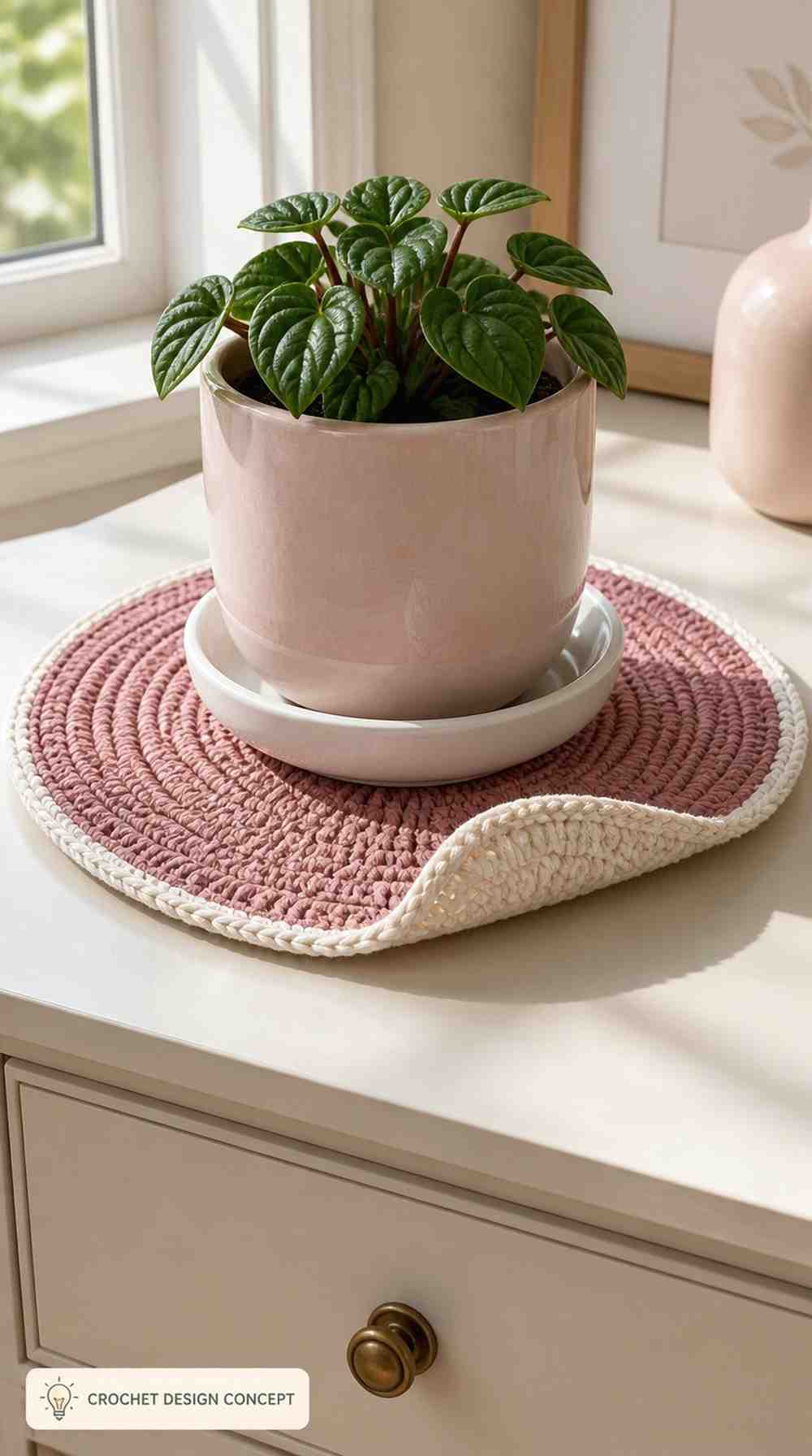
Dusty-rose crochet forms the upper surface of this compact circular mat, while warm ivory crochet creates a contrasting underside. The two closely stitched layers join along a narrow cream edge. One small outer corner is turned back to show the reversible finish, while a white drainage saucer supports a pale-pink peperomia pot.
The double-layer construction gives the mat a more substantial look than a single thin round. It also offers two color choices for the same display. The additional thickness should be kept even so the mat remains flat beneath the ceramic saucer.
- Layer alignment: Join both crochet circles without puckering, especially around the center where the drainage saucer rests.
- Reversible colors: Keep the dusty-rose and ivory sides clean enough to use either face against a dry furniture surface.
- Drying time: Two layers of yarn may hold moisture longer, so inspect and fully dry both sides before returning the mat beneath a plant.
12. Crochet Forest Green Leaf-Silhouette Saucer Mat
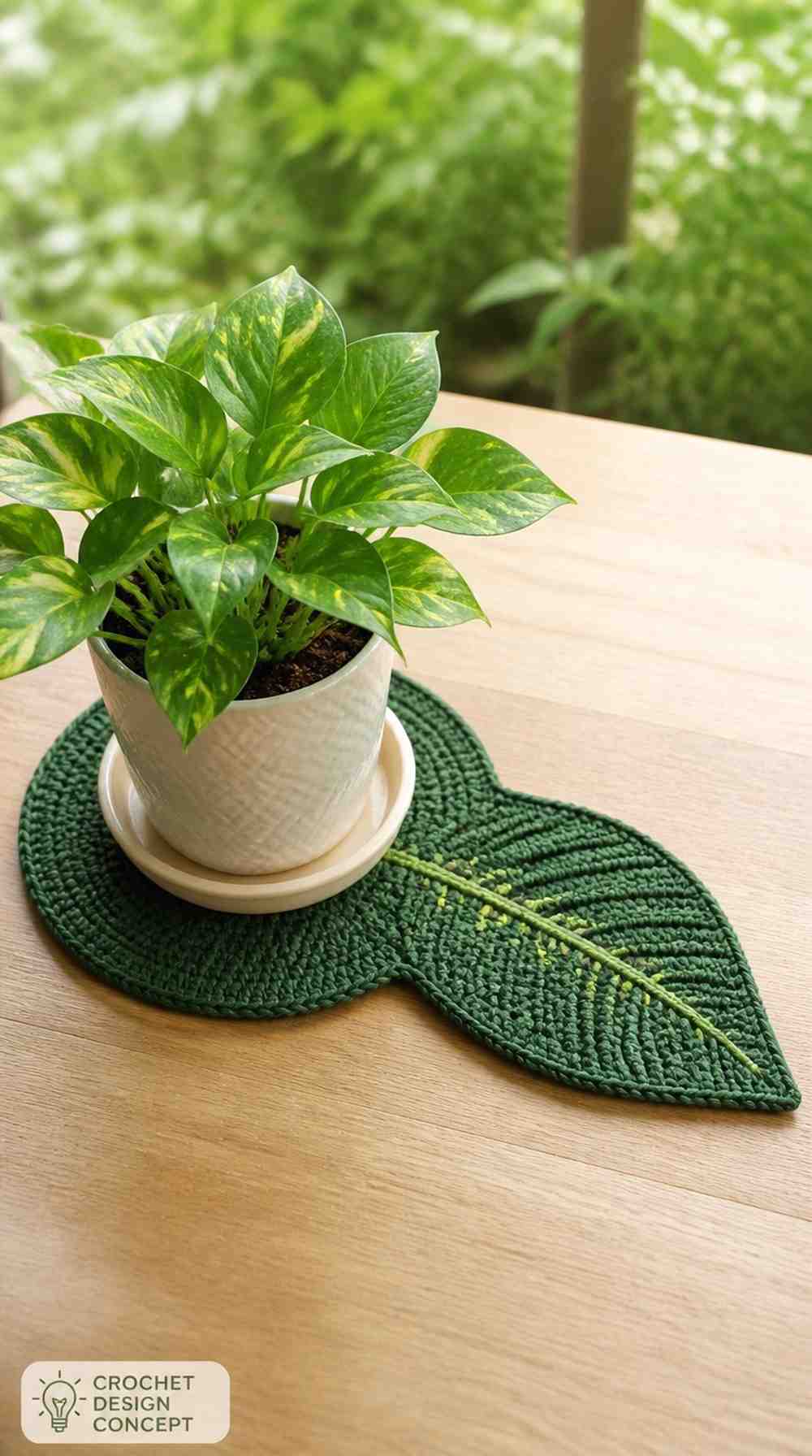
Forest-green crochet forms a rounded solid center with one pointed leaf-shaped extension reaching outward from its side. A lighter-sage stitched vein defines the leaf. A cream ceramic saucer and white pot containing a glossy pothos rest entirely on the central circular section.
The leaf silhouette gives this design a botanical detail without covering the pot or making the mat overly large. Unlike a raised leaf appliqué, the extension lies flat beside the saucer. That helps keep the central resting area uncomplicated while allowing the leaf shape to remain visible.
- Leaf direction: Position the decorative extension toward free shelf space rather than where it could hang over a furniture edge.
- Flat central base: Keep the vein stitching outside the saucer footprint so the pottery rests on a smooth crochet circle.
- Edge handling: Lift the mat by its main body rather than pulling the pointed leaf, which may be more vulnerable to stretching.
13. Crochet Mint Modular Trio Saucer Mat Set
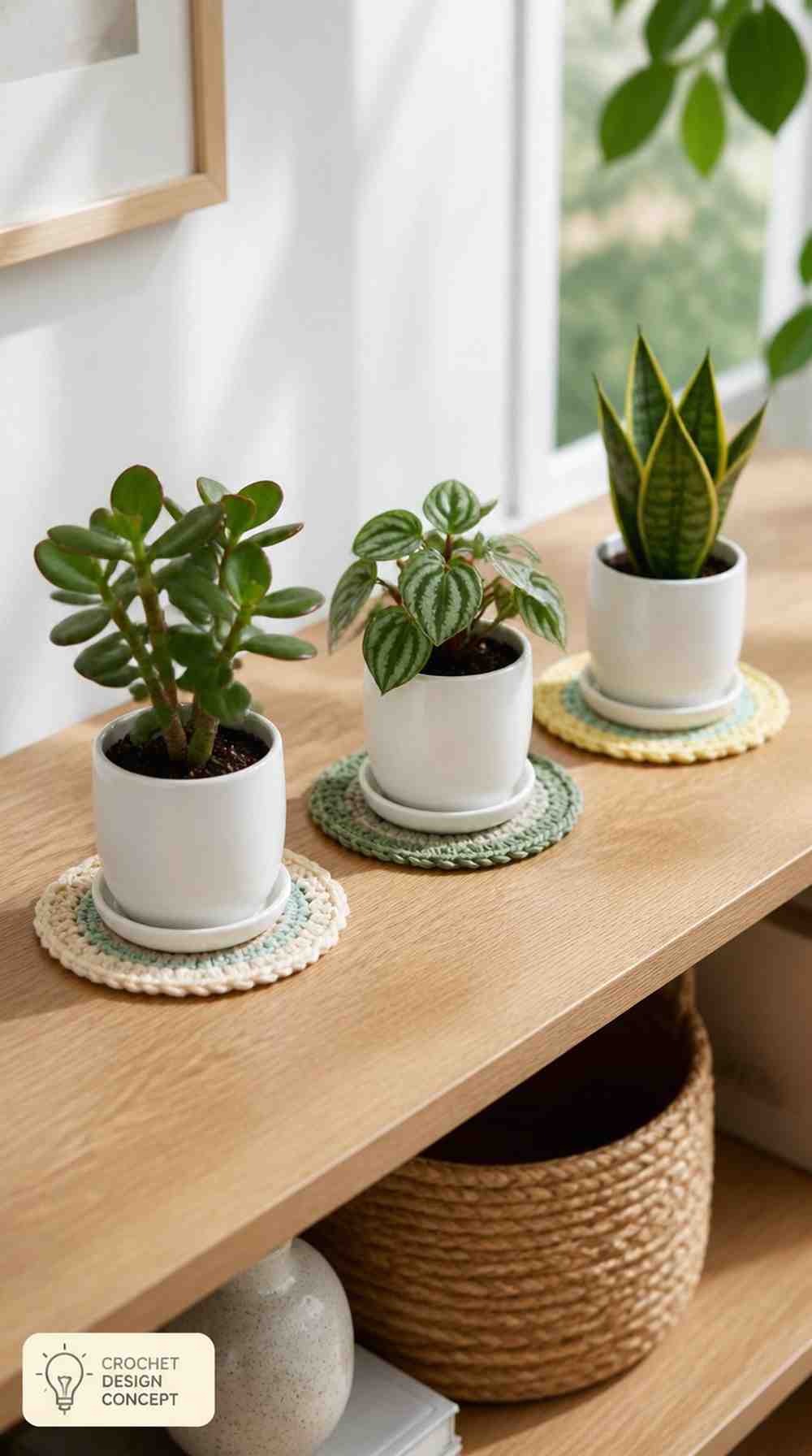
Three separate mint-green circular crochet mats create a coordinated set for a small indoor plant shelf. Each has a dense flat center, with one finished in ivory edging, one in sage, and one in pale lemon. A small white ceramic saucer supports a jade plant, peperomia or miniature snake plant on each matching mat.
The modular approach makes this concept different from one long windowsill runner. Every plant has its own removable crochet base, allowing the arrangement to change without moving a shared textile. The simple matching centers keep the three designs visually connected.
- Individual sizing: Match each mat to its own drainage saucer rather than assuming three different planters need identical base dimensions.
- Flexible arrangement: Separate mats can be spaced farther apart or moved to different shelves without affecting the other plants.
- Coordinated care: Remove the saucers individually and inspect each mint mat for moisture, staining or stretching after plant maintenance.
Practical Guide to Crochet Indoor Plant Pot Drainage Mats
Crochet mats can make plant displays feel warmer and more personal, but they are not drainage trays, waterproof barriers or reliable protection against spilled water. Use them as removable decorative underlays beneath appropriate plant saucers or dry cachepots.
Start with a proper drainage setup. A plant pot with drainage holes should have a suitable watertight saucer or outer container to catch runoff. The crochet mat belongs underneath that container, not directly over the drainage hole. This helps avoid trapping water against yarn, furniture or the bottom of the planter.
Water plants without soaking the mat. Where practical, move the planter to a sink or another suitable watering area, let it drain and return it only when the outside of its saucer is dry. If water collects in a saucer, empty the excess rather than leaving roots standing in it. Plant-care guidance from Illinois Extension explains why removing standing water matters.
Check stability and size. Measure the entire drainage saucer, not just the flowerpot. The central supporting area of the crochet mat should stay flat and level. Large raised borders, bobbles, open holes or uneven seams beneath the saucer may cause unstable placement.
Consider washable materials. Smooth cotton yarn is one possible starting point for a flat mat, depending on its care instructions. Test for shrinking, color transfer and distortion. A damp crochet mat may stain furniture rather than protect it.
Protect sensitive furniture separately. On valuable wood, painted finishes or moisture-sensitive shelves, use a manufacturer-appropriate waterproof surface protector if needed. A ceramic saucer should remain the main water-catching component; crochet alone cannot prevent water damage.
Keep mats easy to remove. Lift the planter and saucer before moving or cleaning the mat. Check underneath for hidden moisture, dust and soil residue, and let the crochet dry completely before replacing it.
For more plant-focused crochet inspiration, explore Yarn Nest Studio’s 19 Crochet Cottagecore Hanging Plant Holder Inspiration Ideas, which covers a different approach to displaying planters. The 14 Crochet Trinket Shelf Display Mat Ideas collection offers additional ways to use small crochet mats on indoor shelves.
Want to Make Something Similar?
These 13 designs are original visual concepts rather than tested patterns. The following published resources provide related crochet mat techniques and sizing ideas:
- Aurea Crochet Plant Mat Pattern — Through the Loop Yarn Craft — a free lacy plant mat pattern by Ashley Edmonds, showing how an adjustable row-based decorative mat can be made.
- Hexagon Plant Pot Mat — Crochet ‘n’ Create — a published plant-pot mat pattern focused on a six-sided crochet shape, useful for exploring non-round mat construction.
- Picot Peaks Plant Pot Mat — Crochet ‘n’ Create — a separate decorative mat pattern with shaped edging, useful for studying borders that sit outside the pot’s footprint.
These resources teach related crochet techniques; they do not reproduce the illustrated designs exactly. A completed project still needs sizing, flattening, material checks and a proper drainage saucer.
Which Crochet Indoor Plant Pot Drainage Mat Should You Choose?
| Your main priority | Design to consider | Important trade-off |
|---|---|---|
| Simple round plant display | Sage Moss-Stitch Round Saucer Mat | Minimal decorative detail |
| Raised outer texture | Terracotta Ribbed-Ring Plant Saucer Mat | Ribs must stay outside the saucer |
| Two plants on one mat | Oatmeal Oval Twin-Saucer Plant Mat | Shared fabric needs separate dry saucers |
| Cottage-style edging | Ivory Scalloped Ceramic Saucer Mat | Scallops may curl if too large |
| Granny-square accents | Lavender Granny-Corner Plant Pot Mat | Center needs to remain flat |
| Modern geometric colorwork | Cobalt Checkerboard Square Saucer Mat | Color joins must not create bumps |
| Cheerful floral decoration | Butter Yellow Daisy-Edge Plant Mat | Daisies must stay outside the base |
| Dark geometric texture | Charcoal Hexagon Waffle Pot Mat | Raised stitches need stability checks |
| Airy openwork finish | Teal Airy-Mesh Border Saucer Mat | Mesh is decorative, not water-catching |
| Narrow windowsill arrangement | Rust Chevron Windowsill Plant Mat | Needs enough sill depth |
| Two-sided color option | Dusty Rose Reversible Double-Layer Pot Mat | Extra fabric takes longer to dry |
| Botanical silhouette | Forest Green Leaf-Silhouette Saucer Mat | Leaf extension needs clear space |
| Separate matching plant stations | Mint Modular Trio Saucer Mat Set | Three mats require individual care |
If you have only one small indoor pot, start with a flat circular or square mat that fits beneath its drainage saucer. For several plants, a shared oval mat or a set of individual round mats can create a more coordinated arrangement, provided every pot has its own suitable drainage container.
Conclusion
Crochet indoor plant pot drainage mats offer a decorative way to frame houseplants on shelves, windowsills and tables. A simple sage circle can feel understated, while scallops, granny-square corners, checkerboards, raised outer ribs and leaf silhouettes give small plant displays more personality.
The most useful approach is to separate appearance from drainage. Let a suitable watertight saucer handle runoff, and use the crochet mat as a removable decorative layer beneath it. That way, you can enjoy handmade texture without relying on yarn to do a job it cannot safely perform.
Which would you choose for your indoor plants: the Sage Moss-Stitch Round Mat, the Ivory Scalloped Saucer Mat, or the Mint Modular Trio Set? Share whether you prefer matching mats for every plant or different colors for each shelf.
Frequently Asked Questions
1. Can a crochet mat absorb water draining from an indoor plant pot?
Crochet yarn may absorb some moisture, depending on the fiber, but it is not a suitable replacement for a drainage saucer. Water can pass through the fabric, remain trapped underneath or damage furniture. Use an appropriate watertight saucer to collect drainage and keep the crochet mat as dry as possible.
2. Should a flowerpot with drainage holes sit directly on a crochet mat?
It is better to place a suitable saucer or drainage container beneath the pot rather than letting the drainage holes rest directly on crochet. The saucer helps collect runoff and keeps the yarn away from the wet base. Empty excess water according to the plant’s care needs.
3. What yarn should I consider for a crochet plant pot mat?
Smooth, washable cotton yarn may work well for a decorative flat mat, but its suitability depends on its care instructions, stitch structure and how the mat is used. Check for shrinking, dye transfer and stretching. No ordinary yarn should be assumed to provide waterproof protection for a shelf.
4. How large should a crochet plant pot mat be?
Measure the outside footprint of the drainage saucer rather than only the plant pot. The mat should support the whole saucer while leaving enough visible crochet around its edges to show the chosen design. Keep raised or decorative details outside the area carrying the saucer.
5. Are these 13 crochet indoor plant pot drainage mat ideas complete patterns?
No. These are original visual design concepts showing possible mat shapes, stitch textures, borders and plant-display arrangements. The linked crochet resources provide related making techniques, but the exact illustrated designs have not been physically tested. Any finished mat should be checked for fit, stability, materials and compatibility with a proper plant drainage saucer.