Curtain hems sometimes flare outward, curl at the corners or hang unevenly, especially when the fabric is light and moves easily with the air. Small drapery weights can sometimes help improve the way a curtain hangs, and decorative crochet pockets offer an interesting way to explore their placement and appearance. These 13 crochet curtain hem weight pocket inspiration ideas feature compact corner pockets, joined granny squares, shaped covers, narrow channels and carefully arranged lower-edge compartments.
The collection focuses on crochet pockets attached to the reverse side of existing curtains, where the decoration can remain relatively discreet from the front. Each design uses an enclosed fabric-covered drapery weight rather than exposed loose metal pieces. You’ll find ideas suited to linen, cotton and sheer curtains, along with practical guidance on suitable weight selection, hem attachment, cleaning, fabric drape and household safety.
These are AI-generated crochet design visualizations for inspiration, not photographs of tested handmade pieces or step-by-step patterns.
Quick Design Selection Guide
| Your curtain or styling goal | Design to explore | Why it stands out |
|---|---|---|
| A small pocket at one hem corner | Crochet Terracotta Ribbed Curtain Hem Pocket | Simple rectangular shape with raised ribs |
| Coordinated pockets at both corners | Crochet Indigo Checkerboard Hem Weight Pockets | Matching joined-square designs |
| Lightweight sheer curtain styling | Crochet Buttercream Scalloped Curtain Weight Pocket | Shallow shape with delicate edging |
| A botanical decorative finish | Crochet Olive Leaf Concealed Hem Pocket | Tapered leaf-shaped front |
| Minimal modern appearance | Crochet Charcoal Foldover Curtain Hem Weight Pocket | Folded rectangular sleeve |
| Separate weight positions across a wide hem | Crochet Rust Triple Section Curtain Hem Pocket | Three independent compartments |
| Decorative openwork with enclosed backing | Crochet Teal Lattice Lined Curtain Weight Pocket | Diamond lattice over cream lining |
| A narrow weight channel | Crochet Oatmeal Hidden Channel Weight Pocket | Low-profile horizontal design |
1. Crochet Terracotta Ribbed Curtain Hem Pocket
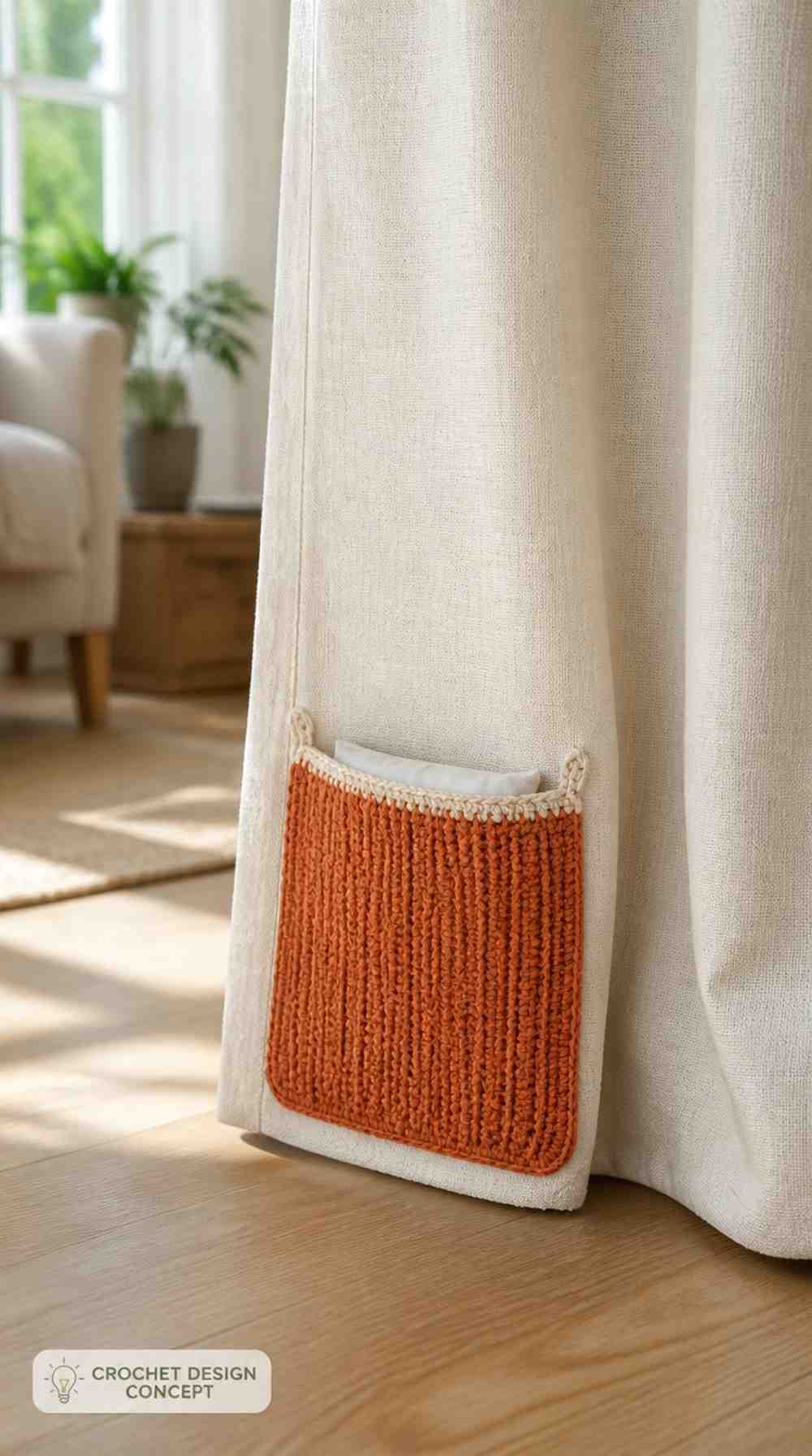
Warm terracotta crochet adds a subtle decorative detail to the reverse-side lower corner of this ivory linen curtain. The compact rectangular pocket has neat vertical ribs, rounded lower corners and a narrow cream upper border. Its reinforced opening reveals a small section of a fully enclosed white fabric drapery-weight packet.
The simple shape makes this concept appealing for curtains with a plain lower hem. Because it sits behind the fabric, the pocket can remain largely hidden from the room, while its attachment and weight would need to be selected carefully.
- Corner Position: Keep the pocket close to the existing lower corner without pulling the linen into an unnatural point or changing its intended floor clearance.
- Ribbed Construction: Closely worked vertical stitches create a tidy surface, but excessive crochet thickness could show through lighter curtain fabrics.
- Weight Security: A real version needs a reliably secured inner weight packet and a closed pocket; the illustrated visible opening is only for showing the concept.
2. Crochet Indigo Checkerboard Hem Weight Pockets
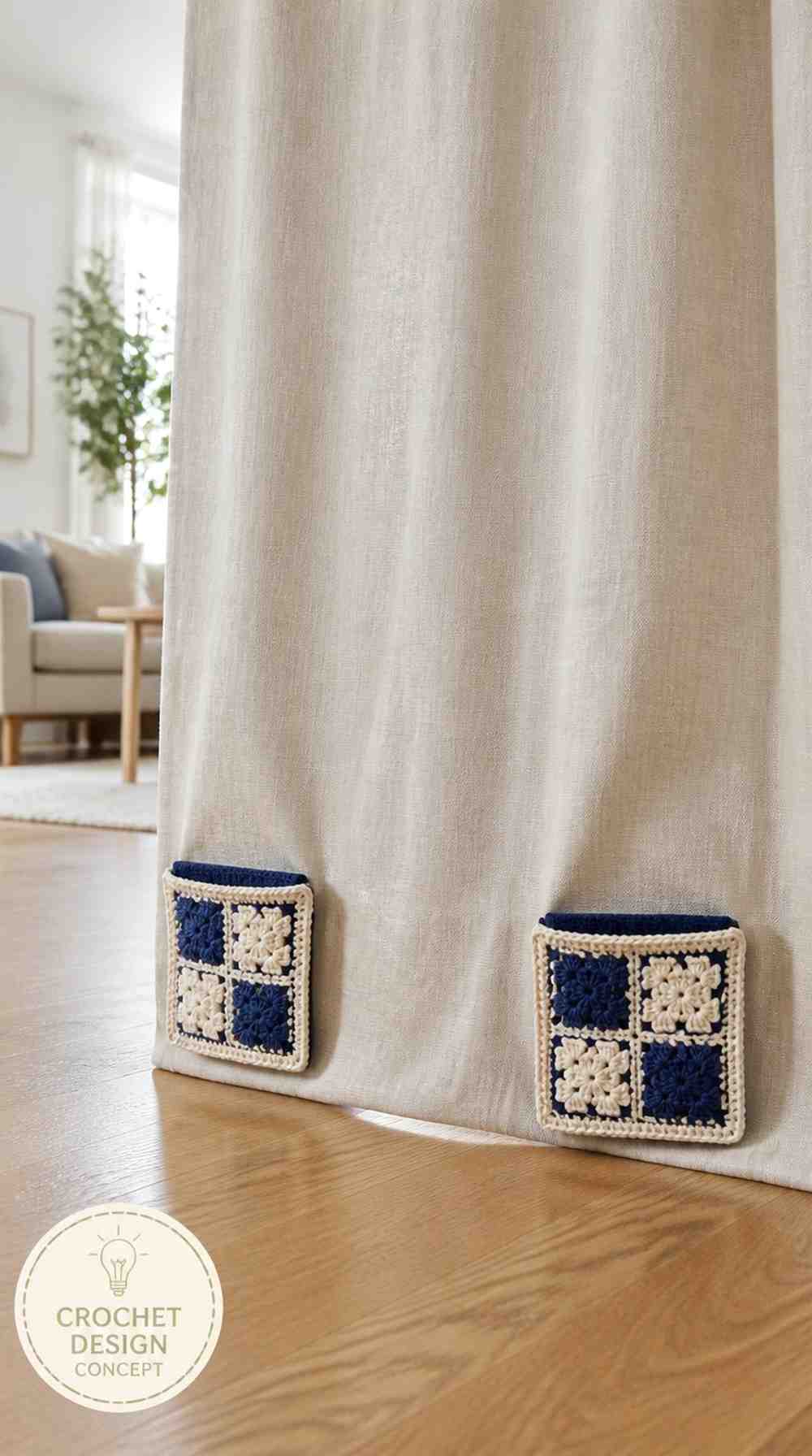
Indigo blue and warm cream give these two small curtain hem pockets a coordinated checkerboard appearance. Each square pocket uses four neatly joined miniature crochet granny squares, a solid indigo backing and a narrow cream border. The pockets sit on the reverse side of opposite bottom corners of an oatmeal linen curtain.
The paired arrangement looks balanced when the curtain is spread open. It also demonstrates how small decorative pockets could be placed at corresponding points rather than concentrating every added weight in one section of the hem.
- Matching Corners: Position the two pockets symmetrically so their visual placement corresponds across the curtain panel.
- Granny Square Joins: Keep the four motifs on each pocket consistent and securely joined, particularly where their edges meet the solid backing.
- Curtain Drape: Matching pockets do not automatically produce an even hem; actual weight selection and the curtain’s fabric behavior still need checking.
3. Crochet Buttercream Scalloped Curtain Weight Pocket
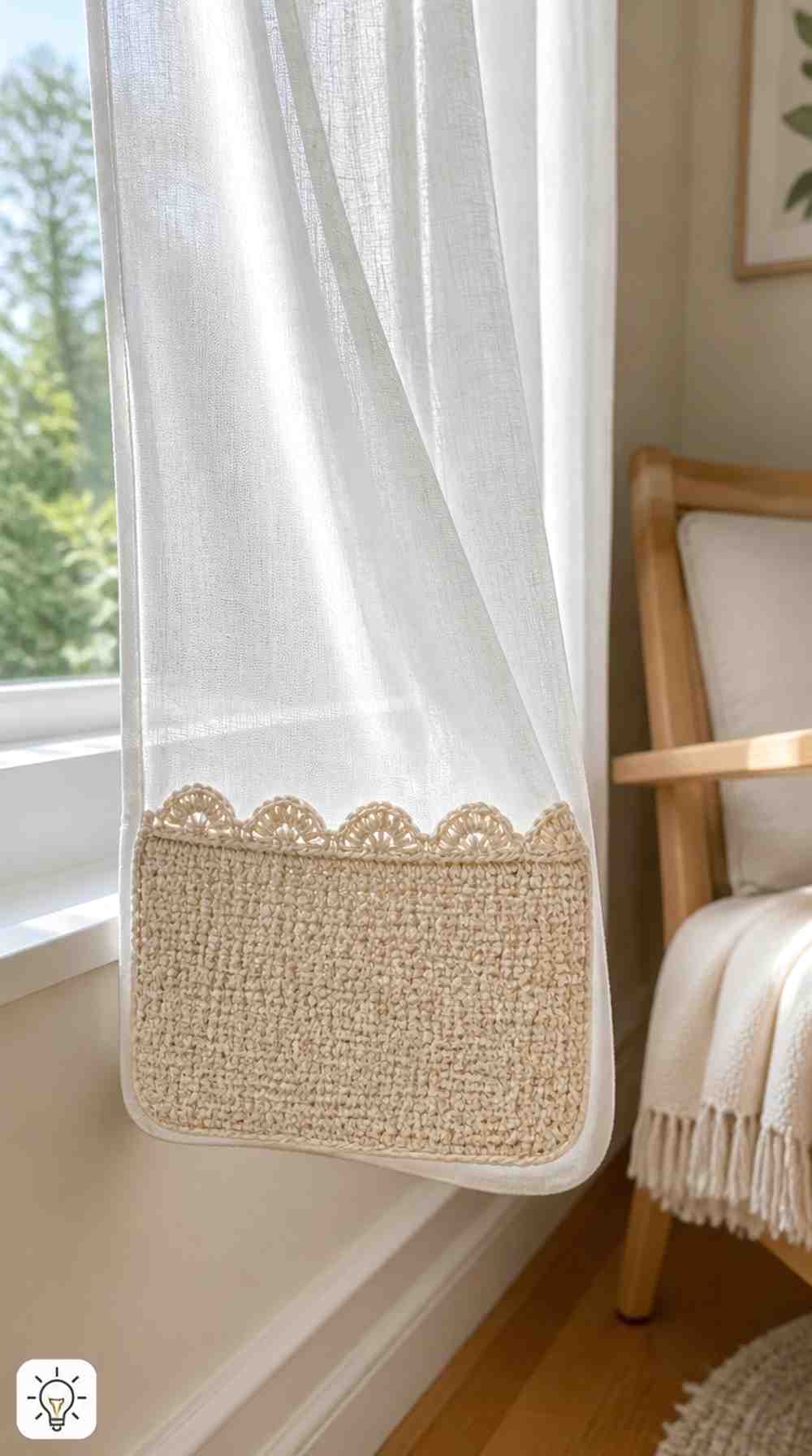
Soft buttercream-yellow crochet creates a shallow weight pocket with a delicate ivory scalloped border. Its closely worked rectangular body sits near the bottom corner of a sheer white cotton curtain, with a gently curved lower edge following the soft appearance of the fabric. A concealed fabric-covered weight is enclosed beneath the securely stitched upper section.
The pale yarn colors work naturally with the curtain’s translucent appearance. This design offers a softer alternative to a strongly colored corner pocket, although sheer material may reveal the outline of even a carefully positioned backing.
- Sheer Fabric Visibility: Examine the pocket from both sides of the curtain, since its stitches and enclosed weight may remain noticeable through thin fabric.
- Scallop Proportions: Keep the ivory curves shallow so they do not create unnecessary bulk or pull against the lower hem.
- Fabric Sensitivity: Delicate sheer curtains may require specialist sewing methods, and their light fabric may not be suitable for additional weight.
4. Crochet Olive Leaf Concealed Hem Pocket
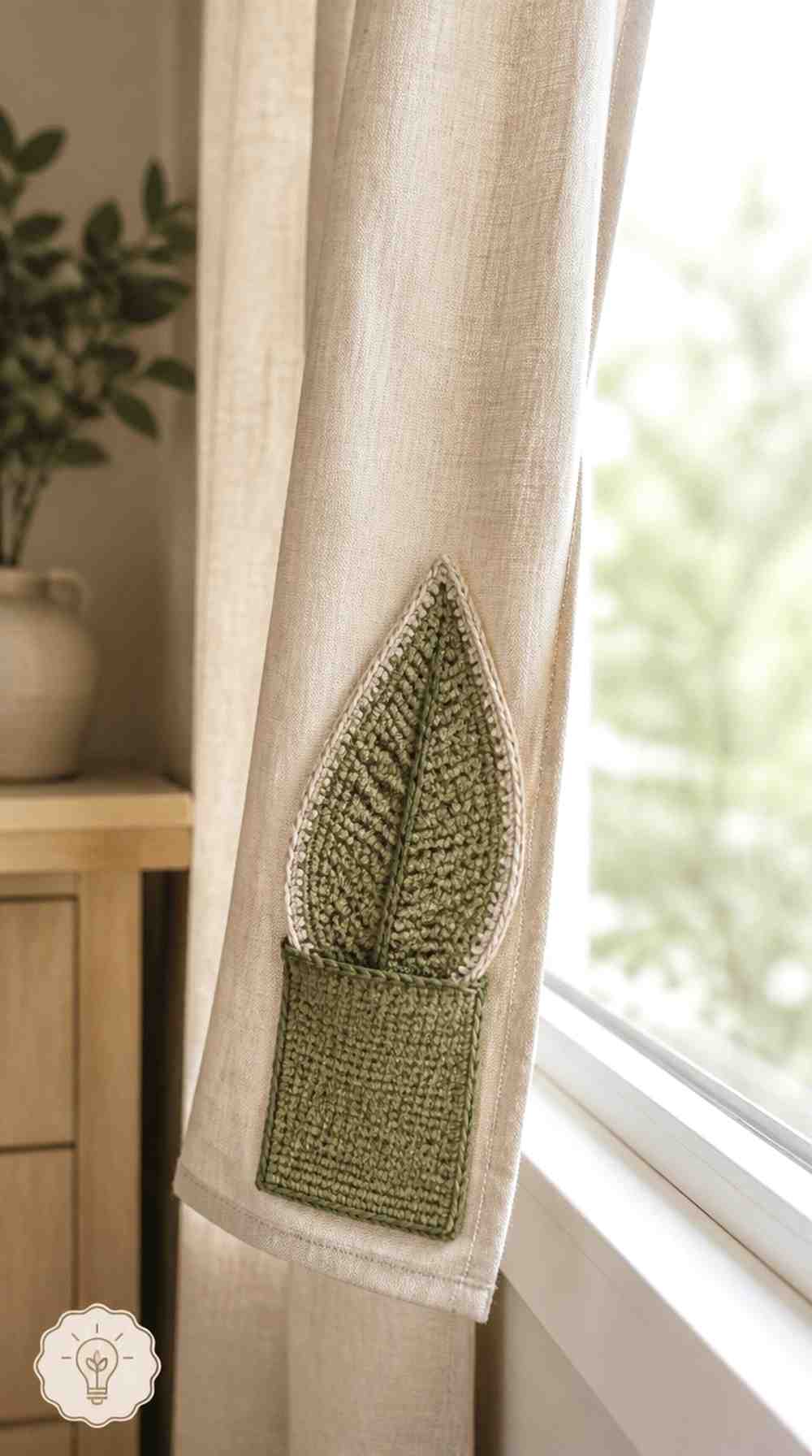
Olive-green crochet gives this lower-corner pocket a gently shaped botanical appearance. A tapered leaf front features a darker raised center vein, pointed lower tip and fine oatmeal edging. Behind the leaf, a solid rectangular backing contains an enclosed fabric-covered drapery weight, with the upper closure stitched securely.
The pocket is designed for the reverse side of a beige linen curtain, where its decorative leaf can sit relatively discreetly. Its shaped front offers more visual character than a plain rectangle, while the backing provides a more conventional area for holding the enclosed insert.
- Leaf Shape: Gradual shaping and a carefully positioned center vein help maintain a recognizable pointed leaf without creating a bulky raised decoration.
- Backing Panel: The concealed weight should be held by the secure rectangular inner backing rather than relying on the decorative leaf front.
- Hem Placement: Keep the pointed tip clear of the floor and away from places where it could catch during curtain movement.
5. Crochet Charcoal Foldover Curtain Hem Weight Pocket
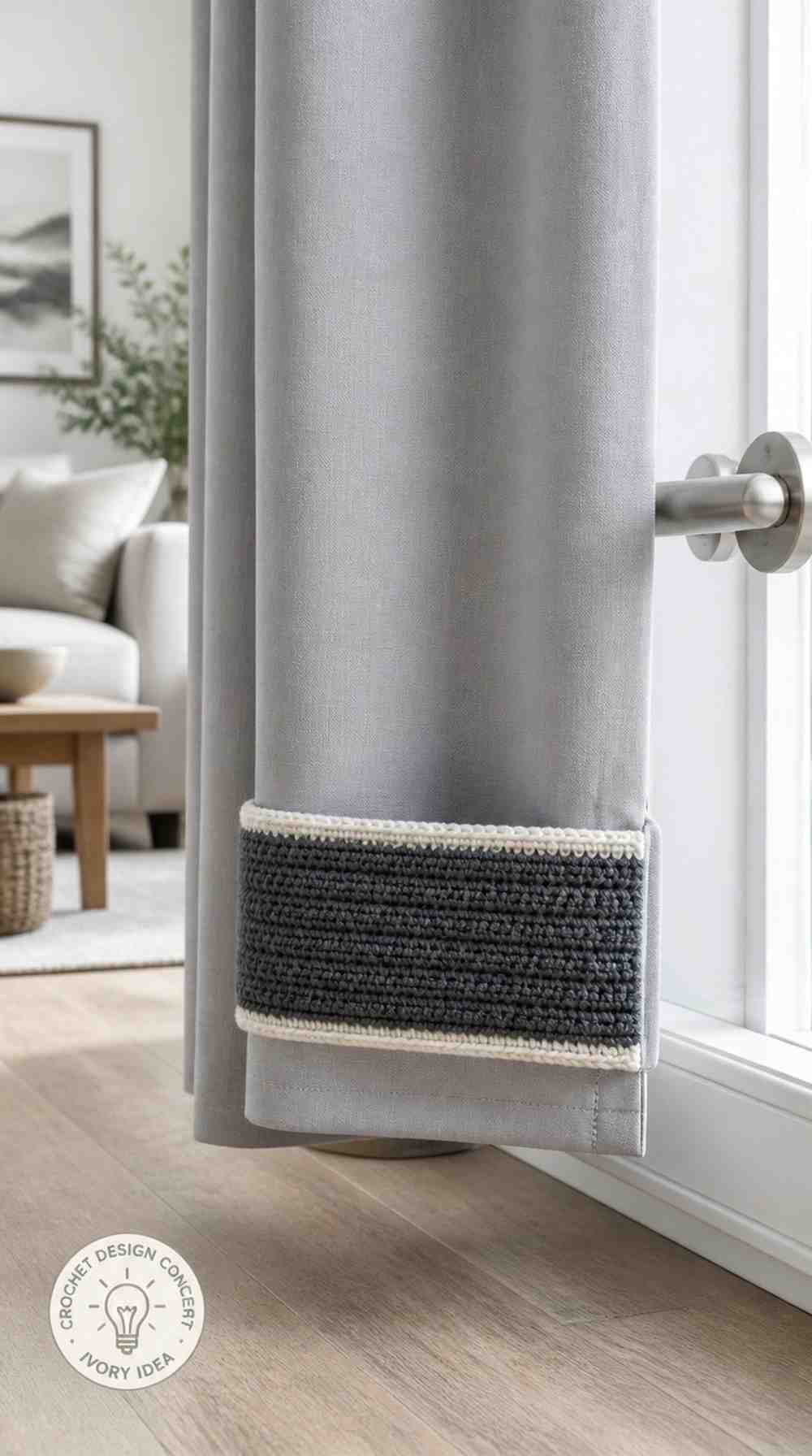
Charcoal-grey crochet creates a narrow folded sleeve around the lower edge of a light-grey cotton curtain. Raised horizontal ridges add texture to the rectangular cover, while a slim warm-cream border gives it a cleaner finish. The folded section wraps over the hem and has a secure upper closure containing a concealed fabric-covered weight.
This design looks more integrated with the curtain edge than a separately attached square pocket. Its contemporary color palette suits a minimalist room, although the overlapping layers may make the lower hem noticeably thicker.
- Foldover Alignment: Both sides of the sleeve should sit evenly around the curtain hem without twisting the fabric or creating a visible diagonal pull.
- Fabric Thickness: Consider the combined thickness of the crochet, curtain fabric and enclosed weight before choosing this style for a lightweight panel.
- Cleaning Access: A securely attached folded sleeve may be harder to remove, so its construction should account for the curtain’s recommended cleaning method.
6. Crochet Blush Daisy Curtain Corner Weight Pocket
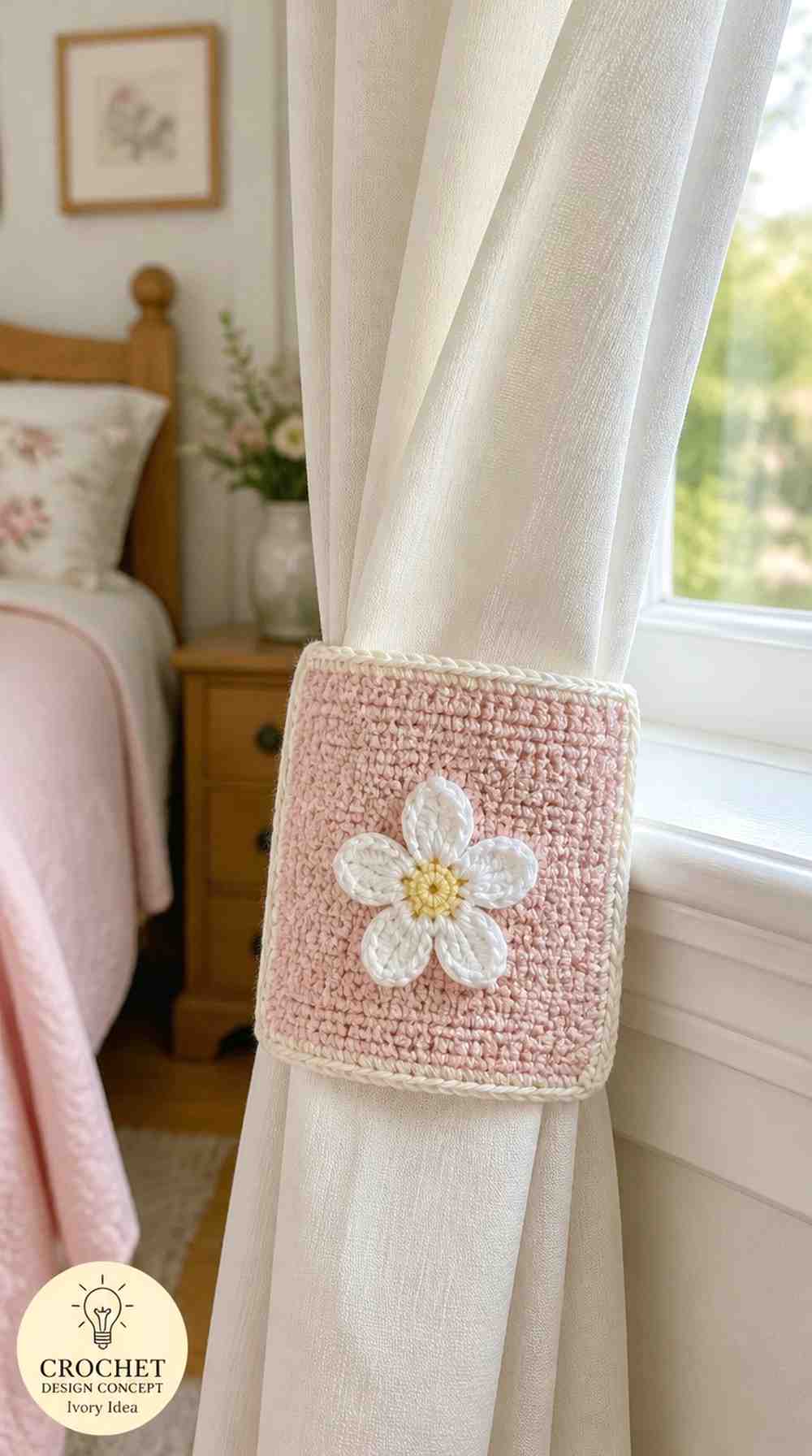
Blush-pink crochet forms a neat square pocket at the reverse-side lower corner of an ivory cotton curtain. A small white five-petal daisy sits on the front, finished with a butter-yellow center and a narrow cream outer border. The solid pocket body contains a concealed fabric-covered weight behind its securely stitched upper seam.
The floral detail gives this concept a soft cottage-bedroom appearance. Because the flower remains flat, it adds decoration without requiring long hanging petals or tassels near the floor. The appliqué still needs careful attachment to prevent snagging during curtain movement.
- Flat Floral Motif: Keep the white petals and yellow center securely attached so the daisy cannot peel away from the pocket during handling.
- Square Pocket Shape: Reinforce the lower corners appropriately to maintain a tidy outline without concentrating tension at the curtain’s hem seam.
- Bedroom Placement: Avoid accessible weighted pockets in rooms used by young children or pets, especially where the curtain reaches close to the floor.
7. Crochet Navy Triangle Corner Weight Pockets
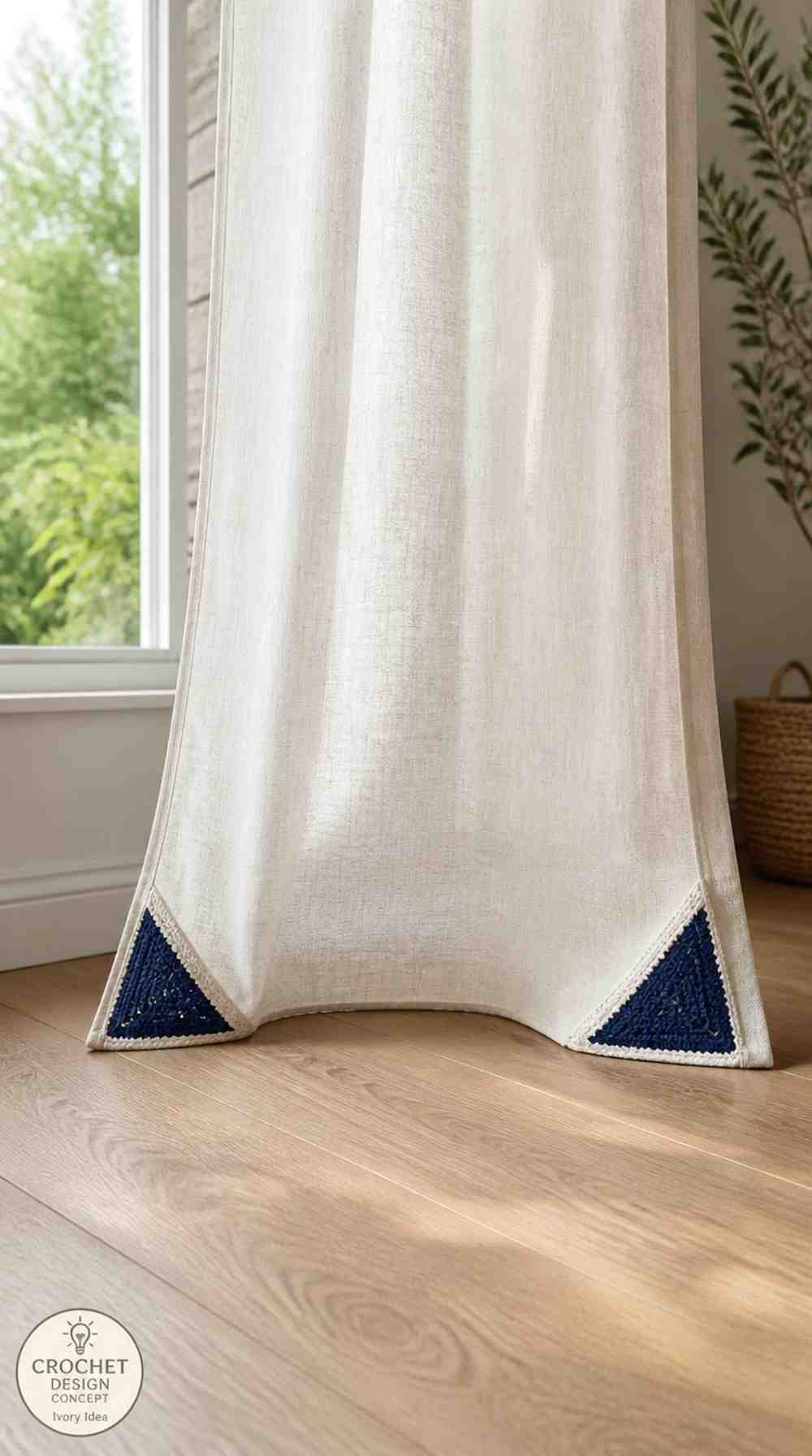
Deep-navy crochet creates two triangular pockets that follow the lower corners of a warm-white linen curtain. Each pocket has a clean pointed shape, closely worked stitches and a slim ivory diagonal border. The upper diagonal seams are securely closed around separate concealed fabric-covered drapery weights.
The matching triangles provide a geometric alternative to square or rectangular corner pockets. Their dark color makes them especially noticeable on the reverse side of the light curtain, while the angled edges follow the shape of the lower corners.
- Triangular Shaping: Keep the diagonal sides symmetrical so each finished pocket sits flat and follows the corner without puckering.
- Paired Positioning: Align the two triangles at corresponding heights to preserve the visual balance of the curtain’s bottom corners.
- Secure Closure: The diagonal upper seams must retain the enclosed packets throughout normal curtain movement, cleaning and handling.
8. Crochet Rust Triple Section Curtain Hem Pocket
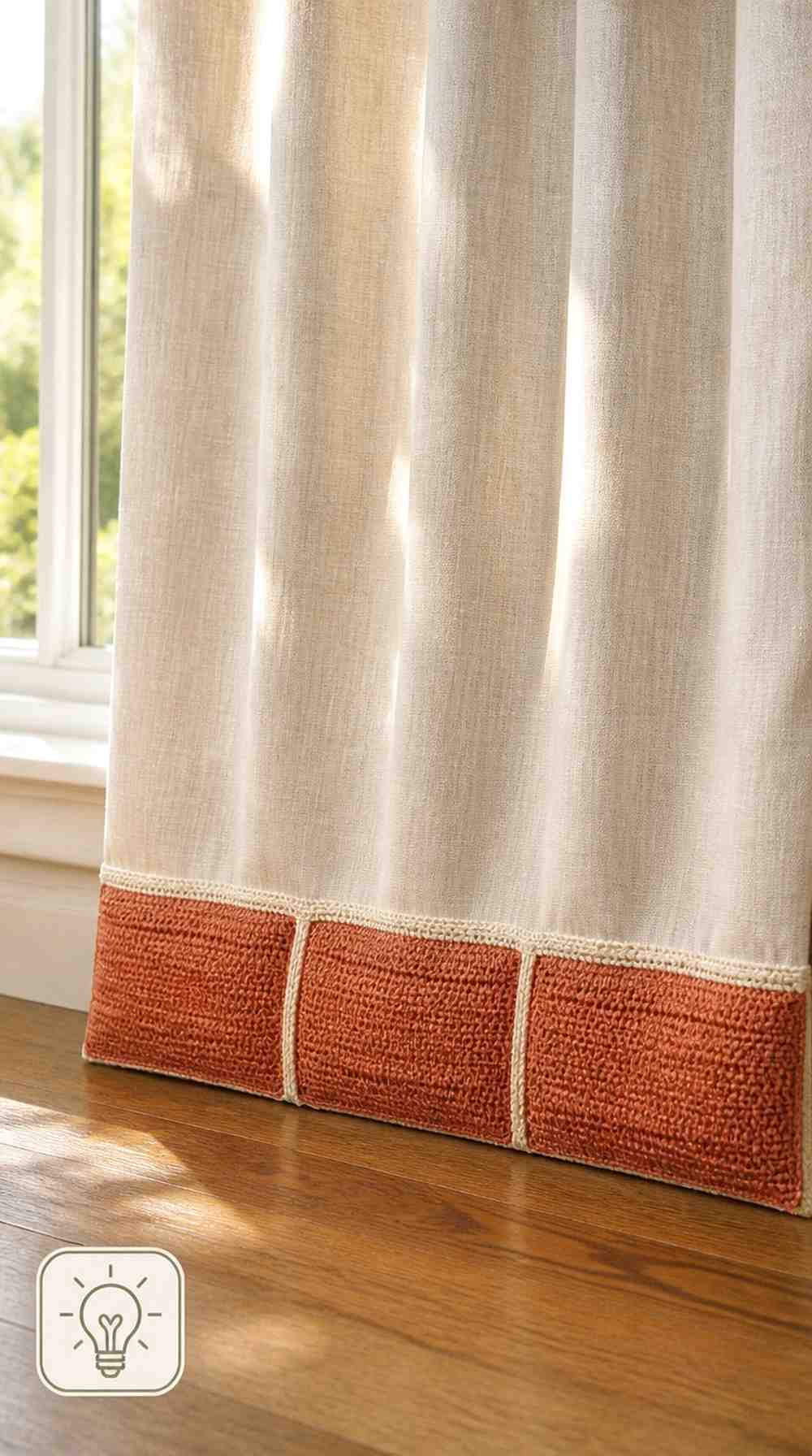
Rust-orange crochet forms a long, shallow pocket strip along the reverse-side lower hem of a natural-flax curtain. Two vertical seams divide the rectangular strip into three equal compartments, each containing a separate enclosed fabric-covered drapery weight. A narrow ivory upper border and closely worked horizontal rows create a tidy, continuous finish.
Unlike individual corner pockets, this concept distributes separate inserts across a longer section of the curtain. It could inspire a more evenly arranged lower-edge treatment, although the actual weight distribution must suit the fabric rather than simply matching the decorative compartments.
- Compartment Separation: Stitch the two vertical dividers securely so the enclosed inserts cannot migrate between the three sections.
- Hem Alignment: Keep the strip level with the curtain’s existing hem, avoiding additional length that could drag on the floor.
- Weight Distribution: Three equal pockets do not necessarily require equal weights; placement and total added weight need to suit the actual curtain.
9. Crochet Teal Lattice Lined Curtain Weight Pocket
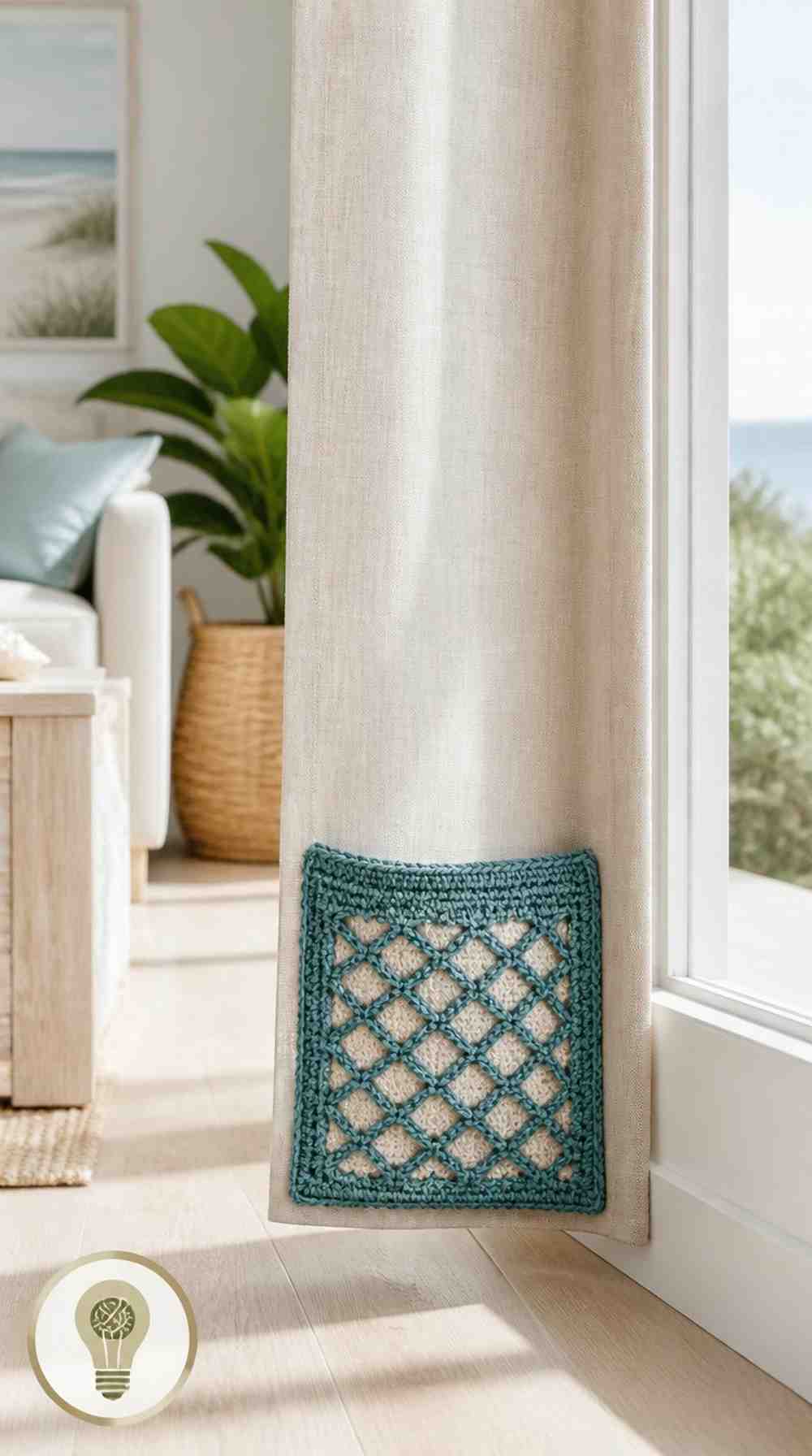
Teal-blue crochet creates a compact rectangular pocket with an orderly diamond-lattice front. A solid teal border surrounds the openwork, while a warm-cream cotton backing remains visible beneath the connected chain spaces. The fully enclosed weight sits behind the backing, leaving no metal visible through the decorative front.
The layered construction makes this design different from a dense single-panel pocket. Against a pale beige linen curtain, the contrasting cream lining helps the teal lattice stand out. However, the extra fabric layers add thickness near the lower corner.
- Lattice Structure: Keep the diamond openings consistent and securely connected to the solid border so the outer panel remains flat.
- Lining Coverage: The warm-cream backing should fully separate the decorative mesh from the enclosed weight packet.
- Layered Thickness: Consider whether the combined crochet and backing are too noticeable through the chosen curtain fabric.
10. Crochet Apricot Button Flap Hem Pocket
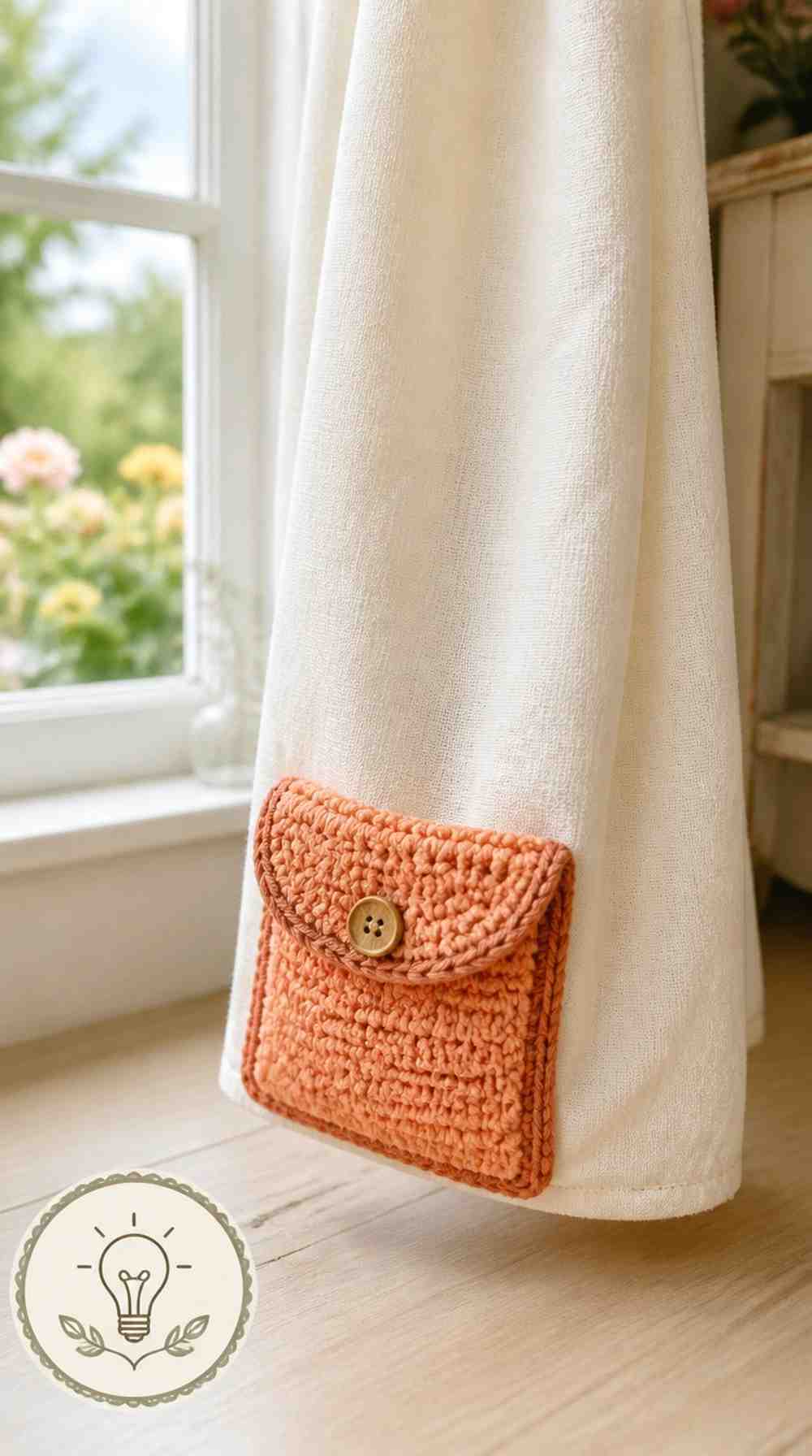
Apricot-orange crochet gives this rectangular hem pocket a warm cottage-style appearance. Its closely worked body has a slim terracotta border, while a short rounded flap folds over the top and fastens with a natural wooden button. Beneath that decorative flap, a separate sewn inner pouch fully encloses the fabric-covered drapery weight.
The button provides a visible finishing detail rather than serving as the only means of securing the weight. This distinction matters because a decorative closure could loosen during use, while an enclosed weight packet should remain independently contained.
- Decorative Button: Keep the natural wooden button securely attached and avoid relying on it as the sole closure retaining the weight.
- Inner Pouch: A separately sewn and fully closed lining can keep the weight enclosed even when the crochet flap is unfastened.
- Extra Bulk: The button, flap and lining add thickness, making this concept less discreet on very thin curtains.
11. Crochet Oatmeal Hidden Channel Weight Pocket
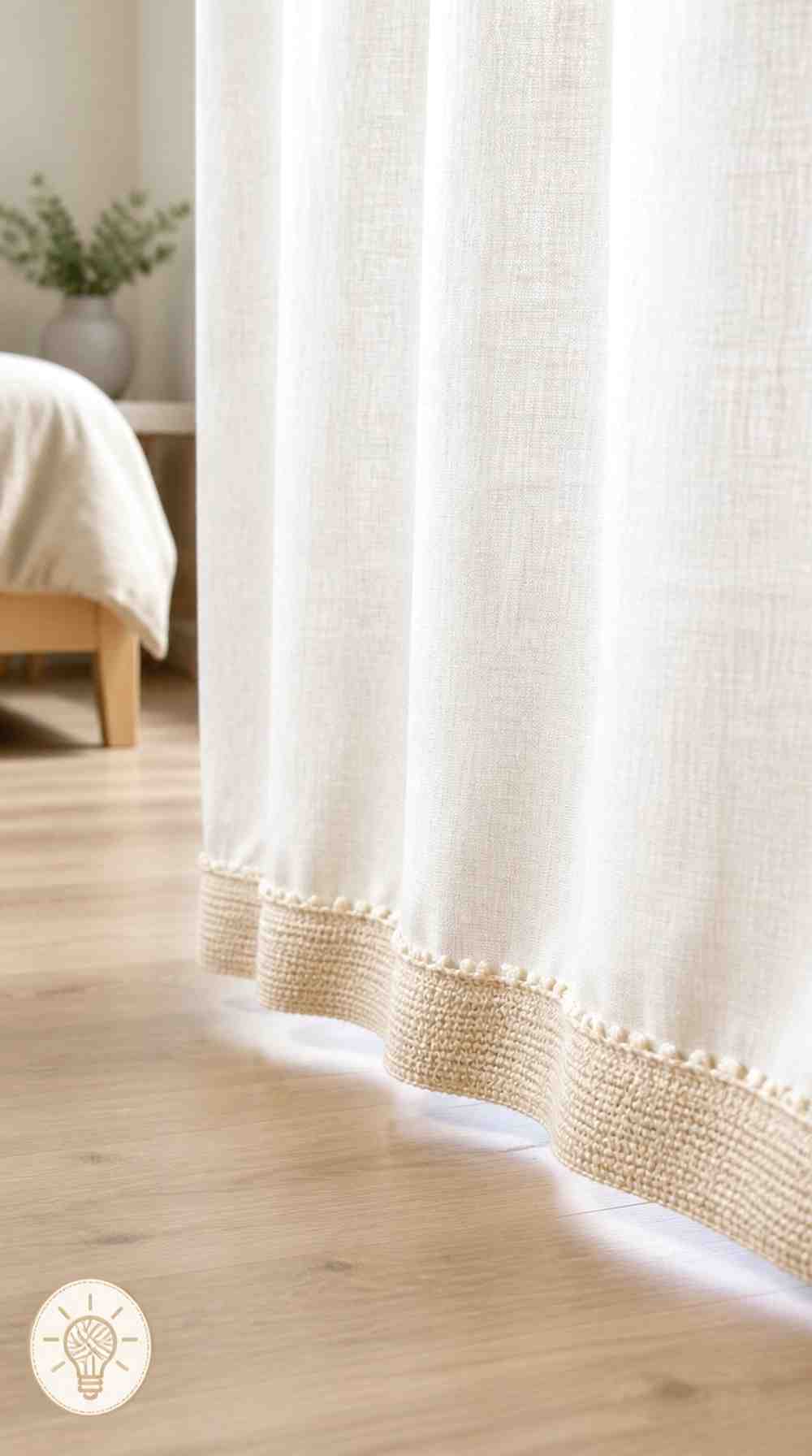
Oatmeal-colored crochet creates a narrow horizontal channel along the reverse-side bottom hem of a soft white linen curtain. Closely worked stitches form a solid backing, while the ends are securely closed around a slim concealed lead-free drapery-weight insert. A fine cream picot border sits just above the original hemline.
The understated color makes the channel feel visually connected to the curtain rather than like a separate decoration. Its long, low shape offers another way to explore weight placement without using multiple square pockets or prominent appliqués.
- Channel Length: Plan the enclosed section according to the actual hem and suitable weight insert, rather than making it longer solely for decoration.
- Closed Ends: Both channel ends need secure construction to prevent the concealed insert from moving out of position.
- Picot Border: Keep the small pointed loops neat and restrained so they do not catch on the curtain fabric during folding or laundering.
12. Crochet Lavender Twin Pocket Hem Divider
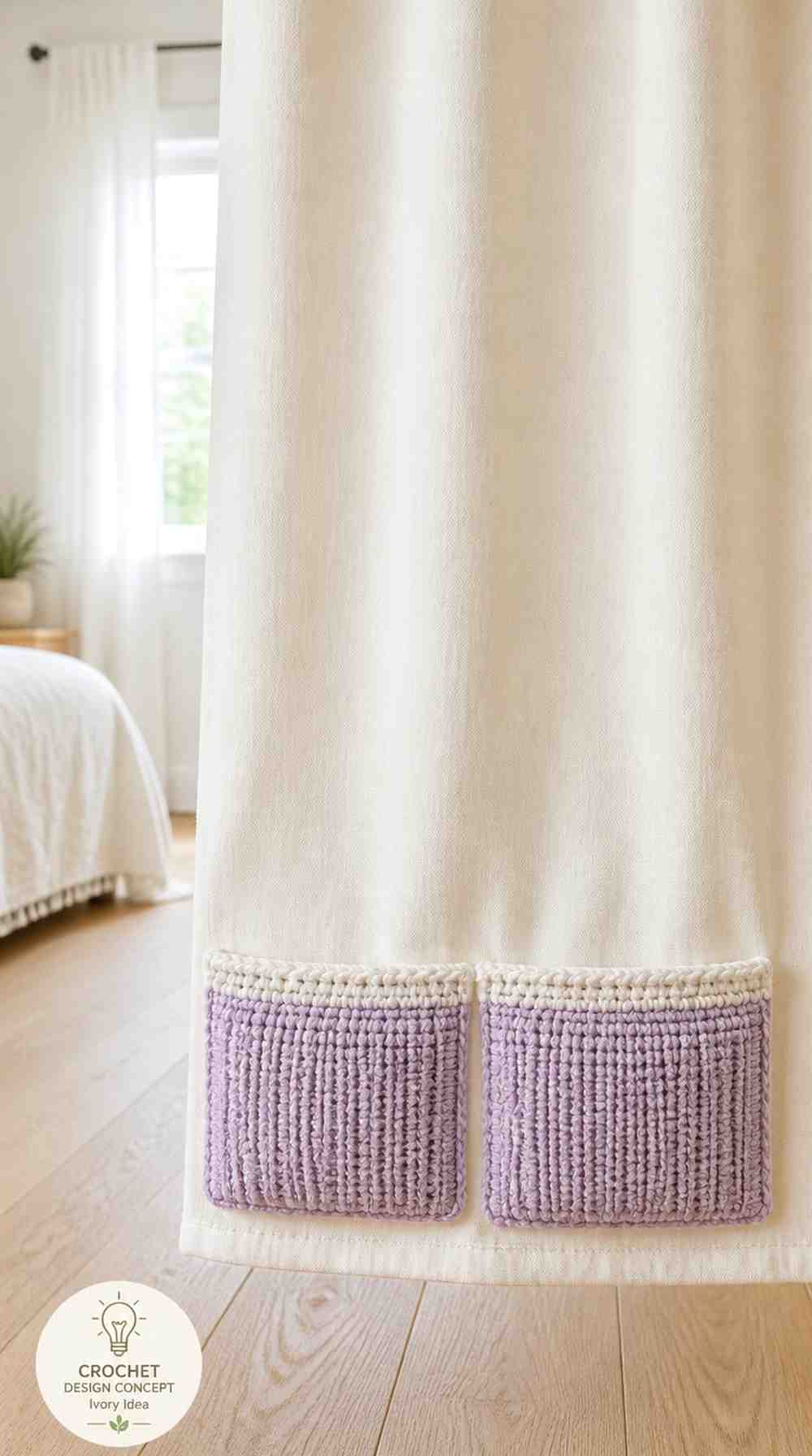
Pale-lavender crochet creates two small rectangular weight pockets positioned side by side along the reverse-side lower hem of a cream cotton curtain. Each pocket features neat vertical ribs, a warm-white upper border and a separately stitched closure. A narrow space between the pockets keeps their shapes visually distinct.
The paired arrangement provides an alternative to one wider channel. It could suit a curtain where two nearby attachment points are being considered, although the gap and enclosed weights must be planned according to the actual fabric.
- Pocket Spacing: Keep the narrow gap consistent so the two lavender pockets remain separate without stretching the curtain between them.
- Individual Closures: Each pocket needs its own secure enclosure; the gap between them should not provide access to either weight.
- Local Hem Pull: Two adjacent weighted sections may create concentrated downward tension, so their suitability must be checked on the real curtain.
13. Crochet Burgundy Curved Gusset Hem Pocket
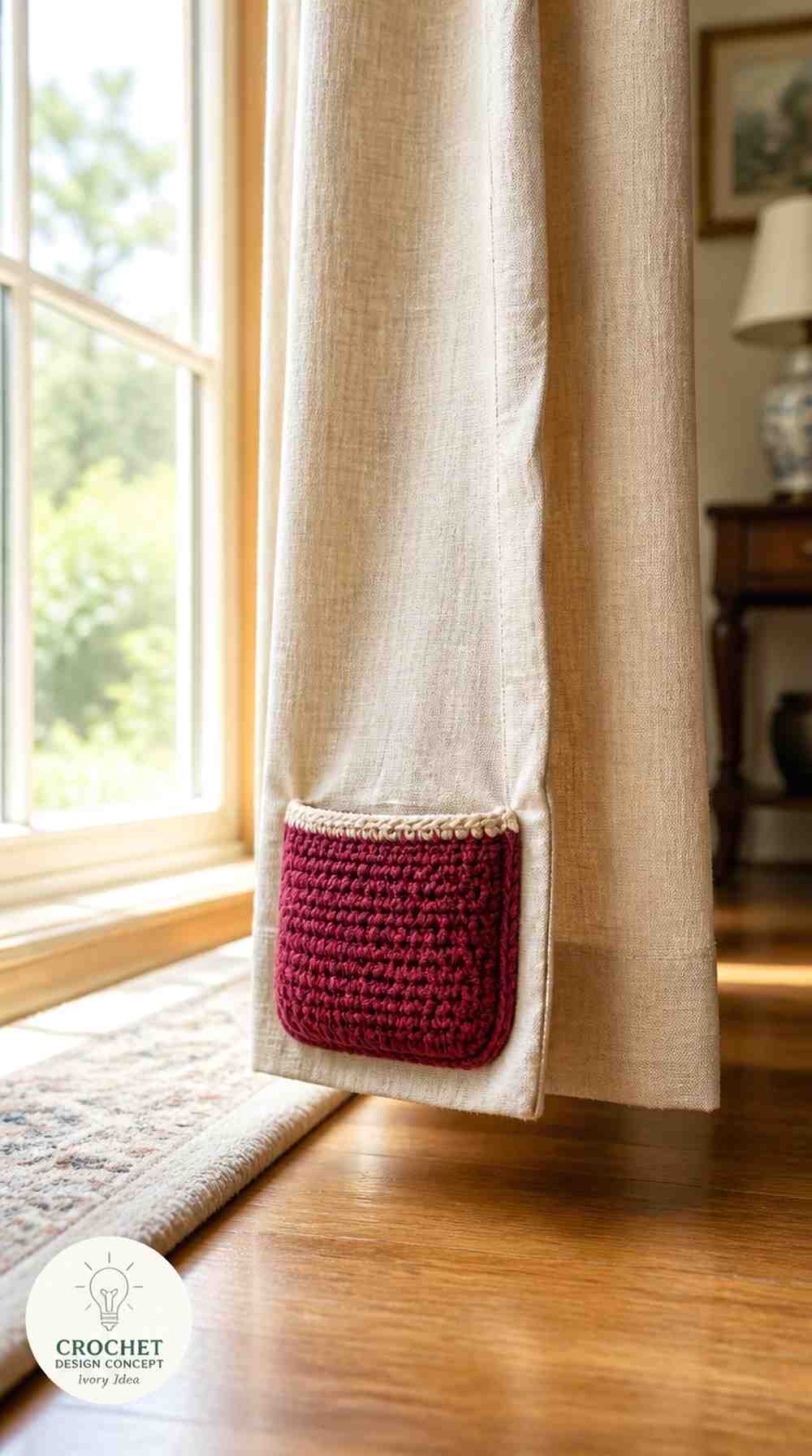
Burgundy-red crochet gives this final pocket a rich, softly structured appearance. Its rounded front features raised basketweave-style stitches, while narrow side gussets and an oatmeal upper border define the compact shape. The pocket sits against the reverse-side bottom corner of a warm beige linen curtain, with a flat enclosed weight held inside a securely sewn lining.
The subtle basket-like silhouette is more dimensional than the flatter rectangular designs. It could complement traditional living-room curtains, although its extra fabric and gussets need careful proportioning to avoid distorting the hem.
- Curved Front: Shape the rounded lower panel evenly so it sits against the curtain without projecting unnecessarily beyond the hem.
- Narrow Gussets: Keep the side sections shallow; the enclosed flat weight should not require the pocket to behave like a deep storage bag.
- Basketweave Texture: Raised stitches add visual character but may increase weight and thickness, so the complete pocket should be assessed on the curtain.
Practical Guide to Crochet Curtain Hem Weight Pockets
Curtain hem weights are used to help certain fabrics hang more evenly or reduce unwanted flaring. Adding crochet pockets introduces another layer of material, so both the curtain and the enclosed weight need careful consideration.
Check whether weights are actually needed. Some curtains hang well without any additional weight. Before making changes, inspect the fabric, existing hem, rod alignment and how the curtain falls when fully extended. Hem weights are not a guaranteed solution for every drape problem.
Choose appropriate, lead-free drapery weights. Purpose-made enclosed zinc or other verified lead-free drapery weights are preferable to loose coins, stones or unidentified metal pieces. For example, Dritz Zinc Drapery Weights are designed for securing within curtain hems or side seams. Follow the product’s installation and care instructions.
Prym Americas
Keep every weight securely enclosed. Decorative crochet openings are not suitable for exposing loose weights. Use an appropriate sealed inner packet and properly secured stitching. A button or decorative crochet flap should not be the only barrier preventing a weight from escaping.
Protect children and pets. Small detached weights can present serious hazards, and lead-containing weights should be avoided. Do not use accessible weighted pockets on curtains within reach of young children or pets. Also keep window-covering cords secured according to established safety guidance.
Match the pocket to the curtain fabric. Sheer cotton, linen and heavier drapery materials behave differently. A thick crochet pocket may show through thin curtains or create unwanted pulling. Weight selection and positioning should be based on the actual fabric and curtain construction.
Check the hem and hardware. Added weight increases the total load on the curtain rod, brackets and fabric seams. Make sure these remain suitable and that the finished curtain does not drag or catch on the floor.
Plan for cleaning. Follow the curtain and weight manufacturer’s instructions. Some combinations may require removing the weight before washing; others may be compatible with particular cleaning methods. Check that the crochet and fabric dry properly before rehanging.
For more window-decoration inspiration, explore Yarn Nest Studio’s 22 Crochet Vintage Lace Café Curtain Ideas for Cozy Winter Kitchens. It covers decorative lower edges, lace shapes and curtain styling rather than weight-pocket construction.
Want to Make Something Similar?
These two resources explain related curtain-weight placement and small crochet pocket construction. Neither is an exact pattern for the 13 designs above.
- How to Use Drapery Weights — National Sewing Circle — Demonstrates how drapery weights can be positioned and hand-stitched inside curtain hems, including lower-corner placement and additional positions along a longer hem. National Sewing Circle
- Little Crocheted Pocket Tutorial — Delia Creates — Shows how to make a small crochet pocket and sew it onto fabric. It is a general pocket-making reference, not a tested method for enclosing curtain weights. deliacreates.com
A handmade version would require suitable drapery hardware, a secure inner weight enclosure and sewing methods appropriate for the curtain fabric.
Which Crochet Curtain Hem Weight Pocket Should You Choose?
| Design | Main visual feature | Important consideration |
|---|---|---|
| Terracotta Ribbed | Simple raised-rib rectangle | Corner position and enclosure |
| Indigo Checkerboard | Matching granny-square pockets | Symmetrical placement and joins |
| Buttercream Scalloped | Delicate curved edging | Sheer fabric visibility |
| Olive Leaf | Botanical pointed front | Concealed backing and leaf shaping |
| Charcoal Foldover | Modern folded sleeve | Added hem thickness |
| Blush Daisy | Small floral appliqué | Secure motif attachment |
| Navy Triangle | Two geometric corner pockets | Diagonal seam closure |
| Rust Triple Section | Three adjacent compartments | Weight distribution |
| Teal Lattice | Openwork with cream lining | Fabric layers |
| Apricot Button Flap | Rounded decorative flap | Separate secure inner pouch |
| Oatmeal Hidden Channel | Narrow horizontal strip | Correctly enclosed insert |
| Lavender Twin Pocket | Two adjacent rectangles | Localized hem tension |
| Burgundy Curved Gusset | Rounded basketweave front | Extra thickness and gussets |
For a simple, understated concept, the Crochet Terracotta Ribbed Curtain Hem Pocket or Crochet Oatmeal Hidden Channel Weight Pocket offers a relatively straightforward visual arrangement.
For paired lower-corner details, the Crochet Indigo Checkerboard Hem Weight Pockets and Crochet Navy Triangle Corner Weight Pockets create coordinated shapes at opposite sides of a curtain.
If decorative texture is the priority, compare the Crochet Olive Leaf Concealed Hem Pocket, Crochet Blush Daisy Curtain Corner Weight Pocket and Crochet Burgundy Curved Gusset Hem Pocket. Their motifs and raised surfaces add character, but they also require more careful fabric and weight planning.
Conclusion
Crochet curtain hem weight pockets bring together decorative yarn textures and the practical idea of keeping suitable drapery weights enclosed near the lower curtain edge. These 13 concepts range from simple rectangular pockets and triangular corners to delicate scallops, floral fronts, lattice panels and low-profile hem channels.
The right approach depends on the curtain’s fabric, existing construction, room conditions and whether extra weight is appropriate at all. Prioritize properly enclosed lead-free weights, secure stitching and child and pet safety over decorative detail.
Which design would you choose for your curtains? Do you prefer the terracotta ribbed corner pocket, the oatmeal hidden channel or the delicate buttercream scalloped design? Share your favorite style and whether your curtains are sheer cotton, linen or heavier fabric.
Frequently Asked Questions
1. Do crochet curtain hem weight pockets help curtains hang straighter?
They can be used as decorative enclosures for suitable drapery weights, which may help some curtains hang more evenly. However, the crochet itself is not necessarily heavy enough to change the drape significantly. Results depend on the curtain material, weight selection, placement, construction and existing hanging arrangement.
2. What should I put inside a crochet curtain hem weight pocket?
Use a purpose-made, appropriately selected, lead-free drapery weight that can be securely enclosed and attached according to its manufacturer’s instructions. Do not use loose coins, stones, unsecured metal pieces or unidentified weights. Decorative crochet should not be the only material retaining the weight.
3. Can I add these pockets to sheer curtains?
A crochet pocket may be visually adapted for a sheer curtain, but thin fabrics can reveal the weight and may be damaged or distorted by unsuitable stitching or added load. The Buttercream Scalloped concept illustrates a delicate appearance, not a tested solution. Check the curtain’s construction and seek appropriate sewing guidance.
4. Are curtain hem weight pockets suitable for homes with children or pets?
Accessible weighted pockets can be hazardous if the enclosure fails and a small weight becomes detached. Avoid using them in places where children or pets can reach, pull at or chew the curtain. Lead-containing weights should be avoided, and existing window-covering cord hazards must also be addressed separately.
5. Are these crochet curtain hem weight pocket ideas complete patterns?
No. These are original design visualizations created for inspiration rather than tested crochet patterns or drapery installation instructions. The linked resources demonstrate related pocket and curtain-weight techniques, but they do not reproduce these exact designs. A real project needs suitable materials, careful measurements, secure weight enclosure and checks for its intended curtain.
Before publishing the generated images, check the number of pockets, crochet stitch accuracy, attachment details and featured-image title. Generated visuals may not reproduce every construction detail correctly.