A crochet sofa throw tuck keeper strap can help arrange a favorite blanket more neatly across a sofa, armrest, or back cushion. These 17 inspiration ideas explore flat tuck-in tails, adjustable button bands, folded blanket loops, soft corner keepers, and decorative straps. The collection brings together warm terracotta, classic oatmeal, navy, muted olive, burgundy, and other inviting colors, with crochet textures ranging from closely worked rows to granny-square accents.
Some designs are intended to keep a folded throw together for display, while others use flexible crochet tails tucked gently between sofa cushions to help position a loose blanket edge. The right choice depends on the sofa’s shape, the thickness of the throw, and whether you want a temporary decorative arrangement or a removable storage band. None is a tested anti-slip device, but these concepts offer several ways to explore neat, practical-looking sofa styling.
These are AI-generated crochet design visualizations for inspiration, not photographs of tested handmade accessories or step-by-step patterns.
Quick Design Selection Guide
- For an untidy throw edge near the cushions: Compare the Crochet Terracotta Flat Tuck-Tail Strap, Crochet Olive T-Shaped Tuck Keeper, and Crochet Forest Green Fabric-Flap Tuck Keeper.
- For a throw draped over the armrest: The Crochet Oatmeal Twin-Loop Armrest Keeper, Crochet Lavender Scalloped Arm Drape Band, and Crochet Butter Yellow Daisy Loop Keeper offer decorative gathering methods.
- For folded or rolled throws: Consider the Crochet Navy Buttoned Backrest Band, Crochet Charcoal Ladder-Button Fold Keeper, and Crochet Ivory Granny-Square Throw Band.
- For two cushion-gap contact points: The Crochet Teal Split-Y Tuck Anchor and Crochet Rust Double-Tail Gap Strap use different branching arrangements.
- For adjustable decorative fastening: The Crochet Coral Fold-Tab Throw Keeper and Crochet Denim Reversible Wrap Belt use removable closures.
1. Crochet Terracotta Flat Tuck-Tail Strap
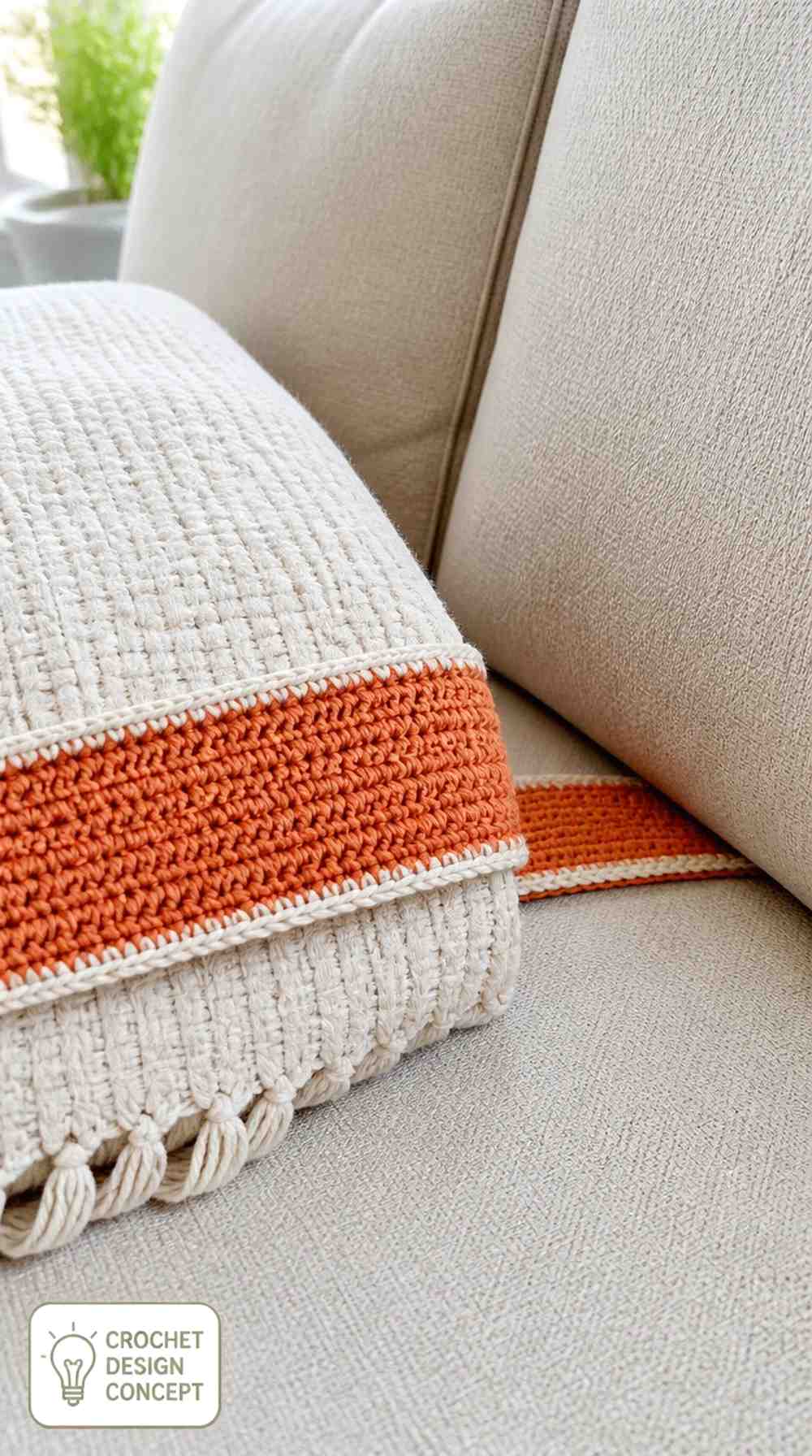
Warm terracotta crochet creates a compact keeper around the folded lower edge of a cream sofa throw. A long rectangular tail extends behind the blanket and disappears into the crease between the beige sofa’s seat and back cushions. A narrow ivory border follows the visible band and tail.
This simple construction combines a decorative front section with a flexible tuck-in extension. Its purpose is to help position a light blanket fold, although its ability to stay in place would depend heavily on the cushion gap and fabric surfaces.
- Flat Tuck Tail: Keep the rectangular tail smooth and flexible so it follows the cushion gap without creating a hard lump against the upholstery.
- Visible Band Width: The terracotta section should be wide enough to gather the folded throw edge without pulling the cream fabric into a tight bunch.
- Cushion Compatibility: A loose gap may provide little resistance to movement, so check the actual sofa before expecting the tail to retain the fold.
2. Crochet Oatmeal Twin-Loop Armrest Keeper
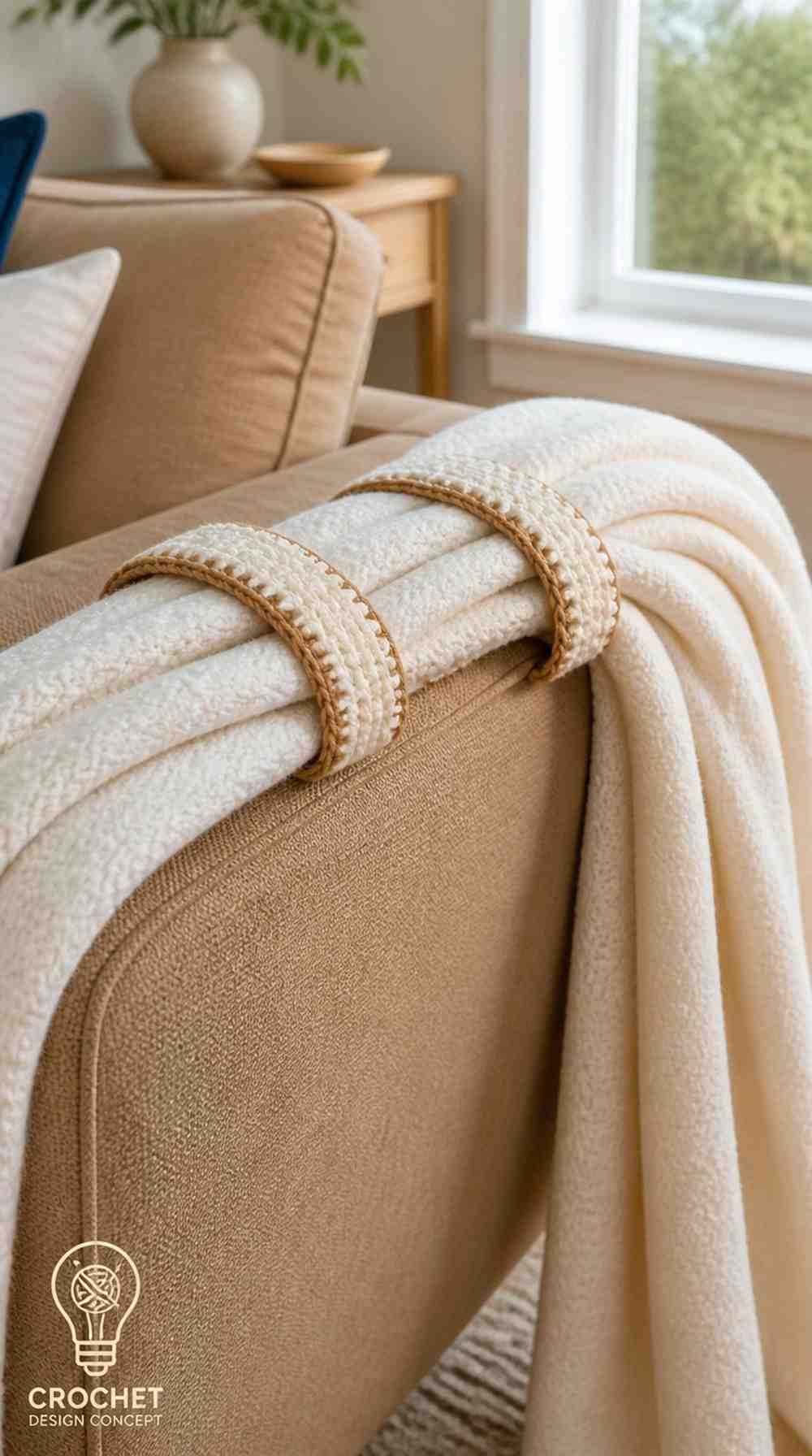
Two oatmeal cotton crochet loops sit side by side, connected by a short flat bridge. Each loop gathers a separate folded section of an ivory throw draped over a camel-colored sofa arm. A fine caramel border gives the loops a tidy finish.
Unlike a strap inserted between cushions, this keeper stays on the throw itself. The short bridge links two fabric folds near the armrest, creating a compact arrangement while allowing the rest of the blanket to hang naturally down the outside.
- Twin-Loop Spacing: Keep the connecting bridge short enough to gather the two folded sections without stretching the throw awkwardly across the armrest.
- Fold Thickness: Measure the bundled fabric before choosing loop size, especially when working with thicker winter throws.
- Armrest Movement: The loops organize the blanket rather than fastening it to the sofa, so the entire arrangement may shift during use.
3. Crochet Navy Buttoned Backrest Band
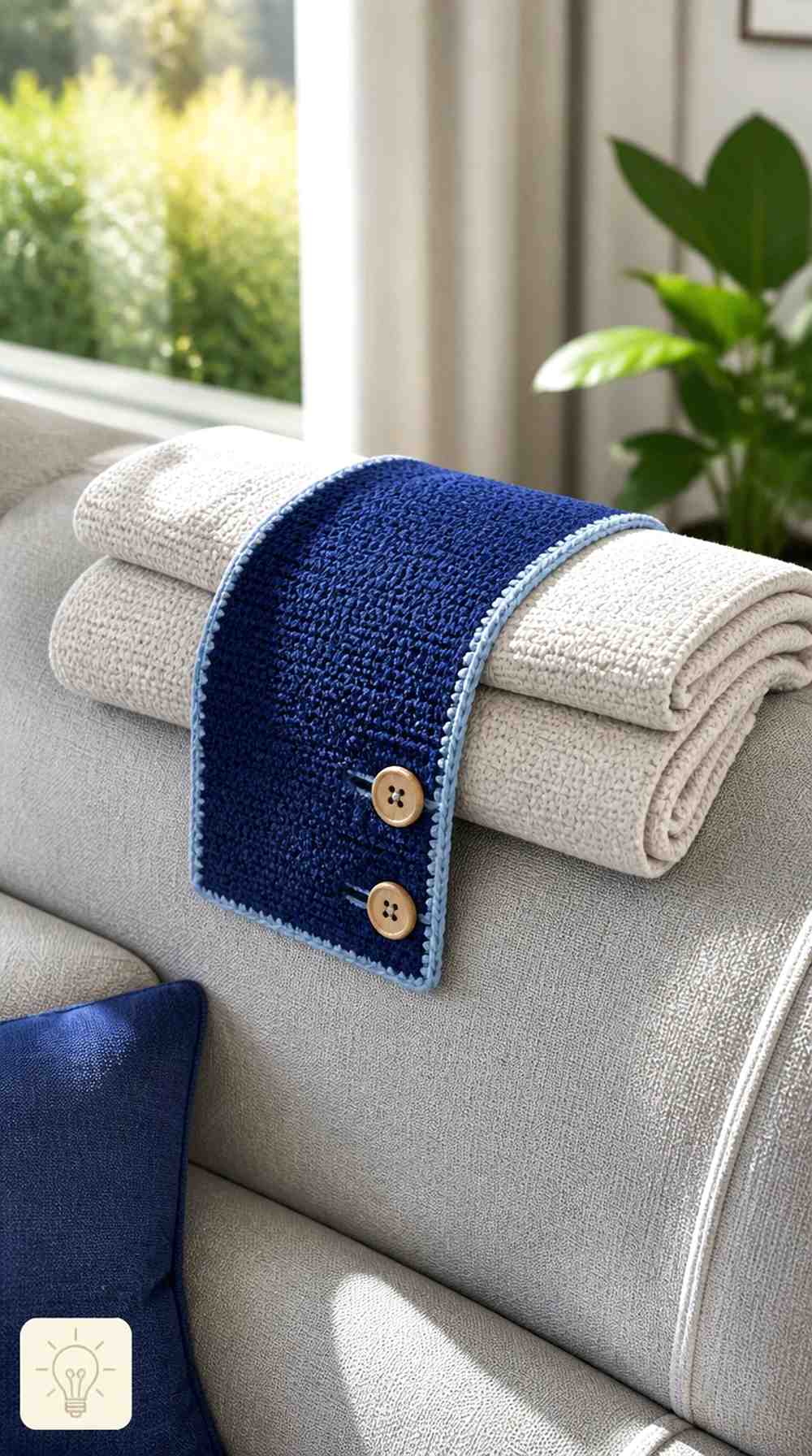
Deep navy crochet wraps around a neatly folded oatmeal throw arranged across the upper backrest of a light-grey sofa. Two small wooden buttons close the overlapping strap ends, while powder-blue edging gives the band a crisp outline.
The buttoned design is intended for a throw kept folded and ready to use. It does not attach to the sofa, making removal straightforward, but the complete folded bundle still depends on the backrest’s shape to remain in position.
- Two-Button Closure: Space the wooden buttons so both ends of the navy band close evenly without pulling the folded blanket into an uneven shape.
- Backrest Arrangement: Check whether the sofa top is broad and level enough to support the folded throw without relying on the strap for stability.
- Button Contact: Keep hard buttons facing away from delicate upholstery where possible to reduce rubbing when the blanket bundle is moved.
4. Crochet Olive T-Shaped Tuck Keeper
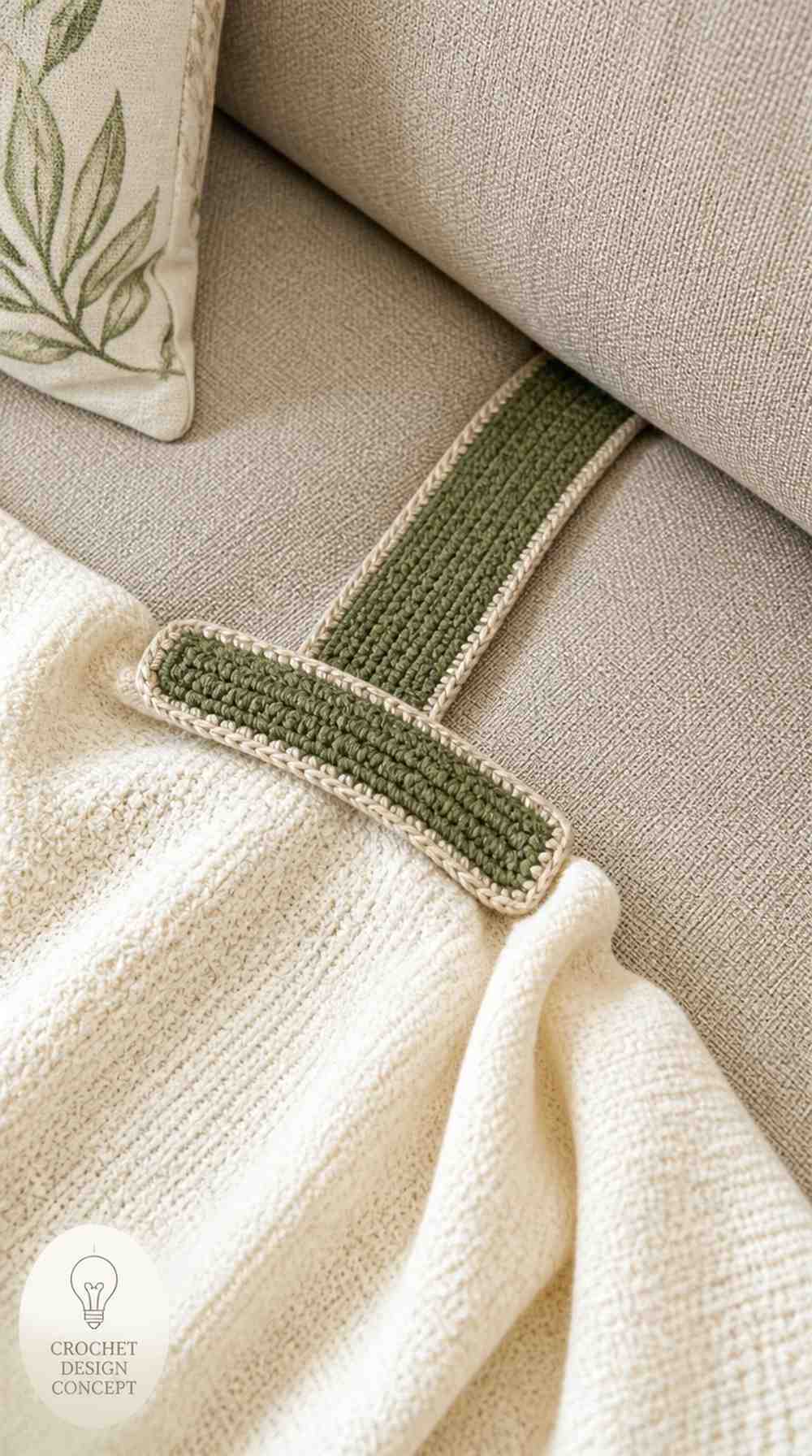
Muted olive-green crochet forms a distinctive T-shaped keeper with an oatmeal border. Its short horizontal crossbar rests across the lower folded edge of a cream sofa throw, while a long flat tail extends into the gap behind the seat cushion.
The simple T shape gives this design a different visual structure from a closed loop. Its front section remains visible above the cushion seam, creating a small handmade accent while the longer extension provides a possible point of light positioning.
- T-Junction: Reinforce the connection between the horizontal crossbar and long vertical tail, where repeated handling could pull against the joined stitches.
- Crossbar Coverage: Keep enough of the olive horizontal section exposed to contact the folded blanket without disappearing entirely into the cushion gap.
- Tuck Depth: Insert the tail only as far as the sofa design comfortably allows; forcing fabric deeply between cushions may damage or distort upholstery.
5. Crochet Dusty Rose Double-Slot Edge Keeper
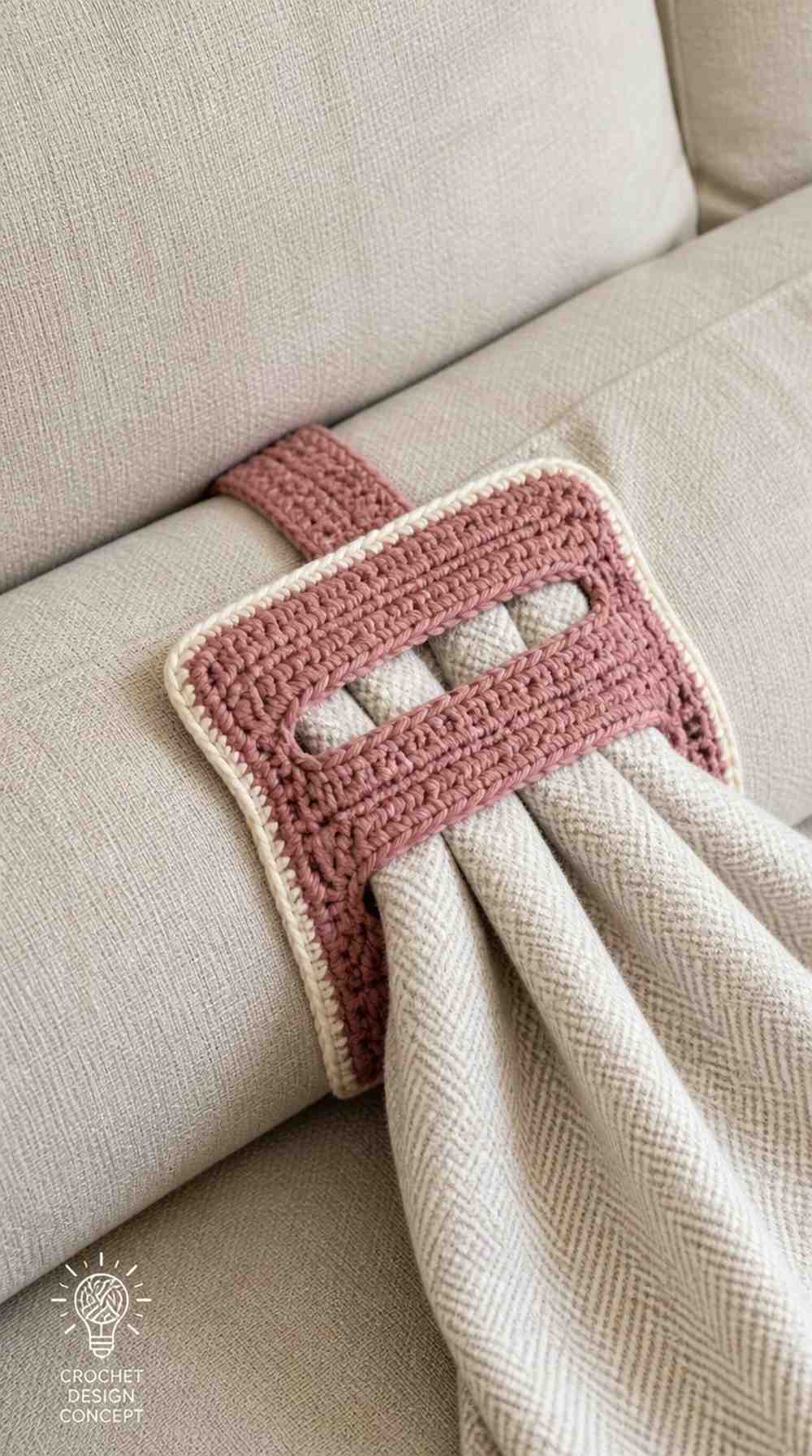
Dusty-rose crochet forms a rectangular band with two horizontal slots worked through its center. Two narrow folds of a cream herringbone throw pass through these openings, while a plain crochet tail extends behind the strap and into the sofa cushion crease. Ivory edging finishes the outer shape.
The paired slots help distinguish this concept from an ordinary wraparound band. They gather two small blanket sections without separate buttons, although threading fabric through the openings could take more effort than simply closing a strap around it.
- Slot Openings: Allow enough room for the two folded fabric sections to pass through without being squeezed or stretched.
- Reinforced Slot Edges: The crochet surrounding each opening needs tidy, secure stitches so repeated threading does not pull the slots out of shape.
- Blanket Texture: Avoid forcing heavily textured or delicate throws through narrow openings where their fibers could snag against the crochet.
6. Crochet Mustard Braided Crease Keeper
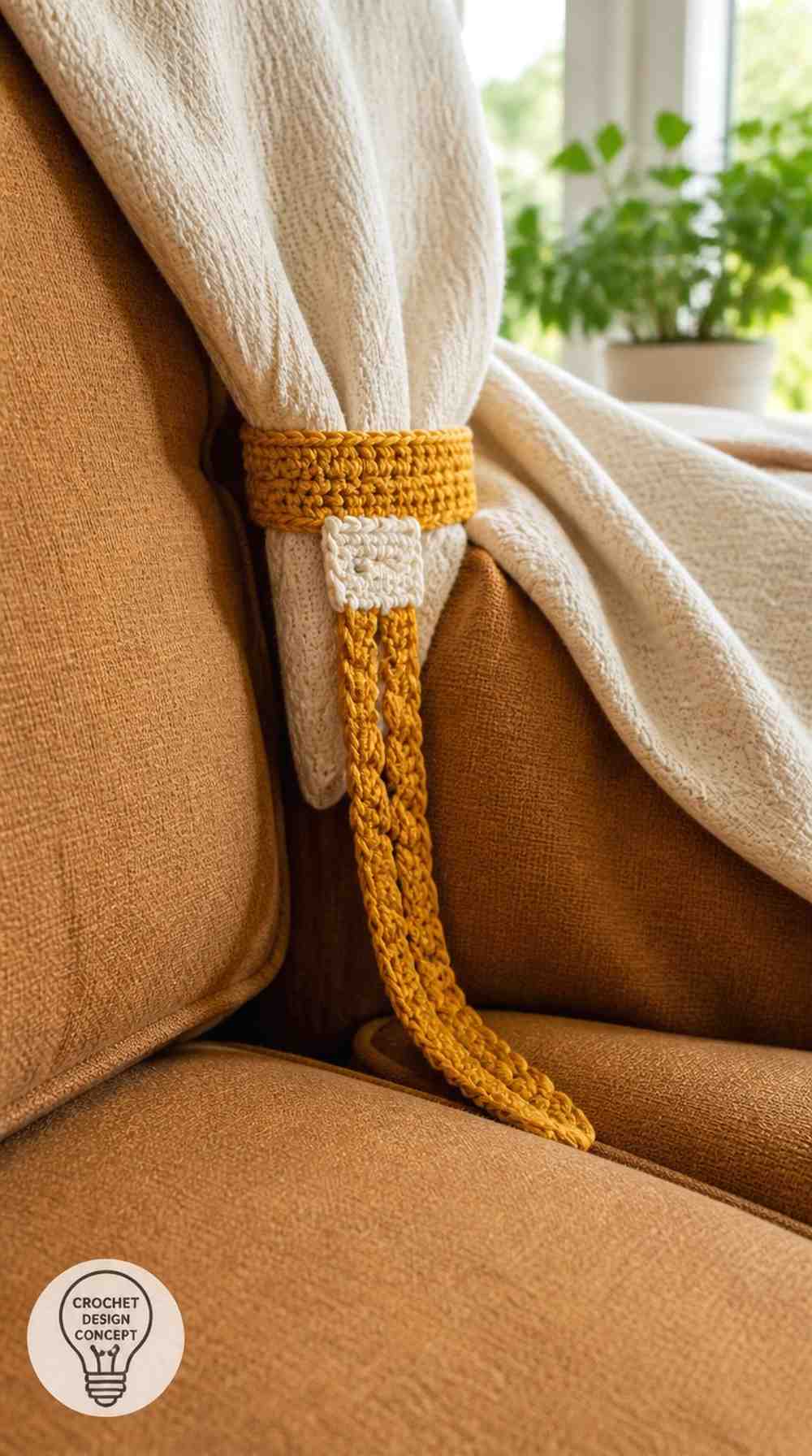
Mustard-yellow crochet creates a compact keeper with a braided tail made from three narrow crocheted cords. A small cream rectangular reinforcement connects the braid to the front band, which circles the folded corner of an ivory throw.
The braided section is partly tucked into the seat-back crease of a caramel-colored sofa. Compared with a broad flat tail, the braid has a more textured appearance and a narrower contact area, making its positioning behavior potentially different.
- Braided Tail: Keep all three cords similar in thickness and securely joined so the braid does not loosen during repeated removal.
- Connection Panel: The cream reinforcement should spread the joining area across the band rather than concentrate tension on a single crochet stitch.
- Cushion Comfort: A thick braid could form a noticeable ridge if trapped beneath a seated person, so use this only where it remains comfortable and unobtrusive.
7. Crochet Charcoal Ladder-Button Fold Keeper
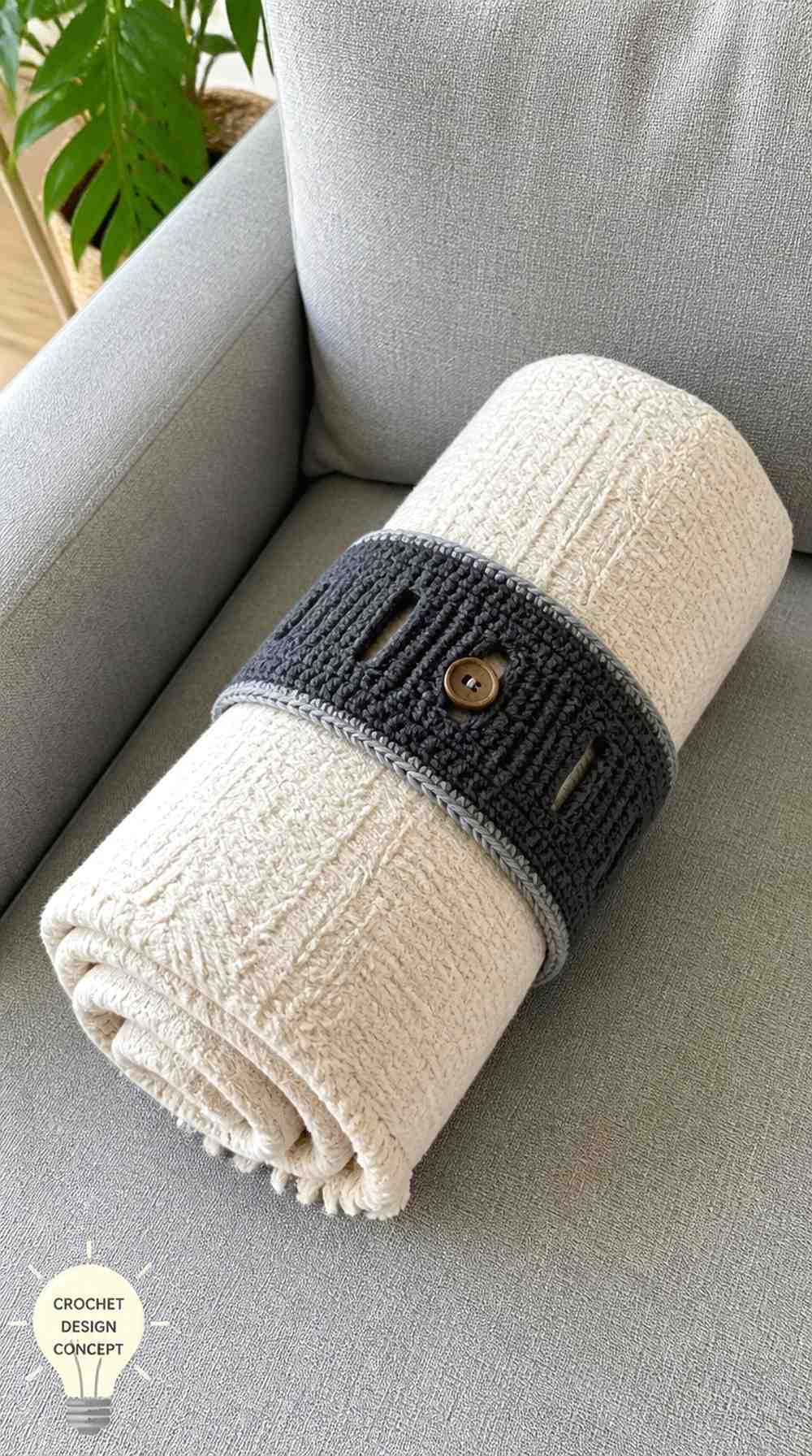
Charcoal-grey crochet forms an adjustable band around a rolled cream throw resting beside the armrest of a light-grey sofa. Three rectangular buttonholes run along the overlapping end, with a small wooden button fastened through the middle opening. Silver-grey edging finishes the strap.
This concept focuses on keeping a throw rolled for storage or display rather than anchoring it between cushions. The multiple buttonholes allow some adjustment for different roll thicknesses, although the completed band should not compress the blanket tightly.
- Ladder Buttonholes: Space the three openings so the button can be moved between positions without weakening the narrow crochet sections between them.
- Roll Diameter: Measure the rolled blanket before selecting the strap length, allowing room for soft fabric without excessive compression.
- Button Placement: Keep the wooden button accessible on the exterior of the roll, away from the sofa upholstery.
8. Crochet Lavender Scalloped Arm Drape Band
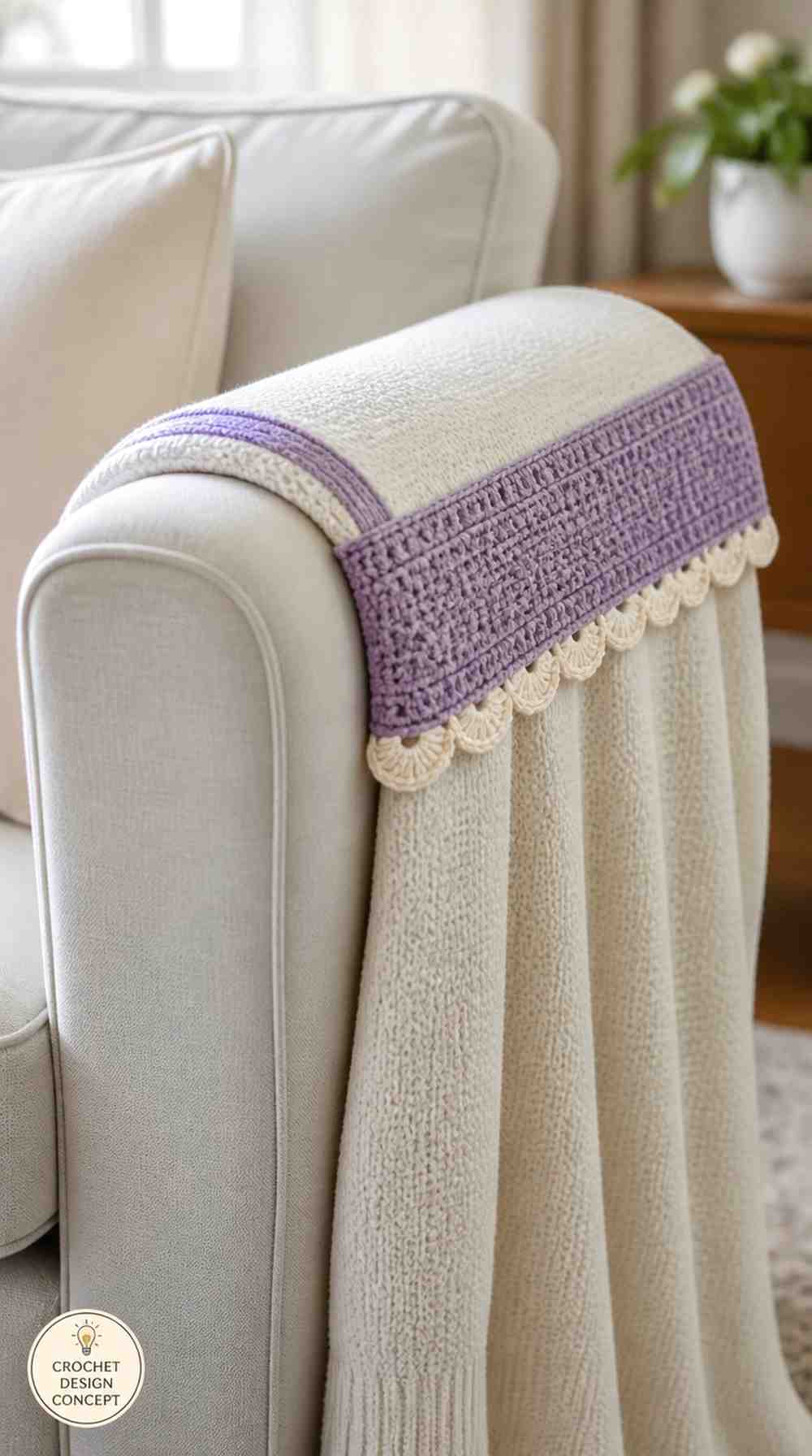
Soft lavender crochet circles a folded section of a white woven throw draped over a cream sofa arm. A row of small ivory scallops runs along the band’s lower edge, creating a gentle decorative finish without covering the main blanket.
The band gives a plain throw a more styled appearance while keeping its soft folds together near the armrest. Its scallops are primarily decorative, so the main band should handle the fabric gathering rather than relying on the delicate edging.
- Scalloped Border: Keep the ivory scallops small and evenly attached so they do not catch on the throw’s woven surface.
- Armrest Fit: The band surrounds the folded blanket, not the sofa arm, so its circumference should match the fabric bundle.
- Decorative Limitation: This keeper does not physically attach to the furniture; it may slide if the throw is repeatedly pulled or rearranged.
9. Crochet Teal Split-Y Tuck Anchor
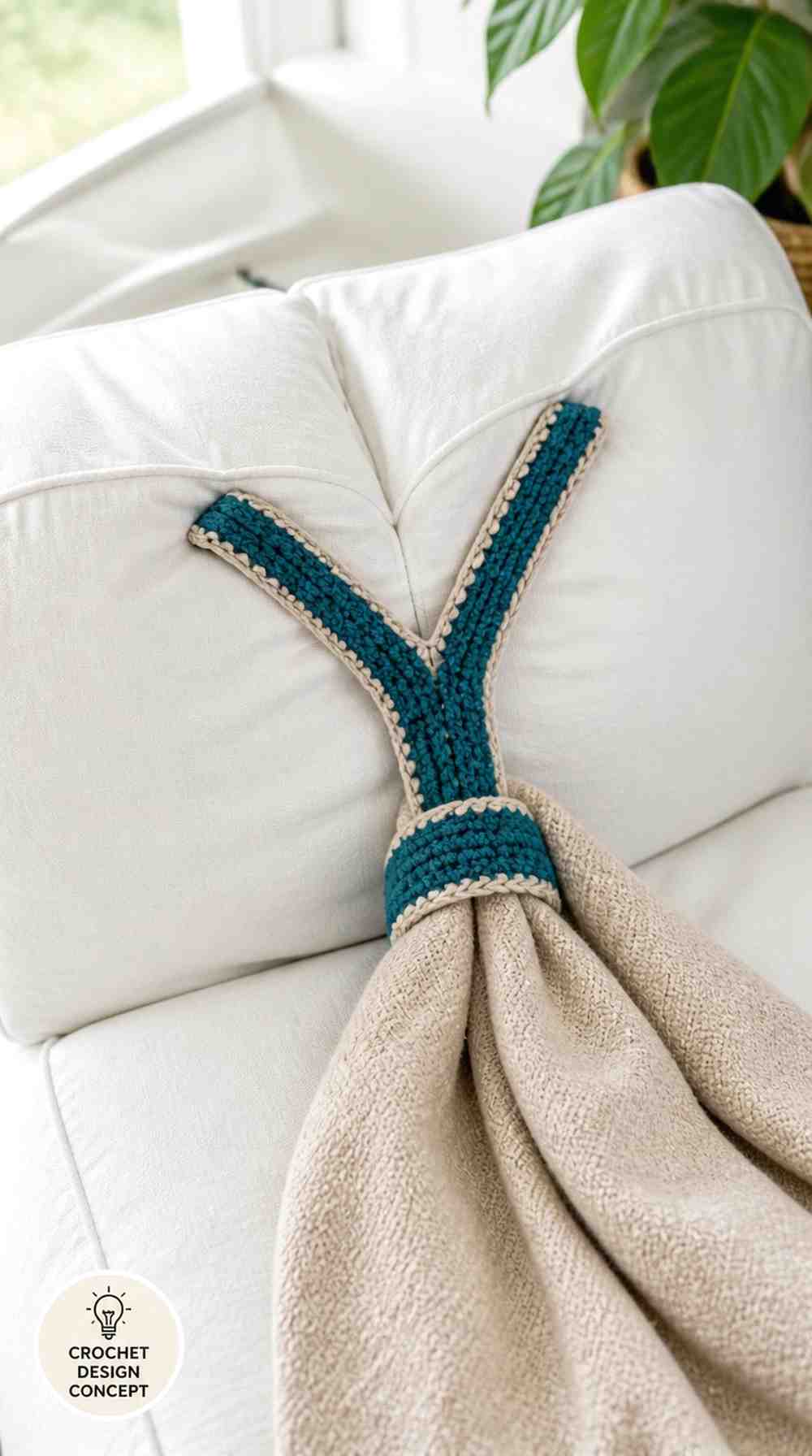
Deep-teal crochet forms a short band around the lower edge of a sand-colored throw, with two narrow tails branching into a Y shape behind it. Cream edging defines the junction and both tails, which enter two nearby sections of the cushion gap.
The branching arrangement gives this concept two separate tuck points rather than one long central extension. It could help distribute the decorative positioning across a wider blanket section, but actual retention depends on the sofa’s cushion spacing.
- Y-Shaped Junction: Reinforce the branching stitch area to avoid a weak connection where the two tails separate from the main teal band.
- Tail Spacing: Position the two ends according to the blanket width and available cushion gap, avoiding unnecessary sideways stretching.
- Sofa Suitability: This shape is inappropriate for moving recliner mechanisms or gaps where loose fabric could become trapped.
10. Crochet Cocoa Fabric-Backed Hold Band
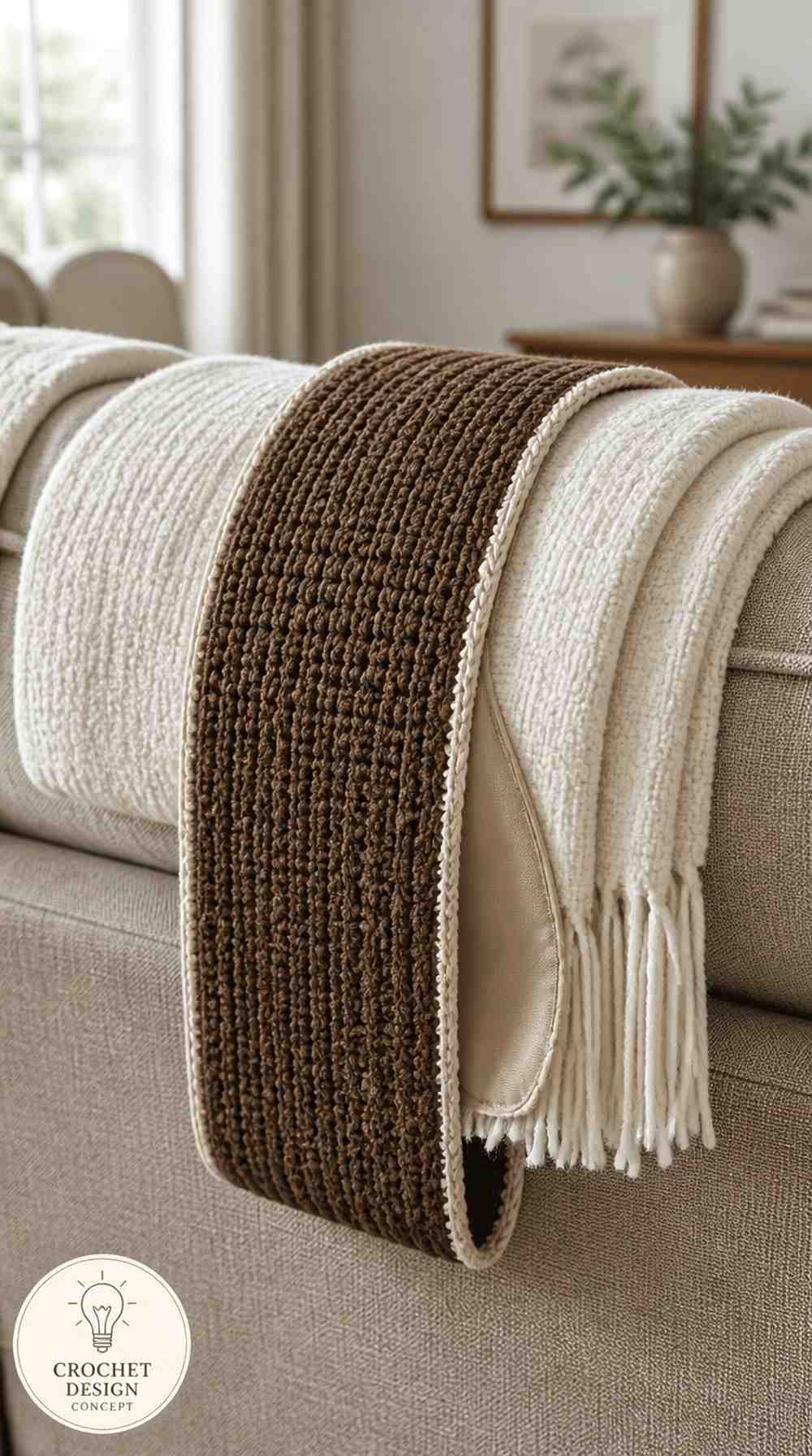
Cocoa-brown crochet forms a broad band around a folded cream throw resting along the upper backrest of a taupe sofa. A smooth beige fabric backing is visible beneath one slightly lifted edge, while narrow warm-ivory crochet borders finish the rounded corners.
The layered construction combines the look of crochet with a separate fabric surface. The beige backing could offer a smoother contact layer against the throw, although the actual friction, stretch, and effect on delicate fibers would need checking.
- Backing Material: Select a smooth fabric compatible with the throw, avoiding abrasive textures or dyes that might transfer onto lighter blankets.
- Concealed Overlap: Keep the closure area flat behind the folded throw so the band does not form an uncomfortable ridge.
- Backrest Stability: The cocoa band organizes the blanket itself; it cannot guarantee that the folded bundle will remain on a rounded or sloping sofa back.
11. Crochet Burgundy Cross-Strap Corner Keeper
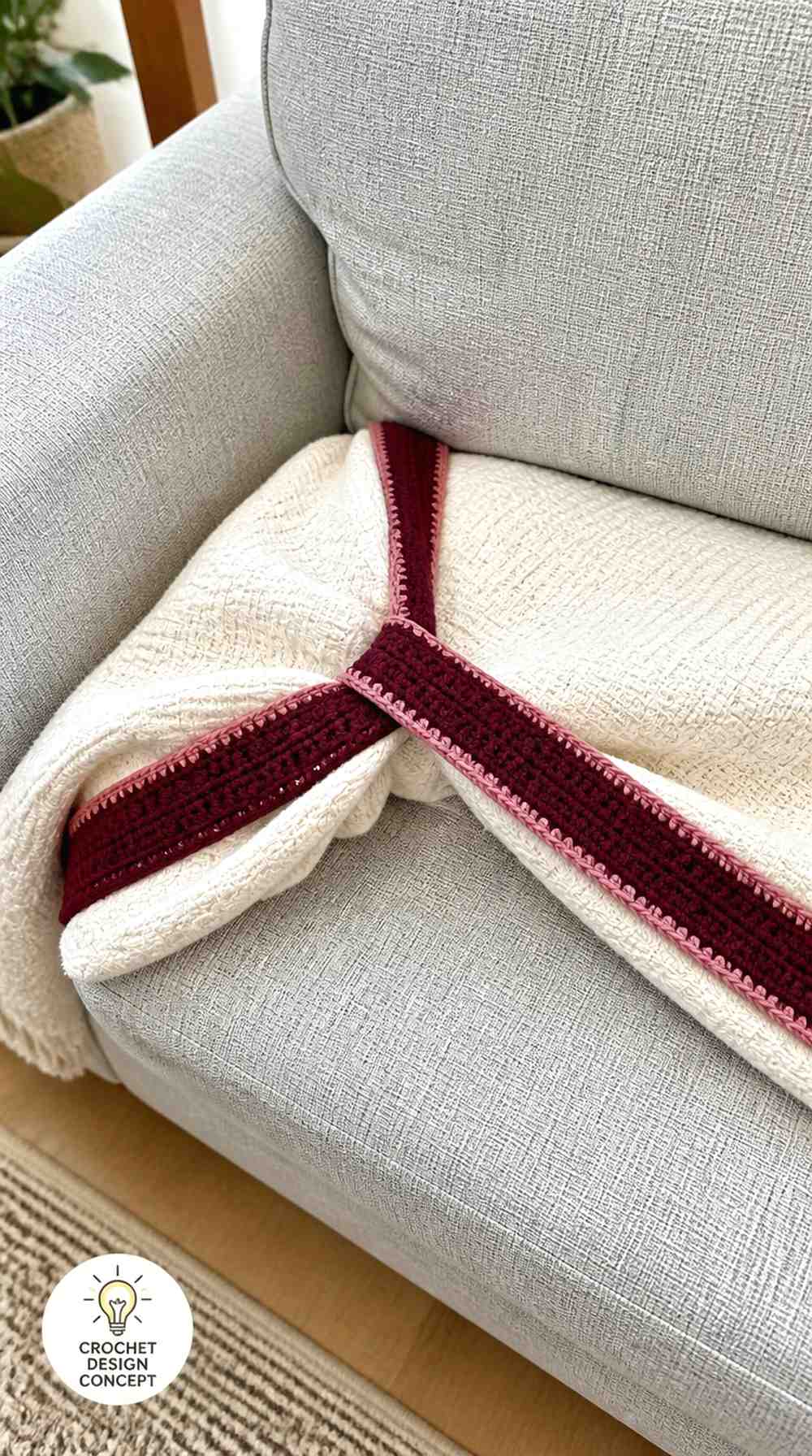
Two narrow burgundy crochet straps cross into a small X over the folded lower corner of an ivory throw. Thin dusty-rose edging highlights the crossing, while a short flat tail extends from their joined section into the sofa’s cushion crease.
The crossed arrangement gives this keeper a distinct corner-focused appearance. Instead of encircling an entire rolled blanket, it gathers one folded corner near the back of the sofa seat, where the tucked tail may help preserve the intended arrangement.
- Crossed Straps: Join the two burgundy sections securely at the center so they stay aligned without sliding apart over the fabric corner.
- Corner Gathering: Keep the X loose enough to avoid making sharp folds or pulling threads from the ivory throw.
- Short Tuck Tail: The limited tail length suits a shallow positioning concept, but may offer little retention in a wide cushion gap.
12. Crochet Ivory Granny-Square Throw Band
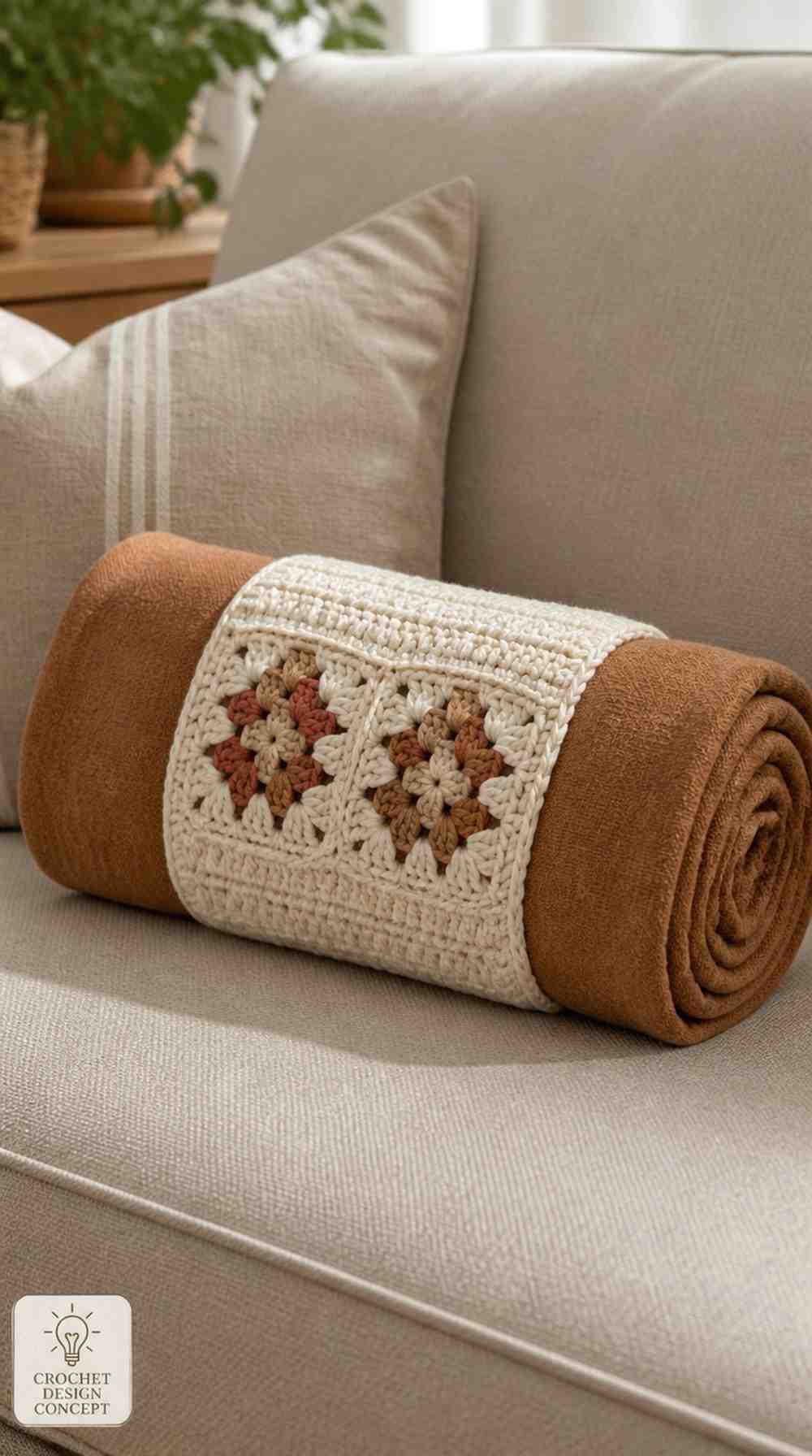
Warm-ivory crochet wraps around a rolled caramel-colored throw, with two joined granny-square motifs at the front. Muted rust and oatmeal centers give the squares gentle color variation, while a dense ivory continuation runs around the back of the blanket bundle.
This design uses traditional crochet motifs as a decorative focal point. Unlike the cushion-gap keepers, it is intended to keep a folded or rolled throw together when the blanket is not being used.
- Motif Joins: Keep the two granny squares neatly connected and reinforce their edges where the dense continuation band begins.
- Open Stitch Areas: Traditional granny-square gaps may catch loose blanket fibers, so check compatibility with delicate or heavily textured throws.
- Bundle Fit: Allow enough circumference around the caramel throw without stretching the motif sections out of square.
13. Crochet Coral Fold-Tab Throw Keeper
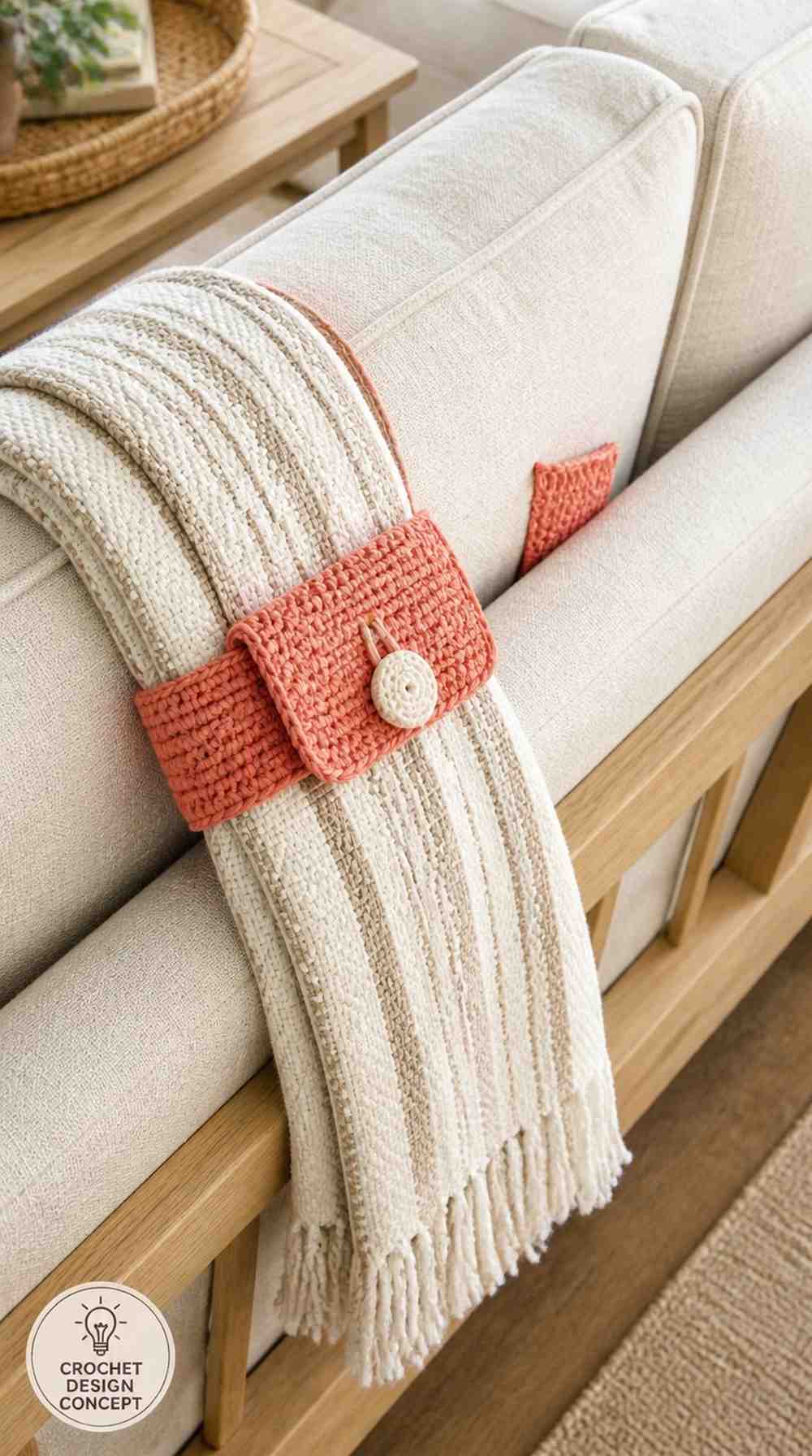
Soft-coral crochet forms a short band around the folded edge of a cream-and-beige striped throw. A rectangular front flap closes with one cream crochet button, while a separate flat coral tail extends behind the fabric into the sofa’s seat-back gap.
The fold-tab closure offers a quick way to open and reposition the keeper. Its compact shape suits a localized blanket edge, with the visible button adding a small decorative feature near the sofa cushion.
- Front Flap: Keep the coral flap wide enough to cover the folded strap end without pulling the striped blanket into a tight crease.
- Button Position: Place the cream button on the outward-facing side, away from the upholstery surface.
- Tuck-Tail Attachment: Reinforce the separate rear tail so it remains securely joined when the keeper is repositioned.
14. Crochet Denim Reversible Wrap Belt
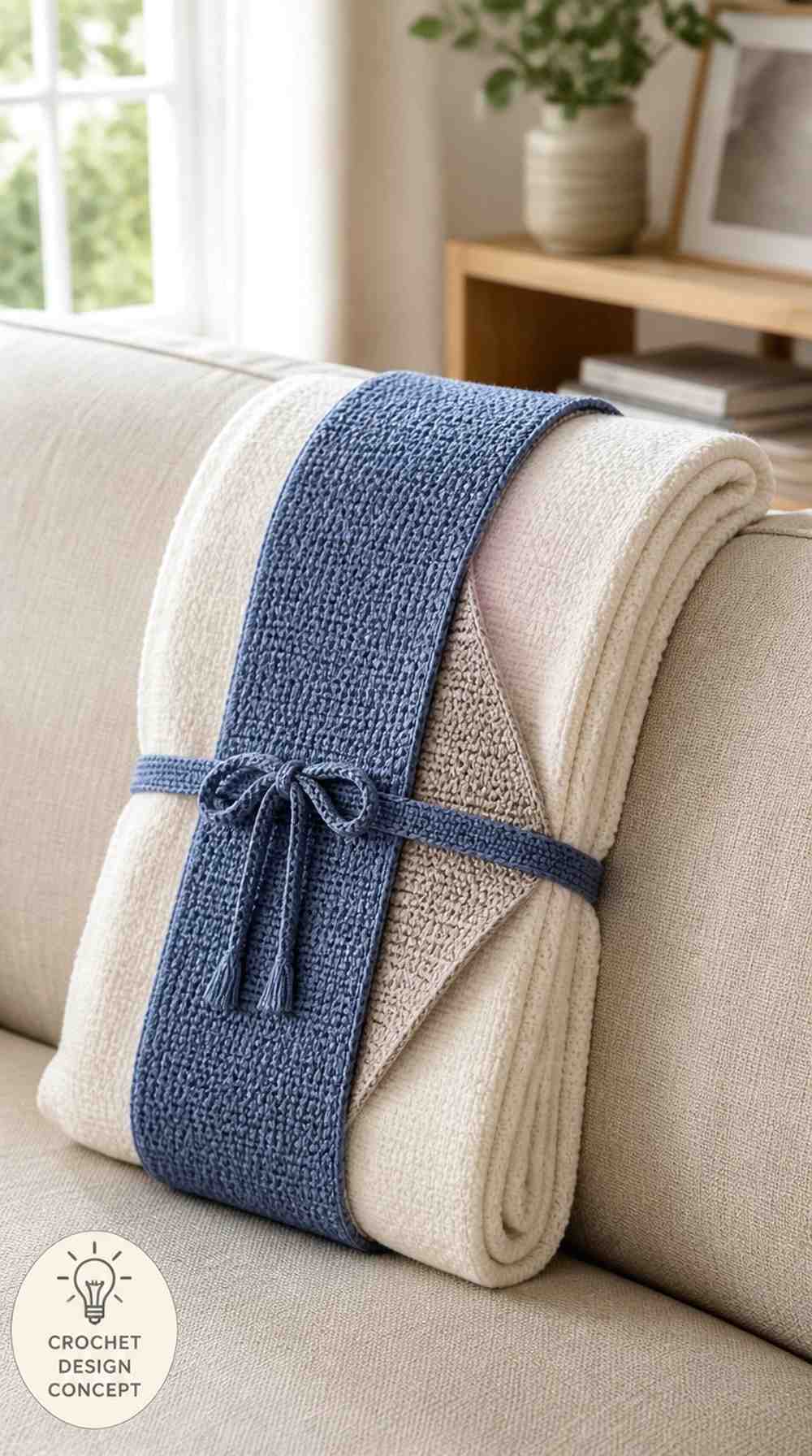
Dusty-denim-blue crochet forms the outer side of a long flat band, while oatmeal crochet appears on the reverse. The turned-back end reveals both colors, and two short blue ties secure the wrap around a folded cream throw resting across the backrest of a beige sofa.
The reversible arrangement gives this design two styling options without changing the entire strap. Its soft tied closure also avoids hard buttons, although the blanket remains supported by the sofa rather than fixed to it.
- Two-Face Construction: Keep the blue and oatmeal sides similar in shape and thickness so the band remains flat when reversed.
- Tie Length: Use short crochet ties that form a tidy bow without hanging over the backrest or catching on nearby cushions.
- Color Transfer: Check that both yarn colors are suitable for contact with a light blanket, especially after washing.
15. Crochet Butter Yellow Daisy Loop Keeper
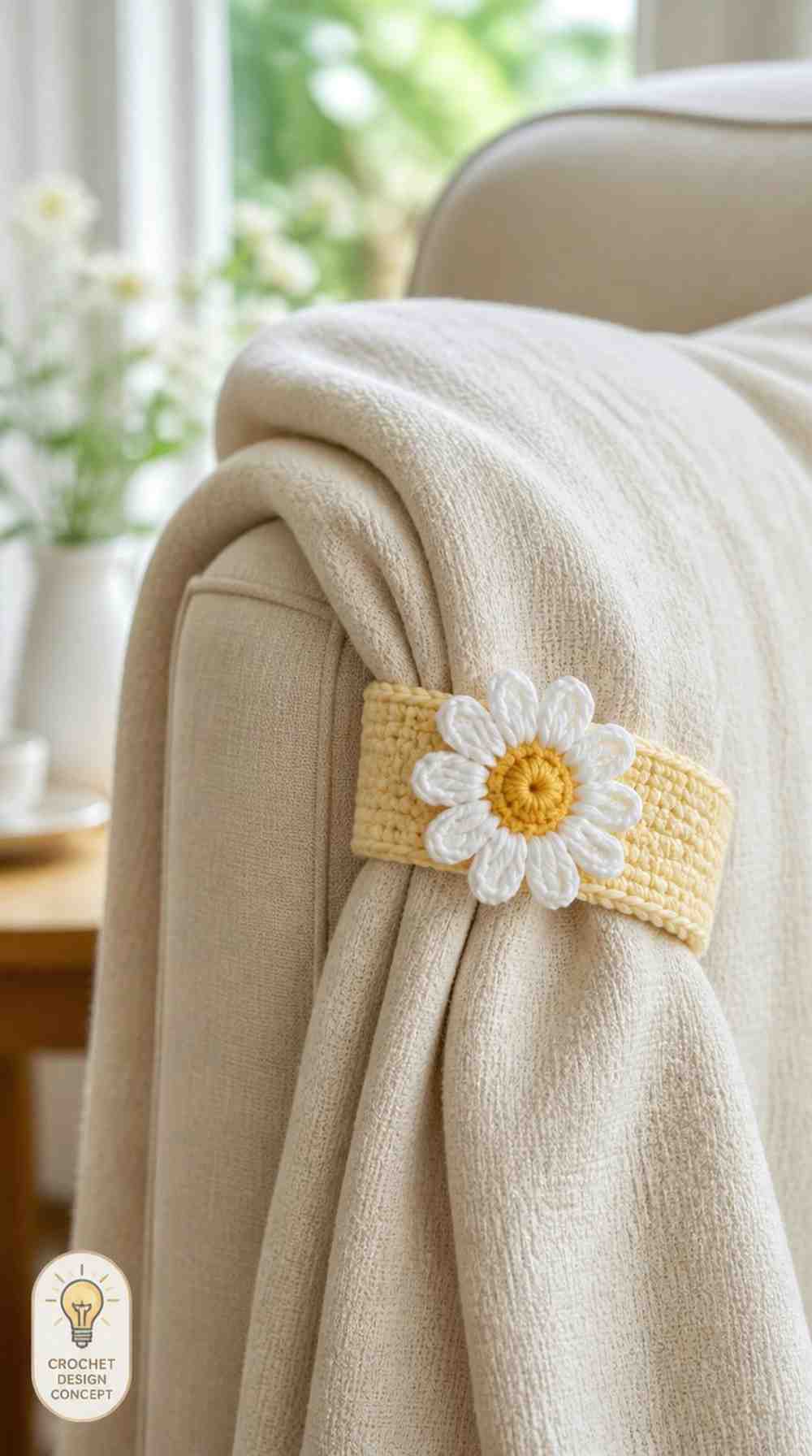
Butter-yellow crochet creates a compact loop around a softly rolled corner of a cream throw resting along a beige sofa arm. A single white crochet daisy with a golden-yellow center sits on the outer face of the loop, adding a small floral accent.
This concept is mainly about decorative gathering rather than firm blanket retention. The daisy remains outside the contact area, while the plain yellow loop circles the folded fabric without adding extra buttons or ties.
- Daisy Attachment: Join the white petals securely to the yellow band, keeping the flower outside the main gripping surface.
- Loop Size: Allow enough room for the folded blanket corner without compressing its soft fabric texture.
- Everyday Use: Remove the decorative loop when unfolding the throw so the flower does not catch or become stretched during use.
16. Crochet Rust Double-Tail Gap Strap
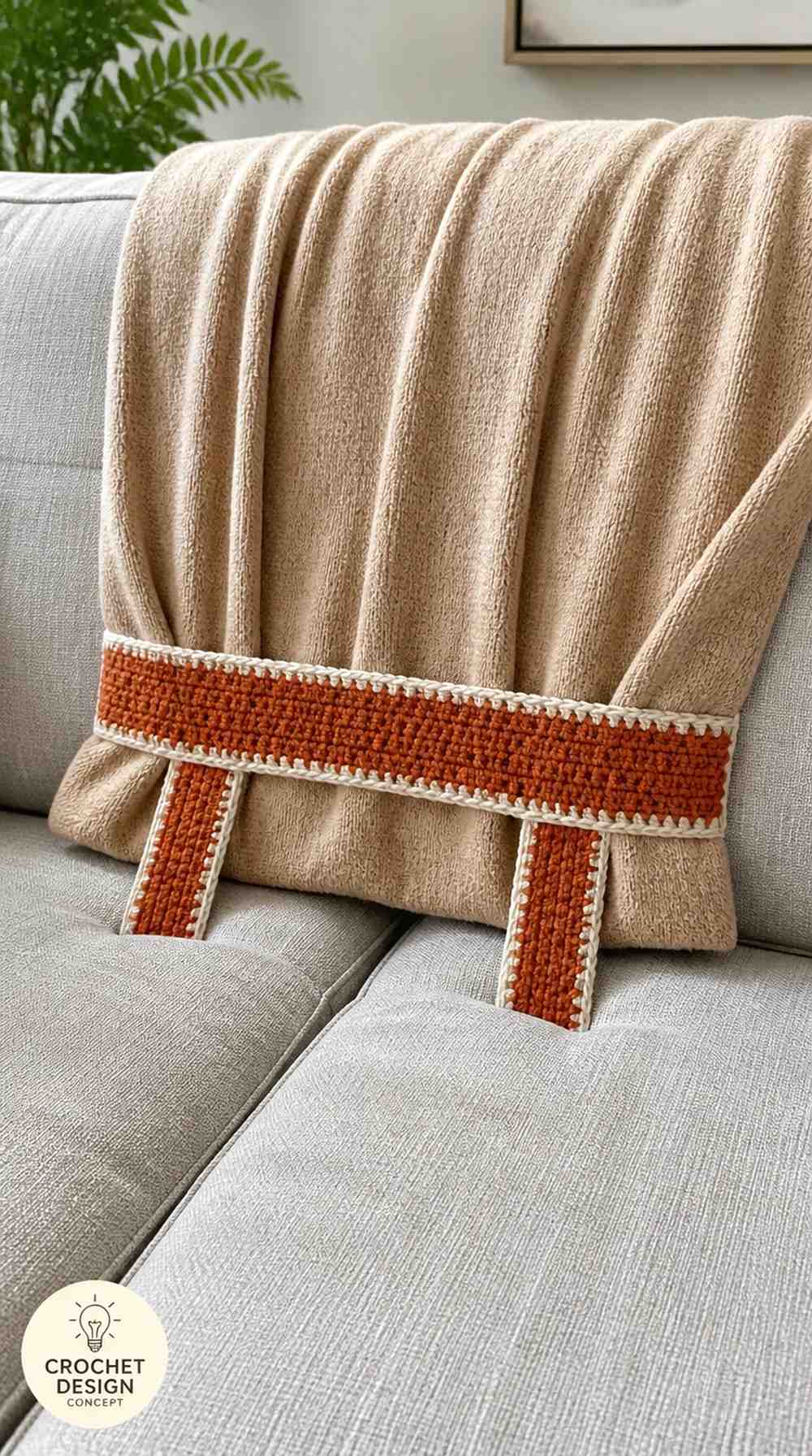
Rust-colored crochet forms a broad band around the folded lower edge of a camel-beige throw. Two separate flat tails extend from the rear of the strap into the cushion gap of a pale-grey sofa, while cream edging highlights their individual shapes.
The paired tails provide two tuck points beneath one visible band. Compared with the Y-shaped teal design, this version keeps the extensions parallel and separately attached, creating a wider spacing arrangement without a central branch.
- Parallel Tail Placement: Position the two rust tails evenly along the band so they do not pull the blanket toward one side.
- Separate Attachments: Reinforce both tail joins independently rather than relying on a single connecting stitch.
- Gap Width: Check the seat-back opening before use; wide or shallow gaps may allow both tails to slide out without offering meaningful retention.
17. Crochet Forest Green Fabric-Flap Tuck Keeper
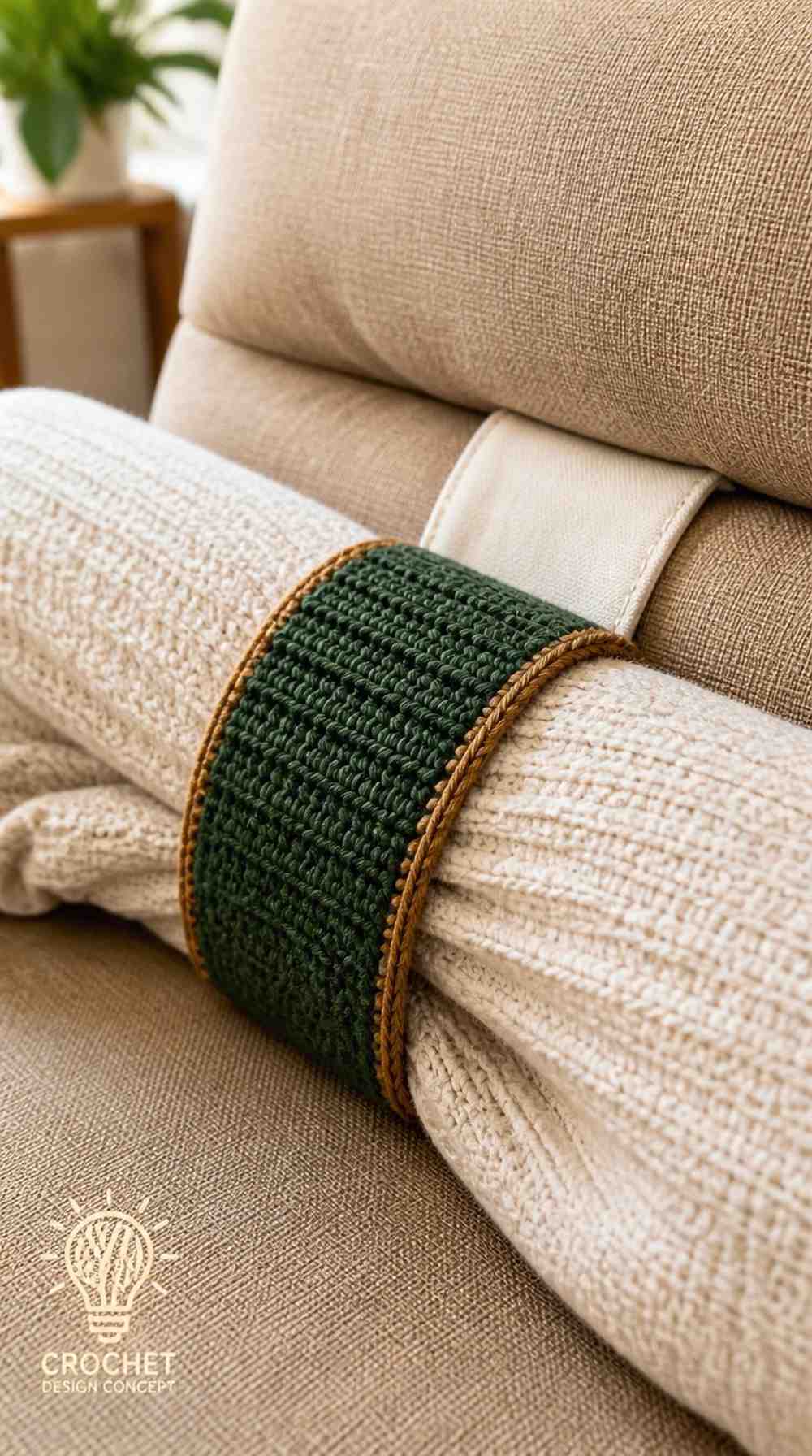
Deep forest-green crochet forms a compact strap around the folded lower edge of an oatmeal throw. A broad cream cotton-fabric flap is neatly sewn to its back and gently inserted into the sofa cushion crease. Caramel edging follows the visible crochet section.
This design combines a handmade crochet band with a plain fabric extension. The broad flap provides a different contact surface from a fully crocheted tail, making it an interesting concept for sofas where textured crochet might catch on upholstery.
- Fabric-Flap Connection: Sew the cream extension securely to a reinforced section of the green crochet rather than attaching it through only a few individual loops.
- Smooth Contact Surface: Choose a soft fabric without rough seams or stiff inserts where the flap touches the sofa upholstery.
- Tuck Compatibility: The broad tail may help position the throw in some cushion gaps, but it has no guaranteed grip and should remain easy to remove.
Practical Guide to Crochet Sofa Throw Tuck Keeper Straps
Decide whether you need a tuck keeper or a storage band
These are two different uses. A tuck keeper has a flexible extension that sits near or inside a cushion gap to help position a blanket edge. A storage band wraps around a folded or rolled throw to keep it together when it is not being used.
A storage band does not need to attach to the sofa. A tuck keeper depends much more on the furniture’s construction and may not work on every couch.
Measure the throw and sofa
Before planning a crochet strap, check the throw’s folded thickness, the length of the edge you want to gather, and the shape of the sofa cushion gap.
For rolled throws, measure the circumference of the actual blanket bundle. For tuck-tail concepts, examine how much space exists between the cushions without forcing anything into the upholstery.
Avoid using loose crochet extensions around reclining mechanisms, sofa-bed hinges, electrical components, or moving furniture parts.
Choose a suitable crochet texture
Smooth cotton or an appropriate cotton blend may be worth considering for flat, clearly defined stitches. Closely worked rows can make a neat strap, while decorative granny-square openings and scallops may be better suited to the outer display surface.
Check the throw for snagging, color transfer, and unwanted creasing. Delicate wool, loosely woven blankets, and heavily textured yarns may not suit tight loops.
Keep the arrangement removable
Do not permanently stitch or pin a keeper into upholstery unless the furniture maker specifically allows that attachment method.
Avoid sharp anchors, exposed metal clips, heavy weights, or stiff inserts hidden between cushions. A removable, soft keeper is easier to inspect, clean, and reposition.
Keep loose straps and tails away from infants and young children, and never use these concepts in a baby’s sleeping area.
Clean and inspect regularly
Sofa accessories collect lint, dust, and loose fibers. Remove the keeper when washing or rearranging the throw, then follow the yarn’s care instructions.
Check buttons, ties, joins, and tuck tails for stretching or damage. No decorative crochet strap should be relied on to guarantee that a blanket stays fixed during everyday sofa use.
For related sofa accessory inspiration, see 17 Crochet Reading Chair Armrest Caddy Ideas for Cozy Winter Nights on Yarn Nest Studio. That collection focuses on arranging useful items around an armrest rather than holding a throw in position.
Want to Make Something Similar?
These 17 keeper straps are original visual concepts, not exact tested patterns. The following crochet resources teach related wrap, strap, and buttonhole techniques.
- Snuggle Bunny Wrap — Snappy Tots is a free crochet pattern for a wrap that the designer also uses around a rolled blanket. It can help with understanding blanket-bundle fastening, but it is not a sofa cushion tuck anchor. Snappy Tots
- Easy Crochet Journal Strap Pattern — Aesthetic Crochet Club demonstrates a measured crochet band and button-loop closure. The construction is for a journal, but its fitting and fastening ideas can inform a removable throw band. Aesthetic Crochet Club
- How to Crochet a Bag with a Strap — Crochet Explained explains closely worked crochet strips, reinforcement, and the way straps can stretch. These are useful general construction lessons rather than instructions for a sofa keeper. Crochet Explained
Any real adaptation needs to be sized for the specific throw and tested gently against the sofa’s fabric and cushion construction.
Which Crochet Sofa Throw Tuck Keeper Strap Should You Choose?
| Your priority | Designs to consider | Main trade-off |
|---|---|---|
| Simple cushion-gap positioning | Terracotta Flat Tuck-Tail, Olive T-Shaped | Retention depends on the cushion gap |
| Multiple tuck points | Teal Split-Y, Rust Double-Tail | More joins and fitting decisions |
| A textured tuck extension | Mustard Braided Crease | Braided tail may create bulk |
| Gathered blanket edge | Dusty Rose Double-Slot, Burgundy Cross-Strap | Fabric threading or folding requires care |
| Buttoned edge keeper | Coral Fold-Tab | Closure must remain clear of upholstery |
| Soft fabric contact | Forest Green Fabric-Flap | Requires an additional sewn fabric section |
| Folded throw on sofa back | Navy Buttoned, Cocoa Fabric-Backed | Does not anchor the bundle to the sofa |
| Rolled throw storage | Charcoal Ladder-Button, Ivory Granny-Square | Needs a suitable bundle circumference |
| Decorative armrest styling | Oatmeal Twin-Loop, Lavender Scalloped | Can shift during use |
| Small floral detail | Butter Yellow Daisy | Primarily decorative |
| Reversible color styling | Denim Reversible Wrap | Two-sided construction adds work |
For an everyday sofa arrangement, the Crochet Terracotta Flat Tuck-Tail Strap offers a straightforward concept with few extra components. If the goal is simply to keep a folded throw neat between uses, the Crochet Navy Buttoned Backrest Band or Crochet Charcoal Ladder-Button Fold Keeper may be more suitable.
Conclusion
Crochet sofa throw tuck keeper strap ideas offer several ways to organize blankets without changing the sofa itself. A flat terracotta tail creates a simple tucked appearance, a teal Y-shaped keeper introduces two possible contact points, and an ivory granny-square band makes a rolled throw look neatly arranged.
The best design depends on how your blanket is used, how the sofa cushions are constructed, and how easily the keeper can be removed. Prioritize gentle fabric contact, practical sizing, and secure crochet joins. Treat the designs as decorative positioning concepts rather than guaranteed anti-slip solutions.
Which would you choose for your sofa: the terracotta tuck-tail strap, the charcoal adjustable keeper, or the butter-yellow daisy loop? Share your favorite design and the type of throw you use most often.
Frequently Asked Questions
1. Can a crochet tuck keeper stop a sofa throw from slipping?
It may help position a lightly folded throw in some sofa arrangements, but it cannot guarantee that the blanket will stay in place. Results depend on the cushion gap, upholstery texture, blanket weight, and strap construction. A loose cushion gap may provide very little grip, and the keeper can shift during ordinary use.
2. What yarn should I consider for a crochet sofa throw keeper strap?
Smooth cotton or a suitable cotton blend may be worth considering because these fibers can form clearly defined stitches and relatively flat straps. However, the best choice depends on the throw’s texture and the sofa upholstery. Check for snagging, stretching, lint, and possible color transfer before using a finished keeper regularly.
3. Will a crochet tuck-tail strap damage sofa cushions?
A soft crochet tail may be less likely to create hard pressure points than a rigid insert, but damage cannot be ruled out. Avoid forcing it into narrow gaps, attaching it with pins, or using it near reclining mechanisms. Check the furniture manufacturer’s care instructions and inspect the upholstery for rubbing or distortion.
4. Should I use a buttoned strap or a cushion-gap tuck keeper?
A buttoned band is generally easier to understand for keeping a folded or rolled throw together when it is not in use. A tuck-tail design is intended to help position a blanket edge near a cushion seam. Choose according to the actual purpose rather than assuming the two styles will work in the same way.
5. Are these 17 crochet sofa throw tuck keeper straps available as exact patterns?
No. These are original AI-generated crochet design concepts rather than tested patterns or finished handmade accessories. The linked crochet resources teach related strap, wrap, and closure methods, but none is an exact pattern for the pictured cushion-gap keepers. A real version needs custom measurements, material choices, and careful checks against the sofa and throw.