A crochet belt buckle protective wrap can bring a soft handmade touch to the way you store your favorite belts. These 16 inspiration ideas explore slip-on sleeves, folded envelopes, buttoned shields, drawstring pouches, and fabric-lined storage cases. From terracotta and natural oatmeal to navy, olive green, burgundy, and plum, each concept combines a different crochet texture with a practical way to keep belt hardware covered between uses.
Whether you organize everyday leather belts in a drawer, store decorative buckles separately, or pack accessories for travel, the shape of the buckle matters when choosing a cover. Some designs wrap around buckles still attached to a belt, while others hold removable metal buckles in separate compartments. Compare opening styles, lining choices, closures, and fabric thickness before deciding which concept suits your collection.
These are AI-generated crochet design visualizations for inspiration, not photographs of tested handmade products or step-by-step patterns. These wraps are intended for storage, not for use while a belt is being worn. They are not guaranteed to prevent scratches or other damage.
Quick Design Selection Guide
- For a simple attached buckle: The Crochet Terracotta Buckle Envelope Wrap and Crochet Oatmeal Slip-On Buckle Sleeve use straightforward shapes.
- For adjustable storage covers: Compare the Crochet Navy Double-Flap Buckle Protector, Crochet Burgundy Cross-Tie Buckle Wrap, and Crochet Charcoal Hook-and-Loop Buckle Wrap.
- For detached decorative buckles: The Crochet Olive Drawstring Buckle Pouch and Crochet Butter Yellow Corner-Cradle Case provide separate storage spaces.
- For multiple buckles: The Crochet Teal Twin-Buckle Travel Case keeps two metal accessories in distinct compartments.
- For a lined storage pouch: The Crochet Mocha Basketweave Buckle Case, Crochet Burnt Orange Double-Layer Buckle Pouch, and Crochet Plum Zippered Buckle Pouch include soft interior fabric.
1. Crochet Terracotta Buckle Envelope Wrap
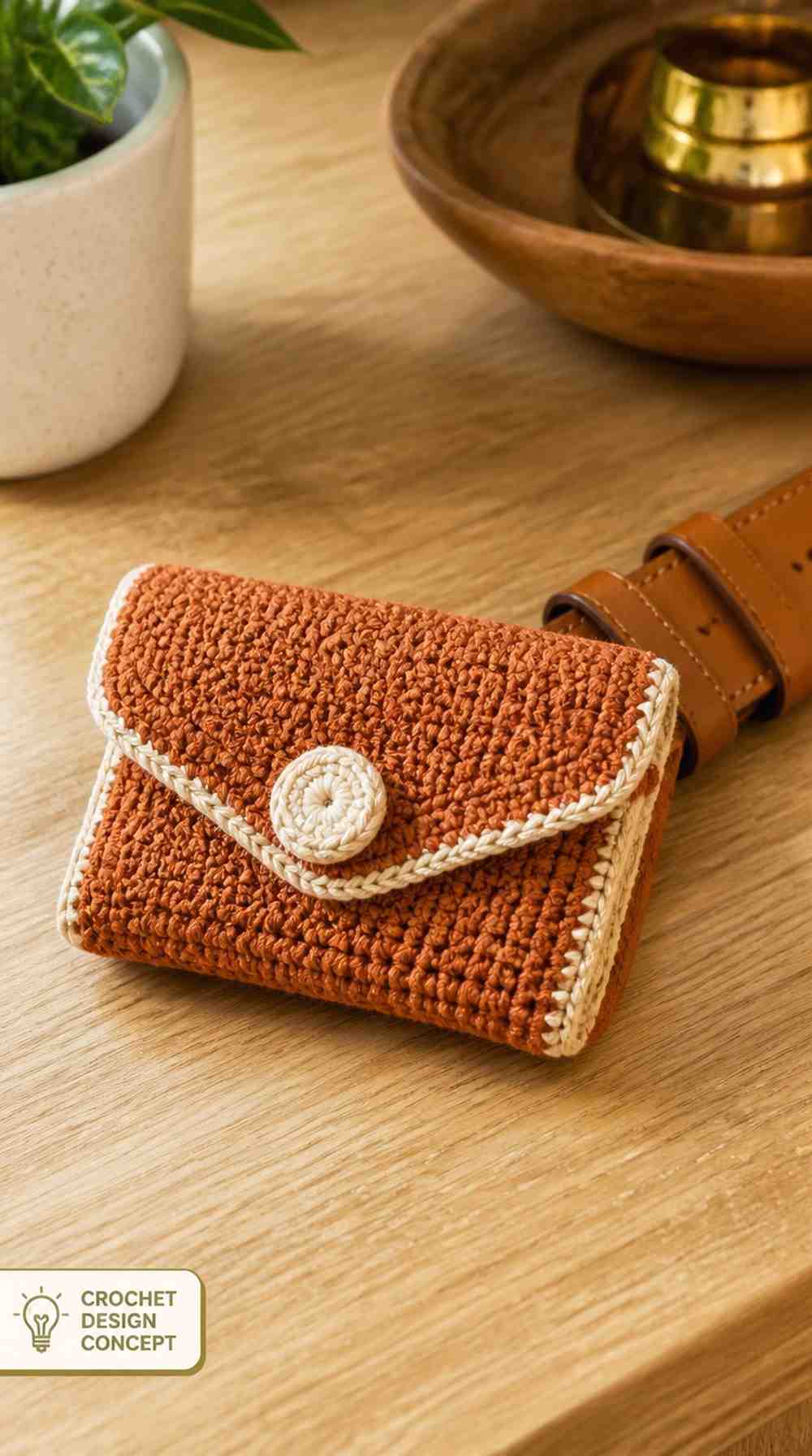
Warm terracotta crochet forms a compact envelope around a rectangular brass belt buckle. The closely worked horizontal rows create a flat front surface, while narrow ivory edging highlights the folded flap. A small cream crochet button secures the cover, and the tan leather belt extends naturally from one side.
This design is worth considering for a buckle that remains attached to its belt during storage. The envelope arrangement conceals the metal face without requiring the entire belt to be placed inside a larger pouch.
- Flap Coverage: Make the rectangular flap wide enough to cover the metal buckle without pulling tightly across its raised corners.
- Button Placement: Position the cream crochet button where it secures the flap without pressing against a prominent metal feature beneath.
- Leather Clearance: Leave room where the belt enters the wrap so the crochet does not fold or crease the leather unnecessarily.
2. Crochet Oatmeal Slip-On Buckle Sleeve
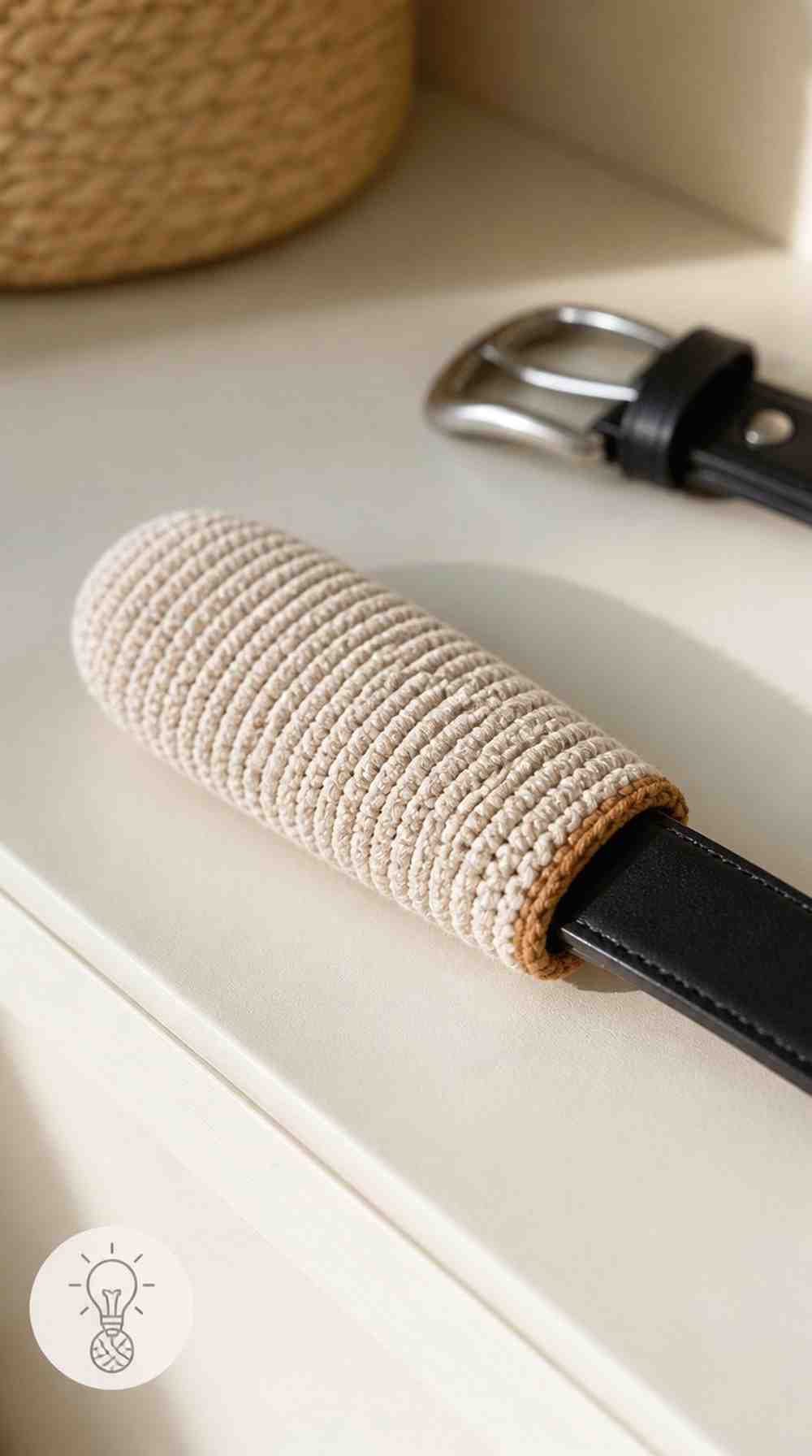
Natural oatmeal cotton creates a short tubular sleeve with neat horizontal crochet rows and a narrow caramel border around the opening. The closed end is softly rounded, allowing the sleeve to follow the shape of a silver buckle beneath it. A black leather belt extends from the other end.
The understated design avoids buttons, ties, or external pockets. It could appeal to someone who prefers a quick slip-on cover, although a real version would need enough opening clearance to pass over the buckle without forcing it.
- Opening Width: Measure the widest section of the buckle, not just the belt strap, before planning the tubular opening.
- Rounded End: Shape the closed tip to accommodate the buckle’s curved outline without stretching the crochet fabric excessively.
- Slip-On Limitation: This approach may be unsuitable for unusually wide or irregular buckles that cannot pass comfortably through the sleeve.
3. Crochet Navy Double-Flap Buckle Protector
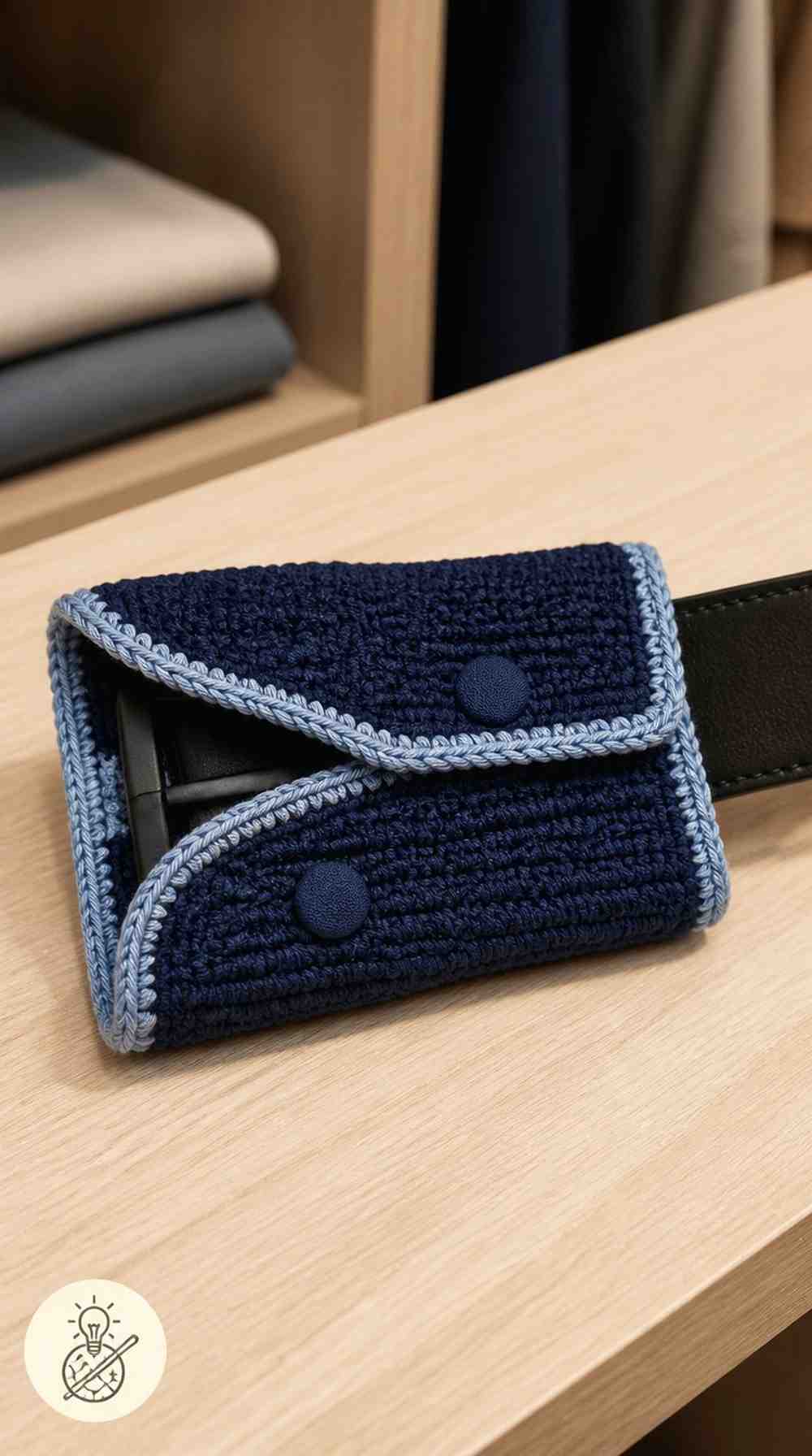
Deep navy crochet creates a protective storage wrap with two overlapping front flaps. Powder-blue borders define their edges, while two small navy fabric-covered snaps hold the flaps together. The wrap surrounds a matte-black rectangular buckle attached to a matching black leather belt.
Unlike a slip-on sleeve, the double-flap construction can open around the buckle. That makes its fastening arrangement the main feature, although the snaps should not be positioned where they press directly against sensitive metal surfaces.
- Overlapping Flaps: Allow enough overlap for both navy panels to lie flat without pulling the buckle into an awkward position.
- Snap Clearance: Keep the two fasteners away from raised buckle details and avoid pressing them closed directly against the metal.
- Removable Construction: An opening wrap may be more convenient for broad buckles that would be difficult to slide into a narrow sleeve.
4. Crochet Butter Yellow Corner-Cradle Case
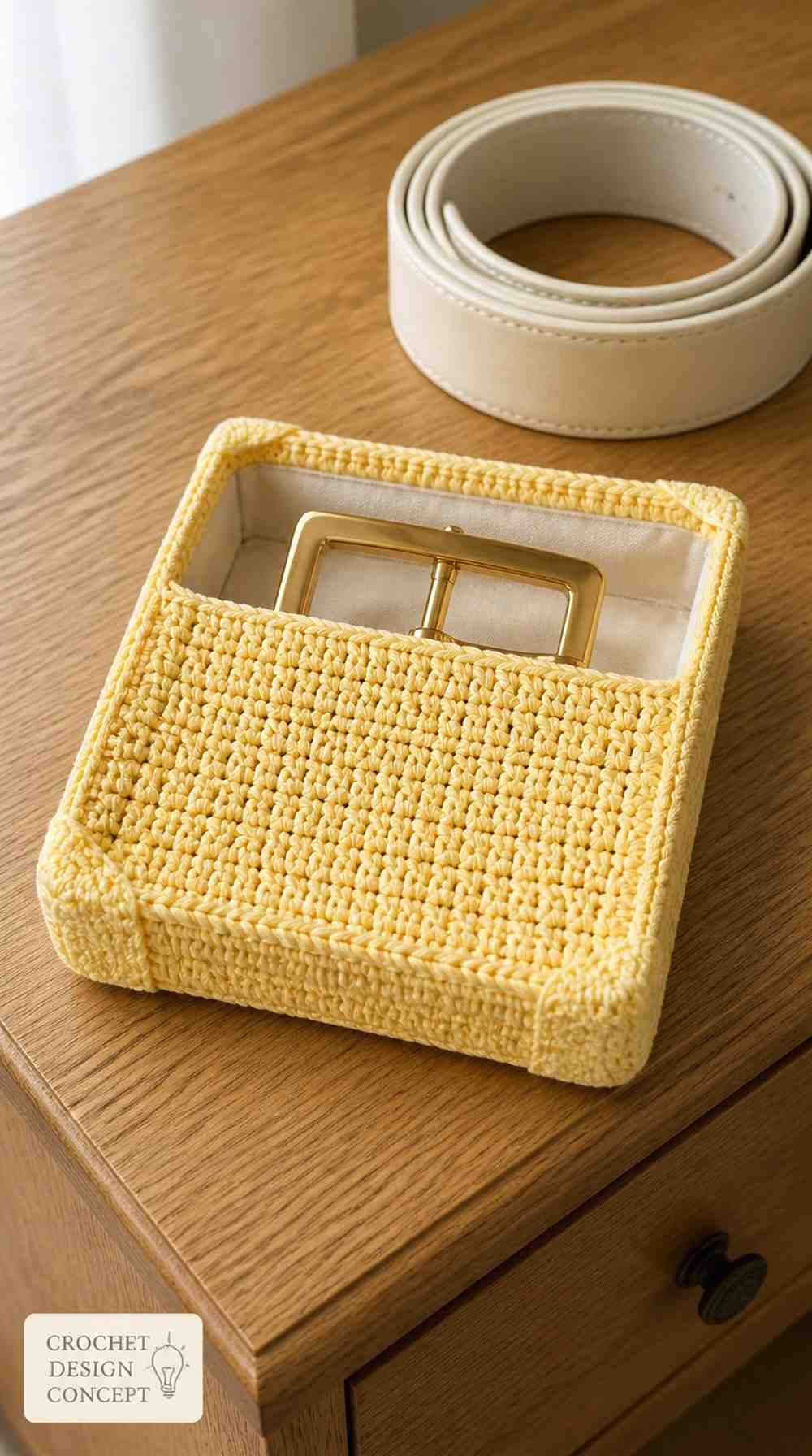
Butter-yellow crochet forms a square storage case with four reinforced exterior corners and a soft ivory lining. A detached brass buckle rests partly inside the open upper edge, while a cream leather belt is coiled separately nearby.
This concept is intended for a buckle that can be removed from its belt. The square outline provides a clear place for the metal accessory, while the lining separates it from the crochet’s interior joins.
- Corner Shape: Check that the square case accommodates all four buckle corners without forcing them against tight crochet seams.
- Interior Lining: Choose a smooth, clean fabric without rough decorations that could rub against the metal finish.
- Separate Storage: Use this design only for buckles intended to be detached; do not force apart a belt’s permanent hardware.
5. Crochet Olive Drawstring Buckle Pouch
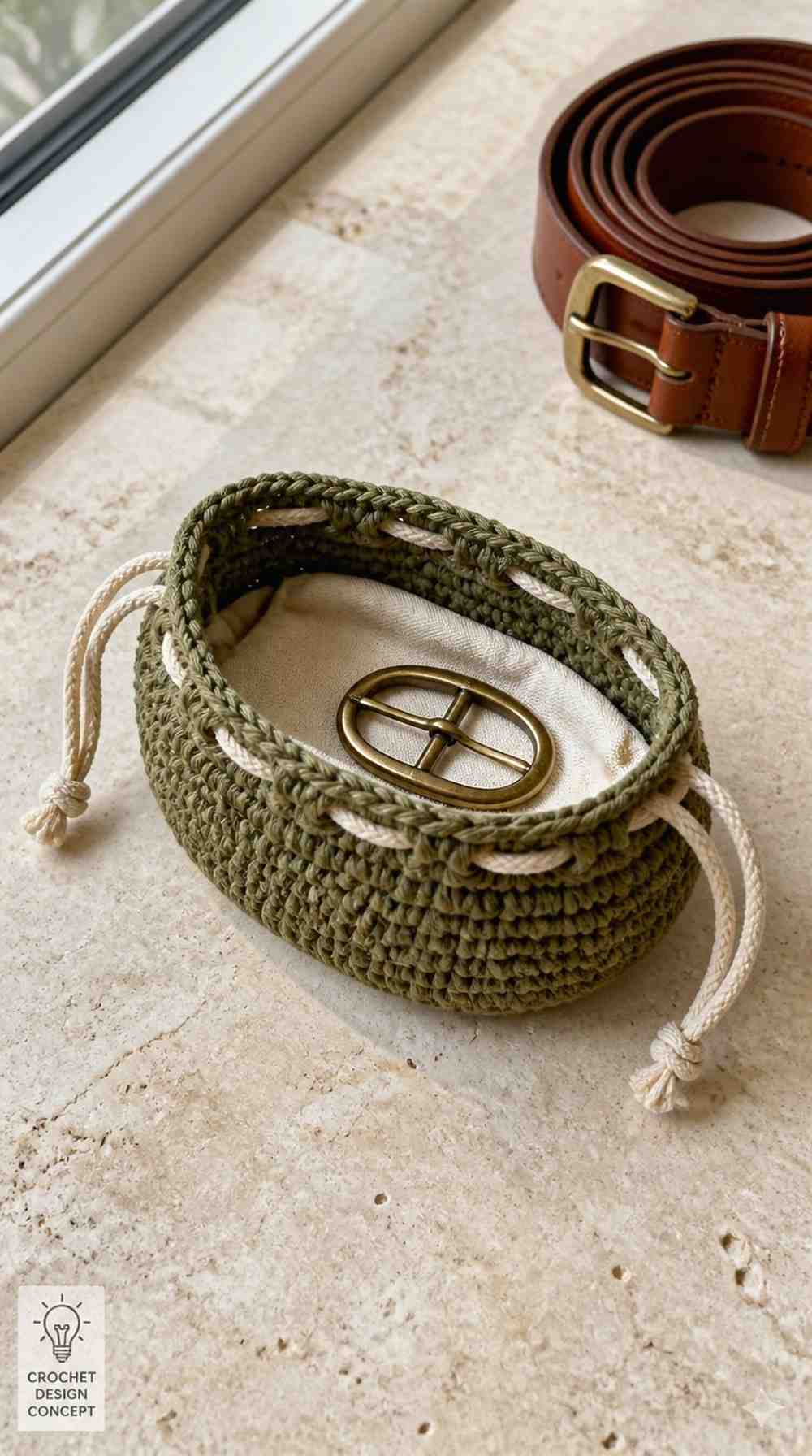
Muted olive-green crochet forms a small oval pouch with a flat base and gently rounded sides. A cream drawstring passes through evenly spaced eyelets around the opening, while an antique-brass oval buckle rests partly visible inside a beige fabric lining.
The soft rounded shape offers a different look from square and rectangular cases. It could work well for a detachable vintage buckle, provided the drawstring closes without putting unnecessary pressure on the hardware.
- Oval Base: Match the pouch’s internal shape to the buckle so the metal does not force the crochet into an uncomfortable stretched oval.
- Drawstring Closure: Keep the cream cord short and secure, allowing the pouch to close gently rather than compress the contents.
- Lining Coverage: Extend the soft lining around the interior so the buckle does not sit directly against eyelet joins or raised crochet seams.
6. Crochet Burgundy Cross-Tie Buckle Wrap
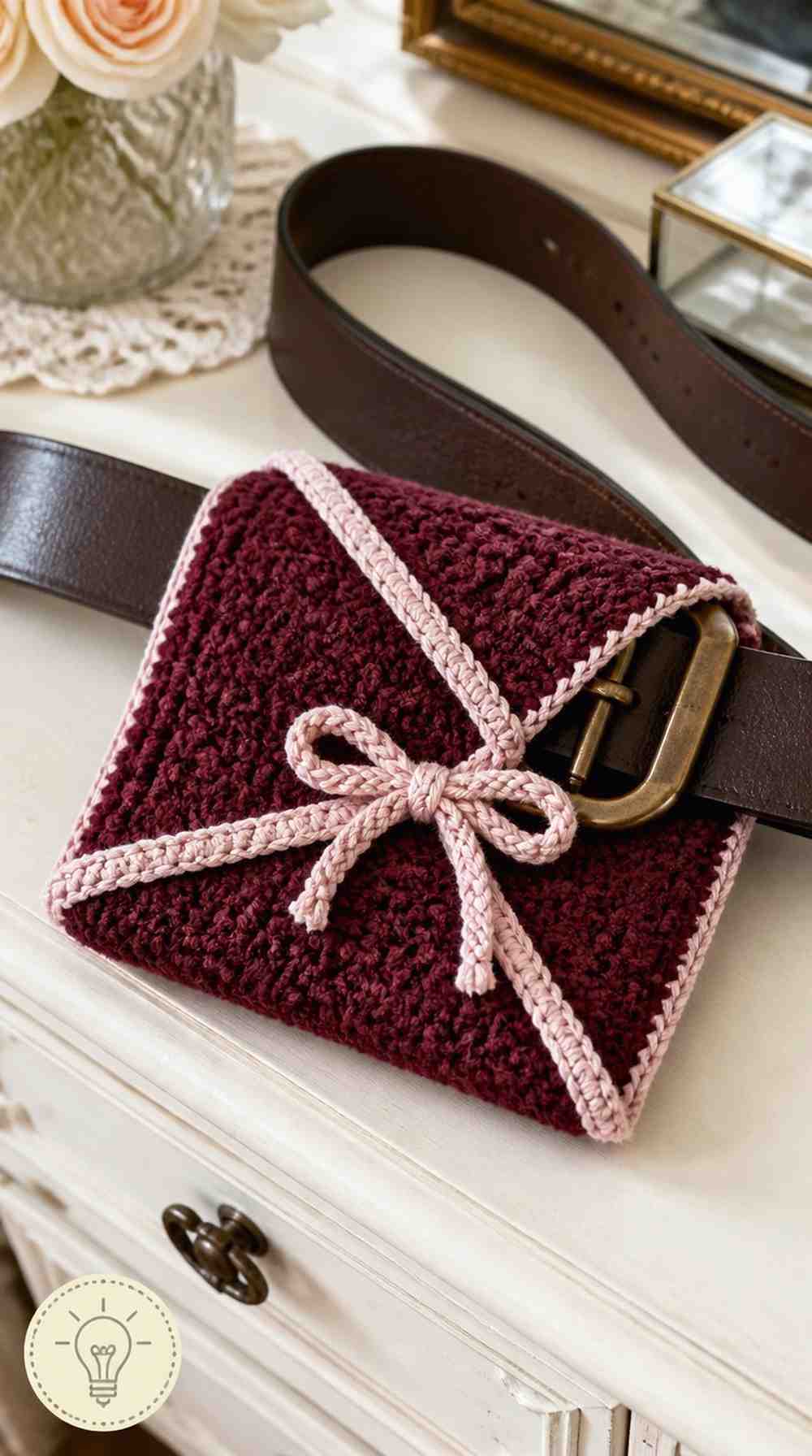
Deep burgundy crochet creates a rectangular folded cover for a wide bronze oval buckle. Two blush-pink ties cross diagonally over the front and meet in a small flat bow. Matching blush edging outlines the panel, while the dark-brown leather belt continues outside the wrap.
The crossed ties give this design a softer, more decorative appearance than buttoned closures. They also allow modest adjustment around buckle thickness, although they should not be pulled tightly against the metal.
- Crossed Tie Position: Keep the blush ties away from sharp edges or raised hardware that could catch or damage individual crochet strands.
- Gentle Fastening: Tie the bow loosely enough to hold the wrap closed without bending the fabric tightly around the buckle.
- Folded Corners: Check the panel’s overlap so the bronze buckle remains covered without bulky crochet bunching at its curved ends.
7. Crochet Dusty Blue Fold-Over Buckle Pocket
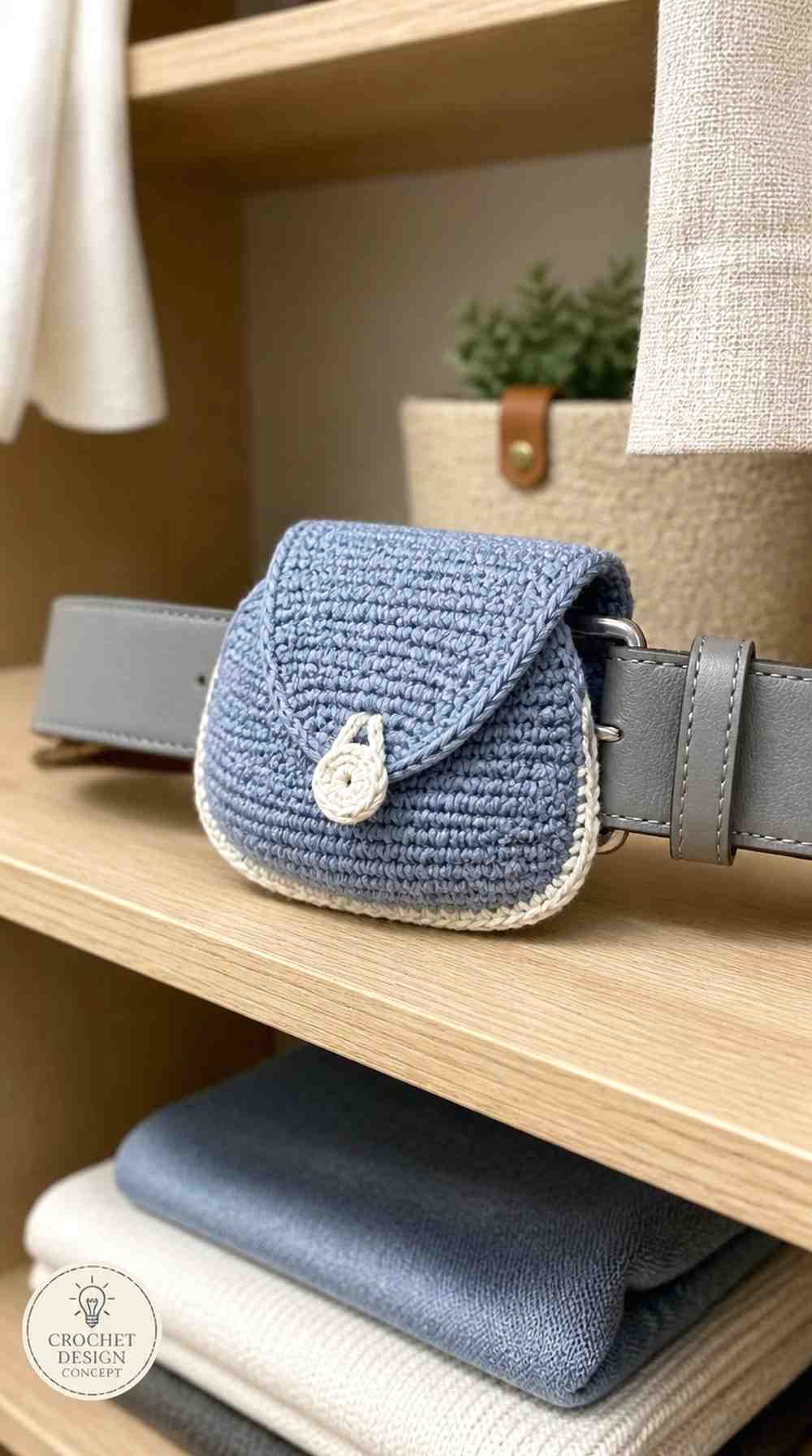
Dusty-blue crochet forms a compact pocket with rounded edges, a cream lower border, and a small upper flap. An ivory crochet button secures the flap over a circular silver buckle attached to a grey leather belt.
The rounded pocket follows the buckle’s shape more closely than a square envelope. Its curved front gives the design a tidy appearance, although shaping the crochet around a circular object requires attention to the pocket’s usable width.
- Circular Fit: Compare the inner pocket width with the buckle’s complete diameter, including any protruding hardware.
- Buttoned Flap: Position the ivory button where the flap can close without pressing into the buckle’s front surface.
- Pocket Depth: Allow enough room for the metal thickness without making the crochet pocket unnecessarily loose around the attached belt.
8. Crochet Mocha Basketweave Buckle Case
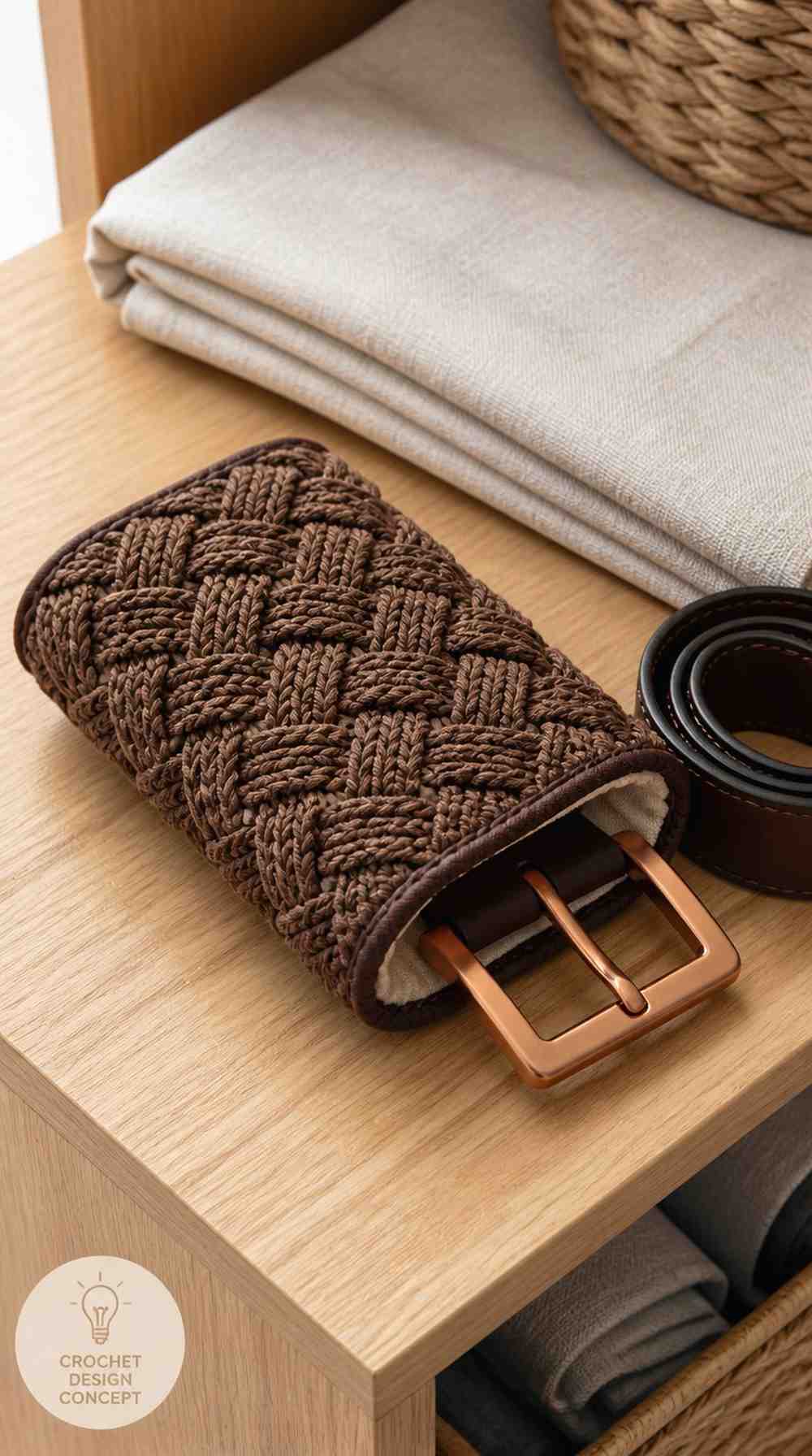
Mocha-brown crochet creates a small rectangular pouch with raised basketweave-like stitch blocks and espresso-colored edging. A cream fabric lining sits inside, while a copper-colored buckle is partially inserted through the short opening. The matching dark leather belt rests separately beside it.
The raised exterior texture makes this design feel more substantial than a plain crochet sleeve. Its soft interior is an important detail because the pronounced outside stitches are decorative rather than a guarantee of cushioning.
- Raised Stitch Texture: Keep the basketweave-style blocks on the exterior, with a smoother lining between the crochet and metal.
- Side Opening: Check the opening dimensions so the buckle can enter without dragging along the copper-colored edges.
- Case Thickness: Avoid excessive bulk if several buckle cases will be stored side by side in a shallow wardrobe drawer.
9. Crochet Lavender Scalloped Buckle Cover
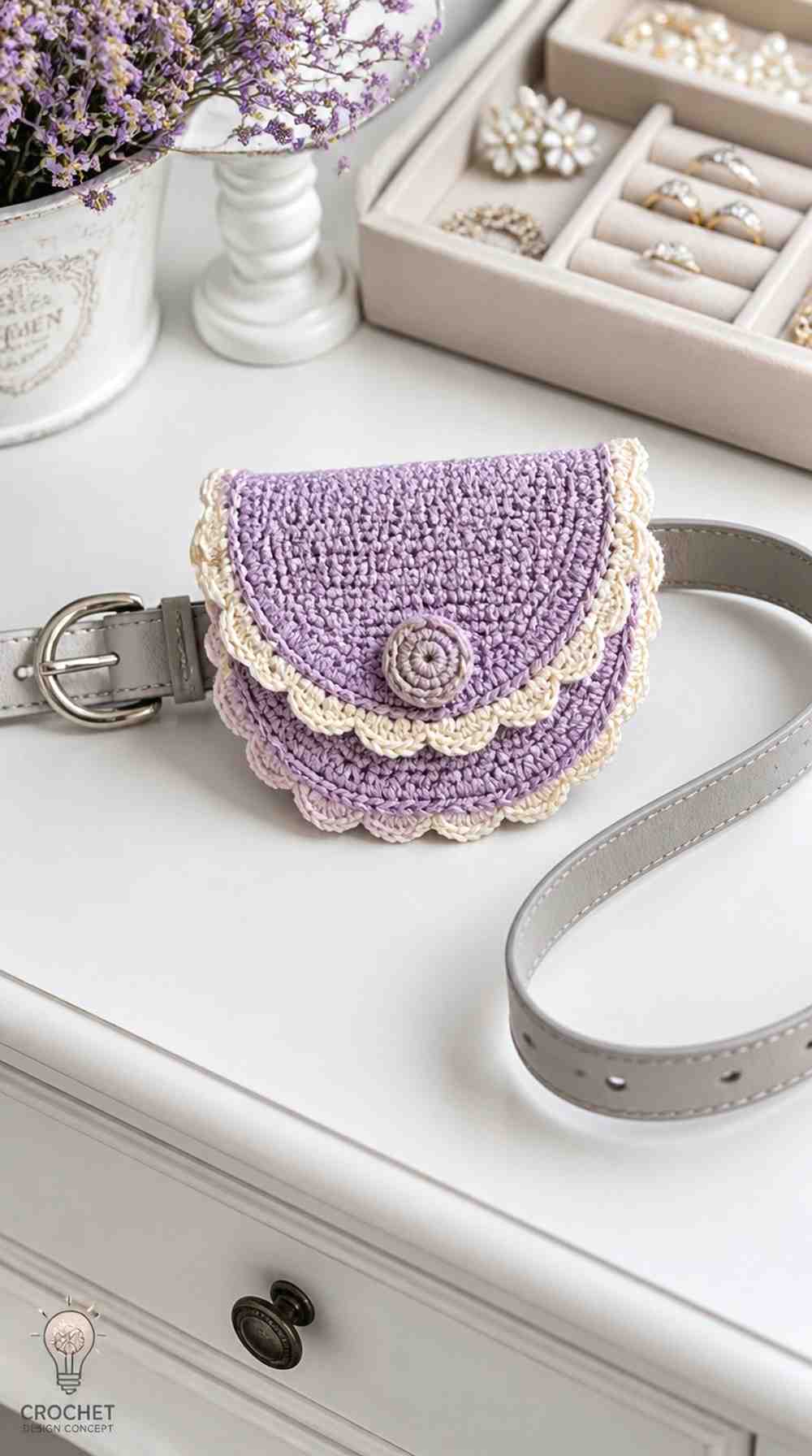
Soft lavender crochet forms a rounded envelope with a solid center, delicate ivory scallops, and a small matching button closure. A silver oval buckle sits inside, while a pale-grey leather belt extends from the covered end.
The scalloped edging gives this concept a dressier appearance without adding hard beads or separate metal decorations. It may suit a small decorative belt stored in a wardrobe drawer, although the scallops themselves need careful finishing to avoid catching on neighboring accessories.
- Scallop Placement: Keep the tiny ivory scallops around the outer flap edge, not underneath the metal buckle.
- Rounded Flap: Shape the curved front so it closes smoothly over the oval buckle without leaving large uncovered gaps.
- Snag Prevention: Check that the scalloped edge does not catch on other belts, hooks, or jewelry when stored.
10. Crochet Charcoal Hook-and-Loop Buckle Wrap
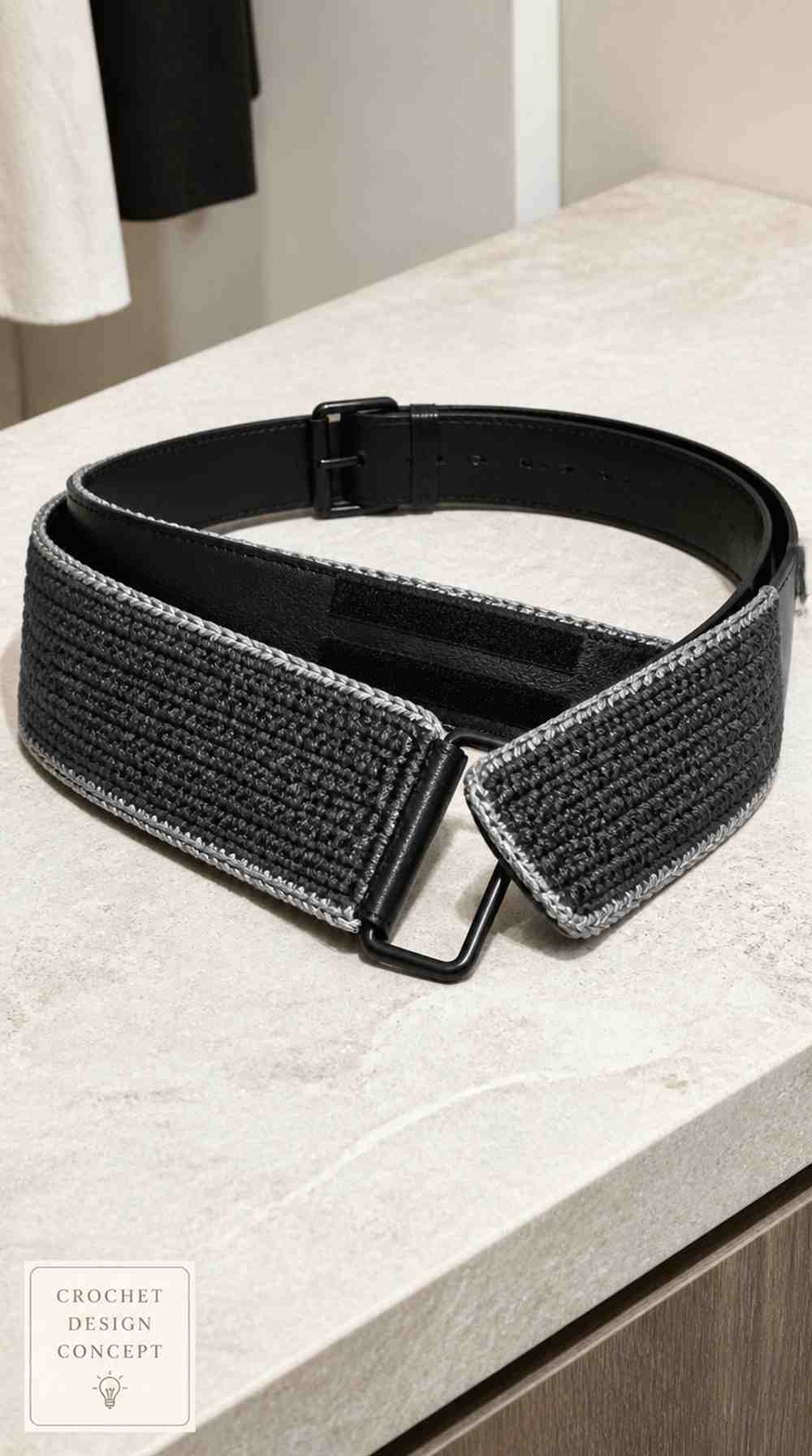
Charcoal-grey crochet creates a broad flat band around a rectangular black belt buckle. Narrow silver-grey edging outlines the fabric, while two overlapping ends meet at the back with small black hook-and-loop fastening strips.
This low-profile design avoids visible bows or buttons. Its fastening system may be convenient for frequently opened storage wraps, but hook-and-loop material can catch yarn fibers if placed carelessly.
- Fastener Position: Keep the black hook-and-loop sections on the reverse overlap rather than against the metal buckle face.
- Yarn Snagging: Select and attach the fastening carefully because rough hook surfaces can pull individual strands from neighboring crochet stitches.
- Wrap Adjustment: Allow enough overlap for the band to close without excessive tension around the buckle or attached leather strap.
11. Crochet Coral Granny-Square Buckle Case
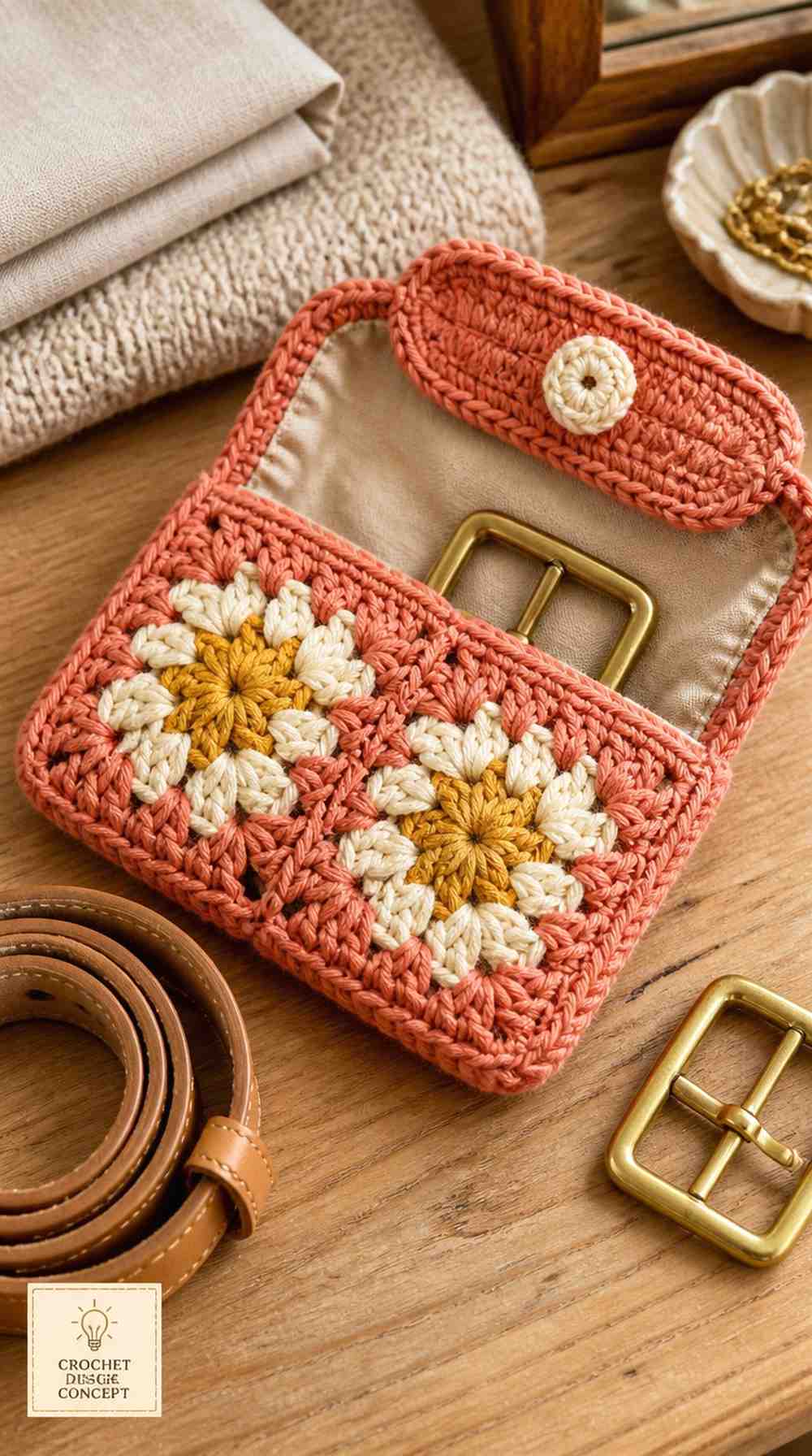
Coral, ivory, and muted-mustard crochet granny squares create a decorative storage case with a solid coral backing and beige fabric lining. A short upper flap closes with a cream crochet button, while a detachable square buckle rests fully enclosed inside.
This concept makes traditional granny-square texture the main visual feature. Its small cluster openings give the case a distinctive handmade appearance, but those openings should not be mistaken for complete dust protection.
- Motif Joining: Keep the granny-square seams flat and secure so their corners do not form prominent ridges inside the storage case.
- Fabric Lining: Use the beige lining to separate the metal buckle from the open crochet clusters and interior joining stitches.
- Square Proportions: Plan the case around the actual detached buckle rather than assuming every square-shaped buckle has similar dimensions.
12. Crochet Teal Twin-Buckle Travel Case
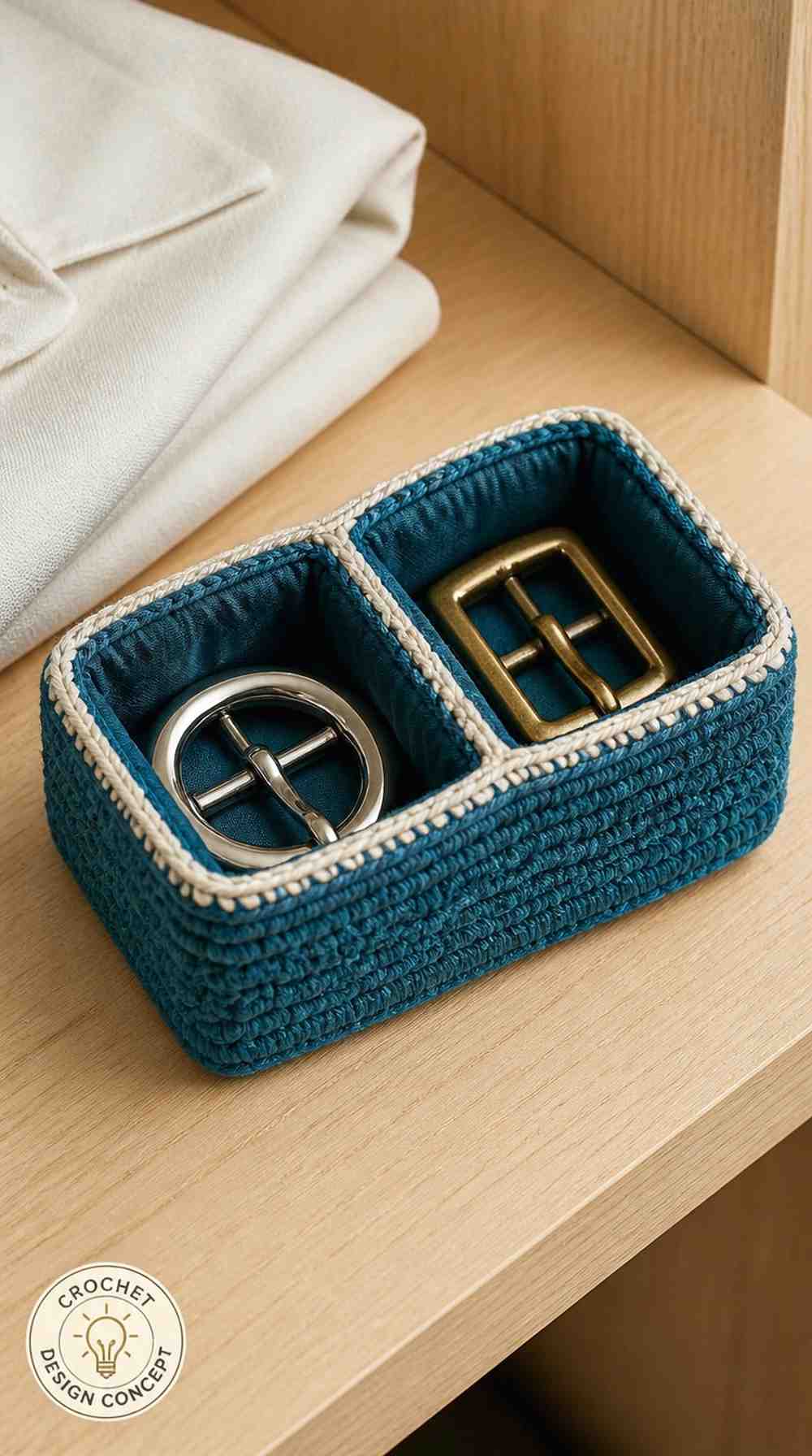
Deep-teal crochet forms a compact rectangular organizer divided into two side-by-side compartments. The left pocket contains a detachable silver round buckle, while the right holds a narrow brushed-brass rectangular buckle. Ivory crochet edging separates the two fabric-lined storage spaces.
The paired arrangement gives this design a clear travel and organization purpose. Keeping each buckle in its own pocket can reduce direct contact between the metal pieces, although the pouch itself is not a tested protective travel case.
- Separate Compartments: Keep the two metal buckles in distinct lined pockets so their edges do not rub directly against each other.
- Divider Stability: Reinforce the ivory central divider and check that neither buckle can slip into the neighboring compartment.
- Travel Limitations: Pack the case where it will not be crushed by heavy items; soft crochet cannot guarantee protection against pressure or impacts.
13. Crochet Ivory Button-Tab Buckle Shield
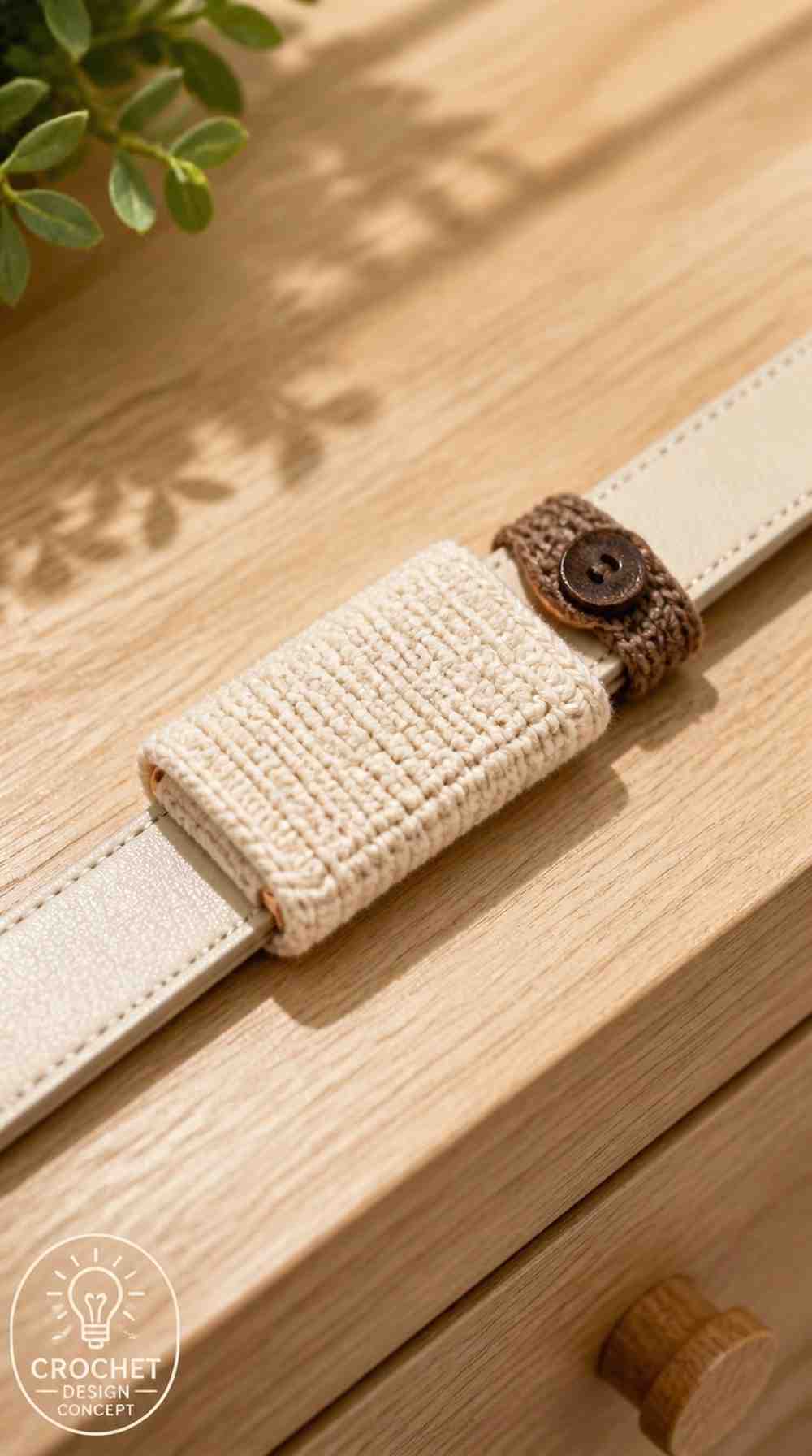
Warm-ivory crochet creates a slim rectangular shield folded over a narrow rose-gold belt buckle. A mocha crochet tab wraps around the belt immediately behind the buckle and closes with a small wooden button.
Unlike a full pouch, this design focuses on covering the exposed buckle face while the belt rests flat. The compact front panel gives it a minimal appearance, although its limited coverage means the buckle’s sides may remain more exposed.
- Front Coverage: Size the ivory shield to cover the main metal face without forcing the fabric underneath the buckle’s fastening parts.
- Rear Tab: Keep the mocha attachment around the belt strap behind the buckle, where it can be removed without disturbing the hardware.
- Partial Protection: Recognize that this shield covers mainly the front; it should not be treated as a completely enclosed storage case.
14. Crochet Burnt Orange Double-Layer Buckle Pouch
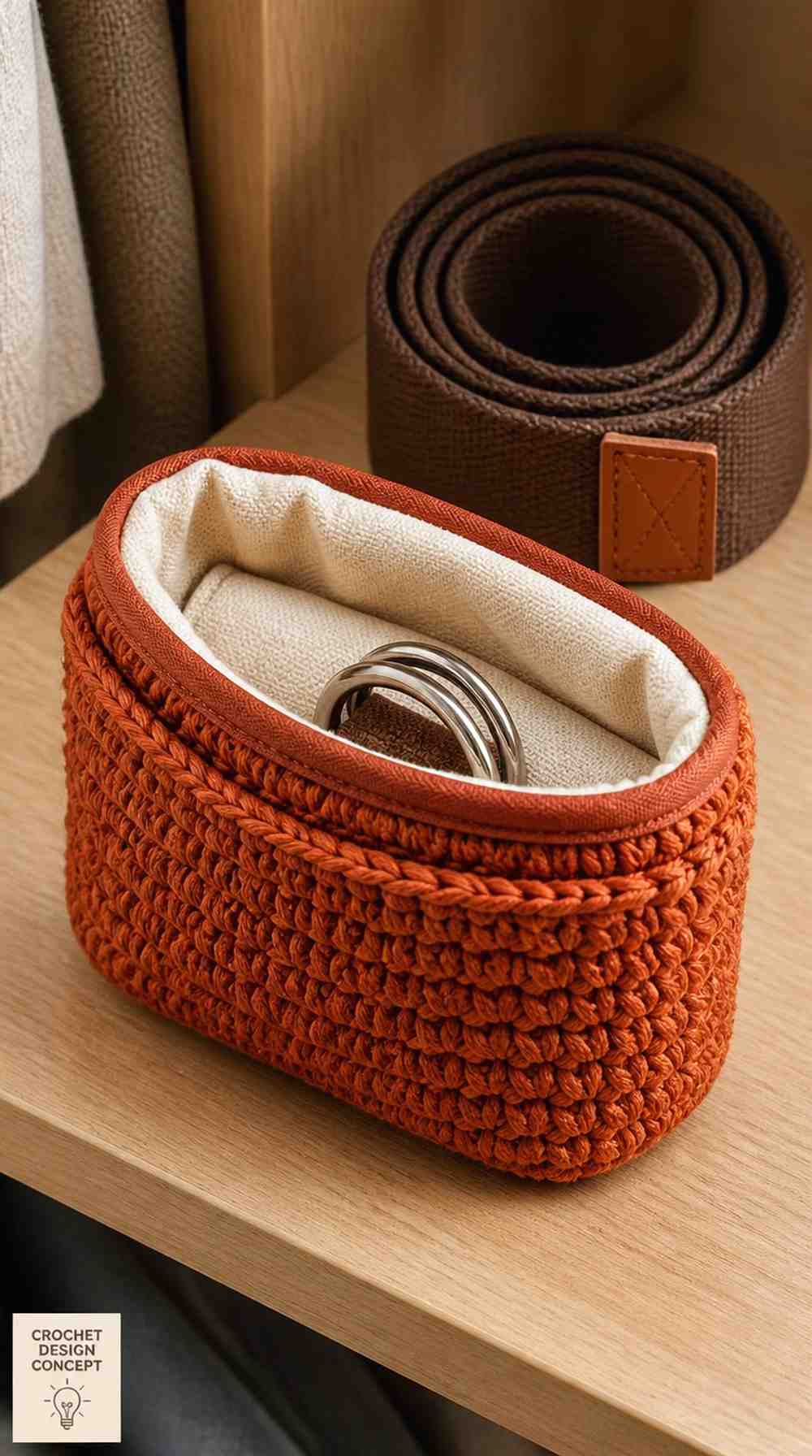
Burnt-orange crochet forms a small rounded pouch with a cream fabric lining and a rust-colored reinforced opening. A detached silver double-D-ring buckle rests partly visible inside, while its brown fabric belt is coiled separately.
The double-ring shape makes this a distinct storage challenge. Both metal rings need enough room to remain together without forcing the opening or pressing hard against the pouch’s stitched corners.
- Double-Ring Fit: Allow enough internal width for both D-rings in their natural resting position rather than compressing them into a narrow opening.
- Rounded Lower Corners: Keep the lower pouch shape smooth to reduce concentrated pressure at the metal ring edges.
- Fabric-Lined Interior: The cream lining can separate the metal from crochet joins, but the actual materials must still be checked for potential rubbing.
15. Crochet Plum Zippered Buckle Pouch
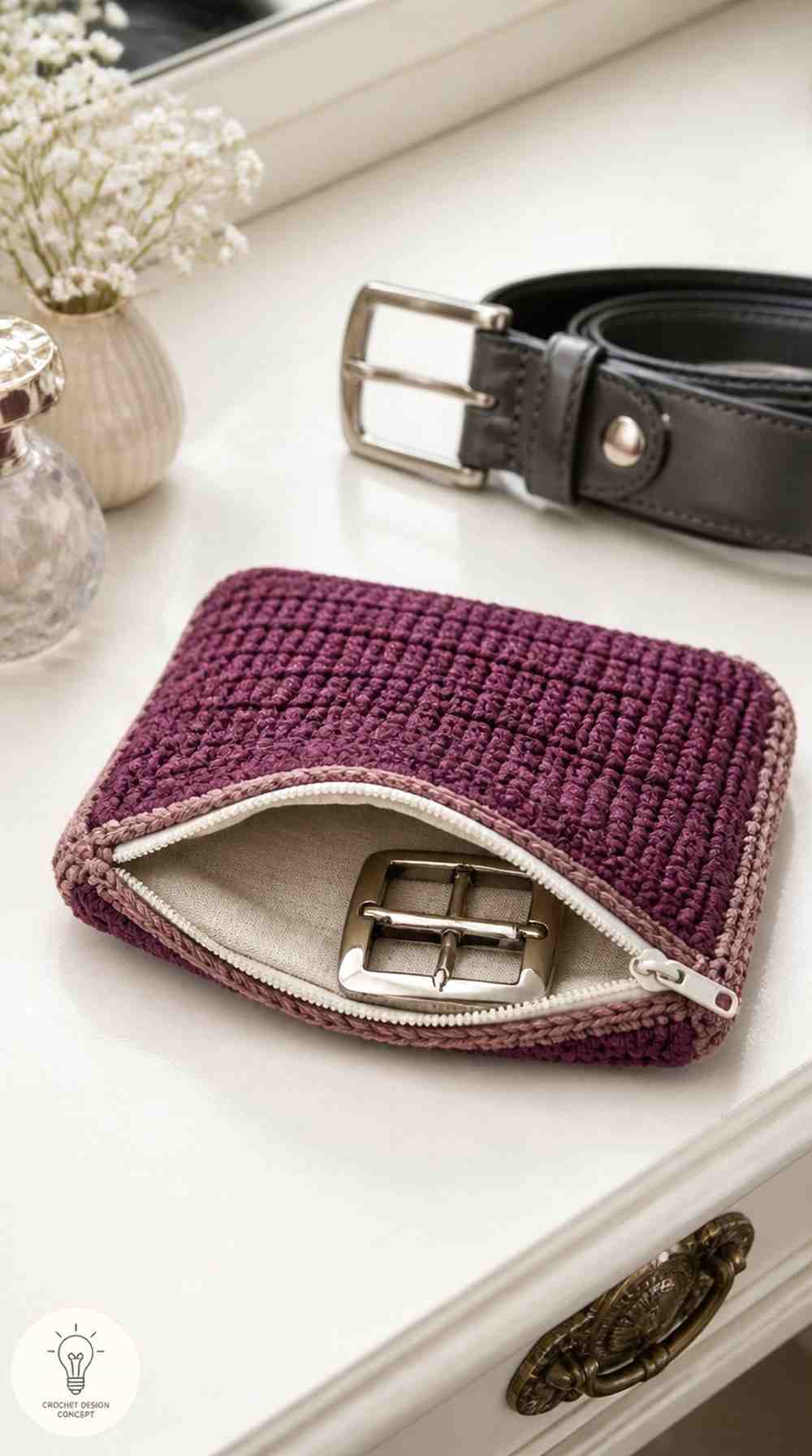
Deep plum crochet forms a neat rectangular storage pouch with a dusty-rose border and a cream zipper along its upper edge. A detached square silver buckle rests inside soft oatmeal lining, with part of the polished metal visible through the open zipper.
The enclosed zipper arrangement offers another option for separately stored hardware. Its compact shape could fit inside a wardrobe drawer or travel accessories bag, but the buckle must be kept away from the zipper teeth during insertion and removal.
- Zipper Clearance: Keep enough space between the metal buckle and cream zipper so the hardware does not scrape against the teeth.
- Soft Interior: Use a smooth lining without abrasive seams, recognizing that lining alone does not guarantee a scratch-free finish.
- Storage Position: Lay the filled pouch flat and avoid placing heavy objects directly on top of the buckle.
16. Crochet Forest Green Hanging Buckle Keeper
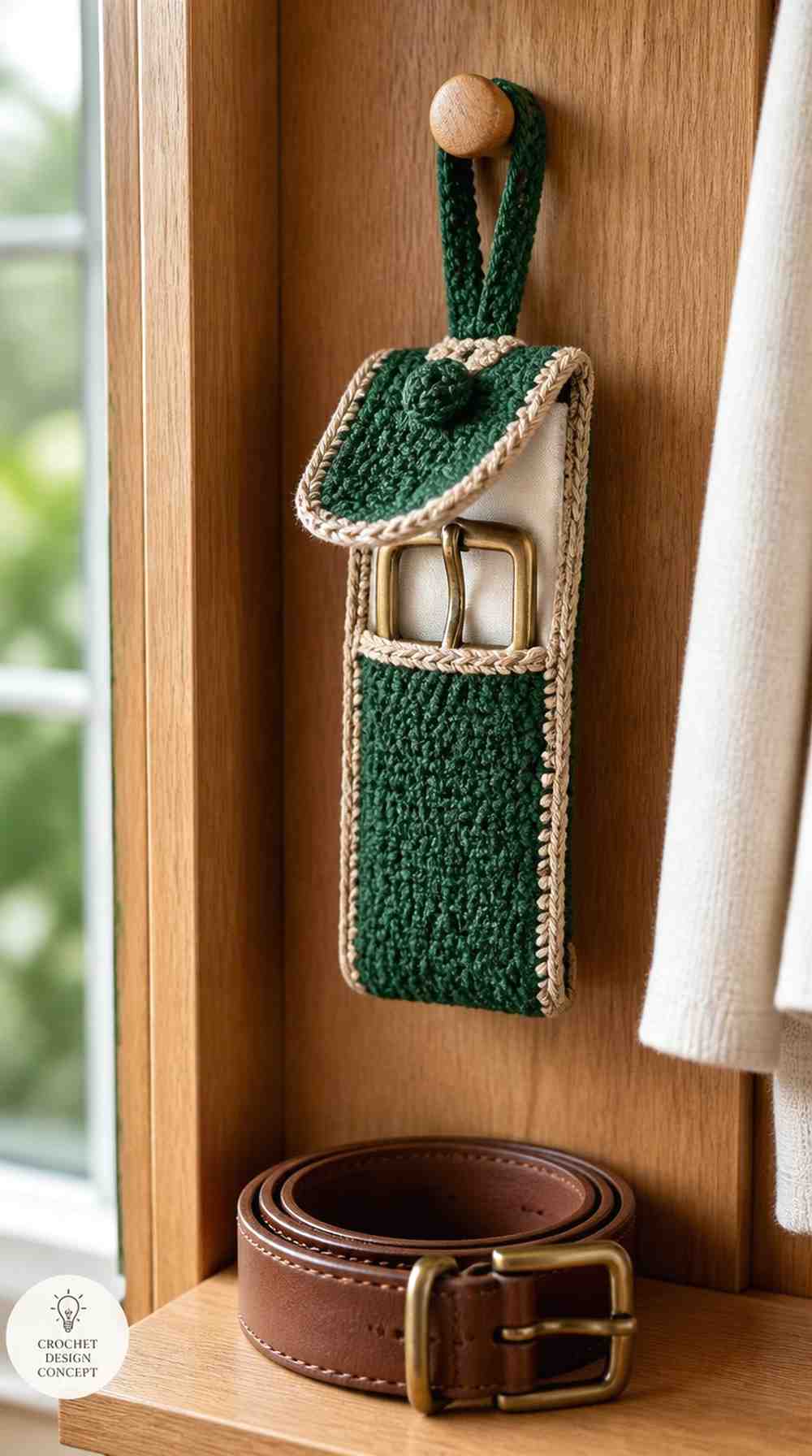
Deep forest-green crochet forms a narrow hanging pocket with oatmeal edging, a small overlapping front flap, and a reinforced loop at the upper edge. A detachable antique-gold rectangular buckle rests inside cream fabric lining, with its upper corner visible beneath the partly opened flap.
The design is intended for a wardrobe peg rather than flat drawer storage. It keeps the small buckle in a dedicated hanging location while the corresponding brown leather belt remains separately coiled on a shelf.
- Hanging Loop: Reinforce the forest-green loop and use a suitable wardrobe peg, checking that the pocket remains secure with its intended contents.
- Buckle Retention: Make the overlapping flap sufficiently deep to keep the detached buckle from slipping out when the pouch hangs vertically.
- Separate Belt Storage: Avoid hanging the weight of a full leather belt from this small crochet keeper unless a real construction has been specifically designed and tested for it.
Practical Guide to Crochet Belt Buckle Protective Wraps
Start with the buckle shape
Before choosing a crochet cover, examine whether the buckle is rectangular, oval, circular, square, or made from two rings. Measure its full width, height, thickness, and any protruding pins or bars.
A cover for a flat decorative buckle may not fit a thicker automatic or ratchet-style buckle. Do not force crochet fabric into moving hardware.
Storage covers are different from wearable accessories
These concepts are designed for keeping clothing belts and buckles covered while they are not in use.
Remove the wrap completely before wearing or fastening the belt. Crochet should not interfere with the tongue, clasp, locking mechanism, strap opening, or other working parts.
These are not covers for vehicle seat-belt buckles, child restraints, climbing harnesses, or other safety-critical fasteners.
Choose soft, suitable materials
Smooth cotton yarn may be worth considering for clear stitch definition and relatively tidy fabric edges. A carefully selected soft lining can separate the metal buckle from interior crochet joins.
However, no ordinary crochet wrap is guaranteed to prevent scratches, tarnishing, or finish damage. Metallic embellishments, coarse seams, unsuitable dyes, and hard buttons may introduce additional contact risks.
Keep belts dry and loosely stored
Check that the buckle, leather strap, crochet cover, and lining are completely dry before putting them into a drawer.
Avoid tightly wrapping leather belts in ways that create permanent bends. For delicate plated or polished buckles, follow the maker’s care instructions and consider storage materials recommended for that finish.
Make removal easy
A storage cover should come off without pulling against sharp buckle edges or moving hardware. Buttoned envelopes, loose slipcases, and carefully designed hook-and-loop wraps offer different removal options.
When testing a handmade concept, check the fit on a flat surface before using it regularly.
For other crochet belt styling inspiration, explore 27 Crochet Lace Belt Ideas for Fall 2026 on Yarn Nest Studio. That collection focuses on the belts themselves, including buckle styles, rather than protective storage covers.
Want to Make Something Similar?
The 16 designs above are original visual concepts, not exact tested crochet patterns. These verified resources teach related techniques that may help with narrow crochet fabric, buckle shapes, and small storage pouches.
- Basic Crochet Belt Pattern with Buckle — CAAB Crochet explains dense thermal-stitch fabric and working crochet around a belt buckle. Its purpose is making a wearable belt, but the construction details may help readers understand buckle shapes and joins. CAAB Crochet
- Crochet Easy Storage Pouch — Crochet With Julie provides written and video guidance for a small crochet pouch with a buttoned flap. It is useful for understanding simple pocket and closure construction, not for reproducing any pictured buckle cover exactly. Crochet With Julie
For any real protective wrap, adapt the shape to the specific clothing buckle and check how the chosen fabric and closures interact with its finish.
Which Crochet Belt Buckle Protective Wrap Should You Choose?
| Your priority | Designs to consider | Main trade-off |
|---|---|---|
| Simple attached-buckle storage | Terracotta Envelope, Oatmeal Slip-On | Opening must match the buckle's shape |
| Adjustable wrap | Navy Double-Flap, Charcoal Hook-and-Loop | Fasteners need careful positioning |
| Soft tied closure | Burgundy Cross-Tie | Ties can snag or create bulk |
| Rounded buckle shape | Dusty Blue Fold-Over, Olive Drawstring | Curved shaping needs careful sizing |
| Detached square buckle | Butter Yellow Corner-Cradle, Coral Granny-Square | Requires separately removable hardware |
| Fabric-lined storage | Mocha Basketweave, Burnt Orange Double-Layer | Lining adds thickness |
| Two detachable buckles | Teal Twin-Buckle Travel Case | Compartments need suitable separation |
| Decorative edging | Lavender Scalloped | More potential for snags |
| Minimal front coverage | Ivory Button-Tab Shield | Does not fully enclose the buckle |
| Zippered storage | Plum Zippered | Zipper may contact metal |
| Hanging wardrobe storage | Forest Green Hanging Keeper | Limited to appropriately lightweight contents |
For a belt used regularly, a removable envelope or slip-on sleeve may be the simplest concept. If you collect detachable decorative buckles, separate lined pouches provide more storage flexibility.
Conclusion
Crochet belt buckle protective wrap ideas show how a small handmade accessory can change the way belts are stored and organized. A terracotta envelope offers a classic folded design, an oatmeal slip-on sleeve keeps the appearance simple, and a teal twin-buckle case creates separate storage for collectible hardware.
The best choice depends on your buckle’s shape, finish, and whether it stays attached to the belt. Focus on gentle contact, easy removal, and suitable storage conditions rather than assuming soft crochet guarantees protection.
Which design would suit your wardrobe best: the terracotta envelope, the burgundy cross-tie wrap, or the plum zippered buckle pouch? Share your favorite and the type of clothing belt buckle you would store inside.
Frequently Asked Questions
1. Can a crochet wrap protect a metal belt buckle from scratches?
A soft crochet cover may reduce some direct contact with surrounding objects during storage, but scratch prevention is not guaranteed. Yarn texture, interior seams, hard fasteners, dust, and the buckle’s finish all matter. For delicate polished or plated buckles, use materials and storage methods recommended by the manufacturer.
2. What yarn should I consider for a crochet belt buckle protective wrap?
Smooth cotton or a suitable cotton blend may be worth considering because it can produce clear stitches and relatively neat edges. Actual suitability depends on the buckle’s finish and the way the cover is constructed. Consider a smooth lining where appropriate, and avoid rough decorative elements against the metal.
3. Can I leave a crochet buckle wrap on while wearing the belt?
No. These designs are intended for storage, not for covering an operating buckle. Remove the wrap before wearing or fastening the belt so the buckle, tongue, clasp, or locking mechanism can work normally. Never use these decorative concepts on safety-critical buckles or restraints.
4. How do I size a crochet storage cover for a belt buckle?
Measure the buckle’s full outside width, height, and thickness, including any protruding parts. Decide whether the cover will slide over the buckle or open around it. Allow enough clearance for gentle insertion and removal without stretching the crochet tightly across metal corners or putting pressure on the mechanism.
5. Are these 16 crochet belt buckle protective wraps available as exact patterns?
No. These are original AI-generated design concepts rather than tested patterns or finished handmade products. The linked tutorials explain related crochet belt and pouch techniques, but neither reproduces the pictured protective wraps exactly. A real version would require custom measurements, material choices, closure placement, and checks against the buckle’s particular finish and construction.