When several people are sharing a table, even the nicest matching glasses can become difficult to tell apart. Crochet beverage glass identifier bands offer a decorative way to give each glass its own look. From terracotta ridges and tiny daisies to numbered bands, miniature granny squares and citrus motifs, these 17 inspiration ideas explore different colors, textures, fastenings and handmade details for everyday drinking glasses.
The best choice depends on the type of glass, the amount of condensation it collects and how easily you want to remove the band afterward. Some of these crochet concepts are narrow and simple, while others use little motifs or adjustable closures to make each glass more recognizable. Use this collection to compare their appearance and practical limitations before planning something suitable for your own drinkware.
These are AI-generated crochet design visualizations for inspiration, not photographs of tested handmade pieces or step-by-step patterns.
Quick Design Selection Guide
- For a simple everyday look: Try Crochet Terracotta Double-Ridge Glass Band or Crochet Mustard Checkerboard Glass Band. Their straightforward shapes keep decoration minimal.
- For telling several glasses apart: Crochet Navy Number Three Glass Band and Crochet Sand Burgundy Cross-Stitch Band offer easily varied identifying marks.
- For a garden brunch: Crochet Blush Daisy Glass Identifier Band and Crochet Ivory Olive Leaf Glass Band bring small botanical details without covering much of the glass.
- For removable fastening: Crochet Sea Glass Lattice Tie Band, Crochet Plum Scalloped Glass Collar and Crochet Slate Adjustable Pinstripe Band each explore a different closure.
- For playful party styling: Crochet Ivory Lime Slice Glass Band, Crochet Cocoa Band With Peach Bow and Crochet Strawberry Granny Tile Glass Band offer recognizable motifs.
1. Crochet Terracotta Double-Ridge Glass Band
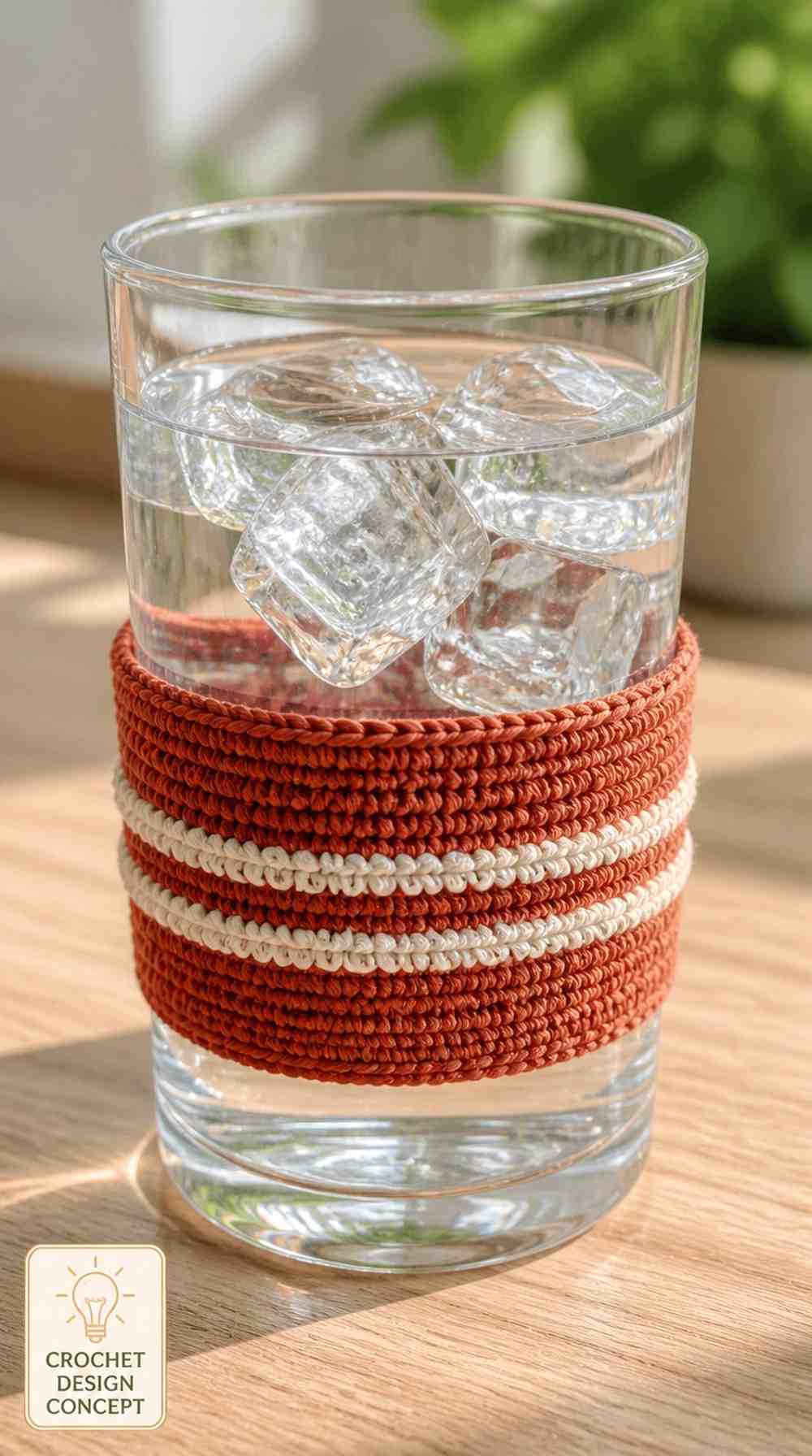
Burnt terracotta gives this slim crochet band a warm, earthy appearance, while two raised ivory ridges run neatly around its center. The closely worked rows and continuous ring create a clean, understated finish. It feels more like a small decorative accent than a full cup sleeve, leaving most of the glass uncovered.
The two ivory lines help distinguish this band from a plain terracotta version. Because the design has no adjustable closure, its actual fit would depend on the glass circumference, crochet tension and how much the finished yarn stretches.
- Best glass shape: Straight-sided tumblers are the most sensible starting point because their circumference changes less across the narrow band’s placement area.
- Raised ridge detail: The ivory ridges should remain clearly separated. Overly bulky raised stitches could make the band feel thicker than intended.
- Continuous-ring fitting: A made version would need careful sizing to slide over the glass while staying in place once fitted.
2. Crochet Blush Daisy Glass Identifier Band
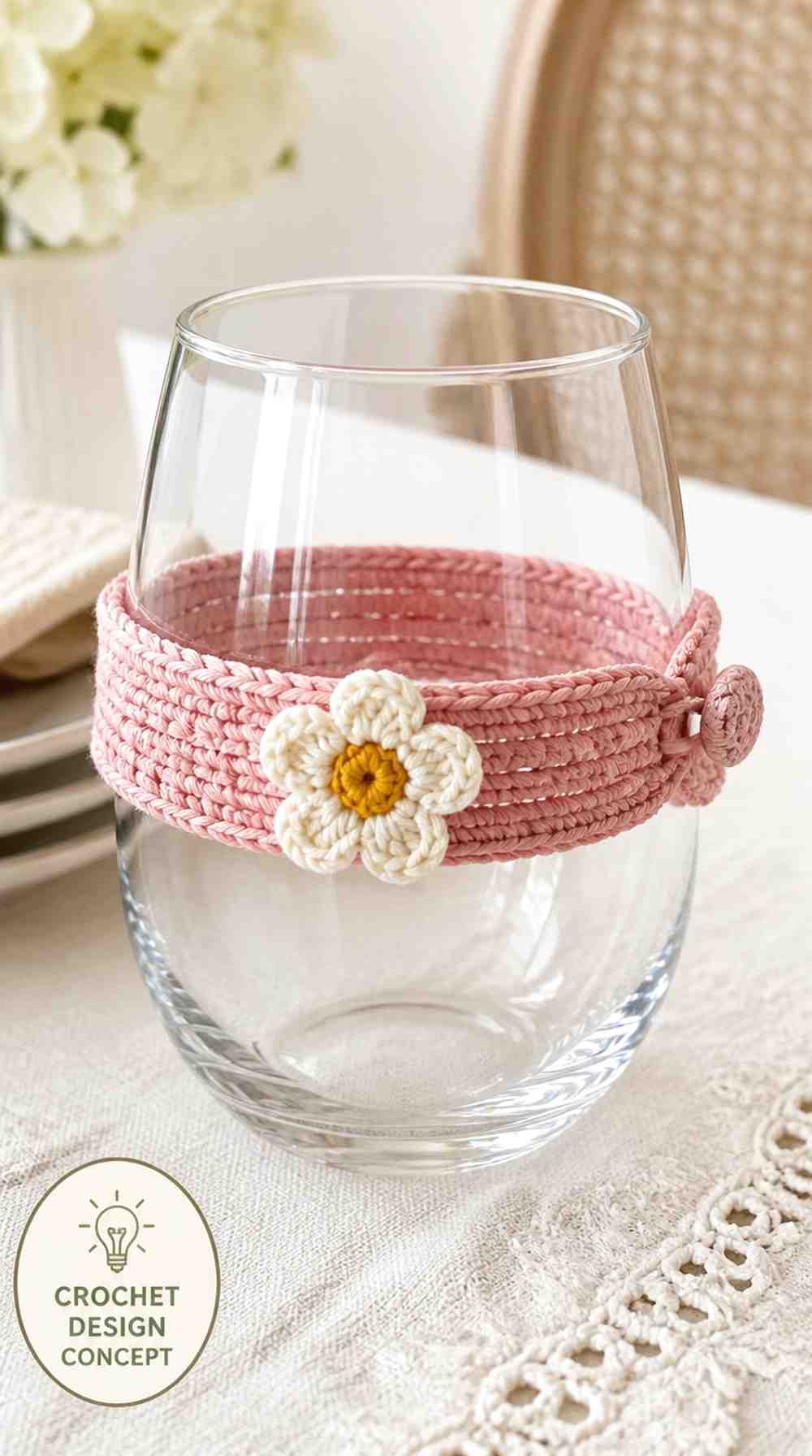
A small ivory daisy becomes the main feature of this dusty-blush crochet band. Its five rounded petals surround a mustard-yellow center, while the narrow pink base keeps the arrangement light and simple. The tiny side button and matching loop give the design a finished, wraparound appearance.
This is a charming option for a floral table setting, especially when each guest could receive a different flower color. The daisy should remain flat against the band so it does not become an awkward raised decoration when someone holds the glass.
- Daisy placement: Keeping the flower centered on the front makes the glass easy to recognize when several identical glasses stand together.
- Button construction: A fabric-covered button is a possible alternative to hard hardware, but it still needs secure attachment and a comfortable position.
- Changing the marker: Different petal colors could identify additional glasses without changing the base band’s shape or fastening arrangement.
3. Crochet Navy Number Three Glass Band
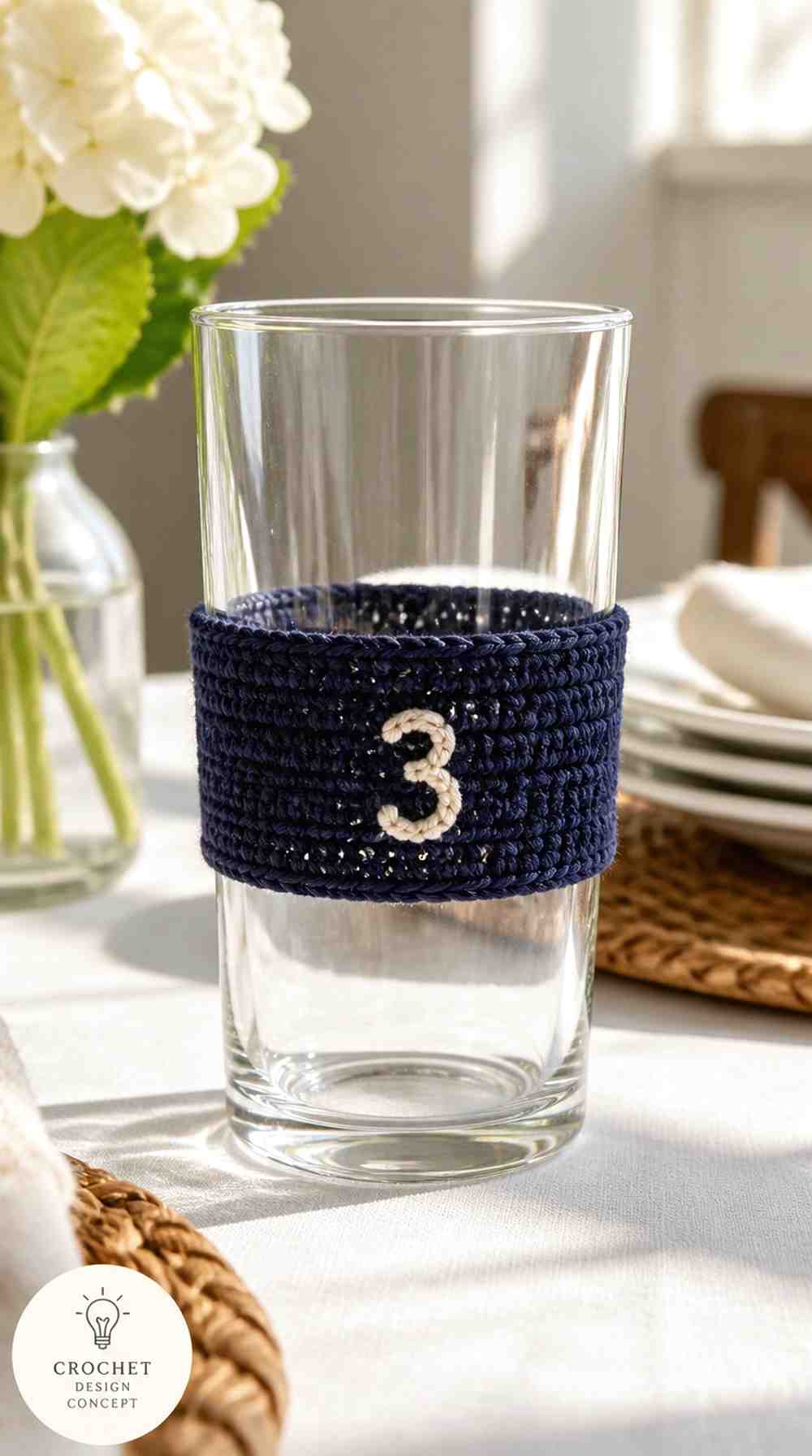
Midnight navy creates a strong background for the small cream embroidered number 3 on this straightforward crochet band. The rectangular rows are closely worked, with clean edges and a discreet rear join that keeps the front simple. Unlike decorative flowers or bows, the number itself becomes the identifying feature.
Numbered bands are worth considering when several people regularly use similar glasses. A clearly stitched numeral may be easier to remember than a subtle change in yarn color, although its size and contrast need attention during actual construction.
- Clear identification: Use visibly different numerals for each glass in a set, making sure the stitching remains readable from normal table-viewing distance.
- Embroidery surface: A fairly dense crochet base gives the number a more consistent foundation than large open stitches would provide.
- Number placement: Keep the numeral away from the closing seam and drinking rim, with enough surrounding navy fabric to distinguish its shape.
4. Crochet Sea Glass Lattice Tie Band
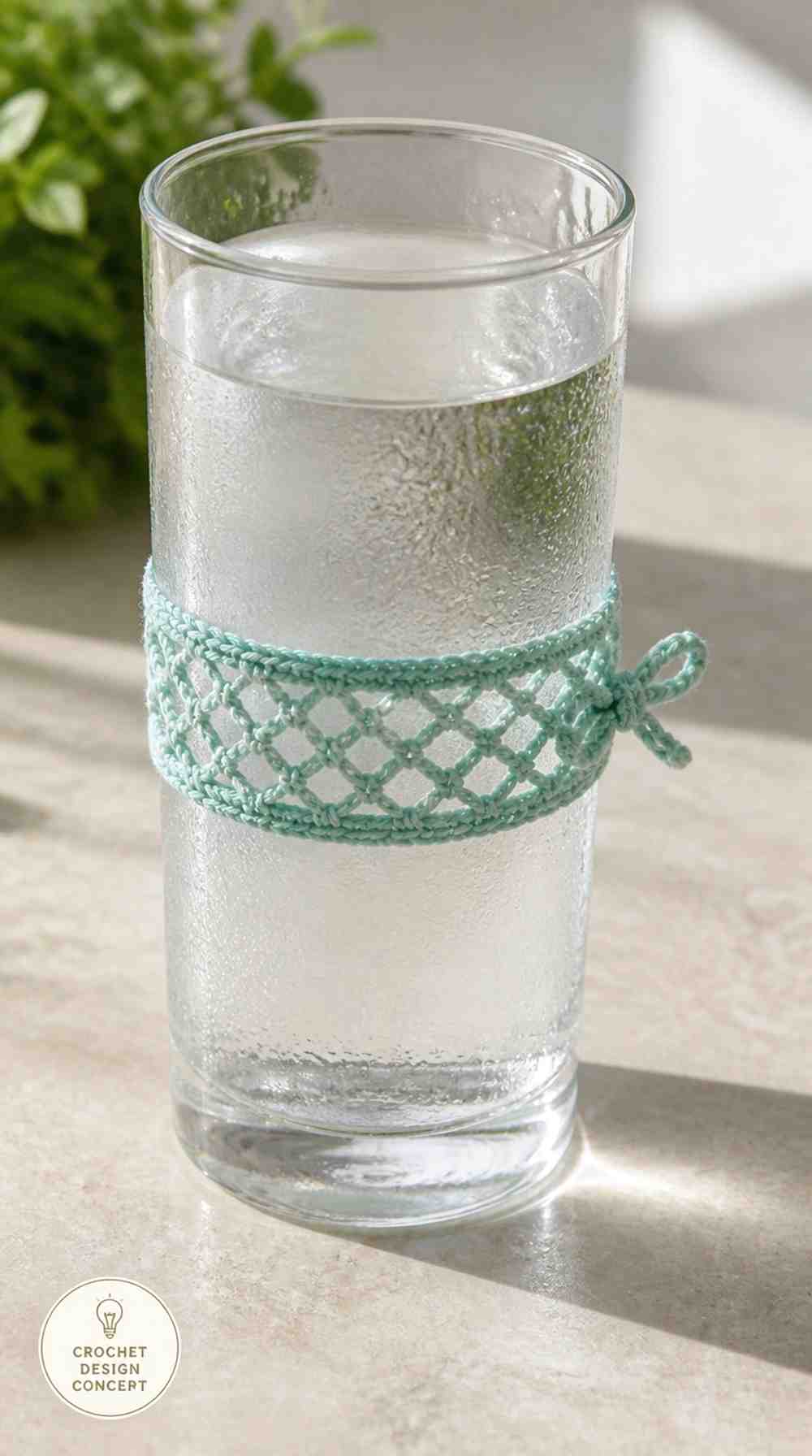
Sea-glass turquoise yarn gives this identifier a fresh, airy appearance. Its central row of open diamond-shaped crochet spaces sits between two narrow solid borders, creating an attractive contrast with the clear glass underneath. Two short ties form a small flat bow at one side.
The lattice looks especially delicate on a tall sparkling-water glass, where the transparent sections remain visible. Its open stitches are mainly decorative rather than supportive, so the solid borders and tie placement would matter when adapting the idea into a working band.
- Open-stitch structure: Keep diamond openings consistent and properly connected to the borders to prevent the lattice from becoming distorted around the glass.
- Tie length: Short crochet ties reduce the amount of loose yarn that might catch against fingers or nearby tableware.
- Wet-glass limitations: Condensation can dampen the yarn, and the tied band may loosen or move. Check its fit on the actual glass.
5. Crochet Plum Scalloped Glass Collar
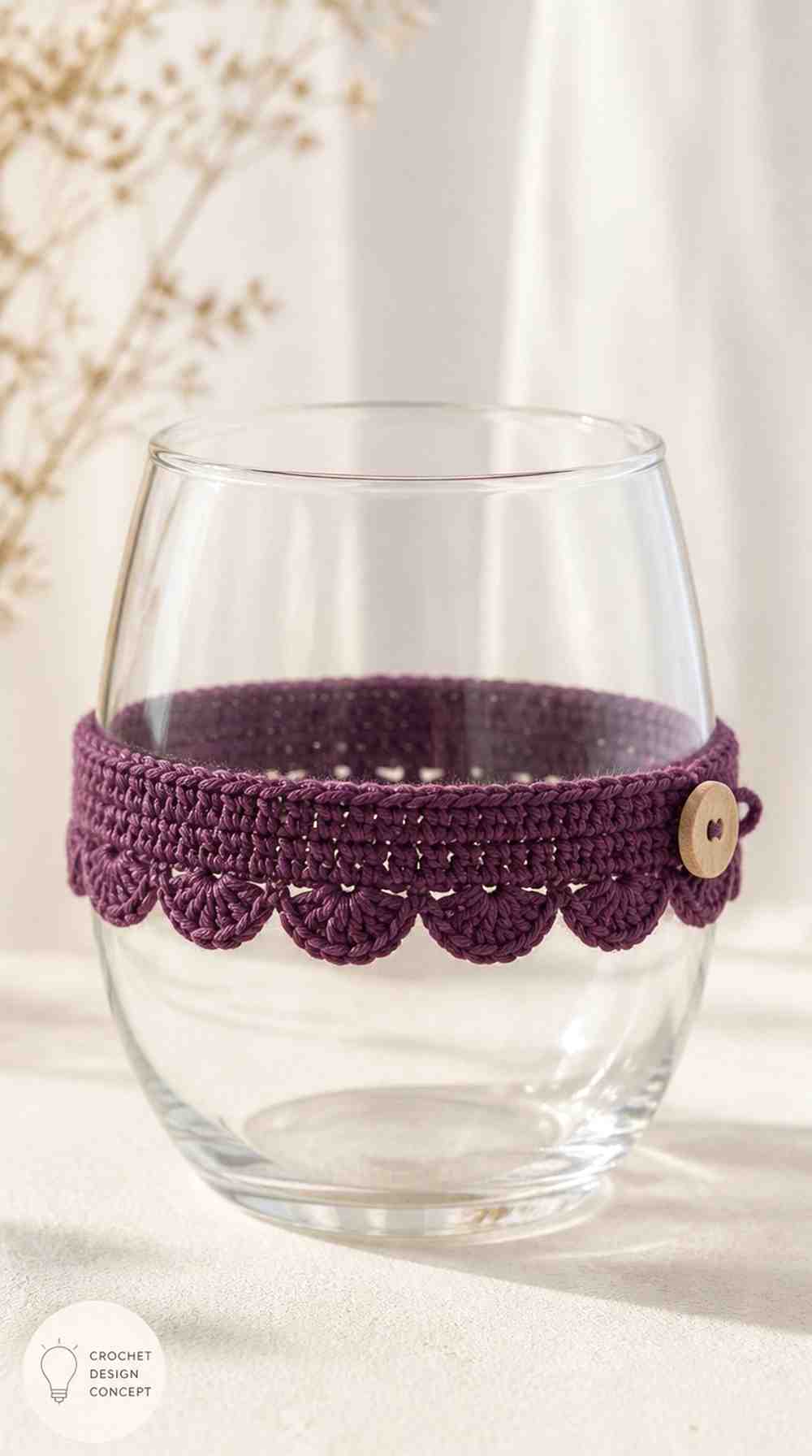
Deep plum yarn gives this small crochet collar a rich, elegant look, while the lower edge carries a neat row of shell-shaped scallops. A straight top border balances the decorative lower finish, and a small wooden button closes the wrap at one side.
The scalloped edge makes this band stand out without needing a separate appliqué. It is a useful concept for someone who prefers textured crochet details over large motifs, although the little shells should not hang so far that they interfere with a comfortable grip.
- Scallop depth: Shallow, evenly spaced shells are a better starting point for a drinking-glass band than large dangling ruffles.
- Button position: Place the side closure where it is unlikely to press uncomfortably against the holder’s fingers.
- Wooden hardware: Wooden buttons may have their own moisture-care limitations and should be removed from wet conditions when practical.
For another look at decorative cup edging, see 15 Crochet Ruffle-Edge Cup Sleeve Ideas, which explores larger sleeve designs with textured borders.
6. Crochet Mustard Checkerboard Glass Band
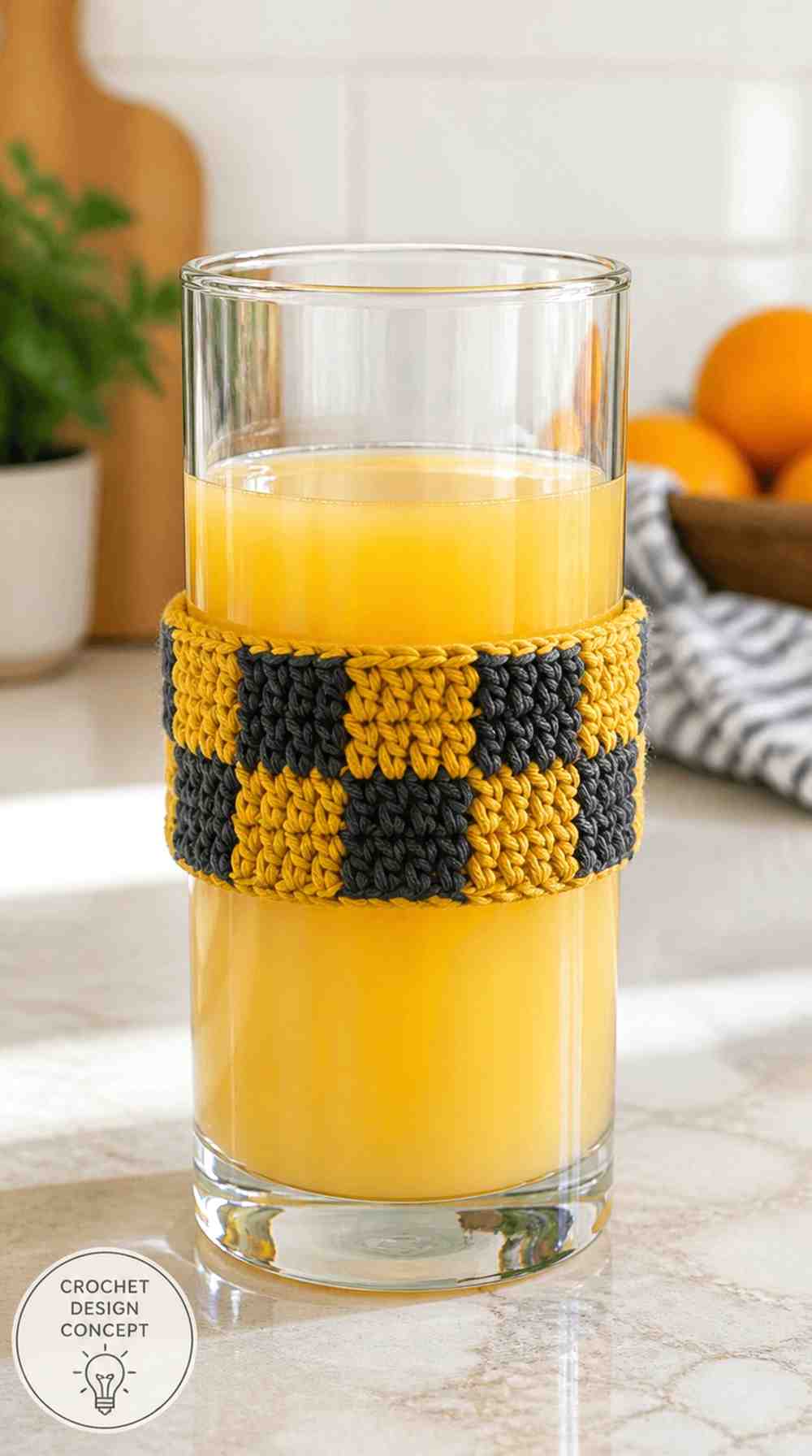
Mustard yellow and deep charcoal form a tidy two-row checkerboard across this narrow crochet identifier. The alternating rectangular blocks create a bold graphic effect, while the continuous ring has plain edges and no added attachments.
Its appeal comes from the stitch pattern itself. On a clear juice glass, the color contrast gives the band a recognizable appearance without flowers, buttons or tags. It would make sense to keep the finished stitches compact so the checkerboard remains recognizable instead of becoming uneven around the curve.
- Color-change neatness: Careful yarn transitions are important because loose carried strands could show through the small checkerboard blocks.
- Pattern visibility: Larger contrasting blocks may be easier to recognize than tiny checks when several glasses are placed close together.
- Band proportions: Keep the checkerboard strip narrow enough to identify the glass without turning it into a full-height beverage cozy.
7. Crochet Cocoa Band With Peach Bow
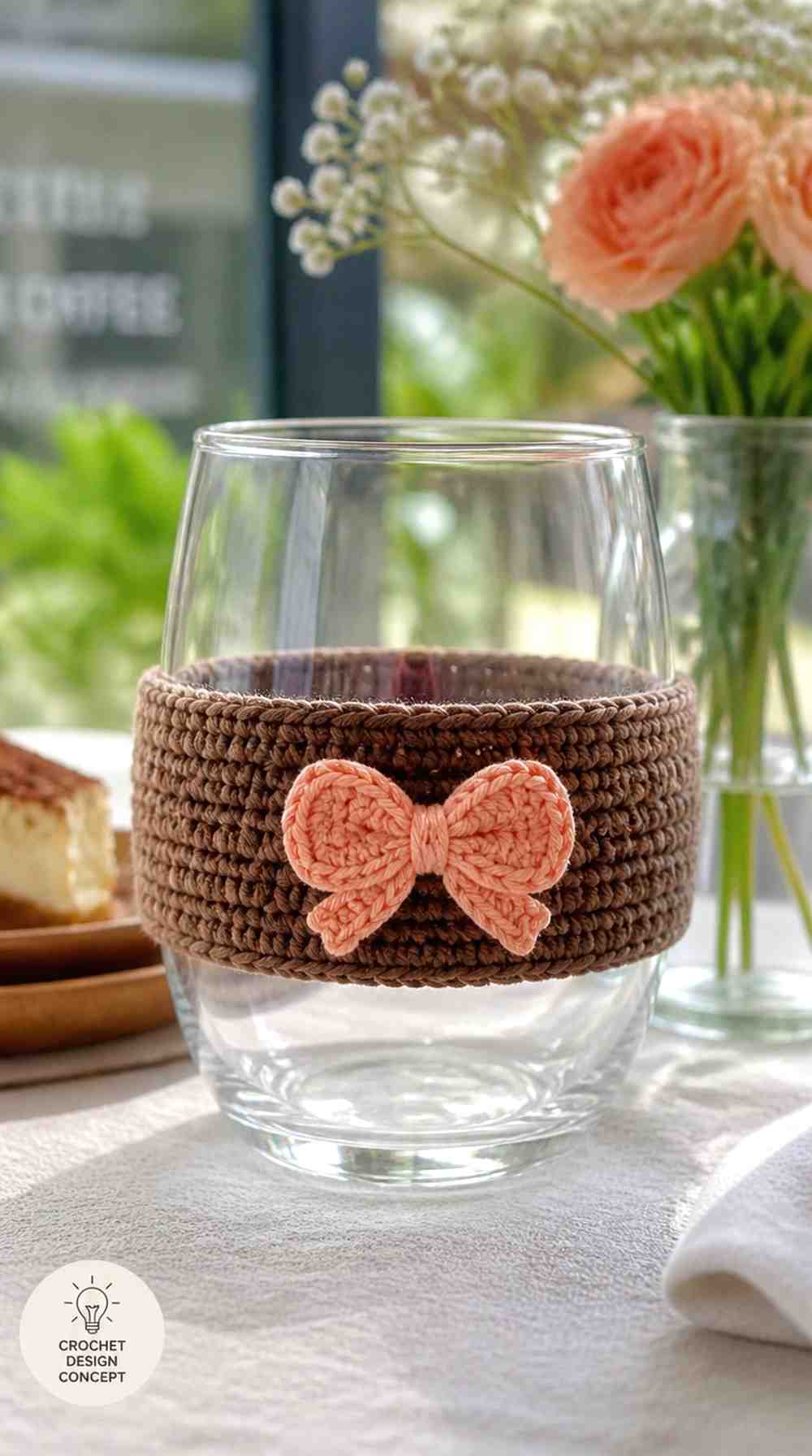
A soft cocoa-brown crochet band provides a calm background for one small pale-peach bow. The bow has two compact loops and short folded tails, while the band underneath remains simple and closely textured. Its warm colors give the design a gentle, understated appearance.
The flat bow is the main identifying detail, so it does not need extra lace or decorative stitching. If this idea becomes a real project, the bow should be stitched securely and kept small enough to avoid becoming uncomfortable or catching on nearby objects.
- Bow attachment: Sew through the bow’s center and into the supporting crochet band so the detail does not depend on a loose decorative knot.
- Comfortable profile: Compact loops and short tails are less intrusive than oversized ribbon-style bows around a drinking glass.
- Set variations: Cocoa bands could carry peach, cream, dusty-blue or burgundy bows as optional variations for identifying different glasses.
8. Crochet Ivory Olive Leaf Glass Band
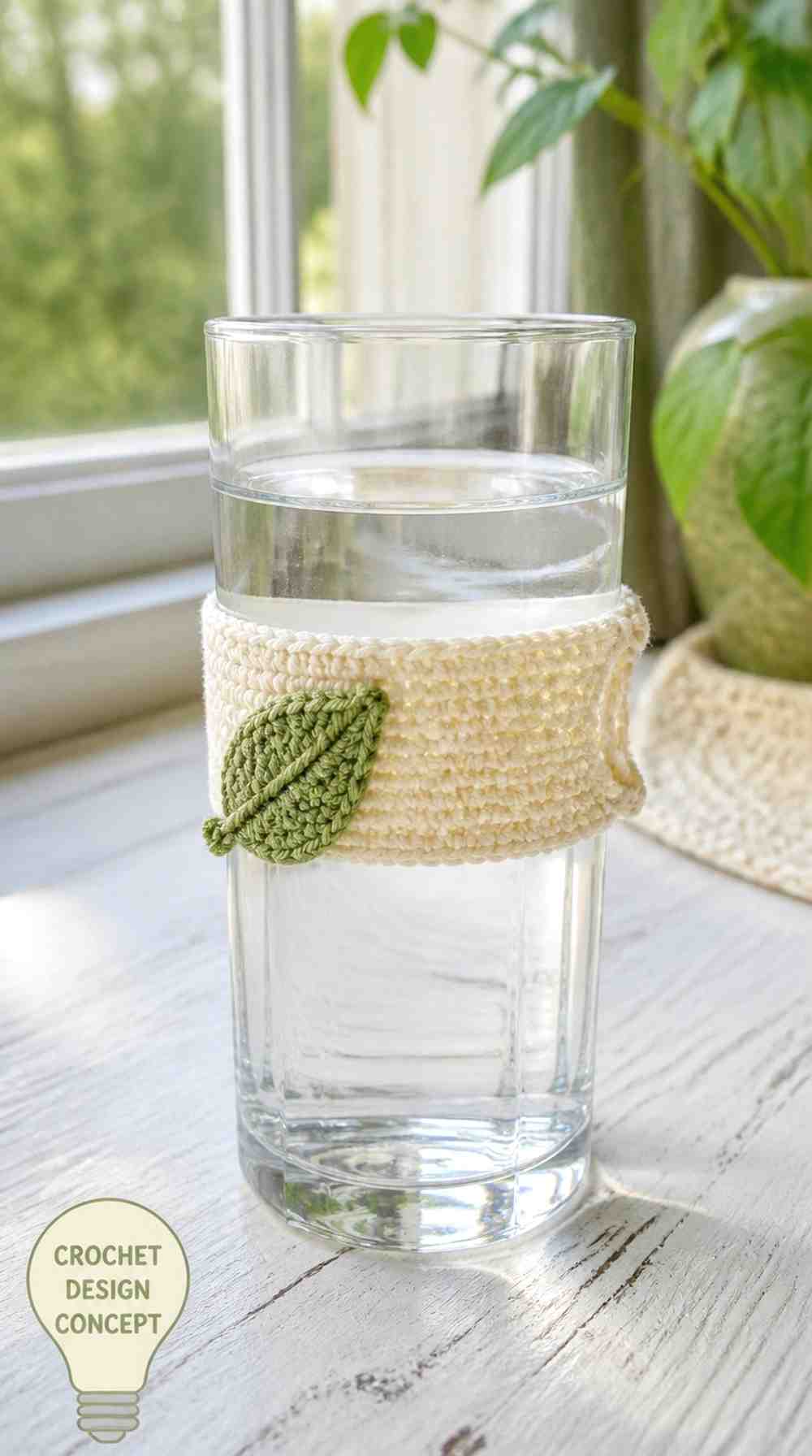
Warm ivory makes this narrow crochet band feel light and natural, while a single olive-green leaf adds a subtle botanical detail near the front. The leaf has a defined center ridge and a pointed tip, with visible crochet loops shaping its small silhouette. A matching ivory loop and covered button close the wrap behind the glass.
This design suits a relaxed garden-table look without relying on large floral decoration. The leaf is intended to lie flat, but a real version would need neat stitching at its attachment points to keep its tip from curling outward.
- Leaf shaping: A defined center and balanced side stitches help the leaf remain recognizable at a small scale.
- Fastening visibility: The covered button sits behind the glass, allowing the olive leaf to remain the most noticeable detail from the front.
- Seasonal adaptation: A rust, golden-yellow or deep-green leaf could create a different mood while retaining the same basic band shape.
9. Crochet Coral Chevron Identifier Band
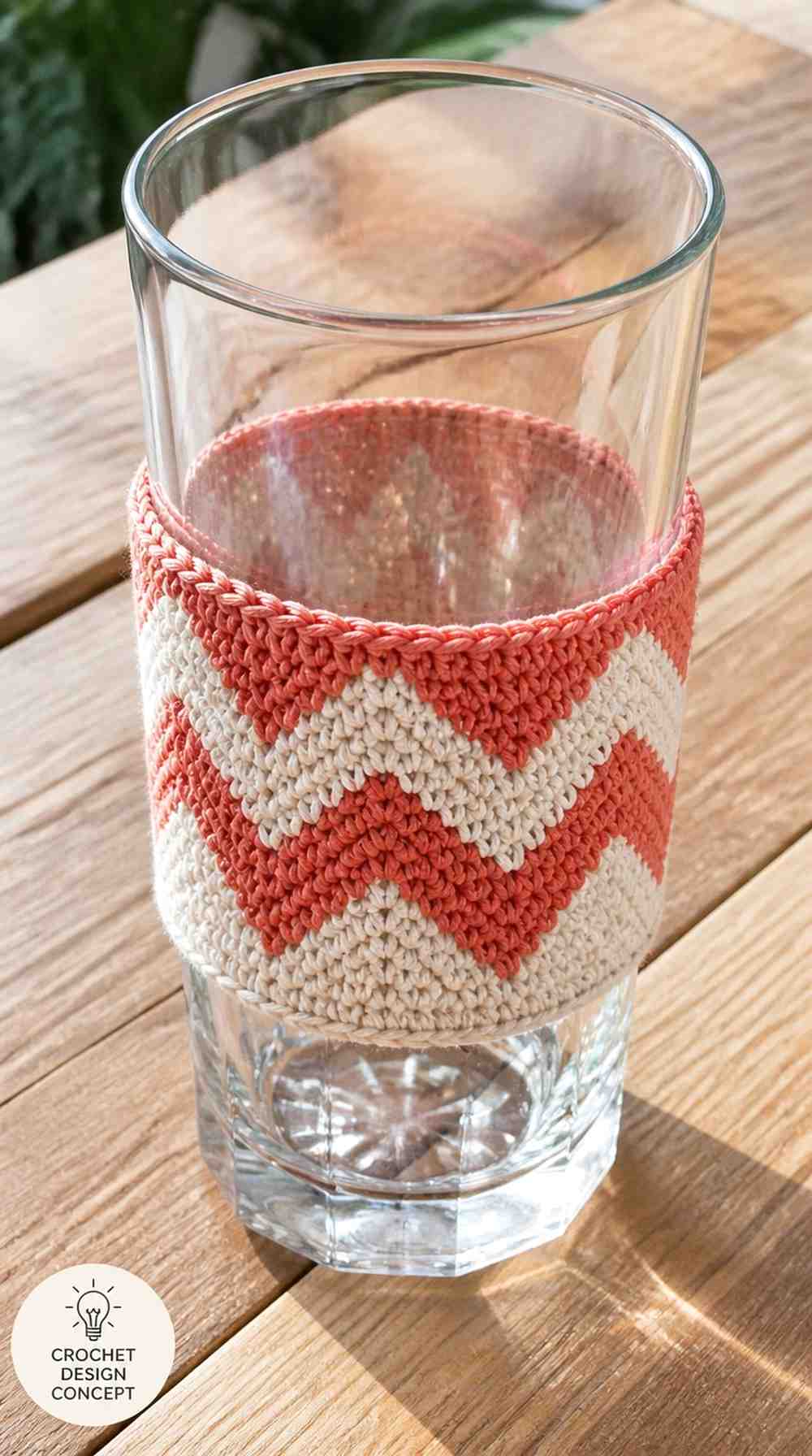
Coral-red and warm-cream chevrons bring lively movement to this slim crochet ring. Small angled stitches form repeating zigzags, framed by a coral upper edge and a cream lower border. With no dangling attachments, the overall look stays clean and graphic.
Unlike a striped band, the chevron pattern creates recognizable changes in direction across its width. The crochet needs careful stitch planning so the points stay consistent as the fabric follows the glass. It works visually best where the complete zigzag row remains easy to see.
- Chevron alignment: Plan the repeating points so the pattern meets neatly at the back instead of ending with a noticeably broken zigzag.
- Edge contrast: The opposite-colored borders frame the central chevrons and prevent the small design from looking visually crowded.
- Glass curvature: A wide or strongly tapered glass may stretch or distort the zigzag, so fit should be checked before finalizing the band.
10. Crochet Espresso Braided Glass Tag
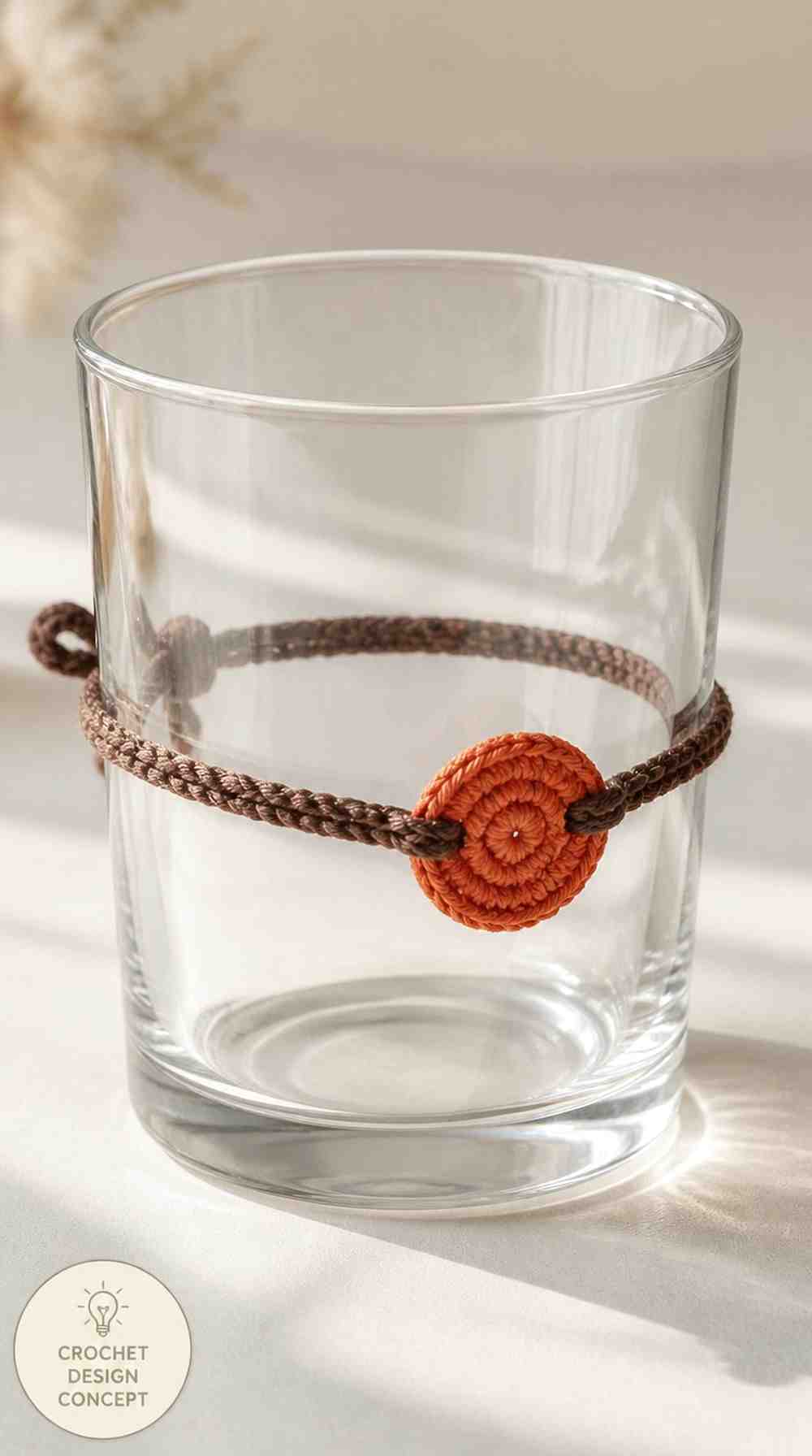
Instead of a broad fabric strip, this concept uses a slender espresso-brown crocheted cord and a small rust-orange circular medallion. The cord wraps once around the glass and ties behind it, while the flat medallion rests against the front surface.
Its distinctive feature is the difference between the narrow cord and the round crochet centerpiece. This could suit someone who wants a lightweight-looking identifier, although a thin cord may move more readily on smooth glass than a broad, properly fitted band.
- Medallion attachment: Pass the cord through secure crochet openings so the round motif cannot slide freely away from its intended position.
- Cord tension: The tie must be firm enough to remain positioned without placing unnecessary pressure on the glass.
- Decorative limitation: This is a visual identifier, not a handle or carrying strap. Never use the cord to lift the glass.
11. Crochet Periwinkle Rosette Glass Band
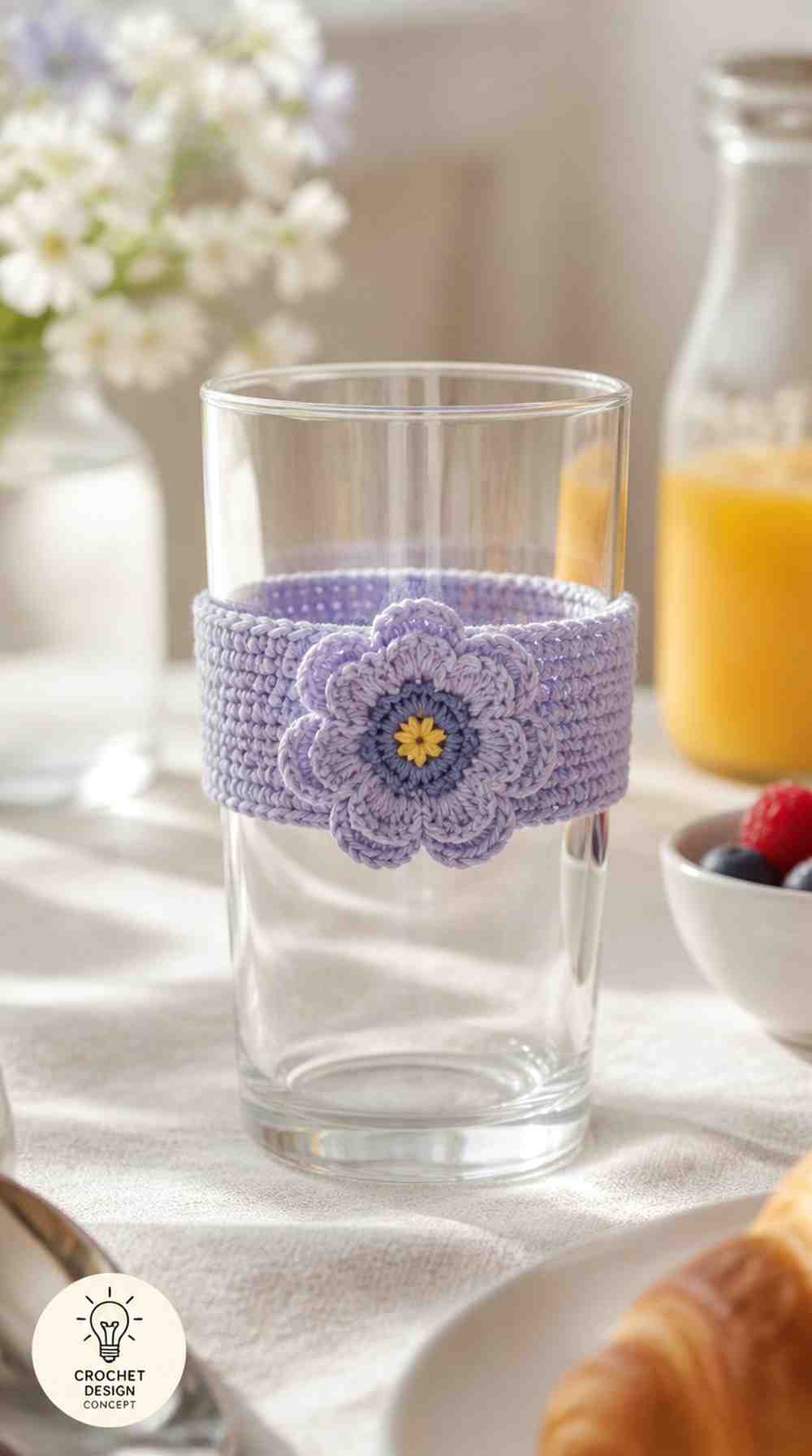
A small layered rosette adds gentle dimension to this periwinkle crochet band. Rounded petals form a compact flower, with a slightly darker center and a tiny ochre yarn knot giving it definition. The surrounding band is narrow and continuous, with softly textured rows and flat borders.
The rosette brings more surface detail than a flat embroidered symbol, making it an attractive choice for a special table setting. Because raised crochet can catch against fingers, the flower should stay compact rather than spreading across most of the band.
- Petal consistency: Similar-sized petals and secure center stitching help the rosette remain balanced after handling or washing.
- Flower thickness: Consider how much the layered motif protrudes; excessive thickness may be awkward against the hand.
- Individual colors: Different rosette centers could distinguish several otherwise matching periwinkle bands.
12. Crochet Turquoise Filet Diamond Band
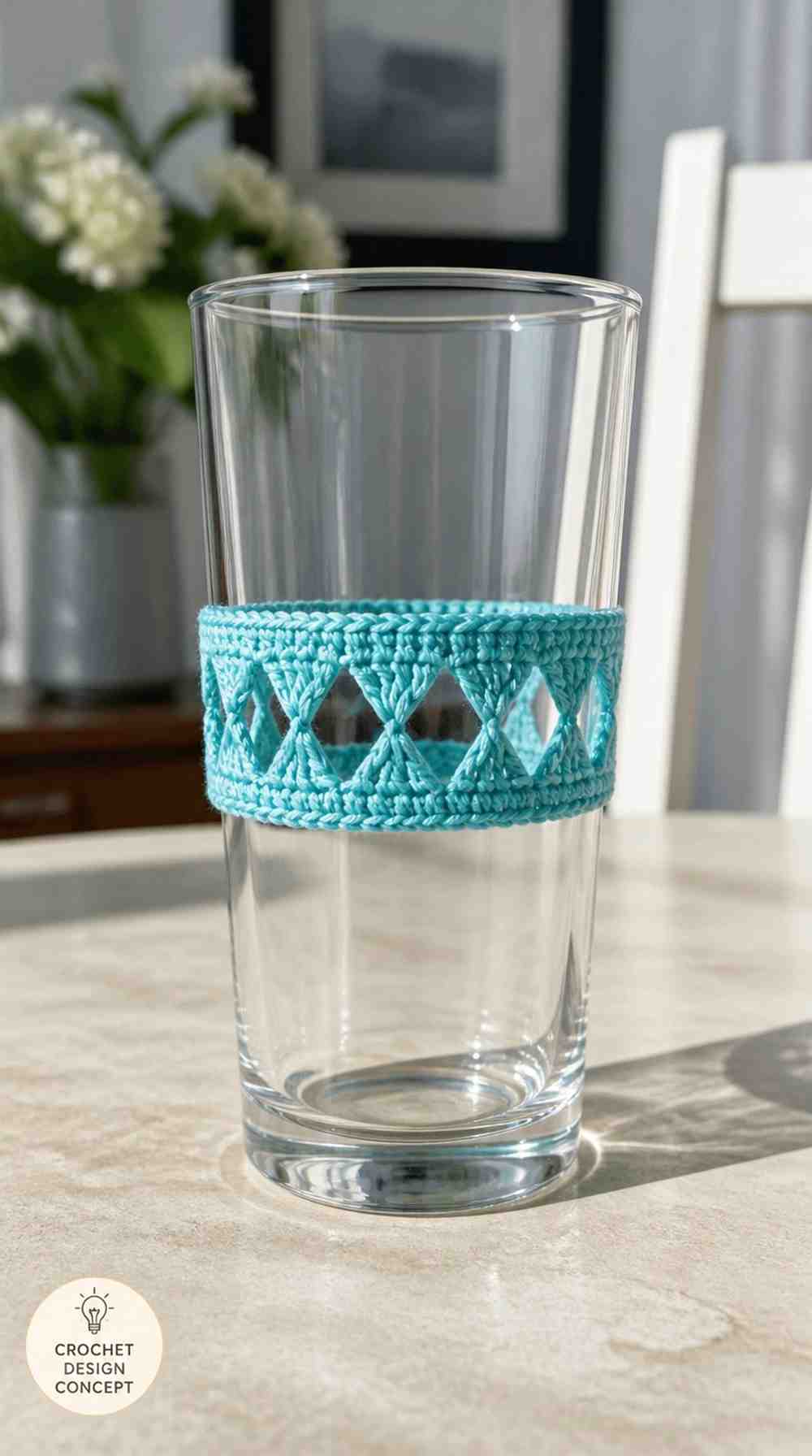
Aqua-turquoise yarn forms a delicate openwork band with one horizontal row of small diamond-shaped spaces. Solid crochet borders run along the top and bottom, keeping the slender strip visually contained. The openings allow the transparent glass to show through the design.
The appearance is lighter than dense checkerboard or chevron crochet, making it suitable for someone who likes subtle texture. It would require careful attention to the connection points between the open diamonds and the borders, particularly if the band is intended for repeated removal.
- Openwork stability: Even diamond spacing and strong connections to the solid borders are important because isolated loose chains can distort under tension.
- Visual identification: The turquoise color remains the strongest identifier; the delicate diamonds may be less obvious from across a busy table.
- Snag awareness: Open crochet loops can catch on jewelry or fingernails, so inspect an actual finished band before regular use.
13. Crochet Strawberry Granny Tile Glass Band
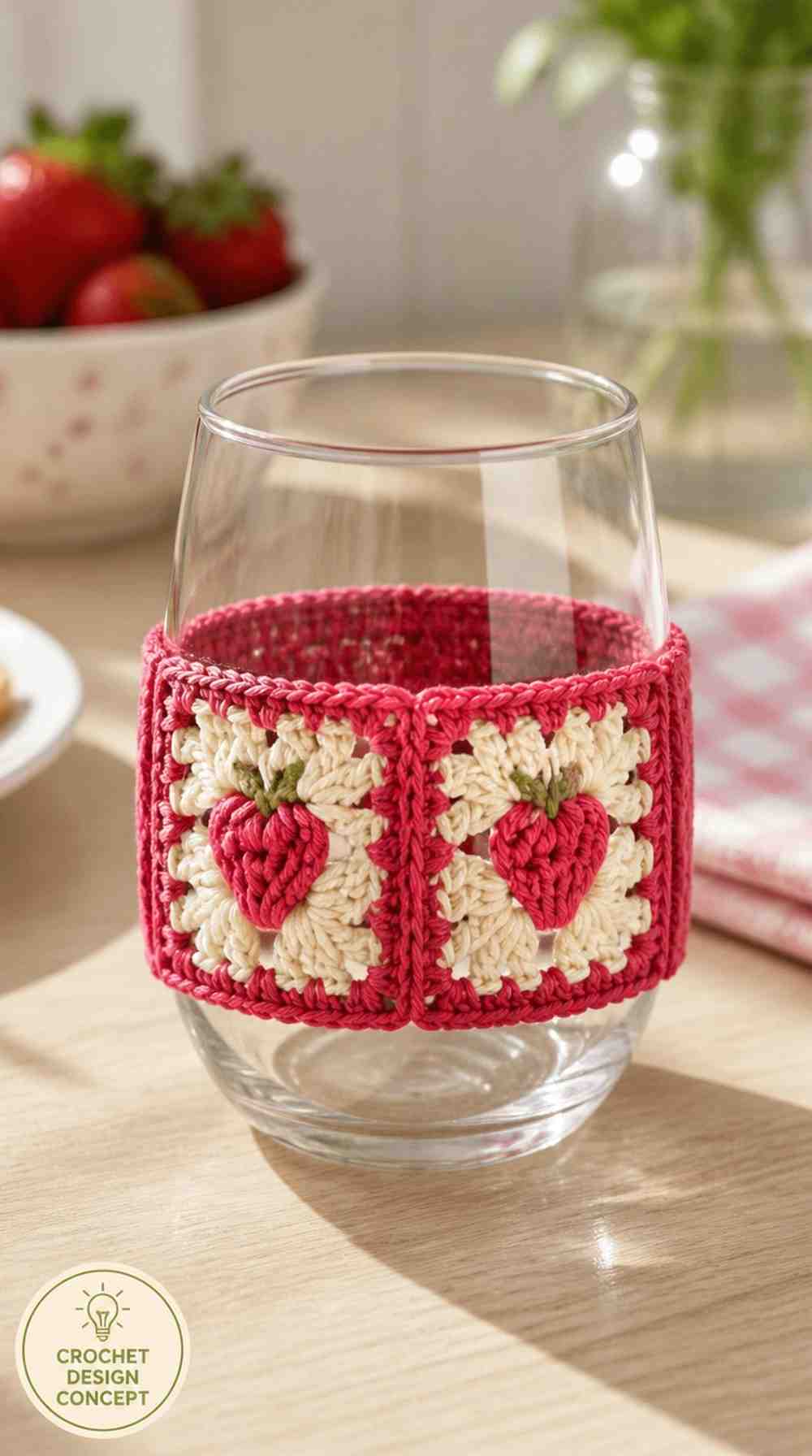
Two miniature crochet granny squares create the decorative front of this strawberry-pink identifier. Each square has a pink center, an ivory second round and a raspberry border. A narrow raspberry crochet section continues around the back, connecting the motifs into one wraparound band.
The miniature tile layout offers a more structured appearance than a single flower or embroidered symbol. Keeping the squares flat and evenly joined is important, because bulky corners could affect how neatly the band rests against a rounded stemless glass.
- Square proportions: The motifs should remain small enough to follow the curve of the glass without folding sharply at their corners.
- Joining finish: Flat, secure joins between the squares help preserve their recognizable outlines and avoid bulky seams.
- Back-band balance: A narrower crochet continuation keeps the focus on the two front squares while reducing unnecessary fabric around the glass.
14. Crochet Slate Adjustable Pinstripe Band
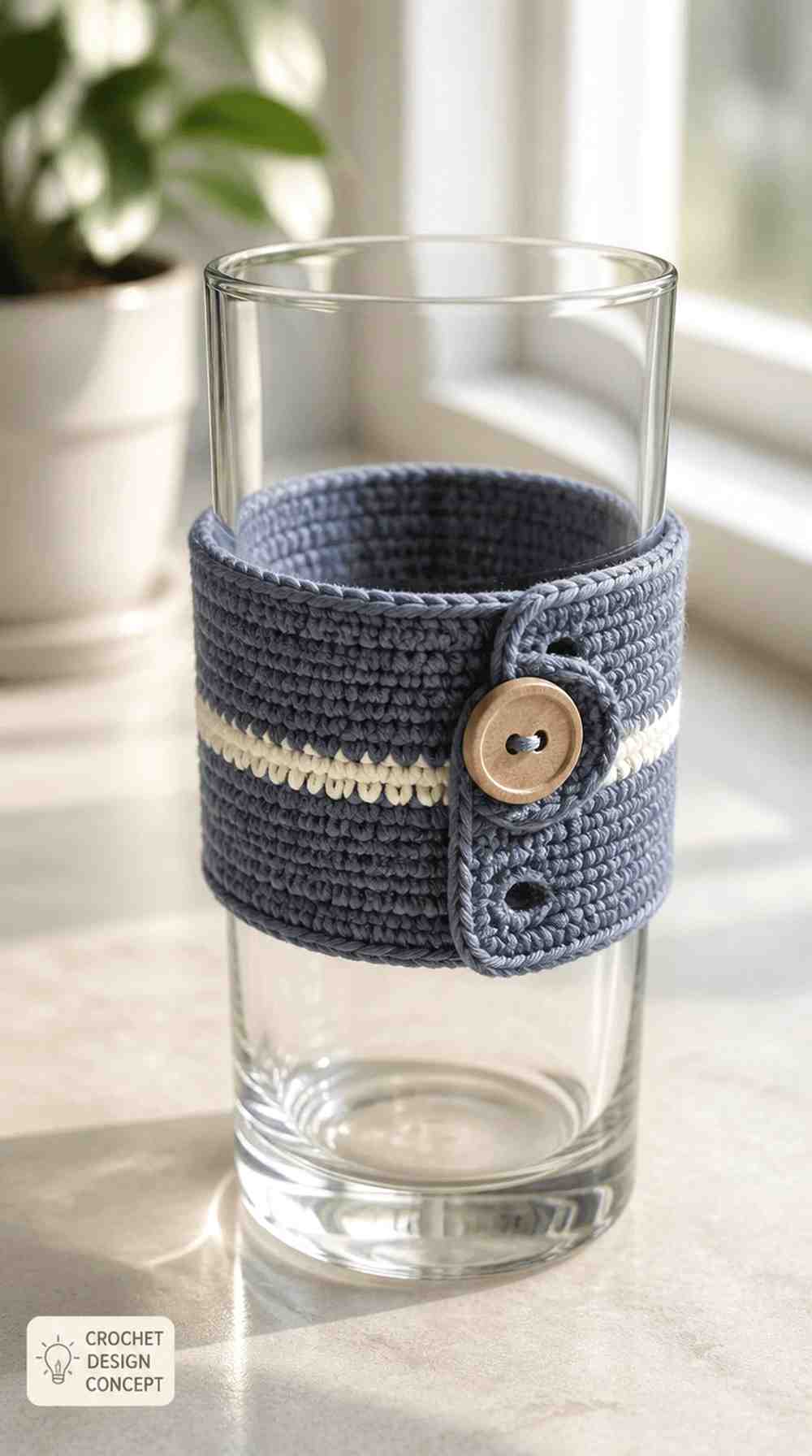
Slate-blue crochet gives this slim band a modern, restrained look. A thin ivory pinstripe runs through its center, while one end overlaps the other at a small tan wooden button. Two reinforced buttonholes provide visible alternative fastening positions.
The adjustable design is interesting for households with several similar but not identical glasses. The buttonhole positions suggest some flexibility, although actual fit would still need to be checked carefully because glass shapes vary and crochet can stretch when damp.
- Adjustment range: Two buttonhole positions offer limited choices, not universal sizing. Both need to be tested on the intended glass shapes.
- Overlap comfort: Keep the layered fastening section as flat as practical so it does not create a noticeable bump against the hand.
- Buttonhole reinforcement: Closely worked stitches around each hole can help the opening retain its shape during repeated fastening.
15. Crochet Ivory Lime Slice Glass Band
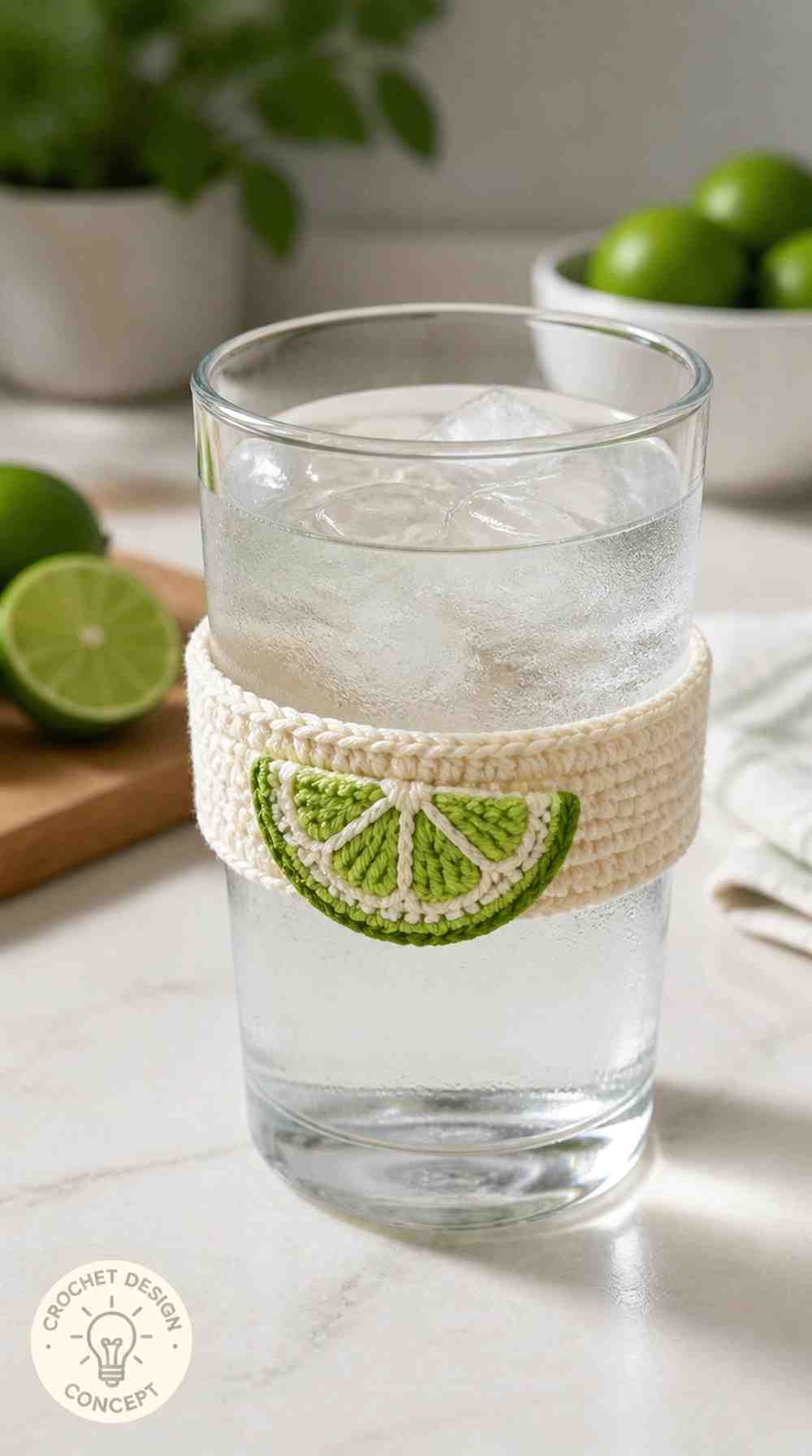
A tiny green crochet lime wedge makes this ivory glass band especially easy to recognize. The semicircular motif includes a darker green rind, pale-green segments and fine ivory dividing lines. It is sewn flat against a closely textured ivory ring, remaining well below the drinking rim.
The citrus detail suits a bright summer table without requiring an oversized decorative piece. Its segmented appearance gives it a clearer identity than a simple solid-green circle. For practical use, the appliqué should remain firmly attached and away from the area where someone drinks.
- Motif proportions: The lime wedge should be small enough to lie against the glass rather than projecting outward like a large ornament.
- Segment definition: Distinct pale-green sections and ivory divisions make the citrus shape recognizable without needing additional decorations.
- Placement caution: Keep the crocheted wedge below the rim and away from direct contact with beverages and mouths.
16. Crochet Sand Burgundy Cross-Stitch Band
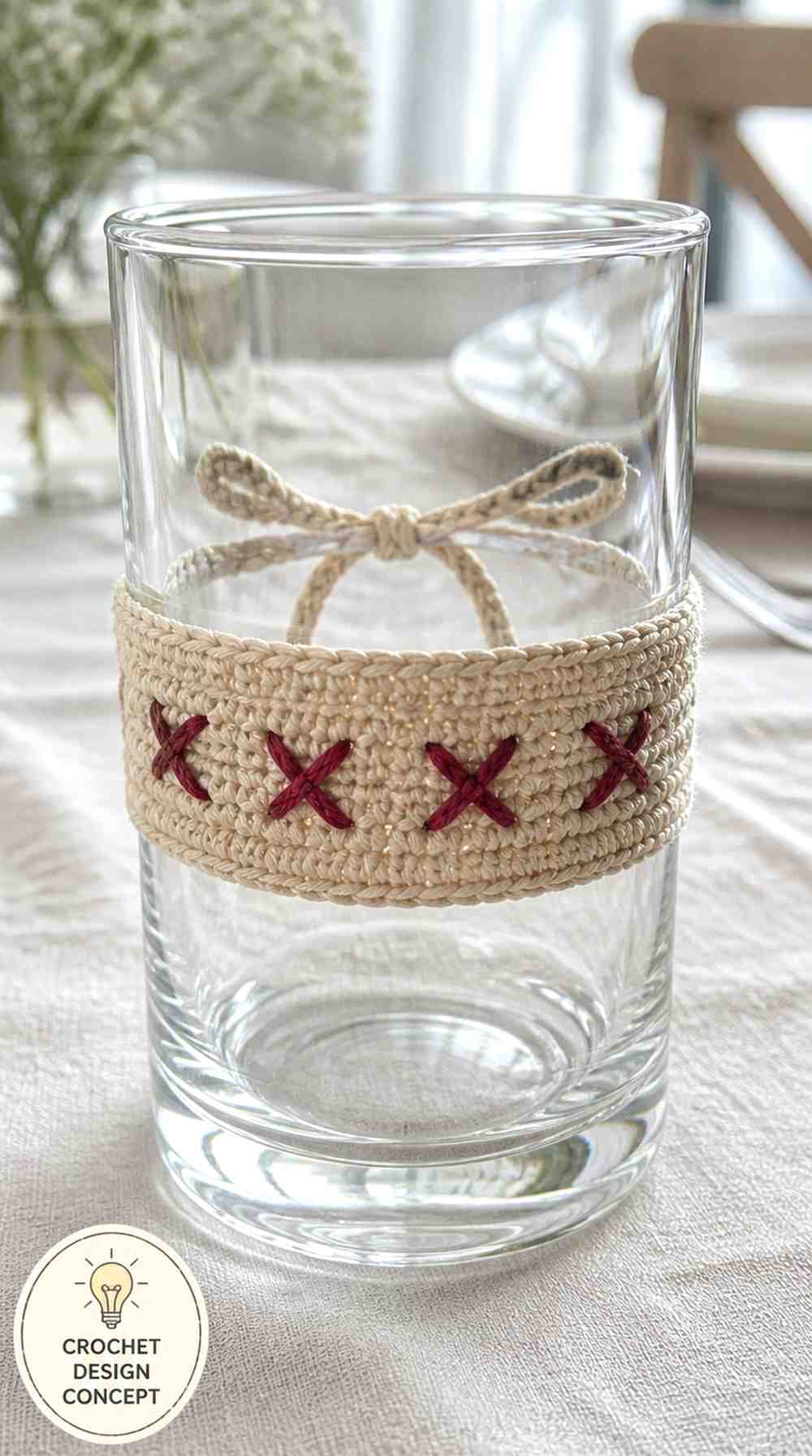
Sandy-beige crochet provides a neat background for four evenly spaced burgundy X-shaped stitches. The embroidery runs across the front of the narrow strip, while two short crochet ties fasten the band with a flat knot behind the glass.
This approach brings personalization into a simple rectangular shape. The stitched X marks are easy to vary, perhaps through color or arrangement, without creating larger appliqués. Because the embroidery lies on top of the base fabric, a closely worked crochet surface helps keep the marks tidy and recognizable.
- Embroidery spacing: Keep the X stitches evenly separated so they read as four intentional markers rather than a crowded surface pattern.
- Marker customization: Different stitch counts or contrasting embroidery colors can help identify glasses in a coordinated set.
- Tie placement: Secure the short ties behind the glass and check that the knot does not slip when the band becomes damp.
17. Crochet Sunset Ripple Glass Band
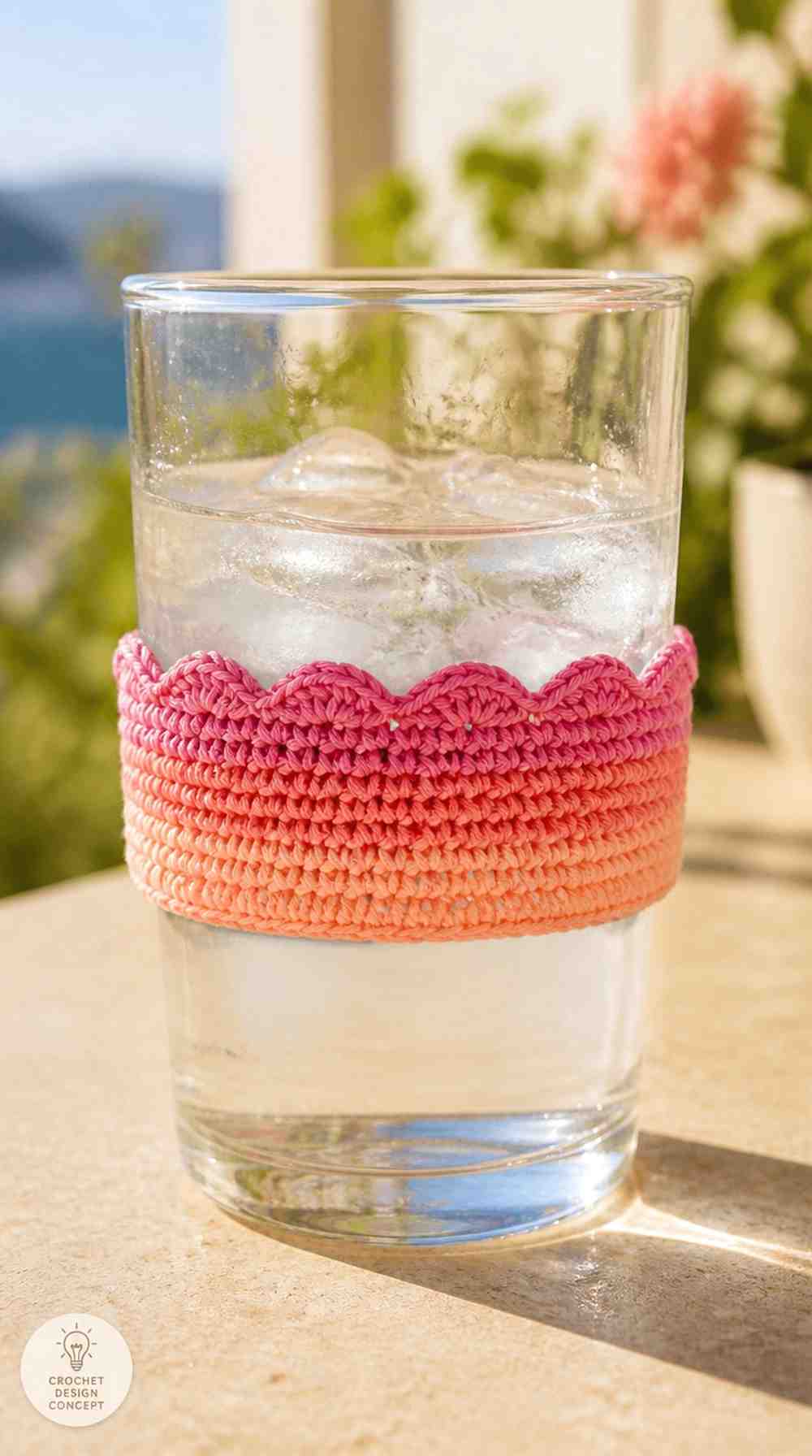
Peach, coral and raspberry yarn form three softly contrasting rows on this sunset-inspired crochet ring. The lower border stays straight, while the upper edge follows a gentle repeating ripple. The effect is decorative without relying on buttons, flowers or stitched symbols.
The shallow waves give this band a distinct silhouette, particularly on a simple straight-sided glass. A carefully balanced ripple is important, because an exaggerated edge could curl away from the glass or become uncomfortable during handling. The three-color arrangement keeps the overall look bright and easy to distinguish.
- Ripple height: Gentle wave peaks are more suitable for a slim glass identifier than deep scallops that could curl or catch.
- Color transitions: Keep the peach, coral and raspberry row changes tidy so the gradient looks intentional and each shade remains visible.
- Upper-edge fit: Check that the rippled edge sits flat enough around the chosen glass instead of lifting away unevenly.
Practical Guide to Crochet Beverage Glass Identifier Bands
Start with the glass, not the decoration. Before planning a band, check the glass circumference where the crochet will sit. Straight-sided glasses are generally easier to work around than strongly tapered or rounded glasses. A narrow band should sit comfortably without slipping downward or requiring force to put on.
Choose yarn with cleaning in mind. Smooth, appropriately sized cotton yarn is worth considering because it gives small crochet stitches good definition. However, washable yarn is not automatically suitable for every washing method. Follow the yarn label and test whether the finished band keeps its shape after cleaning and drying.
Think about condensation and grip. Cold drinks may leave moisture on the outer glass, which can dampen crochet and change how securely the band sits. Yarn wrapped around glass is not inherently non-slip. Never rely on a decorative band to support the weight of a full glass.
Keep the drinking area clear. Position identifiers below the rim so the yarn does not touch someone’s mouth or the beverage. Remove bands before washing glasses or placing them in a dishwasher or microwave. These ideas are not heat-resistant grips or protection against hot glass.
Check detachable decorations. Buttons, appliqués and yarn ends need secure attachment. Designs with small parts are best kept away from young children and pets, since detached pieces could become choking hazards.
When creating a full matching set, make the identifiers noticeably different rather than relying on very similar shades. The most useful design is one that guests can recognize easily, remove without difficulty and clean separately after use.
For wider drinkware decoration, 12 Crochet Pumpkin Spice Mug Cozy Ideas offers another perspective on how crochet can change the appearance of cups. Full cozies and slim identifier bands serve different purposes, so their proportions should not be treated as interchangeable.
Want to Make Something Similar?
These resources provide related crochet techniques and working examples. They are not exact patterns for the 17 concepts pictured above.
- Crochet Wine Glass Markers by Anita Louise Crochet — A small marker project demonstrating a crochet leaf, chain loop and button fastening. Particularly relevant to the leaf and adjustable-wrap ideas.
- The Wine Hugger Stemless Wine Glass Cozy by Sarah Faith Crafts — A free, wider crochet cozy pattern that demonstrates circular construction, cotton yarn and open arcade stitching. Its coverage differs from a slim identifier band.
- Crochet Gauge Basics from the Craft Yarn Council — Useful guidance for understanding stitch gauge before adapting an idea to a particular glass size.
Use these as learning resources for fitting, stitching and fastening techniques rather than instructions for reproducing the illustrated concepts exactly.
Which Crochet Glass Identifier Band Should You Choose?
| Your main priority | Ideas to consider | Important trade-off |
|---|---|---|
| Everyday simplicity | Terracotta Double-Ridge, Mustard Checkerboard | Continuous rings need careful sizing |
| Clear individual identification | Navy Number Three, Sand Burgundy Cross-Stitch | Small marks must be large and contrasting enough to see |
| Botanical decoration | Blush Daisy, Ivory Olive Leaf, Periwinkle Rosette | Motifs need secure, low-profile attachment |
| Adjustable fastening | Sea Glass Lattice Tie, Slate Adjustable Pinstripe | Ties and buttons require checking after repeated use |
| Delicate crochet texture | Plum Scalloped, Turquoise Filet Diamond | Open or shaped edges may snag or distort |
| Playful table styling | Cocoa Peach Bow, Ivory Lime Slice, Strawberry Granny Tile | Extra decoration can make cleaning and handling more involved |
| Color-led designs | Coral Chevron, Sunset Ripple | A complete set needs easily distinguishable combinations |
For a large family table, numbered or clearly contrasting bands offer a practical starting point. For a smaller brunch or afternoon gathering, a set of different motifs may feel more personal.
If your glasses vary in diameter, an adjustable wrap is worth exploring before a closed-ring design. And if easy maintenance matters most, choose a compact crochet surface with fewer attached embellishments.
Conclusion
Crochet beverage glass identifier bands turn a small functional idea into an opportunity for color, texture and personal detail. A simple terracotta ring, a miniature daisy, a numbered marker or a tiny citrus wedge can each give a drinking glass its own identity without covering the entire surface. The key is finding a design that suits the glass shape, remains recognizable and can be removed for cleaning. These 17 concepts provide starting points for creating a coordinated collection that fits your table and personal style.
Which would you choose for your own glasses? Would you prefer numbered crochet bands, small flower motifs, cheerful citrus markers or something simpler like the double-ridge design? Share your favorite idea and the kind of glasses you would use it on.
Frequently Asked Questions
1. What is the purpose of a crochet beverage glass identifier band?
Its main purpose is to help people recognize their own glasses when several look alike. A narrow band can use a different color, number, stitch arrangement or decorative motif for each person. Unlike a full beverage cozy, an identifier band is designed primarily for recognition and appearance, not insulation or carrying support.
2. What type of yarn is suitable for crochet glass identifier bands?
Smooth cotton yarn is one option worth considering because it can show small stitches clearly and may be easier to clean than some decorative fibers. The actual choice depends on thickness, softness, stretch and the manufacturer’s care directions. Avoid assuming that all cotton bands will hold their shape or grip wet glass equally well.
3. How can I stop a crochet band from slipping down a glass?
Start by measuring the actual glass at the intended placement point. The band should fit securely without excessive stretching or pressure. Straight-sided glasses usually make sizing simpler. An adjustable closure may help with small size differences, but condensation, yarn texture and glass shape can still cause movement. Always check the finished fit before use.
4. Can crochet glass identifier bands be used on hot-drink glasses?
These designs are intended mainly as decorative identifiers for ordinary beverage glasses, especially cold drinks. Crochet yarn, buttons and stitching should not be assumed to provide heat protection. A hot glass can still cause burns, even with yarn wrapped around part of it. Keep decorative bands away from hot surfaces and do not use them as handles or heat guards.
5. Are these 17 crochet glass identifier designs available as patterns?
No. The 17 images are original design visualizations intended to help readers explore possible colors, shapes, motifs and fastening styles. They are not tested finished objects or complete crochet patterns. The linked outside resources explain related crochet techniques, but they do not recreate the pictured concepts exactly. Before making or publishing a design, check that its stitches, attachments and proportions are physically workable.