Finding a single sock after washing can be frustrating, especially when its matching partner has disappeared somewhere in the laundry. These 14 crochet missing sock display line inspiration ideas turn that everyday problem into a small, attractive organizing feature. From sage-green horizontal lines and terracotta double rows to blush circular hoops, lilac hanging displays and modular peach cords, each concept offers somewhere to clip clean, unmatched socks while waiting for the other half to turn up.
The collection includes ideas for narrow laundry walls, cabinet undersides, folding counters and small utility-room corners. Some designs use a simple crochet-covered cord with wooden clothespins, while others add rigid frames, hanging rings, sliding rails or a separate pocket for completed pairs. As you explore them, compare how many socks each line holds, how easily the clips can be reached and whether the display can be cleaned or removed without difficulty.
These are AI-generated crochet design visualizations for inspiration, not photographs of tested handmade pieces or step-by-step patterns.
Quick Design Selection Guide
- For a simple laundry wall: Crochet Sage Classic Missing Sock Line uses one easy-to-understand horizontal display.
- For a neat framed look: Crochet Ivory Framed Sock Display Line keeps the cord inside a rectangular oak frame.
- For more unmatched socks: Crochet Terracotta Double Missing Sock Lines offers two separate rows.
- For a fold-away design: Crochet Dusty-Blue Fold-Down Sock Display uses a hinged wall-mounted arm.
- For decorative crochet accents: Crochet Mustard Mini-Sock Bunting Line adds miniature sock appliqués.
- For a round wall display: Crochet Blush Circular Hoop Sock Line gives a single cord a decorative frame.
- For narrow vertical space: Crochet Lilac Vertical Cascade Sock Display uses short dowel branches.
- For unused space beneath shelving: Crochet Mint Under-Shelf Missing Sock Line hangs beneath a floating shelf.
- For removable sections: Crochet Peach Modular Sock Line Segments has three independent display cords.
- For pairing completed socks: Crochet Mocha Sock Line with Match Pocket includes a separate lower pocket.
1. Crochet Sage Classic Missing Sock Line
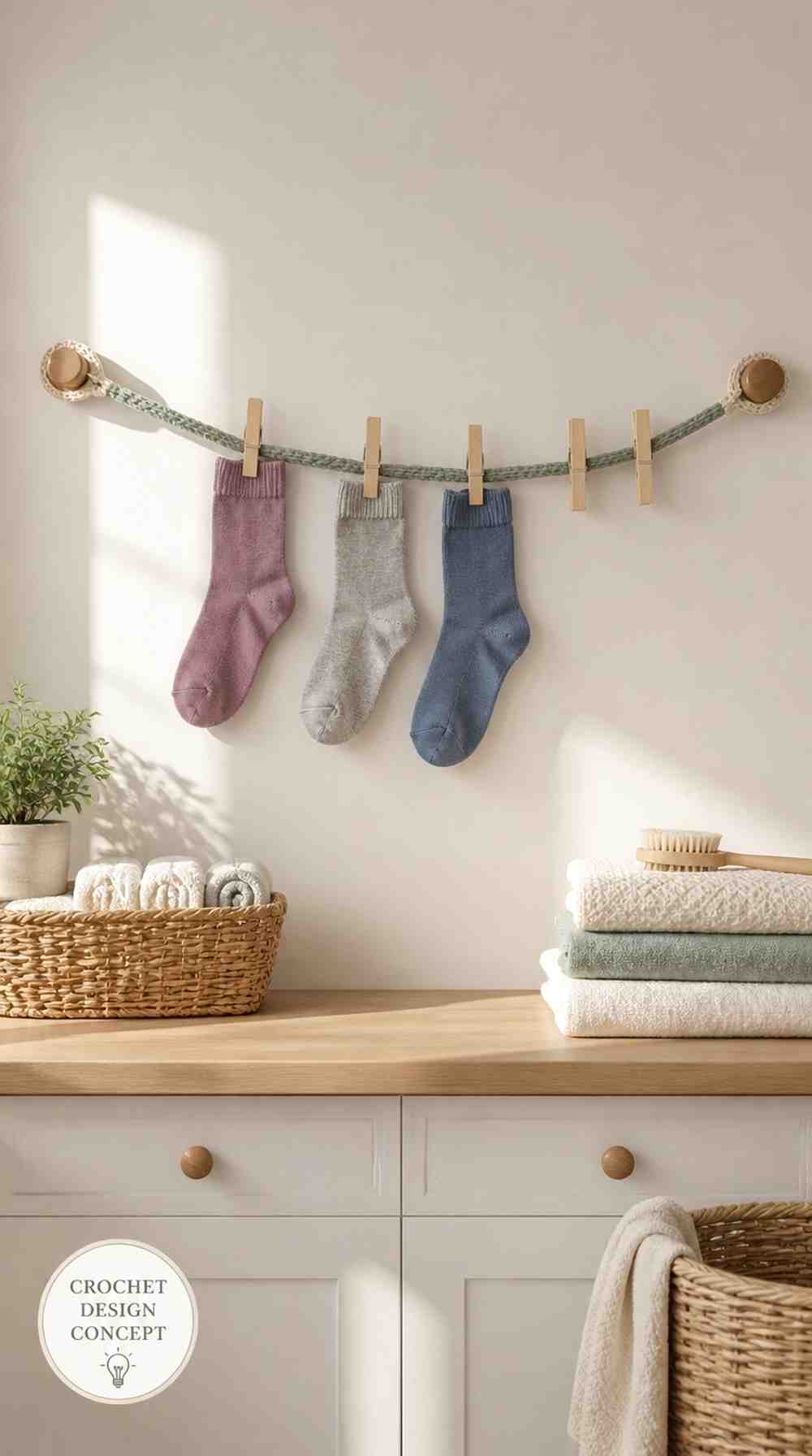
Sage-green crochet creates a simple horizontal line stretched between two smooth wooden wall pegs. Dense braided stitches form the cord, with delicate ivory finishing details around its reinforced end loops. Three clean unmatched socks hang from small wooden clothespins, while two empty clips wait for future missing partners.
The slightly curved line gives the display a relaxed laundry-room appearance. Its main advantage is simplicity: individual socks remain visible and can be removed easily when their matching partners appear during another wash.
- Line tension: Keep the reinforced cord gently taut so the socks do not bunch together in the center or touch the folding counter below.
- Clip spacing: Leave enough distance between the wooden clips for socks of different thicknesses to hang without overlapping.
- Wall attachment: Use suitable hooks or pegs secured to the wall rather than relying on decorative crochet end loops alone.
- Cord construction: A firm underlying cord with a snug crochet covering can reduce stretching compared with an unsupported decorative chain.
2. Crochet Ivory Framed Sock Display Line
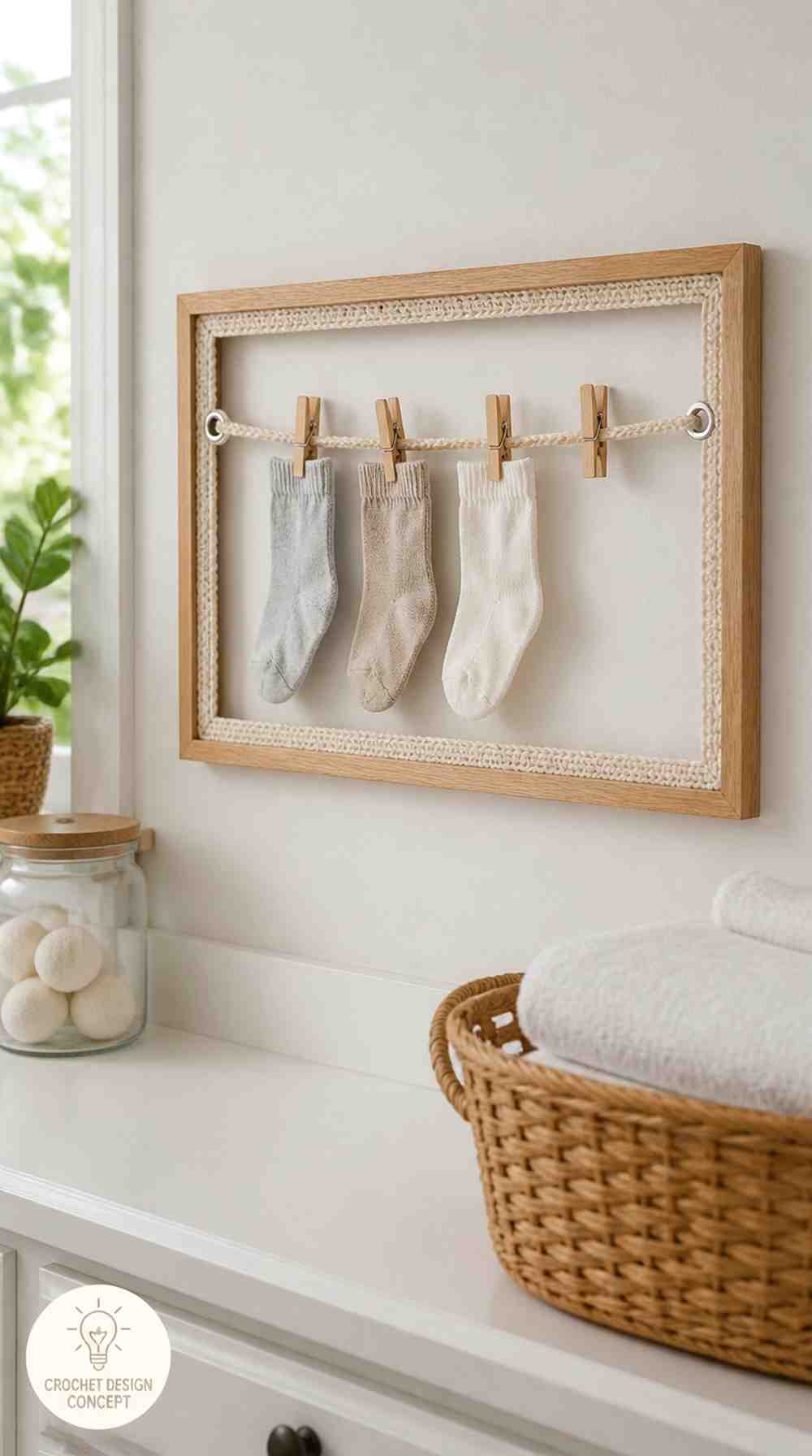
Warm ivory crochet softens a narrow oak wall frame with a single horizontal display cord. Raised diagonal stitches decorate the line, while a delicate oatmeal crochet border runs around the inner wooden frame. Three unmatched socks hang from miniature wooden clips, with one extra clip left unused.
The frame gives the display a more contained appearance than an open wall-to-wall cord. It could suit a small laundry area where the owner wants a dedicated space for missing socks without spreading clips across the room.
- Frame width: Measure the available wall space and allow enough room for socks to hang separately within the rectangular opening.
- Metal eyelets: The cord attachments should connect securely to the rigid frame so tension does not pull against the decorative crochet border.
- Oatmeal edging: Keep the border narrow enough that it does not interfere with the clips or reduce the usable display area.
- Frame cleaning: A removable cord could simplify washing the crochet without exposing the oak frame to unnecessary moisture.
3. Crochet Terracotta Double Missing Sock Lines
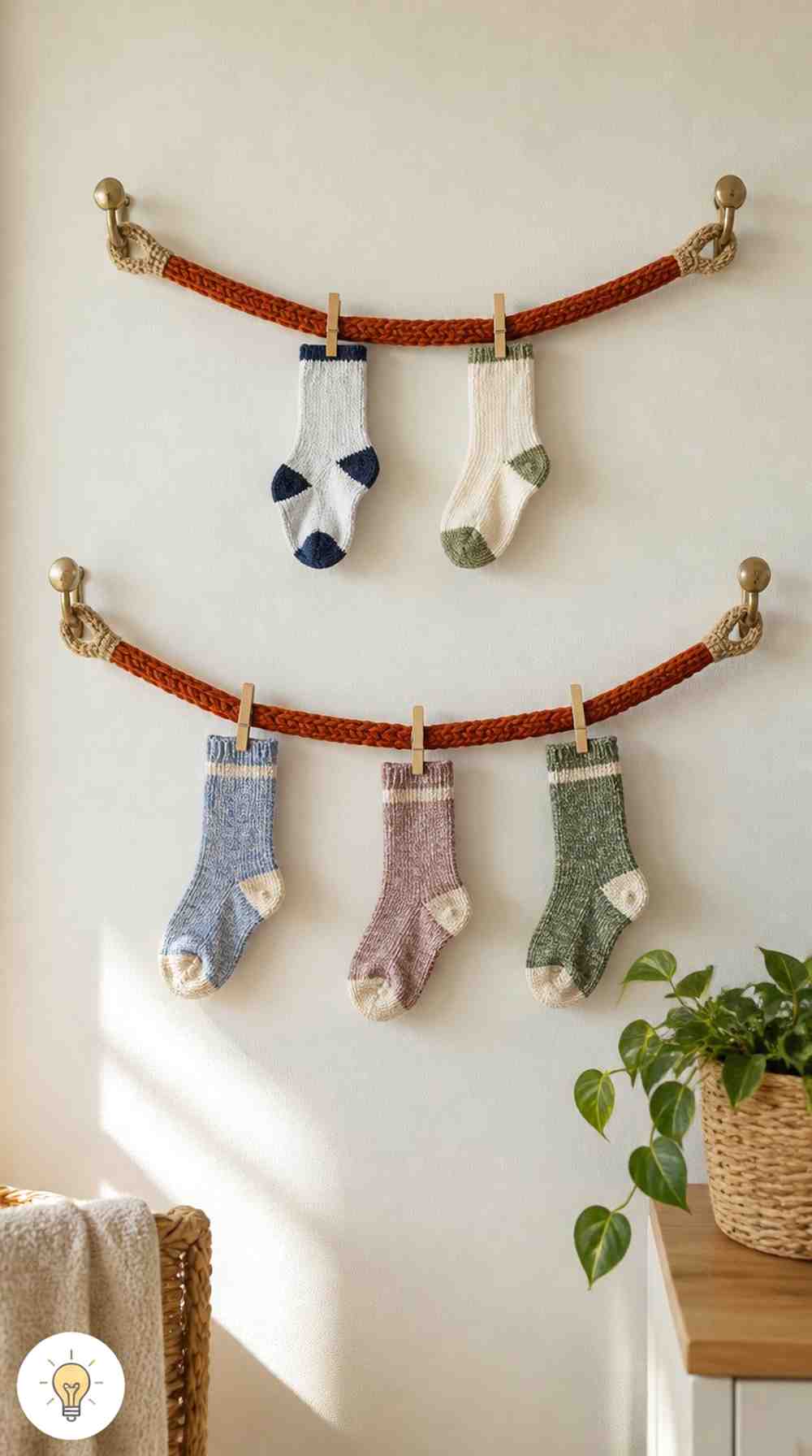
Terracotta crochet creates two parallel hanging lines on a pale laundry-room wall. The upper cord is slightly shorter and holds two single socks, while the longer lower line displays three more. Sandy-beige end loops and small wooden clips give both rows a coordinated handmade finish.
This two-level layout provides more display positions without needing an unusually long wall. The separate lines can make it easier to organize unmatched socks, but adequate vertical spacing is essential so the upper socks do not cover those below.
- Vertical clearance: Space the two cords according to the length of the socks you expect to hang, especially if adult socks are included.
- Different line lengths: A shorter upper line and wider lower line create a balanced arrangement while allowing additional clips below.
- Cord support: Both rows need independent secure attachment points so tension on one line does not affect the other.
- Sorting option: A finished display could reserve the upper row for smaller socks and the lower row for adult sizes, if that suits the household.
4. Crochet Dusty-Blue Fold-Down Sock Display
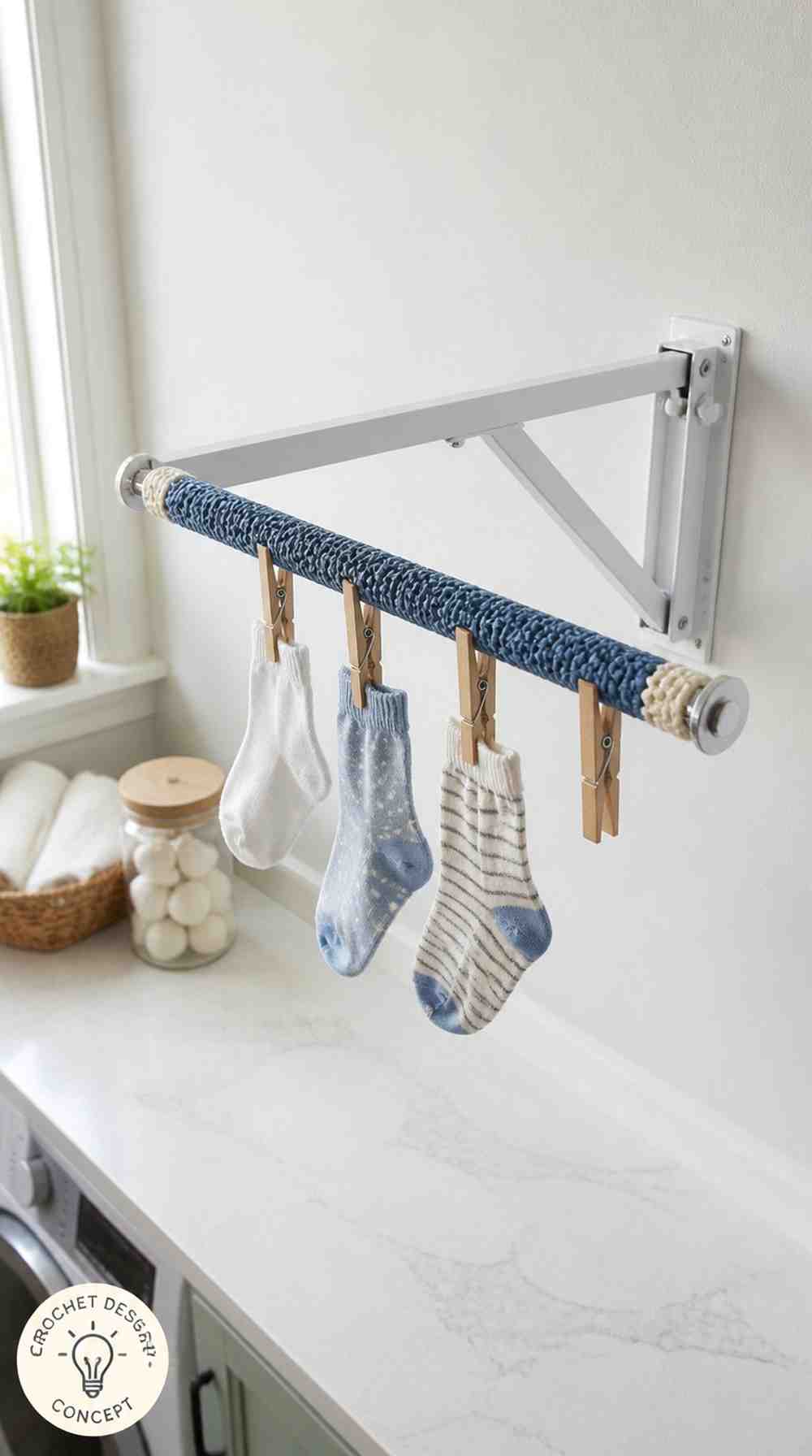
Dusty-blue crochet covers a short reinforced display cord mounted along a white metal folding arm. The arm extends outward from the wall on a visible hinge and locking support. Three mismatched socks hang from wooden clothespins, while one empty clip remains available.
The fold-down structure offers an interesting option for compact laundry spaces. Instead of remaining fully extended all the time, the rigid arm could potentially fold away once the line is empty. The hinge and locking mechanism would need dependable construction.
- Folding mechanism: Choose an arm with a reliable open-position lock so it cannot collapse when socks are clipped onto the line.
- Cord placement: Keep the dusty-blue crochet away from moving hinges where yarn might become trapped or damaged.
- Projection clearance: Check how far the extended arm reaches into the room before installing it beside a walkway or cabinet.
- Empty storage: Fold the arm away only after removing the socks and clips if the mechanism does not safely accommodate them.
5. Crochet Mustard Mini-Sock Bunting Line
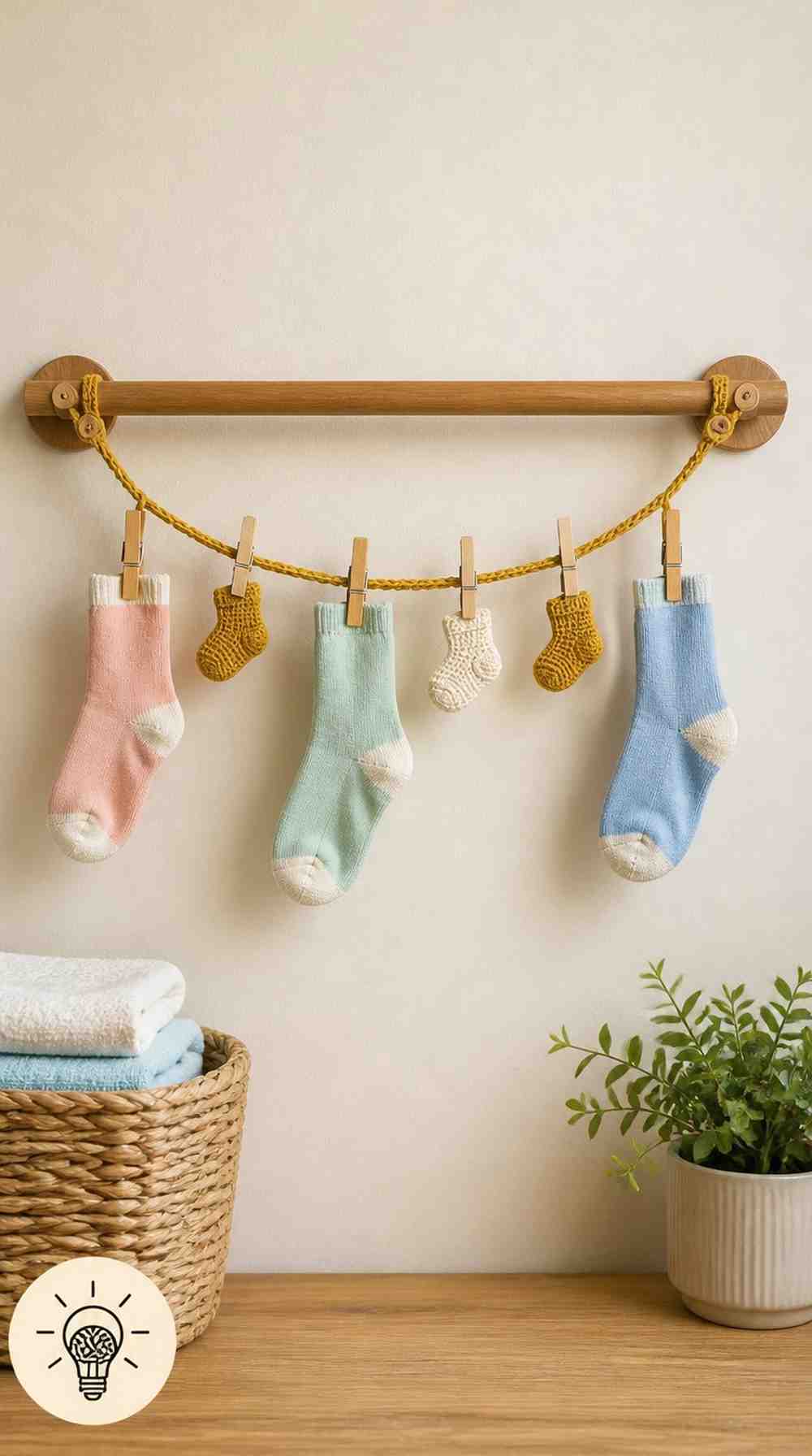
Mustard-yellow crochet turns a simple laundry display into a playful line decorated with tiny sock-shaped appliqués. A firm braided cord hangs beneath a wooden dowel, alternating miniature mustard-and-cream crochet socks with small wooden clothespins. Three real unmatched socks hang from the clips, while one remains empty.
The miniature crochet socks are decorative, not storage pockets. They add personality without changing the basic purpose of the line: keeping single socks visible until their partners are found.
- Miniature motifs: Keep the decorative sock appliqués small enough that they do not overlap the real socks or obstruct the wooden clips.
- Clip arrangement: Alternate the motifs and clothespins rather than clustering everything in one section of the cord.
- Dowel support: Attach the horizontal wooden dowel securely, with the reinforced crochet line hanging from fixed points at both ends.
- Small decorations: If the display is accessible to young children, avoid detachable tiny ornaments and clips that could become choking hazards.
6. Crochet Blush Circular Hoop Sock Line
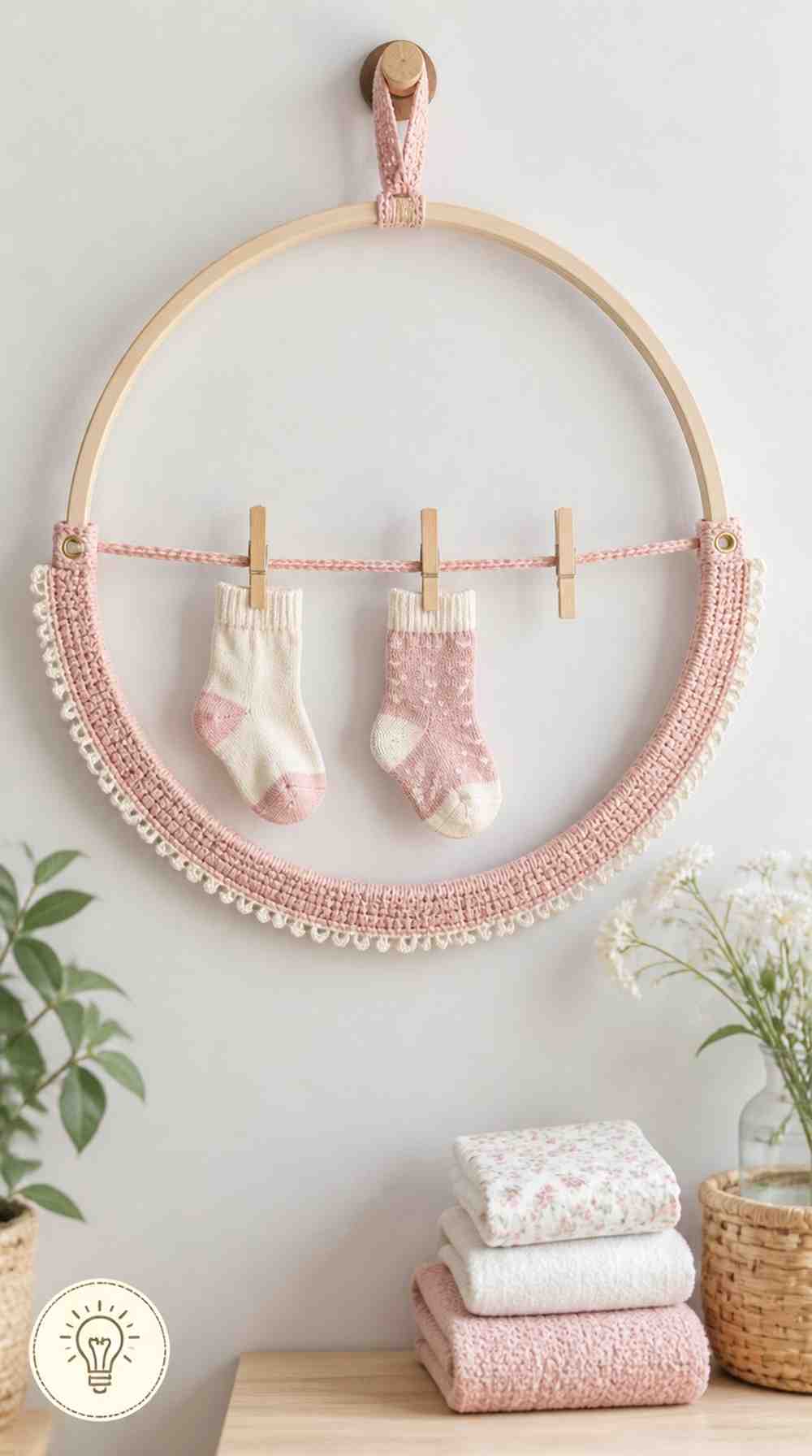
Blush-pink crochet covers part of a pale wooden circular hoop, with delicate ivory picot edging adding a soft decorative border. A single reinforced crochet-covered cord stretches across the center of the hoop. Two clean unmatched socks hang from miniature wooden clips, leaving one empty position.
The round frame gives the missing-sock line a more decorative shape than a conventional horizontal display. Its compact arrangement may suit a small wall above a folding counter where only a few unmatched socks need temporary storage.
- Hoop diameter: Allow enough space across the center for the socks to hang separately without pressing against the circular frame.
- Cord attachment: Secure the horizontal line to rigid eyelets rather than pulling directly against the decorative crochet-covered hoop.
- Picot edging: Keep the ivory points small and outside the clip area to reduce snagging during everyday use.
- Wall hanging: Use a reliable hook and a reinforced suspension loop so the hoop does not rotate excessively when socks are removed.
7. Crochet Olive Corner Missing Sock Lines
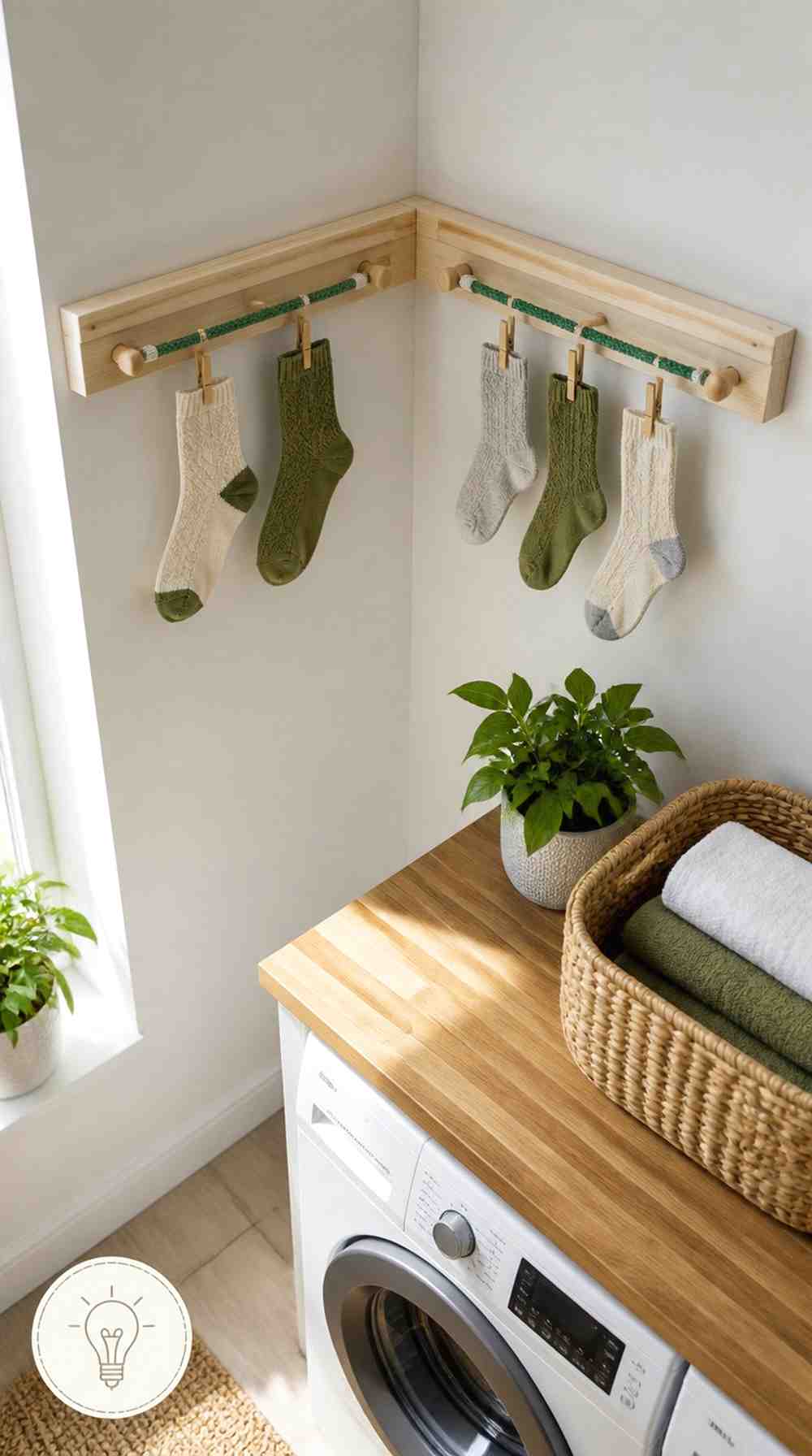
Olive-green crochet makes practical use of an otherwise empty laundry-room corner. Two short display lines run along perpendicular walls, each supported by wooden pegs and rigid backing brackets. One line holds two unmatched socks, while the other displays three, all secured with small wooden clothespins.
Instead of spanning the corner diagonally, the two independent cords follow their own wall surfaces. This arrangement could be useful where a wide, straight section of wall is unavailable but two shorter spaces can accommodate separate sock groups.
- Corner measurements: Check both available wall widths and the clearance around shelves or cabinets before choosing the cord lengths.
- Separate attachments: Each line needs its own secure endpoints so tension changes on one wall do not pull on the other.
- Sock visibility: Arrange the clips away from the corner junction, where hanging socks could overlap and become difficult to identify.
- Cleaning access: Short removable cords may be easier to wash than a permanently attached crochet arrangement spanning both walls.
8. Crochet Lilac Vertical Cascade Sock Display
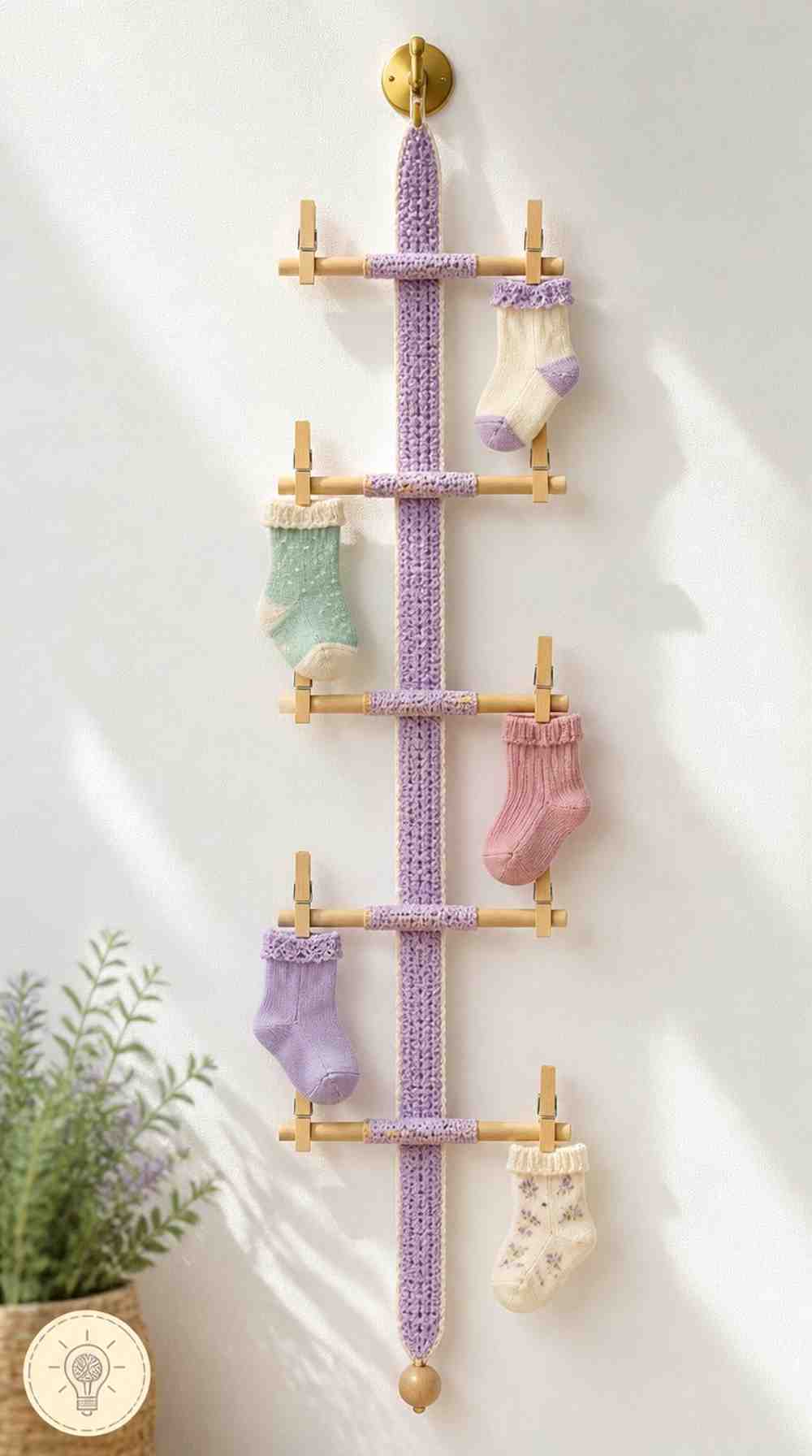
Lilac crochet forms a narrow vertical display with a reinforced central strap and five short horizontal wooden branches. Each branch has a crocheted central covering and wooden clips at its exposed ends. Five unmatched socks hang individually at different heights, leaving additional clips ready for use.
The cascading arrangement uses height instead of width. It provides several separate hanging positions on a narrow wall, making it particularly interesting for small laundry rooms or the side of a utility cupboard.
- Branch spacing: Leave enough room between wooden dowels so longer socks do not cover the clips or branches below.
- Central support: The reinforced strap should keep the dowels aligned rather than twisting under uneven sock placement.
- Top attachment: Use a secure wall hook and keep the wooden components away from areas where someone could catch clothing on them.
- Weighted lower end: The small wooden end bead may improve how the strap hangs visually, but it should remain securely attached.
9. Crochet Charcoal Magnetic Sock Line Panel
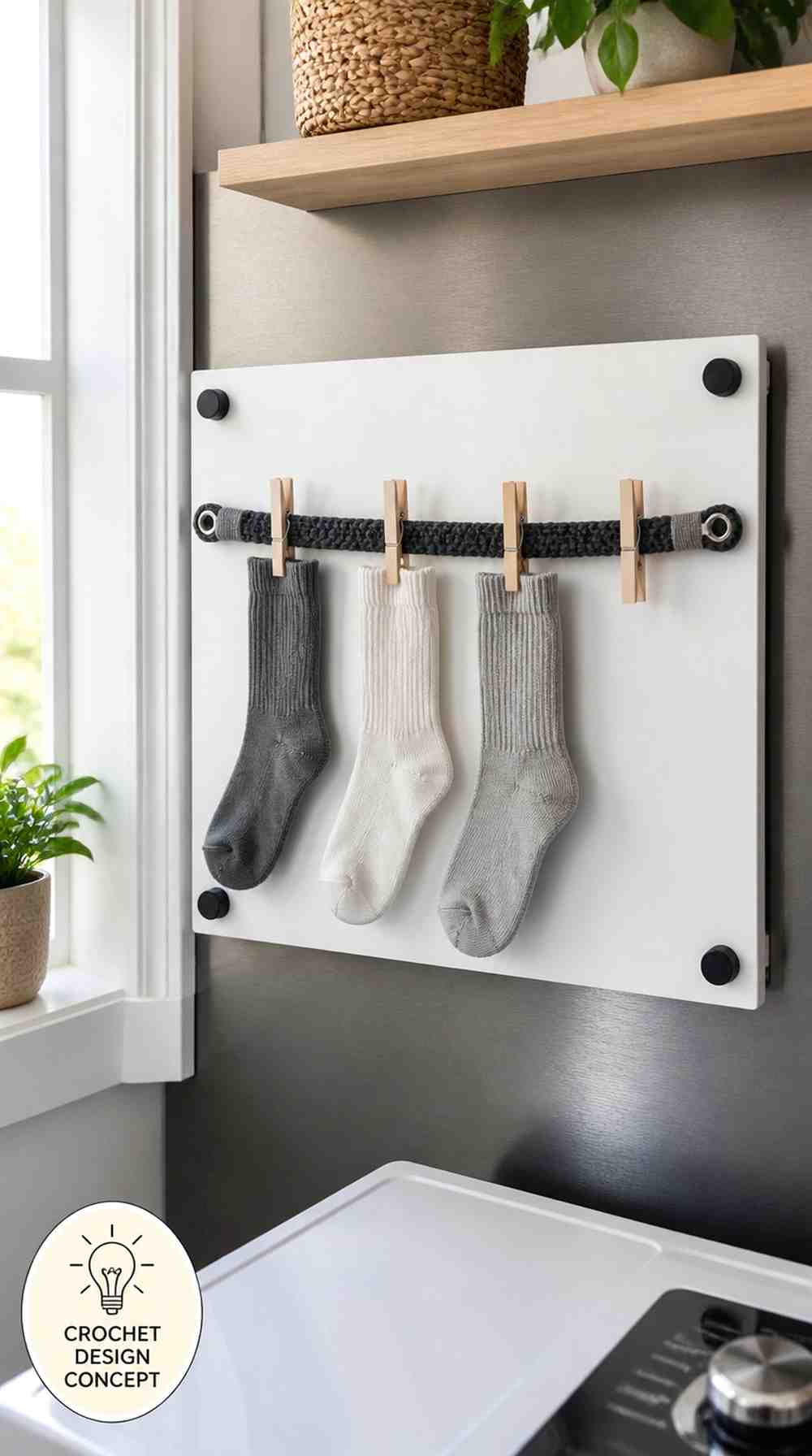
Charcoal-gray crochet creates a modern horizontal sock line inside a compact white metal panel. Tight ridged stitching covers the display cord, while silver-gray end wraps finish its attachment points. Three clean unmatched socks hang from wooden clips, with a fourth clip left available.
Four black magnetic mounts secure the panel to a separate ferromagnetic steel wall board. The removable arrangement could appeal to renters or anyone who wants flexibility without a traditional wall-mounted wooden frame.
- Magnetic surface: Magnets require a compatible steel surface; they do not attach securely to every metal or painted household fixture.
- Mounting strength: Check the combined weight of the panel, cord and socks, and avoid installations where the panel could fall unexpectedly.
- Appliance caution: Use a dedicated compatible board rather than assuming a washing machine’s exterior is an appropriate mounting surface.
- Charcoal yarn: A narrow silver-gray finish keeps the dark crochet texture visible without introducing a large decorative border.
10. Crochet Mint Under-Shelf Missing Sock Line
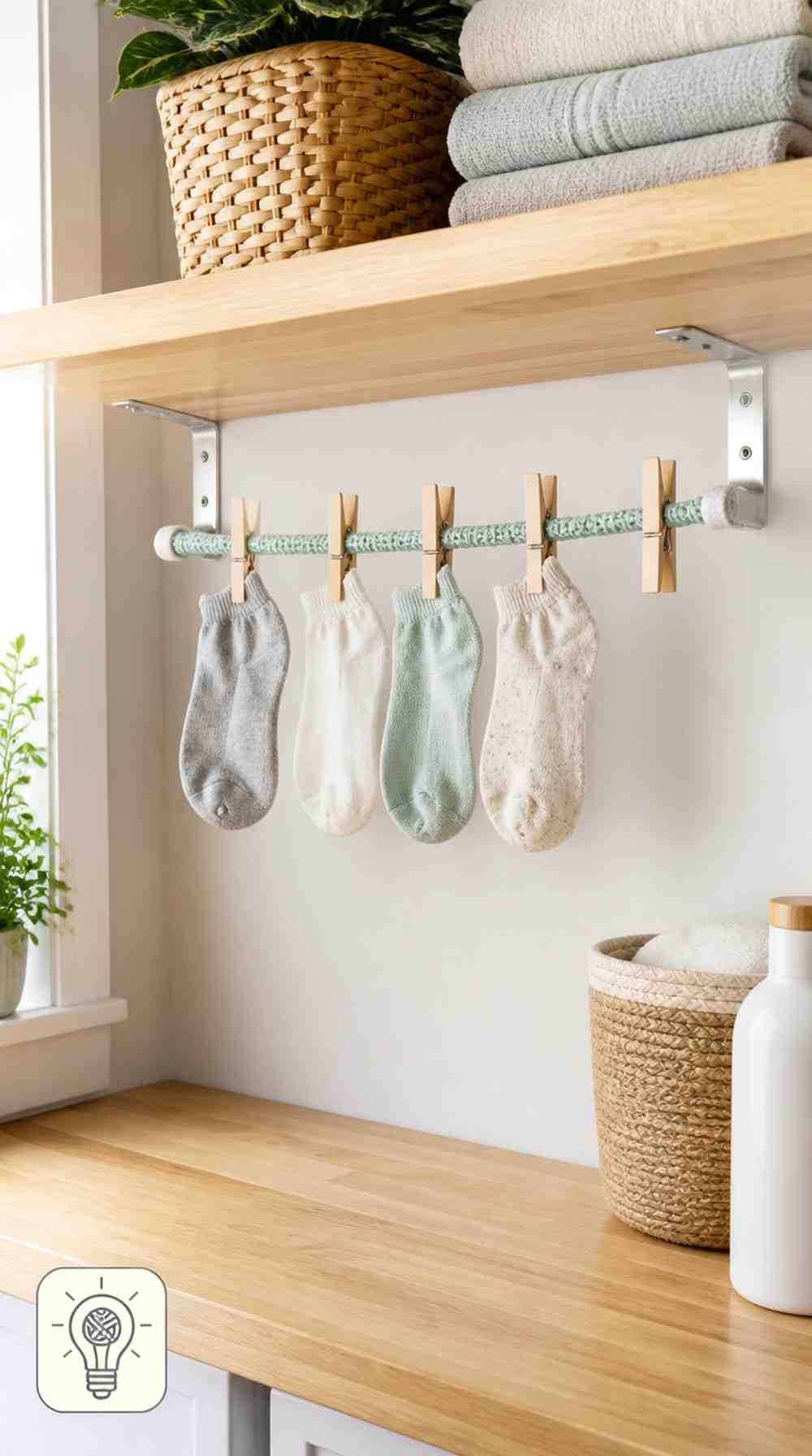
Mint-green crochet adds a fresh handmade detail beneath a pale wooden laundry shelf. A firm textured cord stretches between two small metal brackets mounted securely under the shelf. Four mismatched socks hang from miniature wooden clothespins, while one clip remains empty for another single sock.
The under-shelf layout uses space that might otherwise go unused. It keeps the display close to the laundry folding area without occupying the shelf surface, provided enough room remains beneath the hanging socks.
- Under-shelf clearance: Measure the distance from the shelf to the countertop before deciding whether adult socks can hang without touching the surface.
- Bracket attachment: Select secure mounting points that do not weaken the shelf or interfere with its existing support hardware.
- Mint cord texture: Compact moss-stitch-like crochet keeps the covering tidy around the reinforced central line.
- Refill access: Leave the wooden clips easy to reach rather than positioning the line so far beneath the shelf that they become awkward to operate.
11. Crochet Coral Pull-Out Sock Display Line
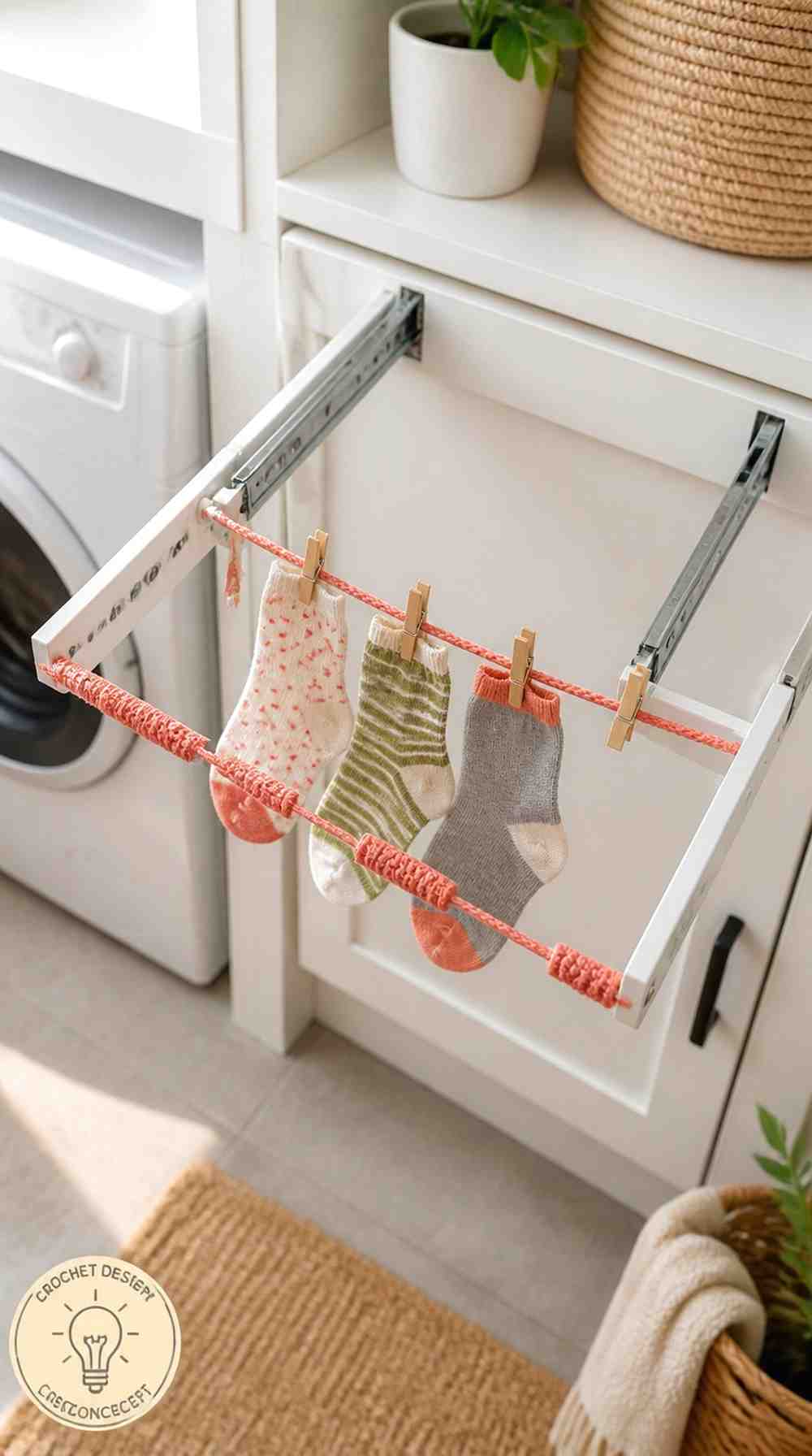
Coral-pink crochet covers a short display cord mounted along a white metal pull-out rail. The rail extends from beneath a laundry cabinet on visible sliding tracks. Three clean mismatched socks hang from wooden clothespins, with one empty clip available for another sock.
This concept brings the temporary sock display forward when needed instead of keeping it permanently across the wall. Its sliding arrangement is the main feature, though the mechanism must have enough clearance and support for safe everyday use.
- Sliding tracks: Choose a mechanism with suitable stops so the extended rail cannot accidentally detach from its supports.
- Cord positioning: Keep coral crochet clear of the moving rail parts to prevent pinching or abrasion.
- Cabinet clearance: Check that the socks and clips can move without catching on doors, handles or adjacent storage items.
- Empty retraction: Remove the hanging socks before sliding the display back if the cabinet does not provide sufficient clearance.
12. Crochet Navy Three-Ring Sock Display Line
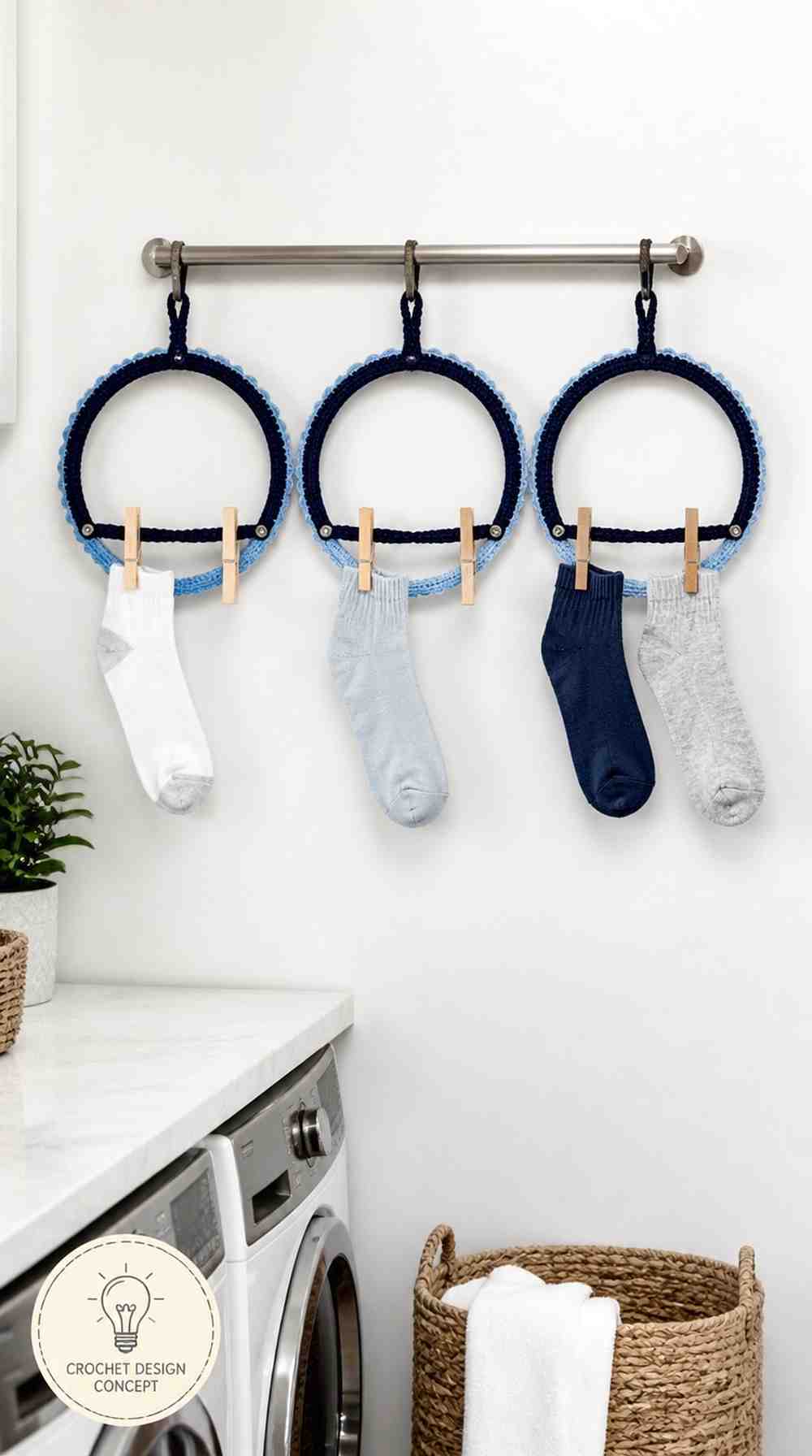
Navy-blue crochet covers three circular metal rings suspended from a narrow brushed-steel wall rail. Each ring contains a short horizontal crochet-covered cord with two wooden clothespins. Four clean unmatched socks hang across the three rings, leaving two available clips.
The separate rings create three small display areas rather than one long clothesline. Powder-blue edging gives the dark navy crochet a clear outline, while the rigid metal circles maintain each section’s shape.
- Individual sections: Separate rings can make it easier to group socks by person or general size without mixing every unmatched item together.
- Ring spacing: Leave enough room between the circles so hanging socks do not overlap neighboring clips.
- Short central cords: Keep the crochet lines securely attached to the rigid rings rather than depending on decorative stitches alone.
- Wall-rail support: The steel rail should carry the rings without bending or allowing them to slide into one another.
13. Crochet Peach Modular Sock Line Segments
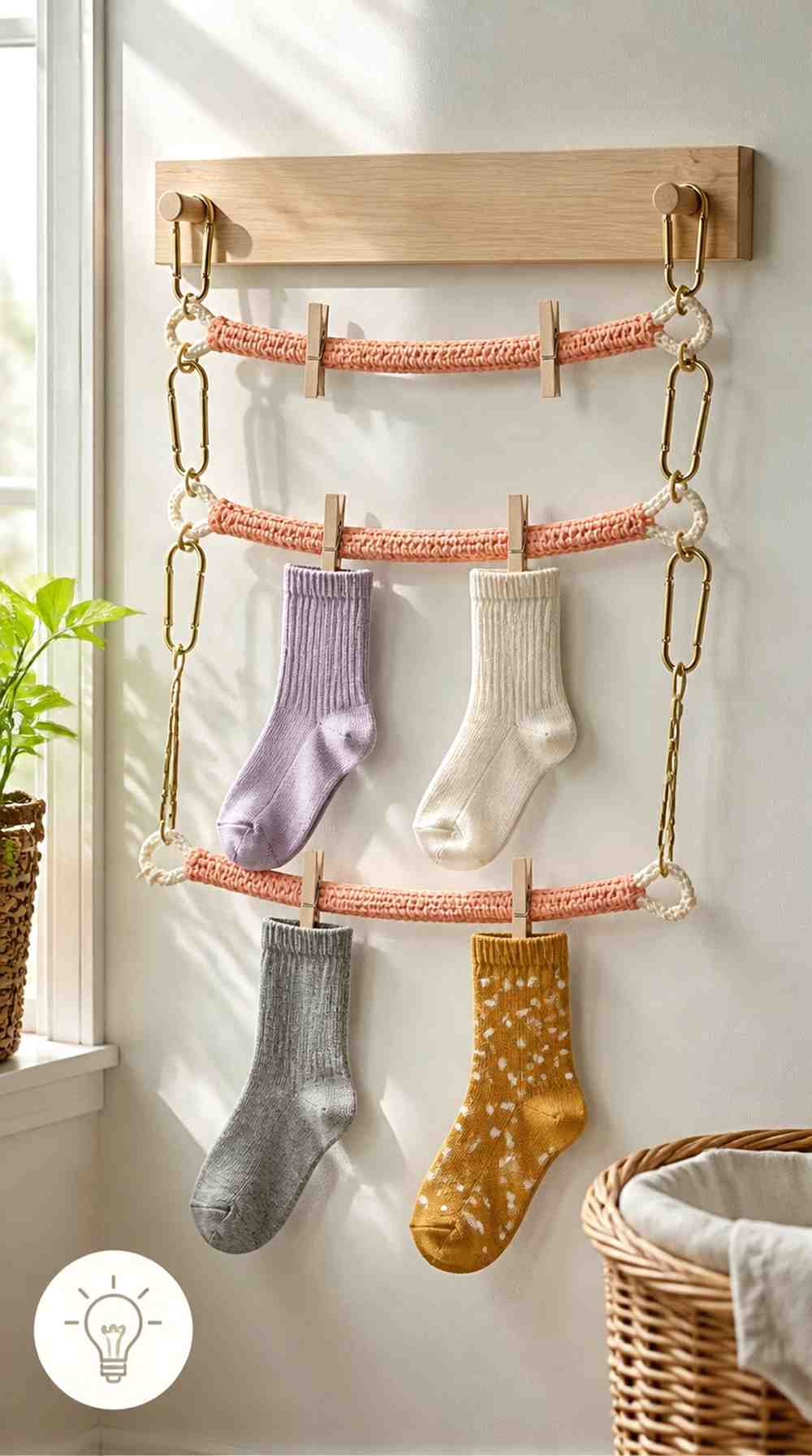
Peach-colored crochet creates three short horizontal sock lines arranged like steps on a pale wooden wall rail. Each segment has neat single-crochet texture, ivory reinforced end loops and small brass carabiner attachments. Four unmatched socks hang across the six wooden clips, leaving two positions unused.
The modular arrangement makes it possible to remove one section without dismantling the others. This is useful as a design direction when the number of unmatched socks changes, although the attachment points need to remain secure during everyday handling.
- Detachable segments: Use connectors with reliable closures so the cords cannot slip free when a clothespin is opened.
- Staggered placement: Leave enough vertical space between the three lines for hanging socks of different lengths.
- Replacing sections: A damaged crochet-covered segment could be replaced independently if the end loops and connectors are designed for removal.
- Peach edging: Keep the ivory reinforced loops compact so they fit the brass attachments without bunching or excessive stretching.
14. Crochet Mocha Sock Line with Match Pocket
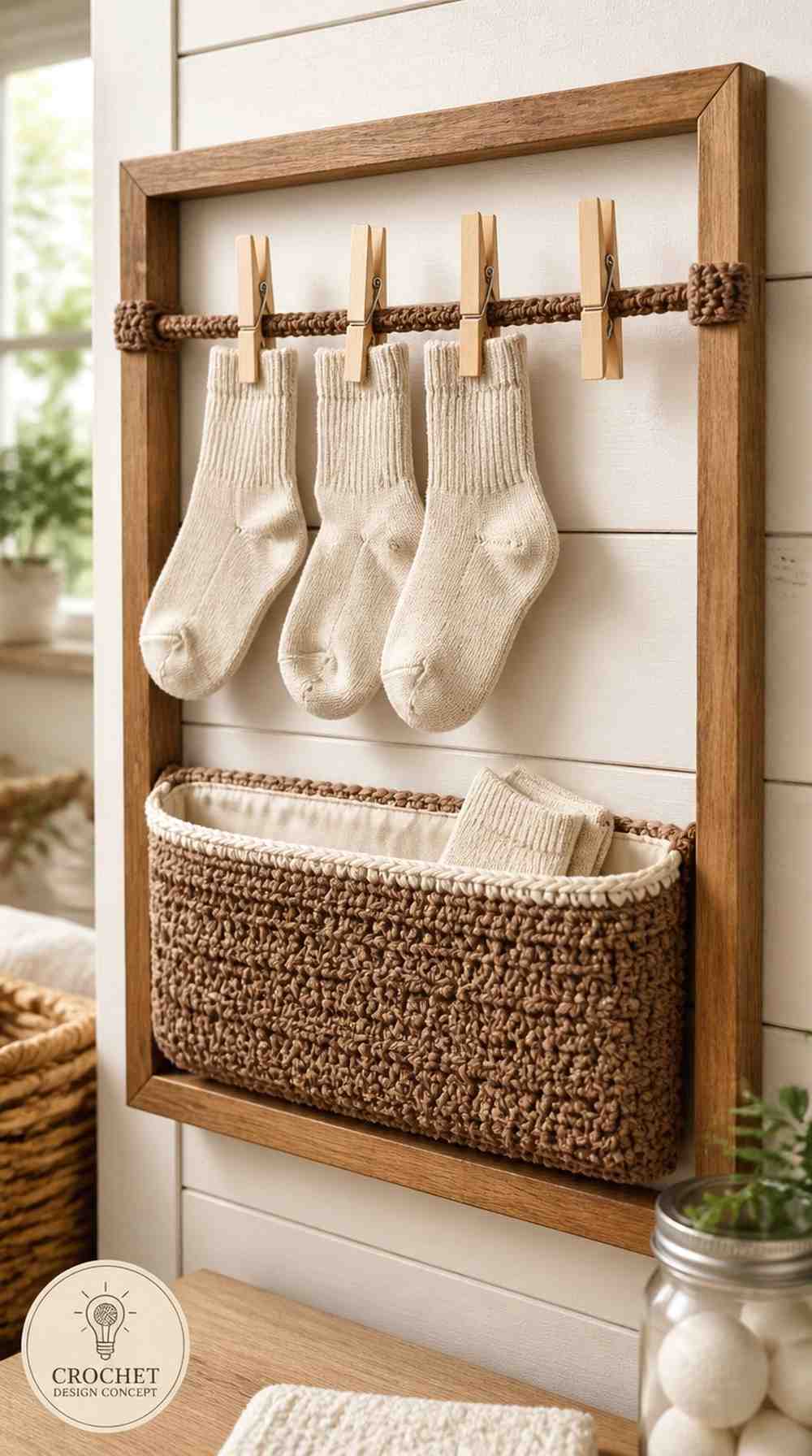
Mocha-brown crochet combines a horizontal missing-sock display with a small storage pocket beneath it. Three clean unmatched socks hang from wooden clips along the upper cord, while a fourth clip remains empty. The lower rectangular crochet pocket has basket-textured stitches, cream piping and a removable ivory lining.
One neatly folded matched pair rests inside the pocket, ready to be returned to the laundry drawer. The design separates socks still waiting for partners from pairs that have been found.
- Separate purposes: Keep unmatched socks on the upper line and move completed pairs into the lower pocket to prevent confusion.
- Pocket capacity: The small rectangular compartment suits a limited number of folded socks rather than a large collection of laundry.
- Liner removal: A detachable ivory lining could make the pocket easier to clean without washing the entire wooden wall frame.
- Frame stability: The rigid support should accommodate both the cord and the lower pocket without allowing the combined display to tilt.
Practical Guide to Crochet Missing Sock Display Lines
A missing-sock display line is a temporary place for clean socks that have lost their matching partners. The most useful arrangement is one that makes individual socks visible and easy to remove without creating more clutter.
Choose the right location. A dry wall near the laundry folding counter is often convenient because unmatched socks can be clipped up immediately after sorting. Keep displays clear of washing machine doors, heated appliances, ventilation openings and narrow walkways.
Use a reinforced line. Crochet chains and soft yarn can stretch when suspended between supports. Consider covering a suitably strong cotton cord with closely worked crochet, or using a rigid backing frame with well-secured attachment points.
Select suitable clips. Wooden clothespins should grip socks without leaving deep marks or damaging delicate fabric. Avoid clips with rough edges or exposed springs that could snag the socks. Small clips and decorative beads should remain away from young children.
Plan the display capacity. A short line may be sufficient for a small household. Larger families may prefer two rows, individual rings or removable sections, but the display should not become a permanent collection of forgotten laundry.
Keep the socks clean. Clip only clean, completely dry socks. Damp fabric can leave the crochet cord wet and create unpleasant conditions. Wash the textile covering when necessary, following the yarn’s care instructions.
Create a simple sorting routine. Review the display after each laundry load. When a matching sock appears, remove the pair and put it away. Periodically decide what to do with socks that have remained unmatched for a long time rather than letting the line become overcrowded.
For related hanging-storage inspiration, explore 20 Crochet Hanging Wall Pocket Organizer Ideas on Yarn Nest Studio. It covers different supported wall displays and pockets that may inspire the framed and combined line-and-pocket concepts.
Want to Make Something Similar?
These verified resources explain related crochet garland and hanging-loop techniques. They are not exact patterns for the 14 missing-sock display concepts.
- Crochet Granny Triangle Garland by Hooked by Robin — A free written pattern and video tutorial showing how to connect crochet motifs along a garland with hanging loops. Relevant to the miniature decorative bunting and modular line concepts. Hooked by Robin
- Mini Crochet Bunting by Cosy Rosie Crochet — A free miniature bunting pattern that may help with small decorative accents for a laundry-room line. Cosy Rosie Crochet
These tutorials teach decorative crochet methods. A functional missing-sock display still needs suitable support points, secure clips and a properly reinforced cord.
Comparison: Which Missing Sock Display Line Should You Choose?
| Laundry-room need | Design to consider | Main trade-off |
|---|---|---|
| Simple sock display | Sage Classic Missing Sock Line | Needs available wall width |
| Decorative framed storage | Ivory Framed Sock Display Line | Fixed frame dimensions |
| More clip positions | Terracotta Double Missing Sock Lines | Requires vertical clearance |
| Fold-away storage | Dusty-Blue Fold-Down Display | Hinges and locking hardware |
| Playful laundry decoration | Mustard Mini-Sock Bunting Line | Additional small appliqués |
| Round wall accent | Blush Circular Hoop Sock Line | Limited display width |
| Narrow wall space | Lilac Vertical Cascade Display | Long socks may overlap |
| Removable metal-board display | Charcoal Magnetic Sock Line Panel | Requires compatible magnetic surface |
| Space beneath a shelf | Mint Under-Shelf Missing Sock Line | Limited hanging clearance |
| Pull-out access | Coral Pull-Out Sock Display Line | Moving tracks need maintenance |
| Individual sock groups | Navy Three-Ring Sock Display Line | Requires wider wall rail |
| Changeable line sections | Peach Modular Sock Line Segments | More attachment points |
| Separate matched pairs | Mocha Sock Line with Match Pocket | Pocket requires cleaning |
For a small laundry room, a short reinforced cord with a few wooden clips may be all you need. If many socks go missing regularly, several short sections can make sorting easier than one overcrowded line. A pocket beneath the display is useful when you want a separate place for pairs that have already been reunited.
Conclusion
Crochet missing sock display lines turn a familiar laundry annoyance into a small, useful organizing idea. From simple sage-green cords and terracotta double lines to decorative blush hoops, lilac vertical branches and modular peach segments, these 14 concepts show different ways to keep unmatched socks visible while waiting for their partners.
The best design depends on the available wall space, the number of socks you regularly need to display and how easily the line can be cleaned. A reinforced cord, secure mounting and simple clips matter more than complicated decoration.
Which design would you use in your laundry room? Would you choose the sage classic line, the lilac vertical cascade or the mocha design with a matching-sock pocket? Share your favorite and how you currently deal with missing socks.
Frequently Asked Questions
What is a crochet missing sock display line?
It is a small hanging organizer where clean socks without matching partners can be clipped temporarily. A crochet-covered cord, garland or framed line keeps the socks visible until their matches are found in a later laundry load. It is meant for light, temporary organization rather than drying heavy wet laundry.
What yarn should I use for a missing sock display line?
Smooth cotton yarn is worth considering for the decorative covering because many cotton varieties offer clear stitch definition and can be washed. However, crochet can stretch, so a reinforced inner cord or rigid support is useful for maintaining the line’s shape. Follow the yarn manufacturer’s care instructions.
How do I prevent the crochet line from sagging?
Choose secure mounting points and avoid making the line unnecessarily long. A reinforced cord with a fitted crochet covering generally provides a more predictable structure than a loose chain alone. Some gentle sag is normal, but excessive sagging suggests that the cord tension, length or supports need adjustment.
Are wooden clothespins suitable for holding socks?
Small wooden clothespins can work for lightweight socks if their gripping surfaces are smooth and their springs are secure. Check that they do not pull threads or leave marks on delicate materials. Keep small detachable clips out of reach of young children, and replace any damaged pins.
Are these 14 crochet missing sock display lines available as exact patterns?
No. These are AI-generated crochet inspiration concepts, not tested finished products or complete patterns. The linked tutorials explain related garland and decorative crochet techniques, but they do not reproduce the exact pictured designs. Each functional display needs its own measurements, reinforcement, attachment choices and practical checks before use. Also inspect generated images for correct clip counts, recognizable crochet stitches and accurate mounting details before publishing.ileswi