Persimmon and jade green give visible sweater repairs a clear two-color identity. Persimmon brings a warm orange-red direction, while jade green creates a cooler counterpoint that can outline, connect, or take over as the dominant shade. Instead of trying to make a repair disappear, these ideas use crochet motifs and surface details to make the repaired area deliberately noticeable.
The position of the damage should guide the color treatment. Elbows and cuffs need mends that can move with the garment, while the chest, shoulder, or lower body can accommodate broader decorative motifs. If the sweater fabric is unraveling, stretched, or structurally weak, stabilize that problem before treating a crochet appliqué as the decorative finish. The credited tutorials below support the crochet motif or technique; the persimmon-and-jade combinations are independent color adaptations for visible mending.
Quick List
- Persimmon and Jade Green Crochet Granny-Center Sweater Mend
- Jade Green and Persimmon Surface-Crochet Sweater Mend
- Persimmon and Jade Green Crochet Star Elbow Sweater Patch
- Jade Green and Persimmon Crochet Heart Cuff Sweater Mend
- Persimmon and Jade Green Crochet Daisy Chest Sweater Patch
- Persimmon and Jade Green Crochet Mini-Flower Shoulder Cluster
- Persimmon and Jade Green Crochet Sunflower Body Sweater Patch
- Jade Green and Persimmon Crochet Leaf-Trail Sweater Mend
- Persimmon and Jade Green Crochet Bee Chest Sweater Mend
- Persimmon and Jade Green Crochet Butterfly Shoulder Sweater Mend
- Persimmon and Jade Green Crochet Mushroom Hem Sweater Mend
- Jade Green and Persimmon Crochet Fish Side-Panel Sweater Mend
- Persimmon and Jade Green Crochet Strawberry Hem Sweater Patch
Plan Persimmon and Jade Green Roles Before Mending the Sweater
A two-color repair is usually clearer when the colors have different jobs. Persimmon might cover the damaged area while jade green defines the perimeter, or jade green can dominate a larger motif while persimmon appears only at the center, tips, or repeated accents. Giving both colors exactly the same visual area can work for strongly divided motifs, but it may make smaller repairs look busier than necessary.
The sweater itself also participates in the palette. Before attaching anything, place both yarn colors on the garment and look at them from normal viewing distance. A persimmon patch that stands out dramatically on a pale sweater may behave much more quietly on a rust or brown background, while jade green may either separate strongly or blend depending on the original garment color.
Check Persimmon and Jade Green Value Contrast Before Adding Small Details
Different hues do not automatically have strong light-and-dark contrast. Your particular persimmon and jade green yarns may be distinctly different in hue while still appearing similar in value. That matters when a repair includes narrow outlines, small flower centers, stripes, or tiny leaves.
Place the two yarns side by side and, if useful, view a photo in grayscale. If they merge visually, rely on larger blocks of color and strong motif silhouettes rather than expecting tiny persimmon-on-jade details to remain obvious. If they separate clearly, smaller contrasting centers, borders, and surface-crochet lines have more room to work.
Keep Persimmon and Jade Green Crochet Mends Flexible on Sweater Fabric
Color is only useful if the repaired area still behaves appropriately when the sweater is worn. A dense crochet patch at an elbow, cuff, underarm, or side seam can feel very different from one placed on a flatter front panel. Check the repair while the garment is relaxed and while the affected area bends or stretches naturally.
This is especially important when the repair yarn differs from the sweater yarn. A persimmon motif can be the visual focus and jade green can reinforce its outline, but adding more layers simply to increase color presence may create an unnecessarily stiff section. Use the amount of crochet needed for the repair concept, then let placement and repetition carry the palette.
1. Persimmon and Jade Green Crochet Granny-Center Sweater Mend

This direction works particularly well when a crocheted sweater has damage inside an existing square or motif. Persimmon can make the repaired center intentionally different from the original sweater, while jade green can visually reconnect that new center with the surrounding square. Because the geometry is already present, the color change looks like part of the motif system rather than an unrelated patch.
Persimmon Can Make the Repaired Granny Center Deliberately Visible
Place persimmon where the eye should recognize the repair first: around the damaged or reconstructed center rather than scattered randomly across the square. A concentrated persimmon area gives the mend a clear focal point and can prevent an irregular repair from looking accidental.
If the persimmon is close in value to the sweater background, increase the importance of its shape rather than adding numerous tiny details. A compact center surrounded by a clearly different jade green area will usually read more intentionally than several disconnected bits of orange-red.
Jade Green Can Connect the Persimmon Center to the Rest of the Sweater
Jade green can act as the transition between a persimmon repair and the existing motif. Use it around the repaired area or repeat a small amount elsewhere in the same panel so the persimmon center does not appear visually stranded.
This is also a useful place to compare the new yarn with the original square before committing. If jade green nearly disappears against the sweater, it may function as a subtle transition; if it contrasts strongly, keep its visual area more controlled so it does not compete with the persimmon center.
Persimmon and Jade Green Should Not Make the Repaired Square Unusually Stiff
A repaired granny center still needs to behave like the surrounding sweater fabric. After introducing persimmon and jade green, flex the square and compare it with nearby motifs. If the repaired area feels substantially denser, adding additional decorative layers just for color balance may make that difference more noticeable.
Creator Credit: Hooked by Robin
2. Jade Green and Persimmon Surface-Crochet Sweater Mend

Surface crochet can turn an already-stabilized repair into a visible design without requiring a large appliqué. A persimmon repair area can become the base, with jade green lines crossing or outlining it. The reverse also works: jade green can cover the main mend while small persimmon lines tie it into other accents on the sweater.
This approach suits wear that is broader than a single tiny hole but does not necessarily need a large motif. The underlying damaged fabric still needs appropriate repair; the surface crochet is the color-focused layer.
Jade Green Lines Can Pull a Persimmon Repair Into the Sweater Design
Use jade green where it can visually extend beyond the edge of the persimmon mend. A line that enters sound surrounding fabric makes the repair look less like an isolated colored spot and more like a deliberate surface feature.
The line does not need to cover every edge. A few well-placed jade green paths can be more effective than completely boxing in the persimmon area, particularly when the original sweater already has strong texture.
Persimmon Surface Crochet Should Not Restrict a Bending Sweater Area
If persimmon surface crochet crosses a sleeve, elbow, or cuff, check that the added line is not pulling the base fabric inward. Decorative color can become distracting if it creates puckering whenever the sweater bends.
Work with the garment in a natural, relaxed position and periodically flex the area. The goal is for persimmon to remain visually noticeable without behaving like a tight cord laid over softer sweater fabric.
Jade Green Repetition Can Keep One Persimmon Mend From Looking Isolated
If the main repair is the only place persimmon and jade green appear, a small second jade green detail elsewhere can make the intervention feel more intentional. That repetition might be near a cuff, neckline, or another genuine worn spot rather than adding a second large patch simply for symmetry.
Creator Credit: naztazia
3. Persimmon and Jade Green Crochet Star Elbow Sweater Patch

A star gives a compact elbow repair a recognizable silhouette while allowing the sweater to remain visible between its points. Persimmon can dominate the star so the repair becomes a deliberate warm focal point, while jade green can outline the center, edge selected points, or appear as a smaller companion detail.
The star shape is most useful when the central body of the motif actually covers the weakened area. Its decorative points should extend onto sound fabric rather than being expected to repair damage by themselves.
Persimmon Should Cover the Main Elbow Wear Inside the Crochet Star
Center the broadest persimmon section over the area that needs coverage. This keeps the color strategy aligned with the repair rather than positioning the most useful part of the motif away from the problem simply for visual symmetry.
Because elbows bend repeatedly, check the placement with the arm flexed. A star that looks centered with the sweater lying flat may sit differently when worn.
Jade Green Can Define Persimmon Star Points Without Crowding Them
Use jade green selectively around the persimmon star if the outline needs more definition. Covering every available space with a second color can weaken the clear star silhouette, especially when the two yarns are similar in value.
A smaller jade green center, short edging detail, or nearby repeated accent can provide enough connection without turning the elbow into a dense two-color block.
Creator Credit: VivCrochets
4. Jade Green and Persimmon Crochet Heart Cuff Sweater Mend

A heart works well for a compact visible mend near a cuff or lower sleeve because its broad upper section and tapered lower point give you two different coverage widths within one motif. Jade green can lead the heart, with persimmon used as a smaller inner accent or repeated on the opposite sleeve.
Cuffs are high-movement areas, so the motif should follow the actual worn spot rather than being enlarged just to display more color.
Jade Green Should Sit Over the Actual Cuff Wear Inside the Heart
Position the fuller jade green portion of the heart over the weakest area. If the damage extends beyond the decorative shape, repair that underlying fabric first rather than relying on an uncovered edge of the heart to hold everything together.
Jade green becomes especially effective here when the sweater background clearly separates from it, because the heart shape remains recognizable even at small scale.
Persimmon Can Repeat Near the Cuff Without Overloading the Jade Green Heart
Persimmon does not need to occupy half of the motif. A small center, edge detail, or second tiny accent can be enough to establish the two-color palette.
If both cuffs are worn, persimmon can also appear on the second repair while jade green remains dominant on the first. That gives the sweater continuity without requiring mirror-image patches.
Creator Credit: HappyBerry Crochet
5. Persimmon and Jade Green Crochet Daisy Chest Sweater Patch

A daisy-style appliqué can turn a small front-panel repair into a graphic botanical detail. Persimmon can form the center with jade green petals, or the colors can be reversed when the green needs to cover more of the damaged area. The result does not need to imitate a natural daisy; the point is to use the flower structure to organize the two colors.
The relatively flatter chest area also allows the motif to spread more comfortably than it might at an elbow or tight cuff.
Persimmon Gives a Jade Green Daisy a Clear Visual Center
A compact persimmon center creates a strong visual anchor inside wider jade green petals. This division works particularly well when the original sweater color shows between the petals, effectively becoming a third neutral element in the composition.
If the persimmon and jade green have similar value, make the center large enough to be read as a shape rather than depending on tiny color changes.
Jade Green Petals Need Separation From the Sweater Background
Before committing to jade green petals, place the yarn directly on the sweater. If the green blends into the background, the flower may read as a persimmon dot surrounded by indistinct texture.
In that case, reverse the roles or allow a narrow area of sweater fabric to remain visible between the persimmon center and jade green outer shapes. The decision should protect the flower silhouette as well as cover the repair.
Creator Credit: Kerri’s Crochet
6. Persimmon and Jade Green Crochet Mini-Flower Shoulder Cluster

A cluster of small flowers is useful when wear is scattered rather than concentrated in one hole. Persimmon can dominate most of the flowers while jade green appears in selected centers or smaller motifs, creating a path across the shoulder instead of one large patch.
This treatment can also connect several separately stabilized thin spots. Keeping spaces between motifs allows the original sweater to remain part of the composition.
Persimmon Should Lead the Crochet Flower Cluster Across the Shoulder
Give most of the visible area to persimmon rather than alternating every flower equally. A clear dominant color helps multiple small motifs read as one repair story instead of a collection of unrelated appliqués.
The largest persimmon flower can sit over the most noticeable repair, with smaller motifs spreading toward sound fabric.
Jade Green Can Mark Smaller Repairs Without Competing With Persimmon
Use jade green on secondary flowers, centers, or the smallest patched areas. Because the green is supporting rather than matching persimmon flower for flower, it can direct the eye along the shoulder without creating a checkerboard effect.
This is particularly useful when the repair extends toward the upper sleeve, where reducing motif size may preserve more movement.
Persimmon and Jade Green Spacing Matters More Than Perfect Symmetry
Visible mending does not require the left and right sides of the sweater to match. Let the actual wear determine the cluster, then use repeated persimmon and jade green to make an asymmetrical arrangement feel connected.
A few intentional gaps can also prevent the shoulder from becoming much heavier than the surrounding garment.
Creator Credit: Rich Textures Crochet
7. Persimmon and Jade Green Crochet Sunflower Body Sweater Patch

A sunflower-like motif offers more coverage than a tiny flower and can suit a broader worn area on the front or back body of a sweater. Jade green can occupy the dense center while persimmon petals spread outward, giving the repair a strong warm perimeter without making every part equally heavy.
The broadest, most substantial part of the motif should correspond to the actual damaged area. Petals are useful for extending the design but should not be treated as the only repair over unstable fabric.
Jade Green Can Carry the Dense Center of a Persimmon Sunflower Mend
Position the jade green center over the area needing the most continuous coverage. This gives the cooler color a structural visual role while persimmon radiates outward as the more expressive accent.
If the sweater is already green-toned, check whether the jade center disappears. Reversing the colors may create a clearer focal repair.
Persimmon Petals Should Extend From the Repair Onto Sound Sweater Fabric
Persimmon petals can make the repaired area appear larger and more intentional, but their outer tips should have sound fabric beneath them for attachment. If damage extends beyond the center, stabilize it before deciding that the petal silhouette provides enough coverage.
Keeping the persimmon perimeter lighter and more open can also prevent a large body patch from becoming one solid block.
Creator Credit: RaffamusaDesigns – Crochet Patterns and Tutorials
8. Jade Green and Persimmon Crochet Leaf-Trail Sweater Mend

A line of leaves can follow narrow damage along a sleeve, side panel, or near a seam. Jade green naturally provides a clear repeated shape, while persimmon can connect the leaves through smaller surface details or appear at occasional repair points.
Unlike a solid patch, a leaf trail leaves significant sweater fabric exposed. That makes it most useful as a decorative layer over individually stabilized weak areas rather than a substitute for repairing a long open tear.
Jade Green Leaves Can Follow a Long Narrow Sweater Repair
Arrange jade green leaves along the actual direction of wear instead of forcing them into a perfectly straight decorative border. A gently changing path can accommodate several small problem areas while keeping the repair visually connected.
Rotate or space the leaves according to the garment area so they do not all crowd into a side seam or elbow crease.
Persimmon Can Connect Jade Green Leaves Without Becoming a Heavy Stripe
Use persimmon sparingly between the leaves when the trail needs continuity. A thick persimmon band may turn a light botanical mend into a rigid-looking stripe, especially on a sleeve.
Small connecting accents give the warm color a role while allowing jade green leaves and the sweater background to remain distinct.
Creator Credit: Edinir Croche
9. Persimmon and Jade Green Crochet Bee Chest Sweater Mend

A bee motif can become a deliberately graphic two-color patch rather than an attempt at natural coloration. Persimmon and jade green can alternate across the body, with the broad torso covering the repair and smaller wings or appendages remaining primarily decorative.
This idea works best where the motif’s main body can sit flat, such as the upper front or another relatively low-bend area.
Persimmon and Jade Green Stripes Need Enough Value Contrast to Read Clearly
Alternating colors only works if the bands remain visible. Check the particular persimmon and jade green yarns together before committing to several narrow stripes.
If their values are close, simplify the body into larger color sections. A broad persimmon section beside a broad jade green section will generally remain clearer than numerous tiny bands that merge at normal viewing distance.
Jade Green Should Cover the Repair Through the Bee Body, Not Only Its Details
If jade green is assigned the main coverage role, keep it in the substantial body area rather than using it only for tiny wings or edging. Decorative protrusions do not provide the same continuous coverage as the central motif.
Persimmon can then appear as high-contrast bands or a repeated nearby accent without taking over the structural visual area.
Creator Credit: Scattie Crochet
10. Persimmon and Jade Green Crochet Butterfly Shoulder Sweater Mend
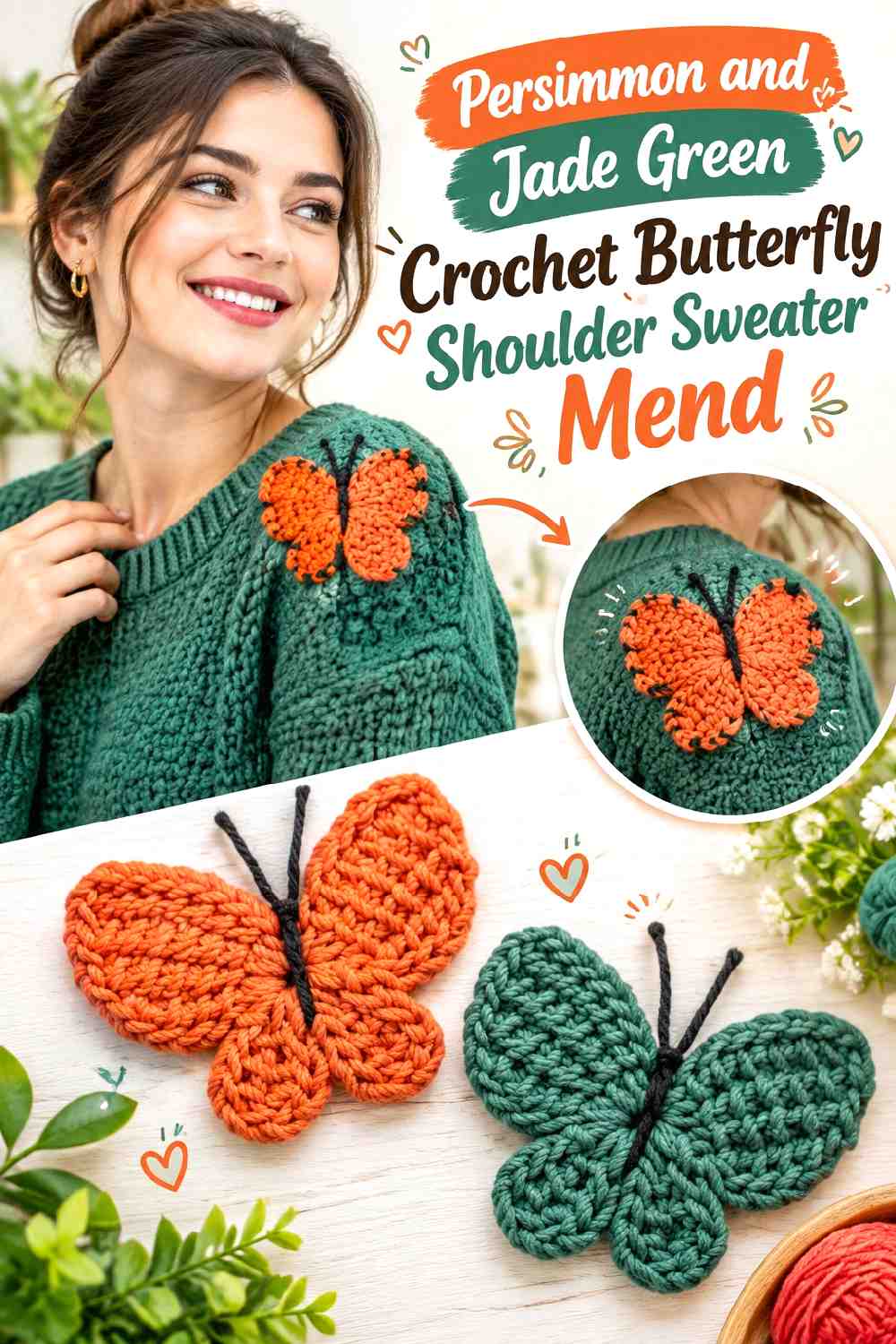
A butterfly provides broad horizontal coverage, making it useful for a repaired area spanning part of the shoulder, upper back, or upper front. Persimmon can dominate one set of wing sections while jade green defines others, giving both colors meaningful visual space without requiring a rigid checkerboard.
The center of the butterfly should align with the part of the repair that benefits from the strongest attachment, while its wings extend over stable surrounding fabric.
Persimmon and Jade Green Can Divide the Butterfly Wings for Balanced Coverage
Instead of mixing both shades in every wing section, give persimmon larger areas on one part of the butterfly and jade green larger areas elsewhere. Distinct blocks make the silhouette readable and reduce visual clutter.
For a more unified look, repeat a small amount of the opposite shade inside each side rather than dividing the butterfly into two completely unrelated halves.
Jade Green Edging Should Not Pull Persimmon Wings Out of Shape
A contrasting jade green outline can make persimmon wing sections clearer, but the edge should follow the motif without drawing it inward. This matters on a shoulder because the underlying fabric changes shape as the arm moves.
Check the butterfly while the sweater is worn or positioned over a similar curve rather than evaluating it only on a flat table.
Creator Credit: GratiaProject
11. Persimmon and Jade Green Crochet Mushroom Hem Sweater Mend

A mushroom shape is especially useful when the repair has one wide portion and one narrower extension. Persimmon can form the broad cap while jade green creates the stem, producing a simple two-color motif that fits naturally near a lower front or back hem.
If the hem edge itself is unraveling or distorted, address that structural problem separately. The mushroom can then sit over or beside the repaired area as the visible color treatment.
Persimmon Works Well on the Mushroom Cap When the Mend Needs Width
Place the broad persimmon cap over the wider part of the worn area. This uses the motif’s natural proportions to cover damage rather than rotating or enlarging it solely for appearance.
A persimmon cap also creates a strong warm focal point, so a large second patch nearby may not be necessary unless there is another genuine repair to address.
Jade Green Can Extend the Persimmon Mushroom Into a Narrow Hem Repair
The narrower jade green stem can follow a small vertical worn section below the persimmon cap. If the actual damage does not extend that far, let the stem remain decorative rather than making it unnecessarily dense.
Where the sweater background is close to jade green, consider making the stem slightly more substantial as a shape rather than adding numerous tiny green details.
Creator Credit: Jolly Lizard
12. Jade Green and Persimmon Crochet Fish Side-Panel Sweater Mend

A fish motif can fit a horizontal snag or worn strip along the side body of a sweater. Jade green can form the elongated body, covering most of the repair, while persimmon appears in the fins or tail to provide a warmer endpoint.
The direction matters here. Position the widest part where coverage is needed, and check that a projecting tail or fin does not crowd a side seam or an underarm area that bends frequently.
Jade Green Should Cover the Longest Part of Horizontal Sweater Wear
Let the jade green body follow the main damaged line. This uses the fish’s length functionally and keeps the color distribution tied to the repair.
If the worn area is shorter than the motif, avoid making the crochet excessively large just to preserve a particular proportion. The finished mend should still suit the sweater panel.
Persimmon Fins Can Add Contrast Without Carrying the Structural Coverage
Persimmon works well on projecting details because a small amount can strongly change the color balance. Those fins and tail, however, should be viewed as extensions of the design rather than the primary covering for weak fabric.
Keeping most continuous coverage in jade green makes the repair logic easy to read while persimmon supplies the visible accent.
Creator Credit: Kiki Crochet Designs
13. Persimmon and Jade Green Crochet Strawberry Hem Sweater Patch

A strawberry gives this palette one of its clearest shape-and-color divisions. Persimmon can occupy the broad fruit body while jade green forms the leafy top, creating an immediately organized repair without needing several additional shades. It works particularly well on a lower body or hem area where a compact tapered patch can sit relatively flat.
The fruit body should do most of the coverage. The jade green leaves can then extend the repair upward or visually link it with a second small mend.
Persimmon Should Cover the Broadest Part of the Strawberry Mend
Place the widest persimmon area over the main damaged section. Because the strawberry narrows toward one end, rotate it according to the actual shape of the wear rather than assuming the leaves must always point in one direction on the garment.
This keeps persimmon from becoming decorative color that misses the area that actually needs coverage.
Jade Green Leaves Can Extend Coverage Without Widening the Persimmon Patch
Use the leafy jade green section where the damaged area becomes narrower. This lets the motif follow an irregular repair while keeping the main persimmon fruit compact.
If the green leaves sit entirely on sound sweater fabric, they can remain lighter and more decorative. If they overlap a weakened area, make sure that area has been appropriately stabilized first.
Persimmon and Jade Green Repetition Should Follow Real Hem Wear
A second tiny strawberry, leaf, or persimmon accent can balance a lone hem patch, but repetition is most useful when it corresponds to another worn area or helps connect existing repairs. Avoid adding a row of motifs automatically; one strong visible mend can be more coherent than several unnecessary ones.
Creator Credit: The Bumbling Busy Bee 🐝
Choosing Between Persimmon-Led and Jade-Green-Led Sweater Mends
Persimmon-led repairs are useful when you want the mend to become the warm focal point of the sweater. Stars, strawberry bodies, mushroom caps, and larger flowers give persimmon enough uninterrupted area to establish that role. Jade green can then provide centers, leaves, outlines, or secondary patches.
A jade-green-led repair shifts the visual weight toward the cooler shade. Leaves, fish bodies, hearts, and continuous repair areas give jade green enough coverage to dominate while persimmon works as a smaller contrasting detail.
For motifs such as butterflies and bees, a more even division can work when the two yarns have enough value contrast. When they do not, larger blocks of each color will usually remain clearer than many small alternating details.
Conclusion
Persimmon and jade green can support very different visible-mending directions without changing the basic two-color palette. For one bold focal repair, the star, sunflower, mushroom, or strawberry ideas give persimmon a strong central role. For a more distributed treatment, surface crochet, leaf trails, and mini-flower clusters can spread jade green and persimmon across several worn areas without covering a large section of the sweater.
Choose the dominant color after placing both yarns against the actual garment, because the sweater background and the light-dark relationship between your particular shades will affect the result. Most importantly, let the shape and location of the damage determine the motif rather than forcing every repair into the same decorative format. Use the credited tutorials for their crochet techniques and motif construction, while treating the persimmon-and-jade placement as an adaptable visible-mending color plan.
Frequently Asked Questions
Can I use only persimmon and jade green for every crochet sweater mend?
Yes. Variety can come from proportion, placement, motif size, and which shade dominates rather than from continually introducing new colors. One repair might be mostly persimmon with a narrow jade green edge, while another could reverse that balance. Keeping the palette limited can also help several different repairs feel related.
Should persimmon or jade green be the dominant sweater-mending color?
There is no universal choice. Compare both yarns against the sweater and decide which one gives the visibility you want. Persimmon can make a strong warm focal repair, while jade green can work well for larger connecting areas, leaves, outlines, or cooler-looking patches. The garment background may change which color appears stronger.
How can I check whether persimmon and jade green have enough contrast?
Place the yarns next to each other on the sweater, step back, and compare them at normal viewing distance. A grayscale photo can also help reveal whether the two shades have meaningful light-dark separation. If they merge, use larger blocks and simpler shapes instead of relying on tiny contrasting details.
Should a crochet appliqué provide the structural sweater repair?
Not automatically. If stitches are unraveling, fabric is torn, or an area is significantly weakened, address that structural problem appropriately first. A crochet star, flower, leaf, or other appliqué can then become the visible decorative layer. The amount of structural work required depends on the garment and the damage.
Where do persimmon and jade green crochet patches work most comfortably on a sweater?
Flatter areas such as the chest, upper back, or lower body generally allow broader decorative motifs, while elbows, cuffs, side seams, and underarm areas move more. For those high-movement locations, check the patch while the garment bends so the added crochet does not create an awkward stiff spot.
What can replace persimmon or jade green if I cannot find the exact shades?
Preserve the relationship rather than chasing an exact commercial color name. For persimmon, look for a warm orange-red shade with a similar visual strength to the one you planned. For jade green, choose a green that keeps the intended cool contrast. Most importantly, maintain enough value separation between the two colors for the motif details you want to show.