A crochet tartan stocking can feel traditional without looking like a mass-produced holiday decoration. Deep red, forest green, navy, cream, charcoal, mustard, and burgundy can be arranged into checked or intersecting color patterns that bring to mind woven tartans while still showing the character of crochet.
The projects below take several different routes. One source teaches an actual plaid stocking, while others provide stocking constructions that can be adapted with checked color blocks, Fair Isle-style colorwork, surface lines, patchwork motifs, tartan cuffs, or carefully planned bands. Those adaptations should be treated as design ideas rather than as instructions contained in every original tutorial.
That distinction matters if you want a stocking that will still look good years from now. Heel shaping, cuff structure, hanging strength, fabric density, and the way the color pattern sits when the stocking is vertical all affect the finished result just as much as the tartan palette.
Quick List
- Crochet Heritage Buffalo Tartan Stocking
- Crochet Fair Isle Tartan Snow Stocking
- Crochet Classic Surface-Line Tartan Stocking
- Crochet Plush-Cuff Highland Tartan Stocking
- Crochet Soft-Felted Tartan Stocking
- Crochet Hexagon Patchwork Tartan Stocking
- Crochet Textured Tartan-Cuff Stocking
- Crochet Chunky Broad-Check Tartan Stocking
- Crochet Cottage Tartan-Band Stocking
- Crochet Cross-Stitched Tartan Stocking
- Crochet Cable-and-Tartan Stocking
- Crochet Small-Motif Tartan Stocking
- Crochet Mini Heirloom Tartan Stocking
- Crochet Santa Tartan Stocking
- Crochet Granny-Square Tartan Stocking
- Crochet Classic Three-Color Tartan Stocking
Make the Crochet Read as Tartan, Not Just Stripes
Tartan depends on intersecting color relationships. Horizontal stripes alone may look festive, but they will not necessarily create the woven-grid impression associated with tartan.
One approach is integrated colorwork, where light, medium, and dark shades form repeating checks directly in the crochet fabric. Another is to establish horizontal bands first and introduce vertical surface lines later. Patchwork constructions can suggest tartan through repeated blocks rather than literal crossing lines.
Whichever route you choose, test the colors together before making the stocking. Three skeins that look clearly different separately can become surprisingly similar when reduced to small blocks. A darker anchor shade, a noticeably lighter shade, and one or two related middle colors usually create a clearer grid than several nearly identical tones.
Decide Where the Tartan Should Stop Around the Heel and Toe
The leg of a stocking gives tartan plenty of uninterrupted space. The heel and toe are different because shaping changes the direction and available width of the fabric.
You do not have to force the same check repeat through every section. A solid heel, toe, or cuff can make an intricate tartan body look more intentional. Repeating one of the tartan colors in those solid areas still connects the entire stocking.
If you are adding vertical surface lines to finished fabric, hang the stocking before completing all the decoration. A line that appears straight while the stocking lies on a table may shift when gravity changes the shape.
Plan an Heirloom Stocking for Repeated Christmas Use
An heirloom stocking needs more than an attractive front. Look at the hanging loop, the inside surface, the cuff, and the amount of stretch in the fabric.
Carried colorwork can create floats inside the stocking that may catch on gifts. Surface embroidery creates a different interior, but yarn ends still need to be secured carefully. Motif stockings introduce numerous joins. Chunky designs may be heavier even before anything is placed inside them.
If you expect the stocking to hold gifts rather than function only as decor, inspect the hanger and upper edge carefully and consider whether a lining would suit your finished piece. Do not assume a decorative hanging loop is designed for substantial weight unless the source specifically addresses that use.
1. Crochet Heritage Buffalo Tartan Stocking
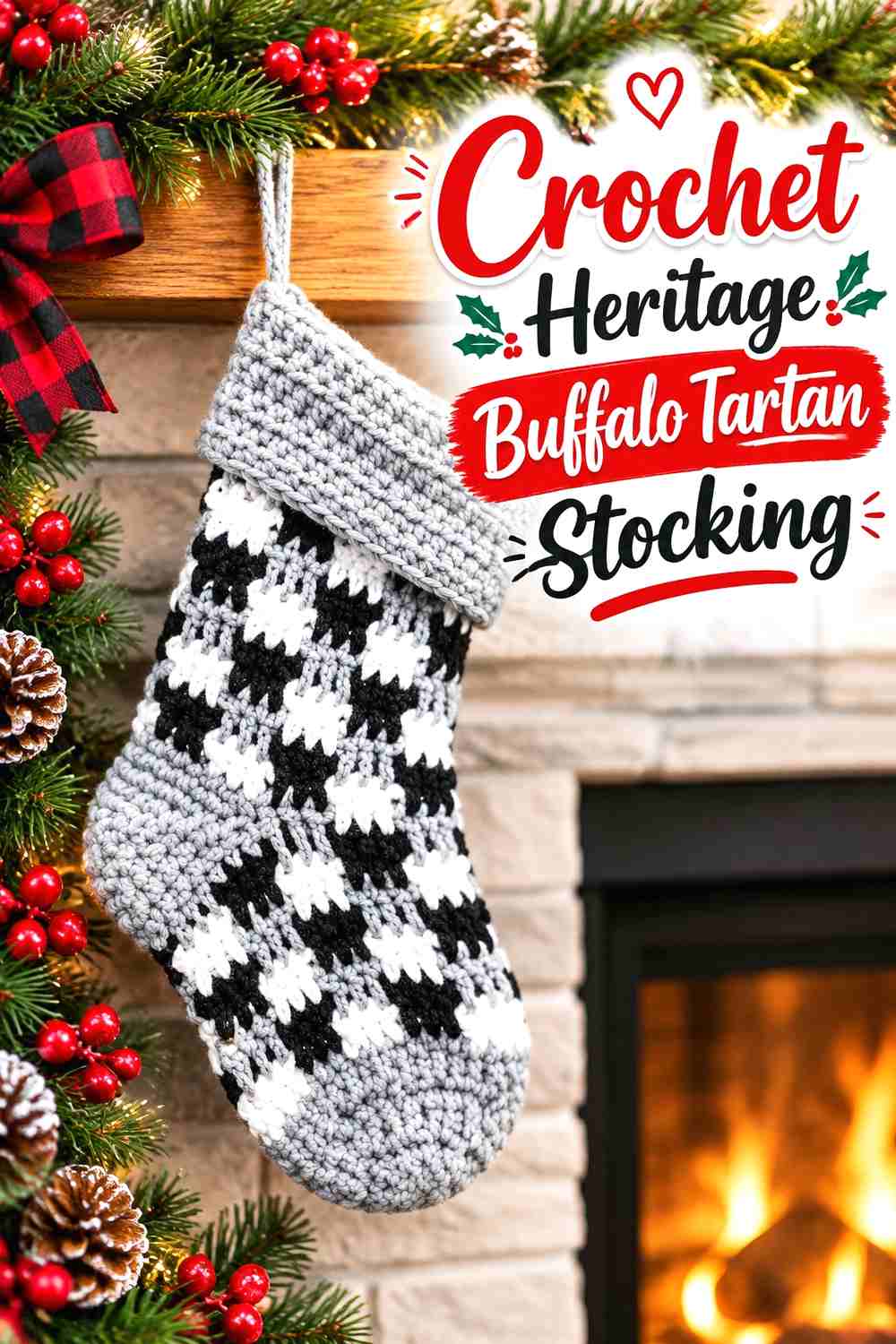
MJ’s Off The Hook Designs provides the closest direct match in this collection: a complete plaid Christmas stocking rather than a plain stocking being independently adapted afterward. The design uses a bold check structure, making it a practical starting point for a more traditional tartan-inspired palette.
Instead of limiting the colors to a classic buffalo-check combination, consider deep burgundy, bottle green, charcoal, and cream, or navy, red, and muted gold. Keep enough contrast between neighboring blocks that the check remains visible from across the room.
Use the Direct Plaid Construction as Your Baseline
If this is your first crochet stocking with repeated checks, beginning with a tutorial already designed around plaid reduces the number of variables you are changing at once.
Follow the creator for the stocking construction and colorwork method. Experiment first with color rather than simultaneously changing yarn weight, proportions, cuff construction, and check scale.
Build a Family Palette Instead of Making Exact Copies
Heirloom stockings do not all need to be identical. You could keep one dark anchor color across the family set while changing the second and third shades for each person.
For example, charcoal might repeat in every stocking while one uses burgundy, another forest green, and another navy. The shared dark grid keeps the collection coordinated.
Check the Plaid at Mantel Distance
A check pattern that looks distinct while crocheting can merge visually once the stocking hangs several feet away. Pause after a substantial section and view it from the opposite side of the room.
If the middle shades disappear into one another, correcting the palette before completing the entire stocking is easier than deciding after finishing that the tartan lacks definition.
Creator Credit: MJ’s Off The Hook Designs
2. Crochet Fair Isle Tartan Snow Stocking

The Unraveled Mitten’s stocking tutorial uses Fair Isle crochet colorwork and a classic stocking structure, including a short-row heel and a patterned leg. That makes it a strong source for readers comfortable with charted or repeated color designs.
For a tartan interpretation, keep the creator’s construction intact and treat your checked or intersecting color plan as a separate design exercise rather than assuming the original snowflake chart is a tartan chart.
Fair Isle Skills Transfer Well to Controlled Tartan Colorwork
The useful feature here is the experience of managing more than one color while maintaining a shaped stocking. Tartan requires the same kind of attention to color dominance, carried yarn, and tension even when the graphic motif is different.
Swatch any new color arrangement before placing it into the full stocking.
Watch the Inside as Closely as the Outside
Colorwork can create strands on the reverse side. On a wearable item those floats affect comfort; inside a stocking they can catch on gift packaging or small objects.
Inspect the interior as the work progresses. If you plan to use the finished stocking actively rather than only display it, interior neatness becomes an important part of the heirloom finish.
Keep a Solid Cuff as a Visual Frame
Detailed colorwork often looks stronger when it stops before the cuff. A cream, charcoal, burgundy, or green cuff can frame the tartan and give the eye a quieter place to rest.
Creator Credit: The Unraveled Mitten
3. Crochet Classic Surface-Line Tartan Stocking
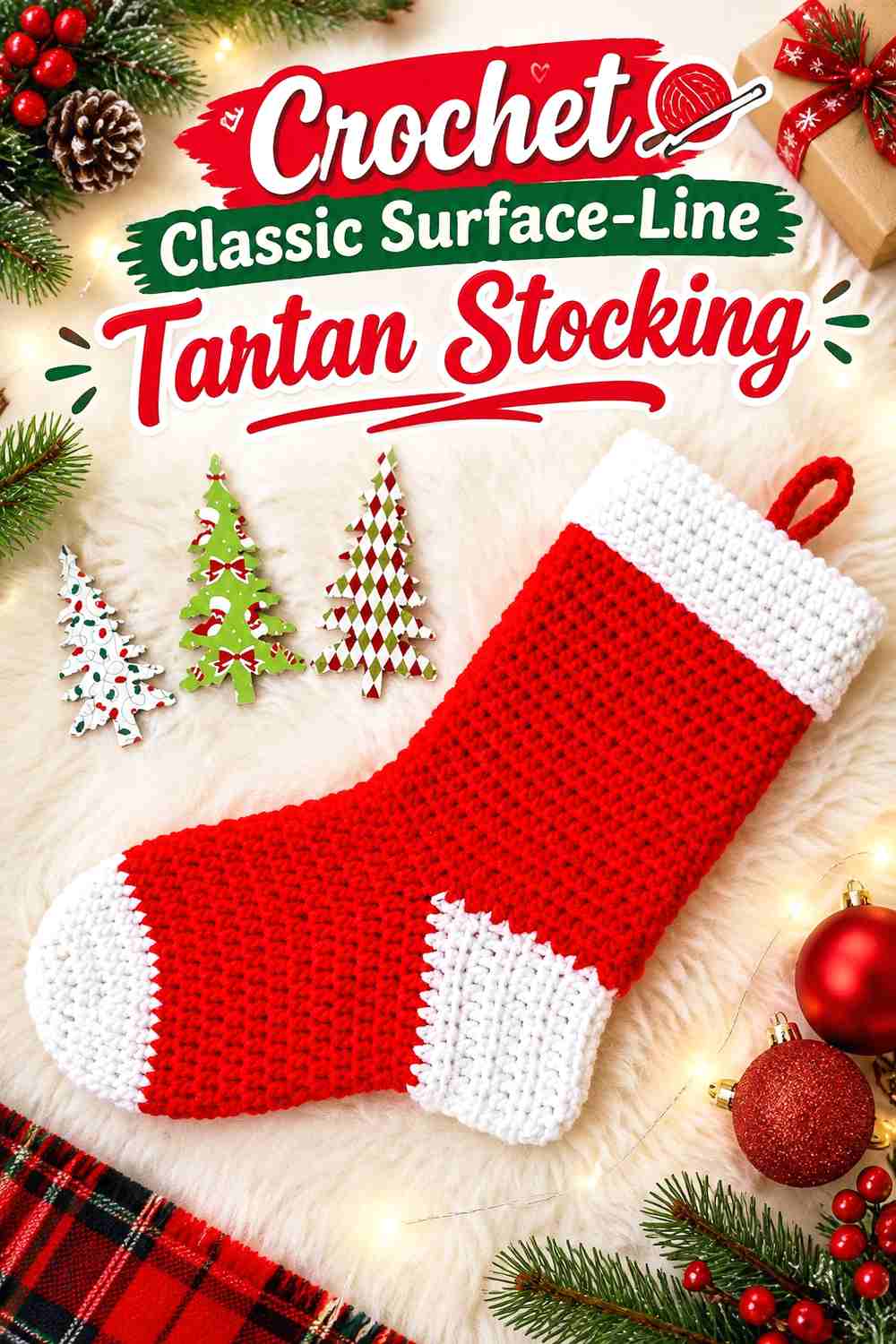
Naztazia’s tutorial teaches a classic Christmas stocking with clearly identifiable toe, heel, body, leg, cuff, and hanging-loop sections.
That uncomplicated base makes it suitable for surface-added tartan. Instead of carrying multiple colors through every round, crochet the stocking body in planned horizontal bands and add selected vertical lines after the basic shape is complete.
Surface Lines Simplify the Heel Problem
A vertical tartan line does not naturally want to follow a curved heel. Working the basic stocking first lets you see exactly where a decorative line should stop, shift, or remain confined to the leg.
That gives you more control than forcing a rigid grid through shaping that was not designed around it.
Keep the Toe or Heel Solid
A solid toe can repeat the darkest color from the tartan and anchor a visually busy leg. A solid heel does the same while avoiding compressed check blocks around the shaped area.
You can use either approach without changing the recognizable traditional stocking silhouette.
Test the Surface-Crochet Tension Early
Decorative vertical lines can pull the underlying fabric inward when they are too tight. Add one line, let the stocking hang naturally, and check for puckering before completing the full grid.
Creator Credit: naztazia
4. Crochet Plush-Cuff Highland Tartan Stocking
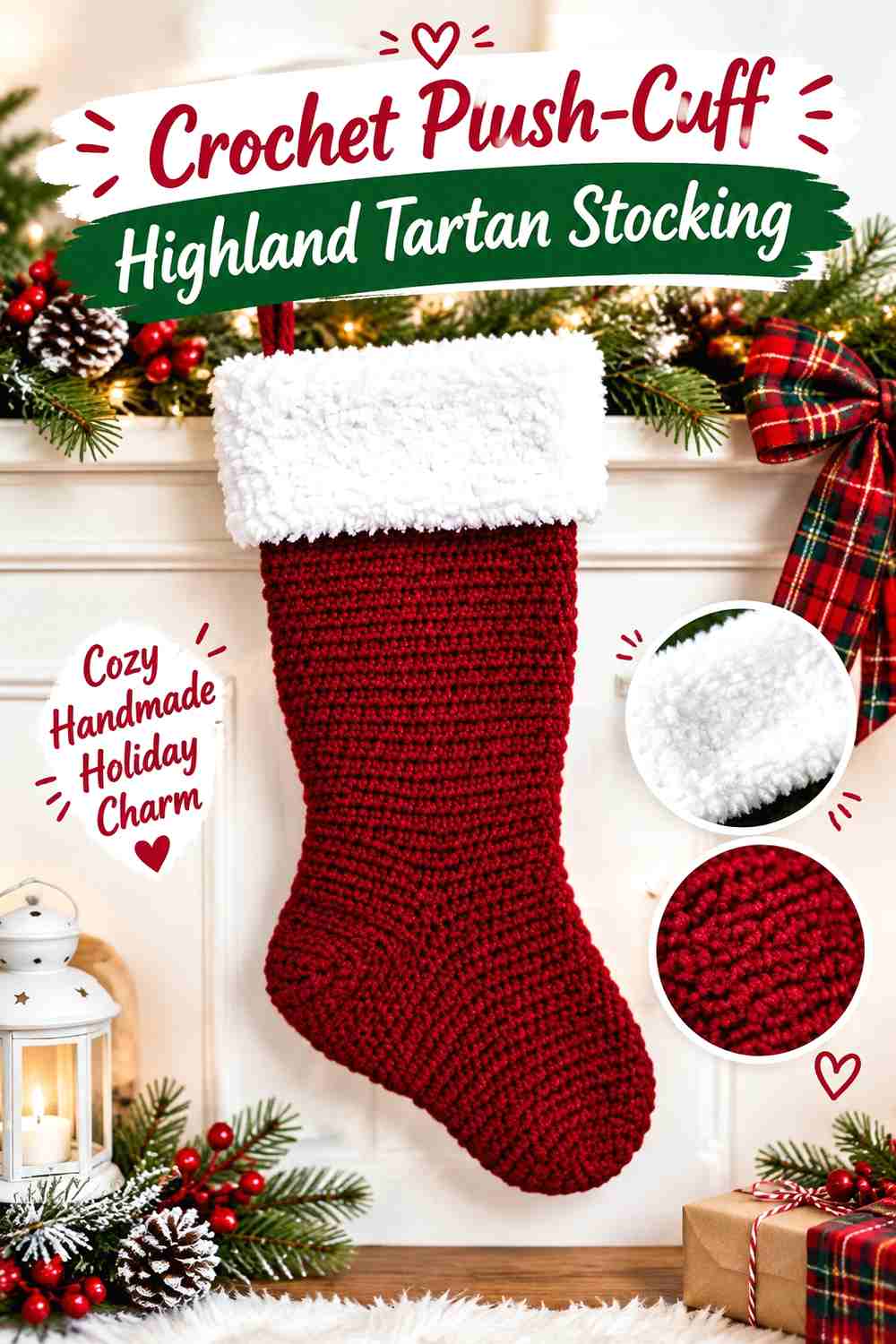
B.Hooked Crochet’s source stocking includes a contrasting soft cuff, giving you a useful construction base when you want crisp tartan below and plush texture above. The plaid itself is an adaptation rather than part of the original tutorial.
This contrast can look particularly traditional with dark red, forest green, navy, or charcoal checks beneath a cream cuff.
Keep Fuzzy Yarn Out of the Tartan Grid
Tartan depends on relatively clear boundaries. A haloed or fuzzy yarn can soften those boundaries until small checks are difficult to distinguish.
Use the plush texture where it makes the most visual sense—the cuff—and choose a yarn with clearer stitch definition for the plaid body.
Compare the Weight of the Two Fabrics
A dense checked body and a fluffy cuff may behave very differently. Hold them together before finishing the transition and make sure the cuff does not visually overwhelm or distort the upper stocking.
Let the Cuff Repeat the Lightest Plaid Shade
Using the cream, oatmeal, or pale gray already present in the tartan can make the cuff feel integrated rather than attached as an unrelated trim.
Creator Credit: B.Hooked Crochet
5. Crochet Soft-Felted Tartan Stocking
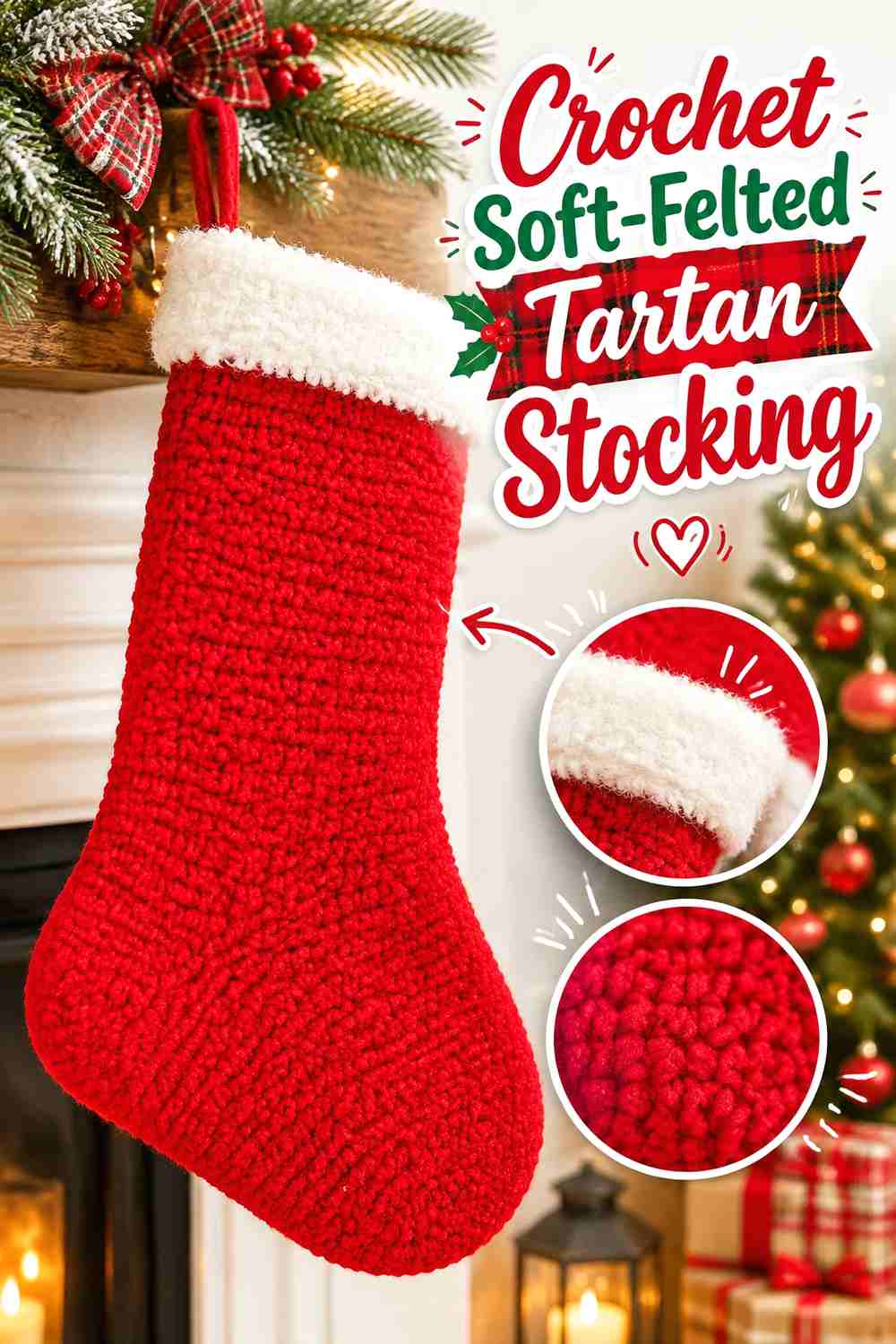
The Crochet Crowd’s source is useful for a different reason: its stocking can be considered with or without felting, which opens the door to a softer, textile-like interpretation of tartan rather than a sharply graphic one.
Felting should only be considered with fibers suited to that process and with an understanding that dimensions and surface appearance can change.
Make a Tartan Test Swatch Before Altering the Full Stocking
A small checked sample can show whether neighboring colors remain distinct after the treatment you intend to use.
Photograph and measure the swatch before and after. You are looking for behavior rather than trying to establish a universal shrinkage rule.
A Blended Grid Creates a More Vintage Appearance
Crisp black-and-red checks can feel bold and graphic. A softened surface can make burgundy, moss, brown, navy, or oatmeal merge more gently, producing a worn textile character that may suit an heirloom theme.
Fiber Choice Matters More Than the Color Name
Two yarns labeled wool can still behave differently, and many synthetic yarns will not respond like feltable animal fibers. Confirm the fiber and care information instead of assuming the treatment will work because the yarn looks rustic.
Creator Credit: The Crochet Crowd
6. Crochet Hexagon Patchwork Tartan Stocking
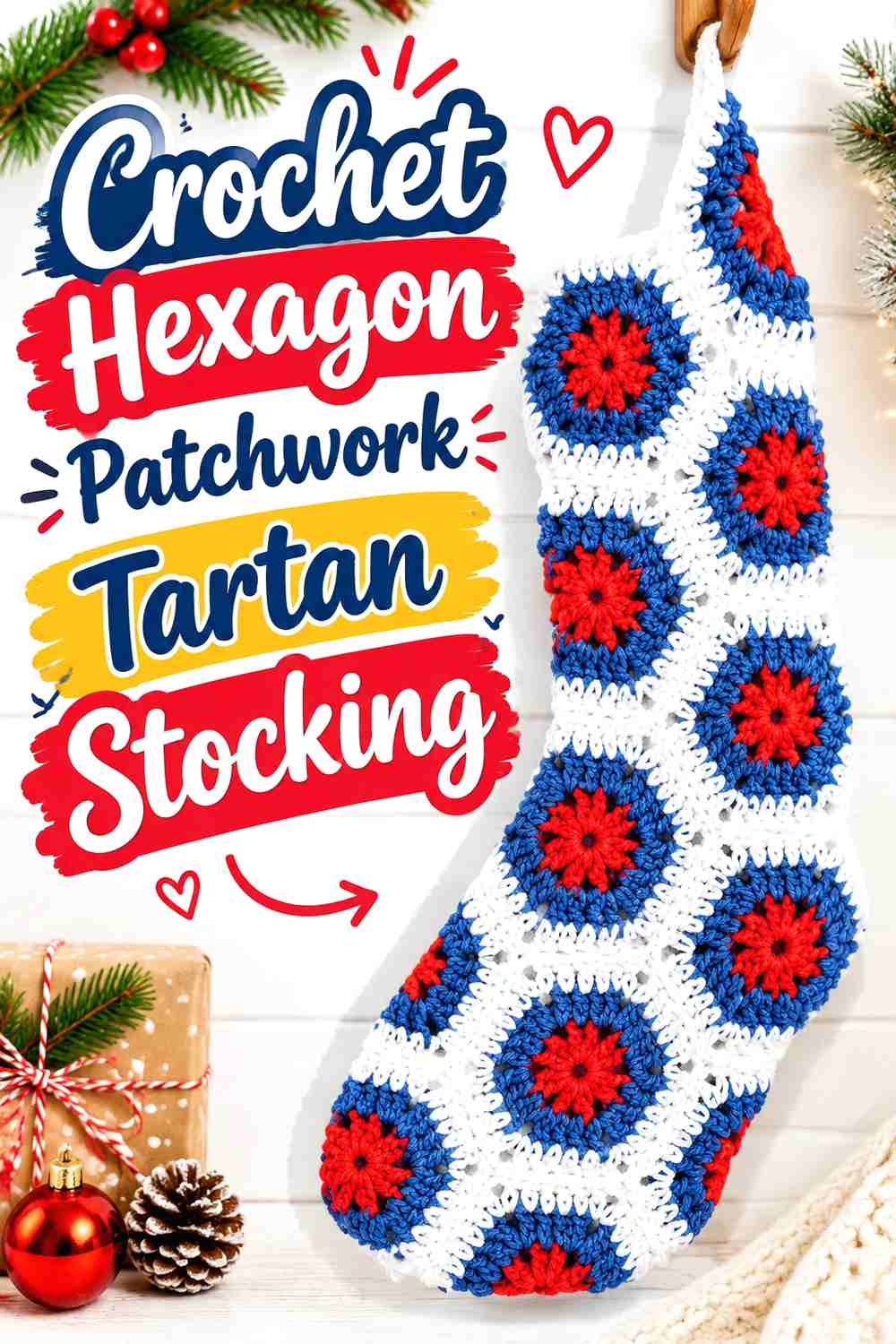
Bella Coco’s stocking is constructed from joined hexagons, giving this idea an entirely different route to tartan. Rather than making a woven-looking grid inside continuous fabric, the motifs themselves become the color blocks.
This is less literal than traditional tartan, but it can still create an heirloom patchwork look when dark, medium, and light colors are repeated in a controlled arrangement.
Lay Out Every Hexagon Before Joining
Motif color placement is difficult to correct after several seams are complete. Arrange the pieces in the approximate stocking shape first and photograph the layout.
Look for accidental clusters where one color dominates a large area.
Treat the Joining Yarn as Another Tartan Line
A dark join can outline every motif and make the construction more graphic. A matching or neutral seam allows the colors to flow together more softly.
Test a few joined hexagons before deciding which effect better suits the rest of your Christmas decor.
Use Fewer Colors Inside Individual Motifs
If every hexagon already contains several colors, the overall patchwork can become too busy to suggest tartan. Simpler motifs allow the full layout to create the color rhythm.
Creator Credit: Bella Coco
7. Crochet Textured Tartan-Cuff Stocking
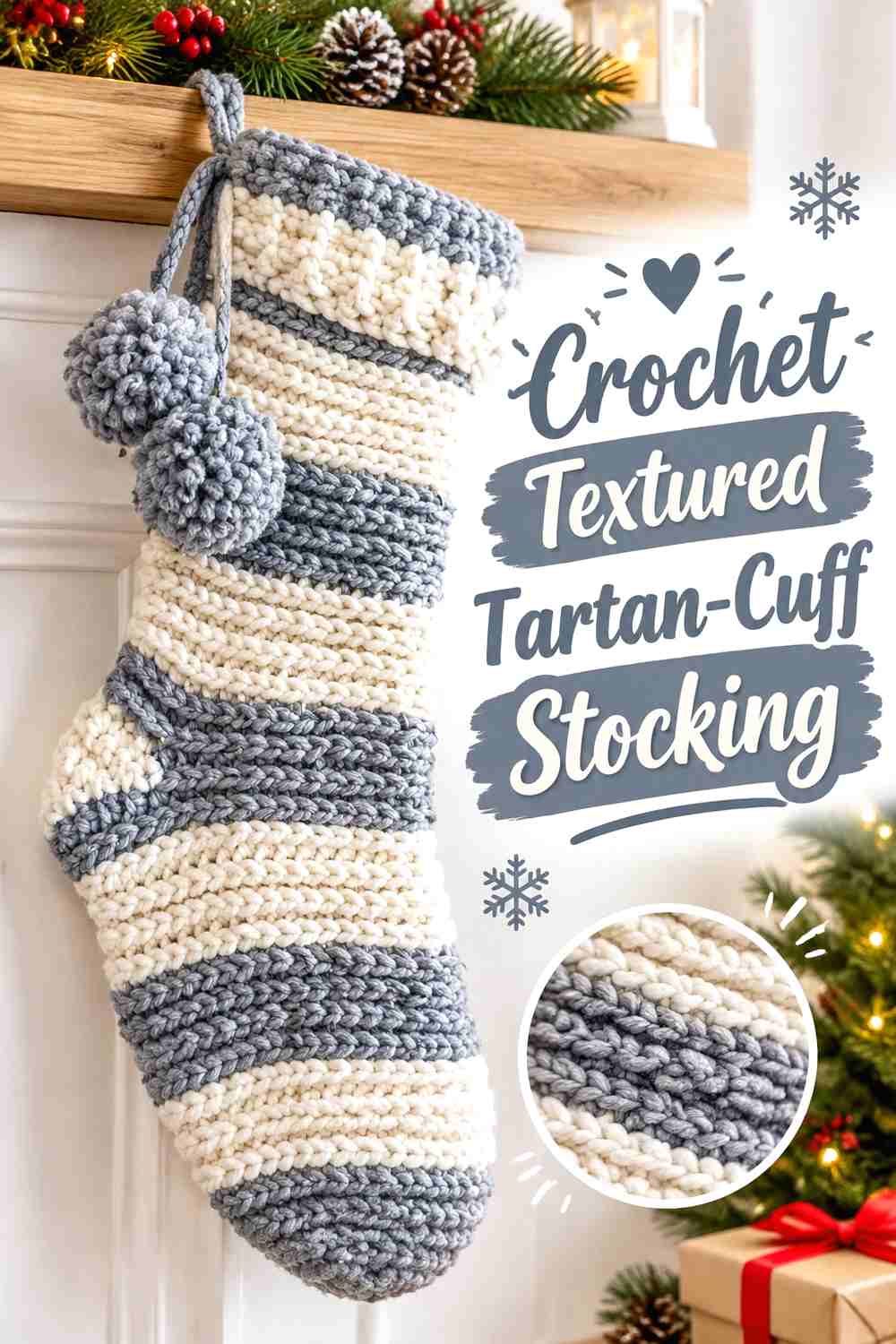
Rich Textures Crochet’s Home for Christmas Stocking emphasizes a substantial textured fabric and contrasting sections, so it is better suited to selective tartan than to tiny checks across the entire surface.
Keep the main body solid and place tartan around the cuff or an upper band. This allows both design ideas to remain visible instead of asking texture and colorwork to compete in the same stitches.
Give the Tartan Its Own Flat Zone
Raised stitches already create shadows. Placing a fine-scale plaid directly over strong texture can make both features harder to see.
A cleaner band near the top provides a better canvas for recognizable checks.
Match the Check Scale to the Stocking Texture
Very small tartan repeats can look fussy beside large stitches. Broader blocks or wider intersecting lines usually relate better to a substantial stocking body.
Repeat One Tartan Color Below the Cuff
A solid heel, toe, pom-pom, or hanger in one of the plaid shades can connect the upper band to the rest of the stocking without extending checks everywhere.
Creator Credit: Rich Textures Crochet
8. Crochet Chunky Broad-Check Tartan Stocking
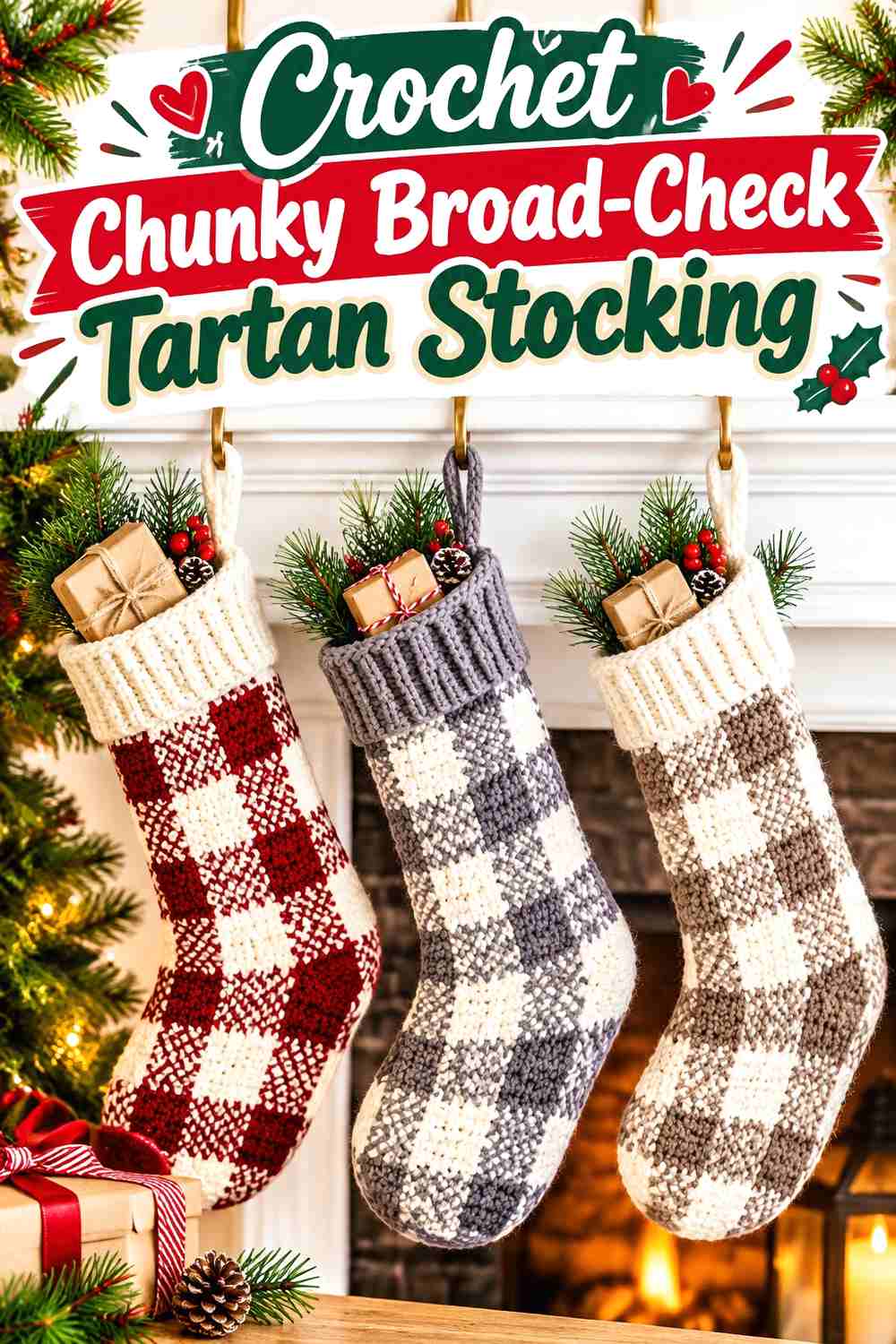
Make & Do Crew’s chunky stocking uses pronounced post-stitch texture and super-bulky yarn, giving it a strong modern shape.
Instead of trying to squeeze a fine woven tartan into large stitches, adapt this style with broad color sections and a few strong crossing lines.
Enlarge the Tartan to Match the Yarn
Large stitches need large-scale decoration. A grid that would look detailed on worsted-weight fabric can disappear inside chunky ribs.
Think in broader areas: a burgundy field, dark green band, and a limited number of charcoal vertical accents can read more clearly than numerous narrow stripes.
Add Vertical Detail After the Shape Is Finished
Surface lines can be placed where they appear straight when the stocking hangs. This is useful on a chunky shape because the pronounced stitch texture may otherwise move thin decorative lines off course.
Avoid Overloading a Strongly Textured Body
The stocking already has significant surface interest. If tartan covers every inch, the result may lose the clean, substantial appearance that makes the chunky construction distinctive.
Creator Credit: Make & Do Crew
9. Crochet Cottage Tartan-Band Stocking
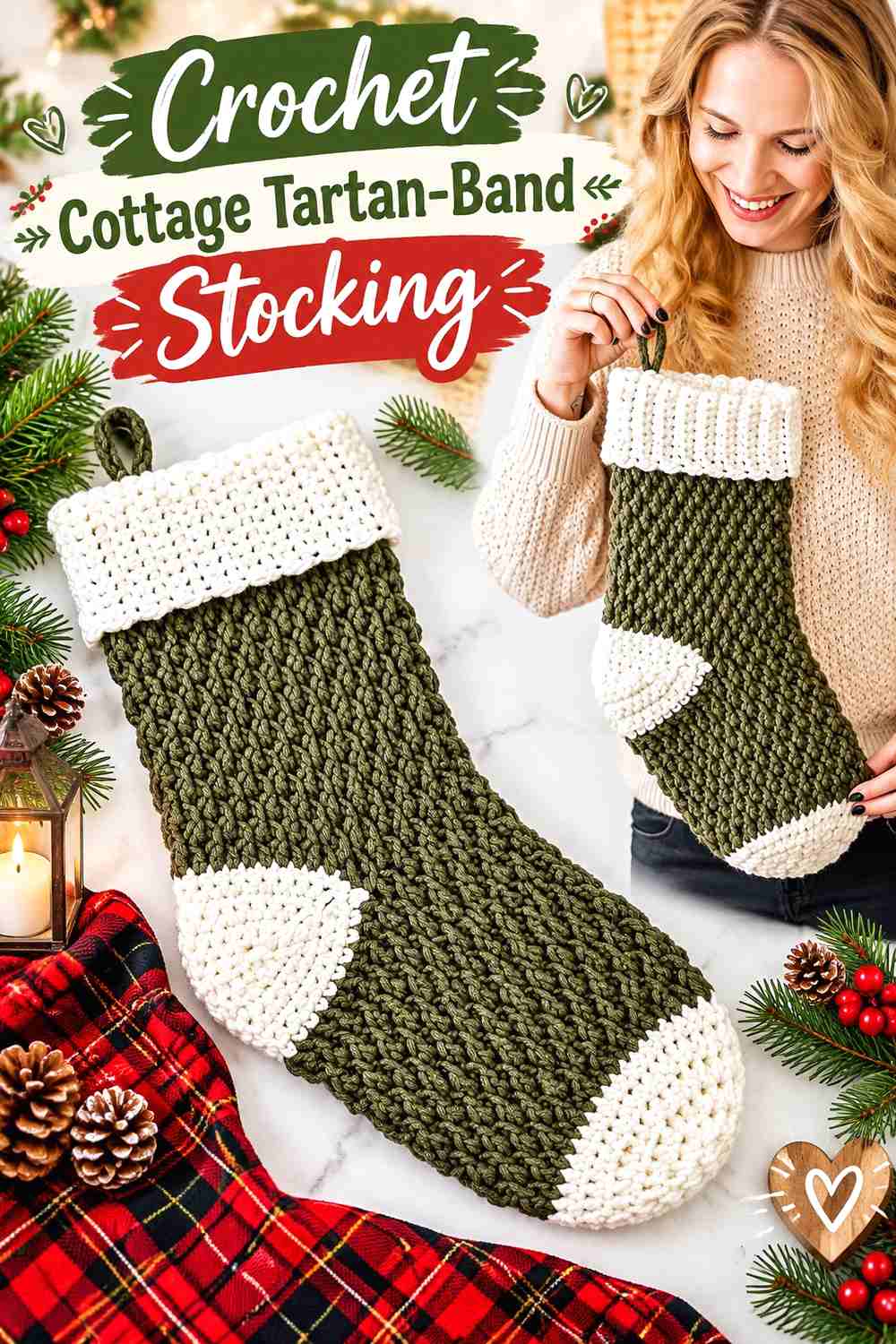
The Turtle Trunk’s Country Cottage Stocking has a pronounced textured body and a classic hanging shape.
That makes it a good candidate for a dedicated tartan band. Keep the main body cream, oatmeal, forest green, or burgundy, then concentrate the check pattern near the top where it behaves more like woven trim.
Treat the Tartan Band Like a Border
The plaid section should have a clear start and finish. A solid transition helps separate the smooth colorwork from the texture below.
Before making the band deep, hold a tartan sample against the stocking. Too much plaid can visually shorten the main body.
Coordinate the Hanger With the Darkest Stripe
The hanging loop is small, but its color is visible at the edge of the stocking. Repeating the darkest tartan shade there can help frame the entire piece.
Make sure the attachment method is appropriate for how you plan to use the stocking rather than relying on color alone.
A Cottage Palette Can Be Quieter Than Classic Red Plaid
Moss, oatmeal, muted burgundy, brown, and charcoal can produce a softer heritage look than bright red and black. Keep enough value contrast for the tartan to remain readable.
Creator Credit: The Turtle Trunk
10. Crochet Cross-Stitched Tartan Stocking
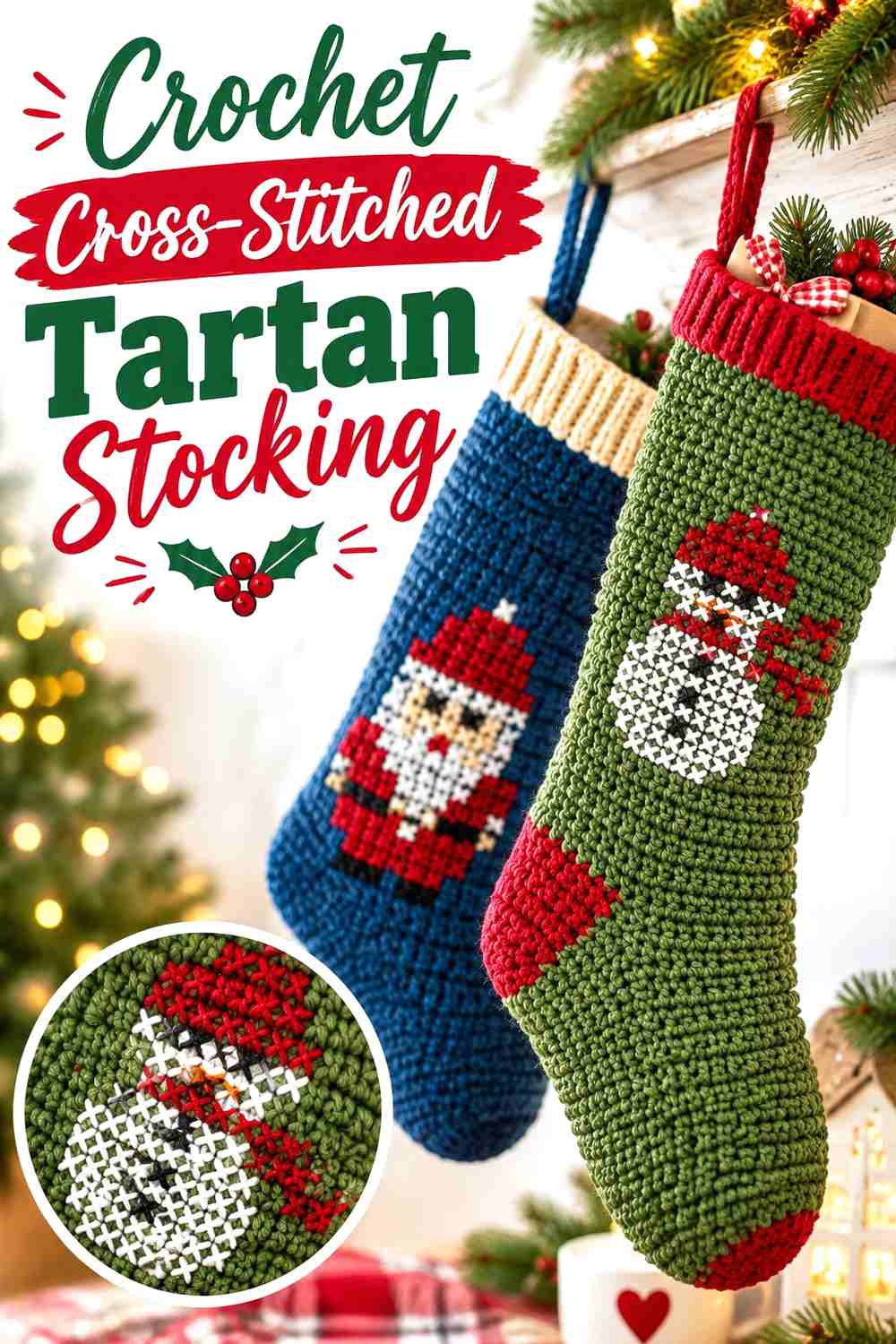
Yarnspirations provides a particularly adaptable learning route because the stocking concept combines crochet fabric with surface cross-stitch decoration. That means the underlying stocking can remain structurally simple while much of the visual pattern is added afterward.
For tartan, treat the crocheted stitches as a grid and develop the crossing color relationships on the completed fabric.
Surface Decoration Lets You Plan the Tartan Late
You can finish the basic stocking and then evaluate how much pattern the front actually needs. That is useful if you want a name, initial, date, or family motif to remain visible without being buried inside checks.
Simplify the Grid Near Shaped Areas
The leg provides the most regular surface. The toe and heel do not.
Rather than bending every line around curves, allow some parts of the stocking to remain solid or use a reduced version of the tartan.
Inspect the Reverse Side Before Calling It Finished
Surface work avoids carrying several yarns through the entire fabric, but it still creates yarn ends and attachment points inside.
An heirloom finish should look considered from both sides, particularly if small gifts will be placed directly inside the stocking.
Creator Credit: Yarnspirations
11. Crochet Cable-and-Tartan Stocking
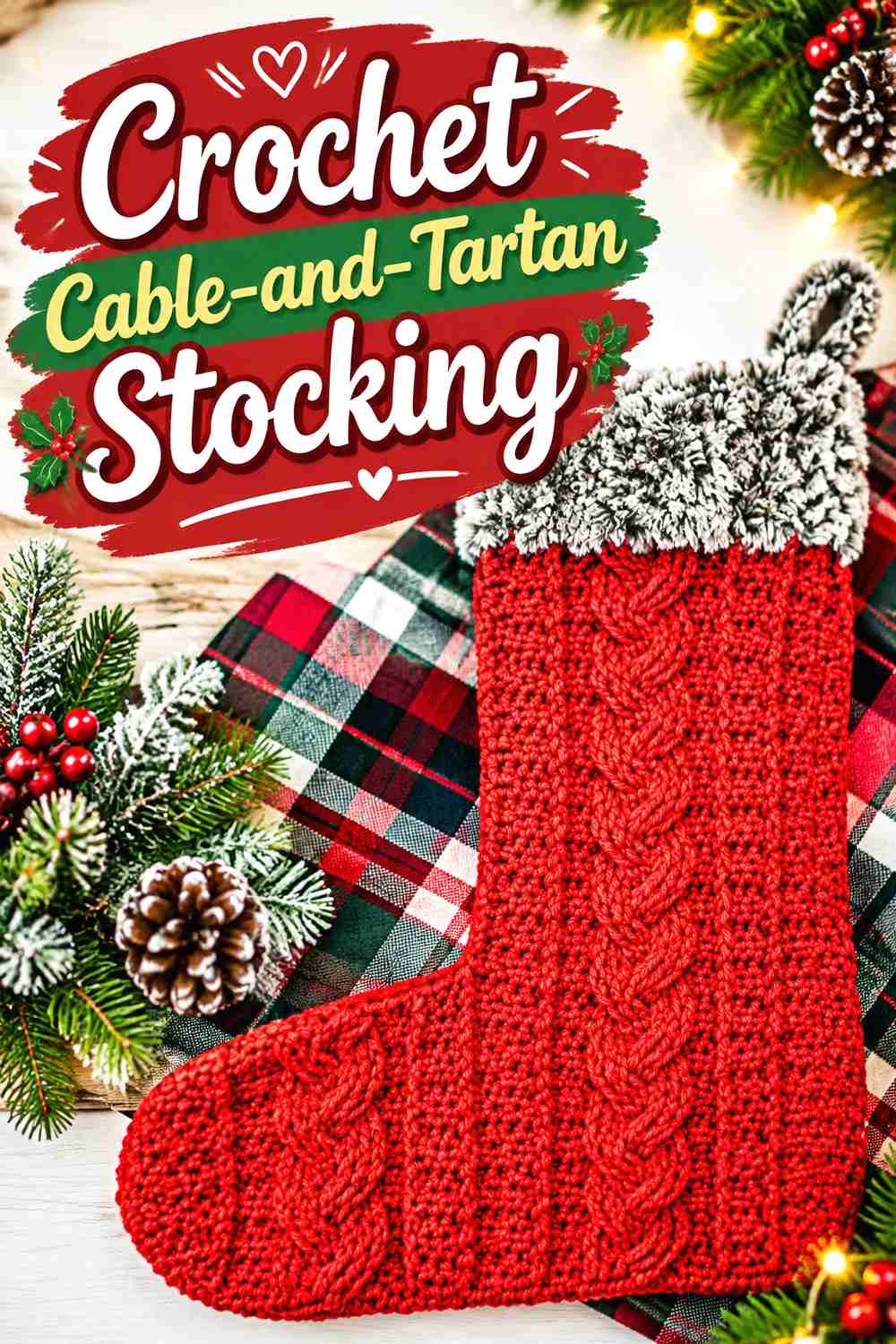
Sierra Fontaine’s tutorial uses separate stocking panels with visible cable work and a cuff.
Cables and tartan are both visually dominant, so this design works best when they occupy separate zones. Keep the cable body solid and introduce plaid at the cuff, heel accent, or a carefully controlled upper panel.
Do Not Hide the Cable Crossings With Checks
The appeal of a cable is the light and shadow created by raised stitches. Frequent color changes across the same area can make those crossings much harder to see.
Let texture lead across the main panel and use tartan as its frame.
Flat Panels Make Color Decisions Easier
Before the stocking is assembled, you can compare a proposed tartan cuff directly with the finished front panel.
This is the right moment to decide whether the plaid feels balanced or whether its color contrast overwhelms the cables.
Repeat a Cuff Color at the Heel or Edge
A small repeat of burgundy, green, navy, or cream elsewhere can keep the tartan section from appearing disconnected from the solid body.
Creator Credit: Sierra Fontaine
12. Crochet Small-Motif Tartan Stocking
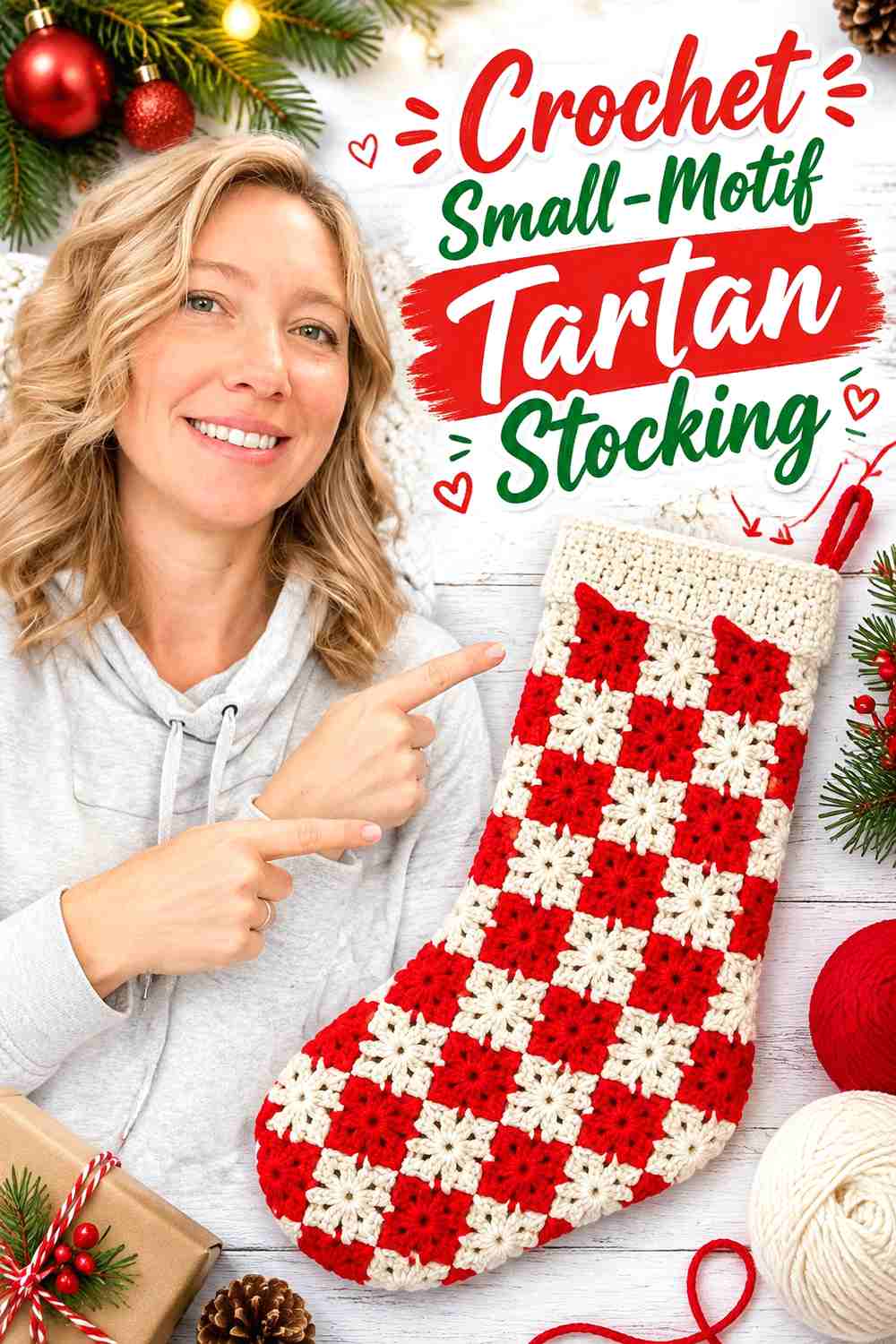
The stocking construction used by love.life.yarn. by Amanda Saladin relies on multiple small square motifs, making color placement part of the assembly process rather than a continuous carried-color technique.
This can create a finer-scale patchwork tartan than the larger hexagon version. Choose light, medium, and dark motif colors and arrange them so their repetition suggests checks across the finished stocking.
Let the Layout Create the Pattern
The individual motifs do not all need complicated internal colorwork. In fact, simpler squares often make the overall plaid arrangement easier to read.
Use the position of the motifs to create the rhythm.
Photograph Both Sides Before Seaming
A stocking is three-dimensional, so planning only the front can create a disorganized reverse side. Arrange the full motif set and photograph the intended sequence before joining.
This also gives you a reference if several similar squares are moved while you work.
Watch for Too Many Competing Joins
If every square changes color and the joining yarn also contrasts strongly, the design can become more mosaic than tartan.
Decide whether the seam should be part of the grid or visually disappear.
Creator Credit: love.life.yarn. by Amanda Saladin
13. Crochet Mini Heirloom Tartan Stocking
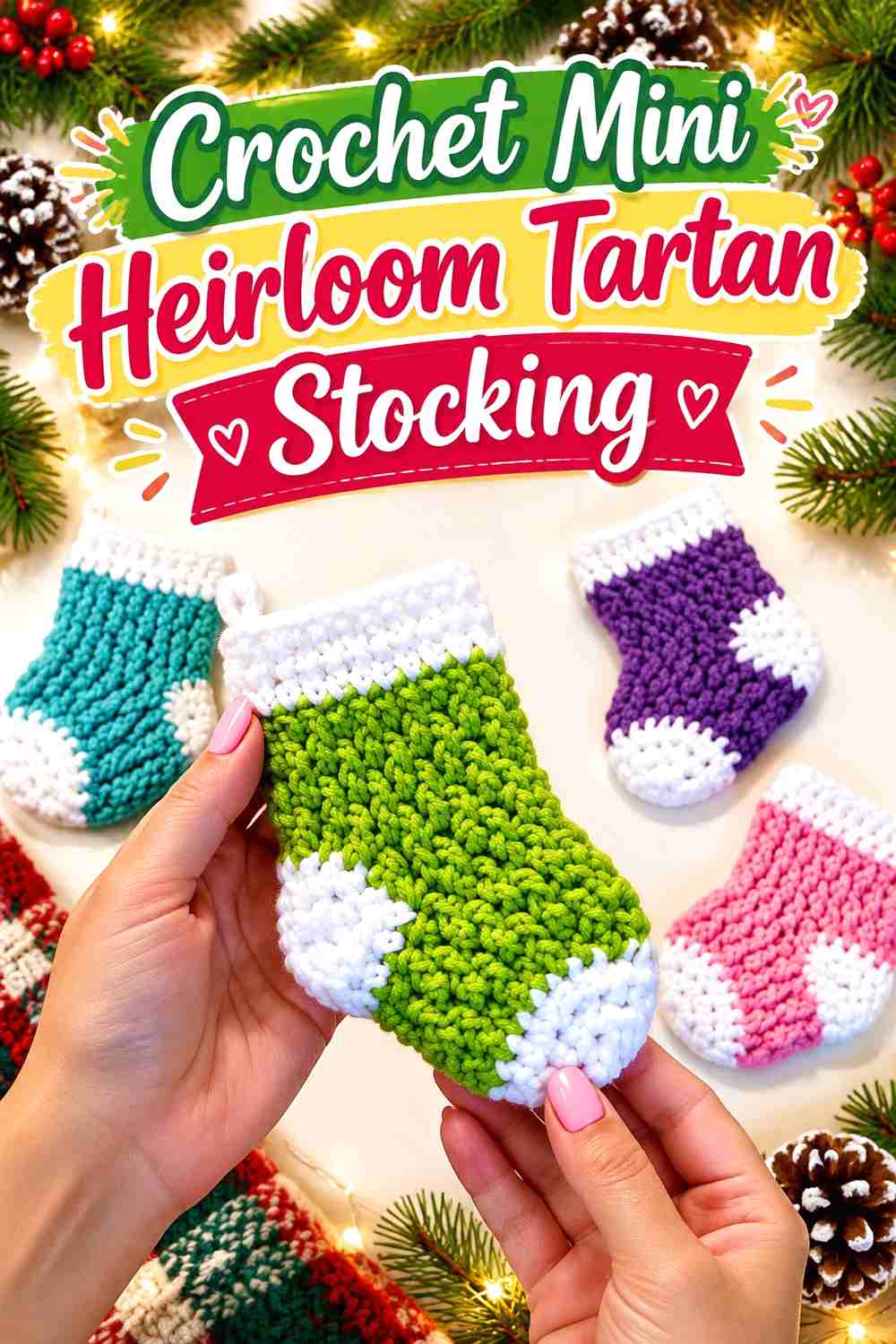
Jennifer Noelle’s mini stocking creates a compact stocking shape with contrasting color and textured detail.
Mini stockings are useful for tree ornaments, small gifts, garlands, or as palette tests before you commit to a full-size tartan stocking.
Simplify Tartan at Miniature Scale
A detailed woven tartan that looks clear on a large stocking can become visual noise on a small ornament.
Reduce the number of intersecting lines and use larger blocks. One checked upper section with a solid heel and toe may communicate the idea better than shrinking every detail.
Use the Mini Stocking as a Color Prototype
Because the project is small, it can show how burgundy, navy, green, cream, or mustard behave on a real stocking silhouette more effectively than a flat rectangular swatch.
Hang the sample at tree-viewing distance before approving the palette for a larger version.
Keep Personalization Legible
If you plan to add an initial, date, or tiny tag, leave enough calm space around it. Miniature tartan and miniature lettering can easily compete.
Creator Credit: Jennifer Noelle
14. Crochet Santa Tartan Stocking
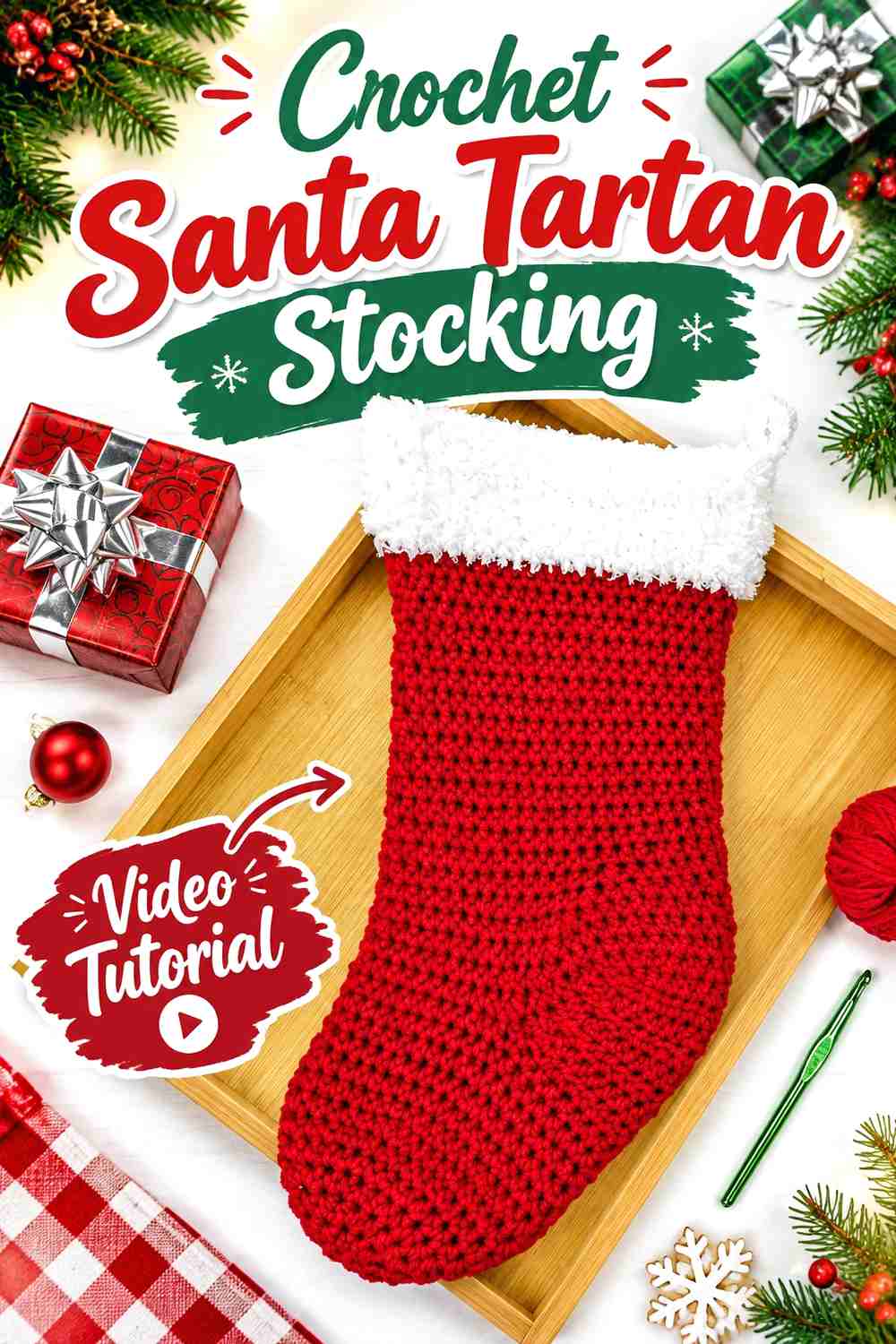
Jo to the World Creations teaches a traditional Santa-style stocking with a distinct red body and light trim.
For a tartan interpretation, replace the broad red body with red, burgundy, and dark-green checks while preserving the light upper trim as a clear frame.
Keep the Santa Cuff Visually Simple
The light cuff is the part that immediately preserves the traditional Santa character. Extending a busy tartan through that area can weaken the contrast.
Let the plaid stop cleanly below it.
Decide Whether the Foot Should Remain Plaid
The leg is the easiest area for an organized repeat. On the foot, the available space and shaping can compress the pattern.
A solid dark-red foot or heel can preserve the Santa character while leaving tartan as the main leg feature.
Red-on-Red Tartan Creates a Subtler Heirloom Look
If black or green feels too bold, combine deep burgundy, traditional red, and a darker wine shade. The plaid becomes visible through value differences while the stocking remains predominantly red.
Creator Credit: Jo to the World Creations
15. Crochet Granny-Square Tartan Stocking
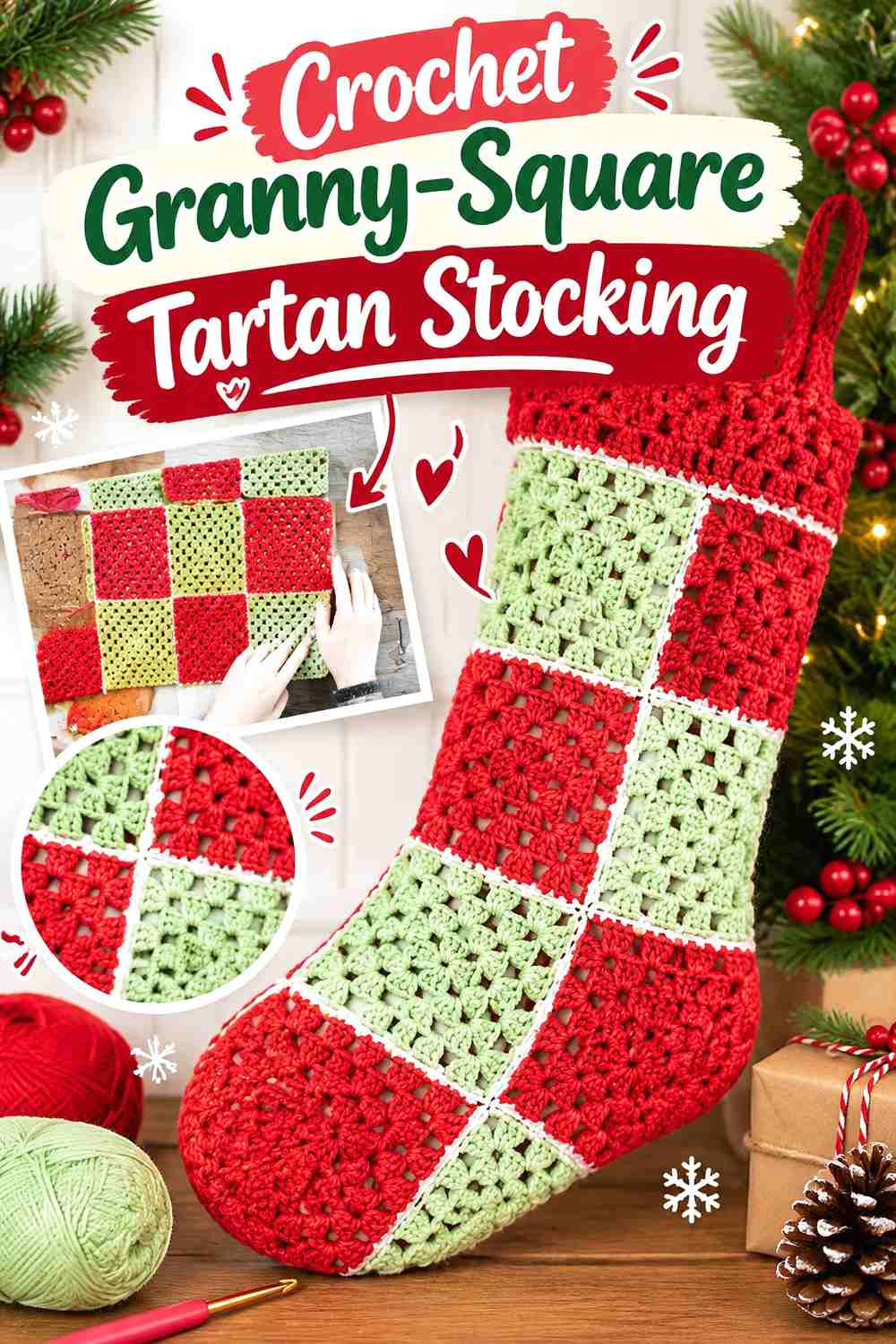
Last Minute Laura’s stocking is built from granny-square crochet, giving this version the broadest patchwork look in the collection.
Instead of treating every square as a colorful scrap motif, organize them into a tartan-inspired sequence of burgundy, cream, forest green, navy, or charcoal.
Larger Squares Create a Bold Plaid Rhythm
This construction will not resemble narrow woven tartan lines. Its strength is the large-scale check effect.
That makes it particularly suitable for a mantel where the stocking will usually be viewed from several feet away.
Keep Each Granny Square Relatively Restrained
If each individual square contains five unrelated colors, the overall tartan plan can disappear.
Consider using one dominant color per square or a small number of repeated combinations, then let the placement create the pattern.
Use the Join to Strengthen the Grid
A dark joining shade can visually separate the blocks and emphasize their checked arrangement. A matching seam creates a softer patchwork.
Make a short sample join before assembling the full stocking.
Creator Credit: Last Minute Laura
16. Crochet Classic Three-Color Tartan Stocking
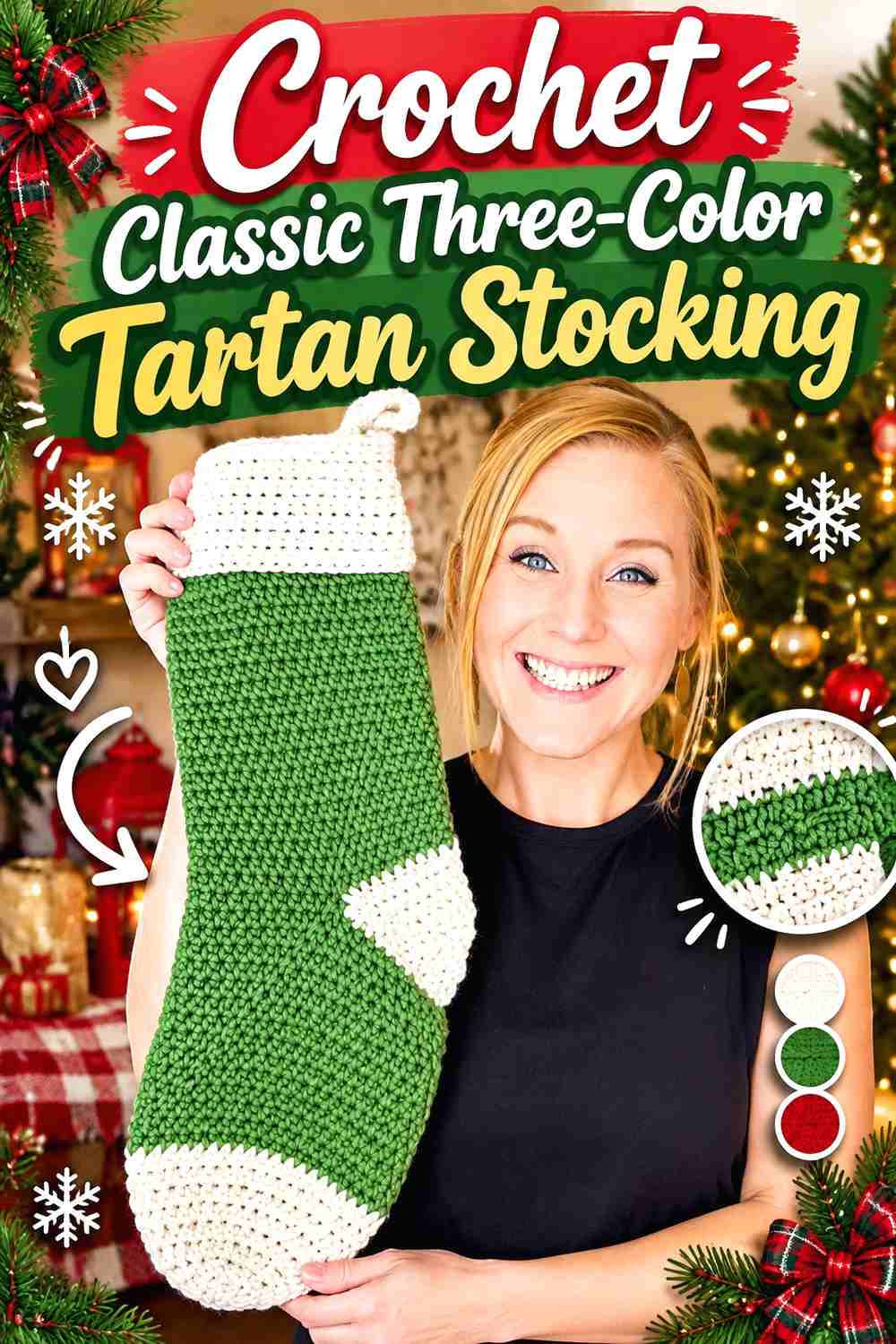
Crochet With Tiffany’s full-size stocking tutorial clearly separates the main stocking areas, including the toe, heel opening, cuff, loop, and heel.
That makes it a useful foundation for a traditional three-color tartan where the body carries most of the checks and the cuff remains comparatively quiet.
Give the Three Colors Different Jobs
A strong tartan benefits from hierarchy. Use one shade as the dominant field, one as the darkest grid color, and the third as a connecting mid-tone.
If all three colors have nearly the same value, the checks may become muddy from a distance.
Let the Folded Cuff Calm the Pattern
A substantial cuff already introduces visual weight at the top. Keeping it solid allows the tartan below to remain the focal point.
Choose a cuff color already present in the grid so it still feels part of the same design.
Decide Where the Tartan Ends Before Reaching the Heel
A full plaid foot feels more continuous, while a solid foot and heel create stronger blocks of color and simplify the shaped areas.
Neither approach is inherently better. Choose according to whether you want uninterrupted tartan or a more traditional stocking silhouette with patterned and solid sections.
Creator Credit: Crochet With Tiffany
Which Tartan Stocking Construction Makes the Strongest Heirloom?
If you want the most direct route to an unmistakably checked stocking, start with the MJ’s Off The Hook Designs plaid construction. It already treats plaid as part of the stocking rather than as an added decoration.
For fine colorwork, the Fair Isle approach from The Unraveled Mitten offers a useful route because the patterned area is integrated into the fabric. Surface-line and cross-stitch adaptations from the Naztazia and Yarnspirations bases offer more freedom to finish the stocking first and develop the tartan afterward.
For a patchwork heirloom, Bella Coco’s hexagon stocking, the small-motif design, and Last Minute Laura’s granny-square stocking let you rearrange color before final assembly. Those approaches are especially useful when each family member will have a related but different palette.
If texture matters more than full-body tartan, choose the Rich Textures Crochet, Make & Do Crew, Turtle Trunk, or Sierra Fontaine constructions and confine plaid to a cuff, band, or controlled accent. That prevents the tartan from obscuring the feature that makes each stocking distinctive.
Conclusion
A strong crochet tartan stocking is not simply a standard stocking made with several Christmas colors. The most convincing designs consider where the lines intersect, how the pattern changes around shaping, which areas should remain solid, and how the stocking will look when it is hanging rather than lying flat.
Choose direct plaid or Fair Isle colorwork if you want the pattern integrated into the fabric. Use surface lines or cross-stitch when you want more control after shaping. Select hexagons, small motifs, or granny squares for a patchwork interpretation, and reserve tartan for the cuff when cables or heavy texture deserve to remain visible.
For an heirloom set, make one stocking or substantial swatch before committing to the entire family collection. Check the colors from across the room, inspect the inside, test the hanging point, and record the yarn choices and color order you want to repeat. Use the original creator tutorial for exact stocking construction and verify its sizing, yarn, and finishing details before making adaptations.
Frequently Asked Questions
What is the difference between a crochet tartan stocking and a buffalo-plaid stocking?
Buffalo plaid usually relies on relatively large repeating checks and a small number of colors. A tartan-inspired crochet design can use more varied horizontal and vertical relationships, narrower accent lines, or additional colors. Crochet cannot reproduce woven tartan in exactly the same structural way unless a specific technique is designed to imitate it, so many handmade versions are better described as tartan-inspired.
How many colors should I use in a crochet tartan Christmas stocking?
There is no required number. Three colors can produce a clear checked effect, while four or more allow more complex tartan-inspired arrangements. What matters most is that the shades remain distinguishable when reduced to small areas. Test them together before beginning the full stocking.
Should the heel and toe match the tartan body?
They can, but they do not have to. Solid heels and toes are useful because shaping can interrupt a strict check repeat. Repeating one of the tartan colors in those areas keeps the stocking cohesive while giving the eye a break from the grid.
Can I add tartan to an ordinary crochet stocking pattern?
Yes, but treat the tartan as a separate design adaptation unless the original pattern specifically includes it. Surface crochet or cross-stitch may be easier to add after the stocking is complete, while integrated checked colorwork requires more planning because tension and yarn carrying can alter the fabric.
How do I keep carried yarn from snagging inside a tartan stocking?
Follow the source tutorial’s colorwork guidance and inspect the inside as you work. Long loose floats can catch on objects placed inside the stocking. Depending on the construction and intended use, you may also decide that a lining is worthwhile, but confirm that it will not distort the crochet shape.
What colors create a traditional heirloom tartan look for Christmas?
Deep red, burgundy, forest green, navy, charcoal, cream, brown, and muted gold can all work. You do not need to use every color in one stocking. A restrained combination such as burgundy, dark green, and cream can look more timeless than a large number of competing shades.
Is a tartan crochet stocking strong enough to fill with gifts?
That depends on the construction, yarn, seams, and hanging loop. Do not judge strength from appearance alone. If you expect the stocking to hold more than lightweight items, pay particular attention to the hanger, upper edge, joins, and stretch of the finished fabric, and follow any load or construction guidance given by the original designer.