A manual recliner lever is a small part of a favorite chair, but its hard plastic or metal handgrip can feel less pleasant than the surrounding upholstery. These 18 crochet recliner lever soft grip sleeve inspiration ideas explore different ways to add a soft-looking textile covering to the outer gripping portion of a side lever. The collection includes simple ribbed sleeves, removable-looking wraps, buttoned and zippered closures, colorblock details and small decorative motifs in warm, modern and cottage-inspired colors.
The designs focus on the lever’s hand-contact area rather than the reclining mechanism itself. Some covers are closely fitted and plain, while others explore texture, lining or removable fastenings. As you compare the concepts, consider your own chair’s handle size, lever travel, available finger clearance and whether the manufacturer permits accessories on its controls. These are decorative design explorations, not tested grip aids, and a cover must never obstruct a recliner’s safe operation.
These are AI-generated crochet design visualizations for inspiration, not photographs of tested handmade pieces or step-by-step patterns.
Quick Design Selection Guide
- For a simple, understated sleeve: Crochet Charcoal Minimal Lever Grip Sleeve and Crochet Terracotta Ribbed Recliner Lever Sleeve use compact shapes without complicated closures.
- For removable-looking fastenings: Crochet Navy Snap-Wrap Recliner Grip, Crochet Dusty Blue Buttoned Lever Sleeve and Crochet Teal Side-Zip Recliner Grip Wrap explore three different opening methods.
- For decorative crochet details: Crochet Ivory Scalloped Lever End Cuff, Crochet Mustard Granny Patch Lever Wrap and Crochet Olive Leaf Accent Lever Cover add small, low-profile motifs.
- For textured grip surfaces: Crochet Moss Spiral Recliner Lever Cover and Crochet Plum Waffle-Textured Recliner Grip feature raised stitch arrangements.
- For a smoother interior: Crochet Oatmeal Lined Comfort Lever Sleeve includes a thin cotton lining, while Crochet Indigo Diamond Mesh-Lined Lever Sleeve uses a solid crochet layer beneath its openwork.
- For a distinctive outer-tip shape: Crochet Coral Flared-Tip Recliner Grip and Crochet Blush Cloud-Edge Lever Grip add controlled shaping around the end.
1. Crochet Terracotta Ribbed Recliner Lever Sleeve
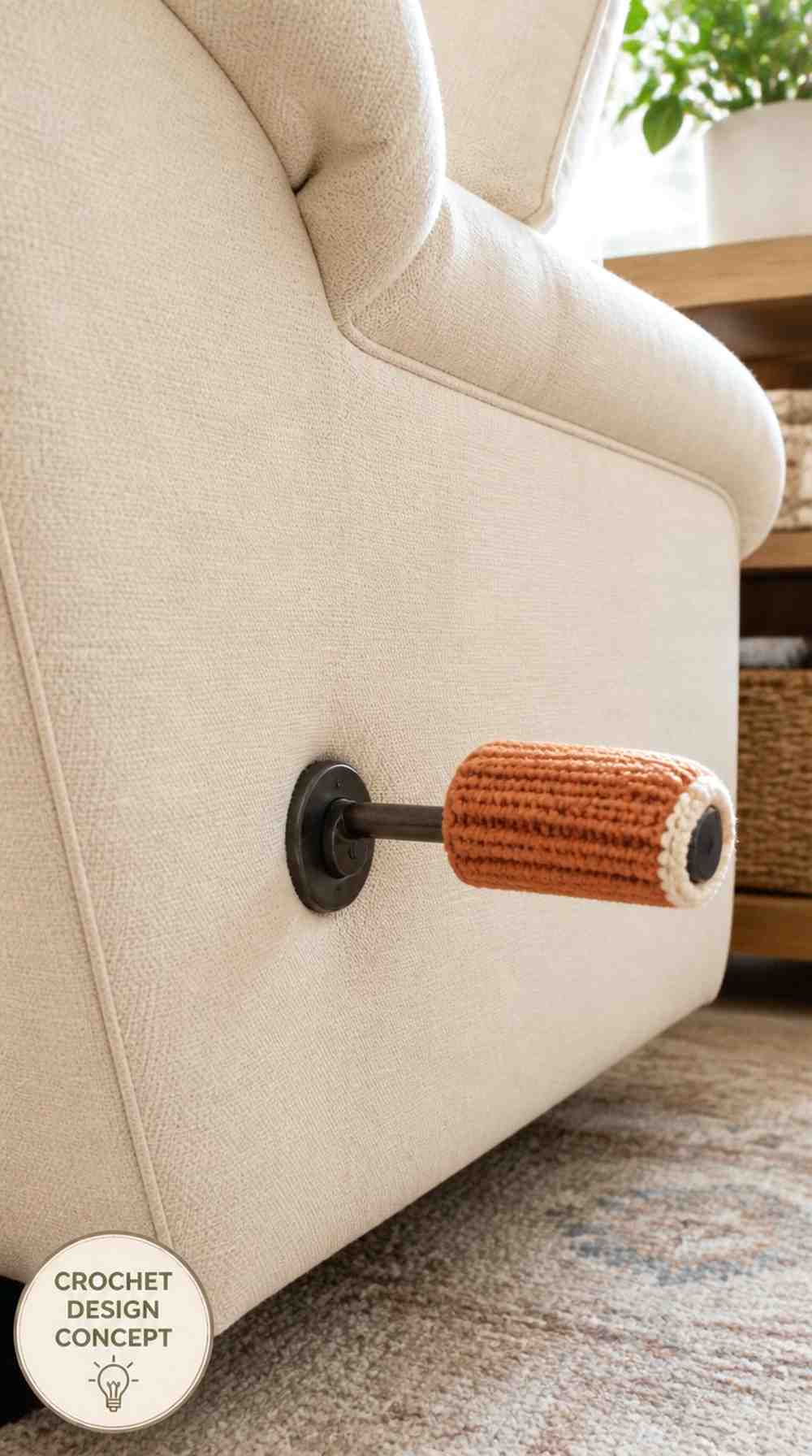
Warm terracotta crochet brings a subtle handmade finish to the black oval handgrip of this cream recliner. Closely worked lengthwise ribs cover the short sleeve, while a narrow ivory border finishes its rounded outer tip. The silver lever shaft remains exposed below the covering.
Its compact shape makes this a useful starting point for comparing sleeve lengths and stitch textures. The ribs add a gentle raised surface, although any change in actual grip comfort would depend on the finished fabric, handle shape and how securely it stays in place.
- Rib Direction: Lengthwise crochet ribs follow the handgrip, creating a different surface from horizontal rows without requiring thick added padding.
- Inner Opening: End the terracotta fabric before the lever shaft and moving joint, allowing the full original range of movement to remain clear.
- Fitting Check: A sleeve that rotates or slides during operation is unsuitable; the finished cover must remain secure without restricting the lever.
2. Crochet Navy Snap-Wrap Recliner Grip
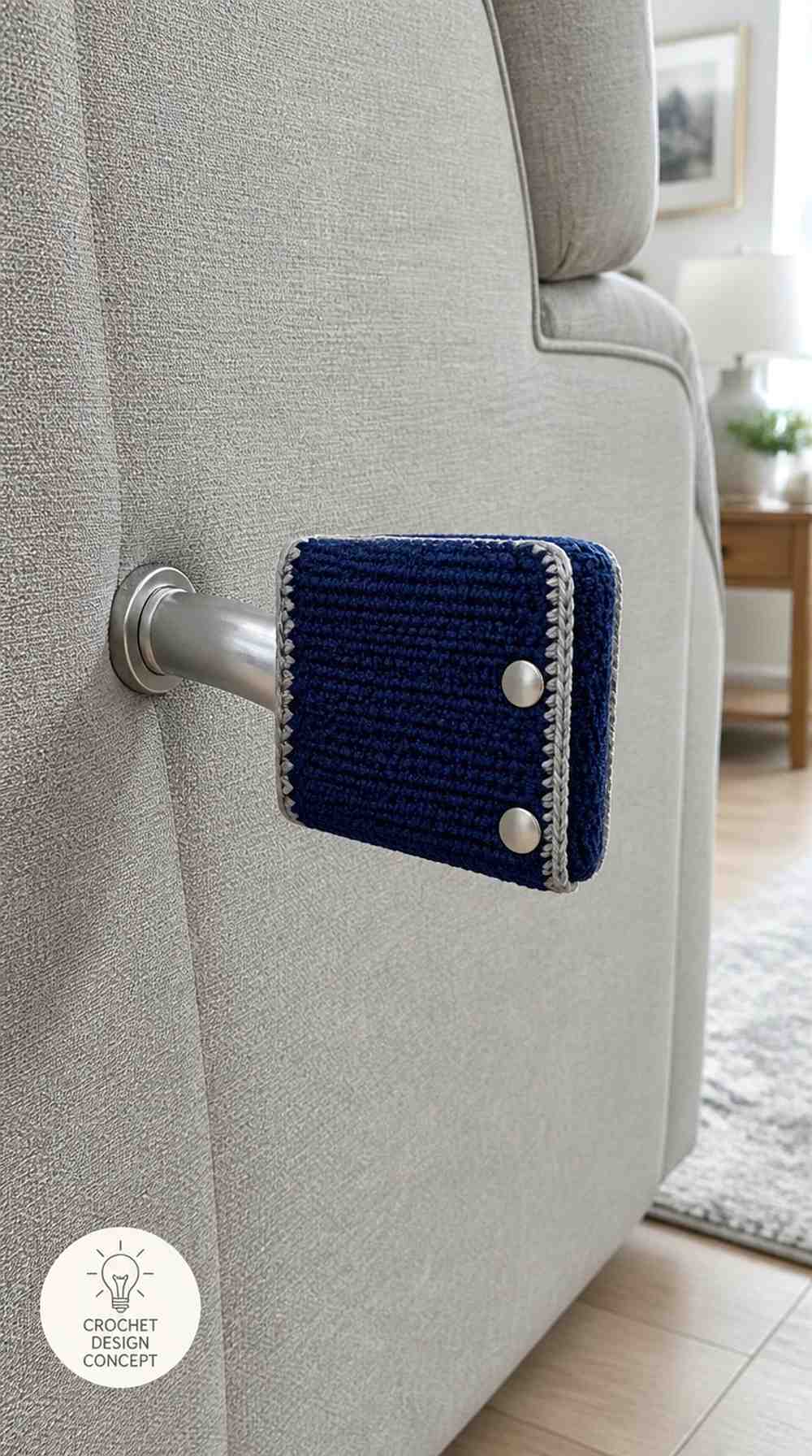
Deep navy crochet gives this removable-looking lever cover a tailored appearance. Two small matte-silver snaps close the overlapping side edges around a flattened black handgrip, while pale-grey edging defines the compact rectangular wrap.
The snap arrangement is the main feature because it suggests a way to remove the textile without pulling it over the entire handle. That could simplify cleaning, but the closure would need to sit away from the user’s fingers and remain securely fastened during normal lever movement.
- Snap Position: Keep the two metal snaps on a low-contact side of the wrap where they do not press against the hand.
- Overlap Thickness: Avoid making the navy closure overlap excessively bulky, especially if the lever passes close to the chair’s upholstery.
- Removable Fit: Check whether the snaps can open accidentally or catch against the chair as the lever moves through its full travel.
3. Crochet Ivory Scalloped Lever End Cuff
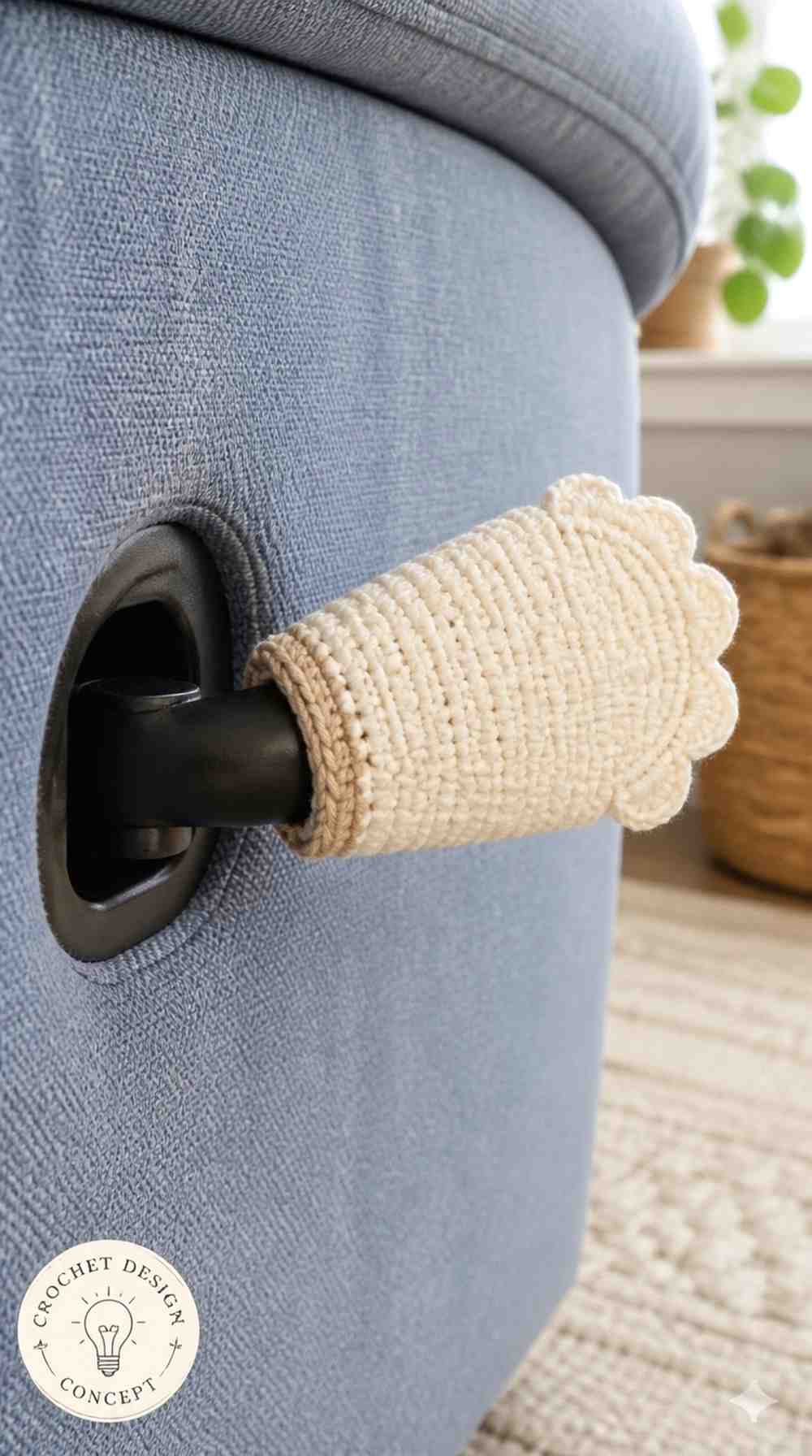
Warm-ivory crochet creates a delicate finish around the outer grip of this blue upholstered recliner. Six tiny scallops decorate the rounded tip, while an oatmeal-colored band defines the opposite opening. The central section remains closely stitched and smooth.
The small scallops provide a decorative alternative to a plain sleeve without covering the whole metal lever. Their position is important because raised details near the shaft could interfere with movement. This design is better treated as a compact decorative idea than a way to enlarge the control.
- Scallop Size: Keep all six decorative sections low and evenly joined so they cannot catch against upholstery or fingers.
- Tip Coverage: Concentrate the edging around the outermost handgrip instead of extending fabric along the metal shaft.
- Light Yarn Care: Ivory crochet may show hand oils and dust more readily; removable construction would make appropriate cleaning easier.
4. Crochet Moss Spiral Recliner Lever Cover
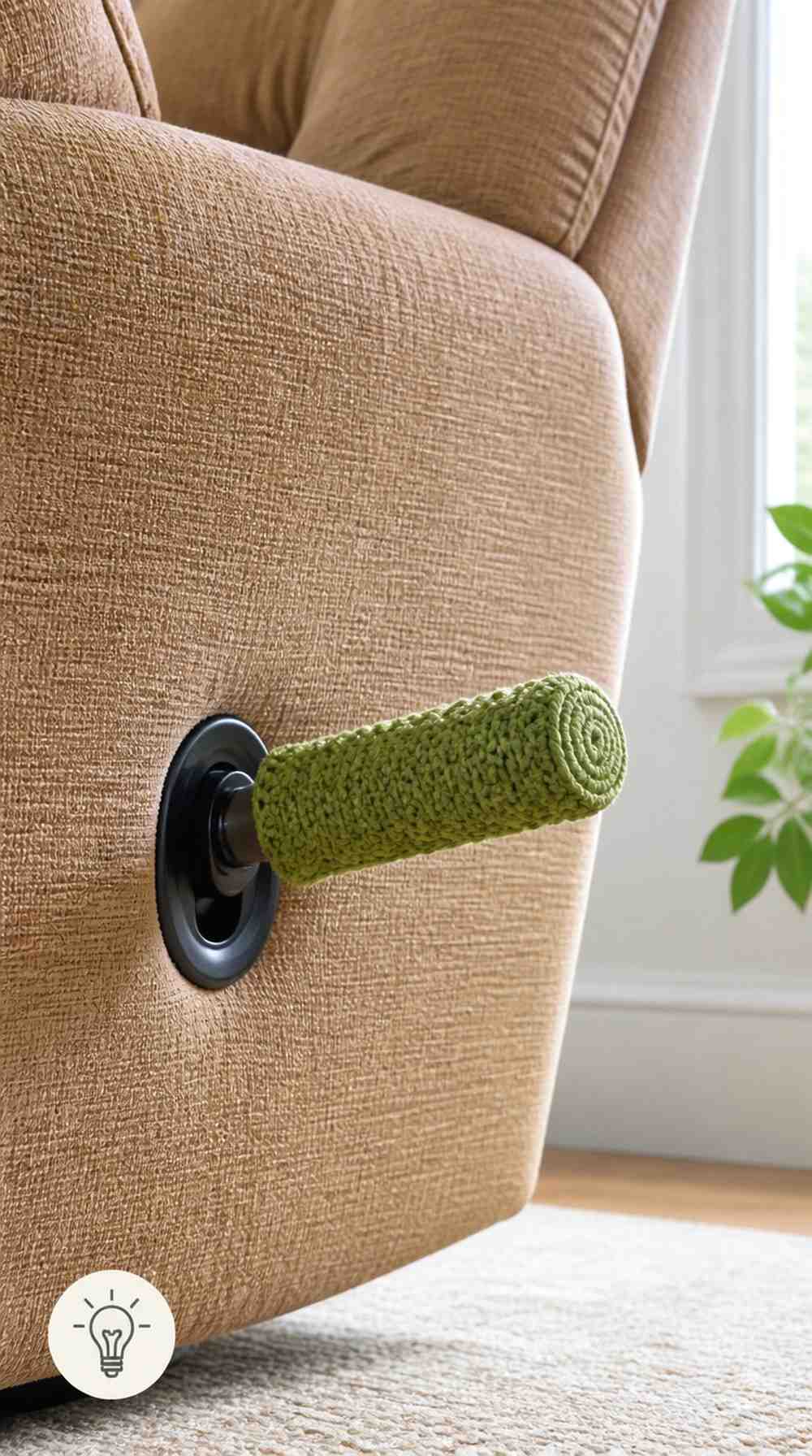
Moss-green crochet gives this tubular lever sleeve a quiet botanical character. Diagonal raised stitches wind gently around the surface, forming a continuous spiral from the open base toward the rounded outer end cap.
The design looks particularly natural against camel-colored fabric upholstery. Unlike a flat wrap, its tubular shape would normally require accurate sizing for the original handgrip. A spiral texture may feel different beneath the fingers, but the rendered design does not establish whether that texture improves control or comfort.
- Tubular Fit: Match the actual handgrip shape before developing a closed crochet sleeve; not every recliner lever has a removable or uniform tip.
- Spiral Height: Keep the diagonal ridges shallow enough to avoid creating uncomfortable pressure points during operation.
- End Cap: The rounded crochet end should sit smoothly against the handgrip without slipping forward or interfering with the lever’s movement.
5. Crochet Burgundy Lace-Up Lever Wrap
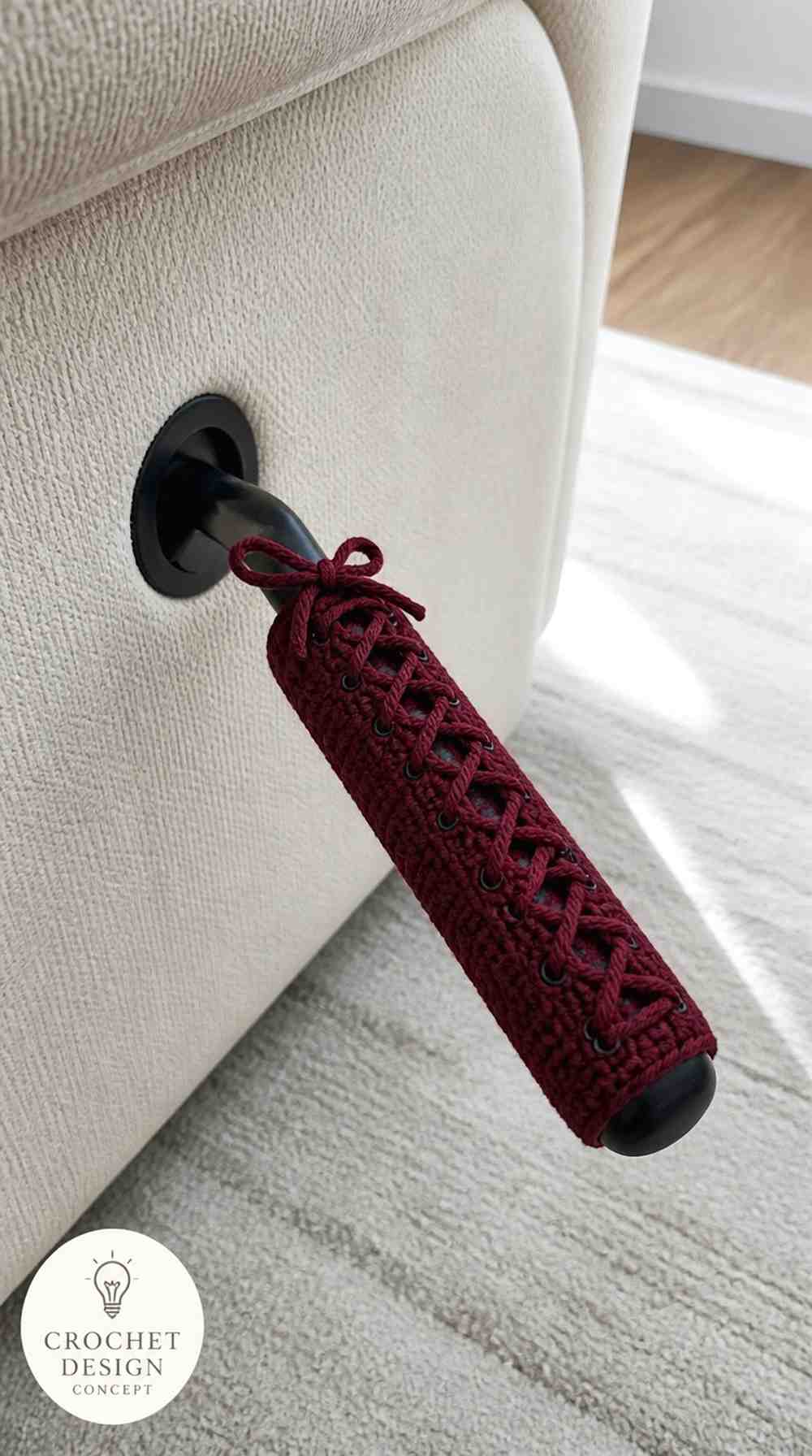
Rich burgundy crochet gives this short lever grip a vintage-inspired look. Four pairs of small reinforced eyelets run along one upper side, with a matching burgundy lace drawing the wrap together over the black handgrip.
The lacing introduces a possible way to adjust the fit without adding buttons or snaps. It also brings more potential snagging points than a simple closed sleeve. The short tied ends shown in the design are especially important because loose cords should never hang toward the reclining mechanism.
- Eyelet Reinforcement: Keep the four paired openings properly edged so tightening the lace does not distort the surrounding crochet.
- Short Lace Ends: Secure the tied ends neatly and avoid dangling cords that might enter moving chair components.
- Closure Security: A lace-up sleeve should not be used if it loosens, rotates or changes the amount of force needed to operate the lever.
6. Crochet Caramel Two-Tone Recliner Grip
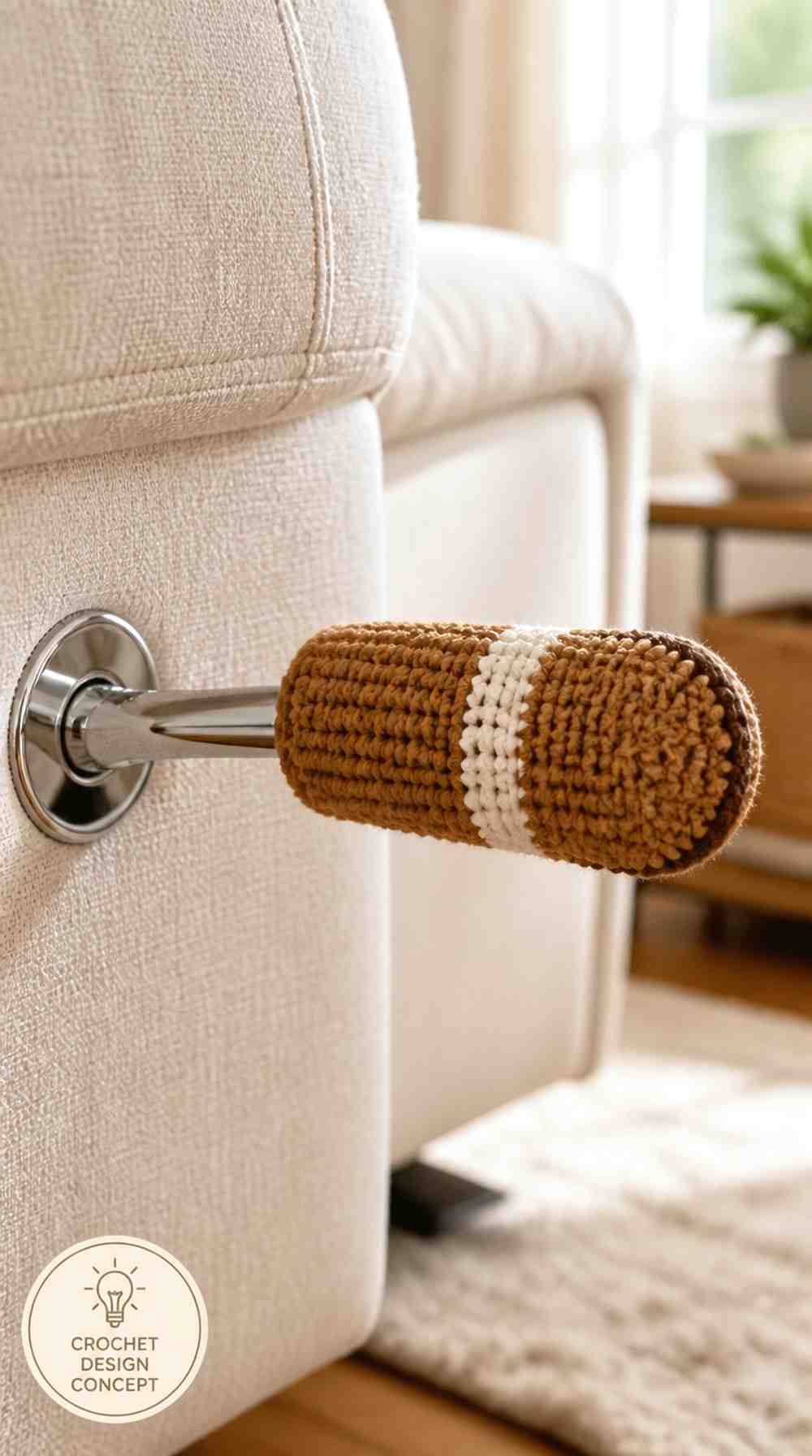
Caramel-brown crochet brings a warm, understated appearance to this silver recliner lever. A single cream band runs around the sleeve’s center, while dark cocoa trim finishes the outer rounded tip. Fine horizontal stitches keep the main surface relatively smooth.
The three-color arrangement adds a recognizable detail without relying on raised motifs or separate hardware. Its compact form suits neutral upholstery and wooden living-room furniture. The central stripe is decorative rather than a tested grip guide, so comfort should be judged from a real sample rather than color placement.
- Color Placement: Keep the cream band centered on the handgrip where it remains visible without extending toward the lever shaft.
- Smooth Stitching: Close-textured horizontal rows create a flatter surface than large bobbles, although the fabric still needs checking for movement.
- Edge Thickness: Use a restrained cocoa border so the outer end does not become unnecessarily bulky.
7. Crochet Mustard Granny Patch Lever Wrap
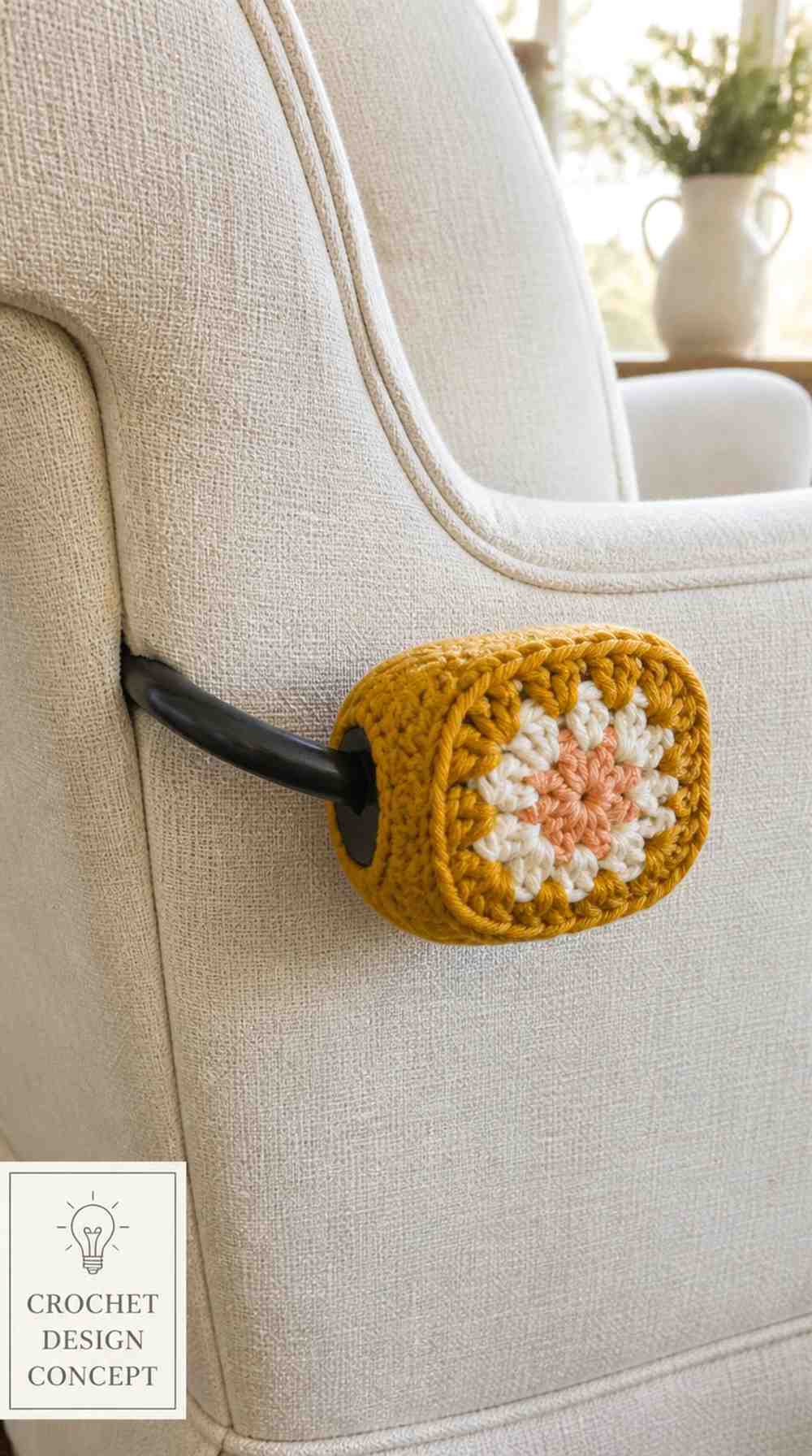
Muted mustard crochet brings traditional granny-square texture to this small recliner handgrip. One tiny square motif decorates the outward-facing surface, with an apricot center, ivory middle round and mustard border joined to a solid crochet backing.
The motif gives the sleeve a different appearance from a plain ribbed cover while leaving the opposite gripping surface relatively simple. Because the square adds another layer, its corners and joining stitches would need to remain flat. A large raised granny motif could become uncomfortable or interfere with the user’s hand.
- Motif Proportion: Keep the granny square smaller than the handgrip’s main contact area, leaving enough smooth crochet around its edges.
- Flat Joining: Secure all four corners against the mustard backing so the decorative square cannot lift or snag.
- Surface Bulk: Consider a finer crochet motif rather than several heavy layers that could make the original lever harder to grasp.
8. Crochet Dusty Blue Buttoned Lever Sleeve
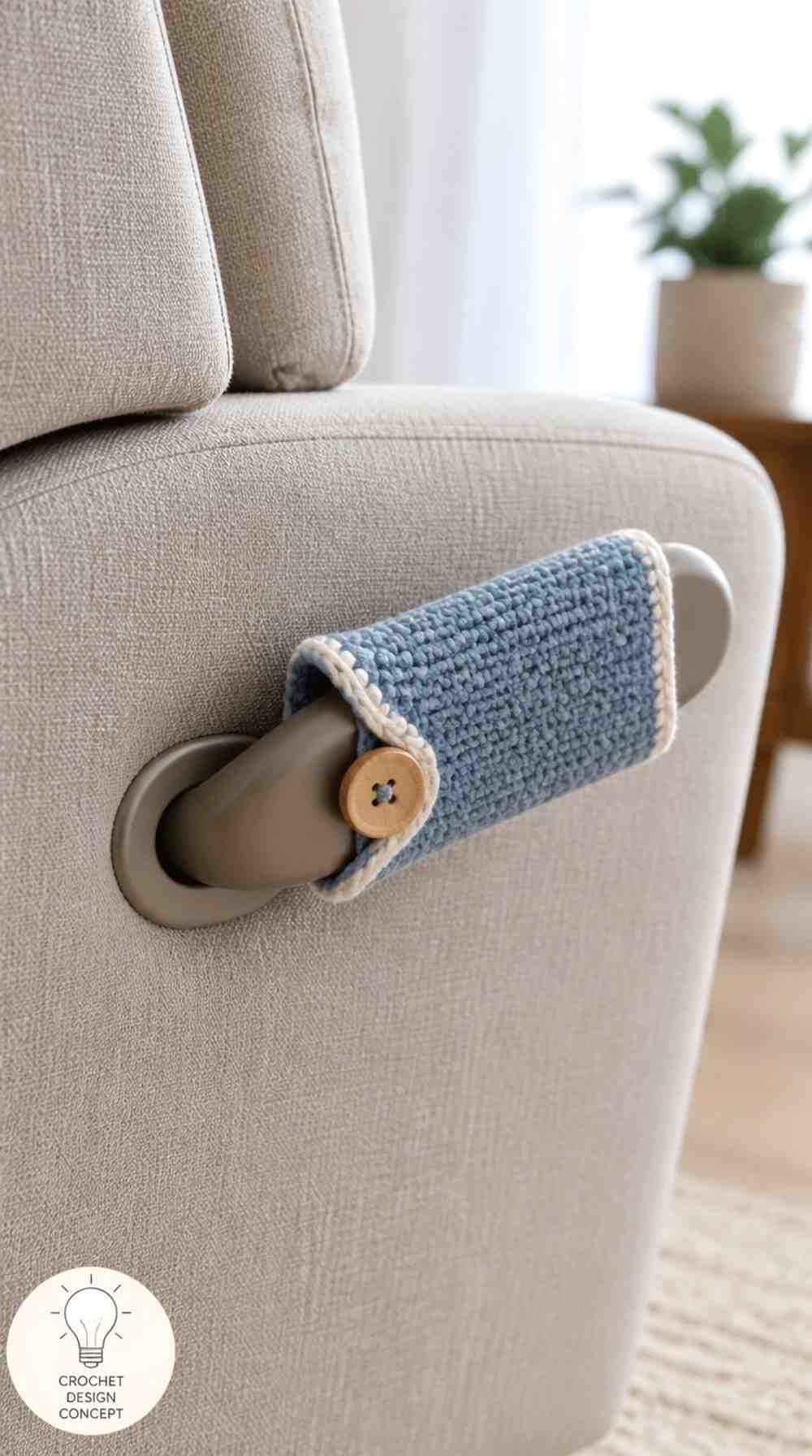
Dusty-blue crochet creates a compact wrap with a small natural wooden button on its outer side. The rectangular sleeve has fine horizontal rows, a narrow ivory border and one reinforced buttonhole positioned on a short overlapping flap.
The button provides a familiar handmade fastening detail and could make the wrap removable for cleaning. However, a button also introduces a hard surface on an otherwise soft cover. Its position matters, particularly when the user grips the lever from the side or reaches across the chair arm.
- Button Location: Place the wooden button away from the main hand-contact area and check that it cannot catch on nearby upholstery.
- Buttonhole Fit: The reinforced opening must hold the button without excessive stretching or accidental release.
- Fastening Clearance: A side flap should remain flat throughout the lever’s movement rather than folding into the pivot area.
9. Crochet Plum Waffle-Textured Recliner Grip
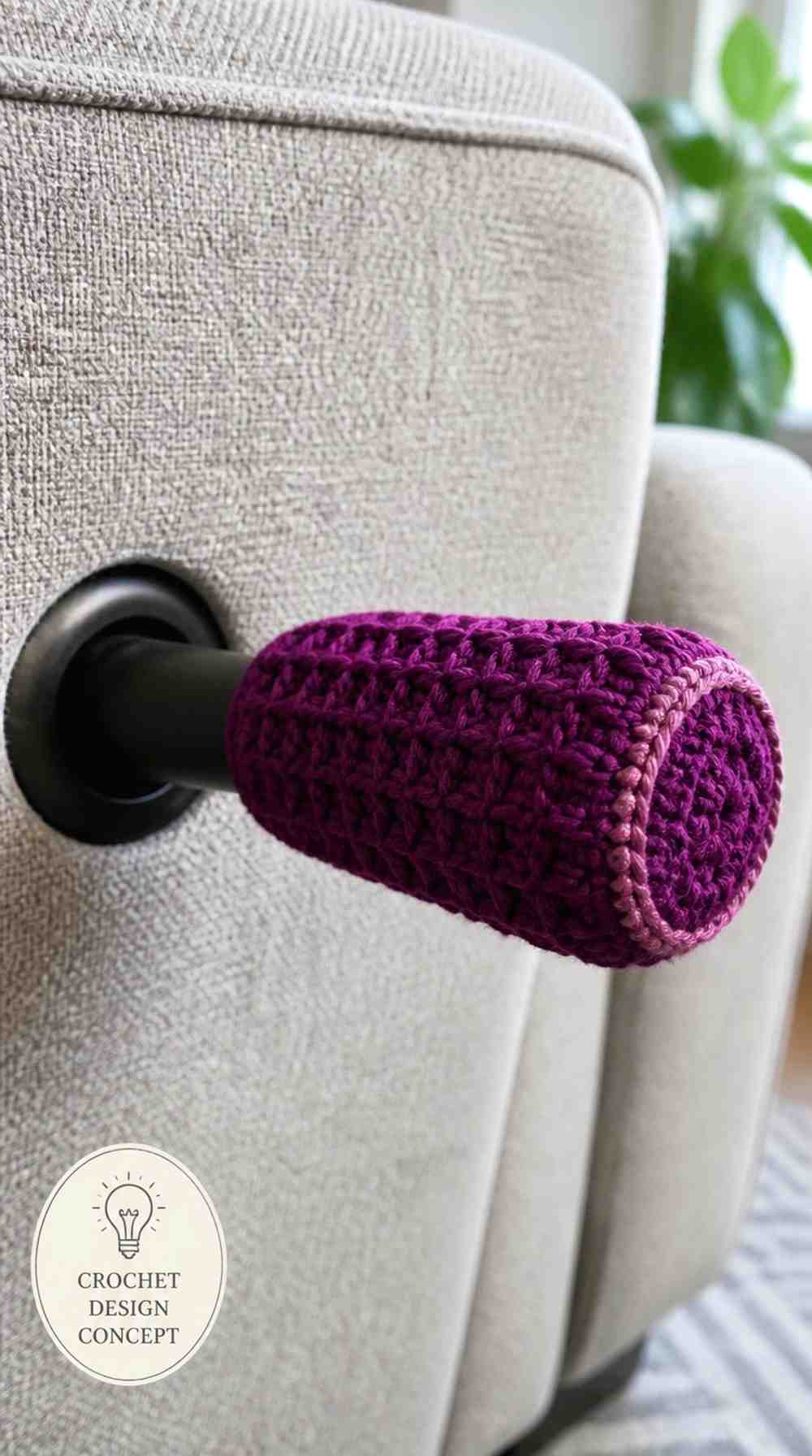
Deep plum crochet gives this short lever cover a rich, textured appearance. Small raised waffle-style squares cover the outward-facing side of the black oval handgrip, while the underside remains closely stitched and relatively smooth.
A narrow dusty-mauve border finishes the rounded outer end. The contrast between raised and flat crochet surfaces makes the design more distinctive than a uniformly textured sleeve. Whether the waffle pattern is comfortable depends on the finished yarn, stitch height and how the user’s fingers meet the grip.
- Waffle Relief: Keep each raised square shallow and consistently shaped, avoiding hard ridges that may press into the palm.
- Smooth Underside: The closely stitched lower surface can help reduce unnecessary bulk where fingers may curl beneath the handgrip.
- Grip Evaluation: A pronounced texture does not automatically improve traction; test the real fabric for slipping and comfortable operation.
10. Crochet Charcoal Minimal Lever Grip Sleeve
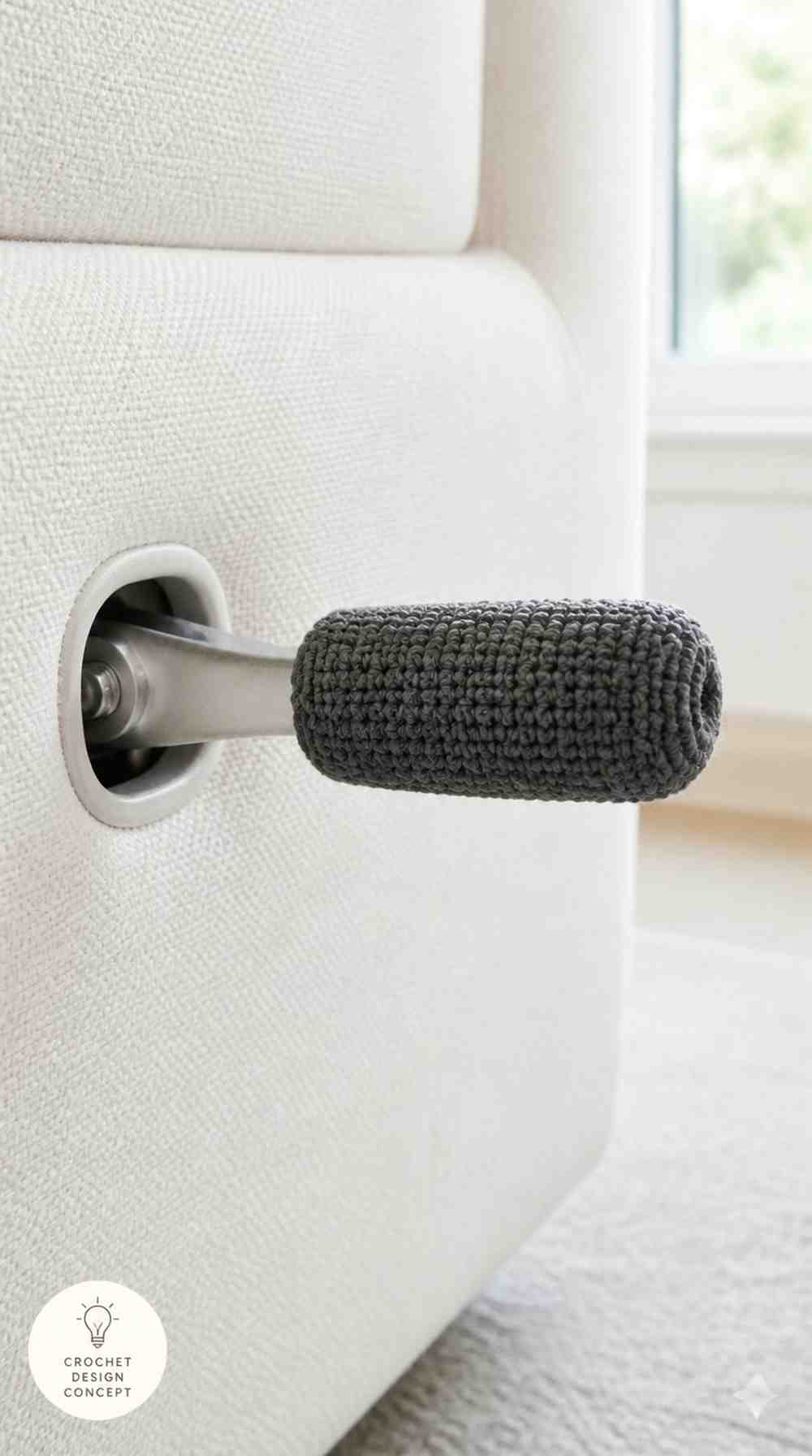
Charcoal-grey crochet gives this recliner lever a simple, understated finish. The compact sleeve follows the oval black handgrip, with closely worked rows, a smooth rounded end and one discreet joining seam running along the underside.
There are no buttons, decorative motifs or raised borders, allowing the shape of the original control to remain recognizable. Against ivory upholstery, the dark cover creates a subtle contrast. This is one of the least complicated visual concepts, although its closed construction still needs an accurate fit.
- Minimal Thickness: A single close-textured crochet layer may be preferable to bulky decoration where the original handgrip has limited clearance.
- Underside Seam: Keep the joining seam smooth and low so it does not create an uncomfortable ridge beneath the user’s fingers.
- Control Visibility: The charcoal covering should end before the exposed silver shaft, leaving the original mechanism clearly identifiable and unobstructed.
11. Crochet Olive Leaf Accent Lever Cover
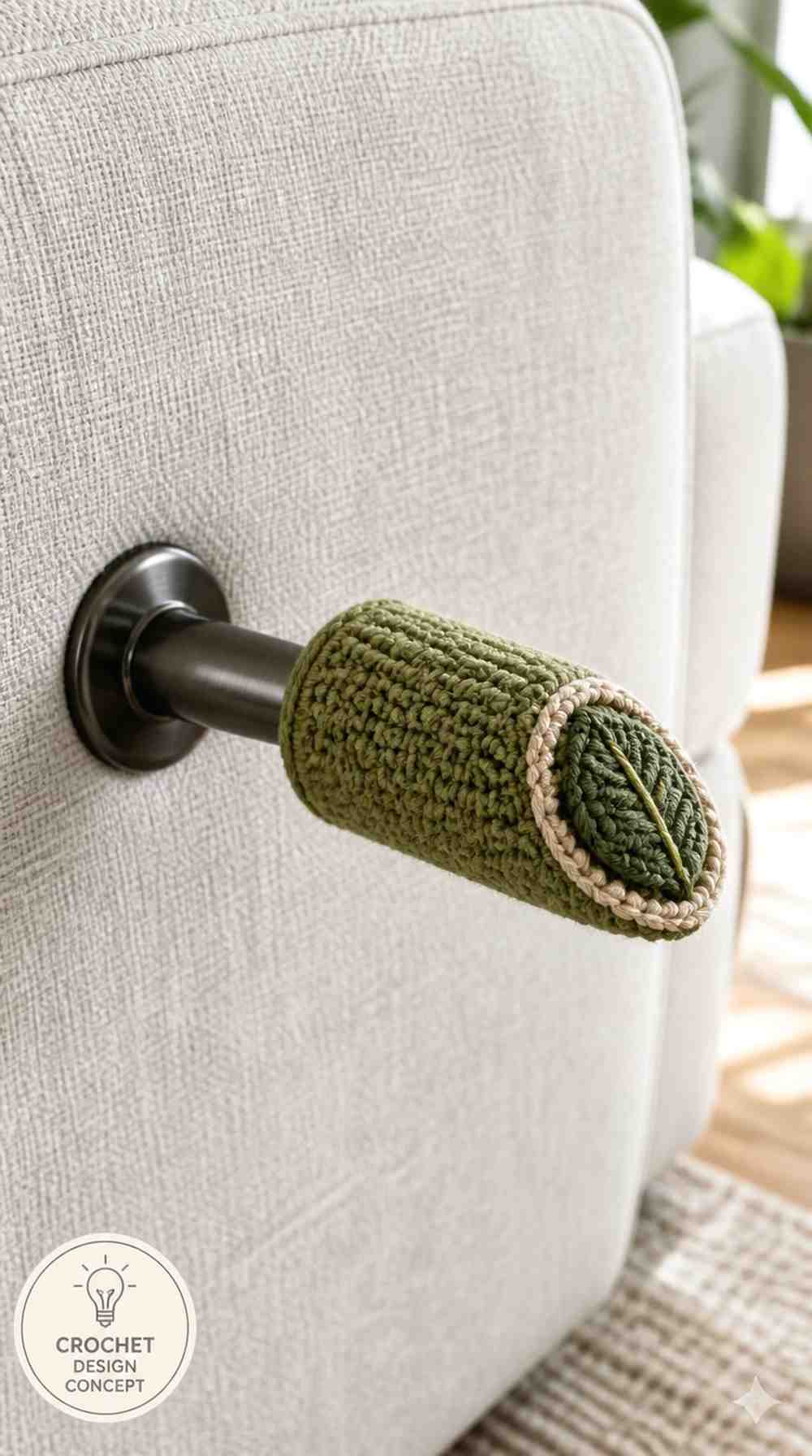
Olive-green crochet gives this recliner handgrip a soft botanical appearance. One small dark-olive leaf decorates the outer-facing surface, with a stitched central vein and neatly finished pointed ends. A thin cream border outlines the rounded tip.
The leaf introduces a recognizable motif without requiring an oversized flower or dangling ornament. Its placement on the outside of the sleeve leaves most of the handgrip relatively plain. The motif should remain fully attached, since loose leaf edges could catch during repeated lever operation.
- Leaf Position: Attach the dark-olive motif to the outward-facing surface rather than wrapping it around the shaft or moving joint.
- Secure Motif Edges: Join the pointed leaf ends carefully so they cannot lift when brushed by a hand or upholstery.
- Decorative Balance: A single small leaf adds visual detail without requiring raised stems, hanging cords or other parts that might interfere with the control.
12. Crochet Teal Side-Zip Recliner Grip Wrap
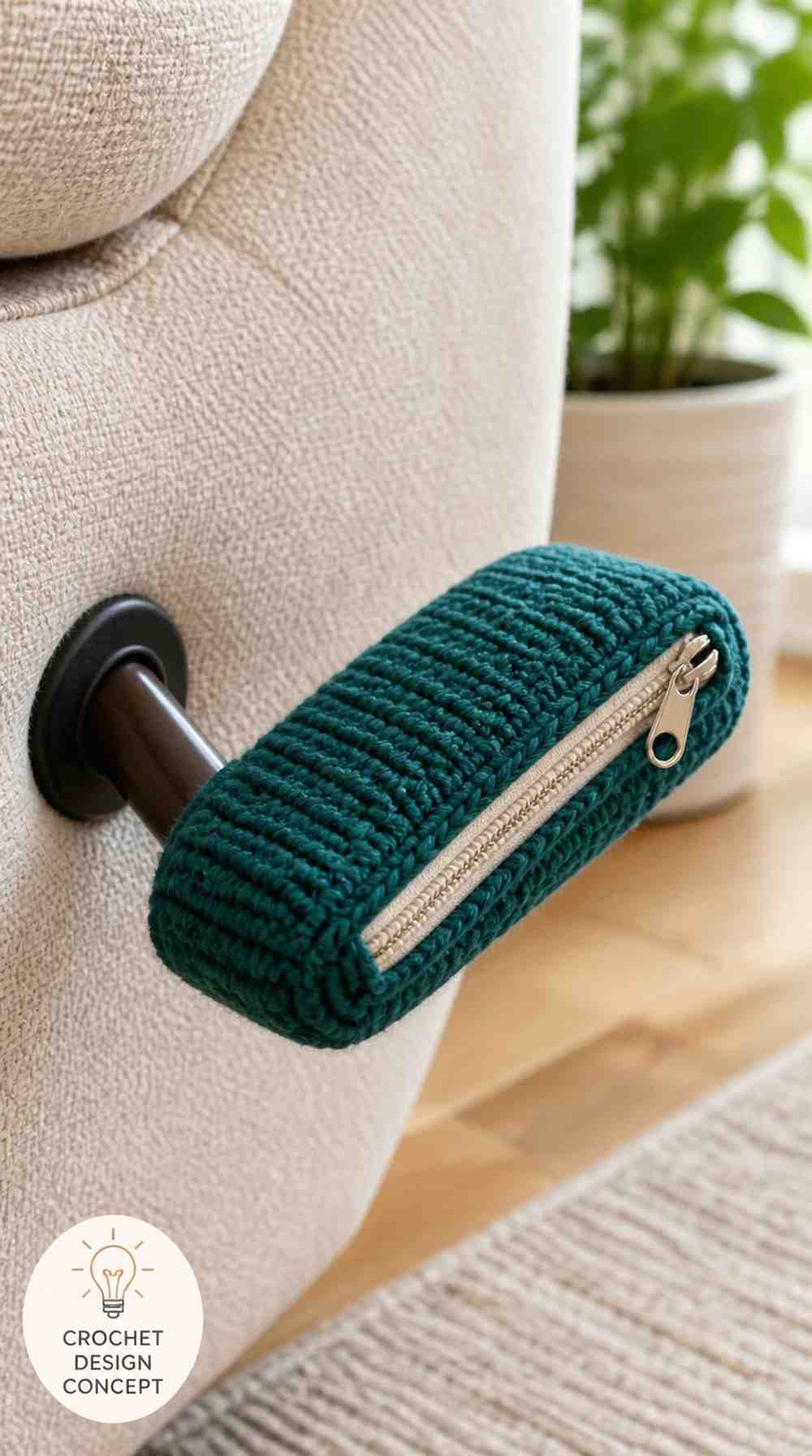
Deep-teal crochet gives this removable-looking lever wrap a neat, contemporary appearance. A short cream zipper runs along the outer side, with its small metal pull resting flat near the rounded tip. Closely worked crochet rows surround the flattened black handgrip.
The zipper makes this design different from buttoned and snap-fastened alternatives. It suggests a way to open the covering without sliding it over the complete lever. However, the zipper adds hardware that could press against fingers, scratch upholstery or become caught if incorrectly positioned.
- Zipper Length: Keep the closure entirely within the outer handgrip area, ending before the metal shaft and pivot.
- Pull-Tab Position: The zipper pull should remain flat and away from the chair upholstery throughout the lever’s full movement.
- Inner Finish: A smooth crochet interior or suitably thin lining may help keep zipper edges away from the original grip surface.
13. Crochet Blush Cloud-Edge Lever Grip
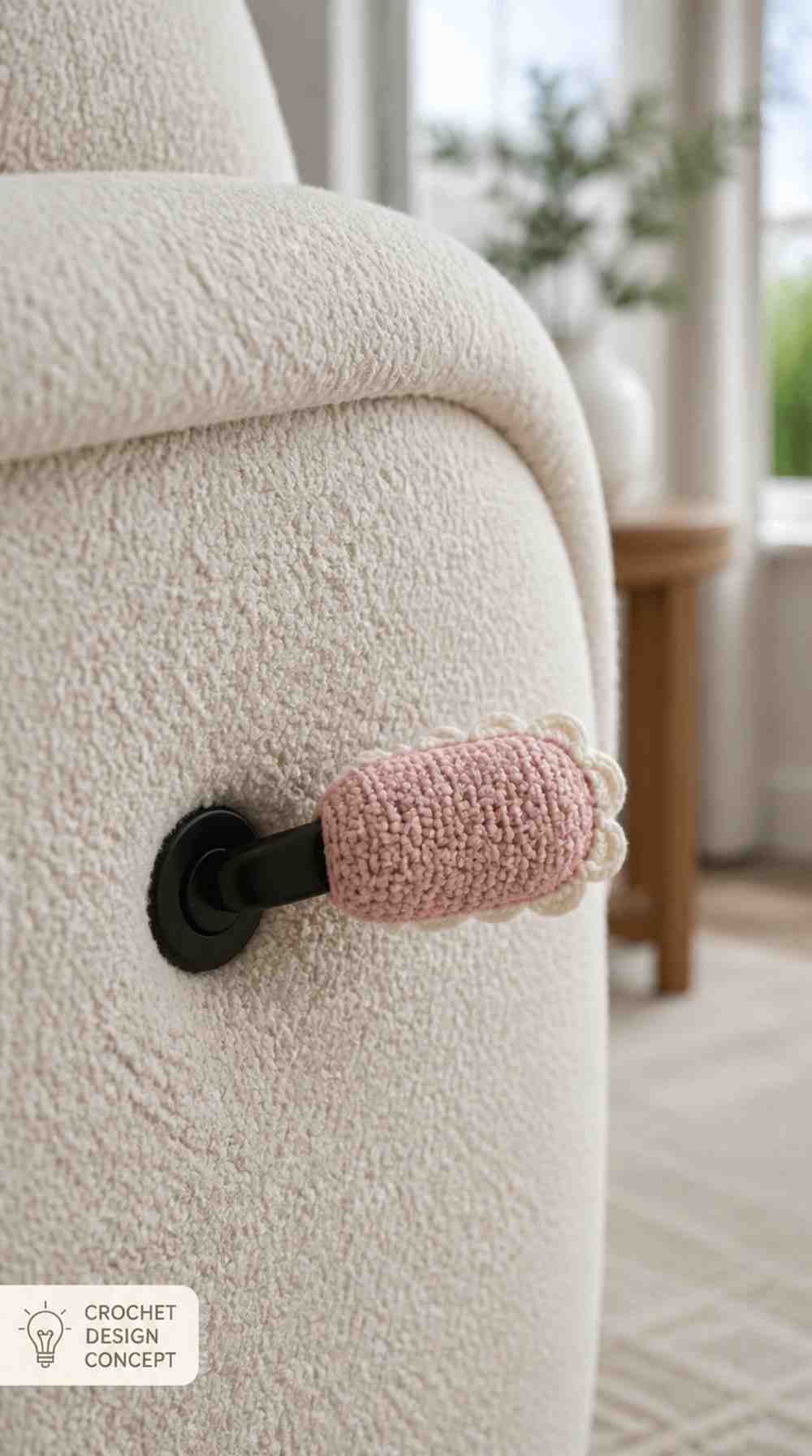
Dusty-blush crochet gives this compact lever sleeve a gentle, rounded silhouette. Five small cloud-like crochet lobes decorate the outermost end, with a restrained ivory outline following their curved shape.
The closely worked center remains relatively plain, allowing the unusual tip to become the main visual detail. Against cream upholstery, the blush color adds a soft decorative touch without creating strong contrast. The lobes should remain low and proportionate because the cover must not extend far enough to catch on surrounding furniture.
- Rounded Lobes: Keep all five cloud-like sections small and securely connected so their edges do not curl outward.
- Outer-Tip Clearance: Check that the decorative edge stays within the safe movement space available around the original lever.
- Contact Surface: Leave the central gripping section smoother than the decorative tip to avoid unnecessary texture beneath the hand.
14. Crochet Indigo Diamond Mesh-Lined Lever Sleeve
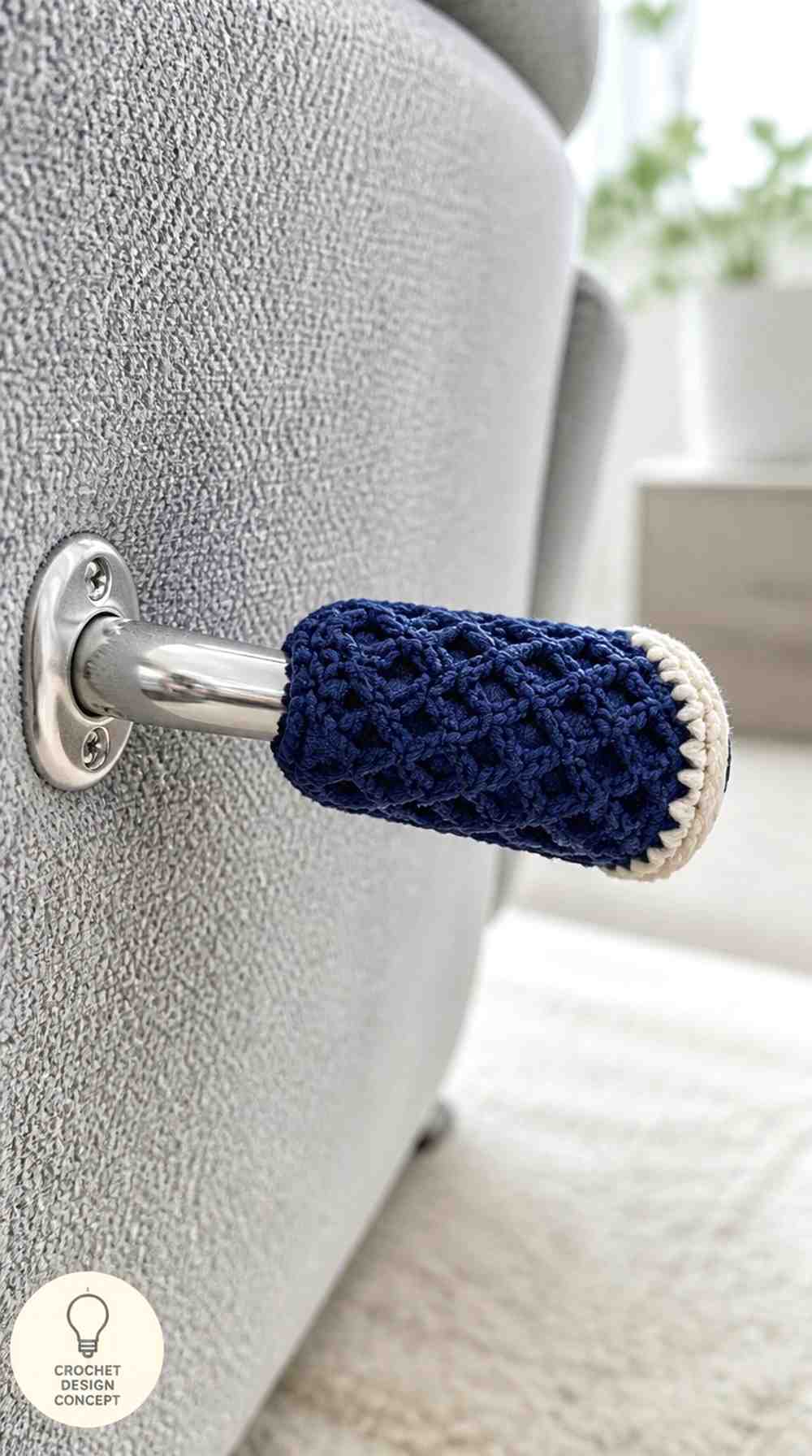
Indigo-blue crochet creates a layered handgrip cover with fine diamond-shaped openings. A solid, closely worked crochet base sits beneath the delicate mesh overlay, while a narrow ivory border defines the rounded outer end.
The two-layer construction gives this sleeve a different appearance from the openwork and solid-textured concepts. Because the mesh is decorative rather than the only covering, the black handgrip remains mostly hidden. Its extra thickness and exposed loops would still need evaluating before considering it for regular use.
- Mesh Connections: Keep each diamond opening properly joined so the surface remains orderly instead of developing loose loops.
- Solid Underlayer: A dense base prevents the decorative mesh from being the only fabric between the fingers and the original handgrip.
- Snagging Risk: Avoid open loops large enough to catch a finger, nail or nearby upholstery during lever operation.
15. Crochet Coral Flared-Tip Recliner Grip
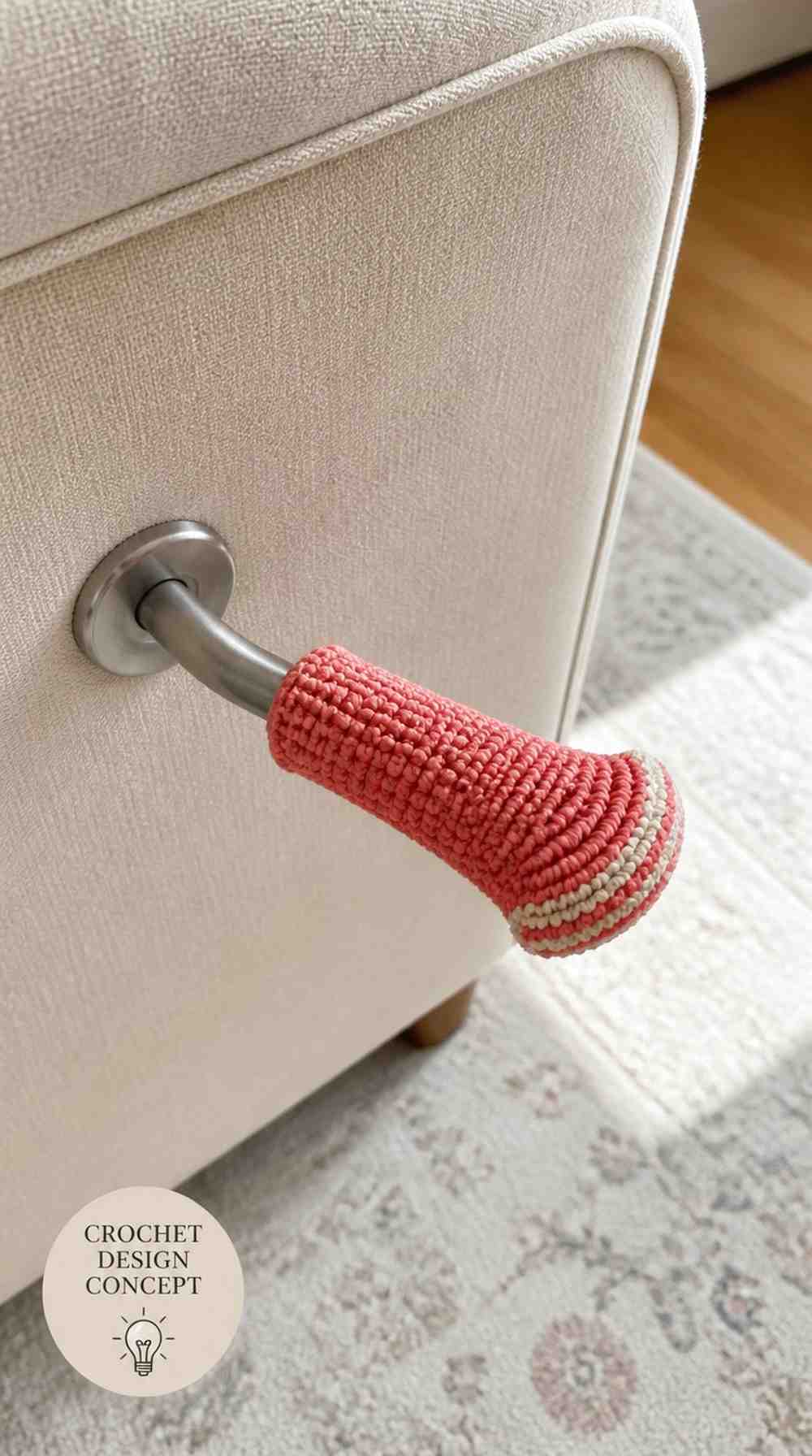
Coral-pink crochet creates a shaped sleeve that follows the flattened end of a black recliner handgrip. The inner section remains narrow, while the fabric widens gently toward the rounded outer tip. Fine cream edging follows the broader end.
The slight flare is the distinguishing feature, giving the cover a more sculpted appearance than a straight tubular sleeve. Its shaping should follow the original handle rather than substantially enlarging it. A bulky or extended tip could change how the user grips the control or restrict its movement.
- Flared Shape: Keep the wider end close to the original grip outline rather than forming an oversized extension beyond the lever.
- Narrow Inner Section: The coral sleeve should taper neatly toward its opening while leaving the exposed metal shaft untouched.
- Operating Clearance: Check the original lever’s full path before adding a shaped cover, especially on chairs with tightly fitted side panels.
16. Crochet Lilac Reversible Colorblock Lever Wrap
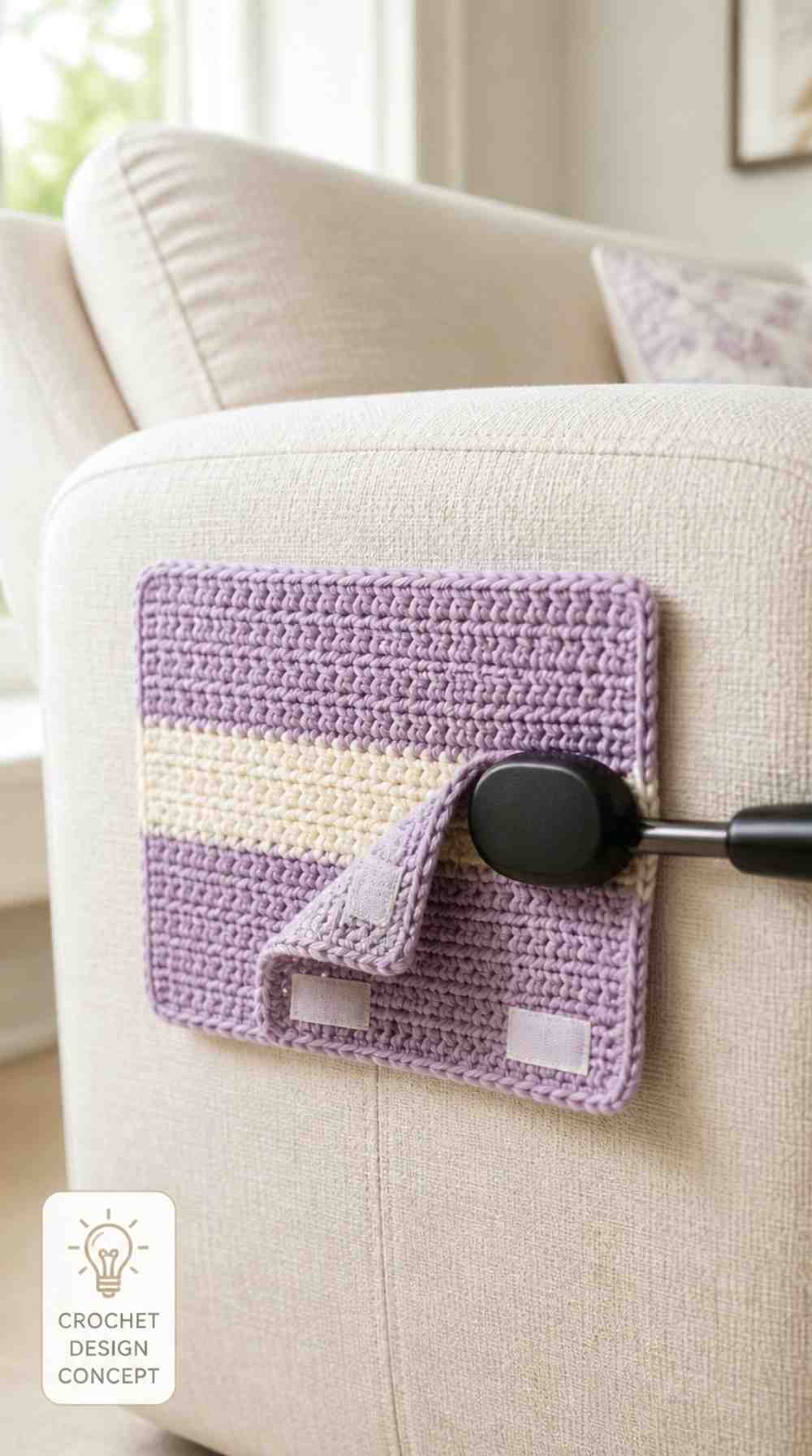
Dusty-lilac crochet gives this compact recliner grip wrap a soft colorblock appearance. A warm ivory stripe crosses the middle of the visible surface, while a gently lifted corner reveals a muted lavender reverse layer.
Two small flat fabric tabs form the pictured removable-looking attachment beneath the grip. The layered design offers more visual variety than a one-color sleeve, but the additional fabric needs careful finishing. A reversible-looking construction should not introduce folds, loose tabs or pressure points during normal chair operation.
- Two-Sided Finish: Join the lilac and lavender layers neatly so the wrap does not separate or wrinkle around the handgrip.
- Colorblock Position: Keep the ivory stripe within the gripping portion instead of extending it toward the moving shaft.
- Attachment Tabs: Secure the underside tabs so they remain flat and cannot catch beneath the lever or against nearby upholstery.
17. Crochet Rust Diagonal Crossing Lever Wrap
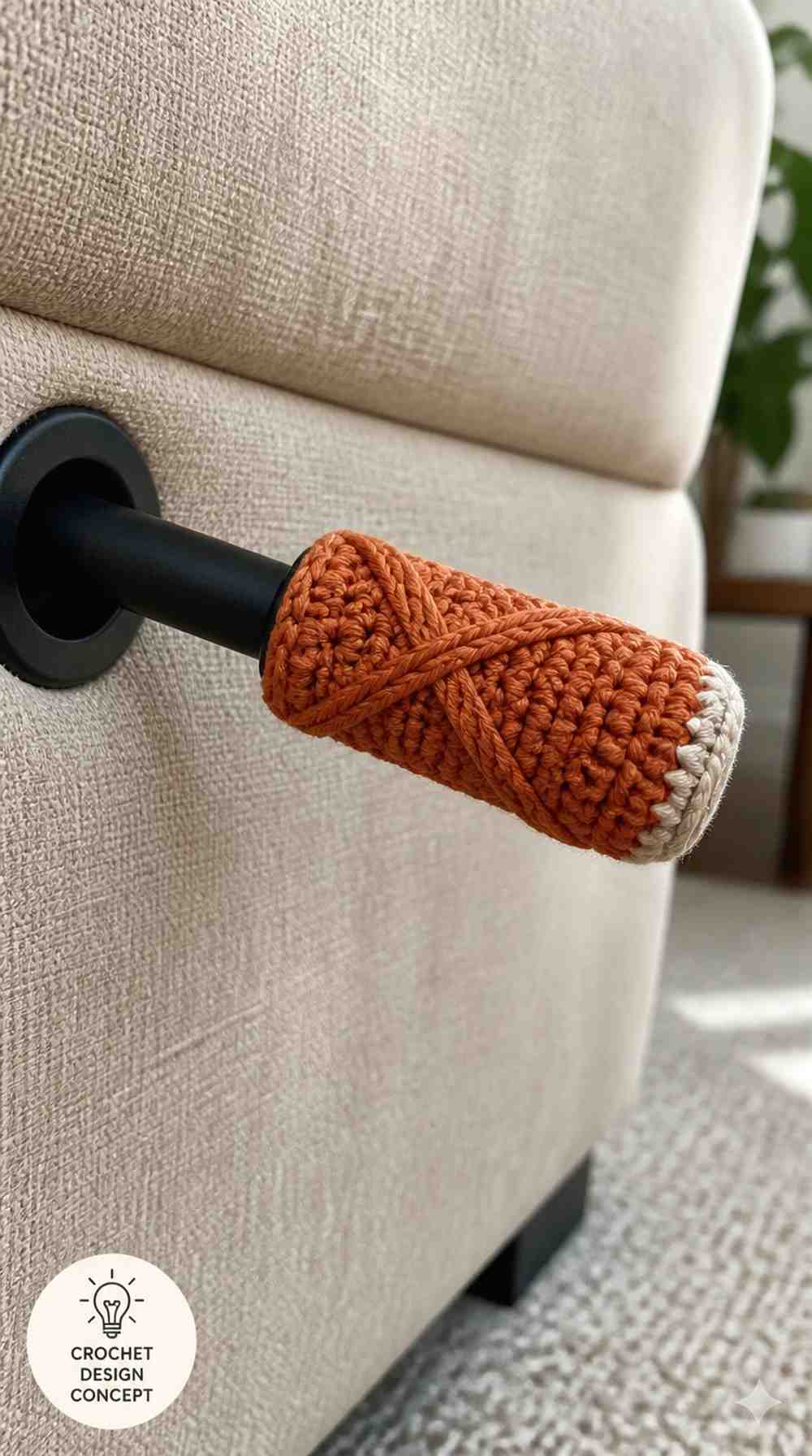
Rust-orange crochet gives this small lever sleeve a structured, handcrafted appearance. Two narrow matching bands cross diagonally over a closely stitched base, forming a single X-shaped detail on the outward-facing surface.
A fine oatmeal border finishes the rounded end, while the original metal shaft remains exposed. The crossing bands introduce depth without covering the whole grip in raised stitches. Their attachment is particularly important because loose diagonal straps could become caught by fingers during operation.
- Crossing Bands: Attach all four strap ends securely to the base sleeve so none can lift or twist during handling.
- Surface Height: Keep the X-shaped detail relatively flat to avoid adding a hard ridge beneath the user’s hand.
- Band Placement: Concentrate the crossed section on the outer grip surface, leaving the lever pivot and shaft completely uncovered.
18. Crochet Oatmeal Lined Comfort Lever Sleeve
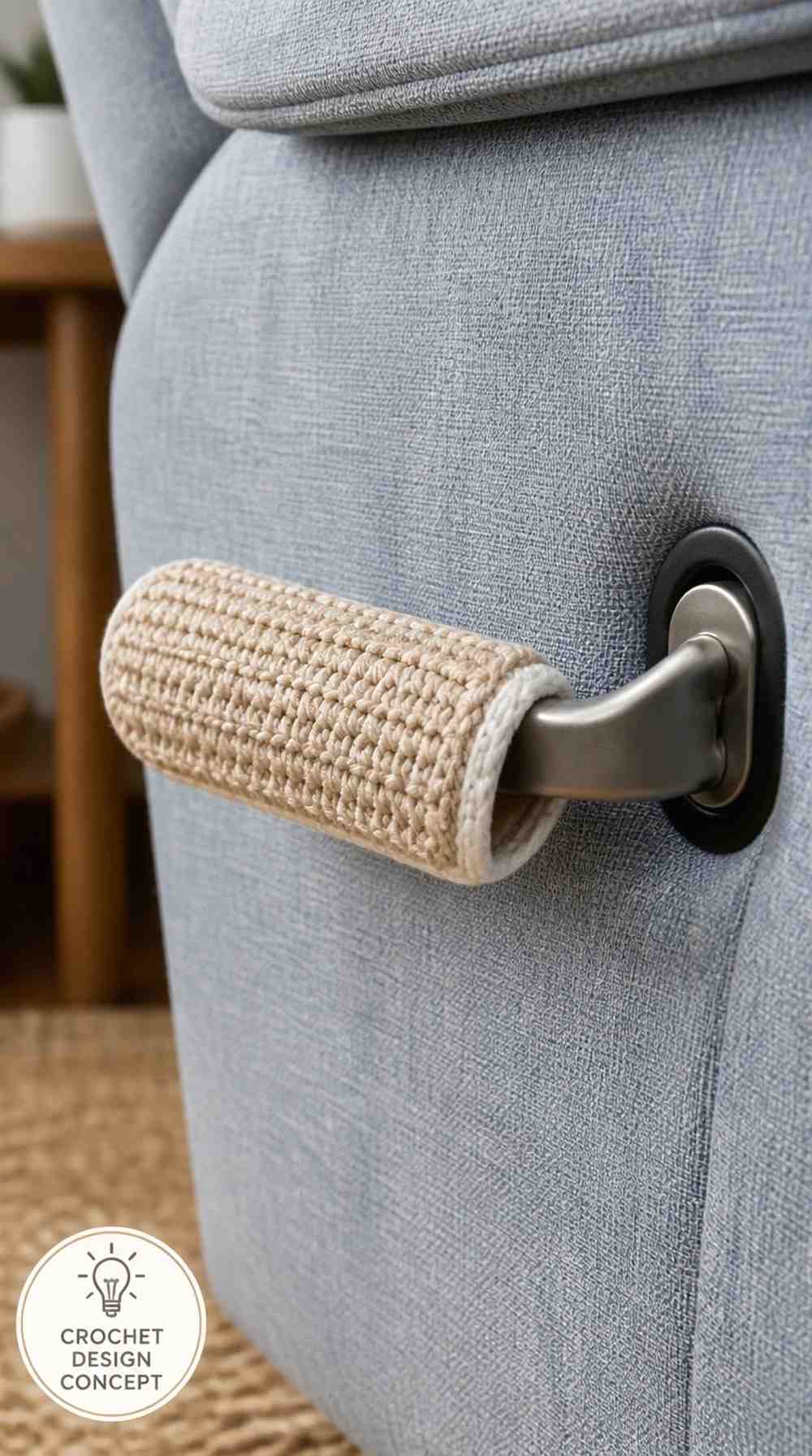
Soft oatmeal crochet finishes this collection with a simple lined handgrip cover. Closely worked horizontal rows wrap around the black oval lever tip, while a cream border defines the rounded outer end. A thin ivory cotton lining is visible at the inner opening.
The lining makes this concept different from the plain charcoal sleeve, introducing a separate fabric surface beneath the crochet. Its smooth finish may appeal to someone who prefers less direct contact with textured yarn. However, the additional layer must remain thin enough not to interfere with the lever’s shape or movement.
- Lining Material: A smooth, lightweight cotton fabric may reduce direct contact with crochet texture, but it does not guarantee improved hand comfort.
- Combined Thickness: Check the crochet and lining together; even thin materials can become bulky around a small control.
- Removable Care: A sleeve that can be removed without altering the lever would make it easier to clean both the textile and original handgrip.
Practical Guide to Crochet Recliner Lever Soft Grip Sleeves
A crochet lever cover should be treated differently from an ordinary decorative furniture accessory because the recliner lever controls moving parts of the chair. Before making or fitting any sleeve, check whether your recliner manufacturer permits modifications or accessories on the lever.
Identify the exact lever type. Manual recliners can use different controls, including side levers and pull handles. Some have a short oval grip, while others have a narrow or curved metal handle. These 18 concepts focus on the outer handgrip of a side lever, not the moving shaft, cable or release mechanism.
Check clearance before choosing a design. Any textile near the lever must stay clear of the pivot, furniture frame, upholstery openings and other moving parts. Do not use a sleeve that restricts travel, changes release force, slips, catches or prevents the mechanism from returning normally. Follow the chair manufacturer’s instructions; recliner operating procedures vary.
Foy’s Interiors
Choose lightweight materials. Smooth cotton yarn is one possible choice for decorative sleeves because it can show neat crochet stitches. However, yarn can stretch, wear or slip, and a textured covering is not automatically safer or easier to grip.
Avoid loose attachments. Long ties, decorative cords, bulky buttons and unsecured mesh can catch near moving equipment. If a design includes a closure, it needs to remain secure and outside the lever’s movement path.
Consider the chair user. Someone who finds the original lever difficult to operate may need a manufacturer-approved control accessory, a different recliner mechanism or advice from an occupational therapist. An untested crochet sleeve should not be presented as an accessibility or medical aid.
Keep the sleeve clean. If the manufacturer permits a covering, remove it for cleaning when appropriate, follow the yarn-care instructions and check regularly for stretched stitches or loose fastenings.
For other handle-cover inspiration, 16 Crochet Mattress Handle Soft Grip Inspiration Ideas explores removable wraps and different crochet textures, while 19 Crochet Game Controller Grip Sleeve Inspiration Ideas offers examples of fitted grips designed to leave important controls exposed. Neither collection provides tested recliner modifications.
Want to Make Something Similar?
These 18 crochet recliner lever designs are original visual concepts, not tested patterns or approved modifications for reclining chairs. These verified crochet resources may help with general handle-wrap techniques:
- Crochet Luggage Handle Wrap — CyCrochet provides a free illustrated tutorial for a rectangular crochet cover that folds around a suitcase handle and fastens with a button. Its construction is relevant to understanding removable crochet wraps, but it is not designed for a recliner’s moving control. CyCrochet
- Bag Handle Cover — Crocket Crochet is a free video-linked pattern listed on Ravelry, using a separating zipper for a removable handbag handle cover. The technique may help explain a zippered wrap, but the pattern has not been verified for recliner use. Ravelry
Before adapting either technique, check the chair’s manual and manufacturer guidance. Do not install a handmade cover if its safety and compatibility cannot be confirmed.
Which Crochet Recliner Lever Soft Grip Sleeve Should You Choose?
| Your main preference | Design to consider | Important consideration |
|---|---|---|
| Simple ribbed appearance | Terracotta Ribbed Sleeve | Raised rows must remain compact |
| Removable snap fastening | Navy Snap-Wrap Grip | Snaps could catch or press against fingers |
| Delicate edging | Ivory Scalloped Cuff | Scallops need movement clearance |
| Spiral stitch texture | Moss Spiral Cover | Tubular fit depends on handle shape |
| Adjustable-looking lacing | Burgundy Lace-Up Wrap | Loose cords can snag |
| Neutral two-tone color | Caramel Two-Tone Grip | Trim should remain thin |
| Traditional crochet motif | Mustard Granny Patch | Extra layers add thickness |
| Buttoned removal | Dusty Blue Buttoned Sleeve | Button position affects grip |
| Raised textured surface | Plum Waffle Grip | Texture may create pressure points |
| Plain minimal coverage | Charcoal Minimal Sleeve | Closed sleeve may slip |
| Botanical decoration | Olive Leaf Cover | Leaf edges need secure attachment |
| Zippered removal | Teal Side-Zip Wrap | Hardware needs clearance |
| Soft rounded decorative tip | Blush Cloud-Edge Grip | Lobes must not extend into moving parts |
| Layered openwork | Indigo Diamond Mesh Sleeve | Open loops may snag |
| Shaped outer end | Coral Flared-Tip Grip | Altered shape may affect operation |
| Reversible colors | Lilac Colorblock Wrap | Double layers increase bulk |
| Diagonal crossing texture | Rust Crossing Wrap | Bands must lie flat |
| Smooth internal lining | Oatmeal Lined Sleeve | Lining adds thickness |
For a visually simple concept, the Charcoal Minimal, Terracotta Ribbed and Caramel Two-Tone sleeves are good starting points to compare. Their shapes keep extra decorative details to a minimum.
If you are exploring removable construction, the Navy Snap-Wrap, Dusty Blue Buttoned and Teal Side-Zip designs show three different fastening approaches. Each introduces hardware that may be unsuitable for a particular chair.
For decorative styling, the Mustard Granny Patch, Olive Leaf and Ivory Scalloped concepts bring recognizable crochet details to a small handgrip. None should be fitted to a working recliner unless the manufacturer permits it and the actual cover can be shown not to interfere with safe operation.
Conclusion
These 18 crochet recliner lever soft grip sleeve inspiration ideas explore how a small textile covering could change the appearance and feel of a manual recliner’s handgrip. Simple ribs, spiral stitches, removable wraps, lined sleeves and decorative motifs each offer a different visual direction.
The most important consideration is preserving the chair’s original function. A crochet covering should never obstruct the lever, reduce clearance, slip into the mechanism or make the control harder to operate. Treat these ideas as inspiration first, and choose only modifications confirmed suitable for your particular chair.
Which design interests you most? Would you choose the simple Terracotta Ribbed sleeve, the modern Charcoal Minimal cover or the decorative Mustard Granny Patch? Share your favorite in the comments.
Frequently Asked Questions
1. Can I put a crochet sleeve on the lever of any manual recliner?
No. Recliner levers vary in shape, size, location and operating mechanism. Some may have too little clearance for any added material, and a manufacturer may advise against modifying the control. Check your chair’s manual or ask the manufacturer before fitting a sleeve. Do not add anything that affects normal operation.
2. Can crochet make a hard recliner lever easier to grip?
A crochet covering may change the surface texture or feel, but improved grip or comfort cannot be assumed. Yarn can slip, stretch or become bulky, especially around small handles. If the original lever is difficult to operate because of limited hand strength or mobility, seek a suitable manufacturer-approved solution rather than relying on an untested handmade sleeve.
3. What yarn would be suitable for a crochet recliner lever cover?
Smooth, lightweight cotton yarn is one material worth considering for a decorative concept because it can form clearly defined stitches. However, fiber choice alone does not ensure a secure or safe fit. The actual yarn, stitch texture, finished thickness and attachment method all need assessment, and the chair manufacturer must permit the accessory.
4. Should I use buttons, snaps or zippers on a lever sleeve?
Buttons, snaps and zippers can make textile wraps removable, but they also introduce hard surfaces and possible snagging points. Hardware must not press into the user’s hand, touch moving chair components or interfere with the lever’s return. If any fastening could catch, loosen or change the operation of the chair, the cover should not be used.
5. Are these 18 crochet recliner lever covers available as patterns?
No. These are AI-generated crochet design visualizations intended for inspiration, not tested patterns or manufacturer-approved recliner accessories. Their sizes, closures and stitch arrangements would need to be developed for a specific handle. Anyone considering a real sleeve should first verify the chair’s requirements, then confirm that the finished accessory does not compromise safety or operation.