Royal purple brings a more dramatic direction to fall crochet than the familiar rust, mustard, and pumpkin-orange palette. It can look polished on structured bags and baskets, rich on textured blankets, or unexpectedly modern on pumpkins and leaf decorations. For wearables, the same color can shift from bold to understated depending on stitch openness, yarn sheen, and what you layer beside it.
The 18 projects below cover far more than color changes. You’ll find fitted and relaxed garments, compact accessories, motif-based bags, dimensional décor, and practical home pieces. Each idea is paired with an original tutorial so you can compare construction before committing your yarn. The royal-purple styling suggestions are adaptations; when yarn weight, sizing, gauge, closures, or construction matter, use the linked creator’s instructions as your starting point.
Quick List
- Royal Purple Crochet V-Stitch Layering Cardigan
- Royal Purple Crochet Tunisian Fringe Scarf
- Royal Purple Crochet Ribbed Beanie
- Royal Purple Crochet Ribbed Loop Cowl
- Royal Purple Crochet Fan-Stitch Autumn Shawl
- Royal Purple Crochet Faux-Cable Fingerless Mitts
- Royal Purple Crochet Twisted Ear Warmer
- Royal Purple Crochet Granny V-Neck Vest
- Royal Purple Crochet Moss-Stitch Granny Tote
- Royal Purple Crochet Bobble Crossbody Bag
- Royal Purple Crochet Harvest Pumpkin
- Royal Purple Crochet Fall Leaf Garland
- Royal Purple Crochet Fall Lettering Pillow
- Royal Purple Crochet Textured Harvest Throw
- Royal Purple Crochet Granny Storage Basket
- Royal Purple Crochet Textured Cup Cozy
- Royal Purple Crochet Geometric Table Runner
- Royal Purple Crochet Pointed Granny Poncho
Choosing the Right Royal Purple Yarn for Fall
Royal purple can appear very different once texture enters the picture. Smooth yarn emphasizes V-stitches, ribbing, colorwork, and crisp motif edges, while fuzzy or haloed yarn softens those details. That may be desirable on a cozy scarf but less useful when the attraction of a project is a sharply defined granny motif or faux cable.
Also think about function before substituting solely for color. Bags and baskets generally benefit from fabric that resists excessive stretching, while shawls and cardigans often need more movement. Wearables should be swatched against the tutorial’s gauge guidance rather than matched only by the yarn label. If you are replacing the designer’s yarn, compare weight, fiber behavior, thickness, and finished fabric—not just whether your skein is labeled “purple.”
Building a Fall Palette Around Royal Purple
A solid royal-purple project makes a strong focal point, but several of these designs also lend themselves to controlled color combinations. Cream or oatmeal can soften the contrast. Charcoal makes purple feel darker and more urban, while camel, muted gold, olive, or rust can move it toward a recognizably autumnal palette without overwhelming the purple.
For motif-heavy pieces, decide which element deserves the strongest color before you begin. A royal-purple pumpkin can use a neutral stem; a granny tote can alternate purple with muted supporting shades; a fall blanket might reserve the brightest purple for dimensional stitch sections. These are styling choices rather than substitutions prescribed by the tutorials. When a design relies on multiple colors for charted imagery or visible contrast, confirm the creator’s construction before simplifying the palette.
Fit, Structure, and Finishing Matter More Than Color
Color can persuade you to start a project, but proportion determines whether you will enjoy the finished piece. Check chest and armhole measurements for garments, head circumference for hats and ear warmers, and usable strap length for bags. For home décor, consider whether the fabric needs to stand, lie flat, stretch over an insert, or support anything placed inside it.
Finishing also becomes more noticeable in a saturated color. Uneven seams, loose ends, twisted straps, distorted motifs, or rippled edges can interrupt the clean expanse of royal purple. Blocking may improve some projects, but the appropriate method depends on fiber and construction. Follow the yarn label and the original designer’s guidance rather than assuming every finished piece should be treated the same way.
1. Royal Purple Crochet V Stitch Layering Cardigan
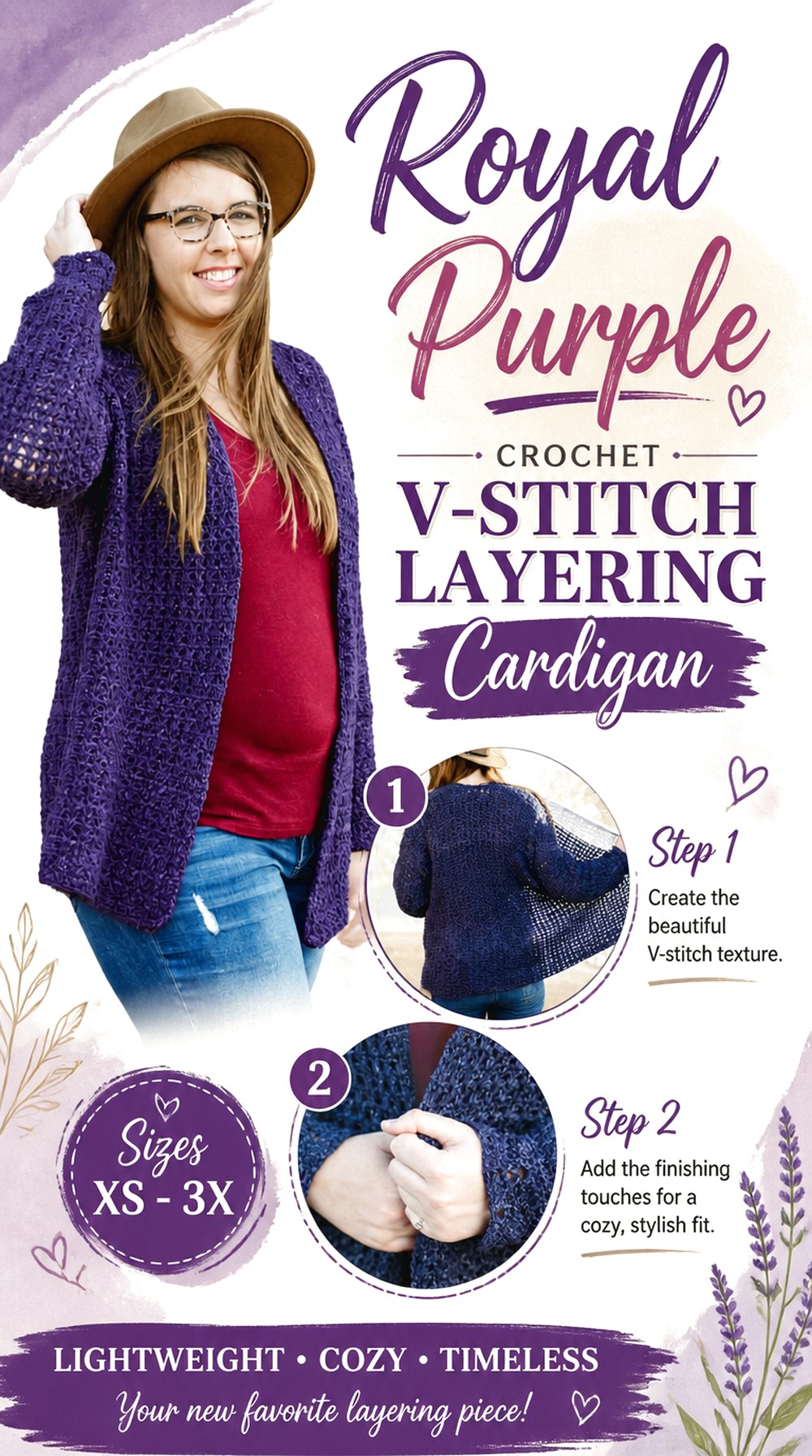
A royal-purple V-stitch cardigan gives the color enough open texture to feel lighter than a completely solid sweater. The source design uses a one-piece body with minimal seaming, dropped sleeves, and a chevron detail at the sleeve edges, creating a relaxed layering silhouette rather than a tightly fitted jacket. That combination makes it especially relevant for transitional fall outfits worn over tees, lightweight knits, or simple dresses.
In royal purple, the stitch definition becomes part of the styling. Before substituting yarn, however, decide whether you want the cardigan to keep the source design’s relaxed character or become more structured. A large difference in yarn behavior can change both drape and sleeve feel.
Check the Cardigan Ease Before Committing
A cardigan can technically fit around the bust and still feel wrong through the shoulders or sleeves. Compare the source measurements with a cardigan you already like wearing, paying attention to chest room, armhole depth, and sleeve length. The original pattern is designed with an oversized dropped-sleeve shape, so choosing a size based only on your usual store-bought label may not give the result you expect.
Let the V-Stitch Stay Visible
Royal purple is saturated enough to show texture strongly, but only if the yarn allows the stitch openings to remain distinct. A very fuzzy substitute may blur the V pattern and sleeve edging. If visual texture is your main reason for choosing this cardigan, crochet and assess a useful swatch before buying the full quantity of yarn.
Balance the Purple With Simple Layers
This cardigan already combines open texture, long sleeves, and decorative edging, so the rest of the outfit does not need to compete. Cream, black, denim, taupe, or warm brown underneath can make the purple the clear focal point. If you add another fall accent color, using it in a small accessory is usually cleaner than introducing several competing colors into the cardigan itself.
Original Tutorial and Creator Credit
Creator/Site: Make & Do Crew
2. Royal Purple Crochet Tunisian Fringe Scarf
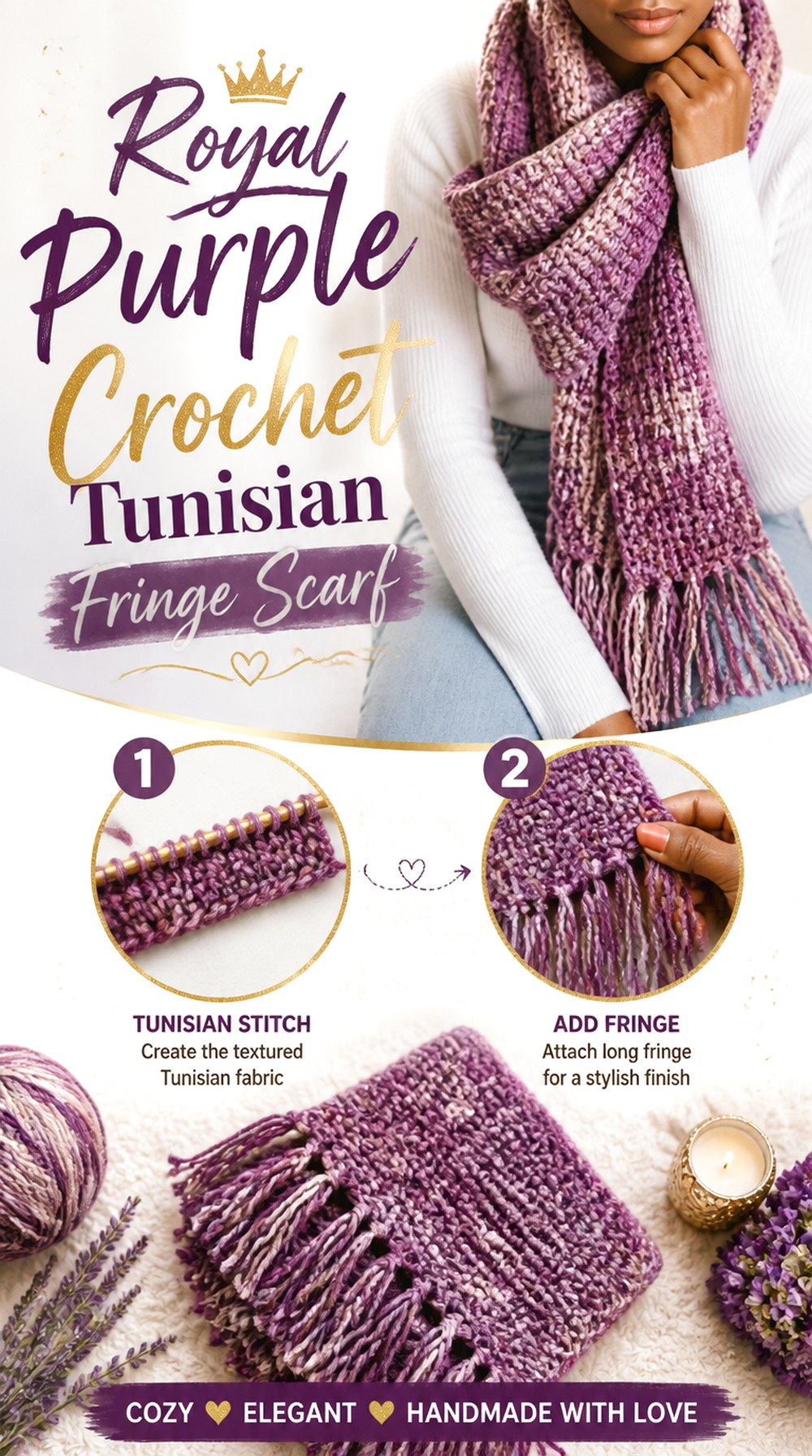
If you want royal purple to look dramatic without making a full garment, a long Tunisian crochet scarf is a strong middle ground. TL Yarn Crafts’ Bobbi Fringe Scarf uses Tunisian texture, color blocking, generous length, and fringe, giving the finished piece more visual movement than a narrow conventional scarf. The designer specifically discusses its long, draping shape and how color and adornment help define the design.
For a fall interpretation, royal purple could dominate the central area while a darker plum, charcoal, or cream creates restrained blocks. A completely solid purple version would put more emphasis on the Tunisian fabric itself, so decide whether color blocking or texture should do most of the visual work.
Consider Where the Color Blocks Fall
On a long scarf, block placement changes what is visible after wrapping. If royal purple is the feature shade, make sure enough of it remains exposed when the scarf is worn rather than placing all of it where layers overlap. You do not need to reproduce the original color placement when adapting the palette, but keep the overall scarf construction intact unless the designer provides modification guidance.
Watch the Finished Drape
A scarf that hangs beautifully flat can become bulky after two wraps around the neck. Yarn thickness, fiber, and fringe all affect that behavior. Make a substantial swatch and feel how it folds rather than judging only its appearance. If your royal-purple yarn produces a much firmer fabric than the tutorial yarn, the scarf may sit differently even when the measurements are similar.
Give the Fringe a Clean Finish
Fringe makes this project distinctive, which also means uneven trimming becomes easy to notice. Allow the scarf fabric and fringe to settle before making your final trim. If the yarn changes noticeably after blocking or relaxing, finishing too early can leave the ends looking inconsistent later.
Original Tutorial and Creator Credit
Creator/Site: TL Yarn Crafts
3. Royal Purple Crochet Ribbed Beanie
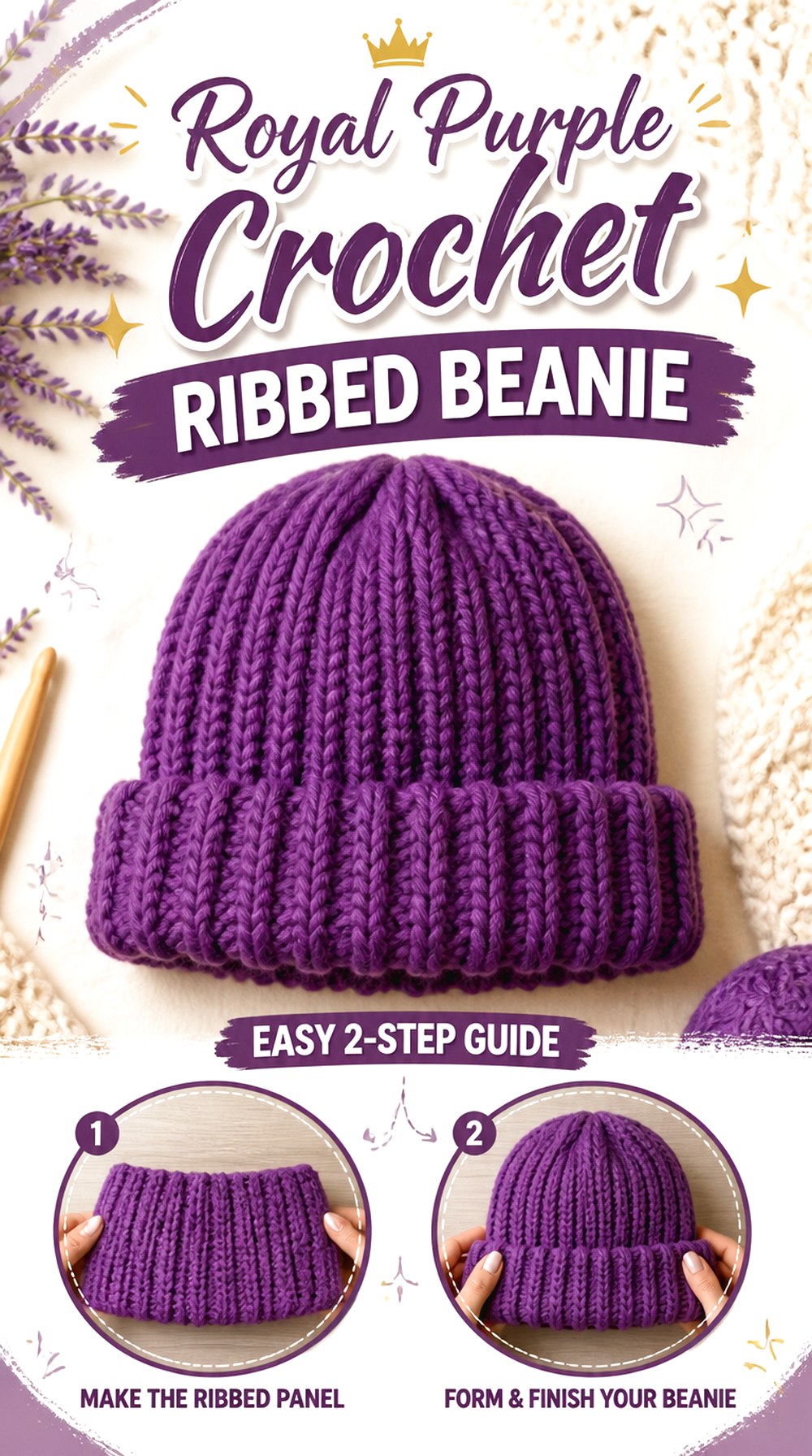
A ribbed beanie lets royal purple function almost like a solid fall basic. VivCrochets’ tutorial produces a minimal ribbed hat with a knit-like appearance and includes dedicated guidance on measurement, sizing, seaming, and gathering the crown. That makes the project useful for readers who care as much about the silhouette as the color.
Royal purple can be worn as the single strong color in an otherwise neutral outfit, and the uninterrupted ribbing prevents the shade from feeling overly decorative. Because hats depend heavily on stretch and circumference, however, a yarn substitution that changes the elasticity of the ribbing deserves more attention than a simple color swap.
Judge Stretch as Well as Width
A flat measurement does not tell the whole story with a ribbed hat. The fabric needs enough recovery to hug the head without feeling restrictive. Compare your swatch to the construction demonstrated in the tutorial and test how readily it stretches and returns. If your yarn behaves substantially differently, use the tutorial’s sizing discussion rather than assuming the same dimensions will fit identically.
Keep the Crown From Becoming the Weak Point
The gathered top affects the finished beanie shape. Too much stiffness can make the crown bulky, while very loose fabric can change how neatly it closes. Follow the creator’s construction rather than improvising the gathering method, particularly if this is your first ribbed beanie.
Pair the Purple With a Neutral Coat
A single-color royal-purple hat works well when you want an obvious seasonal accent without committing to a purple garment. Charcoal, camel, navy, cream, and black outerwear all provide quiet backgrounds. If you also make the matching-color scarf or mitts from this list, consider varying texture so the accessories do not look like one continuous block.
Original Tutorial and Creator Credit
Creator: VivCrochets
4. Royal Purple Crochet Ribbed Loop Cowl
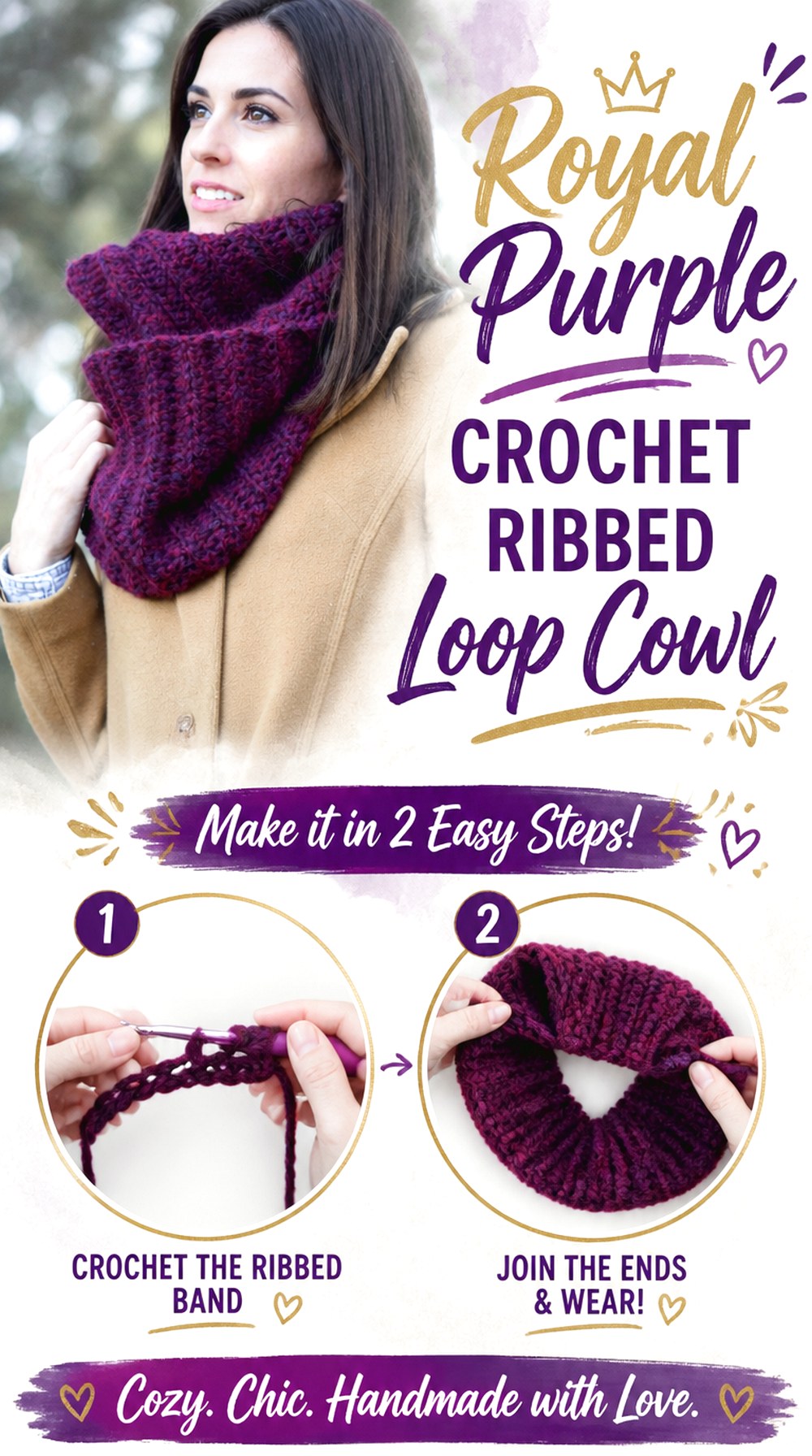
A loop cowl concentrates a large area of royal purple close to the face without the loose ends of a conventional scarf. Mama In A Stitch’s Go-To Cowl is built around a straightforward ribbed fabric and a customizable loop format, making texture rather than complicated shaping the visual feature.
That simplicity suits a vivid color particularly well. A plush royal purple can read cozy and dramatic, while a smoother yarn produces a cleaner, more tailored ribbed surface. Before changing fibers, think about how many times you expect the cowl to wrap and how much bulk you want around the neckline.
Decide on Neckline Volume First
Longer does not always mean more wearable. A cowl intended for a close single loop needs different proportions from one designed for generous wrapping. The source specifically discusses customizing the dimensions, so use that flexibility deliberately.
Make the Seam Disappear Into the Texture
Because the cowl is visually simple, a bulky or uneven join can stand out. Keep the last edge consistent with the first and use the tutorial’s construction as your reference when joining the loop. With a saturated purple yarn, good finishing lets the ribbing remain the main feature.
Original Tutorial and Creator Credit
Creator/Site: Mama In A Stitch
5. Royal Purple Crochet Fan Stitch Autumn Shawl
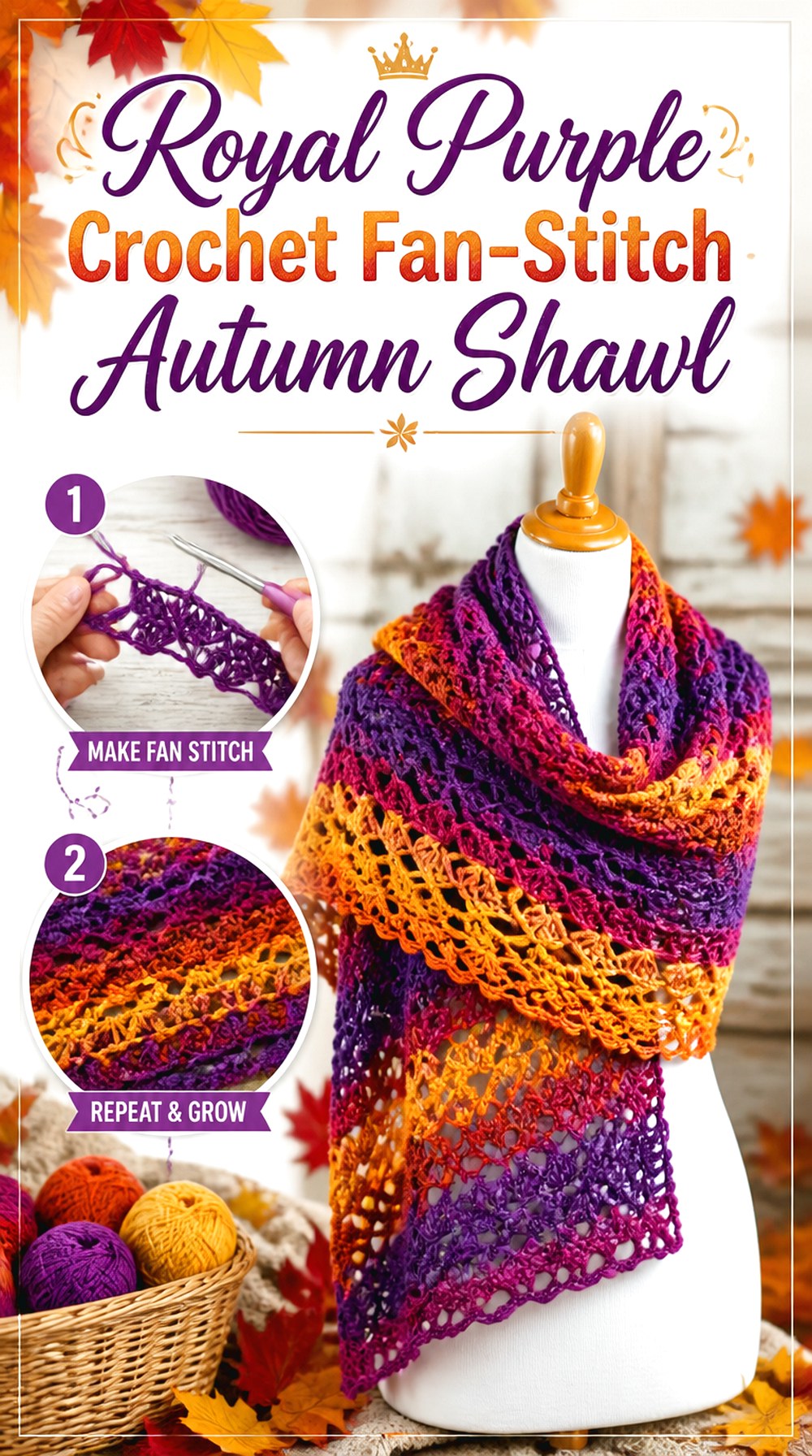
For a larger color statement, an autumn shawl lets royal purple spread across a broad surface while an open fan stitch prevents it from appearing visually heavy. Fiber Flux’s Autumn Symphony Shawl is a flat wrap using a repeating fan-style texture and includes both written guidance and a full video tutorial.
A solid royal purple version would highlight every fan repeat. Another option is a purple gradient that moves from blackberry or aubergine into brighter royal purple, provided the yarn choice still produces the fabric behavior expected by the pattern. This project differs from the scarf because its wider proportions make it useful across the shoulders as well as around the neck.
Preserve the Open Fan Definition
If the openings between stitch groups become too tight, the shawl can lose the airy quality that separates it from a dense scarf. A yarn that is much thicker or a tension that is substantially firmer can change that balance. Check your fabric early and compare it with the finished result shown by the creator.
Think About Shoulder Coverage
A shawl may be worn flat across the shoulders, folded, or wrapped. Those uses place different demands on width and drape. Before adding or removing length, consider your preferred styling method and confirm how the original pattern is meant to be adjusted rather than changing the repeat casually.
Finish for Movement, Not Rigidity
The fan texture benefits from an edge that can hang naturally. If you block the piece, choose a method appropriate to your fiber and avoid forcing the fabric into a shape that removes all of its natural movement. Follow the yarn-care information and any finishing guidance supplied with the tutorial.
Original Tutorial and Creator Credit
Creator/Site: Fiber Flux
6. Royal Purple Crochet Faux Cable Fingerless Mitts
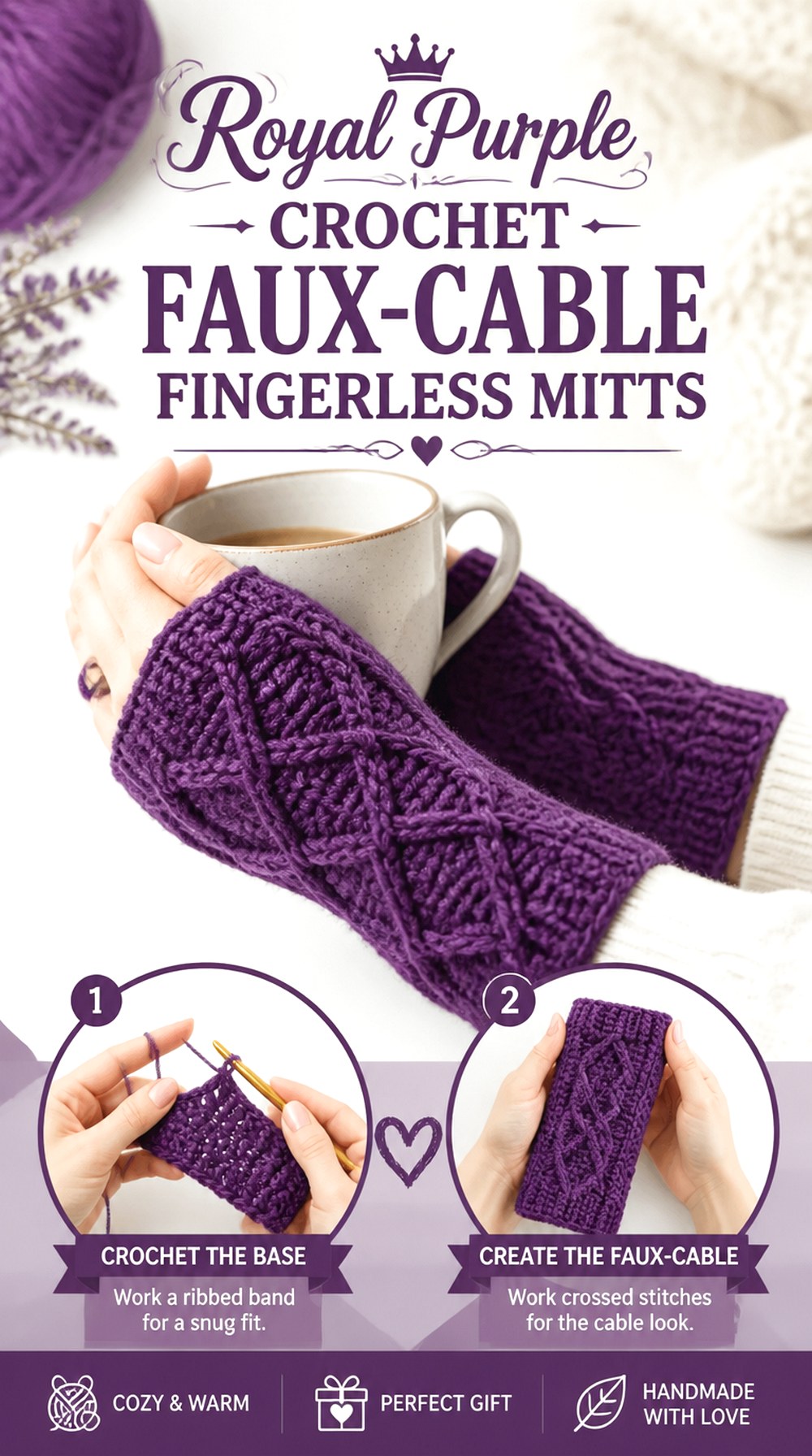
Royal purple and raised cable-like detail make an effective pairing because the strong color creates shadows along the textured surface. Crochet Dreamz’s Adeline mitts use faux cables formed with chain stitches rather than conventional post-stitch cables, giving the top of the hand a decorative focal line.
Fingerless mitts are also a practical way to introduce purple into a fall wardrobe without making a large project. Their fit is less forgiving than a scarf, however. Hand width, wrist circumference, thumb placement, and fabric stretch all influence comfort, so use the original sizing information rather than assuming a generic “one size” will suit every wearer.
Check the Hand Before Adding Decoration
A decorative cable cannot correct a mitt that is already too tight or too loose. Try the basic form against the intended hand at the point the tutorial allows, especially around the thumb opening and knuckle area. Crochet Dreamz’s source includes specific sizing and gauge information, so that should remain the fit reference for an adapted purple version.
Keep Both Cable Tracks Consistent
The faux cables sit prominently on the back of the mitts, so asymmetry between the pair can be obvious. Mark corresponding positions carefully and compare the two pieces as you work. Royal purple will emphasize the shadow created by the decorative chain work, which makes tidy placement particularly worthwhile.
Coordinate Without Making a Full Set
These mitts can echo a purple hat or cowl while still looking intentional on their own. If several accessories use the same yarn, vary the textures rather than duplicating every detail. Ribbing on a hat, faux cable on mitts, and a smoother coat create more visual separation.
Original Tutorial and Creator Credit
Creator/Site: Crochet Dreamz
7. Royal Purple Crochet Twisted Ear Warmer
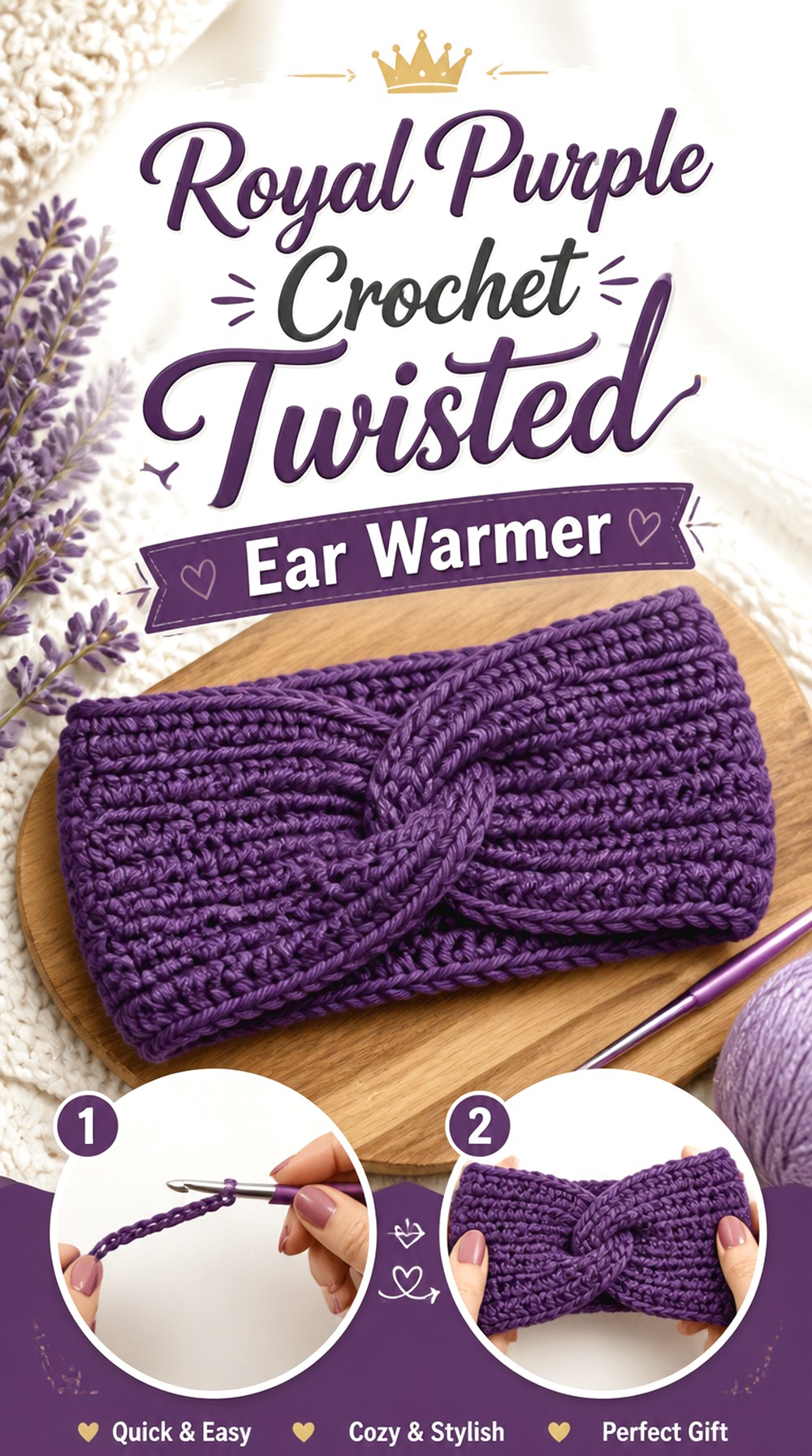
A twisted ear warmer uses less visual space than a hat, so royal purple feels like a sharp accent rather than the dominant part of an outfit. Hooked on Homemade Happiness constructs this design from a ribbed rectangle whose ends are joined to form the front twist. The source also provides multiple sizes and a video tutorial.
The strong horizontal ribbing makes a solid purple yarn more interesting without adding color changes. It is also a useful project when you want warmth around the ears but prefer to leave the top of the head uncovered.
Measure for Gentle Negative Ease
An ear warmer generally needs to stay in place without creating uncomfortable pressure. Yarn stretch can differ substantially, so use the tutorial’s size guidance and compare the piece with the intended wearer as appropriate. If your substitute yarn has poor recovery, matching length alone may not reproduce the same fit.
Practice the Twist Before Final Sewing
The front join creates the recognizable silhouette, which means it is worth arranging the ends carefully before securing them. The original tutorial explains how the rectangle is joined into the twist. A neat join also keeps the inside more comfortable against the forehead.
Original Tutorial and Creator Credit
Creator/Site: Hooked on Homemade Happiness
8. Royal Purple Crochet Granny V Neck Vest
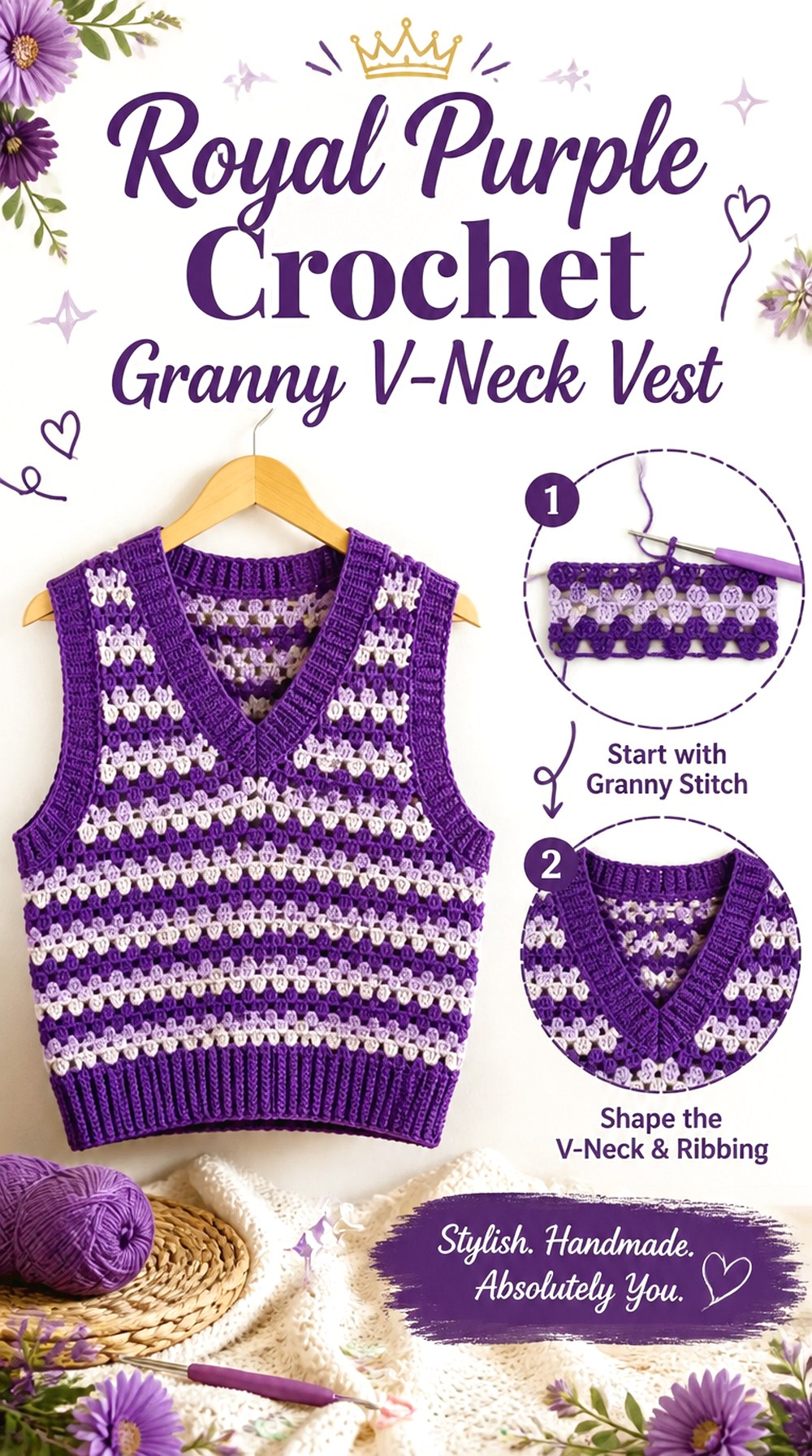
A sleeveless vest is one of the most useful ways to carry royal purple into fall because it can be layered over a neutral long-sleeved shirt rather than worn alone. Crochet with Carrie’s granny-stitch V-neck vest has a relaxed fit with ribbing along the hem, armholes, and neckline, creating stronger definition around an otherwise open-textured body.
The royal-purple adaptation would work particularly well when the ribbing and body stay in one color, allowing the change between dense edging and granny texture to provide the contrast. The source is dated August 2026 and includes its own fit, yarn, gauge, and sizing information.
Compare the Vest to Your Base Layers
A vest that fits correctly over a thin tank may feel restrictive over a fall shirt. Decide how you actually plan to wear it before selecting your size. The source describes a relaxed finished fit, but your yarn substitution and preferred layering thickness can still affect the final feel.
Give the V-Neck Enough Structure
The neckline is visually important because it frames both the face and whatever is worn underneath. Ribbing that becomes too loose can change that clean V shape. Check your tension in the edging and follow the designer’s neckline construction rather than treating it as an interchangeable border.
Use the Armholes as a Fit Checkpoint
Before considering the garment finished, check whether the armhole edge sits comfortably when you reach forward and layer a shirt underneath. An attractive body width does not guarantee comfortable armholes. The ribbed finish can refine the opening, but it should not compensate for an underlying size mismatch.
Original Tutorial and Creator Credit
Creator/Site: Crochet with Carrie
9. Royal Purple Crochet Moss Stitch Granny Tote
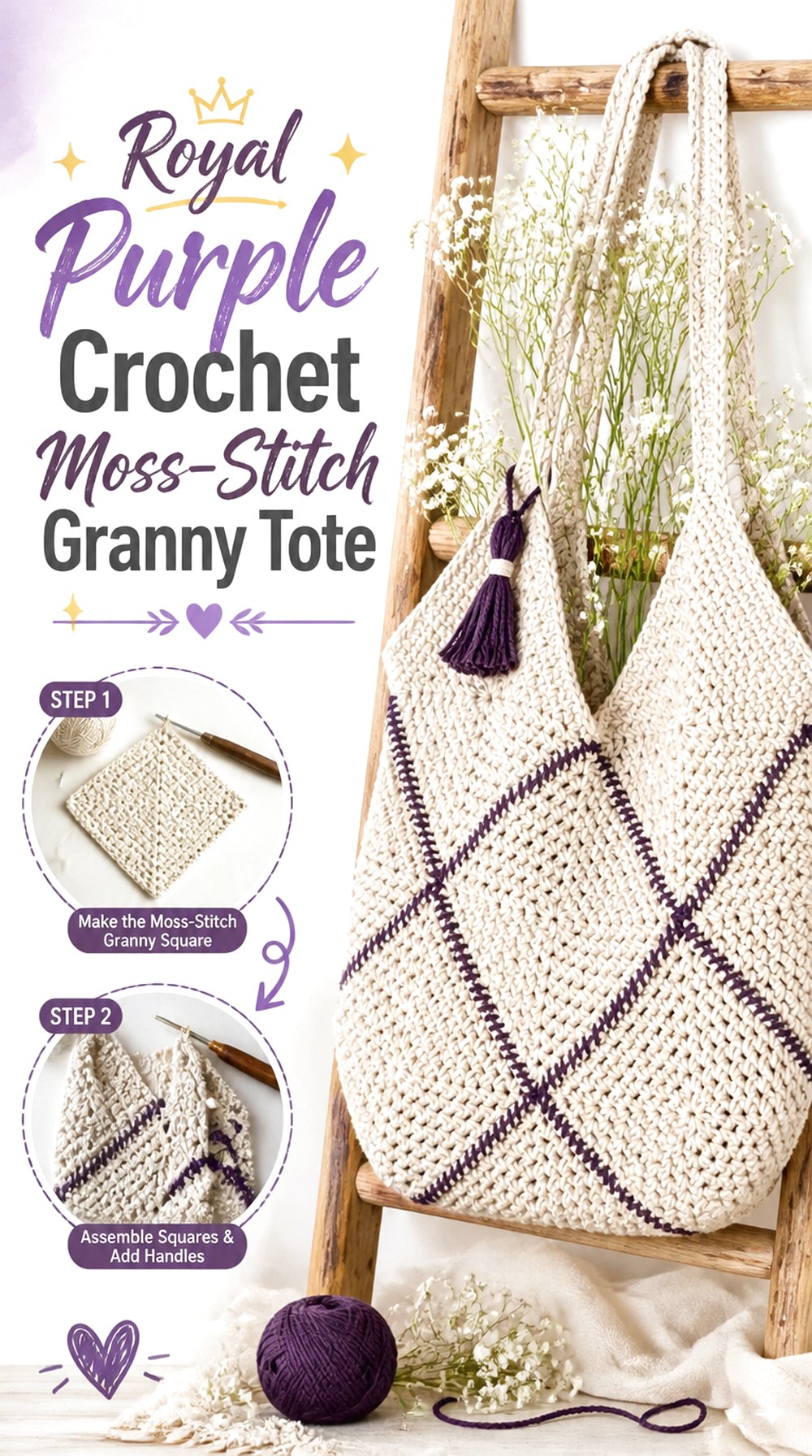
A motif bag lets you break royal purple into smaller visual units rather than making one uninterrupted block of color. Jewels and Jones’ tote is assembled from moss-stitch squares and finished with crocheted handles. The original construction uses 13 squares arranged and seamed into the bag shape, giving the tote a clearly modular look.
For fall, you could keep every square royal purple for a tonal effect or alternate purple with muted cream, camel, charcoal, or olive. Changing the palette is straightforward visually, but changing yarn characteristics can affect how well the bag resists sagging once filled.
Plan Motif Placement Before Joining
Motif projects are easiest to correct while the squares are still separate. Lay every finished square out in the intended arrangement and check both color distribution and size consistency. If one motif is noticeably larger, forcing it into the join can distort the bag even when the color plan is excellent.
Treat the Handles as Functional Parts
Crochet handles can stretch under repeated load depending on yarn and construction. Follow the source method first, then judge the finished bag according to what you expect to carry. If you intend to transport heavier contents than the tutorial demonstrates, consider whether lining or other reinforcement is appropriate without claiming that it will make the bag weight-rated.
Decide Whether a Lining Serves Your Use
A lining can help contain small objects and separate the contents from motif openings, but adding one changes finishing and care. The original bag’s moss-stitch squares create a relatively sturdy motif structure. If you choose to line an adaptation, treat it as an optional functional modification rather than part of the credited tutorial unless the creator provides it.
Original Tutorial and Creator Credit
Creator/Site: Jewels and Jones
10. Royal Purple Crochet Bobble Crossbody Bag
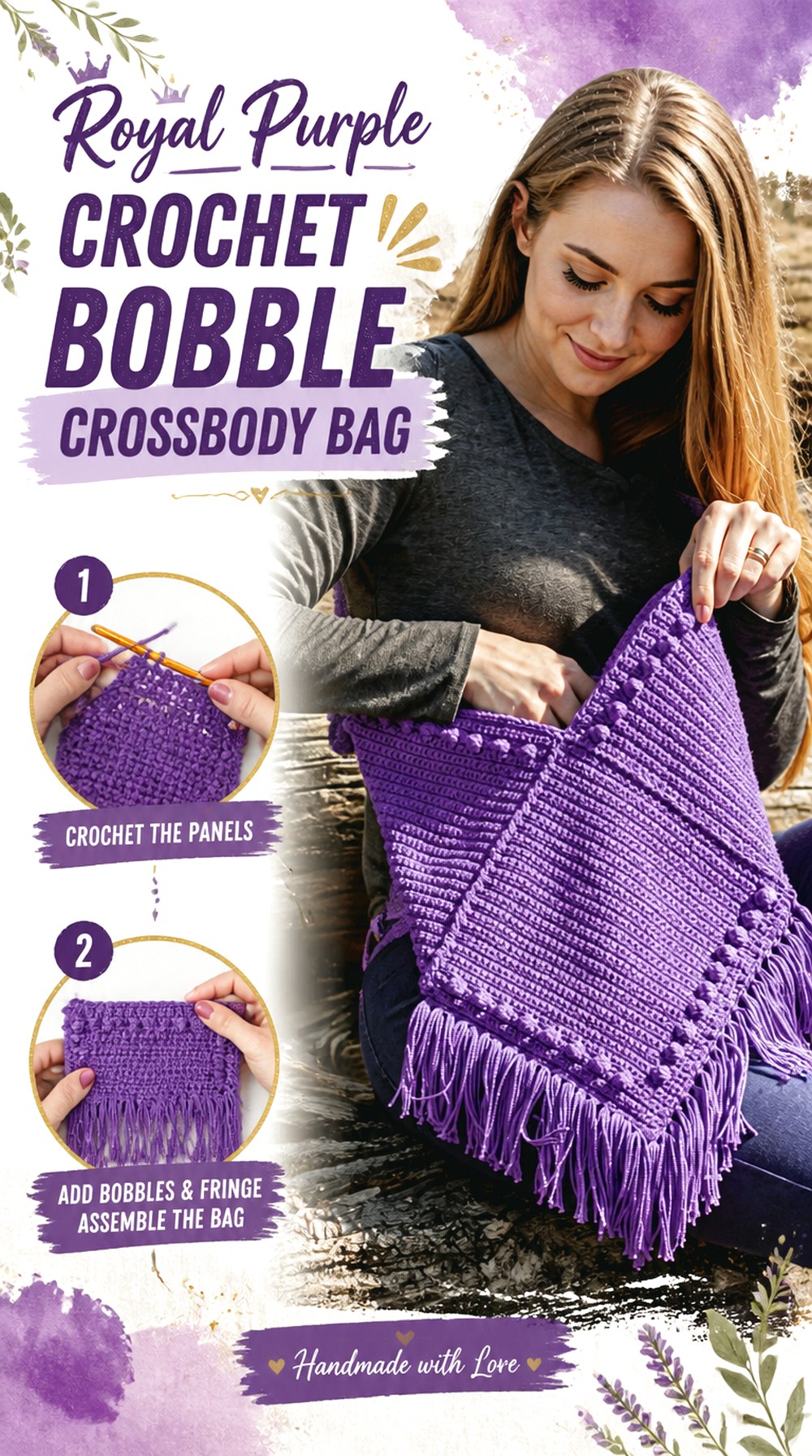
A smaller crossbody bag gives royal purple a more concentrated, everyday role. Life + Yarn’s Kagan design combines bobble texture, square-based construction, a crossbody format, and fringe for a modern-boho finish. The creator explains that the bag is formed from four matching squares arranged to create its distinctive shape.
Royal purple can make the bobbles appear more dimensional because their shadows sit against a saturated field. A tonal tassel keeps the look polished, while a contrasting fringe can push it further toward a casual vintage style.
Keep the Four Squares Truly Alike
When a bag depends on repeated components, small gauge differences become visible during assembly. Measure the squares against one another rather than waiting until all four are finished. Correcting an inconsistent motif early is easier than trying to force mismatched edges together during seaming.
Think Carefully About Strap Stretch
A crossbody strap carries both the bag and its contents over a long span. Crochet can lengthen with wear depending on yarn, stitch, and load. Before changing the creator’s yarn or strap construction, consider how the substitution behaves under tension. A bag intended only for a phone and small essentials has different demands from one routinely loaded with heavier objects.
Let the Fringe Stay Deliberate
Fringe adds movement but can become visually busy when combined with strong bobbles and a saturated color. Keeping the fringe in the same purple family produces a quieter result. If you introduce another fall shade, use it sparingly so the bag’s unusual square construction remains visible.
Original Tutorial and Creator Credit
Creator/Site: Life + Yarn
11. Royal Purple Crochet Harvest Pumpkin
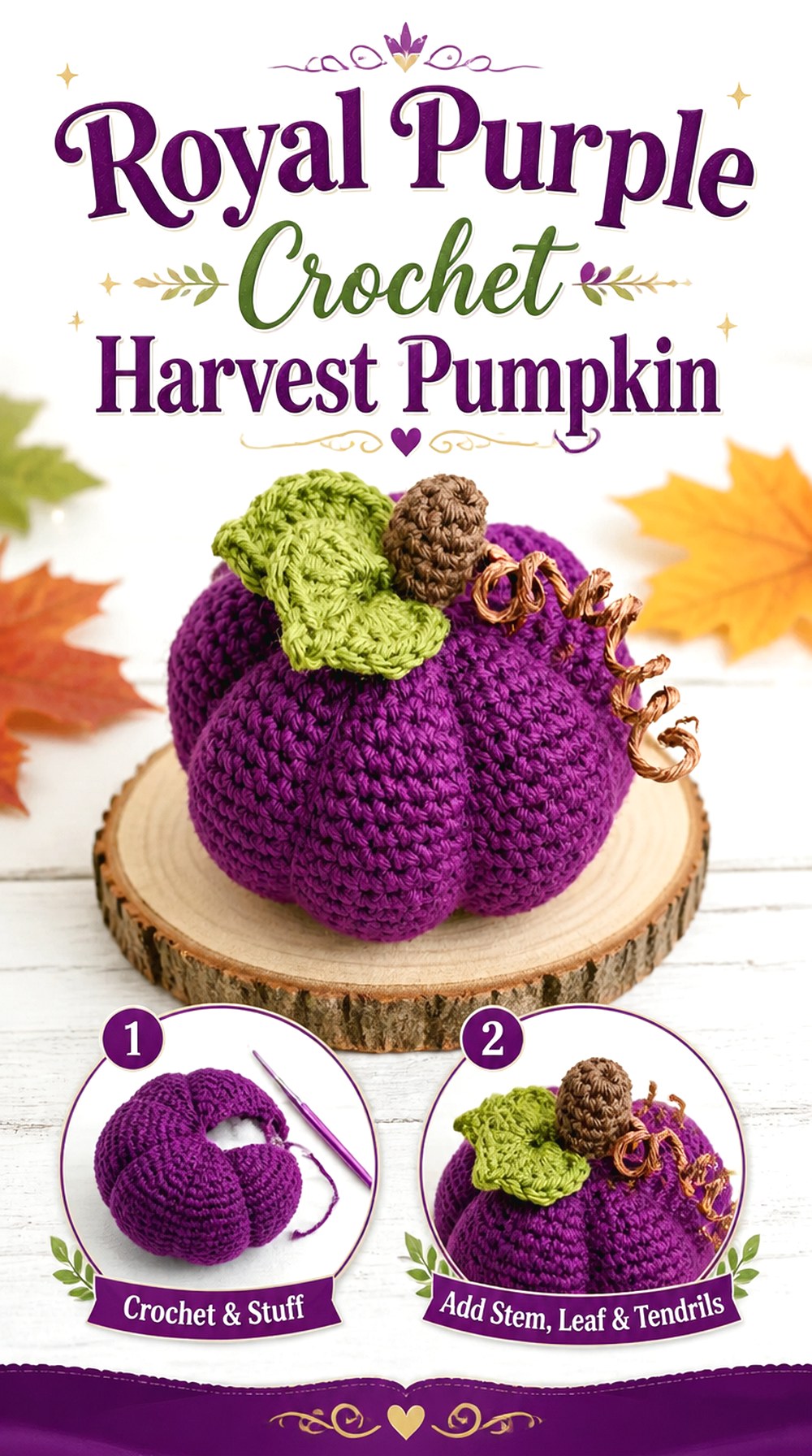
A purple crochet pumpkin turns familiar fall décor into something more graphic without losing the seasonal silhouette. Crochet 365 Knit Too’s medium pumpkin includes the dimensional pumpkin body along with a stem, leaf, and curled tendril, so the shape carries the harvest theme even when orange is replaced with royal purple.
This is an especially useful project for a purple-led fall display because the decorative details give you natural places for secondary colors. Try muted green, brown, cream, or gold-toned accents rather than forcing every component into the same purple.
Shape Matters More Than the Expected Color
Once you depart from traditional pumpkin orange, the ribbed or segmented form needs to read clearly. Stuff evenly and pay attention to the shaping method given by the designer. Too little definition can make an unconventional color look more like a generic ball than a pumpkin.
Consider the Tendril Around Children and Pets
The source uses floral wire in its curled tendril. If the pumpkin will be accessible to young children or pets, consider whether a wired decorative component suits that location. This is seasonal décor, not a toy, and any adaptation should account for where and how the finished piece will be displayed.
Original Tutorial and Creator Credit
Creator/Site: Crochet 365 Knit Too
12. Royal Purple Crochet Fall Leaf Garland
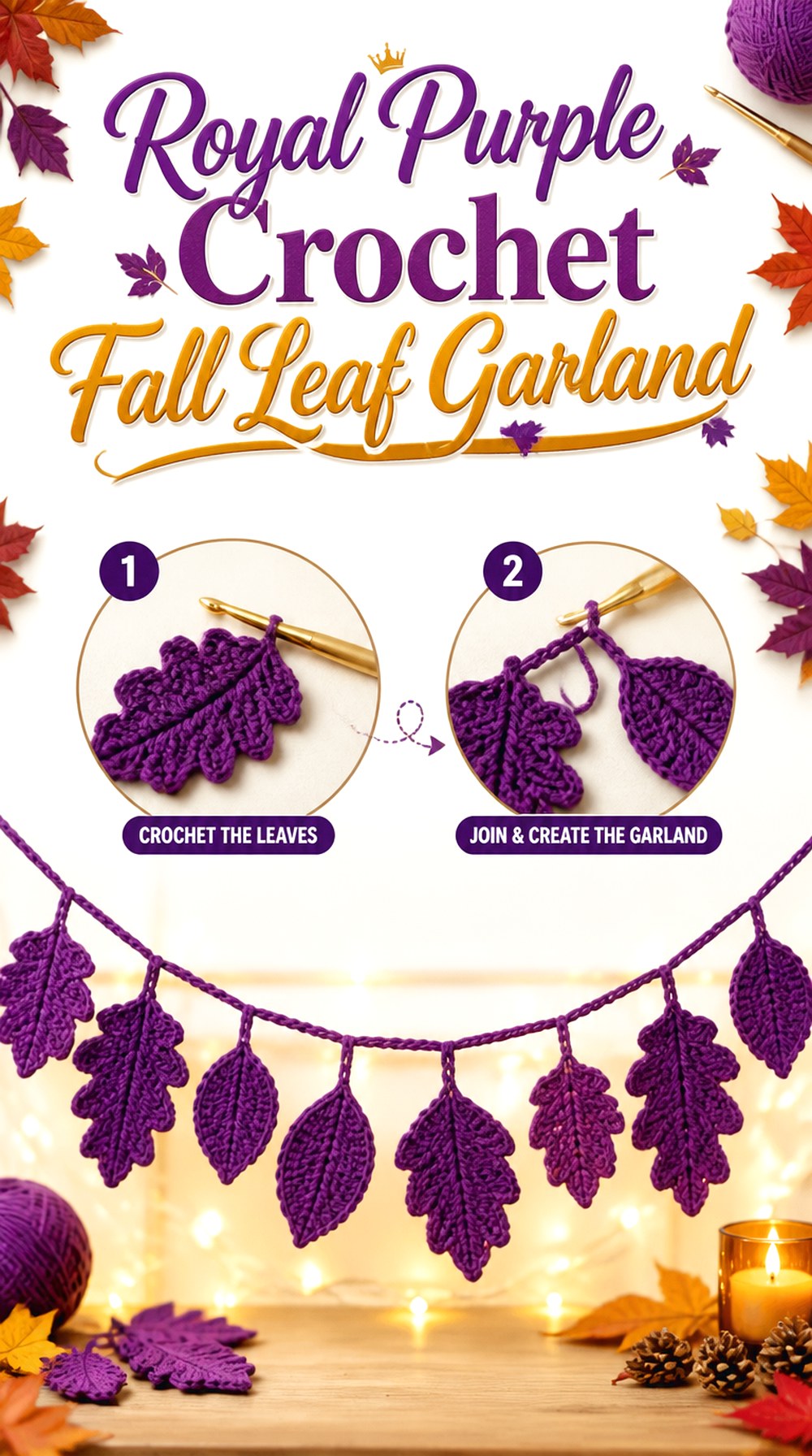
A leaf garland is ideal when you want royal purple distributed around a room rather than concentrated in one object. GoldenLucyCrafts combines several leaf shapes, including pumpkin, autumn, simple, and oak-style leaves, then arranges them along a crocheted garland. The tutorial also notes that the overall length and number of pieces can be adjusted.
Instead of making every leaf identical, consider a tonal range from royal purple to plum and dusty violet, with a few neutral leaves breaking up the sequence. The different silhouettes will keep the garland visibly autumnal even with an unconventional palette.
Arrange the Leaves Before Attachment
Crocheting all the motifs first gives you control over the final visual rhythm. Spread them along the intended hanging space and check where large, dark, or unusually shaped leaves cluster. A balanced arrangement usually looks more intentional than attaching each leaf immediately after it is made.
Choose a Safe Display Location
A yarn garland is decorative textile material. Keep it away from candles, fireplaces, hot bulbs, and other heat or flame sources. Also consider how the garland is secured if it will hang where children or pets could pull on it.
Original Tutorial and Creator Credit
Creator/Site: GoldenLucyCrafts
13. Royal Purple Crochet Fall Lettering Pillow
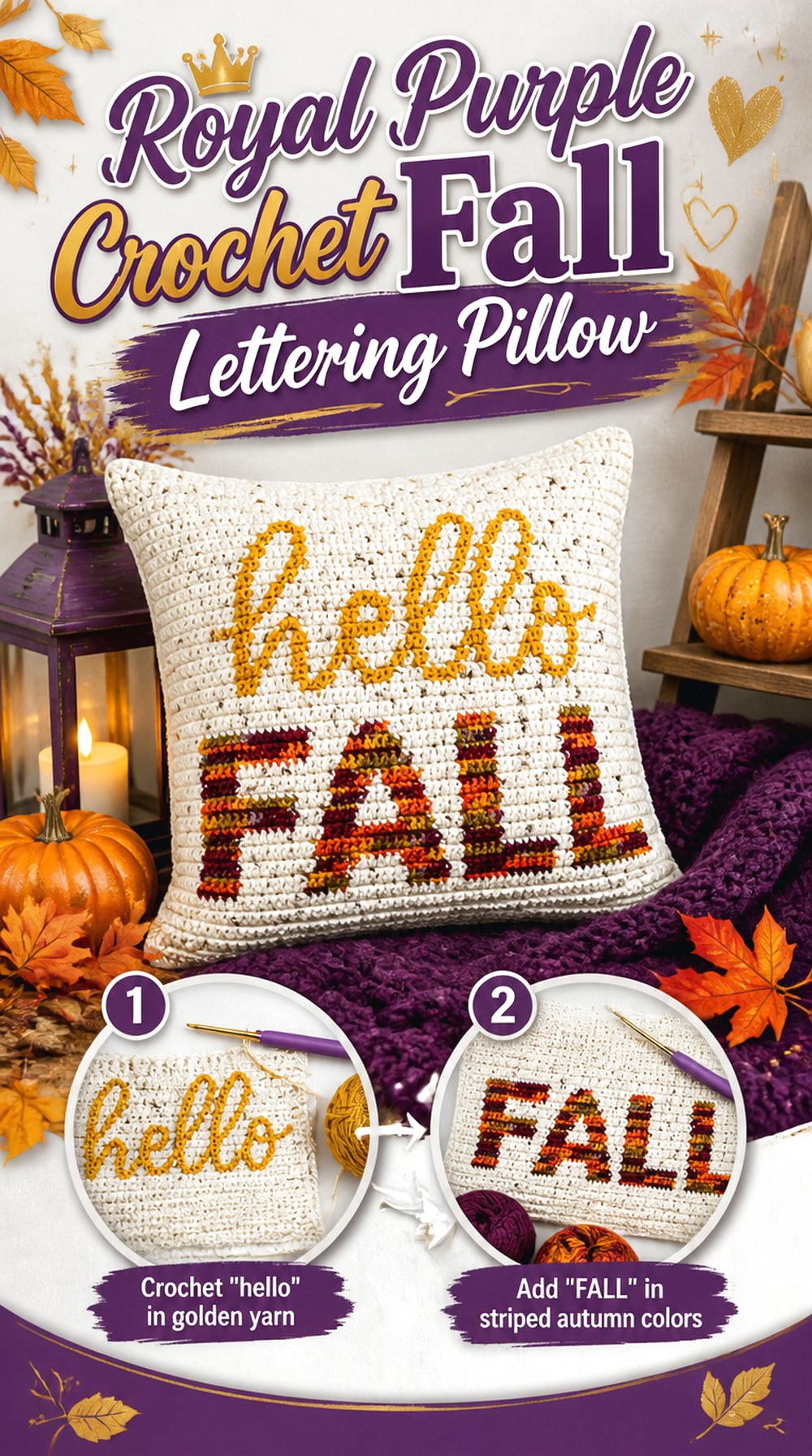
A fall lettering pillow gives royal purple a graphic role rather than relying on texture alone. Briana K Designs’ source uses crochet colorwork to build a “Hello Fall” front and provides options for finishing the pillow with either a crocheted or alternative backing. The pattern also discusses the right and wrong sides of the colorwork fabric.
For a royal-purple interpretation, the strongest approach is often to choose purple either for the main field or for the lettering—not both. Clear contrast is important if you want the words to remain readable across a room.
Protect the Readability of the Lettering
Two colors can look distinct in separate skeins but blend once crocheted together. Photograph a small swatch in both daylight and ordinary room light before committing to the full colorwork. Strong value contrast usually matters more to legibility than whether the colors are traditionally autumnal.
Decide How Removable You Want the Cover
A decorative pillow that will be stored between seasons may benefit from a removable cover, while a permanently stuffed pillow has different finishing needs. The source includes its own back-panel and closure approach. Follow that construction or deliberately plan an alternative rather than discovering at the end that the insert cannot be removed.
Original Tutorial and Creator Credit
Creator/Site: Briana K Designs
14. Royal Purple Crochet Textured Harvest Throw
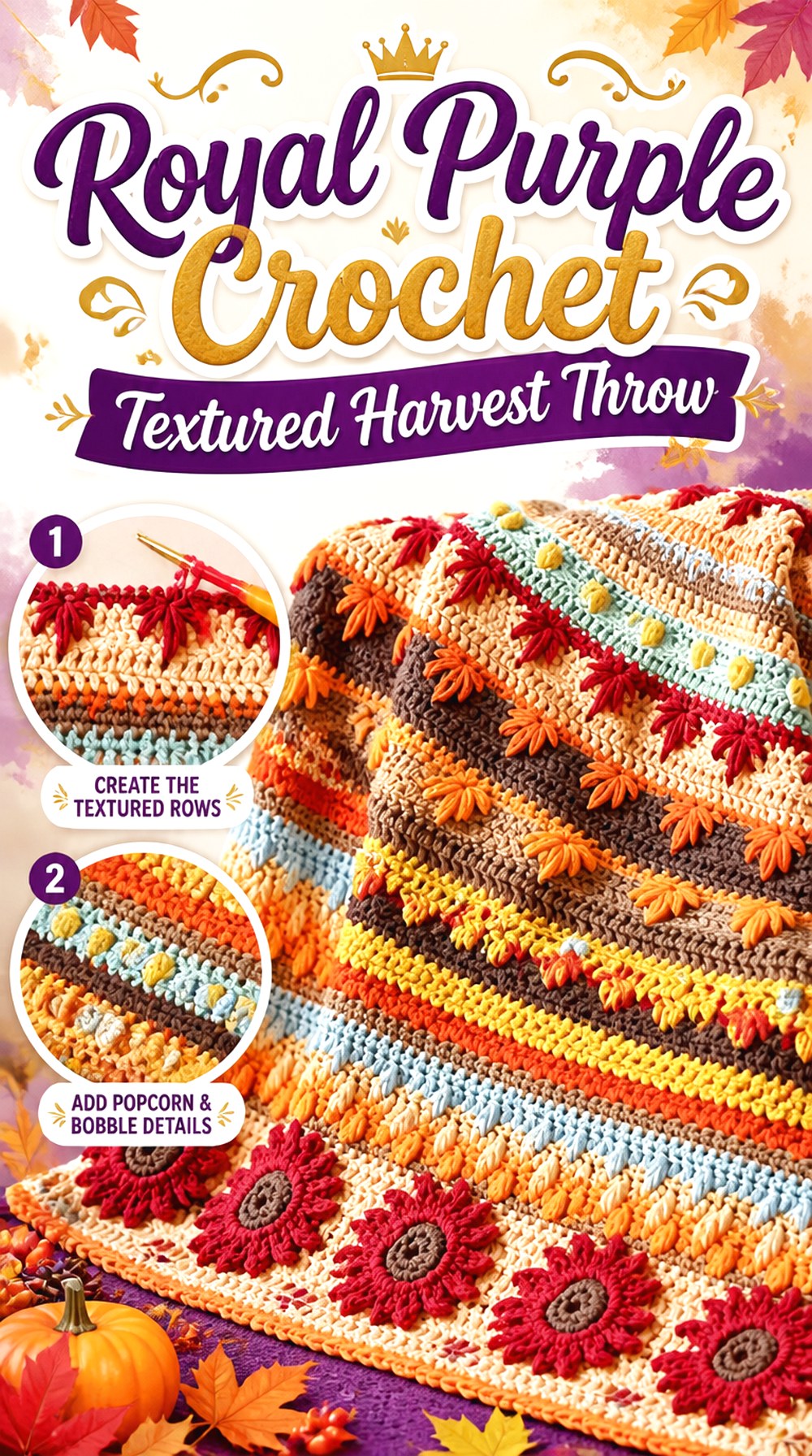
A stitch-sampler blanket is where royal purple can become a complete fall color story rather than a single accent. Nana’s Crafty Home’s Autumn Rhapsody design combines numerous textures, including flower- and leaf-inspired sections, and the creator provides supporting photo and video tutorials for its more involved stitches.
Rather than converting every original color to the same purple, consider several values: deep aubergine for grounding sections, royal purple for feature bands, muted violet for transitions, and cream or warm gray for breathing room. The creator describes the blanket as an intermediate/advanced design, so it is a better choice for readers who want a substantial fall project than for someone seeking a very simple repetitive throw.
Make a Palette Map Before Starting
A sampler changes stitch and often color repeatedly, so improvising one band at a time can create accidental visual imbalance. Place your selected skeins in sequence or make a simple color map before beginning. This does not replace the pattern; it simply helps you decide where the brightest royal purple should appear within the creator’s established construction.
Check Width Through Stitch Changes
Different stitch structures can pull inward or spread outward even when the count is correct. Lay the blanket flat periodically and compare the edges as you move between sections. The source includes resizing information and specific stitch tutorials, which should be consulted if you plan to alter the overall dimensions.
Expect More Finishing Than a One-Stitch Throw
A multi-color sampler can create many ends, dimensional sections, and edges requiring attention. Build finishing time into the project rather than treating the last row as the finish line. If blocking is appropriate for your yarn, use a method compatible with the fiber and follow the creator’s guidance for the final fabric.
Original Tutorial and Creator Credit
Creator/Site: Nana’s Crafty Home
15. Royal Purple Crochet Granny Storage Basket
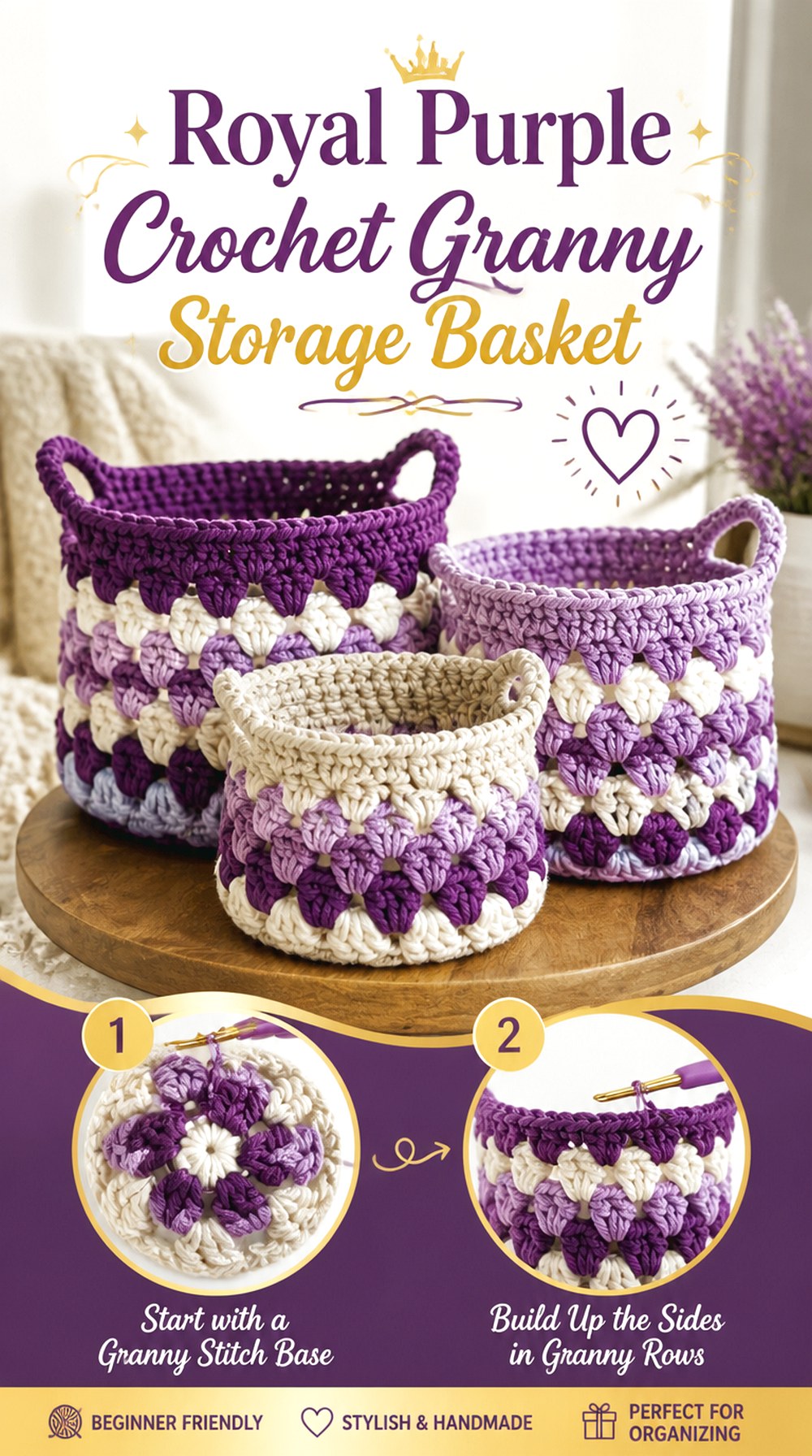
A crochet basket lets royal purple work as functional décor. MJ’s Off The Hook Designs’ Fall for Granny basket uses granny-style clusters, a sturdy upper section, integrated handle openings, and multiple size options. The creator also discusses yarn substitution and the effect yarn thickness can have on the result.
For an autumn room, royal purple could be used solid or combined with cream and a subdued metallic-looking gold shade. Because baskets need to hold their form, however, structure matters more than creating the exact palette you imagined.
Test the Sidewall Before Making a Large Basket
If the first few inches collapse immediately, a taller version will not automatically become more stable. Compare your yarn behavior with the tutorial’s fabric before committing to the largest size. A substitute that is significantly softer or thinner may require reconsideration rather than simply adding more rounds.
Keep the Handles Symmetrical
Integrated handles become natural visual focal points, especially in a solid purple basket. Mark their placement carefully and compare both sides before completing the upper edge. If the basket is meant for storage, remember that crocheted handles and fabric can stretch; avoid assuming a handmade basket has a specific weight capacity unless the creator states one.
Original Tutorial and Creator Credit
Creator/Site: MJ’s Off The Hook Designs
16. Royal Purple Crochet Textured Cup Cozy
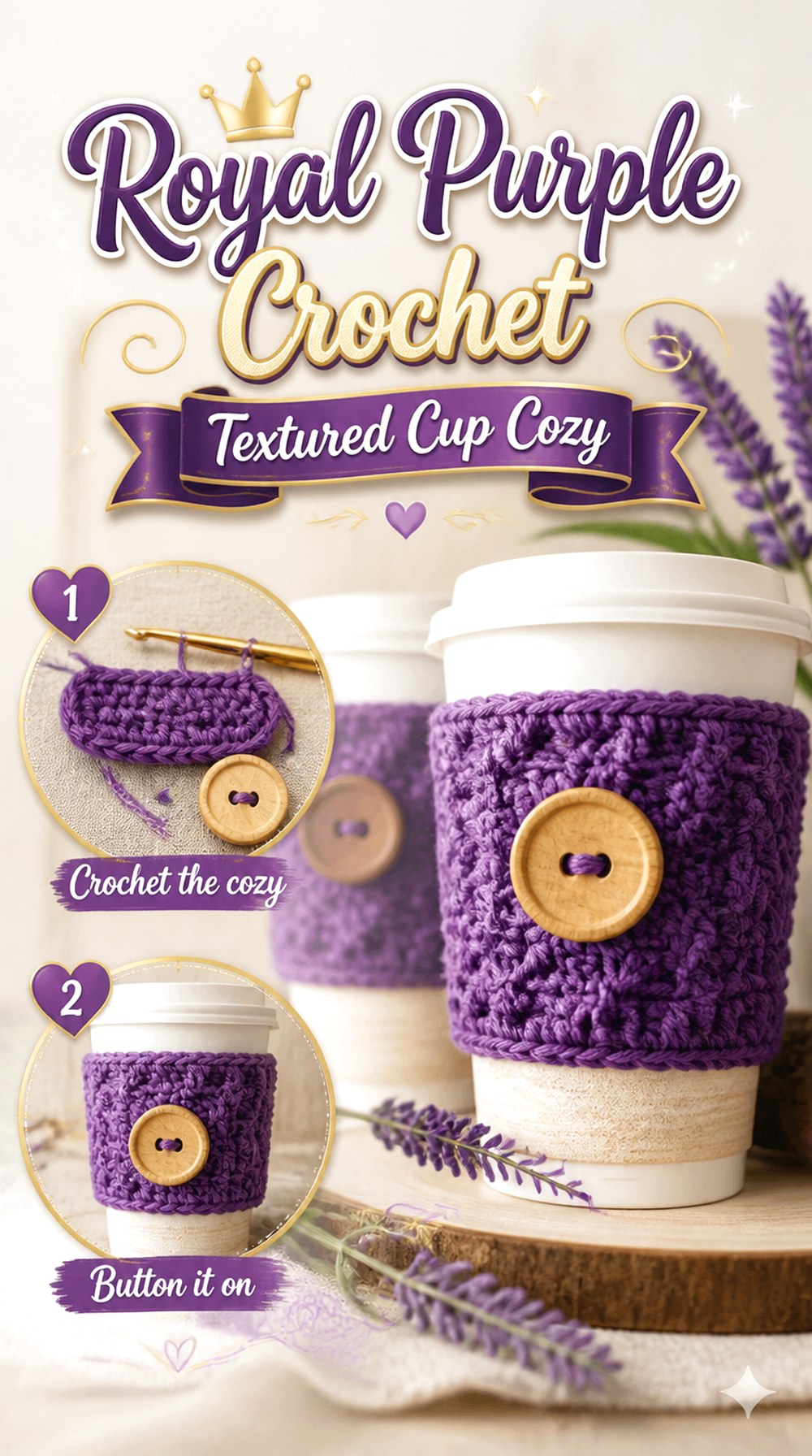
A cup cozy is one of the smallest projects in the list, but royal purple and pronounced texture keep it from disappearing among larger fall décor. CAAB Crochet’s Peek-A-Boo Cup Cozy combines straight, knit-like ridges with a more pebbled central texture and can be left plain or embellished.
A solid royal-purple version is useful when you want the texture to be the entire design. Alternatively, a contrasting button can add a small fall accent without turning the cozy into a multicolor project.
Confirm the Cup Fit You Actually Need
Reusable cups vary in diameter and taper. Before making several cozies as gifts, test the first finished piece on the style of cup it is meant to fit. A cozy that slides down or stretches excessively may be decorative but less practical.
Treat Embellishment as Optional
The source notes that the textured design can stand on its own while also accepting decoration. If you add a button or appliqué, make sure it does not interfere with gripping the cup and secure it appropriately for the intended use.
Original Tutorial and Creator Credit
Creator/Site: CAAB Crochet
17. Royal Purple Crochet Geometric Table Runner
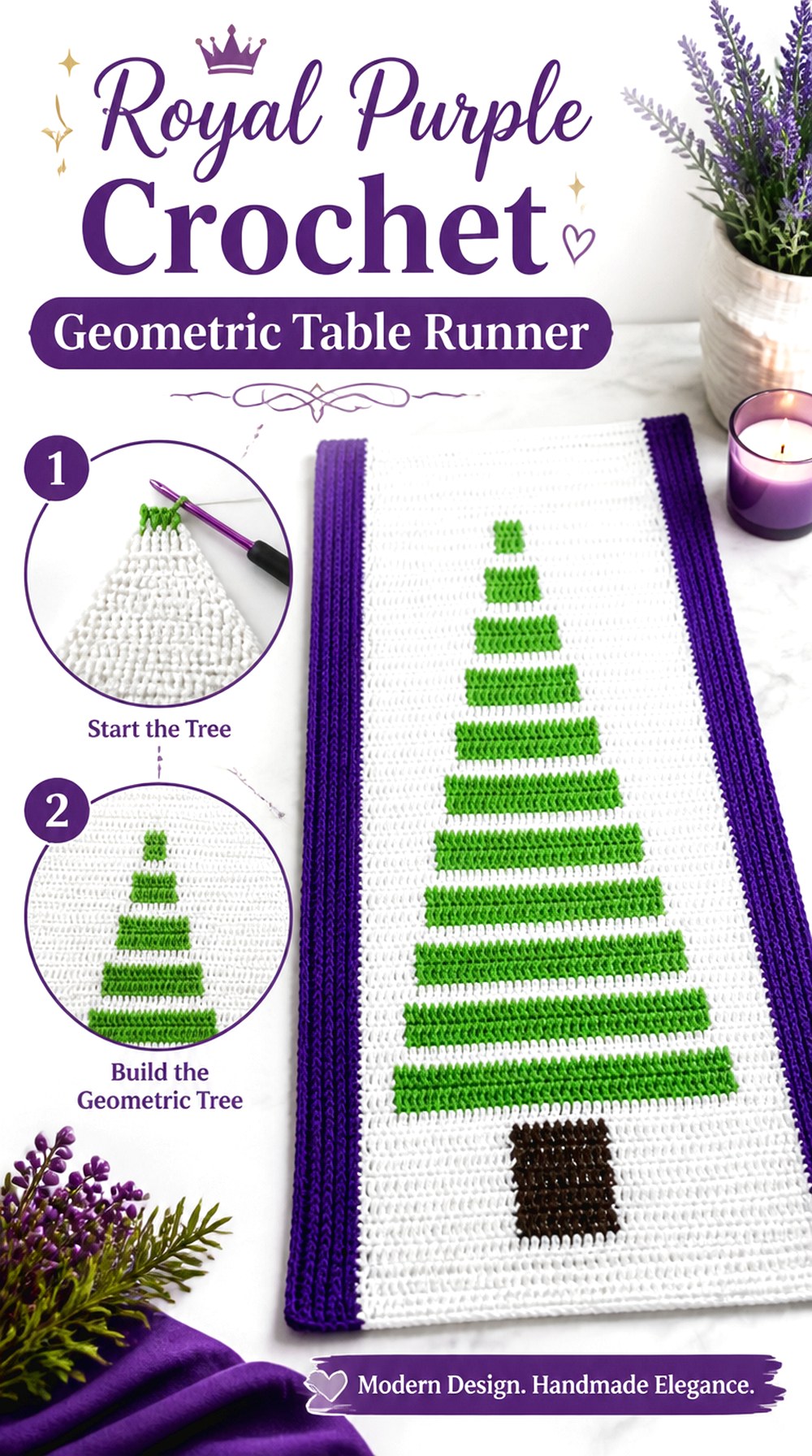
A table runner brings royal purple into fall entertaining without covering the entire tabletop. Winding Road Crochet’s quilt-inspired runner uses geometric color changes and an ombré concept, with matching placemats also discussed in the tutorial. The creator specifically encourages adapting the colors to suit different décor palettes.
That makes it a natural candidate for a purple gradient: pale violet can move through plum into royal purple while cream or charcoal defines the background. Because the source imagery has a tree-like geometric component, assess whether your chosen colors preserve enough contrast for the motif to remain visible.
Map the Gradient Before Crocheting
An ombré skein may not shift color exactly where your motif requires it. If precise placement matters, study the tutorial’s approach to color changes before deciding whether to let the gradient flow naturally or manage sections more deliberately. Avoid cutting yarn repeatedly without understanding how that will affect yardage and ends.
Match the Runner to the Table
A runner should look intentional relative to the tabletop, centerpiece, and place settings. Before changing length or width, check how the original dimensions and repeat structure are built. Also leave enough visual space around any centerpiece so the royal-purple geometry remains visible rather than being covered completely.
Original Tutorial and Creator Credit
Creator/Site: Winding Road Crochet
18. Royal Purple Crochet Pointed Granny Poncho
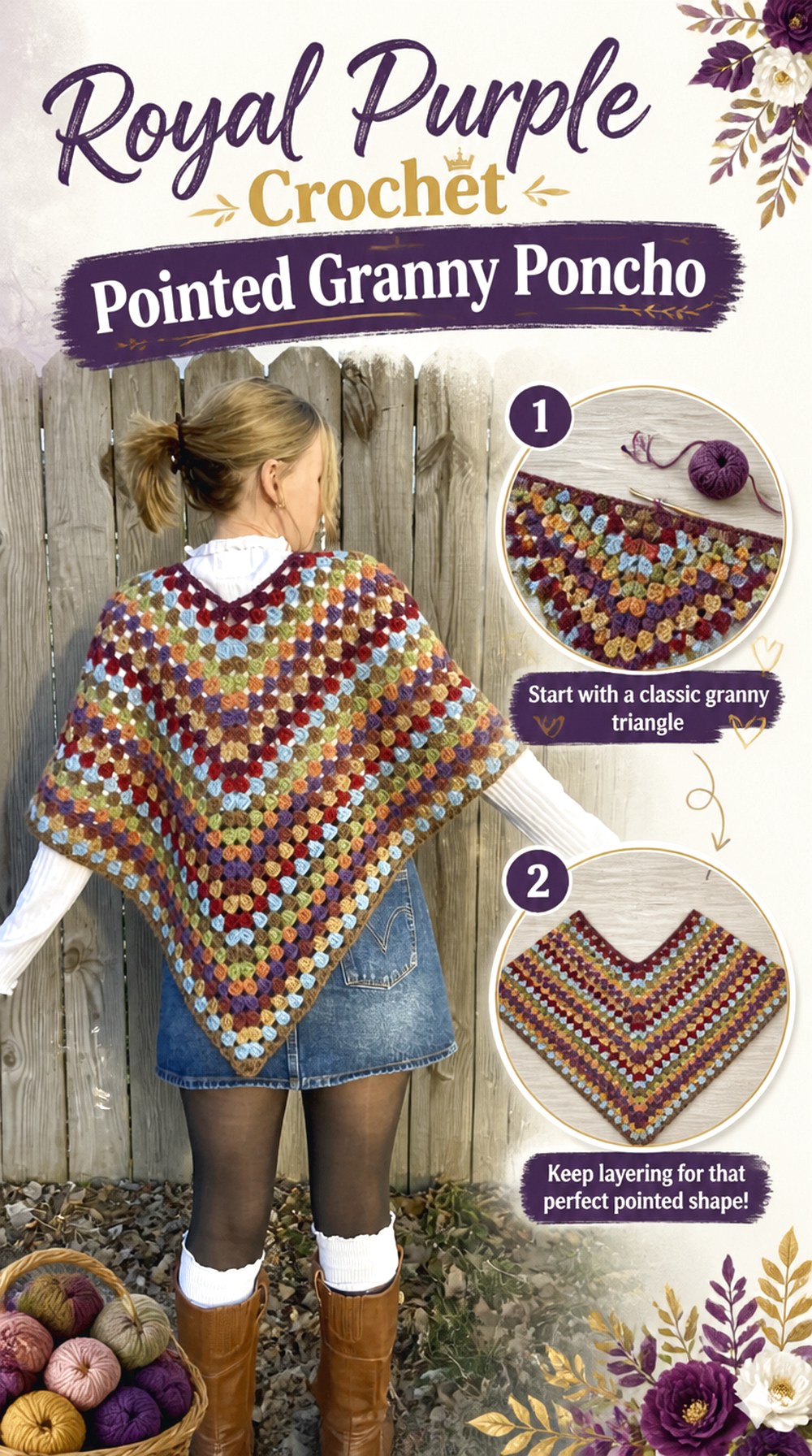
A pointed granny poncho is the largest wearable statement in the collection. HayHay Crochet’s Winifred design uses granny-style clusters and a pointed silhouette that expands outward from the neckline. The source presents the poncho as a one-size design, notes its approximate intended fit range, and explains that additional or fewer rounds can change the length.
Royal purple makes the silhouette especially dramatic when worked as a solid, while alternating plum, violet, cream, or rust stripes creates a more obvious granny aesthetic. Because a poncho hangs from the shoulders rather than fitting like a conventional sweater, neckline and overall depth deserve more attention than bust measurement alone.
Check the Neck Opening Early
A poncho can be roomy through the body and still have an uncomfortable neckline. Before investing in the full length, confirm that the opening sits where you want it and can pass comfortably over the head. Follow the designer’s starting construction closely because changes near the neckline affect the entire garment.
Choose Solid Purple or Controlled Striping
A single royal-purple color emphasizes the expanding granny geometry. Stripes create more movement but also produce more color transitions and ends. If you want a fall palette without making the garment busy, use royal purple as the dominant shade and introduce only one or two quieter supporting colors.
Judge Length While Wearing It
The source explicitly allows the number of rounds to be adjusted for desired length. Try the poncho against the intended wearer before automatically reproducing the sample depth. Taller or shorter wearers—and different styling preferences—can make the same number of rounds feel very different.
Original Tutorial and Creator Credit
Creator/Site: HayHay Crochet
Which Royal Purple Crochet Idea Should You Choose?
For wearable impact, the cardigan and poncho use the most royal purple and therefore need the most attention to fit and drape. The V-neck vest gives you a lighter layering option, while the beanie, mitts, cowl, scarf, and ear warmer are easier ways to test the color in your wardrobe before committing to a garment.
For practical accessories, choose the granny tote when you enjoy repeated motifs and the crossbody bag when you prefer a compact shape with texture. In the home, the sampler throw is the most involved project, while the pumpkin, leaf garland, cup cozy, and basket make smaller seasonal additions. The pillow and table runner sit between those extremes, offering strong fall visuals without the scale of a blanket.
Conclusion
Royal purple works for fall crochet because the color can take on very different personalities depending on construction. Ribbing makes it clean and wearable, open stitches soften it, bobbles and faux cables deepen the shadows, and dimensional pumpkins or leaves turn it into an unexpected seasonal accent. That variety is what keeps an 18-project purple collection from feeling repetitive.
Choose your project first by use, fit, and construction, then decide how much purple you want to introduce. A solid poncho makes a very different statement from a few violet leaves or a compact cup cozy. Once you have chosen a project, use the credited original tutorials for exact construction details, measurements, stitch information, and designer-specific adjustments.
Frequently Asked Questions
Can I simply substitute royal purple yarn into any of these tutorials?
You can usually change color without changing construction, but changing the actual yarn can affect more than appearance. Compare yarn weight, fiber behavior, thickness, gauge, stretch, and drape with the tutorial requirements. Garments, hats, bags, and baskets are especially sensitive to substitution because fit or structure matters. When in doubt, make a swatch and use the original creator’s gauge and sizing guidance as your reference.
What colors look good with royal purple for fall crochet?
Cream, oatmeal, charcoal, warm gray, camel, muted gold, olive, rust, and deep brown can all create useful autumn combinations with royal purple. The best pairing depends on the project. A garment may benefit from restrained neutrals, while pumpkins, blankets, garlands, and table pieces can handle several supporting shades. For charted or motif designs, prioritize enough contrast for the pattern to remain readable.
Is royal purple too bright for a fall crochet wardrobe?
Not necessarily. The amount and placement of color matter more than the shade alone. A royal-purple beanie or pair of mitts acts as an accent, while a cardigan or poncho makes the color the focus. Pairing purple with denim, charcoal, cream, black, camel, or muted brown can ground it. Texture also changes perception: ribbing looks cleaner, while fuzzy yarn creates a softer effect.
Which project is best if I want a small amount of royal purple?
The cup cozy, ear warmer, pumpkin, fingerless mitts, or a few leaves for the garland all use royal purple on a smaller visual scale than a blanket or garment. They are also useful for seeing how a particular purple yarn looks in finished crochet before buying enough for a large project. Check the original tutorial before assuming exact yarn quantities.
Can I make the bags or baskets in a softer yarn?
Possibly, but softer yarn can change how well a bag or basket holds its shape. It may also increase strap stretch or sidewall collapse. Compare your swatch with the fabric shown in the original tutorial and think about intended use. For a decorative basket, softness may be acceptable; for something expected to carry belongings, structure becomes more important.
How should I care for royal-purple crochet items?
Care depends on the actual fiber, yarn construction, embellishments, lining, stuffing, buttons, and other materials—not on the color itself. Follow the yarn label and any care information supplied by the tutorial creator. Dark or saturated yarns can also behave differently when wet, so check the manufacturer’s guidance before combining them with pale contrast colors or mixed-material finishing.