A utensil crock keeps everyday kitchen tools in one place, but a crochet organizer wrap can make the container more useful without taking up another patch of countertop. These 17 crochet utensil crock organizer wrap inspiration ideas explore everything from simple fitted bands and decorative scalloped edges to narrow tool sleeves, removable pockets, adjustable ties, and textured cotton-style finishes. Each concept offers a different balance of storage and handmade character.
Some kitchens need extra room for measuring spoons, while others benefit from keeping a clean thermometer, folded kitchen note, or small accessory beside the main utensils. This collection helps you compare pocket placement, crochet texture, crock shape, closure style, and cleaning needs before choosing a design to adapt. The emphasis is on practical inspiration for existing ceramic or stoneware containers, rather than replacing the crock itself.
These are AI-generated crochet design visualizations for inspiration, not photographs of tested handmade pieces or step-by-step patterns.
Quick Design Selection Guide
- For simple everyday sorting: Crochet Sage Moss Twin-Slot Wrap keeps two slim tools apart without surrounding the crock with bulky pockets.
- For measuring spoons: Crochet Terracotta Waffle Spoon Wrap and Crochet Mint Pocket-Apron Crock Wrap offer divided outer storage with different pocket proportions.
- For a decorative cottage kitchen: Crochet Ivory Scalloped Tie Wrap and Crochet Butter Yellow Daisy Brush Wrap bring softer edges and cheerful small details.
- For adjustable fitting: Crochet Cinnamon Laced Adjustable Wrap offers a more flexible fastening concept for a tapered utensil crock.
- For identifying storage containers: Crochet Lavender Granny Label Wrap provides a removable label-tab idea.
- For a modern kitchen: Crochet Oatmeal Ribbed Thermometer Wrap and Crochet Burgundy Double-Band Organizer Wrap offer more structured silhouettes.
1. Crochet Sage Moss Twin-Slot Wrap
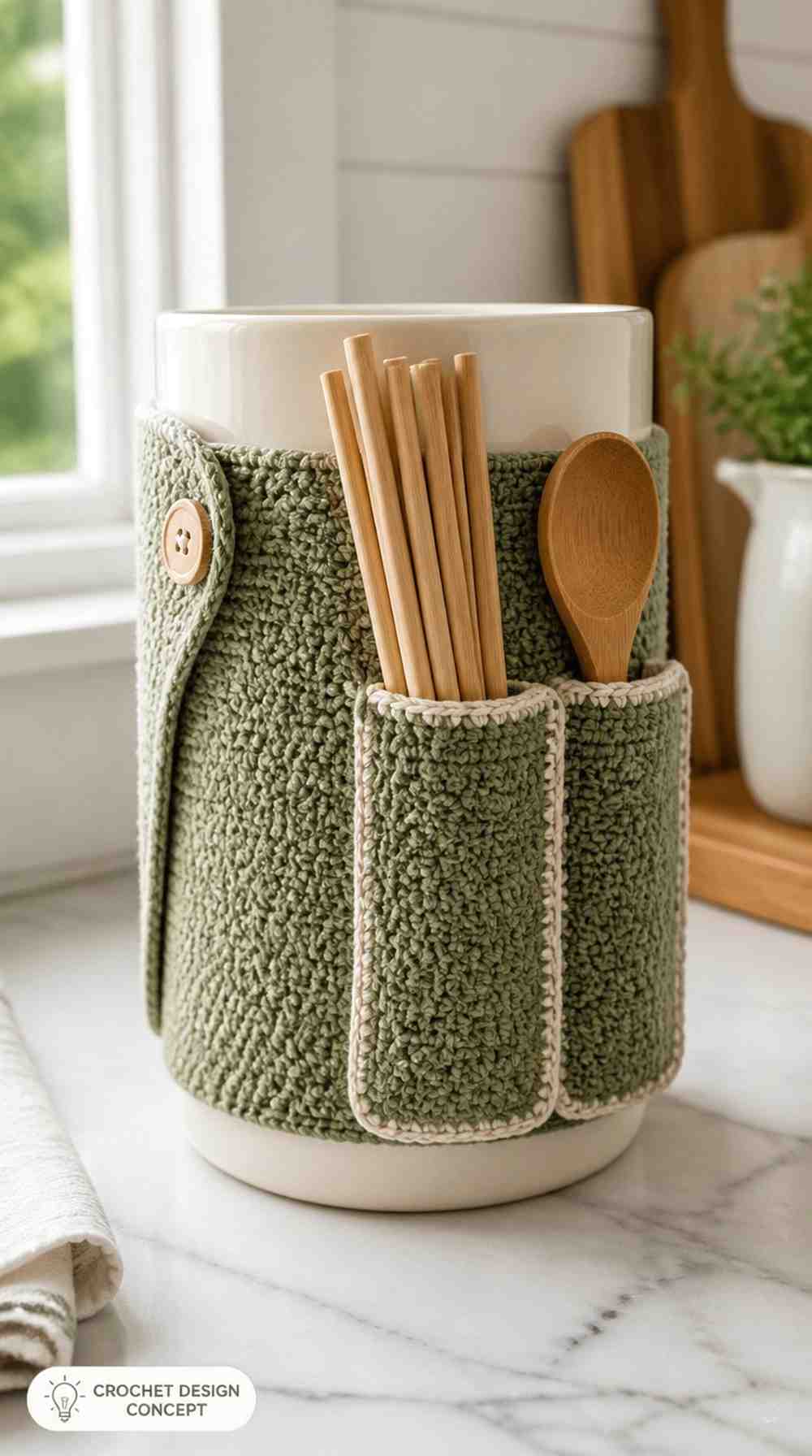
Sage-green moss stitches give this crochet utensil crock wrap a softly textured surface, while two cream-trimmed narrow pockets sit neatly across the front. Clean bamboo chopsticks and a lightweight wooden tasting spoon demonstrate how separate vertical sleeves could organize slim kitchen accessories without taking over the main container.
The natural-wood back button keeps the appearance simple. Because the band sits around the middle of an ivory ceramic crock, the upper opening remains unobstructed for larger utensils. The narrow sleeves are best considered for light, dry items rather than heavy cooking tools.
- Pocket width: Plan each crochet sleeve around the actual utensil handle, leaving enough room to remove the tool without pulling the whole wrap upward.
- Stitch density: Moss stitch creates a close-looking surface, but a real sample should be checked for stretch before relying on it to hold small items.
- Button placement: Position the rear button where it will not press against nearby walls or interfere with lifting the crock from the counter.
2. Crochet Ivory Scalloped Tie Wrap
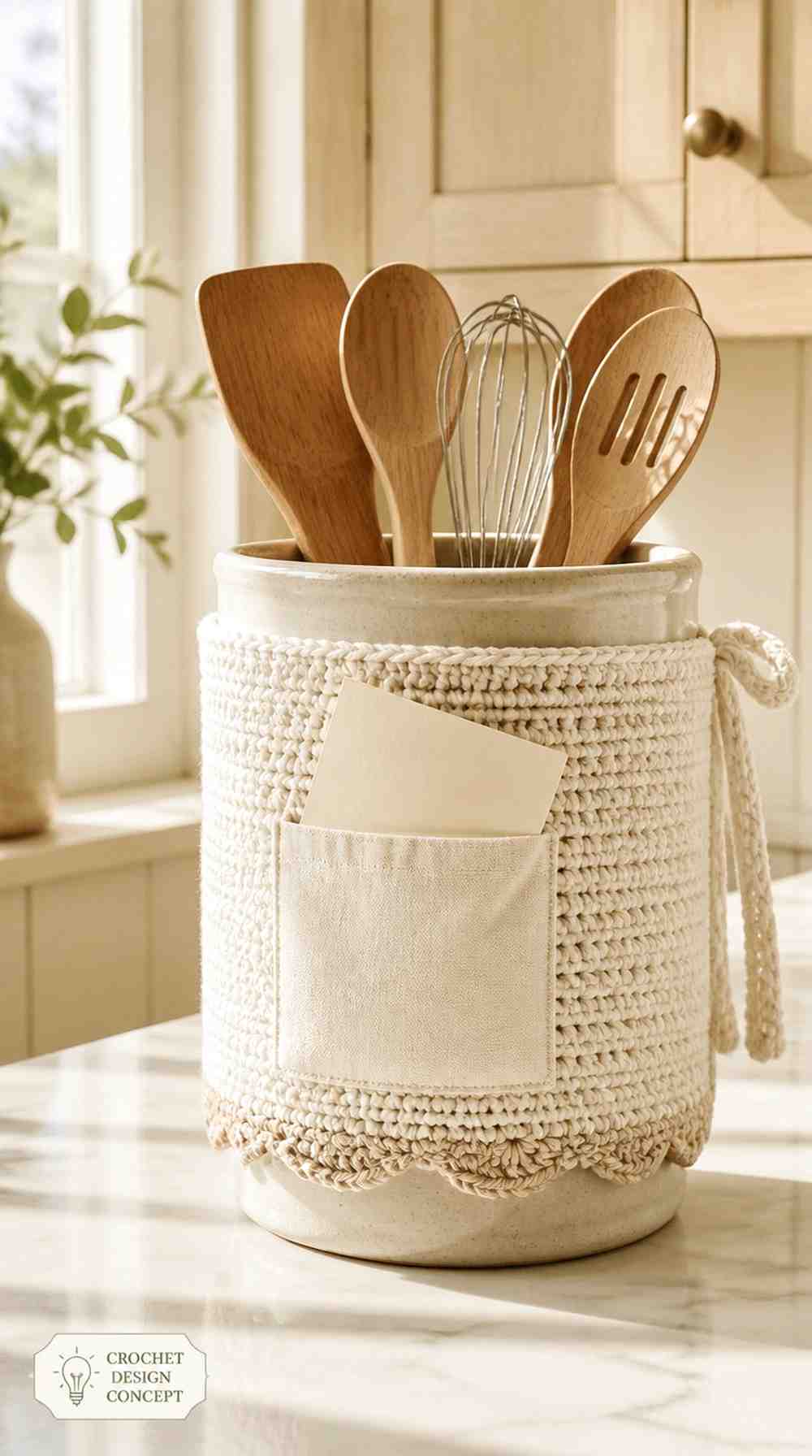
Soft ivory crochet covers the middle of a pale clay utensil crock, ending in an oatmeal scalloped border that gives the lower edge gentle movement. One shallow cream pocket across the front holds a folded kitchen note card, while long crochet ties meet behind the container.
Unlike a fully closed sleeve, this design can be imagined as a flat panel that wraps around the crock. Its decorative lower edge adds character without covering the crock’s opening, although the shallow pocket would be more suitable for occasional notes than for frequently handled cooking tools.
- Scallop clearance: Keep the lower decorative border clear of the countertop so it does not bunch up beneath the crock or collect surface moisture.
- Tie adjustment: A removable tie closure could accommodate small circumference differences, provided the fabric sits firmly without sliding or twisting.
- Paper storage: Only use the front pocket for dry notes, and remove paper before cleaning or placing the crock near splashes.
3. Crochet Terracotta Waffle Spoon Wrap
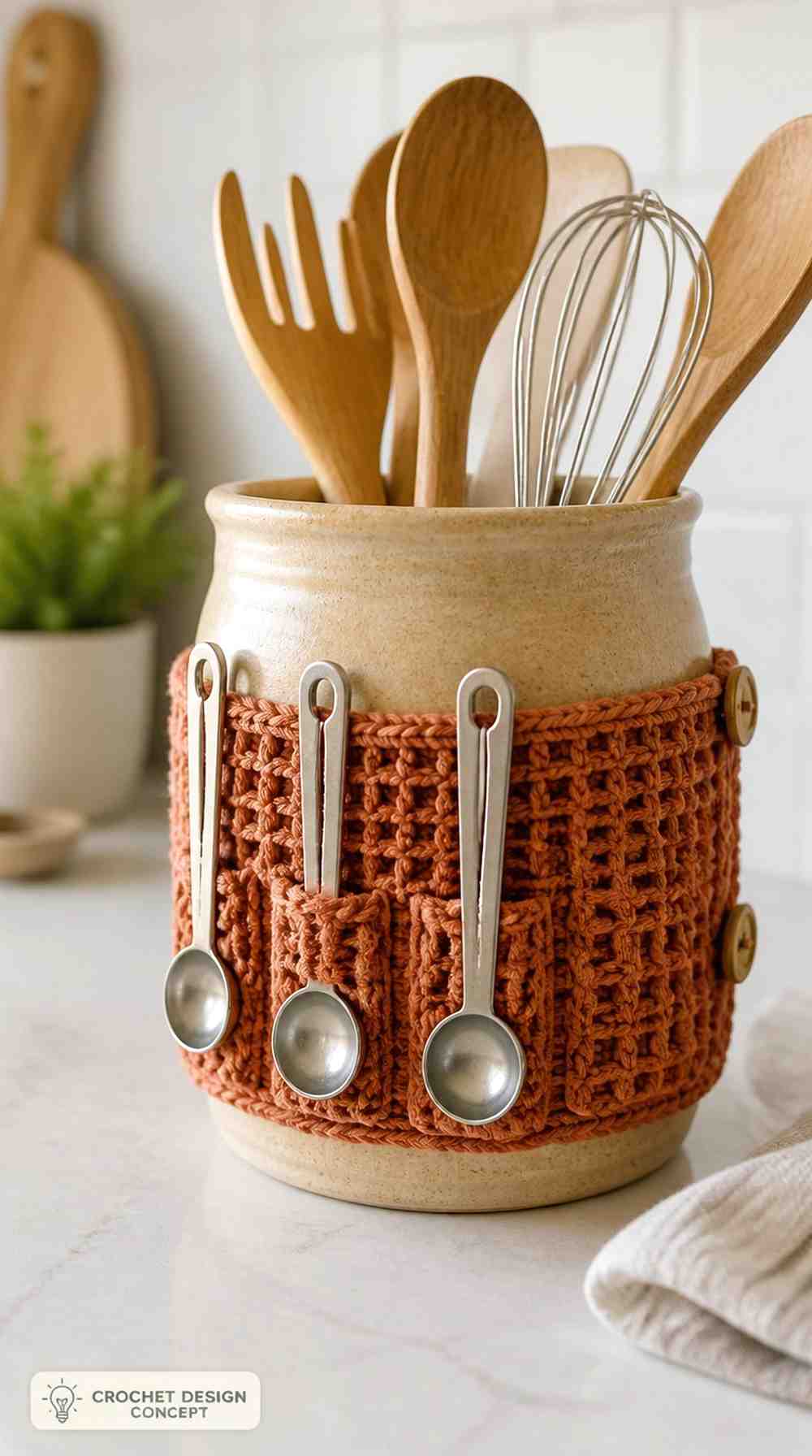
Terracotta waffle stitches bring noticeable depth to this crochet organizer, creating a warm textured band around a sandstone-colored utensil crock. Three short front sleeves divide a small measuring-spoon set, keeping individual handles visible and easier to distinguish.
The two rear buttons add a tidy closure without introducing hanging strings. Raised waffle texture gives the band a more substantial appearance, but the useful part is the division between pockets. Real measuring-spoon sizes would need to be considered before choosing the sleeve widths.
- Pocket spacing: Leave enough space between the three crochet sleeves for fingers to reach each spoon handle without catching adjacent pockets.
- Textured fabric: Raised waffle stitches may create additional bulk, so check how closely a real wrap sits against the crock before making pockets.
- Cleaning access: A buttoned removable band is worth considering because measuring tools are often handled with damp or food-covered fingers.
4. Crochet Cobalt Checkerboard Card Wrap
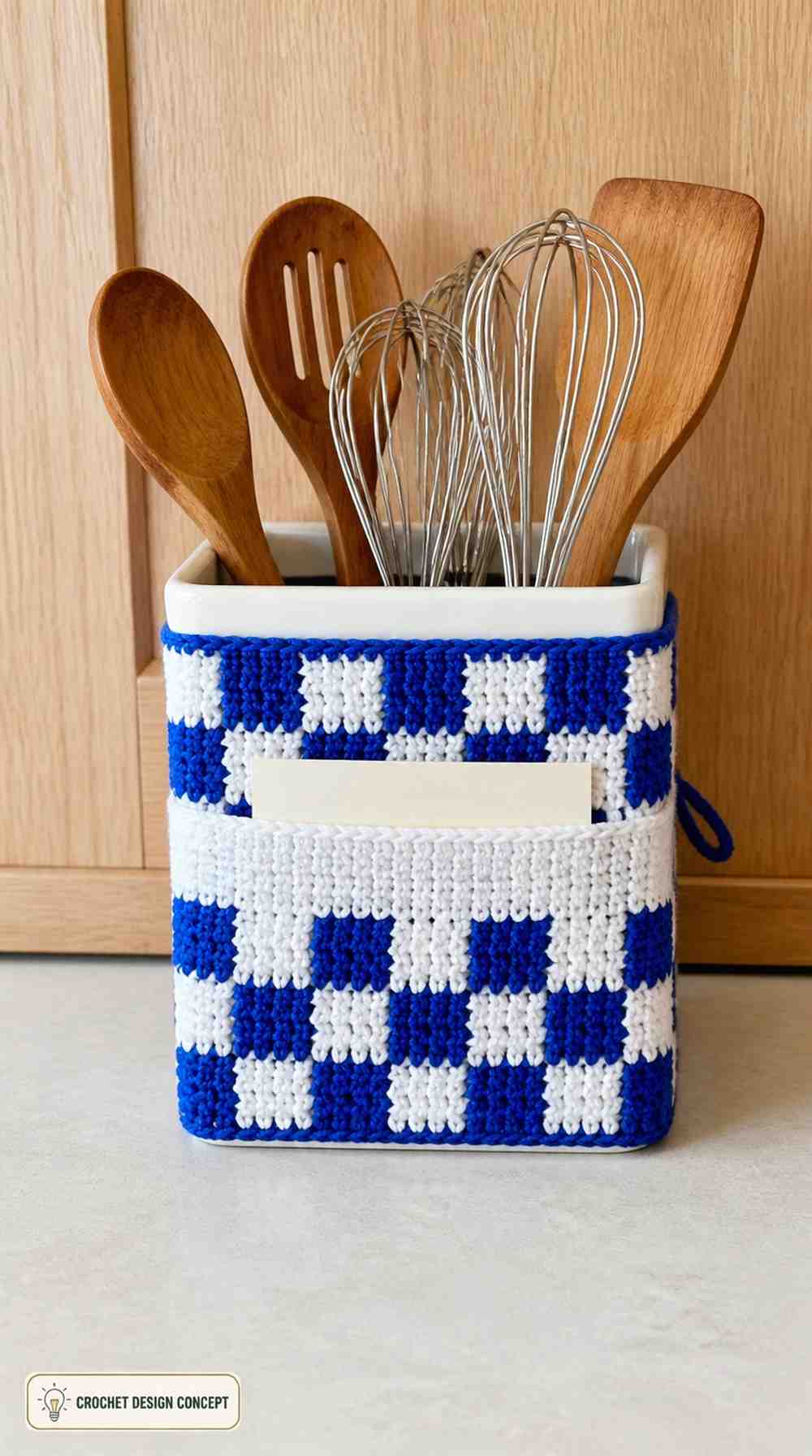
Cobalt-blue and warm-white crochet blocks form a bold checkerboard band around a square ceramic utensil crock. A flat white pocket crosses the front for a folded recipe card, while blue ties secure the wrap behind the container.
The square shape makes this concept different from the usual round-crock sleeve. Its corners introduce folds into the crochet fabric, which can affect pocket position. Keeping the front sleeve relatively flat gives the checkerboard surface room to remain the main visual feature.
- Corner fitting: Measure the distance around the actual square crock, including its corners, rather than treating the container like a smooth cylinder.
- Checkerboard alignment: Plan the joining or color-change positions so prominent squares remain balanced across the front face instead of disappearing around corners.
- Card protection: This outer pocket is for dry reference notes only; paper should be removed if the crock sits near splashes or cooking spills.
5. Crochet Oatmeal Ribbed Thermometer Wrap
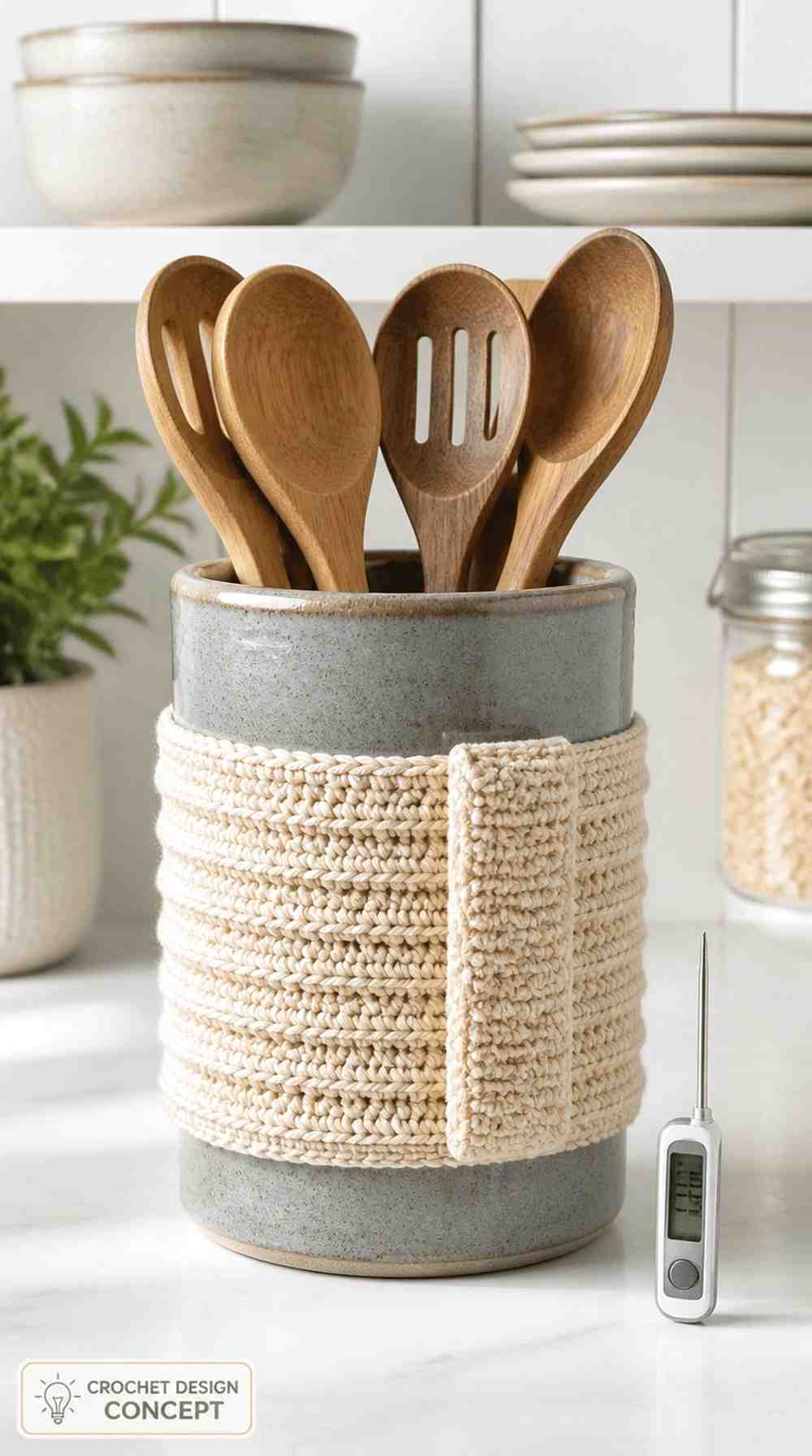
Raised horizontal crochet ribs give this oatmeal-colored band a clean, orderly finish around a tall gray stoneware crock. One narrow upright sleeve sits at the front, holding a clean, cool digital kitchen thermometer separately from the wooden utensils inside.
A dark wooden button and loop close the wrap at the back. The narrow pocket makes this concept particularly focused: rather than adding several small compartments, it gives one frequently used accessory a visible storage position. The thermometer should be completely cooled and dry before being returned.
- Thermometer fit: Check the length and widest section of the actual thermometer, allowing access to its controls and an easy grip for removal.
- Pocket protection: Crochet fabric should not be treated as a protective case for a sharp probe; use a suitable probe cover where needed.
- Raised rib direction: Horizontal crochet ridges emphasize the crock’s width; a firm backing or closer stitches may be needed if the actual band stretches downward.
6. Crochet Butter Yellow Daisy Brush Wrap
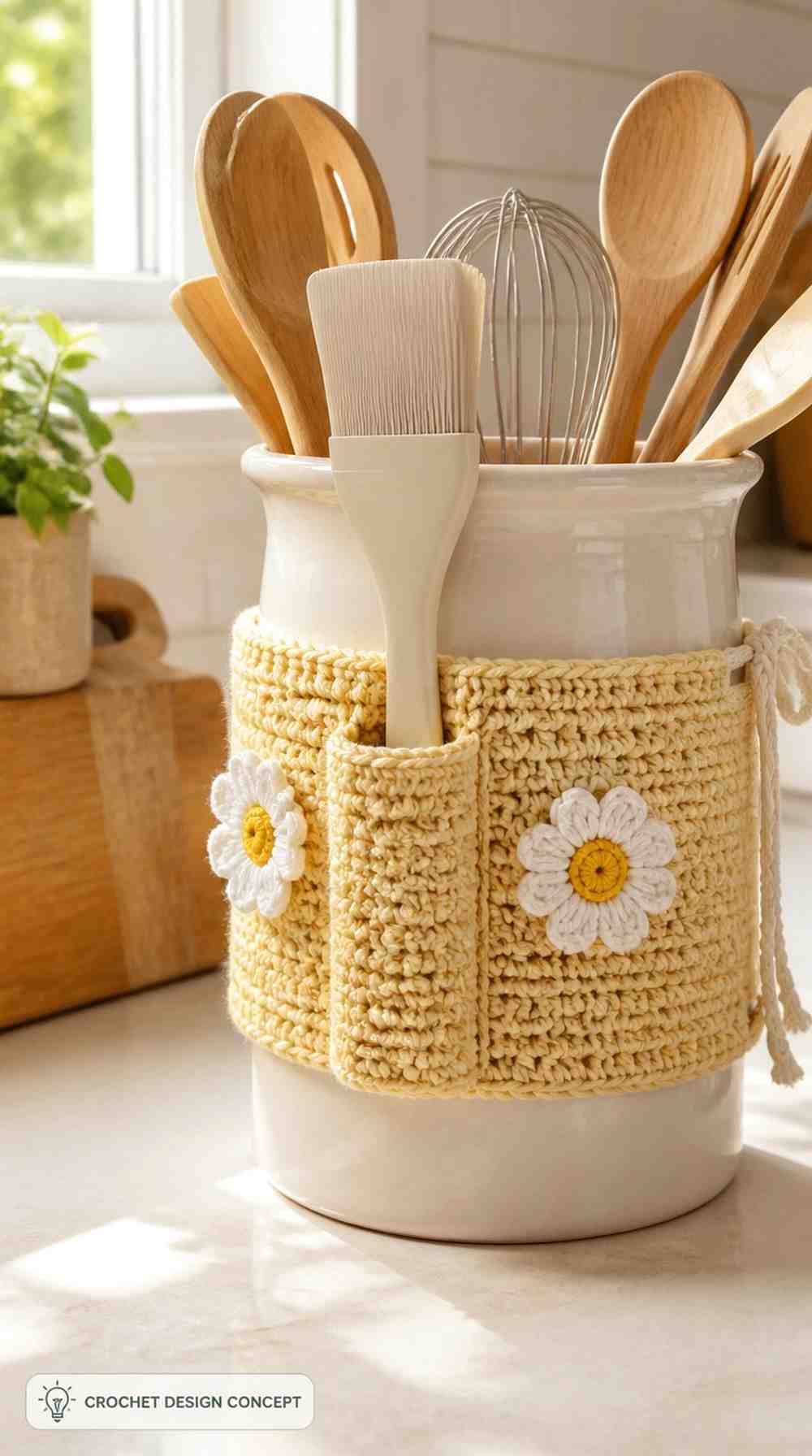
Butter-yellow crochet makes a cheerful band around a cream utensil crock, with a straight central pocket sized for a clean silicone pastry brush. Two little white daisies with golden centers sit on either side of the sleeve without covering its opening.
The cream ties at the back keep the design removable. By placing the flowers away from the working pocket, the wrap separates decoration from storage. It would suit a kitchen where a small pastry brush needs a designated place after it has been properly cleaned and dried.
- Brush condition: Store the silicone pastry brush only when fully clean, cool, and dry; a fabric pocket should not trap moisture around the bristles.
- Flower placement: Keep the decorative crochet daisies flat and away from the pocket opening so they do not catch on the brush handle.
- Pocket depth: A sleeve that is too shallow may let the brush lean outward, while an overly deep sleeve makes the handle harder to grasp.
7. Crochet Teal Mesh Napkin Loop Wrap
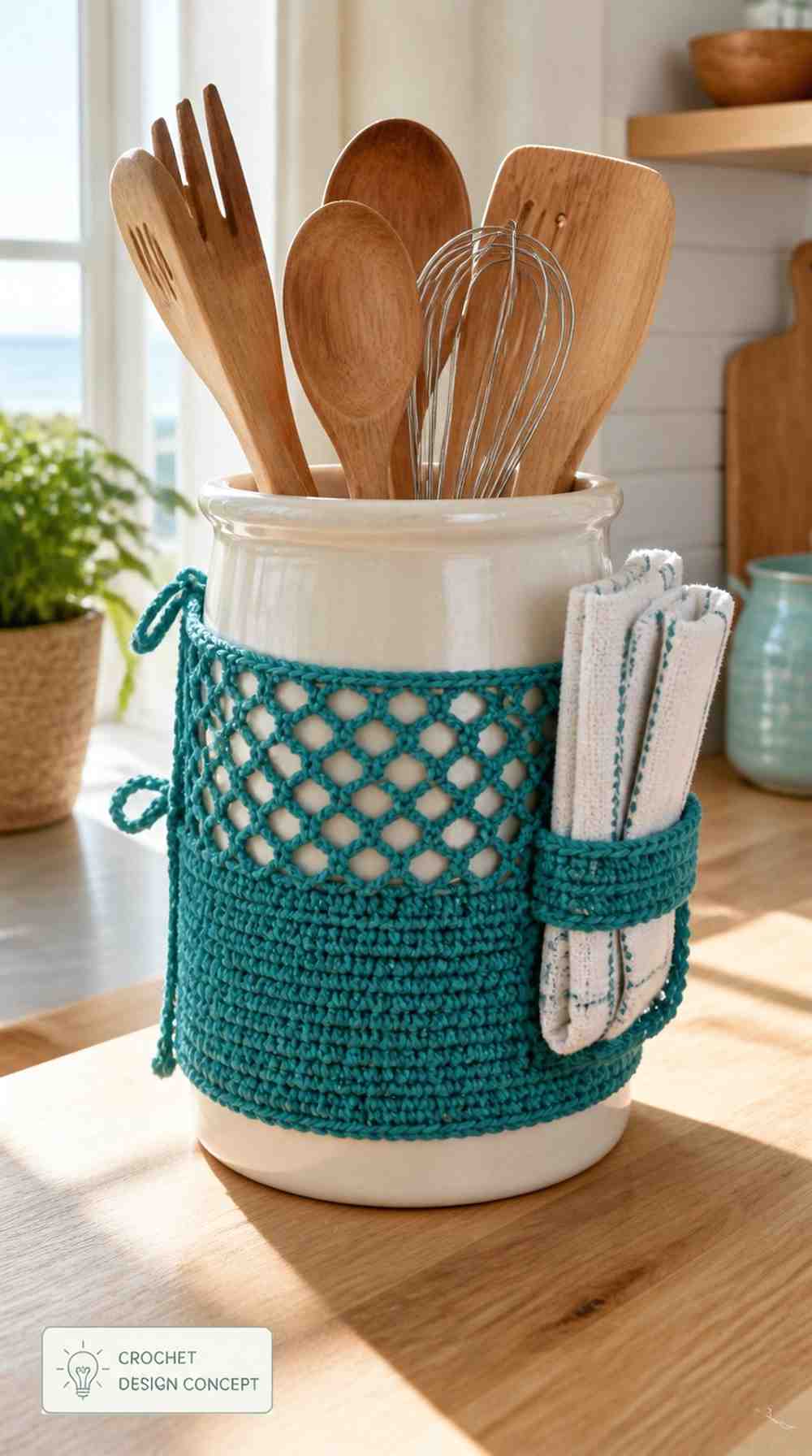
The contrast between a solid teal crochet lower band and open diamond-mesh upper section gives this organizer a lighter appearance. A side loop carries a small, completely dry folded cotton napkin, keeping the front of the cream utensil crock relatively uncluttered.
Two rear ties complete the wrap. The open crochet pattern is a decorative choice rather than a reliable barrier, so the loop becomes the practical feature. It offers a way to keep a small dry cloth close to the utensils without placing it inside the crock.
- Mesh stretch: Open crochet may stretch more visibly around a full crock, so a sounder lower band or closely worked fastening edge deserves consideration.
- Side-loop position: Place the napkin loop where the folded fabric will not drag on the countertop or brush against cooking surfaces.
- Dry-fabric storage: Do not leave a damp napkin hanging against the crochet wrap; moisture can remain trapped between fabric layers and the container.
8. Crochet Dusty Rose Bobble Pocket Wrap
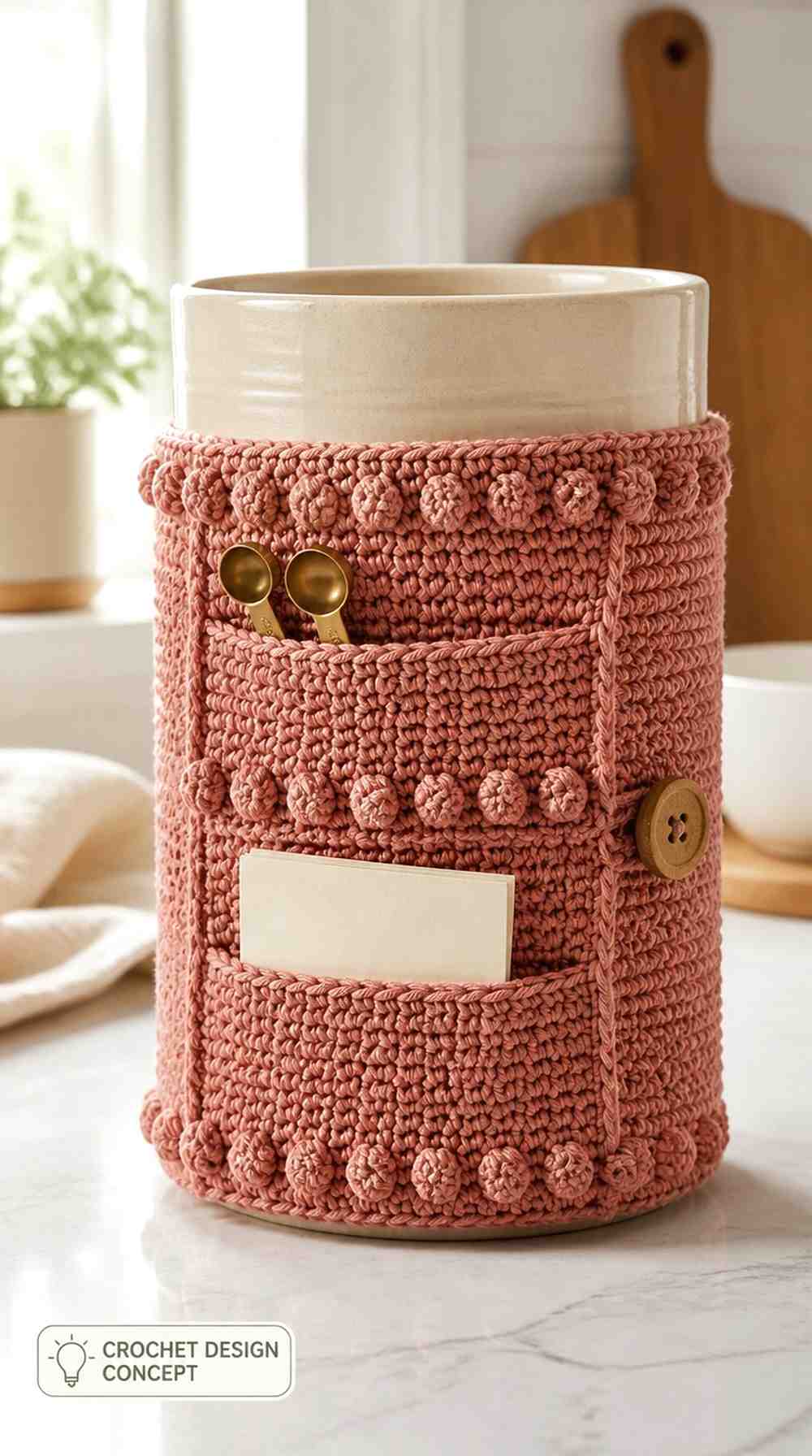
Dusty-rose crochet bobbles frame two short horizontal pockets on this beige ceramic crock. Smooth, close-stitched pocket panels provide a contrast to the raised decoration, with measuring-spoon handles in the upper compartment and a folded blank note card in the lower.
A rear button keeps the band looking contained. The stacked-pocket arrangement makes the design useful for comparing different small items in one place. Since the pockets sit above one another, the contents should remain lightweight enough to avoid pulling the front panel away from the crock.
- Layered-pocket bulk: Stacking crochet pockets adds fabric thickness to a small surface; sample the arrangement before committing to a large bobble border.
- Access order: Keep the upper measuring-spoon pocket shallow so removing a spoon does not push against the lower paper compartment.
- Bobble placement: Raised stitches work best as surrounding accents here, not directly beneath pocket openings where they may interfere with pulling items out.
9. Crochet Forest Green Chopstick Wrap
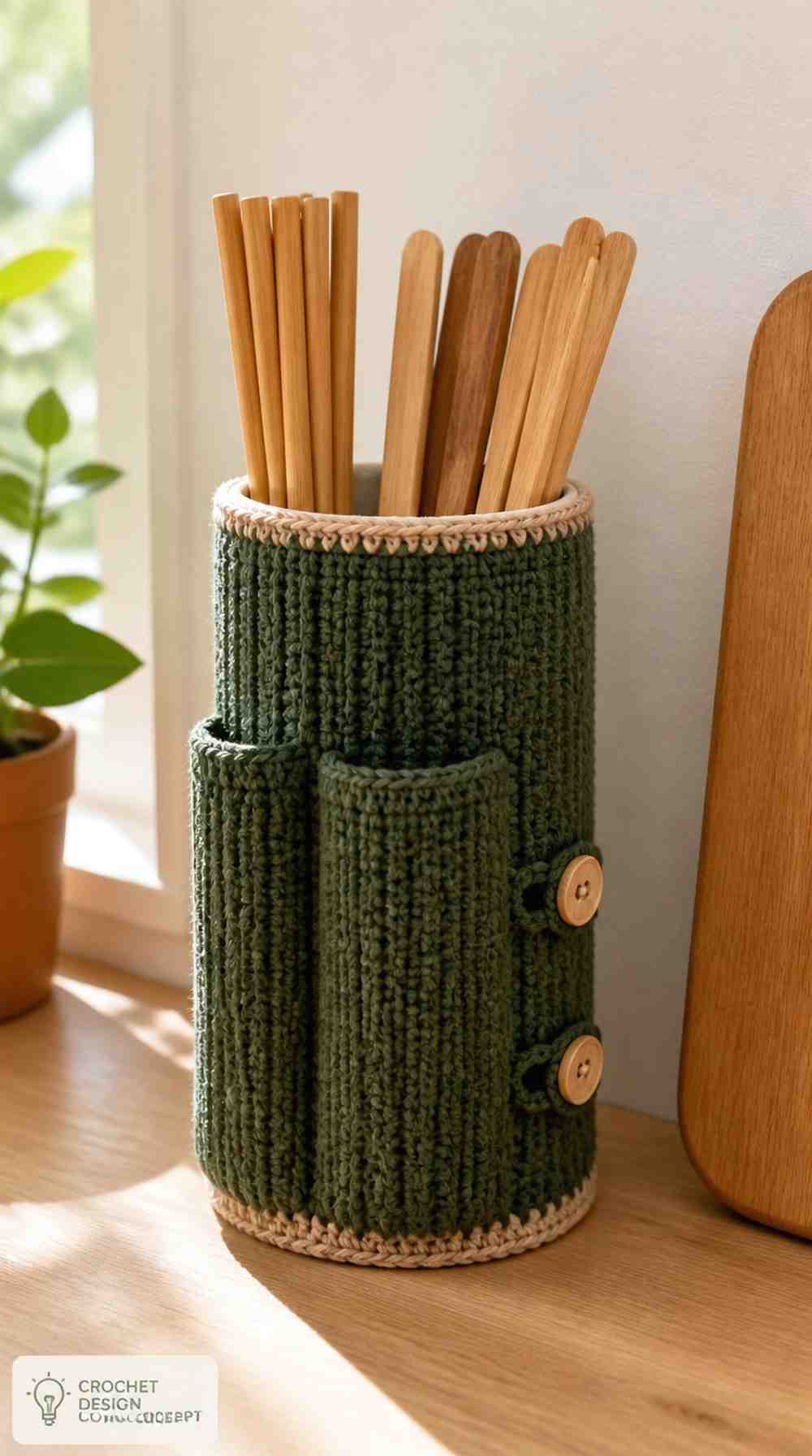
Forest-green vertical crochet ridges wrap around a tall warm-white crock, with tan edging tracing the upper and lower borders. Two narrow outer sleeves hold clean bamboo chopsticks and wooden stirring sticks, separating slimmer pieces from the larger utensils inside.
Small button tabs meet behind the container. The upright ridges visually follow the direction of the chopsticks, giving the organizer a tidy, elongated look. This concept is particularly suited to smaller, lightweight wooden tools that can be stored dry and removed individually.
- Long-handle support: Match sleeve depth to the actual length of the wooden tools, leaving enough handle exposed for a comfortable grip.
- Vertical texture: Front-post ridges create pronounced channels; avoid assuming those channels alone can hold tools without purpose-made crochet sleeves.
- Dry storage: Let washed chopsticks and stirring sticks dry completely before slipping them into yarn pockets, especially when the crochet fits closely.
10. Crochet Lavender Granny Label Wrap
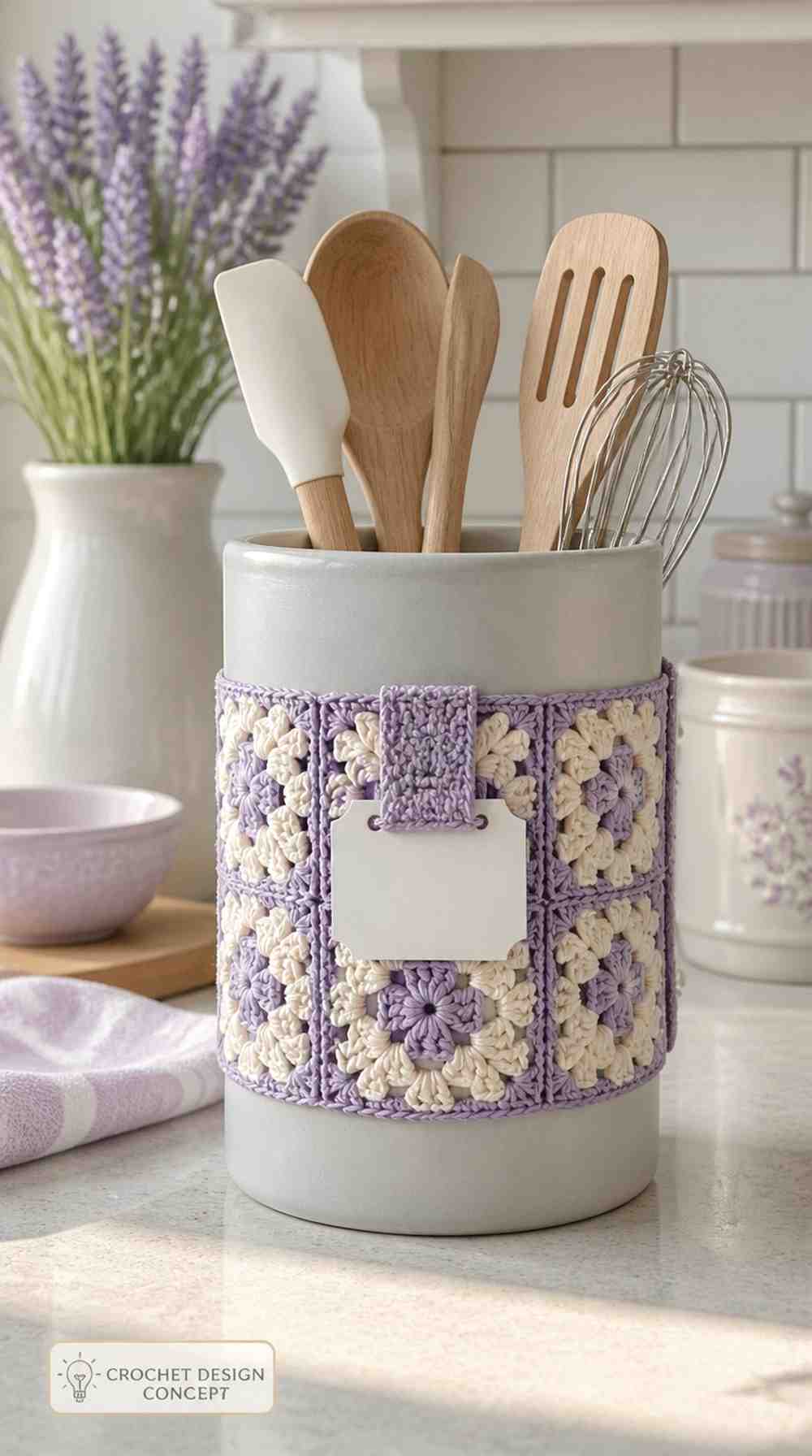
Small lavender-and-cream granny squares create a patchwork band around a pale gray utensil crock. Joined crochet edges form a recognizable handmade grid, while a tiny smooth front tab holds a removable blank paper label. A pearl-like button closes the wrap behind the container.
This concept focuses on identifying a utensil collection rather than carrying several accessories. Its open granny-square corners create an airy decorative surface, and the removable tab could help distinguish a crock reserved for wooden spoons from another holding baking tools.
- Square joining: Keep seams flat and consistent around the crock, since bulky joins may create unwanted gaps beneath the label tab.
- Label replacement: A removable paper insert makes more sense than permanently stitched lettering when the utensils stored in the crock may change.
- Moisture exposure: Open granny stitches and the paper label are best kept away from splashing water or areas that frequently need wiping down.
11. Crochet Rust Chevron Twine Wrap
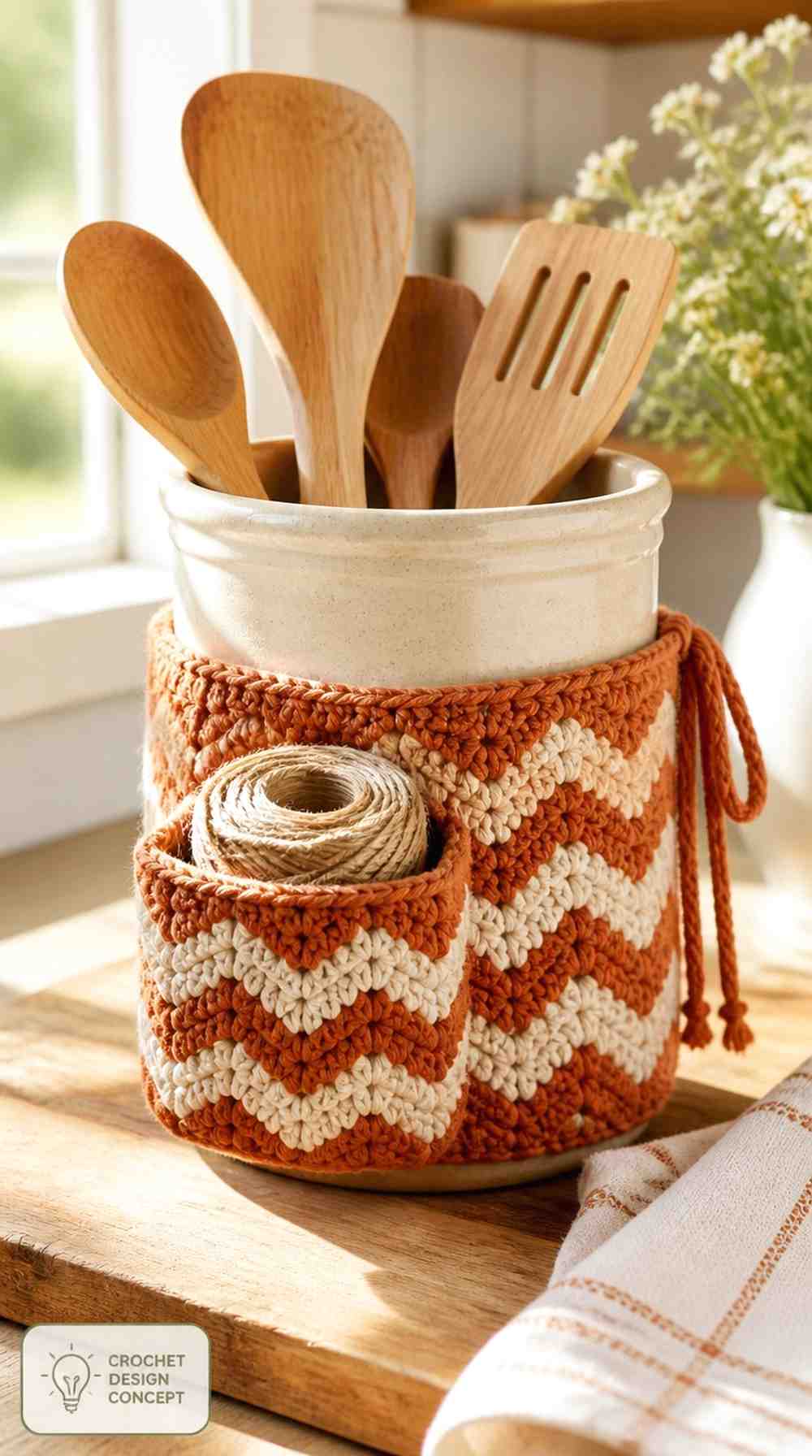
Rust-orange and ecru chevrons run across this crochet band, giving a pale sandstone crock a strong zigzag pattern. A small square side-front pocket holds a tidy coil of kitchen twine, with the loose end tucked inside, while narrow rust-colored ties meet at the rear.
The twine pocket adds a different kind of organization from the utensil sleeves elsewhere in the collection. It is meant for a small, clean, dry coil rather than a large ball of string, which could become awkward beside the other cooking tools.
- Chevron matching: Plan the zigzag repeat around the circumference so the visual pattern does not end abruptly across the most visible front section.
- Twine containment: Keep the coil compact and its loose end tucked away, avoiding long dangling strands that could catch on utensils.
- Storage location: Kitchen twine and crochet yarn should remain away from burners, hot cookware, and other heat sources.
12. Crochet Cornflower Fan-Stitch Loop Wrap
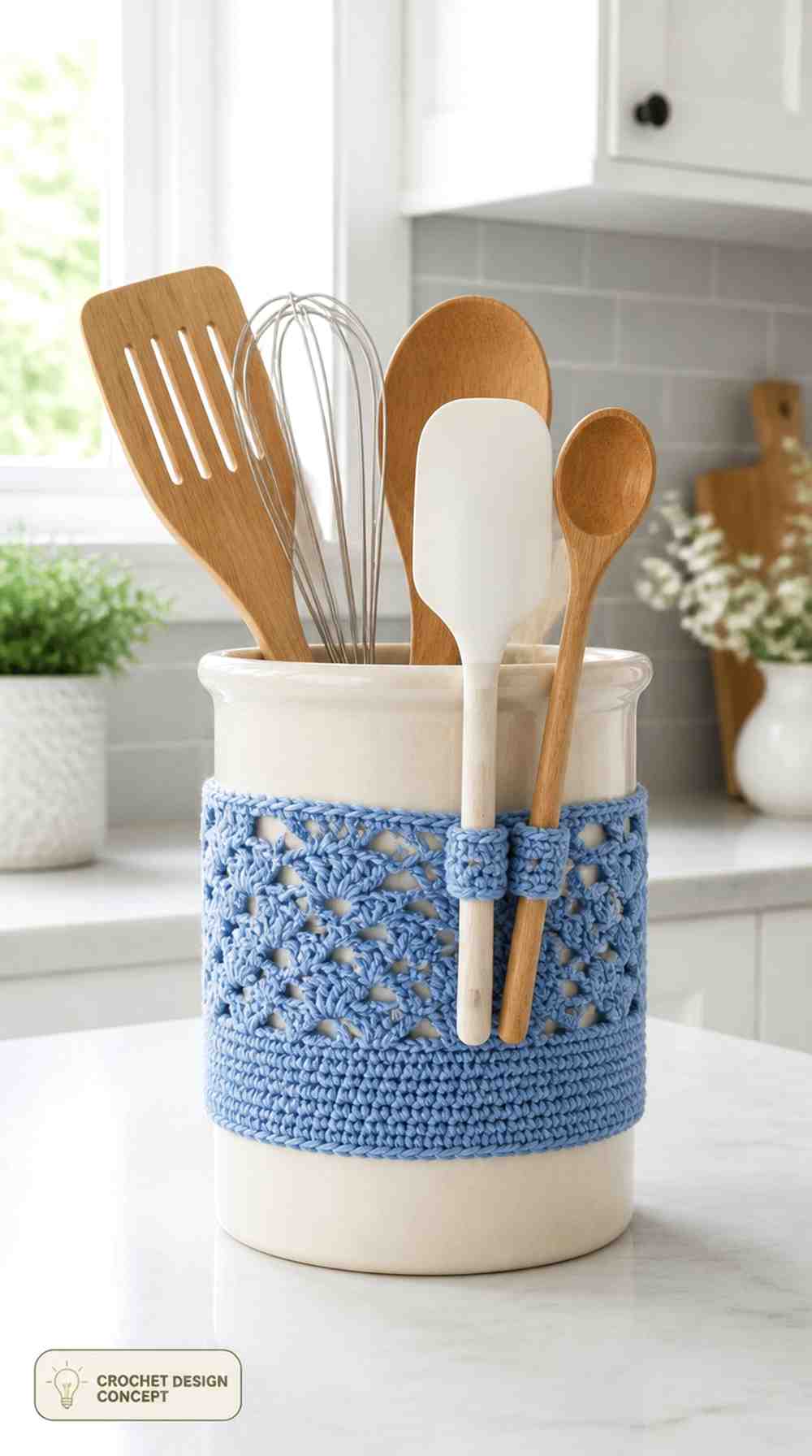
Cornflower-blue fan stitches create a delicate upper surface above a denser crochet lower border. Two short loops are attached to the front of this ivory utensil crock, lightly surrounding the handles of a mini silicone spatula and a slim wooden tasting spoon.
The design keeps those handles visible rather than enclosing them in complete pockets. Its open fan pattern makes the crochet look less heavy, while the solid lower strip gives the small loops a defined attachment area. Actual tool weight and handle shape would determine whether this arrangement is practical.
- Loop attachment: Secure accessory loops to a firmly worked section of a real band; decorative fan stitches alone may not provide enough stability.
- Tool selection: Limit exterior storage to lightweight, cool items that cannot fall dangerously or pull the entire wrap downward.
- Openwork snagging: Test whether the fan stitches catch on nearby utensil handles before choosing this design for a frequently used countertop crock.
13. Crochet Olive Marker Pocket Wrap
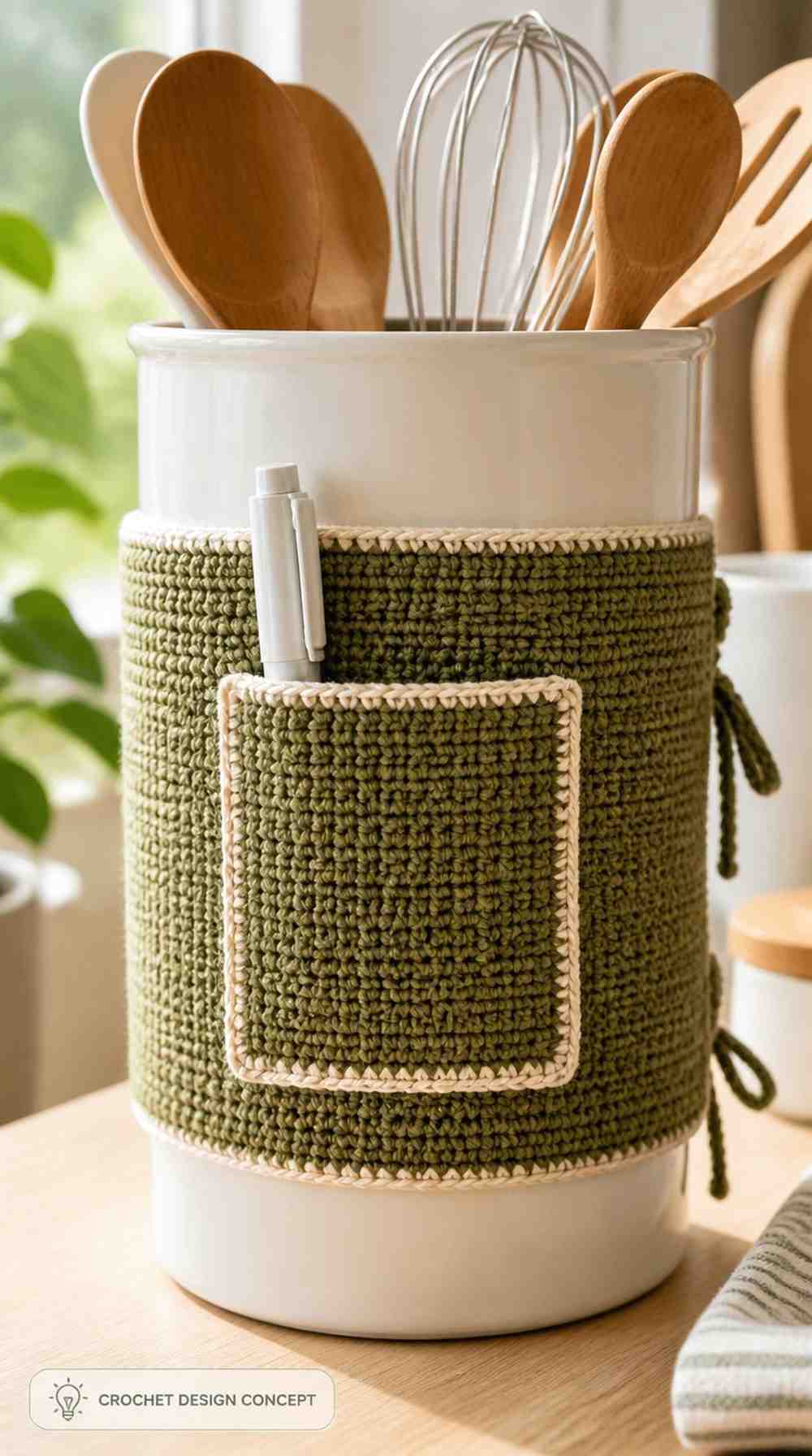
Muted olive-green crochet gives this organizer a straightforward apron-like shape around an off-white crock. One narrow cream-edged pocket stands vertically at the front and holds a capped chalk-marker pen intended for kitchen storage labels.
The close crochet texture keeps the design visually simple, and two short rear ties provide a removable fastening method. Rather than turning the whole crock into a multi-pocket organizer, this concept creates a designated place for one small labeling accessory. It may be especially handy beside a pantry preparation area.
- Marker dimensions: Allow for the cap and any raised clip on the actual pen so the crochet sleeve does not accidentally pull the cap loose.
- Ink care: Store only a tightly capped, clean marker; crochet fibers can become stained if the writing end leaks.
- Workstation placement: A pantry labeling area is more suitable than a splashing sink or stove edge for keeping a marker attached to a utensil crock.
14. Crochet Blush Shell-Edge Cloth Wrap
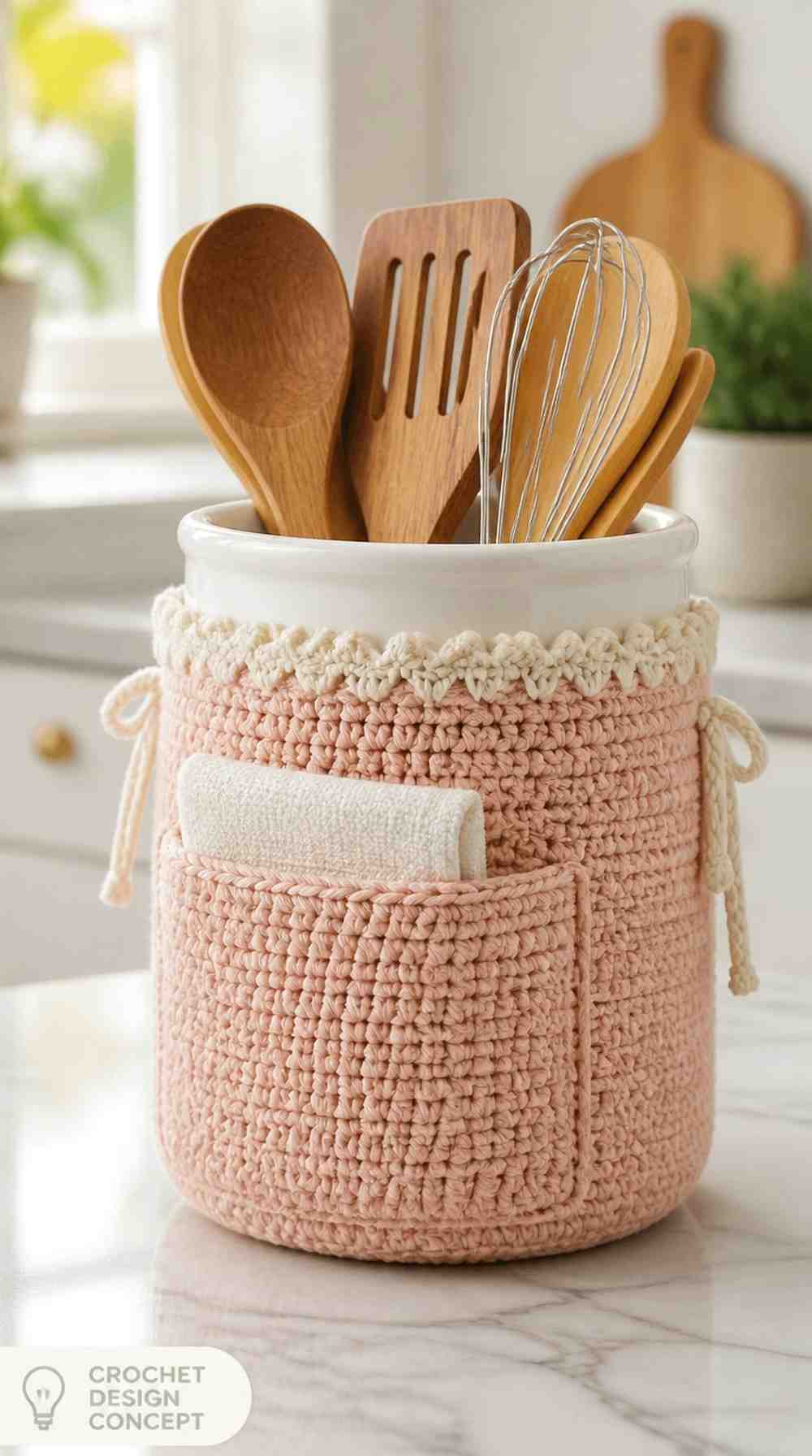
A blush-pink crochet panel sits around a white utensil crock, finished with a narrow cream shell-stitch border along the upper edge. Its wide rectangular front pocket holds a neatly folded small dry cotton cleaning cloth, with just the cloth’s upper edge visible above the opening.
Two cream ties fasten the band at the back. The wide pocket makes this concept feel different from the narrow tool sleeves, offering storage for a soft, folded item. The shell trim adds a decorative finish without taking over the working pocket.
- Cloth folding: Size the crochet pocket for the cloth when folded, not when spread flat, and leave enough fabric visible for easy removal.
- Pocket depth: Keep the pocket low enough to avoid crowding the utensil crock’s rim, particularly when spoons fan outward above the container.
- Dryness check: Store only a fully dry cloth and remove it between uses if it becomes damp or picks up food residue.
15. Crochet Cinnamon Laced Adjustable Wrap
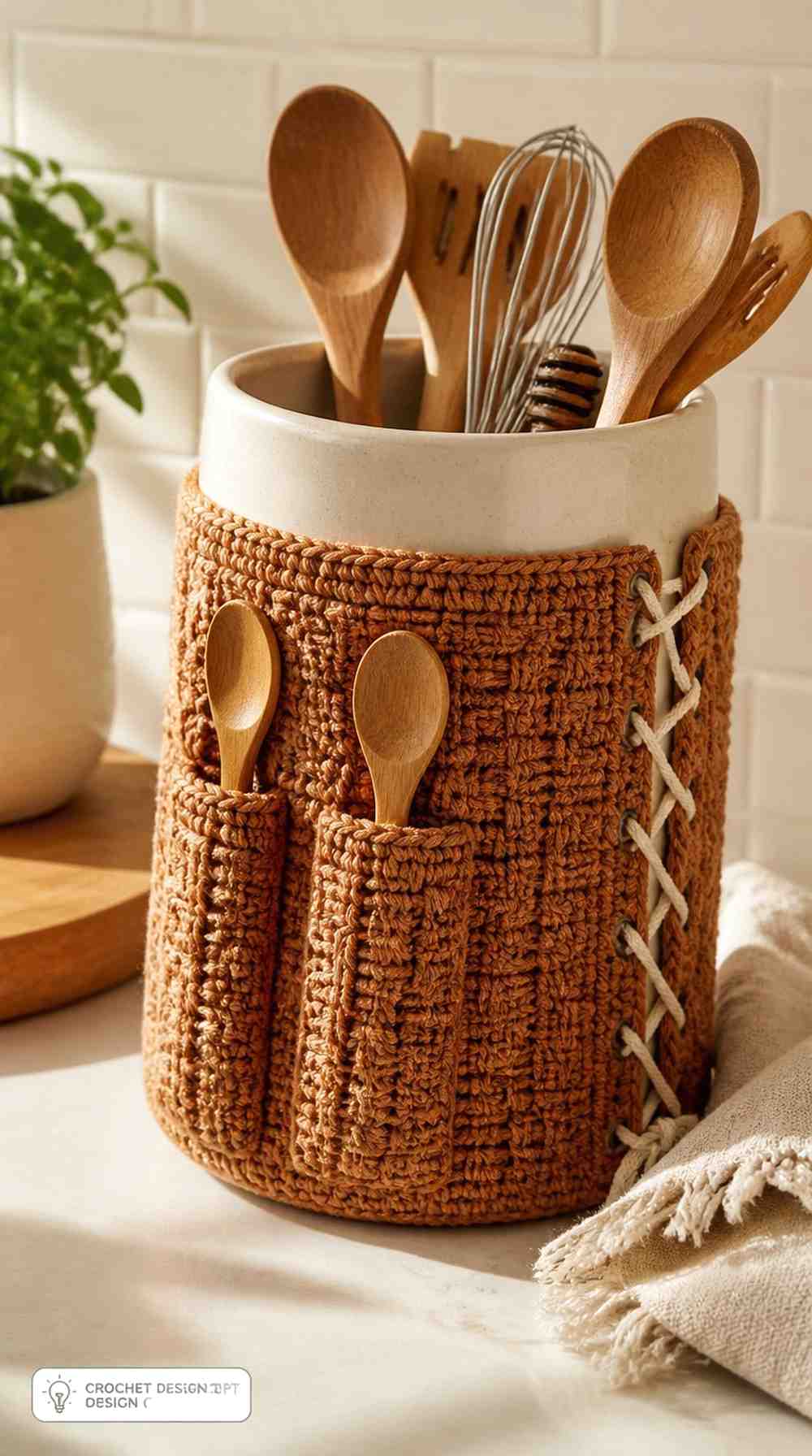
Cinnamon-brown basketweave crochet gives this organizer a strong, structured appearance. Two narrow front sleeves hold lightweight wooden teaspoon handles, while ivory lacing crosses through small eyelets at the rear of the wrap around a slightly tapered cream crock.
The adjustable back closure is the feature that sets this idea apart. Instead of relying on a fixed button position, the lacing could accommodate modest changes in circumference. Its dense basketweave texture would still need to be checked for flexibility before the wrap could fit neatly.
- Tapered fitting: Measure the crock at the upper and lower edges of the proposed band; a single circumference measurement may not describe its shape.
- Eyelet reinforcement: Lacing points concentrate tension, so a real crochet version would need suitable edge support to reduce stretching or distortion.
- Rear accessibility: Leave enough space behind the crock to adjust the laces without removing all the utensils or forcing the container sideways.
16. Crochet Mint Pocket-Apron Crock Wrap
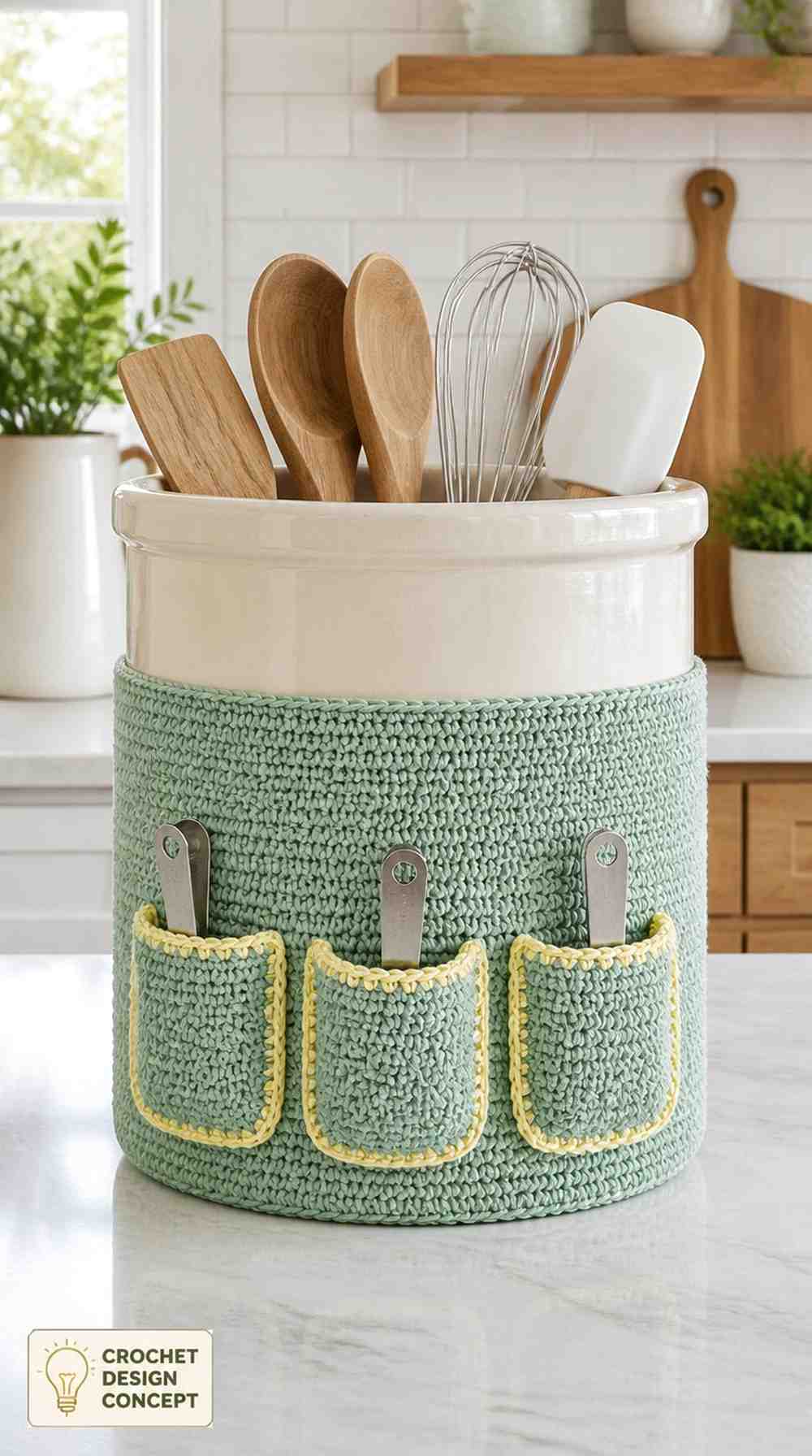
Mint-green crochet forms a short apron-style band across the middle of an ivory utensil crock. Three evenly spaced little patch pockets line the lower front, each with pale lemon edging and a lightweight metal measuring-spoon handle projecting from the opening.
The straight upper edge and softly rounded lower corners keep the organizer cheerful but orderly. Mint ties meet at the back, making the concept easy to imagine as a removable panel. The closely spaced pockets are best suited to small measuring tools rather than full-size kitchen utensils.
- Pocket visibility: Slightly different exposed handle lengths could make a real measuring-spoon set easier to identify, provided all the pockets hold securely.
- Apron proportions: Keep the panel short enough to leave the crock visible and prevent lower pocket corners from resting against the countertop.
- Trim maintenance: Pale lemon edging may show kitchen stains more readily than darker yarn, so consider where the crock sits before choosing the palette.
17. Crochet Burgundy Double-Band Organizer Wrap
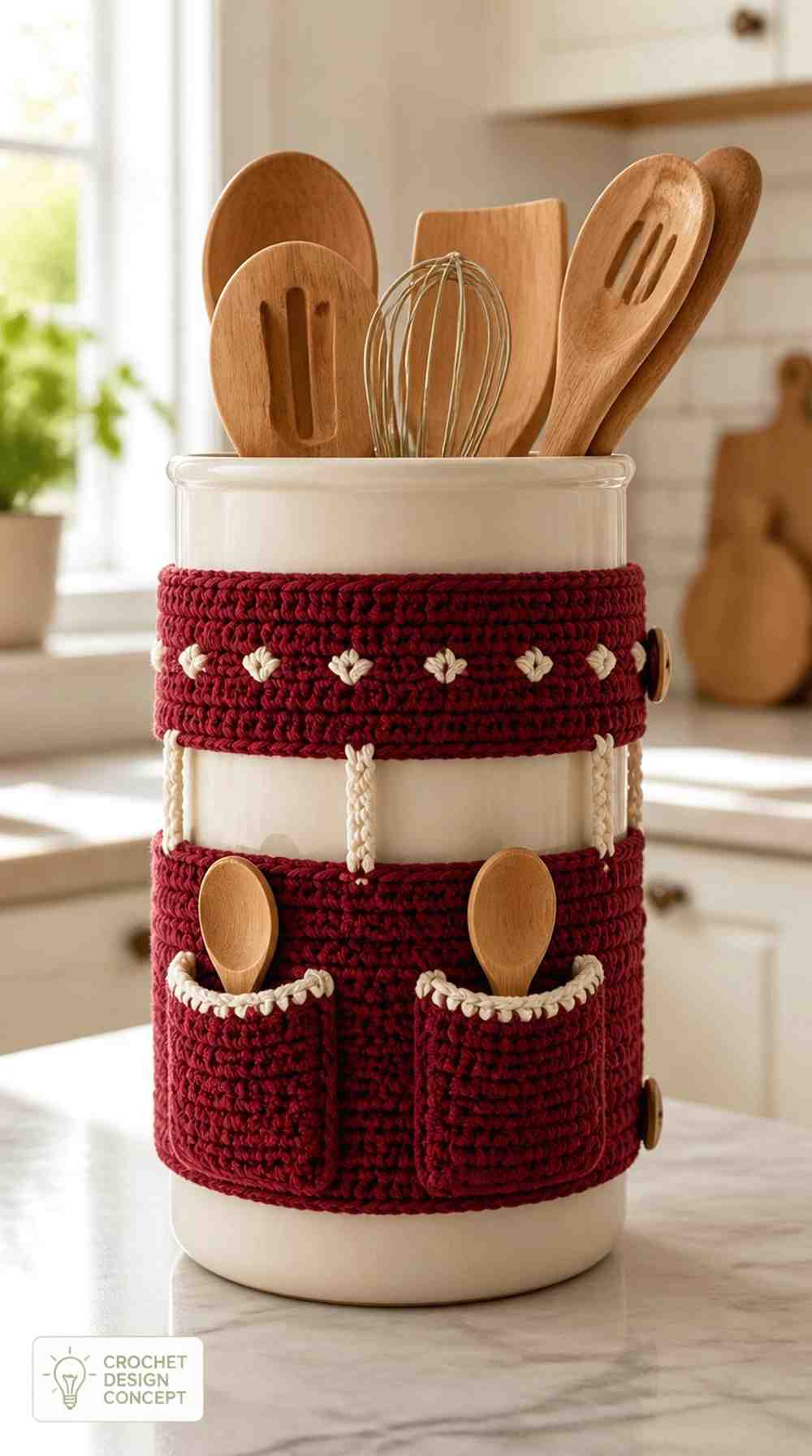
Two burgundy crochet bands circle a tall cream utensil crock, connected by three short ivory vertical sections. The open space between the bands reveals the ceramic surface, while the lower band carries two cream-trimmed sleeves holding clean bamboo tasting spoons. A subtle diamond-stitch accent decorates the upper band.
Small rear buttons close each band separately. This split-level structure introduces a lighter alternative to a full-width crochet sleeve, though it depends on both bands remaining aligned. It is a decorative storage concept for a few slender, dry accessories rather than a load-bearing holder.
- Band alignment: Join the upper and lower bands at consistent positions so the connecting crochet sections do not twist when the wrap is fitted.
- Separate closures: Two buttoned bands may offer adjustment, but both need to fit comfortably without forcing the crock into an uneven position.
- Open-center care: The visible ceramic section remains easy to inspect, but the connecting straps can still trap crumbs and should be removable for cleaning.
Practical Guide to Crochet Utensil Crock Organizer Wraps
Before adapting one of these ideas into an actual crochet project, start with the utensil crock you plan to use. Measure its circumference where the upper and lower edges of the wrap will sit. A tapered crock may need a slightly shaped panel or adjustable ties, while a square crock needs extra attention around its corners.
Choose materials for kitchen use. A smooth, washable cotton yarn is often a practical option for crochet kitchen accessories, but check the specific yarn’s care instructions. Dense stitches can help form pockets, while open mesh is better treated as a decorative feature unless it has suitable support.
Keep the crock stable. The ceramic or stoneware container should remain the structure that holds the utensils. Crochet exterior pockets are better reserved for lightweight, clean, cool items. Never assume a decorative yarn band can safely support knives, heavy metal utensils, sharp probes, or hot tools.
Plan easy removal. Buttons, ties, and adjustable lacing can make it easier to take the wrap off when the container needs washing. Avoid extending fabric beneath the crock, where it may affect stability or stay damp.
Think about the kitchen layout. Keep crocheted wraps away from flames, burners, hot cookware, and places exposed to repeated splashes. If small kitchen notes, markers, or folded cloths are attached, remove them when cleaning. Test a real crochet sample against the actual crock before committing to pocket positions, since stitch stretch and thickness can change the fit.
For more ways to coordinate crochet details with a cooking space, explore 28 Crochet Village Kitchen Decor Inspiration Ideas for Cozy Winter Homes. The site’s 15 Crochet Ruffle-Edge Cup Sleeve Ideas collection also offers visual inspiration for decorative sleeve edges.
Want to Make Something Similar?
These utensil crock wraps are original visual concepts, so the exact designs above do not come with tested patterns. However, related crochet skills can help you plan a removable band, shape a fitted sleeve, or work around a container.
- Mason Jar Holder / Cozy by Annie Wang — a published crochet pattern featuring jar-cover construction and buttonholes. It is not an exact pattern for these organizer wraps.
- Crochet Cozy for Baby Food Jars from CyCrochet — related guidance on fitting crochet fabric around containers with different shapes and sizes.
Use those resources to understand relevant techniques, then measure your own crock and work out the pocket placement independently.
Which Crochet Utensil Crock Organizer Wrap Should You Choose?
| Your main priority | Design to consider | Important trade-off |
|---|---|---|
| Quick access to two slim tools | Sage Moss Twin-Slot Wrap | Limited pocket capacity |
| Separate measuring spoons | Terracotta Waffle Spoon Wrap | Raised stitches add bulk |
| Decorative cottage styling | Ivory Scalloped Tie Wrap | Scallops need countertop clearance |
| Storing a dry thermometer | Oatmeal Ribbed Thermometer Wrap | Pocket must match the actual tool |
| Identifying utensils | Lavender Granny Label Wrap | Paper label needs protection from moisture |
| Flexible circumference | Cinnamon Laced Adjustable Wrap | Requires careful fitting and secure eyelets |
| Small cloth storage | Blush Shell-Edge Cloth Wrap | Cloth must remain dry |
| Less overall fabric coverage | Burgundy Double-Band Organizer Wrap | Two bands must stay aligned |
If you mainly want an attractive cover, a simple tie-on or decorative band may be enough. If you want genuine organizing value, decide which specific small accessory needs a place before selecting the pocket arrangement.
Conclusion
A crochet utensil crock organizer wrap can be a small but thoughtful addition to everyday kitchen storage. The most useful designs do more than introduce color: they provide a suitable place for light measuring tools, notes, dry cloths, or other small accessories while keeping the main crock accessible.
Whether you prefer sage moss stitches, terracotta waffle texture, lavender granny squares, or adjustable cinnamon lacing, begin with the shape of your container and the items you actually use. A removable wrap that fits well and stays easy to clean is worth more than extra pockets that get in the way.
Which design would you choose for your kitchen: the Terracotta Waffle Spoon Wrap, the Mint Pocket-Apron Wrap, or the simpler Sage Moss Twin-Slot Wrap? Share which small utensil accessory you would want to organize first.
Frequently Asked Questions
1. Can a crochet organizer wrap fit any utensil crock?
Not automatically. Crocks differ in circumference, height, shape, and surface texture. A wrap with ties or adjustable lacing may accommodate some variations, but a real project still needs measurements and a test fit. Square and tapered crocks can require different shaping from straight cylindrical containers.
2. What yarn should I consider for a kitchen utensil crock wrap?
Smooth cotton is a reasonable starting point because many cotton yarns can be cleaned according to their care labels and worked into fairly defined crochet textures. However, yarn blends, dyes, and finishes vary. Check the actual material’s washing instructions and avoid using any yarn close to high heat or flames.
3. Can crochet outer pockets hold heavy kitchen utensils?
They should not be assumed capable of doing so. The concepts shown are intended mainly for lightweight accessories such as measuring-spoon handles, small wooden tools, notes, or a clean dry cloth. The ceramic crock should continue to support the larger utensils. Avoid storing sharp or hot items in unsupported crochet pockets.
4. How can I keep a crochet utensil crock wrap clean?
Choose a removable fastening style and follow the yarn’s care instructions. Take out cards, tools, and other pocket contents before cleaning. Check the crochet for food residue or moisture, and let it dry completely before replacing it around the crock. Avoid leaving damp fabric pressed against the container.
5. Are these crochet utensil crock organizer wraps available as patterns?
No exact patterns are supplied for the 17 illustrated concepts. They are design inspiration rather than tested instructions. Related jar-cozy and crochet sleeve tutorials can help with general construction techniques, but pocket spacing, fit, closures, and actual usability must be planned and checked for the chosen crock.