A collection of earrings is much easier to enjoy when each pair has a visible place instead of getting mixed together in a jewelry drawer. These 17 crochet hanging earring display panel inspiration ideas explore openwork wall hangings, framed grids, small dowel displays, circular embroidery-hoop panels, and divided organizers. From sage fine mesh and ivory scalloped lace to terracotta honeycomb stitches and colorful granny-square accents, each concept combines handmade texture with a different approach to arranging earrings.
Some of these designs are best imagined for lightweight hook earrings, while others include special arrangements for studs, hoops, and clip-on styles. You’ll find compact panels for a few favorite pairs, taller organizers for larger collections, and layouts that separate jewelry by type. The collection helps you compare mesh openings, hanging support, jewelry spacing, and practical access before deciding which design could suit your dressing area.
These are AI-generated crochet design visualizations for inspiration, not photographs of tested handmade pieces or step-by-step patterns.
Quick Design Selection Guide
- For everyday hook earrings: Crochet Sage Fine-Grid Dowel Earring Panel and Crochet Charcoal Framed Earring Grid offer straightforward mesh displays.
- For decorative lace: Crochet Ivory Scalloped Arch Earring Display and Crochet Coral Circular Lace Earring Hoop create softer shapes.
- For a compact wall display: Crochet Terracotta Hoop-Framed Honeycomb Earring Panel offers a circular framed arrangement.
- For stud earrings: Crochet Blush Stud-Backing Earring Grid includes an accessible backing for fastening posts.
- For different earring types: Crochet Dusty Blue Mixed-Backing Earring Panel and Crochet Ivory Sunflower Double-Window Earring Panel provide separate display areas.
- For clip-on earrings: Crochet Mint Clip-On Earring Bar Panel uses raised bands instead of relying on ordinary mesh openings.
- For additional small-parts storage: Crochet Mocha Earring Panel with Backing Pocket includes a lower zipped compartment.
1. Crochet Sage Fine-Grid Dowel Earring Panel
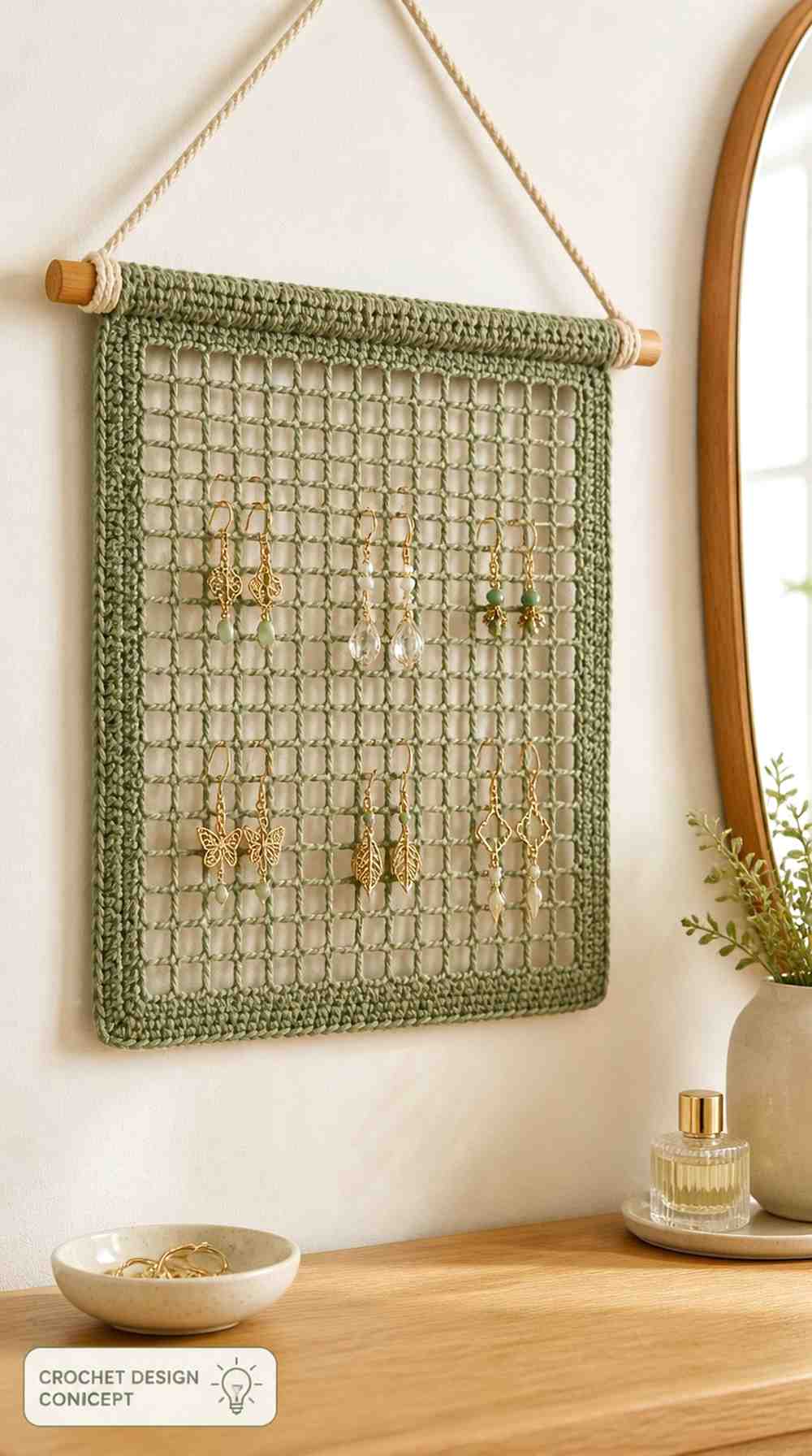
Soft sage-green crochet forms a rectangular mesh display with small, evenly spaced square openings and a dense outer border. A smooth natural-oak dowel holds the upper edge straight, while six pairs of delicate gold French-hook earrings hang separately across the panel.
The fine grid makes this concept useful for organizing several lightweight pairs without needing a separate jewelry hook for every earring. Its simple rectangular shape also leaves the earrings as the main visual feature. A secure dowel and appropriately tensioned crochet would be important for keeping the rows aligned.
- Mesh spacing: Keep enough room between adjacent openings for individual earring pairs to hang without their pendants touching or becoming tangled.
- Dowel support: Use a smooth dowel and reinforced upper crochet channel so the display does not bunch into the center.
- Hook access: French-hook earrings can pass through suitable open stitches, but check that their curved wires do not catch or distort the yarn.
2. Crochet Ivory Scalloped Arch Earring Display
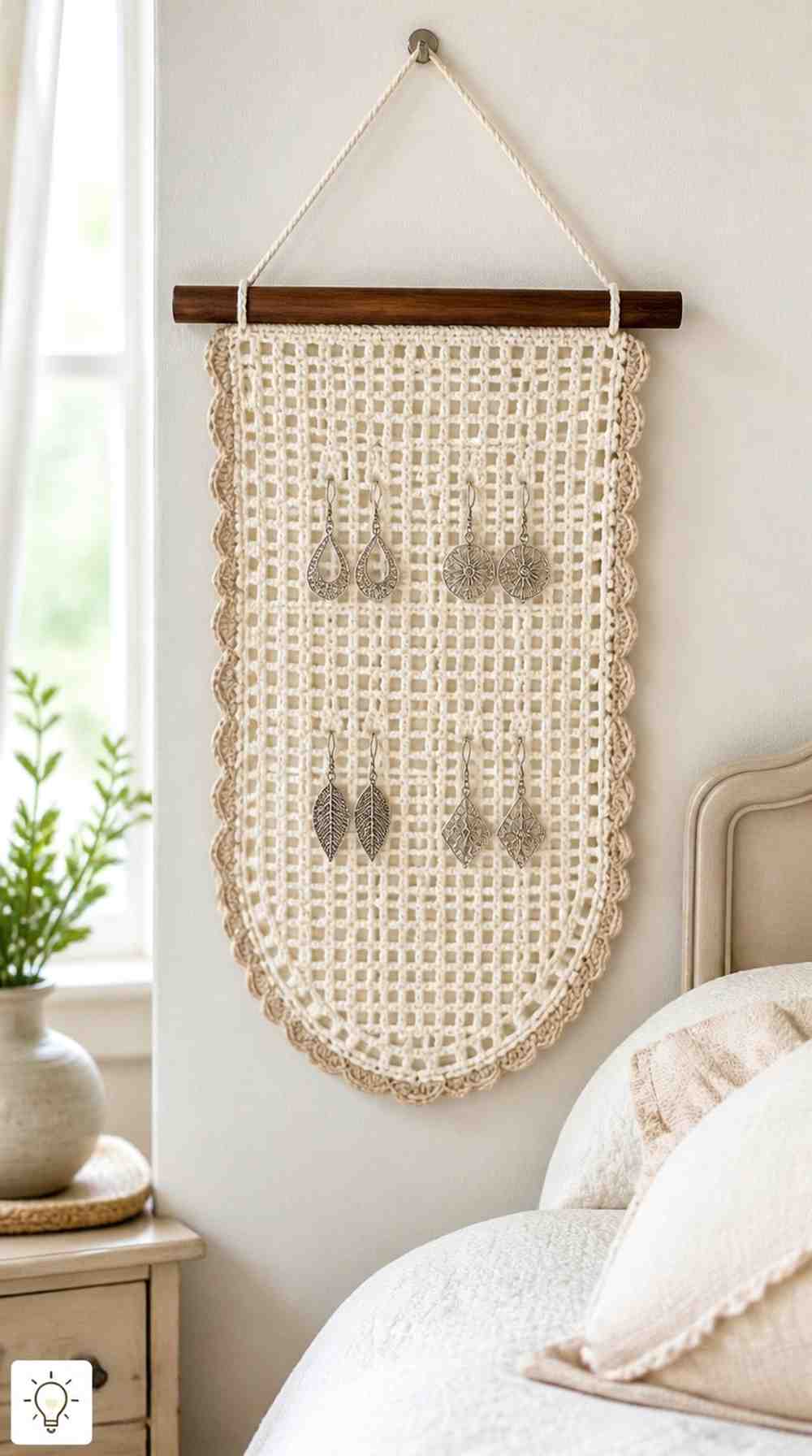
Warm-ivory crochet creates a softly arched hanging panel with fine filet-mesh stitches and an oatmeal scalloped border following the curved sides. A slim walnut rod holds the straight upper edge, while four pairs of small silver hook earrings hang in two neat rows.
The arched lower shape gives this concept a more decorative finish than an ordinary rectangular display. It may suit a small collection placed near a dressing mirror, although the lace edging should stay separate from the working mesh where earrings are inserted and removed.
- Arched shape: Keep the crochet rows balanced so the lower curve remains symmetrical rather than stretching into an uneven point.
- Scallop placement: Use the decorative border mainly along the outside edges, leaving clear mesh openings for the actual earrings.
- Silver contrast: Ivory crochet makes small silver earrings easy to distinguish visually, especially against a pale wall with gentle shadows.
3. Crochet Terracotta Hoop-Framed Honeycomb Earring Panel
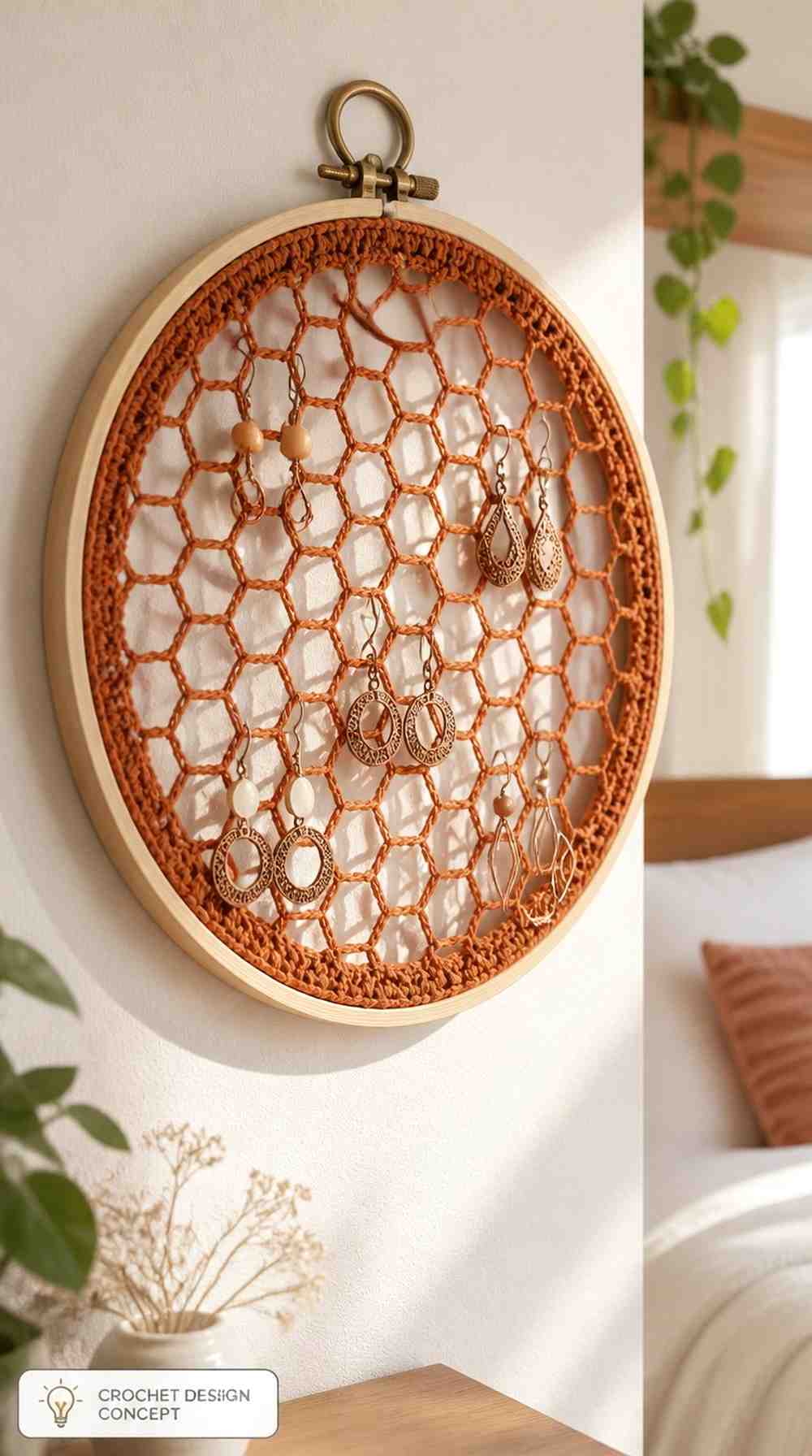
Terracotta-orange crochet fills a circular pale-oak embroidery hoop, with small honeycomb-shaped mesh openings arranged across the center. Five pairs of lightweight copper-colored hook earrings hang at different positions through the crochet, while the wooden frame defines the outer shape.
The circular construction provides a different display experience from a suspended rectangular panel. The hoop can help keep the mesh evenly tensioned, although the crochet should be secured around the frame rather than simply resting loosely inside it.
- Hoop tension: Stretch the crochet evenly around the wooden circle without pulling the honeycomb openings into irregular shapes.
- Earring arrangement: Place longer earrings lower or farther apart so they do not overlap the hoop edge or neighboring jewelry.
- Frame security: Check that the embroidery-hoop fastening remains tight enough to hold the crochet fabric during repeated jewelry changes.
4. Crochet Blush Stud-Backing Earring Grid
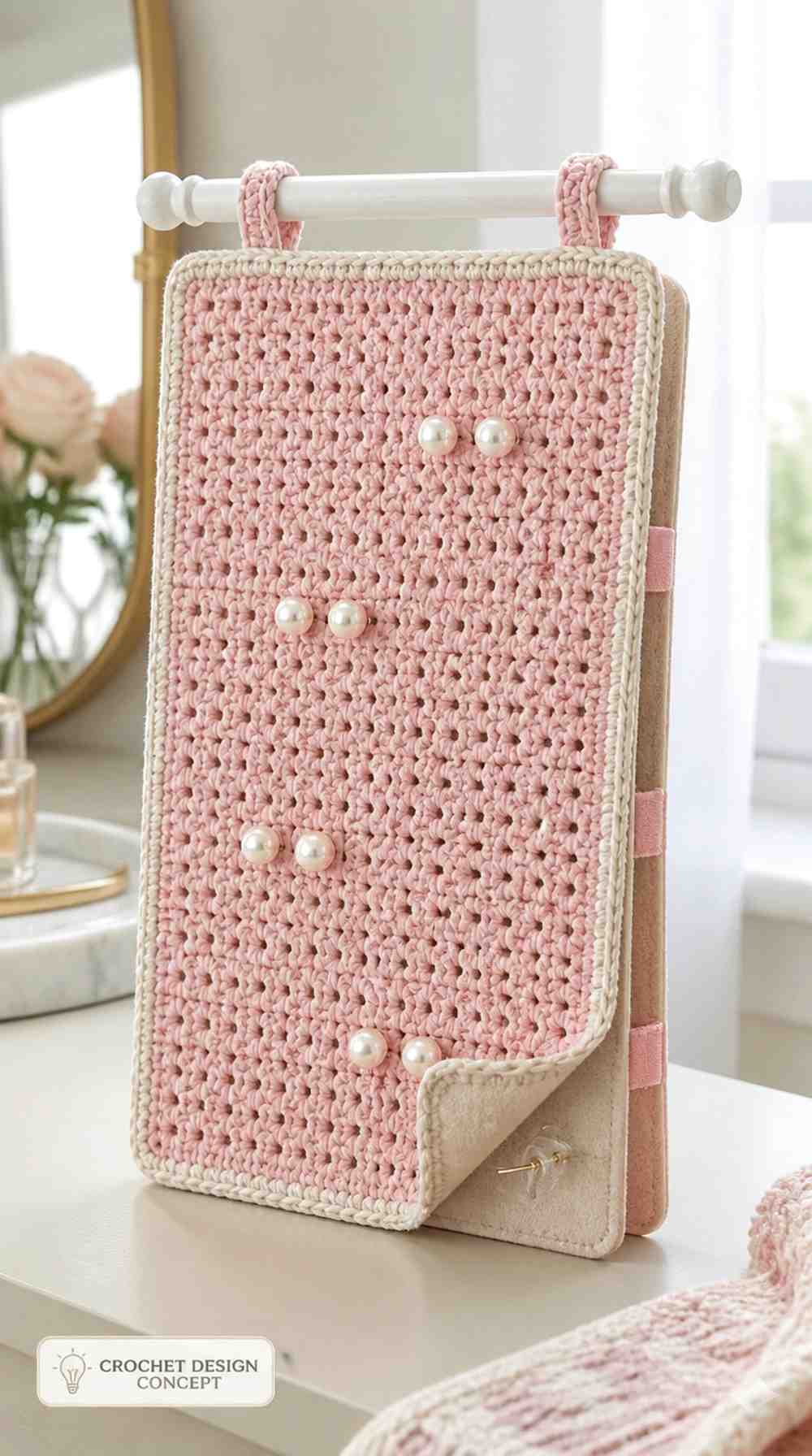
Blush-pink crochet forms a small rectangular earring grid with tiny stitch openings and a cream outer border. Four pairs of pearl studs pass through the fine crochet, with a removable pale-beige felt backing accessible behind the panel. Two short upper loops hold the display on a white dowel.
This concept focuses on stud earrings rather than hanging hooks. Stud posts need a way to pass through the fabric while their backs remain accessible and fastened. The removable backing is therefore part of the practical design, not merely decoration.
- Post access: Ensure the stud posts can pass through the crochet without forcing or splitting yarn strands, and leave room to fasten their backs.
- Removable backing: The felt panel should be easy to open for changing earrings while remaining secure when the display is hanging.
- Small studs: Use a fine, stable grid for lightweight studs; oversized mesh openings may not support small decorative fronts consistently.
5. Crochet Navy Double-Tier Hoop Earring Display
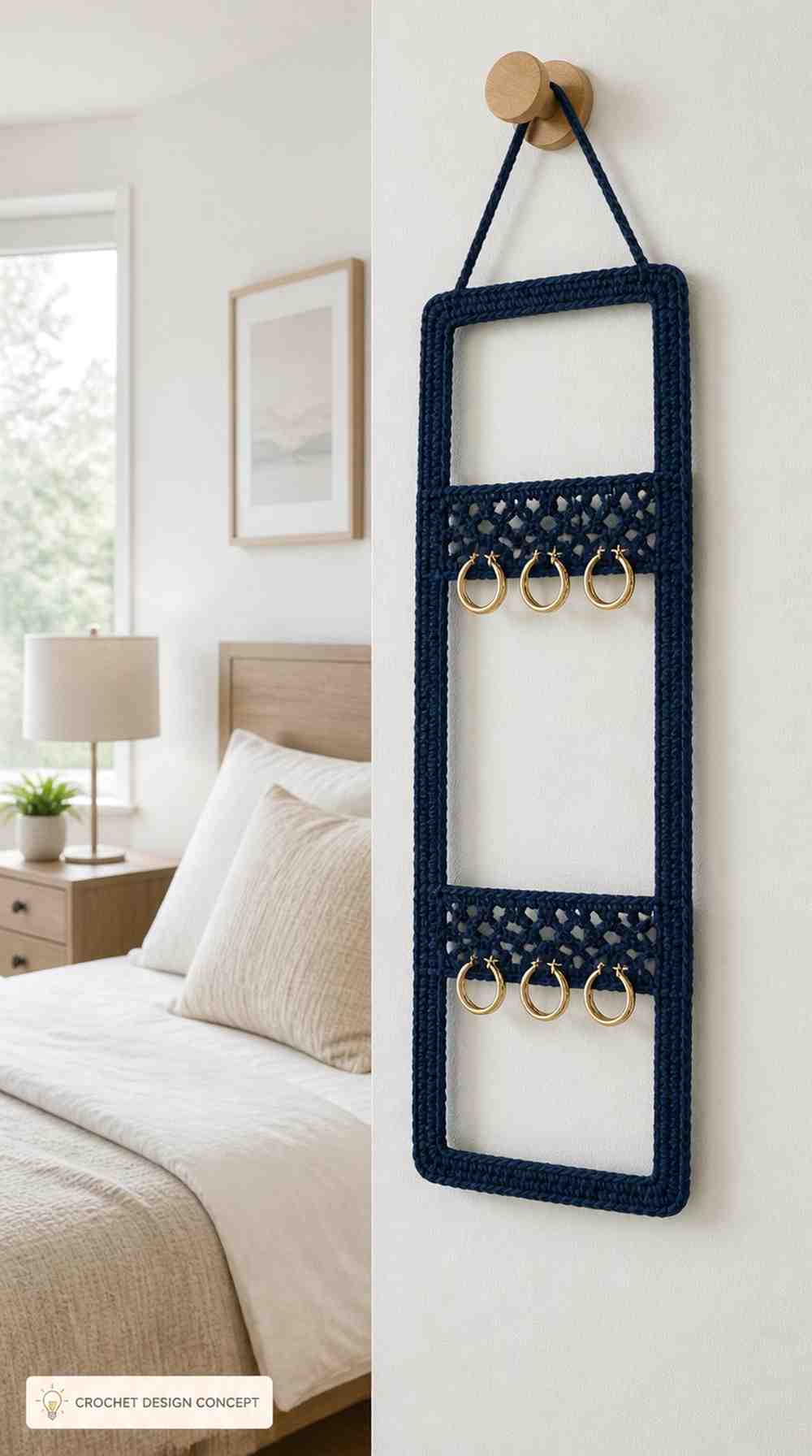
Deep navy crochet creates a tall narrow organizer with two separate horizontal openwork bands connected by solid side rails. Three pairs of gold hinged hoop earrings hang from each band, their closures secured around appropriate crochet openings.
The two-tier arrangement is useful for keeping small hoops visible without spreading them across a large wall panel. Its open center leaves the two rows distinct. Because hoop earrings vary in diameter and weight, the crochet bands should be planned around the actual collection.
- Hoop closures: Only attach hinged hoops where their latches can open and close without catching on the crochet fibers.
- Tier spacing: Leave enough room below the upper band for the first row of hoops to hang freely above the second.
- Side-rail structure: Keep both navy side rails evenly tensioned so the horizontal bands do not sag toward the middle.
6. Crochet Butter Yellow Daisy-Corner Earring Panel
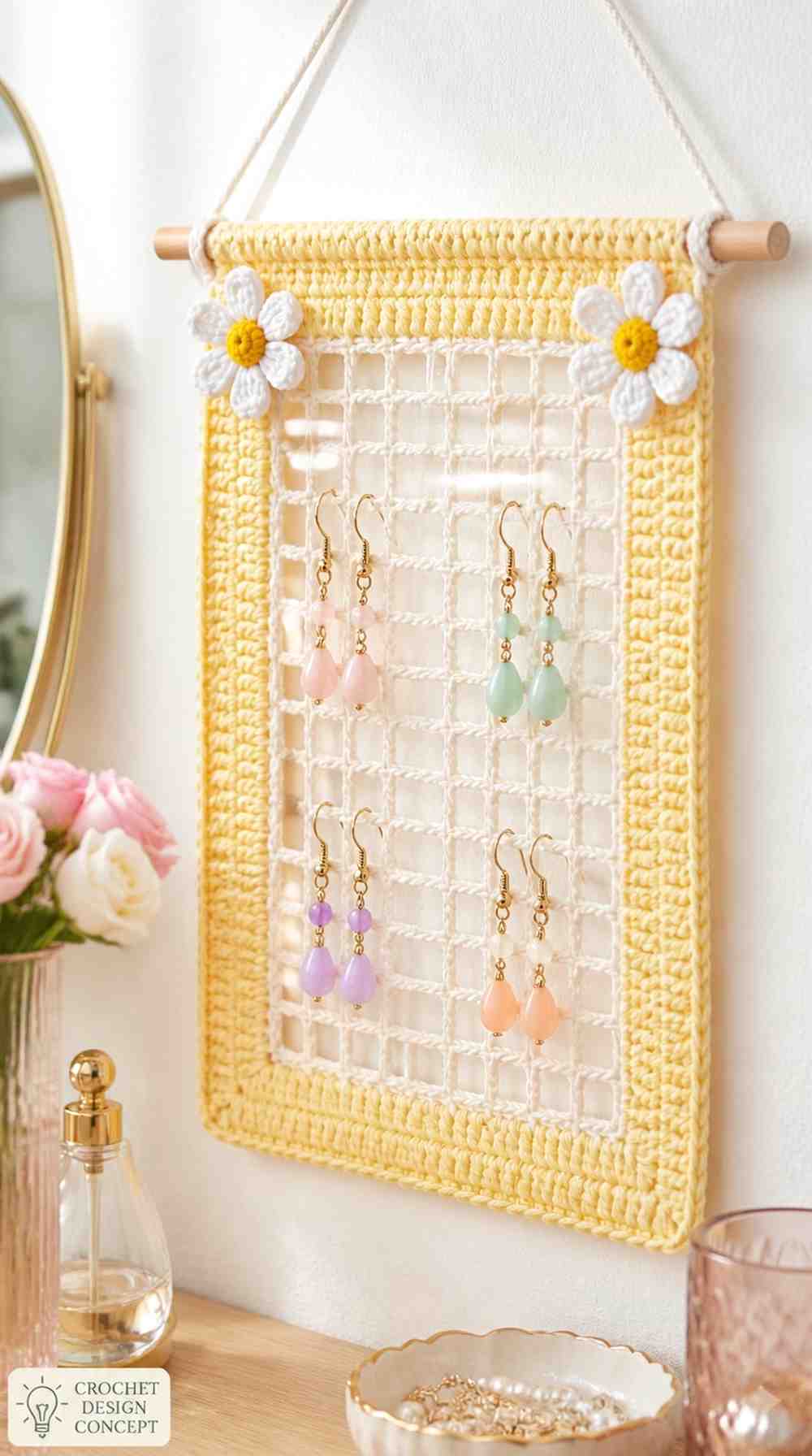
Butter-yellow crochet creates a cheerful rectangular display with a cream fine-mesh center and two small flat white daisies decorating the upper outer corners. Four pairs of pastel hook earrings hang through the central openings, while a light-oak dowel and cream cord support the panel.
The daisy details give the piece a playful finish without taking space away from the earrings. Keeping the motifs near the upper corners also lets the mesh remain the functional part. This would suit a modest collection of lightweight everyday dangles.
- Flat floral accents: Work the daisies close to the outer border so petals do not catch on earring hooks or dangling chains.
- Working area: Keep the central mesh free from appliqués, allowing all four pairs to be removed without disturbing decoration.
- Color balance: Pale yellow and cream create a soft background for pastel earrings, though stronger jewelry colors may need more visual separation.
7. Crochet Charcoal Framed Earring Grid
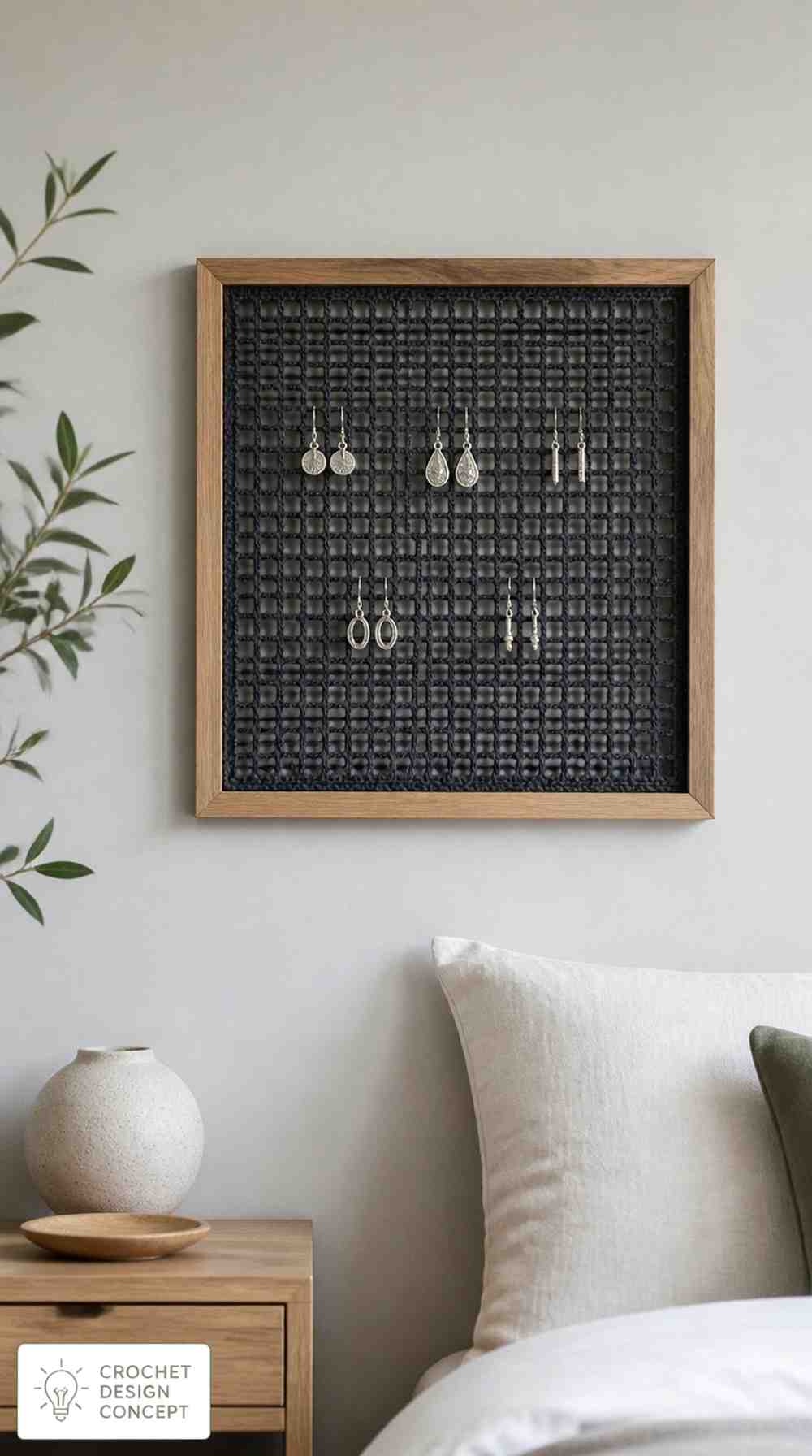
Charcoal-gray crochet forms a taut square mesh inside a slim natural-oak frame. Five pairs of delicate silver fishhook earrings hang in two orderly rows across the grid, with the framed display mounted flat against a light-gray bedroom wall.
The dark crochet makes the silver jewelry stand out while giving the panel a more structured outline. A picture-style frame also provides a different support method from a dowel. The frame should hold the crochet securely without crushing the stitches or exposing sharp attachment points.
- Frame attachment: Secure the crochet edges evenly beneath the wooden frame so the panel remains flat and does not pull away when earrings are removed.
- Dark-stitch visibility: Use bright, balanced lighting so the charcoal crochet openings remain visible when placing small hooks.
- Wall spacing: Leave enough clearance behind the frame to insert and remove hooks without scraping the wall.
8. Crochet Lavender Granny-Window Earring Panel
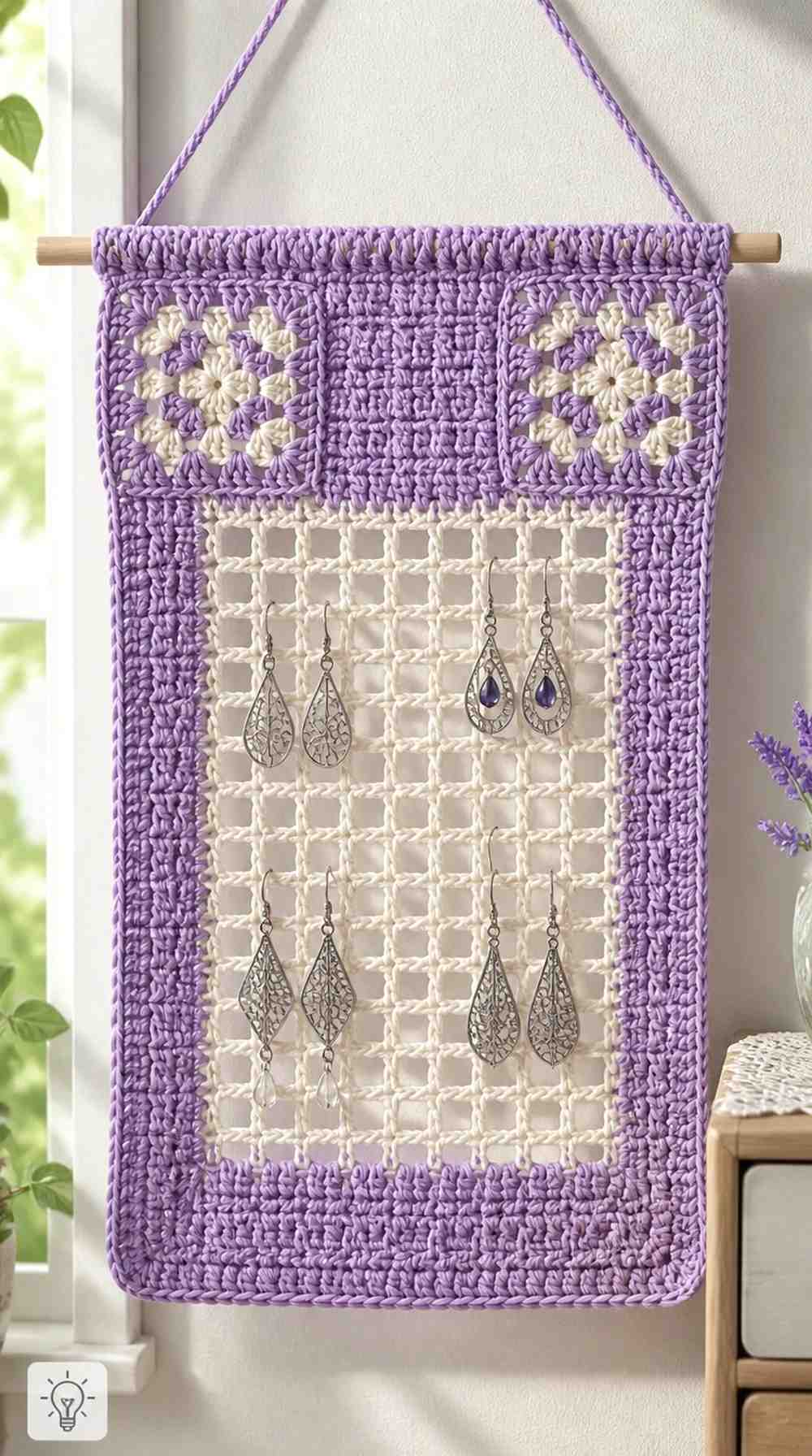
Lavender crochet surrounds a broad cream mesh window, with two small lavender-and-ivory granny-square motifs decorating the upper corners. Four pairs of lightweight silver dangling earrings hang through the central openwork, while a wooden dowel keeps the upper edge straight.
The combination of granny-square accents and a plain central mesh gives the organizer a handmade cottage feel without making it difficult to use. The motifs remain decorative, while the stronger openwork section supports the jewelry display.
- Granny-square placement: Keep the motifs on the outer frame rather than inside the main hanging grid, where they could obstruct earring hooks.
- Central mesh: Choose openings that suit the actual French-hook earrings without leaving excessive space between stitch intersections.
- Panel support: Reinforce the upper channel and side borders so the decorative corners do not pull the working mesh out of shape.
9. Crochet Cobalt Checkerboard Hoop Display Strip
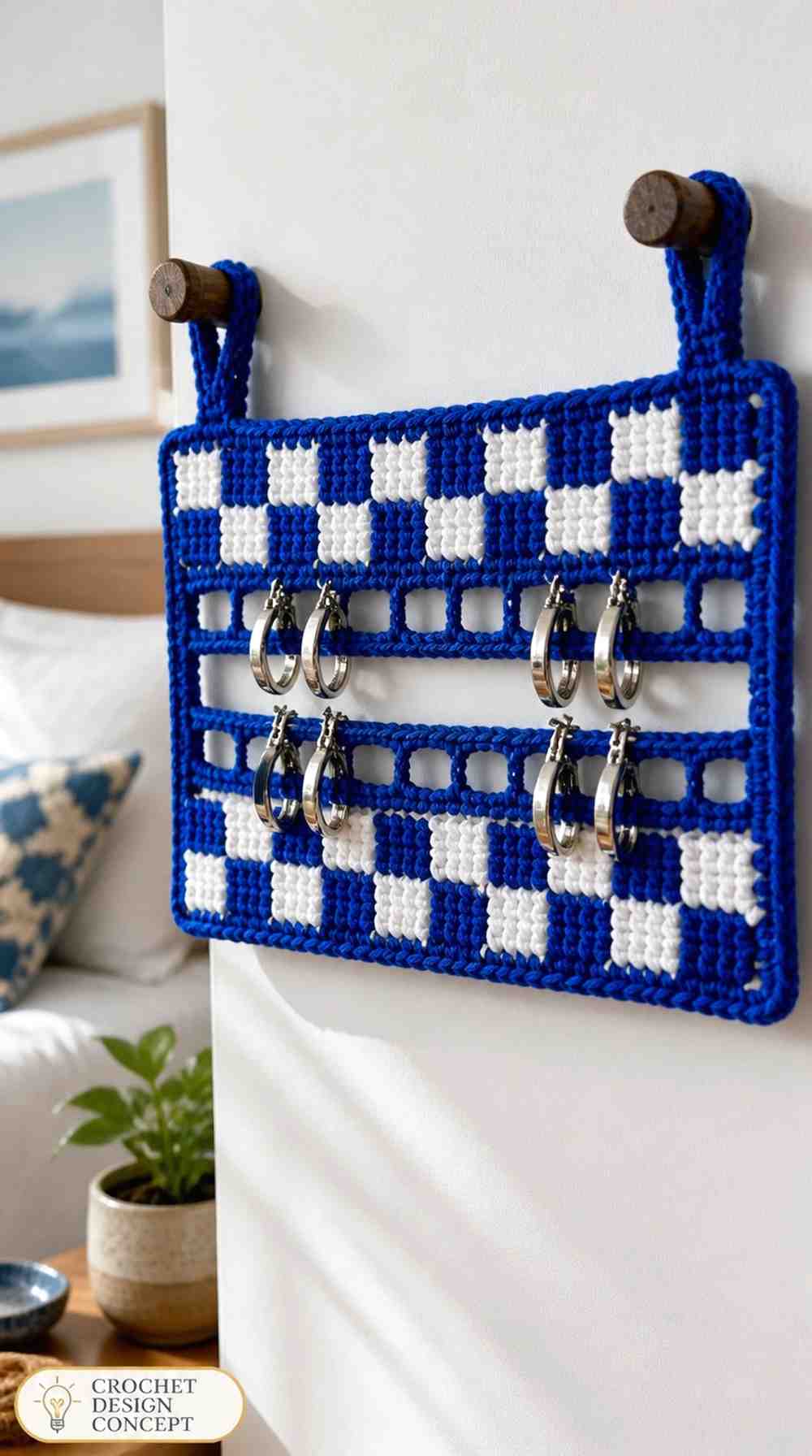
Bold cobalt-blue and warm-white crochet blocks form the upper and lower borders of this horizontal earring display. Two narrow openwork bands sit between them, holding four pairs of small silver hinged hoops. Two cobalt loops attach the organizer to separate dark wooden pegs.
This design differs from a traditional full mesh panel by using only two working rows. It offers a compact way to arrange a few small hoops while the checkerboard provides most of the color. The horizontal layout also needs secure support at both ends.
- Two working bands: Keep the openwork rows clearly separated so hoops attached to the upper band do not press against the lower row.
- Checkerboard borders: Use firm colorwork stitches around the openings so the decorative borders help maintain the strip’s shape.
- Peg spacing: Position the two wall pegs to match the suspension loops without stretching the panel sideways.
10. Crochet Oatmeal Triangle Earring Hanging
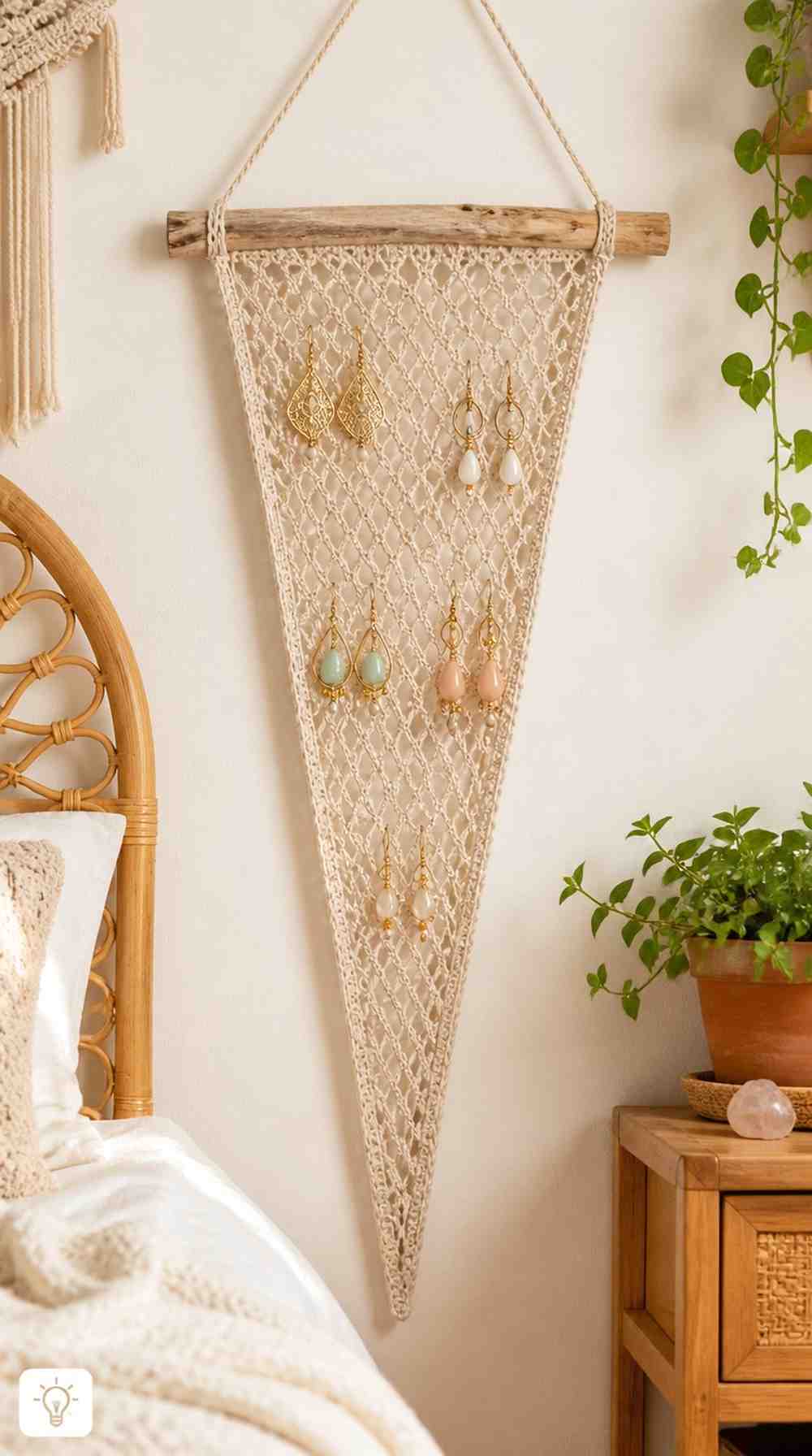
Oatmeal crochet forms a long triangular panel with fine diamond-mesh stitches narrowing toward a pointed lower edge. A thin cream border follows its sloping sides, and four pairs of small gold hook earrings hang in graduated rows beneath a natural wooden rod.
The triangular shape creates an interesting arrangement for a mixed set of lightweight dangling earrings. Wider spacing near the top accommodates several pairs, while the narrowing lower section leaves less room for jewelry. This design works best when the earrings are arranged to suit the changing width.
- Graduated spacing: Place wider or longer pairs near the broad upper area and reserve the narrower lower section for smaller jewelry.
- Pointed lower edge: Keep the crochet tip free from heavy earrings that could pull the triangular shape downward.
- Rod attachment: Secure the full upper edge evenly so the triangle hangs straight instead of gathering into the center.
11. Crochet Forest Green Foldover Earring Display Panel
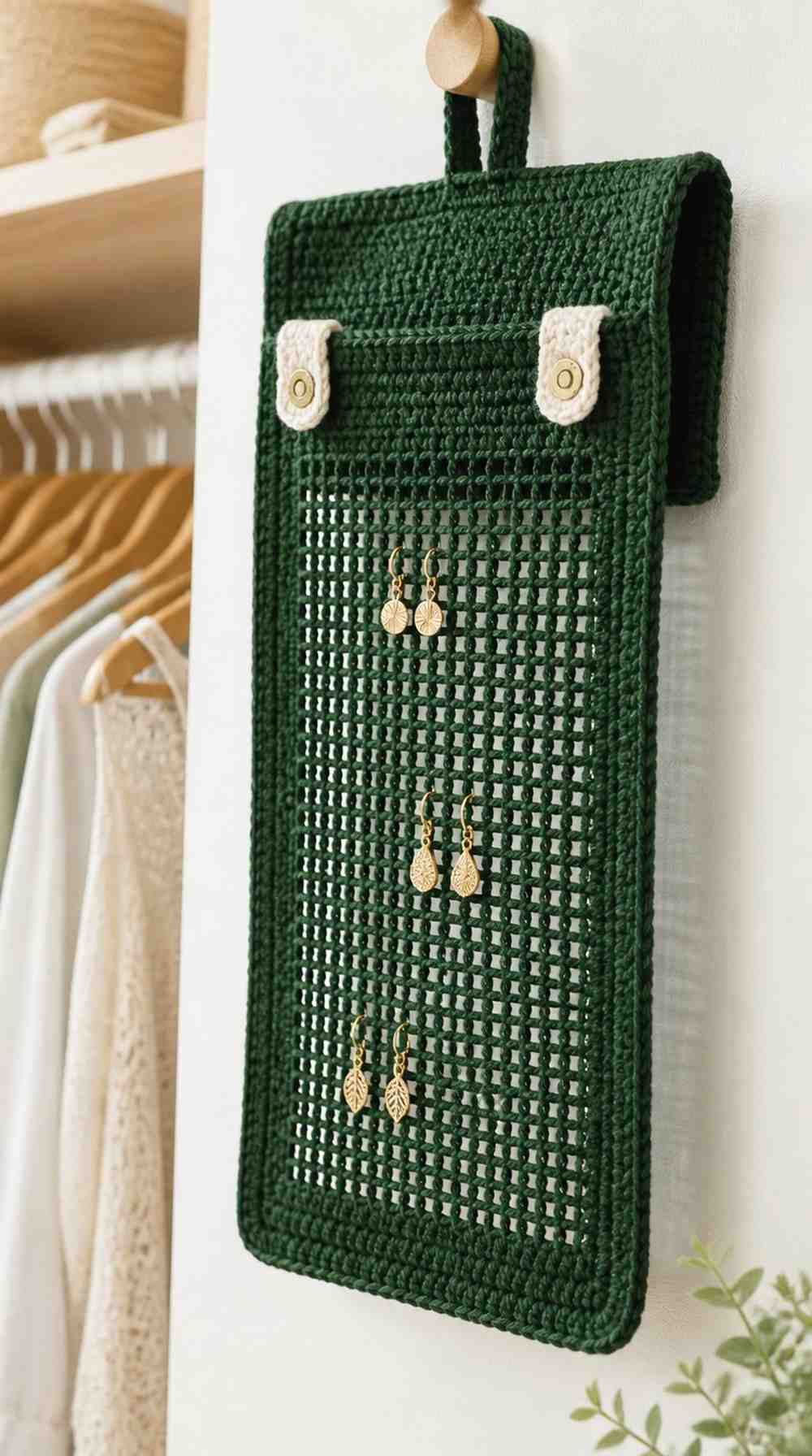
Forest-green crochet creates a tall hanging display with a fine rectangular mesh interior and a solid foldover cover. Three pairs of small gold hook earrings sit across the exposed grid, while the cover is lifted neatly upward to reveal them. Short cream snap tabs provide a closure arrangement.
The foldover feature gives the organizer a more enclosed appearance when not in use. It may help protect jewelry from casual contact while hanging in a wardrobe, although it should not be treated as a travel-safe jewelry case without additional protective construction.
- Cover clearance: Keep the flap from pressing directly against protruding hooks or pendant details when folded closed.
- Snap placement: Position the closure tabs away from the earring attachment rows so they do not catch or dislodge jewelry.
- Storage limitations: A foldover crochet cover is not the same as a padded travel case and may not prevent earrings from tangling during movement.
12. Crochet Dusty Blue Mixed-Backing Earring Panel
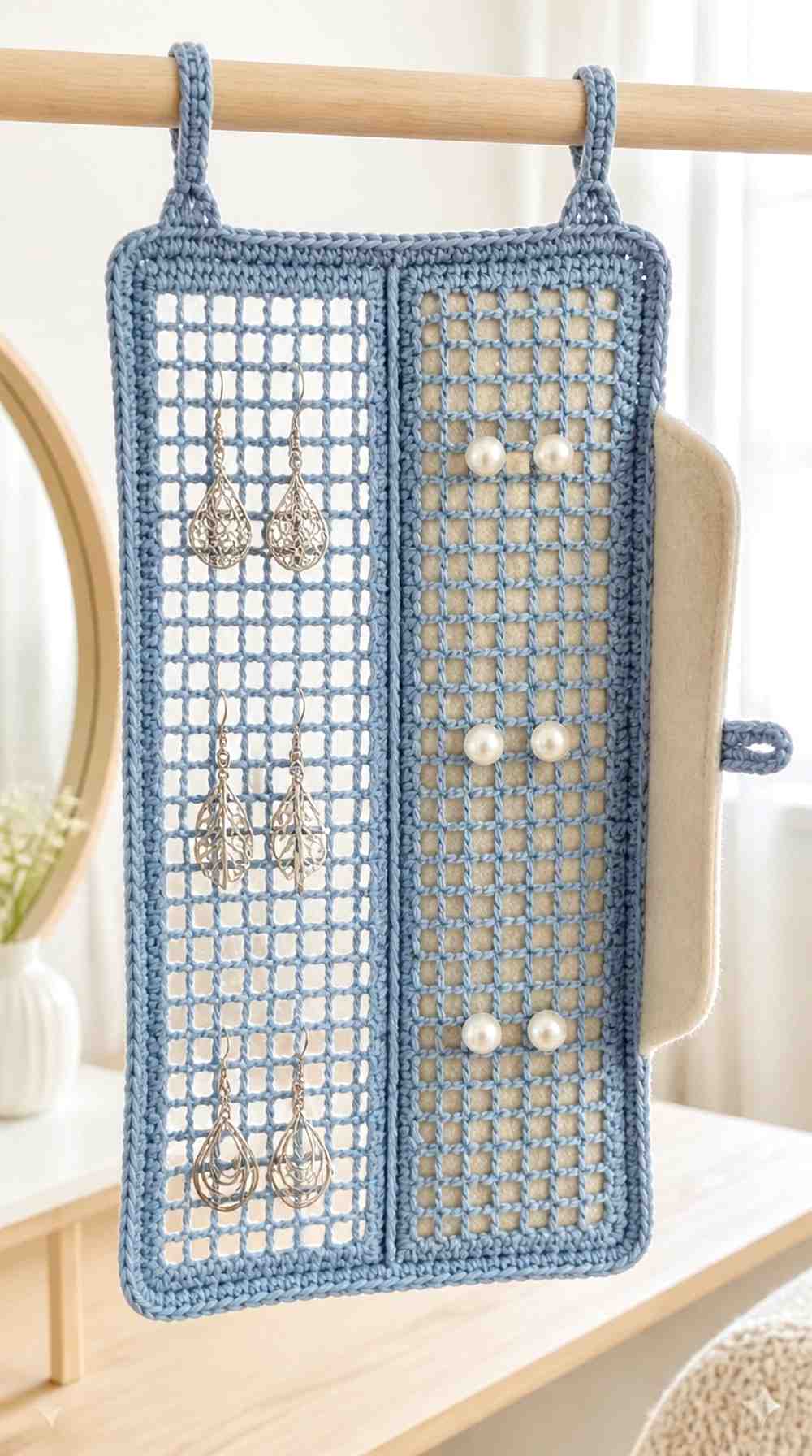
Dusty-blue crochet forms a rectangular display divided into two vertical storage areas. The left section has open square mesh for three pairs of silver French-hook earrings. The right has finer crochet holes backed with removable pale-cream felt for three pairs of small pearl studs.
This layout solves the problem of displaying two different earring types together. Hook earrings can hang through open mesh, while stud earrings need access to the posts and backs. The two-section design keeps those requirements separate without needing two wall organizers.
- Stud backing access: Keep the removable felt section reachable from behind so posts can be fastened and removed without pulling the crochet forward.
- Different mesh scales: Use a more open grid for hooks and a finer stable surface for studs rather than expecting one mesh size to suit both.
- Divider stability: A firm central crochet strip helps prevent the two display areas from stretching into one another.
13. Crochet Coral Circular Lace Earring Hoop
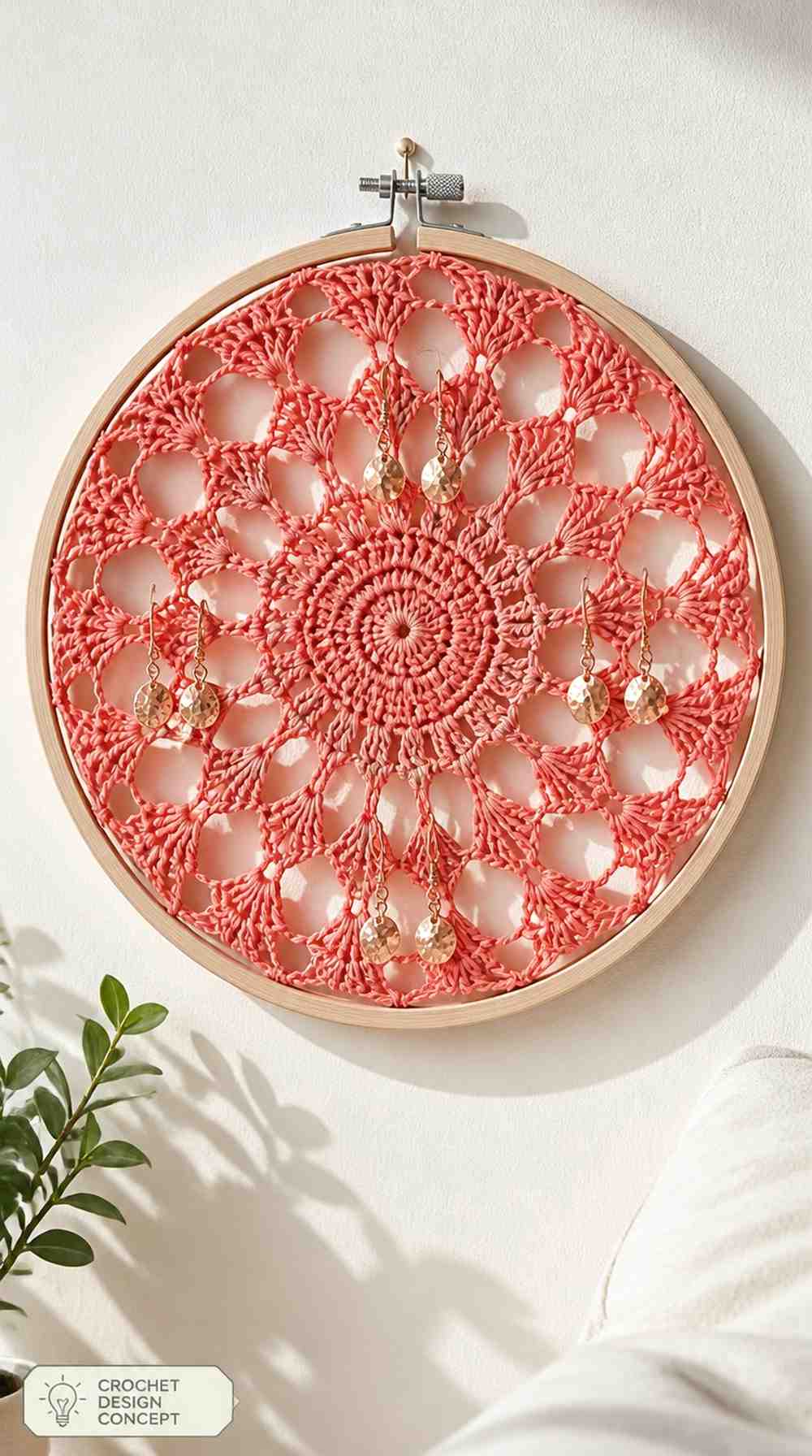
Coral-pink crochet forms a round lace panel inside a pale-oak embroidery hoop, with delicate radial fan stitches surrounding a firm central medallion. Five pairs of rose-gold hook earrings hang through separate openings in the outer lace, leaving the dense center clear.
The circular fan arrangement gives this display a decorative wall-art appearance. Unlike a regular square grid, its openings follow the shape of the round motif. Jewelry positioning would therefore need more attention to avoid crowding the narrower sections near the center.
- Radial spacing: Place earrings around the outer openwork where there is enough room for hooks and dangling details.
- Dense center: Treat the middle medallion mainly as decoration, since tightly worked stitches may not allow hooks to pass through comfortably.
- Hoop attachment: Secure the crochet evenly around the frame so the radial fan pattern remains centered.
14. Crochet Burgundy Three-Zone Ladder Earring Panel
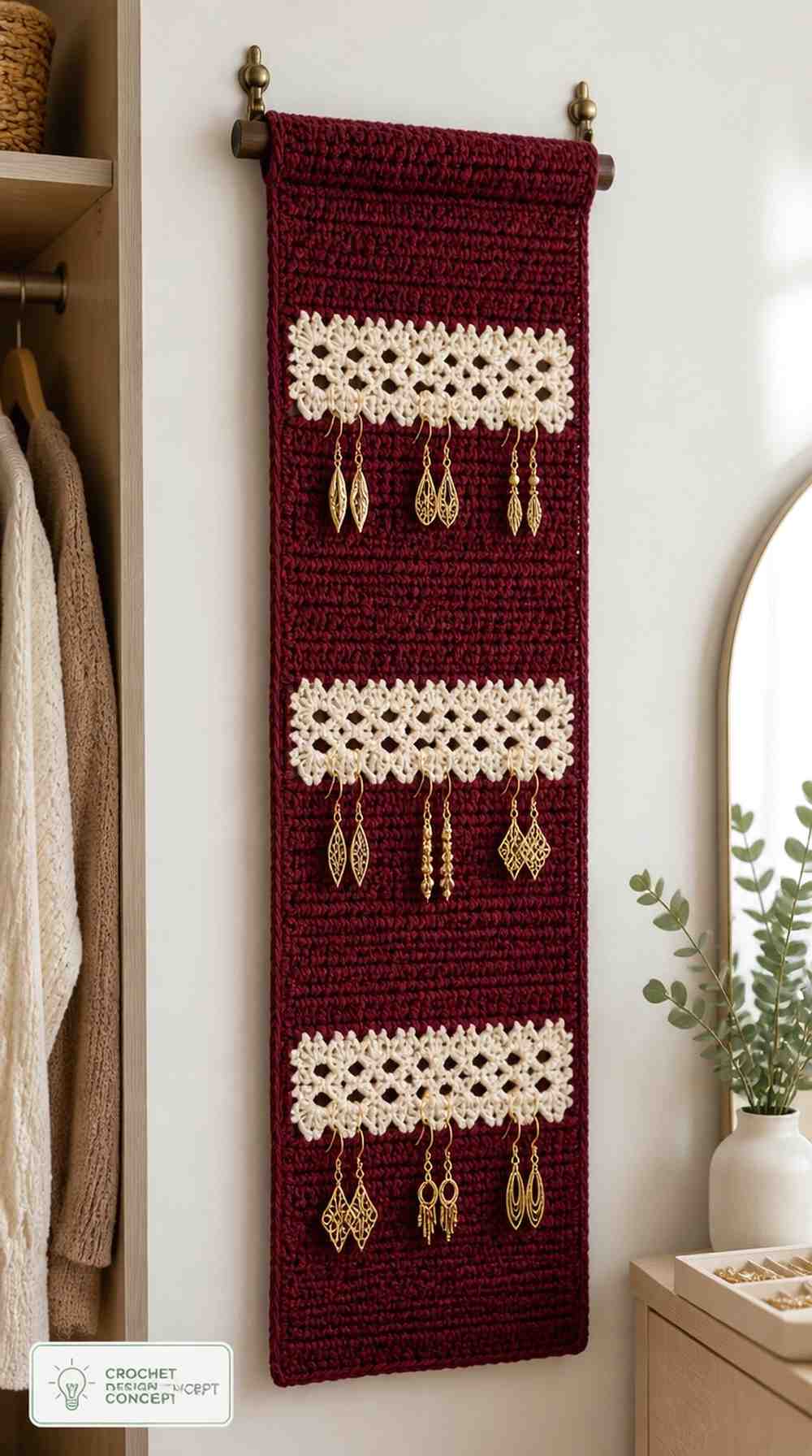
Burgundy crochet forms a tall narrow wall panel with three cream openwork strips arranged from top to bottom. Solid burgundy bands separate the strips, and each working row holds three pairs of small gold dangling earrings. A walnut dowel supports the entire organizer.
The ladder-like arrangement creates three clear sections for sorting a larger collection. It could be useful for keeping everyday, occasion, and favorite earrings in separate rows, although the spacing must account for how far each pair hangs below its attachment point.
- Row separation: Allow sufficient vertical distance between the three openwork strips to prevent dangling earrings from overlapping the next row.
- Solid dividers: Use dense crochet bands between sections to help the display maintain its width and avoid sagging.
- Collection capacity: Avoid filling every opening simply because it is available; leaving space between pairs makes selecting earrings easier.
15. Crochet Mint Clip-On Earring Bar Panel
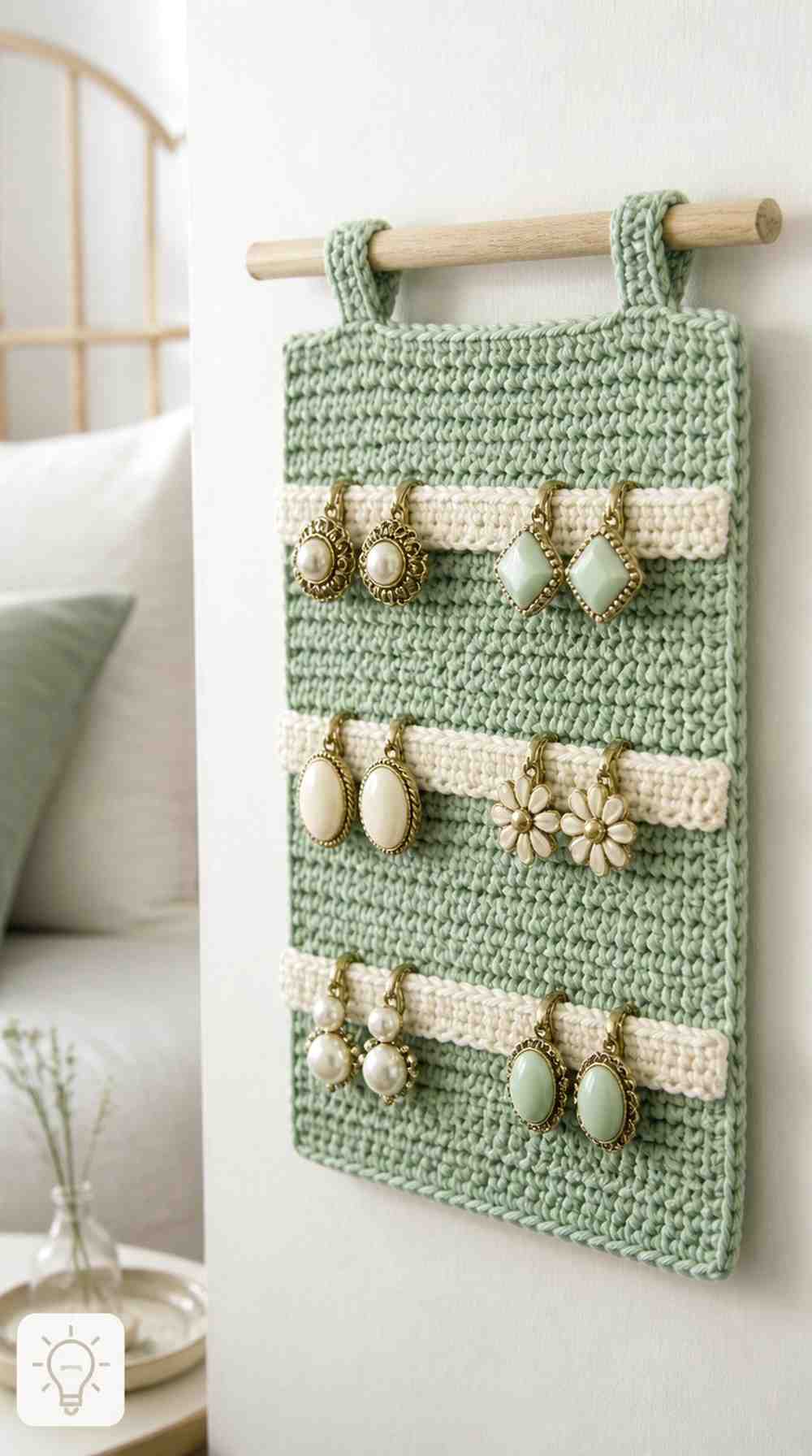
Mint-green crochet forms a compact rectangular backing with three raised cream horizontal bands. Five pairs of vintage-style clip-on earrings fasten around these bands using their own metal clips, while a light-oak dowel and two mint loops suspend the display.
The raised bands distinguish this design from ordinary open mesh. Clip-on earrings do not use piercing posts or French hooks, so they need an appropriate edge or strip to grip. The bands must remain firm enough to hold the clips without allowing them to slide into neighboring pairs.
- Clip pressure: Test the actual clip-on earrings against a crochet sample to ensure the jaws can grip without damaging yarn or loosening.
- Band width: Keep each raised strip wide enough to hold the clips while leaving room between neighboring earring pairs.
- Backing support: A solid rear panel helps maintain the shape of the cream bands when earrings are clipped on and removed.
16. Crochet Mocha Earring Panel with Backing Pocket
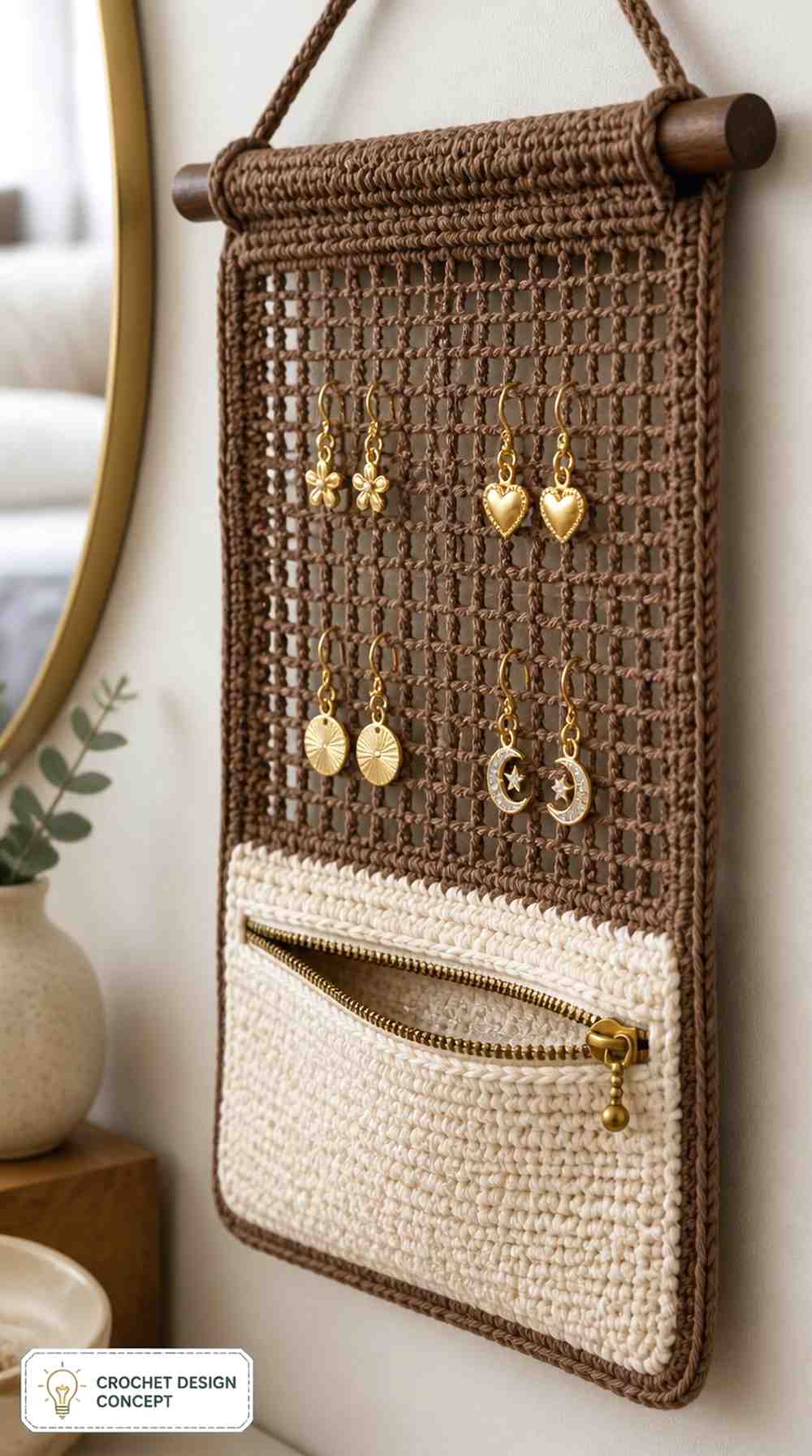
Mocha-brown crochet forms a rectangular wall display with fine mesh across its upper section and a small cream storage pocket along the bottom. Four pairs of gold French-hook earrings hang from the mesh, while the lower pocket closes with a short brass-colored zipper and holds a few spare silicone earring backs.
The combination of open display and enclosed storage gives this organizer a practical second purpose. It keeps frequently used earrings visible while offering a separate place for small replacement parts. The lower compartment should remain shallow so its contents do not pull the whole panel forward.
- Small-parts containment: A properly closed zipper is important for storing tiny earring backs, which could otherwise fall through crochet openings.
- Pocket weight: Keep the lower compartment reserved for very lightweight spare pieces rather than heavy jewelry or large accessories.
- Zipper placement: Position the zipper pull so it does not catch on the dangling earrings above the pocket.
17. Crochet Ivory Sunflower Double-Window Earring Panel
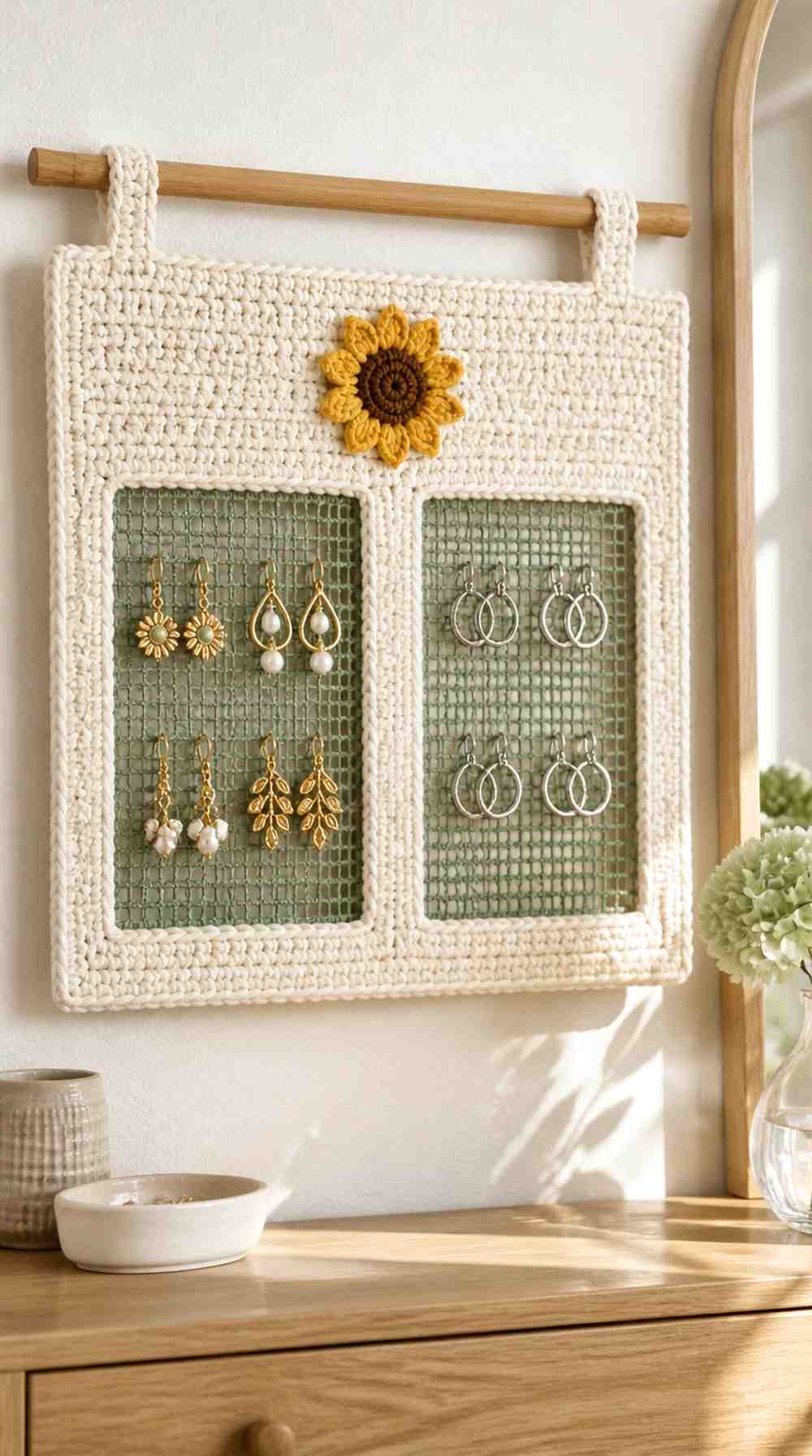
Ivory crochet creates a wide rectangular wall hanging with two sage-green mesh windows arranged side by side. A small flat sunflower motif sits above the central dividing strip, with golden petals and a dark-brown center. Four pairs of gold hook earrings hang in the left window, while four pairs of small silver hinged hoops occupy the right.
The divided layout offers a clear way to separate two common earring styles. Its sunflower accent adds warmth without interfering with the working mesh. A light-oak dowel and two upper loops help support the wider panel.
- Window separation: Keep the central solid crochet strip firm enough that earrings on one side do not pull the other mesh window out of shape.
- Different attachments: French hooks and hinged hoops need different handling, so verify that each type can be removed without damaging the mesh.
- Sunflower placement: Keep the flat decorative motif above the working openings, leaving clear room for the jewelry beneath it.
Practical Guide to Crochet Hanging Earring Display Panels
A crochet earring display should keep jewelry visible, easy to remove, and properly supported. Before choosing a panel shape, look at the types of earrings you own. French-hook dangles, studs, hinged hoops, and clip-on earrings do not all attach to crochet in the same way.
Match the mesh to the jewelry. Open square or diamond mesh can work for lightweight French-hook earrings. Studs need small suitable openings and access to their backs, often with a removable backing layer. Hinged hoops must be able to close through a suitable opening, while clip-on earrings may need firm crochet bands.
Keep the panel flat. A smooth wooden dowel, secure embroidery hoop, or properly fitted frame can reduce sagging and twisting. Test a crochet sample with the actual earrings, particularly when adding several pairs to one display. Heavy statement earrings may need a stronger jewelry organizer.
Protect delicate jewelry. Use smooth yarn, securely finished stitches, and gentle attachment methods. Avoid pulling sharp posts through tightly worked crochet, and do not force clasp mechanisms around thick strands. Remove earrings carefully so hooks do not snag.
Choose a dry hanging location. A bedroom or dressing area is generally more suitable than a damp bathroom. Keep metal jewelry away from repeated moisture exposure and check how the display hangs before filling it.
Plan comfortable spacing. Leave enough room for earrings to move slightly without touching. Organizing by size or type can make individual pairs easier to locate.
For more crochet wall-storage ideas, explore 20 Crochet Hanging Wall Pocket Organizer Ideas. For decorative openwork inspiration, see 17 Crochet Vintage Lace Doily Wall Art Inspiration Ideas.
Want to Make Something Similar?
These 17 designs are original inspiration concepts rather than tested patterns. The following published resources explain related mesh construction and hanging methods.
- DIY Crochet Jewelry Display by Sönna Schuttner of Wool & Wyrd — explains how the creator adapted open crochet fabric into an earring display using wooden supports and a hanging cord. The underlying stitch pattern is a separate creator’s design.
- Crochet Earring Display by Mary Dickerson on Ravelry — a free tutorial listing using basic chain and single crochet stitches with a clothes hanger for support.
- Earring Wall Hanging by Knot’s Designs on Ribblr — a free beginner-level interactive crochet earring-display pattern with adjustable width and length, subject to Ribblr’s access limits.
These are separate designers’ resources and not exact patterns for the 17 illustrated concepts. Choose the construction techniques that suit the type and weight of earrings you plan to display.
Which Crochet Hanging Earring Display Panel Should You Choose?
| Your priority | Design to consider | Main trade-off |
|---|---|---|
| Everyday French-hook earrings | Sage Fine-Grid Dowel Earring Panel | Mesh needs balanced spacing |
| Small decorative wall hanging | Ivory Scalloped Arch Earring Display | Curved border reduces working area |
| Circular framed display | Terracotta Hoop-Framed Honeycomb Earring Panel | Hoop tension needs checking |
| Stud earrings | Blush Stud-Backing Earring Grid | Requires access to stud backs |
| Lightweight hinged hoops | Navy Double-Tier Hoop Earring Display | Bands must remain firm |
| Minimalist display | Charcoal Framed Earring Grid | Needs proper wall clearance |
| Mixed hook and stud earrings | Dusty Blue Mixed-Backing Earring Panel | Two different backing arrangements |
| Large collection in rows | Burgundy Three-Zone Ladder Earring Panel | Needs more vertical space |
| Clip-on earrings | Mint Clip-On Earring Bar Panel | Clip pressure may distort yarn |
| Spare earring backs | Mocha Earring Panel with Backing Pocket | Zipped pocket adds thickness |
| Two separate earring categories | Ivory Sunflower Double-Window Earring Panel | Wider hanging support needed |
For mostly lightweight hook earrings, a simple open-grid dowel panel may be the easiest design to adapt. If you regularly wear studs or clip-on earrings, choose a panel that specifically accommodates those fastenings instead of relying on ordinary open mesh.
Conclusion
A crochet hanging earring display panel can make a small jewelry collection easier to see while adding a handmade detail to a dressing area. From sage fine-grid panels and ivory lace arches to circular honeycomb frames, divided organizers, and sunflower-accented displays, these concepts show different ways to combine practical jewelry storage with crochet texture.
The most important choice is the panel’s compatibility with your actual earrings. Suitable openings, secure hanging support, comfortable spacing, and easy access to fastenings matter more than decorative complexity.
Which display would you choose for your jewelry: the Sage Fine-Grid Dowel Panel, the Terracotta Honeycomb Hoop, or the Dusty Blue Mixed-Backing Panel? Share whether your collection contains mostly studs, hooks, hoops, or clip-on earrings.
Frequently Asked Questions
1. Can I hang all types of earrings on a crochet mesh panel?
Not all types attach in the same way. Lightweight French-hook earrings can hang through suitable mesh openings. Studs require post and backing access, hinged hoops need openings that allow their clasps to close, and clip-on earrings may need firm bands. The actual jewelry should determine the display structure.
2. What yarn should I consider for a crochet earring display?
Smooth cotton or another firm yarn that holds defined stitches may be useful. Fine yarn can create smaller openings, while thicker yarn may produce a heavier and more flexible display. Check how the crochet behaves under the weight of the earrings and avoid rough fibers that could catch on delicate jewelry.
3. How do I stop a hanging crochet earring panel from sagging?
A suitable dowel, embroidery hoop, or frame can support the crochet, but the fabric still needs even tension and well-secured edges. Avoid concentrating heavy earrings in one area. Test the completed panel with the intended collection before relying on it as a permanent display.
4. Can stud earrings be stored on a crochet display?
Yes, provided the posts can pass through suitable openings and their backs can be attached and removed. A removable felt or fabric backing may help organize studs, but it must still allow access to the fastenings. Avoid forcing sharp posts through dense crochet fibers.
5. Are these 17 crochet hanging earring display panel ideas complete patterns?
No. They are original design visualizations showing different display shapes, mesh styles, hanging arrangements, and jewelry storage features. The linked tutorials provide related crochet techniques, but exact dimensions, attachment methods, load support, and compatibility with individual earrings need to be planned and tested separately.