A small jacket zipper can be surprisingly difficult to grip, especially when you’re wearing gloves or trying to close a coat with cold fingers. These 19 crochet jacket zipper pull extender inspiration ideas explore simple ways to add a softer, easier-to-find gripping surface to an existing zipper tab. From sage moss stitches and oatmeal finger loops to compact bobble grips, checkerboard straps and miniature floral accents, each concept brings a different shape, texture and attachment style to an everyday clothing detail.
Some designs focus on making the zipper easier to hold, while others add a small personal touch without creating a bulky dangling charm. The collection includes flat tabs, closed finger loops, rounded grips, removable clips, and doubled crochet pieces suited to different jacket styles. You’ll also find practical considerations for attachment rings, glove-friendly openings, fabric snagging, and keeping the original zipper mechanism working properly.
These are AI-generated crochet design visualizations for inspiration, not photographs of tested handmade pieces or step-by-step patterns.
Quick Design Selection Guide
- For an everyday flat grip: Crochet Sage Moss-Stitch Zipper Grip Tab and Crochet Forest Green Double-Layer Grip Pull offer compact rectangular shapes.
- For gloved hands: Crochet Oatmeal Ribbed Finger-Loop Extender, Crochet Butter Yellow Chain-Loop Zipper Extender and Crochet Black Cream Oval Finger Ring provide loop-style gripping options.
- For extra finger texture: Crochet Terracotta Bobble Thumb-Grip Pull and Crochet Charcoal Tubular Zipper Pull offer different raised or rounded surfaces.
- For small decorative details: Crochet Dusty Rose Daisy Zipper Pull, Crochet Lavender Granny-Diamond Zipper Pull and Crochet Peach Flat-Bow Zipper Tab add restrained motifs.
- For a removable attachment: Crochet Teal Detachable Clasp Zipper Pull uses a separate clasp and connector ring.
- For a simple two-sided finish: Crochet Mocha Reversible Two-Tone Pull Tab shows contrasting crochet colors on opposite faces.
1. Crochet Sage Moss-Stitch Zipper Grip Tab
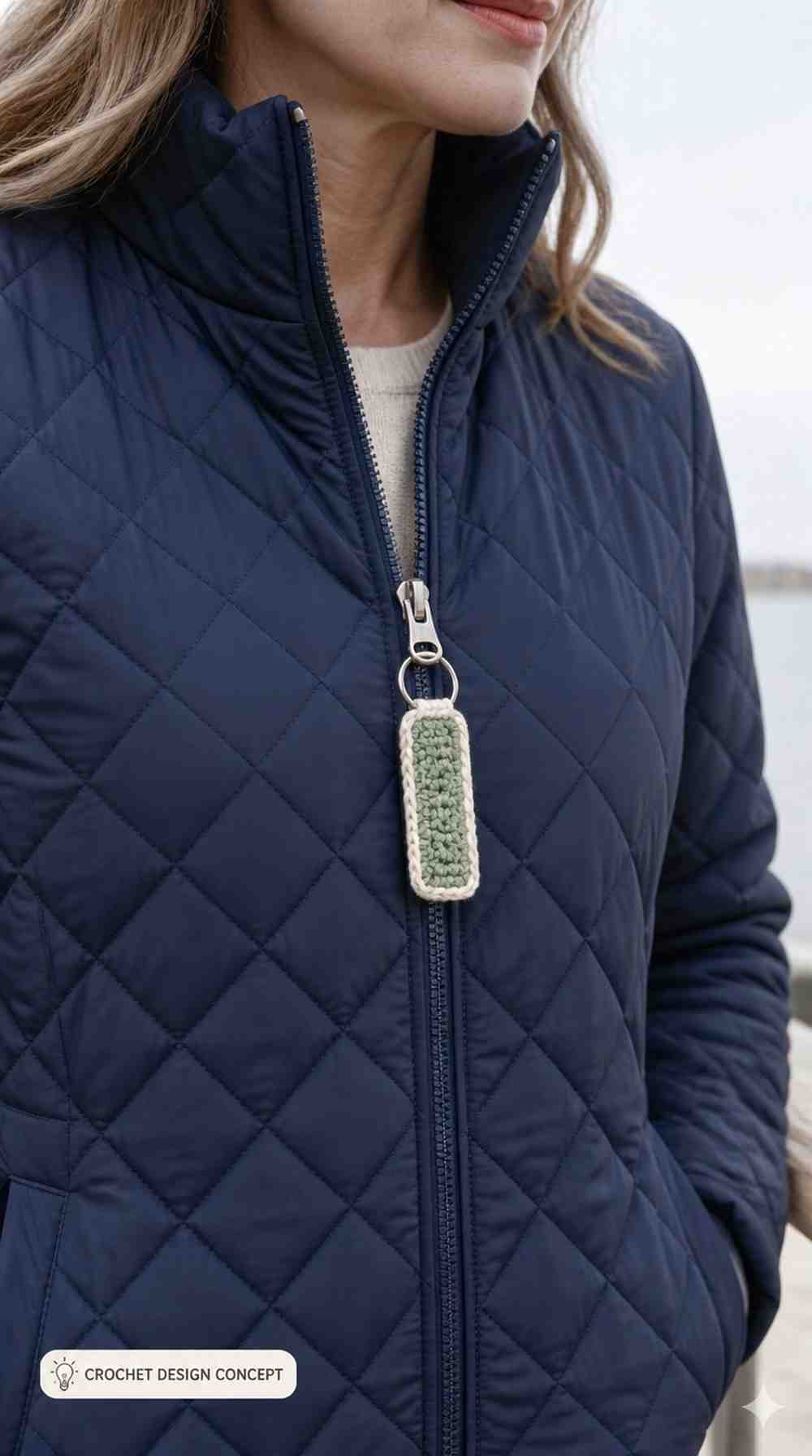
Sage-green moss stitches form a compact rectangular crochet zipper extender with a smooth cream border and softly rounded lower edge. A small silver split ring connects the reinforced upper eyelet to the existing zipper tab of a navy-blue quilted jacket.
The flat shape provides an additional area to pinch without hanging far below the zipper. Moss stitch gives the surface gentle texture, while the cream edging defines the grip against darker jacket fabric. This concept is useful for anyone who prefers a straightforward pull rather than a decorative charm.
- Grip width: Make the crochet tab wide enough for a comfortable finger pinch while keeping it narrow enough to sit neatly against the jacket.
- Split-ring connection: Check that the ring fits through the existing pull-tab hole without forcing or bending the metal.
- Stitch firmness: Moss stitch should hold its shape under repeated handling, so test a small sample before attaching it permanently.
2. Crochet Oatmeal Ribbed Finger-Loop Extender
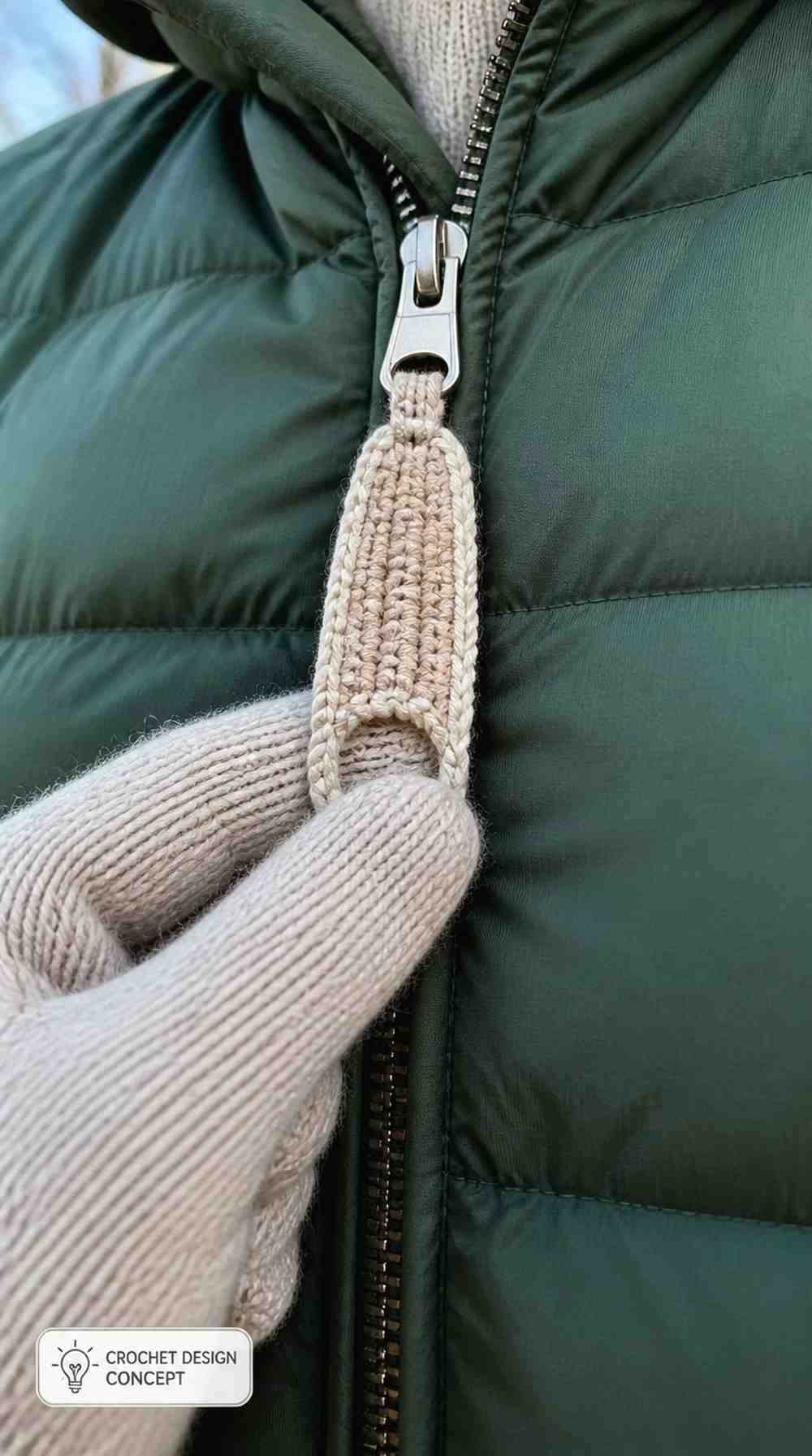
Oatmeal crochet creates a short closed finger loop with raised vertical ribs and narrow cream edging. A reinforced connecting neck passes through the existing silver zipper tab of a forest-green padded jacket, leaving a compact oval opening below the metal.
The finger-loop shape makes this design different from flat gripping tabs. It offers a place for a gloved fingertip to hook through without needing to pinch a tiny metal pull. The loop should remain short, however, because an oversized opening could catch on other objects.
- Finger clearance: Test the oval opening with the gloves normally worn with the jacket; a bare-finger fit may not be sufficient.
- Loop length: Keep the extender compact so it cannot easily catch on bag straps, seat belts or surrounding clothing.
- Ribbed texture: Raised crochet ribs can add grip, but the connecting neck needs suitable reinforcement to resist repeated pulling.
3. Crochet Terracotta Bobble Thumb-Grip Pull
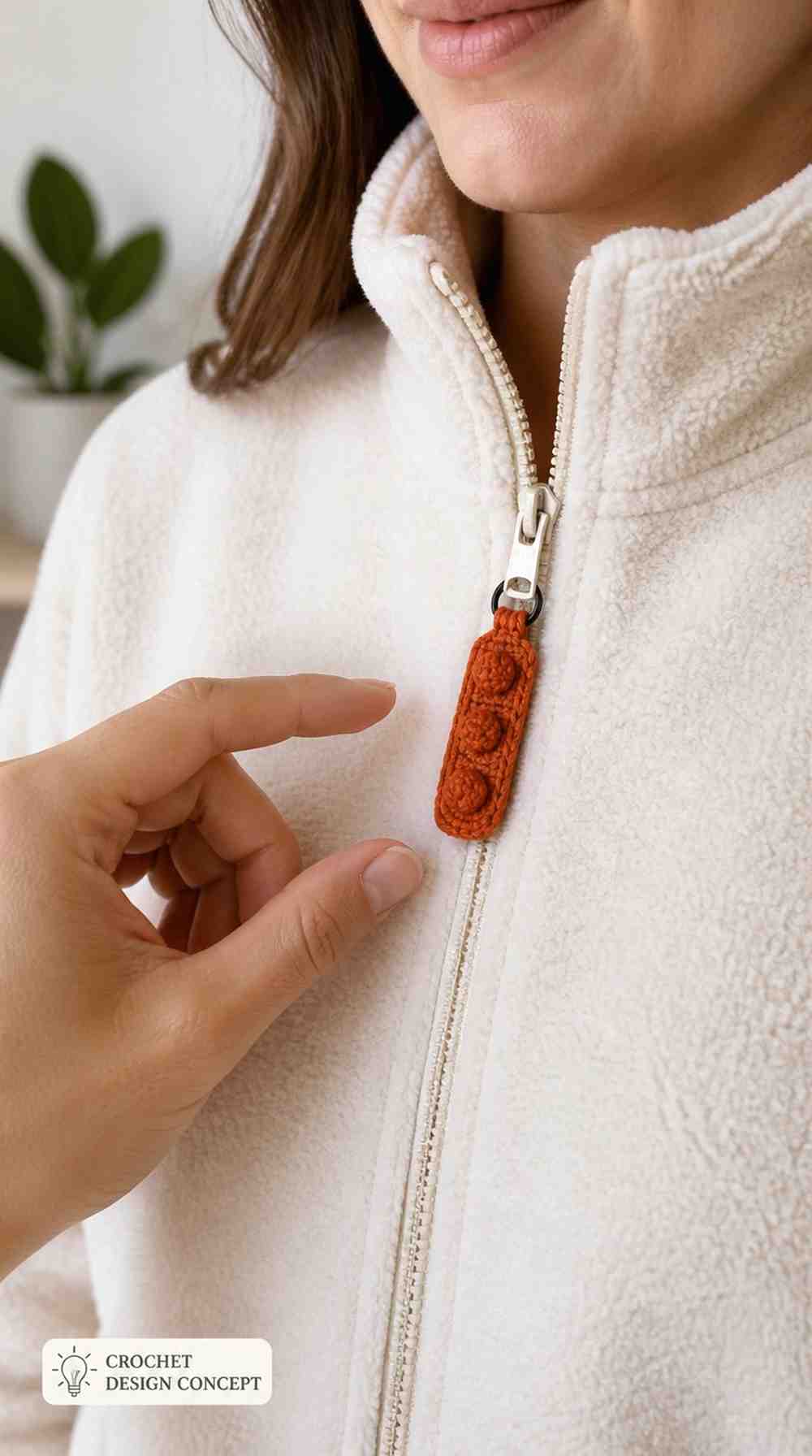
Warm terracotta crochet forms a short rounded rectangular tab with three raised bobble stitches running down its center. A smooth close-stitched backing supports the textured surface, while a black split ring joins the top to the original zipper tab on a cream fleece jacket.
The bobbles create a distinct gripping area without requiring a wide loop or long cord. Their raised surface may help fingers locate the tab, particularly when the original metal pull is difficult to hold. A real version should keep the bobbles small enough to avoid excessive bulk.
- Bobble height: Use low, closely worked bobbles rather than large raised clusters that might catch on the jacket fabric.
- Smooth backing: A flat reverse surface can help the extender lie against fleece without creating unnecessary friction.
- Attachment wear: Check the upper crochet eyelet regularly because this is where pulling force concentrates.
4. Crochet Dusty Rose Daisy Zipper Pull
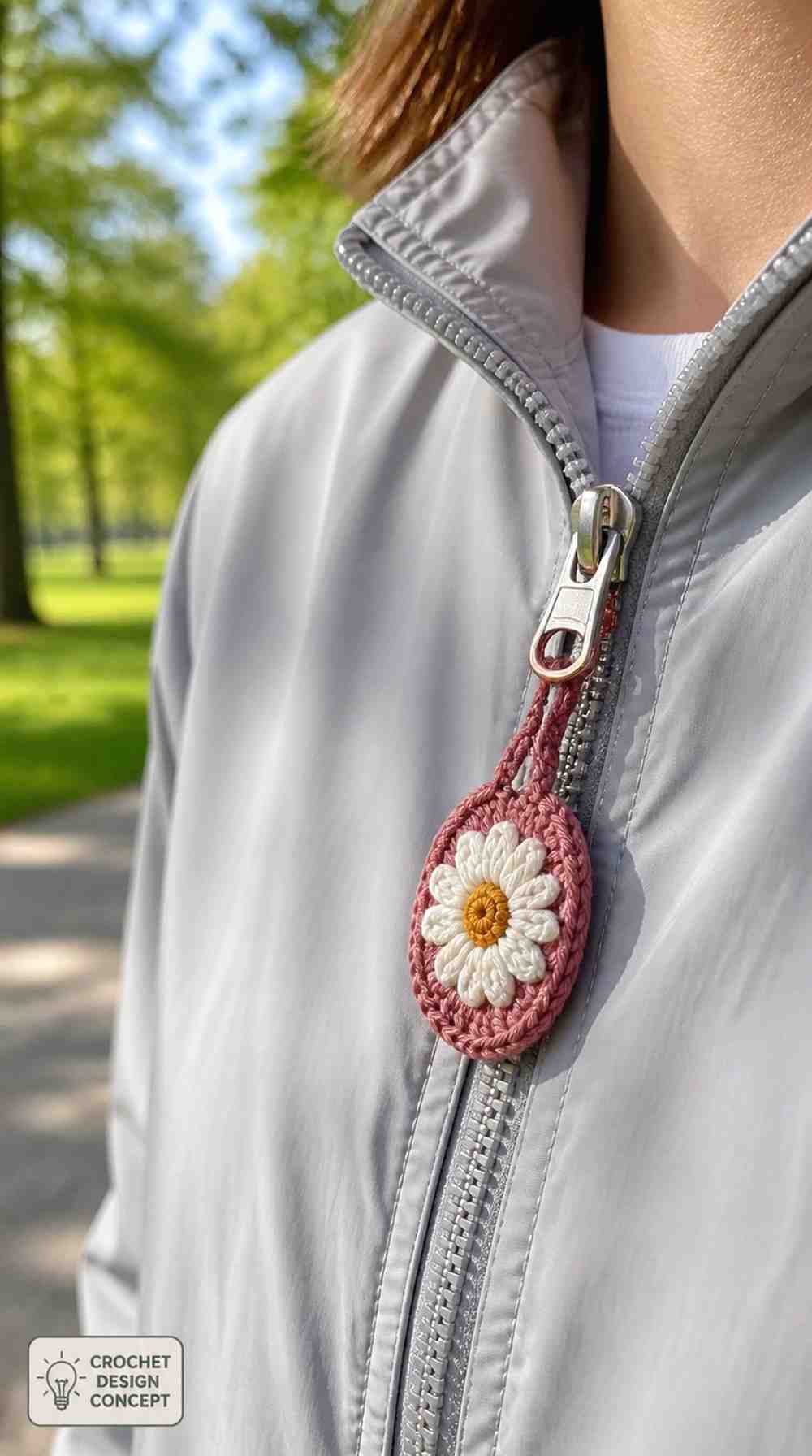
Dusty-rose crochet forms a tiny flattened oval tab with a cream daisy worked directly into its front. The small golden-yellow center is part of the stitched motif, and a rose-gold split ring connects the reinforced upper stem to a light-gray jacket zipper.
The daisy adds a gentle decorative touch while keeping the extender compact. Because the flower is flat rather than separately attached, it avoids the longer dangling shape of a traditional zipper charm. This design would suit a casual jacket where appearance matters alongside a modest additional gripping surface.
- Flat flower design: Use colorwork or closely attached stitches so petals cannot swing freely or snag on the zipper teeth.
- Oval proportions: Keep the grip large enough to pinch but avoid making the little daisy tab disproportionately heavy.
- Color durability: Test the rose and golden-yellow yarns for colorfastness before using the extender on a pale jacket.
5. Crochet Charcoal Tubular Zipper Pull
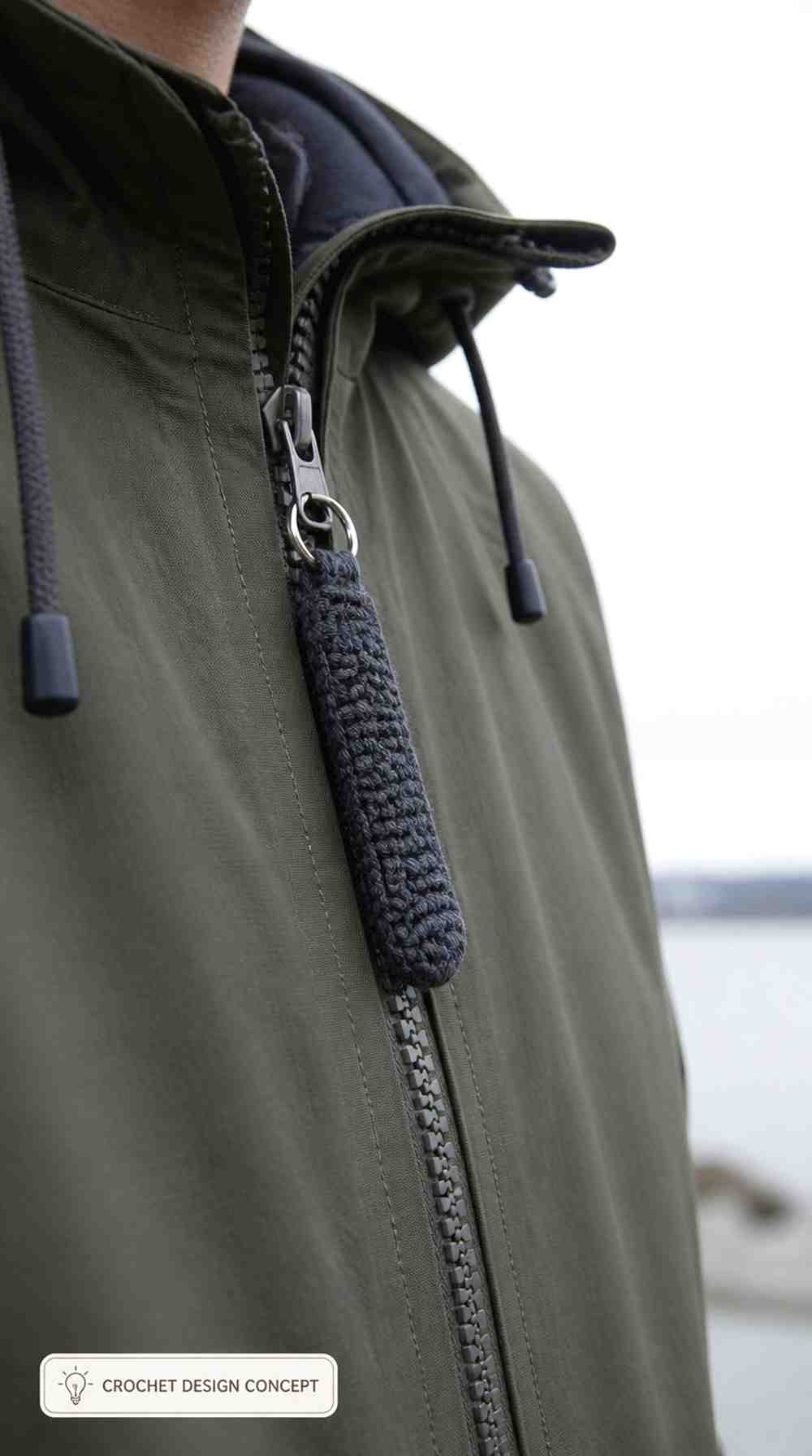
Charcoal-gray crochet creates a short soft tube with compact spiral stitches and a rounded closed lower end. The upper neck connects through a silver split ring to the original zipper tab of a dark-olive parka. Its shape remains narrow and unstuffed.
The tubular form offers a more rounded gripping surface than a flat strip. Its dark color also suits outdoor jackets without looking like an oversized accessory. The important consideration is keeping the tube flexible enough to grasp while preventing the narrow upper connection from stretching.
- Tubular construction: Check that the short crochet tube does not collapse into an awkward knot or become unnecessarily thick.
- Dark-yarn visibility: Charcoal may blend into darker jackets, so consider whether a small contrasting edge would be useful as an optional change.
- Pull direction: Grip the tube and draw it along the zipper track rather than pulling sharply outward from the jacket.
6. Crochet Cobalt Checkerboard Flat Pull Strap
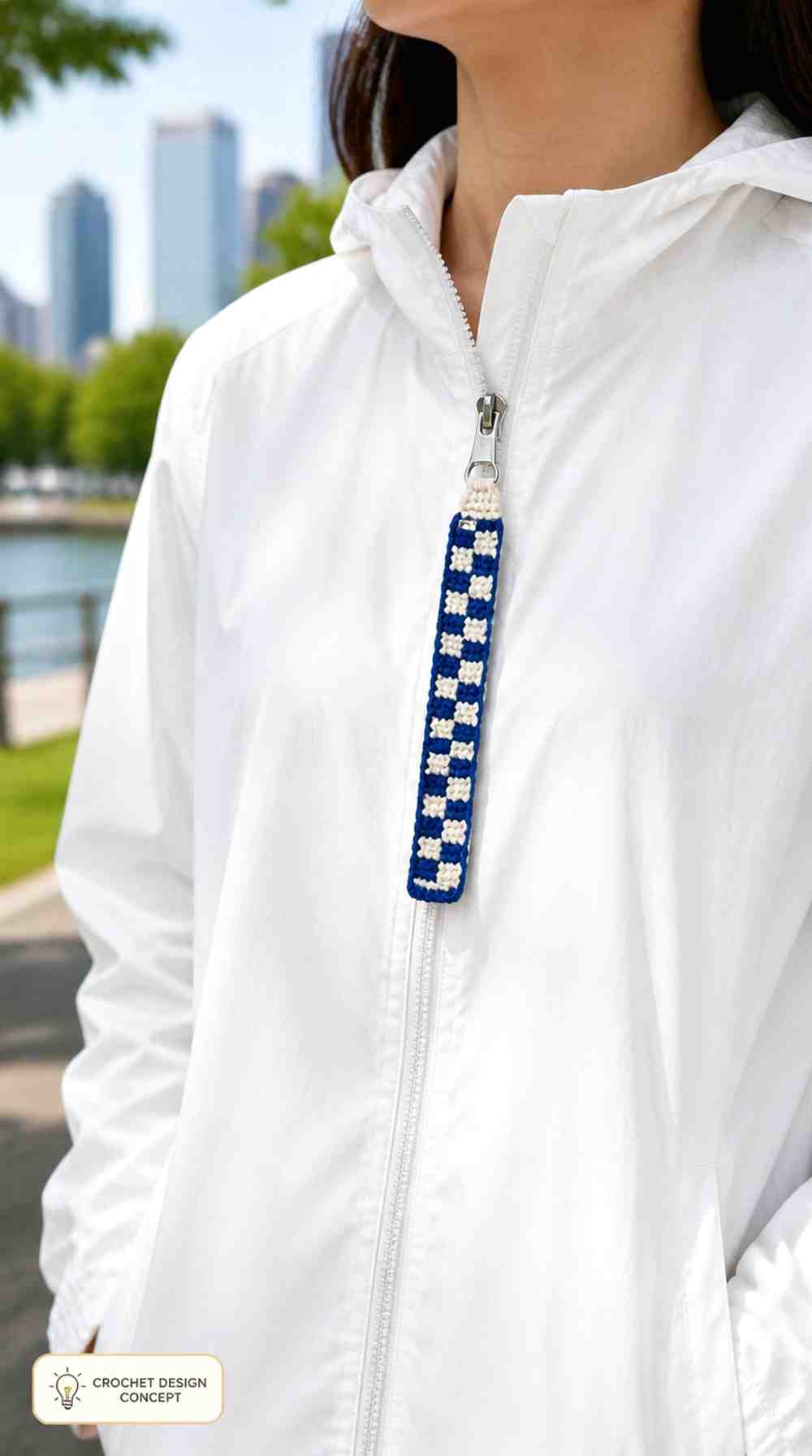
Cobalt-blue and warm-white checkerboard crochet creates a narrow doubled strap with a softly squared lower end. A small cream joining section secures the folded top through the existing metal zipper tab of a white rain jacket.
The bold colorwork gives the extender a modern look without adding separate decorations. Its doubled structure offers a flat gripping surface that can be folded between the fingers. Compared with ring-attached designs, this concept uses a direct threaded connection that would need careful reinforcement.
- Direct attachment: Ensure the folded connecting section fits the original zipper opening without forcing it or creating a bulky knot.
- Checkerboard alignment: Keep the colored blocks balanced across the visible front, especially where the narrow strap folds.
- Double-layer flexibility: The finished crochet should remain easy to bend rather than becoming a stiff tab that presses against the jacket.
7. Crochet Forest Green Double-Layer Grip Pull
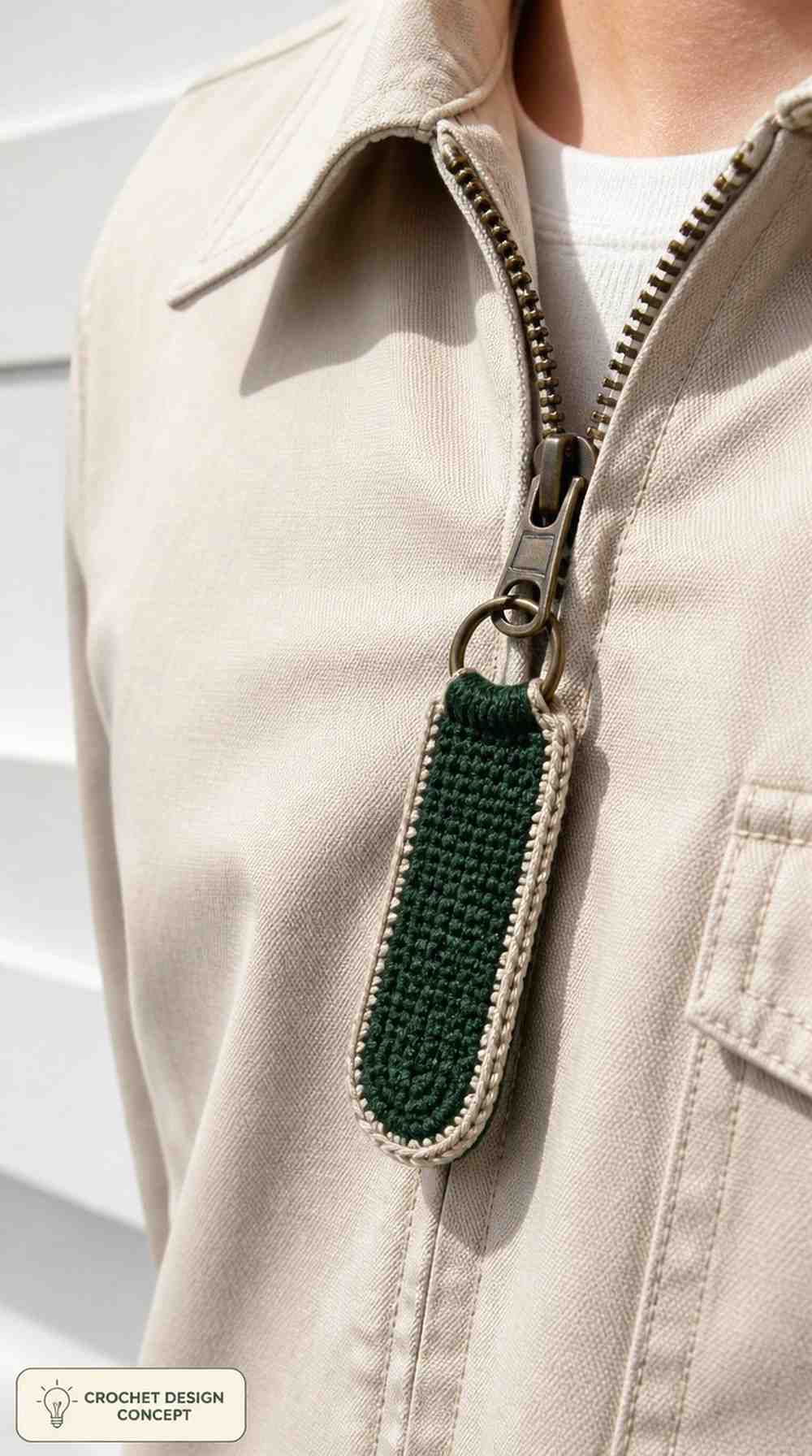
Forest-green crochet forms a small broad rectangular pull with two flat layers joined along their edges. An oatmeal border frames the grip, and a bronze split ring connects its reinforced upper eyelet to the zipper tab of a light-beige canvas jacket.
The doubled surface gives this design a more substantial look without adding stuffing. It could suit someone who finds very narrow cords difficult to pinch, although increasing the width also adds fabric around the zipper area. The shape should remain compact enough to move freely.
- Layer joining: Sew or crochet the two flat layers together evenly so their edges do not separate during repeated gripping.
- Finger contact: A broad lower end provides more surface to pinch, but excessive width may interfere with nearby seams or flaps.
- Ring alignment: Position the reinforced upper eyelet centrally so the doubled tab hangs straight rather than twisting to one side.
8. Crochet Lavender Granny-Diamond Zipper Pull
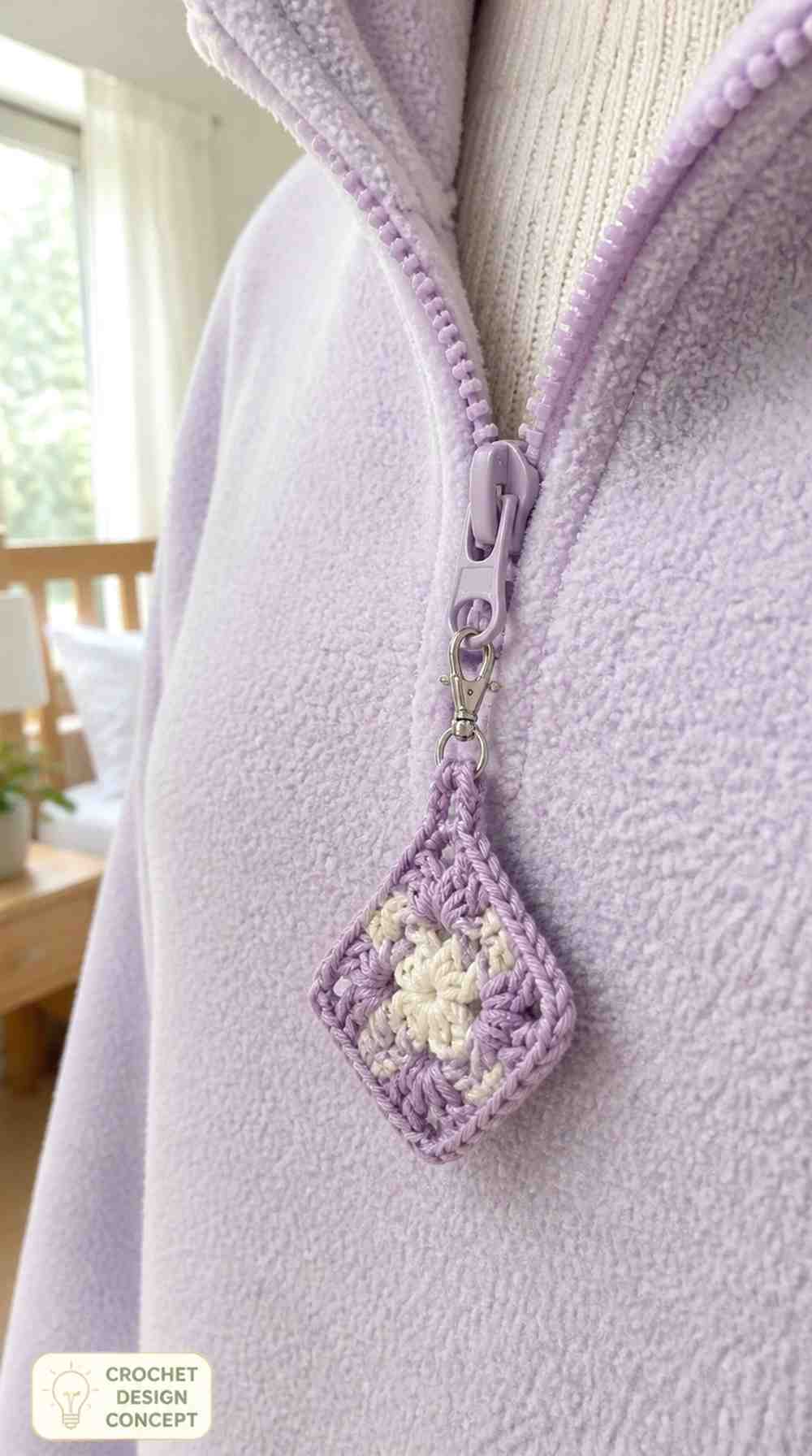
A miniature lavender-and-ivory granny motif forms a diamond-shaped crochet zipper pull with a dense lavender backing. Its reinforced upper neck connects to a tiny silver swivel clasp, which attaches to a closed ring on the zipper tab of a pale-lilac fleece jacket.
The granny-diamond pattern brings traditional crochet texture into a much smaller accessory. The backing is important because open granny clusters alone may stretch or catch during use. The clasp makes the decorative pull removable, though the extra hardware introduces another point that needs checking.
- Miniature granny structure: Keep the motif small and backed so the open clusters do not become loose under repeated handling.
- Clasp compatibility: Check that the clasp and connector ring fit the zipper tab without restricting the slider’s movement.
- Added hardware: The clasp and ring add length and weight, so the finished pull should be checked for swinging and snagging.
9. Crochet Butter Yellow Chain-Loop Zipper Extender
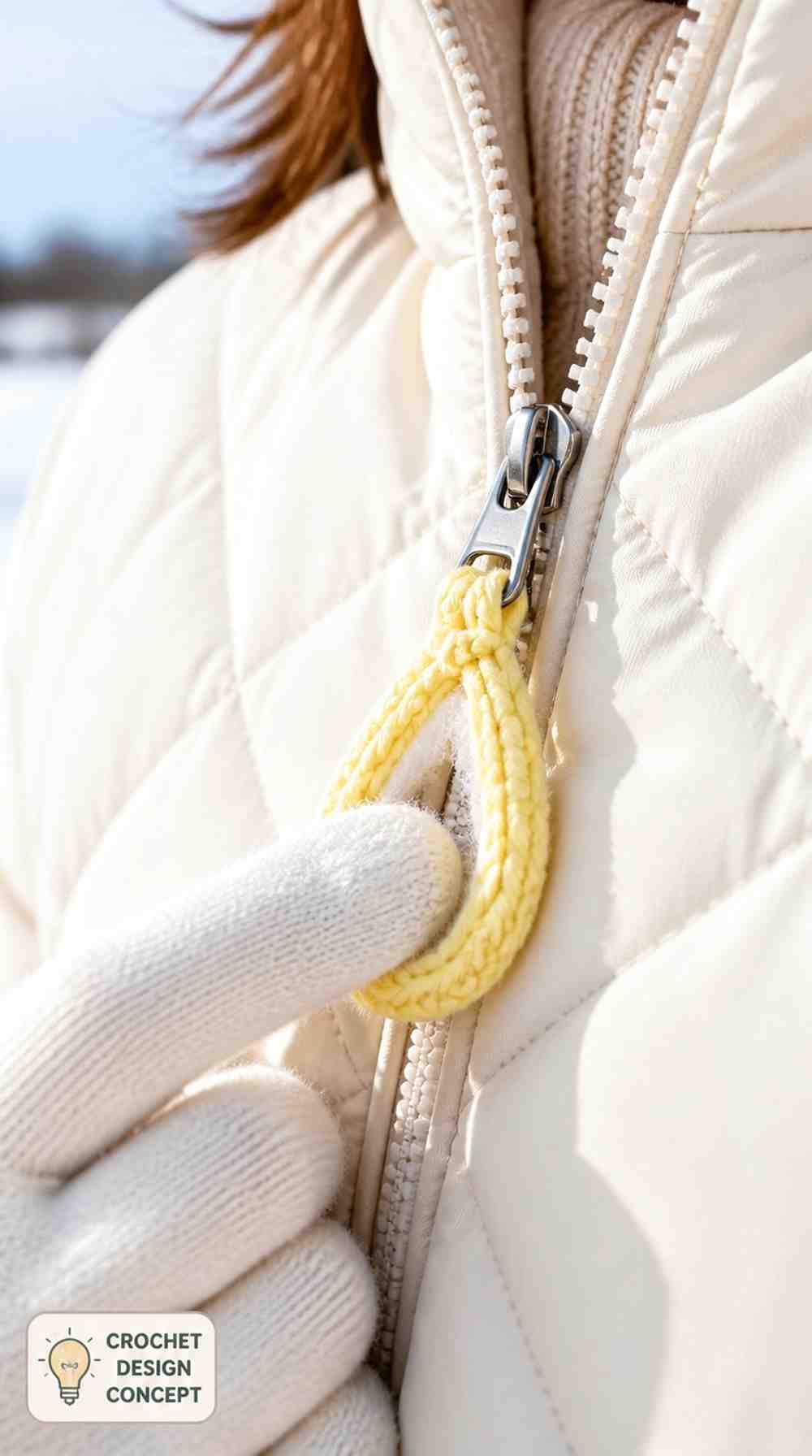
Butter-yellow crochet forms a short closed oval made from reinforced chain and slip stitches. The loop passes through the existing silver pull tab of a cream quilted jacket, leaving a small opening suitable for one gloved fingertip.
This design uses very little crochet fabric compared with the flat tabs. Its cheerful yellow color makes the zipper easier to locate visually against a pale coat, while the compact closed loop avoids dangling ends. The simplicity also means the joining point is especially important.
- Loop reinforcement: A basic chain alone may stretch, so a real extender needs a secure closed join and suitable stitch reinforcement.
- Glove compatibility: Test the loop with a gloved fingertip without making it so large that it becomes a snagging hazard.
- Color contrast: Butter yellow gives a gentle accent to cream outerwear; a darker optional color may be easier to locate in low light.
10. Crochet Navy Silver-Stripe Visibility Pull
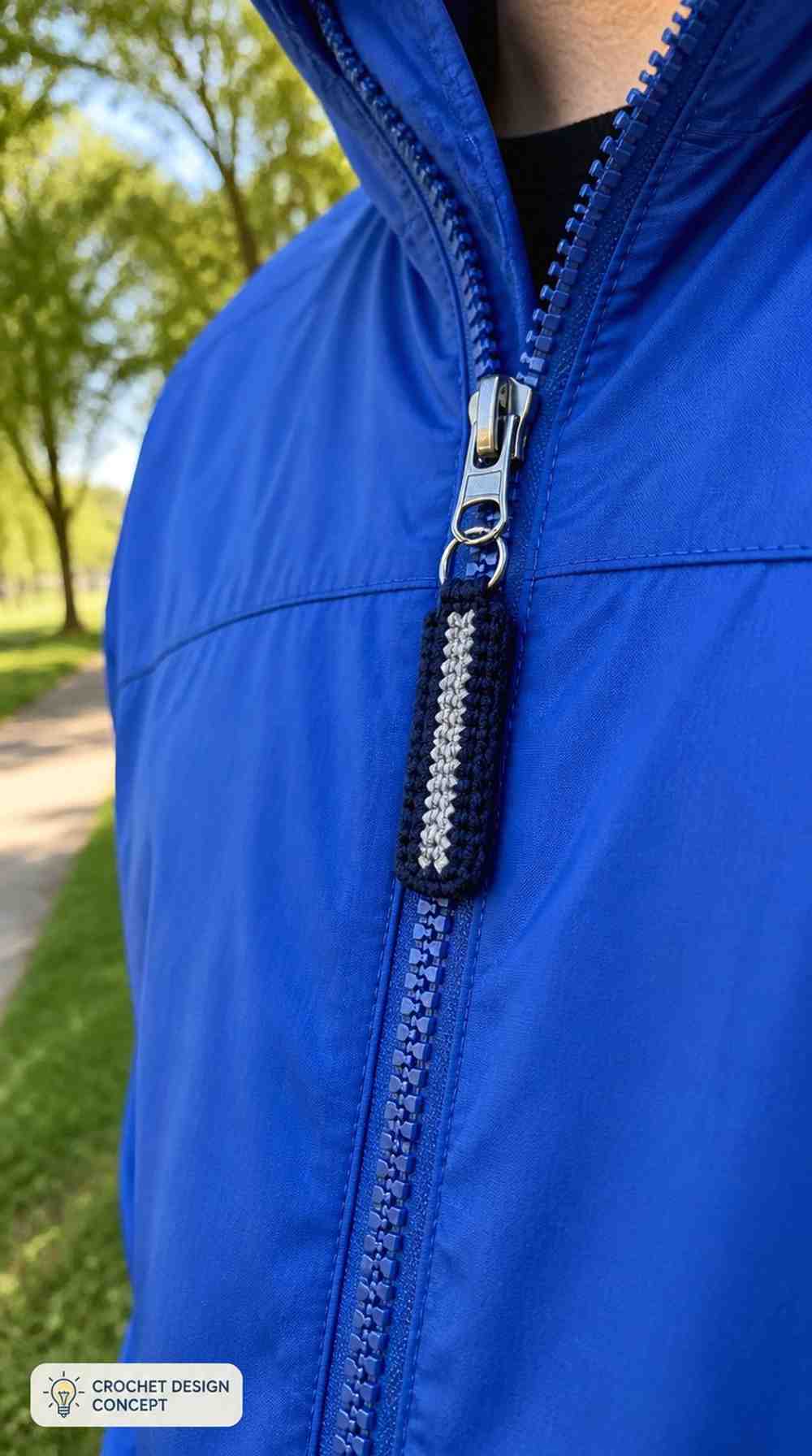
Navy-blue single crochet forms a short rectangular zipper tab with one narrow silver-gray specialty-yarn stripe down the center. A reinforced upper eyelet and silver split ring attach it to the zipper tab of a cobalt-blue outdoor jacket.
The contrasting stripe creates a clear visual feature without requiring a charm or large decoration. It can make the grip stand out against the navy surface, though a metallic-looking thread should not automatically be described as reflective safety material. Its useful quality is the compact flat gripping shape.
- Specialty yarn: Check that the silver-gray yarn is comfortable to touch and suitable for repeated bending before working it into a grip.
- Visibility limits: A shiny accent is not a substitute for certified reflective clothing or visibility equipment.
- Stripe durability: Keep the contrast thread securely integrated into the crochet so it does not loosen during repeated zipper use.
11. Crochet Rust Chevron Tapered Zipper Strap
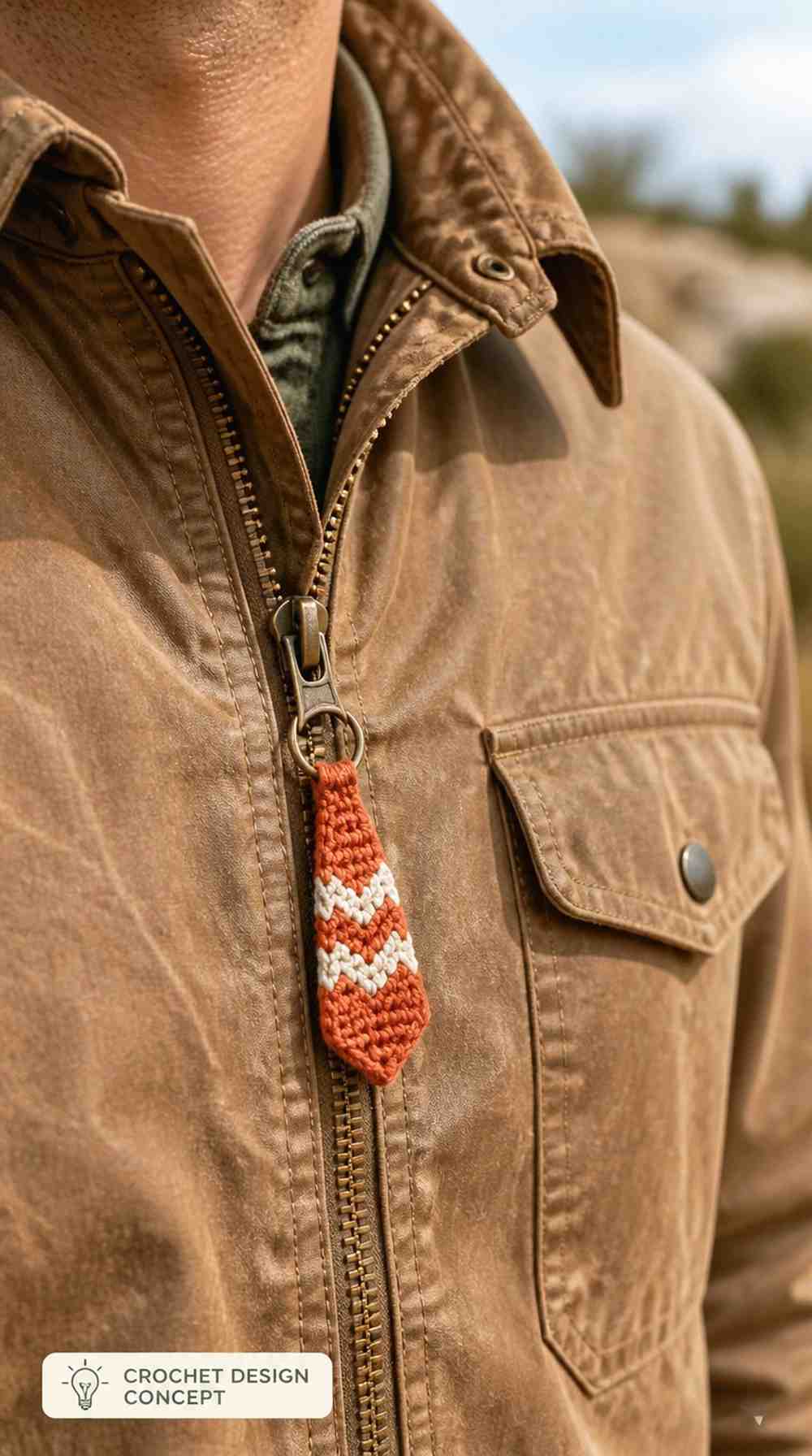
Rust-orange and ecru chevron stitches shape a small tapered crochet pull with a narrow upper neck and a wider softly pointed lower grip. A bronze split ring connects the reinforced top to a light-tan waxed-cotton jacket.
The tapered silhouette gives the fingers a slightly broader place to grasp while keeping the attachment area narrow. Its rust color adds warmth against neutral outerwear, and the small chevrons introduce pattern without requiring additional hardware. The pointed lower edge should remain soft and flexible.
- Tapered shape: Keep the widening gradual so the pull remains easy to grip without folding awkwardly between the fingers.
- Chevron spacing: Small colorwork repeats suit the compact strap better than large zigzags that disappear around the edges.
- Jacket finish: Check that the crochet and connector ring do not rub or scratch the waxed fabric around the zipper.
12. Crochet Ivory Scalloped Mini Zipper Grip
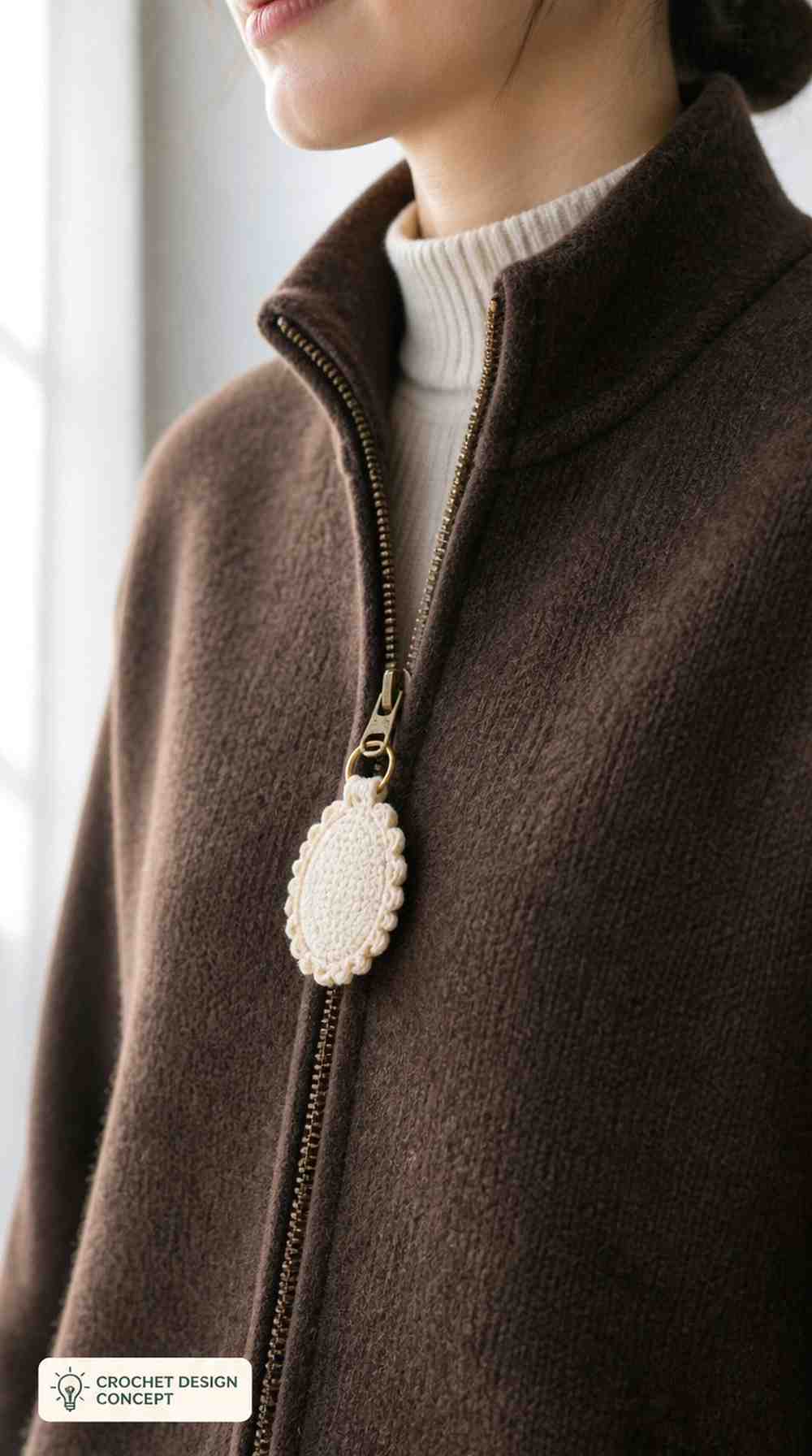
Warm-ivory crochet forms a small flattened oval grip with dense center stitches and delicate scallops around its lower rounded edge. A brushed-gold split ring connects the reinforced upper tab to the existing zipper pull on a cocoa-brown wool-blend jacket.
The scalloped border brings a softer finish to a practical accessory. Unlike a long lace charm, the tiny scallops remain close to the grip, helping the extender stay relatively neat. The ivory surface also provides strong contrast against the darker jacket.
- Scallop depth: Keep each crochet scallop shallow and firm so it cannot easily snag on neighboring fabric.
- Wool contact: Check the metal ring and crocheted edging for rubbing against the jacket’s wool-blend surface.
- Light-color care: Ivory yarn may show dirt from frequent handling, so choose a material with suitable cleaning instructions.
13. Crochet Mint Thumb-Sleeve Zipper Pull
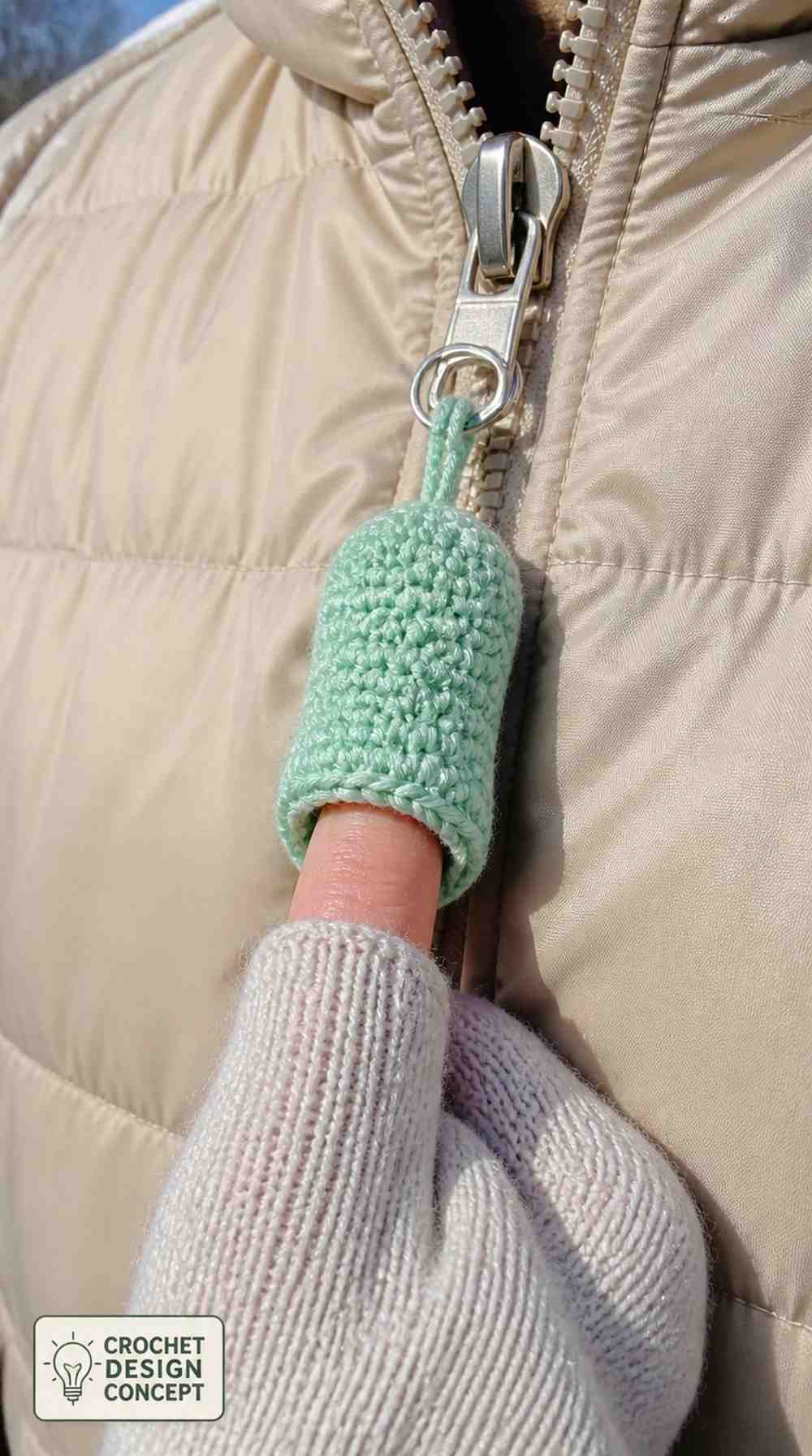
Mint-green crochet creates a small ribbed thumb sleeve with a rounded closed top and an open lower rim. A reinforced upper connection joins the sleeve to the jacket zipper through a silver split ring. Its small cylindrical shape allows a thumb to enter from below.
The finger-pocket approach is different from simply pinching a flat tab. It offers a place to hook a finger into the extender, although the sleeve must remain short enough that it does not catch on other items or twist the zipper during pulling.
- Thumb opening: Measure the intended bare or gloved thumb before sizing the sleeve, and avoid a tight fit that is difficult to release.
- Closed-end support: The upper end needs reinforcement because pulling force passes through the closed crochet tip.
- Practical movement: Test the grip with the jacket worn normally so the sleeve can be released quickly after closing the zipper.
14. Crochet Burgundy Braided-Cord Zipper Grip
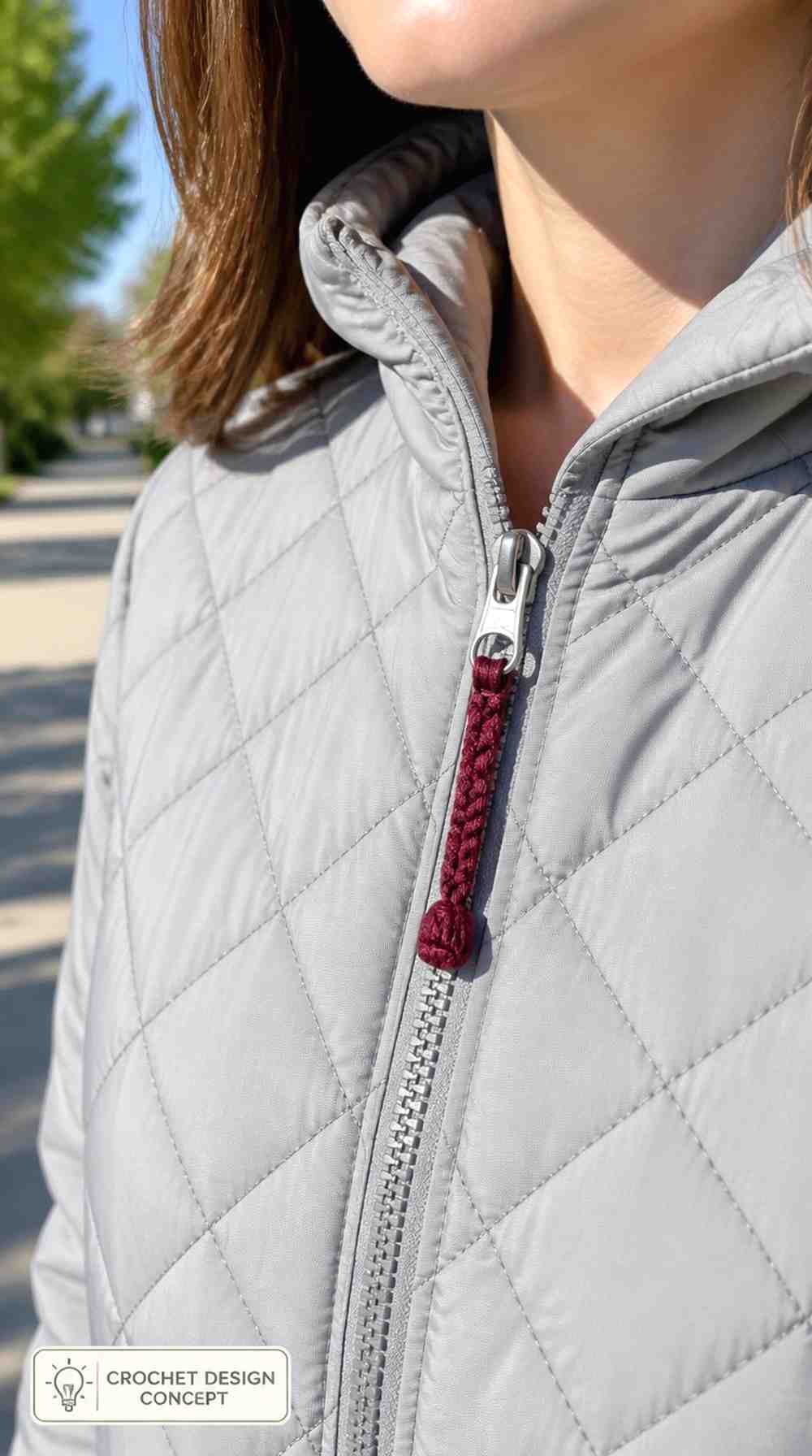
Three slim burgundy crochet cords form a short closely braided zipper grip with a rounded profile. The lower ends tuck into a compact crochet cap, while a narrow upper loop connects directly through the existing metal zipper tab on a light-gray quilted jacket.
The braid creates a flexible alternative to a flat fabric pull. It offers a lightly textured surface that can be pinched between the fingers without requiring a large loop. Its finished ends must be secure, since loose cord strands could unravel or catch during everyday use.
- Braided tension: Keep all three crochet cords evenly tensioned so the grip remains compact rather than developing loose sections.
- End security: Enclose and secure the cord ends inside the crochet cap instead of leaving a tassel below the zipper.
- Direct connection: Check that the narrow upper loop fits the zipper tab without placing excessive pressure on its small metal opening.
15. Crochet Teal Detachable Clasp Zipper Pull
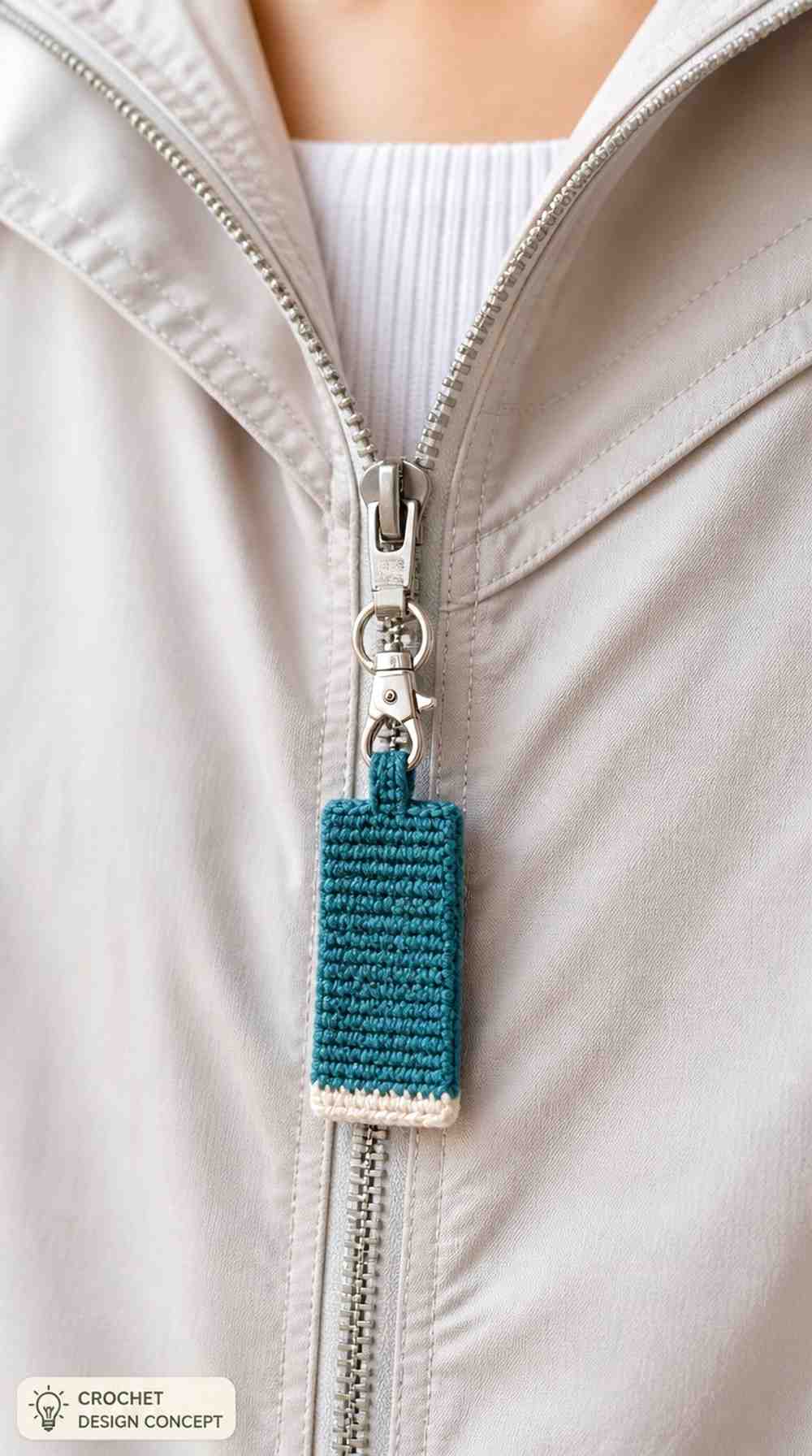
Teal-green crochet forms a compact rectangular grip with smooth horizontal rows and a narrow cream lower border. A reinforced upper tab attaches to a small silver swivel lobster clasp, which connects to a separate closed ring fitted through the original zipper pull hole of a pale-stone jacket.
The detachable clasp gives this design its main purpose. It allows the crochet grip to be removed or exchanged without repeatedly handling its stitched eyelet. However, the clasp and ring both need to fit properly, and the added connection should not make the extender too long.
- Removable hardware: Select a clasp small enough for the jacket zipper while still being manageable for the intended user.
- Two connection points: Check both the crochet-to-clasp attachment and the clasp-to-ring connection for signs of wear.
- Extra length: The clasp adds height above the crochet grip, so measure the entire hanging length rather than only the crocheted portion.
16. Crochet Peach Flat-Bow Zipper Tab
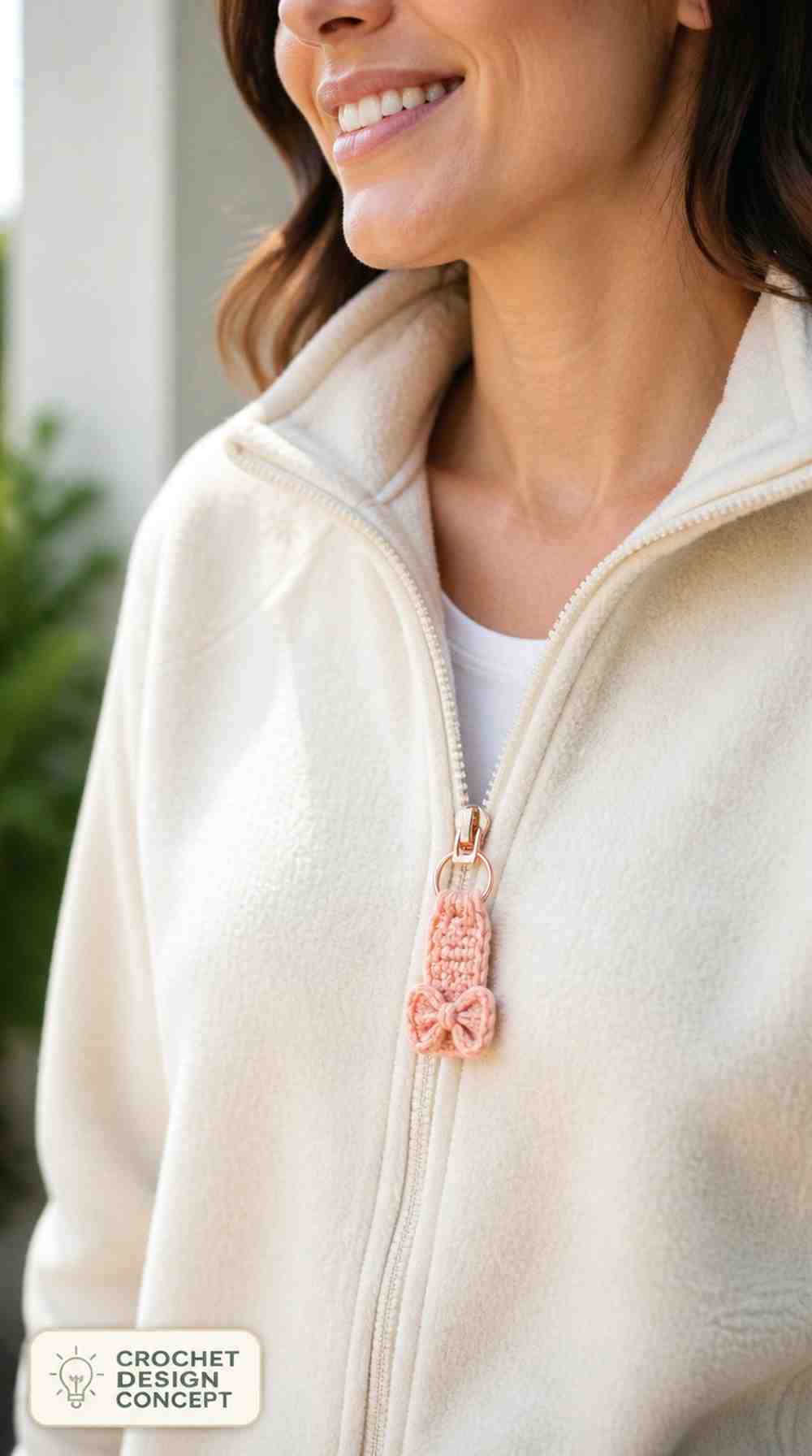
Peach crochet creates a narrow rectangular zipper tab with a tiny matching bow sewn across its lower front. The bow has short flat tails, while a rose-gold split ring connects the reinforced upper eyelet to the metal zipper tab of an ivory fleece jacket.
The small bow adds a playful finishing detail without becoming a separate hanging accessory. Its flat shape is important because a large loose bow could catch on fabric or interfere with gripping. The tab itself remains the functional part, while the bow provides decoration.
- Bow attachment: Stitch the center and short tails securely so the decoration stays flat against the pull.
- Grip clearance: Leave enough smooth crochet surface around the bow for fingers to hold the tab comfortably.
- Fleece contact: Keep the metal connector and decorative stitches smooth to reduce catching against the soft jacket fabric.
17. Crochet Black Cream Oval Finger Ring
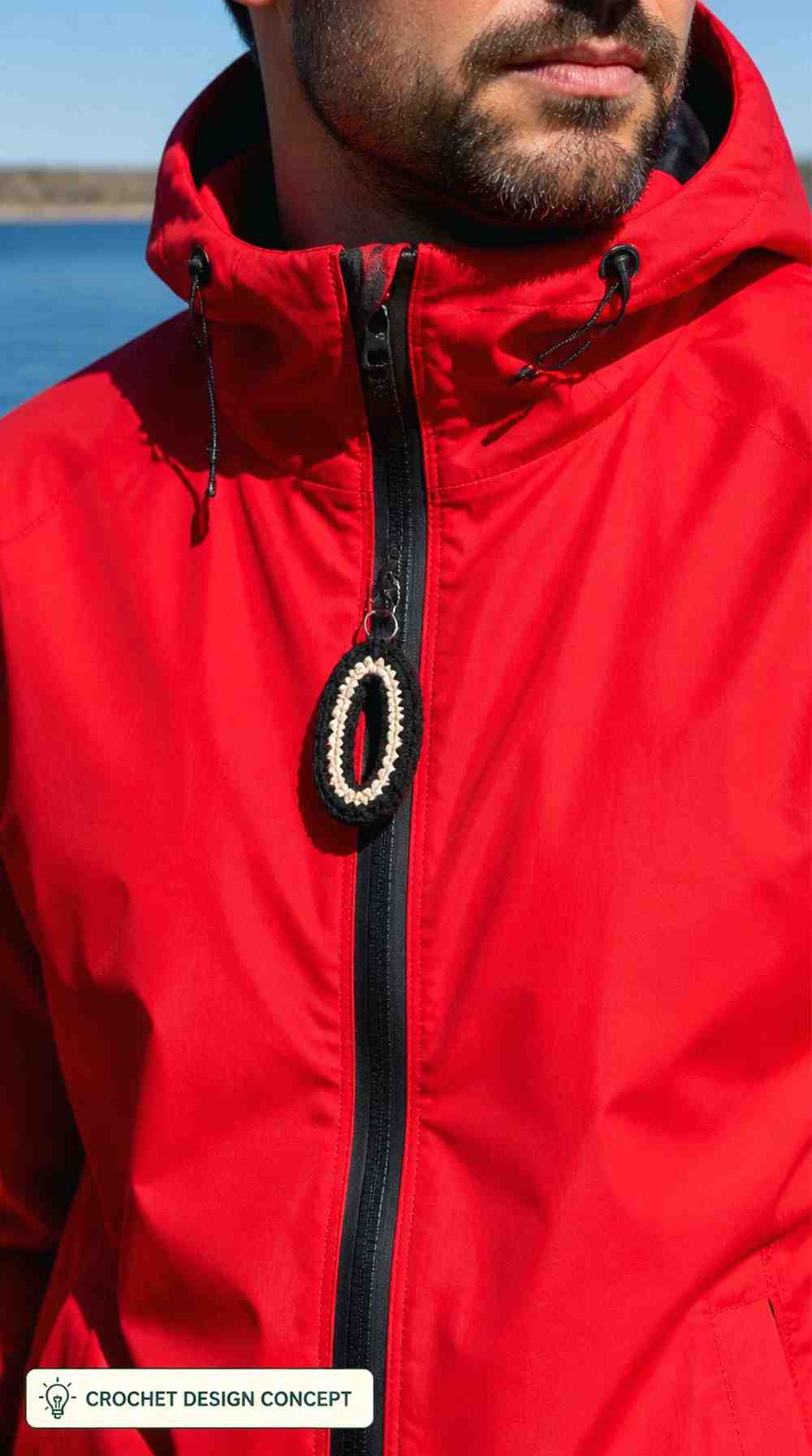
Black crochet forms a short closed oval finger loop with a narrow cream inner border. A reinforced upper joining point connects through a gunmetal split ring to the existing zipper tab of a bright-red jacket. The two-tone loop hangs directly in front of the central zipper.
The bold contrast makes this design easy to distinguish visually from the jacket. Its closed oval provides a finger opening rather than a solid gripping surface, making it a useful alternative for someone who prefers pulling with one fingertip. The loop must remain compact to avoid snagging.
- Oval opening: Shape the ring around a comfortable fingertip opening without creating a large loose circle.
- Inner edging: Smooth cream crochet along the inside may reduce roughness against fingers, depending on the yarn selected.
- Ring orientation: Keep the attachment centered so the oval hangs vertically and does not twist across the zipper track.
18. Crochet Mocha Reversible Two-Tone Pull Tab
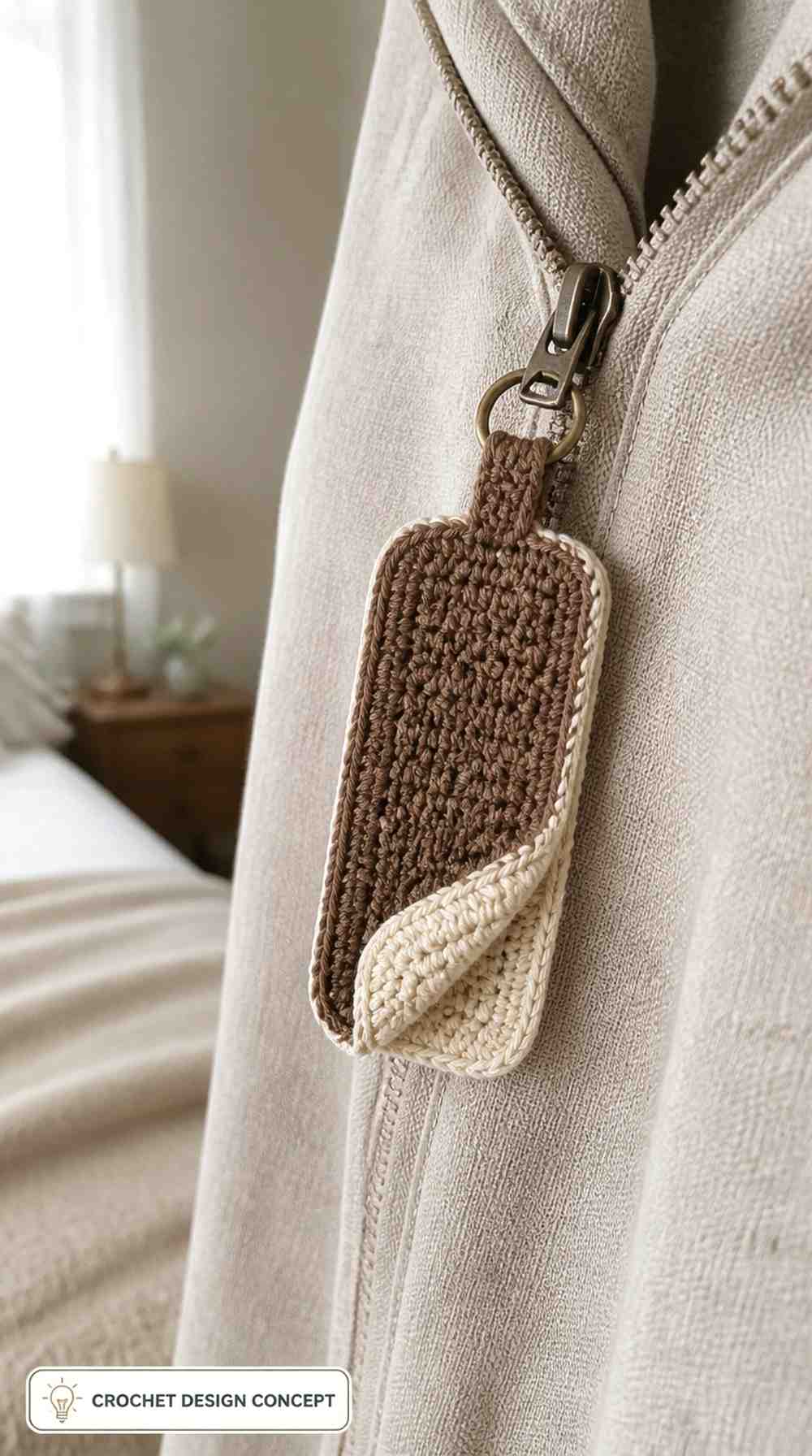
Mocha-brown crochet forms the front of this short flat zipper tab, while warm ivory covers the reverse. Both sides join along smooth cream edges, and a bronze split ring connects the reinforced upper loop to the zipper tab of an oatmeal jacket.
The contrasting sides give the extender a finished appearance whichever face turns outward. Rather than relying on raised decoration, the design uses two closely joined flat layers for a soft gripping surface. The doubled fabric must still remain flexible enough for comfortable everyday use.
- Two-sided joining: Align the mocha and ivory layers so the finished tab does not curl toward one color.
- Edge finishing: Smooth joined edges matter because fingers may grip either side of the reversible pull.
- Bulk control: Use an appropriate yarn thickness so the two-layer construction does not become unnecessarily stiff.
19. Crochet Coral Teardrop Zipper Grip
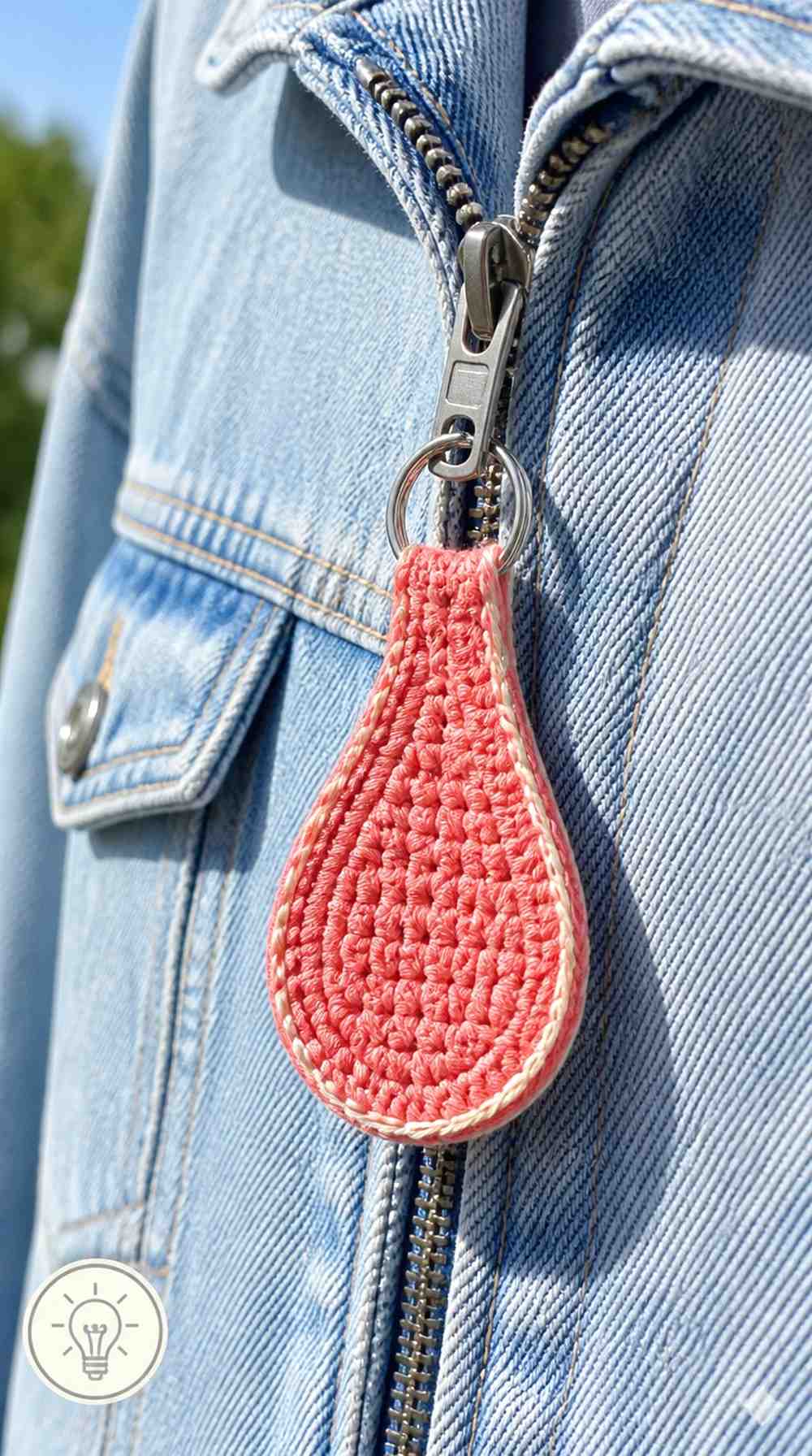
Coral-pink crochet forms a small flattened teardrop with a narrow reinforced upper neck and a softly rounded lower gripping area. Two dense crochet layers join along a pale-cream stitched edge, while a silver split ring attaches the grip to the existing metal zipper tab of a light-denim-blue jacket.
The teardrop shape offers a broader lower section for the fingers and a narrower upper area for attachment. It is decorative without adding beads, tassels or separate motifs. Its smooth shape makes it a fitting final option for someone who wants a little color with a practical gripping surface.
- Teardrop proportions: Keep the lower end broad enough to pinch but short enough that it does not hang awkwardly below the zipper.
- Layer construction: Join the two flat crochet surfaces securely, especially around the narrow upper neck where pulling force concentrates.
- Smooth outline: A thin cream stitched border can define the shape, but it should remain soft and free from loose ends.
Practical Guide to Crochet Jacket Zipper Pull Extenders
A crochet zipper pull extender is a small accessory designed to make the existing zipper tab easier to grip. It should not replace the zipper slider itself or be used to force a damaged zipper to operate.
Inspect the original zipper first. Check that the slider moves smoothly and that the metal pull tab has a suitable opening for a cord loop, split ring or attachment. Some jackets have very small openings, while others use special locking pull mechanisms. Never force a thick crochet cord through a tiny metal hole.
Choose the right gripping shape. Flat tabs are useful for pinching between two fingers. Closed oval loops may be easier for some people wearing gloves. Tubular or braided designs offer a rounded grip, while small raised stitches can add texture. Try the shape with the jacket on, rather than testing only on a table.
Keep the extender short and lightweight. Long strings, heavy charms and oversized loops may snag on bag straps, clothing or nearby objects. Avoid designs that put unnecessary force on the slider or pull the zipper outward instead of along its normal track.
Reinforce the attachment point. The narrow upper loop, eyelet or connecting strap experiences repeated pulling. A real design should use securely finished crochet, suitable joining stitches and properly sized hardware. Inspect split rings and clasps regularly.
Consider yarn care and comfort. Smooth cotton or another suitable washable yarn can be worth considering, depending on the jacket’s care instructions. Avoid scratchy fibers or decorations that may damage delicate fabric. Any metal fittings should be smooth and free of sharp edges.
Keep small parts secure. Metal rings, detachable clasps, beads and decorative attachments can become hazards if they loosen, especially on children’s clothing. Avoid detachable small-part designs where they could be swallowed or chewed.
A pull extender improves access to a functioning zipper; it does not repair damaged teeth, a faulty slider or a broken locking mechanism. If the zipper catches or separates, investigate the underlying problem rather than pulling harder.
For related zipper-accessory styling, explore Yarn Nest Studio’s 15 Crochet Citrus Slice Coin Purse Inspiration Ideas, which includes a small crochet leaf attached to a zipper pull. You can also browse 15 Crochet Zip Pouches Ideas for other ways zipper hardware can work alongside crocheted accessories.
Want to Make Something Similar?
The 19 designs shown above are original inspiration concepts rather than tested patterns. These published resources explain related crochet pull-tab construction and zipper attachment methods.
- Crochet Zipper Pull Tab by CyCrochet — a crochet project focused on a small pull tab, reinforcing a connecting loop and adjusting the grip size.
- Zipper Pull Replacement Guide by iFixit — explains how a replacement cord-style pull attaches through a suitable zipper tab opening, with practical illustrations.
- Little Cherry Zipper Pulls by Twinkie Chan — a published decorative crochet zipper-pull pattern featuring small crochet cherry shapes and clasp hardware.
These are separate creators’ resources. They teach related skills and do not reproduce the exact 19 visual concepts. Always match the attachment to your jacket’s actual zipper and check that the finished pull works without straining it.
Which Crochet Jacket Zipper Pull Extender Should You Choose?
| Your main need | Design to consider | Important trade-off |
|---|---|---|
| Simple everyday gripping | Sage Moss-Stitch Zipper Grip Tab | Needs a suitable ring attachment |
| Easier pulling with gloves | Oatmeal Ribbed Finger-Loop Extender | Loop size must be controlled |
| Raised finger texture | Terracotta Bobble Thumb-Grip Pull | Bobbles may add bulk |
| Soft rounded grip | Charcoal Tubular Zipper Pull | Narrow upper connection needs reinforcement |
| Flat but broader grip | Forest Green Double-Layer Grip Pull | Double fabric adds thickness |
| Decorative crochet detail | Lavender Granny-Diamond Zipper Pull | Extra clasp and openwork need checking |
| Very lightweight finger loop | Butter Yellow Chain-Loop Zipper Extender | Simple loop needs secure reinforcement |
| Compact braided grip | Burgundy Braided-Cord Zipper Grip | Cord ends must remain secured |
| Easily detachable option | Teal Detachable Clasp Zipper Pull | Extra hardware increases length |
| High-contrast finger opening | Black Cream Oval Finger Ring | Ring can snag if too large |
| Reversible colors | Mocha Reversible Two-Tone Pull Tab | Two layers may be stiffer |
| Rounded lower gripping area | Coral Teardrop Zipper Grip | Must remain short and lightweight |
For a jacket used daily, a short flat pull or small closed finger loop is usually a sensible starting point. Decorative designs can work too, provided their attachments remain secure and they do not interfere with normal zipper movement.
Conclusion
Crochet jacket zipper pull extenders show how a very small handmade detail can make an everyday garment more convenient to use. From simple sage moss-stitch tabs and oatmeal finger loops to braided cords, miniature granny diamonds and smooth coral teardrops, these concepts explore different ways to improve the gripping surface of an existing zipper.
The best option will depend on the original zipper, the person’s grip, and how the jacket is worn. Keep the extender light, use a reliable attachment, and check that the zipper moves smoothly before making the design part of everyday wear.
Which design would you choose for a winter jacket: the Oatmeal Ribbed Finger-Loop Extender, the Terracotta Bobble Thumb-Grip Pull, or the simple Sage Moss-Stitch Tab? Share whether you prefer a flat grip, a finger loop, or a small decorative pull.
Frequently Asked Questions
1. Can a crochet zipper pull extender be attached to any jacket?
Not every jacket zipper has a suitable attachment opening. Some have small metal tabs, special locking mechanisms or unusual slider designs. Check the original hardware before adding a crochet loop or connector ring. The extender should move freely without bending the tab, obstructing the slider or damaging the fabric.
2. What yarn is suitable for a crochet jacket zipper pull extender?
A smooth, firm yarn that holds its shape under repeated handling may be a good starting point. Cotton or a suitable synthetic blend can be considered, depending on the intended feel and cleaning requirements. Test the crochet for stretching, abrasion and color transfer before using it on a jacket regularly.
3. Are crochet finger-loop zipper extenders easier to use with gloves?
They can offer an alternative to pinching a small metal tab because a gloved finger may fit through the loop. However, the result depends on glove thickness, loop size and the person’s grip. Test the finished design with the actual gloves and avoid oversized loops that could catch on surrounding objects.
4. Can a crochet zipper pull extender fix a broken jacket zipper?
A pull extender may help when the original gripping tab is too small or missing but the slider is otherwise working and has a suitable attachment point. It cannot repair damaged zipper teeth, a misaligned track or a worn-out slider. Those problems need proper repair or replacement rather than additional pulling force.
5. Are these 19 crochet jacket zipper pull extender ideas complete patterns?
No. They are original visual design concepts showing different grip shapes, stitch textures, attachment styles and decorative finishes. The linked resources provide related crochet and zipper-repair guidance. A real extender still requires appropriate sizing, secure joining, compatible hardware and testing with the intended jacket.