Boucle brings a distinctly textured surface to a crochet bomber, but the yarn can change more than appearance. Its loops and fuzz can soften stitch definition, increase visual bulk, and make seams, ribbing, pockets, and closures behave differently from the smoother yarn used in many jacket tutorials. That makes construction style just as important as silhouette when choosing a Fall 2026 project.
The ideas below range from cropped zip bombers and oversized pocket jackets to teddy-inspired layers, balloon-sleeve cardigans, hooded versions, and varsity-influenced shapes. Some original tutorials already use plush or highly textured yarn; others provide a strong bomber or jacket structure that could be adapted to boucle after careful swatching. Where boucle is an adaptation rather than the designer’s specified yarn, compare gauge, finished measurements, fabric weight, and stitch visibility before substituting.
Quick List
- Crochet Boucle Mesh Pocket Bomber Jacket
- Crochet Boucle Oversized Collar Bomber Jacket
- Crochet Boucle Herringbone Zip Bomber
- Crochet Boucle Wide Rib Pocket Bomber
- Crochet Boucle Alpine Texture Pocket Bomber
- Crochet Boucle 80s Colorblock Zip Bomber
- Crochet Boucle Super Chunky Bomber Cardigan
- Crochet Boucle Cropped Fluffy Bomber
- Crochet Boucle Modern Cropped Zip Bomber
- Crochet Boucle Hooded Pocket Bomber
- Crochet Boucle Clean Line Zip Bomber
- Crochet Boucle Sherpa Style Bomber Jacket
- Crochet Boucle Teddy Collar Bomber Jacket
- Crochet Boucle Chunky Collared Bomber
- Crochet Boucle Hooded Button Bomber
- Crochet Boucle Cropped Cable Bomber Jacket
- Crochet Boucle Textured Balloon Sleeve Bomber
- Crochet Boucle Two Tone Classic Bomber Jacket
Choosing Boucle for a Bomber Structure
Boucle can range from lightly looped yarn that still shows individual stitches to dense, teddy-like yarn that visually blends them together. Before adapting a bomber tutorial, make a generous swatch in the main stitch pattern rather than choosing by yarn weight alone. Compare the resulting fabric with the tutorial’s gauge and intended drape, and check whether ribbing still contracts enough to define the hem and cuffs.
Highly dimensional stitches can lose their visual effect under a strongly textured boucle. Simpler surfaces, broad ribbing, and clear color blocks often remain easier to read. Boucle can also make it difficult to see where to insert the hook or undo mistakes, so a construction with straightforward seams and clearly identifiable edges may be more practical than one relying on intricate stitch placement.
Check Fit Before Committing to a Cropped Bomber
Bomber silhouettes depend on proportion. A cropped body, gathered-looking cuff, broad collar, or fitted lower band can change where the jacket sits even when the overall garment is intentionally roomy. Compare the tutorial’s finished measurements with a jacket you already like rather than relying only on the labeled garment size.
Boucle substitution makes this especially important because a denser swatch may produce a stiffer jacket while a looser one can stretch under its own weight. Check body width, armhole depth, sleeve circumference, sleeve length, and finished jacket length before making all the pieces. If the original design uses positive ease, preserve the designer’s intended relationship between garment and body measurements unless you have a clear reason to change it.
Closures, Pockets, and Ribbing Need Extra Attention
A zipper exposes edge irregularities more clearly than an open cardigan front, and thick boucle can make the zipper area bulky. Before committing to a zip bomber, check how the original tutorial prepares the front edges and whether your substituted fabric lies flat enough to support the closure. Buttons also need stable openings that will not disappear or distort in a very fuzzy fabric.
Pockets add another layer of weight. A soft boucle body may sag more noticeably once pockets are loaded, so placement and attachment deserve attention. Ribbed hems and cuffs should also be tested separately: if the textured yarn does not give the required recovery or definition, using a compatible smoother yarn for trim can preserve the bomber silhouette without forcing boucle into every part of the jacket.
1. Crochet Boucle Mesh Pocket Bomber Jacket
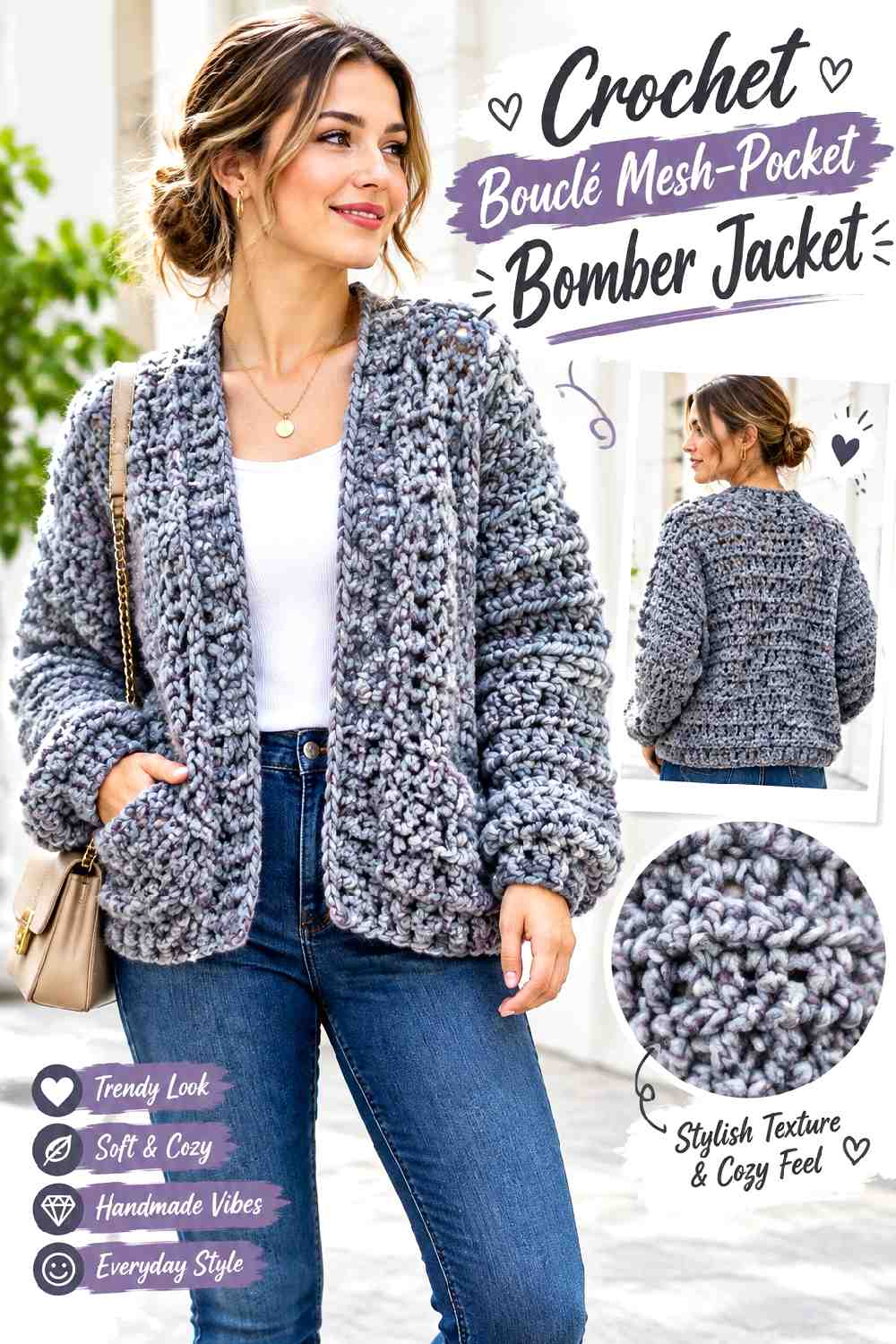
This idea begins with the chunky bomber cardigan from For The Frills, which combines an oversized shape with a noticeably open-textured body, balloon sleeves, substantial lower ribbing, and concealed pockets. The original uses super-bulky yarn rather than boucle, so the value here is the silhouette and construction concept rather than a direct yarn swap. The contrast between an airy body and more substantial trim can create a lighter-looking boucle bomber than an all-over dense teddy jacket.
Before choosing this direction, swatch the tutorial’s main fabric with the proposed yarn. A highly looped boucle may visually close the open spaces or make the structure less distinct, changing both the appearance and ventilation of the jacket.
Preserve the Open Texture
The mesh-like body is one of the design’s distinguishing features, so judge the swatch from normal viewing distance rather than only up close. If the boucle loops blur the openings completely, the fabric may read as a solid fuzzy surface and lose the intended contrast with the ribbing. A less aggressive texture or a slightly different compatible yarn for the main body may preserve more of the original visual rhythm.
Watch the Hidden Pocket Area
Hidden pockets keep the outer silhouette cleaner, but extra fabric around the pocket can become bulky when the main yarn is already plush. Check how the pocket joins the garment in the original tutorial and make sure the substituted fabric can lie flat at that point. Avoid assuming that thicker automatically means more stable; soft bulky yarn can still stretch when a pocket carries weight.
Creator Credit: For The Frills
2. Crochet Boucle Oversized Collar Bomber Jacket
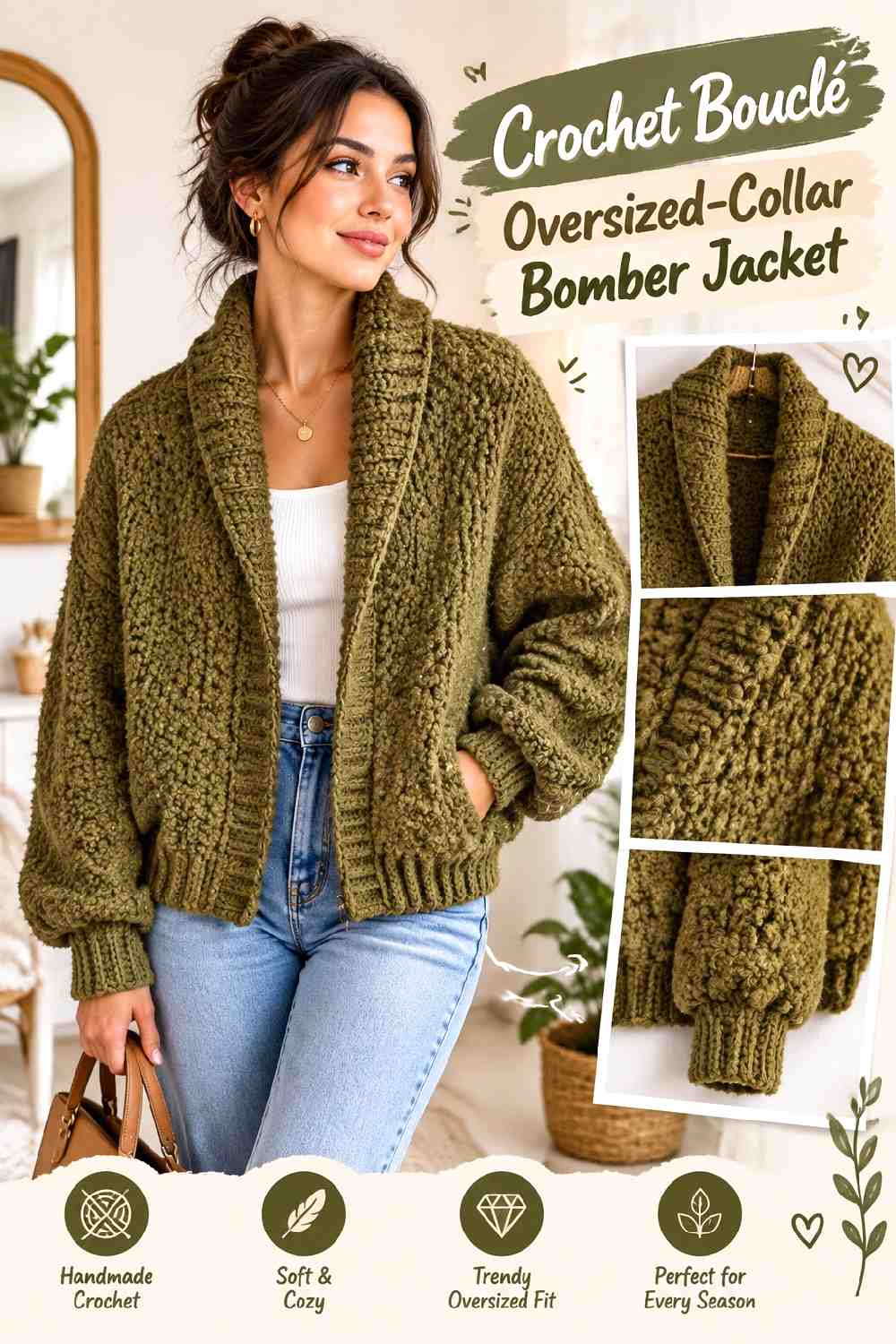
Blue Star Crochet’s bomber provides a strong basis for a classic boucle interpretation because the original already emphasizes an oversized fit, cropped body, prominent collar, and cuffs that give the sleeves a slightly ballooned profile. The tutorial uses a super-chunky yarn, so it offers a useful reference point for judging a substantial fabric even though a boucle substitution would still require its own gauge test.
This direction works well when the goal is a visibly defined bomber silhouette rather than a cardigan that merely uses fuzzy yarn. The collar and lower edge carry much of that identity. Before adapting it, pay particular attention to whether the chosen boucle produces enough structure for the collar without making the neckline feel excessively thick.
Balance the Collar Weight
A large collar made in a looped yarn can become heavier and visually fuller than the same shape in smooth wool. Work enough of a test section to see whether it folds naturally or stands away from the body. If the texture makes the collar unusually rigid, simply matching gauge may not be enough; fabric behavior matters as much as stitch dimensions for this feature.
Confirm Where the Crop Lands
A cropped jacket with positive ease can look intentionally boxy, but body length determines whether it layers comfortably over fall tops. Compare the tutorial’s finished length with the intended wearer’s torso and favorite high-rise or mid-rise garments. If you lengthen the body, remember that additional boucle fabric also adds weight and may alter how the lower band sits.
Creator Credit: Blue Star Crochet
3. Crochet Boucle Herringbone Zip Bomber
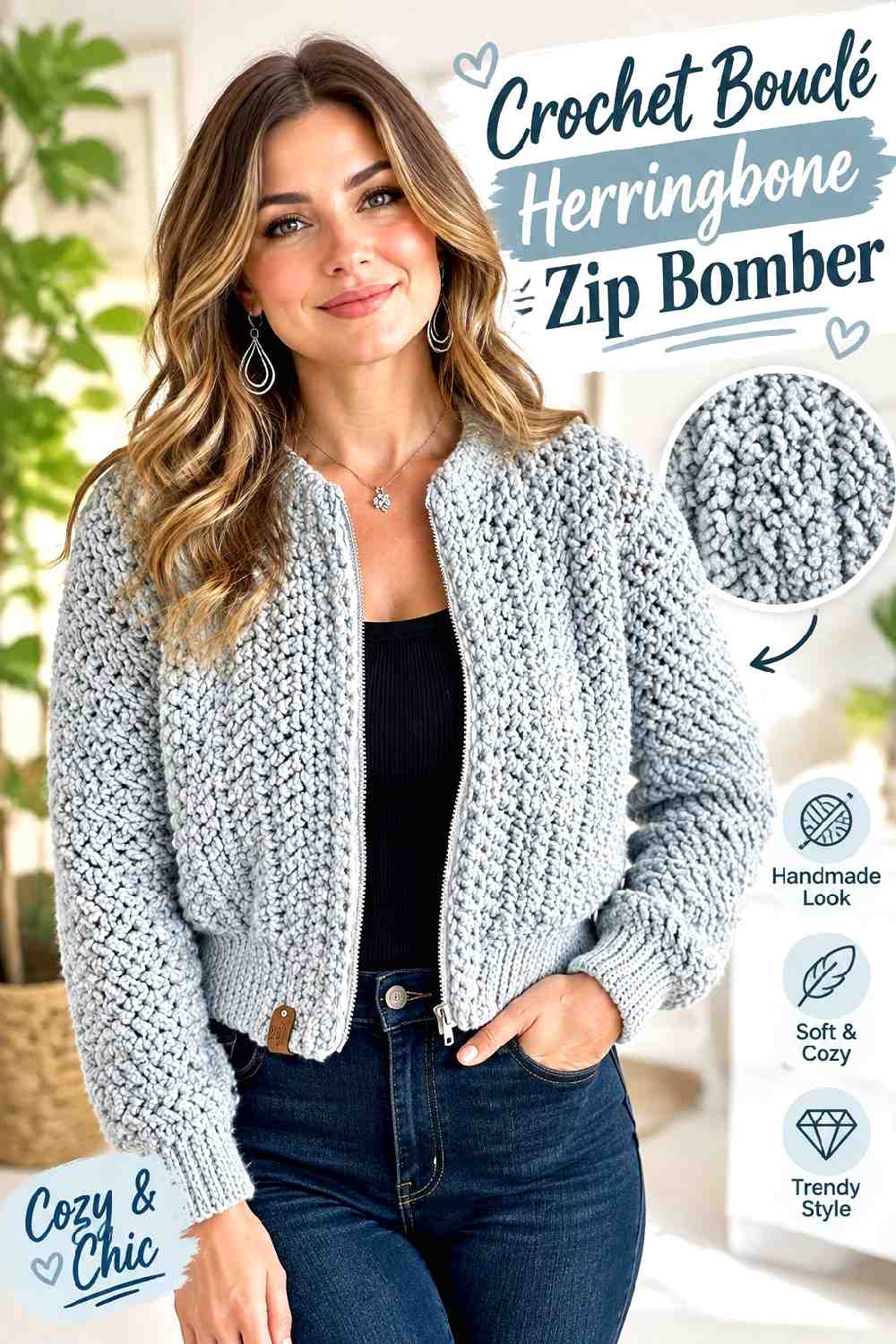
Mermaids & Hooks offers a bomber cardigan with a herringbone-style crochet surface and a choice between a zipper and buttoned front. The source also uses a relatively structured bulky yarn and presents a relaxed jacket shape, making it useful for readers who want a closure rather than an open cardigan front.
For a boucle interpretation, the main decision is whether the yarn still allows the herringbone texture to show. A very nubby strand can erase the directional surface that makes this version distinct. If the stitch texture disappears in the swatch, the jacket may still work structurally, but it will no longer have the same visual character. Consider the closure at the same time because a zipper requires flatter, more controlled front edges than buttons.
Keep the Zipper Edge Stable
A zipper performs best when both fronts remain close in length and lie reasonably flat. Boucle can make edge stitches hard to identify, so mark important points while working rather than trying to locate them afterward. Before installation, compare both front edges without stretching them. Correcting a length mismatch at the finishing stage is more difficult when a zipper must align from hem to neckline.
Decide Whether Herringbone Still Earns Its Place
The herringbone effect is worth keeping only if the yarn allows readers to see it. Test several inches rather than a tiny square, because directional texture often becomes clearer over a larger area. If dense loops obscure the pattern, a smoother companion yarn for selected panels or trim can provide contrast while leaving boucle as the dominant fall texture.
Creator Credit: Mermaids & Hooks
4. Crochet Boucle Wide Rib Pocket Bomber
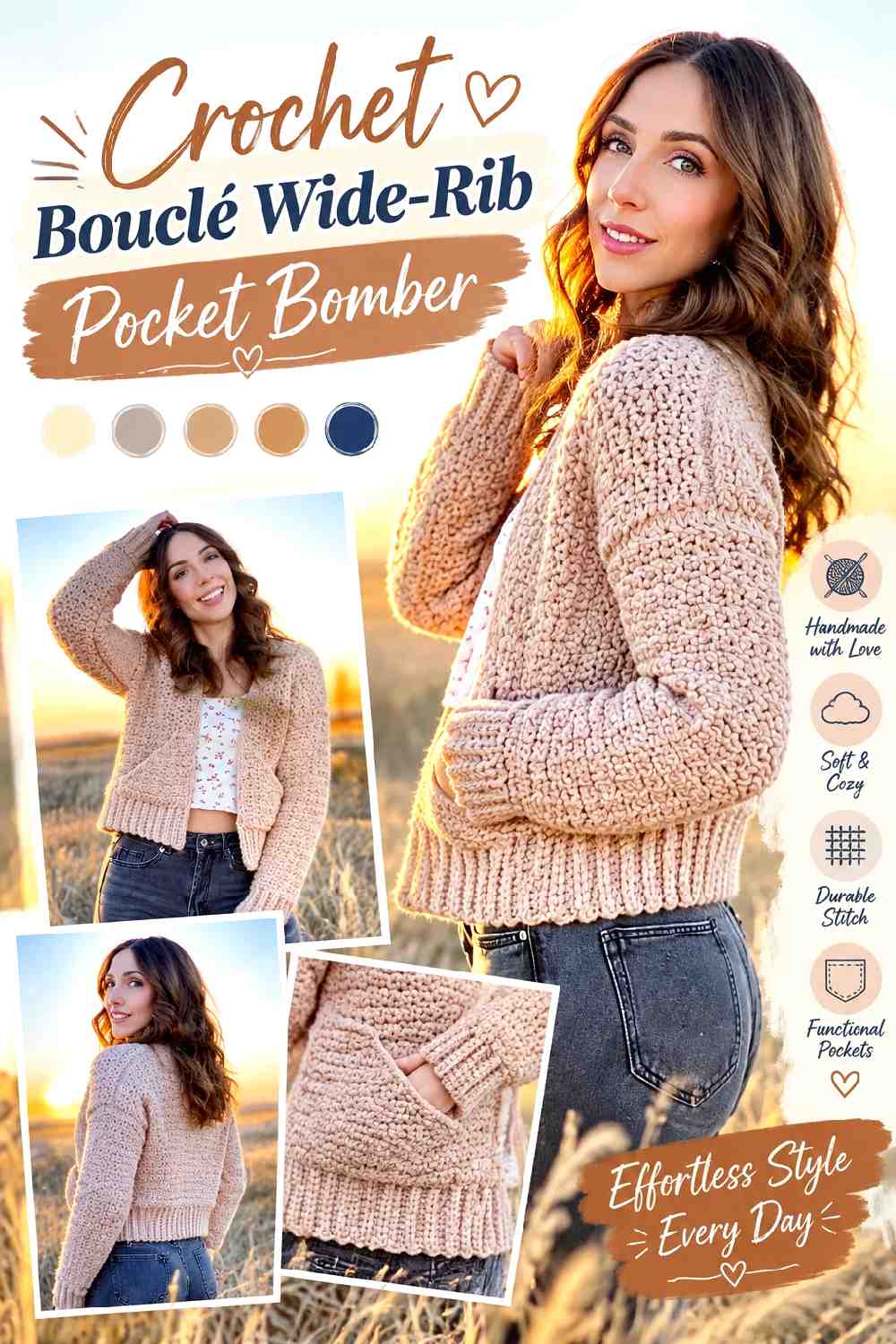
The Sunset Bomber from Evelyn And Peter Crochet combines a roomy bomber body with broad ribbed finishing and pockets. The source uses bulky yarn and separate garment panels, giving readers clear structural checkpoints before assembly.
This is a useful direction for boucle because the wide ribbed areas can act as visual anchors around a fuzzier body. It also suits readers who prefer a jacket whose bomber identity comes from proportion and finishing rather than a zipper. The main adaptation question is whether boucle should be used in the ribbing as well as the body. If the loops make the rib structure indistinct or reduce recovery, a companion yarn can create stronger cuffs and a more defined lower band.
Test How Much the Ribbing Draws In
A bomber hem usually looks different when the lower band is narrower or more elastic than the body above it. Work a meaningful sample of the ribbing and compare its relaxed width with the main fabric. If the boucle ribbing barely contracts, the finished jacket may hang more like a straight cardigan than the intended bomber silhouette.
Account for Pocket Weight Early
Pockets can pull on a soft front panel before anything is placed inside them, particularly with plush yarn. Hold a pocket-size swatch against the main fabric to judge the combined thickness. When using the finished jacket, lightweight contents will generally preserve shape better than routinely loading soft crocheted pockets with heavy items.
Creator Credit: Evelyn And Peter Crochet
5. Crochet Boucle Alpine Texture Pocket Bomber
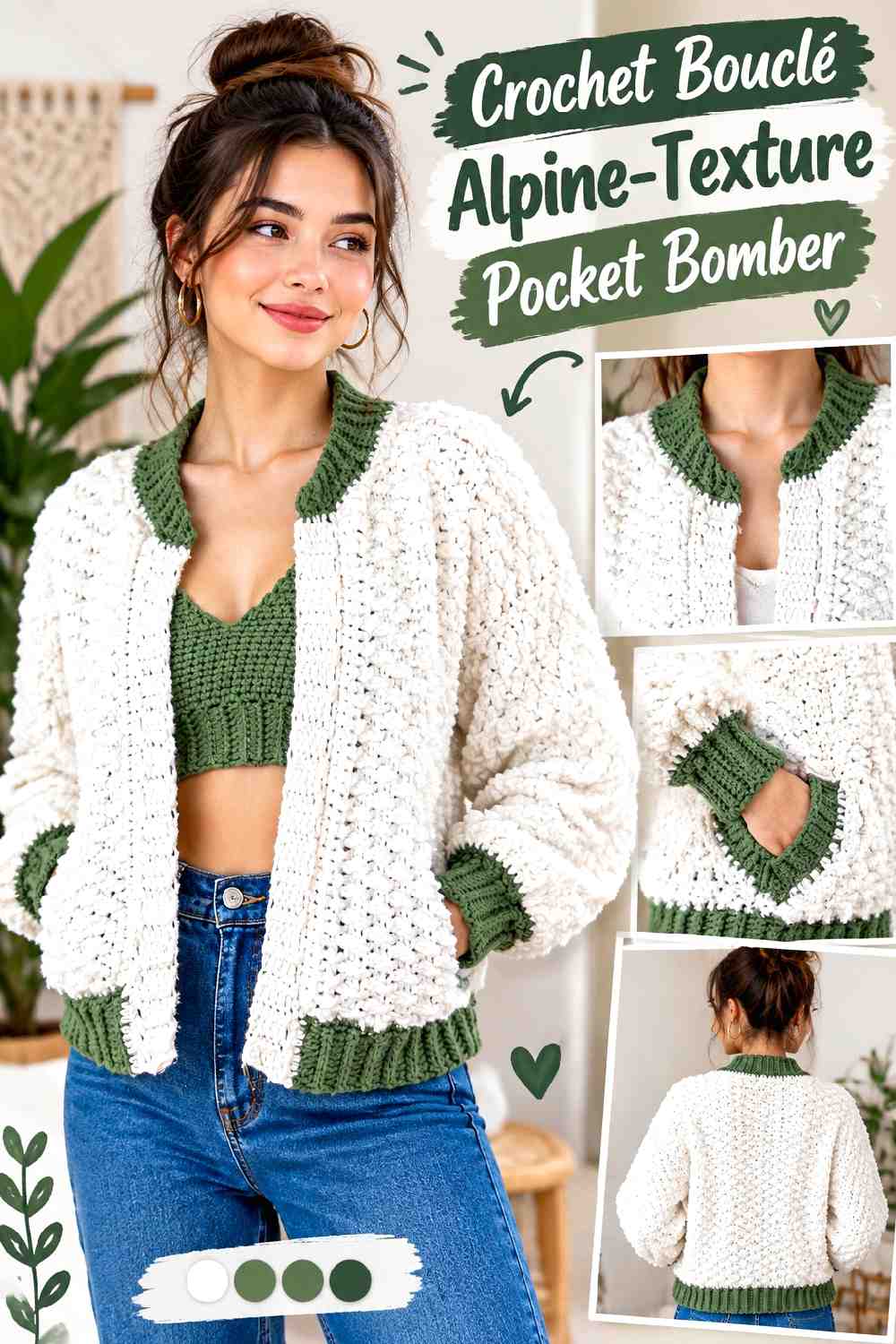
TCDDIY’s bomber tutorial features an oversized, slightly cropped jacket with substantial pockets and an alpine-textured surface. That combination offers a more pronounced stitch pattern than many fuzzy bombers, making this option useful for readers deciding whether they want boucle itself to supply the texture or want a textured stitch underneath it.
The safest approach is to swatch before assuming both effects will remain visible. Alpine-style relief can look striking in smooth yarn, while pronounced boucle may soften or almost erase the raised pattern. If the stitch definition remains readable, the result can be richly dimensional. If it does not, the extra stitch complexity may add effort and thickness without providing much visual return.
Judge Relief From a Distance
Take the swatch into normal daylight and view it from several feet away. If the alpine texture reads only when the fabric is examined very closely, decide whether that subtlety is worth the extra density. A bomber already gains substantial texture from boucle, so simpler stitchwork can sometimes produce a cleaner overall shape.
Keep Deep Pockets From Distorting the Front
Large pockets are useful on a fall jacket but create broad attachment areas. With stretchy boucle, those seams can become noticeable or cause the front to hang differently. Pin or baste pocket-size samples into position before final attachment if necessary, and check the jacket while hanging as well as lying flat.
Creator Credit: TCDDIY
6. Crochet Boucle 80s Colorblock Zip Bomber
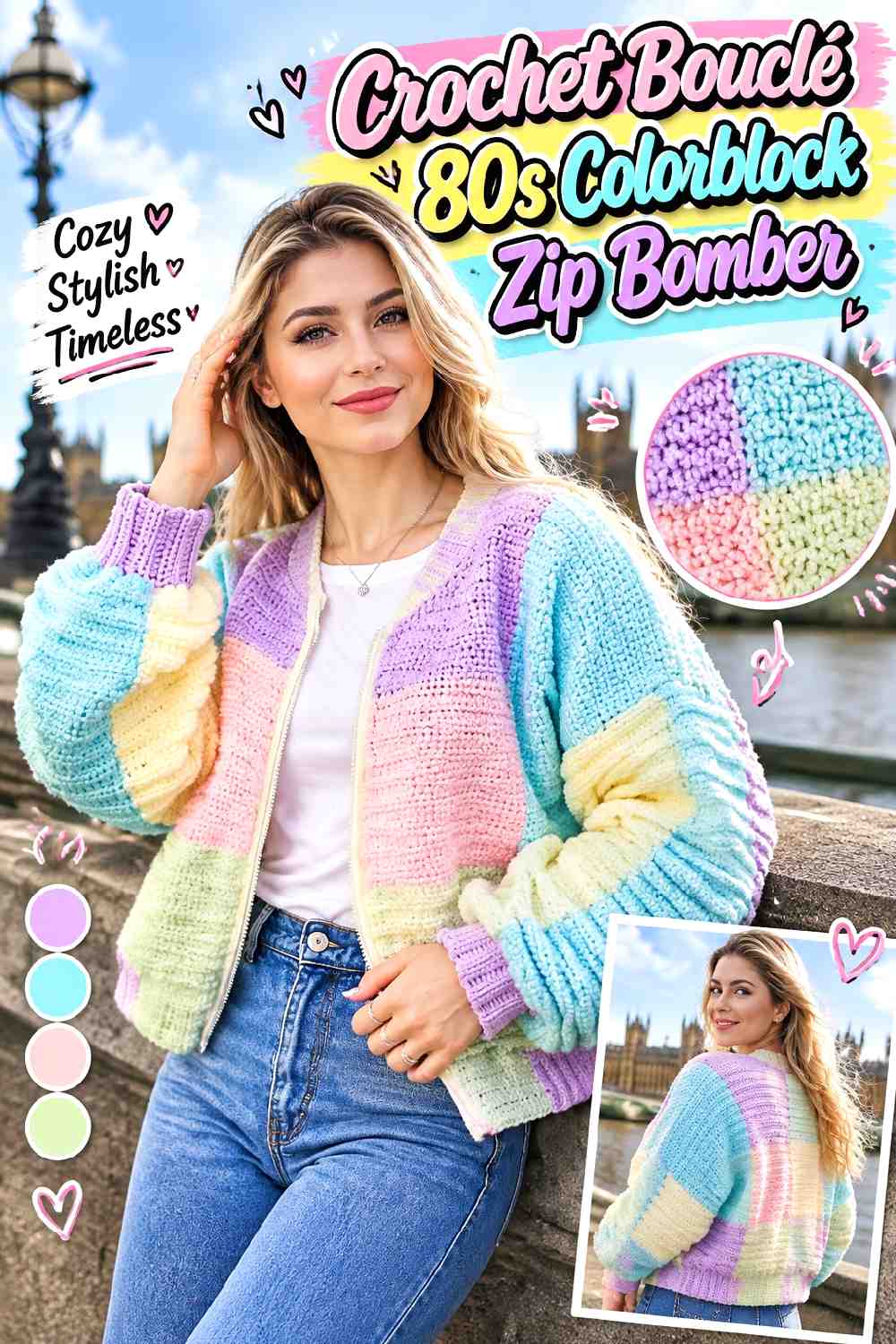
Brunaticality’s tutorial takes an overtly retro approach, combining a bomber shape with an open-ended zipper and strong multicolor styling. The source is explicitly inspired by 1980s jackets, making it a useful starting point when the goal is more graphic than minimalist.
Boucle can soften crisp color boundaries because the loops extend beyond the stitch surface, but that can suit a vintage-inspired jacket if the shades remain distinct enough. This option is particularly effective when the bomber is meant to be the focal layer rather than a neutral basic. Before choosing several boucle colors, make swatches beside one another; similar values may visually blend once the textured fibers overlap.
Plan Color Boundaries Before Buying Multiple Yarns
The more textured the yarn, the less useful a tiny strand sample is for predicting color interaction. Place larger swatches together and check them under indoor and outdoor light. Strong value contrast generally keeps blocking readable even when fuzzy surfaces blur the transition. Closely related shades can produce a softer effect but may make the planned blocks difficult to distinguish.
Give the Zipper a Clean Visual Path
A central zipper introduces a straight architectural line against an otherwise soft surface. Keep both front edges controlled so the zipper does not ripple. Boucle loops can also stray toward the teeth, so evaluate the finished edge before permanent installation and follow the original tutorial’s closure guidance rather than improvising around a poorly stabilized front.
Creator Credit: Brunaticality
7. Crochet Boucle Super Chunky Bomber Cardigan
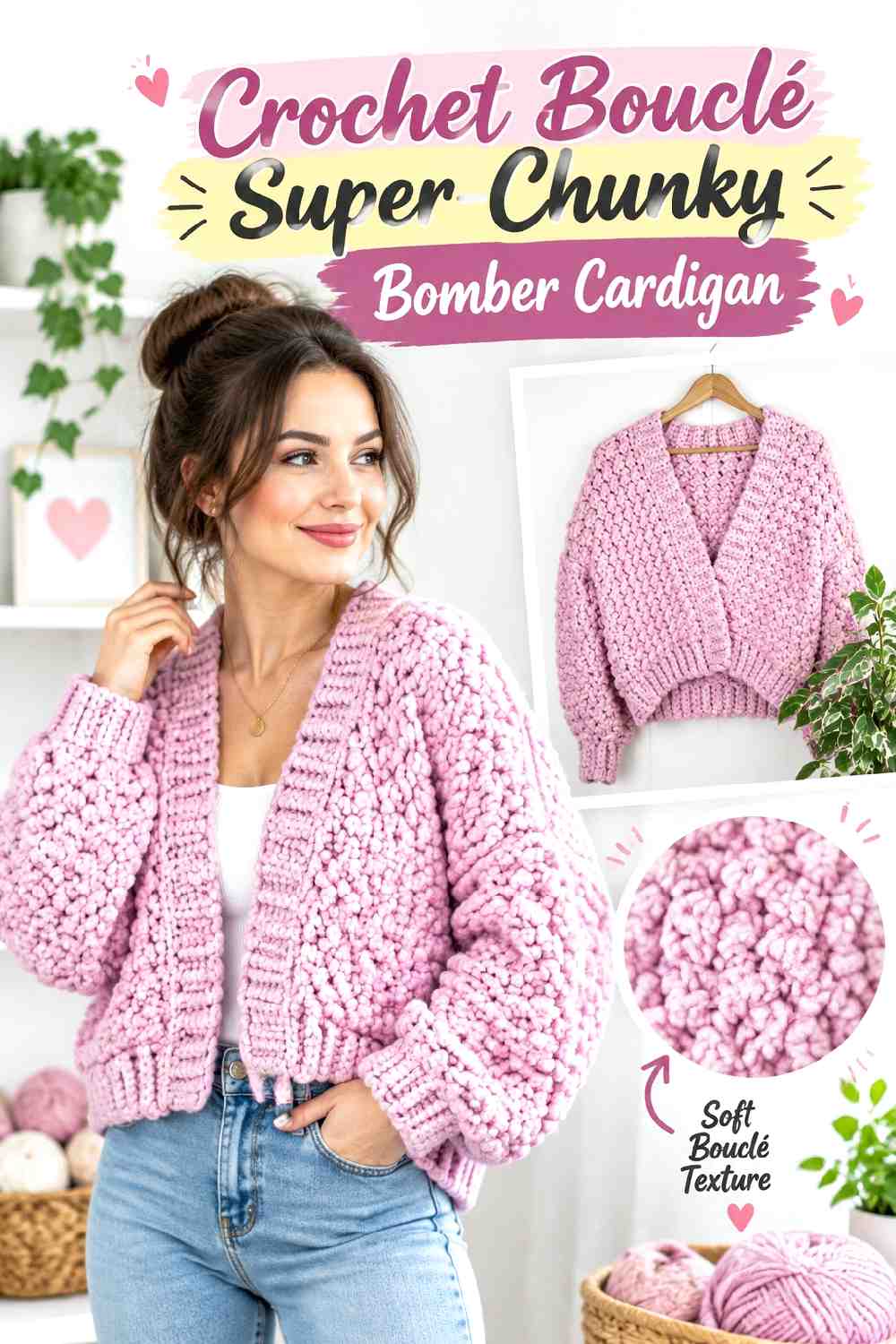
Hey Carrie’s bomber cardigan tutorial uses very heavy yarn and large hooks, creating a substantial jacket with the exaggerated scale associated with super-chunky crochet. That makes it an interesting reference for readers who want the Fall 2026 boucle look to feel visibly oversized and tactile.
A similarly thick boucle should not automatically replace the source yarn, however. Two yarns labeled at comparable weights can produce very different fabric because boucle loops contribute apparent volume without always contributing the same density. Check gauge, weight, and flexibility. This is a better direction for someone comfortable with a bold, bulky layer than for a reader seeking a light indoor cardigan.
Avoid Accidental Armor-Like Fabric
Large-scale crochet can become stiff when the hook is too small for the substituted yarn. Your swatch should bend comfortably where a sleeve bends and should not feel board-like across the body. If matching the tutorial’s gauge requires an unusually tight fabric, the yarn may simply be a poor substitution despite looking appropriate in the skein.
Check Sleeve Bulk With Your Intended Layers
A super-chunky bomber may already create significant volume around the arms. Before finalizing sleeve circumference, think about what will be worn underneath it. A jacket intended over a thin knit top has different layering needs from one expected to fit over a sweatshirt. Compare the tutorial’s finished measurements rather than adding arbitrary extra width.
Creator Credit: Hey Carrie
8. Crochet Boucle Cropped Fluffy Bomber
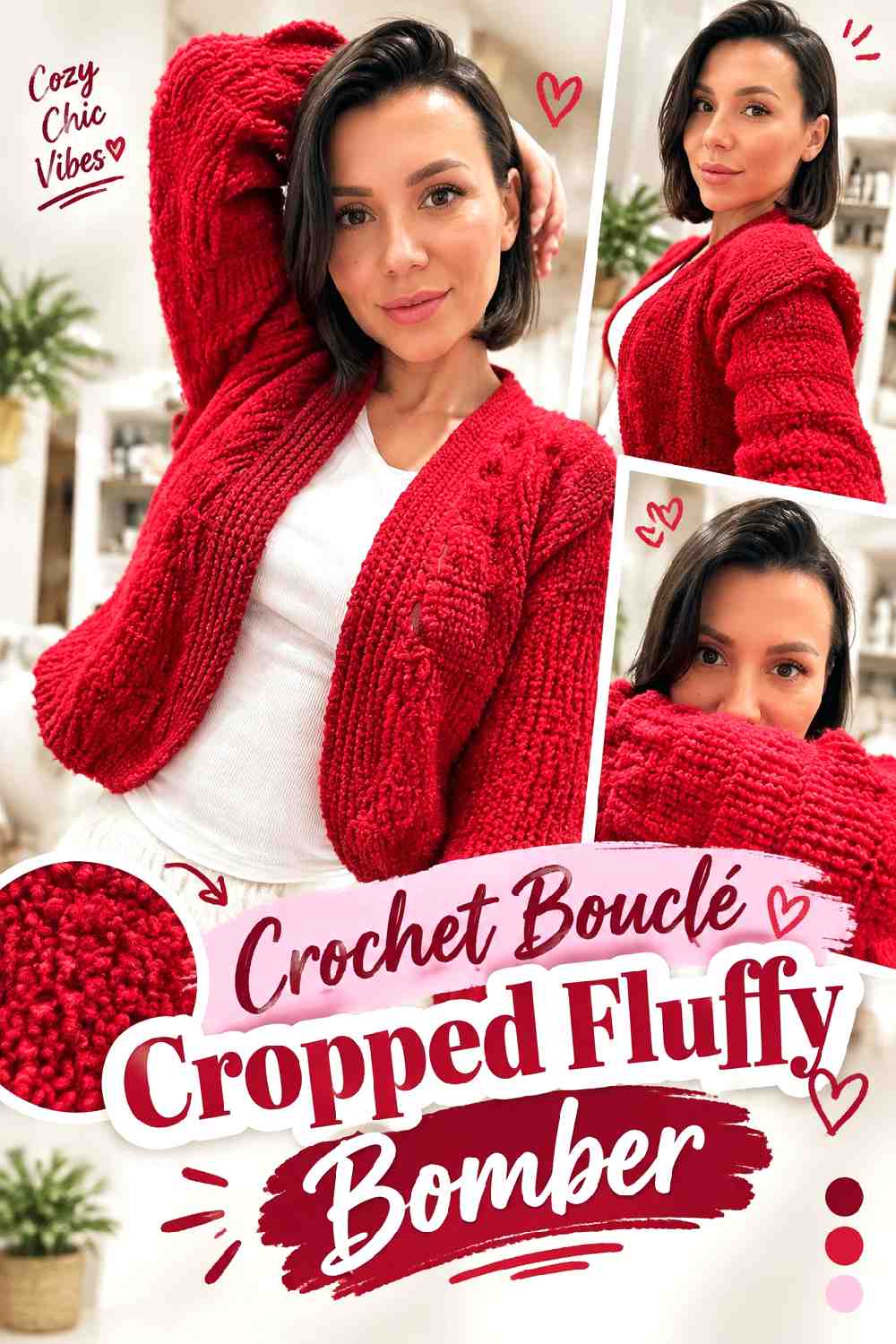
Crochet Studio 22’s bomber tutorial focuses on a cropped cardigan with a soft, visibly fluffy surface. That makes the source useful for readers who want a compact bomber where texture takes priority over elaborate stitchwork. The tutorial also discusses adapting the size, so finished dimensions should be checked directly there before changing the proportions.
A cropped boucle bomber works especially well as a high-waisted layering piece because less body length keeps a plush yarn from overwhelming the silhouette. The trade-off is that small changes in length become more noticeable. Before starting, compare the planned hem position with the garments you expect to wear underneath rather than deciding crop length in isolation.
Treat Crop Length as a Styling Measurement
Instead of considering only torso length, try on a similarly cropped jacket over the trousers, skirts, or dresses you wear most often. The most useful length is the one that creates the intended proportion with those garments. If you add substantial length to a fluffy bomber, remember that the extra fabric may also change how boxy or heavy the jacket feels.
Stabilize an Airy Fluffy Fabric Carefully
A very soft fuzzy fabric can look appealing while still being vulnerable to stretching at seams. Check shoulder and side seams after the pieces are lightly supported rather than aggressively pulled. When joining, avoid cinching seams so tightly that they create a rigid ridge against the softer surrounding fabric.
Creator Credit: Crochet Studio 22
9. Crochet Boucle Modern Cropped Zip Bomber
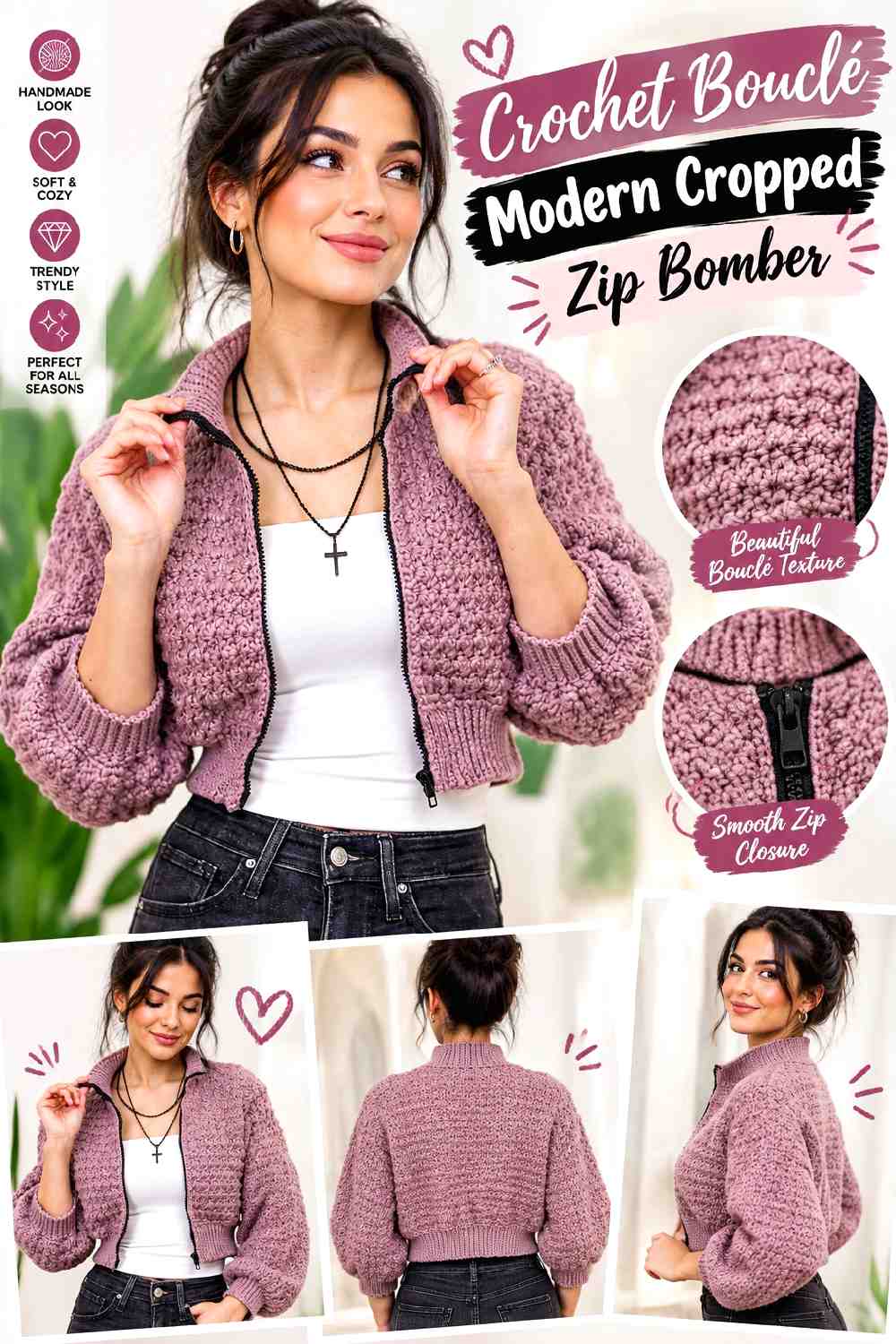
TCDDIY’s modern cropped bomber combines a short body with a zipper, cuffs, lower band, collar, and a textured main stitch pattern. The tutorial is a recent interpretation of the bomber silhouette rather than a cardigan being loosely reimagined as one, making it a strong option when a recognizable jacket structure is the priority.
For boucle, the closure and trim deserve more attention than the trend label. A looped yarn can make the center-front edge irregular, while the zipper emphasizes any difference between the two sides. Swatch the stitch pattern to confirm it remains visible and check the front edge before investing in a zipper sized around an altered jacket length.
Match the Zipper to the Finished Jacket
If you change body length, do not assume the closure specified for the source sample will still fit. Finish or accurately measure the intended center-front opening first, then select the closure appropriate to your version. A zipper that is too long can force the fabric to wave, while stretching crochet to fit a short zipper can distort the hem and neckline.
Check Whether the Main Texture Survives Boucle
The source uses a defined stitch texture, but boucle can soften it substantially. A swatch will tell you whether the stitch pattern remains a design feature or merely contributes density. If the surface becomes visually uniform, decide whether that is acceptable before doing the entire body in a more involved stitch than the finished jacket actually reveals.
Creator Credit: TCDDIY
10. Crochet Boucle Hooded Pocket Bomber
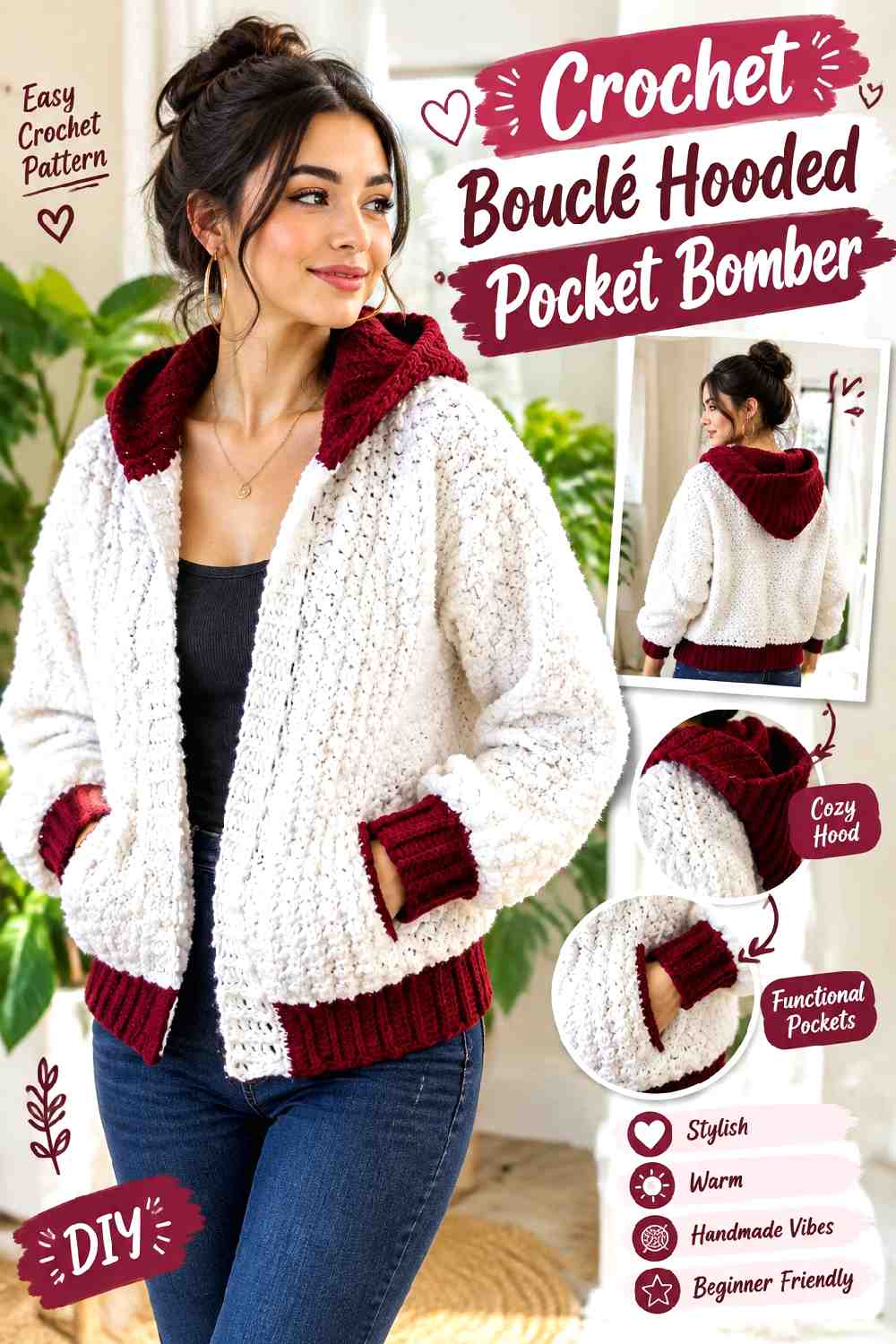
TCDDIY’s bomber hoodie adds a hood and pockets to the familiar cuffed bomber structure. It is a practical variation for readers who want more coverage than a collar-only jacket while retaining the compact, sporty character of a bomber.
The hood changes the balance of a boucle garment more than a small collar would. Plush yarn adds fabric mass behind the neckline, which can pull the jacket backward if the hood becomes heavy. This makes swatching and yarn choice especially important. It is also worth deciding whether the jacket is mainly an outer layer or an indoor cardigan, because a substantial hood and pockets increase both warmth and bulk.
Keep Hood Weight in Proportion
Make sure the chosen fabric folds instead of standing rigidly. A hood that feels manageable as a flat piece can become noticeably heavier once attached at the neckline. If the yarn produces an unusually dense swatch, consider whether using it throughout the hood supports the intended drape or whether a less bulky compatible treatment is more suitable.
Reinforce the Functional Front Areas
Hooded jackets tend to receive repeated handling around the neckline, fronts, and pockets. Boucle may hide joins visually, but hidden does not mean structurally secure. Follow the tutorial’s assembly approach carefully, weave ends in securely according to the yarn’s behavior, and check that the front bands remain even after the hood is attached.
Creator Credit: TCDDIY
11. Crochet Boucle Clean Line Zip Bomber
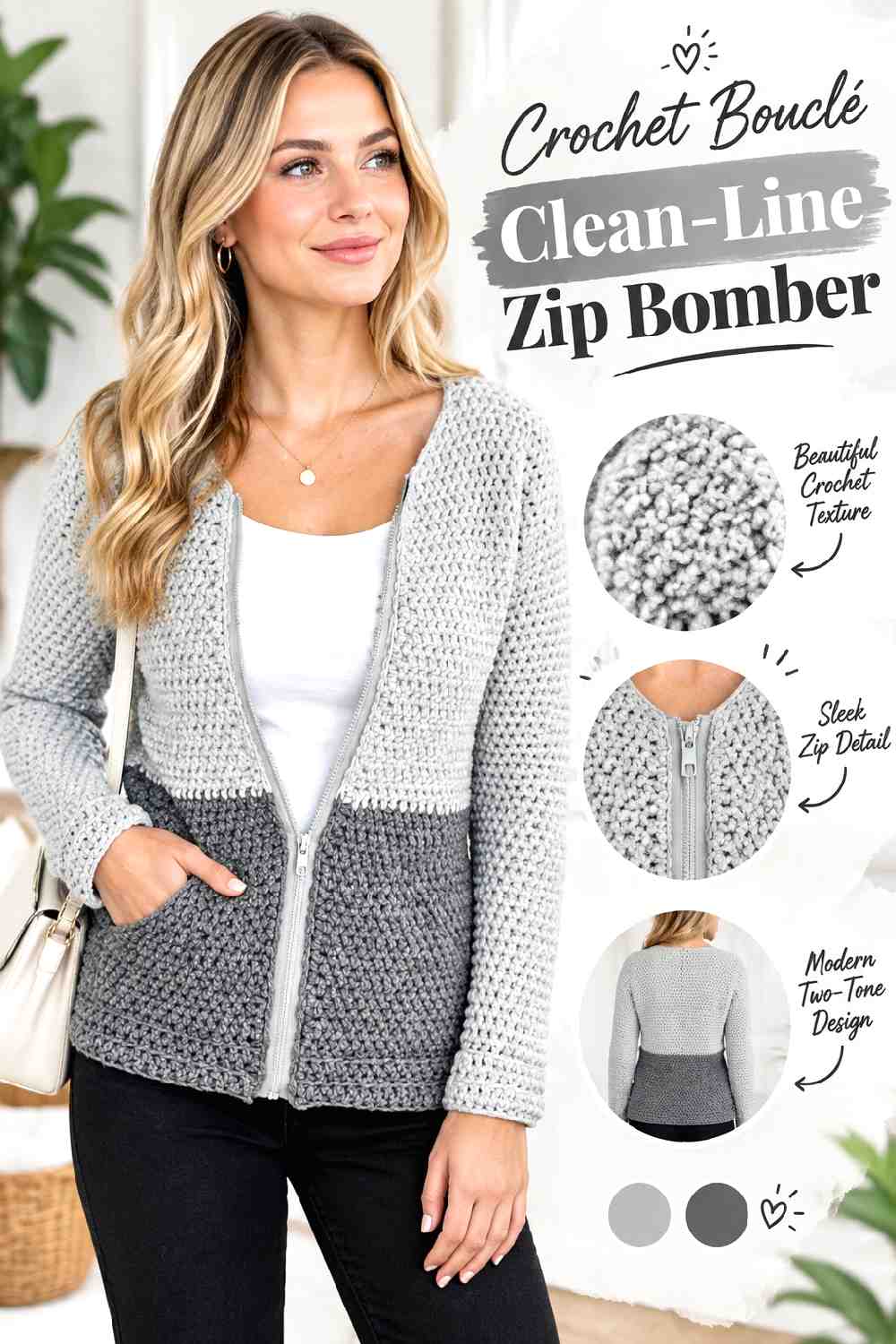
Wilmade’s My First Cardigan is a zip-front design worked with a relatively straightforward construction, including a body made from the lower edge upward and sleeves incorporated at the armholes. Although the source is presented as a cardigan rather than specifically as a boucle bomber, its zipper and uncomplicated lines make it a useful framework for a cleaner bomber-inspired adaptation.
This direction suits readers who prefer less exaggerated ribbing and fewer competing details. With boucle supplying most of the surface interest, the restrained structure can prevent the jacket from becoming visually overloaded. The key requirement is preserving even front edges so the zipper closes without buckling.
Check the Body Before Adding Sleeves
When a construction gives you a substantial body section before the sleeves are completed, use that point as a fit checkpoint. Compare width and length with the intended wearer and consider the thickness of planned underlayers. Correcting a major fit problem becomes less convenient after heavy boucle sleeves are attached.
Keep the Center Front Visually Quiet
A clean zipper front works best when stray texture does not dominate the closure. Brush or position loops away from the zipper path as needed and make sure the fabric is not being stretched during installation. The goal is not to flatten the entire boucle surface, but to preserve a usable opening and a straight visual line.
Creator Credit: Wilmade
12. Crochet Boucle Sherpa Style Bomber Jacket
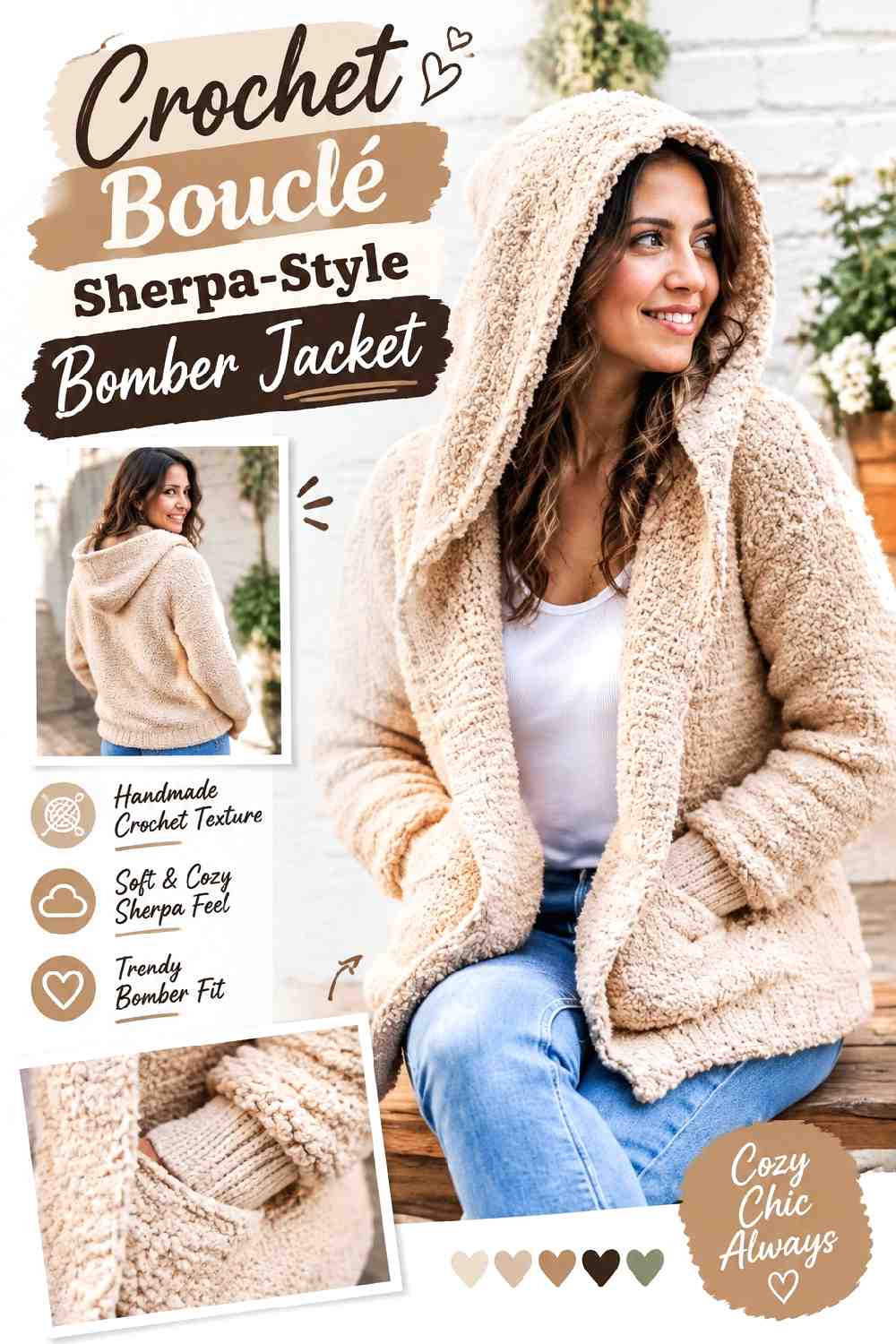
Make & Do Crew’s sherpa sweater jacket is one of the most directly relevant sources for this list because the original project uses a bulky boucle yarn to create its fuzzy, fleece-like surface. The design uses Tunisian crochet and is intended to achieve a substantial sherpa-inspired jacket texture.
This option is useful for readers who want to see how boucle behaves as an intentional design material rather than as a substitution. It differs from many of the smooth-yarn bombers because the fuzzy surface is central to the original aesthetic. Tunisian construction also gives it a different fabric character, so readers should confirm they have the appropriate technique and equipment before choosing it solely for the yarn appearance.
Expect Boucle to Change Stitch Visibility
The looped surface is part of the design here, so precise stitch visibility is less important than maintaining consistent fabric. Marking edge stitches and important locations can reduce frustration when loops obscure the underlying structure. Avoid repeatedly pulling out long sections unless necessary, because some textured yarns are less pleasant to unravel than smooth yarn.
Check the Finished Fabric for Weight
A sherpa-style surface can look light and cloudlike while still producing a substantial finished jacket. Make a large enough sample to assess weight and flexibility, not merely stitch appearance. If your chosen yarn differs from the source yarn, matching the stated category alone does not guarantee the same drape or density.
Creator Credit: Make & Do Crew
13. Crochet Boucle Teddy Collar Bomber Jacket
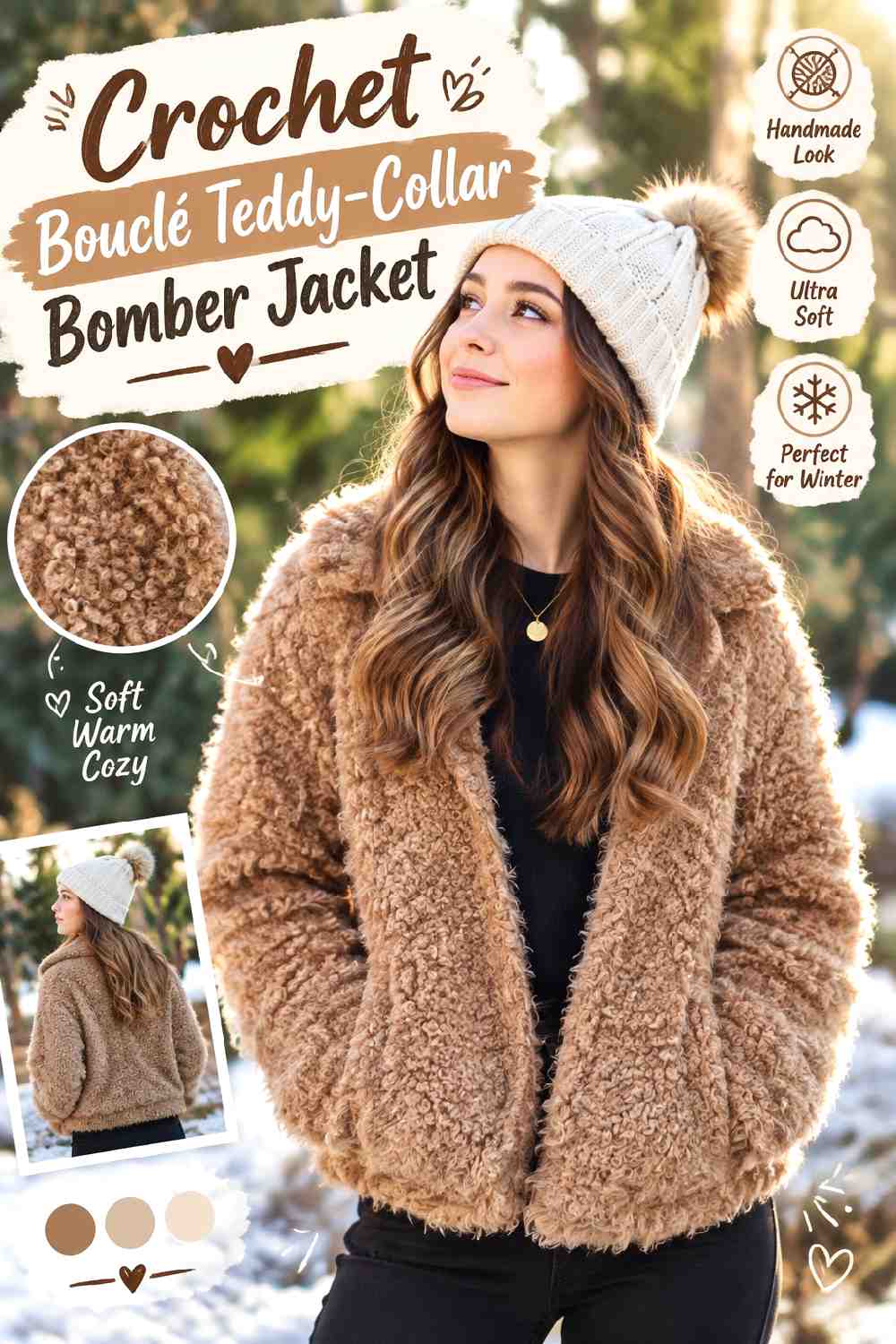
Crochet with Carrie’s Teddy Jacket uses super-bulky yarn to produce a plush jacket with a collar and pockets. Its body construction and straightforward surface make it a strong reference for the teddy side of the boucle-bomber look, where the yarn texture does much of the visual work.
Compared with a sporty zip bomber, this version reads softer and more coat-like. That distinction is useful for readers who want a Fall 2026 layer that can sit between cardigan and outer jacket. If substituting boucle for the source yarn, focus first on whether the collar folds attractively and whether the pocket area remains stable rather than trying to preserve every visual characteristic of the original yarn.
Let the Collar Determine Yarn Suitability
A collar is an excellent test area because it shows whether the fabric can curve and fold without becoming cumbersome. If the swatch feels too rigid when doubled or turned, the yarn may produce a body you like but a collar you do not. That trade-off is worth discovering before the full jacket is assembled.
Keep Pocket Seams From Becoming Lumpy
Plush yarn can conceal a seam while simultaneously adding thickness to it. Test how the pocket edge sits against the body and avoid over-tightening the join. A smooth, secure attachment generally gives a better result than trying to bury the seam beneath excessive tension.
Creator Credit: Crochet with Carrie
14. Crochet Boucle Chunky Collared Bomber
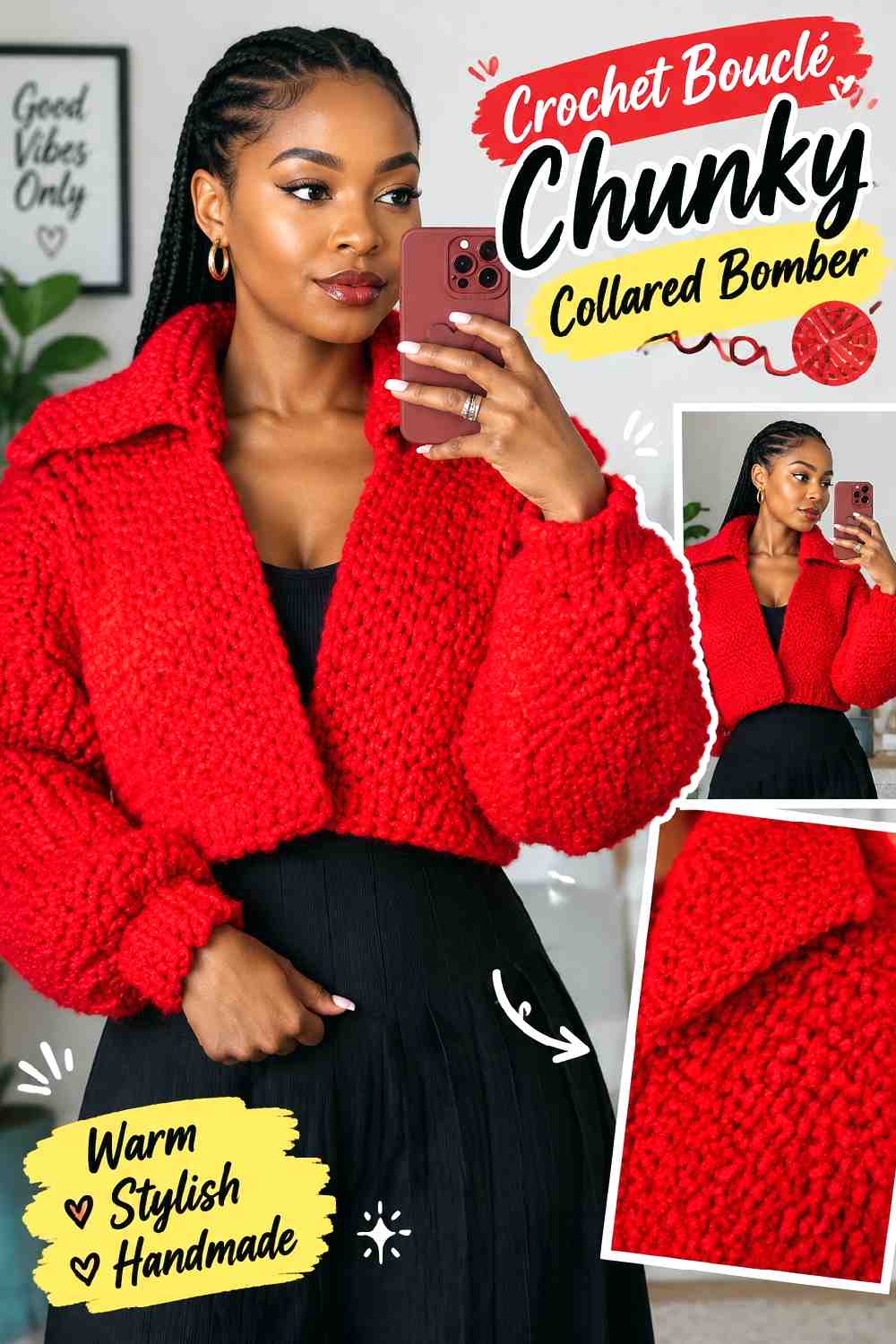
AC Crochets’ chunky collared cardigan tutorial offers a compact, substantial jacket shape with a prominent collar. It is not presented as a traditional bomber, but the chunky proportions make it a useful starting point for readers who want boucle texture without a zipper or hood.
For a bomber-inspired adaptation, the lower edge and sleeve finish will determine how strongly the garment reads as a bomber rather than a standard cardigan. Boucle can provide the rounded visual volume, but it should not be relied upon to create structure by itself. Compare the source’s dimensions and construction before making any trim changes, because altering band depth can affect total garment length and sleeve proportion.
Make Sure the Collar Does Not Dominate
Thick boucle can visually enlarge an already chunky collar. Hold a swatch around the neckline or fold it to approximately the same number of fabric layers to judge scale. If the collar overwhelms the body, a slightly less textured coordinating yarn in that area may preserve the overall balance.
Evaluate Substitution by Fabric, Not Label
Yarn-weight labels are only a starting point for textured yarn. Boucle loops can make two yarns with similar stated weights behave very differently on the hook. Match gauge, then assess drape, thickness, and recovery. If all three are substantially different from the source fabric, forcing the substitution may require more changes than the project is worth.
Creator Credit: AC Crochets
15. Crochet Boucle Hooded Button Bomber
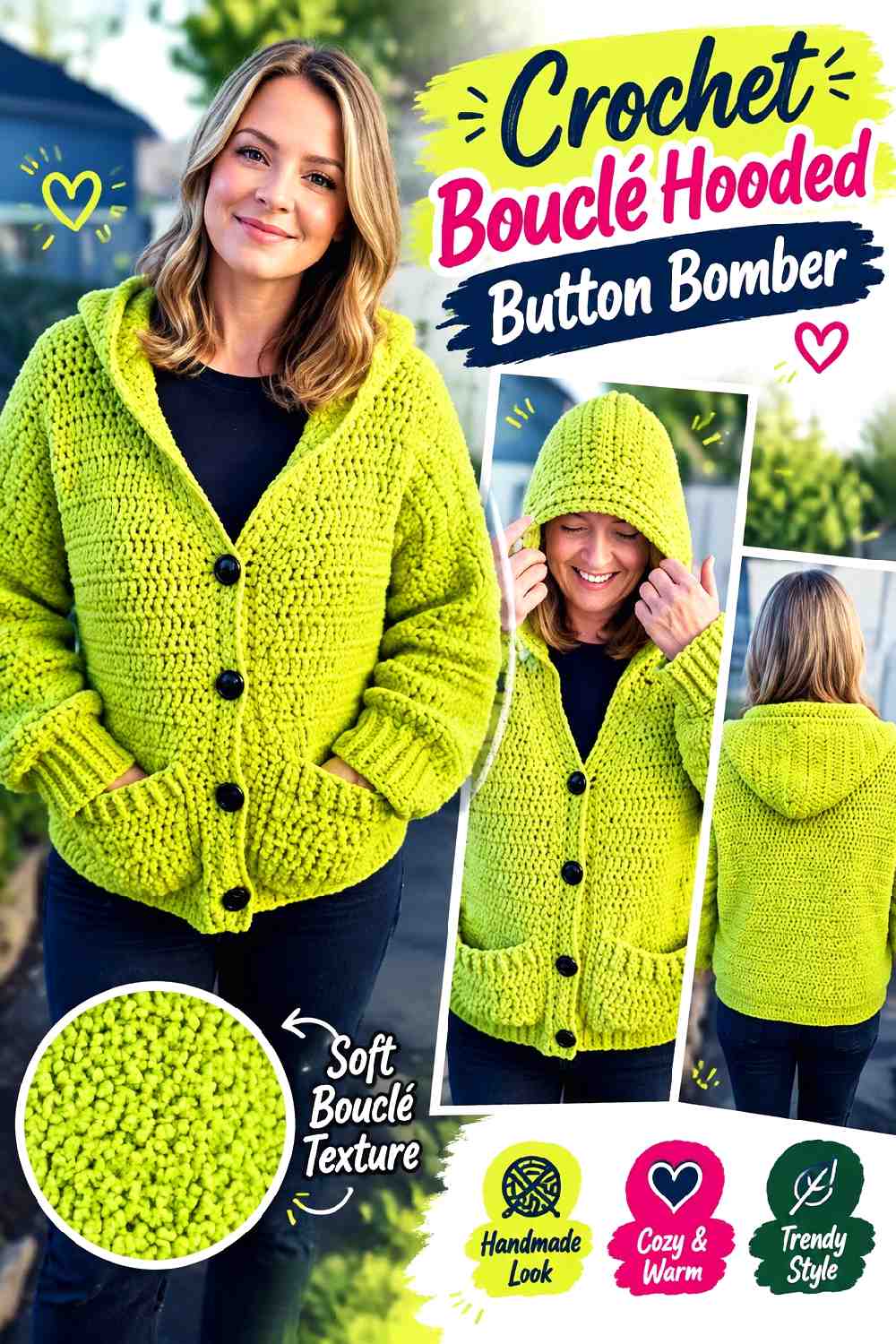
Jera’s Jamboree’s Evie cardigan combines a roomy chunky body with a hood, pockets, and button closure. Those features make it a useful bomber-adjacent option for readers who prefer buttons to a center zipper and want the additional visual weight of a hood.
A boucle adaptation would lean toward a casual outer-layer look rather than a sleek athletic bomber. The hood, pockets, button band, and plush body all add bulk, so this design benefits from restraint elsewhere. Before choosing particularly thick boucle, check how several layers overlap at the front closure. A fabric that feels comfortable as one layer can become cumbersome where the fronts, edging, and buttons meet.
Size Buttons for the Actual Finished Fabric
Do not choose buttons solely from the source photos before seeing your boucle swatch. Highly looped yarn can visually swallow small buttons, while oversized buttons may pull on a soft band. Follow the tutorial’s closure construction, then evaluate button scale and weight against your actual fabric.
Prevent the Hood From Pulling Back
A substantial hood can shift the garment toward the back, especially in a heavy textured yarn. Check the jacket’s shoulder and neckline fit before assuming additional hood weight will be harmless. A well-fitting body gives the hood a more stable foundation than an excessively loose neckline.
Creator Credit: Jera’s Jamboree
16. Crochet Boucle Cropped Cable Bomber Jacket
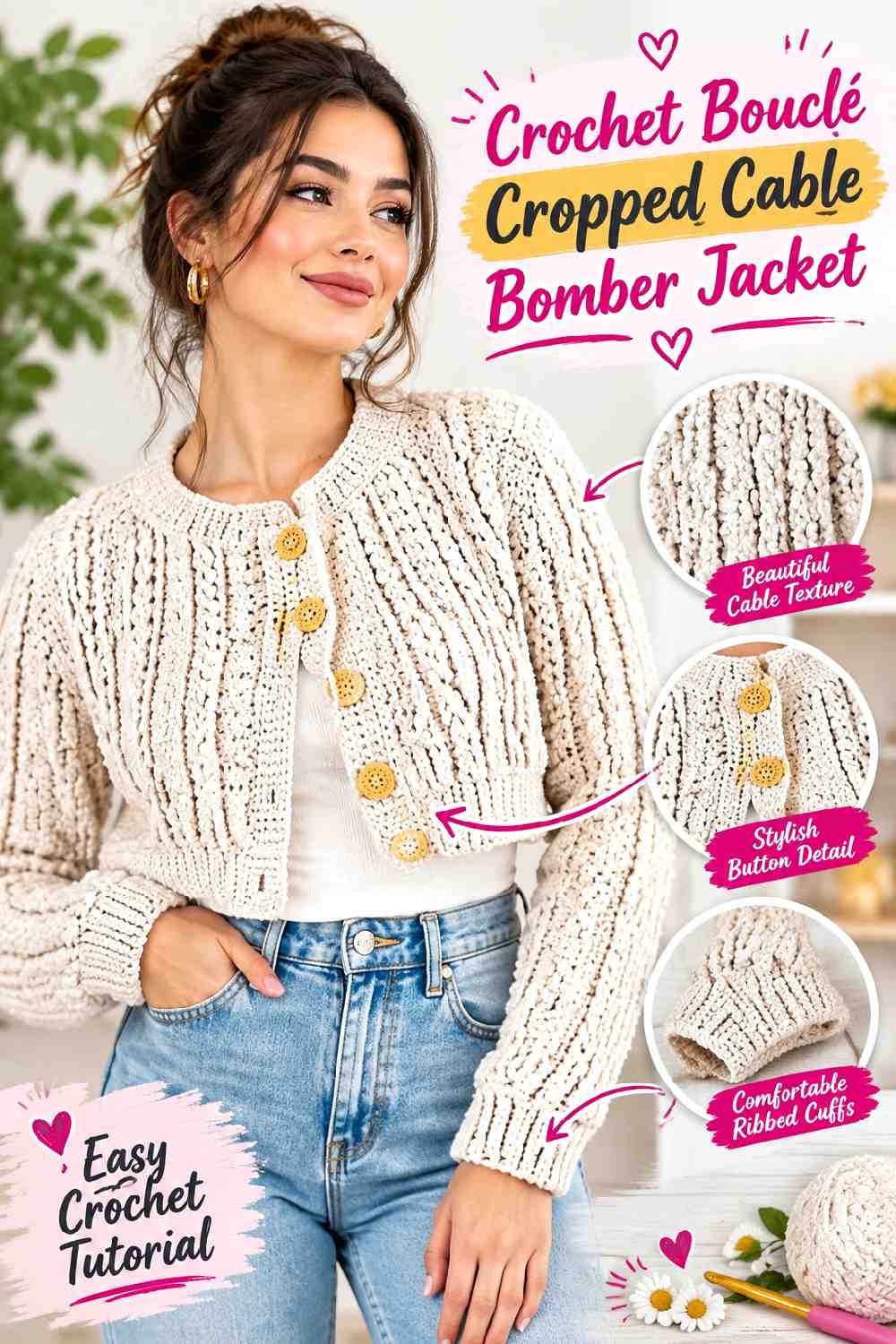
JKD Handmade’s cropped jacket tutorial introduces cable texture into a short jacket silhouette. Unlike the smooth or lightly textured bombers elsewhere in this list, this option puts substantial stitch relief across the fabric, giving readers a clear decision to make: should the yarn or the stitchwork provide most of the texture?
Boucle and cables can compete. A lightly looped yarn may soften the cable effect while leaving it visible, but dense teddy-style yarn can conceal the crossing lines almost completely. This project therefore benefits from a larger-than-usual swatch. If the cable disappears, choose either a smoother yarn or a simpler jacket source rather than investing in detailed stitchwork that cannot be seen.
Decide Whether the Cables Are Visible Enough
Stretch and relax the swatch as it would sit on the body, then view it under several lighting conditions. Shadows help define cables in smooth yarn; fuzzy loops can fill those shadows visually. If the pattern remains readable only when you manipulate the fabric by hand, it may not have enough impact in the finished jacket.
Keep the Cropped Proportion Intentional
Detailed texture already gives the body visual weight, so an overly long adaptation can shift the silhouette toward a heavy cardigan. Compare the source jacket’s proportions with the wearer’s torso and intended layering pieces before adding length. Any adjustment should preserve comfortable arm and shoulder movement as well as the desired hem position.
Creator Credit: JKD Handmade
17. Crochet Boucle Textured Balloon Sleeve Bomber
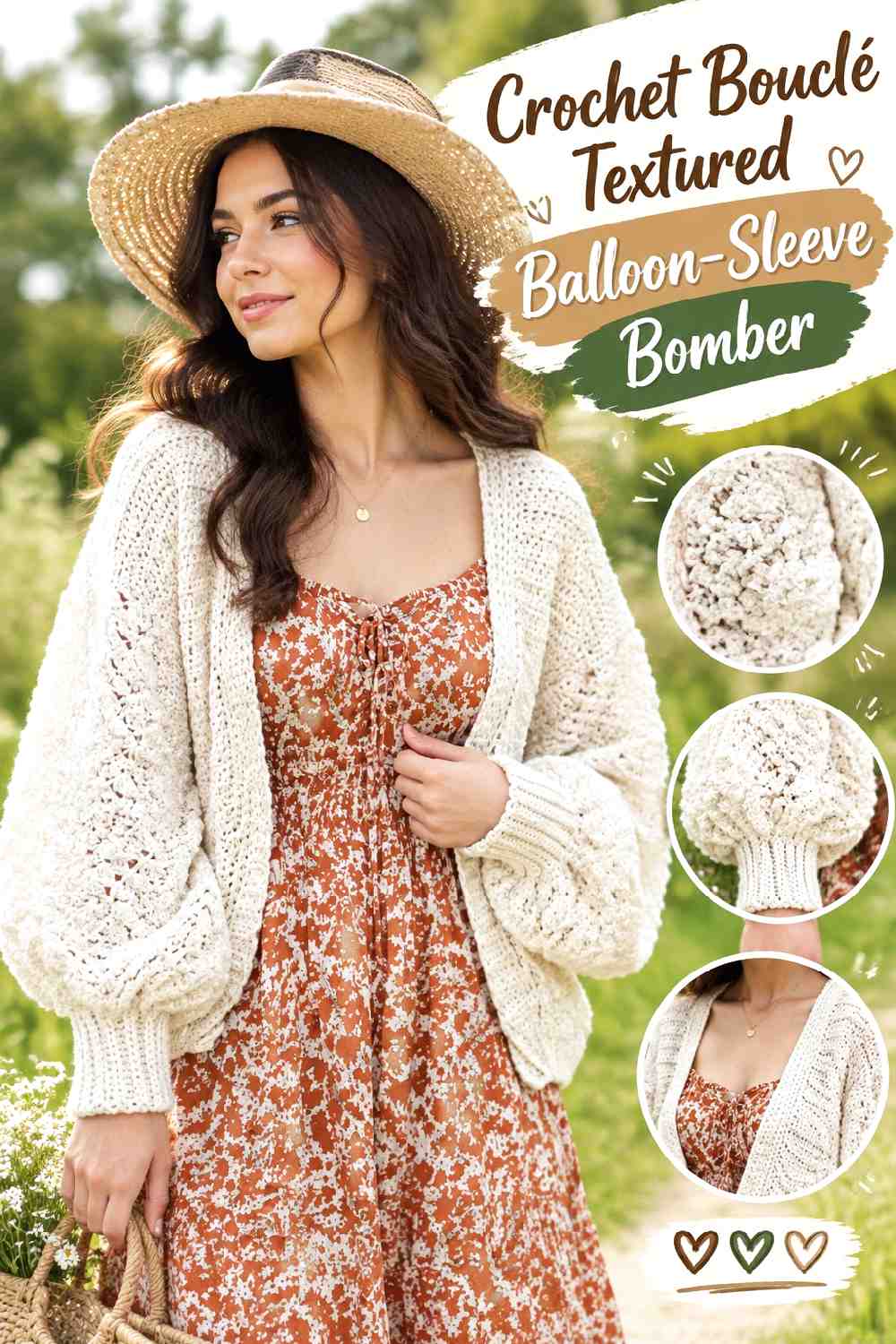
Crochet with Carrie’s Balloon Sleeve Cardigan pairs a simpler body with noticeably full, textured sleeves and fitted finishing at the wrists. That distribution of detail makes it different from an all-over textured jacket: the sleeves become the focal feature while the torso stays comparatively restrained.
For a boucle bomber interpretation, consider using a lighter-textured boucle if you want the sleeve stitchwork to remain evident. A heavily looped yarn may preserve the volume while erasing the stitch pattern, which changes the character of the original design. This option is best for readers who like the rounded sleeve profile associated with bombers but want more fashion emphasis through the arm rather than through a large collar or zipper.
Check Sleeve Volume Before Finishing Both Arms
A full boucle sleeve can feel substantially larger than the same dimensions in smooth yarn. Once one sleeve is far enough along to assess, hold or try it against the body section and make sure the visual scale is appropriate. Do not reduce circumference casually if doing so would disrupt the tutorial’s stitch pattern; verify permissible adjustments at the source.
Let the Cuff Create the Shape
The contrast between a roomy sleeve and a controlled cuff produces much of the balloon effect. If boucle does not give the cuff enough definition, the entire sleeve may read as uniformly wide. A compatible smoother trim yarn is one possible design choice when the main boucle lacks the necessary recovery or clarity.
Creator Credit: Crochet with Carrie
18. Crochet Boucle Two Tone Classic Bomber Jacket
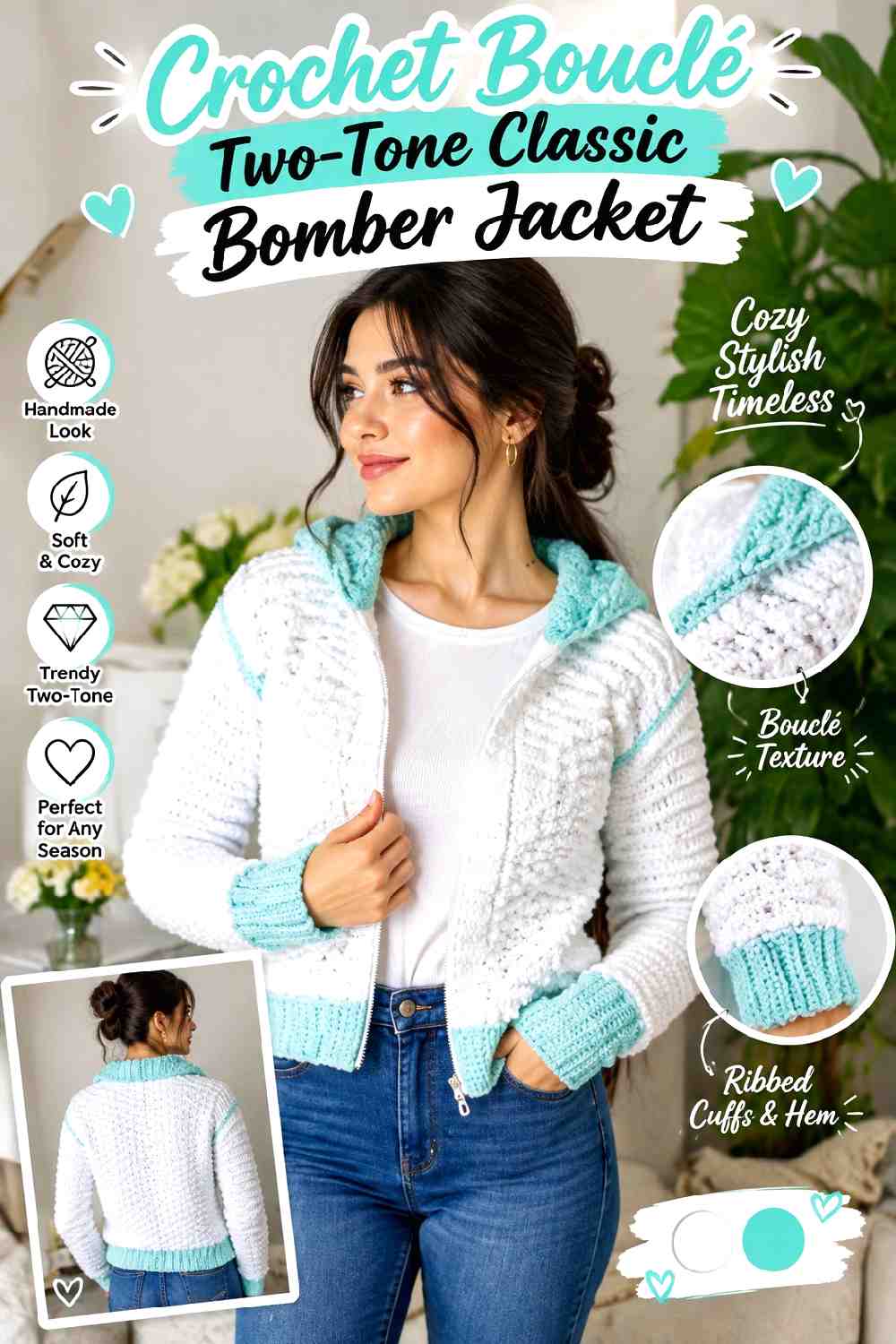
TCDDIY’s classic bomber tutorial provides another direct jacket reference, using a clear bomber silhouette and contrasting colors rather than depending on a coat-like collar or hood. This makes it a useful final option for readers who want the familiar sporty formula but prefer two-tone styling over multicolor blocking.
With boucle, the strongest adaptation is usually to keep the large color areas uncomplicated. The fuzzy surface already adds visual movement, so a limited palette can make the silhouette easier to read. This is also a practical option for combining a boucle body with smoother trim if using the textured yarn everywhere makes the cuffs, hem, or joining areas too bulky.
Keep Both Yarns Structurally Compatible
Two yarns can coordinate visually while producing very different gauge, stretch, and thickness. Make combined swatches before committing to the jacket, particularly if one yarn is smooth and the other boucle. A trim that is substantially tighter or heavier than the body can pull the surrounding fabric out of shape.
Use the Trim Geometry as a Checkpoint
Bomber styling depends heavily on clean boundaries at the neckline, cuffs, and hem. Examine these areas as you work rather than waiting until final finishing. If the boucle makes edges difficult to identify, use stitch markers generously so that attachment points remain evenly distributed and the contrasting sections do not appear skewed.
Creator Credit: TCDDIY
Conclusion
The most successful crochet boucle bomber jacket is not necessarily the one with the most texture. A cropped zip bomber benefits from stable front edges, a teddy jacket needs a collar that can still fold comfortably, and a balloon-sleeve style depends on cuffs strong enough to control the added volume. Hooded and pocketed versions also introduce extra weight that matters more when the yarn is already plush.
For Fall 2026, choose the silhouette first, then decide how much of the texture should come from boucle and how much should come from the stitch pattern or trim. Always swatch before replacing a tutorial’s specified yarn, and compare gauge, drape, thickness, and finished measurements rather than relying only on yarn-weight labels. Use the linked creator tutorial for the exact construction, sizing, materials, and finishing details of each original design.
Frequently Asked Questions
Can I replace any bulky yarn with boucle for a crochet bomber jacket?
Not safely without testing it first. Boucle yarns vary considerably in loop size, density, stretch, and underlying strand construction. A yarn categorized at the same weight as the tutorial yarn can still produce a much stiffer, softer, thicker, or more open fabric. Make a swatch in the actual stitch pattern, match the required gauge, and then assess drape and thickness before treating the substitution as workable.
Which crochet stitches show best with boucle yarn?
Simple stitch surfaces often let boucle itself provide the visual texture, while elaborate cables, relief stitches, and small motifs can become less obvious beneath pronounced loops. That does not mean complex stitches cannot work, but their effect should be confirmed in a swatch. If the stitch pattern is a major reason for choosing a jacket, use a boucle with enough underlying definition for that feature to remain visible.
Is boucle suitable for bomber cuffs and ribbed hems?
It can be, but not every boucle produces firm, elastic-looking ribbing. A bomber relies on cuffs and the lower band to control the silhouette, so test the intended ribbing before committing to the yarn throughout the jacket. If the boucle creates indistinct or weakly contracting ribbing, a compatible smoother yarn for the trim can provide clearer definition while leaving the body textured.
How do I choose the right size for a boucle bomber?
Start with the original tutorial’s finished garment measurements and intended ease rather than choosing only by a standard size label. Compare those measurements with a jacket whose fit you already like. Because boucle substitution can change drape and thickness, confirm your gauge first. Pay particular attention to chest width, armhole depth, sleeve circumference, cuff fit, and finished body length before making major adjustments.
Can I add a zipper to a boucle bomber that was designed as an open cardigan?
A zipper is not always a simple add-on. The center fronts need enough stability, appropriate length, and suitable construction to support one without rippling or stretching. A very plush boucle can also interfere with the zipper teeth. If the original tutorial does not include a zipper, adding one becomes a design modification rather than a standard finishing step; a tutorial already engineered for a zipper is the more predictable choice.
How should I care for a crochet boucle bomber jacket?
Care depends on the exact fiber content, trim yarn, zipper or buttons, and any other materials used. Follow the yarn manufacturer’s care directions together with any project-specific advice from the original designer. When a jacket combines different yarns, check that their care requirements are compatible. Avoid assuming that every fuzzy or teddy-style yarn can be washed, dried, blocked, or brushed in the same way.