Fall 2026 is especially well suited to the funnel-neck capelet. Vogue’s current fall coverage calls the funnel neck a defining outerwear shape for the season, while Fashionista notes that the high, face-framing neckline has appeared in everything from cropped outerwear to midi capes.
Crochet can translate that look without simply copying a coat silhouette. A compact capelet gives the shoulders enough coverage to make the high collar feel intentional, while ribbing, cables, granny texture, shells, and openwork offer very different levels of structure. The finished piece can sit over a fitted dress, long-sleeve tee, lightweight sweater, or simple column of monochrome clothing.
The tutorials below do not all use the phrase “funnel neck.” Some creators call the neckline a turtleneck, cowl, high neck, or collar. Several sources are already capelets, while others are longer ponchos that provide useful high-neck and shoulder construction for a shorter capelet interpretation. Where a source begins with a lower neckline, the funnel collar should be treated as a separate adaptation rather than something the original tutorial already teaches.
Quick List
- Crochet Regal Ribbed Funnel Neck Capelet
- Crochet Sculpted High Neck Mini Capelet
- Crochet Draped Cowl Funnel Capelet
- Crochet Pointed Color Block Funnel Capelet
- Crochet Cozy Short Shoulder Funnel Capelet
- Crochet Two Way Textured Funnel Capelet
- Crochet Classic Draped Funnel Capelet
- Crochet Box And Bow Tie Funnel Capelet
- Crochet Buttoned Chunky Funnel Capelet
- Crochet Rounded Turtleneck Capelet
- Crochet Clean High Collar Capelet
- Crochet Cable Yoke Funnel Capelet
- Crochet Open Front Buttoned Funnel Capelet
- Crochet Shell Yoke Funnel Capelet
- Crochet Soft Shoulder Funnel Capelet
- Crochet Granny Texture Funnel Capelet
- Crochet Petite High Neck Funnel Capelet
What Makes a Crochet Funnel Neck Look Polished?
A funnel neck usually looks more architectural than a soft cowl. It rises around the neck and frames the face, but it does not necessarily fold over like a traditional turtleneck. That distinction matters when adapting crochet because a fabric with too much drape may collapse, while an overly rigid collar can feel bulky or restrictive.
Before committing to collar height, check that the opening can pass comfortably over the head unless the construction includes a functional opening. Then evaluate the collar while it is actually worn. The front should not push awkwardly into the chin, and the back should not pile up simply because more rows were added.
Fiber choice, stitch density, and ribbing direction all influence whether a funnel collar stands, folds, or slouches. A small swatch can tell you more about the eventual shape than judging the yarn in the skein.
Capelet Length Changes the Entire Silhouette
A poncho can extend toward the hip and still tolerate generous volume. A capelet has much less vertical space, so shoulder expansion becomes more important. If the body flares too fast, it may look ruffled; if it does not expand enough, it can pull across the shoulders and force the collar out of position.
Decide where you want the lower edge to stop before shortening a poncho tutorial. Upper-chest, bust-level, and just-above-elbow capelets create very different proportions.
Also consider what will be worn underneath. A compact capelet meant for a fitted knit can sit closer to the shoulders than one intended to layer over a blazer or heavier sweater.
Yarn Structure Matters More Than Seasonal Color
A rich Fall 2026 shade can make the project feel current, but the yarn still has to support the silhouette. Current runway coverage includes both polished funnel-neck outerwear and cape-like shapes, reinforcing the appeal of strong necklines and compact layering pieces this season.
For a crisp funnel, look for a fabric that has enough body to stand without becoming hard around the neck. For a cowl-funnel hybrid, more drape may be desirable. Raised cables and dense granny texture already add visual weight, while shells and openwork usually create a lighter impression.
Do not assume that thicker automatically means more structured. Some bulky yarns produce soft, collapsing fabric, while a smaller yarn worked into a stable stitch can hold a neckline surprisingly well.
1. Crochet Regal Ribbed Funnel Neck Capelet
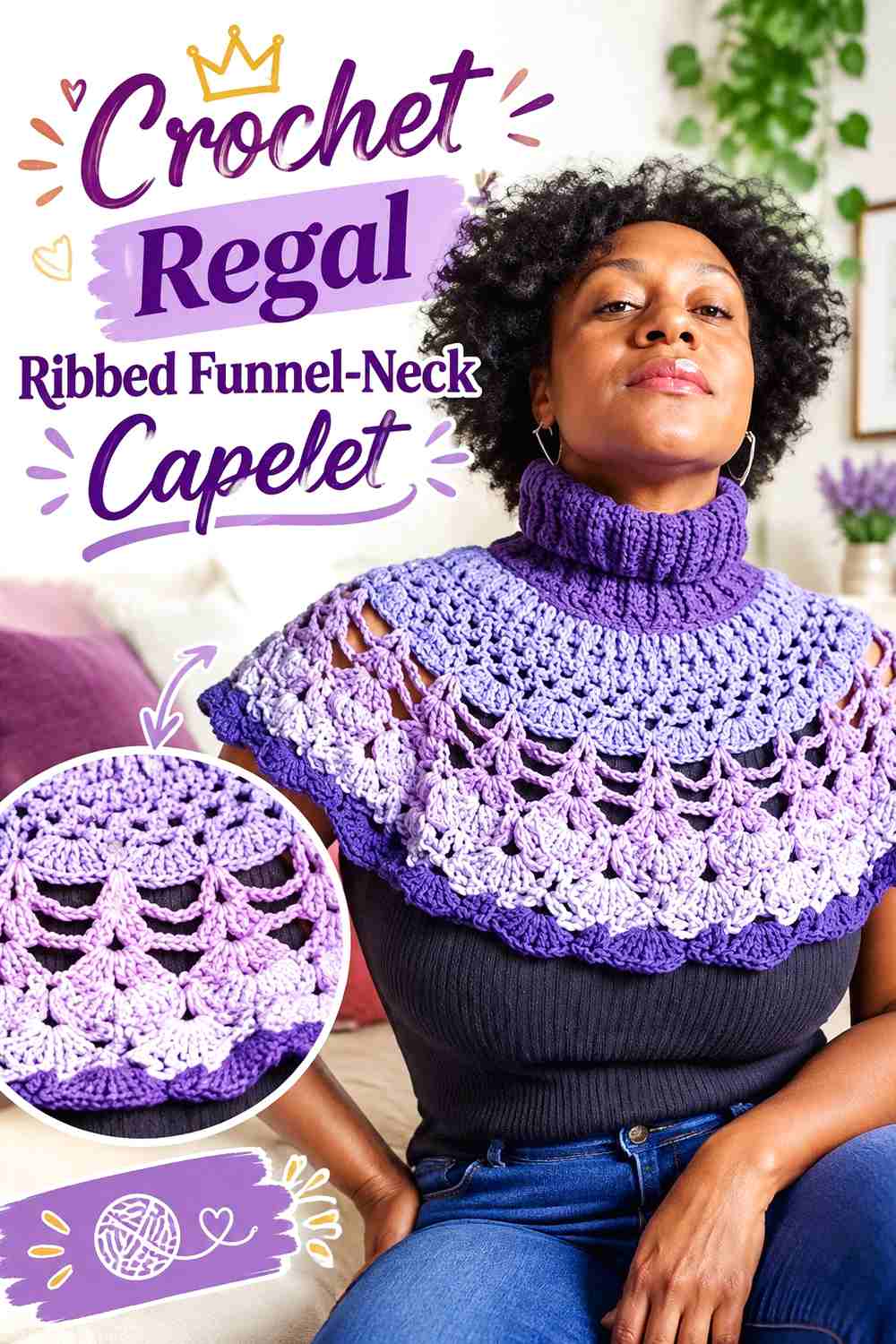
This idea starts with one of the closest direct matches in the collection. Poya Stitches demonstrates a turtleneck capelet with a substantial collar and a yoke that spreads over the shoulders, so the high neckline is part of the original construction rather than an added afterthought.
For a polished interpretation, keep the collar as the main focal point and let the shoulder section provide supporting texture. This is a useful direction if you want something more substantial than a neck warmer but much shorter than a poncho.
Let the Collar Stand Without Crowding the Chin
A tall crochet collar needs enough stability to frame the face, but additional height is not automatically more elegant. Try the collar at different positions before deciding where it should end.
If the upper edge continually folds inward or presses under the chin, changing the fabric behavior may improve the look more than simply adding or removing height.
Check the Yoke Before Extending the Capelet
The shoulder area determines whether the collar can sit upright naturally. If the yoke pulls toward the neck, the collar may distort even when its own measurements seem correct.
Confirm that the fabric settles across both shoulders before deciding whether to add more capelet depth. A shorter, well-balanced yoke can look considerably sharper than extra rows added for coverage.
Creator Credit: Poya Stitches
2. Crochet Sculpted High Neck Mini Capelet
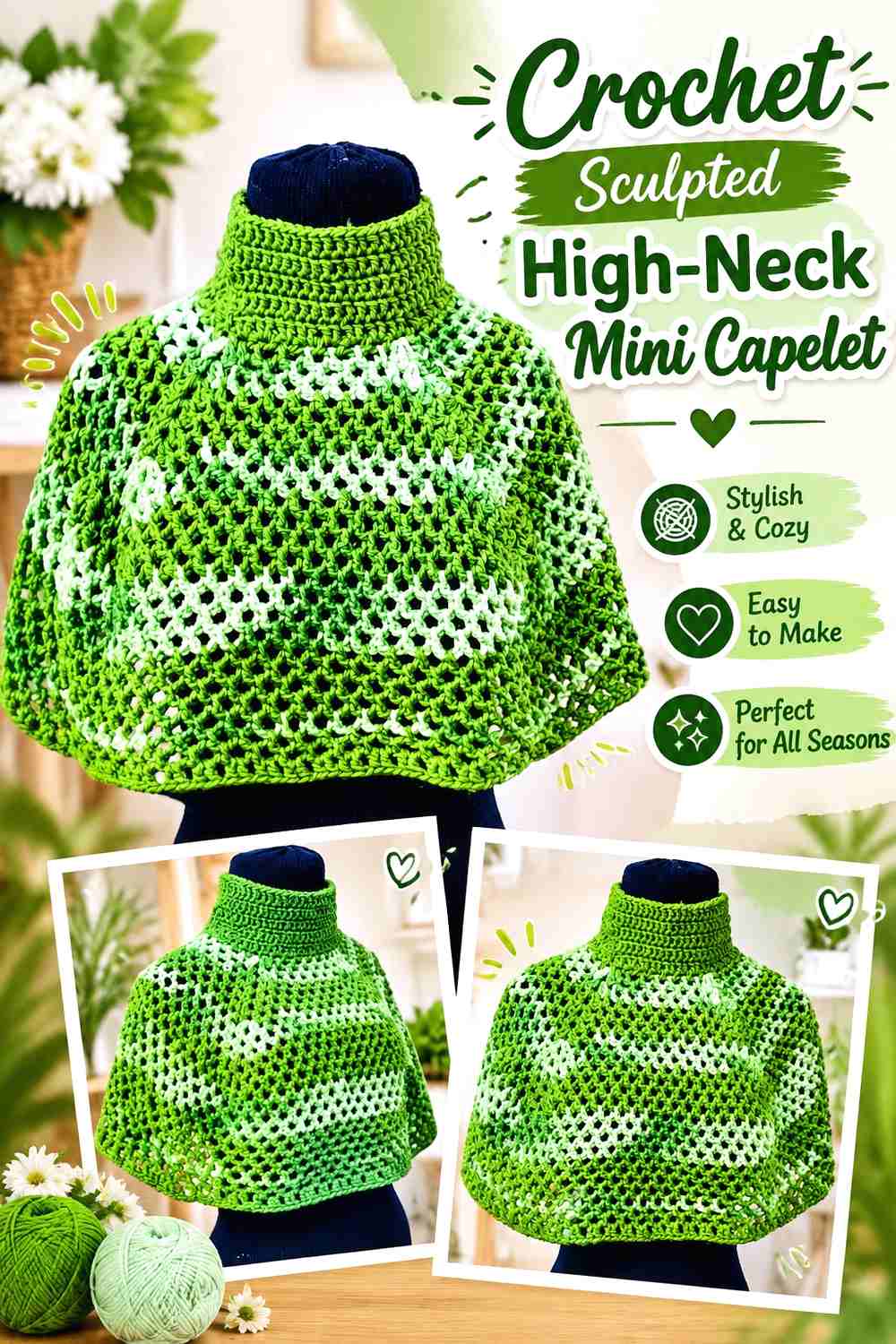
Vivirtejiendo’s high-neck poncho provides a useful base for a more structured capelet interpretation. Instead of reproducing the full poncho length, the idea is to preserve the strong collar and upper-body shaping while choosing an earlier stopping point.
This direction works particularly well when you want the capelet to feel closer to outerwear than to a decorative lace accessory.
Shortening the Body Changes the Visual Weight
A high collar naturally attracts attention toward the face. On a long poncho, there is plenty of fabric below it to balance that emphasis. Once the garment is cropped, the collar becomes proportionally much more dominant.
Evaluate the capelet after the shoulder section is established. You may find that a moderate collar looks more architectural on a short body than an extremely tall one.
Keep the Shoulder Line Smooth Under Structured Clothing
If you plan to wear the capelet over a blazer, dress, or firmly knit sweater, check how the underlying shoulder seams affect the crochet.
A smooth upper section will generally layer more cleanly than one that bunches at the shoulder edge. Test the actual outfit rather than evaluating the capelet only over a thin shirt.
Creator Credit: Vivirtejiendo
3. Crochet Draped Cowl Funnel Capelet
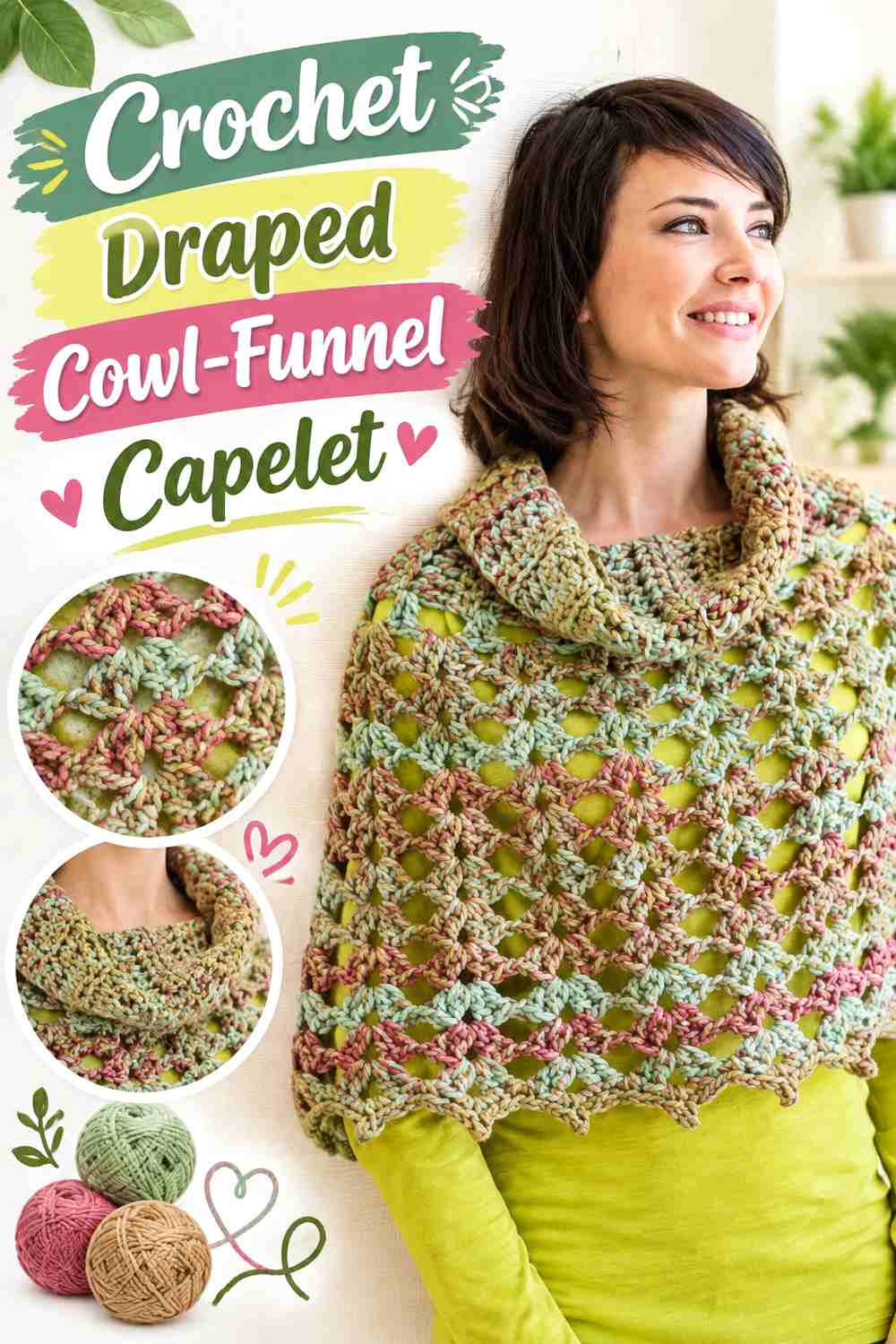
Marly Bird’s cowl-neck poncho offers a softer route to the Fall 2026 high-neck silhouette. Instead of forcing the collar into a rigid stand, this version can be interpreted as a funnel-cowl hybrid with controlled folds around the neck.
Cropping the body can make the neckline feel more prominent while retaining the relaxed character of the original construction.
Control Drape Instead of Trying to Eliminate It
A cowl does not need to become stiff to reference a funnel neck. The more useful goal is controlled volume.
Arrange the collar while worn and notice where it naturally folds. If all the fabric drops to the front, the neckline may read primarily as a cowl. A more evenly distributed collar can preserve some height around the sides and back.
A Shorter Body Needs Enough Shoulder Coverage
Do not crop simply by selecting the shortest possible length. The fabric still needs to extend far enough over the shoulder to read as a capelet rather than an oversized collar.
Try the developing piece with arms relaxed and raised. If the entire garment rides toward the neck during movement, additional shoulder spread may matter more than additional downward length.
Creator Credit: Marly Bird
4. Crochet Pointed Color Block Funnel Capelet
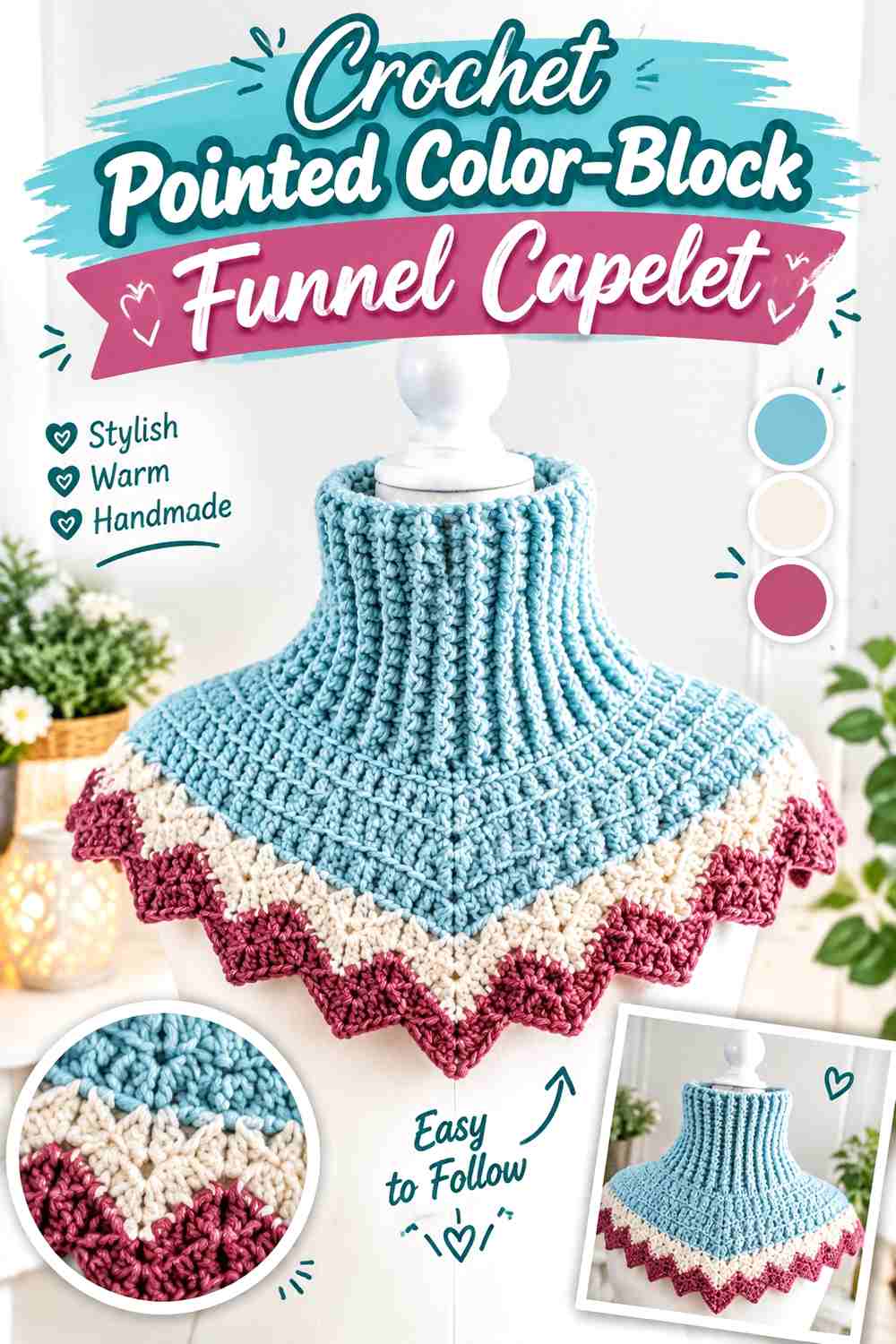
B.Hooked’s poncho construction includes a turtleneck option and a body that expands into defined points. Shortening that geometric form creates a very different capelet from a round yoke.
The points introduce movement at the hem, while the vertical collar keeps the upper silhouette controlled. This is a useful option if a perfectly circular capelet feels too traditional.
Decide Where the Points Should End Before Cropping
The attraction of a pointed capelet comes from visible geometry. Stop too early and there may not be enough fabric for the shape to register; continue too long and the project starts moving back toward full poncho proportions.
Evaluate the front and side views together. The ideal capelet depth should preserve the points without allowing them to dominate the entire outfit.
Plan Color Placement Around the New Length
If you use several colors, shortening a longer tutorial changes the amount of space available for each section.
Lay out the color sequence before committing to the final depth. A compact piece can often look more polished with fewer, larger areas of color than with many narrow changes squeezed into a short body.
Creator Credit: B.Hooked Crochet & Knitting
5. Crochet Cozy Short Shoulder Funnel Capelet
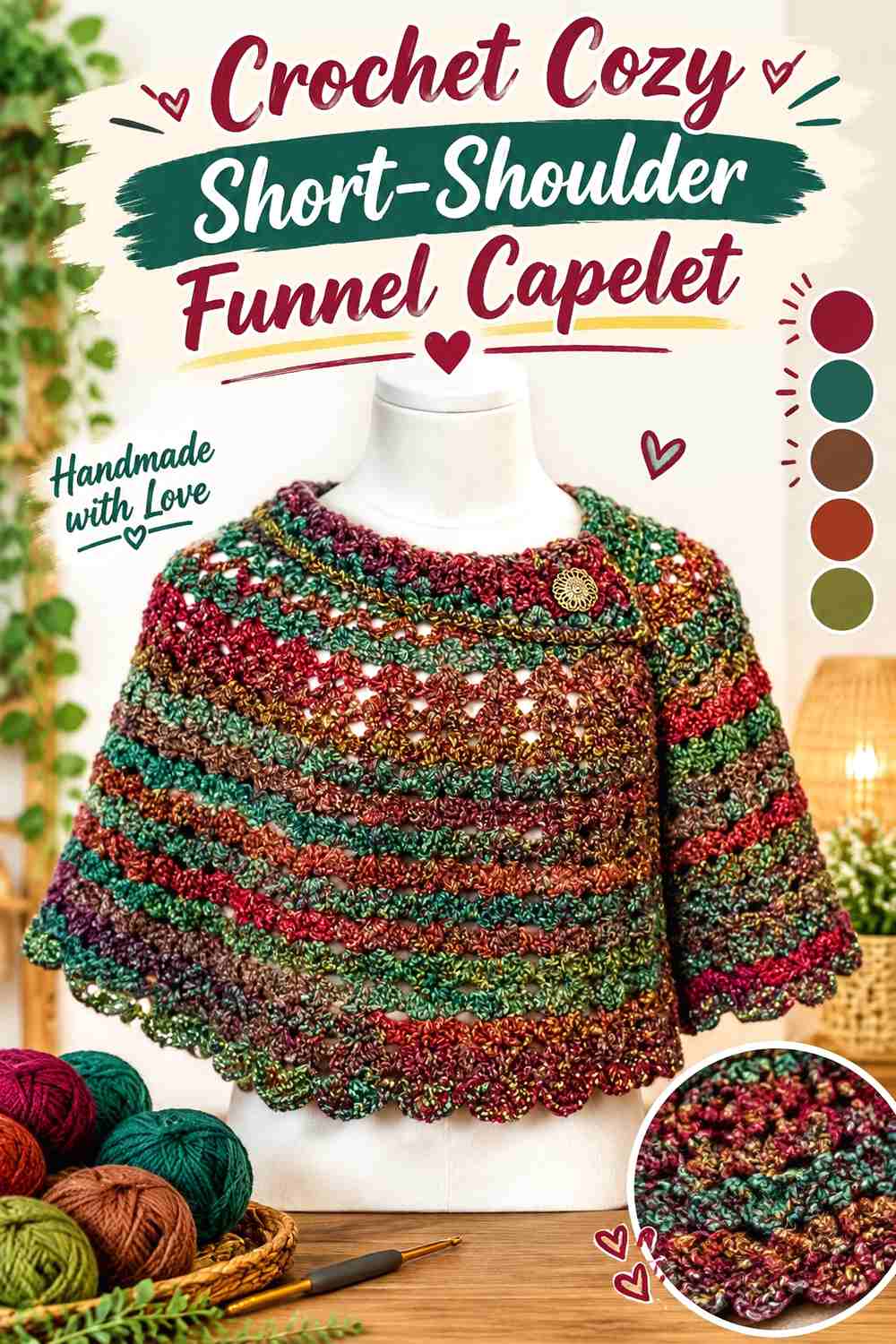
Bag-O-Day Crochet’s cozy capelet and shawl-style construction offers a compact shoulder covering that can serve as the body for a more pronounced high-neck interpretation.
Rather than extending it downward, keep the short capelet character and concentrate any adaptation around the neckline. This can produce a practical layering piece that sits neatly over a fitted top or dress.
Add Neck Height Only After the Shoulder Fit Works
It is tempting to begin the adaptation with the funnel collar because that is the headline feature. The body fit should come first.
Once the capelet settles properly over the shoulders, you can judge how wide the neck opening really is and what type of collar connection makes sense. Otherwise, an early collar decision may have to compensate for a poorly fitting body.
Avoid Turning a Compact Capelet Into a Heavy Poncho
A short piece benefits from restraint. If you add a tall collar, thick edging, fringe, and extra body length simultaneously, the original compact shape can disappear.
Choose one or two strong details. For a polished Fall 2026 version, the high collar itself may provide enough visual impact.
Creator Credit: Bag-O-Day Crochet
6. Crochet Two Way Textured Funnel Capelet
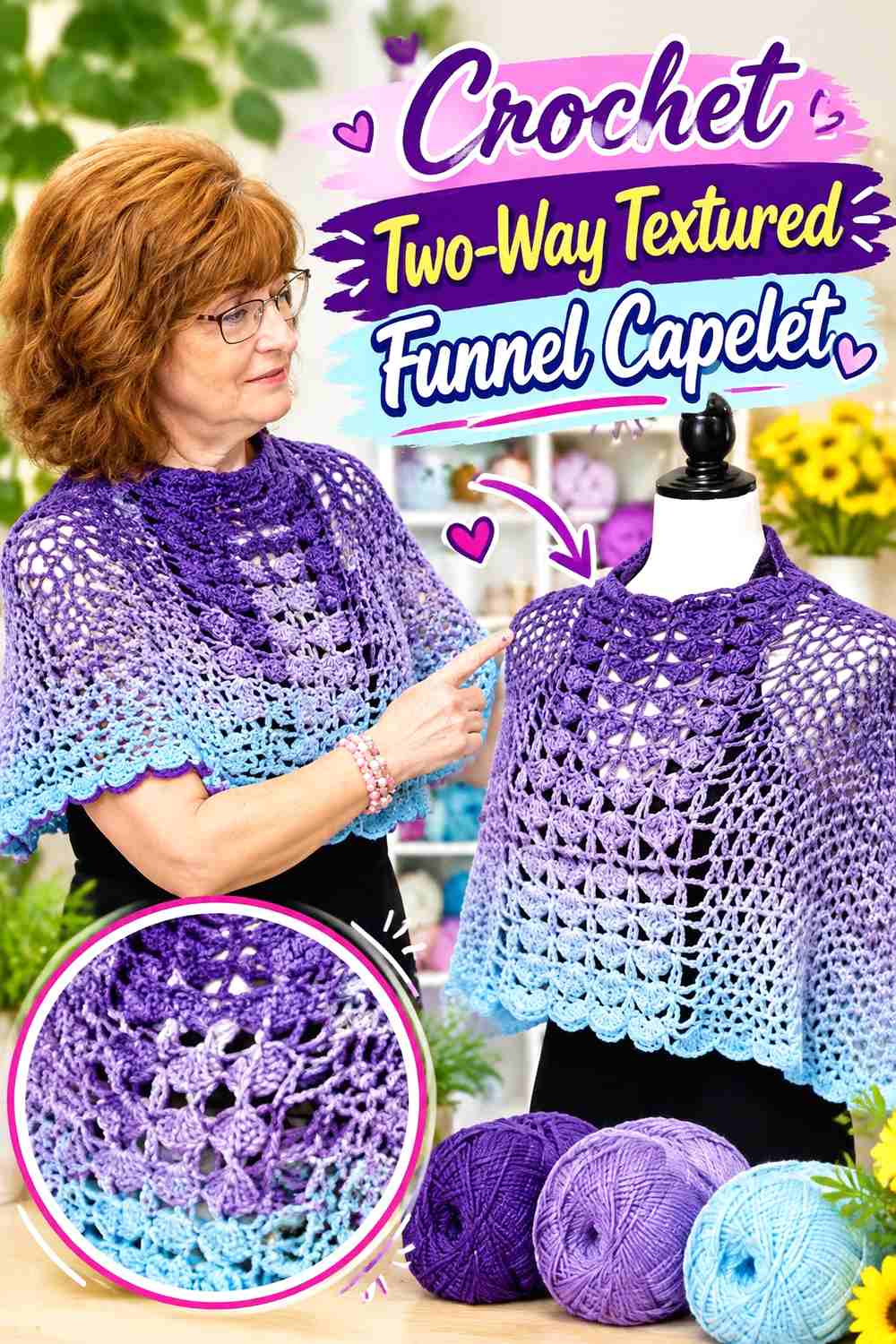
Crafty Yarn Owl with Darla demonstrates a capelet designed with more than one wearing option, making it an interesting base when versatility matters.
For the funnel-neck interpretation, preserve that flexible body concept while treating the collar as an intentional framing element. The finished project can sit higher and closer to the neck for a polished look or relax slightly when a softer outline suits the outfit.
A Convertible Body Needs a Collar That Can Adapt With It
If a capelet shifts position when styled differently, a very rigid neckline may fight that movement.
Before finalizing a tall collar, test the body in each way you intend to wear it. A collar with some recovery may provide structure without locking the capelet into only one position.
Texture Is Easier to Read in a Controlled Palette
A textured capelet already creates shadows and visual movement. Multiple strong colors can compete with that surface.
For a cleaner finish, consider a single color or a tightly related tonal palette. The stitch structure can then become the decorative element while the funnel neck supplies the fashion-forward shape.
Creator Credit: Crafty Yarn Owl with Darla 🇨🇦
7. Crochet Classic Draped Funnel Capelet
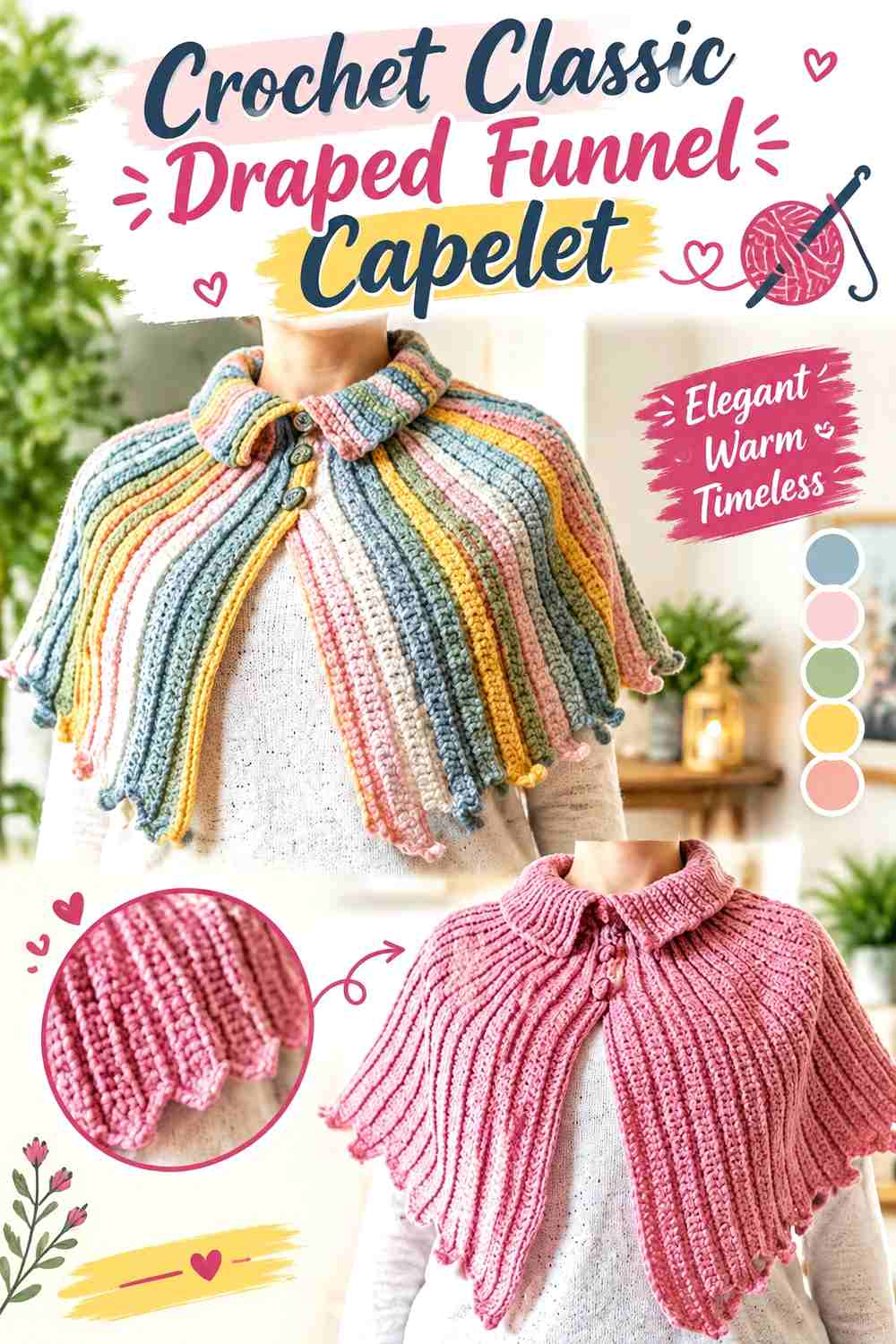
Sabrina Melodieuse’s capelet tutorial supplies a straightforward shoulder-covering form that can be paired with a separately planned high collar.
This is a useful route when you like the proportions of a traditional capelet but do not want the lower body to become complicated. The adaptation can stay concentrated at the neck, allowing the drape over the shoulders to remain visually simple.
Treat the Added Collar as Its Own Fit Problem
A neckline that works perfectly without a collar may need different tension once extra fabric is attached.
Check the circumference against both head clearance and worn position. If the opening is generous, a standing funnel may need shaping or a different attachment strategy rather than simply working straight upward from the existing edge.
Keep the Hem Quiet When the Neckline Is the Statement
A dramatic upper collar and an elaborate lower border can divide attention.
For a more polished version, consider whether the original capelet edge already supplies enough finish. A clean hem often helps a taller neckline appear more intentional.
Creator Credit: Sabrina Melodieuse
8. Crochet Box And Bow Tie Funnel Capelet
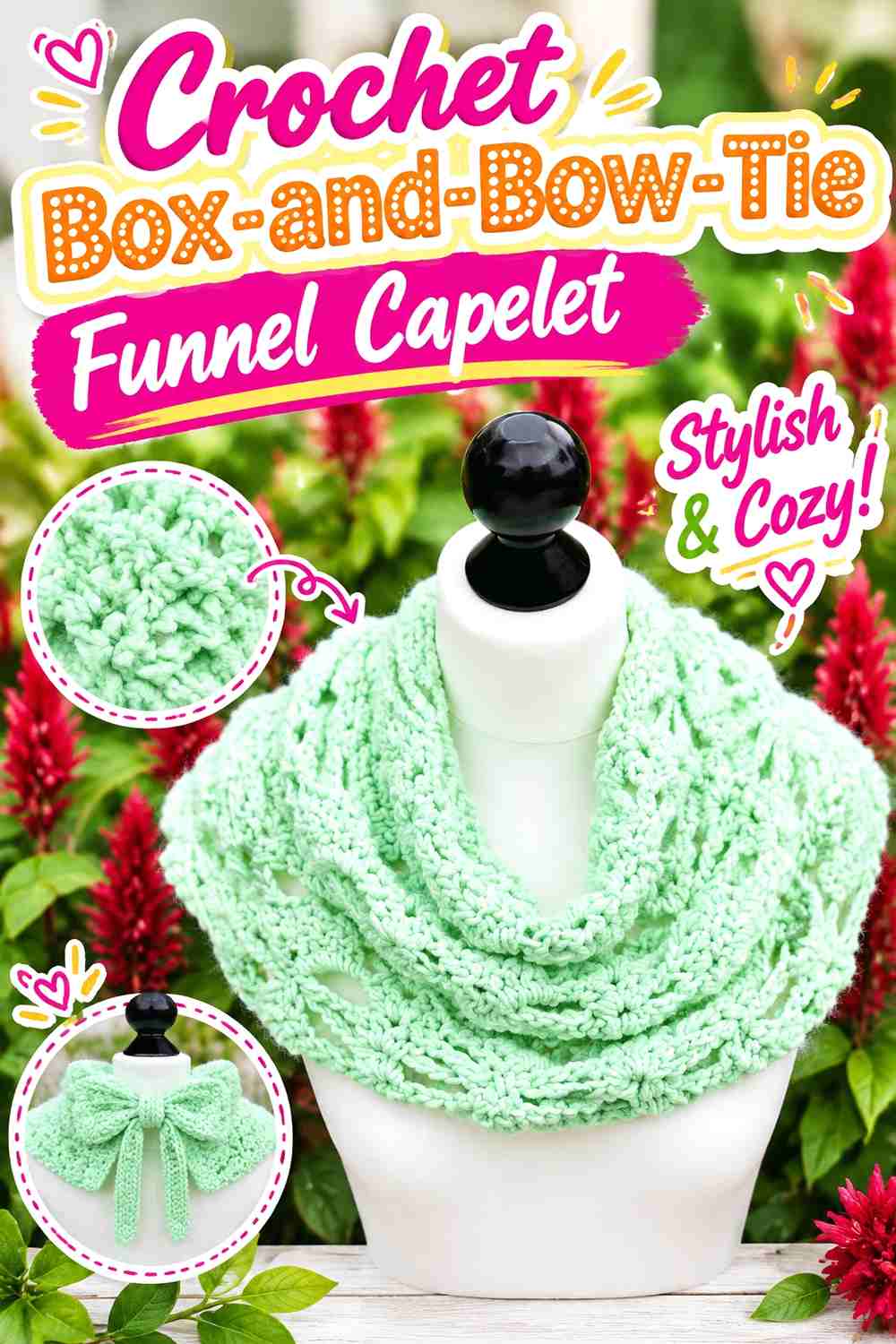
Secret Yarnery’s design can function as a capelet, cowl, or neck warmer and uses a distinctive combination of open and solid crochet sections. That built-in relationship between neckwear and shoulder covering makes it especially interesting for this theme.
Instead of adding a completely unrelated collar, use the existing construction as the starting point for deciding how much height and shoulder spread you want.
Openwork Needs More Support Near a Standing Neck
An airy stitch can produce a beautiful cape body, but the same openness may not hold a tall collar upright.
If the body fabric collapses easily, consider keeping the funnel section denser or otherwise more stable rather than repeating the identical openwork all the way to the face.
Let the Stitch Architecture Replace Extra Embellishment
The box-and-bow-tie effect already brings substantial detail.
A quiet neutral, dark jewel tone, or other solid shade can help the open-and-solid transitions remain visible. Adding several decorative trims may make the compact capelet look busier without improving its structure.
Creator Credit: Secret Yarnery
9. Crochet Buttoned Chunky Funnel Capelet
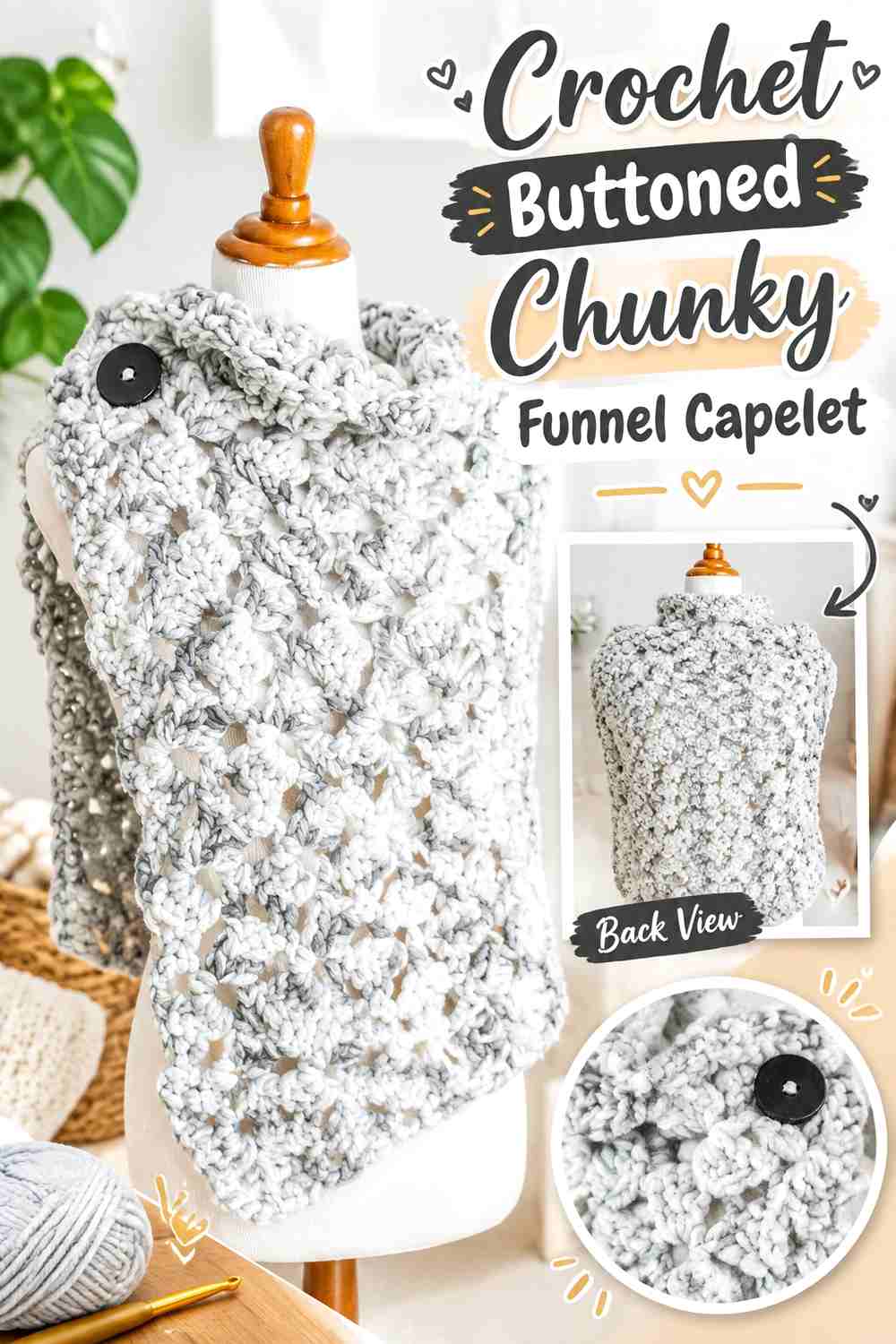
Fiber Flux’s First Snow construction combines capelet and cowl qualities in a substantial wrap secured with a large button. That makes it well suited to readers who want a funnel-neck effect without relying entirely on a permanently closed tube.
The closure can also make a taller neck easier to manage because the opening is not determined solely by stretch.
A Functional Opening Can Solve Head-Clearance Problems
One challenge with a close funnel neck is making it wide enough to pull over the head while keeping it narrow enough to sit well afterward.
A closure changes that equation. If adapting the upper section, think about whether an opening could provide the required access without forcing the finished collar to be oversized.
Bulky Fabric Needs Proportion Control
A substantial yarn can produce impressive collar volume, but the same fabric across a very short capelet can quickly become visually heavy.
Try the piece with the intended clothing before adding more shoulder depth. The right stopping point may be shorter than it would be in a lighter yarn.
Creator Credit: Fiber Flux
10. Crochet Rounded Turtleneck Capelet
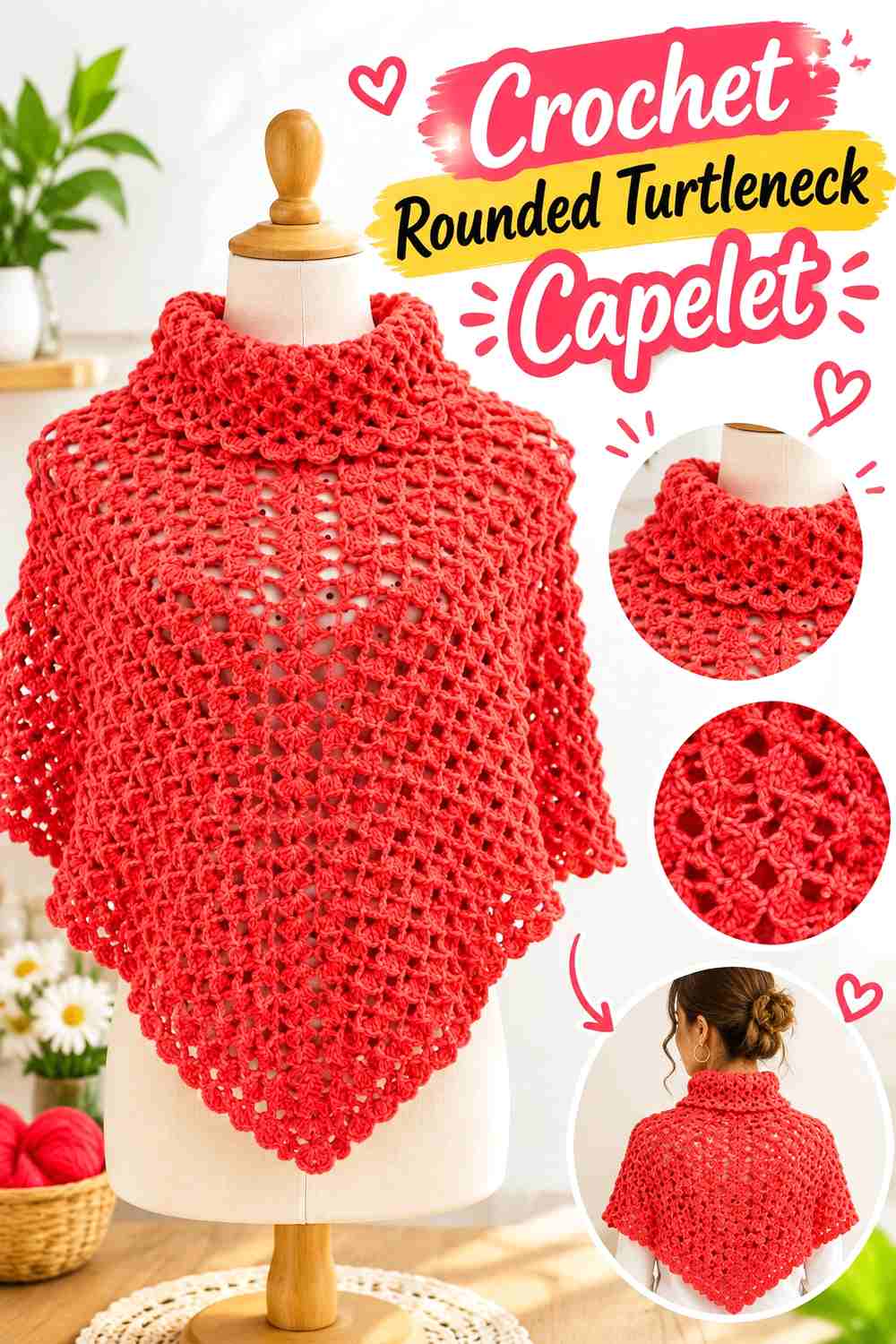
Majovel crochet english provides a turtleneck poncho construction that can be considered for a shorter, rounded capelet interpretation.
The appeal here is the continuous relationship between the high neck and the body. Rather than attaching an unrelated decorative collar to a finished cape, the neckline can remain visually connected to the garment below it.
Establish the Full Shoulder Spread Before Stopping
When shortening a poncho, do not judge length only from the center front.
The sides need enough width to settle over the shoulders and upper arms. If the piece is stopped before that expansion develops, the result can pull upward and behave more like a tight yoke than a capelet.
A Rounded Hem Creates a Softer Alternative to Points
Not every funnel-neck piece needs sharp geometry. A smoother capelet outline can soften the strength of the tall collar.
This combination can work especially well when the yarn already has visible texture and you want the overall silhouette to remain calm.
Creator Credit: Majovel crochet english
11. Crochet Clean High Collar Capelet
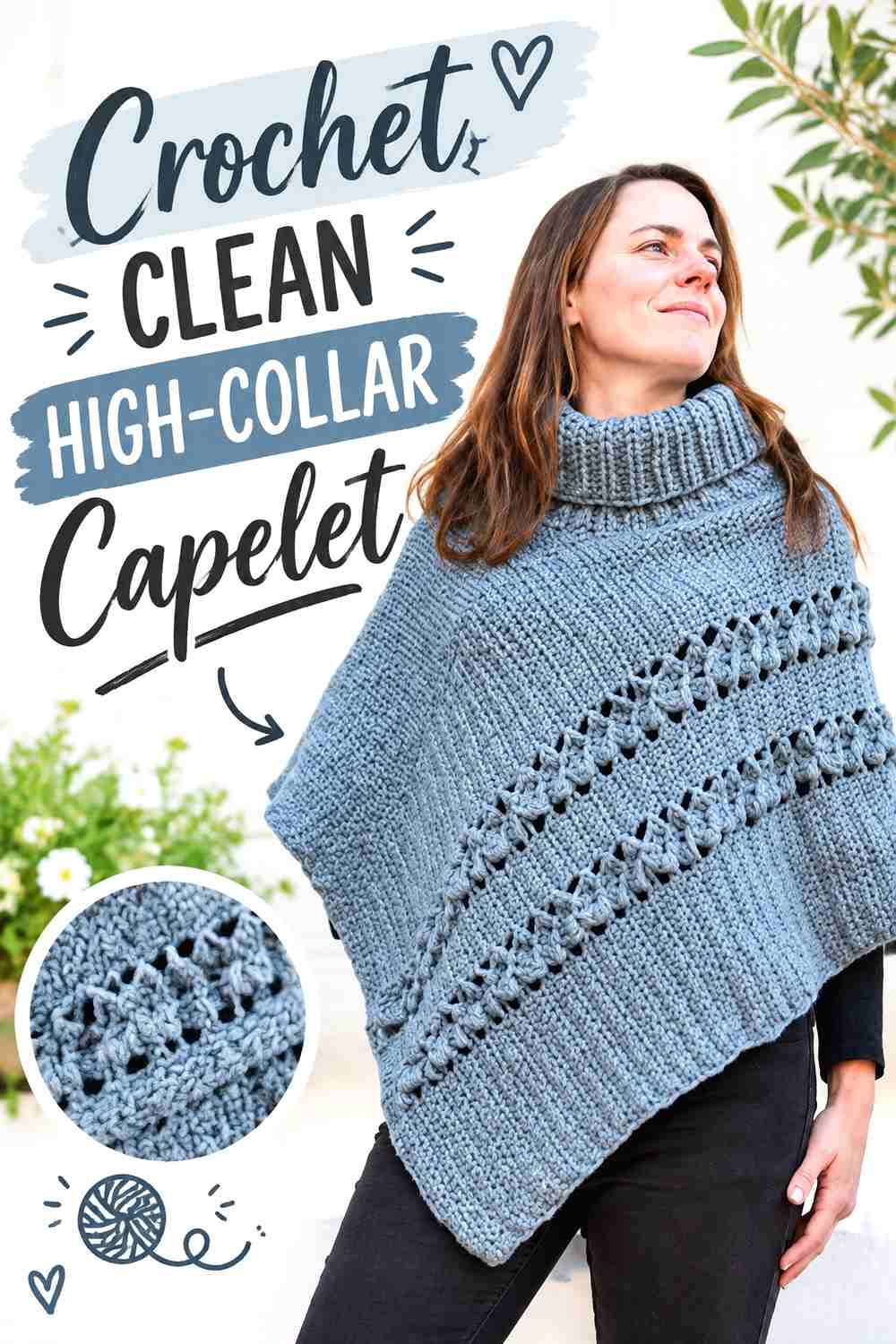
Lanas y Ovillos in English demonstrates another turtleneck poncho approach that can be shortened when you want a clean, high-neck layering piece.
This direction is useful for a restrained Fall 2026 look: instead of relying on fringe or strong surface decoration, let the neck height and compact shoulder coverage establish the silhouette.
Simple Construction Makes Fit Errors More Visible
A minimal capelet gives the eye very few distractions. If the collar leans, the shoulder line puckers, or the hem waves unexpectedly, those issues become prominent.
Check the developing piece from front, side, and back instead of relying only on how it looks while lying flat.
Monochrome Styling Can Emphasize the Shape
A quiet surface is a good place to use one saturated fall color or a refined neutral.
Because there are fewer decorative elements competing for attention, the relationship between the upright collar and the shoulder line becomes the primary visual feature.
Creator Credit: Lanas y Ovillos in English
12. Crochet Cable Yoke Funnel Capelet
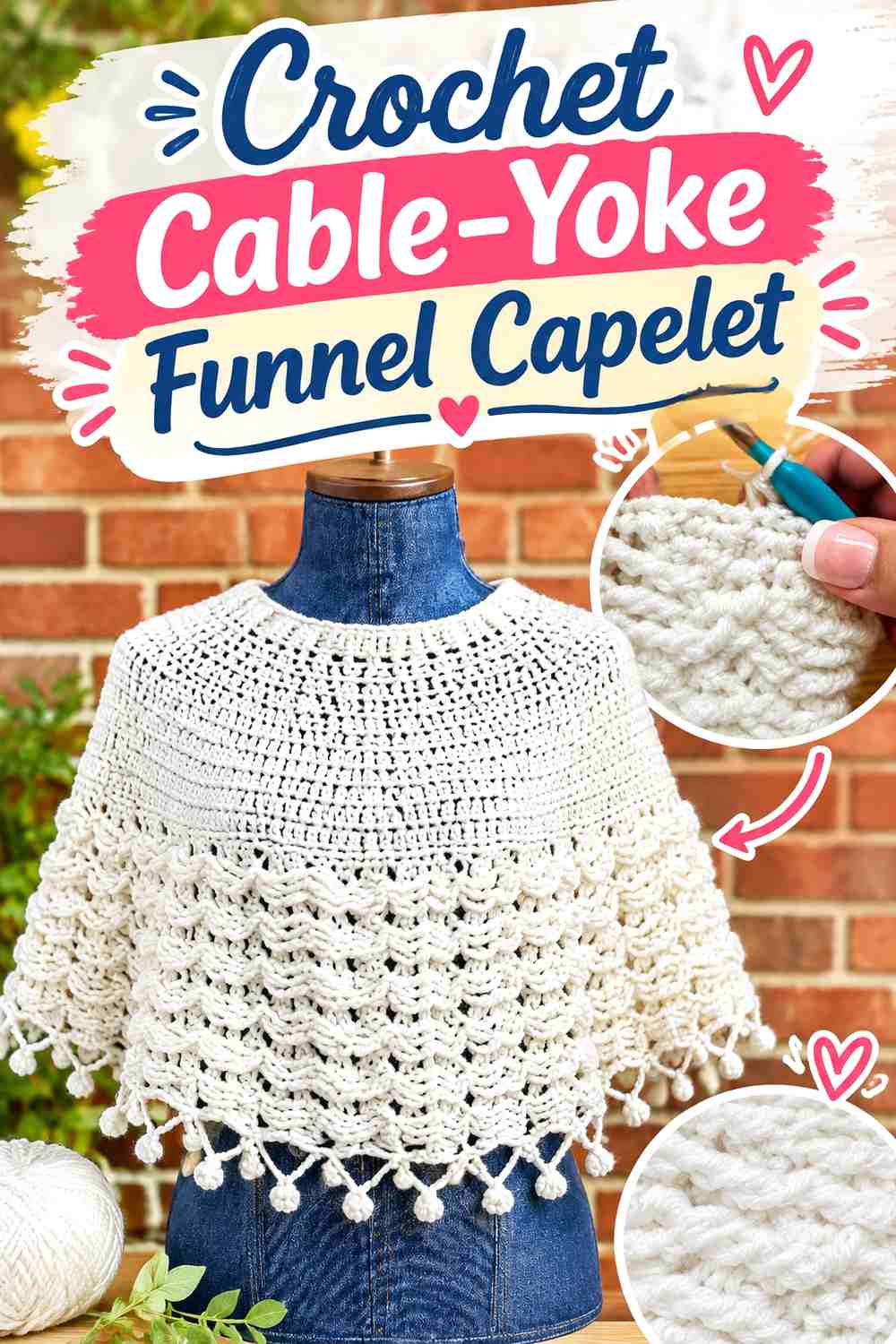
Stitches n Scraps’ Snowdrift capelet is one of the strongest choices if you want surface texture as well as a real capelet structure. The tutorial combines a cable-rich body with a shaped yoke and collar rather than treating the project as a shortened rectangle.
That construction gives the piece a more sculpted quality, which works naturally with the Fall 2026 interest in prominent necklines.
Cable Weight Changes How the Yoke Hangs
Raised cable fabric has more physical and visual substance than plain crochet. Check how the body settles before making the collar more dramatic.
If the capelet already has strong texture below the neck, a comparatively restrained funnel can create better balance than adding another highly dimensional element at the top.
Keep the Cable Orientation Centered
A strong cable becomes an obvious visual reference point. Once the capelet is assembled, check that the texture sits where intended on the body rather than drifting to one side.
Correcting alignment before final finishing can make a larger difference to the polished appearance than adding decorative trim afterward.
Creator Credit: Stitches n Scraps
13. Crochet Open Front Buttoned Funnel Capelet
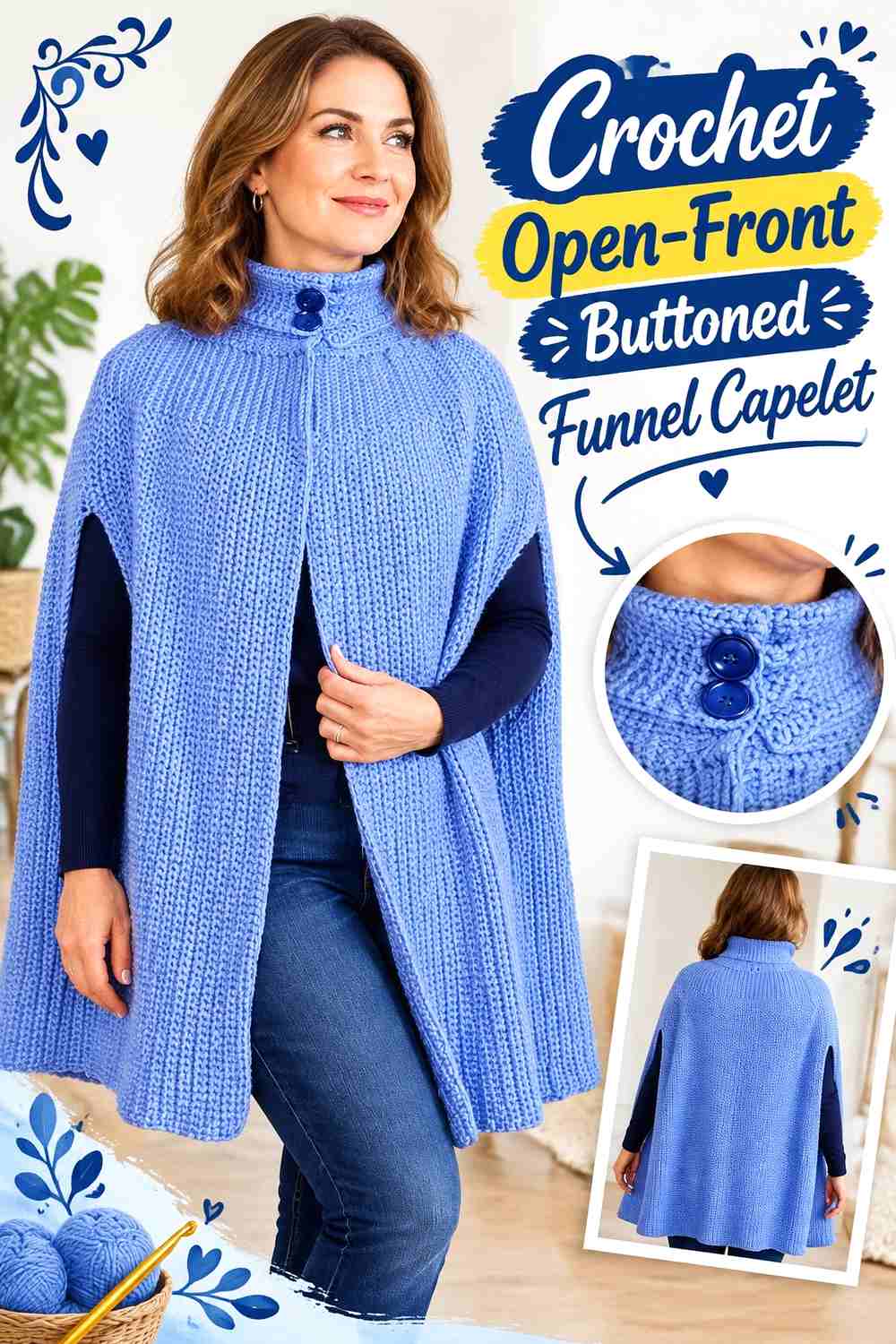
Crazy Cool Crochet’s classic cape construction is particularly useful because the original design includes an open front and an optional turtleneck-style buttoned collar. The source is longer than a capelet, so the Fall 2026 interpretation comes from choosing a shorter body while preserving those opening and collar ideas.
This option stands apart from closed circular capelets because the front opening creates a more jacket-like effect.
Buttons Can Make the Funnel Neck More Adjustable
A buttoned collar allows the neckline to change according to styling and comfort.
Before choosing button placement for an adaptation, test the collar fully closed, partially open, and relaxed. The best configuration should work with the actual height of the neck rather than simply copying spacing from a longer cape.
Shorten the Body With the Front Opening in Mind
An open-front cape can look balanced at one length and abruptly cut off at another.
Pin or fold the lower portion temporarily before committing to the crop. Check whether the front edges still fall cleanly and whether the capelet provides enough shoulder coverage when left open.
Creator Credit: Crazy Cool Crochet
14. Crochet Shell Yoke Funnel Capelet
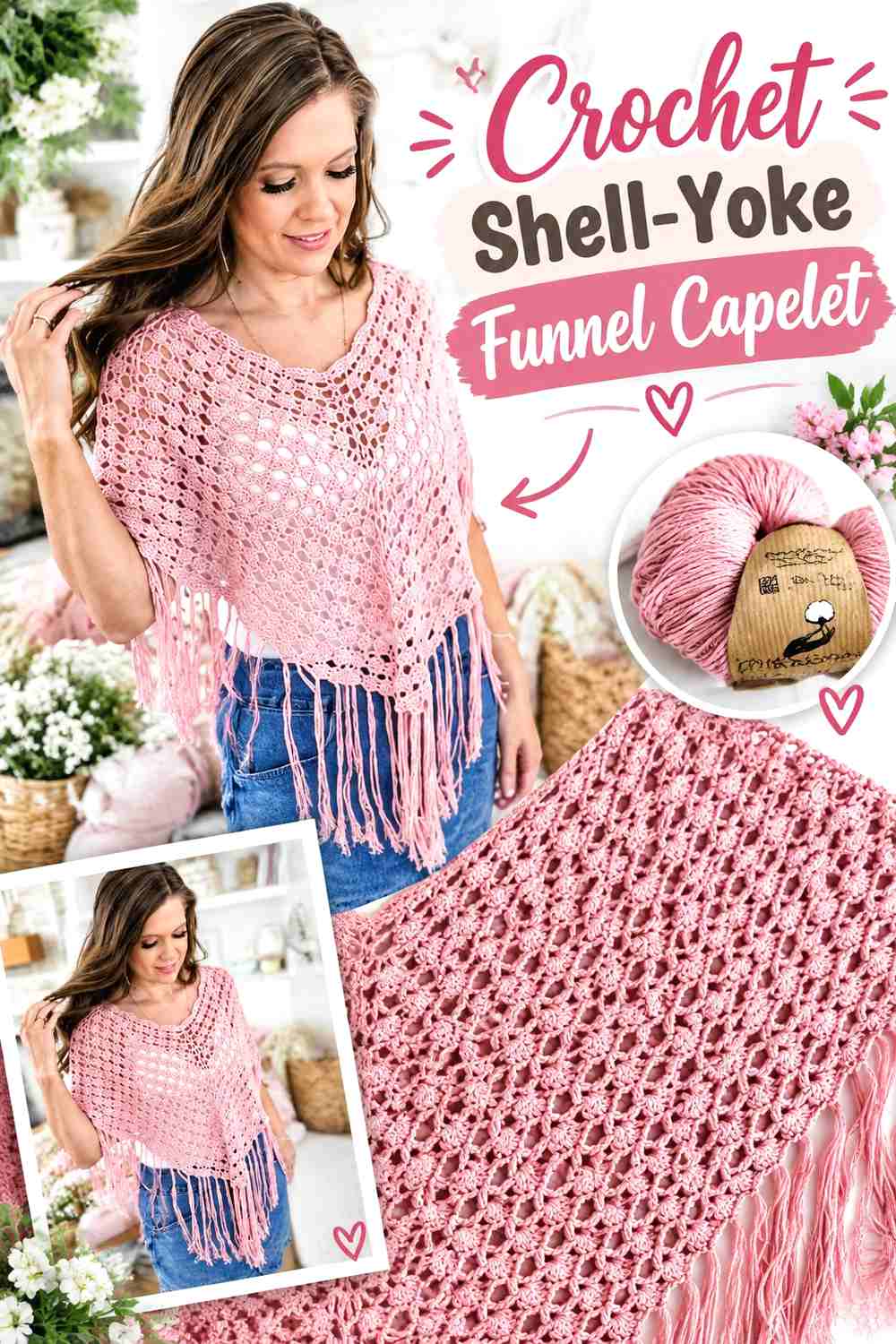
MJ’s Off The Hook Designs’ shell poncho provides a light, top-down yoke with visible shoulder shaping and an airy shell-and-V-stitch fabric. The source does not include a funnel neck, so the high collar is an adaptation rather than part of the demonstrated project. The top-down construction, however, gives a clear shoulder framework for planning a shorter capelet.
This creates one of the lighter-looking ideas in the roundup and offers a contrast to chunky cables and dense turtlenecks.
Build the Funnel More Densely Than the Shell Body
A highly open shell fabric may not have enough support to stand around the neck.
A denser collar can create a deliberate contrast: structured above, airy below. Before joining the two, check whether their circumferences and stretch behavior are compatible.
Stop After the Shoulder Shape Has Done Its Job
Because the source continues into a longer poncho, a capelet adaptation should end after enough expansion has developed to clear the shoulders.
Do not choose the stopping point solely by counting repeats. Try the piece on and evaluate how freely the arms move under the edge.
Creator Credit: MJ’s Off The Hook Designs
15. Crochet Soft Shoulder Funnel Capelet
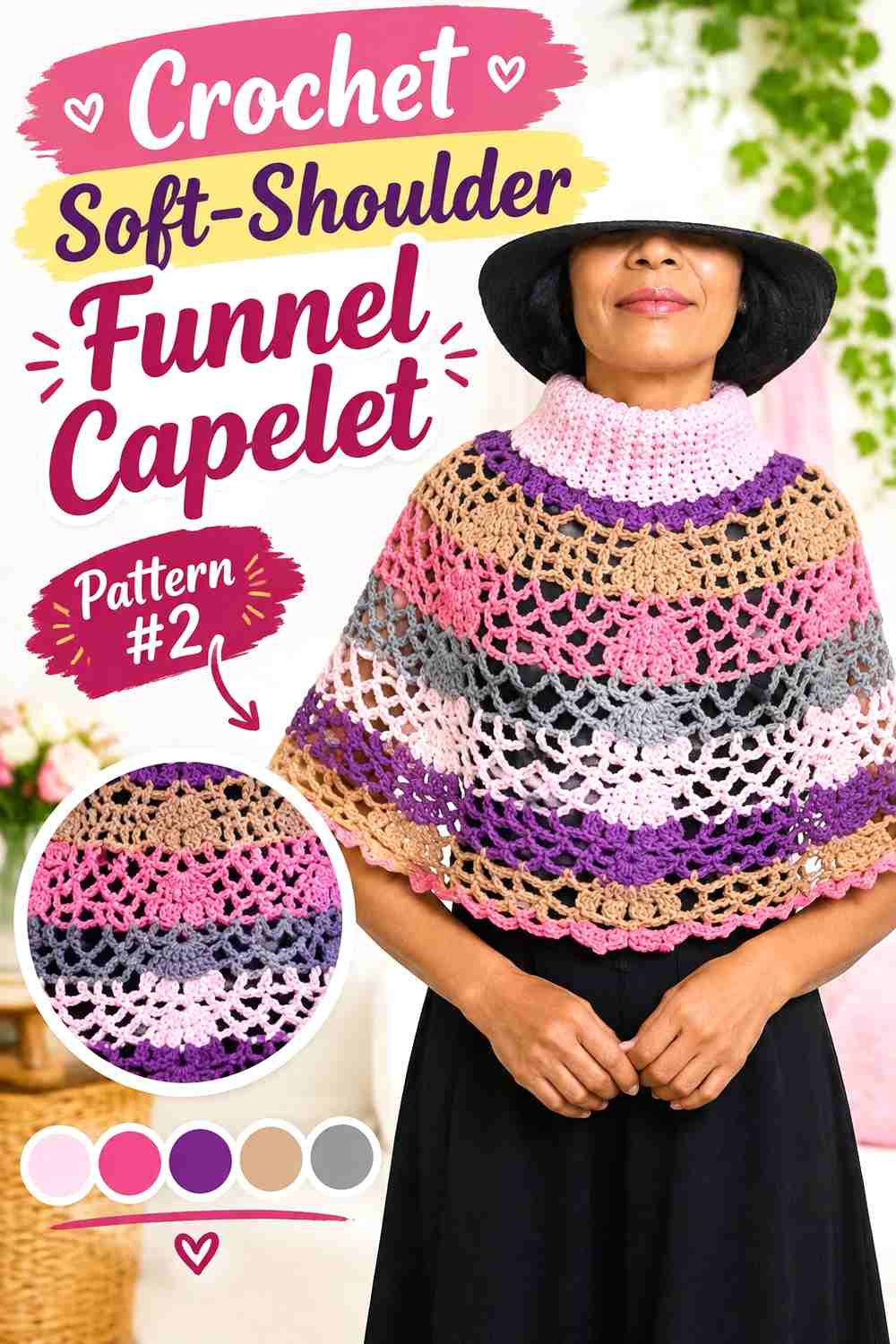
Crafting Shed’s capelet construction offers another route for readers who prefer a recognizable cape shape before adding the high-neck element.
The benefit of this approach is separation: you can first establish a shoulder drape you like, then determine what kind of funnel collar actually complements it rather than committing to both at once.
A Soft Body Can Support a More Architectural Collar
Contrast can make the adaptation more interesting. A capelet that drapes gently over the shoulders does not require an equally soft neckline.
A slightly firmer collar can create the face-framing effect associated with Fall 2026 funnel-neck outerwear while allowing the lower fabric to move more freely.
Check the Neck Seam From Every Angle
When a separate collar is added, the joining area can become the most visible structural transition.
Make sure the connection sits smoothly across the front, shoulders, and back. Excess fullness concentrated in one area may cause the funnel to lean even if the collar itself is evenly made.
Creator Credit: Crafting Shed
16. Crochet Granny Texture Funnel Capelet
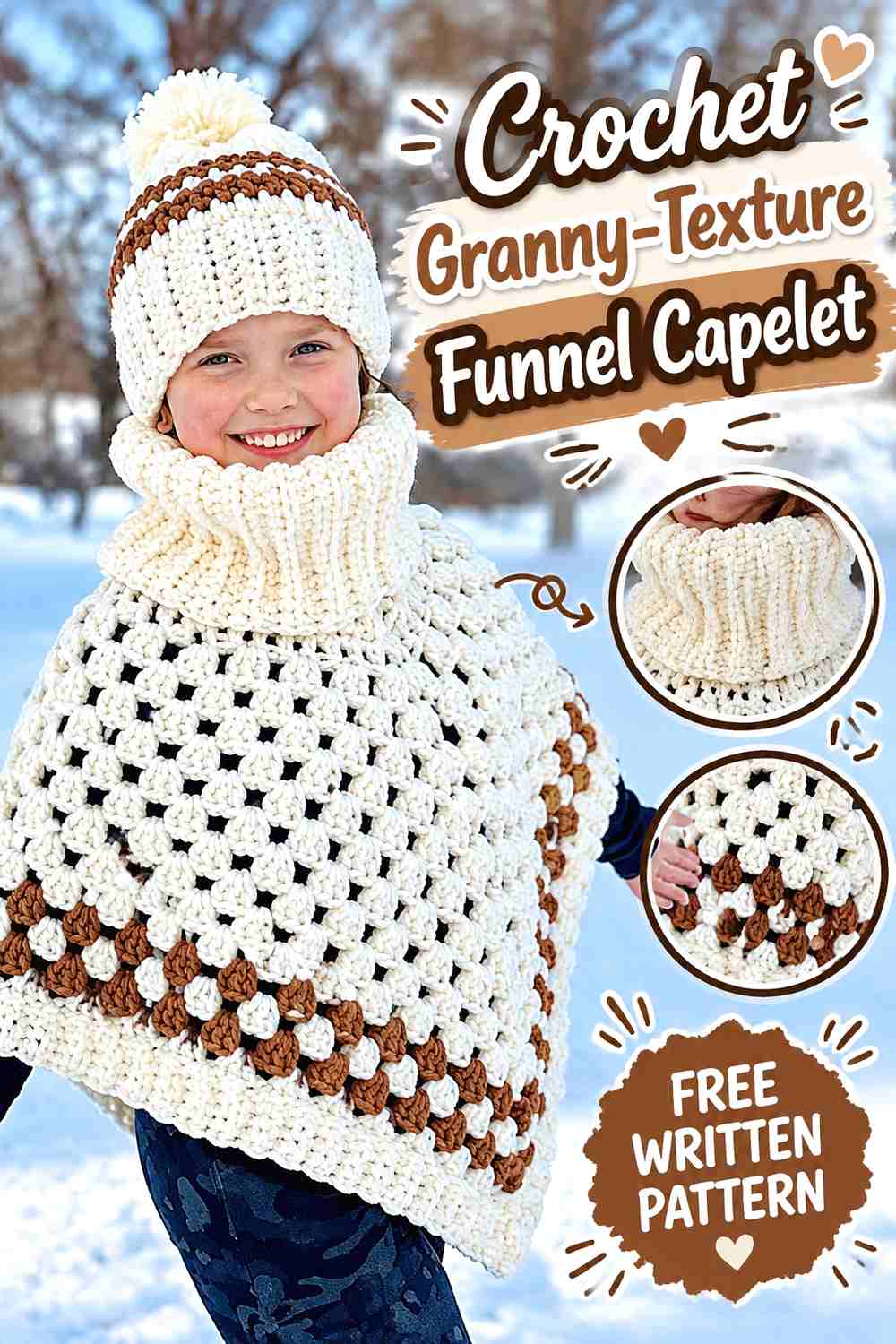
NEBESKA’s turtleneck granny poncho brings a completely different texture to the theme. The project is worked from a substantial high neck into a granny-style poncho body, so shortening that body offers a logical way to create a compact capelet while preserving the strong neckline.
The granny texture makes this the most visibly traditional-crochet option in the collection, but a controlled palette and shorter proportion can give it a more modern finish.
Keep Granny Texture From Overwhelming the Short Shape
Repeated granny sections create strong horizontal and diagonal visual rhythm.
On a capelet, fewer repeats may be all that is needed. Before continuing, step back and judge the entire silhouette rather than assuming more body depth will improve it.
A Calm Neckline Helps Separate Modern From Retro
The granny body already carries plenty of recognizable crochet character.
Keeping the funnel collar relatively clean can create a useful contrast between modern high-neck shaping and familiar stitch texture. That balance may feel more polished than adding further decorative bands around the collar.
Creator Credit: NEBESKA
17. Crochet Petite High Neck Funnel Capelet
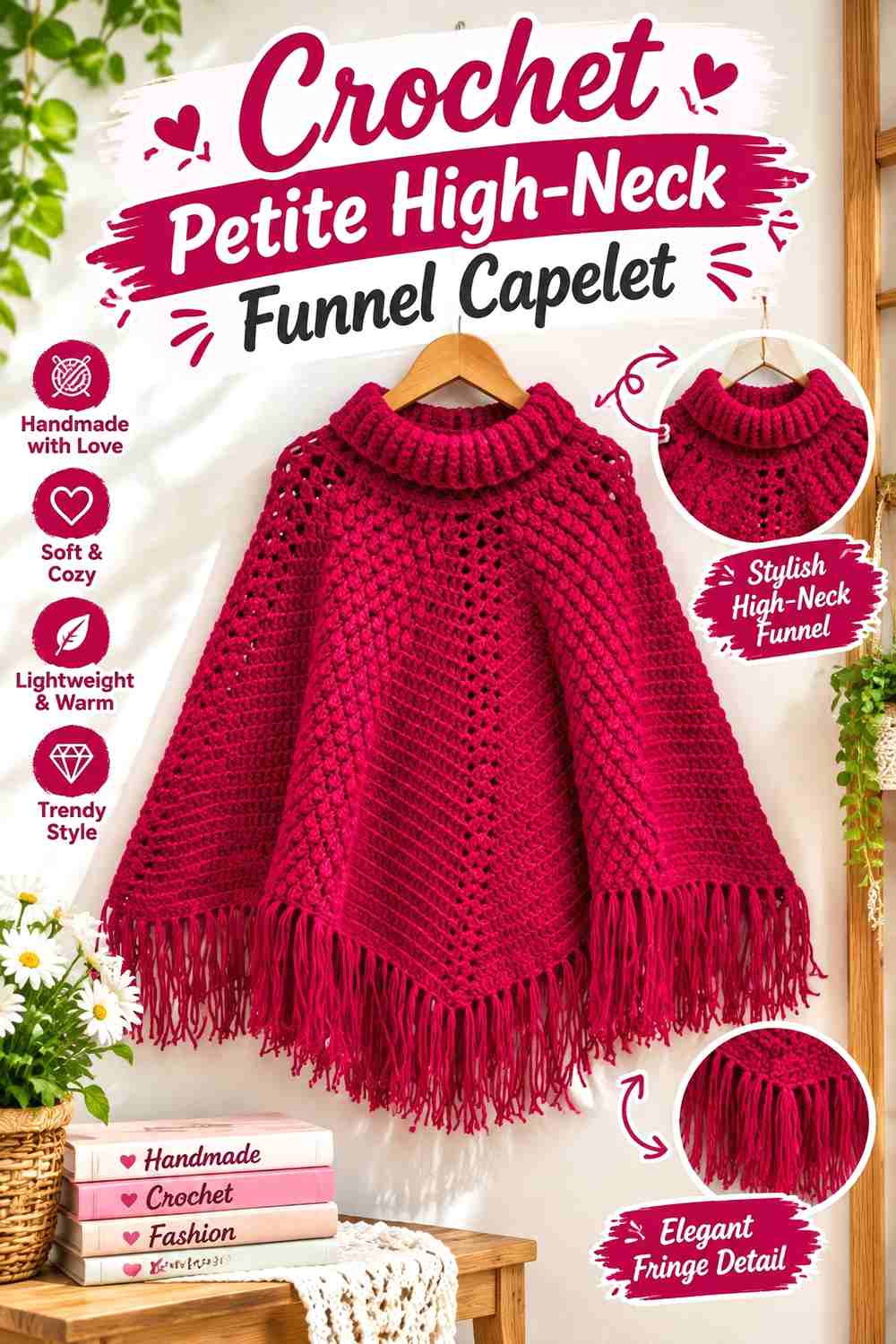
Crochet-crosia’s turtleneck poncho tutorial provides a smaller-scale high-neck poncho reference. Because the source is presented for girls, adult readers should not assume its proportions or dimensions will transfer directly.
Its value here is as construction inspiration for a petite capelet idea: retain the relationship between the tall collar and compact body, but establish adult measurements independently if making an adult version.
Do Not Scale a Smaller Garment With One Measurement
Increasing only the neck circumference or only the starting width can distort the relationship between collar, shoulders, and lower edge.
For an adult adaptation, consider head clearance, neck circumference, shoulder breadth, desired capelet depth, and upper-body layering needs separately.
Petite Proportions Benefit From a Controlled Collar
A very deep funnel can visually consume a short capelet, particularly on a smaller frame.
Pin or fold the developing collar to test several heights. The goal is enough height to create the face-framing effect without making the shoulder section look disproportionately small.
Creator Credit: crochet-crosia
Which Crochet Funnel Neck Capelet Direction Fits Your Style?
| If you want | Consider | Main checkpoint |
|---|---|---|
| The closest direct funnel-neck capelet | 1 or 12 | Collar height and yoke fit |
| A sharp geometric silhouette | 4 | Point placement and crop length |
| A softer draped neckline | 3 | Controlled cowl volume |
| Adjustable neck coverage | 9 or 13 | Closure position and head clearance |
| Strong stitch texture | 6, 8, 12, or 16 | Keep collar and body from competing |
| A minimal polished layer | 2 or 11 | Smooth shoulder shaping |
| A light openwork body | 14 | Use enough collar stability |
| A traditional capelet body with a new high neck | 5, 7, or 15 | Fit the capelet before adding the collar |
| A smaller-scale interpretation | 17 | Re-establish adult measurements rather than enlarging blindly |
A direct high-neck capelet tutorial is the simplest choice when you want fewer structural changes. High-neck ponchos are useful when their collar and shoulder construction already suit the idea and only the body length needs reconsidering. Lower-neck capelets require more planning because a funnel collar changes both the appearance and the forces acting around the neckline.
Conclusion
The strongest crochet funnel neck capelet for Fall 2026 is not necessarily the one with the tallest collar. The polished effect comes from balancing three things: a neckline with enough structure to frame the face, a shoulder section that sits without pulling, and a body length short enough to read clearly as a capelet.
For a direct capelet route, the Poya Stitches and Stitches n Scraps projects provide particularly relevant starting shapes. Choose the B.Hooked construction when you want pointed geometry, Fiber Flux for an adjustable chunky layer, Secret Yarnery for unusual openwork texture, or NEBESKA when granny stitch is part of the appeal. The open-front Crazy Cool Crochet construction offers a more jacket-like alternative.
The lower-neck capelet and poncho sources are most useful as adaptation frameworks rather than ready-made funnel-neck patterns. Establish the original shoulder fit first, then decide how high, firm, and close you actually want the collar. Refer to each creator’s original tutorial for the exact demonstrated construction.
Frequently Asked Questions
What is the difference between a crochet funnel neck, turtleneck, and cowl neck?
The terms overlap, especially in handmade garments, but they describe slightly different effects. A funnel neck generally rises around the neck without needing to fold over. A traditional turtleneck commonly has enough height to fold or double, while a cowl uses extra circumference or length to create softer draping.
In crochet, the actual result depends heavily on the fabric. A collar labeled “turtleneck” may visually behave like a funnel if it stands upright, while a supposedly high collar may read as a cowl if the yarn creates very fluid fabric.
How high should a crochet funnel neck be on a capelet?
There is no reliable universal height because neck length, head size, yarn, stitch structure, and desired styling all differ.
Work enough of the collar to test it on the intended wearer, then evaluate the front, sides, and back. It should create visible height without forcing the chin upward or bunching excessively at the back of the neck.
Can I shorten any crochet turtleneck poncho into a capelet?
Not every poncho should simply be stopped early. The shoulder expansion has to be sufficiently developed before the hem is finished.
If you stop before the body clears the shoulders, the garment can pull toward the neck and restrict movement. Try on a top-down project during construction, or compare the planned dimensions carefully when working separate panels.
How do I stop a crochet funnel collar from collapsing?
First determine why it is collapsing. The stitch pattern may be very stretchy, the yarn may have too much drape, the circumference may be too wide, or the collar may simply be taller than the fabric can support.
A denser fabric or more structured stitch choice may help, but do not make the neck excessively tight simply to force it upright. Head clearance and comfort remain essential.
What yarn qualities work well for a polished funnel-neck capelet?
Look for qualities that suit the specific design rather than one universal fiber. A sculptural funnel benefits from fabric with shape retention, while a cowl-funnel hybrid can use more drape. Cable and granny capelets need enough stitch definition for the texture to remain visible.
Swatch the actual stitch pattern and hold the fabric vertically. That simple test can reveal whether the yarn stands, folds, stretches, or collapses before you commit to an entire collar.
Can a funnel-neck capelet be worn over a coat or blazer?
It can, but the underlying garment changes the required shoulder room. A capelet fitted over a thin top may pull or ride upward when placed over structured outerwear.
If coat or blazer layering is the intended use, test the developing capelet over that type of garment before finalizing the shoulder circumference and hem depth.
Should the funnel collar and capelet body use the same stitch pattern?
Not necessarily. Using a denser or more elastic stitch at the neck can improve stability while an open or textured stitch provides movement over the shoulders.
The important checkpoint is the transition between the two fabrics. Their circumferences, stretch, and visual weight should work together so the collar does not pucker the body or flare away from it.