Indoor climbing plants can make a room feel fresh and welcoming, especially when their supports become part of the display. Crochet indoor plant trellis decorative sleeve ideas offer a creative way to add handmade color and texture to ordinary bamboo stakes, wooden ladders, metal arches, and geometric plant supports. These 18 inspiration concepts explore ribbed covers, scalloped sleeves, corner cuffs, openwork panels, and small floral details in copper, cornflower blue, butter yellow, lavender, and other attractive shades.
Some designs decorate a single upright stake, while others highlight the corners, rungs, curves, or outer rails of a trellis. The collection includes ideas for pothos, philodendrons, hoyas, and other suitable indoor climbers, with each decorative element remaining separate from the plant’s essential structural support. As you explore the designs, consider the trellis shape, stem clearance, watering habits, moisture exposure, and how easily the crochet could be removed for cleaning or plant maintenance.
These are AI-generated crochet design visualizations for inspiration, not photographs of tested handmade pieces or step-by-step patterns. The trellis itself must provide the plant’s support; decorative crochet sleeves should never replace structural components or restrict living stems.
Quick Design Selection Guide
| Your trellis style or goal | Design to explore |
|---|---|
| A simple upright bamboo support | Crochet Copper Ribbed Bamboo Trellis Sleeve |
| A miniature ladder trellis | Crochet Cornflower Ladder Rung Sleeves |
| A curved arch with decorative edging | Crochet Butter Yellow Scalloped Arch Crown Sleeve |
| A circular wooden plant support | Crochet Ivory Olive Hoop-Segment Sleeve |
| A fan-shaped bamboo trellis | Crochet Teal Fan-Spoke Trellis Sleeves |
| A geometric metal grid with decorative corners | Crochet Coral Windowpane Trellis Corner Caps |
1. Crochet Copper Ribbed Bamboo Trellis Sleeve
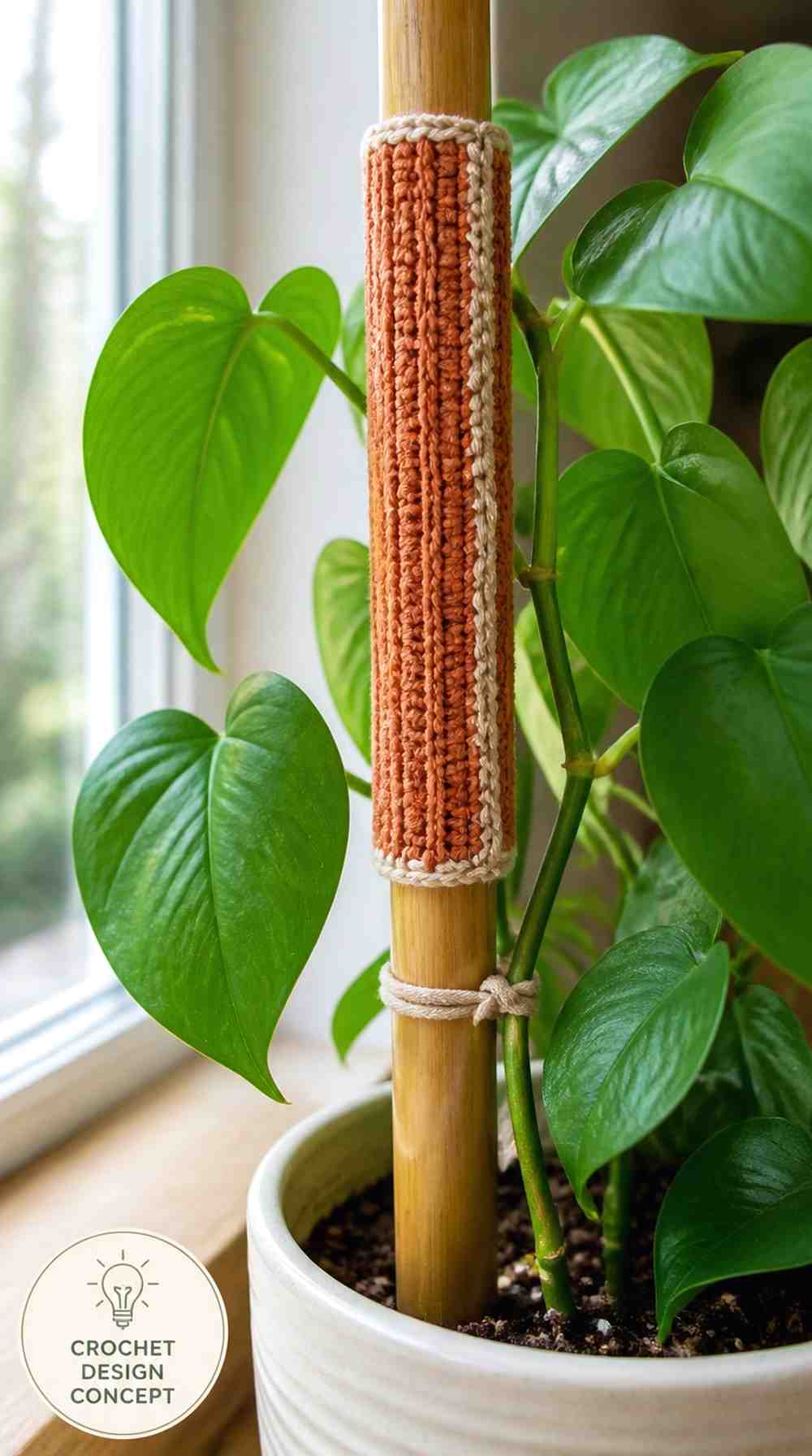
Copper-orange crochet brings a warm handmade finish to a simple bamboo support stake. The narrow sleeve covers the middle-upper section, with neatly worked raised ribs and slim oatmeal borders. Below it, the natural bamboo remains visible beside the green leaves of a heartleaf philodendron.
The design focuses on decorating an existing support rather than creating a climbing surface. A separate soft plant tie holds the vine against an uncovered section of bamboo. Keeping the crochet above the potting mix helps distinguish the decorative sleeve from the plant’s growing environment.
- Ribbed texture: Raised crochet rows create detail on a narrow stake without requiring bulky embellishments that might interfere with nearby leaves.
- Bamboo clearance: Fit the sleeve around the support itself, leaving the living stem and its separate plant tie outside the fabric.
- Removable seam: A properly planned side opening may make the sleeve easier to remove without disturbing the planted stake.
2. Crochet Cornflower Ladder Rung Sleeves
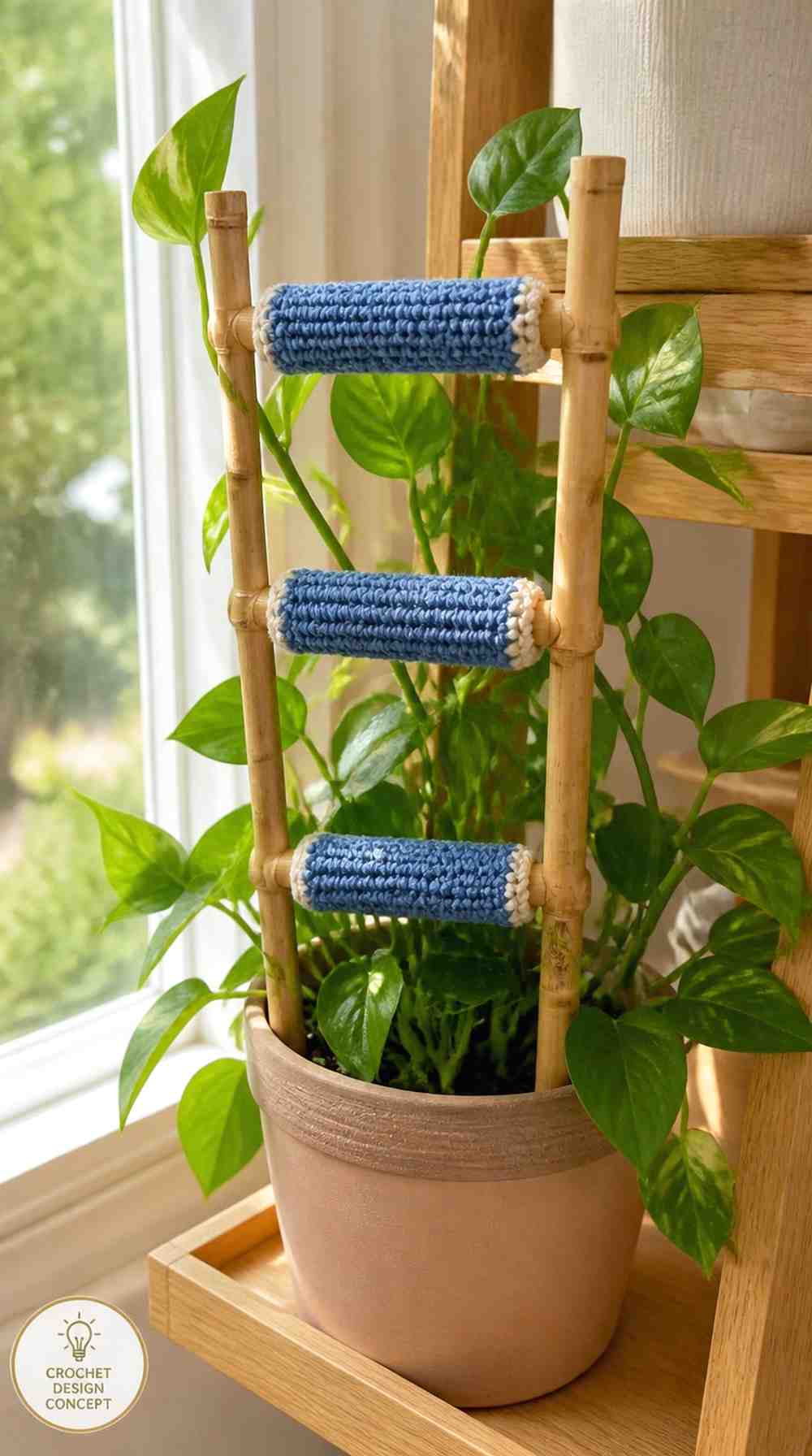
Cornflower-blue crochet decorates three horizontal rungs of a miniature bamboo ladder trellis. Each short sleeve has a narrow cream border, while the two vertical bamboo uprights remain completely exposed. A small green pothos grows beside the ladder inside a pale terracotta planter.
The three separate covers introduce color without concealing the entire wooden structure. Because the rungs are decorated independently, their spacing remains visible. This approach may be easier to adjust than a single long cover fitted around the complete trellis.
- Individual rung fitting: Measure each bamboo crossbar separately, particularly if the ladder narrows toward the top.
- Open uprights: Leaving both vertical supports uncovered provides room for plant ties or natural vine growth beside the wooden structure.
- Consistent borders: Matching cream edging gives the three blue sleeves a coordinated appearance without adding loose cords.
3. Crochet Butter Yellow Scalloped Arch Crown Sleeve
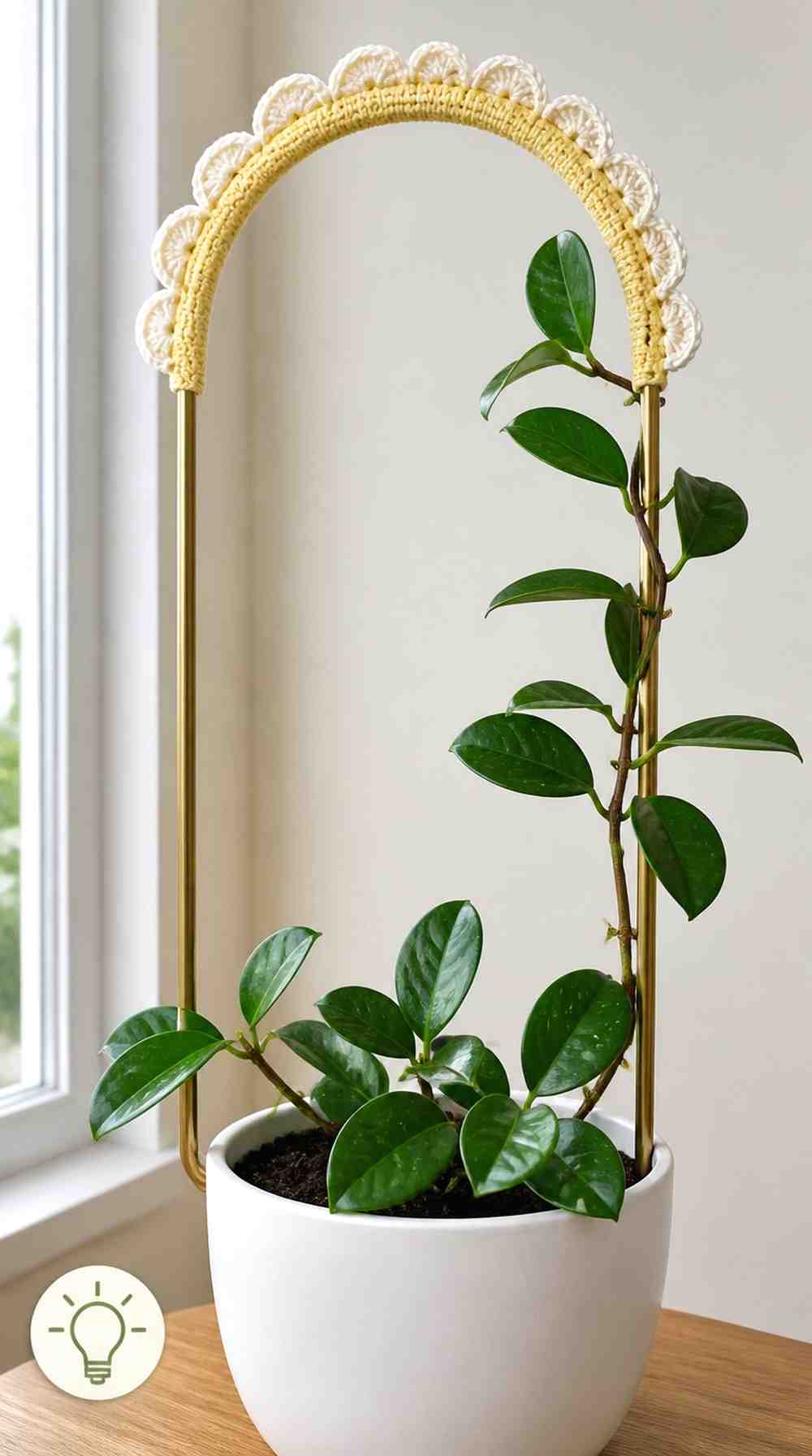
Butter-yellow crochet follows the upper central curve of a slender brass-colored arch trellis. Seven small cream scallops decorate its outer edge, while both lower metal legs remain visible. A glossy-leaf hoya grows along one uncovered side of the arch.
The scalloped crown gives the curved trellis a softer, more decorative appearance. Its limited coverage also allows most of the metal support to remain accessible. Shaping the crochet around the upper arc would require careful attention to the curve rather than treating the sleeve as a straight rectangle.
- Curved fitting: Plan the sleeve around the actual arch radius so the fabric lies smoothly without pulling the metal support out of shape.
- Seven scallops: Keep each cream loop compact and well connected to the butter-yellow body.
- Growth clearance: Reserve the uncovered lower and side sections for the hoya rather than positioning living stems beneath the scalloped crochet.
4. Crochet Plum Diamond-Corner Trellis Cuffs
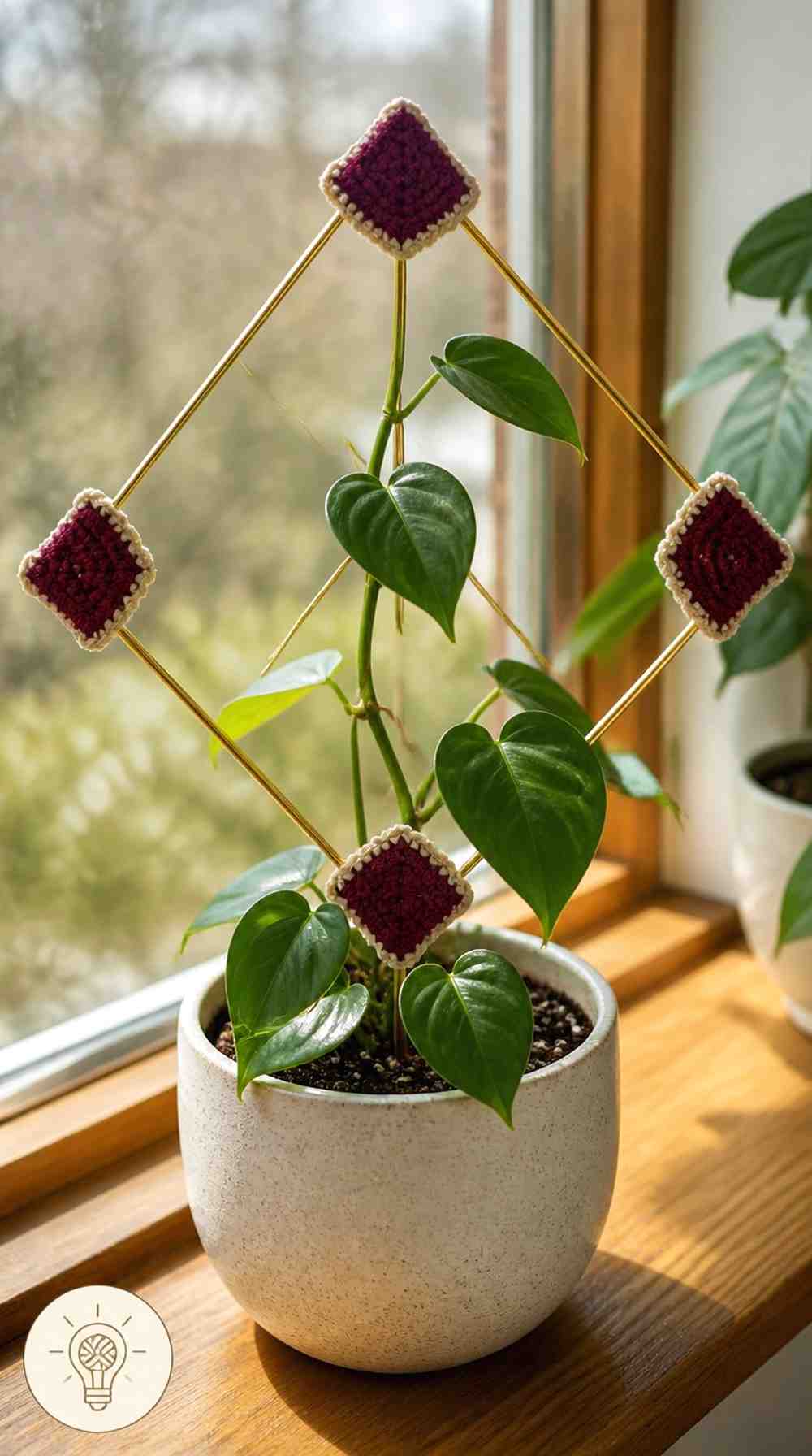
Four deep-plum crochet cuffs decorate the outer corners of a diamond-shaped metal trellis. Small cream borders define each fitted piece, while the straight gold-colored wire sections remain visible between them. A young philodendron grows beside the open structure.
This design highlights the geometry of the support without covering its complete outline. The four corner cuffs create repeated points of color around the diamond. Their shape would need to follow the angles of the actual wire joints rather than stretching one continuous tube around sharp turns.
- Corner measurements: Check all four metal junctions, since an apparently symmetrical trellis may have different upper and lower angles.
- Short fitted cuffs: Keep the plum pieces compact so the open central diamond remains available to the plant.
- Wire finish: Avoid rough crochet seams or fasteners that could scrape delicate coatings on decorative metal supports.
5. Crochet Dusty Rose Buttoned Side-Rail Wrap
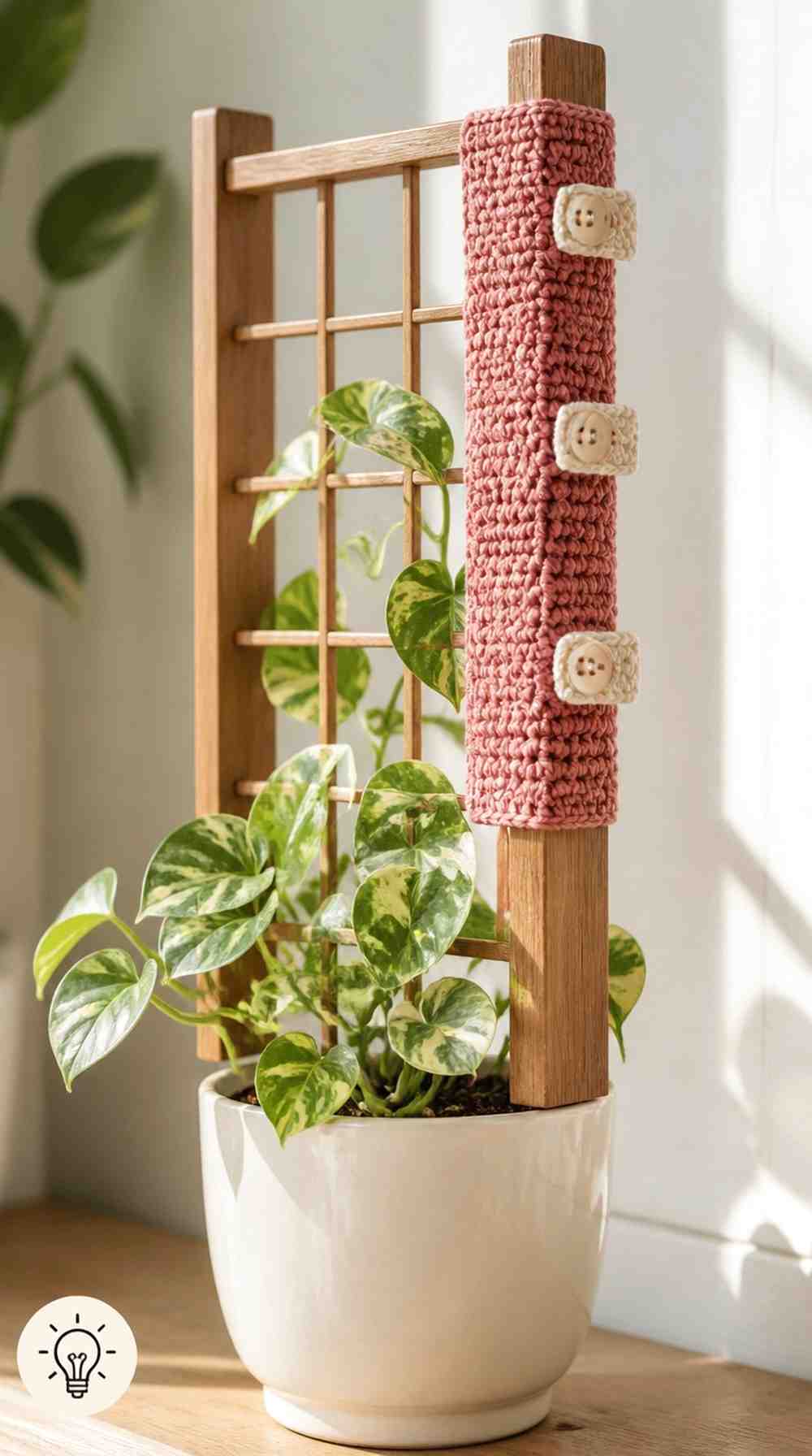
Dusty-rose crochet forms a long narrow wrap around the upper half of one wooden trellis rail. Three cream button tabs secure the fabric along the outward-facing side, each finished with a small natural wooden button. The opposite rail and central wooden grid remain uncovered.
The side-opening arrangement is especially interesting because it suggests a removable decorative piece. Unlike a pull-on sleeve, it could potentially be fitted around an existing rail without dismantling the trellis. However, the button positions must remain away from living stems and delicate leaves.
- Three-button fastening: Space the tabs evenly so the long wrap stays aligned rather than twisting around the rail.
- Right-side placement: Decorating only one rail keeps the opposite side and central grid open for the growing pothos.
- Wooden button care: Keep hard fasteners from rubbing against leaves or pressing into the trellis’s wooden finish.
6. Crochet Ivory Olive Hoop-Segment Sleeve
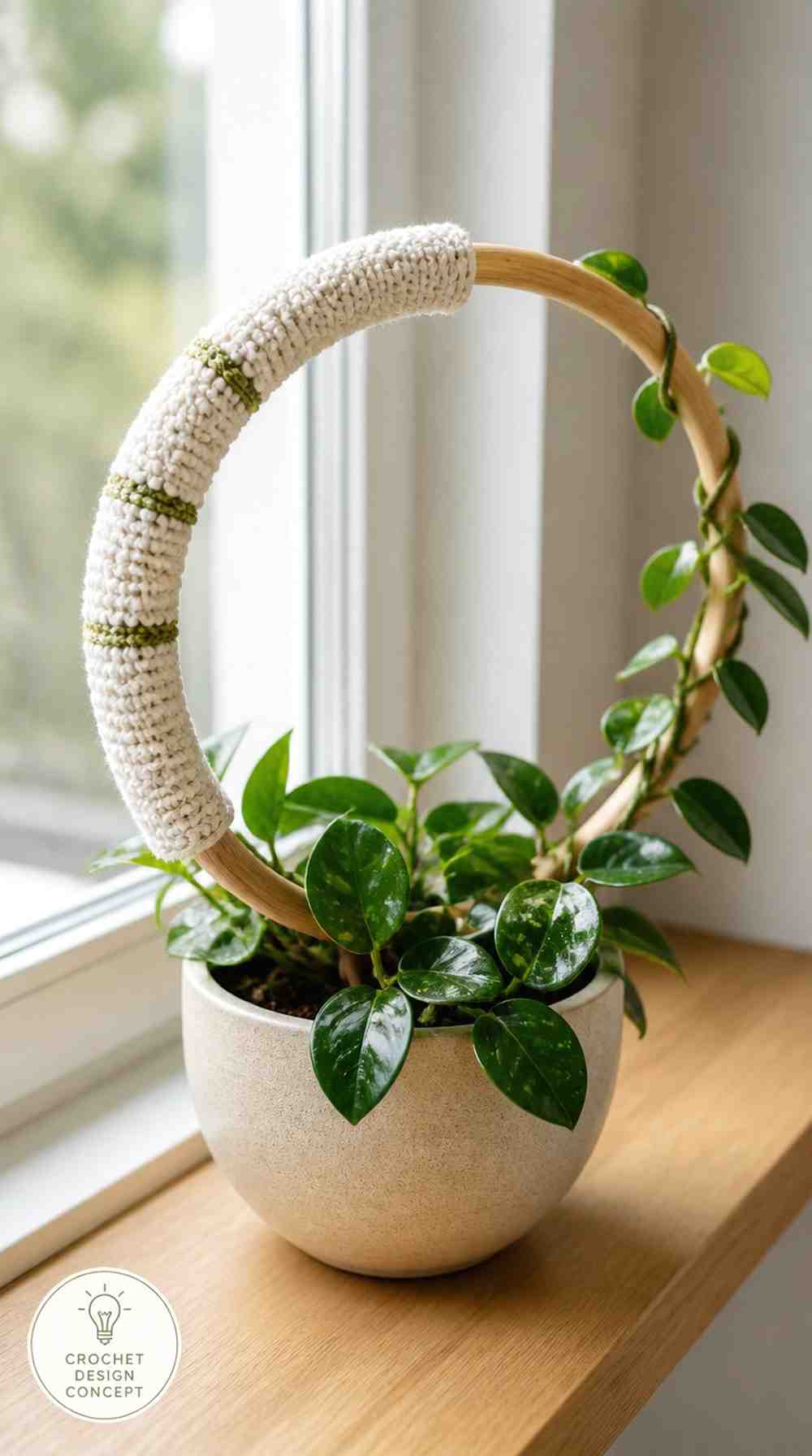
Warm-ivory crochet covers the upper-left quarter of a round wooden hoop trellis. Three narrow olive-green stitch bands decorate the fitted segment, with cream borders finishing both ends. A compact hoya grows around the uncovered opposite side of the natural-oak hoop.
The partial-arc treatment offers a quiet alternative to wrapping the entire circle. Most of the wood remains visible, while the ivory and olive crochet introduces a botanical color accent. Its curved shape needs enough flexibility to follow the hoop without bunching.
- Partial coverage: A quarter-circle sleeve leaves plenty of the original hoop visible and avoids enclosing the entire growing path.
- Olive stitch bands: The three narrow stripes add contrast without requiring attached flowers, beads, or projecting ornaments.
- Wooden hoop fit: Check the support’s thickness and curve before deciding whether a removable sleeve could sit smoothly along the arc.
7. Crochet Teal Fan-Spoke Trellis Sleeves
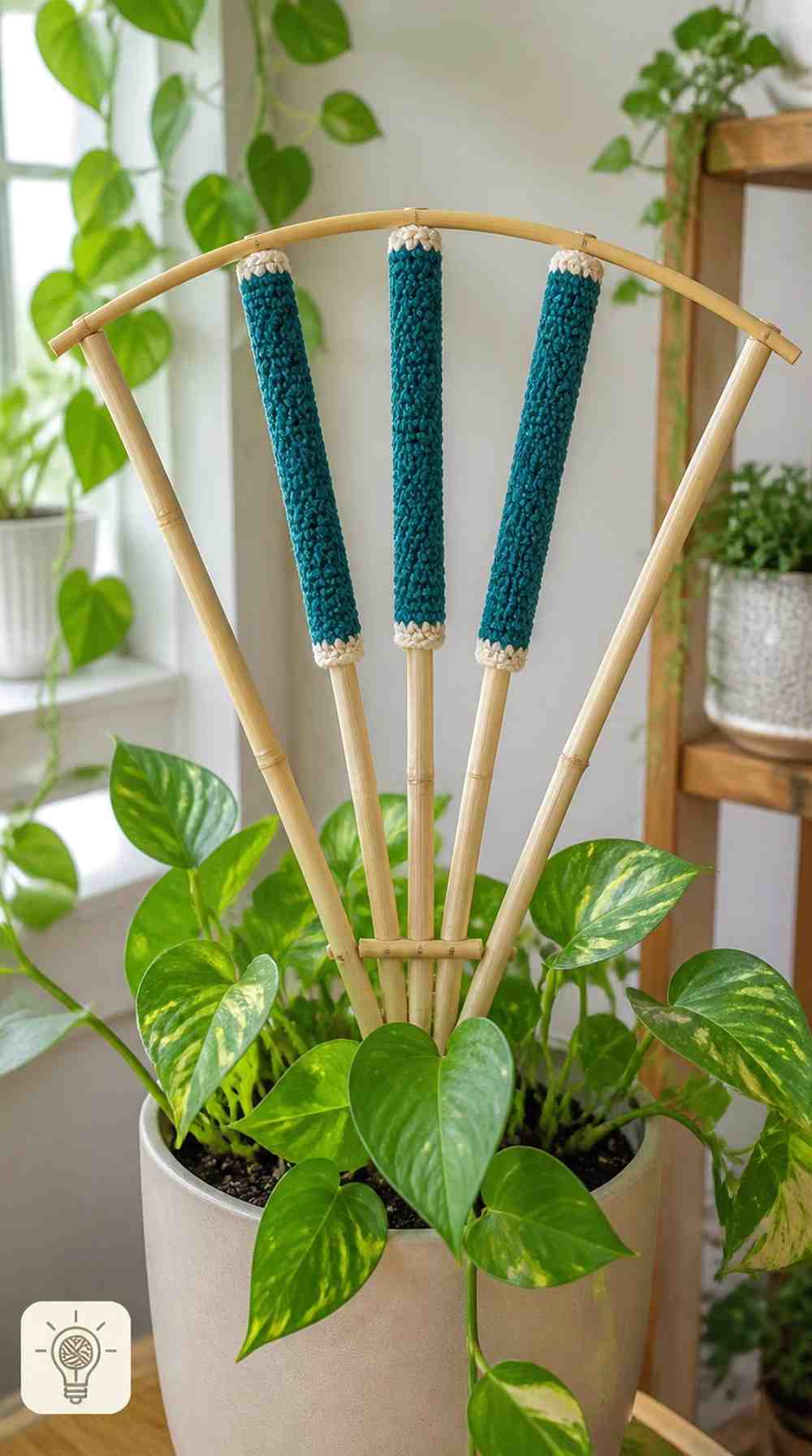
Teal-blue crochet highlights three central spokes of a five-spoke bamboo fan trellis. The fitted sleeves cover only the upper portions of those three rods, finished with narrow ivory borders. The two outer spokes and lower bamboo connections remain bare beside a small pothos.
The fan arrangement creates an attractive spread of repeated blue accents. Because the sleeves follow separate angled rods, the crochet remains visually distinct from the actual support structure. This design could suit a trellis where the plant is still young and much of the upper frame remains visible.
- Spoke spacing: Keep the three fitted sleeves separate so they do not pull the fan rods toward one another.
- Upper placement: Decorating the higher sections leaves the lower joints and growing areas easier to inspect.
- Matching lengths: Similar sleeve proportions give the fan a coordinated appearance even though the rods sit at different angles.
8. Crochet Rust Segmented Spiral Trellis Sleeves
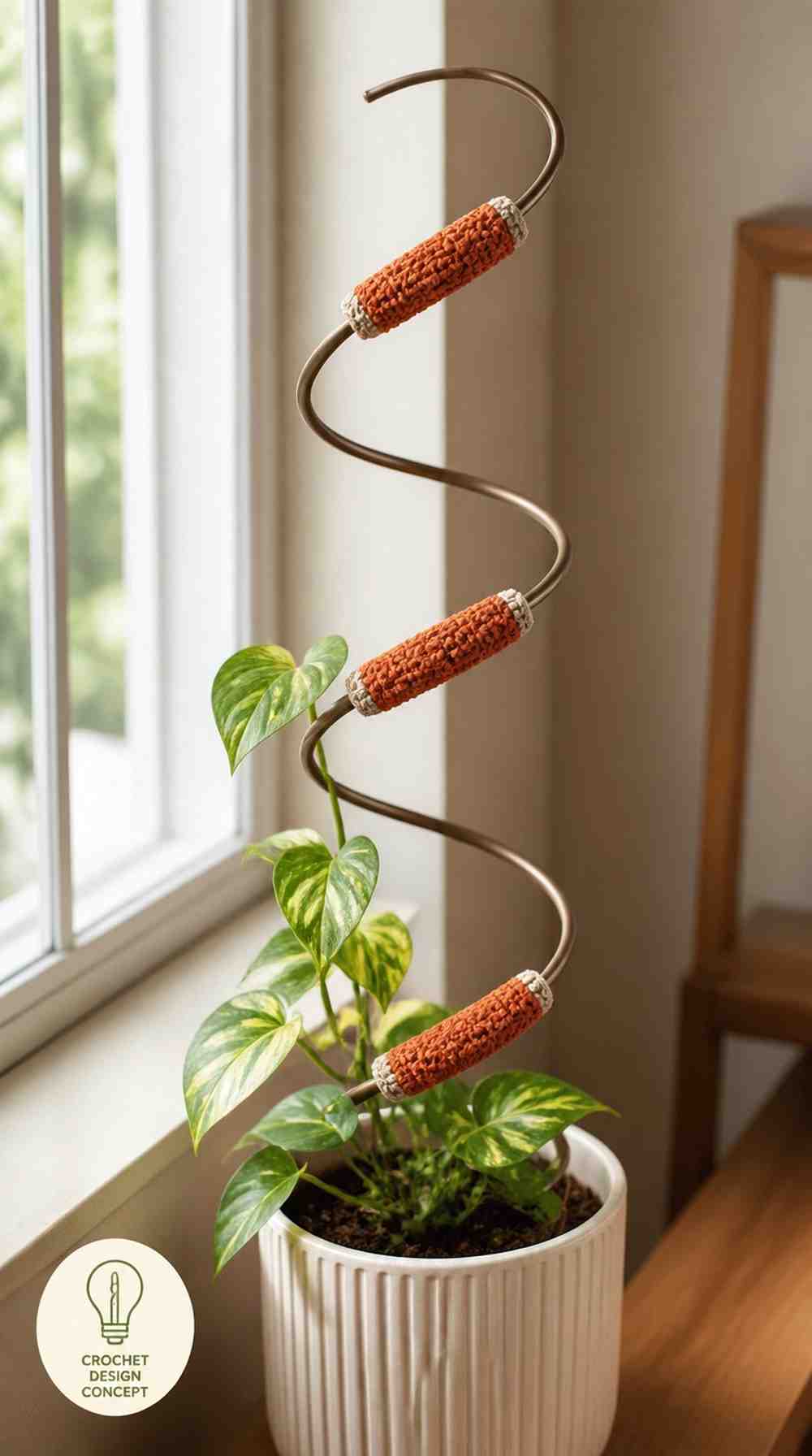
Rust-orange crochet follows three separate sections of a bronze-colored spiral plant trellis. Each short tubular sleeve has an oatmeal border at both ends, leaving exposed metal between the decorated sections. A green pothos grows beside the lower uncovered curve.
The segmented arrangement gives the spiral a repeating handmade accent without hiding its shape. It may also be easier to remove individual pieces for maintenance than one continuous wrap. The sleeves should follow the existing metal curves without changing the support’s spacing.
- Three distinct segments: Leave clear gaps between the rust sleeves so the original metal spiral remains recognizable.
- Curved shaping: A straight crochet tube may bunch around a tight coil, so fitting would need to account for the actual curvature.
- Stem separation: Keep the pothos on the uncovered support sections, with no living stem caught between the metal and yarn.
9. Crochet Lavender Teardrop Apex Sleeve
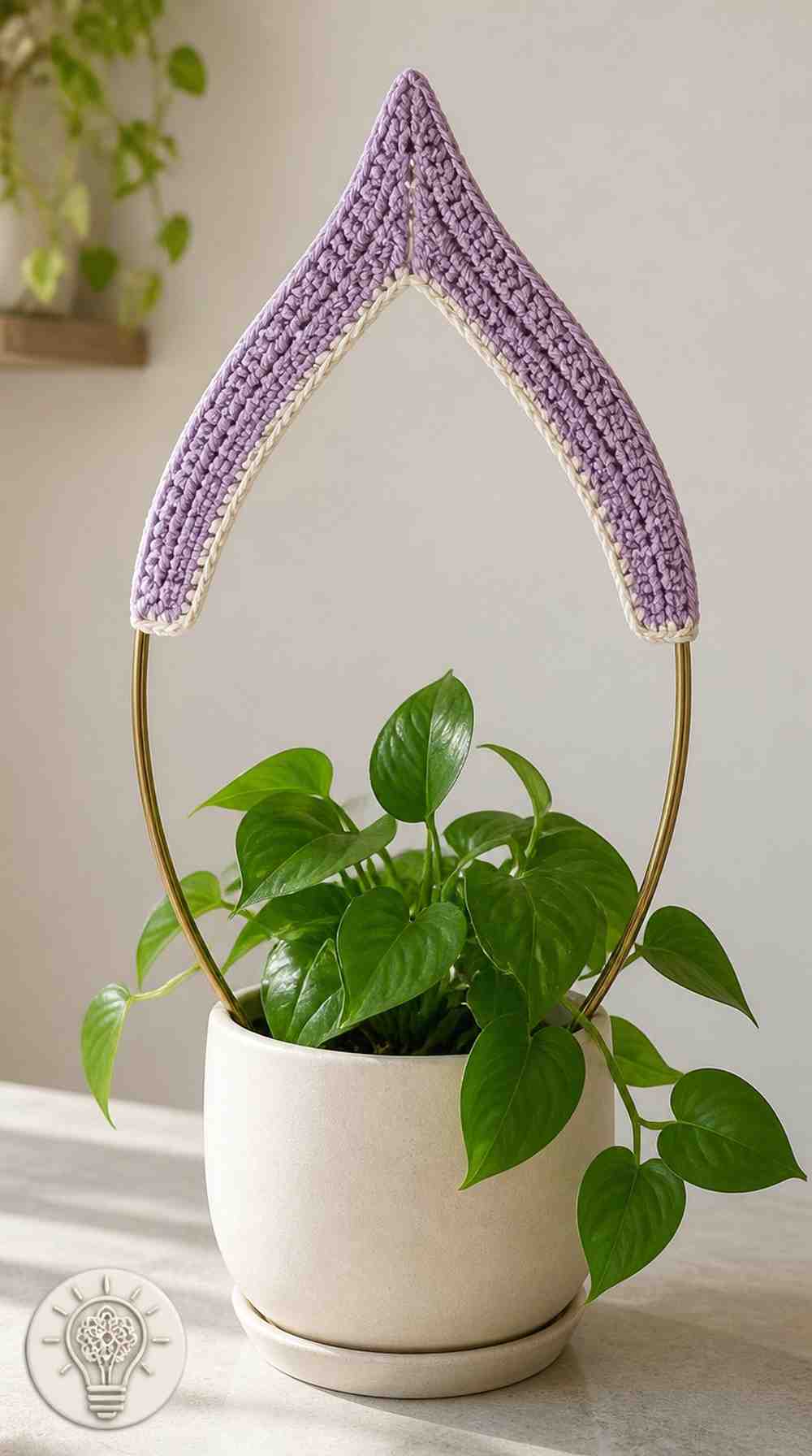
Lavender crochet decorates the pointed upper section of a teardrop-shaped brass trellis. The fitted sleeve extends a short distance down both adjoining sides, with a thin cream border tracing its outline. The lower curves and support legs remain exposed beside a young heartleaf philodendron.
The symmetrical upper cover draws attention to the teardrop silhouette. Its joined center needs careful shaping because the metal frame changes direction at the apex. Keeping the lower support open prevents the decorative crochet from overwhelming the plant.
- Apex alignment: Fit both sides evenly around the upper point so the lavender crochet remains centered.
- Smooth shaping: Keep seams tidy where the metal changes direction, avoiding thick fabric folds around the pointed joint.
- Open lower curves: The bare sections provide space for future growth and easier inspection of the trellis.
10. Crochet Navy A-Frame Rail Sleeves
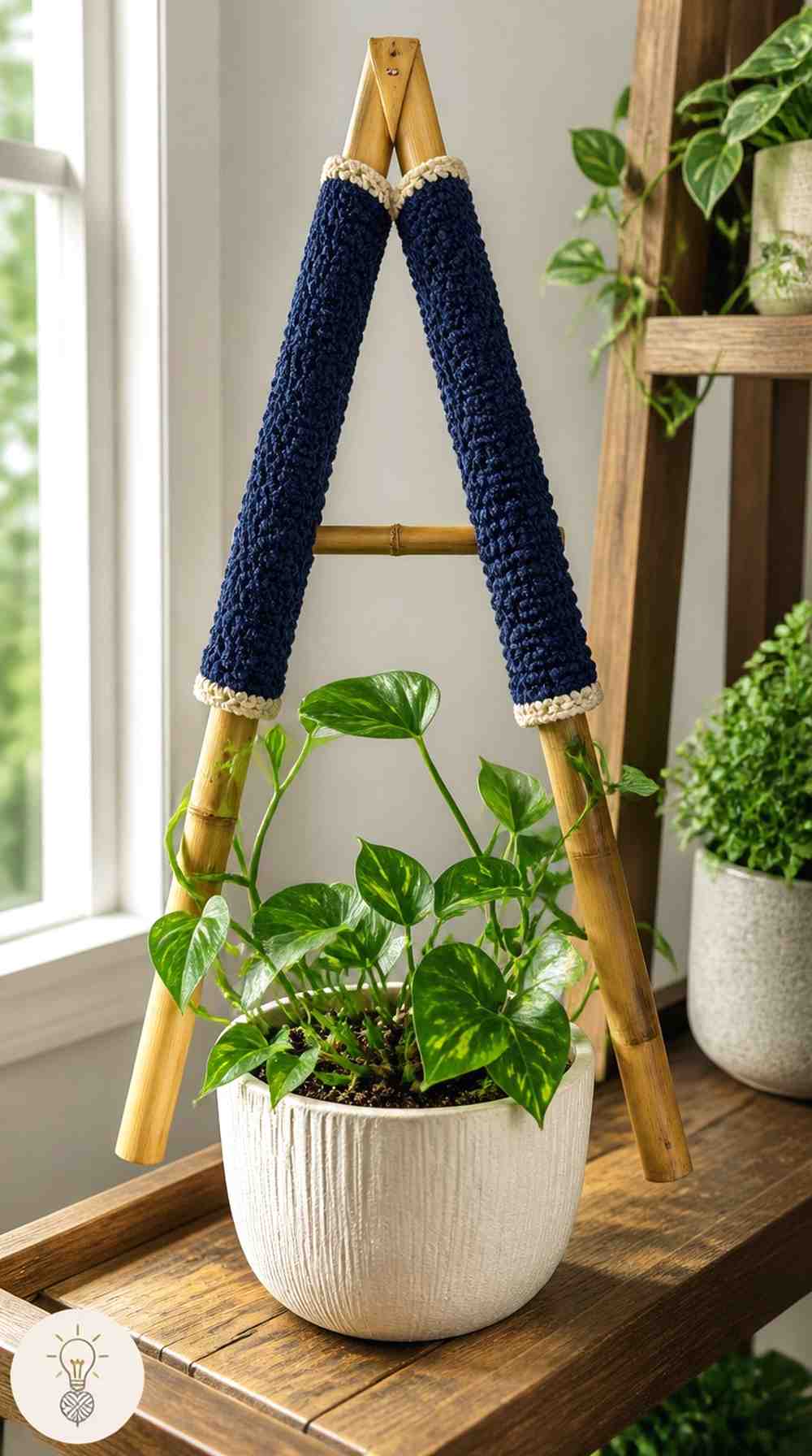
Navy-blue crochet covers the upper halves of two sloping bamboo rails on a small A-shaped plant trellis. Each sleeve has an oatmeal border and subtle raised horizontal ridges. The central crossbar, upper joint, and lower support legs remain uncovered beside a growing pothos.
The paired sleeves emphasize the trellis’s triangular outline without adding fabric to the middle. Their mirrored placement gives the design a balanced appearance. Since the rails meet at an angle, the two pieces should be fitted independently rather than joined tightly across the top.
- Paired rail fitting: Keep the two navy sleeves similar in length while allowing for any small differences in bamboo thickness.
- Uncovered crossbar: Leave the middle connecting support accessible for normal plant training and inspection.
- Raised ridges: Compact crochet texture adds interest without creating loose loops along the sloping edges.
11. Crochet Coral Windowpane Trellis Corner Caps
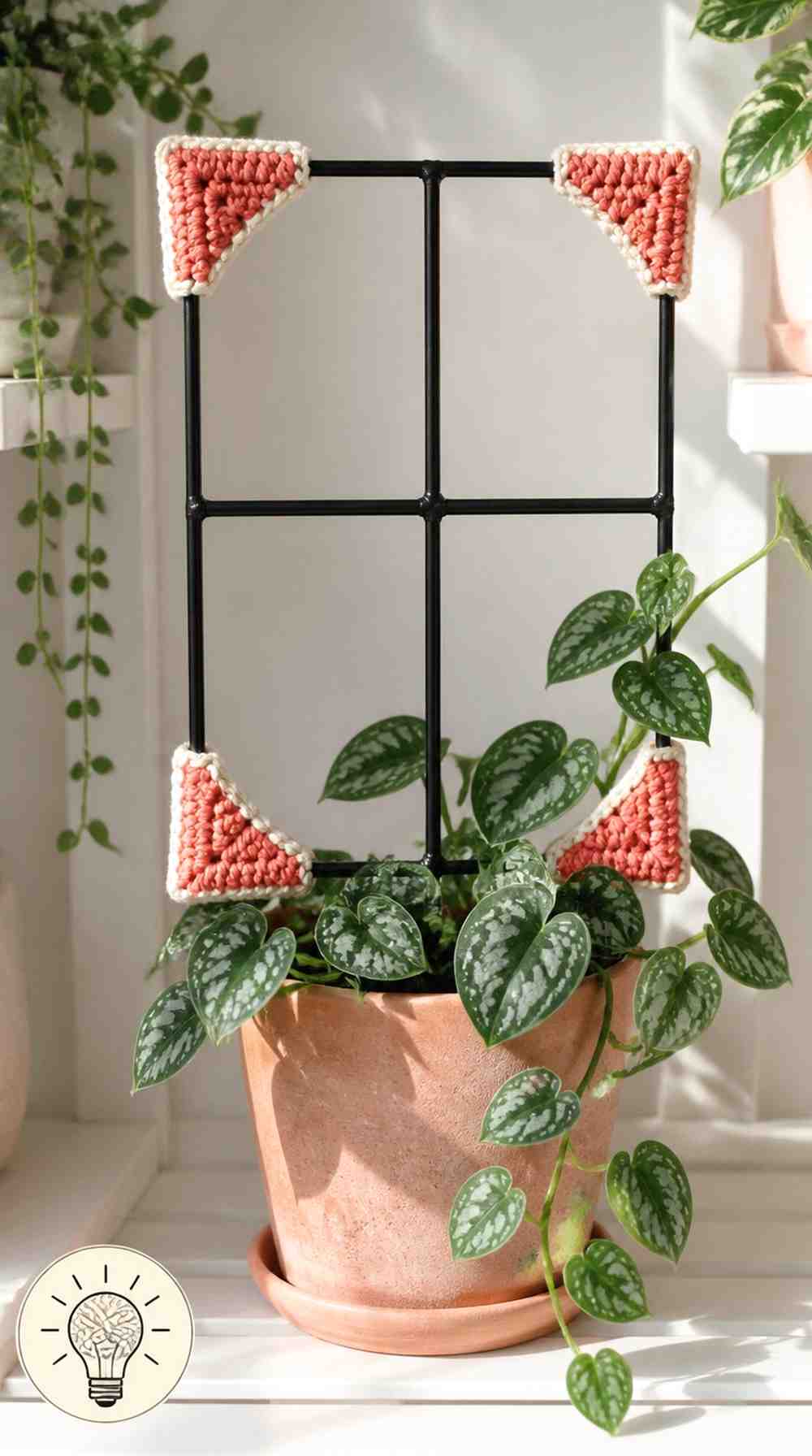
Coral-pink crochet adds four compact corner caps to a black metal windowpane trellis. Each piece wraps around one outer right-angle junction, finished with a cream border. The grid’s central openings remain completely visible beside the silver-speckled leaves of a satin pothos.
This concept makes the corners the decorative focus rather than covering the rails. Its small repeated pieces create a cheerful contrast against the dark metal. The right-angle shaping requires neat corners and secure joins so the caps do not slide into the grid openings.
- Four-corner arrangement: Keep every coral cap aligned with an outer junction rather than placing it across a central climbing opening.
- Right-angle shaping: Use fitted crochet forms that follow the metal corners without pulling against the frame.
- Open grid: The exposed center allows the plant and support structure to remain visible instead of turning the trellis into a fabric-covered panel.
12. Crochet Oatmeal Three-Tier Obelisk Collars
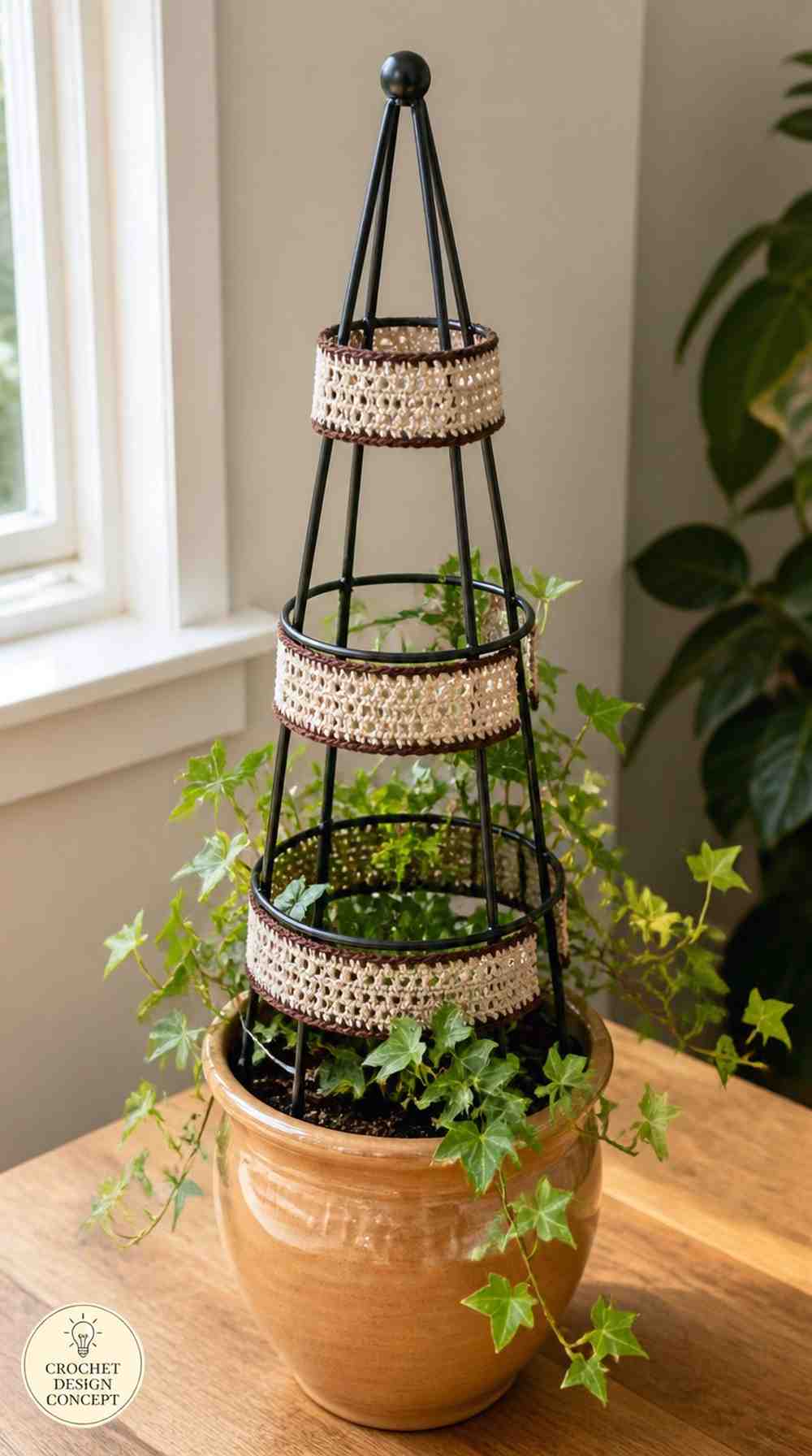
Oatmeal crochet decorates three horizontal rings of a small black metal obelisk trellis. Each ring has a short forward-facing crocheted segment with cocoa-brown edging. Four vertical metal rails remain exposed, and a small ivy plant grows beside the lower structure.
The stacked rings create a tiered design that differs from flat lattice or hoop sleeves. Repeating the same crochet treatment at three heights gives the obelisk a coordinated look. The individual segments should remain loose enough to avoid pulling the rigid metal rings out of alignment.
- Three ring levels: Check the diameter and curvature of each tier before planning the separate oatmeal sections.
- Partial ring coverage: Leaving the vertical rails and remaining ring areas bare preserves the original open structure.
- Plant inspection: Maintain enough access around the lower ivy growth to check stems and remove fallen leaves.
13. Crochet Forest Green Twin-Rail Lattice Sleeves
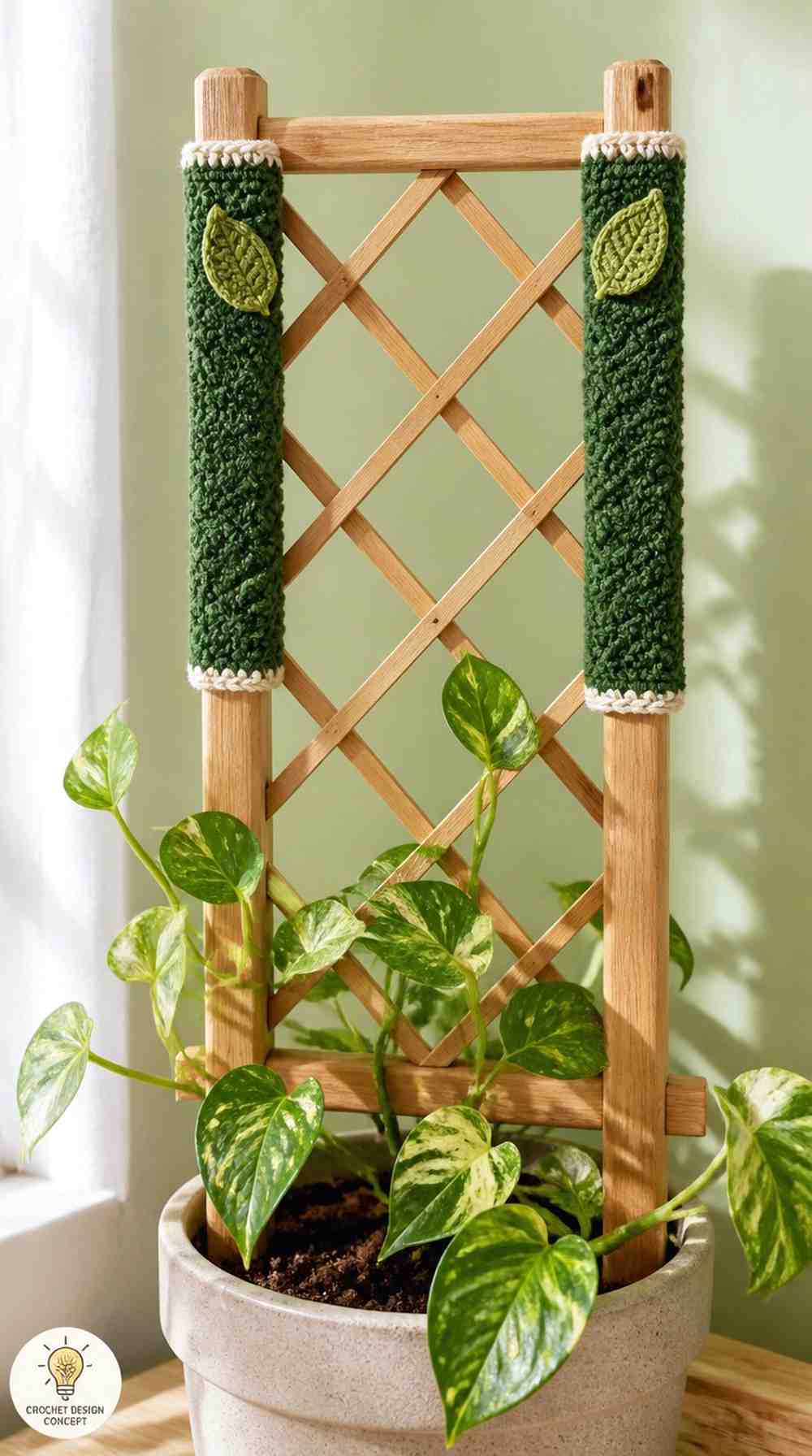
Forest-green crochet covers the upper portions of two outer wooden rails on a narrow lattice trellis. Subtle diagonal stitch relief adds texture, while cream borders finish the sleeves. A small flat olive crochet leaf decorates the upper end of each rail cover, and the central wooden lattice remains open.
The paired leaf details make this design feel botanical without creating a full fabric trellis. The two sleeves frame the growing space rather than occupying it. Their raised diagonal texture should remain compact so the crochet lies neatly against the wood.
- Two matching leaves: Attach each olive motif flat against its sleeve so no loose stem or leaf edge hangs into the growing space.
- Diagonal texture: Keep the raised stitch relief even to prevent one sleeve from stretching differently from the other.
- Central lattice: The uncovered wooden crosspieces remain the plant’s actual climbing support.
14. Crochet Blush Daisy-Trim Crescent Sleeve
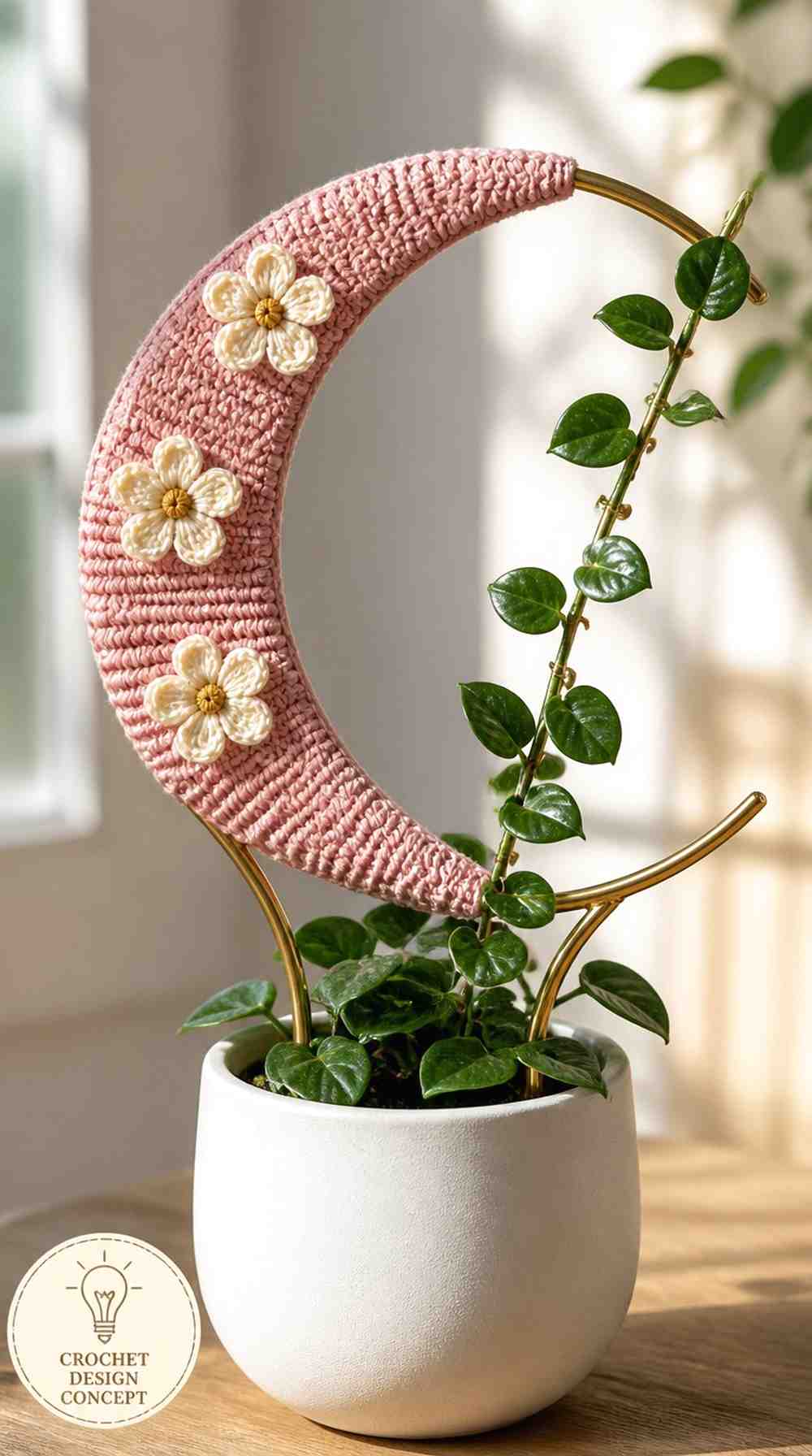
Blush-pink crochet follows the upper-left outer curve of a slim crescent-shaped brass trellis. Three small cream daisies decorate its outward-facing surface, each with five loop-built petals and a mustard center. The lower right curve and support legs remain uncovered beside a glossy-leaf hoya.
The asymmetrical placement gives the crescent a gentle decorative accent without hiding its graceful shape. The flat flowers add detail while staying close to the sleeve. A real version would need careful shaping around the curved metal and secure attachment of every petal.
- Three daisy accents: Space the cream flowers evenly enough that they remain distinct against the blush background.
- Flat flower construction: Keep petals and mustard centers firmly attached without dangling stems or loose decorative strands.
- Crescent balance: Decorating only the upper-left curve leaves the opposite side open for the hoya’s growth.
15. Crochet Mustard Chevron X-Trellis Wraps
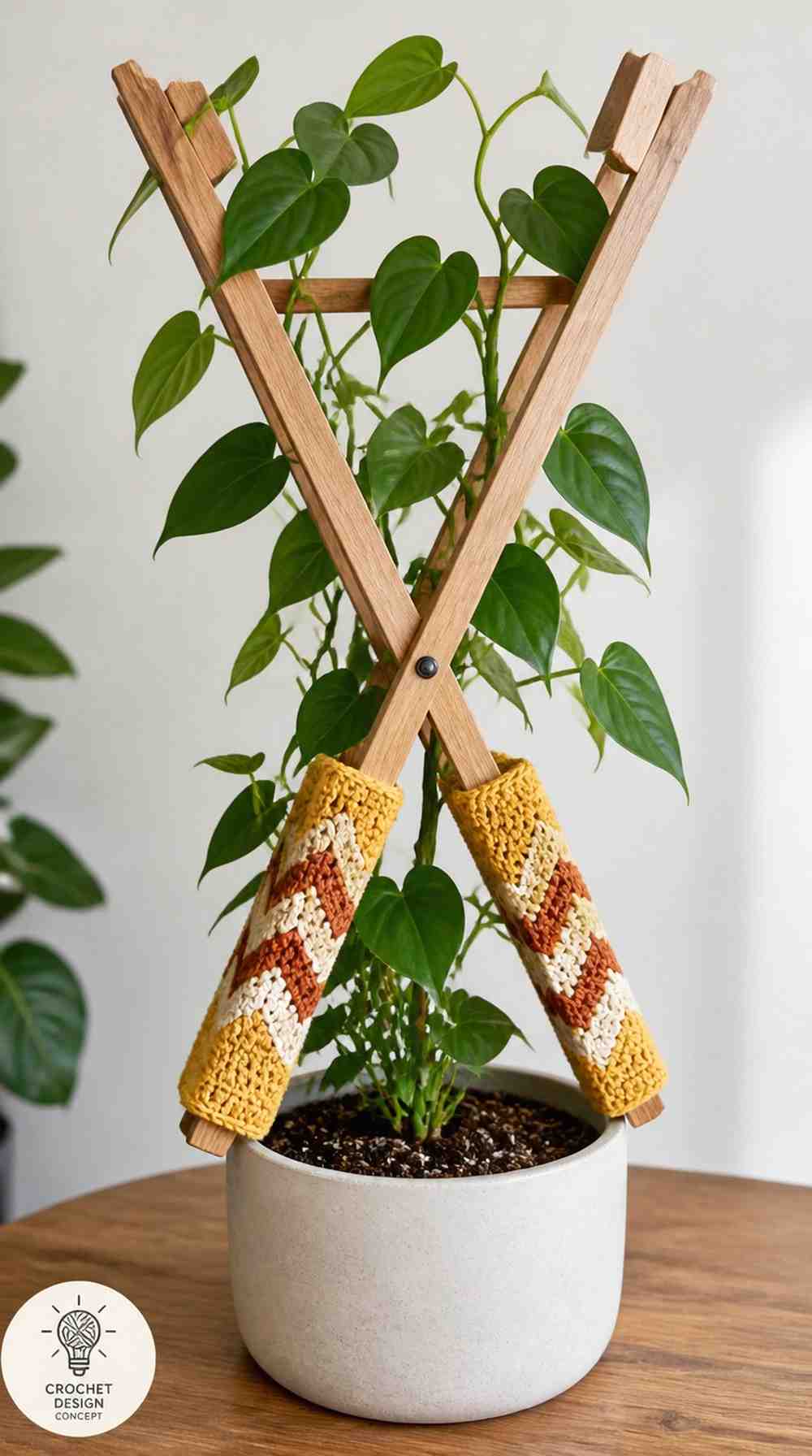
Mustard-yellow crochet forms two short decorative sleeves on the lower outer sections of an X-shaped wooden trellis. Rust and cream chevron colorwork creates repeating diagonal patterns across both pieces. The central wooden intersection and upper arms remain bare beside a heartleaf philodendron.
The chevron pattern adds more color variation than the solid sleeves in this collection. Because the two diagonal pieces are separate, the wooden X remains visually clear. Their placement below the crossing point avoids adding bulk around the trellis’s central joint.
- Chevron alignment: Keep the diagonal crochet pattern consistent on both mustard sleeves without forcing it into a printed-looking surface.
- Clear center joint: Leave the X intersection exposed so the existing wooden structure remains unchanged.
- Lower-arm placement: Start the sleeves above the potting mix and avoid trapping leaves or stems beneath the decorative fabric.
16. Crochet Charcoal Modular Trellis Rail Cuffs
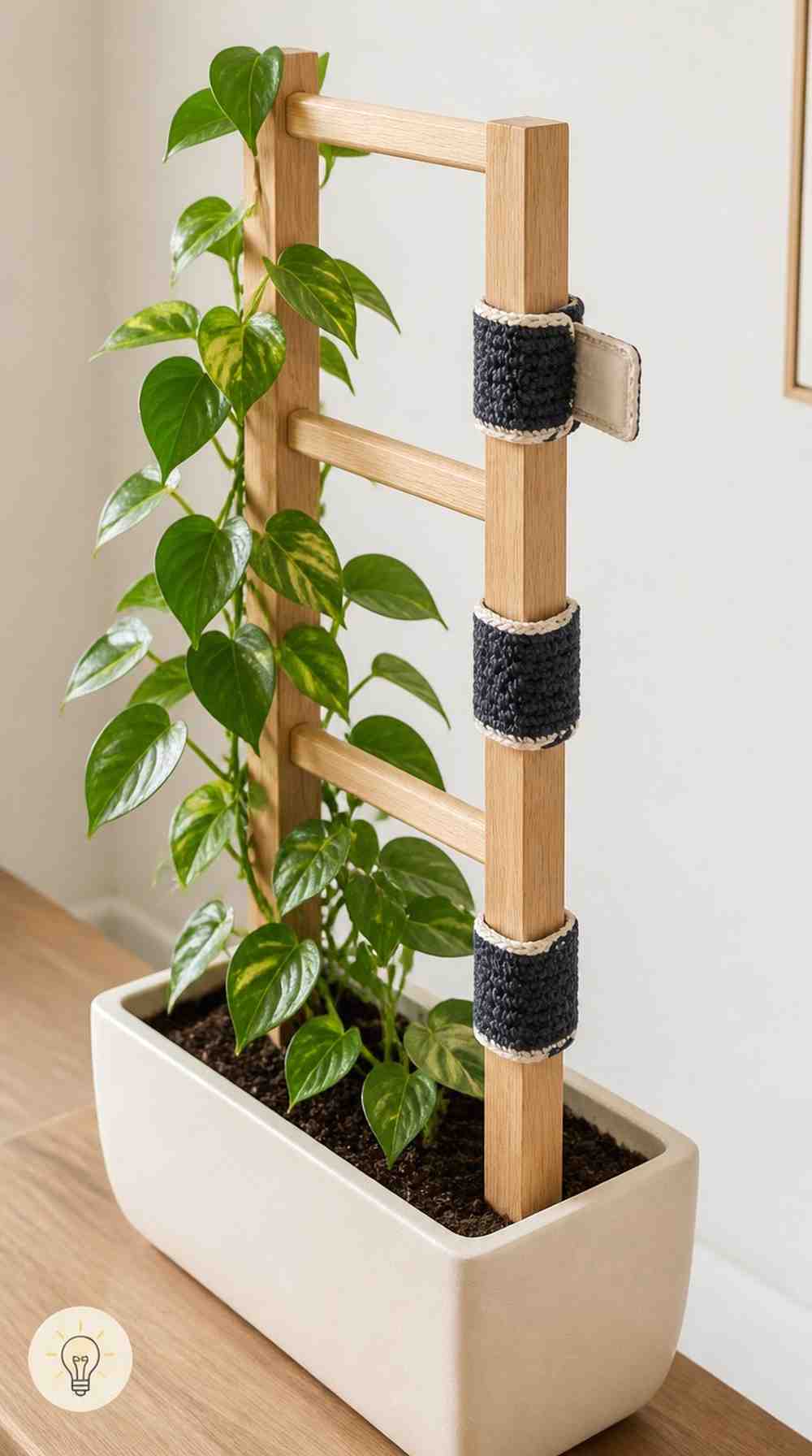
Charcoal-grey crochet creates three separate cuffs spaced along the upper half of one wooden trellis rail. Each has an ivory border and a concealed fabric fastening patch beneath a short overlapping tab. The top cuff is partly opened to reveal the removable construction, while the other two remain closed.
The modular arrangement allows the decorative sections to be handled independently. This could make it easier to replace or clean a single cuff without removing the entire trellis. The plant grows along the opposite uncovered side, keeping its stems away from the fastenings.
- Separate cuff positions: Space the three charcoal pieces so they do not overlap or restrict access to the trellis’s horizontal rungs.
- Fabric fastening: Use broad, properly secured fastening areas instead of small metal hardware that might rub against the wooden rail.
- Removable design: A cuff that opens along its side may be easier to remove than a tightly fitted tube.
17. Crochet Ivory Clover-Lobe Tip Sleeves
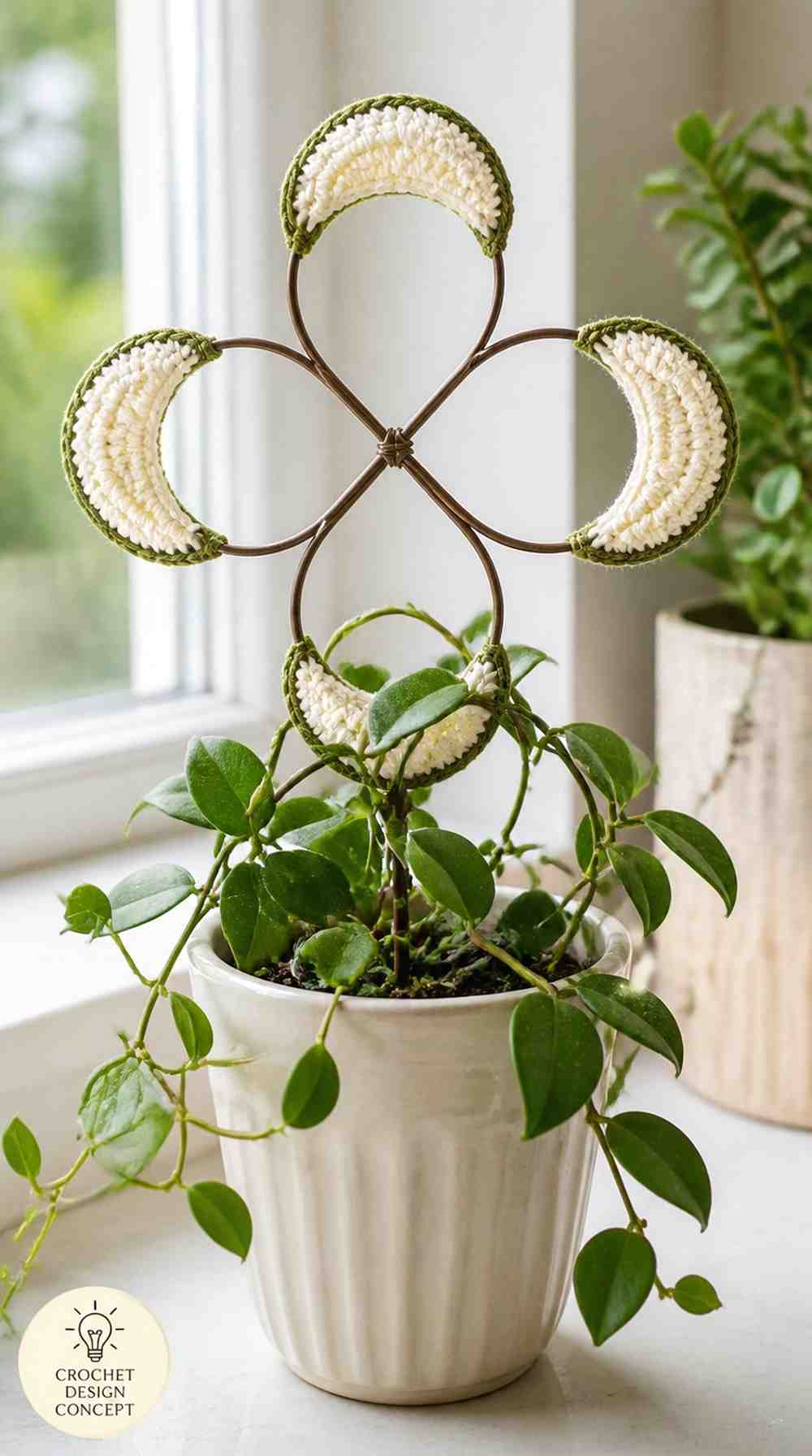
Warm-ivory crochet decorates the four rounded outer tips of a clover-shaped bronze wire trellis. Each short sleeve has a narrow olive-green border and closely connected stitch rows. The central junction and most of the curving metal outline remain uncovered, with a small hoya growing around one lower lobe.
The four repeated sleeve accents highlight the unusual trellis silhouette. Their rounded shaping differs from the straight rail covers and sharp corner cuffs elsewhere in the collection. The compact sections should follow the wire without narrowing the open spaces between lobes.
- Four rounded tips: Keep the sleeve shapes similar while fitting them to each individual curve.
- Olive borders: The narrow green edging adds contrast without covering the clover’s bronze outline.
- Open lobe spaces: Leave the inner curves clear so the hoya is not forced against decorative yarn.
18. Crochet Sea Glass Mesh Side-Panel Sleeve
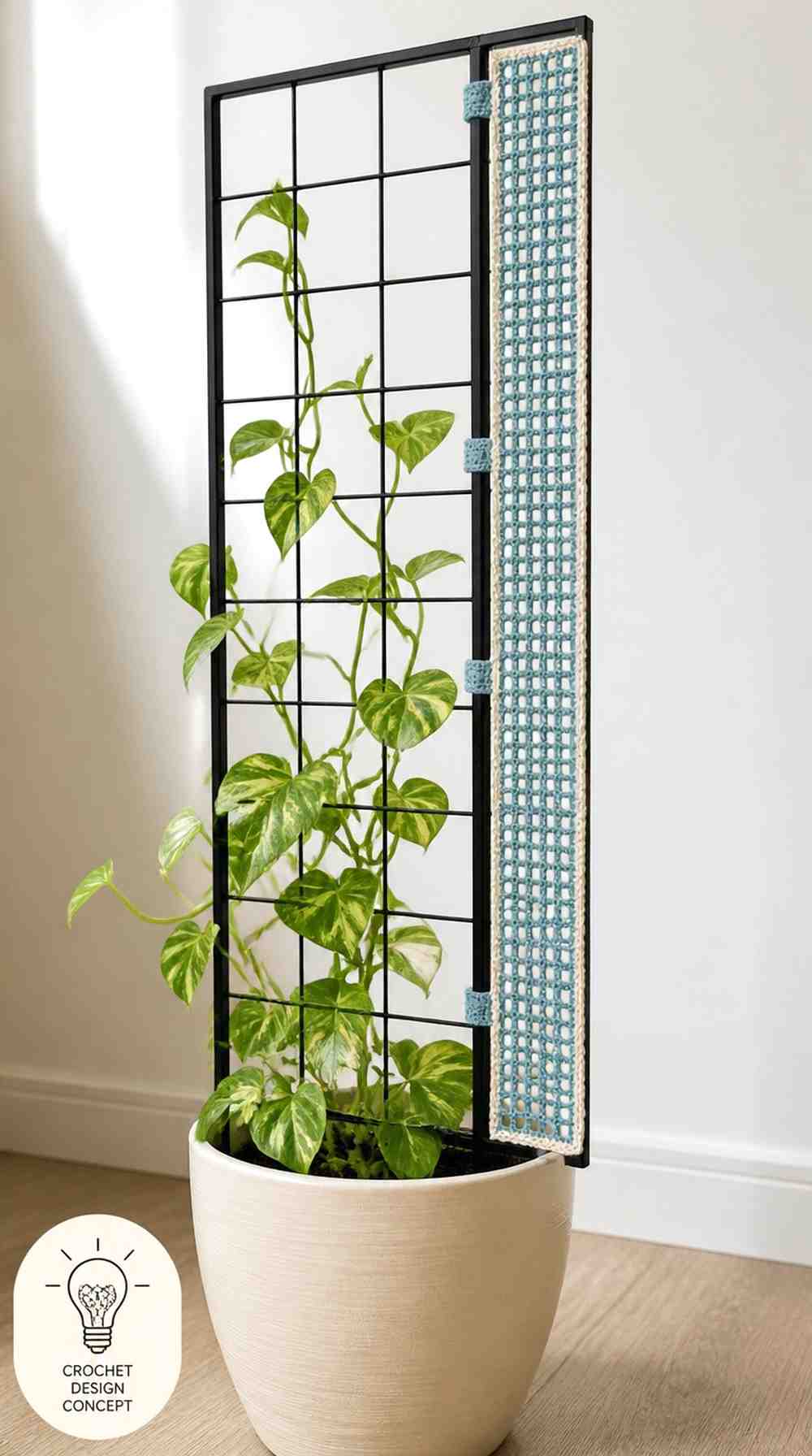
Sea-glass-blue crochet creates a narrow vertical mesh panel along the outside of a rectangular black metal trellis. Three short reinforced blue tabs connect it to the right outer rail, while solid cream edging frames the square openwork. The central metal grid remains uncovered beside a variegated pothos.
This design has a more open textile appearance than the fitted tubular sleeves. The mesh acts as a decorative strip rather than a substitute for the metal climbing framework. Its attachment tabs need to hold it close to the outer rail without extending across the plant’s growing area.
- Square-mesh consistency: Keep the connected crochet chains evenly spaced and bordered by firm cream edging.
- Three attachment tabs: Position the reinforced tabs along the outer rail so the decorative panel stays aligned.
- Nonstructural use: The metal grid provides the plant’s support; the sea-glass mesh should not be relied upon to carry stems or their weight.
Practical Guide to Crochet Indoor Plant Trellis Decorative Sleeves
A decorative crochet sleeve should complement an indoor plant’s support without changing the conditions the plant needs to grow.
Start with a suitable trellis. Choose a bamboo, wooden, or metal support that is already appropriate for the plant’s growth habit and securely positioned in the pot. Crochet fabric must not replace the rigid structure.
Measure the actual support. Check the diameter of bamboo stakes, the curve of metal arches, and the corners of geometric frames. Plan the sleeve around those measurements, allowing for crochet stretch and an opening that can be removed for cleaning.
Leave stems and growing points free. Do not wrap crochet tightly around living stems, developing leaves, aerial roots, or plant ties. Use appropriate soft plant ties on the uncovered support if the plant needs guidance, and check them as stems grow.
Avoid damp contact. Keep textile sleeves above the potting mix and away from areas that remain wet after watering. Cotton and other yarn fibers may retain moisture, so remove wet pieces and allow them to dry fully.
Choose simple, secure details. Compact borders and flat appliqués are generally easier to keep tidy than long fringe, loose cords, or bulky flowers. Small decorations should remain inaccessible to pets and young children.
Make maintenance straightforward. Removable sleeves help when cleaning trellises, pruning plants, or inspecting for pests. Follow the yarn’s care instructions and regularly check the sleeves for trapped debris, stretching, or damage.
For broader indoor plant-support guidance, see How and When to Use a Houseplant Trellis, which explains choosing stable supports and adjusting plant ties as growth continues.
For another way to combine crochet with indoor greenery, explore 19 Crochet Cottagecore Hanging Plant Holder Inspiration Ideas. That collection focuses on decorative pot holders rather than trellis sleeves, offering a complementary styling direction.
Want to Make Something Similar?
If you want to explore the crochet techniques behind these concepts, two established tutorials provide useful starting points.
The How to Crochet an I-Cord guide from Yarnspirations explains how to make narrow tubular crochet cord. Its general construction principles may help when experimenting with slim decorative edging and short tubular pieces.
For openwork details, Crochet Me Lovely shares a Photo Tutorial for the Trellis Stitch. It demonstrates a connected open crochet structure that may inspire decorative mesh treatments.
These resources teach general crochet techniques, not the exact 18 plant trellis sleeves pictured here. A real sleeve would need independent sizing, suitable joining methods, and checks to ensure it does not interfere with the plant or its support.
Comparison: Which Crochet Indoor Plant Trellis Sleeve Should You Choose?
The right design depends primarily on the shape of the support and how much of it you want to decorate.
| Design | Main decorative feature | Practical trade-off |
|---|---|---|
| Crochet Copper Ribbed Bamboo Trellis Sleeve | Raised ribs on one upright stake | Requires a good fit around bamboo |
| Crochet Cornflower Ladder Rung Sleeves | Three separate rung covers | Several individual pieces |
| Crochet Butter Yellow Scalloped Arch Crown Sleeve | Scallops along an arch crown | Curved shaping required |
| Crochet Plum Diamond-Corner Trellis Cuffs | Four decorative corner pieces | Precise joint fitting |
| Crochet Dusty Rose Buttoned Side-Rail Wrap | Removable buttoned rail cover | Buttons add bulk |
| Crochet Ivory Olive Hoop-Segment Sleeve | Partial circular coverage | Curved wooden support |
| Crochet Teal Fan-Spoke Trellis Sleeves | Repeated sleeves on fan spokes | Angled placement |
| Crochet Rust Segmented Spiral Trellis Sleeves | Three separated curved sections | Spiral shaping |
| Crochet Oatmeal Three-Tier Obelisk Collars | Three ring-level accents | Multiple curved fittings |
| Crochet Charcoal Modular Trellis Rail Cuffs | Three removable fastened cuffs | Extra attachment points |
| Crochet Sea Glass Mesh Side-Panel Sleeve | Narrow openwork decorative panel | Must remain nonstructural |
For a straightforward support, the Crochet Copper Ribbed Bamboo Trellis Sleeve offers one of the simplest visual concepts. The Crochet Dusty Rose Buttoned Side-Rail Wrap is worth considering when a removable side-opening design is preferred.
If your plant uses a rounded trellis, the Crochet Ivory Olive Hoop-Segment Sleeve, Crochet Butter Yellow Scalloped Arch Crown Sleeve, or Crochet Lavender Teardrop Apex Sleeve highlights the upper shape without covering the complete frame.
For geometric supports, the Crochet Plum Diamond-Corner Trellis Cuffs, Crochet Coral Windowpane Trellis Corner Caps, and Crochet Mustard Chevron X-Trellis Wraps provide distinct ways to decorate joints and angled rails.
If you prefer a more botanical finish, the Crochet Forest Green Twin-Rail Lattice Sleeves and Crochet Blush Daisy-Trim Crescent Sleeve add small, flat crochet motifs without long hanging decorations.
For more unusual trellis shapes, the Crochet Ivory Clover-Lobe Tip Sleeves and Crochet Oatmeal Three-Tier Obelisk Collars demonstrate how repeated short covers can emphasize an existing frame.
The best choice is one that preserves the trellis’s stability, keeps living growth unobstructed, and can be removed whenever the plant needs care.
Conclusion
Crochet indoor plant trellis decorative sleeves offer an appealing way to add handmade personality to houseplant displays. A simple ribbed cover can brighten a bamboo stake, while scalloped arch sleeves, geometric corner cuffs, and botanical appliqués can highlight the character of more decorative supports.
These 18 concepts show that small sections of crochet may be enough to create an interesting visual effect. There is no need to cover the entire trellis or interfere with the plant’s natural growing space. Choose a design that matches the support, stays clear of living stems, and can be removed easily for maintenance.
Which design would you choose for your indoor plants: the cornflower ladder sleeves, the butter-yellow scalloped arch, or the blush daisy-trim crescent? Share your favorite and whether you currently use bamboo stakes, circular hoops, or metal trellises.
Frequently Asked Questions
1. Can crochet sleeves be added to an existing indoor plant trellis?
Potentially, provided the decorative sleeve does not compromise the trellis’s stability, contact living stems, block the plant’s growing space, or retain moisture where it could cause problems. Removable covers placed on unused support sections are a more practical concept than tightly wrapping an occupied climbing area. The pictured designs have not been physically tested.
2. What yarn should I consider for crochet plant trellis sleeves?
Smooth cotton yarn or a suitable cotton blend may be useful for producing defined stitches and compact decorative shapes. However, cotton can absorb moisture, so yarn should be kept away from continually damp soil or frequently wetted areas. Choose materials according to the intended location, the support’s surface, and the yarn manufacturer’s care instructions.
3. Can climbing plants grow directly through crochet mesh?
Crochet mesh should not automatically be treated as a safe climbing support. Stems and aerial roots may catch in the openings, and the fabric can stretch or retain moisture. Use a suitable rigid trellis as the primary support and keep decorative mesh separate from the growing areas. Follow plant-specific guidance when training stems.
4. Will a crochet sleeve damage a bamboo or metal trellis?
An unsuitable sleeve may retain moisture, create friction, or trap debris against the support. This can be a concern with natural bamboo and some metal finishes. Keep the crochet dry, avoid tight seams that scrape coatings, and remove the sleeve regularly to inspect the underlying support.
5. Are these 18 crochet indoor plant trellis decorative sleeve ideas actual patterns?
No. These are original crochet design visualizations intended to inspire colors, sleeve shapes, edge finishes, decorative motifs, and different placements on existing supports. They are not tested handmade pieces or complete crochet patterns. Anyone making a similar cover should measure the actual trellis, choose suitable materials, and check its effect on plant care before using it regularly.