Packing a yogurt cup alongside sandwiches, fruit containers and snacks can make a small lunch bag feel crowded. A removable crochet divider offers one way to organize the available space and give a sealed yogurt cup its own section. These 17 crochet yogurt cup lunch bag divider inspiration ideas explore narrow partition walls, curved cup compartments, adjustable panels, granny-square dividers, fold-flat corners and organizers with removable inserts.
The designs focus on keeping containers separated inside an existing lunch bag, rather than replacing a proper food-storage container or insulated carrier. Some concepts reserve one corner for yogurt, while others divide the whole bag into several compartments or make room for cold packs. Comparing the different shapes, materials and fastening details can help you decide which style might fit your lunch bag and the sealed yogurt cups you usually pack.
These are AI-generated crochet design visualizations for inspiration, not photographs of tested handmade products or complete patterns. Their strength, fit, cleanability and ability to keep containers upright have not been tested.
Food safety reminder: Crochet dividers organize space; they do not refrigerate yogurt or prevent leaks. Keep yogurt properly sealed and chilled in an insulated lunch bag with suitable cold sources. The USDA recommends at least two cold sources for perishable packed lunches. <Link url=”https://usda.azureedge.us/about-usda/news/blog/2025/08/19/get-lunchbox-back-school-food-safety” title=”USDA packed-lunch food safety guidance”/>.
Quick Design Selection Guide
- For a basic one-cup separator: Crochet Terracotta Center-Wall Yogurt Divider and Crochet Cocoa High-Rib Yogurt Divider offer straightforward upright panels.
- For two yogurt cups: Crochet Indigo Twin-Cup Pocket Divider gives each sealed cup a separate curved compartment.
- For organizing multiple lunch items: Crochet Butter Yellow Accordion Lunch Divider, Crochet Lavender T-Shaped Lunch Divider and Crochet Burgundy Cross-Grid Lunch Divider explore several compartments.
- For small bags: Crochet Slate Fold-Flat Corner Divider and Crochet Olive Offset Corner Yogurt Divider reserve a corner rather than dividing the entire interior.
- For decorative crochet: Crochet Raspberry Granny-Tile Yogurt Divider and Crochet Aqua Mesh-Window Lunch Divider highlight interesting stitch patterns.
- For removable or adjustable construction: Crochet Coral Button-Tab Adjustable Divider, Crochet Teal Lift-Tab Yogurt Divider and Crochet Mustard Removable-Panel Sleeve Divider offer different handling details.
1. Crochet Terracotta Center-Wall Yogurt Divider
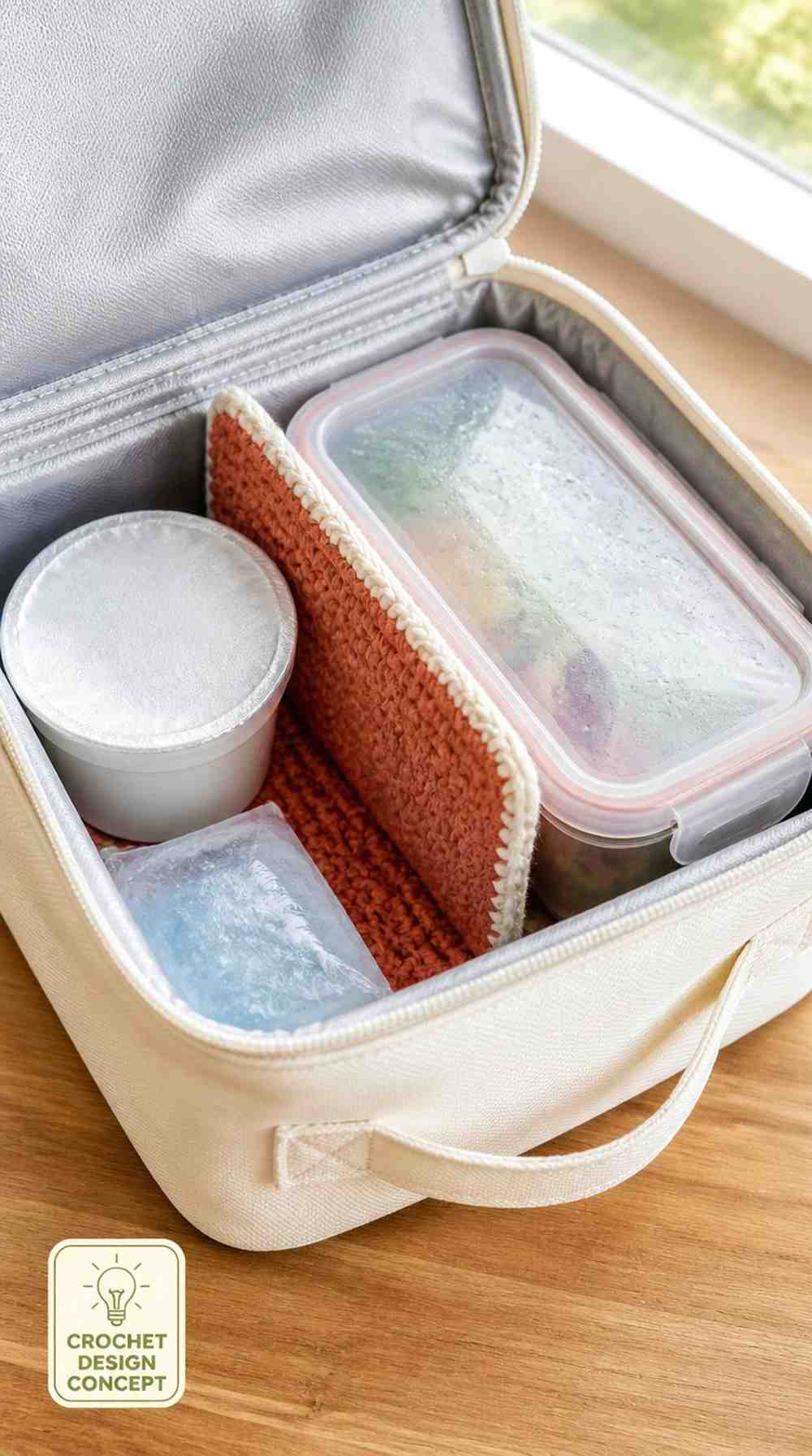
Warm terracotta crochet forms a neat upright partition inside the lunch bag, with closely worked horizontal rows and a slim ivory border. A flat crochet base extends beneath the wall, giving the design a clear dividing line between the sealed yogurt cup and the neighboring lunch container.
This concept is a simple starting point for organizing a compact lunch. Its narrow profile uses relatively little interior space, although a handmade version would need enough support to resist folding when containers press against it.
- Straight partition: A simple rectangular wall is easier to plan around a lunch bag with a flat base than one with heavily rounded interior corners.
- Base connection: A broad, flat crochet foot may help position the partition, but soft yarn alone cannot guarantee that it will stand upright.
- Cup clearance: Leave enough room around the sealed yogurt container for removal without scraping its lid against the divider edge.
2. Crochet Indigo Twin-Cup Pocket Divider
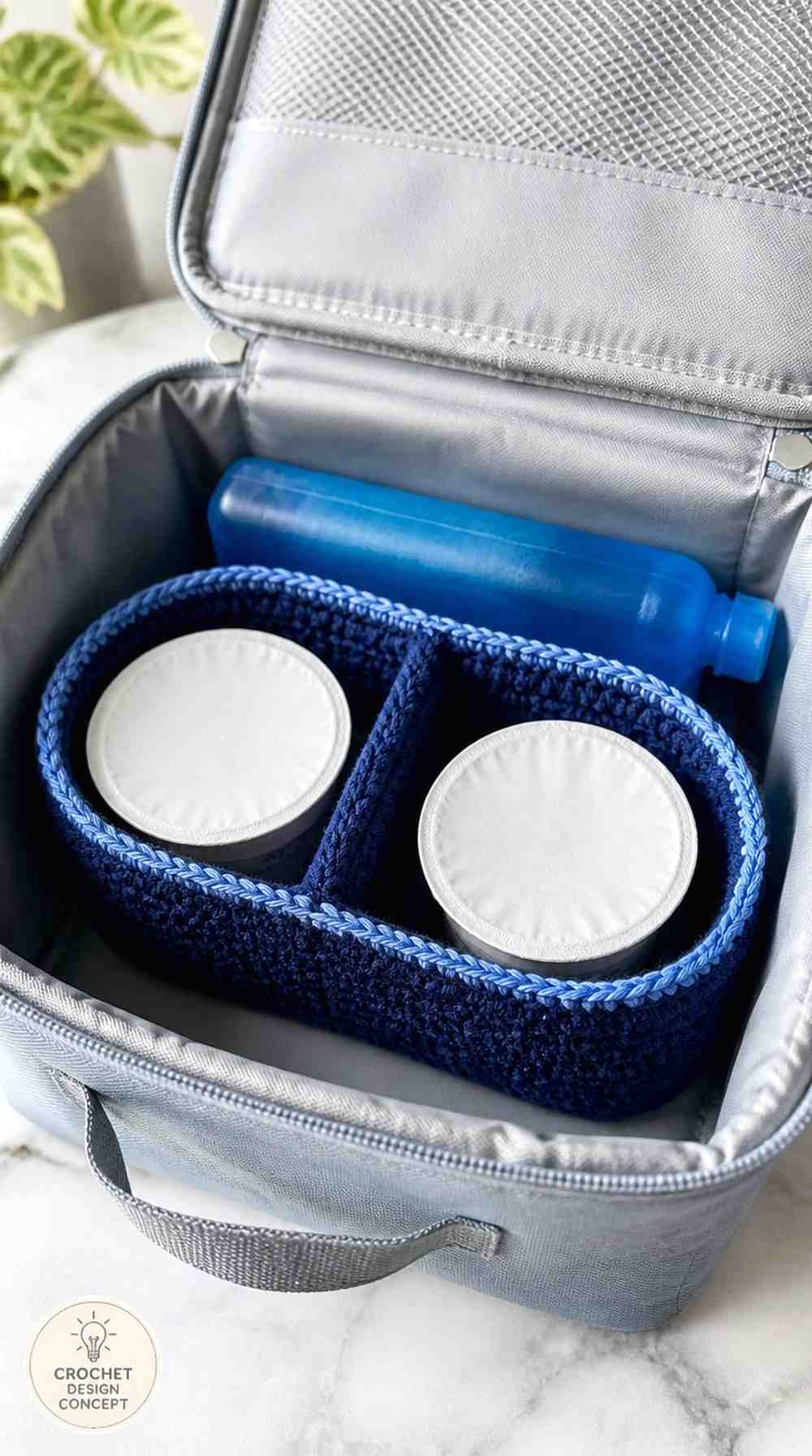
Deep-indigo crochet creates two adjacent semicircular compartments, each holding a sealed yogurt cup. Pale-blue edging outlines the curved openings, while a straight central wall separates the cups. The connected base gives the two compartments the appearance of a compact removable insert.
This design is particularly interesting when a lunch bag needs to accommodate two small yogurt containers. Curved crochet walls look more tailored to the cups, but the actual fit would depend on the containers’ diameters and the firmness of the crocheted structure.
- Two-cup sizing: Measure both sealed cups, including any wider rim or lid, rather than relying only on the narrower container bodies.
- Curved wall shaping: Evenly worked increases and stable joins are important for maintaining two recognizable semicircular compartments.
- Removal space: Keep the divider walls low enough that each yogurt cup can be lifted out without tugging its sealed lid.
3. Crochet Butter Yellow Accordion Lunch Divider
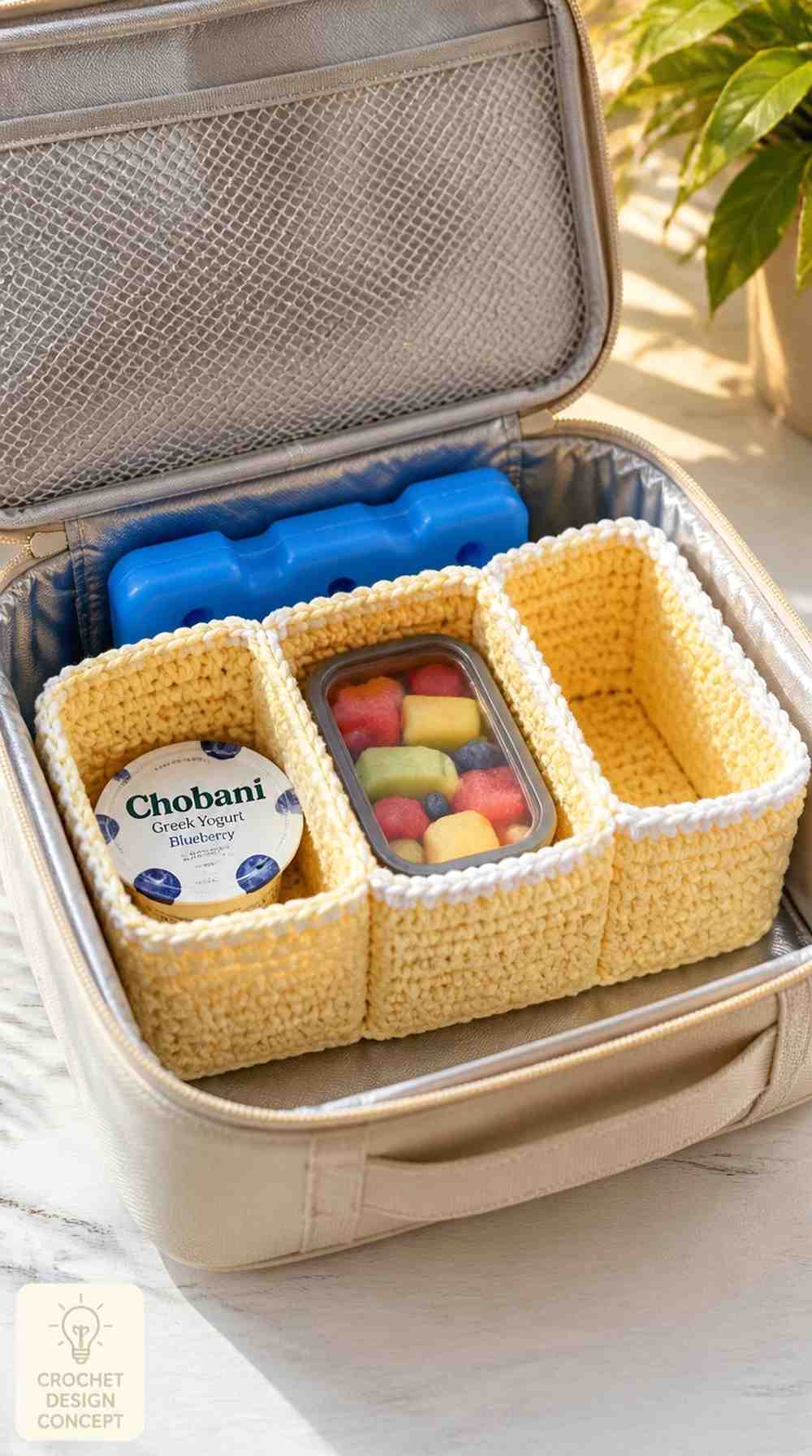
Butter-yellow crochet forms a small accordion-shaped organizer with three upright sections connected at vertical folds. White trim outlines the folding edges, giving the structure a clear geometric appearance. One compartment holds a sealed yogurt cup, another contains a closed fruit box and the third remains open.
The accordion design introduces flexibility into a small lunch-bag organizer. Unlike fixed rectangular compartments, the folded sections suggest a layout that could compress slightly when not in use, although the actual fabric would need careful shaping to preserve those folds.
- Fold construction: Well-defined vertical fold seams help the three panels move together without creating large lumps of crochet at their joins.
- Compartment proportions: Reserve enough width for the yogurt cup first, then allocate the remaining space to smaller snack containers.
- Storage when empty: A foldable insert may take up less space outside the lunch bag, provided any stiffening materials allow the panels to bend.
4. Crochet Peach Curved-Cradle Lunch Divider
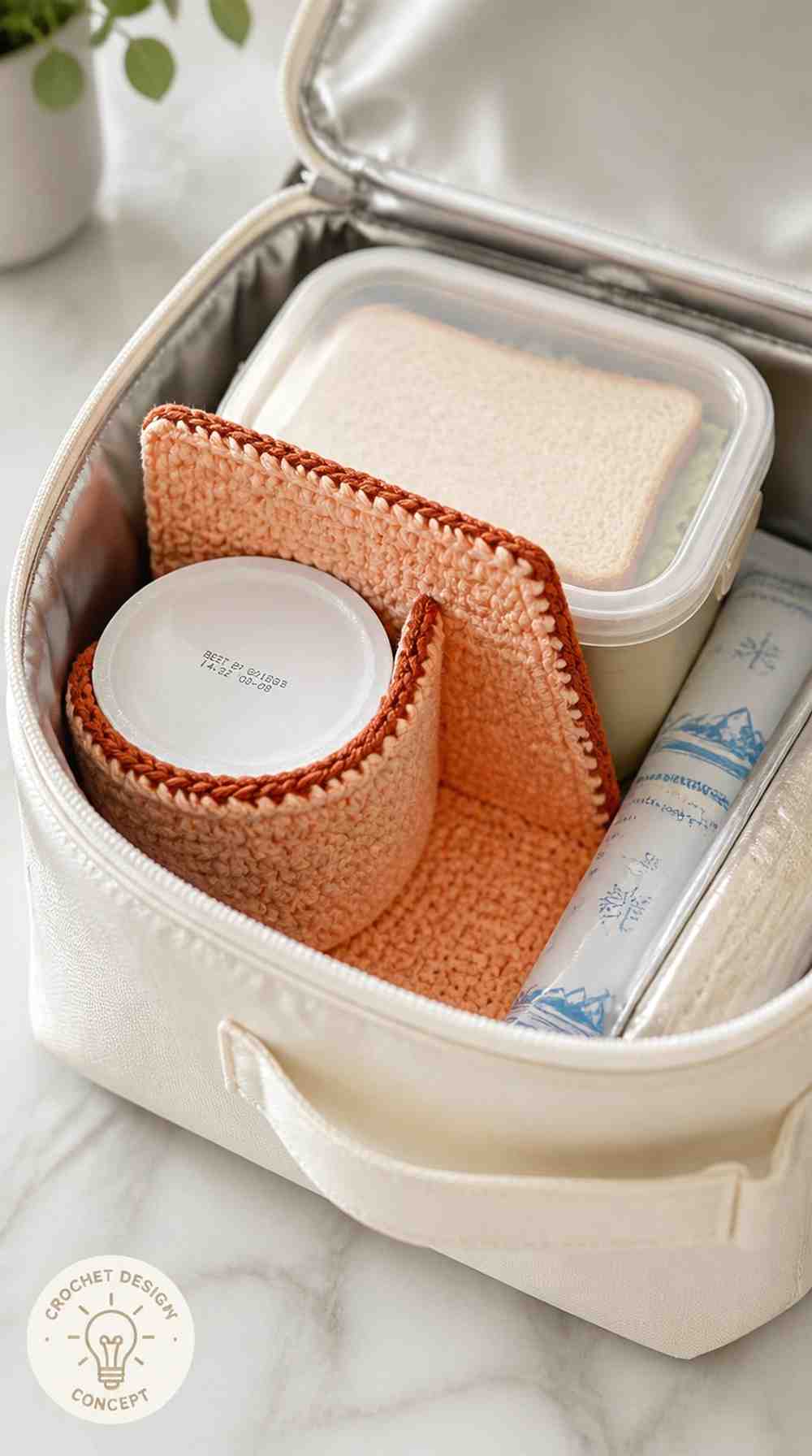
Soft peach crochet gives this divider a gentle appearance, while a rust-colored border highlights its curved shape. A semicircular crochet section extends from the straight central wall and surrounds approximately half of the yogurt cup’s lower side. The remaining side of the cup stays open.
This concept combines a normal compartment divider with a partial cup cradle. It aims to give the yogurt container a more defined position without enclosing it completely. The curved section would need accurate shaping and secure joining to avoid collapsing against the cup.
- Partial cradle shape: A half-circle can define a cup position while leaving the uncovered side accessible for lifting the container out.
- Lower-side contact: Keep the curved panel below the yogurt lid so it does not press against the sealed rim.
- Structural support: The cradle and straight partition should connect to a stable base; decorative crochet tension alone may not keep the curve in place.
5. Crochet Lavender T-Shaped Lunch Divider
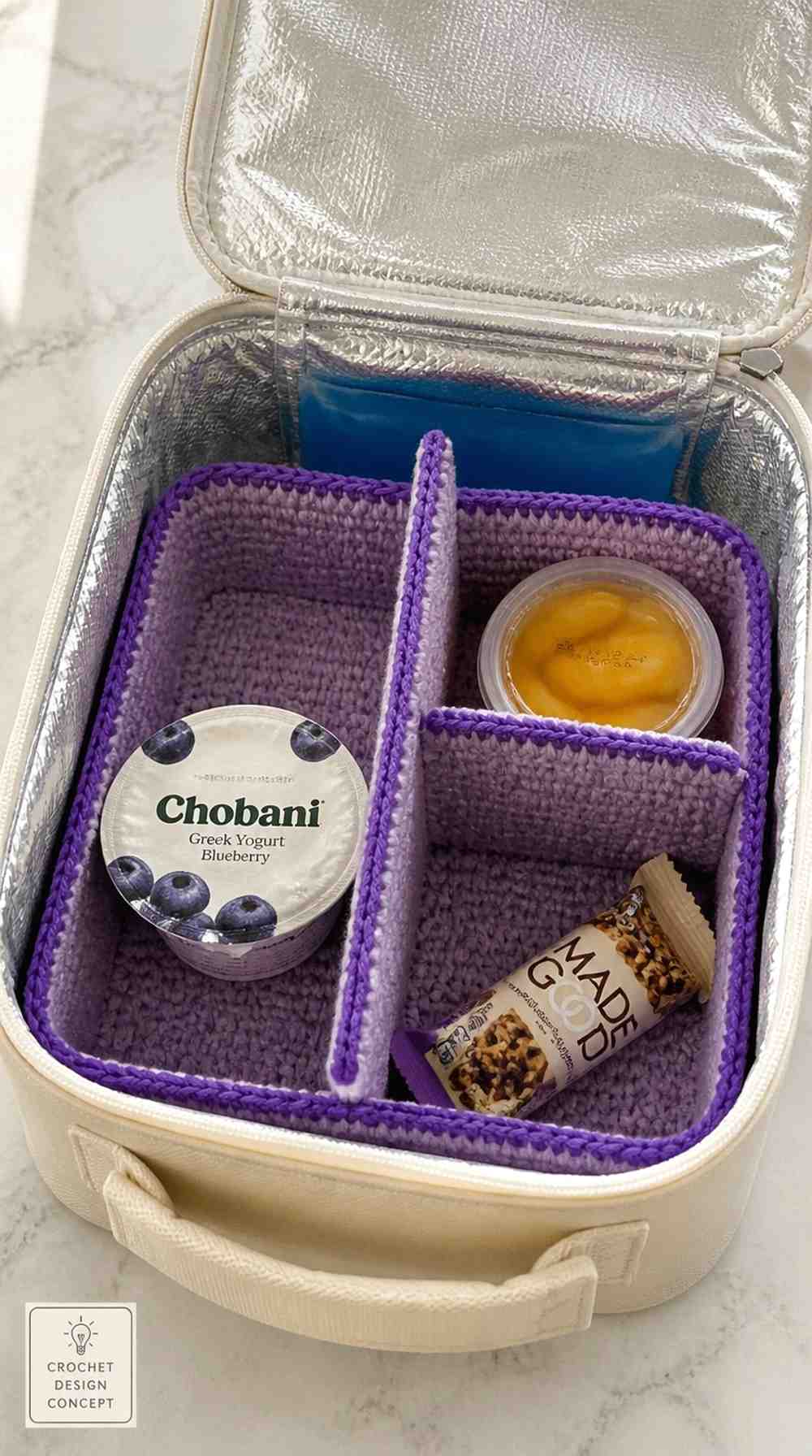
Muted-lavender crochet creates a T-shaped arrangement inside the open lunch bag. One long wall connects to a shorter perpendicular panel, forming a larger section for the yogurt cup and two smaller spaces for a fruit pot and wrapped snack.
The T layout is useful to consider when a lunch bag carries several differently sized containers. It divides the available space without requiring a separate pocket for every item. The joining point between the walls is the most important structural feature of the design.
- Perpendicular connection: The short cross-panel needs a neat, secure join to the main wall so the T shape does not twist when containers are inserted.
- Unequal compartments: A larger yogurt section with smaller snack spaces may use the bag’s available floor area more efficiently than equal-width divisions.
- Bag compatibility: Check the interior base rather than the exterior bag dimensions, since insulated walls and seams reduce usable space.
6. Crochet Raspberry Granny-Tile Yogurt Divider
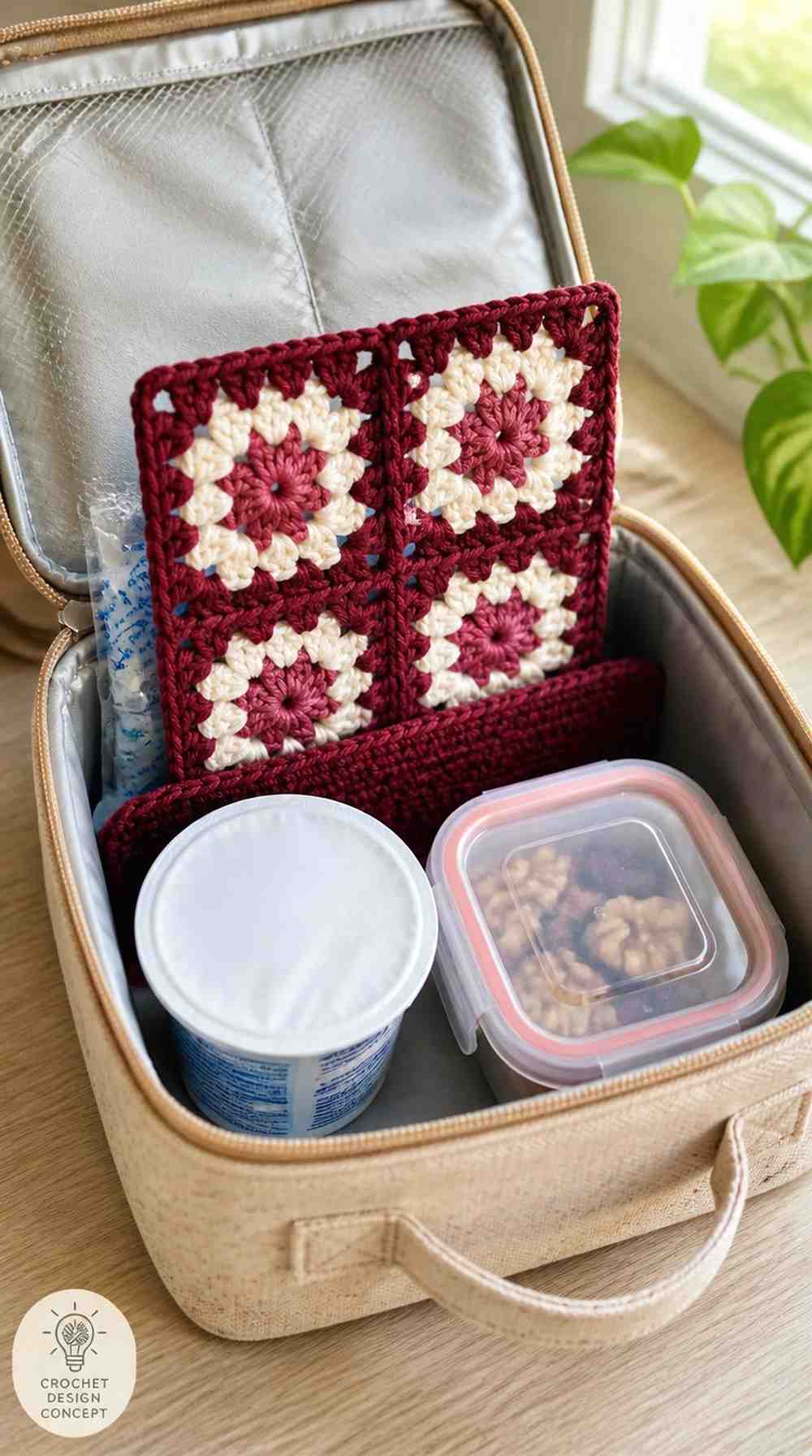
Four small granny squares form the upright panel of this raspberry-colored crochet divider. Each square combines a raspberry center, an ivory middle round and a burgundy outer border. A solid burgundy support strip connects the joined squares to the flat base.
The miniature granny tiles create a decorative surface between the sealed yogurt cup and another food container. Their open corner spaces make the divider visually lighter, but they also mean the crochet cannot act as a barrier against spilled yogurt or other liquids.
- Four-square arrangement: Joining the motifs in a two-by-two layout creates a compact rectangular panel while keeping the individual square pattern easy to recognize.
- Flat joining seams: Bulky granny-square joins could make a narrow lunch bag feel crowded, so a flatter connecting method is worth considering.
- Openwork limitation: The granny-square openings allow moisture and small particles through; only sealed, intact food containers should rest beside the textile.
For another approach to crocheted partition shapes, see 16 Crochet Canned Food Shelf Divider Inspiration Ideas. Those designs concern pantry storage rather than chilled lunch packing, but they offer related visual ideas for divider panels and removable sections.
7. Crochet Aqua Mesh-Window Lunch Divider
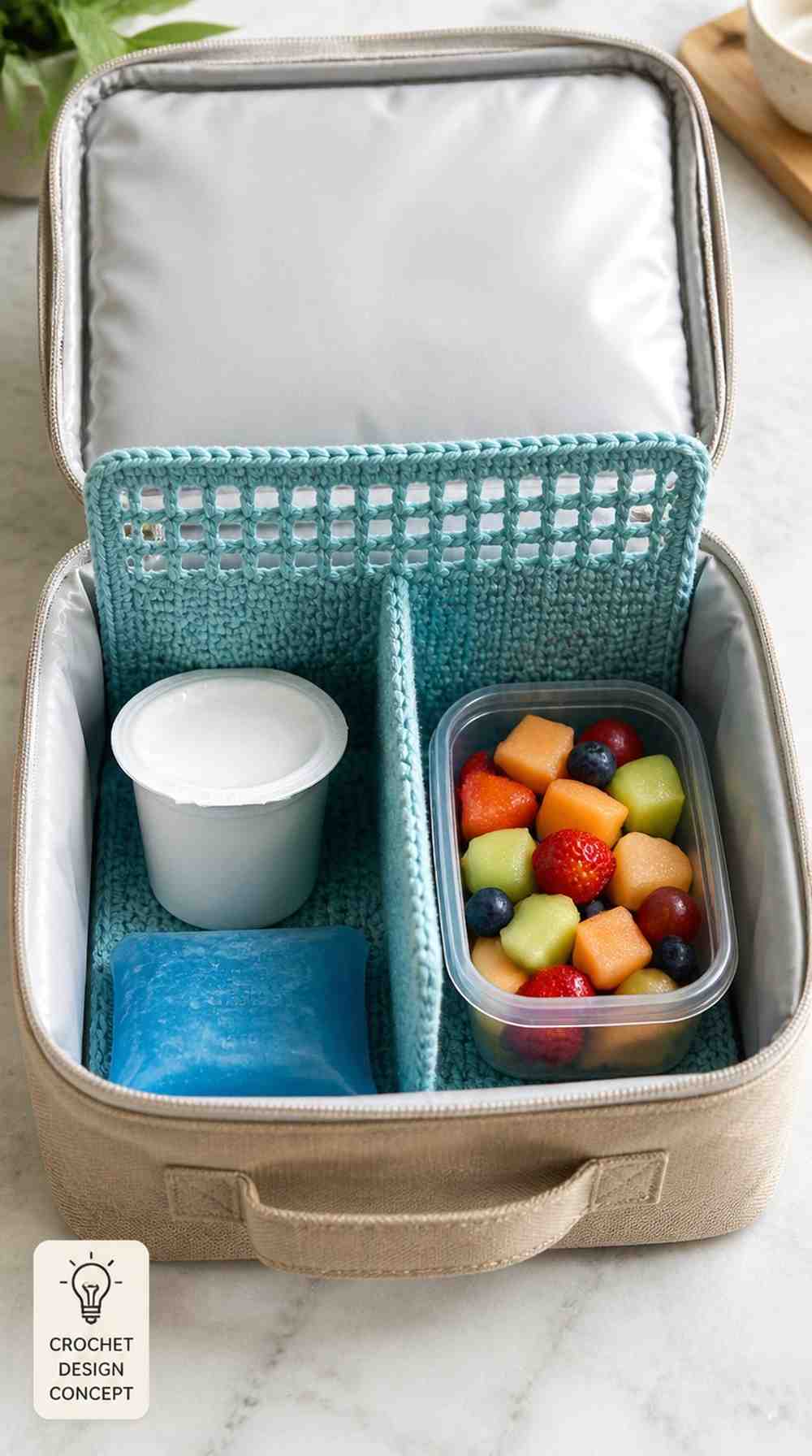
Aqua-blue crochet creates a lightweight-looking divider with a dense lower half and a square-mesh upper section. The mesh openings sit inside a closely worked border, while the flat base supports the upright panel between a sealed yogurt cup and a closed fruit container.
This design creates a visible separation without making the partition look heavy. The combination of solid and open stitches is attractive, although the mesh section may stretch or deform if a container presses firmly against it.
- Solid lower section: The denser crochet beneath the mesh gives the partition a more substantial contact area beside the lower part of the yogurt cup.
- Mesh consistency: Evenly spaced square openings and secure edge connections help prevent the upper panel from becoming uneven or misshapen.
- Cleaning trade-off: Open loops can catch food crumbs or packaging corners, so inspect and clean the divider after use.
8. Crochet Cocoa High-Rib Yogurt Divider
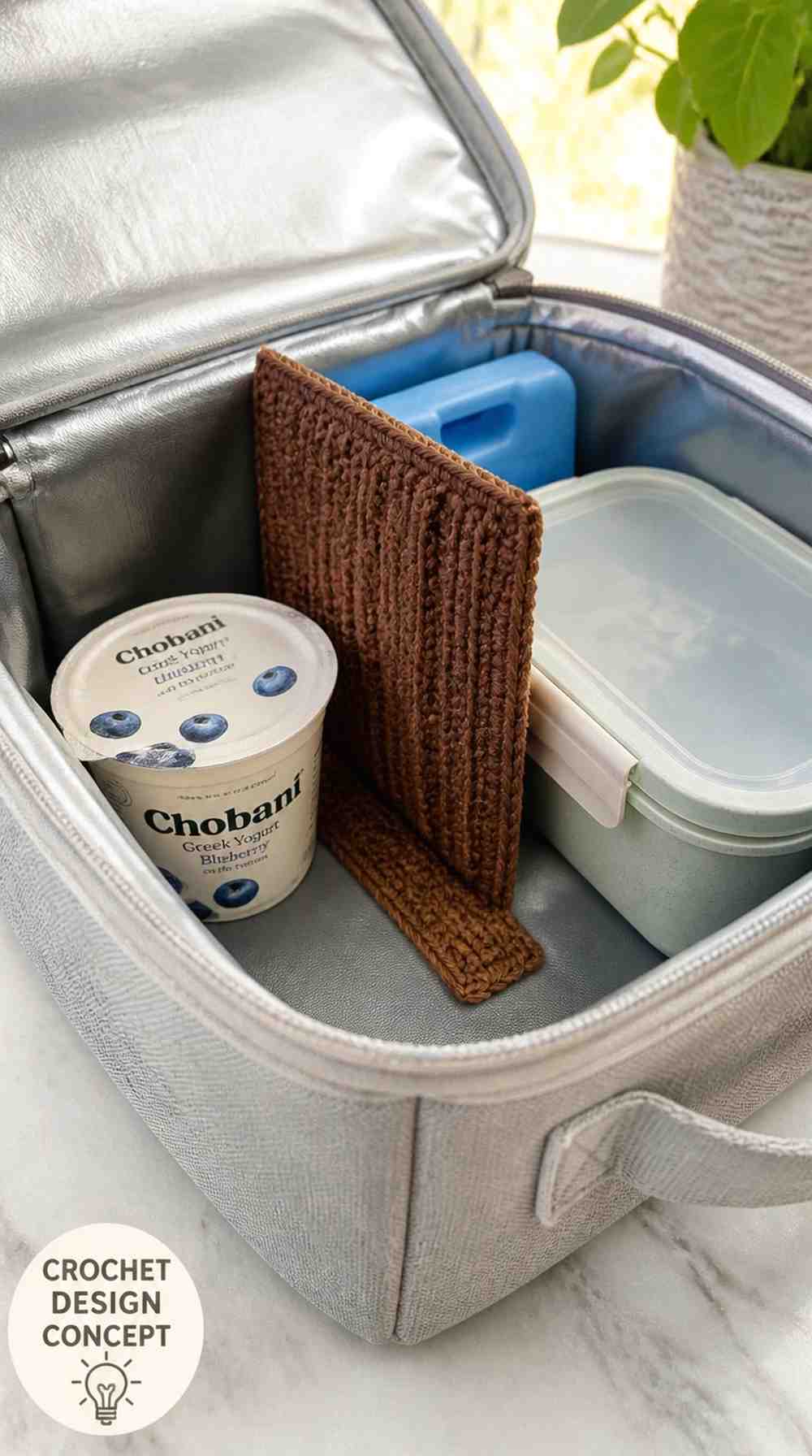
Rich cocoa-brown yarn gives this tall, narrow partition a substantial appearance. Vertical raised crochet ribs run up the main panel, while a dark-caramel border finishes the top. The divider extends slightly above the sealed yogurt cup without reaching the lunch bag’s zipper line.
The extra height distinguishes this concept from low compartment inserts. It could provide a clearer visual boundary between the yogurt cup and neighboring containers, though ribbed crochet must still be supported to prevent bending.
- Height clearance: Check the closed lunch bag’s usable interior height so the divider does not obstruct the zipper or press against the top lining.
- Raised rib texture: Crochet post stitches can create visible vertical relief, but thick ribs may reduce the available width inside a small bag.
- Broad lower support: The flat base needs enough area to keep the taller panel positioned when the bag is opened or packed.
9. Crochet Coral Button-Tab Adjustable Divider
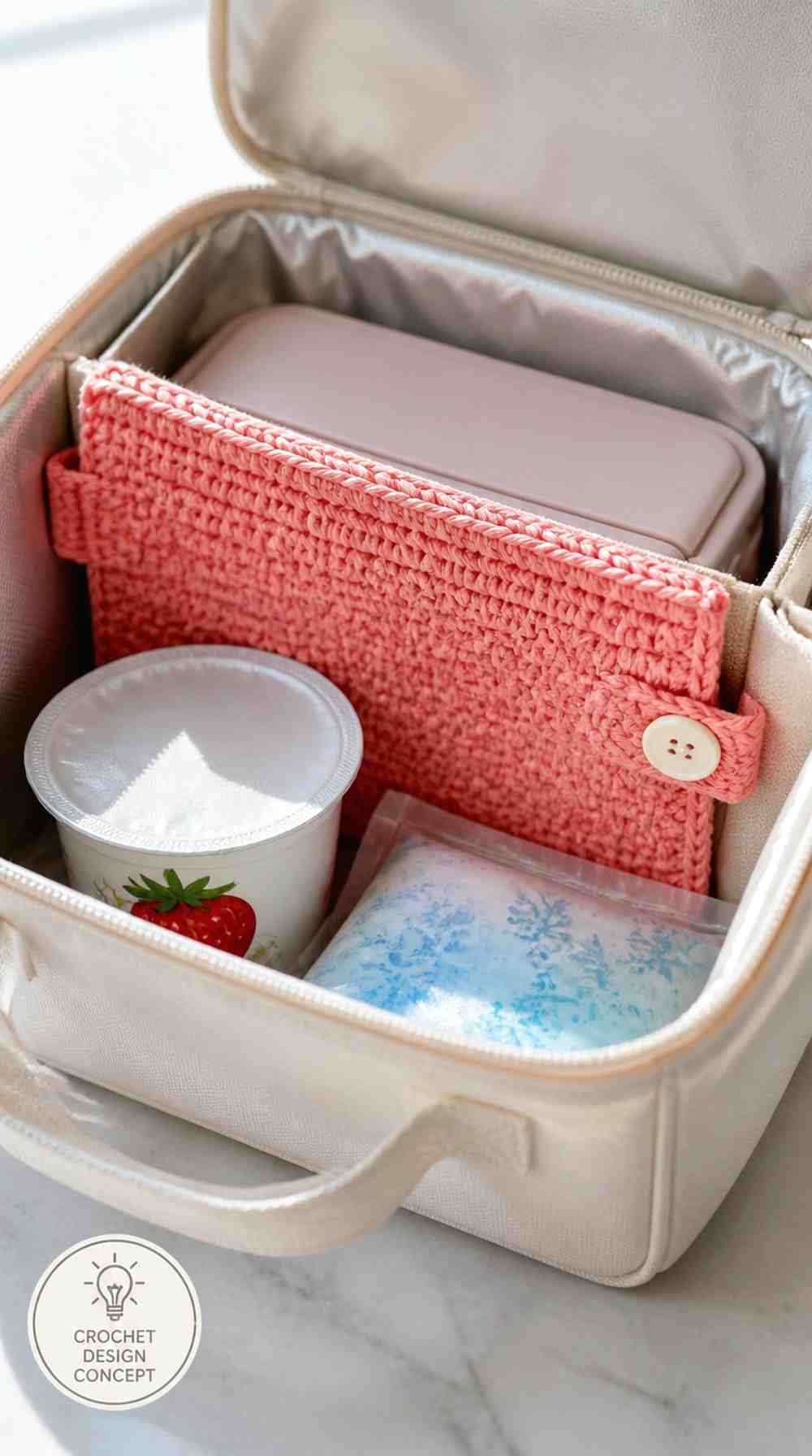
Coral-pink crochet creates a removable upright partition with two short fastening tabs at the sides. Flat ivory buttons secure the tabs around a separate fabric organizer insert, while a reinforced top border gives the wall a neatly finished appearance.
The adjustable-tab detail is the central feature of this design. It suggests a way to reposition a divider without sewing directly into an insulated lunch bag. The separate organizer insert is important because piercing or modifying the bag’s lining could damage its existing construction.
- Buttonhole positions: Multiple reinforced holes may allow small adjustments, but the usable range depends on the dimensions of the separate organizer insert.
- No lining damage: Fasten the tabs around a removable insert instead of puncturing the insulated bag or interfering with its moisture-resistant lining.
- Hardware inspection: Small buttons must remain firmly attached and should be checked before use, especially when lunch bags are handled by children.
10. Crochet Slate Fold-Flat Corner Divider
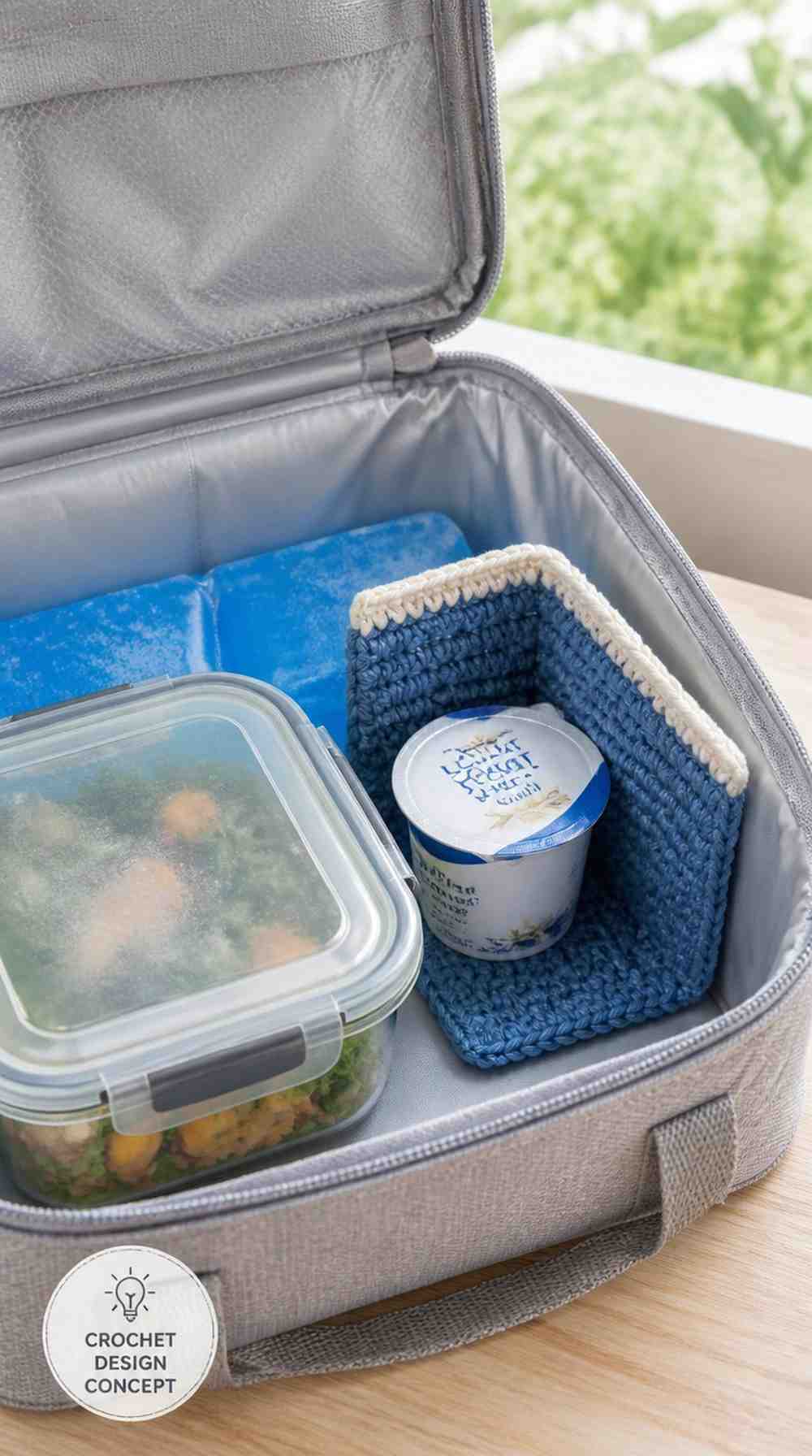
Slate-blue crochet forms an L-shaped corner compartment using two flat rectangular panels joined along a soft vertical fold. Narrow ivory edging highlights their upper borders, while short base extensions rest against the lunch bag’s interior floor.
The design reserves one corner for the sealed yogurt cup and leaves the rest of the bag available for a larger lunch container. Its folding construction may be useful for removable storage, though soft crochet panels need sufficient support to remain at a right angle.
- Corner positioning: Place the L-shaped divider where the yogurt cup fits without blocking access to the larger remaining compartment.
- Flexible joining line: A softer crochet seam can allow the panels to fold flatter when the insert is removed from the bag.
- Stability check: The divider may shift when the lunch bag is carried; use it to organize containers, not as a guarantee against tipping.
11. Crochet Teal Lift-Tab Yogurt Divider
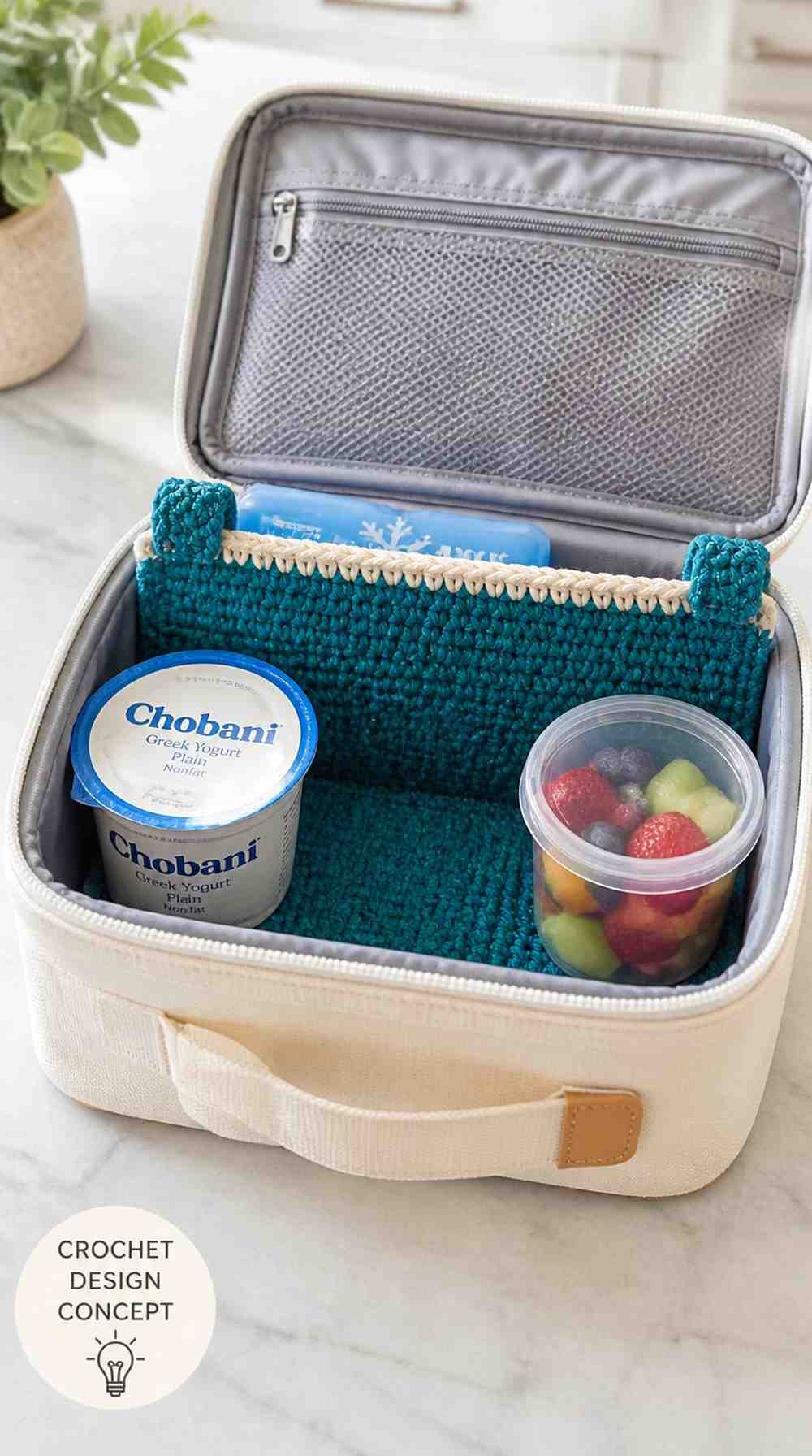
Deep-teal crochet creates a straight removable partition with two small folded pull tabs at its upper corners. A narrow ivory border defines the top edge, and the broad flat base supports the central wall between the yogurt and fruit containers.
The pull tabs are the most distinctive feature. They provide obvious places to grasp the empty divider when cleaning or rearranging the lunch bag, without requiring buttons or an elaborate fastening system.
- Tab placement: Put the two small loops close to the upper corners so they are easy to reach without taking up the central compartment space.
- Reinforced attachment: Sew the tabs securely to the wall’s upper border so repeated handling does not pull individual crochet loops loose.
- Handling limitation: The tabs are for removing the empty insert, not for carrying a loaded lunch bag or lifting food containers.
12. Crochet Rust Triangular-Brace Lunch Divider
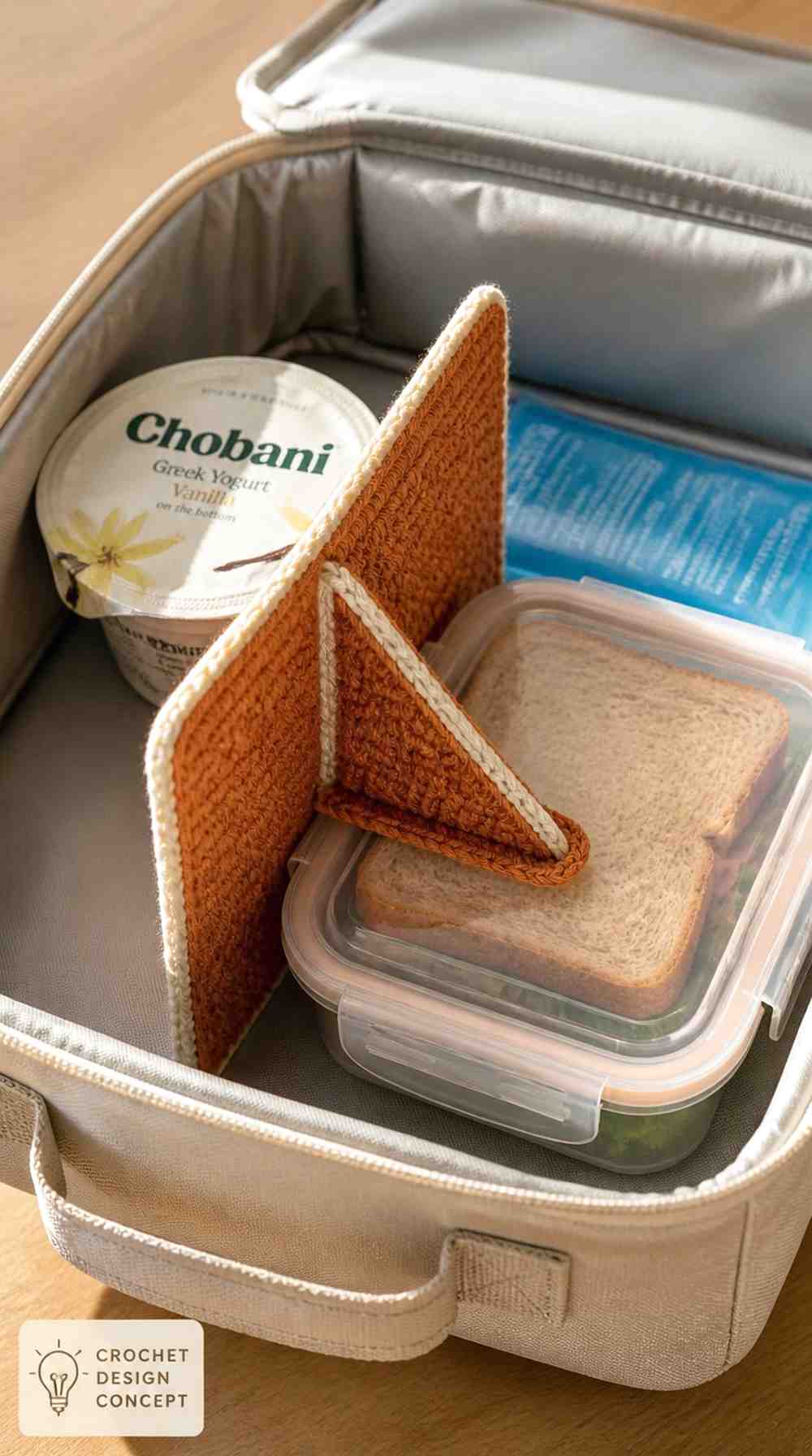
Rust-orange crochet forms an upright rectangular divider supported by a triangular panel on one side. Cream edging outlines the vertical wall and diagonal brace, making the support structure clear from above. The yogurt cup sits opposite the brace, separated from a closed sandwich box.
This concept explores how a crochet panel might hold its shape without depending only on dense stitches. The diagonal brace introduces a wider footprint, which could improve positioning in a suitable organizer but also consumes some valuable lunch-bag space.
- Brace geometry: A triangular support needs secure connections at the wall and base; a loose decorative triangle would provide little practical reinforcement.
- Space requirement: Reserve room on the sandwich-container side for the diagonal brace instead of squeezing it tightly against other packed items.
- Material behavior: Crocheted braces remain flexible unless suitably supported, so this illustrated concept should not be assumed to resist transport forces.
13. Crochet Oatmeal Lined Divider Panel
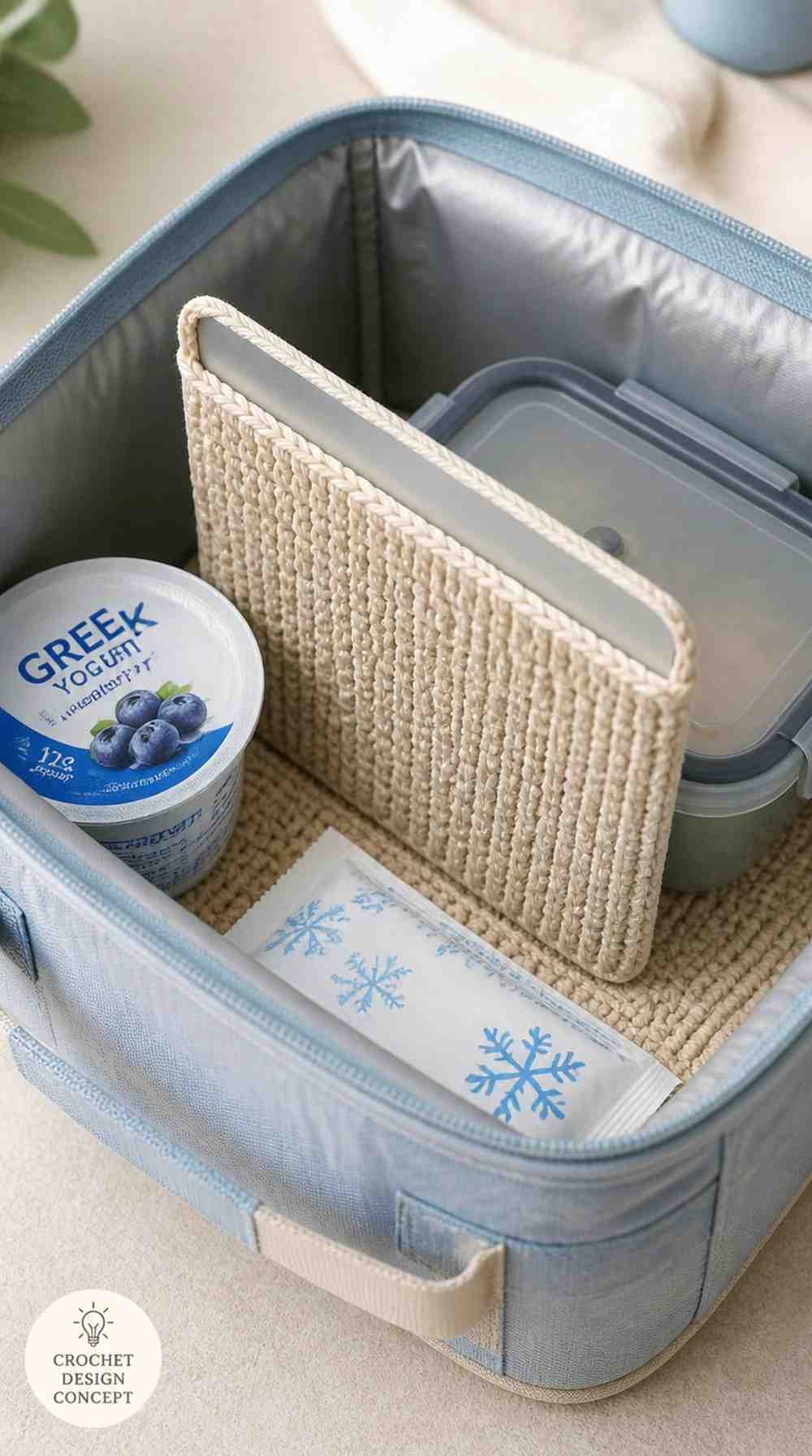
Warm oatmeal crochet forms a slim rectangular sleeve containing a separate pale-gray flexible insert. The insert’s upper edge is visible through an open ivory-trimmed top, while the lower and side edges remain enclosed within the crochet sleeve.
The removable insert is the practical focus of this design. It could provide additional shape support to a handmade divider while allowing the textile and internal sheet to be cleaned separately, provided both materials are compatible with the intended cleaning method.
- Removable insert: Choose a smooth, cleanable sheet that can be taken out of the crochet sleeve without tearing or stretching the stitches.
- Open upper edge: The ivory-trimmed opening should be wide enough for removal but controlled enough to prevent the insert from sliding out unintentionally.
- Moisture management: Remove the internal sheet for inspection after a spill and allow every component to dry completely before reassembling.
14. Crochet Burgundy Cross-Grid Lunch Divider
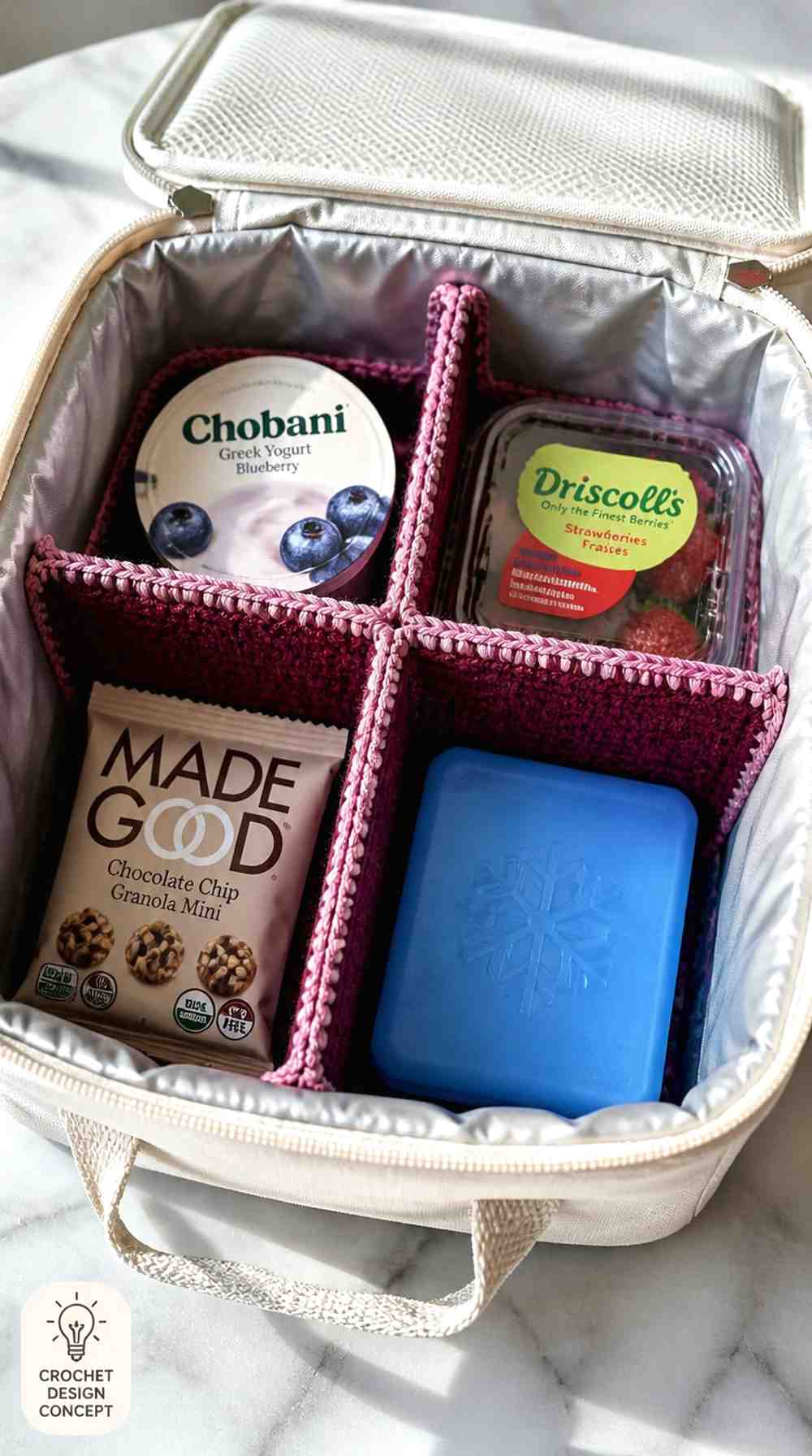
Burgundy crochet creates two intersecting low divider walls on a flat rectangular base. The perpendicular panels form four compartments, with pale-rose edging defining the upper lines. The spaces hold a sealed yogurt cup, a closed fruit box, a wrapped snack and a blue cold pack.
The cross-grid layout makes this one of the more compartment-focused concepts in the collection. It suits a larger lunch bag better than a narrow tote, since four separate sections require sufficient space for both the food containers and the crochet walls.
- Four-bay planning: Measure the largest yogurt and lunch containers before dividing the remaining interior floor into four sections.
- Central intersection: The two panels must join securely at their midpoint to keep the layout from twisting or collapsing during packing.
- Cold-pack access: Leave enough room to remove and replace the frozen pack without dragging it across the sealed yogurt lid or the crochet walls.
15. Crochet Sky-Blue Cold-Pack Pocket Divider
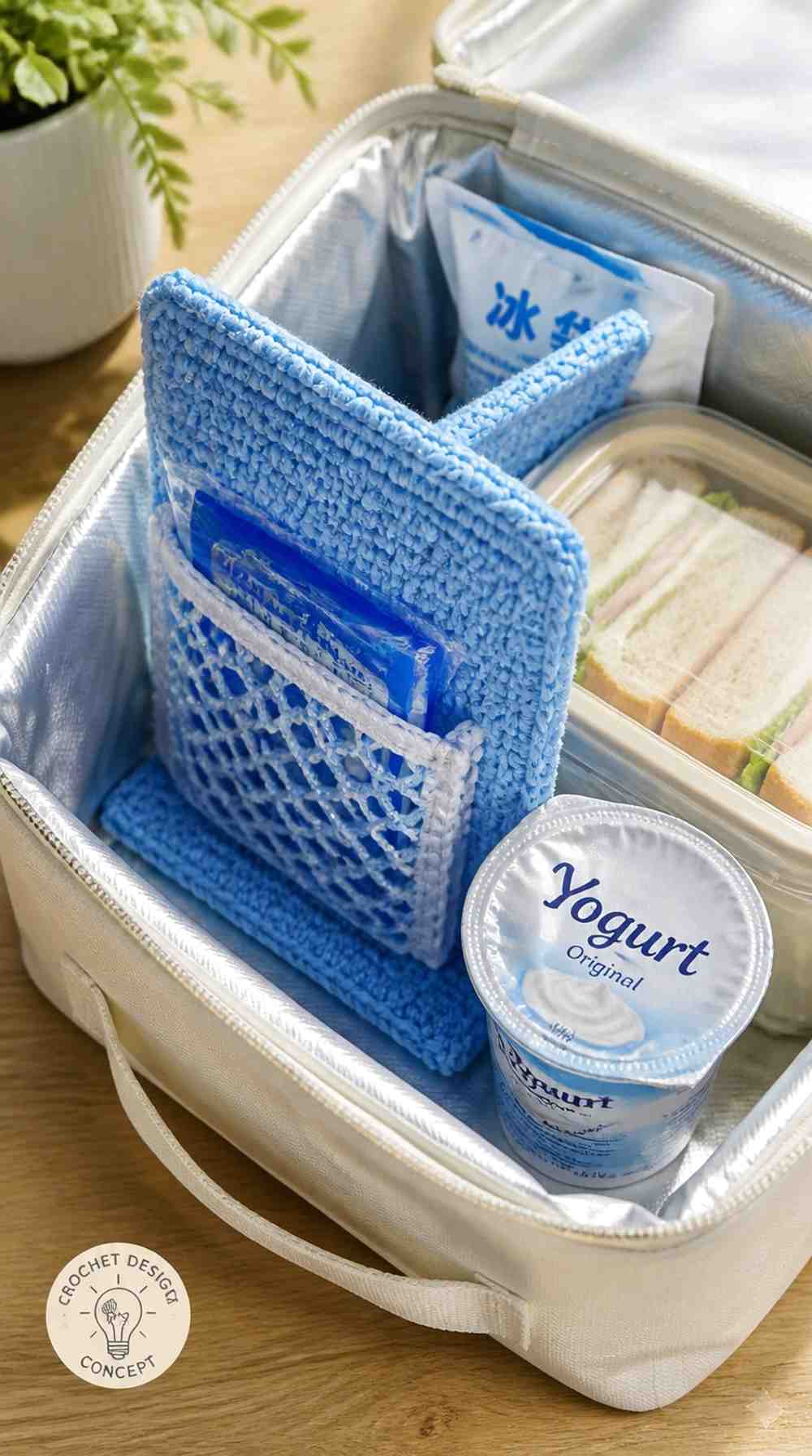
Sky-blue crochet forms an upright partition with a shallow mesh pocket on one side. White edging outlines the pocket, which contains a slim sealed frozen gel pack. The sealed yogurt cup sits beside the opposite face of the partition, and another cold source remains visible in the lunch bag.
The design combines a container divider with a designated cold-pack position. This is an organizational idea, not a cooling system. The actual arrangement must still meet safe packed-lunch temperatures and allow the cold packs to work as their manufacturers intend.
- Pocket dimensions: Size the shallow mesh section for the actual sealed gel pack so it can be removed without stretching or damaging the crochet.
- Moisture separation: Condensation or leaking coolant can dampen the yarn; use intact, sealed cold packs and remove the textile for cleaning when needed.
- Cooling effectiveness: A crochet pocket does not guarantee safe yogurt temperature. Use a properly insulated bag and adequate cold sources independently of the divider.
16. Crochet Olive Offset Corner Yogurt Divider
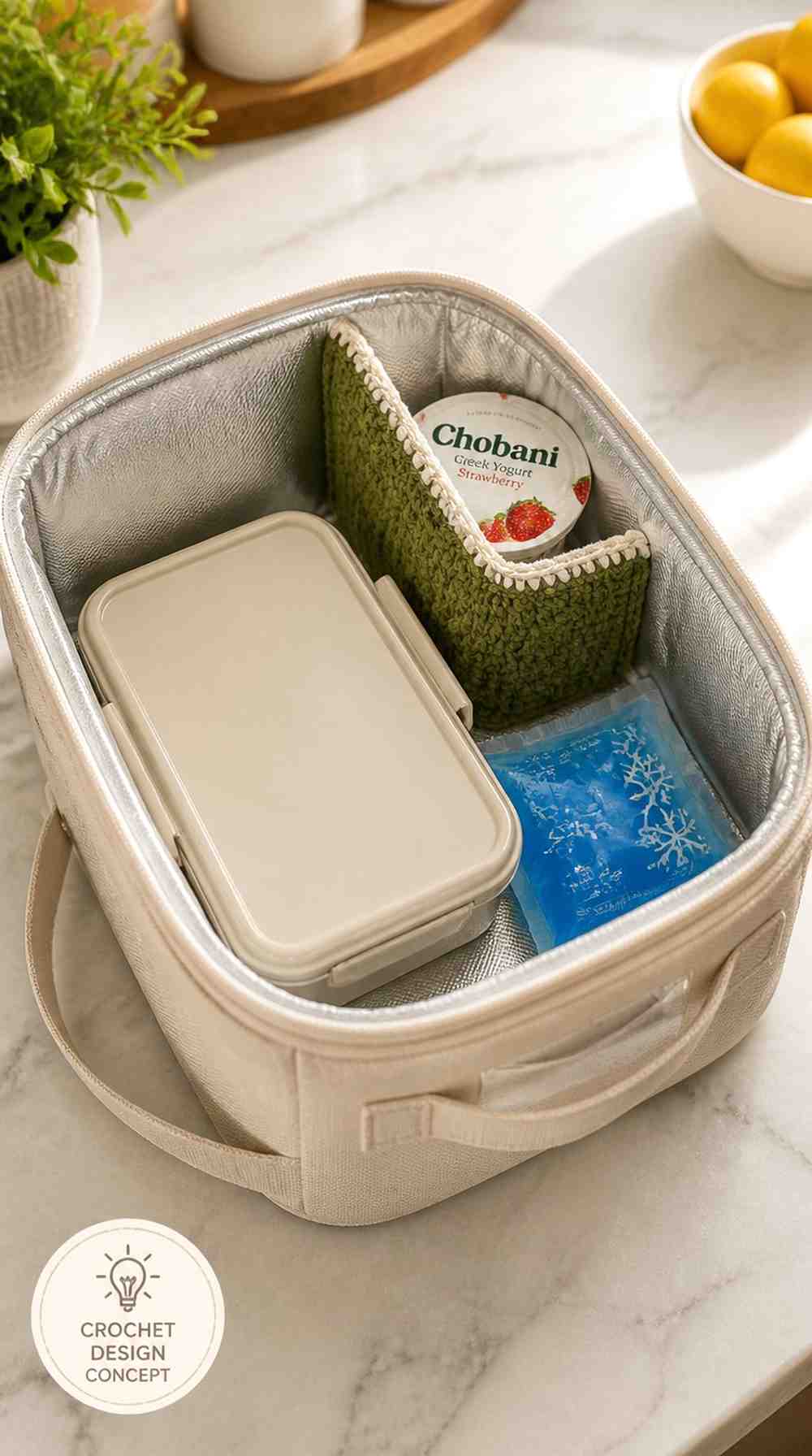
Muted olive-green crochet defines a small corner compartment inside an open insulated lunch bag. Two connected walls meet at a right angle near one side, with warm-ivory edging following their upper borders. A flat olive base keeps the divider visually connected.
Instead of splitting the bag into two equal sections, this layout reserves only enough room for one sealed yogurt cup. The remaining larger compartment can accommodate a rectangular lunch box and a separately packed cold source, making it an appealing idea for bags with unevenly sized contents.
- Offset placement: Position the corner walls around the yogurt container first, then confirm that the larger lunch box still fits comfortably.
- Joined corner: A tidy reinforced seam where the two walls meet is more useful than an overly thick decorative corner.
- Transport limitation: The small compartment can organize the cup but cannot guarantee it will remain upright if the whole lunch bag tips.
17. Crochet Mustard Removable-Panel Sleeve Divider
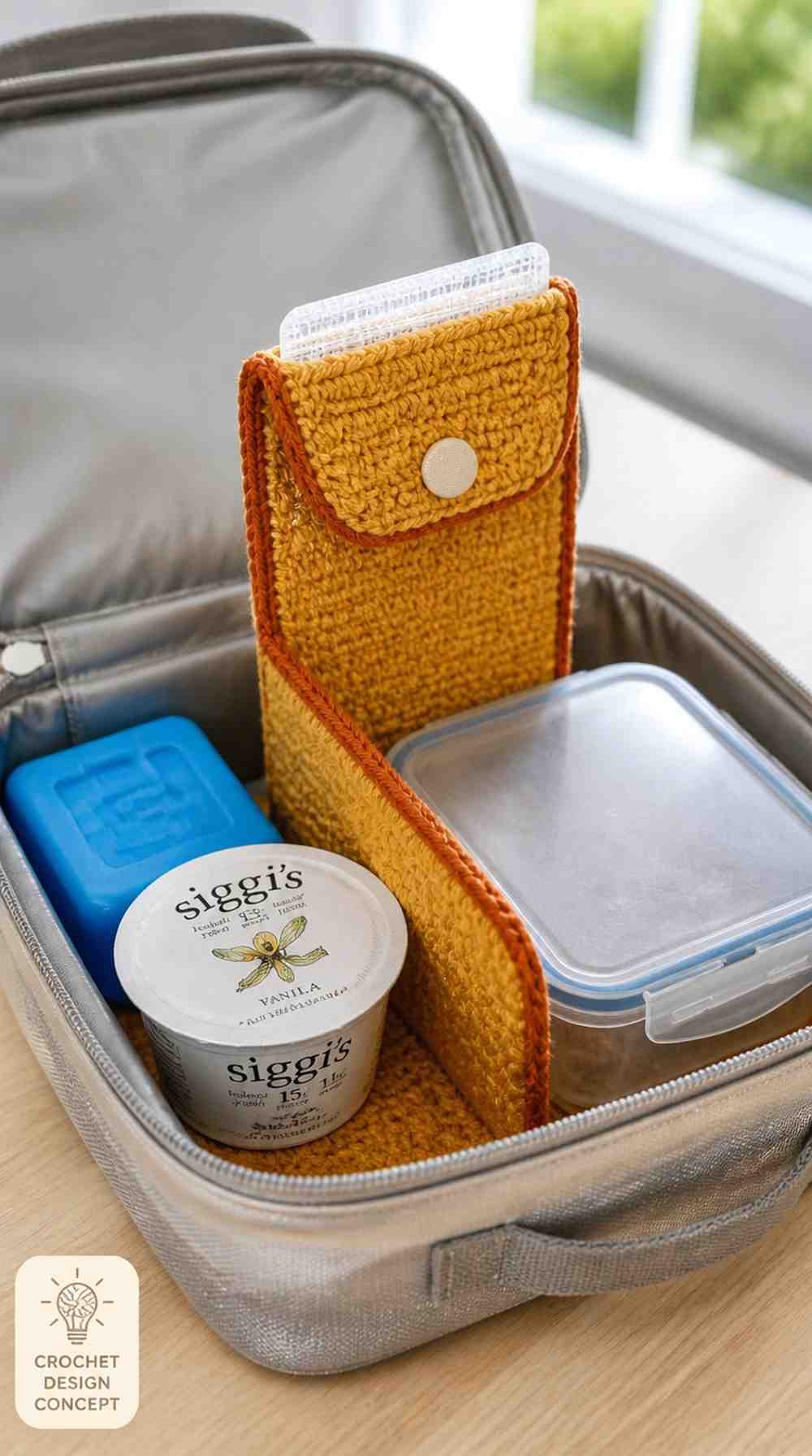
Mustard-yellow crochet forms a compact upright divider sleeve with a thin terracotta border. A small ivory fabric-covered button secures the upper flap, while a removable white plastic-canvas sheet sits inside the sleeve. A broad crochet base extends beneath the panel.
This design explores a more supported partition for lunch bags that need a clearer separation between containers. The internal sheet is removable, which is important when cleaning the fabric after spills. Its material and finish would still need to be checked for suitability in a packed-lunch environment.
- Internal support: A thin plastic-canvas insert can help a panel retain its shape, but choose one without sharp edges that could damage the lunch-bag lining.
- Flap access: The buttoned upper opening should allow the rigid sheet to be removed without forcing it through closely worked crochet stitches.
- Separate cleaning: Remove the insert before washing the yarn sleeve, following the care requirements for both materials and drying everything fully afterward.
Practical Guide to Crochet Yogurt Cup Lunch Bag Dividers
Measure the inside of the bag first. Lunch bags vary widely in shape, lining thickness and available floor space. Measure the usable interior width, length and height, then compare those dimensions with your sealed yogurt cup, lunch container and cold packs. A divider should not prevent the bag from closing properly.
Choose the divider structure carefully. Closely worked cotton crochet can create an attractive fabric panel, but yarn alone may bend, stretch or collapse. A removable, washable support insert may help certain designs hold their shape. Keep any stiffening material smooth, cleanable and protected from direct contact with food.
Plan around sealed containers. These crochet concepts are for separating packaged lunch items, not for holding unpackaged yogurt or other food directly. Yogurt containers should have intact lids and remain upright where possible. A divider is not a spillproof barrier, and open crochet stitches will not contain leaking yogurt.
Make the organizer easy to clean. Yogurt spills can leave moisture and food residue in crochet loops. Choose yarn with suitable care instructions, remove any internal supports and wash the textile promptly if contaminated. Allow all parts to dry completely before putting them back in the bag.
Keep refrigerated foods cold. Yogurt is perishable. USDA guidance recommends an insulated lunch bag with at least two cold sources, such as frozen gel packs or suitable frozen bottles, to maintain safe temperatures. Aim to keep yogurt at 40°F (4°C) or below until eaten, and refrigerate it when possible. A crochet divider must not replace cold packs or interfere with safe cooling arrangements.
Prioritize simple, removable designs for children. Avoid loose ties, detachable buttons or small pieces that could come off. Make sure the insert can be removed independently of the food containers and does not obstruct the lunch bag’s zipper, lining or handles.
Want to Make Something Similar?
The following resources explain related crochet divider, organizer and bag construction techniques. They are not exact patterns for the 17 concepts illustrated here.
- Free Organizer Basket Crochet Pattern with Removable Dividers — Nicki’s Homemade Crafts — A free pattern with video guidance showing a cotton organizer basket and removable partitions. Helpful for understanding divider shapes and joins, although the project is not designed for chilled food storage.
- Crochet Lunch Bag Pattern and Tutorial — The Crochet Crowd — Explains how crocheted panels and a gusset can form a bag. It is useful background for panel construction, not a tested insulated yogurt carrier.
For a separate example of organizing household items with dividers, see 16 Crochet Canned Food Shelf Divider Inspiration Ideas. The designs serve different storage purposes, but their structural ideas may help readers compare divider shapes.
Which Crochet Yogurt Cup Divider Should You Choose?
| Main need | Designs to consider | Trade-off |
|---|---|---|
| Simple one-cup separation | Terracotta Center-Wall, Cocoa High-Rib | Needs reliable support to stay upright |
| Two sealed yogurt cups | Indigo Twin-Cup Pocket | Curved compartments require careful sizing |
| Three or more lunch sections | Butter Yellow Accordion, Lavender T-Shaped, Burgundy Cross-Grid | More walls use more interior space |
| A small corner compartment | Slate Fold-Flat Corner, Olive Offset Corner | Less coverage than a full central partition |
| Decorative crochet details | Raspberry Granny-Tile, Aqua Mesh-Window | Openwork does not block spills |
| Adjustable placement | Coral Button-Tab | Requires a compatible removable organizer insert |
| Easy removal | Teal Lift-Tab, Oatmeal Lined Panel | Tabs and removable parts need secure construction |
| More defined cup positioning | Peach Curved-Cradle, Rust Triangular-Brace | Extra shaping and a larger support footprint |
| Cold-pack organization | Sky-Blue Cold-Pack Pocket | Must not compromise proper chilling |
| Supported upright panel | Mustard Removable-Panel Sleeve | Internal support adds cleaning and material considerations |
For a compact everyday lunch bag, the Terracotta Center-Wall or Olive Offset Corner concept is a practical place to begin. Both emphasize simple separation without taking over the full interior.
For a bag carrying two small yogurt cups, the Indigo Twin-Cup Pocket design offers a more specialized layout. If several different containers need their own spaces, the Lavender T-Shaped or Burgundy Cross-Grid concepts provide more distinct compartments.
If cleaning and repeat use matter most, the Oatmeal Lined Panel or Mustard Removable-Panel Sleeve may be worth exploring because their internal components are designed to be removed.
Conclusion
Crochet yogurt cup lunch bag dividers bring together the appeal of handmade crochet and the practical challenge of arranging several food containers in a small space. From simple terracotta partitions and curved peach cup sections to granny-square panels, adjustable tabs and supported divider sleeves, these 17 concepts explore different ways to organize a lunch bag. The best design will be one that fits your existing bag, separates sealed containers without crowding them and can be removed for cleaning. Proper insulation and cold packs remain essential for keeping yogurt safe.
Which divider would suit your packed lunch? Would you choose a simple center wall, two curved yogurt compartments, an adjustable corner insert or a pocket for organizing a cold pack? Share your favorite design and what you usually pack beside your yogurt cup.
Frequently Asked Questions
1. Can a crochet divider stop a yogurt cup from tipping over?
A well-fitted divider may help position a sealed yogurt cup among other lunch containers, but crochet alone cannot guarantee that the cup will remain upright. The result depends on the container shape, divider structure, support materials and how the bag is carried. A tightly sealed cup and careful packing remain important.
2. What yarn is suitable for a crochet lunch bag divider?
Smooth, washable cotton yarn is one option because it can produce clearly defined, relatively dense stitches. However, different yarns have different care requirements, and no crochet textile should be assumed to be waterproof or food-safe for direct contact. Choose materials that can be cleaned appropriately and used around sealed containers.
3. Will a crochet divider keep yogurt cold?
No. Crochet partitions are intended for organization rather than refrigeration or insulation. Yogurt needs to remain properly chilled in an insulated bag with adequate cold sources, or be kept refrigerated until it is eaten. The divider should leave room for the cold packs and should not be relied upon to maintain a safe food temperature.
4. Should I use a rigid insert inside the crochet divider?
A removable smooth plastic-canvas or other suitable cleanable insert may help some upright panels retain their shape. However, the material must be appropriate for the bag, should not have sharp edges and must not damage the lining. Remove it for washing when necessary and allow the components to dry completely before reuse.
5. Are these 17 crochet yogurt cup lunch bag divider ideas available as patterns?
No. They are original crochet design visualizations for comparing different organizer shapes, colors, compartments and fastening details. They are not tested handmade products or complete patterns. The linked tutorials teach related construction ideas, but none should be assumed to reproduce the illustrated dividers exactly or guarantee safe food storage.