A coordinated crochet sweater and scarf can look much more intentional than two unrelated winter pieces, but matching does not have to mean repeating the exact same pattern from neckline to fringe. Often, the strongest sets share a color palette, motif family, or colorwork scale while letting the sweater and scarf perform different visual jobs.
“Fair Isle crochet” is also used fairly broadly online. Traditional Fair Isle belongs to stranded knitting, while crochet designers can create a related winter colorwork look through carried-yarn techniques, split single crochet, tapestry crochet, mosaic crochet, checks, plaid, or graph-based motifs. Several tutorials below use true Fair-Isle-style carried colorwork, while others offer complementary crochet colorwork methods that work well when planning a coordinated winter set.
Not every source is a tutorial for a complete sweater-and-scarf pair. Instead, each project uses a verified tutorial for a strong sweater or scarf foundation, then explains how to coordinate the second piece without reconstructing or copying the creator’s pattern.
Quick List
- Crochet Nordic Yoke Sweater and Echo-Motif Scarf Set
- Crochet Geometric Mosaic Sweater and Border Scarf Set
- Crochet Pixel Mosaic Sweater and Narrow Colorwork Scarf Set
- Crochet Statement Colorwork Sweater and Minimal Scarf Set
- Crochet Checkerboard Pullover and Block Scarf Set
- Crochet Starlight Mosaic Yoke Sweater and Accent Scarf Set
- Crochet Heart Fair Isle Sweater and Motif Scarf Set
- Crochet Houndstooth Sweater-and-Scarf Set
- Crochet Modern Mosaic Sweater-and-Scarf Set
- Crochet Snowflake Sweater and Winter Scarf Set
- Crochet Soft Plaid Sweater and Woven-Look Scarf Set
- Crochet Gingham Sweater-and-Scarf Set
- Crochet Diagonal Plaid Sweater and C2C Scarf Set
- Crochet Tartan Accent Sweater and Classic Plaid Scarf Set
- Crochet Winter Mosaic Sweater and Pocket Scarf Set
- Crochet Fine-Check Sweater and Slim Scarf Set
Choose the Colorwork Method Before You Choose the Colors
Two winter projects can look similarly Nordic from a distance while behaving very differently on the hook.
Carried colorwork can create compact motifs and a fabric with floats behind the work. Tapestry-style crochet manages contrasting yarn differently. Overlay mosaic colorwork can produce strong geometric designs while changing how the layers and surface stitches behave. Gingham, checkerboard, and plaid may use blocks, carried yarn, or added surface lines instead.
That difference matters when coordinating a set. A method that feels comfortable across a scarf may become much more demanding when expanded across a fitted sweater. If your sweater is the more complex piece, letting the scarf repeat only its main colors or one small motif can keep the pair connected without doubling the difficult work.
A Matching Scarf Does Not Need to Copy the Sweater
Repeating every sweater motif on the scarf can make a set visually heavy. Instead, decide what the connection will be.
A detailed circular yoke can pair with a mostly solid scarf that repeats one narrow geometric band near each end. A checkerboard sweater can pair with a scarf using larger checks. A heart sweater might need only a few spaced heart motifs on a plain scarf.
This also gives you more flexibility with scale. A small motif that fits neatly around a sweater yoke may need to be enlarged, simplified, or replaced with coordinating color bands when moved to a long scarf. Compare swatches rather than assuming the same chart will automatically suit both pieces.
Plan Sweater Fit and Scarf Drape Separately
Using the same yarn across both pieces can create a convincing match, but it is not always the most practical choice.
A sweater needs reliable gauge and appropriate garment drape. A scarf has more freedom: you may want it softer, loftier, narrower, or less dense around the neck. If substituting yarn, swatch the sweater first because its dimensions are less forgiving.
Colorwork also changes fabric behavior. A dense multicolor section may feel firmer than a plain area. Check whether your chosen technique changes the stretch around the sweater’s neckline, upper body, cuffs, or hem, and consider whether repeating that same density across an entire scarf would feel comfortable.
1. Crochet Nordic Yoke Sweater and Echo-Motif Scarf Set
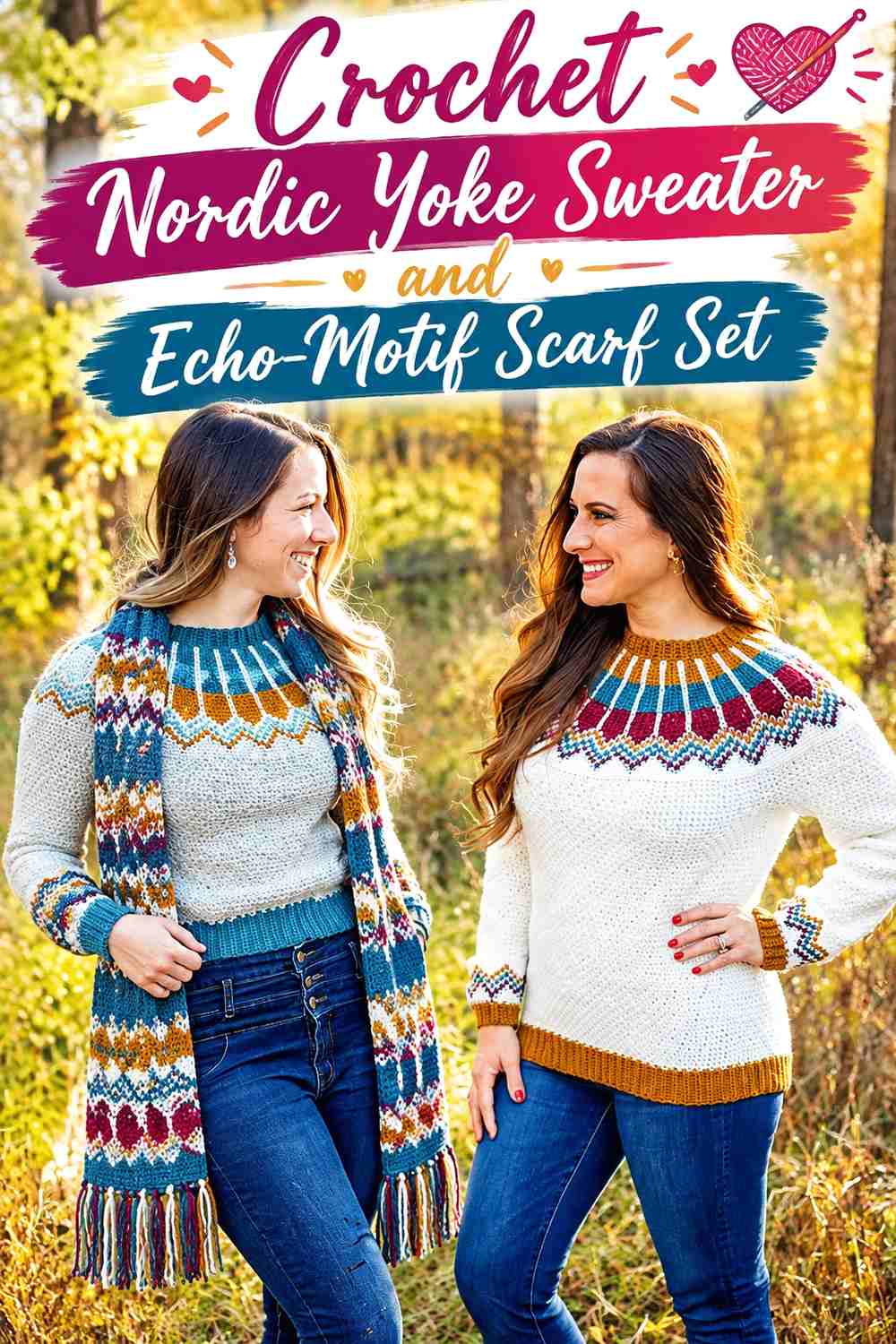
A round-yoke sweater with concentrated colorwork around the shoulders is one of the clearest ways to capture the classic Fair Isle look in crochet. Briana K’s tutorial demonstrates a top-down sweater with Fair-Isle-style colorwork concentrated in the yoke and repeated again near the sleeves.
For the scarf, resist covering the entire length with the same busy motif. A mostly solid scarf with a related geometric band at each end would preserve the relationship while allowing the sweater yoke to remain the dominant feature.
Keep the Scarf Quieter Than the Yoke
A circular yoke already creates a strong focal point near the face. Wearing a densely patterned scarf directly over it can hide the section that required the most careful color planning.
Consider using the sweater’s background shade as the scarf’s main color, then repeat two or three accent colors toward the scarf ends. The two pieces can still look unmistakably coordinated without competing for the same visual space.
Check Colorwork Tension Before Sizing the Sweater
The tutorial uses carried colorwork in the Fair-Isle-style section. That makes tension especially important because overly tight carried yarn can restrict the fabric even when the surrounding plain crochet fits correctly.
Work and assess your colorwork swatch before choosing sweater dimensions. A scarf can tolerate more dimensional variation, but the sweater yoke needs enough flexibility to sit comfortably around the shoulders and upper body.
Creator Credit: Briana K
2. Crochet Geometric Mosaic Sweater and Border Scarf Set
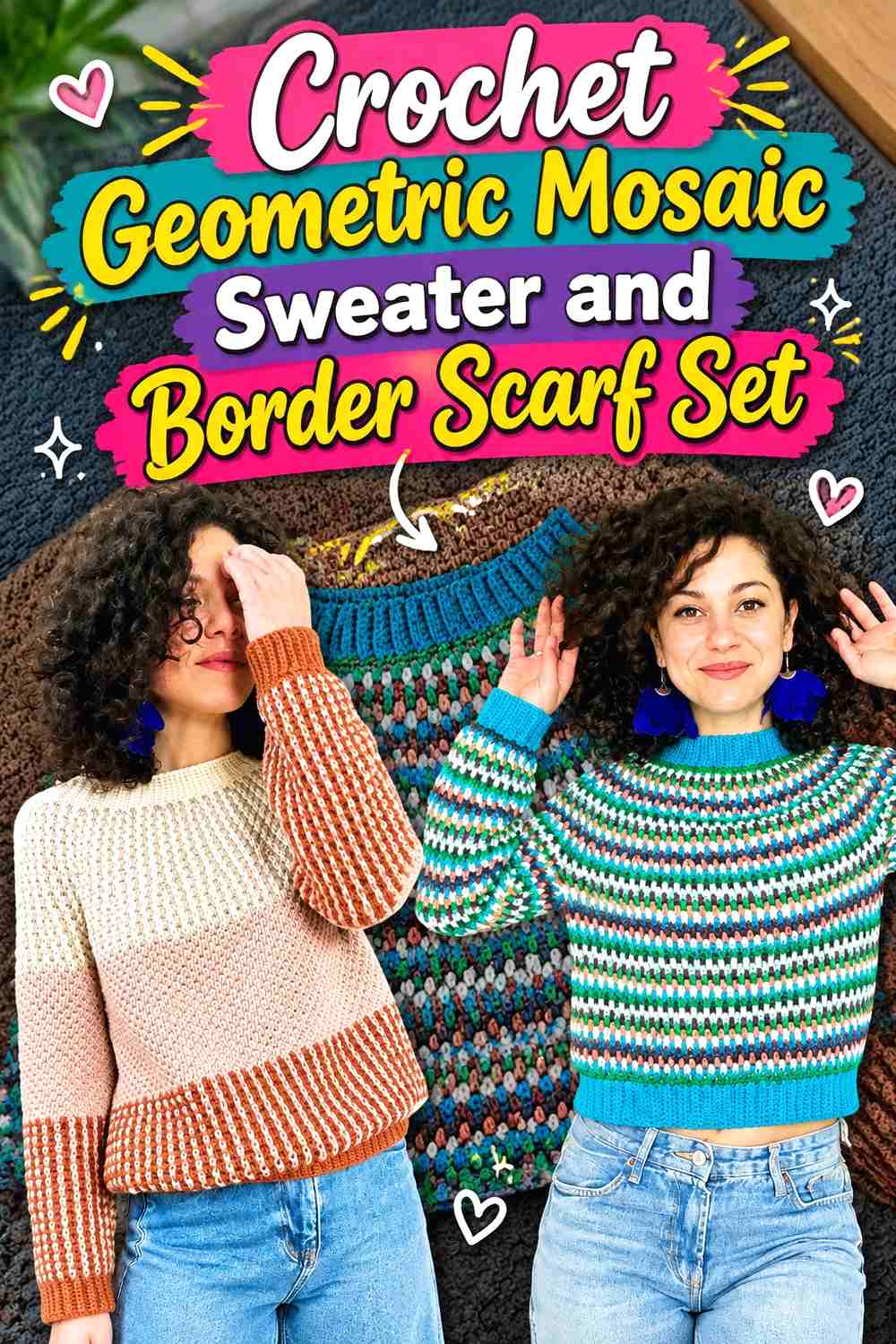
ByKaterina Designs demonstrates a round-yoke sweater worked with overlay mosaic crochet, creating a multicolor geometric surface while keeping the garment construction top-down.
For a coordinated scarf, borrow the geometry rather than duplicating the whole sweater design. A narrow mosaic border against a calmer center section can link the accessory to the sweater while giving the neck fabric more visual breathing room.
Mosaic Colorwork Creates a Different Surface from Stranded Crochet
Overlay mosaic crochet is not the same construction as carried Fair Isle colorwork. That difference is useful: the technique can produce crisp, graphic motifs that make a sweater-and-scarf set feel contemporary rather than strictly traditional.
Before deciding to cover both pieces in mosaic patterning, handle a generous swatch. If the resulting fabric feels firmer than you want around the neck, use mosaic only near the scarf ends.
Let One Color Tie a Multicolor Set Together
A sweater with several accent shades can become difficult to coordinate if every shade also appears equally in the scarf. Instead, identify one background color that can continue through both pieces.
The secondary colors can then appear in shorter scarf bands or isolated geometric sections. This makes future color substitutions easier because you only need to preserve the hierarchy, not copy every shade exactly.
Creator Credit: ByKaterina Designs
3. Crochet Pixel Mosaic Sweater and Narrow Colorwork Scarf Set
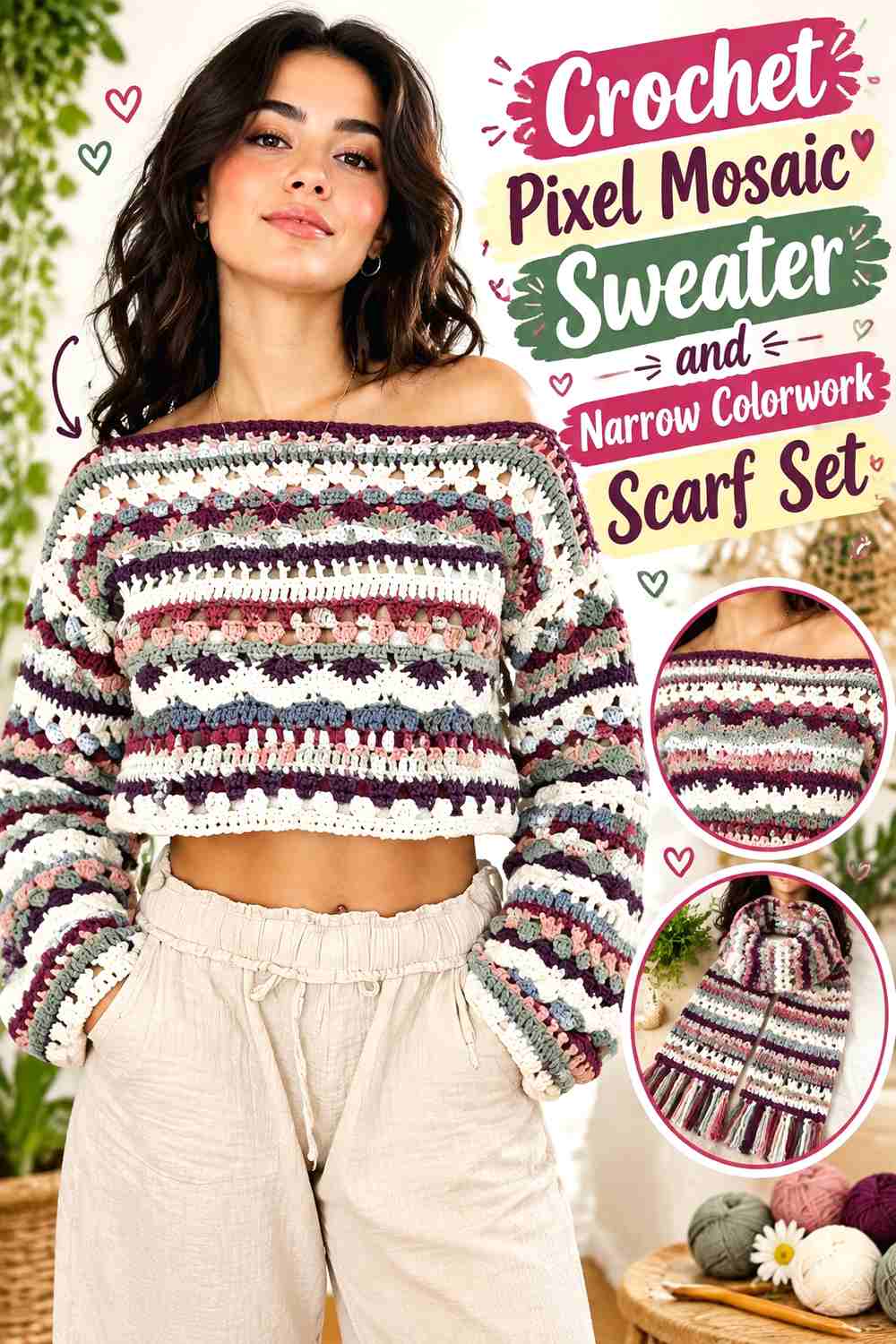
Kamryn Cain’s crochet mosaic sweater tutorial uses a highly visible repeating pattern that creates a stronger all-over graphic effect than a traditional motif limited to the yoke.
That makes this a good foundation for a more playful 2026 set. Pair the sweater with a narrower scarf so the repeated geometry becomes a controlled accent rather than adding another large field of pattern.
Match Pattern Scale to the Width of the Scarf
A motif that works across a wide sweater panel may not fit neatly across a narrow neck accessory. Forcing the original repeat into a smaller width can produce awkward partial motifs.
Instead, use the sweater as color and scale inspiration. Test a reduced geometric repeat or use bands that echo the dominant light-dark rhythm without rebuilding the creator’s exact pattern.
Decide Whether the Sweater or Scarf Gets the Stronger Contrast
High-contrast colors make mosaic shapes appear sharper. If both pieces use maximum contrast across their full surfaces, the set can become visually intense.
One option is to keep the sweater bold and reduce the scarf contrast with two neighboring shades. Another is to use a quieter sweater palette and let the scarf carry the brightest accent.
Creator Credit: Kamryn Cain
4. Crochet Statement Colorwork Sweater and Minimal Scarf Set
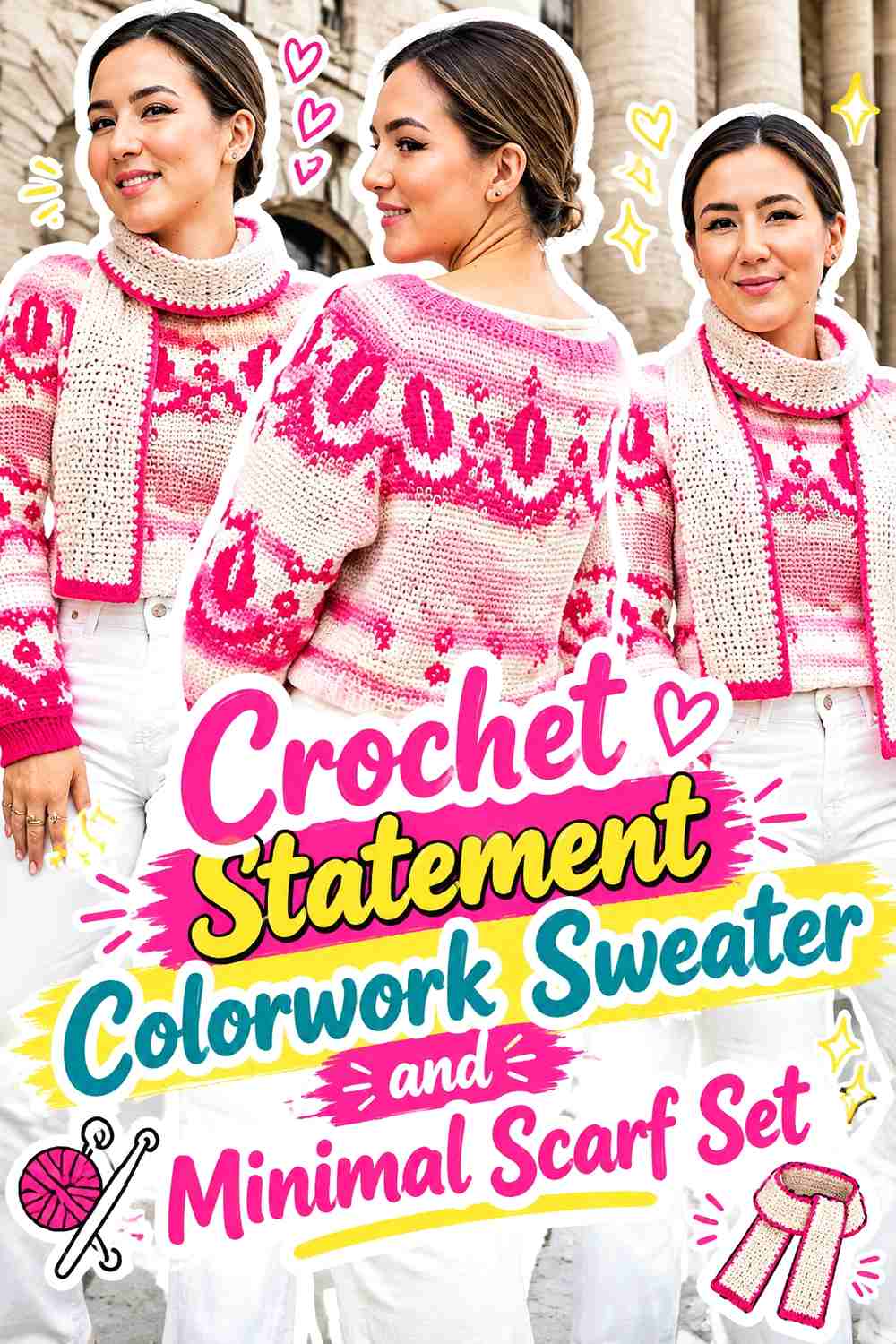
THISISKACHI’s colorwork sweater project offers a useful direction for anyone who wants the sweater itself to be the clear statement piece. The finished garment uses graphic multicolor patterning rather than relying on simple stripes alone.
For this set, make the scarf deliberately restrained. A solid scarf with two or three colorwork bands can look more sophisticated beside a busy pullover than another fully patterned accessory.
Use Negative Space to Make the Set Feel More Wearable
Colorwork needs plain fabric around it to remain readable. If your sweater already has large graphic sections, leaving significant solid space on the scarf can make both pieces look clearer when worn together.
Think about the scarf while it is wrapped, not only when it is laid flat. The center may disappear around the neck, while the ends remain visible over the front of the sweater.
Test the Full Outfit Before Adding More Motifs
Set the unfinished scarf against the finished or partially finished sweater before committing to additional colorwork. What looks sparse on the worktable may be exactly enough once both items overlap on the body.
This checkpoint can prevent the common problem of adding decorative detail simply because there is unused space.
Creator Credit: THISISKACHI
5. Crochet Checkerboard Pullover and Block Scarf Set
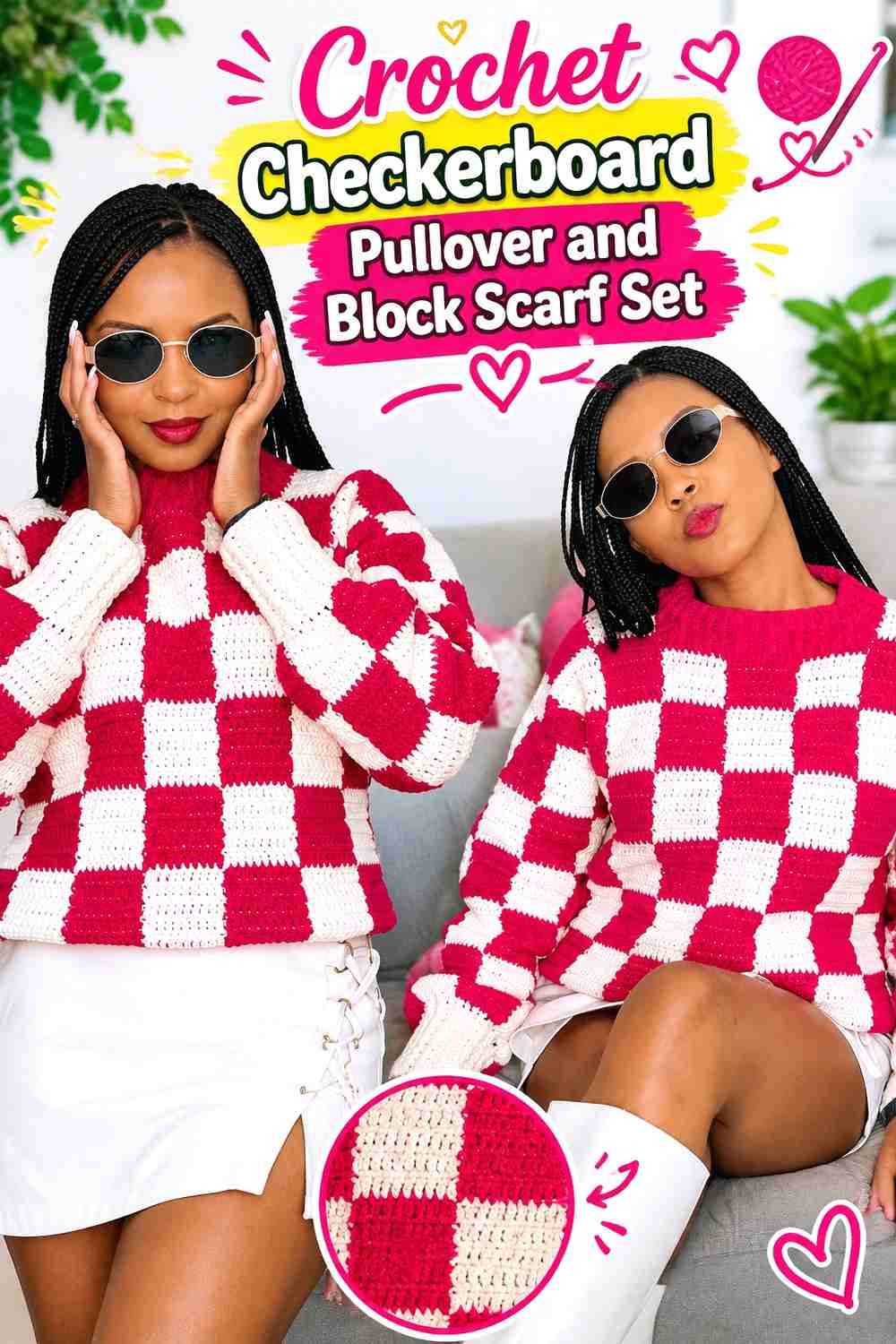
AC Crochets demonstrates a pullover built around large contrasting checkerboard sections, creating an unmistakably graphic color-blocked garment.
Instead of using identical check dimensions on the scarf, change the scale. A scarf with longer rectangular color blocks or only a checked section near each end can coordinate with the pullover while remaining visibly different.
Large Checks Can Change the Perceived Fit
Strong squares create horizontal and vertical visual divisions across the torso. Placement therefore matters almost as much as color.
Before adapting a checkerboard layout, consider where color changes will fall across the shoulders, bust, waist, and sleeves. Moving a block boundary slightly can alter how the garment looks even when the physical measurements stay the same.
A Scarf Gives You More Freedom with Block Size
Scarves do not need to align color blocks with body landmarks, so you can experiment more freely with elongated checks, alternating rectangles, or an asymmetrical sequence.
That freedom makes the scarf a good place to introduce a third coordinating shade if the sweater itself already feels complete with two.
Creator Credit: AC Crochets
6. Crochet Starlight Mosaic Yoke Sweater and Accent Scarf Set
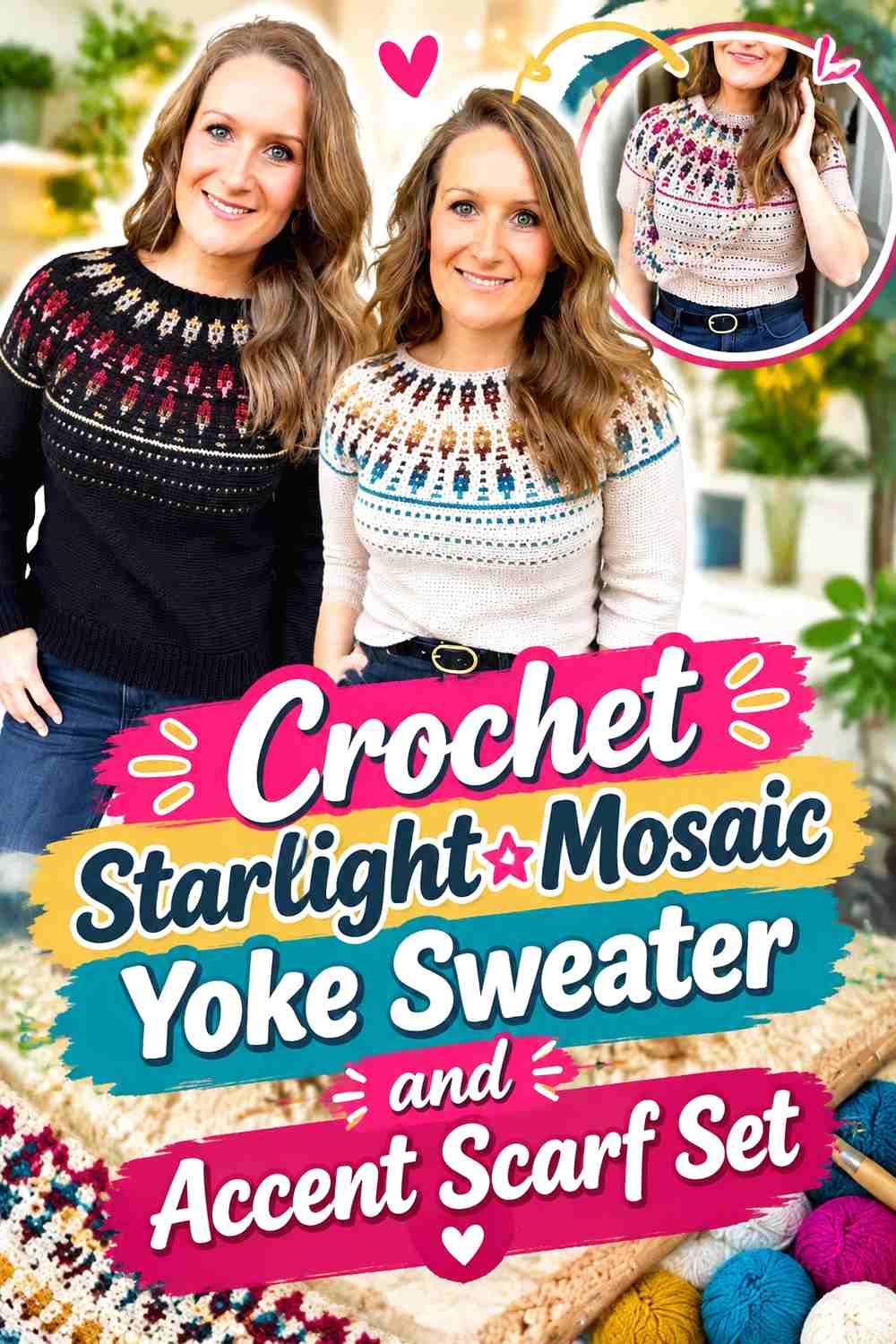
HanJan Crochet’s mosaic sweater uses a seamless top-down construction with overlay mosaic detailing around the upper garment. The pattern is designed around a geometric yoke rather than an all-over repeat, which makes it especially useful for a coordinated set.
A scarf can pick up one element from that yoke—perhaps the contrast relationship or a simplified angular rhythm—while remaining primarily solid.
Yoke Placement Keeps the Colorwork Away from High-Rub Areas
Concentrating intricate colorwork around the upper sweater leaves much of the body relatively calm. That can make the finished garment easier to pair with a patterned scarf because the accessory overlaps mostly with a cleaner section of the sweater.
If you adapt the color placement, think about the view from the front while the scarf is actually worn.
Variegated Yarn Needs a Stable Partner
The sweater design can combine a solid yarn with a variegated one. If you take that approach into the scarf, avoid adding so many additional colors that the pattern loses definition.
A stable solid shade gives changing colors a visual anchor and can make separate pieces look as though they belong to the same set even when the color sequence does not match stitch for stitch.
Creator Credit: HanJan Crochet
7. Crochet Heart Fair Isle Sweater and Motif Scarf Set
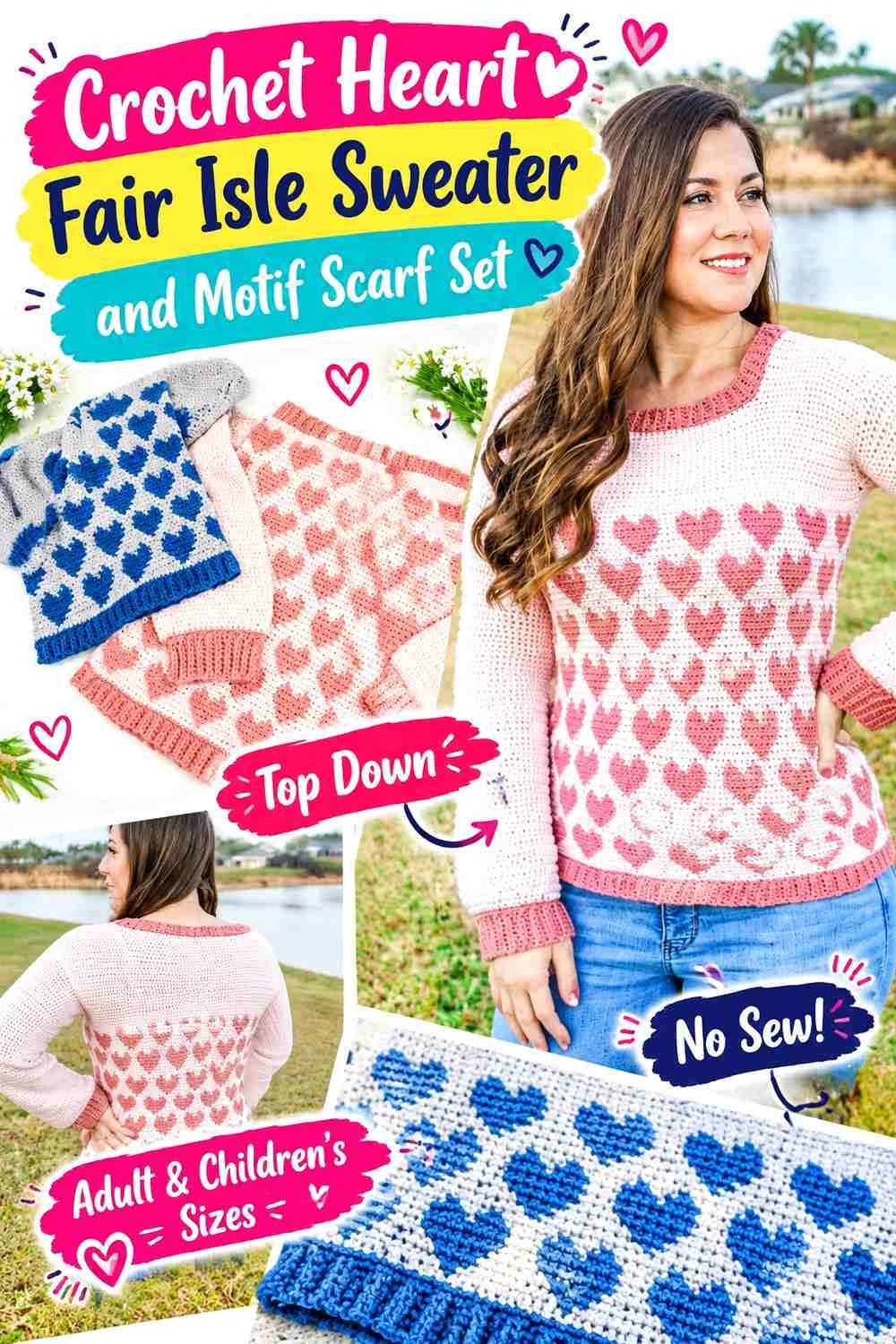
Two Brothers Blankets demonstrates a crochet sweater with heart motifs made using Fair Isle crochet. The colorwork is integrated into a wearable garment rather than added as an appliqué, making this one of the clearest motif-based Fair Isle options in the collection.
For the scarf, spaced hearts can create a better match than continuous hearts from end to end. Leaving solid areas between motifs gives each shape more definition and makes the accessory easier to combine with the sweater.
Repeat the Heart at a Different Frequency
Matching does not require matching repetition. If the sweater carries hearts repeatedly around the body, the scarf can use just a few motifs near the ends.
This reduces color changes and keeps the scarf from obscuring the sweater’s main design when both pieces are worn together.
Watch the Floats Around Fitted Areas
Fair-Isle-style crochet requires attention to the yarn carried behind the visible stitches. The creator specifically addresses managing floats and tension as part of the garment construction.
That matters most where the garment needs to flex. A scarf can be more forgiving, but a sweater that becomes noticeably tighter through its colorwork band may not fit as intended.
Creator Credit: Two Brothers Blankets
8. Crochet Houndstooth Sweater-and-Scarf Set
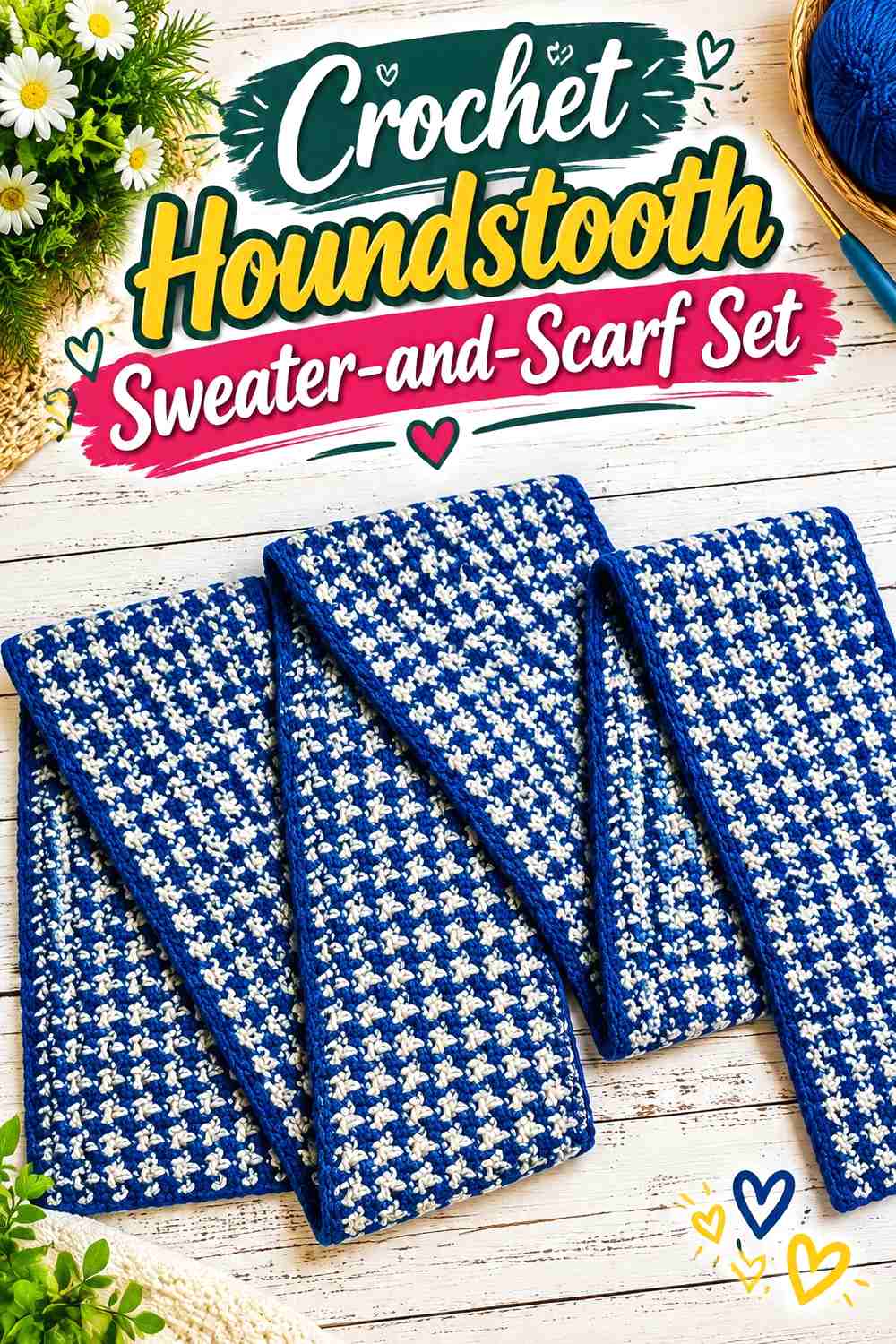
Olga Poltava’s scarf tutorial uses two contrasting colors to build a classic crochet houndstooth fabric. The repeated two-color texture creates a very different effect from large checkerboard blocks or Nordic yoke motifs.
To turn this into a sweater-and-scarf concept, use houndstooth selectively on the garment—such as a lower band, cuffs, or central panel—rather than automatically covering the entire sweater.
Small Repeats Create More Visual Density
Houndstooth reads as an all-over textile pattern rather than a collection of isolated motifs. That means a relatively narrow scarf can still look richly patterned.
When moving the idea to a sweater, decide how much visual density you want. Full coverage produces a bold fashion piece; limited placement makes the set easier to wear with other winter clothing.
Two Colors Make Palette Planning More Important
Because there are fewer colors to distract the eye, the relationship between the two shades becomes especially noticeable. Strong contrast produces a sharper traditional houndstooth effect, while neighboring values soften the pattern.
Make a swatch large enough to step back from. Colors that look attractive as individual skeins can merge unexpectedly once alternated repeatedly.
Creator Credit: Olga Poltava
9. Crochet Modern Mosaic Sweater-and-Scarf Set
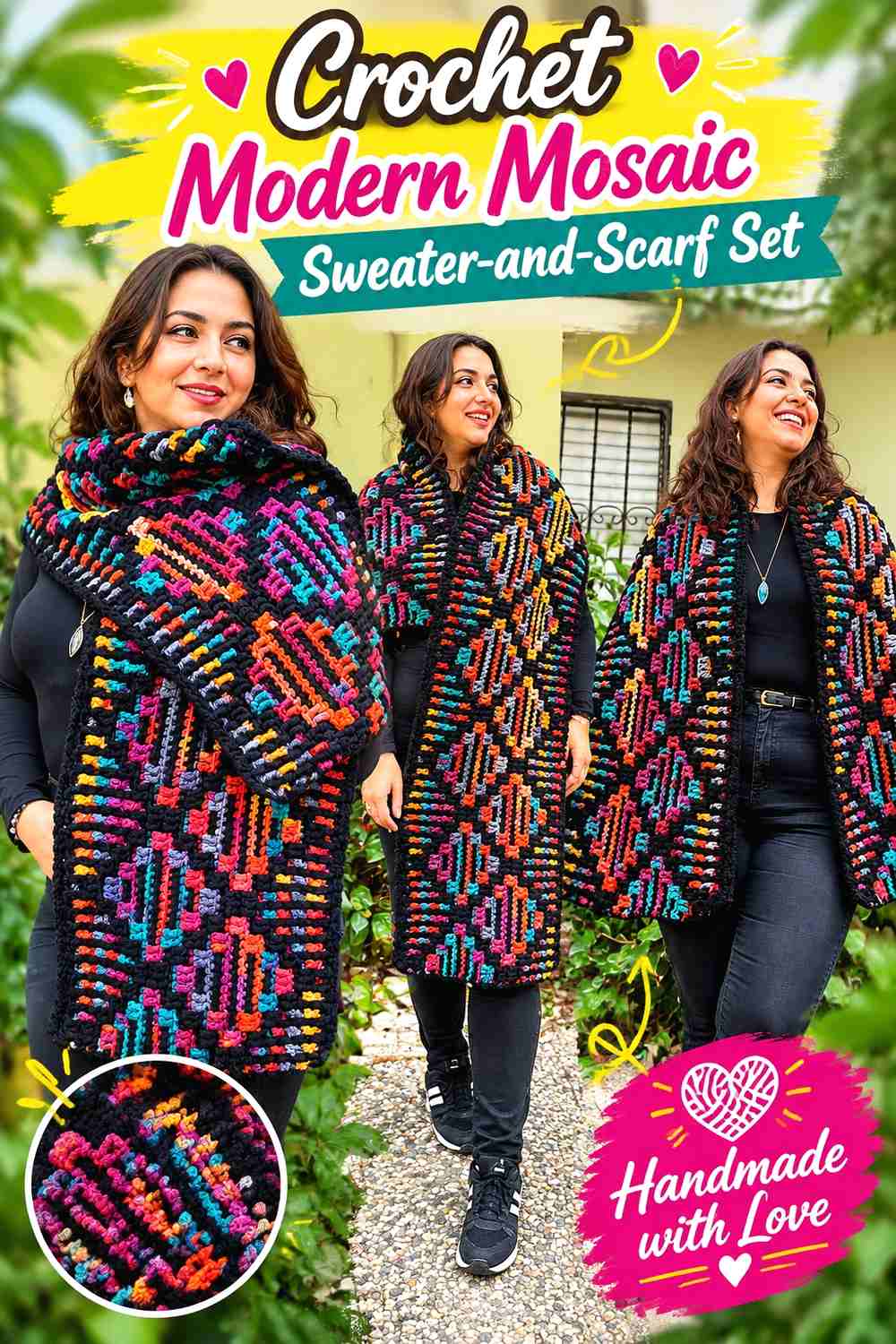
The mosaic scarf from ÖRGÜ MÜ DEDİNİZ uses a colorful geometric crochet technique that can function as either a scarf or a broader shawl-style accessory.
For a sweater pairing, take the opposite approach from the earlier mosaic-yoke projects: let the scarf carry most of the pattern and keep the sweater largely plain, with a related mosaic band at the hem or cuffs.
Give the Scarf Room to Display Its Geometry
Some colorwork only becomes clear after several repeats. A broader scarf can therefore show the design more effectively than a narrow strip.
If the scarf is the hero piece, avoid placing equally complicated motifs across the sweater front. A smaller echo at cuffs or hem can create the connection without making the outfit feel overloaded.
Plan How the Scarf Will Fold
Wide scarves rarely remain perfectly flat when worn. Pattern sections may fold inward, overlap, or disappear around the neck.
Before committing to color placement, drape a swatch or paper mock-up to see which areas are likely to remain visible. Put the most important contrast where it will actually be seen.
Creator Credit: ÖRGÜ MÜ DEDİNİZ
10. Crochet Snowflake Sweater and Winter Scarf Set
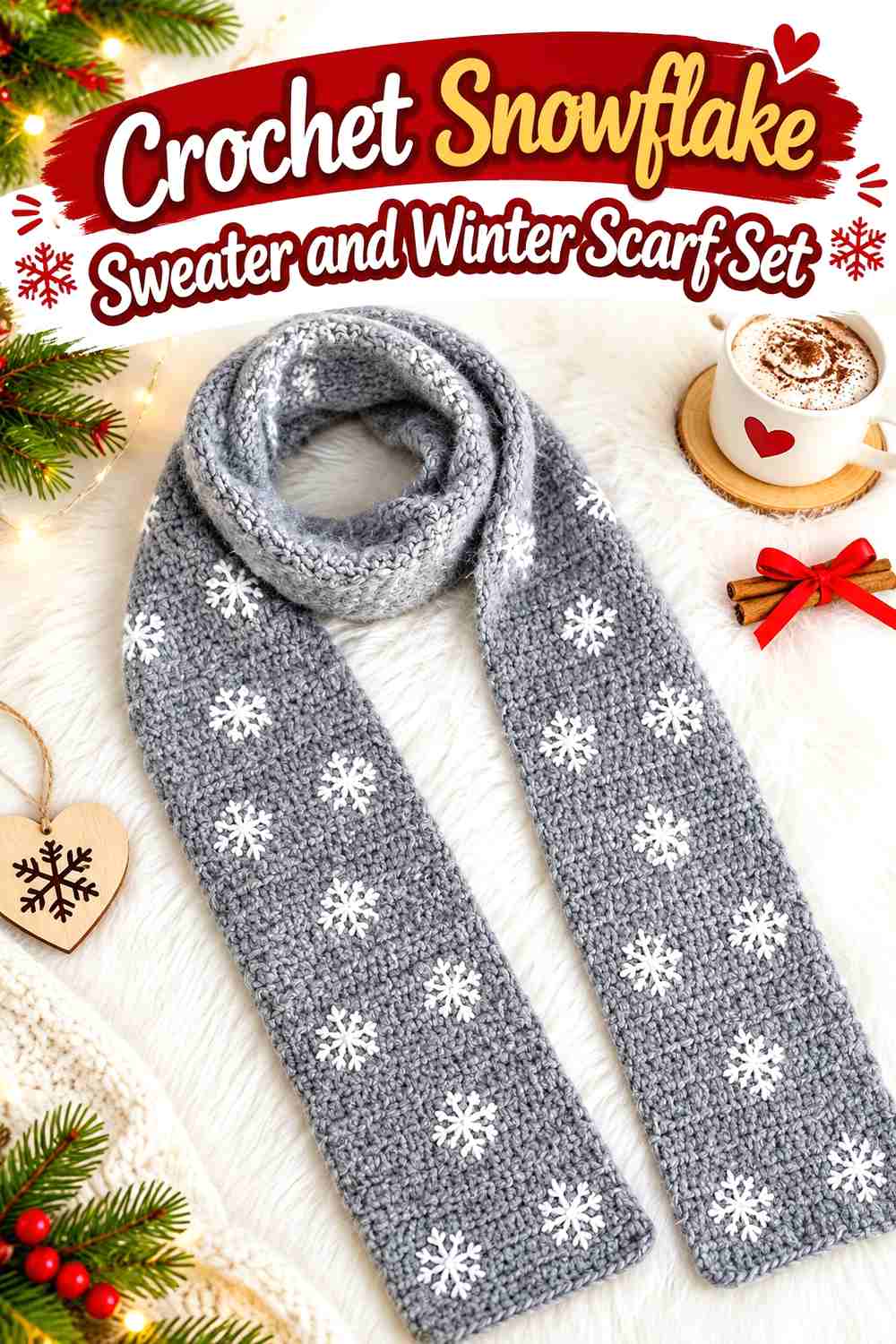
A snowflake motif creates an immediate winter connection without forcing the palette into Christmas red and green. The tutorial from 1YUMAKLAGELENLER demonstrates a gray scarf with contrasting snowflake detailing added to the surface.
For the sweater, place related snowflakes selectively around the yoke, upper sleeves, or lower body. A few well-positioned motifs can feel more Nordic than filling every available area.
Surface Details Give You Another Way to Coordinate
Because the snowflake effect can be added onto an existing crochet surface, you do not necessarily need the scarf and sweater to use exactly the same underlying stitch.
That offers useful flexibility. The sweater fabric can be chosen for fit and drape, while the scarf fabric can prioritize softness, then a related snowflake treatment can visually connect them.
Decide Whether the Snowflakes Should Match Exactly
Perfectly identical motifs create a formal matched-set appearance. Slightly different snowflake shapes can make the pieces feel coordinated rather than manufactured as duplicates.
Whichever route you choose, test the motif against the background color before finishing the garment. Low contrast can cause small snowflake details to disappear from normal viewing distance.
Creator Credit: 1YUMAKLAGELENLER
11. Crochet Soft Plaid Sweater and Woven-Look Scarf Set
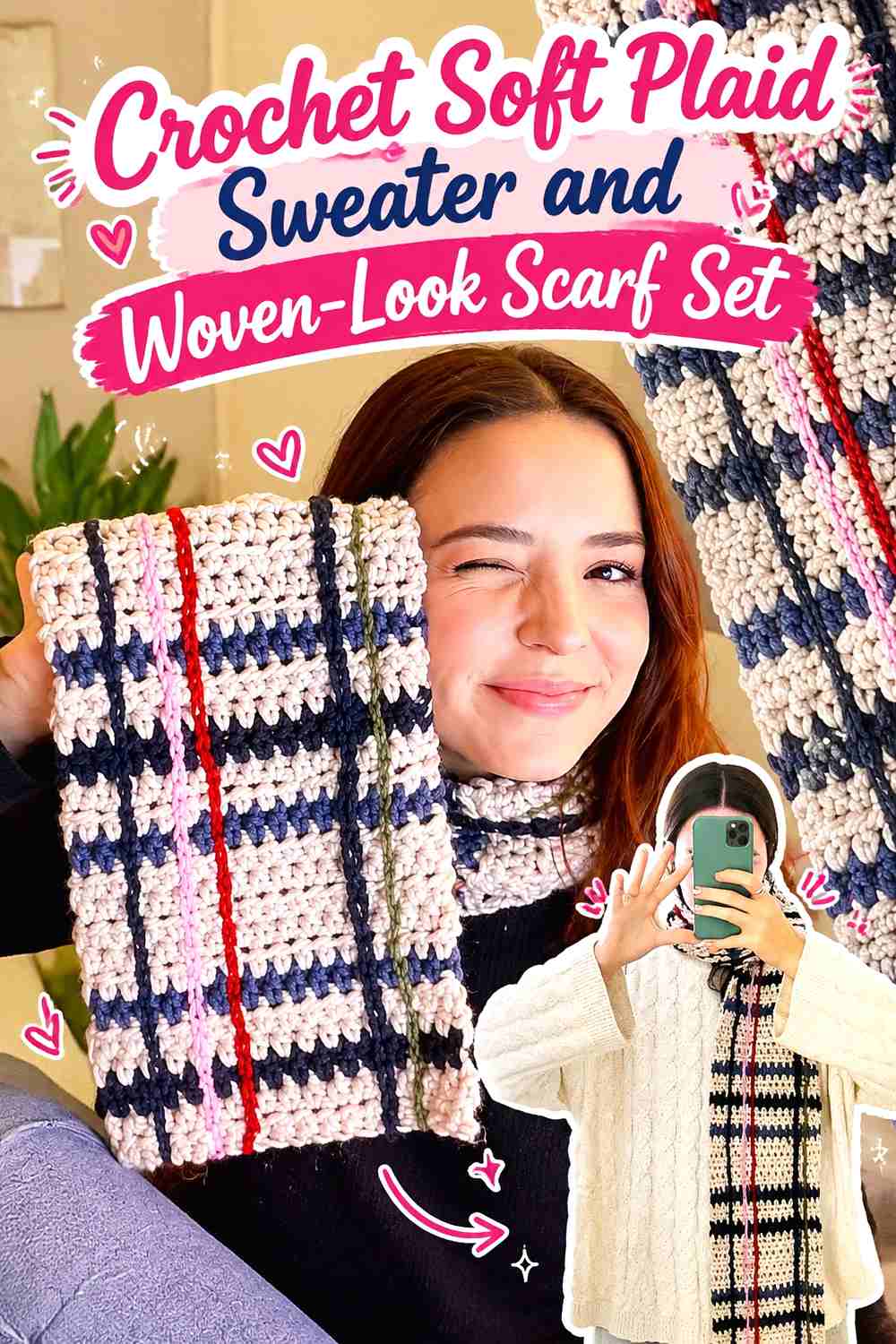
The plaid scarf demonstrated by eliznuts combines horizontal color changes with surface crochet to create the vertical lines that complete the plaid effect.
That construction suggests an interesting sweater pairing: keep most of the pullover simple and use the plaid treatment only across a contained front panel or lower section. The scarf can then display the full pattern more freely.
Surface Lines Need Relaxed Tension
Added vertical lines can distort the base fabric if they are worked too tightly. A scarf may pucker; on a sweater, the same problem could interfere with drape or fit.
When experimenting with a plaid panel, lay the fabric flat after every few lines and check that it remains relaxed rather than waiting until all the surface work is finished.
Three-Tone Plaid Can Make the Set Feel More Layered
Plaid gives you room for a base shade, a secondary band, and a smaller accent. Instead of distributing all three equally across the sweater, let the smallest accent appear only in strategic lines.
This can keep the garment calmer while still matching the more decorative scarf.
Creator Credit: eliznuts
12. Crochet Gingham Sweater-and-Scarf Set
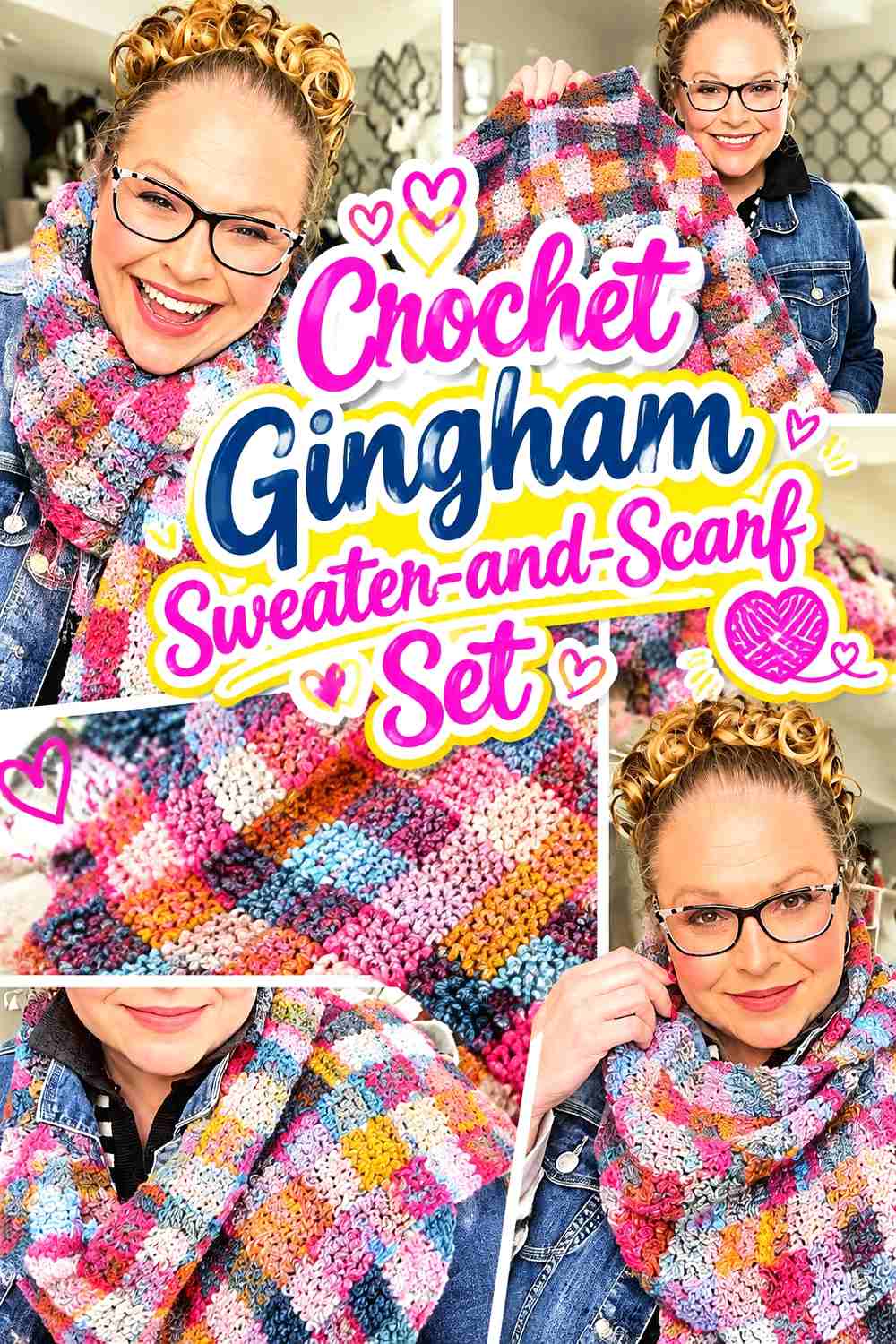
Marly Bird’s gingham plaid scarf uses color changes to build regular checked blocks rather than relying only on post-work surface lines.
For a sweater, that clean block logic can be used as a broad lower-body band, sleeve section, or limited chest panel. The result feels structured and graphic without using the much larger squares of a checkerboard pullover.
Gingham Needs a Clear Color Hierarchy
A convincing gingham effect generally depends on distinct relationships between its shades rather than randomly alternating three unrelated colors.
When adapting the concept, look at the colors in grayscale. If every shade has nearly the same value, the checks may lose definition even though the skeins appear different in color.
Edge Quality Matters on a Long Scarf
A gingham scarf exposes its long edges constantly. Repeated color changes can make those boundaries more noticeable, so consistent turning and yarn management matter to the finished appearance.
On the sweater, seams and edgings can hide or incorporate some transitions. That difference means you should not assume the same finishing solution will work identically on both pieces.
Creator Credit: Marly Bird
13. Crochet Diagonal Plaid Sweater and C2C Scarf Set
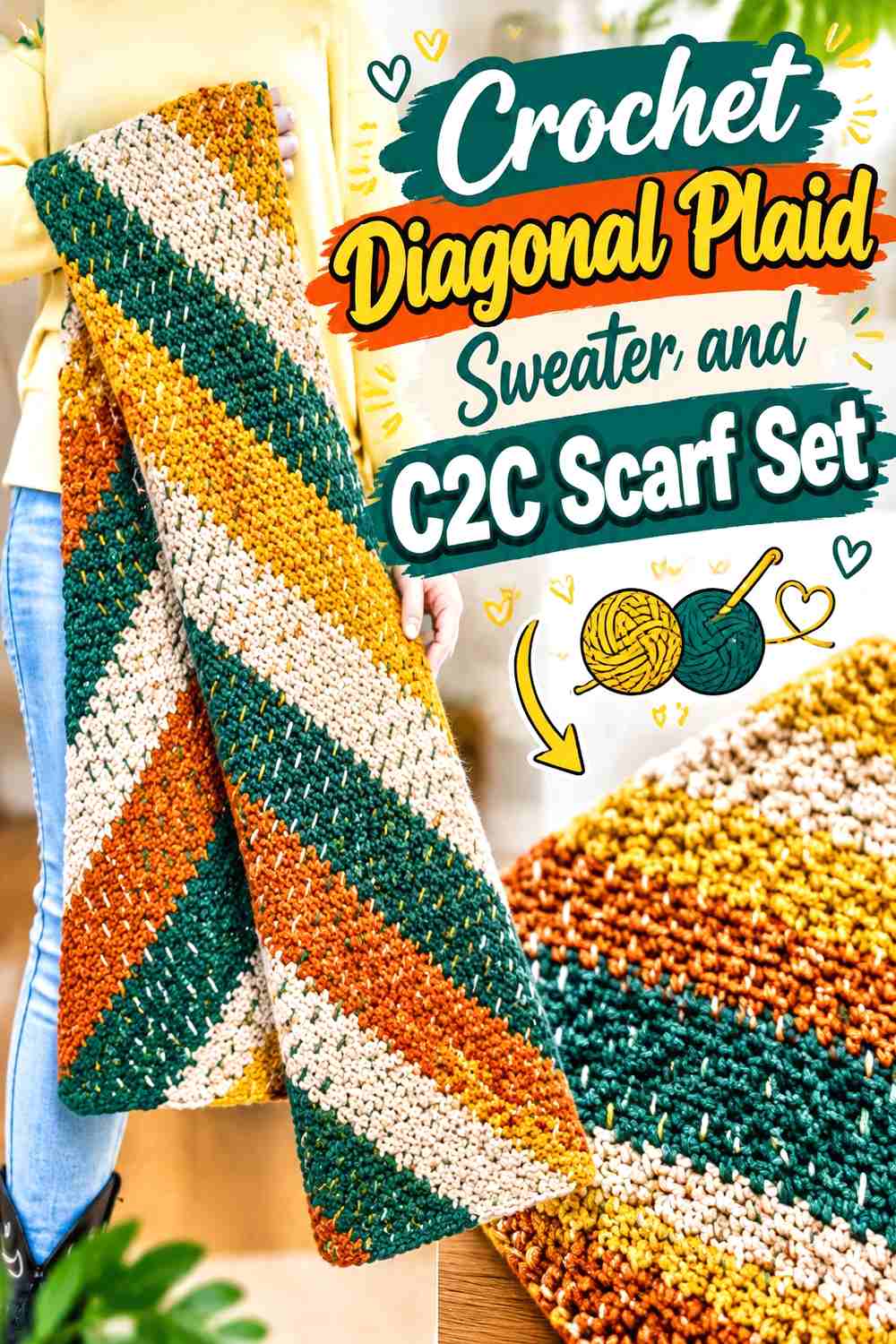
Life + Yarn’s plaid scarf takes a different path by building the fabric on the bias with corner-to-corner moss stitch and then developing the plaid effect across that diagonal construction.
That directional movement can inspire a sweater that uses diagonal color placement rather than conventional horizontal Nordic bands. Even a single diagonal accent panel could connect the garment to the scarf.
Bias Construction Makes the Scarf Feel Different from a Standard Rectangle
Although the finished accessory is rectangular, working on the bias changes how the visual lines travel across it. That distinguishes this set from the straight-row plaid and gingham options elsewhere in the collection.
If you echo the effect on a sweater, keep the garment construction stable and use diagonal color placement as the design feature rather than assuming a scarf construction should simply be transferred to the body.
Woven-In Lines Add Another Texture Layer
The plaid appearance combines the crocheted base with additional yarn running through the fabric. This creates a different surface from tapestry or stranded colorwork.
If the sweater uses a simpler stitch, repeating only the scarf colors may be enough. Trying to reproduce every structural layer on both pieces can add unnecessary bulk.
Creator Credit: Life + Yarn
14. Crochet Tartan Accent Sweater and Classic Plaid Scarf Set
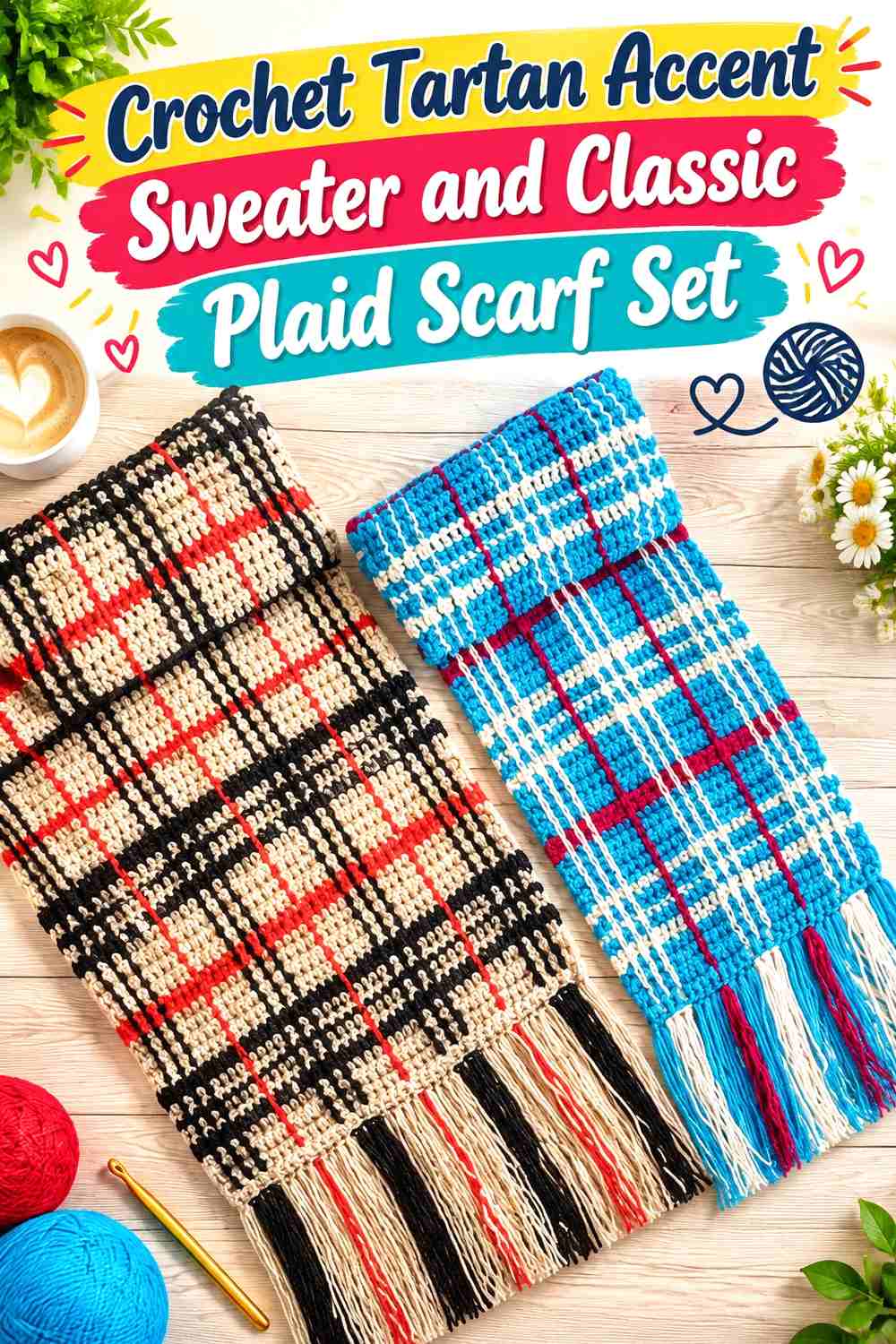
Crafting Happiness Crochet demonstrates a plaid scarf in multiple stages, including the base fabric and the surface work that creates the finished tartan-style appearance.
For a sweater-and-scarf set, this gives you a strong accessory to pair with a comparatively plain pullover. Use the tartan palette at the sweater cuffs, neckline, or hem instead of attempting to cover the entire garment in the full scarf treatment.
Keep Surface Crochet from Restricting the Sweater
A scarf can tolerate decorative surface lines with little concern about body movement. A sweater has to stretch over shoulders, elbows, and the torso.
If you experiment with surface crochet on the garment, use it in an area where it will not noticeably restrict movement and continually check that the underlying fabric still behaves as intended.
A Classic Plaid Benefits from Controlled Accent Color
The smallest or brightest plaid shade often has more impact when used sparingly. Carrying that same accent into the sweater ribbing or a narrow cuff detail can connect the set without reproducing the full plaid grid.
This is particularly effective when the main sweater color also appears as the scarf’s dominant background.
Creator Credit: Crafting Happiness Crochet
15. Crochet Winter Mosaic Sweater and Pocket Scarf Set
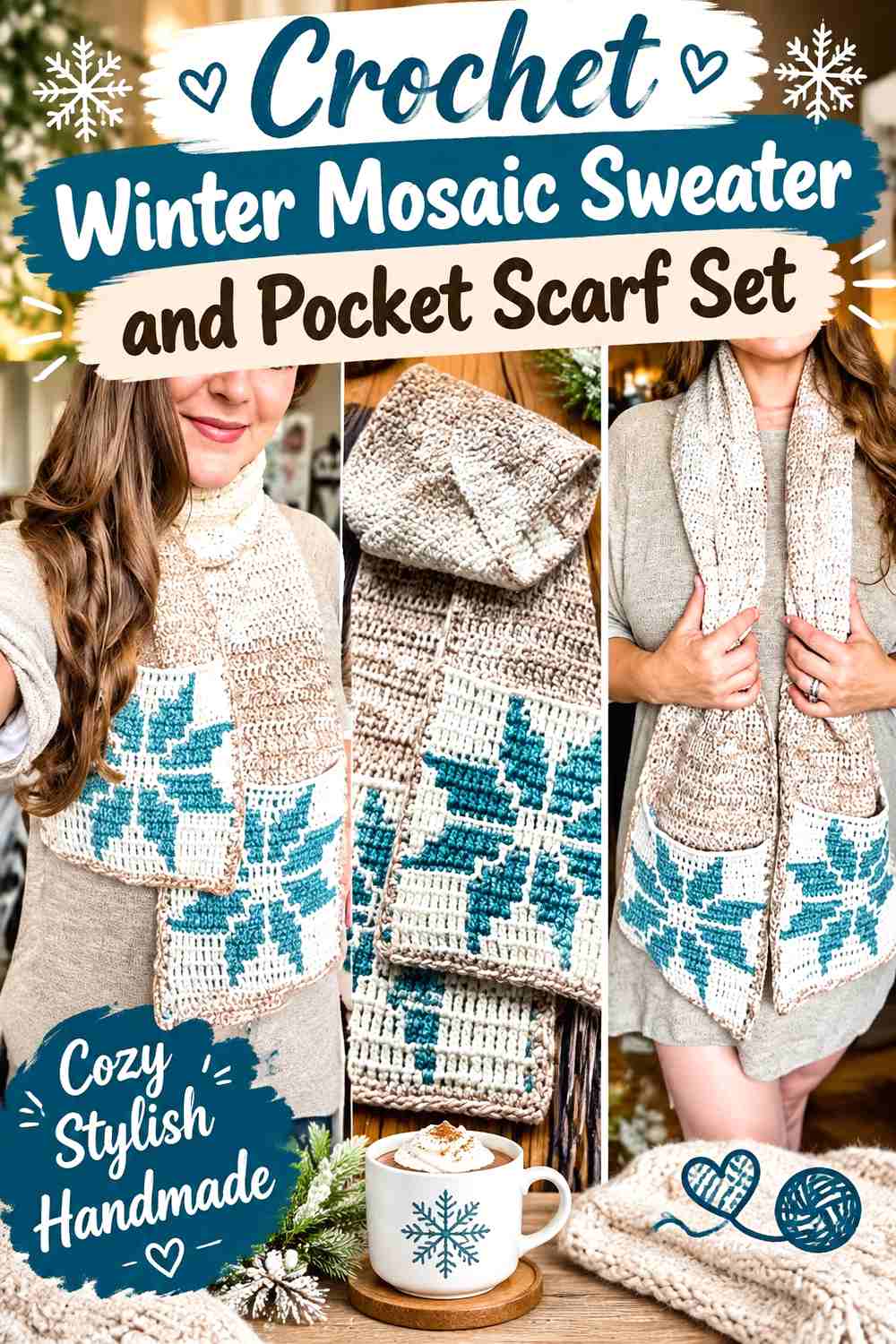
Stardust Gold Crochet’s winter scarf combines mosaic colorwork with a practical pocket-scarf format. The tutorial shows the finished scarf construction and decorative winter treatment rather than functioning as a simple narrow rectangle.
That extra volume makes it a natural partner for a simpler sweater. Repeat the scarf’s color family or a narrow piece of its winter geometry around the sweater yoke and let the pockets remain the accessory’s distinctive feature.
Pockets Add Weight at the Scarf Ends
A pocket scarf behaves differently from a lightweight decorative scarf because the ends have more structure and may also carry small items.
When pairing it with a sweater, consider the combined bulk around the front of the body. A thick scarf plus an equally dense raised sweater motif may feel crowded even if the colors work beautifully together.
Use the Sweater to Calm a Detailed Accessory
The scarf already combines function and pattern, so a restrained sweater provides balance. A solid body with one colorwork yoke or cuff detail can be enough.
This set works particularly well when you want the scarf to remain useful indoors after the sweater is removed, since it has a strong identity of its own.
Creator Credit: Stardust Gold Crochet
16. Crochet Fine-Check Sweater and Slim Scarf Set
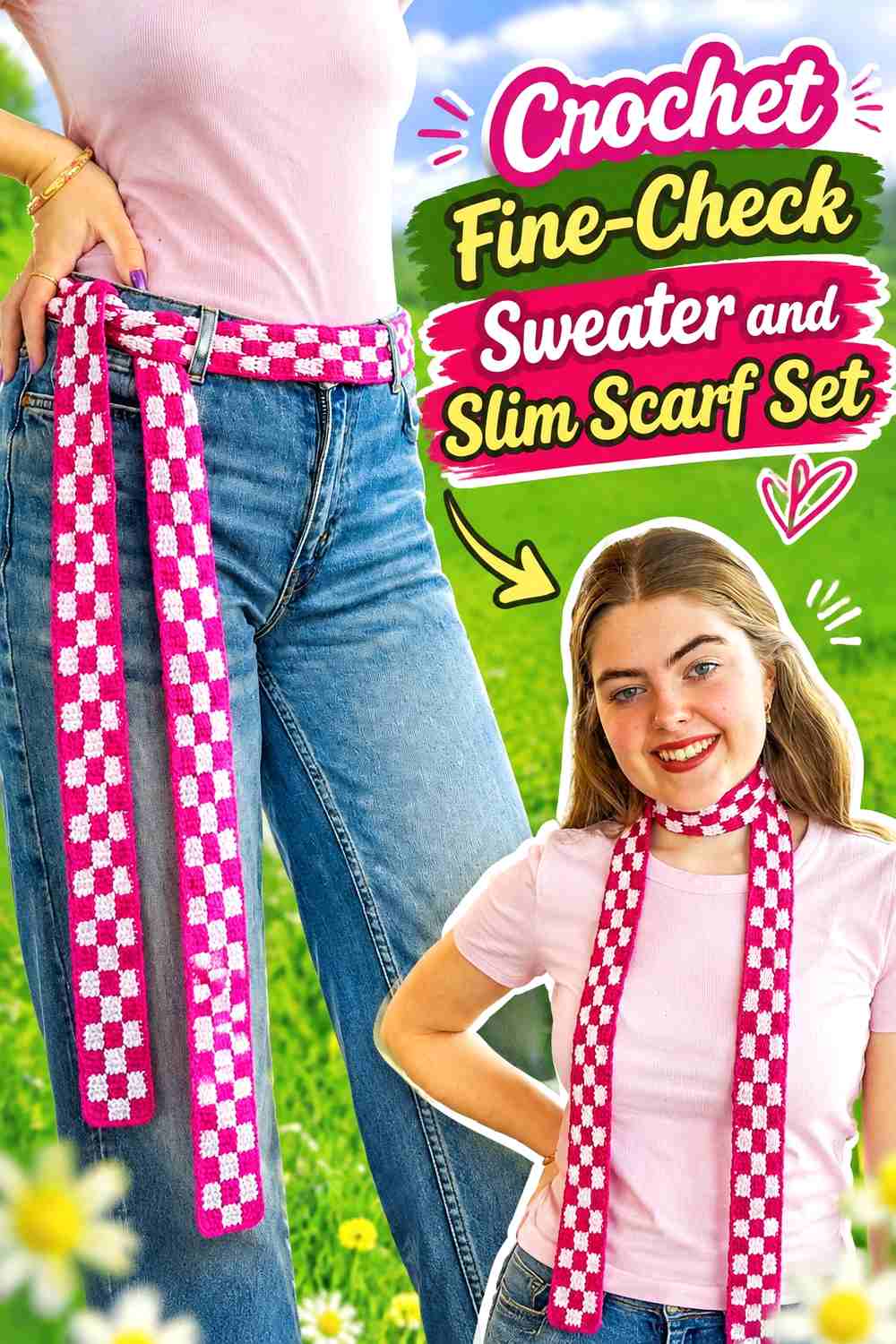
Crochet with Linni’s checkered scarf uses a much narrower, lighter-looking format than the broad plaid scarves elsewhere in this list. The design can also function as a belt, emphasizing its slim proportions.
That makes it useful inspiration for a more refined sweater-and-scarf set. Instead of oversized checkerboard blocks, use smaller repeated checks on the sweater and let the scarf remain long and narrow.
Small Checks Suit More Selective Placement
Fine checks can create substantial visual activity even when the motif itself is small. On a sweater, limiting them to a center panel, yoke band, or sleeve section can keep the garment from looking overly busy.
A slim scarf can carry more of the repeat because its total surface area is smaller.
Thin Accessories Put More Attention on the Sweater
A narrow scarf does not cover much of the upper garment, so the sweater remains visible when both pieces are worn.
This makes the concept particularly useful if your main goal is to showcase the sweater colorwork rather than hide it under a large winter wrap. Coordinate the shades carefully, but let the two pieces use different pattern scales.
Creator Credit: Crochet with Linni
Which Crochet Sweater-and-Scarf Set Should You Choose?
For the closest connection to recognizable Fair-Isle-style crochet, start with the Nordic yoke or heart-motif sweater concepts. Both put carried colorwork directly into a garment and make motif placement an important part of the fit.
Choose the geometric mosaic, Starlight, or winter pocket-scarf sets when you prefer strong graphic patterning without trying to imitate traditional stranded knitting exactly. These options can also work well with modern color palettes such as charcoal and cream, rust and oatmeal, forest green and beige, or muted multicolor yarn against a dark solid.
The houndstooth, gingham, checkerboard, and plaid sets are stronger choices if you like fashion-oriented geometric fabric more than obvious snowflake or Nordic motifs. Their repeats make color selection especially important because a small palette covers a large visual area.
For something quieter, the snowflake set or slim fine-check set lets you concentrate pattern in smaller areas. Those options are particularly useful when you want a sweater that can still be worn easily without its matching scarf.
Conclusion
A successful crochet Fair Isle sweater-and-scarf set does not need two identical patterns. In many cases, the better choice is to repeat one design idea—color, motif shape, contrast level, or pattern scale—while allowing the two pieces to have different constructions.
Choose the Nordic yoke or heart sweater if the garment should carry the strongest traditional-looking colorwork. Pick the mosaic options for more contemporary geometry. Go toward houndstooth, gingham, checks, or tartan for a graphic fashion look, and use snowflakes when you want an unmistakably wintry motif without making the set specifically Christmas-themed.
Most importantly, swatch for the sweater and scarf separately. Fit, stretch, density, and drape have different consequences in a garment and a neck accessory. Use the original tutorials for their exact construction details, then make your coordinating decisions around color and placement rather than trying to reconstruct a creator’s pattern into a second item.
Frequently Asked Questions
Is Fair Isle crochet the same as traditional Fair Isle knitting?
Not exactly. Fair Isle is traditionally associated with stranded colorwork knitting. In crochet, the term is often used for related multicolor effects created with carried yarn, split single crochet, tapestry techniques, and other methods. Mosaic, gingham, and plaid crochet can produce a similar winter colorwork mood but are technically different constructions.
Should a crochet Fair Isle sweater and scarf use exactly the same yarn?
They can, but they do not have to. The sweater requires yarn that gives you appropriate gauge, fit, and garment drape. A scarf may feel better in a softer or slightly different fabric. If you change yarn between pieces, repeating a few important colors can still make the set look coordinated.
How do I keep carried colorwork from making a crochet sweater too tight?
Avoid pulling the inactive yarn tightly across the back of the work, and assess the colorwork section in a swatch before relying on your plain-crochet gauge. The exact handling method should follow the tutorial or pattern you are using because different colorwork constructions manage the inactive yarn differently.
Should I repeat the sweater motif across the entire scarf?
Usually not. A highly patterned yoke can pair effectively with a mostly solid scarf that repeats the motif only near its ends. This reduces visual competition and may also simplify color management.
Can I turn a scarf colorwork pattern directly into a sweater motif?
Treat it as inspiration rather than assuming it will transfer directly. Sweaters introduce shaping, sizing, armholes, necklines, and gauge requirements that a rectangular scarf does not have. Compare repeat dimensions and garment measurements before deciding whether a motif is compatible.
Which colorwork style is useful if I do not want to manage long floats?
Consider mosaic, block-based checks, gingham, or a plaid construction that creates its effect through separate color sections or surface work. These methods are not identical to Fair-Isle-style stranded crochet, but they can provide a similar multicolor winter look.
How many colors should I use in a coordinated sweater-and-scarf set?
There is no universal number. Two high-contrast shades can create a strong houndstooth or checkerboard set, while a Nordic or mosaic design may use several accents. What matters more is hierarchy: choose a dominant background, decide which shades are secondary, and avoid giving every color equal visual weight unless the chosen design specifically calls for it.