A sandwich press is a useful kitchen appliance, but when it sits unused on the countertop, its lid and outer surfaces can gradually collect ordinary household dust. A removable crochet dust cover can add a decorative layer during storage while bringing color and handmade texture into the kitchen. These 16 crochet sandwich press dust cover inspiration ideas explore fitted rectangular covers, granny-square panels, shell borders, textured stitches, adjustable wraps and neatly shaped designs.
The right cover depends on the size and shape of your sandwich press, where you store it and how frequently you use it. Some concepts are simple slip-on covers, while others include side ties, buttoned flaps, decorative pockets or shaping for raised handles and hinges. The collection focuses on the appearance and practical considerations of each design, helping you compare coverage, fitting, removal and cleaning before planning a real project.
These are AI-generated crochet design visualizations for inspiration, not photographs of tested handmade covers or complete patterns. They have not been tested for fit, dust protection, durability or heat safety.
Important safety note: These are storage-only concepts. Never put a crochet cover on a plugged-in, switched-on, warm or hot sandwich press. The appliance must be unplugged, completely cooled, cleaned and dry before covering, and the cover must be removed before reconnecting it. Follow your model’s manufacturer instructions, particularly if they prohibit covering the appliance.
Quick Design Selection Guide
- For a neat, fitted appearance: Crochet Ochre Box-Fit Sandwich Press Cover and Crochet Navy Ivory Gingham Press Cover offer structured rectangular shapes.
- For simple removal: Crochet Denim Blue Side-Slit Press Cover and Crochet Butter Yellow Shell-Hem Press Cover use straightforward dropover designs.
- For farmhouse and cottage kitchens: Crochet Raspberry Granny Tile Press Cover, Crochet Blush Daisy-Corner Press Cover and Crochet Ivory Pleated-Side Press Cover add decorative character.
- For textured crochet lovers: Crochet Cocoa Waffle-Texture Sandwich Press Cover and Crochet Teal Basketweave-Relief Press Cover focus on raised stitches.
- For unusual appliance shapes: Crochet Sand Raised-Handle Dome Cover and Crochet Rust Curved-Hinge Press Cover explore more specific shaping.
- For adjustable or personalized styling: Crochet Sea-Glass Side-Tie Press Wrap, Crochet Sage Foldover Button Press Cover and Crochet Lavender Recipe-Card Pocket Press Cover offer different practical details.
1. Crochet Ochre Box-Fit Sandwich Press Cover
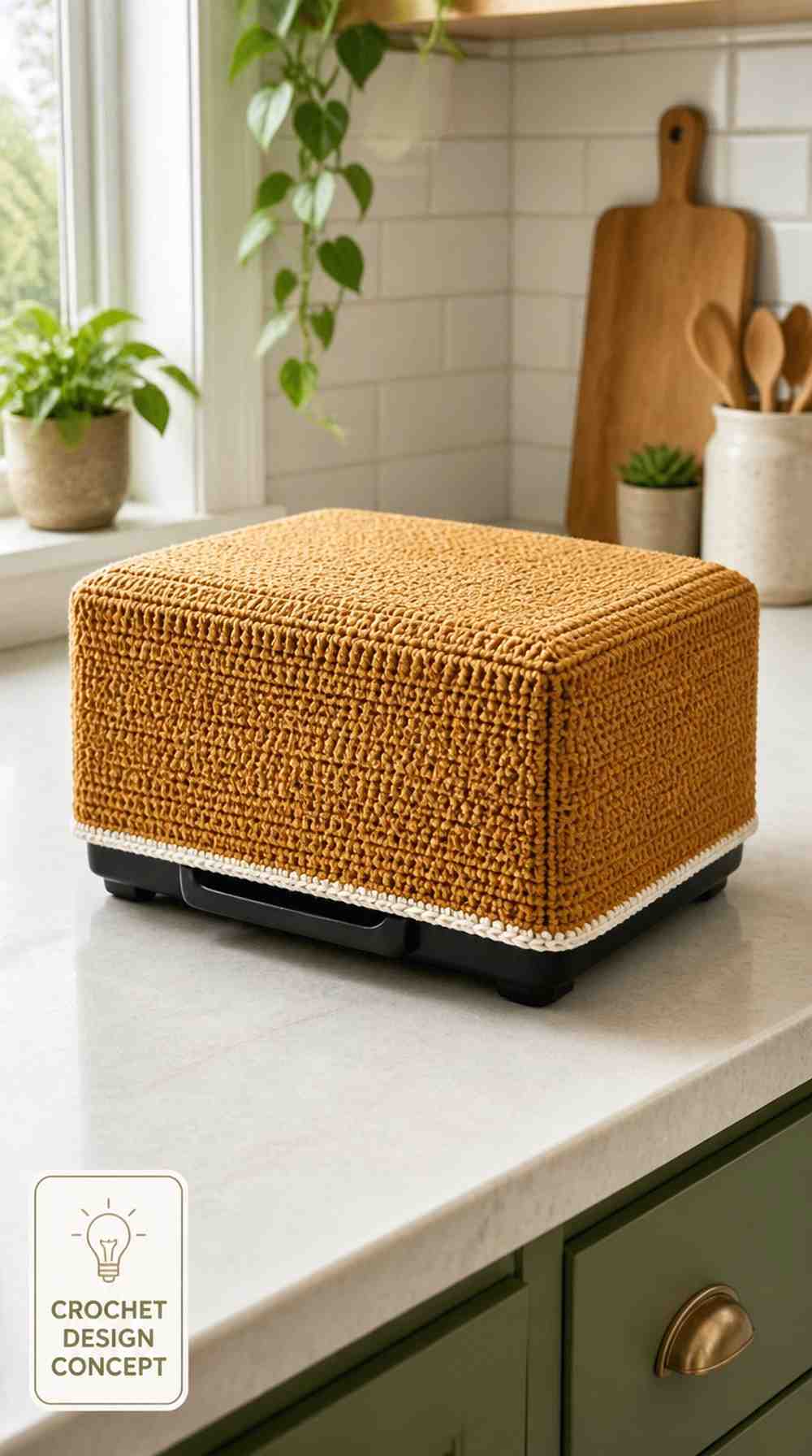
Warm ochre crochet gives this fitted sandwich press cover a clean, welcoming appearance. The rectangular top, softly defined corners and close-textured side panels follow the general shape of a compact appliance. A narrow ivory border finishes the straight lower edge, adding a gentle contrast without making the cover overly decorative.
The fitted silhouette is appealing for a tidy kitchen countertop, particularly when the sandwich maker is stored in the same spot. However, closely fitted crochet needs careful measurements so it can be removed without pulling against handles or hinges.
- Rectangular fitting: Check the press’s full width, front-to-back depth and closed height, including any raised exterior parts, before planning a close-fitting cover.
- Corner construction: Softly joined vertical corners can give the cover its defined shape without creating large, bulky seams that interfere with removal.
- Ivory lower border: A tightly worked finishing row may help the hem hold a straight appearance, although actual shape retention depends on yarn and gauge.
2. Crochet Denim Blue Side-Slit Press Cover
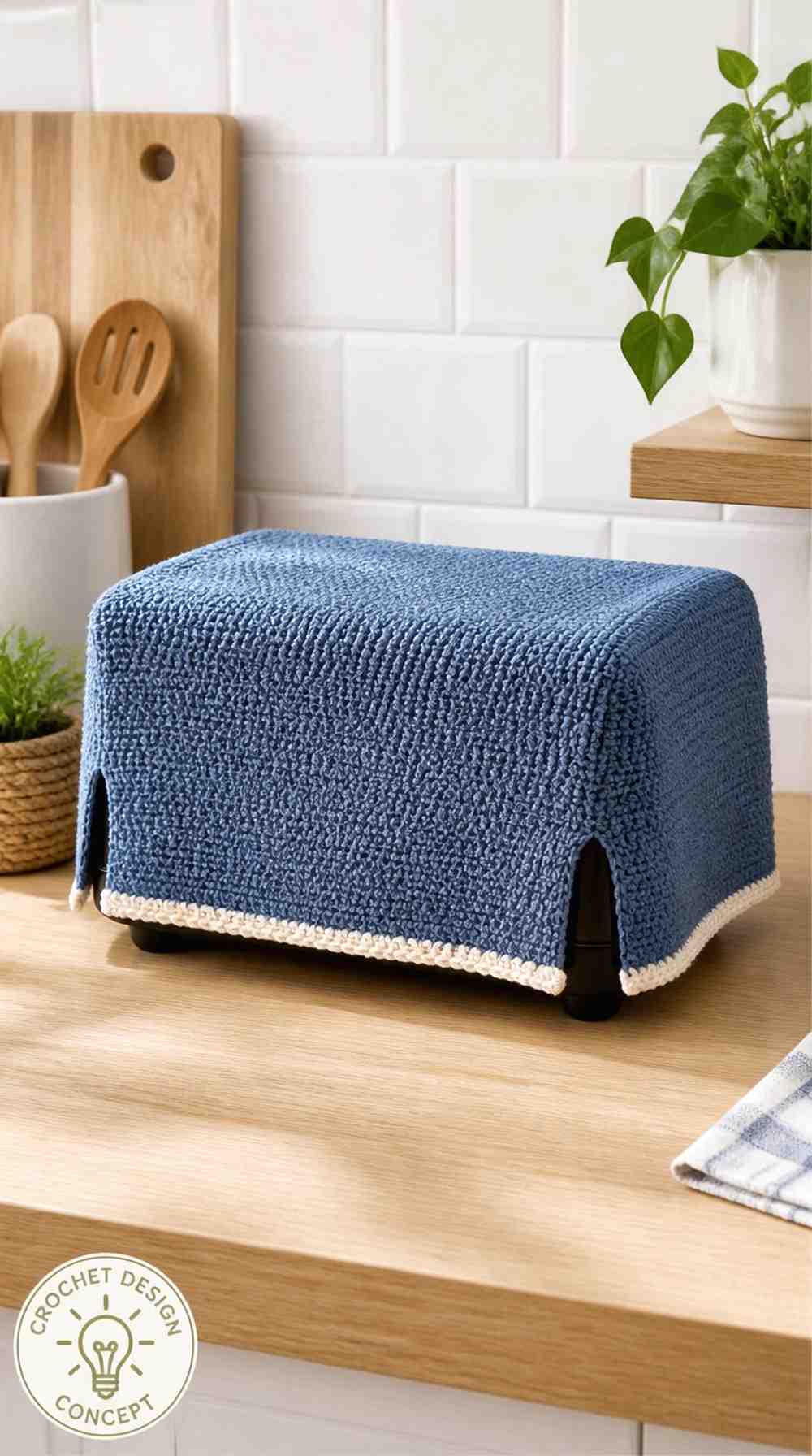
Dusty-denim-blue crochet gives this cover a soft, casual look. The rectangular top falls into relaxed side panels, with short vertical slits at the front-side corners. A narrow cream edge finishes the lower hem, while the fabric hangs loosely around the closed sandwich press.
Unlike a tightly shaped cover, the side-slit arrangement allows the fabric to drape without forcing sharp folds around the appliance. It may be convenient for frequent removal, although the open sections expose small parts of the appliance to dust.
- Side-slit purpose: Short slits allow separate panels to move more freely, which may help reduce bunching at a press’s wider front corners.
- Coverage limitation: Exposed corner areas will not receive the same dust coverage as those beneath a continuous fabric panel.
- Loose-fitting approach: Leave enough room to lift the cover clear of the appliance without dragging yarn against projecting handles or control parts.
3. Crochet Butter Yellow Shell-Hem Press Cover
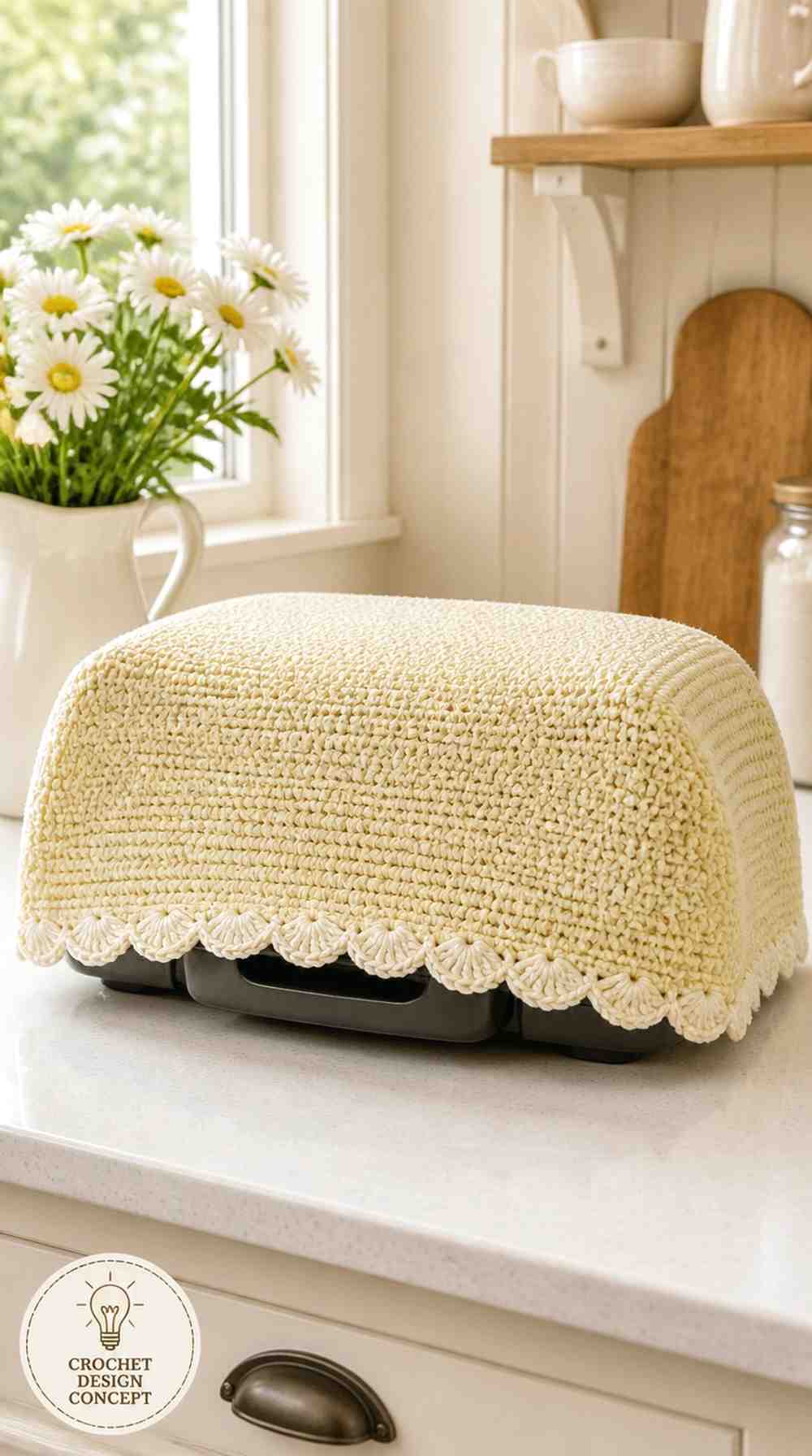
Pale butter-yellow crochet gives this sandwich press cover a soft cottage-kitchen appearance. Its main body uses closely worked rows, while small ivory crochet shells create a continuous scalloped finish around the lower front and side edges. Rounded top corners keep the shape gentle and understated.
The decorative shells are the main feature of this design, rather than separate flowers or appliqués. They add interest to a simple rectangular cover, but the lower border would need consistent spacing to avoid curling or hanging unevenly.
- Shell spacing: Keep the ivory shell stitches evenly distributed so the hem sits at a consistent visual height around the appliance.
- Decorative edge depth: Shallow scallops are easier to accommodate around a compact countertop appliance than long, dangling crochet loops.
- Cleaning consideration: Raised shell shapes may collect kitchen dust and debris in their folds, making regular inspection and washing especially useful.
4. Crochet Raspberry Granny Tile Press Cover
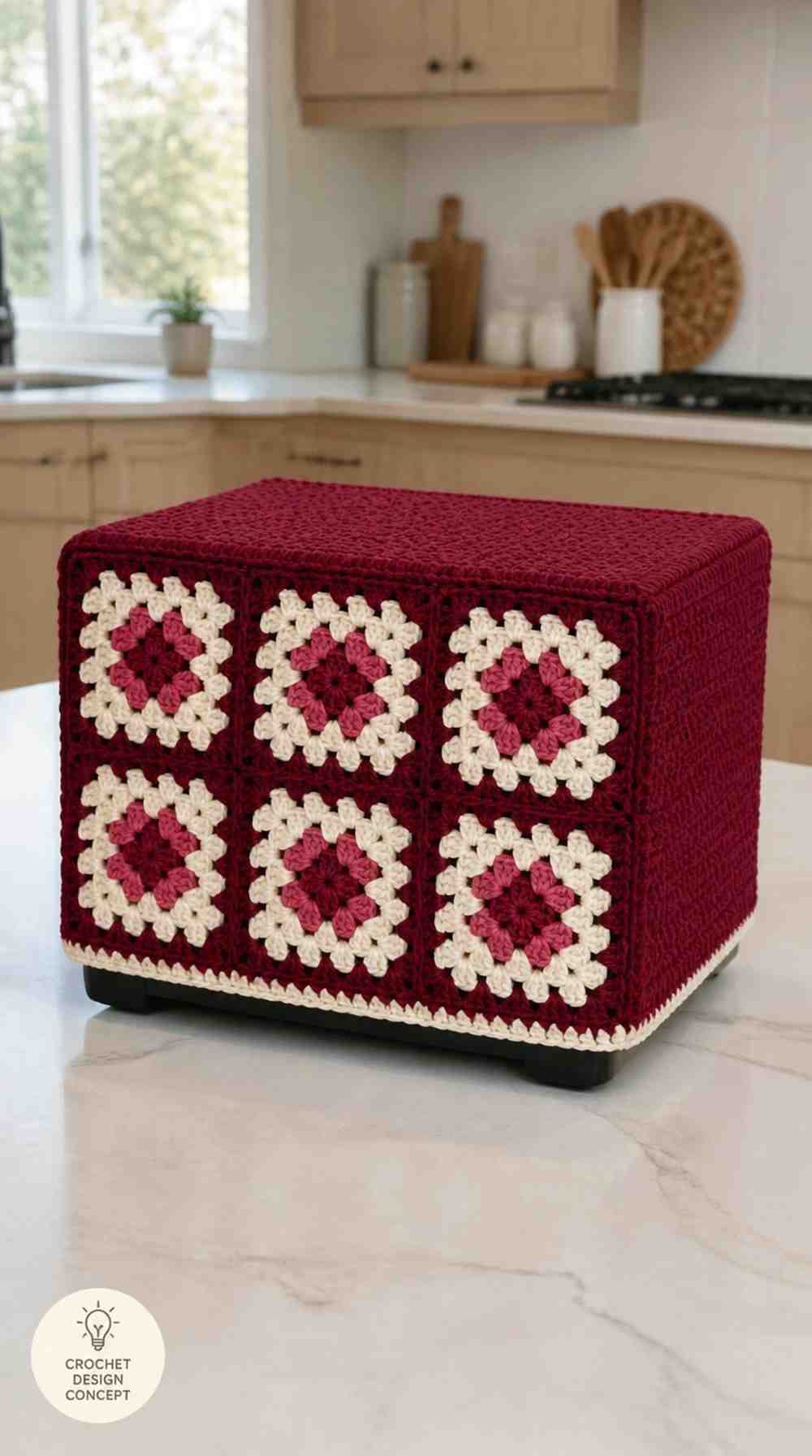
Six small crochet granny squares form the front panel of this raspberry-colored dust cover. Each square has a pink center, an ivory middle round and a burgundy border. The solid burgundy top and side panels create a strong frame around the joined motifs, with a slim ivory edge beneath them.
This design has a more traditional handmade appearance than the smooth fitted styles. The square arrangement provides plenty of room for coordinated colorwork, but the joins and corners need to remain flat to create a neat rectangular cover.
- Six-square layout: Arrange two rows of three evenly sized motifs, checking the combined panel dimensions before attaching the solid top and side sections.
- Joining method: Flat, closely worked joins can reduce bulky ridges where the individual squares meet, helping the front hang more evenly.
- Open motif spaces: Traditional granny-square gaps allow some dust to pass through, so this design should not be treated as a sealed protective barrier.
5. Crochet Cocoa Waffle-Texture Sandwich Press Cover
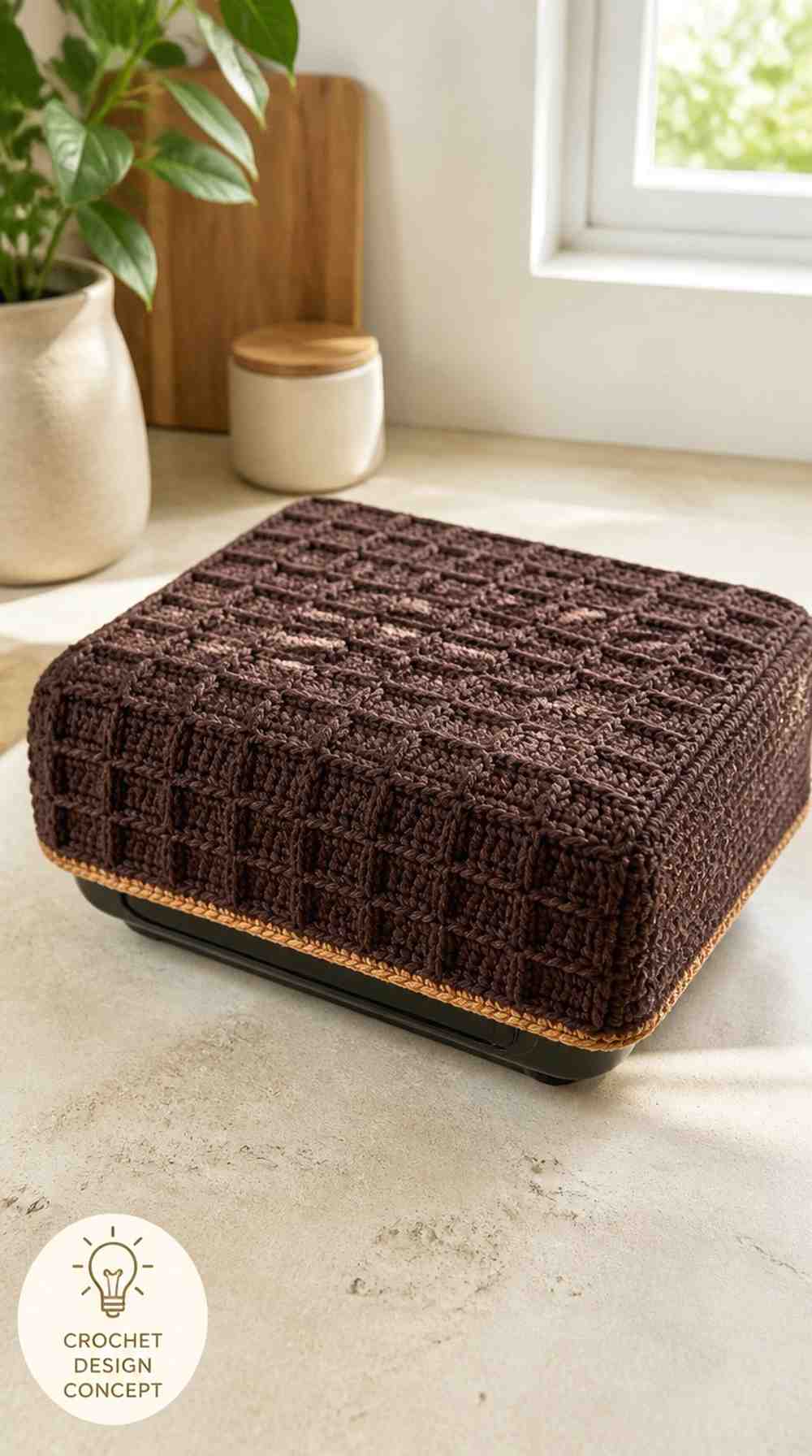
Rich cocoa-brown yarn brings warmth to this textured crochet cover. Low waffle-like squares spread across the top and front panels, while the sides remain smooth and closely stitched. A narrow caramel-brown border defines the lower edge without distracting from the raised pattern.
The contrast between the textured and smooth sections makes this cover especially interesting. Its dimensional crochet stitches can create a substantial-looking surface, although the raised areas may require more attention during cleaning than a plain, flat cover.
- Waffle-stitch relief: Low, even raised squares provide visible depth without adding unnecessary bulk to the appliance cover.
- Smooth side panels: Plain side sections can reduce complicated shaping and allow the textured top and front to remain the visual focus.
- Dust collection: Raised crochet surfaces may trap crumbs or greasy kitchen residue more readily than flatter fabrics, so placement away from cooking splatter matters.
6. Crochet Blush Daisy-Corner Press Cover
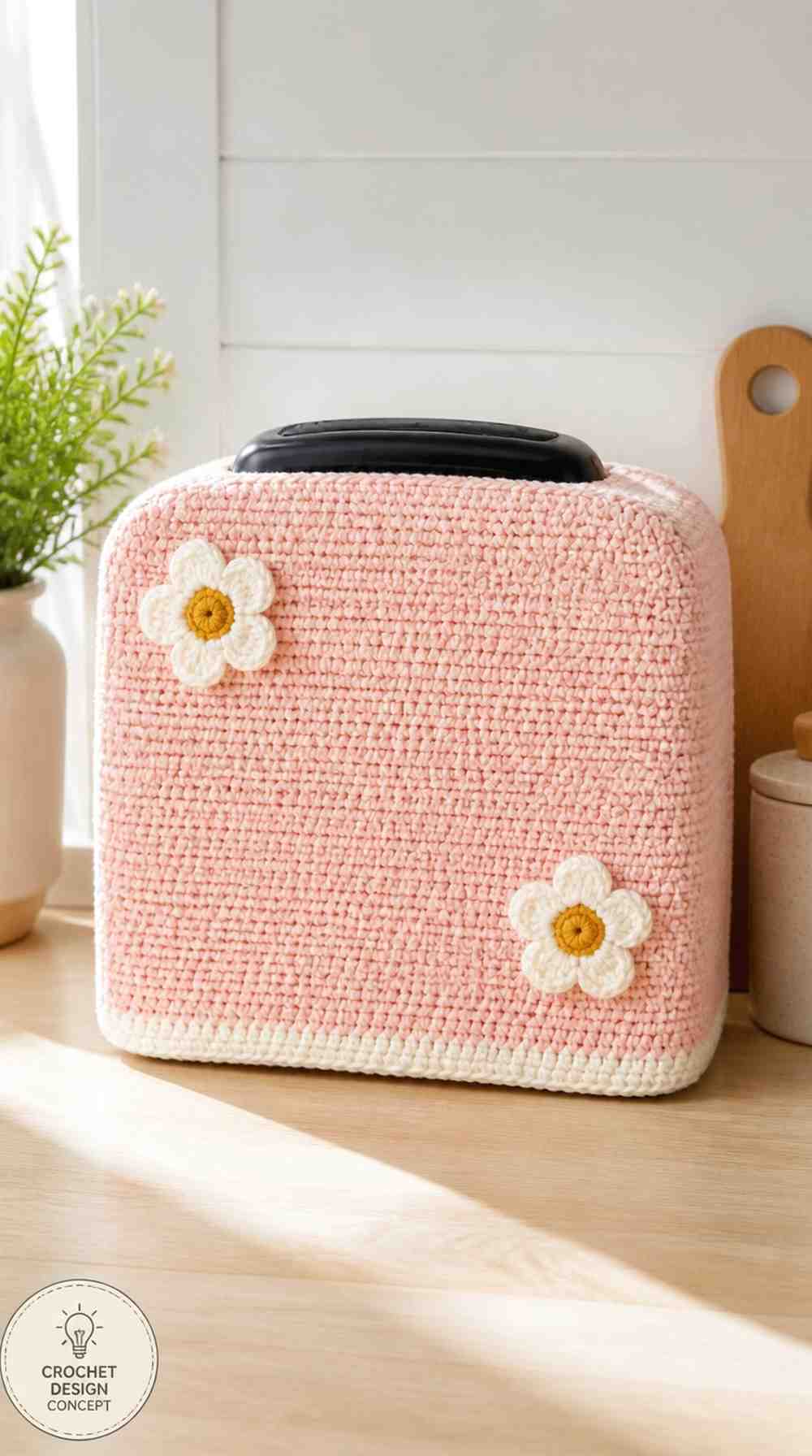
Soft blush-pink crochet forms the simple rectangular base of this sandwich press cover. Two small ivory daisies decorate opposite corners of the front panel, each with five rounded petals and a mustard-yellow center. A narrow white hem gives the design a clean finishing line.
The small floral accents create a cheerful cottage-inspired appearance without covering the entire fabric in decoration. Because the daisies sit near the corners rather than the center, their attachment and placement need careful attention so they stay flat during removal.
- Corner flower placement: Position the daisies far enough from the side joins to prevent the petals from folding awkwardly around the cover’s edges.
- Flat appliqué attachment: Secure each flower through its center and selected petal points to reduce loose edges that might catch during handling.
- Alternative flower colors: Different petal shades are an optional way to match kitchen curtains or towels while preserving the original cover silhouette.
7. Crochet Sea-Glass Side-Tie Press Wrap
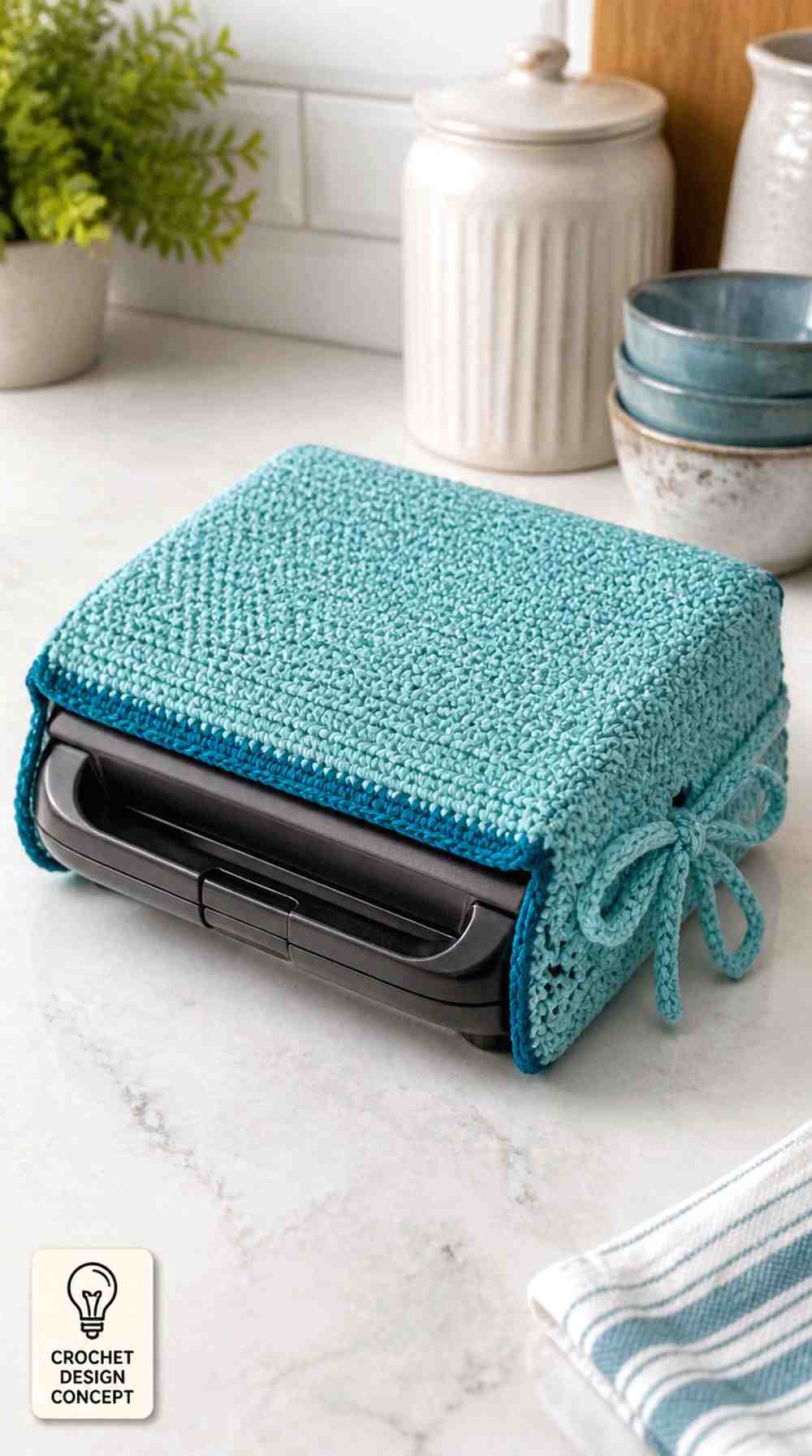
Sea-glass turquoise gives this crochet sandwich press wrap a fresh, light appearance. A flat rectangular top panel extends into overlapping side sections, while short matching crochet ties form small bows along the sides. A deeper teal border outlines the front edge and defines the wrap’s shape.
The side-tie arrangement distinguishes this design from a conventional slip-on cover. It could allow some adjustment around similar-sized appliances, but a finished version would still need careful fitting and secure, easily released ties.
- Overlapping panels: Allow enough overlap to cover the sides without pulling the top fabric into tight folds or creating large gaps.
- Tie placement: Short, securely attached ties should close the wrap without becoming loose strands that fall toward neighboring appliances or sockets.
- Removal process: The wrap is intended to be untied and removed completely before the sandwich press is connected or switched on.
8. Crochet Sage Foldover Button Press Cover
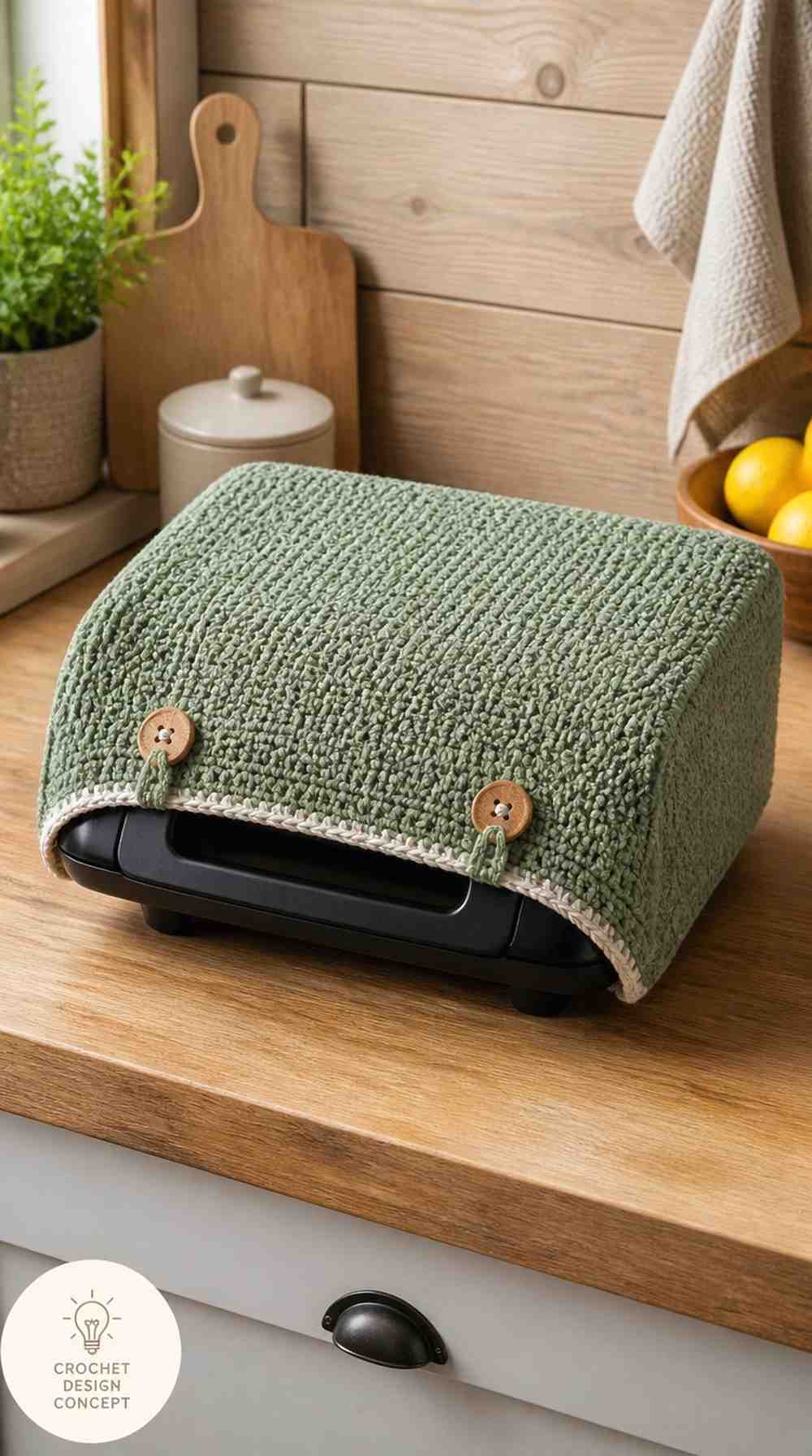
Muted-sage crochet creates a calm, farmhouse-inspired base for this rectangular appliance cover. A short front flap folds over the main panel, with two tan wooden buttons holding it against matching crochet loops. Narrow cream edging follows the flap and gives the front a clear outline.
The buttoned construction makes this design more structured than a simple draped cover. It also adds hardware that needs secure attachment and careful handling, particularly if the cover is removed and replaced frequently.
- Foldover depth: A short front flap gives the buttons enough fabric to fasten without creating a thick, heavy overlap.
- Button security: Secure both wooden buttons properly and inspect them regularly, especially if the cover is handled often.
- Hardware caution: Avoid dragging buttons across glossy or delicate appliance finishes, since hard attachments may cause scratches.
9. Crochet Sand Raised-Handle Dome Cover
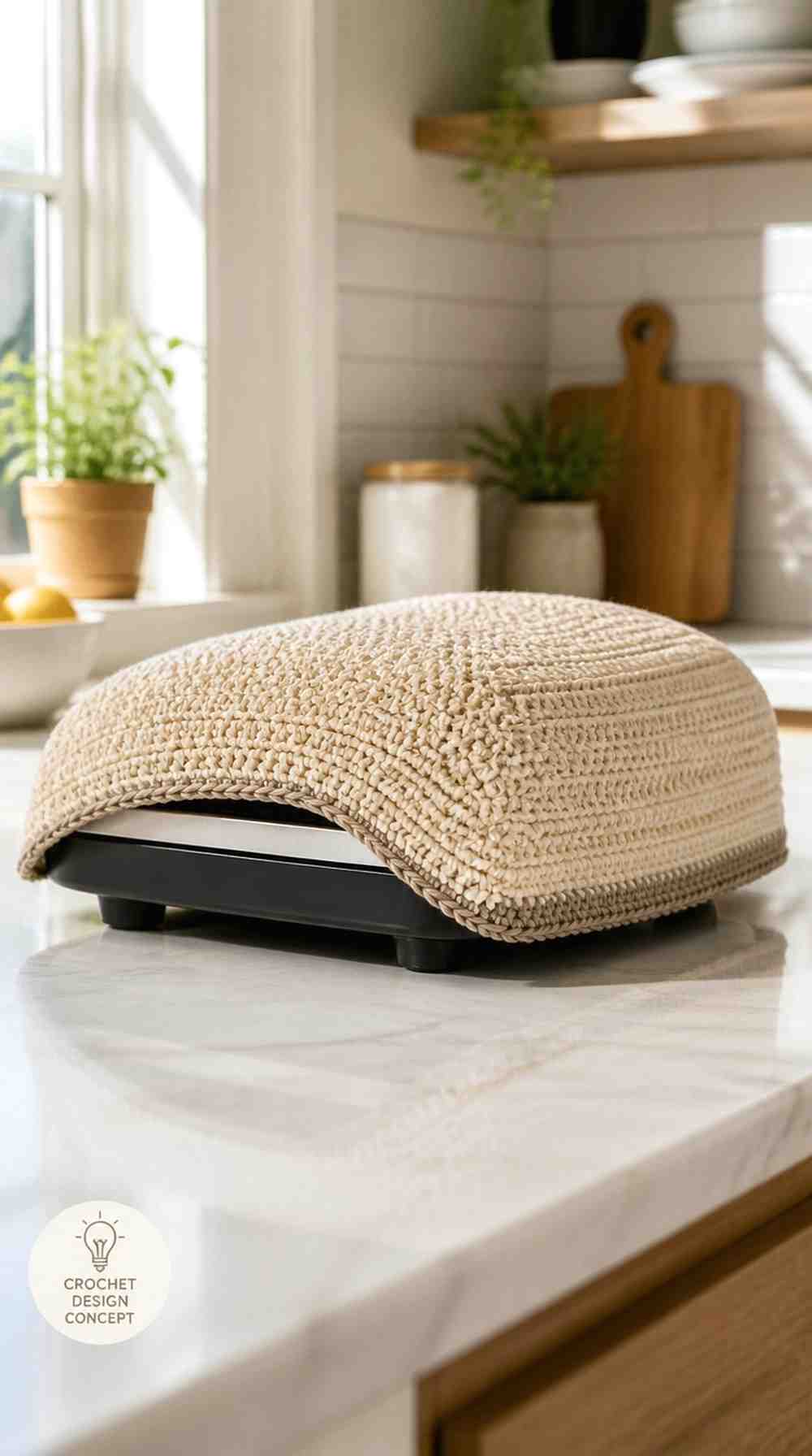
Warm sand-beige yarn shapes this cover into a gentle dome above the closed sandwich press. The upper section rises over the appliance’s exterior handle profile, while the side panels curve softly toward a narrow oatmeal-colored hem. Closely worked horizontal stitches emphasize its shaped silhouette.
Unlike a simple rectangular box cover, the raised top accommodates a particular appliance profile. This makes the concept visually distinctive, but it also means the shape would need to be planned around the exact position and height of the handle.
- Handle clearance: Measure the closed appliance’s highest exterior point rather than using the height of its main rectangular body alone.
- Curved shaping: Gradual stitch increases or shaped panel sections could create the dome, but the actual construction would require gauge testing.
- Model compatibility: This silhouette may not suit a press with a very broad projecting handle or a completely flat upper surface.
10. Crochet Navy Ivory Gingham Press Cover
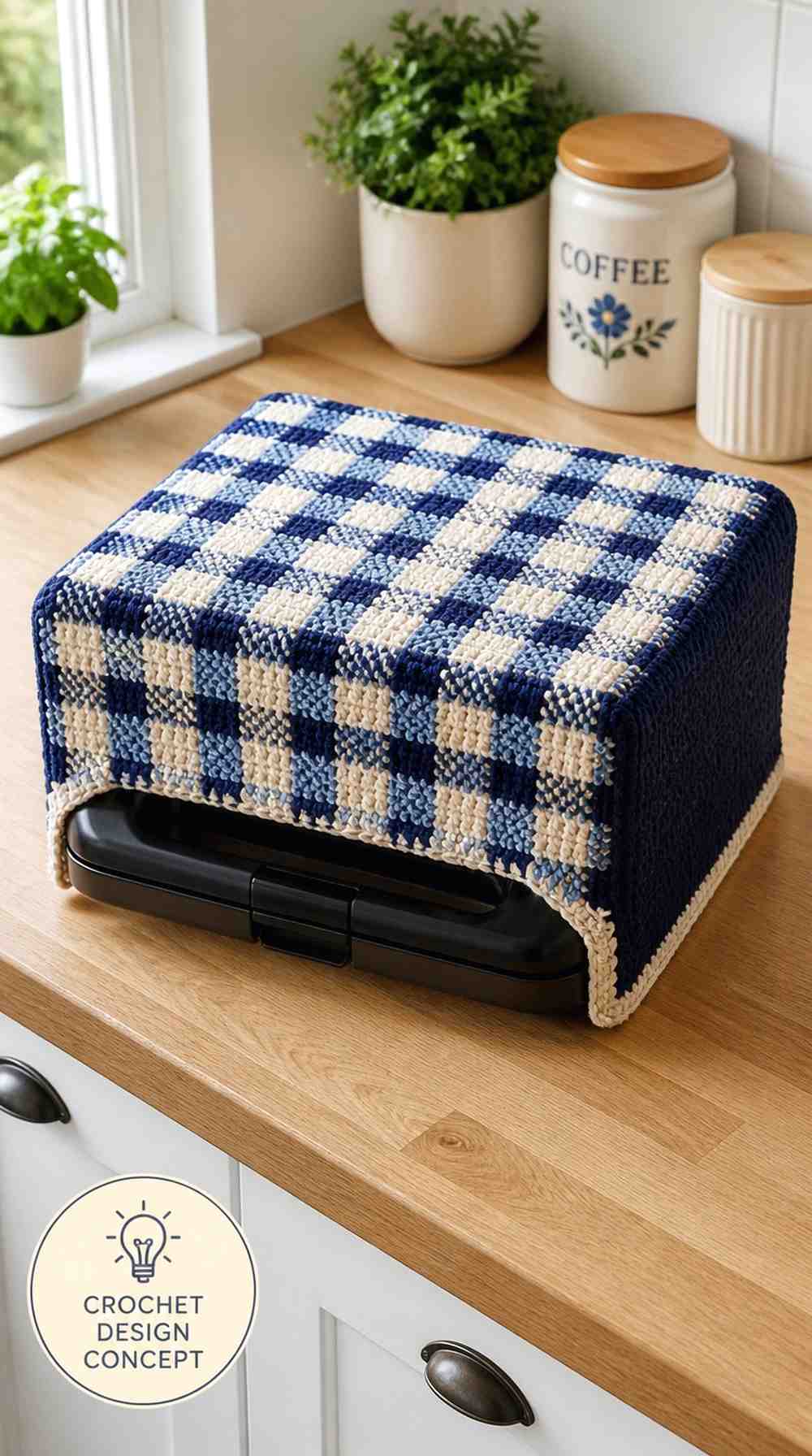
Navy blue, pale blue and soft ivory form small gingham-style checks across the top and front of this crochet cover. Plain navy side panels balance the patterned surfaces, while an ivory hem gives the rectangular shape a neat finishing detail.
The checked appearance comes from the crochet colorwork rather than printed fabric. It would suit a kitchen with simple cabinets and blue accents, although maintaining evenly sized checks across the front and top requires careful color planning.
- Check alignment: Keep the gingham blocks consistent where the top meets the front, especially if the pattern is intended to continue across the corner.
- Color changes: Frequent yarn changes can create extra ends and thickness unless they are managed neatly within the crochet structure.
- Solid side panels: Plain navy sides can reduce the amount of colorwork needed while helping the patterned front remain prominent.
11. Crochet Apricot Embroidered-Diamond Press Cover
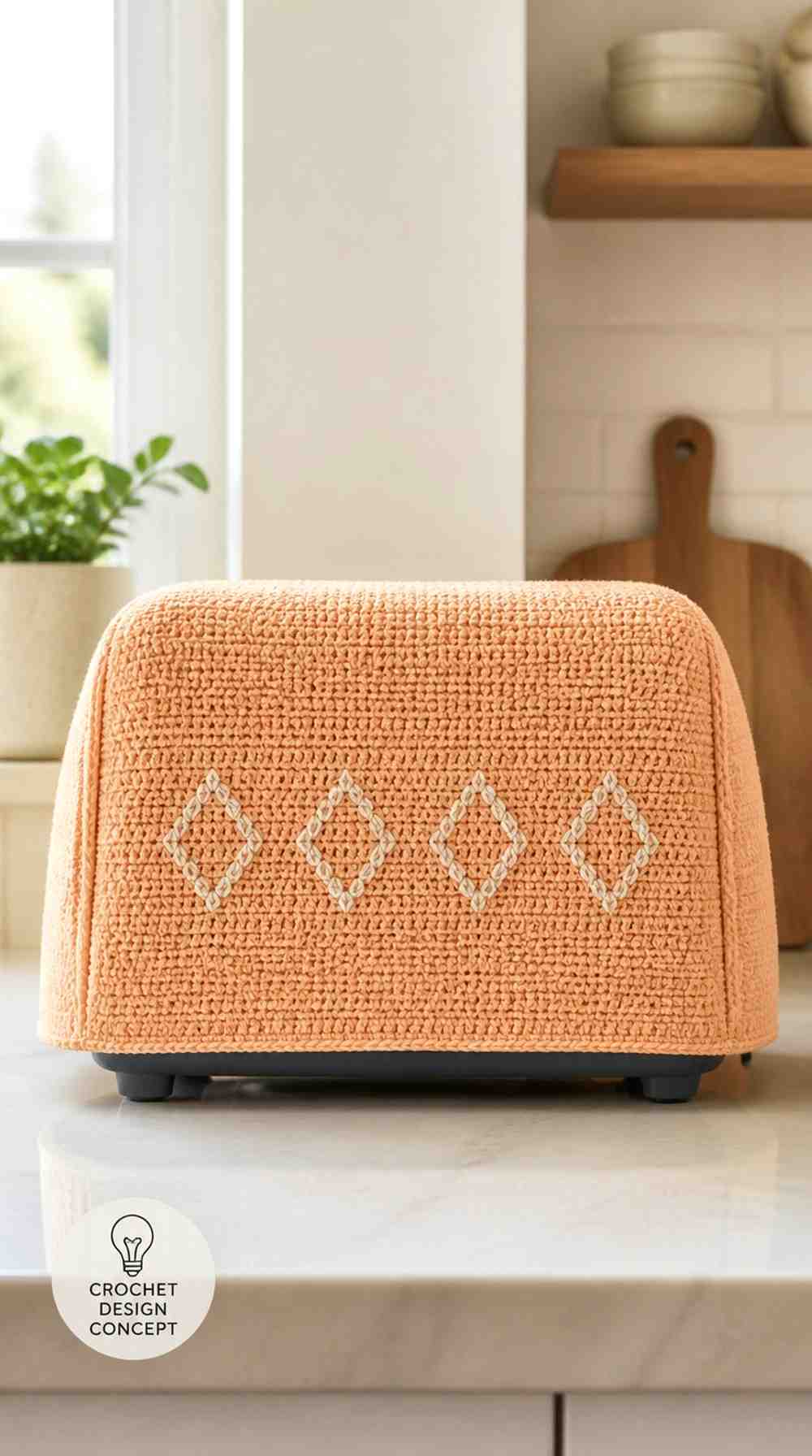
Soft apricot crochet creates a warm background for four small cream embroidered diamonds along the front of this rectangular dust cover. The underlying crochet fabric is smooth and closely worked, with tidy edges and a straight lower hem.
The embroidered diamonds provide decoration without changing the cover’s overall silhouette. This is an appealing direction for someone who enjoys adding needlework to crochet, provided the embroidery remains flat and does not distort the underlying stitches.
- Embroidery foundation: A compact crochet surface gives the diamond outlines a more stable base than widely spaced openwork.
- Diamond spacing: Evenly spaced motifs create a balanced front panel, especially when the appliance cover is viewed directly from the countertop.
- Thread tension: Keep the embroidered lines relaxed enough that the underlying apricot fabric does not pucker or pull inward.
12. Crochet Lavender Recipe-Card Pocket Press Cover
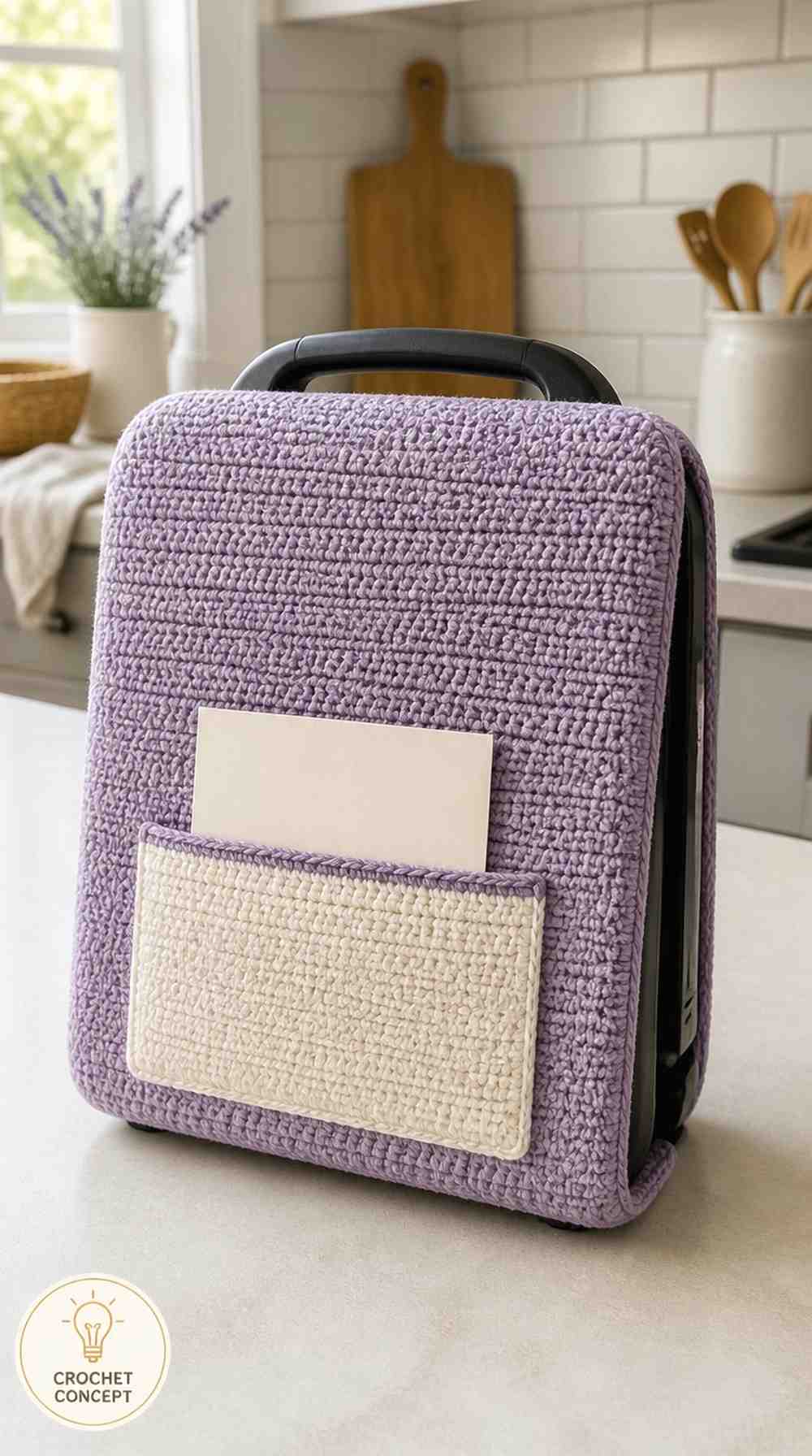
Dusty-lavender crochet gives this appliance cover a soft, practical appearance. A small rectangular ivory pocket sits on the lower front panel, outlined with darker lavender stitching. The pocket holds a single blank cream recipe card, while the surrounding cover remains smooth and simply shaped.
The pocket adds a different kind of detail to the collection. Rather than using flowers or raised stitch patterns, this concept introduces a small storage feature. It is best treated as a place for a lightweight reminder card during cool, unplugged storage, not as a permanent attachment to the appliance.
- Pocket placement: Keep the pocket low enough to remain visible but away from the hem so the inserted card does not catch on the countertop.
- Lightweight contents: A small paper recipe card is more suitable than heavy utensils or accessories that could distort the front panel.
- Before-use routine: Remove the card and the entire crochet cover before plugging in the press, preventing paper or yarn from being left near heat.
13. Crochet Rust Curved-Hinge Press Cover
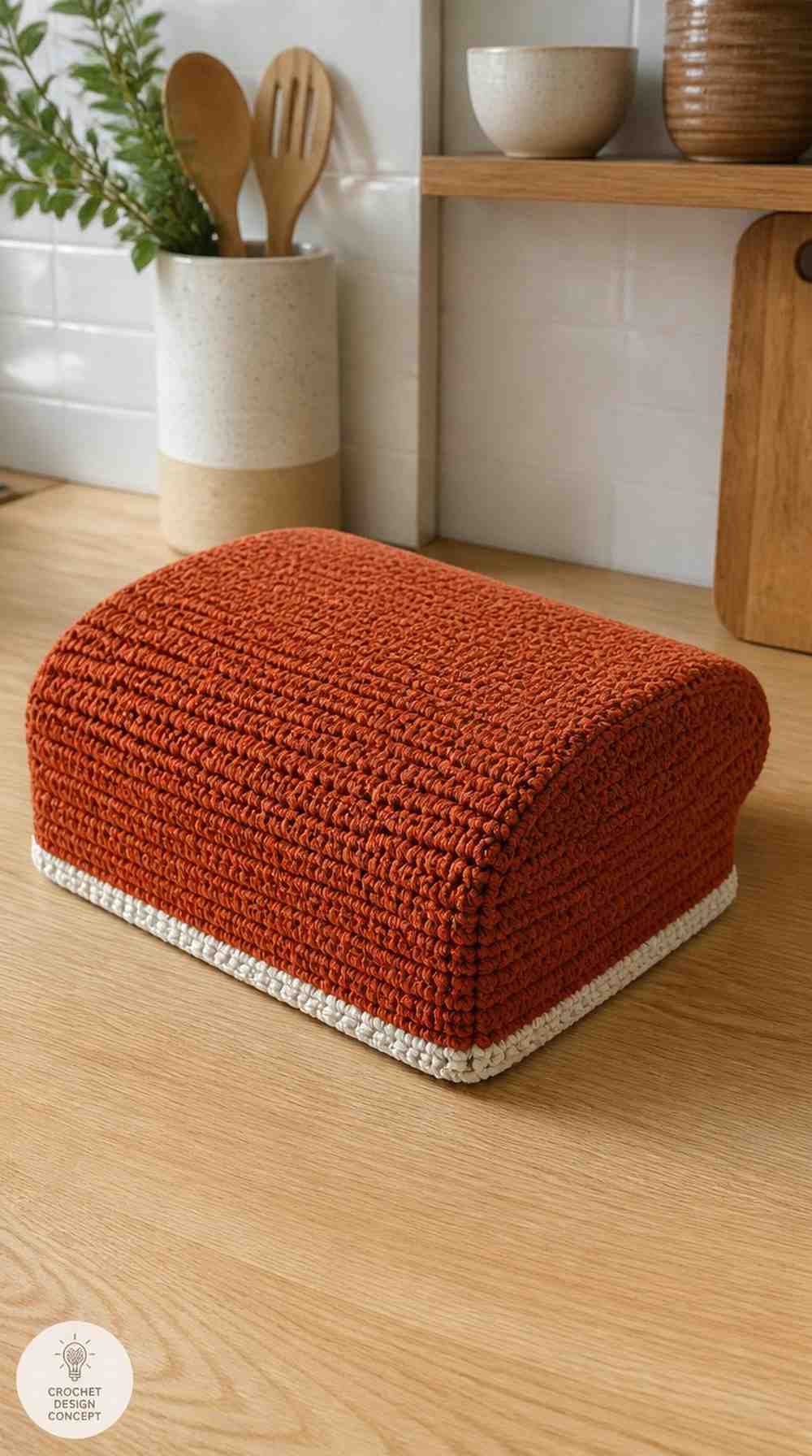
Warm rust-colored crochet gives this cover a rich, natural appearance. Its most unusual feature is the rounded rear-top section, which follows the exterior hinge bulge of the closed sandwich press. The front stays smooth and squared, while a thin oatmeal border finishes the lower edge.
The curved shaping is useful to study for appliances that are not perfectly rectangular. Rather than forcing a flat box cover over a protruding hinge, the design allows more fabric through the rear section. A real version would need to match the particular press.
- Rear profile measurement: Check how far the hinge projects from the closed appliance before shaping the curved back section.
- Shaping joins: Smoothly connected crochet rows around the curve can help avoid large folds or excessive fabric at the rear corners.
- Storage position: This design assumes a horizontal, closed appliance; it should not be assumed to fit the same press during upright storage.
14. Crochet Teal Basketweave-Relief Press Cover
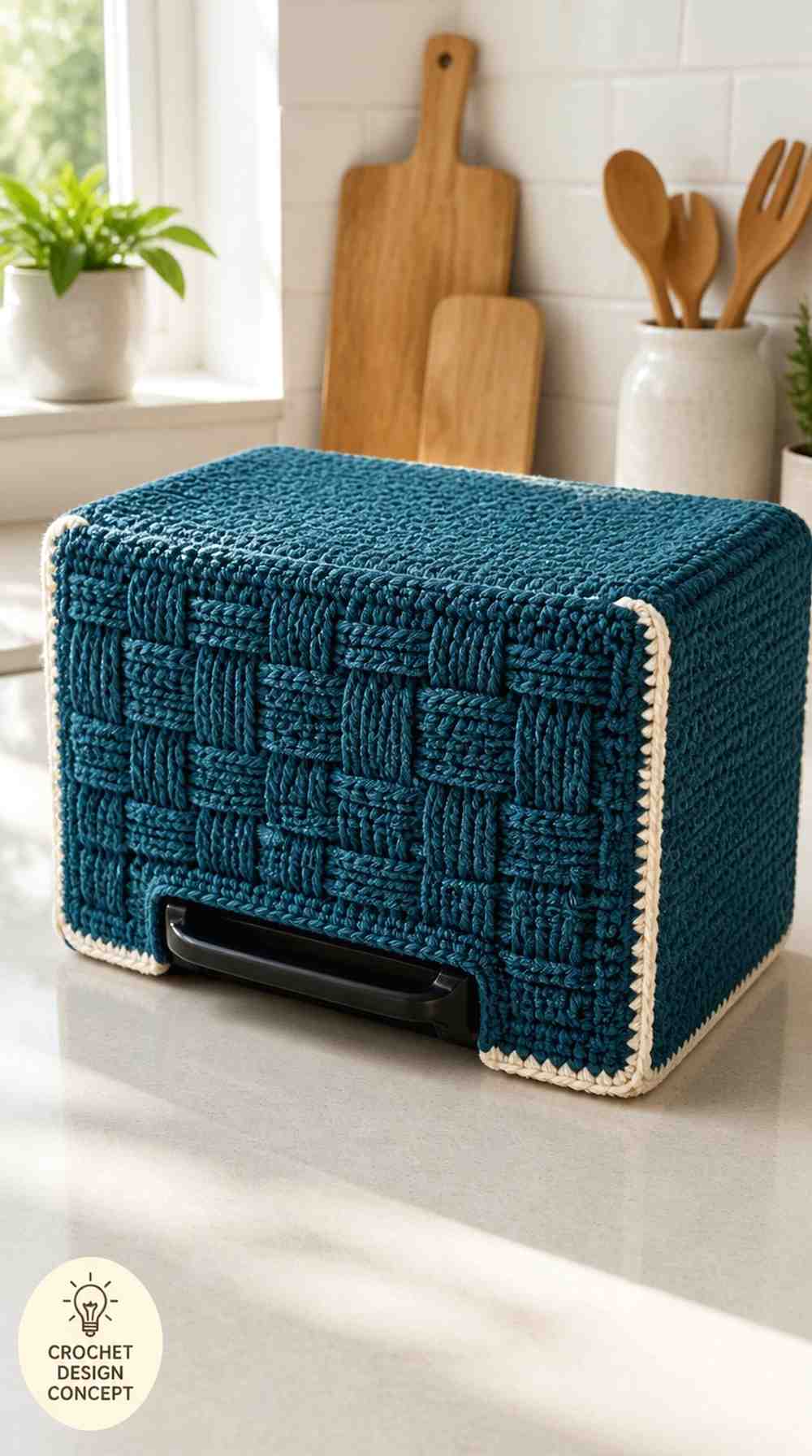
Deep-teal crochet gives this rectangular cover a strong color base, while raised basketweave-style stitches create a patterned front surface. The top and side panels remain closely worked and smooth, and a slim ivory hem outlines the bottom.
The raised stitch groups make this idea more architectural than the embroidered or floral covers. Its textured front gives the appearance of interwoven strips, even though the surface is made from connected crochet stitches. Keeping the relief shallow would help the cover remain manageable.
- Basketweave stitch definition: Choose a crochet stitch arrangement that creates recognizable alternating raised groups rather than separate woven strips.
- Fabric thickness: Raised crochet may produce a heavier front panel, so check whether its weight affects the way the cover hangs.
- Panel balance: Smooth top and side sections can offset the decorative front and reduce unnecessary thickness around the appliance corners.
15. Crochet Mustard Diagonal Colorblock Press Cover
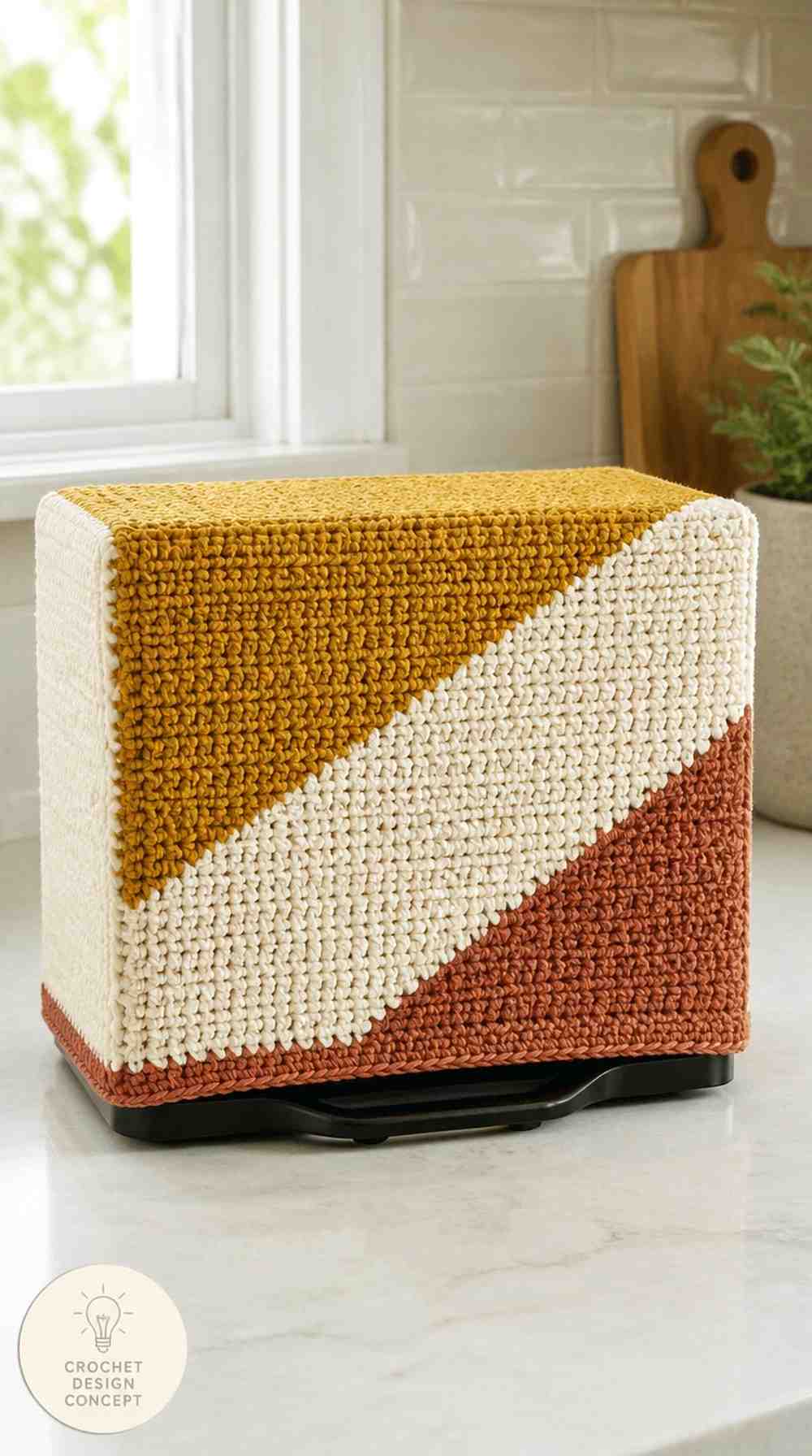
Mustard yellow, warm ivory and muted terracotta create a striking diagonal arrangement across this crochet sandwich press cover. The mustard upper-left section meets a central ivory band, while terracotta fills the lower-right corner. A solid mustard top and ivory sides complete the rectangular silhouette.
This concept uses color placement rather than raised texture or separate decorations. Its clean geometric appearance can work well in a modern kitchen, though the diagonal joins would need accurate stitch planning to stay neat and consistent.
- Diagonal alignment: Plan the color changes so the sloping sections meet smoothly without jagged, unintended steps.
- Three-color balance: The broad ivory center gives visual separation between mustard and terracotta, making each diagonal section easier to recognize.
- Flat surface finish: Keeping the colorwork flat avoids additional appliqués that might catch on nearby items during storage or removal.
16. Crochet Ivory Pleated-Side Press Cover
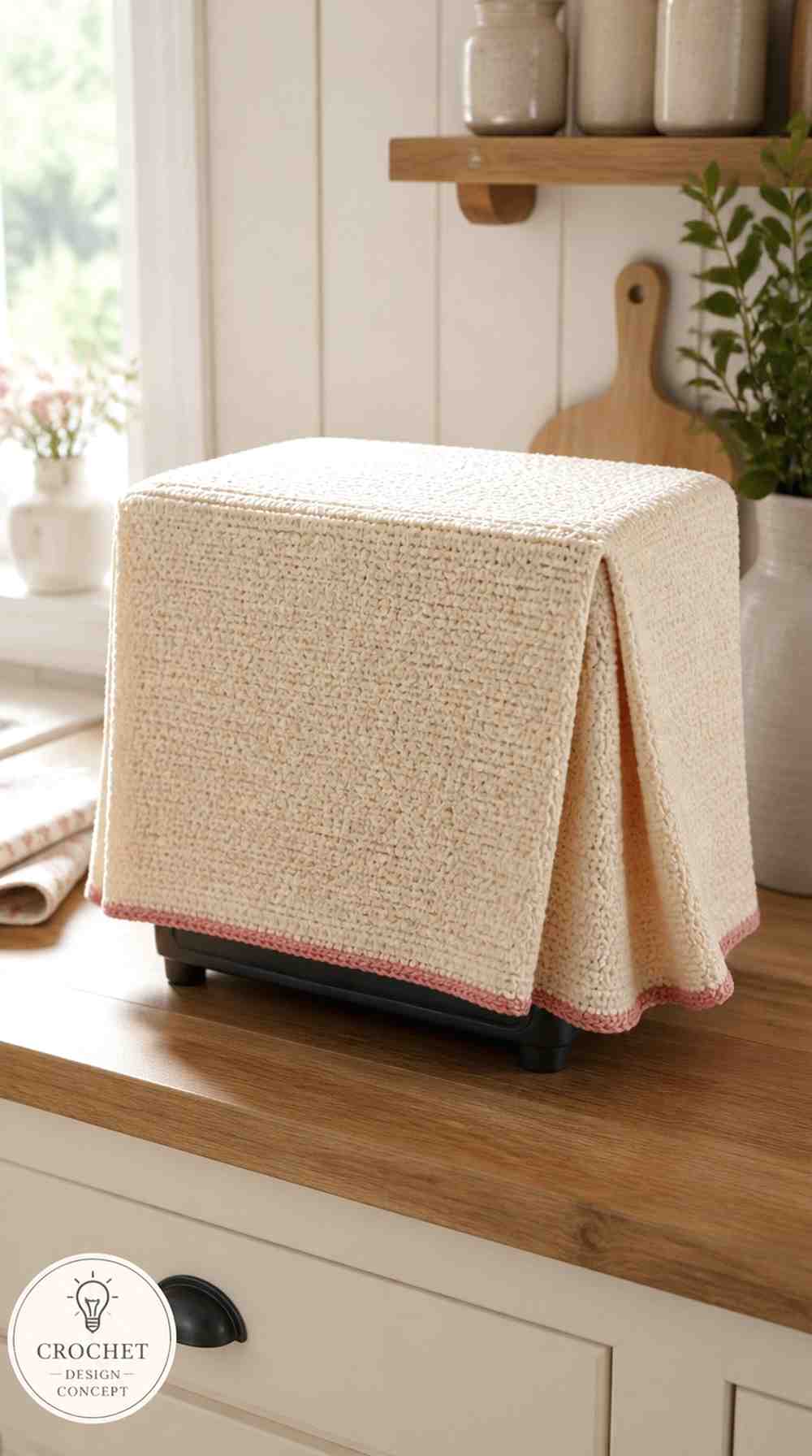
Warm-ivory crochet gives this dust cover a soft, classic appearance. Its rectangular top and smooth front are balanced by shallow folded pleats along the side panels. Thin dusty-rose edging outlines the pleat folds and repeats along the front hem.
The pleats create a more tailored silhouette than a simple dropover. They also add fabric around the sides, which can make fitting more complicated. The folds need to be shaped and joined carefully so they open naturally without becoming bulky or trapping the cover against the appliance.
- Side-pleat spacing: Keep the folds shallow and evenly arranged so they provide decorative movement without adding excessive width around the appliance.
- Rose edging placement: Thin contrasting trim helps define the folds, but it should follow the existing crochet edges without stiffening them unnecessarily.
- Fit during removal: Extra fabric around the sides may catch on exterior handles, so check that the cover lifts clear without snagging.
Practical Guide to Crochet Sandwich Press Dust Covers
Measure the appliance in its storage position. Check the closed sandwich press’s width, depth and maximum height, including handles, hinges, feet and any other projecting parts. Do not assume a standard size; compact sandwich makers and larger grill-style presses can have very different shapes. Plan enough ease to lift the cover off without tugging at the appliance.
Consider crochet stitch density. Closely worked stitches may reduce the amount of ordinary dust reaching the covered surfaces compared with large open motifs, but crochet fabric is not sealed or dustproof. Open granny squares and decorative gaps will allow more dust through than dense fabric.
Choose materials for removable storage. Soft cotton yarn is one option for clearly defined stitches and manageable care, but actual washing and drying requirements depend on the yarn. Synthetic fibers can be damaged by heat. No crochet fiber should be relied upon as heat protection for an appliance.
Protect the appliance from moisture and residue. Make sure the sandwich press is clean and completely dry before putting away a cover. Do not trap moisture, grease or food residue beneath crochet. Wash the cover according to its yarn care instructions and let it dry fully before reuse.
Follow the appliance manual every time. Disconnect the press, allow it to cool completely and remove any cover before connecting or using it again. Some manufacturers specifically warn against covering their appliances, so do not add a crochet cover where the model instructions prohibit it. A storage cover must never block ventilation during operation or be treated as a heat-resistant accessory.
Check removable details. Buttons, ties, appliqués and decorative pockets should be securely attached and easy to remove with the rest of the cover. Keep loose yarn ends away from sockets, neighboring appliances and areas where children or pets could reach them.
For another kitchen-storage textile concept, explore 15 Crochet Rolling Pin Protective Sleeve Inspiration Ideas. The sizing and removable-cover considerations are related, although a rolling pin and an electrical sandwich press have different safety requirements.
Want to Make Something Similar?
The following resources explain related crochet cover construction. They are not exact patterns for the 16 illustrated sandwich press concepts.
- Crochet Toaster Cover Free Pattern — Creating a Simpler Life — Shows an example of constructing a fitted crochet appliance cover from a central piece and joined sides. The maker’s toaster dimensions are not suitable measurements for every sandwich press.
- Vintage Crochet Toaster Cover Pattern — Free Vintage Crochet — A historical crochet kitchen-cover pattern that can provide additional ideas for panel construction and edging.
- Crochet Sandwich Maker Cover — YouTube — A sandwich-maker-specific crochet demonstration, useful for comparing the construction approach with your own appliance shape.
Use these as technique references only. Any finished cover must be checked against the exact appliance dimensions and manufacturer’s instructions before storage.
Which Crochet Sandwich Press Dust Cover Should You Choose?
| Your priority | Designs to consider | Main trade-off |
|---|---|---|
| Close, tidy shape | Ochre Box-Fit, Navy Ivory Gingham | Requires careful measuring |
| Easy slip-on removal | Denim Blue Side-Slit, Butter Yellow Shell-Hem | Loose edges or slits can expose areas |
| Cottage-kitchen decoration | Raspberry Granny Tile, Blush Daisy-Corner, Ivory Pleated-Side | More joining and finishing |
| Raised crochet texture | Cocoa Waffle-Texture, Teal Basketweave-Relief | Extra thickness and cleaning |
| Adjustable fastening | Sea-Glass Side-Tie, Sage Foldover Button | Ties and buttons need inspection |
| Unusual appliance profile | Sand Raised-Handle Dome, Rust Curved-Hinge | Model-specific shaping |
| Decorative needlework | Apricot Embroidered-Diamond | Extra finishing time and careful tension |
| Additional storage detail | Lavender Recipe-Card Pocket | Contents must be removed before use |
| Modern color styling | Mustard Diagonal Colorblock | More precise colorwork joins |
For a compact, regularly used sandwich press, a simple removable cover such as the Ochre Box-Fit or Denim Blue Side-Slit design is a sensible visual starting point.
For a kitchen where the appliance remains stored for longer periods, the denser fabrics of the Cocoa Waffle-Texture or Teal Basketweave-Relief designs may be worth comparing, while recognizing that crochet does not provide a sealed dust barrier.
If the appliance has a raised handle or an unusual hinge, focus first on the physical fit rather than selecting a decorative stitch pattern.
Conclusion
Crochet sandwich press dust covers offer a creative way to bring handmade color and texture to kitchen storage. From simple ochre panels and butter-yellow shells to raspberry granny squares, raised waffle stitches and carefully shaped hinge covers, these 16 concepts provide plenty of room for personal style. The most useful starting point is a design that suits the appliance’s actual shape, can be removed easily and can be cleaned separately. Above all, treat any crochet cover as a storage-only accessory and follow the manufacturer’s safety instructions.
Which design would suit your kitchen best? Would you choose the raspberry granny-square cover, the soft butter-yellow shell edging, a simple fitted style or one of the textured designs? Share your favorite and whether you prefer a modern, cottage or farmhouse kitchen look.
Frequently Asked Questions
1. Can I put a crochet dust cover on a sandwich press?
Only consider doing so for storage if the manufacturer’s instructions permit it, with the sandwich press unplugged, completely cooled, clean and dry. Some appliance manuals warn against covering the unit. Never place crochet fabric on a working or warm press, and always remove the entire cover before plugging it in or switching it on.
2. What yarn is best for a crochet sandwich press dust cover?
Smooth cotton yarn is one option for decorative storage covers because it can produce clearly defined stitches and may be suitable for washing according to its care label. However, cotton is not a safety guarantee, and no yarn makes a cover suitable for use on a hot appliance. Choose materials based on fit, cleaning needs and manufacturer guidance.
3. How do I measure a sandwich press for a crochet cover?
Measure the appliance while it is closed and positioned as it will be stored. Record the full width, depth and maximum height, including any raised handle, hinge or projecting section. Allow for the thickness and movement of the crochet fabric, then check a real stitch swatch before deciding the final cover dimensions.
4. Will crochet fabric keep dust off a sandwich press?
A closely stitched removable cover may reduce ordinary dust settling directly on some exposed surfaces, but it is not airtight or completely dustproof. Open stitch patterns, side slits, loose hems and uncovered sections will allow dust through. The appliance should still be cleaned and maintained according to its manual, even if a decorative cover is used.
5. Are these 16 crochet sandwich press dust covers actual patterns?
No. These are original crochet design visualizations intended to inspire different shapes, colors, borders and decorative details. They are not physical samples or tested patterns, and their appearance does not guarantee a workable fit. The linked tutorials demonstrate related techniques, but a real cover would need to be adapted and checked for your specific appliance.