Kitchen witch decor can go well beyond a row of Halloween figures. Crochet gives you room to mix practical drink coasters and mug cozies with hanging webs, tiny brooms, potion bottles, cauldrons, mushrooms, cats, and witch hats that turn shelves and cabinet edges into part of the display.
The projects below vary in scale and purpose, which matters in a working kitchen. Some stay flat enough for a table, others are better above the counter, and several belong on a hutch or open shelf where they will not interfere with food preparation. You will also find notes on structure, placement, cleaning, and adapting each idea. For anything near hot cookware or an open flame, confirm the fiber and tutorial’s intended use rather than assuming ordinary crochet is heat-safe.
Quick List
- Crochet Witch-Hat Drink Coaster
- Crochet Bubbling Cauldron Shelf Centerpiece
- Crochet Ghost-and-Web Mug Cozy
- Crochet Skull Drink Coaster
- Crochet Mini Witch-Hat Shelf Accent
- Crochet Bat Appliqué Cabinet Accent
- Crochet Corner Spider-Web Cabinet Hanging
- Crochet Witch Doll Hutch Display
- Crochet Mini Witch Broom Shelf Prop
- Crochet Potion Bottle Amigurumi Decor
- Crochet Ghost Drink Coaster
- Crochet Toadstool Cabinet Garland
- Crochet Pumpkin Drink Coaster
- Crochet Witch-Hat Kitchen Garland
- Crochet Coffin Mug Coaster Set
- Crochet Black Cat Appliqué Kitchen Accent
- Crochet Round Spider-Web Drink Mat
- Crochet Bloodshot Eyeball Coaster
Separate Tabletop Utility From Stove-Side Decor
A project labeled as a coaster, mug cozy, garland, or amigurumi should stay within that role unless its designer specifically supports another use. In particular, a drink coaster should not automatically become a potholder or trivet. Heat from cookware introduces a different material requirement than condensation from a glass.
That distinction also helps with placement. Put amigurumi figures, appliqués, and yarn garlands on hutches, shelves, cabinet edges, or other areas away from burners, open flames, and wet prep surfaces. For drink coasters, check the tutorial’s material recommendations and the yarn care label if washability matters. Crafty Crochet Castle, for example, specifically presents its spider web as a decoration and says a cotton version can also serve as a coaster.
Build the Kitchen Witch Look at Different Heights
A stronger kitchen-witch display usually has more than one visual level. A cauldron, potion bottle, or witch doll gives a shelf enough height to act as a focal point. Flat coasters add the theme without occupying permanent counter space, while bats, webs, and garlands draw the eye upward to cabinet fronts and open shelving.
Before making several pieces, identify where each one will live. A small kitchen may benefit from two or three hanging accents and a removable coaster set rather than a crowded counter. An open hutch can handle deeper amigurumi pieces. Also consider what happens when the season ends: flat appliqués and coasters are easier to store than stuffed objects, while garlands need enough room to avoid tangling or crushing dimensional motifs.
Choose Yarn With Shape and Cleaning in Mind
The visual effect changes with the project. A stuffed cauldron or potion bottle benefits from fabric that holds a recognizable silhouette, while an open spider web needs clearly defined spaces and enough control to keep its geometry visible. A large witch-hat garland can deliberately use a much bulkier texture; the Simply Made by Erin Crochet tutorial, for instance, is designed around super-bulky yarn.
For items that will sit under drinks, think about surface stability and the fiber’s care instructions as well as color. Decorative appliqués give you more freedom because they do not have to support a cup. Whatever you substitute, compare the resulting scale with the intended placement before making an entire matching set.
1. Crochet Witch Hat Drink Coaster
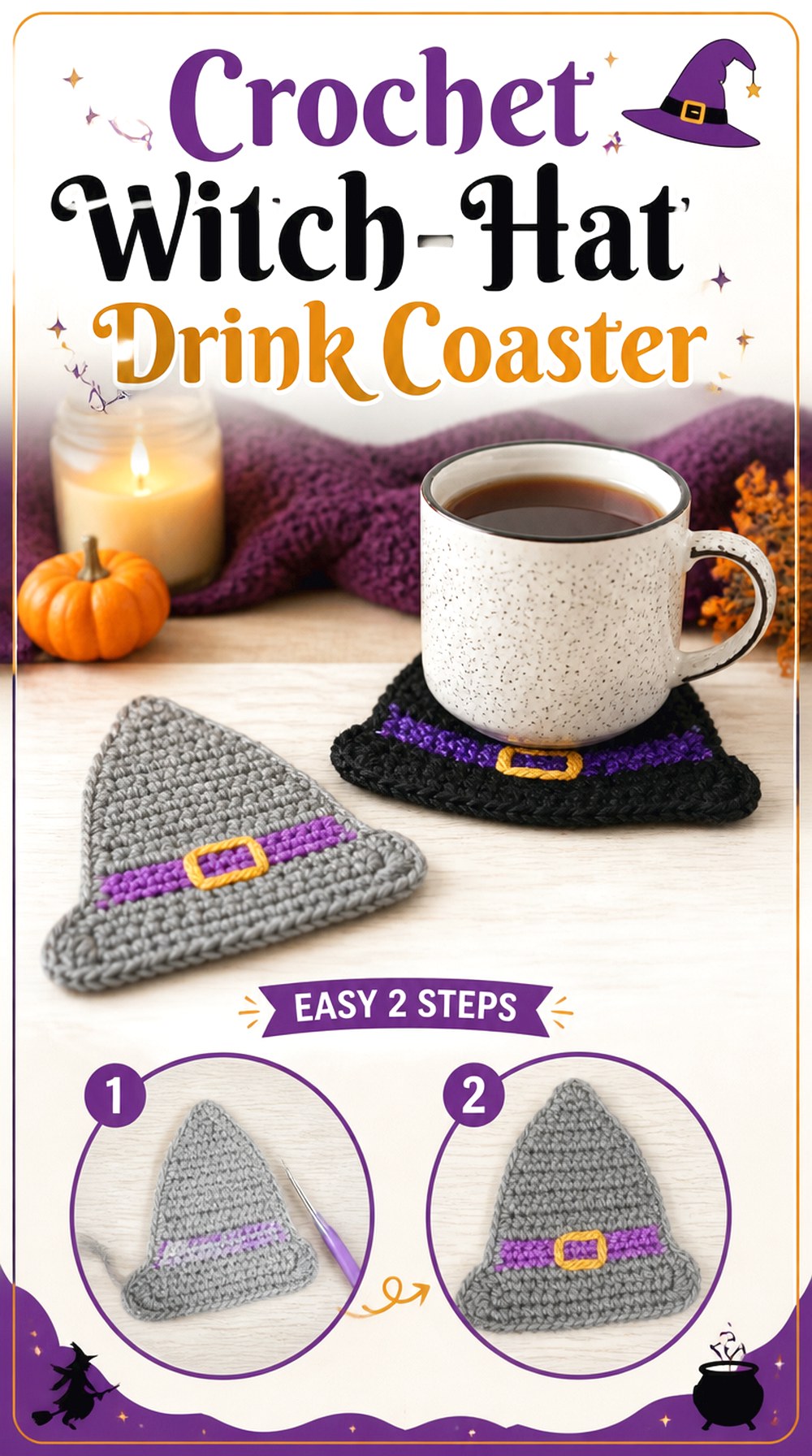
A flat witch hat turns one of the most recognizable witch motifs into an item that can actually live on the kitchen table. The pointed crown gives it more personality than a standard round coaster, while the brim creates the visual width needed for the shape to read clearly.
This option works especially well when you want witchy decor that can disappear into a drawer after use instead of permanently occupying the counter. A small set could also bring the theme to a coffee station without requiring a large centerpiece. The important consideration is keeping the finished fabric flat enough that a mug does not rock on prominent shaping or embellishment.
Keep the Hat Silhouette Flat Under a Mug
A dramatic point and curved-looking brim are part of the appeal, but the center of the piece still needs to behave like a coaster. After finishing, place the actual mug or glass you intend to use on top and check that its base sits evenly. If the fabric pulls upward at the hat’s edges, blocking may help, depending on the yarn’s care instructions. Decorative additions are better kept away from the main cup-contact area.
Treat It as a Coaster, Not a Hot Pad
The tutorial demonstrates a witch-hat coaster, so keep its functional role at that level. Do not assume the same piece can safely sit beneath a hot pan, casserole dish, or kettle. Those uses expose yarn to substantially different heat conditions. If you want coordinating stove-side accessories, choose a separate design whose creator specifically addresses fiber choice and heat contact rather than simply scaling this coaster up.
2. Crochet Bubbling Cauldron Shelf Centerpiece
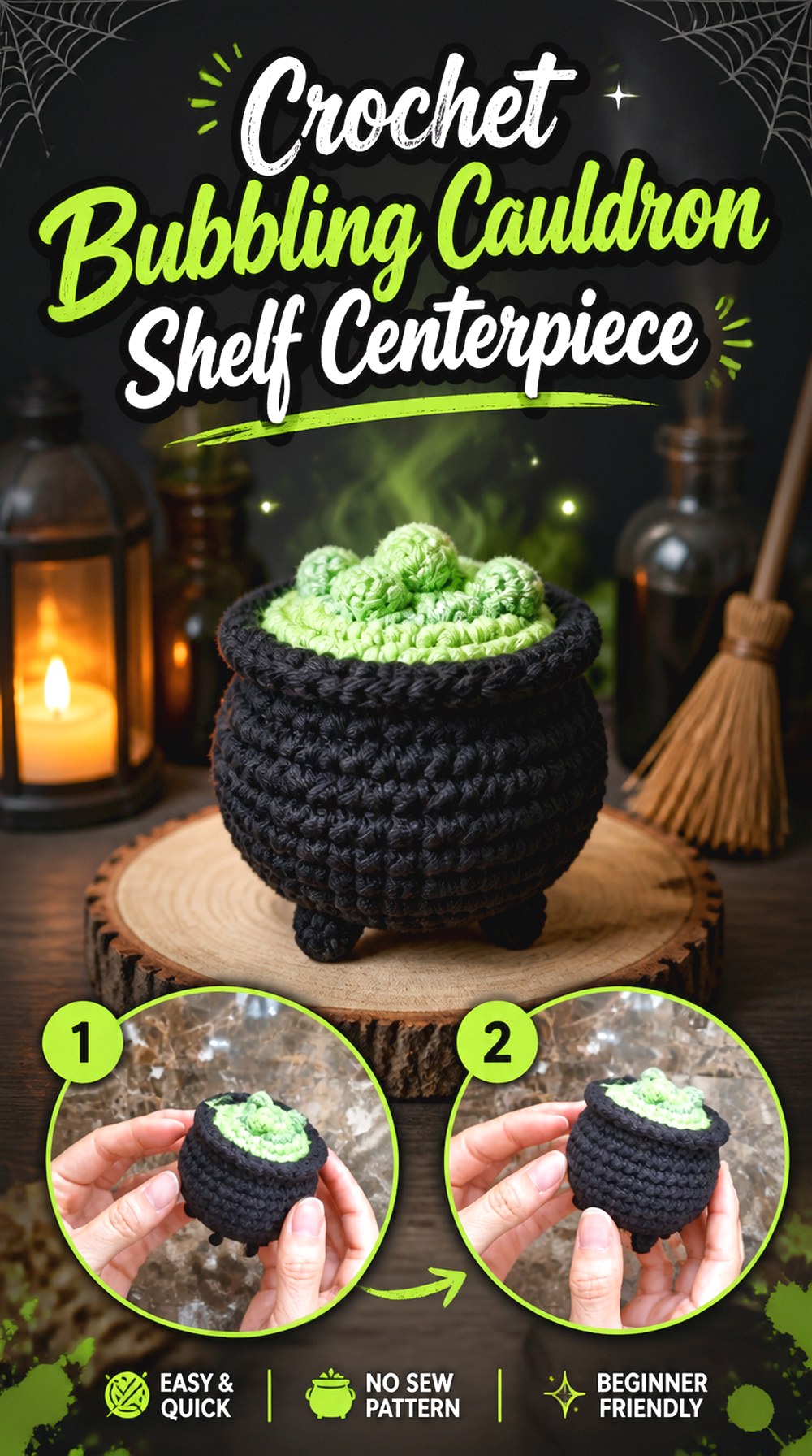
A stuffed crochet cauldron gives the collection a three-dimensional focal point. Instead of another flat Halloween symbol, you get a rounded pot with contrasting “brew” at the opening, which makes it well suited to an open shelf, hutch, tiered display, or protected section of countertop.
This is the piece to choose when the kitchen needs one obvious witch reference rather than dozens of small motifs. The finished form can anchor smaller items such as potion bottles, mushrooms, or a miniature broom. Because it is amigurumi rather than cookware, treat the cauldron as soft decor only and keep it away from the stove and other hot surfaces.
Give the Cauldron Breathing Room on the Shelf
The outline is what makes this project immediately readable. Avoid squeezing it between tall jars until the handles and top opening disappear. A little empty space around the sides lets the round pot shape show clearly. If you plan to group it with other crochet objects, make the cauldron the visual anchor and use smaller pieces around it rather than filling every remaining gap.
Stuffing Changes the Pot’s Visual Weight
With amigurumi decor, the amount and distribution of stuffing affect how convincingly the finished object holds its form. Check the silhouette from several angles while working rather than judging it only from the front. The base is particularly worth watching because a rounded, overfilled underside can make a decorative pot wobble. Follow the creator’s construction for the actual shaping instead of improvising from the finished photograph.
Keep It Out of Active Cooking Zones
A crocheted cauldron may visually reference cookware, but it is not a cooking vessel or heat accessory. Place it on a shelf, hutch, coffee-bar display, or another dry decorative surface where it will not be mistaken for something intended to touch a hot pan. This also protects the stuffed piece from food splashes and grease, which are harder to manage than ordinary seasonal dust.
Original Tutorial and Creator Credit
Creator: meowmeowcrafts
3. Crochet Ghost and Web Mug Cozy
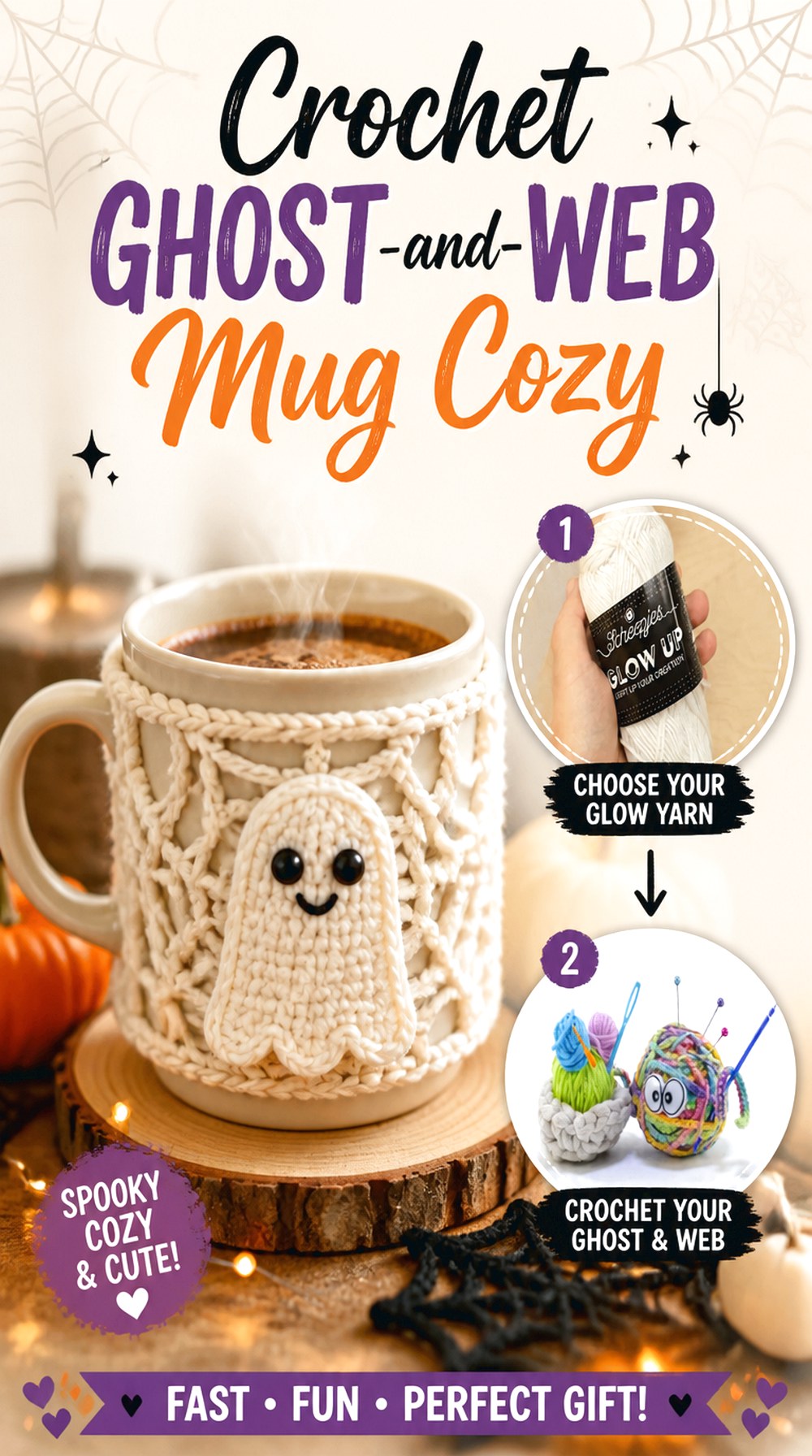
This mug cozy brings the spooky theme directly to a coffee or tea setup without covering the entire table in decorations. The source design combines a cozy with ghost and spider-web imagery, so it has considerably more visual detail than a plain striped cup sleeve.
It suits a kitchen where mugs are already part of the display, especially an open mug rack or seasonal coffee station. Because a cozy has to fit around an existing object, dimensions matter more here than with a loose ornament. Use the creator’s construction as the starting point, then compare the finished or planned circumference with the mug you actually intend to dress.
Check the Cozy Against the Mug You Actually Use
Mugs vary in body width, taper, handle placement, and height, so do not choose one simply because it resembles the cup shown in the video. Before committing to decorative placement, check how the cozy will sit around the widest part of your mug and whether the handle remains comfortable to use. If you change yarn thickness, remember that it can also change both the fabric’s scale and flexibility.
Ghost and Web Details Need Contrast
The motif is doing much of the decorative work, so contrast deserves as much attention as the base color. Pale ghosts may disappear on a similarly light cozy, while fine web details can get lost in highly variegated yarn. If you want a subtler year-round witch look, reduce the number of competing colors rather than making the motif itself difficult to read.
Remove It Before Washing the Mug
A removable cozy is easier to care for if it remains a separate textile accessory. Take it off before washing the mug and follow the yarn’s own care instructions for the crochet piece. Also inspect any attached decorative elements after laundering. If the cozy becomes stretched or distorted, refit it to the mug before putting it back into regular use.
Original Tutorial and Creator Credit
Creator: KnittingKitty
4. Crochet Skull Drink Coaster
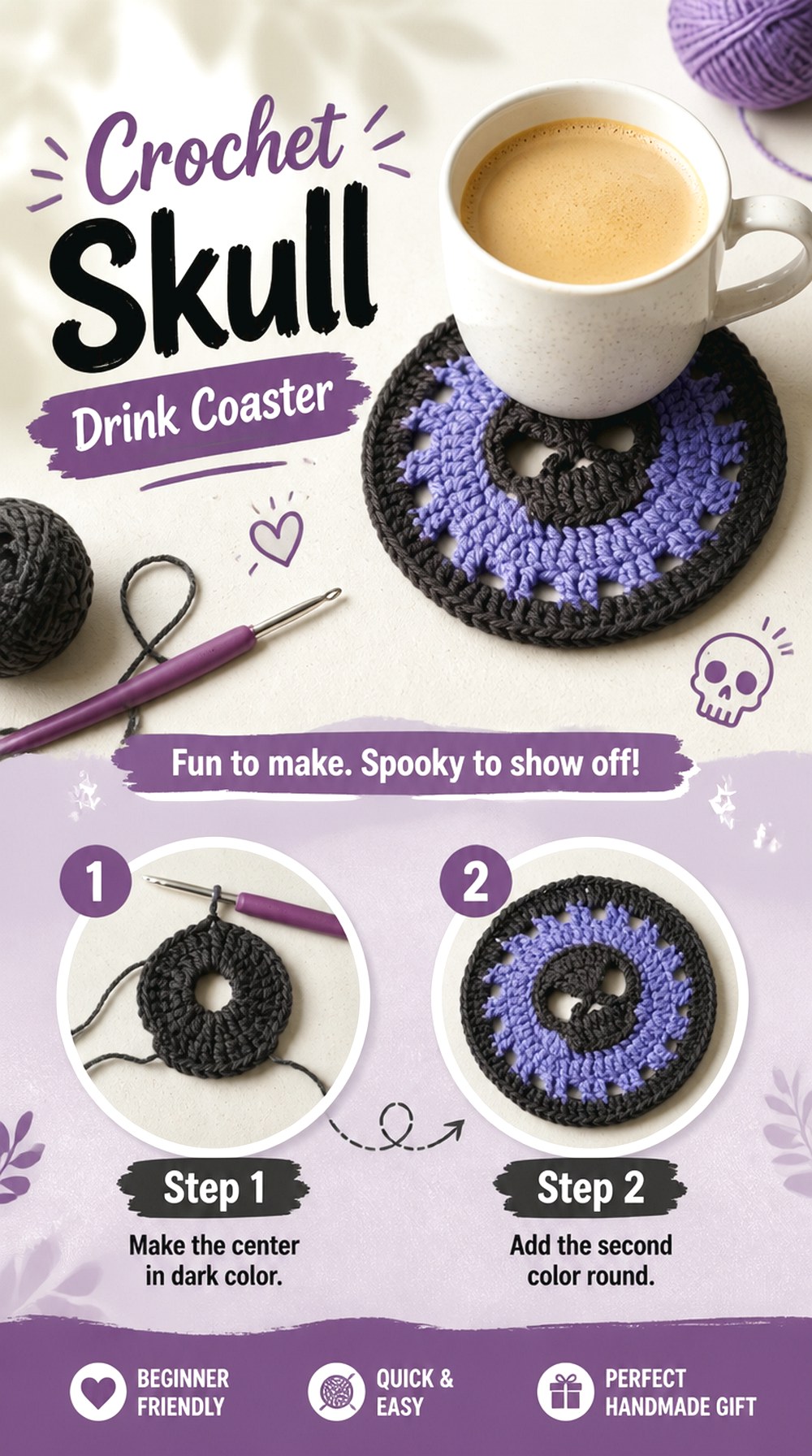
A skull coaster pushes the collection toward a gothic kitchen-witch look. Its advantage is graphic impact: the outline and facial openings create the motif, so the piece can remain relatively flat and still feel much more dramatic than an ordinary circular coaster.
This idea pairs naturally with dark mugs, apothecary jars, black-and-white dishes, or a Halloween drink station. It also offers a useful contrast to softer motifs such as ghosts and pumpkins. Before making a full set, finish one sample and place a glass on it. That quickly tells you whether the shape, edging, and decorative openings work with the kind of drinkware you use most often.
Skull Edges Matter More Than Color
A skull can lose its identity when the outside shape becomes uneven or overly soft. Pay attention to the finished outline before adding more visual detail. If the piece does not lie cleanly, address that first instead of trying to distract from the shape with extra colors. A clearly defined silhouette can work in cream, gray, purple, green, or other palettes without requiring the predictable white-and-black combination.
Pair Graphic Shapes With Plain Tableware
The skull already has a busy internal shape, so it usually shows better beneath a relatively simple mug or glass. Highly patterned tableware can compete with the eye and jaw details and make the coaster look visually cluttered. If your dishes are decorative, consider using the skull coasters only at a coffee bar or party drink station where they can be paired with simpler cups.
Original Tutorial and Creator Credit
Creator: Crochet Mili
5. Crochet Mini Witch Hat Shelf Accent
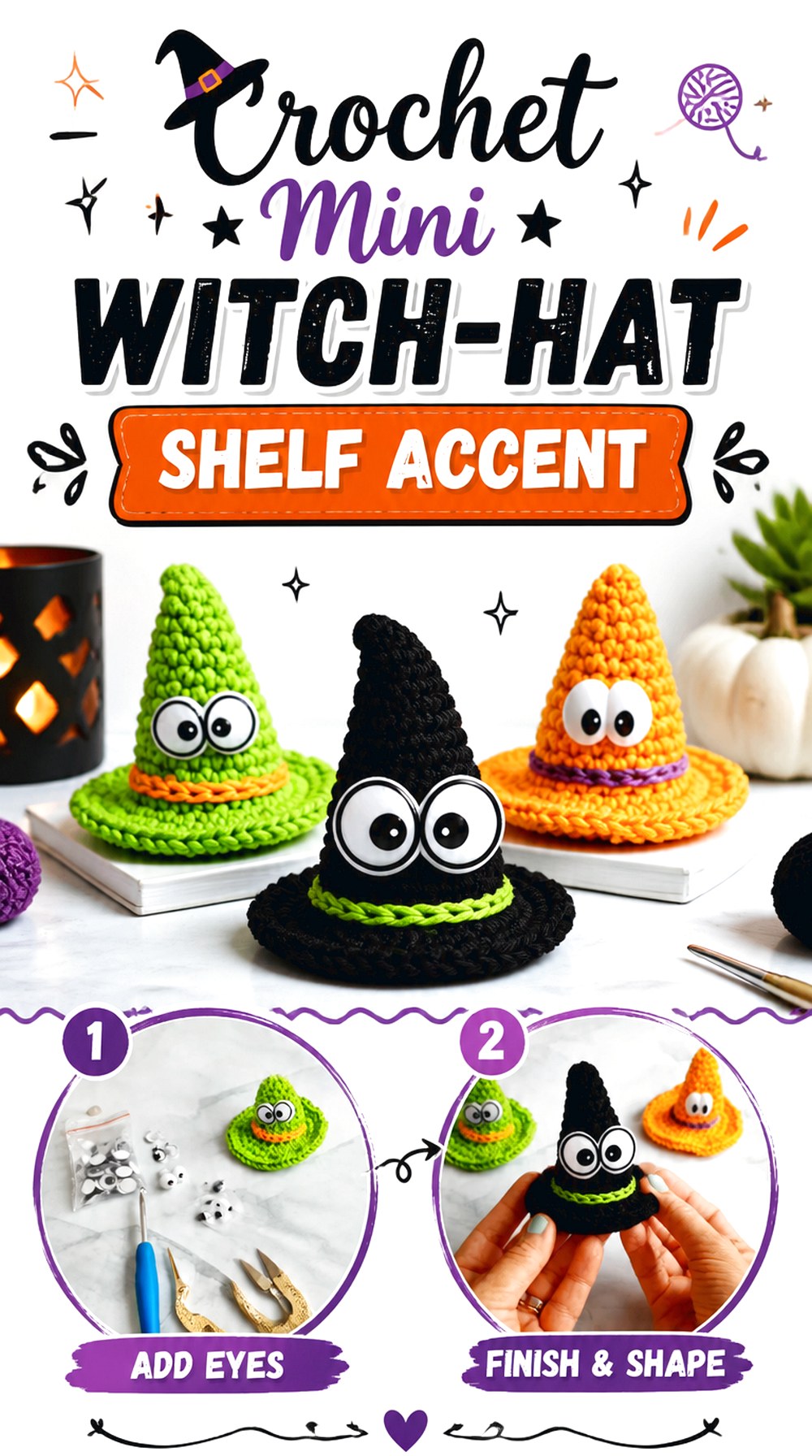
A miniature witch hat is useful when your kitchen has very little room for seasonal decor. The finished item can sit beside spice jars, rest in a small tray, top a decorative display, or join other tiny crochet objects without taking over the counter.
Unlike the flat witch-hat coaster, this version is dimensional, so its main value is silhouette rather than function. It can also help connect larger witch-themed pieces across a shelf. If you make several, vary their placement instead of lining every hat in an identical row; small items tend to look more intentional when they are grouped around objects of different heights.
Small Scale Works Better in Clusters
One tiny hat may disappear on a long open shelf. Pairing it with a potion bottle, miniature broom, or small stack of cookbooks creates a stronger visual unit without requiring you to enlarge the pattern. Before making multiples, test one in the intended spot. The contrast between the hat and the background often matters more than having a large number of pieces.
Keep Loose Embellishments Away From Food-Prep Areas
If you add beads, buttons, charms, or other optional decorations, keep the finished hat on a display surface rather than beside uncovered food. Tiny detachable pieces are easier to monitor on a shelf or hutch. For a busier kitchen, a simple crochet-only finish may also be easier to dust, store, and reposition than a heavily embellished version.
Original Tutorial and Creator Credit
Creator: Start Crochet
6. Crochet Bat Appliqué Cabinet Accent
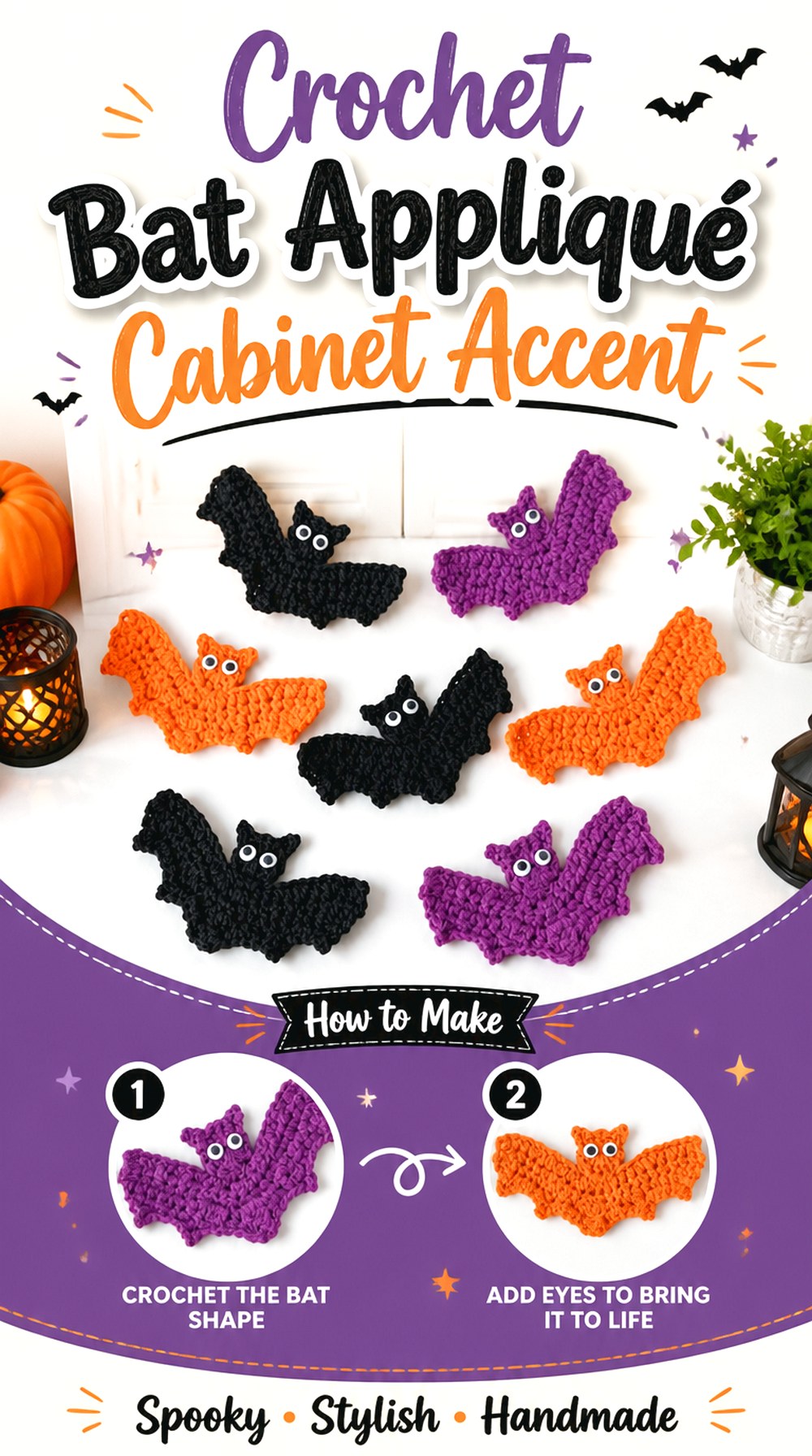
A flat bat appliqué gives you witchy atmosphere without adding another object to the counter. It can be used as a removable decorative accent on a fabric banner, a framed crochet arrangement, or another non-heat kitchen display.
The bat shape also fills a different visual role from pumpkins and hats because it spreads horizontally through its wings. That makes it useful along narrow spaces such as the front of a shelf display or around a larger central motif. Keep the original appliqué removable when possible so the same bat can shift between seasonal displays instead of becoming permanently attached to a kitchen textile you use year-round.
Dark Bats Need a Light Background
A black or deep-purple bat can disappear against dark cabinetry. Before attaching anything, hold the finished appliqué against the exact surface or backing fabric you plan to use and view it from across the room. If the wing outline disappears, a lighter mounting surface or contrasting border can be more effective than simply making a larger bat.
Flat Appliqués Work Best Where They Won’t Snag
Open cabinet doors, drawer pulls, and frequently handled towels can catch raised crochet details. A framed backing, fabric banner, or protected cabinet-front display gives the bat a clearer outline while reducing everyday contact. If you do attach it to another crochet piece, check that the edges stay secure and that the placement does not interfere with washing or normal use.
Original Tutorial and Creator Credit
Creator: GoldenLucyCrafts
7. Crochet Corner Spider Web Cabinet Hanging
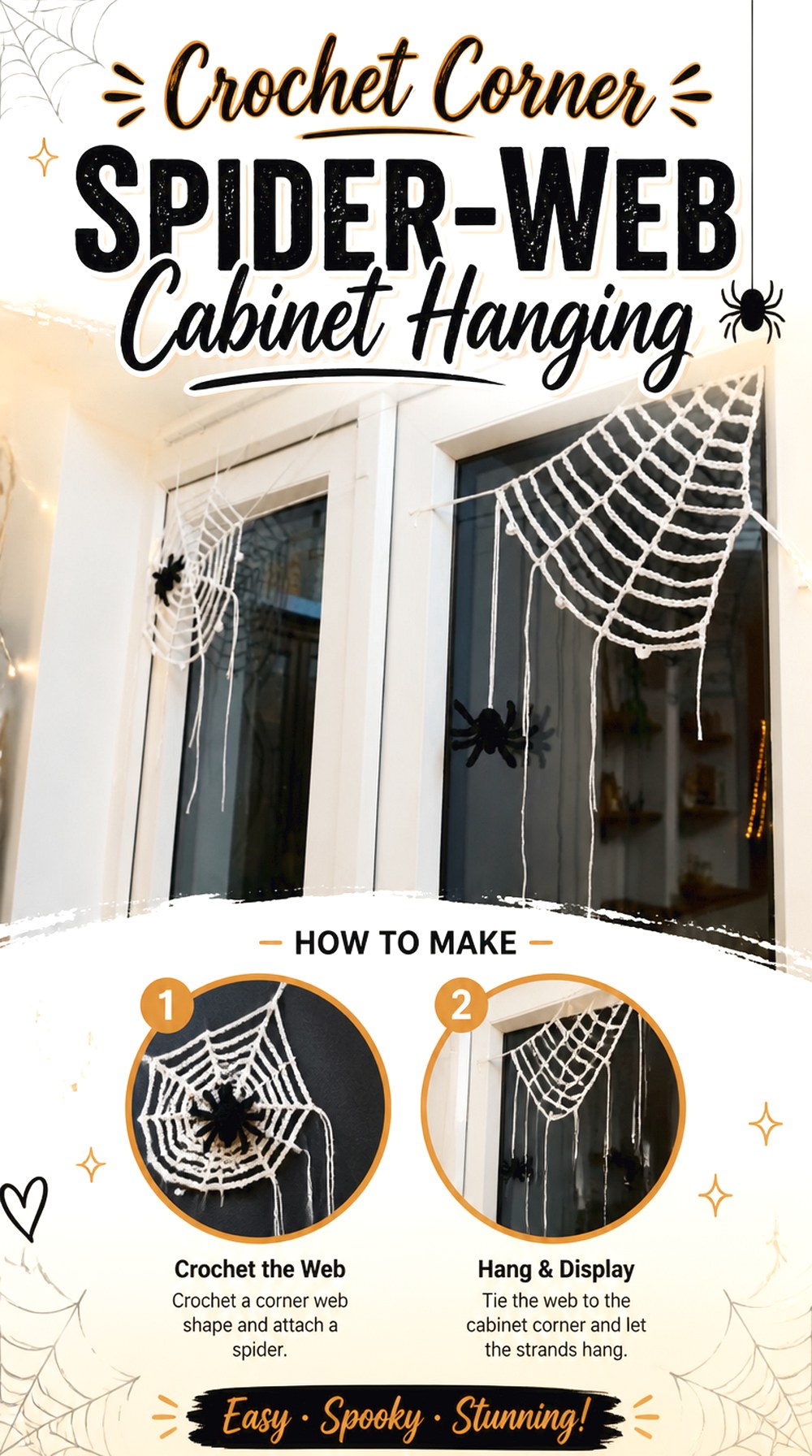
A corner web makes use of an area most kitchen decorations ignore. Instead of centering a round motif on the wall, this design can visually stretch between two edges and frame a cabinet, shelf nook, or protected corner of a display.
Brunaticality’s tutorial includes both round and corner web styles plus a small spider, making the corner version particularly useful here because it differs clearly from the round drink mat later in the list. Keep it away from stove ventilation, flames, and frequently opened cupboard hardware. The project works best as a visual frame rather than something hanging into the working area below.
Use the Corner Shape to Frame, Not Cover
A web looks more convincing when its open spaces remain visible. Position it where the background provides contrast and where jars, signs, or cupboard handles will not cover most of the geometry. A cabinet-top corner, open hutch, or seasonal wall vignette can work better than a crowded backsplash. Dry-fit the web before adding any removable hanging hardware.
Blocking Can Decide Whether the Web Reads Clearly
Open crochet emphasizes tension differences more than dense fabric does. If the finished web looks bunched or its spokes pull unevenly, check the yarn’s care guidance and consider appropriate blocking before deciding the project failed. Pinning or shaping should focus on balanced geometry rather than stretching one side aggressively enough to distort the opposite side.
Original Tutorial and Creator Credit
Creator: Brunaticality
8. Crochet Witch Doll Hutch Display
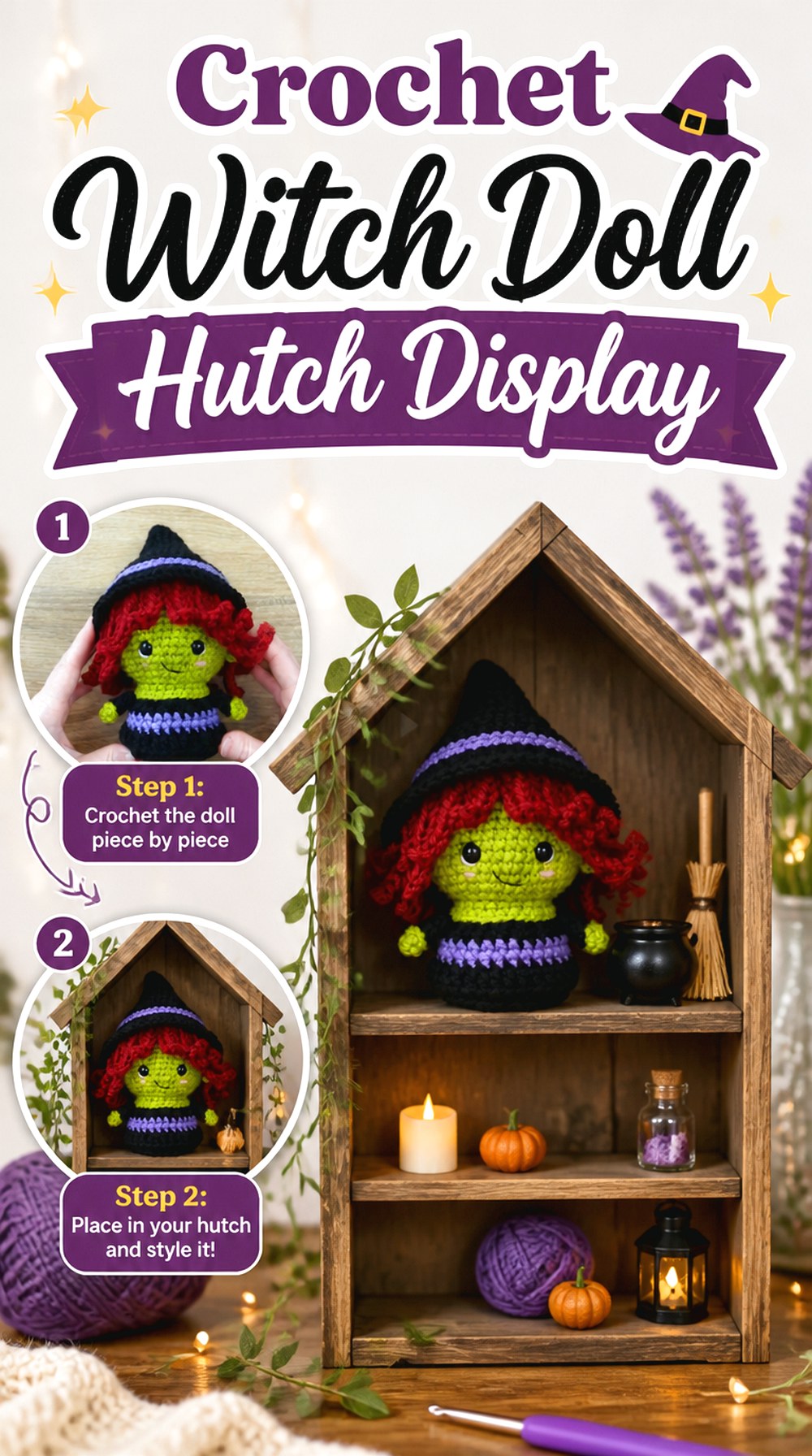
A full crochet witch doll becomes a character rather than just a motif. That makes it a natural centerpiece for a hutch, cookbook shelf, dining-room sideboard, or kitchen display cabinet where the figure can be seen without getting in the way of cooking.
Compared with a tiny hat or appliqué, the doll has more detail to coordinate: clothing, hair, hat, facial features, and overall stance all contribute to the finished impression. Choose this project when you want a single substantial handmade decoration that can carry most of the witch theme by itself. Smaller cauldrons, broom props, or potion bottles can then support the scene without competing for attention.
A Hutch Display Needs a Stable Visual Base
Before deciding where the doll will stand, look at the base and the way the finished figure naturally balances. A narrow ledge is less forgiving than a deep shelf. If the doll is intended to lean or sit rather than stand independently, build the display around that reality instead of forcing a pose the construction does not support.
Choose Facial Details With Display Distance in Mind
Fine facial embroidery can be charming up close but nearly disappear from across a kitchen. Look at the finished doll from the normal viewing distance before deciding whether additional decorative contrast is actually needed. More detail is not always better; clear hair, hat, and clothing shapes may communicate “witch” more effectively than adding several tiny accessories around the face.
Keep the Doll Decorative Around Food and Heat
A soft doll belongs in a clean display area, not beside a burner, sink splash zone, or uncovered food. That placement also helps protect hair and clothing details from grease and moisture. If the kitchen lacks a suitable shelf, a nearby dining hutch can preserve the kitchen-witch atmosphere while giving the figure a safer, more stable home.
Original Tutorial and Creator Credit
Creator: The Kindness Company
9. Crochet Mini Witch Broom Shelf Prop
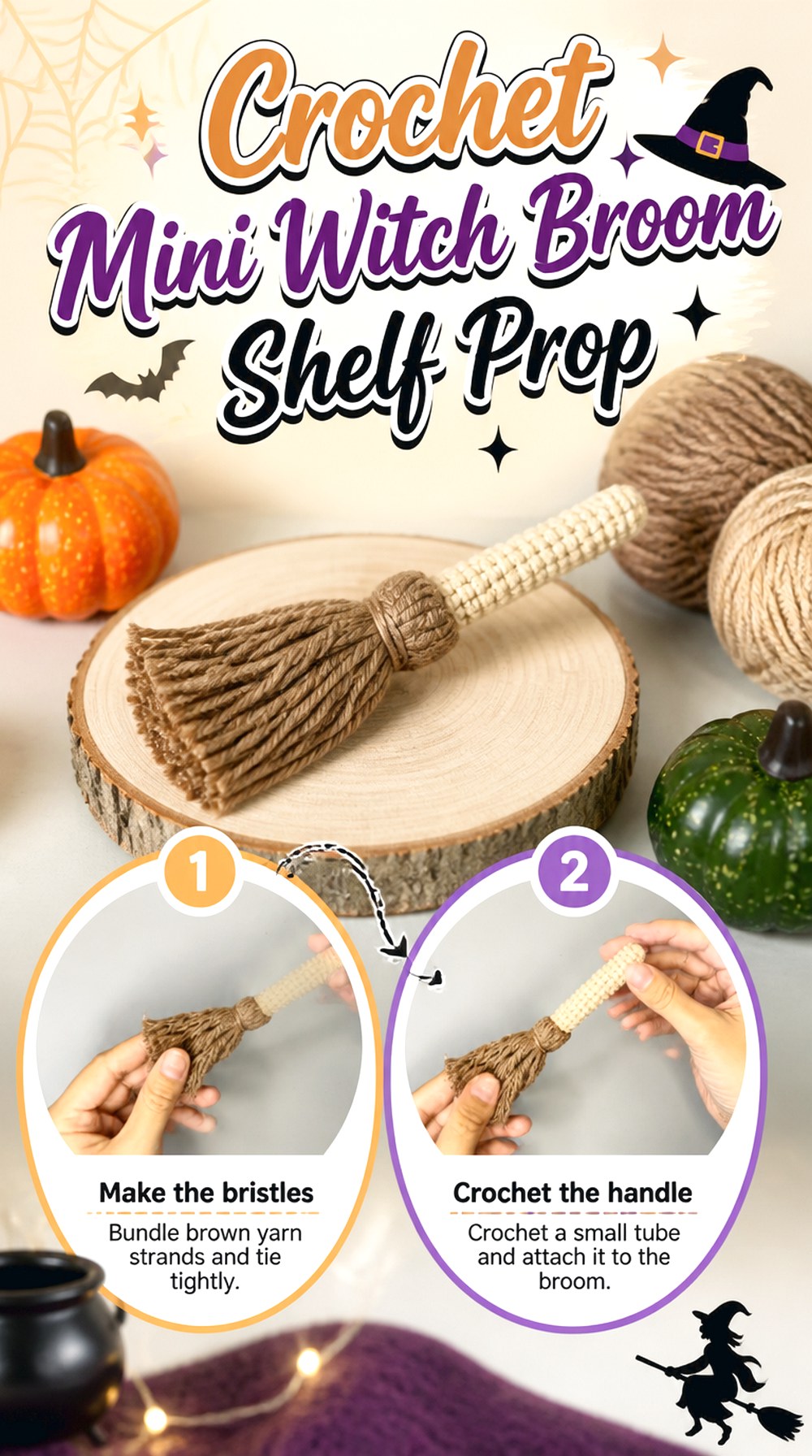
A miniature crochet broom is a strong supporting piece because it suggests the witch theme without repeating another hat, ghost, or skull. Set beside a cauldron or witch doll, it can make a small group of crochet objects feel like one deliberately planned scene.
Funny Bunny Crochet presents the broom as an amigurumi Halloween accessory, and the tutorial uses a stick as part of the shaping. That structural detail matters when planning where the finished prop will sit. Treat it as a decorative object rather than a functional brush, and choose a position where the long handle will not constantly be bumped.
A Broom Reads Best When the Handle Stays Straight
Because the broom has a long, narrow profile, visible bending can change the entire silhouette. Store it so the handle is not pressed under heavier seasonal decorations. When arranging the display, angle the broom enough to be recognizable but not so far into a walkway or counter edge that it will be knocked down whenever someone reaches for a nearby item.
Use It as a Prop, Not a Cleaning Tool
The construction is intended as an amigurumi accessory. It is not a substitute for a pastry brush, cleaning brush, or other kitchen utensil. Keeping that boundary clear also gives you more freedom with placement: tuck it beside a witch doll, lean it against a decorative cauldron, or display it in a small seasonal vignette away from food-contact tools.
Original Tutorial and Creator Credit
Creator: Funny Bunny Crochet
10. Crochet Potion Bottle Amigurumi Decor
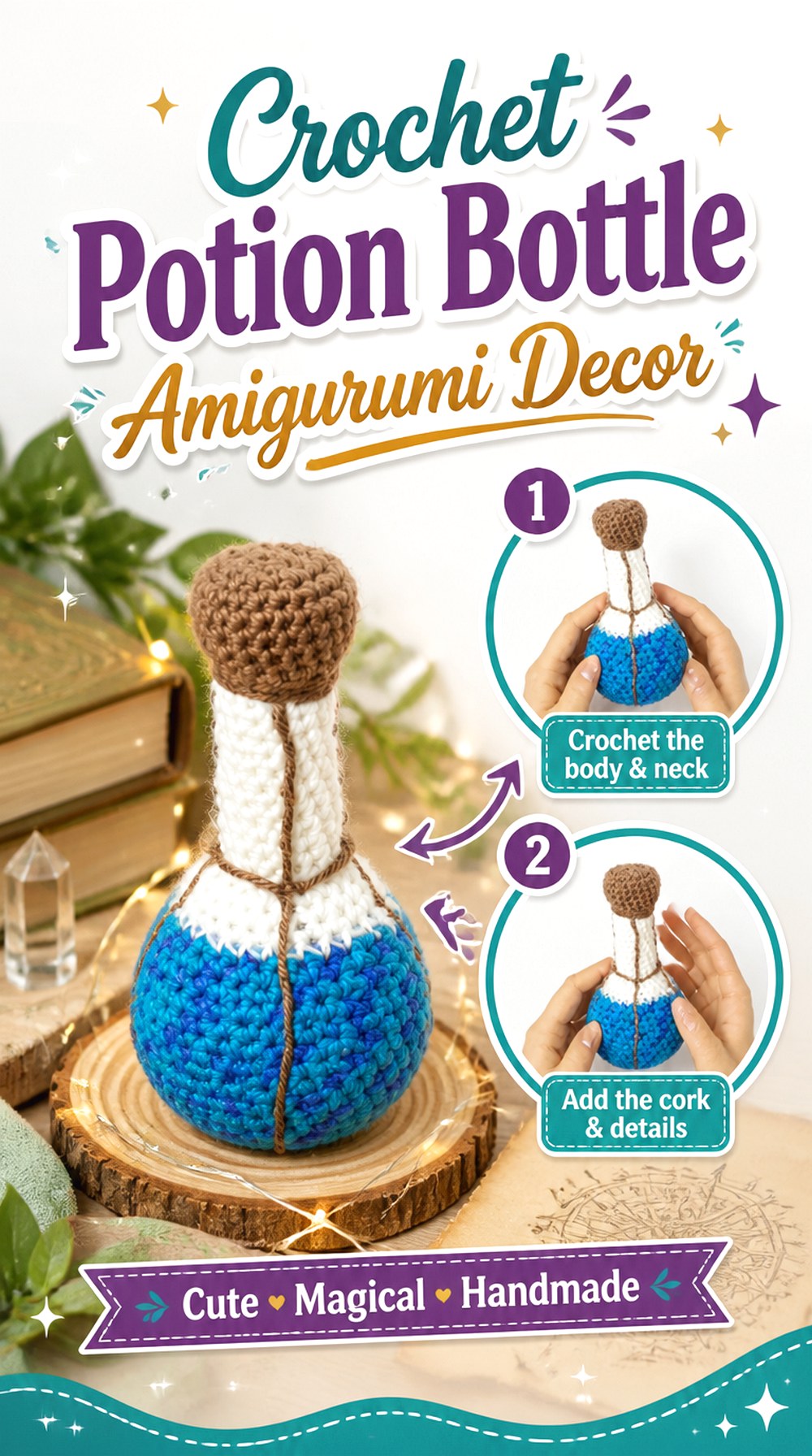
A stuffed potion bottle brings the apothecary side of kitchen-witch style into the collection. Its narrow neck and broader body distinguish it from ordinary round amigurumi, while the fantasy-bottle shape lets it sit naturally among jars, recipe books, herbs, or other decorative containers.
This works especially well for kitchens where the witch theme is meant to feel magical rather than strictly Halloween-based. Make one as a small focal object or group several color variations if the finished scale suits your shelf. The crochet piece is decorative only, so it should remain visually separate from actual bottles containing food, medicine, oils, or cleaning products.
The Bottle Neck Creates the Apothecary Look
The transition between body and neck is the point that makes a stuffed shape read as a bottle instead of a generic oval. Watch that profile as the project develops and compare it with the creator’s finished result. If you change yarn weight or hook choice, the proportions can appear different, so avoid assuming a substitution will produce the exact same scale.
Group It With Real Jars Without Confusing Its Purpose
A crochet potion bottle can look charming between labeled pantry jars, but keep the arrangement visually clear enough that no one mistakes soft decor for a container. A dedicated tray, hutch shelf, or cookbook ledge helps separate the fantasy object from ingredients and household products. That separation is especially useful in shared kitchens where several people use the same storage spaces.
A Flat Base Matters on Narrow Shelves
Before choosing a narrow ledge, check how securely the finished bottle stands. Stuffed forms can lean when the base is overfilled or when internal shaping is uneven. Test it on the actual shelf rather than balancing it temporarily for a photograph. If it prefers to lean, give it a wider display surface or support it as part of a grouped vignette.
Original Tutorial and Creator Credit
Creator: BlueFoxPaws
11. Crochet Ghost Drink Coaster
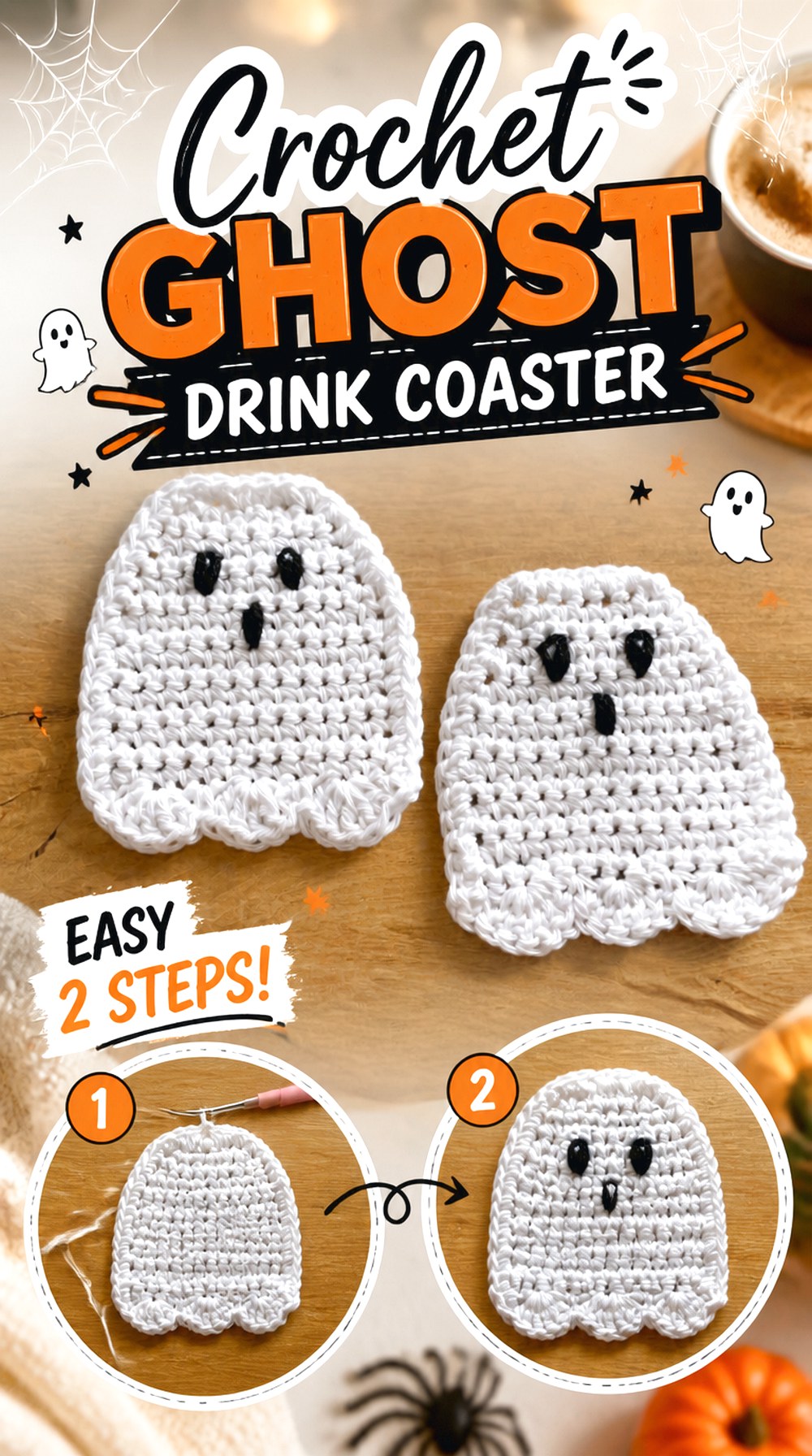
A ghost coaster softens the darker side of kitchen-witch decor. Instead of sharp coffin or skull shapes, the flowing outline creates a playful table accent that can work at a family Halloween breakfast, coffee bar, or casual seasonal gathering.
Caro-stitched’s tutorial demonstrates the ghost as an actual coaster and shows the completed facial detailing. This is also a useful option when you want recognizable seasonal imagery without leaving stuffed decorations on the counter. A set can be stacked or stored flat, making it one of the lower-bulk choices in the collection.
White Ghost Shapes Need Surface Contrast
A pale ghost can almost disappear on a white marble or light laminate counter. Test the coaster against your table before making several identical versions. A darker edge, alternate ghost color, or contrasting placemat underneath can help the outline show. The goal is to preserve the recognizable floating shape rather than rely entirely on the face to explain what the object is.
Keep Facial Features Smooth on a Functional Coaster
Raised decorations beneath a cup can affect stability, so keep the practical surface in mind when customizing the face. The creator’s tutorial should remain your guide for the original finishing. If you add your own embellishments, place the mug on the finished coaster afterward and check for rocking before making the same change across an entire set.
Original Tutorial and Creator Credit
Creator: Caro-stitched
12. Crochet Toadstool Cabinet Garland
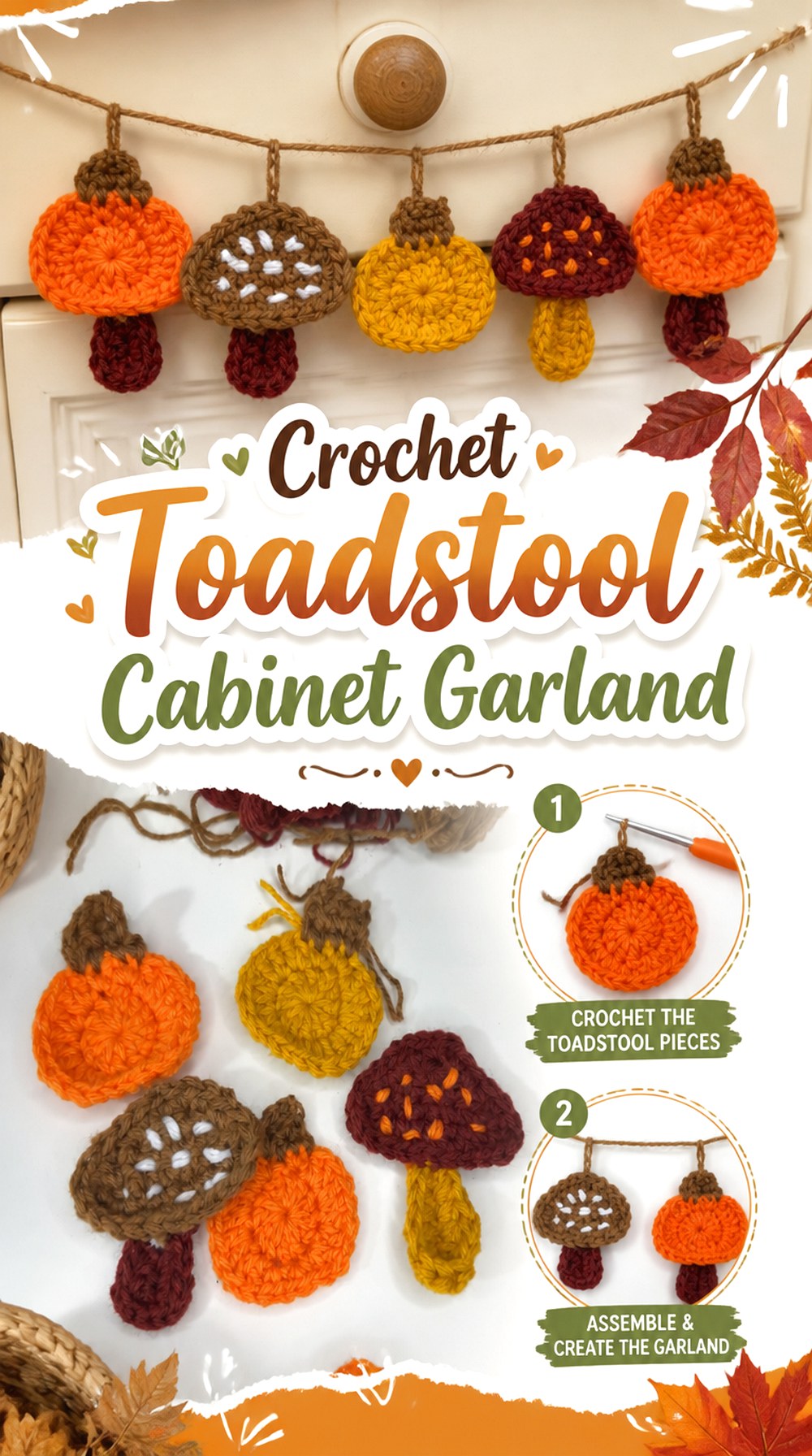
Mushrooms give kitchen-witch decor an earthy, woodland direction. A toadstool garland works especially well beneath open shelves or along the top edge of cabinetry, where the repeated caps add color without taking usable counter space.
This is one of the more adaptable ideas because the kitchen does not have to look overtly Halloween-themed. Reds and creams can create a classic toadstool look, while muted rust, moss, mustard, plum, or brown can connect the garland with autumn decor. The repeating format also lets you adjust the overall display length by planning the number and spacing of motifs rather than enlarging each mushroom.
Let the Toadstools Hang Below the Cabinet Edge
The mushroom shapes need enough vertical clearance for their caps and stems to remain visible. Hold a sample beneath the intended shelf before assembling the full garland. If cabinet doors will sweep through the same area, move the hanging line higher or choose a stationary open shelf instead. A garland that is constantly caught by doors quickly becomes more nuisance than decoration.
Space Motifs Before Fixing the Garland Length
Lay the finished mushrooms out on a table and experiment with the gaps between them before committing to the final arrangement. Wider spacing produces a lighter, more woodland-style display, while closer spacing creates a denser band of color. Planning this first is easier than discovering after assembly that all the motifs have crowded into one small section.
Store the Garland Without Crushing the Caps
Dimensional mushrooms need more careful off-season storage than flat bunting. Avoid compressing them beneath heavy blankets or decor boxes if you want the caps to keep their intended shape. A shallow container or loose coil gives the individual motifs more room. Untangle the connecting strand before storage rather than pulling knots tight around the stuffed pieces.
Original Tutorial and Creator Credit
Creator: Yarn Over With Angie
13. Crochet Pumpkin Drink Coaster
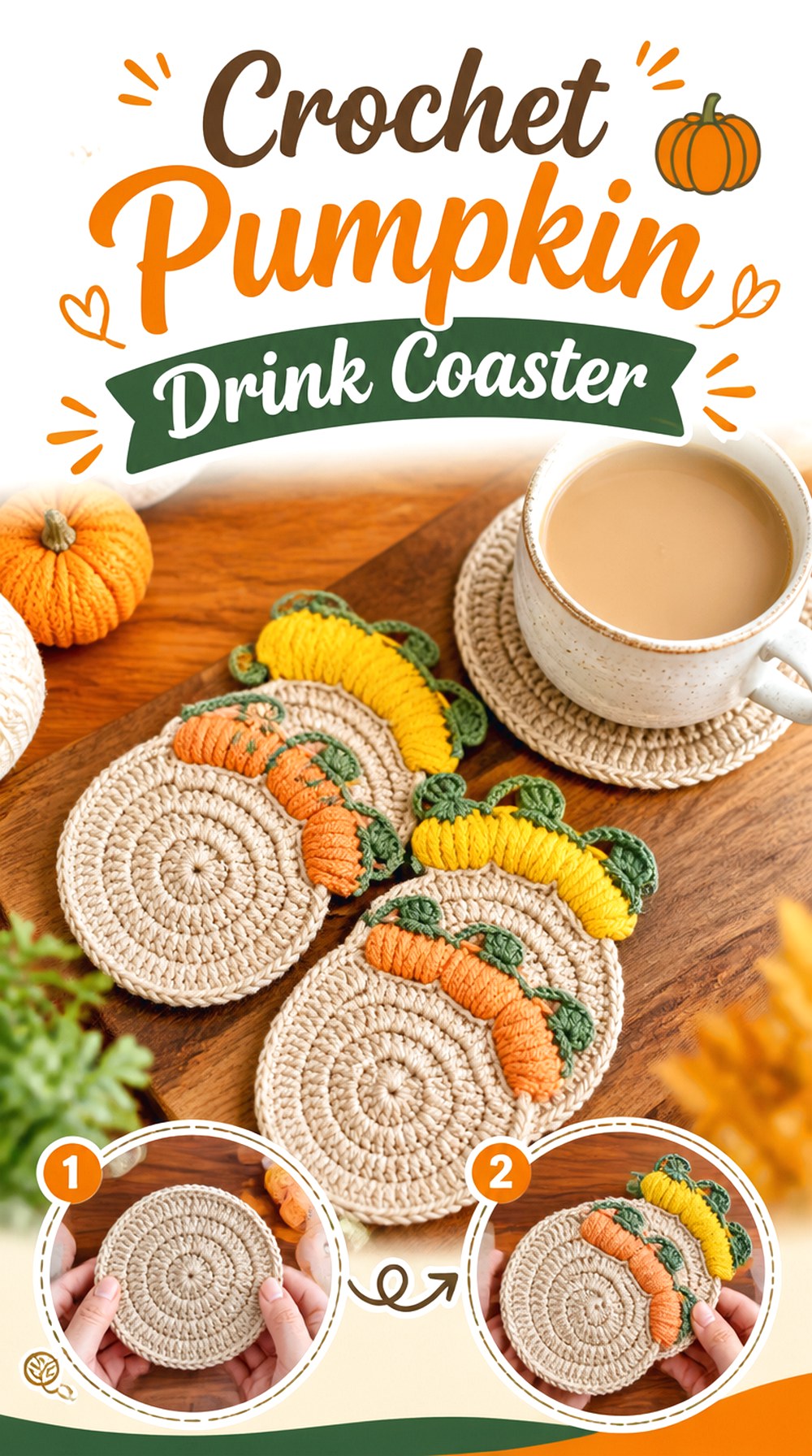
A pumpkin coaster connects the witch theme with harvest-season kitchen decor. The recognizable orange body and green or brown details allow it to sit comfortably beside cauldrons and witch hats, yet it can remain in use after Halloween when the rest of the overtly spooky pieces are packed away.
The project is useful for readers who prefer decor with a longer seasonal window. It also brings a rounded organic shape into a collection containing many points, wings, coffins, and webs. As with the other drink coasters, judge the finished project partly by how evenly your usual cup sits on its central area.
Pumpkin Texture Can Make a Small Coaster Feel Busy
Strong ridges and multiple colors give the pumpkin character, but they also create more visual activity than a plain circle. If your mugs already have elaborate patterns, consider a restrained color combination for the coaster. Conversely, a solid mug lets the pumpkin texture become the main feature. Check that any decorative stem detail does not interfere with where the cup needs to rest.
Autumn Color Can Keep This Piece Out Past Halloween
Orange and green are the obvious choice, but the shape can carry the pumpkin identity even when the palette is quieter. Cream, rust, muted green, brown, or other harvest shades can help the coaster coordinate with a kitchen through the broader fall season. Color changes are an aesthetic adaptation; follow the original tutorial for construction rather than trying to redesign the shaping at the same time.
Original Tutorial and Creator Credit
Creator: Knitting Love
14. Crochet Witch Hat Kitchen Garland
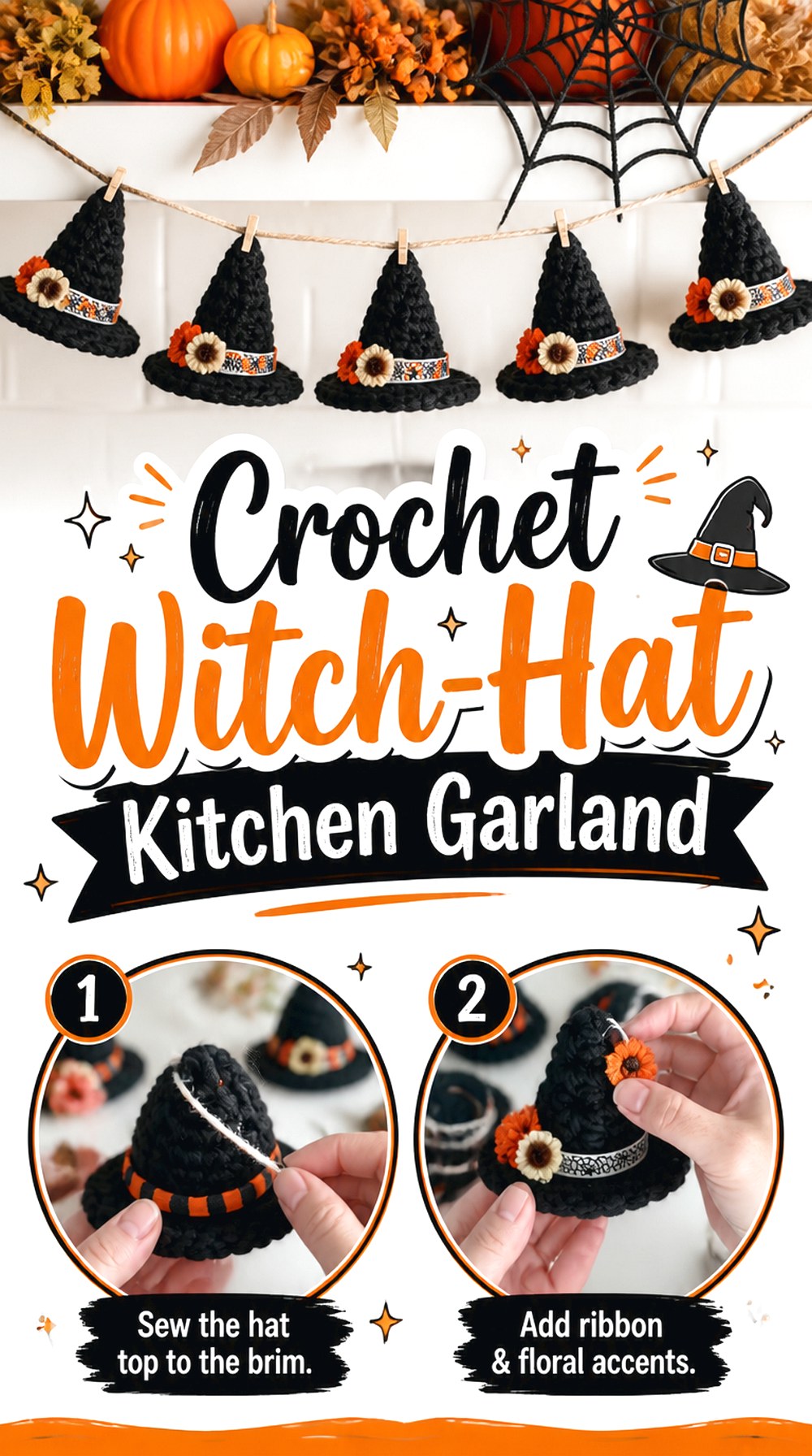
A full witch-hat garland creates a much larger visual statement than the single mini hat earlier in the list. Simply Made by Erin Crochet’s design uses dimensional hats and is intended as a decorative Halloween garland, giving it enough volume to work above cabinets, along a shelf, or across a nearby dining-space wall.
Choose this project when you want the witch motif to define the room rather than appear only in small accents. Because the source design uses super-bulky yarn, check the available clearance carefully. A substantial garland can overwhelm a narrow shelf where a fine flat bunting would fit easily.
Bulky Hats Need More Clearance Than Flat Bunting
Measure the visual space rather than only the length of the hanging line. Dimensional hats project outward and downward, so a garland that technically fits between two cabinets may still interfere with doors or objects stored underneath. Hold one finished hat in place first. If it feels too dominant, choose a higher wall or reduce the number of repeated motifs rather than compressing them together.
Twine Placement Changes How the Hats Face Forward
The connection between motifs affects whether the hats present their fronts cleanly or rotate sideways. Before permanently arranging the entire set, suspend two or three finished pieces and see how gravity positions them. Small adjustments at this stage can produce a much more consistent display than trying to twist every hat back into place after the garland has been mounted.
Use a Short Run for Cabinets and a Longer Run for Open Walls
A kitchen does not require a room-spanning banner. Three or four visually substantial motifs can create a convincing cabinet-top accent if that suits the available space better. On a long unobstructed wall, a larger run can make more sense. Let the architecture determine the quantity rather than making extra hats simply because the original example shows a particular arrangement.
Original Tutorial and Creator Credit
Creator: Simply Made by Erin Crochet
15. Crochet Coffin Mug Coaster Set
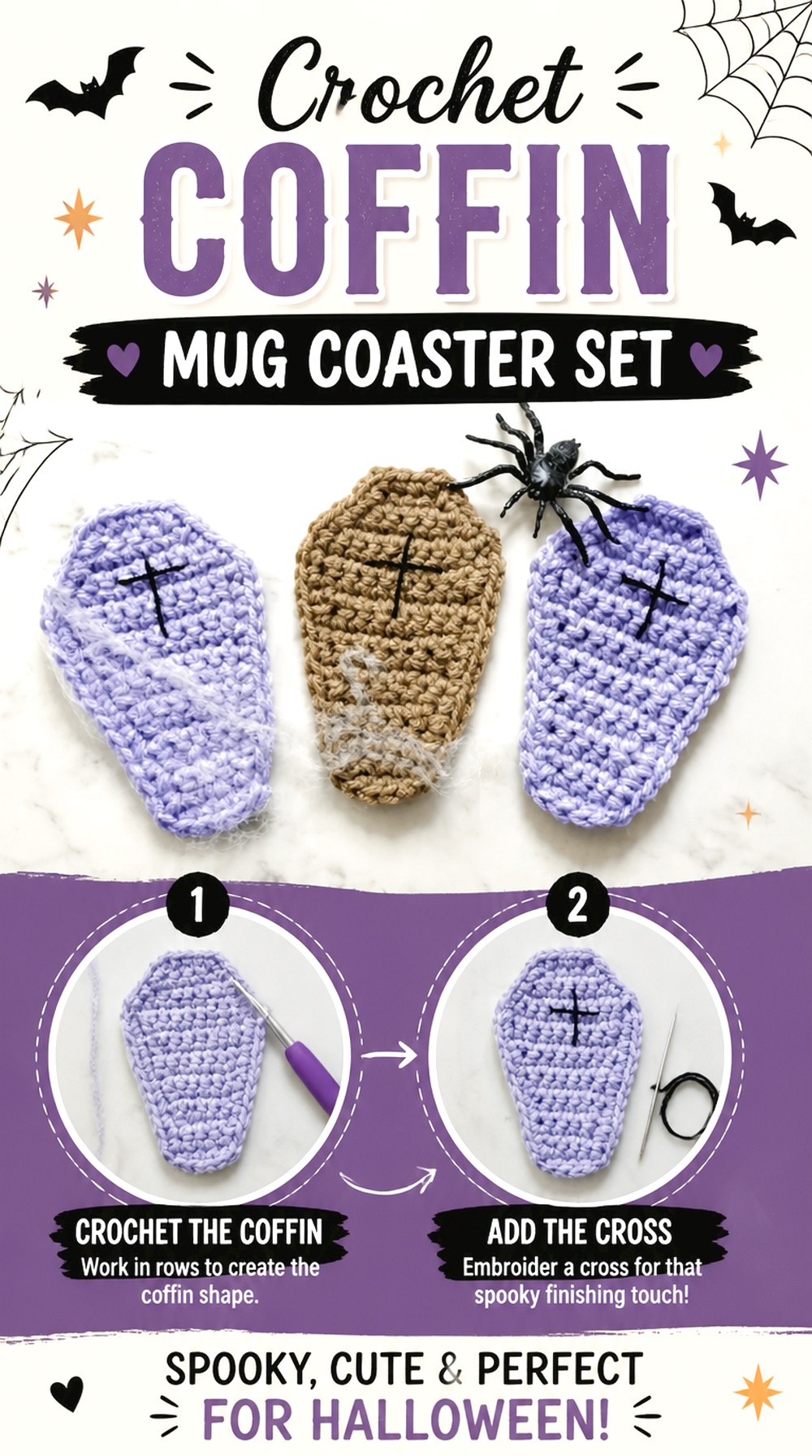
Coffin-shaped coasters bring an unmistakably gothic element to the kitchen table. Heather Corinne Crochets specifically presents the design as versatile enough for coasters or a garland, so you can decide whether you need useful tabletop pieces or a hanging accent before settling on the final display.
For this article, the coaster-set version adds a long geometric silhouette that contrasts with the round spider web, pumpkin, and eyeball designs. The finished coffins also store flat, making them a practical choice for a highly seasonal motif that may only come out for part of the year.
Decide Between Coaster Set and Garland Before Finishing
A shape that can serve two purposes is useful, but the finishing choices may differ. A table coaster needs to remain easy to place beneath drinkware, while a garland needs a reliable way to hang from a connecting strand. Decide which role matters before adding your own loops, ties, or embellishments. That prevents decorative hardware from ending up underneath a glass.
Coffin Silhouettes Show Best With Simple Contrast
The angular sides and narrowed lower section are what separate a coffin from an ordinary rectangle. Use colors that keep the edge visible against your table. If you add a contrasting cross or other stitched detail, step back afterward and make sure the underlying coffin shape still reads clearly rather than disappearing beneath extra surface decoration.
Keep Embroidery Away From the Drink Contact Zone
Decorative stitching can add personality, but bulky embroidery beneath a mug may introduce an uneven point. After finishing one sample, place your normal cup on it and check where the base lands. If you develop your own embellishment variation, concentrate raised features toward areas that remain visible around the cup rather than directly beneath its weight.
Original Tutorial and Creator Credit
Creator: Heather Corinne Crochets
16. Crochet Black Cat Appliqué Kitchen Accent
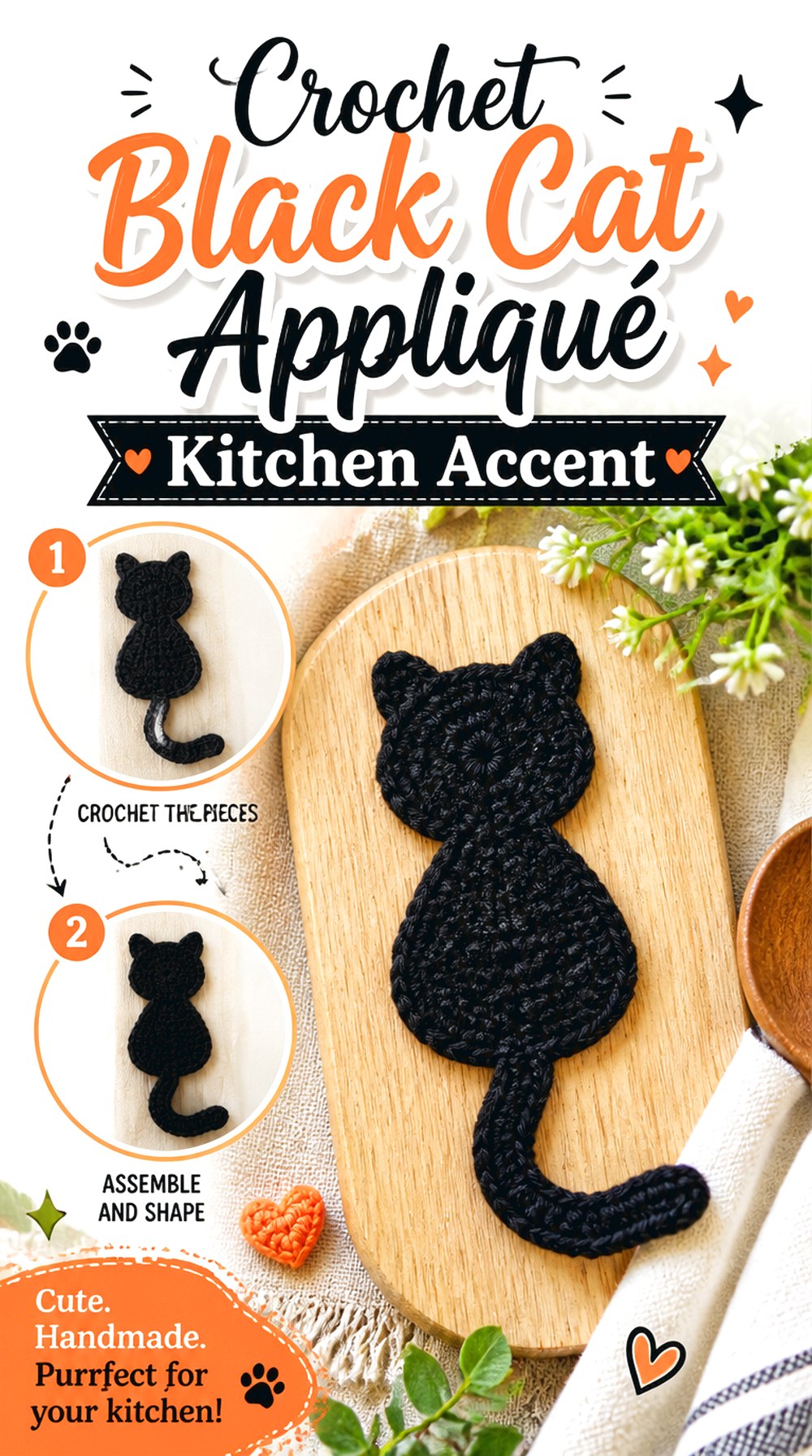
A black cat gives the kitchen-witch theme personality without requiring a full stuffed animal. The flat appliqué can become part of framed fiber art, a removable banner, or another decorative textile positioned away from heat and food contact.
Compared with the bat, this motif is more compact and upright, so it works well beside a moon, hat, or pumpkin rather than stretching across the whole composition. A single cat can also bring the theme into a kitchen that does not need obvious Halloween imagery. Use the tutorial for the actual cat construction, then decide how you want to display the finished appliqué as a separate editorial adaptation.
A Black Cat Needs a Clean Outline
Dark yarn hides internal stitch detail, especially from across a room, so the outer profile becomes important. Test the cat against the planned backing before attaching it. A black motif on deep wood may need a pale fabric panel or contrasting border to remain visible. Good contrast can do more for the finished piece than adding several small colored decorations.
Attach It Only to Removable or Non-Heat Decor
Avoid sewing the appliqué directly onto potholders, oven mitts, or other heat-contact pieces simply to make them match the theme. Unless the underlying item and added materials are designed for that use, decorative modifications can change how it performs. A framed panel, banner, shelf cloth used only for display, or removable seasonal backing keeps the cat safely in a decorative role.
Original Tutorial and Creator Credit
Creator: Pora Pora Crochet
17. Crochet Round Spider Web Drink Mat
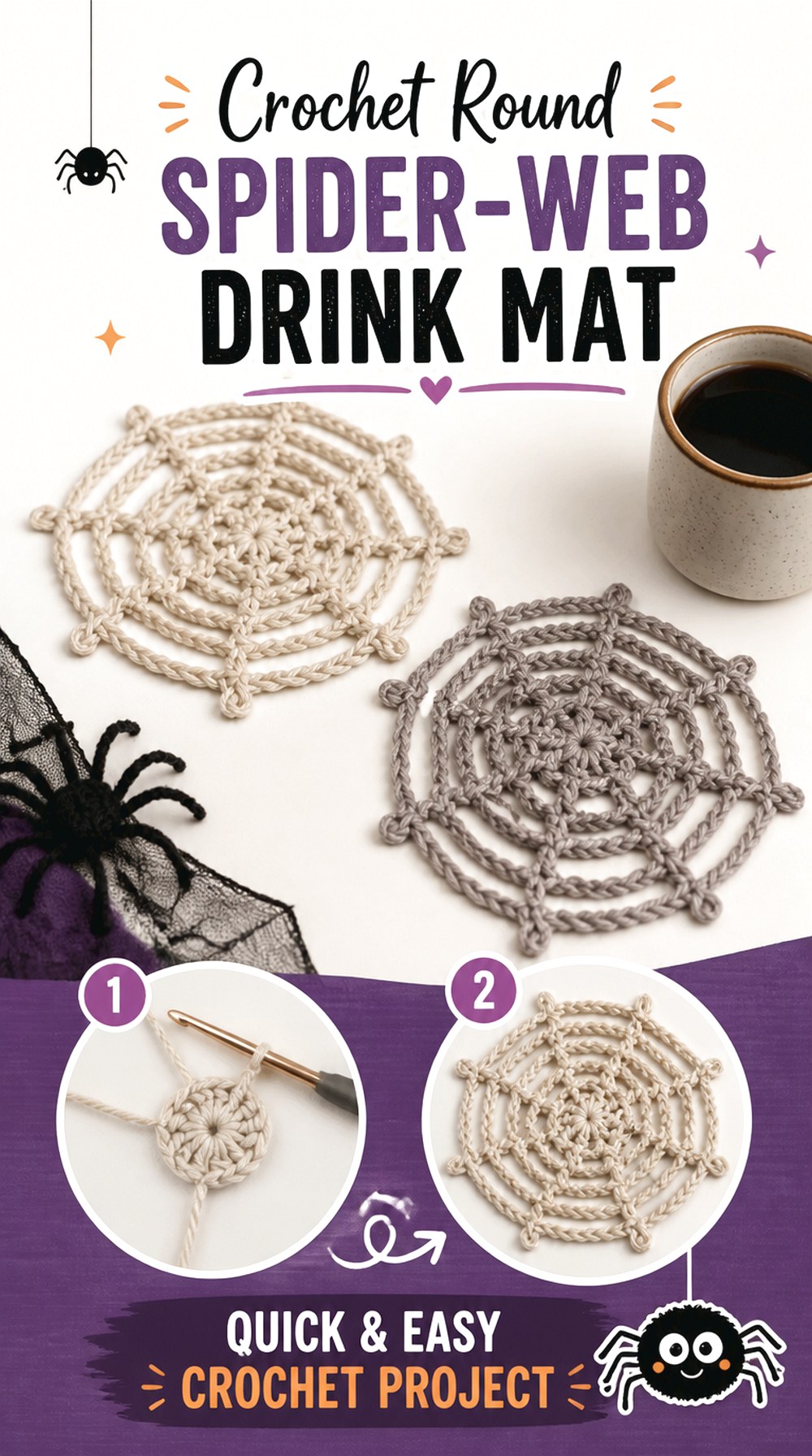
The round spider web creates an airy tabletop motif instead of a solid character shape. Crafty Crochet Castle presents the project both as Halloween decoration and, when made in 100% cotton, as a coaster. That makes it a useful counterpoint to the denser skull, pumpkin, ghost, and coffin pieces.
The web pattern lets the table surface show through, which can look especially effective on contrasting wood or solid-color surfaces. Before committing to a full set, check the diameter against your own drinkware and make sure the open structure still gives the cup enough stable support for the way you intend to use it.
Open Webs Need Even Tension to Sit Flat
When most of the design consists of spokes and open spaces, a small tension difference can pull the whole circle off-center. Lay the work down periodically and check whether the spokes distribute evenly. If the finished web needs shaping, follow the care requirements of the actual yarn rather than applying one blocking method automatically to every fiber.
Cotton Is the Better Match When Following the Coaster Use Shown
The creator specifically notes that a 100% cotton version can be used as a coaster, while other yarn substitutions are discussed for the general pattern. If you intend to use the finished object beneath drinks rather than purely as decor, stay close to the tutorial’s stated functional material choice and check the care information for the yarn you purchase.
Original Tutorial and Creator Credit
Creator: Crafty Crochet Castle
18. Crochet Bloodshot Eyeball Coaster
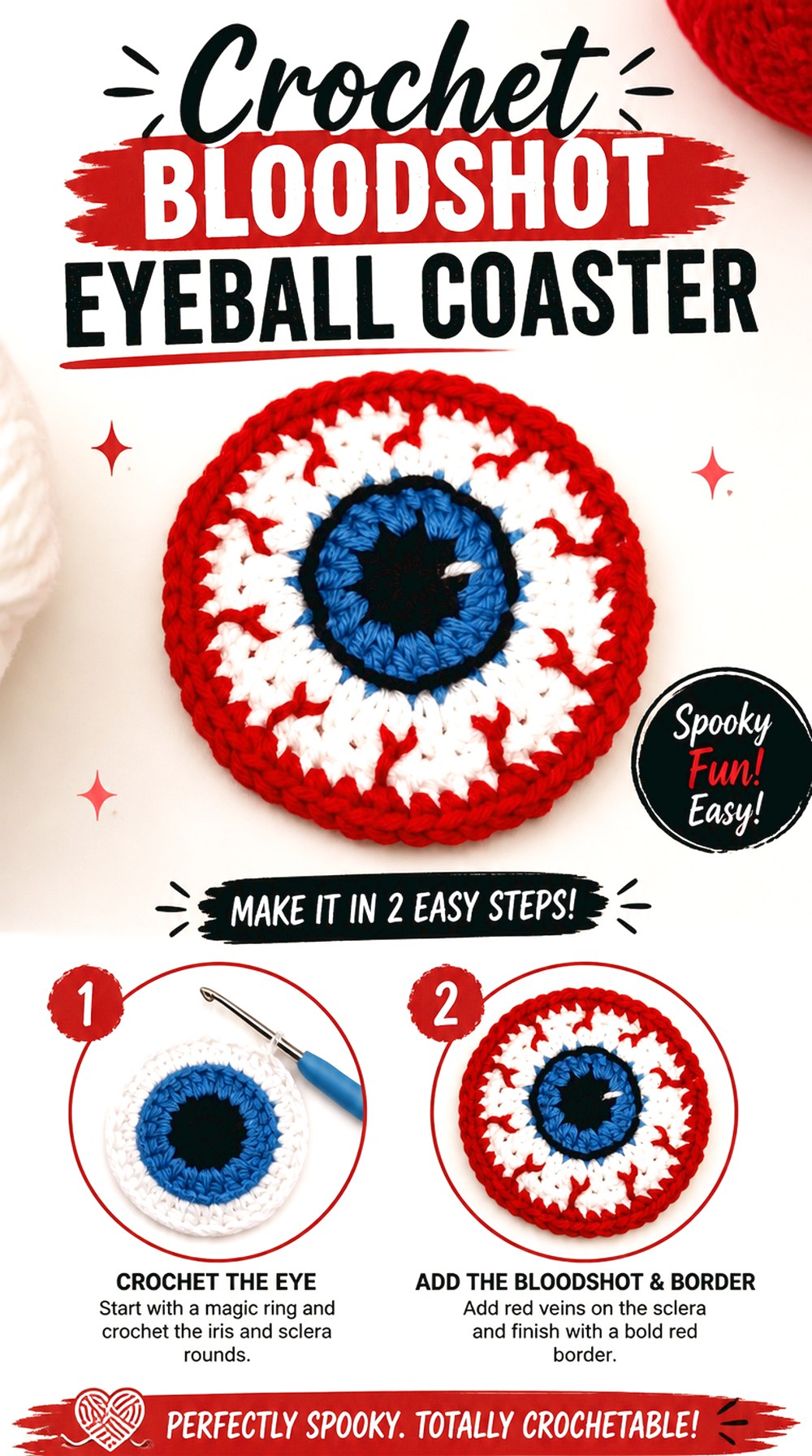
An eyeball coaster is the most playful horror-style option in the collection. The circular form naturally fits the coaster role, while concentric changes in color can create the iris, pupil, white of the eye, and optional bloodshot effect without changing the fundamental shape.
This design works well when you want something stranger than the standard pumpkin-and-ghost combination. Because the basic outline is round, it can also be easier to mix with ordinary table settings than a coffin or witch hat. Make one sample first and evaluate both the color contrast and surface flatness before committing to a coordinated set.
The Eye Design Works Because of Concentric Contrast
If neighboring colors are too similar, the iris and pupil may merge visually. Lay the yarn choices next to one another before starting and think about how they will look from normal table distance, not only close up. An unusual iris color can personalize the project without changing its construction, while keeping the outer eye area sufficiently distinct preserves the recognizable motif.
Keep the Surface Flat Enough for a Glass
A striking eye design still needs to function as a coaster. Check for cupping, ruffling, or bulky decorative additions once the piece is complete. Place a real glass on the center and look for rocking. If you plan to add optional embroidered veins or other surface details, keep them restrained enough that the cup base remains well supported.
Creator: Crochet Crafters
Which Crochet Kitchen Witch Decor Style Fits Your Space?
| If you need… | Strong choices | Main thing to check |
|---|---|---|
| Decor that stores flat | Witch-hat, skull, ghost, pumpkin, coffin, spider-web, and eyeball coasters | Cup stability and yarn care |
| Decor that stays off the counter | Bat and cat appliqués, corner web, mushroom garland, witch-hat garland | Door clearance, hanging position, and contrast |
| A shelf focal point | Cauldron, witch doll, potion bottle | Stable placement and enough surrounding space |
| Small supporting accents | Mini witch hat and broom | Scale, snagging, and how they group with larger pieces |
| A coffee-station detail | Ghost-and-web mug cozy | Fit around the specific mug and handle |
A small kitchen will usually benefit more from flat and hanging projects, while open shelves give dimensional pieces enough room to make an impact. If you want decor that lasts beyond Halloween, mushrooms, pumpkins, potion bottles, black cats, and subtler witch-hat colors can transition more easily into an autumn or year-round cottage-witch palette.
Conclusion
The most useful crochet kitchen witch decor combines different functions instead of repeating the same motif everywhere. Choose coasters when you want seasonal pieces that store easily, a cauldron or witch doll when the display needs a focal point, and webs, bats, mushrooms, or witch hats when empty cabinet and shelf space can carry the theme without sacrificing work surfaces.
For a darker kitchen, skulls, coffins, and eyeballs bring stronger gothic contrast. For a softer cottage-witch look, start with mushrooms, pumpkins, potion bottles, and a small broom. Whichever direction you choose, use the original tutorials for exact construction details and verify yarn care, dimensions, and intended use when those details matter to your kitchen setup.
Frequently Asked Questions
Can crochet kitchen witch decor be used as potholders or trivets?
Not automatically. A project being flat, thick, or kitchen-themed does not establish that it is appropriate for direct contact with hot cookware. The drink coasters in this collection should remain coasters unless the original designer specifically supports another use. For a potholder or trivet, choose a dedicated project whose materials and intended heat-contact function are clearly stated rather than adapting an ordinary decorative pattern based on appearance alone.
What yarn should I use for crochet kitchen witch coasters?
Start with the material specified by the individual tutorial, particularly when the creator discusses functional use. Crafty Crochet Castle, for example, specifically mentions a 100% cotton version for using its spider web as a coaster. Also consider how the yarn handles moisture and how its care label recommends washing it. Changing fiber or yarn thickness can affect absorbency, surface texture, scale, and how flat the finished coaster lies.
How can I keep crochet spider webs from looking loose or uneven?
First check whether the tension and spacing are reasonably balanced around the entire web. Openwork makes small inconsistencies much more visible than dense crochet does. Appropriate blocking can help define the final geometry, but the method should suit the fiber you used. Also make sure the web is supported from enough points when hanging it; pulling strongly from only one corner can distort otherwise balanced spokes.
How can I add kitchen witch decor without cluttering the countertops?
Move the theme upward. Cabinet-edge garlands, framed appliqués, corner webs, and open-shelf accents provide plenty of visual character without occupying prep space. Keep only genuinely useful items, such as coasters or a mug cozy, on working surfaces. Larger decorative pieces such as a witch doll or cauldron can go on a hutch or deep shelf where they still contribute to the room without competing with everyday cooking tasks.
Can kitchen witch crochet decor work outside Halloween?
Yes, especially when the project is not tied exclusively to horror imagery. Mushrooms, pumpkins, potion-style bottles, black cats, miniature brooms, and subdued witch hats can fit autumn, cottage, woodland, or fantasy-inspired kitchens for longer periods. Color also changes the mood considerably. Muted rust, moss, cream, brown, plum, and charcoal generally feel less party-specific than a palette built entirely around bright orange, neon green, and black.
Do all the projects need to use the same yarn weight to look coordinated?
No. Matching scale and color relationships often matters more than forcing every project into one yarn weight. A deliberately bulky witch-hat garland can coexist with finer appliqués and smaller amigurumi if each fits its display location. Follow the individual tutorial closely enough to understand its intended structure before substituting yarn, since changing thickness can affect finished size, stiffness, drape, and the clarity of small details.