An embellished cardigan can be a practical fall layer without looking like every other basic crochet sweater. The decoration may be as small as a ruffled edge or tie closure, or it can define the entire garment through flower squares, checkerboard blocks, raised bobbles, fruit motifs, celestial graphics, or mosaic colorwork.
These 24 ideas cover noticeably different silhouettes and embellishment methods rather than relying on color changes alone. Some have flatter surfaces that are easier to wear beneath coats, while others make the cardigan itself the statement layer. You will also find cropped, long, belted, zippered, open-front, and buttoned constructions. The planning notes focus on the details that affect real wear: motif placement, drape, added weight, closures, fit, finishing, and what to check before adapting a tutorial for your own fall wardrobe.
Quick List
- Crochet Bow-Tie Cropped Cardigan
- Crochet Cherry-Vine Ruffle Cardigan
- Crochet Butterfly-Back Graphic Cardigan
- Crochet Chunky Daisy Granny-Square Cardigan
- Crochet Daisy Colorwork Cardigan
- Crochet Flower-Lace Button Cardigan
- Crochet Long Bobble-Snow Cardigan
- Crochet Strawberry-Detail Cardigan
- Crochet Starburst Motif Cardigan
- Crochet Puffy-Flower Statement Cardigan
- Crochet Checkerboard Accent Cardigan
- Crochet Tulip-Panel Cardigan
- Crochet Woven-Rose Cardigan
- Crochet Pumpkin Mosaic Belted Cardigan
- Crochet Wildflower Granny-Square Cardigan
- Crochet Patchwork Block Cardigan
- Crochet Zippered Granny-Square Cardigan
- Crochet Flower-Stitch Button Cardigan
- Crochet Suzette Ruffle Tie Cardigan
- Crochet Celestial Star-and-Moon Cardigan
- Crochet No-Sew Heart Granny Cardigan
- Crochet Garden-Party Lace Cardigan
- Crochet Polka-Dot Bobble Crop Cardigan
- Crochet Popcorn-Stitch Contrast Cardigan
Plan Embellishment Placement Around Real Fall Layers
Decoration changes how a cardigan behaves, not just how it looks. Flat colorwork, mosaic designs, lace, and motifs integrated directly into the fabric usually create less surface bulk than large appliqués or heavily raised bobbles. That difference matters when you expect to wear the cardigan beneath a trench, denim jacket, or winter coat.
Think about where pressure will land before committing to dimensional decoration. Large flowers on the shoulder can sit directly beneath a bag strap; thick motifs under the arm may rub against a coat; elaborate sleeve decoration can make an already roomy sleeve harder to fit through another garment. If the cardigan is intended to be your outermost fall layer, you have much more freedom to use dramatic raised textures.
Let the Decoration Influence Your Yarn Choice
A cardigan covered in bobbles or dimensional flowers already uses texture to create visual weight, so an extremely fuzzy yarn can hide the details that make the design interesting. Smooth yarns generally show crisp colorwork, motif edges, and raised stitches more clearly, while softer haloed fibers can create a gentler effect at the cost of definition.
Drape matters too. A loose lace cardigan benefits from movement, whereas a zippered front or graphic granny-square layout needs enough stability to keep edges and motifs recognizable. If you substitute yarn, compare a sample with the tutorial fabric before committing to a whole garment. Check thickness, stretch, recovery, and the blocked appearance rather than assuming two yarns labeled with the same weight will behave identically.
Check Fit Before the Embellishment Makes the Decision for You
Motif-built garments deserve extra planning because the decoration and the garment dimensions are connected. Block a representative square first, then use its finished width to estimate how a panel grid will behave. As a simple planning example, four blocked squares measuring 5 inches each would span about 20 inches before joins, borders, seams, and intended ease are considered.
Added embellishments can also change how the fabric hangs. A cropped cardigan carrying a few flowers may react very differently from a long garment covered with dense textured stitches. Check shoulder width, armhole comfort, sleeve mobility, and front opening before attaching optional surface decorations. For made-to-measure tutorials, compare the work to your own body or a cardigan whose fit you already like instead of relying only on generic size labels.
1. Crochet Bow Tie Cropped Cardigan
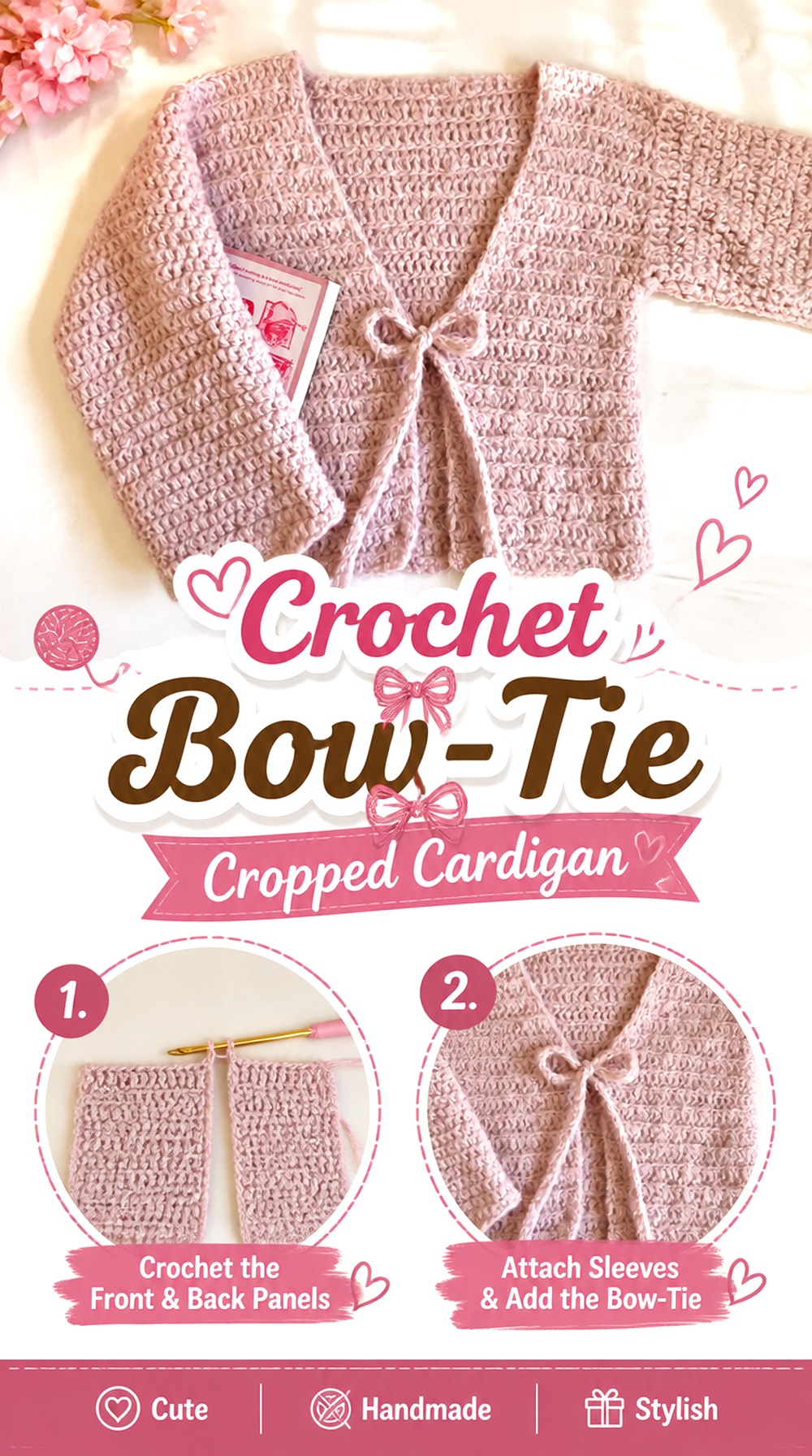
This Crochet Bow-Tie Cropped Cardigan puts the embellishment at the center front rather than spreading decoration over the entire garment. The tied opening creates a soft, decorative focal point while leaving the front relatively open for layering. The tutorial is designed around adaptable measurements, which makes this direction useful when you want the proportions of a cropped fall cardigan to relate to your own torso instead of a fixed sample size.
Because the body itself stays visually simple, this design works especially well when you want an embellished look that will not compete with patterned skirts, high-waisted pants, or dresses.
The Front Ties Control More Than the Decoration
A tie closure changes how much of the layer underneath remains visible. Before settling on tie placement, decide whether you want the cardigan to sit relatively closed or behave more like a shrug with a small center connection. The front edges should still hang comfortably when the tie is loose; a tie should not be responsible for pulling an undersized cardigan into position.
Cropped Proportions Make Sleeve Balance Important
With a short body, sleeves occupy more of the garment’s visual area. Extra-wide or highly textured sleeves can make the cardigan feel dramatically different from a close sleeve. Compare the body length with your intended bottoms before finishing the sleeves, particularly if you plan to layer it over dresses or high-rise waistlines through fall.
Original Tutorial and Creator Credit
Creator: mahum 🎀
2. Crochet Cherry Vine Ruffle Cardigan
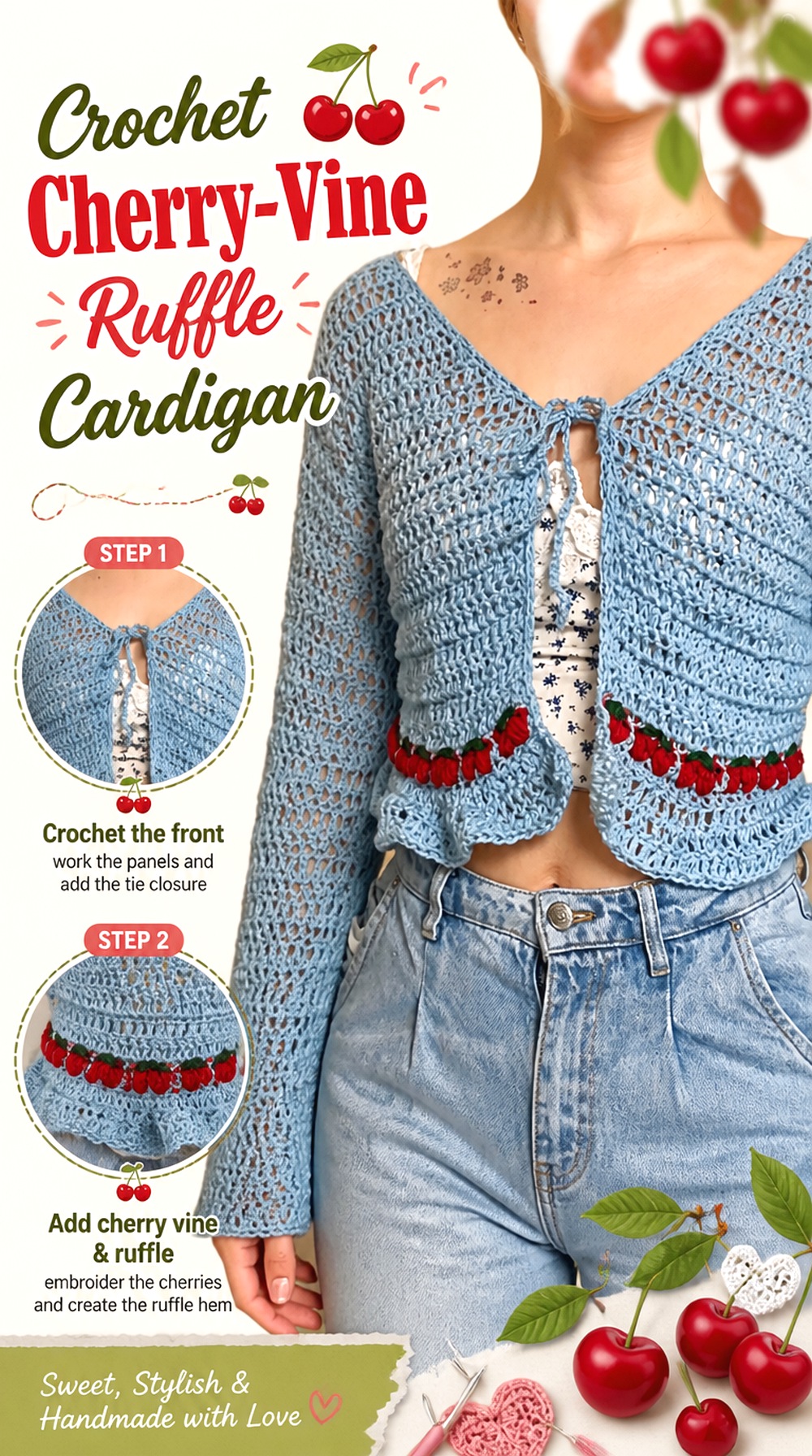
This Crochet Cherry-Vine Ruffle Cardigan combines several embellishment types in one cottage-inspired piece: cherry details, stitched stems, ruffled edging, and front ties. The tutorial also works through body measurements and separate cardigan sections, so the fruit decoration sits on a recognizable wearable rather than functioning as isolated appliqué inspiration.
For fall, this is a good direction if you want a playful cardigan that still works as an open layer. The cherries provide small concentrated areas of color, while the ruffles soften the front opening. That balance makes it less visually dense than an allover motif cardigan even though several decorative elements are present.
Give the Cherry Stems Room to Stay Readable
Small fruit motifs depend on contrast and spacing. If the cherries are positioned too close to a seam, tie, or ruffled border, their stems can disappear into the surrounding detail. Judge the motif from normal viewing distance before final attachment or embroidery. A slightly simpler arrangement can make each cherry more recognizable than filling every available area.
Ruffles Can Change the Way the Front Edge Hangs
A decorative ruffle adds fabric to an edge, so the base edge needs to lie cleanly before extra fullness is introduced. If you adapt the cardigan length or opening, assess the front first without embellishment. This helps separate a fit issue from a ruffle issue and makes it easier to keep both front sides visually balanced.
Original Tutorial and Creator Credit
Creator: thisfairymade
3. Crochet Butterfly Back Graphic Cardigan
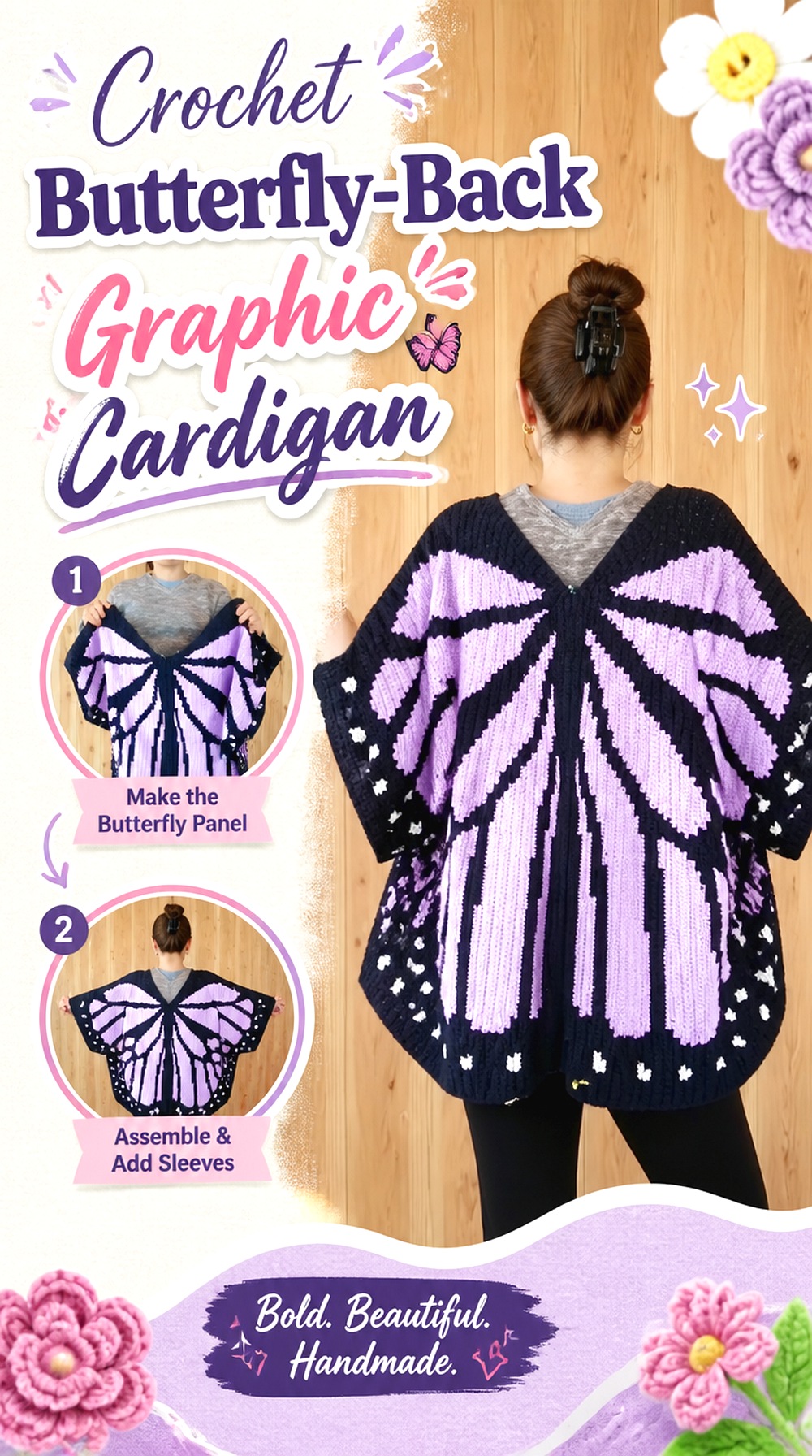
A large butterfly turns the back of this Crochet Butterfly-Back Graphic Cardigan into a single statement panel. Unlike scattered appliqués, the image depends on color placement within the fabric, so the decoration stays comparatively flat. MATTI HANDCRAFTS presents the butterfly project as a tutorial series and explains how the sweater construction can be converted to an open cardigan version.
This direction suits a fall wardrobe where the cardigan itself will often be seen from the back—over a simple tee, for example. It also offers a very different visual rhythm from granny-square cardigans because the eye reads one large image instead of many repeated units.
Preserve the Graphic Before Adjusting the Silhouette
A large image relies on its width-to-height relationship. Cropping a graphic cardigan, narrowing a panel, or changing shaping can affect the butterfly more noticeably than it would affect a solid fabric. Treat the image and the garment outline as connected decisions. If resizing is necessary, follow the creator’s guidance rather than removing arbitrary sections of a chart.
Loose Floats Can Become a Wearability Issue
Colorwork may leave strands on the reverse side. Those strands should not be so loose that fingers, jewelry, or a layer underneath constantly catch them, but they also should not be tightened enough to draw in the fabric. Check the wrong side periodically while working and compare the panel flat before proceeding.
Original Tutorial and Creator Credit
Creator: MATTI HANDCRAFTS
4. Crochet Chunky Daisy Granny Square Cardigan
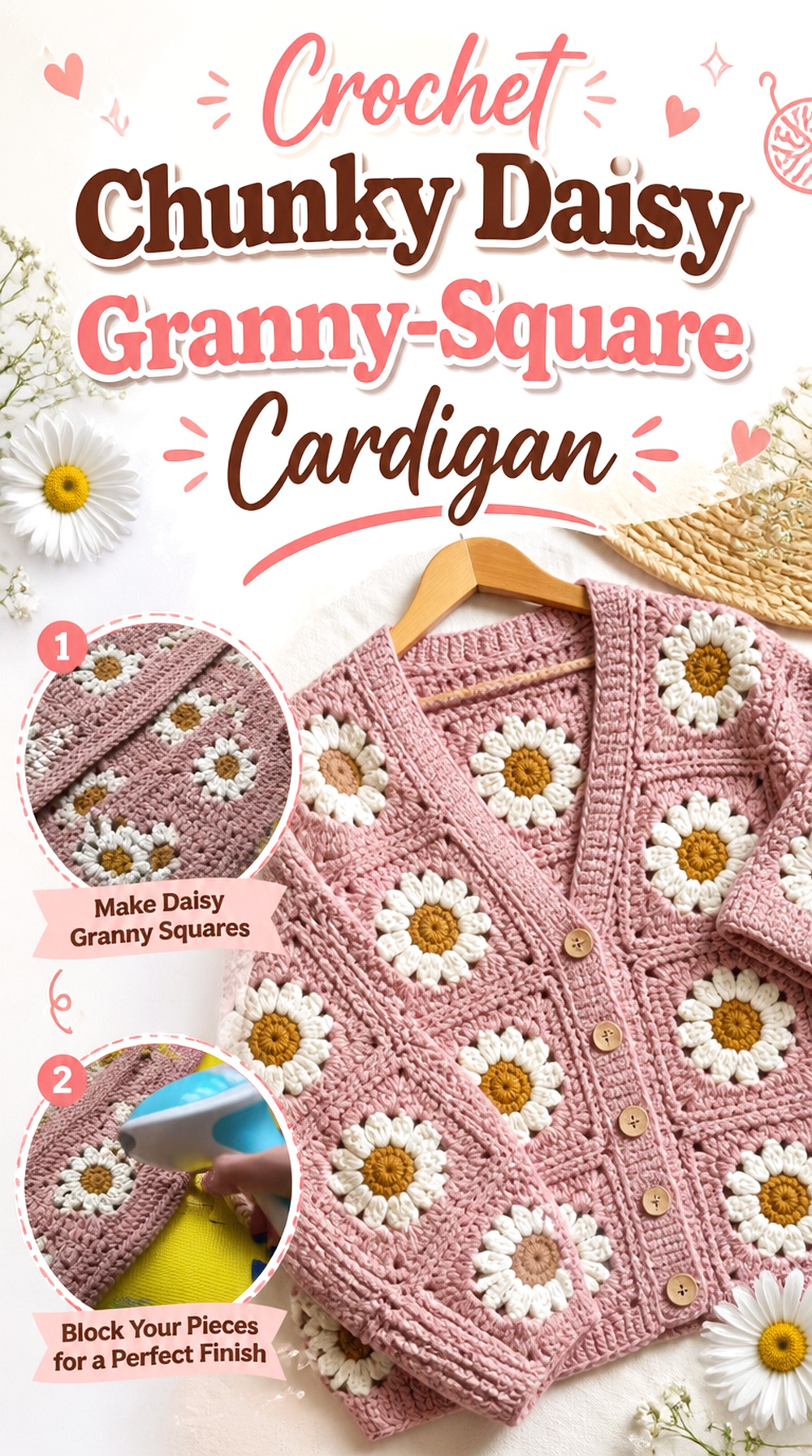
The Crochet Chunky Daisy Granny-Square Cardigan uses large floral squares as both embellishment and garment structure. AllAboutAmi’s Cozy Days Daisy Cardigan features daisy granny squares together with substantial ribbed finishing at the cuffs, collar, and edges, producing a stronger fall-layer feel than a delicate floral mesh cardigan.
Because the daisies repeat across a grid, color placement can dramatically change the finished effect. A limited earthy palette can make the flowers feel autumnal, while stronger contrast makes each square read as an individual graphic. The square-based construction also makes blocking and layout planning central to achieving a balanced finished garment.
Block One Daisy Before Planning the Whole Grid
The finished size of a granny square determines much of the cardigan geometry. Block a representative motif using the same yarn and method you intend for the garment, then compare its dimensions with the tutorial layout. A seemingly small change per square can become much more noticeable when several motifs span the body or sleeve.
Ribbing Gives the Floral Grid a Visual Frame
A repeated flower field can look busy when every edge ends directly in motifs. Ribbing creates a quieter border and can visually organize the squares. If you change the flower colors, consider whether the ribbing should blend with the square backgrounds or act as a deliberate outline. Either approach changes how strongly the separate motifs stand out.
Original Tutorial and Creator Credit
Creator: AllAboutAmi
5. Crochet Daisy Colorwork Cardigan
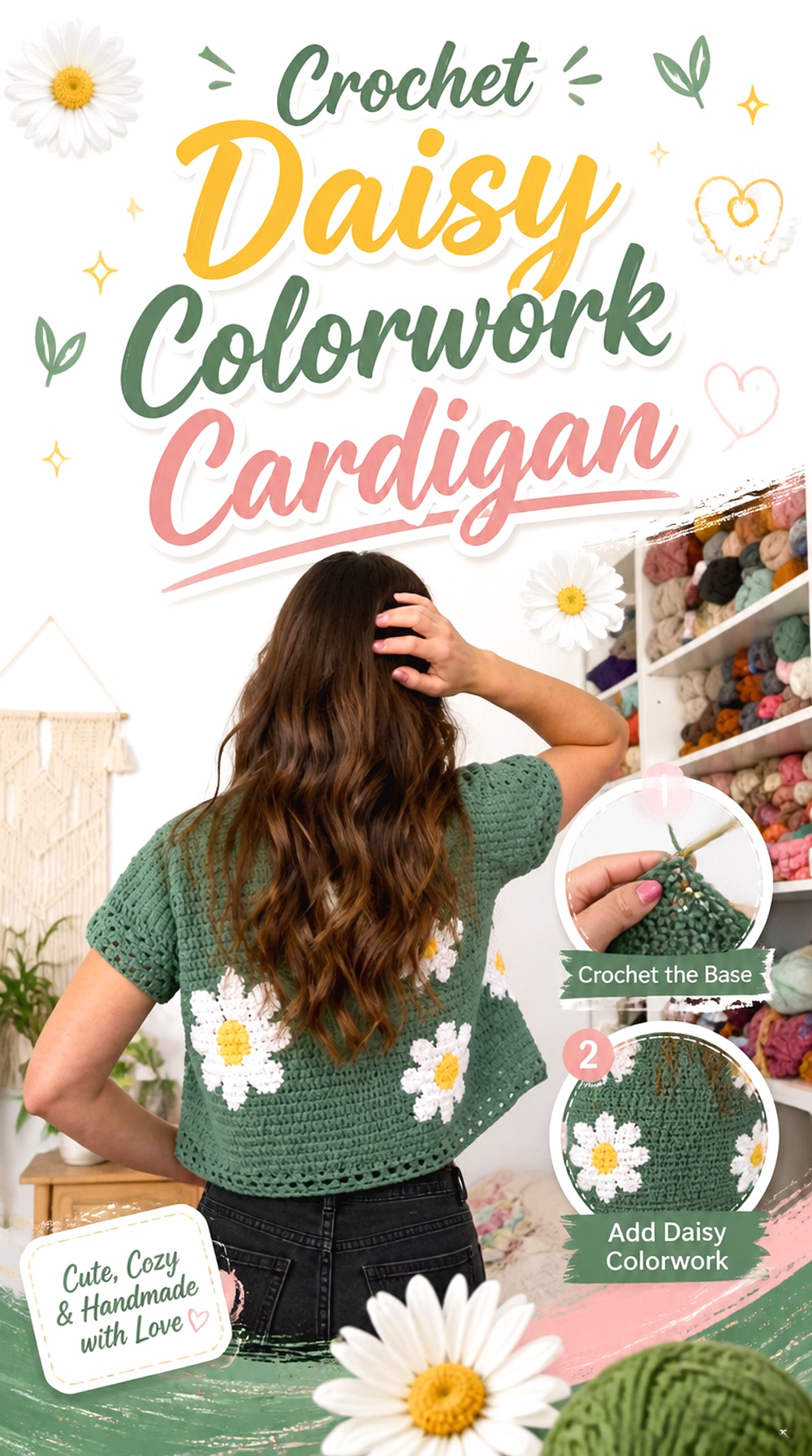
Instead of attaching separate flowers, this Crochet Daisy Colorwork Cardigan works daisies into the garment fabric. Evelyn And Peter Crochet’s Daisy Day Cardigan places floral colorwork across the front and back and incorporates granny-stripe detailing, giving the finished piece several decorative surfaces without the raised profile of appliqués.
That flatter construction makes this one of the more practical choices if the cardigan will regularly sit beneath another fall layer. The daisies remain prominent, but there are no large petals projecting from the surface. It is also a useful option for readers who enjoy floral cardigans but prefer a more continuous garment fabric than motif-square assembly provides.
Contrast Determines Whether the Daisies Stay Crisp
Colorwork flowers need enough separation from their background to remain recognizable. Before committing to a full cardigan palette, place the yarn colors together under ordinary indoor and natural light. Two shades that look different in skeins can blend once worked into small areas. Strong value contrast usually preserves the flower silhouette more clearly.
Let the Granny Stripes Support the Main Motif
The additional stripe areas already introduce another decorative language. When adapting colors, decide whether they should echo a daisy color or deliberately recede into the background. Adding too many unrelated shades can turn supporting details into competitors. A controlled palette lets the daisies remain the dominant element while the stripes provide transition and structure.
Original Tutorial and Creator Credit
Creator: Evelyn And Peter Crochet
6. Crochet Flower Lace Button Cardigan
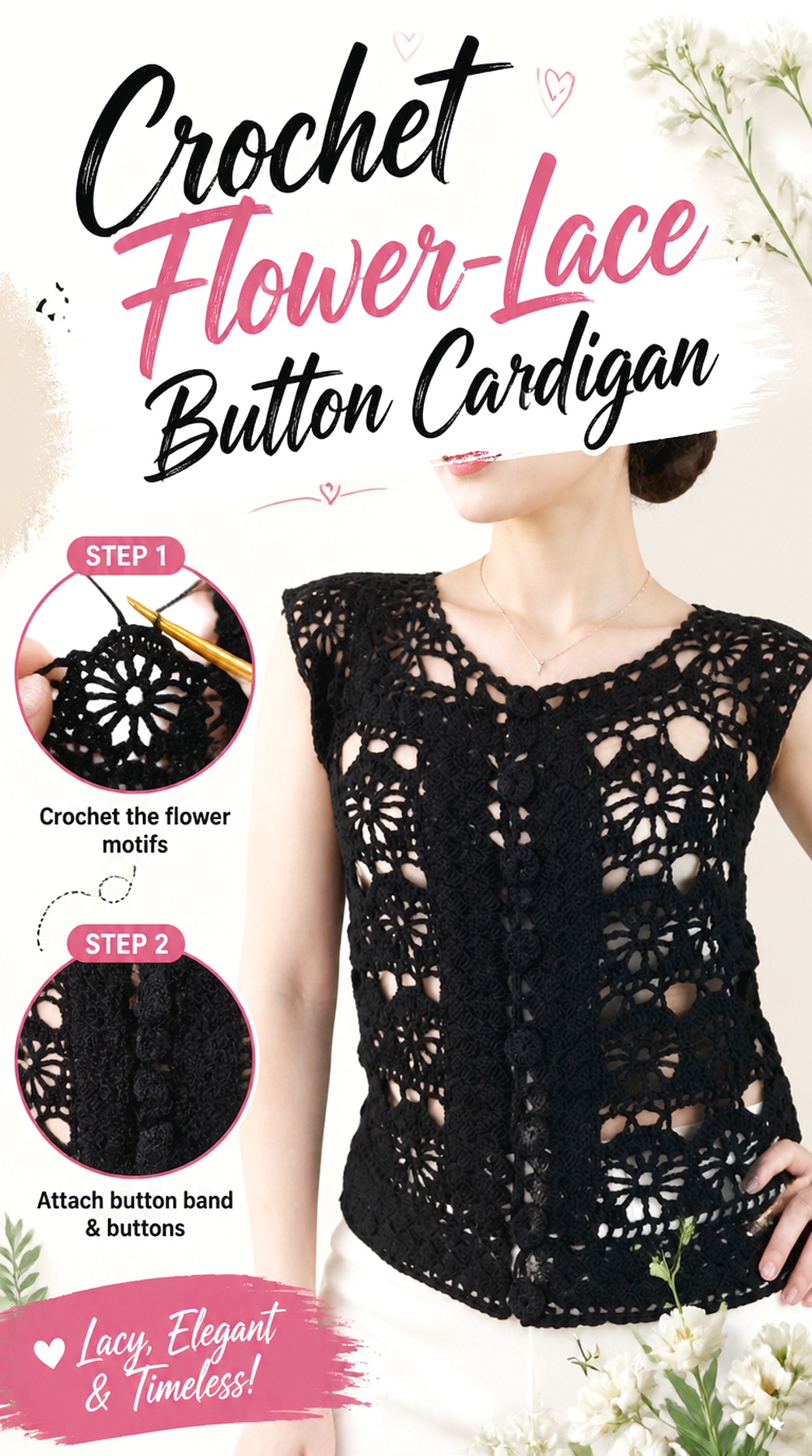
The Crochet Flower-Lace Button Cardigan gets its embellishment from open floral stitchwork instead of motifs attached afterward. Beautiful Crochet Stuff’s tutorial combines flower-lace sections with plainer crochet areas and finishes the cardigan with edging and buttons.
This gives the garment a lighter visual presence than most dimensional flower designs, which can be useful during early fall or indoors when a chunky cardigan would feel excessive. The buttoned front also creates more control over coverage than an entirely open lace layer. For a fall adaptation, deeper neutrals or jewel tones can shift the mood without changing the decorative stitch structure.
Lace Needs to Be Judged After Blocking
Open stitch patterns often change more visibly during blocking than dense crochet does. Before making decisions about finished length or fit, check how a representative section behaves when treated the same way as the planned cardigan. The important questions are whether the flowers open clearly, whether the fabric grows, and whether the edge remains stable rather than becoming wavy.
Button Bands Need More Stability Than the Lace Field
A decorative open fabric and a functional fastening have different jobs. The area carrying buttons should remain reasonably stable so repeated use does not stretch the opening disproportionately. When substituting yarn, pay particular attention to the button-band fabric and the relationship between the fastening edge and the softer lace body.
Original Tutorial and Creator Credit
Creator: Beautiful Crochet Stuff
7. Crochet Long Bobble Snow Cardigan
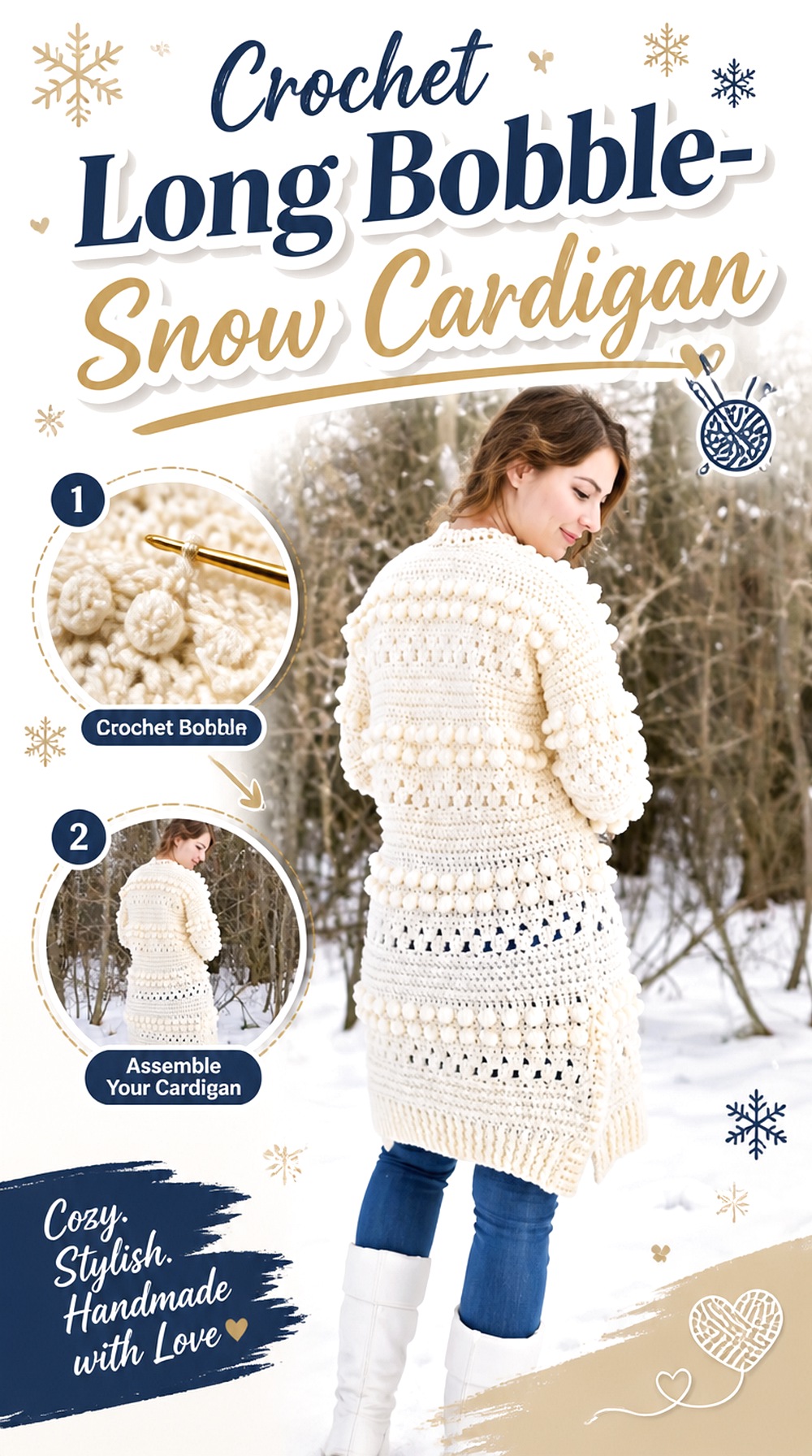
The Crochet Long Bobble-Snow Cardigan uses raised texture instead of literal flower or fruit motifs. Colour Ceilidh Crochet’s Bobbles of Snow design is a longer cardigan with bobble detailing, granny-style stitch areas, and side slits.
For fall, the extra length gives this idea a coat-like presence while the raised bobbles prevent a long expanse of fabric from looking flat. It differs from cropped bobble options later in the list because its length and openings affect movement much more strongly. If you want an embellished cardigan that still feels relatively neutral, using texture in one color can deliver detail without relying on multiple contrasting shades.
Side Slits Help a Long Textured Cardigan Move
Long crochet fabric can become restrictive around the hips if its lower edge is completely closed. Side openings give the garment room to move and can reduce the feeling of a heavy continuous tube. If you alter the length, reassess where those openings begin so they still make sense relative to the new proportions.
Raised Bobbles Add Yarn Where the Fabric Is Already Long
Texture contributes additional material to a garment. On a longer cardigan, that matters more than it does on a cropped piece because there is simply more fabric overall. Consider the weight of a swatch in your chosen yarn and how it hangs. A beautiful dense texture can feel less appealing if the finished cardigan pulls heavily at the shoulders.
Original Tutorial and Creator Credit
Creator: Colour Ceilidh Crochet
8. Crochet Strawberry Detail Cardigan
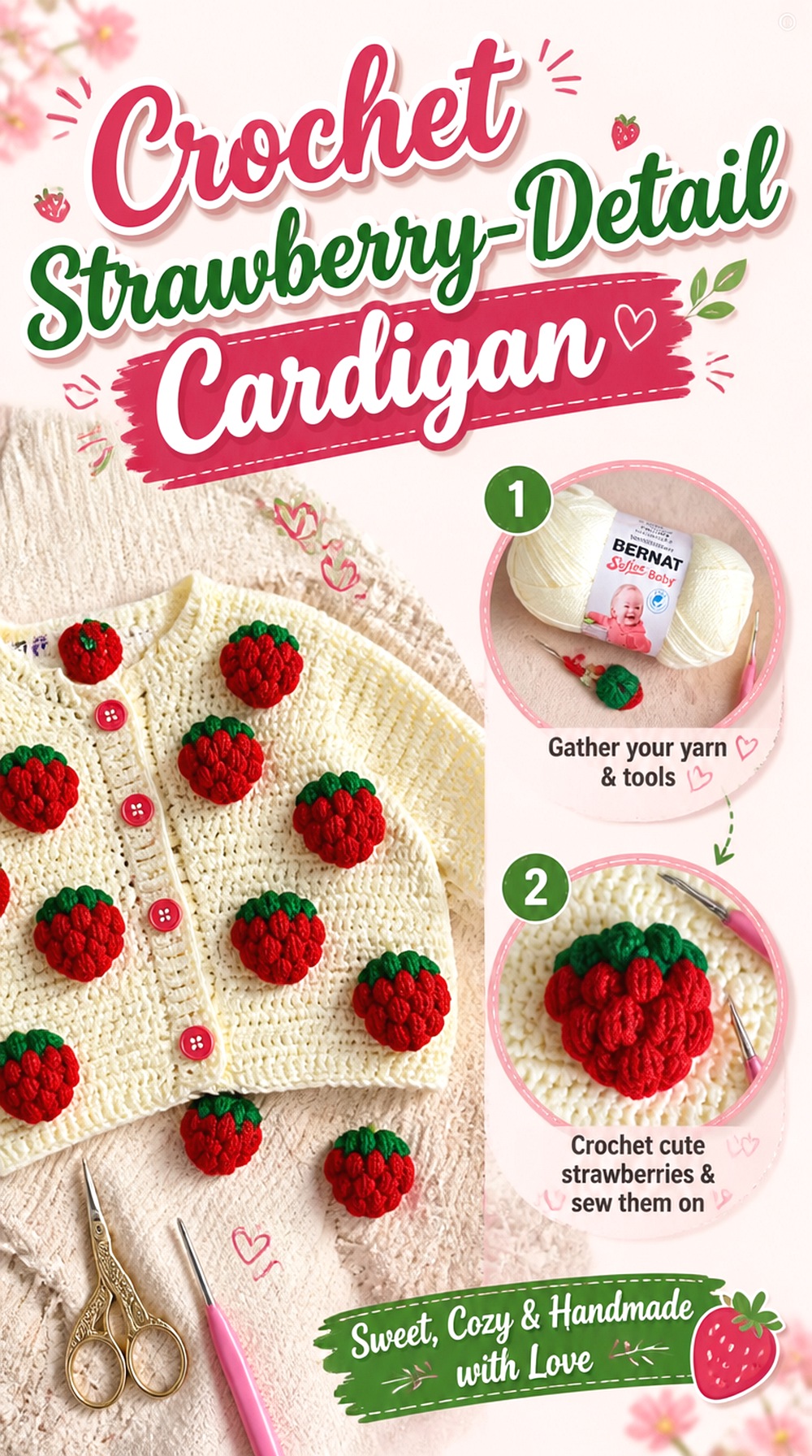
This Crochet Strawberry-Detail Cardigan takes a recognizable fruit motif and distributes it across a more traditional cardigan form. CrafTrovebyT’s tutorial series begins with the strawberry cardigan and continues through finishing elements in its second part, giving the decorative theme a complete garment context rather than presenting strawberries as standalone appliqués.
The smaller scale of the fruit is the main advantage here. Strawberries can provide repeated color without the heavy grid effect of large granny squares. They also suit a fall palette surprisingly well when bright red is paired with cream, brown, olive, rust, or another grounded background.
Keep Important Berries Away From the Fastening Edge
Buttons and front bands already interrupt the surface. A strawberry positioned too close to that area may partly disappear when the cardigan is worn closed or may become distorted through repeated handling. Plan the front after the opening width is clear, then give the most recognizable motifs enough uninterrupted fabric around them.
Negative Space Keeps Small Motifs From Becoming Noise
Because strawberries are compact, it is tempting to keep adding them wherever plain fabric remains. That can weaken the overall composition. Step away from the garment periodically and check the distribution from several feet away. Empty areas can make the individual berries easier to read and keep the cardigan from feeling like an allover print.
Original Tutorial and Creator Credit
Creator: CrafTrovebyT
9. Crochet Starburst Motif Cardigan
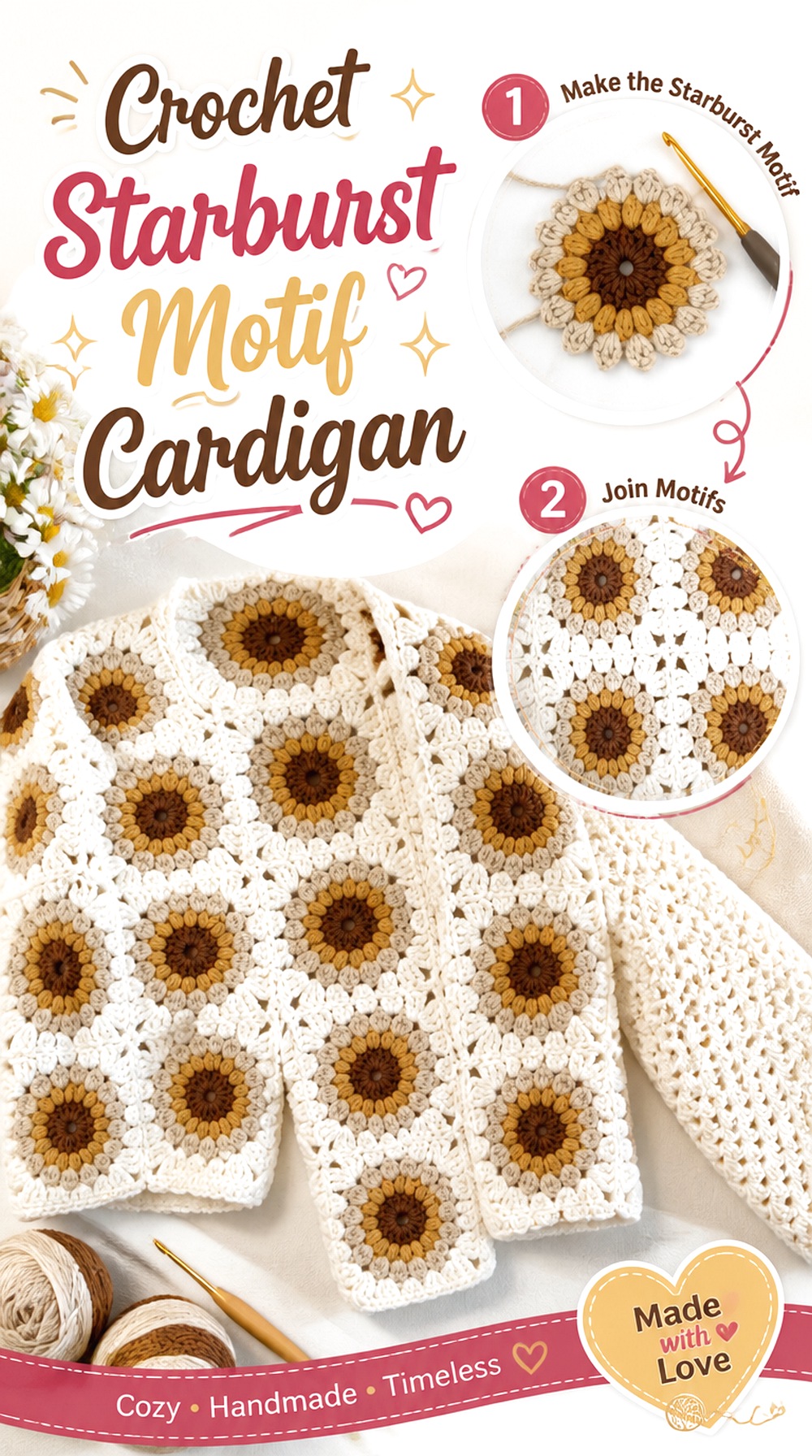
The Crochet Starburst Motif Cardigan uses repeated radiating squares, giving the surface energy without relying on a literal flower image. Crochet with Aisha’s tutorial covers the starburst square, joining, arms, and border, so the motif is tied directly to the structure of the finished cardigan.
This is an especially flexible fall idea because starburst colors can move from bright retro combinations to muted autumn palettes while preserving the same graphic effect. Compared with chunky floral squares, the emphasis here is on radiating color and geometry. That makes it easier to pair with a wardrobe that does not otherwise lean heavily into floral styling.
Rotate and Arrange Every Square Before Joining
A motif may be technically square while still having a visual direction because of color changes or the way the center radiates outward. Lay out the full set before joining and photograph the arrangement. The photo makes accidental swaps easier to spot and lets you judge whether similar high-contrast squares are clustering in one area.
Border Color Can Calm or Intensify the Starbursts
A repeated motif cardigan needs something to visually connect the separate units. Using the same quiet border around each square can make a multicolor layout feel more cohesive. A contrasting border does the opposite and emphasizes the grid. Decide which effect you want before producing many motifs because border choice influences the entire surface.
Original Tutorial and Creator Credit
Creator: Crochet with Aisha
10. Crochet Puffy Flower Statement Cardigan
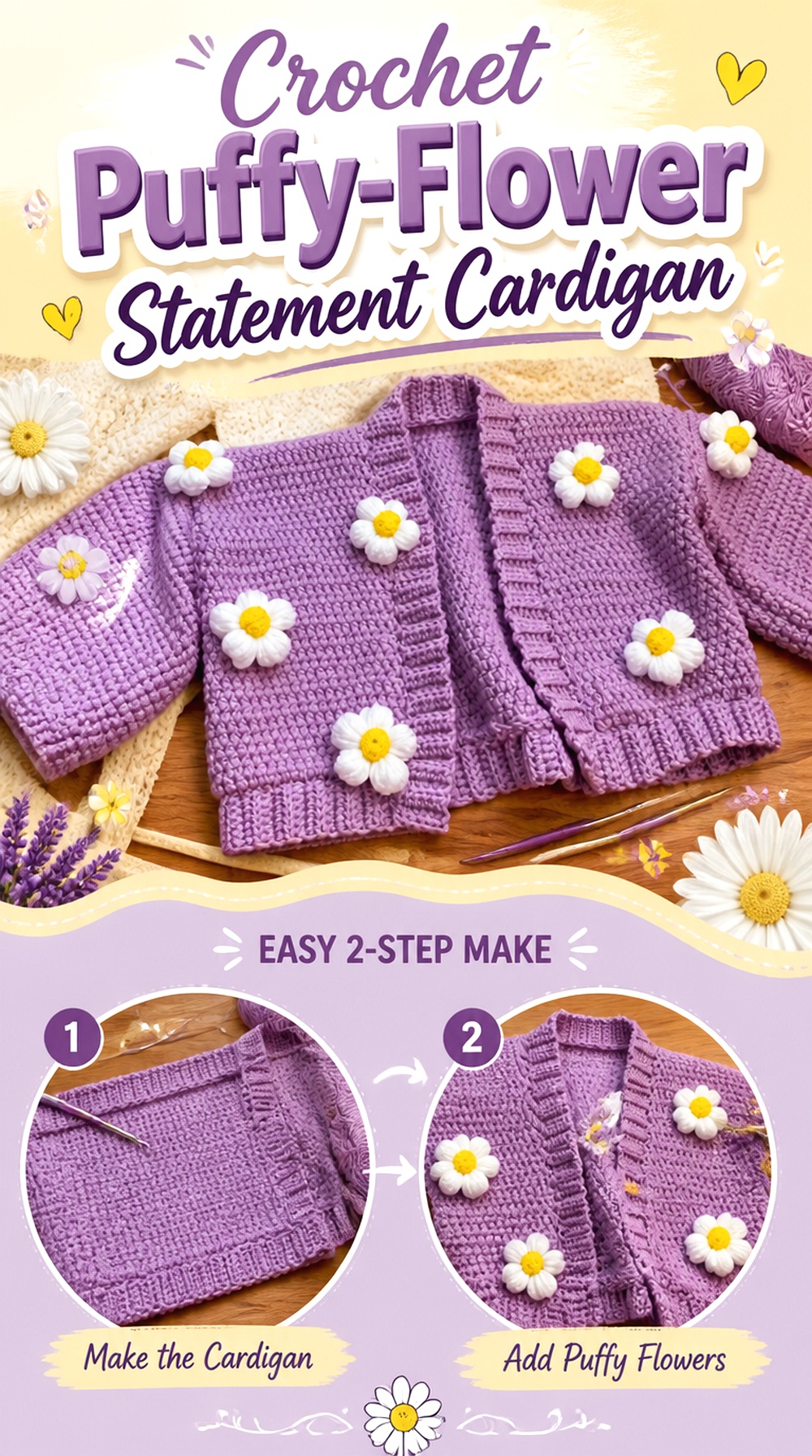
The Crochet Puffy-Flower Statement Cardigan pushes floral embellishment into three dimensions. NoteswNat’s tutorial focuses on a puffy flower cardigan, producing a surface that reads more like a collection of tactile blossoms than flat floral colorwork.
This is a strong choice when the cardigan will function as the visible outer layer rather than disappearing beneath a fitted coat. The flowers create shadows and physical depth, so even a restrained palette can look highly decorative. For a fall version, concentrating the puffiest motifs on the front, back, or outer sleeves can preserve the dramatic effect while leaving high-friction areas less crowded.
Test Flower Placement While the Cardigan Is Worn
A layout that looks balanced on a flat table can shift once shoulders curve and sleeves hang. Temporarily position motifs, put the cardigan on, and check the front, side, and back. This is especially important near the shoulder and upper sleeve, where a flower can tilt or fold when the arm changes position.
Think About Bags and Outerwear Before Covering the Shoulders
Raised petals can be repeatedly compressed by a backpack, tote strap, or coat. If this will be an everyday cardigan, consider reserving the most dimensional flowers for lower-friction areas. The design can remain highly embellished without placing its most delicate texture exactly where daily wear will press against it.
Original Tutorial and Creator Credit
Creator: NoteswNat
11. Crochet Checkerboard Accent Cardigan
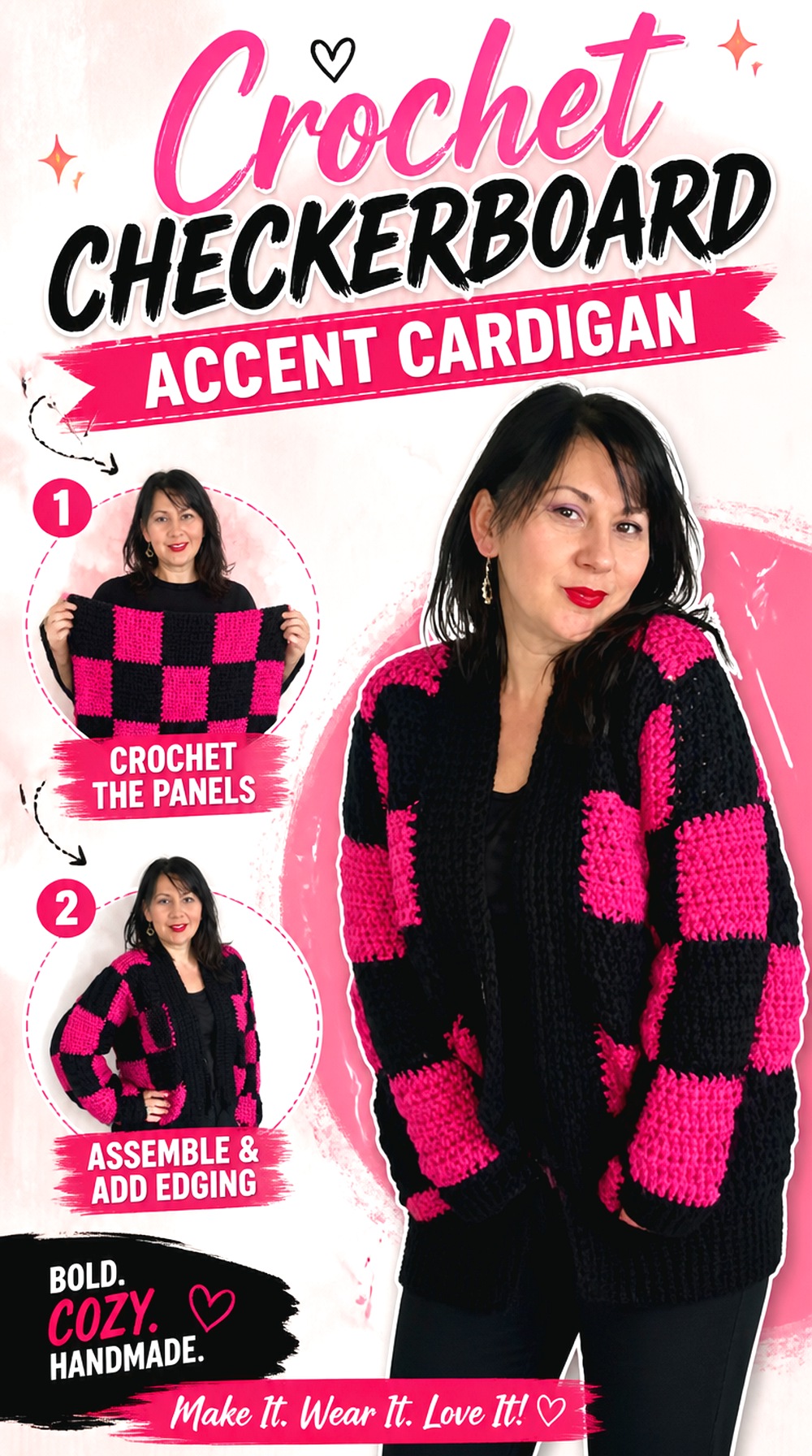
The Crochet Checkerboard Accent Cardigan swaps flowers and fruit for a clean geometric embellishment. Indigo Handmade Design’s Checkmate Cardigan tutorial uses checkerboard patterning, creating a strong graphic surface that was published in January 2026.
Checkerboard is useful for fall because it can be bold without depending on seasonal motifs. Rust and cream can feel autumnal, black and ivory more graphic, or two close neutrals much quieter. The repeated blocks also give you a clear opportunity to decide where contrast should be strongest. Compared with scattered appliqués, the decoration is built into the fabric, which keeps the surface flatter for layering.
Keep the Checks Square When Adjusting Fit
Geometric colorwork makes distortion easier to see. If a panel is stretched noticeably in one direction, squares can begin to look rectangular. Before committing to a different yarn or hook, examine a blocked sample and compare the proportions of the checks rather than judging gauge only by overall width.
Decide Where the Pattern Should Break
A checkerboard can continue across every part of a cardigan or be confined to selected areas. When adapting, think deliberately about cuffs, bands, shoulders, and sleeves rather than letting the repeat end wherever construction happens to interrupt it. A quiet border can provide useful visual separation between a busy check field and the cardigan opening.
Original Tutorial and Creator Credit
Creator: Indigo Handmade Design
12. Crochet Tulip Panel Cardigan
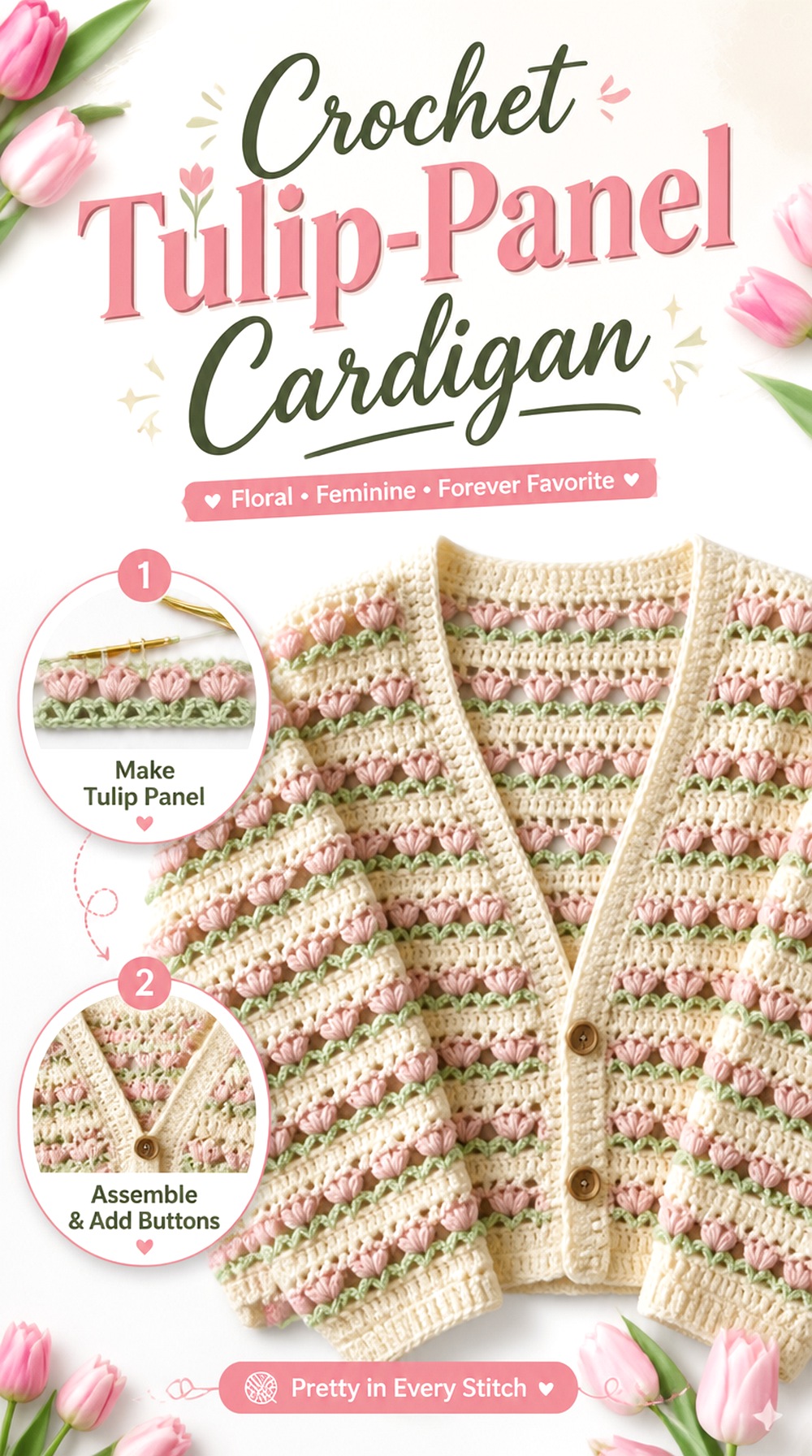
The Crochet Tulip-Panel Cardigan uses an identifiable floral design while keeping the overall surface cleaner than an allover granny-square layout. The Yarnling’s tutorial centers on a tulip cardigan and presents it as adaptable across sizes.
Tulips provide a more linear floral shape than daisies or puff flowers, which can make them useful for vertical placement along fronts or other panel areas. For fall, deep red, ochre, plum, olive, or muted pink can shift the same motif away from a spring-only appearance. This option also suits readers who want florals to read as a deliberate panel feature rather than repeated everywhere.
Vertical Motifs Can Visually Lengthen a Front Panel
Tulip stems and upright flower shapes naturally encourage the eye to move vertically. If you are adapting motif placement, keep complete flowers in areas where the full stem and bloom remain visible. Breaking the motif too close to a neckline, hem, or front edge can weaken the feature more than reducing the total number of flowers would.
Check Both Fronts Together Before Finishing
If decorative tulips appear on the cardigan fronts, assess the two sides as one composition. Mirrored placement creates a more formal balance, while an intentionally asymmetric arrangement feels more playful. Either can work, but an accidental near-match often looks less considered than choosing one approach clearly from the beginning.
Original Tutorial and Creator Credit
Creator: The Yarnling
13. Crochet Woven Rose Cardigan
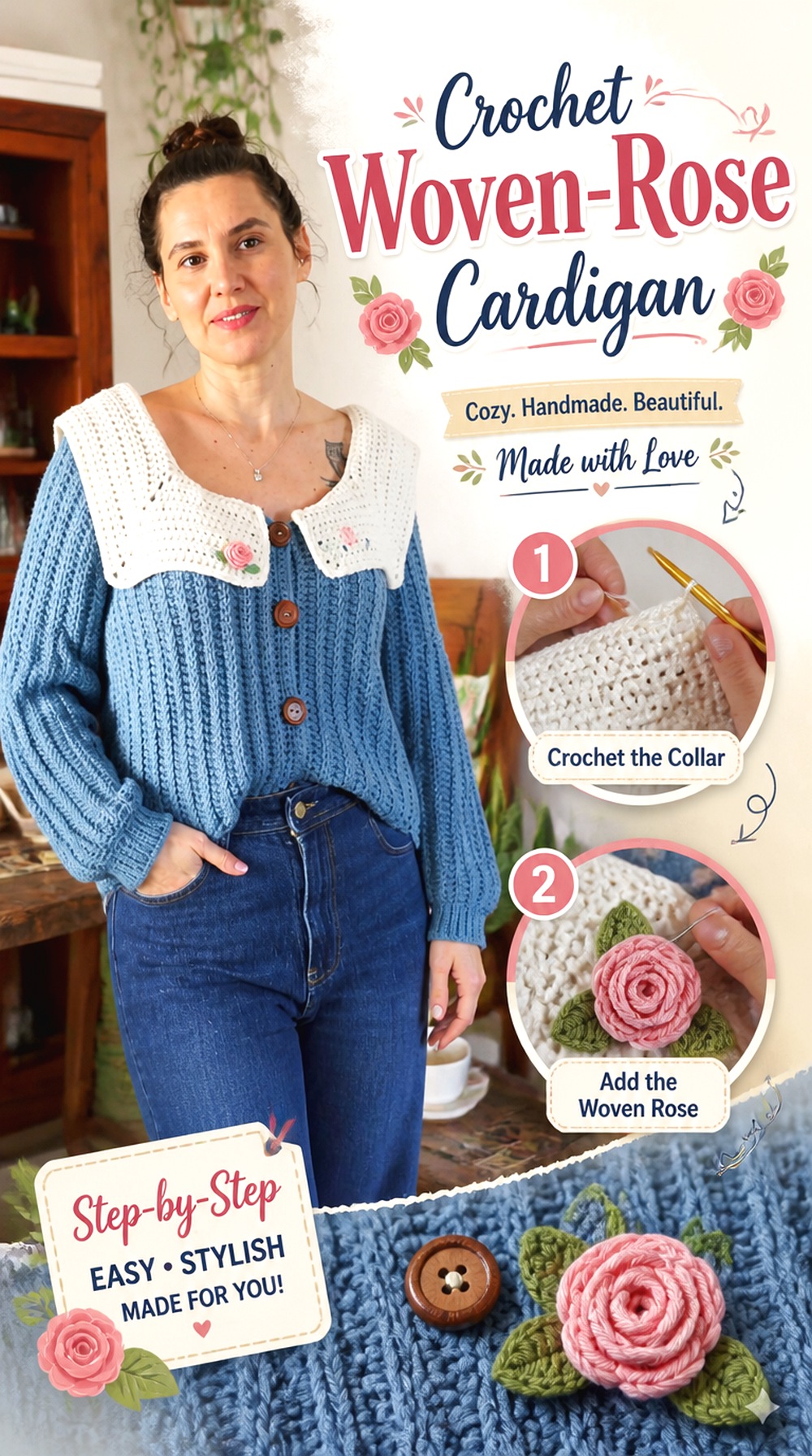
The Crochet Woven-Rose Cardigan offers a different kind of floral surface: the rose detail comes from woven-wheel embellishment added to the cardigan. Sirin’s Crochet links the rose technique directly from the cardigan tutorial, making this useful for readers who prefer embroidery-like decoration rather than granny-square flowers or bulky appliqués.
Because woven roses can be concentrated in selected areas, you have more control over visual density than with an allover colorwork pattern. That makes this concept adaptable to a restrained fall cardigan: a few roses near pockets or the upper front can create a focal point without turning every inch of fabric into decoration.
Mark Rose Centers Before Adding Any Yarn
Surface embellishment is easier to balance when the layout is planned first. With the cardigan flat, mark proposed centers using removable markers or contrasting scraps. Then put the garment on and check the locations again. This prevents a flower that looked centered on a panel from appearing too close to an edge once the cardigan wraps around the body.
Let the Base Fabric Carry the Weight
A rose embellishment adds yarn to a specific area. If the base cardigan fabric is very loose or stretchy, a dense decorative cluster can pull it out of shape. Test one rose on a representative swatch when changing materials, and check how the fabric hangs vertically rather than only examining the embellishment on a table.
Original Tutorial and Creator Credit
Creator: Sirin’s Crochet
14. Crochet Pumpkin Mosaic Belted Cardigan
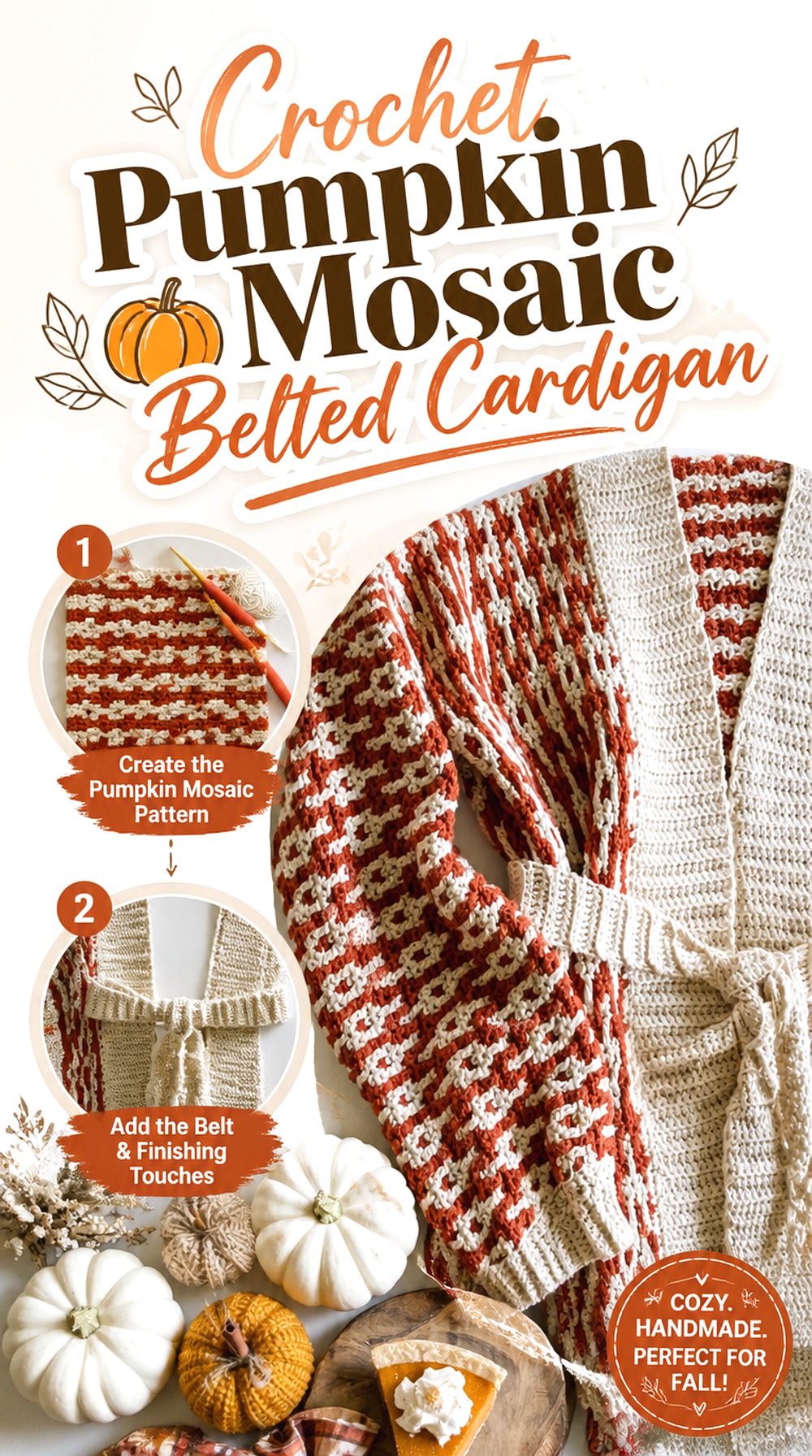
Few projects in this collection read as clearly fall-specific as the Crochet Pumpkin Mosaic Belted Cardigan. MJ’s Off The Hook Designs uses inset mosaic colorwork in the Hello Pumpkin Cardigan and adds functional details including pockets, a belt, and a ribbed collar. The cardigan is worked flat and the pattern is offered across a broad published size range.
The colorwork remains relatively flat compared with appliqué-heavy garments, while the long shape gives it substantial presence. This makes it a good candidate for wearing as the visible outer layer on cool fall days rather than merely as a small decorative cardigan indoors.
The Belt Changes the Silhouette Immediately
A belt can convert a relatively straight cardigan into a waist-defined layer, so choose the size based on how you want the garment to behave both belted and open. Do not assume that a fit you like only when cinched will also hang well unfastened. Check shoulder and front-panel proportions independently of the belt.
Mosaic Graphics Reward Strong Stitch Definition
The pumpkin and lettering depend on clear colorwork shapes. When substituting yarn, a smooth strand and sufficient color contrast generally make the graphic easier to read than two fuzzy, similarly valued shades. Swatch enough of the mosaic technique to see the actual relationship between the colors before buying yarn for the entire cardigan.
Original Tutorial and Creator Credit
Creator: MJ’s Off The Hook Designs
15. Crochet Wildflower Granny Square Cardigan
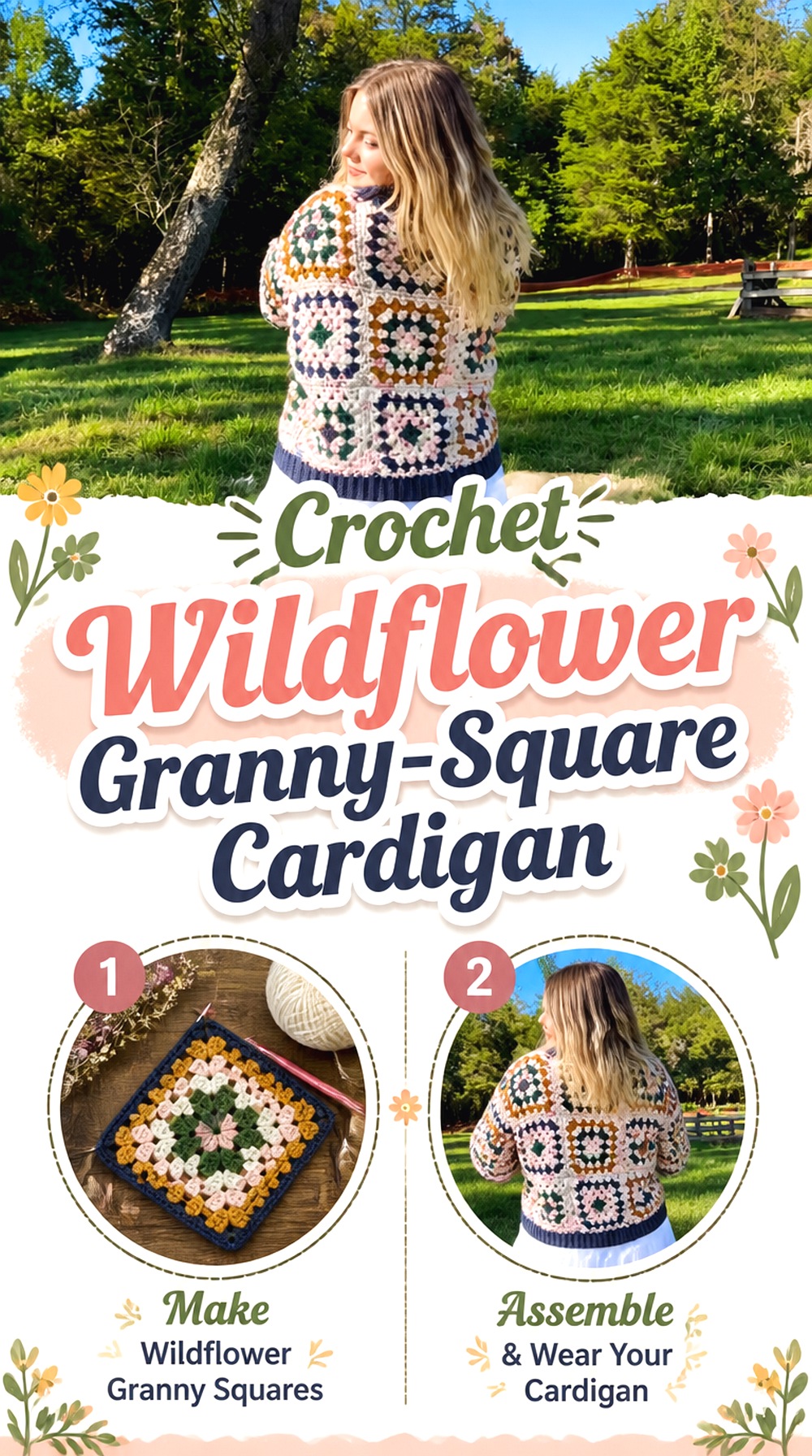
The Crochet Wildflower Granny-Square Cardigan brings florals back into the collection through repeated motif construction, but its visual character differs from the chunky daisy option. Off The Clock’s Wildflower Cardigan tutorial is explicitly built around granny squares, giving readers a motif-based route to a more varied floral surface.
Wildflower styling works particularly well when several related colors are allowed to appear across the garment rather than forcing every motif to match. For fall, that can mean muted berry, ochre, olive, cream, clay, and brown. The key is to control the layout so the cardigan feels intentionally mixed rather than randomly assembled.
Sort the Squares Before the Final Join
When several motif colors are involved, group the finished squares by dominant shade before laying out the cardigan. This makes it easier to distribute strong colors across the front, back, and sleeves. Try to avoid accidentally creating one very dark sleeve or a large bright cluster unless that imbalance is an intentional part of the design.
Check Motif Corners for Consistent Blocking
Granny-square cardigans depend on straight, compatible edges. If some motifs have sharper corners and others remain rounded or smaller, joins can pull unevenly. Compare blocked dimensions before assembly. Correcting individual squares early is usually cleaner than trying to force several mismatched edges into alignment during final joining.
Original Tutorial and Creator Credit
Creator: Off The Clock
16. Crochet Patchwork Block Cardigan
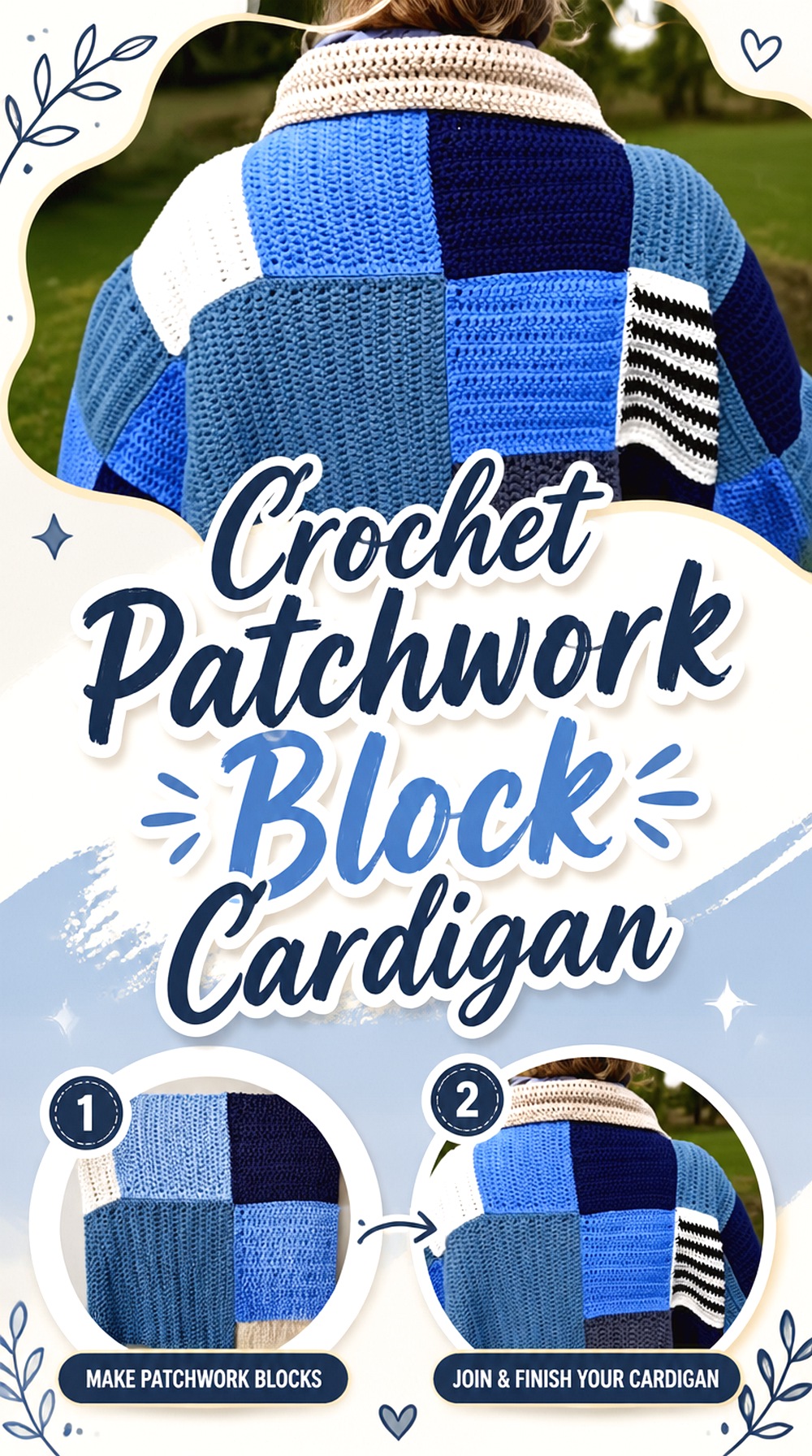
The Crochet Patchwork Block Cardigan treats contrasting blocks, stitch textures, and seams as the embellishment. Crochet.Box’s tutorial is a patchwork cardigan inspired by the highly graphic multiblock cardigan style, making this a useful non-floral direction for Fall 2026.
Patchwork also gives scrap-friendly visual inspiration without requiring every block to feature a pictorial motif. The finished effect can range from bold and eclectic to restrained if you reduce the palette. Compared with granny-square flowers, the blocks read more like larger textile panels, so seam quality and the distribution of strong colors become major parts of the design.
Make a Layout Map Before Sewing the Blocks
Large contrasting pieces are difficult to rearrange once several seams have been completed. Photograph the entire planned front and back before assembly, then refer to the image as you work. This is particularly useful when two blocks have similar dimensions but different colors or textures and could easily be swapped accidentally.
Decorative Seams Should Still Behave Like Garment Seams
A visible join may contribute to the patchwork aesthetic, but it still needs to sit comfortably against the body. Keep seam bulk in mind around the underarm and shoulder, where several layers can become noticeable. A dramatic join on the body may not be the best choice for every high-movement area.
Original Tutorial and Creator Credit
Creator: Crochet.Box
17. Crochet Zippered Granny Square Cardigan
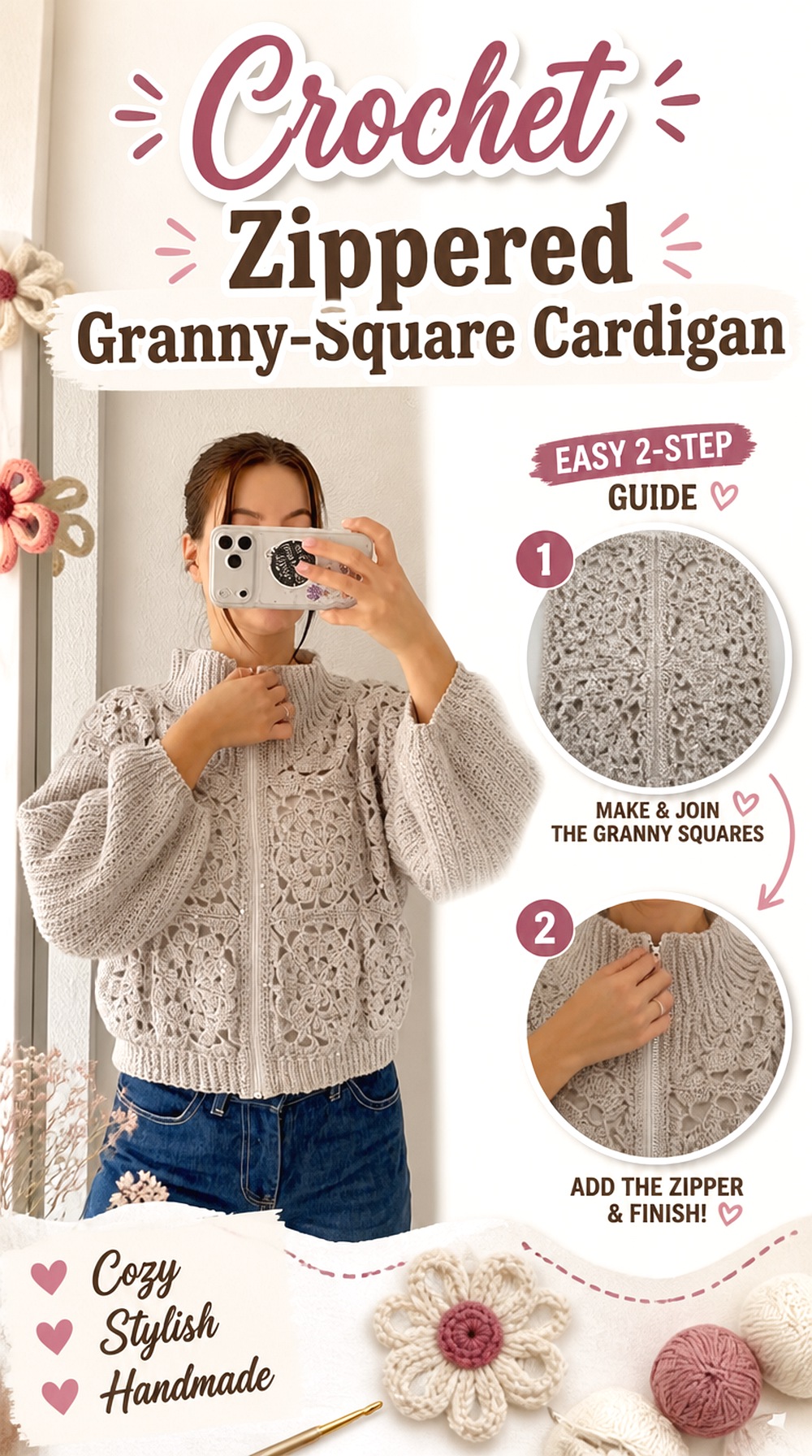
The Crochet Zippered Granny-Square Cardigan makes its embellishment practical by pairing decorative squares with a full front zipper. Nora Moon’s tutorial specifically demonstrates a granny-square cardigan with a zipper and also notes that buttons can be used as an alternative.
That closure changes the look considerably. A zipper gives the cardigan more of a jacket profile, which feels especially appropriate for fall, and provides a straight vertical line through an otherwise busy motif layout. This is also a useful idea for anyone who likes granny squares but does not want the conventional open-front or button-band finish.
The Zipper Edge Needs to Stay Straight
A zipper will quickly reveal uneven front edges because the two sides need to meet predictably. Before installing it, block the cardigan and compare both opening edges without stretching them. If one front is longer, forcing the zipper to compensate can create ripples. The closure should follow the garment rather than reshape it.
Keep Motif Joins Away From Closure Distortion
Granny-square joins close to the front opening need enough stability to handle repeated opening and closing. Check that the edge treatment supports those joins without making the band excessively stiff. If you substitute a heavier zipper, compare its weight with the crochet fabric before attaching it permanently.
Original Tutorial and Creator Credit
Creator: Nora Moon – handmade clothes with love
18. Crochet Flower Stitch Button Cardigan
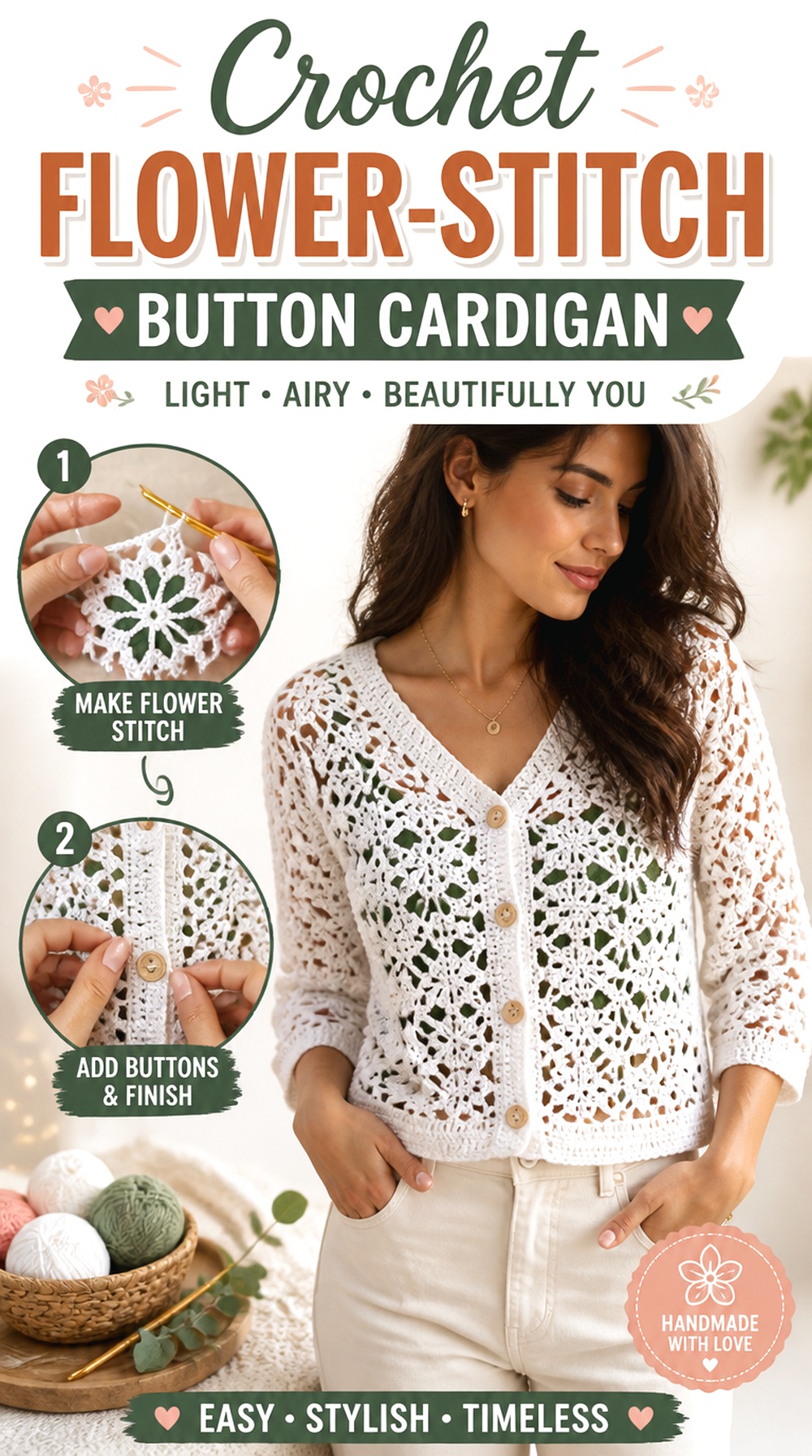
The Crochet Flower-Stitch Button Cardigan uses flowers worked into the main stitch pattern rather than separately attached blossoms. Nightmoon Studio’s tutorial shows the flower cardigan with options for long or short sleeves and finishes the garment with edging and buttons.
This construction keeps the decorative element flatter than puffy appliqués but gives the fabric more character than plain rows. The button closure and sleeve options also make it easy to think about as a transitional piece: long sleeves suit cooler fall layering, while the floral openings keep the surface from feeling as visually heavy as a dense textured cardigan.
Let the Flower Repeat Finish Cleanly at Panel Edges
A repeating stitch motif looks most deliberate when important flower shapes are not awkwardly chopped by an edge. If you alter panel width, study how the repeat relates to both sides before proceeding. Adding width purely by eye can leave one front with a complete motif and the other with a noticeably different ending.
Button Placement Should Follow the Finished Edge
Finish and block the front border before making final decisions about button spacing if you are adapting the project. Floral fabrics can relax after blocking, and that affects how the two fronts meet. Buttons should support the cardigan’s natural hang rather than pulling an open lace-like fabric into a shape it does not want to hold.
Original Tutorial and Creator Credit
Creator: Nightmoon Studio
19. Crochet Suzette Ruffle Tie Cardigan
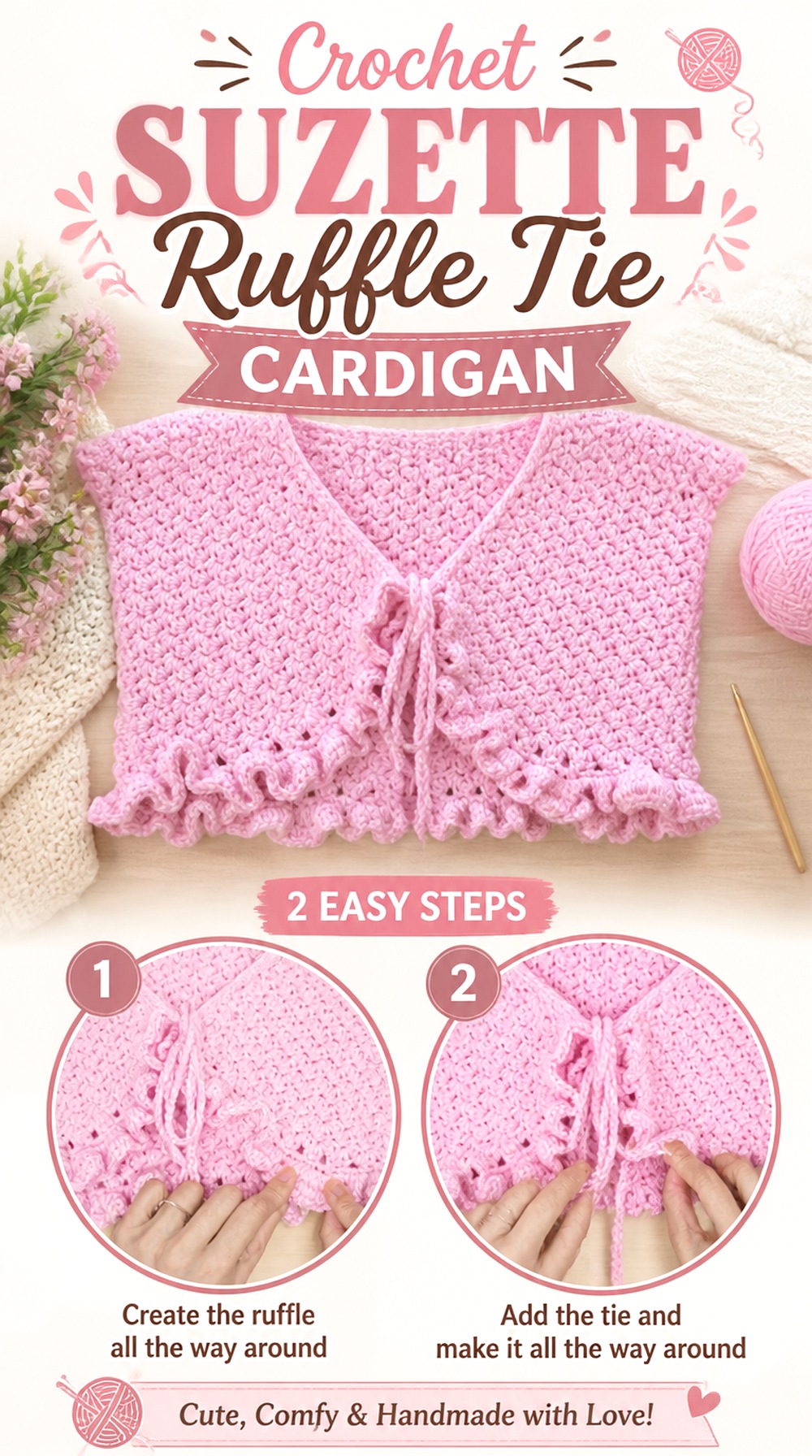
The Crochet Suzette Ruffle Tie Cardigan combines a textured Suzette-stitch fabric with a cropped silhouette, front tie, and ruffled lower edge. TCDDIY’s 2025 tutorial also features short ribbed sleeves, making the result quite different from the long-sleeved bow cardigan at the beginning of this list.
This is a lighter fall option for climates where September and October remain warm. The decoration is concentrated along the silhouette rather than scattered across the body, so texture and edge treatment do most of the visual work. Layer it over a close-fitting top to keep the ruffle and tie easy to see.
The Lower Ruffle Changes the Waistline Visually
A ruffle creates both width and movement at the lower edge. Before adapting the crop length, decide where you want that extra fullness to land. Moving the hem several inches can shift the ruffle from the waist toward the hip, which changes the entire proportion even if the body construction remains the same.
Keep the Tie Functional When Adjusting the Front
A decorative tie still needs to reach comfortably and sit flat enough to knot without pulling the neckline. If you broaden or narrow the fronts, reassess the tie rather than copying its original proportion automatically. The cardigan should retain a relaxed shape when tied instead of forming tension lines radiating from the closure.
Original Tutorial and Creator Credit
Creator: TCDDIY
20. Crochet Celestial Star and Moon Cardigan
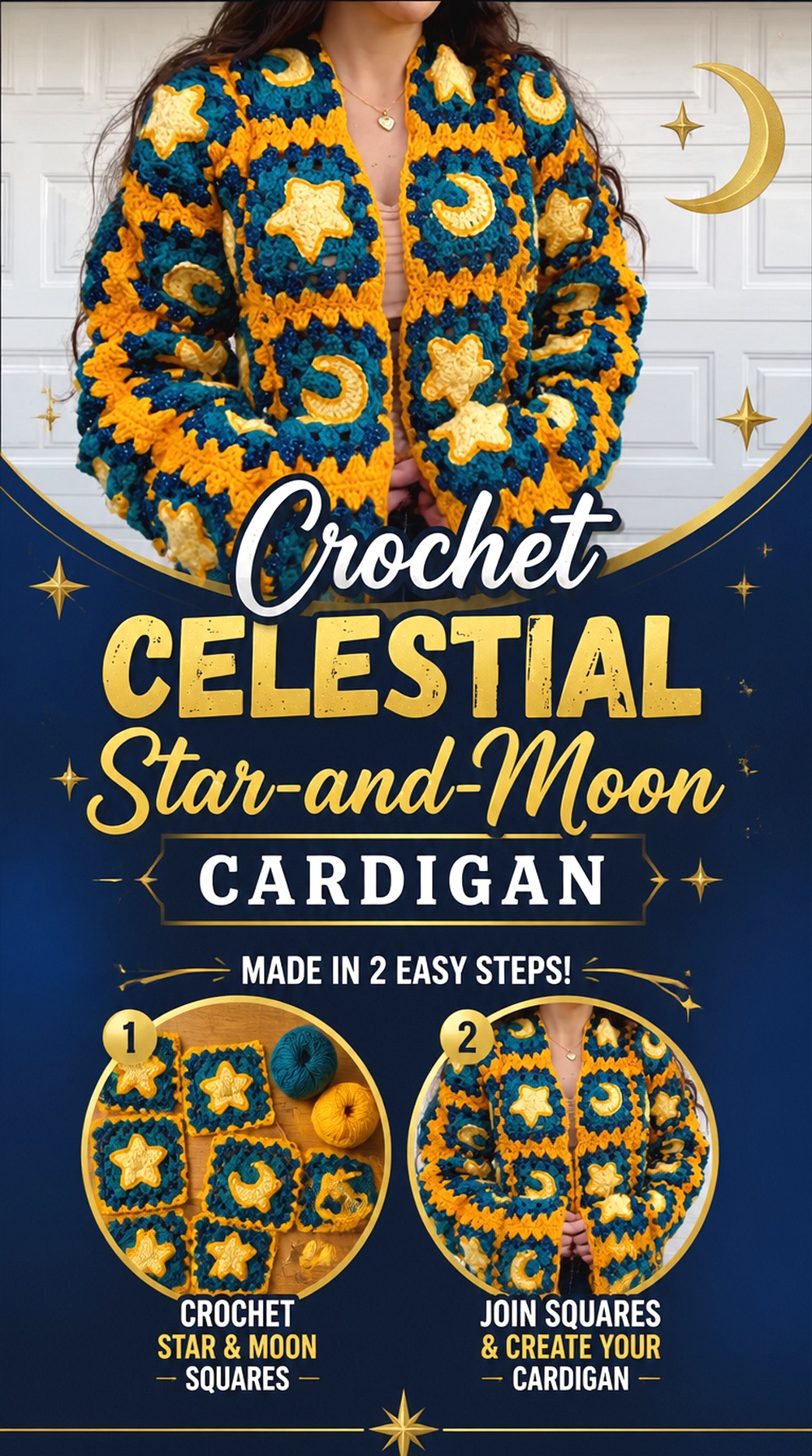
The Crochet Celestial Star-and-Moon Cardigan replaces fall botanicals with night-sky imagery. Krystal Everdeen’s January 2026 project uses star and moon crochet designs and points viewers to the component cardigan and celestial-square resources behind the finished piece.
Celestial motifs work particularly well for fall because they can move easily into deep teal, navy, plum, black, mustard, or metallic-accented palettes without relying on literal pumpkins or leaves. A motif-grid construction also lets you reserve the most detailed moon or star designs for prominent areas instead of repeating every image uniformly.
Put the Most Detailed Squares Where They Stay Visible
A complex moon motif loses impact if most of it disappears beneath an arm or into a side seam. Reserve high-detail squares for the center back, upper front, or outer sleeve where their full shape can be seen. Simpler stars can fill transitional areas and help keep the layout from becoming visually overloaded.
Test Specialty Yarn Against the Main Motifs
Sparkle or metallic effects suit a celestial theme, but novelty strands may be stiffer, finer, or more slippery than the primary yarn. Make a test motif before committing. The goal is for all finished squares to reach compatible blocked dimensions without forcing the decorative yarn to behave like a structurally different fiber.
Original Tutorial and Creator Credit
Creator: Krystal Everdeen
21. Crochet No Sew Heart Granny Cardigan
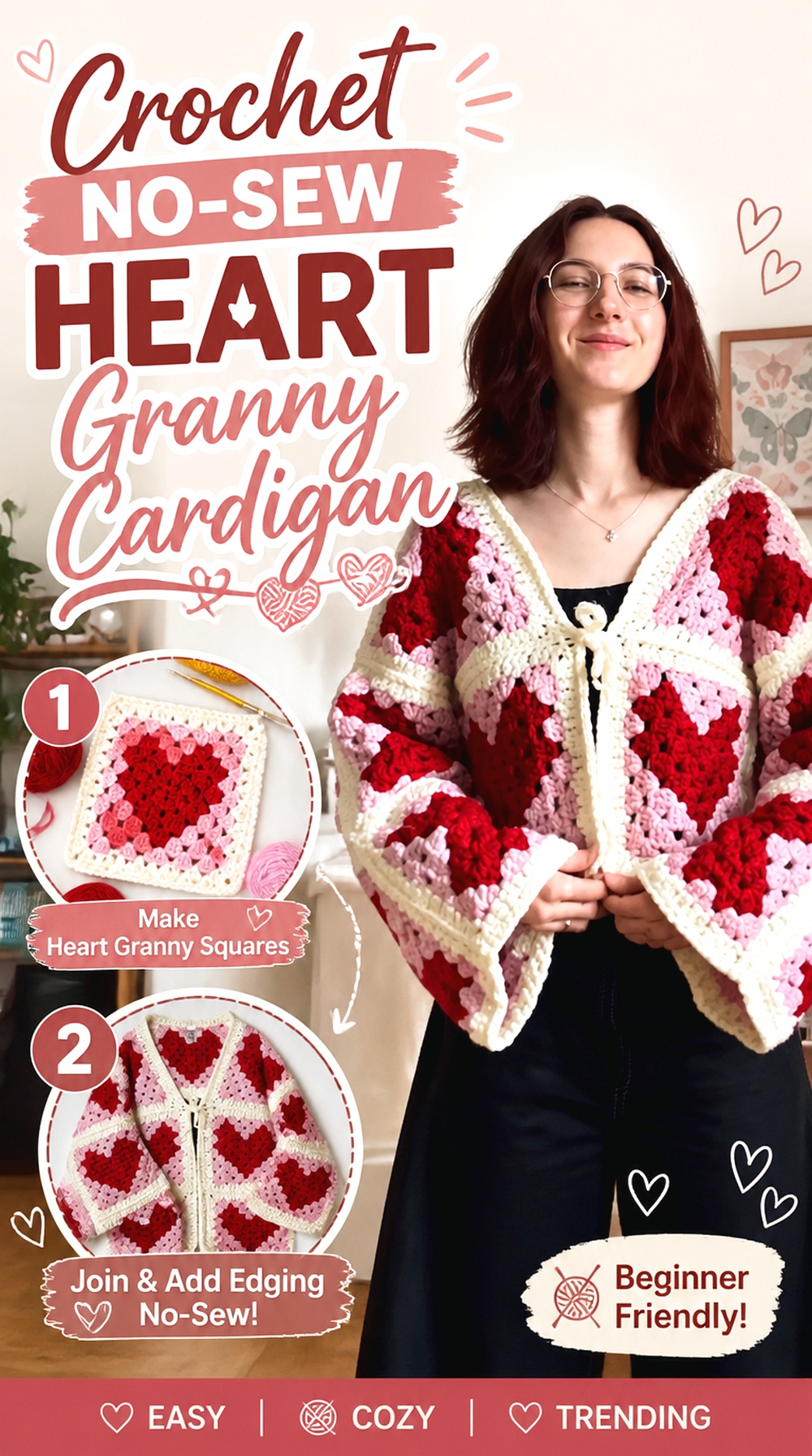
The Crochet No-Sew Heart Granny Cardigan brings a recognizable heart motif into a chunky square-based garment while changing the assembly method. Krafty Station’s February 2026 tutorial presents a heart granny-square cardigan built without conventional sewing between the motifs.
That makes this idea meaningfully different from the floral and celestial grids even though it shares modular construction. Hearts can be distributed as occasional accents among simpler squares or allowed to dominate the layout. For fall, pairing a warm background with one contrasting heart color can create a graphic layer that feels less seasonal than pumpkins but still suits cooler-weather outfits.
Decide How Frequently Hearts Should Repeat
A heart in every square creates an allover print; occasional hearts make each motif more noticeable. Before crocheting a complete set, sketch or digitally block out the front, back, and sleeves. This makes it easier to see whether hearts will align in strict rows, alternate, or appear as selected focal points.
No-Sew Does Not Remove the Need for Size Consistency
Joining while crocheting can reduce later assembly, but incompatible squares will still affect garment geometry. Block or compare motifs as you go rather than discovering at the end that one batch is consistently larger. Pay particular attention if you change colors, yarns, or tension between heart and filler squares.
Original Tutorial and Creator Credit
Creator: Krafty Station
22. Crochet Garden Party Lace Cardigan
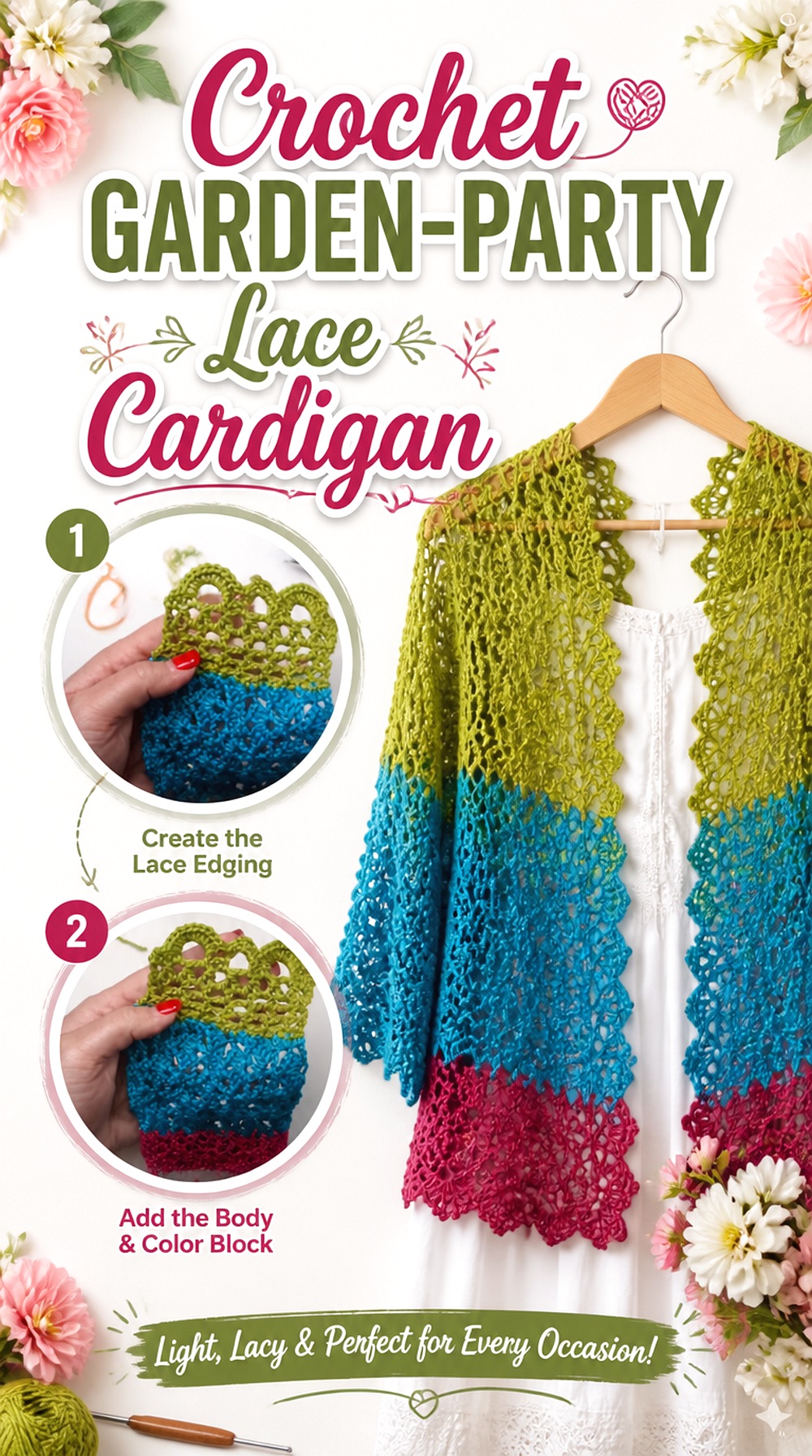
The Crochet Garden-Party Lace Cardigan takes embellishment in a refined direction. Marly Bird’s updated Garden Party tutorial works with a shell-lace body and decorative filet-style edging, and it emphasizes blocking as part of achieving the intended finished shape.
Unlike the puffy flowers or bobbles in this collection, the decoration here comes from negative space and repeated lace structure. That makes it a strong choice for early fall events, indoor layering, or anyone who wants a cardigan that looks detailed without adding much visual bulk. A darker autumn shade can make the lace read completely differently from a pale warm-weather version.
Blocking Is Part of the Edge Control
An elaborate border can bunch if the underlying body has not reached its intended finished dimensions. Treat blocking as a construction checkpoint rather than an optional cosmetic step. Once the body lies correctly, the relationship between the lace field and its edging becomes easier to assess and finish cleanly.
Choose the Layer Underneath as Part of the Design
Open lace exposes whatever sits beneath it, so the underlayer affects the final appearance more than it does with dense crochet. A high-contrast top makes the stitch pattern stand out strongly; a similar shade creates a quieter effect. Consider that pairing when choosing yarn rather than treating the cardigan color in isolation.
Original Tutorial and Creator Credit
Creator: Marly Bird
23. Crochet Polka Dot Bobble Crop Cardigan
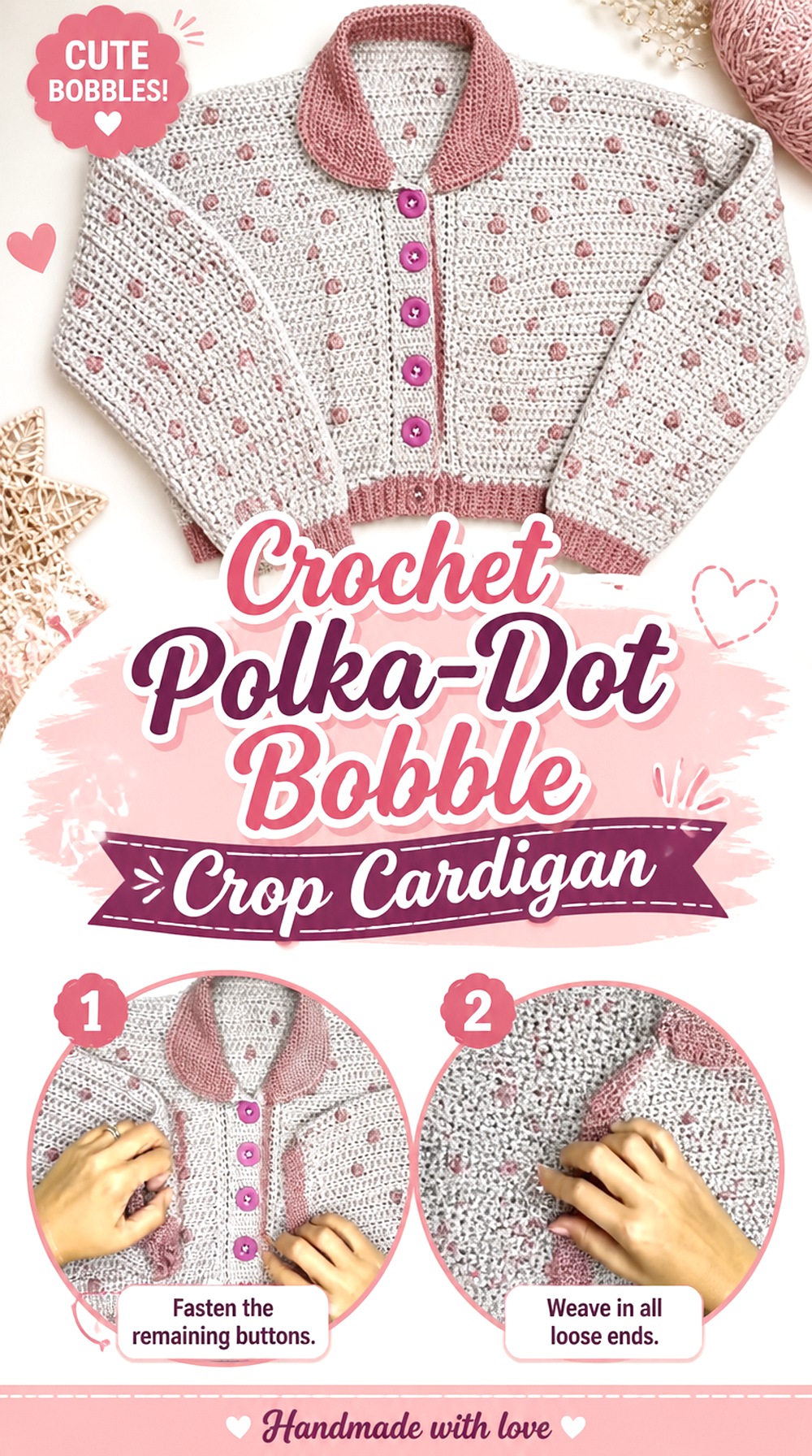
The Crochet Polka-Dot Bobble Crop Cardigan uses contrasting raised bobbles to create a dotted surface. TheKnottyLace’s tutorial pairs that texture with a cropped body, long sleeves, collar, ribbed finishing, and buttons, providing a much more tailored outline than the long Bobbles of Snow cardigan earlier in the collection.
Because the dots are small and evenly spaced, the pattern can feel playful without introducing large pictorial motifs. A two-neutral combination makes the texture comparatively subtle, while strong contrast turns every bobble into a visible spot. That flexibility makes it easy to adapt for a fall wardrobe without losing the defining embellishment.
Bobble Contrast Changes the Visual Scale
When the bobbles and base are close in value, texture becomes more important than color. Strong contrast makes the cardigan look almost printed from a distance. Decide which effect you want before choosing yarn, because the same physical stitch pattern can read as quiet texture or a very graphic polka-dot design.
Keep the Collar From Competing With the Dots
A collar adds another visual area at the neckline. If you also use highly contrasting cuffs, ribbing, and bobbles, the cardigan can become crowded. Consider letting one element lead. A quieter collar frames a bold dotted body, while a stronger contrast collar works well when the bobbles are more tonal.
Original Tutorial and Creator Credit
Creator: TheKnottyLace
24. Crochet Popcorn Stitch Contrast Cardigan
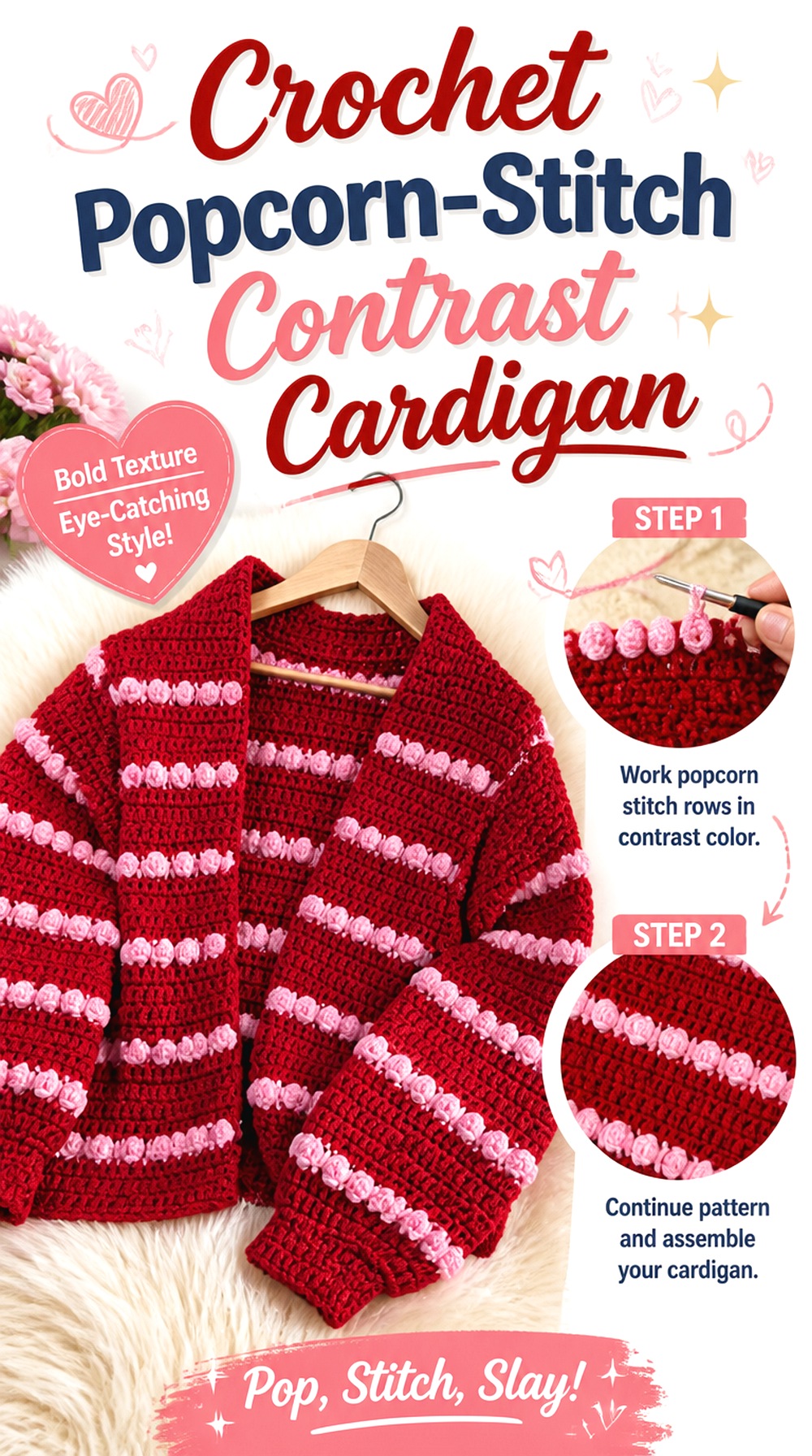
The Crochet Popcorn-Stitch Contrast Cardigan closes the list with allover dimensional texture arranged in bold contrasting colors. Doacrochet’s January 2026 tutorial explains a popcorn-style cardigan worked in red and pink, making the raised stitches part of a striking graphic surface rather than small isolated accents.
This is a useful choice if you want fall embellishment without flowers, hearts, or seasonal imagery. Popcorn texture provides depth on its own, while the color arrangement can be adapted toward rust and burgundy, cream and brown, or another fall combination. Because the surface is tactile, it is especially suited to being worn as the visible layer.
Dimensional Texture Needs Breathing Room
Popcorn stitches project from the fabric, so very dense placement can make a cardigan feel substantially different from a flat swatch. Before substituting a heavier yarn, test a decent-sized sample and drape it vertically. Look for whether the fabric still bends comfortably or begins to feel too rigid for sleeves and body movement.
Use Contrast to Reveal the Texture, Not Hide It
Color can either emphasize or compete with raised stitches. If several intense shades alternate rapidly, the eye may register the color pattern before the popcorn texture. A simpler two-color scheme or tonal pairing can make the dimensional structure clearer. Choose the balance according to whether texture or color should be the primary feature.
Original Tutorial and Creator Credit
Creator: Doacrochet
Which Embellishment Style Fits Your Fall Wardrobe?
For the easiest layering beneath another jacket, start with flatter decoration: the Daisy Colorwork, Checkerboard, Pumpkin Mosaic, Butterfly Graphic, or Garden-Party Lace cardigans. They create visual interest without relying heavily on raised surface pieces.
If the cardigan itself will serve as your outer layer, the Puffy-Flower, Long Bobble-Snow, Polka-Dot Bobble, and Popcorn-Stitch options can carry much more texture without needing to fit beneath another garment. Granny-square designs sit between those groups. Their surfaces are generally flatter than appliqués, but repeated joins and motif density can produce a substantial fabric.
For adaptable decoration, the Woven-Rose and smaller fruit-motif ideas give you more freedom to control placement. For the strongest fall theme, the Pumpkin Mosaic is the clearest seasonal statement, while celestial, heart, checkerboard, and patchwork designs can remain useful well beyond autumn.
Conclusion
The most useful way to choose among these 24 crochet embellished cardigan ideas is to start with how you expect to wear the finished layer. Choose flat colorwork, mosaic, or lace when another coat needs to fit over it; choose bobbles, popcorn texture, or dimensional flowers when the cardigan should be the statement piece. Granny-square cardigans make motif layout part of the fit, while ties, buttons, belts, and zippers change how the front behaves as much as they change the look.
Fall color can be added to almost any of these ideas without changing the underlying construction. Once you choose a direction, use the original creator’s tutorial for the exact construction details and verify measurements, materials, and finishing information before adapting the project.
Frequently Asked Questions
Which crochet embellished cardigans are easiest to layer under a fall coat?
Flatter embellishment usually creates fewer pressure points beneath another garment. Colorwork daisies, checkerboards, mosaic patterns, lace stitches, and large graphics worked into the fabric are therefore worth considering first. Dimensional puff flowers, large bobbles, and popcorn texture may be more comfortable when the cardigan itself is the outer layer. Coat fit matters too: an oversized coat naturally gives textured sleeves and shoulders more room than a fitted jacket.
Should I block granny squares before planning an embellished cardigan?
Yes, blocking a representative motif is useful because the finished dimensions determine how a square grid translates into cardigan width and length. Measure the square in the condition in which it will actually be assembled rather than relying on its freshly crocheted size. If you are combining different motif designs, block samples of each and compare their edges before producing a complete set.
Can I add flowers or fruit motifs to a finished plain crochet cardigan?
Separate appliqués can often be planned after the base garment is complete, provided the underlying fabric can support them. Temporarily position the motifs first and check the cardigan while it is being worn. Pay attention to shoulders, underarms, pockets, button bands, and areas beneath bag straps. A balanced arrangement with some plain space usually adapts more successfully than filling every available section simply because space remains.
How can I keep raised embellishments from making the sleeves too bulky?
Concentrate the most dimensional details on lower-friction areas and leave the underarm comparatively clear. Outer sleeves can carry visible flowers or bobbles without creating as much pressure as motifs placed directly where the arm meets the body. Also consider yarn thickness: substituting a substantially heavier yarn can increase both sleeve bulk and garment weight. A swatch can reveal whether the chosen texture remains flexible enough for comfortable movement.
Are motif cardigans or colorwork cardigans easier to resize?
They create different resizing challenges. Motif cardigans can be planned through the finished dimensions and arrangement of squares, but adding or removing a whole motif may produce a substantial jump in panel size. Integrated colorwork allows more continuous garment shaping, yet changing stitch counts can interfere with the graphic. In either case, follow the original tutorial’s sizing guidance rather than assuming the decorative repeat can simply be expanded or trimmed anywhere.
What should I check before substituting yarn in an embellished fall cardigan?
Compare more than the yarn-weight label. Check the resulting gauge, blocked dimensions, stretch, recovery, drape, surface fuzz, and stitch definition. Smooth yarn usually reveals mosaic graphics, small fruit motifs, checkerboards, and bobbles more clearly, while a haloed yarn can soften those edges. For motif garments, confirm that the substitute produces compatible square dimensions; for zippered or buttoned designs, also make sure the front edge remains stable enough to support the closure.