A crochet snood can be anything from a close neck warmer to a long cowl that doubles around the neck or a deeper design that pulls up as a hood. That difference matters in cold-weather planning. A snug tube handles drafts differently from an open infinity loop, while a hooded snood adds head coverage but also needs enough drape and opening space to move comfortably.
These 18 ideas cover chunky, lightweight, textured, modular, hooded, pointed, faux-fur, and convertible constructions. Instead of choosing by color alone, compare how each project sits around the neck, whether it needs to pass over the head, how much fabric it places around the shoulders, and whether its stitch texture favors structure or drape. The original tutorials provide the exact construction details for each project.
Quick List
- Chunky Hooded Crochet Snood
- Faux Fur Pull-Up Crochet Snood
- Möbius Wrap Crochet Hooded Snood
- Lacy Openwork Crochet Cowl Snood
- Double-Wrap Crochet Infinity Snood
- Fold-Down Tri-Color Crochet Cowl Snood
- Adjustable Everyday Crochet Cowl Snood
- Pointed-Front Crochet Snood
- Crisscross Texture Crochet Neck Snood
- Ribbed-Cuff Crochet Hooded Snood
- Lightweight Block-Stitch Crochet Snood
- C2C Bobble Crochet Cowl Snood
- Waffle-Texture Crochet Hooded Snood
- Two-Square Crochet Granny Cowl
- Ribbed Granny-Square Crochet Snood
- One-Skein Crochet Neck-Warmer Snood
- Bactus-Style Crochet Triangle Snood
- Ribbed Color-Block Crochet Infinity Snood
Choose a Snood by Coverage, Not Just Stitch Texture
The most important difference is how much of the neck, shoulders, and head you want the finished piece to cover. A short cowl concentrates fabric at the neck and is convenient under a coat. A long infinity-style snood gives you more styling freedom because the loop can be doubled, but all that extra fabric can become bulky under a closely fitted jacket.
Hooded snoods solve a different problem: they extend upward when you need head coverage and collapse around the neck when you do not. Check how the hood transitions into the neck section because an overly stiff fabric can stand away from the body instead of settling naturally. Pointed and triangle-front designs offer another option when you want visual coverage across the upper chest without building a very tall tube.
Yarn Weight, Drape, and Stretch Change the Fit
Thicker yarn does more than make a snood look substantial. It increases the depth of every ridge, cable, bobble, or rib and can make a relatively small neck warmer feel much fuller. That is useful for a compact winter cowl, but it can make an already deep hood or double-loop design cumbersome.
Finer or smoother yarn usually allows textured fabric to fold and layer with less bulk. Open stitch patterns also need special consideration: increasing thickness does not automatically make openwork wind-resistant because the spaces in the fabric still matter. For a project that will touch your jaw, cheeks, or hair, consider the feel of the finished swatch as carefully as its appearance. Fiber content also affects stretch and care, so confirm the yarn label before making substitutions.
Check the Opening Before You Commit to the Final Size
A pull-over snood must clear the head before it can sit comfortably around the neck. That sounds obvious, but it is easy to focus on the final neck fit and forget about the route the cowl takes to get there. Before completing a joined tube, check the opening against the intended wearer without relying only on an unstretched measurement.
Stretch matters differently in seamed, ribbed, granny-square, and dense textured fabrics. A highly elastic rib can tolerate a closer opening than a rigid motif seam. Hooded designs need enough room to move from the neck onto the head without pulling uncomfortably at the front. When adapting any tutorial, treat the creator’s stitch multiple, gauge information, and construction method as a connected system rather than changing circumference independently.
1. Chunky Hooded Crochet Snood
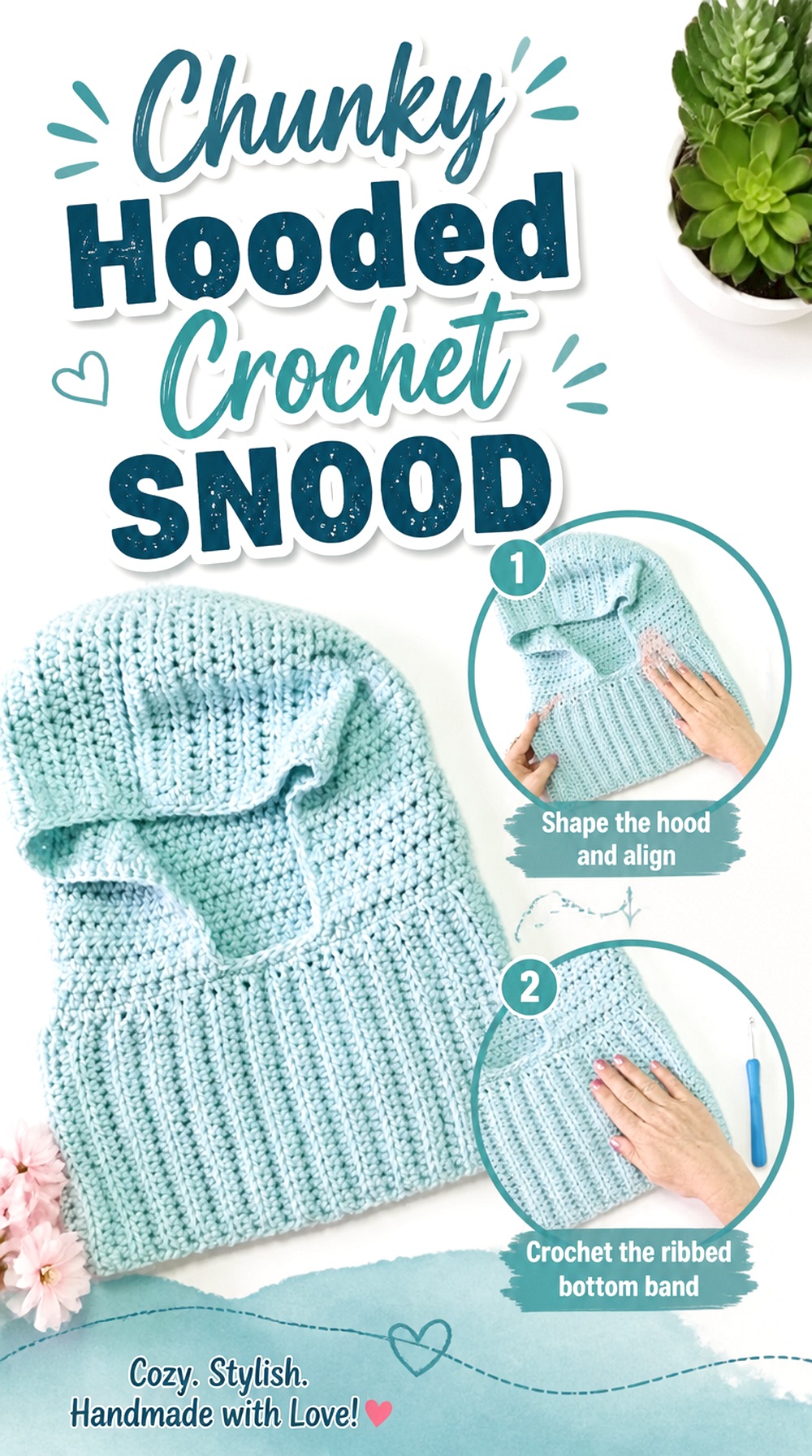
This design combines a substantial neck cowl with an attached hood, giving it more cold-weather coverage than a standard tube snood. Treasurie’s tutorial uses chunky yarn and a straightforward hood-and-cowl construction, so the finished piece has a clean, uncomplicated surface instead of relying on elaborate texture for its impact. It works especially well as an alternative to managing a separate scarf and hood when you want one continuous accessory. Before choosing it, consider whether you prefer a hood that sits prominently around the shoulders when lowered; that extra fabric is part of the look as well as the function.
The Hood Adds Volume Even When It Is Down
A hooded snood does not disappear into the neckline in the same way a short cowl does. When the hood is lowered, it creates additional folds behind and beside the neck. That can look attractive over a simple coat, but it may feel crowded beneath a narrow hood already attached to outerwear. Compare the neckline of your usual winter jacket with the snood’s finished shape before deciding where you expect to wear it most.
Chunky Fabric Needs Enough Room to Fold
Bulky yarn produces quick visual volume, but that same thickness limits how tightly the fabric can collapse. If you substitute yarn, do not judge the replacement by diameter alone. Make a small sample and bend it the way the finished hood will bend. A fabric that feels pleasant while flat can become much firmer once two or three folds stack around the neck.
Original Tutorial and Creator Credit
Creator: Treasurie
2. Faux Fur Pull Up Crochet Snood
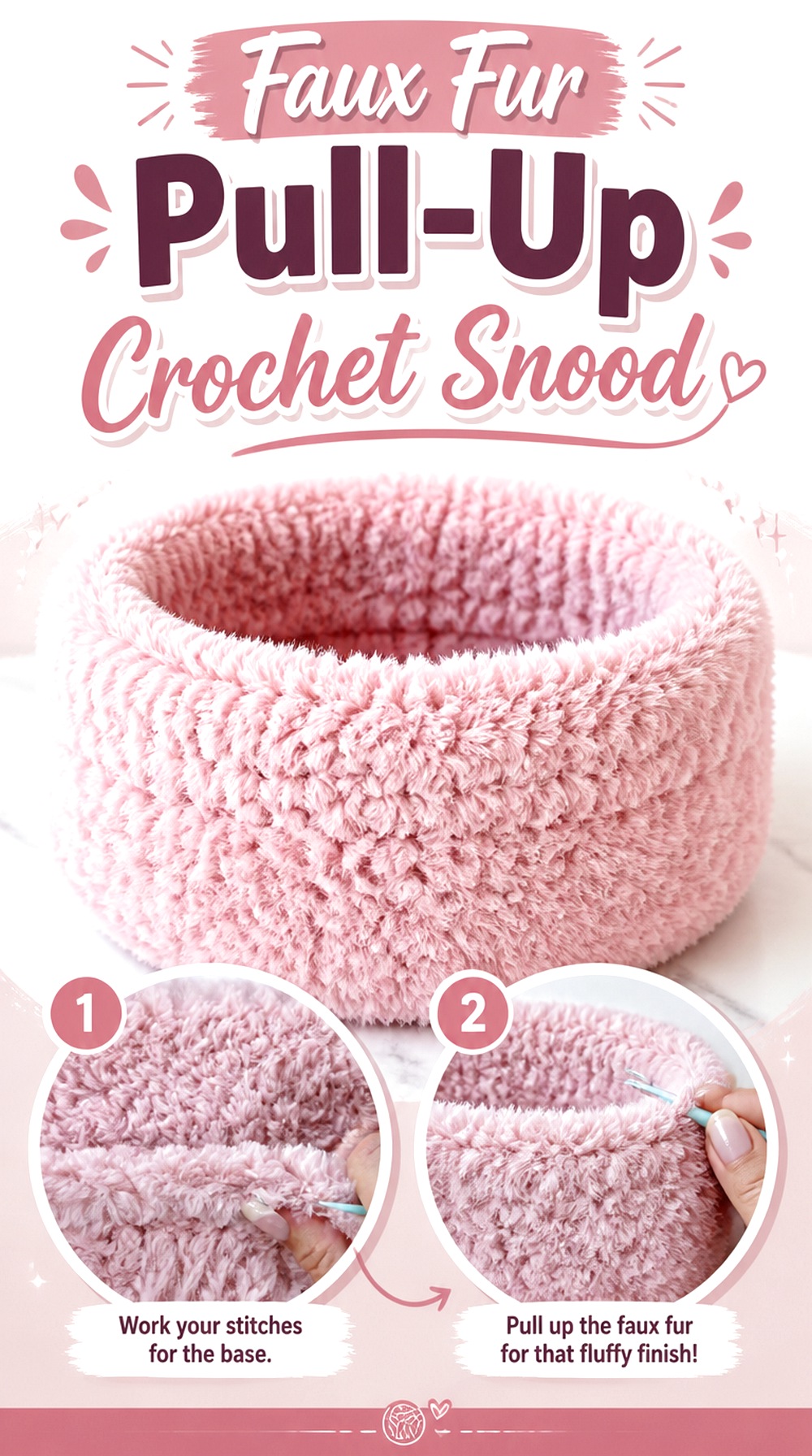
This faux-fur snood is a long tubular cowl designed to bunch around the neck or pull upward over the head. That makes the fabric itself the main feature: there are no granny motifs, elaborate edging sections, or obvious decorative seams competing with the fuzzy surface. Nicki’s Homemade Crafts uses faux-fur yarn and explains the challenge of locating stitches when the yarn obscures them. The finished shape is particularly suited to readers who want a dramatic, soft-looking winter accessory without a separately shaped hood. Because the yarn hides stitch definition, this project asks for a different kind of attention than a smooth, highly visible ribbed cowl.
Fuzzy Yarn Changes How You Check Your Work
With faux fur, visual stitch counting may be less reliable because the fibers can cover the stitch tops. That makes consistent placement and frequent checks more useful than waiting until the end to inspect the shape. If you are new to this yarn type, sample it first so you know whether you are comfortable finding stitches by touch before committing to the full circumference.
A Pull-Up Tube Needs Vertical Flexibility
Unlike a dedicated hood with separate shaping, this snood depends on enough height and flexibility to move from the neck to the head. A stiffer substitute yarn could preserve the tube shape but reduce that convertible drape. If you change fibers, check both positions—bunched at the neck and extended upward—rather than deciding whether the fabric works from a flat swatch alone.
Original Tutorial and Creator Credit
Creator: Nicki’s Homemade Crafts
3. Möbius Wrap Crochet Hooded Snood
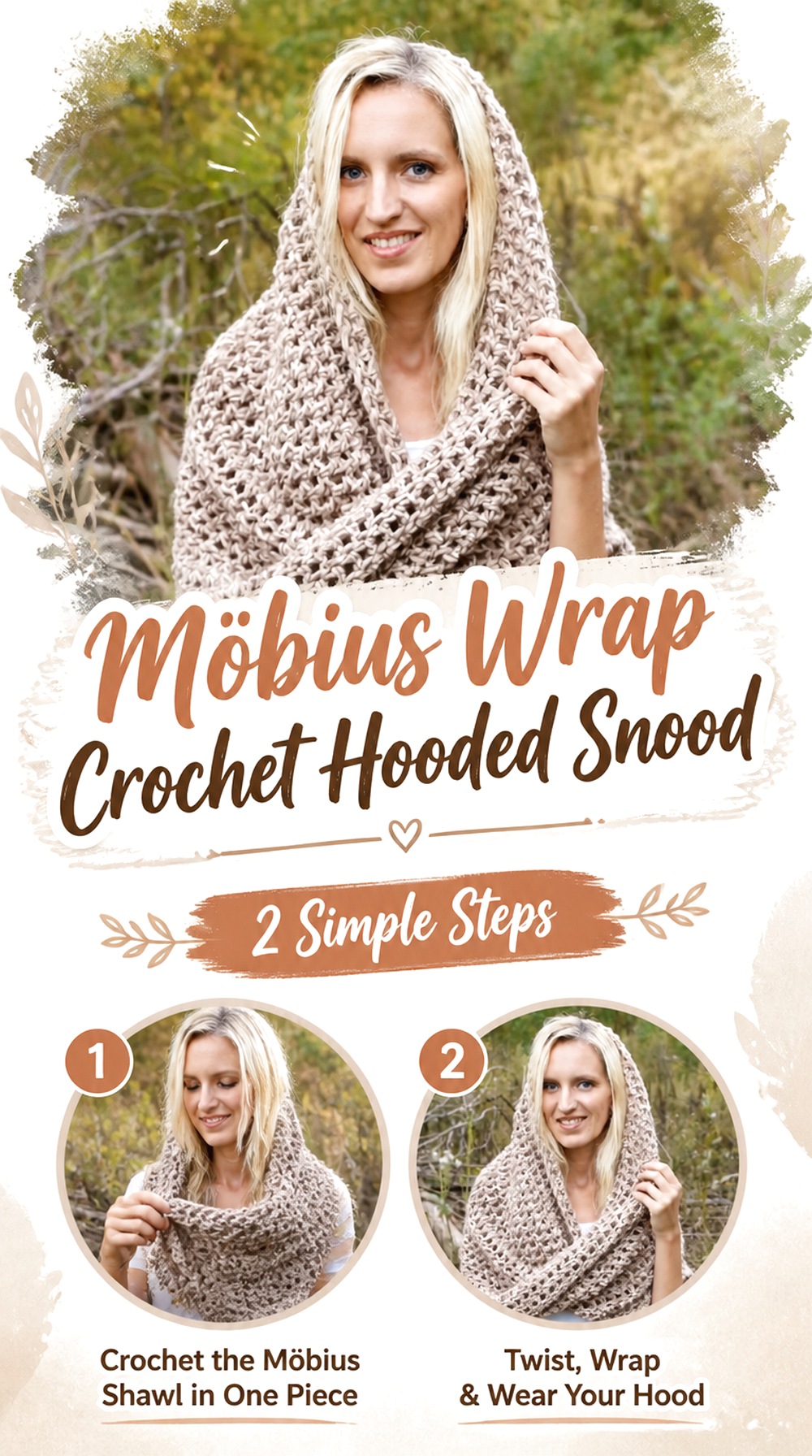
A Möbius construction immediately separates this snood from an ordinary circular cowl because the loop contains a deliberate twist. Naztazia’s tutorial shows a seamless wrap that can also be worn as a hooded cowl, giving the finished accessory several ways to sit around the shoulders, neck, and head. The twist creates movement without adding a button, drawstring, or decorative join. This is a useful choice when you like a wider wrap silhouette rather than a compact neck tube. The trade-off is that the twist becomes part of the structure, so orientation matters from the beginning rather than being something you can casually change after finishing.
The Twist Controls the Finished Drape
A Möbius loop is not simply an infinity scarf with an accidental turn. The intentional twist affects how the fabric crosses itself and where folds naturally settle. Before adapting the width, think about whether you want the piece to behave mostly like a shoulder wrap or mostly like a hooded cowl. More width means more coverage, but it also means more fabric collecting around the upper body.
Self-Striping Yarn Can Emphasize the Construction
Color changes can make the continuous twist easier to see, particularly when the yarn has long transitions. A solid color shifts attention toward stitch texture instead. Neither approach changes the structure, but it changes what the eye notices first. If the Möbius geometry is the feature you want to highlight, choose a yarn whose color behavior will not obscure the folds.
Keep the Starting Edge Organized
A long foundation is the point where an unwanted extra twist can enter the project. Lay the starting section out carefully and distinguish the intentional Möbius turn from accidental twisting before progressing too far. This is a construction checkpoint worth doing early because correcting orientation is much easier before a substantial amount of fabric has been added.
Original Tutorial and Creator Credit
Creator: naztazia
4. Lacy Openwork Crochet Cowl Snood
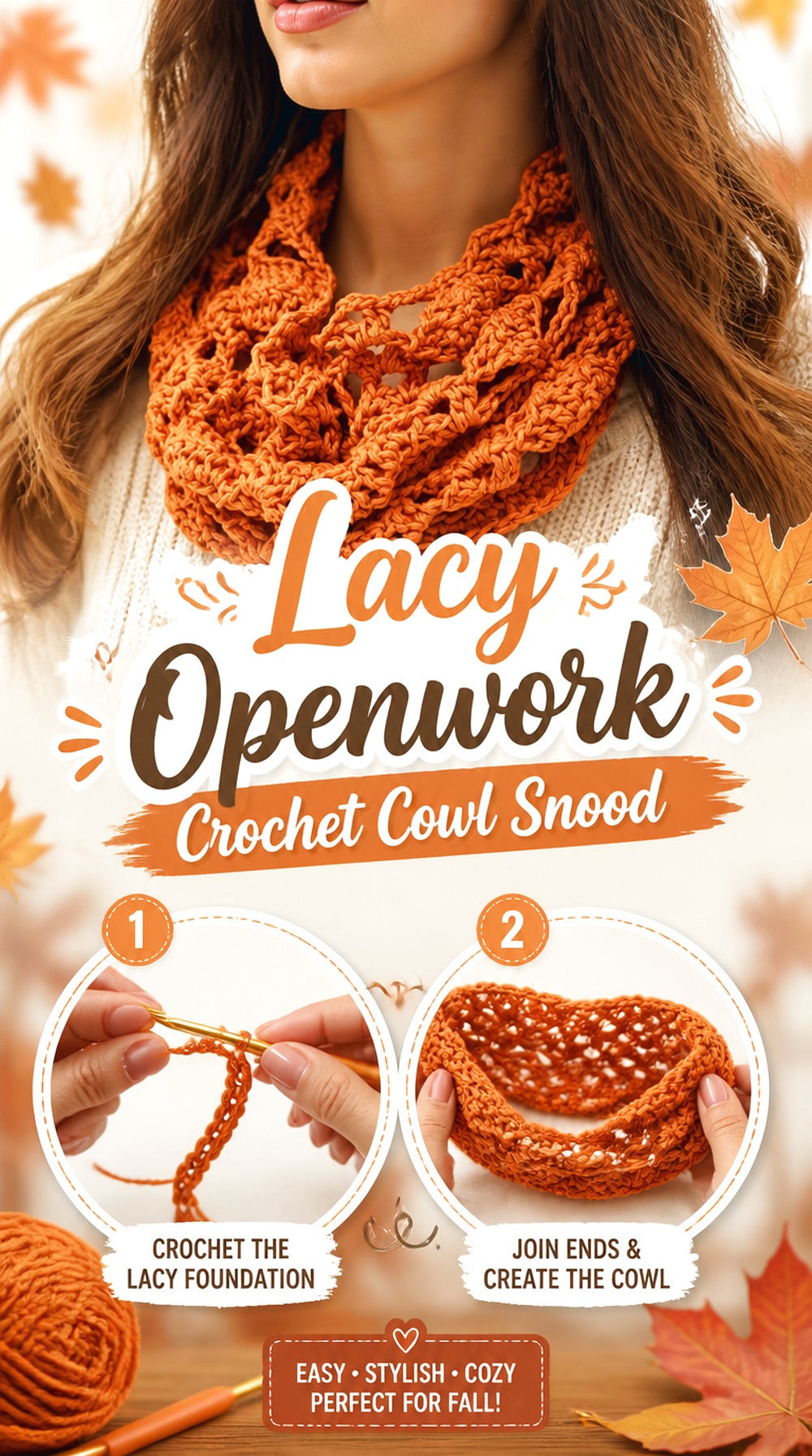
This Bag-O-Day Crochet cowl brings a more open, decorative surface into a collection dominated by dense winter textures. The tutorial’s finished cowl uses a lacy-looking stitch arrangement and can be extended toward an infinity-scarf style, so it suits readers who want a snood that works as part of an outfit rather than acting only as heavy insulation. Openwork gives the fabric visual lightness and helps it fold without the thickness of a heavily ribbed or bobbled design. For colder conditions, remember that beautiful open spaces also permit more airflow, so think of this as a different kind of fall-and-winter layer rather than a direct substitute for a dense wind-blocking cowl.
Open Texture Makes Yarn Definition Important
A decorative stitch loses impact if the yarn’s halo or color changes hide the spaces that form the pattern. Smooth yarn with clear definition will emphasize the construction, while very fuzzy yarn can soften it. Before substituting, work enough of the stitch pattern to see whether the openings remain distinct at the scale you want.
Longer Circumference Changes Its Role
Extending a cowl toward infinity-scarf length creates more styling choices, but it also changes how the same stitch pattern behaves. A single loop showcases the open texture clearly; a doubled loop stacks the fabric and makes it look denser. Decide whether you want the stitch pattern displayed or layered before choosing your final circumference.
Original Tutorial and Creator Credit
Creator: Bag-O-Day Crochet
5. Double Wrap Crochet Infinity Snood
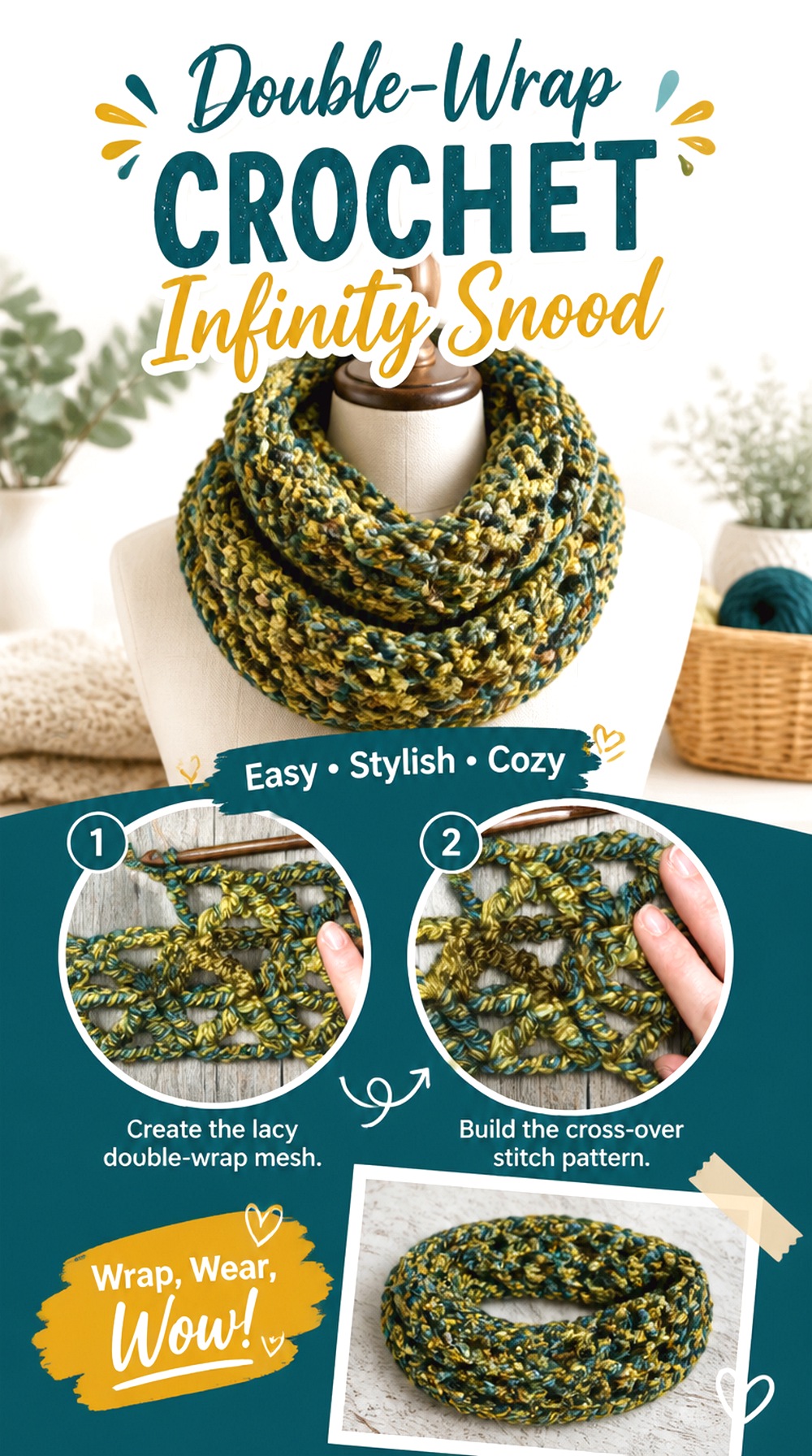
Rich Textures Crochet’s version has the elongated circumference associated with an infinity-style cowl, allowing the fabric to hang in a longer loop or wrap more closely around the neck. The stitch pattern has visible openness and texture, so the extra length does not read like a heavy solid tube. This is a useful middle ground for fall or milder winter days when you want the styling flexibility of a long snood. Its main difference from a close cowl is fabric distribution: instead of concentrating all the yarn immediately against the neck, you decide how much warmth to create by looping and arranging it.
Double Wrapping Multiplies Bulk
A fabric that seems fairly light in one layer may feel much more substantial once doubled. When considering a yarn substitution, fold your swatch over itself rather than judging one layer. That quick test gives a better idea of how the finished infinity loop will behave around a coat collar.
Elasticity Should Not Replace Opening Checks
Stretch can make a loop easier to arrange, but a highly elastic yarn can also cause a long snood to sag more than expected. Compare the recovery of your swatch after stretching it. If the fabric does not spring back well, a long circumference may become looser with wear, particularly when the stitch pattern itself is open.
Original Tutorial and Creator Credit
Creator: Rich Textures Crochet
6. Fold Down Tri Color Crochet Cowl Snood
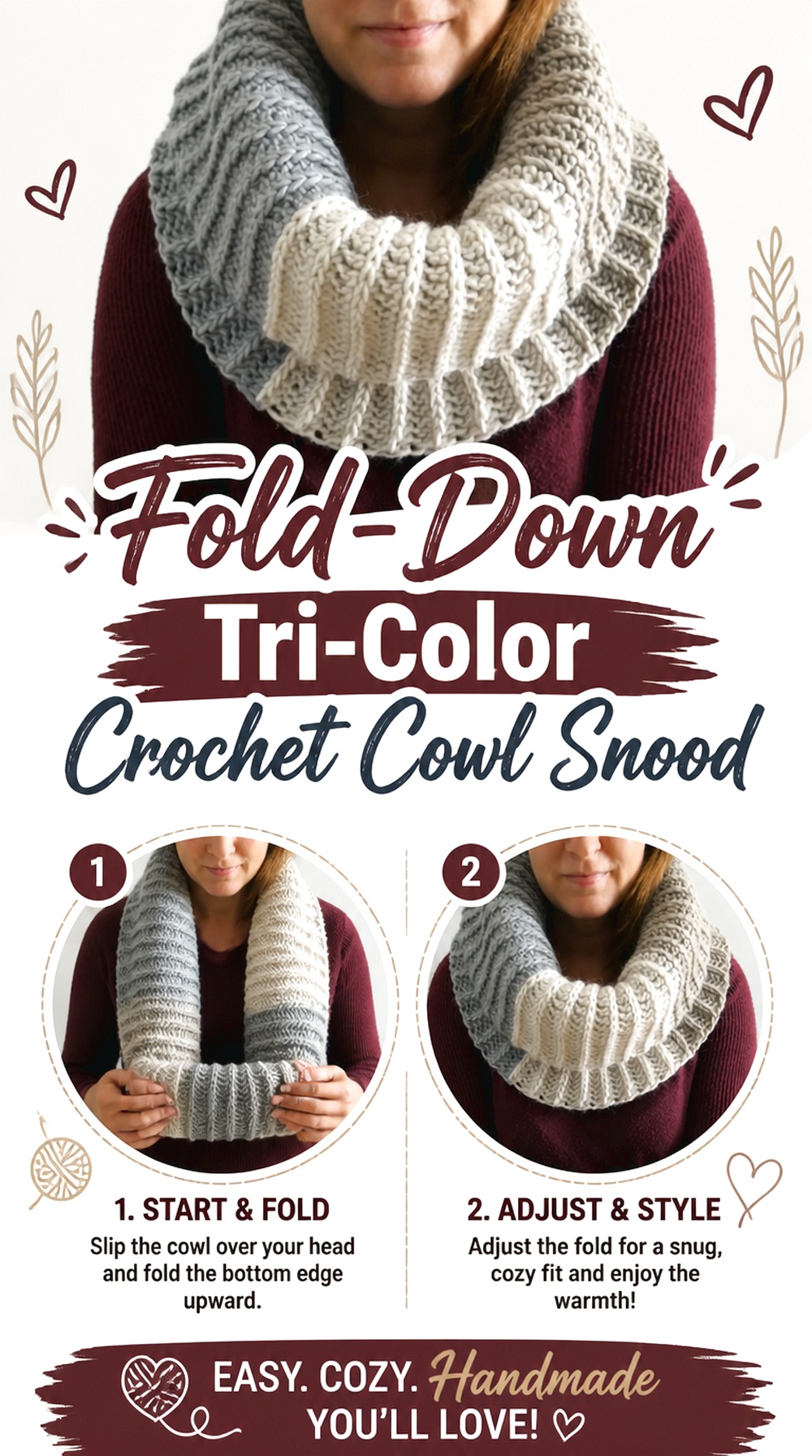
B.Hooked Crochet’s oversized cowl is designed with enough height to fold down, giving the neck area a double layer without requiring a long infinity loop. The sample also uses three colors, which turns simple horizontal sections into part of the visual design. This shape is worth considering if you want warmth concentrated high around the neck but dislike managing a long scarf tail or a wide hood. The folded construction also creates an easy way to regulate coverage: keep the collar tall when you want more protection or roll it lower when a coat already provides substantial neck coverage.
Fold Height Affects Comfort Near the Jaw
A taller cowl can feel cozy until the folded edge presses against the chin every time you turn your head. Before finishing, hold the fabric at the planned height and test normal movement. If you are adapting the project, changing height may be more useful than changing circumference when the opening already fits comfortably.
Color Placement Can Define the Fold
Multiple colors let you decide which section remains most visible when the cowl is folded. If you use contrasting shades, plan the fold direction before choosing their order. A transition placed exactly at the fold may look very different from one positioned fully on the visible outer layer.
Original Tutorial and Creator Credit
Creator: B.Hooked Crochet
7. Adjustable Everyday Crochet Cowl Snood
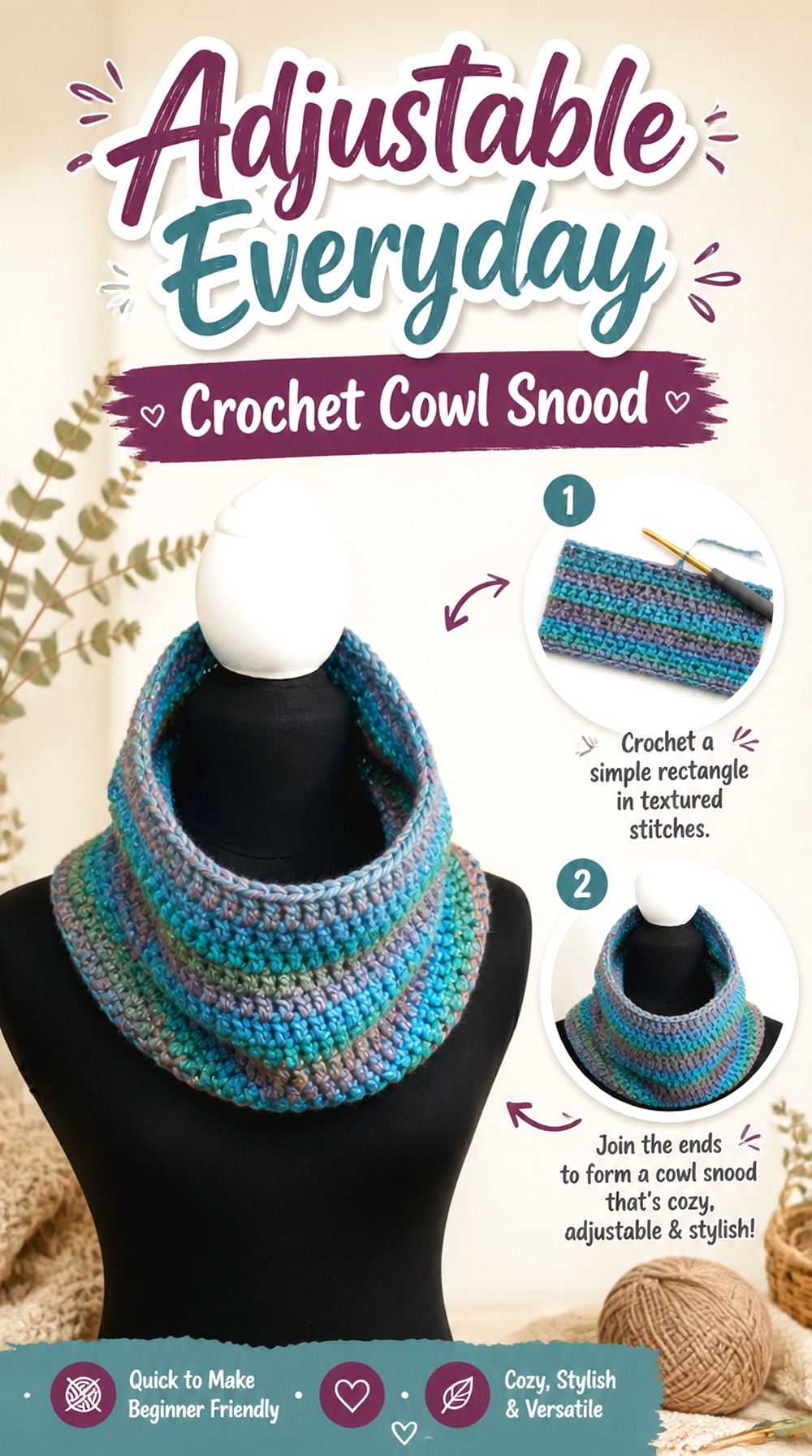
Crochet with Clare’s cowl is a straightforward option for readers who want to understand the basic relationship between yarn thickness, opening size, and final cowl dimensions without decorative construction taking over the project. The tutorial specifically discusses adjusting the size and using different yarn thicknesses, which makes it a useful foundation for a personalized everyday snood. Visually, this type of project works well when you want yarn color or texture to do most of the styling. It also makes a practical comparison point for the more specialized ideas in this roundup because there is no hood, motif join, point, or twist to accommodate.
Measure for the Way It Will Be Put On
A close-fitting cowl may look best near the neck, but the opening still needs to move over the wearer’s head unless the design includes another opening method. Check that path before committing to the final join. If a yarn has limited stretch, allow that characteristic to influence the opening rather than expecting the fabric to behave like ribbing.
Let Unusual Yarn Be the Feature
A simple silhouette is a good place for marled, gradient, tweed, or heavily textured yarn because the construction does not compete for attention. The caution is stitch visibility: if the chosen yarn is difficult to read, confirm that you can still identify the edges and joining points cleanly.
Original Tutorial and Creator Credit
Creator: Crochet with Clare
8. Pointed Front Crochet Snood
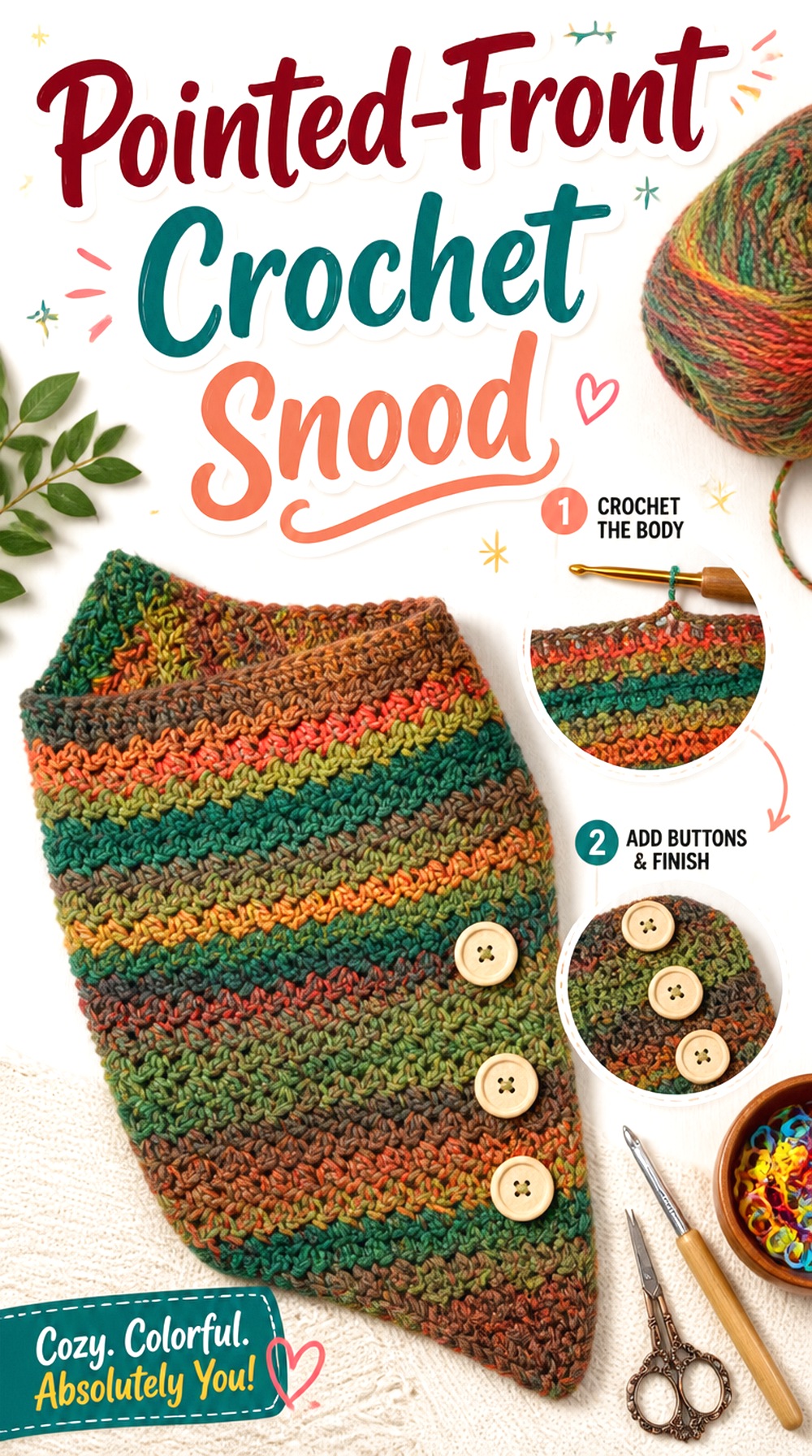
The Perfect Point Cowl from Moogly changes the standard horizontal lower edge by forming a distinct point at the front. That small structural decision makes the snood behave more like a mini scarf or kerchief while retaining the easy pull-on form of a cowl. It can fill the visual gap above a coat neckline without requiring a long scarf wrapped around the neck. The tutorial works the piece flat and seams it into its finished form, so the shaping can be seen clearly before assembly. This is a strong choice when you want the front of the accessory to be as important as the neck coverage.
Position the Point Before Final Seaming
With an asymmetrical-looking lower edge, small changes in rotation are more noticeable than they are on a plain tube. Before securing the seam permanently, place the cowl around the neck and make sure the point naturally settles where you want it. The same check helps determine whether a self-striping sequence lands attractively at the center front.
Bulky Yarn Makes the Point More Sculptural
A thicker yarn gives the front point more visual presence, while a softer, finer yarn will allow it to collapse closer to the chest. Neither effect is automatically preferable. Choose according to whether you want a clearly defined outerwear accessory or a softer snood that layers under a jacket.
Original Tutorial and Creator Credit
Creator: Tamara Kelly – Moogly
9. Crisscross Texture Crochet Neck Snood
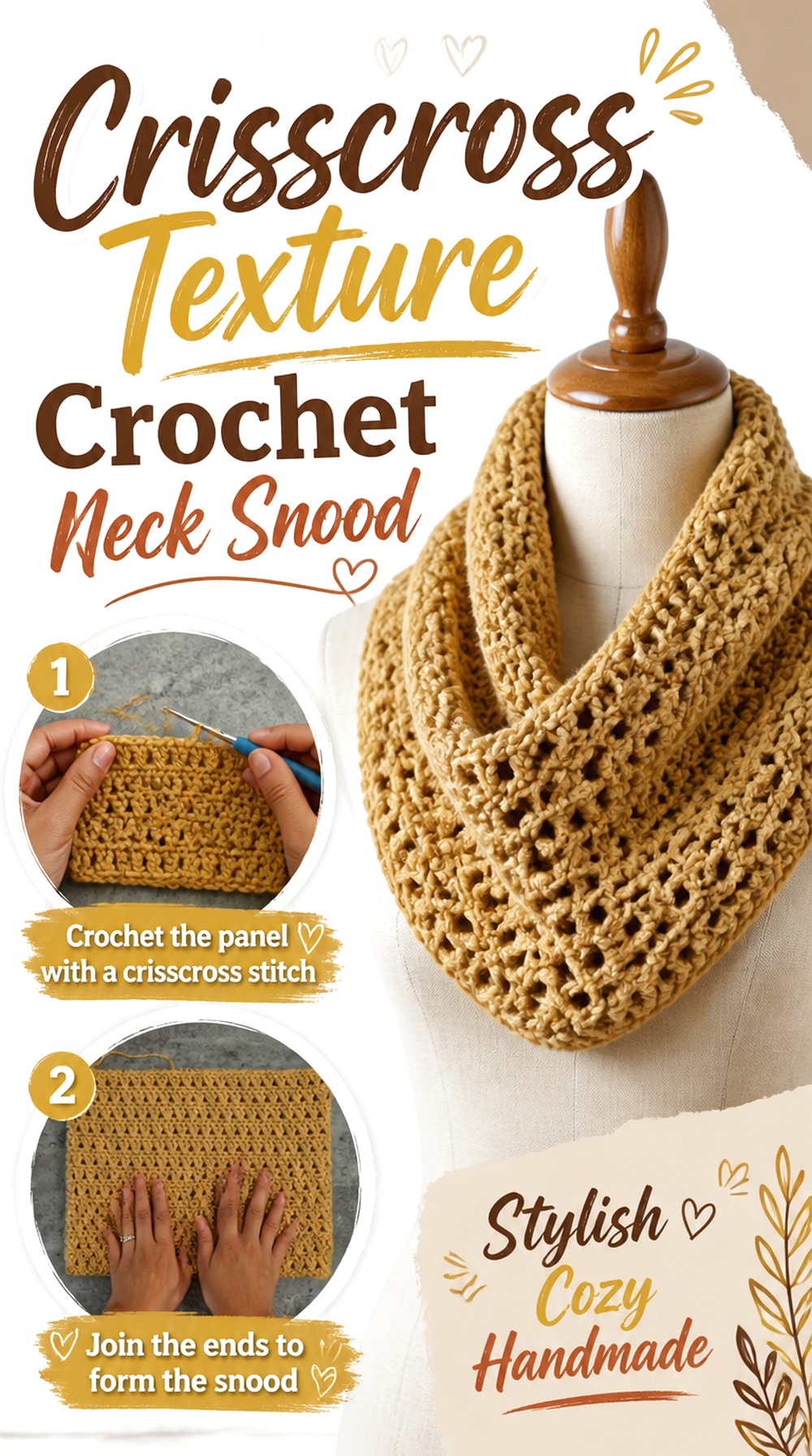
KnitcroAddict’s cowl uses a crisscross stitch texture that gives a close neck warmer more surface detail without adding a hood, point, or modular motifs. The tutorial pairs that texture with a medium-weight yarn in the demonstrated project, producing a fabric that looks structured while remaining less bulky than the super-chunky options in this collection. This is a useful fall-to-winter transition style when you want the snood to be visibly textured even with a solid color. Since the stitch pattern is the main attraction, yarn substitution should prioritize clean definition rather than simply matching a favorite shade.
Crisscross Texture Benefits From Clear Definition
Highly variegated yarn can make crossing stitches harder to distinguish because color changes interrupt the lines created by the fabric. A solid or gently tonal yarn keeps the stitch architecture easier to see. If you prefer a busy colorway, work a generous swatch first and judge it from normal wearing distance rather than only close up.
Decide How Much Neck Drape You Want
A textured cowl can be made roomy enough to fold softly or close enough to frame the neck. The same stitch may look quite different in those two fits. Before changing the circumference, decide whether you want visible drape at the front or a more upright collar effect, then check the tutorial’s sizing information accordingly.
Original Tutorial and Creator Credit
Creator: KnitcroAddict
10. Ribbed Cuff Crochet Hooded Snood
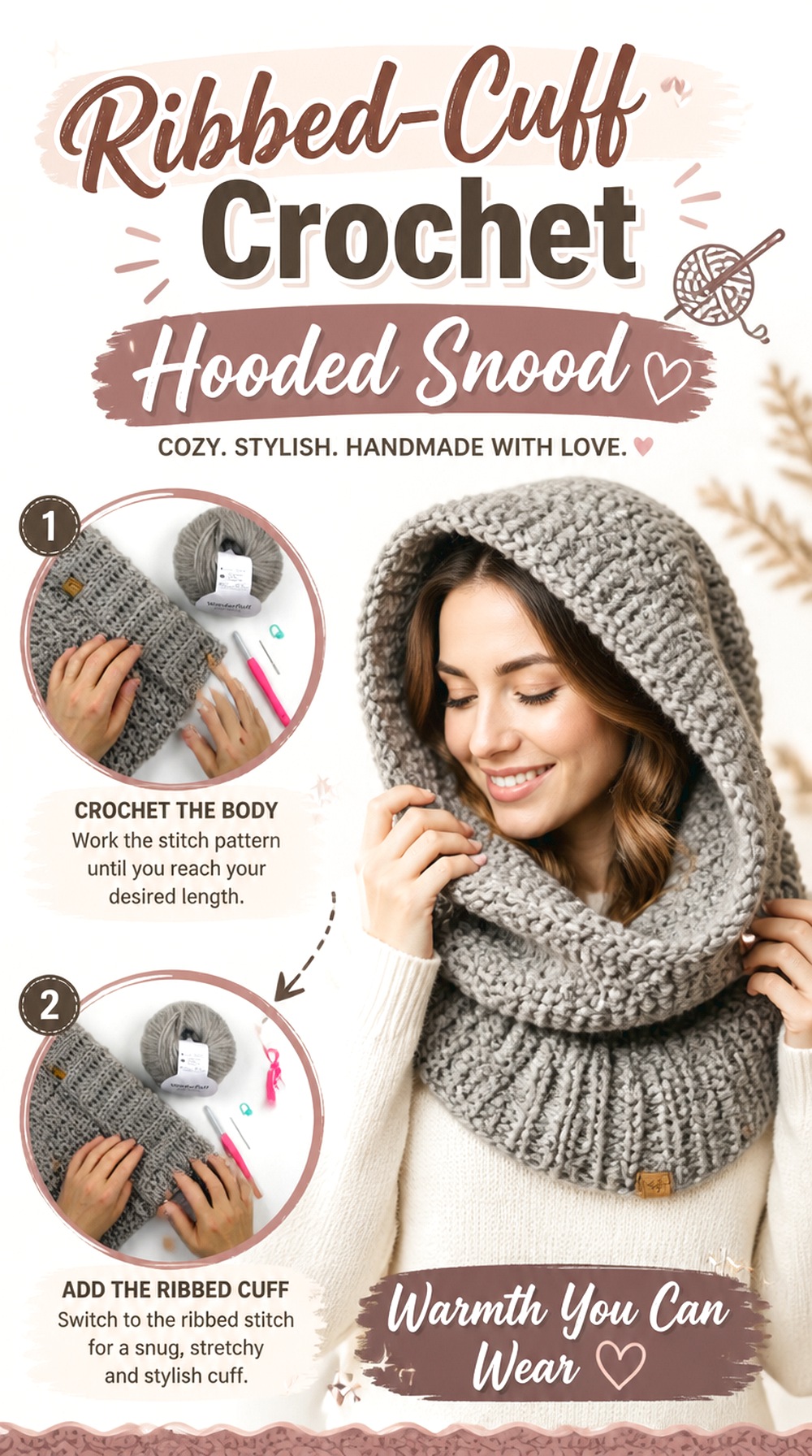
A Crocheted Simplicity’s hooded cowl adds a ribbed cuff after the main body, giving the opening a defined frame instead of allowing the hood edge to remain visually plain. The project is worked as a roomy cowl that can be pulled over the head, making it another convertible option, but the ribbing distinguishes it from the simple faux-fur tube and the seamed hood-and-cowl designs elsewhere in this list. The tutorial also discusses yarn choices and construction before moving into the body and cuff. Choose this style when you want a hooded snood with a more deliberately finished edge around the face.
Ribbing Changes the Behavior of the Opening
Adding ribbing does more than decorate the edge. Its stretch and recovery influence how the opening frames the face and returns to shape after the snood is pulled on and off. If you substitute yarn, compare how the ribbed sample behaves with the main fabric instead of assuming both sections will respond identically.
Hood Drape Depends on the Main Fabric
The hood needs to fall backward when lowered rather than standing rigidly around the head. A yarn that creates an excellent firm rib may still be too stiff for the main section at the same hook size. Check the tutorial’s yarn guidance before altering both yarn weight and hook choice simultaneously.
Keep the Seam Out of the Spotlight
A large hood naturally exposes different parts of the fabric as it moves between the head and neck. When joining or finishing, consider where the seam sits in both positions. Neat finishing matters more on a convertible piece because an area hidden in cowl mode may become visible when the hood is raised.
Original Tutorial and Creator Credit
Creator: A Crocheted Simplicity – Jennifer Renaud
11. Lightweight Block Stitch Crochet Snood
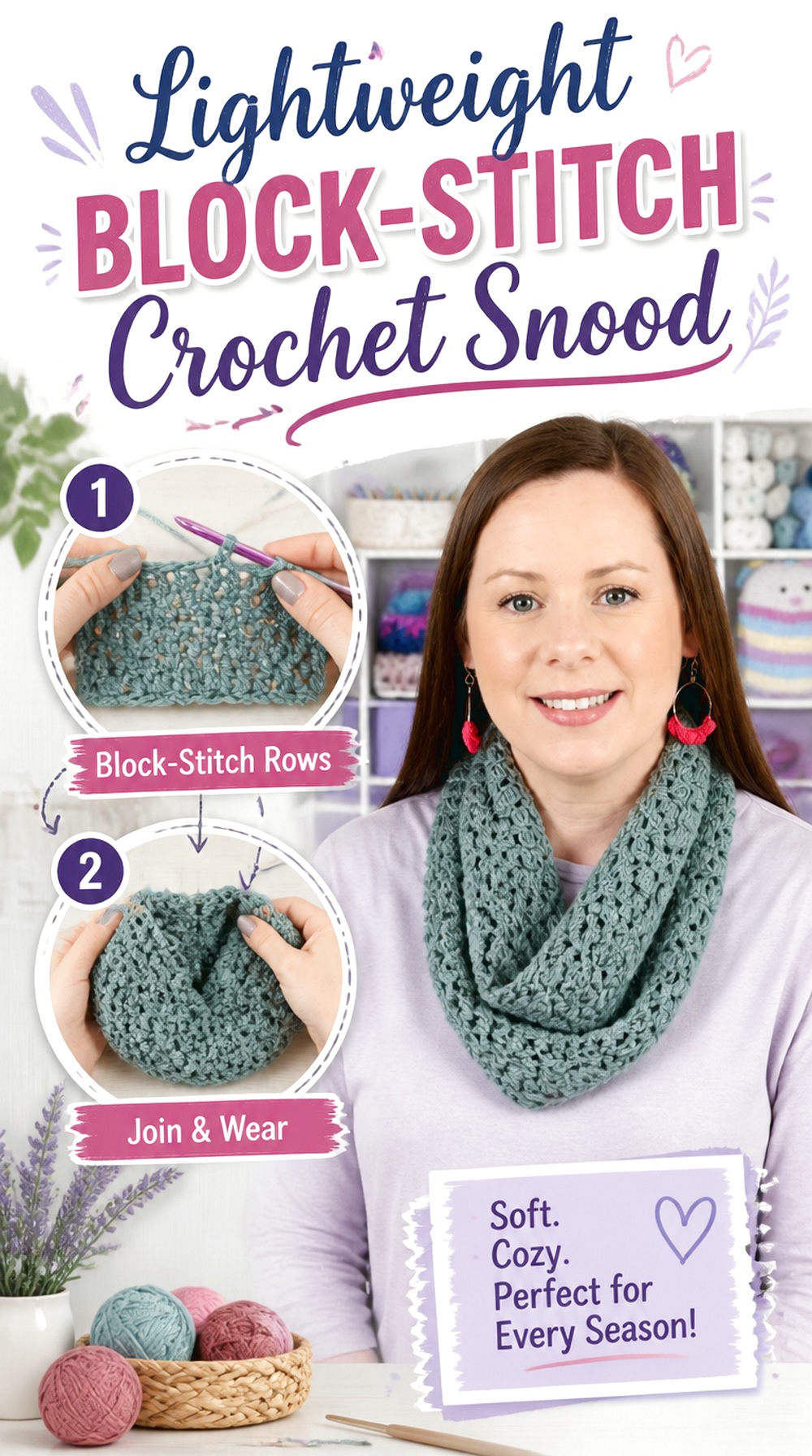
The Fair Weather Cowl from Fiber Flux provides a lighter alternative to the dense winter cowls in this roundup. Its block-stitch surface introduces small openings and color opportunities while the flat construction is eventually seamed into a loop. The finished look works particularly well for early fall, indoor layering, or climates where a super-bulky collar would be excessive. Because it begins as a flat strip, it is also easier to judge length and drape before committing to the final join. Readers who enjoy visible stitch rhythm but do not want large bobbles or thick post-stitch texture may find this a more balanced option.
A Light Snood Can Still Have Visual Depth
Open spaces and alternating stitch groups create shadows that give a fine fabric definition without requiring thick yarn. If you change colors, decide whether you want the block pattern emphasized with contrast or softened with neighboring tones. Too many sharp changes can make a small cowl visually busier than expected.
Test the Seam Before Closing the Loop
Flat construction gives you a useful fitting opportunity. Temporarily bring the ends together and place the strip around the neck before making the permanent seam. This lets you judge both circumference and how the seam affects the pattern continuity without undoing finished work later.
Original Tutorial and Creator Credit
Creator: Fiber Flux
12. C2C Bobble Crochet Cowl Snood
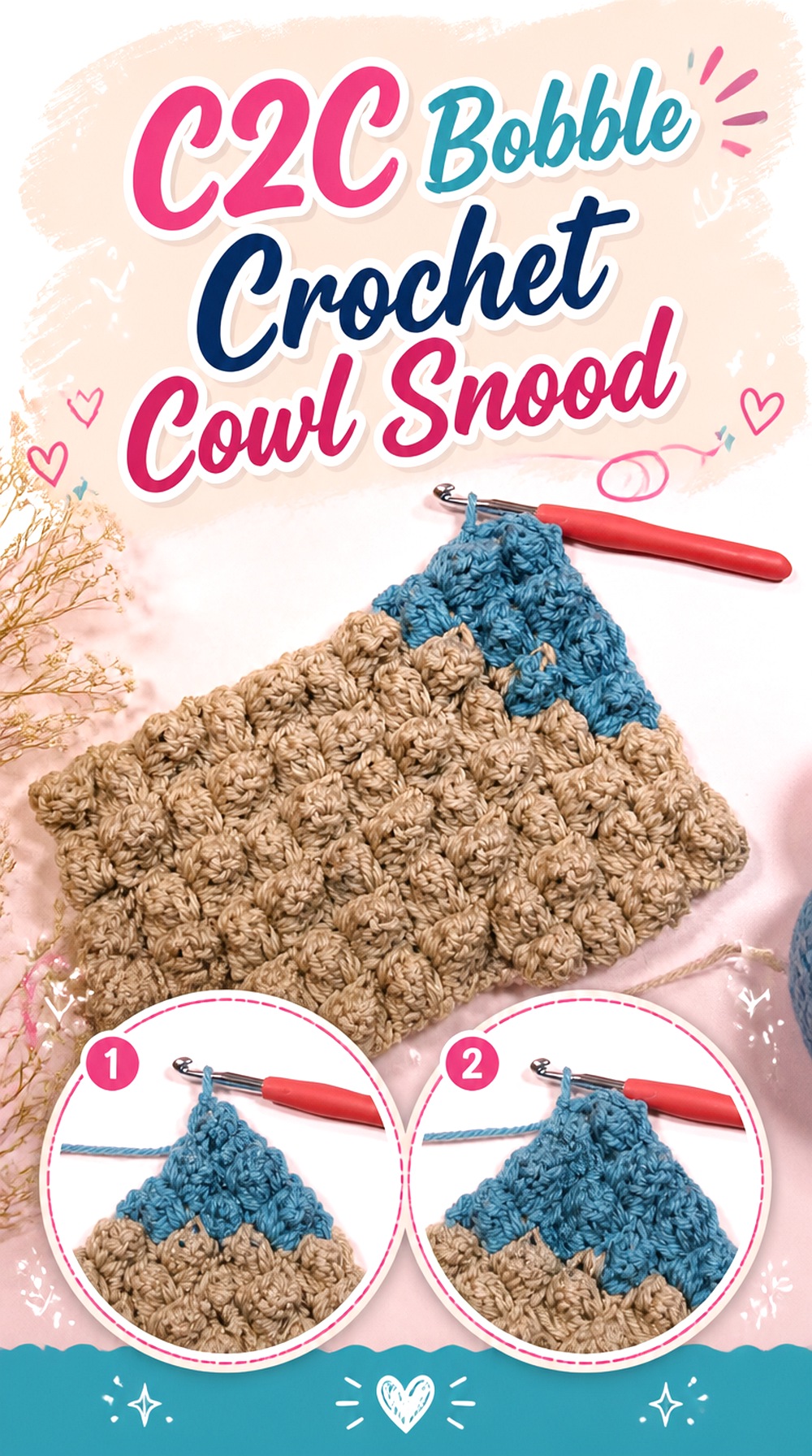
The Crochet Crowd takes corner-to-corner construction in a less expected direction by working a rectangular cowl panel with bobble texture. That combination gives this project a noticeably different rhythm from a standard cowl worked straight around in repeated rounds. The bobbles create raised surface interest, while the flat rectangular construction lets you see the proportions before the piece becomes a closed neck accessory. This snood suits someone who wants texture to be the central feature and does not mind a more dimensional fabric. Because bobbles place extra yarn in concentrated areas, the completed piece can feel fuller than a flat stitch fabric of similar overall dimensions.
Bobbles Add Weight as Well as Texture
Raised stitches are not only decorative. They increase yarn use and create localized thickness. If you substitute a heavier yarn, the effect compounds quickly, so a swatch is useful for deciding whether the bobbles remain pleasantly flexible or start feeling too dense around the neck.
Flat C2C Construction Makes Proportion Easy to See
Since the project develops as a rectangle, you can inspect its visual balance before it becomes a cowl. This is the point to decide whether the depth suits your intended neckline. A wider panel gives more coverage, but it also places more bobbled fabric close to the jaw and shoulders.
Original Tutorial and Creator Credit
Creator: The Crochet Crowd
13. Waffle Texture Crochet Hooded Snood
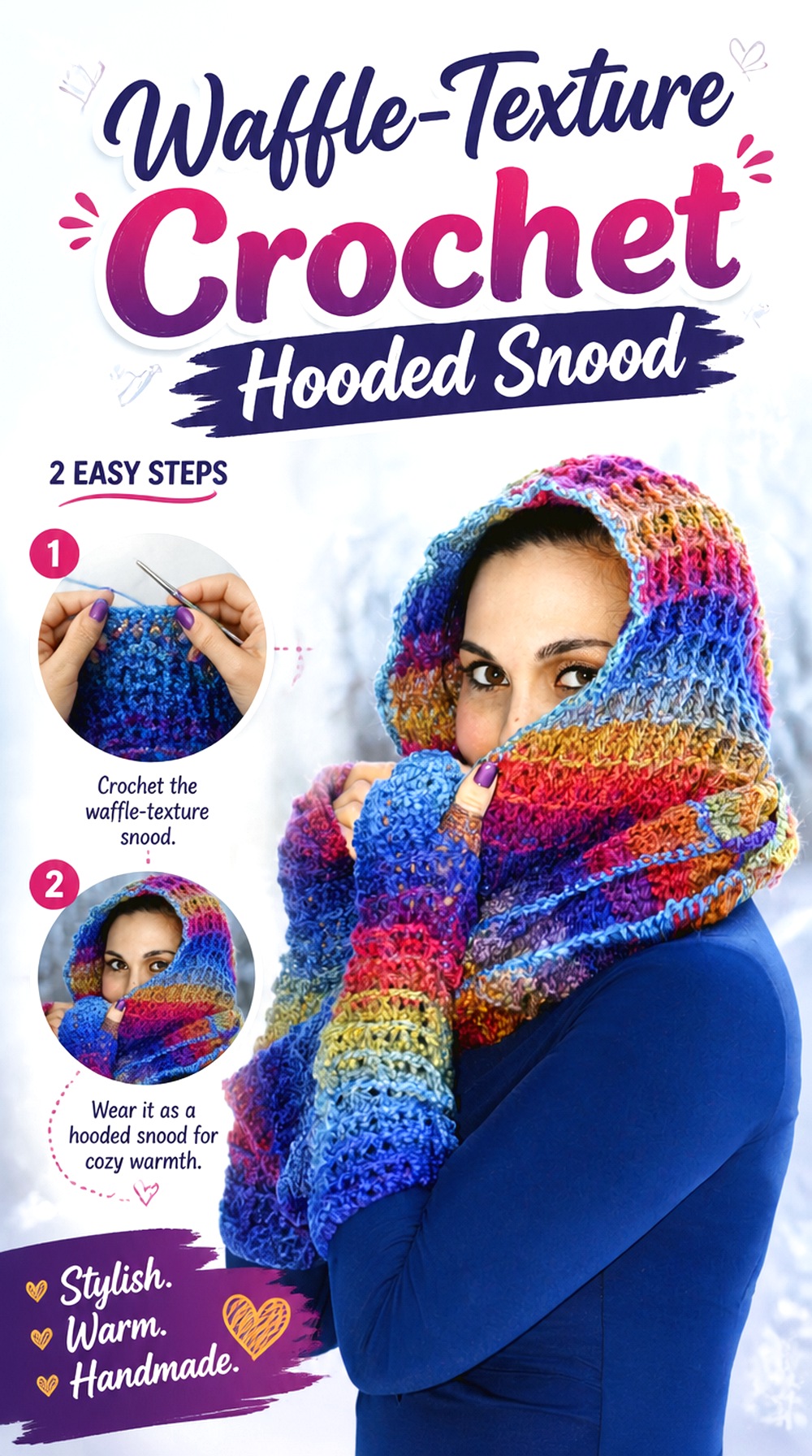
YARNutopia’s Warm Waffles Hooded Cowl uses pronounced waffle texture across a long piece that is assembled into a hooded cowl form. Compared with a short tube that simply pulls over the head, this project gives the texture much more surface area and creates a substantial statement accessory. The deep grid-like stitch pattern is especially visible in solid or lightly varied yarn. This is the kind of snood to consider when texture itself is part of the winter styling rather than an incidental detail. It also places more fabric around the wearer than a compact cowl, so total weight and drape deserve attention when choosing a substitute yarn.
Waffle Texture Can Become Heavy in Dense Yarn
Post-stitch textures use yarn to build depth rather than remaining flat. On a large hooded piece, that accumulated weight can affect how the fabric hangs. If substituting, compare not only gauge but also the weight of a reasonably sized sample. A small difference can become noticeable across a long finished accessory.
The Hood Seam Should Work With the Texture
Raised grids make misalignment more visible than they would be on a smooth stitch pattern. Before securing the hood area, check that the texture meets cleanly enough for your preference. Exact construction belongs to the tutorial, but visually inspecting the pattern alignment before final finishing can prevent a distracting join.
A Statement Snood Needs Outerwear Space
This design is more substantial than a close collar. If you usually wear a coat with a large built-in hood or a very high neckline, consider how the two pieces will overlap. A textured hooded snood often works most comfortably as an outer layer where its shape has room to sit naturally.
Original Tutorial and Creator Credit
Creator: Fuad Azmat / YARNutopia by Nadia
14. Two Square Crochet Granny Cowl
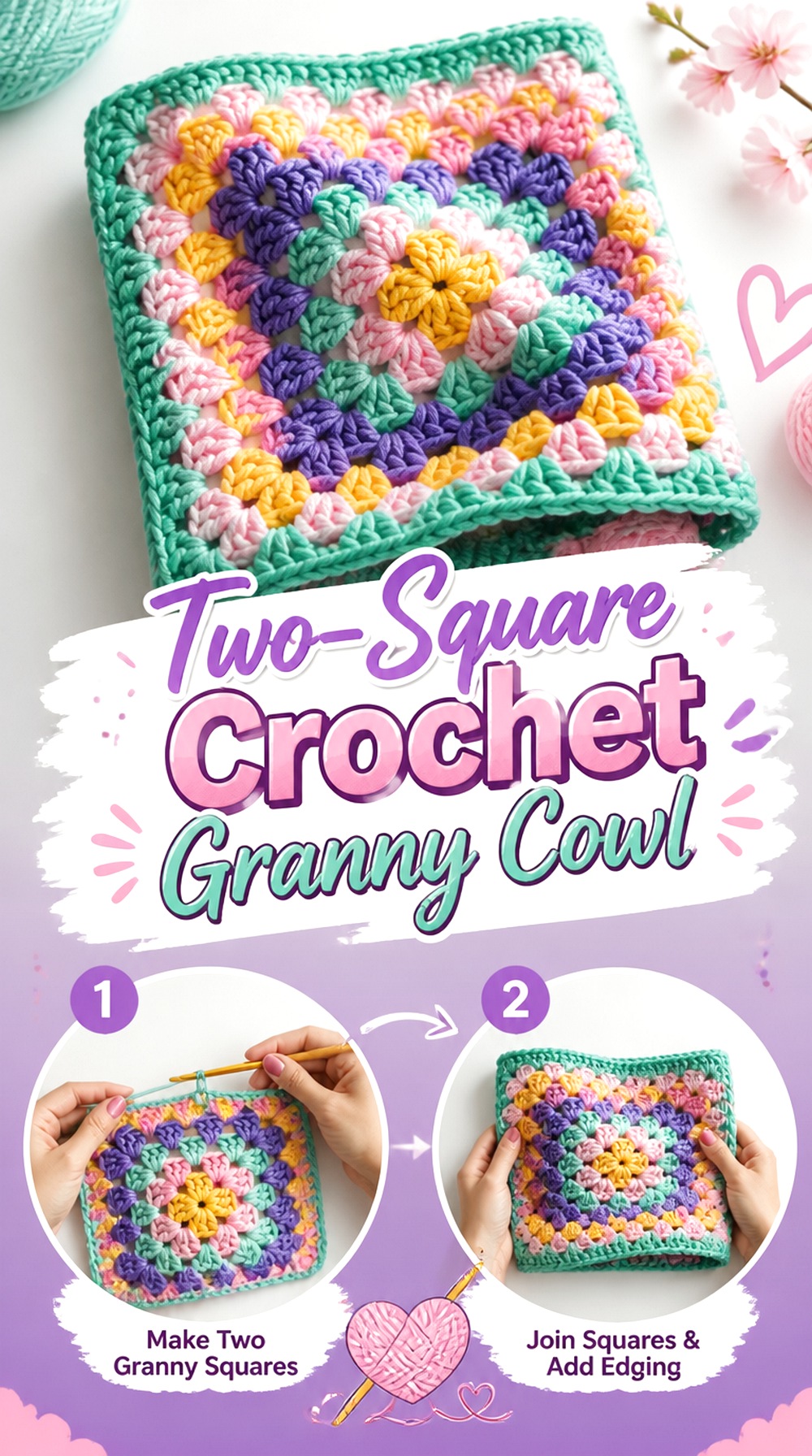
Katia Creates builds this cowl from two large granny squares rather than a long strip or continuous tube. That gives the finished piece a bold geometric look and makes color planning especially important because each square occupies a large visible area. The tutorial demonstrates creating the two squares and joining their sides, so the motif is not merely decorative—it is the basic construction unit. This is a strong choice when you enjoy granny-square crochet but do not want the many small motifs and numerous joins associated with a larger garment or blanket. The finished scale of each square directly controls the cowl’s proportions, so blocked dimensions matter before assembly.
Block Both Squares to Comparable Dimensions
Two panels only join neatly when their corresponding edges agree. If one square relaxes more during blocking, the difference may show as puckering or uneven tension along the seam. Compare the finished dimensions before joining instead of relying on matching round counts alone.
Color Placement Has More Impact on a Large Motif
Because the square is large, every color band takes up meaningful visual space. A dark final round can create a strong frame, while lower-contrast choices let the granny structure blend together. Plan the sequence as part of the finished cowl rather than treating each round as an isolated color decision.
Original Tutorial and Creator Credit
Creator: Katia Creates
15. Ribbed Granny Square Crochet Snood
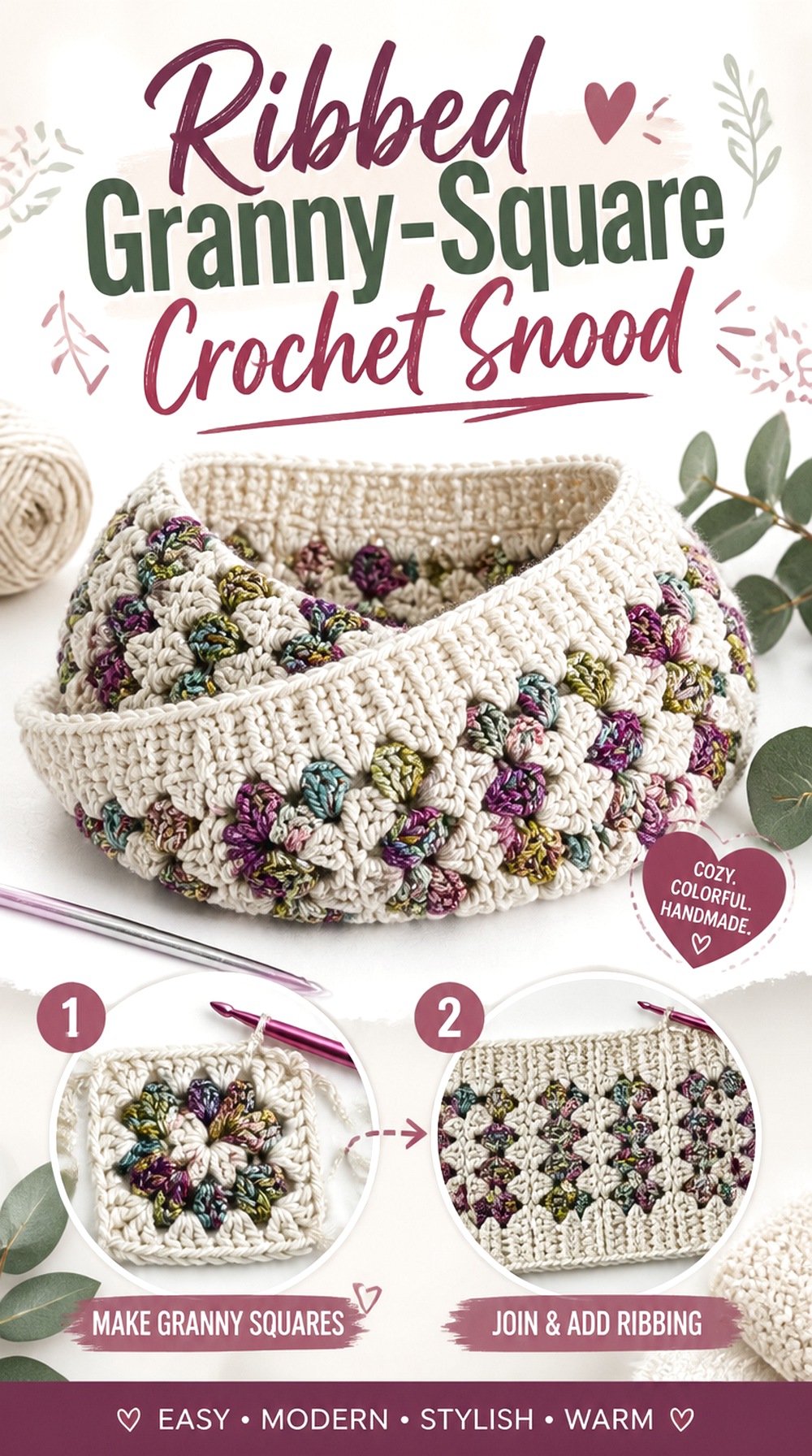
Lullaby Lodge’s cowl uses granny-square construction but adds ribbed finishing, making it clearly different from the two-large-square approach above. The combination brings two textures into one accessory: colorful or graphic granny sections provide the main visual field, while ribbing creates a more defined edge near the neck. That makes this a useful project when you want a handcrafted patchwork look without allowing the motifs to determine every edge of the finished silhouette. The tutorial covers the granny squares, seaming, and ribbing, so readers can see how modular work and a more elastic finish interact within the same cowl.
Ribbing Can Correct the Visual Edge
Granny motifs naturally create a squared, modular appearance. Adding ribbing gives the neckline a continuous finish that can visually unify those separate units. When planning colors, decide whether the ribbing should blend into the motifs or act like a frame around them.
Match Motif Size Before Seaming
Small differences between blocked granny squares can accumulate when several edges meet. Lay the finished motifs together before assembly and compare corners as well as side lengths. If one square is noticeably different, correcting that discrepancy early produces a cleaner result than forcing the seam to absorb it.
Keep the Neck Edge More Flexible Than the Motif Field
Granny-square fabric and ribbing often stretch differently. That contrast can be useful: a more elastic top edge helps the cowl open and return to shape. When substituting yarn, check that the ribbing still behaves as a flexible finish rather than becoming as rigid as the motif section.
Original Tutorial and Creator Credit
Creator: Lullaby Lodge
16. One Skein Crochet Neck Warmer Snood
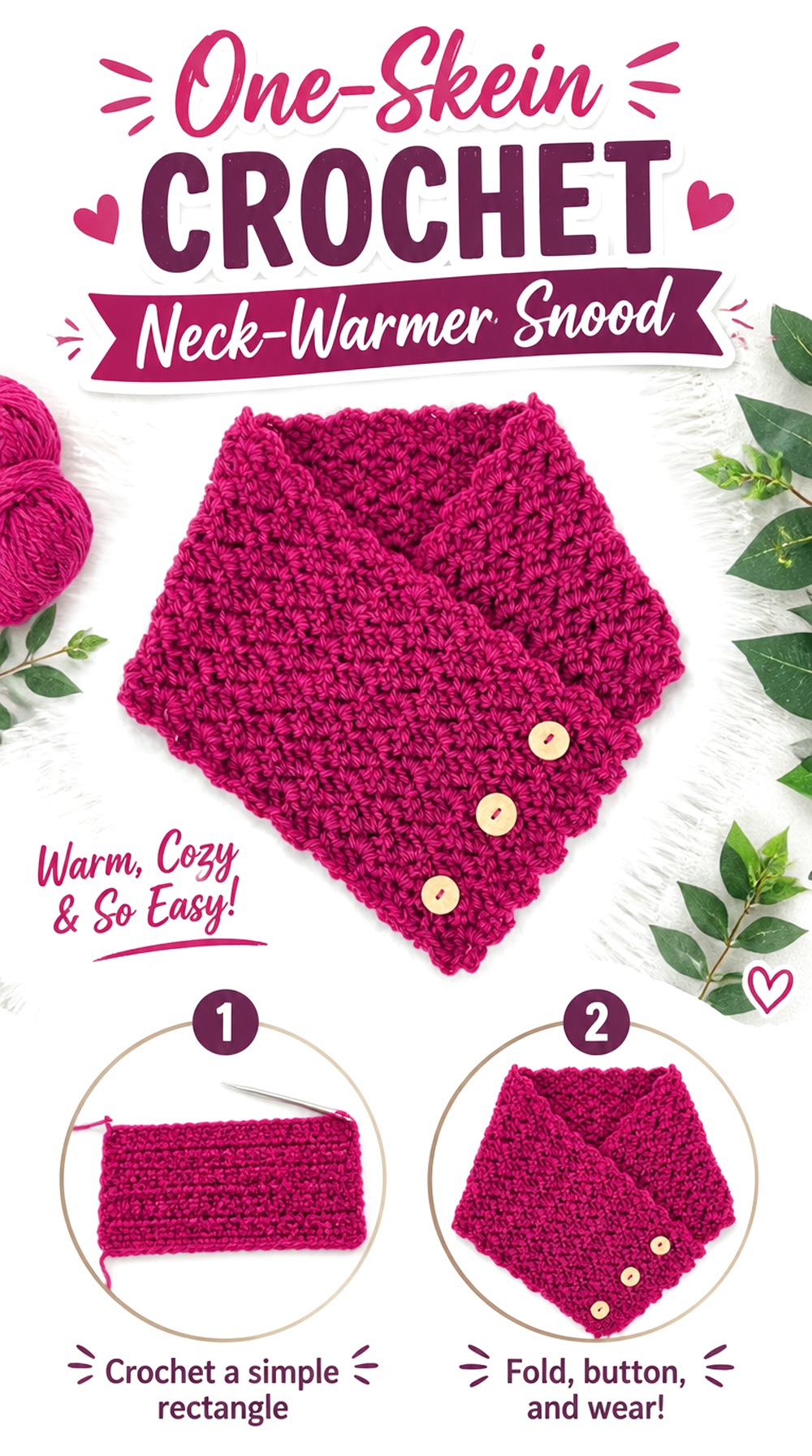
Jo to the World Creations presents a compact crochet neck warmer made with simple stitches and a one-skein format in the demonstrated pattern. Its appeal in this collection is restraint: the finished shape focuses on practical neck coverage without the extra fabric of an infinity loop or hood. This makes it easier to pair with jackets that already have high collars or substantial hoods. It is also a useful option when you want a project where yarn texture and color can stand on their own. If you substitute yarn, however, confirm the tutorial’s gauge and material information rather than assuming that every skein contains the same usable yardage.
Compact Cowls Need a Well-Judged Opening
With less fabric to hide fit problems, circumference becomes more noticeable. A cowl that is too loose may sit away from the neck, while one that is too close can be difficult to pull over the head. Check both the entry opening and the resting fit before finalizing any adjustment.
Simple Fabric Makes Finishing More Visible
When the stitch pattern is understated, an uneven join or bulky woven-in end can attract more attention than it would in faux fur or bobble texture. Take time with the finishing area and position it where the cowl naturally sits least prominently.
Original Tutorial and Creator Credit
Creator: Jo to the World Creations
17. Bactus Style Crochet Triangle Snood
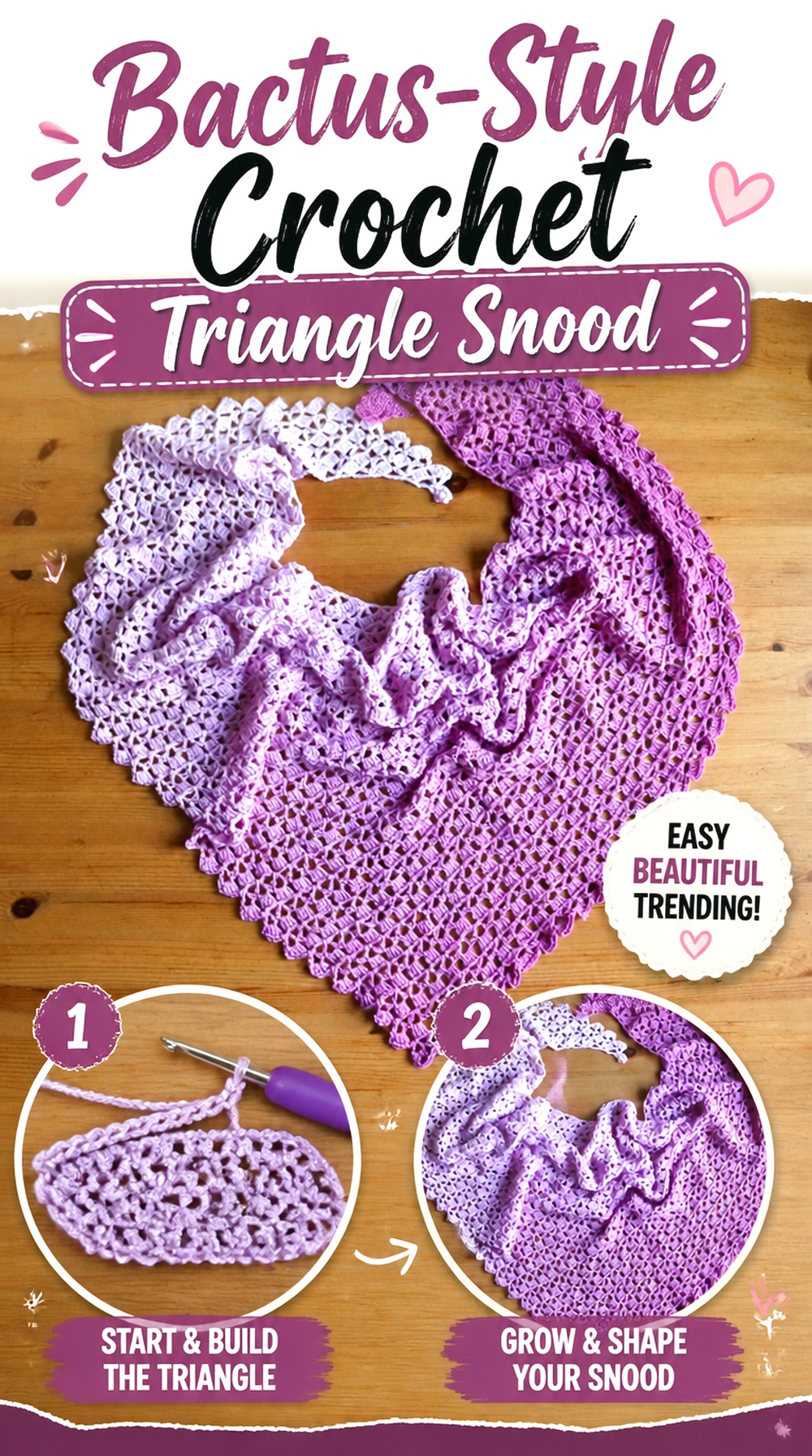
Sirin’s Crochet tutorial approaches neck coverage from a bactus-style triangular shape rather than starting with the familiar cowl tube. The pointed front creates scarf-like coverage across the chest while the upper portion can be arranged as a cowl, giving this idea a distinct silhouette among the 18 projects. It is particularly appealing when you like the visual line of a small shawl but want something that stays more contained around the neck. Because the triangle itself is highly visible, increases, edges, and yarn color transitions become part of the overall styling in a way they would not on a plain cylindrical snood.
The Point Adds Coverage Without a Tall Collar
A triangle extends downward rather than stacking all the fabric vertically. This can be useful if you want the upper chest visually covered while keeping less material directly beneath the chin. When adapting the dimensions, consider the relationship between point depth and neck section rather than enlarging every direction equally.
Gradient Yarn Naturally Follows the Expanding Shape
A color-changing yarn can emphasize the widening rows of a triangular construction. Solid yarn shifts attention toward the stitch pattern instead. If using a gradient, think about which shade you want near the face because the color sequence may become more prominent as the triangle grows.
Original Tutorial and Creator Credit
Creator: Sirin’s Crochet
18. Ribbed Color Block Crochet Infinity Snood
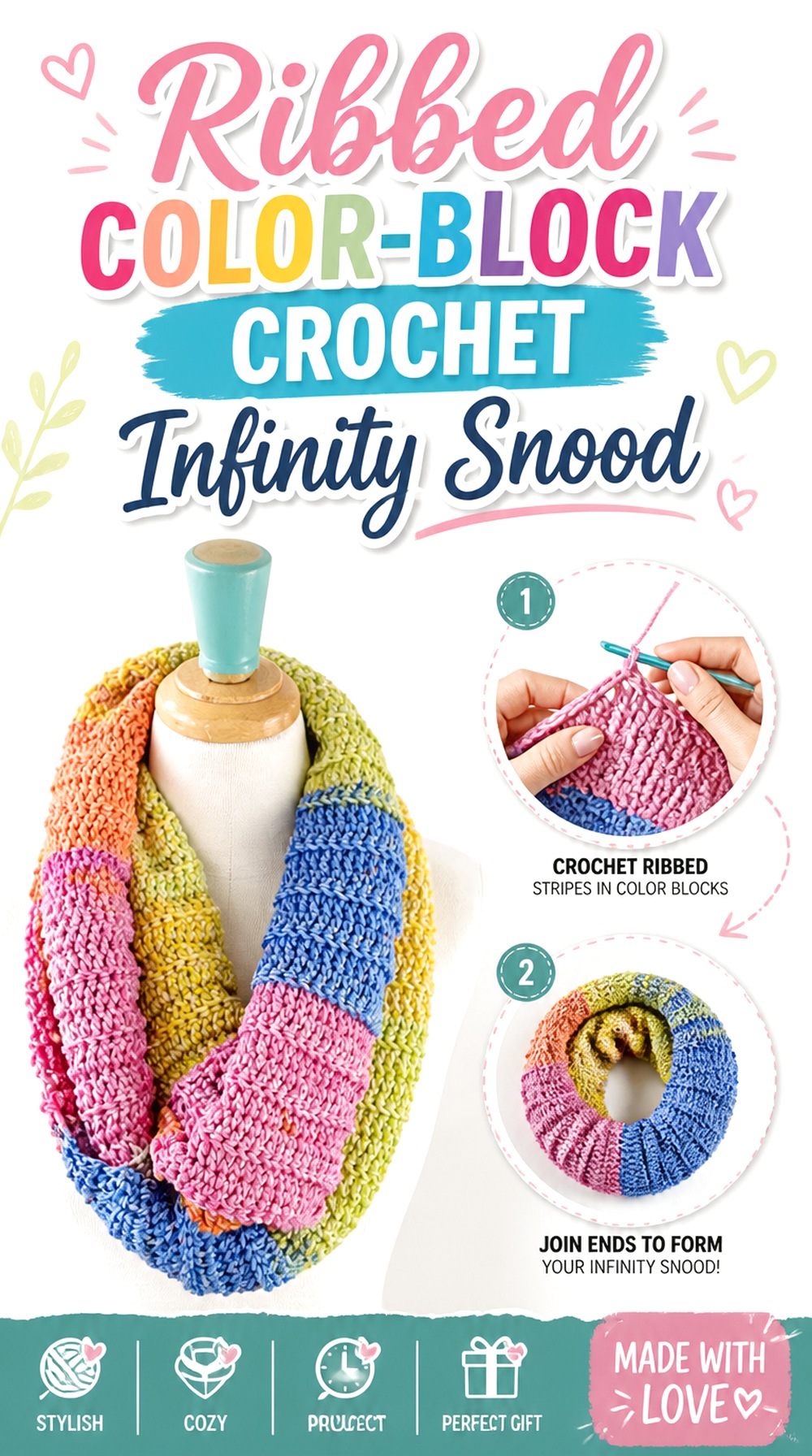
Just Be Crafty’s cowl combines a long loop with back-loop ribbing and color changes, producing an infinity-style snood that can be wrapped around the neck rather than worn as a short single tube. The demonstrated project uses a self-striping yarn, which allows the color blocks to develop without frequent manual changes. Structurally, the ribbing is more important than the color: it gives the long fabric stretch and visible vertical texture when the loop is arranged around the neck. This is a useful finale to the collection because it blends three decisions—length, elasticity, and color behavior—without adding hood shaping or decorative motifs.
Long Ribbing Should Recover After Stretching
Infinity cowls are handled and stretched every time they are wrapped. A ribbed swatch should therefore be checked after repeated stretching, not only immediately after it comes off the hook. If it remains permanently elongated, the finished loop may loosen faster than you expect.
Self-Striping Yarn Can Change Mid-Row
Automatic color changes do not always occur neatly at an edge, and that can be part of the design. If you prefer clearly separated blocks, you may need more control over color placement. Decide which look you prefer before cutting out sections of a self-striping yarn and creating extra ends to finish.
Original Tutorial and Creator Credit
Creator: Just Be Crafty
Which Crochet Snood Style Should You Choose?
For concentrated winter warmth without much fabric, start with the compact neck-warmer or fold-down cowl styles. The chunky hooded, faux-fur, ribbed-cuff, and waffle options make more sense when head coverage is part of the goal. If you prefer flexible styling, the Möbius, double-wrap, and ribbed infinity snoods give you more ways to rearrange the fabric.
Texture also changes the decision. Bobbles and waffle stitches create pronounced dimension, while block stitch and openwork keep the silhouette visually lighter. The granny-square options suit crocheters who enjoy modular color planning, and the pointed or bactus constructions are useful when you want the snood to extend down the chest rather than simply encircle the neck.
Conclusion
The right crochet snood depends less on which stitch looks prettiest in a close-up and more on how you expect the finished accessory to behave. Choose a compact cowl for uncomplicated neck coverage, an infinity loop when you want adjustable layers, a hooded snood when head coverage matters, or a pointed design when you want extra fabric at the front without a towering collar.
Yarn weight, stretch, opening size, and the amount of fabric around your outerwear can change the experience dramatically, so check those details before substituting materials or resizing. Once you have chosen the silhouette that fits your needs, use the original tutorials for the creators’ exact construction details and finishing methods.
Frequently Asked Questions
What is the difference between a crochet snood, cowl, and infinity scarf?
The terms overlap considerably, and different designers use them differently. In this roundup, a cowl generally means a closed neck loop, an infinity scarf is a longer loop that can usually be wrapped more than once, and a hooded snood is deep or shaped enough to cover the head. When choosing a tutorial, rely on the finished shape and wearing demonstration rather than the project name alone.
Which crochet snood shape gives the most winter coverage?
A hooded snood generally covers more area because it can protect both the neck and head, while a deep pull-up tube offers similar versatility with less separate shaping. A double-wrap infinity snood can provide substantial neck coverage but does not necessarily protect the head comfortably. Dense fabric also matters; an open stitch pattern may feel less protective in wind even when the snood itself is large.
How do I know whether a pull-over crochet snood opening will fit?
Check whether the unfinished opening passes comfortably over the intended wearer’s head without requiring the fabric to stretch beyond what feels natural. Then check how it rests at the neck. A ribbed opening can behave differently from a granny-square seam or dense textured fabric, so do not rely on circumference alone. Follow the tutorial’s gauge and resizing guidance whenever you alter the original dimensions.
Can I turn any crochet cowl into a hooded snood?
Not reliably. A hood requires enough height, circumference, and drape to move around the head without pulling tightly at the neck. Simply adding more rounds to a close cowl can create a tall stiff tube rather than a comfortable hood. If hood coverage is your priority, start with a tutorial designed as a hooded or pull-up snood and adapt from that construction instead.
What yarn qualities matter most for a crochet snood worn against the face?
Comfort, drape, stretch, and care all matter. A yarn can look attractive in a skein but feel irritating once it repeatedly touches the jaw or cheeks. Dense woolly or fuzzy textures may also feel warmer than smoother open fabrics. Make a swatch large enough to bend and rub lightly against the neck area, and always check the yarn manufacturer’s care information before deciding how the finished snood should be washed.
Should I block a crochet snood before joining or finishing it?
Blocking can be especially useful for granny squares, open stitch patterns, and flat panels because it lets you compare dimensions and see the fabric’s settled drape before permanent assembly. The appropriate method depends on the fiber and project, so follow the yarn-care guidance and the creator’s instructions. For modular snoods, getting individual pieces to compatible dimensions before joining can prevent uneven seams and puckering.